WO2017018488A1 - Corps fritté contenant du titanate de lithium et titanate de lithium et de lanthane, procédé de production associé et batterie au lithium - Google Patents
Corps fritté contenant du titanate de lithium et titanate de lithium et de lanthane, procédé de production associé et batterie au lithium Download PDFInfo
- Publication number
- WO2017018488A1 WO2017018488A1 PCT/JP2016/072205 JP2016072205W WO2017018488A1 WO 2017018488 A1 WO2017018488 A1 WO 2017018488A1 JP 2016072205 W JP2016072205 W JP 2016072205W WO 2017018488 A1 WO2017018488 A1 WO 2017018488A1
- Authority
- WO
- WIPO (PCT)
- Prior art keywords
- lithium
- sintered body
- titanate
- precursor
- sintered
- Prior art date
- Legal status (The legal status is an assumption and is not a legal conclusion. Google has not performed a legal analysis and makes no representation as to the accuracy of the status listed.)
- Ceased
Links
Images







Classifications
-
- C—CHEMISTRY; METALLURGY
- C04—CEMENTS; CONCRETE; ARTIFICIAL STONE; CERAMICS; REFRACTORIES
- C04B—LIME, MAGNESIA; SLAG; CEMENTS; COMPOSITIONS THEREOF, e.g. MORTARS, CONCRETE OR LIKE BUILDING MATERIALS; ARTIFICIAL STONE; CERAMICS; REFRACTORIES; TREATMENT OF NATURAL STONE
- C04B35/00—Shaped ceramic products characterised by their composition; Ceramics compositions; Processing powders of inorganic compounds preparatory to the manufacturing of ceramic products
- C04B35/01—Shaped ceramic products characterised by their composition; Ceramics compositions; Processing powders of inorganic compounds preparatory to the manufacturing of ceramic products based on oxide ceramics
- C04B35/46—Shaped ceramic products characterised by their composition; Ceramics compositions; Processing powders of inorganic compounds preparatory to the manufacturing of ceramic products based on oxide ceramics based on titanium oxides or titanates
- C04B35/462—Shaped ceramic products characterised by their composition; Ceramics compositions; Processing powders of inorganic compounds preparatory to the manufacturing of ceramic products based on oxide ceramics based on titanium oxides or titanates based on titanates
-
- C—CHEMISTRY; METALLURGY
- C01—INORGANIC CHEMISTRY
- C01G—COMPOUNDS CONTAINING METALS NOT COVERED BY SUBCLASSES C01D OR C01F
- C01G23/00—Compounds of titanium
- C01G23/002—Compounds containing titanium, with or without oxygen or hydrogen, and containing two or more other elements
-
- C—CHEMISTRY; METALLURGY
- C01—INORGANIC CHEMISTRY
- C01G—COMPOUNDS CONTAINING METALS NOT COVERED BY SUBCLASSES C01D OR C01F
- C01G23/00—Compounds of titanium
- C01G23/003—Titanates
- C01G23/005—Alkali titanates
-
- C—CHEMISTRY; METALLURGY
- C04—CEMENTS; CONCRETE; ARTIFICIAL STONE; CERAMICS; REFRACTORIES
- C04B—LIME, MAGNESIA; SLAG; CEMENTS; COMPOSITIONS THEREOF, e.g. MORTARS, CONCRETE OR LIKE BUILDING MATERIALS; ARTIFICIAL STONE; CERAMICS; REFRACTORIES; TREATMENT OF NATURAL STONE
- C04B35/00—Shaped ceramic products characterised by their composition; Ceramics compositions; Processing powders of inorganic compounds preparatory to the manufacturing of ceramic products
- C04B35/50—Shaped ceramic products characterised by their composition; Ceramics compositions; Processing powders of inorganic compounds preparatory to the manufacturing of ceramic products based on rare-earth compounds
-
- C—CHEMISTRY; METALLURGY
- C04—CEMENTS; CONCRETE; ARTIFICIAL STONE; CERAMICS; REFRACTORIES
- C04B—LIME, MAGNESIA; SLAG; CEMENTS; COMPOSITIONS THEREOF, e.g. MORTARS, CONCRETE OR LIKE BUILDING MATERIALS; ARTIFICIAL STONE; CERAMICS; REFRACTORIES; TREATMENT OF NATURAL STONE
- C04B35/00—Shaped ceramic products characterised by their composition; Ceramics compositions; Processing powders of inorganic compounds preparatory to the manufacturing of ceramic products
- C04B35/622—Forming processes; Processing powders of inorganic compounds preparatory to the manufacturing of ceramic products
- C04B35/62218—Forming processes; Processing powders of inorganic compounds preparatory to the manufacturing of ceramic products obtaining ceramic films, e.g. by using temporary supports
-
- H—ELECTRICITY
- H01—ELECTRIC ELEMENTS
- H01M—PROCESSES OR MEANS, e.g. BATTERIES, FOR THE DIRECT CONVERSION OF CHEMICAL ENERGY INTO ELECTRICAL ENERGY
- H01M10/00—Secondary cells; Manufacture thereof
- H01M10/05—Accumulators with non-aqueous electrolyte
- H01M10/052—Li-accumulators
-
- H—ELECTRICITY
- H01—ELECTRIC ELEMENTS
- H01M—PROCESSES OR MEANS, e.g. BATTERIES, FOR THE DIRECT CONVERSION OF CHEMICAL ENERGY INTO ELECTRICAL ENERGY
- H01M10/00—Secondary cells; Manufacture thereof
- H01M10/05—Accumulators with non-aqueous electrolyte
- H01M10/052—Li-accumulators
- H01M10/0525—Rocking-chair batteries, i.e. batteries with lithium insertion or intercalation in both electrodes; Lithium-ion batteries
-
- H—ELECTRICITY
- H01—ELECTRIC ELEMENTS
- H01M—PROCESSES OR MEANS, e.g. BATTERIES, FOR THE DIRECT CONVERSION OF CHEMICAL ENERGY INTO ELECTRICAL ENERGY
- H01M10/00—Secondary cells; Manufacture thereof
- H01M10/05—Accumulators with non-aqueous electrolyte
- H01M10/056—Accumulators with non-aqueous electrolyte characterised by the materials used as electrolytes, e.g. mixed inorganic/organic electrolytes
- H01M10/0561—Accumulators with non-aqueous electrolyte characterised by the materials used as electrolytes, e.g. mixed inorganic/organic electrolytes the electrolyte being constituted of inorganic materials only
- H01M10/0562—Solid materials
-
- H—ELECTRICITY
- H01—ELECTRIC ELEMENTS
- H01M—PROCESSES OR MEANS, e.g. BATTERIES, FOR THE DIRECT CONVERSION OF CHEMICAL ENERGY INTO ELECTRICAL ENERGY
- H01M10/00—Secondary cells; Manufacture thereof
- H01M10/05—Accumulators with non-aqueous electrolyte
- H01M10/056—Accumulators with non-aqueous electrolyte characterised by the materials used as electrolytes, e.g. mixed inorganic/organic electrolytes
- H01M10/0564—Accumulators with non-aqueous electrolyte characterised by the materials used as electrolytes, e.g. mixed inorganic/organic electrolytes the electrolyte being constituted of organic materials only
- H01M10/0565—Polymeric materials, e.g. gel-type or solid-type
-
- H—ELECTRICITY
- H01—ELECTRIC ELEMENTS
- H01M—PROCESSES OR MEANS, e.g. BATTERIES, FOR THE DIRECT CONVERSION OF CHEMICAL ENERGY INTO ELECTRICAL ENERGY
- H01M10/00—Secondary cells; Manufacture thereof
- H01M10/05—Accumulators with non-aqueous electrolyte
- H01M10/056—Accumulators with non-aqueous electrolyte characterised by the materials used as electrolytes, e.g. mixed inorganic/organic electrolytes
- H01M10/0564—Accumulators with non-aqueous electrolyte characterised by the materials used as electrolytes, e.g. mixed inorganic/organic electrolytes the electrolyte being constituted of organic materials only
- H01M10/0566—Liquid materials
-
- H—ELECTRICITY
- H01—ELECTRIC ELEMENTS
- H01M—PROCESSES OR MEANS, e.g. BATTERIES, FOR THE DIRECT CONVERSION OF CHEMICAL ENERGY INTO ELECTRICAL ENERGY
- H01M4/00—Electrodes
- H01M4/02—Electrodes composed of, or comprising, active material
- H01M4/04—Processes of manufacture in general
- H01M4/0438—Processes of manufacture in general by electrochemical processing
- H01M4/045—Electrochemical coating; Electrochemical impregnation
- H01M4/0452—Electrochemical coating; Electrochemical impregnation from solutions
-
- H—ELECTRICITY
- H01—ELECTRIC ELEMENTS
- H01M—PROCESSES OR MEANS, e.g. BATTERIES, FOR THE DIRECT CONVERSION OF CHEMICAL ENERGY INTO ELECTRICAL ENERGY
- H01M4/00—Electrodes
- H01M4/02—Electrodes composed of, or comprising, active material
- H01M4/04—Processes of manufacture in general
- H01M4/0471—Processes of manufacture in general involving thermal treatment, e.g. firing, sintering, backing particulate active material, thermal decomposition, pyrolysis
-
- H—ELECTRICITY
- H01—ELECTRIC ELEMENTS
- H01M—PROCESSES OR MEANS, e.g. BATTERIES, FOR THE DIRECT CONVERSION OF CHEMICAL ENERGY INTO ELECTRICAL ENERGY
- H01M4/00—Electrodes
- H01M4/02—Electrodes composed of, or comprising, active material
- H01M4/13—Electrodes for accumulators with non-aqueous electrolyte, e.g. for lithium-accumulators; Processes of manufacture thereof
- H01M4/131—Electrodes based on mixed oxides or hydroxides, or on mixtures of oxides or hydroxides, e.g. LiCoOx
-
- H—ELECTRICITY
- H01—ELECTRIC ELEMENTS
- H01M—PROCESSES OR MEANS, e.g. BATTERIES, FOR THE DIRECT CONVERSION OF CHEMICAL ENERGY INTO ELECTRICAL ENERGY
- H01M4/00—Electrodes
- H01M4/02—Electrodes composed of, or comprising, active material
- H01M4/13—Electrodes for accumulators with non-aqueous electrolyte, e.g. for lithium-accumulators; Processes of manufacture thereof
- H01M4/139—Processes of manufacture
- H01M4/1391—Processes of manufacture of electrodes based on mixed oxides or hydroxides, or on mixtures of oxides or hydroxides, e.g. LiCoOx
-
- H—ELECTRICITY
- H01—ELECTRIC ELEMENTS
- H01M—PROCESSES OR MEANS, e.g. BATTERIES, FOR THE DIRECT CONVERSION OF CHEMICAL ENERGY INTO ELECTRICAL ENERGY
- H01M4/00—Electrodes
- H01M4/02—Electrodes composed of, or comprising, active material
- H01M4/36—Selection of substances as active materials, active masses, active liquids
- H01M4/362—Composites
-
- H—ELECTRICITY
- H01—ELECTRIC ELEMENTS
- H01M—PROCESSES OR MEANS, e.g. BATTERIES, FOR THE DIRECT CONVERSION OF CHEMICAL ENERGY INTO ELECTRICAL ENERGY
- H01M4/00—Electrodes
- H01M4/02—Electrodes composed of, or comprising, active material
- H01M4/36—Selection of substances as active materials, active masses, active liquids
- H01M4/48—Selection of substances as active materials, active masses, active liquids of inorganic oxides or hydroxides
- H01M4/485—Selection of substances as active materials, active masses, active liquids of inorganic oxides or hydroxides of mixed oxides or hydroxides for inserting or intercalating light metals, e.g. LiTi2O4 or LiTi2OxFy
-
- H—ELECTRICITY
- H01—ELECTRIC ELEMENTS
- H01M—PROCESSES OR MEANS, e.g. BATTERIES, FOR THE DIRECT CONVERSION OF CHEMICAL ENERGY INTO ELECTRICAL ENERGY
- H01M4/00—Electrodes
- H01M4/02—Electrodes composed of, or comprising, active material
- H01M4/36—Selection of substances as active materials, active masses, active liquids
- H01M4/58—Selection of substances as active materials, active masses, active liquids of inorganic compounds other than oxides or hydroxides, e.g. sulfides, selenides, tellurides, halogenides or LiCoFy; of polyanionic structures, e.g. phosphates, silicates or borates
-
- C—CHEMISTRY; METALLURGY
- C01—INORGANIC CHEMISTRY
- C01P—INDEXING SCHEME RELATING TO STRUCTURAL AND PHYSICAL ASPECTS OF SOLID INORGANIC COMPOUNDS
- C01P2002/00—Crystal-structural characteristics
- C01P2002/30—Three-dimensional structures
-
- C—CHEMISTRY; METALLURGY
- C01—INORGANIC CHEMISTRY
- C01P—INDEXING SCHEME RELATING TO STRUCTURAL AND PHYSICAL ASPECTS OF SOLID INORGANIC COMPOUNDS
- C01P2002/00—Crystal-structural characteristics
- C01P2002/30—Three-dimensional structures
- C01P2002/32—Three-dimensional structures spinel-type (AB2O4)
-
- C—CHEMISTRY; METALLURGY
- C01—INORGANIC CHEMISTRY
- C01P—INDEXING SCHEME RELATING TO STRUCTURAL AND PHYSICAL ASPECTS OF SOLID INORGANIC COMPOUNDS
- C01P2002/00—Crystal-structural characteristics
- C01P2002/30—Three-dimensional structures
- C01P2002/34—Three-dimensional structures perovskite-type (ABO3)
-
- C—CHEMISTRY; METALLURGY
- C01—INORGANIC CHEMISTRY
- C01P—INDEXING SCHEME RELATING TO STRUCTURAL AND PHYSICAL ASPECTS OF SOLID INORGANIC COMPOUNDS
- C01P2002/00—Crystal-structural characteristics
- C01P2002/50—Solid solutions
- C01P2002/52—Solid solutions containing elements as dopants
- C01P2002/54—Solid solutions containing elements as dopants one element only
-
- C—CHEMISTRY; METALLURGY
- C01—INORGANIC CHEMISTRY
- C01P—INDEXING SCHEME RELATING TO STRUCTURAL AND PHYSICAL ASPECTS OF SOLID INORGANIC COMPOUNDS
- C01P2002/00—Crystal-structural characteristics
- C01P2002/70—Crystal-structural characteristics defined by measured X-ray, neutron or electron diffraction data
- C01P2002/72—Crystal-structural characteristics defined by measured X-ray, neutron or electron diffraction data by d-values or two theta-values, e.g. as X-ray diagram
-
- C—CHEMISTRY; METALLURGY
- C01—INORGANIC CHEMISTRY
- C01P—INDEXING SCHEME RELATING TO STRUCTURAL AND PHYSICAL ASPECTS OF SOLID INORGANIC COMPOUNDS
- C01P2004/00—Particle morphology
- C01P2004/01—Particle morphology depicted by an image
- C01P2004/03—Particle morphology depicted by an image obtained by SEM
-
- C—CHEMISTRY; METALLURGY
- C01—INORGANIC CHEMISTRY
- C01P—INDEXING SCHEME RELATING TO STRUCTURAL AND PHYSICAL ASPECTS OF SOLID INORGANIC COMPOUNDS
- C01P2004/00—Particle morphology
- C01P2004/80—Particles consisting of a mixture of two or more inorganic phases
- C01P2004/82—Particles consisting of a mixture of two or more inorganic phases two phases having the same anion, e.g. both oxidic phases
-
- C—CHEMISTRY; METALLURGY
- C01—INORGANIC CHEMISTRY
- C01P—INDEXING SCHEME RELATING TO STRUCTURAL AND PHYSICAL ASPECTS OF SOLID INORGANIC COMPOUNDS
- C01P2006/00—Physical properties of inorganic compounds
- C01P2006/10—Solid density
-
- C—CHEMISTRY; METALLURGY
- C01—INORGANIC CHEMISTRY
- C01P—INDEXING SCHEME RELATING TO STRUCTURAL AND PHYSICAL ASPECTS OF SOLID INORGANIC COMPOUNDS
- C01P2006/00—Physical properties of inorganic compounds
- C01P2006/40—Electric properties
-
- C—CHEMISTRY; METALLURGY
- C04—CEMENTS; CONCRETE; ARTIFICIAL STONE; CERAMICS; REFRACTORIES
- C04B—LIME, MAGNESIA; SLAG; CEMENTS; COMPOSITIONS THEREOF, e.g. MORTARS, CONCRETE OR LIKE BUILDING MATERIALS; ARTIFICIAL STONE; CERAMICS; REFRACTORIES; TREATMENT OF NATURAL STONE
- C04B2235/00—Aspects relating to ceramic starting mixtures or sintered ceramic products
- C04B2235/02—Composition of constituents of the starting material or of secondary phases of the final product
- C04B2235/30—Constituents and secondary phases not being of a fibrous nature
- C04B2235/32—Metal oxides, mixed metal oxides, or oxide-forming salts thereof, e.g. carbonates, nitrates, (oxy)hydroxides, chlorides
- C04B2235/3201—Alkali metal oxides or oxide-forming salts thereof
- C04B2235/3203—Lithium oxide or oxide-forming salts thereof
-
- C—CHEMISTRY; METALLURGY
- C04—CEMENTS; CONCRETE; ARTIFICIAL STONE; CERAMICS; REFRACTORIES
- C04B—LIME, MAGNESIA; SLAG; CEMENTS; COMPOSITIONS THEREOF, e.g. MORTARS, CONCRETE OR LIKE BUILDING MATERIALS; ARTIFICIAL STONE; CERAMICS; REFRACTORIES; TREATMENT OF NATURAL STONE
- C04B2235/00—Aspects relating to ceramic starting mixtures or sintered ceramic products
- C04B2235/02—Composition of constituents of the starting material or of secondary phases of the final product
- C04B2235/30—Constituents and secondary phases not being of a fibrous nature
- C04B2235/32—Metal oxides, mixed metal oxides, or oxide-forming salts thereof, e.g. carbonates, nitrates, (oxy)hydroxides, chlorides
- C04B2235/3224—Rare earth oxide or oxide forming salts thereof, e.g. scandium oxide
- C04B2235/3227—Lanthanum oxide or oxide-forming salts thereof
-
- C—CHEMISTRY; METALLURGY
- C04—CEMENTS; CONCRETE; ARTIFICIAL STONE; CERAMICS; REFRACTORIES
- C04B—LIME, MAGNESIA; SLAG; CEMENTS; COMPOSITIONS THEREOF, e.g. MORTARS, CONCRETE OR LIKE BUILDING MATERIALS; ARTIFICIAL STONE; CERAMICS; REFRACTORIES; TREATMENT OF NATURAL STONE
- C04B2235/00—Aspects relating to ceramic starting mixtures or sintered ceramic products
- C04B2235/02—Composition of constituents of the starting material or of secondary phases of the final product
- C04B2235/50—Constituents or additives of the starting mixture chosen for their shape or used because of their shape or their physical appearance
- C04B2235/54—Particle size related information
- C04B2235/549—Particle size related information the particle size being expressed by crystallite size or primary particle size
-
- C—CHEMISTRY; METALLURGY
- C04—CEMENTS; CONCRETE; ARTIFICIAL STONE; CERAMICS; REFRACTORIES
- C04B—LIME, MAGNESIA; SLAG; CEMENTS; COMPOSITIONS THEREOF, e.g. MORTARS, CONCRETE OR LIKE BUILDING MATERIALS; ARTIFICIAL STONE; CERAMICS; REFRACTORIES; TREATMENT OF NATURAL STONE
- C04B2235/00—Aspects relating to ceramic starting mixtures or sintered ceramic products
- C04B2235/65—Aspects relating to heat treatments of ceramic bodies such as green ceramics or pre-sintered ceramics, e.g. burning, sintering or melting processes
- C04B2235/656—Aspects relating to heat treatments of ceramic bodies such as green ceramics or pre-sintered ceramics, e.g. burning, sintering or melting processes characterised by specific heating conditions during heat treatment
- C04B2235/6567—Treatment time
-
- C—CHEMISTRY; METALLURGY
- C04—CEMENTS; CONCRETE; ARTIFICIAL STONE; CERAMICS; REFRACTORIES
- C04B—LIME, MAGNESIA; SLAG; CEMENTS; COMPOSITIONS THEREOF, e.g. MORTARS, CONCRETE OR LIKE BUILDING MATERIALS; ARTIFICIAL STONE; CERAMICS; REFRACTORIES; TREATMENT OF NATURAL STONE
- C04B2235/00—Aspects relating to ceramic starting mixtures or sintered ceramic products
- C04B2235/70—Aspects relating to sintered or melt-casted ceramic products
- C04B2235/74—Physical characteristics
- C04B2235/76—Crystal structural characteristics, e.g. symmetry
-
- C—CHEMISTRY; METALLURGY
- C04—CEMENTS; CONCRETE; ARTIFICIAL STONE; CERAMICS; REFRACTORIES
- C04B—LIME, MAGNESIA; SLAG; CEMENTS; COMPOSITIONS THEREOF, e.g. MORTARS, CONCRETE OR LIKE BUILDING MATERIALS; ARTIFICIAL STONE; CERAMICS; REFRACTORIES; TREATMENT OF NATURAL STONE
- C04B2235/00—Aspects relating to ceramic starting mixtures or sintered ceramic products
- C04B2235/70—Aspects relating to sintered or melt-casted ceramic products
- C04B2235/74—Physical characteristics
- C04B2235/76—Crystal structural characteristics, e.g. symmetry
- C04B2235/762—Cubic symmetry, e.g. beta-SiC
- C04B2235/763—Spinel structure AB2O4
-
- C—CHEMISTRY; METALLURGY
- C04—CEMENTS; CONCRETE; ARTIFICIAL STONE; CERAMICS; REFRACTORIES
- C04B—LIME, MAGNESIA; SLAG; CEMENTS; COMPOSITIONS THEREOF, e.g. MORTARS, CONCRETE OR LIKE BUILDING MATERIALS; ARTIFICIAL STONE; CERAMICS; REFRACTORIES; TREATMENT OF NATURAL STONE
- C04B2235/00—Aspects relating to ceramic starting mixtures or sintered ceramic products
- C04B2235/70—Aspects relating to sintered or melt-casted ceramic products
- C04B2235/74—Physical characteristics
- C04B2235/76—Crystal structural characteristics, e.g. symmetry
- C04B2235/768—Perovskite structure ABO3
-
- C—CHEMISTRY; METALLURGY
- C04—CEMENTS; CONCRETE; ARTIFICIAL STONE; CERAMICS; REFRACTORIES
- C04B—LIME, MAGNESIA; SLAG; CEMENTS; COMPOSITIONS THEREOF, e.g. MORTARS, CONCRETE OR LIKE BUILDING MATERIALS; ARTIFICIAL STONE; CERAMICS; REFRACTORIES; TREATMENT OF NATURAL STONE
- C04B2235/00—Aspects relating to ceramic starting mixtures or sintered ceramic products
- C04B2235/70—Aspects relating to sintered or melt-casted ceramic products
- C04B2235/74—Physical characteristics
- C04B2235/77—Density
-
- C—CHEMISTRY; METALLURGY
- C04—CEMENTS; CONCRETE; ARTIFICIAL STONE; CERAMICS; REFRACTORIES
- C04B—LIME, MAGNESIA; SLAG; CEMENTS; COMPOSITIONS THEREOF, e.g. MORTARS, CONCRETE OR LIKE BUILDING MATERIALS; ARTIFICIAL STONE; CERAMICS; REFRACTORIES; TREATMENT OF NATURAL STONE
- C04B2235/00—Aspects relating to ceramic starting mixtures or sintered ceramic products
- C04B2235/70—Aspects relating to sintered or melt-casted ceramic products
- C04B2235/80—Phases present in the sintered or melt-cast ceramic products other than the main phase
-
- C—CHEMISTRY; METALLURGY
- C04—CEMENTS; CONCRETE; ARTIFICIAL STONE; CERAMICS; REFRACTORIES
- C04B—LIME, MAGNESIA; SLAG; CEMENTS; COMPOSITIONS THEREOF, e.g. MORTARS, CONCRETE OR LIKE BUILDING MATERIALS; ARTIFICIAL STONE; CERAMICS; REFRACTORIES; TREATMENT OF NATURAL STONE
- C04B2235/00—Aspects relating to ceramic starting mixtures or sintered ceramic products
- C04B2235/70—Aspects relating to sintered or melt-casted ceramic products
- C04B2235/96—Properties of ceramic products, e.g. mechanical properties such as strength, toughness, wear resistance
-
- H—ELECTRICITY
- H01—ELECTRIC ELEMENTS
- H01M—PROCESSES OR MEANS, e.g. BATTERIES, FOR THE DIRECT CONVERSION OF CHEMICAL ENERGY INTO ELECTRICAL ENERGY
- H01M4/00—Electrodes
- H01M4/02—Electrodes composed of, or comprising, active material
- H01M2004/021—Physical characteristics, e.g. porosity, surface area
-
- H—ELECTRICITY
- H01—ELECTRIC ELEMENTS
- H01M—PROCESSES OR MEANS, e.g. BATTERIES, FOR THE DIRECT CONVERSION OF CHEMICAL ENERGY INTO ELECTRICAL ENERGY
- H01M4/00—Electrodes
- H01M4/02—Electrodes composed of, or comprising, active material
- H01M2004/026—Electrodes composed of, or comprising, active material characterised by the polarity
- H01M2004/027—Negative electrodes
-
- H—ELECTRICITY
- H01—ELECTRIC ELEMENTS
- H01M—PROCESSES OR MEANS, e.g. BATTERIES, FOR THE DIRECT CONVERSION OF CHEMICAL ENERGY INTO ELECTRICAL ENERGY
- H01M2300/00—Electrolytes
- H01M2300/0017—Non-aqueous electrolytes
-
- H—ELECTRICITY
- H01—ELECTRIC ELEMENTS
- H01M—PROCESSES OR MEANS, e.g. BATTERIES, FOR THE DIRECT CONVERSION OF CHEMICAL ENERGY INTO ELECTRICAL ENERGY
- H01M2300/00—Electrolytes
- H01M2300/0017—Non-aqueous electrolytes
- H01M2300/0065—Solid electrolytes
- H01M2300/0082—Organic polymers
-
- Y—GENERAL TAGGING OF NEW TECHNOLOGICAL DEVELOPMENTS; GENERAL TAGGING OF CROSS-SECTIONAL TECHNOLOGIES SPANNING OVER SEVERAL SECTIONS OF THE IPC; TECHNICAL SUBJECTS COVERED BY FORMER USPC CROSS-REFERENCE ART COLLECTIONS [XRACs] AND DIGESTS
- Y02—TECHNOLOGIES OR APPLICATIONS FOR MITIGATION OR ADAPTATION AGAINST CLIMATE CHANGE
- Y02E—REDUCTION OF GREENHOUSE GAS [GHG] EMISSIONS, RELATED TO ENERGY GENERATION, TRANSMISSION OR DISTRIBUTION
- Y02E60/00—Enabling technologies; Technologies with a potential or indirect contribution to GHG emissions mitigation
- Y02E60/10—Energy storage using batteries
-
- Y—GENERAL TAGGING OF NEW TECHNOLOGICAL DEVELOPMENTS; GENERAL TAGGING OF CROSS-SECTIONAL TECHNOLOGIES SPANNING OVER SEVERAL SECTIONS OF THE IPC; TECHNICAL SUBJECTS COVERED BY FORMER USPC CROSS-REFERENCE ART COLLECTIONS [XRACs] AND DIGESTS
- Y02—TECHNOLOGIES OR APPLICATIONS FOR MITIGATION OR ADAPTATION AGAINST CLIMATE CHANGE
- Y02T—CLIMATE CHANGE MITIGATION TECHNOLOGIES RELATED TO TRANSPORTATION
- Y02T10/00—Road transport of goods or passengers
- Y02T10/60—Other road transportation technologies with climate change mitigation effect
- Y02T10/70—Energy storage systems for electromobility, e.g. batteries
Definitions
- the present invention relates to a sintered body in which lithium titanate and lithium lanthanum titanate are combined and a method for producing the same, and more particularly, to a sintered body that can be used for an electrode of a lithium primary battery or a lithium secondary battery, a method for producing the same, and the like. .
- Secondary batteries are used in portable devices such as mobile phones and laptop computers, transportation equipment such as automobiles and airplanes, and power storage devices for power leveling. Improvements in energy density are required in all applications. Yes.
- the practical secondary battery with the highest energy density is a lithium ion battery, and research is being conducted to further increase the energy density while maintaining safety.
- all-solid-state batteries batteries that use solid electrolytes instead of electrolytes, which is an improved technology for lithium-ion batteries, has been conducted.
- the negative electrode, electrolyte, and positive electrode that make up the battery are all solid, so by repeatedly stacking the negative electrode layer, solid electrolyte layer, and positive electrode layer, a battery with a series structure can be manufactured without using wires, etc. Therefore, it is considered suitable for automobiles and power storage. Furthermore, an all-oxide all-solid battery in which the negative electrode active material, the solid electrolyte, and the positive electrode active material are oxides can be expected to have an effect on safety and high-temperature durability in addition to improving energy density.
- Li 4 Ti 5 O 12 As a kind of negative electrode active material of a lithium ion battery, lithium titanate Li 4 Ti 5 O 12 (also referred to as LTO), which is an oxide having a spinel crystal structure, is known (Patent Document 1).
- LTO has almost no change in lattice size due to charge / discharge, so graphite-based carbon material (although it is widely used as a negative electrode for lithium ion batteries, the graphite layer expands and contracts by about 10% in the c-axis direction due to charge / discharge. It is considered that it has excellent properties as a negative electrode active material for all solid state batteries.
- lithium titanate for example, Li 2 Ti 3 O 7
- ramsdelite also called ramsdelite
- lithium lanthanum titanate Li 3x La 2 / 3-x TiO 3 having a perovskite-type crystal structure with high lithium ion conductivity. It has been reported that a sintered body (0 ⁇ x ⁇ 1/6, also called LLTO) is used (Patent Document 3).
- JP 2012-104280 A Japanese Patent Laid-Open No. 11-283624 JP 2013-140762 A JP 2010-033877 A JP 2013-080637 A
- the composites for electrodes described in Patent Documents 4 and 5 use a sulfide-based solid electrolyte containing sulfur and lithium that tends to have low interface resistance as the solid electrolyte.
- the crystal grains of the electrode active material and the crystal grains of the solid electrolyte need to be in close contact with each other at a low resistance interface, but the oxide-based solid excellent in safety and high-temperature durability A sintered body in which an electrolyte and an electrode active material are combined has not been reported.
- the present invention has been made to solve such problems of the prior art, and an object thereof is to provide a sintered body in which an electrode active material and an oxide solid electrolyte are combined.
- the composite of the electrode active material and the solid electrolyte means that the respective crystal grains are joined and a lithium ion conduction path to the crystal grains of the electrode active material is formed through the crystal grains of the solid electrolyte. Means.
- the inventors have obtained a mixture of a precursor that becomes lithium titanate by heating and a precursor that becomes lithium lanthanum titanate by heating, or a mixture of lithium titanate and lithium lanthanum titanate.
- a sintered body in which lithium titanate crystal grains and lithium lanthanum titanate crystal grains were bonded was obtained, and the present invention was completed.
- a first aspect of the present invention includes lithium titanate having a spinel type crystal structure and / or lithium titanate having a ramsdelite type crystal structure, and lithium lanthanum titanate having a perovskite type crystal structure. This is a sintered body.
- a negative electrode that occludes and releases lithium and a positive electrode that occludes and releases lithium are disposed in an electrolyte solution facing each other with a separator interposed therebetween. It is a lithium battery characterized by using a bonded body.
- a negative electrode layer that occludes and releases lithium, a solid electrolyte layer that conducts lithium, and a positive electrode layer that occludes and releases lithium are laminated in this order. Or it is an all-solid-state lithium battery using the said sintered compact as said positive electrode layer.
- a fourth aspect of the present invention there are provided a step of molding a powder of a mixture of a lithium titanate precursor and a lithium lanthanum titanate precursor to obtain a molded body, and a sintering process for sintering the molded body. And a sintering step.
- the fifth aspect of the present invention includes a step of calcining a mixture of a lithium titanate precursor and a lithium lanthanum titanate precursor to obtain a calcined body, and molding the calcined powder.
- the method for producing a sintered body includes a step of obtaining a molded body and a sintering step of sintering the molded body.
- a sintering process including a step of forming a powder of a mixture of lithium titanate and lithium lanthanum titanate to obtain a formed body, and a sintering step of sintering the formed body. It is a manufacturing method of a zygote.
- a sintered body in which an electrode active material and an oxide solid electrolyte are combined can be provided.
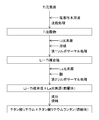
- 2 is a powder X-ray diffraction pattern of a precipitate and a precursor according to Example 1.
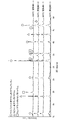
- FIG. 3 is a powder X-ray diffraction pattern of the sintered bodies according to Examples 1-1 to 1-4.
- Fig. 5 is a powder X-ray diffraction pattern of the sintered body according to Example 1-5.
- FIG. Fig. 5 is a powder X-ray diffraction pattern of the sintered body according to Example 5-3.
- the sintered body according to the present invention includes lithium titanate having a spinel crystal structure and / or lithium titanate having a ramsdelite crystal structure and lithium lanthanum titanate having a perovskite crystal structure. That is, the sintered body may contain either one of lithium titanate having a spinel crystal structure and lithium titanate having a ramsdelite crystal structure, or both.
- the lithium titanate having a spinel crystal structure is, for example, Li 4 Ti 5 O 12 .
- Part of the elements constituting lithium titanate may be replaced with another element, or another element may be doped.
- Lithium titanate having a ramsdelite type crystal structure is, for example, Li 2 Ti 3 O 7 .
- Part of the elements constituting lithium titanate may be replaced with another element, or another element may be doped.
- Examples of the lithium titanate having a Rams Delight type crystal structure, in addition to Li 2 Ti 3 O 7, LiTi 2 O 4 or the like, and a large number of substances are known, solid solutions thereof, for example, Li 2 Ti 3 O 7 A solid solution of LiTi 2 O 4 is also known.
- the lithium lanthanum titanate having a perovskite crystal structure is, for example, lithium lanthanum titanate represented by the general formula Li 3x La 2 / 3-x TiO 3 (0 ⁇ x ⁇ 1/6). Part of the elements constituting lithium lanthanum titanate may be replaced with another element, or another element may be doped.
- Identification of lithium titanate and lithium lanthanum titanate can be performed using X-ray diffraction.
- the sintered body according to the present invention is characterized by containing both lithium titanate and lithium lanthanum titanate.
- the strongest line strength of lithium titanate and the lithium lanthanum titanate The ratio to the strongest line intensity is 100 times or less.
- the strongest ray intensity I S of the lithium titanate having a spinel type crystal structure, and the strongest intensity I R of the lithium titanate having a Rams Delight type crystal structure the strongest of the lanthanum lithium titanate having a perovskite type crystal structure
- the relationship is When CuK ⁇ rays are used, the strongest line of lithium titanate having a spinel crystal structure usually appears at 17 ° or more and 19 ° or less, and the strongest line of lithium titanate having a ramsdelite crystal structure is 19 ° or more. It appears at 21 ° or less, and the strongest line of lithium lanthanum titanate having a perovskite crystal structure appears at 32 ° or more and 34 ° or less.
- the actual density of the sintered body is preferably 2.5 g / cm 3 or more, more preferably 2.8 g / cm 3 or more, and further preferably 3.0 g / cm 3 or more.
- the upper limit of the actual density of the sintered body is not particularly limited, and may be, for example, 6.0 g / cm 3 or less, or 5.0 g / cm 3 or less.
- the lithium ion conductivity at 25 ° C. of the sintered body is preferably 1 ⁇ 10 ⁇ 8 S / cm or more, more preferably 5 ⁇ 10 ⁇ 8 S / cm or more, and 1 ⁇ 10 ⁇ 7 S. / Cm or more is more preferable.
- lithium ion conductivity means the value evaluated using the non-blocking electrode measuring method which measures using a cell which pinched
- the upper limit of the lithium ion conductivity at 25 ° C. of the sintered body is not particularly limited, and may be, for example, 1 ⁇ 10 ⁇ 2 S / cm or less, or 1 ⁇ 10 ⁇ 3 S / cm or less.
- the thickness of the plate-like or sheet-like sintered body is preferably 3 ⁇ m or more.
- the thickness of the sintered body is more preferably 5 ⁇ m or more, further preferably 10 ⁇ m or more, and particularly preferably 30 ⁇ m or more.
- the thickness is 1 mm or less because the resistance hardly increases.
- the sintered body of the present invention can be used as the negative electrode or the positive electrode.
- a negative electrode layer that occludes and releases lithium, a solid electrolyte layer that conducts lithium, and a positive electrode layer that occludes and releases lithium are stacked in this order using a solid electrolyte layer instead of the electrolyte solution.
- the sintered body described in the present invention can be used as the positive electrode layer.
- a dry polymer electrolyte layer containing a lithium salt in the polymer may be used as the solid electrolyte layer.
- Lithium titanate is often used as a negative electrode active material for lithium ion secondary batteries, but a counter electrode (such as lithium metal or lithium alloy) that has a relatively low charge / discharge potential relative to lithium titanate ( If used in a negative electrode), it can be used as a positive electrode active material.
- a counter electrode such as lithium metal or lithium alloy
- the lithium battery includes both a primary battery and a secondary battery, and not only a battery using metallic lithium or a lithium alloy as an electrode, but also an entire battery in which lithium ions move between a positive electrode and a negative electrode. including.
- the sintered body is composed of crystal grains of lithium titanate and lithium lanthanum titanate, and the diameter of each crystal grain is 1/3 or less of the thickness of the sintered body.
- the thickness is preferably 1/5 or less of the thickness of the sintered body, and more preferably 1/10 or less of the thickness of the sintered body.
- the diameter of the crystal grains constituting the sintered body can be confirmed with an electron microscope.
- the minimum of the diameter of the said crystal grain is not specifically limited, For example, 1 / 100,000 or more of the thickness of a sintered compact may be sufficient, and 1 / 10,000 or more may be sufficient.
- the lithium lanthanum titanate phase network contributes to lithium ion conduction, and a lithium ion conduction path to the lithium titanate is established through the lithium lanthanum titanate network. Therefore, charging / discharging is possible in the state of a sintered body. Therefore, the sintered body of the present invention processed to a thickness of 500 ⁇ m is used as a negative electrode or a positive electrode, and the initial stage of the sintered body when a charge / discharge test is performed at a rate of 0.1 mA / cm 2 in a cell using an electrolytic solution.
- the charge capacity and / or initial discharge capacity is preferably 10 mAh / g or more, more preferably 20 mAh / g or more, and further preferably 30 mAh / g or more.
- the capacity means a capacity per unit mass of the sintered body obtained by dividing the capacity of the cell by the mass of the sintered body. More specifically, the cell is a cell using a sintered body of the present invention processed to a thickness of 500 ⁇ m as a negative electrode or a positive electrode, and using a predetermined counter electrode and an electrolyte solution.
- a positive electrode including a positive electrode material such as a lithium-containing transition metal phosphate compound (for example, lithium iron phosphate) or a lithium-containing transition metal composite oxide (for example, LiCoO 2 ) is given.
- a negative electrode containing a negative electrode material such as metallic lithium or graphite can be used.
- the upper limit of the initial charge capacity and / or the initial discharge capacity is not particularly limited, and may be, for example, 336 mAh / g or less, or 250 mAh / g or less.
- a charge / discharge test was conducted at a temperature of 60 ° C.
- the initial charge capacity and / or initial discharge capacity of the sintered body is preferably 10 mAh / g or more, more preferably 20 mAh / g or more, and further preferably 30 mAh / g or more.
- the capacity means a capacity per unit mass of the sintered body obtained by dividing the capacity of the all solid-type cell by the mass of the sintered body.
- the all-solid-type cell is an all-solid-type cell using a predetermined counter electrode and a solid electrolyte, with the sintered body processed to a thickness of 10 ⁇ m or more and 150 ⁇ m or less as a negative electrode or a positive electrode.
- the predetermined counter electrode is as described above.
- the upper limit of the initial charge capacity and / or the initial discharge capacity is not particularly limited, and may be, for example, 336 mAh / g or less, or 250 mAh / g or less.
- the sintered body may contain a conductive agent having electronic conductivity in addition to lithium titanate and lithium lanthanum titanate.
- the conductive agent include metals such as gold, silver, copper, and nickel, oxides such as tin oxide, zinc oxide, titanium oxide, and indium tin oxide, and materials such as carbon, particles, fibers, It can be used in the form of a rod, tube or the like.
- the carbon-based conductive agent carbon fiber, carbon black, carbon nanotube, carbon nanofiber, graphene, graphite or the like can be used.
- a film of a conductive agent may be formed on the surface of lithium titanate or lithium lanthanum titanate particles.
- a conductive agent may be mixed and added to the powder before molding, or a conductive agent may be added during the production of the precursor.
- the method for producing the sintered body of the present invention is not particularly limited.
- a method of forming and sintering a mixture of precursors to be lithium titanate or lithium lanthanum titanate by heating, lithium titanate and titanium Any method of forming and sintering a mixture with lithium lanthanum acid can be employed.
- the first method for producing a sintered body according to the present invention includes a step of molding a powder of a mixture of a lithium titanate precursor and a lithium lanthanum titanate precursor to obtain a molded body, And a step of sintering.
- the mixture of precursors not only means that the lithium titanate precursor and the lithium lanthanum titanate are separate particles, but also titanium, lanthanum, and lithium are integrated. It also means a case where lithium titanate and lithium lanthanum titanate are generated from the solidified material by heating. Further, the precursor may contain lithium titanate or lithium lanthanum titanate crystals.
- the second method for producing a sintered body according to the present invention includes a step of calcining a mixture of a lithium titanate precursor and a lithium lanthanum titanate precursor to obtain a calcined body, Is a method for producing a sintered body, comprising: a step of forming a powder to obtain a molded body; and a sintering step of sintering the molded body.
- a mixture of a lithium titanate precursor and a lithium lanthanum titanate precursor is heated at 250 ° C. or higher and 1500 ° C. or lower, preferably 400 ° C. or higher and 1300 ° C. or lower. / Or produces lithium lanthanum titanate. Pre-firing at a lower temperature to produce only lithium titanate and no need to produce lithium lanthanum titanate, or pre-firing at a higher temperature to produce both lithium titanate and lithium lanthanum titanate You may let them.
- the third method for producing a sintered body according to the present invention includes lithium titanate, for example, lithium titanate having a spinel type and / or ramsdellite type crystal structure, and lithium titanate, for example, perovskite type. It is a manufacturing method including a step of molding a powder of a mixture with lithium lanthanum titanate having a crystal structure to obtain a molded body, and a step of sintering the molded body. In order to obtain a mixture of lithium titanate and lithium lanthanum titanate, there is a method obtained by mixing the respective powders, but calcining obtained by calcining by the above-described second sintered body production method The body may fall under this.
- the mixing method of lithium titanate and lithium lanthanum titanate can be obtained by mixing with a ball mill or the like.
- the lithium titanate powder and the lithium lanthanum titanate powder are mixed in a solvent such as water or alcohol for several minutes to several tens of hours, preferably 10 minutes or more. It is preferable to achieve
- a mixture of a lithium titanate precursor and a lithium lanthanum titanate precursor, or a mixture of lithium titanate and lithium lanthanum titanate is formed.
- the powder of the mixture is put into a mold or formed into a sheet.
- a method is conceivable in which powder is dispersed in a solvent, the obtained dispersion is applied, the solvent is dried, and pressure is applied using a roll press or the like.
- the molding pressure can be set in the range of 100 MPa to 1000 MPa in the mold.
- the linear pressure can be in the range of 20 N / mm to 2000 N / mm.
- the molded body is heated at 250 ° C. or higher and 1500 ° C. or lower, preferably 400 ° C. or higher and 1300 ° C. or lower, thereby binding the constituent particles of the molded body.
- the sintering temperature is higher than about 1000 ° C, lithium titanate with a ramsdellite-type crystal structure is likely to be produced.
- the sintering temperature reaches 1200 ° C., most of the lithium titanate becomes a ramsdelite type.
- the heating method after molding in the sintering step is not particularly limited, and for example, resistance heating, microwave heating, or the like can be applied.
- well-known sintering methods such as electric current sintering and electric discharge plasma sintering which perform a shaping
- the atmosphere during sintering any of an air atmosphere, an inert atmosphere such as nitrogen, a highly oxidizing atmosphere such as oxygen, and a reducing atmosphere such as diluted hydrogen can be used.
- the holding time of the sintering temperature can be appropriately changed according to the sintering temperature and the like, and practically, 24 hours or less is preferable. When the sintering temperature is 600 ° C.
- the holding time of the sintering temperature may be a short time of 1 hour or less. Furthermore, the holding time is set to 0 minutes, and heating is performed immediately after reaching the sintering temperature. You may stop.
- the cooling method is not particularly limited, either natural cooling (cooling in the furnace) may be performed, cooling may be performed more rapidly than natural cooling, or the temperature may be maintained at a certain temperature during cooling.
- lithium titanate having a spinel crystal structure that can be used as an electrode active material and / or lithium titanate having a ramsdelite crystal structure that can be used as an electrode active material, and a solid electrolyte It is possible to synthesize a sintered body in which lithium lanthanum titanate having a perovskite crystal structure that can be used as a composite is combined. This sintered body can be used as an electrode for a lithium battery.
- the sintering step of the first sintered body manufacturing method, the preliminary firing step and the sintering step of the second sintered body manufacturing method that is, the precursor that becomes lithium titanate or lithium lanthanum titanate by heating.
- a change in crystal phase from the precursor and / or an improvement in crystallinity occur.
- the change in crystal phase and / or improvement in crystallinity can be confirmed by powder X-ray diffraction. Changes in the crystal phase are reflected in the X-ray diffraction pattern as changes in the diffraction pattern, and improvements in crystallinity are reflected in the diffraction line width as a decrease.
- Li 0.94 Ti 2 O 4 [ICDD No. 01-088-0609], lithium titanate having a perovskite crystal structure Lanthanum such as Li 3x La 2 / 3-x TiO 3 (0 ⁇ x ⁇ 1/6) [ICDD numbers 01-074-4217, 00-046-0467, 01-087-0935, 00-046-0466 etc.] Produces.
- the mixture of the lithium titanate precursor and the lithium lanthanum titanate precursor used in the forming step in the first or second method for producing a sintered body according to the present invention is the solvothermal method described below. It is preferable to obtain the first to fourth precursors using the method.
- a mixture containing a Ti element source, a Li element source and a solvent needs to be solvothermally treated.
- the compound of the La element source can be added later as in the second precursor production method to be described later, but a mixture containing the La element source, the Ti element source, the Li element source and the solvent is solvothermal.
- a precursor production method including a step of heating by a treatment method can also be used. This manufacturing method corresponds to the superordinate concept of the manufacturing method of the first precursor, the modification of the manufacturing method of the second precursor, the manufacturing method of the third precursor, and the manufacturing method of the fourth precursor.
- an aqueous solution preparation step of preparing an aqueous solution containing La cation and Ti cation, an aqueous solution obtained in the aqueous solution preparation step, and a basic aqueous solution To obtain a precipitate containing an oxide and / or hydroxide of La element and an oxide and / or hydroxide of Ti element, and obtained in the simultaneous precipitation process step.
- aqueous solution preparation process In the aqueous solution preparation step, an aqueous solution containing La cation and Ti cation is prepared.
- La 3+ is exemplified as the La cation
- Ti 4+ is exemplified as the Ti cation.
- Each of the La cation and the Ti cation may form a complex with water, ammonia, oxide ions, hydroxide ions, counter anions described later, and the like as ligands.
- the counter anion of La cation and Ti cation include, in addition to oxide ions and hydroxide ions, chlorine-containing anions such as chloride ions, nitrate anions, and the like. Said counter anion may be used independently or may use 2 or more types together.
- the aqueous solution is prepared, for example, by dissolving a lanthanum compound that generates La cations by dissolution and a titanium compound that generates Ti cations by dissolution in water or an acidic aqueous solution.
- these lanthanum compounds and titanium compounds include chlorides, oxychlorides, hydroxides, oxides, nitrates, and the like, and chlorides or oxychlorides are easily available or inexpensive. Is preferred.
- nitrate is preferable from the viewpoint of easy dissolution. It does not specifically limit as said lanthanum compound and a form of a titanium compound, For example, solids, such as a powder, liquids, such as aqueous solution, etc. are mentioned.
- Each of the above lanthanum compounds and titanium compounds may be used alone or in combination of two or more.
- the aqueous solution prepared in the aqueous solution preparation step preferably has a pH of less than 7, that is, acidic.
- La cations show a high aqueous solution in the region from strong acidity to weak acidity, while Ti cations show high water solubility only in the strong acidity region. Therefore, the aqueous solution prepared in the aqueous solution preparation step is preferably strongly acidic (for example, pH 3 or less) from the viewpoint of stability.
- the precipitate containing lanthanum oxide and / or hydroxide and titanium oxide and / or hydroxide is mixed by mixing the aqueous solution obtained in the aqueous solution preparation step and the basic aqueous solution.
- the method of mixing the aqueous solution obtained in the aqueous solution preparation step and the basic aqueous solution is not particularly limited, and examples thereof include a method of dropping or spraying the aqueous solution obtained in the aqueous solution preparation step onto the basic aqueous solution.
- the pH of the basic aqueous solution is preferably 8 or more from the viewpoint of the precipitation rate. It does not specifically limit as basic aqueous solution, For example, ammonia water and lithium hydroxide aqueous solution are mentioned. Ammonia water is preferred because it is easily available and inexpensive. From the viewpoint of preventing contamination to the solid electrolyte, an aqueous lithium hydroxide solution in which the alkali cation is a lithium ion, that is, a cation constituting the solid electrolyte is preferable.
- the molar equivalent of the base of the basic aqueous solution used in the simultaneous precipitation treatment step is the molar equivalent of the counter anion of La cation and Ti cation (excluding oxide ions and hydroxide ions) in the aqueous solution obtained in the aqueous solution preparation step. It is preferable that the amount is larger than that, and a large excess (for example, about twice or more) is more preferable.
- the molar equivalent of the base in the basic aqueous solution is larger than the molar equivalent of the counter anion, the basicity of the mixed solution can be sufficiently maintained even after the aqueous solution obtained in the aqueous solution preparation step and the basic aqueous solution are mixed.
- the precipitate obtained in the simultaneous precipitation treatment step is appropriately separated and washed.
- the separation method is not particularly limited, and examples thereof include centrifugation, decantation, and filtration. Moreover, it does not specifically limit as a solvent used for washing
- the precipitate obtained in the simultaneous precipitation treatment step can prevent a large decrease in mass due to detachment of organic ligands during sintering, which occurs by a sol-gel method.
- the lithium element source compound is not particularly limited, and examples thereof include lithium carbonate, lithium chloride, lithium fluoride, lithium hydroxide, lithium nitrate, lithium acetate, and hydrates thereof. These lithium compounds may be used alone or in combination of two or more. Moreover, the form of the lithium compound may be a solid such as a powder or an aqueous solution, and is not particularly limited.
- the content ratio of La element to Ti element in the mixture before performing the solvothermal treatment step is La / Ti ⁇ 0.66.
- La / Ti ⁇ 0.66 more La than required by the electrode composite containing the target mixed composition lithium titanate and lithium lanthanum titanate is unlikely to remain after firing. Therefore, by firing, other than LTO or LLTO Impurity phases such as La (OH) 3 , La 2 O 3 and La 2 Ti 2 O 7 are hardly generated.
- hydrothermal treatment using water as a solvent is mainly performed as solvothermal treatment.
- Hydrothermal treatment refers to a compound synthesis method or crystal growth method performed in the presence of hot water of high temperature and high pressure, and a chemical reaction that does not occur in an aqueous solution at normal temperature and pressure may proceed.
- an aqueous solution containing lithium element is added to a solid or solution containing La cation and Ti cation, and a high temperature and high pressure treatment is performed, so that lithium element that is water-soluble at room temperature and normal pressure is replaced with titanium element.
- Complex chloride can be incorporated into the complex salt, and the precursor is obtained by separating the complex salt from the solvent.
- water is used as a solvent, but the same effect can be expected by a method (solvothermal method) using a solvent other than water (for example, an organic solvent).
- the absolute pressure is higher than atmospheric pressure and lower than 8.7 MPa
- the temperature is in an environment of 60 ° C. or higher and 300 ° C. or lower, more preferably, the absolute pressure is 0.15 MPa or higher and 4.0 MPa or lower.
- the temperature is preferably about 1 hour to 100 hours in an environment of 60 ° C. to 250 ° C.
- the Ti element source fine particles (solid matter) containing an oxide and / or hydroxide of Ti element can be used.
- Method for synthesizing Ti-containing fine particles (solid matter) As a method for synthesizing the fine particles (solid matter) containing the oxide and / or hydroxide of the Ti element, titanium tetrachloride is vapor-phase oxidized, and the hydrous titanium oxide is first treated with sodium hydroxide and then with hydrochloric acid. And a method using a precipitation reaction. As an example, a method using a precipitation reaction is shown below. In this method, fine particles containing an oxide and / or hydroxide of Ti element are synthesized by mixing an aqueous solution containing Ti cations and a basic aqueous solution.
- aqueous solution preparation process In the aqueous solution preparation step, an aqueous solution containing Ti cations is prepared.
- the aqueous solution preparation step of the second precursor production method can be performed in the same manner as the aqueous solution preparation step of the first precursor production method, except that the lanthanum compound is not added.
- a precipitate containing titanium oxide and / or hydroxide is obtained by mixing the aqueous solution containing the Ti cation obtained in the aqueous solution preparation step and the basic aqueous solution.
- the precipitation treatment step of the second precursor production method can be performed in the same manner as the precipitation treatment step of the first precursor production method.
- solvothermal treatment step a Ti element source that is a solid matter containing a Ti cation such as a precipitate obtained in the precipitation treatment step, a compound of a lithium element source, and a solvent are mixed, and the pressure is higher than atmospheric pressure. Under heating, a composite salt of Li and Ti is obtained.
- the solvothermal treatment step of the second precursor production method can be performed in the same manner as the solvothermal treatment step of the first precursor production method.
- the La element source is added following the solvothermal treatment step.
- the La element source addition step may be performed before the composite salt after the solvothermal treatment is separated from the solvent or after it is separated from the solvent.
- the form of the La element source may be, for example, a solid such as a powder or an aqueous solution, and is not particularly limited, and is dissolved in water or an acidic aqueous solution when the complex salt is added before separation from the solvent.
- These lanthanum compounds include, for example, chlorides, oxychlorides, hydroxides, oxides, and nitrates. From the viewpoint of easy availability and low cost, chlorides or lanthanum compounds can be used. Oxychloride is preferred.
- lanthanum compound in the case of adding after isolate
- the above lanthanum compounds may be used alone or in combination of two or more.
- the La element source may be simply mixed with the composite salt.
- a solid substance can also be formed by a thermal treatment method.
- the solvothermal treatment process for forming a composite salt of Li and Ti is a first solvothermal treatment process
- the process for forming a solid substance is a second solvothermal treatment process.
- the molar ratio (Li / Ti) with respect to the titanium in the reaction container which performs a 1st solvothermal treatment process is 0.5 or more and 3.5 or less. Preferably, it is 0.8 or more and 3.0 or less, more preferably 1.0 or more and 2.5 or less.
- La element source lanthanum compounds that dissolve in water or acidic aqueous solutions can be used.
- these lanthanum compounds include chlorides, oxychlorides, hydroxides, oxides, and nitrates, which are easily available. From the viewpoint of being inexpensive and inexpensive, chloride or oxychloride is preferred. Moreover, nitrate is preferable from the viewpoint of easy dissolution. It does not specifically limit as a form of said La element source, For example, solid, such as powder, aqueous solution etc. are mentioned.
- the above lanthanum compounds may be used alone or in combination of two or more.
- the second solvothermal treatment step may be performed in a state where an acid is added together with the La element source.
- an acid an inorganic acid or an organic acid can be used, and hydrochloric acid, nitric acid, sulfuric acid, formic acid, acetic acid and the like can be used.
- the amount of acid added was such that the difference from the molar ratio of acid to titanium (acid / Ti) from the molar ratio of lithium to titanium (Li / Ti) was 0.1 ⁇ [(Li / Ti)-(acid / Ti )] ⁇ 1.5, preferably 0.3 ⁇ [(Li / Ti)-(acid / Ti)] ⁇ 1.1.
- the pH of the solution after addition of the acid is preferably 8 or more and 14 or less.
- the same hydrothermal treatment method as that used in the first solvothermal treatment step can be used.
- a complex salt is formed in order to supply a sufficient amount of lithium to the amount of titanium in the first solvothermal step.
- the amount of Ti cations that have not been reduced can be reduced.
- the impurity phase after firing can be reduced, and the sintering density can be increased when sintering is performed after molding.
- a Li—Ti composite salt that becomes a precursor of LTO in the first solvothermal treatment step, a Li—Ti composite salt that becomes a precursor of LTO
- a solid substance that becomes the precursor of LLTO is formed, so that a structure in which the periphery of LTO is covered with LLTO is formed in the lithium titanate composite product after firing. Is expected to do.
- the aqueous solution preparation step, simultaneous precipitation treatment step, and first solvothermal treatment step of the third precursor production method are respectively the aqueous solution preparation step, simultaneous precipitation treatment step, and solvothermal of the first precursor production method.
- the molar ratio (Li / Ti) of lithium to titanium in the reaction vessel in which the first solvothermal treatment step is performed is preferably 0.5 or more and 3.5 or less. It is more preferably 8 or more and 3.0 or less, and further preferably 1.0 or more and 2.5 or less.
- an acid is added to the solid substance containing the Li—Ti composite salt and the La element source obtained in the first solvothermal treatment step, under a pressure higher than atmospheric pressure. Heat to obtain the precursor.
- an inorganic acid or an organic acid can be used, and hydrochloric acid, nitric acid, sulfuric acid, formic acid, acetic acid and the like can be used.
- the difference between the molar ratio of titanium (acid / Ti) and the molar ratio of lithium to titanium (Li / Ti) is 0.1 ⁇ [(Li / Ti)-(acid / Ti)]. It is preferable to satisfy ⁇ 1.5, and it is more preferable to satisfy 0.3 ⁇ [(Li / Ti)-(acid / Ti)] ⁇ 1.1.
- the pH of the solution after addition of the acid is preferably 8 or more and 14 or less.
- the same hydrothermal treatment method as that used in the first solvothermal treatment step can be used.
- the amount of Ti cations that do not form a composite salt can be reduced.
- the impurity phase after firing can be reduced, and the sintering density can be increased when sintering is performed after molding.
- the precursor according to the present invention is a mixture containing a single salt of La element, a single salt of Ti element, a single salt of Li element and a solvent under a pressure higher than atmospheric pressure.
- a complex salt of Li and Ti can also be obtained by a heating solvothermal treatment step. That is, a single salt of La element can be used as the La element source, and a single salt of Ti element can be used as the Ti element source.
- a solvothermal process it can carry out by the method similar to the solvothermal process with respect to the precipitate obtained by the simultaneous precipitation method.
- the elemental salt of La element is not particularly limited, and examples thereof include lanthanum oxide and / or hydroxide.
- the single salt of Ti element is not particularly limited, and examples thereof include titanium oxide and / or hydroxide.
- the Li element simple salt is not particularly limited, and examples thereof include lithium carbonate, lithium chloride, lithium fluoride, lithium hydroxide, lithium nitrate, lithium acetate, and hydrates thereof.
- the average particle size of the single salt of Ti element is preferably 100 nm or less, more preferably 50 nm or less, and particularly preferably 30 nm or less. This is because when the Ti element single salt particles are within the above range, complex chlorination of Li and Ti easily proceeds during the solvothermal treatment.
- the precursor obtained in the solvothermal treatment step may be dried.
- conditions for the drying step include 60 ° C. or higher and 250 ° C. or lower and 1 hour or longer and 10 hours or shorter.
- Example 1 Preparation of precursor (simultaneous precipitation process) A solution obtained by dissolving lanthanum chloride heptahydrate in water is mixed with an aqueous solution of titanium tetrachloride, and an aqueous solution having a La concentration of 0.50 mmol / g, a Ti concentration of 2.60 mmol / g, and a Cl concentration of 8.23 mmol / g. Prepared. At this time, the La / Ti ratio was 0.192 (molar ratio). This aqueous solution was transparent and did not produce a precipitate when left at room temperature.
- Example 1-1 (2) Production of sintered body (molding process) Part of the obtained precursor was packed in a metal mold having a diameter of 13 mm and pressed into a pellet at 740 MPa to obtain a molded body.
- the molded body was sintered in air at a sintering temperature of 850 ° C. and a holding time of 12 hours to obtain a sintered body having a thickness of 500 ⁇ m.
- the sintered body was pulverized and subjected to powder X-ray diffraction measurement using CuK ⁇ rays. As shown in FIG. 6 (Example 1-1), spinel phase lithium titanate and perovskite phase titanate. A diffraction line corresponding to lithium lanthanum was detected.
- Examples 1-2 to 1-5 Sintered bodies of Examples 1-2 to 1-5 were produced in the same manner as Example 1-1 except that the sintering temperature was changed to 900 ° C., 950 ° C., 1000 ° C., and 1050 ° C.
- Example 1-2 to 1-5 powder X-ray diffraction measurement was performed in the same manner as in Example 1-1.
- the results of Examples 1-2 to 1-4 are shown in FIG. 6, and the results of Example 1-5 are shown in FIG.
- Examples 1-2 and 1-3 diffraction lines corresponding to spinel phase lithium titanate and perovskite phase lithium titanate were detected.
- Examples 1-4 and 1-5 diffraction lines corresponding to spinel lithium titanate, ramsdellite phase lithium titanate and perovskite phase lithium lanthanum were detected.
- FIGS. 8A to 8D show the results of observation of the surface of the sintered bodies according to Examples 1-1 and 1-3 with a scanning electron microscope. Comparing FIGS. 8A to 8D, in comparison with Example 1-1 sintered at 850 ° C., the example sintered at 950 ° C. has a larger crystal grain size and an actual density of 3 Increased from 3 g / cm 3 to 3.6 g / cm 3 . 8B and 8D, the bright region is a region containing a large amount of La, that is, crystal grains of a lithium lanthanum titanate phase, and the dark region is a crystal grain of a lithium titanate phase having less La. Yes, the crystal grains of each other are joined.
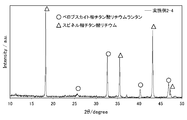
- Examples 2-1 to 2-4 A solution obtained by dissolving lanthanum chloride heptahydrate in water was mixed with an aqueous solution of titanium tetrachloride to prepare a solution having a La / Ti ratio of 0.065 (molar ratio). Thus, sintered bodies of Examples 2-1 to 2-4 were produced. For the sintered body according to Example 2-4, powder X-ray diffraction measurement was performed in the same manner as in Example 1-1. The results are shown in FIG. In any of Examples 2-1 to 2-4, diffraction lines corresponding to spinel phase lithium titanate and perovskite phase lithium titanate were detected.
- Example 3-1 A precursor was obtained in the same manner as in Example 1. The precursor was calcined at 800 ° C. for 5 hours to obtain a calcined body. The calcined body was placed in a zirconia ball mill jar, zirconia balls and 2-propanol were added, and planetary ball milling was performed at 300 rpm for 12 hours. The obtained powder was separated from balls and 2-propanol and dried at 200 ° C. to obtain a calcined pulverized product. A part of the obtained calcined pulverized body was packed in a mold having a diameter of 13 mm and pressure-formed into a pellet at 740 MPa. The molded body was sintered in air at 950 ° C.
- Example 3-1 powder X-ray diffraction measurement was performed in the same manner as in Example 1-1. As a result, also in Example 3-1, formation of both spinel-phase lithium titanate and perovskite-phase lithium titanate was confirmed.
- Example 3-2 A sintered body was obtained by the same method as in Example 3-1, except that the calcining temperature at the time of obtaining the calcined body was 400 ° C. In Example 3-2, formation of both spinel phase lithium titanate and perovskite phase lithium lanthanum titanate was confirmed.
- a sintered body was obtained by the following procedure.
- the precursor was calcined at 1150 ° C. for 2 hours to obtain a calcined body.
- the obtained calcined body was put into a ball mill jar made of zirconia, zirconia balls were added, and a planetary ball mill treatment was performed at 400 rpm for 1 hour in a dry method, and then 2-propanol was added and further treated at 400 rpm for 1 hour.
- Example 4 A part of the obtained precursor was packed in a mold having a diameter of 13 mm, and pressure-molded into a pellet at 740 MPa. The molded body was sintered in air at 950 ° C. for 12 hours to obtain a sintered body having a thickness of 500 ⁇ m.
- powder X-ray diffraction measurement was performed in the same manner as in Example 1-1. The results are shown in FIG. Also in Example 4, the formation of both spinel-phase lithium titanate and perovskite-phase lithium titanate was confirmed.
- Example 1 was carried out in the same manner as Example 1-1 except that the sintering temperature and the holding time thereof were (1100 ° C., 10 minutes), (1050 ° C., 0 minutes) and (1200 ° C., 0 minutes), respectively.
- Sintered bodies of 5-1 to 5-3 were produced.
- Examples 5-1 and 5-2 diffraction lines corresponding to spinel phase lithium titanate, ramsdellite phase lithium titanate, and perovskite phase lithium lanthanum titanate were detected.
- FIG. 11 shows the result of the powder X-ray diffraction measurement of Example 5-3.
- Example 5-3 diffraction lines corresponding to ramsdelite phase lithium titanate and perovskite phase lithium titanate were detected.
- Example 6 Example, except that the amount of precursor used in the molding process is reduced to 1/4, and the sintering temperature and the holding time thereof are (950 ° C., 12 hours) and (1150 ° C., 0 minutes), respectively.
- sintered bodies of Examples 6-1 and 6-2 were produced. The thicknesses of the obtained sintered bodies were all 130 ⁇ m.
- Example 6-1 diffraction lines corresponding to spinel phase lithium titanate and perovskite phase lithium lanthanum titanate were detected.
- Example 6-2 diffraction lines corresponding to spinel phase lithium titanate, ramsdelite phase lithium titanate and perovskite phase lithium lanthanum were detected.
- Example 7 The precursor obtained by the method described in Example 1 was dispersed in a solvent in which toluene and isopropyl alcohol were mixed at a volume ratio of 2: 1 together with polyvinyl butyral as a binder to form a slurry. After coating on a PET film, drying at 120 ° C. for 10 minutes, and pressing at 440 MPa using a hot plate press at 80 ° C., the PET film was peeled off and heated at 500 ° C. for 2 hours to remove the binder. Thereafter, sintering was performed at 1150 ° C. and a holding time of 2 hours to obtain a sintered body sheet having a thickness of 30 ⁇ m.
- Lithium titanate powder (manufactured by Wako Pure Chemical Industries, Ltd.) was packed in a mold having a diameter of 13 mm and pressure-formed into a pellet at 740 MPa. The molded body was sintered in air at 950 ° C. for 12 hours to obtain a sintered body having a thickness of 500 ⁇ m.
- Comparative Example 2 A sintered body of Comparative Example 2 was produced in the same manner as Comparative Example 1 except that the amount of lithium titanate powder packed in the mold was reduced to a quarter. The thickness of the obtained sintered body was 130 ⁇ m.
- Comparative Example 3 A sintered body sheet of Comparative Example 3 was prepared in the same manner as in Example 7 except that the lithium titanate powder (manufactured by Wako Pure Chemical Industries, Ltd.) was sintered at 950 ° C. for 12 hours. . The thickness of the obtained sintered body sheet was 10 ⁇ m.
- the test electrolyte cell was prepared in a glove box. Gold was vapor-deposited on one surface of the sintered body sample, and the vapor-deposited surface was placed on the lower part of the stainless steel cell exterior. A separator and a positive electrode were placed on top of each other in this order, and the whole was immersed in an electrolytic solution, covered with the upper part of the cell exterior, and sealed in a form in which compressive stress was applied to the sintered body / separator / positive electrode laminate.
- the electrolyte solution was prepared by dissolving LiPF 6 at a concentration of 1 mol / L in a solvent in which ethylene carbonate and ethyl methyl carbonate were mixed at a volume ratio of 3: 7.
- the positive electrode was lithium iron phosphate, carbon, and polytetrafluoro. What mixed ethylene with the ratio (mass ratio) of 85: 10: 5 was used. Charging / discharging was performed at a temperature of 25 ° C., a constant current of 0.1 mA / cm 2 , an upper limit cutoff potential of 2.3 V, and a lower limit cutoff potential of 1.0 V.
- the test all-solid cell was prepared in a glove box. Polyethylene oxide having a weight average molecular weight of 600,000 and lithium bis (trifluoromethanesulfonyl) imide having a mass ratio of 35% with respect to polyethylene oxide are mixed in acetonitrile and applied to the upper surface and the periphery of a sintered body in which gold is deposited on the lower surface. did. Then, it dried under reduced pressure for 12 hours at 130 ° C., and acetonitrile was completely removed to obtain a laminate of a dry polymer electrolyte and a sintered body.
- a coin-type all-solid-state cell for testing in which metal lithium is adhered to the dry polymer electrolyte side of this laminate and sealed in a coin-type container, with the sintered body as the positive electrode, the dry polymer electrolyte as the solid electrolyte, and the metal lithium as the negative electrode And a charge / discharge test was performed at 60 ° C. Charging / discharging started from the discharge, and was performed with a constant current of 0.02 mA / cm 2 , an upper limit cutoff potential of 2.5 V, and a lower limit cutoff potential of 1.25 V.
- the measurement cell was produced in a glove box. Place a metal lithium foil on the lower part of the stainless steel cell exterior, and stack the separator soaked with electrolyte, the sintered body sample, the separator impregnated with the electrolyte, and the metal lithium foil in this order. The upper part was covered, and it sealed in the form which applies a compressive stress to the laminated body of metal lithium foil / separator / sintered body sample / separator / metal lithium foil positive electrode.
- the electrolytic solution was used a solution obtained by dissolving LiClO 4 at a concentration of 1 mol / L in an equal volume mixed solvent of ethylene carbonate and diethyl carbonate.
- the measurement was performed at a temperature of 25 ° C.
- an impedance analyzer was used (frequency 1 Hz to 32 MHz, amplitude voltage 100 mV), a resistance value was obtained from the arc of the Nyquist plot, and lithium ion conductivity was calculated from this resistance value.
- capacitance shows the capacity
- Examples 1-1 to 1-5 and Examples 5-1 to 5-3 show that lithium titanate having a ramsdelite type crystal structure was formed at a sintering temperature of 1000 ° C. or higher.
- the sintering temperature was 1200 ° C.
- lithium titanate having a spinel crystal structure was hardly observed.
- the sintered body obtained in the present invention and containing lithium titanate and lithium lanthanum titanate of Examples 1-3, 1-5, 2-3, 3-2, 4, 5-1 to 5-3 It was possible to charge and discharge in the electrolytic cell. Even in Examples 5-1 to 5-3, in which the holding time of the sintering temperature is short, a sufficient sintered body is obtained, which is energy saving and long in a high temperature environment that brings about composition variation and particle size coarseness. It is preferable in that it does not have to be exposed to time.
- Comparative Example 1 which is a sintered body of only lithium titanate powder does not contain a solid electrolyte, and the electrolyte does not penetrate into the dense sintered body. Because there was no conduction path, it was almost impossible to charge and discharge.
- a sintered body having a thickness of 130 ⁇ m containing lithium titanate and lithium lanthanum titanate of Examples 6-1 and 6-2 obtained in the present invention, and lithium titanate and lithium lanthanum titanate of Example 7 were used.
- seat included was able to charge / discharge in the all-solid-state battery using the dry polymer electrolyte which is a solid electrolyte, without using electrolyte solution.
- Comparative Examples 2 and 3 which are sintered bodies composed only of lithium titanate powders could hardly be charged / discharged in the charge / discharge test using the all-solid cell, similarly to the charge / discharge test using the electrolyte cell. .
Landscapes
- Chemical & Material Sciences (AREA)
- Engineering & Computer Science (AREA)
- Chemical Kinetics & Catalysis (AREA)
- Electrochemistry (AREA)
- General Chemical & Material Sciences (AREA)
- Manufacturing & Machinery (AREA)
- Inorganic Chemistry (AREA)
- Organic Chemistry (AREA)
- Materials Engineering (AREA)
- Ceramic Engineering (AREA)
- Condensed Matter Physics & Semiconductors (AREA)
- Physics & Mathematics (AREA)
- General Physics & Mathematics (AREA)
- Structural Engineering (AREA)
- General Life Sciences & Earth Sciences (AREA)
- Life Sciences & Earth Sciences (AREA)
- Environmental & Geological Engineering (AREA)
- Geology (AREA)
- Composite Materials (AREA)
- Dispersion Chemistry (AREA)
- Battery Electrode And Active Subsutance (AREA)
- Inorganic Compounds Of Heavy Metals (AREA)
- Compositions Of Oxide Ceramics (AREA)
- Secondary Cells (AREA)
Abstract
Priority Applications (4)
| Application Number | Priority Date | Filing Date | Title |
|---|---|---|---|
| CN201680039768.7A CN107848890A (zh) | 2015-07-30 | 2016-07-28 | 包含钛酸锂和钛酸锂镧的烧结体、其制造方法以及锂电池 |
| US15/747,947 US20180219224A1 (en) | 2015-07-30 | 2016-07-28 | Sintered Body Containing Lithium Titanate and Lithium Lanthanum Titanate, Method for Producing Same, and Lithium Battery |
| KR1020187005597A KR20180033571A (ko) | 2015-07-30 | 2016-07-28 | 티탄산 리튬과 티탄산 리튬란탄을 포함하는 소결체, 그 제조 방법 및 리튬 전지 |
| EP16830593.6A EP3326983A4 (fr) | 2015-07-30 | 2016-07-28 | Corps fritté contenant du titanate de lithium et titanate de lithium et de lanthane, procédé de production associé et batterie au lithium |
Applications Claiming Priority (4)
| Application Number | Priority Date | Filing Date | Title |
|---|---|---|---|
| JP2015150610 | 2015-07-30 | ||
| JP2015-150610 | 2015-07-30 | ||
| JP2016-011622 | 2016-01-25 | ||
| JP2016011622 | 2016-01-25 |
Publications (1)
| Publication Number | Publication Date |
|---|---|
| WO2017018488A1 true WO2017018488A1 (fr) | 2017-02-02 |
Family
ID=57884531
Family Applications (1)
| Application Number | Title | Priority Date | Filing Date |
|---|---|---|---|
| PCT/JP2016/072205 Ceased WO2017018488A1 (fr) | 2015-07-30 | 2016-07-28 | Corps fritté contenant du titanate de lithium et titanate de lithium et de lanthane, procédé de production associé et batterie au lithium |
Country Status (6)
| Country | Link |
|---|---|
| US (1) | US20180219224A1 (fr) |
| EP (1) | EP3326983A4 (fr) |
| JP (1) | JP2017132682A (fr) |
| KR (1) | KR20180033571A (fr) |
| CN (1) | CN107848890A (fr) |
| WO (1) | WO2017018488A1 (fr) |
Cited By (3)
| Publication number | Priority date | Publication date | Assignee | Title |
|---|---|---|---|---|
| WO2019078307A1 (fr) * | 2017-10-20 | 2019-04-25 | セントラル硝子株式会社 | Électrode composite et batterie au lithium entièrement solide |
| CN111656563A (zh) * | 2017-09-05 | 2020-09-11 | 罗伯特·博世有限公司 | 用于陶瓷电解质颗粒的表面涂层 |
| JP2021039872A (ja) * | 2019-09-02 | 2021-03-11 | 太平洋セメント株式会社 | リチウムイオン二次電池の固体電解質用チタン酸ランタンリチウム結晶粒子の製造方法 |
Families Citing this family (9)
| Publication number | Priority date | Publication date | Assignee | Title |
|---|---|---|---|---|
| DE102016212050A1 (de) * | 2016-07-01 | 2018-01-04 | Fraunhofer-Gesellschaft zur Förderung der angewandten Forschung e.V. | Komposit-Kathodenschichtaufbau für Festkörperbatterien auf Lithiumbasis und ein Verfahren zu seiner Herstellung |
| EP3627595B1 (fr) * | 2017-05-15 | 2021-08-25 | NGK Insulators, Ltd. | Plaque frittée de titanate de lithium |
| KR102224126B1 (ko) * | 2018-04-05 | 2021-03-08 | 주식회사 세븐킹에너지 | 리튬 이차전지를 위한 세라믹 고체 전해질의 제조 방법 |
| JP7022207B2 (ja) * | 2018-05-17 | 2022-02-17 | 日本碍子株式会社 | リチウム二次電池 |
| US10741873B2 (en) * | 2018-07-16 | 2020-08-11 | Ford Global Technologies, Llc | Composition for sintered lithium titanate-lithium lanthanum titanium oxide composite |
| CN110330050A (zh) * | 2019-03-25 | 2019-10-15 | 郑州大学 | 一种锂镧钛氧材料及其制备方法、h2s气敏传感器 |
| US12071680B2 (en) * | 2020-08-14 | 2024-08-27 | Lawrence Livermore National Security, Llc | Mechanically alloyed Li—Sn—Zn |
| CN114678587B (zh) * | 2022-04-12 | 2025-02-18 | 湖州南木纳米科技有限公司 | 固态电解质的制备方法、镧钛氧化合物及其制备方法 |
| CN117756519B (zh) * | 2023-12-11 | 2025-12-30 | 西安理工大学 | 基于电脉冲的高致密钛酸锂细晶陶瓷快速烧结方法 |
Citations (2)
| Publication number | Priority date | Publication date | Assignee | Title |
|---|---|---|---|---|
| JP2013105646A (ja) * | 2011-11-15 | 2013-05-30 | Seiko Epson Corp | 固体電解質層形成用組成物、固体電解質層の形成方法、固体電解質層およびリチウムイオン二次電池 |
| WO2016017745A1 (fr) * | 2014-07-30 | 2016-02-04 | セントラル硝子株式会社 | Précurseur de produit composite de titanate de lithium et son procédé de fabrication |
Family Cites Families (1)
| Publication number | Priority date | Publication date | Assignee | Title |
|---|---|---|---|---|
| CN102332579B (zh) * | 2011-02-21 | 2014-10-08 | 东莞新能源科技有限公司 | 一种锂离子电池及其负极活性材料 |
-
2016
- 2016-07-28 WO PCT/JP2016/072205 patent/WO2017018488A1/fr not_active Ceased
- 2016-07-28 EP EP16830593.6A patent/EP3326983A4/fr not_active Withdrawn
- 2016-07-28 CN CN201680039768.7A patent/CN107848890A/zh not_active Withdrawn
- 2016-07-28 US US15/747,947 patent/US20180219224A1/en not_active Abandoned
- 2016-07-28 JP JP2016148678A patent/JP2017132682A/ja active Pending
- 2016-07-28 KR KR1020187005597A patent/KR20180033571A/ko not_active Ceased
Patent Citations (2)
| Publication number | Priority date | Publication date | Assignee | Title |
|---|---|---|---|---|
| JP2013105646A (ja) * | 2011-11-15 | 2013-05-30 | Seiko Epson Corp | 固体電解質層形成用組成物、固体電解質層の形成方法、固体電解質層およびリチウムイオン二次電池 |
| WO2016017745A1 (fr) * | 2014-07-30 | 2016-02-04 | セントラル硝子株式会社 | Précurseur de produit composite de titanate de lithium et son procédé de fabrication |
Non-Patent Citations (3)
| Title |
|---|
| See also references of EP3326983A4 * |
| SUN LI: "High-strength all-solid lithium ion electrodes based on Li4Ti5O12", JOURNAL OF POWER SOURCES, vol. 196, no. 15, pages 6507 - 6511, XP028216056 * |
| YI TING-FENG: "Synthesis and application of a novel Li4Ti5O12 composite as anode material with enhanced fast charge-discharge performance for lithium-ion battery", ELECTROCHIMICA ACTA, vol. 134, pages 377 - 383, XP028849810 * |
Cited By (4)
| Publication number | Priority date | Publication date | Assignee | Title |
|---|---|---|---|---|
| CN111656563A (zh) * | 2017-09-05 | 2020-09-11 | 罗伯特·博世有限公司 | 用于陶瓷电解质颗粒的表面涂层 |
| WO2019078307A1 (fr) * | 2017-10-20 | 2019-04-25 | セントラル硝子株式会社 | Électrode composite et batterie au lithium entièrement solide |
| JP2021039872A (ja) * | 2019-09-02 | 2021-03-11 | 太平洋セメント株式会社 | リチウムイオン二次電池の固体電解質用チタン酸ランタンリチウム結晶粒子の製造方法 |
| JP7299110B2 (ja) | 2019-09-02 | 2023-06-27 | 太平洋セメント株式会社 | リチウムイオン二次電池の固体電解質用チタン酸ランタンリチウム結晶粒子の製造方法 |
Also Published As
| Publication number | Publication date |
|---|---|
| US20180219224A1 (en) | 2018-08-02 |
| KR20180033571A (ko) | 2018-04-03 |
| EP3326983A4 (fr) | 2018-07-11 |
| CN107848890A (zh) | 2018-03-27 |
| EP3326983A1 (fr) | 2018-05-30 |
| JP2017132682A (ja) | 2017-08-03 |
Similar Documents
| Publication | Publication Date | Title |
|---|---|---|
| WO2017018488A1 (fr) | Corps fritté contenant du titanate de lithium et titanate de lithium et de lanthane, procédé de production associé et batterie au lithium | |
| CN106232526B (zh) | 石榴石型化合物的制造方法 | |
| JP5957618B2 (ja) | 固体電解質層を含む二次電池 | |
| JP5283188B2 (ja) | 全固体二次電池およびその製造方法 | |
| EP3540843A1 (fr) | Batterie secondaire | |
| JP6109672B2 (ja) | セラミック正極−固体電解質複合体 | |
| JP6018930B2 (ja) | 正極−固体電解質複合体の製造方法 | |
| Yi et al. | Effective enhancement of electrochemical performance for spherical spinel LiMn2O4 via Li ion conductive Li2ZrO3 coating | |
| EP2911223A1 (fr) | Matériau actif d'électrode basé sur un oxyde de composite titane-niobium et batterie secondaire au lithium utilisant celui-ci | |
| WO2018139657A1 (fr) | Stratifié d'électrode et pile au lithium entièrement solide | |
| CN107848894A (zh) | 石榴石型氧化物烧结体和其制造方法 | |
| CN104995769A (zh) | 正极活性物质及其制备方法以及包含该正极活性物质的锂二次电池 | |
| JP2018125062A (ja) | 全固体リチウム電池用電極積層体の製造方法、全固体リチウム電池用電極複合体及びその製造方法 | |
| JP6109673B2 (ja) | セラミック正極−固体電解質複合体 | |
| JP2019164980A (ja) | 複合体電極及び全固体リチウム電池 | |
| EP2565161A1 (fr) | Nouveau titanate de lithium, son procédé de production, matériau d'électrode actif le contenant, et accumulateur électrique utilisant ledit matériau d'électrode actif | |
| JP7126518B2 (ja) | 全固体リチウム電池及びその製造方法 | |
| JP7115626B2 (ja) | 固体電解質の前駆体組成物、二次電池の製造方法 | |
| JP2019077573A (ja) | スピネル型チタン酸リチウムを含む焼結体の製造方法 | |
| JP6168690B2 (ja) | セラミック正極−固体電解質複合体 | |
| Lu et al. | Conductivity and stability of Li3/8Sr7/16-3x/2LaxZr1/4Ta3/4O3 superionic solid electrolytes | |
| Gu et al. | Two-dimensional layered lithium lanthanum titanium oxide/graphene-like composites as electrodes for lithium-ion batteries | |
| JP7196369B1 (ja) | イオン伝導性固体及び全固体電池 | |
| CN107324379A (zh) | 一种高容量钛酸锂材料制备方法 | |
| CN114122505B (zh) | 固体电解质、固体电解质的制造方法及复合体 |
Legal Events
| Date | Code | Title | Description |
|---|---|---|---|
| 121 | Ep: the epo has been informed by wipo that ep was designated in this application |
Ref document number: 16830593 Country of ref document: EP Kind code of ref document: A1 |
|
| WWE | Wipo information: entry into national phase |
Ref document number: 15747947 Country of ref document: US |
|
| NENP | Non-entry into the national phase |
Ref country code: DE |
|
| WWE | Wipo information: entry into national phase |
Ref document number: 2016830593 Country of ref document: EP |
|
| ENP | Entry into the national phase |
Ref document number: 20187005597 Country of ref document: KR Kind code of ref document: A |