WO2017033797A1 - 化粧品 - Google Patents
化粧品 Download PDFInfo
- Publication number
- WO2017033797A1 WO2017033797A1 PCT/JP2016/073885 JP2016073885W WO2017033797A1 WO 2017033797 A1 WO2017033797 A1 WO 2017033797A1 JP 2016073885 W JP2016073885 W JP 2016073885W WO 2017033797 A1 WO2017033797 A1 WO 2017033797A1
- Authority
- WO
- WIPO (PCT)
- Prior art keywords
- cosmetic
- elastic body
- resin
- holding
- sample
- Prior art date
- Legal status (The legal status is an assumption and is not a legal conclusion. Google has not performed a legal analysis and makes no representation as to the accuracy of the status listed.)
- Ceased
Links
Images


Classifications
-
- A—HUMAN NECESSITIES
- A45—HAND OR TRAVELLING ARTICLES
- A45D—HAIRDRESSING OR SHAVING EQUIPMENT; EQUIPMENT FOR COSMETICS OR COSMETIC TREATMENTS, e.g. FOR MANICURING OR PEDICURING
- A45D34/00—Containers or accessories specially adapted for handling liquid toiletry or cosmetic substances, e.g. perfumes
- A45D34/04—Appliances specially adapted for applying liquid, e.g. using roller or ball
-
- A—HUMAN NECESSITIES
- A45—HAND OR TRAVELLING ARTICLES
- A45D—HAIRDRESSING OR SHAVING EQUIPMENT; EQUIPMENT FOR COSMETICS OR COSMETIC TREATMENTS, e.g. FOR MANICURING OR PEDICURING
- A45D33/00—Containers or accessories specially adapted for handling powdery toiletry or cosmetic substances
- A45D33/005—Flexible holders, pouches for powder or powder puffs
-
- A—HUMAN NECESSITIES
- A45—HAND OR TRAVELLING ARTICLES
- A45D—HAIRDRESSING OR SHAVING EQUIPMENT; EQUIPMENT FOR COSMETICS OR COSMETIC TREATMENTS, e.g. FOR MANICURING OR PEDICURING
- A45D33/00—Containers or accessories specially adapted for handling powdery toiletry or cosmetic substances
- A45D33/34—Powder-puffs, e.g. with installed container
-
- A—HUMAN NECESSITIES
- A45—HAND OR TRAVELLING ARTICLES
- A45D—HAIRDRESSING OR SHAVING EQUIPMENT; EQUIPMENT FOR COSMETICS OR COSMETIC TREATMENTS, e.g. FOR MANICURING OR PEDICURING
- A45D40/00—Casings or accessories specially adapted for storing or handling solid or pasty toiletry or cosmetic substances, e.g. shaving soaps or lipsticks
- A45D40/26—Appliances specially adapted for applying pasty paint, e.g. using roller, using a ball
-
- A—HUMAN NECESSITIES
- A61—MEDICAL OR VETERINARY SCIENCE; HYGIENE
- A61K—PREPARATIONS FOR MEDICAL, DENTAL OR TOILETRY PURPOSES
- A61K8/00—Cosmetics or similar toiletry preparations
- A61K8/02—Cosmetics or similar toiletry preparations characterised by special physical form
-
- A—HUMAN NECESSITIES
- A61—MEDICAL OR VETERINARY SCIENCE; HYGIENE
- A61Q—SPECIFIC USE OF COSMETICS OR SIMILAR TOILETRY PREPARATIONS
- A61Q1/00—Make-up preparations; Body powders; Preparations for removing make-up
- A61Q1/02—Preparations containing skin colorants, e.g. pigments
-
- D—TEXTILES; PAPER
- D04—BRAIDING; LACE-MAKING; KNITTING; TRIMMINGS; NON-WOVEN FABRICS
- D04H—MAKING TEXTILE FABRICS, e.g. FROM FIBRES OR FILAMENTARY MATERIAL; FABRICS MADE BY SUCH PROCESSES OR APPARATUS, e.g. FELTS, NON-WOVEN FABRICS; COTTON-WOOL; WADDING ; NON-WOVEN FABRICS FROM STAPLE FIBRES, FILAMENTS OR YARNS, BONDED WITH AT LEAST ONE WEB-LIKE MATERIAL DURING THEIR CONSOLIDATION
- D04H1/00—Non-woven fabrics formed wholly or mainly of staple fibres or like relatively short fibres
- D04H1/40—Non-woven fabrics formed wholly or mainly of staple fibres or like relatively short fibres from fleeces or layers composed of fibres without existing or potential cohesive properties
- D04H1/54—Non-woven fabrics formed wholly or mainly of staple fibres or like relatively short fibres from fleeces or layers composed of fibres without existing or potential cohesive properties by welding together the fibres, e.g. by partially melting or dissolving
- D04H1/541—Composite fibres, e.g. sheath-core, sea-island or side-by-side; Mixed fibres
- D04H1/5412—Composite fibres, e.g. sheath-core, sea-island or side-by-side; Mixed fibres sheath-core
-
- D—TEXTILES; PAPER
- D04—BRAIDING; LACE-MAKING; KNITTING; TRIMMINGS; NON-WOVEN FABRICS
- D04H—MAKING TEXTILE FABRICS, e.g. FROM FIBRES OR FILAMENTARY MATERIAL; FABRICS MADE BY SUCH PROCESSES OR APPARATUS, e.g. FELTS, NON-WOVEN FABRICS; COTTON-WOOL; WADDING ; NON-WOVEN FABRICS FROM STAPLE FIBRES, FILAMENTS OR YARNS, BONDED WITH AT LEAST ONE WEB-LIKE MATERIAL DURING THEIR CONSOLIDATION
- D04H1/00—Non-woven fabrics formed wholly or mainly of staple fibres or like relatively short fibres
- D04H1/40—Non-woven fabrics formed wholly or mainly of staple fibres or like relatively short fibres from fleeces or layers composed of fibres without existing or potential cohesive properties
- D04H1/54—Non-woven fabrics formed wholly or mainly of staple fibres or like relatively short fibres from fleeces or layers composed of fibres without existing or potential cohesive properties by welding together the fibres, e.g. by partially melting or dissolving
- D04H1/541—Composite fibres, e.g. sheath-core, sea-island or side-by-side; Mixed fibres
- D04H1/5414—Composite fibres, e.g. sheath-core, sea-island or side-by-side; Mixed fibres side-by-side
-
- D—TEXTILES; PAPER
- D04—BRAIDING; LACE-MAKING; KNITTING; TRIMMINGS; NON-WOVEN FABRICS
- D04H—MAKING TEXTILE FABRICS, e.g. FROM FIBRES OR FILAMENTARY MATERIAL; FABRICS MADE BY SUCH PROCESSES OR APPARATUS, e.g. FELTS, NON-WOVEN FABRICS; COTTON-WOOL; WADDING ; NON-WOVEN FABRICS FROM STAPLE FIBRES, FILAMENTS OR YARNS, BONDED WITH AT LEAST ONE WEB-LIKE MATERIAL DURING THEIR CONSOLIDATION
- D04H1/00—Non-woven fabrics formed wholly or mainly of staple fibres or like relatively short fibres
- D04H1/40—Non-woven fabrics formed wholly or mainly of staple fibres or like relatively short fibres from fleeces or layers composed of fibres without existing or potential cohesive properties
- D04H1/54—Non-woven fabrics formed wholly or mainly of staple fibres or like relatively short fibres from fleeces or layers composed of fibres without existing or potential cohesive properties by welding together the fibres, e.g. by partially melting or dissolving
- D04H1/541—Composite fibres, e.g. sheath-core, sea-island or side-by-side; Mixed fibres
- D04H1/5416—Composite fibres, e.g. sheath-core, sea-island or side-by-side; Mixed fibres sea-island
-
- D—TEXTILES; PAPER
- D04—BRAIDING; LACE-MAKING; KNITTING; TRIMMINGS; NON-WOVEN FABRICS
- D04H—MAKING TEXTILE FABRICS, e.g. FROM FIBRES OR FILAMENTARY MATERIAL; FABRICS MADE BY SUCH PROCESSES OR APPARATUS, e.g. FELTS, NON-WOVEN FABRICS; COTTON-WOOL; WADDING ; NON-WOVEN FABRICS FROM STAPLE FIBRES, FILAMENTS OR YARNS, BONDED WITH AT LEAST ONE WEB-LIKE MATERIAL DURING THEIR CONSOLIDATION
- D04H1/00—Non-woven fabrics formed wholly or mainly of staple fibres or like relatively short fibres
- D04H1/40—Non-woven fabrics formed wholly or mainly of staple fibres or like relatively short fibres from fleeces or layers composed of fibres without existing or potential cohesive properties
- D04H1/54—Non-woven fabrics formed wholly or mainly of staple fibres or like relatively short fibres from fleeces or layers composed of fibres without existing or potential cohesive properties by welding together the fibres, e.g. by partially melting or dissolving
- D04H1/541—Composite fibres, e.g. sheath-core, sea-island or side-by-side; Mixed fibres
- D04H1/5418—Mixed fibres, e.g. at least two chemically different fibres or fibre blends
-
- A—HUMAN NECESSITIES
- A45—HAND OR TRAVELLING ARTICLES
- A45D—HAIRDRESSING OR SHAVING EQUIPMENT; EQUIPMENT FOR COSMETICS OR COSMETIC TREATMENTS, e.g. FOR MANICURING OR PEDICURING
- A45D34/00—Containers or accessories specially adapted for handling liquid toiletry or cosmetic substances, e.g. perfumes
- A45D2034/002—Accessories
-
- A—HUMAN NECESSITIES
- A45—HAND OR TRAVELLING ARTICLES
- A45D—HAIRDRESSING OR SHAVING EQUIPMENT; EQUIPMENT FOR COSMETICS OR COSMETIC TREATMENTS, e.g. FOR MANICURING OR PEDICURING
- A45D40/00—Casings or accessories specially adapted for storing or handling solid or pasty toiletry or cosmetic substances, e.g. shaving soaps or lipsticks
- A45D2040/0006—Accessories
-
- A—HUMAN NECESSITIES
- A45—HAND OR TRAVELLING ARTICLES
- A45D—HAIRDRESSING OR SHAVING EQUIPMENT; EQUIPMENT FOR COSMETICS OR COSMETIC TREATMENTS, e.g. FOR MANICURING OR PEDICURING
- A45D2200/00—Details not otherwise provided for in A45D
- A45D2200/10—Details of applicators
- A45D2200/1009—Applicators comprising a pad, tissue, sponge, or the like
- A45D2200/1036—Applicators comprising a pad, tissue, sponge, or the like containing a cosmetic substance, e.g. impregnated with liquid or containing a soluble solid substance
-
- D—TEXTILES; PAPER
- D10—INDEXING SCHEME ASSOCIATED WITH SUBLASSES OF SECTION D, RELATING TO TEXTILES
- D10B—INDEXING SCHEME ASSOCIATED WITH SUBLASSES OF SECTION D, RELATING TO TEXTILES
- D10B2331/00—Fibres made from polymers obtained otherwise than by reactions only involving carbon-to-carbon unsaturated bonds, e.g. polycondensation products
- D10B2331/04—Fibres made from polymers obtained otherwise than by reactions only involving carbon-to-carbon unsaturated bonds, e.g. polycondensation products polyesters, e.g. polyethylene terephthalate [PET]
-
- D—TEXTILES; PAPER
- D10—INDEXING SCHEME ASSOCIATED WITH SUBLASSES OF SECTION D, RELATING TO TEXTILES
- D10B—INDEXING SCHEME ASSOCIATED WITH SUBLASSES OF SECTION D, RELATING TO TEXTILES
- D10B2401/00—Physical properties
- D10B2401/04—Heat-responsive characteristics
- D10B2401/041—Heat-responsive characteristics thermoplastic; thermosetting
-
- D—TEXTILES; PAPER
- D10—INDEXING SCHEME ASSOCIATED WITH SUBLASSES OF SECTION D, RELATING TO TEXTILES
- D10B—INDEXING SCHEME ASSOCIATED WITH SUBLASSES OF SECTION D, RELATING TO TEXTILES
- D10B2503/00—Domestic or personal
-
- Y—GENERAL TAGGING OF NEW TECHNOLOGICAL DEVELOPMENTS; GENERAL TAGGING OF CROSS-SECTIONAL TECHNOLOGIES SPANNING OVER SEVERAL SECTIONS OF THE IPC; TECHNICAL SUBJECTS COVERED BY FORMER USPC CROSS-REFERENCE ART COLLECTIONS [XRACs] AND DIGESTS
- Y10—TECHNICAL SUBJECTS COVERED BY FORMER USPC
- Y10S—TECHNICAL SUBJECTS COVERED BY FORMER USPC CROSS-REFERENCE ART COLLECTIONS [XRACs] AND DIGESTS
- Y10S206/00—Special receptacle or package
- Y10S206/823—Cosmetic, toilet, powder puff
Definitions
- the present invention relates to cosmetics. More specifically, the present invention relates to a cosmetic-holding elastic body used for holding cosmetics, a cosmetic-containing elastic body containing cosmetics in the cosmetic-holding elastic body, and the cosmetic-containing elastic body.
- the present invention relates to a cosmetic product.
- the elastic material for retaining cosmetics of the present invention can be suitably used for various cosmetics such as foundations, including puffs used when applying cosmetics to the skin and the like.
- Liquid cosmetics such as foundations are housed in cosmetic containers such as compacts.
- the cosmetic container has a container main body and a lid, and a cosmetic holding elastic body for holding the liquid cosmetic is stored in the container main body.
- soft sponges such as polyethylene foam, polyurethane foam, and rubber foam have been used as elastic bodies for holding cosmetics.
- Ether-based urethane foams have been proposed (see, for example, Patent Document 1).
- the polyether polyurethane foam can easily attach the liquid cosmetic present on the surface to the puff, etc., but since it has a cell structure, the liquid cosmetic incorporated inside the Therefore, it cannot be easily taken out by a puff or the like. For this reason, there is a drawback that a large amount of liquid cosmetic that is not used remains inside the polyether polyurethane foam. Furthermore, polyurethane foam is not a fiber but a urethane-bonded foam, and since the entire surface area is large, it is inferior in light resistance and easily yellowed by sunlight, etc. There is.
- the present invention has been made in view of the above-described prior art, and a cosmetic-holding elastic body capable of efficiently taking out the cosmetics taken inside, and the cosmetics on the cosmetic-holding elastic body. It is an object of the present invention to provide a cosmetic-containing elastic body to be contained and a cosmetic having the cosmetic-containing elastic body.
- the present invention (1) A cosmetic-holding elastic body used for holding cosmetics, comprising a composite fiber as a constituent fiber, wherein the composite fiber is a resin A and a resin B having a higher melting temperature than the resin A An elastic body for holding a cosmetic, characterized in that the contact portion between the constituent fibers is integrated with the composite fiber resin A, (2)
- the present invention relates to a cosmetic-containing elastic body containing a cosmetic in the cosmetic-holding elastic body described in (1), and (3) a cosmetic having the cosmetic-containing elastic body described in (2).
- the cosmetic-holding elastic body of the present invention has an excellent effect that the cosmetics taken inside can be efficiently taken out to the outside. Since the cosmetic-containing elastic body of the present invention contains the cosmetic in the cosmetic-holding elastic body, the cosmetic-containing elastic body has an excellent effect that the cosmetic taken into the interior can be taken out efficiently. Moreover, since the cosmetics of this invention have the said cosmetics containing elastic body, there exists the outstanding effect that the cosmetics taken in inside can be taken out outside efficiently.
- FIG. 1 It is a schematic explanatory drawing which shows one embodiment of the method of manufacturing the web sheet used when manufacturing the elastic body for cosmetics holding
- (A) is a drawing substitute optical microscope photograph in the cross section of the sample A obtained in Example 1
- (b) is a drawing substitute optical microscope photograph in the cross section of the sample A in the thickness direction.
- (A) is a drawing-substituting optical micrograph showing the light resistance test result of sample A in Experimental Example 1
- (b) is a drawing-substituting optical micrograph showing the light resistance test result of Sample B in Experimental Example 1
- (c) is Drawing substitute optical microscope photograph showing light resistance test result of sample C in experimental example 1
- (d) is drawing substitute optical microscope photograph showing light resistance test result of sample R1 in experimental example 1
- (e) is in experimental example 1. It is a drawing substitute optical microscope photograph which shows the light resistance test result of sample R2.
- the cosmetic-holding elastic body of the present invention is a cosmetic-holding elastic body that is used to hold cosmetics, contains composite fibers as constituent fibers, and the composite fibers are resin A and A resin B having a melting temperature higher than that of the resin A is contained, and contact portions between constituent fibers are integrated by a resin A of a composite fiber.
- the melting temperature of the resin A constituting the composite fiber is lower than the melting temperature of the resin B.
- the melting temperature of the resin A is preferably 20 ° C. or more lower than the melting temperature of the resin B, more preferably 30 ° C. or more from the viewpoint of preventing the composite fiber from sagging.
- the melting temperature of the resin A is preferably 130 to 220 ° C. from the viewpoint of preventing sag of the composite fibers and firmly integrating the contact portions of the constituent fibers with the resin A.
- the melting temperature of the resin A and the melting temperature of the resin B and the melting temperature of the synthetic fiber described later cannot be clearly measured, the melting temperature is replaced with the softening temperature.
- Examples of the resin A include polyesters and thermoplastic elastomers, but the present invention is not limited to such examples.
- polyesters examples include polyethylene terephthalate, polytrimethylene terephthalate, polybutylene terephthalate, polyhexamethylene terephthalate, polytetramethylene terephthalate, poly 1,4-dimethylcyclohexane terephthalate, and polyhydrolactone. It is not limited only to such illustration. These polyesters may be used alone or in combination of two or more. Among these thermoplastic polyesters, polyethylene terephthalate, polytrimethylene terephthalate, polybutylene terephthalate and polyhexamethylene terephthalate are preferable because of excellent light resistance.
- thermoplastic elastomers examples include polyester elastomers and polyurethane elastomers. Of these, polyester elastomers are preferred from the viewpoint of improving the light resistance of the cosmetic-holding elastic body of the present invention.
- polyester elastomers examples include polyester elastomers such as polyethylene terephthalate elastomer, polyether-ester block copolymers having polyester as a hard segment and poly (alkylene oxide) glycol as a soft segment.
- Polyether-ester block copolymers can be prepared, for example, by reacting dicarboxylic acids, diols, and poly (alkylene oxide) glycols.
- dicarboxylic acid examples include o-phthalic acid, m-phthalic acid, terephthalic acid, naphthalene-2,6-dicarboxylic acid, naphthalene-2,7-dicarboxylic acid, diphenyl-4,4′-dicarboxylic acid, Aromatic dicarboxylic acids such as phenoxyethanedicarboxylic acid and sodium 3-sulfoisophthalate, alicyclic dicarboxylic acids such as 1,4-cyclohexanedicarboxylic acid, succinic acid, oxalic acid, adipic acid, sebacic acid, dodecanediic acid, dimer acid
- these dicarboxylic acids may be used alone or in combination of two or more.
- diol examples include aliphatic diols such as ethylene glycol, trimethylene glycol, tetramethylene glycol, pentamethylene glycol, hexamethylene glycol, 1,4-butanediol, neopentyl glycol, decamethylene glycol, 1,1- Examples thereof include alicyclic diols such as cyclohexanedimethanol, 1,4-cyclohexanedimethanol, and tricyclodecane dimethanol, but the present invention is not limited to such examples. These diols may be used alone or in combination of two or more.
- poly (alkylene oxide) glycol examples include polyethylene glycol, poly (1,2-propylene oxide) glycol, poly (1,3-propylene oxide) glycol, poly (tetramethylene oxide) glycol, and ethylene oxide-propylene oxide copolymer. , Ethylene oxide-tetrahydrofuran copolymer, and the like, but the present invention is not limited to such examples.
- These poly (alkylene oxide) glycols may be used alone or in combination of two or more.
- the number average molecular weight of poly (alkylene oxide) glycol is usually preferably about 400 to 5000.
- the intrinsic viscosity of the polyester-based elastomer is preferably 0.8 to 1.7, more preferably 0.9 to 1.5 from the viewpoint of firmly integrating the contact portions of the constituent fibers with the resin A.
- the polyurethane-based elastomer can be obtained, for example, by polymerizing polyol and diisocyanate in the presence of a chain extender.
- polyols examples include polyols having a molecular weight of about 500 to 6000, such as dihydroxy polyether, dihydroxy polyester, dihydroxy polycarbonate, and dihydroxy polyester amide, but the present invention is not limited to such examples. These polyols may be used alone or in combination of two or more.
- diisocyanate examples include diisocyanate having a molecular weight of 500 or less, such as diphenylmethane diisocyanate, tolylene diisocyanate, isophorone diisocyanate, hydrogenated diphenylmethane diisocyanate, xylylene diisocyanate, diisocyanate methyl caproate, hexamethylene diisocyanate, etc. Is not limited to such examples. These diisocyanates may be used alone or in combination of two or more.
- chain extender examples include ethylene glycol, amino alcohol, bishydroxyethoxybenzene, 1,4-butanediol and the like, but the present invention is not limited to such examples. These chain extenders may be used alone or in combination of two or more.
- thermoplastic elastomer having polybutylene terephthalate as a hard segment and polyoxybutylene glycol as a soft segment can be used as the thermoplastic elastomer.
- a part of the acid component used as a raw material for polybutylene terephthalate may be substituted with an acid such as a dicarboxylic acid other than terephthalic acid or an oxycarboxylic acid within a range not hindering the object of the present invention.
- an acid such as a dicarboxylic acid other than terephthalic acid or an oxycarboxylic acid within a range not hindering the object of the present invention.
- a part of butylene glycol used as a raw material of polyoxybutylene glycol may be substituted with another polyhydric alcohol within a range in which the object of the present invention is not inhibited.
- a part of butylene glycol used as a raw material for polyoxybutylene glycol may be substituted with another polyhydric alcohol within a range in which the object of the present invention is not impaired.
- thermoplastic polyesters examples include thermoplastic polyesters, but the present invention is not limited to such examples.
- thermoplastic polyester examples include polyethylene terephthalate, polytrimethylene terephthalate, polybutylene terephthalate, polyhexamethylene terephthalate, polytetramethylene terephthalate, poly 1,4-dimethylcyclohexane terephthalate, and polyhydrolactone. Is not limited to such examples. These thermoplastic polyesters may be used alone or in combination of two or more. Among these thermoplastic polyesters, polyethylene terephthalate, polytrimethylene terephthalate, polybutylene terephthalate and polyhexamethylene terephthalate are preferable because of excellent light resistance.
- the melting temperature of the resin B is preferably 20 ° C. or more higher than the melting temperature of the resin A and more preferably 30 ° C. or more from the viewpoint of preventing the composite fiber from sagging.
- the melting temperature of the resin B is preferably 150 to 270 ° C., and preferably 160 to 270 ° C. from the viewpoint of preventing the sag of the composite fiber and firmly integrating the contact portions of the constituent fibers with the resin A. It is more preferable.
- the composite fiber is a polyester or a polyester-based elastomer
- the resin B Is preferably a thermoplastic polyester.
- the composite fiber contains the resin A and the resin B having a higher melting temperature than the resin A, but may contain a resin other than the resin A and the resin B as long as the object of the present invention is not impaired.
- the composite fiber examples include a core-sheath type composite fiber, a side-by-side type composite fiber, and a sea-island type composite fiber, but the present invention is not limited to such examples.
- the core-sheath type composite fiber is preferable.
- a side-by-side type composite fiber is preferable.
- the composite fiber contains a resin A and a resin B.
- a resin A and a resin B two types of resins, resin A and resin B, are usually used.
- the type composite fiber usually 2 to 4 types, preferably 2 or 3 types, more preferably resin A and resin B containing resin A and resin B are used.
- the resin B is used as the core component and the resin A is used as the sheath component from the viewpoint of firmly integrating the contact portions of the constituent fibers with the resin A.
- the core component is preferably not exposed on the surface of the composite fiber. More preferably, the center of the core component in the fiber radial direction and the center of the sheath component in the fiber radial direction are the same.
- the core-sheath type composite fiber may be concentric and have a core-sheath structure, or may be eccentric and have a core-sheath structure.
- the conjugate fiber having the core-sheath structure in which the core-sheath structure is formed in an eccentric shape is crimped by heating, and thus is suitable for applications requiring crimping.
- Examples of the cross-sectional shape of the core-sheath type composite fiber include a polygonal shape such as a circle, a triangle, and a quadrangle, an ellipse, and an ellipse.
- the present invention is not limited to such examples. Among these shapes, a circle is preferable.
- the volume ratio of the core component to the sheath component of the core-sheath composite fiber is improved from the viewpoint of improving the single fiber strength and firmly integrating the contact portions of the constituent fibers with the resin A.
- the core-sheath type conjugate fiber is obtained by, for example, heat-melting the resin B and the resin A constituting the core component and the sheath component, respectively, and producing a composite spinning for producing the core-sheath type conjugate fiber. It can be manufactured by introducing into a device, extruding from a core-sheath type composite nozzle, and spinning.
- heat-melting resin A and resin B a single screw extruder, a twin screw extruder, a kneader etc. can be used, for example.
- the core-sheath type composite nozzle for example, a core-sheath type composite nozzle in which the cap pores are arranged in a staggered arrangement or an annular arrangement can be used.
- the core-sheath composite fiber can be cooled and solidified, for example, by blowing cold air onto the spun core-sheath composite fiber.
- the fineness of the composite fiber is 0.5 from the viewpoint of obtaining a cosmetic-holding elastic body excellent in mechanical strength, allowing the cosmetics taken into the cosmetic-holding elastic body to be efficiently taken out to the outside. It is preferably ⁇ 15 denier, more preferably 1 to 10 denier.
- the fineness of the fiber means the mass (g) of the fiber (filament) per 9000 m of the fiber length.
- the fiber length of the composite fiber is 20 to 20% from the viewpoint of obtaining a cosmetic holding elastic body excellent in mechanical strength, in which the cosmetic taken in the cosmetic holding elastic body can be taken out efficiently. It is preferable that it is about 150 mm.
- the composite fiber may be subjected to processing such as antibacterial processing and antibacterial processing, if necessary, from the viewpoint of antiseptic properties such as cosmetics used in cosmetics.
- processing such as antibacterial processing and antibacterial processing, if necessary, from the viewpoint of antiseptic properties such as cosmetics used in cosmetics.
- Various methods can be employed for these processes, and the present invention is not limited to such methods.
- the cosmetic-holding elastic body of the present invention contains a composite fiber as a constituent fiber, and the constituent fiber may be composed only of the composite fiber. Other than the composite fiber and the composite fiber, You may be comprised with the fiber.
- Examples of other fibers include natural fibers such as cotton, hemp, and silk, regenerated fibers such as rayon, and synthetic fibers.
- the present invention is not limited to such examples.
- the cosmetic taken in the cosmetic holding elastic body can be efficiently taken out to the outside. Synthetic fibers are preferred.
- polyester fibers such as polyethylene terephthalate fibers, polybutylene terephthalate fibers, and polytrimethylene terephthalate fibers, polyvinyl chloride fibers, polyvinylidene chloride fibers, polypropylene fibers, polyvinyl alcohol fibers, and nylon 6.
- polyester fibers such as polyethylene terephthalate fibers, polybutylene terephthalate fibers, and polytrimethylene terephthalate fibers, polyvinyl chloride fibers, polyvinylidene chloride fibers, polypropylene fibers, polyvinyl alcohol fibers, and nylon 6.
- polyester fibers such as polyethylene terephthalate fibers, polybutylene terephthalate fibers, and polytrimethylene terephthalate fibers
- polyvinyl chloride fibers such as polyethylene terephthalate fibers, polybutylene terephthalate fibers, and polytrimethylene terephthalate fibers
- the synthetic fiber may be subjected to processing such as antibacterial processing and antibacterial processing, if necessary, from the viewpoint of preserving cosmetics used in cosmetics.
- processing such as antibacterial processing and antibacterial processing, if necessary, from the viewpoint of preserving cosmetics used in cosmetics.
- Various methods can be employed for these processes, and the present invention is not limited to such methods.
- the melting temperature of the synthetic fiber is preferably 20 ° C. or more higher than the melting temperature of the resin A, and more preferably 30 ° C. or more from the viewpoint of preventing the composite fiber from sagging.
- the melting temperature of the synthetic fiber is preferably 150 to 270 ° C. from the viewpoint of preventing the sag of the composite fiber and efficiently heat-sealing the composite fiber and the synthetic fiber at the intersection of the composite fiber and the synthetic fiber. 160 to 270 ° C. is more preferable.
- the fineness of the synthetic fiber is 0.5 to 15 denier from the viewpoint of obtaining a cosmetic holding elastic body that can efficiently take out the cosmetic taken in the cosmetic holding elastic body. It is preferably 1 to 10 denier.
- the fiber length of the synthetic fiber is 20 to 20% from the viewpoint of obtaining a cosmetic holding elastic body excellent in mechanical strength, allowing the cosmetic taken into the cosmetic holding elastic body to be taken out efficiently. It is preferable that it is about 150 mm.
- a composite fiber and other fibers can be obtained from the viewpoint of obtaining a cosmetic-holding elastic body that can efficiently take out the cosmetic taken into the cosmetic-holding elastic body and is excellent in light resistance.
- a synthetic fiber is used in combination, more preferably a composite fiber and a synthetic fiber are used in combination with a polyester fiber or a polyamide fiber, and more preferably a composite fiber and a polyester fiber are used in combination. .
- the mass ratio of the composite fiber to the synthetic fiber is such that the composite fiber and the synthetic fiber are efficiently heat-sealed at the intersection of the composite fiber and the synthetic fiber, and the elastic material for holding cosmetics is used. From the viewpoint of obtaining a cosmetic-holding elastic body capable of efficiently taking out cosmetics taken inside, it is preferably 10/90 to 100/0, and preferably 30/70 to 80/20. Is more preferable.
- FIG. 1 is a schematic explanatory view showing one embodiment of a method for producing a web sheet used in producing the cosmetic-holding elastic body of the present invention.
- the web 1 is laminated.
- the web 1 can be formed, for example, by defibrating each of the composite fibers and the synthetic fibers, weighing them so as to have a predetermined ratio, and mixing them so as to have a uniform composition.
- the thickness of the formed web is appropriately adjusted according to the size of the elastic material for holding cosmetics used.
- the web 1 is sandwiched between two flat plates (not shown), and if necessary, the web 1 is pressed to a predetermined thickness, and the composite fiber contained in the web 1 in that state is pressed.
- the web 1 is heated at a temperature equal to or higher than the melting temperature of the resin A constituting the resin B and lower than the melting temperature of the resin B and the synthetic fiber constituting the composite fiber, the resin A is melted, and the composite fiber and
- the web sheet 2 can be obtained by fusing and integrating the contact portions of the constituent fibers containing the synthetic fibers with the molten resin A.
- the web sheet 2 is placed in a mold so as to have a predetermined density, the web sheet 2 is heated in the same manner as described above, and the resin A is melted, thereby crossing the constituent fibers. It is possible to fuse with the molten resin A, and to form a lump (amoeba-shaped) fused portion made of the resin A at the intersection.
- the fused part is denoted by reference symbol A.
- the web sheet 2 obtained as described above is joined in the form of dots by the resin A in which the intersecting portions of the constituent fibers are melted, and the joined fibers are aligned in the plane direction of the web sheet 2.
- the web sheet 2 obtained as described above is cut in the vertical direction as shown by an arrow B in FIG.
- the cut web sheet 3 is arranged such that the cut surface is the upper surface or the lower surface. Since the web sheet 3 forms a structure (three-dimensional solid structure) like a jungle gym in the thickness direction, the repulsion is large against the pressure from the upper surface of the web sheet 3, so that the cushioning property It is considered that it is excellent in resistance to “sag”.
- the web sheet 3 when mixing the composite fiber and the synthetic fiber, when the web sheet 3 is manufactured by arranging and laminating both the composite fiber and the synthetic fiber so as to be parallel to the length direction of the fiber, the web sheet 3 When 3 is stretched as indicated by arrow C in FIG. 1 (d), stripes indicating that both the composite fiber and the synthetic fiber are parallel appear. The stripes serve as an index indicating that the web sheet 3 is manufactured by the above method.
- the elastic material for holding cosmetics can be obtained by cutting the web sheet 3 obtained above into a desired size and shape.
- the size and shape of the cosmetic-holding elastic body vary depending on the use of the cosmetic-holding elastic body, it cannot be determined unconditionally. Therefore, it is preferable that the size and shape of the cosmetic-holding elastic body are appropriately adjusted according to the use of the cosmetic-holding elastic body.
- the elastic body for holding cosmetics for example, a cylindrical elastic body for holding cosmetics having a planar shape of a circle with a diameter of about 3 to 15 cm and a thickness of about 0.5 to 5 cm can be cited.
- the cosmetic-holding elastic body can be suitably used, for example, as a cosmetic-holding elastic body for holding a liquid cosmetic such as a foundation.
- the density of the elastic material for holding a cosmetic according to the present invention cannot be determined unconditionally because it varies depending on the use of the elastic material for holding a cosmetic, but is usually preferably about 6 to 50 kg / m 3 or more. Preferably, it is about 6 to 30 kg / m 3 .
- the Asker F hardness of the cosmetic-holding elastic body of the present invention cannot be determined unconditionally because it varies depending on the use of the cosmetic-holding elastic body, but is usually preferably about 30 to 60. .
- the Asker F hardness of the cosmetic-holding elastic body is a value when measured at a temperature of 25 ° C. using an Asker rubber hardness meter F type manufactured by Kobunshi Keiki Co., Ltd.
- the web sheets 3 are arranged in the thickness direction.
- the size of sag due to continuous use of the elastic body for holding a cosmetic of the present invention is preferably 20% or less, more preferably 10%. It is as follows.
- the sag (mm) of the elastic body for holding cosmetics is a value when measured based on the method described in the following examples.
- the elastic material for holding a cosmetic according to the present invention obtained as described above includes a composite fiber containing a resin A and a resin B having a melting temperature higher than that of the resin A, and a contact portion between the constituent fibers is a composite fiber resin. Since the voids exist between the constituent fibers because they are integrated by A, and the voids are fixed, in contrast to the conventional polyurethane foam and rubber foam having a large surface area, Since the cosmetics taken inside can be efficiently taken out from the gaps between the fibers of the constituent fibers, the residual rate of the cosmetics after use can be reduced.
- the elastic body for holding cosmetics of the present invention has a three-dimensional structure, the amount of cosmetics taken into the elastic body from the beginning of use is suppressed compared to conventional polyurethane foams. be able to.
- the elastic material for holding a cosmetic according to the present invention is excellent in light resistance and has an advantage that yellowing due to sunlight or the like can be suppressed.
- the light fastness is a composite fiber in which the resin A is a polyester or a polyester-based elastomer, the resin B is a thermoplastic polyester, and other fibers are included in the constituent fibers. It is effectively expressed when a polyester single fiber (filament) is used as the other fiber.
- the elastic material for retaining cosmetics of the present invention is excellent in the retention property (non-adsorbability) of the UV absorber contained in the cosmetics, and further, since the sag due to repeated use is small, it is durable. Also excellent in properties.
- the cosmetic-holding elastic body of the present invention can be suitably used as a cosmetic-containing elastic body by holding the cosmetic in the cosmetic-holding elastic body. It can be suitably used for various cosmetics.
- the cosmetic-containing elastic body of the present invention uses the cosmetic-holding elastic body, and thus exhibits an effect based on the cosmetic-holding elastic body. Moreover, since the cosmetic-containing elastic body is used in the cosmetic of the present invention, the effect based on the cosmetic-containing elastic body is expressed.
- Cosmetics that can be used in the cosmetic-containing elastic body of the present invention include, for example, foundation, makeup base, eye shadow, eyeliner, mascara, blusher, funny, eyebrow, cleansing cream, cleansing milk, cleansing liquid, face wash Cream, facial cleansing foam, massage cream, cold cream, burnishing cream, skin cream, skin gel, milky lotion, lotion, various lotions, sunscreen, body cream, body oil, hair shampoo, hair rinse, hair conditioner, hair Treatments, hair liquids, hair tonics and the like can be mentioned, but the present invention is not limited to such examples.
- the cosmetic-containing elastic body of the present invention has an excellent effect on the liquid cosmetic, so that the liquid cosmetic is preferable.
- the viscosity of the cosmetic is not particularly limited.
- the viscosity of the cosmetic at 25 ° C. is preferably 500 to 50000 mPa ⁇ s, more preferably 500 to 30000 mPa ⁇ s, and still more preferably 1000 to 20000 mPa ⁇ s. Even more preferably, it is 1000 to 10,000 mPa ⁇ s.
- the viscosity of cosmetics is a value when measured using a BM type viscometer.
- the amount of the cosmetic used in the cosmetic-containing elastic body of the present invention varies depending on the type of cosmetic and cannot be determined unconditionally.
- the cosmetic is a liquid foundation
- the diameter is 5 cm and the thickness is A liquid foundation having a viscosity at 25 ° C. of 6000 mPa ⁇ s can be used in an amount of about 10 to 20 g for a cosmetic-containing elastic body having a thickness of 1.5 cm.
- the cosmetic holding body contains the cosmetic holding elastic body of the present invention. Since the cosmetic holding body contains the cosmetic holding elastic body, the cosmetic holding body exhibits an effect based on the cosmetic holding elastic body.
- the cosmetic holding body may contain only the cosmetic holding elastic body of the present invention, and an elastic body, fiber, or resin other than the cosmetic holding elastic body as long as the object of the present invention is not impaired. It may contain a film or the like.
- the cosmetic carrier may have a laminated structure.
- the layer in the plane direction of the cosmetic carrier from the viewpoint of obtaining a cosmetic carrier that can efficiently take out the cosmetic taken in the cosmetic carrier.
- at least the surface layer is preferably the cosmetic-holding elastic body of the present invention.
- the cosmetic carrier can be used after being cut into a desired size and shape. Since the size and shape of the cosmetic carrier vary depending on the use of the cosmetic carrier, it cannot be determined unconditionally. Therefore, it is preferable that the size and shape of the cosmetic holder are appropriately adjusted according to the use of the cosmetic holder.
- a cylindrical cosmetic carrier having a planar shape of a circle with a diameter of about 3 to 15 cm and a thickness of about 0.5 to 5 cm can be given.
- the said cosmetics holding body can be used conveniently as a cosmetics holding body for hold
- the density of the cosmetic holder cannot be determined unconditionally because it varies depending on the use of the cosmetic holder, etc., but is usually preferably about 6 to 50 kg / m 3 , more preferably 6 to 30 kg / m. About three .
- the Asker F hardness of the cosmetic carrier cannot be determined unconditionally because it varies depending on the use of the cosmetic carrier, but is usually preferably about 30 to 60.
- the Asker F hardness of the cosmetic holder is a value measured based on the same method as the Asker F hardness of the cosmetic holding elastic body.
- the degree of sag of the cosmetic carrier is preferably 20% or less, more preferably 10% or less, from the viewpoint of preventing sag during use.
- the sag degree of the cosmetic holder is a value obtained based on the same method as the sag degree of the cosmetic holding elastic body.
- the cosmetic carrier can be preferably used as a cosmetic-containing carrier by holding the cosmetic in the cosmetic carrier, and the cosmetic-containing carrier is preferably used for various cosmetics. Can do.
- the cosmetic holding body is used for the cosmetic-containing holding body, the effect based on the cosmetic holding body is expressed. Moreover, since the said cosmetics containing holding body is used for the said cosmetics, the effect based on the said cosmetics containing holding body is expressed.
- Examples of the cosmetic that can be used for the cosmetic-containing holding body include the same cosmetics that can be used for the cosmetic-containing elastic body. Moreover, the viscosity of cosmetics, and the quantity of the cosmetics used for a cosmetics containing holding body can illustrate the viscosity similar to the above, and its quantity.
- Example 1 Core-sheath type composite fiber [core component: polyethylene terephthalate, sheath component: thermoplastic polyethylene terephthalate, fineness: 6 denier] and polyester fiber (resin: polyethylene terephthalate, fineness: 3 denier) in a mass ratio of 40:60
- the elastic material for holding cosmetics was produced by heating and melting the sheath component in a state where the web spun so as to be in parallel was pressed. By cutting this, Sample A (density: 13.4 kg / m 3 ) having a diameter of 5 cm and a thickness of 1.4 cm was obtained.
- FIG. 2A is an optical micrograph of a cross section in the plane direction of the sample A
- FIG. 2B is a microphotograph of a cross section in the thickness direction of the sample A.
- the magnification of each photograph is shown at the bottom of each photograph, and one scale is 25 ⁇ m.
- Example 2 Core-sheath type composite fiber [core component: polyethylene terephthalate, sheath component: thermoplastic polyethylene terephthalate, fineness: 6 denier] and polyester fiber (resin: polyethylene terephthalate, fineness: 3 denier) at a mass ratio of 70:30
- the sheath component is heated and melted in a state where the mixed web is pressed so as to be parallel to each other, thereby producing a cosmetic-holding elastic body, and cutting this to give a diameter of 5 cm and a thickness of 1.5 cm.
- Sample B (density: 12.9 kg / m 3 ) was obtained.
- Example 3 Core-sheath type composite fiber [core component: polyethylene terephthalate, sheath component: thermoplastic polyethylene terephthalate, fineness: 6 denier] and polyester fiber (resin: polyethylene terephthalate, fineness: 3 denier) at a mass ratio of 50:50
- the sheath component is heated and melted in a state where the mixed web is pressed so as to be parallel to each other, thereby producing a cosmetic-holding elastic body, and cutting this to give a diameter of 5 cm and a thickness of 1.6 cm.
- Sample C (density: 17.1 kg / m 3 ) was obtained.
- Example 4 Core-sheath type composite fiber [core component: polyethylene terephthalate, sheath component: thermoplastic polyethylene terephthalate, fineness: 6 denier] and polyester fiber (resin: polyethylene terephthalate, fineness: 3 denier) at a mass ratio of 70:30
- the sheath component is heated and melted in a state where the mixed web is pressed so as to be parallel to each other, thereby producing a cosmetic-holding elastic body, and cutting this to give a diameter of 5 cm and a thickness of 1.5 cm.
- Sample D density: 14.0 kg / m 3 ) was obtained.
- Example 5 Core-sheath type composite fiber [core component: polyethylene terephthalate, sheath component: thermoplastic polyethylene terephthalate, fineness: 6 denier] and polyester fiber (resin: polyethylene terephthalate, fineness: 3 denier) in a mass ratio of 40:60
- the sheath component is heated and melted in a state where the mixed web is pressed so as to be parallel to each other, thereby producing a cosmetic-holding elastic body, and cutting this to give a diameter of 5 cm and a thickness of 1.6 cm.
- Sample E (density: 14.2 kg / m 3 ) was obtained.
- Example 6 Core-sheath type composite fiber [core component: polyethylene terephthalate, sheath component: thermoplastic polyethylene terephthalate, fineness: 6 denier] and polyester fiber (resin: polyethylene terephthalate, fineness: 3 denier) at a mass ratio of 50:50
- the sheath component is heated and melted in a state where the mixed web is pressed so as to be parallel to each other, thereby producing a cosmetic-holding elastic body, and cutting this to give a diameter of 6 cm and a thickness of 1.1 cm.
- Sample F density: 16.4 kg / m 3 ) was obtained.
- Example 7 Core-sheath type composite fiber [core component: polyethylene terephthalate, sheath component: thermoplastic polyethylene terephthalate, fineness: 6 denier] and polyester fiber (resin: polyethylene terephthalate, fineness: 3 denier) at a mass ratio of 70:30
- the sheath component is heated and melted in a state where the mixed web is pressed so as to be parallel to each other, thereby producing a cosmetic-holding elastic body, and cutting this to give a diameter of 6 cm and a thickness of 1.5 cm.
- Sample G (density: 17.1 kg / m 3 ) was obtained.
- Example 8 Core-sheath type composite fiber [core component: polyethylene terephthalate, sheath component: thermoplastic polyethylene terephthalate, fineness: 6 denier] and polyester fiber (resin: polyethylene terephthalate, fineness: 3 denier) at a mass ratio of 20:80
- the sheath component is heated and melted in a state where the mixed web is pressed so as to be parallel to each other, thereby producing a cosmetic-holding elastic body, and cutting this to give a diameter of 5 cm and a thickness of 1.4 cm.
- Sample H (density: 18.9 kg / m 3 ) was obtained.
- the Asker F hardness of Sample H was 39.
- Example 9 Core-sheath type composite fiber [core component: polyethylene terephthalate, sheath component: thermoplastic polyethylene terephthalate, fineness: 6 denier] and polyester fiber (resin: polyethylene terephthalate, fineness: 3 denier) in a mass ratio of 40:60
- the sheath component is heated and melted in a state where the mixed web is pressed so as to be parallel to each other, thereby producing a cosmetic-holding elastic body, and cutting this to give a diameter of 5 cm and a thickness of 1.4 cm.
- Sample I (density: 20.5 kg / m 3 ) was obtained.
- the Asker F hardness of Sample I was 51.4.
- Example 10 Core-sheath type composite fiber [core component: polyethylene terephthalate, sheath component: thermoplastic polyethylene terephthalate, fineness: 6 denier] and polyester fiber (resin: polyethylene terephthalate, fineness: 3 denier) at a mass ratio of 50:50
- the sheath component is heated and melted in a state where the mixed web is pressed so as to be parallel to each other, thereby producing a cosmetic-holding elastic body, and cutting this to give a diameter of 5 cm and a thickness of 1.4 cm.
- Sample J (density: 19.9 kg / m 3 ) was obtained.
- the Asker F hardness of Sample J was 54.2.
- Example 11 Core-sheath type composite fiber [core component: polyethylene terephthalate, sheath component: thermoplastic polyethylene terephthalate, fineness: 6 denier] and polyester fiber (resin: polyethylene terephthalate, fineness: 3 denier) at a mass ratio of 70:30
- the sheath component is heated and melted in a state where the mixed web is pressed so as to be parallel to each other, thereby producing a cosmetic-holding elastic body, and cutting this to give a diameter of 5 cm and a thickness of 1.4 cm.
- Sample K (density: 18.9 kg / m 3 ) was obtained.
- the Asker F hardness of sample K was 51.4.
- Example 12 An elastic body for holding cosmetics is obtained by heating and melting the sheath component in a state of pressing a web composed only of a core-sheath type composite fiber [core component: polyethylene terephthalate, sheath component: thermoplastic polyethylene terephthalate, fineness: 6 denier].
- the elastic body for cosmetics holding is produced by carrying out the cutting process, and the sample L (density: 15.4 kg / m) of diameter 5cm and thickness 1.4cm by cutting this. 3 ) was obtained.
- the Asker F hardness of the sample L was 43.2.
- Comparative Example 1 A sample R1 made of polyether-based polyretane foam and having a diameter of 5 cm and a thickness of 1.5 cm was prepared.
- Comparative Example 2 A sample R2 made of nitrile rubber foam and having a diameter of 5 cm and a thickness of 1.5 cm was prepared.
- FIGS. 3 (a) to 3 (e) The results of the light resistance test for each sample are shown in FIGS. 3 (a) to 3 (e) in order.
- the left half is the surface state of the sample before ultraviolet irradiation
- the right half is the surface state of the sample after ultraviolet irradiation.
- the test piece is a test piece in which vertical stripes by fibers run in the tensile direction of the test piece, and a test piece in which horizontal stripes by fibers run in a direction perpendicular to the tensile direction of the test piece.
- a horizontal test piece was used, and these two kinds of test pieces were used.
- each sample obtained in each example has good tensile strength, and the tensile strength can be widely adjusted. It can be seen that the tensile strength of the elastic body can be adjusted as appropriate. Moreover, it turns out that the test piece which the vertical stripe by the fiber has run in the tensile direction of the test piece is excellent in tensile strength compared with the test piece in which the horizontal stripe by the fiber has run in the tensile direction of the test piece.
- each sample was uniformly coated with 15 g of mineral water foundation [manufactured by Shiseido Co., Ltd., viscosity: 2000 mPa ⁇ s], and then allowed to stand for 1 hour to impregnate each sample with the foundation.
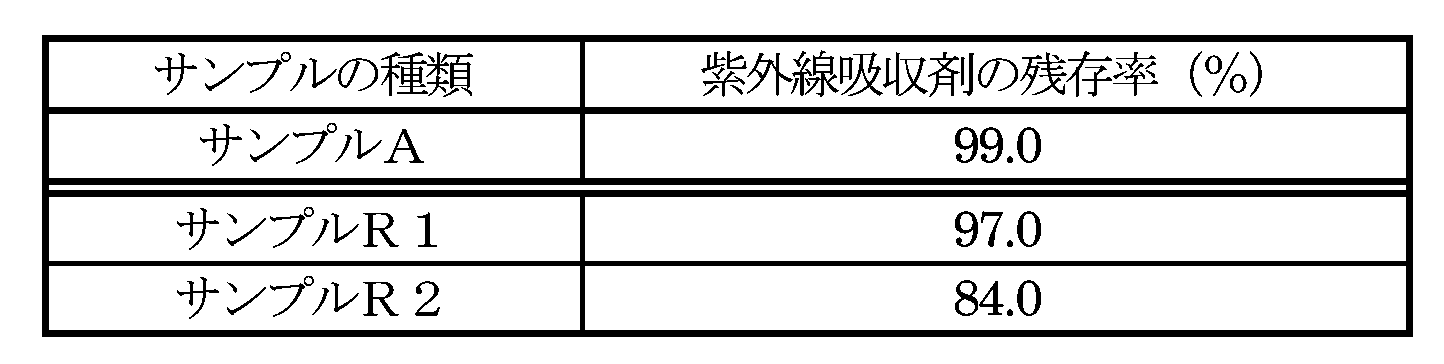
- Test solution was prepared by mixing 900 g of liquid paraffin and 100 g of an ultraviolet absorber (2-ethylhexyl paramethoxycinnamate).
- a sample in which 30 g of test solution is put in a petri dish (blank), a sample in which 30 g of test solution is impregnated in sample A, a sample in which 30 g of test solution is impregnated in sample R1, and a sample in which sample R2 is impregnated with 30 g of test solution Prepared and allowed to stand in a constant temperature and humidity room at room temperature 25 ° C. and relative humidity 60% for 4 days, and then the UV absorber contained in the test solution in the blank and each sample was subjected to liquid chromatography under the following measurement conditions. Quantified. The amount of the ultraviolet absorber was determined based on a calibration curve prepared in advance.
- the sample A obtained in the example of the present invention has a high residual ratio of the ultraviolet absorber as compared with the conventional samples R1 and R2. It turns out that it is excellent in the property hold
- the cosmetic-holding elastic body of the present invention is excellent in the retention of UV absorbers, and can be suitably used for cosmetics such as foundations.
- the panel was lightly pressed on the surface of each sample with a cosmetic puff, and then the operation of wiping off the foundation adhering to the cosmetic puff was repeated twice a day for 30 days.
- the sag of samples A to G was not inferior to the sag of sample R1.
- the surfaces of Samples A to G after repeated use for 30 days were visually observed, but no fuzz was observed on the surfaces of any of the samples.
- the degree of sag of sample K determined from the sag (mm) of sample K determined above was 7.8%. From this result, it can be seen that the sample K has little sag due to continuous use.
- the elastic body for holding cosmetics according to the present invention has a small surface sag due to continuous use, and maintains a good surface state without fluff even when repeatedly rubbed with a cosmetic puff. This shows that it can be used suitably for cosmetics, such as a foundation, for example.
Landscapes
- Textile Engineering (AREA)
- Engineering & Computer Science (AREA)
- Life Sciences & Earth Sciences (AREA)
- Health & Medical Sciences (AREA)
- Public Health (AREA)
- General Health & Medical Sciences (AREA)
- Animal Behavior & Ethology (AREA)
- Veterinary Medicine (AREA)
- Epidemiology (AREA)
- Birds (AREA)
- Nonwoven Fabrics (AREA)
- Multicomponent Fibers (AREA)
- Cosmetics (AREA)
Abstract
Description
(1)化粧料を保持するために用いられる化粧料保持用弾性体であって、構成繊維として複合繊維を含有し、当該複合繊維が樹脂Aおよび当該樹脂Aよりも溶融温度が高い樹脂Bを含有し、構成繊維同士の接触部が複合繊維の樹脂Aによって一体化されていることを特徴とする化粧料保持用弾性体、
(2)前記(1)に記載の化粧料保持用弾性体に化粧料を含有する化粧料含有弾性体、および
(3)前記(2)に記載の化粧料含有弾性体を有する化粧品
に関する。
〔化粧料保持用弾性体のへたり度(%)〕
=[〔化粧料保持用弾性体のへたり(mm)〕÷〔化粧料保持用弾性体の初期厚さ(mm)〕]×100
に基づいて求めたときの値である。また、化粧料保持用弾性体のへたり(mm)は、以下の実施例に記載の方法に基づいて測定したときの値である。
芯鞘型複合繊維〔芯成分:ポリエチレンテレフタレート、鞘成分:熱可塑性ポリエチレンテレフタレート、繊度:6デニール〕とポリエステル繊維(樹脂:ポリエチレンテレフタレート、繊度:3デニール)とを40:60の質量比で各繊維が並行となるように混紡したウェブを押圧した状態で鞘成分を加熱溶融させることにより、化粧料保持用弾性体を作製した。これに切削加工を施すことにより、直径5cm、厚さ1.4cmのサンプルA(密度:13.4kg/m3)を得た。
芯鞘型複合繊維〔芯成分:ポリエチレンテレフタレート、鞘成分:熱可塑性ポリエチレンテレフタレート、繊度:6デニール〕とポリエステル繊維(樹脂:ポリエチレンテレフタレート、繊度:3デニール)とを70:30の質量比で各繊維が並行となるように混紡したウェブを押圧した状態で鞘成分を加熱溶融させることにより、化粧料保持用弾性体を作製し、これに切削加工を施すことにより、直径5cm、厚さ1.5cmのサンプルB(密度:12.9kg/m3)を得た。
芯鞘型複合繊維〔芯成分:ポリエチレンテレフタレート、鞘成分:熱可塑性ポリエチレンテレフタレート、繊度:6デニール〕とポリエステル繊維(樹脂:ポリエチレンテレフタレート、繊度:3デニール)とを50:50の質量比で各繊維が並行となるように混紡したウェブを押圧した状態で鞘成分を加熱溶融させることにより、化粧料保持用弾性体を作製し、これに切削加工を施すことにより、直径5cm、厚さ1.6cmのサンプルC(密度:17.1kg/m3)を得た。
芯鞘型複合繊維〔芯成分:ポリエチレンテレフタレート、鞘成分:熱可塑性ポリエチレンテレフタレート、繊度:6デニール〕とポリエステル繊維(樹脂:ポリエチレンテレフタレート、繊度:3デニール)とを70:30の質量比で各繊維が並行となるように混紡したウェブを押圧した状態で鞘成分を加熱溶融させることにより、化粧料保持用弾性体を作製し、これに切削加工を施すことにより、直径5cm、厚さ1.5cmのサンプルD(密度:14.0kg/m3)を得た。
芯鞘型複合繊維〔芯成分:ポリエチレンテレフタレート、鞘成分:熱可塑性ポリエチレンテレフタレート、繊度:6デニール〕とポリエステル繊維(樹脂:ポリエチレンテレフタレート、繊度:3デニール)とを40:60の質量比で各繊維が並行となるように混紡したウェブを押圧した状態で鞘成分を加熱溶融させることにより、化粧料保持用弾性体を作製し、これに切削加工を施すことにより、直径5cm、厚さ1.6cmのサンプルE(密度:14.2kg/m3)を得た。
芯鞘型複合繊維〔芯成分:ポリエチレンテレフタレート、鞘成分:熱可塑性ポリエチレンテレフタレート、繊度:6デニール〕とポリエステル繊維(樹脂:ポリエチレンテレフタレート、繊度:3デニール)とを50:50の質量比で各繊維が並行となるように混紡したウェブを押圧した状態で鞘成分を加熱溶融させることにより、化粧料保持用弾性体を作製し、これに切削加工を施すことにより、直径6cm、厚さ1.1cmのサンプルF(密度:16.4kg/m3)を得た。
芯鞘型複合繊維〔芯成分:ポリエチレンテレフタレート、鞘成分:熱可塑性ポリエチレンテレフタレート、繊度:6デニール〕とポリエステル繊維(樹脂:ポリエチレンテレフタレート、繊度:3デニール)とを70:30の質量比で各繊維が並行となるように混紡したウェブを押圧した状態で鞘成分を加熱溶融させることにより、化粧料保持用弾性体を作製し、これに切削加工を施すことにより、直径6cm、厚さ1.5cmのサンプルG(密度:17.1kg/m3)を得た。
芯鞘型複合繊維〔芯成分:ポリエチレンテレフタレート、鞘成分:熱可塑性ポリエチレンテレフタレート、繊度:6デニール〕とポリエステル繊維(樹脂:ポリエチレンテレフタレート、繊度:3デニール)とを20:80の質量比で各繊維が並行となるように混紡したウェブを押圧した状態で鞘成分を加熱溶融させることにより、化粧料保持用弾性体を作製し、これに切削加工を施すことにより、直径5cm、厚さ1.4cmのサンプルH(密度:18.9kg/m3)を得た。なお、サンプルHのアスカーF硬度は、39であった。
芯鞘型複合繊維〔芯成分:ポリエチレンテレフタレート、鞘成分:熱可塑性ポリエチレンテレフタレート、繊度:6デニール〕とポリエステル繊維(樹脂:ポリエチレンテレフタレート、繊度:3デニール)とを40:60の質量比で各繊維が並行となるように混紡したウェブを押圧した状態で鞘成分を加熱溶融させることにより、化粧料保持用弾性体を作製し、これに切削加工を施すことにより、直径5cm、厚さ1.4cmのサンプルI(密度:20.5kg/m3)を得た。なお、サンプルIのアスカーF硬度は、51.4であった。
芯鞘型複合繊維〔芯成分:ポリエチレンテレフタレート、鞘成分:熱可塑性ポリエチレンテレフタレート、繊度:6デニール〕とポリエステル繊維(樹脂:ポリエチレンテレフタレート、繊度:3デニール)とを50:50の質量比で各繊維が並行となるように混紡したウェブを押圧した状態で鞘成分を加熱溶融させることにより、化粧料保持用弾性体を作製し、これに切削加工を施すことにより、直径5cm、厚さ1.4cmのサンプルJ(密度:19.9kg/m3)を得た。なお、サンプルJのアスカーF硬度は、54.2であった。
芯鞘型複合繊維〔芯成分:ポリエチレンテレフタレート、鞘成分:熱可塑性ポリエチレンテレフタレート、繊度:6デニール〕とポリエステル繊維(樹脂:ポリエチレンテレフタレート、繊度:3デニール)とを70:30の質量比で各繊維が並行となるように混紡したウェブを押圧した状態で鞘成分を加熱溶融させることにより、化粧料保持用弾性体を作製し、これに切削加工を施すことにより、直径5cm、厚さ1.4cmのサンプルK(密度:18.9kg/m3)を得た。なお、サンプルKのアスカーF硬度は、51.4であった。
芯鞘型複合繊維〔芯成分:ポリエチレンテレフタレート、鞘成分:熱可塑性ポリエチレンテレフタレート、繊度:6デニール〕のみからなるウェブを押圧した状態で鞘成分を加熱溶融させることにより、化粧料保持用弾性体を作製し、これに切削加工を施すことにより、化粧料保持用弾性体を作製し、これに切削加工を施すことにより、直径5cm、厚さ1.4cmのサンプルL(密度:15.4kg/m3)を得た。なお、サンプルLのアスカーF硬度は、43.2であった。
ポリエーテル系ポリレタンフォームからなり、直径5cm、厚さ1.5cmのサンプルR1を用意した。
ニトリルゴムフォームからなり、直径5cm、厚さ1.5cmのサンプルR2を用意した。
サンプルA、サンプルB、サンプルC、サンプルR1およびサンプルR2の耐光性試験を以下の条件に基づいて行なった。
・試験機器:ガス試験機(株)製、商品名:紫外線オートフェードメーターU48AU
・試験方法:前記試験機器を用い、各サンプルに紫外線を7時間照射させ、紫外線照射前後のサンプルの表面状態を調べた。
サンプルA~EおよびサンプルG~Lからそれぞれダンベル型試験片(試験部の長さ:30mm、試験部の幅:10mm、試験部の厚さ:15mm)を切り出し、チャック間距離が30mmとなるように設定し、引張試験機〔(株)島津製作所製、商品名:オートグラフAGS-100G〕のチャックに掴持し、引張速度100mm/minにて引張試験を行なった。その結果を表1に示す。

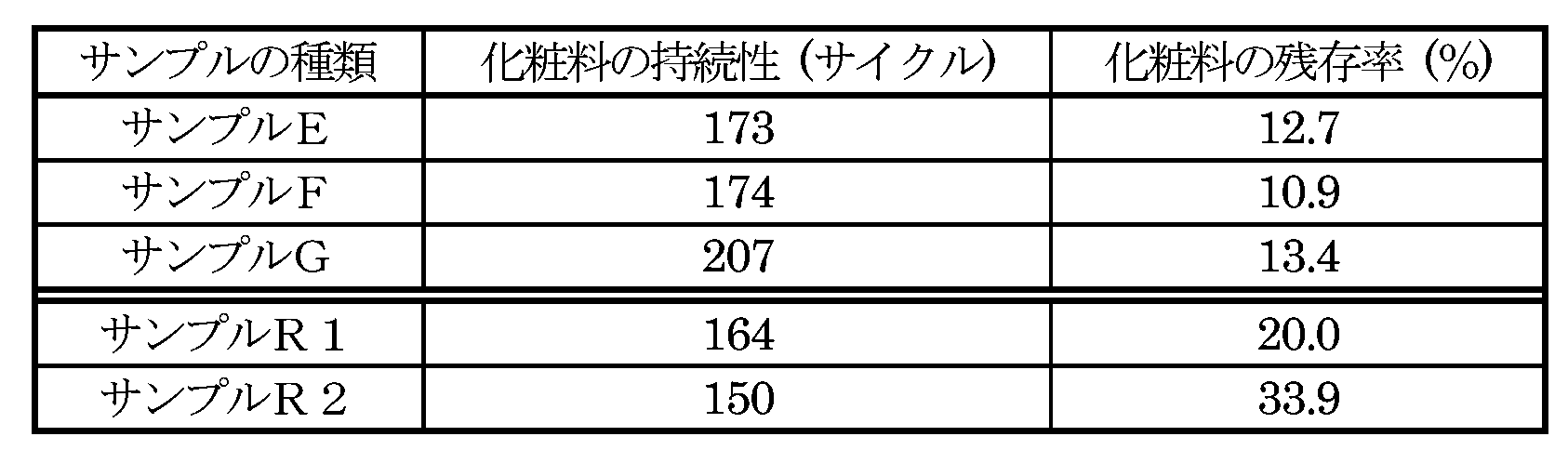
サンプルE、サンプルF、サンプルG、サンプルR1およびサンプルR2を用い、各サンプルの初期質量を秤量した。
〔化粧料の残存率〕
={〔(サンプルの初期質量)-(サンプルの最終質量)〕÷〔化粧料の使用量(15g)〕}×100
に基づいて求めた。以上の結果を表2に示す。
流動パラフィン900gと紫外線吸収剤(パラメトキシケイ皮酸2-エチルヘキシル)100gとを混合することにより、試験液を調製した。
・測定装置:ウォーターズ社製、商品名:ACQUITY UPLCH-Class
・検出器:ウォーターズ社製、商品名:TUV(検出波長:310nm)
・カラム:ウォーターズ社製、商品名:ACQUITY UPLC-BEH C-8(内径:2.1mm、長さ:10cm)
・測定温度:50℃
・移動相:水50質量%とアセトニトリル50質量%との混合溶媒
・流量:0.5mL/min
サンプルA~GおよびサンプルR1の平面にミネラルウォータリーファンデーション〔(株)資生堂製〕15gを均一に塗布した後、1時間静置することにより、当該ファンデーションを各サンプルに含浸させた。
実験例3で化粧料の持続性(サイクル)を評価した後のサンプルKの最終厚さを測定した。サンプルKの初期厚さ(1.4cm)および前記サンプルKの最終厚さに基づき、サンプルKのへたり(mm)を式:
〔サンプルKのへたり(mm)〕
=〔サンプルKの初期厚さ(mm)〕-〔サンプルKの最終厚さ(mm)〕
に基づいて求めたところ、1.1mmであった。
2 ウェブシート
3 裁断されたウェブシート
Claims (3)
- 化粧料を保持するために用いられる化粧料保持用弾性体であって、構成繊維として複合繊維を含有し、当該複合繊維が樹脂Aおよび当該樹脂Aよりも溶融温度が高い樹脂Bを含有し、構成繊維同士の接触部が複合繊維の樹脂Aによって一体化されていることを特徴とする化粧料保持用弾性体。
- 請求項1に記載の化粧料保持用弾性体に化粧料を含有する化粧料含有弾性体。
- 請求項2に記載の化粧料含有弾性体を有する化粧品。
Priority Applications (5)
| Application Number | Priority Date | Filing Date | Title |
|---|---|---|---|
| KR1020187002937A KR102153202B1 (ko) | 2015-08-21 | 2016-08-16 | 화장품 |
| CN201680040584.2A CN107847035B (zh) | 2015-08-21 | 2016-08-16 | 化妆品 |
| US15/753,736 US10413037B2 (en) | 2015-08-21 | 2016-08-16 | Cosmetic |
| JP2017536762A JP6614679B2 (ja) | 2015-08-21 | 2016-08-16 | 化粧品 |
| EP16839144.9A EP3338592B1 (en) | 2015-08-21 | 2016-08-16 | Cosmetic |
Applications Claiming Priority (2)
| Application Number | Priority Date | Filing Date | Title |
|---|---|---|---|
| JP2015-163434 | 2015-08-21 | ||
| JP2015163434 | 2015-08-21 |
Publications (1)
| Publication Number | Publication Date |
|---|---|
| WO2017033797A1 true WO2017033797A1 (ja) | 2017-03-02 |
Family
ID=58100077
Family Applications (1)
| Application Number | Title | Priority Date | Filing Date |
|---|---|---|---|
| PCT/JP2016/073885 Ceased WO2017033797A1 (ja) | 2015-08-21 | 2016-08-16 | 化粧品 |
Country Status (6)
| Country | Link |
|---|---|
| US (1) | US10413037B2 (ja) |
| EP (1) | EP3338592B1 (ja) |
| JP (1) | JP6614679B2 (ja) |
| KR (1) | KR102153202B1 (ja) |
| CN (1) | CN107847035B (ja) |
| WO (1) | WO2017033797A1 (ja) |
Cited By (5)
| Publication number | Priority date | Publication date | Assignee | Title |
|---|---|---|---|---|
| WO2018235444A1 (ja) * | 2017-06-20 | 2018-12-27 | 株式会社トキワ | 液状化粧品 |
| WO2019017738A1 (ko) * | 2017-07-20 | 2019-01-24 | 한국콜마주식회사 | 화장료 조성물 함침용 소재 |
| JP2020501814A (ja) * | 2017-05-04 | 2020-01-23 | コスマックス、インコーポレイテッド | 液状化粧料含浸用の3次元織物含浸材を備える化粧品 |
| JP2020521605A (ja) * | 2017-05-26 | 2020-07-27 | エスティー ローダー インターナショナル,インコーポレーテッド | 捲縮繊維を含む化粧品基材 |
| JP2021527537A (ja) * | 2018-06-21 | 2021-10-14 | エルブイエムエイチ レシェルシェ | 化粧品用のパッケージングおよび/または塗布アセンブリのための変形可能な吸収性基材 |
Families Citing this family (6)
| Publication number | Priority date | Publication date | Assignee | Title |
|---|---|---|---|---|
| KR101525532B1 (ko) * | 2015-01-15 | 2015-06-11 | (주)씨아이티 | 화장품용 함침폼 제조장치 및 제조방법 |
| JP7098274B2 (ja) * | 2016-03-23 | 2022-07-11 | 株式会社イノアックコーポレーション | 化粧料保持体及びそれが収納された化粧料容器 |
| JP7023038B2 (ja) * | 2016-07-07 | 2022-02-21 | 株式会社タイキ | 化粧品 |
| KR102593673B1 (ko) * | 2018-06-15 | 2023-10-24 | 가부시키가이샤 타이키 | 화장료 함침용 담체 |
| WO2020204207A1 (ja) * | 2019-04-04 | 2020-10-08 | 花王株式会社 | 毛髪用化粧品 |
| CN114269199B (zh) * | 2019-10-22 | 2025-04-08 | 株式会社黛怡茜 | 化妆品、液体化妆料用的垫以及液体化妆料含浸体 |
Citations (4)
| Publication number | Priority date | Publication date | Assignee | Title |
|---|---|---|---|---|
| JPH10113223A (ja) * | 1996-10-15 | 1998-05-06 | Toray Ind Inc | 化粧綿 |
| JP2005177176A (ja) * | 2003-12-19 | 2005-07-07 | Daiwabo Co Ltd | 化粧料含浸用基材及びこれを用いた顔面被覆化粧料シート |
| JP2011506778A (ja) * | 2007-12-14 | 2011-03-03 | Esファイバービジョンズ株式会社 | 低温加工性を有する複合繊維、これを用いた不織布及び成形体 |
| JP2015513987A (ja) * | 2012-04-13 | 2015-05-18 | 株式会社アモーレパシフィックAmorepacific Corporation | スクリーンネットを含む化粧品およびその製造方法 |
Family Cites Families (7)
| Publication number | Priority date | Publication date | Assignee | Title |
|---|---|---|---|---|
| JP4791175B2 (ja) * | 2005-12-26 | 2011-10-12 | 帝人ファイバー株式会社 | 高弾性繊維球状体からなる成型品 |
| WO2008041384A1 (en) * | 2006-10-03 | 2008-04-10 | Daiwabo Co., Ltd. | Crimping composite fiber and fibrous mass comprising the same |
| CN101606312B (zh) * | 2007-02-09 | 2012-08-08 | 柯尼卡美能达精密光学株式会社 | 驱动装置 |
| KR101257628B1 (ko) | 2011-03-24 | 2013-04-29 | (주)아모레퍼시픽 | 화장료 조성물이 함침된 발포 우레탄 폼을 포함하는 화장품 |
| JP5961972B2 (ja) * | 2011-10-12 | 2016-08-03 | Jnc株式会社 | 伸縮性嵩高不織布およびその製造方法 |
| WO2014022988A1 (en) * | 2012-08-08 | 2014-02-13 | Daiwabo Holdings Co., Ltd. | Nonwoven, sheet for absorbent article from the same, and absorbent article using the same |
| JP6285737B2 (ja) * | 2014-02-06 | 2018-02-28 | ダイワボウホールディングス株式会社 | ウェットシート用不織布、ウェットワイピングシート、および液体含浸皮膚被覆シート |
-
2016
- 2016-08-16 CN CN201680040584.2A patent/CN107847035B/zh active Active
- 2016-08-16 US US15/753,736 patent/US10413037B2/en active Active
- 2016-08-16 KR KR1020187002937A patent/KR102153202B1/ko active Active
- 2016-08-16 JP JP2017536762A patent/JP6614679B2/ja active Active
- 2016-08-16 EP EP16839144.9A patent/EP3338592B1/en active Active
- 2016-08-16 WO PCT/JP2016/073885 patent/WO2017033797A1/ja not_active Ceased
Patent Citations (4)
| Publication number | Priority date | Publication date | Assignee | Title |
|---|---|---|---|---|
| JPH10113223A (ja) * | 1996-10-15 | 1998-05-06 | Toray Ind Inc | 化粧綿 |
| JP2005177176A (ja) * | 2003-12-19 | 2005-07-07 | Daiwabo Co Ltd | 化粧料含浸用基材及びこれを用いた顔面被覆化粧料シート |
| JP2011506778A (ja) * | 2007-12-14 | 2011-03-03 | Esファイバービジョンズ株式会社 | 低温加工性を有する複合繊維、これを用いた不織布及び成形体 |
| JP2015513987A (ja) * | 2012-04-13 | 2015-05-18 | 株式会社アモーレパシフィックAmorepacific Corporation | スクリーンネットを含む化粧品およびその製造方法 |
Cited By (11)
| Publication number | Priority date | Publication date | Assignee | Title |
|---|---|---|---|---|
| JP2020501814A (ja) * | 2017-05-04 | 2020-01-23 | コスマックス、インコーポレイテッド | 液状化粧料含浸用の3次元織物含浸材を備える化粧品 |
| JP6992072B2 (ja) | 2017-05-04 | 2022-01-13 | コスマックス、インコーポレイテッド | 液状化粧料含浸用の3次元織物含浸材を備える化粧品 |
| JP2020521605A (ja) * | 2017-05-26 | 2020-07-27 | エスティー ローダー インターナショナル,インコーポレーテッド | 捲縮繊維を含む化粧品基材 |
| JP7234218B2 (ja) | 2017-05-26 | 2023-03-07 | エスティー ローダー インターナショナル,インコーポレーテッド | 捲縮繊維を含む化粧品基材 |
| WO2018235444A1 (ja) * | 2017-06-20 | 2018-12-27 | 株式会社トキワ | 液状化粧品 |
| JP2019004919A (ja) * | 2017-06-20 | 2019-01-17 | 株式会社トキワ | 液状化粧品 |
| WO2019017738A1 (ko) * | 2017-07-20 | 2019-01-24 | 한국콜마주식회사 | 화장료 조성물 함침용 소재 |
| WO2019017737A1 (ko) * | 2017-07-20 | 2019-01-24 | 한국콜마주식회사 | 화장료 조성물 함침용 소재 |
| JP2021527537A (ja) * | 2018-06-21 | 2021-10-14 | エルブイエムエイチ レシェルシェ | 化粧品用のパッケージングおよび/または塗布アセンブリのための変形可能な吸収性基材 |
| JP7550654B2 (ja) | 2018-06-21 | 2024-09-13 | エルブイエムエイチ レシェルシェ | 化粧品用のパッケージングおよび/または塗布アセンブリのための変形可能な吸収性基材 |
| US12569049B2 (en) | 2018-06-21 | 2026-03-10 | L V M H Recherche | Deformable absorbent substrate for a packaging and/or application assembly for a cosmetic product |
Also Published As
| Publication number | Publication date |
|---|---|
| JPWO2017033797A1 (ja) | 2018-06-07 |
| EP3338592B1 (en) | 2021-10-06 |
| CN107847035A (zh) | 2018-03-27 |
| KR20180044883A (ko) | 2018-05-03 |
| US10413037B2 (en) | 2019-09-17 |
| EP3338592A1 (en) | 2018-06-27 |
| JP6614679B2 (ja) | 2019-12-04 |
| US20180235344A1 (en) | 2018-08-23 |
| HK1252947A1 (zh) | 2019-06-06 |
| EP3338592A4 (en) | 2019-04-17 |
| KR102153202B1 (ko) | 2020-09-07 |
| CN107847035B (zh) | 2021-07-16 |
Similar Documents
| Publication | Publication Date | Title |
|---|---|---|
| JP6614679B2 (ja) | 化粧品 | |
| ES2378428T3 (es) | Agregado de nanofibras, fibra de aleación de polímero, fibra híbrida, estructuras fibrosas y procedimientos para la producción de las mismas | |
| JP7811404B2 (ja) | 化粧料含浸用担体 | |
| KR102085883B1 (ko) | 화장료 조성물 함침용 소재 | |
| JP7141573B2 (ja) | 化粧品 | |
| KR20080080144A (ko) | 고탄성 섬유 구상체로 이루어지는 성형품 | |
| KR101309874B1 (ko) | 마스카라 브러쉬 | |
| CN109068833A (zh) | 用于面膜片的非织造片材 | |
| KR101253248B1 (ko) | 브러시사, 멀티 브러시사 및 이의 제조방법 | |
| HK1252947B (zh) | 化妆品 | |
| WO2021039127A1 (ja) | 化粧料含浸用担体 | |
| KR20200092137A (ko) | 화장용 패드 | |
| KR20200088393A (ko) | 화장료 함침용 탄성체 | |
| HK1261964B (zh) | 化妆品 | |
| JP5833418B2 (ja) | 不織布および吸収性物品用シート材 | |
| HK1261964A1 (en) | Cosmetic | |
| JPH07189106A (ja) | 多成分網状構造体及びその製法 |
Legal Events
| Date | Code | Title | Description |
|---|---|---|---|
| 121 | Ep: the epo has been informed by wipo that ep was designated in this application |
Ref document number: 16839144 Country of ref document: EP Kind code of ref document: A1 |
|
| ENP | Entry into the national phase |
Ref document number: 2017536762 Country of ref document: JP Kind code of ref document: A |
|
| ENP | Entry into the national phase |
Ref document number: 20187002937 Country of ref document: KR Kind code of ref document: A |
|
| WWE | Wipo information: entry into national phase |
Ref document number: 15753736 Country of ref document: US |
|
| NENP | Non-entry into the national phase |
Ref country code: DE |