WO2017043613A1 - 抗cd26抗体と他の抗癌剤とを組み合わせた癌治療用組成物 - Google Patents
抗cd26抗体と他の抗癌剤とを組み合わせた癌治療用組成物 Download PDFInfo
- Publication number
- WO2017043613A1 WO2017043613A1 PCT/JP2016/076542 JP2016076542W WO2017043613A1 WO 2017043613 A1 WO2017043613 A1 WO 2017043613A1 JP 2016076542 W JP2016076542 W JP 2016076542W WO 2017043613 A1 WO2017043613 A1 WO 2017043613A1
- Authority
- WO
- WIPO (PCT)
- Prior art keywords
- antibody
- amino acid
- acid sequence
- seq
- cells
- Prior art date
- Legal status (The legal status is an assumption and is not a legal conclusion. Google has not performed a legal analysis and makes no representation as to the accuracy of the status listed.)
- Ceased
Links
Images


Classifications
-
- A—HUMAN NECESSITIES
- A61—MEDICAL OR VETERINARY SCIENCE; HYGIENE
- A61K—PREPARATIONS FOR MEDICAL, DENTAL OR TOILETRY PURPOSES
- A61K39/00—Medicinal preparations containing antigens or antibodies
- A61K39/395—Antibodies; Immunoglobulins; Immune serum, e.g. antilymphocytic serum
-
- A—HUMAN NECESSITIES
- A61—MEDICAL OR VETERINARY SCIENCE; HYGIENE
- A61K—PREPARATIONS FOR MEDICAL, DENTAL OR TOILETRY PURPOSES
- A61K31/00—Medicinal preparations containing organic active ingredients
-
- A—HUMAN NECESSITIES
- A61—MEDICAL OR VETERINARY SCIENCE; HYGIENE
- A61K—PREPARATIONS FOR MEDICAL, DENTAL OR TOILETRY PURPOSES
- A61K31/00—Medicinal preparations containing organic active ingredients
- A61K31/33—Heterocyclic compounds
- A61K31/335—Heterocyclic compounds having oxygen as the only ring hetero atom, e.g. fungichromin
- A61K31/34—Heterocyclic compounds having oxygen as the only ring hetero atom, e.g. fungichromin having five-membered rings with one oxygen as the only ring hetero atom, e.g. isosorbide
- A61K31/343—Heterocyclic compounds having oxygen as the only ring hetero atom, e.g. fungichromin having five-membered rings with one oxygen as the only ring hetero atom, e.g. isosorbide condensed with a carbocyclic ring, e.g. coumaran, bufuralol, befunolol, clobenfurol, amiodarone
-
- A—HUMAN NECESSITIES
- A61—MEDICAL OR VETERINARY SCIENCE; HYGIENE
- A61K—PREPARATIONS FOR MEDICAL, DENTAL OR TOILETRY PURPOSES
- A61K31/00—Medicinal preparations containing organic active ingredients
- A61K31/33—Heterocyclic compounds
- A61K31/395—Heterocyclic compounds having nitrogen as a ring hetero atom, e.g. guanethidine or rifamycins
- A61K31/495—Heterocyclic compounds having nitrogen as a ring hetero atom, e.g. guanethidine or rifamycins having six-membered rings with two or more nitrogen atoms as the only ring heteroatoms, e.g. piperazine or tetrazines
- A61K31/505—Pyrimidines; Hydrogenated pyrimidines, e.g. trimethoprim
- A61K31/519—Pyrimidines; Hydrogenated pyrimidines, e.g. trimethoprim ortho- or peri-condensed with heterocyclic rings
-
- A—HUMAN NECESSITIES
- A61—MEDICAL OR VETERINARY SCIENCE; HYGIENE
- A61K—PREPARATIONS FOR MEDICAL, DENTAL OR TOILETRY PURPOSES
- A61K31/00—Medicinal preparations containing organic active ingredients
- A61K31/33—Heterocyclic compounds
- A61K31/395—Heterocyclic compounds having nitrogen as a ring hetero atom, e.g. guanethidine or rifamycins
- A61K31/535—Heterocyclic compounds having nitrogen as a ring hetero atom, e.g. guanethidine or rifamycins having six-membered rings with at least one nitrogen and one oxygen as the ring hetero atoms, e.g. 1,2-oxazines
- A61K31/5375—1,4-Oxazines, e.g. morpholine
- A61K31/5377—1,4-Oxazines, e.g. morpholine not condensed and containing further heterocyclic rings, e.g. timolol
-
- A—HUMAN NECESSITIES
- A61—MEDICAL OR VETERINARY SCIENCE; HYGIENE
- A61K—PREPARATIONS FOR MEDICAL, DENTAL OR TOILETRY PURPOSES
- A61K31/00—Medicinal preparations containing organic active ingredients
- A61K31/70—Carbohydrates; Sugars; Derivatives thereof
- A61K31/7042—Compounds having saccharide radicals and heterocyclic rings
- A61K31/7052—Compounds having saccharide radicals and heterocyclic rings having nitrogen as a ring hetero atom, e.g. nucleosides, nucleotides
- A61K31/706—Compounds having saccharide radicals and heterocyclic rings having nitrogen as a ring hetero atom, e.g. nucleosides, nucleotides containing six-membered rings with nitrogen as a ring hetero atom
- A61K31/7064—Compounds having saccharide radicals and heterocyclic rings having nitrogen as a ring hetero atom, e.g. nucleosides, nucleotides containing six-membered rings with nitrogen as a ring hetero atom containing condensed or non-condensed pyrimidines
- A61K31/7068—Compounds having saccharide radicals and heterocyclic rings having nitrogen as a ring hetero atom, e.g. nucleosides, nucleotides containing six-membered rings with nitrogen as a ring hetero atom containing condensed or non-condensed pyrimidines having oxo groups directly attached to the pyrimidine ring, e.g. cytidine, cytidylic acid
-
- A—HUMAN NECESSITIES
- A61—MEDICAL OR VETERINARY SCIENCE; HYGIENE
- A61K—PREPARATIONS FOR MEDICAL, DENTAL OR TOILETRY PURPOSES
- A61K33/00—Medicinal preparations containing inorganic active ingredients
- A61K33/24—Heavy metals; Compounds thereof
- A61K33/243—Platinum; Compounds thereof
-
- A—HUMAN NECESSITIES
- A61—MEDICAL OR VETERINARY SCIENCE; HYGIENE
- A61K—PREPARATIONS FOR MEDICAL, DENTAL OR TOILETRY PURPOSES
- A61K39/00—Medicinal preparations containing antigens or antibodies
- A61K39/395—Antibodies; Immunoglobulins; Immune serum, e.g. antilymphocytic serum
- A61K39/39533—Antibodies; Immunoglobulins; Immune serum, e.g. antilymphocytic serum against materials from animals
- A61K39/3955—Antibodies; Immunoglobulins; Immune serum, e.g. antilymphocytic serum against materials from animals against proteinaceous materials, e.g. enzymes, hormones, lymphokines
-
- A—HUMAN NECESSITIES
- A61—MEDICAL OR VETERINARY SCIENCE; HYGIENE
- A61K—PREPARATIONS FOR MEDICAL, DENTAL OR TOILETRY PURPOSES
- A61K39/00—Medicinal preparations containing antigens or antibodies
- A61K39/395—Antibodies; Immunoglobulins; Immune serum, e.g. antilymphocytic serum
- A61K39/39533—Antibodies; Immunoglobulins; Immune serum, e.g. antilymphocytic serum against materials from animals
- A61K39/39558—Antibodies; Immunoglobulins; Immune serum, e.g. antilymphocytic serum against materials from animals against tumor tissues, cells, antigens
-
- A—HUMAN NECESSITIES
- A61—MEDICAL OR VETERINARY SCIENCE; HYGIENE
- A61K—PREPARATIONS FOR MEDICAL, DENTAL OR TOILETRY PURPOSES
- A61K45/00—Medicinal preparations containing active ingredients not provided for in groups A61K31/00 - A61K41/00
- A61K45/06—Mixtures of active ingredients without chemical characterisation, e.g. antiphlogistics and cardiaca
-
- A—HUMAN NECESSITIES
- A61—MEDICAL OR VETERINARY SCIENCE; HYGIENE
- A61K—PREPARATIONS FOR MEDICAL, DENTAL OR TOILETRY PURPOSES
- A61K47/00—Medicinal preparations characterised by the non-active ingredients used, e.g. carriers or inert additives; Targeting or modifying agents chemically bound to the active ingredient
- A61K47/50—Medicinal preparations characterised by the non-active ingredients used, e.g. carriers or inert additives; Targeting or modifying agents chemically bound to the active ingredient the non-active ingredient being chemically bound to the active ingredient, e.g. polymer-drug conjugates
- A61K47/51—Medicinal preparations characterised by the non-active ingredients used, e.g. carriers or inert additives; Targeting or modifying agents chemically bound to the active ingredient the non-active ingredient being chemically bound to the active ingredient, e.g. polymer-drug conjugates the non-active ingredient being a modifying agent
- A61K47/68—Medicinal preparations characterised by the non-active ingredients used, e.g. carriers or inert additives; Targeting or modifying agents chemically bound to the active ingredient the non-active ingredient being chemically bound to the active ingredient, e.g. polymer-drug conjugates the non-active ingredient being a modifying agent the modifying agent being an antibody, an immunoglobulin or a fragment thereof, e.g. an Fc-fragment
- A61K47/6801—Drug-antibody or immunoglobulin conjugates defined by the pharmacologically or therapeutically active agent
- A61K47/6803—Drugs conjugated to an antibody or immunoglobulin, e.g. cisplatin-antibody conjugates
-
- A—HUMAN NECESSITIES
- A61—MEDICAL OR VETERINARY SCIENCE; HYGIENE
- A61K—PREPARATIONS FOR MEDICAL, DENTAL OR TOILETRY PURPOSES
- A61K47/00—Medicinal preparations characterised by the non-active ingredients used, e.g. carriers or inert additives; Targeting or modifying agents chemically bound to the active ingredient
- A61K47/50—Medicinal preparations characterised by the non-active ingredients used, e.g. carriers or inert additives; Targeting or modifying agents chemically bound to the active ingredient the non-active ingredient being chemically bound to the active ingredient, e.g. polymer-drug conjugates
- A61K47/51—Medicinal preparations characterised by the non-active ingredients used, e.g. carriers or inert additives; Targeting or modifying agents chemically bound to the active ingredient the non-active ingredient being chemically bound to the active ingredient, e.g. polymer-drug conjugates the non-active ingredient being a modifying agent
- A61K47/68—Medicinal preparations characterised by the non-active ingredients used, e.g. carriers or inert additives; Targeting or modifying agents chemically bound to the active ingredient the non-active ingredient being chemically bound to the active ingredient, e.g. polymer-drug conjugates the non-active ingredient being a modifying agent the modifying agent being an antibody, an immunoglobulin or a fragment thereof, e.g. an Fc-fragment
- A61K47/6835—Medicinal preparations characterised by the non-active ingredients used, e.g. carriers or inert additives; Targeting or modifying agents chemically bound to the active ingredient the non-active ingredient being chemically bound to the active ingredient, e.g. polymer-drug conjugates the non-active ingredient being a modifying agent the modifying agent being an antibody, an immunoglobulin or a fragment thereof, e.g. an Fc-fragment the modifying agent being an antibody or an immunoglobulin bearing at least one antigen-binding site
- A61K47/6851—Medicinal preparations characterised by the non-active ingredients used, e.g. carriers or inert additives; Targeting or modifying agents chemically bound to the active ingredient the non-active ingredient being chemically bound to the active ingredient, e.g. polymer-drug conjugates the non-active ingredient being a modifying agent the modifying agent being an antibody, an immunoglobulin or a fragment thereof, e.g. an Fc-fragment the modifying agent being an antibody or an immunoglobulin bearing at least one antigen-binding site the antibody targeting a determinant of a tumour cell
- A61K47/6857—Medicinal preparations characterised by the non-active ingredients used, e.g. carriers or inert additives; Targeting or modifying agents chemically bound to the active ingredient the non-active ingredient being chemically bound to the active ingredient, e.g. polymer-drug conjugates the non-active ingredient being a modifying agent the modifying agent being an antibody, an immunoglobulin or a fragment thereof, e.g. an Fc-fragment the modifying agent being an antibody or an immunoglobulin bearing at least one antigen-binding site the antibody targeting a determinant of a tumour cell the tumour determinant being from lung cancer cell
-
- A—HUMAN NECESSITIES
- A61—MEDICAL OR VETERINARY SCIENCE; HYGIENE
- A61K—PREPARATIONS FOR MEDICAL, DENTAL OR TOILETRY PURPOSES
- A61K47/00—Medicinal preparations characterised by the non-active ingredients used, e.g. carriers or inert additives; Targeting or modifying agents chemically bound to the active ingredient
- A61K47/50—Medicinal preparations characterised by the non-active ingredients used, e.g. carriers or inert additives; Targeting or modifying agents chemically bound to the active ingredient the non-active ingredient being chemically bound to the active ingredient, e.g. polymer-drug conjugates
- A61K47/51—Medicinal preparations characterised by the non-active ingredients used, e.g. carriers or inert additives; Targeting or modifying agents chemically bound to the active ingredient the non-active ingredient being chemically bound to the active ingredient, e.g. polymer-drug conjugates the non-active ingredient being a modifying agent
- A61K47/68—Medicinal preparations characterised by the non-active ingredients used, e.g. carriers or inert additives; Targeting or modifying agents chemically bound to the active ingredient the non-active ingredient being chemically bound to the active ingredient, e.g. polymer-drug conjugates the non-active ingredient being a modifying agent the modifying agent being an antibody, an immunoglobulin or a fragment thereof, e.g. an Fc-fragment
- A61K47/6835—Medicinal preparations characterised by the non-active ingredients used, e.g. carriers or inert additives; Targeting or modifying agents chemically bound to the active ingredient the non-active ingredient being chemically bound to the active ingredient, e.g. polymer-drug conjugates the non-active ingredient being a modifying agent the modifying agent being an antibody, an immunoglobulin or a fragment thereof, e.g. an Fc-fragment the modifying agent being an antibody or an immunoglobulin bearing at least one antigen-binding site
- A61K47/6871—Medicinal preparations characterised by the non-active ingredients used, e.g. carriers or inert additives; Targeting or modifying agents chemically bound to the active ingredient the non-active ingredient being chemically bound to the active ingredient, e.g. polymer-drug conjugates the non-active ingredient being a modifying agent the modifying agent being an antibody, an immunoglobulin or a fragment thereof, e.g. an Fc-fragment the modifying agent being an antibody or an immunoglobulin bearing at least one antigen-binding site the antibody targeting an enzyme
-
- A—HUMAN NECESSITIES
- A61—MEDICAL OR VETERINARY SCIENCE; HYGIENE
- A61P—SPECIFIC THERAPEUTIC ACTIVITY OF CHEMICAL COMPOUNDS OR MEDICINAL PREPARATIONS
- A61P35/00—Antineoplastic agents
-
- C—CHEMISTRY; METALLURGY
- C07—ORGANIC CHEMISTRY
- C07K—PEPTIDES
- C07K16/00—Immunoglobulins [IG], e.g. monoclonal or polyclonal antibodies
- C07K16/18—Immunoglobulins [IG], e.g. monoclonal or polyclonal antibodies against material from animals or humans
- C07K16/28—Immunoglobulins [IG], e.g. monoclonal or polyclonal antibodies against material from animals or humans against receptors, cell surface antigens or cell surface determinants
- C07K16/2896—Immunoglobulins [IG], e.g. monoclonal or polyclonal antibodies against material from animals or humans against receptors, cell surface antigens or cell surface determinants against molecules with a "CD"-designation, not provided for elsewhere
-
- C—CHEMISTRY; METALLURGY
- C07—ORGANIC CHEMISTRY
- C07K—PEPTIDES
- C07K16/00—Immunoglobulins [IG], e.g. monoclonal or polyclonal antibodies
- C07K16/40—Immunoglobulins [IG], e.g. monoclonal or polyclonal antibodies against enzymes
-
- C—CHEMISTRY; METALLURGY
- C12—BIOCHEMISTRY; BEER; SPIRITS; WINE; VINEGAR; MICROBIOLOGY; ENZYMOLOGY; MUTATION OR GENETIC ENGINEERING
- C12Q—MEASURING OR TESTING PROCESSES INVOLVING ENZYMES, NUCLEIC ACIDS OR MICROORGANISMS; COMPOSITIONS OR TEST PAPERS THEREFOR; PROCESSES OF PREPARING SUCH COMPOSITIONS; CONDITION-RESPONSIVE CONTROL IN MICROBIOLOGICAL OR ENZYMOLOGICAL PROCESSES
- C12Q1/00—Measuring or testing processes involving enzymes, nucleic acids or microorganisms; Compositions therefor; Processes of preparing such compositions
- C12Q1/02—Measuring or testing processes involving enzymes, nucleic acids or microorganisms; Compositions therefor; Processes of preparing such compositions involving viable microorganisms
-
- G—PHYSICS
- G01—MEASURING; TESTING
- G01N—INVESTIGATING OR ANALYSING MATERIALS BY DETERMINING THEIR CHEMICAL OR PHYSICAL PROPERTIES
- G01N33/00—Investigating or analysing materials by specific methods not covered by groups G01N1/00 - G01N31/00
- G01N33/48—Biological material, e.g. blood, urine; Haemocytometers
- G01N33/50—Chemical analysis of biological material, e.g. blood, urine; Testing involving biospecific ligand binding methods; Immunological testing
- G01N33/5005—Chemical analysis of biological material, e.g. blood, urine; Testing involving biospecific ligand binding methods; Immunological testing involving human or animal cells
- G01N33/5008—Chemical analysis of biological material, e.g. blood, urine; Testing involving biospecific ligand binding methods; Immunological testing involving human or animal cells for testing or evaluating the effect of chemical or biological compounds, e.g. drugs, cosmetics
- G01N33/5011—Chemical analysis of biological material, e.g. blood, urine; Testing involving biospecific ligand binding methods; Immunological testing involving human or animal cells for testing or evaluating the effect of chemical or biological compounds, e.g. drugs, cosmetics for testing antineoplastic activity
-
- G—PHYSICS
- G01—MEASURING; TESTING
- G01N—INVESTIGATING OR ANALYSING MATERIALS BY DETERMINING THEIR CHEMICAL OR PHYSICAL PROPERTIES
- G01N33/00—Investigating or analysing materials by specific methods not covered by groups G01N1/00 - G01N31/00
- G01N33/48—Biological material, e.g. blood, urine; Haemocytometers
- G01N33/50—Chemical analysis of biological material, e.g. blood, urine; Testing involving biospecific ligand binding methods; Immunological testing
- G01N33/53—Immunoassay; Biospecific binding assay; Materials therefor
- G01N33/575—Immunoassay; Biospecific binding assay; Materials therefor for cancer
- G01N33/5752—Immunoassay; Biospecific binding assay; Materials therefor for cancer of the lungs
-
- A—HUMAN NECESSITIES
- A61—MEDICAL OR VETERINARY SCIENCE; HYGIENE
- A61K—PREPARATIONS FOR MEDICAL, DENTAL OR TOILETRY PURPOSES
- A61K39/00—Medicinal preparations containing antigens or antibodies
- A61K2039/505—Medicinal preparations containing antigens or antibodies comprising antibodies
-
- A—HUMAN NECESSITIES
- A61—MEDICAL OR VETERINARY SCIENCE; HYGIENE
- A61K—PREPARATIONS FOR MEDICAL, DENTAL OR TOILETRY PURPOSES
- A61K2300/00—Mixtures or combinations of active ingredients, wherein at least one active ingredient is fully defined in groups A61K31/00 - A61K41/00
-
- G—PHYSICS
- G01—MEASURING; TESTING
- G01N—INVESTIGATING OR ANALYSING MATERIALS BY DETERMINING THEIR CHEMICAL OR PHYSICAL PROPERTIES
- G01N2333/00—Assays involving biological materials from specific organisms or of a specific nature
- G01N2333/435—Assays involving biological materials from specific organisms or of a specific nature from animals; from humans
- G01N2333/705—Assays involving receptors, cell surface antigens or cell surface determinants
- G01N2333/70596—Molecules with a "CD"-designation not provided for elsewhere in G01N2333/705
-
- G—PHYSICS
- G01—MEASURING; TESTING
- G01N—INVESTIGATING OR ANALYSING MATERIALS BY DETERMINING THEIR CHEMICAL OR PHYSICAL PROPERTIES
- G01N2800/00—Detection or diagnosis of diseases
- G01N2800/52—Predicting or monitoring the response to treatment, e.g. for selection of therapy based on assay results in personalised medicine; Prognosis
Definitions
- the present invention relates to a cancer therapeutic composition for use in combination with other anticancer agents containing an anti-CD26 antibody as an active ingredient.
- the present invention also relates to the field of antibody-drug conjugates (ADC).
- ADC antibody-drug conjugates
- Non-patent Document 1 In chemotherapy for mesothelioma, it has been reported that drug reactivity is as low as 20% or less when treated with an anticancer agent alone (Non-patent Document 1). Therefore, it has been attempted to use a plurality of drugs in combination for the purpose of more effective treatment of mesothelioma. For example, it has been reported that cisplatin and pemetrex are superior in therapeutic effect when used in combination as compared with a single agent (Non-patent Document 2). For this reason, the combined use of cisplatin and pemetrexide is currently applied as standard chemotherapy for mesothelioma (Non-patent Document 3).
- the average survival time is only less than 12 months, and it is necessary to develop a chemotherapy having a higher therapeutic effect.
- the cytotoxic effect of the combination therapy of cisplatin and pemetrexide is related to cytotoxicity, and there is a need for a therapy with few side effects on patients such as non-platinum-based treatment.
- Gemcitabine is a nucleoside derivative in which the hydrogen at the 2 ′ position of the sugar chain of deoxycytidine is substituted with fluorine, and its mechanism of action is inhibition of DNA synthesis. It is excellent in safety (Non-Patent Document 4) and is widely used as an anticancer agent.
- Non-Patent Document 4 Non-Patent Document 4
- the therapeutic effect on mesothelioma of gemcitabine alone is not sufficient, and it is expected to develop a combination therapy having a high therapeutic effect by combining gemcitabine with an appropriate anticancer agent.
- pemetrex and gemcitabine which have been shown to be effective alone as anticancer agents, have been tried, but mesothelioma treatment has only the same effect as pemetrexide alone in prolonging the average survival time.
- Non-patent document 5 Furthermore, when cisplatin-pemetrexide combination and cisplatin-gemcitabine combination were compared in the treatment of mesothelioma, it was reported that cisplatin-pemetrexide combination was superior (Non-patent Document 6). Moreover, even if it combines epirubicin and gemcitabine, the improvement effect by combined use is hardly acquired (nonpatent literature 7). Similarly, it has been reported that the combined use of vinorelbine and gemcitabine, which is a vinca alkaloid antineoplastic agent, has no improvement effect due to the combination (Non-patent Document 8). Therefore, the improvement effect by combined use is not acquired in these gemcitabine combination agents tried until now.
- Non-patent Document 9 the combined use of docetaxel and gemcitabine has an average survival time of 15 months, and a slight improvement effect by the combined use is recognized.
- methotoxalate which is an antifolate
- gemcitabine it has been reported that the average survival time is slightly extended to 19.4 months (Non-patent Document 10).
- anticancer drugs used in combination with these gemcitabine act on cells non-selectively, and there is concern about the induction of side effects.
- Non-patent Document 11 EGFR inhibitor gefitinib (Iressa) is frequently used, and the development of combination therapy with drugs other than cisplatin and gemcitabine is required.
- erythropoietin may be administered in the standard treatment of mesothelioma because anemia is observed, erythropoietin does not enhance the cytotoxic effect on mesothelioma cell lines combined with cisplatin and pemetrex (Non-patent literature) 12). It has been reported that vorinostat, a histone deacetylase (HDAC) inhibitor, does not prolong life-prolonging effect compared to placebo in mesothelioma patients (Non-patent Document 13).
- HDAC histone deacetylase
- Non-patent Document 14 It has been reported that valproate, an HDAC inhibitor and an anticonvulsant, enhances the antitumor activity of a combination of cisplatin and pemetrex in an experiment using a mesothelioma cell line.
- valproate is susceptible to side effects such as nausea and vomiting, and it is considered difficult to administer it to cancer patients with severe fatigue.
- Non-patent Document 16 Treatment by gene transfer is currently difficult in clinical practice, and a simpler and more effective method is desired because of the complexity in practical use.
- VEGF vascular endothelial growth factor
- Non-patent Document 18 The addition of the low-molecular weight compound sunitinib, a receptor tyrosine kinase (RTK) inhibitor, to the standard therapy cisplatin-pemetrexide combination therapy is 10 non-small cell carcinomas, 1 mesothelioma in the phase I clinical trial However, drug interaction has not been confirmed (Non-patent Document 18).
- RTK receptor tyrosine kinase
- Non-patent Document 19 In an experiment using a mesothelioma cell line, it was reported that interferon ⁇ synergistically enhanced the cytotoxic activity of cisplatin and pemetrexide (Non-patent Document 19). This effect is thought to be due to p53 expression induced by interferon ⁇ . However, it seems that there are problems of side effects such as fever and fatigue associated with interferon ⁇ administration in practical use.
- Non-Patent Document 20 The clinical features of mesothelioma are characterized by infiltration into the pleura (Non-Patent Document 20), and as a symptom, dyspnea due to pleural effusion due to pleural infiltration appears strongly. Although the characteristic of mesothelioma is infiltration, its effect on invasion has not been fully analyzed. It has been reported that the introduction of the SOCS-1 gene into the mesothelioma cells described above synergistically increases the anti-invasive effect of the cisplatin-pemetrexide combination (Non-patent Document 21).
- Mesothelin is a 40 kDa glycoprotein that is overexpressed in mesothelioma, pancreatic cancer, and ovarian cancer, and mesothelin has been reported to promote invasion of mesothelioma cell lines (Non-Patent Document 22). No low molecular compound inhibitor or antibody effective against mesothelin has been reported yet. In addition, it has been reported that pregnancy-related plasma protein A (PAPPA) promotes invasion in experiments using mesothelioma cell lines (Non-patent Document 23), but it is effective for mesothelioma targeting PAPPA. No substance has been reported.
- PAPPA pregnancy-related plasma protein A
- Antibody drug conjugates are being put into practical use mainly as targeted therapy for malignant tumors.
- a drug having an antitumor action to an antibody that specifically binds to a tumor cell, there is an advantage that the drug is efficiently introduced into the tumor cell and side effects due to toxicity to non-tumor cells are reduced.
- the antibody drug conjugate is made by the following procedure. Select drugs that have an extremely high antitumor effect on target tumor cells from antibodies that are specifically expressed in tumor cells to humanized antibodies from monoclonal antibodies to humans using in silico modeling technology. The humanized antibody is bound by a crosslinker.
- CD26 is a transmembrane protein and a costimulatory molecule involved in T cell activation, but has recently been shown to be highly expressed in various malignant tumors including malignant mesothelioma. Since CD26 is cancer-specific, its antitumor effect is expected (Patent Document 1 and Patent Document 2). In particular, CD26 is overexpressed in mesothelioma (Non-patent Document 24), and anti-CD26 antibody is considered to be highly safe. Actually, anti-CD26 antibody suppresses the growth of mesothelioma cells (Non-patent Document 25; Patent Document 3), and thus YS110, which is already a humanized anti-CD26 antibody, has completed phase I clinical trials in France. And its safety has been confirmed (Non-Patent Document 26). However, there has been no report on the combined use of an anti-CD26 antibody and other drugs so far.
- the standard treatment of mesothelioma chemotherapy is currently being studied in many ways, including the combination of other drugs, in order to solve the problem of cisplatin-pemetrexide combination therapy.
- the anti-tumor effect of the standard therapy cisplatin-pemetrexide combination is based on the cytotoxic effect, so when additional drugs are added to the standard therapy, the added drugs are not based on cytotoxicity and are highly safe And high effectiveness is required.
- CD26 is overexpressed in mesothelioma and is considered highly safe.
- anti-CD26 antibodies inhibit the growth of mesothelioma cells, and phase I clinical trials are ongoing for mesothelioma patients. Therefore, the present inventors examined a therapeutic method combining an anti-CD26 antibody and a standard therapy cisplatin-pemetrex combination for proliferation and invasion in a mesothelioma cell line. As a result, it was clarified that the anti-CD26 antibody was combined with the standard therapy cisplatin-pemetrexide combination to enhance the growth inhibitory effect of mesothelioma.
- the present inventors have a synergistic enhancement of the invasion inhibitory effect by combining the anti-CD26 antibody with the combination of cisplatin and pemetrex, while the combined use of cisplatin and pemetrex increases the invasion suppression effect only slightly. I found out.
- the present inventors have a high therapeutic effect by using humanized CD26 antibody and gemcitabine or gefetinib for the growth of mesothelioma cell line, The present inventors have found that a method for treating mesothelioma having excellent safety can be provided.
- the present invention relates to a drug obtained by combining an anti-CD26 antibody and another drug, or a complex formed by binding an anti-CD26 antibody and triptolide. More specifically, the present invention relates to the following inventions. (1) A complex formed by binding an anti-CD26 antibody or a fragment thereof and triptolide. (2) The complex according to (1), wherein the anti-CD26 antibody or a fragment thereof is a humanized antibody or a fragment thereof.
- the humanized antibody has an American Type Culture Collection (ATCC) accession number PTA-7695, and s640409.
- the complex according to (2) produced by a strain named YST-pABMC148 (x411).
- Any one of (1) to (8), wherein the fragment is selected from the group consisting of Fab, Fab ′, Fab′-SH, Fv, scFv, and F (ab ′) 2.
- the composite according to Item (10) A pharmaceutical composition comprising the complex according to any one of (1) to (9) as an active ingredient.
- the pharmaceutical composition according to (10), which is used for treatment of malignant mesothelioma (12) A growth inhibitor of malignant mesothelioma cells, comprising the complex according to any one of (1) to (9). (13) A lysing agent for malignant mesothelioma cells, comprising the complex according to any one of (1) to (9). (14) Use of the complex according to any one of (1) to (9) in the manufacture of a pharmaceutical composition for the treatment of malignant mesothelioma. (15) A pharmaceutical composition comprising an anti-CD26 antibody or a fragment thereof and another antitumor agent.
- the heavy chain variable region wherein the humanized antibody or fragment thereof comprises an amino acid sequence having 80% or more identity with an amino acid sequence selected from the group consisting of SEQ ID NOs: 8 to 14, and SEQ ID NOs: 1 to 7
- the heavy chain variable region wherein the humanized antibody or fragment thereof comprises an amino acid sequence having 80% or more identity with an amino acid sequence selected from the group consisting of SEQ ID NOs: 1-7, and SEQ ID NOs: 8-14
- the humanized antibody or fragment thereof has at least one heavy chain comprising an amino acid sequence having 90% or more sequence identity with the amino acid sequence shown in SEQ ID NO: 17, and the amino acid sequence shown in SEQ ID NO: 18
- the humanized antibody or fragment thereof comprises at least one heavy chain comprising the 20th to 465th amino acid sequences of the amino acid sequence represented by SEQ ID NO: 17, and the amino acid sequence represented by SEQ ID NO: 18
- the pharmaceutical composition according to (17) comprising at least one light chain comprising the 21st to 234th amino acid sequences.
- the pharmaceutical composition according to any one of (17) to (21), wherein the humanized antibody or fragment thereof binds to one or more peptides selected from the group consisting of SEQ ID NOs: 19 to 28. object.
- the humanized antibody has an American Type Culture Collection (ATCC) accession number PTA-7695, and s604409.
- the pharmaceutical composition according to item. (25)
- the pharmaceutical composition according to any one of (15) to (24) which is used for treatment of malignant mesothelioma.
- a growth inhibitor of malignant mesothelioma cells comprising the pharmaceutical composition according to any one of (15) to (24).
- a lysing agent for malignant mesothelioma cells comprising the pharmaceutical composition according to any one of (15) to (24).
- Use of an anti-CD26 antibody and other antitumor agents in the manufacture of a pharmaceutical composition for the treatment of malignant mesothelioma is one or more agents selected from the group consisting of cisplatin, pemetrexide, gefenitib, and gemcitabine.
- triptolide by combining triptolide with the humanized anti-CD26 antibody, the proliferation of malignant mesothelioma cells can be effectively suppressed with a smaller amount of triptolide. Therefore, it is possible to provide an antineoplastic agent having low toxicity and high effect.
- A represents unbound YS110 (measured value: 17012.7), and B represents Y-TR1 (SMCC) (measured value: 151815.6).
- 2 is a graph showing binding of Y-TR1 to a malignant mesothelioma cell line MSTO clone12 (CD26 positive).
- second antibody FITC-conjugated rabbit anti-human IgG. 10 ⁇ g / ml or more of Y-TR1 shows intact binding to CD26 positive cells.
- the vertical axis represents the fluorescence intensity
- the horizontal axis represents the number of cells. It is a graph which shows the result of the toxicity with respect to the malignant mesothelioma cell line of a triptolide, and a T cell leukemia cell line.
- the vertical axis represents the fluorescence intensity (%) compared to the control, and the horizontal axis represents the triptolide concentration (nM).
- 2 is a graph showing cytotoxicity in vitro against TR1 malignant mesothelioma cell line.
- the vertical axis represents the fluorescence intensity (%) compared to the control, and the horizontal axis represents the TR1 concentration (nM).
- 2 is a graph showing in vitro cytotoxicity against a malignant mesothelioma cell line of Y-TR1 and a T cell leukemia cell line.
- A shows a comparison of the cytotoxicity of Y-TR1 against CD26 positive malignant mesothelioma cell line MSTO clone12 using various linkers.
- Y-TR1 using SMCC showed the highest cytotoxicity.
- B shows cytotoxicity of TR1 against CD26 positive malignant mesothelioma cell line JMN compared to unbound YS110.
- FIG. 6 is a graph showing IC50 values of unbound TR1 and Y-TR1 compared at molar concentration.
- Y-TR1 was administered intraperitoneally at 4 mg / kg / dose three times a week. Y-TR1 was administered nine times in total from day 0 after ingesting 1 ⁇ 10 7 JMN cells subcutaneously. The mean estimated tumor volume on day 55 was calculated between three groups (control group, YS110 administration group, Y-TR1 administration) using Fisher's protected least-square differences (PLSD) multiple comparison test. Group).
- the average tumor volume in the Y-TR1 administration group was significantly lower (p ⁇ 0.05) compared to the control group and the YS110 administration group.
- the vertical axis represents the estimated average tumor volume (mm 3 ), and the horizontal axis represents each group.
- FIG. 6 is a graph showing CD26 expression in mesothelioma cell lines. The cells used are shown above each graph. 1 is a graph showing dose response curves for cisplatin and pemetrexide.
- the vertical axis represents viable cells (turbidity: OD), and the horizontal axis represents the concentration of cisplatin or pemetrexide.
- the left graph represents the results using MESO1 cells, and the right graph represents the results using H2452 cells.
- the upper row shows the results for cisplatin and the lower row shows the results for pemetrexide.
- A shows the result of cisplatin, and B shows the result of pemetrexide.
- the vertical axis represents viable cells (turbidity: OD), and the horizontal axis represents the dose of each drug.
- Anti-CD26 represents the anti-CD26 antibody YS110. * P ⁇ 0.05, ** p ⁇ 0.01, *** p ⁇ 0.001.
- A shows the result of cisplatin, and B shows the result of pemetrexide.
- the vertical axis represents viable cells (turbidity: OD), and the horizontal axis represents the dose of each drug.
- Anti-CD26 represents the anti-CD26 antibody YS110. * P ⁇ 0.05, ** p ⁇ 0.01, *** p ⁇ 0.001).
- A represents the results for MESO1 cells and B represents the results for H2452 cells.
- the vertical axis represents viable cells (turbidity: OD), and the horizontal axis represents the administered drug.
- Anti-CD26 represents the anti-CD26 antibody YS110. * P ⁇ 0.05, ** p ⁇ 0.01, *** p ⁇ 0.001. It is the graph and photograph showing the in vivo JMN cell growth inhibitory effect of cisplatin (Cis) and pemetrexide (PMT) by YS110.
- the vertical axis of the graph represents tumor weight (mg), and the horizontal axis represents the administered drug.
- the photo is an excised tumor sample.
- * P ⁇ 0.05, ** p ⁇ 0.01 2 is a graph and a photograph showing the in vivo JMN cell proliferation inhibitory effect of YS110 in combination with cisplatin (Cis) -pemetrexide (PMT).
- the vertical axis of the graph represents tumor weight (mg), and the horizontal axis represents the administered drug.
- the photo is an excised tumor sample.
- * P ⁇ 0.05, ** p ⁇ 0.01, *** p ⁇ 0.001 2 is a graph and a photograph showing the in vivo MESO1 cell growth inhibitory effect of cisplatin-pemetrexide combination by YS110.
- the vertical axis of the graph represents tumor weight (mg), and the horizontal axis represents the administered drug.
- the photo is an excised tumor sample. * P ⁇ 0.05, ** p ⁇ 0.01.
- 2 is a graph and a photograph showing the in vivo H2452 cell proliferation inhibitory effect of cisplatin (Cis) -pemetrexide (PMT) combined use by YS110.
- the vertical axis of the graph represents tumor weight (mg), and the horizontal axis represents the administered drug.
- the photo is an excised tumor sample.
- the vertical axis represents the number of infiltrating cells, and the horizontal axis represents the concentration ( ⁇ M) of each drug.
- the left graph represents the results using MESO1 cells, and the right graph represents the results using H2452 cells.
- the upper graph shows the results for cisplatin, and the lower graph shows the results for pemetrexide. * P ⁇ 0.05, ** p ⁇ 0.01, *** p ⁇ 0.001.
- 2 is a graph showing the cell infiltration inhibitory effect of combined use of cisplatin (Cis) -pemetrexide (PMT).
- the vertical axis represents the number of infiltrating cells, and the horizontal axis represents the concentration ( ⁇ M) of each drug.
- the upper graph represents the results using MESO1 cells, and the lower graph represents the results using H2452 cells.
- B It is a table
- A It is a graph showing the cell infiltration inhibitory effect of H2452 cell by combined use of YS110 and cisplatin (Cis).
- the vertical axis represents the number of infiltrating cells, and the horizontal axis represents the concentration ( ⁇ M) of each drug.
- B It is a table
- FIG. 3 is a graph showing a dose-response curve of gemcitabine in a mesothelioma cell line.
- the vertical axis represents viable cells (turbidity: OD), and the horizontal axis represents the concentration of gemcitabine.
- A is a graph showing the combined effect of YS110 and gemcitabine (Gem) on sarcoma type mesothelioma MESO1 cell proliferation.
- the vertical axis represents the number of cells ( ⁇ 10 3 cells), and the horizontal axis represents the dose of each drug. * P ⁇ 0.05, ** p ⁇ 0.01.
- B It is a table
- A is a graph showing the combined effect of YS110 and gemcitabine (Gem) on sarcoma type mesothelioma JMN cell proliferation.
- the vertical axis represents the number of cells ( ⁇ 10 3 cells), and the horizontal axis represents the dose of each drug. * P ⁇ 0.05, ** p ⁇ 0.01, *** p ⁇ 0.001.
- B It is a table
- A is a graph showing the combined effect of YS110 and gemcitabine (Gem) on proliferation of epithelial mesothelioma H2452 cells.
- the vertical axis represents the number of cells ( ⁇ 10 3 cells), and the horizontal axis represents the dose of each drug. * P ⁇ 0.05, ** p ⁇ 0.01, *** p ⁇ 0.001.
- B It is a table
- A is a graph showing the combined effect of anti-CD26 antibody and gemcitabine (Gem) on proliferation of epithelial mesothelioma H226 cells.
- the vertical axis represents the number of cells ( ⁇ 10 3 cells), and the horizontal axis represents the dose of each drug. * P ⁇ 0.05, ** p ⁇ 0.01, *** p ⁇ 0.001.
- B It is a table
- the vertical axis represents viable cells (turbidity: OD), and the horizontal axis represents the administered drug.
- the cell line used is shown on the table.
- the black square represents the control group, the black circle represents the gemcitabine 3 ⁇ 10 ⁇ 8 M administration group, and the black triangle represents the gemcitabine 1 ⁇ 10 ⁇ 9 M administration group.
- 2 is a graph and photographs showing the combined effect of YS110 and gemcitabine on in vivo growth of epithelial mesothelioma cell H226 cells, and a table showing the interaction between gemcitabine and YS110.
- the vertical axis of the graph represents tumor weight (mg), and the horizontal axis represents the administered drug.
- the photo is an excised tumor sample.
- 2 is a graph and photographs showing the combined effect of YS110 and gemcitabine on in vivo growth of sarcoma type mesothelioma cells JMN cells, and a table showing the interaction between gemcitabine and YS110.
- the vertical axis of the graph represents tumor weight (mg), and the horizontal axis represents the administered drug.
- the photo is an excised tumor sample.
- 2 is a graph showing the combined effect of YS110 and cisplatin-pemetrexide on the in vivo growth of CD26 positive lung cancer cell line HCC827 cells.
- the vertical axis of the graph represents tumor weight (mg), and the horizontal axis represents the administered drug.
- the photo is an excised tumor sample. It is a graph showing the combined effect of YS110 and gefitinib on in vivo growth of CD26 positive lung cancer cell line HCC4006 cells.
- the vertical axis of the graph represents tumor weight (mg), and the horizontal axis represents the administered drug.
- the vertical axis of the graph represents tumor weight (mg), and the horizontal axis represents the administered drug.
- the vertical axis represents the growth inhibition rate (%), and the horizontal axis represents the concentration (M) of each drug.
- A shows the results of comparing the growth inhibitory effects of cisplatin.
- B shows the results of comparing the growth inhibitory effects of pemetrexide.
- an “antibody” can specifically bind to a target such as a carbohydrate, a polynucleotide, a lipid, or an antibody via at least one antigen recognition site located in the variable region of an immunoglobulin molecule. It is an immunoglobulin molecule.
- the term refers not only to complete polyclonal or monoclonal antibodies, but also fragments thereof (Fab, Fab ′, F (ab ′) 2, Fv, etc.), single chain (ScFv) , Variants thereof, fusion proteins containing antibody portions, and other modified structures of immunoglobulin molecules that contain antigen recognition sites.
- Antibodies include any class of antibody, such as IgG, IgA, or IgM (or subclasses thereof) and need not be a specific class.
- immunoglobulins are classified into different classes. There are five main immunoglobulin classes: IgA, IgD, IgE, IgG and IgM, some of which are further subdivided into subclasses (isotypes), eg, IgG1, IgG2, IgG3, IgG4, IgA1 and IgA2. sell.
- the corresponding heavy chain constant domains of the different classes of immunoglobulins are called ⁇ , ⁇ , ⁇ , ⁇ and ⁇ , respectively.
- the subunit structures and three-dimensional structures for different classes of immunoglobulins are well known.
- “monoclonal antibody” refers to an antibody obtained from a cell population that produces a substantially homogeneous antibody. That is, the individual antibodies contained in the cell population are identical except for naturally occurring mutants that may be present in some amount. Monoclonal antibodies are directed against a single antigenic site and are very specific. Furthermore, in contrast to typical polyclonal antibodies that contain different antigens that target different determinants (epitopes), each monoclonal antibody targets a single determinant of the antigen.
- the modifier “monoclonal” indicates the character of the antibody as being obtained from a substantially homogeneous antibody-producing cell population, and should not be construed as requiring production of the antibody by any particular method.
- monoclonal antibodies used in accordance with the present invention can be prepared by recombinant DNA methods as described in US Pat. No. 4,816,567.
- Monoclonal antibodies can also be isolated from phage libraries generated using, for example, the techniques described in McCafferty et al., 1990, Nature, 348: 552-554.
- humanized antibodies are specific chimeric immunoglobulins, immunoglobulin chains or fragments thereof containing minimal sequences derived from non-human immunoglobulin (Fv, Fab, Fab ′, F (ab ′ 2) or other antigen-binding partial sequence of an antibody), and the like, which is a non-human (for example, mouse) antibody form.
- Some humanized antibodies have non-human species (donor antibodies), such as mice, rats or rabbits, in which residues from the complementarity determining region (CDR) of the receptor have the desired specificity, affinity and ability.
- donor antibodies such as mice, rats or rabbits, in which residues from the complementarity determining region (CDR) of the receptor have the desired specificity, affinity and ability.
- human immunoglobulin that is substituted with residues from the CDRs of
- Fv framework region (FR) residues of the human immunoglobulin are replaced by corresponding non-human derived residues.
- Some humanized antibodies comprise at least one, usually two variable regions from a non-human species (donor antibody), such as a mouse, rat or rabbit, having the desired specificity, affinity and / or ability.
- donor antibody such as a mouse, rat or rabbit
- One or more Fv framework region residues and / or one or more FvCDR residues are replaced by corresponding human residues (ie, residues from a human antibody sequence).
- at least a plurality of Fv framework region residues will be substituted in one or more variable regions of a humanized antibody.
- humanized antibodies may contain residues that are found neither in the receptor antibody nor in the imported CDR or framework sequences, but may contain residues for further improvement and optimization of the antibody performance.
- Some humanized antibodies contain substantially all of at least one, generally two variable regions, in which all or substantially all of the CDRs correspond to the CDRs of a non-human immunoglobulin. And all or substantially all of the FRs are FRs of human immunoglobulin consensus sequences. Some humanized antibodies contain substantially all of at least one, generally two variable regions, in which most of the amino acid residues of the CDRs are the CDRs of a non-humanized immunoglobulin. And one or more of the FR amino acid residues are FRs of a human immunoglobulin consensus sequence.
- the humanized antibody will most preferably comprise at least a portion of a constant region (Fc) or domain (generally a human immunoglobulin) of a human immunoglobulin.
- humanized antibodies have a modified Fc region as described in WO 99/58572.
- Some forms of humanized antibodies have one or more (eg, 1, 2, 3, 4, 5, 6) CDRs that are altered with respect to the original antibody, which CDRs of the original antibody. Also referred to as one or more CDRs “derived from” one or more CDRs.
- variable region of an antibody refers to the variable region of an antibody light chain or the variable region of an antibody heavy chain, each alone or in combination.
- the variable regions of the heavy and light chains each consist of four framework regions (FR) linked by three complementarity determining regions (CDRs), also known as hypervariable regions.
- the CDR in each chain is held in the immediate vicinity by the FR, and contributes to the formation of the antigen-binding site of the antibody together with the CDR from the other chain.
- CDRs complementarity determining regions
- the “constant region” of an antibody refers to a constant region of an antibody light chain or a constant region of an antibody heavy chain, each alone or in combination.
- An epitope that “specifically binds” to an antibody is a term well understood in the art, and methods for determining specific binding are also well known in the art.
- a molecule reacts more frequently, more rapidly, lasts longer, and / or with greater affinity than a particular cell or substance than it interacts with or interacts with another cell or substance A molecule is said to exhibit “specific binding” when it does or interacts.
- An antibody "specifically binds" to a target when it binds more rapidly and / or lasting longer with greater affinity, binding activity, and binding than other substances bind. .
- an antibody that specifically binds to one CD26 epitope lasts more rapidly and / or longer with greater affinity, binding activity than binding to other CD26 epitopes or non-CD26 epitopes. It is an antibody that binds to the CD26 epitope.
- an antibody (or portion or epitope) that specifically binds to a first target may or may not specifically bind to a second target.
- specific binding does not necessarily require (although it can include) exclusive binding.
- a “host cell” includes an individual cell or cell culture that can be a recipient of a vector that incorporates a polynucleotide insert, or is already a recipient.
- a host cell contains the progeny of a single host cell, and the progeny does not necessarily differ from the original parent cell (morphologically or in genomic DNA complement) by natural, incidental, or deliberate mutations. It does not have to be the same.
- Host cells include cells transfected in vivo with a polynucleotide of the invention.
- an “isolated” antibody, antibody, polynucleotide, vector, cell, or composition is an antibody, antibody, polynucleotide, vector, cell, or composition that is in a form not found in nature.
- An isolated antibody, antibody, polynucleotide, vector, cell, or composition includes one that has been purified to a form that is no longer found in nature.
- the isolated antibody, polynucleotide, vector, cell, or composition is substantially pure.
- treatment is an approach for obtaining beneficial or desired clinical results.
- beneficial or desired clinical results can reduce one or more symptoms, reduce the scope of the disease, stabilize the disease (ie, worsen). Status), disease progression delay or slowing, disease state recovery or remission, and remission (partial or total), but are not limited to these.
- Treatment also means extending the life expectancy of the expected life expectancy of not receiving treatment.
- an effective amount is an amount sufficient to achieve a beneficial or desired clinical result, including clinical results.
- An effective amount can be administered in one or more administrations.
- an effective amount such as an anti-CD26 antibody conjugate described herein, or an anti-CD26 antibody and other anticancer agent, is an amount sufficient to delay the progression of a condition associated with tumor growth. is there.
- effective amounts of anti-CD26 antibody conjugates and anti-CD26 antibodies and other anti-cancer agents can include, among other things, patient history, as well as anti-CD26 antibody conjugates and other anti-cancer agents used. It may vary or depend on other factors such as type (and / or amount).
- a “pharmaceutically acceptable carrier” or “pharmaceutically acceptable excipient” is an active ingredient capable of maintaining biological activity when combined with the active ingredient. Including any material that is non-reactive with the subject's immune system when delivered and is non-toxic to the subject. Examples include, but are not limited to, all standard pharmaceutical carriers such as phosphate buffered saline, water, emulsions such as oil / water emulsions, and various types of wetting agents. Preferred diluents for spray or parenteral administration are phosphate buffered saline or saline (0.9%).
- compositions containing such carriers are formulated by well-known conventional methods (eg, Remington's Pharmaceutical Sciences, 18th edition, edited by A. Gennaro, Mack Publishing Co., Easton, PA, 1990 and Reming). The Science and Practice of Pharmacy 20th Ed. Mack Publishing, 2000, see The Science and Practice.
- the anti-CD26 antibodies used herein specifically bind to human CD26.
- the anti-CD26 antibody described herein binds to the same epitope as mouse monoclonal antibody 14D10.
- the anti-CD26 antibodies described herein are capable of blocking the binding of mouse monoclonal antibody 14D10 to human CD26 (competes with mouse monoclonal antibody 14D10) in a competition assay.
- the anti-CD26 antibodies described herein are capable of blocking the binding of mouse monoclonal antibody 1F7 to human CD26 in a competition assay (competes with mouse monoclonal antibody 1F7).
- a competitive assay involves contacting a test antibody against an immobilized epitope or antigen, then removing unbound antibody by washing, then contacting the labeled 14D10 antibody or 1F7 antibody with the epitope or antigen, This can be carried out by detecting the 14D10 antibody or 1F7 antibody bound after removing unbound antibody by washing. Binding of 14D10 antibody or 1F7 antibody to epitope or antigen when contacted with test antibody is reduced compared to binding of 14D10 antibody or 1F7 antibody to epitope or antigen to a control not contacted with test antibody In the competition assay, it can be determined to be capable of blocking the binding of 14D10 antibody or 1F7 antibody (competing with 14D10 antibody or 1F7 antibody).
- the binding affinity of anti-CD26 antibodies to human CD26 is less than 10 ⁇ 5 M, less than 5 ⁇ 10 ⁇ 5 M, less than 10 ⁇ 6 M, less than 5 ⁇ 10 ⁇ 7 M, 10 Less than -7 M, less than 5 ⁇ 10 ⁇ 8 M, less than 10 ⁇ 8 M, less than 5 ⁇ 10 ⁇ 9 M, less than 10 ⁇ 9 M, less than 5 ⁇ 10 ⁇ 10 M, less than 10 ⁇ 10 M, 5 ⁇ 10 Affinities with dissociation constants (ie, Kd) of less than ⁇ 11 M or less than 10 ⁇ 11 M are mentioned.
- the dissociation constant is also 10 ⁇ 15 M or more, 5 ⁇ 10 ⁇ 15 M or more, 10 ⁇ 14 M or more, 5 ⁇ 10 ⁇ 14 M or more, 10 ⁇ 13 M or more, 5 ⁇ 10 ⁇ 13 M or more, 10 ⁇ 12 It may be M or more, 5 ⁇ 10 ⁇ 12 M or more, 10 ⁇ 11 M or more, 5 ⁇ 10 ⁇ 11 M or more, 10 ⁇ 10 M or more, or 5 ⁇ 10 ⁇ 10 M or more. Methods for determining affinity are known in the art.
- binding affinity may be determined using a BIAcore biosensor, KinExA biosensor, scintillation proximity assay, ELISA, ORIGEN immunoassay (IGEN), fluorescence quenching, fluorescence transfer, and / or yeast display. . Affinity can be screened using an appropriate bioassay.
- One method for determining the binding affinity of an antibody for CD26 is to measure the affinity of the monofunctional Fab fragment of the antibody.
- antibodies eg, IgG
- antibodies can be cleaved with papain or expressed by recombinant techniques.
- the affinity of the anti-CD26 Fab fragment of the monoclonal antibody can be determined by a surface plasmon resonance (SPR) system (BIAcore 3000 TM, BIAcore, Piscaway, NJ).
- SA chips streptavidin
- Biotinylated CD26 can be diluted in HBS-EP (100 mM HEPES pH 7.4, 150 mM NaCl, 3 mM EDTA, 0.005% P20) and injected onto the chip at a concentration of 0.005 mg / mL. .
- HBS-EP 100 mM HEPES pH 7.4, 150 mM NaCl, 3 mM EDTA, 0.005% P20
- two ranges of antigen density are achieved: 10-20 response units (RU) for detailed kinetic testing, for concentration Is 500-600RU.
- a mixture of Pierce elution buffer and 4M NaCl (2: 1) efficiently removes bound Fab while retaining CD26 activity on the chip for over 200 injections.
- HBS-EP buffer can be used as a running buffer in all BIAcore assays.
- a serial dilution of purified Fab sample (0.1-10 ⁇ estimated KD) is injected at 100 ⁇ L / min for 2 minutes, and a dissociation time of up to 30 minutes is usually acceptable.
- concentration of Fab protein can be determined by ELISA and / or SDS-PAGE electrophoresis using a standard Fab of known concentration (determined by amino acid analysis).
- the reaction rate binding rate (kon) and dissociation rate (koff) can be obtained simultaneously by fitting the data to a 1: 1 Langmuir binding model using the BIAevaluation program (Lofas & Johnson, 1990).
- the equilibrium dissociation constant (KD) value is calculated as koff / kon.
- the present invention relates to a pharmaceutical composition containing an anti-CD26 antibody-triptolide complex, or an anti-CD26 antibody and another anticancer agent, which inhibits the proliferation of cells expressing CD26.
- the invention also encompasses embodiments in which the complex or composition is useful for the treatment of conditions (such as diseases or disorders) associated with CD26 expression, such as malignant mesothelioma.
- a complex or composition of the invention may have one or more of the following characteristics: (a) binds to CD26, (b) modulates CD26 activity, (c) Stop the cell cycle of CD26 + cells at the G1 / S checkpoint, (d) inhibit the proliferation of cells expressing CD26 (eg, malignant mesothelioma), (e) inhibit the binding of CD26 to the extracellular matrix And / or (f) useful in the treatment of conditions associated with CD26 expression.
- the condition associated with CD26 expression is a disease or disorder associated with CD26 overexpression. In some embodiments, the condition associated with CD26 expression is at least partially mediated by CD26.
- condition associated with CD26 expression is a condition associated with proliferation of cells in which CD26 is expressed.
- the disease or disorder is cancer (eg, malignant mesothelioma, lung cancer, kidney cancer, liver cancer or other malignant tumors with CD26 expression).
- an antibody contained in a complex or composition of the invention comprises a heavy chain variable comprising an amino acid sequence having at least about 80% identity with an amino acid sequence selected from the group consisting of SEQ ID NOs: 8-14. And a light chain variable region comprising an amino acid sequence having at least about 80% identity with an amino acid sequence selected from the group consisting of SEQ ID NOs: 1-7.
- the antibody contained in the complex or composition of the invention comprises a light chain variable comprising an amino acid sequence having at least about 80% identity with an amino acid sequence selected from the group consisting of SEQ ID NOs: 8-14.
- a heavy chain variable region comprising a region and an amino acid sequence having at least about 80% identity with an amino acid sequence selected from the group consisting of SEQ ID NOs: 1-7.
- the antibody contained in the complex or composition of the invention comprises at least 5 consecutive amino acids, at least 8 consecutive amino acids of any one amino acid sequence of SEQ ID NOs: 1-14, at least It comprises about 10 contiguous amino acids, at least about 15 contiguous amino acids, at least about 20 contiguous amino acids, at least about 30 contiguous amino acids, or at least about 50 contiguous amino acids.
- the present invention further provides an antibody sequence as described herein (eg, any one of SEQ ID NO: 1-7, SEQ ID NO: 8-14, SEQ ID NO: 15, and SEQ ID NO: 16).
- a pharmaceutical composition containing an anti-CD26 antibody-triptolide complex, or an anti-CD26 antibody and another anticancer agent, which comprises an antibody comprising a fragment.
- the antibody is a fragment of an antibody sequence as described herein, and is at least about 50 amino acids, at least about 75 amino acids, or at least about 100 amino acids long Including a piece of sasa.
- X1 is E or Q
- X2 is A or G
- X3 is G or E
- X4 is L or V
- X5 is V
- K or E
- X6 is G
- X7 is T or S
- X8 is T or S
- X9 is T or K
- X10 is F or Y
- X11 is S or T
- X12 is T
- X13 is V or M
- X14 is G or D
- X15 is A or S
- X16 is A or S
- X17 is K or R
- X18 is N or T
- X19 is S or N
- X20 is V or A
- X21 is M or L
- X22 is V
- M or T
- X23 is N or S.
- X1 is D or E
- X2 is L or E
- X3 is M or L
- X4 is A or V
- X5 is S or T
- X6 is L
- P Or A
- X7 is D or E
- X8 is V or A
- X9 is T or S
- X10 is S or R
- X11 is G or D
- X12 is S or N
- X13 is H or Q
- X14 is S or T
- X15 is S, D, or A
- X16 is E or Q
- X17 is P or A
- X18 is F or V
- X19 is T
- X20 is I or N
- X21 is F or L.
- Table 1 shows X376 (SEQ ID NO: 1), X377 (SEQ ID NO: 2), X378 (SEQ ID NO: 3), X379 (SEQ ID NO: 4), X380 (SEQ ID NO: 5), X381 (SEQ ID NO: 6). ), And the amino acid sequence of a humanized VL variant that is X394 (SEQ ID NO: 7).
- the scheme with Kabat number and SEQ ID NO is consistent with the light chain variable region.
- Table 2 shows X384 (SEQ ID NO: 8), X385 (SEQ ID NO: 9), X386 (SEQ ID NO: 10), X387 (SEQ ID NO: 11) and X388 (SEQ ID NO: 12), X399 (SEQ ID NO: 13).
- X420 SEQ ID NO: 14 are amino acid sequences of humanized VH variants. Both SEQ ID NO and Kabat number schemes are shown. The Kabat number scheme includes 82a, 82b, and 82c.
- the antibody may further contain SEQ ID NO: 17, or a fragment or variant thereof.
- the antibody comprises SEQ ID NO: 17.
- the antibody comprises SEQ ID NO: 17, excluding the signal sequence (the skilled artisan will readily understand that in certain embodiments, the signal sequence of the antibody is cleaved from the antibody. ).
- the antibody comprises the variable region of SEQ ID NO: 17.
- the antibody has an antibody (or they) having at least about 80%, at least about 85%, at least about 90%, at least about 95%, or at least about 98% identity to SEQ ID NO: 17. Fragment).
- the antibody comprises a fragment of SEQ ID NO: 17, which is at least about 10 amino acids, at least about 25 amino acids, at least about 50 amino acids, at least about 75 amino acids, at least about 100 amino acids in length. In certain embodiments, the antibody binds to human CD26.
- the antibody further comprises SEQ ID NO: 18, or a fragment or variant thereof.
- the antibody comprises SEQ ID NO: 18.
- the antibody comprises SEQ ID NO: 18, excluding the signal sequence. (Those skilled in the art will readily appreciate that in certain embodiments, the signal sequence of the antibody is cleaved from the antibody.)
- the antibody comprises a variable region of SEQ ID NO: 18. Including. In certain embodiments, the antibody has (or is) an antibody having at least about 80%, at least about 85%, at least about 90%, at least about 95%, or at least about 98% identity to SEQ ID NO: 18. Fragment).
- the antibody comprises a fragment of SEQ ID NO: 18, wherein the fragment is at least about 10 amino acids, at least about 25 amino acids, at least about 50 amino acids, at least about 75 amino acids, at least about 100 amino acids in length.
- the antibody further comprises SEQ ID NO: 18, or a fragment or variant thereof.
- the antibody binds to human CD26.
- the antibody comprises at least one heavy chain (eg, two heavy chains) each comprising SEQ ID NO: 17 without a signal sequence, and each comprises SEQ ID NO: 18 without a signal sequence.
- An antibody comprising at least one light chain (eg, two light chains).
- YS110 which is a humanized anti-CD26 antibody, has a heavy chain constant region consisting of the amino acid sequence set forth in SEQ ID NO: 17, and a light chain constant region determined from the amino acid sequence set forth in SEQ ID NO: 18. Is an antibody.
- YS110 binds to CD26 on the malignant tumor cell membrane, it is reported to be taken up into the cell and further transferred into the nucleus (Yamada K et al, Plos One, 2013 Apr 29; 8 (4): e62304). . More specifically, YS110 is considered to be taken into the cytoplasm by caveolin-dependent endocytosis and transported into the nucleus by early endoscopic vesicles.
- the anti-tumor effect (eg, therapeutic effect on mesothelioma) by YS110 and triptolide complex may be based on such action by YS110.
- the anti-CD26 antibody of the present invention may be an antibody that is taken up into cells when bound to CD26 on the malignant tumor cell membrane and further migrates into the nucleus. Whether or not the antibody binds to CD26 on the malignant tumor cell membrane is taken into the cell and further moves into the nucleus is determined by contacting the labeled antibody with the cell and then the position of the antibody based on the label Can be detected by using a microscope or the like and determining the positional relationship between the position and the tissue in the cell.
- the antibody is YSLRWISDHEYLY (SEQ ID NO: 19; Peptide 6), LEYNYVKQWRHSY (SEQ ID NO: 20; Peptide 35), TWSPPVGHKLAYVW (SEQ ID NO: 21; Peptide 55), LWWSPNGTFLAYA (SEQ ID NO: 22; Peptide 84), RISLQWLRI (SEQ ID NO: 23; peptide 132), YVKQWRHSYTASY (SEQ ID NO: 24; peptide 37), EEEVFSAYSALWW (SEQ ID NO: 25; peptide 79), DYISPDGQFILL (SEQ ID NO: 26; peptide 29), SIPPDGQFILLEY (SEQ ID NO: 27; peptide 30), and Binds to one or more peptides selected from the group consisting of IYVKIEPNLPSYR (SEQ ID NO: 28; peptide 63) .
- the antibody specifically binds to one or more of the peptides. These peptides are regions of human CD26. In one embodiment, the antibody has YSLRWISDHEYLY (SEQ ID NO: 19; peptide 6), LEYNYVKQWRHSY (SEQ ID NO: 20; peptide 35), TWSPVGHKLAYVW (SEQ ID NO: 19) compared to one or more peptides corresponding to other regions of human CD26. No.
- the antibody binds to each of the following peptides: YSLRWISDHEYLY (SEQ ID NO: 19; peptide 6); LEYNYVKQWRHSY (SEQ ID NO: 20; peptide 35); TWSPVGHKLAIVW (SEQ ID NO: 21; peptide 55); LWWSPNGTFLAYA ( SEQ ID NO: 22; peptide 84); and RISLQWLRRiqNY (SEQ ID NO: 23; peptide 132).
- the antibody comprises the following respective peptides: YSLRWISDHEYLY (SEQ ID NO: 19; Peptide 6); TWSPPVGHKLAYVW (SEQ ID NO: 21; Peptide 55); RISLQWLRRIQNY (SEQ ID NO: 23; Peptide 132); YVKQWRHSYTASY (SEQ ID NO: 24; peptide 37); and EEEVFSAYSALWW (SEQ ID NO: 25; peptide 79).
- the antibody binds to each of the following peptides: DYISPDGQFILL (SEQ ID NO: 26; peptide 29); SIPPDGQFILLEY (SEQ ID NO: 27; peptide 30); and TWSPVGHKLAYVW (SEQ ID NO: 21; peptide 55). In certain other embodiments, the antibody binds to each of the following peptides: DYISPDGQFILL (SEQ ID NO: 26; peptide 29); SIPPDGQFILLEY (SEQ ID NO: 27; peptide 30); TWSPVGHKLAYVW (SEQ ID NO: 21; peptide 55); And IYVKIEPNLPSYR (SEQ ID NO: 28; peptide 63).
- a competition assay can be used to determine whether two antibodies bind to the same epitope by recognizing identical or sterically overlapping epitopes.
- the antigen is immobilized on a multiwell plate, and the ability of the unlabeled antibody to block the binding of the labeled antibody is measured.
- Common labels for such competition assays are radioactive labels or enzyme labels.
- epitope mapping techniques known to those skilled in the art, the epitope to which the antibody binds can be determined.
- the antibody comprises one or more constant regions. In certain embodiments, the antibody comprises a human constant region. In certain embodiments, the constant region is a heavy chain constant region. In another embodiment, the constant region is a light chain constant region. In certain embodiments, the antibody has a constant having at least about 80%, at least about 85%, at least about 90%, at least about 95%, at least about 98%, or 100% identity to a human constant region. Includes area. In certain embodiments, the antibody comprises an Fc region. In certain embodiments, the antibody comprises a human Fc region. In certain embodiments, the antibody has an Fc having at least about 80%, at least about 85%, at least about 90%, at least about 95%, at least about 98%, or 100% identity to the human Fc region. Includes area.
- the antibody is an IgG antibody. In certain embodiments, the antibody is an IgG1 antibody. In another embodiment, the antibody is an IgG2 antibody. In certain embodiments, the antibody is a human IgG antibody.
- the antibody may be a monomeric, dimeric, or multimeric antibody.
- bispecific antibodies monoclonal antibodies that have binding specificities for at least two different antigens, can be prepared using the antibodies disclosed herein (eg, Suresh et al., Methods in). Enzymology, 1986, 121, 210).
- Traditionally, recombinant production of bispecific antibodies has been based on the co-expression of two immunoglobulin heavy chain-light chain pairs, including two heavy chains with different specificities (Millstein, Cuello, Nature, 1983, 305, 537-539).
- antibody variable regions (antibody-antigen binding sites) with the desired binding specificity are fused to immunoglobulin constant regions.
- the fusion moiety is associated with an immunoglobulin heavy chain constant region, comprising at least part of the hinge, CH2 and CH3 regions.
- at least one fusion moiety has a first heavy chain constant region (CH1) containing a site essential for light chain binding.
- CH1 first heavy chain constant region
- the unequal ratio of the three antibody chains used in the construction provides optimal yield, it is possible to prepare the mutual ratio of these three antibodies with high flexibility. If expression at an equal ratio of at least two antibodies results in high yields, or the ratio is not particularly important, the coding sequence of two or all three antibodies can be inserted into one expression vector. Good.
- One approach consists of a hybrid immunoglobulin heavy chain with a first binding specificity of one arm, and a hybrid heavy chain-light chain pair (with a second binding specificity) of the other arm.
- Bispecific antibodies This asymmetric structure (having the immunoglobulin light chain in only half of the bispecific antibody molecule) facilitates the separation of the desired bispecific compound from unwanted immunoglobulin chain combinations. This approach is described in International Publication No. 94/04690 published March 3, 1994.
- Heteroconjugate antibodies including two covalently bound antibodies, are also within the scope of the antibody. Such antibodies have been used to target immune system cells to unwanted cells (US Pat. No. 4,676,980) or for the treatment of HIV infection (WO 91/90). 00, 360 and 92 / 200,373; European Patent 03089). Heteroconjugate antibodies may be made using any convenient cross-linking method. Suitable crosslinking agents and crosslinking techniques are well known in the art and are described in US Pat. No. 4,676,980.
- the antibody is an antibody fragment.
- the antibody is selected from the group consisting of Fab, Fab ', Fab'-SH, Fv, scFv, and F (ab') 2.
- the antibody is a Fab.
- Various techniques have been developed for the production of antibody fragments. These fragments can be obtained through protein digestion of intact antibodies (eg, Morimoto et al., 1992, J. Biochem. Biophys. Methods 24: 107-117 and Brennan et al., 1985, Science 229: 81). See also) or can be produced directly by recombinant host cells.
- F (ab ') 2 fragments can be formed by directly recovering Fab'-SH fragments from E. coli and chemically conjugating them (Carter et al., 1992, Bio / Technology 10: 163-167).
- F (ab ') 2 is formed using leucine zipper GCN4 that facilitates assembly of F (ab') 2 molecules.
- fragments of Fv, Fab, or F (ab ') 2 are isolated directly from recombinant host cell culture.
- the antibody is a single chain (ScFv), a variant, a fusion protein comprising an antibody portion, a humanized antibody, a chimeric antibody, a diabody, a linear antibody, a single chain antibody, and any other An immunoglobulin molecule in a modified configuration.
- ScFv single chain
- a variant a fusion protein comprising an antibody portion, a humanized antibody, a chimeric antibody, a diabody, a linear antibody, a single chain antibody, and any other An immunoglobulin molecule in a modified configuration.
- Single chain variable region fragments are produced by linking light and / or heavy chain variable regions using a short linking peptide.
- An example of a linking peptide is (GGGGGS) 3 (SEQ ID NO: 29), which bridges about 3.5 nm between the carboxy terminus of one variable region and the amino terminus of the other variable region.
- Other sequence linkers have also been designed and used. Bird et al. (1988). The linker can then be modified for additional functions such as immobilization of the drug or immobilization to a solid support.
- Single-stranded variants can be produced by either recombinant or synthetic techniques.
- scFv When scFv is produced by a synthesis technique, an automatic synthesizer can be used.
- a suitable plasmid containing a polynucleotide encoding scFv can be transformed into a suitable host cell, yeast cell, plant cell, insect cell or mammalian cell such as a eukaryote. Or can be introduced into prokaryotes such as E. coli.
- a polynucleotide encoding the target scFv can be prepared by a routine operation such as ligation of the polynucleotide.
- the resulting scFv can be isolated using standard protein purification techniques known in the art.
- Diabody is a bivalent bispecific antibody in which the VH and VL domains are expressed on a single antibody chain, but uses a linker that is too short for the two domains to pair on the same chain Therefore, forcing these domains must be paired with the complementary domains of another chain, creating two antigen-binding sites (eg, Holliger, P. et al. ( (1993) Proc. Natl. Acad. Sci. USA 90: 6444-6448; Poljak, R. J. et al. (1994) Structure 2: 1121-1123).
- Such antibodies include modifications to the antibodies described herein, examples of such modifications include functionally equivalent antibodies and enhancements or attenuations that do not significantly affect the properties of the antibody. And mutants having the enhanced activity. Modification of antibodies is a routine operation in the art and need not be described in detail herein. Examples of modified antibodies include antibodies that involve conservative substitution of amino acid residues, deletion or addition of one or more amino acids that do not significantly impair functional activity, or the use of chemical analogs.
- Amino acid sequence insertions or additions include amino-terminal and / or carboxyl-terminal fusions from one residue to antibodies containing more than 100 residues in length and within single or multiple amino acid residue sequences. Including insertion.
- terminal insertions include antibodies having an N-terminal methionyl residue or antibodies fused to an epitope tag.
- Other insertional variants of the antibody molecule include an enzyme or antibody fusion that extends the serum half-life of the antibody to the N-terminus or C-terminus of the antibody.
- substitutional variants at least one amino acid residue in the antibody sequence has been removed and a different residue inserted in its place.
- CDRs are included in the sites that are most effective by substitutional mutagenesis, but FR changes are also intended.
- Conservative substitutions are shown in the heading of Table 3: “Conservative substitutions” Where such a substitution results in a change in biological activity, it may be termed an “exemplary substitution” in Table 3 or introduce a more substantial change, as described further below for the amino acid class.
- the product may be screened.
- Substantial modifications in the biological properties of the antibody include (a) the structure of the antibody backbone in the substitution region, eg, a sheet or helix conformation, (b) the charge or hydrophobicity of the molecule at the target site, or (C) achieved by selecting a substitution that significantly changes the effect of the modification on the maintenance of side chain volume.
- Residues that occur in the natural state are grouped into the following groups based on general side chain properties: (1) Hydrophobicity: norleucine, Met, Ala, Val, Leu, Ile; (2) Neutral hydrophilicity: Cys, Ser, Thr; (3) Acidity: Asp, Glu; (4) Basicity: Asn, Gln, His, Lys, Arg; (5) Residues affecting chain orientation: Gly, Pro; and (6) Aromatics: Trp, Tyr, Phe.
- Non-conservative substitutions are made by exchanging one member of these classes with another class. More conservative substitutions involve exchanging one member of a class with another member of the same class.
- Amino acid modifications range from a change or modification of one or more amino acids to a complete redesign of a region such as a variable region. Changes in the variable region can change binding affinity and / or specificity. In certain embodiments, no more than 1-5 conservative amino acid substitutions are made within a CDR domain. In other embodiments, no more than one to three conservative amino acid substitutions are made within a CDR3 domain. In yet another embodiment, the CDR domain is CDRH3 and / or CDR L3.
- Modifications also include glycosylated and non-glycosylated antibodies, as well as antibodies with other post-translational modifications such as, for example, glycosylation with different sugars, acetylation, and phosphorylation.
- Antibodies are glycosylated at conserved positions in their constant regions (Jefferis and Lund, 1997, Chem. Immunol. 65: 111-128; Wright and Morrison, 1997, TibTECH 15: 26-32).
- the oligosaccharide side chain of an immunoglobulin is the protein function (Boyd et al., 1996, Mol. Immunol. 32: 1311-1318, Wittwe and Howard, 1990, Biochem. 29: 4175-4180) and the three-dimensional structure and presentation of glycoproteins.
- ADCC antibody-dependent cytotoxicity
- Antibody glycosylation is usually either N-linked or O-linked.
- N-linked refers to the attachment of a carbohydrate moiety to the side chain of an asparagine residue.
- the tripeptide sequences asparagine-X-serine, asparagine-X-threonine, and asparagine-X-cysteine (where X is any amino acid other than proline) enzymatically link the carbohydrate moiety to the asparagine side chain. Is a recognition sequence to be added to Thus, the presence of either of these tripeptide sequences in the antibody creates a potential glycosylation site.
- O-linked glycosylation refers to the attachment of one carbohydrate of N-acetylgalactosamine, galactose, or xylose to a hydroxy amino acid, most commonly serine or threonine, but 5-hydroxyproline or 5-hydroxylysine may be used.
- glycosylation sites are conveniently accomplished by modifying the amino acid sequence such that the antibody contains one or more of the above tripeptide sequences (for N-linked glycosylation sites). Modifications may also be made by addition or substitution (for O-linked glycosylation sites) with one or more serine or threonine residues to the original antibody sequence.
- the glycosylation pattern of the antibody may also be altered without altering the underlying nucleotide sequence. Glycosylation is highly dependent on the host cell used to express the antibody. As a possible therapy, predict the diversity of glycosylation patterns of antibodies, as recombinant glycoproteins, for example, the cell types used for antibody expression are rarely natural cells (See, for example, Hse et al., 1997, J. Biol. Chem. 272: 9062-9070).
- Factors affecting glycosylation during antibody recombinant production include growth mode, media mix, culture density, oxygenation, pH, purification scheme, and the like.
- Various methods have been proposed to modify the glycosylation pattern achieved in specific host organisms, including introducing or overexpressing specific enzymes involved in oligosaccharide production. (US Pat. Nos. 5,047,335, 5,510,261, and 5,278,299).
- Glycosylation or certain types of glycosylation can be removed from glycoproteins by enzymes, for example using endoglycosidase H (EndoH).
- EndoH endoglycosidase H
- recombinant host cells can be genetically modified so that processing of certain types of polysaccharides is defective.
- Modified antibodies can be made using procedures established in the art and screened using standard assays known in the art, some of which are methods Are described below and in the examples.
- antibody modifications include antibodies modified as described in WO 99/58572 published November 18, 1999.
- these antibodies include an effector domain having an amino acid sequence that is substantially homologous to all or part of the constant domain of a human immunoglobulin heavy chain.
- the effector domain can specifically bind to FcRn and / or Fc ⁇ RIIb. These are usually based on chimeric domains derived from two or more human immunoglobulin heavy chain CH2 domains.
- modified antibodies are particularly suitable for use in chronic antibody therapy and avoid inflammation and other adverse reactions to conventional antibody therapy.
- affinity matured antibodies can be produced by methods known in the art (Marks et al., 1992, Bio / Technology, 10: 779-783; Barbas et al., 1994, Proc Nat. Acad. Sci. USA 91: 3809-3813; Schier et al., 1995, Gene, 169: 147-155; Yelton et al., 1995, J. Immunol., 155: 994-2004; Jackson et al., 1995, J. Immunol., 154 (7 ): 3310-9; Hawkins et al., 1992, J. Mol. Biol., 226: 889-896; and International Publication No. 2004/058184).
- Candidate affinity matured antibodies are known in the art, including screening methods using BIAcore surface plasmon resonance analysis and any selection method known in the art including phage display, yeast display, and ribosome display. Any known method can be used to screen or select based on improved and / or modified binding affinity.
- Monoclonal antibodies may be prepared using the hybridoma method as described by Kohler and Milstein, 1975, Nature 256: 495.
- mice, hamsters, or other suitable host animals are usually immunized with an immunizing agent to produce antibodies that specifically bind to the immunizing agent or to induce lymphocytes that can be produced. Is done.
- lymphocytes may be immunized in vitro.
- Monoclonal antibodies may also be made by recombinant DNA methods, as described in US Pat. No. 4,816,567.
- the DNA encoding the monoclonal antibody is isolated and sequenced using conventional methods, such as the use of oligonucleotide probes that can specifically bind to the gene encoding the heavy or light chain of the monoclonal antibody. .
- the DNA is incorporated into an expression vector and transferred into host cells such as E. coli cells, monkey COS cells, Chinese hamster ovary cells (CHO), or myeloma cells that do not produce immunoglobulin proteins unless the expression vector is introduced.
- host cells such as E. coli cells, monkey COS cells, Chinese hamster ovary cells (CHO), or myeloma cells that do not produce immunoglobulin proteins unless the expression vector is introduced.
- host cells such as E. coli cells, monkey COS cells, Chinese hamster ovary cells (CHO), or myeloma cells that do not produce immuno
- the antibody is expressed in any organism or cell derived from any organism, including but not limited to bacteria, yeast, plants, insects, and mammals.
- Specific types of cells are Drosophila melanogaster cells, Saccharomyces cerevisiae and other yeast, E. coli, Bacillus subtilis, SF9 cells, HEK-293 cells, Neurospora, BHK cells, CHO cells, blast cells, blast cells, blast cells Tumor cell lines, immortalized mammalian bone marrow and lymphoid cell lines, Jurkat cells, mast cells and other endocrine and exocrine cells, and neurons, but are not limited to these.
- GS glutamine synthetase
- the antibody is purified or isolated after expression according to methods known to those skilled in the art.
- purification methods include electrophoretic, molecular biological, immunological and chromatographic techniques, such as ion exchange, hydrophobic affinity, and reverse phase HPLC chromatography, and Isoelectric focusing may be mentioned.
- the degree of purification required can vary depending on the application of the antibody. In some embodiments, no purification is necessary.
- DNA can be modified, for example, by covalently linking all or part of a non-immunoglobulin antibody coding sequence to an immunoglobulin coding sequence.
- “chimeric” or “hybrid” antibodies are prepared that have the binding specificity of the monoclonal antibodies disclosed herein.
- non-immunoglobulin antibodies are replaced by one constant surface of CD26 by being replaced by the constant domain of an antibody of the invention or by the variable domain of one antigen binding site of an antibody of the invention.
- Chimeric bivalent antibodies are created that contain one antigen binding site with specificity for an epitope and another antigen binding site with specificity for a different antigen or CD26 epitope.
- the antibody includes a humanized antibody.
- Therapeutic antibodies often induce side effects due in part to eliciting an immune response against the administered antibody. As a result, reduced efficacy, decreased cells with the target antigen, and undesirable inflammatory responses can occur.
- recombinant anti-CD26 humanized antibodies may be generated.
- the general principles of antibody humanization include maintaining the basic sequence of the antigen-binding portion of an antibody, while replacing at least a portion of the non-human remainder of the antibody with a human antibody sequence.
- Fully human antibodies can be obtained by using commercially available mice engineered to express specific human immunoglobulin proteins.
- Transgenic animals designed to produce a more desirable (eg, fully human antibody) or more robust immune response may also be used to make humanized or human antibodies. Examples of such technologies are Xenomous TM from Abgenix (Fremont, CA) and HuMAb-Mouse® and TC Mouse TM from Medarex (Princeton, NJ).
- antibodies may be produced recombinantly by phage display technology. See, for example, US Pat. Nos. 5,565,332; 5,580,717; 5,733,743 and 6,265,150, and Winter et al., Annu. Rev. Immunol. 12: 433-455 (1994).
- the phage display technology (McCafferty et al., Nature 348: 552-553 (1990)) produces human antibodies and human antibody fragments in vitro from an immunoglobulin variable (V) domain gene repertoire from an unimmunized donor.
- antibody V domain genes are cloned in-frame into filamentous bacteriophage major or minor coat protein genes such as M13 or fd and displayed as functional antibody fragments on the surface of phage particles.
- filamentous particles contain a single-stranded DNA copy of the phage genome
- selecting an antibody based on functional properties also selects a gene encoding an antibody that exhibits those properties.
- phage mimics some of the characteristics of B cells.
- Phage display can be performed in various ways. For reference, for example, Johnson, Kevin S. And Chiswell, David J. et al. , Current Opinion in Structural Biology 3, 564-571 (1993).
- a plurality of V gene segment sources can be used for phage display.
- Clackson et al., Nature 352: 624-628 (1991) isolated a diverse array of anti-oxazolone antibodies from a small random combinatorial library of V genes derived from the spleens of immunized mice.
- a repertoire of V genes from unimmunized human donors can be constructed, and antibodies against a diverse array of antigens (including self-antigens) are described in Mark et al. Mol. Biol. 222: 581-597 (1991) or Griffith et al., EMBO J. et al. 12: 725-34 (1993) and can be isolated essentially according to the technique described.
- antibody genes accumulate mutations at a high rate (somatic hypermutation).
- the human antibody When the human antibody has the same affinity and specificity as the starting rodent antibody, the human antibody can be derived from the rodent antibody by using gene shuffling. According to this method, also referred to as “epitope imprinting”, the heavy or light chain V domain gene of the rodent antibody obtained by phage display technology is replaced with a repertoire of human V domain genes, and the rodent A similar human chimera is created. Antigen-based selection results in the isolation of human variable regions that can reconstruct functional antigen binding sites. That is, the epitope dominates (imprints) the choice of partner. Repeating the above method to replace the remaining rodent V domain results in a human antibody (see WO 9306213 published April 1, 1993).
- Chimeric or hybrid antibodies can also be prepared in vitro using known methods of synthetic protein chemistry, including methods using cross-linking agents.
- immunotoxins can be constructed using a disulfide exchange reaction or by forming a thioether bond.
- suitable reagents for this purpose include iminothiolate and methyl-4-mercaptobutyrimidate.
- Single chain Fv fragments may also be produced as described in Iliades et al., 1997, FEBS Letters, 409: 437-441. Coupling of such single-stranded fragments using various linkers is described in Kortt et al., 1997, Protein Engineering, 10: 423-433. Various techniques for the recombinant production and manipulation of antibodies are well known in the art.
- the antibody may be bound to a water-soluble polymer moiety.
- the antibody may be conjugated with polyethylene glycol (PEG), monomethoxy-PEG, ethylene glycol / propylene glycol copolymer, carboxymethyl cellulose, dextran, polyvinyl alcohol or the like.
- PEG polyethylene glycol
- the antibody may be modified at random positions on the molecule, or at predetermined positions on the molecule, and may contain one, two, three or more binding moieties.
- the polymer may be of any molecular weight and may be branched or unbranched.
- the moiety is attached to the antibody via a linker.
- the binding moiety increases the circulating half-life of the antibody in the animal body.
- the antibody is a PEGylated antibody, such as a PEGylated antibody.
- the complex is further bound to other drugs such as different chemotherapeutic agents, radionuclides, immunotherapeutic agents, cytokines, chemokines, contrast agents, toxins, biological agents, enzyme inhibitors, or antibodies. May be.
- the present invention relates to a complex formed by binding the antibody and triptolide.
- Triptolide is the IUPAC name (3bS, 4aS, 5aS, 6R, 6aR, 7aS, 7bS, 8aS, 8bS) -6-Hydroxy-6a-isopropyl-8b-methyl-3b, 4, 4a, 6, 6a, 7a, 7b , 8b, 9, 10-decahydrotrioxyxireno [6, 7: 8a, 9: 4b, 5] phenanthro [1,2-c] furan-1 (3H) -one, having a structure represented by the following formula:
- the antibody-triptolide complex of the present invention can be represented by the following formula:
- Ab represents an antibody
- L represents a linker
- n represents a natural number, and represents the number of triptolide bound to the antibody.
- the antibody and triptolide are covalently bonded via the linker L.
- a multivalent linker for example, a bivalent linker
- Linkers that can link an antibody to a drug are well known in the art.
- the linker may be degradable or non-degradable.
- the linker contains a sulfur atom or does not contain a sulfur atom.
- the linker can be acid degradable, photodegradable, peptidase degradable, esterase degradable, disulfide bond reducing, or hydrophobic.
- the linker may have, for example, a maleimide group or a haloacetyl group as a basic skeleton.
- linker examples include N-Succinimidyl 3- (2-pyridyldithio) -propionate (SPDP), N- [ ⁇ -maleimidobutyroxyl] suc, cinmideester (GMBS), succinimidyl-4- (N-methyl-i-cylmidyl-1-cylmidyl-4- (N-mecylyl-cyl-cyloxy)) SMCC), N- (4-Maleimidobutyroxy) sulfosuccinimide, sodium salt (Sulfo-GMBS), N-[(4-Maleimidomethyl) cyclohexylsulfumcinosucci-succi-sucrose-SCC cinimidyl-4- (maleimidomethyl) cyclohexane-1-carboxy- (6-amidocaprote) (LC-SMCC), ⁇ -maleimidodeconic acid N-succinimidyle
- the triptolide used as a raw material can be made into a dimer having the following structure in order to enhance storage stability, and the dimer can be reduced and used as it is.
- 4-Oxo-4-[(2-thioethyl) amino] butanoic acid group bonded to triptolide may be used as the linker L as it is.
- 4-Oxo-4-[(2-thioethyl) amino] butanoic acid group may be removed and only the above-mentioned linker may be directly bonded to triptolide as linker L.
- the linker L may be a group in which the above-described divalent linker and a 4-Oxo-4-[(2-thioethyl) amino] butanoic acid group are bonded.
- the antibody-triptolide complex of the present invention can be represented by the following formula:
- the number of triptolide binding to one antibody molecule may be at least 1, for example, 2 or more, 2.5 or more, 3 or more, 3.5 or more 4 or more, 4.5 or more, 5 or more, 5.5 or more, 6 or more, 6.489 or more, 6.5 or more, 7 or more, 7 .5 or more, 8 or more, 8.5 or more, 9 or more, 9.5 or more, or 10 or more.
- the number of triptolide (n in the above formula) bound to one antibody molecule is 3 or less, 3.5 or less, 4 or less, 4.5 or less, 5 or less, .5 or less, 6 or less, 6.5 or less, 7 or less, 7.5 or less, 8 or less, 8.5 or less, 9 or less, 9.5 Or less, or 10 or less.
- the number of triptolide binding to one antibody molecule is 1 to 10, 1 to 9, 1 to 8, 1 to 7, 1 to 6, 1 to 5, 1 to 4, 1 to 3, 1 to 2, 2 to 10, 2 to 9, 2 to 8, 2 to 2, 2 to 6, 2 to 5, 2 to 4, 2 to 3, 3 to 10, 3 to 9, 3 to 8, 3 to 7, 3 to 6, 3-5, 3-4, 4-10, 4-9, 4-8, 4-7, 4-6, 4-5, 5-10, 5-9, 5-8, 5-7, 5 to 6, 6 to 10, 6 to 9, 6 to 8, 6 to 7, 7 to 10, 7 to 9, 7 to 8, 8 to 10, 8 to 9, 9 to 10, or 1, 2, 2.5, 3, 3.5, 4, 4.5, 5, 5.5, 6, 6.5, 6.489, 7, 7.5, 8, 8.5, 9, 9.5 or 10 can be used.
- the binding of the linker to the antibody is usually achieved by acylating the lysine residue of the antibody.
- the binding position of triptolide to the antibody is not particularly limited as long as it does not affect the specificity of the antibody, but preferably it binds to the constant region of the antibody.
- the antibody-pharmaceutical complex of the present invention can be produced by methods well known to those skilled in the art.
- the drug triptolide
- the linker can be bound to the linker.
- the antibody is reacted with 10 to 50 molar amount of linker dissolved in DMSO in PBS-EDTA (pH 7.5) for 30 minutes at room temperature, and the unreacted linker is removed to remove the antibody.
- a linker can be attached.
- the triptolide derivative dimer is dissolved in 100% ethanol and reduced for 2 hours, and the linker-modified antibody and triptolide are reacted overnight at room temperature in PBS-EDTA pH 7.5 at a ratio of 1: 5.68.
- an antibody-linker-triptolide conjugate can be obtained.
- Combination agent further relates to a combination agent of the antibody and another antitumor agent.
- Antitumor agents that can be used in combination with the antibody include nitrogen mustards such as cyclophosphamide, ifosfamide, melphalan, busulfan, and thiotepa, and nimustine, ranimustine, dacarbacin, procarbacin, temozolomide, carmustine, streptozotocin, bendamustine, etc.
- Alkylating drugs including nitroureas platinum compounds such as cisplatin, carboplatin, oxaliplatin, nedaplatin; enositabine, capecitabine, carmofur, cladribine, gemcitabine, cytarabine, cytarabine okphosphat, decafur, decafur uracil, decafurera gera Syl potassium, doxyfluridine, nelarabine, hydroxycarbamide, 5-fluorouracil (5-FU), fludarabi Antimetabolites such as irinotecan, etoposide, eribulin, sobuzoxan, docetaxel, nogitecan, paclitaxel, vinorelbine, vincristine, vindesine, vinblastine D; actinomycin D; , Anti-cancer antibiotics such as aclarubicin, amrubicin, idarubicin, epirubicin, dinostatin stimar
- the concomitant agent (pharmaceutical composition containing two or more drugs) of the present invention may contain all or part of two or more kinds of drugs used in one preparation, and is intended for combined use And may be provided as a preparation containing each drug alone.
- the concomitant agent of the present invention may be provided as a kit for concomitant use with a preparation containing each agent alone for all or some of the two or more agents used in combination.
- the complex or concomitant drug of the present invention is useful for various applications including, but not limited to, therapeutic methods and malignant cell lysis methods.
- the present invention provides a pharmaceutical composition containing the complex or concomitant agent of the present invention as an active ingredient, a malignant mesothelioma therapeutic agent, a malignant mesothelioma cell growth inhibitor, and a malignant mesothelioma cell lysing agent. Including.
- the present invention is a complex or a combination of the present invention for use as a pharmaceutical composition, a malignant mesothelioma therapeutic agent, a malignant mesothelioma cell growth inhibitor, or a malignant mesothelioma cell lysing agent. May be.
- the present invention relates to the use of the complex of the present invention or an anti-CD26 antibody in the manufacture of a pharmaceutical composition, a therapeutic agent for malignant mesothelioma, a growth inhibitor of malignant mesothelioma cells, or a lysing agent for malignant mesothelioma cells. And use of an antitumor agent.
- the present invention provides a method for treating malignant mesothelioma, a method for inhibiting the growth of malignant mesothelioma cells, comprising administering an effective amount of the complex or concomitant agent of the present invention to a patient in need thereof.
- a method of lysing malignant mesothelioma cells includes a method of lysing malignant mesothelioma cells.
- the present invention also provides a method of inhibiting the proliferation of CD26 expressing cells. Inhibition of growth of CD26 expressing cells includes any level of inhibition that can be observed, including partial or complete growth inhibition.
- cell proliferation is inhibited by at least about 10%, at least about 25%, at least about 50%, at least about 75%, at least about 90%, at least about 95%, at least about 98%, or about 100%.
- the method may be performed in vitro or in vivo.
- the method comprises contacting the cell with a complex or concomitant described herein.
- the cells are contacted with an amount of the complex or concomitant agent sufficient to inhibit cell proliferation.
- the CD26 expressing cell is a mammalian cell, preferably a human cell.
- the CD26-expressing cell is a cancer cell.
- the CD26 expressing cells are malignant mesothelioma, lung cancer, kidney cancer, liver cancer or other malignant tumors with expression of CD26.
- the tumor cell is malignant or benign.
- Methods for assessing inhibition of cell proliferation include MTT assays (eg, Aytac et al. (2003) British Journal of Cancer 88: 455-462, Ho et al. (2001) Clinical Cancer Research 7: 2031-2040, Hansen et al. (1989) J. Immunol. Methods, 119: 203-210, and Aytac et al. (2001) Cancer Res 61: 7204-7210).
- MTT assays eg, Aytac et al. (2003) British Journal of Cancer 88: 455-462, Ho et al. (2001) Clinical Cancer Research 7: 2031-2040, Hansen et al. (1989) J. Immunol. Methods, 119: 203-210, and Aytac et al. (2001) Cancer Res 61: 7204-7210).
- the present invention provides a method for treating a condition associated with CD26 expression in a subject.
- a method of treating a condition associated with CD26 expression in a subject comprises administering to the subject an effective amount of a composition comprising a conjugate or combination as described herein.
- the condition associated with CD26 expression may be associated with abnormal expression of CD26.
- Conditions associated with CD26 expression may include changes or abnormalities in CD26 expression (in some embodiments, increased or decreased CD26 expression (as compared to normal samples), and / or inappropriate expression, eg, normally expressing CD26. Or a condition associated with expression in tissue and / or cells that do not, or lack of CD26 expression in tissues or cells that normally express CD26).
- the condition associated with CD26 expression may be a condition associated with CD26 overexpression.
- the condition associated with CD26 expression may be at least partially mediated by CD26, may be associated with CD26 expressing cells, or may be abnormal in proliferation of CD26 expressing cells. There may be.
- the CD26 expressing cell may be a T cell or a tumor cell, and the tumor cell may be malignant or benign.
- Conditions associated with CD26 expression in a subject include proliferative diseases, particularly cancer.
- Cancer is a malignant mesothelioma, lung cancer, kidney cancer, liver cancer or other malignant tumors with expression of CD26.
- the methods (including treatment methods) described herein may be performed by a single direct injection at a single time point or multiple time points to a single site or multiple sites. Administration may also occur at multiple sites approximately simultaneously. The frequency of dosing will be determined and adjusted over the course of treatment and will be based on the results desired to be achieved. In some cases, sustained release sustained formulations of the composites or concomitant agents and pharmaceutical compositions of the invention may be appropriate. Various formulations and devices for achieving sustained release are well known in the art.
- Treatment or prevention subjects include mammals such as humans, cows, horses, dogs, cats, pigs, sheep, and the like, preferably humans.
- the complex or concomitant drug is preferably administered to a mammal in a state contained in a carrier (preferably a pharmaceutically acceptable carrier).
- a carrier preferably a pharmaceutically acceptable carrier.
- Suitable carriers and their formulations are described in Remington's Pharmaceutical Sciences, 18th edition, A.I. Edited by Gennaro, Mack Publishing Co. , Easton, PA, 1990 and Remington, The Science and Practice of Pharmacy, 20th edition, Mack Publishing, 2000.
- an appropriate amount of a pharmaceutically acceptable salt is used in the formulation to make the formulation isotonic.
- carriers include saline, Ringer's solution, and dextrose solution.
- the pH of these solutions is preferably from about 5 to about 8, more preferably from about 7 to about 7.5.
- Further carriers include sustained release formulations such as semi-permeable matrices made of solid hydrophobic polymers containing antibodies, which matrices are in the form of shaped articles such as films, liposomes or microparticles, for example. . It will be apparent to those persons skilled in the art that certain heterogeneous carriers may be more preferable depending upon, for example, the route of administration and concentration of antibody being administered.
- the complex or combination may be administered to a mammal by injection (eg, systemic, intravenous, intraperitoneal, subcutaneous, intramuscular, intraportal) or delivery to the bloodstream in an effective form. It may be administered by other means (eg, infusion) to ensure.
- the complex or concomitant agent may be administered by an isolated perfusion method such as intra-tissue isolated perfusion in order to obtain a therapeutic effect locally. Intravenous injection is preferred.
- the effective dose and schedule for administering the complex or concomitant drug of the present invention are determined empirically, and such a determination method is within the common general technical knowledge in the art.
- a person skilled in the art will determine the dose of the conjugate or concomitant to be administered, for example, the mammal inoculated with the conjugate or concomitant, the route of administration, the specific type of antibody used and the mammal. It will be appreciated that it depends on other drugs.
- a typical daily dose of the complex or concomitant used alone will depend on the factors discussed above, but may range from about 1 ⁇ g / kg body weight to 100 mg / kg body weight or more per day. Good.
- any of the following dosages may be used: at least about 50 mg / kg body weight; at least about 10 mg / kg body weight; at least about 3 mg / kg body weight; at least about 1 mg / kg body weight; at least about 750 ⁇ g / kg body weight; At least about 500 ⁇ g / kg body weight; at least about 250 ⁇ g / kg body weight; at least about 100 ⁇ g / kg body weight; at least about 50 ⁇ g / kg body weight; at least about 10 ⁇ g / kg body weight; at least about 1 ⁇ g / kg body weight; A dose is administered.
- the complex or concomitant agent may be further administered in combination with an effective amount of one or more other therapeutic agents to the mammal.
- the complex or combination may be administered with one or more other therapeutic agents sequentially or simultaneously.
- the amount of the conjugate or concomitant and therapeutic agent depends on, for example, what type of agent is used, the pathological condition being treated, and the administration schedule and route of administration, but generally The amount will be less than when the complex or concomitant and the therapeutic are used individually.
- the physiological state of the mammal can be monitored by various methods well known to those skilled in the art.
- the present invention relates to a method for screening a compound having a synergistic effect by using in combination with anti-CD26 antibody.
- the screening method of the present invention is based on the fact that CD26 and CD9 interact and counter each other (Okamoto et al., PLOS One (2014) 9 (1): e86671).
- the candidate chemotherapeutic agent interacts with CD26, its effect is attenuated by CD9, so that a cell line co-expressing CD26 and CD9 and CD26 are expressed but CD9 is expressed.
- the screening method of the present invention comprises: A method for screening a compound that exhibits a synergistic anti-tumor effect when used in combination with an anti-CD26 antibody, the method comprising the following steps: (A) culturing a tumor cell line coexpressing CD26 and CD9 and a cell line expressing CD26 but not CD9 in the presence of a test compound; (B) measuring the number of cells of each tumor cell line after culture; (C) Growth inhibitory effect of a tumor cell line coexpressing CD26 and CD9 of the test compound, and growth inhibition of a cell line expressing CD26 of the test compound but not CD9 Calculating the effect; (D) Growth inhibitory effect of a tumor cell line coexpressing the test compound CD26 and CD9, and growth inhibition of a cell line expressing the test compound CD26 but not CD9
- mesothelioma cell lines MESO1 and H2452 can be used as tumor cell lines co-expressing CD26 and CD9.
- JMN and H226 can be used as a cell line expressing CD26 but not CD9.
- any known method can be adopted as long as a measurement value reflecting the number of cells can be obtained.
- Other numerical values that serve as an index of the number of cells, such as the measured value, may be substituted.
- the growth inhibitory effect of the tumor cell line may be calculated as the number of cells when the control is 100, or a numerical value that is an index of drug efficacy such as IC50 may be calculated. Whether the growth inhibitory effect is excellent or not can be determined as having an excellent growth inhibitory effect when the number of cells whose growth is inhibited is large.
- Example 1 Antibody-drug binding (1)
- Raw material The humanized anti-CD26 antibody YS110 was designed and expressed based on the anti-CD26 mouse antibody 14D10 by an already reported technique (International Publication WO2007 / 014169). Inamoto T et al., Clin Cancer Res (2007) 13: 4191-200).
- TR1 was provided as a dimer linked by an SS bond having the following structure to enhance scientific stability.
- SPDP N-Succinimidyl 3- (2-pyridyldithio) -propionate
- GMBS N- [ ⁇ -maleimidoxybimidocymimidobinocymidobinocymidinec]) ester
- SMCC succinimidyl 4- [N-maleimidomethyl] cyclohexane-1-carboxylate
- YS110 is reacted with PBS-EDTA (pH 7.5) for 30 minutes at room temperature with the heterobivalent linker SPDP (15 molar times), GMBS (30 molar times), or SMCC (20 molar times). And modified. Unreacted linker was removed with a HiTrap Desalting column (catalog number 21857, GE Healthcare Inc., Buckinghamshire, UK). Triptolide derivative TR1 SS dimer was dissolved in 100% ethanol and reduced with immobilized TCEP Reducing Gel (catalog number 77712, Thermo Scientific Inc., Waltham, Mass.) For 2 hours.
- the concentration of SH group of reduced TR1-SH was measured by DTNB ((5,5-dithio-bis- (2-nitrobenzoic acid)) assay.
- the linker-modified YS110 and TR1-SH were 1: 5.68.
- the reaction was carried out overnight at room temperature in PBS-EDTA pH 7.5, and unreacted TR1-SH was removed with a PD-10 column (Catalog No. 17085101, CGE Healthcare Inc., Buckinghamshire, UK). The outline of is as follows.
- the obtained product was filter sterilized using Millex-GV Filter Unit 0.22um (Cat no. SLGV 013SL, EMD Millipore, Billerica, MA), and the final concentration was BCA protein assay reagent kit (Catalog No. 23225Tc , Waltham, MA). The remaining TR1-SH that did not bind in the product was measured by DTNB assay.
- Example 2 Cell Culture The CD26 gene was introduced into MSTO-211H (MSTO) (American Type Cell Culture Collection, Manassas, Va.), A CD26-negative malignant mesothelioma cell line, and named MSTO-clone12 (Aoe K Et al., Clin Cancer Res. (2012) 18: 1447-56).
- the CD26 gene was introduced into Jurkat (American Type Cell Culture Collection, Manassas, Va.), A CD26-negative T-cell leukemia cell line, and named Jurkat CD26 (+) (Tanaka T et al., Proc Natl Acad S93). 90: 4586-90).
- the CD26 positive cell line JMN established from malignant mesothelioma was provided by Dr.
- the intact masses of unbound YS110 and Y-TR1 (SMCC) analyzed by MALDI-TOFmass were 17012.7 and 151815.6, respectively (FIG. 1).
- the estimated molecular weight of TR1 and SMCC groups bound to the antibody was 739.6. Based on this molecular weight, the average value of the TR1-SMCC group bound to one molecule of YS110 can be calculated by the formula ⁇ (1511815.6-147012.7) /739.6 ⁇ . Was 6.489. This means that on average 6.489 molecules of TR-1 are bound to one molecule of YS110.
- triptolide (0-100 nM), TR1 (0-100 nM), YS110 (0-100 ⁇ g / ml), or Y-TR1 (0-100 ug) in a 96-well plate in RPMI medium containing Streptomycin (100 ⁇ g / ml) / Ml) at 37 ° C. in a 5% CO 2 environment for 48 hours.
- the WST-1 assay was performed according to the manual provided by the manufacturer.
- the background absorbance at 630 nm for each sample was subtracted from the measured value at 450 nm. Experiments were performed in triplicate and representative results were shown.
- triptolide was dosed against the malignant mesothelioma cell lines MSTO-wt, MSTO-clone12, JMN, and T cell leukemia cell lines Jurkat, Jurkat CD26 (+) after 48 hours of treatment. It showed a dependent toxic effect.
- Table 4 shows the triptolide IC50 values for these cell lines.
- TR1 was reduced from the SS dimer by immobilized TR-1 TCEP Reducing Gel (Thermo Scientific Inc., Waltham, Mass.) Prior to the assay.
- Y-TR1 showed dose-dependent cytotoxicity against CD26-positive malignant mesothelioma cell line and leukemia cell line (FIG. 5).
- the cytotoxicity of Y-TR1 against the CD26 positive malignant mesothelioma cell line MSTO clone12 was compared between three types of linkers (SPDP, GMBS and SMCC) (FIG. 5A).
- IC50 values of Y-TR1 using SPDP, GMBS, and SMCC for MSTO clone 12 were 38 ⁇ g / ml, 18 ⁇ g / ml, and 15 ⁇ g / ml, respectively.
- ml Table 5).
- Y-TR1 bound by SMCC showed the most excellent cytotoxicity, so Y-TR1 (SMCC) was used in the subsequent experiments.
- the cytotoxicity of Y-TR1 against CD26 positive or CD26 negative malignant mesothelioma cell lines and leukemia cell lines was compared to unbound YS110 (FIGS. 5A, B).
- Table 4 shows IC50 values of Y-TR1 (SMCC) for various cell lines.
- Y-TR1 showed significantly higher cytotoxicity than CD26 positive cells (MSTO clone 12, JMN, Jurkat CD26 (+)) compared to YS110.
- NOD / SCID mice were maintained in a microisolator cage in a specific pathogen-free (SPF) facility and were given free access to sterile food and water. .
- the animal experiment protocol was approved by the Animal Experiment Committee. 1 ⁇ 10 7 cultured JMN cells were administered subcutaneously to 6-8 week old female NOD / SCID mice. A total of 30 animals were randomly divided into three treatment groups: a control group, a YS110 administration group, and a Y-TR1 administration group.
- YS110 and Y-TR1 groups were administered 4 mg / kg / dose of YS110 or Y-TR1 three times a week in the peritoneum, for a total of 9 administrations.
- the control group received the same amount of PBS.
- the tumor was clearly visible, the tumor was removed and the size was measured with calipers.
- Estimated tumor volume was determined by calculating the formula: ⁇ / 6 ⁇ L ⁇ W ⁇ W (Tomayko MM et al., Cancer Chemother Pharmacol. (1989) 24: 148-54).
- Statistical significance between the mean tumor volumes in each group was determined using Fisher's protected least-square differences (PLSD) multiple comparison test. Statistical analysis was performed using SPSS software (IBM, Armonk, NY).
- FIG. 7 shows the results of in vivo efficacy of Y-TR1 compared to non-binding YS110 in a NOD / SCID mouse xenograft model using CD26 positive malignant mesothelioma cell line JMN.
- the average tumor volume of the Y-TR1 administration group (36 mg / kg Y-TR1 in total was intraperitoneally administered) was significantly lower than that of the control group and YS110 administration group (p ⁇ 0.05). Two mice out of nine in the two of the nine Y-TR1 administration group were confirmed to be completely inhibited from tumor growth with the naked eye at the end of the experiment (day 55).
- FIG. 7 shows a representative example of similar experimental results obtained twice. The average body weight of each group of mice at the end of the experiment was not significantly different.
- Example 7 Confirmation of CD26 expression in mesothelioma cell line CD26 expression in mesothelioma cell line was measured by FACS and confirmed.
- CD26 positive mesothelioma cell lines ACC-MESO1 and JMN were used as sarcoma type mesothelioma cell lines, and NCI-H2452 and NCI-H226 were used as epithelial type mesothelioma cell lines.
- ACC-MESO1, JMN, NCI-H2452, and NCI-H226 cells were stained with anti-CD26 monoclonal antibody-FITC and analyzed by FACS. The results are shown in FIG. It was confirmed that CD26 was expressed in all the cell lines studied.
- Example 8 Enhancement of cytostatic effect by combined use of cisplatin-pemetrexide and YS110 in mesothelioma cells
- Dose-response curve of cisplatin and pemetrexide MESO1, H2452 cells (2 ⁇ 10 3 / well) in 96-well plate After 1 hour, cisplatin or pemetrexide was added at 10 ⁇ 9 , 10 ⁇ 8 , 10 ⁇ 7 , 10 ⁇ 6 , 10 ⁇ 5 , 10 ⁇ 4 M (n 6). On the second day, MTT assay was performed. The results are shown in FIG. Cisplatin and pemetrex inhibited the growth of MESO1 and H2452 in a dose-dependent manner.
- Cisplatin suppressed cell infiltration at 10 ⁇ M, but pemetrex did not enhance the cell infiltration suppression effect by cisplatin even at 30 ⁇ M. Therefore, combining peplatexide with cisplatin did not enhance the inhibitory effect on cell invasion, indicating that cisplatin and cisplatin-pemetrex are equivalent to cell invasion.
- YS110 enhanced the cell infiltration inhibitory action of cisplatin-pemetrexide (A). There was an interaction in the combination of YS110 (10 ⁇ g / ml) + cisplatin (10 ⁇ M), and YS110 (20 ⁇ g / ml) + cisplatin (10 ⁇ M) (B).
- YS110 enhances the cell infiltration inhibitory effect of cisplatin in H2452 cells.
- H2452 cells 2.5 ⁇ 10 4 cells / well
- cisplatin (0, 3, 10 ⁇ M)
- YS110 0, 10, 20 ⁇ g / ml
- the significant difference test was performed by Two-tailed t-test (vs Cont).
- the interaction between YS110 and cisplatin-pemetrexide was examined. Interactions were analyzed with Two-way ANOVA.
- YS110 synergistically enhanced the cell infiltration inhibitory effect of cisplatin-pemetrexide (A). There was an interaction in the combination of YS110 (10 ⁇ g / ml) + cisplatin (10 ⁇ M), and YS110 (20 ⁇ g / ml) + cisplatin (10 ⁇ M) (B).
- the growth inhibitory effect of gemcitabine was enhanced by YS110 (A).
- an interaction was observed in the combination of gemcitabine (3 ⁇ 10 ⁇ 8 M) and YS110 (3 ⁇ g / ml), and gemcitabine (3 ⁇ 10 ⁇ 8 M) and YS110 (10 ⁇ g / ml) (B).
- the growth inhibitory effect of gemcitabine was enhanced by YS110 (A). Also, a combination of gemcitabine (10 ⁇ 8 M) and YS110 (3 ⁇ g / ml), a combination of gemcitabine (3 ⁇ 10 ⁇ 8 M) and YS110 (3 ⁇ g / ml), gemcitabine (3 ⁇ 10 ⁇ 8 M) and YS110 (B).
- JMN H226 cells were transplanted subcutaneously on the back of female SCID mice (3 ⁇ 10 5 cells / mouse).
- the tumor was removed and the tumor weight was measured.
- the significant difference test was performed by Two-tailed t-test (vs Cont).
- the interaction in the combined use of YS110 and gemcitabine was analyzed with Two-way ANOVA.
- Example 11 Combined use of YS110 for in vivo growth of CD26 positive lung cancer cell line (1) Combination of YS110 and cisplatin-pemetrexide for in vivo growth of CD26 positive lung cancer cell line HCC827 Transplanted (1.8 ⁇ 10 5 cells / mouse). The day of transplantation was defined as day 0. On day 1, YS110 (10 mg / kg) alone, cisplatin (0.5 mg / kg) + pemetrexide (50 mg / kg), or YS110 (10 mg / kg) + cisplatin (0.
- HCC827 cells were transplanted subcutaneously to the back of female SCID mice (0.5 ⁇ 10 5 cells / animal).
- YS110 (10 mg / kg, intraperitoneal administration), gefitinib (100 mg / kg, oral administration), or YS110 (10 mg / kg, intraperitoneal administration) twice on day 1 and day 4 on the day of transplantation Internal administration) + gefitinib (100 mg / kg, oral administration).
- the tumor was removed and the tumor weight was measured.
- the significant difference test was performed by Two-tailed t-test (vs Cont). The results are shown in FIG. YS110 enhanced the effect of gefitinib.
- mesothelioma cell lines MESO1 coexpressing CD26 and CD9
- H2452 and CD26 expressing cells lines JMN H2452 and CD26 expressing cells lines JMN
- H226, and chemotherapeutic agent in combination with CD26 antibody The screening system setting was examined to see if a synergistic effect could be expected.
- gemcitabine has a synergistic effect when used in combination with anti-CD26 antibody. Therefore, when there is a difference in the growth inhibitory effect between CD9 + cells and CD9 ⁇ cells, it is synergistic in combination with anti-CD26 antibody. It was shown that an effect can be obtained. As described above, by using cells co-expressing CD26 and CD9 (for example, MESO1, H2452) and cells expressing CD26 but not expressing CD9 (JMN, H226), by using in combination with the CD26 antibody It has been shown that chemotherapeutic agents that produce synergistic effects can be screened.
Landscapes
- Health & Medical Sciences (AREA)
- Life Sciences & Earth Sciences (AREA)
- Chemical & Material Sciences (AREA)
- Medicinal Chemistry (AREA)
- General Health & Medical Sciences (AREA)
- Engineering & Computer Science (AREA)
- Public Health (AREA)
- Animal Behavior & Ethology (AREA)
- Veterinary Medicine (AREA)
- Pharmacology & Pharmacy (AREA)
- Epidemiology (AREA)
- Immunology (AREA)
- Bioinformatics & Cheminformatics (AREA)
- Molecular Biology (AREA)
- Organic Chemistry (AREA)
- Biomedical Technology (AREA)
- Microbiology (AREA)
- Biochemistry (AREA)
- Cell Biology (AREA)
- Hematology (AREA)
- Urology & Nephrology (AREA)
- Proteomics, Peptides & Aminoacids (AREA)
- Mycology (AREA)
- Genetics & Genomics (AREA)
- Biophysics (AREA)
- Analytical Chemistry (AREA)
- Physics & Mathematics (AREA)
- Biotechnology (AREA)
- Nuclear Medicine, Radiotherapy & Molecular Imaging (AREA)
- General Chemical & Material Sciences (AREA)
- Chemical Kinetics & Catalysis (AREA)
- Inorganic Chemistry (AREA)
- Oncology (AREA)
- General Physics & Mathematics (AREA)
- Pathology (AREA)
- Food Science & Technology (AREA)
- Wood Science & Technology (AREA)
- Zoology (AREA)
- Pulmonology (AREA)
- Toxicology (AREA)
Abstract
Description
(1) 抗CD26抗体又はその断片とトリプトライドとが結合してなる複合体。
(2) 抗CD26抗体又はその断片が、ヒト化抗体又はその断片である、(1)に記載の複合体。
(3) 前記ヒト化抗体又はその断片が、配列番号8~14からなる群から選択されるアミノ酸配列と80%以上の同一性を有するアミノ酸配列を含む重鎖可変領域、および配列番号1~7からなる群から選択されるアミノ酸配列と80%以上の同一性を有するアミノ酸配列を含む軽鎖可変領域を含むものである、(2)記載の複合体。
(4) 前記ヒト化抗体又はその断片が、配列番号1~7からなる群から選択されるアミノ酸配列と80%以上の同一性を有するアミノ酸配列を含む重鎖可変領域、および配列番号8~14からなる群から選択されるアミノ酸配列と80%以上の同一性を有するアミノ酸配列を含む軽鎖可変領域を含むものである、(2)又は(3)に記載の複合体。
(5) 前記ヒト化抗体又はその断片が、配列番号17で示されるアミノ酸配列と90%以上の配列同一性を有するアミノ酸配列を含む少なくとも1本の重鎖、および配列番号18で示されるアミノ酸配列と90%以上の配列同一性を有するアミノ酸配列を含む少なくとも1本の軽鎖を含む、(2)~(4)のいずれか1項に記載の複合体。
(6) 前記ヒト化抗体又はその断片が、配列番号17で示されるアミノ酸配列のうち第20~465番目のアミノ酸配列を含む少なくとも1本の重鎖、および配列番号18で示されるアミノ酸配列のうち第21~234番目のアミノ酸配列を含む少なくとも1本の軽鎖を含む、(2)~(5)のいずれか1項に記載の複合体。
(7) 前記ヒト化抗体又はその断片が、配列番号19~28からなる群から選択される1つ以上のペプチドに結合する、(2)~(6)のいずれか1項に記載の複合体。
(8) 前記ヒト化抗体が、American Type Culture Collection(ATCC)の受託番号PTA-7695を有し、s604069.YST-pABMC148(x411)と命名された株により生産される、(2)に記載の複合体。
(9) 前記断片が、Fab、Fab’、Fab’‐SH、Fv、scFv、およびF(ab’)2からなる群から選択されるものである、(1)~(8)のいずれか1項に記載の複合体。
(10) (1)~(9)のいずれか1項に記載の複合体を有効成分として含有する医薬組成物。
(11) 悪性中皮腫の治療用である、(10)に記載の医薬組成物。
(12) (1)~(9)のいずれか1項に記載の複合体を含む、悪性中皮腫細胞の増殖阻害剤。
(13)(1)~(9)のいずれか1項に記載の複合体を含む、悪性中皮腫細胞の溶解剤。
(14) 悪性中皮腫の治療用の医薬組成物の製造における、(1)~(9)のいずれか1項に記載の複合体の使用。
(15) 抗CD26抗体又はその断片と他の抗腫瘍剤とを含有する、医薬組成物。
(16) 前記他の抗腫瘍剤が、シスプラチン、ペメトレキシド、ゲフェニチブ、及びゲムシタビンからなる群から選択される1以上の薬剤である、(15)に記載の医薬組成物。
(17) 抗CD26抗体又はその断片が、ヒト化抗体又はその断片である、(15)又は(16)に記載の医薬組成物。
(18) 前記ヒト化抗体又はその断片が、配列番号8~14からなる群から選択されるアミノ酸配列と80%以上の同一性を有するアミノ酸配列を含む重鎖可変領域、および配列番号1~7からなる群から選択されるアミノ酸配列と80%以上の同一性を有するアミノ酸配列を含む軽鎖可変領域を含むものである、(17)に記載の医薬組成物。
(19) 前記ヒト化抗体又はその断片が、配列番号1~7からなる群から選択されるアミノ酸配列と80%以上の同一性を有するアミノ酸配列を含む重鎖可変領域、および配列番号8~14からなる群から選択されるアミノ酸配列と80%以上の同一性を有するアミノ酸配列を含む軽鎖可変領域を含むものである、(17)に記載の医薬組成物。
(20) 前記ヒト化抗体又はその断片が、配列番号17で示されるアミノ酸配列と90%以上の配列同一性を有するアミノ酸配列を含む少なくとも1本の重鎖、および配列番号18で示されるアミノ酸配列と90%以上の配列同一性を有するアミノ酸配列を含む少なくとも1本の軽鎖を含む、(17)に記載の医薬組成物。
(21) 前記ヒト化抗体又はその断片が、配列番号17で示されるアミノ酸配列のうち第20~465番目のアミノ酸配列を含む少なくとも1本の重鎖、および配列番号18で示されるアミノ酸配列のうち第21~234番目のアミノ酸配列を含む少なくとも1本の軽鎖を含む、(17)に記載の医薬組成物。
(22) 前記ヒト化抗体又はその断片が、配列番号19~28からなる群から選択される1つ以上のペプチドに結合する、(17)~(21)のいずれか1項に記載の医薬組成物。
(23) 前記ヒト化抗体が、American Type Culture Collection(ATCC)の受託番号PTA-7695を有し、s604069.YST-pABMC148(x411)と命名された株により生産される、(17)~(22)のいずれか1項に記載の医薬組成物。
(24) 前記断片が、Fab、Fab’、Fab’‐SH、Fv、scFv、およびF(ab’)2からなる群から選択されるものである、(15)~(23)のいずれか1項に記載の医薬組成物。
(25) 悪性中皮腫の治療用である、(15)~(24)のいずれか1項に記載の医薬組成物。
(26)(15)~(24)のいずれか1項に記載の医薬組成物を含む、悪性中皮腫細胞の増殖阻害剤。
(27)(15)~(24)のいずれか1項に記載の医薬組成物を含む、悪性中皮腫細胞の溶解剤。
(28) 悪性中皮腫の治療用の医薬組成物の製造における、抗CD26抗体及び他の抗腫瘍剤の使用。
(29) 前記他の抗腫瘍剤が、シスプラチン、ペメトレキシド、ゲフェニチブ、及びゲムシタビンからなる群から選択される1以上の薬剤である、(28)に記載の使用。
本明細書において「抗体」とは、免疫グロブリン分子の可変領域に位置する、少なくとも1つの抗原認識部位を介して、糖質、ポリヌクレオチド、脂質、抗体等の標的に特異的に結合可能な免疫グロブリン分子である。本明細書で使用する場合、前記用語は、完全体のポリクローナル抗体またはモノクローナル抗体だけでなく、それらの断片(Fab、Fab’、F(ab’)2、Fv等)、1本鎖(ScFv)、それらの変異体、抗体部分を含む融合タンパク質、および抗原認識部位を含む免疫グロブリン分子の他の修飾構造体が含まれる。抗体は、IgG、IgA、またはIgM(またはこれらのサブクラス)などの抗体の任意のクラスを含み、特定のクラスである必要は無い。重鎖の定常ドメインの抗体アミノ酸配列により、免疫グロブリンは、異なるクラスに分類される。5つの主な免疫グロブリンのクラス:IgA、IgD、IgE、IgGおよびIgMがあり、これらの幾つかは、例えば、IgG1、IgG2、IgG3、IgG4、IgA1およびIgA2というサブクラス(アイソタイプ)にさらに細分化されうる。異なるクラスの免疫グロブリンの対応する重鎖の定常ドメインは、それぞれ、α、δ、ε、γおよびμと呼ばれている。異なるクラスの免疫グロブリンごとのサブユニット構造および3次元構造は、よく知られている。
ある実施態様において、本明細書において用いられる抗CD26抗体は、ヒトCD26に特異的に結合する。ある実施態様において、本明細書において記載される抗CD26抗体は、マウスモノクローナル抗体14D10と同じエピトープに結合する。ある実施態様において、本明細書において記載される抗CD26抗体は、競合アッセイにおいて、ヒトCD26に対するマウスモノクローナル抗体14D10の結合を遮断する能力がある(マウスモノクローナル抗体14D10と競合する)。ある実施態様において、本明細書において記載される抗CD26抗体は、競合アッセイにおいてヒトCD26に対するマウスモノクローナル抗体1F7の結合を遮断する能力がある(マウスモノクローナル抗体1F7と競合する)。競合アッセイは、固定化したエピトープ又は抗原に対して被験抗体を接触させた後、未結合の抗体を洗浄により除去し、次いで、標識化した14D10抗体又は1F7抗体と該エピトープ又は抗原と接触させ、、未結合の抗体を洗浄により除去した後に結合した14D10抗体又は1F7抗体を検出することにより行うことができる。被験抗体と接触させていないコントロールへの14D10抗体又は1F7抗体とエピトープ又は抗原との結合と比較して、被験抗体を接触させた場合における14D10抗体又は1F7抗体とエピトープ又は抗原への結合が減少している場合には、競合アッセイにおいて、14D10抗体又は1F7抗体の結合を遮断する能力がある(14D10抗体又は1F7抗体と競合する)と判定することができる。
EVQLVX1SGX2X3X4X5QPGX6X7LRLX8CX9ASGX10X11LX12TYGVHWVRQAPGKGLEWX13GVIWGX14GRTDYDX15X16FMSRVTISX17DX18SKX19TX20YLQX21NSLRAEDTAVYYCX22RX23RHDWFDYWGQGTTVTVSS
XIIX2X3TQSPSSLSX4X5X6GX7RX8TIX9CX10ASQX11IRNX12LNWYQQKPGQAPRLLIYYSSNLXI3X14GVPX15RFSGSGSGTDFTLTISRLX16X17EDX18AX19YYCQQSX20KLPX21TFGSGTKVEIK


MEWSWVFLFFLSVTTGVHSEVQLVESGAGVKQPGGTLRLTCTASGFSLTTYGVHWVRQAPGKGLEWVGVIWGDGRTDYDAAFMSRVTISKDTSKSTVYLQMNSLRAEDTAVYYCMRNRHDWFDYWGQGTTVTVSSASTKGPSVFPLAPSSKSTSGGTAALGCLVKDYFPEPVTVSWNSGALTSGVHTFPAVLQSSGLYSLSSVVTVPSSSLGTQTYICNVNHKPSNTKVDKKVEPKSCDKTHTCPPCPAPELLGGPSVFLFPPKPKDTLMISRTPEVTCVVVDVSHEDPEVKFNWYVDGVEVHNAKTKPREEQYNSTYRVVSVLTVLHQDWLNGKEYKCKVSNKALPAPIEKTISKAKGQPREPQVYTLPPSRDELTKNQVSLTCLVKGFYPSDIAVEWESNGQPENNYKTTPPVLDSDGSFFLYSKLTVDKSRWQQGNVFSCSVMHEALHNHYTQKSLSLSPGK
MSVPTQVLGLLLLWLTDARCDILLTQSPSSLSATPGERATITCRASQGIRNNLNWYQQKPGQAPRLLIYYSSNLQSGVPSRFSGSGSGTDFTLTISRLQPEDVAAYYCQQSIKLPFTFGSGTKVEIKRTVAAPSVFIFPPSDEQLKSGTASVVCLLNNFYPREAKVQWKVDNALQSGNSQESVTEQDSKDSTYSLSSTLTLSKADYEKHKVYACEVTHQGLSSPVTKSFNRGEC
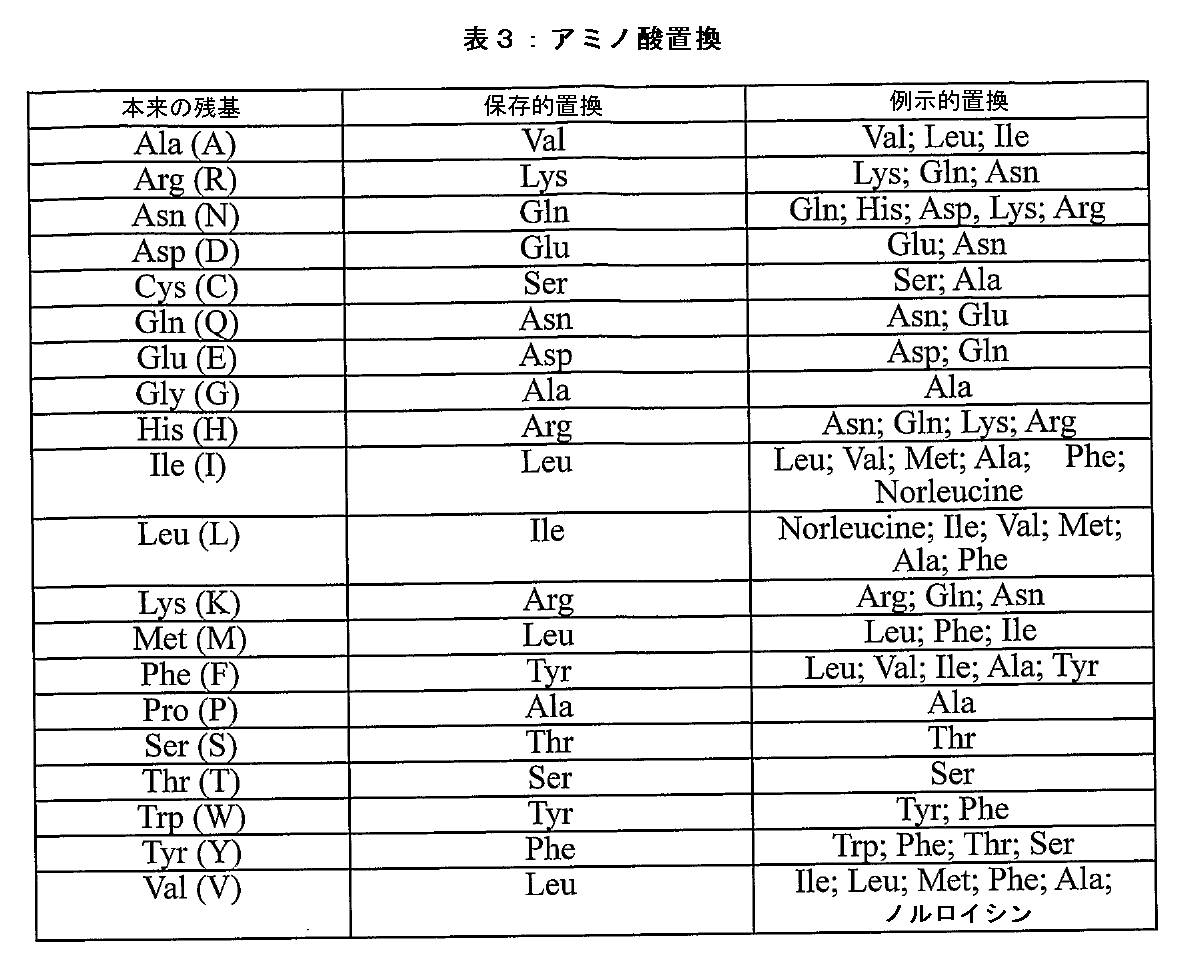
(1)疎水性:ノルロイシン、Met、Ala、Val、Leu、Ile;
(2)中性親水性:Cys、Ser、Thr;
(3)酸性:Asp、Glu;
(4)塩基性:Asn、Gln、His、Lys、Arg;
(5)鎖配向に影響を及ぼす残基:Gly、Pro;および
(6)芳香族:Trp、Tyr、Phe。
ある実施態様において、本発明は前記抗体とトリプトライドとが結合してなる複合体に関する。トリプトライドはIUPAC名(3bS、4aS、5aS、6R、6aR、7aS、7bS、8aS、8bS)-6-Hydroxy-6a-isopropyl-8b-methyl-3b、4、4a、6、6a、7a、7b、8b、9、10-decahydrotrisoxireno[6、7:8a、9:4b、5]phenanthro[1、2-c]furan-1(3H)-oneであり、下記式で表される構造を有する:


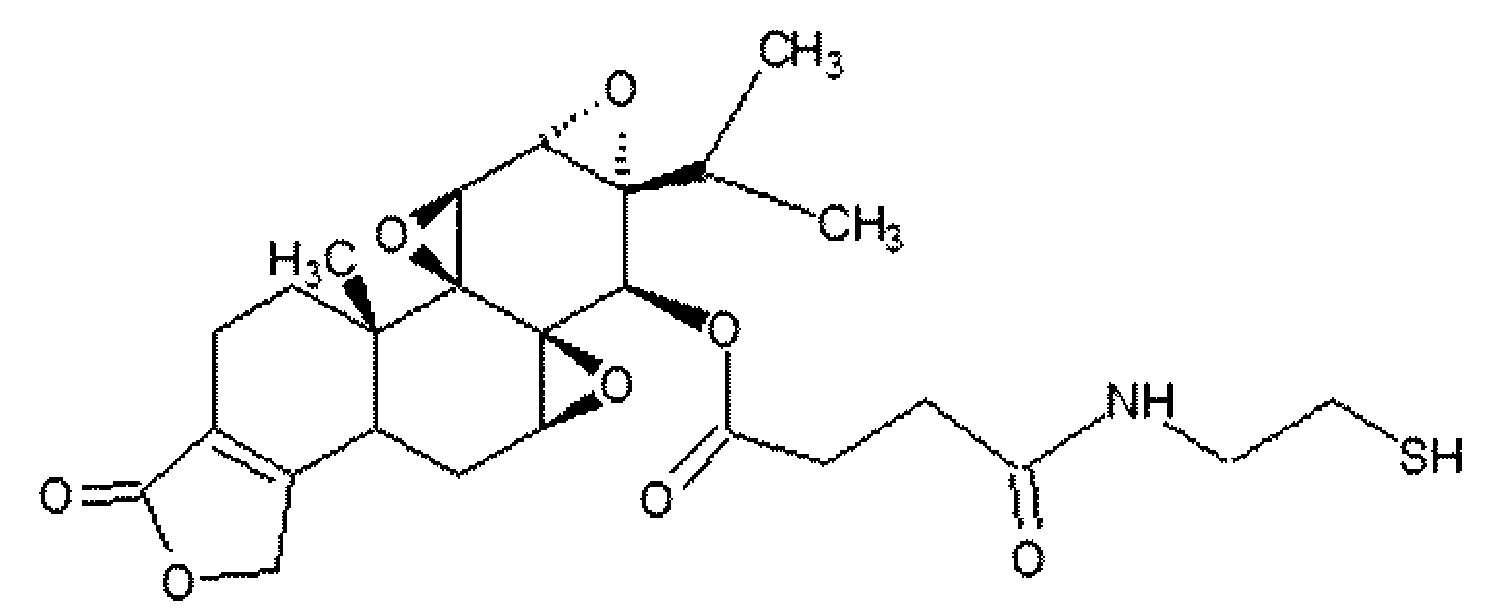

本発明は、更に、前記抗体と他の抗腫瘍剤との併用剤に関する。前記抗体と併用可能な抗腫瘍剤としては、シクロホスファミド、イホスファミド、メルファラン、ブスルファン、チオテパ等のナイトロジェンマスタード類、及び、ニムスチン、ラニムスチン、ダカルバシン、プロカルバシン、テモゾロミド、カルムスチン、ストレプトゾトシン、ベンダムスチン等のニトロウレア類を含むアルキル化薬;シスプラチン、カルボプラチン、オキサリプラチン、ネダプラチンなどの白金化合物;エノシタビン、カペシタビン、カルモフール、クラドリビン、ゲムシタビン、シタラビン、シタラビンオクホスファート、デカフール、デカフール・ウラシル、デカフール・ギメラシル・オテラシルカリウム、ドキシフルリジン、ネララビン、ヒドロキシカルバミド、5-フルオロウラシル(5-FU)、フルダラビン、ペメトレキシド、ペントスタチン、メルカプトプリン、メトトレキサートなどの代謝拮抗薬;イリノテカン、エトポシド、エリブリン、ソブゾキサン、ドセタキセル、ノギテカン、パクリタキセル、ビノレルビン、ビンクリスチン、ビンデシン、ビンブラスチンなどの植物アルカロイド又は微小管阻害薬;アクチノマイシンD、アクラルビシン、アムルビシン、イダルビシン、エピルビシン、ジノスタチンスチマラマー、ダウノルビシン、ドキソルビシン、ピラルピシン、ブレオマイシン、ペプロマイシン、マイトマイシンC、ミトキサントロン、リポソーマルドキソルビシンなどの抗癌性抗生物質;シプリューセル-T等の癌ワクチン;イブリツモマブチウキセタン、イマチニブ、エベロリムス、エルロチニブ、ゲフィチニブ、ゲムツズマブオゾガマイシン、スニチニブ、セツキシマブ、ソラフェニブ、ダサチニブ、タミバロテン、トラスツズマブ、トレチノイン、パニツムマブ、ベバシズマブ、ボルテゾミブ、ラパチニブ、リツキシマブ等の分子標的薬;アナストロゾール、エキセメスタン、エストラムスチン、エチニルエストラジオール、クロルマジノン、ゴセレリン、タモキシフェン、デキサメタゾン、トレミフェン、ビカルタミド、フルタミド、ブレドニゾロン、ホスフェストロール、ミトタン、メチルテストステロン、メドロキシプロゲステロン、メピチオスタン、リュープロレリン、レトロゾールなどのホルモン剤;インターフェロンα、インターフェロンβ、インターフェロンγ、インターロイキン、ウベニメクス、乾燥BCG、レンチナンなどの生物学的応答調節剤を挙げることができ、好ましくは、シスプラチン、ペメトレキシド、ゲムシタビンであり、より好ましくは、ゲムシタビンである。
本発明の複合体又は併用剤は、治療方法、悪性細胞の溶解方法を含む様々な適用に有用であるが、これらに限定されるものではない。例えば、本発明は、本発明の複合体又は併用剤を有効成分として含有する医薬組成物、悪性中皮腫治療薬、悪性中皮腫細胞の増殖阻害剤、悪性中皮腫細胞の溶解剤を含む。又は、本発明は、医薬組成物、悪性中皮腫治療薬、悪性中皮腫細胞の増殖阻害剤、悪性中皮腫細胞の溶解剤として使用するための本発明の複合体又は併用剤であってもよい。あるいは、本発明は、医薬組成物、悪性中皮腫治療薬、悪性中皮腫細胞の増殖阻害剤、悪性中皮腫細胞の溶解剤の製造における、本発明の複合体の使用又は抗CD26抗体及び抗腫瘍剤の使用であってもよい。一態様では本発明は、有効量の本発明の複合体又は併用剤をそれを必要とする患者に投与することを備える、悪性中皮腫の治療方法、悪性中皮腫細胞の増殖阻害方法、悪性中皮腫細胞の溶解方法を含む。よって、本発明は、CD26発現細胞の増殖を阻害する方法も提供する。CD26発現細胞の増殖阻害は、部分的な増殖阻害ないし完全な増殖阻害を含む、観察可能なあらゆるレベルの阻害を含む。ある実施態様では、細胞増殖は、少なくとも約10%、少なくとも約25%、少なくとも約50%、少なくとも約75%、少なくとも約90%、少なくとも約95%、少なくとも約98%、または約100%阻害される。本方法は、in vitroまたはin vivoで行ってもよい。ある実施態様では、方法は、細胞を本明細書中に記載される複合体又は併用剤と接触させる工程を含む。一般には、細胞増殖を阻害するのに十分な量の複合体又は併用剤と細胞とを接触させる。
更に別の態様において、本発明は、抗CD26抗体と併用することにより相乗的効果を示す化合物のスクリーニング方法に関する。本発明のスクリーニング方法は、CD26とCD9は相互作用を行い、互いにcounterしている(Okamotoら、PLOS One(2014)9(1):e86671)ことに基づく。候補化学療法剤がCD26と相互作用している場合にはその効果がCD9により減弱されることから、CD26とCD9を共発現している細胞株とCD26を発現しているがCD9を発現していない細胞株との間で増殖抑制効果に差がある場合には、抗CD26抗体との併用により相乗的効果を相する薬物であると決定することができる。具体的には、本発明のスクリーニング方法は、
抗CD26抗体と併用することにより相乗的な抗腫瘍効果を呈する化合物のスクリーニング方法であって、以下のステップを備える方法:
(a)CD26とCD9を共発現している腫瘍細胞株、及び、CD26を発現しているがCD9を発現していない細胞株を被検化合物の存在下で培養するステップ;
(b)培養後の前記各々の腫瘍細胞株の細胞数を測定するステップ;
(c)前記被検化合物のCD26とCD9を共発現している腫瘍細胞株の増殖抑制効果、及び、前記被検化合物のCD26を発現しているがCD9を発現していない細胞株の増殖抑制効果を算出するステップ;
(d)前記被検化合物のCD26とCD9を共発現している腫瘍細胞株の増殖抑制効果、及び、前記被検化合物のCD26を発現しているがCD9を発現していない細胞株の増殖抑制効果を比較し、CD26を発現しているがCD9を発現していない細胞株の増殖抑制効果の方が優れる場合には、前記被検化合物は抗CD26抗体と併用することにより相乗的な抗腫瘍効果を呈する可能性が高い化合物として選択するステップ。
(1)原料
ヒト化抗CD26抗体YS110は、既に報告された手法により抗CD26マウス抗体14D10を元として設計し、発現させた(国際公開公報WO2007/014169);Inamoto Tら、Clin Cancer Res(2007)13:4191-200参照)。以下の構造を有するトリプトライド(triptolide)(Molecular Formula: C20H24O6;MW=360.4)は、Shaanxi Taiji Technology(陝西省、中国)から購入した。

ChemGenesis Inc.(東京、日本)により、トリプトライドにSH基を導入した。得られたトリプトライド誘導体をTR1と命名した。TR1は科学的安定性を高めるため、以下の構造を有するS-S結合で結合した二量体として提供された。
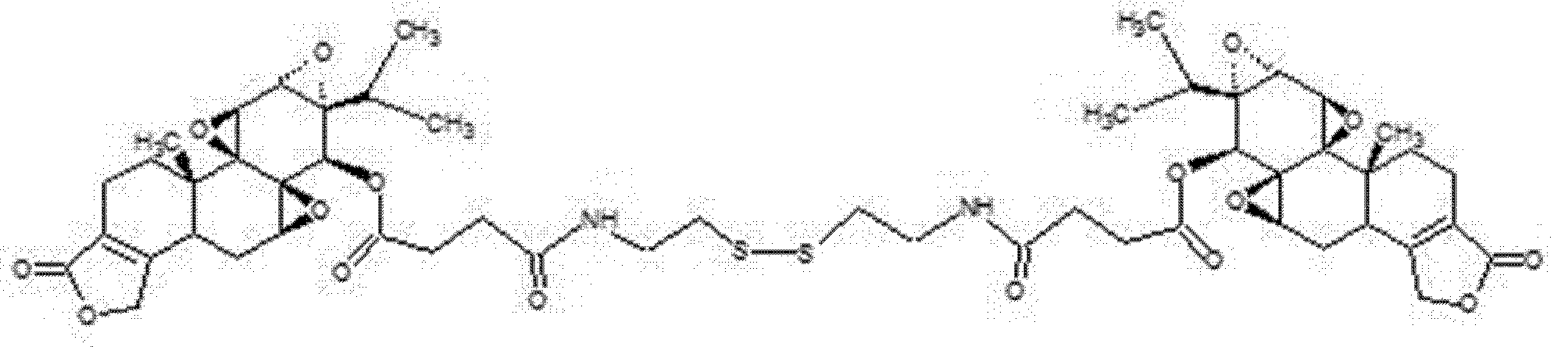
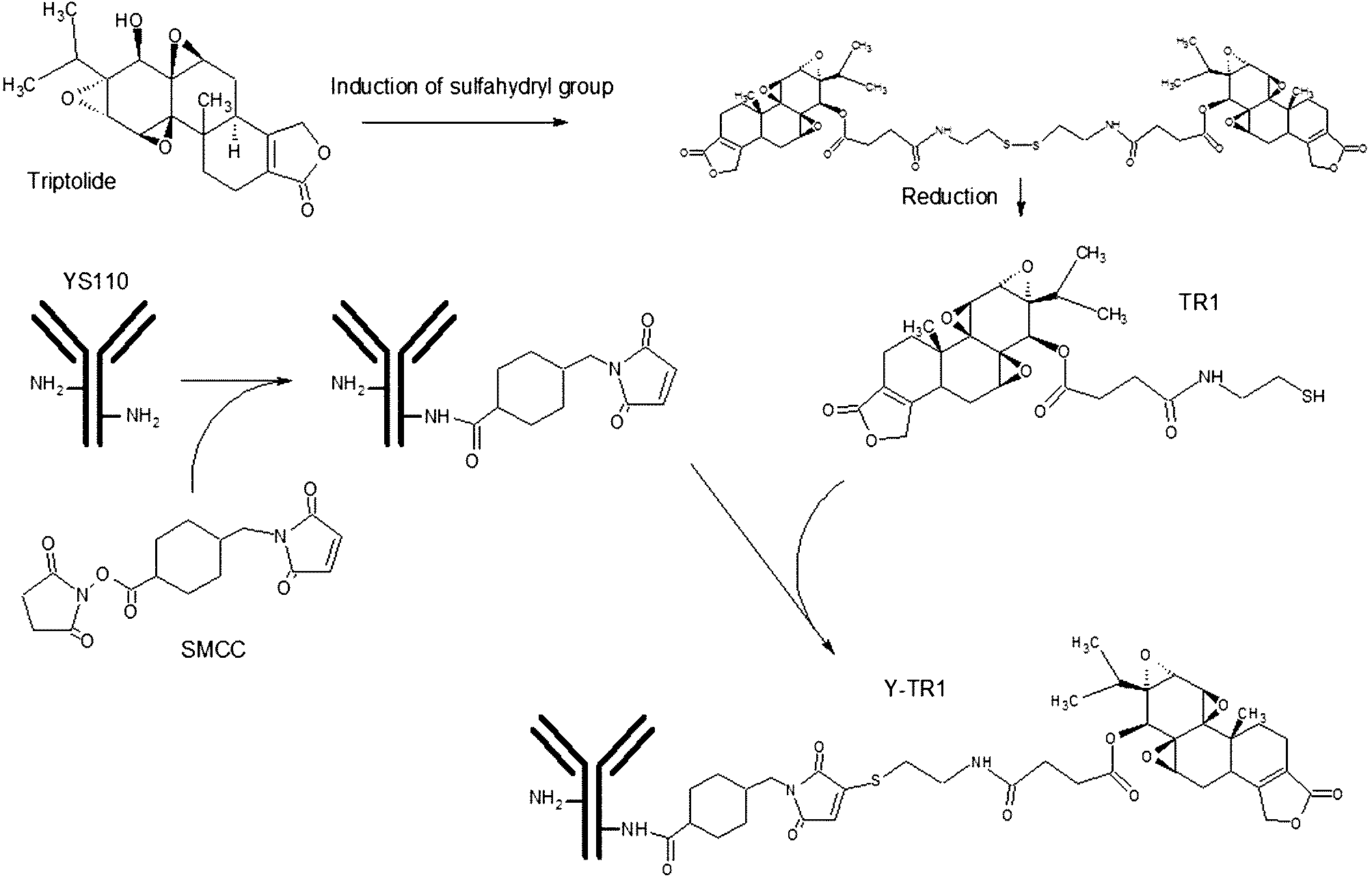
前記方法に従って、ヘテロ二価性リンカー(SPDP、GMBS、SMCC)を用いてYS110とTR1を結合させた。BCA protein assay reagent kit(Thermo Scientific Inc.、Waltham、MA)により測定された最終産物濃度は約1mg/mlであった。DTNB assayにより産物中の残存非結合TR1-SHを測定したが、ほとんど検出できなかった(データ非図示)。
CD26陰性悪性中皮腫細胞株であるMSTO-211H(MSTO)(American Type Cell Culture Collection、Manassas、VA)にCD26遺伝子を導入し、MSTO-clone12と名づけた(Aoe Kら、Clin Cancer Res.(2012)18:1447-56)。CD26陰性T細胞系白血病細胞株であるJurkat(American Type Cell Culture Collection、Manassas、VA)にCD26遺伝子を導入し、Jurkat CD26(+)と名づけた(Tanaka Tら、Proc Natl Acad Sci USA(1993)90:4586-90)。悪性中皮腫から樹立したCD26陽性細胞株JMNは、東京大学医科学研究所の森本 幾夫先生から提供いただいた。全ての細胞株は、10%熱不活化ウシ胎児血清(FBS、Life Technologies、Carlsbad、CA)、ABPC(100μg/ml)、及びStreptomycin(100μg/ml)含有RPMI培地(カタログ番号11875-093、Life Technologies、Carlsbad、CA)中、37℃、5%CO2環境下で培養した。
(実施例3)マススペクトルアッセイ
Y-TR1の薬剤/抗体比は、限外ろ過の後、Autoflex III(Bruker Corporation、Billerica、MA)を用いて、マトリックス支援レーザー脱離イオン化法(MALDI-TOFmass)により分析した。
Y-TR1のCD26陽性悪性中皮腫細胞結合を調べるため、培養したMSTO-wt細胞(CD26陰性)及びMSTO-clone12細胞(CD26陽性)を回収し、1×10⁶細胞を1μg/ml、10μg/ml、100μg/mlのY-TR1と共に4℃で30分間培養した。細胞を3回洗浄し、1:100希釈でFITC結合ウサギ抗ヒトIgG(カタログ番号6140-02、Southern Biotech、Birmingham、AL)と共に4℃で30分間培養した。3回洗浄後、Epics XL-MCL(Beckman Coulter、Brea、CA)を用いて、FACS分析を行った。
トリプトライド、YS110及びY-TR1の悪性中皮腫細胞株及びT細胞系白血病細胞株に対する細胞毒性は、ホルマザン色素の比色検出に基づくcolorimetric cell proliferation kit WST-1(カタログ番号11644807001、Roche Applied Science、Rotkreuz、Switzerland)を用いて測定した。概略としては、5×10³細胞のMSTO-wt、MSTO-clone12、JMN、Jurkat CD26(-)、及びJurkat CD26(+)細胞を、10%熱不活化ウシ胎児血清、ABPC(100μg/ml)及びStreptomycin(100μg/ml)含有RPMI培地中、96ウェルプレート内で、トリプトライド(0~100nM)、TR1(0~100nM)、YS110(0~100μg/ml)、又はY-TR1(0~100ug/ml)と共に、37℃、5%CO2環境下で48時間培養した。WST-1アッセイは、製造者が提供するマニュアルに従って実施した。各サンプルの630nmにおけるバックグラウンド吸光度を450nmにおける測定値から差し引いた。実験はトリプリケートで行い、代表的な結果を示した。
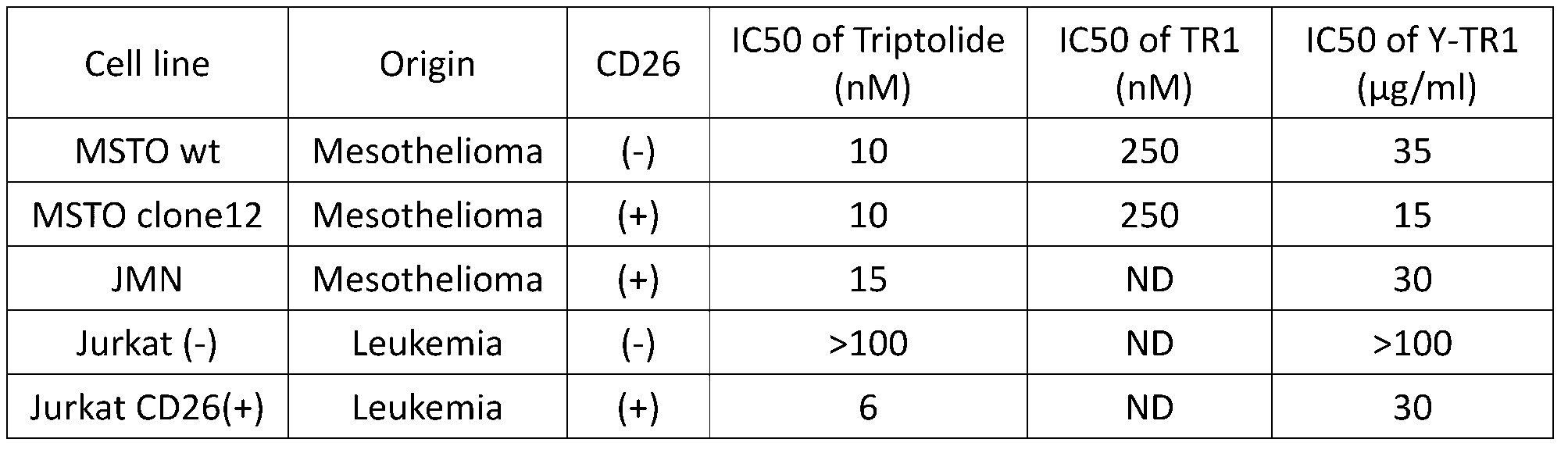

NOD/SCID(NOD/LtSz-scid)マウスを特定病原体不在(SPF)施設内のマイクロアイソレーターケージで維持し、滅菌食及び滅菌水を自由摂取させた。動物実験プロトコルは動物実験委員会の承認を得て行った。
1×10⁷細胞の培養JMN細胞を6-8週齢のメスNOD/SCIDマウスに皮下投与した。全部で30匹の動物をランダムに3種類の治療群、すなわち、対照群、YS110投与群、及びY-TR1投与群に分けた。移植日からYS110及びY-TR1群は4mg/kg/doseのYS110又はY-TR1を腹膜内に週3回投与し、全部で9回投与した。対照群は同量のPBSを投与した。腫瘍が明らかに目視できる用になった時点で腫瘍を摘出し、大きさをノギスで計測した。推定腫瘍体積は、式:π/6×L×W×Wを計算して求めた(Tomayko MMら、Cancer Chemother Pharmacol.(1989)24:148-54)。各群の平均腫瘍体積間の統計的有意性は、フィッシャーのPLSD多重比較法(Fisher’s protected least-square differences(PLSD)multiple comparison test)を用いて決定した。統計分析はSPSSソフトウェア(IBM、Armonk、NY)を用いて行った。
中皮腫細胞株におけるCD26発現をFACSにより測定して確認した。CD26陽性中皮腫細胞株のうち、肉腫型中皮腫細胞株としてACC-MESO1、JMNを、上皮型中皮腫細胞株としてNCI-H2452、NCI-H226を使用した。ACC-MESO1、JMN、NCI-H2452、NCI-H226細胞を抗CD26モノクローナル抗体-FITCで染色後、FACS解析した。
結果を図8に示す。実験した全ての細胞株において、CD26が発現していることが確認された。
(1)シスプラチン及びペメトレキシドの用量作用曲線
MESO1、H2452細胞(2×10³/well)を96ウェルプレートに撒いた1時間後にシスプラチン又はペメトレキシドを10-9、10-8、10-7、10-6、10-5、10-4Mで添加した(n=6)。2日目にMTT assayを行った。
結果を図9に示す。シスプラチン及びペメトレキシドは用量依存的にMESO1、H2452の増殖を抑制した。
MESO1細胞(2×10³/well)を96ウェルプレートに撒いた1時間後に、シスプラチン0.3、3、10μMとYS110の0.1、3、10μg/mlとの組み合わせ、又は、ペメトレキシド0.03、0.3、1μMとYS110の0.1、3、10μg/mlとの組み合わせを添加した。2日目にMTT assayを行った。有意差検定はTwo-tailed t-test(vs Cont)を用いて行った。
結果を図10に示す。YS110はシスプラチンおよびペメトレキシドの細胞増殖抑制効果を増強した。
ペメトレキシド
H2452細胞(2×10³細胞/ウェル)を96ウェルプレートに撒いた1時間後、シスプラチン0.03、0.3、1μMとYS110の0.1、3、10μg/mlとを組み合わせ、又は、ペメトレキシド0.01、0.1、0.3μMとYS110の0.1、3、10μg/mlを組み合わせを添加した(n=6)。2日目にMTT assayを行った。有意差検定はTwo-tailed t-test(vs Cont)を用いて行った。
結果を図11に示す。YS110はシスプラチンおよびペメトレキシドの細胞増殖抑制効果を増強した。
MESO1細胞(2×10³細胞/well)又はH2452細胞(2×103細胞/well)を96ウェルプレートに撒いた1時間後、シスプラチン0.3μM-ペメトレキシド0.1μMの組み合わせ、又は、YS110(10μg/ml)をシスプラチン0.3μM-ペメトレキシド0.1μMに追加した組み合わせを添加した(n=6)。2日目にMTTassayを行った。有意差検定はTwo-tailed t-test(vs Cont)を用いて行った。
結果を図12に示す。YS110はシスプラチン-ペメトレキシドの細胞増殖抑制効果を増強した。
JMN細胞(3×10⁵細胞/匹)をメスSCIDマウスの背部皮下に移植した。移植した日を0日目として、1日目と4日目の2回、YS110(10mg/kg)単独、シスプラチン(0.5mg/kg)単独、ペメトレキシド(50mg/kg)単独、シスプラチン(0.5mg/kg)とYS110(10mg/kg)との併用、又は、ペメトレキシド(50mg/kg)とYS110(10mg/kg)との併用を腹腔内投与した。7日目に腫瘍を摘出し、腫瘍重量を測定した。有意差検定はTwo-tailed t-test(vs Cont)により行った。
結果を図13に示す。YS110はシスプラチンおよびペメトレキシドのin vivにおける腫瘍増殖抑制効果を増強した。
JMN細胞(5×10³細胞/匹)をメスSCIDマウスの背部皮下に移植した。移植した日を0日目として、1日目と4日目の2回、シスプラチン(0.5mg/kg)-ペメトレキシド(50mg/kg)併用、YS110(10mg/kg)単独、又は、前記シスプラチン-ペメトレキシド併用とYS110(10mg/kg)との併用を腹腔内投与した。7日目に腫瘍を摘出し、腫瘍重量を測定した。有意差検定はTwo-tailed t-test(vs Cont)により行った。
結果を図14に示す。YS110はシスプラチン-ペメトレキシドのin vivoにおける腫瘍増殖抑制効果を増強した。
MESO1細胞(3×10⁵細胞/匹)をメスSCIDマウスの背部皮下に移植した。移植した日を0日目として、1日目と4日目の2回、YS110(10mg/kg)単独、シスプラチン(0.5mg/kg)-ペメトレキシド(50mg/kg)併用、又は、前記シスプラチン-ペメトレキシド併用とYS110(10mg/kg)との併用を腹腔内投与した。7日目に腫瘍を摘出し、腫瘍重量を測定した。有意差検定はTwo-tailed t-test(vs Cont)により行った。
結果を図15に示す。YS110はMESO1細胞においてシスプラチン-ペメトレキシドのin vivoにおける腫瘍増殖抑制効果を増強した。
H2452細胞(3×10⁵細胞/匹)をメスSCIDマウスの背部皮下に移植した。移植した日を0日目として、1日目と4日目の2回、YS110(10mg/kg)単独、シスプラチン(0.5mg/kg)-ペメトレキシド(50mg/kg)併用、又は、前記シスプラチン-ペメトレキシド併用とYS110(10mg/kg)との併用を腹腔内投与した。7日目に腫瘍を摘出し、腫瘍重量を測定した。有意差検定はTwo-tailed t-test(vs Cont)により行った。
結果を図16に示す。YS110はH2452細胞においてシスプラチン-ペメトレキシドのin vivoにおける腫瘍増殖抑制効果を増強した。
(1)シスプラチンおよびペメトレキシドの細胞浸潤に対する作用
MESO1細胞又はH2452細胞(2.5×10⁴細胞/ウェル)をBoyden chamberに撒いた1時間後、シスプラチン(5、10、30μM)又はペメトレキシド(1、10、30μM)を添加して(n=5)、Boyden chamber invasion assayを行った。細胞播種から24時間後に浸潤細胞をDiff-Qick-staining kitで染色した。有意差検定はTwo-tailed t-test(vs Cont)により行った。
結果を図17に示す。シスプラチンは10および30μMにおいてinvasionを抑制した。一方、ペメトレキシドは30μMにおいてもinvasionに対して抑制作用を示さなかった。
MESO1細胞又はH2452細胞(2.5×10⁴細胞/ウェル)をBoyden chamberに撒いた1時間後、シスプラチン(0、3、10μM)とペメトレキシド(0、10、30μM)とを組み合わせを添加して(n=5)、Boyden chamber invasion assayを行った。細胞播種から24時間後に浸潤細胞をDiff-Qick-staining kitで染色した。有意差検定はTwo-tailed t-test(vs Cont)により行った。
結果を図18に示す。シスプラチンは10μMにおいて細胞浸潤を抑制したがペメトレキシドは30μMにおいてもシスプラチンによる細胞浸潤抑制効果を増強しなかった。したがって、シスプラチンにペメトレキシドを組み合わせても細胞浸潤に対する抑制効果は増強されず、細胞浸潤に対してはシスプラチンとシスプラチン-ペメトレキシドは同等であることが示された。
MESO1細胞(2.5×10⁴細胞/ウェル)をBoyden chamberに撒き、1時間後にシスプラチン(0、3、10μM)とYS110(0、10、20μg/ml)の組み合わせを添加して(n=5)、Boyden chamber invasion assayを行った。細胞播種から24時間後に浸潤細胞をDiff-Qick-staining kitで染色した。有意差検定はTwo-tailed t-test(vs Cont)により行った。次にYS110と シスプラチン-ペメトレキシドの併用における交互作用を検討した。交互作用はTwo-way ANOVAで解析した。
結果を図19に示す。YS110はシスプラチン-ペメトレキシドの細胞浸潤抑制作用を増強した(A)。YS110(10μg/ml)+シスプラチン(10μM)、およびYS110(20μg/ml)+シスプラチン(10μM)の組み合わせにおいて交互作用があった(B)。
H2452細胞(2.5×10⁴細胞/ウェル)ををBoyden chamberに撒き、1時間後にシスプラチン(0、3、10μM)とYS110(0、10、20μg/ml)の組み合わせを添加して(n=5)、Boyden chamber invasion assayを行った。細胞播種から24時間後に浸潤細胞をDiff-Qick-staining kitで染色した。有意差検定はTwo-tailed t-test(vs Cont)により行った。次にYS110とシスプラチン-ペメトレキシドの併用における交互作用を検討した。交互作用はTwo-way ANOVAで解析した。
結果を図20に示す。YS110はシスプラチン-ペメトレキシドの細胞浸潤抑制作用を相乗的に増強した(A)。YS110(10μg/ml)+シスプラチン(10μM)、およびYS110(20μg/ml)+シスプラチン(10μM)の組み合わせにおいて交互作用があった(B)。
(1)中皮腫細胞株におけるゲムシタビンの用量作用曲線
中皮腫細胞株の増殖に対するゲムシタビンの効果を検討した。中皮腫細胞株MESO1、JMN、H2452、H226(2×10³細胞/ウェル)を96ウェルプレートに撒いた1時間後、ゲムシタビン(10-9、10-8、10-7、10-6、10-5、10-4M)を添加した(N=6)。2日後にMTT assayを行った。有意差検定はTwo-tailed t-test(vs Cont)により行った。
結果を図21に示す。ゲムシタビンはJMN、H226においてより強く増殖を抑制した。
MESO1細胞(2×10³細胞/well)を96ウェルプレートに撒いた1時間後、ゲムシタビン(0、10-8、3×10-8、10-7M)とYS110(0、1、3、10μg/ml)を組み合わせて添加した。2日目にMTT assayを行った。有意差検定はTwo-tailed t-test(vs Cont)により行った。次に薬物併用における交互作用を検討した(n=6)。YS110とゲムシタビンの併用における交互作用はTwo-way ANOVAで解析した。
結果を図22に示す。ゲムシタビンの増殖抑制効果はYS110により増強された(A)。また、ゲムシタビン(10-8M)とYS110(3μg/ml)の組み合わせにおいて交互作用が認められた(B)。
JMN細胞(2×10³細胞/ウェル)を96ウェルプレートに撒いた1時間後、ゲムシタビン(0、3×10-10、10-9、3×10-8M)とYS110(0、1、3、10μg/ml)を組み合わせて添加した。2日目にMTT assayを行った。有意差検定はTwo-tailed t-test(vs Cont)により行った。次に薬物併用における交互作用を検討した(n=6)。YS110とゲムシタビンの併用における交互作用はTwo-way ANOVAで解析した。
結果を図23に示す。ゲムシタビンの増殖抑制効果はYS110により増強された(A)。また、ゲムシタビン(3×10⁻⁸M)とYS110(3μg/ml)、およびゲムシタビン(3×10-8M)とYS110(10μg/ml)の組み合わせにおいて交互作用が認められた(B)。
H2452細胞(2×10³細胞/ウェル)を96ウェルプレートに撒いた1時間後、ゲムシタビン(0、10-8、3×10-8、10-7M)とYS110(0、1、3、10μg/ml)を組み合わせて添加した。2日目にMTT assayを行った。有意差検定はTwo-tailed t-test(vs Cont)により行った。次に薬物併用における交互作用を検討した(n=6)。YS110とゲムシタビンの併用における交互作用はTwo-way ANOVAで解析した。
結果を図24に示す。ゲムシタビンの増殖抑制効果はYS110により増強された(A)。また、ゲムシタビン(10-7M)とYS110(3μg/ml)の組み合わせにおいて交互作用が認められた(B)。
H226細胞(2×10³細胞/ウェル)を96ウェルプレートに撒いた1時間後、ゲムシタビン(0、10-8、3×10-8、10-7M)とYS110(0、1、3、10μg/ml)とを組み合わせて添加した。2日目にMTT assayを行った。有意差検定はTwo-tailed t-test(vs Cont)により行った。次に薬物併用における交互作用を検討した(n=6)。YS110とゲムシタビンの併用における交互作用はTwo-way ANOVAで解析した。
結果を図25に示す。ゲムシタビンの増殖抑制効果はYS110により増強された(A)。また、ゲムシタビン(10-8M)とYS110(3μg/ml)の組み合わせ、ゲムシタビン(3×10-8M)とYS110(3μg/ml)の組み合わせ、ゲムシタビン(3×10-8M)とYS110(10μg/ml)の組み合わせにおいて交互作用が認められた(B)。
MESO1、JMN、H2452およびH226細胞(2×10³細胞/ウェルを96ウェルプレートに撒いた1時間後、シスプラチン(0、0.1、0.3、1μM)とペメトレキシド(0、0.03、0.1、0.3μM)の組み合わせに、ゲムシタビン3×10-8M、又は10-7Mを併用して添加した(n=6)。2日目にMTT assayを行った。
結果を図26に示す。シスプラチン-ペメトレキシドの組み合わせに対するゲムシタビンの併用はシスプラチン-ペメトレキシドの増殖抑制作用を増強しなかった。
メスSCIDマウス背部皮下にH226を移植(3.8×10⁵細胞/匹)した。移植した日を0日目として、2日目と4日目の2回、YS110(10mg/kg)、ゲムシタビン(20mg/kg)、又は、YS110(10mg/kg)+ゲムシタビン(20mg/kg)を腹腔内に投与した(n=6)。7日目に腫瘍を摘出し、腫瘍重量を測定した。有意差検定はTwo-tailed t-test(vs Cont)により行った。YS110とゲムシタビンの併用における交互作用はTwo-way ANOVAで解析した。
結果を図27に示す。YS110単独、ゲムシタビン単独、YS110+ゲムシタビンの各群はそれぞれ34%、29%、および88%の抑制効果を示し、それぞれ有意な抑制効果を示した。また、YS110とゲムシタビンの併用には交互作用が認められた。
メスSCIDマウスの背部皮下にH226細胞を移植した(3×10⁵細胞/匹)。移植した日を0日目として、2日目と4日目の2回、YS110(10mg/kg)、ゲムシタビン(10mg/kg)、又はYS110(10mg/kg)+ゲムシタビン(10mg/kg)を腹腔内に投与した(n=6)。7日目に腫瘍を摘出し、腫瘍重量を測定した。有意差検定はTwo-tailed t-test(vs Cont)により行った。YS110とゲムシタビンの併用における交互作用はTwo-way ANOVAで解析した。
結果を図28に示す。YS110単独、ゲムシタビン単独、YS110+ゲムシタビンの各群はそれぞれ34%、29%、および88%の抑制効果を示し、それぞれ有意な抑制効果を示した。また、YS110とゲムシタビンの併用には交互作用が認められた。
(1)CD26陽性肺癌細胞株HCC827のin vivo増殖に対するYS110とシスプラチン-ペメトレキシドの併用
メスSCIDマウスの背部皮下にHCC827細胞を移植した(1.8×10⁵細胞/匹)。移植した日を0日目として、1日目にYS110(10mg/kg)単独、シスプラチン(0.5mg/kg)+ペメトレキシド(50mg/kg)、又は、YS110(10mg/kg)+シスプラチン(0.5mg/kg)+ペメトレキシド(50mg/kg)を腹腔内に投与し、4日目に1日目と同じ薬剤を同量、同じ方法で投与した(n=6)。7日目に腫瘍を摘出し、腫瘍重量を測定した。有意差検定はTwo-tailed t-test(vs Cont)により行った。
結果を図29に示す。YS110はシスプラチン-ペメトレキシドの効果を増強した。
メスSCIDマウスの背部皮下にHCC827細胞を移植した(0.5×10⁵細胞/匹)。移植した日を0日目として、1日目と4日目の2回、YS110(10mg/kg、腹腔内投与)、ゲフィチニブ(100mg/kg、経口投与)、又は、YS110(10mg/kg、腹腔内投与)+ゲフィチニブ(100mg/kg、経口投与)を投与した。7日目に腫瘍を摘出し、腫瘍重量を測定した。有意差検定はTwo-tailed t-test(vs Cont)により行った。
結果を図30に示す。YS110はゲフィチニブの効果を増強した。
メスSCIDマウスの背部皮下にHCC827細胞を移植した(0.9×10⁵細胞/匹)。移植した日を0日目として、1日目と4日目の2回、YS110(10mg/kg、腹腔内投与)、ゲフィチニブ(100mg/kg、経口投与)およびYS110(10mg/kg、腹腔内投与)+ゲフィチニブ(100mg/kg、経口投与)を投与した。7日目に腫瘍を摘出し、腫瘍重量を測定した。有意差検定はTwo-tailed t-test(vs Cont)により行った。
結果を図31に示す。YS110はゲフィチニブの効果を増強した。
薬物療法における相乗効果は互いの関与分子が相互作用していることによりもたらされると考えられる。したがって、ある化学療法剤がCD26と相互作用しながら抗癌効果を発揮している場合にはCD26抗体との併用で相乗効果の期待できる可能性が考えられる。CD26とCD9は相互作用を行い、互いにcounterしている(Okamotoら、PLOS One(2014)9(1):e86671)。したがってある化学療法剤がCD26と相互作用している場合にはその効果がCD9により減弱される可能性がある。よって、CD26とCD9を共発現している中皮腫細胞株MESO1、H2452とCD26を発現しているがCD9を発現していない細胞株JMN、H226を用いて化学療法剤がCD26抗体との併用により相乗効果が期待できるかどうかのスクリーニング系設定の検討を行った。
MESO1、JMN細胞株を用いて、シスプラチン(10-9~10-4M)及びペメトレキシド(10-9~10-4M)の増殖抑制効果を比較した。
結果を図32に示す。A:シスプラチンの増殖抑制効果を比較した結果、シスプラチンの増殖抑制効果はMESO1、JMN間で差がなかった。B:ペメトレキシドの増殖抑制効果を比較した結果、ペメトレキシドの増殖抑制効果はMESO1、JMN間で差がなかった。したがって抗CD26抗体とシスプラチンとの併用、抗CD26抗体とペメトレキシドとの併用では相乗効果が期待されない可能性が示唆された。
MESO1、H2452、JMN、H226細胞株を用いて、ゲムシタビン(10-9~10-4M)の増殖抑制効果を比較した。
結果を図33に示す。A:ゲムシタビンの増殖抑制効果をMESO1、JMNで比較した結果、ゲムシタビンはJMNにおいてMESO1においてよりも有意に強い増殖抑制効果を示した。B:ゲムシタビンの増殖抑制効果をH2452、H226で比較した結果、ゲムシタビンはH226においてH2452においてよりも有意に強い増殖抑制効果を示した。ゲムシタビンはMESO1とJMN、H2452とH226間での比較においてCD9の発現していないJMN、H226では強い増殖抑制効果が観察された。したがって、抗CD26抗体とゲムシタビンの併用では相乗効果の期待できる可能性が示唆された。
Claims (30)
- 抗CD26抗体又はその断片とトリプトライドとが結合してなる複合体。
- 抗CD26抗体又はその断片が、ヒト化抗体又はその断片である、請求項1に記載の複合体。
- 前記ヒト化抗体又はその断片が、配列番号8~14からなる群から選択されるアミノ酸配列と80%以上の同一性を有するアミノ酸配列を含む重鎖可変領域、および配列番号1~7からなる群から選択されるアミノ酸配列と80%以上の同一性を有するアミノ酸配列を含む軽鎖可変領域を含むものである、請求項2記載の複合体。
- 前記ヒト化抗体又はその断片が、配列番号1~7からなる群から選択されるアミノ酸配列と80%以上の同一性を有するアミノ酸配列を含む重鎖可変領域、および配列番号8~14からなる群から選択されるアミノ酸配列と80%以上の同一性を有するアミノ酸配列を含む軽鎖可変領域を含むものである、請求項2に記載の複合体。
- 前記ヒト化抗体又はその断片が、配列番号17で示されるアミノ酸配列と90%以上の配列同一性を有するアミノ酸配列を含む少なくとも1本の重鎖、および配列番号18で示されるアミノ酸配列と90%以上の配列同一性を有するアミノ酸配列を含む少なくとも1本の軽鎖を含む、請求項2に記載の複合体。
- 前記ヒト化抗体又はその断片が、配列番号17で示されるアミノ酸配列のうち第20~465番目のアミノ酸配列を含む少なくとも1本の重鎖、および配列番号18で示されるアミノ酸配列のうち第21~234番目のアミノ酸配列を含む少なくとも1本の軽鎖を含む、請求項2に記載の複合体。
- 前記ヒト化抗体又はその断片が、配列番号19~28からなる群から選択される1つ以上のペプチドに結合する、請求項2~請求項6のいずれか1項に記載の複合体。
- 前記ヒト化抗体が、American Type Culture Collection(ATCC)の受託番号PTA-7695を有し、s604069.YST-pABMC148(x411)と命名された株により生産される、請求項2に記載の複合体。
- 前記断片が、Fab、Fab’、Fab’-SH、Fv、scFv、およびF(ab’)2からなる群から選択されるものである、請求項1~請求項8のいずれか1項に記載の複合体。
- 請求項1~9のいずれか1項に記載の複合体を有効成分として含有する医薬組成物。
- 悪性中皮腫の治療用である、請求項10に記載の医薬組成物。
- 請求項1~9のいずれか1項に記載の複合体を含む、悪性中皮腫細胞の増殖阻害剤。
- 請求項1~9のいずれか1項に記載の複合体を含む、悪性中皮腫細胞の溶解剤。
- 悪性中皮腫の治療用の医薬組成物の製造における、請求項1~9のいずれか1項に記載の複合体の使用。
- 抗CD26抗体又はその断片と抗腫瘍剤とを含有する、医薬組成物。
- 抗腫瘍剤が、シスプラチン、ペメトレキシド、ゲフェニチブ、及びゲムシタビンからなる群から選択される1以上の薬剤である、請求項15に記載の医薬組成物。
- 抗CD26抗体又はその断片が、ヒト化抗体又はその断片である、請求項15又は請求項16に記載の医薬組成物。
- 前記ヒト化抗体又はその断片が、配列番号8~14からなる群から選択されるアミノ酸配列と80%以上の同一性を有するアミノ酸配列を含む重鎖可変領域、および配列番号1~7からなる群から選択されるアミノ酸配列と80%以上の同一性を有するアミノ酸配列を含む軽鎖可変領域を含むものである、請求項17に記載の医薬組成物。
- 前記ヒト化抗体又はその断片が、配列番号1~7からなる群から選択されるアミノ酸配列と80%以上の同一性を有するアミノ酸配列を含む重鎖可変領域、および配列番号8~14からなる群から選択されるアミノ酸配列と80%以上の同一性を有するアミノ酸配列を含む軽鎖可変領域を含むものである、請求項17に記載の医薬組成物。
- 前記ヒト化抗体又はその断片が、配列番号17で示されるアミノ酸配列と90%以上の配列同一性を有するアミノ酸配列を含む少なくとも1本の重鎖、および配列番号18で示されるアミノ酸配列と90%以上の配列同一性を有するアミノ酸配列を含む少なくとも1本の軽鎖を含む、請求項17に記載の医薬組成物。
- 前記ヒト化抗体又はその断片が、配列番号17で示されるアミノ酸配列のうち第20~465番目のアミノ酸配列を含む少なくとも1本の重鎖、および配列番号18で示されるアミノ酸配列のうち第21~234番目のアミノ酸配列を含む少なくとも1本の軽鎖を含む、請求項17に記載の医薬組成物。
- 前記ヒト化抗体又はその断片が、配列番号19~28からなる群から選択される1つ以上のペプチドに結合する、請求項17に記載の医薬組成物。
- 前記ヒト化抗体が、American Type Culture Collection(ATCC)の受託番号PTA-7695を有し、s604069.YST-pABMC148(x411)と命名された株により生産される、請求項17に記載の医薬組成物。
- 前記断片が、Fab、Fab’、Fab’-SH、Fv、scFv、およびF(ab’)2からなる群から選択されるものである、請求項15~請求項23のいずれか1項に記載の医薬組成物。
- 悪性中皮腫の治療用である、請求項15~請求項24のいずれか1項に記載の医薬組成物。
- 請求項15~請求項24のいずれか1項に記載の医薬組成物を含む、悪性中皮腫細胞の増殖阻害剤。
- 請求項15~請求項24のいずれか1項に記載の医薬組成物を含む、悪性中皮腫細胞の溶解剤。
- 悪性中皮腫の治療用の医薬組成物の製造における、抗CD26抗体及び抗腫瘍剤の使用。
- 抗腫瘍剤が、シスプラチン、ペメトレキシド、ゲフェニチブ、及びゲムシタビンからなる群から選択される1以上の薬剤である、請求項28に記載の使用。
- 抗CD26抗体と併用することにより相乗的な抗腫瘍効果を呈する化合物のスクリーニング方法であって、以下のステップを備える方法:
(a)CD26とCD9を共発現している腫瘍細胞株、及び、CD26を発現しているがCD9を発現していない細胞株を被検化合物の存在下で培養するステップ;
(b)培養後の前記各々の腫瘍細胞株の細胞数を測定するステップ;
(c)前記被検化合物のCD26とCD9を共発現している腫瘍細胞株の増殖抑制効果、及び、前記被検化合物のCD26を発現しているがCD9を発現していない細胞株の増殖抑制効果を比較し、CD26を発現しているがCD9を発現していない細胞株の増殖抑制効果の方が優れる場合には、前記被検化合物は抗CD26抗体と併用することにより相乗的な抗腫瘍効果を呈する可能性が高い化合物として選択するステップ。
Priority Applications (9)
| Application Number | Priority Date | Filing Date | Title |
|---|---|---|---|
| CN201680052747.9A CN108025070B (zh) | 2015-09-11 | 2016-09-09 | 抗cd26抗体与其它抗癌剂组合而成的癌症治疗用组合物 |
| RU2018112649A RU2742953C2 (ru) | 2015-09-11 | 2016-09-09 | Композиция для лечения рака, объединяющая анти-cd26 антитело и другое противораковое средство |
| ES16844474T ES2881878T3 (es) | 2015-09-11 | 2016-09-09 | Composición para el tratamiento del cáncer que combina el anticuerpo anti-CD26 y otro antineoplásico |
| DK16844474.3T DK3348276T3 (da) | 2015-09-11 | 2016-09-09 | Cancerbehandlingssammensætning, hvor af anti-CD26-antistof og et andet anticancermiddel er kombineret |
| SG11201802915WA SG11201802915WA (en) | 2015-09-11 | 2016-09-09 | Cancer treatment composition combining anti-cd26 antibody and other anticancer agent |
| US15/759,170 US11273217B2 (en) | 2015-09-11 | 2016-09-09 | Cancer treatment composition combining anti-CD26 antibody and other anticancer agent |
| KR1020187010065A KR20180061226A (ko) | 2015-09-11 | 2016-09-09 | 항cd26 항체와 다른 항암제를 조합한 암 치료용 조성물 |
| JP2017538530A JP6931228B2 (ja) | 2015-09-11 | 2016-09-09 | 抗cd26抗体と他の抗癌剤とを組み合わせた癌治療用組成物 |
| EP16844474.3A EP3348276B1 (en) | 2015-09-11 | 2016-09-09 | Cancer treatment composition combining anti-cd26 antibody and other anticancer agent |
Applications Claiming Priority (2)
| Application Number | Priority Date | Filing Date | Title |
|---|---|---|---|
| JP2015179672 | 2015-09-11 | ||
| JP2015-179672 | 2015-09-11 |
Publications (1)
| Publication Number | Publication Date |
|---|---|
| WO2017043613A1 true WO2017043613A1 (ja) | 2017-03-16 |
Family
ID=58239915
Family Applications (1)
| Application Number | Title | Priority Date | Filing Date |
|---|---|---|---|
| PCT/JP2016/076542 Ceased WO2017043613A1 (ja) | 2015-09-11 | 2016-09-09 | 抗cd26抗体と他の抗癌剤とを組み合わせた癌治療用組成物 |
Country Status (10)
| Country | Link |
|---|---|
| US (1) | US11273217B2 (ja) |
| EP (1) | EP3348276B1 (ja) |
| JP (1) | JP6931228B2 (ja) |
| KR (1) | KR20180061226A (ja) |
| CN (1) | CN108025070B (ja) |
| DK (1) | DK3348276T3 (ja) |
| ES (1) | ES2881878T3 (ja) |
| RU (2) | RU2020142534A (ja) |
| SG (1) | SG11201802915WA (ja) |
| WO (1) | WO2017043613A1 (ja) |
Cited By (3)
| Publication number | Priority date | Publication date | Assignee | Title |
|---|---|---|---|---|
| US20210113690A1 (en) * | 2018-06-14 | 2021-04-22 | Berlin-Chemie Ag | Pharmaceutical combinations |
| WO2022255248A1 (ja) | 2021-05-31 | 2022-12-08 | ワイズ・エー・シー株式会社 | 抗cd26抗体と免疫チェックポイント阻害剤との併用療法 |
| JP2023525495A (ja) * | 2020-04-29 | 2023-06-16 | エイチシーダブリュー バイオロジックス インコーポレイテッド | 抗cd26タンパク質及びそれらの使用法 |
Families Citing this family (16)
| Publication number | Priority date | Publication date | Assignee | Title |
|---|---|---|---|---|
| US11401324B2 (en) | 2018-08-30 | 2022-08-02 | HCW Biologics, Inc. | Single-chain chimeric polypeptides and uses thereof |
| US11518792B2 (en) | 2018-08-30 | 2022-12-06 | HCW Biologics, Inc. | Multi-chain chimeric polypeptides and uses thereof |
| CA3109361A1 (en) | 2018-08-30 | 2020-03-05 | HCW Biologics, Inc. | Single-chain and multi-chain chimeric polypeptides and uses thereof |
| CN109709337B (zh) * | 2018-12-28 | 2021-09-14 | 江苏众红生物工程创药研究院有限公司 | 人cd26的免疫组化检测试剂盒及其临床应用 |
| CN120924491A (zh) | 2019-06-21 | 2025-11-11 | 免疫生物公司 | 多链嵌合多肽和其用途 |
| US20210023238A1 (en) * | 2019-07-23 | 2021-01-28 | City Of Hope | Triptolide antibody conjugates |
| CA3169243A1 (en) | 2020-02-11 | 2021-08-19 | HCW Biologics, Inc. | Methods of activating regulatory t cells |
| WO2021163299A1 (en) | 2020-02-11 | 2021-08-19 | HCW Biologics, Inc. | Chromatography resin and uses thereof |
| AU2021220870A1 (en) | 2020-02-11 | 2022-08-04 | Immunitybio, Inc. | Methods of treating age-related and inflammatory diseases |
| US12024545B2 (en) | 2020-06-01 | 2024-07-02 | HCW Biologics, Inc. | Methods of treating aging-related disorders |
| CN112725286B (zh) * | 2021-03-30 | 2021-06-29 | 中国农业科学院蜜蜂研究所 | 一种分泌雷公藤甲素单克隆抗体的杂交瘤细胞株及其应用 |
| AU2022271679A1 (en) | 2021-05-13 | 2023-12-07 | Adienne S.A. | Methods of treating graft versus host disease |
| US20250340665A1 (en) | 2021-05-13 | 2025-11-06 | Adienne S.A. | Methods of treating dermatomyositis |
| WO2023201311A1 (en) | 2022-04-13 | 2023-10-19 | HCW Biologics, Inc. | Multi-chain chimeric polypeptide for use in the treatment of treating neuroinflammatory disorder |
| CN118359716A (zh) * | 2023-01-18 | 2024-07-19 | 江苏众红生物工程创药研究院有限公司 | 抗cd26抗体及其用途 |
| CN117159740B (zh) * | 2023-08-28 | 2024-02-23 | 中国医学科学院皮肤病医院(中国医学科学院皮肤病研究所) | 一种雷公藤甲素抗体药物偶联物及其制备方法和应用 |
Citations (3)
| Publication number | Priority date | Publication date | Assignee | Title |
|---|---|---|---|---|
| JP2003508443A (ja) * | 1999-08-30 | 2003-03-04 | ザ、ボード、オブ、トラスティーズ、オブ、ザ、リーランド、スタンフォード、ジュニア、ユニバーシティ | ジテルペノイドトリエポキシドの抗増殖剤としての使用 |
| JP2010521418A (ja) * | 2007-03-14 | 2010-06-24 | 国立大学法人 東京大学 | 悪性中皮種の治療方法 |
| WO2014145303A1 (en) * | 2013-03-15 | 2014-09-18 | Pharmagenesis, Inc. | Intravenous emulsions of triptolide as immunomodulators and anticancer agents i |
Family Cites Families (4)
| Publication number | Priority date | Publication date | Assignee | Title |
|---|---|---|---|---|
| WO2002014462A1 (en) | 2000-08-14 | 2002-02-21 | The Regents Of The University Of California | Biosensors and methods for their use |
| EP1392361A4 (en) * | 2001-05-11 | 2009-08-05 | Univ Texas | ANTI-CD26 MONOCLONAL ANTIBODIES FOR THE TREATMENT OF DISEASES ASSOCIATED WITH CD26 EXPRESSIVE CELLS |
| EP1907425B1 (en) * | 2005-07-22 | 2014-01-08 | Y's Therapeutics Co., Ltd. | Anti-cd26 antibodies and methods of use thereof |
| EP2427467B1 (en) * | 2009-05-07 | 2015-08-05 | Regents of the University of Minnesota | Triptolide prodrugs |
-
2016
- 2016-09-09 KR KR1020187010065A patent/KR20180061226A/ko not_active Ceased
- 2016-09-09 US US15/759,170 patent/US11273217B2/en active Active
- 2016-09-09 RU RU2020142534A patent/RU2020142534A/ru unknown
- 2016-09-09 RU RU2018112649A patent/RU2742953C2/ru active
- 2016-09-09 WO PCT/JP2016/076542 patent/WO2017043613A1/ja not_active Ceased
- 2016-09-09 CN CN201680052747.9A patent/CN108025070B/zh not_active Expired - Fee Related
- 2016-09-09 EP EP16844474.3A patent/EP3348276B1/en active Active
- 2016-09-09 JP JP2017538530A patent/JP6931228B2/ja active Active
- 2016-09-09 ES ES16844474T patent/ES2881878T3/es active Active
- 2016-09-09 SG SG11201802915WA patent/SG11201802915WA/en unknown
- 2016-09-09 DK DK16844474.3T patent/DK3348276T3/da active
Patent Citations (3)
| Publication number | Priority date | Publication date | Assignee | Title |
|---|---|---|---|---|
| JP2003508443A (ja) * | 1999-08-30 | 2003-03-04 | ザ、ボード、オブ、トラスティーズ、オブ、ザ、リーランド、スタンフォード、ジュニア、ユニバーシティ | ジテルペノイドトリエポキシドの抗増殖剤としての使用 |
| JP2010521418A (ja) * | 2007-03-14 | 2010-06-24 | 国立大学法人 東京大学 | 悪性中皮種の治療方法 |
| WO2014145303A1 (en) * | 2013-03-15 | 2014-09-18 | Pharmagenesis, Inc. | Intravenous emulsions of triptolide as immunomodulators and anticancer agents i |
Non-Patent Citations (4)
| Title |
|---|
| CHIKAO MORIMOTO ET AL.: "Antibody therapy for malignant mesothelioma : humanized anti- CD 26 mAb therapy", JAPANESE JOURNAL OF CLINICAL MEDICINE, vol. 70, 2012, pages 2177 - 2182, XP009509011 * |
| HAYASHI M. ET AL.: "A humanized anti- CD 26 monoclonal antibody inhibits cell growth of malignant mesothelioma via retarded G2/M cell cycle transition", CANCER CELL INT., vol. 16, April 2016 (2016-04-01), pages 35, XP055368390 * |
| OKAMOTO T. ET AL.: "CD 9 negatively regulates CD 26 expression and inhibits CD 26-mediated enhancement of invasive potential of malignant mesothelioma cells", PLOS ONE, vol. 9, 2014, pages e86671, XP055367480 * |
| See also references of EP3348276A4 * |
Cited By (5)
| Publication number | Priority date | Publication date | Assignee | Title |
|---|---|---|---|---|
| US20210113690A1 (en) * | 2018-06-14 | 2021-04-22 | Berlin-Chemie Ag | Pharmaceutical combinations |
| US12194092B2 (en) * | 2018-06-14 | 2025-01-14 | Berlin-Chemie Ag | Pharmaceutical combinations |
| JP2023525495A (ja) * | 2020-04-29 | 2023-06-16 | エイチシーダブリュー バイオロジックス インコーポレイテッド | 抗cd26タンパク質及びそれらの使用法 |
| JP7734693B2 (ja) | 2020-04-29 | 2025-09-05 | イミュニティーバイオ インコーポレイテッド | 抗cd26タンパク質及びそれらの使用法 |
| WO2022255248A1 (ja) | 2021-05-31 | 2022-12-08 | ワイズ・エー・シー株式会社 | 抗cd26抗体と免疫チェックポイント阻害剤との併用療法 |
Also Published As
| Publication number | Publication date |
|---|---|
| EP3348276A1 (en) | 2018-07-18 |
| US11273217B2 (en) | 2022-03-15 |
| CN108025070A (zh) | 2018-05-11 |
| JP6931228B2 (ja) | 2021-09-01 |
| US20180326052A1 (en) | 2018-11-15 |
| RU2742953C2 (ru) | 2021-02-12 |
| JPWO2017043613A1 (ja) | 2018-09-06 |
| EP3348276A4 (en) | 2019-05-08 |
| RU2020142534A (ru) | 2021-02-01 |
| SG11201802915WA (en) | 2018-05-30 |
| ES2881878T3 (es) | 2021-11-30 |
| DK3348276T3 (da) | 2021-08-09 |
| RU2018112649A (ru) | 2019-10-11 |
| RU2018112649A3 (ja) | 2020-07-30 |
| KR20180061226A (ko) | 2018-06-07 |
| RU2020142534A3 (ja) | 2022-04-28 |
| EP3348276B1 (en) | 2021-07-14 |
| CN108025070B (zh) | 2021-11-23 |
Similar Documents
| Publication | Publication Date | Title |
|---|---|---|
| JP6931228B2 (ja) | 抗cd26抗体と他の抗癌剤とを組み合わせた癌治療用組成物 | |
| JP6927639B2 (ja) | ヒトクローディン−18.2を結合する抗体およびその使用 | |
| US20210380680A1 (en) | Anti-claudin antibodies and uses thereof | |
| JP6157575B2 (ja) | Trop−2に対して特異的な抗体およびこれらの使用 | |
| RU2675516C2 (ru) | Anti-cxcr4 антитела и конъюгаты антитело-лекарство | |
| ES2708124T3 (es) | Procedimiento para preparar moléculas heteromultiméricas | |
| JP4997239B2 (ja) | 抗cd26抗体およびその使用方法 | |
| JP2020521481A (ja) | Flt3に特異的な抗体およびその使用 | |
| TW201738271A (zh) | 對表皮生長因子受體變異體iii具特異性之抗體類及彼等之用途 | |
| EP3602060B1 (en) | Compositions and methods for treating lung cancer | |
| EP3601347B1 (en) | Compositions and methods for detecting and treating prostate cancer using progastrin binding molecule | |
| US20250276076A1 (en) | Anti-alpp/alppl2 antibodies and antibody-drug conjugates | |
| JP7104153B2 (ja) | 癌を治療するための抗プロガストリン抗体と免疫療法の併用療法 | |
| KR20200032162A (ko) | 항-bst-1 항체 및 시티딘 유사체를 포함하는 약학적 조합물 | |
| RU2784604C2 (ru) | Комбинированная терапия из антитела к прогастрину и иммунотерапии для лечения рака | |
| HK1199209A1 (en) | Vegf/dll4 binding agents and uses thereof | |
| HK1199209B (en) | Vegf/dll4 binding agents and uses thereof |
Legal Events
| Date | Code | Title | Description |
|---|---|---|---|
| 121 | Ep: the epo has been informed by wipo that ep was designated in this application |
Ref document number: 16844474 Country of ref document: EP Kind code of ref document: A1 |
|
| ENP | Entry into the national phase |
Ref document number: 2017538530 Country of ref document: JP Kind code of ref document: A |
|
| NENP | Non-entry into the national phase |
Ref country code: DE |
|
| WWE | Wipo information: entry into national phase |
Ref document number: 11201802915W Country of ref document: SG |
|
| ENP | Entry into the national phase |
Ref document number: 20187010065 Country of ref document: KR Kind code of ref document: A |
|
| WWE | Wipo information: entry into national phase |
Ref document number: 2018112649 Country of ref document: RU Ref document number: 2016844474 Country of ref document: EP |
|
| WWE | Wipo information: entry into national phase |
Ref document number: 15759170 Country of ref document: US |