WO2017073754A1 - Fil de fer doux résistant à la chaleur et câblage électrique utilisant un tel fil - Google Patents
Fil de fer doux résistant à la chaleur et câblage électrique utilisant un tel fil Download PDFInfo
- Publication number
- WO2017073754A1 WO2017073754A1 PCT/JP2016/082130 JP2016082130W WO2017073754A1 WO 2017073754 A1 WO2017073754 A1 WO 2017073754A1 JP 2016082130 W JP2016082130 W JP 2016082130W WO 2017073754 A1 WO2017073754 A1 WO 2017073754A1
- Authority
- WO
- WIPO (PCT)
- Prior art keywords
- heat
- thermoplastic elastomer
- resistant flexible
- electric wire
- resin
- Prior art date
- Legal status (The legal status is an assumption and is not a legal conclusion. Google has not performed a legal analysis and makes no representation as to the accuracy of the status listed.)
- Ceased
Links
Images


Classifications
-
- H—ELECTRICITY
- H01—ELECTRIC ELEMENTS
- H01B—CABLES; CONDUCTORS; INSULATORS; SELECTION OF MATERIALS FOR THEIR CONDUCTIVE, INSULATING OR DIELECTRIC PROPERTIES
- H01B7/00—Insulated conductors or cables characterised by their form
- H01B7/17—Protection against damage caused by external factors, e.g. sheaths or armouring
- H01B7/29—Protection against damage caused by extremes of temperature or by flame
- H01B7/295—Protection against damage caused by extremes of temperature or by flame using material resistant to flame
-
- C—CHEMISTRY; METALLURGY
- C08—ORGANIC MACROMOLECULAR COMPOUNDS; THEIR PREPARATION OR CHEMICAL WORKING-UP; COMPOSITIONS BASED THEREON
- C08L—COMPOSITIONS OF MACROMOLECULAR COMPOUNDS
- C08L101/00—Compositions of unspecified macromolecular compounds
-
- C—CHEMISTRY; METALLURGY
- C08—ORGANIC MACROMOLECULAR COMPOUNDS; THEIR PREPARATION OR CHEMICAL WORKING-UP; COMPOSITIONS BASED THEREON
- C08L—COMPOSITIONS OF MACROMOLECULAR COMPOUNDS
- C08L23/00—Compositions of homopolymers or copolymers of unsaturated aliphatic hydrocarbons having only one carbon-to-carbon double bond; Compositions of derivatives of such polymers
- C08L23/02—Compositions of homopolymers or copolymers of unsaturated aliphatic hydrocarbons having only one carbon-to-carbon double bond; Compositions of derivatives of such polymers not modified by chemical after-treatment
- C08L23/18—Homopolymers or copolymers of hydrocarbons having four or more carbon atoms
- C08L23/20—Homopolymers or copolymers of hydrocarbons having four or more carbon atoms having four to nine carbon atoms
-
- H—ELECTRICITY
- H01—ELECTRIC ELEMENTS
- H01B—CABLES; CONDUCTORS; INSULATORS; SELECTION OF MATERIALS FOR THEIR CONDUCTIVE, INSULATING OR DIELECTRIC PROPERTIES
- H01B3/00—Insulators or insulating bodies characterised by the insulating materials; Selection of materials for their insulating or dielectric properties
- H01B3/18—Insulators or insulating bodies characterised by the insulating materials; Selection of materials for their insulating or dielectric properties mainly consisting of organic substances
- H01B3/28—Insulators or insulating bodies characterised by the insulating materials; Selection of materials for their insulating or dielectric properties mainly consisting of organic substances natural or synthetic rubbers
-
- H—ELECTRICITY
- H01—ELECTRIC ELEMENTS
- H01B—CABLES; CONDUCTORS; INSULATORS; SELECTION OF MATERIALS FOR THEIR CONDUCTIVE, INSULATING OR DIELECTRIC PROPERTIES
- H01B3/00—Insulators or insulating bodies characterised by the insulating materials; Selection of materials for their insulating or dielectric properties
- H01B3/18—Insulators or insulating bodies characterised by the insulating materials; Selection of materials for their insulating or dielectric properties mainly consisting of organic substances
- H01B3/30—Insulators or insulating bodies characterised by the insulating materials; Selection of materials for their insulating or dielectric properties mainly consisting of organic substances plastics; resins; waxes
-
- H—ELECTRICITY
- H01—ELECTRIC ELEMENTS
- H01B—CABLES; CONDUCTORS; INSULATORS; SELECTION OF MATERIALS FOR THEIR CONDUCTIVE, INSULATING OR DIELECTRIC PROPERTIES
- H01B7/00—Insulated conductors or cables characterised by their form
-
- H—ELECTRICITY
- H01—ELECTRIC ELEMENTS
- H01B—CABLES; CONDUCTORS; INSULATORS; SELECTION OF MATERIALS FOR THEIR CONDUCTIVE, INSULATING OR DIELECTRIC PROPERTIES
- H01B7/00—Insulated conductors or cables characterised by their form
- H01B7/0045—Cable-harnesses
-
- H—ELECTRICITY
- H01—ELECTRIC ELEMENTS
- H01B—CABLES; CONDUCTORS; INSULATORS; SELECTION OF MATERIALS FOR THEIR CONDUCTIVE, INSULATING OR DIELECTRIC PROPERTIES
- H01B7/00—Insulated conductors or cables characterised by their form
- H01B7/02—Disposition of insulation
Definitions
- the present invention relates to a heat-resistant flexible electric wire and a wire harness using the same. Specifically, the present invention relates to a heat-resistant flexible electric wire having high heat resistance and excellent flexibility, and a wire harness using the heat-resistant flexible electric wire.
- thermoplastic resin such as polymethylpentene resin, which has a higher melting point than polyolefin-based resins such as polyethylene and polypropylene, as a coating layer for electric wires having high-temperature melt resistance.
- Patent Document 1 a metal hydrate, a hindered phenol antioxidant, a sulfur antioxidant and a metal are contained in a non-crosslinked base resin containing a propylene resin and a thermoplastic resin having a melting point of 180 ° C. or higher.
- a non-crosslinked flame retardant resin composition containing an oxide is disclosed.
- Patent Document 1 also discloses that the thermoplastic resin having a melting point of 180 ° C. or higher is polymethylpentene.
- silicone resin or fluororesin is used for the coating layer of the electric wire.
- the silicone resin has a problem that the flexibility is high but the wear resistance is low, and the fluororesin has a problem that the heat resistance, chemical resistance and mechanical properties are good but the flexibility is low.
- An object of the present invention is to provide a heat-resistant flexible wire excellent in heat resistance and flexibility, and a wire harness using the heat-resistant flexible wire.
- the heat-resistant flexible wire according to the first aspect of the present invention includes a continuous phase formed of a non-crosslinked resin having a melting point of 200 ° C. or higher, and a dispersed phase formed of a thermoplastic elastomer having a melting point of less than 200 ° C. And a coating layer having a phase separation structure. Further, the heat-resistant flexible electric wire includes a conductor that is covered with the covering layer. The average aspect ratio of the dispersed phase is 10 or less.
- the heat-resistant flexible electric wire according to the second aspect of the present invention relates to the heat-resistant flexible electric wire of the first aspect, and the non-crosslinked resin is a polymethylpentene copolymer.
- the heat-resistant flexible wire according to the third aspect of the present invention relates to the heat-resistant flexible wire of the first or second aspect, and is a mass ratio (A / B) between the resin (A) having a non-crosslinked structure and the thermoplastic elastomer (B). ) Is 30/70 to 60/40.
- the heat-resistant flexible electric wire according to the fourth aspect of the present invention relates to the heat-resistant flexible electric wire according to any one of the first to third aspects, and the melt flow rate of the thermoplastic elastomer is 0.5 g / 10 min or less.
- the heat-resistant flexible wire according to the fifth aspect of the present invention relates to the heat-resistant flexible wire according to any one of the second to fourth aspects,
- the said coating layer consists of the resin composition which contains the polymethylpentene copolymer which is the resin of the said non-crosslinked structure, the said thermoplastic elastomer, and a flame retardant, and a bending elastic modulus is 400 Mpa or less.
- the heat-resistant flexible electric wire according to the sixth aspect of the present invention relates to the heat-resistant flexible electric wire according to the fifth aspect, with a total of 100 parts by mass of 30 to 60 parts by mass of the polymethylpentene copolymer and 40 to 70 parts by mass of the thermoplastic elastomer. On the other hand, it contains 8 to 30 parts by mass of the flame retardant.
- the heat-resistant flexible wire according to the seventh aspect of the present invention relates to the heat-resistant flexible wire according to the fifth or sixth aspect, wherein the flame retardant is a brominated flame retardant.
- the heat-resistant flexible wire according to the eighth aspect of the present invention relates to the heat-resistant flexible wire according to any one of the first to seventh aspects, and the thermoplastic elastomer includes a crosslinked rubber component.
- the heat-resistant flexible wire according to the ninth aspect of the present invention relates to the heat-resistant flexible wire according to any one of the second to eighth aspects, and the flexural modulus of the polymethylpentene copolymer is 1400 MPa or less.
- the heat-resistant flexible wire according to the tenth aspect of the present invention relates to the heat-resistant flexible wire according to any one of the first to ninth aspects, and the thermoplastic elastomer has a type A durometer hardness of 50 or more.
- a wire harness according to an eleventh aspect of the present invention includes the heat-resistant flexible electric wire according to any one of the first to tenth aspects.
- the coating layer of the heat-resistant flexible wire of the present invention has a phase separation structure having a continuous phase formed of a resin having a non-crosslinked structure and a dispersed phase formed of a thermoplastic elastomer, and the average aspect ratio of the dispersed phase is further increased. Since it is 10 or less, high heat resistance and flexibility can be obtained.
- the heat-resistant flexible electric wire 1 includes a coating layer 3 having electrical insulation and a conductor 2 covered with the coating layer 3.
- the coating layer 3 consists of a resin composition containing the resin of non-crosslinked structure whose melting
- the resin composition of the coating layer 3 contains a non-crosslinked resin having a melting point of 200 ° C. or higher, it is possible to obtain heat resistance that can be used even in a high temperature environment such as an engine room of an automobile.
- the resin having a non-crosslinked structure is a resin that has not been subjected to a treatment for providing an irreversible bridging bond between linear polymers.
- the non-crosslinked resin having a melting point of 200 ° C. or higher include polymethylpentene copolymer.
- the resin composition of the coating layer 3 contains a thermoplastic elastomer having a melting point of less than 200 ° C. in addition to the above-mentioned non-crosslinked resin.
- a thermoplastic elastomer having a melting point of less than 200 ° C. By including such a thermoplastic elastomer together with a resin having a non-crosslinked structure, it is possible to have flexibility due to the thermoplastic elastomer while having heat resistance resulting from the resin having a non-crosslinked structure.
- the melting point of the non-crosslinked resin and the thermoplastic elastomer can be measured according to Japanese Industrial Standard JIS K7121 (plastic transition temperature measurement method).
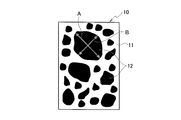
- the resin composition 10 of the coating layer 3 has a structure in which a resin having a non-crosslinked structure and a thermoplastic elastomer are mixed and phase-separated.
- the non-crosslinked resin forms a continuous phase (matrix phase) 11 and the thermoplastic elastomer forms a dispersed phase (domain phase) 12. That is, the resin composition 10 has a sea-island structure in which the dispersed phase 12 having a small volume is dispersed in the continuous phase 11.
- the heat resistance is improved by the continuous phase 11 made of a resin having a non-crosslinked structure, and the flexibility is improved by the dispersed phase 12 made of a thermoplastic elastomer. .
- the average aspect ratio of the dispersed phase 12 is preferably 10 or less.
- the aspect ratio is the ratio of the maximum value of the distance between two points on the contour in the dispersed phase 12 (major axis length A) to the minor axis length B perpendicular to the major axis ([major axis length A] / [Length of minor axis B]).
- the average aspect ratio of the dispersed phase 12 can be determined by observing the dispersed phase 12 with a scanning electron microscope (SEM) or a transmission electron microscope (TEM).
- the mass ratio (A / B) of the resin (A) having a non-crosslinked structure and the thermoplastic elastomer (B) is preferably 30/70 to 60/40.
- the amount of the non-crosslinked structure resin in the total of 100 parts by mass of the noncrosslinked resin and the thermoplastic elastomer is 30 parts by mass or more, a resin composition having good heat resistance can be obtained.
- the resin of a non-crosslinked structure is 60 parts by mass or less, a resin composition having good flexibility can be obtained.
- the non-crosslinked resin is more preferably 35 to 55 parts by mass. When the content of the resin having a non-crosslinked structure is within such a range, a resin composition having further excellent high-temperature melt resistance and flexibility can be obtained.
- the non-crosslinked resin having a melting point of 200 ° C. or higher is preferably a polymethylpentene copolymer.
- a polymethylpentene copolymer a copolymer obtained by copolymerizing a methylpentene monomer and another ⁇ -olefin is used.
- the methylpentene monomer is preferably 4-methylpentene-1.
- the flexural modulus of the polymethylpentene copolymer is preferably 1400 MPa or less. More specifically, the flexural modulus of the polymethylpentene copolymer is preferably 300 MPa to 1400 MPa. When the flexural modulus of the polymethylpentene copolymer is 300 MPa or more and 1400 MPa or less, a resin composition with good flexibility can be obtained, and therefore it can be suitably used for the coating layer of the electric wire.
- the flexural modulus of the polymethylpentene copolymer is more preferably 400 MPa or more and 800 MPa or less. When the flexural modulus of the polymethylpentene copolymer is in such a range, a resin composition with even better flexibility can be obtained.
- the value of the flexural modulus is a 3.2 mm-thick injection molded piece of the resin composition, in accordance with ASTM-D790, at a test speed of 1.3 mm / min and an inter-fulcrum distance of 51 mm in a 23 ° C. atmosphere. It can be obtained by measuring.
- thermoplastic elastomer (TPE) of this embodiment is as defined in JIS K6418 (terms and abbreviations for thermoplastic elastomer). That is, a thermoplastic elastomer (TPE) is composed of a polymer or polymer blend that has the same properties as vulcanized rubber at operating temperatures, but can be molded or reshaped at high temperatures in the same manner as a thermoplastic resin.
- thermoplastic elastomer TPE
- amide thermoplastic elastomer TPA
- ester thermoplastic elastomer TPC
- olefin thermoplastic elastomer TPO
- styrene thermoplastic elastomer TPS
- urethane thermoplastic elastomer TPU
- dynamically crosslinked thermoplastic elastomer TPV
- other thermoplastic elastomers TPZ
- thermoplastic elastomer having a melting point of less than 200 ° C. it is preferable to use an olefin-based thermoplastic elastomer (TPO) or a dynamically crosslinked thermoplastic elastomer (TPV).
- TPO olefin-based thermoplastic elastomer
- TPV dynamically crosslinked thermoplastic elastomer
- a resin composition with good oil resistance can be obtained.
- Olefin-based thermoplastic elastomers include a simple blend type of polyolefin and rubber, and a type in which a comonomer such as ethylene is added during propylene polymerization and blended in-situ.
- the rubber phase of the blend has no or almost no crosslinking points.
- polystyrene resin examples include ethylene, propylene, 1-butene, 1-pentene, 1-hexene, 4-methyl-1-pentene, 1-octene and 1-decene.
- An ⁇ -olefin homopolymer or two or more types of copolymers can be used. Specifically, a polypropylene resin, a polyethylene resin, or the like can be used.
- Examples of rubbers used for olefinic thermoplastic elastomer (TPO) include natural rubber (NR), isoprene rubber (IR), butadiene rubber (BR), styrene-butadiene copolymer rubber (SBR), and acrylonitrile-butadiene copolymer. Rubber (NBR), chloroprene rubber (CR), butyl rubber (IIR), ethylene-propylene rubber (EPM), ethylene-propylene-diene rubber (EPDM) and the like can be used. These rubbers may be used alone or in combination of two or more.
- the rubber used for the olefin-based thermoplastic elastomer (TPO) is particularly preferably at least one of ethylene-propylene rubber (EPM) and ethylene-propylene-diene rubber (EPDM).
- Dynamically cross-linked thermoplastic elastomer is a blend of thermoplastic resin and ordinary rubber, and this rubber is dynamically cross-linked during blending or kneading process. It is preferable to use a blend of a thermoplastic resin and a crosslinked rubber as the thermoplastic elastomer of this embodiment because a resin composition with good oil resistance can be obtained. However, this rubber is not necessarily crosslinked by dynamic vulcanization. There is no need to be. That is, it is preferable that the thermoplastic elastomer of this embodiment includes a crosslinked rubber component.
- thermoplastic resin used for the dynamically crosslinked thermoplastic elastomer examples include amide resins, ester resins, olefin resins, styrene resins, and urethane resins. These thermoplastic resins may be used alone or in combination of two or more.
- the rubber used for the dynamically crosslinked thermoplastic elastomer is not particularly limited.
- natural rubber NR
- isoprene rubber IR
- butadiene rubber BR
- styrene-butadiene copolymer rubber SBR
- Acrylonitrile-butadiene copolymer rubber NBR
- chloroprene rubber CR
- butyl rubber IIR
- ethylene-propylene rubber EPM
- EPDM ethylene-propylene-diene rubber
- the rubber used for the dynamically crosslinked thermoplastic elastomer is particularly preferably at least one of ethylene-propylene rubber (EPM) and ethylene-propylene-diene rubber (EPDM).
- the mass ratio (A / B) between the resin (A) having a non-crosslinked structure and the thermoplastic elastomer (B) is preferably 30/70 to 60/40.
- the resin having a non-crosslinked structure is 30 parts by mass or more, a resin composition having good heat resistance can be obtained.
- flexibility can be obtained when resin of a non-crosslinked structure is 60 mass parts or less, it can use suitably for the coating layer etc. of an electric wire.
- the non-crosslinked resin is more preferably 35 to 55 parts by mass. When the content of the resin having a non-crosslinked structure is within such a range, a resin composition having further excellent heat resistance and flexibility can be obtained.
- thermoplastic elastomer in a total of 100 parts by mass of the resin having a non-crosslinked structure and the thermoplastic elastomer is 40 parts by mass or more, a resin composition having good flexibility can be obtained.
- a thermoplastic elastomer is 70 mass parts or less, the resin composition with favorable heat resistance can be obtained.
- the thermoplastic elastomer is more preferably 45 to 65 parts by mass. When the content of the thermoplastic elastomer is within such a range, a resin composition with even better flexibility and heat resistance can be obtained.
- the melt flow rate of the thermoplastic elastomer is preferably 0.5 g / 10 min or less.
- the melt flow rate is measured according to JIS K7210-1 (Plastics-Determination of melt mass flow rate (MFR) and melt volume flow rate (MVR) of thermoplastics-Part 1: Standard test method). It is calculated by.
- the melt flow rate is measured at a measurement temperature of 250 ° C. and a load of 2.16 kg.
- the instantaneous value of the type A durometer hardness of the thermoplastic elastomer is preferably 50 or more. More specifically, the instantaneous value of the type A durometer hardness of the thermoplastic elastomer is preferably 50 or more and 100 or less. When the instantaneous value of the type A durometer hardness is 50 or more and 100 or less, the wear resistance of the resin composition is further improved and can be suitably used for the coating layer 3.
- the instantaneous value of type A durometer hardness is more preferably 70 or more and 90 or less. By being in this range, a resin composition having good flexibility can be obtained, and can be suitably used for the coating layer 3.
- the instantaneous value of type A durometer hardness can be measured according to JIS K7215 (plastic durometer hardness test method).
- the resin composition 10 constituting the coating layer 3 preferably contains a flame retardant in addition to the above-mentioned non-crosslinked resin and thermoplastic elastomer.
- a flame retardant for example, an organic flame retardant or an inorganic flame retardant can be used. These flame retardants may be used alone or in combination of two or more.
- organic flame retardants for example, halogen flame retardants such as bromine flame retardants and chlorine flame retardants, phosphorous flame retardants such as phosphate esters, condensed phosphate esters, cyclic phosphorus compounds, red phosphorus, etc. Can do.
- a metal hydroxide, an antimony flame retardant, or the like can be used.
- the flame retardant is preferably an organic flame retardant, and more preferably a halogen flame retardant. Further, it is more preferable to use a brominated flame retardant as the flame retardant. By using such a flame retardant, a resin composition having good heat aging resistance can be obtained.
- brominated flame retardants examples include 1,2-bis (bromophenyl) ethane, 1,2-bis (pentabromophenyl) ethane, hexabromobenzene, ethylene bis-dibromonorbornane dicarboximide, and ethylene bis-tetrabromo.
- the blending amount of the flame retardant is not particularly limited.
- the total of 100 parts by mass of the resin having a non-crosslinked structure and the thermoplastic elastomer that is, 30 to 60 parts by mass of the polymethylpentene copolymer, and the total of 40 to 70 parts by mass of the thermoplastic elastomer. It is preferable to contain 8 to 50 parts by mass with respect to 100 parts by mass.
- the blending amount of the flame retardant is 8 parts by mass or more, a resin composition having good flame retardancy can be obtained.
- the blending amount of the flame retardant is 50 parts by mass or less, a resin composition having good heat aging resistance can be obtained.
- the blending amount of the flame retardant is preferably 20 to 40 parts by mass with respect to a total of 100 parts by mass of the non-crosslinked resin and the thermoplastic elastomer. By being in this range, it becomes possible to obtain a resin composition with better flame retardancy and heat aging resistance.
- the flame retardant is dispersed inside the continuous phase 11 and the dispersed phase 12 in the resin composition 10. Therefore, in the resin composition 10, it is preferable that the average interparticle distance of the flame retardant is 5 ⁇ m or more. When the average interparticle distance is 5 ⁇ m or more, aggregation of the flame retardant is suppressed, so that the flexibility of the coating layer 3 can be increased. In addition, the interparticle distance of a flame retardant can be calculated
- the flexural modulus is preferably 400 MPa or less.
- the flexural modulus of the resin composition is 400 MPa or less, since the flexibility of the resin composition is excellent, it can be suitably used for an electric wire coating layer or the like.
- the resin composition 10 of the coating layer 3 in the present embodiment can contain various additives as long as the effects of the present embodiment are not hindered.
- Additives include antioxidants, metal deactivators, anti-aging agents, lubricants, fillers (fillers), reinforcing agents, UV absorbers, stabilizers, plasticizers, pigments, dyes, colorants, antistatic agents, Examples include foaming agents and flame retardant aids.
- the resin composition 10 of the coating layer 3 of the present embodiment is prepared by melt-kneading the above-described materials, and known methods can be used for the method. For example, after pre-blending using a high-speed mixing device such as a Henschel mixer, the resin composition is kneaded using a known kneader such as a Banbury mixer, kneader, roll mill, single screw extruder, twin screw extruder, etc. 10 can be obtained.
- a known kneader such as a Banbury mixer, kneader, roll mill, single screw extruder, twin screw extruder, etc. 10 can be obtained.
- the heat-resistant flexible wire 1 includes a coating layer 3 made of the resin composition 10 and a conductor 2 covered with the coating layer 3.
- the resin composition 10 of the present embodiment is excellent in heat resistance and flexibility, it is suitable for the coating layer 3 of the heat resistant flexible wire 1.
- a single wire constituted by one strand may be used, or a stranded wire constituted by twisting a plurality of strands may be used.
- a stranded wire is also a concentric stranded wire in which one or several strands are centered and the strands are concentrically twisted around it; a collective stranded wire in which a plurality of strands are twisted together in the same direction; Any composite stranded wire in which a plurality of aggregate stranded wires are twisted concentrically can be used.
- the diameter of the conductor 2 and the diameter of each strand constituting the conductor 2 are not particularly limited.
- the material of the conductor 2 is not particularly limited, and for example, general metals, conductive fibers, and conductive polymers can be used.
- known conductive metal materials such as copper, copper alloy, aluminum, and aluminum alloy can be used. These conductive metal materials are particularly preferable because of their good flexibility and conductivity.
- the surface of the conductor 2 may be plated, for example, tin plating, silver plating, or nickel plating.
- the coating layer 3 in the heat-resistant flexible wire 1 of the present embodiment is prepared by melt-kneading the resin composition material, and known methods can be used. Furthermore, a known means can be used for the method of coating the conductor 2 with the coating layer 3.
- the coating layer 3 can be formed by a general extrusion molding method. And as an extruder used by the extrusion method, a single screw extruder or a twin screw extruder can be used, for example, and a screw, breaker plate, crosshead, distributor, nipple and die can be used.
- the resin composition constituting the coating layer 3 is melted and kneaded by a screw, and a certain amount is supplied to the crosshead via the breaker plate.
- the molten resin composition flows onto the circumference of the nipple by a distributor and is extruded in a state of being coated on the outer circumference of the conductor by a die, whereby the coating layer 3 covering the outer circumference of the conductor 2 can be obtained. .
- a coating layer can be formed by extrusion molding in the same manner as a general resin composition for electric wires.
- the processing method of a resin composition the kneading method of a resin material and the coating method to an electric wire can select the optimal construction method according to the objective, and are not specifically limited. Therefore, the processing method can be variously modified within the scope of the gist of the present embodiment.
- the heat-resistant flexible wire 1 is formed of the continuous phase 11 formed of a non-crosslinked resin having a melting point of 200 ° C. or higher and the thermoplastic elastomer having a melting point of less than 200 ° C.
- a coating layer 3 having a phase separation structure having a dispersed phase 12 is provided.
- the heat-resistant flexible electric wire 1 includes a conductor 2 that is covered with a covering layer 3.
- the average aspect ratio of the dispersed phase 12 is 10 or less.
- the coating layer 3 having such a phase separation structure has improved heat resistance due to the continuous phase 11 made of a resin having a non-crosslinked structure, and improved flexibility due to the dispersed phase 12 made of a thermoplastic elastomer. Therefore, it becomes possible to obtain the heat-resistant flexible wire 1 having high heat resistance and excellent flexibility.
- the wire harness according to the present embodiment includes the heat-resistant flexible electric wire 1 described above.
- the heat-resistant flexible wire 1 is excellent in heat resistance and flexibility, it can be preferably used, for example, as a wire harness for automobiles. Furthermore, since such a wire harness is excellent in high temperature melt resistance, it can be suitably used in an engine room of an automobile.
- TPX Polymethylpentene copolymer
- MX004 Polymethylpentene copolymer
- flexural modulus of 750 MPa -TPX (registered trademark) RT18 manufactured by Mitsui Chemicals
- Thermoplastic elastomer Miralastomer (registered trademark) 9020NS, manufactured by Mitsui Chemicals, dynamically crosslinked thermoplastic elastomer (TPV), MFR: 0.02 g / 10 min, type A durometer hardness 89 Miralastomer (registered trademark) 6030NS, manufactured by Mitsui Chemicals, dynamically crosslinked thermoplastic elastomer (TPV), MFR: 0.10 g / 10 min, type A durometer hardness 50 Prime TPO (registered trademark) R110E, manufactured by Prime Polymer Co., Ltd., olefinic thermoplastic elastomer (TPO), MFR: 2.19 g / 10 min ⁇ Tuffmer (registered trademark) DF605, manufactured by Mitsui Chemicals, olefin thermoplastic elastomer (TPO, ethylene- ⁇ -olefin copolymer), MFR: 1.46 g / 10 min
- the average aspect ratio of the dispersed phase in the test wires in each example was measured as follows. First, the test wires were embedded with resin. Next, trimming and chamfering were performed with an ultramicrotome equipped with a diamond knife, and after vapor staining with a metal oxide, an ultrathin section was prepared. And the cross section of the longitudinal direction of the electric wire for a test was observed. As the observation apparatus, a transmission electron microscope HT7700 manufactured by Hitachi High-Technologies Corporation was used, and the observation was performed at an acceleration voltage of 100 kV.
- the test wire was wound around a mandrel having a diameter equal to the outer diameter of the test wire in each example so that no gap was formed, and heated in an environment of 200 ° C. for 30 minutes. Then, the test wire was unwound from the mandrel, and the presence or absence of the exposed conductor was visually examined. The test wire in which the conductor was not exposed after heating at 200 ° C. was evaluated as “ ⁇ ”. In addition, the electric wire for a test by which exposure of the conductor was recognized after heating at 200 degreeC was evaluated as "x".
- the test wire was cut so that the length was 100 mm to obtain a test sample.
- the test sample 20 was placed on the rollers 21 arranged at intervals of 60 mm. Then, a load was applied from above at the center of the test sample at a speed of 100 mm / min, and the maximum load until the wire fell was measured using a force gauge.
- a case where the force gauge value was less than 7N was evaluated as “ ⁇ ”
- a case where the force gauge value was 7N or more and 8.5N or less was evaluated as “ ⁇ ”
- a case where the force gauge value exceeded 8.5N was evaluated as “X”.
- Abrasion resistance was evaluated by tape abrasion.
- a 150 J garnet sandpaper was prepared in which conductive bands of 5 mm to 10 mm were attached perpendicularly to the edge of the sandpaper at intervals of a maximum of 75 mm. Appropriate brackets were attached to the pivot arm so that the test sample was located on the unused portion of the sandpaper wear tape.
- the test sample was stretched without stretching, and a test sample having a length of 900 mm was horizontally installed.
- the wear tape is brought into contact with the test sample and a 1500 g weight is added to the wear tape.
- the wear tape was moved at a speed of (1500 ⁇ 75) mm / min, and the length of the wear tape until the test sample was worn and the metal conductor contacted the wear tape was measured. Thereafter, the test sample was moved 50 mm, and the test sample was rotated 90 ° clockwise. This procedure was repeated for a total of four measurements. The case where the length until contact was 330 mm or more was evaluated as “ ⁇ ”, and the case where it was less than 330 mm was evaluated as “x”.
- the oil resistance was evaluated as follows. First, a liquid in which 2,2,4-trimethylpentane and toluene were mixed at a ratio of 1: 1 was prepared. Next, after measuring the outer diameter of the test sample, the test sample was immersed in a liquid at 23 ° C. for 20 hours. After immersion, the test sample was taken out of the liquid, the liquid adhering to the surface was wiped off, and the outer diameter at the same location as before the immersion was measured. And the change rate (%) of the outer diameter after immersion with respect to the outer diameter before immersion in the liquid was calculated
- Rate of change (%) (outer diameter after immersion ⁇ outer diameter before immersion) / (outer diameter before immersion) ⁇ 100
- the resin compositions of Examples 1 to 5 have an average aspect ratio of the dispersed phase of 10 or less. Therefore, it turns out that it is excellent in heat resistance (high temperature melt resistance) and a softness
- Example preparation of Examples 6 to 20 and Comparative Example 3 ⁇ Preparation of resin composition> First, by using a twin screw extruder, the following polymethylpentene copolymer, thermoplastic elastomer, flame retardant and flame retardant auxiliary were melt-kneaded in the blending amounts shown in Tables 2 to 4, and each Example and Comparative Example were compared. Example resin compositions were prepared.
- Test wires coated with the resin compositions of the examples and comparative examples were produced in the same manner as in Example 1.
- Heat aging resistance For heat aging resistance, an electric wire having a length of 350 mm was heated at 180 ° C. for 300 hours. Then, the electric wire was taken out from the oven and wound around a mandrel 1.5 times the outer diameter of the electric wire. Then, a voltage of 1 kV was applied for 1 minute, and evaluation was made as “ ⁇ ” if dielectric breakdown did not occur and “ ⁇ ” if dielectric breakdown occurred.
- the resin composition ratio of the polymethylpentene copolymer and the thermoplastic elastomer is within a predetermined range. Therefore, compared with Example 13, Excellent high-temperature melt resistance.
- Example 6 As shown in Tables 2 and 4, the resin compositions of Examples 6 to 12 were superior in oil resistance compared to Example 16 because the thermoplastic elastomer contained a crosslinked rubber component.
- Example 18 since the resin composition of Example 18 added 60 parts by mass of the metal hydroxide flame retardant, the flame retardancy was improved as compared with Example 17. The heat aging resistance is reduced. This shows that it is preferable to use a brominated flame retardant instead of the metal hydroxide flame retardant from the viewpoint of achieving both heat resistance and heat aging resistance.
- the resin compositions of Examples 6 to 12 were superior in flexibility compared to Example 19 because the flexural modulus of the polymethylpentene copolymer was 1400 MPa or less.
- the resin compositions of Examples 6 to 12 have an abrasion resistance compared to Example 20 because the instantaneous value of the type A durometer hardness of the crosslinked elastomer is 50 or more. It was excellent.
Landscapes
- Chemical & Material Sciences (AREA)
- Physics & Mathematics (AREA)
- Spectroscopy & Molecular Physics (AREA)
- Health & Medical Sciences (AREA)
- Chemical Kinetics & Catalysis (AREA)
- Medicinal Chemistry (AREA)
- Polymers & Plastics (AREA)
- Organic Chemistry (AREA)
- Compositions Of Macromolecular Compounds (AREA)
- Insulated Conductors (AREA)
- Organic Insulating Materials (AREA)
Abstract
La présente invention concerne un fil de fer doux résistant à la chaleur (1) doté d'une couche de revêtement (3) ayant une structure à séparation de phase comprenant une phase continue (11) qui est formée d'une résine non réticulée ayant un point de fusion égal ou supérieure à 200 °C et de phases dispersées (12) qui sont réalisées en un élastomère thermoplastique ayant un point de fusion inférieur à 200 °C. Ce fil de fer doux résistant à la chaleur (1) est également doté d'un conducteur (2) qui est recouvert par la couche de revêtement. Les phases dispersées ont un rapport d'aspect moyen égal ou inférieur à 10. La présente invention concerne également un faisceau électrique utilisant ce fil de fer doux résistant à la chaleur.
Priority Applications (3)
| Application Number | Priority Date | Filing Date | Title |
|---|---|---|---|
| CN201680057860.6A CN108140455B (zh) | 2015-10-30 | 2016-10-28 | 耐热柔性电缆和使用该耐热柔性电缆的线束 |
| DE112016005008.9T DE112016005008B4 (de) | 2015-10-30 | 2016-10-28 | Hitzebeständiges flexibles stromkabel und kabelbaum, der dieses verwendet |
| US15/943,021 US10381133B2 (en) | 2015-10-30 | 2018-04-02 | Heat-resistant flexible electric cable and wire harness using the same |
Applications Claiming Priority (4)
| Application Number | Priority Date | Filing Date | Title |
|---|---|---|---|
| JP2015-213996 | 2015-10-30 | ||
| JP2015213996A JP6243888B2 (ja) | 2015-10-30 | 2015-10-30 | 樹脂組成物、これを用いた電線及びワイヤーハーネス |
| JP2016182805A JP6367880B2 (ja) | 2016-09-20 | 2016-09-20 | 耐熱柔軟電線及びこれを用いたワイヤーハーネス |
| JP2016-182805 | 2016-09-20 |
Related Child Applications (1)
| Application Number | Title | Priority Date | Filing Date |
|---|---|---|---|
| US15/943,021 Continuation US10381133B2 (en) | 2015-10-30 | 2018-04-02 | Heat-resistant flexible electric cable and wire harness using the same |
Publications (1)
| Publication Number | Publication Date |
|---|---|
| WO2017073754A1 true WO2017073754A1 (fr) | 2017-05-04 |
Family
ID=58630400
Family Applications (1)
| Application Number | Title | Priority Date | Filing Date |
|---|---|---|---|
| PCT/JP2016/082130 Ceased WO2017073754A1 (fr) | 2015-10-30 | 2016-10-28 | Fil de fer doux résistant à la chaleur et câblage électrique utilisant un tel fil |
Country Status (4)
| Country | Link |
|---|---|
| US (1) | US10381133B2 (fr) |
| CN (1) | CN108140455B (fr) |
| DE (1) | DE112016005008B4 (fr) |
| WO (1) | WO2017073754A1 (fr) |
Families Citing this family (5)
| Publication number | Priority date | Publication date | Assignee | Title |
|---|---|---|---|---|
| JP6662920B2 (ja) | 2018-01-19 | 2020-03-11 | ファナック株式会社 | ケーブル |
| JP6662919B2 (ja) * | 2018-01-19 | 2020-03-11 | ファナック株式会社 | ケーブル |
| JP6897621B2 (ja) * | 2018-03-30 | 2021-06-30 | 株式会社オートネットワーク技術研究所 | ワイヤハーネス |
| US11636958B2 (en) * | 2019-09-04 | 2023-04-25 | Yazaki Corporation | Communication cable and wire harness |
| JP7521460B2 (ja) * | 2021-03-08 | 2024-07-24 | 株式会社オートネットワーク技術研究所 | 通信用電線、ワイヤーハーネス、および通信用電線の製造方法 |
Citations (3)
| Publication number | Priority date | Publication date | Assignee | Title |
|---|---|---|---|---|
| JP2005105040A (ja) * | 2003-09-29 | 2005-04-21 | Sumitomo Chemical Co Ltd | 樹脂組成物および難燃性被覆製品 |
| JP2007250245A (ja) * | 2006-03-14 | 2007-09-27 | Toray Ind Inc | ケーブル用絶縁フィルムおよびそれを用いたケーブル |
| JP2014136738A (ja) * | 2013-01-16 | 2014-07-28 | Hitachi Ltd | 押出成形用樹脂組成物およびその製造方法、並びにそれを用いた絶縁電線 |
Family Cites Families (12)
| Publication number | Priority date | Publication date | Assignee | Title |
|---|---|---|---|---|
| WO1993006604A1 (fr) * | 1991-09-27 | 1993-04-01 | Minnesota Mining And Manufacturing Company | Structure amelioree de cable plat |
| JPH08337724A (ja) * | 1995-06-09 | 1996-12-24 | Nippon Oil & Fats Co Ltd | ブロー成形品及びその成形方法 |
| ATE476471T1 (de) * | 2003-04-16 | 2010-08-15 | Prime Polymer Co Ltd | Polyolefinharzzusammensetzung und kombination von harzformkörpern unter deren verwendung |
| JP4311727B2 (ja) | 2003-12-04 | 2009-08-12 | 株式会社オートネットワーク技術研究所 | 非架橋型難燃性樹脂組成物ならびにこれを用いた絶縁電線およびワイヤーハーネス |
| US7094836B2 (en) * | 2004-03-04 | 2006-08-22 | Teknor Apex Company | Compatibilizers for fluoropolymers and polyolefins; blends thereof |
| US7847024B2 (en) * | 2007-02-23 | 2010-12-07 | Teknor Apex Company | Elastomer and vulcanizate compositions having desirable high temperature properties |
| JP2009301921A (ja) * | 2008-06-16 | 2009-12-24 | Autonetworks Technologies Ltd | 絶縁電線およびワイヤーハーネス |
| US8397765B2 (en) * | 2008-07-25 | 2013-03-19 | Shawcor Ltd. | High temperature resistant insulation for pipe |
| JP4821868B2 (ja) * | 2009-03-13 | 2011-11-24 | 横浜ゴム株式会社 | 熱可塑性エラストマー組成物 |
| TWI568784B (zh) * | 2009-04-10 | 2017-02-01 | 三菱麗陽股份有限公司 | 熱可塑性樹脂用添加劑及其製造方法、熱可塑性樹脂組成物及成形體 |
| JP2013109874A (ja) * | 2011-11-18 | 2013-06-06 | Hitachi Cable Ltd | 絶縁電線 |
| WO2013108836A1 (fr) * | 2012-01-19 | 2013-07-25 | アロン化成株式会社 | Composition d'élastomère thermoplastique |
-
2016
- 2016-10-28 WO PCT/JP2016/082130 patent/WO2017073754A1/fr not_active Ceased
- 2016-10-28 DE DE112016005008.9T patent/DE112016005008B4/de active Active
- 2016-10-28 CN CN201680057860.6A patent/CN108140455B/zh active Active
-
2018
- 2018-04-02 US US15/943,021 patent/US10381133B2/en active Active
Patent Citations (3)
| Publication number | Priority date | Publication date | Assignee | Title |
|---|---|---|---|---|
| JP2005105040A (ja) * | 2003-09-29 | 2005-04-21 | Sumitomo Chemical Co Ltd | 樹脂組成物および難燃性被覆製品 |
| JP2007250245A (ja) * | 2006-03-14 | 2007-09-27 | Toray Ind Inc | ケーブル用絶縁フィルムおよびそれを用いたケーブル |
| JP2014136738A (ja) * | 2013-01-16 | 2014-07-28 | Hitachi Ltd | 押出成形用樹脂組成物およびその製造方法、並びにそれを用いた絶縁電線 |
Also Published As
| Publication number | Publication date |
|---|---|
| US10381133B2 (en) | 2019-08-13 |
| US20180286537A1 (en) | 2018-10-04 |
| DE112016005008B4 (de) | 2023-06-01 |
| DE112016005008T5 (de) | 2018-07-26 |
| CN108140455A (zh) | 2018-06-08 |
| CN108140455B (zh) | 2019-11-15 |
Similar Documents
| Publication | Publication Date | Title |
|---|---|---|
| US10381133B2 (en) | Heat-resistant flexible electric cable and wire harness using the same | |
| JP5821827B2 (ja) | ノンハロゲン架橋樹脂組成物を用いた鉄道車両用絶縁電線、鉄道車両用ケーブル | |
| CN101555334B (zh) | 不含卤素的树脂组合物、用其包覆的包覆线以及具有至少一根上述包覆线的线束 | |
| CN114262479B (zh) | 树脂组合物以及使用该树脂组合物的通信电缆和线束 | |
| JP4311727B2 (ja) | 非架橋型難燃性樹脂組成物ならびにこれを用いた絶縁電線およびワイヤーハーネス | |
| JP4198039B2 (ja) | 非架橋型難燃性樹脂組成物ならびにこれを用いた絶縁電線およびワイヤーハーネス | |
| US11407887B2 (en) | Resin composition, sheath cable, and wire harness | |
| JP2006348136A (ja) | 難燃性樹脂組成物ならびにこれを用いた絶縁電線およびワイヤーハーネス | |
| JP5643138B2 (ja) | 被覆電線 | |
| JP6367880B2 (ja) | 耐熱柔軟電線及びこれを用いたワイヤーハーネス | |
| JP6243888B2 (ja) | 樹脂組成物、これを用いた電線及びワイヤーハーネス | |
| JP2009161703A (ja) | ポリオレフィン系樹脂組成物及び被覆電線 | |
| WO2014084048A1 (fr) | Procédé de production d'un corps moulé à l'aide d'une composition de résine thermorésistante, réticulable par silane | |
| JP2006348137A (ja) | 難燃性樹脂組成物ならびにこれを用いた絶縁電線およびワイヤーハーネス | |
| JP6854203B2 (ja) | 高柔軟電線及びインホイールモーター用ケーブル | |
| JP2017160328A (ja) | ハロゲンフリー難燃性樹脂組成物及びハロゲンフリー難燃絶縁電線 | |
| JP7247140B2 (ja) | 配線材及びその製造方法 | |
| CN113583329B (zh) | 树脂组合物、护套电缆和线束 | |
| JP2013227373A (ja) | 電線保護材用組成物、電線保護材及びワイヤーハーネス | |
| JP3682842B2 (ja) | 絶縁電線・ケーブル | |
| JP2024082649A (ja) | 架橋ゴム組成物、電線、ケーブルおよび架橋ゴム組成物の製造方法 | |
| JP5712076B2 (ja) | 被覆電線 | |
| JP2007056204A (ja) | 難燃性樹脂組成物及び絶縁電線 |
Legal Events
| Date | Code | Title | Description |
|---|---|---|---|
| 121 | Ep: the epo has been informed by wipo that ep was designated in this application |
Ref document number: 16859982 Country of ref document: EP Kind code of ref document: A1 |
|
| WWE | Wipo information: entry into national phase |
Ref document number: 112016005008 Country of ref document: DE |
|
| 122 | Ep: pct application non-entry in european phase |
Ref document number: 16859982 Country of ref document: EP Kind code of ref document: A1 |