WO2017086463A1 - Dispositif de production de glace en flocons, système de production de glace en flocons, procédé de production de glace en flocons et corps mobile associé - Google Patents
Dispositif de production de glace en flocons, système de production de glace en flocons, procédé de production de glace en flocons et corps mobile associé Download PDFInfo
- Publication number
- WO2017086463A1 WO2017086463A1 PCT/JP2016/084321 JP2016084321W WO2017086463A1 WO 2017086463 A1 WO2017086463 A1 WO 2017086463A1 JP 2016084321 W JP2016084321 W JP 2016084321W WO 2017086463 A1 WO2017086463 A1 WO 2017086463A1
- Authority
- WO
- WIPO (PCT)
- Prior art keywords
- ice
- flake ice
- brine
- flake
- refrigerant
- Prior art date
- Legal status (The legal status is an assumption and is not a legal conclusion. Google has not performed a legal analysis and makes no representation as to the accuracy of the status listed.)
- Ceased
Links
Images


Classifications
-
- F—MECHANICAL ENGINEERING; LIGHTING; HEATING; WEAPONS; BLASTING
- F25—REFRIGERATION OR COOLING; COMBINED HEATING AND REFRIGERATION SYSTEMS; HEAT PUMP SYSTEMS; MANUFACTURE OR STORAGE OF ICE; LIQUEFACTION SOLIDIFICATION OF GASES
- F25C—PRODUCING, WORKING OR HANDLING ICE
- F25C1/00—Producing ice
- F25C1/02—Producing natural ice, i.e. without refrigeration
-
- A—HUMAN NECESSITIES
- A23—FOODS OR FOODSTUFFS; TREATMENT THEREOF, NOT COVERED BY OTHER CLASSES
- A23B—PRESERVATION OF FOODS, FOODSTUFFS OR NON-ALCOHOLIC BEVERAGES; CHEMICAL RIPENING OF FRUIT OR VEGETABLES
- A23B4/00—Preservation of meat, sausages, fish or fish products
- A23B4/06—Freezing; Subsequent thawing; Cooling
-
- A—HUMAN NECESSITIES
- A23—FOODS OR FOODSTUFFS; TREATMENT THEREOF, NOT COVERED BY OTHER CLASSES
- A23B—PRESERVATION OF FOODS, FOODSTUFFS OR NON-ALCOHOLIC BEVERAGES; CHEMICAL RIPENING OF FRUIT OR VEGETABLES
- A23B2/00—Preservation of foods or foodstuffs, in general
- A23B2/80—Freezing; Subsequent thawing; Cooling
-
- A—HUMAN NECESSITIES
- A23—FOODS OR FOODSTUFFS; TREATMENT THEREOF, NOT COVERED BY OTHER CLASSES
- A23B—PRESERVATION OF FOODS, FOODSTUFFS OR NON-ALCOHOLIC BEVERAGES; CHEMICAL RIPENING OF FRUIT OR VEGETABLES
- A23B2/00—Preservation of foods or foodstuffs, in general
- A23B2/80—Freezing; Subsequent thawing; Cooling
- A23B2/85—Freezing; Subsequent thawing; Cooling with addition of or treatment with chemicals
- A23B2/88—Freezing; Subsequent thawing; Cooling with addition of or treatment with chemicals with direct contact between the food and the chemical, e.g. liquid N2 at cryogenic temperature
-
- A—HUMAN NECESSITIES
- A23—FOODS OR FOODSTUFFS; TREATMENT THEREOF, NOT COVERED BY OTHER CLASSES
- A23B—PRESERVATION OF FOODS, FOODSTUFFS OR NON-ALCOHOLIC BEVERAGES; CHEMICAL RIPENING OF FRUIT OR VEGETABLES
- A23B4/00—Preservation of meat, sausages, fish or fish products
- A23B4/02—Preserving by means of inorganic salts
-
- A—HUMAN NECESSITIES
- A23—FOODS OR FOODSTUFFS; TREATMENT THEREOF, NOT COVERED BY OTHER CLASSES
- A23B—PRESERVATION OF FOODS, FOODSTUFFS OR NON-ALCOHOLIC BEVERAGES; CHEMICAL RIPENING OF FRUIT OR VEGETABLES
- A23B4/00—Preservation of meat, sausages, fish or fish products
- A23B4/02—Preserving by means of inorganic salts
- A23B4/027—Preserving by means of inorganic salts by inorganic salts other than kitchen salt or mixtures thereof with organic compounds, e.g. biochemical compounds
-
- A—HUMAN NECESSITIES
- A23—FOODS OR FOODSTUFFS; TREATMENT THEREOF, NOT COVERED BY OTHER CLASSES
- A23B—PRESERVATION OF FOODS, FOODSTUFFS OR NON-ALCOHOLIC BEVERAGES; CHEMICAL RIPENING OF FRUIT OR VEGETABLES
- A23B4/00—Preservation of meat, sausages, fish or fish products
- A23B4/06—Freezing; Subsequent thawing; Cooling
- A23B4/08—Freezing; Subsequent thawing; Cooling with addition of chemicals or treatment with chemicals before or during cooling, e.g. in the form of an ice coating or frozen block
- A23B4/09—Freezing; Subsequent thawing; Cooling with addition of chemicals or treatment with chemicals before or during cooling, e.g. in the form of an ice coating or frozen block with direct contact between the food and the chemical, e.g. liquid N2, at cryogenic temperature
-
- F—MECHANICAL ENGINEERING; LIGHTING; HEATING; WEAPONS; BLASTING
- F25—REFRIGERATION OR COOLING; COMBINED HEATING AND REFRIGERATION SYSTEMS; HEAT PUMP SYSTEMS; MANUFACTURE OR STORAGE OF ICE; LIQUEFACTION SOLIDIFICATION OF GASES
- F25B—REFRIGERATION MACHINES, PLANTS OR SYSTEMS; COMBINED HEATING AND REFRIGERATION SYSTEMS; HEAT PUMP SYSTEMS
- F25B9/00—Compression machines, plants or systems, in which the refrigerant is air or other gas of low boiling point
- F25B9/002—Compression machines, plants or systems, in which the refrigerant is air or other gas of low boiling point characterised by the refrigerant
-
- F—MECHANICAL ENGINEERING; LIGHTING; HEATING; WEAPONS; BLASTING
- F25—REFRIGERATION OR COOLING; COMBINED HEATING AND REFRIGERATION SYSTEMS; HEAT PUMP SYSTEMS; MANUFACTURE OR STORAGE OF ICE; LIQUEFACTION SOLIDIFICATION OF GASES
- F25C—PRODUCING, WORKING OR HANDLING ICE
- F25C1/00—Producing ice
-
- F—MECHANICAL ENGINEERING; LIGHTING; HEATING; WEAPONS; BLASTING
- F25—REFRIGERATION OR COOLING; COMBINED HEATING AND REFRIGERATION SYSTEMS; HEAT PUMP SYSTEMS; MANUFACTURE OR STORAGE OF ICE; LIQUEFACTION SOLIDIFICATION OF GASES
- F25C—PRODUCING, WORKING OR HANDLING ICE
- F25C1/00—Producing ice
- F25C1/12—Producing ice by freezing water on cooled surfaces, e.g. to form slabs
- F25C1/14—Producing ice by freezing water on cooled surfaces, e.g. to form slabs to form thin sheets which are removed by scraping or wedging, e.g. in the form of flakes
- F25C1/145—Producing ice by freezing water on cooled surfaces, e.g. to form slabs to form thin sheets which are removed by scraping or wedging, e.g. in the form of flakes from the inner walls of cooled bodies
-
- F—MECHANICAL ENGINEERING; LIGHTING; HEATING; WEAPONS; BLASTING
- F25—REFRIGERATION OR COOLING; COMBINED HEATING AND REFRIGERATION SYSTEMS; HEAT PUMP SYSTEMS; MANUFACTURE OR STORAGE OF ICE; LIQUEFACTION SOLIDIFICATION OF GASES
- F25C—PRODUCING, WORKING OR HANDLING ICE
- F25C5/00—Working or handling ice
- F25C5/02—Apparatus for disintegrating, removing or harvesting ice
- F25C5/04—Apparatus for disintegrating, removing or harvesting ice without the use of saws
- F25C5/12—Ice-shaving machines
-
- F—MECHANICAL ENGINEERING; LIGHTING; HEATING; WEAPONS; BLASTING
- F25—REFRIGERATION OR COOLING; COMBINED HEATING AND REFRIGERATION SYSTEMS; HEAT PUMP SYSTEMS; MANUFACTURE OR STORAGE OF ICE; LIQUEFACTION SOLIDIFICATION OF GASES
- F25C—PRODUCING, WORKING OR HANDLING ICE
- F25C5/00—Working or handling ice
- F25C5/20—Distributing ice
-
- F—MECHANICAL ENGINEERING; LIGHTING; HEATING; WEAPONS; BLASTING
- F25—REFRIGERATION OR COOLING; COMBINED HEATING AND REFRIGERATION SYSTEMS; HEAT PUMP SYSTEMS; MANUFACTURE OR STORAGE OF ICE; LIQUEFACTION SOLIDIFICATION OF GASES
- F25C—PRODUCING, WORKING OR HANDLING ICE
- F25C5/00—Working or handling ice
- F25C5/20—Distributing ice
- F25C5/22—Distributing ice particularly adapted for household refrigerators
-
- F—MECHANICAL ENGINEERING; LIGHTING; HEATING; WEAPONS; BLASTING
- F25—REFRIGERATION OR COOLING; COMBINED HEATING AND REFRIGERATION SYSTEMS; HEAT PUMP SYSTEMS; MANUFACTURE OR STORAGE OF ICE; LIQUEFACTION SOLIDIFICATION OF GASES
- F25D—REFRIGERATORS; COLD ROOMS; ICE-BOXES; COOLING OR FREEZING APPARATUS NOT OTHERWISE PROVIDED FOR
- F25D15/00—Devices not covered by group F25D11/00 or F25D13/00, e.g. non-self-contained movable devices
-
- F—MECHANICAL ENGINEERING; LIGHTING; HEATING; WEAPONS; BLASTING
- F25—REFRIGERATION OR COOLING; COMBINED HEATING AND REFRIGERATION SYSTEMS; HEAT PUMP SYSTEMS; MANUFACTURE OR STORAGE OF ICE; LIQUEFACTION SOLIDIFICATION OF GASES
- F25D—REFRIGERATORS; COLD ROOMS; ICE-BOXES; COOLING OR FREEZING APPARATUS NOT OTHERWISE PROVIDED FOR
- F25D3/00—Devices using other cold materials; Devices using cold-storage bodies
- F25D3/02—Devices using other cold materials; Devices using cold-storage bodies using ice, e.g. ice-boxes
-
- F—MECHANICAL ENGINEERING; LIGHTING; HEATING; WEAPONS; BLASTING
- F25—REFRIGERATION OR COOLING; COMBINED HEATING AND REFRIGERATION SYSTEMS; HEAT PUMP SYSTEMS; MANUFACTURE OR STORAGE OF ICE; LIQUEFACTION SOLIDIFICATION OF GASES
- F25D—REFRIGERATORS; COLD ROOMS; ICE-BOXES; COOLING OR FREEZING APPARATUS NOT OTHERWISE PROVIDED FOR
- F25D3/00—Devices using other cold materials; Devices using cold-storage bodies
- F25D3/02—Devices using other cold materials; Devices using cold-storage bodies using ice, e.g. ice-boxes
- F25D3/04—Stationary cabinets
- F25D3/045—Details
-
- F—MECHANICAL ENGINEERING; LIGHTING; HEATING; WEAPONS; BLASTING
- F25—REFRIGERATION OR COOLING; COMBINED HEATING AND REFRIGERATION SYSTEMS; HEAT PUMP SYSTEMS; MANUFACTURE OR STORAGE OF ICE; LIQUEFACTION SOLIDIFICATION OF GASES
- F25D—REFRIGERATORS; COLD ROOMS; ICE-BOXES; COOLING OR FREEZING APPARATUS NOT OTHERWISE PROVIDED FOR
- F25D3/00—Devices using other cold materials; Devices using cold-storage bodies
- F25D3/10—Devices using other cold materials; Devices using cold-storage bodies using liquefied gases, e.g. liquid air
-
- A—HUMAN NECESSITIES
- A23—FOODS OR FOODSTUFFS; TREATMENT THEREOF, NOT COVERED BY OTHER CLASSES
- A23V—INDEXING SCHEME RELATING TO FOODS, FOODSTUFFS OR NON-ALCOHOLIC BEVERAGES AND LACTIC OR PROPIONIC ACID BACTERIA USED IN FOODSTUFFS OR FOOD PREPARATION
- A23V2002/00—Food compositions, function of food ingredients or processes for food or foodstuffs
-
- F—MECHANICAL ENGINEERING; LIGHTING; HEATING; WEAPONS; BLASTING
- F25—REFRIGERATION OR COOLING; COMBINED HEATING AND REFRIGERATION SYSTEMS; HEAT PUMP SYSTEMS; MANUFACTURE OR STORAGE OF ICE; LIQUEFACTION SOLIDIFICATION OF GASES
- F25C—PRODUCING, WORKING OR HANDLING ICE
- F25C2301/00—Special arrangements or features for producing ice
- F25C2301/002—Producing ice slurries
-
- F—MECHANICAL ENGINEERING; LIGHTING; HEATING; WEAPONS; BLASTING
- F25—REFRIGERATION OR COOLING; COMBINED HEATING AND REFRIGERATION SYSTEMS; HEAT PUMP SYSTEMS; MANUFACTURE OR STORAGE OF ICE; LIQUEFACTION SOLIDIFICATION OF GASES
- F25C—PRODUCING, WORKING OR HANDLING ICE
- F25C2600/00—Control issues
- F25C2600/04—Control means
-
- Y—GENERAL TAGGING OF NEW TECHNOLOGICAL DEVELOPMENTS; GENERAL TAGGING OF CROSS-SECTIONAL TECHNOLOGIES SPANNING OVER SEVERAL SECTIONS OF THE IPC; TECHNICAL SUBJECTS COVERED BY FORMER USPC CROSS-REFERENCE ART COLLECTIONS [XRACs] AND DIGESTS
- Y02—TECHNOLOGIES OR APPLICATIONS FOR MITIGATION OR ADAPTATION AGAINST CLIMATE CHANGE
- Y02A—TECHNOLOGIES FOR ADAPTATION TO CLIMATE CHANGE
- Y02A40/00—Adaptation technologies in agriculture, forestry, livestock or agroalimentary production
- Y02A40/90—Adaptation technologies in agriculture, forestry, livestock or agroalimentary production in food processing or handling, e.g. food conservation
- Y02A40/963—Off-grid food refrigeration
Definitions
- the present invention relates to a flake ice production apparatus, a flake ice production system, a flake ice production method, and a mobile object.
- salt-containing ice obtained by freezing salt-containing water having a solute concentration of about 0.5 to 2.5% is formed into a slurry to be used for maintaining the freshness of fresh food.
- salt water is prepared by adjusting the salinity of raw water such as filtered and sterilized seawater, and the salt-containing water is rapidly cooled.
- a method for producing slurry-like salt-containing ice having a freezing point temperature of ⁇ 5 to ⁇ 1 ° C. corresponding to the solute concentration is disclosed.
- Patent Document 2 discloses a method for maintaining the freshness of fish by cooling the fish by bringing ice made of saline into contact with the fish.
- Patent Document 2 discloses a method for producing a salt ice solution by cooling a salt solution in a container and cooling it from the outside.
- Patent Document 3 in a salt-containing water ice making method in which salt-containing ice obtained by freezing salt-containing water having a solute concentration of approximately 0.5 to 2.5% is formed into a slurry, filtration is performed. Sterilized raw water, such as seawater, is adjusted to a salt content to obtain a salt-containing water having a solute concentration of about 1.0 to 1.5%, and the salt-containing water is rapidly cooled to cope with the solute concentration- A method is disclosed for producing slurry-like salt-containing ice having a freezing point temperature of 5 to -1 ° C.
- Patent Document 4 bittern is added to 0.2 to 5.0% (w / v) saline, and fresh fish is immersed in a liquid maintained at a temperature of -3 to 10 ° C. for a certain period of time. A method of freezing is disclosed.
- salt-containing ice obtained by freezing salt-containing water having a solute concentration of about 0.5 to 2.5% for use in maintaining the freshness of the produced frozen plant or animal or part thereof.
- a salt-containing water ice-making method formed into a slurry raw water such as seawater that has been sterilized by filtration is adjusted to a salt content to obtain salt-containing water having a solute concentration of about 1.0 to 1.5%
- a method of producing slurry-like salt-containing ice having a freezing point temperature of -5 to -1 ° C. corresponding to the solute concentration by rapidly cooling the salt-containing water is disclosed.
- Patent Document 4 fresh fish is immersed for a certain period of time in a dipping solution in which bittern is added to 0.2 to 5.0% (w / v) saline and the water temperature is maintained at -3 to 10 ° C. A method is disclosed.
- the present invention has been made in view of such circumstances, and an object thereof is to easily produce flake ice having a substantially uniform solute concentration. Moreover, the manufacturing method of the flake ice excellent in cooling ability and the manufacturing method of the flake ice which can maintain the state which is not isolate
- a flake ice manufacturing apparatus includes: A flake ice production device for producing ice flakes by freezing brine, A drum including an inner cylinder, an outer cylinder surrounding the inner cylinder, and a clearance formed between the inner cylinder and the outer cylinder; A refrigerant supply unit for supplying a refrigerant to the clearance; A rotating shaft that rotates about the central axis of the drum; An injection unit that rotates together with the rotation shaft and injects brine toward the inner peripheral surface of the inner cylinder; The brine jetted from the jetting unit adheres to the inner peripheral surface of the inner cylinder cooled by the refrigerant supplied to the clearance, and scraping unit scraping off the resulting flake ice, Is provided.
- the brine is An aqueous solution containing a solute that satisfies a predetermined condition; A solid (for example, metal) having higher thermal conductivity than liquid ice containing the aqueous solution can be contained.
- liquid is Furthermore, oil can be contained.
- the solute is Two or more solutes having different freezing point depression degrees can be included.
- the flake ice manufacturing apparatus of one aspect of the present invention is A speed control unit that variably controls the rotation speed of the rotation shaft can be further provided.
- the refrigerant supply unit As the refrigerant, liquefied natural gas can be supplied to the clearance.
- the flake ice manufacturing apparatus of one embodiment of the present invention can be mounted on a moving body.
- flake ice having a substantially uniform solute concentration can be easily produced. Moreover, the manufacturing method of the flake ice excellent in cooling ability and the manufacturing method of the flake ice which can maintain the state which is not isolate
- the ice produced by the flake ice production apparatus of the present invention is also called ice (flake ice) of a liquid (also called brine) containing an aqueous solution containing a solute that satisfies the following conditions (a) and (b). ).
- ice flake ice
- the temperature at the completion of melting is less than 0 ° C.
- the change rate of the solute concentration of the aqueous solution generated from the ice during the melting process is within 30%.
- the ice having a reduced freezing point as described above continues to be stable at a temperature below the freezing point of fresh water when melted, so that the state where cold energy is stored continues. Therefore, the cooling ability of the object to be cooled should be higher than that of ice made of fresh water.
- the present inventors have found that the ice produced by the conventional technique does not have sufficient ability to cool the object to be cooled, for example, the temperature of the ice itself increases rapidly with time.
- the present inventors examined the reason, and even if ice was produced from an aqueous solution containing a solute such as salt in the conventional technique, in practice, ice containing no solute was first produced before the aqueous solution was frozen. As a result, a mixture of ice and solute containing no solute is produced, or only a small amount of ice having a reduced freezing point is produced, so that ice with high cooling capacity is not produced. I found out.
- the present inventors have succeeded in producing liquid ice containing an aqueous solution having a reduced freezing point by a predetermined method (details will be described later).
- the ice produced by the flake ice production apparatus of the present invention satisfies the above conditions (a) and (b).
- the above conditions (a) and (b) will be described.
- the temperature of the freezing point is lower than the freezing point of fresh water (water containing no solute). ing. Therefore, it has the characteristic that the temperature at the time of completion of melting is less than 0 ° C. “The temperature at the time of melting completion” means that the ice generated by the flake ice making apparatus of the present invention is placed in an environment above the melting point (for example, room temperature and atmospheric pressure) to start melting the ice, It refers to the temperature of the water when it melts into water.
- the temperature at the completion of melting is not particularly limited as long as it is less than 0 ° C., and can be appropriately changed by adjusting the kind and concentration of the solute.
- the temperature at the completion of melting is preferably lower in terms of higher cooling ability, and specifically, -1 ° C or lower (-2 ° C or lower, -3 ° C or lower, -4 ° C or lower, -5 ° C or lower, -6 ° C or lower, -7 ° C or lower, -8 ° C or lower, -9 ° C or lower, -10 ° C or lower, -11 ° C or lower, -12 ° C or lower, -13 ° C or lower, -14 ° C or lower, -15 Or less, ⁇ 16 ° C.
- the temperature at the completion of thawing is not too high.
- -21 ° C or higher (-20 ° C or higher, -19 ° C or higher, -18 ° C or higher, -17 ° C or higher, -16 ° C or higher, -15 ° C or higher, -14 ° C or higher, -13 ° C or higher,- 12 ° C or higher, -11 ° C or higher, -10 ° C or higher, -9 ° C or higher, -8 ° C or higher, -7 ° C or higher, -6 ° C or higher, -5 ° C or higher, -4 ° C or higher, -3 ° C or higher,- 2 ° C or higher, -1 ° C or higher, -0.5 ° C or higher, etc.).
- the ice produced by the flake ice production apparatus of the present invention is the rate of change in the solute concentration of the aqueous solution generated from the ice during the melting process (hereinafter abbreviated as “rate of change in solute concentration” in this specification). Is) within 30%. Even in the method described in Patent Document 1, ice having a slightly reduced freezing point may be generated, but most of them are a mixture of water-free ice and solute crystals. Is not enough.
- the ice produced by the flake ice production apparatus of the present invention is made of liquid ice containing an aqueous solution containing a solute, it has a feature that there is little change in the elution rate of the solute during the melting process. Specifically, the change rate of the solute concentration of the aqueous solution generated from ice during the melting process is 30%.
- the “rate of change in the solute concentration of an aqueous solution generated from ice during the melting process” means the ratio of the concentration of the aqueous solution at the completion of melting to the solute concentration in the aqueous solution generated at an arbitrary point in the melting process.
- the “solute concentration” means the concentration of the mass of the solute in the aqueous solution.
- the change rate of the solute concentration in the ice produced by the flake ice production apparatus of the present invention is not particularly limited as long as it is within 30%, but the smaller the change rate, the higher the purity of the ice in the aqueous solution having a reduced freezing point. In other words, it means that the cooling capacity is high. From this viewpoint, the change rate of solute concentration is within 25% (within 24%, within 23%, within 22%, within 21%, within 20%, within 19%, within 18%, within 17%, within 16%.
- the change rate of the solute concentration is 0.1% or more (0.5% or more, 1% or more, 2% or more, 3% or more, 4% or more, 5% or more, 6% or more, 7% or more, 8 % Or more, 9% or more, 10% or more, 11% or more, 12% or more, 13% or more, 14% or more, 15% or more, 16% or more, 17% or more, 18% or more, 19% or more, 20% or more Etc.).
- solute The type of solute contained in the ice produced by the flake ice production apparatus of the present invention is not particularly limited as long as it is a solute when water is used as a solvent, depending on the desired freezing point, the use of ice to be used, etc. It can be selected appropriately.
- the solute include solid solutes and liquid solutes, and typical solid solutes include salts (inorganic salts, organic salts, etc.). Particularly, among salts, sodium chloride (NaCl) is preferable because it does not excessively lower the temperature of the freezing point and is suitable for cooling fresh animals and plants or a part thereof.
- salt is contained in seawater, it is also preferable in terms of easy procurement.
- ethylene glycol etc. are mentioned as a liquid solute.
- a solute may be contained individually by 1 type and may be contained 2 or more types.
- the concentration of the solute contained in the ice produced by the flake ice production apparatus of the present invention is not particularly limited and can be appropriately selected according to the kind of solute, the desired freezing point, the use of the ice to be used, and the like.
- concentration of the sodium chloride is 0.5% (w / v) or more (1% (w / v) in that the freezing point of the aqueous solution can be further lowered to obtain a high cooling capacity.
- w / v) or less (20% (w / v) or less, 19% (w / v) or less, 18% (w / v) or less, 17% (w / v) or less, 16% (w / v) or less 15% (w / v) or less, 14% (w / v) or less, 13% (w / v) or less, 12% (w / v) or less, 11% (w / v) or less, 10% (w / V) or less, 9% (w / v) or less, 8% (w / v) or less, 7% (w / v) or less, 6% (w / v) or less, 5% (w / v) or less, 4% (
- the ice produced by the flake ice production apparatus of the present invention is excellent in cooling ability, it is suitable for use as a refrigerant for cooling an object to be cooled.
- the low-temperature refrigerant for cooling the object to be cooled include organic solvents used as an antifreeze liquid such as ethanol in addition to ice, but ice has higher thermal conductivity and higher specific heat than these antifreeze liquids. Therefore, ice having a low freezing point by dissolving a solute such as ice produced by the flake ice production apparatus of the present invention has a superior cooling ability than other refrigerants having a temperature lower than 0 ° C. such as antifreeze. Is also useful.
- the ice produced by the flake ice production apparatus of the present invention may or may not contain components other than the above solute.
- ice refers to a frozen liquid containing an aqueous solution.
- the ice produced by the flake ice production apparatus of the present invention continues to be stable at a temperature below the freezing point of fresh water, that is, it can maintain a state where it is not separated for a long time. Therefore, for example, as described later, when the liquid constituting the ice produced by the flake ice manufacturing apparatus of the present invention is a liquid containing oil in addition to the aqueous solution containing the solute, the oil A uniform state lasts for a long time, that is, a state where no separation occurs can be sustained for a long time.
- the liquid constituting the ice produced by the flake ice production apparatus of the present invention may be a liquid containing oil in addition to the aqueous solution containing the solute.
- liquids include raw milk and industrial waste (such as waste milk) containing water and oil.
- waste milk industrial waste
- the liquid is raw milk, it is preferable in terms of improving the functionality when eating the ice.
- the reason why the functionality is improved is that oil (fat) contained in raw milk is confined in ice.
- the ratio of water to oil in the liquid is not particularly limited, and is, for example, 1:99 to 99: 1 (10 : 90 to 90:10, 20:80 to 80:20, 30:80 to 80:30, 40 to 60:40 to 60, etc.).
- the ice produced by the flake ice production apparatus of the present invention may be an aqueous ice containing two or more solutes having different freezing point depression degrees.
- the ice produced by the apparatus for producing flake ice of the present invention may be a mixture of ice in an aqueous solution containing one solute and ice in an aqueous solution containing the other solute.
- ice of an aqueous solution containing sodium chloride as a solute having a different freezing point depression degree from that of ethylene glycol to ice of an aqueous solution containing ethylene glycol as a solute, melting of the ice of the aqueous solution containing ethylene glycol can be delayed. it can.
- generated by the flake ice manufacturing apparatus of this invention may be the ice of the aqueous solution which melt
- the melting point of the ice in the salt solution can be lowered by using a solute (ethylene glycol, calcium chloride, etc.) that can lower the melting point further than the salt.
- a temperature around -30 ° C that cannot be achieved with ice alone can be achieved.
- the ratio of two or more solutes having different freezing point depression degrees can be appropriately changed according to the purpose.
- This invention includes the refrigerant
- coolant which cools to-be-cooled material containing said ice.
- the refrigerant for cooling an object to be cooled is hereinafter referred to as “ice slurry”. Call it.
- the ice slurry produced by the flake ice production apparatus of the present invention may contain other components of the above ice, for example, by containing water in addition to the above ice, it is composed of a mixture of ice and water. Also good. For example, when it further contains water containing the same solute as that contained in ice, the solute concentration in ice and the solute concentration in water are preferably close. The reason is as follows.
- the solute concentration of ice When the solute concentration of ice is higher than the solute concentration of water, the temperature of the ice is lower than the saturation freezing point of water, so that water freezes immediately after mixing water with a low solute concentration.
- the solute concentration of ice when the solute concentration of ice is lower than the solute concentration of water, the saturated freeze point of water is lower than the saturated freeze point of ice, so the ice melts and the temperature of the ice slurry consisting of a mixture of ice and water decreases.
- the solute concentrations of the ice and water to be mixed are approximately the same as described above.
- the water may be one obtained by melting the ice, or one prepared separately, but one obtained by melting the ice. It is preferable that
- the ratio of the solute concentration in ice to the solute concentration in water is 75:25. Is more preferably 20:30, more preferably 70:30 to 30:70, still more preferably 60:40 to 40:60, and 55:45 to 45:55. Is even more preferred, with 52:48 to 48:52 being particularly preferred, and 50:50 being most preferred.
- the ratio of the solute concentration in ice to the solute concentration in water is preferably within the above range.
- the water that is the raw material of the ice produced by the flake ice production apparatus of the present invention is not particularly limited, but when using salt as a solute, ice of seawater, seawater-added salt, or seawater-diluted water It is preferable that Seawater, water obtained by adding salt to seawater, or seawater-diluted water can be easily procured, thereby reducing costs.
- the ice slurry produced by the flake ice production apparatus of the present invention may further contain a solid having a higher thermal conductivity than the ice produced by the above-described flake ice production apparatus of the present invention.
- a solid having a higher thermal conductivity than the ice produced by the above-described flake ice production apparatus of the present invention.
- the ice produced by the flake ice production apparatus of the present invention has a high cooling ability as described above, it is possible to cool for a long time while obtaining a short-time cooling ability by a solid having high thermal conductivity.
- solids having higher thermal conductivity than ice produced by the flake ice production apparatus of the present invention include metals (aluminum, silver, copper, gold, duralumin, antimony, cadmium, zinc, tin, bismuth, tungsten, titanium).
- alloy steel (carbon steel, chrome steel, nickel steel, chrome nickel steel, silicon steel, (Tungsten steel, manganese steel, etc
- the solid having higher thermal conductivity than ice produced by the flake ice production apparatus of the present invention has a thermal conductivity of 2.3 W / m K or more (3 W / m K or more, 5 W / m K or more, 8 W / m K or higher), preferably a solid having a thermal conductivity of 10 W / m K or higher (20 W / m K or higher, 30 W / m K or higher, 40 W / m K or higher, etc.).
- a solid having a thermal conductivity of 50 W / m K or higher (60 W / m K or higher, 75 W / m K or higher, 90 W / m K or higher, etc.), and a thermal conductivity of 100 W / m K or higher (125 W).
- the thermal conductivity is 200 W / m K or more (250 W / m K or more, 300 W / m K or more, 3 0 W / m K or more), more preferably a solid having a thermal conductivity of 200 W / m K or more, and a thermal conductivity of 400 W / m K or more (410 W / m K or more). ) Is particularly preferred.
- the ice slurry generated by the flake ice manufacturing apparatus of the present invention contains a solid having a higher thermal conductivity than the ice generated by the above flake ice manufacturing apparatus of the present invention, Even if it is contained, it is suitable for long-time cooling, for example, produced by the flake ice production apparatus of the present invention contained in a solid mass / ice slurry having a higher thermal conductivity than the ice produced by the flake ice production apparatus of the present invention.
- the mass of ice (or the total mass of the ice produced by the flake ice production apparatus of the present invention contained in the ice slurry and the liquid containing the aqueous solution) is 1/1000 or more (1/50000 or more, 1/10000 or more) 1/5000 or more, 1/1000 or more, 1/500 or more, 1/100 or more, 1/50 or more, 1/10 or more, 1/5 or more, / 4 or more, 1/3 or more, it may be 1/2 or more, etc.).
- the solid in the present invention may have any shape, but is preferably particulate.
- the solid may be included in a form included in the ice produced by the flake ice production apparatus of the present invention, may be included in a form included outside the ice, Since it is easier to come into direct contact with the object to be cooled when it is contained in the form of being contained outside the ice, the cooling ability is increased. For this reason, it is preferable to be included in a form included outside the ice.
- the ice slurry produced by the flake ice production apparatus of the present invention contains the above solid, the ice is produced by the method for producing ice produced by the flake ice production apparatus of the present invention described later, and then mixed with the solid.
- ice may be produced in a state of being mixed with water as a raw material in advance.
- the wall surface is, for example, an inner wall of a cylindrical structure such as a drum 11 in FIG. 1 to be described later, but is not particularly limited as long as it can be maintained at a temperature below the freezing point of the aqueous solution.
- the temperature of the wall surface is not particularly limited as long as it is maintained at a temperature lower than or equal to the freezing point of the aqueous solution.
- the spraying method is not particularly limited, for example, spraying can be performed by spraying from a spraying means having a spraying hole 13a like a spraying unit 13 in FIG.
- the water pressure at the time of injection is, for example, 0.001 MPa or more (0.002 MPa or more, 0.005 MPa or more, 0.01 MPa or more, 0.05 MPa or more, 0.1 MPa or more, 0.2 MPa or more, etc.). 1 MPa or less (0.8 MPa or less, 0.7 MPa or less, 0.6 MPa or less, 0.5 MPa or less, 0.3 MPa or less, 0.1 MPa or less, 0.05 MPa or less, 0.01 MPa or less, etc.) There may be.
- a rotating means such as a rotatable shaft 12 is provided on the central axis of the saddle drum 11, and the spraying is performed by continuous spraying such as spraying while rotating. Also good.
- This invention has the process of collect
- the method of collecting is not particularly limited, and for example, as shown in FIG. 1 to be described later, the ice on the wall surface may be scraped by means such as a blade 15 and the dropped ice may be collected.
- the actual melting completion temperature can be adjusted by adjusting the amount of ice making heat remaining in the ice. In order to adjust the ice making heat, it can be performed by adjusting the holding time of the ice on the wall surface in the recovery step of the present invention.
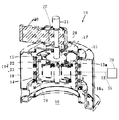
- FIG. 1 is an image diagram including a partial cross-sectional perspective view showing an outline of a flake ice manufacturing apparatus 10 according to an embodiment of the present invention.
- the flake ice manufacturing apparatus 10 includes a drum 11, a rotating shaft 12, an injection unit 13, a scraping unit 14, a blade 15, a flake ice discharge port 16, and an upper bearing member 17. , A heat protection cover 19, a geared motor 20, a rotary joint 21, a refrigerant clearance 24, a bush 28, a refrigerant supply unit 29, and a rotation control unit 27.
- the drum 11 includes an inner cylinder 22, an outer cylinder 23 surrounding the inner cylinder 22, and a refrigerant clearance 24 formed between the inner cylinder 22 and the outer cylinder 23.
- the outer peripheral surface of the drum 11 is covered with a cylindrical heat-resistant protective cover 19.
- the material of the inner cylinder 22 and the outer cylinder 23 is not particularly limited. In this embodiment, steel is employed.
- Refrigerant is supplied to the refrigerant clearance 24 from the refrigerant supply unit 29 via the refrigerant pipe 35. Thereby, the inner peripheral surface of the inner cylinder 22 is cooled.
- the rotary shaft 12 is arranged on the central axis of the drum 11 and rotates around the material axis with the central shaft as an axis, using a geared motor 20 installed above the upper bearing member 17 as a power source.
- the rotational speed of the geared motor 20 is controlled by a rotation control unit 27 described later.
- a rotary joint 21 is attached to the top of the rotating shaft 12.
- the upper part of the rotating shaft 12 is formed with a hole 12a extending in the material axis direction and communicating with each pipe 13 (see FIG. 2).
- the injection unit 13 is composed of a plurality of pipes having injection holes 13 a for injecting brine toward the inner peripheral surface of the inner cylinder 22 at the tip, and rotates together with the rotating shaft 12.
- the brine injected from the injection hole 13a adheres to the inner peripheral surface of the inner cylinder 22 cooled by the refrigerant, and freezes rapidly without giving time for separation.
- the plurality of pipes constituting the injection unit 13 extend radially from the rotary shaft 12 in the radial direction of the drum 11.
- the installation height of each pipe is not particularly limited, but in this embodiment, the installation height is set at an upper position of the inner cylinder 22 of the drum 11. Note that a spray nozzle or the like may be employed instead of the pipe.
- the scraping unit 14 is composed of a plurality of arms on which blades 15 that scrape the brine adhering to the inner peripheral surface of the drum 11 in a frozen state are attached to the tip.
- the scraping portion 14 extends in the radial direction of the drum 11 and rotates together with the rotating shaft 12.
- the plurality of arms constituting the scraping portion 14 are mounted so as to be symmetric with respect to the rotating shaft 12.
- the number of arms is not particularly limited, but in the present embodiment, the number of arms is two.
- the size and material of the blade 15 attached to the tip of each arm are not particularly limited as long as the frozen brine can be scraped off.
- the blade 15 in the present embodiment is made of a stainless steel plate having a length substantially equal to the entire length (total height) of the inner cylinder 22, and a plurality of saw teeth 15 a are formed on the end surface facing the inner cylinder 22. .
- the flake ice dropped from the flake ice discharge port 16 is stored in a flake ice storage tank 34 (FIG. 2) disposed immediately below the flake ice manufacturing apparatus 10.
- the upper bearing member 17 has a shape in which the pan is inverted, and seals the upper surface of the drum 11.
- a bush 24 that supports the rotating shaft 12 is fitted in the center of the upper bearing member 17.
- the rotating shaft 12 is supported only by the upper bearing member 17, and the lower end portion of the rotating shaft 12 is not pivotally supported. That is, since there is no obstacle below the drum 11 when the flake ice scraped by the blade 15 falls, the lower surface of the drum 11 serves as a flake ice discharge port 16 for discharging the flake ice.
- the refrigerant supply unit 29 supplies a refrigerant for cooling the inner peripheral surface of the inner cylinder 22 to the refrigerant clearance 24 via the refrigerant pipe 35.
- the refrigerant supplied by the refrigerant supply unit 29 is not particularly limited as long as it cools the inner peripheral surface of the inner cylinder 22.
- LNG Liquid Natural Gas / liquefied natural gas
- a method of using LNG as a refrigerant will be described later with reference to FIG.
- the refrigerant supplied to the refrigerant clearance 24 can be circulated between the refrigerant clearance 24 and the refrigerant supply unit 36 via the refrigerant pipe 35. Thereby, the refrigerant
- the rotation control unit 27 adjusts the rotation speed of the ejection unit 13 and the scraping unit 14 that rotate together with the rotating shaft 12 by adjusting the rotation speed of the geared motor 20.
- the method by which the rotation control unit 27 controls the rotation speed is not particularly limited. Specifically, for example, a control method using an inverter may be employed.
- FIG. 2 is an image diagram showing an outline of the entire flake ice production system 60 including the flake ice production apparatus 10 of FIG.
- the flake ice production system 60 includes a flake ice production apparatus 10, a brine storage tank 30, a pump 31, a brine pipe 32, a brine tank 33, a flake ice storage tank 34, a refrigerant pipe 35, and a freezing point adjustment unit. 36.
- the brine storage tank 30 stores brine as a raw material for flake ice.
- the brine stored in the brine storage tank 30 is fed to the rotary joint 21 via the brine pipe 32 by operating the pump 31, and becomes flake ice by the flake ice manufacturing apparatus 10. That is, the brine fed to the rotary joint 21 is fed to the pit hole 12 a formed in the rotary joint 21 and the rotary shaft 12, and is fed from the pit hole 12 a to each pipe constituting the injection unit 13.
- the brine tank 33 supplies brine to the brine storage tank 30 when the brine in the brine storage tank 30 is low.
- the brine that has flowed down without being frozen on the inner peripheral surface of the inner cylinder 22 is stored in the brine storage tank 30 and is fed again to the rotary joint 21 via the brine pipe 32 by operating the pump 31.
- the flake ice storage tank 34 is disposed immediately below the flake ice manufacturing apparatus 10 and stores the flake ice that has fallen from the flake ice discharge port 16 of the flake ice manufacturing apparatus 10.
- the freezing point adjustment unit 36 adjusts the freezing point of the brine supplied to the brine storage tank 30 by the brine tank 33.
- the freezing point of the salt water varies depending on the concentration, so the freezing point adjustment unit 36 adjusts the concentration of the salt water stored in the brine storage tank 30.
- the method for adjusting the freezing point of the brine is not particularly limited to this.
- the following method can also be employed. That is, a plurality of brine storage tanks 30 are provided, and a plurality of types of brines having different freezing points are stored in each of several brine storage tanks 30.
- the brine freezing point adjustment unit 37 selects a predetermined type of brine based on the required temperature of the flake ice (for example, the required cool temperature for the transported product transported by the flake ice), The flake ice production apparatus 10 is supplied. Thus, the temperature of the flake ice produced can be adjusted by adjusting the freezing point of the brine.
- the refrigerant supply unit 36 supplies the refrigerant to the refrigerant clearance 24 and sets the temperature of the inner peripheral surface of the inner cylinder 22 to be about ⁇ 10 ° C. lower than the freezing point of the salt water. Thereby, the salt water adhering to the inner peripheral surface of the inner cylinder 22 can be frozen.
- the rotation control unit 27 drives the geared motor 20 to rotate the rotating shaft 12 around the material axis.
- the pump 31 supplies brine that is brine into the rotary shaft 12 from the brine storage tank 30 via the rotary joint 21.
- the injection unit 13 that rotates together with the rotating shaft 12 injects salt water toward the inner peripheral surface of the inner peripheral surface of the inner cylinder 22.
- the salt water sprayed from the spray unit 13 comes into contact with the inner peripheral surface of the inner peripheral surface of the inner cylinder 22, it freezes instantly and becomes ice.
- the rotation control unit 27 controls the rotation speed of the rotating shaft 12 to 2 to 4 rpm.
- the rotation control unit 27 controls the rotation speed of the rotary shaft 12 to 10 to 15 rpm.
- the ice generated on the inner peripheral surface of the inner cylinder 22 is scraped off by the scraping unit 14 that rotates together with the rotating shaft 12.
- the ice scraped off by the scraping unit 14 falls from the discharge port 16 as flake ice.
- the flake ice that has fallen from the discharge port 16 is stored in a flake ice storage tank 34 disposed immediately below the flake ice manufacturing apparatus 10.
- the salt water that does not become ice but flows down the inner peripheral surface of the inner cylinder 22 is stored in the brine storage tank 30, and is supplied again to the rotary joint 21 via the brine pipe 32 by operating the pump 31. Is done.
- the brine tank 33 supplies the salt water stored in itself to the brine storage tank 30.
- the rotation control unit 27 can change the temperature of the flake ice manufactured by the flake ice manufacturing apparatus 10 by changing the rotation speed of the geared motor 20.
- salt water is adopted as the brain.
- the freezing point at which salt water freezes depends only on the solute concentration.
- salt water freezes at ⁇ 1.2 ° C. in any case when the applicant adopts salt water as a brain and changes the rotation speed of the rotary shaft 12 using the flake ice production apparatus 10 of the present embodiment, flake ice produced from the same concentration of salt water is obtained.
- the temperature of the liquid crystal changes according to the rotational speed, and in particular, the temperature decreases as the rotational speed decreases.
- the reason for this is that the flake ice is maintained until the ice-heated state is completely melted. Thereby, the temperature of flake ice can be adjusted, fixing the density
- FIG. 3 is an image diagram showing types of ice slurry that can be produced from the flake ice produced by the flake ice production apparatus 10 of FIG.
- the flake ice manufacturing apparatus 10 freezes salt water having a solute concentration in the range of 1% to 23.2% when brine is used as salt water, thereby ⁇ 1 ° C. to ⁇ 21.3 Flakes ice (salt ice) in the range of ° C. can be produced.
- FIG. 4 is a diagram showing an example of use of LNG exhaust heat.
- imported LNG is stored in the LNG storage tank in a liquid state at -160 ° C.
- the LNG at -160 ° C is vaporized until it reaches room temperature, adjusted for calorific value, and given odor. And supplied for city gas or GT power generation.
- the heat of exhaust cooling until LNG at ⁇ 160 ° C. reaches room temperature the production of liquid oxygen and liquid nitrogen, freezing warehouses, cold power generation, seawater as the heat source
- the technique used for the vaporization of LNG (ORV type) is used.
- flake ice when brine is salt water (sodium chloride aqueous solution), flake ice can be produced at a saturated state of -21.2 ° C, and when magnesium chloride aqueous solution is saturated at -26.27 ° C, The freezing point is lower than that of glycol salt water and magnesium chloride aqueous solution, and substances that could not be used as brine in the past as “antifreeze liquid” can also be used as flake ice by instant freezing. Specifically, for example, flake ice using ethylene glycol as a brine can be produced.
- the required cold-retention temperature varies depending on the type of the object to be cooled, and for example, -1 ° C is suitable, and -150 ° C is suitable.
- the present invention makes it possible to easily produce flake ice matched with a wide range of required cold insulation temperatures by utilizing an ultra-low temperature refrigerant of -160 degrees LNG.
- the brine is salt water (aqueous sodium chloride solution) in the above-described embodiment, but is not particularly limited.
- aqueous calcium chloride solution, an aqueous magnesium chloride solution, ethylene glycol, or the like can be employed.
- a plurality of types of brines having different freezing points according to differences in solute or concentration can be prepared.
- the ice produced by the ice making apparatus of the present invention is preferably liquid ice containing an aqueous solution containing a solute that satisfies the above conditions (a) and (b). Ice) that does not satisfy one or both of the conditions. That is, the object to be cooled may be kept cold using ice slurries having different solute concentrations of ice and water.
- the solid having a higher thermal conductivity than the ice between the ice contained in the ice slurry and the object to be cooled is preferable to perform cooling so as to intervene. Thereby, it is possible to cool for a long time while obtaining a cooling capability for a short time by a solid having high thermal conductivity. In such a case, another object may be interposed between ice, a solid having a higher thermal conductivity than ice, and an object to be cooled, depending on the purpose.
- the object to be cooled in the ice slurry for example, solid (metal etc.) having a higher thermal conductivity than ice, which is not preferable to contact the object to be cooled from the viewpoint of safety
- the ice slurry is contained, either the ice slurry or the object to be cooled may be accommodated in the bag, and the ice slurry and the object to be cooled may be cooled so as not to be in direct contact with each other.
- the flake ice manufacturing apparatus 10 according to an embodiment of the ice making apparatus of the present invention, flake ice at an arbitrary temperature can be efficiently manufactured, so the size of the flake ice manufacturing apparatus 10 itself is made more compact. Can be made.
- the flake ice manufacturing apparatus 10 having a smaller volume than the entire volume of the cooled object to be loaded can be mounted. That is, when transporting a cold object, an ice slurry for cooling the cold object is required in proportion to the amount of the cold object to be transported. Vehicles, ships, and aircraft have maximum loading capacity.
- the flake ice manufacturing apparatus 10 In order to maximize the load capacity of the object to be cooled within the range of the maximum load capacity, it is necessary to minimize the amount of ice slurry within the range in which the cooling effect can be maintained. At this time, if the flake ice manufacturing apparatus 10 is made compact, the volume of the cold-reserved object can be maximized within the range of the maximum load capacity because the volume of the ice-cold object can be smaller than that of the entire cold-retained object to be loaded. It becomes possible to make it.
- the flake ice production apparatus and the flake ice production system to which the present invention is applied need only have the following configuration, and can take various embodiments. That is, the flake ice production apparatus to which the present invention is applied (for example, the flake ice production apparatus 10 in FIG. 1)
- An inner cylinder for example, inner cylinder 22 in FIG. 1)
- an outer cylinder for example, corresponding 23 in FIG. 1 surrounding the inner cylinder
- a clearance for example, FIG. 1 formed between the inner cylinder and the outer cylinder.
- a drum e.g., drum 11 in FIG. 1)
- a refrigerant supply unit for example, the refrigerant supply unit 36 in FIG. 2) for supplying a refrigerant (for example, LNG in FIG.
- a rotating shaft that rotates around the central axis of the drum (for example, the rotating shaft 12 in FIG. 1);
- An injection unit e.g., the injection unit 13 in FIG. 1 that rotates with the rotation shaft and injects brine toward the inner peripheral surface of the inner cylinder;
- the brine jetted from the jetting unit adheres to the inner peripheral surface of the inner cylinder cooled by the refrigerant supplied to the clearance and scrapes off the resulting flake ice (for example, Scraping part 14) of FIG. Is provided.
- the flake ice which frozen the brine can be manufactured easily.
- the brine is An aqueous solution containing a solute that satisfies a predetermined condition; A solid (for example, metal) having higher thermal conductivity than liquid ice containing the aqueous solution can be contained. Thereby, cooling capacity can be made high.
- liquid is Furthermore, oil can be contained.
- the solute is Two or more solutes having different freezing point depression degrees can be included. Thereby, the manufacturing method of the flake ice excellent in cooling capacity and the manufacturing method of the flake ice which can maintain the state which is not isolate
- a speed control unit (for example, the rotation control unit 27 in FIG. 2) that variably controls the rotation speed of the rotary shaft. Can further be provided. Thereby, since the rotational speed of the geared motor 20 can be made low, the flake ice of temperature lower than usual can be manufactured.
- the refrigerant supply unit As the refrigerant, liquefied natural gas can be supplied to the clearance.
- a flake ice production system to which the present invention is applied (for example, the flake ice production system 60 in FIG. 2) A flake ice production system that freezes brine to produce flake ice, A spraying section for spraying the brine (for example, the spraying section 13 in FIG. 1); A member for producing the flake ice by freezing the brine by adhering the sprayed brine in a state cooled below the freezing point of the brine by a predetermined refrigerant (for example, LNG in FIG. 4) (for example, Flake ice production apparatus 10) of FIG.
- a refrigerant supply unit (for example, the refrigerant supply unit 36 in FIG. 2) that supplies the member with a liquefied gas (for example, LNG in FIG. 4) that can cool the member below the freezing point of the brine.
- a refrigerant supply unit for example, the refrigerant supply unit 36 in FIG. 2 that supplies the member with a liquefied gas (for example, LNG in FIG.
- coolant supply part can supply LNG to the said member as said predetermined
- the flake ice manufacturing apparatus 10 to which this invention is applied can be mounted in a moving body.
- the size of flake ice manufacturing apparatus itself can be made more compact. For this reason, for example, in a vehicle, a ship, and an aircraft for transporting the object to be cooled, a flake ice manufacturing apparatus having a smaller volume than the volume of the entire cold object to be loaded can be mounted.
Landscapes
- Engineering & Computer Science (AREA)
- Life Sciences & Earth Sciences (AREA)
- Chemical & Material Sciences (AREA)
- Physics & Mathematics (AREA)
- Mechanical Engineering (AREA)
- Thermal Sciences (AREA)
- General Engineering & Computer Science (AREA)
- Zoology (AREA)
- Food Science & Technology (AREA)
- Polymers & Plastics (AREA)
- Wood Science & Technology (AREA)
- Combustion & Propulsion (AREA)
- Chemical Kinetics & Catalysis (AREA)
- General Chemical & Material Sciences (AREA)
- Inorganic Chemistry (AREA)
- Freezing, Cooling And Drying Of Foods (AREA)
Abstract
Priority Applications (14)
| Application Number | Priority Date | Filing Date | Title |
|---|---|---|---|
| CN201680067406.9A CN108471761A (zh) | 2015-11-19 | 2016-11-18 | 薄片冰制造装置、薄片冰制造系统、薄片冰制造方法以及移动体 |
| KR1020187017430A KR20180092996A (ko) | 2015-11-19 | 2016-11-18 | 플레이크 아이스 제조 장치, 플레이크 아이스 제조 시스템, 플레이크 아이스 제조 방법 및 이동체 |
| JP2017551959A JP6752474B2 (ja) | 2015-11-19 | 2016-11-18 | フレークアイス製造装置、フレークアイス製造システム、フレークアイス製造方法、移動体 |
| AU2016358285A AU2016358285B2 (en) | 2015-11-19 | 2016-11-18 | Flake ice production device, flake ice production system, flake ice production method, and moving body |
| CA3007142A CA3007142A1 (fr) | 2015-11-19 | 2016-11-18 | Dispositif de production de glace en flocons, systeme de production de glace en flocons, procede de production de glace en flocons et corps mobile associe |
| MX2018006082A MX2018006082A (es) | 2015-11-19 | 2016-11-18 | Dispositivo de produccion de hielo granizado, sistema de produccion de hielo granizado, metodo de produccion de hielo granizado, y cuerpo movible. |
| US15/777,025 US20200256604A1 (en) | 2015-11-19 | 2016-11-18 | Flake ice production device, flake ice production system, flake ice production method, and moving body |
| SG11201803512PA SG11201803512PA (en) | 2015-11-19 | 2016-11-18 | Flake ice production device, flake ice production system, flake ice production method, and moving body |
| EP16866463.9A EP3378321A4 (fr) | 2015-11-19 | 2016-11-18 | Dispositif de production de glace en flocons, système de production de glace en flocons, procédé de production de glace en flocons et corps mobile associé |
| BR112018010040-4A BR112018010040A2 (pt) | 2015-11-19 | 2016-11-18 | dispositivo, método e sistema de produção de gelo em flocos, e, corpo móvel |
| RU2018121507A RU2694972C1 (ru) | 2015-11-19 | 2016-11-18 | Устройство для производства чешуйчатого льда, система производства чешуйчатого льда, способ производства чешуйчатого льда и подвижный объект |
| IL259338A IL259338A (en) | 2015-11-19 | 2018-05-14 | A device for producing ice chips, a system for producing ice chips, a method for producing ice chips and a mobile body |
| PH12018501061A PH12018501061A1 (en) | 2015-11-19 | 2018-05-17 | Flake ice production device, flake ice production system, flake ice production method, and moving body |
| ZA2018/04017A ZA201804017B (en) | 2015-11-19 | 2018-06-15 | Flake ice production device, flake ice production system, flake ice production method, and moving body |
Applications Claiming Priority (20)
| Application Number | Priority Date | Filing Date | Title |
|---|---|---|---|
| JP2015226589 | 2015-11-19 | ||
| JP2015-226589 | 2015-11-19 | ||
| JP2016-041189 | 2016-03-03 | ||
| JP2016041189 | 2016-03-03 | ||
| JP2016103012 | 2016-05-24 | ||
| JP2016103640 | 2016-05-24 | ||
| JP2016103014 | 2016-05-24 | ||
| JP2016-103014 | 2016-05-24 | ||
| JP2016103638 | 2016-05-24 | ||
| JP2016-103639 | 2016-05-24 | ||
| JP2016-103638 | 2016-05-24 | ||
| JP2016-103013 | 2016-05-24 | ||
| JP2016103013 | 2016-05-24 | ||
| JP2016-103012 | 2016-05-24 | ||
| JP2016-103640 | 2016-05-24 | ||
| JP2016103637 | 2016-05-24 | ||
| JP2016103639 | 2016-05-24 | ||
| JP2016-103637 | 2016-05-24 | ||
| JP2016-132615 | 2016-07-04 | ||
| JP2016132615A JP6175168B1 (ja) | 2015-11-19 | 2016-07-04 | 氷、冷媒、氷の製造方法、及び被冷却物の製造方法 |
Publications (1)
| Publication Number | Publication Date |
|---|---|
| WO2017086463A1 true WO2017086463A1 (fr) | 2017-05-26 |
Family
ID=58718897
Family Applications (4)
| Application Number | Title | Priority Date | Filing Date |
|---|---|---|---|
| PCT/JP2016/084321 Ceased WO2017086463A1 (fr) | 2015-11-19 | 2016-11-18 | Dispositif de production de glace en flocons, système de production de glace en flocons, procédé de production de glace en flocons et corps mobile associé |
| PCT/JP2016/084320 Ceased WO2017086462A1 (fr) | 2015-11-19 | 2016-11-18 | Dispositif de fabrication de glace, corps mobile, dispositif de production de glace en flocons et procédé de production de glace en flocons |
| PCT/JP2016/084322 Ceased WO2017086464A1 (fr) | 2015-11-19 | 2016-11-18 | Unité de conservation au froid, corps mobile, système d'approvisionnement de coulis de glace, procédé de conservation au froid d'articles devant être conservés au froid, et procédé de transport d'articles devant être conservés au froid |
| PCT/JP2016/084319 Ceased WO2017086461A1 (fr) | 2015-11-19 | 2016-11-18 | Glace, réfrigérant, procédé de production de glace, procédé de production d'article refroidi, procédé de production d'article réfrigéré de plante/animal ou partie de ce dernier, matériau de réfrigération pour plante/animal ou partie de ce dernier, procédé de production de plante/animal frais congelé ou partie de ce dernier, article décongelé ou article traité, et matériau de congélation pour plante/animal frais ou partie de ce dernier |
Family Applications After (3)
| Application Number | Title | Priority Date | Filing Date |
|---|---|---|---|
| PCT/JP2016/084320 Ceased WO2017086462A1 (fr) | 2015-11-19 | 2016-11-18 | Dispositif de fabrication de glace, corps mobile, dispositif de production de glace en flocons et procédé de production de glace en flocons |
| PCT/JP2016/084322 Ceased WO2017086464A1 (fr) | 2015-11-19 | 2016-11-18 | Unité de conservation au froid, corps mobile, système d'approvisionnement de coulis de glace, procédé de conservation au froid d'articles devant être conservés au froid, et procédé de transport d'articles devant être conservés au froid |
| PCT/JP2016/084319 Ceased WO2017086461A1 (fr) | 2015-11-19 | 2016-11-18 | Glace, réfrigérant, procédé de production de glace, procédé de production d'article refroidi, procédé de production d'article réfrigéré de plante/animal ou partie de ce dernier, matériau de réfrigération pour plante/animal ou partie de ce dernier, procédé de production de plante/animal frais congelé ou partie de ce dernier, article décongelé ou article traité, et matériau de congélation pour plante/animal frais ou partie de ce dernier |
Country Status (5)
| Country | Link |
|---|---|
| CA (1) | CA3004245C (fr) |
| MY (1) | MY187613A (fr) |
| PH (1) | PH12022550336A1 (fr) |
| TW (1) | TWI747517B (fr) |
| WO (4) | WO2017086463A1 (fr) |
Cited By (2)
| Publication number | Priority date | Publication date | Assignee | Title |
|---|---|---|---|---|
| JP2020016427A (ja) * | 2018-07-25 | 2020-01-30 | チュン コー ジェームズ | 塩分を含んだ微細な氷の製造装置 |
| WO2024257802A1 (fr) * | 2023-06-13 | 2024-12-19 | 株式会社MARS Company | Procédé d'utilisation d'énergie froide et appareil d'utilisation d'énergie froide |
Families Citing this family (5)
| Publication number | Priority date | Publication date | Assignee | Title |
|---|---|---|---|---|
| CN107975994B (zh) * | 2017-12-25 | 2023-10-31 | 中能绿色精灵(北京)科技有限公司 | 一种气体射流冰浆蓄冷装置及其蓄冷方法 |
| JP7153302B2 (ja) * | 2018-02-22 | 2022-10-14 | ブランテックインターナショナル株式会社 | フレークアイス製造装置 |
| JP7370555B2 (ja) * | 2018-05-28 | 2023-10-30 | ブランテックインターナショナル株式会社 | 氷スラリー製造装置及び冷凍システム |
| JP7148112B2 (ja) * | 2018-05-28 | 2022-10-05 | ブランテックインターナショナル株式会社 | 冷凍装置及び冷凍システム |
| CN109479949A (zh) * | 2018-11-22 | 2019-03-19 | 李爱芳 | 生鲜水产品保鲜方法及设备 |
Citations (5)
| Publication number | Priority date | Publication date | Assignee | Title |
|---|---|---|---|---|
| JPS5484045A (en) * | 1977-12-14 | 1979-07-04 | Seiwa Kasei Kk | Freezing of brine of food |
| JPS623736A (ja) * | 1985-06-29 | 1987-01-09 | Sakai Tadaaki | 魚介類の急速凍結法 |
| JP2003056953A (ja) * | 2001-08-08 | 2003-02-26 | Hoshizaki Electric Co Ltd | 製氷機 |
| JP2007175699A (ja) * | 2005-12-02 | 2007-07-12 | Chugoku Electric Manufacture Co Ltd | 電解海水氷生成システム、電解海水生成装置、製氷装置、電解海水氷生成方法、及び鮮魚保存方法 |
| JP2014508268A (ja) * | 2011-01-31 | 2014-04-03 | アイ・ディ・イー・テクノロジーズ・リミテッド | 凍結脱塩装置および凍結脱塩方法 |
Family Cites Families (16)
| Publication number | Priority date | Publication date | Assignee | Title |
|---|---|---|---|---|
| JPH0623637B2 (ja) * | 1985-03-11 | 1994-03-30 | 日立冷熱株式会社 | 保冷庫の温度制御方法 |
| JPS61247337A (ja) * | 1985-04-25 | 1986-11-04 | Takeshi Hayashi | 魚体の活締、冷却方法および装置 |
| JPS63178786U (fr) * | 1987-05-08 | 1988-11-18 | ||
| JPH0714747B2 (ja) * | 1990-05-28 | 1995-02-22 | 三井造船株式会社 | 冷蔵コンテナ |
| JPH0656665U (ja) * | 1992-12-28 | 1994-08-05 | アイスマン製氷機工業株式会社 | 製氷機 |
| JPH109734A (ja) * | 1996-06-25 | 1998-01-16 | Mitsui Eng & Shipbuild Co Ltd | 球状氷の製造方法 |
| JP2000354454A (ja) | 1999-06-14 | 2000-12-26 | San Ceiling Kk | 魚等の鮮度保持方法 |
| JP2001066030A (ja) * | 1999-08-30 | 2001-03-16 | Sanden Corp | 保冷庫 |
| JP3681107B2 (ja) | 2000-10-05 | 2005-08-10 | 株式会社前川製作所 | 生鮮食品の鮮度保持方法と生鮮食品の鮮度保持システム |
| JP2002162136A (ja) * | 2000-11-24 | 2002-06-07 | Tokyo Inst Of Technol | 製氷方法及び製氷装置 |
| JP2006158301A (ja) | 2004-12-08 | 2006-06-22 | Marufuku Suisan Kk | 鮮魚の鮮度保持方法 |
| JP2007040548A (ja) * | 2005-07-29 | 2007-02-15 | Kajima Corp | 塩水軟氷の製造方法及び装置 |
| JP5395131B2 (ja) * | 2011-08-03 | 2014-01-22 | 株式会社 泉井鐵工所 | スラリーアイス製造装置 |
| BE1020620A5 (fr) * | 2012-04-13 | 2014-02-04 | Franz Colruyt Ets | |
| WO2014174535A1 (fr) * | 2013-04-23 | 2014-10-30 | Skaginn Hf. | Traitement de poisson entier super-refroidi |
| FR3029352B1 (fr) | 2014-11-27 | 2017-01-06 | Soitec Silicon On Insulator | Procede d'assemblage de deux substrats |
-
2016
- 2016-11-18 TW TW109132830A patent/TWI747517B/zh active
- 2016-11-18 PH PH1/2022/550336A patent/PH12022550336A1/en unknown
- 2016-11-18 MY MYPI2018701858A patent/MY187613A/en unknown
- 2016-11-18 WO PCT/JP2016/084321 patent/WO2017086463A1/fr not_active Ceased
- 2016-11-18 WO PCT/JP2016/084320 patent/WO2017086462A1/fr not_active Ceased
- 2016-11-18 WO PCT/JP2016/084322 patent/WO2017086464A1/fr not_active Ceased
- 2016-11-18 CA CA3004245A patent/CA3004245C/fr active Active
- 2016-11-18 WO PCT/JP2016/084319 patent/WO2017086461A1/fr not_active Ceased
Patent Citations (5)
| Publication number | Priority date | Publication date | Assignee | Title |
|---|---|---|---|---|
| JPS5484045A (en) * | 1977-12-14 | 1979-07-04 | Seiwa Kasei Kk | Freezing of brine of food |
| JPS623736A (ja) * | 1985-06-29 | 1987-01-09 | Sakai Tadaaki | 魚介類の急速凍結法 |
| JP2003056953A (ja) * | 2001-08-08 | 2003-02-26 | Hoshizaki Electric Co Ltd | 製氷機 |
| JP2007175699A (ja) * | 2005-12-02 | 2007-07-12 | Chugoku Electric Manufacture Co Ltd | 電解海水氷生成システム、電解海水生成装置、製氷装置、電解海水氷生成方法、及び鮮魚保存方法 |
| JP2014508268A (ja) * | 2011-01-31 | 2014-04-03 | アイ・ディ・イー・テクノロジーズ・リミテッド | 凍結脱塩装置および凍結脱塩方法 |
Non-Patent Citations (2)
| Title |
|---|
| KAISUI FLAKE SEIHYOKI, 4 November 2015 (2015-11-04), Retrieved from the Internet <URL:https://www.youtube.com/watch?v=IzmLqrF18U> [retrieved on 20170120] * |
| THE REFRIGERATION, vol. 90, no. 1057, 15 November 2015 (2015-11-15), pages 2 * |
Cited By (2)
| Publication number | Priority date | Publication date | Assignee | Title |
|---|---|---|---|---|
| JP2020016427A (ja) * | 2018-07-25 | 2020-01-30 | チュン コー ジェームズ | 塩分を含んだ微細な氷の製造装置 |
| WO2024257802A1 (fr) * | 2023-06-13 | 2024-12-19 | 株式会社MARS Company | Procédé d'utilisation d'énergie froide et appareil d'utilisation d'énergie froide |
Also Published As
| Publication number | Publication date |
|---|---|
| WO2017086461A1 (fr) | 2017-05-26 |
| CA3004245A1 (fr) | 2017-05-26 |
| TWI747517B (zh) | 2021-11-21 |
| PH12022550336A1 (en) | 2024-01-22 |
| CA3004245C (fr) | 2022-03-15 |
| MY187613A (en) | 2021-10-04 |
| WO2017086464A1 (fr) | 2017-05-26 |
| WO2017086462A1 (fr) | 2017-05-26 |
| TW202110330A (zh) | 2021-03-16 |
Similar Documents
| Publication | Publication Date | Title |
|---|---|---|
| JP6752474B2 (ja) | フレークアイス製造装置、フレークアイス製造システム、フレークアイス製造方法、移動体 | |
| WO2017086463A1 (fr) | Dispositif de production de glace en flocons, système de production de glace en flocons, procédé de production de glace en flocons et corps mobile associé | |
| JP2018017490A (ja) | フレークアイス製造装置、氷、冷媒、氷の製造方法、被冷却物の製造方法、動植物又はその部分の被冷蔵物の製造方法、動植物又はその部分の冷蔵剤、被冷凍生鮮動植物又はその部分の製造方法、被解凍物又はその加工物、及び生鮮動植物又はその部分の凍結剤 | |
| WO2018212335A1 (fr) | Dispositif de commande de changement de phase et procédé de commande de changement de phase | |
| JP7056901B2 (ja) | 氷および氷の製造方法 | |
| WO2018110506A1 (fr) | Dispositif de production et procédé de production de glace en flocons | |
| JP2018059694A (ja) | 製氷装置 | |
| JP6998577B2 (ja) | 解凍装置及び解凍方法 | |
| HK1260232A1 (en) | Flake ice production device, flake ice production system, flake ice production method, and moving body | |
| HK1260273A1 (en) | Ice, refrigerant, ice production method, method for producing cooled article, method for producing refrigerated article of plant/animal or portion thereof, refrigerating material for plant/animal or portion thereof, method for producing frozen fresh plant/animal or portion thereof, defrosted article or processed article thereof, and freezing material for fresh plant/animal or portion thereof |
Legal Events
| Date | Code | Title | Description |
|---|---|---|---|
| 121 | Ep: the epo has been informed by wipo that ep was designated in this application |
Ref document number: 16866463 Country of ref document: EP Kind code of ref document: A1 |
|
| WWE | Wipo information: entry into national phase |
Ref document number: 11201803512P Country of ref document: SG |
|
| ENP | Entry into the national phase |
Ref document number: 3007142 Country of ref document: CA |
|
| WWE | Wipo information: entry into national phase |
Ref document number: 000974-2018 Country of ref document: PE Ref document number: 259338 Country of ref document: IL |
|
| WWE | Wipo information: entry into national phase |
Ref document number: MX/A/2018/006082 Country of ref document: MX |
|
| WWE | Wipo information: entry into national phase |
Ref document number: 12018501061 Country of ref document: PH |
|
| ENP | Entry into the national phase |
Ref document number: 2017551959 Country of ref document: JP Kind code of ref document: A |
|
| NENP | Non-entry into the national phase |
Ref country code: DE |
|
| ENP | Entry into the national phase |
Ref document number: 2016358285 Country of ref document: AU Date of ref document: 20161118 Kind code of ref document: A |
|
| REG | Reference to national code |
Ref country code: BR Ref legal event code: B01A Ref document number: 112018010040 Country of ref document: BR |
|
| ENP | Entry into the national phase |
Ref document number: 20187017430 Country of ref document: KR Kind code of ref document: A |
|
| WWE | Wipo information: entry into national phase |
Ref document number: 2018121507 Country of ref document: RU Ref document number: 1020187017430 Country of ref document: KR Ref document number: 2016866463 Country of ref document: EP |
|
| ENP | Entry into the national phase |
Ref document number: 2016866463 Country of ref document: EP Effective date: 20180619 |
|
| ENP | Entry into the national phase |
Ref document number: 112018010040 Country of ref document: BR Kind code of ref document: A2 Effective date: 20180517 |