WO2017094487A1 - 高強度ボルト - Google Patents
高強度ボルト Download PDFInfo
- Publication number
- WO2017094487A1 WO2017094487A1 PCT/JP2016/083738 JP2016083738W WO2017094487A1 WO 2017094487 A1 WO2017094487 A1 WO 2017094487A1 JP 2016083738 W JP2016083738 W JP 2016083738W WO 2017094487 A1 WO2017094487 A1 WO 2017094487A1
- Authority
- WO
- WIPO (PCT)
- Prior art keywords
- strength
- content
- bolt
- mass
- steel
- Prior art date
- Legal status (The legal status is an assumption and is not a legal conclusion. Google has not performed a legal analysis and makes no representation as to the accuracy of the status listed.)
- Ceased
Links
Images


Classifications
-
- C—CHEMISTRY; METALLURGY
- C22—METALLURGY; FERROUS OR NON-FERROUS ALLOYS; TREATMENT OF ALLOYS OR NON-FERROUS METALS
- C22C—ALLOYS
- C22C38/00—Ferrous alloys, e.g. steel alloys
- C22C38/18—Ferrous alloys, e.g. steel alloys containing chromium
- C22C38/28—Ferrous alloys, e.g. steel alloys containing chromium with titanium or zirconium
-
- C—CHEMISTRY; METALLURGY
- C21—METALLURGY OF IRON
- C21D—MODIFYING THE PHYSICAL STRUCTURE OF FERROUS METALS; GENERAL DEVICES FOR HEAT TREATMENT OF FERROUS OR NON-FERROUS METALS OR ALLOYS; MAKING METAL MALLEABLE, e.g. BY DECARBURISATION OR TEMPERING
- C21D1/00—General methods or devices for heat treatment, e.g. annealing, hardening, quenching or tempering
- C21D1/18—Hardening; Quenching with or without subsequent tempering
-
- C—CHEMISTRY; METALLURGY
- C21—METALLURGY OF IRON
- C21D—MODIFYING THE PHYSICAL STRUCTURE OF FERROUS METALS; GENERAL DEVICES FOR HEAT TREATMENT OF FERROUS OR NON-FERROUS METALS OR ALLOYS; MAKING METAL MALLEABLE, e.g. BY DECARBURISATION OR TEMPERING
- C21D6/00—Heat treatment of ferrous alloys
- C21D6/004—Heat treatment of ferrous alloys containing Cr and Ni
-
- C—CHEMISTRY; METALLURGY
- C21—METALLURGY OF IRON
- C21D—MODIFYING THE PHYSICAL STRUCTURE OF FERROUS METALS; GENERAL DEVICES FOR HEAT TREATMENT OF FERROUS OR NON-FERROUS METALS OR ALLOYS; MAKING METAL MALLEABLE, e.g. BY DECARBURISATION OR TEMPERING
- C21D6/00—Heat treatment of ferrous alloys
- C21D6/005—Heat treatment of ferrous alloys containing Mn
-
- C—CHEMISTRY; METALLURGY
- C21—METALLURGY OF IRON
- C21D—MODIFYING THE PHYSICAL STRUCTURE OF FERROUS METALS; GENERAL DEVICES FOR HEAT TREATMENT OF FERROUS OR NON-FERROUS METALS OR ALLOYS; MAKING METAL MALLEABLE, e.g. BY DECARBURISATION OR TEMPERING
- C21D6/00—Heat treatment of ferrous alloys
- C21D6/008—Heat treatment of ferrous alloys containing Si
-
- C—CHEMISTRY; METALLURGY
- C21—METALLURGY OF IRON
- C21D—MODIFYING THE PHYSICAL STRUCTURE OF FERROUS METALS; GENERAL DEVICES FOR HEAT TREATMENT OF FERROUS OR NON-FERROUS METALS OR ALLOYS; MAKING METAL MALLEABLE, e.g. BY DECARBURISATION OR TEMPERING
- C21D8/00—Modifying the physical properties of ferrous metals or ferrous alloys by deformation combined with, or followed by, heat treatment
-
- C—CHEMISTRY; METALLURGY
- C21—METALLURGY OF IRON
- C21D—MODIFYING THE PHYSICAL STRUCTURE OF FERROUS METALS; GENERAL DEVICES FOR HEAT TREATMENT OF FERROUS OR NON-FERROUS METALS OR ALLOYS; MAKING METAL MALLEABLE, e.g. BY DECARBURISATION OR TEMPERING
- C21D9/00—Heat treatment, e.g. annealing, hardening, quenching or tempering, adapted for particular articles; Furnaces therefor
- C21D9/0093—Heat treatment, e.g. annealing, hardening, quenching or tempering, adapted for particular articles; Furnaces therefor for screws; for bolts
-
- C—CHEMISTRY; METALLURGY
- C22—METALLURGY; FERROUS OR NON-FERROUS ALLOYS; TREATMENT OF ALLOYS OR NON-FERROUS METALS
- C22C—ALLOYS
- C22C38/00—Ferrous alloys, e.g. steel alloys
- C22C38/001—Ferrous alloys, e.g. steel alloys containing N
-
- C—CHEMISTRY; METALLURGY
- C22—METALLURGY; FERROUS OR NON-FERROUS ALLOYS; TREATMENT OF ALLOYS OR NON-FERROUS METALS
- C22C—ALLOYS
- C22C38/00—Ferrous alloys, e.g. steel alloys
- C22C38/002—Ferrous alloys, e.g. steel alloys containing In, Mg, or other elements not provided for in one single group C22C38/001 - C22C38/60
-
- C—CHEMISTRY; METALLURGY
- C22—METALLURGY; FERROUS OR NON-FERROUS ALLOYS; TREATMENT OF ALLOYS OR NON-FERROUS METALS
- C22C—ALLOYS
- C22C38/00—Ferrous alloys, e.g. steel alloys
- C22C38/02—Ferrous alloys, e.g. steel alloys containing silicon
-
- C—CHEMISTRY; METALLURGY
- C22—METALLURGY; FERROUS OR NON-FERROUS ALLOYS; TREATMENT OF ALLOYS OR NON-FERROUS METALS
- C22C—ALLOYS
- C22C38/00—Ferrous alloys, e.g. steel alloys
- C22C38/04—Ferrous alloys, e.g. steel alloys containing manganese
-
- C—CHEMISTRY; METALLURGY
- C22—METALLURGY; FERROUS OR NON-FERROUS ALLOYS; TREATMENT OF ALLOYS OR NON-FERROUS METALS
- C22C—ALLOYS
- C22C38/00—Ferrous alloys, e.g. steel alloys
- C22C38/06—Ferrous alloys, e.g. steel alloys containing aluminium
-
- C—CHEMISTRY; METALLURGY
- C22—METALLURGY; FERROUS OR NON-FERROUS ALLOYS; TREATMENT OF ALLOYS OR NON-FERROUS METALS
- C22C—ALLOYS
- C22C38/00—Ferrous alloys, e.g. steel alloys
- C22C38/18—Ferrous alloys, e.g. steel alloys containing chromium
- C22C38/32—Ferrous alloys, e.g. steel alloys containing chromium with boron
-
- C—CHEMISTRY; METALLURGY
- C22—METALLURGY; FERROUS OR NON-FERROUS ALLOYS; TREATMENT OF ALLOYS OR NON-FERROUS METALS
- C22C—ALLOYS
- C22C38/00—Ferrous alloys, e.g. steel alloys
- C22C38/18—Ferrous alloys, e.g. steel alloys containing chromium
- C22C38/40—Ferrous alloys, e.g. steel alloys containing chromium with nickel
- C22C38/42—Ferrous alloys, e.g. steel alloys containing chromium with nickel with copper
-
- C—CHEMISTRY; METALLURGY
- C22—METALLURGY; FERROUS OR NON-FERROUS ALLOYS; TREATMENT OF ALLOYS OR NON-FERROUS METALS
- C22C—ALLOYS
- C22C38/00—Ferrous alloys, e.g. steel alloys
- C22C38/18—Ferrous alloys, e.g. steel alloys containing chromium
- C22C38/40—Ferrous alloys, e.g. steel alloys containing chromium with nickel
- C22C38/44—Ferrous alloys, e.g. steel alloys containing chromium with nickel with molybdenum or tungsten
-
- C—CHEMISTRY; METALLURGY
- C22—METALLURGY; FERROUS OR NON-FERROUS ALLOYS; TREATMENT OF ALLOYS OR NON-FERROUS METALS
- C22C—ALLOYS
- C22C38/00—Ferrous alloys, e.g. steel alloys
- C22C38/18—Ferrous alloys, e.g. steel alloys containing chromium
- C22C38/40—Ferrous alloys, e.g. steel alloys containing chromium with nickel
- C22C38/46—Ferrous alloys, e.g. steel alloys containing chromium with nickel with vanadium
-
- C—CHEMISTRY; METALLURGY
- C22—METALLURGY; FERROUS OR NON-FERROUS ALLOYS; TREATMENT OF ALLOYS OR NON-FERROUS METALS
- C22C—ALLOYS
- C22C38/00—Ferrous alloys, e.g. steel alloys
- C22C38/18—Ferrous alloys, e.g. steel alloys containing chromium
- C22C38/40—Ferrous alloys, e.g. steel alloys containing chromium with nickel
- C22C38/48—Ferrous alloys, e.g. steel alloys containing chromium with nickel with niobium or tantalum
-
- C—CHEMISTRY; METALLURGY
- C22—METALLURGY; FERROUS OR NON-FERROUS ALLOYS; TREATMENT OF ALLOYS OR NON-FERROUS METALS
- C22C—ALLOYS
- C22C38/00—Ferrous alloys, e.g. steel alloys
- C22C38/18—Ferrous alloys, e.g. steel alloys containing chromium
- C22C38/40—Ferrous alloys, e.g. steel alloys containing chromium with nickel
- C22C38/50—Ferrous alloys, e.g. steel alloys containing chromium with nickel with titanium or zirconium
-
- C—CHEMISTRY; METALLURGY
- C22—METALLURGY; FERROUS OR NON-FERROUS ALLOYS; TREATMENT OF ALLOYS OR NON-FERROUS METALS
- C22C—ALLOYS
- C22C38/00—Ferrous alloys, e.g. steel alloys
- C22C38/18—Ferrous alloys, e.g. steel alloys containing chromium
- C22C38/40—Ferrous alloys, e.g. steel alloys containing chromium with nickel
- C22C38/54—Ferrous alloys, e.g. steel alloys containing chromium with nickel with boron
-
- F—MECHANICAL ENGINEERING; LIGHTING; HEATING; WEAPONS; BLASTING
- F16—ENGINEERING ELEMENTS AND UNITS; GENERAL MEASURES FOR PRODUCING AND MAINTAINING EFFECTIVE FUNCTIONING OF MACHINES OR INSTALLATIONS; THERMAL INSULATION IN GENERAL
- F16B—DEVICES FOR FASTENING OR SECURING CONSTRUCTIONAL ELEMENTS OR MACHINE PARTS TOGETHER, e.g. NAILS, BOLTS, CIRCLIPS, CLAMPS, CLIPS OR WEDGES; JOINTS OR JOINTING
- F16B35/00—Screw-bolts; Stay-bolts; Screw-threaded studs; Screws; Set screws
Definitions
- the present invention relates to a bolt, and more particularly to a high-strength bolt.
- alloy elements such as Mo and V in the steel may be reduced. If the alloy elements are reduced, the hardenability of the steel material is lowered, and the production of a hard structure such as bainite can be suppressed when a wire is produced by hot rolling. Therefore, the softening heat treatment can be omitted or simplified, and the manufacturing cost is reduced. However, it is difficult to increase the strength of the bolt, and the hydrogen embrittlement resistance is also deteriorated.
- high-strength bolts containing boron (B) in place of alloy elements such as Mo and V have been studied.
- B enhances the hardenability of steel, like alloy elements such as Mo and V.
- the hydrogen embrittlement resistance may be low.
- Patent Document 1 JP 2012-162798 A
- Patent Document 2 JP 11-293401 A
- Patent Document 3 JP 10-53834 A
- Patent Document 4 Japanese Patent Laid-Open No. 2008-156678
- the steel for high-strength bolts disclosed in Patent Document 1 is in mass%, C: 0.20 to less than 0.40%, Si: 0.20 to 1.50%, Mn: 0.00. 30 to 2.0%, P: 0.03% or less (not including 0%), S: 0.03% or less (not including 0%), Ni: 0.05 to 1.0%, Cr: 0.01 to 1.50%, Cu: 1.0% or less (including 0%), Al: 0.01 to 0.10%, Ti: 0.01 to 0.1%, B: 0.0003 -0.0050% and N: 0.002-0.010%, respectively, and a total of 0.10-3.0% of one or more selected from the group consisting of Cu, Ni and Cr, and the balance Consists of iron and inevitable impurities.
- the steel further has a ratio of Si content [Si] to C content [C] ([Si] / [C]) of 1.0 or more, and has a ferrite and pearlite structure.
- Patent Document 1 describes that a B-added high-strength bolt excellent in delayed fracture resistance can be obtained.
- the Si content is made higher than the C content, the strength of the matrix is increased by Si, and the delayed fracture resistance is improved.
- expensive Ni is contained as an essential element, the steel material cost is increased.
- the steel for bolts disclosed in Patent Document 2 is in mass%, C: 0.10 to 0.45%, B: 0.0003 to 0.0050%, Ti: 0.01 to 0.1%, N : Including 0.0025 to 0.010%, and as other components, Si: 0.03 to 0.5%, Mn: 0.3 to 1.5% and Al: 0.01 to 0.10%
- the balance consists of Fe and inevitable impurities.
- This steel further satisfies at least one of the following requirements (1) and (2).
- Patent Document 2 describes that a bolt made of B-containing steel having excellent cold workability and delayed fracture resistance can be obtained.
- the bolt of Patent Document 2 has a low Si content and a mass ratio of Si and Mn of less than 1.0. Therefore, it is difficult to control inclusions, and the hydrogen embrittlement resistance may be low.
- Patent Document 3 The steel for high-strength bolts disclosed in Patent Document 3 is mass%, B: 0.0008 to 0.004%, C: 0.4% or less (not including 0%), Ti: 0.025 to 0.06%, N: 0.006% or less (not including 0%), with the balance being Fe and inevitable impurities.
- the relationship between the ferrite grain size FGc during hot rolling and the Ti compound excluding TiN satisfies [Ti compound amount excluding TiN / FGc 1/2 ] ⁇ 1000 ⁇ 3.
- Patent Document 3 describes that a high-strength bolt having an austenite grain size number of 5 or more and a tensile strength exceeding 785 N / mm 2 can be obtained.
- the steel for high-strength bolts disclosed in Patent Document 4 is mass%, C: more than 0.15% and 0.30% or less, Si: 1.0% or less, Mn: 1.5% or less, Ti: 0 0.1% or less, Mo: 0.3% or more, 0.5% or less, B: 0.0005% or more, 0.01% or less, with the balance being Fe and impurities.
- this steel is tempered at 100 to 400 ° C. to obtain a steel structure having an average prior austenite grain size of 10 ⁇ m or less after quenching.
- Patent Document 4 it is described that a high-strength bolt excellent in delayed fracture resistance and corrosion resistance having a bolt strength range of about 1200 to 1600 MPa can be obtained.
- the bolt of Patent Document 4 contains 0.3 to 0.5% by mass of Mo, so that the hardenability is too high. Therefore, it is necessary to carry out a long softening heat treatment before wire drawing and cold forging. In this case, the manufacturing cost may increase significantly.
- An object of the present invention is to provide a bolt having high strength and excellent hydrogen embrittlement resistance.
- the high-strength bolt according to the present invention is, in mass%, C: 0.22 to 0.40%, Si: 0.10 to 1.50%, Mn: 0.20 to less than 0.40%, P: 0.00. 020% or less, S: 0.020% or less, Cr: 0.70 to 1.45%, Al: 0.005 to 0.060%, Ti: 0.010 to 0.045%, B: 0.0003 ⁇ 0.0040%, N: 0.0015 ⁇ 0.0080%, O: 0.0020% or less, Cu: 0 ⁇ 0.50%, Ni: 0 ⁇ 0.30%, Mo: 0 ⁇ 0.04 %, V: 0 to 0.05%, and Nb: 0 to 0.050%, the balance is composed of Fe and impurities, and has a chemical composition satisfying the formulas (1) and (2), It has a tensile strength of 1000 to 1300 MPa.
- the high-strength bolt according to the present invention has high strength and excellent hydrogen embrittlement resistance.
- FIG. 1 is a diagram showing the relationship between the critical diffusion hydrogen amount and Si / Mn in the bolt.
- FIG. 2 is a side view of a test piece with an annular V-notch.
- FIG. 3 is a side view of the screw manufactured in the example.
- the present inventors do not contain a large amount of expensive alloy elements such as Mo and V, but use B-containing steel containing C, Si, Mn, Cr and B, etc.
- the investigation and investigation were conducted on the components and the structure affecting the crystallization characteristics. As a result, the present inventors obtained the following knowledge.
- fn1 C + Si / 10 + Mn / 5 + 5Cr / 22.
- C, Si, Mn, and Cr are all elements that enhance the hardenability. Therefore, fn1 is an index of hardenability and cold workability.
- fn1 If fn1 is too low, sufficient hardenability cannot be obtained. On the other hand, if fn1 is too high, the hardenability becomes too high. In this case, when the bolt steel is rolled into a wire rod, bainite is generated and the strength and hardness are increased. Therefore, sufficient cold workability cannot be obtained unless a long-time softening heat treatment is performed a plurality of times before the next wire drawing step and the cold forging step. If fn1 satisfies the formula (1), sufficient cold workability can be obtained without performing a long-time softening heat treatment a plurality of times while obtaining excellent hardenability.
- FIG. 1 is a diagram showing the relationship between the limit diffusion hydrogen amount HR and fn2.
- FIG. 1 was obtained by the following method.
- the electrolytic charging method was performed as follows. The test piece was immersed in an aqueous solution of ammonium thiocyanate. With the test piece immersed, hydrogen was taken into the test piece by generating an anode potential on the surface of the test piece. Then, the zinc plating film was formed in the surface of each test piece, and dissipation of the hydrogen in a test piece was prevented. Subsequently, a constant load test was performed in which a constant load was applied so that a tensile stress of a nominal stress of 1080 MPa was applied to the V-notch cross section of the test piece.
- test piece that was broken during the test and the test piece that was not broken were subjected to a temperature rising analysis method using a gas chromatograph apparatus to measure the amount of hydrogen in the test piece. After the measurement, the maximum hydrogen content of the test piece that did not break in each steel was defined as the critical diffusible hydrogen content Hc.
- FIG. 1 is an index of hydrogen embrittlement resistance.
- FIG. 1 was created based on the obtained HR and fn2 of each steel.
- HR increases significantly as fn2 increases, that is, as the ratio of Si content to Mn content increases.
- fn2 is 1.0 or more
- HR is 1.20 or more
- excellent hydrogen embrittlement resistance is obtained.
- fn2 is 1.0 or more
- HR does not change so much even if fn2 increases.
- the high-strength bolt according to the present invention completed on the basis of the above knowledge is, in mass%, C: 0.22 to 0.40%, Si: 0.10 to 1.50%, Mn: 0.20 to 0.00. Less than 40%, P: 0.020% or less, S: 0.020% or less, Cr: 0.70 to 1.45%, Al: 0.005 to 0.060%, Ti: 0.010 to 0.00.
- the high-strength bolt according to the present invention is further, in mass%, Cu: 0.02-0.50%, Ni: 0.03-0.30%, Mo: 0.01-0.04%, and V: One or more selected from the group consisting of 0.005 to 0.05% may be contained.
- the high-strength bolt according to the present invention may further contain Nb: 0.0015 to 0.050 mass% or less.
- the absolute value of the compressive residual stress of the surface layer of the screw bottom portion is 10 to 90% of the tensile strength of the high strength bolt.
- the hydrogen embrittlement resistance is further enhanced.
- the chemical composition of the high-strength bolt of this embodiment contains the following elements.
- C 0.22 to 0.40% Carbon (C) increases the hardenability of the bolt and increases the tensile strength of the bolt after quenching and tempering to 1000 MPa or more. If the C content is less than 0.22%, the above effect cannot be obtained. On the other hand, if the C content exceeds 0.40%, the hardenability becomes too high. In this case, the strength of the steel for bolts after hot working becomes too high, and cold workability is lowered. Therefore, it is necessary to perform a long-time heat treatment for the purpose of softening a steel material before performing cold working such as wire drawing and cold forging a plurality of times, which increases the manufacturing cost. When heat treatment is performed, the hydrogen embrittlement resistance is further deteriorated. Therefore, the C content is 0.22 to 0.40%.
- the minimum with preferable C content is 0.24%, More preferably, it is 0.26%.
- the upper limit with preferable C content is 0.38%, More preferably, it is 0.35%.
- Si 0.10 to 1.50% Silicon (Si) suppresses the precipitation of cementite and increases the temper softening resistance. Si further deoxidizes the steel. The deoxidation product MnO—SiO 2 is a vitrified soft inclusion and is refined by drawing and cutting during hot rolling. Therefore, the hydrogen embrittlement resistance is improved. If the Si content is less than 0.10%, the above effects cannot be obtained. On the other hand, if the S content exceeds 1.50%, the strength becomes too high. In this case, the ductility and cold forgeability of the steel are reduced. Therefore, the Si content is 0.10 to 1.50%.
- the minimum with preferable Si content is more than 0.35%, More preferably, it is 0.40%, More preferably, it is 0.45%, More preferably, it is more than 0.50%.
- the upper limit with preferable Si content is 1.20%, More preferably, it is 1.00%.
- Mn 0.20 to less than 0.40%
- Manganese (Mn) increases the hardenability and makes the bolt tensile strength 1000 MPa or more. Mn further combines with Si to form inclusions (MnO—SiO 2 ). This inclusion is soft and is stretched, cut, and refined during hot rolling, so that the density of MnO—SiO 2 is reduced and the resistance to hydrogen embrittlement is increased. If the Mn content is less than 0.20%, this effect cannot be obtained. On the other hand, if the Mn content is 0.40% or more, it segregates at the grain boundary and promotes grain boundary fracture. Therefore, the Mn content is 0.20 to less than 0.40%. The minimum with preferable Mn content is 0.22%, More preferably, it is 0.25%. The upper limit with preferable Mn content is 0.38%, More preferably, it is 0.35%.
- Phosphorus (P) is an impurity. P segregates at the grain boundaries to lower the cold workability and lower the hydrogen embrittlement resistance of the bolt. Therefore, the P content is 0.020% or less. The upper limit with preferable P content is 0.015%. The P content is preferably as low as possible.
- S 0.020% or less Sulfur (S) is an impurity. S forms sulfides, lowering the cold workability and lowering the hydrogen embrittlement resistance of the bolt. Therefore, the S content is 0.020% or less.
- the upper limit with preferable S content is 0.010%, More preferably, it is 0.008%.
- the S content is preferably as low as possible.
- Chromium (Cr) increases the hardenability and makes the tensile strength of the bolt 1000 MPa or more. Cr further enhances the hydrogen embrittlement resistance of the bolt. If the Cr content is less than 0.70%, these effects cannot be obtained. On the other hand, if the Cr content exceeds 1.45%, the hardenability becomes too high, and the cold workability of the bolt steel material decreases. Therefore, the Cr content is 0.70 to 1.45%.
- a preferable lower limit of the Cr content is 0.90%.
- the upper limit with preferable Cr content is 1.20%.
- Al 0.005 to 0.060%
- Aluminum (Al) deoxidizes steel. If the Al content is less than 0.005%, this effect cannot be obtained. On the other hand, if the Al content exceeds 0.060%, coarse oxide inclusions are generated and cold workability is lowered. Therefore, the Al content is 0.005 to 0.060%.
- a preferable lower limit of the Al content is 0.010%.
- the upper limit with preferable Al content is 0.055%.
- the Al content means the total amount of Al contained in the steel material.
- Ti 0.010 to 0.045% Titanium (Ti) combines with N in the steel to form nitride (TiN). By the generation of TiN, the generation of BN is suppressed and the amount of dissolved B increases. As a result, the hardenability of the steel material is increased. Ti further combines with C to form carbides (TiC) to refine crystal grains. This increases the hydrogen embrittlement resistance of the bolt. If the Ti content is less than 0.010%, these effects cannot be obtained. On the other hand, if the Ti content exceeds 0.045%, a large amount of coarse TiN is generated. In this case, cold workability and hydrogen embrittlement resistance are reduced. Therefore, the Ti content is 0.010 to 0.045%. A preferred lower limit of the Ti content is 0.015%. The upper limit with preferable Ti content is 0.040%.
- B 0.0003 to 0.0040% Boron (B) increases the hardenability of the steel. B further suppresses the grain boundary segregation of P and enhances the hydrogen embrittlement resistance of the bolt. If the B content is less than 0.0003%, these effects cannot be obtained. On the other hand, if the B content exceeds 0.0040%, the effect of improving hardenability is saturated. Furthermore, coarse BN is generated and cold workability is lowered. Therefore, the B content is 0.0003 to 0.0040%. A preferable lower limit of the B content is 0.0005%. The upper limit with preferable B content is 0.0025%.
- N 0.0015 to 0.0080% Nitrogen (N) combines with Ti in the steel to form nitrides and refines the crystal grains. If the N content is less than 0.0015%, this effect cannot be obtained. On the other hand, if the N content exceeds 0.0080%, the effect is saturated. Furthermore, N combines with B to form a nitride, reducing the amount of dissolved B. In this case, the hardenability of the steel is reduced. Therefore, the N content is 0.0015 to 0.0080%. The minimum with preferable N content is 0.0020%. The upper limit with preferable N content is 0.0070%.
- Oxygen (O) is an impurity. O forms an oxide and reduces cold workability. If the O content exceeds 0.0020%, a large amount of oxide is generated and MnS is coarsened, so that the cold workability is remarkably lowered. Therefore, the O content is 0.0020% or less. The upper limit with preferable O content is 0.0018%. The O content is preferably as low as possible.
- the balance of the chemical composition of the high-strength bolt according to the present invention consists of Fe and impurities.
- the impurities are mixed from ore as a raw material, scrap, or production environment when industrially producing high-strength bolts, and are allowed within a range that does not adversely affect the present invention. Means something.
- the high-strength bolt described above may further contain one or more selected from the group consisting of Cu, Ni, Mo, and V instead of a part of Fe. All of these elements are optional elements and enhance the hardenability of the steel.
- Cu 0 to 0.50% Copper (Cu) is an optional element and may not be contained. When contained, Cu increases the hardenability of the steel. However, if Cu content exceeds 0.50%, hardenability will become high too much and cold workability will fall. Therefore, the Cu content is 0 to 0.50%.
- the minimum with preferable Cu content for acquiring the said effect more effectively is 0.02%, More preferably, it is 0.05%.
- the upper limit with preferable Cu content is 0.30%, More preferably, it is 0.20%.
- Nickel (Ni) is an optional element and may not be contained. When contained, Ni increases the hardenability of the steel and further increases the toughness of the steel material after quenching. However, if Ni content exceeds 0.30%, hardenability will become high too much and cold workability will fall. Therefore, the Ni content is 0 to 0.30%.
- the preferable lower limit of the Ni content for obtaining the above effect more effectively is 0.03%, and more preferably 0.05%.
- the upper limit with preferable Ni content is 0.20%, More preferably, it is 0.10%.
- Mo 0 to 0.04%
- Molybdenum (Mo) is an optional element and may not be contained. When contained, Mo increases the hardenability of the steel. However, if the Mo content exceeds 0.04%, the hardenability becomes too high and the cold workability of the steel material for high-strength bolts decreases. Therefore, the Mo content is 0 to 0.04%.
- the minimum with preferable Mo content for acquiring the said effect more effectively is 0.01%, More preferably, it is 0.015%.
- the upper limit with preferable Mo content is 0.03%, More preferably, it is 0.025%.
- V 0 to 0.05%
- Vanadium (V) is an optional element and may not be contained. When contained, V increases the hardenability of the steel. V further forms carbides, nitrides or carbonitrides to refine crystal grains. However, if the V content exceeds 0.05%, carbides and the like are coarsened and cold workability is lowered. Therefore, the V content is 0 to 0.05%. The minimum with preferable V content for acquiring the said effect more effectively is 0.005%. The upper limit with preferable V content is 0.03%, More preferably, it is 0.02%.
- the chemical composition of the high-strength bolt according to the present invention may further contain Nb instead of part of Fe.
- Niobium (Nb) is an optional element and may not be contained. When contained, Nb combines with C and N to form carbides, nitrides or carbonitrides and refines the crystal grains. Nb further enhances the hydrogen embrittlement resistance of the bolt. However, if the Nb content exceeds 0.050%, coarse carbides or the like are generated and the cold workability of the steel material is lowered. Therefore, the Nb content is 0 to 0.050%. The minimum with preferable Nb content for acquiring the said effect more effectively is 0.0015%. The upper limit with preferable Nb content is 0.040%, More preferably, it is 0.030%.
- the chemical composition of the high-strength bolt according to the present invention further satisfies the formula (1). 0.50 ⁇ C + Si / 10 + Mn / 5 + 5Cr / 22 ⁇ 0.85 (1)
- the content (mass%) of the corresponding element is substituted for each element symbol in the formula (1).
- “0” is assigned to the corresponding element symbol in the formula (1).
- Fn1 C + Si / 10 + Mn / 5 + 5Cr / 22 is an index of steel strength and cold workability.
- fn1 represents the carbon equivalent of the steel material. If fn1 is too low, sufficient hardenability cannot be obtained and strength cannot be obtained. On the other hand, if fn1 is too high, the hardenability is too high. In this case, when the steel for high-strength bolts is rolled into a wire, bainite is generated, and the strength and hardness of the steel are too high. Therefore, sufficient cold workability cannot be obtained unless a long-time softening heat treatment is performed a plurality of times before the next wire drawing step and the cold forging step.
- fn1 is 0.50 to 0.85, sufficient cold workability can be obtained without obtaining long-time softening heat treatment while obtaining excellent hardenability.
- a preferred lower limit of fn1 is 0.53.
- the preferable upper limit of fn1 is 0.83.
- MnO—SiO 2 has a melting point of about 1250 ° C. Therefore, although it is liquid in the molten metal before solidification, it becomes solid in the steel piece after solidification, and becomes a vitrified soft inclusion. This inclusion is stretched and divided during hot rolling to be refined. Therefore, the fatigue strength is improved and the hydrogen embrittlement resistance is improved. In order to obtain fine MnO—SiO 2 , it is necessary to appropriately control the ratio of Si to Mn. This index is fn2.
- HR increases remarkably as fn2 increases.
- fn2 exceeds 1.0, HR becomes 1.2 or more, and excellent hydrogen embrittlement resistance can be obtained.
- a preferred lower limit of fn2 is 1.1.
- the absolute value of the compressive residual stress of the surface layer of the screw bottom portion is 10 to 90% of the tensile strength of the high strength bolt.
- the tensile stress applied to the screw bottom when the bolt is tightened is offset with the compressive residual stress. For this reason, the stress state of the starting point portion is relaxed, and breakage due to hydrogen embrittlement hardly occurs. If the compressive residual stress (absolute value) is less than 10% of the tensile strength (absolute value), the tensile stress canceling effect by the compressive residual stress is insufficient, and excellent hydrogen embrittlement resistance cannot be obtained. On the other hand, if the compressive residual stress (absolute value thereof) exceeds 90% of the tensile strength (absolute value thereof), the above effect is saturated. Therefore, the compressive residual stress is 10 to 90% of the tensile strength.
- the “surface layer” refers to a range from the surface of the high-strength bolt to a depth of 50 ⁇ m toward the central axis.
- the compressive residual stress is measured by a known X-ray method. Specifically, an X-ray stress measurement method using X-ray diffraction is used in accordance with JIS B2711 (2013). The measurement is performed using characteristic X-ray types: MnK ⁇ ray, Cr filter, reference diffraction angle 2 ⁇ 0 : 152.0 °, ⁇ angle 14.0 °, and X-ray stress constant K: -336 MPa / °. The measurement site is centered on the central position of the screw bottom. The tensile strength is determined according to JIS Z2241 (2011).
- a molten steel having the above chemical composition is produced.
- a slab is manufactured by a continuous casting method using molten steel.
- an ingot is manufactured by an ingot-making method using molten steel.
- the produced slab or ingot is rolled into a steel slab.
- the steel piece is hot-worked to obtain a steel material (wire) for high-strength bolts. Hot working is, for example, hot rolling.
- High-strength bolt manufacturing process high-strength bolts are manufactured using steel materials for high-strength bolts.
- the high-strength bolt manufacturing process includes a wire drawing process, a cold forging process, a threading process, and a quenching and tempering process. Hereinafter, each process will be described.
- a steel wire is manufactured by drawing a wire.
- the wire drawing may be performed only by primary wire drawing, or may be performed a plurality of times such as secondary wire drawing.
- a lubricating film is formed on the surface of the wire.
- the lubricating coating is, for example, a phosphate coating or a non-phosphorous lubricating coating.
- a lubricating film containing no P is used.
- the surface of the steel material (steel wire) is washed or pickled before the quenching step described later, and the phosphate coating is removed from the surface.
- the cleaning is, for example, a well-known alkali cleaning.
- the high-strength bolt after threading is quenched and tempered under known conditions to adjust the tensile strength of the high-strength bolt to 1000 to 1300 MPa. If the tensile strength is less than 1000 MPa, the strength of the bolt is insufficient. On the other hand, when the tensile strength exceeds 1300 MPa, the hydrogen sensitivity increases and the hydrogen embrittlement resistance decreases. Accordingly, the tensile strength of the high-strength bolt is 1000 to 1300 MPa.
- a lubricating coating containing P typified by a phosphate coating is used during the wire drawing step, the surface of the steel (steel wire) is preferably subjected to alkali cleaning before quenching as described above.
- a known compressive residual stress applying step is performed on the high-strength bolt after quenching and tempering so that the compressive residual stress on the surface layer of the screw bottom is 10 to 90% of the tensile strength of the high-strength bolt.
- a known compressive residual stress application process is, for example, shot peening. By appropriately adjusting the conditions of the shot peening process, the compressive residual stress of the surface layer at the bottom of the screw can be made 10 to 90% of the tensile strength of the high-strength bolt.
- the threading process (pre-rolling process) is performed before quenching and tempering.
- the threading process (post-rolling process) may be performed after quenching and tempering instead of the pre-rolling process.
- a compressive residual stress of 10 to 90% of the tensile strength of the high-strength bolt can be applied to the surface layer at the bottom of the screw.
- the shot peening process may not be performed.
- the high-strength bolt of the present invention is manufactured.
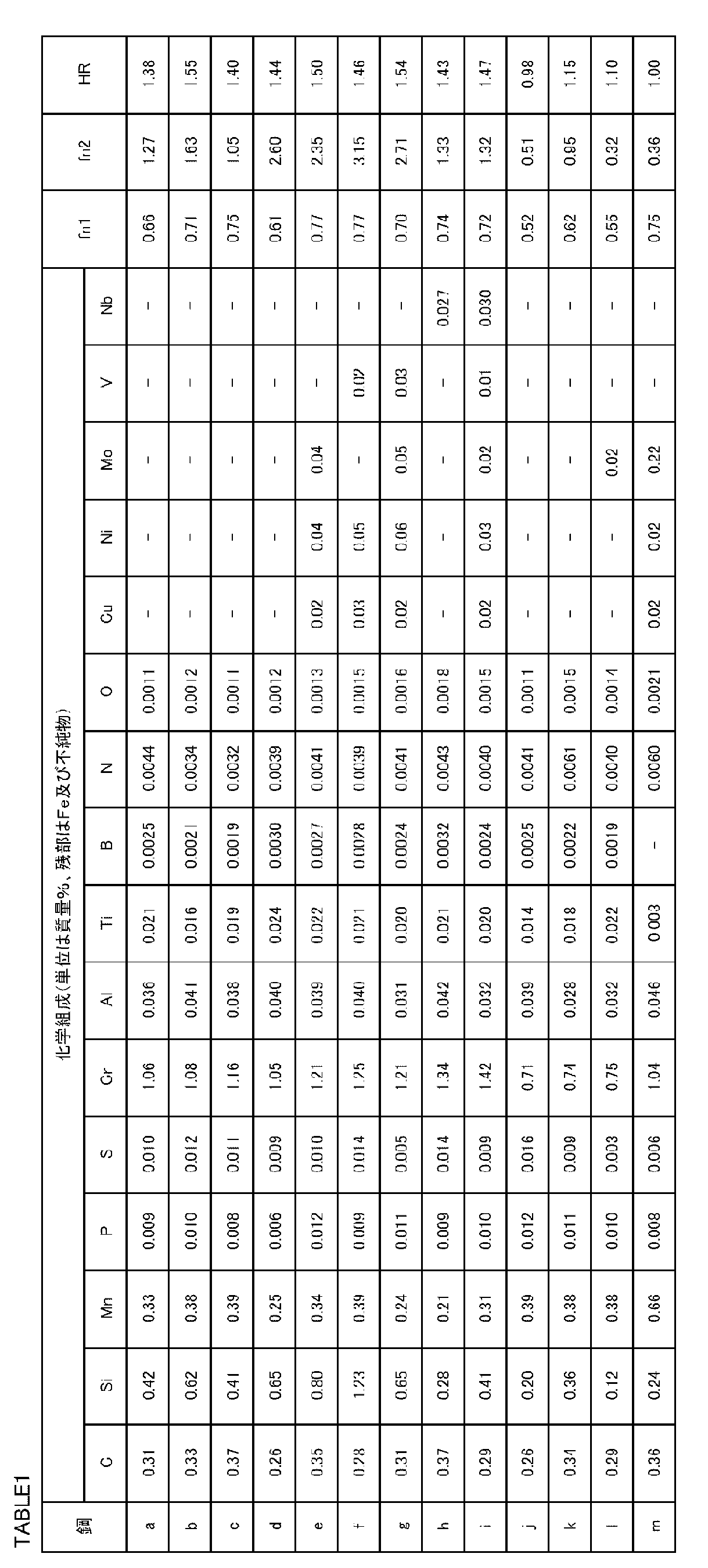
- steel L had a chemical composition corresponding to SCM435 of JIS G4053 (2008).
- Billets having a cross-section of 162 mm ⁇ 162 mm were manufactured by continuous casting using molten steel. The billet was hot-worked (hot-rolled) to produce a wire having a diameter of 11.5 mm.
- Steel wires were manufactured by performing wire drawing on the wire materials having the test numbers shown in Table 3. At this time, heat treatment for softening was performed. The heat treatment temperature was 750 ° C., the heat treatment time was 60 minutes, and annealing was performed after the heat treatment. Further, after degreasing and pickling, zinc phosphate treatment (75 ° C., immersion time 600 sec) and metal soap treatment (80 ° C., immersion time 180 sec) are carried out, and a zinc phosphate coating and a metal soap coating are applied to the surface. A lubricating treatment film was formed. Thereafter, finish wire drawing was performed to produce a steel wire having a diameter of 10.5 mm. This steel wire was used as a material for forging high-strength bolts.
- the steel wire of each test number was cold forged to produce a high-strength bolt shown in FIG. Specifically, cold forging was performed in two steps. In the first step, the shaft portion of the high-strength bolt was pressed and molded. In the second step, a die was designed so as to perform the process of forming the head portion and the flange portion of the high-strength bolt, and the die was mounted on a hydraulic forging press and cold forging was performed.
- Each numerical value in the figure indicates the dimension (mm) of the corresponding part.
- the “ ⁇ numerical value” in the figure indicates the diameter (mm) of the designated part.
- Numerical value °” in the figure indicates the angle (°) of the designated part.
- R numerical value indicates the radius of curvature (mm) of the designated portion.
- M7 ⁇ 1.0 indicates that the outer diameter is 7 mm and the pitch is 1.0 mm.
- the steel wires with test numbers 1 to 6, 9, 10, and 12 to 14 were subjected to rolling after quenching and tempering treatments, and residual stress was applied to the surface of the screw bottom along with screwing.
- the steel wires with test numbers 13 and 14 were subjected to rolling before quenching and tempering.
- the compressive residual stress of the surface layer of the screw bottom was measured using an X-ray stress measurement method using X-ray diffraction in accordance with JIS B2711 (2013). The measurement was performed using characteristic X-ray types: MnK ⁇ ray, Cr filter, reference diffraction angle 2 ⁇ 0 : 152.0 °, ⁇ angle 14.0 °, and X-ray stress constant K: -336 MPa / °. The measurement site was centered on the central position of the screw bottom.
- the limit diffusion hydrogen amount of the steel wire of test number 14 having a chemical composition corresponding to SCM435 in the JIS standard used for conventional bolts was used as the standard (Href) of the limit diffusion hydrogen amount ratio HR.
- Href the limit diffusible hydrogen amount ratio
- HR was determined using the formula (A).
- those having an HR of 1.2 or more were accepted (“ ⁇ ” in Table 3), and those less than 1.2 were rejected (“X” in Table 3).
- the chemical composition of the high-strength bolts with test numbers 1 to 6 was appropriate. Furthermore, fn1 satisfied Expression (1), and fn2 satisfied Expression (2). Also, the absolute value of the compressive residual stress on the screw bottom surface of the high-strength bolt satisfied the range of 10 to 90% of the tensile strength of the high-strength bolt. As a result, the high-strength bolts of these test numbers have a critical diffusible hydrogen content ratio HR of 1.20 or more despite excellent tensile strength of 1000 to 1300 MPa, and excellent hydrogen embrittlement resistance. It was.
- fn1 was less than the lower limit of formula (1). Therefore, the tensile strength was less than 1000 MPa.
- fn1 exceeded the upper limit of formula (1). Therefore, the cold workability of the steel material (wire material) for high-strength bolts was low, and cracks were observed in the high-strength bolts after cold forging, so the subsequent treatment and test were not performed.
- the Ti content was too high. Therefore, the cold workability of the steel material (wire material) for high-strength bolts was low, and cracks were observed in the high-strength bolts after cold forging, so the subsequent treatment and test were not performed.
Landscapes
- Chemical & Material Sciences (AREA)
- Engineering & Computer Science (AREA)
- Mechanical Engineering (AREA)
- Materials Engineering (AREA)
- Metallurgy (AREA)
- Organic Chemistry (AREA)
- Physics & Mathematics (AREA)
- Thermal Sciences (AREA)
- Crystallography & Structural Chemistry (AREA)
- General Engineering & Computer Science (AREA)
- Heat Treatment Of Articles (AREA)
- Heat Treatment Of Steel (AREA)
Abstract
Description
0.50≦C+Si/10+Mn/5+5Cr/22≦0.85 (1)
Si/Mn>1.0 (2)
ここで、式(1)及び式(2)の各元素記号には、対応する元素の含有量(質量%)が代入される。
ボルトの引張強度を1000~1300MPaの高強度にするためには、十分な焼入れ性が必要である。しかしながら、焼入れ性が高すぎれば、冷間加工性が低下する。この場合、線材等の鋼材に対して伸線及び冷間鍛造等の冷間加工を実施する前に、鋼材の軟化を目的とした長時間の軟化熱処理を複数回実施しなければならない。そのため、Mo、V等の合金元素を多量に含有しなくても、製造コストが高くなる。したがって、長時間の軟化熱処理を複数回実施しなくても冷間加工が可能であり、かつ、上記引張強度が得られる焼入れ性を有する鋼材が望ましい。
0.50≦C+Si/10+Mn/5+5Cr/22≦0.85 (1)
ここで、式(1)中の各元素記号には、対応する元素の含有量(質量%)が代入される。
[Si/Mnと耐水素脆化特性との関係について]
ボルトの引張強度が1000~1300MPaの高強度であっても、式(2)を満たせば、優れた耐水素脆化特性が得られる。
Si/Mn>1.0 (2)
ここで、式(2)中の各元素記号には、対応する元素の含有量(質量%)が代入される。以降の説明において、fn2=Si/Mnと定義する。fn2は式(2)の左辺に相当する。以下、式(2)について説明する。
HR=Hc/Href (A)
0.50≦C+Si/10+Mn/5+5Cr/22≦0.85 (1)
Si/Mn>1.0 (2)
ここで、式(1)及び式(2)の各元素記号には、対応する元素の含有量(質量%)が代入される。
本実施形態の高強度ボルトの化学組成は、次の元素を含有する。
炭素(C)は、ボルトの焼入れ性を高め、焼入れ及び焼戻し後のボルトの引張強度を1000MPa以上に高める。C含有量が0.22%未満であれば、上記効果が得られない。一方、C含有量が0.40%を超えれば、焼入れ性が高くなりすぎる。この場合、熱間加工後のボルト用鋼材の強度が高くなりすぎ、冷間加工性が低下する。そのため、伸線、及び、冷間鍛造等の冷間加工を実施する前の鋼材に対して、軟化を目的とした長時間の熱処理を複数回実施しなければならず、製造コストが高くなる。熱処理を実施した場合さらに、耐水素脆化特性が低下する。したがって、C含有量は0.22~0.40%である。C含有量の好ましい下限は0.24%であり、さらに好ましくは0.26%である。C含有量の好ましい上限は0.38%であり、さらに好ましくは0.35%である。
シリコン(Si)は、セメンタイトの析出を抑制して、焼戻し軟化抵抗を高める。Siはさらに、鋼を脱酸する。脱酸生成物のMnO-SiO2はガラス化した軟質の介在物であり、熱間圧延中に延伸及び分断されて微細化される。そのため、耐水素脆化特性が高まる。Si含有量が0.10%未満であれば、上述の効果が得られない。一方、S含有量が1.50%を超えれば、強度が高くなり過ぎる。この場合、鋼の延性及び冷間鍛造性が低下する。したがって、Si含有量は、0.10~1.50%である。Si含有量の好ましい下限は0.35%超であり、さらに好ましくは0.40%であり、さらに好ましくは0.45%であり、さらに好ましくは0.50%超である。Si含有量の好ましい上限は1.20%であり、さらに好ましくは1.00%である。
マンガン(Mn)は、焼入れ性を高めてボルトの引張強度を1000MPa以上とする。Mnはさらに、Siと結合して介在物(MnO-SiO2)を形成する。この介在物は軟質であり、熱間圧延中に延伸及び分断されて微細化されるため、MnO-SiO2の密度が低減し、耐水素脆化性が高まる。Mn含有量が0.20%未満であれば、この効果が得られない。一方、Mn含有量が0.40%以上であれば、粒界に偏析して粒界破壊を助長する。したがって、Mn含有量は、0.20~0.40%未満である。Mn含有量の好ましい下限は0.22%であり、さらに好ましくは0.25%である。Mn含有量の好ましい上限は0.38%であり、さらに好ましくは0.35%である。
燐(P)は不純物である。Pは、結晶粒界に偏析して冷間加工性を低下し、ボルトの耐水素脆化特性を低下する。したがって、P含有量は0.020%以下である。P含有量の好ましい上限は0.015%である。P含有量はなるべく低い方が好ましい。
硫黄(S)は不純物である。Sは硫化物を形成して冷間加工性を低下し、ボルトの耐水素脆化特性を低下する。したがって、S含有量は0.020%以下である。S含有量の好ましい上限は0.010%であり、さらに好ましくは0.008%である。S含有量はなるべく低い方が好ましい。
クロム(Cr)は、焼入れ性を高めてボルトの引張強度を1000MPa以上とする。Crはさらに、ボルトの耐水素脆化特性を高める。Cr含有量が0.70%未満であれば、これらの効果が得られない。一方、Cr含有量が1.45%を超えれば、焼入れ性が高くなりすぎ、ボルト用鋼材の冷間加工性が低下する。したがって、Cr含有量は0.70~1.45%である。Cr含有量の好ましい下限は0.90%である。Cr含有量の好ましい上限は1.20%である。
アルミニウム(Al)は鋼を脱酸する。Al含有量が0.005%未満であれば、この効果が得られない。一方、Al含有量が0.060%を超えれば、粗大な酸化物系介在物が生成して冷間加工性が低下する。したがって、Al含有量は0.005~0.060%である。Al含有量の好ましい下限は0.010%である。Al含有量の好ましい上限は0.055%である。本発明による高強度ボルトの化学組成において、Al含有量は、鋼材中に含有する全Al量を意味する。
チタン(Ti)は鋼中のNと結合して窒化物(TiN)を形成する。TiNの生成により、BNの生成が抑制され、固溶B量が増える。その結果、鋼材の焼入れ性が高まる。Tiはさらに、Cと結合して炭化物(TiC)を形成して結晶粒を微細化する。これにより、ボルトの耐水素脆化特性が高まる。Ti含有量が0.010%未満であれば、これらの効果が得られない。一方、Ti含有量が0.045%を超えれば、粗大なTiNが多量に生成する。この場合、冷間加工性及び耐水素脆化特性が低下する。したがって、Ti含有量は0.010~0.045%である。Ti含有量の好ましい下限は0.015%である。Ti含有量の好ましい上限は0.040%である。
ボロン(B)は鋼の焼入れ性を高める。Bはさらに、Pの粒界偏析を抑制して、ボルトの耐水素脆化特性を高める。B含有量が0.0003%未満であれば、これらの効果が得られない。一方、B含有量が0.0040%を超えれば、焼入れ性向上の効果が飽和する。さらに、粗大なBNが生成して冷間加工性が低下する。したがって、B含有量は0.0003~0.0040%である。B含有量の好ましい下限は0.0005%である。B含有量の好ましい上限は0.0025%である。
窒素(N)は、鋼中のTiと結合して窒化物を生成し、結晶粒を微細化する。N含有量が0.0015%未満であれば、この効果が得られない。一方、N含有量が0.0080%を超えれば、その効果が飽和する。さらに、NがBと結合して窒化物を生成し、固溶B量を低下する。この場合、鋼の焼入れ性が低下する。したがって、N含有量は0.0015~0.0080%である。N含有量の好ましい下限は0.0020%である。N含有量の好ましい上限は0.0070%である。
酸素(O)は不純物である。Oは酸化物を形成して冷間加工性を低下する。O含有量が0.0020%を超えれば、酸化物が多量に生成するとともに、MnSが粗大化して、冷間加工性が顕著に低下する。したがって、O含有量は0.0020%以下である。O含有量の好ましい上限は0.0018%である。O含有量はなるべく低い方が好ましい。
上述の高強度ボルトはさらに、Feの一部に代えて、Cu、Ni、Mo、及びVからなる群から選択される1種以上を含有してもよい。これらの元素はいずれも任意元素であり、鋼の焼入れ性を高める。
銅(Cu)は任意元素であり、含有されなくてもよい。含有される場合、Cuは鋼の焼入れ性を高める。しかしながらCu含有量が0.50%を超えれば、焼入れ性が高くなりすぎて冷間加工性が低下する。したがって、Cu含有量は0~0.50%である。上記効果をより有効に得るためのCu含有量の好ましい下限は0.02%であり、さらに好ましくは0.05%である。Cu含有量の好ましい上限は0.30%であり、さらに好ましくは0.20%である。
ニッケル(Ni)は任意元素であり、含有されなくてもよい。含有される場合、Niは鋼の焼入れ性を高め、さらに、焼入れ後の鋼材の靭性を高める。しかしながら、Ni含有量が0.30%を超えれば、焼入れ性が高くなりすぎて冷間加工性が低下する。したがって、Ni含有量は0~0.30%である。上記効果をより有効に得るためのNi含有量の好ましい下限は0.03%であり、さらに好ましくは0.05%である。Ni含有量の好ましい上限は0.20%であり、さらに好ましくは0.10%である。
モリブデン(Mo)は任意元素であり、含有されなくてもよい。含有される場合、Moは鋼の焼入れ性を高める。しかしながら、Mo含有量が0.04%を超えれば、焼入れ性が高くなりすぎて、高強度ボルト用鋼材の冷間加工性が低下する。したがって、Mo含有量は0~0.04%である。上記効果をより有効に得るためのMo含有量の好ましい下限は0.01%であり、さらに好ましくは0.015%である。Mo含有量の好ましい上限は0.03%であり、さらに好ましくは0.025%である。
バナジウム(V)は任意元素であり、含有されなくてもよい。含有される場合、Vは鋼の焼入れ性を高める。Vはさらに、炭化物、窒化物又は炭窒化物を形成して結晶粒を微細化する。しかしながら、V含有量が0.05%を超えれば、炭化物等が粗大化して冷間加工性を低下する。したがって、V含有量は0~0.05%である。上記効果をより有効に得るためのV含有量の好ましい下限は0.005%である。V含有量の好ましい上限は0.03%であり、さらに好ましくは0.02%である。
ニオブ(Nb)は任意元素であり、含有されなくてもよい。含有される場合、NbはC及びNと結合して、炭化物、窒化物又は炭窒化物を形成し、結晶粒を微細化する。Nbはさらに、ボルトの耐水素脆化特性を高める。しかしながら、Nb含有量が0.050%を超えれば、粗大な炭化物等が生成して鋼材の冷間加工性が低下する。したがって、Nb含有量は0~0.050%である。上記効果をより有効に得るためのNb含有量の好ましい下限は0.0015%である。Nb含有量の好ましい上限は0.040%であり、さらに好ましくは0.030%である。
本発明による高強度ボルトの化学組成はさらに、式(1)を満たす。
0.50≦C+Si/10+Mn/5+5Cr/22≦0.85 (1)
式(1)中の各元素記号には、対応する元素の含有量(質量%)が代入される。対応する元素が不純物レベルの場合、式(1)の対応する元素記号には「0」が代入される。
本発明による高強度ボルトの化学組成はさらに、式(2)を満たす。
Si/Mn>1.0 (2)
ここで、式(2)の各元素記号には、対応する元素の含有量(質量%)が代入される。対応する元素が不純物レベルの場合、式(2)の対応する元素記号には「0」が代入される。
好ましくは、本発明による高強度ボルトのねじ底部において、ねじ底部の表層の圧縮残留応力の絶対値は高強度ボルトの引張強度の10~90%である。
本発明による高強度ボルトの製造方法の一例について説明する。初めに、周知の製造方法により高強度ボルト用鋼材を製造する(素材製造工程)。その後、高強度ボルト用鋼材を用いて、高強度ボルトを製造する(高強度ボルト製造工程)。以下、各工程について説明する。
上述の化学組成を有する溶鋼を製造する。溶鋼を用いて連続鋳造法により鋳片を製造する。又は、溶鋼を用いて造塊法によりインゴットを製造する。製造された鋳片又はインゴットを分塊圧延して鋼片にする。鋼片を熱間加工して、高強度ボルト用鋼材(線材)とする。熱間加工はたとえば、熱間圧延である。
高強度ボルト製造工程では、高強度ボルト用鋼材を用いて高強度ボルトを製造する。高強度ボルト製造工程は、伸線工程、冷間鍛造工程、ねじ加工工程、及び、焼入れ及び焼戻し工程を含む。以下、それぞれの工程について説明する。
初めに、線材に対して伸線加工を実施して鋼線を製造する。伸線加工は、一次伸線のみであってもよいし、二次伸線等、複数回の伸線加工を実施してもよい。伸線時において、線材の表面に潤滑被膜を形成する。潤滑被膜はたとえば、リン酸塩被膜や非リン系の潤滑被膜である。
伸線後の鋼材を所定の長さに切断して、切断された鋼材に対して冷間鍛造を実施して高強度ボルトを製造する。
従前の高強度ボルトの製造方法では、強度が高すぎるボルト用鋼材(線材)の軟化を目的として、伸線加工前及び冷間鍛造前に、軟化熱処理を複数回実施している。しかしながら、本発明による高強度ボルトでは、式(1)を満たすことにより、このような軟化熱処理を簡素化する。これにより、軟化熱処理の実施による製造コストの上昇を抑えることができ、さらに、高強度ボルトの耐水素脆化特性を高めることができる。
冷間鍛造により製造された高強度ボルトに対して、周知の条件で転造加工を実施して、ねじ山を形成する。
ねじ加工後の高強度ボルトに対して、周知の条件で焼入れ及び焼戻しを実施して、高強度ボルトの引張強度を1000~1300MPaに調整する。引張強度が1000MPa未満では、ボルトの強度が不足する。一方、引張強度が1300MPaを超える場合、水素感受性が高まり、耐水素脆化特性が低下する。したがって、高強度ボルトの引張強度は1000~1300MPaである。伸線工程時にリン酸塩被膜に代表されるPを含有する潤滑被膜を利用する場合、上述のとおり、好ましくは、焼入れを実施する前に、鋼材(鋼線)の表面をアルカリ洗浄する。
好ましくは、焼入れ及び焼戻し後の高強度ボルトに対して周知の圧縮残留応力付与工程を実施して、ねじ底部の表層の圧縮残留応力を高強度ボルトの引張強度の10~90%にする。周知の圧縮残留応力付与工程はたとえば、ショットピーニング加工である。ショットピーニング加工の条件を適宜調整することにより、ねじ底部の表層の圧縮残留応力を高強度ボルトの引張強度の10~90%にすることができる。


JIS B1051(2000)に準拠して、室温(25℃)、大気中にて各試験番号の焼入れ及び焼戻し処理、又は転造加工後の高強度ボルトの引張強度(MPa)を測定した。測定結果を表3に示す。
各試験番号の焼入れ及び焼戻し処理、又は転造加工後の高強度ボルトに対して、図2に示す環状Vノッチ試験片を作製し、電解チャージ法を用いて、種々の濃度の水素を導入した。電解チャージ法は次のとおり実施した。チオシアン酸アンモニウム水溶液中に高強度ボルトを浸漬した。高強度ボルトを浸漬した状態で、高強度ボルトの表面にアノード電位を発生させて水素を高強度ボルト内に取り込んだ。
表3に試験結果を示す。
Claims (4)
- 質量%で、
C:0.22~0.40%、
Si:0.10~1.50%、
Mn:0.20~0.40%未満、
P:0.020%以下、
S:0.020%以下、
Cr:0.70~1.45%、
Al:0.005~0.060%、
Ti:0.010~0.045%、
B:0.0003~0.0040%、
N:0.0015~0.0080%、
O:0.0020%以下、
Cu:0~0.50%、
Ni:0~0.30%、
Mo:0~0.04%、
V:0~0.05%、及び、
Nb:0~0.050%を含有し、残部はFe及び不純物からなり、式(1)及び式(2)を満たす化学組成を有し、
1000~1300MPaの引張強度を有する、高強度ボルト。
0.50≦C+Si/10+Mn/5+5Cr/22≦0.85 (1)
Si/Mn>1.0 (2)
ここで、式(1)及び式(2)の各元素記号には、対応する元素の含有量(質量%)が代入される。 - 請求項1に記載の高強度ボルトであって、質量%で、
Cu:0.02~0.50%、
Ni:0.03~0.30%、
Mo:0.01~0.04%、及び、
V:0.005~0.05%からなる群から選択される1種又は2種以上を含有する、高強度ボルト。 - 請求項1又は請求項2に記載の高強度ボルトであって、質量%で、
Nb:0.0015~0.050%を含有する、高強度ボルト。 - 請求項1~請求項3のいずれかに記載の高強度ボルトであって、前記高強度ボルトのねじ底部において、ねじ底部の表層の圧縮残留応力の絶対値が高強度ボルトの引張強度の10~90%である、高強度ボルト。
Priority Applications (5)
| Application Number | Priority Date | Filing Date | Title |
|---|---|---|---|
| JP2017553749A JP6477917B2 (ja) | 2015-12-04 | 2016-11-15 | 高強度ボルト |
| US15/780,574 US10487372B2 (en) | 2015-12-04 | 2016-11-15 | High-strength bolt |
| CN201680069866.5A CN108291284A (zh) | 2015-12-04 | 2016-11-15 | 高强度螺栓 |
| EP16870426.0A EP3385398A4 (en) | 2015-12-04 | 2016-11-15 | HIGH-FIXED SCREW |
| KR1020187016507A KR102079312B1 (ko) | 2015-12-04 | 2016-11-15 | 고강도 볼트 |
Applications Claiming Priority (2)
| Application Number | Priority Date | Filing Date | Title |
|---|---|---|---|
| JP2015237721 | 2015-12-04 | ||
| JP2015-237721 | 2015-12-04 |
Publications (1)
| Publication Number | Publication Date |
|---|---|
| WO2017094487A1 true WO2017094487A1 (ja) | 2017-06-08 |
Family
ID=58796656
Family Applications (1)
| Application Number | Title | Priority Date | Filing Date |
|---|---|---|---|
| PCT/JP2016/083738 Ceased WO2017094487A1 (ja) | 2015-12-04 | 2016-11-15 | 高強度ボルト |
Country Status (6)
| Country | Link |
|---|---|
| US (1) | US10487372B2 (ja) |
| EP (1) | EP3385398A4 (ja) |
| JP (1) | JP6477917B2 (ja) |
| KR (1) | KR102079312B1 (ja) |
| CN (1) | CN108291284A (ja) |
| WO (1) | WO2017094487A1 (ja) |
Cited By (2)
| Publication number | Priority date | Publication date | Assignee | Title |
|---|---|---|---|---|
| JP2019218584A (ja) * | 2018-06-18 | 2019-12-26 | 日本製鉄株式会社 | ボルト |
| JP2024040994A (ja) * | 2022-09-13 | 2024-03-26 | 日本製鉄株式会社 | ボルト |
Families Citing this family (1)
| Publication number | Priority date | Publication date | Assignee | Title |
|---|---|---|---|---|
| CN113584390B (zh) * | 2021-08-03 | 2022-05-13 | 宝武杰富意特殊钢有限公司 | 一种高强螺栓用圆钢及其制备方法 |
Citations (8)
| Publication number | Priority date | Publication date | Assignee | Title |
|---|---|---|---|---|
| JPH1053834A (ja) | 1996-08-06 | 1998-02-24 | Kobe Steel Ltd | 高強度ボルト用鋼および高強度ボルト |
| JPH11293401A (ja) | 1998-02-10 | 1999-10-26 | Kobe Steel Ltd | 冷間加工性と耐遅れ破壊性に優れたb含有鋼およびその製造方法並びにボルト |
| JP2008156678A (ja) | 2006-12-21 | 2008-07-10 | Jfe Steel Kk | 耐遅れ破壊特性および耐腐食性に優れた高強度ボルト |
| JP2012162798A (ja) | 2011-01-18 | 2012-08-30 | Kobe Steel Ltd | 耐遅れ破壊性に優れたボロン添加高強度ボルト用鋼および高強度ボルト |
| WO2015045951A1 (ja) * | 2013-09-25 | 2015-04-02 | 株式会社神戸製鋼所 | 耐遅れ破壊性およびボルト成形性に優れた高強度ボルト用鋼およびボルト |
| JP2015105428A (ja) * | 2013-12-02 | 2015-06-08 | 株式会社神戸製鋼所 | 耐遅れ破壊性に優れたボルト用鋼線および高強度ボルト並びにそれらの製造方法 |
| JP2016060933A (ja) * | 2014-09-17 | 2016-04-25 | 新日鐵住金株式会社 | 高強度ボルト用鋼 |
| WO2017002770A1 (ja) * | 2015-06-29 | 2017-01-05 | 新日鐵住金株式会社 | ボルト |
Family Cites Families (17)
| Publication number | Priority date | Publication date | Assignee | Title |
|---|---|---|---|---|
| JPH07278672A (ja) * | 1994-04-12 | 1995-10-24 | Nippon Steel Corp | 耐遅れ破壊特性に優れた高強度ボルトの製造法 |
| JPH09104945A (ja) | 1995-10-05 | 1997-04-22 | Kobe Steel Ltd | 冷間加工性および耐遅れ破壊性に優れた高強度ボルト用鋼、高強度ボルトの製造方法および高強度ボルト |
| JPH1129842A (ja) * | 1997-07-15 | 1999-02-02 | Sumitomo Metal Ind Ltd | フェライト・パーライト型非調質鋼 |
| JP3817105B2 (ja) | 2000-02-23 | 2006-08-30 | 新日本製鐵株式会社 | 疲労特性の優れた高強度鋼およびその製造方法 |
| JP4441434B2 (ja) | 2005-04-11 | 2010-03-31 | 新日本製鐵株式会社 | 耐遅れ破壊特性に優れた高強度ボルトの製造方法 |
| JP4427012B2 (ja) * | 2005-07-22 | 2010-03-03 | 新日本製鐵株式会社 | 耐遅れ破壊特性に優れた高強度ボルトおよびその製造方法 |
| KR100742820B1 (ko) * | 2005-12-27 | 2007-07-25 | 주식회사 포스코 | 냉간가공성과 소입성이 우수한 강선재 및 그 제조방법 |
| JP5338370B2 (ja) | 2009-02-24 | 2013-11-13 | 愛知製鋼株式会社 | 浸炭用鋼 |
| JP4390157B1 (ja) | 2009-04-07 | 2009-12-24 | 山田 榮子 | 高抗張力ボルトとその締結方法 |
| CN102791898A (zh) | 2010-03-11 | 2012-11-21 | 新日本制铁株式会社 | 耐延迟断裂特性优异的高强度钢材和高强度螺栓及其制造方法 |
| JP5796406B2 (ja) * | 2011-04-28 | 2015-10-21 | Jfeスチール株式会社 | 冷間鍛造性および結晶粒粗大化抑制能に優れた肌焼鋼の製造方法 |
| MX363411B (es) * | 2012-01-11 | 2019-03-22 | Kobe Steel Ltd | Acero para uso en pernos, pernos, y metodos para fabricar pernos. |
| JP6034632B2 (ja) * | 2012-03-26 | 2016-11-30 | 株式会社神戸製鋼所 | 耐遅れ破壊性に優れたボロン添加高強度ボルト用鋼および高強度ボルト |
| JP5486634B2 (ja) | 2012-04-24 | 2014-05-07 | 株式会社神戸製鋼所 | 冷間加工用機械構造用鋼及びその製造方法 |
| JP6182489B2 (ja) | 2014-03-27 | 2017-08-16 | 株式会社神戸製鋼所 | 優れた冷間鍛造性を有し、浸炭処理時の異常粒発生が抑制可能な肌焼鋼 |
| WO2016080308A1 (ja) | 2014-11-18 | 2016-05-26 | 新日鐵住金株式会社 | 冷間鍛造部品用圧延棒鋼または圧延線材 |
| JP6819198B2 (ja) | 2016-02-08 | 2021-01-27 | 日本製鉄株式会社 | 冷間鍛造調質品用圧延棒線 |
-
2016
- 2016-11-15 JP JP2017553749A patent/JP6477917B2/ja active Active
- 2016-11-15 WO PCT/JP2016/083738 patent/WO2017094487A1/ja not_active Ceased
- 2016-11-15 KR KR1020187016507A patent/KR102079312B1/ko not_active Expired - Fee Related
- 2016-11-15 US US15/780,574 patent/US10487372B2/en not_active Expired - Fee Related
- 2016-11-15 EP EP16870426.0A patent/EP3385398A4/en not_active Withdrawn
- 2016-11-15 CN CN201680069866.5A patent/CN108291284A/zh active Pending
Patent Citations (8)
| Publication number | Priority date | Publication date | Assignee | Title |
|---|---|---|---|---|
| JPH1053834A (ja) | 1996-08-06 | 1998-02-24 | Kobe Steel Ltd | 高強度ボルト用鋼および高強度ボルト |
| JPH11293401A (ja) | 1998-02-10 | 1999-10-26 | Kobe Steel Ltd | 冷間加工性と耐遅れ破壊性に優れたb含有鋼およびその製造方法並びにボルト |
| JP2008156678A (ja) | 2006-12-21 | 2008-07-10 | Jfe Steel Kk | 耐遅れ破壊特性および耐腐食性に優れた高強度ボルト |
| JP2012162798A (ja) | 2011-01-18 | 2012-08-30 | Kobe Steel Ltd | 耐遅れ破壊性に優れたボロン添加高強度ボルト用鋼および高強度ボルト |
| WO2015045951A1 (ja) * | 2013-09-25 | 2015-04-02 | 株式会社神戸製鋼所 | 耐遅れ破壊性およびボルト成形性に優れた高強度ボルト用鋼およびボルト |
| JP2015105428A (ja) * | 2013-12-02 | 2015-06-08 | 株式会社神戸製鋼所 | 耐遅れ破壊性に優れたボルト用鋼線および高強度ボルト並びにそれらの製造方法 |
| JP2016060933A (ja) * | 2014-09-17 | 2016-04-25 | 新日鐵住金株式会社 | 高強度ボルト用鋼 |
| WO2017002770A1 (ja) * | 2015-06-29 | 2017-01-05 | 新日鐵住金株式会社 | ボルト |
Non-Patent Citations (1)
| Title |
|---|
| See also references of EP3385398A4 |
Cited By (3)
| Publication number | Priority date | Publication date | Assignee | Title |
|---|---|---|---|---|
| JP2019218584A (ja) * | 2018-06-18 | 2019-12-26 | 日本製鉄株式会社 | ボルト |
| JP7155644B2 (ja) | 2018-06-18 | 2022-10-19 | 日本製鉄株式会社 | ボルト |
| JP2024040994A (ja) * | 2022-09-13 | 2024-03-26 | 日本製鉄株式会社 | ボルト |
Also Published As
| Publication number | Publication date |
|---|---|
| KR102079312B1 (ko) | 2020-02-19 |
| EP3385398A1 (en) | 2018-10-10 |
| US10487372B2 (en) | 2019-11-26 |
| KR20180082543A (ko) | 2018-07-18 |
| JP6477917B2 (ja) | 2019-03-06 |
| EP3385398A4 (en) | 2019-07-03 |
| CN108291284A (zh) | 2018-07-17 |
| US20180347004A1 (en) | 2018-12-06 |
| JPWO2017094487A1 (ja) | 2018-08-16 |
Similar Documents
| Publication | Publication Date | Title |
|---|---|---|
| JP5880788B2 (ja) | 高強度油井用鋼材および油井管 | |
| JP6601284B2 (ja) | 高強度ボルト | |
| US10669604B2 (en) | Bolt | |
| JP6497450B2 (ja) | 冷間鍛造調質品用圧延棒線 | |
| CN107002193A (zh) | 冷锻部件用轧制棒钢或轧制线材 | |
| CN107109560A (zh) | 冷锻部件用轧制棒钢或轧制线材 | |
| JP6819198B2 (ja) | 冷間鍛造調質品用圧延棒線 | |
| JP6679935B2 (ja) | 冷間加工部品用鋼 | |
| JP6614349B2 (ja) | 圧延線材 | |
| WO2018061101A1 (ja) | 鋼 | |
| JP6477917B2 (ja) | 高強度ボルト | |
| JP7155644B2 (ja) | ボルト | |
| JP6459704B2 (ja) | 冷間鍛造部品用鋼 | |
| JPH10330836A (ja) | 被削性及び疲労特性に優れた熱間鍛造部品の製造方法 | |
| JP2018035419A (ja) | 浸炭用鋼、浸炭鋼部品及び浸炭鋼部品の製造方法 | |
| JP7543687B2 (ja) | 高強度ボルト用鋼の製造方法 | |
| JP2018035418A (ja) | 浸炭用鋼、浸炭鋼部品及び浸炭鋼部品の製造方法 |
Legal Events
| Date | Code | Title | Description |
|---|---|---|---|
| 121 | Ep: the epo has been informed by wipo that ep was designated in this application |
Ref document number: 16870426 Country of ref document: EP Kind code of ref document: A1 |
|
| ENP | Entry into the national phase |
Ref document number: 2017553749 Country of ref document: JP Kind code of ref document: A |
|
| NENP | Non-entry into the national phase |
Ref country code: DE |
|
| ENP | Entry into the national phase |
Ref document number: 20187016507 Country of ref document: KR Kind code of ref document: A |
|
| WWE | Wipo information: entry into national phase |
Ref document number: 1020187016507 Country of ref document: KR |
|
| WWE | Wipo information: entry into national phase |
Ref document number: 2016870426 Country of ref document: EP |
|
| ENP | Entry into the national phase |
Ref document number: 2016870426 Country of ref document: EP Effective date: 20180704 |