WO2017104663A1 - Pneu - Google Patents
Pneu Download PDFInfo
- Publication number
- WO2017104663A1 WO2017104663A1 PCT/JP2016/087067 JP2016087067W WO2017104663A1 WO 2017104663 A1 WO2017104663 A1 WO 2017104663A1 JP 2016087067 W JP2016087067 W JP 2016087067W WO 2017104663 A1 WO2017104663 A1 WO 2017104663A1
- Authority
- WO
- WIPO (PCT)
- Prior art keywords
- resin
- tire
- metal
- adhesive layer
- based thermoplastic
- Prior art date
- Legal status (The legal status is an assumption and is not a legal conclusion. Google has not performed a legal analysis and makes no representation as to the accuracy of the status listed.)
- Ceased
Links
Images


Classifications
-
- B—PERFORMING OPERATIONS; TRANSPORTING
- B60—VEHICLES IN GENERAL
- B60C—VEHICLE TYRES; TYRE INFLATION; TYRE CHANGING; CONNECTING VALVES TO INFLATABLE ELASTIC BODIES IN GENERAL; DEVICES OR ARRANGEMENTS RELATED TO TYRES
- B60C5/00—Inflatable pneumatic tyres or inner tubes
- B60C5/01—Inflatable pneumatic tyres or inner tubes without substantial cord reinforcement, e.g. cordless tyres, cast tyres
-
- B—PERFORMING OPERATIONS; TRANSPORTING
- B60—VEHICLES IN GENERAL
- B60C—VEHICLE TYRES; TYRE INFLATION; TYRE CHANGING; CONNECTING VALVES TO INFLATABLE ELASTIC BODIES IN GENERAL; DEVICES OR ARRANGEMENTS RELATED TO TYRES
- B60C9/00—Reinforcements or ply arrangement of pneumatic tyres
- B60C9/18—Structure or arrangement of belts or breakers, crown-reinforcing or cushioning layers
- B60C9/20—Structure or arrangement of belts or breakers, crown-reinforcing or cushioning layers built-up from rubberised plies each having all cords arranged substantially parallel
- B60C9/2003—Structure or arrangement of belts or breakers, crown-reinforcing or cushioning layers built-up from rubberised plies each having all cords arranged substantially parallel characterised by the materials of the belt cords
-
- B—PERFORMING OPERATIONS; TRANSPORTING
- B60—VEHICLES IN GENERAL
- B60C—VEHICLE TYRES; TYRE INFLATION; TYRE CHANGING; CONNECTING VALVES TO INFLATABLE ELASTIC BODIES IN GENERAL; DEVICES OR ARRANGEMENTS RELATED TO TYRES
- B60C1/00—Tyres characterised by the chemical composition or the physical arrangement or mixture of the composition
-
- B—PERFORMING OPERATIONS; TRANSPORTING
- B60—VEHICLES IN GENERAL
- B60C—VEHICLE TYRES; TYRE INFLATION; TYRE CHANGING; CONNECTING VALVES TO INFLATABLE ELASTIC BODIES IN GENERAL; DEVICES OR ARRANGEMENTS RELATED TO TYRES
- B60C5/00—Inflatable pneumatic tyres or inner tubes
- B60C5/007—Inflatable pneumatic tyres or inner tubes made from other material than rubber
-
- B—PERFORMING OPERATIONS; TRANSPORTING
- B60—VEHICLES IN GENERAL
- B60C—VEHICLE TYRES; TYRE INFLATION; TYRE CHANGING; CONNECTING VALVES TO INFLATABLE ELASTIC BODIES IN GENERAL; DEVICES OR ARRANGEMENTS RELATED TO TYRES
- B60C9/00—Reinforcements or ply arrangement of pneumatic tyres
- B60C9/18—Structure or arrangement of belts or breakers, crown-reinforcing or cushioning layers
- B60C9/20—Structure or arrangement of belts or breakers, crown-reinforcing or cushioning layers built-up from rubberised plies each having all cords arranged substantially parallel
- B60C9/22—Structure or arrangement of belts or breakers, crown-reinforcing or cushioning layers built-up from rubberised plies each having all cords arranged substantially parallel the plies being arranged with all cords disposed along the circumference of the tyre
- B60C9/2204—Structure or arrangement of belts or breakers, crown-reinforcing or cushioning layers built-up from rubberised plies each having all cords arranged substantially parallel the plies being arranged with all cords disposed along the circumference of the tyre obtained by circumferentially narrow strip winding
-
- C—CHEMISTRY; METALLURGY
- C08—ORGANIC MACROMOLECULAR COMPOUNDS; THEIR PREPARATION OR CHEMICAL WORKING-UP; COMPOSITIONS BASED THEREON
- C08K—Use of inorganic or non-macromolecular organic substances as compounding ingredients
- C08K3/00—Use of inorganic substances as compounding ingredients
- C08K3/02—Elements
- C08K3/04—Carbon
-
- C—CHEMISTRY; METALLURGY
- C08—ORGANIC MACROMOLECULAR COMPOUNDS; THEIR PREPARATION OR CHEMICAL WORKING-UP; COMPOSITIONS BASED THEREON
- C08L—COMPOSITIONS OF MACROMOLECULAR COMPOUNDS
- C08L23/00—Compositions of homopolymers or copolymers of unsaturated aliphatic hydrocarbons having only one carbon-to-carbon double bond; Compositions of derivatives of such polymers
- C08L23/02—Compositions of homopolymers or copolymers of unsaturated aliphatic hydrocarbons having only one carbon-to-carbon double bond; Compositions of derivatives of such polymers not modified by chemical after-treatment
- C08L23/10—Homopolymers or copolymers of propene
- C08L23/14—Copolymers of propene
-
- C—CHEMISTRY; METALLURGY
- C08—ORGANIC MACROMOLECULAR COMPOUNDS; THEIR PREPARATION OR CHEMICAL WORKING-UP; COMPOSITIONS BASED THEREON
- C08L—COMPOSITIONS OF MACROMOLECULAR COMPOUNDS
- C08L77/00—Compositions of polyamides obtained by reactions forming a carboxylic amide link in the main chain; Compositions of derivatives of such polymers
- C08L77/02—Polyamides derived from omega-amino carboxylic acids or from lactams thereof
-
- B—PERFORMING OPERATIONS; TRANSPORTING
- B60—VEHICLES IN GENERAL
- B60C—VEHICLE TYRES; TYRE INFLATION; TYRE CHANGING; CONNECTING VALVES TO INFLATABLE ELASTIC BODIES IN GENERAL; DEVICES OR ARRANGEMENTS RELATED TO TYRES
- B60C1/00—Tyres characterised by the chemical composition or the physical arrangement or mixture of the composition
- B60C2001/0033—Compositions of the sidewall inserts, e.g. for runflat
-
- B—PERFORMING OPERATIONS; TRANSPORTING
- B60—VEHICLES IN GENERAL
- B60C—VEHICLE TYRES; TYRE INFLATION; TYRE CHANGING; CONNECTING VALVES TO INFLATABLE ELASTIC BODIES IN GENERAL; DEVICES OR ARRANGEMENTS RELATED TO TYRES
- B60C9/00—Reinforcements or ply arrangement of pneumatic tyres
- B60C9/0007—Reinforcements made of metallic elements, e.g. cords, yarns, filaments or fibres made from metal
- B60C2009/0021—Coating rubbers for steel cords
-
- B—PERFORMING OPERATIONS; TRANSPORTING
- B60—VEHICLES IN GENERAL
- B60C—VEHICLE TYRES; TYRE INFLATION; TYRE CHANGING; CONNECTING VALVES TO INFLATABLE ELASTIC BODIES IN GENERAL; DEVICES OR ARRANGEMENTS RELATED TO TYRES
- B60C9/00—Reinforcements or ply arrangement of pneumatic tyres
- B60C9/18—Structure or arrangement of belts or breakers, crown-reinforcing or cushioning layers
- B60C9/20—Structure or arrangement of belts or breakers, crown-reinforcing or cushioning layers built-up from rubberised plies each having all cords arranged substantially parallel
- B60C9/22—Structure or arrangement of belts or breakers, crown-reinforcing or cushioning layers built-up from rubberised plies each having all cords arranged substantially parallel the plies being arranged with all cords disposed along the circumference of the tyre
- B60C2009/2238—Physical properties or dimensions of the ply coating rubber
- B60C2009/2247—Thickness
-
- C—CHEMISTRY; METALLURGY
- C08—ORGANIC MACROMOLECULAR COMPOUNDS; THEIR PREPARATION OR CHEMICAL WORKING-UP; COMPOSITIONS BASED THEREON
- C08F—MACROMOLECULAR COMPOUNDS OBTAINED BY REACTIONS ONLY INVOLVING CARBON-TO-CARBON UNSATURATED BONDS
- C08F210/00—Copolymers of unsaturated aliphatic hydrocarbons having only one carbon-to-carbon double bond
- C08F210/04—Monomers containing three or four carbon atoms
- C08F210/06—Propene
-
- C—CHEMISTRY; METALLURGY
- C08—ORGANIC MACROMOLECULAR COMPOUNDS; THEIR PREPARATION OR CHEMICAL WORKING-UP; COMPOSITIONS BASED THEREON
- C08F—MACROMOLECULAR COMPOUNDS OBTAINED BY REACTIONS ONLY INVOLVING CARBON-TO-CARBON UNSATURATED BONDS
- C08F210/00—Copolymers of unsaturated aliphatic hydrocarbons having only one carbon-to-carbon double bond
- C08F210/14—Monomers containing five or more carbon atoms
-
- C—CHEMISTRY; METALLURGY
- C08—ORGANIC MACROMOLECULAR COMPOUNDS; THEIR PREPARATION OR CHEMICAL WORKING-UP; COMPOSITIONS BASED THEREON
- C08G—MACROMOLECULAR COMPOUNDS OBTAINED OTHERWISE THAN BY REACTIONS ONLY INVOLVING UNSATURATED CARBON-TO-CARBON BONDS
- C08G69/00—Macromolecular compounds obtained by reactions forming a carboxylic amide link in the main chain of the macromolecule
- C08G69/02—Polyamides derived from amino-carboxylic acids or from polyamines and polycarboxylic acids
- C08G69/08—Polyamides derived from amino-carboxylic acids or from polyamines and polycarboxylic acids derived from amino-carboxylic acids
- C08G69/14—Lactams
-
- C—CHEMISTRY; METALLURGY
- C08—ORGANIC MACROMOLECULAR COMPOUNDS; THEIR PREPARATION OR CHEMICAL WORKING-UP; COMPOSITIONS BASED THEREON
- C08L—COMPOSITIONS OF MACROMOLECULAR COMPOUNDS
- C08L2207/00—Properties characterising the ingredient of the composition
- C08L2207/10—Peculiar tacticity
Definitions
- This disclosure relates to tires.
- the metal cord and the resin layer are adhered to each other with the adhesive layer, so that the metal cord and the resin layer can be firmly adhered to each other.
- resin tends to be more water permeable than rubber, the effect of moisture that has permeated through the adhesive layer and resin layer on the metal cord (wet heat deterioration such as rust and reduced adhesion to the adhesive layer) is examined. There is room for.
- the adhesive layer and the resin layer As a technique for suppressing moisture permeation of the adhesive layer and the resin layer, it is possible to reduce the amount of moisture permeation by increasing the thickness of the adhesive layer and the resin layer around the metal cord.
- the reinforcing cord (the metal cord is covered with the adhesive layer and the resin layer) becomes thick, and the number of reinforcing cords that can be wound around the tire frame is reduced.
- the pressure resistance particularly, the internal pressure resistance
- the adhesive layer and the resin layer may be formed of a resin material having low water permeability.
- resin materials with low water permeability generally tend to be hard and may affect other properties required for tires. Therefore, development of a tire excellent in internal pressure resistance and wet heat durability is awaited.
- An annular tire skeleton including a resin material, and a belt portion including a metal resin composite disposed on an outer periphery of the tire skeleton, wherein the metal resin composite includes a metal member, an adhesive layer, A tire having a structure in which resin layers are arranged in this order, and satisfying the conditions of the following formulas (1) and (2).
- A is the water permeability coefficient of the resin layer
- B is the water permeability coefficient of the adhesive layer
- a is the thickness (mm) of the resin layer
- b is the thickness (mm) of the adhesive layer. It is. ]
- a tire using a metal resin composite which is excellent in internal pressure resistance and wet heat durability, is provided.
- resin is a concept including a thermoplastic resin, a thermoplastic elastomer, and a thermosetting resin, and does not include vulcanized rubber.
- resin “same species” means those having a skeleton that is common to the skeleton constituting the main chain of the resin, such as esters and styrenes.
- a numerical range expressed using “to” means a range including numerical values described before and after “to” as a lower limit value and an upper limit value.
- process includes not only an independent process but also a process that can be clearly distinguished from other processes as long as the purpose is achieved. include.
- the tire according to the present disclosure includes an annular tire skeleton including a resin material, and a belt portion including a metal resin composite disposed on an outer peripheral portion of the tire skeleton, and the metal resin composite includes a metal member.
- the adhesive layer and the resin layer are arranged in this order, and satisfy the conditions of the following formulas (1) and (2).
- A is the water permeability coefficient of the resin layer
- B is the water permeability coefficient of the adhesive layer
- a is the thickness (mm) of the resin layer
- b is the thickness (mm) of the adhesive layer. It is. ]
- the tire in which the metal resin composite contained in the belt portion of the tire frame satisfies the conditions of the formulas (1) and (2) is excellent in both pressure resistance and wet heat durability. Became clear.
- the condition of the formula (1) a sufficient number of metal resin composites are arranged on the belt portion of the tire frame body to obtain a sufficient reinforcing effect, and the condition of the formula (2) is satisfied.
- moisture permeation to the metal cord is sufficiently suppressed.
- the metal member, the adhesive layer, and the resin layer that constitute the metal resin composite included in the tire of the present disclosure will be described in order. Furthermore, a tire frame body and a tire embodiment used in an embodiment of the tire of the present disclosure will be described.
- the metal resin composite has a structure in which a metal member, an adhesive layer, and a resin layer are arranged in this order.
- Examples of the shape of the metal resin composite include a cord shape.
- the cross-sectional shape of the metal resin composite is not particularly limited, and examples thereof include a circle, an ellipse, and a polygon.
- one or a plurality of cord-like metal resin composites are formed on the outer peripheral portion of the tire frame body along the circumferential direction of the tire.
- Belt portions (belt layers), belt portions (crossing belt layers) arranged such that a plurality of cord-like metal resin composites have an angle with respect to the circumferential direction of the tire and cross each other.
- a metal resin composite is arrange
- the “belt portion” means a portion where the metal resin composite is disposed on the outer peripheral portion of the tire frame body.
- the number of metal resin composites contained in the belt part means that the metal resin composites observed in a cross section obtained by cutting the tire frame on which the metal resin composites are arranged in a direction perpendicular to the radial direction of the tire Means the number of bodies.
- Width of belt portion means a metal resin composite at both ends of the belt portion (positions furthest away from the center line of the tire frame in the left-right direction) among the metal resin composites observed in the cross section. Means a length (mm) along the outer peripheral surface of the tire frame body.
- the metal resin composite is disposed so as to overlap in the thickness direction of the tire skeleton (for example, when the metal resin composite is further wound after the metal resin composite is wound on the tire skeleton)
- the total number of metal resin composites observed in the cross section is defined as “number of metal resin composites”.
- the value of “the number of metal resin composites contained in the belt portion / the width of the belt portion (mm) ⁇ 100” is 23 or more and 30 or more. Is more preferable and 40 or more is more preferable.
- the upper limit of the value of “the number of metal resin composites contained in the belt portion / the width of the belt portion (mm) ⁇ 100” is not particularly limited, but is preferably 86 or less from the viewpoint of weight reduction of the tire. The following is more preferable.
- the metal resin composite satisfies the condition of the following formula (2). 1 / ⁇ (a / A) + (b / B) ⁇ ⁇ 210 (2)
- A is the water permeability coefficient of the resin layer
- B is the water permeability coefficient of the adhesive layer
- a is the thickness of the resin layer
- b is the thickness of the adhesive layer.
- A is a value (g ⁇ mm / (m 2 ⁇ day) measured by a method in accordance with JIS K 7126-1: 2006 using a sample prepared from a resin layer or a material forming the resin layer. ).
- B is a value (g ⁇ mm / (m 2 ⁇ day)) measured by the same method as A using a sample prepared from the adhesive layer or the material forming the adhesive layer.
- the lower limit value of A is not particularly limited, but is preferably 50 g ⁇ mm / (m 2 ⁇ day) or more, more preferably 100 g ⁇ mm / (m 2 ⁇ day) or more from the viewpoint of durability. 150 g ⁇ mm / (m 2 ⁇ day) or more is more preferable.
- the upper limit of A is not particularly limited, it is preferable from the viewpoint of the water degradation resistance is 600g ⁇ mm / (m 2 ⁇ day) or less, it is 400g ⁇ mm / (m 2 ⁇ day) or less More preferably, it is still more preferably 300 g ⁇ mm / (m 2 ⁇ day) or less.
- the lower limit of B is not particularly limited, but is preferably 5 g ⁇ mm / (m 2 ⁇ day) or more, more preferably 15 g ⁇ mm / (m 2 ⁇ day) or more from the viewpoint of durability. , even more preferably 30g ⁇ mm / (m 2 ⁇ day) or more.
- the upper limit of B is not particularly limited, but is preferably 300 g ⁇ mm / (m 2 ⁇ day) or less, and preferably 150 g ⁇ mm / (m 2 ⁇ day) or less from the viewpoint of water deterioration durability. More preferably, it is 50 g ⁇ mm / (m 2 ⁇ day) or less.
- the value of a is obtained by acquiring SEM images of cross sections obtained by cutting the metal resin composite along the lamination direction of the metal member, the adhesive layer, and the resin layer from arbitrary five locations. It is set as the number average value of the thickness of the resin layer measured from the image.
- the thickness of the resin layer in each SEM image is a value measured at the thinnest part (the part where the distance between the interface between the adhesive layer and the resin layer and the outer edge of the metal-resin composite is minimum). .
- the value of b is obtained by obtaining SEM images of cross sections obtained by cutting the metal resin composite along the stacking direction of the metal member, the adhesive layer, and the resin layer from arbitrary five locations.
- the number average value of the thickness of the adhesive layer measured from the image is used.
- the thickness of the adhesive layer in each SEM image is measured at the thinnest part (the part where the distance between the interface between the metal member and the adhesive layer and the interface between the adhesive layer and the resin layer is minimum). Value.
- the value of 1 / ⁇ (a / A) + (b / B) ⁇ is 210 or less, preferably 150 or less, and more preferably 100 or less. Preferably, it is 80 or less.
- the lower limit of 1 / ⁇ (a / A) + (b / B) ⁇ is not particularly limited, but is preferably 23 or more from the viewpoint of durability, more preferably 30 or more, and 50 or more. More preferably it is.
- the lower limit of a is not particularly limited, but is preferably 0.015 mm or more from the viewpoint of weldability, more preferably 0.05 mm or more, and further preferably 0.1 mm or more.
- the upper limit value of a is not particularly limited, but is preferably 1.5 mm or less, more preferably 1.0 mm or less, and still more preferably 0.8 mm or less from the viewpoint of durability.
- the lower limit of b is not particularly limited, but is preferably 0.005 mm or more, more preferably 0.01 mm or more, and further preferably 0.03 mm or more from the viewpoint of adhesiveness.
- the upper limit of b is not particularly limited, but is preferably 0.2 mm or less from the viewpoint of durability, more preferably 0.18 mm or less, and further preferably 0.15 mm or less.
- the value of the total thickness c of the adhesive layer and the resin layer is preferably less than 1.6 mm, more preferably 1.0 mm or less, and even more preferably 0.8 mm or less. .
- the value of c is obtained by acquiring SEM images of cross sections obtained by cutting the metal-resin composite along the lamination direction of the metal member, the adhesive layer, and the resin layer from arbitrary five locations. The number average value of the total thickness of the adhesive layer and the resin layer measured from the image is used. The total thickness of the adhesive layer and the resin layer in each SEM image is measured at the thinnest part (the part where the distance between the interface between the metal member and the adhesive layer and the outer edge of the metal resin composite is minimum). Value.
- the distance between the metal members of the adjacent metal resin composites (hereinafter also referred to as the distance between the metal members) is 0.2 mm to 3.3 mm from the viewpoint of achieving both the internal pressure resistance and weight reduction of the tire. Is preferred.
- adjacent metal resin composites means a metal resin composite and another metal resin composite that is closest to the metal resin composite. Both when the body is adjacent and when different parts of the same metal-resin composite are adjacent (for example, when one metal-resin composite is wound around the outer periphery of the tire frame multiple times) included.
- the “distance between metal members” is a value obtained by the following equation (3).
- “n” is the number of metal resin composites included in the belt portion.
- Distance between metal members ⁇ width of belt portion ⁇ (thickness of metal member ⁇ n) ⁇ / (n ⁇ 1) (3)
- the thickness of the metal member is the number average value of the measured thickness values at five arbitrarily selected locations.
- the measured thickness value is the maximum diameter of the cross section of the metal member (the distance between two points arbitrarily selected on the contour line of the cross section of the metal member is the maximum). The distance between the two points).
- the metal member is composed of a plurality of metal cords, the diameter of the smallest circle among the circles including all the cross-sections of the plurality of metal cords observed in the cross-section of the metal member is used.
- the thickness of the thickest metal member is defined as “the thickness of the metal member”.
- the distance between the metal members is preferably 0.2 mm or more, more preferably 0.4 mm or more, and further preferably 0.8 mm or more. From the viewpoint of the internal pressure resistance of the tire, the distance between the metal members is preferably 3.3 mm or less, more preferably 2.5 mm or less, and even more preferably 2.1 mm or less.
- the thickness of the metal resin composite is preferably 0.2 mm to 2 mm.
- the thickness of the metal resin composite is the number average value of the measured thickness values at five arbitrarily selected locations.
- the thickness measurement value is the maximum diameter of the cross section of the metal resin composite (the distance between the two points when the distance between the two points arbitrarily selected on the contour line of the cross section of the metal member is the maximum). .
- the thickness of the metal resin composite is preferably 0.2 mm or more, more preferably 0.5 mm or more, and further preferably 0.8 mm or more. From the viewpoint of the internal pressure resistance of the tire, the thickness of the metal resin composite is preferably 6.5 mm or less, more preferably 4 mm or less, and still more preferably 3 mm or less.
- the metal member is not particularly limited, and for example, a metal cord used for a conventional rubber tire can be used as appropriate.
- the metal cord include a monofilament (single wire) made of a single metal cord, and a multifilament (twisted wire) in which a plurality of metal cords are twisted.
- the metal member is preferably a multifilament from the viewpoint of further improving the durability of the tire.
- the cross-sectional shape, size (diameter), etc. of the metal member are not particularly limited, and those suitable for the desired tire can be appropriately selected and used.
- the number of the plurality of cords is not particularly limited. For example, it can be selected from a range of 2 to 10 and is preferably 3 to 8.
- the thickness of the metal member is preferably 0.2 mm to 2 mm, and more preferably 0.8 mm to 1.6 mm.
- the thickness of a metal member be the number average value of the thickness measured in five places chosen arbitrarily. The thickness of the metal member is determined by the method described above.
- the tensile elastic modulus of the metal member itself (hereinafter, unless otherwise specified, “elastic modulus” means a tensile elastic modulus) is usually about 100,000 MPa to 300,000 MPa, and may be 120,000 MPa to 270000 MPa. Preferably, it is 150,000 MPa to 250,000 MPa.
- the tensile elastic modulus of the metal member is calculated from the slope of a stress-strain curve drawn on a tensile tester using a ZWICK type chuck.
- the breaking elongation (tensile breaking elongation) of the metal member itself is usually about 0.1% to 15%, preferably 1% to 15%, more preferably 1% to 10%.
- the tensile elongation at break of a metal member can be obtained from the strain by drawing a stress-strain curve using a ZWICK chuck with a tensile tester.
- the material of the resin layer is not particularly limited as long as the conditions of the above formulas (1) and (2) are satisfied.
- at least one thermoplastic material selected from the group consisting of thermoplastic resins and thermoplastic elastomers can be used.
- the resin layer preferably contains a thermoplastic elastomer, and more preferably contains at least one selected from the group consisting of a polyamide-based thermoplastic resin and a polyamide-based thermoplastic elastomer.
- thermoplastic resin means a polymer compound that softens and flows as the temperature rises and becomes relatively hard and strong when cooled, but does not have rubbery elasticity.
- thermoplastic elastomer means a crystalline polymer having a high melting point hard segment or a high cohesion hard segment, and an amorphous polymer having a low glass transition temperature soft segment. It means a polymer compound having a rubber-like elasticity, which becomes a relatively hard and strong state when cooled, and the material softens and flows as the temperature rises.
- thermoplastic resin examples include the same types of thermoplastic resins used in tire skeleton bodies described later, specifically, polyamide-based thermoplastic resins, polyester-based thermoplastic resins, olefin-based thermoplastic resins, Examples thereof include polyurethane-based thermoplastic resins, vinyl chloride-based thermoplastic resins, and polystyrene-based thermoplastic resins. You may use these individually or in combination of 2 or more types.
- the thermoplastic resin is preferably at least one selected from polyamide-based thermoplastic resins, polyester-based thermoplastic resins, and olefin-based thermoplastic resins, and is selected from polyamide-based thermoplastic resins and olefin-based thermoplastic resins.
- the resin layer contains at least one of a polyamide-based thermoplastic resin and an olefin-based thermoplastic resin
- the adhesiveness with an adhesive layer described later tends to increase. Therefore, the metal member and the resin layer are more firmly fixed, and the resistance of the metal member to the resin layer can be further enhanced.
- the thermoplastic resin is preferably selected in consideration of adhesiveness with a resin material used for the tire frame.
- the resin material forming the tire frame body and the thermoplastic resin contained in the resin layer are the same type of resin, the adhesion between the tire frame body and the resin layer can be further enhanced.
- a polyamide-based thermoplastic resin is used as the thermoplastic resin contained in the resin layer, it is preferable to use a polyamide-based thermoplastic elastomer as a resin material for forming the tire skeleton.
- polyamide-based thermoplastic resin examples include a polyamide that forms a hard segment of a polyamide-based thermoplastic elastomer used in a tire skeleton, which will be described later.
- polyamide-based thermoplastic resins include polyamide (amide 6) obtained by ring-opening polycondensation of ⁇ -caprolactam, polyamide (amide 11) obtained by ring-opening polycondensation of undecane lactam, and ring-opening polycondensation of lauryl lactam.
- the amide 6 can be represented by, for example, ⁇ CO— (CH 2 ) 5 —NH ⁇ n .
- the amide 11 can be represented by ⁇ CO— (CH 2 ) 10 —NH ⁇ n , for example.
- the amide 12 can be represented by, for example, ⁇ CO— (CH 2 ) 11 —NH ⁇ n .
- the amide 66 can be represented by ⁇ CO (CH 2 ) 4 CONH (CH 2 ) 6 NH ⁇ n , for example.
- Amide MX can be represented, for example, by the following structural formula (A-1). Here, n represents the number of repeating units.
- amide 6 As a commercially available product of amide 6, for example, “UBE nylon” series (for example, 1022B, 1011FB, etc.) manufactured by Ube Industries, Ltd. can be used.
- amide 11 for example, “Rilsan B” series manufactured by Arkema Co., Ltd. can be used.
- amide 12 As a commercially available product of amide 12, for example, “UBE nylon” series (for example, 3024U, 3020U, 3014U, etc.) manufactured by Ube Industries, Ltd. can be used.
- amide 66 for example, “UBE nylon” series (for example, 2020B, 2015B, etc.) manufactured by Ube Industries, Ltd. can be used.
- amide MX for example, “MX nylon” series (for example, S6001, S6021, S6011, etc.) manufactured by Mitsubishi Gas Chemical Co., Ltd. can be used.
- the polyamide-based thermoplastic resin may be a homopolymer formed only from the above structural unit, or may be a copolymer of the above structural unit and another monomer. In the case of a copolymer, it is preferable that the content rate of the said structural unit in each polyamide-type thermoplastic resin is 40 mass% or more.
- polyester-based thermoplastic resin examples include a polyester that forms a hard segment of a polyester-based thermoplastic elastomer used for a tire skeleton, which will be described later.
- Specific examples of the polyester-based thermoplastic resin include polylactic acid, polyhydroxy-3-butylbutyric acid, polyhydroxy-3-hexylbutyric acid, poly ( ⁇ -caprolactone), polyenantlactone, polycaprylolactone, and polybutylene.
- polyester-based thermoplastic resin examples include aliphatic polyesters such as adipate and polyethylene adipate, and aromatic polyesters such as polyethylene terephthalate, polybutylene terephthalate, polystyrene terephthalate, polyethylene naphthalate, and polybutylene naphthalate.
- aromatic polyesters such as polyethylene terephthalate, polybutylene terephthalate, polystyrene terephthalate, polyethylene naphthalate, and polybutylene naphthalate.
- polybutylene terephthalate is preferable as the polyester-based thermoplastic resin.
- polyester-based thermoplastic resins examples include “Duranex” series (for example, 2000, 2002, etc.) manufactured by Polyplastics Co., Ltd., and “Novaduran” series (for example, 5010R5) manufactured by Mitsubishi Engineering Plastics Co., Ltd. 5010R3-2 etc.), “Toraycon” series (for example, 1401X06, 1401X31 etc.) manufactured by Toray Industries, Inc. can be used.
- the olefinic thermoplastic resin examples include polyolefin that forms a hard segment of an olefinic thermoplastic elastomer used in a tire skeleton described later.
- Specific examples of the olefin-based thermoplastic resin include a polyethylene-based thermoplastic resin, a polypropylene-based thermoplastic resin, a polybutadiene-based thermoplastic resin, and the like.
- the olefin thermoplastic resin is preferably a polypropylene thermoplastic resin.
- polypropylene-based thermoplastic resin examples include a propylene homopolymer, a propylene- ⁇ -olefin random copolymer, a propylene- ⁇ -olefin block copolymer, and the like.
- Examples of the ⁇ -olefin include propylene, 1-butene, 1-pentene, 3-methyl-1-butene, 1-hexene, 4-methyl-1-pentene, 3-methyl-1-pentene, 1-heptene, Examples thereof include ⁇ -olefins having about 3 to 20 carbon atoms such as 1-octene, 1-decene, 1-dodecene, 1-tetradecene, 1-hexadecene, 1-octadecene and 1-eicocene.
- thermoplastic elastomer As a thermoplastic elastomer, the same kind as a thermoplastic elastomer used for a tire skeleton mentioned below can be mentioned. Specific examples of the thermoplastic elastomer include polyamide-based thermoplastic elastomers, polyester-based thermoplastic elastomers, olefin-based thermoplastic elastomers, polyurethane-based thermoplastic elastomers, and the like. You may use these individually or in combination of 2 or more types.
- the thermoplastic elastomer is preferably at least one selected from polyamide-based thermoplastic elastomers, polyester-based thermoplastic elastomers, and olefin-based thermoplastic elastomers, and is selected from polyamide-based thermoplastic elastomers and olefin-based thermoplastic elastomers. More preferably, at least one selected from the group consisting of When at least one of a polyamide-based thermoplastic elastomer and an olefin-based thermoplastic elastomer is used as the thermoplastic material contained in the resin layer, the adhesion between the adhesive layer containing a hot-melt adhesive described later and the resin layer tends to increase. is there. Therefore, the metal member and the resin layer are more firmly fixed, and the resistance of the metal member to the resin layer can be further enhanced.
- the thermoplastic elastomer is preferably selected in consideration of adhesiveness with the resin material used for the tire frame.
- the resin material forming the tire frame body and the thermoplastic elastomer contained in the resin layer are the same type of resin, the adhesion between the tire frame body and the resin layer can be further enhanced.
- a polyamide-based thermoplastic elastomer is used as the thermoplastic elastomer contained in the resin layer, it is preferable to use a polyamide-based thermoplastic elastomer as the resin material forming the tire skeleton.
- thermoplastic elastomer The polyamide-based thermoplastic elastomer is the same as the polyamide-based thermoplastic elastomer used for the tire skeleton described later, and the preferred embodiment is also the same. Therefore, detailed description is omitted here.
- polyester-based thermoplastic elastomer is the same as the polyester-based thermoplastic elastomer used in the tire skeleton described later, and the preferred embodiment is also the same. Therefore, detailed description is omitted here.
- thermoplastic elastomer The olefin-based thermoplastic elastomer is the same as the olefin-based thermoplastic elastomer used for the tire skeleton described later, and the preferred embodiment is also the same. Therefore, detailed description is omitted here.
- the resin layer includes both a thermoplastic resin and a thermoplastic elastomer and has a sea phase that is a matrix phase including the thermoplastic resin and an island phase that is a dispersed phase including the thermoplastic elastomer. Good. Since the resin layer has a sea-island structure in which a thermoplastic elastomer is dispersed in a thermoplastic resin matrix, it is possible to further improve the pull-out resistance of the metal member to the resin layer.
- the mass ratio (p / e) of the thermoplastic resin (p) and the thermoplastic elastomer (e) in the resin layer includes the sea phase containing the thermoplastic resin and the thermoplastic elastomer. From the viewpoint of easily forming a sea-island structure composed of island phases, it is preferably 95/5 to 55/45, more preferably 90/10 to 60/40, and 85/15 to 70 / More preferably, it is 30.
- the island phase containing the thermoplastic elastomer in the resin layer is dispersed in the sea phase containing the thermoplastic resin can be confirmed by photographic observation using a SEM (scanning electron microscope). it can.
- the size of the island phase containing the thermoplastic elastomer (major axis of the island phase) is preferably about 0.4 ⁇ m to 10.0 ⁇ m, more preferably about 0.5 ⁇ m to 7 ⁇ m, and more preferably 0.5 ⁇ m to More preferably, it is about 5 ⁇ m.
- the size of each phase can be measured using an observation photograph using SEM.
- the resin layer may contain components other than the resin.
- other components include rubbers, elastomers, thermoplastic resins, various fillers (eg, silica, calcium carbonate, clay), anti-aging agents, oils, plasticizers, color formers, weathering agents, and the like.
- the material of the adhesive layer is not particularly limited as long as the conditions of the above formulas (1) and (2) are satisfied.
- at least one thermoplastic material selected from the group consisting of thermoplastic resins and thermoplastic elastomers can be used. Since a tire may become high temperature during use, it is preferable to use a material having a softening point exceeding 100 ° C. as a material which is at least a main component.
- the material for forming the adhesive layer examples include modified olefin resins (modified polyethylene resins, modified polypropylene resins, etc.), polyamide resins, polyurethane resins, polyester resins, ethylene-ethyl acrylate copolymers, ethylene -Thermoplastic resins such as vinyl acetate copolymer.
- modified olefin resins modified polyethylene resins, modified polypropylene resins, etc.
- polyamide resins polyurethane resins
- polyester resins ethylene-ethyl acrylate copolymers
- ethylene -Thermoplastic resins such as vinyl acetate copolymer.
- the “modified olefin resin modified with an acid with an unsaturated carboxylic acid” means a modified olefin resin obtained by graft copolymerizing an unsaturated carboxylic acid with a polyolefin.
- the unsaturated carboxylic acid include acrylic acid, methacrylic acid, maleic acid, fumaric acid, itaconic acid and the like.
- the olefin resin include a polyethylene resin, a polypropylene resin, and a polybutadiene resin.
- acid-modified olefin resins are preferred, especially maleic acid-modified polyethylene resins
- At least one thermoplastic resin selected from the group consisting of a resin and a maleic acid-modified polypropylene resin is preferred.
- the adhesive layer preferably contains a thermoplastic resin and a thermoplastic elastomer.
- the thermoplastic elastomer include polyamide-based thermoplastic elastomers, polyester-based thermoplastic elastomers, polyolefin-based thermoplastic elastomers, and styrene-based thermoplastic elastomers.
- the content of the thermoplastic elastomer is preferably 5% by mass to 40% by mass of the entire adhesive layer, and more preferably 10% by mass to 35% by mass.
- the crystallinity of the adhesive layer may be controlled within a desired range from the viewpoint of achieving both the adhesiveness and the ride comfort of the adhesive layer.
- the crystallinity of the adhesive layer is preferably 16% to 44%.
- the adhesive force of the adhesive layer tends to be improved.
- a technique for improving the adhesive strength of the adhesive layer is to form the adhesive layer with a resin having a high elastic modulus.
- the technique of setting the crystallinity within a desired range makes the adhesive layer harder and more effective. It tends to be able to suppress a decrease in comfort.
- the crystallinity of the adhesive layer is a value determined by differential scanning calorimetry (DSC). Specifically, a pellet-like sample was prepared using an adhesive layer (or a material forming the adhesive layer), and a differential scanning calorimetry (DSC) apparatus [manufactured by TA Instruments, Q2000] The sample is heated from ⁇ 60 ° C. to 220 ° C. at a rate of 10 ° C./min, and the heat of fusion of the sample is measured. Next, the crystallinity of the crystalline resin is calculated from the measured value of the heat of fusion and the theoretical value of the heat of fusion of the crystalline resin contained in the sample.
- DSC differential scanning calorimetry
- the crystal is further multiplied by the content of the crystalline resin in the sample (for example, 0.7 when the content of the crystalline resin is 70% by mass).
- the degree of conversion is calculated.
- the degree of crystallinity is calculated from the measured value of each heat of fusion obtained by DSC.
- the heating conditions are not particularly limited and can be set according to the desired crystallinity.
- crystal growth in a crystalline resin tends to be promoted by heating at a low temperature for a long time rather than heating at a high temperature for a short time.
- the type and content of the resin contained in the adhesive layer, the thickness of the adhesive layer, and the tire configuration (tread thickness, etc.) during the heat treatment also affect the crystallinity, so the heating conditions are changed accordingly. By doing so, it can be controlled to achieve a desired crystallinity.
- the time for performing the heat treatment for bringing the crystallinity of the adhesive layer to a predetermined range is not particularly limited.
- a heat treatment when vulcanizing a tread rubber disposed around a tire skeleton in a state where the metal resin composite is disposed may be used, and the metal resin composite is disposed around the tire skeleton. You may heat-process in the state before performing.
- the crystallinity of the adhesive layer is preferably higher from the viewpoint of improving adhesiveness. From the viewpoint of suppressing the adhesive layer from becoming too hard and achieving a good riding comfort, the crystallinity of the adhesive layer is preferably low.
- the crystallinity of the adhesive layer is more preferably 20% or more, and further preferably 25% or more. Further, the crystallinity of the adhesive layer is more preferably 40% or less, and further preferably 35% or less.
- the content of the acid-modified polypropylene in the adhesive layer is preferably 50% by mass or more from the viewpoint of achieving a desired crystallinity, and is 60% by mass. More preferably, it is more preferably 70% by mass or more.
- the elastic modulus of the adhesive layer is preferably 2000 MPa or less. In this case, the adhesive layer is not too hard and good riding comfort is maintained. From the viewpoint of adhesiveness, the elastic modulus of the adhesive layer is more preferably 200 MPa or more. In this specification, the elastic modulus of the adhesive layer means a tensile elastic modulus, and is a value measured in accordance with JIS K7113: 1995.
- the adhesive layer may contain additives such as a tackifier resin, a softener (plasticizer), an antioxidant (anti-aging agent), and a heat stabilizer, as necessary.
- a tackifier resin such as polyethylene glycol dimethacrylate (PET), polymethyl methacrylate (PS), polymethyl methacrylate (PMS), polymethyl methacrylate (PMS), polymethyl methacrylate (PMS), polymethyl methacrylate), polymethyl methacrylate, polymethyl methacrylate, polymethyl methacrylate, polymethyl methacrylate, sodium bicarbonate, sodium bicarbonate, sodium bicarbonate, sodium bicarbonate, sodium bicarbonate, sodium bicarbonate, sodium bicarbonate, sodium bicarbonate, sodium bicarbonate, sodium bicarbonate, sodium bicarbonate, sodium bicarbonate (sulfate), sodium bicarbonate (SSS), sodium bicarbonate), sodium bicarbonate (SSS), sodium bicarbonate), sodium bicarbonate (SSS), sodium bicarbonate (SSS), sodium bicarbonate (
- Examples of carbon black include furnace black obtained by the furnace method, channel black obtained by the channel method, acetylene black obtained by the acetylene method, and thermal black obtained by the thermal method.
- the kind in particular of carbon black is not restrict
- the particle size of carbon black is not particularly limited, and for example, the average particle size can be in the range of 0.03 ⁇ m to 20 ⁇ m, preferably in the range of 0.05 ⁇ m to 10 ⁇ m, and in the range of 0.1 ⁇ m to 5 ⁇ m. It is more preferable that Two or more carbon blacks having different average particle diameters may be used in combination.
- the content of carbon black in the adhesive layer is preferably greater than 0% by mass, and is 0.2% by mass or greater with respect to the entire adhesive. It is more preferable that the content is 0.4% by mass or more. From the viewpoint of maintaining the durability of the adhesive layer, the carbon black content in the adhesive layer is preferably less than 4% by mass, more preferably 3% by mass or less, based on the entire adhesive layer. More preferably, it is 2.5 mass% or less.
- Carbon black may be mixed with the material for forming the adhesive layer as it is or in the state of a master batch.
- the master batch include a mixture of carbon black and a dispersion medium such as polyethylene, polypropylene, and polyamide (preferably a dispersion medium compatible with the resin forming the adhesive layer).
- the master batch may contain additives other than the dispersion medium.
- carbon black examples include Asahi Carbon Co., Ltd. product names: Asahi # 8, Asahi # 66, Asahi # 70, Asahi # 78, Asahi # 80, Asahi # 15HS, SBX55, HS-500, Tokai Carbon ( Product names of Co., Ltd .: 9H, 9, 7HM600, 5H and the like.
- Specific examples of the master batch include Nippon Pigment Co., Ltd. product name: BEK-8136-A, Resino Color Industry Co., Ltd. product name: Black PBF-640, and the like.
- the adhesive layer is preferably formed using a hot melt adhesive.
- the “hot melt adhesive” is mainly composed of a thermoplastic resin, and the solid content is 95% by mass or more, preferably 99% by mass or more, more preferably 99.5% by mass or more, Preferably, it means a 100% adhesive that is solid or semi-solid at normal temperature (25 ° C.) but melts by heating.
- the hot melt adhesive is applied to the adherend while being heated and melted, and solidifies by cooling and adheres to the adherend. Therefore, even if the surface of the adherend has irregularities, the hot melt adhesive is used. It is possible to adhere closely. For this reason, it is thought that the metal member which is a to-be-adhered body and a resin layer can be fixed firmly, and the extraction tolerance of the metal member with respect to a resin layer improves. Moreover, since the hot-melt adhesive has a low organic solvent content or does not contain an organic solvent, it does not require a drying step for removing the solvent, and is excellent from the viewpoints of environment and production.
- the tire frame includes a resin material.
- the resin material includes at least a resin, and examples of the resin include a thermosetting resin, a thermoplastic elastomer, and a thermosetting resin. From the viewpoint of mechanical durability, the resin material preferably includes a thermoplastic elastomer, and more preferably includes a polyamide-based thermoplastic elastomer.
- thermosetting resin examples include phenol-based thermosetting resins, urea-based thermosetting resins, melamine-based thermosetting resins, and epoxy-based thermosetting resins.
- thermoplastic resin examples include polyamide-based thermoplastic resins, polyester-based thermoplastic resins, olefin-based thermoplastic resins, polyurethane-based thermoplastic resins, vinyl chloride-based thermoplastic resins, polystyrene-based thermoplastic resins, and the like. You may use these individually or in combination of 2 or more types.
- thermoplastic resin is preferably at least one selected from polyamide-based thermoplastic resins, polyester-based thermoplastic resins, and olefin-based thermoplastic resins, and is selected from polyamide-based thermoplastic resins and olefin-based thermoplastic resins. More preferably, at least one selected from the group consisting of
- thermoplastic elastomer examples include polyamide-based thermoplastic elastomer (TPA), polystyrene-based thermoplastic elastomer (TPS), polyurethane-based thermoplastic elastomer (TPU), olefin-based thermoplastic elastomer (TPO) specified in JIS K6418, Examples thereof include polyester-based thermoplastic elastomer (TPEE), crosslinked thermoplastic rubber (TPV), and other thermoplastic elastomers (TPZ).
- TPA polyamide-based thermoplastic elastomer
- TPS polystyrene-based thermoplastic elastomer
- TPU polyurethane-based thermoplastic elastomer
- TPO olefin-based thermoplastic elastomer
- TPEE polyester-based thermoplastic elastomer
- TPV crosslinked thermoplastic rubber
- TPZ thermoplastic elastomers
- the polyamide-based thermoplastic elastomer is a thermoplastic resin material made of a copolymer having a crystalline polymer having a high melting point and a non-crystalline polymer having a low glass transition temperature. It means that having an amide bond (—CONH—) in the main chain of the polymer forming the hard segment.
- the polyamide-based thermoplastic elastomer for example, at least a polyamide is a crystalline hard crystalline segment with a high melting point, and other polymers (for example, polyester, polyether, etc.) are amorphous and have a soft glass transition temperature low soft segment. The material which forms is mentioned.
- the polyamide-based thermoplastic elastomer may be formed using a chain extender such as dicarboxylic acid in addition to the hard segment and the soft segment.
- a chain extender such as dicarboxylic acid
- Specific examples of polyamide-based thermoplastic elastomers include amide-based thermoplastic elastomers (TPA) defined in JIS K6418: 2007, polyamide-based elastomers described in JP-A No. 2004-346273, and the like. it can.
- examples of the polyamide forming the hard segment include polyamides produced by monomers represented by the following general formula (1) or general formula (2).
- R 1 represents a molecular chain of a hydrocarbon having 2 to 20 carbon atoms (for example, an alkylene group having 2 to 20 carbon atoms).
- R 2 represents a hydrocarbon molecular chain having 3 to 20 carbon atoms (for example, an alkylene group having 3 to 20 carbon atoms).
- R 1 is preferably a hydrocarbon molecular chain having 3 to 18 carbon atoms, such as an alkylene group having 3 to 18 carbon atoms, and a hydrocarbon molecular chain having 4 to 15 carbon atoms, such as carbon.
- An alkylene group having 4 to 15 carbon atoms is more preferable, and a molecular chain of a hydrocarbon having 10 to 15 carbon atoms, for example, an alkylene group having 10 to 15 carbon atoms is particularly preferable.
- R 2 is preferably a hydrocarbon molecular chain having 3 to 18 carbon atoms, for example, an alkylene group having 3 to 18 carbon atoms, and a hydrocarbon molecular chain having 4 to 15 carbon atoms,
- an alkylene group having 4 to 15 carbon atoms is more preferable
- a molecular chain of a hydrocarbon having 10 to 15 carbon atoms for example, an alkylene group having 10 to 15 carbon atoms is particularly preferable.
- the monomer represented by the general formula (1) or the general formula (2) include ⁇ -aminocarboxylic acid or lactam.
- the polyamide forming the hard segment include polycondensates of these ⁇ -aminocarboxylic acids or lactams, and co-condensation polymers of diamines and dicarboxylic acids.
- Examples of the ⁇ -aminocarboxylic acid include those having 5 to 20 carbon atoms such as 6-aminocaproic acid, 7-aminoheptanoic acid, 8-aminooctanoic acid, 10-aminocapric acid, 11-aminoundecanoic acid, 12-aminododecanoic acid and the like. Examples thereof include aliphatic ⁇ -aminocarboxylic acids.
- Examples of the lactam include aliphatic lactams having 5 to 20 carbon atoms such as lauryl lactam, ⁇ -caprolactam, udecan lactam, ⁇ -enantolactam, and 2-pyrrolidone.
- diamine examples include ethylene diamine, trimethylene diamine, tetramethylene diamine, hexamethylene diamine, heptamethylene diamine, octamethylene diamine, nonamethylene diamine, decamethylene diamine, undecamethylene diamine, dodecamethylene diamine, 2, 2, 4
- diamine compounds such as aliphatic diamines having 2 to 20 carbon atoms such as trimethylhexamethylenediamine, 2,4,4-trimethylhexamethylenediamine, 3-methylpentamethylenediamine, and metaxylenediamine.
- the dicarboxylic acid can be represented by HOOC- (R 3 ) m-COOH (R 3 : a hydrocarbon molecular chain having 3 to 20 carbon atoms, m: 0 or 1).
- R 3 a hydrocarbon molecular chain having 3 to 20 carbon atoms, m: 0 or 1.
- oxalic acid, succinic acid And aliphatic dicarboxylic acids having 2 to 20 carbon atoms such as glutaric acid, adipic acid, pimelic acid, suberic acid, azelaic acid, sebacic acid and dodecanedioic acid.
- a polyamide obtained by ring-opening polycondensation of lauryl lactam, ⁇ -caprolactam, or decane lactam can be preferably used.
- polyester, polyether, etc. are mentioned, for example, Polyethylene glycol, polypropylene glycol, polytetramethylene ether glycol, ABA type
- mold triblock polyether etc. are mentioned specifically ,. These can be used alone or in combination of two or more.
- polyether diamine etc. which are obtained by making ammonia etc. react with the terminal of polyether can also be used.
- the “ABA type triblock polyether” means a polyether represented by the following general formula (3).
- x and z represent an integer of 1 to 20.
- y represents an integer of 4 to 50.
- each of x and z is preferably an integer of 1 to 18, more preferably an integer of 1 to 16, still more preferably an integer of 1 to 14, and particularly preferably an integer of 1 to 12.
- y is preferably an integer of 5 to 45, more preferably an integer of 6 to 40, still more preferably an integer of 7 to 35, and particularly preferably an integer of 8 to 30.
- combinations of hard segment and soft segment include lauryl lactam ring-opening polycondensate / polyethylene glycol combination, lauryl lactam ring-opening polycondensate / polypropylene glycol combination, and lauryl lactam ring-opening polycondensation.
- the number average molecular weight of the polymer (polyamide) forming the hard segment is preferably 300 to 15000 from the viewpoint of melt moldability.
- the number average molecular weight of the polymer forming the soft segment is preferably 200 to 6000 from the viewpoint of toughness and low temperature flexibility.
- the mass ratio (x: y) to the hard segment (x) and the soft segment (y) is preferably 50:50 to 90:10, and more preferably 50:50 to 80:20, from the viewpoint of moldability. .
- the polyamide-based thermoplastic elastomer can be synthesized by copolymerizing a polymer forming a hard segment and a polymer forming a soft segment by a known method.
- Examples of commercially available polyamide-based thermoplastic elastomers include “UBESTA XPA” series (for example, XPA9063X1, XPA9055X1, XPA9048X2, XPA9048X1, XPA9040X1, XPA9040X2XPA9044, etc.) from Daibe Eponic Corporation. Series (for example, E40-S3, E47-S1, E47-S3, E55-S1, E55-S3, EX9200, E50-R2, etc.) can be used.
- UESTA XPA for example, XPA9063X1, XPA9055X1, XPA9048X2, XPA9048X1, XPA9040X1, XPA9040X2XPA9044, etc.
- Series for example, E40-S3, E47-S1, E47-S3, E55-S1, E55-S3, EX9200, E50-R2, etc.
- Polyamide thermoplastic elastomer is suitable as a resin material because it satisfies the performance required as a tire frame from the viewpoints of elastic modulus (flexibility) and strength.
- polyamide-based thermoplastic elastomers often have good adhesion to thermoplastic resins and thermoplastic elastomers. Therefore, when a polyamide-based thermoplastic elastomer is used as a resin material for forming a tire skeleton, the material of the coating composition can be freely selected from the viewpoint of adhesiveness between the tire skeleton and the resin layer included in the metal resin composite. Tend to be higher.
- polystyrene-based thermoplastic elastomer for example, at least polystyrene forms a hard segment, and other polymers (for example, polybutadiene, polyisoprene, polyethylene, hydrogenated polybutadiene, hydrogenated polyisoprene, etc.) are amorphous and have a glass transition temperature.
- the material which forms the soft segment of low is mentioned.
- the polystyrene forming the hard segment for example, those obtained by a known radical polymerization method, ionic polymerization method and the like are preferably used, and specifically, polystyrene having anion living polymerization can be mentioned.
- the polymer that forms the soft segment include polybutadiene, polyisoprene, poly (2,3-dimethyl-butadiene), and the like.
- the combination of the hard segment and the soft segment mentioned above can be mentioned.
- the combination of the hard segment and the soft segment is preferably a combination of polystyrene / polybutadiene or a combination of polystyrene / polyisoprene.
- the soft segment is preferably hydrogenated.
- the number average molecular weight of the polymer (polystyrene) forming the hard segment is preferably 5,000 to 500,000, and more preferably 10,000 to 200,000. Further, the number average molecular weight of the polymer forming the soft segment is preferably from 5,000 to 1,000,000, more preferably from 10,000 to 800,000, and even more preferably from 30,000 to 500,000. Furthermore, the volume ratio (x: y) to the hard segment (x) and the soft segment (y) is preferably 5:95 to 80:20, more preferably 10:90 to 70:30, from the viewpoint of moldability. .
- the polystyrene-based thermoplastic elastomer can be synthesized by copolymerizing a polymer forming a hard segment and a polymer forming a soft segment by a known method.
- polystyrene-based thermoplastic elastomers include styrene-butadiene copolymers [SBS (polystyrene-poly (butylene) block-polystyrene), SEBS (polystyrene-poly (ethylene / butylene) block-polystyrene)], styrene-isoprene.
- Copolymer polystyrene-polyisoprene block-polystyrene
- styrene-propylene copolymer [SEP (polystyrene- (ethylene / propylene) block), SEPS (polystyrene-poly (ethylene / propylene) block-polystyrene), SEEPS ( Polystyrene-poly (ethylene-ethylene / propylene) block-polystyrene), SEB (polystyrene (ethylene / butylene) block)] and the like.
- SEP polystyrene- (ethylene / propylene) block
- SEPS polystyrene-poly (ethylene / propylene) block-polystyrene
- SEEPS Polystyrene-poly (ethylene-ethylene / propylene) block-polystyrene
- SEB polystyrene (ethylene / butylene) block
- thermoplastic elastomer As a commercially available product of polystyrene-based thermoplastic elastomer, for example, “Tough Tech” series (for example, H1031, H1041, H1043, H1051, H1052, H1053, H1062, H1082, H1141, H1221, H1272, etc.) manufactured by Asahi Kasei Corporation, “SEBS” series (8007, 8076, etc.) and “SEPS” series (2002, 2063, etc.) manufactured by Kuraray Co., Ltd. can be used.
- “Tough Tech” series for example, H1031, H1041, H1043, H1051, H1052, H1053, H1062, H1082, H1141, H1221, H1272, etc.
- SEBS 8007, 8076, etc.
- SEPS 2002, 2063, etc.
- thermoplastic elastomer As polyurethane-based thermoplastic elastomers, for example, at least polyurethane forms a hard segment in which pseudo-crosslinking is formed by physical aggregation, and other polymers form a soft segment with a low glass transition temperature that is amorphous. Material.
- Specific examples of the polyurethane-based thermoplastic elastomer include a polyurethane-based thermoplastic elastomer (TPU) defined in JIS K6418: 2007.
- TPU polyurethane-based thermoplastic elastomer
- the polyurethane-based thermoplastic elastomer can be represented as a copolymer including a soft segment including a unit structure represented by the following formula A and a hard segment including a unit structure represented by the following formula B.
- P represents a long-chain aliphatic polyether or a long-chain aliphatic polyester.
- R represents an aliphatic hydrocarbon, an alicyclic hydrocarbon, or an aromatic hydrocarbon.
- P ′ represents a short chain aliphatic hydrocarbon, an alicyclic hydrocarbon, or an aromatic hydrocarbon.
- the long-chain aliphatic polyether or long-chain aliphatic polyester represented by P for example, those having a molecular weight of 500 to 5000 can be used.
- P is derived from a diol compound containing a long-chain aliphatic polyether represented by P and a long-chain aliphatic polyester.
- diol compounds include polyethylene glycol, polypropylene glycol, polytetramethylene ether glycol, poly (butylene abido) diol, poly- ⁇ -caprolactone diol, poly (hexamethylene carbonate) having a molecular weight within the above range.
- Diol, ABA type triblock polyether and the like These can be used alone or in combination of two or more.
- R is derived from a diisocyanate compound containing an aliphatic hydrocarbon, an alicyclic hydrocarbon, or an aromatic hydrocarbon represented by R.
- the aliphatic diisocyanate compound containing an aliphatic hydrocarbon represented by R include 1,2-ethylene diisocyanate, 1,3-propylene diisocyanate, 1,4-butane diisocyanate, 1,6-hexamethylene diisocyanate, and the like.
- Examples of the diisocyanate compound containing an alicyclic hydrocarbon represented by R include 1,4-cyclohexane diisocyanate and 4,4-cyclohexane diisocyanate.
- examples of the aromatic diisocyanate compound containing an aromatic hydrocarbon represented by R include 4,4′-diphenylmethane diisocyanate and tolylene diisocyanate. These can be used alone or in combination of two or more.
- P ′ is derived from a diol compound containing a short-chain aliphatic hydrocarbon, alicyclic hydrocarbon, or aromatic hydrocarbon represented by P ′.
- Examples of the aliphatic diol compound containing a short-chain aliphatic hydrocarbon represented by P ′ include glycol and polyalkylene glycol.
- ethylene glycol, propylene glycol, trimethylene glycol, 1, 4 -Butanediol, 1,3-butanediol, 1,5-pentanediol, 1,6-hexanediol, 1,7-heptanediol, 1,8-octanediol, 1,9-nonanediol, 1,10- A decanediol etc. are mentioned.
- Examples of the alicyclic diol compound containing an alicyclic hydrocarbon represented by P ′ include cyclopentane-1,2-diol, cyclohexane-1,2-diol, cyclohexane-1,3-diol, Examples include cyclohexane-1,4-diol and cyclohexane-1,4-dimethanol.
- examples of the aromatic diol compound containing an aromatic hydrocarbon represented by P ′ include hydroquinone, resorcin, chlorohydroquinone, bromohydroquinone, methylhydroquinone, phenylhydroquinone, methoxyhydroquinone, phenoxyhydroquinone, 4,4′- Dihydroxybiphenyl, 4,4′-dihydroxydiphenyl ether, 4,4′-dihydroxydiphenyl sulfide, 4,4′-dihydroxydiphenylsulfone, 4,4′-dihydroxybenzophenone, 4,4′-dihydroxydiphenylmethane, bisphenol A, 1, Examples thereof include 1-di (4-hydroxyphenyl) cyclohexane, 1,2-bis (4-hydroxyphenoxy) ethane, 1,4-dihydroxynaphthalene, 2,6-dihydroxynaphthalene and the like. These can be used alone or in combination of two or more.
- the number average molecular weight of the polymer (polyurethane) forming the hard segment is preferably 300 to 1500 from the viewpoint of melt moldability.
- the number average molecular weight of the polymer forming the soft segment is preferably 500 to 20000, more preferably 500 to 5000, and particularly preferably 500 to 3000, from the viewpoints of flexibility and thermal stability of the polyurethane-based thermoplastic elastomer.
- the mass ratio (x: y) to the hard segment (x) and the soft segment (y) is preferably 15:85 to 90:10, more preferably 30:70 to 90:10, from the viewpoint of moldability. .
- the polyurethane-based thermoplastic elastomer can be synthesized by copolymerizing a polymer forming a hard segment and a polymer forming a soft segment by a known method.
- a polyurethane-based thermoplastic elastomer for example, thermoplastic polyurethane described in JP-A-5-331256 can be used.
- a combination of a hard segment composed of an aromatic diol and an aromatic diisocyanate and a soft segment composed of a polycarbonate is preferable.
- At least one selected from carbonate copolymers is preferable, TDI / polyester polyol copolymer, TDI / polyether polyol copolymer, MDI / polyester polyol copolymer, MDI / polyether polyol copolymer, And at least one selected from MDI +
- thermoplastic elastomers examples include, for example, “Elastollan” series (for example, ET680, ET880, ET690, ET890, etc.) manufactured by BASF, and “Clamiron U” series (for example, Kuraray Co., Ltd.) 2000 series, 3000 series, 8000 series, 9000 series, etc.) “Milactolan” series (for example, XN-2001, XN-2004, P390RSUP, P480RSUI, P26MRNAT, E490, E590, P890, etc.) manufactured by Japan Miraclan Etc. can be used.
- “Elastollan” series for example, ET680, ET880, ET690, ET890, etc.
- Clamiron U for example, Kuraray Co., Ltd. 2000 series, 3000 series, 8000 series, 9000 series, etc.
- Milactolan for example, XN-2001, XN-2004, P390RSUP, P480RS
- thermoplastic elastomer for example, at least a polyolefin forms a hard segment with a crystalline and high melting point, and other polymers (for example, polyolefin, other polyolefins, polyvinyl compounds, etc.) are amorphous and have a glass transition temperature. Examples include materials that form low soft segments. Examples of the polyolefin forming the hard segment include polyethylene, polypropylene, isotactic polypropylene, polybutene, and the like.
- olefinic thermoplastic elastomers include olefin- ⁇ -olefin random copolymers, olefin block copolymers, and the like.
- propylene block copolymers ethylene-propylene copolymers, propylene- 1-hexene copolymer, propylene-4-methyl-1-pentene copolymer, propylene-1-butene copolymer, ethylene-1-hexene copolymer, ethylene-4-methyl-pentene copolymer, ethylene- 1-butene copolymer, 1-butene-1-hexene copolymer, 1-butene-4-methyl-pentene, ethylene-methacrylic acid copolymer, ethylene-methyl methacrylate copolymer, ethylene-ethyl methacrylate Copolymer, ethylene-butyl methacrylate copolymer, ethylene-methyl acrylate copolymer Ethylene-eth
- thermoplastic elastomers include propylene block copolymers, ethylene-propylene copolymers, propylene-1-hexene copolymers, propylene-4-methyl-1-pentene copolymers, propylene-1- Butene copolymer, ethylene-1-hexene copolymer, ethylene-4-methyl-pentene copolymer, ethylene-1-butene copolymer, ethylene-methacrylic acid copolymer, ethylene-methyl methacrylate copolymer , Ethylene-ethyl methacrylate copolymer, ethylene-butyl methacrylate copolymer, ethylene-methyl acrylate copolymer, ethylene-ethyl acrylate copolymer, ethylene-butyl acrylate copolymer, propylene-methacrylic acid copolymer , Propylene-methyl methacrylate copolymer, pro Lene-e
- olefin resins such as ethylene and propylene may be used in combination.
- 50 mass% or more and 100 mass% or less of the olefin resin content rate in an olefin type thermoplastic elastomer are preferable.
- the number average molecular weight of the olefinic thermoplastic elastomer is preferably 5,000 to 10,000,000.
- the mechanical properties of the thermoplastic resin material are sufficient and the processability is excellent.
- the number average molecular weight of the olefinic thermoplastic elastomer is more preferably 7,000 to 1,000,000, and particularly preferably 10,000 to 1,000,000. Thereby, the mechanical properties and processability of the thermoplastic resin material can be further improved.
- the number average molecular weight of the polymer forming the soft segment is preferably 200 to 6000 from the viewpoint of toughness and low temperature flexibility.
- the mass ratio (x: y) to the hard segment (x) and the soft segment (y) is preferably 50:50 to 95:15, more preferably 50:50 to 90:10, from the viewpoint of moldability.
- the olefinic thermoplastic elastomer can be synthesized by copolymerization by a known method.
- olefin thermoplastic elastomer one obtained by acid-modifying a thermoplastic elastomer may be used.
- a product obtained by acid-modifying an olefin thermoplastic elastomer means that an unsaturated compound having an acidic group such as a carboxylic acid group, a sulfuric acid group, or a phosphoric acid group is bonded to the olefin thermoplastic elastomer. Examples of bonding an unsaturated compound having an acidic group such as a carboxylic acid group, sulfuric acid group, and phosphoric acid group to an olefin thermoplastic elastomer include, for example, an unsaturated compound having an acidic group as an unsaturated compound having an acidic group.
- Examples include bonding (for example, graft polymerization) an unsaturated bond site of a saturated carboxylic acid (generally maleic anhydride).
- the unsaturated compound having an acidic group is preferably an unsaturated compound having a carboxylic acid group which is a weak acid group from the viewpoint of suppressing deterioration of the olefin thermoplastic elastomer, for example, acrylic acid, methacrylic acid, itaconic acid, crotonic acid. , Isocrotonic acid, maleic acid and the like.
- thermoplastic elastomers examples include “Tuffmer” series (for example, A0550S, A1050S, A4050S, A1070S, A4070S, A35070S, A1085S, A4085S, A7090, A70090, MH7007, MH7010, manufactured by Mitsui Chemicals, Inc.
- Prime TPO made by prime polymers (for example, , E-2900H, F-3900H, E-2900, F-3900, J-5900, E-2910, F-3910, J-5910, E-2710, F 3710, J-5910, E-2740, F-3740, R110MP, R110E, can be used T310E, also M142E, etc.) and the like.
- thermoplastic elastomer for example, at least a polyester is crystalline and a hard segment having a high melting point is formed, and another polymer (eg, polyester or polyether) is amorphous and has a low glass transition temperature.
- the polyester-based thermoplastic elastomer for example, at least a polyester is crystalline and a hard segment having a high melting point is formed, and another polymer (eg, polyester or polyether) is amorphous and has a low glass transition temperature. The material which forms is mentioned.
- An aromatic polyester can be used as the polyester forming the hard segment.
- the aromatic polyester can be formed, for example, from an aromatic dicarboxylic acid or an ester-forming derivative thereof and an aliphatic diol.
- the aromatic polyester is preferably polybutylene terephthalate derived from terephthalic acid and / or dimethyl terephthalate and 1,4-butanediol, and further, isophthalic acid, phthalic acid, naphthalene-2,6-dicarboxylic acid Dicarboxylic acid components such as naphthalene-2,7-dicarboxylic acid, diphenyl-4,4′-dicarboxylic acid, diphenoxyethanedicarboxylic acid, 5-sulfoisophthalic acid, or ester-forming derivatives thereof, and a molecular weight of 300 or less Diols such as aliphatic diols such as ethylene glycol, trimethylene glycol, pentamethylene glycol, he
- polyester forming the hard segment examples include polyethylene terephthalate, polybutylene terephthalate, polymethylene terephthalate, polyethylene naphthalate, polybutylene naphthalate, and the like, and polybutylene terephthalate is preferable.
- Aliphatic polyethers include poly (ethylene oxide) glycol, poly (propylene oxide) glycol, poly (tetramethylene oxide) glycol, poly (hexamethylene oxide) glycol, copolymers of ethylene oxide and propylene oxide, poly (propylene oxide) And ethylene oxide addition polymer of glycol, and a copolymer of ethylene oxide and tetrahydrofuran.
- the aliphatic polyester include poly ( ⁇ -caprolactone), polyenantlactone, polycaprylolactone, polybutylene adipate, and polyethylene adipate.
- poly (tetramethylene oxide) glycol poly (propylene oxide) glycol are polymers that form soft segments from the viewpoint of the elastic properties of the resulting polyester block copolymer.
- Preferred are ethylene oxide adducts, poly ( ⁇ -caprolactone), polybutylene adipate, polyethylene adipate and the like.
- the number average molecular weight of the polymer forming the soft segment is preferably 300 to 6000 from the viewpoint of toughness and low temperature flexibility. Furthermore, the mass ratio (x: y) between the hard segment (x) and the soft segment (y) is preferably 99: 1 to 20:80, more preferably 98: 2 to 30:70, from the viewpoint of moldability. .
- the combination of the hard segment and the soft segment described above examples include, for example, combinations of the hard segment and the soft segment mentioned above.
- the combination of the hard segment and the soft segment described above is preferably a combination in which the hard segment is polybutylene terephthalate, the soft segment is an aliphatic polyether, and the hard segment is polybutylene terephthalate. More preferred is a combination wherein is poly (ethylene oxide) glycol.
- polyester-based thermoplastic elastomers examples include “Hytrel” series (for example, 3046, 5557, 6347, 4047, 4767, etc.) manufactured by Toray DuPont Co., Ltd., and “Perprene” series manufactured by Toyobo Co., Ltd. (For example, P30B, P40B, P40H, P55B, P70B, P150B, P280B, P450B, P150M, S1001, S2001, S5001, S6001, S9001, etc.) can be used.
- Hytrel for example, 3046, 5557, 6347, 4047, 4767, etc.
- Perprene manufactured by Toyobo Co., Ltd.
- the polyester-based thermoplastic elastomer can be synthesized by copolymerizing a polymer that forms a hard segment and a polymer that forms a soft segment by a known method.
- the melting point of the resin material is usually about 100 ° C. to 350 ° C., but is preferably about 100 ° C. to 250 ° C., more preferably 120 ° C. to 250 ° C. from the viewpoint of tire durability and productivity.
- the resin material may be rubber, elastomer, thermoplastic resin, various fillers (for example, silica, calcium carbonate, clay, etc.), anti-aging agent, oil, plasticizer, color former, weathering agent, etc., as desired. These various additives may be contained (blended).
- the tensile modulus of elasticity defined in JIS K7113: 1995 of the resin material (tire frame) itself is preferably 50 MPa to 1000 MPa, more preferably 50 MPa to 800 MPa, and particularly preferably 50 MPa to 700 MPa.
- the rim can be assembled efficiently while maintaining the shape of the tire frame.
- the tensile strength specified in JIS K7113 (1995) of the resin material (tire frame) itself is usually about 15 MPa to 70 MPa, preferably 17 MPa to 60 MPa, and more preferably 20 MPa to 55 MPa.
- the tensile yield strength specified in JIS K7113 (1995) of the resin material (tire frame) itself is preferably 5 MPa or more, more preferably 5 MPa to 20 MPa, and particularly preferably 5 MPa to 17 MPa.
- the resin material can withstand deformation against a load applied to the tire during traveling.
- the tensile yield elongation defined by JIS K7113 (1995) of the resin material (tire frame) itself is preferably 10% or more, more preferably 10% to 70%, and particularly preferably 15% to 60%.
- the tensile yield elongation of the resin material is 10% or more, the elastic region is large and the rim assembly property can be improved.
- the tensile elongation at break specified in JIS K7113 (1995) of the resin material (tire frame) itself is preferably 50% or more, more preferably 100% or more, particularly preferably 150% or more, and most preferably 200% or more.
- the rim assemblability is good, and it is difficult to break against a collision.
- the deflection temperature under load (at 0.45 MPa load) specified in ISO 75-2 or ASTM D648 of the resin material (tire frame) itself is preferably 50 ° C. or more, more preferably 50 ° C. to 150 ° C., and more preferably 50 ° C. to 50 ° C. 130 ° C. is particularly preferred.
- the deflection temperature under load of the resin material is 50 ° C. or higher, deformation of the tire skeleton can be suppressed even when vulcanization is performed in the manufacture of the tire.
- the Martens hardness (d1) of the tire frame body, the Martens hardness (d2) of the resin layer, and the Martens hardness (d3) of the adhesive layer satisfy a relationship of d1 ⁇ d2 ⁇ d3.
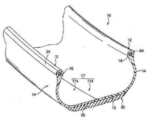
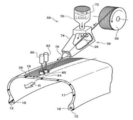
- FIG. 1A, FIG. 1B, FIG. 2, FIG. 3, and FIG. 4 are the figures shown typically, and the size and shape of each part are for ease of understanding. And exaggerated as appropriate.
- FIG. 1A is a perspective view showing a cross section of a part of the tire according to the first embodiment.
- FIG. 1B is a cross-sectional view of a bead portion attached to a rim.
- a tire 10 according to the first embodiment has a cross-sectional shape substantially similar to that of a conventional general rubber pneumatic tire.
- the tire 10 includes a pair of bead portions 12 that contact the bead seat 21 and the rim flange 22 of the rim 20, a side portion 14 that extends outward in the tire radial direction from the bead portion 12, and a tire radial direction of one side portion 14.
- a tire skeleton body 17 including a crown portion (corresponding to an outer peripheral portion and a tread portion) 16 that connects an outer end and an outer end in the tire radial direction of the other side portion 14 is provided.
- the tire skeleton 17 is formed using a resin material (for example, a polyamide-based thermoplastic elastomer).
- the tire frame body 17 includes an annular tire frame half body (tire frame piece) 17A having the same shape, which is injection-molded by integrating one bead portion 12, one side portion 14, and a half-width crown portion 16 together. It is formed by facing each other and joining at the tire equatorial plane.
- annular bead core 18 made of a steel cord is embedded as in a conventional general pneumatic tire. Further, the portion of the bead portion 12 that comes into contact with the rim 20 and at least the portion that comes into contact with the rim flange 22 of the rim 20 are made of rubber, which is a material having better sealing properties than the resin material constituting the tire frame body 17. An annular seal layer 24 is formed.
- the metal resin composite 26 which is a reinforcement cord, is embedded in the crown portion 16 in a cross-sectional view along the axial direction of the tire frame body 17. It is spirally wound in the circumferential direction. Further, a tread 30 made of rubber, which is a material superior in wear resistance to the resin material constituting the tire skeleton 17, is disposed on the outer side of the metal resin composite 26 in the tire radial direction. The details of the metal resin composite 26 will be described later.
- the tire skeleton 17 is formed of a resin material, unlike the conventional rubber tire skeleton, there is no need to vulcanize and the manufacturing process is greatly increased.
- the molding time can be shortened.
- the tire frame half body 17A has a symmetrical shape, that is, since one tire frame half body 17A and the other tire frame body A have the same shape, a mold for molding the tire frame half body 17A is provided. There is an advantage that only one type is required.
- the tire skeleton 17 is formed of a single resin material, but is not limited to such a mode, and is a conventional general rubber pneumatic Similarly to the tire, a resin material having different characteristics for each portion (for example, the side portion 14, the crown portion 16, the bead portion 12, etc.) of the tire skeleton 17 may be used. Further, reinforcing materials (polymer materials, metal fibers, cords, non-woven fabrics, woven fabrics, etc.) are embedded in each part of the tire skeleton body 17 (for example, the side portion 14, the crown portion 16, the bead portion 12, etc.). The tire frame body 17 may be reinforced with the reinforcing material.
- the tire skeleton half body 17A is formed by injection molding, but is not limited thereto, and may be formed by, for example, vacuum forming, pressure forming, melt casting, or the like. Good. Further, in the tire 10 according to the first embodiment, the tire skeleton 17 is formed by joining two members (tire skeleton half 17A), but is not limited thereto, and a low melting point metal is used. The tire skeleton body may be formed as one member by the melting core method, the split core method, or the blow molding used, or may be formed by joining three or more members.
- An annular bead core 18 made of a steel cord is embedded in the bead portion 12 of the tire 10.
- the bead core 18 may be formed of an organic fiber cord, a resin-coated organic fiber cord, or a hard resin in addition to the steel cord.
- the bead core 18 may be omitted if the rigidity of the bead portion 12 is ensured and there is no problem in fitting with the rim 20.
- An annular seal layer 24 made of rubber is formed on a portion of the bead portion 12 that contacts the rim 20 and at least a portion of the rim 20 that contacts the rim flange 22.
- the seal layer 24 may also be formed in a portion where the tire skeleton 17 (bead portion 12) and the bead sheet 21 are in contact with each other.
- the material for forming the seal layer 24 When rubber is used as the material for forming the seal layer 24, it is preferable to use the same type of rubber as that used on the outer surface of the bead portion of a conventional general rubber pneumatic tire.
- the rubber seal layer 24 may be omitted if only the resin material forming the tire skeleton 17 can secure the sealing performance with the rim 20.
- the seal layer 24 may be formed using another thermoplastic resin or thermoplastic elastomer that is more excellent in sealability than the resin material forming the tire skeleton 17.
- thermoplastic resins include resins such as polyurethane resins, olefin resins, polystyrene resins, and polyester resins, and blends of these resins with rubbers or elastomers.
- Thermoplastic elastomers can also be used, and examples thereof include polyester-based thermoplastic elastomers, polyurethane-based thermoplastic elastomers, olefin-based thermoplastic elastomers, combinations of these elastomers, and blends with rubber.
- FIG. 2 is a cross-sectional view along the tire rotation axis of the tire 10 according to the first embodiment, and shows a state in which the metal resin composite 26 is embedded in the crown portion of the tire skeleton 17.
- the metal resin composite 26 is spirally wound in a state in which at least a part thereof is embedded in the crown portion 16 in a cross-sectional view along the axial direction of the tire frame body 17.
- buried under the crown part 16 of the metal resin composite 26 is in the state closely_contact
- the embedding depth L of the metal resin composite 26 with respect to the crown portion 16 is 1 ⁇ 2 of the diameter D of the metal resin composite 26.
- the metal resin composite 26 has a structure in which a metal member 27 (for example, a steel cord twisted with steel fibers) is used as a core and the outer periphery of the metal member 27 is covered with a resin layer 28 via an adhesive layer 25. is doing.
- a rubber tread 30 is disposed on the outer peripheral side of the metal resin composite 26 in the tire radial direction. Further, the tread 30 is formed with a tread pattern including a plurality of grooves on the ground contact surface with the road surface in the same manner as a conventional rubber pneumatic tire.
- the metal resin composite 26 covered with the resin layer 28 containing a thermoplastic elastomer is in close contact with the tire skeleton 17 formed of a resin material containing the same kind of thermoplastic elastomer. Buried. Therefore, the contact area between the resin layer 28 covering the metal member 27 and the tire frame body 17 is increased, and the durability of adhesion between the metal resin composite 26 and the tire frame body 17 is improved. As a result, the durability of the tire is increased. Will be excellent.
- the embedding depth L with respect to the crown portion 16 of the metal resin composite 26 is preferably 1/5 or more of the diameter D of the metal resin composite 26, and more preferably exceeds 1/2. It is further preferable that the entire metal resin composite 26 is embedded in the crown portion 16. When the embedding depth L of the metal resin composite 26 exceeds 1/2 of the diameter D of the metal resin composite 26, it is difficult to jump out of the embedded portion due to the size of the metal resin composite 26. When the entire metal resin composite 26 is embedded in the crown portion 16, the surface (outer peripheral surface) becomes flat, and the member is placed on the crown portion 16 in which the metal resin composite 26 is embedded. Even so, it is possible to prevent air from entering the peripheral portion of the metal resin composite 26.
- the tread 30 is formed of rubber, but instead of rubber, another type of thermoplastic resin that is more excellent in wear resistance than the resin material constituting the tire skeleton 17.
- a tread formed of a material may be used.
- the tire manufacturing method according to the first embodiment will be described below.
- the tire skeleton halves supported by a thin metal support ring face each other.
- a joining mold is installed so as to contact the outer peripheral surface of the abutting portion of the tire skeleton half.
- die is comprised so that the periphery of the junction part (butting part) of a tire frame half body may be pressed with a predetermined pressure (not shown).
- the periphery of the joint portion of the tire frame half body is pressed at a temperature equal to or higher than the melting point (or softening point) of the thermoplastic resin material (in this embodiment, a polyamide-based thermoplastic elastomer) that forms the tire frame body.
- the joint portion of the tire frame half body is heated and pressurized by the bonding mold, the joint portion is melted, the tire frame half halves are fused together, and these members are integrated into the tire frame body 17. Is formed.
- metal resin composite molding process Next, the metal resin composite molding process will be described.
- the metal member 27 is unwound from the reel and the surface thereof is cleaned.
- the outer periphery of the metal member 27 is covered with a thermoplastic resin (in this embodiment, acid-modified polypropylene) extruded from an extruder to form a layer that becomes the adhesive layer 25.
- a resin layer 28 is formed by coating the resin layer 28 with a resin layer extruded from an extruder (in this embodiment, a polyamide-based thermoplastic elastomer), and the resulting metal resin composite 26 is wound around a reel 58. .
- FIG. 3 is an explanatory diagram for explaining an operation of installing the metal resin composite on the crown portion of the tire frame body using the metal resin composite heating device and rollers.
- the metal resin composite supply device 56 includes a reel 58 around which the metal resin composite 26 is wound, a metal resin composite heating device 59 disposed downstream of the reel 58 in the code conveying direction, and a metal resin composite.
- a first roller 60 disposed on the downstream side of the body 26 in the conveying direction, a first cylinder device 62 that moves the first roller 60 in a direction in which the first roller 60 contacts and separates from the tire outer peripheral surface, and a first roller 60.
- the second roller 64 can be used as a metal cooling roller.
- the surface of the first roller 60 or the second roller 64 is coated with a fluororesin (in this embodiment, Teflon (registered trademark)) in order to suppress adhesion of a molten or softened resin material. .
- Teflon registered trademark
- the metal resin composite heating device 59 includes a heater 70 and a fan 72 that generate hot air.
- the metal resin composite heating device 59 includes a heating box 74 through which the hot air is supplied and the metal resin composite 26 passes through the internal space, and a discharge port 76 that discharges the heated metal resin composite 26. It has.
- the temperature of the heater 70 of the metal resin composite heating device 59 is raised, and the ambient air heated by the heater 70 is sent to the heating box 74 by the wind generated by the rotation of the fan 72.
- the metal resin composite 26 unwound from the reel 58 is sent into a heating box 74 in which the internal space is heated with hot air, and heated (for example, the temperature of the metal resin composite 26 is set to about 100 ° C. to 250 ° C. Heat).
- the heated metal resin composite 26 passes through the discharge port 76 and is spirally wound around the outer peripheral surface of the crown portion 16 of the tire skeleton 17 rotating in the direction of arrow R in FIG.
- the resin material in the contact portion melts or softens, and melts and joins with the resin of the tire frame body to form the crown portion 16. It is integrated with the outer peripheral surface.
- the metal resin composite since the metal resin composite is melt-bonded to the adjacent metal resin composite, the metal resin composite is wound without a gap. Thereby, the air entering to the portion where the metal resin composite 26 is embedded is suppressed.
- the embedding depth L of the metal resin composite 26 can be adjusted by the heating temperature of the metal resin composite 26, the tension applied to the metal resin composite 26, the pressing force by the first roller 60, and the like. In an embodiment, the embedding depth L of the metal resin composite 26 is set to be 1/5 or more of the diameter D of the metal resin composite 26.
- a belt-like tread 30 is wound around the outer peripheral surface of the tire skeleton 17 in which the metal resin composite 26 is embedded, and this is accommodated in a vulcanizing can or mold and heated (vulcanized).
- the tread 30 may be unvulcanized rubber or vulcanized rubber.
- the joining portion of the tire skeleton half body 17A is heated using a joining mold.
- a joining mold a separately provided high-frequency heater
- the tire frame half body 17A may be joined by heating the joining part by means of, for example, softening or melting in advance by irradiation with hot air or infrared rays, and pressurizing with a joining mold.
- the metal resin composite supply device 56 has two rollers, the first roller 60 and the second roller 64, but the present disclosure is limited to this. However, only one of the rollers (that is, one roller) may be provided.
- the metal resin composite 26 is heated, and the surface of the tire skeleton body 17 in the portion in contact with the heated metal resin composite 26 is melted or softened.
- the present invention is not limited to this embodiment, and the metal resin composite 26 is heated after the outer peripheral surface of the crown portion 16 in which the metal resin composite 26 is embedded is heated using a hot air generator without heating the metal resin composite 26. 26 may be embedded in the crown portion 16.
- the heat source of the metal resin composite heating device 59 is a heater and a fan.
- the present disclosure is not limited to this aspect, and the metal resin composite 26 is used. It is good also as an aspect directly heated by radiant heat (for example, infrared rays etc.).
- the portion where the thermoplastic resin material in which the metal resin composite 26 is embedded is melted or softened is forcibly cooled by the metal second roller 64.
- the present disclosure is not limited to this embodiment, the present disclosure is not limited to this embodiment, and cold air is directly blown onto a portion where the thermoplastic resin material is melted or softened to forcibly cool and solidify the melted or softened portion of the thermoplastic resin material. It is good also as an aspect to do.
- it is easy to manufacture the metal resin composite 26 spirally a method of disposing the metal resin composite 26 discontinuously in the width direction is also conceivable.
- the tire 10 according to the first embodiment is a so-called tubeless tire in which an air chamber is formed between the tire 10 and the rim 20 by attaching the bead portion 12 to the rim 20, but the present disclosure is in this aspect. It is not limited and a perfect tube shape may be sufficient.
- the tire according to the present disclosure includes tires having the following modes. ⁇ 1> An annular tire skeleton including a resin material, and a belt portion including a metal resin composite disposed on an outer periphery of the tire skeleton, wherein the metal resin composite is bonded to a metal member. A tire having a structure in which a layer and a resin layer are arranged in this order, and satisfying the following expressions (1) and (2).
- ⁇ 3> The tire according to ⁇ 1> or ⁇ 2>, wherein a distance between metal members of adjacent metal resin composites is 0.2 mm to 3.3 mm.
- a In any one of ⁇ 1> to ⁇ 3>, in the formula (2), a is 0.015 mm or more, b is 0.005 mm or more, and a + b is less than 1.6 mm.
- the adhesive layer includes a polyolefin-based thermoplastic resin.
- ⁇ 6> Any one of ⁇ 1> to ⁇ 5>, wherein the adhesive layer contains carbon black, and the content of the carbon black is more than 0% by mass and less than 4% by mass with respect to the entire adhesive layer.
- Tire described in. ⁇ 7> The tire according to any one of ⁇ 1> to ⁇ 6>, wherein the resin layer includes at least one selected from the group consisting of a polyamide-based thermoplastic resin and a polyamide-based thermoplastic elastomer.
- ⁇ Production of metal resin composite> In accordance with the metal resin composite molding step in the tire manufacturing method of the first embodiment described above, a heat-melted resin material was adhered around the metal member to form an adhesive layer. Next, the adhesive layer was covered with a resin material extruded with an extruder, cooled to form a resin layer, and a metal resin composite was produced. As the metal member, a stranded wire in which multifilaments having an average diameter of ⁇ 1.15 mm (five monofilaments of ⁇ 0.35 mm (made of steel, strength: 280 N, elongation: 3%) were twisted was used.
- the metal resin composite was wound around the outer peripheral portion (crown portion) of the tire skeleton formed of polyamide-based thermoplastic elastomer to form a belt portion.
- a tread rubber was disposed on the belt portion, and a vulcanization process was performed to produce a tire.
- the tire size was 245/35 R18.
- the type (number) and thickness of the resin layer (mm) of the metal resin material used for the production of the metal resin composite in each example and comparative example the type (number) of the resin material for forming the adhesive layer, Thickness (mm), carbon black content in adhesive layer (parts by mass), crystallinity of adhesive layer after vulcanization (%), total thickness of resin layer and adhesive layer (mm), belt part Table 1 shows the number of metal resin composites per width of 100 mm, the value of 1 ⁇ (a / A) + (b / B) ⁇ , and performance evaluation results (an evaluation method will be described later).
- the details of the resin materials used in the examples and comparative examples are as follows.
- Adhesive layer resin 1 Acid-modified polypropylene hot melt adhesive (Mitsui Chemicals, trade name “QE060”), water permeability 10 g ⁇ mm / (m 2 ⁇ day) ⁇ Adhesive layer resin 2 Polyamide hot melt adhesive (trade name “B409” manufactured by Arkema Co., Ltd.), water permeability 100 g ⁇ mm / (m 2 ⁇ day) ⁇ Resin 3 for adhesive layer Polyamide-based hot-melt adhesive (manufactured by Daicel-Evonik Co., Ltd., trade name “A6492”), water permeability 50 g ⁇ mm / (m 2 ⁇ day) ⁇ Adhesive layer resin 4 Polyester-based hot melt adhesive (manufactured by Mitsubishi Chemical Corporation, trade name "GQ331”), water transmittance 500g ⁇ mm / (m 2 ⁇ day) Resin 4 for adhesive layer: polyester hot melt adhesive (product name “GQ331” manufactured by Mitsubishi Chemical Corporation
- the crystallinity of the adhesive layer after vulcanization was measured by the above-mentioned method by differential scanning calorimetry (DSC). Specifically, a sample was prepared using the acid-modified polypropylene used for forming the adhesive layer, heated under the same conditions as tire vulcanization, and the crystallinity of the heated sample was measured. In order to heat the sample under the same conditions as the adhesive layer included in the metal resin composite of the tire, using the tire heated under the above conditions, the adhesive layer of the metal resin composite near the center line portion of the tire during heating The temperature of the part corresponding to was measured, and the sample was heat-treated under the temperature conditions and time obtained by the measurement.
- DSC differential scanning calorimetry
- a The peel force after the deterioration treatment is 75% or more of the peel force immediately after production.
- B The peel force after the deterioration treatment is 50% or more and less than 75% of the peel force immediately after the production.
- C The peel force after the deterioration treatment is less than 50% of the peel force immediately after the production.
- ⁇ Initial adhesion test> As an index of the adhesion between the adhesive layer and the metal member, the peel force when the adhesive layer and the resin layer were peeled from the metal member immediately after the production of the metal resin composite was measured. Specifically, using a “TENSIRON RTF-1210” manufactured by A & D Co., Ltd., a 180 ° peel test was performed at a tensile speed of 100 mm / min in a room temperature environment (25 ° C.), and the peel force (unit: : N) was measured, and the adhesion was evaluated according to the following evaluation criteria.
- a The peeling force is 17N or more.
- B The peeling force is 14N or more and less than 17N.
- C Peeling force is 10N or more and less than 14N.
- D The peeling force is less than 10N.
- ⁇ JIS drum test after deterioration treatment> The tires produced in the examples and comparative examples were filled with air so that the internal pressure was 250 kPa, and then subjected to a deterioration treatment for 10 days under conditions of a temperature of 80 degrees and a humidity of 90%.
- the tire after the deterioration treatment was subjected to a durability drum test as described below and evaluated according to the following evaluation criteria. After adjusting the internal pressure of 3.0 kg / cm 2 at room 25 ⁇ 2 ° C. The tires were left for 24 hours.
- Example 12 in which the adhesive layer contained 0.1 part by mass of carbon black, the evaluation of initial adhesiveness was better than those of other examples.
- Comparative Example 4 that does not satisfy the condition of the formula (1), the evaluation of the water pressure test was lower than that of the example.
- Comparative Examples 1, 2, 3, and 5 to 9 that do not satisfy the condition of the formula (2), the evaluation of the adhesion test after the deterioration treatment was lower than that of the example. From the above, it was found that the tire of the present disclosure is excellent in both internal pressure resistance and wet heat durability.
Landscapes
- Engineering & Computer Science (AREA)
- Mechanical Engineering (AREA)
- Chemical & Material Sciences (AREA)
- Health & Medical Sciences (AREA)
- Chemical Kinetics & Catalysis (AREA)
- Medicinal Chemistry (AREA)
- Polymers & Plastics (AREA)
- Organic Chemistry (AREA)
- Tires In General (AREA)
Abstract
Priority Applications (4)
| Application Number | Priority Date | Filing Date | Title |
|---|---|---|---|
| JP2017556071A JP6785245B2 (ja) | 2015-12-16 | 2016-12-13 | タイヤ |
| CN201680073607.XA CN108367597A (zh) | 2015-12-16 | 2016-12-13 | 轮胎 |
| US16/061,659 US20180370285A1 (en) | 2015-12-16 | 2016-12-13 | Tire |
| EP16875640.1A EP3392062B1 (fr) | 2015-12-16 | 2016-12-13 | Pneu |
Applications Claiming Priority (2)
| Application Number | Priority Date | Filing Date | Title |
|---|---|---|---|
| JP2015245423 | 2015-12-16 | ||
| JP2015-245423 | 2015-12-16 |
Publications (1)
| Publication Number | Publication Date |
|---|---|
| WO2017104663A1 true WO2017104663A1 (fr) | 2017-06-22 |
Family
ID=59056822
Family Applications (1)
| Application Number | Title | Priority Date | Filing Date |
|---|---|---|---|
| PCT/JP2016/087067 Ceased WO2017104663A1 (fr) | 2015-12-16 | 2016-12-13 | Pneu |
Country Status (5)
| Country | Link |
|---|---|
| US (1) | US20180370285A1 (fr) |
| EP (1) | EP3392062B1 (fr) |
| JP (1) | JP6785245B2 (fr) |
| CN (1) | CN108367597A (fr) |
| WO (1) | WO2017104663A1 (fr) |
Cited By (4)
| Publication number | Priority date | Publication date | Assignee | Title |
|---|---|---|---|---|
| EP3305548A4 (fr) * | 2015-06-05 | 2018-05-23 | Bridgestone Corporation | Pneumatique |
| WO2019230821A1 (fr) * | 2018-05-30 | 2019-12-05 | 株式会社ブリヂストン | Élément composite de résine-métal pour pneus, son procédé de production et pneu |
| WO2019230822A1 (fr) * | 2018-05-30 | 2019-12-05 | 株式会社ブリヂストン | Élément composite de métal de résine pour pneus, procédé de production associé et pneu |
| CN112351894A (zh) * | 2018-06-14 | 2021-02-09 | 株式会社普利司通 | 轮胎及带束层结构构件的制造方法 |
Citations (11)
| Publication number | Priority date | Publication date | Assignee | Title |
|---|---|---|---|---|
| JPS58174474A (ja) * | 1982-04-07 | 1983-10-13 | Mitsui Toatsu Chem Inc | 熱接着剤 |
| JPH0379401A (ja) * | 1989-08-17 | 1991-04-04 | Sumitomo Rubber Ind Ltd | 空気入りタイヤ |
| JPH03143702A (ja) * | 1989-10-27 | 1991-06-19 | Sumitomo Rubber Ind Ltd | 空気入りタイヤ |
| JP2002331806A (ja) * | 2001-05-09 | 2002-11-19 | Yokohama Rubber Co Ltd:The | 熱可塑性エラストマー被覆スチールコードを用いた空気入りタイヤ |
| JP2007193001A (ja) * | 2006-01-18 | 2007-08-02 | Canon Inc | 導電性ローラの製造方法 |
| JP2010053495A (ja) * | 2008-08-29 | 2010-03-11 | Yokohama Rubber Co Ltd:The | タイヤ補強用スチールコード及びこれを使用した空気入りタイヤ |
| JP2013180615A (ja) * | 2012-02-29 | 2013-09-12 | Bridgestone Corp | タイヤ |
| JP2013544900A (ja) * | 2010-09-23 | 2013-12-19 | コンパニー ゼネラール デ エタブリッスマン ミシュラン | 複合補強材 |
| WO2014175453A1 (fr) * | 2013-04-25 | 2014-10-30 | 株式会社ブリヂストン | Pneumatique |
| WO2014175452A1 (fr) * | 2013-04-25 | 2014-10-30 | 株式会社ブリヂストン | Pneumatique |
| WO2017002872A1 (fr) * | 2015-06-29 | 2017-01-05 | 株式会社ブリヂストン | Pneu et procédé de fabrication de pneu |
Family Cites Families (3)
| Publication number | Priority date | Publication date | Assignee | Title |
|---|---|---|---|---|
| EP0425299B1 (fr) * | 1989-10-27 | 1996-03-13 | Sumitomo Rubber Industries Limited | Bandage pneumatique |
| US10590299B2 (en) * | 2010-06-01 | 2020-03-17 | Riken Technos Corp. | Paint, adhesive composition, bonding method and laminate |
| JP2012219401A (ja) * | 2011-04-07 | 2012-11-12 | Mitsubishi Heavy Industries Bridge & Steel Structures Engineering Co Ltd | ワイヤロープ |
-
2016
- 2016-12-13 WO PCT/JP2016/087067 patent/WO2017104663A1/fr not_active Ceased
- 2016-12-13 CN CN201680073607.XA patent/CN108367597A/zh active Pending
- 2016-12-13 EP EP16875640.1A patent/EP3392062B1/fr not_active Not-in-force
- 2016-12-13 JP JP2017556071A patent/JP6785245B2/ja not_active Expired - Fee Related
- 2016-12-13 US US16/061,659 patent/US20180370285A1/en not_active Abandoned
Patent Citations (11)
| Publication number | Priority date | Publication date | Assignee | Title |
|---|---|---|---|---|
| JPS58174474A (ja) * | 1982-04-07 | 1983-10-13 | Mitsui Toatsu Chem Inc | 熱接着剤 |
| JPH0379401A (ja) * | 1989-08-17 | 1991-04-04 | Sumitomo Rubber Ind Ltd | 空気入りタイヤ |
| JPH03143702A (ja) * | 1989-10-27 | 1991-06-19 | Sumitomo Rubber Ind Ltd | 空気入りタイヤ |
| JP2002331806A (ja) * | 2001-05-09 | 2002-11-19 | Yokohama Rubber Co Ltd:The | 熱可塑性エラストマー被覆スチールコードを用いた空気入りタイヤ |
| JP2007193001A (ja) * | 2006-01-18 | 2007-08-02 | Canon Inc | 導電性ローラの製造方法 |
| JP2010053495A (ja) * | 2008-08-29 | 2010-03-11 | Yokohama Rubber Co Ltd:The | タイヤ補強用スチールコード及びこれを使用した空気入りタイヤ |
| JP2013544900A (ja) * | 2010-09-23 | 2013-12-19 | コンパニー ゼネラール デ エタブリッスマン ミシュラン | 複合補強材 |
| JP2013180615A (ja) * | 2012-02-29 | 2013-09-12 | Bridgestone Corp | タイヤ |
| WO2014175453A1 (fr) * | 2013-04-25 | 2014-10-30 | 株式会社ブリヂストン | Pneumatique |
| WO2014175452A1 (fr) * | 2013-04-25 | 2014-10-30 | 株式会社ブリヂストン | Pneumatique |
| WO2017002872A1 (fr) * | 2015-06-29 | 2017-01-05 | 株式会社ブリヂストン | Pneu et procédé de fabrication de pneu |
Non-Patent Citations (1)
| Title |
|---|
| See also references of EP3392062A4 * |
Cited By (7)
| Publication number | Priority date | Publication date | Assignee | Title |
|---|---|---|---|---|
| EP3305548A4 (fr) * | 2015-06-05 | 2018-05-23 | Bridgestone Corporation | Pneumatique |
| WO2019230821A1 (fr) * | 2018-05-30 | 2019-12-05 | 株式会社ブリヂストン | Élément composite de résine-métal pour pneus, son procédé de production et pneu |
| WO2019230822A1 (fr) * | 2018-05-30 | 2019-12-05 | 株式会社ブリヂストン | Élément composite de métal de résine pour pneus, procédé de production associé et pneu |
| JPWO2019230821A1 (ja) * | 2018-05-30 | 2021-07-29 | 株式会社ブリヂストン | タイヤ用樹脂金属複合部材、及びその製造方法、並びにタイヤ |
| JPWO2019230822A1 (ja) * | 2018-05-30 | 2021-07-29 | 株式会社ブリヂストン | タイヤ用樹脂金属複合部材、及びその製造方法、並びにタイヤ |
| JP7221951B2 (ja) | 2018-05-30 | 2023-02-14 | 株式会社ブリヂストン | タイヤ用樹脂金属複合部材、及びその製造方法、並びにタイヤ |
| CN112351894A (zh) * | 2018-06-14 | 2021-02-09 | 株式会社普利司通 | 轮胎及带束层结构构件的制造方法 |
Also Published As
| Publication number | Publication date |
|---|---|
| US20180370285A1 (en) | 2018-12-27 |
| JPWO2017104663A1 (ja) | 2018-10-04 |
| JP6785245B2 (ja) | 2020-11-18 |
| EP3392062A4 (fr) | 2018-12-05 |
| EP3392062B1 (fr) | 2021-02-03 |
| EP3392062A1 (fr) | 2018-10-24 |
| CN108367597A (zh) | 2018-08-03 |
Similar Documents
| Publication | Publication Date | Title |
|---|---|---|
| JP6356664B2 (ja) | タイヤ | |
| JP6356663B2 (ja) | タイヤ | |
| WO2013129525A1 (fr) | Pneumatique | |
| US10821690B2 (en) | Tire and method for manufacturing tire | |
| JP6057981B2 (ja) | タイヤ | |
| JP2013082311A (ja) | タイヤ | |
| WO2017104472A1 (fr) | Pneu | |
| JP6604840B2 (ja) | タイヤ | |
| JP6785245B2 (ja) | タイヤ | |
| JP5840534B2 (ja) | タイヤ | |
| JP5840535B2 (ja) | タイヤ | |
| JP2018176872A (ja) | タイヤ用樹脂金属複合部材及びタイヤ | |
| JP5905298B2 (ja) | タイヤ | |
| JP6649766B2 (ja) | タイヤ | |
| JP6745284B2 (ja) | タイヤ | |
| JP6114498B2 (ja) | タイヤ | |
| JP2013180619A (ja) | タイヤ | |
| JP6049273B2 (ja) | タイヤ | |
| JP6590679B2 (ja) | タイヤ | |
| JP2020062935A (ja) | タイヤ用ワイヤー樹脂複合部材、及びタイヤ |
Legal Events
| Date | Code | Title | Description |
|---|---|---|---|
| 121 | Ep: the epo has been informed by wipo that ep was designated in this application |
Ref document number: 16875640 Country of ref document: EP Kind code of ref document: A1 |
|
| ENP | Entry into the national phase |
Ref document number: 2017556071 Country of ref document: JP Kind code of ref document: A |
|
| NENP | Non-entry into the national phase |
Ref country code: DE |
|
| WWE | Wipo information: entry into national phase |
Ref document number: 2016875640 Country of ref document: EP |
|
| ENP | Entry into the national phase |
Ref document number: 2016875640 Country of ref document: EP Effective date: 20180716 |