WO2017104785A1 - Instrument de nettoyage interdentaire - Google Patents
Instrument de nettoyage interdentaire Download PDFInfo
- Publication number
- WO2017104785A1 WO2017104785A1 PCT/JP2016/087489 JP2016087489W WO2017104785A1 WO 2017104785 A1 WO2017104785 A1 WO 2017104785A1 JP 2016087489 W JP2016087489 W JP 2016087489W WO 2017104785 A1 WO2017104785 A1 WO 2017104785A1
- Authority
- WO
- WIPO (PCT)
- Prior art keywords
- reinforcing material
- cleaning tool
- interdental cleaning
- weight
- shaft portion
- Prior art date
- Legal status (The legal status is an assumption and is not a legal conclusion. Google has not performed a legal analysis and makes no representation as to the accuracy of the status listed.)
- Ceased
Links
Images






Classifications
-
- A—HUMAN NECESSITIES
- A46—BRUSHWARE
- A46B—BRUSHES
- A46B1/00—Brush bodies and bristles moulded as a unit
-
- A—HUMAN NECESSITIES
- A61—MEDICAL OR VETERINARY SCIENCE; HYGIENE
- A61C—DENTISTRY; APPARATUS OR METHODS FOR ORAL OR DENTAL HYGIENE
- A61C15/00—Devices for cleaning between the teeth
- A61C15/02—Toothpicks
-
- A—HUMAN NECESSITIES
- A46—BRUSHWARE
- A46B—BRUSHES
- A46B15/00—Other brushes; Brushes with additional arrangements
- A46B15/0093—Magazins or sets of brushes components, e.g. plurality of brushes linked as a package
-
- A—HUMAN NECESSITIES
- A46—BRUSHWARE
- A46B—BRUSHES
- A46B3/00—Brushes characterised by the way in which the bristles are fixed or joined in or on the brush body or carrier
- A46B3/22—Brushes characterised by the way in which the bristles are fixed or joined in or on the brush body or carrier rubber bristles being fixed in or on brush bodies
-
- A—HUMAN NECESSITIES
- A46—BRUSHWARE
- A46B—BRUSHES
- A46B2200/00—Brushes characterized by their functions, uses or applications
- A46B2200/10—For human or animal care
- A46B2200/1066—Toothbrush for cleaning the teeth or dentures
- A46B2200/108—Inter-dental toothbrush, i.e. for cleaning interdental spaces specifically
Definitions
- the present invention relates to an interdental cleaning tool.
- Patent Document 1 discloses an interdental cleaning tool including a base portion having a shape extending in a specific direction and a cleaning portion made of an elastomer.
- the base portion includes a shaft portion having a shape that can be inserted between teeth and a grip portion having a shape that can be gripped by a finger.
- the cleaning part has a shape that covers a part (including the tip part) of the outer peripheral surface of the shaft part.
- the base portion is formed of a composite material (a material obtained by adding a fibrous reinforcing material to a synthetic resin) including a synthetic resin (polypropylene or the like) and a reinforcing material (glass fiber or the like).
- the reinforcing material is added to increase the strength of the shaft portion (particularly the buckling load).
- An object of the present invention is to provide an interdental cleaning tool capable of suppressing breakage of a shaft portion.
- An interdental cleaning tool includes a base portion having a shaft portion having a shape that can be inserted between teeth, and the base portion includes a synthetic resin, a reinforcing material, and a hardness of the synthetic resin. And a low-hardness resin having a lower hardness.
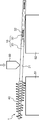
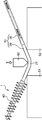
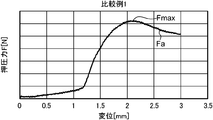
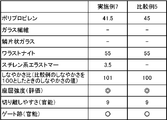
- FIG. 1 It is a front view of the interdental cleaning tool of one Embodiment of this invention. It is a figure which shows the measuring method of the flexibility of the axial part of the interdental cleaning tool shown in FIG. It is a figure which shows the measuring method of the flexibility of the axial part of the interdental cleaning tool shown in FIG. It is a graph which shows the relationship between the displacement of a pressing tool in Example 1, and pressing force. It is a graph which shows the relationship between the displacement of the pressing tool in Comparative Example 1, and pressing force. It is a table
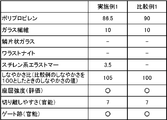
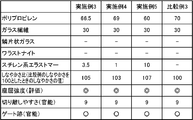
- Example 6 is a table showing compositions and various test results of Examples 3 to 5 and Comparative Example 3. It is a table
- FIG. 1 shows an interdental cleaning tool group having a plurality (three in FIG. 1) of interdental cleaning tools 1.
- the interdental cleaning tool 1 includes a base portion 10 and a cleaning portion 40.
- the base portion 10 includes a shaft portion 20 and a grip portion 30.
- the shaft portion 20 has a shape that extends linearly along a specific direction (vertical direction in FIG. 1) and can be inserted between teeth.
- the shaft portion 20 has a proximal end portion 20a connected to the grip portion 30 and a distal end portion that is an end portion on the side inserted between the teeth.
- the shaft portion 20 is formed in a cylindrical shape whose outer diameter gradually decreases from the base end portion 20a toward the insertion end portion.
- the grip portion 30 extends from the base end portion 20a of the shaft portion 20 so as to be separated from the shaft portion 20 along the axial direction of the shaft portion 20, and has a flat shape that can be gripped by a finger.
- the gripping portions 30 adjacent to each other are connected by a pair of connecting portions 32.
- Each connecting portion 32 is preferably thinner than the grip portion 30.
- each connection part 32 is a shape which becomes thin gradually as it goes to the direction which mutually approaches. If it does in this way, it will be easy to cut off with connecting part 32, and it will be suppressed that it is cut off with connecting part 32 by the impact at the time of transportation.
- the boundary between the connecting portion 32 and the grip portion 30 located on one side of the connecting portion 32 is thinner than the boundary between the connecting portion 32 and the grip portion 30 located on the other side of the connecting portion 32. .
- the base 10 is formed of a composite material including a synthetic resin, a reinforcing material, and a low-hardness resin having a hardness lower than that of the synthetic resin.
- thermoplastic resins such as polypropylene, polyethylene, ABS, polybutylene terephthalate, polycarbonate, polyethylene terephthalate, polystyrene, and polyacetal are preferably used. From the viewpoint of increasing the buckling strength of the shaft portion 20 and ensuring flexibility, it is preferable to use polypropylene as the synthetic resin, and it is more preferable to use homopolymer polypropylene among the polypropylene. In this embodiment, homopolymer polypropylene is used as the synthetic resin.
- a fibrous reinforcing material As the reinforcing material, a fibrous reinforcing material, an acicular reinforcing material, a plate-like reinforcing material, a granular reinforcing material, or the like is preferably used.
- the length of the fibrous reinforcing material is usually 50 ⁇ m to 450 ⁇ m when included in the synthetic resin.
- glass fiber, aramid fiber, carbon fiber, cellulose fiber, nanocellulose fiber or the like is preferably used. Since the buckling load of the axial part 20 increases effectively, glass fiber is used more preferably as a fibrous reinforcement.
- the length of the acicular reinforcing material (longest dimension) is usually 20 ⁇ m to 90 ⁇ m when included in the synthetic resin.
- Wollastonite is preferably used as the acicular reinforcement.
- the length of the plate-like reinforcing material is usually 10 ⁇ m to 150 ⁇ m when included in the synthetic resin.
- As the plate-like reinforcing material mica, scaly glass, talc and the like are preferably used.
- the length of the granular reinforcing material is usually 5 ⁇ m to 40 ⁇ m when included in the synthetic resin.
- the reinforcing material is preferably treated with at least one of a coupling agent and an adhesive. Both the coupling agent and the adhesive are used. More preferably, it is treated with. Such treatment is particularly preferred when scaly glass is used as the reinforcing material.
- the coupling agent include a silane coupling agent, a titanium coupling agent, an aluminum coupling agent, and a zirconia coupling agent.
- the adhesive include a vinyl acetate resin and an acrylic resin.
- Polyester resin polyether resin, phenoxy resin, polyamide resin, epoxy resin, polyolefin resin, methyl cellulose, carboxymethyl cellulose, starch, carboxymethyl starch, hydroxyethyl cellulose, hydroxypropyl cellulose, and polyvinyl alcohol.
- the content of the reinforcing material in the composite material is usually set to 10% by weight or more and 60% by weight or less from the viewpoint of obtaining good buckling strength and flexibility.
- the content is preferably 10% by weight to 40% by weight, and more preferably 10% by weight to 30% by weight.
- the content is preferably 10% by weight or more and 50% by weight or less, more preferably 20% by weight or more and 50% by weight or less, and particularly 20% by weight or more from the viewpoint of excellent flexibility. It is more preferably 40% by weight or less, and particularly preferably 20% by weight or more and 30% by weight or less.
- the content is preferably 20% by weight or more and 60% by weight or less, and more preferably 30% by weight or more and 60% by weight or less.
- the content is preferably 10% by weight to 45% by weight, more preferably 20% by weight to 40% by weight, and particularly 20% by weight to 30% from the viewpoint of excellent flexibility. More preferably, it is not more than% by weight.
- polypropylene such as polypropylene random polymer and polypropylene block polymer
- polyethylene such as linear low-density polyethylene and low-density polyethylene
- styrene-based elastomer Elastomers such as olefin elastomers and polyester elastomers, and silicon are preferably used
- elastomers such as styrene elastomers, olefin elastomers, and polyester elastomers, and silicones are more preferably used, and styrene elastomers are more preferably used.
- a styrene elastomer is used as the low hardness resin.
- the Shore A hardness of the elastomer is preferably 20-50.
- the low-hardness resin only needs to have a lower hardness than the synthetic resin used for the base 10.
- the random polymer polypropylene has a lower hardness than the homopolymer polypropylene, and thus becomes a low hardness resin.
- the content of the low-hardness resin in the composite material is set to 1% by weight or more and 30% by weight or less from the viewpoint that flexibility is obtained while the buckling strength is good.
- the content of the low-hardness resin is 1% by weight or more, the flexibility of the shaft part 20 due to the inclusion of the low-hardness resin can be sufficiently improved, and when it is 30% by weight or less, the shaft part A buckling strength of 20 is sufficiently obtained.
- This content is preferably 1% by weight or more and 20% by weight or less, more preferably 1% by weight or more and 10% by weight or less, and further preferably 1% by weight or more and 5% by weight or less.
- the low-hardness resin is an elastomer
- the content is preferably 20% by weight or less from the viewpoint of ensuring sufficient buckling strength of the shaft portion 20.
- the cleaning unit 40 covers the outer peripheral surface of the shaft unit 20 and can clean between the teeth.
- the cleaning unit 40 includes a cleaning unit main body 42 that covers the outer peripheral surface of the shaft unit 20, and a plurality of brush hairs 44 that protrude from the outer peripheral surface of the cleaning unit main body 42.
- the cleaning unit 40 is made of an elastomer.
- the same resin (styrene elastomer) as the low-hardness resin is used as the elastomer. This is preferable because the compatibility between the cleaning unit 40 and the shaft unit 20 is increased.
- polypropylene is employed as the synthetic resin, the styrene elastomer is preferable because of its excellent compatibility with polypropylene.
- This manufacturing method includes a kneading step, a base portion forming step, and a cleaning portion forming step.
- a composite material is formed by kneading a synthetic resin, a reinforcing material, and a low-hardness resin with a kneader.
- the content of the reinforcing material in the composite material is set to 60% by weight or less, the kneading is uniformly performed.
- a part of wollastonite becomes a granular form from a needle shape by being crushed in the kneading step.
- the composite material is filled into a base forming mold (not shown) having a space corresponding to the base 10 from the side corresponding to the grip portion 30 toward the side corresponding to the shaft portion 20.
- the base 10 is formed.
- the reinforcing material is added to the synthetic resin, it is suppressed that the gate mark of the base portion 10 is sharp. For this reason, the irritation
- the cleaning portion is filled by filling the same resin (elastomer) as the low-hardness resin in a cleaning portion forming mold (not shown) having a space in which the cleaning portion 40 can be formed around the shaft portion 20. 40 is formed.
- the interdental cleaning tool 1 is inserted between the teeth with the tip of the shaft portion 20 as the head. And the holding part 30 is operated so that the cleaning part 40 reciprocates along between teeth. At this time, although a bending load may act on the shaft part 20, since the shaft part 20 is supple in the interdental cleaning tool 1 of the present embodiment, the bending of the shaft part 20 is suppressed. Specifically, in the interdental cleaning tool 1, since the composite material includes a low-hardness resin having a hardness lower than that of the synthetic resin, the buckling strength of the shaft portion 20 is maintained and the shaft portion 20 A suppleness is secured.
- the reinforcing material increases the buckling load of the shaft portion 20, and the low-hardness resin increases the toughness of the shaft portion 20 that is reduced by the addition of the reinforcing material. Therefore, both the buckling strength and the flexibility of the shaft portion 20 are ensured.
- the content of the low-hardness resin in the composite material is 1% by weight or more and 30% by weight or less, ensuring the flexibility of the shaft portion 20 and ensuring the effective buckling strength can be achieved more reliably. Specifically, when the content of the low-hardness resin is 1% by weight or more, the flexibility of the shaft portion 20 is more reliably ensured, and when the content of the low-hardness resin is 30% by weight or less, the shaft The buckling strength of the portion 20 is maintained.
- the buckling strength of the shaft portion 20 is ensured when the content of the reinforcing material is 10% by weight or more. And when content of a reinforcing material is 60 weight% or less, it is suppressed that a reinforcing material acts as resistance with respect to the bending of the axial part 20, and the flexibility of the axial part 20 is ensured.
- the elastomer forming the cleaning portion 40 is the same resin as the low-hardness resin. For this reason, since the compatibility of the cleaning part 40 which consists of elastomers, and the axial part 20 increases, peeling from the axial part 20 of the cleaning part 40 is suppressed.
- the low-hardness resin contained in the composite material and the elastomer forming the cleaning portion 40 may be different from each other. Further, the cleaning unit 40 may be omitted.
- the shaft portion 20 may have a curved shape. Further, the grip portion 30 may be omitted. Moreover, as FIG.13 and FIG.14 shows, the shape of the base 10 can be changed suitably.
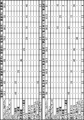
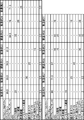
- the composition of each example and each comparative example is as shown in FIGS.
- the unit of the synthetic resin, the reinforcing material, and the low-hardness resin (elastomer) shown in each table is% by weight.
- Glass fiber is from Asahi Fiber Glass Co., Ltd., Nitto Boseki Co., Ltd., Central Glass Co., Ltd., scale glass is from Nippon Sheet Glass Co., Ltd., Wollastonite is Kansai Matec Co., Ltd., Keiwa Furnace It is available from Co., Ltd., Maruto Co., Ltd.
- FIG. 4 and 5 show the test results.
- FIG. 4 is a graph showing the test results of Example 1
- FIG. 5 is a graph showing the test results of Comparative Example 1. 4 and 5, in Example 1, the pressing force F of the pressing tool 60 gradually changes after the maximum pressing force Fmax, which is the maximum value of the pressing force F during measurement, while in Comparative Example 1, the pressing force F It can be seen that the pressing force F of the tool 60 rapidly decreases after the maximum pressing force Fmax (the shaft portion 20 is broken).
- the pressing force F was measured with AUTOGRAPH AGS-J 1 kN (manufactured by Shimadzu Corporation), and a force gauge attachment (imada Co., Ltd./A type S-4) was used as the pressing tool 60.
- the suppleness is the maximum pressing force Fmax, the post-displacement pressing force Fa when the pressing tool 60 is further displaced downward by 0.5 mm from the position of the pressing tool 60 when the maximum pressing force Fmax is obtained, and Calculated based on Specifically, the suppleness was calculated based on the following equation.
- 6 to 10 show the ratio of the flexibility of the shaft portion 20 of each example to the flexibility of the shaft portion 20 of the comparative example to be compared (hereinafter referred to as “flexibility ratio”). .
- This suppleness ratio is represented by the value of the suppleness of the shaft portion 20 of the embodiment when the suppleness of the shaft portion 20 of the comparative example in each figure is 100. That is, it is evaluated that the shaft portion 20 of the example is more flexible as the value is larger than 100 than the shaft portion 20 of the comparative example to be compared.
- 6 to 10 show the results when the content (% by weight) of the reinforcing material in the composite material is the same in the example and the comparative example.
- the buckling load is 2.2 N or more, and the cleaning unit 40 can be easily inserted into both the front teeth and the back teeth.
- the buckling load is 2.0 N or more 2 Less than 2N, and the cleaning unit 40 can be sufficiently inserted into both the teeth between the front teeth and between the back teeth.
- the buckling load is 1.6N or more and less than 2.0N.
- the cleaning unit 40 can be inserted between the teeth of each other, but it may be difficult to insert the cleaning unit 40 between the back teeth (" ⁇ " in FIGS. 6 to 10). Does not exist)
- the buckling load is less than 1.6 N, and it is difficult to insert the cleaning unit 40 into both the teeth between the front teeth and the teeth between the back teeth (“ ⁇ ” in FIGS. 6 to 10 indicates not exist)
- the embodiment described above includes an invention having the following configuration.
- the interdental cleaning tool of the present embodiment includes a base portion having a shaft portion having a shape that can be inserted between teeth, and the base portion has a synthetic resin, a reinforcing material, and a hardness of the synthetic resin. And a low-hardness resin having a low hardness.
- the composite material includes a low-hardness resin having a hardness lower than that of the synthetic resin
- the shaft portion is maintained in the buckling strength and the shaft portion is secured.
- the reinforcing material increases the buckling load of the shaft portion
- the low-hardness resin increases the toughness of the shaft portion that is reduced by the addition of the reinforcing material. Therefore, both the buckling strength and the flexibility of the shaft portion are ensured.
- the reinforcing material include a fibrous reinforcing material, an acicular reinforcing material, a plate-like reinforcing material, and a granular reinforcing material.
- Examples of the fibrous reinforcing material include glass fiber, aramid fiber, carbon fiber, cellulose fiber, nanocellulose fiber, vinylon fiber, alumina fiber, and metal fiber.
- Examples of the acicular reinforcing material include wollastonite, asbestos, potassium titanate, zonotolite, phosphate fiber, dosonite, acicular MgO, aluminum borate, acicular magnesium hydroxide, and the like.
- Examples of the plate-like reinforcing material include mica, scaly glass, plate-like talc, metal foil, graphite, plate-like calcium carbonate, plate-like aluminum hydroxide, and the like.
- Examples of the granular reinforcing material include silica, granular calcium carbonate, clay, and glass beads.
- the content of the low hardness resin in the composite material is preferably 1% by weight or more and 30% by weight or less.
- the content of the reinforcing material in the composite material is preferably 10% by weight or more and 60% by weight or less.
- the maintenance of the buckling strength and the flexibility of the shaft portion can be achieved more reliably.
- the content of the reinforcing material is 10% by weight or more, the buckling strength of the shaft portion is maintained.
- content of a reinforcing material is 60 weight% or less, it is suppressed that a reinforcing material acts as resistance with respect to the bending of a axial part, and the flexibility of an axial part is ensured.
- the reinforcing material is preferably a fibrous reinforcing material.
- the buckling load of the shaft portion is effectively increased.
- the degree of reduction in the toughness of the shaft when the fibrous reinforcing material is added to the synthetic resin is such that non-fibrous reinforcing materials (acicular reinforcing material, plate-like reinforcing material and granular reinforcing material) are added to the synthetic resin. This influence is negligible because it has the effect of adding a low-hardness resin to the synthetic resin.
- the fibrous reinforcing material for example, glass fiber, aramid fiber, carbon fiber, cellulose fiber, and nanocellulose fiber are preferably used.
- the interdental cleaning tool further includes a cleaning portion that is made of an elastomer, covers the outer peripheral surface of the shaft portion and can clean the interdental space, and the elastomer is the same resin as the low-hardness resin. Is preferred.
Landscapes
- Health & Medical Sciences (AREA)
- Dentistry (AREA)
- Epidemiology (AREA)
- Life Sciences & Earth Sciences (AREA)
- Animal Behavior & Ethology (AREA)
- General Health & Medical Sciences (AREA)
- Public Health (AREA)
- Veterinary Medicine (AREA)
- Brushes (AREA)
- Compositions Of Macromolecular Compounds (AREA)
Abstract
Cette invention concerne un instrument de nettoyage interdentaire (1) comprenant une partie base (10) pourvue d'une partie manche (20) ayant une forme pouvant s'insérer entre les dents. La partie base (10) est formée à partir d'un matériau composite qui comprend : une résine synthétique ; un matériau de renfort ; et une résine de faible dureté ayant une dureté inférieure à la dureté de la résine synthétique.
Priority Applications (2)
| Application Number | Priority Date | Filing Date | Title |
|---|---|---|---|
| US16/062,683 US11478341B2 (en) | 2015-12-18 | 2016-12-16 | Interdental cleaning tool |
| CN201680074221.0A CN108366849A (zh) | 2015-12-18 | 2016-12-16 | 齿间清洁工具 |
Applications Claiming Priority (2)
| Application Number | Priority Date | Filing Date | Title |
|---|---|---|---|
| JP2015-247483 | 2015-12-18 | ||
| JP2015247483A JP6925776B2 (ja) | 2015-12-18 | 2015-12-18 | 歯間清掃具 |
Publications (1)
| Publication Number | Publication Date |
|---|---|
| WO2017104785A1 true WO2017104785A1 (fr) | 2017-06-22 |
Family
ID=59056662
Family Applications (1)
| Application Number | Title | Priority Date | Filing Date |
|---|---|---|---|
| PCT/JP2016/087489 Ceased WO2017104785A1 (fr) | 2015-12-18 | 2016-12-16 | Instrument de nettoyage interdentaire |
Country Status (6)
| Country | Link |
|---|---|
| US (1) | US11478341B2 (fr) |
| JP (1) | JP6925776B2 (fr) |
| CN (1) | CN108366849A (fr) |
| HK (1) | HK1252584A1 (fr) |
| TW (1) | TW201733534A (fr) |
| WO (1) | WO2017104785A1 (fr) |
Cited By (1)
| Publication number | Priority date | Publication date | Assignee | Title |
|---|---|---|---|---|
| DE102018002147B3 (de) * | 2018-03-16 | 2019-06-13 | Interbros Gmbh | Interdentalreiniger |
Families Citing this family (8)
| Publication number | Priority date | Publication date | Assignee | Title |
|---|---|---|---|---|
| JP7021936B2 (ja) * | 2017-12-26 | 2022-02-17 | 小林製薬株式会社 | 歯間清掃具 |
| JP7252708B2 (ja) * | 2017-12-28 | 2023-04-05 | 小林製薬株式会社 | 歯間清掃具及び基部の製造方法 |
| TWI685331B (zh) * | 2018-12-28 | 2020-02-21 | 昱宣有限公司 | 具沿圓周向呈小於180度等間隔角度排列之立體刷毛的潔牙裝置 |
| CH716207A2 (de) * | 2019-05-22 | 2020-11-30 | Curaden Ag | Verbindungselement zum Verbinden von Zahnbürstenhaltern und Zahnbürstenhaltersystem. |
| DE102020132142A1 (de) | 2020-12-03 | 2022-06-09 | M + C Schiffer Gmbh | Reinigungsgerät für die Mundhygiene und Verfahren zur Herstellung eines Reinigungsgeräts für die Mundhygiene |
| CN116528724A (zh) | 2020-12-24 | 2023-08-01 | 狮王株式会社 | 牙间刷 |
| USD1021416S1 (en) * | 2021-03-02 | 2024-04-09 | Esro Ag | Interdental cleaner |
| CN115804496A (zh) | 2021-09-14 | 2023-03-17 | 株式会社Lg生活健康 | 牙间刷及其制造方法 |
Citations (4)
| Publication number | Priority date | Publication date | Assignee | Title |
|---|---|---|---|---|
| WO2013176297A1 (fr) * | 2012-05-24 | 2013-11-28 | サンスター スイス エスエー | Procédé de fabrication d'un instrument destiné au nettoyage de l'intervalle entre les dents et instrument destiné au nettoyage de l'intervalle entre les dents |
| WO2014065368A1 (fr) * | 2012-10-24 | 2014-05-01 | サンスター株式会社 | Outil de nettoyage interdentaire |
| WO2015147076A1 (fr) * | 2014-03-27 | 2015-10-01 | サンスター スイス エスエー | Outil de nettoyage interdentaire et son procédé de fabrication |
| JP2015204905A (ja) * | 2014-04-17 | 2015-11-19 | ライオン株式会社 | 歯間ケア用具 |
Family Cites Families (11)
| Publication number | Priority date | Publication date | Assignee | Title |
|---|---|---|---|---|
| DE19642431A1 (de) * | 1996-10-15 | 1998-04-16 | Coronet Werke Gmbh | Interdentalreiniger und Verfahren zu seiner Herstellung |
| JP4097311B2 (ja) * | 1997-01-14 | 2008-06-11 | 株式会社ジーシーデンタルプロダクツ | 歯間ブラシ |
| GB9926418D0 (en) * | 1999-11-08 | 2000-01-12 | Westone Prod Ltd | Interdental brush |
| US8876003B2 (en) * | 2010-10-13 | 2014-11-04 | Square, Inc. | Read head device with selected output jack characteristics |
| CN101909483A (zh) * | 2007-12-26 | 2010-12-08 | 狮王株式会社 | 齿间刷 |
| JP4892631B2 (ja) * | 2008-06-13 | 2012-03-07 | ライオン株式会社 | 歯間ブラシの製造方法及び歯間ブラシ |
| JP5828498B2 (ja) * | 2010-11-02 | 2015-12-09 | 花王株式会社 | 歯間清掃具 |
| JP6060505B2 (ja) * | 2012-03-22 | 2017-01-18 | サンスター株式会社 | 歯間清掃具 |
| US10299577B2 (en) * | 2012-07-02 | 2019-05-28 | Trisa Holding Ag | Method for producing brushes, in particular interdental brushes, and brush, in particular interdental brush, and product group comprising a plurality of brushes |
| PL2829253T3 (pl) * | 2014-03-06 | 2017-02-28 | Tepe Munhygienprodukter Ab | Szczoteczka międzyzębowa |
| CN204393672U (zh) * | 2014-12-16 | 2015-06-17 | 煜扬钢模有限公司 | 齿间清洁按摩刷 |
-
2015
- 2015-12-18 JP JP2015247483A patent/JP6925776B2/ja active Active
-
2016
- 2016-12-16 US US16/062,683 patent/US11478341B2/en active Active
- 2016-12-16 CN CN201680074221.0A patent/CN108366849A/zh active Pending
- 2016-12-16 TW TW105141859A patent/TW201733534A/zh unknown
- 2016-12-16 HK HK18111898.0A patent/HK1252584A1/zh unknown
- 2016-12-16 WO PCT/JP2016/087489 patent/WO2017104785A1/fr not_active Ceased
Patent Citations (4)
| Publication number | Priority date | Publication date | Assignee | Title |
|---|---|---|---|---|
| WO2013176297A1 (fr) * | 2012-05-24 | 2013-11-28 | サンスター スイス エスエー | Procédé de fabrication d'un instrument destiné au nettoyage de l'intervalle entre les dents et instrument destiné au nettoyage de l'intervalle entre les dents |
| WO2014065368A1 (fr) * | 2012-10-24 | 2014-05-01 | サンスター株式会社 | Outil de nettoyage interdentaire |
| WO2015147076A1 (fr) * | 2014-03-27 | 2015-10-01 | サンスター スイス エスエー | Outil de nettoyage interdentaire et son procédé de fabrication |
| JP2015204905A (ja) * | 2014-04-17 | 2015-11-19 | ライオン株式会社 | 歯間ケア用具 |
Cited By (1)
| Publication number | Priority date | Publication date | Assignee | Title |
|---|---|---|---|---|
| DE102018002147B3 (de) * | 2018-03-16 | 2019-06-13 | Interbros Gmbh | Interdentalreiniger |
Also Published As
| Publication number | Publication date |
|---|---|
| HK1252584A1 (zh) | 2019-05-31 |
| JP6925776B2 (ja) | 2021-08-25 |
| CN108366849A (zh) | 2018-08-03 |
| JP2017109018A (ja) | 2017-06-22 |
| US20190000598A1 (en) | 2019-01-03 |
| US11478341B2 (en) | 2022-10-25 |
| TW201733534A (zh) | 2017-10-01 |
Similar Documents
| Publication | Publication Date | Title |
|---|---|---|
| WO2017104785A1 (fr) | Instrument de nettoyage interdentaire | |
| WO2017104786A1 (fr) | Instrument de nettoyage interdentaire | |
| WO2017104784A1 (fr) | Outil de nettoyage interdentaire | |
| CN107205802B (zh) | 齿间清洁具 | |
| JP7274020B2 (ja) | 歯間清掃具 | |
| JP7252708B2 (ja) | 歯間清掃具及び基部の製造方法 | |
| JP7339490B2 (ja) | 歯間清掃具 | |
| WO2019208784A1 (fr) | Outil de nettoyage interdentaire | |
| JP2017119095A (ja) | 歯間清掃具及びその製造方法 | |
| WO2017086369A1 (fr) | Outil de nettoyage interdentaire | |
| KR20180036642A (ko) | 치간 칫솔 | |
| JP7283857B2 (ja) | 歯間清掃具 | |
| JP7066323B2 (ja) | 歯間清掃具 | |
| WO2019208780A1 (fr) | Outil de nettoyage interdentaire | |
| JP6822776B2 (ja) | 歯間清掃具及び歯間清掃具群 | |
| JP2020074818A (ja) | 歯間清掃具 | |
| WO2020003798A1 (fr) | Instrument de nettoyage interdentaire | |
| WO2019003948A1 (fr) | Instrument de nettoyage interdentaire | |
| JP7388922B2 (ja) | 歯間清掃具 | |
| WO2020003797A1 (fr) | Instrument de nettoyage interdentaire | |
| JP7634340B2 (ja) | 歯間清掃具 | |
| JP7457502B2 (ja) | 歯間清掃具 | |
| JP7820903B2 (ja) | 歯間清掃具 | |
| JP2021106724A (ja) | 歯間清掃具 | |
| JP7252715B2 (ja) | 歯間清掃具 |
Legal Events
| Date | Code | Title | Description |
|---|---|---|---|
| 121 | Ep: the epo has been informed by wipo that ep was designated in this application |
Ref document number: 16875759 Country of ref document: EP Kind code of ref document: A1 |
|
| NENP | Non-entry into the national phase |
Ref country code: DE |
|
| 122 | Ep: pct application non-entry in european phase |
Ref document number: 16875759 Country of ref document: EP Kind code of ref document: A1 |