WO2017104848A1 - Composition comprenant agrégat hydrophobe et un minéral argileux - Google Patents
Composition comprenant agrégat hydrophobe et un minéral argileux Download PDFInfo
- Publication number
- WO2017104848A1 WO2017104848A1 PCT/JP2016/087690 JP2016087690W WO2017104848A1 WO 2017104848 A1 WO2017104848 A1 WO 2017104848A1 JP 2016087690 W JP2016087690 W JP 2016087690W WO 2017104848 A1 WO2017104848 A1 WO 2017104848A1
- Authority
- WO
- WIPO (PCT)
- Prior art keywords
- powder composition
- fullerene
- water
- composition according
- hydrophobic
- Prior art date
- Legal status (The legal status is an assumption and is not a legal conclusion. Google has not performed a legal analysis and makes no representation as to the accuracy of the status listed.)
- Ceased
Links
Images

Definitions
- the present invention relates to a composition for water-solubilizing or water-dispersing a hydrophobic cluster, particularly fullerene, and a method for producing the composition.
- the hydrophobic cluster described here is a hydrophobic organic substance or inorganic substance that cannot generally be dispersed / dissolved in water, and atoms or molecules aggregate through van der Waals force, hydrogen bond, covalent bond, etc. Refers to an aggregate of fine particles of several nanometers to several hundred nanometers.
- hydrophobic organic substances such as ⁇ -conjugated compounds such as conductive polymers, conjugated cyclic compounds, carotenoids, carbon materials such as carbon nanotubes, fullerenes, graphene, graphite, carbon black, carbon atoms and heteroatoms
- carbon clusters such as boron atoms and carbolines such as carbolines, metal oxides, and inorganic inorganic particles such as hydrophobic inorganic substances are applied to basic research and practical application in the fields of electronic materials, pharmaceuticals, foods, cosmetics and daily necessities. Have been widely studied.
- fullerene which is a kind of carbon allotrope along with diamond, graphene, graphite and carbon nanotube, has attracted attention in the fields of electronic materials, pharmaceuticals, foods, cosmetics and daily necessities due to its unique chemical structure and electronic properties.
- Fullerene is a hydrophobic carbon cluster having a hollow structure in which many carbon atoms are bonded in a cage shape.
- fullerene (Cn, n: number of carbon atoms) is a molecular chemical species having a molecular weight.
- C 70 , C 74 , C C Higher order fullerenes such as 76 and C 78 have been reported so far.
- solubility medium fullerenes is very low, good its solubility with respect to a limited organic solvents are solvents high and difficult to say (for example, the solubility of C 60 fullerene, toluene; 2.9 mg / mL, benzene; 1.5 mg / mL, carbon tetrachloride; 0.32 mg / mL, N-methyl-2-pyrrolidone; 0.89 mg / mL, polyethylene glycol; 0.004 mg / mL, dimethyl sulfoxide; 0.001 mg / ML, ethanol; 0.001 mg / mL), solubility in water is extremely low ( ⁇ 0.00001 mg / mL) (for example, see Patent Document 1). At present, the solubility of fullerenes in a medium and low storage stability are major issues in application development.
- a method for producing a fullerene aqueous dispersion in which fullerene is saturated and dissolved in a relatively good polar organic solvent (for example, dimethyl sulfoxide or tetrahydrofuran), water is added, and then the solvent is removed if necessary.
- a relatively good polar organic solvent for example, dimethyl sulfoxide or tetrahydrofuran
- water is added, and then the solvent is removed if necessary.
- JP 2005-60380 A Special table 2013-528582 JP 2001-348214 A JP 2007-70147 A International Publication No. 2011/066541 JP 2006-69812 A
- the present invention has been made in view of the above problems, and provides a composition comprising a hydrophobic cluster (particularly fullerene) having practically sufficient water-solubility or water-dispersibility, and a method for producing the composition.
- the present invention is as follows: (1) A water-soluble or water-dispersible powder composition comprising a powder obtained by dry-grinding a mixture of hydrophobic clusters and clay minerals. (2) The powder composition according to the above (1), wherein the ratio (by weight) of the hydrophobic cluster to the clay mineral is in the range of 1: 100 to 1: 1. (3) The powder composition according to any one of (1) and (2) above, wherein the clay mineral is a clay mineral mainly composed of layered silicate. (4) The powder composition according to any one of (1) to (3) above, wherein the clay mineral is a layered silicate that swells in water and is ion-exchangeable.
- the powder composition according to (7), wherein the conjugated cyclic compound is selected from pentacene, anthracene, naphthalene, or porphyrin.
- fullerene, C 60 fullerene is selected from the group consisting of C 70 fullerenes and their mixtures, powder composition according to the above (11).
- a method for producing a water-soluble or water-dispersible powder composition comprising dry pulverizing a mixture comprising a hydrophobic cluster and a clay mineral to obtain a powder.
- the production method according to (13) or (14), wherein the dry pulverization is performed using a ball mill or a grinder.
- the powder composition according to any one of (1) to (12) above or the powder composition obtained by the production method according to any one of (13) to (15) above is dissolved in an aqueous medium Or a dispersed fullerene-containing aqueous composition.
- the powder composition of the present invention can be uniformly dispersed in an aqueous medium without requiring selection by the particle size and specific gravity of fullerene in the preparation process. Furthermore, a solid gel can be formed by increasing the concentration of the powder composition in the aqueous medium.
- the aqueous dispersion of fullerene obtained from the powder composition of the present invention can have a high concentration that cannot be compared with those obtained by conventional techniques, and is excellent in long-term stability. Furthermore, when the manufacturing method of the composition of this invention was used, in addition to fullerene, it discovered that the water dispersibility of another hydrophobic cluster was improved.
- the powder composition of the present invention includes a powder obtained by dry-grinding a mixture of hydrophobic clusters, preferably fullerene and clay mineral, and is characterized by being water-soluble or water-dispersible.
- hydrophobic cluster in the present invention is an organic or inorganic substance that is usually insoluble or low in dispersibility in water, and is formed by aggregation of atoms or molecules through van der Waals force, hydrogen bond, covalent bond, or the like. Means an aggregate of nanometer to hundreds of nanometer particles.
- hydrophobic organic materials include ⁇ -conjugated compounds and the like
- hydrophobic inorganic materials include carbon clusters, metal oxides, inorganic fine particles, and the like.
- ⁇ -conjugated compound is a general term for compounds having delocalized electrons by alternately locating single bonds and multiple bonds in the compound.
- ⁇ -conjugated compounds are known to reduce the energy of the whole molecule and increase the stability. Unshared electron pairs, radicals, carbenium ions, etc. are also considered as part of the conjugated system.
- ⁇ -conjugated compounds include conductive polymers such as polyphenylene, polyphenylene vinylene, polythiophene, polyethynylene, polydiacetylene, polyacetylene, polypyrrole, polyfuran, polyaniline; porphyrin, pentacene, naphthacene, pyrene, anthracene, naphthalene, benzene, Conjugated cyclic compounds such as annulene, azulene, cyclopentadiene; cinnam alcohol, cinnamaldehyde, orthophenylphenol, butylhydroxyanisole, butylhydroxytoluene, flavonoids (eg, catechin), nicotinic acid, nicotinamide, ⁇ -tocopherol, Aromatic compounds which may contain heteroatoms such as nitrogen, oxygen and sulfur atoms such as coumarin and salicylic acid; and ⁇ -carotene, retino
- carbon clusters include carbon nanotubes such as single-walled carbon nanotubes or multi-walled carbon nanotubes, carbon materials such as fullerene, graphene, graphite (graphite), activated carbon, carbon black, furnace black, acetylene black, and ketjen black. It is done. These may contain hetero atoms such as nitrogen atom, oxygen atom, sulfur atom and boron atom, and specific examples thereof include boron clusters such as carborane and carboline composed of carbon atom and boron atom. Among these, carbon nanotubes such as single-walled carbon nanotubes and multi-walled carbon nanotubes, fullerene, graphene, graphite, and carbon black are preferable, and fullerene is particularly preferable.
- the fullerene used in the present invention is a fullerene having 60 to 120 carbon atoms, preferably 60, 70, 76, 78, 80, 82, 84, 86, 88, 90, 92, 94, 96 fullerenes.
- the carbon atom in the fullerene hollow structure is modified with another functional group, the hollow structure includes an ionic species, and the hollow structure is partially ring-opened.
- the fullerene is not particularly limited, but fullerene having 60 and 70 carbon atoms or a mixture thereof is more preferable, and fullerene having 60 carbon atoms is most preferable.
- the fullerene used in the present invention may include carbon materials other than fullerene such as graphite and other powder materials as impurities.
- a fullerene containing 20% by mass or more, preferably 70% by mass or more, more preferably 90% by mass or more can be used.
- the clay mineral used in the present invention means a natural or synthetic layered silicate mineral, and is not particularly limited as long as it swells in water and can exchange ions. Examples include zeolite, talc, chlorite, kaolinite, illite, glowconite, sericite, smectite and the like. Of these, kaolinite and smectite are preferred because of their high hydrophilicity.
- the smectite is appropriately selected from montmorillonite, beidellite, nontronite, stevensite, soconite, hectorite, saponite, and bentonite, and montmorillonite, hectorite, saponite, and bentonite are more preferable.
- Smectite is a commercial product mainly composed of synthetic sodium silicate / magnesium (for example, Laponite (manufactured by Rockwood Co., Ltd.), Kunipia (manufactured by Kunimine Kogyo Co., Ltd.), Smecton (manufactured by Kunimine Kogyo Co., Ltd.), Bengel (Hojun Co., Ltd.) )))))
- Laponite manufactured by Rockwood Co., Ltd.
- Kunipia manufactured by Kunimine Kogyo Co., Ltd.
- Smecton manufactured by Kunimine Kogyo Co., Ltd.
- Bengel Hojun Co., Ltd.
- laponite and smecton are preferred, and laponite is most preferred.
- the layered silicate mineral is contained as a main component of the clay mineral, and the content thereof is usually 60% or more, preferably 75% or more, and most preferably 90% or more.
- the ratio (weight basis) of fullerene to clay mineral is in the range of 1: 100 to 1: 1, preferably 1:50 to 1. : 2 range, more preferably 1:25 to 1: 3.
- a pulverizer such as a homogenizer, a multi-bead shocker, a pin mill, or a jet mill.
- the pulverization time, the treatment pressure, and the like are appropriately adjusted according to the hardness of the hydrophobic cluster and clay mineral to be pulverized. It is preferable to perform dry pulverization using a ball mill, a pot mill, a grinder, or a multi-bead shocker in that the dispersibility of fullerene in the resulting composition is improved.
- the average particle size of the dry pulverized powder can be determined, for example, by the scattering intensity average particle size by a dynamic light scattering device (DLS) in an aqueous medium.
- the average particle diameter is 1 ⁇ m or less, preferably 500 nm or less, more preferably 300 nm or less.
- the lower limit value of the average particle diameter is, for example, 10 nm.
- a hydrophobic cluster (in particular, fullerene) -containing aqueous composition can be obtained by dissolving or dispersing the powder composition of the present invention in an aqueous medium.
- the aqueous composition containing hydrophobic clusters (particularly fullerene) of the present invention can uniformly disperse a high concentration of hydrophobic clusters in an aqueous medium and has excellent long-term stability. It can be used in the cosmetics and daily necessities fields.
- the aqueous medium is water, a water-miscible organic solvent or a mixture thereof, preferably water or a mixture of water and a water-miscible organic solvent.
- water miscible organic solvents include alcohols having 1 to 4 carbon atoms such as methanol, ethanol, isopropyl alcohol and butanol, ketones such as acetone, nitriles such as acetonitrile, N-methylpyrrolidone, N-cyclohexylpyrrolidone Amides such as N, N-dimethylacetamide and N, N-dimethylformamide, lactones such as ⁇ -butyrolactone, and ethers such as tetrahydrofuran. These are appropriately selected according to the purpose of the hydrophobic cluster-containing aqueous composition of the present invention, and can be contained within a range that does not adversely affect the dissolution or dispersion of the hydrophobic clusters.
- the hydrophobic cluster-containing aqueous composition of the present invention may contain other components depending on the purpose.
- any other component can be added as long as it does not adversely affect the dissolution or dispersion of fullerene.
- examples of such other components include alcohols, polyhydric alcohols, sugars, emollients, nonionic surfactants, plant extracts, water-soluble polymers, fragrances, colorants, UV protection agents, pH adjusters. , Antiseptics, bactericides, antioxidants, sequestering agents and bioactive ingredients.
- Examples 1 to 3 Comparative Examples 1 to 9
- (1) Preparation of powder composition Weigh C 60 fullerene (manufactured by Sigma-Aldrich) and a dispersant (see Table 1) according to Table 1, and dry pulverize and mix them together with a ball mill (manufactured by Retsch, MM200). (25 Hz, 90 minutes), and C 60 fullerene powder compositions of Examples 1 to 3 were obtained. Further, various dispersants other than clay minerals and C 60 fullerene not using a dispersant were subjected to the same dry pulverization / mixing treatment to obtain compositions of Comparative Examples 1 to 9.
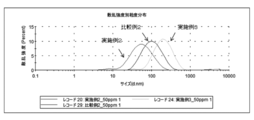
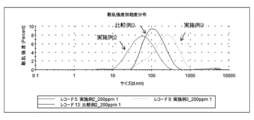
- Example 2 From Table 3, in the C 60 fullerene conversion concentration is 50 ppm, Example 2, Example 3, and any of C 60 fullerene-containing aqueous composition obtained from the powder composition of Comparative Example 2 also by forming fine particles in water It was shown that C 60 fullerene-containing aqueous composition among them obtained from the powder composition of Example 2, and 65 nm, to be very small particles was found ( Figure 2). On the other hand, when the C 60 fullerene equivalent concentration is 200 ppm, the C 60 fullerene-containing aqueous composition obtained from the powder composition of Example 3 has an increased particle size compared to the compositions of Example 2 and Comparative Example 2. And the spread of the particle size distribution was confirmed. From the result of the dispersion test example (Table 2), it is considered that the particle size increased because the aqueous composition of Example 3 tends to gel.
- each hydrophobic cluster (25 mg) and Laponite XLG (475 mg) were weighed together and subjected to dry grinding / mixing treatment (25 Hz, 90 minutes) with a ball mill (Retsch, MM200).
- a powder composition of each hydrophobic cluster of ⁇ 12 was obtained.
- the powder composition of each hydrophobic cluster was added to water so as to have a predetermined concentration shown in Table 4, and the dispersibility in water was confirmed in the same manner as in Example 2. Further, the same water dispersion test was performed on the hydrophobic cluster to which 19 times the amount of Laponite XLG was added without performing dry pulverization / mixing treatment. The results are shown in Table 4.
- any of the compositions was well dispersed in water. Above all, it can be well dispersed in carbon clusters such as graphene, carbon nanotubes, and carbon black, conductive polymers such as polythiophene, conjugated cyclic compounds such as pentacene and porphyrin, and carotenoids such as retinoic acid. Indicated.
- the hydrophobic clusters not subjected to the dry pulverization / mixing treatment with the clay mineral did not show good dispersibility when simply added to water (Table 4, unground). From these results, it was revealed that the composition obtained by subjecting hydrophobic clusters and clay minerals to dry pulverization / mixing showed good dispersibility in water.
- Example 13 C 60 fullerene (Aldrich, 0.1 g) and Laponite XLG (1.9 g) were added to the sample holder with a multi-sample specimen precision crusher (Yasui Kikai Co., Ltd., PV1001C), and pulverization treatment (3000 rpm, 1 Minutes). After pulverization, the obtained powder composition was recovered. A water dispersion test was carried out in the same manner as in Example 2, and it was confirmed that the water was well dispersed.
- Example 14 A pot mill (manufactured by ASONE, HD-B-105) was charged with C 60 fullerene (manufactured by Aldrich, 2 g), Laponite XLG (38 g), zirconia balls ( ⁇ 10 mm, 4 kg), and a pot mill (manufactured by ASONE, PTA-01). ) For 20 hours (measured value: 76 rpm). After pulverization, the zirconia balls were removed, and the obtained powder composition was collected, and a dispersion test for water was conducted in the same manner as in Example 2 to confirm that it was well dispersed in water.
- Example 15 C 60 fullerene (manufactured by Aldrich, 0.5 g) and Laponite XLG (9.5 g) were added and pulverized for 3 hours (setting value: 20 rpm) with a grinder (Ishikawa Factory, No. 18D). The obtained powder composition was collected and subjected to a water dispersion test in the same manner as in Example 2 to confirm that it was well dispersed in water.
- Example 16 C 60 fullerene (Aldrich, 0.5 g) and Laponite XLG (9.5 g) were added and pulverized for 2.5 hours (setting value: 20 rpm) with a grinder (Ishikawa Factory, No. 18D). . Then, water (5.0 g) was added, and further mixed for 0.5 hours (set value: 20 rpm). The obtained powder composition was collected and subjected to a water dispersion test in the same manner as in Example 2 to confirm that it was well dispersed in water. It became clear that even if water was added, a good pulverized product was obtained.
- Example 14 to 16 a scale-up study was conducted (the total solid content was 40 g for Example 14 and 10 g for Examples 15 and 16). It was found that it was well dispersed in water at any scale. It was also found that the composition can be produced even in a pulverization apparatus (pot mill measurement value: 76 rpm, crusher setting value: 20 rpm) having a relatively low processing speed as described above.
- the method for producing the water-soluble or water-dispersible powder composition of the present invention is very simple, and there is no need to perform complicated processes such as filtration, centrifugation, sediment removal, and distillation operation, and the hydrophobic composition is efficiently hydrophobic.
- a cluster (particularly fullerene) -containing aqueous composition can be obtained, which is characterized by being dispersible in water.
- dispersible hydrophobic clusters (especially fullerenes) can be applied to a wide range of concentrations, so that they can be used in various industrial fields such as electronic materials, pharmaceuticals, and daily necessities.
Landscapes
- Carbon And Carbon Compounds (AREA)
- Cosmetics (AREA)
Abstract
La présente invention concerne : une composition pulvérulente hydrosoluble ou hydrodispersible, qui comprend une poudre obtenue par pulvérisation à sec d'un mélange formé d'un agrégat hydrophobe (en particulier, du fullerène) et d'un minéral argileux ; et un procédé de production de la composition pulvérulente.
Priority Applications (1)
| Application Number | Priority Date | Filing Date | Title |
|---|---|---|---|
| JP2017556490A JPWO2017104848A1 (ja) | 2015-12-18 | 2016-12-16 | 疎水性クラスター及び粘土鉱物を含む組成物 |
Applications Claiming Priority (2)
| Application Number | Priority Date | Filing Date | Title |
|---|---|---|---|
| JP2015247172 | 2015-12-18 | ||
| JP2015-247172 | 2015-12-18 |
Publications (1)
| Publication Number | Publication Date |
|---|---|
| WO2017104848A1 true WO2017104848A1 (fr) | 2017-06-22 |
Family
ID=59056768
Family Applications (1)
| Application Number | Title | Priority Date | Filing Date |
|---|---|---|---|
| PCT/JP2016/087690 Ceased WO2017104848A1 (fr) | 2015-12-18 | 2016-12-16 | Composition comprenant agrégat hydrophobe et un minéral argileux |
Country Status (3)
| Country | Link |
|---|---|
| JP (1) | JPWO2017104848A1 (fr) |
| TW (1) | TW201736253A (fr) |
| WO (1) | WO2017104848A1 (fr) |
Cited By (1)
| Publication number | Priority date | Publication date | Assignee | Title |
|---|---|---|---|---|
| CN110386599A (zh) * | 2018-04-20 | 2019-10-29 | 杭州万杵材料科技有限公司 | 一种石墨烯复合材料及其制备方法 |
Citations (5)
| Publication number | Priority date | Publication date | Assignee | Title |
|---|---|---|---|---|
| WO2006028297A1 (fr) * | 2004-09-10 | 2006-03-16 | Vitamin C60 Bioresearch Corporation | Fullerene hydrosoluble, procede de synthese dudit fullerene, preparation antioxydante et preparation a usage externe |
| JP2009203102A (ja) * | 2008-02-27 | 2009-09-10 | Nagoya Institute Of Technology | セラミックス粉体の固化方法及びセラミックス固化体 |
| WO2015105167A1 (fr) * | 2014-01-09 | 2015-07-16 | 昭和電工株式会社 | Matériau actif d'électrode négative pour cellule secondaire lithium-ion |
| JP5777193B1 (ja) * | 2014-09-09 | 2015-09-09 | グラフェンプラットフォーム株式会社 | 複合強化素材及びその製造方法 |
| JP2015197976A (ja) * | 2014-03-31 | 2015-11-09 | 株式会社日本触媒 | 亜鉛電極用合剤 |
-
2016
- 2016-12-16 JP JP2017556490A patent/JPWO2017104848A1/ja active Pending
- 2016-12-16 WO PCT/JP2016/087690 patent/WO2017104848A1/fr not_active Ceased
- 2016-12-19 TW TW105142072A patent/TW201736253A/zh unknown
Patent Citations (5)
| Publication number | Priority date | Publication date | Assignee | Title |
|---|---|---|---|---|
| WO2006028297A1 (fr) * | 2004-09-10 | 2006-03-16 | Vitamin C60 Bioresearch Corporation | Fullerene hydrosoluble, procede de synthese dudit fullerene, preparation antioxydante et preparation a usage externe |
| JP2009203102A (ja) * | 2008-02-27 | 2009-09-10 | Nagoya Institute Of Technology | セラミックス粉体の固化方法及びセラミックス固化体 |
| WO2015105167A1 (fr) * | 2014-01-09 | 2015-07-16 | 昭和電工株式会社 | Matériau actif d'électrode négative pour cellule secondaire lithium-ion |
| JP2015197976A (ja) * | 2014-03-31 | 2015-11-09 | 株式会社日本触媒 | 亜鉛電極用合剤 |
| JP5777193B1 (ja) * | 2014-09-09 | 2015-09-09 | グラフェンプラットフォーム株式会社 | 複合強化素材及びその製造方法 |
Cited By (1)
| Publication number | Priority date | Publication date | Assignee | Title |
|---|---|---|---|---|
| CN110386599A (zh) * | 2018-04-20 | 2019-10-29 | 杭州万杵材料科技有限公司 | 一种石墨烯复合材料及其制备方法 |
Also Published As
| Publication number | Publication date |
|---|---|
| TW201736253A (zh) | 2017-10-16 |
| JPWO2017104848A1 (ja) | 2018-10-18 |
Similar Documents
| Publication | Publication Date | Title |
|---|---|---|
| Munkhbayar et al. | Influence of dry and wet ball milling on dispersion characteristics of the multi-walled carbon nanotubes in aqueous solution with and without surfactant | |
| Weng et al. | Impact of synthesis conditions on Pb (II) removal efficiency from aqueous solution by green tea extract reduced graphene oxide | |
| Mchedlov-Petrossyan | Fullerenes in liquid media: an unsettling intrusion into the solution chemistry | |
| Hyung et al. | Dispersion of C60 in natural water and removal by conventional drinking water treatment processes | |
| Bharath et al. | Enhanced hydroxyapatite nanorods formation on graphene oxide nanocomposite as a potential candidate for protein adsorption, pH controlled release and an effective drug delivery platform for cancer therapy | |
| WO2018135200A1 (fr) | Composition comprenant un groupe hydrophobe et des saccharides | |
| Yazid et al. | A review of the impact of preparation on stability of carbon nanotube nanofluids | |
| Kharissova et al. | Solubilization and dispersion of carbon allotropes in water and non-aqueous solvents | |
| Liu et al. | Green synthesis of carbon quantum dots from lignite coal and the application in Fe3+ detection | |
| Côa et al. | Coating carbon nanotubes with humic acid using an eco-friendly mechanochemical method: Application for Cu (II) ions removal from water and aquatic ecotoxicity | |
| Hilburn et al. | Synthesizing aqueous fullerene colloidal suspensions by new solvent-exchange methods | |
| Kokubo | Water soluble single-nano carbon particles: fullerenol and its derivatives | |
| Bentedlaouti et al. | Antibacterial and antioxidant activities of graphene and graphene oxide synthesis coated silver nanoparticules | |
| Ansari et al. | Novel green synthesis of graphene layers using zante currants and graphene oxide | |
| Wang et al. | Effect of surfactants on synthesis of TiO2 nano-particles by homogeneous precipitation method | |
| JP6494919B2 (ja) | ナノカーボン用分散剤 | |
| Arake et al. | Dispersion of multi-walled carbon nanotube using soluble polysilsesquioxane containing alkylammonium side chains and triiodide counterions | |
| JPWO2017104848A1 (ja) | 疎水性クラスター及び粘土鉱物を含む組成物 | |
| WO2019117224A1 (fr) | Antioxydant comprenant un agrégat hydrophobe et des saccharides | |
| Desai et al. | Antisolvent precipitation of hydrophobic functionalized multiwall carbon nanotubes in an aqueous environment | |
| CN102944528A (zh) | 一种水介质中c60纳米晶体颗粒浓度测定的方法 | |
| Qu et al. | Dispergation and modification of multi-walled carbon nanotubes in aqueous solution | |
| TW200842107A (en) | Carbon nanocapsules-layered silicate hybrid and preparation method thereof | |
| JP5901156B2 (ja) | 無機有機複合粒子及びその製造方法 | |
| Begletsova et al. | Copper nanoparticles obtained by chemical reduction stabilized by micelles of various surfactants |
Legal Events
| Date | Code | Title | Description |
|---|---|---|---|
| 121 | Ep: the epo has been informed by wipo that ep was designated in this application |
Ref document number: 16875822 Country of ref document: EP Kind code of ref document: A1 |
|
| ENP | Entry into the national phase |
Ref document number: 2017556490 Country of ref document: JP Kind code of ref document: A |
|
| NENP | Non-entry into the national phase |
Ref country code: DE |
|
| 122 | Ep: pct application non-entry in european phase |
Ref document number: 16875822 Country of ref document: EP Kind code of ref document: A1 |