WO2017106921A1 - A process for producing cementitious material - Google Patents
A process for producing cementitious material Download PDFInfo
- Publication number
- WO2017106921A1 WO2017106921A1 PCT/AU2016/051272 AU2016051272W WO2017106921A1 WO 2017106921 A1 WO2017106921 A1 WO 2017106921A1 AU 2016051272 W AU2016051272 W AU 2016051272W WO 2017106921 A1 WO2017106921 A1 WO 2017106921A1
- Authority
- WO
- WIPO (PCT)
- Prior art keywords
- cementitious
- cementitious material
- oversized
- composition
- cement
- Prior art date
- Legal status (The legal status is an assumption and is not a legal conclusion. Google has not performed a legal analysis and makes no representation as to the accuracy of the status listed.)
- Ceased
Links
Classifications
-
- C—CHEMISTRY; METALLURGY
- C04—CEMENTS; CONCRETE; ARTIFICIAL STONE; CERAMICS; REFRACTORIES
- C04B—LIME, MAGNESIA; SLAG; CEMENTS; COMPOSITIONS THEREOF, e.g. MORTARS, CONCRETE OR LIKE BUILDING MATERIALS; ARTIFICIAL STONE; CERAMICS; REFRACTORIES; TREATMENT OF NATURAL STONE
- C04B40/00—Processes, in general, for influencing or modifying the properties of mortars, concrete or artificial stone compositions, e.g. their setting or hardening ability
- C04B40/0028—Aspects relating to the mixing step of the mortar preparation
- C04B40/0039—Premixtures of ingredients
- C04B40/0046—Premixtures of ingredients characterised by their processing, e.g. sequence of mixing the ingredients when preparing the premixtures
-
- C—CHEMISTRY; METALLURGY
- C04—CEMENTS; CONCRETE; ARTIFICIAL STONE; CERAMICS; REFRACTORIES
- C04B—LIME, MAGNESIA; SLAG; CEMENTS; COMPOSITIONS THEREOF, e.g. MORTARS, CONCRETE OR LIKE BUILDING MATERIALS; ARTIFICIAL STONE; CERAMICS; REFRACTORIES; TREATMENT OF NATURAL STONE
- C04B22/00—Use of inorganic materials as active ingredients for mortars, concrete or artificial stone, e.g. accelerators or shrinkage compensating agents
- C04B22/08—Acids or salts thereof
- C04B22/10—Acids or salts thereof containing carbon in the anion, e.g. carbonates
-
- C—CHEMISTRY; METALLURGY
- C04—CEMENTS; CONCRETE; ARTIFICIAL STONE; CERAMICS; REFRACTORIES
- C04B—LIME, MAGNESIA; SLAG; CEMENTS; COMPOSITIONS THEREOF, e.g. MORTARS, CONCRETE OR LIKE BUILDING MATERIALS; ARTIFICIAL STONE; CERAMICS; REFRACTORIES; TREATMENT OF NATURAL STONE
- C04B22/00—Use of inorganic materials as active ingredients for mortars, concrete or artificial stone, e.g. accelerators or shrinkage compensating agents
- C04B22/08—Acids or salts thereof
- C04B22/14—Acids or salts thereof containing sulfur in the anion, e.g. sulfides
- C04B22/142—Sulfates
- C04B22/148—Aluminium-sulfate
-
- C—CHEMISTRY; METALLURGY
- C04—CEMENTS; CONCRETE; ARTIFICIAL STONE; CERAMICS; REFRACTORIES
- C04B—LIME, MAGNESIA; SLAG; CEMENTS; COMPOSITIONS THEREOF, e.g. MORTARS, CONCRETE OR LIKE BUILDING MATERIALS; ARTIFICIAL STONE; CERAMICS; REFRACTORIES; TREATMENT OF NATURAL STONE
- C04B24/00—Use of organic materials as active ingredients for mortars, concrete or artificial stone, e.g. plasticisers
- C04B24/10—Carbohydrates or derivatives thereof
-
- C—CHEMISTRY; METALLURGY
- C04—CEMENTS; CONCRETE; ARTIFICIAL STONE; CERAMICS; REFRACTORIES
- C04B—LIME, MAGNESIA; SLAG; CEMENTS; COMPOSITIONS THEREOF, e.g. MORTARS, CONCRETE OR LIKE BUILDING MATERIALS; ARTIFICIAL STONE; CERAMICS; REFRACTORIES; TREATMENT OF NATURAL STONE
- C04B28/00—Compositions of mortars, concrete or artificial stone, containing inorganic binders or the reaction product of an inorganic and an organic binder, e.g. polycarboxylate cements
- C04B28/02—Compositions of mortars, concrete or artificial stone, containing inorganic binders or the reaction product of an inorganic and an organic binder, e.g. polycarboxylate cements containing hydraulic cements other than calcium sulfates
-
- C—CHEMISTRY; METALLURGY
- C04—CEMENTS; CONCRETE; ARTIFICIAL STONE; CERAMICS; REFRACTORIES
- C04B—LIME, MAGNESIA; SLAG; CEMENTS; COMPOSITIONS THEREOF, e.g. MORTARS, CONCRETE OR LIKE BUILDING MATERIALS; ARTIFICIAL STONE; CERAMICS; REFRACTORIES; TREATMENT OF NATURAL STONE
- C04B28/00—Compositions of mortars, concrete or artificial stone, containing inorganic binders or the reaction product of an inorganic and an organic binder, e.g. polycarboxylate cements
- C04B28/02—Compositions of mortars, concrete or artificial stone, containing inorganic binders or the reaction product of an inorganic and an organic binder, e.g. polycarboxylate cements containing hydraulic cements other than calcium sulfates
- C04B28/04—Portland cements
-
- C—CHEMISTRY; METALLURGY
- C04—CEMENTS; CONCRETE; ARTIFICIAL STONE; CERAMICS; REFRACTORIES
- C04B—LIME, MAGNESIA; SLAG; CEMENTS; COMPOSITIONS THEREOF, e.g. MORTARS, CONCRETE OR LIKE BUILDING MATERIALS; ARTIFICIAL STONE; CERAMICS; REFRACTORIES; TREATMENT OF NATURAL STONE
- C04B28/00—Compositions of mortars, concrete or artificial stone, containing inorganic binders or the reaction product of an inorganic and an organic binder, e.g. polycarboxylate cements
- C04B28/02—Compositions of mortars, concrete or artificial stone, containing inorganic binders or the reaction product of an inorganic and an organic binder, e.g. polycarboxylate cements containing hydraulic cements other than calcium sulfates
- C04B28/06—Aluminous cements
- C04B28/065—Calcium aluminosulfate cements, e.g. cements hydrating into ettringite
-
- C—CHEMISTRY; METALLURGY
- C04—CEMENTS; CONCRETE; ARTIFICIAL STONE; CERAMICS; REFRACTORIES
- C04B—LIME, MAGNESIA; SLAG; CEMENTS; COMPOSITIONS THEREOF, e.g. MORTARS, CONCRETE OR LIKE BUILDING MATERIALS; ARTIFICIAL STONE; CERAMICS; REFRACTORIES; TREATMENT OF NATURAL STONE
- C04B40/00—Processes, in general, for influencing or modifying the properties of mortars, concrete or artificial stone compositions, e.g. their setting or hardening ability
- C04B40/0028—Aspects relating to the mixing step of the mortar preparation
- C04B40/0039—Premixtures of ingredients
-
- C—CHEMISTRY; METALLURGY
- C04—CEMENTS; CONCRETE; ARTIFICIAL STONE; CERAMICS; REFRACTORIES
- C04B—LIME, MAGNESIA; SLAG; CEMENTS; COMPOSITIONS THEREOF, e.g. MORTARS, CONCRETE OR LIKE BUILDING MATERIALS; ARTIFICIAL STONE; CERAMICS; REFRACTORIES; TREATMENT OF NATURAL STONE
- C04B2103/00—Function or property of ingredients for mortars, concrete or artificial stone
- C04B2103/10—Accelerators; Activators
- C04B2103/14—Hardening accelerators
-
- C—CHEMISTRY; METALLURGY
- C04—CEMENTS; CONCRETE; ARTIFICIAL STONE; CERAMICS; REFRACTORIES
- C04B—LIME, MAGNESIA; SLAG; CEMENTS; COMPOSITIONS THEREOF, e.g. MORTARS, CONCRETE OR LIKE BUILDING MATERIALS; ARTIFICIAL STONE; CERAMICS; REFRACTORIES; TREATMENT OF NATURAL STONE
- C04B2111/00—Mortars, concrete or artificial stone or mixtures to prepare them, characterised by specific function, property or use
- C04B2111/00034—Physico-chemical characteristics of the mixtures
- C04B2111/00146—Sprayable or pumpable mixtures
- C04B2111/00155—Sprayable, i.e. concrete-like, materials able to be shaped by spraying instead of by casting, e.g. gunite
-
- C—CHEMISTRY; METALLURGY
- C04—CEMENTS; CONCRETE; ARTIFICIAL STONE; CERAMICS; REFRACTORIES
- C04B—LIME, MAGNESIA; SLAG; CEMENTS; COMPOSITIONS THEREOF, e.g. MORTARS, CONCRETE OR LIKE BUILDING MATERIALS; ARTIFICIAL STONE; CERAMICS; REFRACTORIES; TREATMENT OF NATURAL STONE
- C04B2111/00—Mortars, concrete or artificial stone or mixtures to prepare them, characterised by specific function, property or use
- C04B2111/00474—Uses not provided for elsewhere in C04B2111/00
- C04B2111/00482—Coating or impregnation materials
- C04B2111/00577—Coating or impregnation materials applied by spraying
-
- Y—GENERAL TAGGING OF NEW TECHNOLOGICAL DEVELOPMENTS; GENERAL TAGGING OF CROSS-SECTIONAL TECHNOLOGIES SPANNING OVER SEVERAL SECTIONS OF THE IPC; TECHNICAL SUBJECTS COVERED BY FORMER USPC CROSS-REFERENCE ART COLLECTIONS [XRACs] AND DIGESTS
- Y02—TECHNOLOGIES OR APPLICATIONS FOR MITIGATION OR ADAPTATION AGAINST CLIMATE CHANGE
- Y02W—CLIMATE CHANGE MITIGATION TECHNOLOGIES RELATED TO WASTEWATER TREATMENT OR WASTE MANAGEMENT
- Y02W30/00—Technologies for solid waste management
- Y02W30/50—Reuse, recycling or recovery technologies
- Y02W30/91—Use of waste materials as fillers for mortars or concrete
Definitions
- the present invention relates to a process for producing at least two cementitious material fractions from a cementitious feed, in particular a fine cementitious material and an oversized cementitious material fraction using a particle separator, a fine cementitious material and an oversized cementitious material fraction produced by the process and use thereof.
- the invention is particularly applicable as a low energy process for producing two usable cementitious products comprising a fine cementitious material, such as micro fine or ultra fine cement, and an oversized cementitious material fraction using a single separation process. It will be convenient to hereinafter disclose the invention in relation to that exemplary application. However, it is to be appreciated that the invention is not limited to that application and could be used to produce various cementitious powder products from various types of cementitious material feeds. Background of Invention
- a cementitious material is any material or materials which can be mixed with a liquid, such as water, to form a cement base substance.
- Cementitious materials include cements, lime, fly ash, mortar, ground granulated blast furnace slag (GGBS), silica fume, calcined clay, calcined shale, refractory cements, gypsum, expanding cements, sand, rice hull ash, quartz, silica, amorphous silicon dioxide, pozzolanic materials or the like.
- Hydraulic cements are powders that react with water to generate hard, solid matrices, that continue to increase in compressive strength even when the matrix is placed in excess water (for example as taught in H. F.W.Taylor, Cement Chemistry, Academic Press Ltd, 1990, ISBN 0-12-683900-X).
- PC Portland cement
- AC's & CAC's alumina cements
- SAB's sulpho-aluminate belite cements
- pozzolanic slags fuel ashes and other silacious glasses.
- Portland cement is the most common form of hydraulic cementitious material. 'Cement' is a generic term used to describe a material comprising organic and inorganic binding agents. However, it is to be understood that the described process is not limited to cements and could also be applied to any Pozzolanic material.
- the most common cements are hydraulic cements which are materials which set and harden after combining with water, as a result of chemical reactions with the mixing of water and after hardening, retain strength and stability even upon exposure to water.
- Portland cements are produced from ground naturally occurring calcareous (limestone) and argillaceous (clay or shale) material and fused in a rotary calcining kiln.
- Portland cement is manufactured in vast quantities around the world and is the most common material for many construction projects. Portland cements can be used for any suitable application including construction or mining applications. Such applications include construction of dams, bridges, swimming pools, buildings, rock and anchor bolts, patios, basements, balustrades, tiles and pavement, lamp- posts, drain covers, benches, beams, piers, masonry, motorways and roads, overpasses, sidewalks, and the like.
- Typical Portland cements have a composition of 45-75% C 3 S, 7-32% C 2 S, 0-13% C 3 A, 0-18% C 4 AF and 2-10% gypsum on a w/w basis.
- Type I Portland cement is a general-purpose cement and is the most common class. Type I cements have a typical composition of 55% C 3 S, 19% C 2 S, 10% C 3 A, 7% C 4 AF, 2.8% MgO, 2.9% S, with 1 % ignition loss and 1 % free CaO on a w/w basis.
- Type II Portland cement releases less heat compared to Type I Portland cement and requires that the amount of C 3 A does not exceed 8% on w/w basis.
- a typical composition of a Type II Portland cement is 51 % C 3 S, 24% C 2 S, 6% C 3 A, 11 % C4AF, 2.9% MgO, 2.5% S, with 0.8% ignition loss and 1 % free CaO on a w/w basis.
- Type III Portland cement has a relatively high early strength and has particle sizes finer than Type I Portland cement.
- Type III Portland cement typically has a specific surface area of 50-80% higher than Type I Portland cement.
- a Type III Portland cement has a 3-day compressive strength equal to the 7-day compressive strength of a Type I and II Portland cement and a Type III cement has a 7 day compressive strength equal to the 28-day compressive strength of a Type I and II Portland cement.
- a typical composition of a Type III Portland cement is 57% C 3 S, 19% C 2 S, 10% C 3 A, 7% C4AF, 3.0% MgO, 3.1 % S, with 0.9% ignition loss and 1.3% free CaO on a w/w basis.
- Type IV Portland cement typically has a low heat of hydration and requires that the amount of C 3 A does not exceed 7% and C 3 S does not exceed 35% on a w/w basis.
- IV Portland cements are generally used for large concrete structures having a low surface to volume ratio such as dams.
- a typical composition of a Type IV Portland cement is 28% C 3 S, 49% C 2 S, 4% C 3 A, 12% C 4 AF, 1.8% MgO, 1.9% S, with 0.9% ignition loss and 0.8% free CaO on a w/w basis.
- Type V Portland cement is used when sulphate resistance is required and the composition does not exceed 5% C 3 A on a w/w basis. Additionally, the composition of a Type
- V Portland cement has a requirement that C4AF + 2(CsA) does not exceed 20% on a w/w basis.
- a typical composition of a Type V Portland cement is 38% C 3 S, 43% C 2 S, 4% C 3 A, 9%
- Types la, lia and Ilia are variants to Types l-lll Portland cements and refers to the addition of an air-entraining agent which is ground into the composition. Further, Types ll(MH) and ll(MH)A have a similar composition to Type I! Portland cement above, however has mild heat release. [017] According to European standard EN 197, five classes of Portland cement have been described which are different to the classes described in ASTM C150.
- Type I Portland cement as Portland cement comprising Portland cement and up to 5% of minor additional constituents
- Type II Portland-composite cement comprises Portland cement and up to 35% of other single constituents
- Type II I Blast furnace cement comprises Portland cement and higher percentages of blast furnace slag
- Type IV Pozzolanic cement comprises Portland cement and up to 55% of pozzolanic constituents
- Type V Composite cement comprising Portland cement, pozzolan and blast furnace slag or fly ash.
- One of the key aspects for controlling the reactivity of a Portland cement is fineness of the cement. By grinding the cement finer, the surface area of the cement can be increased which increases the reactivity with water.
- the fineness of the ground cement in terms of reactivity is secondary to requiring the cement to have a very fine particle size, allowing the cement to penetrate fine structures such as rock fractures.
- These cements which target fine structures are commercially manufactured to produce a very fine particle size even though the process is high cost and energy intensive.
- the high cost and energy required is due to the exponential decrease of grinding efficiency with decreasing particle size.
- large particle size cements do not have a presence in the market as small increases in particle size (mean particle size greater than 30 microns) rapidly reduces the reactivity of Portland cement causing the cement to be unusable. Therefore, manufacturers have to balance high grinding costs with the issue of low reactivity for oversized particle sizes.
- GGBFS Ground-granulated blastfurnace slag
- micro fine and ultra fine cements comprise micro fine particles generally having a d97 ⁇ 30 pm.
- Ultra fine cements comprise ultra fine particles generally having a d97 ⁇ 12 ⁇ .
- micro fine cements may vary from country to country.
- the AC! Committee 552, Geotechnical Cement Grouting defines micro fine cement as a material in which d max ⁇ 15 ⁇ .
- micro fine cements are characterized by a specific surface area >800 m 2 /kg and d S5 ⁇ 20 ⁇
- micro fine cement are divided into two groups of microcements: d S5 ⁇ 30 ⁇ micro fine cement and d S5 ⁇ 15 pm, ultra fine cement.
- ultra fine cements are characterized by d max ⁇ 6 pm.
- micro fine particle size of these cements provides advantageous properties and therefore provides excellent penetration in tight joints, fissures and pore spaces. It can also be useful as a complete or partial cement replacement to provide higher early strength due to increased reactivity, or as a high performance cement. This can be useful where cement is needed to be injected into a structure or material, for example stabilizing or sealing earthen foundations, tunnels, dams, and fluid storage tanks.
- Micro fine cements are generally produced by dry milling or grinding of a cement particle or powder, however, requires careful matching of the milling conditions to the respective raw material. Alternatively, wet milling processes using water are also disclosed.
- milling or grinding is generally carried out using media milling equipment, for example, tumbling ball mills, vibratory ball mills, planetary mills, stirred and centrifugal mills or the like, and non-media milling equipment, for example, roller or jet mills or the like.
- media milling equipment for example, tumbling ball mills, vibratory ball mills, planetary mills, stirred and centrifugal mills or the like
- non-media milling equipment for example, roller or jet mills or the like.
- the use of milling techniques to produce micro fine cements is not without its problems. For instance, a problem in producing micro fine cements is that the milling process is costly and energy intensive. In addition, the milling process is time consuming and inefficient in obtaining the desired micro fine cement particle size.
- the present invention provides a process for producing at least two cementitious material fractions from a cementitious feed comprising the steps of: providing a cementitious feed; and separating a fine cementitious material fraction from the cementitious feed using a particle separator; thereby producing at least two cementitious material fractions comprising a fine cementitious material fraction and an oversized cementitious material fraction; and wherein after separating a fine cementitious material fraction from the cementitious feed using a particle separator, the fine cementitious material fraction and the oversized cementitious material fraction have a different chemical composition to the cementitious feed.
- a fine cementitious material such as micro fine cementitious material and/or an ultra fine cementitious material is therefore produced in the fine cementitious material fraction.
- the oversized cementitious material fraction comprises the oversize particles from the particle separation process.
- Conventional separation processes and grinding methods as discussed above to produce fine cementitious materials have the same chemical composition as that of the cementitious feed. A skilled addressee would understand that chemical separation by conventional methods (such as a mechanical classifying system or grinding) to produce a fine cementitious material fraction would not result in chemical separation compared to the cementitious feed.
- a particle separator for example a mechanical classifying system
- a suitable fine cementitious material can be separated from the same cementitious feed material used for conventional grinding and milling processes.
- the oversized cementitious material fraction has a different chemical composition to that of the cementitious feed.
- the oversized cementitious material fraction is a waste product due to the low hydraulic activity of the cement.
- the oversized cementitious material is therefore typically is recycled and re-ground as part of the cement feed.
- the process of the present invention provides an oversized cementitious material which can be sold as a commercially saleable product due to chemical separation in certain embodiments.
- the particle size of this oversized cementitious material fraction generally prevents the sale of this material as a normal Portland or low energy cement.
- the oversized cementitious material fraction can be used for the formation of non-Portland cement hydrates where the Portland cement is used as a lime and silica source rather than a binder.
- the oversized cementitious material fraction produced by the present invention has a higher dicalcium silicate content to that of the cementitious feed which allows the cement hydration process to proceed without super saturation by calcium hydroxide and subsequent precipitation of calcium hydroxide gel which occurs during normal Portland cement hydration.
- the larger particle size of the oversized cementitious material fraction (as compared to the average particle size of the feed material and fine cementitious material fraction) effectively reduces the supersaturation envelope and reduces the size of the inner and outer hydration spheres.
- the particles in solution of the oversized cementitious material fraction have nowhere else to go upon meeting another particle in the solution and form a large dense meshed hydration sphere.
- the oversized cementitious material fraction therefore exhibits a good hydration effect.
- the inventors have found that in some embodiments the oversized cementitious material fraction is suitable as a hydraulic cement for the production of high performance cementitious materials, (based on non-Portland hydration pathways).
- the process of the invention is more energy efficient as two saleable products are produced at the same time.
- the present invention is especially suited to but not limited to producing cementitious fractions having different hardness or crystal cleavage between the fine cementitious material fraction and an oversized cementitious material fraction.
- the separation of the oversized cementitious material fraction from the cementitious feed produces a Portland cement which is suitable for the formation of non-Portland cement hydration products.
- the separation of a fine cementitious material fraction from a cementitious feed in the present invention produces at least two cementitious material fractions comprising i) a suitable performing Portland cement (fine cementitious material fraction) and ii) a second high performing non-Portland type hydration based hydraulic binder (oversized cementitious material fraction) without requiring energy intensive grinding.
- the main cementitious phases of a cementitious material are tricalcium silicate (Alite; C 3 S), dicalcium silicate (Belite; C 2 S), tricalcium aluminate (Aluminate or Celite; C 3 A) and tetracalcium alumino ferrite (ferrite; C4AF).
- a skilled addressee would understand that the resulting properties of the grout formed from the cementitious materials can be dependent on the relative proportions of the main cementitious phases.
- the composition of the fine cementitious material fraction has a higher content of tricalcium silicate by weight % than the composition of the cementitious feed.
- the composition of the fine cementitious material fraction has a content of tricalcium silicate of from 0.5 to 15 wt% greater than the cementitious feed, preferably from 0.5 to 12 wt% greater than the cementitious feed, more preferably from 1 to 5 wt% greater than the cementitious feed and yet more preferably from 5 to 12 wt % greater than the cementitious feed.
- the composition of the fine cementitious material fraction has a lower content of dicalcium silicate by weight % than the composition of the cementitious feed.
- the composition of the fine cementitious material fraction has a content of dicalcium silicate of from 2 to 15 wt% lower than the cementitious feed, preferably from 2 to 10 wt% lower than the cementitious feed, more preferably 2 to 6 wt% lower than the cementitious feed and yet more preferably from 5 to 15 wt% lower than the cementitious feed.
- the composition of the fine cementitious material fraction has a higher content of tricalcium aluminate by weight % than the composition of the cementitious feed.
- the composition of the fine cementitious material fraction has a content of tricalcium aluminate of from 0.05 to 2 wt% higher than the cementitious feed, preferably from 0.05 to 1 wt% higher than the cementitious feed and more preferably from 0.05 to 0.5 wt% higher than the cementitious feed.
- the composition of the fine cementitious material fraction has a lower content of tetracalcium alumino ferrite by weight % than the composition of the cementitious feed.
- the composition of the fine cementitious fraction has a content of tetracalcium alumino ferrite of from 0.1 to 2 wt% lower than the cementitious feed, preferably from 0.1 to 1 wt% lower than the cementitious feed and more preferably from 0.5 to 1 wt% lower than the cementitious feed.
- the composition of the oversized cementitious material fraction has a lower content of tricalcium silicate by weight % than the composition of the cementitious feed.
- the composition of the oversized cementitious material fraction has a content of tricalcium silicate of from 2 to 15 wt% lower than the cementitious feed, preferably from 3 to 12 wt% lower than the cementitious feed, more preferably from 3 to 9 wt% lower than the cementitious feed and yet more preferably from 3 to 6 wt % lower than the cementitious feed.
- the composition of the oversized cementitious material fraction has a higher content of dicaicium silicate by weight % than the composition of the cementitious feed.
- the composition of the oversized cementitious material fraction has a content of dicaicium silicate of from 1 to 15 wt% higher than the cementitious feed, preferably 1 to 10 wt% higher than the cementitious feed, more preferably 6 to 12 wt% higher than the cementitious feed and yet more preferably 6 to 10 wt% higher than the cementitious feed.
- the composition of the oversized cementitious material fraction has a lower content of tricalcium aluminate by weight % than the composition of the cementitious feed.
- the composition of the oversized cementitious material fraction has a content of tricalcium aluminate of from 0.01 to 2 wt% lower than the cementitious feed, preferably 0.01 to 1 wt% lower than the cementitious feed, more preferably 0.05 to 1 wt% lower than the cementitious feed and yet more preferably 0.06 to 0.08 wt% lower than the cementitious feed.
- the composition of the oversized cementitious material fraction has a higher content of tetracalcium alumino ferrite by weight % than the composition of the cementitious feed.
- the composition of the oversized cementitious material fraction has a content of tetracalcium alumino ferrite of from 0.1 to 2 wt% higher than the cementitious feed, preferably 0.1 to 1 wt% higher than the cementitious feed, more preferably 0.5 to 1 wt% higher than the cementitious feed and yet more preferably 0.6 to 0.9 wt% higher than the cementitious feed.
- the oversized cementitious material fraction has a lower content of tricalcium silicate by weight % than the composition of the fine cementitious material fraction.
- the composition of the oversized cementitious material fraction has a content of tricalcium silicate of from 2 to 25 wt% lower than the fine cementitious material fraction, preferably 2 to 20 wt% lower than the fine cementitious material fraction, more preferably 2 to 15 wt% lower than the fine cementitious material fraction and yet more preferably 2 to 10 wt% lower than the fine cementitious material fraction.
- the oversized cementitious material fraction has a higher content of dicalcium silicate by weight % than the composition of the fine cementitious material fraction.
- the composition of the oversized cementitious material fraction has a content of dicalcium silicate of from 1 to 30 wt% higher than the fine cementitious material fraction, preferably 10 to 20 wt% higher than the fine cementitious material fraction, more preferably 10 to 30 wt% higher than the fine cementitious material fraction, more preferably 15 to 20 wt% higher than the fine cementitious material fraction and yet more preferably 15 to 25 wt% higher than the fine cementitious material fraction.
- the oversized cementitious material fraction has a lower content of tricalcium aluminate by weight % than the composition of the fine cementitious material fraction.
- the composition of the oversized cementitious material fraction has a content of tricalcium aluminate of from 0.1 to 2 wt% lower than the fine cementitious material fraction, preferably 0.1 to 1 wt% lower than the fine cementitious material fraction, more preferably 0.1 to 0.9 wt% lower than the fine cementitious material fraction and yet more preferably 0.1 to 0.5 wt% lower than the fine cementitious material fraction.
- the oversized cementitious material fraction has a higher content of tetracalcium alumino ferrite by weight % than the composition of the fine cementitious material fraction.
- the composition of the oversized cementitious material fraction has a content of tetracalcium alumino ferrite of from 0.1 to 5 wt% higher than the fine cementitious material fraction, preferably 0.1 to 2 wt% higher than the fine cementitious material fraction, more preferably 0.5 to 2 wt% higher than the fine cementitious material fraction, more preferably 1 to 2 wt% higher than the fine cementitious material fraction and yet more preferably 1 to 1.5 wt% higher than the fine cementitious material fraction.
- the fine cementitious material fraction has a higher content of tricalcium aluminate, calcium oxide and calcium sulphate.
- tricalcium aluminate and calcium hydroxide can increase the hydration activity of the cementitious material.
- the content of tricalcium aluminate and calcium hydroxide is too high and the cementitious material comprising these components is not chemically retarded can result in flash setting of the grout.
- composition of the fine cementitious material fraction to the cementitious feed when using the process of the present invention can include at least one of the following: ⁇ the composition of the fine cementitious material fraction has a lower content of
- the composition of the fine cementitious material fraction has a greater content of S0 3 by weight % than the composition of the cementitious feed. In some embodiments, this is deemed to reflect gypsum composition.
- Gypsum is composed of calcium sulphate dehydrate and falls under the S0 3 category within a shorthand chemical compound analysis.
- the composition of the fine cementitious material fraction has a lower content of Si0 2 by weight % than the composition of the cementitious feed.
- the composition of the fine cementitious material fraction has a lower content of MgO by weight % than the composition of the cementitious feed.
- the composition of the fine cementitious material fraction has a lower content of Na 2 0 by weight % than the composition of the cementitious feed.
- the composition of the fine cementitious material fraction has a greater content of K 2 0 by weight % than the composition of the cementitious feed.
- ⁇ the fine cementitious material fraction has a greater loss on ignition (LOI) than the cementitious feed.
- the LOI reflects movement in 'free lime' in OPC or GP cement only.
- the movement of lime, (or the enrichment of fine cementitious material) in the slag blended (i.e. any blends containing a slag component) cement can be harder to define, as the slag in the blend disguises, or hides this chemical movement.
- the reason the free lime is reflected is due to the method of LOI which involves the super heating of cement powder, pozzolanic powder or fly ash. Normally this will get to a temperature high enough to 'burn off' free carbon; generally regarded as a negative component in the hydraulic nature of concrete formation because it increases water demand and has a latent function. There is no carbon compound in OPC or GP, and the LOI can thus be equated to 'free lime'.
- composition of the oversized cementitious material fraction to the cementitious feed when using the process of the present invention can include at least one of the following: ⁇ the composition of the oversized cementitious material fraction has a greater content of Si0 2 by weight % than the composition of the cementitious feed.
- the composition of the oversized cementitious material fraction has a greater content of CaO by weight % than the composition of the cementitious feed.
- the composition of the oversized cementitious material fraction has a lower content of S0 3 by weight % than the composition of the cementitious feed.
- the composition of the oversized cementitious material fraction has a greater content of MgO by weight % than the composition of the cementitious feed.
- the composition of the oversized cementitious material fraction has a lower content of K 2 0 by weight % than the composition of the cementitious feed.
- the oversized cementitious material fraction has a lower loss on ignition (LOI) than the cementitious feed.
- the inventors consider that differences between the composition of the oversized cementitious material fraction to the cementitious feed is facilitated by the centrifugal separation and centrifugal force therein applied to the differing masses of particles (and compositions) in the cementitious feed mixture.
- the centrifugal separation separates compounds based on molecular weight. For example, Si0 2 is heavier than the lime and gypsum in the cement, and therefore has a greater chance to be liberated in the air stream.
- fine cementitious material is used to describe a material in the present invention comprising a top particle size of less than 30 microns. It is to be understood that the terms “fine”, “ultra fine”, “micro fine” and “super fine” in relation to cementitious material or related terms (cements, powder etc..) in this specification all fall into the scope of the term “fine cementitious material” and therefore should be understood as being synonymous.
- the fine cementitious material can be used for Portland type hydration. Therefore, any material which satisfies the above definition of "fine cementitious material” is within the scope of the present invention.
- oversized cementitious material in the present invention is used to describe the remaining material after separation of the fine cementitious material fraction from the cementitious feed comprising a top particle size of greater than 30 microns.
- the oversized cementitious material can be used for non-Portland type hydration.
- non-Portland type hydration refers to hydration of the cement which does not proceed along the normal Portland cement hydration pathway known to those skilled in the art.
- the particle separator can comprise any separator apparatus or system capable of separating micro fine particle fraction from a conventional cementitious raw material feed.
- the particle separator comprises a mechanical classifying system.
- the particle separator comprises at least one air separator, cyclone separator, centrifuge, or a combination thereof.
- the particle separator comprises a sieve, filter, gravity separator, or a combination thereof.
- the filter may for example be a bag filter.
- the particle separator comprises an air classifier, for example a turbo classifier.
- the particle separator comprises a dry material or powder centrifuge.
- the process of the present invention is not limited to use of a single particle separator.
- the process may include multiple separators.
- the separator comprises at least two particle separators.
- the particle separators of the process could be arranged in series, parallel or a combination thereof.
- One example is a classification circuit.
- the particle separator can comprise a primary particle separator, followed by a secondary particle separator.
- the primary particle separator could comprise a mechanical classifier, and the secondary particle separator could comprise a filter or filtration system.
- the process further includes one or more additional cyclonic separation systems.
- each particle separator or additional particle separator could have one or more air streams fed into the separator for separation.
- the particle separator may have a one (primary) air stream; it could have a second (secondary) 'supporting - or complimenting' air stream.
- the particle separator or separators could have a third (tertiary) air stream, and so on and so forth.
- each particle separator has primary, secondary, and tertiary air streams.
- the particle size distribution and characteristics of the fine cementitious product are typically tailored to a desired size requirement.
- the top particle size of the fine cementitious product fraction is one indicative characteristic of the required particle size distribution.
- the top size fraction is characterised by d 97
- the micro fine cementitious material fraction has a d 97 of less than 30 microns.
- the d 97 may be less than 24 microns, preferably less than 20 microns, more preferably less than 16 microns, yet more preferably less than 12 microns, and in some embodiments less than 6 microns.
- the top particle size of the fine cementitious product fraction may be defined as the d 10 o size limit of the required particle size distribution.
- the micro fine cementitious material fraction has a d i0 o of less than 30 microns.
- the d 10 o may be less than 24 microns, preferably less than 20 microns, more preferably less than 16 microns, yet more preferably less than 12 microns, and more preferably in some instances less than 6 microns.
- the dio particle size can be another indicative characteristic of the required particle size distribution.
- the fine cementitious material fraction has a d io particle size of no more than 4 microns. However, depending on the required application, the d-o particle size may be of no more than 3 microns, preferably no more than 2 microns, and more preferably no more than 1.5 microns. In some embodiments, the fine cementitious material fraction has a d 10 particle size of 1.0 microns or smaller.
- the d 90 particle size can be another indicative characteristic of the required particle size distribution. In some embodiments, the fine cementitious material fraction has a dgo particle size of no more than 15 microns.
- the d 90 particle size may be of no more than 12 microns, preferably no more than 10 microns, and more preferably no more than 9 microns.
- the fine cementitious material fraction has a d 90 particle size of 7 microns.
- the mean particle size (d 50 ) can be yet another indicative characteristic of the required particle size distribution.
- the fine cementitious material fraction has a mean particle size of at most 15 microns, preferably at most 12 microns, preferably at most 10 microns, preferably at most 5 microns.
- the fine cementitious material fraction has a mean particle size of at most 6 microns, preferably at most 4 microns, preferably at most 3 microns, preferably at most 2 microns.
- the separation process of the present invention can produce a fine cementitious material fraction, oversized cementitious material fraction or a combination thereof that has a different composition to the cementitious feed.
- the chemical compositions of the cementitious materials may be converted into a different cement composition such as general purpose cement (GP), Portland cement, blended cement (GB), low heat cement (LH), high early strength cement (HE), shrinkage limited cement (SL) or sulphate resisting cement (SR) or a combination thereof.
- GP general purpose cement
- GB blended cement
- LH low heat cement
- HE high early strength cement
- SL shrinkage limited cement
- SR sulphate resisting cement
- the top size fraction is characterised by d 97.
- the oversized cementitious material fraction has a d S7 of less than 10 mm, preferably less than 1 mm.
- the d 97 may be of from 100 to 1000 microns, preferably of from 100 to 1000 microns, more preferably of from 300 to 1000 microns, yet more preferably of from 500 to 1000 microns, and in some embodiments of from 100 to 800 microns.
- the top particle size of the oversized cementitious product fraction may be defined as the d 10 o size limit of the required particle size distribution.
- the oversized cementitious material fraction has a d 1 ⁇ of less than 10 mm, preferably less than 1 mm.
- the d 00 may be less than 5 mm, preferably less than 3 mm, more preferably less than 1 mm, yet more preferably less than 200 microns and more preferably less than 100 microns.
- the oversized cementitious material fraction has a mean particle size of from 100 to 5000 microns, preferably of from 100 to 3000 microns, preferably of from 100 to 1000 microns, preferably of from 100 to 500 microns.
- top size particles might be defined as a range from dgs-dioo, the pure nature of the particle size analysis can make this result unpredictable and almost impossible to replicate in the real world.
- the most stable result is d 50 (median), and a three point result such as d 10 , d 50 and d 90 may provide a reliable characterisation in some embodiments.
- the cementitous feed can comprise any suitable cementitious material, preferably powder.
- suitable cementitious materials include cements, lime, fly ash, mortar, ground granulated blast furnace slag (GGBS), silica fume, calcined clay, calcined shale, refractory cements, gypsum, expanding cements, sand, rice hull ash, quartz, silica, amorphous silicon dioxide or the like, or combinations thereof.
- the cementitious feed preferably comprises a conventional cementitious material that is commercially available, and used for conventional cement applications.
- the cementitious feed is a conventional cement material, preferably a hydraulic cement.
- the cementitious feed comprises a cement which complies with Australian Standard 3972-2010.
- the cementitious feed could comprise a general purpose cement (GP), also referred to as OPC, or ordinary portland cement, blended cement (GB), fly ash blended cement (FAB), low heat cement (LH), high early strength cement (HE), shrinkage limited cement (SL), sulphate resisting cement (SR), sulphoaluminate-belite cement(SAB), calcium sulphoaluminate cement (CSA), calcium aluminate cement (CA) or a combination thereof.
- GP general purpose cement
- OPC ordinary portland cement
- GB blended cement
- FAB fly ash blended cement
- LH low heat cement
- HE high early strength cement
- SL shrinkage limited cement
- SR sulphate resisting cement
- SAB sulphoaluminate-belite cement
- CSA calcium sulphoaluminate cement
- CA calcium aluminate cement
- conventional cements exhibit a broad particle size range typically spanning two or three decades from the submicrometer range to 100 microns (generally having a top size of 60-70 prrt).
- some portland cement comprise about 15% by weight of particles less than 5 microns and 5% by weight of particles greater than 45 microns.
- the cementitious feed of the process comprises general purpose cement exhibiting a broad particle size range having a top particle size of less than 100 microns.
- the fine cementitious material produced from the process depends on the composition and particle size distribution of the feed cementitious material.
- the resulting fine cementitious material fraction would be a fine cement, such as a micro fine or ultra fine cement.
- the fine cementitious material fraction is at least one of a ultra fine cement or a GP cement.
- the fine cementitious material fraction is an ultra fine cement. It should be appreciated that other fine powders can be produced using different feed cementitious material.
- the oversized cementitious material fraction similarly depends on the composition and particle size distribution of the feed cementitious material. It is desirable for the resulting oversized cementitious material fraction to have some commercial value.
- the oversized cementitious material fraction can comprise a saleable product in some embodiments.
- the oversized cementitious material fraction has a different hydration pathway to the fine cementitious material fraction.
- the resulting oversized cementitious material fraction can in some embodiments comprise at least one of a low heat strength cement (LH), sulphate resisting cement (SR), shrinkage limited cement (SL) or a combination thereof. Both product fractions can therefore be commercially sold.
- LH low heat strength cement
- SR sulphate resisting cement
- SL shrinkage limited cement
- the process may also comprise additional processing steps.
- the process may also comprise a further step of blending a portion of the fine cementitious material fraction and a portion of the oversized cementitious material fraction to produce a cementitious material having a desired property.
- the process may also comprise a further step of blending a portion of at least one of the fine cementitious material fraction with at least one supplementary cementitious material to produce a cementitious material having a desired property.
- the process may also comprise a further step of blending a portion of at least one of the oversized cementitious material fraction with at least one supplementary cementitious material to produce a cementitious material having a desired property.
- the desired property of the resulting cementitious product typically comprises one or more of particle size distribution, composition, loss on ignition or a combination thereof. Each of these properties can be affected by the supplementary cementitious material blended into the fine cementitious material fraction, oversized cementitious material fraction or the blending combination of those two fractions.
- the at least one supplementary cementitious material can in some embodiments comprise at least one of a fly ash, slag, silica fume, pozzolans or a combination thereof.
- the process may also comprise a further step of comminuting the oversized cementitious material fraction to produce a comminuted cementitious material having a desired particle size distribution.
- the comminuted cementitious material may be recycled into the cementitious feed. It should be appreciated that the initial changes, or transfer of compounds and chemistry may differ after each comminution.
- the oversized fraction can be recycled as a feed material as part of a normal or conventional cement powder manufacture.
- oversized cementitious material fraction can be sold as a specialty cement whose parameters it has been categorised, as described previously.
- the process may also comprise a further step of phase composition analysis, wherein the oversized cementitious material fraction has a phase composition which produces a hydraulic cement, pozzolanic material or a combination thereof.
- the oversized cementitious material fraction will be classed as a functional cement or pozzolanic material, regardless of the phase composition analysed.
- the present invention also provides fine cementitious material, an oversized cementitious material or combination thereof produced by the process according to any one of the embodiments of the first aspect of the present invention described herein.
- the present invention also provides a cementitious composition
- a cementitious composition comprising cementitious material from a fine cementitious material fraction, an oversized cementitious material fraction or a combination thereof produced using a process according to any one of the embodiments of the first aspect described herein. That material can in some embodiments be used for grouting, soil stabilisation, injection, piling, repair, an additive or a combination thereof.
- the present invention also provides a cement comprising cementitious material from a fine cementitious material fraction, an oversized cementitious material fraction or a combination thereof produced using a process according to any one of the embodiments described herein.
- the cement further comprises a fly ash, slag, silica fume, pozzolans, calcined clay, calcined shale, refractory cements, gypsum, expanding cements, sand, rice hull ash, quartz, silica, amorphous silicon dioxide or the like or a combination thereof.
- the cement is a hydraulic cement.
- the cement is a general purpose cement (GP), ordinary portland cement (OPC), fly ash blended cement (FAB), blended cement (GB), low heat cement (LH), high early strength cement (HE), shrinkage limited cement (SL), sulphate resisting cement (SR), sulphoaluminate-belite. (SAB) cement, calcium sulphoaluminate cement (CSA), calcium aluminate cement (CA) or a combination thereof.
- GP general purpose cement
- OPC ordinary portland cement
- FAB fly ash blended cement
- GB low heat cement
- HE high early strength cement
- SL shrinkage limited cement
- SR sulphate resisting cement
- SAB sulphoaluminate-belite.
- SAB calcium sulphoaluminate cement
- CA calcium aluminate cement
- the process of the present invention is particularly advantageous in that fine cementitious materials may be obtained without the need for milling processes which may reduce cost, time and energy.
- the invention is also advantageous as the process produces a fine cementitious material fraction suitable as a fine cement and an oversized cementitious material fraction suitable as a low heat strength cement (LH), sulphate resisting cement (SR), shrinkage limited cement (SL) or a combination thereof. Additionally, the process of the present invention is advantageous as the fine and oversized cementitious material fractions have different chemical compositions to the cementitious feed, thus providing control of the amounts of cementitious phases in the fractions.
- LH low heat strength cement
- SR sulphate resisting cement
- SL shrinkage limited cement
- Figure 1 is a general process flow diagram of a process for the production of fine cementitious materials according to one embodiment of the present invention.
- Figure 2 is a process schematic of an air classifier for producing a fine cementitious material which can be used as a particle separator in the process shown in Figure 1.
- Figure 3 is a schematic of an air classifier that can be used in the process shown in Figure 2 showing air flow patterns flowing there through.
- Figure 4 is a schematic of another air classifier that can be used in the process shown in Figure 2.
- Figure 5 is a photographic image of an inlet of an air classifier than can be used in the process shown in Figure 2.
- Figure 6 is an alternative view of the photographic image of the inlet shown in Figure 5.
- Figure 7 is a photographic image of an air classifier than can be used in the process shown in Figure 2.
- Figure 8 is an alternative view of the photographic image of the air classifier shown in Figure 7.
- Figure 9 provides graphical results showing the particle size distribution of a cementitious feed comprising general purpose cement.
- Figure 10 provides graphical results showing the particle size distribution of a fine cementitious material fraction produced by the process for a typical ordinary Portland cement (Bulwer GP).
- Figure 11 provides graphical results showing the elemental changes of the composition of a fine and oversized cementitious material fraction produced by the process for a typical ordinary Portland cement (Bulwer GP).
- Figure 12 provides graphical results showing the elemental changes of the composition of a fine and oversized cementitious material fraction produced by the process for a typical ordinary Portland cement (Bulwer GP) with calcium sulphate removed.
- Figure 13 provides graphical results showing the minor elemental changes of the composition of a fine and oversized cementitious material fraction produced by the process for a typical ordinary Portland cement (Bulwer GP).
- Figure 14 provides graphical results showing the particle size distribution of fine and oversized cementitious materials produced by the process for a general purpose cement and a conventional jet milled cement having a d 97 > 30 micron.
- Figure 15 provides graphical results showing the phase distribution of fine and oversized cementitious material fractions of a commercially available GP cement using the process shown in Figures 1 and 2.
- Figure 16 provides graphical results showing the elemental changes of the composition of a fine and oversized Pulverised Fly Ash material fraction produced by the process as a comparative example.
- cementitious material is any material or materials which can be mixed with a liquid, such as water, to form a hydraulic binder.
- Cementitious materials include: cements, portland cements, pozzolanic materials, lime, fly ash, mortar, ground granulated blast furnace slag (GGBS), silica fume, calcined clay, calcined shale, refractory cements, gypsum, expanding cements, sand, rice hull ash, quartz, silica, amorphous silicon dioxide, sulphoaluminate-belite cement (SAB) (SAB), calcium sulphoaluminate cement (CSA), calcium aluminate cement (CA) or the like.
- cementitious may describe a hydraulic binder including cement; but is not limited to materials traditionally recognised as cements.
- cementitious feed can comprise any suitable cementitious material
- suitable cementitious materials include cements, lime, fly ash, mortar, ground granulated blast furnace slag (GGBS), silica fume, calcined clay, calcined shale, refractory cements, gypsum, expanding cements, sand, rice hull ash, quartz, silica, amorphous silicon dioxide, sulphoaluminate-belite cement (SAB), calcium sulphoaluminate cement (CSA), calcium aluminate cement (CA), or the like, or combinations thereof.
- SAB sulphoaluminate-belite cement
- CSA calcium sulphoaluminate cement
- CA calcium aluminate cement
- the present invention provides in a first aspect, a process for producing at least two cementitious material fractions.
- the processes generally comprises the following process steps:
- the particle separator separates the cementitious feed into at least two cementitious material fractions comprising a fine cementitious material fraction and an oversized cementitious material fraction.
- a fine cementitious material is therefore produced in the fine cementitious material fraction.
- the oversized cementitious material fraction comprises the oversize particles from the particle separation process.
- FIG. 1 A general process schematic of the above process is shown in Figure 1. Following the process flow diagram from the raw material feed, it can be seen that a cementitious raw material such as cement, fly ash or the like (as defined above) is fed into the process.
- the raw material properties of this feed material can be measured in order to determine the required cut settings required for the subsequent particle separation step.
- the raw material properties include (but not limited to) particle size distribution and LOI.
- the raw material feed may differ in particle size distribution consistency between batches and therefore particle separation settings may need to be adjusted. These properties are measured using standard measurement techniques well known in the cement industry and are outlined for example in Australian Standards AS4863 AS4932.1 and AS4784.
- the raw material cementitious feed is then fed into a particle separation process step.
- the cementitious feed material (raw material) is processed using a particle separator.
- the particle separation step can comprise any suitable particle separation process for example, a mechanical classifying system, such as an air classifier as illustrated in Figure 2 (and discussed in more detail below). However, it should be appreciated that other particle separators could also be used within the scope of the present invention.
- the separation process produces a fine cementitious material fraction and an oversized cementitious material fraction.
- the fine cementitious material fraction may be suitable as a micro fine cement or ultra fine cement, for example, a high early strength cementitious material.
- the oversized cementitious material fraction may be suitable as at least one of a low heat strength cement (LH), sulphate resisting cement (SR), shrinkage limited cement or a combination thereof. Both product fractions can therefore be commercially sold.
- LH low heat strength cement
- SR sulphate resisting cement
- the 'finished material' (fine cementitious material fraction, oversized cementitious material fraction, or a combination thereof) may be recycled and fed back into the system for further processing in the particle separator step as shown in the process of Figure 1.
- weather factors are also an important consideration in the process.
- weather factors affect the raw material by increasing particle agglomeration in high humidity. Separation efficiency of the cementitious raw feed decreases when there is high humidity. In some embodiments, high humidity results in a decrease of 10% of typical efficiency, while the sizing of the process is not affected.
- the process may also comprise additional secondary processing steps to modify the properties of the 'finished material' for recycling, or in order to modify the properties of the fine cementitious material fraction and/or oversized cementitious material fraction to produce a more suitable/saleable product.
- the fine cementitious material fraction and/or oversized cementitious material fraction may be subjected to a further blending process.
- a portion of the fine cementitious material fraction and a portion of the oversized cementitious material fraction may be blended to produce a cementitious feed material with desired properties.
- a portion of at least one of the fine cementitious material fraction may be blended with at least one supplementary cementitious material to produce a cementitious feed material with desired properties.
- a portion of at least one of the oversized cementitious material fraction may be blended with at least one supplementary cementitious material to produce a cementitious feed material with desired properties.
- the at least one supplementary cementitious material can comprise at least one of a fly ash, slag, silica fume, pozzolans or a combination thereof.
- cementitious materials produced by the process of the present invention may be blended with supplementary cementitious materials, for example, fly ash which complies with Australian Standard 3582.1.
- the oversized cementitious material fraction may be blended with fly ash in quantities greater than 7.5% by weight of the total mass. The blending with fly ash ensures that the oversized cementitious material fraction complies with the general blended (GB) requirements of Australian Standard 3972-2010.
- Australian Standard 3972-2010 provides that general blended cements comprise at least 65% by weight of cementitious material and up to 35% by weight of supplementary cementitious materials. However, it is noted that the percentage of fly ash blended with the cementitious materials produced by the present invention may be tailored to have desired properties.
- cement ratio typically provides higher compressive strengths.
- the process may also comprise an additional step or steps to alter the particle size of the oversized cementitious material fraction.
- the particle size may be altered using a further step of comminuting the oversized cementitious material fraction to produce a comminuted cementitious material. This material may be recycled into the particle separator step, or may have been processed to meet desired properties specifications (e.g. LOI, chemical composition, particle size distribution etc.).
- the produced fine cementitious material fraction and oversized cementitious material fraction are preferably produced with properties equating to a commercially saleable cementitious product. As can be appreciated, these properties are dependent on at least the initial properties of the raw material feed and the particular settings (cut etc.) of the particle separator.
- the particle separation step uses a classifier system or circuit 100, such as the system 100 illustrated in Figure 2.
- the illustrated classifier system 100 is a two step separation process, using a primary air classifier wheel 116, in this case a turbo classifier, to make the initial separation of fine cementitious material fraction and/or oversized cementitious material fraction.
- the fine cementitious material fraction is then collected in a bag filter 120 in order to capture the refined fine cementitious material fraction.
- a raw material feed is fed into this classifier system 100 through feed inlet 112.
- the feed inlet 1 12 mechanically allows a particular volume of product into the feed pipe 1 15 moderated by a VSD (variable speed drive) 130.
- the venturi valve 114 is a baffle which moderates primary air flow to the classifier, the air is sourced through primary air inlet 113.
- Primary air inlet 113 is an open ended pipe enabling the system 100 to create the venturi effect to draw raw material feed through feed inlet 1 12 on an upward flow, with the driver being the suction fan 124.
- the resulting particle entrained air flow is drawn into air classifier body (or housing) 1 18.
- the classifier wheel 1 16 situated inside the housing separates materials by a combination of size, shape, mass and density. Inside the classifier housing 118, air drag on the particles supplies an upward force which counteracts the force of gravity and lifts the particles into the air. Due to the dependence of air drag on particle size and shape, the particles in the moving air column are sorted vertically and can be separated in this manner by the classifier wheel 1 16 and other associated mechanisms in the housing 1 18.
- Figure 3 shows one embodiment of a classifier wheel 1 16 that can be used in the process shown in Figure 2. This classifier wheel 116 uses centrifugal force for cementitious or pozzolanic material separation.
- Primary air inlet 1 13 has a manual baffle (illustrated as venturi regulation valve 114) which allows the operator to control the flow, force and drag of air at this particular point.
- Feed is drawn to classifier housing 1 18 through feed pipe 1 15 to the classifier inlet shown as a flanged addendum between the feed pipe 115 and classifier housing 1 18.
- the classifier housing 118 comprises one or more tertiary air inlet 117, which are band shaped and comprise a butterfly valve allowing a further volume of air to enter the classifier housing 1 18.
- the tertiary air inlet 1 17 allows the particles to vortex and move vertically and also draws in more feed to maintain integrity.
- the classifier housing 118 below the air inlet may comprise one or more secondary air inlets 129, which are banded and in a horizontal series.
- the secondary air inlets 129 include an internal plate 126 having a honeycomb configuration.
- the secondary air inlets 129 allows particles that may be agglomerated, to separate, liberate and re-join the vortex of particles flowing internally of plate 126. Oversized feed which is too large to be collected will exit (flow, spill, fall) through and from the classifier housing 1 18 downwards, via the separated material outlet 119, which become collected and expelled in this embodiment by a rotary air lock 122.
- the classifier system 100 may operate quaternary or further inlets to assist with the required balancing forces of suction and flow.
- the classifier system 100 may comprise a product stream divider (internal) 131.
- the fine cementitious material is then 'shaken' off the bags using an air manifold comprising solenoid valves to allow user defined millisecond pulses.
- the fine cementitious material is collected and exits the dust filter 120 through bag house rotary air lock 125.
- the illustrated air classifier system 100 can be operated using 'proprietary settings', examples of which are provided in Table 1.
- further critical moderation of air flow is adjusted by a manual (or electronic) baffle.
- a large butterfly valve (not illustrated) increases the suction force of the process.
- the classifier wheel speed is moderated by a classifier motor variable speed drive (VSD, such as vertical in drive positioning) 130.
- VSD classifier motor variable speed drive
- the suction fan motor 127 is also controlled by a VSD, and between these two motors, baffles, and centrifugal forces, form the basis of the overall operating principles.
- the speed and rate of feed entering via feed inlet 1 12 is also moderated by a VSD driven motor (not illustrated). Any type, shape, design dry centrifuge classifier or separator, multiple motors, fans, or the like are capable of achieving the same typical results or outcomes exemplified in this specification.
- Figures 5 to 8 show a photographic image of an embodiment of the classifier system 100 as discussed above.
- the proprietary settings are typically selected to suit particular cementitious feed material properties.
- the proprietary settings involve feed rates, 5 air speed, rotor speeds, air supply, motor speeds and differing air flow; which are also regulated by the cementitious feed particle size and the desired product material properties. It should be appreciated that these 'proprietary settings' are apparatus dependent, and could therefore significantly differ depending on the type and arrangement of particle separator used in the process.
- a cementitious feed material comprising a general purpose (GP) cement exhibiting a broad particle size range of from about 0.03 microns to about 100 microns is fed into the process of the present invention, as shown in Figure 9.
- GP general purpose
- the feed is classified in a classifier system 100 as discussed above to produce a fine cementitious material fraction comprising a narrow particle size distribution.
- Figure 10 shows a typical particle size distribution of one selected resulting fine cementitious material fraction having a top particle size d 97 of less than 12 microns. It should be appreciated that other particle size distributions could be obtained using different classifier circuit settings, as discussed above.
- the minimal energy required to undertake the process is an important aspect of the present invention.
- the process of the invention allows for the production of a fine cementitious material fraction and an oversized cementitious material fraction at an energy consumption rate of approximately 25 kW per 2 x combined metric tonne (MT) of material produced, or approximately 10-13 kW per metric tonne of combined material produced.
- the energy consumption rate was estimated using an amp meter as part of the control circuit and converted to power (kW).
- total efficiency of achievable classification is 70% of the sum of the starting mass of material.
- 50% x 70% 35% of the total starting mass.
- 350 kg of cement having a particle size of less than 12 ⁇ and 650 kg of material having a particle size greater than 12 ⁇ will be separated using the classifier from 1 metric tonne of cement feed material.
- the process of the present invention does not change or alter the original top size particle size since the present invention does not involve grinding or milling in the separation process.
- the separation process comprises mechanical separation.
- the estimation of the amount of energy units consumed in the separation of at least one of a fine cementitious material fraction or oversized cementitious material fraction can be further determined in addition to separation efficiency, as discussed above.
- the amount of energy units consumed in the separation can be estimated by taking the percentage of material below the desired threshold (particle size) within the feed material and multiplying by 60-70%. For example, if 50% of raw material is below 12 microns, the maximum recovery of fine cementitious material would be within a range of 30-35%. Therefore, for one metric tonne of raw feed material, it is expected that a minimum of 300 kg can be marketed as fine cementitious material (d 97 ) while the remaining separated 700 kg can be used for other products. It is noted that a fine cementitious material having a particle size of less than 30 m has a different efficiency from the efficiency above and is approximately 50% or 1 : 1 energy split given the larger nature of the particles desired to be separated.
- Example 1 Change in composition of cementitious materials
- the inventors have found that the illustrated separation process of the present invention can produce a fine cementitious material fraction, oversized cementitious material fraction or a combination thereof that has a different composition to the cementitious feed.
- the separation process changes the chemical compositions of the cementitious feed. It should be appreciated that the differences in the composition of the fine cementitious material fraction to the cementitious feed depend on the properties and composition of the initial cementitious feed.
- GP General purpose cement
- GP General purpose cement
- the chemical composition of fly ash was characterised using the Wagner process as shown in Tables 2-4.
- the chemical composition (oxides) of the samples listed in Table 2-4 were estimated using X-ray fluorescence (XRF) analysis of either the cementitious feed material (e.g. raw meal) or the fine cementitious material fraction (e.g. clinker).
- XRF spectrometry is used to determine the chemical composition of the cement, and can be used to estimate the predicted phase composition using the Bogue equation as expressed in the formulas (1 ) to (4) in Example 5.
- the cement composition is continually monitored to ensure that the composition does not change during the manufacture process using the process of the present invention. Changes in cement composition to produce the fine cementitious material may result in detrimental effects not only on the Kiln lining (ie. during collection) but also on the hydration kinetics of the cement produced, causing them to vary in an uncontrolled manner.
- the -S12 micro fine cementitious material fraction showed an increase in Loss on Ignition (LOI) and Sulphur Trioxide (S0 3 ), exhibiting an increased lime content.
- LOI Loss on Ignition
- S0 3 Sulphur Trioxide
- LOI is increased by 60% while the sulphate content increased by 65% to the cementitious feed material.
- the +S12 oversized cementitious material fraction in Table 2 i.e., the rejected oversize material showed a decrease in LOI (-44%) and a decrease in S0 3 (-51 %).
- the oversized cementitious material showed an increase silicon dioxide (Si0 2 ) content of 8.2% to the cementitious feed material.
- Example 1A shows that a number of chemical compositional changes are occurring after separation using the process of the present invention.
- the chemical compositions show changes in three of the five main (Ca, Si and Al) elements in the cementitious material fractions.
- conventional processes to obtain fine cementitious materials including either by classification or grinding no significant change in the chemical composition is expected. Any minor changes are due to small variations in hardness of individual phases and the physical properties of single cementitious phases such as softness.
- flash ash analysis in Example 5 did not show significant change in the chemical compositions even though the fly ash was separated using the process of the present invention which had a similar experimental run conducted using the classification system 100 shown in Figure 2.
- the proprietary settings used in the fly ash analysis were the same as the S30 run shown in Table 1.
- the CTO showed chemical composition variations even though it would be expected to have an almost identical composition to the cementitious feed as the CTO particles are simply very large (typical average size of 26.57 ⁇ and a typical d10-d90 of from 9.32 to 46.86 ⁇ ) particles of the parent material and therefore would be expected to have the same chemical composition.
- GP General purpose cement
- micro fine fraction show changes in LOI and chemical properties. It should be appreciated that a higher LOI indicates prehydration and carbonation which may indicate higher gypsum content.
- Blend 2 00 0 0 0
- Blend 4 25 75 0 0
- the results provided in Examples 2 and 3 indicate that the +S30 and +S12 oversized cementitious material fractions of a GP cement may be suitable as a general blended low heat (LH), and sulphate resisting (SR) cement.
- LH general blended low heat
- SR sulphate resisting
- Example 1A The characteristics of the cementitious fractions A-D produced in Example 1A are shown in Table 15.
- the cementitious fractions A-D were produced using the classification system 100 as shown in Figure 2.
- the proprietary setting used in each experimental run was the same as S30 run shown in Table 1.
- S30 run As a comparative example, the characteristics of conventional jet milled cement having a d 97 > 30 micron as previously described in Table 9 is also shown in Table 15.
- the main phases of cement are tri calcium silicate (C 3 S), dicalcium silicate (C 2 S), tricalcium aluminate (C 3 A) and tetracalcium alumino ferrite (C 4 AF). These phases have different functions in the hydration process of cementitious materials and the composition can be estimated using the Bogue equation as expressed in the formulas below:
- the reactivity of Portland cement may therefore be controlled by changing the proportions of the different phases of the cementitious material. Small compositional changes can have considerable effects on the reactivity of the cement. In some embodiments, increasing tricalcium aluminate proportions would lead to faster hyd rating cement. Similarly, in some embodiments, the strength development of a high belite (C 2 S) cement would be greater, but only in the long term and the initial hydration may be poor.
- C 2 S high belite
- the fine cementitious material fraction and oversized cementitious material fraction undergo changes in the phase composition which provides control of the reactivity of the materials and the present invention addresses the issues of conventional processes.
- Example 6 Comparative Example for Separation of Pulverised Fly Ash
- cementitious materials such as Portland cement are created by the slow diffusion from one particle of the raw meal into other particles and vice versa
- fly ash is created by total melting and fusion of the elements within the coal.
- Coal is a natural deposit derived from plant matter buried underneath soil and any other fine deposit present during that time. This results in conversion to carbon.
- pulverised fly ash represents the elemental composition at the time of coal formation. While elementally the pulverised fly ash will vary from one location to the next, it is highly unusual for it to vary substantially in one coal seam or even coal deposit. Therefore the individual particles would be expected to have a very similar composition to the parent average elemental mass.
- Tables 2-4 and Figure 16 shows that the elemental composition of the pulverised fly ash separated using the process of the present invention has an almost identical composition to the feed and any change occurring within the pulverised fly ash in this case is just a minor variation in the composition derived from a material of natural origin.
- the fine cementitious material fraction is highly reactive during hydration as it is has a higher content of tricalcium aluminate and calcium hydroxide as well as having smaller particle size.
- the oversized cementitious material fractions would usually have low activity due to the larger particle size and is usually regarded as waste.
- the oversized cementitious material fractions produced by the process of the present invention are capable of reacting even though the fraction contains slower reacting phases and therefore provides a commercially saleable product. This is because the inventors have surprisingly found that hydration of the oversized cementitious material fraction proceeds along a non-Portland cement hydration pathway.
- Sample F cementitious feed
- Cement Works cement Australia
- Sample F was expected to show hydration along the Portland cement route, having poor compressive strength with considerable microstrain changes during curing. This was not the case in the present invention and higher performance than expected with controlled shrinkage was observed.
- Sample G is a slag:cement 70:30 blend with a single sub 30 micron stripping.
- the Portland cement of sample G has a mean average particle size of greater than 20 microns.
- the slag is inactive and does not function as a hydraulic binder and as a result the grout was expected to show no hydraulic activity for several days and remain soft. This was not the case in the present invention and higher performance than expected with controlled shrinkage was observed.
- Sample H is a standard Portland cement with a single sub 30 micron stripping (some fines remain in the sample) was expected to show a grout having poor compressive strength and unpredictable expansion during hydration (non Portland-type hydration). This was not the case in the present invention and higher performance than expected with controlled shrinkage was observed.
- Sample I is a standard Portland cement which had been twice cycled to remove the fine particles. Specifically, sample I was first cycled with a single sub 12 micron stripping followed by a sub 30 micron stripping resulting in a composition having a large mean average particle size of greater than 30 microns. Sample I is also an oversized cementitious material fraction having a physical size (mean average particle size of greater than 30 microns) which would otherwise be regarded as being unable to react by a skilled addressee. This was not the case in the present invention as high performance and controlled shrinkage was observed for samples F-l.
- mixtures were prepared using the composition as shown in Table 19, although the sand was substituted for different proportions of the hydraulic fraction as shown in Table 20.
- the mixtures (Samples J-M) of the cementitious compositions of the present invention according to Tables 19 and 20 were made by mixing the actives with samples F and G above.
- the actives comprise Portland cement, calcium aluminosulphate and calcium sulphate and was diluted with sand.
- the present applicants note that typically, dilution with sand reduces the compressive strength of a grout, contrary to the present invention.
Landscapes
- Chemical & Material Sciences (AREA)
- Engineering & Computer Science (AREA)
- Ceramic Engineering (AREA)
- Materials Engineering (AREA)
- Structural Engineering (AREA)
- Organic Chemistry (AREA)
- Inorganic Chemistry (AREA)
- Chemical Kinetics & Catalysis (AREA)
- Molecular Biology (AREA)
- Life Sciences & Earth Sciences (AREA)
- Health & Medical Sciences (AREA)
- Curing Cements, Concrete, And Artificial Stone (AREA)
- Fats And Perfumes (AREA)
Abstract
A process for producing at least two cementitious material fractions from a cementitious feed comprising the steps of: providing a cementitious feed; and separating a fine cementitious material fraction from the cementitious feed using a particle separator; thereby producing at least two cementitious material fractions comprising a fine cementitious material fraction and an oversized cementitious material fraction; and wherein after separating a fine cementitious material fraction from the cementitious feed using a particle separator, the fine cementitious material fraction and the oversized cementitious material fraction have a different chemical composition to the cementitious feed.
Description
A PROCESS FOR PRODUCING CEMENTITIOUS MATERIAL
Cross-Reference
[001 ] This application claims priority from Australian Provisional Patent Application No. 2015905358 filed 23 December 2015, Australian Provisional Patent Application No. 2015905359 filed 23 December 2015, and Australian Provisional Patent Application No. 2016904374 filed 27 October 2016, the contents of which should be understood to be incorporated.
Technical Field
[002] The present invention relates to a process for producing at least two cementitious material fractions from a cementitious feed, in particular a fine cementitious material and an oversized cementitious material fraction using a particle separator, a fine cementitious material and an oversized cementitious material fraction produced by the process and use thereof. The invention is particularly applicable as a low energy process for producing two usable cementitious products comprising a fine cementitious material, such as micro fine or ultra fine cement, and an oversized cementitious material fraction using a single separation process. It will be convenient to hereinafter disclose the invention in relation to that exemplary application. However, it is to be appreciated that the invention is not limited to that application and could be used to produce various cementitious powder products from various types of cementitious material feeds. Background of Invention
[003] A wide variety of cementitious materials are currently commercially available. A cementitious material is any material or materials which can be mixed with a liquid, such as water, to form a cement base substance. Cementitious materials include cements, lime, fly ash, mortar, ground granulated blast furnace slag (GGBS), silica fume, calcined clay, calcined shale, refractory cements, gypsum, expanding cements, sand, rice hull ash, quartz, silica, amorphous silicon dioxide, pozzolanic materials or the like.
[004] Hydraulic cements are powders that react with water to generate hard, solid matrices, that continue to increase in compressive strength even when the matrix is placed in excess water (for example as taught in H. F.W.Taylor, Cement Chemistry, Academic Press Ltd, 1990, ISBN 0-12-683900-X). Within this category are Portland cement (PC), alumina
cements (AC's & CAC's), sulpho-aluminate belite cements (SAB's), pozzolanic slags, fuel ashes and other silacious glasses.
[005] Portland cement is the most common form of hydraulic cementitious material. 'Cement' is a generic term used to describe a material comprising organic and inorganic binding agents. However, it is to be understood that the described process is not limited to cements and could also be applied to any Pozzolanic material. The most common cements are hydraulic cements which are materials which set and harden after combining with water, as a result of chemical reactions with the mixing of water and after hardening, retain strength and stability even upon exposure to water. [006] Portland cements are produced from ground naturally occurring calcareous (limestone) and argillaceous (clay or shale) material and fused in a rotary calcining kiln. Milling of the clinkers in a dry milling process provides a cement powder capable of reacting with water. However, the particle size of the resulting cement powders is relatively nonuniform. [007] Improvements in the manufacture processes and composition of Portland cement predominantly occurred between the years 1756 to 1900. Portland cement is manufactured in vast quantities around the world and is the most common material for many construction projects. Portland cements can be used for any suitable application including construction or mining applications. Such applications include construction of dams, bridges, swimming pools, buildings, rock and anchor bolts, patios, basements, balustrades, tiles and pavement, lamp- posts, drain covers, benches, beams, piers, masonry, motorways and roads, overpasses, sidewalks, and the like.
[008] The composition of Portland cements can vary significantly; however, several classes of Portland cement have been described in ASTM C150 and European standard EN 197. As described throughout the specification, the following cement chemist notation is used as follows: C = CaO; S = Si02; A = Ai203; F = Fe203; M = MgO; K = K20; S = S03; N = Na20; T = Ti02; P = P205; H = H20; C = C03.
[009] Typical Portland cements have a composition of 45-75% C3S, 7-32% C2S, 0-13% C3A, 0-18% C4AF and 2-10% gypsum on a w/w basis.
010] The main classes of Portland cement as described in ASTM C150 are Types l-V.
[01 1 ] Type I Portland cement is a general-purpose cement and is the most common class. Type I cements have a typical composition of 55% C3S, 19% C2S, 10% C3A, 7% C4AF, 2.8% MgO, 2.9% S, with 1 % ignition loss and 1 % free CaO on a w/w basis.
[012] Type II Portland cement releases less heat compared to Type I Portland cement and requires that the amount of C3A does not exceed 8% on w/w basis. A typical composition of a Type II Portland cement is 51 % C3S, 24% C2S, 6% C3A, 11 % C4AF, 2.9% MgO, 2.5% S, with 0.8% ignition loss and 1 % free CaO on a w/w basis.
[013] Type III Portland cement has a relatively high early strength and has particle sizes finer than Type I Portland cement. Type III Portland cement typically has a specific surface area of 50-80% higher than Type I Portland cement. Additionally, a Type III Portland cement has a 3-day compressive strength equal to the 7-day compressive strength of a Type I and II Portland cement and a Type III cement has a 7 day compressive strength equal to the 28-day compressive strength of a Type I and II Portland cement. A typical composition of a Type III Portland cement is 57% C3S, 19% C2S, 10% C3A, 7% C4AF, 3.0% MgO, 3.1 % S, with 0.9% ignition loss and 1.3% free CaO on a w/w basis.
[014] Type IV Portland cement typically has a low heat of hydration and requires that the amount of C3A does not exceed 7% and C3S does not exceed 35% on a w/w basis. Type
IV Portland cements are generally used for large concrete structures having a low surface to volume ratio such as dams. A typical composition of a Type IV Portland cement is 28% C3S, 49% C2S, 4% C3A, 12% C4AF, 1.8% MgO, 1.9% S, with 0.9% ignition loss and 0.8% free CaO on a w/w basis.
[015] Type V Portland cement is used when sulphate resistance is required and the composition does not exceed 5% C3A on a w/w basis. Additionally, the composition of a Type
V Portland cement has a requirement that C4AF + 2(CsA) does not exceed 20% on a w/w basis. A typical composition of a Type V Portland cement is 38% C3S, 43% C2S, 4% C3A, 9%
C4AF, 1.9% MgO, 1.8% S, with 0.9% ignition loss and 0.8% free CaO on a w/w basis.
[016] Types la, lia and Ilia are variants to Types l-lll Portland cements and refers to the addition of an air-entraining agent which is ground into the composition. Further, Types ll(MH) and ll(MH)A have a similar composition to Type I! Portland cement above, however has mild heat release.
[017] According to European standard EN 197, five classes of Portland cement have been described which are different to the classes described in ASTM C150. EN 197 describes Type I Portland cement as Portland cement comprising Portland cement and up to 5% of minor additional constituents; Type II Portland-composite cement comprises Portland cement and up to 35% of other single constituents; Type II I Blast furnace cement comprises Portland cement and higher percentages of blast furnace slag; Type IV Pozzolanic cement comprises Portland cement and up to 55% of pozzolanic constituents; and Type V Composite cement comprising Portland cement, pozzolan and blast furnace slag or fly ash.
[018] One of the key aspects for controlling the reactivity of a Portland cement is fineness of the cement. By grinding the cement finer, the surface area of the cement can be increased which increases the reactivity with water.
[019] For some purposes, the fineness of the ground cement in terms of reactivity is secondary to requiring the cement to have a very fine particle size, allowing the cement to penetrate fine structures such as rock fractures. These cements which target fine structures are commercially manufactured to produce a very fine particle size even though the process is high cost and energy intensive. The high cost and energy required is due to the exponential decrease of grinding efficiency with decreasing particle size. In contrast, large particle size cements do not have a presence in the market as small increases in particle size (mean particle size greater than 30 microns) rapidly reduces the reactivity of Portland cement causing the cement to be unusable. Therefore, manufacturers have to balance high grinding costs with the issue of low reactivity for oversized particle sizes.
[020] Other types of cements are also possible, such as Ground-granulated blastfurnace slag (GGBFS). GGBFS is is obtained by quenching molten iron slag (a by-product of iron and steel-making) from a blast furnace in water or steam, to produce a glassy, granular product that is then dried and ground into a fine powder.
[021 ] One specialised form of cement is micro fine and ultra fine cements. Micro fine cements comprise micro fine particles generally having a d97 < 30 pm. Ultra fine cements comprise ultra fine particles generally having a d97 < 12 μιτι.
[022] However, it should be appreciated that the definition of such cements may vary from country to country. For example, the AC! Committee 552, Geotechnical Cement Grouting, defines micro fine cement as a material in which dmax <15 μιη. Accordingly to the European Standard for grouting SFS-EN 12715, micro fine cements are characterized by a
specific surface area >800 m2/kg and dS5 <20 μητ In Norway, micro fine cement are divided into two groups of microcements: dS5<30 μηι micro fine cement and dS5< 15 pm, ultra fine cement. In U.K. practice, ultra fine cements are characterized by dmax <6 pm.
[023] The micro fine particle size of these cements provides advantageous properties and therefore provides excellent penetration in tight joints, fissures and pore spaces. It can also be useful as a complete or partial cement replacement to provide higher early strength due to increased reactivity, or as a high performance cement. This can be useful where cement is needed to be injected into a structure or material, for example stabilizing or sealing earthen foundations, tunnels, dams, and fluid storage tanks. Micro fine cements are generally produced by dry milling or grinding of a cement particle or powder, however, requires careful matching of the milling conditions to the respective raw material. Alternatively, wet milling processes using water are also disclosed. However, such wet milling processes using water are only possible if the micro fine cement is produced on site in situ immediately before use, before it becomes hard. Milling or grinding is generally carried out using media milling equipment, for example, tumbling ball mills, vibratory ball mills, planetary mills, stirred and centrifugal mills or the like, and non-media milling equipment, for example, roller or jet mills or the like. The use of milling techniques to produce micro fine cements is not without its problems. For instance, a problem in producing micro fine cements is that the milling process is costly and energy intensive. In addition, the milling process is time consuming and inefficient in obtaining the desired micro fine cement particle size.
[024] It would therefore be desirable to provide a process that is effective for obtaining a fine cementitious material such as micro fine or ultra fine cements as well as an oversized cementitious material fraction such as an oversized Portland cement fraction which can save energy and time. [025] The discussion of documents, acts, materials, devices, articles and the like is included in this specification solely for the purpose of providing a context for the present invention. It is not suggested or represented that any or all of these matters formed part of the prior art base or were common general knowledge in the field relevant to the present invention as it existed before the priority date of each claim of this application. [026] Where the terms "comprise", "comprises", "comprised" or "comprising" are used in this specification (including the claims) they are to be interpreted as specifying the presence of the stated features, integers, steps or components, but not precluding the presence of one or more other features, integers, steps or components, or group thereof.
Summary of Invention
[027] In a first aspect, the present invention provides a process for producing at least two cementitious material fractions from a cementitious feed comprising the steps of: providing a cementitious feed; and separating a fine cementitious material fraction from the cementitious feed using a particle separator; thereby producing at least two cementitious material fractions comprising a fine cementitious material fraction and an oversized cementitious material fraction; and wherein after separating a fine cementitious material fraction from the cementitious feed using a particle separator, the fine cementitious material fraction and the oversized cementitious material fraction have a different chemical composition to the cementitious feed.
[028] A fine cementitious material such as micro fine cementitious material and/or an ultra fine cementitious material is therefore produced in the fine cementitious material fraction. The oversized cementitious material fraction comprises the oversize particles from the particle separation process. [029] Conventional separation processes and grinding methods as discussed above to produce fine cementitious materials have the same chemical composition as that of the cementitious feed. A skilled addressee would understand that chemical separation by conventional methods (such as a mechanical classifying system or grinding) to produce a fine cementitious material fraction would not result in chemical separation compared to the cementitious feed. This is because the separation of a homogeneous material to produce a fine cementitious material fraction by division, such as grinding, results in smaller particles derived from the cementitious feed and would therefore have the same chemical composition as the parent. Similarly, conventional mechanical classification techniques only separate particles based on particle size and not chemical composition. [030] However, the inventors have surprisingly found that the fine cementitious materials and oversized cementitious materials can be produced from a conventional cementitious raw feed material by passing that material through a particle separator while simultaneously providing chemical composition separation. The use of a particle separator, for example a mechanical classifying system, provides a more energy efficient (low energy) alternative to the conventional energy intensive production route of grinding or milling the same feed while also providing chemical composition separation allowing for tailored cementitious materials depending on desired use. A suitable fine cementitious material can
be separated from the same cementitious feed material used for conventional grinding and milling processes.
[031 ] Further, the oversized cementitious material fraction has a different chemical composition to that of the cementitious feed. [032] In conventional separation processes, the oversized cementitious material fraction is a waste product due to the low hydraulic activity of the cement. The oversized cementitious material is therefore typically is recycled and re-ground as part of the cement feed. Advantageously, the process of the present invention provides an oversized cementitious material which can be sold as a commercially saleable product due to chemical separation in certain embodiments. The particle size of this oversized cementitious material fraction generally prevents the sale of this material as a normal Portland or low energy cement. However, the Inventors have found that the oversized cementitious material fraction can be used for the formation of non-Portland cement hydrates where the Portland cement is used as a lime and silica source rather than a binder. Without wishing to be bound by any one theory, the oversized cementitious material fraction produced by the present invention has a higher dicalcium silicate content to that of the cementitious feed which allows the cement hydration process to proceed without super saturation by calcium hydroxide and subsequent precipitation of calcium hydroxide gel which occurs during normal Portland cement hydration. Moreover, in certain embodiments of the present invention, the larger particle size of the oversized cementitious material fraction (as compared to the average particle size of the feed material and fine cementitious material fraction) effectively reduces the supersaturation envelope and reduces the size of the inner and outer hydration spheres. This leads to a lower bond between adjacent particles. In this sense, is not the speed of release of calcium that matters as such, it is the number sites and volume of calcium being delivered into supersaturation solution before the formation of a gel which increases the size of the outer hydration sphere of the particles. The particles in solution of the oversized cementitious material fraction have nowhere else to go upon meeting another particle in the solution and form a large dense meshed hydration sphere. The oversized cementitious material fraction therefore exhibits a good hydration effect. [033] In particular, the inventors have found that in some embodiments the oversized cementitious material fraction is suitable as a hydraulic cement for the production of high performance cementitious materials, (based on non-Portland hydration pathways). Furthermore, the process of the invention is more energy efficient as two saleable products
are produced at the same time. The present invention is especially suited to but not limited to producing cementitious fractions having different hardness or crystal cleavage between the fine cementitious material fraction and an oversized cementitious material fraction.
[034] Advantageously, in some embodiments, the separation of the oversized cementitious material fraction from the cementitious feed (hydraulic cement) produces a Portland cement which is suitable for the formation of non-Portland cement hydration products. This allows the oversized cementitious material fraction to be used as a high performance product in addition to the fine cementitious material fraction. This is especially important in regions of the world including North and South America and Asia where Portland cement manufactured in those regions is of low quality (low reactivity). Contrary to traditional Portland cement manufacture which increases the reactivity of low quality cements by grinding the products to produce fine particle sizes, the separation of a fine cementitious material fraction from a cementitious feed in the present invention produces at least two cementitious material fractions comprising i) a suitable performing Portland cement (fine cementitious material fraction) and ii) a second high performing non-Portland type hydration based hydraulic binder (oversized cementitious material fraction) without requiring energy intensive grinding.
[035] The main cementitious phases of a cementitious material are tricalcium silicate (Alite; C3S), dicalcium silicate (Belite; C2S), tricalcium aluminate (Aluminate or Celite; C3A) and tetracalcium alumino ferrite (ferrite; C4AF). A skilled addressee would understand that the resulting properties of the grout formed from the cementitious materials can be dependent on the relative proportions of the main cementitious phases.
[036] The amount of each cementitious phase can be estimated using the Bogue equation as expressed in the formulas below: C3S = 4.071 OCaO - 7.6024SiO2 - 6.7187AI203 - 1.4297Fe203 (1)
C2S = - 3.071 OCaO + 8.6024SiO2 + 5.0683AI2O3+ 1.0785Fe2O3 (2)
C3A = 2.6504AI2O3 - 1 ,6920Fe2O3 (3)
C4AF = 3.0432Fe2O3; where the composition is expressed as w/w%.(4)
[037] Additional parameters can also be estimated using the following formulas:
Silica ratio = SR or SM = Si02/Al203 + Fe203 (5)
Alumina-iron ratio = AR = Al203/Fe203 (6)
Lime factor = C - (1.65 A + 0.315F)/S (7)
Lime saturation factor = LSF = 100(CaO + 0.75Mg) / (2.85Si02) + (1.18AI203) +(0.65Fe2O3) for MgO below 2% (8) Lime saturation factor = LSF = 100(CaO + 1.5Mg) / (2.85Si02) + (1.18AI203) +(0.65Fe2O3) for MgO above 2% (9)
[038] In certain embodiments, the composition of the fine cementitious material fraction has a higher content of tricalcium silicate by weight % than the composition of the cementitious feed. In one embodiment, the composition of the fine cementitious material fraction has a content of tricalcium silicate of from 0.5 to 15 wt% greater than the cementitious feed, preferably from 0.5 to 12 wt% greater than the cementitious feed, more preferably from 1 to 5 wt% greater than the cementitious feed and yet more preferably from 5 to 12 wt % greater than the cementitious feed.
[039] In some embodiments, the composition of the fine cementitious material fraction has a lower content of dicalcium silicate by weight % than the composition of the cementitious feed. In one embodiment, the composition of the fine cementitious material fraction has a content of dicalcium silicate of from 2 to 15 wt% lower than the cementitious feed, preferably from 2 to 10 wt% lower than the cementitious feed, more preferably 2 to 6 wt% lower than the cementitious feed and yet more preferably from 5 to 15 wt% lower than the cementitious feed. [040] In some embodiments, the composition of the fine cementitious material fraction has a higher content of tricalcium aluminate by weight % than the composition of the cementitious feed. In one embodiment, the composition of the fine cementitious material fraction has a content of tricalcium aluminate of from 0.05 to 2 wt% higher than the cementitious feed, preferably from 0.05 to 1 wt% higher than the cementitious feed and more preferably from 0.05 to 0.5 wt% higher than the cementitious feed.
[041 ] In certain embodiments, the composition of the fine cementitious material fraction has a lower content of tetracalcium alumino ferrite by weight % than the composition of the cementitious feed. In one embodiment, the composition of the fine cementitious fraction has a content of tetracalcium alumino ferrite of from 0.1 to 2 wt% lower than the cementitious feed, preferably from 0.1 to 1 wt% lower than the cementitious feed and more preferably from 0.5 to 1 wt% lower than the cementitious feed.
[042] In some embodiments, the composition of the oversized cementitious material fraction has a lower content of tricalcium silicate by weight % than the composition of the cementitious feed. In one embodiment, the composition of the oversized cementitious material fraction has a content of tricalcium silicate of from 2 to 15 wt% lower than the cementitious feed, preferably from 3 to 12 wt% lower than the cementitious feed, more preferably from 3 to 9 wt% lower than the cementitious feed and yet more preferably from 3 to 6 wt % lower than the cementitious feed.
[043] In certain embodiments, the composition of the oversized cementitious material fraction has a higher content of dicaicium silicate by weight % than the composition of the cementitious feed. In one embodiment, the composition of the oversized cementitious material fraction has a content of dicaicium silicate of from 1 to 15 wt% higher than the cementitious feed, preferably 1 to 10 wt% higher than the cementitious feed, more preferably 6 to 12 wt% higher than the cementitious feed and yet more preferably 6 to 10 wt% higher than the cementitious feed. [044] In some embodiments, the composition of the oversized cementitious material fraction has a lower content of tricalcium aluminate by weight % than the composition of the cementitious feed. In one embodiment, the composition of the oversized cementitious material fraction has a content of tricalcium aluminate of from 0.01 to 2 wt% lower than the cementitious feed, preferably 0.01 to 1 wt% lower than the cementitious feed, more preferably 0.05 to 1 wt% lower than the cementitious feed and yet more preferably 0.06 to 0.08 wt% lower than the cementitious feed.
[045] In some embodiments, the composition of the oversized cementitious material fraction has a higher content of tetracalcium alumino ferrite by weight % than the composition of the cementitious feed. In one embodiment, the composition of the oversized cementitious material fraction has a content of tetracalcium alumino ferrite of from 0.1 to 2 wt% higher than the cementitious feed, preferably 0.1 to 1 wt% higher than the cementitious feed, more preferably 0.5 to 1 wt% higher than the cementitious feed and yet more preferably 0.6 to 0.9 wt% higher than the cementitious feed.
[046] It can also be convenient to express the change in chemical composition of the oversized cementitious material fraction relative to the fine cementitious material fraction. In some embodiments, the oversized cementitious material fraction has a lower content of tricalcium silicate by weight % than the composition of the fine cementitious material fraction. In one embodiment, the composition of the oversized cementitious material fraction has a
content of tricalcium silicate of from 2 to 25 wt% lower than the fine cementitious material fraction, preferably 2 to 20 wt% lower than the fine cementitious material fraction, more preferably 2 to 15 wt% lower than the fine cementitious material fraction and yet more preferably 2 to 10 wt% lower than the fine cementitious material fraction. [047] In other embodiments, the oversized cementitious material fraction has a higher content of dicalcium silicate by weight % than the composition of the fine cementitious material fraction. In one embodiment, the composition of the oversized cementitious material fraction has a content of dicalcium silicate of from 1 to 30 wt% higher than the fine cementitious material fraction, preferably 10 to 20 wt% higher than the fine cementitious material fraction, more preferably 10 to 30 wt% higher than the fine cementitious material fraction, more preferably 15 to 20 wt% higher than the fine cementitious material fraction and yet more preferably 15 to 25 wt% higher than the fine cementitious material fraction.
[048] In certain embodiments, the oversized cementitious material fraction has a lower content of tricalcium aluminate by weight % than the composition of the fine cementitious material fraction. In one embodiment, the composition of the oversized cementitious material fraction has a content of tricalcium aluminate of from 0.1 to 2 wt% lower than the fine cementitious material fraction, preferably 0.1 to 1 wt% lower than the fine cementitious material fraction, more preferably 0.1 to 0.9 wt% lower than the fine cementitious material fraction and yet more preferably 0.1 to 0.5 wt% lower than the fine cementitious material fraction.
[049] In some embodiments, the oversized cementitious material fraction has a higher content of tetracalcium alumino ferrite by weight % than the composition of the fine cementitious material fraction. In one embodiment, the composition of the oversized cementitious material fraction has a content of tetracalcium alumino ferrite of from 0.1 to 5 wt% higher than the fine cementitious material fraction, preferably 0.1 to 2 wt% higher than the fine cementitious material fraction, more preferably 0.5 to 2 wt% higher than the fine cementitious material fraction, more preferably 1 to 2 wt% higher than the fine cementitious material fraction and yet more preferably 1 to 1.5 wt% higher than the fine cementitious material fraction. [050] As would be understood by a skilled addressee, calcium hydroxide and tricalcium aluminate content contributes to early strength of grout formed from a cementitious material and dicalcium silicate contributes to later hydration strength of grout formed.
[051 ] In some embodiments of the present invention, the fine cementitious material fraction has a higher content of tricalcium aluminate, calcium oxide and calcium sulphate. The presence of tricalcium aluminate and calcium hydroxide can increase the hydration activity of the cementitious material. However, if the content of tricalcium aluminate and calcium hydroxide is too high and the cementitious material comprising these components is not chemically retarded can result in flash setting of the grout.
[052] Additional differences in the composition of the fine cementitious material fraction to the cementitious feed when using the process of the present invention can include at least one of the following: · the composition of the fine cementitious material fraction has a lower content of
CaO by weight % than the composition of the cementitious feed.
• the composition of the fine cementitious material fraction has a greater content of S03 by weight % than the composition of the cementitious feed. In some embodiments, this is deemed to reflect gypsum composition. In this respect, Gypsum is composed of calcium sulphate dehydrate and falls under the S03 category within a shorthand chemical compound analysis.
• the composition of the fine cementitious material fraction has a lower content of Si02 by weight % than the composition of the cementitious feed.
• the composition of the fine cementitious material fraction has a lower content of MgO by weight % than the composition of the cementitious feed.
• the composition of the fine cementitious material fraction has a lower content of Na20 by weight % than the composition of the cementitious feed.
• the composition of the fine cementitious material fraction has a greater content of K20 by weight % than the composition of the cementitious feed. · the fine cementitious material fraction has a greater loss on ignition (LOI) than the cementitious feed.
[053] It should be appreciated that the LOI reflects movement in 'free lime' in OPC or GP cement only. The movement of lime, (or the enrichment of fine cementitious material) in the slag blended (i.e. any blends containing a slag component) cement can be harder to
define, as the slag in the blend disguises, or hides this chemical movement. The reason the free lime is reflected is due to the method of LOI which involves the super heating of cement powder, pozzolanic powder or fly ash. Normally this will get to a temperature high enough to 'burn off' free carbon; generally regarded as a negative component in the hydraulic nature of concrete formation because it increases water demand and has a latent function. There is no carbon compound in OPC or GP, and the LOI can thus be equated to 'free lime'.
[054] Additional differences in the composition of the oversized cementitious material fraction to the cementitious feed when using the process of the present invention can include at least one of the following: · the composition of the oversized cementitious material fraction has a greater content of Si02 by weight % than the composition of the cementitious feed.
• the composition of the oversized cementitious material fraction has a greater content of CaO by weight % than the composition of the cementitious feed.
• the composition of the oversized cementitious material fraction has a lower content of S03 by weight % than the composition of the cementitious feed.
• the composition of the oversized cementitious material fraction has a greater content of MgO by weight % than the composition of the cementitious feed.
• the composition of the oversized cementitious material fraction has a lower content of K20 by weight % than the composition of the cementitious feed. · the oversized cementitious material fraction has a lower loss on ignition (LOI) than the cementitious feed.
[055] Whilst not wishing to be limited to any one theory, the inventors consider that differences between the composition of the oversized cementitious material fraction to the cementitious feed is facilitated by the centrifugal separation and centrifugal force therein applied to the differing masses of particles (and compositions) in the cementitious feed mixture. The centrifugal separation separates compounds based on molecular weight. For example, Si02 is heavier than the lime and gypsum in the cement, and therefore has a greater chance to be liberated in the air stream.
[056] The inventors have also found that the process of the present invention can allow for quick and effective grading of marketable cement products with distinct sizing, for example (but not limited to) particle sizes having d97 of 24 μιτι, 20 μηι, 16 μηι, 12 pm, and even 8 to 6 μηι. [057] It should be appreciated that term "fine cementitious material" is used to describe a material in the present invention comprising a top particle size of less than 30 microns. It is to be understood that the terms "fine", "ultra fine", "micro fine" and "super fine" in relation to cementitious material or related terms (cements, powder etc..) in this specification all fall into the scope of the term "fine cementitious material" and therefore should be understood as being synonymous. In certain embodiments, the fine cementitious material can be used for Portland type hydration. Therefore, any material which satisfies the above definition of "fine cementitious material" is within the scope of the present invention.
[058] It should also be appreciated that the term "oversized cementitious material" in the present invention is used to describe the remaining material after separation of the fine cementitious material fraction from the cementitious feed comprising a top particle size of greater than 30 microns. In certain embodiments, the oversized cementitious material can be used for non-Portland type hydration. As defined herein, non-Portland type hydration refers to hydration of the cement which does not proceed along the normal Portland cement hydration pathway known to those skilled in the art. [059] The particle separator can comprise any separator apparatus or system capable of separating micro fine particle fraction from a conventional cementitious raw material feed. In some embodiments, the particle separator comprises a mechanical classifying system. In particular embodiments, the particle separator comprises at least one air separator, cyclone separator, centrifuge, or a combination thereof. In some embodiments, the particle separator comprises a sieve, filter, gravity separator, or a combination thereof. The filter may for example be a bag filter. In exemplary embodiments, the particle separator comprises an air classifier, for example a turbo classifier. In some embodiments, the particle separator comprises a dry material or powder centrifuge.
[060] It should be appreciated that the process of the present invention is not limited to use of a single particle separator. In some embodiments, the process may include multiple separators. For example, in some embodiments, the separator comprises at least two particle separators. The particle separators of the process could be arranged in series, parallel or a combination thereof. One example is a classification circuit. In some
embodiments, the particle separator can comprise a primary particle separator, followed by a secondary particle separator. For example, the primary particle separator could comprise a mechanical classifier, and the secondary particle separator could comprise a filter or filtration system. In some embodiments, the process further includes one or more additional cyclonic separation systems. Furthermore, each particle separator or additional particle separator could have one or more air streams fed into the separator for separation. For example, the particle separator may have a one (primary) air stream; it could have a second (secondary) 'supporting - or complimenting' air stream. In some embodiments, the particle separator or separators could have a third (tertiary) air stream, and so on and so forth. In exemplary embodiments each particle separator has primary, secondary, and tertiary air streams.
[061 ] The particle size distribution and characteristics of the fine cementitious product are typically tailored to a desired size requirement. The top particle size of the fine cementitious product fraction is one indicative characteristic of the required particle size distribution. Thus, in some embodiments of the invention, the top size fraction is characterised by d97 In some embodiments, the micro fine cementitious material fraction has a d97 of less than 30 microns. However, depending on the required application, the d97 may be less than 24 microns, preferably less than 20 microns, more preferably less than 16 microns, yet more preferably less than 12 microns, and in some embodiments less than 6 microns. [062] In some embodiments, the top particle size of the fine cementitious product fraction may be defined as the d10o size limit of the required particle size distribution. Thus, in some embodiments of the invention, the micro fine cementitious material fraction has a d i0o of less than 30 microns. However, depending on the required application, the d10o may be less than 24 microns, preferably less than 20 microns, more preferably less than 16 microns, yet more preferably less than 12 microns, and more preferably in some instances less than 6 microns.
[063] The dio particle size can be another indicative characteristic of the required particle size distribution. In some embodiments, the fine cementitious material fraction has a d io particle size of no more than 4 microns. However, depending on the required application, the d-o particle size may be of no more than 3 microns, preferably no more than 2 microns, and more preferably no more than 1.5 microns. In some embodiments, the fine cementitious material fraction has a d10 particle size of 1.0 microns or smaller.
[064] The d90 particle size can be another indicative characteristic of the required particle size distribution. In some embodiments, the fine cementitious material fraction has a dgo particle size of no more than 15 microns. However, depending on the required application, the d90 particle size may be of no more than 12 microns, preferably no more than 10 microns, and more preferably no more than 9 microns. In some embodiments, the fine cementitious material fraction has a d90 particle size of 7 microns.
[065] The mean particle size (d50) can be yet another indicative characteristic of the required particle size distribution. In some embodiments, the fine cementitious material fraction has a mean particle size of at most 15 microns, preferably at most 12 microns, preferably at most 10 microns, preferably at most 5 microns. In other embodiments, the fine cementitious material fraction has a mean particle size of at most 6 microns, preferably at most 4 microns, preferably at most 3 microns, preferably at most 2 microns. The separation process of the present invention can produce a fine cementitious material fraction, oversized cementitious material fraction or a combination thereof that has a different composition to the cementitious feed. It can be advantageous for the chemical compositions of the cementitious materials to differ to the feed material after separation as the composition of the resulting cementitious materials may be converted into a different cement composition such as general purpose cement (GP), Portland cement, blended cement (GB), low heat cement (LH), high early strength cement (HE), shrinkage limited cement (SL) or sulphate resisting cement (SR) or a combination thereof. The separation process of the present invention therefore can create two separated fractions (a fine cementitious material fraction and an oversized cementitious material fraction) having unique chemical compositions compared to both the feed cementitious material and the other fraction.
[066] The particle size distribution and characteristics of the oversized cementitious product are tailored depending on the separation parameters of the present invention. In some embodiments of the invention, the top size fraction is characterised by d97. In some embodiments, the oversized cementitious material fraction has a dS7 of less than 10 mm, preferably less than 1 mm. However, depending on the required application, the d97 may be of from 100 to 1000 microns, preferably of from 100 to 1000 microns, more preferably of from 300 to 1000 microns, yet more preferably of from 500 to 1000 microns, and in some embodiments of from 100 to 800 microns.
[067] In some embodiments, the top particle size of the oversized cementitious product fraction may be defined as the d10o size limit of the required particle size distribution. Thus, in
some embodiments of the invention, the oversized cementitious material fraction has a d1∞ of less than 10 mm, preferably less than 1 mm. However, depending on the required application, the d 00 may be less than 5 mm, preferably less than 3 mm, more preferably less than 1 mm, yet more preferably less than 200 microns and more preferably less than 100 microns.
[068] In some embodiments, the oversized cementitious material fraction has a mean particle size of from 100 to 5000 microns, preferably of from 100 to 3000 microns, preferably of from 100 to 1000 microns, preferably of from 100 to 500 microns.
[069] The inventors note that whilst the top size particles might be defined as a range from dgs-dioo, the pure nature of the particle size analysis can make this result unpredictable and almost impossible to replicate in the real world. The most stable result is d50 (median), and a three point result such as d10, d50 and d90 may provide a reliable characterisation in some embodiments.
[070] It is noted that conventional grinding processes which comminute cementitious particles to fine particle sizes would typically produce no appreciable change in the chemistry/composition of the particles due to the nature of the grinding process. The composition of the comminuted particles would typically substantially match the feed cementitious material.
[071 ] The cementitous feed can comprise any suitable cementitious material, preferably powder. Examples of suitable cementitious materials include cements, lime, fly ash, mortar, ground granulated blast furnace slag (GGBS), silica fume, calcined clay, calcined shale, refractory cements, gypsum, expanding cements, sand, rice hull ash, quartz, silica, amorphous silicon dioxide or the like, or combinations thereof. The cementitious feed preferably comprises a conventional cementitious material that is commercially available, and used for conventional cement applications. In embodiments of the invention, the cementitious feed is a conventional cement material, preferably a hydraulic cement. In some embodiments, the cementitious feed comprises a cement which complies with Australian Standard 3972-2010. For example, the cementitious feed could comprise a general purpose cement (GP), also referred to as OPC, or ordinary portland cement, blended cement (GB), fly ash blended cement (FAB), low heat cement (LH), high early strength cement (HE), shrinkage limited cement (SL), sulphate resisting cement (SR), sulphoaluminate-belite cement(SAB), calcium sulphoaluminate cement (CSA), calcium aluminate cement (CA) or a combination thereof. The cementitious feed has the normal particle distribution and
characteristics of that of conventional cementitious material. For example, conventional cements exhibit a broad particle size range typically spanning two or three decades from the submicrometer range to 100 microns (generally having a top size of 60-70 prrt). For instance, some portland cement comprise about 15% by weight of particles less than 5 microns and 5% by weight of particles greater than 45 microns. In some embodiments, the cementitious feed of the process comprises general purpose cement exhibiting a broad particle size range having a top particle size of less than 100 microns.
[072] The fine cementitious material produced from the process depends on the composition and particle size distribution of the feed cementitious material. Where that feed comprises a cement, the resulting fine cementitious material fraction would be a fine cement, such as a micro fine or ultra fine cement. In some embodiments, the fine cementitious material fraction is at least one of a ultra fine cement or a GP cement. In a preferred embodiment, the fine cementitious material fraction is an ultra fine cement. It should be appreciated that other fine powders can be produced using different feed cementitious material.
[073] The oversized cementitious material fraction similarly depends on the composition and particle size distribution of the feed cementitious material. It is desirable for the resulting oversized cementitious material fraction to have some commercial value. Advantageously, the oversized cementitious material fraction can comprise a saleable product in some embodiments. In certain embodiments, the oversized cementitious material fraction has a different hydration pathway to the fine cementitious material fraction. For example, where a conventional cement feed (for example a GP cement feed material) is used for the cementitious feed, the resulting oversized cementitious material fraction can in some embodiments comprise at least one of a low heat strength cement (LH), sulphate resisting cement (SR), shrinkage limited cement (SL) or a combination thereof. Both product fractions can therefore be commercially sold.
[074] The process may also comprise additional processing steps. In some embodiments, the process may also comprise a further step of blending a portion of the fine cementitious material fraction and a portion of the oversized cementitious material fraction to produce a cementitious material having a desired property. In some embodiments, the process may also comprise a further step of blending a portion of at least one of the fine cementitious material fraction with at least one supplementary cementitious material to produce a cementitious material having a desired property. In some embodiments, the
process may also comprise a further step of blending a portion of at least one of the oversized cementitious material fraction with at least one supplementary cementitious material to produce a cementitious material having a desired property.
[075] The desired property of the resulting cementitious product typically comprises one or more of particle size distribution, composition, loss on ignition or a combination thereof. Each of these properties can be affected by the supplementary cementitious material blended into the fine cementitious material fraction, oversized cementitious material fraction or the blending combination of those two fractions. The at least one supplementary cementitious material can in some embodiments comprise at least one of a fly ash, slag, silica fume, pozzolans or a combination thereof.
[076] It may also be desirable to alter the particle size of the oversized cementitious material fraction. In some embodiments, the process may also comprise a further step of comminuting the oversized cementitious material fraction to produce a comminuted cementitious material having a desired particle size distribution. The comminuted cementitious material may be recycled into the cementitious feed. It should be appreciated that the initial changes, or transfer of compounds and chemistry may differ after each comminution. In some embodiments, the oversized fraction can be recycled as a feed material as part of a normal or conventional cement powder manufacture. In other embodiments, oversized cementitious material fraction can be sold as a specialty cement whose parameters it has been categorised, as described previously.
[077] In some embodiments, the process may also comprise a further step of phase composition analysis, wherein the oversized cementitious material fraction has a phase composition which produces a hydraulic cement, pozzolanic material or a combination thereof. In these embodiments, the oversized cementitious material fraction will be classed as a functional cement or pozzolanic material, regardless of the phase composition analysed.
[078] In a second aspect, the present invention also provides fine cementitious material, an oversized cementitious material or combination thereof produced by the process according to any one of the embodiments of the first aspect of the present invention described herein.
[079] In a third aspect, the present invention also provides a cementitious composition comprising cementitious material from a fine cementitious material fraction, an oversized cementitious material fraction or a combination thereof produced using a process according to any one of the embodiments of the first aspect described herein. That material can in
some embodiments be used for grouting, soil stabilisation, injection, piling, repair, an additive or a combination thereof.
[080] In a fourth aspect, the present invention also provides a cement comprising cementitious material from a fine cementitious material fraction, an oversized cementitious material fraction or a combination thereof produced using a process according to any one of the embodiments described herein. In some embodiments, the cement further comprises a fly ash, slag, silica fume, pozzolans, calcined clay, calcined shale, refractory cements, gypsum, expanding cements, sand, rice hull ash, quartz, silica, amorphous silicon dioxide or the like or a combination thereof. In some embodiments, the cement is a hydraulic cement. In some embodiments, the cement is a general purpose cement (GP), ordinary portland cement (OPC), fly ash blended cement (FAB), blended cement (GB), low heat cement (LH), high early strength cement (HE), shrinkage limited cement (SL), sulphate resisting cement (SR), sulphoaluminate-belite. (SAB) cement, calcium sulphoaluminate cement (CSA), calcium aluminate cement (CA) or a combination thereof. [081 ] The process of the present invention is particularly advantageous in that fine cementitious materials may be obtained without the need for milling processes which may reduce cost, time and energy. The invention is also advantageous as the process produces a fine cementitious material fraction suitable as a fine cement and an oversized cementitious material fraction suitable as a low heat strength cement (LH), sulphate resisting cement (SR), shrinkage limited cement (SL) or a combination thereof. Additionally, the process of the present invention is advantageous as the fine and oversized cementitious material fractions have different chemical compositions to the cementitious feed, thus providing control of the amounts of cementitious phases in the fractions.
Brief Description of Drawings [082] The present invention will now be described with reference to the figures of the accompanying drawings, which illustrate particular preferred embodiments of the present invention, wherein:
[083] Figure 1 is a general process flow diagram of a process for the production of fine cementitious materials according to one embodiment of the present invention.
[084] Figure 2 is a process schematic of an air classifier for producing a fine cementitious material which can be used as a particle separator in the process shown in Figure 1.
[085] Figure 3 is a schematic of an air classifier that can be used in the process shown in Figure 2 showing air flow patterns flowing there through.
[086] Figure 4 is a schematic of another air classifier that can be used in the process shown in Figure 2.
[087] Figure 5 is a photographic image of an inlet of an air classifier than can be used in the process shown in Figure 2. [088] Figure 6 is an alternative view of the photographic image of the inlet shown in Figure 5.
[089] Figure 7 is a photographic image of an air classifier than can be used in the process shown in Figure 2.
[090] Figure 8 is an alternative view of the photographic image of the air classifier shown in Figure 7.
[091 ] Figure 9 provides graphical results showing the particle size distribution of a cementitious feed comprising general purpose cement.
[092] Figure 10 provides graphical results showing the particle size distribution of a fine cementitious material fraction produced by the process for a typical ordinary Portland cement (Bulwer GP).
[093] Figure 11 provides graphical results showing the elemental changes of the composition of a fine and oversized cementitious material fraction produced by the process for a typical ordinary Portland cement (Bulwer GP).
[094] Figure 12 provides graphical results showing the elemental changes of the composition of a fine and oversized cementitious material fraction produced by the process for a typical ordinary Portland cement (Bulwer GP) with calcium sulphate removed.
[095] Figure 13 provides graphical results showing the minor elemental changes of the composition of a fine and oversized cementitious material fraction produced by the process for a typical ordinary Portland cement (Bulwer GP).
[096] Figure 14 provides graphical results showing the particle size distribution of fine and oversized cementitious materials produced by the process for a general purpose cement and a conventional jet milled cement having a d97> 30 micron.
[097] Figure 15 provides graphical results showing the phase distribution of fine and oversized cementitious material fractions of a commercially available GP cement using the process shown in Figures 1 and 2. [098] Figure 16 provides graphical results showing the elemental changes of the composition of a fine and oversized Pulverised Fly Ash material fraction produced by the process as a comparative example.
Detailed Description
[099] Various terms that will be used throughout the specification have meanings that will be well understood by a skilled addressee. However, for ease of reference, some of these terms will now be defined.
[0100] The term "cementitious material" is any material or materials which can be mixed with a liquid, such as water, to form a hydraulic binder. Cementitious materials include: cements, portland cements, pozzolanic materials, lime, fly ash, mortar, ground granulated blast furnace slag (GGBS), silica fume, calcined clay, calcined shale, refractory cements, gypsum, expanding cements, sand, rice hull ash, quartz, silica, amorphous silicon dioxide, sulphoaluminate-belite cement (SAB) (SAB), calcium sulphoaluminate cement (CSA), calcium aluminate cement (CA) or the like. It is to be understood that the term "cementitious" may describe a hydraulic binder including cement; but is not limited to materials traditionally recognised as cements.
[0101 ] The term "cementitious feed" can comprise any suitable cementitious material, suitable cementitious materials include cements, lime, fly ash, mortar, ground granulated blast furnace slag (GGBS), silica fume, calcined clay, calcined shale, refractory cements, gypsum, expanding cements, sand, rice hull ash, quartz, silica, amorphous silicon dioxide, sulphoaluminate-belite cement (SAB), calcium sulphoaluminate cement (CSA), calcium aluminate cement (CA), or the like, or combinations thereof.
Process for producing a fine cementitious material
[0102] As discussed above, the present invention provides in a first aspect, a process for producing at least two cementitious material fractions. The processes generally comprises the following process steps:
(A) providing a suitable cementitious feed; and
(B) separating a fine cementitious material fraction from the cementitious feed using a particle separator.
[0103] The particle separator separates the cementitious feed into at least two cementitious material fractions comprising a fine cementitious material fraction and an oversized cementitious material fraction. A fine cementitious material is therefore produced in the fine cementitious material fraction. The oversized cementitious material fraction comprises the oversize particles from the particle separation process.
[0104] A general process schematic of the above process is shown in Figure 1. Following the process flow diagram from the raw material feed, it can be seen that a cementitious raw material such as cement, fly ash or the like (as defined above) is fed into the process. The raw material properties of this feed material can be measured in order to determine the required cut settings required for the subsequent particle separation step. As can be appreciated, the raw material properties include (but not limited to) particle size distribution and LOI. In some embodiments, the raw material feed may differ in particle size distribution consistency between batches and therefore particle separation settings may need to be adjusted. These properties are measured using standard measurement techniques well known in the cement industry and are outlined for example in Australian Standards AS4863 AS4932.1 and AS4784. [0105] The raw material cementitious feed is then fed into a particle separation process step. In this step, the cementitious feed material (raw material) is processed using a particle separator. The particle separation step can comprise any suitable particle separation process for example, a mechanical classifying system, such as an air classifier as illustrated in Figure 2 (and discussed in more detail below). However, it should be appreciated that other particle separators could also be used within the scope of the present invention.
[0106] The separation process produces a fine cementitious material fraction and an oversized cementitious material fraction. The fine cementitious material fraction may be suitable as a micro fine cement or ultra fine cement, for example, a high early strength cementitious material. The oversized cementitious material fraction may be suitable as at least one of a low heat strength cement (LH), sulphate resisting cement (SR), shrinkage limited cement or a combination thereof. Both product fractions can therefore be commercially sold.
[0107] The 'finished material' (fine cementitious material fraction, oversized cementitious material fraction, or a combination thereof) may be recycled and fed back into the system for further processing in the particle separator step as shown in the process of Figure 1.
[0108] As shown in Figure 1 , weather factors are also an important consideration in the process. In this regard, weather factors affect the raw material by increasing particle agglomeration in high humidity. Separation efficiency of the cementitious raw feed decreases when there is high humidity. In some embodiments, high humidity results in a decrease of 10% of typical efficiency, while the sizing of the process is not affected.
Secondary Processing
[0109] Whilst not illustrated in Figure 1 , the process may also comprise additional secondary processing steps to modify the properties of the 'finished material' for recycling, or in order to modify the properties of the fine cementitious material fraction and/or oversized cementitious material fraction to produce a more suitable/saleable product.
[01 10] For example, the fine cementitious material fraction and/or oversized cementitious material fraction may be subjected to a further blending process. In some embodiments, a portion of the fine cementitious material fraction and a portion of the oversized cementitious material fraction may be blended to produce a cementitious feed material with desired properties. Alternatively, a portion of at least one of the fine cementitious material fraction may be blended with at least one supplementary cementitious material to produce a cementitious feed material with desired properties. Further, alternatively, a portion of at least one of the oversized cementitious material fraction may be blended with at least one supplementary cementitious material to produce a cementitious feed material with desired properties. Typically, the at least one supplementary cementitious material can comprise at least one of a fly ash, slag, silica fume, pozzolans or a combination thereof.
[01 1 1 ] For example, cementitious materials produced by the process of the present invention may be blended with supplementary cementitious materials, for example, fly ash which complies with Australian Standard 3582.1. The oversized cementitious material fraction may be blended with fly ash in quantities greater than 7.5% by weight of the total mass. The blending with fly ash ensures that the oversized cementitious material fraction complies with the general blended (GB) requirements of Australian Standard 3972-2010. Australian Standard 3972-2010 provides that general blended cements comprise at least 65% by weight of cementitious material and up to 35% by weight of supplementary cementitious materials. However, it is noted that the percentage of fly ash blended with the cementitious materials produced by the present invention may be tailored to have desired properties.
[01 12] The present inventors have found that blending fly ash with cementitious materials produced by the invention provides advantages as follows:
• Reduced heat of hydration - further lowering the low heat cement peak rise temperature during setting.
· Reduced permeability to water and aggressive chemicals - making the sulphate resisting cement further resistant.
• Reduced water content - environmentally friendly and lowering the water content: cement ratio typically provides higher compressive strengths.
• Lower costs - fly ash is a by-product and recycling it in concrete and cement offers cost benefits as well as reducing landfill.
[01 13] The process may also comprise an additional step or steps to alter the particle size of the oversized cementitious material fraction. The particle size may be altered using a further step of comminuting the oversized cementitious material fraction to produce a comminuted cementitious material. This material may be recycled into the particle separator step, or may have been processed to meet desired properties specifications (e.g. LOI, chemical composition, particle size distribution etc.).
[01 14] The produced fine cementitious material fraction and oversized cementitious material fraction are preferably produced with properties equating to a commercially saleable cementitious product. As can be appreciated, these properties are dependent on at least the initial properties of the raw material feed and the particular settings (cut etc.) of the particle separator.
Classifier Circuit
[01 15] In some embodiments, the particle separation step uses a classifier system or circuit 100, such as the system 100 illustrated in Figure 2. The illustrated classifier system 100 is a two step separation process, using a primary air classifier wheel 116, in this case a turbo classifier, to make the initial separation of fine cementitious material fraction and/or oversized cementitious material fraction. The fine cementitious material fraction is then collected in a bag filter 120 in order to capture the refined fine cementitious material fraction.
[01 16] As shown in Figure 2, a raw material feed is fed into this classifier system 100 through feed inlet 112. The feed inlet 1 12 mechanically allows a particular volume of product into the feed pipe 1 15 moderated by a VSD (variable speed drive) 130. The venturi valve 114 is a baffle which moderates primary air flow to the classifier, the air is sourced through primary air inlet 113. Primary air inlet 113 is an open ended pipe enabling the system 100 to create the venturi effect to draw raw material feed through feed inlet 1 12 on an upward flow, with the driver being the suction fan 124. The resulting particle entrained air flow is drawn into air classifier body (or housing) 1 18. [01 17] Separation of the fine cementitious material fraction from the cementitious feed may be achieved in the classifier housing 1 18. The classifier wheel 1 16 situated inside the housing separates materials by a combination of size, shape, mass and density. Inside the classifier housing 118, air drag on the particles supplies an upward force which counteracts the force of gravity and lifts the particles into the air. Due to the dependence of air drag on particle size and shape, the particles in the moving air column are sorted vertically and can be separated in this manner by the classifier wheel 1 16 and other associated mechanisms in the housing 1 18. Figure 3 shows one embodiment of a classifier wheel 1 16 that can be used in the process shown in Figure 2. This classifier wheel 116 uses centrifugal force for cementitious or pozzolanic material separation. [01 18] Feed enters through inlet 1 12 and is drawn into the classifier housing 118 by suction fan 124, drawing air through the entire system, starting at primary air inlet 113. Primary air inlet 1 13 has a manual baffle (illustrated as venturi regulation valve 114) which allows the operator to control the flow, force and drag of air at this particular point. Feed is drawn to classifier housing 1 18 through feed pipe 1 15 to the classifier inlet shown as a flanged addendum between the feed pipe 115 and classifier housing 1 18.
[01 19] Once the feed is inside the classifier housing 118, cementitious material is separated by the classifier wheel 116 and associated by moderating particle size. By forcing individual particles to compete for space in the housing 118, and competing for space by
passing through the 'fins' of the classifier wheel 116, the centrifugal forces allow correctly sized and moderated particles to maintain integrity, and continue to travel through the air stream to be collected in bag filter 120; or, be subjected to turbulence, or instability due to either being too heavy, large, or agglomerated and thereby exit the separated material outlet 1 19 in this embodiment at the base of the classifier housing 118. The inventors have found that 30% or more of the fine cementitious material will exit the separated material outlet 1 19 during the separation process, primarily due to space competition as discussed above, and agglomeration of particles of differing sized particles bound by attraction. Without being bound by any one theory, it is believed that the maximum efficiency of air flow, feed rates and particle moderation is gauged at around 70%. For instance, a product retrieval of particles having a top size of 30 μηη from a feed having 60% of particles of 30 urn or finer would theoretically achieve a 42% retrieval rate (60% x 70% maximum efficiency = 42% maximum efficiency). In these embodiments, the inventors have moderated all total machine settings to achieve maximum efficiency of required powder retrieval. [0120] In some embodiments, the classifier housing 118 comprises one or more tertiary air inlet 117, which are band shaped and comprise a butterfly valve allowing a further volume of air to enter the classifier housing 1 18. The tertiary air inlet 1 17 allows the particles to vortex and move vertically and also draws in more feed to maintain integrity.
[0121 ] In some embodiments of the classifier housing 1 18, for example as shown in Figure 4, the classifier housing 118 below the air inlet may comprise one or more secondary air inlets 129, which are banded and in a horizontal series. The secondary air inlets 129 include an internal plate 126 having a honeycomb configuration. The secondary air inlets 129 allows particles that may be agglomerated, to separate, liberate and re-join the vortex of particles flowing internally of plate 126. Oversized feed which is too large to be collected will exit (flow, spill, fall) through and from the classifier housing 1 18 downwards, via the separated material outlet 119, which become collected and expelled in this embodiment by a rotary air lock 122.
[0122] In some embodiments, the classifier system 100 may operate quaternary or further inlets to assist with the required balancing forces of suction and flow. In other embodiments, the classifier system 100 may comprise a product stream divider (internal) 131.
[0123] The fine cementitious material that passes through the classifier wheel 1 16, passes through fine product collection pipe 121 which is then collected in the dust filter 120 (bag house) using specialized filter bags. The fine cementitious material is then 'shaken' off
the bags using an air manifold comprising solenoid valves to allow user defined millisecond pulses. The fine cementitious material is collected and exits the dust filter 120 through bag house rotary air lock 125.
[0124] The illustrated air classifier system 100 can be operated using 'proprietary settings', examples of which are provided in Table 1.
[0125] In some embodiments, further critical moderation of air flow is adjusted by a manual (or electronic) baffle. In this embodiment, a large butterfly valve (not illustrated) increases the suction force of the process.
[0126] In some embodiments, the classifier wheel speed is moderated by a classifier motor variable speed drive (VSD, such as vertical in drive positioning) 130. The suction fan motor 127 is also controlled by a VSD, and between these two motors, baffles, and centrifugal forces, form the basis of the overall operating principles. The speed and rate of feed entering via feed inlet 1 12 is also moderated by a VSD driven motor (not illustrated). Any type, shape, design dry centrifuge classifier or separator, multiple motors, fans, or the like are capable of achieving the same typical results or outcomes exemplified in this specification.
[0127] Figures 5 to 8 show a photographic image of an embodiment of the classifier system 100 as discussed above.
Table 1 - Proprietary settings

[0128] As shown in Table 1 , the proprietary settings are typically selected to suit particular cementitious feed material properties. The proprietary settings involve feed rates, 5 air speed, rotor speeds, air supply, motor speeds and differing air flow; which are also regulated by the cementitious feed particle size and the desired product material properties. It should be appreciated that these 'proprietary settings' are apparatus dependent, and could therefore significantly differ depending on the type and arrangement of particle separator used in the process.
10 [0129] For example, for given air volume (manual baffles and suction fan speed) within the classifying circuit, an increase in the classifier wheel speed (RPM) results in a finer particle size distribution.
[0130] Furthermore, for a given classifier wheel speed (RPM), a decrease of the air volume within the classifying circuit results in a finer particle size distribution.
15 [0131 ] This may be express as Formula (I): dt = Z (I),
where dt = outpoint, c= constant for different materials, V= air volume and n= classifier speed. Particle size distribution
[0132] In some embodiments, a cementitious feed material comprising a general purpose (GP) cement exhibiting a broad particle size range of from about 0.03 microns to about 100 microns is fed into the process of the present invention, as shown in Figure 9.
[0133] The feed is classified in a classifier system 100 as discussed above to produce a fine cementitious material fraction comprising a narrow particle size distribution. Figure 10 shows a typical particle size distribution of one selected resulting fine cementitious material fraction having a top particle size d97 of less than 12 microns. It should be appreciated that other particle size distributions could be obtained using different classifier circuit settings, as discussed above.
Energy usage and volume process
[0134] As discussed above, it is desirable to provide a process for producing fine cementitious materials that is energy, time and/or cost effective. The present inventors have surprisingly found that energy costs could be significantly reduced using the process of the present invention which produces micro fine and/or ultra fine cementitious materials without the need for milling or grinding of conventional and commercially available cementitious materials which is required by disclosed processes. A reduction of energy consumption up to 90% could be achieved using the process of the present invention when compared to conventional comminution processes. Mills of conventional milling and grinding processes use approximately 300 kilowatts per hour (kW/h), while the classifier circuit of the present invention uses approximately 30 kW/h which was estimated by the instantaneous power consumption displayed on the classifier circuit.
[0135] The minimal energy required to undertake the process is an important aspect of the present invention. The process of the invention allows for the production of a fine cementitious material fraction and an oversized cementitious material fraction at an energy consumption rate of approximately 25 kW per 2 x combined metric tonne (MT) of material produced, or approximately 10-13 kW per metric tonne of combined material produced. The energy consumption rate was estimated using an amp meter as part of the control circuit and converted to power (kW).
[0136] In respect of centrifugal classification, without wishing to be bound by any one theory, total efficiency of achievable classification is 70% of the sum of the starting mass of material. For example, for a general purpose cement comprising 50% of particles with a size of 12 pm or less, then the maximum efficiency will be approximately as follows: 50% x 70% = 35% of the total starting mass. In this example, 350 kg of cement having a particle size of less than 12 μηι and 650 kg of material having a particle size greater than 12 μιη will be separated using the classifier from 1 metric tonne of cement feed material. It is noted that the process of the present invention does not change or alter the original top size particle size since the present invention does not involve grinding or milling in the separation process. For example, in some embodiments, the separation process comprises mechanical separation.
[0137] The estimation of the amount of energy units consumed in the separation of at least one of a fine cementitious material fraction or oversized cementitious material fraction can be further determined in addition to separation efficiency, as discussed above. The amount of energy units consumed in the separation can be estimated by taking the percentage of material below the desired threshold (particle size) within the feed material and multiplying by 60-70%. For example, if 50% of raw material is below 12 microns, the maximum recovery of fine cementitious material would be within a range of 30-35%. Therefore, for one metric tonne of raw feed material, it is expected that a minimum of 300 kg can be marketed as fine cementitious material (d97) while the remaining separated 700 kg can be used for other products. It is noted that a fine cementitious material having a particle size of less than 30 m has a different efficiency from the efficiency above and is approximately 50% or 1 : 1 energy split given the larger nature of the particles desired to be separated.
[0138] Furthermore, it is noted that throughput and efficiency does not affect the energy consumption, this value remains constant at approximately 10-13 kW per metric tonne of cementitious material produced by the present process. The overall size of the classifier or classification circuit also has no effect on the energy consumption, however, feed volume will increase with increasing size.
EXAMPLES
Example 1 - Change in composition of cementitious materials [0139] The inventors have found that the illustrated separation process of the present invention can produce a fine cementitious material fraction, oversized cementitious material fraction or a combination thereof that has a different composition to the cementitious feed.
The separation process changes the chemical compositions of the cementitious feed. It should be appreciated that the differences in the composition of the fine cementitious material fraction to the cementitious feed depend on the properties and composition of the initial cementitious feed.
(1A) - General Purpose Cement Feed and Fly Ash Analysis
[0140] A number of experimental runs were conducted using a commercially available General Purpose (GP) cement feed material using the classification system 100 shown in Figure 2. The proprietary setting used in each experimental run was the same as the s30 run shown in Table 1. The classification system 100 was run to produce:
(A) Micro fine cement fraction having a d97< 12 micron - labelled -S12; and
(B) A oversized cement fraction of (A) - labelled +S12
(C) Micro fine cement fraction having a d97< 30 micron - labelled -S30; and
(D) A oversized cement fraction of (C) - labelled +S30
(E) A CTO fraction (classified twice over fraction - i.e. particles classified twice over or having had the S12 and the S30 taken out of the same sample. This is a basically waste or clinker grits fraction).
[0141 ] The loss of ignition and chemical composition of the feed and the resulting fractions were measured using Australian Standard AS2350.2 and ASTM C1 14. The composition of the feed material and each of the above fractions is provided in Table 2. Additionally, the percentage variation of components in the cementitious materials is provided in Table 3 and the variation by element in moles is shown in Table 4.
Chemical Composition (Oxides)

GP = General purpose cement; +S12 = oversized cementitious material (>12 m); +S30 = oversized cementitious material (>30 urn); -S12 micro fine cementitious material (<12 urn); -S30 = micro fine cementitious material (<30 urn
Table 3 - Percentage Variation of Chemical Composition

GP = General purpose cement; +S12 = oversized cementitious material (>12 m); +S30 = oversized cementitious material (>30 urn); -S1 micro fine cementitious material (<12 ^im); -S30 = micro fine cementitious material (<30 μm); CTO = classified twice over fraction.
Table 4 - Cement Variation by Elements in moles (cement fraction)

GP = General purpose cement; +S12 = oversized cementitious material (>12 μηι); +S30 = oversized cementitious material (>30 μιτι); -S12 icro fine cementitious material (<12 μηι); -S30 = micro fine cementitious material (<30 μιη); CTO = classified twice over fraction
[0142] The chemical composition of fly ash was characterised using the Wagner process as shown in Tables 2-4. The chemical composition (oxides) of the samples listed in Table 2-4 were estimated using X-ray fluorescence (XRF) analysis of either the cementitious feed material (e.g. raw meal) or the fine cementitious material fraction (e.g. clinker). XRF spectrometry is used to determine the chemical composition of the cement, and can be used to estimate the predicted phase composition using the Bogue equation as expressed in the formulas (1 ) to (4) in Example 5. In some embodiments, the cement composition is continually monitored to ensure that the composition does not change during the manufacture process using the process of the present invention. Changes in cement composition to produce the fine cementitious material may result in detrimental effects not only on the Kiln lining (ie. during collection) but also on the hydration kinetics of the cement produced, causing them to vary in an uncontrolled manner.
[0143] As shown in Tables 2-4, there is a significant change in composition between the feed material, and the resulting fractions. Significantly, the composition of each of the micro fine fraction (-S12 and -S30) are different to the corresponding oversized fraction.
[0144] For example, in Table 2, the -S12 micro fine cementitious material fraction showed an increase in Loss on Ignition (LOI) and Sulphur Trioxide (S03), exhibiting an increased lime content. LOI is increased by 60% while the sulphate content increased by 65% to the cementitious feed material.
[0145] Similarly, the +S12 oversized cementitious material fraction in Table 2 i.e., the rejected oversize material showed a decrease in LOI (-44%) and a decrease in S03 (-51 %). The oversized cementitious material showed an increase silicon dioxide (Si02) content of 8.2% to the cementitious feed material.
[0146] These results are important as it has been disclosed that increasing S03 (sulphate) content increases expansion in lime and sulphate. In addition, it has been disclosed that strength loss for mortar exposed to a sodium sulphate solution is also related to increased S03 content.
[0147] Looking at the composition of the +S12 and +S30 oversized cementitious material fractions in Table 2, it is noted that these oversized cementitious material fractions may be suitable as a low heat strength cement (LH), sulphate resisting cement (SR), shrinkage limited cement (SL) or a combination thereof.
[0148] The elemental deviations in Tables 4 and Figure 1 1 shows that a significant difference occurs between the different fractions (A)-(E). Table 4 and Figure 11 show a change in the C3S-C2S ratio and an increase in gypsum content. In order to show that this variation is not just a calcium element variation which results in a phase discrepancy, the gypsum content was subtracted and the remaining element composition is shown in Tables 5- 6 and Figure 12. Although calcium and sulphate was removed by gypsum subtraction, the ratio of calcium and silicon shifts towards C3S or more reactive phases as the particle size decreases as shown in Table 6. Similarly, there is an increase towards C2S in the oversized cementitious material fractions.
[01 9] The analysis in Example 1A shows that a number of chemical compositional changes are occurring after separation using the process of the present invention. In particular, the chemical compositions show changes in three of the five main (Ca, Si and Al) elements in the cementitious material fractions. Using conventional processes to obtain fine cementitious materials including either by classification or grinding, no significant change in the chemical composition is expected. Any minor changes are due to small variations in hardness of individual phases and the physical properties of single cementitious phases such as softness. As a comparative analysis, flash ash analysis in Example 5 did not show significant change in the chemical compositions even though the fly ash was separated using the process of the present invention which had a similar experimental run conducted using the classification system 100 shown in Figure 2. The proprietary settings used in the fly ash analysis were the same as the S30 run shown in Table 1.
[0150] Most interestingly, the CTO showed chemical composition variations even though it would be expected to have an almost identical composition to the cementitious feed as the CTO particles are simply very large (typical average size of 26.57 μηι and a typical d10-d90 of from 9.32 to 46.86 μί~η) particles of the parent material and therefore would be expected to have the same chemical composition.
[0151 ] Again, in order to verify that the results were not artificial due to analysis of the chemical elements, the analysis was extended to the minor compositional components to determine whether the trends were extended into other phases. The elemental distributions shown in Figure 13 vary between fractions and in some instances reversed. This indicates that the effects observed are not artefacts but are actual mineralogical composition changes.
Table 5 - Molar clinker composition by fraction with sulphate removed

GP = General purpose cement; +S12 = oversized cementitious material (>12 μιτι); +S30 = oversized cementitious material (>30 μίη); -S12 = micro fine cementitious material (<12 μιη); -S30 = micro fine cementitious material (<30 μηι); CTO = classified twice over fraction
Table 6 - Molar clinker composition (variation) by fraction with sulphate removed

GP = General purpose cement: +S12 = oversized cementitious material (>12 μιτι); +S30 = oversized cementitious material (>30 ,um); -S12 = micro fine cementitious material (<12 urn): -S30 = micro fine cementitious material (<30 um); CTO = classified twice over fraction
(1 B) - Bulwer GP feed cement
[0152] A similar experimental run was conducted using a commercially available Bulwer General Purpose (GP) cement feed material using the classification system 100 shown in Figure 2. Again, the proprietary settings used in each experimental run were the same as the S30 run shown in Table 1. The classification system 100 was run to produce:
(A) Micro fine cement fraction having a d97< 12 micron - labelled -S12; and
(B) Micro fine cement fraction having a d97< 30 micron - labelled -S30.
[0153] Again, the LOI and composition of the feed and micro fine fraction were measured using the same methodology discussed above. However, in this run, the properties of the corresponding oversized fractions were not measured. The results are shown in Table 7.
Table 7 - Chemical Composition using Bulwer GP feed cement

[0154] Again, the micro fine fraction show changes in LOI and chemical properties. It should be appreciated that a higher LOI indicates prehydration and carbonation which may indicate higher gypsum content.
(1C) - Conventional Jet Milled Cement
[0155] As a comparative example, a number of experimental runs were conducted using a conventional jet milling (JM) process to produce a micro fine fraction and the resulting compositions were analysed using the same methodology discussed above. It should be noted that the micro fine fraction was not further processed using the process and classification system 100 as shown in Figures 1 and 2. Additionally, the composition of the oversized fraction having a d97> 30 micron labelled as +S30 is shown in Table 9.
Table 8 - Blend ratios of conventional jet milled cement by weight (%)
 Blend 1 0 0 0 100
Blend 2 00 0 0 0
Blend 3 75 25 0 0
Blend 4 25 75 0 0
Blend 5 50 50 0 0
Table 9- Chemical Composition (Oxides) of Conventional Jet Milled Cement

Table 10 - Physical Properties

Soundness - freedom from excessive expansion (MgO present in Portland cement clinker).
Example 2 - Low Heat Cement
[0156] The +S12 and +S30 oversized fractions produced and characterised in Example 1 were tested to determine whether these oversized cementitious material fractions comply with the Low Heat Cement requirements in accordance with Australian Standard 3972-2010 (AS 3972).
[0157] The following tests were conducted on each of the +S12 and +S30 oversized fractions and comparative tests were run for commercially available low heat cements from Cockburn Cement Limited, Cement Australia and Boral: Fineness Index, Normal Consistency, Initial Set Time, Final Set Time, Soundness, Heat of Hydration Peak T C, Sulphate Expansion, ISOCEN Mortar Bar Strengths at 3 days, 7 days, and 28 days. Each of these tests was conducted in accordance with the methodology prescribed in Australian Standard 3972-2010 (AS 3972).
[0158] The results are set out in Table 11
Table 11 - Physical Properties

Soundness - freedom from excessive expansion (MgO present in Portland cement clinker).
[0159] The results in Table 11 show that other than the heat of hydration peak parameter, the oversized cementitious material fractions comply with the requirements for a low heat cement.
[0160] The CI and S03 content of each of the +S12 and +S30 oversized fraction were also measured in accordance with the methodology prescribed in Australian Standard 3972- 2010 (AS 3972). The results are provided in Table 12.
Table 12 - Chemical Properties

Example 3 - Sulphate Resisting Cement
[0162] The suitability of the +S12 and +S30 oversized fractions produced and characterised in Example 1 were tested to determine whether these oversized cementitious material fractions comply with the Sulphate Resisting Cement requirements in accordance with Australian Standard 3972-2010 (AS 3972). In particular, the physical properties using ISOCEN Mortar Bar Strengths and the chemical properties of each of the +S12 and +S30 oversized fraction were measured in accordance with the methodology prescribed in Australian Standard 3972-2010 (AS 3972). The results are provided in Tables 13 and 14.
Table 13 - Chemical Properties

[0163] Furthermore, the previously determined physical properties, including the shrinkage limited (SL) and sulphate resisting (SR) cements comply with 7 and 28 day compression strengths for either general purpose or general blended cements as shown in Table 14.
Table 14 - Physical Properties
GP GB Jet Milled Bulwer
+S12 ~312 -S30 +S30
Parameter (MPa (MPa +S30 GP
(MPa) (MPa) (MPa) (MPa)
min) min) (MPa) Cement days - - 18.4 53.3 48.9 14.4 22.0 39.8 days 35 20 31.8 58.3 54.6 27.9 42.9 51.08 days 45 35 50.3 63.7 62.5 51.1 63.2 62.1
[0164] The results in Tables 13 and 14 shows that the oversized cementitious material fractions comply with the requirements for a Sulphate Resisting Cement.
[0165] Overall, the results provided in Examples 2 and 3 indicate that the +S30 and +S12 oversized cementitious material fractions of a GP cement may be suitable as a general blended low heat (LH), and sulphate resisting (SR) cement.
[0166] As a comparative example, the compression strengths of conventional jet milled cement having a ds7> 30 micron as previously described and commercially available Bulwer GP cement (non-processed) is shown in Table 14.
Example 4 - General Purpose Cement Properties
[0167] The characteristics of the cementitious fractions A-D produced in Example 1A are shown in Table 15. The cementitious fractions A-D were produced using the classification system 100 as shown in Figure 2. The proprietary setting used in each experimental run was the same as S30 run shown in Table 1. As a comparative example, the characteristics of conventional jet milled cement having a d97> 30 micron as previously described in Table 9 is also shown in Table 15.
Table 15 - Characteristics of GP Cement

[0168] The particle size distribution of Fractions A, B and D and the conventional jet milled +S30 fraction as a comparative example were characterised using dynamic light scattering (DLS) using a Malvern particle size analyser and the results are shown in Table 15 and Figure 14. It is noted that the +S30 fraction was unable to achieve consistent flow and therefore particle size distributions could not be estimated.
Example 5— Phase Composition Analysis
[0169] The main phases of cement (Portland Cement) are tri calcium silicate (C3S), dicalcium silicate (C2S), tricalcium aluminate (C3A) and tetracalcium alumino ferrite (C4AF). These phases have different functions in the hydration process of cementitious materials and the composition can be estimated using the Bogue equation as expressed in the formulas below:
C3S = 4.071QCaO - 7.6024SiO2 - 6.7187AI203 - 1.4297Fe203 (1)
C2S = - 3.071 OCaO + 8.6024SiO2 + 5.0683AI2O3+ 1.0785Fe2O3 (2)
C3A = 2.6504AI2O3 - 1.6920Fe2O3 (3)
C4AF = 3.0432Fe2O3; where the composition is expressed as w/w%.(4)
[0170] The compositions of Fractions A-E and of comparative example for jet milled cement having a d97> 30 micron as shown in Tables 2-4, 6 and 9 were estimated using the Bogue equation and the results are provided in Tables 16 and 17.
Table 16 - Phase Composition (4% free lime was included in the Bogue calculations)
Sample Silica Al/Fe Lime LSF C3S C2S C3A C4AF Type Ratio Ratio Facto (w/w%) (w/w%) (w w%) (w/w%)
r
GP Feed 2.27 1.71 56.4 119.8 59.0 10.3 8.80 9.43 Material
GP 2.38 1.64 54.4 114.8 54.0 18.6 8.73 10.0
(+S12)
GP {- 2.07 1.79 54.0 126.4 61.6 1.72 8.88 8.83 S12)
GP (- 2.18 1.83 55.0 122.2 58.2 7.39 9.14 8.83 S30)
GP 2.45 1.64 51.1 114.4 55.6 19.2 8.73 10.0
(+S30)
CTO 2.42 1.53 52.6 113.4 52.0 20.4 8.02 10.35
Jet 57.7 17.4 9.1 10.1
Milled
+S30 F = lime saturation factor (MgO<2); C" O = classified twice over fraction
Table 17 - Variation of Phase Composition relative to cementitious feed

CTO = classified twice over fraction.
[0171 ] The change in the phase composition of the fine and oversized cementitious material fractions using the process of the invention can be estimated relative to the feed material and the results of Table 17 is represented graphically in Figure 15.
[0172] Whilst not wishing to be limited to any one theory, it can be observed that there is an apparent phase exchange between CSS and C2S on separation, the finer you go the bigger the apparent change. This is interesting as it changes the reactivity of the cement in terms of phase composition and in terms of particle size. Thus a separation taken form a mill will have an average composition as the oversize and fresh material are being inter-ground. This material will be more reactive in terms of reactivity due to the mineral composition than an equivalent microfine cement of the same size from conventional grinding. However what it also means is that the oversize cement is "less reactive" than a cement of this particle size. In reality, the larger C2S component means that the later and long term strength of this
fraction will be greater than normal cement and if applied to a system which does not follow traditional Portland cement chemistry, it can be made to be much stronger than expected.
[0173] The reactivity of Portland cement may therefore be controlled by changing the proportions of the different phases of the cementitious material. Small compositional changes can have considerable effects on the reactivity of the cement. In some embodiments, increasing tricalcium aluminate proportions would lead to faster hyd rating cement. Similarly, in some embodiments, the strength development of a high belite (C2S) cement would be greater, but only in the long term and the initial hydration may be poor.
[0 74] In conventional processes, a rapid hardening Portland cement (RHPC) would be a more heavily ground cementitious material such as a basic Portland cement clinker. However, there is a minimum particle size that can be achieved in a ball mill and grinding these materials more heavily results in only a small increase in hydration activity. This is due to decreased grind efficiency, as the average particle size approaches the minimum grind size, the energy requirement to continue this process rapidly becomes uneconomical. Control of the reactivity of the cement by small changes in the phase composition of the feed material may be possible, however, rapid migration of the phase composition of the kiln to a new configuration is difficult and problematic. The cement produced by conventional processes which undergo compositional changes would be non-standard. There is also the added risk of pulling the lining out of the kiln which may result in temporary shut down of factories which employ conventional processes and may be financially detrimental.
[0175] In some embodiments, the fine cementitious material fraction and oversized cementitious material fraction undergo changes in the phase composition which provides control of the reactivity of the materials and the present invention addresses the issues of conventional processes.
Example 6: Comparative Example for Separation of Pulverised Fly Ash
[0176] A similar experimental run was conducted using pulverised fly ash as a comparative feed material using the classification system 100 shown in Figure 2. Again, the proprietary settings used in each experimental run were the same as the S30 run shown in Table 1. The classification system 100 was run to produce an oversized cementitious material fraction and a fine cementitious material fraction. The resulting fractions were analysed to determine if any chemical compositional changes were observed relative to the feed material.
[0177] A skilled addressee would understand that the change in chemical composition of pulverised fly ash by conventional classification systems would be negligible. This is because fly ash is prepared in a different manner compared to that of cementitious materials. While cementitious materials such as Portland cement are created by the slow diffusion from one particle of the raw meal into other particles and vice versa, fly ash is created by total melting and fusion of the elements within the coal. Coal is a natural deposit derived from plant matter buried underneath soil and any other fine deposit present during that time. This results in conversion to carbon.
[0178] As such, pulverised fly ash represents the elemental composition at the time of coal formation. While elementally the pulverised fly ash will vary from one location to the next, it is highly unusual for it to vary substantially in one coal seam or even coal deposit. Therefore the individual particles would be expected to have a very similar composition to the parent average elemental mass.
[0179] Tables 2-4 and Figure 16 shows that the elemental composition of the pulverised fly ash separated using the process of the present invention has an almost identical composition to the feed and any change occurring within the pulverised fly ash in this case is just a minor variation in the composition derived from a material of natural origin.
[0180] From Examples 1-6, it can be seen that the oversized cementitious material fractions derived from sintered feedstocks such as cementitious materials including Portland cement are significantly different in chemical composition compared to the cementitious feed when the fractions are produced using the process of the present invention. In contrast, materials which are totally fused such as pulverised fly ash do not exhibit significant variations in chemical composition compared to the feed when separated using the process of the present invention.
[0181 ] In conventional cementitious material manufacturing processes, the chemical composition of the clinker cannot be modified once the clinker is formed. Instead, conventional methods of controlling activity of the cementitious material are adjusted by particle size of the cementitious feed.
[0182] However, it is advantageous to have the ability to select the mineral composition of a cementitious material in terms of producing a range of different products while still retaining a single source of supply. In this way it is possible to produce two commercially saleable products at the same time. By producing two cementitious material fractions at one time, the production efficiencies as well as energy and carbon dioxide reductions associated
with product can be dramatically reduced. The process of the present invention provides control of the chemical compositions of the fine and oversized cementitious material fractions produced from a cementitious feed.
[0183] Significantly there is no single parameter which if changed allows the mineral composition to normalise with that of the cementitious feed. Similarly the analysis of the cementitious fractions was normalised and the ratio of elements compared on a molecular weight basis. The Examples show change in chemical compositions of the fine and oversized cementitious material fractions compared to the cementitious feed when produced by the process of the present invention. Similarly, computational models also showed similar results (not shown).
Example 7: Compressive Strength Comparison of grouts from Oversized Cementitious Material Fractions
[0184] As discussed above, the fine cementitious material fraction is highly reactive during hydration as it is has a higher content of tricalcium aluminate and calcium hydroxide as well as having smaller particle size. A skilled addressee would understand that the oversized cementitious material fractions would usually have low activity due to the larger particle size and is usually regarded as waste. However, the oversized cementitious material fractions produced by the process of the present invention are capable of reacting even though the fraction contains slower reacting phases and therefore provides a commercially saleable product. This is because the inventors have surprisingly found that hydration of the oversized cementitious material fraction proceeds along a non-Portland cement hydration pathway.
[0185] Samples F-l of Portland cement prepared using the classification system 100 as shown in Figure 2. The proprietary setting used in each experimental run was the same as S30 run shown in Table 1. The grouts were made using a high cement formulation (70% of hydraulic total cement) at a w:c ratio of 0.20: 1. The compressive strength of the samples were measured and the results are shown in Table 18.
18: Compressive Strength for Portland Cement
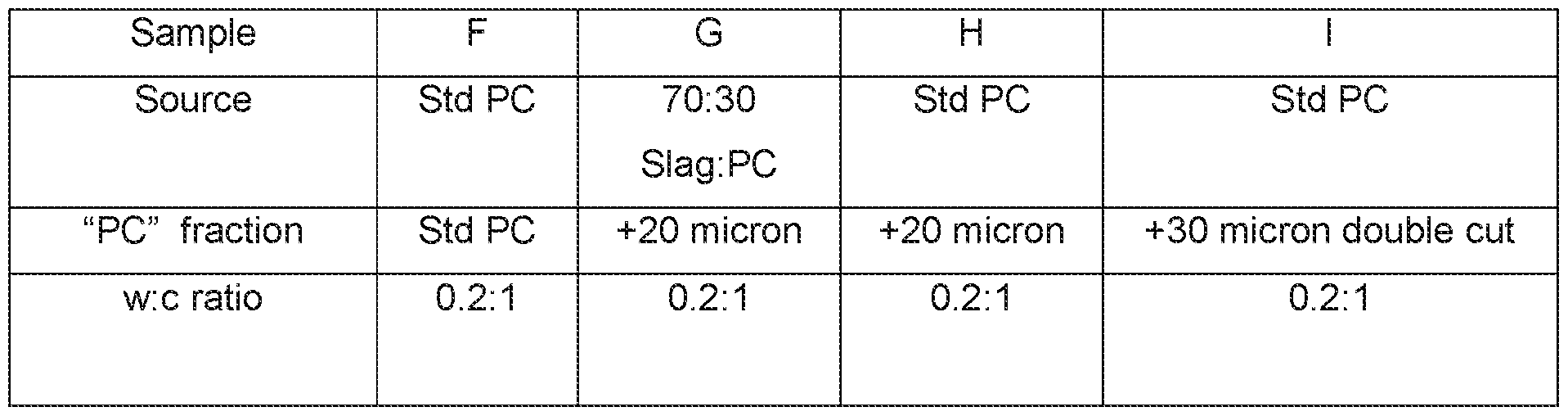
1 day 44.5 MPa 24.8 MPa 50.4 MPa 43.8 MPa
7 days 78.7 MPa 42.9 MPa 75.4 MPa 71.8 MPa
28 days 79.6 MPa 61.2 MPa 86.7 MPa 89.9 MPa
Std PC = Portland cement; measurements are averages of 3 samples; "+30 microns" indicates a mean particle size (d50) of greater than 30 microns; "+20 microns" indicates a mean particle size (d50) of greater than 20 microns; MPa = compressive strength; w:c = watencement ratio
[0186] Sample F (cementitious feed) was prepared using uncut Portland cement as supplied from Cement Works (Cement Australia) and typically, contained a fraction of very small particles. Sample F was expected to show hydration along the Portland cement route, having poor compressive strength with considerable microstrain changes during curing. This was not the case in the present invention and higher performance than expected with controlled shrinkage was observed.
[0187] Sample G is a slag:cement 70:30 blend with a single sub 30 micron stripping. The Portland cement of sample G has a mean average particle size of greater than 20 microns. The slag is inactive and does not function as a hydraulic binder and as a result the grout was expected to show no hydraulic activity for several days and remain soft. This was not the case in the present invention and higher performance than expected with controlled shrinkage was observed.
[0188] Sample H is a standard Portland cement with a single sub 30 micron stripping (some fines remain in the sample) was expected to show a grout having poor compressive strength and unpredictable expansion during hydration (non Portland-type hydration). This was not the case in the present invention and higher performance than expected with controlled shrinkage was observed.
[0189] Sample I is a standard Portland cement which had been twice cycled to remove the fine particles. Specifically, sample I was first cycled with a single sub 12 micron stripping followed by a sub 30 micron stripping resulting in a composition having a large mean average particle size of greater than 30 microns. Sample I is also an oversized cementitious material fraction having a physical size (mean average particle size of greater than 30 microns) which would otherwise be regarded as being unable to react by a skilled addressee. This was not the case in the present invention as high performance and controlled shrinkage was observed for samples F-l.
[0190] Additionally, mixtures (Samples J-M) were prepared using the composition as shown in Table 19, although the sand was substituted for different proportions of the hydraulic fraction as shown in Table 20. The mixtures (Samples J-M) of the cementitious compositions of the present invention according to Tables 19 and 20 were made by mixing the actives with samples F and G above.
[0191 ] The actives comprise Portland cement, calcium aluminosulphate and calcium sulphate and was diluted with sand. The present applicants note that typically, dilution with sand reduces the compressive strength of a grout, contrary to the present invention.
Table 19: Composition of samples J-M

[0192] As discussed above, the results in Tables 19 and 20 shows that an increase in sand content increases the compressive strength of the matrix. Interestingly, fine cements impede the hydration reaction while the oversized fractions (for example +20 microns) do not.
Table 20: Comparison of Compressive Strength for Cementitious Compositions

[0193] As can be seen in Table 20, the compressive strengths of samples J-M change significantly once the active content is reduced using sand. Accordingly, the present applicants have surprisingly and unexpectedly found that the oversized cementitious material fraction of the present invention have an increased rate of hydration and improved compressive strengths compared to Portland cement alone. In addition, the present invention yields advantages of having superior dimensional stability.
[0194] Those skilled in the art will appreciate that the invention described herein is susceptible to variations and modifications other than those specifically described. It is understood that the invention includes all such variations and modifications which fall within the spirit and scope of the present invention.
Claims
1 . A process for producing at least two cementitious material fractions from a cementitious feed comprising the steps of: providing a cementitious feed; and separating a fine cementitious material fraction from the cementitious feed using a particle separator; thereby producing at least two cementitious material fractions comprising a fine cementitious material fraction and an oversized cementitious material fraction; and wherein the fine cementitious material fraction and the oversized cementitious material fraction have a different chemical composition to the cementitious feed.
2. The process according to claim 1 , wherein at least one cementitious phase selected from the group consisting tricalcium silicate, dicalcium silicate, tricalcium aluminate, tetracalcium alumino ferrite or combination thereof of the fine cementitious material fraction and the oversized cementitious material fraction has a different chemical composition to the cementitious feed.
3. The process according to claim 2, wherein the composition of the oversized cementitious material fraction has a higher content of dicalcium silicate or tetracalcium alumino ferrite by weight % than the composition of the cementitious feed.
4. The process according to claim 2 or 3, wherein the composition of the oversized cementitious material fraction has a lower content of tricalcium aluminate by weight % than the composition of the cementitious feed, preferably from 0.01 to 2 wt%, more preferably from 0.01 to 1 wt% lower than the cementitious feed.
5. The process according to any one of claims 2 to 4, wherein the composition of the oversized cementitious material fraction has a higher content of dicalcium silicate by weight % than the composition of the cementitious feed, preferably from 1 to 15 wt%, more preferably between 1 to 10 wt% and yet more preferably 6 to 10 wt% greater than the cementitious feed.
6. The process according to any one of claims 2 to 5, wherein the composition of the oversized cementitious material fraction has a higher content of dicalcium silicate or
tetracalcium alumino ferrite by weight % than the composition of the fine cementitious material fraction.
7. The process according to any one of claims 2 to 6, wherein the composition of the oversized cementitious material fraction has a lower content of tricalcium aluminate by weight % than the composition of the fine cementitious material fraction, preferably from 0.1 to 2 wt%, more preferably 0.1 to 1 wt% lower than the fine cementitious material fraction.
8. The process according to any one of claims 2 to 7, wherein the composition of the oversized cementitious material fraction has a higher content of dicalcium silicate by weight % than the composition of the fine cementitious material fraction, preferably from 1 to 30 wt%, more preferably 10 to 20 wt% higher than the fine cementitious material fraction.
9. The process according to any one of claims 1 to 8, wherein the composition of the oversized cementitious material fraction has a higher content of CaO by weight % than the composition of the cementitious feed.
10. The process according to any one of claims 1 to 9, wherein the composition of the oversized cementitious material fraction has a lower content of S03 by weight % than the composition of the cementitious feed.
1 1 . The process according to any one of claims 1 to 10, wherein the composition of the oversized cementitious material fraction has a higher content of MgO by weight % than the composition of the cementitious feed.
12. The process according to any one of claims 1 to 1 1 , wherein the composition of the oversized cementitious material fraction has a higher content of Na20 by weight % than the composition of the cementitious feed.
13. The process according to any one of claims 1 to 12, wherein the composition of the oversized cementitious material fraction has a lower content of K20 by weight % than the composition of the cementitious feed.
14. The process according to any one of claims 1 to 13, wherein the oversized cementitious material fraction has a lower loss on ignition (LOI) than the cementitious feed.
15. The process according to any one of claims 1 to 14, wherein the cementitious feed is a hydraulic cement, or pozzolanic material, or combination thereof.
16. The process according to any one of claims 1 to 15, wherein the oversized cementitious material fraction is at least one of a low heat cement (LH), sulphate resisting cement (SR), shrinkage limited cement or a combination thereof.
17. The process according to any one of claims 1 to 16, wherein the particle separator comprises a mechanical classifying system.
18. The process according to any one of claims 1 to 17, wherein the particle separator comprises at least one air separator, cyclone separator, centrifuge, or a combination thereof.
19. The process according to any one of claims 1 to 18, wherein the particle separator comprises an air classifier, preferably a turbo classifier.
20. The process according to any one of claims 1 to 19, wherein the separator comprises at least two particle separators.
21 . The process according to any one of claims 1 to 20, wherein the at least two particle separators are arranged in series, parallel or a combination thereof.
22. The process according to any one of claims 1 to 21 , wherein the fine cementitious material fraction has a top particle size of less than 30 microns, preferably less than 24 microns, more preferably less than 12 microns.
23. The process according to any one of claims 1 to 22, wherein the fine cementitious material fraction has a d97 particle size of 30 microns.
24. The process according to any one of claims 1 to 23, wherein the fine cementitious material fraction has a mean particle size (d50) of at most 7 microns, preferably at most 3 microns.
25. The process according to any one of claims 1 to 24, wherein the oversized cementitious material fraction has a top particle size of less than 10 mm, preferably less than 1 mm.
26. The process according to any one of claims 1 to 25, wherein the oversized cementitious material fraction has a d97 particle size of from 100 to 800 microns.
27. The process according to any one of claims 1 to 26, wherein the oversized cementitious material fraction has a mean particle size (d50) of from 100 to 500 microns.
28. The process according to any one of claims 1 to 27, further comprising at least one the following steps: blending a portion of the fine cementitious material fraction and a portion of the oversized cementitious material fraction to produce a cementitious material having a desired property; blending a portion of at least one of the fine cementitious material fraction with at least one supplementary cementitious material to produce a cementitious material having a desired property; or blending a portion of at least one of the oversized cementitious material fraction with at least one supplementary cementitious material to produce a cementitious material having a desired property.
29. The process according to claim 28, wherein the supplementary cementitious material comprises at least one of a fly ash, slag, silica fume, pozzolans or a combination thereof.
30. The process according to any one of claims 1 to 29, further comprising the step of: comminuting the oversized cementitious material fraction to produce a comminuted cementitious material having a desired particle size distribution.
31 . The process according to any one of claims 1 to 30, further comprising a phase composition analysis step wherein the oversized cementitious material fraction has a phase composition which produces a hydraulic cement, pozzolanic material or a combination thereof.
32. A cementitious composition comprising cementitious material from a fine cementitious material fraction, an oversized cementitious material fraction or a combination thereof produced using a process according to any one of claims 1 to 31 .
33. A cementitious composition according to claim 32 comprising a cement, and wherein the cement preferably further comprises a fly ash, slag, silica fume, pozzolans or a combination thereof.
34. A cement according to claim 33, wherein the cement is a general purpose cement (GP), Portland cement, blended cement (GB), low heat cement (LH), high early strength cement (HE), shrinkage limited cement (SL) or sulphate resisting cement (SR) or a combination thereof.
Applications Claiming Priority (6)
| Application Number | Priority Date | Filing Date | Title |
|---|---|---|---|
| AU2015905359A AU2015905359A0 (en) | 2015-12-23 | Accelerator for hydraulic composition | |
| AU2015905358A AU2015905358A0 (en) | 2015-12-23 | Cementitious composition | |
| AU2015905358 | 2015-12-23 | ||
| AU2015905359 | 2015-12-23 | ||
| AU2016904374A AU2016904374A0 (en) | 2016-10-27 | A process for producing cementitious material | |
| AU2016904374 | 2016-10-27 |
Publications (1)
| Publication Number | Publication Date |
|---|---|
| WO2017106921A1 true WO2017106921A1 (en) | 2017-06-29 |
Family
ID=59088732
Family Applications (3)
| Application Number | Title | Priority Date | Filing Date |
|---|---|---|---|
| PCT/AU2016/051271 Ceased WO2017106920A1 (en) | 2015-12-23 | 2016-12-22 | Accelerator for hydraulic composition |
| PCT/AU2016/051272 Ceased WO2017106921A1 (en) | 2015-12-23 | 2016-12-22 | A process for producing cementitious material |
| PCT/AU2016/051273 Ceased WO2017106922A1 (en) | 2015-12-23 | 2016-12-22 | Cementitious composition |
Family Applications Before (1)
| Application Number | Title | Priority Date | Filing Date |
|---|---|---|---|
| PCT/AU2016/051271 Ceased WO2017106920A1 (en) | 2015-12-23 | 2016-12-22 | Accelerator for hydraulic composition |
Family Applications After (1)
| Application Number | Title | Priority Date | Filing Date |
|---|---|---|---|
| PCT/AU2016/051273 Ceased WO2017106922A1 (en) | 2015-12-23 | 2016-12-22 | Cementitious composition |
Country Status (7)
| Country | Link |
|---|---|
| US (1) | US10793479B2 (en) |
| EP (1) | EP3394006A4 (en) |
| AU (1) | AU2016377393B2 (en) |
| CA (1) | CA3009532C (en) |
| EA (1) | EA036829B1 (en) |
| WO (3) | WO2017106920A1 (en) |
| ZA (1) | ZA201804911B (en) |
Families Citing this family (5)
| Publication number | Priority date | Publication date | Assignee | Title |
|---|---|---|---|---|
| FR3084358B1 (en) * | 2018-07-26 | 2024-01-05 | Vicat | NEW CEMENTITIOUS COMPOSITION FOR 3D PRINTING AND IMPLEMENTATION METHOD |
| CN109592918B (en) * | 2019-01-11 | 2021-07-23 | 济南大学 | A kind of negative temperature resistant and radiation proof five-element system sulfoaluminate cement clinker |
| US11180412B2 (en) | 2019-04-17 | 2021-11-23 | United States Gypsum Company | Aluminate-enhanced type I Portland cements with short setting times and cement boards produced therefrom |
| IT202200002309A1 (en) * | 2022-02-09 | 2023-08-09 | Buzzi S P A | Production process of a cementitious material |
| EP4663619A1 (en) * | 2024-06-13 | 2025-12-17 | Sika Technology AG | Admixtures to improve the workability of construction compositions comprising calcium sulfoaluminate cement |
Citations (1)
| Publication number | Priority date | Publication date | Assignee | Title |
|---|---|---|---|---|
| US20130192493A1 (en) * | 2010-07-16 | 2013-08-01 | Roman Cement Llc | Narrow psd hydraulic cement, cement-scm blends, and methods for making same |
Family Cites Families (18)
| Publication number | Priority date | Publication date | Assignee | Title |
|---|---|---|---|---|
| CN85108582B (en) | 1984-10-30 | 1988-08-17 | 蓝圈工业有限公司 | curing bonding composition |
| GB8710605D0 (en) * | 1987-05-05 | 1987-06-10 | Modern Advanced Concrete | Cementitious mixes |
| GB8725385D0 (en) * | 1987-10-29 | 1987-12-02 | Fosroc International Ltd | Cementitious composition |
| FR2680130A1 (en) * | 1991-08-07 | 1993-02-12 | Kadim Ltd | Method of employing a hydraulic binder and device for applying said binder |
| GB2347415A (en) * | 1999-03-02 | 2000-09-06 | Mbt Holding Ag | Set-retarding admixture for calcium sulfoaluminate cements |
| FR2825698B1 (en) * | 2001-06-07 | 2004-07-09 | Bpb Plc | PLATE BASED ON CEMENT BINDER, METHOD FOR MANUFACTURING SUCH A PLATE, EXTRUDER FOR CARRYING OUT SUCH A METHOD, AND USE OF SUCH A PLATE |
| GB2402671B (en) * | 2003-05-14 | 2006-08-09 | Transmix Group Ltd | Remediation of recycled glass waste |
| JP4746429B2 (en) * | 2003-08-20 | 2011-08-10 | 電気化学工業株式会社 | Spraying method using spraying material |
| JP4452473B2 (en) * | 2003-09-19 | 2010-04-21 | Basfポゾリス株式会社 | Liquid accelerator |
| WO2009015520A1 (en) * | 2007-08-02 | 2009-02-05 | Basf Construction Chemicals (Shanghai) Co. Ltd | Cement-based grout composition |
| CN101439943B (en) * | 2007-11-19 | 2012-09-19 | 苏笮斌 | Composition for inhibiting concrete alkali aggregate reaction and preparation thereof |
| US8366823B2 (en) | 2008-09-25 | 2013-02-05 | United States Gypsum Company | Fly ash based lightweight cementitious composition with high compressive strength and fast set |
| GB0817997D0 (en) * | 2008-10-02 | 2008-11-05 | Building Adhesives Ltd | Cement based compound |
| CN102690077B (en) * | 2011-03-25 | 2014-09-10 | 苏琳 | Anticorrosion expansion compacting agent composition and preparation method thereof |
| WO2013086722A1 (en) * | 2011-12-15 | 2013-06-20 | Dow Global Technologies Llc | Dry mix formulations containing carboxylated styrene-butadiene redispersible polymer powders and alumina rich containing cements |
| AU2012372512B2 (en) | 2012-03-09 | 2016-12-15 | Parexgroup Sa | Dry composition based on a mineral binder, used for preparing a moist formulation for the building industry |
| CA2905909C (en) * | 2013-03-15 | 2017-12-19 | Hercules Incorporated | Hydraulic composition with prolonged open time |
| GB201320942D0 (en) * | 2013-11-27 | 2014-01-08 | Normet Internat Ltd | Flowable concrete with secondary accelerator |
-
2016
- 2016-12-22 AU AU2016377393A patent/AU2016377393B2/en active Active
- 2016-12-22 WO PCT/AU2016/051271 patent/WO2017106920A1/en not_active Ceased
- 2016-12-22 CA CA3009532A patent/CA3009532C/en active Active
- 2016-12-22 WO PCT/AU2016/051272 patent/WO2017106921A1/en not_active Ceased
- 2016-12-22 US US16/065,799 patent/US10793479B2/en active Active
- 2016-12-22 WO PCT/AU2016/051273 patent/WO2017106922A1/en not_active Ceased
- 2016-12-22 EP EP16877009.7A patent/EP3394006A4/en not_active Withdrawn
- 2016-12-22 EA EA201891362A patent/EA036829B1/en unknown
-
2018
- 2018-07-20 ZA ZA2018/04911A patent/ZA201804911B/en unknown
Patent Citations (1)
| Publication number | Priority date | Publication date | Assignee | Title |
|---|---|---|---|---|
| US20130192493A1 (en) * | 2010-07-16 | 2013-08-01 | Roman Cement Llc | Narrow psd hydraulic cement, cement-scm blends, and methods for making same |
Non-Patent Citations (3)
| Title |
|---|
| "The Constitution and Specification of Portland Cements", 1998, article C. DAVID LAWRENCE: "Lea's Chemistry of Cement and Concrete", pages: 132 - 194 * |
| ZHANG, T. ET AL.: "A new gap-graded particle size distribution and resulting consequences on properties of blended cement", CEMENT AND CONCRETE COMPOSITES, vol. 33, no. 5, 2011, pages 543 - 550, XP055064277 * |
| ZHANG, T. ET AL.: "Effects of size fraction on composition and fundamental properties of Portland cement", CONSTRUCTION AND BUILDING MATERIALS, vol. 25, no. 7, 2011, pages 3038 - 3043, XP028158258 * |
Also Published As
| Publication number | Publication date |
|---|---|
| US20190010092A1 (en) | 2019-01-10 |
| CA3009532C (en) | 2023-04-04 |
| CA3009532A1 (en) | 2017-06-29 |
| EP3394006A1 (en) | 2018-10-31 |
| AU2016377393B2 (en) | 2021-07-01 |
| WO2017106922A1 (en) | 2017-06-29 |
| AU2016377393A1 (en) | 2018-07-12 |
| ZA201804911B (en) | 2019-09-25 |
| EP3394006A4 (en) | 2019-08-14 |
| EA036829B1 (en) | 2020-12-24 |
| WO2017106920A1 (en) | 2017-06-29 |
| US10793479B2 (en) | 2020-10-06 |
| EA201891362A1 (en) | 2019-01-31 |
Similar Documents
| Publication | Publication Date | Title |
|---|---|---|
| Pandey et al. | Effects of rice straw ash and micro silica on mechanical properties of pavement quality concrete | |
| JP5453440B2 (en) | Pozzolanic cement blend with high early strength development | |
| US9238591B2 (en) | Particle packed cement-SCM blends | |
| US12435000B2 (en) | Compositions and methods for making blended supplementary cementitious materials | |
| John | Strength properties of metakaolin admixed concrete | |
| CN113490651A (en) | Activation of natural pozzolans and uses thereof | |
| US10730805B2 (en) | Use of quarry fines and/or limestone powder to reduce clinker content of cementitious compositions | |
| Ajay et al. | Effect of micro silica on the strength of concrete with ordinary Portland cement | |
| US9102567B1 (en) | Engineered Portland cement incorporating SCMs and methods for making same | |
| US20120012034A1 (en) | Narrow psd hydraulic cement, cement-scm blends, and methods for making same | |
| US12428353B2 (en) | Classification and recombination of different SCM and cement fractions to efficiently manufacture cement-SCM compositions | |
| EP2536669A2 (en) | Modification of pozzolanic chemistry at production plant | |
| WO2012075208A2 (en) | Engineered portland cement incorporating scms and methods for making and using same | |
| Pliatsikas et al. | Valorization of demolition ceramic wastes and lignite bottom ash for the production of ternary blended cements | |
| US20240174565A1 (en) | Performance-enhancing particulate premix comprised of mineral fines treated with one or more additives | |
| Khan et al. | Conversion of waste marble powder into a binding material | |
| Khudhair et al. | Development of a new hydraulic binder (composite cement) based on a mixture of natural Pozzolan active ‘PN’and Pure Limestone ‘P, Lime’: Study of the physical-chemical and mechanical properties | |
| Motisariya et al. | Experimental analysis of strength and durability properties of cement binders and mortars with addition of microfine sewage sludge ash (SSA) particles | |
| Goljandin | Performance evaluation of cement mortar and concrete with incorporated micro fillers obtained by collision milling in disintegrator | |
| Mele et al. | Processing of high sulphate and free lime calcareous coal fly ash for producing high volume blended cements and complying grade products employed in civil engineering | |
| Ghiasvand et al. | Effect of grinding method and particle size distribution on early-age properties of blended cements | |
| CN1762883A (en) | Building mortar composite cementing material and preparation method thereof | |
| Šupic et al. | Sustainable Masonry Mortars with Fly Ash, Blast Furnace Granulated Slag and Wheat Straw Ash. Sustainability 2021, 13, 12245 | |
| Pike et al. | High volume pozzolan concrete: Three years of industrial experience in Texas with CemPozz | |
| CN107352906A (en) | C30 level slag sand self-compacting concretes and preparation method thereof, prefabricated components |
Legal Events
| Date | Code | Title | Description |
|---|---|---|---|
| 121 | Ep: the epo has been informed by wipo that ep was designated in this application |
Ref document number: 16877010 Country of ref document: EP Kind code of ref document: A1 |
|
| NENP | Non-entry into the national phase |
Ref country code: DE |
|
| 122 | Ep: pct application non-entry in european phase |
Ref document number: 16877010 Country of ref document: EP Kind code of ref document: A1 |