WO2017111485A1 - Schéma permettant de réaliser une session de données par l'intermédiaire d'un accès wi-fi dans un système de communication sans fil - Google Patents
Schéma permettant de réaliser une session de données par l'intermédiaire d'un accès wi-fi dans un système de communication sans fil Download PDFInfo
- Publication number
- WO2017111485A1 WO2017111485A1 PCT/KR2016/015076 KR2016015076W WO2017111485A1 WO 2017111485 A1 WO2017111485 A1 WO 2017111485A1 KR 2016015076 W KR2016015076 W KR 2016015076W WO 2017111485 A1 WO2017111485 A1 WO 2017111485A1
- Authority
- WO
- WIPO (PCT)
- Prior art keywords
- access
- entry
- look
- user
- connect
- Prior art date
- Legal status (The legal status is an assumption and is not a legal conclusion. Google has not performed a legal analysis and makes no representation as to the accuracy of the status listed.)
- Ceased
Links
Images



Classifications
-
- H—ELECTRICITY
- H04—ELECTRIC COMMUNICATION TECHNIQUE
- H04W—WIRELESS COMMUNICATION NETWORKS
- H04W4/00—Services specially adapted for wireless communication networks; Facilities therefor
- H04W4/02—Services making use of location information
-
- H—ELECTRICITY
- H04—ELECTRIC COMMUNICATION TECHNIQUE
- H04M—TELEPHONIC COMMUNICATION
- H04M1/00—Substation equipment, e.g. for use by subscribers
- H04M1/72—Mobile telephones; Cordless telephones, i.e. devices for establishing wireless links to base stations without route selection
- H04M1/724—User interfaces specially adapted for cordless or mobile telephones
- H04M1/72448—User interfaces specially adapted for cordless or mobile telephones with means for adapting the functionality of the device according to specific conditions
-
- H—ELECTRICITY
- H04—ELECTRIC COMMUNICATION TECHNIQUE
- H04M—TELEPHONIC COMMUNICATION
- H04M1/00—Substation equipment, e.g. for use by subscribers
- H04M1/72—Mobile telephones; Cordless telephones, i.e. devices for establishing wireless links to base stations without route selection
- H04M1/724—User interfaces specially adapted for cordless or mobile telephones
- H04M1/72448—User interfaces specially adapted for cordless or mobile telephones with means for adapting the functionality of the device according to specific conditions
- H04M1/72457—User interfaces specially adapted for cordless or mobile telephones with means for adapting the functionality of the device according to specific conditions according to geographic location
-
- H—ELECTRICITY
- H04—ELECTRIC COMMUNICATION TECHNIQUE
- H04W—WIRELESS COMMUNICATION NETWORKS
- H04W36/00—Hand-off or reselection arrangements
- H04W36/34—Reselection control
- H04W36/36—Reselection control by user or terminal equipment
- H04W36/365—Reselection control by user or terminal equipment by manual user interaction
-
- H—ELECTRICITY
- H04—ELECTRIC COMMUNICATION TECHNIQUE
- H04W—WIRELESS COMMUNICATION NETWORKS
- H04W48/00—Access restriction; Network selection; Access point selection
- H04W48/16—Discovering, processing access restriction or access information
-
- H—ELECTRICITY
- H04—ELECTRIC COMMUNICATION TECHNIQUE
- H04W—WIRELESS COMMUNICATION NETWORKS
- H04W48/00—Access restriction; Network selection; Access point selection
- H04W48/18—Selecting a network or a communication service
-
- H—ELECTRICITY
- H04—ELECTRIC COMMUNICATION TECHNIQUE
- H04W—WIRELESS COMMUNICATION NETWORKS
- H04W48/00—Access restriction; Network selection; Access point selection
- H04W48/20—Selecting an access point
-
- H—ELECTRICITY
- H04—ELECTRIC COMMUNICATION TECHNIQUE
- H04W—WIRELESS COMMUNICATION NETWORKS
- H04W76/00—Connection management
- H04W76/10—Connection setup
- H04W76/11—Allocation or use of connection identifiers
-
- H—ELECTRICITY
- H04—ELECTRIC COMMUNICATION TECHNIQUE
- H04M—TELEPHONIC COMMUNICATION
- H04M1/00—Substation equipment, e.g. for use by subscribers
- H04M1/72—Mobile telephones; Cordless telephones, i.e. devices for establishing wireless links to base stations without route selection
- H04M1/724—User interfaces specially adapted for cordless or mobile telephones
- H04M1/72403—User interfaces specially adapted for cordless or mobile telephones with means for local support of applications that increase the functionality
- H04M1/72409—User interfaces specially adapted for cordless or mobile telephones with means for local support of applications that increase the functionality by interfacing with external accessories
- H04M1/72412—User interfaces specially adapted for cordless or mobile telephones with means for local support of applications that increase the functionality by interfacing with external accessories using two-way short-range wireless interfaces
-
- H—ELECTRICITY
- H04—ELECTRIC COMMUNICATION TECHNIQUE
- H04M—TELEPHONIC COMMUNICATION
- H04M2250/00—Details of telephonic subscriber devices
- H04M2250/06—Details of telephonic subscriber devices including a wireless LAN interface
-
- H—ELECTRICITY
- H04—ELECTRIC COMMUNICATION TECHNIQUE
- H04W—WIRELESS COMMUNICATION NETWORKS
- H04W8/00—Network data management
- H04W8/22—Processing or transfer of terminal data, e.g. status or physical capabilities
-
- H—ELECTRICITY
- H04—ELECTRIC COMMUNICATION TECHNIQUE
- H04W—WIRELESS COMMUNICATION NETWORKS
- H04W84/00—Network topologies
- H04W84/02—Hierarchically pre-organised networks, e.g. paging networks, cellular networks, WLAN [Wireless Local Area Network] or WLL [Wireless Local Loop]
- H04W84/10—Small scale networks; Flat hierarchical networks
- H04W84/12—WLAN [Wireless Local Area Networks]
-
- H—ELECTRICITY
- H04—ELECTRIC COMMUNICATION TECHNIQUE
- H04W—WIRELESS COMMUNICATION NETWORKS
- H04W88/00—Devices specially adapted for wireless communication networks, e.g. terminals, base stations or access point devices
- H04W88/02—Terminal devices
- H04W88/06—Terminal devices adapted for operation in multiple networks or having at least two operational modes, e.g. multi-mode terminals
-
- H—ELECTRICITY
- H04—ELECTRIC COMMUNICATION TECHNIQUE
- H04W—WIRELESS COMMUNICATION NETWORKS
- H04W88/00—Devices specially adapted for wireless communication networks, e.g. terminals, base stations or access point devices
- H04W88/08—Access point devices
Definitions
- the present disclosure relates to a scheme for performing a data session via a Wi-Fi access in a wireless network. More particularly, the present disclosure relates to a method and system for switching from a cellular radio connection to a Wi-Fi connection, in a wireless communication system.
- the 5G or pre-5G communication system is also called a 'beyond 4G network' or a 'post long term evolution (LTE) system'.
- the 5G communication system is considered to be implemented in higher frequency (mmWave) bands, e.g., 60GHz bands, so as to accomplish higher data rates.
- mmWave e.g., 60GHz bands
- MIMO massive multiple-input multiple-output
- FD-MIMO full dimensional MIMO
- array antenna an analog beam forming, and large scale antenna techniques are discussed in 5G communication systems.
- RANs cloud radio access networks
- D2D device-to-device
- wireless backhaul moving network
- CoMP coordinated multi-points
- FSK frequency shift keying
- QAM quadrature amplitude modulation
- SWSC sliding window superposition coding
- ACM advanced coding modulation
- FBMC filter bank multi carrier
- NOMA non-orthogonal multiple access
- SCMA sparse code multiple access
- a user needs to keep both Wi-Fi radio connection and mobile data connection (e.g., cellular radio connection) turned on all the time on the device.
- UI device user interface
- the device When a device is in a Wi-Fi coverage of a known access point (AP), the device connects to the known AP as long as the device is in the Wi-Fi coverage area of the AP.
- a data session or internet access can happen through mobile data access on the cellular coverage provided by either a 4G or 3G network.
- the device connects to the known Wi-Fi AP when the device is in a good coverage area of Wi-Fi radio access.
- the device can automatically avail mobile data through cellular radio access without explicitly notifying the user.
- this solution results in heavy draining of battery (e.g., continuous scanning for new Wi-Fi APs) when connection to current Wi-Fi AP is lost.
- a user needs to remember to manually switch on/off Wi-Fi user preference on the device at the right time. That is, the user needs to turn-on Wi-Fi radio connection on the device when the user enters the coverage of known Wi-Fi AP and turn-off Wi-Fi radio connection on the device when the user moves out of the coverage of connected Wi-Fi access to save battery drain.
- This solution has the following issues: a) lacks good user experience i.e., the user has to manually perform switch on/off every time, and b) the user may end up paying higher data charges for mobile data if the user forgets to utilize known Wi-Fi radio access where it was available.
- Wi-Fi radio capability On his/her device most of the time for data session and/or internet access when Wi-Fi radio access is available.
- Usage of mobile data i.e., data session and/or internet access on a mobile device through cellular radio access technology like 4G LTE/worldwide interoperability for microwave access (WiMAX), 3G high speed packet access (HSPA)/universal mobile telecommunications system (UMTS) etc.
- Wi-Fi radio access is usually preferred over mobile data (i.e. cellular radio access through 4G or 3G) because Wi-Fi is supposed to provide faster access and high data rates at a lower cost compared to similar data rates through the cellular radio access.
- a new apparatus and method are required for user expectation to use Wi-Fi radio access preferably with improved user experience and incurring less battery power consumption.
- a simple and elegant solution is proposed so that a user does not have to manually perform switching of Wi-Fi user preference settings on his/her device.
- Various of the proposed embodiments allow a device to automatically switch on/off Wi-Fi radio capability based on determining a time to switch.
- the proposed embodiments may be termed as "smart Wi-Fi switch (SWS)" in the present disclosure.
- an aspect of the present disclosure is to provide a method and system for using location information intelligently for determining a time to automatically switch on/off a Wi-Fi radio capability based on a look-up table.
- Another aspect of the present disclosure is to provide a system and method for creating a new entry in a reference table or a look-up table with the available location information for a plurality of granularities corresponding to a Wi-Fi identifier.
- Another aspect of the present disclosure is to provide a system and method for automatically switching on/off a Wi-Fi radio capability when the user preference for Wi-Fi on the device is turned ON.
- Another aspect of the present disclosure is to provide a system and method for automatically switching on/off a Wi-Fi radio capability when the user preference for Wi-Fi on the device is turned OFF.
- Another aspect of the present disclosure is to provide a system and method for finding a location matched in the reference table or look-up table based on a current location of the device to determine the presence of any known Wi-Fi access point (AP).
- AP Wi-Fi access point
- Another aspect of the present disclosure is to provide a system and method for finding a location matched in the reference table or look-up table based on a current location of the device to determine the presence of an open Wi-Fi AP.
- Another aspect of the present disclosure is to provide a system and method for activating a scan timer to periodically scan and discover a Wi-Fi AP after a location match is found in the reference table or look-up based on a current location of the device.
- Another aspect of the present disclosure is to provide a system and method for stopping and resetting a scan timer when the device connects to a discovered Wi-Fi AP after a location match is found in the reference table or look-up based on a current location of the device.
- Another aspect of the present disclosure is to provide a system and method for activating a prompt timer to avoid scanning for additional Wi-Fi APs wherein the user has declined consent to connect to the discovered Wi-Fi AP after a location match was found.
- a method for performing a data session via a Wi-Fi access of a user equipment (UE) in a cellular network includes maintaining a look-up table including at least an entry, the entry including a Wi-Fi identifier of a Wi-Fi AP and location information of the Wi-Fi AP, determining whether a user preference for a Wi-Fi connection is set to ON or OFF, checking whether at least one matched entry of the look-up table is found based on current location information of the UE, scanning to discover the Wi-Fi AP, connecting to a Wi-Fi AP corresponding to the matched entry based on a result of the determining, and performing a data session via a Wi-Fi access to the connected Wi-Fi AP.
- a UE for performing a data session via a Wi-Fi access in a cellular network includes at least one processor configured to maintain a look-up table including at least an entry, the entry including a Wi-Fi identifier of a Wi-Fi AP and location information of the Wi-Fi AP, determine whether a user preference for a Wi-Fi connection is set to ON or OFF, check, based on current location information of the UE, whether at least one matched entry of the look-up table are found, scan to discover the Wi-Fi AP, and connect to a Wi-Fi AP corresponding to the matched entry based on a result of the determining, and a transceiver configured to perform a data session via a Wi-Fi access to the connected Wi-Fi AP.
- the present disclosure offers various benefits regarding a better user experience with SWS (in comparison to manually remembering to switch between Wi-Fi and mobile data).
- Wi-Fi speed is better and optimum usage of Wi-Fi is provided.
- battery usage is reduced because Wi-Fi is not always on and the battery does not drain due to continuous scanning in non-Wi-Fi areas.
- FIG. 1 illustrates a smart network switch feature according to an embodiment of the present disclosure
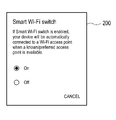
- FIG. 2 illustrates enabling a smart Wi-Fi switch (SWS) according to an embodiment of the present disclosure
- FIGS. 3A and 3B illustrate a process of an SWS feature according to various embodiments of the present disclosure
- FIG. 4 illustrates an information structure for a Wi-Fi access point (AP) binding with cell identification (ID) and public land mobile network ID (PLMN ID) according to an embodiment of the present disclosure
- FIG. 5 illustrates a situation of overlapping cell coverage areas in a cellular network according to an embodiment of the present disclosure
- FIG. 6 illustrates a Wi-Fi radio capability behavior when a user/device is moving to a new location when SWS is enabled according to an embodiment of the present disclosure
- FIG. 7 is a view schematically illustrating a configuration of a user equipment (UE) device according to an embodiment of the present disclosure.
- UE user equipment
- a base station is an entity that communicates with a user equipment (UE), and may also be referred to as a BS, a nodeB (NB), an evolved NB (eNB), an access point (AP), or the like.
- a Wi-Fi AP may be distinguished from an eNB for cellular radio connection, in respect to access schemes.
- the UE is an entity that communicates with the BS, and may also be referred to as a user/device, a mobile station (MS), a mobile equipment (ME), a terminal, or the like.
- MS mobile station
- ME mobile equipment
- FIG. 1 illustrates a smart network switch feature according to an embodiment of the present disclosure.
- a solution called smart network switch (SNS), mobile data connection (e.g., cellular radio connection) is always turned ON, while a Wi-Fi access is switched continuously keeping the Wi-Fi radio capability in the device always ON.
- the SNS may be implemented on latest mobile devices such a smartphones, tablets, notebooks etc. From a user interface's point of view, the user is prompted with an appropriate message 100 on the device to enable or disable the SNS feature as shown in FIG. 1.
- the pre-condition for enabling the SNS feature is that the mobile data user preference setting on the device should always be turned ON.
- the SNS is specifically designed to switch from cellular radio access to Wi-Fi radio access (if Wi-Fi radio capability is turned on through user preference) when good quality Wi-Fi signal strength is available.
- a switch from an already connected Wi-Fi radio access to cellular radio access i.e. mobile data access
- the SNS will keep track of dealing with a spotty or degrading Wi-Fi connection by making the switch automatically, leaving a user a notification explaining an unstable Wi-Fi connection was discovered so access is switched to mobile data access automatically.
- Switching from a Wi-Fi access to a mobile data access does not turn off a Wi-Fi radio capability in the device. Further, the device performs continuous switching from the Wi-Fi access to the mobile data access back and forth in certain time intervals (time intervals are implementation specific) during which Wi-Fi scanning for new access points will continue in the background, which leads to battery drain. Due to continuous switching for the radio access at the protocol lower layer, the device internet protocol (IP) address is not preserved when switching happens. This may lead to service discontinuity or (more precisely) session discontinuity if mechanisms for service/session continuity are not implemented at the application layer upon a change of IP address handling the ongoing session. Further, continuous notification to the user is not desired from a user experience perspective. Even though this solution automatically handles the switching for radio access, it does not provide a desired user experience and also suffers from battery drain due to continuous scanning for switching functionality.
- time intervals are implementation specific
- MNO mobile network operator's
- a smart Wi-Fi switch (SWS) solution is proposed.
- the proposed SWS solution works based on at least one of following principles:
- a cellular coverage such a 4 th generation (4G), 3 rd generation (3G) or any other cellular radio access technology providing packet switched services is overlaid with a Wi-Fi coverage, and cellular radio capability in a device is always ON for mobile data (i.e. user preference for mobile data is ON).
- a look-up table, reference table or database is dynamically maintained having a plurality of Wi-Fi identifiers tagged with location information.
- the device identifies (determines) its current location information and checks the look-up table, database, or reference table for a match.
- User preference may keep a Wi-Fi radio capability in the device turned ON or turned OFF.
- FIG. 2 illustrates enabling a smart Wi-Fi switch according to an embodiment of the present disclosure.
- a user is prompted with an appropriate message 200 on a device to enable or disable an SWS feature.
- FIGS. 3A and 3B illustrate a process of an SWS feature according to various embodiments of the present disclosure.
- the device may determine whether mobile data is set to ON by a user preference at operation 300.
- An SWS feature can be enabled at operation 302 when the mobile data is ON in the device according to the user preference, else the SWS feature is disabled at operation 304.
- the SWS feature may be enabled by the user regardless of a user preference setting for Wi-Fi connection in the device. This means that working of the SWS feature can be independent of the user preference setting for Wi-Fi on the device. Therefore, FIGS. 3A and 3B depict the working of the SWS feature when Wi-Fi connection is ON and when Wi-Fi connection is OFF according to the user preference setting.
- the SWS feature works on the principle of determining the user/device location and the principle of checking the look-up table, database, or reference table for known Wi-Fi APs or open Wi-Fi APs.
- any available mechanism in the device can be used. Since a device has a cellular radio capability, location information is available to the user/device on a cell-ID granularity (i.e., precision of location information is based on cell coverage area covered by the cell-ID) and/or a public land mobile network-ID (PLMN-ID) granularity based on a current serving base-station for cellular access. If the device is equipped with a positioning radio capability like a global positioning system (GPS), a global navigation satellite system (GNSS), etc., and if such capability is enabled then the location information is available on a granularity provided by the positioning radio capability.
- GPS global positioning system
- GNSS global navigation satellite system
- the location information is not restricted to above mechanism but could be based on any positioning mechanism available in the device such as an indoor positioning mechanism.
- FIG. 4 illustrates an information structure for a Wi-Fi AP binding with cell-ID and PLMN-ID according to an embodiment of the present disclosure.
- a new entry may be created as follows.
- a new entry is created in a reference table or look-up table.
- the entry in the table includes a Wi-Fi identifier 400 such as a service set identifier (SSID), a basic SSID (BSSID) (which is basically a media access control (MAC) address of the Wi-Fi AP) or some other identifier tagged with at least the location information 402 or 404 as depicted in FIG. 4.
- the Wi-Fi AP identifier can also be a combination of SSID and BSSID, or the Wi-Fi AP identifier can be some other identifier.
- Other information such as frequency channel number 406 on which the Wi-Fi AP is operating can also be tagged to the Wi-Fi identifier 400 in the look-up table.
- the location information 402, 404 that can be included along with the Wi-Fi identifier is based on the granularity of location information available at that position. For an SWS operation, the mobile data is always ON. This means that cellular radio capability is always enabled. Thus, at least current cell-ID and/or PLMN-ID 402 of a cellular network serving the device may be included along with the Wi-Fi identifier 400, and optionally the operating frequency channel 406 of that Wi-Fi AP to which the device is connected after user consent may be included along with the Wi-Fi identifier 400.
- location information 404 of a finer granularity can be used if available, such as GPS co-ordinates and/or location information based on an in-door positioning mechanism.
- a Wi-Fi identifier 400 e.g., SSID/BSSID
- SSID/BSSID SSID/BSSID
- the device will check the location information at operation 312 either based on cell-ID and/or PLMN-ID and/or GPS co-ordinates if available.
- the location information is used to check to find a match in the reference table or look-up table to determine the presence of any known Wi-Fi AP in the current location at operation 316.
- the Wi-Fi radio capability (or Wi-Fi radio module) is turned ON at operation 320, and a timer called “Scan Timer” is started at operation 324.
- the Wi-Fi radio module in the device is not turned ON if a timer called “Prompt Timer” is running.
- the "Prompt Timer” is OFF.
- the Wi-Fi radio module performs a scanning operation to discover the known Wi-Fi AP from the look-up table at operation 328.
- a timer called "Scan Timer” is started during which the Wi-Fi radio module in the device will periodically scan to discover the Wi-Fi AP.
- scanning periodicity to discover the Wi-Fi AP can be adjusted based on the granularity of the location information. For example, if the location information has coarse granularity such as cell-ID and/or PLMN-ID then corresponding scanning periodicity is longer than a scanning periodicity of the location information which has finer granularity such as GPS co-ordinates.
- the Wi-Fi radio module in the device may prioritize the discovery for the known Wi-Fi AP in the reference table.
- the device will automatically connect to the known Wi-Fi AP and the scan timer is stopped and reset at operation 334. Now a data session continues through a Wi-Fi access to the known Wi-Fi AP even when the mobile data is ON as long the device remains connected to the known Wi-Fi AP at operation 336. If the user moves outside the coverage of a Wi-Fi AP, then the data session continues through the mobile data through the cellular radio access. The Wi-Fi radio capability is turned OFF if the data session is complete or when the user moves outside the coverage of the known Wi-Fi AP.
- the device scans for open Wi-Fi APs at operation 338. If the device discovers an open Wi-Fi AP at operation 339, then the user is prompted for user consent to connect to the discovered open Wi-Fi AP at operation 340. The prompting for the user consent may happen if it is determined that user is currently performing a data session.
- the user may decide to connect to the open Wi-Fi AP or decide to continue a data session using the mobile data through the cellular radio access if he/she is not interested.
- the device will connect to the open Wi-Fi AP and the scan timer is stopped and reset at operation 346.
- An entry for a Wi-Fi identifier for the discovered open Wi-Fi is created in the look-up table or reference table along with available location information.
- the data session continues through a Wi-Fi access to the open Wi-Fi AP even when the mobile data is ON as long as the device remains connected to the open Wi-Fi AP at operation 348. If the user moves outside the coverage of the open Wi-Fi AP, then the data session continues using the mobile data through the cellular radio access.
- the Wi-Fi radio capability is turned OFF if the data session is complete or when the user moves outside the coverage of the open Wi-Fi AP.
- the Wi-Fi radio capability is turned OFF and a timer called as "Prompt Timer" is started at operation 350. As long as the "prompt timer" is running, the Wi-Fi radio capability cannot be turned ON. Such mechanism avoids an annoyance to the user with continuous prompting to connect to the discovered open APs for which he/she had declined some time ago. Now the device continues the data session via the mobile data access at operation 352.
- the periodic scanning continues as long as the scan timer is running.
- the device will check if the scan timer has expired or not at operation 354. If the scan timer expires then the Wi-Fi radio capability is turned OFF at operation 356 till the time a match for a newly determined location information is found in the look-up table or reference table.
- the SWS feature is enabled and the user preference for Wi-Fi connection is set to OFF, checking at operation 310 for location information and checking at operation 314 for a match in the look-up table will happen (even if a Wi-Fi radio capability is OFF from a user preference's point of view). All the operations described above for the case where a user interface shows Wi-Fi radio capability ON from the user preference's point of view, are applicable when the user interface shows Wi-Fi radio capability OFF from the user preference's point of view. Even if the user interface shows Wi-Fi OFF, the SWS feature may turn ON the Wi-Fi radio capability (i.e., Wi-Fi radio module) in the device when a match is found at operation 318.
- Wi-Fi radio capability i.e., Wi-Fi radio module
- a timer called “Scan Timer” is started at operation 322.
- the Wi-Fi radio module in the device is not turned ON if a timer called “Prompt Timer” is running.
- the "Prompt Timer” is OFF.
- the Wi-Fi radio module performs a scanning operation to discover any Wi-Fi AP in a certain periodicity at operation 326.
- the timer called "Scan Timer” is started during which the Wi-Fi radio module in the device will periodically scan to discover the Wi-Fi AP.
- scanning periodicity to discover the Wi-Fi AP can be adjusted based on the granularity of the location information.
- Wi-Fi AP In the event a known Wi-Fi AP from the reference table or look-up table or an open Wi-Fi AP is discovered at operation 330, the user is prompted about the availability of Wi-Fi AP at operation 358. Then the user consent is mainly either to change the user preference for Wi-Fi access or to connect to the discovered Wi-Fi AP without changing the user preference (i.e., the user interface on the device will still show Wi-Fi OFF even when the user has given consent to connect to Wi-Fi access).
- Wi-Fi may show ON or OFF
- the scan timer is reset and an entry for the Wi-Fi identifier is created in the look-up table or reference table along with available location information at operation 362.
- a data session continues through a Wi-Fi access to the known or open Wi-Fi AP at operation 364.
- the Wi-Fi radio capability is turned OFF after the data session is complete or when the user moves outside the coverage of the Wi-Fi AP.
- the Wi-Fi radio capability is turned OFF and a timer called "Prompt Timer" is started at operation 366.
- the Wi-Fi radio module in the device will not be turned ON even if a new location match is found in the look-up table.
- the user will not be prompted to change the user preference when the prompt timer is running because the Wi-Fi radio module in the device is turned OFF.
- the device continues the data session via the mobile data access at operation 368.
- the device will check if the scan timer has expired or not at operation 370. If the scan timer has expired, the device will turn the Wi-Fi radio capability off at operation 372.
- the working of the SWS feature is to a large extent independent of the setting of user preference for Wi-Fi (i.e., whether the user interface on the device shows Wi-Fi ON or OFF does not matter if the SWS feature is enabled).
- One side benefit of the SWS feature is that the SWS feature simplifies the user interface and settings for user preference. For example, if the mobile data is ON according to the user preference, then the user has the option to enable the SWS feature. If the SWS feature is enabled, then one option on the user interface is to disable the Wi-Fi user preference because the SWS operation is independent of that. If the SWS feature is disabled, then user can set a preference for Wi-Fi ON/OFF through user preference settings.
- FIG. 5 illustrates a situation of overlapping cell coverage areas in a cellular network according to an embodiment of the present disclosure.
- a Wi-Fi AP 500 (denoted by SSID #1) is deployed on overlapping coverage of multiple cells (i.e., Cell A 510 and Cell B 520).
- the cell-ID and PLMN-ID for both overlapping cells are stored corresponding to a Wi-Fi AP identifier of the Wi-Fi AP in the look-up table.
- cell-ID_A + PLMN-ID_A for cell A 510 and cell-ID_B + PLMN-ID_B for cell B 520 may be stored to the Wi-Fi AP identifier of the Wi-Fi AP 500.
- FIG. 6 illustrates a Wi-Fi radio capability behavior when a user/device is moving to a new location when SWS is enabled according to an embodiment of the present disclosure.
- the user/device 600 moves from a match found in a look-up table location to a no match found location.
- the Wi-Fi radio capability in the device is turned OFF internally without changes to a user interface (i.e., no changes to user preference related to Wi-Fi).
- the user/device moves from a no match found in a look-up table location to a match found location.
- the Wi-Fi radio capability in the device is turned ON internally without changes to user interface, and the device scans for a Wi-Fi access point with a certain periodicity; if user interaction is detected regardless of the user preference related to Wi-Fi on the device user interface.
- Case 3 the user/device moves from a match found in a look-up table location to another match found location.
- the Wi-Fi radio capability remains turned ON internally and only scans for stored access points according to the look up table on any priority.
- FIG. 7 is a view schematically illustrating a configuration of a UE device according to an embodiment of the present disclosure.
- the UE 700 may include a transceiver 705 communicating signals with another communication device or an entity in a network, and a controller (e.g., one or more processors) 710 controlling operations performed by the UE 700. It may be appreciated that all of the operations of the UE described above in connection with various cases of the present disclosure are performed under the control of the controller 710. Further, the controller 710 and the transceiver 705 are not necessarily implemented as separate devices, but may be implemented in a single configuration unit in the form of, e.g., a single chip.
- the above-described operations may be realized by equipping a memory device retaining their corresponding codes in an entity, or any component of a UE device in a communication system. That is, the controller in the entity, or the UE device may execute the above-described operations by reading and executing the program codes stored in the memory device by a processor or central processing unit (CPU).
- a processor or central processing unit CPU
- various components or modules in the entity or UE device may be operated using a hardware circuit, e.g., a complementary metal oxide semiconductor-based logic circuit, firmware, software, and/or using a hardware circuit such as a combination of hardware, firmware, and/or software embedded in a machine-readable medium.
- a hardware circuit e.g., a complementary metal oxide semiconductor-based logic circuit, firmware, software, and/or using a hardware circuit such as a combination of hardware, firmware, and/or software embedded in a machine-readable medium.
- various electric structures and methods may be executed using electric circuits such as transistors, logic gates, or application specific integrated circuits (ASICs).
Landscapes
- Engineering & Computer Science (AREA)
- Computer Networks & Wireless Communication (AREA)
- Signal Processing (AREA)
- Computer Security & Cryptography (AREA)
- Human Computer Interaction (AREA)
- Environmental & Geological Engineering (AREA)
- Mobile Radio Communication Systems (AREA)
Abstract
L'invention concerne un procédé permettant de réaliser une session de données par l'intermédiaire d'un accès Wi-Fi d'un équipement utilisateur (UE) dans un réseau cellulaire. Ce procédé consiste : à entretenir une table de consultation comprenant au moins une entrée, cette entrée contenant un identifiant Wi-Fi d'un point d'accès (AP) Wi-Fi et des informations de localisation du point d'accès Wi-fi ; à déterminer si une préférence utilisateur pour une connexion Wi-fi est réglée sur MARCHE ou ARRÊT ; à vérifier si au moins une entrée correspondante de la table de consultation est trouvée en fonction des informations de localisation courantes de l'UE ; à effectuer un balayage pour découvrir le point d'accès Wi-fi ; à établir une connexion à un point d'accès Wi-fi correspondant à l'entrée correspondante en fonction du résultat de la détermination ; et à réaliser une session de données par l'intermédiaire d'un accès Wi-fi au point d'accès Wi-fi connecté.
Priority Applications (3)
| Application Number | Priority Date | Filing Date | Title |
|---|---|---|---|
| EP16879352.9A EP3366066B1 (fr) | 2015-12-23 | 2016-12-22 | Schéma permettant de réaliser une session de données par l'intermédiaire d'un accès wi-fi dans un système de communication sans fil |
| CN201680075814.9A CN108476466B (zh) | 2015-12-23 | 2016-12-22 | 用于在无线通信系统中经由Wi-Fi接入来执行数据会话的方案 |
| KR1020187014767A KR102607158B1 (ko) | 2015-12-23 | 2016-12-22 | 무선 통신 시스템에서 와이파이 액세스를 통한 데이터 세션 수행 방법 |
Applications Claiming Priority (2)
| Application Number | Priority Date | Filing Date | Title |
|---|---|---|---|
| IN1331/KOL/2015 | 2015-12-23 | ||
| IN1331KO2015 | 2015-12-23 |
Publications (1)
| Publication Number | Publication Date |
|---|---|
| WO2017111485A1 true WO2017111485A1 (fr) | 2017-06-29 |
Family
ID=59088132
Family Applications (1)
| Application Number | Title | Priority Date | Filing Date |
|---|---|---|---|
| PCT/KR2016/015076 Ceased WO2017111485A1 (fr) | 2015-12-23 | 2016-12-22 | Schéma permettant de réaliser une session de données par l'intermédiaire d'un accès wi-fi dans un système de communication sans fil |
Country Status (5)
| Country | Link |
|---|---|
| US (2) | US10178611B2 (fr) |
| EP (1) | EP3366066B1 (fr) |
| KR (1) | KR102607158B1 (fr) |
| CN (1) | CN108476466B (fr) |
| WO (1) | WO2017111485A1 (fr) |
Families Citing this family (11)
| Publication number | Priority date | Publication date | Assignee | Title |
|---|---|---|---|---|
| KR101669865B1 (ko) | 2012-10-03 | 2016-10-27 | 인텔 코포레이션 | 디바이스 위치 정보를 사용한 무선 디바이스의 스마트 탐색 |
| CN106101998A (zh) * | 2016-05-26 | 2016-11-09 | 努比亚技术有限公司 | 一种终端及开启终端无线保真wifi功能的方法 |
| US9936434B2 (en) * | 2016-06-27 | 2018-04-03 | Ringcentral, Inc. | Method and phone system for pre-call quality of service assessment of available networks |
| US10285216B2 (en) | 2017-07-21 | 2019-05-07 | Motorola Mobility Llc | Dynamically reconfiguring connection types associated with a wireless networking device |
| US10433363B2 (en) * | 2017-07-21 | 2019-10-01 | Motorola Mobility Llc | Dynamically initiating changes to a connectivity configuration by a user device |
| US10382105B2 (en) | 2017-11-29 | 2019-08-13 | Motorola Mobility Llc | Beacon frame transmission using learned beamforming parameters |
| KR102661263B1 (ko) * | 2018-01-26 | 2024-04-29 | 삼성전자 주식회사 | 상점 정보를 수신하는 방법 및 이를 사용하는 전자 장치 |
| CN110300218A (zh) * | 2018-03-23 | 2019-10-01 | 中兴通讯股份有限公司 | 性能调整方法及装置、终端、存储介质、电子装置 |
| CN114845285A (zh) * | 2022-04-20 | 2022-08-02 | 读书郎教育科技有限公司 | 一种智能书包wifi连接方法及智能书包 |
| CN115243084B (zh) * | 2022-06-28 | 2024-05-17 | 海信视像科技股份有限公司 | 显示设备及设备互联方法 |
| US20240314622A1 (en) * | 2023-03-16 | 2024-09-19 | Plume Design, Inc. | Smart network steering of wireless devices |
Citations (8)
| Publication number | Priority date | Publication date | Assignee | Title |
|---|---|---|---|---|
| JPH1089980A (ja) * | 1996-09-13 | 1998-04-10 | Hitachi Ltd | 情報端末 |
| WO2011022731A1 (fr) * | 2009-08-21 | 2011-02-24 | Qualcomm Incorporated | Systèmes, procédés et appareil configurés pour gérer des listes de cellules voisines |
| US20120033594A1 (en) | 2010-08-04 | 2012-02-09 | Cellco Partnership D/B/A Verizon Wireless | Wireless mobile communication device with autonomous wi-fi control based on usage of battery in device |
| KR20120126859A (ko) * | 2011-05-13 | 2012-11-21 | 방경식 | 와이파이접속 판별기능이 구비된 이동통신단말기 및 그 제어방법 |
| US20140185604A1 (en) * | 2013-01-02 | 2014-07-03 | Samsung Electronics Co., Ltd | Method of controlling connection to wireless access point and mobile terminal supporting the same |
| US20140293829A1 (en) | 2013-03-26 | 2014-10-02 | Bandwidthx Inc. | Systems and methods for establishing wireless connections based on access conditions |
| JP2014233014A (ja) * | 2013-05-29 | 2014-12-11 | 春佳 西守 | コンピュータプログラム |
| US20150024787A1 (en) | 2013-07-16 | 2015-01-22 | AVG Netherlands B.V. | Mobile device tracking prevention method and system |
Family Cites Families (12)
| Publication number | Priority date | Publication date | Assignee | Title |
|---|---|---|---|---|
| US7979097B2 (en) | 2008-03-18 | 2011-07-12 | Kyocera Corporation | Power management for multimode wireless communication device |
| US8270952B2 (en) * | 2009-01-28 | 2012-09-18 | Headwater Partners I Llc | Open development system for access service providers |
| US8615216B2 (en) * | 2009-01-23 | 2013-12-24 | LocusPlay, Inc. | Systems and methods for managing mobile communications |
| US8570993B2 (en) * | 2010-05-20 | 2013-10-29 | At&T Mobility Ii Llc | Wi-Fi intelligent selection engine |
| US20120230305A1 (en) * | 2011-03-08 | 2012-09-13 | Research In Motion Limited | Wi-fi network access and a mobile terminal configured for the same |
| US9294996B2 (en) * | 2012-02-24 | 2016-03-22 | Intel Deutschland Gmbh | Enhanced power management in communication device |
| US20130267224A1 (en) * | 2012-04-10 | 2013-10-10 | Jyotsna KRISHNASWAMY | Apparatus and method for efficient location-based seamless modem and mobile application activation |
| KR101669865B1 (ko) * | 2012-10-03 | 2016-10-27 | 인텔 코포레이션 | 디바이스 위치 정보를 사용한 무선 디바이스의 스마트 탐색 |
| KR102060373B1 (ko) * | 2013-02-21 | 2019-12-30 | 삼성전자주식회사 | 단말기의 근거리 무선통신 연결방법 및 장치 |
| CN103347049A (zh) * | 2013-06-08 | 2013-10-09 | 西安云井电子科技有限公司 | 一种基于移动终端的位置与应用程序的自动适配启动系统及方法 |
| US20150097731A1 (en) * | 2013-10-03 | 2015-04-09 | Motorola Mobility Llc | Gps/wifi indoor/outdoor detection |
| US20150221149A1 (en) * | 2014-06-30 | 2015-08-06 | Richard Brewster Main | Wifi wallet payments and entry keys |
-
2016
- 2016-12-22 WO PCT/KR2016/015076 patent/WO2017111485A1/fr not_active Ceased
- 2016-12-22 CN CN201680075814.9A patent/CN108476466B/zh active Active
- 2016-12-22 KR KR1020187014767A patent/KR102607158B1/ko active Active
- 2016-12-22 EP EP16879352.9A patent/EP3366066B1/fr active Active
- 2016-12-22 US US15/388,654 patent/US10178611B2/en active Active
-
2019
- 2019-01-07 US US16/241,293 patent/US10609640B2/en active Active
Patent Citations (8)
| Publication number | Priority date | Publication date | Assignee | Title |
|---|---|---|---|---|
| JPH1089980A (ja) * | 1996-09-13 | 1998-04-10 | Hitachi Ltd | 情報端末 |
| WO2011022731A1 (fr) * | 2009-08-21 | 2011-02-24 | Qualcomm Incorporated | Systèmes, procédés et appareil configurés pour gérer des listes de cellules voisines |
| US20120033594A1 (en) | 2010-08-04 | 2012-02-09 | Cellco Partnership D/B/A Verizon Wireless | Wireless mobile communication device with autonomous wi-fi control based on usage of battery in device |
| KR20120126859A (ko) * | 2011-05-13 | 2012-11-21 | 방경식 | 와이파이접속 판별기능이 구비된 이동통신단말기 및 그 제어방법 |
| US20140185604A1 (en) * | 2013-01-02 | 2014-07-03 | Samsung Electronics Co., Ltd | Method of controlling connection to wireless access point and mobile terminal supporting the same |
| US20140293829A1 (en) | 2013-03-26 | 2014-10-02 | Bandwidthx Inc. | Systems and methods for establishing wireless connections based on access conditions |
| JP2014233014A (ja) * | 2013-05-29 | 2014-12-11 | 春佳 西守 | コンピュータプログラム |
| US20150024787A1 (en) | 2013-07-16 | 2015-01-22 | AVG Netherlands B.V. | Mobile device tracking prevention method and system |
Non-Patent Citations (1)
| Title |
|---|
| See also references of EP3366066A4 |
Also Published As
| Publication number | Publication date |
|---|---|
| US10178611B2 (en) | 2019-01-08 |
| EP3366066A4 (fr) | 2019-01-02 |
| CN108476466A (zh) | 2018-08-31 |
| EP3366066B1 (fr) | 2020-11-11 |
| EP3366066A1 (fr) | 2018-08-29 |
| CN108476466B (zh) | 2021-04-09 |
| US10609640B2 (en) | 2020-03-31 |
| US20170188298A1 (en) | 2017-06-29 |
| US20190141627A1 (en) | 2019-05-09 |
| KR20180087262A (ko) | 2018-08-01 |
| KR102607158B1 (ko) | 2023-11-28 |
Similar Documents
| Publication | Publication Date | Title |
|---|---|---|
| WO2017111485A1 (fr) | Schéma permettant de réaliser une session de données par l'intermédiaire d'un accès wi-fi dans un système de communication sans fil | |
| EP3338478B1 (fr) | Commande de utilisation de ue relais | |
| EP2910055B1 (fr) | Commutation d'appel inter-système entre des systèmes sans fil de coexistence | |
| WO2021159852A1 (fr) | Procédé et appareil de partage de ressources de recherche pour mesure sans intervalle de mesure | |
| TWI568283B (zh) | 管理共存干擾之方法和裝置、來源無線電接取節點、目標無線電接取節點、以及包含程式碼手段之電腦程式 | |
| WO2012023734A2 (fr) | Procédé d'empêchement d'interférences idc dans un système de communication sans fil et appareil associé | |
| WO2013081370A1 (fr) | Procédé pour effectuer ou prendre en charge une communication d2d dans un système de communication sans fil et appareil correspondant | |
| EP2767119A1 (fr) | Équipement d'utilisateur et n ud de réseau de radiocommunication, et procédés associés pour des communications entre des dispositifs | |
| CA2981190A1 (fr) | Dispositif de cote terminal et de cote station de base, dispositif terminal, station de base, et procede de communication sans fil | |
| CN106233784A (zh) | 用于在云无线通信系统中收发系统信息的方法及其设备 | |
| WO2016101563A1 (fr) | Procédé de notification de plmn, terminal, et dispositif d'accès côté réseau | |
| EP3669592A1 (fr) | Procédé et système de maintien de continuité de service par un équipement utilisateur (ue) dans un système de communication sans fil | |
| CN107592649A (zh) | 一种邻区关系建立方法、装置、基站及终端 | |
| WO2020167072A1 (fr) | Fonctionnement d'un équipement utilisateur dans un système de communication 5g nr | |
| WO2024144154A1 (fr) | Procédé et appareil de configuration de politique de délestage pour service de bord de vplmn dans un système de communication mobile | |
| WO2019039753A1 (fr) | Dispositif, station de base et leurs procédés de commande dans un système de communications sans fil | |
| US20160353460A1 (en) | Apparatus, Systems and Methods for Prioritizing Frequency Selection for a Mobile Device | |
| EP4464074B1 (fr) | Procédé et équipement utilisateur prenant en charge musim pour la priorisation de cellules | |
| WO2023055143A1 (fr) | Procédé et système de gestion de réseau mobile terrestre public enregistré pendant une situation de catastrophe dans un réseau sans fil | |
| US12167286B2 (en) | Interruption and measurement exception with SMTC2-LP in idle and inactive RRM | |
| JPWO2018008239A1 (ja) | 無線通信システム | |
| US12621650B2 (en) | Dynamic device capability for multi-SIM/eSIM wireless devices during out-of-service scenarios | |
| WO2016122220A1 (fr) | Appareil et procédé d'équilibrage de charge dans un système de communication sans fil | |
| US20240406708A1 (en) | DYNAMIC DEVICE CAPABILITY FOR MULTI-SIM/eSIM WIRELESS DEVICES DURING OUT-OF-SERVICE SCENARIOS | |
| WO2021182842A1 (fr) | Procédé et système de connexion à une cellule lte |
Legal Events
| Date | Code | Title | Description |
|---|---|---|---|
| 121 | Ep: the epo has been informed by wipo that ep was designated in this application |
Ref document number: 16879352 Country of ref document: EP Kind code of ref document: A1 |
|
| ENP | Entry into the national phase |
Ref document number: 20187014767 Country of ref document: KR Kind code of ref document: A |
|
| NENP | Non-entry into the national phase |
Ref country code: DE |