WO2017111502A1 - Système et procédé d'embarquement/débarquement de transport public en utilisant une balise - Google Patents
Système et procédé d'embarquement/débarquement de transport public en utilisant une balise Download PDFInfo
- Publication number
- WO2017111502A1 WO2017111502A1 PCT/KR2016/015109 KR2016015109W WO2017111502A1 WO 2017111502 A1 WO2017111502 A1 WO 2017111502A1 KR 2016015109 W KR2016015109 W KR 2016015109W WO 2017111502 A1 WO2017111502 A1 WO 2017111502A1
- Authority
- WO
- WIPO (PCT)
- Prior art keywords
- user
- beacon
- getting
- public transportation
- terminal
- Prior art date
- Legal status (The legal status is an assumption and is not a legal conclusion. Google has not performed a legal analysis and makes no representation as to the accuracy of the status listed.)
- Ceased
Links
Images



Classifications
-
- H—ELECTRICITY
- H04—ELECTRIC COMMUNICATION TECHNIQUE
- H04W—WIRELESS COMMUNICATION NETWORKS
- H04W4/00—Services specially adapted for wireless communication networks; Facilities therefor
- H04W4/02—Services making use of location information
-
- H—ELECTRICITY
- H04—ELECTRIC COMMUNICATION TECHNIQUE
- H04W—WIRELESS COMMUNICATION NETWORKS
- H04W4/00—Services specially adapted for wireless communication networks; Facilities therefor
- H04W4/02—Services making use of location information
- H04W4/029—Location-based management or tracking services
-
- G—PHYSICS
- G06—COMPUTING OR CALCULATING; COUNTING
- G06Q—INFORMATION AND COMMUNICATION TECHNOLOGY [ICT] SPECIALLY ADAPTED FOR ADMINISTRATIVE, COMMERCIAL, FINANCIAL, MANAGERIAL OR SUPERVISORY PURPOSES; SYSTEMS OR METHODS SPECIALLY ADAPTED FOR ADMINISTRATIVE, COMMERCIAL, FINANCIAL, MANAGERIAL OR SUPERVISORY PURPOSES, NOT OTHERWISE PROVIDED FOR
- G06Q20/00—Payment architectures, schemes or protocols
- G06Q20/04—Payment circuits
-
- G—PHYSICS
- G06—COMPUTING OR CALCULATING; COUNTING
- G06Q—INFORMATION AND COMMUNICATION TECHNOLOGY [ICT] SPECIALLY ADAPTED FOR ADMINISTRATIVE, COMMERCIAL, FINANCIAL, MANAGERIAL OR SUPERVISORY PURPOSES; SYSTEMS OR METHODS SPECIALLY ADAPTED FOR ADMINISTRATIVE, COMMERCIAL, FINANCIAL, MANAGERIAL OR SUPERVISORY PURPOSES, NOT OTHERWISE PROVIDED FOR
- G06Q20/00—Payment architectures, schemes or protocols
- G06Q20/08—Payment architectures
- G06Q20/14—Payment architectures specially adapted for billing systems
-
- G—PHYSICS
- G06—COMPUTING OR CALCULATING; COUNTING
- G06Q—INFORMATION AND COMMUNICATION TECHNOLOGY [ICT] SPECIALLY ADAPTED FOR ADMINISTRATIVE, COMMERCIAL, FINANCIAL, MANAGERIAL OR SUPERVISORY PURPOSES; SYSTEMS OR METHODS SPECIALLY ADAPTED FOR ADMINISTRATIVE, COMMERCIAL, FINANCIAL, MANAGERIAL OR SUPERVISORY PURPOSES, NOT OTHERWISE PROVIDED FOR
- G06Q50/00—Information and communication technology [ICT] specially adapted for implementation of business processes of specific business sectors, e.g. utilities or tourism
- G06Q50/40—Business processes related to the transportation industry
-
- H—ELECTRICITY
- H04—ELECTRIC COMMUNICATION TECHNIQUE
- H04W—WIRELESS COMMUNICATION NETWORKS
- H04W4/00—Services specially adapted for wireless communication networks; Facilities therefor
Definitions
- the present invention relates to a public transportation getting on and off system and method, and more particularly, to a public transportation getting on and off system and method that can be used safely and effectively to get on, off and use of public transportation using beacons.
- the user when using public transportation, the user takes a bus or subway using a transportation card or cash.
- a transportation card or cash In other words, when the user boards a bus, cash is charged into a cash inlet or a transportation card is placed near a card recognition device to pay for a public transportation fee.
- the user After boarding, the user must touch or approach the traffic card to the card reader. Generally, the card reader is located near the entrance of the bus. Wait until they have completed payment. This may cause inconvenience to the user. In addition, even when there are many waiting times for getting off, users may stand in an uneasy manner in the bus and wait for a card recognition order.
- an object of the present invention is to use the indoor positioning technique of the beacon public transportation boarding system for facilitating safe charging reservation and getting on and off the transfer and transfer of users And to a method.
- the public transportation getting on and off system is provided on a user terminal, a bus or a subway, which is carried by a user, and a beacon (beacon) which grasps the location information of the user through the user terminal and transmits the user location information to the user terminal.
- a fixed terminal for receiving user location information from the user terminal and a payment server for receiving the user's location information or transfer details from the fixed terminal to pay the usage fee, the user terminal is an application capable of short-range communication with the beacon Characterized in that provided.
- the public transportation getting on and off system is characterized in that the user starts by executing the application of the user terminal at the time of boarding and selectively operates according to the termination or transfer when the user gets off.
- the beacons may be installed in a plurality of buses or subways, and may recognize the position of the user through triangulation to determine whether the user is on or off.
- the user terminal is characterized in that to increase the transmission strength when the user enters the stop.
- the user terminal is characterized in that when the user wants to get off the bus information in advance to the fixed terminal or beacon.
- beacon (beacon) provided on the bus or subway to determine the location information of the user via a user terminal carried by the user, the beacon transmits the user location information to the user terminal Step, the fixed terminal provided on the bus or subway receiving the user location information from the user terminal and the payment server receives the user's location information or transfer details from the fixed terminal to pay the usage fee,
- the user terminal is characterized in that it is provided as an application capable of short-range communication with the beacon.
- the step of identifying the location information of the user is characterized in that it comprises the step of executing the application of the user terminal when the user rides.
- the step of determining the location information of the user is characterized in that the beacon installed in the bus or subway to recognize the location of the user through the triangulation.
- the user terminal is characterized in that to increase the transmission strength when the user enters the stop.
- the user terminal is characterized in that when the user wants to get off the bus information in advance to the fixed terminal or beacon.
- the public transportation getting on and off system and method according to the present invention can provide an easy and safe public transportation getting on and off system and method by enabling the user to make a reservation upon getting off the fee after recognizing the user using the indoor positioning technique of the beacon. .
- FIG. 1 is a flowchart illustrating a system and method for getting on and off public transportation according to the present invention
- FIG. 2 is an explanatory diagram of a bus charging system according to the present invention.
- FIG. 3 is an explanatory diagram of a subway charging system according to the present invention.
- FIG. 5 is a process overview diagram of the public transportation getting on and off system and method according to the present invention.
- FIG. 6 is a flowchart illustrating an operation of a system for and method of getting on and off public transportation according to the present invention.
- the beacon of the vehicle recognizes the location and transfer information of the user through an application mounted on the user terminal and transmits the information to the payment server or the fixed terminal.
- the public transportation getting on and off system and method comprises the steps of setting an application of a user terminal (S100), executing and riding an application (S110), riding recognition and basics, paying a transfer fee (S120), riding Recognizing a state (S130), the step of recognizing and final payment of the getting off state (S140), and determining the presence or absence of the transfer (S150).
- the public transportation getting on and off system is provided on a user terminal, a bus or a subway, which is carried by a user, and a beacon (beacon) which grasps the location information of the user through the user terminal and transmits the user location information to the user terminal.
- a fixed terminal for receiving user location information from the user terminal and a payment server for receiving the user's location information or transfer details from the fixed terminal to pay the usage fee, the user terminal is an application capable of short-range communication with the beacon Is prepared.
- the public transportation getting on and off system starts by executing an application of the user terminal when the user gets on and selectively operates according to the termination or transfer when the user gets off. Therefore, the user terminal carried by the user may be set to operate automatically, so that the user's position can be automatically measured when entering the vehicle or subway ticket gate.
- the user terminal When the user terminal does not operate due to a problem such as a failure or power consumption, the user may proceed with a traffic payment system and a traffic card.
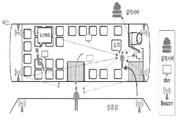
- the beacons are installed in plural on the bus or subway and recognize the user's position through triangulation to determine the user's riding or getting off. Preferably it can be installed one by one on the four corners of the bus, to determine the location of the user to get on and off the beacon.
- the user terminal may increase transmission strength to reduce error in grasping location information and increase accuracy.
- the user terminal transmits the getting off information to the fixed terminal or the beacon in advance. This prevents the user from falling or getting injured when the user is standing off the bus seat when getting off.
- the user terminal may perform information transmission and reception with a fixed terminal or beacon mounted in a vehicle according to a WAVE (Wireless Access in Vehicular Environment) communication standard.
- WAVE Wireless Access in Vehicular Environment
- the WAVE has been developed for mobile networks so that vehicles can provide services such as real-time traffic information, digital maps, movies, and music through communication with the external Internet as well as the role of a vehicle. Communication specification standard.
- the WAVE collects relevant information from vehicles on the road in real time and collects traffic status information through the collected information.
- a separate system may be provided to deliver to the vehicle in real time.
- a communication standard known as IEEE 802.11p it is a long distance wireless data communication that supports public safety and personal communication through vehicle, roadside, and vehicle-to-vehicle communication.
- IEEE 802.11p it is a long distance wireless data communication that supports public safety and personal communication through vehicle, roadside, and vehicle-to-vehicle communication.
- an OFDM-based 5.9GHz band DSRC standard may be applied to enable high-speed transmission in a high-speed wireless channel environment.
- the pedestrian traffic safety system according to the present invention may be applied to a DSRC communication standard
- the dedicated short range communication is a two-way communication method for exchanging various services and information between a roadside base station and a vehicle terminal to suit ITS. This is how it is applied.
- the user terminal or the fixed terminal is provided as a device or a system capable of transmitting and receiving traffic information, location information, transfer information to a terminal mounted in a vehicle (subway). In addition, it may be provided in a variety of specifications and performances according to the size, purpose and shape of the vehicle.
- the user terminal may be used as a smart phone installed with a beacon-only application, or may be used in various ways as a user using a beacon or a means for reducing the size or weight so as to be easily driven and operated by a low power power source for pedestrians to carry. have.
- the user terminal may be a variety of communication methods such as GPS or RFID may be used in place of beacons.
- the fixed terminal is a gateway of a beacon that can transmit and receive vehicle and pedestrian and location information and traffic information. That is, it serves to transmit traffic information received from the vehicle or the pedestrian to the payment server and the vehicle or the pedestrian, and in some cases, transmits the traffic information to the base station or the RTD (real time traffic information processing device) or from the RTD. Traffic information can be received.
- the gateway may generate a movement path by adding a beacon transceiver and tracking the user location sensed by the user terminal.
- the public transit getting on and off system further includes a vehicle, a traffic information transmitting and receiving apparatus mounted on the user, and a gateway or a base station relaying the transmitting and receiving apparatus, thereby ensuring safe boarding and It can help you transfer and get off and secure your vehicle's safe transportation system.
- the public transportation boarding and unloading system further includes a real-time traffic information processing apparatus, and receives and analyzes the user's movement route and the vehicle's movement route in real time, stores and analyzes the movement route of the user according to time and place. Volume and pattern can be analyzed and used as big data. Through this, it is possible to increase the user recognition accuracy in the section with a large number of transfer personnel, and to analyze the time and pattern required for the user's boarding fault so that the vehicle can easily approach and move to the user.
- FIG. 2 is a view illustrating a bus charging system of a public transportation getting on and off system according to the present invention. That is, as shown in the public transportation getting on and off system, when the user terminal (mobile phone, application) of the user who boards the bus starts to operate, the vehicle recognizes the ride through the beacon and automatically performs the basic fare payment.
- the user terminal mobile phone, application
- the fixed terminal charges the basic fee by transmitting information about the user's usage history to the payment server.
- the beacon of the bus recognizes the getting off status and additional charges are automatically charged through the in-vehicle fixed terminal.
- the algorithm for determining whether the beacon is a user's getting on or off is to install a beacon at each vertex of the bus and determine that the user's position is within the predetermined area through triangulation, and determine that the beacon is not within the predetermined area. will be.
- the transmission strength of the application of the user terminal may be increased, but in this case, the battery consumption is also increased. Therefore, in order to minimize power waste, the transmission strength may be increased only when the user enters a stop.
- passwords can be assigned to each beacon on the bus to improve security.
- FIG. 3 is a view illustrating a subway charging system of the public transit getting on and off system according to the present invention. That is, as shown in the public transportation boarding system, when the user terminal (mobile phone, application) of the user who enters the ticket gate of the subway starts operation, the vehicle recognizes the ride through the beacons of the subway ticket gate and automatically proceeds to pay the basic fare. .
- the fixed terminal charges the basic fee by transmitting information about the user's usage history to the payment server.
- the beacon of the subway ticket gate recognizes the getting off status and the additional fee is automatically charged through the in-vehicle fixed terminal.
- Algorithm for determining the beacon of the user the beacon installed beacon at each vertex in the subway ticket gates and determined by the triangulation when the user's position is within the predetermined area, it is determined that the beacon is not within the predetermined area It is.
- the transmission strength of the application of the user terminal may be increased, but in this case, the battery consumption is also increased. Therefore, in order to minimize power waste, the transmission strength may be increased only when the user enters the subway ticket gate. In addition, security can be improved by providing a password to each beacon mounted at the subway ticket gate.
- FIG. 4 is a view for explaining the transfer system of the bus, subway of the public transit getting on and off system according to the present invention. That is, as shown in the public transportation getting on and off system, when the user terminal (mobile phone, application) of the user who boards the bus starts to operate, the vehicle recognizes the ride through the beacon and automatically performs the basic fare payment.
- the user terminal mobile phone, application
- the fixed terminal charges the basic fee by transmitting information about the user's usage history to the payment server.
- the beacon of the bus recognizes the getting off status and additional charges are automatically charged through the in-vehicle fixed terminal.
- the beacon of the subway ticket gate grasps the user's location information and transmits and receives the location information to a fixed terminal in the subway station,
- the fixed terminal charges a basic fee by transmitting information about a user's usage history to a payment server.
- the beacon of the subway ticket gate recognizes the getting off status and the additional fee is automatically charged through the in-vehicle fixed terminal.
- the location information is used by the communication between the user terminal and the beacon carried by the user, and the billing is automatically performed, thereby facilitating the user's use of public transportation. You can benefit.
- the driver may manually check whether the driver is boarding.
- the user may transmit information to the payment server so that the maximum section payment is automatically performed.
- the number of occupants does not increase in the fixed terminal next to the crew member when the user does not execute the user terminal, and if several users pass, payment can be manually checked through the fixed terminal to the application screen for each user. have.
- FIG. 5 is a flowchart illustrating a process of using the public transit getting on and off system according to the present invention.
- the user may ride the bus, automatically recognize the ride through a beacon mounted on the bus, and the user may get off the bus after reserving the getting off information.
- charging is automatically performed through transmission of all location information.
- the user can reserve the transfer information in advance, and when the subway transfer, the location is automatically charged through the user terminal will be charged the subway fare.
- Figure 6 shows the operation sequence of the application of the user terminal, that is, the mobile phone of the user using the public transportation getting on and off system according to the present invention. That is, after initialization, the boarding confirmation information is displayed, and the user checks the reservation and the route information through the route or the map view. In addition, if information is entered after checking in order to proceed with a reservation for getting off, an alarm service such as vibration and sound can be provided to the user before the destination arrives.
- an alarm service such as vibration and sound can be provided to the user before the destination arrives.
- beacon-based public transportation getting on and off system through the application can be used as user-provided information because it can accumulate and provide a variety of information, such as transfer location, transit time required to the user.
- beacon (beacon) provided on the bus or subway to determine the location information of the user via a user terminal carried by the user, the beacon transmits the user location information to the user terminal Step, the fixed terminal provided on the bus or subway receiving the user location information from the user terminal and the payment server receives the user's location information or transfer details from the fixed terminal to pay the usage fee,
- the user terminal may be provided as an application capable of short-range communication with the beacon.
- the step of identifying the location information of the user may include executing an application of the user terminal when the user rides.
- the step of determining the location information of the user is a beacon installed on the bus or subway recognizes the location of the user through the triangulation
- the user terminal may increase the transmission strength when the user enters the stop.
- the user terminal may transmit the getting off information to the fixed terminal or beacon in advance.
- Various components of the above-described pedestrian traffic safety system may be variously configured. That is, the steps of transmitting and receiving the traffic information of the pedestrian or the vehicle to the counterpart terminal or analyzing and collecting the traffic information may be changed according to the requirements and the situation. It shows an example of several methods of safety.
- the public transportation getting on and off system and method according to the present invention can be used for the public transportation getting on and off system and method which is excellent in user convenience and economical by determining the location of the user using the beacon, pre-scheduling the presence or absence of the automatic charging. have.
Landscapes
- Business, Economics & Management (AREA)
- Engineering & Computer Science (AREA)
- Accounting & Taxation (AREA)
- Computer Networks & Wireless Communication (AREA)
- Signal Processing (AREA)
- Strategic Management (AREA)
- Physics & Mathematics (AREA)
- General Business, Economics & Management (AREA)
- General Physics & Mathematics (AREA)
- Theoretical Computer Science (AREA)
- Finance (AREA)
- Economics (AREA)
- Development Economics (AREA)
- Tourism & Hospitality (AREA)
- Health & Medical Sciences (AREA)
- General Health & Medical Sciences (AREA)
- Human Resources & Organizations (AREA)
- Marketing (AREA)
- Primary Health Care (AREA)
- Devices For Checking Fares Or Tickets At Control Points (AREA)
- Operations Research (AREA)
- Traffic Control Systems (AREA)
Abstract
La présente invention concerne un système d'embarquement/débarquement de transport public, comprenant : un terminal d'utilisateur porté par un utilisateur ; une balise qui est disposée dans un bus ou un métro et sert à obtenir des informations de localisation d'utilisateur au moyen du terminal d'utilisateur et à transmettre les informations de localisation d'utilisateur au terminal d'utilisateur ; un terminal fixe destiné à recevoir les informations de localisation d'utilisateur de la part du terminal d'utilisateur ; et un serveur de paiement destiné à recevoir l'enregistrement de transfert et les informations de localisation de l'utilisateur de la part du terminal fixe et à payer le prix du trajet. Le terminal d'utilisateur est réalisé sous la forme d'une application qui permet une communication en champ proche avec la balise.
Applications Claiming Priority (2)
| Application Number | Priority Date | Filing Date | Title |
|---|---|---|---|
| KR10-2015-0184903 | 2015-12-23 | ||
| KR1020150184903A KR20170075353A (ko) | 2015-12-23 | 2015-12-23 | 비콘을 이용한 대중교통 승하차 시스템 및 방법 |
Publications (1)
| Publication Number | Publication Date |
|---|---|
| WO2017111502A1 true WO2017111502A1 (fr) | 2017-06-29 |
Family
ID=59089610
Family Applications (1)
| Application Number | Title | Priority Date | Filing Date |
|---|---|---|---|
| PCT/KR2016/015109 Ceased WO2017111502A1 (fr) | 2015-12-23 | 2016-12-22 | Système et procédé d'embarquement/débarquement de transport public en utilisant une balise |
Country Status (2)
| Country | Link |
|---|---|
| KR (1) | KR20170075353A (fr) |
| WO (1) | WO2017111502A1 (fr) |
Cited By (2)
| Publication number | Priority date | Publication date | Assignee | Title |
|---|---|---|---|---|
| CN110166939A (zh) * | 2018-05-10 | 2019-08-23 | 腾讯大地通途(北京)科技有限公司 | 公共交通站点判断方法及装置 |
| CN114070807A (zh) * | 2020-08-07 | 2022-02-18 | 丰田自动车株式会社 | 方法以及服务器 |
Families Citing this family (20)
| Publication number | Priority date | Publication date | Assignee | Title |
|---|---|---|---|---|
| US20190066515A1 (en) * | 2017-08-22 | 2019-02-28 | Waymo Llc | Estimating time to pick up and drop off passengers for improved stopping analysis in autonomous vehicles |
| KR102054494B1 (ko) * | 2018-01-16 | 2019-12-10 | 한국철도기술연구원 | 비접촉 과금 시스템 및 그 방법 |
| KR102051619B1 (ko) * | 2018-05-31 | 2019-12-03 | 주식회사 이비카드 | 버스 요금 결제 확인 디스플레이 시스템 및 방법 |
| KR102061074B1 (ko) * | 2018-11-14 | 2020-02-20 | 주식회사 코어시스템즈 | 비콘을 활용한 요금 자동 징수 방법 및 시스템 |
| KR102182409B1 (ko) * | 2018-11-20 | 2020-11-24 | 한국철도공사 | 교통 요금 통합 결제 시스템 및 방법 |
| KR102001112B1 (ko) | 2019-02-12 | 2019-07-17 | (주)신일승강기 | 전자 태그를 이용한 엘리베이터 장치 이동에 필요한 통신 정보 제공 시스템 |
| WO2020196961A1 (fr) * | 2019-03-28 | 2020-10-01 | 엘지전자 주식회사 | Dispositif électronique pour véhicule et procédé de fonctionnement de dispositif électronique pour véhicule |
| CN110766812B (zh) * | 2019-10-31 | 2020-11-10 | 广东科学技术职业学院 | 一种无人驾驶汽车的乘车付费方法、装置及电子设备 |
| KR102158990B1 (ko) * | 2020-03-04 | 2020-09-23 | 허지원 | 지하철 스마트 결제 시스템 |
| KR102179371B1 (ko) | 2020-09-03 | 2020-11-16 | 주식회사 코어시스템즈 | 지하철의 요금 결제 방법 및 시스템 |
| KR102621931B1 (ko) | 2020-10-13 | 2024-01-09 | 주식회사 이동의즐거움 | 태그리스 자동 결제 시스템 및 방법 |
| KR102376860B1 (ko) | 2021-05-21 | 2022-03-22 | 주식회사 코어시스템즈 | 지하철의 요금 결제 방법 및 시스템 |
| KR102645565B1 (ko) * | 2021-06-24 | 2024-03-11 | (주)피디씨 | 비접촉 교통요금 결제 시스템 및 방법 |
| KR102379973B1 (ko) * | 2021-07-01 | 2022-03-29 | 한국철도기술연구원 | 스마트 도어를 이용한 요금결제 방법 및 시스템 |
| JP2023015835A (ja) * | 2021-07-20 | 2023-02-01 | 三菱重工エンジニアリング株式会社 | 課金処理装置、車両、課金処理方法およびプログラム |
| KR20230034057A (ko) | 2021-09-02 | 2023-03-09 | 주식회사 코어시스템즈 | 교통카드 시뮬레이터 장치를 이용한 지하철의 요금결제 방법 및 시스템 |
| KR102440546B1 (ko) * | 2022-01-04 | 2022-09-06 | (주)에이텍티앤 | 블루투스를 활용한 버스 승차요금 결제방법 |
| KR102666939B1 (ko) | 2023-03-03 | 2024-05-17 | 주식회사 이동의즐거움 | 태그리스 자동 요금 수수를 위한 승차 결제 시스템 및 그 방법 |
| KR102671515B1 (ko) | 2023-03-09 | 2024-05-31 | 주식회사 이동의즐거움 | 태그리스 자동 요금 수수를 위한 하차 결제 시스템 및 그 방법 |
| KR102897880B1 (ko) * | 2024-06-24 | 2025-12-10 | 김성렬 | 통신사 기지국 연동 기반 태그리스 결제 관리장치와 이를 이용한 방법 및 시스템 |
Citations (4)
| Publication number | Priority date | Publication date | Assignee | Title |
|---|---|---|---|---|
| KR20120037109A (ko) * | 2010-10-11 | 2012-04-19 | 최필호 | 이동통신 단말을 이용한 버스 환승 처리 시스템 |
| KR20120095174A (ko) * | 2011-02-18 | 2012-08-28 | 최필호 | 근거리 무선 통신을 이용한 버스 환승 처리 시스템 |
| KR20150113325A (ko) * | 2014-03-27 | 2015-10-08 | 에스케이플래닛 주식회사 | 대중교통 정보 제공 서비스 시스템, 대중교통 정보 제공 서비스 방법 및 이를 위한 장치 |
| KR20150131900A (ko) * | 2014-05-16 | 2015-11-25 | 허성민 | 비콘 기반 미싱 객체 찾기 시스템, 미싱 객체 찾기 방법, 그 컴퓨터 프로그램 및 미싱 객체 찾기 서버 |
-
2015
- 2015-12-23 KR KR1020150184903A patent/KR20170075353A/ko not_active Ceased
-
2016
- 2016-12-22 WO PCT/KR2016/015109 patent/WO2017111502A1/fr not_active Ceased
Patent Citations (4)
| Publication number | Priority date | Publication date | Assignee | Title |
|---|---|---|---|---|
| KR20120037109A (ko) * | 2010-10-11 | 2012-04-19 | 최필호 | 이동통신 단말을 이용한 버스 환승 처리 시스템 |
| KR20120095174A (ko) * | 2011-02-18 | 2012-08-28 | 최필호 | 근거리 무선 통신을 이용한 버스 환승 처리 시스템 |
| KR20150113325A (ko) * | 2014-03-27 | 2015-10-08 | 에스케이플래닛 주식회사 | 대중교통 정보 제공 서비스 시스템, 대중교통 정보 제공 서비스 방법 및 이를 위한 장치 |
| KR20150131900A (ko) * | 2014-05-16 | 2015-11-25 | 허성민 | 비콘 기반 미싱 객체 찾기 시스템, 미싱 객체 찾기 방법, 그 컴퓨터 프로그램 및 미싱 객체 찾기 서버 |
Non-Patent Citations (1)
| Title |
|---|
| KIM, JUN HO ET AL.: "The Development of Automatic Boarding and Alighting Bus System", KOREAN INSTITUTE OF COMMUNICATION SCIENCES, SUMMER CONFERENCE, June 2015 (2015-06-01), pages 1390 - 1391 * |
Cited By (3)
| Publication number | Priority date | Publication date | Assignee | Title |
|---|---|---|---|---|
| CN110166939A (zh) * | 2018-05-10 | 2019-08-23 | 腾讯大地通途(北京)科技有限公司 | 公共交通站点判断方法及装置 |
| CN110166939B (zh) * | 2018-05-10 | 2022-03-04 | 腾讯大地通途(北京)科技有限公司 | 公共交通站点判断方法及装置 |
| CN114070807A (zh) * | 2020-08-07 | 2022-02-18 | 丰田自动车株式会社 | 方法以及服务器 |
Also Published As
| Publication number | Publication date |
|---|---|
| KR20170075353A (ko) | 2017-07-03 |
Similar Documents
| Publication | Publication Date | Title |
|---|---|---|
| WO2017111502A1 (fr) | Système et procédé d'embarquement/débarquement de transport public en utilisant une balise | |
| WO2016144079A1 (fr) | Procédé et système de paiement de transport public utilisant une balise | |
| WO2020022679A1 (fr) | Système de gestion de charge et de paiement intégré pour véhicule électrique | |
| CN102081807B (zh) | 一种停车场停车管理系统及引导停车的方法 | |
| WO2014175569A1 (fr) | Robot permettant de charger un véhicule électrique | |
| CN103186926B (zh) | 乘坐公交车分段自动扣费的方法和系统 | |
| WO2018004265A1 (fr) | Système de règlement automatique de frais de stationnement | |
| WO2016148349A1 (fr) | Système de collecte de péage automatique basé sur un poste de péage virtuel et utilisant un téléphone intelligent | |
| CN111160894A (zh) | 一种基于蓝牙精定位的公交无感知支付系统 | |
| KR102061074B1 (ko) | 비콘을 활용한 요금 자동 징수 방법 및 시스템 | |
| CN115410371A (zh) | 基于无感支付的城市轨道交通客流数据采集及分析方法 | |
| KR102287173B1 (ko) | 다중 사물인터넷 장치를 이용한 지하철 결제 방법 | |
| WO2025009742A1 (fr) | Système de numéro de badge numéroté d'autoroute | |
| KR101783305B1 (ko) | 주차 요금 결제 시스템 및 방법 | |
| KR20160105200A (ko) | 비콘을 이용한 대중교통 결제 장치 및 그 방법 | |
| JP2004334581A (ja) | 乗合車両の乗降支援装置およびその通信方法 | |
| CN111553991A (zh) | 一种基于蓝牙etc、obu的停车信息采集收费系统及其停车信息采集收费方法 | |
| CN1797476B (zh) | 支付乘车费的通讯系统及支付乘车费的方法 | |
| WO2017115913A1 (fr) | Système passe-haut mobile utilisant un terminal intelligent et un terminal obd | |
| CN205281596U (zh) | 一种基于手机无线通信的高速道路收费系统 | |
| WO2010131862A2 (fr) | Système intelligent pour station de taxis | |
| WO2022260197A1 (fr) | Procédé et système de paiement de transport en commun au moyen d'une uwb | |
| KR20150053655A (ko) | 지하철 요금 정산을 위한 결제 서버 및 단말기 | |
| KR20180029785A (ko) | 교통 요금 결제 단말기 | |
| CN206833524U (zh) | 一种高速公路即时通行收费系统 |
Legal Events
| Date | Code | Title | Description |
|---|---|---|---|
| 121 | Ep: the epo has been informed by wipo that ep was designated in this application |
Ref document number: 16879369 Country of ref document: EP Kind code of ref document: A1 |
|
| NENP | Non-entry into the national phase |
Ref country code: DE |
|
| 122 | Ep: pct application non-entry in european phase |
Ref document number: 16879369 Country of ref document: EP Kind code of ref document: A1 |