WO2017111663A1 - Protective marking and article containing said marking - Google Patents
Protective marking and article containing said marking Download PDFInfo
- Publication number
- WO2017111663A1 WO2017111663A1 PCT/RU2016/000896 RU2016000896W WO2017111663A1 WO 2017111663 A1 WO2017111663 A1 WO 2017111663A1 RU 2016000896 W RU2016000896 W RU 2016000896W WO 2017111663 A1 WO2017111663 A1 WO 2017111663A1
- Authority
- WO
- WIPO (PCT)
- Prior art keywords
- luminescence
- protective
- marking
- spectral
- radiation
- Prior art date
- Legal status (The legal status is an assumption and is not a legal conclusion. Google has not performed a legal analysis and makes no representation as to the accuracy of the status listed.)
- Ceased
Links
Classifications
-
- B—PERFORMING OPERATIONS; TRANSPORTING
- B42—BOOKBINDING; ALBUMS; FILES; SPECIAL PRINTED MATTER
- B42D—BOOKS; BOOK COVERS; LOOSE LEAVES; PRINTED MATTER CHARACTERISED BY IDENTIFICATION OR SECURITY FEATURES; PRINTED MATTER OF SPECIAL FORMAT OR STYLE NOT OTHERWISE PROVIDED FOR; DEVICES FOR USE THEREWITH AND NOT OTHERWISE PROVIDED FOR; MOVABLE-STRIP WRITING OR READING APPARATUS
- B42D25/00—Information-bearing cards or sheet-like structures characterised by identification or security features; Manufacture thereof
- B42D25/20—Information-bearing cards or sheet-like structures characterised by identification or security features; Manufacture thereof characterised by a particular use or purpose
- B42D25/21—Information-bearing cards or sheet-like structures characterised by identification or security features; Manufacture thereof characterised by a particular use or purpose for multiple purposes
-
- B—PERFORMING OPERATIONS; TRANSPORTING
- B42—BOOKBINDING; ALBUMS; FILES; SPECIAL PRINTED MATTER
- B42D—BOOKS; BOOK COVERS; LOOSE LEAVES; PRINTED MATTER CHARACTERISED BY IDENTIFICATION OR SECURITY FEATURES; PRINTED MATTER OF SPECIAL FORMAT OR STYLE NOT OTHERWISE PROVIDED FOR; DEVICES FOR USE THEREWITH AND NOT OTHERWISE PROVIDED FOR; MOVABLE-STRIP WRITING OR READING APPARATUS
- B42D25/00—Information-bearing cards or sheet-like structures characterised by identification or security features; Manufacture thereof
- B42D25/40—Manufacture
- B42D25/405—Marking
-
- C—CHEMISTRY; METALLURGY
- C09—DYES; PAINTS; POLISHES; NATURAL RESINS; ADHESIVES; COMPOSITIONS NOT OTHERWISE PROVIDED FOR; APPLICATIONS OF MATERIALS NOT OTHERWISE PROVIDED FOR
- C09K—MATERIALS FOR MISCELLANEOUS APPLICATIONS, NOT PROVIDED FOR ELSEWHERE
- C09K11/00—Luminescent materials, e.g. electroluminescent or chemiluminescent
- C09K11/08—Luminescent materials, e.g. electroluminescent or chemiluminescent containing inorganic luminescent materials
Definitions
- the invention relates to the field of protection of products from counterfeiting and is intended for instrumental determination of the authenticity of protected printing products.
- Such protective features are understood as technical solutions in which, during instrument control, authenticity is checked not one but two or more parameters related in a specified way, or a specific reaction to two or more simultaneously specified actions is evaluated.
- Examples of such complex effects include the dependence of the UV luminescence of a substance on the temperature applied to it, or the angle of rotation of the plane of polarization of linearly polarized radiation under the influence of an external electric field, or reversible color change of a substance under the influence of heat and light.
- the proposed solution is based on the well-known physical phenomena of photostimulation (“flash” or flashing) and optical quenching of photoluminescence, which are of a fundamental nature, and are described below.
- small electron traps can play the role of quenching centers. With decreasing temperature, the time spent by electrons in them increases, and therefore the possibility of recombination of the latter with holes increases.
- the degree of quenching that is, the fraction of nonradiative transitions, depends on the density of the excitation power.
- Inorganic compounds having photostimulated luminescence or quenching of luminescence in the visible range of the spectrum Examples of known formulations are shown in Table 1.
- compositions of ZnS — Cu, Me, C1 should be classified as practically important, where Me — Co 2+ for quenching and Me — Pb 2+ , Sm 3+, or Mn 2+ for flash.
- Me — Co 2+ for quenching
- Me — Pb 2+ for quenching
- Me — Pb 2+ for quenching
- Me — Pb 2+ for quenching
- Me — Pb 2+ for quenching
- Me — Pb 2+ Sm 3+
- Mn 2+ for flash.
- IR sensitivity spectra green for Pb 2+ , red for Sm 3+ and orange for Mn 2+
- kinetics of the visible afterglow Luminescence showed that these compounds work according to the following scheme:
- e c is the electron in the conduction band
- ap v is the hole in the valence band
- the efficiency of ZnS-Cu, Me, CI luminescent compounds is limited primarily by incomplete absorption of the recorded luminescent radiation, which is no more than 10-15%.
- the currently known optically sensitive luminescent compounds based on zinc sulfide are designed to detect only quenching of visible luminescence when exposed to radiation in the region from 0.7 to 1.0 ⁇ m.
- the main disadvantage of these compounds which excludes the possibility of their use as luminescent compounds with photostimulated quenching of luminescence upon excitation by radiation in the range from 0.7 to 1.0 ⁇ m and stimulation by UV radiation, is the absence of ions in their composition that provide, when excited by radiation, in the range from 0.7 to 1.0 ⁇ m, Stokes or anti-Stokes luminescence in the specified spectral region.
- the necessary parameters of luminescent compounds with photostimulated quenching ("intensity modulation") of luminescence in the spectral range of 700 - 2500 nm when exposed to radiation in the wavelength range of 300-700 nm are as follows:
- the presence in the composition of compounds of rare-earth ions or their pairs (for example, Yb - Er), which, when excited by laser radiation in the range from 700 to 1000 nm, provide Stokes and anti-Stokes luminescence in the region of 700 - 2500 nm; the presence in the composition of compounds of ions forming donor levels in the band gap (deep electron traps) with a low probability of release of the electrons located on them.
- the formation of such traps can be achieved by partial heterovalent substitution of cations of the pigment matrix by other ions, which have a large electron capture cross section;
- quenchers or sensitizers spatially located near the luminescence centers, it is possible to purposefully organize channels for selecting charge carriers from the luminescence centers or vice versa of the inflow. In both cases, modulation of stationary photoluminescence is observed.
- this solution does not provide the necessary level of security due to the availability of these luminescent compounds in the free market. Also, this solution does not have the property of changing the intensity of luminescent radiation when exposed to stimulating radiation.
- the disadvantage is the use of the visible range of the spectrum when registering a sign.
- a valuable document with a protective marking is known based on an inorganic luminescent compound containing rare-earth metal ions, which has the phenomenon of photostimulated luminescence in the visible range of the optical spectrum.
- This solution is aimed at solving the problem of creating a security feature based on the visual dynamic effect, which consists in the apparent flashing and scattering of brightness bands luminescence, and is not aimed at creating a hidden security tag for instrumental authentication.
- luminescent materials are known having an invisible but machine-readable spectral code formed by at least two materials with overlapping spectral bands as a response.
- Each of the materials is a powder pigment and contains a matrix with an embedded phosphor.
- the known invention describes a protective labeling based on an inorganic luminescent compound containing rare earth metal ions, including based on rare earth metal phosphates containing replacement elements.
- a well-known solution is aimed at instrument control of the authenticity of a valuable document. It involves authenticity control taking into account the totality of the optical properties of the compound used, namely: the luminescence spectrum, the excitation spectrum, the dependence of the intensity of the spectral bands on the power of the exciting radiation and the kinetics of their acceleration and / or attenuation.
- the objective of the proposed invention is the development of protective markings that increase the level of security of the product with expert or machine determination of its authenticity, which is based on the phenomena of both optical quenching of luminescence and photostimulation of luminescence.
- Lni is one of the ions La 3+ , Gd 3+ , Y 3+ and / or any of their combinations
- Ln 2 is one of the ions Yb 3+ , Er 3+ , Nd 3+ , Ce 3+ , Tm 3+ , Ho 3+ , and / or any of their combinations
- the structure of the crystalline structure which is characterized by a high concentration of associated nonradiative capture centers of free charge carriers formed around the luminescence centers, due to which the proposed marking has Stokes and / or anti-Stokes luminescence in the spectral range 400 - 2500 nm arising under the influence of exciting radiation lying in spectral range 700 - 1000 nm, and a change in the given law of the luminescence intensity without changing its spectral composition under The action of stimulating radiation, which lies within the spectral range 300 - 700 nm.
- Particles of inorganic luminescent compounds that are part of the protective markings can be characterized by sizes from 0.1 ⁇ m to 50 ⁇ m.
- the problem is also solved by the proposed product, made in the form of a valuable document that contains the protective markings described above.
- Protective marking can be introduced into the paper or polymer pulp, or applied as a layer on the surface of the paper or polymer, or applied as an adhesive layer between the inner layers of the multilayer product.
- the product can be a banknote, an excise stamp, a postage stamp, a passport, a travel document, a driver’s license, an identity card, a security paper, a plastic card, a label, a payment document.
- Protective marking on the product can be made in the form of geometric figures, guilloche elements, graphic or alphanumeric characters.
- the marking is colorless and indistinguishable in daylight.
- Determination of the authenticity of the marking may consist in the fact that they produce exposure to exciting radiation in the spectral range of 700 - 1000 nm, and the change in the intensity of the exciting radiation over time is described by a harmonic function or the sum of harmonic functions.
- a change in the intensity of Stokes and / or anti-Stokes luminescence is recorded in the wavelength range 400 - 2500 nm. Parameters proportional to the degree are calculated. distortion of the original harmonic signal.
- the stimulating source is switched on in the spectral range 300 - 700 nm, the change in parameter values is recorded.
- the authenticity of the product with the declared protective markings can be evaluated as follows. They act as exciting radiation in the spectral range of 700 - 1000 nm, sequentially change the wavelength of stimulating radiation in the spectral range of 300 - 700 nm, fix the dependence of the intensity of luminescent radiation in the wavelength range of 400 - 2500 nm on the wavelength of stimulating radiation.
- the determination of the authenticity of a valuable document with a declared protective marking was carried out as follows. They produce exciting radiation in the spectral range of 700 - 1000 nm, fix the level of luminescent radiation in the wavelength range of 400 - 2500 nm, produce stimulating radiation in the spectral range of 300 - 700 nm, change the power of stimulating radiation, and fix the dependence of the intensity of luminescent radiation on the intensity of the stimulating radiation. From the foregoing, the obvious advantages of the proposed invention, which are based on use of a complex attribute of authenticity. The complexity consists in a certain reaction of the claimed luminescent substance to a double optical effect, which is not inherent in publicly available materials known from the prior art, including the technical solution adopted for the prototype.
- a valuable document in the form of a banknote contains on the reverse side a colorless protective marking of a rectangular shape made by offset printing.
- the security label contains 80% binder, and 20% inorganic luminescent compound with an average particle size of 3 ⁇ m, with the following formula:
- the initial Stokes luminescence intensity of ytterbium ions (Yb 3+ ) in the spectral range of 990 - 1100 and erbium ions (Er 3+ ) in the spectral ranges of 540 - 660 nm (anti-stokes luminescence) is instrumentally measured and recorded ) and 1500 - 1600 nm (Stokes luminescence).
- the change in the intensity of the indicated luminescence due to optical quenching is instrumentally measured, while the dependence of the Stokes ion luminescence intensity (Yb 3+ , Er 3+ ) is also measured depending on the intensity of the stimulating radiation.
- the spectral composition of the luminescent study is estimated, since only the intensity of the spectral bands of luminescence changes, and not its * spectral composition.
- the totality of the measured parameters including the luminescence spectrum, the dependence of the intensity of the spectral bands not only on the exciting, but also on the stimulating radiation, inherent only for this chemical compound, is instrumental measured and, taking into account the results obtained, establishes the authenticity of the document.
- Valuable document in the form of an excise stamp contains a transparent protective marking on the front side rectangular shape made by screen printing.
- the protective marking contains 90% of a binder and 10% of an inorganic luminescent compound in the form of particles with an average size of 10 ⁇ m of the following composition:
- the change in the intensity of the indicated luminescence is instrumentally measured due to optical quenching, and at the same time, the rate of increase and decay of luminescence is measured, and the invariance of its spectral composition is evaluated.
- the luminescence intensity is restored, the speed the acceleration and attenuation of spectral bands, characterized by a luminescence time constant, take on their original value.
- a valuable document in the form of an excise stamp contains on the front side a colorless protective marking of a square shape, an area of 1 cm, made by offset printing.
- the protective marking contains 85% of the binder and 15% of the inorganic luminescent compound in the form of particles with an average size of 2 ⁇ m of the following composition:
- the change in the intensity of the indicated luminescence is instrumentally measured due to optical quenching, and at the same time, the rate of increase and decay of luminescence is measured, and the invariance of its spectral composition is evaluated.
- the magnitude of the change in the acceleration / attenuation rate of the luminescence band depending on the power of the applied stimulating radiation will be characteristic only for a given chemical substance.
- the luminescence intensity is restored, the acceleration and decay rates of the spectral bands, characterized by the luminescence time constant, take their initial value.
- the combination of the above protective labeling parameters including the luminescence spectrum, the dependence of the intensity of the spectral bands not only on excitation, but also from modulating radiation, as well as a change in the speed of burning up and decay of luminescence, characteristic only for a substance with a specified chemical composition, are instrumentally measured, and the authenticity of the product is established by the measurement results.
- a valuable document in the form of a banknote contains a protective marking in the composition of the paper base, located throughout the product area, made at the paper production stage.
- the protective marking was introduced in an amount of 10% in the paper and is an inorganic luminescent compound in the form of particles with an average size of 20 microns of the following composition:
- the Stokes luminescence of Yb 3+ ions is observed in the range of 990 - 1100 nm, with a burning speed characterized by a time constant of 3 ms.
- the change in the intensity of the indicated luminescence due to optical quenching is instrumentally measured, and at the same time it is measured the rate of acceleration and decay of luminescence, and the invariance of its spectral composition is estimated.
- the magnitude of the change in the acceleration / attenuation rate of the luminescence band depending on the power of the applied stimulating radiation will be characteristic only for a given chemical substance.
- the luminescence intensity is restored, the acceleration and decay rates of the spectral bands, characterized by the luminescence time constant, take their initial value.
- Valuable document in the form of a banknote contains on the back side a colorless protective marking in the form of a strip 2 cm wide, located along the short side of the banknote, made by strip introduction into a paper web at the stage of manufacturing a paper base.
- the protective marking is introduced into the pulp in an amount of 10%, and is an inorganic luminescent compound with an average particle size of 15 ⁇ m, of the following composition:
- the luminescence intensity is restored, the acceleration and decay rates of the spectral bands, characterized by the luminescence time constant, take their initial value.
- the combination of the above protective marking parameters, including the luminescence spectrum, the dependence of the intensity of the spectral bands not only on the exciting, but also on the modulating radiation, as well as the change in the rate of rise and decay of the luminescence, are instrumentally measured, and the authenticity of the product is established from the measurement results.
- a valuable document in the form of an identity card contains a protective marking on the front side of black colors in the form of a text block with personal data of the owner of the document, made by inkjet printing.
- Protective labeling contains 95% binder and 5% inorganic luminescent compounds in the form of particles with an average size of 0.2 ⁇ m of the following composition:
- the change in the intensity of the indicated luminescence is instrumentally measured due to optical quenching, and at the same time, the rate of increase and decay of luminescence is measured, and the invariance of its spectral composition is evaluated.
- the luminescence intensity is restored, the acceleration and decay rates of the spectral bands, characterized by the luminescence time constant, take their initial value.
- the combination of the above protective marking parameters, including the luminescence spectrum, the dependence of the intensity of the spectral bands not only on the exciting, but also on the modulating radiation, as well as the change in the rate of rise and decay of the luminescence, are instrumentally measured, and the authenticity of the product is established from the measurement results.
- a valuable document in the form of a travel document contains on the front side a colorless protective marking of a round shape with an area of 1.5 cm, made by the method of flexographic printing.
- Protective labeling contains 80% binder and 20% inorganic luminescent compounds in the form of particles with an average size of 3 ⁇ m of the following composition:
- the change in the intensity of the indicated luminescence is instrumentally measured due to optical quenching, and at the same time, the rate of increase and decay of luminescence is measured, and the invariance of its spectral composition is evaluated.
- the intensity of the spectral bands of luminescence is restored, the speed of acceleration and attenuation of the spectral bands, characterized by a constant luminescence time, take their initial value.
- the combination of the above protective marking parameters, including the luminescence spectrum, the dependence of the intensity of the spectral bands not only on the exciting, but also on the modulating radiation, as well as the change in the rate of rise and decay of the luminescence, are instrumentally measured, and the authenticity of the product is established from the measurement results.
- a valuable document in the form of a composite material token contains a protective marking in the base material introduced between the IR transparent layers of the multilayer carrier as a separate layer, and the concentration of the protective marking material in the bulk of the base of this layer is 10%.
- the protective marking is made on the basis of an inorganic luminescent compound with an average particle size of 2.5 ⁇ m, of the following composition:
- the luminescence intensity is restored, the acceleration and decay rates of the spectral bands, characterized by the luminescence time constant, take their initial value.
- the combination of the above protective marking parameters, including the luminescence spectrum, the dependence of the intensity of the spectral bands not only on the exciting, but also on the modulating radiation, as well as the change in the rate of rise and decay of the luminescence, are instrumentally measured, and the authenticity of the product is established from the measurement results.
- Valuable document in the form of a bank card contains on the back side a metallized magnetic strip for storage of special / official banking information, which includes protective marking, the concentration of which in the metallized layer is 5%.
- the protective marking is based on an inorganic luminescent compound with an average particle size of 0.3 ⁇ m, of the following composition:
- the change in the intensity of the indicated luminescence is instrumentally measured due to optical quenching, and at the same time, the rate of increase and decay of luminescence is measured, and the invariance of its spectral composition is evaluated.
- the luminescence intensity is restored, the acceleration and decay rates of the spectral bands, characterized by the luminescence time constant, take their initial value.
- the combination of the above protective marking parameters, including the luminescence spectrum, the dependence of the intensity of the spectral bands not only on the exciting, but also on the modulating radiation, as well as the change in the rate of rise and decay of the luminescence, are instrumentally measured, and the authenticity of the product is established from the measurement results.
- a valuable document in the form of an identity card on a plastic basis contains between the layers transparent in the infrared range of the spectrum, as part of the adhesive layer, a protective marking for instrumental determination of the authenticity of the document.
- the adhesive layer contains 80% of the base adhesive and 20% of an inorganic luminescent compound with an average particle size of 1 ⁇ m, of the following composition:
- the change in the intensity of the indicated luminescence is instrumentally measured, while the rate of increase and decay of the luminescence is measured, and the invariance of its spectral composition is evaluated.
- the luminescence intensity is restored, the acceleration and decay rates of the spectral bands, characterized by the luminescence time constant, take their initial value.
- a valuable document in the form of an identity card contains on the front side a colorless protective marking of a rectangular shape, made by offset printing as a substrate for a photograph of the owner of the document.
- Protective labeling contains 80% binder and 20% inorganic luminescent compounds with an average particle size of 5 microns of the following composition:
- the change in the intensity of the indicated luminescence due to optical quenching is instrumentally measured, and at the same time it is measured the rate of acceleration and attenuation of the luminescence bands, and the invariance of their spectral composition is evaluated.
- the luminescence intensity is restored, the acceleration and decay rates of the spectral bands, characterized by the luminescence time constant, take their initial value.
- the combination of the above protective marking parameters, including the luminescence spectrum, the dependence of the intensity of the spectral bands not only on the exciting, but also on the modulating radiation, as well as the change in the rate of rise and decay of the luminescence, are instrumentally measured, and the authenticity of the product is established from the measurement results.
- the invention is applicable in the field of protection of products from counterfeiting, which allows for instrumental determination of the authenticity of protected printing products.
Landscapes
- Chemical & Material Sciences (AREA)
- Engineering & Computer Science (AREA)
- Manufacturing & Machinery (AREA)
- Inorganic Chemistry (AREA)
- Materials Engineering (AREA)
- Organic Chemistry (AREA)
- Credit Cards Or The Like (AREA)
- Luminescent Compositions (AREA)
Abstract
Description
ЗАЩИТНАЯ МАРКИРОВКА PROTECTIVE MARKING
И ИЗДЕЛИЕ, СОДЕРЖАЩЕЕ ДАННУЮ AND PRODUCT CONTAINING THIS
МАРКИРОВКУ Область техники MARKING
Изобретение относится к области защиты изделий от подделки и предназначено для приборного определения подлинности защищаемых полиграфических изделий. The invention relates to the field of protection of products from counterfeiting and is intended for instrumental determination of the authenticity of protected printing products.
Предшествующий уровень техники State of the art
В последнее время, с ростом конкуренции среди производителей защищенной полиграфической продукции, а также ростом технических возможностей потенциальных фальшивомонетчиков, все большую актуальность получают комплексные защитные признаки. Под такими защитными признаками понимают технические решения, в которых при проведении приборного контроля подлинности проверяются не один, а два или более связанных заданным образом параметров, или оценивается определенная реакция на два или более одновременно заданных воздействия. Recently, with increasing competition among manufacturers of security printing products, as well as the growing technical capabilities of potential counterfeiters, complex security features have become increasingly relevant. Such protective features are understood as technical solutions in which, during instrument control, authenticity is checked not one but two or more parameters related in a specified way, or a specific reaction to two or more simultaneously specified actions is evaluated.
В качестве примеров таких комплексных воздействий можно привести зависимость УФ люминесценции вещества от приложенной к нему температуры, или угол разворота плоскости поляризации линейно поляризованного излучения под воздействием внешнего электрического поля, или обратимое изменение цвета вещества под воздействием тепла и света. Examples of such complex effects include the dependence of the UV luminescence of a substance on the temperature applied to it, or the angle of rotation of the plane of polarization of linearly polarized radiation under the influence of an external electric field, or reversible color change of a substance under the influence of heat and light.
Обычно для повышения эксплуатационных показателей и надежности контроля ценных документов проводят усложнение химического и/или элементного контроля веществ, входящих в защитную маркировку, добиваясь этим устранения влияния общеизвестных помех и имитаторов, повышают избирательность и чувствительность методов контроля, и таким образом пытаются минимизировать весовое (процентное) количество защитных веществ в общем составе материала маркировки. Usually, to increase the operational performance and reliability of control of valuable documents, chemical and / or elemental control of substances included in the protective label is complicated, in order to eliminate the influence of well-known interference and imitators, they increase the selectivity and sensitivity of control methods, and thus try to minimize weight (percentage) amount of protective substances in the overall composition of the labeling material.
Важным требованием к защитным признакам для приборного и машинного контроля подлинности также является их скрытость В связи с этим, практический интерес для создания комплексных защитных признаков в первую очередь представляют решения, не проявляющие свои свойства в видимом диапазоне спектра. An important requirement for security features for instrument and machine authentication is also their secrecy. In this regard, decisions that do not show their properties in the visible range of the spectrum are of practical interest for creating comprehensive security features.
Одним из самых востребованных физических явлений, используемых при защите ценных документов, является люминесценция веществ под воздействием возбуждающего излучения (света) и называемая фотолюминесценцией. One of the most popular physical phenomena used in the protection of valuable documents is the luminescence of substances under the influence of exciting radiation (light) and is called photoluminescence.
Широкое распространение явления фотолюминесценции при защите подлинности ценных документов обусловлено простотой её контроля, возможностью осуществления бесконтактного контроля, высоким быстродействием, высокой избирательностью используемых современных методов приборного контроля. The widespread occurrence of the phenomenon of photoluminescence in protecting the authenticity of valuable documents is due to the simplicity of its control, the possibility of contactless control, high speed, high selectivity of modern instrument control methods used.
Предлагаемое решение основано на известных физических явлениях фотостимуляции («вспышки» или высвечивания) и оптического тушения фотолюминесценции, носящих фундаментальный характер, и описанных ниже. The proposed solution is based on the well-known physical phenomena of photostimulation (“flash” or flashing) and optical quenching of photoluminescence, which are of a fundamental nature, and are described below.
Оба рассматриваемых явления обладают требуемым набором свойств, и могут рассматриваться как основа для создания защитных признаков с комплексным (комбинированным) воздействием. При этом очевидно, что особый интерес для решения задачи защиты от подделки ценных документов могут представлять люминесцентные составы, обладающие нестандартными оптическими свойствами, неизвестные населению, и неиспользуемые в промышленности. Both phenomena under consideration possess the required set of properties, and can be considered as the basis for creating protective features with a complex (combined) effect. Moreover, it is obvious that luminescent compositions with non-standard optical properties, unknown to the population, and unused in industry, can be of particular interest in solving the task of protecting against forgery of valuable documents.
Эффект оптического тушения инфракрасным излучением видимой люминесценции неорганических соединений на основе сульфида цинка, объясняется в литературе исходя из упрощенной зонной модели. В такой модели ИК тушение люминесценции связано с высвобождением дырок с ионизированных возбуждением УФ излучением центров свечения в валентную зону с последующей их безызлучательной рекомбинацией на центрах тушения, образованных специально введенными примесными ионами-тушителями. Ситуация в основном остается такой же, если тушителем является не дырочная, а глубокая электронная ловушка. Здесь происходит рекомбинационное взаимодействие примесных центров, обладающих обычно эффективными зарядами противоположных знаков. Дырка, освобожденная тепловыми колебаниями из центра свечения, мигрирует к центру тушения, захватившему электрон и рекомбинирует с ним. Кроме этого, роль центров тушения могут играть мелкие электронные ловушки. При понижении температуры увеличивается время пребывания в них электронов, а поэтому и возможность рекомбинации последних с дырками. Степень тушения, то есть доля безызлучательных переходов, зависит от плотности мощности возбуждения. Как и в случае взаимодействия двух центров свечения это объясняется тем, что с увеличением интенсивности возбуждающего излучения скорость рекомбинации растет быстрее (пропорционально Na-n - где Na число ионизованных центров, п - число свободных электронов), чем скорость освобождения дырок с ионизированных центров тушения. В результате эффект тушения изменяется. Степень тушения также зависит от длительности импульсов стимулирующего излучения (τ). Очевидно, что если длительность импульса (τ) будет меньше времени захвата дырок на ионизированных центрах свечения, то дырки не будут успевать вернуться на вышеуказанные центры. The effect of optical quenching by infrared radiation of the visible luminescence of inorganic compounds based on zinc sulfide is explained in the literature on the basis of a simplified zone model. In this model, IR quenching of luminescence is associated with the release of holes with emission centers ionized by UV radiation into the valence band, followed by their non-radiative recombination at the quenching centers formed by specially introduced impurity quenching ions. The situation basically remains the same if the quencher is not hole, but deep electronic trap. Here the recombination interaction of impurity centers occurs, which usually have effective charges of opposite signs. A hole freed by thermal vibrations from the center of luminescence migrates to the quenching center that has captured the electron and recombines with it. In addition, small electron traps can play the role of quenching centers. With decreasing temperature, the time spent by electrons in them increases, and therefore the possibility of recombination of the latter with holes increases. The degree of quenching, that is, the fraction of nonradiative transitions, depends on the density of the excitation power. As in the case of the interaction of two luminescence centers, this is explained by the fact that with an increase in the intensity of the exciting radiation, the recombination rate grows faster (proportionally to N a -n - where N a is the number of ionized centers, n is the number of free electrons) than the rate of hole release from ionized centers extinguishing. As a result, the quenching effect changes. The degree of quenching also depends on the duration of the stimulating radiation pulses (τ). Obviously, if the pulse duration (τ) is less than the time of hole capture at the ionized emission centers, then the holes will not have time to return to the above centers.
Из уровня техники известны неорганические соединения, обладающие фотостимулированной люминесценцией или тушением люминесценции в видимом диапазоне спектра. Примеры известных составов приведены в Таблице 1. Inorganic compounds having photostimulated luminescence or quenching of luminescence in the visible range of the spectrum. Examples of known formulations are shown in Table 1.
Таблица 1 , Table 1 ,
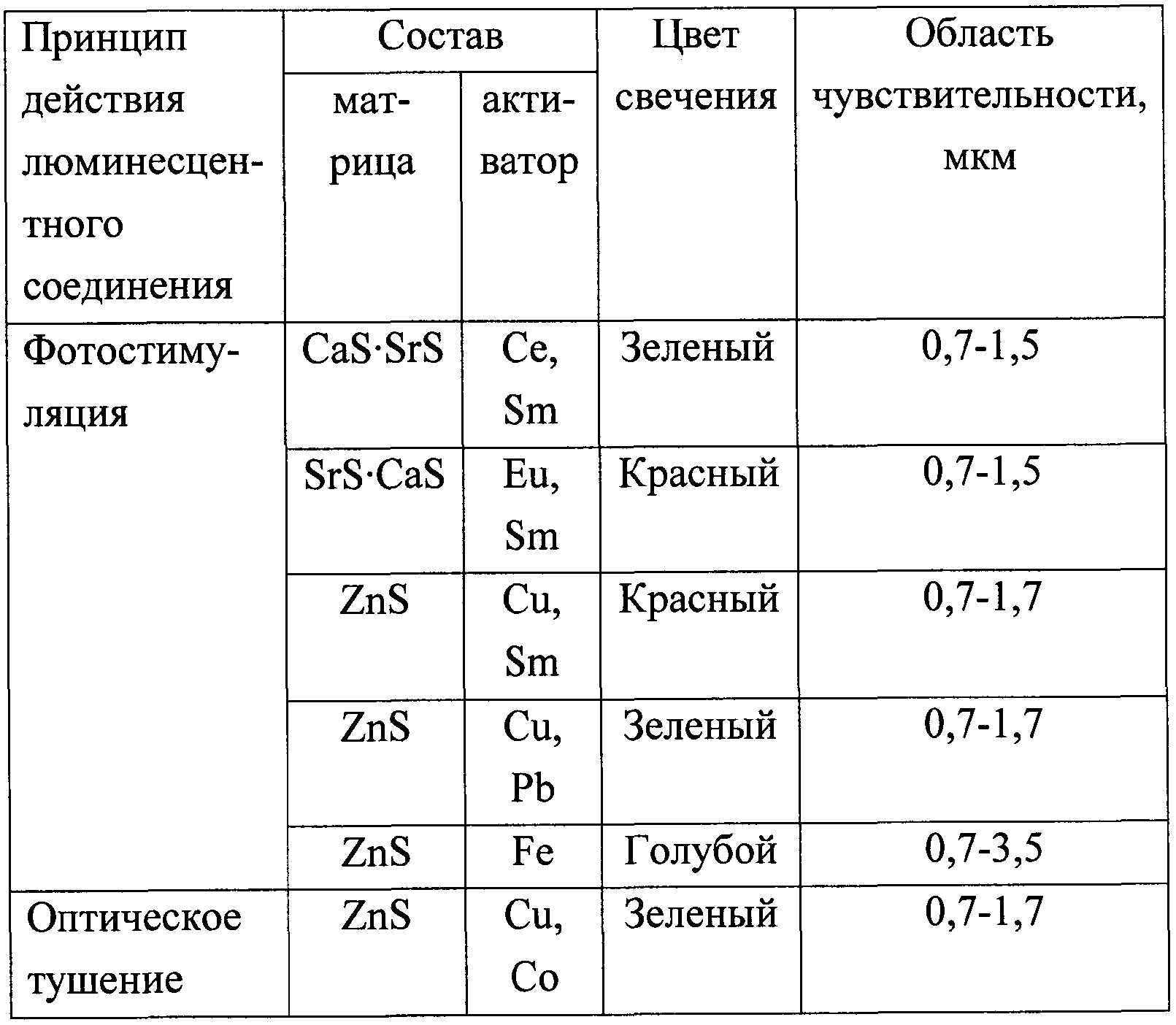
Из представленных соединений к числу практически важных следует отнести составы ZnS - Cu, Me, С1, где Me - Со2+ для тушения и Me - Pb2+, Sm3+ или Мп2+ для вспышки. Исследования спектров ИК чувствительности, спектров вспышки (зеленой для РЬ2+, красной для Sm3+ и оранжевой для Мп2+), а также кинетики послесвечения видимой люминесценции показали, что эти соединения работают по следующей схеме: Of the compounds presented, the compositions of ZnS — Cu, Me, C1, should be classified as practically important, where Me — Co 2+ for quenching and Me — Pb 2+ , Sm 3+, or Mn 2+ for flash. Studies of IR sensitivity spectra, flash spectra (green for Pb 2+ , red for Sm 3+ and orange for Mn 2+ ), as well as the kinetics of the visible afterglow Luminescence showed that these compounds work according to the following scheme:
(Си )* (C) *
hv УФ hv UV
2+ 2+
и е + Си ' Си + hv3 послесвечение hv ИК and e + si 'si + hv 3 afterglow hv IR
Pv + Си тушениеP v + X quenching
Me Me

где ес - электрон в зоне проводимости, a pv - дырка в валентной зоне. where e c is the electron in the conduction band, ap v is the hole in the valence band.
Величина световой суммы, запасаемой в таких люминесцентных соединениях при оптимальных условиях УФ возбуждения, достигает 1014-1015 квантов-см"2, т.е. соизмерима с полным количеством примесных центров на глубине проникновения возбуждающего излучения (~ 50 мкм для λΒ036 = 365 нм и Сси~3- 10 см" ). Вместе с тем эффективность люминесцентных соединений ZnS-Cu, Me, CI ограничена в первую очередь неполным поглощением регистрируемого люминесцентного излучения, которое составляет не более 10-15%. The amount of light accumulated in such luminescent compounds under optimal conditions of UV excitation reaches 10 14 -10 15 quanta-cm "2 , i.e., it is comparable with the total number of impurity centers at the penetration depth of the exciting radiation (~ 50 μm for λ Β03 6 = 365 nm and ssi ~ 3-10 cm " ). At the same time, the efficiency of ZnS-Cu, Me, CI luminescent compounds is limited primarily by incomplete absorption of the recorded luminescent radiation, which is no more than 10-15%.
Таким образом, известные к настоящему времени оптически чувствительные люминесцентные соединения на основе сульфида цинка предназначены для регистрации только тушения видимой люминесценции при воздействии излучения в области от 0,7 до 1,0 мкм. Основным недостатком этих соединений, исключающим возможность их использования в качестве люминесцентных соединений с фотостимулированным тушением люминесценции при возбуждении излучением в диапазоне от 0,7 до 1,0 мкм и стимуляции УФ излучением, является отсутствие в их составе ионов, обеспечивающих при возбуждении излучением в диапазоне от 0,7 до 1,0 мкм, стоксовую или антистоксовую люминесценцию в указанной спектральной области. Thus, the currently known optically sensitive luminescent compounds based on zinc sulfide are designed to detect only quenching of visible luminescence when exposed to radiation in the region from 0.7 to 1.0 μm. The main disadvantage of these compounds, which excludes the possibility of their use as luminescent compounds with photostimulated quenching of luminescence upon excitation by radiation in the range from 0.7 to 1.0 μm and stimulation by UV radiation, is the absence of ions in their composition that provide, when excited by radiation, in the range from 0.7 to 1.0 μm, Stokes or anti-Stokes luminescence in the specified spectral region.
В связи с этим, для решения поставленной задачи требуется использовать другие классы соединений, которые способны обеспечивать фотостимулированное тушение полученной при возбуждении люминесценции в области спектра 700 - 2500 нм за счет воздействия излучения в области длин волн от 300 до 700 нм. In this regard, to solve this problem, it is required to use other classes of compounds that are capable of providing photostimulated quenching of the luminescence obtained upon excitation in the spectral region 700 - 2500 nm due to the effect of radiation in the wavelength range from 300 to 700 nm.
Необходимыми параметрами люминесцентных соединений с фотостимулированным тушением («модуляцией интенсивности») люминесценции в спектральном диапазоне 700 - 2500 нм при воздействии излучения в области длин волн 300-700 нм являются следующие: The necessary parameters of luminescent compounds with photostimulated quenching ("intensity modulation") of luminescence in the spectral range of 700 - 2500 nm when exposed to radiation in the wavelength range of 300-700 nm are as follows:
- присутствие в составе соединений редкоземельных ионов или их пар (например, Yb - Ег), обеспечивающих при возбуждении излучением лазеров в диапазоне от 700 до 1000 нм стоксовую и антистоксовую люминесценцию в области 700 - 2500 нм; присутствие в составе соединений ионов, образующих в запрещенной зоне донорные уровни (глубокие электронные ловушки) с малой вероятностью освобождения находящихся на них электронов. Образование подобного рода ловушек может быть достигнуто за счет частичного гетеровалентного замещения катионов матрицы пигмента другими ионами, обладающие большим сечением захвата электронов; - the presence in the composition of compounds of rare-earth ions or their pairs (for example, Yb - Er), which, when excited by laser radiation in the range from 700 to 1000 nm, provide Stokes and anti-Stokes luminescence in the region of 700 - 2500 nm; the presence in the composition of compounds of ions forming donor levels in the band gap (deep electron traps) with a low probability of release of the electrons located on them. The formation of such traps can be achieved by partial heterovalent substitution of cations of the pigment matrix by other ions, which have a large electron capture cross section;
присутствие в составе соединений ионов, образующих в запрещенной зоне кристалла акцепторные уровни (глубокие дырочные ловушки). Образование подобного типа ловушек может быть достигнуто за счет частичного гетеровалентного замещения катионов матрицы пигмента другими ионами, обладающие большим сечением захвата дырок. the presence of ions in the composition of compounds that form acceptor levels in the band gap of the crystal (deep hole traps). The formation of this type of traps can be achieved due to the partial heterovalent substitution of cations of the pigment matrix by other ions, which have a large hole capture cross section.
Подбором тушителей или сенсибилизаторов пространственно расположенных вблизи центров люминесценции, возможно, целенаправленно организовать каналы отбора носителей заряда от центров люминесценции или наоборот притока. В обоих случаях наблюдается модуляция стационарной фотолюминесценции By selecting quenchers or sensitizers spatially located near the luminescence centers, it is possible to purposefully organize channels for selecting charge carriers from the luminescence centers or vice versa of the inflow. In both cases, modulation of stationary photoluminescence is observed.
(отрицательная - тушение, положительное - синергетическое разгорание). При этом, при подаче только электромагнитных колебаний, соответствующих частоте (длине волны) изменения интенсивности сигнала люминесценции не наблюдается вовсе. Используя указанный подход, можно выбрать люминесцентные соединения с модуляцией стационарной стоксовой и антистоксовой люминесценцией на основе неорганических веществ - сульфиды, оксиды, оксисульфиды, фосфаты, композиционные соединения щелочноземельных, редкоземельных элементов имеющие как рекомбинационный, так и внутрицентровой механизм люминесценции. (negative - quenching, positive - synergistic flare-up). Moreover, when applying only electromagnetic oscillations corresponding to the frequency (wavelength), changes in the intensity of the luminescence signal are not observed at all. Using this approach, it is possible to choose luminescent compounds with modulation of stationary Stokes and anti-Stokes luminescence based on inorganic substances - sulfides, oxides, oxysulfides, phosphates, compositional compounds of alkaline earth, rare earth elements having both recombination and intracenter luminescence mechanisms.
Данный принцип, положенный в основу создания защитной маркировки, можно рассматривать также в совокупности и с другими видами воздействий. В частности, практический интерес представляют неорганические люминесцентные соединения, которые обладают выраженным свойством термотушения люминесценции, и при этом дополнительно содержат в своем составе ионы металлов, за счет которых приобретают ферромагнитные свойства. При перемагничивании таких веществ с высокой частотой, наблюдается изменение температуры их центров свечения, и, как следствие, изменение интенсивности люминесценции за счет эффекта термотушения или термовысвечивания. This principle, which underlies the creation of protective markings, can also be considered in conjunction with other types of impacts. In particular, of practical interest are inorganic luminescent compounds, which have a pronounced property of thermal quenching of luminescence, and at the same time additionally contain metal ions, due to which they acquire ferromagnetic properties. During magnetization reversal of such substances with a high frequency, a change in the temperature of their luminescence centers is observed, and, as a result, a change in the luminescence intensity due to the effect of thermal quenching or thermal emission.
Из US 4387112 известно техническое решение, использующее для приборного контроля подлинности ценных документов неорганические люминесцентные соединения с редкоземельными ионами, обладающих антистоксовой люминесценции в видимом диапазоне спектра. From US 4387112, a technical solution is known that uses inorganic luminescent compounds with rare-earth ions for the instrument authentication of valuable documents. anti-Stokes luminescence in the visible spectrum.
На современном этапе данное решение не обеспечивает необходимого уровня защищенности из-за доступности указанных люминесцентных соединений в свободной продаже. Также указанное решение не обладает свойством изменения интенсивности люминесцентного излучения при воздействии стимулирующим излучением. At the present stage, this solution does not provide the necessary level of security due to the availability of these luminescent compounds in the free market. Also, this solution does not have the property of changing the intensity of luminescent radiation when exposed to stimulating radiation.
Из US 4047033 известен способ приборного контроля подлинности ценного документа на основе использования неорганических соединений с редкоземельными ионами на основе соединения SrS, обладающего вспышечной (фотостимулируемой) люминесценцией в видимом диапазоне оптического спектра. From US 4047033, a method is known for instrumental authenticity verification of a valuable document based on the use of inorganic compounds with rare-earth ions based on the SrS compound having flare (photostimulated) luminescence in the visible range of the optical spectrum.
Недостатком также является использование видимого диапазона спектра при регистрации признака. The disadvantage is the use of the visible range of the spectrum when registering a sign.
Из RU 2379192 С1 известен ценный документ с защитной маркировкой, на основе неорганического люминесцентного соединения, содержащего ионы редкоземельных металлов, обладающее явлением фотостимулируемой люминесценции в видимом диапазоне оптического спектра. Данное решение направлено на решение задачи создания защитного признака на основе визуального динамического эффекта, заключающегося в кажущемся вспыхивании и разбегании полос яркости люминесценции, и не направлено на создание скрытой защитной метки для приборного определения подлинности. From RU 2379192 C1, a valuable document with a protective marking is known based on an inorganic luminescent compound containing rare-earth metal ions, which has the phenomenon of photostimulated luminescence in the visible range of the optical spectrum. This solution is aimed at solving the problem of creating a security feature based on the visual dynamic effect, which consists in the apparent flashing and scattering of brightness bands luminescence, and is not aimed at creating a hidden security tag for instrumental authentication.
Из RU 2388054 известны люминесцентные материалы, обладающие невидимым, но машиночитаемым спектральным кодом, образованным по меньшей мере двумя материалами с перекрывающимися спектральными полосами в качестве отклика. Каждый из материалов представляет собой порошковый пигмент и содержит матрицу с внедрённым люминофором. From RU 2388054, luminescent materials are known having an invisible but machine-readable spectral code formed by at least two materials with overlapping spectral bands as a response. Each of the materials is a powder pigment and contains a matrix with an embedded phosphor.
Наиболее близким к предложенному изобретению является изобретение по RU 2379195 С1. Closest to the proposed invention is the invention according to RU 2379195 C1.
Известное изобретение описывает защитную маркировку, на основе неорганического люминесцентного соединения, содержащего ионы редкоземельных металлов, в том числе на основе фосфатов редкоземельных металлов, содержащих замещающие элементы. Известное решение направлено на приборный контроль подлинности ценного документа. Оно предполагает проведение контроля подлинности с учётом совокупности оптических свойств использованного соединения, а именно: спектра люминесценции, спектра возбуждения, зависимости интенсивности спектральных полос от мощности возбуждающего излучения и кинетики их разгорания и/или затухания. The known invention describes a protective labeling based on an inorganic luminescent compound containing rare earth metal ions, including based on rare earth metal phosphates containing replacement elements. A well-known solution is aimed at instrument control of the authenticity of a valuable document. It involves authenticity control taking into account the totality of the optical properties of the compound used, namely: the luminescence spectrum, the excitation spectrum, the dependence of the intensity of the spectral bands on the power of the exciting radiation and the kinetics of their acceleration and / or attenuation.
Однако указанное выше решение не обеспечивает заданную реакцию при комплексном воздействии излучения на защитную маркировку, и в связи с этим степень защиты неорганическими соединениями, используемыми в известном решении, является недостаточной Раскрытие изобретения However, the above solution does not provide the desired response when the complex effect of radiation protective labeling, and in this regard, the degree of protection of inorganic compounds used in the known solution is insufficient
Задачей предложенного изобретения является разработка защитной маркировки, обеспечивающей повышение уровня защищенности изделия при экспертном или машинном определении его подлинности, которое основано на явлениях как оптического тушения люминесценции, так и фотостимуляции люминесценции. The objective of the proposed invention is the development of protective markings that increase the level of security of the product with expert or machine determination of its authenticity, which is based on the phenomena of both optical quenching of luminescence and photostimulation of luminescence.
Поставленная задача решается предложенной защитной маркировкой для приборного контроля подлинности изделия, выполненной на основе неорганических люминесцентных соединений редкоземельных и щелочноземельных элементов, содержащих замещающие элементы, имеющих химический состав, соответствующий следующей эмпирической формуле: The problem is solved by the proposed protective marking for instrument control of the authenticity of the product, made on the basis of inorganic luminescent compounds of rare-earth and alkaline-earth elements containing replacement elements having a chemical composition corresponding to the following empirical formula:
(1 -x-y-z^n^Os- xLn^Os-yMe'O-zMe^-nS-nu^Os где: Lni - один из ионов La3+, Gd3+, Y3+ и/или любая из их комбинаций; Ln2 - один из ионов Yb3+, Er3+, Nd3+, Ce3+, Tm3+, Ho3+, и/или любая из их комбинаций; (1 -xyz ^ n ^ Os- xLn ^ Os-yMe'O-zMe ^ -nS-nu ^ Os where: Lni is one of the ions La 3+ , Gd 3+ , Y 3+ and / or any of their combinations ; Ln 2 is one of the ions Yb 3+ , Er 3+ , Nd 3+ , Ce 3+ , Tm 3+ , Ho 3+ , and / or any of their combinations;
один из ионов Mg2+, Са2+, Sr2+,Ba2+; one of the ions Mg 2+ , Ca 2+ , Sr 2+ , Ba 2+;
один из ионов Ti4+, Zr4+ , Si4+, Ge4+, Saone of the ions Ti 4+ , Zr 4+ , Si 4+ , Ge 4+ , Sa
0 < x < 0.60; 0 <x <0.60;
0.01 < y < 0.10; 0.01 <y <0.10;
0.005 < z < 0.05; 0.005 <z <0.05;
0 < n < 1 ; 0 <n <1;
0 < m < 1; 0 <m <1;
n + m = 1, n + m = 1,
и строение кристаллической структуры, которое характеризуется высокой концентрацией ассоциированных безызлучательных центров захвата свободных носителей заряда, сформированных вокруг центров свечения, за счет чего предложенная маркировка обладает стоксовой и/или антистоксовой люминесценцией в спектральном диапазоне 400 - 2500 нм, возникающей под воздействием возбуждающего излучения, лежащего в спектральном диапазоне 700 - 1000 нм, и изменением по заданному закону интенсивности люминесценции без изменения её спектрального состава под воздействием стимулирующего излучения, лежащего в спектральном диапазоне 300 - 700 нм. and the structure of the crystalline structure, which is characterized by a high concentration of associated nonradiative capture centers of free charge carriers formed around the luminescence centers, due to which the proposed marking has Stokes and / or anti-Stokes luminescence in the spectral range 400 - 2500 nm arising under the influence of exciting radiation lying in spectral range 700 - 1000 nm, and a change in the given law of the luminescence intensity without changing its spectral composition under The action of stimulating radiation, which lies within the spectral range 300 - 700 nm.
Частицы неорганического люминесцентного соединения, входящие в состав защитной маркировки, могут характеризоваться размерами от 0,1 мкм до 50 мкм. Поставленная задача решается также предложенным изделием, выполненным в виде ценного документа, которое содержит защитную маркировку, охарактеризованную выше. Particles of inorganic luminescent compounds that are part of the protective markings can be characterized by sizes from 0.1 μm to 50 μm. The problem is also solved by the proposed product, made in the form of a valuable document that contains the protective markings described above.
Защитная маркировка может быть введена в бумажную или полимерную массу, или нанесена в виде слоя на поверхность бумаги или полимера, или нанесена в составе клеевого слоя между внутренними слоями многослойного изделия. Изделие может представлять собой банкноту, акцизную марку, почтовую марку, паспорт, проездной документ, водительские права, удостоверение личности, ценную бумагу, пластиковую карту, этикетку, платежный документ. Protective marking can be introduced into the paper or polymer pulp, or applied as a layer on the surface of the paper or polymer, or applied as an adhesive layer between the inner layers of the multilayer product. The product can be a banknote, an excise stamp, a postage stamp, a passport, a travel document, a driver’s license, an identity card, a security paper, a plastic card, a label, a payment document.
Защитная маркировка на изделии может быть выполнена в виде геометрических фигур, гильоширных элементов, графических или цифро-буквенных символов. Protective marking on the product can be made in the form of geometric figures, guilloche elements, graphic or alphanumeric characters.
Предпочтительно, маркировка выполнена бесцветной и неразличимой при дневном освещении. Preferably, the marking is colorless and indistinguishable in daylight.
Определение подлинности маркировки может заключаться в том, что производят воздействие возбуждающим излучением в спектральном диапазоне 700 - 1000 нм, причем изменение интенсивности возбуждающего излучения во времени описывают гармонической функцией или суммой гармонических функций. Фиксируют изменение интенсивности стоксовой и/или антистоксовой люминесценции в диапазоне длин волн 400 - 2500 нм. Рассчитывают параметры, пропорциональные степени искажения исходного гармонического сигнала. Включают источник стимулирующего в спектральном диапазоне 300 - 700 нм, фиксируют изменение значений параметров. Determination of the authenticity of the marking may consist in the fact that they produce exposure to exciting radiation in the spectral range of 700 - 1000 nm, and the change in the intensity of the exciting radiation over time is described by a harmonic function or the sum of harmonic functions. A change in the intensity of Stokes and / or anti-Stokes luminescence is recorded in the wavelength range 400 - 2500 nm. Parameters proportional to the degree are calculated. distortion of the original harmonic signal. The stimulating source is switched on in the spectral range 300 - 700 nm, the change in parameter values is recorded.
Кроме того, подлинность изделия с заявленной защитной маркировкой может быть оценена следующим образом. Производят воздействие возбуждающим излучением в спектральном диапазоне 700 - 1000 нм, последовательно изменяют длину волны стимулирующего излучения в спектральном диапазоне 300 - 700 нм, фиксируют зависимость интенсивности люминесцентного излучения в диапазоне длин волн 400 - 2500 нм от длины волны стимулирующего излучения. In addition, the authenticity of the product with the declared protective markings can be evaluated as follows. They act as exciting radiation in the spectral range of 700 - 1000 nm, sequentially change the wavelength of stimulating radiation in the spectral range of 300 - 700 nm, fix the dependence of the intensity of luminescent radiation in the wavelength range of 400 - 2500 nm on the wavelength of stimulating radiation.
Ещё в одном случае определение подлинности ценного документа с заявленной защитной маркировкой было проведено следующим образом. Производят воздействие возбуждающим излучением в спектральном диапазоне 700 - 1000 нм, фиксируют уровень люминесцентного излучения в диапазоне длин волн 400 - 2500 нм, производят воздействие стимулирующим излучением в спектральном диапазоне 300 - 700 нм, изменяют мощность стимулирующего излучения, фиксируют зависимость интенсивности люминесцентного излучения от интенсивности стимулирующего излучения. Из вышесказанного очевидны преимущества предложенного изобретения, которые основаны на использовании комплексного признака подлинности. Комплексность заключается в определенной реакции заявленного люминесцентного вещества на двойное оптическое воздействие, которое не присуще общедоступным материалам, известным из уровня техники, в том числе, техническому решению, принятому за прототип. In another case, the determination of the authenticity of a valuable document with a declared protective marking was carried out as follows. They produce exciting radiation in the spectral range of 700 - 1000 nm, fix the level of luminescent radiation in the wavelength range of 400 - 2500 nm, produce stimulating radiation in the spectral range of 300 - 700 nm, change the power of stimulating radiation, and fix the dependence of the intensity of luminescent radiation on the intensity of the stimulating radiation. From the foregoing, the obvious advantages of the proposed invention, which are based on use of a complex attribute of authenticity. The complexity consists in a certain reaction of the claimed luminescent substance to a double optical effect, which is not inherent in publicly available materials known from the prior art, including the technical solution adopted for the prototype.
Предложенную защитную маркировку целесообразно использовать в случае нанесения на защитную маркировку некоторой неслучайной информации, сохранность которой необходимо обеспечить как минимум в течение срока проверки подлинности, и как максимум - в течение срока обращения изделия. Перспективным представляется нанесение защитной информации, которая носит временный характер. Заявленная защитная маркировка обладает таким свойством. Таким образом, в объёме заявленной совокупности признаков достигается технический результат, а именно обеспечивается повышение уровня защищенности, возможность экспертного или машинного определения подлинности, возможностью многократной проверки подлинности изделия, исключающей непреднамеренное обнаружение скрытой информации между циклами проверки. Дополнительным преимуществом является возможность нанесения и считывания скрытой информации, которая генерируется случайным образом, а проявляется и считывается с использованием двойного воздействия непосредственно в процессе машинного контроля и, таким образом, не может быть воспроизведена сознательно. It is advisable to use the proposed protective marking in the event that some non-random information is applied to the protective marking, the safety of which must be ensured at least during the period of authentication, and as a maximum during the period of circulation of the product. It seems promising to apply protective information that is temporary in nature. Declared safety marking has this property. Thus, in the amount of the claimed combination of features, a technical result is achieved, namely, an increase in the level of security, the possibility of expert or machine authentication, the possibility of multiple verification of the authenticity of the product, eliminating the inadvertent detection of hidden information between verification cycles, is achieved. An additional advantage is the ability to apply and read hidden information, which is randomly generated, and appears and is read using double exposure directly in the process of machine control and, therefore, cannot be reproduced consciously.
Лучший пример осуществления изобретения The best example of carrying out the invention
Предлагаемое техническое решение поясняется конкретными примерами. The proposed technical solution is illustrated by specific examples.
Пример 1. Example 1
Ценный документ в виде банкноты, содержит на оборотной стороне бесцветную защитную маркировку прямоугольной формы, выполненную способом офсетной печати. A valuable document in the form of a banknote, contains on the reverse side a colorless protective marking of a rectangular shape made by offset printing.
Защитная маркировка содержит 80% связующего, и 20% неорганического люминесцентного соединения со средним размером частиц 3 мкм, со следующей формулой: The security label contains 80% binder, and 20% inorganic luminescent compound with an average particle size of 3 μm, with the following formula:
0.7 Y203- 0.15 Yb2O3-0.05 Er2O3"0.05 СаО-0.05 ΤίΟ2·0.999 0.7 Y 2 0 3 - 0.15 Yb 2 O 3 -0.05 Er 2 O 3 "0.05 CaO-0.05 ΤίΟ 2 · 0.999
S-0.001 P205 S-0.001 P 2 0 5
При обработке участков защитной маркировки возбуждающим лазерным излучением 975 нм, инструментально измеряется и фиксируется начальная интенсивность стоксовой люминесценции ионов иттербия (Yb3+) в спектральном диапазоне 990 - 1100 и ионов эрбия (Ег3+) в спектральных диапазонах 540 - 660 нм (антистоксовая люминесценция) и 1500 - 1600 нм (стоксовая люминесценция) . При воздействии на участки защитной маркировки модулирующим излучением в спектральном диапазоне 300 - 700 нм инструментально измеряется изменение интенсивности указанной люминесценции за счет оптического тушения, причем одновременно измеряется зависимость интенсивности стоксовой люминесценции ионов (Yb3+, Ег3+) в зависимости от интенсивности стимулирующего излучения. When processing areas of protective markings with exciting laser radiation of 975 nm, the initial Stokes luminescence intensity of ytterbium ions (Yb 3+ ) in the spectral range of 990 - 1100 and erbium ions (Er 3+ ) in the spectral ranges of 540 - 660 nm (anti-stokes luminescence) is instrumentally measured and recorded ) and 1500 - 1600 nm (Stokes luminescence). When exposed to protective marking areas with modulating radiation in the spectral range 300 - 700 nm, the change in the intensity of the indicated luminescence due to optical quenching is instrumentally measured, while the dependence of the Stokes ion luminescence intensity (Yb 3+ , Er 3+ ) is also measured depending on the intensity of the stimulating radiation.
При этом проводится оценка спектрального состава люминесцентного изучения, поскольку изменяется только интенсивность спектральных полос люминесценции, а не ее* спектральный состав. In this case, the spectral composition of the luminescent study is estimated, since only the intensity of the spectral bands of luminescence changes, and not its * spectral composition.
После снятия стимулирующего излучения, интенсивность люминесценции восстанавливается. After removing the stimulating radiation, the luminescence intensity is restored.
Таким образом, совокупность измеряемых параметров, включая спектр люминесценции, зависимость интенсивности спектральных полос не только от возбуждающего, но и от стимулирующего излучения, присущие только для данного химического соединения, инструментально измеряют и с учётом полученных результатов устанавливают подлинность документа. Thus, the totality of the measured parameters, including the luminescence spectrum, the dependence of the intensity of the spectral bands not only on the exciting, but also on the stimulating radiation, inherent only for this chemical compound, is instrumental measured and, taking into account the results obtained, establishes the authenticity of the document.
Пример 2. Example 2
Ценный документ в виде акцизной марки, содержит на лицевой стороне прозрачную защитную маркировку прямоугольной формы, выполненную способом трафаретной печати. Valuable document in the form of an excise stamp, contains a transparent protective marking on the front side rectangular shape made by screen printing.
Защитная маркировка содержит 90% связующего и 10% неорганического люминесцентного соединения в виде частиц со средним размером 10 мкм следующего состава: The protective marking contains 90% of a binder and 10% of an inorganic luminescent compound in the form of particles with an average size of 10 μm of the following composition:
0,89 Y2O3-0.01 Nd2O3-0.05 СаО-0.05 ΤιΟ2·1.0 Р205 При обработке участков защитной маркировки возбуждающим импульсным лазерным излучением в диапазоне 805 нм наблюдается стоксовая люминесценция ионов Nd3+ в спектральном диапазоне 1060 - 1370 нм, со скоростью разгорания, характеризующейся постоянной времени 0.3 мс. 0.89 Y 2 O 3 -0.01 Nd 2 O 3 -0.05 CaO-0.05 ΤιΟ 2 · 1.0 P 2 0 5 When processing areas of protective markings by exciting pulsed laser radiation in the range of 805 nm, Stokes luminescence of Nd 3+ ions is observed in the spectral range of 1060 - 1370 nm, with a burning speed characterized by a time constant of 0.3 ms.
При воздействии на участки защитной маркировки импульсным стимулирующим излучением в спектральном диапазоне 300 - 700 нм инструментально измеряется изменение интенсивности указанной люминесценции за счет оптического тушения, причем одновременно измеряется скорость разгорания и затухания люминесценции, и проводится оценка неизменности её спектрального состава. When exposed to protective marking areas with pulsed stimulating radiation in the spectral range of 300 - 700 nm, the change in the intensity of the indicated luminescence is instrumentally measured due to optical quenching, and at the same time, the rate of increase and decay of luminescence is measured, and the invariance of its spectral composition is evaluated.
Считают, что подлинность документа установлена, если изменилась только интенсивность спектральных полос люминесценции, а не её спектральный состав, и при этом скорости разгорания и затухания люминесценции соответствуют заданным значениям. It is believed that the authenticity of the document is established if only the intensity of the spectral bands of luminescence has changed, and not its spectral composition, and at the same time, the rate of increase and decay of the luminescence correspond to the specified values.
После снятия стимулирующего излучения, интенсивность люминесценции восстанавливается, скорости разгорания и затухания спектральных полос, характеризующиеся постоянной времени люминесценции, принимают первоначальное значение. After removing stimulating radiation, the luminescence intensity is restored, the speed the acceleration and attenuation of spectral bands, characterized by a luminescence time constant, take on their original value.
Совокупность указанных выше параметров защитной маркировки, включая спектр люминесценции, зависимость интенсивности спектральных полос не только от возбуждающего, но и от модулирующего излучения, а также изменение скорости разгорания и затухания люминесценции, характерные только для данного вещества, инструментально измеряются, и по результатам измерений устанавливают подлинность изделия. The combination of the above protective labeling parameters, including the luminescence spectrum, the dependence of the intensity of the spectral bands not only on the excitation, but also on the modulating radiation, as well as the change in the rate of rise and decay of luminescence, characteristic only for this substance, are instrumentally measured, and the authenticity is determined by the measurement results products.
Пример 3. Example 3
Ценный документ в виде акцизной марки, содержит на лицевой стороне бесцветную защитную маркировку квадратной формы, площадью 1 см , выполненную способом офсетной печати. A valuable document in the form of an excise stamp contains on the front side a colorless protective marking of a square shape, an area of 1 cm, made by offset printing.
Защитная маркировка содержит 85% связующего и 15% неорганического люминесцентного соединения в виде частиц со средним размером 2 мкм следующего состава: The protective marking contains 85% of the binder and 15% of the inorganic luminescent compound in the form of particles with an average size of 2 μm of the following composition:
0.2 Y2O3"0.5 Gd203" 0.15 Yb2O3-0.1 СаО-0.05 ZrO2-0.999 0.2 Y 2 O 3 "0.5 Gd 2 0 3 " 0.15 Yb 2 O 3 -0.1 CaO-0.05 ZrO 2 -0.999
S-0.001 P205 S-0.001 P 2 0 5
При обработке участков защитной маркировки возбуждающим импульсным лазерным излучением с длиной волны 975 нм наблюдается стоксовая люминесценция ионов У з+ в диапазоне 990 - 1 100 нм, со скоростью разгорания, характеризующейся постоянной времени 3 мс. When processing areas of protective markings with exciting pulsed laser radiation with a wavelength of 975 nm, Stokes ion luminescence is observed At z + in the range of 990 - 1100 nm, with a speed of acceleration characterized by a time constant of 3 ms.
При воздействии на участки защитной маркировки импульсным стимулирующим излучением в спектральном диапазоне 300 - 700 нм инструментально измеряется изменение интенсивности указанной люминесценции за счет оптического тушения, причем одновременно измеряется скорость разгорания и затухания люминесценции, и проводится оценка неизменности её спектрального состава. When exposed to protective marking areas with pulsed stimulating radiation in the spectral range of 300 - 700 nm, the change in the intensity of the indicated luminescence is instrumentally measured due to optical quenching, and at the same time, the rate of increase and decay of luminescence is measured, and the invariance of its spectral composition is evaluated.
Величина изменения скорости разгорания/затухания полосы люминесценции в зависимости от мощности приложенного стимулирующего излучения, будет характерной только для данного химического вещества. The magnitude of the change in the acceleration / attenuation rate of the luminescence band depending on the power of the applied stimulating radiation will be characteristic only for a given chemical substance.
Считают, что подлинность документа установлена, если изменилась только интенсивность спектральных полос люминесценции, а не её спектральный состав, и при этом скорости разгорания и затухания люминесценции соответствуют заданным значениям. It is believed that the authenticity of the document is established if only the intensity of the spectral bands of luminescence has changed, and not its spectral composition, and at the same time, the rate of increase and decay of the luminescence correspond to the specified values.
После снятия стимулирующего излучения, интенсивность люминесценции восстанавливается, скорости разгорания и затухания спектральных полос, характеризующиеся постоянной времени люминесценции, принимают первоначальное значение. After removal of the stimulating radiation, the luminescence intensity is restored, the acceleration and decay rates of the spectral bands, characterized by the luminescence time constant, take their initial value.
Совокупность указанных выше параметров защитной маркировки, включая спектр люминесценции, зависимость интенсивности спектральных полос не только от возбуждающего, но и от модулирующего излучения, а также изменение скорости разгорания и затухания люминесценции, характерные только для вещества с указанным химическим составом, инструментально измеряются, и по результатам измерений устанавливают подлинность изделия. The combination of the above protective labeling parameters, including the luminescence spectrum, the dependence of the intensity of the spectral bands not only on excitation, but also from modulating radiation, as well as a change in the speed of burning up and decay of luminescence, characteristic only for a substance with a specified chemical composition, are instrumentally measured, and the authenticity of the product is established by the measurement results.
Пример 4. Example 4
Ценный документ в виде банкноты, содержит в составе бумажной основы защитную маркировку, расположенную по всей площади изделия, выполненную на стадии производства бумаги. A valuable document in the form of a banknote contains a protective marking in the composition of the paper base, located throughout the product area, made at the paper production stage.
Защитная маркировка введена в количестве 10% в состав бумаги и представляет собой неорганическое люминесцентное соединение в виде частиц со средним размером 20 мкм следующего состава: The protective marking was introduced in an amount of 10% in the paper and is an inorganic luminescent compound in the form of particles with an average size of 20 microns of the following composition:
0.7 La203- 0.15 Yb2O3-0.1 ВаО-0.05 TiO2-0.999 S-0.001 Р205 0.7 La 2 0 3 - 0.15 Yb 2 O 3 -0.1 BaO-0.05 TiO 2 -0.999 S-0.001 P 2 0 5
При обработке участков защитной маркировки возбуждающим импульсным лазерным излучением с длиной волны 940 нм наблюдается стоксовая люминесценция ионов Yb3+ в диапазоне 990 - 1100 нм, со скоростью разгорания, характеризующейся постоянной времени 3 мс. When processing areas of protective markings with exciting pulsed laser radiation with a wavelength of 940 nm, the Stokes luminescence of Yb 3+ ions is observed in the range of 990 - 1100 nm, with a burning speed characterized by a time constant of 3 ms.
При воздействии на участки защитной маркировки импульсным стимулирующим излучением в спектральном диапазоне 300 - 700 нм инструментально измеряется изменение интенсивности указанной люминесценции за счет оптического тушения, причем одновременно измеряется скорость разгорания и затухания люминесценции, и проводится оценка неизменности её спектрального состава. When exposed to protective marking areas with pulsed stimulating radiation in the spectral range 300 - 700 nm, the change in the intensity of the indicated luminescence due to optical quenching is instrumentally measured, and at the same time it is measured the rate of acceleration and decay of luminescence, and the invariance of its spectral composition is estimated.
Величина изменения скорости разгорания/затухания полосы люминесценции в зависимости от мощности приложенного стимулирующего излучения, будет характерной только для данного химического вещества. The magnitude of the change in the acceleration / attenuation rate of the luminescence band depending on the power of the applied stimulating radiation will be characteristic only for a given chemical substance.
Считают, что подлинность документа установлена, если изменилась только интенсивность спектральных полос люминесценции, а не её спектральный состав, и при этом скорости разгорания и затухания люминесценции соответствуют заданным значениям. It is believed that the authenticity of the document is established if only the intensity of the spectral bands of luminescence has changed, and not its spectral composition, and at the same time, the rate of increase and decay of the luminescence correspond to the specified values.
После снятия стимулирующего излучения, интенсивность люминесценции восстанавливается, скорости разгорания и затухания спектральных полос, характеризующиеся постоянной времени люминесценции, принимают первоначальное значение. After removal of the stimulating radiation, the luminescence intensity is restored, the acceleration and decay rates of the spectral bands, characterized by the luminescence time constant, take their initial value.
Совокупность указанных выше параметров защитной маркировки, включая спектр люминесценции, зависимость интенсивности спектральных полос не только от возбуждающего, но и от модулирующего излучения, а также изменение скорости разгорания и затухания люминесценции, характерной только для данного химического соединения, инструментально измеряются, и по результатам измерений устанавливают подлинность изделия. Пример 5. The combination of the above protective labeling parameters, including the luminescence spectrum, the dependence of the intensity of the spectral bands not only on the exciting, but also on the modulating radiation, as well as the change in the rate of rise and decay of the luminescence, which is characteristic only for this chemical compound, are instrumentally measured and determined by the measurement results the authenticity of the product. Example 5
Ценный документ в виде банкноты, содержит на оборотной стороне бесцветную защитную маркировку в виде полосы шириной 2 см, расположенную вдоль короткой стороны банкноты, выполненную способом полосового введения в бумажное полотно на стадии изготовления бумажной основы. Valuable document in the form of a banknote, contains on the back side a colorless protective marking in the form of a strip 2 cm wide, located along the short side of the banknote, made by strip introduction into a paper web at the stage of manufacturing a paper base.
Защитная маркировка введена в бумажную массу в количестве 10%, и представляет собой неорганическое люминесцентное соединение со средним размером частиц 15 мкм, следующего состава: The protective marking is introduced into the pulp in an amount of 10%, and is an inorganic luminescent compound with an average particle size of 15 μm, of the following composition:
0.6 Υ203· 0.15 Gd203- 0.17 Yb203- 0.001 Tm2O3-0.05 0.6 Υ 2 0 3 · 0.15 Gd 2 0 3 - 0.17 Yb 2 0 3 - 0.001 Tm 2 O 3 -0.05
CaOO.029 TiO2-0.9 S-0.1 P205 CaOO.029 TiO 2 -0.9 S-0.1 P 2 0 5
При обработке участков защитной маркировки возбуждающим импульсным лазерным излучением с длиной волны 975 нм наблюдается стоксовая люминесценция ионов Yb3+ в диапазоне 990 - 1100 нм, со скоростью разгорания стоксовой люминесценции, характеризующейся постоянной времени 3 мс, и люминесценция ионов Тт3+ в областях 0.465 - 0.495, 0.79 - 0.84 (антистоксовая люминесценция), и 1.65 - 1.98 мкм (стоксовая люминесценция), со скоростью разгорания стоксовой люминесценции, характеризующейся постоянной времени 3,5 мс. In the treatment of parts of the security marking excitation pulsed laser radiation with a wavelength of 975 nm is observed Stokes luminescence Yb 3+ ions in the range 990 - 1100 nm, with a speed flare-Stokes luminescence, characterized by a time constant of 3 ms, and Tm 3+ ion luminescence is in the fields of 0.465 - 0.495, 0.79 - 0.84 (anti-Stokes luminescence), and 1.65 - 1.98 μm (Stokes luminescence), with a Stokes luminescence acceleration rate characterized by a time constant of 3.5 ms.
При воздействии на участки защитной маркировки импульсным стимулирующим излучением в спектральном диапазоне 300 - 700 нм инструментально измеряется изменение интенсивности указанной люминесценции за счет оптического тушения, причем одновременно измеряется скорость разгорания и затухания люминесценции, и проводится оценка неизменности её спектрального состава. When exposed to areas of protective marking by pulsed stimulating radiation in the spectral range of 300 - 700 nm, instrumentally measured a change in the intensity of the indicated luminescence due to optical quenching, at the same time, the rate of increase and decay of the luminescence is measured, and the invariance of its spectral composition is evaluated.
Считают, что подлинность документа установлена, если изменилась только интенсивность спектральных полос люминесценции, а не её спектральный состав, и при этом скорости разгорания и затухания люминесценции соответствуют заданным значениям, характерным только для данного химического вещества. It is believed that the authenticity of the document is established if only the intensity of the spectral bands of luminescence has changed, and not its spectral composition, and at the same time, the rates of luminosity’s acceleration and decay correspond to the set values characteristic only for a given chemical substance.
После снятия стимулирующего излучения, интенсивность люминесценции восстанавливается, скорости разгорания и затухания спектральных полос, характеризующиеся постоянной времени люминесценции, принимают первоначальное значение. After removal of the stimulating radiation, the luminescence intensity is restored, the acceleration and decay rates of the spectral bands, characterized by the luminescence time constant, take their initial value.
Совокупность указанных выше параметров защитной маркировки, включая спектр люминесценции, зависимость интенсивности спектральных полос не только от возбуждающего, но и от модулирующего излучения, а также изменение скорости разгорания и затухания люминесценции инструментально измеряются, и по результатам измерений устанавливают подлинность изделия. The combination of the above protective marking parameters, including the luminescence spectrum, the dependence of the intensity of the spectral bands not only on the exciting, but also on the modulating radiation, as well as the change in the rate of rise and decay of the luminescence, are instrumentally measured, and the authenticity of the product is established from the measurement results.
Пример 6. Example 6
Ценный документ в виде удостоверения личности содержит на лицевой стороне защитную маркировку черного цвета в виде текстового блока с персональными данными владельца документа, выполненную способом струйной печати. A valuable document in the form of an identity card contains a protective marking on the front side of black colors in the form of a text block with personal data of the owner of the document, made by inkjet printing.
Защитная маркировка содержит 95% связующего и 5% неорганического люминесцентного соединения в виде частиц со средним размером 0.2 мкм следующего состава: Protective labeling contains 95% binder and 5% inorganic luminescent compounds in the form of particles with an average size of 0.2 μm of the following composition:
0.758 Υ203· 0.15 Yb203- 0.002 Но2О3-0.05 ВаО-0.04 SnO2-0.75 0.758 Υ 2 0 3 · 0.15 Yb 2 0 3 - 0.002 But 2 О 3 -0.05 BaO-0.04 SnO 2 -0.75
S-0.25 P205 S-0.25 P 2 0 5
При обработке участков защитной маркировки возбуждающим импульсным лазерным излучением с длиной волны 940 нм, наблюдается антистоксовая люминесценция ионов Ноз+ в области 0,54 - 0,56 мкм, и стоксовая люминесценция ионов Yb3+ H Но3+ в областях 0.96 - 1.12, 1.15 - 1.22 и 1.9 - 2.1 мкм, со скоростями разгорания стоксовой люминесценции, характерными только для данного химического соединения. When processing areas of protective markings with exciting pulsed laser radiation with a wavelength of 940 nm, anti-Stokes luminescence of Hose + ions is observed in the region of 0.54 - 0.56 μm, and Stokes luminescence of Yb 3+ H But 3+ ions is in the range of 0.96 - 1.12, 1.15 - 1.22 and 1.9 - 2.1 microns, with Stokes luminescence ignition rates typical only for a given chemical compound.
При воздействии на участки защитной маркировки импульсным стимулирующим излучением в спектральном диапазоне 300 - 700 нм инструментально измеряется изменение интенсивности указанной люминесценции за счет оптического тушения, причем одновременно измеряется скорость разгорания и затухания люминесценции, и проводится оценка неизменности её спектрального состава. When exposed to protective marking areas with pulsed stimulating radiation in the spectral range of 300 - 700 nm, the change in the intensity of the indicated luminescence is instrumentally measured due to optical quenching, and at the same time, the rate of increase and decay of luminescence is measured, and the invariance of its spectral composition is evaluated.
Считают, что подлинность документа установлена, если изменилась только интенсивность спектральных полос люминесценции, а не её спектральный состав, и при этом скорости разгорания и затухания люминесценции соответствуют заданным значениям. It is believed that the authenticity of the document is established if only the intensity of the spectral bands of luminescence has changed, and not its spectral composition, and the rate of acceleration and decay of luminescence correspond to the specified values.
После снятия стимулирующего излучения, интенсивность люминесценции восстанавливается, скорости разгорания и затухания спектральных полос, характеризующиеся постоянной времени люминесценции, принимают первоначальное значение. After removal of the stimulating radiation, the luminescence intensity is restored, the acceleration and decay rates of the spectral bands, characterized by the luminescence time constant, take their initial value.
Совокупность указанных выше параметров защитной маркировки, включая спектр люминесценции, зависимость интенсивности спектральных полос не только от возбуждающего, но и от модулирующего излучения, а также изменение скорости разгорания и затухания люминесценции инструментально измеряются, и по результатам измерений устанавливают подлинность изделия. The combination of the above protective marking parameters, including the luminescence spectrum, the dependence of the intensity of the spectral bands not only on the exciting, but also on the modulating radiation, as well as the change in the rate of rise and decay of the luminescence, are instrumentally measured, and the authenticity of the product is established from the measurement results.
Пример 7. Example 7
Ценный документ в виде проездного документа, содержит на лицевой стороне бесцветную защитную маркировку круглой формы площадью 1.5 см , выполненную способом флексографской печати. A valuable document in the form of a travel document, contains on the front side a colorless protective marking of a round shape with an area of 1.5 cm, made by the method of flexographic printing.
Защитная маркировка содержит 80% связующего и 20% неорганического люминесцентного соединения в виде частиц со средним размером 3 мкм следующего состава: Protective labeling contains 80% binder and 20% inorganic luminescent compounds in the form of particles with an average size of 3 μm of the following composition:
0.76 Gd2O3-0.1 15 Yb2O3-0.005 Er2O3-0.08 SrO-0.04 GeO2-0.03 0.76 Gd 2 O 3 -0.1 15 Yb 2 O 3 -0.005 Er 2 O 3 -0.08 SrO-0.04 GeO 2 -0.03
S-0.97 P205 При обработке участков защитной маркировки возбуждающим импульсным лазерным излучением с длиной волны 940 нм наблюдается стоксовая люминесценция ионов Yb3+ и Ег3+ в спектральных областях 0.9 - 1.1 и 1.5-1.6 мкм соответственно, со скоростями разгорания/затухания стоксовой люминесценции, характерными только для соединения с данным химическим составом. S-0.97 P 2 0 5 When processing areas of protective markings with exciting pulsed laser radiation with a wavelength of 940 nm, the Stokes luminescence of Yb 3+ and Er 3+ ions is observed in the spectral regions 0.9 - 1.1 and 1.5-1.6 μm, respectively, with the Stokes luminescence rise / decay rates typical only for the compound with this chemical composition.
При воздействии на участки защитной маркировки импульсным стимулирующим излучением в спектральном диапазоне 300 - 700 нм инструментально измеряется изменение интенсивности указанной люминесценции за счет оптического тушения, причем одновременно измеряется скорость разгорания и затухания люминесценции, и проводится оценка неизменности её спектрального состава. When exposed to protective marking areas with pulsed stimulating radiation in the spectral range of 300 - 700 nm, the change in the intensity of the indicated luminescence is instrumentally measured due to optical quenching, and at the same time, the rate of increase and decay of luminescence is measured, and the invariance of its spectral composition is evaluated.
Считают, что подлинность документа установлена, если изменилась только интенсивность спектральных полос люминесценции, а не её спектральный состав, и при этом скорости разгорания и затухания спектральных полос стоксовой люминесценции соответствуют заданным значениям. It is believed that the authenticity of the document is established if only the intensity of the spectral bands of luminescence has changed, and not its spectral composition, and at the same time, the rates of rise and fall of the spectral bands of Stokes luminescence correspond to the specified values.
После снятия стимулирующего излучения, интенсивность спектральных полос люминесценции восстанавливается, скорости разгорания и затухания спектральных полос, характеризующиеся постоянной времени люминесценции, принимают первоначальное значение. Совокупность указанных выше параметров защитной маркировки, включая спектр люминесценции, зависимость интенсивности спектральных полос не только от возбуждающего, но и от модулирующего излучения, а также изменение скорости разгорания и затухания люминесценции инструментально измеряются, и по результатам измерений устанавливают подлинность изделия. After removing the stimulating radiation, the intensity of the spectral bands of luminescence is restored, the speed of acceleration and attenuation of the spectral bands, characterized by a constant luminescence time, take their initial value. The combination of the above protective marking parameters, including the luminescence spectrum, the dependence of the intensity of the spectral bands not only on the exciting, but also on the modulating radiation, as well as the change in the rate of rise and decay of the luminescence, are instrumentally measured, and the authenticity of the product is established from the measurement results.
Пример 8. Example 8
Ценный документ в виде жетона из композиционного материала, содержит в составе материала-основы защитную маркировку, введенную между ИК прозрачными слоями многослойного носителя в виде отдельного слоя, причем в массе основы данного слоя концентрация материала защитной маркировки составляет 10%. A valuable document in the form of a composite material token contains a protective marking in the base material introduced between the IR transparent layers of the multilayer carrier as a separate layer, and the concentration of the protective marking material in the bulk of the base of this layer is 10%.
Защитная маркировка выполнена на основе неорганического люминесцентного соединения со средним размером частиц 2,5 мкм, следующего состава: The protective marking is made on the basis of an inorganic luminescent compound with an average particle size of 2.5 μm, of the following composition:
0.765 Gd203 « 0.115 Yb203- 0.08 СаО-0.4 SiO2-0.03 S-0.97 Р205 При обработке участков защитной маркировки возбуждающим импульсным лазерным излучением в диапазоне 940 нм наблюдается стоксовая люминесценция ионов YD3+ B области 0.99 - 1.1 мкм, со скоростью разгорания, характеризующейся постоянной времени 3,5 мс. 0.765 Gd 2 0 3 « 0.115 Yb 2 0 3 - 0.08 CaO-0.4 SiO 2 -0.03 S-0.97 P 2 0 5 When processing areas of protective markings by exciting pulsed laser radiation in the range of 940 nm, Stokes luminescence of YD3 + B ions is observed in the range 0.99 - 1.1 microns, with a speed of acceleration characterized by a time constant of 3.5 ms.
При воздействии на участки защитной маркировки импульсным стимулирующим излучением в спектральном диапазоне 300 - 700 нм инструментально измеряется изменение интенсивности указанной люминесценции, причем одновременно измеряется скорость разгорания и затухания люминесценции, и проводится оценка неизменности её спектрального состава. When exposed to areas of protective marking by pulsed stimulating radiation in the spectral In the range 300 - 700 nm, a change in the intensity of the indicated luminescence is instrumentally measured, and at the same time, the rate of increase and decay of the luminescence is measured, and the invariance of its spectral composition is evaluated.
Считают, что подлинность документа установлена, если изменилась только интенсивность спектральных полос люминесценции, а не её спектральный состав, и при этом скорости разгорания и затухания люминесценции соответствуют заданным значениям. It is believed that the authenticity of the document is established if only the intensity of the spectral bands of luminescence has changed, and not its spectral composition, and at the same time, the rate of increase and decay of the luminescence correspond to the specified values.
После снятия стимулирующего излучения, интенсивность люминесценции восстанавливается, скорости разгорания и затухания спектральных полос, характеризующиеся постоянной времени люминесценции, принимают первоначальное значение. After removal of the stimulating radiation, the luminescence intensity is restored, the acceleration and decay rates of the spectral bands, characterized by the luminescence time constant, take their initial value.
Совокупность указанных выше параметров защитной маркировки, включая спектр люминесценции, зависимость интенсивности спектральных полос не только от возбуждающего, но и от модулирующего излучения, а также изменение скорости разгорания и затухания люминесценции инструментально измеряются, и по результатам измерений устанавливают подлинность изделия. The combination of the above protective marking parameters, including the luminescence spectrum, the dependence of the intensity of the spectral bands not only on the exciting, but also on the modulating radiation, as well as the change in the rate of rise and decay of the luminescence, are instrumentally measured, and the authenticity of the product is established from the measurement results.
Пример 9. Example 9
Ценный документ в виде банковской карты, содержит на оборотной стороне металлизированную магнитную полосу для хранения специальной / служебной банковской информации, в состав которой введена защитная маркировка, концентрация которой в металлизированном слое составляет 5%. Valuable document in the form of a bank card, contains on the back side a metallized magnetic strip for storage of special / official banking information, which includes protective marking, the concentration of which in the metallized layer is 5%.
Защитная маркировка основана на неорганическом люминесцентном соединении со средним размером частиц 0.3 мкм, следующего состава: The protective marking is based on an inorganic luminescent compound with an average particle size of 0.3 μm, of the following composition:
0.74 Y2O3-0.119 Yb2O3-0.05 Er2O3-0.001 Се2О3-0.05 СаО-0.04 0.74 Y 2 O 3 -0.119 Yb 2 O 3 -0.05 Er 2 O 3 -0.001 Ce 2 O 3 -0.05 CaO-0.04
ТЮ2-0.03 S-0.97 Р205 При обработке участков защитной маркировки возбуждающим импульсным лазерным излучением в диапазоне 975 нм наблюдается антистоксовая люминесценция ионов УЪ3+ и Ег3+ в областях 0.99 - 1.1 и 1.5 - 1.6 мкм соответственно, со скоростью разгорания стоксовой люминесценции, характеризующейся постоянной времени 5 мс для Yb3+ и 3.5 мс для Ег3+. TU 2 -0.03 S-0.97 Р 2 0 5 When treating protective marking areas with exciting pulsed laser radiation in the 975 nm range, anti-Stokes luminescence of UV 3+ and Er 3+ ions is observed in the regions 0.99 - 1.1 and 1.5 - 1.6 μm, respectively, with a burning speed Stokes luminescence, characterized by a time constant of 5 ms for Yb 3+ and 3.5 ms for Er 3+ .
При воздействии на участки защитной маркировки импульсным стимулирующим излучением в спектральном диапазоне 300 - 700 нм инструментально измеряется изменение интенсивности указанной люминесценции за счет оптического тушения, причем одновременно измеряется скорость разгорания и затухания люминесценции, и проводится оценка неизменности её спектрального состава. When exposed to protective marking areas with pulsed stimulating radiation in the spectral range of 300 - 700 nm, the change in the intensity of the indicated luminescence is instrumentally measured due to optical quenching, and at the same time, the rate of increase and decay of luminescence is measured, and the invariance of its spectral composition is evaluated.
Считают, что подлинность документа установлена, если изменилась только интенсивность спектральных полос люминесценции, а не её спектральный состав, и при этом скорости разгорания и затухания люминесценции соответствуют заданным значениям. It is believed that the authenticity of the document is established if only the intensity of the spectral bands of luminescence has changed, and not its spectral composition, and the rate of acceleration and decay of luminescence correspond to the specified values.
После снятия стимулирующего излучения, интенсивность люминесценции восстанавливается, скорости разгорания и затухания спектральных полос, характеризующиеся постоянной времени люминесценции, принимают первоначальное значение. After removal of the stimulating radiation, the luminescence intensity is restored, the acceleration and decay rates of the spectral bands, characterized by the luminescence time constant, take their initial value.
Совокупность указанных выше параметров защитной маркировки, включая спектр люминесценции, зависимость интенсивности спектральных полос не только от возбуждающего, но и от модулирующего излучения, а также изменение скорости разгорания и затухания люминесценции инструментально измеряются, и по результатам измерений устанавливают подлинность изделия. The combination of the above protective marking parameters, including the luminescence spectrum, the dependence of the intensity of the spectral bands not only on the exciting, but also on the modulating radiation, as well as the change in the rate of rise and decay of the luminescence, are instrumentally measured, and the authenticity of the product is established from the measurement results.
Пример 10. Example 10
Ценный документ в виде удостоверения личности на пластиковой основе, содержит между слоями, прозрачными в ИК диапазоне спектра, в составе клеевого слоя защитную маркировку для приборного определения подлинности документа. A valuable document in the form of an identity card on a plastic basis, contains between the layers transparent in the infrared range of the spectrum, as part of the adhesive layer, a protective marking for instrumental determination of the authenticity of the document.
Клеевой слой содержит 80% основы - адгезива и 20% неорганического люминесцентного соединения со средним размером частиц 1 мкм, следующего состава: The adhesive layer contains 80% of the base adhesive and 20% of an inorganic luminescent compound with an average particle size of 1 μm, of the following composition:
0.1 La2O3-0.685 Υ2Ο3-0.115 Yb2O3-0.03 СаОО.ОЗ MgO-0.04 0.1 La 2 O 3 -0.685 Υ 2 Ο 3 -0.115 Yb 2 O 3 -0.03 CaOO.OZ MgO-0.04
TiO2-0.95 S-0.05 P205 При обработке участков защитной маркировки возбуждающим импульсным лазерным излучением в диапазоне 980 нм наблюдается стоксовая люминесценция ионов УЬз+ в области 0.99 - 1.1 мкм, со скоростью разгорания, характеризующейся постоянной времени 3.2 мс. TiO 2 -0.95 S-0.05 P 2 0 5 When processing areas of protective markings with exciting pulsed laser radiation in the range of 980 nm, the Stokes luminescence of Ub3 + ions is observed in the range 0.99 - 1.1 μm, with a burning speed characterized by a time constant of 3.2 ms.
При воздействии на участки защитной маркировки импульсным стимулирующим излучением в спектральном диапазоне 300 - 700 нм инструментально измеряется изменение интенсивности указанной люминесценции, причем одновременно измеряется скорость разгорания и затухания люминесценции, и проводится оценка неизменности её спектрального состава. When exposed to protective marking areas with pulsed stimulating radiation in the spectral range of 300 - 700 nm, the change in the intensity of the indicated luminescence is instrumentally measured, while the rate of increase and decay of the luminescence is measured, and the invariance of its spectral composition is evaluated.
Считают, что подлинность документа установлена, если изменилась только интенсивность спектральных полос люминесценции, а не её спектральный состав, и при этом скорости разгорания и затухания люминесценции соответствуют заданным значениям. It is believed that the authenticity of the document is established if only the intensity of the spectral bands of luminescence has changed, and not its spectral composition, and at the same time, the rate of increase and decay of the luminescence correspond to the specified values.
После снятия стимулирующего излучения, интенсивность люминесценции восстанавливается, скорости разгорания и затухания спектральных полос, характеризующиеся постоянной времени люминесценции, принимают первоначальное значение. After removal of the stimulating radiation, the luminescence intensity is restored, the acceleration and decay rates of the spectral bands, characterized by the luminescence time constant, take their initial value.
Совокупность указанных выше параметров защитной маркировки, включая спектр люминесценции, зависимость интенсивности спектральных полос не только от возбуждающего, но и от модулирующего излучения, а также изменение скорости разгорания и затухания люминесценции инструментально измеряются, и по результатам измерений устанавливают подлинность изделия. Пример 11. The combination of the above protective labeling parameters, including the luminescence spectrum, the dependence of the intensity of the spectral bands not only on the exciting, but also on the modulating radiation, as well as the change in the rate of acceleration and decay of luminescence is instrumentally measured, and the authenticity of the product is established from the measurement results. Example 11
Ценный документ в виде удостоверения личности содержит на лицевой стороне бесцветную защитную маркировку прямоугольной формы, выполненную способом офсетной печати в качестве подложки под фотографию владельца документа. A valuable document in the form of an identity card contains on the front side a colorless protective marking of a rectangular shape, made by offset printing as a substrate for a photograph of the owner of the document.
Защитная маркировка содержит 80% связующего и 20% неорганического люминесцентного соединения со средним размером частиц 5 мкм следующего состава: Protective labeling contains 80% binder and 20% inorganic luminescent compounds with an average particle size of 5 microns of the following composition:
0.7 Y2O3-0.19 Gd203- 0.02 Nd2O3-0.04 SrO0.05 ZrO2-0.999 0.7 Y 2 O 3 -0.19 Gd 2 0 3 - 0.02 Nd 2 O 3 -0.04 SrO0.05 ZrO 2 -0.999
S-0.001 P205 S-0.001 P 2 0 5
При обработке участков защитной маркировки возбуждающим импульсным лазерным излучением с длиной волны 805 нм наблюдается стоксовая люминесценция ионов Nd3+ в областях 0.86 - 0.95, 1.03 - 1.12 и 1.3 - 1.45 мкм, со скоростями разгорания/затухания люминесценции, характерными только для данного соединения. When processing areas of protective markings with exciting pulsed laser radiation with a wavelength of 805 nm, the Stokes luminescence of Nd 3+ ions is observed in the regions of 0.86 - 0.95, 1.03 - 1.12, and 1.3 - 1.45 μm, with luminescence acceleration / decay rates characteristic of this compound only.
При воздействии на участки защитной маркировки импульсным стимулирующим излучением в спектральном диапазоне 300 - 700 нм инструментально измеряется изменение интенсивности указанной люминесценции за счет оптического тушения, причем одновременно измеряется скорость разгорания и затухания полос люминесценции, и проводится оценка неизменности их спектрального состава. When exposed to protective marking areas with pulsed stimulating radiation in the spectral range 300 - 700 nm, the change in the intensity of the indicated luminescence due to optical quenching is instrumentally measured, and at the same time it is measured the rate of acceleration and attenuation of the luminescence bands, and the invariance of their spectral composition is evaluated.
Считают, что подлинность документа установлена, если изменилась только интенсивность спектральных полос люминесценции, а не её спектральный состав, и при этом скорости разгорания и затухания люминесценции соответствуют заданным значениям. It is believed that the authenticity of the document is established if only the intensity of the spectral bands of luminescence has changed, and not its spectral composition, and at the same time, the rate of increase and decay of the luminescence correspond to the specified values.
После снятия стимулирующего излучения, интенсивность люминесценции восстанавливается, скорости разгорания и затухания спектральных полос, характеризующиеся постоянной времени люминесценции, принимают первоначальное значение. After removal of the stimulating radiation, the luminescence intensity is restored, the acceleration and decay rates of the spectral bands, characterized by the luminescence time constant, take their initial value.
Совокупность указанных выше параметров защитной маркировки, включая спектр люминесценции, зависимость интенсивности спектральных полос не только от возбуждающего, но и от модулирующего излучения, а также изменение скорости разгорания и затухания люминесценции инструментально измеряются, и по результатам измерений устанавливают подлинность изделия. The combination of the above protective marking parameters, including the luminescence spectrum, the dependence of the intensity of the spectral bands not only on the exciting, but also on the modulating radiation, as well as the change in the rate of rise and decay of the luminescence, are instrumentally measured, and the authenticity of the product is established from the measurement results.
Промышленная применимость Industrial applicability
Изобретение применимо в области защиты изделий от подделки позволяет осуществлять приборное определение подлинности защищаемых полиграфических изделий. The invention is applicable in the field of protection of products from counterfeiting, which allows for instrumental determination of the authenticity of protected printing products.
Claims
Applications Claiming Priority (2)
| Application Number | Priority Date | Filing Date | Title |
|---|---|---|---|
| RU2015154750 | 2015-12-21 | ||
| RU2015154750A RU2614980C1 (en) | 2015-12-21 | 2015-12-21 | Security marking and product containing this marking |
Publications (1)
| Publication Number | Publication Date |
|---|---|
| WO2017111663A1 true WO2017111663A1 (en) | 2017-06-29 |
Family
ID=58507155
Family Applications (1)
| Application Number | Title | Priority Date | Filing Date |
|---|---|---|---|
| PCT/RU2016/000896 Ceased WO2017111663A1 (en) | 2015-12-21 | 2016-12-19 | Protective marking and article containing said marking |
Country Status (2)
| Country | Link |
|---|---|
| RU (1) | RU2614980C1 (en) |
| WO (1) | WO2017111663A1 (en) |
Cited By (1)
| Publication number | Priority date | Publication date | Assignee | Title |
|---|---|---|---|---|
| RU216603U1 (en) * | 2021-08-06 | 2023-02-14 | Дмитрий Александрович Зуев | SECURITY MARKING |
Families Citing this family (1)
| Publication number | Priority date | Publication date | Assignee | Title |
|---|---|---|---|---|
| DE102017008868A1 (en) * | 2017-09-21 | 2019-03-21 | Giesecke+Devrient Currency Technology Gmbh | Optical storage phosphor, method for checking an authenticity feature, apparatus for carrying out a method, authenticity feature and value document |
Citations (5)
| Publication number | Priority date | Publication date | Assignee | Title |
|---|---|---|---|---|
| US3948798A (en) * | 1974-12-23 | 1976-04-06 | Gte Sylvania Incorporated | Titanium-activated lanthanum oxysulfide phosphor and method of preparing same |
| US6503603B1 (en) * | 1998-02-02 | 2003-01-07 | Giesecke & Devrient Gmbh | Printed document having a value and comprising a luminescent authenticity feature |
| RU2261479C2 (en) * | 2000-01-10 | 2005-09-27 | Сикпа Холдинг С.А. | Product authentication method |
| RU2286885C2 (en) * | 2001-03-08 | 2006-11-10 | Гизеке Унд Девриент Гмбх | Important document |
| RU2379195C1 (en) * | 2008-11-25 | 2010-01-20 | Федеральное Государственное Унитарное Предприятие "Гознак" (Фгуп "Гознак") | Valuable document with counterfeit protection and method for detection of its authenticity |
-
2015
- 2015-12-21 RU RU2015154750A patent/RU2614980C1/en active
-
2016
- 2016-12-19 WO PCT/RU2016/000896 patent/WO2017111663A1/en not_active Ceased
Patent Citations (5)
| Publication number | Priority date | Publication date | Assignee | Title |
|---|---|---|---|---|
| US3948798A (en) * | 1974-12-23 | 1976-04-06 | Gte Sylvania Incorporated | Titanium-activated lanthanum oxysulfide phosphor and method of preparing same |
| US6503603B1 (en) * | 1998-02-02 | 2003-01-07 | Giesecke & Devrient Gmbh | Printed document having a value and comprising a luminescent authenticity feature |
| RU2261479C2 (en) * | 2000-01-10 | 2005-09-27 | Сикпа Холдинг С.А. | Product authentication method |
| RU2286885C2 (en) * | 2001-03-08 | 2006-11-10 | Гизеке Унд Девриент Гмбх | Important document |
| RU2379195C1 (en) * | 2008-11-25 | 2010-01-20 | Федеральное Государственное Унитарное Предприятие "Гознак" (Фгуп "Гознак") | Valuable document with counterfeit protection and method for detection of its authenticity |
Cited By (1)
| Publication number | Priority date | Publication date | Assignee | Title |
|---|---|---|---|---|
| RU216603U1 (en) * | 2021-08-06 | 2023-02-14 | Дмитрий Александрович Зуев | SECURITY MARKING |
Also Published As
| Publication number | Publication date |
|---|---|
| RU2614980C1 (en) | 2017-03-31 |
Similar Documents
| Publication | Publication Date | Title |
|---|---|---|
| US9250183B2 (en) | Luminescent materials, articles incorporating luminescent materials, and methods for performing article authentication | |
| US4598205A (en) | Security paper with authenticity features in the form of substances luminescing only in the invisible region of the optical spectrum and process for testing the same | |
| RU2261479C2 (en) | Product authentication method | |
| RU2249504C2 (en) | Protection-attribute combination for important documents | |
| CN104507698B (en) | Article including security feature, the method for verifying the article and verification system | |
| EP3390066B1 (en) | Security element formed from at least two materials present in partially overlapping areas, articles carrying the security element, and authentication methods | |
| SE458531B (en) | SAFETY PAPERS WITH CAMOFLAG MATERIALS TO PROTECT ITS AUTHENTIC LABEL AND PROCEDURE BEFORE PREPARING THEREOF | |
| KR20120115313A (en) | Controlling the detectability of an article and method for authenticating the article | |
| RU2379192C1 (en) | Valuable document with counterfeit protection, method for verification of valuable document authenticity and device for verification of counterfeit-protected valuable document authenticity | |
| CN110461620B (en) | Valuable document with anti-counterfeiting mark with varying decay time and method for identifying anti-counterfeiting mark | |
| CN112689857B (en) | Value document system | |
| CN103270137A (en) | Security feature | |
| CN102224016A (en) | Anti-counterfeiting valuable certificate and method for verifying its authenticity | |
| RU2567068C1 (en) | Determination of laminar article authentication | |
| CN102114743A (en) | Marketable file and method for identifying same | |
| RU2614980C1 (en) | Security marking and product containing this marking | |
| DE3121484A1 (en) | Securities with substances, method and device for testing the latter | |
| US20120153184A1 (en) | Luminescent phosphor-containing materials, and methods for their production and use in authenticating articles | |
| JP2013196165A (en) | Identification medium and ink for identification | |
| EP3150763A1 (en) | Product containing a carrier with protective markings, and method for determining the authenticity of a product | |
| RU2720464C1 (en) | Method of marking anti-counterfeit object, method of identifying marking and marking identification device | |
| JPH1086563A (en) | Recognition mark, mark recording medium, and mark recognition method | |
| RU2725599C1 (en) | Composite material for marking a material object | |
| Prasad et al. | Security Applications of Persistent Luminescence Nanoparticles | |
| JP5979713B2 (en) | Infrared light emitting phosphor |
Legal Events
| Date | Code | Title | Description |
|---|---|---|---|
| 121 | Ep: the epo has been informed by wipo that ep was designated in this application |
Ref document number: 16879469 Country of ref document: EP Kind code of ref document: A1 |
|
| NENP | Non-entry into the national phase |
Ref country code: DE |
|
| 122 | Ep: pct application non-entry in european phase |
Ref document number: 16879469 Country of ref document: EP Kind code of ref document: A1 |