WO2017115853A1 - ペプチドタグおよびそれを含むタグ付加タンパク質 - Google Patents
ペプチドタグおよびそれを含むタグ付加タンパク質 Download PDFInfo
- Publication number
- WO2017115853A1 WO2017115853A1 PCT/JP2016/089139 JP2016089139W WO2017115853A1 WO 2017115853 A1 WO2017115853 A1 WO 2017115853A1 JP 2016089139 W JP2016089139 W JP 2016089139W WO 2017115853 A1 WO2017115853 A1 WO 2017115853A1
- Authority
- WO
- WIPO (PCT)
- Prior art keywords
- protein
- peptide
- added
- tag
- minutes
- Prior art date
- Legal status (The legal status is an assumption and is not a legal conclusion. Google has not performed a legal analysis and makes no representation as to the accuracy of the status listed.)
- Ceased
Links
Images






Classifications
-
- C—CHEMISTRY; METALLURGY
- C12—BIOCHEMISTRY; BEER; SPIRITS; WINE; VINEGAR; MICROBIOLOGY; ENZYMOLOGY; MUTATION OR GENETIC ENGINEERING
- C12N—MICROORGANISMS OR ENZYMES; COMPOSITIONS THEREOF; PROPAGATING, PRESERVING, OR MAINTAINING MICROORGANISMS; MUTATION OR GENETIC ENGINEERING; CULTURE MEDIA
- C12N15/00—Mutation or genetic engineering; DNA or RNA concerning genetic engineering, vectors, e.g. plasmids, or their isolation, preparation or purification; Use of hosts therefor
- C12N15/09—Recombinant DNA-technology
- C12N15/11—DNA or RNA fragments; Modified forms thereof; Non-coding nucleic acids having a biological activity
- C12N15/62—DNA sequences coding for fusion proteins
-
- C—CHEMISTRY; METALLURGY
- C07—ORGANIC CHEMISTRY
- C07K—PEPTIDES
- C07K14/00—Peptides having more than 20 amino acids; Gastrins; Somatostatins; Melanotropins; Derivatives thereof
-
- C—CHEMISTRY; METALLURGY
- C07—ORGANIC CHEMISTRY
- C07K—PEPTIDES
- C07K14/00—Peptides having more than 20 amino acids; Gastrins; Somatostatins; Melanotropins; Derivatives thereof
- C07K14/37—Peptides having more than 20 amino acids; Gastrins; Somatostatins; Melanotropins; Derivatives thereof from fungi
- C07K14/39—Peptides having more than 20 amino acids; Gastrins; Somatostatins; Melanotropins; Derivatives thereof from fungi from yeasts
-
- C—CHEMISTRY; METALLURGY
- C07—ORGANIC CHEMISTRY
- C07K—PEPTIDES
- C07K14/00—Peptides having more than 20 amino acids; Gastrins; Somatostatins; Melanotropins; Derivatives thereof
- C07K14/435—Peptides having more than 20 amino acids; Gastrins; Somatostatins; Melanotropins; Derivatives thereof from animals; from humans
- C07K14/43504—Peptides having more than 20 amino acids; Gastrins; Somatostatins; Melanotropins; Derivatives thereof from animals; from humans from invertebrates
-
- C—CHEMISTRY; METALLURGY
- C07—ORGANIC CHEMISTRY
- C07K—PEPTIDES
- C07K14/00—Peptides having more than 20 amino acids; Gastrins; Somatostatins; Melanotropins; Derivatives thereof
- C07K14/435—Peptides having more than 20 amino acids; Gastrins; Somatostatins; Melanotropins; Derivatives thereof from animals; from humans
- C07K14/43504—Peptides having more than 20 amino acids; Gastrins; Somatostatins; Melanotropins; Derivatives thereof from animals; from humans from invertebrates
- C07K14/43563—Peptides having more than 20 amino acids; Gastrins; Somatostatins; Melanotropins; Derivatives thereof from animals; from humans from invertebrates from insects
-
- C—CHEMISTRY; METALLURGY
- C07—ORGANIC CHEMISTRY
- C07K—PEPTIDES
- C07K14/00—Peptides having more than 20 amino acids; Gastrins; Somatostatins; Melanotropins; Derivatives thereof
- C07K14/435—Peptides having more than 20 amino acids; Gastrins; Somatostatins; Melanotropins; Derivatives thereof from animals; from humans
- C07K14/46—Peptides having more than 20 amino acids; Gastrins; Somatostatins; Melanotropins; Derivatives thereof from animals; from humans from vertebrates
- C07K14/461—Peptides having more than 20 amino acids; Gastrins; Somatostatins; Melanotropins; Derivatives thereof from animals; from humans from vertebrates from fish
-
- C—CHEMISTRY; METALLURGY
- C07—ORGANIC CHEMISTRY
- C07K—PEPTIDES
- C07K14/00—Peptides having more than 20 amino acids; Gastrins; Somatostatins; Melanotropins; Derivatives thereof
- C07K14/435—Peptides having more than 20 amino acids; Gastrins; Somatostatins; Melanotropins; Derivatives thereof from animals; from humans
- C07K14/46—Peptides having more than 20 amino acids; Gastrins; Somatostatins; Melanotropins; Derivatives thereof from animals; from humans from vertebrates
- C07K14/47—Peptides having more than 20 amino acids; Gastrins; Somatostatins; Melanotropins; Derivatives thereof from animals; from humans from vertebrates from mammals
-
- C—CHEMISTRY; METALLURGY
- C07—ORGANIC CHEMISTRY
- C07K—PEPTIDES
- C07K14/00—Peptides having more than 20 amino acids; Gastrins; Somatostatins; Melanotropins; Derivatives thereof
- C07K14/435—Peptides having more than 20 amino acids; Gastrins; Somatostatins; Melanotropins; Derivatives thereof from animals; from humans
- C07K14/475—Growth factors; Growth regulators
-
- C—CHEMISTRY; METALLURGY
- C07—ORGANIC CHEMISTRY
- C07K—PEPTIDES
- C07K14/00—Peptides having more than 20 amino acids; Gastrins; Somatostatins; Melanotropins; Derivatives thereof
- C07K14/435—Peptides having more than 20 amino acids; Gastrins; Somatostatins; Melanotropins; Derivatives thereof from animals; from humans
- C07K14/52—Cytokines; Lymphokines; Interferons
- C07K14/555—Interferons [IFN]
- C07K14/565—IFN-beta
-
- C—CHEMISTRY; METALLURGY
- C07—ORGANIC CHEMISTRY
- C07K—PEPTIDES
- C07K14/00—Peptides having more than 20 amino acids; Gastrins; Somatostatins; Melanotropins; Derivatives thereof
- C07K14/435—Peptides having more than 20 amino acids; Gastrins; Somatostatins; Melanotropins; Derivatives thereof from animals; from humans
- C07K14/575—Hormones
- C07K14/61—Growth hormone [GH], i.e. somatotropin
-
- C—CHEMISTRY; METALLURGY
- C07—ORGANIC CHEMISTRY
- C07K—PEPTIDES
- C07K19/00—Hybrid peptides, i.e. peptides covalently bound to nucleic acids, or non-covalently bound protein-protein complexes
-
- C—CHEMISTRY; METALLURGY
- C07—ORGANIC CHEMISTRY
- C07K—PEPTIDES
- C07K4/00—Peptides having up to 20 amino acids in an undefined or only partially defined sequence; Derivatives thereof
-
- C—CHEMISTRY; METALLURGY
- C07—ORGANIC CHEMISTRY
- C07K—PEPTIDES
- C07K7/00—Peptides having 5 to 20 amino acids in a fully defined sequence; Derivatives thereof
- C07K7/04—Linear peptides containing only normal peptide links
- C07K7/06—Linear peptides containing only normal peptide links having 5 to 11 amino acids
-
- C—CHEMISTRY; METALLURGY
- C07—ORGANIC CHEMISTRY
- C07K—PEPTIDES
- C07K7/00—Peptides having 5 to 20 amino acids in a fully defined sequence; Derivatives thereof
- C07K7/04—Linear peptides containing only normal peptide links
- C07K7/08—Linear peptides containing only normal peptide links having 12 to 20 amino acids
-
- C—CHEMISTRY; METALLURGY
- C12—BIOCHEMISTRY; BEER; SPIRITS; WINE; VINEGAR; MICROBIOLOGY; ENZYMOLOGY; MUTATION OR GENETIC ENGINEERING
- C12N—MICROORGANISMS OR ENZYMES; COMPOSITIONS THEREOF; PROPAGATING, PRESERVING, OR MAINTAINING MICROORGANISMS; MUTATION OR GENETIC ENGINEERING; CULTURE MEDIA
- C12N15/00—Mutation or genetic engineering; DNA or RNA concerning genetic engineering, vectors, e.g. plasmids, or their isolation, preparation or purification; Use of hosts therefor
- C12N15/09—Recombinant DNA-technology
-
- C—CHEMISTRY; METALLURGY
- C12—BIOCHEMISTRY; BEER; SPIRITS; WINE; VINEGAR; MICROBIOLOGY; ENZYMOLOGY; MUTATION OR GENETIC ENGINEERING
- C12N—MICROORGANISMS OR ENZYMES; COMPOSITIONS THEREOF; PROPAGATING, PRESERVING, OR MAINTAINING MICROORGANISMS; MUTATION OR GENETIC ENGINEERING; CULTURE MEDIA
- C12N5/00—Undifferentiated human, animal or plant cells, e.g. cell lines; Tissues; Cultivation or maintenance thereof; Culture media therefor
- C12N5/10—Cells modified by introduction of foreign genetic material
-
- C—CHEMISTRY; METALLURGY
- C12—BIOCHEMISTRY; BEER; SPIRITS; WINE; VINEGAR; MICROBIOLOGY; ENZYMOLOGY; MUTATION OR GENETIC ENGINEERING
- C12N—MICROORGANISMS OR ENZYMES; COMPOSITIONS THEREOF; PROPAGATING, PRESERVING, OR MAINTAINING MICROORGANISMS; MUTATION OR GENETIC ENGINEERING; CULTURE MEDIA
- C12N9/00—Enzymes; Proenzymes; Compositions thereof; Processes for preparing, activating, inhibiting, separating or purifying enzymes
- C12N9/14—Hydrolases (3)
- C12N9/16—Hydrolases (3) acting on ester bonds (3.1)
-
- C—CHEMISTRY; METALLURGY
- C12—BIOCHEMISTRY; BEER; SPIRITS; WINE; VINEGAR; MICROBIOLOGY; ENZYMOLOGY; MUTATION OR GENETIC ENGINEERING
- C12N—MICROORGANISMS OR ENZYMES; COMPOSITIONS THEREOF; PROPAGATING, PRESERVING, OR MAINTAINING MICROORGANISMS; MUTATION OR GENETIC ENGINEERING; CULTURE MEDIA
- C12N9/00—Enzymes; Proenzymes; Compositions thereof; Processes for preparing, activating, inhibiting, separating or purifying enzymes
- C12N9/14—Hydrolases (3)
- C12N9/24—Hydrolases (3) acting on glycosyl compounds (3.2)
- C12N9/2402—Hydrolases (3) acting on glycosyl compounds (3.2) hydrolysing O- and S- glycosyl compounds (3.2.1)
- C12N9/2477—Hemicellulases not provided in a preceding group
- C12N9/248—Xylanases
-
- C—CHEMISTRY; METALLURGY
- C12—BIOCHEMISTRY; BEER; SPIRITS; WINE; VINEGAR; MICROBIOLOGY; ENZYMOLOGY; MUTATION OR GENETIC ENGINEERING
- C12P—FERMENTATION OR ENZYME-USING PROCESSES TO SYNTHESISE A DESIRED CHEMICAL COMPOUND OR COMPOSITION OR TO SEPARATE OPTICAL ISOMERS FROM A RACEMIC MIXTURE
- C12P21/00—Preparation of peptides or proteins
-
- C—CHEMISTRY; METALLURGY
- C12—BIOCHEMISTRY; BEER; SPIRITS; WINE; VINEGAR; MICROBIOLOGY; ENZYMOLOGY; MUTATION OR GENETIC ENGINEERING
- C12P—FERMENTATION OR ENZYME-USING PROCESSES TO SYNTHESISE A DESIRED CHEMICAL COMPOUND OR COMPOSITION OR TO SEPARATE OPTICAL ISOMERS FROM A RACEMIC MIXTURE
- C12P21/00—Preparation of peptides or proteins
- C12P21/02—Preparation of peptides or proteins having a known sequence of two or more amino acids, e.g. glutathione
-
- C—CHEMISTRY; METALLURGY
- C12—BIOCHEMISTRY; BEER; SPIRITS; WINE; VINEGAR; MICROBIOLOGY; ENZYMOLOGY; MUTATION OR GENETIC ENGINEERING
- C12Q—MEASURING OR TESTING PROCESSES INVOLVING ENZYMES, NUCLEIC ACIDS OR MICROORGANISMS; COMPOSITIONS OR TEST PAPERS THEREFOR; PROCESSES OF PREPARING SUCH COMPOSITIONS; CONDITION-RESPONSIVE CONTROL IN MICROBIOLOGICAL OR ENZYMOLOGICAL PROCESSES
- C12Q1/00—Measuring or testing processes involving enzymes, nucleic acids or microorganisms; Compositions therefor; Processes of preparing such compositions
- C12Q1/68—Measuring or testing processes involving enzymes, nucleic acids or microorganisms; Compositions therefor; Processes of preparing such compositions involving nucleic acids
- C12Q1/6806—Preparing nucleic acids for analysis, e.g. for polymerase chain reaction [PCR] assay
-
- C—CHEMISTRY; METALLURGY
- C07—ORGANIC CHEMISTRY
- C07K—PEPTIDES
- C07K2319/00—Fusion polypeptide
- C07K2319/01—Fusion polypeptide containing a localisation/targetting motif
- C07K2319/02—Fusion polypeptide containing a localisation/targetting motif containing a signal sequence
-
- C—CHEMISTRY; METALLURGY
- C07—ORGANIC CHEMISTRY
- C07K—PEPTIDES
- C07K2319/00—Fusion polypeptide
- C07K2319/20—Fusion polypeptide containing a tag with affinity for a non-protein ligand
-
- C—CHEMISTRY; METALLURGY
- C07—ORGANIC CHEMISTRY
- C07K—PEPTIDES
- C07K2319/00—Fusion polypeptide
- C07K2319/40—Fusion polypeptide containing a tag for immunodetection, or an epitope for immunisation
-
- C—CHEMISTRY; METALLURGY
- C07—ORGANIC CHEMISTRY
- C07K—PEPTIDES
- C07K2319/00—Fusion polypeptide
- C07K2319/50—Fusion polypeptide containing protease site
-
- C—CHEMISTRY; METALLURGY
- C07—ORGANIC CHEMISTRY
- C07K—PEPTIDES
- C07K2319/00—Fusion polypeptide
- C07K2319/60—Fusion polypeptide containing spectroscopic/fluorescent detection, e.g. green fluorescent protein [GFP]
-
- C—CHEMISTRY; METALLURGY
- C12—BIOCHEMISTRY; BEER; SPIRITS; WINE; VINEGAR; MICROBIOLOGY; ENZYMOLOGY; MUTATION OR GENETIC ENGINEERING
- C12Q—MEASURING OR TESTING PROCESSES INVOLVING ENZYMES, NUCLEIC ACIDS OR MICROORGANISMS; COMPOSITIONS OR TEST PAPERS THEREFOR; PROCESSES OF PREPARING SUCH COMPOSITIONS; CONDITION-RESPONSIVE CONTROL IN MICROBIOLOGICAL OR ENZYMOLOGICAL PROCESSES
- C12Q2531/00—Reactions of nucleic acids characterised by
- C12Q2531/10—Reactions of nucleic acids characterised by the purpose being amplify/increase the copy number of target nucleic acid
- C12Q2531/113—PCR
-
- C—CHEMISTRY; METALLURGY
- C12—BIOCHEMISTRY; BEER; SPIRITS; WINE; VINEGAR; MICROBIOLOGY; ENZYMOLOGY; MUTATION OR GENETIC ENGINEERING
- C12Y—ENZYMES
- C12Y302/00—Hydrolases acting on glycosyl compounds, i.e. glycosylases (3.2)
- C12Y302/01—Glycosidases, i.e. enzymes hydrolysing O- and S-glycosyl compounds (3.2.1)
Definitions
- the present invention relates to a peptide tag, a tagged protein containing the peptide tag, a DNA encoding the same, and a transformant containing the DNA.
- Patent Document 1 discloses a technique for expressing bacterial toxin protein in plants and the like, and discloses that bacterial toxin protein is expressed by linking with a peptide linker in which proline is arranged at regular intervals (patent). Reference 1).
- Patent Document 2 Non-Patent Documents 1 to 4
- Most of these peptide tag linking technologies improve the solubility of the target protein, suppress the formation of inclusion bodies in the cells, and promote normal expression of the target protein. It is not something to do. Many of them are mainly applied to expression systems using Escherichia coli.
- the toxin fusion protein can be highly accumulated in the plant by connecting the toxin protein using a peptide linker in which prolines disclosed in Patent Document 1 are arranged at regular intervals.
- this peptide linker is highly useful as a linker for linking multiple proteins, its ability as a peptide tag for the purpose of high expression of a single target protein has not been sufficiently studied, and there is room for further study. was there. Accordingly, an object of the present invention is to provide a peptide tag that can increase the expression level of a target protein by binding to the target protein when the target protein is expressed in a host cell.
- serine (S), glycine (G) in peptides basic amino acids such as lysine (K) and arginine (R), acidic amino acids such as aspartic acid (D) and glutamic acid (E), Is a peptide substituted with an amino acid that has no charge on the side chain of different stericity or polarity such as alanine (A), threonine (T), leucine (L), methionine (M), asparagine (N), glutamine (Q)
- A alanine
- T threonine
- L leucine
- M methionine
- N glutamine
- the expression level of the target protein is improved by adding to the target protein a peptide in which S and G existing between P and P in PG12 and PG17 are substituted with K, L, N, Q, or R. I found.
- the present invention has been made based on such knowledge.
- X, Y and Z are arginine (R), glycine (G), serine (S), lysine (K), threonine (T), leucine (L), asparagine (N), glutamine (Q),
- m is an integer of 0 to 5
- n is 1, 2 or 3 (preferably n is 2 or 3)
- q is an integer of 1 to 10
- r is an integer of 0 to 10.
- [2] The peptide according to [1], wherein the content ratio of G and S is less than 60%.
- [5] A tagged protein comprising the peptide according to any one of [1] to [4] and a useful protein.
- the tagged protein according to any one of [5] to [7] which contains a secretion signal.
- a recombinant vector comprising the DNA according to [9].
- [11] A transformant transformed with the DNA according to [9] or the recombinant vector according to [10].
- a method for producing a tagged protein comprising culturing the transformant according to [11] or [12], accumulating the tagged protein, and collecting the tagged protein.
- the expression level of the target protein can be improved by using the peptide tag of the present invention. Therefore, it is useful for protein production using cells such as yeast, Escherichia coli and Brevibacillus. In particular, Escherichia coli and Brevibacillus have so far been unclear about the effect of the tag on the expression level, and it is very useful industrially that the expression improvement by the tag can be achieved.
- the peptide tag of the present invention is as small as about 10 to 30 amino acids, and is unlikely to affect the structure and function of the target protein to which the peptide tag is added. Therefore, it is highly possible that the cleavage treatment after the expression can be omitted, but if it is necessary to remove the peptide tag, a protease recognition sequence can be inserted.
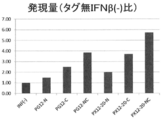
- the relative value when the expression level of untagged IFN ⁇ is 1 is shown.
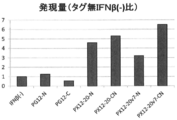
- the relative value when the expression level of untagged IFN ⁇ is 1 is shown.
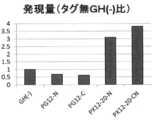
- the relative value when the expression level of untagged hGH is 1 is shown.
- the relative value when the expression level of untagged hGH is 1 is shown.
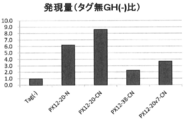
- the relative value when the expression level of untagged xylanase is 1 is shown.
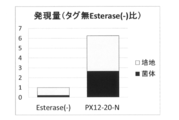
- the relative value when the expression level of untagged esterase is 1 is shown.
- the peptide of the present invention (also referred to as a peptide tag) has the following sequence.
- X m means that m Xs are consecutive, and m Xs in this case are the same amino acid residues selected from R, G, S, K, T, L, N, Q, and H. It may be a different amino acid residue.
- m is an integer of 0 to 5, preferably an integer of 1 to 5, more preferably an integer of 1 to 3.
- PY n means PY n , that is, n is 1, 2 or 3, and means that PY, PYY or PYYY continues q times (P indicates proline).
- PY, PYY, and PYYY may be continuous q times in total.
- each Y may be the same amino acid residue selected from R, G, S, K, T, L, N, and Q, or may be different amino acid residues, but q times
- At least one of Y included in consecutive PY n is K, L, N, Q, H, or R. More preferably, two or more of Y contained in q consecutive PY n are K, L, N, Q, H or R.
- q is an integer of 1 to 10, preferably an integer of 2 to 10, more preferably an integer of 2 to 5, and further preferably an integer of 2 to 3.
- PZ r means that after Z, there are r consecutive Z's, where r Z's are the same amino acid residues selected from R, G, S, K, T, L, N, Q There may be different amino acid residues.
- r is an integer of 0 to 10, preferably an integer of 1 to 10, more preferably an integer of 1 to 5.
- the peptide of the present invention is preferably 6 to 50 amino acids in length, more preferably 6 to 40 amino acids, still more preferably 8 to 40 amino acids, and even more preferably 10 to 30 amino acids. It is more preferably 12 to 25 amino acids, and particularly preferably 12 to 20 amino acids.
- the total content of glycine and serine with respect to all amino acids is preferably less than 60%, more preferably less than 57%.
- amino acids other than P 1 to several (eg, 1 to 6, preferably 2 to 6) amino acids are K, L, N or Peptides having an amino acid sequence substituted with Q can be mentioned.
- a peptide having an amino acid sequence in which one to several (for example, 1 to 5, preferably 2 to 5) amino acids other than P and R are substituted with R is exemplified. It is done.
- the amino acid substituted in PG12 or PG17 is more preferably an amino acid between P and P.
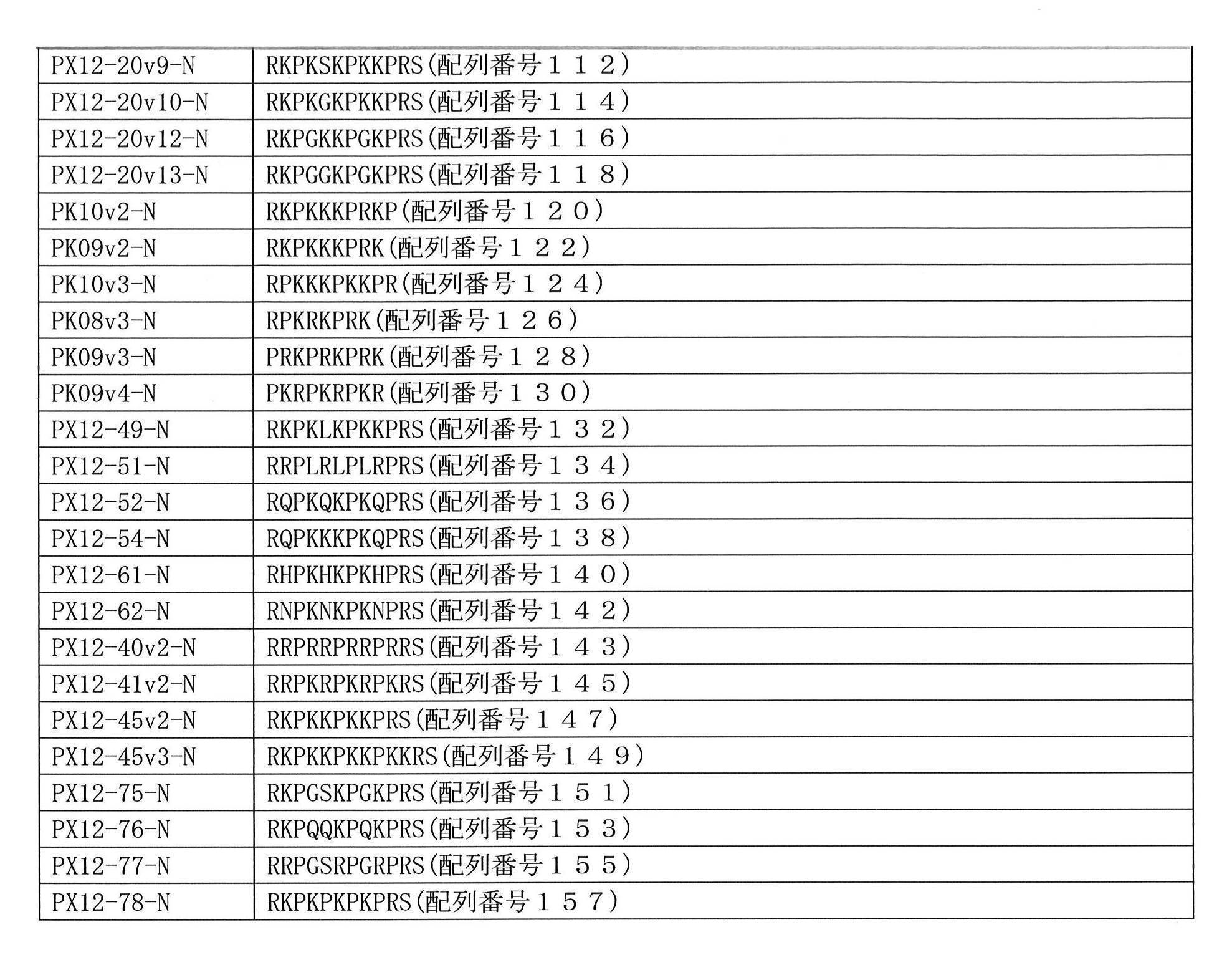
- the peptide of the present invention is preferably SEQ ID NO: 25, 28, 30, 32, 34, 36, 38, 40, 42, 44, 46, 48, 50, 52, 54, 58, 60, 64, 66, 92. , 94, 96, 98, 100, 102, 104, 106, 108, 110, 112, 114, 116, 118, 120, 122, 124, 126, 128, 130, 132, 134, 136, 140, 142, 143 , 145, 147, 149, 151, 153, 155, or 157.
- the tag-added protein of the present invention is a protein in which the peptide tag of the present invention is bound to the target protein (also called a fusion protein of the tag and the target protein).
- a peptide tag may be bound to the N-terminus of the target protein, a peptide tag may be bound to the C-terminus of the target protein, or a peptide tag may be bound to both the N-terminus and C-terminus of the target protein.
- the peptide tag may be directly bound to the N-terminus and / or C-terminus of the target protein, or may be bound via a sequence of 1 to several amino acids (eg, 1 to 5 amino acids).
- the sequence of 1 to several amino acids may be any sequence as long as it does not adversely affect the function and expression level of the tag-added protein.
- the peptide tag is used as a useful protein after being expressed and purified by using a protease recognition sequence. Can be separated from.
- the protease recognition sequence include factor Xa recognition sequence (IEGR: SEQ ID NO: 10).
- the tagged protein of the present invention may contain other tag sequences necessary for detection and purification, such as His tags, HN tags (for example, SEQ ID NO: 6), and FLAG tags.
- a growth factor, a hormone, a cytokine, a blood protein, an enzyme, an antigen, an antibody, a transcription factor, a receptor, fluorescent protein, or those partial peptides etc. are mentioned. It is done.
- Examples of the enzyme include lipase, protease, steroid synthase, kinase, phosphatase, xylanase, esterase, methylase, demethylase, oxidase, reductase, cellulase, aromatase, collagenase, transglutaminase, glycosidase and chitinase.
- growth factors examples include epidermal growth factor (EGF), insulin-like growth factor (IGF), transforming growth factor (TGF), nerve growth factor (NGF), brain-derived neurotrophic factor (BDNF), and vascular endothelial cell proliferation Factor (VEGF), granulocyte colony stimulating factor (G-CSF), granulocyte macrophage colony stimulating factor (GM-CSF), platelet derived growth factor (PDGF), erythropoietin (EPO), thrombopoietin (TPO), fibroblast proliferation Factor (FGF) and hepatocyte growth factor (HGF).
- EGF epidermal growth factor
- IGF insulin-like growth factor
- TGF nerve growth factor
- BDNF brain-derived neurotrophic factor
- VEGF vascular endothelial cell proliferation Factor
- G-CSF granulocyte colony stimulating factor
- GM-CSF granulocyte macrophage colony stimulating factor
- PDGF platelet derived growth factor
- EPO ery
- hormones include insulin, glucagon, somatostatin, growth hormone (eg, SEQ ID NO: 1), parathyroid hormone, prolactin, leptin, and calcitonin.
- cytokines examples include interleukin, interferon (IFN ⁇ , IFN ⁇ (for example, SEQ ID NO: 2), IFN ⁇ ), and tumor necrosis factor (TNF).
- IFN ⁇ interferon
- IFN ⁇ for example, SEQ ID NO: 2
- IFN ⁇ tumor necrosis factor
- TNF tumor necrosis factor
- blood proteins examples include thrombin, serum albumin, factor VII, factor VIII, factor IX, factor X, and tissue plasminogen activator.
- antibodies include complete antibodies, Fab, F (ab ′), F (ab ′) 2 , Fc, Fc fusion protein, heavy chain (H chain), light chain (L chain), single chain Fv (scFv) , Sc (Fv) 2 , disulfide bond Fv (sdFv), and Diabody.
- the antigenic protein used as a vaccine is not particularly limited as long as it can elicit an immune response, and may be appropriately selected according to the target of the assumed immune response.
- proteins derived from pathogenic bacteria and pathogenicity Examples include proteins derived from viruses.
- the tagging protein of the present invention may be added with a secretory signal peptide that functions in a host cell for secretory production.
- Secretion signal peptides include invertase secretion signal (for example, SEQ ID NO: 5), P3 secretion signal, ⁇ -factor secretion signal (SEQ ID NO: 168) and the like when yeast is used as the host, and PelB when E. coli is used as the host.
- a secretion signal may be mentioned.
- a P22 secretion signal may be mentioned.
- Solanaceae Solanaceae
- Rosaceae Rosaceae
- Cissicaceae plants belonging to the Asteraceae (Asteraceae)
- Nicotiana Nicotiana
- Arabidopsis Arabidopsis Secretion signal derived from plants belonging to the genus Strawberry, Fragaria , Lactuca, etc., preferably tobacco ( Nicotianatabacum ), Arabidopsis thaliana , Dutch strawberry ( Fragaria x ananassa ), lettuce ( Lactuca sativa ), etc. Is mentioned.
- the tag-added protein of the present invention may be added with a transport signal peptide such as an endoplasmic reticulum residual signal peptide or a vacuolar translocation signal peptide in order to be expressed in a specific cell compartment.
- a transport signal peptide such as an endoplasmic reticulum residual signal peptide or a vacuolar translocation signal peptide
- the tagged protein of the present invention can be synthesized chemically or can be produced by genetic engineering. A method for producing by genetic engineering will be described later.
- the DNA of the present invention is characterized in that it contains DNA encoding the tagged protein of the present invention. That is, the DNA of the present invention includes DNA encoding useful proteins and DNA encoding peptide tags. A DNA encoding a useful protein and a DNA encoding a peptide tag are linked together in a reading frame.
- a DNA encoding a useful protein can be obtained, for example, by a general genetic engineering technique based on a known base sequence. Further, in the DNA encoding the tagged protein of the present invention, the codon indicating the amino acid constituting the tagged protein is appropriately modified so that the translation amount of the hybrid protein increases according to the host cell that produces the protein. It is also preferable. As a codon modification method, for example, the method of Kang et al. (2004) can be referred to. In addition, a method of selecting a codon frequently used in the host cell, selecting a codon having a high GC content, or selecting a codon frequently used in the housekeeping gene of the host cell can be mentioned.
- the DNA of the present invention may contain an enhancer sequence that functions in a host cell in order to improve expression in the host cell.
- Enhancers include the Kozak sequence and the 5'-untranslated region of a plant-derived alcohol dehydrogenase gene.
- the DNA of the present invention can be prepared by a general genetic engineering technique.
- the DNA encoding the peptide tag of the present invention and the DNA encoding a useful protein are linked using PCR, DNA ligase or the like. Can be built.
- the recombinant vector of the present invention only needs to be inserted into the vector so that the DNA encoding the tagged protein can be expressed in the host cell into which the vector is introduced.
- the vector is not particularly limited as long as it can replicate in the host cell, and examples thereof include plasmid DNA and viral DNA.
- the vector preferably contains a selection marker such as a drug resistance gene.
- Specific plasmid vectors include, for example, pTrcHis2 vector, pUC119, pBR322, pBluescript II KS +, pYES2, pAUR123, pQE-Tri, pET, pGEM-3Z, pGEX, pMAL, pRI909, pRI910, pBI221, pBI121, pBI101, pIG121Hm, Examples include pTrc99A, pKK223, pA1-11, pXT1, pRc / CMV, pRc / RSV, pcDNA I / Neo, p3 ⁇ FLAG-CMV-14, pCAT3, pcDNA3.1, and pCMV.
- pTrcHis2 vector pUC119, pBR322, pBluescript II KS +, pYES2, pAUR123, pQE-Tri, pET, pGEM-3Z,
- the promoter used in the vector can be appropriately selected depending on the host cell into which the vector is introduced. For example, when expressed in yeast, GAL1 promoter, PGK1 promoter, TEF1 promoter, ADH1 promoter, TPI1 promoter, PYK1 promoter, etc. can be used. When expressed in plants, cauliflower mosaic virus 35S promoter, rice actin promoter, maize ubiquitin promoter, lettuce ubiquitin promoter, and the like can be used. Examples of expression in E. coli include T7 promoter, and examples of expression in Brevibacillus include P2 promoter and P22 promoter. Inducible promoters may be used.
- trc which are IPTG-inducible promoters, IAA-inducible trp, L-arabinose-inducible ara, tetracycline-inducible Pzt-1, P L promoter inducible at high temperature (42 ° C.), promoter of cspA gene which is one of cold shock genes, and the like can be used. Further, if necessary, a terminator sequence can be included depending on the host cell.
- the recombinant vector of the present invention can be produced, for example, by cleaving a DNA construct with an appropriate restriction enzyme or adding a restriction enzyme site by PCR and inserting it into a restriction enzyme site or a multicloning site of the vector.
- the transformant of the present invention is characterized by being transformed with the DNA or a recombinant vector containing the DNA.
- the host cell used for transformation may be a eukaryotic cell or a prokaryotic cell, but a eukaryotic cell is preferred.
- eukaryotic cells yeast cells, mammalian cells, plant cells, insect cells and the like are preferably used. Examples of yeast include Saccharomyces cerevisiae , Candida utilis , Schizosaccharomyces pombe , and Pichia pastoris . Furthermore, microorganisms such as Aspergillus can also be used.
- the prokaryotic cells include E.
- plant cells include cells of plants belonging to the genus Lactuca (Astaraceae), solanaceae (Solanaceae), Brassicaceae (Rosaceae), Rosaceae (Chenopodiaceae), etc. .
- the transformant used in the present invention can be prepared by introducing the recombinant vector of the present invention into a host cell using a general genetic engineering technique.
- electroporation method (Tada, et al., 1990, Theor. Appl. Genet, 80: 475), protoplast method (Gene, 39, 281-286 (1985)), polyethylene glycol method (Lazzeri, et al. , 1991, Theor. Appl. Genet. 81: 437), introduction method using Agrobacterium (Hood, et al., 1993, Transgenic, Res. 2: 218, Hiei, et al., 1994 Plant J. 6 : 271), particle gun method (Sanford, et al., 1987, J.
- the gene expression may be transient expression or stable expression integrated into a chromosome.
- a transformant After introducing the recombinant vector of the present invention into a host cell, a transformant can be selected according to the phenotype of the selection marker. Moreover, the tagged protein can be produced by culturing the selected transformant. The medium and conditions used for the culture can be appropriately selected according to the species of the transformant.
- the host cell is a plant cell
- the plant body can be regenerated by culturing the selected plant cell according to a conventional method, and the tagged protein is accumulated in the plant cell or outside the cell membrane of the plant cell. Can be made.
- the protein to which the peptide tag of the present invention accumulated in the medium or cells is added can be separated and purified according to methods well known to those skilled in the art. For example, known appropriate methods such as salting out, ethanol precipitation, ultrafiltration, gel filtration chromatography, ion exchange column chromatography, affinity chromatography, medium to high pressure liquid chromatography, reverse phase chromatography, hydrophobic chromatography, etc. , Or a combination thereof can be separated and purified.
- Yeast invertase SUC2 signal peptide SUC2SP, SEQ ID NO: 5, Hashimoto et al., Protein Engineering, 1998 2; 75-77
- 6 ⁇ HN tag SEQ ID NO: 6
- an artificially synthesized DNA (SEQ ID NO: 7) in which a DNA sequence encoding SUC2SP and a 6 ⁇ HN tag is added to the 5 ′ end of a multicloning site consisting of NotI, SalI, SfiI, XhoI, AscI recognition sequences, pYES2
- the plasmid 3 for yeast expression was prepared by inserting into the HindIII-XbaI site of (Invitrogen).
- a plasmid for expressing hGH or IFN ⁇ with various tags (Table 1) added to the N or C terminus or both N and C terminus was constructed in the following procedure (FIG. 1).
- PCR was performed using a combination of the template plasmid, forward primer, and reverse primer shown in Table 2.
- a homologous sequence with plasmid 3 was added to the 5 ′ end of each primer.
- PCR using KOD-PLUS-Ver.2 (Toyobo), 2 pg / ⁇ l template plasmid, 0.3 ⁇ M forward primer, 0.3 ⁇ M reverse primer, 0.2 mM dNTPs, 1 ⁇ Buffer for KOD-Plus-Ver.2, 1.5 mM
- the obtained amplified fragment was purified by QIAquick PCR Purification Kit (QIAGEN). Plasmid 3 was digested with NotI and AscI, separated by electrophoresis using 0.8% SeaKem GTG Agarose (Lonza), and extracted from the gel using QIAquick Gel Extraction Kit (QIAGEN). About 50 ng of the extracted plasmid 3 and 2 ⁇ l of the purified PCR product are mixed to adjust the volume to 5 ⁇ l, and then mixed with 5 ⁇ l of 2 ⁇ Enzyme Mix attached to Gene Art Seamless PLUS Cloning and Assembly Kit (Applied Biosystem). The mixture was allowed to stand at room temperature for 30 minutes and then left on ice for 5 minutes.
- Colonies were transferred to 2 x YT liquid medium (16 g / l Bacto tryptone, 10 g / l Bacto Yeast Extract, 5 g / l NaCl) containing 100 mg / l ampicillin and cultured overnight at 37 ° C and 200 rpm. Thereafter, the plasmid was extracted, and after confirming the nucleotide sequence, it was used for yeast transformation.
- 2 x YT liquid medium (16 g / l Bacto tryptone, 10 g / l Bacto Yeast Extract, 5 g / l NaCl
- Yeast Transformation Yeast Saccharomyces cerevisiae INVSc1, Invitrogen was shaken and cultured overnight at 30 ° C. and 200 rpm in YPD medium (1% yeast extract, 2% peptone, 2% dextrose (D-glucose)). After diluting in 10 ml of YPD so that the turbidity (OD 600 ) at a wavelength of 600 nm was 0.2-0.4, shaking culture was performed at 30 ° C. and 200 rpm until the OD 600 became 0.6-1.0. Centrifuge at 500 xg for 5 minutes at room temperature to pellet the cells and discard the supernatant. The pellet was then suspended in 10 ml of Solution I (S. c.
- SC-Ura medium (6.7 g / L yeast nitrogen base, 0.1 g / L adenine, 0.1 g / L arginine, 0.1 g / L cysteine, 0.1 g) containing 2% glucose and 2% Bacto Agar.
- the turbidity is measured with a spectrophotometer 600nm, and when resuspended in 3ml medium, the necessary amount of the culture that has a turbidity of 0.4 is dispensed into a sterilized 1.5ml Eppendorf tube, and then 3,000x After centrifuging at 4 ° C for 5 minutes and removing the supernatant, the precipitate was suspended in 1 ml induction medium (SC-Ura, 1% galactose, 1% raffinose), and sterilized with 2 ml of induction medium dispensed in advance.
- SC-Ura 1 ml induction medium
- shaking culture was performed at 30 ° C., 200 rpm for 24 hours. After completion of the culture, 400 ⁇ l of the culture solution is taken into a 1.5 ml Eppendorf tube, centrifuged at 3,000 ⁇ g, 4 ° C. for 5 minutes, the supernatant is removed, frozen in liquid nitrogen, and then at ⁇ 80 ° C. in a deep freezer. saved.
- a plasmid for expressing hGH or IFN ⁇ with various tags added to the N or C terminus or both N and C terminus in E. coli was constructed by the following procedure (FIG. 2).
- PCR was performed using a combination of the template plasmid, forward primer, and reverse primer shown in Table 3.
- a homologous sequence with plasmid 4 was added to the 5 ′ end of each primer.
- PCR using KOD-PLUS-Ver.2 (Toyobo), 2 pg / ⁇ l template plasmid, 0.3 ⁇ M forward primer, 0.3 ⁇ M reverse primer, 0.2 mM dNTPs, 1 ⁇ Buffer for KOD-Plus-Ver.2, 1.5 mM
- the obtained amplified fragment was purified by QIAquick PCR Purification Kit (QIAGEN). Plasmid 4 was digested with NotI and AscI, separated by electrophoresis using 0.8% SeaKem GTG Agarose (Lonza), and extracted from the gel using QIAquick Gel Extraction Kit (QIAGEN). About 50 ng of the extracted plasmid 4 and 2 ⁇ l of the purified PCR product are mixed to adjust the volume to 5 ⁇ l, and then mixed with 5 ⁇ l of 2 ⁇ Enzyme Mix attached to Gene Art Seamless PLUS Cloning and Assembly Kit (Applied Biosystem). The mixture was allowed to stand at room temperature for 30 minutes and then left on ice for 5 minutes.
- Colonies were transferred to 2 x YT liquid medium (16 g / l Bacto tryptone, 10 g / l Bacto Yeast Extract, 5 g / l NaCl) containing 100 mg / l ampicillin and cultured overnight at 37 ° C and 200 rpm. Thereafter, the plasmid was extracted, and after confirming the base sequence, it was used for transformation of E. coli for protein expression.
- 2 YT liquid medium (16 g / l Bacto tryptone, 10 g / l Bacto Yeast Extract, 5 g / l NaCl
- 0.2 ml of the above pre-cultured solution was inoculated into a sterile Erlenmeyer flask containing 100 ml SOB medium, followed by shaking culture at 30 ° C. and 200 rpm.
- the turbidity (OD600) at a wavelength of 600 nm reached 0.4-0.6, the culture was stopped by cooling with ice for 10-30 minutes.
- the culture was transferred to a 50 ml conical tube and centrifuged at 2,500 xg, 4 ° C for 10 minutes (x2).
- the supernatant was discarded, and the ice-cold 15 ml TB (10 mM PIPES-KOH, pH 6.7, 15 mM CaCl 2 , 0.25 M KCl, 55 mM MnCl 2 ) was added and gently suspended ( ⁇ 2) .
- Two suspensions were combined into one and centrifuged at 2,500 ⁇ g, 4 ° C. for 10 minutes.
- the supernatant was discarded, and the pellet was gently suspended by adding ice-cold 10 ml TB.
- 700 ⁇ l of DMSO was added and suspended while cooling with ice.
- the obtained competent cells were thawed on ice, and 1 ng of the peptide-tagged protein expression plasmid for E. coli prepared above was added, and then gently mixed and allowed to stand on ice for 30 minutes. After treatment at 42 ° C. for 30-45 seconds (heat shock), the mixture was allowed to stand on ice for 2 min. After adding 250 ⁇ l of SOC, the tube was leveled and shaken at 37 ° C., 200 rpm for 1 hour. 50 ⁇ l of the shake product was applied to a 2 ⁇ YT agar medium containing 100 mg / l ampicillin, and then statically cultured at 37 ° C. overnight to obtain transformed colonies.
- LB medium 100 ppm Ampicillin
- PCR using KOD-PLUS-Ver.2 (Toyobo), 2 pg / ⁇ l template plasmid, 0.3 ⁇ M forward primer, 0.3 ⁇ M reverse primer, 0.2 mM dNTPs, 1 ⁇ Buffer for KOD-Plus-Ver.2, 1.5 mM
- the obtained amplified fragment was purified by QIAquick PCR Purification Kit (QIAGEN). Plasmid construction and transformation by homologous recombination were performed as follows. 100 ng of Brevibacillus expression plasmid pBIC3 (attached to the kit) and the purified PCR product were mixed at a molar ratio of about 1: 2, and adjusted to 5 ⁇ l with sterile water. Brevibacillus choshinensis SP3 Competent Cell (Takara Bio) is allowed to stand still in a 37 ° C heat block for 30 seconds and rapidly thawed.
- Culture medium is MTNm plate (10 g / L glucose, 10 g / L phyton peptone, 5 g / L Erlich skipjack extract, 2 g / L powdered yeast extract S, 10 mg / L FeSO 4 ⁇ 7H 2 O, 10 mg / L MnSO 4 ⁇ 4H 2 O, 1 mg / L ZnSO 4 ⁇ 7H 2 O, 20 mM MgCl 2 , 1.5% Bacto Agar, 50 ⁇ g / mL neomycin, pH 7.0) and stand overnight at 37 ° C Incubated. The obtained clones were confirmed by Western analysis of colonies to confirm the expression of the target protein.
- TMNm medium (10 g / L glucose, 10 g / L phyton peptone, 5 g / L El Eirich bonito extract, 2 g / L powder yeast extract S, 10 mg / L FeSO 4 ⁇ 7H 2 O, 10 mg / L MnSO 4 ⁇ 4H 2 O, 1 mg / L ZnSO 4 ⁇ 7H 2 O, 50 ⁇ g / mL Neomycin, pH 7.0
- TMNm medium 10 g / L glucose, 10 g / L phyton peptone, 5 g / L El Eirich bonito extract, 2 g / L powder yeast extract S, 10 mg / L FeSO 4 ⁇ 7H 2 O, 10 mg / L MnSO 4 ⁇ 4H 2 O, 1 mg / L ZnSO 4 ⁇ 7H 2 O, 50 ⁇ g / mL Neomycin, pH 7.0
- plasmid 6 was obtained by inserting an artificially synthesized DNA (SEQ ID NO: 186) encoding an esterase derived from Bacillus subtilis (EstA, SEQ ID NO: 185) into the EcoRV recognition site of pUC19-modified plasmid pUCFa (Fasmac).
- SEQ ID NO: 186 an artificially synthesized DNA
- EstA an esterase derived from Bacillus subtilis
- PCR was performed using a combination of template plasmid, forward primer and reverse primer shown in Table 3. A homologous sequence with plasmid 7 was added to the 5 ′ end of each primer.
- the forward primer was designed so that two amino acid residues AD were added following the signal peptide.
- PCR using KOD-PLUS-Ver.2 (Toyobo), 2 pg / ⁇ l template plasmid, 0.3 ⁇ M forward primer, 0.3 ⁇ M reverse primer, 0.2 mM dNTPs, 1 ⁇ Buffer for KOD-Plus-Ver.2, 1.5 mM
- the obtained amplified fragment was purified by QIAquick PCR Purification Kit.
- Plasmid 7 was digested with NcoI and NdeI, separated by electrophoresis using 0.8% SeaKem GTG Agarose, and extracted from the gel using QIAquick Gel Extraction Kit.
- Approximately 50 ng of the extracted plasmid 7 and 2 ⁇ l of the purified PCR product are mixed to adjust the volume to 5 ⁇ l, and then mixed with 5 ⁇ l of 2 ⁇ Enzyme Mix supplied with Gene Art Seamless PLUS Cloning and Assembly Kit. The mixture was allowed to stand for 5 minutes, and then left on ice for 5 minutes.
- Brevibacillus choshinensis SP3 competent cells are left to stand in a 37 ° C heat block for 30 seconds, rapidly thawed, centrifuged (12,000 rpm, room temperature, 1 minute), supernatant removed, 1 ⁇ l and 50 ⁇ l Solution A of the above plasmid solution The total amount of the mixture was added, and the competent cell pellet was completely suspended by vortexing and allowed to stand for 5 minutes.
- xylanase and esterase 200 ⁇ l of the preculture was inoculated into 3 ml TMNm medium and cultured with shaking at 30 ° C. and 120 rpm. After 48 hours, the culture containing the cells was sampled. The culture solution was divided into 100 ⁇ l aliquots, separated into culture supernatant and cells by centrifugation (20,000 ⁇ g, 4 ° C., 10 minutes), and 50 ⁇ l of the culture supernatant and the total amount of the cells were stored at ⁇ 80 ° C.
- PCR was performed using a combination of the template plasmid, forward primer, and reverse primer shown in Table 3. A homologous sequence with plasmid 8 was added to the 5 ′ end of each primer.
- Plasmid 8 was digested with XhoI and NotI, separated by electrophoresis using 0.8% SeaKem GTG Agarose, and extracted from the gel using QIAquick Gel Extraction Kit. About 50 ng of extracted plasmid 8 and 2 ⁇ l of purified PCR product are mixed to adjust the volume to 5 ⁇ l, then mixed with 5 ⁇ l of 2 ⁇ Enzyme Mix attached to Gene Art Seamless PLUS Cloning and Assembly Kit, and mixed at room temperature for 30 ⁇ l. The mixture was allowed to stand for 5 minutes, and then left on ice for 5 minutes. 5 ⁇ l of the reaction mixture was mixed with competent cell DH10B T1 SA, allowed to stand on ice for 30 minutes, then warmed at 37 ° C.
- the plasmid was linearized by cutting with SacI, the protein was removed by phenol / chloroform extraction, ethanol precipitation, drying, dissolution in TE buffer, and use for transformation of Pichia yeast.
- Pichia yeast Pichia pastoris PPS-9010 was cultured with shaking in YPD medium at 30 ° C. and 200 rpm overnight.
- the above culture solution was added to an Erlenmeyer flask containing 100 ml of YPD medium so that OD 600 was 0.2-0.4, and shaking culture was performed at 30 ° C. and 200 rpm until OD 600 was 0.8-1.0.
- the mixture was centrifuged at 500 ⁇ g for 5 minutes at room temperature, and the supernatant was discarded to obtain a cell pellet.
- BEDS solution (10 mM Bicine, 3% (v / v) Ethylene glycol, 5% (v / v) Dimethyl sulfoxide, 1 M Sorbitol) and 2 ml of ice-cooled 1 M Dithiothreitol on ice. After addition and suspension, the mixture was incubated at 30 ° C. and 100 rpm for 5 minutes. Further, centrifugation was performed at 500 ⁇ g for 5 minutes at room temperature, and the supernatant was discarded to obtain a cell pellet. 2 ml of BEDS solution was added to the pellet, and after suspension, 40 ⁇ l was dispensed to make a competent cell.
- BMMY medium 1% Bacto Yeast Extract, 2% Bacto peptone, 0.1 M potassium phosphate buffer (pH 6.0), 1.34% Yeast nitrogen base with ammonium sulfate without amino acids, 0.4 mg / L Biotin, 0.5%
- BMMY medium 1% Bacto Yeast Extract, 2% Bacto peptone, 0.1 M potassium phosphate buffer (pH 6.0), 1.34% Yeast nitrogen base with ammonium sulfate without amino acids, 0.4 mg / L Biotin, 0.5%
- the whole amount was mixed with 2 ml of BMMY medium prepared in advance in a sterile 14 ml tube, followed by shaking culture at 30 ° C., 200 rpm for 72 hours. After completion of the culture, 100 ⁇ l of the culture solution is dispensed into a microtube, centrifuged at 15,000 ⁇ g, 4 ° C.
- the culture supernatant and the cell pellet were frozen in liquid nitrogen and stored at ⁇ 80 ° C. in a deep freezer.
- An electrophoresis buffer (Tris / Glycine / SDS Buffer, BIO RAD) was placed in the electrophoresis tank, and 4 ⁇ l of the SDS-converted sample was applied to the well, followed by electrophoresis at 200 V constant voltage for 40 minutes.
- the gel after electrophoresis was blotted with a transblot Turbo (BIO RAD) using a transblot transcription pack (BIO RAD).
- the membrane after blotting is immersed in a blocking solution (TBS system, pH 7.2, Nacalai Tesque), shaken at room temperature for 1 hour or allowed to stand at 4 ° C.
- TBS-T 137 mM sodium chloride, 2.68 mM potassium chloride, In 1% polyoxyethylene sorbitan monolaurate, 25 mM Tris-HCl, pH 7.4
- EPR11047 (B)] abcam
- IFN ⁇ antiserum Mouse-monoclonal Anti-HumanIFN ⁇ antibody
- antiserum Rat-monoclonal Anti-HA antibody (Roche) was diluted 6000 times with TBS-T and used. The membrane was immersed in the diluted antibody and shaken at room temperature for 1 hour to carry out an antigen-antibody reaction, followed by washing in TBS-T by shaking at room temperature for 5 minutes 3 times.
- Secondary antibodies include Anti-Rabbit IgG and AP-linked Antibody (Cell Signaling TECHNOLOGY) diluted 2,000-fold with TBS-T for hGH detection, and Anti-Mouse IgG and AP- for IFN ⁇ detection. linked Antibody (Cell Signaling TECHNOLOGY) was used.
- Anti-Rat IgG AP-linked Antibody (EDM Millipore Corp.) diluted 6,000 times with TBS-T was used.
- the membrane was immersed in the secondary antibody diluent, and the antigen-antibody reaction was performed by shaking at room temperature for 1 hour, followed by washing in TBS-T by shaking at room temperature for 5 minutes three times.
- the color development reaction with alkaline phosphatase was carried out using a chromogenic solution (0.1 M sodium chloride, 5 mM magnesium chloride, 0.33 mg / ml nitroblue tetrazolium, 0.33 mg / ml 5-bromo-4-chloro-3-indolyl-phosphate, 0.1 M Tris
- a chromogenic solution 0.1 M sodium chloride, 5 mM magnesium chloride, 0.33 mg / ml nitroblue tetrazolium, 0.33 mg / ml 5-bromo-4-chloro-3-indolyl-phosphate, 0.1 M Tris
- the membrane was immersed in HCl, pH 9.5, and shaken at room temperature for 15 minutes. The membrane was washed with distilled water and then dried at room temperature.
- the developed membrane was imaged with a scanner (PM-A900, Epson) at a resolution of 600 dpi, and hGH or IFN ⁇ protein was quantified
- Green fluorescent protein (GFP, amino acid sequence: SEQ ID NO: 175, DNA base sequence: SEQ ID NO: 176) derived from Aequorea jellyfish was used as a protein to which a peptide tag was added.
- Forward primer (pENTR1A-1 (SEQ ID NO: 177) ... for tagless use, pENTR1A-2 (SEQ ID NO: 178) ⁇
- Various peptide tags placed on the N-terminal side of the GFP protein and Flag tag on the C-terminal side ⁇ ⁇
- For PG12 tag pENTR1A-3 (SEQ ID NO: 179) ... for PX12-20 tag
- pENTR1A-4 (SEQ ID NO: 180) ...
- PCR reaction was performed with the set of (SEQ ID NO: 181) to prepare a DNA fragment for cloning.
- the prepared DNA fragment was cloned into pENTR 1A (ThermoFisher Scientific) to construct a plasmid having DNA fragments encoding various peptide tags-GFP-Flag tags.
- DNAs encoding various peptide tags-GFP-Flag tags were inserted into the donor vector pFastbac (ThermoFisher Scientific) using LR reaction.
- the collected cell fraction was suspended in 200 ⁇ l of 20 mM Tris-HCl (pH 7.4), 20 mM NaCl, 3 mM MgCl 2 solution and sonicated, and then the supernatant was collected by centrifugation. Added to. The fluorescence intensity was measured at an excitation wavelength of 395 nm and a measurement wavelength of 509 nm. Various peptide tag-GFP-Flag tag protein fluorescence intensity divided by the number of cells was compared to determine the effect of improving the protein expression level of various peptide tags.
- the peptide tag of the present invention is useful in fields such as genetic engineering and protein engineering, and the protein to which the peptide tag of the present invention is added is useful in fields such as medicine, research, food, and livestock.
Landscapes
- Chemical & Material Sciences (AREA)
- Health & Medical Sciences (AREA)
- Life Sciences & Earth Sciences (AREA)
- Organic Chemistry (AREA)
- Genetics & Genomics (AREA)
- Zoology (AREA)
- Engineering & Computer Science (AREA)
- Biochemistry (AREA)
- Molecular Biology (AREA)
- General Health & Medical Sciences (AREA)
- Wood Science & Technology (AREA)
- Biophysics (AREA)
- Medicinal Chemistry (AREA)
- Bioinformatics & Cheminformatics (AREA)
- Proteomics, Peptides & Aminoacids (AREA)
- Biotechnology (AREA)
- General Engineering & Computer Science (AREA)
- Biomedical Technology (AREA)
- Microbiology (AREA)
- Gastroenterology & Hepatology (AREA)
- Toxicology (AREA)
- Physics & Mathematics (AREA)
- Chemical Kinetics & Catalysis (AREA)
- Plant Pathology (AREA)
- General Chemical & Material Sciences (AREA)
- Tropical Medicine & Parasitology (AREA)
- Analytical Chemistry (AREA)
- Mycology (AREA)
- Cell Biology (AREA)
- Endocrinology (AREA)
- Insects & Arthropods (AREA)
- Immunology (AREA)
- Peptides Or Proteins (AREA)
- Micro-Organisms Or Cultivation Processes Thereof (AREA)
- Enzymes And Modification Thereof (AREA)
- Preparation Of Compounds By Using Micro-Organisms (AREA)
Abstract
Description
[1]下記の配列を有するペプチド。
Xm(PYn)qPZr
ここで、X、YおよびZはそれぞれアルギニン(R)、グリシン(G)、セリン(S)、リジン(K)、トレオニン(T)、ロイシン(L)、アスパラギン(N)、グルタミン(Q)、ヒスチジン(H)から独立して選択されるアミノ酸残基であって、Yのうち少なくとも1つはK、L、N、Q、HまたはRを含む。
mは0~5の整数であり、nは1、2または3(好ましくはnは2または3)であり、qは1~10の整数であり、r=0~10の整数である。
[2]GとSの含有率が60%未満である、[1]に記載のペプチド。
[3]長さが6~50アミノ酸である、[1]または[2]に記載のペプチド。
[4]配列番号25,28,30,32,34,36,38,40,42,44,46,48,50,52,54,58,60,64,66,92,94,96,98,100,
102,104,106,108,110,112,114,116,118,120,122,124,126,128,130,132,134,136,140,142,143,145,147,149,151,153,155,または157のアミノ酸列を有する、[1]~[3]のいずれかに記載のペプチド。
[5][1]~[4]のいずれかに記載のペプチドと、有用タンパク質と、を含むタグ付加タンパク質。
[6]有用タンパク質がヒト成長ホルモン、インターフェロンβ、キシラナーゼ、エステラーゼ、または緑色蛍光タンパク質(GFP)である、である、[5]に記載のタグ付加タンパク質。
[7]前記ペプチドと、前記有用タンパク質がプロテアーゼ認識配列を介して連結されている、[5]または[6]に記載のタグ付加タンパク質。
[8]分泌シグナルを含む、[5]~[7]のいずれかに記載のタグ付加タンパク質。
[9][5]~[8]のいずれかに記載のタグ付加タンパク質をコードするDNA。
[10][9]に記載のDNAを含む組換えベクター。
[11][9]に記載のDNAまたは[10]に記載の組換えベクターで形質転換された形質転換体。
[12]形質転換体が、酵母、大腸菌、ブレビバチルス、昆虫細胞または哺乳動物細胞(ヒト培養細胞を含むがヒト個体は含まない)である、[11]に記載の形質転換体。
[13][11]または[12]に記載の形質転換体を培養してタグ付加タンパク質を蓄積させ、タグ付加タンパク質を回収することを特徴とする、タグ付加タンパク質の製造方法。
Xm(PYn)qPZr
ここで、それぞれのYはR、G、S、K、T、L、N、Qから選択される同じアミノ酸残基であってもよいし、異なるアミノ酸残基であってもよいが、q回連続するPYnに含まれるYのうち、少なくとも1つはK、L、N、Q、HまたはRである。q回連続するPYnに含まれるYのうち、2つ以上がK、L、N、Q、HまたはRであることがより好ましい。qは1~10の整数であり、好ましくは2~10の整数、より好ましくは2~5の整数、さらに好ましくは2~3の整数である。
また、本発明のタグ付加タンパク質をコードするDNAは、該タンパク質を生産させる宿主細胞に応じて、ハイブリッドタンパク質の翻訳量が増大するように、タグ付加タンパク質を構成するアミノ酸を示すコドンが適宜改変されていることも好ましい。コドン改変の方法としては、例えばKang et al. (2004)の方法を参考にすることができる。また、宿主細胞において使用頻度の高いコドンを選択したり、GC含量が高いコドンを選択したり、宿主細胞のハウスキーピング遺伝子において使用頻度の高いコドンを選択したりする方法が挙げられる。
また、必要に応じ、ターミネーター配列も宿主細胞に応じて含めることができる。
真核細胞としては、酵母細胞、哺乳動物細胞、植物細胞、昆虫細胞などが好ましく用いられる。酵母としては、Saccharomyces cerevisiaeやCandida utilisやSchizosaccharomyces pombe、Pichia pastorisなどが挙げられる。さらに、麹菌(Aspergillus)等の微生物を用いることもできる。原核細胞としては、大腸菌(Escherichia coli)、乳酸菌(Lactobacillus)、枯草菌(Bacillus)、ブレビバチルス(Brevibacillus)、アグロバクテリウム(Agrobacterium tumefaciens)、放線菌などが挙げられる。植物細胞としては、アキノノゲシ属(Lactuca)などのキク科(Astaraceae)、ナス科(Solanaceae)、アブラナ科(Brassicaceae)、バラ科(Rosaceae)、アカザ科(Chenopodiaceae)に属する植物の細胞などが挙げられる。
また、宿主細胞が植物細胞の場合には、選抜した植物細胞を常法に従って培養することにより、植物体を再生することができ、植物細胞内又は植物細胞の細胞膜外に前記タグ付加タンパク質を蓄積させることができる。
ペプチドタグを付加するタンパク質として、1)ヒト成長ホルモン(hGH、配列番号1)、2)ヒトインターフェロンβ-1b(IFNβ、配列番号2)を用いた。hGHをコードする人工合成DNA(配列番号3)をpUC19改変プラスミドpTRU5(ファスマック)のEcoRV認識部位に挿入し、プラスミド1を得た。IFNβをコードする人工合成DNA(配列番号4)をpUC19改変プラスミドpTRU5のEcoRV認識部位に挿入しプラスミド2を得た。
まず、hGHまたはIFNβのNまたはC末端またはN、C両末端に各種タグを付加するために、表2に示した鋳型プラスミド、フォワードプライマー、リバースプライマーの組み合わせによるPCRを実施した。各プライマーの5’末端にはプラスミド3との相同配列を付加した。PCRはKOD-PLUS-Ver.2(東洋紡)を用い、2 pg/μl 鋳型プラスミド、0.3 μM フォワードプライマー、0.3 μM リバースプライマー、0.2 mM dNTPs、1×Buffer for KOD-Plus-Ver.2、1.5 mM MgSO4、0.02 U/μl KOD-PLUS-Ver.2 となるように50 μl反応液を調製し、94℃、5分間加熱した後、98℃、10秒間、60℃、 30秒間、68℃, 40秒間の加熱処理を25サイクル行い、最後に68℃で5分間加熱した。得られた増幅断片はQIAquick PCR Purification Kit(QIAGEN)で精製した。プラスミド3はNotI、AscIで消化後、0.8% SeaKem GTG Agarose(Lonza)を用いた電気泳動により分離し、QIAquick Gel Extraction Kit(QIAGEN)を用いゲルから抽出した。約50 ng分の抽出したプラスミド3と精製PCR産物2 μlを混合し液量を5 μlに調整後、Gene Art Seamless PLUS Cloning and Assembly Kit(Applied Biosystem)添付の2×Enzyme Mix 5 μlと混合し、室温で30分間静置、その後5分間氷上に静置した。反応液5 μlを上記キット添付のコンピテントセルDH10B T1 SAと混合し氷上で30分間静置後、37℃で10分間加温し、氷上で2分間静置後、SOCを250 μl添加し、37℃、200 rpmで1時間振盪した。その後、振盪物の50μlを100 mg/lアンピシリンを含む2×YT寒天培地(16 g/l Bacto tryptone、10 g/l Bacto Yeast Extract、5 g/l NaCl、15 g/l Bacto Agar)に塗布後、37℃で一晩静置培養し、形質転換コロニーを得た。コロニーを100 mg/lアンピシリンを含む2×YT液体培地(16 g/l Bacto tryptone、10 g/l Bacto Yeast Extract、5 g/l NaCl)に移植し、37℃、200 rpmで一晩振盪培養後、プラスミドを抽出し、塩基配列を確認後、酵母の形質転換に用いた。
酵母(Saccharomyces cerevisiaeINVSc1、Invitrogen)をYPD培地(1% yeast extract, 2% peptone, 2% dextrose (D-glucose))で30℃、200rpmで一晩振盪培養した。10 mlのYPD 中に波長600 nmでの濁度(OD600)が0.2-0.4になるように希釈した後、OD600が0.6-1.0になるまで30℃、200 rpmで振盪培養した。500 x g、室温で5 分間遠心し、細胞をペレットにし、上清を捨てた。次にペレットを10 ml のSolution I(S. c. EasyComp Transformation Kit、Invitrogen)に懸濁した。さらに、500 x g、室温で5 分間遠心し、細胞をペレットにし、上清を捨てた。次にペレットを1 mlのSolutionII(S. c. EasyComp Transformation Kit、Invitrogen)に懸濁し、50 μl ずつ分注し、コンピテントセルとした。使用するまで-80℃のディープフリーザーに保管した。
得られたコンピテントセルを融解して室温に戻し、上記で作製したペプチドタグ付加タンパク質発現用プラスミドを1 μg添加した後、500 μlのSolutionIII(室温)を添加しボルテックスした後、30℃にて1時間静置した(15分ごとにボルテックスを行った)。さらに上記静置物50μlを、2% glucoseおよび2% Bacto Agar を含むSC-Ura培地 (6.7 g/L yeast nitrogen base, 0.1 g/L adenine, 0.1 g/L arginine, 0.1 g/L cysteine, 0.1 g/L leucine, 0.1 g/L lysine, 0.1 g/L threonine, 0.1 g/L tryptophan, 0.05 g/L aspartic acid, 0.05 g/L histidine, 0.05 g/L isoleucine, 0.05 g/L methionine, 0.05 g/L phenylalanine, 0.05 g/L proline, 0.05 g/L serine, 0.05 g/L tyrosine, 0.05 g/L valine)に塗布後、30℃で2-3日静置培養し、形質転換コロニーを得た。
形質転換後のシングルコロニーをプレート培地(SC-Ura, 2% dextrose)に塗株し、30℃、24時間インキュベーター中に静置し培養を行った。次に、培養後のプレート培地より1μl滅菌ディスポループで菌体をかきとり、3ml前培養培地(SC-Ura, 2% galactose)を分注した滅菌ポリスチレン製14mlチューブに植菌し、30℃、200rpm、16時間振盪培養を行った。培養終了後、分光光度計600nmにて濁度を測定し、3ml培地に再懸濁した場合に濁度が0.4になる必要量の培養物を滅菌済1.5mlエッペンドルフチューブに分取後、3,000×g、4℃、5分間遠心分離を行い、上清を除去後、沈殿を1ml誘導培地(SC-Ura, 1% galactose, 1% raffinose)に懸濁し、予め2mlの誘導培地を分注した滅菌ポリスチレン製14mlチューブと合せ、30℃、200rpm、24時間振盪培養を行った。培養終了後、培養液400μlを1.5ml エッペンドルフチューブに分取し、3,000×g、4℃、5分間遠心後、上清を除去した後、液体窒素中で凍結後、ディープフリーザー中-80℃で保存した。
タンパク質抽出はAkira Hosomi らの方法(Akira Hosomi, et al,: J Biol Chem, 285,(32), 24324-24334, 2010)に従い、液体窒素凍結後、-80℃で保存した遺伝子導入酵母菌体を用いて行った。保存サンプルに720μlの蒸留水を加えボルテックスミキサーにて撹拌後、80μlの1.0N NaOHを加え、再度ボルテックスミキサーにて撹拌後、氷冷化10分静置した。次に、4℃、15,000g、5分間遠心分離を行い、上清を棄てた後、沈殿を回収した。沈殿に100μlのサンプルバッファー(EZ Apply、ATTO製)を加え、ボルテックスミキサーにて撹拌後、沸騰水中で10分間加温し、サンプルのSDS化を行った。
人工合成DNA(配列番号78)を調製し、pET-15b(Novagen)のXbaI-BlpIサイトに挿入し大腸菌発現用プラスミド4を作成した。人工合成DNA(配列番号78)は、pET-22b(+)(Novagen)のXbaI-BlpI間の遺伝子発現カセットのうち、大腸菌PelBシグナルぺプチド(PelBSP)直後から終始コドンまでの領域を、検出・精製用の6×HNタグ(配列番号6)に続くNotI、SalI、SfiI、XhoI、AscI認識配列からなるマルチクローニングサイトに置き換えたものである。
下記手順でNまたはC末端あるいはN、C両末端に各種タグを付加したhGHまたはIFNβを大腸菌で発現させるためのプラスミドを構築した(図2)。
まず、hGHまたはIFNβのNまたはC末端またはN、C両末端に各種タグを付加するために、表3に示した鋳型プラスミド、フォワードプライマー、リバースプライマーの組み合わせによるPCRを実施した。各プライマーの5’末端にはプラスミド4との相同配列を付加した。PCRはKOD-PLUS-Ver.2(東洋紡)を用い、2 pg/μl 鋳型プラスミド、0.3 μM フォワードプライマー、0.3 μM リバースプライマー、0.2 mM dNTPs、1×Buffer for KOD-Plus-Ver.2、1.5 mM MgSO4、0.02 U/μl KOD-PLUS-Ver.2 となるように50 μl反応液を調製し、94℃、5分間加熱した後、98℃、10秒間、60℃、 30秒間、68℃, 40秒間の加熱処理を25サイクル行い、最後に68℃で5分間加熱した。得られた増幅断片はQIAquick PCR Purification Kit(QIAGEN)で精製した。プラスミド4はNotI、AscIで消化後、0.8% SeaKem GTG Agarose(Lonza)を用いた電気泳動により分離し、QIAquick Gel Extraction Kit(QIAGEN)を用いゲルから抽出した。約50 ng分の抽出したプラスミド4と精製PCR産物2 μlを混合し液量を5 μlに調整後、Gene Art Seamless PLUS Cloning and Assembly Kit(Applied Biosystem)添付の2×Enzyme Mix 5 μlと混合し、室温で30分間静置、その後5分間氷上に静置した。反応液5 μlを上記キット添付のコンピテントセル大腸菌DH10B T1 SAと混合し氷上で30分間静置後、37℃で10分間加温し、氷上で2分間静置後、SOCを250 μl添加し、37℃、200 rpmで1時間振盪した。その後、振盪物の50μlを100 mg/lアンピシリンを含む2×YT寒天培地(16 g/l Bacto tryptone、10 g/l Bacto Yeast Extract、5 g/l NaCl、15 g/l Bacto Agar)に塗布後、37℃で一晩静置培養し、形質転換コロニーを得た。コロニーを100 mg/lアンピシリンを含む2×YT液体培地(16 g/l Bacto tryptone、10 g/l Bacto Yeast Extract、5 g/l NaCl)に移植し、37℃、200 rpmで一晩振盪培養後、プラスミドを抽出し、塩基配列を確認後、タンパク質発現用大腸菌の形質転換に用いた。
大腸菌BL21 (DE3)(Novagen)のグリセロールストックを3 ml SOB培地(20 g/l Bacto tryptone、5 g/l Bacto Yeast Extract、10 mM NaCl、2.5 mM KCl、10 mM MgSO4、10 mM MgCl2)の入った滅菌ポリスチレン製14mlチューブに植菌し、37℃、200rpmで一晩振盪培養した。100 ml SOB培地の入った滅菌三角フラスコに上記前培養液を0.2 ml植菌後、30℃、200rpmで振盪培養した。波長600 nmでの濁度(OD600)が0.4-0.6になったら10-30分間氷冷し培養を止めた。培養液を50 ml コニカルチューブに移し2,500×g、4℃、10 分間遠心分離した(×2本)。上清を捨て、ペレットを氷冷した15 ml TB(10 mM PIPES-KOH、pH6.7、15 mM CaCl2、0.25 M KCl、55 mM MnCl2)を加え穏やかに懸濁した(×2本)。2本分の懸濁液を1本にまとめ、2,500×g、4℃、10 分間遠心分離した。上清を捨て、ペレットを氷冷した10ml TBを加え穏やかに懸濁した。DMSOを700 μl加え、氷冷しながら懸濁した。1.5 mlマイクロチューブに50μlずつ分注しコンピテントセルとした。液体窒素で凍結後、使用するまで‐80℃保存した。
得られたコンピテントセルを氷上で融解して、上記で作製した大腸菌用ペプチドタグ付加タンパク質発現プラスミドを1 ng添加後、穏やかに混合し氷上で30 分間静置した。42℃、30-45秒処理(ヒートショック)した後、氷上で2 min静置した。250 μlのSOCを添加後、チューブを水平にし、37℃、200 rpmで1 時間振盪した。振盪物50μlを100 mg/lアンピシリンを含む2×YT寒天培地に塗布後、37℃で一晩静置培養し、形質転換コロニーを得た。
形質転換後のシングルコロニーをプレート培地(2×YT、100ppm Ampicillin)に塗株し、37℃、一晩インキュベーター中に静置し培養を行った。次に、培養後のプレート培地より滅菌ディスポループで菌体をかきとり、2 ml前培養培地(LB, 100ppm Ampicillin)を分注した滅菌ポリスチレン製14 mlチューブに植菌し、37℃、200 rpm、OD600値が0.6~1.0に達するまで振盪培養を行った。これら培養物の遠心上清を除いた沈殿物に1.0ml LB培地(100ppm Ampicillin)を添加した際に、OD600値が0.3になるのに必要な量の培養物を、1.5ml エッペンドルフチューブに分取し、4℃(冷蔵庫内)で一晩静置保管した。翌日、前記サンプルを2,000 rpm、4℃、30 min遠心後、上清を除去し、新しいLB培地(100ppm Ampicillin)1 mlを加え、沈殿を懸濁した。更に、OD600値が0.03となる様に、2.7 mlのLB培地(100 ppm Ampicillin)に上記サンプル1 mlのうちの300μlを植菌し、OD600値が0.4~1.0に達するまで、37℃、200 rpmで振盪培養した。 次に、1M IPTG(誘導剤)を3μl(終濃度1mM)加え、37℃、200 rpmで3時間振盪培養を行った。培養終了後、サンプルの入った試験管を氷上で5分間冷却し、大腸菌の増殖をストップさせた後、培養液200μlを新しい1.5 mlのエッペンドルフチューブに分取し、5,000rpm、4℃、5min遠心分離を行った。次に、上清を除き、菌体を液体窒素で凍結後、‐80℃で凍結保存した。
凍結保存サンプルに100μlのサンプルバッファー(EZ Apply、ATTO製)を加え、ボルテックスミキサーにて撹拌後、沸騰水中で10分間加熱し、サンプルのSDS化を行った。
プラスミド構築およびブレビバチルスの形質転換はBrevibacillus Expression System -BIC System-(タカラバイオ)を用い行った(図3)。
まず、hGHのNまたはC末端またはN、C両末端に各種タグを付加するために、表3に示した鋳型プラスミド、フォワードプライマー、リバースプライマーの組み合わせによるPCRを実施した。各プライマーの5’末端にはpBIC3の挿入箇所と相同な配列を付加した。PCRはKOD-PLUS-Ver.2(東洋紡)を用い、2 pg/μl 鋳型プラスミド、0.3 μM フォワードプライマー、0.3 μM リバースプライマー、0.2 mM dNTPs、1×Buffer for KOD-Plus-Ver.2、1.5 mM MgSO4、0.02 U/μl KOD-PLUS-Ver.2 となるように50 μl反応液を調製し、94℃、5分間加熱した後、98℃、10秒間、60℃、 30秒間、68℃, 40秒間の加熱処理を25サイクル行い、最後に68℃で5分間加熱した。得られた増幅断片はQIAquick PCR Purification Kit(QIAGEN)で精製した。
相同組換えによるプラスミドの構築及び形質転換は以下のように行った。100 ngのブレビバチルス発現用プラスミドpBIC3(キットに添付)と精製したPCR産物をモル比で約1:2になるように混合し、滅菌水で5 μlになるように調整した。Brevibacillus choshinensis SP3 コンピテントセル(タカラバイオ)を37℃ヒートブロックで30秒間静置して急速解凍し、遠心分離(12,000 rpm、室温、1分間)後上清を除去後、上記5 μl DNA溶液と50 μl Solution A(キットに添付)を混合したものを全量添加しボルテックスによりコンピテントセルのペレットを完全に懸濁し、5分間静置した。150 μlのSolution B(PEG溶液)を加え、ボルテックスで10秒間混和し、遠心分離(5,000 rpm、室温、5分間)後上清を除去、再度遠心分離(5,000 rpm、室温、30秒間)し完全に上清を除去した。これに1 ml MT培地を加え、マイクロピペットを使って完全に懸濁後、37 ℃ 200 rpmで1時間振盪培養した。培養液はMTNmプレート(10 g/Lグルコース、10 g/Lファイトンペプトン、5 g/Lエルリッヒカツオエキス、2 g/L粉末酵母エキスS、10 mg/L FeSO4・7H2O、10 mg/L MnSO4・4H2O、1 mg/L ZnSO4・7H2O、20 mM MgCl2、1.5% Bacto Agar、50 μg/mLネオマイシン、pH 7.0)にプレーティングし、37 ℃で1晩静置培養した。得られたクローンはコロニーのウエスタン解析により目的タンパク質の発現を確認し、発現が確認できたクローンについては、コロニーをTMNm培地(10 g/Lグルコース、10 g/Lファイトンペプトン、5 g/Lエルリッヒカツオエキス、2 g/L粉末酵母エキスS、10 mg/L FeSO4・7H2O、10 mg/L MnSO4・4H2O、1 mg/L ZnSO4・7H2O、50 μg/mLネオマイシン、pH 7.0)に植菌し、30℃、200 rpmで一晩培養し、プラスミドを抽出し、塩基配列を確認した。
Bacillus subtilis由来キシラナーゼ(XynA、配列番号159)をコードする人工合成DNA(配列番号160)をpUC19改変プラスミドpUCFa(ファスマック)のEcoRV認識部位に挿入しプラスミド5を得た。また、Bacillus subtilis由来のエステラーゼ(EstA、配列番号185)をコードする人工合成DNA(配列番号186)をpUC19改変プラスミドpUCFa(ファスマック)のEcoRV認識部位に挿入してプラスミド6を得た。
検出・精製用のHAタグ(配列番号161)および6×Hisタグ(配列番号162)が発現タンパク質のC末端に付加されるように、HAタグ、6×Hisタグおよび終始コドンをコードする人工合成DNA(配列番号163)を、pNCMO2(タカラバイオ)のNcoI-HindIIIサイトに挿入し、ブレビバチルス発現用プラスミド7を作製した。
下記手順でNまたはC末端あるいはN、C両末端にPX12-20タグを付加したキシラナーゼまたはエステラーゼをブレビバチルスで発現させるためのプラスミドを構築した(図9,10)。
まず、キシラナーゼまたはエステラーゼのNまたはC末端あるいはN、C両末端に各種タグを付加するために、表3に示した鋳型プラスミド、フォワードプライマー、リバースプライマーの組み合わせによるPCRを実施した。各プライマーの5’末端にはプラスミド7との相同配列を付加した。また、フォワードプライマーは、シグナルペプチドに続き、2個のアミノ酸残基ADが付加されるように設計した。PCRはKOD-PLUS-Ver.2(東洋紡)を用い、2 pg/μl 鋳型プラスミド、0.3 μM フォワードプライマー、0.3 μM リバースプライマー、0.2 mM dNTPs、1×Buffer for KOD-Plus-Ver.2、1.5 mM MgSO4、0.02 U/μl KOD-PLUS-Ver.2 となるように50 μl反応液を調製し、94℃、5分間加熱した後、98℃、10秒間、60℃、 30秒間、68℃, 40秒間の加熱処理を25サイクル行い、最後に68℃で5分間加熱した。得られた増幅断片はQIAquick PCR Purification Kitで精製した。プラスミド7はNcoI、NdeIで消化後、0.8% SeaKem GTG Agaroseを用いた電気泳動により分離し、QIAquick Gel Extraction Kitを用いゲルから抽出した。約50 ng分の抽出したプラスミド7と精製PCR産物2 μlを混合し液量を5 μlに調整後、Gene Art Seamless PLUS Cloning and Assembly Kit添付の2×Enzyme Mix 5 μlと混合し、室温で30分間静置、その後5分間氷上に静置した。反応液5 μlをコンピテントセルDH10B T1 SAと混合し氷上で30分間静置後、37℃で10分間加温し、氷上で2分間静置後、SOCを250 μl添加し、37℃、200 rpmで1時間振盪した。その後、振盪物の50μlを100 mg/lアンピシリンを含む2×YT寒天培地に塗布後、37℃で一晩静置培養し、形質転換コロニーを得た。コロニーを100 mg/lアンピシリンを含む2×YT液体培地に移植し、37℃、200 rpmで一晩振盪培養後、プラスミドを抽出し、塩基配列を確認後、ブレビバチルスの形質転換に用いた。
Brevibacillus choshinensis SP3 コンピテントセルを37℃ヒートブロックで30秒間静置して急速解凍し、遠心分離(12,000 rpm、室温、1分間)後上清を除去後、上記プラスミド溶液1 μlと50 μl Solution Aを混合したものを全量添加しボルテックスによりコンピテントセルのペレットを完全に懸濁し、5分間静置した。150 μlのSolution Bを加え、ボルテックスで10秒間混和し、遠心分離(5,000 rpm、室温、5分間)後上清を除去、再度遠心分離(5,000 rpm、室温、30秒間)し完全に上清を除去した。これに1 ml MT培地を加え、マイクロピペットを使って完全に懸濁後、37 ℃、200 rpmで1時間振盪培養した。培養液はMTNmプレートにプレーティングし、37 ℃で1晩静置培養し、形質転換ブレビバチルスを得た。
形質転換ブレビバチルスのシングルコロニーをMTNmプレートに塗株し、30℃、一晩静置し培養を行った。培養後のプレート培地より1μl滅菌ディスポループで菌体をかきとり、滅菌ポリスチレン製14 mlチューブに入った3 ml TMNm培地に植菌し、30℃、200rpmで一晩前培養した。hGH発現の場合、前培養液200μlを3 ml TMNm培地に植菌し30℃、200rpmで振盪培養し、48時間後に菌体を含む培養液をサンプリングした。キシラナーゼおよびエステラーゼの発現の場合、前培養液200μlを3 ml TMNm培地に植菌し30℃、120rpmで振盪培養し、48時間後に菌体を含む培養液をサンプリングした。培養液は100 μlずつ小分けし、遠心分離(20,000×g、4℃、10分間)により培養上清と菌体とに分け、培養上清50μlと菌体全量を-80 ℃で保存した。
凍結保存した培養上清50μlに対し、2×サンプルバッファー(EZ Apply、ATTO製)50μlを加え、ボルテックスミキサーにて撹拌後、沸騰水中で10分間加熱しSDS化を行った。菌体に関しては、1×サンプルバッファー(EZ Applyを2倍希釈したもの)100μlを加え、同様の工程でSDS化を行った。
コザック配列の下流にSaccharomyces cerevisiae由来ファクターαの細胞外分泌シグナルペプチド(AFSP、配列番号168)コード配列および終始コドン配列を配した人工合成DNA(配列番号169)を、pJ902-15(Invivogen)のBsaI-BsaIサイトに挿入しピキア酵母発現用プラスミド8を作成した。
下記手順でNまたはC末端あるいはN、C両末端に各種タグを付加したhGHをピキア酵母で発現させるためのプラスミドを構築した(図11)。
まず、hGHのNまたはC末端あるいはN、C両末端にタグを付加するために、表3に示した鋳型プラスミド、フォワードプライマー、リバースプライマーの組み合わせによるPCRを実施した。各プライマーの5’末端にはプラスミド8との相同配列を付加した。PCRはKOD-PLUS-Ver.2(東洋紡)を用い、2 pg/μl 鋳型プラスミド、0.3 μM フォワードプライマー、0.3 μM リバースプライマー、0.2 mM dNTPs、1×Buffer for KOD-Plus-Ver.2、1.5 mM MgSO4、0.02 U/μl KOD-PLUS-Ver.2 となるように50 μl反応液を調製し、94℃、5分間加熱した後、98℃、10秒間、60℃、 30秒間、68℃, 40秒間の加熱処理を25サイクル行い、最後に68℃で5分間加熱した。得られた増幅断片はQIAquick PCR Purification Kitで精製した。プラスミド8はXhoI、NotIで消化後、0.8% SeaKem GTG Agaroseを用いた電気泳動により分離し、QIAquick Gel Extraction Kitを用いゲルから抽出した。約50 ng分の抽出したプラスミド8と精製PCR産物2 μlを混合し液量を5 μlに調整後、Gene Art Seamless PLUS Cloning and Assembly Kit添付の2×Enzyme Mix 5 μlと混合し、室温で30分間静置、その後5分間氷上に静置した。反応液5 μlをコンピテントセルDH10B T1 SAと混合し氷上で30分間静置後、37℃で10分間加温し、氷上で2分間静置後、SOCを250 μl添加し、37℃、200 rpmで1時間振盪した。その後、振盪物の50μlを100 mg/lアンピシリンを含む2×YT寒天培地に塗布後、37℃で一晩静置培養し、形質転換コロニーを得た。コロニーを100 mg/lアンピシリンを含む2×YT液体培地に移植し、37℃、200 rpmで一晩振盪培養後、プラスミドを抽出し、塩基配列を確認した。プラスミドはSacI切断により直鎖化し、フェノール・クロロホルム抽出によりタンパク質を除き、エタノール沈殿後、乾燥し、TEバッファーに溶解し、ピキア酵母の形質転換に用いた。
ピキア酵母(Pichia pastoris PPS-9010)をYPD培地で30℃、200rpmにて一晩振盪培養した。100 mlのYPD 培地が入った三角フラスコにOD600が0.2-0.4になるように上記培養液を添加し、30℃、200 rpmにてOD600が0.8-1.0になるまで振盪培養した。500 x g、室温で5 分間遠心し、上清を捨て細胞ペレットを得た。ペレットに氷冷した18 mlのBEDS solution(10 mM Bicine、3% (v/v) Ethylene glycol、5% (v/v) Dimethyl sulfoxide、1 M Sorbitol)と氷冷した2 mlの1 M Dithiothreitolを添加し、懸濁後、30℃、100 rpmにて5分間インキュベートした。さらに、500 x g、室温で5 分間遠心し、上清を捨て細胞ペレットを得た。ペレットに2 mlのBEDS solutionを添加し、懸濁後、40 μl ずつ分注し、コンピテントセルとした。使用するまで-80℃のディープフリーザーで保管した。
直鎖化した約100 ng分の上記プラスミド溶液を、氷上で融解したコンピテントセルと混合し、エレクトロポレーション用キュベット(電極間距離0.2 cm、BIO-RAD)に添加し2分間氷上で静置した。キュベットをエレクトロポレーション用装置(MicroPulser、BIO-RAD)にセットし、プログラムされた条件(Pic、10μF、600Ω、2.0 kV、1 pulse)にてエレクトロポレーションを実施した。直後に1 M Sorbitolを含むYPD培地を1 ml添加し、全量をマイクロチューブに移し、30℃、200 rpmで1時間振盪した。振盪後、500μlを、1 M Sorbitol、2% Bacto Agar および100 mg/L Zeocine (invivogen)を含むYPDプレート培地に塗布後、30℃で2-3日静置培養し、形質転換コロニーを得た。
形質転換後のシングルコロニーを1 M Sorbitol、2% Bacto Agar および100 mg/L Zeocineを含むYPDプレート培地に塗布し、30℃、24時間、静置培養を行った。次に、培養後のプレート培地より1μl滅菌ディスポループで菌体をかきとり、滅菌14mlチューブに添加した3 ml BMGY培地(1% Bacto Yeast Extract、2% Bacto peptone、0.1 M potassium phosphate buffer (pH6.0)、1.34% Yeast nitrogen base with ammonium sulfate without amino acids、0.4 mg/L Biotin、1% Glycerol)に植菌し、30℃、200rpmにてOD600が2-6になるまで振盪培養した。3ml培地に再懸濁した場合にOD600が1になる必要量の培養物を滅菌済1.5mlエッペンドルフチューブに分取後、3,000×g、20℃、5分間遠心分離を行い、上清を除去後、沈殿を1ml BMMY培地(1% Bacto Yeast Extract、2% Bacto peptone、0.1 M potassium phosphate buffer (pH6.0)、1.34% Yeast nitrogen base with ammonium sulfate without amino acids、0.4 mg/L Biotin、0.5% Methanol)に懸濁し、全量を予め滅菌14 mlチューブに用意しておいた2 mlのBMMY培地と混合し、30℃、200rpm、72時間振盪培養を行った。培養終了後、培養液100 μlをマイクロチューブに分取し、15,000×g、4℃、10分間遠心後、上清50 μlを新しいマイクロチューブに分取し培養上清を得、残った上清を除去し、菌体ペレットを得た。培養上清、菌体ペレットは液体窒素中で凍結後、ディープフリーザー中-80℃で保存した。
凍結保存した培養上清50μlに対し、2×サンプルバッファー(EZ Apply、ATTO製)50μlを加え、ボルテックスミキサーにて撹拌後、沸騰水中で10分間加熱しSDS化を行った。
菌体ペレットは、氷冷した懸濁バッファー(1X PBS (BIO-RAD)、1XcOmplete-EDTA free(ロシュ))100μlに懸濁し、全量を80 μl ガラスビーズ(直径0.5 mm、酸処理済み、Sigma)が入ったマイクロチューブに添加し、TissueLyzerII(QIAGEN)を用い、30 Hz、4分間振盪し破砕した。破砕液を30μl分取し、2×サンプルバッファー(EZ Apply、ATTO製)30μlを加え、ボルテックスミキサーにて撹拌後、沸騰水中で10分間加熱しSDS化を行った。
タンパク質定量時の標準物質にはhGHおよびIFNβの標品を用いた。また、キシラナーゼの定量の際は、HA配列を付加したStx2eBを標品として用いた。これをサンプルバッファー(EZ Apply、ATTO製)で2倍希釈を繰り返すことにより希釈系列を作成し、これらをスタンダードとして用いた。
タンパク質の電気泳動(SDS-PAGE)は、電気泳動槽(Criterion cell、BIO RAD)およびCriterion TGX-ゲル(BIO RAD)を用いた。電気泳動槽に泳動バッファー(Tris/Glycine/SDS Buffer、BIO RAD)を入れ、ウェルにSDS化したサンプルを4 μlアプライし、200 V定電圧で40分間泳動した。
電気泳動後のゲルは、トランスブロット転写パック(BIO RAD)を用い、トランスブロットTurbo(BIO RAD)でブロッティングを行った。
ブロッティング後のメンブレンはブロッキング溶液(TBS系, pH7.2、ナカライテスク)に浸し、室温で1時間振盪または4℃で16時間静置後、TBS-T(137 mM 塩化ナトリウム、2.68 mM 塩化カリウム、1% ポリオキシエチレンソルビタンモノラウラート、25 mM Tris-HCl、pH 7.4)中で室温、5分間の振盪を3回行い洗浄した。hGHの検出には、抗血清Rabbit-monoclonal Anti-Growth Hormone antibody[EPR11047(B)](abcam) をTBS-Tで3,000倍希釈して使用した。IFNβの検出には、抗血清Mouse-monoclonal Anti-HumanIFNβantibody(R&D Systems) をTBS-Tで1,000倍希釈して使用した。また、キシラナーゼおよびエステラーゼの検出には、抗血清Rat-monoclonal Anti-HA antibody(Roche)をTBS-Tで6,000倍希釈して使用した。抗体希釈液中にメンブレンを浸し、室温で1時間振盪することにより抗原抗体反応を行い、TBS-T中で室温、5分間の振盪を3回行い洗浄した。二次抗体には、hGH検出の場合は、TBS-Tで2,000倍希釈したAnti-Rabbit IgG, AP-linked Antibody(Cell Signaling TECHNOLOGY)を、IFNβの検出の場合は、Anti-Mouse IgG, AP-linked Antibody(Cell Signaling TECHNOLOGY)を使用した。また、キシラナーゼおよびエステラーゼの検出の場合は、TBS-Tで6,000倍希釈したAnti-Rat IgG, AP-linked Antibody(EDM Millipore Corp.)を使用した。
二次抗体希釈液中にメンブレンを浸し、室温で1時間振盪することにより抗原抗体反応を行い、TBS-T中で室温、5分間の振盪を3回行い洗浄した。アルカリホスファターゼによる発色反応は、発色液(0.1 M 塩化ナトリウム、5 mM 塩化マグネシウム、0.33 mg/mlニトロブルーテトラゾリウム、0.33 mg/ml 5-ブロモ-4-クロロ-3-インドリル-リン酸、0.1 M Tris-HCl、pH9.5、)中にメンブレンを浸し、室温で15分間振盪することにより行い、メンブレンを蒸留水で洗浄した後、常温で乾燥した。
発色したメンブレンはスキャナー(PM-A900、エプソン)により解像度600 dpiで画像化し、画像解析ソフト(CS Analyzer ver. 3.0、アトー)を用い、hGHまたはIFNβタンパク質の定量を行った。
ペプチドタグを付加するタンパク質としてオワンクラゲ由来の緑色蛍光タンパク質(GFP、アミノ酸配列:配列番号175、DNA塩基配列:配列番号176)を用いた。GFPタンパク質のN末端側に各種ペプチドタグ、C末端側にFlagタグが配置されるようなフォワードプライマー(pENTR1A-1(配列番号177)・・・タグなし用、pENTR1A-2(配列番号178)・・・PG12タグ用、pENTR1A-3(配列番号179)・・・PX12-20タグ用、pENTR1A-4(配列番号180)・・・PX12-20v7タグ用)と、リバースプライマー(pENTR1A-Flag-GFP(配列番号181))のセットでPCR反応を行い、クローニング用DNA断片を調整した。調整したDNA断片をpENTR 1A(ThermoFisher Scientific)へクローニングして各種ペプチドタグ-GFP-FlagタグをコードするDNA断片を持つプラスミドを構築した。このプラスミドをもとにLR反応を用いてドナーベクターであるpFastbac(ThermoFisher Scientific)へ各種ペプチドタグ-GFP-FlagタグをコードするDNAを挿入した。これらの各種ドナーベクターを大腸菌DH10bac(ThermoFisher Scientific)へ導入してバクミドベクターのlacZ領域にトランスポジションさせて組換えバクミドを作成した。各種ペプチドタグ-GFP-FlagタグをコードするDNAを含む組換えバクミドDNAをカイコ由来BmN細胞へ導入して各種バキュロウイルスを作成した。得られた各種バキュロウイルス溶液をBmN細胞用培地へ添加して再度バキュロウイルス溶液を得る作業を3回繰り返し、十分にバキュロウイルス濃度が高まった各種バキュロウイルス溶液を調整した。このバキュロウイルス溶液200 μlを5.0×10⁵のBmN細胞を含む1.8 mlのIPL41-10%FCS培地に添加し、36時間後にピペッティングして細胞を剥がし、培養液を回収して細胞数を計測したのち、培養上清と細胞画分に遠心操作で分離した。回収した細胞画分は200 μlの20 mM Tris-HCl(pH7.4)、20 mM NaCl、3 mM MgCl2溶液に懸濁して超音波処理したのち遠心操作で上清を回収した。回収した細胞破砕上清は培養上清に加えて解析用サンプルとした。各種ペプチドタグ-GFP-Flagタグを含む解析用サンプル9 μl分をSDS-PAGEにかけ、1次抗体にanti-Flag抗体(Sigma Aldrich)、2次抗体にanti-mouse IgG HRP標識抗体(GE healthcare)を用いて、ImmunoStar Zeta(和光純薬)を用いて各種ペプチドタグ-GFP-Flagタグタンパク質を検出した。各種ペプチドタグ-GFP-Flagタグタンパク質のバンド強度を細胞数で除した数値を比較して各種ペプチドタグのタンパク質発現量向上効果とした。
ペプチドタグを付加するタンパク質としてオワンクラゲ由来の緑色蛍光タンパク質(GFP、アミノ酸配列:配列番号175、DNA塩基配列:配列番号176)を用いた。GFPタンパク質のN末端側に各種ペプチドタグ、C末端側にFlagタグが配置されるようなフォワードプライマー(pENTR1A-1(配列番号177)・・・タグなし用、pENTR1A-2(配列番号178)・・・PG12タグ用、pENTR1A-3(配列番号179)・・・PX12-20タグ用)と、リバースプライマー(pENTR1A-Flag-GFP(配列番号181))のセットでPCR反応を行い、クローニング用DNA断片を調整した。調整したDNA断片をpENTR 1A(ThermoFisher Scientific)へクローニングして各種ペプチドタグ-GFP-FlagタグをコードするDNA断片を持つプラスミドを構築した。このプラスミドをもとにLR反応を用いてpAd/CMV/v5-DESTアデノウイルスベクター(ThermoFisher Scientific)へ各種ペプチドタグ-GFP-FlagタグをコードするDNAを挿入した。これらの各種ベクターをHEK293A細胞へ導入して各種アデノウイルス溶液を作成した。得られた各種アデノウイルス溶液をHEK293A細胞へ接種して再度アデノウイルス溶液を得る作業を4回繰り返し、十分にアデノウイルス濃度が高まった各種アデノウイルス溶液を調整した。このアデノウイルス溶液200 μlを2.5×10⁵のA549細胞へ1.2 mlのDMEM high glucose-10%FCS培地中に添加し、84時間後にトリプシン処理(37℃、10分間)して細胞を剥がし、培養液を回収して細胞数を計測したのち、培養上清と細胞画分に遠心操作で分離した。回収した細胞画分は200 μlの20 mM Tris-HCl(pH7.4)、20 mM NaCl、3 mM MgCl2溶液に懸濁して超音波処理したのち遠心操作で上清を回収し、培養上清に加えた。励起波長395 nm、測定波長509 nmで蛍光強度を測定した。各種ペプチドタグ-GFP-Flagタグタンパク質の蛍光強度を細胞数で除した数値を比較して各種ペプチドタグのタンパク質発現量向上効果とした。
(1) 各種ペプチドタグ付加による酵母におけるタンパク質の発現量向上
作出した遺伝子組換え酵母を所定の条件で培養し、所定の条件にてhGHもしくはIFNβを抽出し、ウエスタン解析によりそれらの目的タンパク質の発現量を測定した。その結果、図4より、PG12の配列(配列番号22)において、3つのSをKに変えたPX12-20(配列番号25)をIFNβに付加したとき、PG12を付加したIFNβよりもタンパク質の発現量が増加した。また、PX12-20タグの効果はN末よりもC末に付加したときの方が大きく、N末とC末の両方に付加したときの方がさらに大きかった。
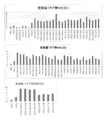
また、図5では、PG12およびPG17の配列に対して様々な改変を行ってペプチドタグを作製し、hGHの発現に対する影響を調べたところ、PG12のSやGを置換するアミノ酸はK以外に、L、N、QまたはRでも高発現効果があることが分かった。また、アミノ酸配列を改変したタグに、プロテアーゼ認識配列を付加した場合も高発現効果を維持していた。
作出した遺伝子組換え大腸菌を所定の条件で培養し、所定の条件にてhGHもしくはIFNβを抽出し、ウエスタン解析によりそれらの目的タンパク質の発現量を測定した。その結果、図6より、PX12-20(配列番号25)およびPX12-20v7(配列番号38)をそれぞれIFNβに付加したとき、PG12を付加したIFNβよりもタンパク質の発現量が増加した。また、PX12-20およびPX12-20v7の効果はN末のみよりも、N末とC末の両方に付加したときの方がさらに大きかった。また、図7より、PX12-20の効果はhGHに対しても発揮された。
作出した遺伝子組換えブレビバチルスを所定の条件で培養し、所定の条件にてhGHを抽出し、ウエスタン解析によりそれらの目的タンパク質の発現量を測定した。その結果、図8より、PX12-20(配列番号25)、PX12-38(配列番号52)およびPX12-20v7(配列番号38)をそれぞれhGHに付加したとき、hGHの発現量が増加した。
また、作出した遺伝子組換えブレビバチルスを所定の条件で培養し、所定の条件にてキシラナーゼを抽出し、ウエスタン解析によりそれらの目的タンパク質の発現量を測定した。その結果、図12より、PX12-20(配列番号25)をC末もしくはN末とC末の両方に付加したとき、キシラナーゼの発現量が増加した。
さらに、作出した遺伝子組換えブレビバチルスを所定の条件で培養し、所定の条件にてエステラーゼを抽出し、ウエスタン解析によりそれらの目的タンパク質の発現量を測定した。その結果、図13より、PX12-20(配列番号25)をN末に付加したとき、エステラーゼの発現量が増加した。
作出した遺伝子組換えピキア酵母を所定の条件で培養し、所定の条件にてhGHを抽出し、ウエスタン解析によりそれらの目的タンパク質の発現量を測定した。その結果、図14より、PX12-20(配列番号25)およびPX12-20v7(配列番号38)をそれぞれhGHに付加したとき、hGHの発現量が増加した。



作出した遺伝子組換え昆虫細胞および哺乳動物細胞を所定の条件で培養し、所定の条件にてGFPの蛍光を測定した。
その結果、図15に示す通り、昆虫細胞で各種ペプチドタグが付加されたGFPを発現させた場合、PX12-20タグやPX12-20v7タグが付加されたタンパク質はタグを付けない場合より発現量が増強された。
その結果、図16に示す通り、ほ乳類細胞で各種ペプチドタグが付加されたGFPを発現させた場合、PX12-20タグが付加されたタンパク質はタグを付けない場合より発現量が増強された。
Claims (13)
- 下記の配列を有するペプチド。
Xm(PYn)qPZr
ここで、X、YおよびZはそれぞれアルギニン(R)、グリシン(G)、セリン(S)、リジン(K)、トレオニン(T)、ロイシン(L)、アスパラギン(N)、グルタミン(Q)、ヒスチジン(H)から独立して選択されるアミノ酸残基であって、Yのうち少なくとも1つはK、L、N、Q、HまたはRを含む。
mは0~5の整数であり、nは1、2または3であり、qは1~10の整数であり、r=0~10の整数である。 - GとSの含有率が60%未満である、請求項1に記載のペプチド。
- 長さが6~50アミノ酸である、請求項1または2に記載のペプチド。
- 配列番号25,28,30,32,34,36,38,40,42,44,46,48,50,52,54,58,60,64,66,92,94,96,98,100,102,104,106,108,110,112,114,116,118,120,122,124,126,128,130,132,134,136,140,142,143,145,147,149,151,153,155,または157のアミノ酸配列を有する、請求項1~3のいずれか一項に記載のペプチド。
- 請求項1~4のいずれか一項に記載のペプチドと、有用タンパク質とを含む、タグ付加タンパク質。
- 有用タンパク質がヒト成長ホルモン、インターフェロンβ、キシラナーゼ、エステラーゼ、または緑色蛍光タンパク質(GFP)である、請求項5に記載のタグ付加タンパク質。
- 前記ペプチドと、前記有用タンパク質がプロテアーゼ認識配列を介して連結されている、請求項5または6に記載のタグ付加タンパク質。
- 分泌シグナルを含む、請求項5~7のいずれか一項に記載のタグ付加タンパク質。
- 請求項5~8のいずれか一項に記載のタグ付加タンパク質をコードするDNA。
- 請求項9に記載のDNAを含む組換えベクター。
- 請求項9に記載のDNAまたは請求項10に記載の組換えベクターで形質転換された形質転換体。
- 形質転換体が、酵母、大腸菌、ブレビバチルス、昆虫細胞または哺乳動物細胞(ヒト培養細胞を含むがヒト個体は含まない)である、請求項11に記載の形質転換体。
- 請求項11または12に記載の形質転換体を培養してタグ付加タンパク質を蓄積させ、タグ付加タンパク質を回収することを特徴とする、タグ付加タンパク質の製造方法。
Priority Applications (11)
| Application Number | Priority Date | Filing Date | Title |
|---|---|---|---|
| CN201680076564.0A CN108473979B (zh) | 2015-12-28 | 2016-12-28 | 肽标签及包含它的带有标签的蛋白质 |
| US16/066,468 US10808253B2 (en) | 2015-12-28 | 2016-12-28 | Peptide tag and tagged protein including same |
| MX2018008019A MX2018008019A (es) | 2015-12-28 | 2016-12-28 | Etiqueta de peptido y proteina etiquetada que incluye la misma. |
| EP16881827.6A EP3399033B1 (en) | 2015-12-28 | 2016-12-28 | Peptide tag and tagged protein including same |
| JP2017559238A JP7027168B2 (ja) | 2015-12-28 | 2016-12-28 | ペプチドタグおよびそれを含むタグ付加タンパク質 |
| AU2016382134A AU2016382134B2 (en) | 2015-12-28 | 2016-12-28 | Peptide tag and tagged protein including same |
| CA3009880A CA3009880C (en) | 2015-12-28 | 2016-12-28 | Peptide tag and tagged protein including same |
| KR1020187020935A KR20180091098A (ko) | 2015-12-28 | 2016-12-28 | 펩티드 태그 및 그것을 포함하는 태그 부가 단백질 |
| BR112018013246-2A BR112018013246A2 (ja) | 2015-12-28 | 2016-12-28 | Tag addition protein containing a peptide tag and it |
| US17/018,751 US12371697B2 (en) | 2015-12-28 | 2020-09-11 | Peptide tag and tagged protein including same |
| JP2021209816A JP2022044600A (ja) | 2015-12-28 | 2021-12-23 | ペプチドタグおよびそれを含むタグ付加タンパク質 |
Applications Claiming Priority (4)
| Application Number | Priority Date | Filing Date | Title |
|---|---|---|---|
| JP2015-256396 | 2015-12-28 | ||
| JP2015256396 | 2015-12-28 | ||
| JP2016-153265 | 2016-08-03 | ||
| JP2016153265 | 2016-08-03 |
Related Child Applications (2)
| Application Number | Title | Priority Date | Filing Date |
|---|---|---|---|
| US16/066,468 A-371-Of-International US10808253B2 (en) | 2015-12-28 | 2016-12-28 | Peptide tag and tagged protein including same |
| US17/018,751 Continuation US12371697B2 (en) | 2015-12-28 | 2020-09-11 | Peptide tag and tagged protein including same |
Publications (1)
| Publication Number | Publication Date |
|---|---|
| WO2017115853A1 true WO2017115853A1 (ja) | 2017-07-06 |
Family
ID=59225307
Family Applications (1)
| Application Number | Title | Priority Date | Filing Date |
|---|---|---|---|
| PCT/JP2016/089139 Ceased WO2017115853A1 (ja) | 2015-12-28 | 2016-12-28 | ペプチドタグおよびそれを含むタグ付加タンパク質 |
Country Status (10)
| Country | Link |
|---|---|
| US (2) | US10808253B2 (ja) |
| EP (1) | EP3399033B1 (ja) |
| JP (2) | JP7027168B2 (ja) |
| KR (1) | KR20180091098A (ja) |
| CN (1) | CN108473979B (ja) |
| AU (1) | AU2016382134B2 (ja) |
| BR (1) | BR112018013246A2 (ja) |
| MX (1) | MX2018008019A (ja) |
| TW (1) | TW201726706A (ja) |
| WO (1) | WO2017115853A1 (ja) |
Cited By (7)
| Publication number | Priority date | Publication date | Assignee | Title |
|---|---|---|---|---|
| WO2017217460A1 (ja) * | 2016-06-15 | 2017-12-21 | 出光興産株式会社 | ペプチドリンカーで連結された2以上のタンパク質を含む融合タンパク質 |
| WO2019167962A1 (ja) * | 2018-02-27 | 2019-09-06 | 出光興産株式会社 | 高発現かつ高機能な二重特異性抗体 |
| WO2020045530A1 (ja) | 2018-08-31 | 2020-03-05 | 出光興産株式会社 | ペプチドタグを利用したタンパク質の可溶性発現 |
| JP2021052728A (ja) * | 2019-10-02 | 2021-04-08 | 出光興産株式会社 | 高機能酵素複合体の高生産技術 |
| WO2022092132A1 (ja) * | 2020-10-27 | 2022-05-05 | 出光興産株式会社 | ペプチドタグおよびそれを含むタグ付加タンパク質 |
| JP2022109230A (ja) * | 2021-01-14 | 2022-07-27 | 出光興産株式会社 | ペプチドタグおよびそれを含むタグ付加タンパク質 |
| JP2023005283A (ja) * | 2021-06-28 | 2023-01-18 | 出光興産株式会社 | ペプチドタグ付加タンパク質を用いた代謝物生産 |
Families Citing this family (4)
| Publication number | Priority date | Publication date | Assignee | Title |
|---|---|---|---|---|
| CN109182299B (zh) * | 2018-10-30 | 2021-12-31 | 福建师范大学 | 耐受过氧化氢的枯草芽胞杆菌脂肪酶突变体及其制备方法 |
| CN114375298A (zh) * | 2019-09-14 | 2022-04-19 | 江阴贝瑞森制药有限公司 | 新肽 |
| WO2022071291A1 (ja) * | 2020-09-29 | 2022-04-07 | 出光興産株式会社 | ペプチドタグおよびそれを含むタグ付加タンパク質 |
| JPWO2024237315A1 (ja) * | 2023-05-18 | 2024-11-21 |
Citations (4)
| Publication number | Priority date | Publication date | Assignee | Title |
|---|---|---|---|---|
| US20090137004A1 (en) * | 2007-11-15 | 2009-05-28 | Molecular Kinetics Incorporated | Artificial entropic bristle domain sequences and their use in recombinant protein production |
| JP2009201437A (ja) * | 2008-02-28 | 2009-09-10 | Toyota Motor Corp | 種子内の油脂含量を調節する変異遺伝子、種子内油脂含量の調節方法 |
| WO2009133882A1 (ja) * | 2008-05-02 | 2009-11-05 | 出光興産株式会社 | 細菌毒素ワクチン |
| JP5273438B2 (ja) | 2007-11-22 | 2013-08-28 | 国立大学法人東京農工大学 | ペプチド付加生体分子の溶解度計算方法、及びそれを用いたペプチドタグの設計方法と封入体形成防止方法 |
Family Cites Families (14)
| Publication number | Priority date | Publication date | Assignee | Title |
|---|---|---|---|---|
| JPS5273438A (en) | 1975-12-15 | 1977-06-20 | Tomita Takahashi | Folding structure of truck handle |
| JPS5818558B2 (ja) | 1976-11-13 | 1983-04-13 | 株式会社クボタ | 流量圧力制御方法 |
| US6686333B1 (en) * | 1996-10-04 | 2004-02-03 | The United States Of America As Represented By The Department Of Health And Human Resources | Inhibition of HIV replication using soluble Tat peptide analogs |
| ES2338097T3 (es) * | 2000-04-14 | 2010-05-04 | Genencor International, Inc. | Procedimiento de identificacion selectiva. |
| US7205387B2 (en) * | 2003-08-28 | 2007-04-17 | Agency For Science, Technology And Research | Recombinant polypeptide useful for neurotrophin receptor mediated gene delivery and as neurotrophin agonist |
| US20100234568A1 (en) * | 2006-10-19 | 2010-09-16 | Linda Jane Decarolis | Identification of peptide tags for the production of insoluble peptides by sequence scanning |
| JP5626717B2 (ja) * | 2009-03-26 | 2014-11-19 | 学校法人日本大学 | レチノイン酸受容体αを含む融合タンパク質 |
| WO2010129033A2 (en) * | 2009-04-29 | 2010-11-11 | Calmune Corporation | Modified antibodies for passive immunotherapy |
| CA2765171C (en) | 2009-06-10 | 2018-10-02 | Nono Inc. | Co-administration of an agent linked to an internalization peptide with an anti-inflammatory |
| JP6013470B2 (ja) | 2011-06-29 | 2016-10-25 | アフィニティ バイオサイエンス ピーティーワイ リミテッド | タンパク質ディスプレイの方法 |
| WO2013091661A2 (en) * | 2011-12-23 | 2013-06-27 | Aarhus Universitet | Proteolytic resistant protein affinity tag |
| CA2865578C (en) * | 2012-02-27 | 2023-01-17 | Amunix Operating Inc. | Xten conjugate compositions and methods of making same |
| HK1212237A1 (en) * | 2012-08-31 | 2016-06-10 | University Of Virginia Patent Foundation | Target peptides for immunotherapy and diagnostics |
| SG11201508469YA (en) * | 2013-05-02 | 2015-11-27 | Glaxosmithkline Ip Dev Ltd | Therapeutic peptides |
-
2016
- 2016-12-28 MX MX2018008019A patent/MX2018008019A/es unknown
- 2016-12-28 BR BR112018013246-2A patent/BR112018013246A2/ja not_active Application Discontinuation
- 2016-12-28 WO PCT/JP2016/089139 patent/WO2017115853A1/ja not_active Ceased
- 2016-12-28 AU AU2016382134A patent/AU2016382134B2/en active Active
- 2016-12-28 JP JP2017559238A patent/JP7027168B2/ja active Active
- 2016-12-28 EP EP16881827.6A patent/EP3399033B1/en active Active
- 2016-12-28 KR KR1020187020935A patent/KR20180091098A/ko not_active Withdrawn
- 2016-12-28 US US16/066,468 patent/US10808253B2/en active Active
- 2016-12-28 CN CN201680076564.0A patent/CN108473979B/zh active Active
- 2016-12-28 TW TW105143577A patent/TW201726706A/zh unknown
-
2020
- 2020-09-11 US US17/018,751 patent/US12371697B2/en active Active
-
2021
- 2021-12-23 JP JP2021209816A patent/JP2022044600A/ja active Pending
Patent Citations (5)
| Publication number | Priority date | Publication date | Assignee | Title |
|---|---|---|---|---|
| US20090137004A1 (en) * | 2007-11-15 | 2009-05-28 | Molecular Kinetics Incorporated | Artificial entropic bristle domain sequences and their use in recombinant protein production |
| JP5273438B2 (ja) | 2007-11-22 | 2013-08-28 | 国立大学法人東京農工大学 | ペプチド付加生体分子の溶解度計算方法、及びそれを用いたペプチドタグの設計方法と封入体形成防止方法 |
| JP2009201437A (ja) * | 2008-02-28 | 2009-09-10 | Toyota Motor Corp | 種子内の油脂含量を調節する変異遺伝子、種子内油脂含量の調節方法 |
| WO2009133882A1 (ja) * | 2008-05-02 | 2009-11-05 | 出光興産株式会社 | 細菌毒素ワクチン |
| JP5360727B2 (ja) | 2008-05-02 | 2013-12-04 | 出光興産株式会社 | 細菌毒素ワクチン |
Non-Patent Citations (14)
| Title |
|---|
| AKIRA HOSOMI ET AL., J BIOL CHEM, vol. 285, no. 32, 2010, pages 24324 - 24334 |
| DATABASE UNIPROTkb [O] 1 June 2001 (2001-06-01), NIERMAN W. C. ET AL.: "TPR DOMAIN PROTEIN", XP055507161, retrieved from uniprot Database accession no. Q9AB24 * |
| DI GUAN, C. ET AL., GENE, vol. 67, 1988, pages 21 |
| GENE, vol. 39, 1985, pages 281 - 286 |
| HASHIMOTO ET AL., PROTEIN ENGINEERING, vol. 2, 1998, pages 75 - 77 |
| HIEI ET AL., PLANT J., vol. 6, 1994, pages 271 |
| HOOD ET AL., TRANSGENIC, RES., vol. 2, 1993, pages 218 |
| LAZZERI ET AL., THEOR. APPL. GENET., vol. 81, 1991, pages 437 |
| MARBLESTONE, J. G. ET AL., PROTEIN SCI., vol. 15, 2006, pages 182 |
| MARIA. C. V. ET AL., GENE, vol. 74, 1988, pages 365 - 373 |
| OHTSUKI ET AL., FEBS LETT., vol. 428, no. 3, 29 May 1998 (1998-05-29), pages 235 - 40 |
| SANFORD ET AL., J. PART. SCI. TECH., vol. 5, 1987, pages 27 |
| SMITH, D. B.; JOHNSON, K. S., GENE, vol. 67, 1988, pages 31 |
| TADA ET AL., THEOR. APPL. GENET, vol. 80, 1990, pages 475 |
Cited By (15)
| Publication number | Priority date | Publication date | Assignee | Title |
|---|---|---|---|---|
| WO2017217460A1 (ja) * | 2016-06-15 | 2017-12-21 | 出光興産株式会社 | ペプチドリンカーで連結された2以上のタンパク質を含む融合タンパク質 |
| WO2019167962A1 (ja) * | 2018-02-27 | 2019-09-06 | 出光興産株式会社 | 高発現かつ高機能な二重特異性抗体 |
| US20220275353A1 (en) * | 2018-08-31 | 2022-09-01 | Idemitsu Kosan Co., Ltd. | Soluble expression of protein using peptide tag |
| WO2020045530A1 (ja) | 2018-08-31 | 2020-03-05 | 出光興産株式会社 | ペプチドタグを利用したタンパク質の可溶性発現 |
| CN112639103A (zh) * | 2018-08-31 | 2021-04-09 | 出光兴产株式会社 | 利用肽标签的蛋白质可溶性表达 |
| JPWO2020045530A1 (ja) * | 2018-08-31 | 2021-08-26 | 出光興産株式会社 | ペプチドタグを利用したタンパク質の可溶性発現 |
| US12398382B2 (en) * | 2018-08-31 | 2025-08-26 | Idemitsu Kosan Co., Ltd. | Soluble expression of protein using peptide tag |
| JP7477450B2 (ja) | 2018-08-31 | 2024-05-01 | 出光興産株式会社 | ペプチドタグを利用したタンパク質の可溶性発現 |
| JP2021052728A (ja) * | 2019-10-02 | 2021-04-08 | 出光興産株式会社 | 高機能酵素複合体の高生産技術 |
| JPWO2022092132A1 (ja) * | 2020-10-27 | 2022-05-05 | ||
| WO2022092132A1 (ja) * | 2020-10-27 | 2022-05-05 | 出光興産株式会社 | ペプチドタグおよびそれを含むタグ付加タンパク質 |
| JP7777540B2 (ja) | 2020-10-27 | 2025-11-28 | 出光興産株式会社 | ペプチドタグおよびそれを含むタグ付加タンパク質 |
| JP2022109230A (ja) * | 2021-01-14 | 2022-07-27 | 出光興産株式会社 | ペプチドタグおよびそれを含むタグ付加タンパク質 |
| JP7768775B2 (ja) | 2021-01-14 | 2025-11-12 | 出光興産株式会社 | ペプチドタグおよびそれを含むタグ付加タンパク質 |
| JP2023005283A (ja) * | 2021-06-28 | 2023-01-18 | 出光興産株式会社 | ペプチドタグ付加タンパク質を用いた代謝物生産 |
Also Published As
| Publication number | Publication date |
|---|---|
| US20210130404A1 (en) | 2021-05-06 |
| CN108473979A (zh) | 2018-08-31 |
| US10808253B2 (en) | 2020-10-20 |
| EP3399033A1 (en) | 2018-11-07 |
| US12371697B2 (en) | 2025-07-29 |
| JP2022044600A (ja) | 2022-03-17 |
| US20190024094A1 (en) | 2019-01-24 |
| JP7027168B2 (ja) | 2022-03-01 |
| CN108473979B (zh) | 2022-08-19 |
| AU2016382134B2 (en) | 2022-09-22 |
| TW201726706A (zh) | 2017-08-01 |
| CA3009880A1 (en) | 2017-07-06 |
| EP3399033B1 (en) | 2024-11-06 |
| KR20180091098A (ko) | 2018-08-14 |
| EP3399033A4 (en) | 2019-06-19 |
| MX2018008019A (es) | 2018-11-09 |
| AU2016382134A1 (en) | 2018-07-26 |
| BR112018013246A2 (ja) | 2018-12-04 |
| JPWO2017115853A1 (ja) | 2018-10-18 |
Similar Documents
| Publication | Publication Date | Title |
|---|---|---|
| JP7027168B2 (ja) | ペプチドタグおよびそれを含むタグ付加タンパク質 | |
| KR102353262B1 (ko) | 펩티드 생산용 융합 파트너 | |
| US20210269811A1 (en) | Means and methods for increased protein expression by use of transcription factors | |
| US20240141363A1 (en) | Signal peptides for increased protein secretion | |
| KR101183720B1 (ko) | 슈도모나스 플루오레센스에서의 포유류 단백질의 발현 | |
| JP6064915B2 (ja) | 発現ベクターおよび蛋白質の製造方法 | |
| JP7477450B2 (ja) | ペプチドタグを利用したタンパク質の可溶性発現 | |
| WO2017217460A1 (ja) | ペプチドリンカーで連結された2以上のタンパク質を含む融合タンパク質 | |
| US20230365979A1 (en) | Peptide tag and tagged protein including same | |
| JP7768775B2 (ja) | ペプチドタグおよびそれを含むタグ付加タンパク質 | |
| CA3009880C (en) | Peptide tag and tagged protein including same | |
| WO2022092132A1 (ja) | ペプチドタグおよびそれを含むタグ付加タンパク質 | |
| JP6188574B2 (ja) | 発現プロセス |
Legal Events
| Date | Code | Title | Description |
|---|---|---|---|
| 121 | Ep: the epo has been informed by wipo that ep was designated in this application |
Ref document number: 16881827 Country of ref document: EP Kind code of ref document: A1 |
|
| ENP | Entry into the national phase |
Ref document number: 2017559238 Country of ref document: JP Kind code of ref document: A |
|
| ENP | Entry into the national phase |
Ref document number: 3009880 Country of ref document: CA |
|
| WWE | Wipo information: entry into national phase |
Ref document number: MX/A/2018/008019 Country of ref document: MX |
|
| NENP | Non-entry into the national phase |
Ref country code: DE |
|
| REG | Reference to national code |
Ref country code: BR Ref legal event code: B01A Ref document number: 112018013246 Country of ref document: BR |
|
| ENP | Entry into the national phase |
Ref document number: 20187020935 Country of ref document: KR Kind code of ref document: A |
|
| WWE | Wipo information: entry into national phase |
Ref document number: 1020187020935 Country of ref document: KR |
|
| ENP | Entry into the national phase |
Ref document number: 2016382134 Country of ref document: AU Date of ref document: 20161228 Kind code of ref document: A |
|
| WWE | Wipo information: entry into national phase |
Ref document number: 2016881827 Country of ref document: EP |
|
| ENP | Entry into the national phase |
Ref document number: 2016881827 Country of ref document: EP Effective date: 20180730 |
|
| ENP | Entry into the national phase |
Ref document number: 112018013246 Country of ref document: BR Kind code of ref document: A2 Effective date: 20180627 |