WO2017121408A1 - Procédé destiné à la mise en œuvre d'une commande de puissance de liaison montante et terminal - Google Patents
Procédé destiné à la mise en œuvre d'une commande de puissance de liaison montante et terminal Download PDFInfo
- Publication number
- WO2017121408A1 WO2017121408A1 PCT/CN2017/072852 CN2017072852W WO2017121408A1 WO 2017121408 A1 WO2017121408 A1 WO 2017121408A1 CN 2017072852 W CN2017072852 W CN 2017072852W WO 2017121408 A1 WO2017121408 A1 WO 2017121408A1
- Authority
- WO
- WIPO (PCT)
- Prior art keywords
- power
- transmission
- uplink
- terminal
- pmax
- Prior art date
- Legal status (The legal status is an assumption and is not a legal conclusion. Google has not performed a legal analysis and makes no representation as to the accuracy of the status listed.)
- Ceased
Links
Images


Classifications
-
- H—ELECTRICITY
- H04—ELECTRIC COMMUNICATION TECHNIQUE
- H04W—WIRELESS COMMUNICATION NETWORKS
- H04W52/00—Power management, e.g. Transmission Power Control [TPC] or power classes
- H04W52/04—Transmission power control [TPC]
- H04W52/06—TPC algorithms
- H04W52/14—Separate analysis of uplink or downlink
Definitions
- the present application relates to, but is not limited to, a wireless communication technology, and in particular, to a method and a terminal for implementing uplink power control.
- Machine Type Communication also known as Machine to Machine (M2M) communication
- IoT Internet of Things
- 3GPP Three Generation Partnership Project
- the Partner Program conducted a feasibility study and evaluation of a cellular network IoT system based on a 200 kHz narrowband (NB, Narrowband).
- NB-IoT Narrowband Internet of Things
- the embodiment of the invention provides a method and a terminal for implementing uplink power control, which can perform uplink power control.
- the embodiment of the invention provides a method for implementing uplink power control, which includes: determining, by the terminal, uplink transmit power according to a transmission scenario to which the terminal belongs.
- the method may further include: Determining a transmission scenario to which the terminal belongs according to at least one of the following factors:
- Transmission capability or mode number of subcarriers; coverage level; channel type; information to be sent.
- the transmission capability or mode may include at least one of the following:
- the carrier bandwidth is the first bandwidth
- the carrier bandwidth is the second bandwidth
- the carrier bandwidth is the third bandwidth
- the carrier bandwidth is the fourth bandwidth.
- the coverage level may be a preset number of presets of the system, where the preset number is an integer greater than or equal to 1, and the level includes at least: a level indicating different coverage levels. Use different levels of repetition or repetition levels.
- the channel type may include:
- NB-PRACH Narrowband Physical Random Access Channel
- NB-PUSCH Narrowband Physical Uplink Shared Channel
- the information to be transmitted may include:
- Random access preamble (preamble); or,
- Service data uplink control information
- service data and uplink control information are examples of service data, uplink control information, or service data and uplink control information.
- determining the uplink transmit power according to the transmission scenario to which the terminal belongs may include:
- the transmission scenario to which the terminal belongs is the first coverage level, and when the random access preamble is sent through the NB-PRACH, the uplink transmit power is determined according to the first transmit power calculation formula and the first power control parameter; or
- the transmission scenario to which the terminal belongs is the second coverage level, and when the NB-PUSCH uses the single carrier to send the random access procedure message Msg3, service data, uplink control information, or service data and uplink control information, according to the second transmission power. Calculating the formula and the second power control parameter to determine the uplink transmit power; or
- the transmission scenario to which the terminal belongs is a third coverage level, and is randomly transmitted through the NB-PUSCH.
- the process message Msg3 the service data, the uplink control information, or the service data and the uplink control information are accessed, determining the uplink transmit power according to the third transmit power calculation formula and the third power control parameter; or
- the uplink transmit power is determined according to the coverage level to which the terminal belongs and the coverage level and power level relationship information preset by the system.
- the method may further include: the terminal according to a transmit power control (TPC) command. Adjusting the uplink transmit power; wherein the adjusting includes a cumulative adjustment and an absolute adjustment.
- TPC transmit power control
- the first transmit power calculation formula may be one of the following:
- P min ⁇ Pmax, PL+TargetPower+Delta+(Counter–1)*Step) ⁇ ;
- P is the determined uplink transmit power
- Pmax is the terminal maximum transmit power
- PL is the terminal estimated downlink path loss
- TargetPower is the random access preamble initial receive target power
- Delta is the power offset
- Counter is random.
- the number of entries, Step is the power increment step.
- the first power control parameter may include at least one of the following:
- the random access preamble initial receiving target power TargetPower is different; or,
- the random access preamble initial receiving target power TargetPower is the same, and the power offset Delta includes power demand deviations of different transmission capabilities or modes;
- the transmission capability or mode may include at least one of the following:
- the carrier bandwidth is the first bandwidth
- the carrier bandwidth is the second bandwidth
- the carrier bandwidth is the third bandwidth
- the carrier bandwidth is the fourth bandwidth.
- the power offset Delta may include power demand offsets for different random access preambles.
- the power increment step Step may be different when different transmission capabilities or modes are employed; the power increment step Step may be different when different random access preambles are employed.
- the second transmit power calculation formula may be one of the following formulas:
- P is the determined uplink transmit power
- Pmax is the terminal maximum transmit power
- Po is the target receive power parameter
- PL is the terminal estimated downlink path loss
- alpha is the path loss compensation factor
- Delta is the power offset, fi Adjust the amount of power
- the target received power parameter Po is the sum of the common power parameter Po_nominal and the terminal specific power parameter Po_UE.
- the second power control parameter may include at least one of the following:
- the third transmit power calculation formula may be one of the following formulas:
- P is the determined uplink transmit power
- Pmax is the terminal maximum transmit power
- Po is the target receive power parameter
- PL is the terminal estimated downlink path loss
- alpha is the path loss compensation factor
- Delta is the power offset, fi Adjust the amount of power
- the M is a transmission resource bandwidth, and the transmission resource bandwidth M includes at least one of the following: the number of subcarriers, the number of resource units, and the number of resource blocks;
- the target received power parameter Po is a common power parameter Po_nominal and a terminal special The sum of the power parameters Po_UE.
- the third power control parameter may include at least one of the following:
- the terminal sending the random access procedure message Msg3, the service data, the uplink control information, or the service data and the uplink control information by using the NB-PUSCH may include:
- the transmission resource bandwidth M is 1.
- the path loss compensation factor is different
- the common power parameter Po_nominal is different; or the common power parameter Po_nominal is the same;
- the terminal specific power parameter Po_UE includes power demand deviations of different transmission capabilities or modes; or the power offset amount Delta includes power demand deviations of different transmission capabilities or modes;
- the power adjustment amount fi includes power demand deviations of different transmission capabilities or modes; or, the value of the transmission resource bandwidth M is set according to a preset transmission capability or mode and a bandwidth difference between different transmission capabilities or modes; the transmission The ability or mode includes at least one of the following:
- the carrier bandwidth is the first bandwidth
- the carrier bandwidth is the second bandwidth
- the carrier bandwidth is the third bandwidth
- the carrier bandwidth is the fourth bandwidth.
- the method may further include: the terminal performing uplink transmission by using the determined uplink transmit power.
- the method may further include:
- the terminal determines a power headroom report (PHR) according to the preset transmission scenario, and sends a power headroom report through the NB-PUSCH;
- PHR power headroom report
- the preset transmission scenario includes at least one of the following:
- the channel type is NB-PUSCH
- the present application further provides a terminal for implementing uplink power control, including: a power determining unit configured to determine an uplink transmit power according to a transmission scenario to which the terminal belongs.
- the terminal may further include a scenario determining unit configured to determine a transmission scenario to which the terminal belongs according to at least one of the following factors:
- Transmission capability or mode number of subcarriers; coverage level; channel type; information to be sent.
- the power determining unit may be configured to determine an uplink transmit power according to a transmission scenario to which the terminal belongs by:
- the uplink transmit power is determined according to the first transmit power calculation formula and the first power control parameter;
- the NB-PUSCH uses the single carrier to send the random access procedure message Msg3, the service data, the uplink control information, or the service data and the uplink control information, according to the second transmission Determining the uplink transmit power by a power calculation formula and a second power control parameter; or
- the formula is calculated according to the third transmission power. And determining, by the third power control parameter, the uplink transmit power; or
- the uplink transmit power is determined according to the coverage level to which the terminal belongs and the coverage level and power level relationship information preset by the system.
- the terminal may further include an adjusting unit configured to: when the power determining unit determines the uplink transmit power according to the coverage level to which the terminal belongs and the coverage level and power level relationship information preset by the system, according to the A transmit power control (TPC) command adjusts the uplink transmit power; wherein the adjustment includes a cumulative adjustment and an absolute adjustment.
- TPC transmit power control
- the terminal may further include an execution unit,
- the execution unit is configured to perform uplink transmission by using the determined uplink transmit power after the power determining unit determines the uplink transmit power.
- the present application also provides a computer readable storage medium storing computer executable instructions that, when executed by a processor, implement the above described method of implementing uplink power control.
- the technical solution of the present application includes: determining, by the terminal, uplink transmit power according to a transmission scenario to which the terminal belongs.
- the uplink transmission power is determined by the terminal and the uplink transmission is performed, thereby implementing the design of the uplink power control scheme.
- FIG. 1 is a flowchart of a method for implementing uplink power control according to an embodiment of the present invention
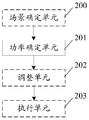
- FIG. 2 is a structural block diagram of a terminal for implementing uplink power control according to an embodiment of the present invention
- FIG. 3 is a flowchart of a method of Application Example 1 of the present application.
- FIG. 1 is a flowchart of a method for implementing uplink power control according to an embodiment of the present invention. As shown in FIG. 1 , the method includes:
- Step 100 The terminal determines an uplink transmit power according to a transmission scenario to which the terminal belongs.
- the method of the embodiment of the present invention may further include: determining, according to at least one of the following factors, a transmission scenario to which the terminal belongs:
- Transmission capability or mode number of subcarriers; channel type; coverage level; information to be transmitted.
- the coverage level may be a preset number of presets of the system, where the preset number is an integer greater than or equal to 1, and the level includes at least: a level indicating different coverage levels, and adopting The level or repetition level of different repetitions.
- the channel type may include:
- NB-PRACH Narrowband Physical Random Access Channel
- NB-PUSCH Narrowband Physical Uplink Shared Channel
- the information to be transmitted may include:
- Random access preamble (preamble); or,
- Service data uplink control information
- service data and uplink control information are examples of service data, uplink control information, or service data and uplink control information.
- the transmission capability or mode may include:
- the carrier bandwidth is the first bandwidth
- the carrier bandwidth is the second bandwidth
- the carrier bandwidth is the third bandwidth
- the carrier bandwidth is the fourth bandwidth.
- the first bandwidth is different from the second bandwidth.
- the first bandwidth may be 3.75 kHz
- the second bandwidth may be 15 kHz
- the third bandwidth is different from the fourth bandwidth.
- the third bandwidth may be 1.25 kHz.
- the four bandwidths may be 15 kHz or the like; the transmission capability or mode of the terminal may only support single carrier transmission, or support multi-carrier transmission; wherein terminals supporting multi-carrier transmission may also adopt Use single carrier transmission.
- determining the transmission scenario to which the terminal belongs may be implemented by the terminal determining its transmission capability or mode according to its transmission capability or mode configuration information; whether to adopt single carrier transmission or multi-carrier transmission, and system configuration information or scheduling according to the transmission capability or mode configuration information;
- the information determines the number of subcarriers for uplink transmission; determines the coverage level according to the coverage level preset by the system and the downlink reference signal measurement result; determines the channel type and the information to be transmitted according to the uplink transmission process; thus, the terminal determines its transmission separately After one or more of the capabilities or modes, the number of subcarriers, the coverage level, the channel type, and the information to be sent, the transmission scenario to which it belongs can be determined.
- determining the uplink transmit power according to the transmission scenario to which the terminal belongs may include:
- the transmission scenario to which the terminal belongs is the first coverage level, and when the random access preamble is sent through the NB-PRACH, the uplink transmit power is determined according to the first transmit power calculation formula and the first power control parameter; or
- the transmission scenario to which the terminal belongs is the second coverage level, and when the NB-PUSCH uses the single carrier to send the random access procedure message Msg3, the service data, the uplink control information, or the service data and the uplink control information, the calculation formula according to the second transmission power is used. And determining, by the second power control parameter, an uplink transmit power; or
- the transmission scenario to which the terminal belongs is the third coverage level, and when the random access procedure message Msg3, the service data, the uplink control information, or the service data and the uplink control information are sent through the NB-PUSCH, the third transmit power calculation formula and the third The power control parameter determines the uplink transmit power; or,
- the transmission scenario to which the terminal belongs is the fourth coverage level, determine that the maximum transmit power is the uplink transmit power.
- the uplink transmit power is determined according to the coverage level to which the terminal belongs and the coverage level and power level relationship information preset by the system.
- first coverage level, the second coverage level, the third coverage level, and the fourth coverage level are only used for distinguishing descriptions, and do not have strict order relationships, nor do they mean completely different.
- first coverage level, the second coverage level, and the third coverage level represent the same one or more coverage levels, and the fourth coverage level indicates another one or more coverage levels;
- first transmit power calculation formula, the second transmit power calculation formula, and the third transmit power calculation formula may be a preset transmit power calculation formula of the system; in addition, the first power control parameter and the second power control parameter
- the third power control parameter may include parameters configured by the system through signaling and notified to the terminal, and parameters preset by the system.
- the coverage level and power level relationship information preset by the system may be a preset relationship between the coverage level and the power level of the system.
- the method in the embodiment of the present invention may further include:
- the terminal adjusts the uplink transmit power according to the Transmission Power Control (TPC) command; wherein the adjustment includes the cumulative adjustment and the absolute adjustment.
- TPC Transmission Power Control
- the first transmit power calculation formula may be one of the following:
- P min ⁇ Pmax, PL+TargetPower+Delta+(Counter–1)*Step) ⁇ ;
- Step is the power increment step.
- the first power control parameter may include at least one of the following:
- the initial access target power TargetPower of the random access preamble is configured by the system and notified by signaling; the power increment step Step is configured by the system and notified by signaling or preset by the system; the power offset Delta is configured by the system and passes the signal Order notifications or preset by the system.
- the random access preamble initially receives the target power TargetPower differently; or,
- Random access preamble initial receiving target power TargetPower is the same, power offset Delta includes power demand deviations for different transmission capabilities or modes;
- the transmission capability or mode may include at least one of the following:
- the carrier bandwidth is the first bandwidth
- the carrier bandwidth is the second bandwidth
- the carrier bandwidth is the third bandwidth
- the carrier bandwidth is the fourth bandwidth.
- the power offset Delta may include power demand offsets for different random access preambles.
- the power increment step when different transmission capabilities or modes are used, the power increment step is different; when different random access preambles are used, the power increment step is different;
- the power increment step is different when different transmission capabilities or modes and different random access preambles are used at the same time.
- the second transmit power calculation formula may be one of the following formulas:
- P is the determined uplink transmit power
- Pmax is the terminal maximum transmit power
- Po is the target receive power parameter
- PL is the terminal estimated downlink path loss
- alpha is the path loss compensation factor
- Delta is the power offset
- fi is the power Adjustment amount
- the target received power parameter Po is the sum of the common power parameter Po_nominal and the terminal specific power parameter Po_UE.
- the second power control parameter may include at least one of the following:
- the common power parameter Po_nominal is configured by the system and notified by signaling;
- the terminal specific power parameter Po_UE is configured by the system and notified by signaling or preset by the system;
- the path loss compensation factor alpha is configured by the system and notified by signaling or by the system Preset;
- the power offset Delta is configured by the system and signaled or preset by the system;
- the transmit power control TPC is configured by the system and signaled.
- the second transmit power calculation formula may be one of the following formulas when the transmission scenario to which the terminal belongs is the second coverage level and the uplink control information is sent by using the single carrier on the NB-PUSCH:
- the third transmit power calculation formula may be one of the following formulas:
- P is the determined uplink transmit power
- Pmax is the terminal maximum transmit power
- Po is the target receive power parameter
- PL is the terminal estimated downlink path loss
- alpha is the path loss compensation factor
- Delta is the power offset
- fi is the power Adjustment amount
- the M is a transmission resource bandwidth, and the transmission resource bandwidth M includes at least one of the following: the number of subcarriers, the number of resource units, and the number of resource blocks;
- the target received power parameter Po is the sum of the common power parameter Po_nominal and the terminal specific power parameter Po_UE.
- the third power control parameter may include at least one of the following:
- the transmission resource bandwidth M is configured by the system and is notified by signaling or preset by the system; the common power parameter Po_nominal is configured by the system and notified by signaling; the terminal specific power parameter Po_UE is configured by the system and is notified by signaling or by the system.
- the path loss compensation factor alpha is configured by the system and signaled or preset by the system; the power offset Delta is configured by the system and signaled or preset by the system; the transmission power control TPC is configured by the system and passes the letter Order notice.
- the second transmit power calculation formula and the third transmit power calculation formula may be the same or different.
- the third transmit power calculation formula may be one of the following formulas when the transmission scenario to which the terminal belongs is the third coverage level and the service data, or the service data and the uplink control information are sent through the NB-PUSCH:
- P min ⁇ Pmax, 10*log10(M)+Po+alpha*PL+Delta+fi ⁇ .
- the terminal sending the random access procedure message Msg3, the service data, the uplink control information, or the service data and the uplink control information by using the NB-PUSCH may include:
- the terminal sends a random access procedure message Msg3, service data, uplink control information, or service data and uplink control information by using a single tone transmission mode through the NB-PUSCH.
- the transmission resource bandwidth M is 1.
- the path loss compensation factor is different
- the common power parameter Po_nominal is different; or the common power parameter Po_nominal is the same; wherein, when the common power parameter Po_nominal is the same, the terminal specific power parameter Po_UE includes power demand deviation of different transmission capabilities or modes, or the power offset Delta includes different transmission capabilities Or the power demand deviation of the mode, or the power adjustment amount fi includes the power demand deviation of different transmission capabilities or modes, or the value of the transmission resource bandwidth M according to the preset transmission capability or mode and the bandwidth between different transmission capabilities or modes Difference setting
- the path loss compensation factor alpha is different; or, the common power parameter Po_nominal is different; or, the common power parameter Po_nominal is the same;
- the path loss compensation factor alpha is different from the common power parameter Po_nominal; or, public The common power parameter Po_nominal is the same;
- the path loss compensation factor alpha is the same as the common power parameter Po_nominal; or the common power parameter Po_nominal is different;
- the transmission capability or mode may include at least one of the following:
- the carrier bandwidth is the first bandwidth
- the carrier bandwidth is the second bandwidth
- the carrier bandwidth is the third bandwidth
- the carrier bandwidth is the fourth bandwidth.
- the terminal specific power parameter Po_UE includes power demand deviations of different transmission capabilities or modes.
- the terminal specific power parameter Po_UE is used to carry power demand deviations of different transmission capabilities or modes;
- the power offset Delta includes power of different transmission capabilities or modes.
- the demand deviation indicates that the power offset Delta is used to carry the power demand deviation of different transmission capabilities or modes, which can be configured by the system and notified by signaling or preset by the system;
- the power adjustment amount fi includes power requirements of different transmission capabilities or modes.
- the deviation includes: initializing the power adjustment amount fi according to the power demand deviation of different transmission capabilities or modes; the value of the transmission resource bandwidth M is set according to a preset transmission capability or mode and a bandwidth difference between different transmission capabilities or modes, including : setting the value of the transmission resource bandwidth M based on the preset transmission capability or mode, and for other transmission capabilities or modes having a bandwidth difference from the preset transmission capability or mode, the transmission resource bandwidth M according to the bandwidth difference
- the value is set; for example, with carrier bandwidth 3
- the .75 kHz transmission is used as a reference.
- the value of the transmission resource bandwidth M is set to 4; or, when the carrier bandwidth is 15 kHz, the carrier bandwidth is 3.75 kHz for single carrier transmission. Set the value of the transmission resource bandwidth M to 1/4.
- the maximum transmit power Pmax of the terminal is set by the system;
- the power adjustment amount fi is initialized according to the system preset rule, and is calculated according to the power adjustment mode and the power adjustment step corresponding to the transmission power control (TPC) command.
- the power adjustment method includes an accumulated adjustment method and an absolute adjustment method.
- the method of the embodiment of the present invention may further include: Step 101: The terminal performs uplink transmission by using the determined uplink transmit power.
- the method of the embodiment of the present invention may further include:
- the terminal determines a power headroom report (PHR) according to the preset transmission scenario, and sends a power headroom report through the NB-PUSCH;
- PHR power headroom report
- the preset transmission scenario may include at least one of the following:
- the channel type is NB-PUSCH
- the preset transmission scenario is used by the terminal to determine its uplink transmit power in the scenario; further, the terminal may determine the power headroom report in the scenario according to the maximum transmit power and the determined uplink transmit power.
- the preset transmission scenario is to use a single carrier to transmit service data through the NB-PUSCH, and the terminal determines its uplink transmit power according to the preset transmission scenario, and then uses the difference between the maximum transmit power and the determined uplink transmit power as Its PHR in this scenario.
- the method for implementing uplink power control in the embodiment of the present invention can be applied to a narrowband Internet of Things (NB-IoT).
- NB-IoT narrowband Internet of Things
- the uplink transmission power is determined by the terminal and the uplink transmission is performed, thereby implementing the design of the uplink power control scheme.
- FIG. 2 is a structural block diagram of a terminal for implementing uplink power control according to an embodiment of the present invention. As shown in FIG. 2, the method further includes: a power determining unit 201 configured to determine an uplink transmit power according to a transmission scenario to which the terminal belongs.
- a power determining unit 201 configured to determine an uplink transmit power according to a transmission scenario to which the terminal belongs.
- the power determining unit 201 may be configured to:
- the uplink transmit power is determined according to the first transmit power calculation formula and the first power control parameter;
- the transmission scenario to which the terminal belongs is the second coverage level, and the single carrier is adopted through the NB-PUSCH.
- the single tone sends the random access procedure message Msg3, the service data, the uplink control information, or the service data and the uplink control information, determining the uplink transmit power according to the second transmit power calculation formula and the second power control parameter; or
- the formula and the third transmit power are calculated according to the third transmission power.
- the three power control parameters determine the uplink transmit power; or,
- the uplink transmit power is determined according to the coverage level to which the terminal belongs and the coverage level and power level relationship information preset by the system.
- the terminal of the embodiment of the present invention may further include: an adjusting unit 202, configured to perform, according to the transmission power control, when the power determining unit 201 determines the uplink transmitting power according to the coverage level to which the terminal belongs and the coverage level and power level relationship information preset by the system.
- the TPC) command adjusts the uplink transmit power; wherein the adjustment includes cumulative adjustment and absolute adjustment.
- the terminal of the embodiment of the present invention may further include: an executing unit 203, configured to perform uplink transmission by using the determined uplink transmit power after the power determining unit 201 determines the uplink transmit power.
- the terminal of the embodiment of the present invention may further include: a scenario determining unit 200, configured to determine, according to at least one of the following factors, a transmission scenario to which the terminal belongs:
- Transmission capability or mode number of subcarriers; coverage level; channel type; information to be sent.
- the terminal implementing uplink power control may be a terminal in the NB-IoT.
- FIG. 3 The method flowchart of the application example 1 of the present application is shown in FIG. 3, and the method of the application example includes:
- Step 300 Determine a transmission scenario to which the terminal belongs.
- the terminal will send according to the transmission capability or mode, the number of subcarriers, the coverage level, and the channel type.
- One or more of the sent information and other factors determine the transmission scenario to which the terminal belongs, where:
- the transmission capability or mode includes at least one of the following: single carrier transmission, the carrier bandwidth is the first bandwidth, single carrier transmission, the carrier bandwidth is the second bandwidth, multi-carrier transmission, the carrier bandwidth is the third bandwidth, multi-carrier transmission, and the carrier bandwidth is Fourth bandwidth;
- the first bandwidth is different from the second bandwidth.
- the first bandwidth may be 3.75 kHz
- the second bandwidth may be 15 kHz
- the third bandwidth is different from the fourth bandwidth.
- the third bandwidth may be 1.25 kHz.
- the bandwidth of the terminal may be 15 kHz or the like; the transmission capability or mode of the terminal may only support single carrier transmission or support multi-carrier transmission; wherein the terminal supporting multi-carrier transmission may also adopt single-carrier transmission; the terminal may be configured according to its transmission capability or mode. Information determines its transmission capabilities or patterns;
- the number of sub-carriers is 1.
- the number of sub-carriers is M, M is greater than 1 and less than or equal to the maximum number of system sub-carriers; the terminal can determine its uplink according to system configuration information or scheduling information.
- the number of subcarriers transmitted for example, when the terminal transmits Hybrid Automatic Repeat Request (HARQ) feedback information (such as acknowledgment (ACK) / non-acknowledgement (NACK) information) through the narrowband physical uplink shared traffic channel (NB-PUSCH), the use list Carrier transmission, the number of subcarriers is 1.
- HARQ Hybrid Automatic Repeat Request
- NACK non-acknowledgement
- the number of subcarriers is 1.
- the terminal transmits service data through the NB-PUSCH the M subcarriers are used for multicarrier transmission according to system scheduling information;
- the coverage level is a preset number of presets of the system, where the preset number is an integer greater than or equal to 1, and the level includes at least: a level indicating different coverage levels, a level using different repetition times, or a repetition level.
- the application example preset system presets three levels, namely, coverage level 1, coverage level 2, and coverage level 3, and the maximum coupling loss (MCL, Maximum Coupling Loss) corresponding to the three coverage levels is, for example, 144 dB, respectively.
- these three coverage levels can also be called: regular coverage level, extended coverage level, extreme coverage level; or, basic coverage level, robust coverage level, extreme coverage level; Non-enhanced coverage level, coverage level 2, coverage level 3 can be used as the enhanced coverage level, and coverage level 3 can be used as the highest coverage level; the terminal can determine its coverage level according to the downlink measurement result; terminals of different coverage levels can adopt different repetition times or Repeat level for data transfer.
- Channel types include narrowband physical random access channel (NB-PRACH), narrowband physical uplink a channel (NB-PUSCH), wherein the NB-PRACH is configured to send a random access Preamble for performing random access, and the NB-PUSCH is configured to send uplink service data, uplink control information, or uplink service data and uplink control information, where
- the uplink control information includes HARQ feedback information (for example, ACK/NACK information) and the like.
- the terminal After the terminal determines one or more of its transmission capability or mode, the number of subcarriers, the coverage level, the channel type, and the information to be sent, the terminal can determine the transmission scenario to which it belongs.
- the terminal determines, according to its transmission capability or mode configuration information, that it only supports single carrier transmission with a carrier bandwidth of a first bandwidth (for example, 3.75 kHz) (the number of subcarriers is 1), and determines the downlink measurement result according to the downlink measurement result.
- the coverage level is coverage level 3, and the uplink control information is to be sent through the NB-PUSCH. Then, the terminal can determine the transmission scenario to which the terminal belongs according to the information, and perform uplink power control accordingly.
- Step 301 The terminal determines an uplink transmit power according to a transmission scenario to which the terminal belongs.
- the terminal determines the maximum transmit power as its uplink transmit power; wherein, for example, the fourth coverage level may be the coverage level 2
- the coverage level 3 is the two enhanced coverage levels, or the highest coverage level is the coverage level 3.
- the terminal since the terminal determines in step 300 that its coverage level is coverage level 3 and belongs to the fourth coverage level, the terminal determines the maximum transmission power as its uplink transmission power.
- Step 302 The terminal performs uplink transmission by using the determined uplink transmit power.
- the terminal determines the transmission scenario to which the terminal belongs according to one or more of the transmission capability or the mode, the number of subcarriers, the coverage level, the channel type, and the information to be sent, and the application scenario 1 can be referred to.
- the terminal determines, according to its transmission capability or mode configuration information, a multi-carrier transmission whose support bandwidth is a fourth bandwidth (for example, 15 kHz), and determines that its coverage level is coverage level 1 according to the downlink measurement result, and will pass NB-PRACH adopts multi-carrier transmission random connection
- the terminal can determine the transmission scenario to which the terminal belongs according to the information, and perform uplink power control accordingly.
- the terminal determines the uplink transmit power according to the transmission scenario to which the terminal belongs;
- the terminal when the transmission scenario to which the terminal belongs is the first coverage level, and the random access preamble is sent through the NB-PRACH, the terminal calculates the formula according to the first transmit power and the first power control.
- the parameter determines the uplink transmit power; wherein, for example, the first coverage level may be coverage level 1, ie, a conventional coverage level or a basic coverage level.
- the terminal since the terminal determines that its coverage level is coverage level 1, which belongs to the first coverage level, and the multi-carrier transmission random access Preamble is to be adopted through NB-PRACH, the terminal calculates a formula according to the first transmission power and the first The power control parameter determines an uplink transmit power;
- the first transmission power calculation formula is one of the following:
- P min ⁇ Pmax, PL+TargetPower+Delta+(Counter–1)*Step) ⁇ ;
- Step is the power increment step
- the first transmit power calculation formula may be a preset transmit power calculation formula of the system.
- the first power control parameter includes: a random access preamble initial receiving target power TargetPower, a power increment step Step, and a power offset Delta;
- the initial access target power TargetPower of the random access preamble is configured by the system and notified by signaling; the power increment step Step is configured by the system and notified by signaling or preset by the system; the power offset Delta is configured by the system and passes the signal Order notifications or preset by the system.
- This application example is also applicable to a terminal that transmits a random access preamble by using NB-PRACH with other transmission capabilities or modes.
- the terminal supports single carrier transmission with a carrier bandwidth of a first bandwidth (for example, 3.75 kHz), and the coverage level is coverage level 1.
- the NB-PRACH will use a single carrier to transmit the random access Preamble; or the terminal supports the single-carrier transmission with the carrier bandwidth as the second bandwidth (for example, 15 kHz), the coverage level is the coverage level 1, and the single carrier will be transmitted through the NB-PRACH. Random access to Preamble.
- the system initially sets the target power TargetPower of the random access preamble for different transmission capabilities or modes, for example, the system configures multiple sets of random access preamble initials.
- the target power TargetPower parameter is respectively applied to different transmission capabilities or modes; or the system randomly sets the target power of the random access preamble to be different for the different transmission capabilities or modes, and includes different transmission capabilities or modes by using the power offset Delta.
- the power demand deviation for example, the system configures a common random access preamble initial target power TargetPower parameter for different transmission capabilities or modes, and the system configures multiple sets of power offset Delta parameters by signaling, respectively, for different Transmission capability or mode; or, the system presets the power offset Delta to a different value for different transmission capabilities or modes.
- the power offset Delta can also be used for power demand deviation including different random access preambles.
- the power offset Delta can also be used for power demand deviation including different random access preambles.
- Parameter implementations, such as DeltaA and DeltaB, are two power offsets.
- different power increment step Steps may be used for different transmission capabilities or modes; different power increment step Steps may be used when different random access preambles are used; different transmission capabilities or modes and different For random access to the preamble, different power increment step Steps may also be used; for example, the system is configured by signaling or preset multiple sets of power increment step Steps, respectively, to be applied to at least one of the following: different transmission capabilities or modes. Different random access preamble.
- the terminal uses the determined uplink transmit power for uplink transmission.
- the terminal determines the transmission scenario to which the terminal belongs according to one or more of the transmission capability or the mode, the number of subcarriers, the coverage level, the channel type, and the information to be sent, and the application scenario 1 can be referred to.
- the terminal determines, according to its transmission capability or mode configuration information, a multi-carrier transmission whose support bandwidth is a fourth bandwidth (for example, 15 kHz), and determines that its coverage level is coverage level 1 according to the downlink measurement result, and will pass
- the NB-PUSCH uses a single carrier to send uplink control information. Then, the terminal can determine the transmission scenario to which the terminal belongs according to the information, and perform uplink power control accordingly.
- the terminal determines the uplink transmit power according to the transmission scenario to which the terminal belongs;
- the method for implementing the uplink power control when the transmission scenario to which the terminal belongs is the second coverage level, and the single access carrier sends the random access procedure message Msg3, service data, uplink control information, or service through the NB-PUSCH.
- the uplink transmit power is determined according to the second transmit power calculation formula and the second power control parameter; wherein, for example, the second coverage level may be coverage level 1, ie, a normal coverage level or a basic coverage level.
- the terminal since the terminal determines that its coverage level is coverage level 1, which belongs to the second coverage level, and the uplink control information is to be transmitted by using the single carrier on the NB-PUSCH, the terminal calculates the formula and the second power according to the second transmission power.
- the control parameters determine the uplink transmit power.
- the second transmission power calculation formula is one of the following formulas:
- the second transmit power calculation formula may be one of the following formulas:
- P is the determined uplink transmit power
- Pmax is the terminal maximum transmit power
- Po is the target receive power parameter
- PL is the terminal estimated downlink path loss
- alpha is the path loss compensation factor
- Delta is the power offset
- fi is the power The adjustment amount
- the target received power parameter Po is the sum of the common power parameter Po_nominal and the terminal specific power parameter Po_UE;
- the second transmit power calculation formula may be a preset transmit power calculation formula of the system.
- the second power control parameter includes: a common power parameter Po_nominal; a terminal specific power parameter Po_UE; a path loss compensation factor alpha; a power offset Delta; a transmission power control TPC;
- the common power parameter Po_nominal is configured by the system and notified by signaling
- the terminal specific power parameter Po_UE is configured by the system and notified by signaling or preset by the system
- the path loss compensation factor alpha is configured by the system and notified by signaling or by the system.
- the power offset Delta is configured by the system and signaled or preset by the system.
- the transmission power control TPC is configured by the system and signaled.
- This application example is also applicable to a terminal that transmits uplink control information by using an NB-PUSCH of another transmission capability or mode.
- the terminal supports single carrier transmission with a carrier bandwidth of a first bandwidth (for example, 3.75 kHz), and the coverage level is coverage level 1.
- the uplink control information is to be transmitted by using the single carrier on the NB-PUSCH; or the terminal supports the single carrier transmission with the carrier bandwidth being the second bandwidth (for example, 15 kHz), the coverage level is the coverage level 1, and the single carrier transmission uplink control is to be adopted through the NB-PUSCH. information.
- the application example is also applicable to a terminal that uses a NB-PUSCH with different transmission capabilities or modes to send a random access procedure message Msg3, uplink service data, or uplink service data and uplink control information
- the terminal supports a carrier bandwidth as a first bandwidth ( For example, a single carrier transmission of 3.75 kHz, coverage level is coverage level 1, and a single carrier is used to transmit a random access procedure message Msg3, uplink service data, or uplink service data and uplink control information through the NB-PUSCH; or, the terminal supports the carrier.
- the single-carrier transmission with the bandwidth of the second bandwidth (for example, 15 kHz) has a coverage level of coverage level 1.
- the single-carrier transmission random access procedure message Msg3, uplink service data, or uplink service data and uplink control information are to be transmitted through the NB-PUSCH.
- the path loss compensation factor alpha can be different; when using single carrier and multi-carrier transmission, the path loss compensation factor alpha can also be different; for example, the system configures multiple sets by signaling.
- the path loss compensation factor alpha parameter is applied to different transmission capabilities or modes respectively; or, the system presets the path loss compensation factor alpha to different values for different transmission capabilities or modes; or, for a specified transmission capability or mode, The system presets the path loss compensation factor alpha to a specific value. For other transmission capabilities or modes, the system configures the path loss compensation factor alpha by signaling.
- the configured common power parameter Po_nominal is different; for example, the system configuration multiple sets of public The power parameter Po_nominal is applied to different transmission capabilities or modes respectively; or the configured common power parameter Po_nominal is the same; for example, the system configures a common power parameter Po_nominal for different transmission capabilities or modes, and the configured common power parameter Po_nominal is the same,
- the terminal specific power parameter Po_UE carries the power demand deviation of different transmission capabilities or modes, or the power demand deviation of the different transmission capabilities or modes is carried by the power offset Delta, configured by the system and notified to the terminal by signaling or preset by the system
- the power adjustment amount fi includes power demand deviations of different transmission capabilities or modes, or the value of the transmission resource bandwidth M is set according to a preset transmission capability or mode and a bandwidth difference between different transmission capabilities or modes.
- the power requirement deviation of different transmission capabilities or modes is carried by the terminal specific power parameter Po_UE; for example, when the terminal configures the terminal specific power parameter Po_UE for the terminal with different transmission capabilities or modes, the parameters are combined with the power demand deviation of different transmissions or modes.
- the terminal specific power parameter Po_UE may have different value ranges.
- the system configures multiple sets of terminal specific power parameters Po_UE with different values ranging from different transmission capabilities or modes.
- the power offset delta carries the power demand deviation of different transmission capabilities or modes; for example, the system configures multiple sets of power offset Delta parameters by signaling, respectively, for different transmission capabilities or modes; or, the system is different for different
- the setting of the transmission resource bandwidth M according to the preset transmission capability or mode and the bandwidth difference between different transmission capabilities or modes includes: setting the value of the transmission resource bandwidth M based on the preset transmission capability or mode, For other transmission capabilities or modes that have a bandwidth difference from the preset transmission capability or mode, the value of the transmission resource bandwidth M is set according to the bandwidth difference; for example, the carrier bandwidth is 3.75 kHz transmission and the carrier bandwidth is used.
- the value of the transmission resource bandwidth M is set to 4; or, based on the carrier bandwidth of 15 kHz, when the carrier bandwidth is 3.75 kHz for single carrier transmission, the value of the transmission resource bandwidth M is set. It is 1/4.
- the power offset Delta may further include at least one of: a power demand deviation between different modulation and coding modes; a power demand deviation between transmitting the service data and transmitting the uplink control information; transmitting service data and uplink control information and transmitting uplink control The power demand deviation between the information.
- the system can also implement the different functions described above by employing multiple power offset parameters.
- the common power parameter Po_nominal may be the sum of the random access preamble initial receiving target power TargetPower and the system configured by the signaling or the system preset power offset Delta_Msg3;
- Delta_Msg3 For the value of Delta_Msg3, in at least one of the following cases: when NB-PRACH and Msg3 adopt the same transmission capability or mode, when the power requirement or SNR requirement difference between the two is small, Delta_Msg3 can adopt a smaller absolute value. In at least one of the following cases: when NB-PRACH and Msg3 adopt different transmission capabilities or modes, and the power demand or SNR requirement between the two is different, Delta_Msg3 can adopt a larger absolute value. value.
- the terminal uses the determined uplink transmit power for uplink transmission.
- the terminal determines the transmission scenario to which the terminal belongs according to one or more of the transmission capability or the mode, the number of subcarriers, the coverage level, the channel type, and the information to be sent, and the application scenario 1 can be referred to.
- the terminal determines, according to its transmission capability or mode configuration information, a multi-carrier transmission whose support bandwidth is a fourth bandwidth (for example, 15 kHz), and determines that its coverage level is coverage level 1 according to the downlink measurement result, and will pass
- the NB-PUSCH uses the multi-carrier to transmit the uplink service data. Then, the terminal can determine the transmission scenario to which the terminal belongs according to the information, and perform uplink power control accordingly.
- the terminal determines the uplink transmit power according to the transmission scenario to which the terminal belongs;
- the method for implementing the uplink power control according to the embodiment of the present invention when the transmission scenario to which the terminal belongs is the third preset coverage level, and the random access procedure message Msg3, service data, uplink control information, or service data is sent through the NB-PUSCH. And the uplink control information is determined according to the third transmit power calculation formula and the third power control parameter; wherein, for example, the third preset coverage level may be the coverage level 1, that is, the normal coverage level or the basic coverage level.
- the terminal since the terminal determines that its coverage level is coverage level 1, which belongs to the third preset coverage level, and the uplink service data is to be transmitted by using the multi-carrier through the NB-PUSCH, the terminal calculates the formula and the third transmission power according to the third transmission power.
- the three power control parameters determine the uplink transmit power.
- the third transmission power calculation formula is one of the following formulas:
- the third transmit power calculation formula may be one of the following formulas:
- P is the determined uplink transmit power
- Pmax is the terminal maximum transmit power
- Po is the target receive power parameter
- PL is the terminal estimated downlink path loss
- alpha is the path loss compensation factor
- Delta is the power offset
- fi is the power Adjustment amount
- M is the transmission resource bandwidth
- the target received power parameter Po is the sum of the common power parameter Po_nominal and the terminal specific power parameter Po_UE;
- the transmission resource bandwidth M includes at least one of the following: the number of subcarriers, the number of resource units, and the number of resource blocks; for example, M may be the number of subcarriers;
- the third transmit power calculation formula may be a preset transmit power calculation formula of the system.
- the third power control parameter includes: a transmission resource bandwidth M; a common power parameter Po_nominal; a terminal specific power parameter Po_UE; a path loss compensation factor alpha; a power offset Delta; a transmission power control TPC;
- the transmission resource bandwidth M is configured by the system and is notified by signaling or preset by the system; the common power parameter Po_nominal is configured by the system and notified by signaling; the terminal specific power parameter Po_UE is configured by the system and is notified by signaling or by the system.
- the path loss compensation factor alpha is configured by the system and signaled or preset by the system; the power offset Delta is configured by the system and signaled or preset by the system; the transmission power control TPC is configured by the system and passes the letter Order notice.
- the downlink path loss PL is estimated by the terminal according to the downlink reference signal, and the system sends the reference signal power to the terminal through signaling, and the terminal obtains the reference signal received power by measurement, and uses the difference between the two as the estimated value of the downlink path loss PL.
- the NB-IoT system currently includes three applications: a stand-alone application, a Guard-band using, for example, an LTE system, and an In-band using an LTE system, for, for Stand- In the single scenario, the NB-IoT system can use its independent carrier resources to monopolize its downlink transmit power.
- the NB-IoT system uses resource blocks located in the LTE carrier Guard-band, and the NB-IoT system can monopolize its downlink.
- the transmit power can also share the downlink transmit power with the LTE system.
- the NB-IoT system uses the resource block located on the LTE carrier, and the NB-IoT system needs to share the downlink transmit power with the LTE system.
- the NB-IoT system can configure the reference signal power parameter according to the downlink transmit power usage, and send it to the terminal through signaling for the terminal to perform PL estimation. Since the bandwidth of the NB-IoT system is very narrow, when the terminal acquires the received power of the reference signal by measurement, in order to improve the measurement accuracy, measurement and processing can be performed on multiple subframes in the time domain.
- the application example is also applicable to a terminal that uses a single carrier to transmit a random access procedure message Msg3, or service data, or uplink control information, or service data and uplink control information through the NB-PUSCH.
- the number of subcarriers M is used. It is 1, and the number of subcarriers M can be set to 1 by default, and does not need to be configured by the system and signaled.
- the application example is also applicable to a terminal that uses a NB-PUSCH with different transmission capabilities or modes to send a random access procedure message Msg3, or uplink service data, or uplink control information, or uplink service data and uplink control information, for example, a terminal support carrier.
- Information or, the terminal supports single carrier transmission with a carrier bandwidth of a second bandwidth (eg, 15 kHz), The coverage level is coverage level 1.
- the random access procedure message Msg3, or uplink service data, or uplink service data and uplink control information are to be transmitted by using the single carrier on the NB-PUSCH.
- the path loss compensation factor alpha may be different; when using single carrier and multi-carrier transmission The path loss compensation factor alpha can also be different.
- the configured common power parameter Po_nominal is different; or the configured common power parameter Po_nominal The same is true.
- the power requirement deviation of different transmission capabilities or modes is carried by the terminal specific power parameter Po_UE, or the power demand deviation of different transmission capabilities or modes is carried by the power offset Delta, which is configured by the system and notified to the terminal by signaling. Or preset by the system, or by the power adjustment amount fi including the power demand deviation of different transmission capabilities or modes, or the value of the transmission resource bandwidth M according to the preset transmission capability or mode and the bandwidth between different transmission capabilities or modes Difference settings.
- the power offset Delta may further include at least one of: a power demand deviation between different modulation and coding modes; a power demand deviation between transmitting the service data and transmitting the uplink control information; transmitting service data and uplink control information and transmitting uplink control The power demand deviation between the information.
- the system can also implement the different functions described above by employing multiple power offset parameters.
- the terminal uses the determined uplink transmit power for uplink transmission.
- the terminal determines the transmission scenario to which the terminal belongs according to one or more of the transmission capability or the mode, the number of subcarriers, the coverage level, the channel type, and the information to be sent, and the application scenario 1 can be referred to.
- the terminal determines the uplink transmit power according to the transmission scenario to which the terminal belongs;
- the terminal determines the uplink transmit power according to the coverage level to which the terminal belongs and the coverage level and power level relationship information preset by the system;
- the system preset coverage level and power level relationship information for example, as shown in Table 1 below, where the coverage level 1 corresponds to the power level range [x ⁇ y] dBm, and the coverage level 2 and the power level range [ Corresponding to p ⁇ q]dBm, the coverage level 3 corresponds to the maximum transmission power level; wherein the power level range corresponding to the coverage level 2 is higher than the power level range corresponding to the coverage level 1, for example, [x ⁇ y]dBm may be (0) ⁇ 10] dBm, [p ⁇ q] dBm can be (10 ⁇ 23) dBm, the maximum transmit power is 23dBm.
- the terminal may determine the uplink transmit power according to the coverage level and the relationship information. When a coverage level corresponds to multiple power levels or a power level range, the terminal may further determine the power level used according to, for example, the downlink reference signal measurement result. As the uplink transmit power.
- the terminal may further adjust the determined uplink transmit power according to a Transmission Power Control (TPC) command; for example, the power adjustment amount fi is initialized according to a system preset rule (for example, initialized to 0), and then adjusted according to power.
- TPC Transmission Power Control
- the method and the received power adjustment control (TPC) command corresponding to the power adjustment step size is performed to determine the power adjustment amount fi;
- the power adjustment mode includes an accumulated adjustment mode and an absolute adjustment mode, which are configured by the system through signaling or preset by the system;
- the power adjustment step size corresponding to the transmission power control (TPC) command may take a larger absolute value for fast tracking and adjusting transmission performance.
- the above application examples can guarantee the performance of NB-IoT uplink transmission, and can also reduce the complexity of NB-IoT uplink power control.
- an embodiment of the present invention further provides a computer readable storage medium storing computer executable instructions, which are implemented by the processor to implement the foregoing method for implementing uplink power control.
- the functional modules/units in the system, device can be implemented as software, firmware, hardware, and suitable combinations thereof.
- the division between functional modules/units mentioned in the above description does not necessarily correspond to the division of physical units; for example, one physical component may have multiple functions, or one function or step may be composed of several physical The components work together.
- Some or all of the components may be implemented as software executed by a processor, such as a digital signal processor or microprocessor, or as hardware, or as an integrated circuit, such as an application specific integrated circuit.
- Such software may be distributed on a computer readable medium, which may include computer storage media (or non-transitory media) and communication media (or transitory media).
- computer storage medium includes volatile and nonvolatile, implemented in any method or technology for storing information, such as computer readable instructions, data structures, program modules or other data. Sex, removable and non-removable media.
- Computer storage media includes, but is not limited to, RAM, ROM, EEPROM, flash memory or other memory technology, CD-ROM, digital versatile disc (DVD) or other optical disc storage, magnetic cartridge, magnetic tape, magnetic disk storage or other magnetic storage device, or may Any other medium used to store the desired information and that can be accessed by the computer.
- communication media typically includes computer readable instructions, data structures, program modules, or other data in a modulated data signal, such as a carrier wave or other transport mechanism, and can include any information delivery media. .
- the embodiment of the present invention provides a method and a terminal for implementing uplink power control, and determining an uplink transmit power and performing uplink transmission by using a terminal, and implementing an uplink power control scheme.
Landscapes
- Engineering & Computer Science (AREA)
- Computer Networks & Wireless Communication (AREA)
- Signal Processing (AREA)
- Mobile Radio Communication Systems (AREA)
Abstract
La présente invention concerne un procédé destiné à la mise en œuvre d'une commande de puissance de liaison montante et un terminal. Le procédé consiste en les opérations suivantes : un terminal détermine la puissance de transmission de liaison montante en fonction d'un scénario de transmission auquel appartient le terminal. Dans la solution technique des modes de réalisation de la présente invention, un terminal détermine la puissance de transmission de liaison montante et effectue une transmission de liaison montante, ce qui permet de mettre en œuvre la conception d'un schéma de commande de puissance de liaison montante.
Priority Applications (1)
| Application Number | Priority Date | Filing Date | Title |
|---|---|---|---|
| US15/762,064 US10932199B2 (en) | 2016-01-11 | 2017-03-02 | Method and terminal for implementing uplink power control |
Applications Claiming Priority (4)
| Application Number | Priority Date | Filing Date | Title |
|---|---|---|---|
| CN201610018690.2 | 2016-01-11 | ||
| CN201610018690 | 2016-01-11 | ||
| CN201610081444.1 | 2016-02-05 | ||
| CN201610081444.1A CN106961721B (zh) | 2016-01-11 | 2016-02-05 | 一种实现上行功率控制的方法及终端 |
Publications (1)
| Publication Number | Publication Date |
|---|---|
| WO2017121408A1 true WO2017121408A1 (fr) | 2017-07-20 |
Family
ID=59310860
Family Applications (1)
| Application Number | Title | Priority Date | Filing Date |
|---|---|---|---|
| PCT/CN2017/072852 Ceased WO2017121408A1 (fr) | 2016-01-11 | 2017-02-03 | Procédé destiné à la mise en œuvre d'une commande de puissance de liaison montante et terminal |
Country Status (1)
| Country | Link |
|---|---|
| WO (1) | WO2017121408A1 (fr) |
Cited By (5)
| Publication number | Priority date | Publication date | Assignee | Title |
|---|---|---|---|---|
| CN108513724A (zh) * | 2018-01-12 | 2018-09-07 | 北京小米移动软件有限公司 | 数据传输方法、装置及数据发送端 |
| CN110035488A (zh) * | 2018-01-12 | 2019-07-19 | 华为技术有限公司 | 通信方法及装置 |
| CN110622582A (zh) * | 2017-08-10 | 2019-12-27 | Oppo广东移动通信有限公司 | 无线通信方法、终端设备和网络设备 |
| CN110972245A (zh) * | 2018-09-28 | 2020-04-07 | 维沃移动通信有限公司 | 确定上行发送功率的方法和设备 |
| CN111586820A (zh) * | 2019-02-15 | 2020-08-25 | 华为技术有限公司 | 确定上行发送功率的方法和终端设备 |
Citations (6)
| Publication number | Priority date | Publication date | Assignee | Title |
|---|---|---|---|---|
| CN102006657A (zh) * | 2009-08-31 | 2011-04-06 | 华为技术有限公司 | 上行功率控制方法、装置及终端 |
| CN102348269A (zh) * | 2011-09-27 | 2012-02-08 | 电信科学技术研究院 | 一种上行功率控制的方法和设备 |
| US20140011535A1 (en) * | 2012-07-09 | 2014-01-09 | Samsung Electronics Co. Ltd. | Apparatus and method for controlling uplink power in a wireless communication system |
| CN103546955A (zh) * | 2012-07-12 | 2014-01-29 | 华为技术有限公司 | 功率控制方法、ue及网络设备 |
| CN104105187A (zh) * | 2013-04-03 | 2014-10-15 | 上海贝尔股份有限公司 | 多链路连接的上行传输功率控制方法与装置 |
| CN104812046A (zh) * | 2014-01-28 | 2015-07-29 | 电信科学技术研究院 | 一种上行信道的功率控制方法及装置 |
-
2017
- 2017-02-03 WO PCT/CN2017/072852 patent/WO2017121408A1/fr not_active Ceased
Patent Citations (6)
| Publication number | Priority date | Publication date | Assignee | Title |
|---|---|---|---|---|
| CN102006657A (zh) * | 2009-08-31 | 2011-04-06 | 华为技术有限公司 | 上行功率控制方法、装置及终端 |
| CN102348269A (zh) * | 2011-09-27 | 2012-02-08 | 电信科学技术研究院 | 一种上行功率控制的方法和设备 |
| US20140011535A1 (en) * | 2012-07-09 | 2014-01-09 | Samsung Electronics Co. Ltd. | Apparatus and method for controlling uplink power in a wireless communication system |
| CN103546955A (zh) * | 2012-07-12 | 2014-01-29 | 华为技术有限公司 | 功率控制方法、ue及网络设备 |
| CN104105187A (zh) * | 2013-04-03 | 2014-10-15 | 上海贝尔股份有限公司 | 多链路连接的上行传输功率控制方法与装置 |
| CN104812046A (zh) * | 2014-01-28 | 2015-07-29 | 电信科学技术研究院 | 一种上行信道的功率控制方法及装置 |
Cited By (10)
| Publication number | Priority date | Publication date | Assignee | Title |
|---|---|---|---|---|
| CN110622582A (zh) * | 2017-08-10 | 2019-12-27 | Oppo广东移动通信有限公司 | 无线通信方法、终端设备和网络设备 |
| CN108513724A (zh) * | 2018-01-12 | 2018-09-07 | 北京小米移动软件有限公司 | 数据传输方法、装置及数据发送端 |
| CN110035488A (zh) * | 2018-01-12 | 2019-07-19 | 华为技术有限公司 | 通信方法及装置 |
| CN108513724B (zh) * | 2018-01-12 | 2022-09-09 | 北京小米移动软件有限公司 | 数据传输方法、装置及数据发送端 |
| CN110035488B (zh) * | 2018-01-12 | 2024-05-17 | 华为技术有限公司 | 通信方法及装置 |
| CN110972245A (zh) * | 2018-09-28 | 2020-04-07 | 维沃移动通信有限公司 | 确定上行发送功率的方法和设备 |
| CN110972245B (zh) * | 2018-09-28 | 2023-04-07 | 维沃移动通信有限公司 | 确定上行发送功率的方法和设备 |
| CN111586820A (zh) * | 2019-02-15 | 2020-08-25 | 华为技术有限公司 | 确定上行发送功率的方法和终端设备 |
| CN111586820B (zh) * | 2019-02-15 | 2022-06-10 | 华为技术有限公司 | 确定上行发送功率的方法和终端设备 |
| US12075360B2 (en) | 2019-02-15 | 2024-08-27 | Huawei Technologies Co., Ltd. | Uplink transmit power determining method and terminal device |
Similar Documents
| Publication | Publication Date | Title |
|---|---|---|
| US10932199B2 (en) | Method and terminal for implementing uplink power control | |
| US12089168B2 (en) | Power headroom control element, method of communicating power information from a user equipment, method for processing received power information as well as a corresponding user equipment and base station | |
| CN114389664B (zh) | 无线通信方法、无线通信装置、存储介质 | |
| EP3681208B1 (fr) | Dispositif de station de base, dispositif terminal, procédé de communication et circuit intégré | |
| US11026182B2 (en) | Base station apparatus, terminal apparatus, communication method, and integrated circuit | |
| TWI700011B (zh) | 基地台裝置、終端裝置、通訊方法、及積體電路 | |
| CN113490264B (zh) | 功率控制方法和装置、基站、终端、计算机可读存储介质 | |
| JP6671173B2 (ja) | 端末装置、基地局装置、通信方法、および集積回路 | |
| US11178698B2 (en) | Power control of random access in NB-IoT | |
| KR20140002689A (ko) | 통신 시스템에서 phr에 전력 백오프 표시를 가능하게 하는 방법 및 장치 | |
| WO2017121408A1 (fr) | Procédé destiné à la mise en œuvre d'une commande de puissance de liaison montante et terminal | |
| JP6876606B2 (ja) | 端末装置、基地局装置、通信方法、および、集積回路 | |
| US20190327037A1 (en) | Base station apparatus, terminal apparatus, and communication method for base station apparatus and terminal apparatus | |
| CN102598806A (zh) | 无线通信系统、基站装置、移动站装置、无线通信方法、移动站装置的控制程序、基站装置以及移动站装置的集成电路 | |
| WO2017195655A1 (fr) | Dispositif terminal, dispositif station de base, et procédé de communication | |
| WO2015188513A1 (fr) | Procédé de commande de puissance, équipement d'utilisateur, station de base, système, et support d'informations | |
| CN110049541A (zh) | 一种d2d干扰避免的方法和装置 | |
| CN118975334A (zh) | 用于发射质量感知上行链路功率控制的装置和方法 | |
| HK1229123A1 (en) | Methods and apparatuses for enabling power back-off indication in phr in a telecommunications system | |
| HK1188895A (en) | Methods and apparatuses for enabling power back-off indication in phr in a telecommunications system | |
| HK1189745B (en) | The method of transmitting power information from the user equipment, the processing method of the received power information and the corresponding user equipment, base stations, systems, and apparatus |
Legal Events
| Date | Code | Title | Description |
|---|---|---|---|
| 121 | Ep: the epo has been informed by wipo that ep was designated in this application |
Ref document number: 17738221 Country of ref document: EP Kind code of ref document: A1 |
|
| WWE | Wipo information: entry into national phase |
Ref document number: 15762064 Country of ref document: US |
|
| NENP | Non-entry into the national phase |
Ref country code: DE |