WO2017122244A1 - 放射性物質汚染粒状物質の除染方法 - Google Patents
放射性物質汚染粒状物質の除染方法 Download PDFInfo
- Publication number
- WO2017122244A1 WO2017122244A1 PCT/JP2016/005030 JP2016005030W WO2017122244A1 WO 2017122244 A1 WO2017122244 A1 WO 2017122244A1 JP 2016005030 W JP2016005030 W JP 2016005030W WO 2017122244 A1 WO2017122244 A1 WO 2017122244A1
- Authority
- WO
- WIPO (PCT)
- Prior art keywords
- radioactive
- psc
- contaminated
- cesium
- radioactive material
- Prior art date
- Legal status (The legal status is an assumption and is not a legal conclusion. Google has not performed a legal analysis and makes no representation as to the accuracy of the status listed.)
- Ceased
Links
Images


Classifications
-
- G—PHYSICS
- G21—NUCLEAR PHYSICS; NUCLEAR ENGINEERING
- G21F—PROTECTION AGAINST X-RADIATION, GAMMA RADIATION, CORPUSCULAR RADIATION OR PARTICLE BOMBARDMENT; TREATING RADIOACTIVELY CONTAMINATED MATERIAL; DECONTAMINATION ARRANGEMENTS THEREFOR
- G21F9/00—Treating radioactively contaminated material; Decontamination arrangements therefor
- G21F9/001—Decontamination of contaminated objects, apparatus, clothes, food; Preventing contamination thereof
-
- G—PHYSICS
- G21—NUCLEAR PHYSICS; NUCLEAR ENGINEERING
- G21F—PROTECTION AGAINST X-RADIATION, GAMMA RADIATION, CORPUSCULAR RADIATION OR PARTICLE BOMBARDMENT; TREATING RADIOACTIVELY CONTAMINATED MATERIAL; DECONTAMINATION ARRANGEMENTS THEREFOR
- G21F9/00—Treating radioactively contaminated material; Decontamination arrangements therefor
- G21F9/28—Treating solids
- G21F9/30—Processing
- G21F9/301—Processing by fixation in stable solid media
- G21F9/302—Processing by fixation in stable solid media in an inorganic matrix
-
- G—PHYSICS
- G21—NUCLEAR PHYSICS; NUCLEAR ENGINEERING
- G21F—PROTECTION AGAINST X-RADIATION, GAMMA RADIATION, CORPUSCULAR RADIATION OR PARTICLE BOMBARDMENT; TREATING RADIOACTIVELY CONTAMINATED MATERIAL; DECONTAMINATION ARRANGEMENTS THEREFOR
- G21F9/00—Treating radioactively contaminated material; Decontamination arrangements therefor
- G21F9/04—Treating liquids
- G21F9/06—Processing
- G21F9/12—Processing by absorption; by adsorption; by ion-exchange
-
- G—PHYSICS
- G21—NUCLEAR PHYSICS; NUCLEAR ENGINEERING
- G21F—PROTECTION AGAINST X-RADIATION, GAMMA RADIATION, CORPUSCULAR RADIATION OR PARTICLE BOMBARDMENT; TREATING RADIOACTIVELY CONTAMINATED MATERIAL; DECONTAMINATION ARRANGEMENTS THEREFOR
- G21F9/00—Treating radioactively contaminated material; Decontamination arrangements therefor
- G21F9/28—Treating solids
Definitions
- the present invention relates to a method for decontaminating a radioactive material-contaminated particulate material, which decontaminates the particulate material contaminated by the radioactive material, and in particular, by using a porous granular carbonized fired product made of paper sludge.
- the present invention relates to a method for decontaminating radioactive material-contaminated particulate matter including a pretreatment process for improving decontamination efficiency.
- Radioactive material-contaminated particulate matter is sludge, rock particles, sediment, dredging deposited in or discharged from treatment facilities such as agricultural land, private residential areas, public facilities, drainage, sewage, etc. .
- the radioactive substance is an element of atomic number 57 to 71 of the lanthanoid containing the first type of cesium and an element of atomic number 89 to 104 of the second type of actinoid.
- the first type of cesium is considered.
- the first method is mainly a method by mechanical processing.
- soil with small particle size containing most of radioactive cesium and soil with large particle size containing less radioactive cesium are classified (Patent Document 1), or radioactive cesium contaminated soil is incinerated as the first step
- the contaminated soil that has been incinerated in a furnace and reduced in volume is then classified in a classifier with a small amount of radioactive cesium (Patent Document 2).
- the second method is a method of extracting radioactive cesium from a radioactive cesium contaminated soil with a chemical agent solution.
- the extraction chemical solution described in Patent Document 3 includes ferrous chloride, ferric chloride, ferrous sulfate, ferric sulfate, ferrous nitrate, ferric nitrate, and iron salts of polyiron sulfate, And chlorides of ammonium salts and potassium salts.
- This extract is further treated with cesium chloride, glycerin or ethylene glycol monoethyl ether (EGME: cellosolve).
- the extraction chemical solution described in Patent Document 4 is an inorganic acid, an organic acid, or the like, and this acidic solution is neutralized with an alkali, and further ion-exchanged in a washing step with washing water containing ammonium sulfate, Fractionate supernatant and precipitated soil.
- This supernatant adsorbs radioactive substances with an adsorbent such as mordenite and zeolite.
- the extraction chemical solution is sodium carbonate, oxalic acid, citric acid, EDTA (ethylenediaminetetraacetic acid chelating agent), and Extraction efficiency is improved by replacing the sodium salt of the extraction chemical with potassium salt.
- an oxidizing agent such as hydrogen peroxide, ozone, or potassium permanganate must be added to the extraction chemical solution.
- the present inventor conducted an improved purification test of radioactive material-contaminated soil using a porous granular carbonized product made of paper sludge, confirmed that radioactive cesium 134 and 137 can be removed from the radioactive material-contaminated soil, and Patent Document 6 discloses that 30 Bq / kg, which is the total value of the obtained white rice radioactive materials cesium 134 and 137, is lower than the Japanese standard value of 100 Bq / kg.
- the porous granular carbonized fired product made of paper sludge consists of carbonized and fired paper sludge of a paper mill that uses waste paper, wood chips alone, or both waste paper and wood chips, and has the following configuration.
- potassium (K) content 0.0003% or more
- porous granular carbonized fired product made of paper sludge having an organic content of less than 25% and an inorganic content of 75% or more used paper and wood chips alone Or it is generated by carbonizing and firing paper sludge from paper mills that use both waste paper and wood chips, and porous granular carbonized fired products made of paper sludge are diffused and mixed in radioactive material contaminated soil and impregnated with iodine.
- a method for improving and purifying radioactive material-contaminated soil wherein the radioactive material is removed from the radioactive material-contaminated soil by ion exchange with cesium.
- the radioactive material-contaminated soil contains a total concentration of radioactive cesium 134 and 137 of 800 Bq / kg or more.
- the addition amount of the porous granular carbonized product made of the paper sludge to be diffused or mixed in the radioactive material contaminated soil is 0.1-6 kg / m 2 (0.5-50 kg / m 3 ) (dry soil Of 0.1 to 6% by weight, preferably 1.0 to 3.5 kg / m 2 (8 to 30 kg / m 3 ) (0.9 to 3.3% by weight of dry soil).
- the paper sludge has a moisture content of 50 to 85%. After granulating and drying the paper sludge, carbonization is performed in a reduction carbonization firing furnace having a carbonization temperature of 500 to 1300 ° C., preferably 700 to 1200 ° C. Bake.
- the porous granular carbonized fired product made of the paper sludge has an absolute dry weight, combustible content (including carbon): 15 to 25%, TiO 2 : 0.5 to 3.0%, Na 2 O: 0.0001 to 0.0005%, K 2 O: 0.0001 to 0.0005%, SiO 2 : 15 to 35%, Al 2 O 3 : 8 to 20%, Fe 2 O 3 : 5 to 15%, CaO: 15 to 30%, MgO: 1 to 8%, other (impurities): 0.5 to 3.0%, the total of these is 100%, and the water absorption rate according to JIS-C2141 is 100 to 160% Specific surface area by BET adsorption method is 80 ⁇ 150 m 2 / g and has open cells.
- the porous granular carbonized product comprising the paper sludge has a volume porosity of 70% or more, a void volume of 1000 mm 3 / g or more, an average void radius of 20 to 60 ⁇ m, and a total void volume of It is a mixed substance in the form of a sphere, ellipse, cylinder, etc., in which voids with a radius of 1 ⁇ m or more occupy 70% or more and the major axis is 1 to 10 mm, and is black.
- PSC radioactive cesium 134 and 137
- PSC not impregnated with the above compound is 23.0%
- PSC impregnated with 5% potassium chloride is 42.1%
- PSC impregnated with 1% magnesium sulfate is 35.9%
- the PSC impregnated with 1% copper sulfate was 36.1%.
- the present invention provides a method for further improving the decontamination efficiency of radioactive cesium 134 and 137 of the improved radioactive material-contaminated granular material by PSC impregnated with potassium chloride, magnesium sulfate and copper sulfate.
- a method for decontaminating radioactive substance-contaminated particulate matter includes a pretreatment step of mixing radioactive substance-contaminated particulate matter with a sodium phosphate-based dispersant, and the pretreatment step.
- the radioactive material-contaminated granular material subjected to the above is mixed with a porous granular carbonized fired product made of paper sludge, thereby decontaminating radioactive cesium 134 and 137 of the radioactive material-contaminated granular material into the porous granular carbonized fired material. And a process.
- the sodium phosphate dispersant is one or more compounds selected from the group consisting of sodium hexametaphosphate, sodium tripolyphosphate and sodium tetrapyrophosphate. It is characterized by containing.
- one or two or more compounds selected from the group consisting of potassium chloride, magnesium sulfate and copper sulfate, which can be ion-exchanged are used as the porous granular carbonized fired product.
- the porous granular carbonized product is impregnated and mixed with the radioactive material-contaminated granular material subjected to the pretreatment step, and the radioactive cesium 134 and 137 of the radioactive material-contaminated granular material is ion-exchanged to form the porous granular material. It is characterized by being incorporated into a carbonized fired product.
- the method for decontaminating radioactive material-contaminated particulate matter includes performing a pretreatment step of mixing the radioactive material-contaminated particulate matter with a sodium phosphate-based dispersant, so that the radioactive material-contaminated particulate matter is obtained using a sodium-based dispersant
- the structure is relaxed and the internal space becomes larger. Therefore, when mixed with the porous granular carbonized fired product made of paper sludge, radioactive cesium 134 and 137 are easily taken into the porous granular carbonized fired product. As a result, the decontamination rate can be improved as compared with the case where the pretreatment step is not performed.
- the method for decontaminating radioactive material-contaminated particulate matter according to the present invention can satisfy cost and practicality, and can greatly increase the decontamination efficiency of radioactive cesium 134 and 137.
- radioactive cesium 134 and 137 are not detected from rice, food, vegetables, etc. harvested from the soil, or can be easily set to a value lower than the Japanese standard value.
- the porous particulate carbonized fired product is one or more compounds selected from the group of potassium chloride, magnesium sulfate and copper sulfate, which are ion-exchangeable. Is impregnated.
- the structure of the radioactive substance-contaminated particulate matter is loosened by the pretreatment process, and the internal space is enlarged. Therefore, when mixed with the porous granular carbonized fired product, the radioactive cesium 134 and 137 are easily ion-exchanged, and the decontamination rate can be improved as compared with the case where the pretreatment process is not performed.
- sodium hexametaphosphate, sodium tripolyphosphate, and sodium tetrapyrophosphate can be used as a sodium phosphate dispersant in the pretreatment step.
- Radioactive material contaminated particulate matter is an example of radioactive material contaminated soil.
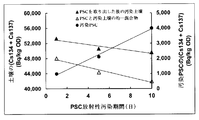
- Radioactive material contaminated particulate matter is an example of radioactive material contaminated soil. It is the figure which showed the time-dependent change of the radioactive material contamination soil by the decontamination method of the radioactive material contamination granular material which concerns on embodiment of this invention.
- a porous granular carbonized fired product containing 5% KCl (% with respect to PSC weight), 1% MgSO 4 (% with respect to PSC weight) and 1% CuSO 4 (% with respect to PSC weight) as described above. (PSC) was impregnated.
- PSC impregnated with each metal compound is referred to as “metal name-PSC (eg, 5% KCl-PSC)”.
- the decontamination rates of 5% KCl-PSC, 1% MgSO 4 -PSC and 1% CuSO 4 -PSC were 42.1% and 35.
- the decontamination rate was greatly improved by 9% and 36.1%.
- a decontamination method for radioactive substance-contaminated particulate matter includes a pretreatment step of mixing radioactive substance-contaminated particulate matter with a sodium phosphate-based dispersant, and a radioactive substance-contaminated particulate matter subjected to the pretreatment step.
- a porous granular carbonized fired product made of paper sludge impregnated with one or more compounds selected from the group of potassium chloride, magnesium sulfate and copper sulfate, so that radioactive cesium of radioactive material-contaminated granular material 134 and 137 have a decontamination process to be taken into the porous granular carbonized fired product.
- This decontamination method for radioactive material-contaminated particulate matter is a pretreatment step in which the radioactive material-contaminated particulate matter is mixed with a dispersant before using the porous particulate carbonized product impregnated with potassium chloride, magnesium sulfate, and copper sulfate. To fully disperse the components of the particulate material, or swell between the non-expanded layer and the expanded layer of clay of the particulate material.
- the clay is sufficiently separated from the sand, silt, etc., and after swelling between the non-expanded layer of clay and the expanded layer, potassium chloride Further, the porous granular carbonized product impregnated with magnesium sulfate and copper sulfate is again sprinkled in the soil and mixed well to further improve the ion exchange properties of radioactive material contaminated soil with radioactive cesium 134 and 137. .
- radioactive cesium 137 has the property of preferentially adsorbing to radioactive material-contaminated soils with mica minerals (Francis, CW, Brinkley, FS, 1976. Preferential admission of 137 Cs to micaceous minerals in contaminated fresh water education. Nature 260, 511-513). Further, the radioactive material contaminated soil having the mica mineral includes 2.27 ⁇ 10 ⁇ 10 mole Cs / kg soil of radioactive cesium 134 and 137, in other words, 60% of the total of cesium 134 and 137 of the radioactive material contaminated soil.
- radioactive cesium is contained in these vacancies. Adsorbed.
- radioactive cesium is selectively adsorbed on a fertil edge site called a V-shaped intermediate zone between the layers (Nakao, A., Thiry, Y., Funaka, S. Y., Kosaki, T., 2008. Characteristic of the frayed edge site of micaceous minerals in soy crayers influ ed by pi n ed n er n er n. For this reason, radioactive cesium binds more strongly to the soil. Because Japanese soil is acidic, the flared edge sites are easy to fold and negative charge is reduced.
- Radioactive cesium is an inferred mechanism that adsorbs to clay with mica minerals in two stages. In the first stage, the diffusion reaction of radioactive cesium is fast and the reaction site is between the non-expansion layer and the expansion layer. In the second stage, the diffusion reaction of radioactive cesium is slow, and the reaction site is a folded flared edge site.
- the diffusion reaction of cesium adsorption at the flade edge site has been experimentally confirmed (Man, C. K., Chu, P. Y., 2004.
- radioactive cesium initially reacts with calcium hydroxide at the clay's flared edge site, which causes the flared edge site to fold, allowing the cesium at the flared edge site to react with calcium.
- These cesiums are not removable.
- the cesium moves to the back between the non-expanded layer and the expanded layer with time, and is fixed while performing ion exchange with potassium there.
- Fraler, A.J., Shaw, S., Ward, M.B., Haigh, S.J., Moselmans J.F.W. Peacock, C.L., Stackhouse, S., Dent, A J., Trivedi, D., Burke, IT, 2015. Caesium information and retention in milliinterlayers. Appl. Clay Sci. 108, 128-134).
- the pretreatment step of first mixing the radioactively-contaminated particulate matter with the dispersing agent is performed, and between the flared edge site and the non-expanded layer and the expanded layer. Is fully expanded. After that, 5% KCl—PSC, 1% MgSO 4 —PSC, 1% CuSO 4 —PSC is added, and cesium that cannot be removed by mixing well is potassium, magnesium, copper impregnated in PSC. The ion exchange reaction with etc. is promoted. Therefore, the decontamination rate of radioactive cesium 134 and 137, which is a radioactive substance-contaminated particulate matter, is greatly increased.
- the method for decontaminating radioactive material-contaminated particulate matter includes sodium hexametaphosphate (SHMP), sodium tripolyphosphate (STPP), and sodium tetrapyrophosphate (SP) in the pretreatment step.
- SHMP sodium hexametaphosphate
- STPP sodium tripolyphosphate
- SP sodium tetrapyrophosphate
- sodium hexametaphosphate is a weak acid that is easily neutralized with caustic soda.
- Radioactive material contaminated soil in Iitate Village, Fukushima Prefecture was collected in April 2014 and used for the investigation of the effects of dispersants. Radioactive material-contaminated soil was air-dried until the solid content reached 90% or more, and adjusted to about 80% solid content with distilled water during the experiment. This radioactive material-contaminated soil was used in Examples and Reference Examples. In addition, radioactive materials were detected from some soils due to the nuclear power plant accident in the Great East Japan Earthquake that occurred on March 11, 2011.
- Radioactive material contaminated soil 80 g, completely dried (OD) weight
- 5% KCl-PSC (20 g, OD weight) in this order in a polyethylene bag, mixed well, and left at 25 ° C. for 10 days
- Radiocesium 134 and 137 were measured.
- Radioactive cesium 134 and 137 in soil contaminated with radioactive material is a coaxial germanium detector manufactured by Camberra based on the Ministry of Health, Labor and Welfare “Manual for Measuring Radiation of Foods in Emergency” and Ministry of Education, Culture, Sports, Science and Technology “ ⁇ -ray spectrometry using germanium semiconductor detector”.
- Measured with In 1% MgSO 4 -PSC and 1% CuSO 4 -PSC the experiment was performed in the same procedure as in 5% KCl-PSC. The result is shown in FIG.
- Example 1 Radioactive material contaminated soil (80 g, OD weight), sodium hexametaphosphate (SHMP) 5%, 10%, 20% (% of soil weight) in polyethylene bags, mixed well, and mixed at 25 ° C at 2 Left for days. After that, 5% KCl-PSC, 1% MgSO 4 -PSC, 1% CuSO 4 -PSC (20 g each, OD weight) are added to each SHMP level polyethylene bag, and mixed well again at 25 ° C. for 10 days. After standing, radioactive cesium 134 and 137 were measured. The result is shown in FIG.
- the decontamination rate of 5% KCl-PSC, 1% MgSO 4 -PSC and 1% CuSO 4 -PSC is pretreated.
- the 5% KCl-PSC have not, rose than 1% MgSO 4-PSC and 1% CuSO 4-PSC decontamination rate.
- doping ratio is 5 to 20% SHMP, those pre-treated with the addition of 10 percent, the highest decontamination factor, 5% KCl-PSC, 1 % MgSO 4 -PSC, 1% CuSO 4 - All PSC decontamination rates increased by about 1.4 times.
- the decontamination rate of 5% KCl-PSC was the highest, about 60%. From these results, it is considered that SHMP dispersed soil clay, sand, silt, etc., or spread between the non-expanded layer and expanded layer of clay, or decomposed / split.
- Example 2 > 5% KCl-PSC after pretreatment with 10% sodium hexametaphosphate (SHMP), sodium tripolyphosphate (STPP) and sodium tetrapyrophosphate (TSPP) using soil containing radioactive material-contaminated particulate matter After mixing (decontamination) with 1% MgSO 4 -PSC and 1% CuSO 4 -PSC, radioactive cesium 134 and 137 were measured.
- SHMP sodium hexametaphosphate
- STPP sodium tripolyphosphate
- TSPP sodium tetrapyrophosphate
- radioactive material-contaminated granular materials are first sodium hexametaphosphate (SHMP), sodium tripolyphosphate (STPP), and sodium tetrapyrophosphate (TSPP).
- SHMP sodium hexametaphosphate
- STPP sodium tripolyphosphate
- TSPP sodium tetrapyrophosphate
- the PSC is impregnated with a compound selected from the group of potassium chloride, magnesium sulfate, and copper sulfate, and decontamination results in a higher decontamination rate than when there is no pretreatment. Greatly improved.
- Pretreatment using a sodium phosphate-based dispersant is easy to operate, can easily adjust the metal salt compound, is easy to impregnate into PSC, and is an inexpensive commercial product. It is a technology that comprehensively satisfies Furthermore, it becomes possible to reuse radioactive substance-contaminated particulate matter (soil) decontaminated for the production of rice, food, vegetables, etc., and radioactive cesium 134 from rice, food, vegetables, etc. harvested in the soil. And 137 are not detected, or can be easily set to a value lower than the Japanese standard value.
- PSC in order to improve the decontamination rate of radioactive material-contaminated particulate matter, PSC should be impregnated with potassium chloride, magnesium sulfate, and copper sulfate compounds. Furthermore, in order to achieve a synergistic effect on the decontamination rate of radioactive material-contaminated particulate matter, two or more compounds out of six possible combinations of potassium chloride, magnesium sulfate and copper sulfate can be converted into PSC. Can be impregnated.
- two or more compounds out of six possible combinations of sodium hexametaphosphate, sodium tripolyphosphate and sodium tetrapyrophosphate Should be pretreated using a dispersant impregnated with.
- radioactive particulate pollutants sludge, rock particles, sedimentary sediment and dredged sediment that are deposited or discharged into soil, drainage, sewage treatment facilities such as farmland, private residential areas and public facilities are targeted.
- the decontamination method for radioactive substance-contaminated particulate matter according to the present embodiment is not limited to the above-mentioned place, etc., and is applied to sludge, sedimentary earth, etc. deposited or discharged at a place where radioactive substance-contaminated particulate matter can be contained. can do.
- the decontamination rate is improved even when pretreated radioactive material-contaminated particulate matter is mixed with PSC not impregnated with a metal salt such as potassium chloride.
- a metal salt such as potassium chloride.
- the radioactive substance-contaminated particulate matter is pretreated with a sodium salt-based dispersant, so that the structure of the radioactive substance-contaminated particulate matter is loosened, the internal space becomes large, and the radioactive cesium 134 is mixed when mixed with PSC. This is because 137 and 137 are easily incorporated into the PSC.
- radioactive material-contaminated soil 100 g, OD
- Iitate-mura Iitate-mura
- Fukushima Prefecture in the summer of 2012 was placed in a polyethylene bag
- PSC (10 g, OD) in a mesh bag was embedded in the radioactive material-contaminated soil. It was left at 25 ° C. for 10 days.
- radioactive material-contaminated soil 100 g, OD
- PSC 10 g, OD
- PSC 10 g, OD
- Radioactive cesium 134 and 137 of each radioactive substance-contaminated soil, PSC, pH, ion exchange capacity (CEC), metal composition of PSC before and after contamination were measured.
- the quality results of radioactive material contaminated soil and PSC are shown in Table 1 and FIG. 5, and the metal composition of PSC before and after contamination is shown in Table 2.
- radioactive soil contaminated particulate matter is contained in some soils in Fukushima Prefecture.
- the radioactive cesium 134 and 137 in the radioactive material contaminated soil decreases as the standing period increases, and conversely, the radioactive cesium 134 and 137 in the PSC increases. Can be estimated to have been transferred to PSC.
- Table 1 shows the results of standing for 10 days by the above lab test.
- the total of residual radioactive cesium 134 and 137 in the radioactive material contaminated soil and the total of radioactive cesium 134 and 137 adsorbed in the PSC was the same as that of the radioactive material contaminated soil before the embedded test.
- the total of radioactive cesium 134 and 137 was almost equivalent.
- the total of the radioactive cesium 134 and 137 of the mixture is lower than the total of the radioactive cesium 134 and 137 of the radioactive material contaminated soil before the test.
- the PSC in order to improve the decontamination efficiency of radioactive material contaminated soil, it can be seen that it is desirable that the PSC is in contact with as much radioactive material contaminated soil as possible. Further, it can be seen that the PSC after the contamination has a lower pH and cation exchange capacity (CEC) than before the contamination, and the PSC undergoes an ion exchange reaction with the radioactive cesium 134 and 137 of the radioactive material contaminated soil.
- CEC pH and cation exchange capacity
- cesium is classified as the same alkali metal as sodium and potassium, and it is known that it behaves like these elements.
- radioactive cesium generated from nuclear fission reactions such as nuclear power plant accidents and nuclear tests disperses in the atmosphere and falls to the soil. Soil with negative charge attracts and retains these cationic cesiums.
- the radioactive cesium that falls is confined by the negative charge containing the surface OH - group of the clay mineral.
- radioactive cesium adsorbed on soil performs ion exchange with potassium, barium, copper, magnesium, calcium, iron, and the like, which are constituent elements of PSC, and as a result, PSC is radioactively contaminated. . Therefore, it can be seen that the radioactive cesium in the radioactive material-contaminated soil does not simply physically adsorb to the PSC porous particles.
- radioactive sodium 23, radioactive calcium 40 and the like exchange ions with clay.
- the ionic element to be exchanged has a mass number of one point than the ionic element to be exchanged. It turns out that it is low.
- the identification of the reaction product, the half-life, etc. are unknown when ion exchange of the above PSC with potassium, barium, copper, magnesium, calcium, iron or the like is performed. Furthermore, it is also unknown that isotopes such as Cu64, Fe59, Zn65, Ca47, and Mg28 are produced when the stable metal performs ion exchange with radioactive cesium 134 and 137. Moreover, when these heavy metal isotopes are generated, it is unknown that the radioactive cesiums 134 and 137 are transformed into other cesium isotopes, but the radioactive cesiums 134 and 137 in the radioactive material contaminated soil are reduced. There is a high possibility of transformation.
- radioactive cesium 134 when mixing radioactive material-contaminated soil and PSC, radioactive cesium 134 is ion-exchanged into PSC and disintegrated into stable cesium 133. Similarly, radioactive cesium 137 has a short half-life. Presumed to be decayed to radioactive cesium 136. According to this estimation, it becomes possible to elucidate the reduction of radioactive cesium 134 and 137 in the radioactive material contaminated soil due to contact with the PSC confirmed in the present embodiment. In addition, cesium has 39 kinds of isotopes.
- radioactive cesium 137 and 134 are 30 years and 2 years, respectively, and mass numbers 132, 135 m, 136, 138 and 138 m are 6.5 days and 53 minutes, respectively. 13.2 days, 33 minutes, 3 minutes, most other isotopes are seconds to fractions of a second.
- the ion exchange reaction is enhanced by further increasing these metals to PSC.
- the decontamination efficiency of radioactive material contaminated soil by PSC is improved.
- PSC is impregnated with one or more compounds selected from the group consisting of metal chlorides, sulfates, and potassium ferrocyanide compounds containing both potassium and iron.
- the decontamination effect of contaminated soil was investigated.
- the chlorine and sulfur of PSC generally do not exist independently, and combine with the above metal to form a metal salt compound.
- both barium sulfate and calcium sulfate hardly dissolved in water, these compounds were not tested.
- potassium chlorides such as potassium, barium, copper, magnesium, calcium and iron
- potassium chloride can be used.
- potassium, copper, magnesium can be used among sulfates, such as potassium, copper, magnesium, and iron.
- sulfates such as potassium, copper, magnesium, and iron.
- These compounds can be used alone, or two or more of the six possible combinations can be used.
- potassium ferrocyanide can also be applied. When metal chlorides, sulfates and potassium ferrocyanide are used in combination, two or more of the 120 possible combinations of these compounds can be used.
- PSC has a stable cesium content of 0.2 ppm, but for the purpose of confirming the ion exchange reaction between stable cesium and radioactive cesium, 1% cesium chloride or 1% cesium sulfate relative to the weight of PSC is distilled water. After being dissolved in and impregnated with PSC, it was mixed with radioactive material contaminated soil, and the decontamination efficiency was investigated.
- radioactive material contaminated soil used in the experiment was collected in September 2013 in Iitate Village, Fukushima Prefecture, and air-dried until the solid content was about 85%.
- radioactive material-contaminated soil 85 g, OD
- PSC PSC
- metal compound PSC impregnated with potassium ferrocyanide compound
- potassium ferrocyanide compound 15 g, OD
- Radioactive material contaminated soil 100 g, OD
- 1% potassium chloride % with respect to soil weight
- % of soil weight 100 g, OD
- % of soil weight 100 g, OD
- cesium chloride % of soil weight
- CaCl 2 -PSC Adjustment of 6% CaCl 2 -PSC was carried out by the following procedure. CaCl 2 ⁇ 2H 2 O (23.838 g) was dissolved in distilled water (300 ml), then poured onto PSC (300 g, OD) in a shallow container and dried at 25 ° C. for 24-48 hours, Meanwhile, the container was shaken 2-3 times. In the same manner, KCl-PSC, BaCl 2 -PSC, MgCl 2 -PSC, and CsCl-PSC were prepared. Radioactive material contaminated soil (85 g, OD) and the above metal chloride compound-PSC (15 g, OD) were put in a polyethylene bag, mixed uniformly, and left at 25 ° C. for 10 days.
- radioactive material-contaminated soil 85 g, OD
- PSC 15 g, OD
- radioactive cesium 134 and 137 were measured. The results are shown in Table 4.
- MgSO 4 -PSC 1% MgSO 4 -PSC was prepared by the following method. Magnesium sulfate (MgSO 4 , 3 g) is dissolved in distilled water (300 ml) and then poured onto PSC (300 g, OD) in a shallow container and dried at 25 ° C. for 24-48 hours, while the container is 2 Shake ⁇ 3 times. The same manner, CuSO the K 2 SO 4 -PSC with potassium sulfate, the FeSO 4-PSC with FeSO 4 ⁇ 7H 2 O, the ZnSO 4-PSC with ZnSO 4 ⁇ 7H 2 O, with CuSO 4 ⁇ 5H 2 O 4- PSC and CsSO 4 -PSC were prepared with cesium sulfate, respectively.
- Radioactive material contaminated soil 85 g, OD
- sulfate metal salt-PSC 15 g, OD
- PSC PSC
- 1% potassium ferrocyanide-PSC was prepared by the following method.
- K 4 [Fe (CN) 6 ] 3H 2 O (3.385 g) was dissolved in distilled water (360 ml) and then poured onto PSC (300 g, OD) in a shallow vessel and at 25 ° C., 24-48 Time drying was performed, and the container was shaken 2-3 times during that time.
- Radioactive material-contaminated soil 85 g, OD
- potassium ferrocyanide-PSC (15 g, OD) were put in a polyethylene bag, mixed uniformly, and left at 25 ° C. for 10 days.
- radioactive material-contaminated soil 85 g, OD
- PSC 15 g, OD
- radioactive cesium 134 and 137 were measured. The results are shown in Table 6.
- potassium ferrocyanide-PSC has a higher decontamination rate than the blank test. This is thought to be due to the fact that potassium, iron, and the like that exchange ions with radioactive cesium are present in potassium ferrocyanide as described above. Accordingly, when PSC is impregnated with potassium ferrocyanide, the decontamination rate of radioactive material contaminated soil can be improved.
Landscapes
- Engineering & Computer Science (AREA)
- Physics & Mathematics (AREA)
- General Engineering & Computer Science (AREA)
- High Energy & Nuclear Physics (AREA)
- Chemical & Material Sciences (AREA)
- Inorganic Chemistry (AREA)
- Life Sciences & Earth Sciences (AREA)
- Food Science & Technology (AREA)
- Solid-Sorbent Or Filter-Aiding Compositions (AREA)
- Processing Of Solid Wastes (AREA)
Priority Applications (3)
| Application Number | Priority Date | Filing Date | Title |
|---|---|---|---|
| CA3003233A CA3003233C (en) | 2016-01-15 | 2016-11-30 | Method for decontaminating radiocontaminated grains |
| EP16884848.9A EP3373306A4 (de) | 2016-01-15 | 2016-11-30 | Verfahren zur dekontaminierung von mit radioaktivem material kontaminiertem körnigem material |
| US15/775,876 US10706981B2 (en) | 2016-01-15 | 2016-11-30 | Method for decontaminating radiocontaminated grains |
Applications Claiming Priority (2)
| Application Number | Priority Date | Filing Date | Title |
|---|---|---|---|
| JP2016-005753 | 2016-01-15 | ||
| JP2016005753A JP6238214B2 (ja) | 2016-01-15 | 2016-01-15 | 放射性物質汚染粒状物質の除染方法 |
Publications (1)
| Publication Number | Publication Date |
|---|---|
| WO2017122244A1 true WO2017122244A1 (ja) | 2017-07-20 |
Family
ID=59310965
Family Applications (1)
| Application Number | Title | Priority Date | Filing Date |
|---|---|---|---|
| PCT/JP2016/005030 Ceased WO2017122244A1 (ja) | 2016-01-15 | 2016-11-30 | 放射性物質汚染粒状物質の除染方法 |
Country Status (5)
| Country | Link |
|---|---|
| US (1) | US10706981B2 (de) |
| EP (1) | EP3373306A4 (de) |
| JP (1) | JP6238214B2 (de) |
| CA (1) | CA3003233C (de) |
| WO (1) | WO2017122244A1 (de) |
Families Citing this family (3)
| Publication number | Priority date | Publication date | Assignee | Title |
|---|---|---|---|---|
| KR102452825B1 (ko) * | 2020-08-31 | 2022-10-12 | 한국원자력연구원 | 부식산화막 제염제 및 이를 이용한 부식산화막의 제염방법 |
| CN114133935A (zh) * | 2021-11-29 | 2022-03-04 | 北京师范大学 | 一种由三氯化铁和有机膦酸强化的草酸基清洗活性材料 |
| CN114130367A (zh) * | 2021-11-29 | 2022-03-04 | 北京师范大学 | 用于放射性污染土壤清洗去污的磁性吸附材料 |
Citations (8)
| Publication number | Priority date | Publication date | Assignee | Title |
|---|---|---|---|---|
| JPH07185513A (ja) * | 1993-10-18 | 1995-07-25 | Westinghouse Electric Corp <We> | 粒状物からの金属、放射性汚染要因物等の除去方法 |
| JPH08506524A (ja) | 1993-11-30 | 1996-07-16 | ブリテイツシユ・ニユクリアー・フユールズ・ピー・エル・シー | 粒状物質処理方法 |
| JP2012237658A (ja) | 2011-05-12 | 2012-12-06 | Taiheiyo Cement Corp | 汚染土壌の浄化方法 |
| JP2013019876A (ja) * | 2011-07-07 | 2013-01-31 | Reino:Kk | 放射性核種セシウムの除染剤 |
| JP2013068459A (ja) | 2011-09-21 | 2013-04-18 | San-Ei Regulator Co Ltd | 放射性物質汚染土壌の改良浄化方法 |
| JP2013178132A (ja) | 2012-02-28 | 2013-09-09 | Hitachi Ltd | 放射性物質の除去方法 |
| JP2013208592A (ja) | 2012-03-30 | 2013-10-10 | Ube Machinery Corporation Ltd | 汚染土壌処理方法及び汚染土壌処理システム |
| JP2014153153A (ja) | 2013-02-07 | 2014-08-25 | Ube Machinery Corporation Ltd | 汚染土壌処理システム及び汚染土壌処理方法 |
Family Cites Families (9)
| Publication number | Priority date | Publication date | Assignee | Title |
|---|---|---|---|---|
| US6204430B1 (en) * | 1998-02-18 | 2001-03-20 | Rocky Mountain Remediation Services Llc | Hexametaphosphate as an agent for treating wastes, preparing construction materials and stabilizing soils |
| JP3886689B2 (ja) * | 1999-01-29 | 2007-02-28 | 株式会社東芝 | ほう素含有廃棄物の処理方法 |
| US6290637B1 (en) | 1999-07-16 | 2001-09-18 | University Of New Hampshire | Phosphate mineral-based reactive barrier containment system |
| JP2002006087A (ja) * | 2000-06-20 | 2002-01-09 | Japan Atom Energy Res Inst | ウラン鉱さいを安定化する方法 |
| JP6168740B2 (ja) * | 2011-10-21 | 2017-07-26 | 株式会社クラレ | セシウム回収シート及び海水浄化材 |
| JP5924572B2 (ja) * | 2011-12-02 | 2016-05-25 | 国立研究開発法人農業環境技術研究所 | 放射能汚染土壌の除染方法 |
| JP5916556B2 (ja) * | 2012-08-03 | 2016-05-11 | Dowaエコシステム株式会社 | 土壌からのセシウム除去のための前処理方法およびセシウム除去方法 |
| AU2014341297B2 (en) * | 2013-10-28 | 2017-05-25 | Yoshino Gypsum Co., Ltd. | Insolubilizing material for specific hazardous substance and method for insolubilizing specific hazardous substance with same |
| JP5946044B2 (ja) * | 2014-06-18 | 2016-07-05 | コアレックス三栄株式会社 | 放射性物質汚染土壌の除染方法 |
-
2016
- 2016-01-15 JP JP2016005753A patent/JP6238214B2/ja active Active
- 2016-11-30 EP EP16884848.9A patent/EP3373306A4/de not_active Withdrawn
- 2016-11-30 CA CA3003233A patent/CA3003233C/en active Active
- 2016-11-30 US US15/775,876 patent/US10706981B2/en not_active Expired - Fee Related
- 2016-11-30 WO PCT/JP2016/005030 patent/WO2017122244A1/ja not_active Ceased
Patent Citations (8)
| Publication number | Priority date | Publication date | Assignee | Title |
|---|---|---|---|---|
| JPH07185513A (ja) * | 1993-10-18 | 1995-07-25 | Westinghouse Electric Corp <We> | 粒状物からの金属、放射性汚染要因物等の除去方法 |
| JPH08506524A (ja) | 1993-11-30 | 1996-07-16 | ブリテイツシユ・ニユクリアー・フユールズ・ピー・エル・シー | 粒状物質処理方法 |
| JP2012237658A (ja) | 2011-05-12 | 2012-12-06 | Taiheiyo Cement Corp | 汚染土壌の浄化方法 |
| JP2013019876A (ja) * | 2011-07-07 | 2013-01-31 | Reino:Kk | 放射性核種セシウムの除染剤 |
| JP2013068459A (ja) | 2011-09-21 | 2013-04-18 | San-Ei Regulator Co Ltd | 放射性物質汚染土壌の改良浄化方法 |
| JP2013178132A (ja) | 2012-02-28 | 2013-09-09 | Hitachi Ltd | 放射性物質の除去方法 |
| JP2013208592A (ja) | 2012-03-30 | 2013-10-10 | Ube Machinery Corporation Ltd | 汚染土壌処理方法及び汚染土壌処理システム |
| JP2014153153A (ja) | 2013-02-07 | 2014-08-25 | Ube Machinery Corporation Ltd | 汚染土壌処理システム及び汚染土壌処理方法 |
Non-Patent Citations (12)
| Title |
|---|
| "y-rays Spectrometry by Germanium Semiconductor Detector", MINISTRY OF EDUCATION, CULTURE, SPORTS, SCIENCE AND TECHNOLOGY |
| AI VAN TRAN, HIROAKI TAMIYA: "Survey on decontamination of the soil contaminated with radioactive substances using porous/granular calcined material made from paper sludge", DAI 3 KAI KANKYO HOSHANO JOSEN KENKYU HAPPYOKAI YOSHISHU, 3 July 2014 (2014-07-03), pages 107, XP009512343 * |
| CANBERRA: "Radiation Measurement Manual of Food in an Emergency", MINISTRY OF HEALTH, LABOUR AND WELFARE |
| COMANS, R.N.; HALLER, M.; DE PRETER, P.: "Sorption of cesium on illite: Non-equilibrium behaviour and reversibility", GEOCHIM. COSMOCHIM. ACTA, vol. 55, 1991, pages 433 - 440 |
| FERRIS, A.P.; JEPSON, W.B.: "The exchange capacities of kaolinite and the preparation of homoionic clays", JOURNAL OF COLLOID AND INTERFACE SCIENCE, vol. 51, no. 5, 1975, pages 245 - 259, XP024187352, DOI: doi:10.1016/0021-9797(75)90110-1 |
| FRANCIS, C.W.; BRINKLEY, F.S.: "Preferential Adsorption of C to micaceous minerals in contaminated fresh water sediment", NATURE, vol. 260, 1976, pages 511 - 513 |
| FULLER, A.J.; SHAW, S.; WARD, M.B.; HAIGH, S.J.; MOSSELMANS J.F.W.; PEACOCK, C.L.; STACKHOUSE, S.; DENT, A.J.; TRIVEDI, D.; BURKE,: "Caesium incorporation and retention in illite interlayers", APPL. CLAY SCI., vol. 108, 2015, pages 128 - 134, XP029147894, DOI: doi:10.1016/j.clay.2015.02.008 |
| KOZAI, N.; OHNUKI, T.; ARISAKA, M.; WATANABE, M.; SAKAMOTO, F.; YAMASAKI, S.; JIANG, M-Y.: "Chemical states of fallout radioactive Cs in the soils deposited at Fukushima Daiichi Nuclear Power Plant accident", J. NUCL. SCI. TECHNOL., vol. 49, 2012, pages 473 - 478 |
| MAN, C.K.; CHU, P.Y.: "Experimental and modelling studies of radiocesium retention in soils", J RADIOANAL NUCL CHEM, vol. 262, 2004, pages 339 - 344, XP019251599 |
| NAKAO, A.; THIRY, Y.; FUNAKAWA, S.Y.; KOSAKI, T.: "Characterization of the frayed edge site of micaceous minerals in soil clays influenced by different pedogenetic conditions in Japan and northern Thailand", SOIL SCI. PLANT NUTRI., vol. 54, 2008, pages 479 - 489 |
| OHNUKI, T.: "Sorption characteristics of cesium on sandy soils and their components. Radiochim", ACTA, vol. 65, 1994, pages 75 - 80 |
| See also references of EP3373306A4 |
Also Published As
| Publication number | Publication date |
|---|---|
| US10706981B2 (en) | 2020-07-07 |
| US20180330838A1 (en) | 2018-11-15 |
| EP3373306A1 (de) | 2018-09-12 |
| CA3003233C (en) | 2020-07-21 |
| JP6238214B2 (ja) | 2017-11-29 |
| CA3003233A1 (en) | 2017-07-20 |
| EP3373306A4 (de) | 2019-09-11 |
| JP2017125785A (ja) | 2017-07-20 |
Similar Documents
| Publication | Publication Date | Title |
|---|---|---|
| Aljerf | High-efficiency extraction of bromocresol purple dye and heavy metals as chromium from industrial effluent by adsorption onto a modified surface of zeolite: kinetics and equilibrium study | |
| Mondal et al. | A comprehensive review on removal of arsenic using activated carbon prepared from easily available waste materials | |
| Ahmaruzzaman | Role of fly ash in the removal of organic pollutants from wastewater | |
| Wang et al. | Stabilization of an elevated heavy metal contaminated site | |
| Mohan et al. | Single-and multi-component adsorption of cadmium and zinc using activated carbon derived from bagasse—an agricultural waste | |
| Xu et al. | Enhanced removal efficiency of Cd2+ and Pb2+ from aqueous solution by H3PO4–modified tea branch biochar: Characterization, adsorption performance and mechanism | |
| Zhang et al. | Stabilization/solidification (S/S) of mercury-contaminated hazardous wastes using thiol-functionalized zeolite and Portland cement | |
| Oyanedel-Craver et al. | Simultaneous sorption of benzene and heavy metals onto two organoclays | |
| Maiti et al. | Iron oxide NPs facilitated a smart building composite for heavy-metal removal and dye degradation | |
| Xue et al. | Removal of heavy metals from landfill leachate using municipal solid waste incineration fly ash as adsorbent | |
| KR101743263B1 (ko) | 우라늄 폐기물 처리방법 | |
| Yang et al. | Nitrogen-functionalized bone chars with developed surface area for efficient adsorption of multiple aquatic pollutants | |
| Andryushchenko et al. | Sorption characteristics of materials of the filtration barrier in upper aquifers contaminated with radionuclides | |
| Kozai et al. | Radioactive fallout cesium in sewage sludge ash produced after the Fukushima Daiichi nuclear accident | |
| JP6238214B2 (ja) | 放射性物質汚染粒状物質の除染方法 | |
| Asgari et al. | Removal of cyanide from aqueous solution by adsorption onto bone charcoal | |
| Tang et al. | REMOVAL OF AQUEOUS Cu (II) WITH NATURAL KAOLIN: KINETICS AND EQUILIBRIUM STUDIES. | |
| Mishra et al. | Removal of zinc ions from wastewater using industrial waste sludge: a novel approach | |
| Martin et al. | The effect of organics on lead sorption onto Apatite II™ | |
| Su et al. | Porous durian shell biochar modified by KMnO4 (Mn-DSB) as a highly selective adsorbent for Be (II) | |
| JP2016099264A (ja) | 放射性物質を安全に処分する放射性物質吸着セラミックス | |
| JP5946044B2 (ja) | 放射性物質汚染土壌の除染方法 | |
| Sharma et al. | Repurposed marble dust as a promising adsorbent for modelling the removal of methylene blue from aqueous solutions | |
| Liao et al. | Electrokinetic stabilization of heavy metals in MSWI fly ash after water washing | |
| Ortiz-Oliveros et al. | Titanium pyrophosphate for removal of trivalent heavy metals and actinides simulated by retention of europium |
Legal Events
| Date | Code | Title | Description |
|---|---|---|---|
| 121 | Ep: the epo has been informed by wipo that ep was designated in this application |
Ref document number: 16884848 Country of ref document: EP Kind code of ref document: A1 |
|
| ENP | Entry into the national phase |
Ref document number: 3003233 Country of ref document: CA |
|
| WWE | Wipo information: entry into national phase |
Ref document number: 15775876 Country of ref document: US |
|
| NENP | Non-entry into the national phase |
Ref country code: DE |