WO2017126021A1 - Procédé de production de peigne - Google Patents
Procédé de production de peigne Download PDFInfo
- Publication number
- WO2017126021A1 WO2017126021A1 PCT/JP2016/051373 JP2016051373W WO2017126021A1 WO 2017126021 A1 WO2017126021 A1 WO 2017126021A1 JP 2016051373 W JP2016051373 W JP 2016051373W WO 2017126021 A1 WO2017126021 A1 WO 2017126021A1
- Authority
- WO
- WIPO (PCT)
- Prior art keywords
- hole
- plating
- resin molded
- comb
- molded product
- Prior art date
- Legal status (The legal status is an assumption and is not a legal conclusion. Google has not performed a legal analysis and makes no representation as to the accuracy of the status listed.)
- Ceased
Links
Images



Classifications
-
- C—CHEMISTRY; METALLURGY
- C25—ELECTROLYTIC OR ELECTROPHORETIC PROCESSES; APPARATUS THEREFOR
- C25D—PROCESSES FOR THE ELECTROLYTIC OR ELECTROPHORETIC PRODUCTION OF COATINGS; ELECTROFORMING; APPARATUS THEREFOR
- C25D7/00—Electroplating characterised by the article coated
-
- A—HUMAN NECESSITIES
- A45—HAND OR TRAVELLING ARTICLES
- A45D—HAIRDRESSING OR SHAVING EQUIPMENT; EQUIPMENT FOR COSMETICS OR COSMETIC TREATMENTS, e.g. FOR MANICURING OR PEDICURING
- A45D24/00—Hair combs for care of the hair; Accessories therefor
-
- A—HUMAN NECESSITIES
- A45—HAND OR TRAVELLING ARTICLES
- A45D—HAIRDRESSING OR SHAVING EQUIPMENT; EQUIPMENT FOR COSMETICS OR COSMETIC TREATMENTS, e.g. FOR MANICURING OR PEDICURING
- A45D24/00—Hair combs for care of the hair; Accessories therefor
- A45D24/02—Single-piece combs
Definitions
- the present invention relates to a method for producing a comb having a surface plated.
- Comb is known as a means for combing human hair (for example, see Patent Document 1).
- Such a comb is formed by projecting a plurality of substantially pin-shaped teeth arranged in a row from the main body.
- Various materials for the comb are known, but a resin molded product plated is generally easy to handle and is generally used.
- a resin molded product plated is generally easy to handle and is generally used.
- the surface becomes smooth and contact friction with hair is reduced.
- such a comb is recognized to have an effect of discharging the human body as a ground against static electricity staying in the hair.
- this painted part was easier to peel off than plating, and the resin inside was immediately exposed. This leads to a deterioration in the appearance of the comb. Further, if the part peeled off immediately in this way is in the vicinity of the teeth, the part peeled off when the comb is used may hit the hair and damage the hair. In addition, since the non-plated portion has low conductivity, it is difficult for the static electricity staying in the hair to be grounded through the human body and diffused.
- the present invention is a method for producing a comb that takes the above-described conventional technology into consideration and can reduce the influence on the hair due to the presence of a non-plated portion even when plating is performed, and further does not impair the appearance.
- the purpose is to provide.
- a plurality of teeth arranged in a row, a main body portion from which these teeth protrude, and a gripping portion that is a portion to be gripped continuously with the main body portion,
- a resin molded product manufacturing process for manufacturing a resin molded product comprising a through-hole penetrating the gripping part, and a plating process for plating the entire surface of the resin molded product while contacting a plating electrode to the through-hole,
- a finishing step of covering both ends of the through hole from both side surfaces of the gripping part including the inner wall surface of the through hole
- a male cover part and a female cover part each having male and female fitting protrusions are prepared, and the male and female fitting protrusions are fitted in the through hole, The vicinity of both ends of the through-hole is covered with the lids of the lid part and the female lid part.
- the main body portion is formed so as to extend along a root portion of the tooth, and the grip portion is further extended in a direction in which the main body portion extends, A through hole is formed at the end of the grip portion.
- the main body portion is formed to extend along a root portion of the tooth, and the main body portion is further extended in a direction opposite to the side where the tooth exists, and the gripping portion is formed.
- through holes are formed in advance in the resin molded product manufacturing process, and plating is performed while the plating electrode is in contact with the through holes in the plating process. For this reason, although non-plating parts, such as peeling which arise when talking about a plating electrode, arise, the inner wall surface of the through-hole including this day plating part is covered in a finishing process. Thereby, it can prevent that a non-plating part influences hair. That is, even if the resin molded product is plated, the influence on the hair due to the presence of the non-plated portion can be reduced, and the appearance is not impaired.
- a resin molded product manufacturing process is performed (step S1).
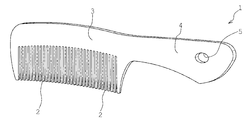
- This step is a step of manufacturing a resin molded product 1 as shown in FIG.
- the resin molded product 1 shown in this example has a plurality of teeth 2 arranged in a row. These teeth 2 protrude from the main body 3.
- a grip 4 is extended from the main body 3.
- the grip portion 4 is provided with a through hole 5 that penetrates the grip portion 4.
- the resin molded product 1 having such a shape is manufactured, for example, by injection molding using a resin.
- ABS resin can be used as the resin.
- a parting line is formed by molding, it is removed by polishing or the like as appropriate.
- step S2 This step is a step of plating the entire surface of the resin molded product 1.
- various plating treatments can be performed.
- electrolytic plating and electroless plating are used. Specifically, first, electroless nickel plating is performed to make the resin surface conductive. Thereafter, electrolytic plating is performed. That is, the material to be plated is connected to the anode, and the resin molded product 1 is connected to the cathode. Then, the plating solution is impregnated and a direct current is applied between both electrodes. Thereby, the metal which should be plated deposits on the whole surface of the resin molded product 1 which is in contact with the cathode.
- This electrolytic plating is also preferably performed a plurality of times, and after copper plating, nickel plating and chromium plating are preferably performed. Thereby, a smooth comb street can be realized.
- the cathode serving as the plating electrode is performed in contact with the through hole 5.
- the through hole 5 it can prevent that peeling of plating generate
- the non-plated portion including such a peeled portion is generated on the inner wall surface of the through hole 5.
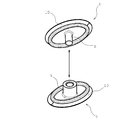
- step S3 is a step of covering both ends of the through hole 5. Specifically, both ends of the through-hole 5 are covered from both side surfaces of the grip portion 4 using the male lid part 6 and the female lid part 7 as shown in FIG.
- the male cover part 6 has a protrusion 8 which is a male fitting protrusion
- the female cover part 7 has a receiving portion 9 which is a female fitting protrusion.
- the male lid part 6 and the female lid part 7 are fitted to each other by inserting the protrusion 8 into the receiving part 9 in the through hole 5.
- the male lid part 6 and the female lid part 7 each have a lid body 10 that extends in a substantially circular shape.
- the lid body 10 covers the vicinity of both ends of the through-hole 5, and the inner wall surface of the through-hole 5 cannot be completely seen from the outside.
- the male lid part 6 and the female lid part 7 are also subjected to the same plating treatment as that of the dendritic molded article 1.
- a comb C as shown in FIG. 3 is formed.
- the inner wall surface of the through hole 5 is not visually recognized from the outside. Since the inner wall surface of the through hole 5 is not visually recognized from the outside, the non-plated portion is not exposed to the outside. Therefore, even if the resin molded product 1 is plated, the influence on the hair due to the presence of the non-plated portion can be reduced, and the appearance is not impaired. That is, it is possible to prevent the peeled portion generated by the plating process from directly touching the hair. Further, since the non-plated portion is not exposed, the entire surface of the comb C is coated with the plating metal, and therefore the conductivity is high on the entire surface. For this reason, against the static electricity staying in the hair, the human body can be reliably diffused as a ground along the surface of the plated comb C.
- the comb C as shown in FIG. 3 is formed so that the main body 3 extends along the root portion of the tooth 2, and the grip 4 is further extended in the direction in which the main body 3 extends. . That is, the teeth 2 are not formed so as to protrude from the grip portion 4.
- a through hole 5 is formed at the end of the grip portion 4. Thereby, the through hole 5 is formed at a position far from the tooth 2. Therefore, the possibility that the non-plated portion generated in the through hole 5 has an influence on the hair using the comb C can be eliminated as much as possible.
- the present invention does not prevent the non-plated portion generated by the plating process from being formed on the comb C, and even if there is a non-plated portion, the effect is not given to the hair as much as possible. It is.
- the male cover part 6 and the female cover part 7 are used, and more preferably, the through hole 5 is provided in the grip portion 4 in order to increase the distance between the through hole 5 and the tooth 2.
- the comb C manufactured by this invention is not limited to the example of FIG. 3,
- a thing like FIG. 5 may be used.
- the main body portion 3 extends along the root portion of the tooth 2, but the grip portion 4 extends from the main body portion 3 in a direction opposite to the tooth 2. Even if the gripping part 4 is extended in such a direction, when the hair is combed, the distance between the through hole 5 in which the non-plating part is formed and the tooth 2 is far, so that the influence of the non-plating part on the hair is suppressed. it can.
Landscapes
- Chemical & Material Sciences (AREA)
- Engineering & Computer Science (AREA)
- Chemical Kinetics & Catalysis (AREA)
- Electrochemistry (AREA)
- Materials Engineering (AREA)
- Metallurgy (AREA)
- Organic Chemistry (AREA)
- Electroplating Methods And Accessories (AREA)
- Brushes (AREA)
Abstract
Priority Applications (4)
| Application Number | Priority Date | Filing Date | Title |
|---|---|---|---|
| CN201680076359.4A CN108471857B (zh) | 2016-01-19 | 2016-01-19 | 梳子的制造方法 |
| JP2017519708A JP6176514B1 (ja) | 2016-01-19 | 2016-01-19 | コームの製造方法 |
| PCT/JP2016/051373 WO2017126021A1 (fr) | 2016-01-19 | 2016-01-19 | Procédé de production de peigne |
| KR1020187017611A KR102090943B1 (ko) | 2016-01-19 | 2016-01-19 | 빗의 제조방법 |
Applications Claiming Priority (1)
| Application Number | Priority Date | Filing Date | Title |
|---|---|---|---|
| PCT/JP2016/051373 WO2017126021A1 (fr) | 2016-01-19 | 2016-01-19 | Procédé de production de peigne |
Publications (1)
| Publication Number | Publication Date |
|---|---|
| WO2017126021A1 true WO2017126021A1 (fr) | 2017-07-27 |
Family
ID=59362333
Family Applications (1)
| Application Number | Title | Priority Date | Filing Date |
|---|---|---|---|
| PCT/JP2016/051373 Ceased WO2017126021A1 (fr) | 2016-01-19 | 2016-01-19 | Procédé de production de peigne |
Country Status (4)
| Country | Link |
|---|---|
| JP (1) | JP6176514B1 (fr) |
| KR (1) | KR102090943B1 (fr) |
| CN (1) | CN108471857B (fr) |
| WO (1) | WO2017126021A1 (fr) |
Cited By (3)
| Publication number | Priority date | Publication date | Assignee | Title |
|---|---|---|---|---|
| JP7089321B1 (ja) * | 2021-12-28 | 2022-06-22 | 株式会社YC・Primarily | くし |
| EP4585100A4 (fr) * | 2023-11-29 | 2025-07-16 | Yc Primarily Co Ltd | Peigne |
| JPWO2025163793A1 (fr) * | 2024-01-31 | 2025-08-07 |
Citations (4)
| Publication number | Priority date | Publication date | Assignee | Title |
|---|---|---|---|---|
| JPS313348Y1 (fr) * | 1954-11-09 | 1956-03-06 | ||
| JPS5019698U (fr) * | 1973-06-22 | 1975-03-05 | ||
| JPS5656803U (fr) * | 1979-10-10 | 1981-05-16 | ||
| JP3456473B2 (ja) * | 2000-11-16 | 2003-10-14 | 日本電気株式会社 | 携帯電話機筐体 |
Family Cites Families (11)
| Publication number | Priority date | Publication date | Assignee | Title |
|---|---|---|---|---|
| JPS586798B2 (ja) * | 1976-02-05 | 1983-02-07 | 三菱電機株式会社 | 電解装置 |
| TW247882B (en) * | 1993-03-23 | 1995-05-21 | Shean-Rong Wang | Process of producing hair comb |
| CN1150084A (zh) * | 1995-11-10 | 1997-05-21 | 方国章 | 高品质梳子框的成型制造方法 |
| DK1549174T3 (en) * | 2002-09-20 | 2016-08-15 | Colgate Palmolive Co | Toothbrush with grip area |
| KR200382799Y1 (ko) * | 2004-12-06 | 2005-04-25 | 양원동 | 기능성 빗과 브러시 |
| JP2007111295A (ja) | 2005-10-21 | 2007-05-10 | Yoshiaki Inaoka | 櫛 |
| JP4967662B2 (ja) * | 2007-01-05 | 2012-07-04 | 豊田合成株式会社 | 樹脂めっき製品の製造方法及びこれに用いられる被めっき樹脂成形品 |
| KR20090061749A (ko) * | 2007-12-12 | 2009-06-17 | 김설화 | 에센스가 나오며 머리카락을 쉽게 제거하는 머리 빗 |
| CN201139186Y (zh) * | 2007-12-20 | 2008-10-29 | 于珍 | 一种组合梳子 |
| CN101922031B (zh) * | 2010-08-04 | 2012-05-30 | 四川长虹电器股份有限公司 | 双镀层钢带及电镀工艺 |
| CN104042024A (zh) * | 2013-03-13 | 2014-09-17 | 周明 | 一种梳子的制作方法 |
-
2016
- 2016-01-19 KR KR1020187017611A patent/KR102090943B1/ko active Active
- 2016-01-19 CN CN201680076359.4A patent/CN108471857B/zh active Active
- 2016-01-19 WO PCT/JP2016/051373 patent/WO2017126021A1/fr not_active Ceased
- 2016-01-19 JP JP2017519708A patent/JP6176514B1/ja active Active
Patent Citations (4)
| Publication number | Priority date | Publication date | Assignee | Title |
|---|---|---|---|---|
| JPS313348Y1 (fr) * | 1954-11-09 | 1956-03-06 | ||
| JPS5019698U (fr) * | 1973-06-22 | 1975-03-05 | ||
| JPS5656803U (fr) * | 1979-10-10 | 1981-05-16 | ||
| JP3456473B2 (ja) * | 2000-11-16 | 2003-10-14 | 日本電気株式会社 | 携帯電話機筐体 |
Cited By (9)
| Publication number | Priority date | Publication date | Assignee | Title |
|---|---|---|---|---|
| JP7089321B1 (ja) * | 2021-12-28 | 2022-06-22 | 株式会社YC・Primarily | くし |
| WO2023127104A1 (fr) | 2021-12-28 | 2023-07-06 | 株式会社YC・Primarily | Peigne |
| KR20240096753A (ko) | 2021-12-28 | 2024-06-26 | 가부시키가이샤 와이시 푸라이마리 | 빗 |
| US20240415260A1 (en) * | 2021-12-28 | 2024-12-19 | Yc Primarily Co., Ltd. | Comb |
| EP4458205A4 (fr) * | 2021-12-28 | 2025-09-24 | Yc Primarily Co Ltd | Peigne |
| EP4585100A4 (fr) * | 2023-11-29 | 2025-07-16 | Yc Primarily Co Ltd | Peigne |
| JPWO2025163793A1 (fr) * | 2024-01-31 | 2025-08-07 | ||
| WO2025163793A1 (fr) * | 2024-01-31 | 2025-08-07 | 株式会社YC・Primarily | Peigne pliable |
| JP7813489B2 (ja) | 2024-01-31 | 2026-02-13 | 株式会社YC・Primarily | 折り畳みコーム |
Also Published As
| Publication number | Publication date |
|---|---|
| CN108471857B (zh) | 2020-12-15 |
| KR20180101712A (ko) | 2018-09-13 |
| KR102090943B1 (ko) | 2020-03-19 |
| CN108471857A (zh) | 2018-08-31 |
| JP6176514B1 (ja) | 2017-08-09 |
| JPWO2017126021A1 (ja) | 2018-01-25 |
Similar Documents
| Publication | Publication Date | Title |
|---|---|---|
| JP6176514B1 (ja) | コームの製造方法 | |
| CN106061153A (zh) | 用于电隔离金属体的区域的方法 | |
| US20100239111A1 (en) | Hearing instrument housing made of a polymer metal composite | |
| US9474893B2 (en) | Tip structure for a skin care apparatus | |
| TWI577257B (zh) | 於基材絕緣表面形成導電線路的方法 | |
| CN105007342B (zh) | 一种壳体及其制造方法 | |
| EP2108716A2 (fr) | Procédé d'électrodéposition d'un substrat en plastique | |
| KR100375636B1 (ko) | 동복알루미늄선의 제조 방법 | |
| CN105900181A (zh) | 用于使大电流汇流条绝缘的系统 | |
| IL148895A0 (en) | Method for producing an electrolytically coated cold rolled strip, preferably for use in the production of battery sheaths, and battery sheath produced according to said method | |
| CN105214922A (zh) | 在壳体侧壁形成多种层次视觉效果的方法和电子设备 | |
| CN210420212U (zh) | 一种质感高级的涂金设备 | |
| KR200357998Y1 (ko) | 전기 도금용 지그 | |
| US887482A (en) | Electrocosmetic face-mask. | |
| US2335774A (en) | Process for making prosthetic articles by electrodeposition of metals | |
| WO2023127104A1 (fr) | Peigne | |
| CN111733434A (zh) | 一种质感高级的涂金设备及其使用方法 | |
| JP2011052258A5 (fr) | ||
| JPH0649694A (ja) | 電気メッキ処理用ラック及びそれを用いた電気メッキ処理方法 | |
| CN104651916B (zh) | 用于镶件表面与edm深型腔的电镀前处理工艺 | |
| US211610A (en) | Improvement in processes for bronzing metals | |
| CN201171308Y (zh) | 覆有保护层的宠物项圈绳索连接半圆扣 | |
| CN121228165A (zh) | 杆头图样形成方法 | |
| CN104762650B (zh) | 细深孔镀铬阳极及其制作方法 | |
| KR20140141322A (ko) | 금속 도금장치 |
Legal Events
| Date | Code | Title | Description |
|---|---|---|---|
| ENP | Entry into the national phase |
Ref document number: 2017519708 Country of ref document: JP Kind code of ref document: A |
|
| 121 | Ep: the epo has been informed by wipo that ep was designated in this application |
Ref document number: 16886264 Country of ref document: EP Kind code of ref document: A1 |
|
| ENP | Entry into the national phase |
Ref document number: 20187017611 Country of ref document: KR Kind code of ref document: A |
|
| NENP | Non-entry into the national phase |
Ref country code: DE |
|
| 122 | Ep: pct application non-entry in european phase |
Ref document number: 16886264 Country of ref document: EP Kind code of ref document: A1 |