WO2017126202A1 - 車両用窓ガラス及び車両用窓ガラスの製造方法 - Google Patents
車両用窓ガラス及び車両用窓ガラスの製造方法 Download PDFInfo
- Publication number
- WO2017126202A1 WO2017126202A1 PCT/JP2016/083669 JP2016083669W WO2017126202A1 WO 2017126202 A1 WO2017126202 A1 WO 2017126202A1 JP 2016083669 W JP2016083669 W JP 2016083669W WO 2017126202 A1 WO2017126202 A1 WO 2017126202A1
- Authority
- WO
- WIPO (PCT)
- Prior art keywords
- window glass
- glass
- conductor layer
- glass plate
- thickness
- Prior art date
- Legal status (The legal status is an assumption and is not a legal conclusion. Google has not performed a legal analysis and makes no representation as to the accuracy of the status listed.)
- Ceased
Links
Images
Classifications
-
- H—ELECTRICITY
- H05—ELECTRIC TECHNIQUES NOT OTHERWISE PROVIDED FOR
- H05B—ELECTRIC HEATING; ELECTRIC LIGHT SOURCES NOT OTHERWISE PROVIDED FOR; CIRCUIT ARRANGEMENTS FOR ELECTRIC LIGHT SOURCES, IN GENERAL
- H05B3/00—Ohmic-resistance heating
- H05B3/84—Heating arrangements specially adapted for transparent or reflecting areas, e.g. for demisting or de-icing windows, mirrors or vehicle windshields
-
- C—CHEMISTRY; METALLURGY
- C03—GLASS; MINERAL OR SLAG WOOL
- C03C—CHEMICAL COMPOSITION OF GLASSES, GLAZES OR VITREOUS ENAMELS; SURFACE TREATMENT OF GLASS; SURFACE TREATMENT OF FIBRES OR FILAMENTS MADE FROM GLASS, MINERALS OR SLAGS; JOINING GLASS TO GLASS OR OTHER MATERIALS
- C03C17/00—Surface treatment of glass, not in the form of fibres or filaments, by coating
- C03C17/006—Surface treatment of glass, not in the form of fibres or filaments, by coating with materials of composite character
- C03C17/007—Surface treatment of glass, not in the form of fibres or filaments, by coating with materials of composite character containing a dispersed phase, e.g. particles, fibres or flakes, in a continuous phase
-
- B—PERFORMING OPERATIONS; TRANSPORTING
- B60—VEHICLES IN GENERAL
- B60J—WINDOWS, WINDSCREENS, NON-FIXED ROOFS, DOORS, OR SIMILAR DEVICES FOR VEHICLES; REMOVABLE EXTERNAL PROTECTIVE COVERINGS SPECIALLY ADAPTED FOR VEHICLES
- B60J1/00—Windows; Windscreens; Accessories therefor
-
- B—PERFORMING OPERATIONS; TRANSPORTING
- B60—VEHICLES IN GENERAL
- B60S—SERVICING, CLEANING, REPAIRING, SUPPORTING, LIFTING, OR MANOEUVRING OF VEHICLES, NOT OTHERWISE PROVIDED FOR
- B60S1/00—Cleaning of vehicles
- B60S1/02—Cleaning windscreens, windows or optical devices
-
- B—PERFORMING OPERATIONS; TRANSPORTING
- B60—VEHICLES IN GENERAL
- B60S—SERVICING, CLEANING, REPAIRING, SUPPORTING, LIFTING, OR MANOEUVRING OF VEHICLES, NOT OTHERWISE PROVIDED FOR
- B60S1/00—Cleaning of vehicles
- B60S1/02—Cleaning windscreens, windows or optical devices
- B60S1/56—Cleaning windscreens, windows or optical devices specially adapted for cleaning other parts or devices than front windows or windscreens
- B60S1/58—Cleaning windscreens, windows or optical devices specially adapted for cleaning other parts or devices than front windows or windscreens for rear windows
-
- C—CHEMISTRY; METALLURGY
- C03—GLASS; MINERAL OR SLAG WOOL
- C03C—CHEMICAL COMPOSITION OF GLASSES, GLAZES OR VITREOUS ENAMELS; SURFACE TREATMENT OF GLASS; SURFACE TREATMENT OF FIBRES OR FILAMENTS MADE FROM GLASS, MINERALS OR SLAGS; JOINING GLASS TO GLASS OR OTHER MATERIALS
- C03C17/00—Surface treatment of glass, not in the form of fibres or filaments, by coating
- C03C17/02—Surface treatment of glass, not in the form of fibres or filaments, by coating with glass
- C03C17/04—Surface treatment of glass, not in the form of fibres or filaments, by coating with glass by fritting glass powder
-
- C—CHEMISTRY; METALLURGY
- C03—GLASS; MINERAL OR SLAG WOOL
- C03C—CHEMICAL COMPOSITION OF GLASSES, GLAZES OR VITREOUS ENAMELS; SURFACE TREATMENT OF GLASS; SURFACE TREATMENT OF FIBRES OR FILAMENTS MADE FROM GLASS, MINERALS OR SLAGS; JOINING GLASS TO GLASS OR OTHER MATERIALS
- C03C17/00—Surface treatment of glass, not in the form of fibres or filaments, by coating
- C03C17/06—Surface treatment of glass, not in the form of fibres or filaments, by coating with metals
-
- H—ELECTRICITY
- H05—ELECTRIC TECHNIQUES NOT OTHERWISE PROVIDED FOR
- H05B—ELECTRIC HEATING; ELECTRIC LIGHT SOURCES NOT OTHERWISE PROVIDED FOR; CIRCUIT ARRANGEMENTS FOR ELECTRIC LIGHT SOURCES, IN GENERAL
- H05B3/00—Ohmic-resistance heating
- H05B3/84—Heating arrangements specially adapted for transparent or reflecting areas, e.g. for demisting or de-icing windows, mirrors or vehicle windshields
- H05B3/86—Heating arrangements specially adapted for transparent or reflecting areas, e.g. for demisting or de-icing windows, mirrors or vehicle windshields the heating conductors being embedded in the transparent or reflecting material
-
- C—CHEMISTRY; METALLURGY
- C03—GLASS; MINERAL OR SLAG WOOL
- C03C—CHEMICAL COMPOSITION OF GLASSES, GLAZES OR VITREOUS ENAMELS; SURFACE TREATMENT OF GLASS; SURFACE TREATMENT OF FIBRES OR FILAMENTS MADE FROM GLASS, MINERALS OR SLAGS; JOINING GLASS TO GLASS OR OTHER MATERIALS
- C03C2217/00—Coatings on glass
- C03C2217/40—Coatings comprising at least one inhomogeneous layer
- C03C2217/43—Coatings comprising at least one inhomogeneous layer consisting of a dispersed phase in a continuous phase
- C03C2217/44—Coatings comprising at least one inhomogeneous layer consisting of a dispersed phase in a continuous phase characterized by the composition of the continuous phase
- C03C2217/45—Inorganic continuous phases
- C03C2217/452—Glass
-
- C—CHEMISTRY; METALLURGY
- C03—GLASS; MINERAL OR SLAG WOOL
- C03C—CHEMICAL COMPOSITION OF GLASSES, GLAZES OR VITREOUS ENAMELS; SURFACE TREATMENT OF GLASS; SURFACE TREATMENT OF FIBRES OR FILAMENTS MADE FROM GLASS, MINERALS OR SLAGS; JOINING GLASS TO GLASS OR OTHER MATERIALS
- C03C2217/00—Coatings on glass
- C03C2217/40—Coatings comprising at least one inhomogeneous layer
- C03C2217/43—Coatings comprising at least one inhomogeneous layer consisting of a dispersed phase in a continuous phase
- C03C2217/46—Coatings comprising at least one inhomogeneous layer consisting of a dispersed phase in a continuous phase characterized by the dispersed phase
- C03C2217/47—Coatings comprising at least one inhomogeneous layer consisting of a dispersed phase in a continuous phase characterized by the dispersed phase consisting of a specific material
- C03C2217/475—Inorganic materials
- C03C2217/479—Metals
-
- H—ELECTRICITY
- H05—ELECTRIC TECHNIQUES NOT OTHERWISE PROVIDED FOR
- H05B—ELECTRIC HEATING; ELECTRIC LIGHT SOURCES NOT OTHERWISE PROVIDED FOR; CIRCUIT ARRANGEMENTS FOR ELECTRIC LIGHT SOURCES, IN GENERAL
- H05B2203/00—Aspects relating to Ohmic resistive heating covered by group H05B3/00
- H05B2203/013—Heaters using resistive films or coatings
-
- H—ELECTRICITY
- H05—ELECTRIC TECHNIQUES NOT OTHERWISE PROVIDED FOR
- H05B—ELECTRIC HEATING; ELECTRIC LIGHT SOURCES NOT OTHERWISE PROVIDED FOR; CIRCUIT ARRANGEMENTS FOR ELECTRIC LIGHT SOURCES, IN GENERAL
- H05B2203/00—Aspects relating to Ohmic resistive heating covered by group H05B3/00
- H05B2203/016—Heaters using particular connecting means
Definitions
- the present invention relates to a vehicle window glass and a method for manufacturing a vehicle window glass.
- solder solder alloy
- the solder solder alloy which connects between the wiring formed with the silver paste on the glass plate used as a base and the power supply terminal has conventionally been one containing lead.
- lead-free solder has a higher Young's modulus and higher rigidity than leaded solder containing lead. For this reason, when a mechanical stress or a stress due to a difference in thermal expansion coefficient is applied, cracks or the like may occur in the glass plate or may be peeled off.
- An object of the present invention is to provide a vehicle window glass and a method for manufacturing a vehicle window glass that are less prone to cracking.
- the present invention solves the above problems by the following means.
- the invention according to claim 1 is mainly composed of a glass plate, a color ceramic layer having a thickness of 10 ⁇ m to 25 ⁇ m or less formed on the surface of the glass plate, and silver formed on the surface of the color ceramic layer.
- the invention according to claim 2 is the window glass for vehicle according to claim 1, wherein the color ceramic layer has a thickness of 16 ⁇ m or more.
- Invention of Claim 3 is the window glass for vehicles of Claim 1 or 2, Comprising: The said conductor layer is formed by apply
- the invention according to claim 4 is the window glass for a vehicle according to any one of claims 1 to 3, wherein the conductor layer has a thickness of 7 to 8 ⁇ m. It is a window glass for vehicles.
- Invention of Claim 5 is a manufacturing method of the window glass for vehicles of any one of Claim 1 to 4, Comprising: Ceramic paste is screened with a screen with an opening ratio larger than 38% and smaller than 60%. A step of printing on the glass plate to form a coating film of the precursor of the color ceramic layer; and a step of printing a silver paste on the coating film of the precursor of the color ceramic layer on a single screen. It is a manufacturing method of the window glass for vehicles provided.
- the invention according to claim 6 is the method for manufacturing the window glass for vehicle according to claim 5, wherein the number of times of printing of the ceramic paste is one.
- the said structure may be improved suitably, and at least one part may substitute for another structure.
- window glass for vehicles of embodiment. It is a top view of window glass 1 for vehicles of an embodiment.
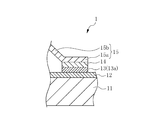
- Drawing 1 is a sectional view of window glass 1 for vehicles of an embodiment.
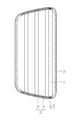
- Drawing 2 is a top view of window glass 1 for vehicles of an embodiment.
- the window glass 1 for vehicles of this embodiment is used as a rear window, for example, it is not limited to this.
- the vehicle window glass 1 shown in FIG. 1 is incorporated in a vehicle, the lower side in the figure is the outside of the vehicle, and the upper side is the inside of the vehicle.
- the vehicle window glass 1 includes a glass plate 11, a color ceramic layer (ceramic sintered layer) 12, a conductor layer 13, a lead-free solder 14, and a power supply terminal 15 from the outside.
- the glass plate 11 has a shape curved by bending.
- the glass plate 11 is a tempered glass in which a compression stress layer (external pressure applied force) is formed on the surface by a wind-cooling strengthening method or a chemical strengthening method, or a laminated glass in which two glass plates are bonded with a resin film. May be.
- a material of the glass plate 11 a known glass composition can be used in addition to soda-lime silicate glass as defined in ISO16293-1.
- a coloring component such as iron or cobalt is appropriately adjusted as a component of the glass composition, and a material exhibiting a color tone such as gray, green, or blue may be used.
- the color ceramic layer 12 is a conductor formed on the inner surface of the vehicle window glass 1 to prevent deterioration of the urethane adhesive due to solar radiation when the vehicle window glass 1 is bonded to the window frame. It is formed for the purpose of hiding the wiring of the layer 13 from the outside and the like, and preferably a black one is used.
- the color ceramic layer 12 is a color ceramic composition having a heat-resistant pigment (metal oxide) that is an inorganic component and a glass material having a softening point temperature lower than the softening point temperature of the glass plate 11.
- a ceramic paste formed by kneading a powder of a heat resistant pigment (metal oxide) as an inorganic component and a glass frit as a glass material together with a vehicle is applied to the surface of the glass plate 11 by screen printing.
- the heat resistant pigment is blended in order to give a desired color to the ceramic color.
- the particle size is appropriately determined in consideration of dispersibility in the ceramic paste and color developability, and a 50% particle size of 0.1 to 10 ⁇ m, preferably about 0.2 to 5 ⁇ m can be used. .
- a conventional heat resistant pigment can be used as the heat resistant pigment.
- pigments for exhibiting black color include copper-chromium composite oxide, iron-manganese composite oxide, copper-chromium-manganese composite oxide, cobalt-iron-chromium composite oxide, magnetite and the like.
- pigments for exhibiting brown color include zinc-iron composite oxide and zinc-iron-chromium composite oxide.
- blue pigments include cobalt blue
- examples of green pigments include chrome green, cobalt-zinc-nickel-titanium composite oxide, cobalt-aluminum-chromium composite oxide, and the like.
- white pigments titanium white, zinc oxide, etc.
- red pigments blue pigments
- yellow pigments titanium-barium-nickel composite oxide, titanium-antimony-nickel composite oxide
- Materials titanium-antimony-chromium composite oxides, etc.
- the glass frit is for binding the color ceramic to a glass plate to form the color ceramic layer 12.
- a glass frit conventionally used in color ceramics can be used. Examples of such glass frit include borosilicate glass, zinc borosilicate glass, and bismuth glass. These glass frit can be used individually or in combination of 2 or more types.
- the softening point temperature of the glass frit is preferably lower than the bending temperature of the glass plate 11, for example, 600 to 750 ° C., preferably 380 to 600 ° C., preferably 400 to 580, more preferably about 410 to 550 ° C. Can be used.
- the particle size of the glass frit is appropriately determined in consideration of the applicability of the ceramic paste during screen printing. For example, at a 50% particle size, 0.1 to 10 ⁇ m, preferably 0.5 to 5 ⁇ m, more preferably 1 About 4 ⁇ m can be used.
- the content of glass material can be 50 to 95% by mass, preferably 60 to 80% by mass. This content can be appropriately adjusted in consideration of the binding property of the color ceramic layer 12 to the glass plate 11 and the color tone of the color ceramic layer 12.
- the reason why the stress from the lead-free solder 14 to the glass plate 11 can be relaxed by the presence of the color ceramic layer 12 having a predetermined thickness is not clear.
- the color ceramic layer 12 is a fired product of the glass material and the heat-resistant pigment, and the color ceramic layer 12 is a porous body including pores. Since the color ceramic layer 12 is a softer material than the glass 11, it is presumed that stress relaxation occurs in the color ceramic layer 12 having a predetermined thickness.
- the vehicle is formulated to paste the heat-resistant pigment (metal oxide) powder, which is an inorganic component, and the glass frit powder, which is a glass material, and apply it to coating processes such as screen printing. It has a medium and a binder.
- the vehicle is appropriately blended in consideration of printability (applicability), and can be contained, for example, 10 to 50% by mass, preferably 15 to 45% by mass with respect to the entire color ceramic paste.
- the dispersion medium is preferably low in volatility at normal temperature and has a boiling point that volatilizes at a temperature lower than the temperature at which the glass frit softens.
- a dispersion medium of about 50 to 250 ° C. can be used.
- dispersion medium examples include aliphatic alcohols (for example, saturated or unsaturated C6-3 such as 2-ethyl-1-hexanol, octanol, decanol, etc.), cellosolves (methyl cellosolve, ethyl cellosolve, butyl cellosolve).
- aliphatic alcohols for example, saturated or unsaturated C6-3 such as 2-ethyl-1-hexanol, octanol, decanol, etc.
- cellosolves methyl cellosolve, ethyl cellosolve, butyl cellosolve.
- C1-4 alkyl cellosolves etc.
- cellosolve acetates C1-4 alkyl cellosolve acetates such as ethyl cellosolve acetate, butyl cellosolve acetate
- carbitols methyl carbitol, ethyl carbitol, propyl carbitol, butyl carbitol
- C1-4 alkyl carbitols such as Tol
- carbitol acetates C1-4 alkyl cellosolve acetates such as ethyl carbitol acetate and butyl carbitol acetate
- aliphatic polyvalent alcohol Eg, ethylene glycol, diethylene glycol, dipropylene glycol, 1,4-butanediol, triethylene glycol, glycerin, etc.
- alicyclic alcohols eg, cycloalkanols such as cyclohexanol, 1 terpineol
- Terpene alcohols for example, monoterpene alcohol etc.
- aromatic power rubonic acid esters diC1-10 alkyl esters of phthalic acid such as dibutyl phthalate and dioctyl phthalate
- diC1-10 alkyl phthalates such as dibutylbenzyl phthalate Aralkyl esters, etc.
- Any binder can be used as long as it gives an appropriate viscosity to the color ceramic paste and can be decomposed at about 200 to 550 ° C., preferably about 220 to 400 ° C.
- examples include thermoplastic resins (olefin resins, vinyl resins, acrylic resins, styrene resins, polyester resins, polyamide resins, cellulose derivatives, etc.), thermosetting resins (thermosetting acrylic resins, Epoxy resins, phenol resins, unsaturated polyester resins, polyurethane resins, etc.), mixtures thereof and the like. Acrylic resins are preferred.
- the ratio of the binder to the entire vehicle may be 5 to 80% by mass, preferably 10 to 50% by mass, and more preferably 15 to 40% by mass.
- the conductor layer 13 is formed on the color ceramic layers 12 on both sides of the glass plate 11, and is connected in parallel at a predetermined interval by connecting the bus bars 13a. And the line 13b.
- the conductor layer 13 is a conductor composition having silver metal (silver or silver alloy) and a glass material having a softening point temperature lower than the softening point temperature of the glass plate 11.
- the composition is formed by applying a silver paste containing silver as a main component onto the color ceramic layer 12 by screen printing according to a predetermined pattern, and firing the applied product.
- the conductor layer 13 is, for example, a heat ray print of a defogger or a defroster, but may be an antenna print for broadcast reception.
- the glass frit and vehicle used in the silver paste can be the same as the glass frit and vehicle described in the section of the color ceramic paste, and the blending ratio of the vehicle is 10 to 10% with respect to the whole paste. It can be contained in an amount of 50% by mass, preferably 15 to 45% by mass.
- the conductor composition Since it is necessary for the conductor composition to ensure the conductivity of the composition, it is necessary to increase the silver metal content, and the glass material content is lower than the color ceramic layer. ing. Although there is a possibility that the object of the present invention can be achieved by increasing the thickness of the conductor layer 13, it is necessary to apply a larger amount of silver paste to the glass plate 11 in order to increase the thickness of the conductor layer 13. . Although the silver paste can be applied to the glass plate 11 by screen printing, the number of times of printing is preferably one in order to improve production efficiency. Therefore, the amount of silver paste discharged onto the glass plate can be increased by stacking at least two screens. In the coating by this method, the thickening of the conductor layer 13 promotes the roughening of the surface of the conductor layer.
- the roughening of the surface of the conductor layer 13 causes the lead-free solder 14 to be firmly joined to the conductor layer by the anchor effect. If it becomes like this, the stress which the lead-free solder 14 gives to the glass plate 11 will become larger. If the color ceramic layer 12 is made thicker in consideration of production efficiency, as a result, the glass plate 11 is likely to crack in the vehicle window glass 1. Considering this, the thickness of the conductor layer 13 is preferably 7 to 8 ⁇ m. With this thickness, the conductor layer 13 can be efficiently formed without causing the conductor layer 13 to become rough.
- the lead-free solder 14 joins the defogger heat wire or antenna wire formed with the conductor layer 13 to the power supply terminal 15.
- the lead-free solder 14 is, for example, Sn—Ag series or Sn—Ag—Cu series lead free solder, but is not limited thereto.
- lead-free solder. 14 preferably contains Ag.
- a lead-free solder having a Sn content of 95% by mass or more is used, and the content is preferably 95 to 99% by mass, more preferably 96 to 98% by mass.
- the Ag content is 5% by mass or less, preferably 1.5 to 5% by mass, more preferably 2 to 4% by mass.
- the lead-free solder contains Cu, it can be contained in an amount of 1.5% by mass or less, preferably 1 to 0.1% by mass.
- the power supply terminal 15 is connected to a power source (not shown) mounted on the vehicle, and is provided to supply current to the conductor layer 13.
- the material of the terminal 15 is preferably a conductive material that is easy to machine and can be made of copper or brass (brass). Examples of the structure of the power supply terminal 15 include a pair of terminal seats 15a to be joined to the lead-free solder 14, leg portions 15b for connecting them, and a portion (not shown) for connecting an electric cable. .
- the vehicle window glass 1 in which the glass plate 11, the color ceramic layer 12, the conductor layer 13, the lead-free solder 14, and the power supply terminal 15 are laminated is manufactured.
- the present inventors can heat and cool the glass plate 11 when the film thicknesses of the color ceramic layer 12 and the conductor layer 13 are in a predetermined condition. It was found that the glass plate 11 is not easily broken even if the above is repeated. Hereinafter, the experimental result will be described.
- the glass plate 11 on which each precursor coating film is formed is subjected to bending processing and air cooling strengthening treatment in a known air cooling strengthening furnace, and the glass plate 11 on which the color ceramic layer 12 and the conductor layer 13 are formed. Got.
- the conductor layer 13 is formed on the color ceramic layers 12 on both sides of the glass plate 11 and has a bus bar 13a having a width of 18 mm and a length of 250 mm, and the bus bars 13a are connected to each other and arranged in parallel at intervals of 40 mm. And a line 13b having a line width of 0.5 m.
- Table 1 shows the thickness of the color ceramic layer 12 of each example and comparative example, the thickness of the conductor layer 13, the surface roughness (Ra) of the conductor layer, and the screen printing conditions.
- the lead-free solder 14 made of Sn (98 mass%)-Ag (2 mass%) in an amount of 0.3 to 0.6 g It heated and was made to adhere to the terminal seat 15a of the electric power feeding terminal 15.
- flat glass was used as an experiment for observing the influence of the lead-free solder 14 on the glass plate 11, but even a three-dimensionally bent glass plate used for vehicle glass may be used. It goes without saying that similar results can be obtained.
- the joining strength of the joined article was measured by pulling the feeding terminal 15 with a strength of 80 N with a push-pull gauge in a direction perpendicular to the joining surface of the conductor layer 13 and the terminal seat 15a. A glass plate 11 that was not cracked and that did not peel off at the joint was determined as a good product.
- mesh types # 110, # 135, # 180, and # 200 are screen mesh standards and represent the number of lines within one inch (25.4 mm) square.
- the screen line width, mesh opening (inter-line distance), and aperture ratio are as follows.
- the mesh opening is 140 to 180 ⁇ m (preferably 150 to 170 ⁇ m) and the aperture ratio is 40 to 60% (preferably 45 to) so that the number of times of printing can be one. It can be seen that it is preferable to use a 55%) screen.
- the mesh opening is 53 to 93 ⁇ m (preferably 63 to 83 ⁇ m) and the aperture ratio is 24 to 39% (preferably 28 to 39) so that the number of times of printing can be one. It is preferred to use a 36%) screen.
- the thickness of the color ceramic layer 12 is preferably thicker than 10 ⁇ m. Furthermore, it is more preferable that it is 18 micrometers or more. On the other hand, when the thickness of the color ceramic layer 12 exceeds 25 ⁇ m, there is a problem that the production efficiency is lowered. Therefore, the thickness of the color ceramic layer 12 of this embodiment is thicker than 10 ⁇ m, preferably 25 ⁇ m or less, and more preferably 18 ⁇ m or more and 22 ⁇ m or less.
- the thickness of the ceramic layer 12 is 10 ⁇ m when # 180 is performed once. That is, the aperture ratio is 38%. Therefore, the aperture ratio is preferably larger than 38%.
- the thickness of the ceramic layer 12 is 18 ⁇ m when # 110 is performed once. That is, since the aperture ratio is 48%, the aperture ratio is more preferably 48% or more.
- the thickness of the ceramic layer 12 is 25 ⁇ m when the aperture ratio is 60% or more.
- the thickness of the color ceramic layer 12 is 10 ⁇ m and 20 ⁇ m, the influence of the thickness of the color ceramic layer 12 is strong, and therefore the presence or absence of cracks in the glass plate 11 is determined regardless of the thickness of the conductor layer 13. It is thought that. That is, when the thickness of the color ceramic layer 12 is 10 ⁇ m, since the color ceramic layer 12 is thin, the stress caused by the difference in thermal expansion between the lead-free solder 14 and the glass plate 11 cannot be buffered, and the glass plate 11 is cracked. When the thickness of the color ceramic layer 12 is 20 ⁇ m, the color ceramic layer 12 is thick, so that the stress generated by the difference in thermal expansion between the lead-free solder 14 and the glass plate 11 is buffered, and the glass plate 11 does not crack. .
- the thickness of the color ceramic layer 12 is 18 ⁇ m
- the influence of the thickness of the color ceramic layer 12 on the presence or absence of cracks in the glass is considered to be fluid. Therefore, the state of the conductor layer 13 also affects the presence or absence of cracks in the glass.
- the conductor layer 13 is screen printed once and has a thickness of 7 to 8 ⁇ m, the glass plate 11 does not crack.
- the screen printing is performed twice and the thickness is 10 ⁇ m or more, it is considered that the glass plate 11 is cracked.
- the conductor layer 13 when the conductor layer 13 is formed by coating with one screen, the surface of the conductor layer 13 is smoother than when formed by coating with two screens. For this reason, when it forms and apply
- the glass plate is weak enough to buffer the difference in thermal expansion between the lead-free solder 14 and the glass plate 11. It is considered that no crack occurred in No. 11.
- the conductor layer 13 of the embodiment may be formed by coating with one screen.
- the mesh opening is preferably # 200, that is, the aperture ratio is 32% so that one screen can be formed.
- the vehicle window glass 1 of the present embodiment is mainly composed of a glass plate 11, a color ceramic layer 12 formed on the surface of the glass plate 11, and silver formed on the surface of the color ceramic layer 12.
- the conductor layer 13 is provided, and the conductor layer 13 and a terminal 15 for energizing the conductor layer 3 are connected by lead-free solder 14.
- the thickness of the color ceramic layer 12 is greater than 10 ⁇ m and not greater than 25 ⁇ m. According to this embodiment, since the thickness of the color ceramic layer 12 is thicker than 10 ⁇ m, the glass plate 1 is hardly cracked. (2) Moreover, when the thickness of the color ceramic layer 12 is 18 ⁇ m or more, cracks are less likely to occur.
- the glass plate 1 is more unlikely to crack.
- Vehicle window glass 1 of the embodiment Since the color ceramic layer 12 has a thickness of 18 ⁇ m and the conductor layer 13 is formed by coating with one screen, a crack is generated in the glass plate 1. Hard to do.
- the conductor layer 13 of the vehicle window glass 1 according to the embodiment has a film thickness of 7 to 8 ⁇ m when the color ceramic layer 12 has a thickness of 18 ⁇ m, so that the glass plate 1 is hardly cracked. .
Landscapes
- Chemical & Material Sciences (AREA)
- Engineering & Computer Science (AREA)
- Mechanical Engineering (AREA)
- Materials Engineering (AREA)
- General Chemical & Material Sciences (AREA)
- Geochemistry & Mineralogy (AREA)
- Life Sciences & Earth Sciences (AREA)
- Organic Chemistry (AREA)
- Chemical Kinetics & Catalysis (AREA)
- Dispersion Chemistry (AREA)
- Composite Materials (AREA)
- Surface Treatment Of Glass (AREA)
- Fittings On The Vehicle Exterior For Carrying Loads, And Devices For Holding Or Mounting Articles (AREA)
Abstract
クラックが生じにくい車両用窓ガラス及び車両用窓ガラスの製造方法を提供する。 本発明の車両用窓ガラス1は、ガラス板11と、前記ガラス板11の表面に形成された10μmより厚く25μm以下の膜厚のカラーセラミック層12と、前記カラーセラミック層12の表面に形成された銀を主成分とする導電体層13と、を備え、前記導電体層13と、前記導電体層13に通電する端子との間が無鉛はんだ14により接続される。本発明の車両用窓ガラス1は、カラーセラミック層12の厚さが、10μmより厚いので、ガラス板1にクラックが発生しにくい。
Description
本発明は、車両用窓ガラス及び車両用窓ガラスの製造方法に関するものである。
車両用窓ガラスにおいて、ベースとなるガラス板上に銀ペーストで形成された配線と、給電端子との間を接続するはんだ(はんだ合金)は、従来、鉛を含むものが使用されていた。しかし、近年、鉛の環境へ影響等が問題視され、無鉛はんだの使用へと移行している(特許文献1参照)。
無鉛はんだは、鉛を含む有鉛はんだに比べてヤング率が高く、剛性が高い。このため、機械的な応力や、熱膨張係数の違いによる応力が加わった場合、ガラス板にクラック等が発生したり、剥がれたりする可能性がある。
無鉛はんだは、鉛を含む有鉛はんだに比べてヤング率が高く、剛性が高い。このため、機械的な応力や、熱膨張係数の違いによる応力が加わった場合、ガラス板にクラック等が発生したり、剥がれたりする可能性がある。
本発明の課題は、クラックが生じにくい車両用窓ガラス及び車両用窓ガラスの製造方法を提供することである。
本発明は、以下のような解決手段により上記課題を解決する。
請求項1に記載の発明は、ガラス板と、前記ガラス板の表面に形成された10μmより厚く25μm以下の膜厚のカラーセラミック層と、前記カラーセラミック層の表面に形成された銀を主成分とする導電体層と、を備え、前記導電体層と、前記導電体層に通電する端子との間が無鉛はんだにより接続される車両用窓ガラスである。
請求項2に記載の発明は、請求項1に記載の車両用窓ガラスであって、前記カラーセラミック層の厚さが、16μm以上であること、を特徴とする車両用窓ガラスである。
請求項3に記載の発明は、請求項1又は2に記載の車両用窓ガラスであって、前記導電体層は、1枚のスクリーンで塗布して形成されたものであること、を特徴とする車両用窓ガラスである。
請求項4に記載の発明は、請求項1から3のいずれか1項に記載の車両用窓ガラスであって、前記導電体層は、7~8μmの膜厚であること、を特徴とする車両用窓ガラスである。
請求項5に記載の発明は、請求項1から4のいずれか1項に記載の車両用窓ガラスの製造方法であって、セラミックペーストを、開口率が38%より大きく60%より小さいスクリーンで前記ガラス板に印刷してカラーセラミック層の前駆体の塗膜を形成する工程と、銀ペーストを、前記カラーセラミック層の前駆体の塗膜上に、1枚のスクリーンで印刷する工程と、を備える車両用窓ガラスの製造方法である。
請求項6に記載の発明は、請求項5に記載の車両用窓ガラスの製造方法であって、セラミックペーストの印刷回数が1回である、車両用窓ガラスの製造方法である。
なお、上記構成は、適宜改良してもよく、また、少なくとも一部を他の構成物に代替してもよい。
請求項1に記載の発明は、ガラス板と、前記ガラス板の表面に形成された10μmより厚く25μm以下の膜厚のカラーセラミック層と、前記カラーセラミック層の表面に形成された銀を主成分とする導電体層と、を備え、前記導電体層と、前記導電体層に通電する端子との間が無鉛はんだにより接続される車両用窓ガラスである。
請求項2に記載の発明は、請求項1に記載の車両用窓ガラスであって、前記カラーセラミック層の厚さが、16μm以上であること、を特徴とする車両用窓ガラスである。
請求項3に記載の発明は、請求項1又は2に記載の車両用窓ガラスであって、前記導電体層は、1枚のスクリーンで塗布して形成されたものであること、を特徴とする車両用窓ガラスである。
請求項4に記載の発明は、請求項1から3のいずれか1項に記載の車両用窓ガラスであって、前記導電体層は、7~8μmの膜厚であること、を特徴とする車両用窓ガラスである。
請求項5に記載の発明は、請求項1から4のいずれか1項に記載の車両用窓ガラスの製造方法であって、セラミックペーストを、開口率が38%より大きく60%より小さいスクリーンで前記ガラス板に印刷してカラーセラミック層の前駆体の塗膜を形成する工程と、銀ペーストを、前記カラーセラミック層の前駆体の塗膜上に、1枚のスクリーンで印刷する工程と、を備える車両用窓ガラスの製造方法である。
請求項6に記載の発明は、請求項5に記載の車両用窓ガラスの製造方法であって、セラミックペーストの印刷回数が1回である、車両用窓ガラスの製造方法である。
なお、上記構成は、適宜改良してもよく、また、少なくとも一部を他の構成物に代替してもよい。
本発明によれば、クラックが生じにくい車両用窓ガラス及び車両用窓ガラスの製造方法を提供することができる。
図1は、実施形態の車両用窓ガラス1の断面図である。図2は、実施形態の車両用窓ガラス1の平面図である。
本実施形態の車両用窓ガラス1は、例えばリアウィンドウとして用いられるものであるが、これに限定されない。図1に示す車両用窓ガラス1は、車両に組み込まれた場合、図中の下が車の外側となり、上が車の内側となる。
図示するように、車両用窓ガラス1は、外側から、ガラス板11と、カラーセラミック層(セラミック焼結層)12と、導電体層13と、無鉛はんだ14と、給電端子15とを備える。
本実施形態の車両用窓ガラス1は、例えばリアウィンドウとして用いられるものであるが、これに限定されない。図1に示す車両用窓ガラス1は、車両に組み込まれた場合、図中の下が車の外側となり、上が車の内側となる。
図示するように、車両用窓ガラス1は、外側から、ガラス板11と、カラーセラミック層(セラミック焼結層)12と、導電体層13と、無鉛はんだ14と、給電端子15とを備える。
(ガラス板11)
ガラス板11は、曲げ加工により湾曲した形状を備えていることが好ましい。例えば、ガラス板11が後部窓ガラスとして使用される場合は、略台形の湾曲した形状を有するものとするとよい。
ガラス板11は、風冷強化法や化学強化法によって、表面に圧縮応力層(外部圧力応用力)を形成させた強化ガラスや、2枚のガラス板を樹脂フィルムによって貼り合わせた合わせガラスであってもよい。
ガラス板11の材質としては、ISO16293-1で規定されているようなソーダ石灰珪酸塩ガラスの他、公知のガラス組成のものを使用することができる。また、ガラス板11の材質として、鉄やコバルト等の着色成分がガラス組成の成分として適宜調整され、グレー、緑、青などの色調を呈するものも使用してもよい。
ガラス板11は、曲げ加工により湾曲した形状を備えていることが好ましい。例えば、ガラス板11が後部窓ガラスとして使用される場合は、略台形の湾曲した形状を有するものとするとよい。
ガラス板11は、風冷強化法や化学強化法によって、表面に圧縮応力層(外部圧力応用力)を形成させた強化ガラスや、2枚のガラス板を樹脂フィルムによって貼り合わせた合わせガラスであってもよい。
ガラス板11の材質としては、ISO16293-1で規定されているようなソーダ石灰珪酸塩ガラスの他、公知のガラス組成のものを使用することができる。また、ガラス板11の材質として、鉄やコバルト等の着色成分がガラス組成の成分として適宜調整され、グレー、緑、青などの色調を呈するものも使用してもよい。
(カラーセラミック層12)
カラーセラミック層12は、窓枠へ車両用窓ガラス1を接着した際の、ウレタン系接着剤の外部よりの日射による劣化防止、および車両用窓ガラス1の車内側の面に形成された導電体層13の配線等を外部から隠す等の目的で形成されるもので、好ましくは、黒色のものが使用される。
カラーセラミック層12は、窓枠へ車両用窓ガラス1を接着した際の、ウレタン系接着剤の外部よりの日射による劣化防止、および車両用窓ガラス1の車内側の面に形成された導電体層13の配線等を外部から隠す等の目的で形成されるもので、好ましくは、黒色のものが使用される。
カラーセラミック層12は、無機成分である耐熱性顔料(金属酸化物)とガラス板11の軟化点温度よりも低い軟化点温度を有するガラス材料とを有するカラーセラミック組成物である。
組成物として、無機成分である耐熱性顔料(金属酸化物)の粉末、およびガラス材料であるガラスフリットの粉末が、ビヒクルと共に混練され形成されたセラミックペーストがスクリーン印刷によってガラス板11の表面に塗布され、その塗布物が焼成されて形成されたものを用いることができる。
組成物として、無機成分である耐熱性顔料(金属酸化物)の粉末、およびガラス材料であるガラスフリットの粉末が、ビヒクルと共に混練され形成されたセラミックペーストがスクリーン印刷によってガラス板11の表面に塗布され、その塗布物が焼成されて形成されたものを用いることができる。
耐熱性顔料は、セラミックカラーに目的の色を付与するために配合される。その粒径は、セラミックペーストへの分散性や発色性を考慮して適宜決定され、50%粒子径において、0.1~10μm、好ましくは0.2~5μm程度のものを使用することができる。
耐熱性顔料としては、慣用の耐熱性顔料を使用できる。黒色を呈するための顔料例としては、銅-クロム複合酸化物、鉄-マンガン複合酸化物、銅-クロム-マンガン複合酸化物、コバルト-鉄-クロム複合酸化物、マグネタイト等が挙げられる。また、茶色を呈するための顔料例としては、亜鉛-鉄複合酸化物、亜鉛-鉄-クロム複合酸化物等が挙げられる。
さらに、青色系顔料の例として、コバルトブルー、緑色系顔料の例として、クロムグリーン、コバルト-亜鉛-ニッケル-チタン複合酸化物、コバルト-アルミニウム-クロム複合酸化物等が挙げられる。
さらに、青色系顔料の例として、コバルトブルー、緑色系顔料の例として、クロムグリーン、コバルト-亜鉛-ニッケル-チタン複合酸化物、コバルト-アルミニウム-クロム複合酸化物等が挙げられる。
これら顔料の他にも、白色系顔料(チタン白、酸化亜鉛等)、赤色系顔料(ベンガラ等)、黄色系顔料(チタンイエロー、チタン-バリウム-ニッケル複合酸化物、チタン-アンチモン-ニッケル複合酸化物、チタン-アンチモン-クロム複合酸化物等)を使用することもできる。
ガラスフリットは、カラーセラミックをガラス板に結着させ、カラーセラミック層12を形成するためのものである。ガラスフリットとしては、カラーセラミックにおいて慣用的に使用されているガラスフリットを使用できる。そのようなガラスフリットの例として、ホウケイ酸系ガラス、ホウケイ酸亜鉛系ガラス、ビスマス系ガラスなどが挙げられる。これらのガラスフリットは、単独で又は二種以上組み合わせて使用できる。
ガラスフリットの軟化点温度は、ガラス板11の曲げ成形温度、例えば、600~750℃より低いものが好ましく、380~600℃、好ましくは400~580、より好ましくは410~550℃程度のもが使用できる。
ガラスフリットの粒径は、スクリーン印刷時のセラミックペーストの塗布性を考慮して適宜決定され、例えば、50%粒子径において、0.1~10μm、好ましくは0.5~5μm、より好ましくは1~4μm程度のものを使用できる。
ガラスフリットの粒径は、スクリーン印刷時のセラミックペーストの塗布性を考慮して適宜決定され、例えば、50%粒子径において、0.1~10μm、好ましくは0.5~5μm、より好ましくは1~4μm程度のものを使用できる。
カラーセラミック層12において、ガラス材料(ガラスフリットが焼成されたもの)含有量は、50~95質量%、好ましくは、60~80質量%とすることができる。この含有量は、カラーセラミック層12のガラス板11への結着性、カラーセラミック層12の色調を考慮して、適宜調整することができる。
所定の厚みを有するカラーセラミック層12が介在することで無鉛はんだ14からガラス板11への応力を緩和できるような理由は明らかではない。カラーセラミック層12は、前記ガラス材料と、前記耐熱性顔料との焼成物であり、カラーセラミック層12は、気孔を含む多孔体となる。カラーセラミック層12は、ガラス11よりは柔軟な材料となるため、所定の厚みを有するカラーセラミック層12においては、応力の緩和が生じているのではないかと推察される。
ビヒクルは、無機成分である耐熱性顔料(金属酸化物)の粉末、およびガラス材料であるガラスフリットの粉末を、ペースト化し、スクリーン印刷などの塗布工程に適用するために配合されるもので、分散媒とバインダーとを有するものである。ビヒクルは、印刷性(塗布性)を考慮して適宜配合され、例えば、カラーセラミックペースト全体に対して、10~50質量%、好ましくは15~45質量%含有させることができる。
分散媒は、常温での揮発性が低く、ガラスフリットが軟化する温度よりも低い温度で揮発する程度の沸点を有するものが好ましく、例えば、50~250℃程度のものを使用できる。
分散媒との例としては、脂肪族アルコール(例えば、2-エチルー1-ヘキサノール、オクタノール、デカノール等の飽和又は不飽和C6-3。脂肪族アルコール等)、セロソルブ類(メチルセロソルブ、エチルセロソルブ、ブチルセロソルブ等のC1-4アルキルセロソルブ類等)、セロソルブアセテート類(エチルセロソルブアセテート、ブチルセロソルブアセテート等のC1-4アルキルセロソルブアセテート類)、カルビトール類(メチルカルビトール、エチルカルビトール、プロピルカルビトール、ブチルカルビトール等のC1-4アルキルカルビトール類等)、カルビトールアセテート類(エチルカルビトールアセテート、ブチルカルビトールアセテート等のC1-4アルキルセロソルブアセテート類)、脂肪族多価アルコール類(例えば、エチレングリコール、ジエチレングリコール、ジプロピレングリコール、1,4-ブタンジオール、トリエチレングリコール、グリセリン等)、脂環族アルコール類[例えば、シクロヘキサノール等のシクロアルカノール類1テルピネオール、ジヒドロテルピネオール等のテルペンアルコール類(例えば、モノテルペンアルコール等)等]、芳香族力ルボン酸エステル類(ジブチルフタレート、ジオクチルフタレート等のフタル酸ジC1-10アルキルエステル、ジブチルベンジルフタレート等のフタル酸ジC1-10アルキルアラルキルエステル等)、これら混合物等が挙げられる。
バインダーとして、カラーセラミックペーストに適度な粘度を与え、200~550℃、好ましくは220~400℃程度で分解できるものであればよい。
その例としては、熱可塑性樹脂(オレフィン系樹脂、ビニル系樹脂、アクリル系樹脂、スチレン系樹脂、ポリエステル系樹脂、ポリアミド系樹脂、セルロース誘導体など)、熱硬化性樹脂(熱硬化性アクリル系樹脂、エポキシ樹脂、フェノール樹脂、不飽和ポリエステル系樹脂、ポリウレタン系樹脂等)、これらの混合物等などが挙げられる。アクリル系樹脂が好ましい。バインダーのビヒクル全体に対する割合は、5~80質量%、好ましくは10~50質量%、さらに好ましくは15~40質量%としてもよい。
その例としては、熱可塑性樹脂(オレフィン系樹脂、ビニル系樹脂、アクリル系樹脂、スチレン系樹脂、ポリエステル系樹脂、ポリアミド系樹脂、セルロース誘導体など)、熱硬化性樹脂(熱硬化性アクリル系樹脂、エポキシ樹脂、フェノール樹脂、不飽和ポリエステル系樹脂、ポリウレタン系樹脂等)、これらの混合物等などが挙げられる。アクリル系樹脂が好ましい。バインダーのビヒクル全体に対する割合は、5~80質量%、好ましくは10~50質量%、さらに好ましくは15~40質量%としてもよい。
(導電体層13)
導電体層13は、図2に示すように、ガラス板11の側辺両側のカラーセラミック層12上に形成された、バスバー13aと、両バスバー13aを連結して所定間隔で平行に配列された、線条13bとを有する。
導電体層13は、銀金属(銀、又は銀合金)、とガラス板11の軟化点温度よりも低い軟化点温度を有するガラス材料とを有する導電体組成物である。組成物は、銀を主成分とする銀ペーストを、カラーセラミック層12の上に、所定パターンに従ってスクリーン印刷によって塗布され、その塗布物が焼成されて形成されている。導電体層13は、例えばデフォッガやデフロスタの熱線プリントであるが、放送受信用のアンテナプリントであってもよい。
導電体層13は、図2に示すように、ガラス板11の側辺両側のカラーセラミック層12上に形成された、バスバー13aと、両バスバー13aを連結して所定間隔で平行に配列された、線条13bとを有する。
導電体層13は、銀金属(銀、又は銀合金)、とガラス板11の軟化点温度よりも低い軟化点温度を有するガラス材料とを有する導電体組成物である。組成物は、銀を主成分とする銀ペーストを、カラーセラミック層12の上に、所定パターンに従ってスクリーン印刷によって塗布され、その塗布物が焼成されて形成されている。導電体層13は、例えばデフォッガやデフロスタの熱線プリントであるが、放送受信用のアンテナプリントであってもよい。
カラーセラミック層12及び導電体層13は、前述のように、スクリーン印刷及び乾燥の後、ともに焼結される。
銀ペーストは、銀、又は銀合金からなる銀粉末、導電体組成物でのガラス材料となるガラスフリット、ビヒクル、必要に応じてその他添加剤を含むものである。
導電体組成物中の銀金属の含有量、及び銀ペースト中の銀粉末の粒径は、導電体層13の比抵抗を考慮して適宜決定される。導電体組成物中の銀金属の含有量は、例えば、85~99質量%、好ましくは88~98質量%とすることができる。
他の成分は、実質的にはガラス板11の軟化点温度よりも低い軟化点温度を有するガラス材料からなり、このガラス成分は、ガラスフリットを焼成して形成することができる。銀粉末の粒径は、50%粒子径において、0.1~10μm、好ましくは0.2~7μm程度のものを使用することができる。
銀ペーストは、銀、又は銀合金からなる銀粉末、導電体組成物でのガラス材料となるガラスフリット、ビヒクル、必要に応じてその他添加剤を含むものである。
導電体組成物中の銀金属の含有量、及び銀ペースト中の銀粉末の粒径は、導電体層13の比抵抗を考慮して適宜決定される。導電体組成物中の銀金属の含有量は、例えば、85~99質量%、好ましくは88~98質量%とすることができる。
他の成分は、実質的にはガラス板11の軟化点温度よりも低い軟化点温度を有するガラス材料からなり、このガラス成分は、ガラスフリットを焼成して形成することができる。銀粉末の粒径は、50%粒子径において、0.1~10μm、好ましくは0.2~7μm程度のものを使用することができる。
銀ペーストで使用されるガラスフリットと、ビヒクルは、カラーセラミックペーストの項で述べたガラスフリット、ビヒクルと同様のものを適用することができ、ビヒクルの配合割合は、ペースト全体に対して、10~50質量%、好ましくは15~45質量%含有させることができる。
導電体組成物は、該組成物の導電性を確保する必要があることから、銀金属の含有率を高めとする必要があり、カラーセラミック層よりも、ガラス材料の含有率が低いものとなっている。導電体層13の厚膜化によって、本発明の目的を達成できる可能性はあるが、導電体層13を厚膜化するためには、銀ペーストをガラス板11に多めに塗布する必要がある。銀ペーストのガラス板11への塗布は、スクリーン印刷により行うことができるが、生産効率向上のためには、印刷回数は1回とすることが好ましい。そのため、スクリーンを少なくとも2枚重ねることで、銀ペーストのガラス板への吐出量を増やすことがなされる。この方法による塗布では、導電体層13の厚膜化は、導電体層表面の粗面化を促すことになる。
導電体層13表面の粗面化は、無鉛はんだ14がアンカー効果により、強固に導電体層に接合するようになる。こうなると、無鉛はんだ14が、ガラス板11に与える応力が、より大きくなる。生産効率を考慮したうえで、カラーセラミック層12を厚膜化を図ると、結果として、車両用窓ガラス1において、ガラス板11にクラックが生じやすくなる。これを考慮すると、導電体層13の厚みは、7~8μmとすることが好ましい。この厚みであれば、導電体層13の粗面化を生じせしめることなく、導電体層13を効率良く形成することができる。
(無鉛はんだ14)
無鉛はんだ14は、導電体層13で形成された、デフォッガ熱線やアンテナ線と給電端子15とを接合する。
無鉛はんだ14は、例えば、Sn-Ag系、Sn-Ag-Cu系無鉛はんだであるがこれに限定されない。ただし、無鉛はんだ14による銀線の銀くわれ、すなわち導電体層13中の銀が無鉛はんだ14に拡散し、導電体層14中の銀の含有率が低下することを抑制するため、無鉛はんだ14は、Agを含むことが好ましい。
無鉛はんだ中、Snの含有量95質量%以上含んでいるものは使用され、その含有量は、好ましくは95~99質量%、より好ましくは96~98質量%とされる。Agの含有量は、5質量%以下で、好ましくは1.5~5質量%、より好ましくは2~4質量%とされる。無鉛はんだがCuを含む場合、1.5質量%以下で、好ましくは1~0.1質量%含むものとすることができる。
無鉛はんだ14は、導電体層13で形成された、デフォッガ熱線やアンテナ線と給電端子15とを接合する。
無鉛はんだ14は、例えば、Sn-Ag系、Sn-Ag-Cu系無鉛はんだであるがこれに限定されない。ただし、無鉛はんだ14による銀線の銀くわれ、すなわち導電体層13中の銀が無鉛はんだ14に拡散し、導電体層14中の銀の含有率が低下することを抑制するため、無鉛はんだ14は、Agを含むことが好ましい。
無鉛はんだ中、Snの含有量95質量%以上含んでいるものは使用され、その含有量は、好ましくは95~99質量%、より好ましくは96~98質量%とされる。Agの含有量は、5質量%以下で、好ましくは1.5~5質量%、より好ましくは2~4質量%とされる。無鉛はんだがCuを含む場合、1.5質量%以下で、好ましくは1~0.1質量%含むものとすることができる。
(給電端子15)
給電端子15は、車両に積載された電源(図示せず)と接続されるものであり、導電体層13に電流を供給するために設けられるものである。端子15の材料としては、導電性物質が良好で、機械加工が容易なものが好ましく、銅、黄銅(真鍮)のようなものを使用できる。
給電端子15の構造例としては、無鉛はんだ14と接合する一対の端子座15aと、これらを連結する脚部15bと、電気ケーブルを接続させるための部位(図示せず)を有するものが挙げられる。
給電端子15は、車両に積載された電源(図示せず)と接続されるものであり、導電体層13に電流を供給するために設けられるものである。端子15の材料としては、導電性物質が良好で、機械加工が容易なものが好ましく、銅、黄銅(真鍮)のようなものを使用できる。
給電端子15の構造例としては、無鉛はんだ14と接合する一対の端子座15aと、これらを連結する脚部15bと、電気ケーブルを接続させるための部位(図示せず)を有するものが挙げられる。
このようにして、ガラス板11と、カラーセラミック層12と、導電体層13と、無鉛はんだ14と、給電端子15とが積層された車両用窓ガラス1が製造される。
(クラック発生)
ここで、導電体層13により形成されたデフォッガ配線やアンテナ配線には、給電端子15を介して、電流が流れたり遮断されたりする。これにより、ガラス板11は加熱と冷却とが繰り返される。また、大気環境の影響によって、加熱と冷却が繰り返される。
無鉛はんだ14は、従来の有鉛はんだと比べてヤング率が大きく、剛性が高いため、ガラス板11の膨張収縮に対して柔軟に追従しにくい。したがって、ガラス板11との熱膨張係数が異なると、ガラス板11に応力が加わり、クラック(亀裂、割れ、ヒビ等)が生じやすい。
ここで、導電体層13により形成されたデフォッガ配線やアンテナ配線には、給電端子15を介して、電流が流れたり遮断されたりする。これにより、ガラス板11は加熱と冷却とが繰り返される。また、大気環境の影響によって、加熱と冷却が繰り返される。
無鉛はんだ14は、従来の有鉛はんだと比べてヤング率が大きく、剛性が高いため、ガラス板11の膨張収縮に対して柔軟に追従しにくい。したがって、ガラス板11との熱膨張係数が異なると、ガラス板11に応力が加わり、クラック(亀裂、割れ、ヒビ等)が生じやすい。
上述のように、本発明者らは、無鉛はんだ14を用いた場合であっても、カラーセラミック層12及び導電体層13の膜厚等が所定の条件の場合、ガラス板11の加熱・冷却を繰り返しても、ガラス板11が割れにくいことを見出した。以下、その実験結果について説明する。
(実験内容)
1.カラーセラミック層12、導電体層13のガラス板11への形成
ガラス板11(300mm角(厚さ3.5mm)の平板ガラス)の周縁部にカラー(黒色)セラミックペーストをスクリーン印刷によって塗布し、120℃で20分間乾燥し、カラーセラミック層13の前駆体塗膜をガラス板11の周縁部に額縁状に形成した。
その後、銀ペーストをスクリーン印刷によって、カラーセラミック層12の前駆体の塗膜上、及びガラス板11上に塗布し、120℃で10分間乾燥し、導電体層13の前駆体塗膜を形成した。
1.カラーセラミック層12、導電体層13のガラス板11への形成
ガラス板11(300mm角(厚さ3.5mm)の平板ガラス)の周縁部にカラー(黒色)セラミックペーストをスクリーン印刷によって塗布し、120℃で20分間乾燥し、カラーセラミック層13の前駆体塗膜をガラス板11の周縁部に額縁状に形成した。
その後、銀ペーストをスクリーン印刷によって、カラーセラミック層12の前駆体の塗膜上、及びガラス板11上に塗布し、120℃で10分間乾燥し、導電体層13の前駆体塗膜を形成した。
各前駆体塗膜が形成されたガラス板11を、公知の風冷強化炉で、曲げ加工、及び風冷強化処理をし、カラーセラミック層12、及び導電体層13が形成されたガラス板11を得た。
導電体層13は、ガラス板11の側辺両側のカラーセラミック層12上に形成された、幅18mm、長さ250mmのバスバー13aと、両バスバー13aを連結し、40mm間隔で平行に配列された、線幅0.5mの線条13bとを有する。
各実施例、比較例のカラーセラミック層12の厚み、導電体層13の厚み、導電体層の表面粗さ(Ra)、スクリーン印刷の条件は表1に示すとおりである。
各実施例、比較例のカラーセラミック層12の厚み、導電体層13の厚み、導電体層の表面粗さ(Ra)、スクリーン印刷の条件は表1に示すとおりである。
2.導電体層13(バスバー13a)への無鉛はんだ14を介しての給電端子15の接合
0.3~0.6g量のSn(98質量%)-Ag(2質量%)からなる無鉛はんだ14を加熱して、給電端子15の端子座15aに付着させた。
その後、無鉛はんだ14にフラックスを塗布し、導電体層13(バスバー13a)上に無鉛はんだ14を局所加熱して、導電体層13(バスバー13a)への無鉛はんだ14を介しての給電端子15の接合を行った。
尚、本実施例では、ガラス板11への無鉛はんだ14の影響を見るための実験として、平板ガラスを用いたが、車両ガラスに使用される三次元に曲げ加工されたガラス板であっても同様の結果が得られることは言うまでもない。
0.3~0.6g量のSn(98質量%)-Ag(2質量%)からなる無鉛はんだ14を加熱して、給電端子15の端子座15aに付着させた。
その後、無鉛はんだ14にフラックスを塗布し、導電体層13(バスバー13a)上に無鉛はんだ14を局所加熱して、導電体層13(バスバー13a)への無鉛はんだ14を介しての給電端子15の接合を行った。
尚、本実施例では、ガラス板11への無鉛はんだ14の影響を見るための実験として、平板ガラスを用いたが、車両ガラスに使用される三次元に曲げ加工されたガラス板であっても同様の結果が得られることは言うまでもない。
3.無鉛はんだ14による接合部の良否評価
接合部の良否を、耐冷熱サイクル試験を車両用窓ガラス1に行うことで評価した。具体的には、20℃ →-40℃(90分)→20℃ →105℃(120分)→20℃を1サイクルとし、60サイクルを繰り返し実施した後のガラス板11へのクラック発生有無を観察した。
接合部の良否を、耐冷熱サイクル試験を車両用窓ガラス1に行うことで評価した。具体的には、20℃ →-40℃(90分)→20℃ →105℃(120分)→20℃を1サイクルとし、60サイクルを繰り返し実施した後のガラス板11へのクラック発生有無を観察した。
また、導電体層13と端子座15aの接合面に対して垂直方向に、プッシュ・プルゲージで給電端子15を80Nの強度で引っ張ることで、接合物の接合強度を測定した。ガラス板11へのクラックの発生が無く、接合部で、剥がれが生じないものを良品と判定した。
以下、試験結果を示す。

なお、前記スクリーンには、日本特殊織物株式会社によるスマートメッシュが使用された。メッシュの種類、#110、#135、#180、#200は、スクリーンメッシュ規格であり、1インチ(25.4mm)角内の線の数を表している。使用されたスクリーンにおいて、スクリーンの線幅、メッシュオープニング(線間距離)、及び開口率は、それぞれ、以下のとおりである。
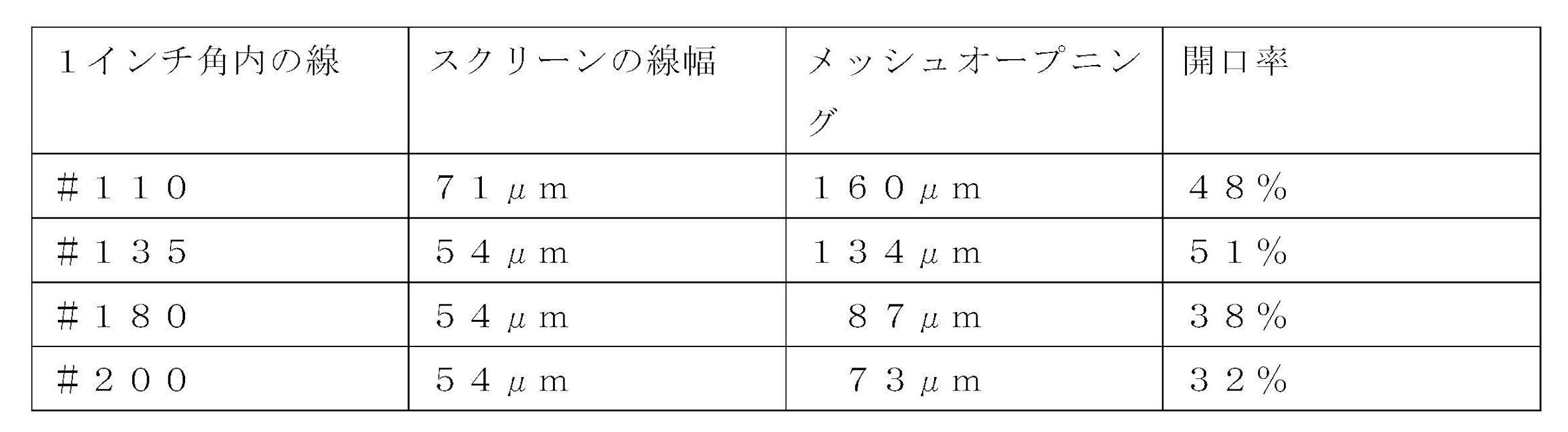
スクリーンの線幅が同じ場合、メッシュを構成する線の数が多いほどスクリーンがきめ細かくなってガラスへのペースト吐出量が下がる傾向がある。
なお、カラーセラミック層12を形成するためには、印刷の回数を1回とできるように、メッシュオープニングが140~180μm(好ましくは150~170μm)、開口率が40~60%(好ましくは45~55%)のスクリーンを使用することが好ましいことがわかる。また、導電体層13を形成するためには、印刷の回数を1回とできるように、メッシュオープニングが53~93μm(好ましくは63~83μm)、開口率が24~39%(好ましくは28~36%)のスクリーンを使用することが好ましい。
なお、カラーセラミック層12を形成するためには、印刷の回数を1回とできるように、メッシュオープニングが140~180μm(好ましくは150~170μm)、開口率が40~60%(好ましくは45~55%)のスクリーンを使用することが好ましいことがわかる。また、導電体層13を形成するためには、印刷の回数を1回とできるように、メッシュオープニングが53~93μm(好ましくは63~83μm)、開口率が24~39%(好ましくは28~36%)のスクリーンを使用することが好ましい。
(カラーセラミック層12の膜厚に関する考察)
表に示すように、カラーセラミック層12の厚さが10μm(#180を1回)の場合は、導電体層13の膜厚にかかわらず、ガラス板11にクラックが発生した。
カラーセラミック層12の厚さが18μm(#110を1回)の場合は、導電体層13の膜厚が7~8μmにおいて、ガラス板11にクラックが発生しなかったが、導電体層13の膜厚が10μm以上において、ガラス板11にクラックが発生した。
カラーセラミック層12の厚さが20μm(#180を2回)の場合は、導電体層13の膜厚にかかわらずガラス板11にクラックが発生しなかった。
表に示すように、カラーセラミック層12の厚さが10μm(#180を1回)の場合は、導電体層13の膜厚にかかわらず、ガラス板11にクラックが発生した。
カラーセラミック層12の厚さが18μm(#110を1回)の場合は、導電体層13の膜厚が7~8μmにおいて、ガラス板11にクラックが発生しなかったが、導電体層13の膜厚が10μm以上において、ガラス板11にクラックが発生した。
カラーセラミック層12の厚さが20μm(#180を2回)の場合は、導電体層13の膜厚にかかわらずガラス板11にクラックが発生しなかった。
カラーセラミック層12は、10μm(#180を1回)の場合、導電体層13の厚さやスクリーン印刷の回数にかかわらす、クラックが発生することが分かった。
したがって、カラーセラミック層12の厚さは、10μmより厚いことが好ましい。さらに、18μm以上であることがより好ましい。
一方、カラーセラミック層12の厚さは、25μm超えになると、生産効率が低下するという問題がある。
したがって、本実施形態のカラーセラミック層12の厚さは、10μmより厚く、25μm以下であることが好ましく、18μm以上22μm以下であることがより好ましい。
したがって、カラーセラミック層12の厚さは、10μmより厚いことが好ましい。さらに、18μm以上であることがより好ましい。
一方、カラーセラミック層12の厚さは、25μm超えになると、生産効率が低下するという問題がある。
したがって、本実施形態のカラーセラミック層12の厚さは、10μmより厚く、25μm以下であることが好ましく、18μm以上22μm以下であることがより好ましい。
セラミック層12の厚さが10μmとなるのは、#180を1回の場合である。すなわち、開口率が38%の場合である。したがって、開口率は38%より大きいことが好ましい。
セラミック層12の厚さが18μmとなるのは、#110を1回の場合である。すなわち、開口率は48%なので、開口率は48%以上であることがより好ましい。
なお、セラミック層12の厚さが25μmとなるのは、開口率が60%以上の場合である。
セラミック層12の厚さが18μmとなるのは、#110を1回の場合である。すなわち、開口率は48%なので、開口率は48%以上であることがより好ましい。
なお、セラミック層12の厚さが25μmとなるのは、開口率が60%以上の場合である。
(導電体層13に関する考察)
上述のように、カラーセラミック層12の厚さが10μmの場合は、導電体層13の膜厚にかかわらず、ガラス板11にクラックが発生した。
カラーセラミック層12の厚さが18μmの場合は、導電体層13の膜厚が7~8μmにおいて、ガラス板11にクラックが発生しなかったが、導電体層13の膜厚が10μm以上において、ガラス板11にクラックが発生した。
カラーセラミック層12の厚さが20μmの場合は、導電体層13の膜厚にかかわらずガラス板11にクラックが発生しなかった。
上述のように、カラーセラミック層12の厚さが10μmの場合は、導電体層13の膜厚にかかわらず、ガラス板11にクラックが発生した。
カラーセラミック層12の厚さが18μmの場合は、導電体層13の膜厚が7~8μmにおいて、ガラス板11にクラックが発生しなかったが、導電体層13の膜厚が10μm以上において、ガラス板11にクラックが発生した。
カラーセラミック層12の厚さが20μmの場合は、導電体層13の膜厚にかかわらずガラス板11にクラックが発生しなかった。
これは、カラーセラミック層12の厚さが10μm及び20μmの場合、カラーセラミック層12の厚さの影響が強いため、導電体層13の厚さに関係なく、ガラス板11のクラックの有無が決定されていると考えられる。
すなわち、カラーセラミック層12の厚さが10μmの場合、カラーセラミック層12が薄いので、無鉛はんだ14とガラス板11との間の熱膨張の差によって生じる応力を緩衝することができず、ガラス板11にクラックが発生する。
カラーセラミック層12の厚さが20μmの場合、カラーセラミック層12が厚いので、無鉛はんだ14とガラス板11との間の熱膨張の差によって生じる応力が緩衝され、ガラス板11にクラックが発生しない。
すなわち、カラーセラミック層12の厚さが10μmの場合、カラーセラミック層12が薄いので、無鉛はんだ14とガラス板11との間の熱膨張の差によって生じる応力を緩衝することができず、ガラス板11にクラックが発生する。
カラーセラミック層12の厚さが20μmの場合、カラーセラミック層12が厚いので、無鉛はんだ14とガラス板11との間の熱膨張の差によって生じる応力が緩衝され、ガラス板11にクラックが発生しない。
一方、カラーセラミック層12の厚さが18μmの場合、カラーセラミック層12の厚さがガラスのクラックの有無に与える影響が流動的であると考えられる。
したがって、導電体層13の状態もガラスのクラックの有無に影響を与え、導電体層13が、スクリーン印刷を1回行って厚さが7~8μmである場合、ガラス板11にクラックが発生せず、スクリーン印刷を2回行って厚さが10μm以上である場合、ガラス板11にクラックが発生すると考えられる。
したがって、導電体層13の状態もガラスのクラックの有無に影響を与え、導電体層13が、スクリーン印刷を1回行って厚さが7~8μmである場合、ガラス板11にクラックが発生せず、スクリーン印刷を2回行って厚さが10μm以上である場合、ガラス板11にクラックが発生すると考えられる。
これは、導電体層13を形成する際のスクリーンを重ねる枚数が影響すると考えられる。
導電体層13は、2枚のスクリーンで塗布されて形成されたものであると、1枚のスクリーンで塗布されて形成された場合より導電体層13の表面が粗くなる。表面が粗くなるほど、アンカー効果で導電体層13と無鉛はんだ14との接着が強くなる。接着力が強すぎると、ガラス板11の膨張係数と無鉛はんだ14の熱膨張係数との差によってガラス板11へ加わる応力が大きく、クラックが発生しやすくなる。
導電体層13は、2枚のスクリーンで塗布されて形成されたものであると、1枚のスクリーンで塗布されて形成された場合より導電体層13の表面が粗くなる。表面が粗くなるほど、アンカー効果で導電体層13と無鉛はんだ14との接着が強くなる。接着力が強すぎると、ガラス板11の膨張係数と無鉛はんだ14の熱膨張係数との差によってガラス板11へ加わる応力が大きく、クラックが発生しやすくなる。
一方、導電体層13を、1枚のスクリーンで塗布して形成した場合、導電体層13の表面は2枚のスクリーンで塗布して形成した場合と比べて滑らかである。このため、1枚のスクリーンで塗布して形成した場合、2枚のスクリーンで塗布して形成した場合と比べて導電体層13と無鉛はんだ14との間の接着力が弱い。したがってガラス板11の膨張係数と無鉛はんだ14の熱膨張係数との差によって生じる応力が緩和され、ガラス板11がクラック生じにくくなる。なお、この場合であっても、導電体層13と無鉛はんだ14とが剥がれることはなかった。
すなわち、導電体層13と無鉛はんだ14との間の接着力は、剥がれが生じるほどではないが、無鉛はんだ14とガラス板11との間の熱膨張の差を緩衝する程度に弱かったためガラス板11にクラックの発生が生じなかったと考えられる。
すなわち、導電体層13と無鉛はんだ14との間の接着力は、剥がれが生じるほどではないが、無鉛はんだ14とガラス板11との間の熱膨張の差を緩衝する程度に弱かったためガラス板11にクラックの発生が生じなかったと考えられる。
ゆえに、実施形態の導電体層13は、カラーセラミック層12の厚さが18μmの場合、1枚のスクリーンで塗布して形成したものとしてもよい。
導電体層13を形成するためには、1枚のスクリーンできるように、メッシュオープニングは#200、すなわち開口率32%が好ましい。
導電体層13を形成するためには、1枚のスクリーンできるように、メッシュオープニングは#200、すなわち開口率32%が好ましい。
(実施形態の効果)
(1)本実施形態の車両用窓ガラス1は、ガラス板11と、ガラス板11の表面に形成されたカラーセラミック層12と、カラーセラミック層12の表面に形成された銀を主成分とする導電体層13と、を備え、導電体層13と、導電体層3に通電する端子15との間が無鉛はんだ14により接続されている。そして、カラーセラミック層12の厚さが、10μmより厚く25μm以下である。
本実施形態によると、カラーセラミック層12の厚さが、10μmより厚いので、ガラス板1にクラックが発生しにくい。
(2)また、カラーセラミック層12の厚さが、18μm以上の場合、クラックがより発生しにくい。さらに、カラーセラミック層12の厚さが、20μm以上の場合、ガラス板1にクラックがさらに発生しにくい。
(3)実施形態の車両用窓ガラス1カラーセラミック層12の厚さが18μmで、導電体層13が1枚のスクリーンで塗布して形成されたものであるので、ガラス板1にクラックが発生しにくい。
(4)実施形態の車両用窓ガラス1の導電体層13は、カラーセラミック層12の厚さが、18μmの場合、7~8μmの膜厚であるので、ガラス板1にクラックが発生しにくい。
(1)本実施形態の車両用窓ガラス1は、ガラス板11と、ガラス板11の表面に形成されたカラーセラミック層12と、カラーセラミック層12の表面に形成された銀を主成分とする導電体層13と、を備え、導電体層13と、導電体層3に通電する端子15との間が無鉛はんだ14により接続されている。そして、カラーセラミック層12の厚さが、10μmより厚く25μm以下である。
本実施形態によると、カラーセラミック層12の厚さが、10μmより厚いので、ガラス板1にクラックが発生しにくい。
(2)また、カラーセラミック層12の厚さが、18μm以上の場合、クラックがより発生しにくい。さらに、カラーセラミック層12の厚さが、20μm以上の場合、ガラス板1にクラックがさらに発生しにくい。
(3)実施形態の車両用窓ガラス1カラーセラミック層12の厚さが18μmで、導電体層13が1枚のスクリーンで塗布して形成されたものであるので、ガラス板1にクラックが発生しにくい。
(4)実施形態の車両用窓ガラス1の導電体層13は、カラーセラミック層12の厚さが、18μmの場合、7~8μmの膜厚であるので、ガラス板1にクラックが発生しにくい。
1:車両用窓ガラス、11:ガラス板、12:カラーセラミック層、13:導電体層、14:無鉛はんだ、15:給電端子
Claims (6)
- ガラス板と、
前記ガラス板の表面に形成された10μmより厚く25μm以下の膜厚のカラーセラミック層と、
前記カラーセラミック層の表面に形成された銀を主成分とする導電体層と、を備え、
前記導電体層と、前記導電体層に通電する端子との間が無鉛はんだにより接続される車両用窓ガラス。 - 請求項1に記載の車両用窓ガラスであって、
前記カラーセラミック層の厚さが、16μm以上であること、
を特徴とする車両用窓ガラス。 - 請求項1又は2に記載の車両用窓ガラスであって、
前記導電体層は、1枚のスクリーンで塗布して形成されたものであること、
を特徴とする車両用窓ガラス。 - 請求項1から3のいずれか1項に記載の車両用窓ガラスであって、
前記導電体層は、7~8μmの膜厚であること、
を特徴とする車両用窓ガラス。 - 請求項1から4のいずれか1項に記載の車両用窓ガラスの製造方法であって、
セラミックペーストを、開口率が38%より大きく60%より小さいスクリーンで前記ガラス板に印刷してカラーセラミック層の前駆体の塗膜を形成する工程と、
銀ペーストを、前記カラーセラミック層の前駆体の塗膜上に、1枚のスクリーンで印刷する工程と、
を備える車両用窓ガラスの製造方法。 - 請求項5に記載の車両用窓ガラスの製造方法であって、セラミックペーストの印刷回数が1回である、車両用窓ガラスの製造方法。
Priority Applications (3)
| Application Number | Priority Date | Filing Date | Title |
|---|---|---|---|
| CN201680073953.8A CN108367657B (zh) | 2016-01-22 | 2016-11-14 | 车辆用窗玻璃和车辆用窗玻璃的制造方法 |
| EP16886441.1A EP3369596B2 (en) | 2016-01-22 | 2016-11-14 | Vehicle window glass and method for manufacturing vehicle window glass |
| US16/062,506 US10696582B2 (en) | 2016-01-22 | 2016-11-14 | Vehicle window glass and method for manufacturing vehicle window glass |
Applications Claiming Priority (2)
| Application Number | Priority Date | Filing Date | Title |
|---|---|---|---|
| JP2016010348A JP6613920B2 (ja) | 2016-01-22 | 2016-01-22 | 車両用窓ガラス及び車両用窓ガラスの製造方法 |
| JP2016-010348 | 2016-01-22 |
Publications (1)
| Publication Number | Publication Date |
|---|---|
| WO2017126202A1 true WO2017126202A1 (ja) | 2017-07-27 |
Family
ID=59361580
Family Applications (1)
| Application Number | Title | Priority Date | Filing Date |
|---|---|---|---|
| PCT/JP2016/083669 Ceased WO2017126202A1 (ja) | 2016-01-22 | 2016-11-14 | 車両用窓ガラス及び車両用窓ガラスの製造方法 |
Country Status (5)
| Country | Link |
|---|---|
| US (1) | US10696582B2 (ja) |
| EP (1) | EP3369596B2 (ja) |
| JP (1) | JP6613920B2 (ja) |
| CN (1) | CN108367657B (ja) |
| WO (1) | WO2017126202A1 (ja) |
Cited By (1)
| Publication number | Priority date | Publication date | Assignee | Title |
|---|---|---|---|---|
| CN117507769A (zh) * | 2023-12-13 | 2024-02-06 | 福耀玻璃工业集团股份有限公司 | 车窗玻璃组件和车辆 |
Families Citing this family (8)
| Publication number | Priority date | Publication date | Assignee | Title |
|---|---|---|---|---|
| EP3823784B1 (de) * | 2018-07-20 | 2024-09-04 | Saint-Gobain Glass France | System und verfahren zum verlöten von kontaktelementen mit induktionswärme |
| CN112159082A (zh) * | 2020-09-21 | 2021-01-01 | 福耀玻璃工业集团股份有限公司 | 一种汽车挡风玻璃及其制造方法 |
| CN112208310A (zh) * | 2020-09-28 | 2021-01-12 | 福耀玻璃工业集团股份有限公司 | 一种安装有摄像头的夹层玻璃 |
| JP7784056B2 (ja) * | 2020-12-01 | 2025-12-11 | Agc株式会社 | 金属端子付き車両用窓ガラス |
| WO2022176814A1 (ja) * | 2021-02-19 | 2022-08-25 | Agc株式会社 | 車両用ガラス |
| TW202306788A (zh) * | 2021-05-18 | 2023-02-16 | 美商康寧公司 | 具有高表面能量接合介面的載具內部元件及形成此元件的方法 |
| CN113571943A (zh) * | 2021-08-17 | 2021-10-29 | 长春捷翼汽车零部件有限公司 | 扁带与端子的插接结构及机动车辆 |
| JP2024033936A (ja) * | 2022-08-31 | 2024-03-13 | Agc株式会社 | 車両用フロントガラスとその製造方法 |
Citations (4)
| Publication number | Priority date | Publication date | Assignee | Title |
|---|---|---|---|---|
| WO2012090353A1 (ja) * | 2010-12-28 | 2012-07-05 | 日本板硝子株式会社 | パターン付きガラス基板及びその製造方法 |
| WO2012096373A1 (ja) * | 2011-01-14 | 2012-07-19 | 旭硝子株式会社 | 車両用窓ガラスおよびその製造方法 |
| JP2012192449A (ja) * | 2011-03-02 | 2012-10-11 | Central Glass Co Ltd | 車両ガラス用無鉛ハンダ合金 |
| JP2014096198A (ja) * | 2011-03-02 | 2014-05-22 | Central Glass Co Ltd | 自動車用窓ガラスと給電端子の接合方法 |
Family Cites Families (13)
| Publication number | Priority date | Publication date | Assignee | Title |
|---|---|---|---|---|
| JPS61111939A (ja) * | 1984-11-02 | 1986-05-30 | Nippon Sheet Glass Co Ltd | 板ガラス |
| US4623389A (en) * | 1985-04-22 | 1986-11-18 | Ppg Industries, Inc. | Electroconductive silver composition |
| US5817586A (en) * | 1996-04-12 | 1998-10-06 | Asahi Glass Company Ltd. | Colored ceramic composition |
| JP4957246B2 (ja) * | 2004-08-10 | 2012-06-20 | 旭硝子株式会社 | 車両用窓ガラス |
| US7223940B2 (en) * | 2005-02-22 | 2007-05-29 | Ppg Industries Ohio, Inc. | Heatable windshield |
| US20090053534A1 (en) * | 2007-08-21 | 2009-02-26 | Robert Prunchak | Coating compositions |
| JP4976508B2 (ja) * | 2008-02-13 | 2012-07-18 | 日本板硝子株式会社 | 導電性セラミックス焼結体付き窓ガラス |
| US20120058311A1 (en) * | 2009-05-14 | 2012-03-08 | Takahiro Shimomura | Vehicle glass and method for manufacturing same |
| JP2012091216A (ja) * | 2010-10-28 | 2012-05-17 | Asahi Glass Co Ltd | 無鉛はんだ合金、およびこれを用いたガラス物品 |
| US20130115435A1 (en) * | 2011-11-04 | 2013-05-09 | GM Global Technology Operations LLC | Laminated windshield glass |
| KR101711314B1 (ko) | 2012-11-21 | 2017-02-28 | 쌩-고벵 글래스 프랑스 | 전기 연결 소자 및 보상판을 갖는 디스크 |
| AR097558A1 (es) | 2013-10-29 | 2016-03-23 | Saint Gobain | Entrepaño con -al menos- dos elementos de conexión eléctrica y un conductor de conexión |
| JP6483241B2 (ja) * | 2014-04-29 | 2019-03-13 | サン−ゴバン グラス フランスSaint−Gobain Glass France | 基板上の導電性構造を接続するための電気接続エレメントを有するウィンドウガラスおよびその製造方法ならびに使用 |
-
2016
- 2016-01-22 JP JP2016010348A patent/JP6613920B2/ja active Active
- 2016-11-14 US US16/062,506 patent/US10696582B2/en active Active
- 2016-11-14 WO PCT/JP2016/083669 patent/WO2017126202A1/ja not_active Ceased
- 2016-11-14 CN CN201680073953.8A patent/CN108367657B/zh active Active
- 2016-11-14 EP EP16886441.1A patent/EP3369596B2/en active Active
Patent Citations (4)
| Publication number | Priority date | Publication date | Assignee | Title |
|---|---|---|---|---|
| WO2012090353A1 (ja) * | 2010-12-28 | 2012-07-05 | 日本板硝子株式会社 | パターン付きガラス基板及びその製造方法 |
| WO2012096373A1 (ja) * | 2011-01-14 | 2012-07-19 | 旭硝子株式会社 | 車両用窓ガラスおよびその製造方法 |
| JP2012192449A (ja) * | 2011-03-02 | 2012-10-11 | Central Glass Co Ltd | 車両ガラス用無鉛ハンダ合金 |
| JP2014096198A (ja) * | 2011-03-02 | 2014-05-22 | Central Glass Co Ltd | 自動車用窓ガラスと給電端子の接合方法 |
Cited By (1)
| Publication number | Priority date | Publication date | Assignee | Title |
|---|---|---|---|---|
| CN117507769A (zh) * | 2023-12-13 | 2024-02-06 | 福耀玻璃工业集团股份有限公司 | 车窗玻璃组件和车辆 |
Also Published As
| Publication number | Publication date |
|---|---|
| JP2017128287A (ja) | 2017-07-27 |
| EP3369596A4 (en) | 2018-12-12 |
| EP3369596A1 (en) | 2018-09-05 |
| JP6613920B2 (ja) | 2019-12-04 |
| CN108367657B (zh) | 2021-10-01 |
| CN108367657A (zh) | 2018-08-03 |
| EP3369596B1 (en) | 2021-04-14 |
| EP3369596B2 (en) | 2024-02-28 |
| US10696582B2 (en) | 2020-06-30 |
| US20190002338A1 (en) | 2019-01-03 |
Similar Documents
| Publication | Publication Date | Title |
|---|---|---|
| JP6613920B2 (ja) | 車両用窓ガラス及び車両用窓ガラスの製造方法 | |
| JP5336543B2 (ja) | コイル部品 | |
| JP3541070B2 (ja) | 自動車ガラスの厚膜導電体ペースト | |
| KR20140148397A (ko) | 세라믹 컬러 페이스트 및 세라믹 컬러, 및 세라믹 컬러 부착 유리 및 그의 제법 | |
| JP7037047B2 (ja) | 車両用窓ガラス | |
| US20090098350A1 (en) | Conductor composition v | |
| CN106104702B (zh) | 导电性糊剂、层叠陶瓷部件、印刷布线板、以及电子装置 | |
| CN103313886A (zh) | 车辆用窗玻璃及其制造方法 | |
| EP1506944B1 (en) | Thick-film conductor paste for automotive glass | |
| JP6701197B2 (ja) | 銅含有導電性ストリップを備えたガラス基材 | |
| JP2018074055A (ja) | プリント配線板の製造方法 | |
| CN108604475A (zh) | 导电性糊剂 | |
| EP2822000B1 (en) | Thick print copper pastes for aluminium nitride substrates | |
| JP2020037404A (ja) | 車両用窓ガラス | |
| JP5000499B2 (ja) | 導電性被膜の形成されたガラス物品及びその製造方法 | |
| CN1608298B (zh) | 导体合成物在电路中的使用 | |
| JP5819751B2 (ja) | 導電性積層体並びにその製造方法及び前駆体 | |
| WO2022172785A1 (ja) | はんだ接合構造、車両用窓ガラス、はんだ接合構造の製造方法、ガラス物品の製造方法及びガラス物品 | |
| AT7326U1 (de) | Verfahren zur herstellung eines flächenheizelementes und danach hergestelltes flächenheizelement | |
| KR20120007231A (ko) | 차량 유리용 은 페이스트 및 이를 이용하여 제조된 차량용 유리 | |
| JPH08222852A (ja) | 導体充填スルーホールの製造方法 | |
| CN1511325A (zh) | 导体合成物及其应用 | |
| JP2006108399A (ja) | フェライト多層回路基板の導電部形成用導電性ペースト及びその導電性ペーストを用いたフェライト多層回路基板 | |
| JP2003511838A (ja) | 導電体組成物 | |
| KR20170019158A (ko) | 저온 소결용 구리 나노 잉크를 이용한 적층형 디지타이저 및 이의 제조방법 |
Legal Events
| Date | Code | Title | Description |
|---|---|---|---|
| 121 | Ep: the epo has been informed by wipo that ep was designated in this application |
Ref document number: 16886441 Country of ref document: EP Kind code of ref document: A1 |
|
| NENP | Non-entry into the national phase |
Ref country code: DE |