WO2017126244A1 - Agent de revêtement bicomposant et procédé de protection de corps revêtu - Google Patents
Agent de revêtement bicomposant et procédé de protection de corps revêtu Download PDFInfo
- Publication number
- WO2017126244A1 WO2017126244A1 PCT/JP2016/086422 JP2016086422W WO2017126244A1 WO 2017126244 A1 WO2017126244 A1 WO 2017126244A1 JP 2016086422 W JP2016086422 W JP 2016086422W WO 2017126244 A1 WO2017126244 A1 WO 2017126244A1
- Authority
- WO
- WIPO (PCT)
- Prior art keywords
- mass
- agent
- main agent
- covering
- curing agent
- Prior art date
- Legal status (The legal status is an assumption and is not a legal conclusion. Google has not performed a legal analysis and makes no representation as to the accuracy of the status listed.)
- Ceased
Links
Images


Classifications
-
- C—CHEMISTRY; METALLURGY
- C09—DYES; PAINTS; POLISHES; NATURAL RESINS; ADHESIVES; COMPOSITIONS NOT OTHERWISE PROVIDED FOR; APPLICATIONS OF MATERIALS NOT OTHERWISE PROVIDED FOR
- C09D—COATING COMPOSITIONS, e.g. PAINTS, VARNISHES OR LACQUERS; FILLING PASTES; CHEMICAL PAINT OR INK REMOVERS; INKS; CORRECTING FLUIDS; WOODSTAINS; PASTES OR SOLIDS FOR COLOURING OR PRINTING; USE OF MATERIALS THEREFOR
- C09D127/00—Coating compositions based on homopolymers or copolymers of compounds having one or more unsaturated aliphatic radicals, each having only one carbon-to-carbon double bond, and at least one being terminated by a halogen; Coating compositions based on derivatives of such polymers
- C09D127/02—Coating compositions based on homopolymers or copolymers of compounds having one or more unsaturated aliphatic radicals, each having only one carbon-to-carbon double bond, and at least one being terminated by a halogen; Coating compositions based on derivatives of such polymers not modified by chemical after-treatment
- C09D127/12—Coating compositions based on homopolymers or copolymers of compounds having one or more unsaturated aliphatic radicals, each having only one carbon-to-carbon double bond, and at least one being terminated by a halogen; Coating compositions based on derivatives of such polymers not modified by chemical after-treatment containing fluorine atoms
-
- B—PERFORMING OPERATIONS; TRANSPORTING
- B05—SPRAYING OR ATOMISING IN GENERAL; APPLYING FLUENT MATERIALS TO SURFACES, IN GENERAL
- B05D—PROCESSES FOR APPLYING FLUENT MATERIALS TO SURFACES, IN GENERAL
- B05D3/00—Pretreatment of surfaces to which liquids or other fluent materials are to be applied; After-treatment of applied coatings, e.g. intermediate treating of an applied coating preparatory to subsequent applications of liquids or other fluent materials
- B05D3/10—Pretreatment of surfaces to which liquids or other fluent materials are to be applied; After-treatment of applied coatings, e.g. intermediate treating of an applied coating preparatory to subsequent applications of liquids or other fluent materials by other chemical means
-
- B—PERFORMING OPERATIONS; TRANSPORTING
- B32—LAYERED PRODUCTS
- B32B—LAYERED PRODUCTS, i.e. PRODUCTS BUILT-UP OF STRATA OF FLAT OR NON-FLAT, e.g. CELLULAR OR HONEYCOMB, FORM
- B32B27/00—Layered products comprising a layer of synthetic resin
- B32B27/30—Layered products comprising a layer of synthetic resin comprising vinyl (co)polymers; comprising acrylic (co)polymers
-
- C—CHEMISTRY; METALLURGY
- C09—DYES; PAINTS; POLISHES; NATURAL RESINS; ADHESIVES; COMPOSITIONS NOT OTHERWISE PROVIDED FOR; APPLICATIONS OF MATERIALS NOT OTHERWISE PROVIDED FOR
- C09D—COATING COMPOSITIONS, e.g. PAINTS, VARNISHES OR LACQUERS; FILLING PASTES; CHEMICAL PAINT OR INK REMOVERS; INKS; CORRECTING FLUIDS; WOODSTAINS; PASTES OR SOLIDS FOR COLOURING OR PRINTING; USE OF MATERIALS THEREFOR
- C09D133/00—Coating compositions based on homopolymers or copolymers of compounds having one or more unsaturated aliphatic radicals, each having only one carbon-to-carbon double bond, and at least one being terminated by only one carboxyl radical, or of salts, anhydrides, esters, amides, imides, or nitriles thereof; Coating compositions based on derivatives of such polymers
-
- C—CHEMISTRY; METALLURGY
- C09—DYES; PAINTS; POLISHES; NATURAL RESINS; ADHESIVES; COMPOSITIONS NOT OTHERWISE PROVIDED FOR; APPLICATIONS OF MATERIALS NOT OTHERWISE PROVIDED FOR
- C09D—COATING COMPOSITIONS, e.g. PAINTS, VARNISHES OR LACQUERS; FILLING PASTES; CHEMICAL PAINT OR INK REMOVERS; INKS; CORRECTING FLUIDS; WOODSTAINS; PASTES OR SOLIDS FOR COLOURING OR PRINTING; USE OF MATERIALS THEREFOR
- C09D133/00—Coating compositions based on homopolymers or copolymers of compounds having one or more unsaturated aliphatic radicals, each having only one carbon-to-carbon double bond, and at least one being terminated by only one carboxyl radical, or of salts, anhydrides, esters, amides, imides, or nitriles thereof; Coating compositions based on derivatives of such polymers
- C09D133/04—Homopolymers or copolymers of esters
- C09D133/06—Homopolymers or copolymers of esters of esters containing only carbon, hydrogen and oxygen, the oxygen atom being present only as part of the carboxyl radical
- C09D133/10—Homopolymers or copolymers of methacrylic acid esters
- C09D133/12—Homopolymers or copolymers of methyl methacrylate
-
- C—CHEMISTRY; METALLURGY
- C09—DYES; PAINTS; POLISHES; NATURAL RESINS; ADHESIVES; COMPOSITIONS NOT OTHERWISE PROVIDED FOR; APPLICATIONS OF MATERIALS NOT OTHERWISE PROVIDED FOR
- C09D—COATING COMPOSITIONS, e.g. PAINTS, VARNISHES OR LACQUERS; FILLING PASTES; CHEMICAL PAINT OR INK REMOVERS; INKS; CORRECTING FLUIDS; WOODSTAINS; PASTES OR SOLIDS FOR COLOURING OR PRINTING; USE OF MATERIALS THEREFOR
- C09D183/00—Coating compositions based on macromolecular compounds obtained by reactions forming in the main chain of the macromolecule a linkage containing silicon, with or without sulfur, nitrogen, oxygen, or carbon only; Coating compositions based on derivatives of such polymers
- C09D183/04—Polysiloxanes
-
- C—CHEMISTRY; METALLURGY
- C09—DYES; PAINTS; POLISHES; NATURAL RESINS; ADHESIVES; COMPOSITIONS NOT OTHERWISE PROVIDED FOR; APPLICATIONS OF MATERIALS NOT OTHERWISE PROVIDED FOR
- C09D—COATING COMPOSITIONS, e.g. PAINTS, VARNISHES OR LACQUERS; FILLING PASTES; CHEMICAL PAINT OR INK REMOVERS; INKS; CORRECTING FLUIDS; WOODSTAINS; PASTES OR SOLIDS FOR COLOURING OR PRINTING; USE OF MATERIALS THEREFOR
- C09D7/00—Features of coating compositions, not provided for in group C09D5/00; Processes for incorporating ingredients in coating compositions
- C09D7/40—Additives
-
- C—CHEMISTRY; METALLURGY
- C09—DYES; PAINTS; POLISHES; NATURAL RESINS; ADHESIVES; COMPOSITIONS NOT OTHERWISE PROVIDED FOR; APPLICATIONS OF MATERIALS NOT OTHERWISE PROVIDED FOR
- C09D—COATING COMPOSITIONS, e.g. PAINTS, VARNISHES OR LACQUERS; FILLING PASTES; CHEMICAL PAINT OR INK REMOVERS; INKS; CORRECTING FLUIDS; WOODSTAINS; PASTES OR SOLIDS FOR COLOURING OR PRINTING; USE OF MATERIALS THEREFOR
- C09D7/00—Features of coating compositions, not provided for in group C09D5/00; Processes for incorporating ingredients in coating compositions
- C09D7/40—Additives
- C09D7/60—Additives non-macromolecular
- C09D7/63—Additives non-macromolecular organic
Definitions
- the present invention relates to a two-component coating agent suitable for forming a coating film excellent in stain resistance, friction resistance, water resistance, texture, etc. on the surface of a coated body, and a coated body protecting method using the same. .
- the most orthodox finishing method on the leather surface is a bare finish.
- this basic finish without using a coloring agent or a finishing agent, in some cases, only a small amount of dye is used, and the color luster of the leather itself is fully utilized only by rolling or buffing.
- the so-called leather is finished without any dyeing.
- the texture of the leather itself comes out, and it is excellent in feel and appearance, but there is also a drawback that the quality of the material appears clearly.
- it is inferior in water resistance has a drawback that it is easily stained in the part not coated, and it becomes noticeable. For this reason, careful attention is required for care in this raw finishing.
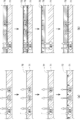
- FIG. 3 (a) schematically shows the change over time of the leather that has been subjected to a bare finish.
- the surface finish of the leather 71 is not coated with any colorant or finishing material. In this basic finishing, it is a matter of course that aeration is ensured, but moisture and oil easily leach out to the outside according to the aging. Easy to do. Further, the dirt 72 gradually adheres to the surface of the leather 71 with the passage of time, and further, the dirt 72 starts to penetrate deep into the leather 71 with the passage of time. Finally, the leather 71 itself is cracked based on the dirt 72.
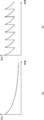
- FIG. 4 (a) shows the state of change of the leather 71 with respect to time in this raw finishing.
- a raw finish since no coating is applied from the outside, the above-mentioned cracks, wrinkles, adhesion of dirt 72, drying and curing, rubbing, etc. will progress steadily over time. .
- dye finishing is often used as a leather surface finishing method.
- This dye finish is dyed by a thin film so as to make use of the expression of the silver surface of the leather (the surface of the leather). For this reason, the dye finish can create a natural texture with a feeling of touch and appearance, and is often used especially for high-grade candy.
- this dye finish is inferior in water resistance and easily discolored, and has a drawback that its color and gloss are likely to change over time.
- This pigment finish is a method in which the surface of the leather is coated with a pigment, and has the advantage that it is easy to produce vivid colors, has excellent durability, and is not easily discolored.
- this pigment finish has the disadvantages that it is difficult to obtain a natural feel and that it is difficult to see the natural expression inherent in leather.
- FIG. 3B schematically shows a change in leather over time when a general protective film 73 made of these dyes or pigments is applied to the surface of the leather 71.
- the protective film 73 is applied to the surface of the leather 71, it is a matter of course that ventilation is ensured in the same manner, and moisture and oil are hardly leached to the outside and are difficult to evaporate, but the breathability is poor. Further, the drying, curing, and rubbing of the leather 71 itself can be suppressed to some extent through the protective film 73. However, the dirt 72 gradually accumulates on the surface of the protective film 73 with the passage of time, and the protective film 73 gradually becomes keratinized.
- the protective film 73 is naturally peeled off due to the keratinization or peeled off by cleaning. For this reason, it is necessary to apply a new protective film 73 from the viewpoint of further reinforcing the peeled protective film 73.
- FIG. 4B shows a state of change of the state of the leather 71 with respect to time when the general protective film 73 made of this dye or pigment is applied.
- the maintenance by the new coating operation of the protective film 73 described above occurs every several months to several years, and it cannot be denied that the surface deterioration of the leather 71 is more likely to proceed accordingly.
- FIG. 5 shows a detailed image of the surface when this protective film 73 is applied. Not only the dirt 72 but also sebum 75, dust 76 and the like adhere to the protective film 73 and cause light and dullness.
- the leather 71 is used for a car seat or the like, static electricity is likely to be generated in the car, and the dust 76 is easily adsorbed to the surface. Further, when it rains, the wet dust 76 easily penetrates the surface.
- the present invention has been devised in view of the above-described problems, and the object of the present invention is to firmly prevent the adhesion of dirt and to prevent surface deterioration of a covering such as leather or cloth for a long period of time.
- a two-part coating agent capable of forming a coating film excellent in water resistance, friction resistance, texture, etc. on the surface of the coated body and a method for protecting the coated body using the same is there.
- the present inventors have prepared the weight of the fluororesin / the weight of the crosslinking component after mixing the main agent and the curing agent so that the water resistance is in the range of 1 to 4. It was newly found that a coating film excellent in friction resistance, texture and the like can be formed on the surface of the coated body.
- the two-component coating agent according to the first invention is a two-component coating agent comprising at least a main agent and a curing agent, wherein the main agent contains a fluororesin and is in a mass% with respect to the total mass of the main agent, and acrylic: 3 to 20% , Silicon: 3 to 20%, water containing the above fluororesin: 40% to 90%, mineral oil: 3 to 50%, the curing agent contains a crosslinking component composed of a carbodiimide compound, The mass of the fluororesin after mixing of the curing agent / the mass of the crosslinking component is 1 to 4.
- the two-component coating agent according to the second invention is characterized in that, in the first invention, the mass of the curing agent / the mass of the main agent is 0.1 to 0.07.
- the two-component coating agent according to the third invention is used in the first invention or the second invention to prevent the adhesion of dirt by forming a film on a covering made of leather or cloth. It is characterized by.
- the two-component coating agent according to the fourth invention is any one of the first to third inventions, wherein the carbodiimide compound is a polyvalent carbodiimide.
- a covering body protecting method comprising: a covering body protecting method for protecting a covering body by forming a film on the covering body with the two-component coating agent according to any of the first to fourth inventions;
- the main agent application step of applying the main agent to the surface of the body, and the curing agent application step of applying the curing agent to the surface of the main agent applied in the main agent application step, were applied by the hardener application step. It is characterized in that adhesion of dirt is prevented through the film after curing with the curing agent.
- the covering according to the sixth invention is characterized in that a film is formed on the surface by the two-component coating agent of any one of the first to fourth inventions.
- the present invention having the above-described configuration, it is possible to firmly prevent the adhesion of dirt through the fluorine coating formed on the covering, and to prevent the surface deterioration of the covering for a long period of time.
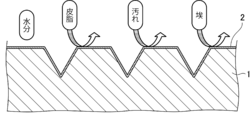
- FIG. 1 It is a figure which shows the example which formed the fluorine film in the surface of the coating
- (A) is a figure which shows typically the time-dependent change of the leather which performed raw finishing
- (b) is a figure which shows the time-dependent change of the leather at the time of apply
- (A) is a figure which shows the change state of the state with respect to the change of the time of the leather in a raw finish
- (b) is a change of the state with respect to the change of the time of the leather 71 at the time of apply
- the two-component coating agent to which the present invention is applied is composed of at least a main agent and a curing agent.
- the main agent is a material that exhibits the desired antifouling property, friction resistance, water resistance, etc. by actually curing.
- the main agent is composed of acrylic resin, urethane resin, silicon, fluorine-containing water, mineral oil, polysilazane and the like.
- the acrylic resin is a polymer of acrylic acid ester or methacrylic acid ester, and is an amorphous synthetic resin with high transparency.
- This acrylic resin is represented by PMMA (polymethyl methacrylate resin) and the like, and has a degree of polymerization of about 10,000 to 15,000.
- PMMA polymethyl methacrylate resin
- Such an acrylic resin plays a role of improving friction resistance, particularly by improving adhesion.
- the content of this acrylic resin is added in a ratio of 3 to 20% by mass with respect to the total mass of the main agent.
- the content of the acrylic resin is less than 3% by mass, the above-described effect of improving the friction resistance unique to the acrylic resin cannot be obtained.
- the content of the acrylic resin exceeds 20% by mass, the effects described above will be saturated even if it is added more, and the material cost will be increased. Therefore, the content of the acrylic resin is 3 to 20% by mass with respect to the total mass of the main agent.
- Urethane resin is represented by polyurethane, for example, and is produced by condensation of a compound having an isocyanate group and a hydroxyl group.
- the urethane resin may be any polymer as long as it has a urethane bond.
- Such a urethane resin plays a role of improving friction resistance, particularly by improving adhesion.
- this urethane resin is added at a ratio of 10% by mass or less with respect to the total mass of the main agent. If the content of this urethane resin exceeds 10% by mass, the effects described above will be saturated even if it is added more particularly, and the material cost will be increased. For this reason, content of a urethane resin is 10 mass% or less with respect to the main ingredient total mass. Incidentally, this urethane resin may not be contained in the main agent.
- Silicon is a kind of artificial polymer compound and has a main skeleton with siloxane bonds. This silicon plays a role of improving stain resistance and texture.
- the content of silicon is added at a rate of 3 to 20% by mass with respect to the total mass of the main agent. If the silicon content is less than 3% by mass, the above-described effects of contamination resistance and texture of silicon cannot be achieved. On the other hand, if the silicon content exceeds 20% by mass, the effects described above will be saturated even if added more than that, and the material cost will increase. Therefore, the silicon content is 3 to 20% by mass with respect to the total mass of the main agent.
- Fluorine-containing water is water containing a fluororesin.
- the fluororesin is a synthetic resin obtained by polymerizing an olefin containing fluorine, and is represented by, for example, polytetrafluoroethylene ⁇ tetrafluororesin>.
- a fluororesin is dissolved in a certain ratio with respect to water.
- the fluororesin will be described by taking as an example the case of containing 10% by mass% with respect to the total mass of water, but the present invention is not limited to this, and it may be contained in any proportion. Good.
- Fluorine-containing water in which such a fluororesin is dissolved is not particularly limited with respect to the total content of the main agent, and may be contained in any proportion.
- the fluorine-containing water is contained in a proportion of 40 to 90% by mass with respect to the total mass of the main agent will be described as an example.
- this fluororesin forms a crosslinked structure with the crosslinking component contained in the hardening
- Mineral oil is a mineral oil such as petroleum (crude oil), natural gas, coal, etc., and is a hydrocarbon compound derived from underground resources.
- this mineral oil vegetable oil, animal fats, etc. may be applied, for example. This mineral oil plays the role which improves workability especially.
- the content of this mineral oil is added in a ratio of 3 to 50% by mass with respect to the total mass of the main agent. If the content of the mineral oil is less than 3% by mass, the above-described effect of improving the workability of the mineral oil cannot be achieved. On the other hand, if the content of the mineral oil exceeds 50% by mass, the effect described above is saturated even if it is added more particularly, and the material cost is increased. For this reason, the content of mineral oil is 3 to 50% by mass with respect to the total mass of the main agent.
- Polysilazane is also used as a coating agent, but it may be added in a trace amount. Incidentally, the inclusion of polysilazane is not essential and may not be contained in particular.
- main agent for example, a hydrocarbon solvent, a nonionic surfactant, an anionic surfactant, a thickener, a preservative, and the like may be appropriately added.
- the curing agent contains a carbodiimide compound or isocyanate as a crosslinking component. Except for the crosslinking component, it is composed of moisture.
- the crosslinking component in this curing agent is contained in a proportion of 38 to 42% by mass with respect to the total mass of the curing agent. If this crosslinking component is less than 38% with respect to the total mass of the curing agent, the amount of carboxylic acid that reacts with the fluororesin when mixed with the main agent is reduced to effectively form a crosslinked structure. It is impossible to effectively apply the fluorine coating on the surface of the covering. Further, if the crosslinking component is more than 42% with respect to the total mass of the curing agent, the effect described above is saturated even if it is added more than that, and the material cost is increased.
- the content of the crosslinking component with respect to the total mass of the curing agent is not limited to the above-described range. Specifically, the content of the crosslinking component is determined by the relationship with the fluororesin contained in the main agent.
- the mass of the fluororesin / the mass of the crosslinking component after mixing the main agent and the curing agent is adjusted to be 1 to 4.
- a fluorine film can be suitably formed in a covering, and it becomes possible to aim at improvement of anti-contamination friction resistance, improvement in water resistance, improvement in texture and workability.
- the mass of the fluororesin / the mass of the cross-linking component after mixing of the main agent and the curing agent is less than 1 or exceeds 4, a suitable fluorine coating cannot be formed, and the above-mentioned The desired effects cannot be achieved. For this reason, the mass of the fluororesin / the mass of the crosslinking component after mixing the main agent and the curing agent is 1 to 4.
- the mixing ratio of the main agent and the curing agent, the content ratio of fluorine-containing water contained in the main agent, The content ratio of the fluororesin in the fluorine-containing water and the content ratio of the crosslinking component in the curing agent will be adjusted.
- the mass of the curing agent / the mass of the main agent 0.1 to 0.07, but is not limited thereto. It is not a thing, and what is mixed in what ratio may be used.
- the mass of the curing agent / the mass of the main agent: 0.1 to 0.07 has an advantage that the mixing operation of the curing agent and the main agent is facilitated.
- the two-component coating agent is distributed and sold in a state where both the main agent and the curing agent are sealed in separate containers.
- a consumer who has actually purchased a two-part coating agent mixes the main agent with a curing agent.
- the mixing ratio of the main agent and the curing agent is adjusted in advance based on the above-described mass ratio of the fluororesin and the crosslinking component.
- the mixed liquid after mixing is mixed so that the mass of the fluororesin / the mass of the crosslinking component is 1 to 4 as described above.
- the consumer applies this mixed solution to leather, cloth, etc. as a covering to actually apply the coating.
- a crosslinked structure is formed on the surface of the covering.
- the reaction between the fluororesin and the crosslinking component further proceeds, and as a result, as shown in FIG. 1, the fluorine coating 2 having the above-described crosslinked structure is formed on the surface of the covering 1.
- the fluorine coating 2 is a film-like thin film. If the covering 1 is made of a foldable material, the fluorine coating 2 applied to the coating 1 can also follow this. Further, even when irregularities and undulations are formed with a fine pitch on the surface of the covering 1 and the film is highly flexible, the fluorine coating 2 is deposited along the irregularities. .
- the air permeability of the covering 1 can be ensured through the fluorine coating 2, but even when the surface of the fluorine coating 2 is in contact with or adheres to the surface of the coating 1, a wet cloth or the like can be used.
- the dirt can be almost completely removed by wiping lightly.
- this fluorine coating 2 it is possible to exhibit a high anti-contamination property such that the oil-based ballpoint pen is not contaminated.
- the adhesion of sebum and dust as in the prior art can be effectively prevented by the fluorine coating 2. This is because the fluorine coating 2 exhibits the property that static electricity is hardly generated.
- this fluorine coating 2 it becomes possible to effectively repel moisture by exhibiting water resistance.
- the water resistance of about 6 times can be exhibited compared to the covering 1 to which the fluorine coating 2 is not attached. Become.
- the fluorine coating 2 it is possible to improve the friction resistance that can withstand friction when it is applied, and the workability to be actually applied to the covering 1 is excellent, and maintenance work is also possible. It will be easy. Moreover, since the covering 1 can be formed with a very thin film thickness, the texture and texture of the leather when touching the fluorine coating 2 formed on the covering 1 is not impaired.
- FIG. 2 shows a change state of the state of the covering 1 with respect to time when the fluorine coating 2 is actually formed on the covering 1 with the two-component coating agent to which the present invention is applied. It is shown that the condition hardly deteriorates with the passage of time. Drying, curing, rubbing, and adhesion of dirt are greatly suppressed, and the attached dirt can be removed by a simple maintenance operation, so that it is possible to maintain a beautiful state for more than three years. That is, the curing that the fluorine coating 2 once formed on the covering body 1 can last longer. Further, a large-scale maintenance work such as re-coating of the coating as in the pigment finish shown in FIG. 4B is not required, and it is possible to prevent the surface of the covering 1 from being damaged.
- this covering 1 when this covering 1 is used for an automobile seat, it is often used violently because a person sits on it or goes out, but the characteristics of the leather as the covering 1 (breathability, oil retention) It is possible to effectively prevent deterioration of the leather surface while making use of (moisturizing).
- the main agent was prepared by preparing respective content ratios of acrylic resin, urethane resin, silicon, fluorine-containing water, and mineral oil. At this time, the ratio of the fluororesin contained in the fluorine-containing water is 10% by mass with respect to the total mass of the fluorine-containing water. Moreover, the hardening
- curing agent was produced by preparing content of the isocyanate and carbodiimide compound which are contained in this, respectively. The ratio of the crosslinking component including the carboimide compound contained in the curing agent is 38 to 42%, which is also shown in Table 1.
- the main agent and the curing agent respectively prepared were mixed based on the mass ratio (%) of the main agent and the mass ratio (%) of the curing agent shown in Table 1. Next, after mixing the main agent and the curing agent, this was applied to the covering 1.
- the coated covering 1 is white leather.
- the touch drying time is 3 to 5 minutes.
- test items are 5 items of contamination resistance, water resistance, durability, workability, and texture.
- Water resistance was evaluated based on JIS K 6550. First, the black leather as the covering 1 coated with the sample is rubbed with a sponge soaked with a weak alkaline degreasing agent and wiped cleanly. Thereafter, water is sprayed on the location where the degreasing agent is wiped off to confirm the water-repellent state. When the sprayed water is soaked on the covering 1 to be in a hydrophilic state, it is determined that the water resistance is low because it is not water repellent. On the other hand, when the sprayed water does not penetrate into the inside of the covering 1 and forms independent substantially hemispherical water droplets, it is in a so-called water-repellent state and has high water resistance. Judge that.
- the water repellency of the sprayed water is actually observed through visual appearance observation, and the water resistance is evaluated in the range of 1 to 5 (up to the first decimal place). The higher the water resistance value, the higher the water repellency.
- the evaluation was performed by two evaluators observing the appearance, and the evaluation values were averaged to obtain a final evaluation value.
- Durability is an index indicating how much the coated fluorine film has, and was evaluated based on the dyeing friction fastness of JIS K 6547 leather.
- this durability dirt was intentionally attached to the white leather as the covering 1 coated with the sample on the surface by scribbling with an oil ballpoint pen. The surface of the coated body 1 that was graffitied with this oil-based ballpoint pen was rubbed over the surface of the covering 1 for 11,000 times. After this rubbing, dye transfer evaluation was performed. In the dye transfer evaluation, it was judged how much the color was actually transferred in the direction in which the oil-based ballpoint pen was rubbed and reciprocated through the rub work. Actually, this dye transfer evaluation is performed through visual appearance observation, and durability is evaluated in the range of 1 to 5. The higher the durability value, the lower the dye transfer degree. The evaluation was performed by two evaluators observing the appearance, and the evaluation values were averaged to obtain a final evaluation value.
- the workability is an index for measuring the ease of work for forming the fluorine coating 2 by applying the main agent and the curing agent that actually constitute the two-component coating agent at the actual construction site.
- an appropriate amount of a mixed solution in which the main agent and the curing agent were mixed was applied onto the above-described covering body 1 and hand-painted.
- the evaluator who actually performed the construction by hand painting evaluates the workability within the range of 1 to 5. The higher this value, the better the workability.
- the evaluation was performed by two evaluators actually performing construction work, and the evaluation values were averaged to obtain a final evaluation value.
- the texture indicates the result of actual palpation of the fluorine coating 2 that is actually formed on the covering 1, and indicates a change in the so-called surface touch.
- the texture is evaluated by an evaluator who palpates the applied fluorine coating 2 within a range of 1 to 5. The higher this value, the better the texture.
- the evaluation was performed by the two evaluators actually performing palpation, and the evaluation values were averaged to obtain a final evaluation value.
- each component of the main agent and the curing agent is shown.
- the content of the fluororesin is shown at the bottom.
- the content rate of this fluororesin is shown by the mass% with respect to the total mass of a main ingredient. Since the fluororesin contained in the fluorine-containing water contains 10% by mass% with respect to the total mass of water, an additional 10% of the mass% of the fluorine-containing water is mass with respect to the total mass of the main component of this fluororesin. %.
- the mixing ratio of the main agent and the curing agent is defined by the mass ratio when the main agent and the curing agent are mixed.
- Table 1 also shows the equivalent mass of the fluororesin and the equivalent mass of the isocyanate or carbodiimide compound that is a crosslinking component of the curing agent for each of the present invention examples and comparative examples.
- the converted mass of fluorine is (mass ratio of main agent) ⁇ (mass (%) of fluororesin with respect to the total mass of the main agent).
- the converted mass of the crosslinking component of the curing agent is (mass ratio of the curing agent) ⁇ (mass (%) of the crosslinking component in the curing agent).
- the mass of the fluororesin / the mass of the cross-linking component after mixing the main agent and the curing agent is represented by (equivalent mass of the fluororesin) / (equivalent mass of the cross-linking component). Table 1 also shows this ratio.
- the mass of the fluororesin / the mass of the crosslinking component are all in the range of 1 to 4.
- Comparative Examples 1 to 3 and 5 have a mass of the fluororesin / the mass of the crosslinking component of less than 1
- Comparative Examples 4 and 6 have a mass of the fluororesin / the mass of the crosslinking component of 4. Over.
- Inventive Examples 1 to 8 are all excellent in stain resistance, water resistance, durability, workability and texture, and the evaluation value of each evaluation item is at least 2.5 or more. It was. Incidentally, the level of this evaluation score of 2.5 is a level that satisfies the minimum required performance when considering commercialization. The total value of the evaluation points of contamination resistance, water resistance, durability, workability, and texture was 13.7 at the minimum, which was favorable.
- the mass of the fluororesin / the mass of the crosslinking component is in the range of 1.8 to 2.7, the total value of the evaluation points can be increased to 17.6 or more, and the covering 1 It is shown that the fluorine coating 2 can be suitably formed, and the effects of contamination resistance, friction resistance, improvement in water resistance, improvement in texture and workability become even more remarkable.
Landscapes
- Chemical & Material Sciences (AREA)
- Life Sciences & Earth Sciences (AREA)
- Engineering & Computer Science (AREA)
- Materials Engineering (AREA)
- Wood Science & Technology (AREA)
- Organic Chemistry (AREA)
- Chemical Kinetics & Catalysis (AREA)
- General Chemical & Material Sciences (AREA)
- Paints Or Removers (AREA)
- Treatment And Processing Of Natural Fur Or Leather (AREA)
- Application Of Or Painting With Fluid Materials (AREA)
Abstract
Pour obtenir un agent de revêtement bicomposant qui peut empêcher la détérioration de la surface d'un corps revêtu, tel que du cuir et du tissu, pendant une longue durée, ainsi qu'empêcher fortement l'adhérence des taches, et qui peut former, à la surface du corps revêtu, une pellicule de revêtement qui présente une excellente résistance à l'eau, résistance à l'abrasion, texture, etc., la présente invention est caractérisée en ce que, dans un agent de revêtement bicomposant comprenant au moins un agent principal et un agent de durcissement, l'agent principal contient une résine fluorocarbonée et contient 3 à 20 % en masse d'acryliques, 3 à 20 % en masse de silicone, 40 à 90 % en masse d'eau contenant la résine fluorocarbonée, et 3 à 50 % en masse d'huile minérale par rapport à la masse totale de l'agent principal, l'agent de durcissement contient un composant de réticulation comprenant un composé carbodiimide, et la masse de la résine fluorocarbonée sur la masse du composant de réticulation après mélangeage de l'agent principal et de l'agent de durcissement est de 1 à 4.
Priority Applications (3)
| Application Number | Priority Date | Filing Date | Title |
|---|---|---|---|
| US16/068,852 US20190023933A1 (en) | 2016-01-18 | 2016-12-07 | Two-parts coating agent and method for protecting covering material |
| EP16886483.3A EP3406680A4 (fr) | 2016-01-18 | 2016-12-07 | Agent de revêtement bicomposant et procédé de protection de corps revêtu |
| CN201680002605.1A CN107960088B (zh) | 2016-01-18 | 2016-12-07 | 二液型涂布剂和被覆体保护方法 |
Applications Claiming Priority (2)
| Application Number | Priority Date | Filing Date | Title |
|---|---|---|---|
| JP2016007116A JP6033974B1 (ja) | 2016-01-18 | 2016-01-18 | 二液型コーティング剤及び被覆体保護方法 |
| JP2016-007116 | 2016-01-18 |
Publications (1)
| Publication Number | Publication Date |
|---|---|
| WO2017126244A1 true WO2017126244A1 (fr) | 2017-07-27 |
Family
ID=57419800
Family Applications (1)
| Application Number | Title | Priority Date | Filing Date |
|---|---|---|---|
| PCT/JP2016/086422 Ceased WO2017126244A1 (fr) | 2016-01-18 | 2016-12-07 | Agent de revêtement bicomposant et procédé de protection de corps revêtu |
Country Status (5)
| Country | Link |
|---|---|
| US (1) | US20190023933A1 (fr) |
| EP (1) | EP3406680A4 (fr) |
| JP (1) | JP6033974B1 (fr) |
| CN (1) | CN107960088B (fr) |
| WO (1) | WO2017126244A1 (fr) |
Families Citing this family (2)
| Publication number | Priority date | Publication date | Assignee | Title |
|---|---|---|---|---|
| JP7263960B2 (ja) * | 2019-07-23 | 2023-04-25 | スターライト工業株式会社 | 非粘着性表面を有する非粘着塗膜、該非粘着塗膜が形成された基材及び非粘着塗膜の製造方法 |
| JP7615956B2 (ja) * | 2021-08-11 | 2025-01-17 | トヨタ自動車株式会社 | 車両および塗装方法 |
Citations (5)
| Publication number | Priority date | Publication date | Assignee | Title |
|---|---|---|---|---|
| JPH01170700A (ja) | 1987-11-28 | 1989-07-05 | Bayer Ag | 革及び革様材料のための仕上げ加工剤 |
| JPH04353447A (ja) * | 1991-05-31 | 1992-12-08 | Kawasaki Steel Corp | 複合型制振材料の製造方法 |
| JP2000038537A (ja) * | 1998-07-24 | 2000-02-08 | Asahi Glass Co Ltd | 塗料用樹脂組成物 |
| JP2004203921A (ja) * | 2002-12-24 | 2004-07-22 | Daikin Ind Ltd | 皮革用塗料組成物、塗装方法および塗装皮革 |
| JP2009520087A (ja) * | 2005-12-19 | 2009-05-21 | ランクセス ドイチュラント ゲゼルシャフト ミット ベシュレンクテル ハフツング | 硬化性含フッ素コポリマーおよび被覆および被覆方法 |
Family Cites Families (2)
| Publication number | Priority date | Publication date | Assignee | Title |
|---|---|---|---|---|
| JP5515274B2 (ja) * | 2008-10-27 | 2014-06-11 | 日本ポリウレタン工業株式会社 | 2液型ポリウレタン樹脂塗料用硬化剤およびその製造方法ならびに2液型ポリウレタン樹脂塗料 |
| JP5597380B2 (ja) * | 2009-10-09 | 2014-10-01 | 株式会社ダイフレックス | 手塗り施工用塗工剤 |
-
2016
- 2016-01-18 JP JP2016007116A patent/JP6033974B1/ja active Active
- 2016-12-07 WO PCT/JP2016/086422 patent/WO2017126244A1/fr not_active Ceased
- 2016-12-07 EP EP16886483.3A patent/EP3406680A4/fr not_active Withdrawn
- 2016-12-07 CN CN201680002605.1A patent/CN107960088B/zh active Active
- 2016-12-07 US US16/068,852 patent/US20190023933A1/en not_active Abandoned
Patent Citations (5)
| Publication number | Priority date | Publication date | Assignee | Title |
|---|---|---|---|---|
| JPH01170700A (ja) | 1987-11-28 | 1989-07-05 | Bayer Ag | 革及び革様材料のための仕上げ加工剤 |
| JPH04353447A (ja) * | 1991-05-31 | 1992-12-08 | Kawasaki Steel Corp | 複合型制振材料の製造方法 |
| JP2000038537A (ja) * | 1998-07-24 | 2000-02-08 | Asahi Glass Co Ltd | 塗料用樹脂組成物 |
| JP2004203921A (ja) * | 2002-12-24 | 2004-07-22 | Daikin Ind Ltd | 皮革用塗料組成物、塗装方法および塗装皮革 |
| JP2009520087A (ja) * | 2005-12-19 | 2009-05-21 | ランクセス ドイチュラント ゲゼルシャフト ミット ベシュレンクテル ハフツング | 硬化性含フッ素コポリマーおよび被覆および被覆方法 |
Non-Patent Citations (1)
| Title |
|---|
| See also references of EP3406680A4 |
Also Published As
| Publication number | Publication date |
|---|---|
| CN107960088B (zh) | 2019-10-01 |
| EP3406680A1 (fr) | 2018-11-28 |
| JP6033974B1 (ja) | 2016-11-30 |
| CN107960088A (zh) | 2018-04-24 |
| US20190023933A1 (en) | 2019-01-24 |
| JP2017128624A (ja) | 2017-07-27 |
| EP3406680A4 (fr) | 2019-08-07 |
Similar Documents
| Publication | Publication Date | Title |
|---|---|---|
| CN103509422B (zh) | 一种疏水和疏油的涂层组合物 | |
| KR101823758B1 (ko) | 내오염 합성피혁 및 이의 제조방법 | |
| CN103819222B (zh) | 一种新型防油污防水石材防护剂及其制备方法 | |
| JP2010241963A (ja) | 防汚性付与皮革 | |
| US8333829B2 (en) | Sprayable liquid emulsion polymer coating compositions | |
| JP5753181B2 (ja) | 防汚性付与皮革 | |
| JP3948126B2 (ja) | 含フッ素樹脂塗装皮革 | |
| JP6033974B1 (ja) | 二液型コーティング剤及び被覆体保護方法 | |
| WO2019244321A1 (fr) | Cuir synthétique et son procédé de fabrication | |
| CN108997928A (zh) | 一种无氟防水剂 | |
| CN104004419A (zh) | 一种氟碳仿石漆料、多彩漆面及其制备方法 | |
| JPH1036771A (ja) | 自動車用劣化塗膜及び小傷修復兼つや出し剤 | |
| CN109836988A (zh) | 一种水性变色龙耐溶剂弹性涂层涂料 | |
| EP2044226B1 (fr) | Composition de réparation des surfaces en cuir, et procédé de réparation superficielle des surfaces en cuir | |
| JP5871502B2 (ja) | 光輝性天然皮革 | |
| JP2016000874A (ja) | 汚れ除去性布帛 | |
| US20150239283A1 (en) | Methods of making an artwork and artworks so formed | |
| CN110028892A (zh) | 一种用于bopet预涂膜的易清洁功能涂料及其制备方法 | |
| JP2010116488A (ja) | 防汚革及びその製造方法 | |
| Shin et al. | Development of regenerated protein fibers from a collagen-polyvinyl alcohol complex | |
| JP2007031850A (ja) | 撥油防汚性能を有する合成皮革 | |
| CN206189179U (zh) | 一种水性环保擦色合成革 | |
| JP3792225B2 (ja) | タイヤの艶出し組成物 | |
| CN102702811A (zh) | 水性涂料组合物 | |
| JPS6020425B2 (ja) | 艶出し用組成物 |
Legal Events
| Date | Code | Title | Description |
|---|---|---|---|
| 121 | Ep: the epo has been informed by wipo that ep was designated in this application |
Ref document number: 16886483 Country of ref document: EP Kind code of ref document: A1 |
|
| NENP | Non-entry into the national phase |
Ref country code: DE |
|
| WWE | Wipo information: entry into national phase |
Ref document number: 2016886483 Country of ref document: EP |
|
| ENP | Entry into the national phase |
Ref document number: 2016886483 Country of ref document: EP Effective date: 20180820 |