WO2017126442A1 - Chlorure de nickel anhydre et procédé pour le produire - Google Patents
Chlorure de nickel anhydre et procédé pour le produire Download PDFInfo
- Publication number
- WO2017126442A1 WO2017126442A1 PCT/JP2017/001085 JP2017001085W WO2017126442A1 WO 2017126442 A1 WO2017126442 A1 WO 2017126442A1 JP 2017001085 W JP2017001085 W JP 2017001085W WO 2017126442 A1 WO2017126442 A1 WO 2017126442A1
- Authority
- WO
- WIPO (PCT)
- Prior art keywords
- nickel chloride
- chloride solution
- anhydrous
- concentrated
- less
- Prior art date
- Legal status (The legal status is an assumption and is not a legal conclusion. Google has not performed a legal analysis and makes no representation as to the accuracy of the status listed.)
- Ceased
Links
Images
Classifications
-
- C—CHEMISTRY; METALLURGY
- C01—INORGANIC CHEMISTRY
- C01G—COMPOUNDS CONTAINING METALS NOT COVERED BY SUBCLASSES C01D OR C01F
- C01G53/00—Compounds of nickel
- C01G53/08—Halides; Oxyhalides
- C01G53/09—Chlorides; Oxychlorides
-
- C—CHEMISTRY; METALLURGY
- C23—COATING METALLIC MATERIAL; COATING MATERIAL WITH METALLIC MATERIAL; CHEMICAL SURFACE TREATMENT; DIFFUSION TREATMENT OF METALLIC MATERIAL; COATING BY VACUUM EVAPORATION, BY SPUTTERING, BY ION IMPLANTATION OR BY CHEMICAL VAPOUR DEPOSITION, IN GENERAL; INHIBITING CORROSION OF METALLIC MATERIAL OR INCRUSTATION IN GENERAL
- C23C—COATING METALLIC MATERIAL; COATING MATERIAL WITH METALLIC MATERIAL; SURFACE TREATMENT OF METALLIC MATERIAL BY DIFFUSION INTO THE SURFACE, BY CHEMICAL CONVERSION OR SUBSTITUTION; COATING BY VACUUM EVAPORATION, BY SPUTTERING, BY ION IMPLANTATION OR BY CHEMICAL VAPOUR DEPOSITION, IN GENERAL
- C23C16/00—Chemical coating by decomposition of gaseous compounds, without leaving reaction products of surface material in the coating, i.e. chemical vapour deposition [CVD] processes
- C23C16/44—Chemical coating by decomposition of gaseous compounds, without leaving reaction products of surface material in the coating, i.e. chemical vapour deposition [CVD] processes characterised by the method of coating
- C23C16/455—Chemical coating by decomposition of gaseous compounds, without leaving reaction products of surface material in the coating, i.e. chemical vapour deposition [CVD] processes characterised by the method of coating characterised by the method used for introducing gases into reaction chamber or for modifying gas flows in reaction chamber
- C23C16/45523—Pulsed gas flow or change of composition over time
- C23C16/45525—Atomic layer deposition [ALD]
- C23C16/45553—Atomic layer deposition [ALD] characterized by the use of precursors specially adapted for ALD
-
- C—CHEMISTRY; METALLURGY
- C25—ELECTROLYTIC OR ELECTROPHORETIC PROCESSES; APPARATUS THEREFOR
- C25B—ELECTROLYTIC OR ELECTROPHORETIC PROCESSES FOR THE PRODUCTION OF COMPOUNDS OR NON-METALS; APPARATUS THEREFOR
- C25B1/00—Electrolytic production of inorganic compounds or non-metals
- C25B1/01—Products
- C25B1/24—Halogens or compounds thereof
- C25B1/26—Chlorine; Compounds thereof
-
- H—ELECTRICITY
- H10—SEMICONDUCTOR DEVICES; ELECTRIC SOLID-STATE DEVICES NOT OTHERWISE PROVIDED FOR
- H10P—GENERIC PROCESSES OR APPARATUS FOR THE MANUFACTURE OR TREATMENT OF DEVICES COVERED BY CLASS H10
- H10P14/00—Formation of materials, e.g. in the shape of layers or pillars
- H10P14/40—Formation of materials, e.g. in the shape of layers or pillars of conductive or resistive materials
- H10P14/42—Formation of materials, e.g. in the shape of layers or pillars of conductive or resistive materials using a gas or vapour
-
- C—CHEMISTRY; METALLURGY
- C01—INORGANIC CHEMISTRY
- C01P—INDEXING SCHEME RELATING TO STRUCTURAL AND PHYSICAL ASPECTS OF SOLID INORGANIC COMPOUNDS
- C01P2004/00—Particle morphology
- C01P2004/51—Particles with a specific particle size distribution
-
- C—CHEMISTRY; METALLURGY
- C01—INORGANIC CHEMISTRY
- C01P—INDEXING SCHEME RELATING TO STRUCTURAL AND PHYSICAL ASPECTS OF SOLID INORGANIC COMPOUNDS
- C01P2004/00—Particle morphology
- C01P2004/60—Particles characterised by their size
-
- C—CHEMISTRY; METALLURGY
- C01—INORGANIC CHEMISTRY
- C01P—INDEXING SCHEME RELATING TO STRUCTURAL AND PHYSICAL ASPECTS OF SOLID INORGANIC COMPOUNDS
- C01P2004/00—Particle morphology
- C01P2004/60—Particles characterised by their size
- C01P2004/61—Micrometer sized, i.e. from 1-100 micrometer
-
- C—CHEMISTRY; METALLURGY
- C01—INORGANIC CHEMISTRY
- C01P—INDEXING SCHEME RELATING TO STRUCTURAL AND PHYSICAL ASPECTS OF SOLID INORGANIC COMPOUNDS
- C01P2006/00—Physical properties of inorganic compounds
- C01P2006/11—Powder tap density
-
- C—CHEMISTRY; METALLURGY
- C01—INORGANIC CHEMISTRY
- C01P—INDEXING SCHEME RELATING TO STRUCTURAL AND PHYSICAL ASPECTS OF SOLID INORGANIC COMPOUNDS
- C01P2006/00—Physical properties of inorganic compounds
- C01P2006/80—Compositional purity
-
- C—CHEMISTRY; METALLURGY
- C23—COATING METALLIC MATERIAL; COATING MATERIAL WITH METALLIC MATERIAL; CHEMICAL SURFACE TREATMENT; DIFFUSION TREATMENT OF METALLIC MATERIAL; COATING BY VACUUM EVAPORATION, BY SPUTTERING, BY ION IMPLANTATION OR BY CHEMICAL VAPOUR DEPOSITION, IN GENERAL; INHIBITING CORROSION OF METALLIC MATERIAL OR INCRUSTATION IN GENERAL
- C23C—COATING METALLIC MATERIAL; COATING MATERIAL WITH METALLIC MATERIAL; SURFACE TREATMENT OF METALLIC MATERIAL BY DIFFUSION INTO THE SURFACE, BY CHEMICAL CONVERSION OR SUBSTITUTION; COATING BY VACUUM EVAPORATION, BY SPUTTERING, BY ION IMPLANTATION OR BY CHEMICAL VAPOUR DEPOSITION, IN GENERAL
- C23C16/00—Chemical coating by decomposition of gaseous compounds, without leaving reaction products of surface material in the coating, i.e. chemical vapour deposition [CVD] processes
- C23C16/06—Chemical coating by decomposition of gaseous compounds, without leaving reaction products of surface material in the coating, i.e. chemical vapour deposition [CVD] processes characterised by the deposition of metallic material
- C23C16/08—Chemical coating by decomposition of gaseous compounds, without leaving reaction products of surface material in the coating, i.e. chemical vapour deposition [CVD] processes characterised by the deposition of metallic material from metal halides
- C23C16/14—Deposition of only one other metal element
-
- Y—GENERAL TAGGING OF NEW TECHNOLOGICAL DEVELOPMENTS; GENERAL TAGGING OF CROSS-SECTIONAL TECHNOLOGIES SPANNING OVER SEVERAL SECTIONS OF THE IPC; TECHNICAL SUBJECTS COVERED BY FORMER USPC CROSS-REFERENCE ART COLLECTIONS [XRACs] AND DIGESTS
- Y02—TECHNOLOGIES OR APPLICATIONS FOR MITIGATION OR ADAPTATION AGAINST CLIMATE CHANGE
- Y02P—CLIMATE CHANGE MITIGATION TECHNOLOGIES IN THE PRODUCTION OR PROCESSING OF GOODS
- Y02P10/00—Technologies related to metal processing
- Y02P10/20—Recycling
Definitions
- the present invention relates to anhydrous nickel chloride suitable for precursor raw materials of metal organic vapor phase epitaxy (hereinafter referred to as MO-CVD: Metal Organic Chemical Vapor Deposition) and atomic layer deposition (hereinafter referred to as ALD). .
- MO-CVD Metal Organic Chemical Vapor Deposition
- ALD atomic layer deposition
- Nickel thin films used in the production of next-generation ultra-high density semiconductor devices are formed by MO-CVD or ALD, and an organometallic complex is used as a precursor (precursor) as a raw material gas.
- Anhydrous nickel chloride used as a precursor raw material is required to have high purity, and several production methods have been proposed (Patent Document 1, Patent Document 2, and Patent Document 3).
- Patent Document 1 discloses a method for producing anhydrous nickel chloride with a moisture content of 0.2 to 0.3 wt% by drying nickel chloride at the first stage at 240 to 250 ° C. and second stage at 300 to 340 ° C. is doing.
- Patent Document 2 discloses a method for producing anhydrous nickel chloride by dissolving metallic nickel with hydrochloric acid, removing impurities, dehydrating / drying and granulating a nickel chloride solution. Further, particles having a particle size of 4 mm or more are 1% by mass or less, particles having a particle size of 0.3 mm or less are 60% by mass or less, and the bulk density is 1.5 to 0.9 kg / L. In anhydrous nickel chloride, the moisture content is 0.1 wt% and iron is 10 to 40 wt ppm.
- Patent Document 3 discloses a method of producing anhydrous nickel chloride having a NiO content of 0.1 to 1 wt% by heat-treating nickel chloride hexahydrate at 160 to 200 ° C. at atmospheric pressure or 100 torr.
- an object of the present invention is to provide anhydrous nickel chloride and a method for producing the same, which have a higher purity than conventional ones and a reduced content of impurity components.
- the inventor made nickel chloride aqueous solution by ion exchange membrane electrolysis using metal nickel as a raw material, and removed iron ions, which are main impurities, as necessary, and then concentrated and dehydrated steps As a result, it was found that high purity anhydrous nickel chloride can be obtained by preparing an environment in which foreign impurities are reduced.
- the present invention includes the following (1) and below.
- the total content of impurity elements other than gas components is less than 10 wtppm, boron, sodium, magnesium, aluminum, potassium, calcium, titanium, chromium, manganese, iron, copper, zinc, arsenic, silver, cadmium, indium, tin,
- the total particle size of 4 mm or more is 10 wt% or more, preferably 50 wt% or more, and the particle size of 0.3 mm or less is 30 wt% or less, preferably 10 wt% or less.
- this invention includes the following (11) or less.
- (11) Raw material nickel is used as the anode, conductive material is used as the cathode, high-purity hydrochloric acid is used as the electrolyte, anolyte and catholyte are separated by an anion exchange membrane, and ion exchange membrane electrolysis is performed.
- a method for producing anhydrous nickel chloride comprising: (12) After the step of obtaining a nickel chloride solution as anolyte, Any of the following steps (a) to (c) are provided: (A) a step of separating the nickel chloride solution after contacting with the solvent extractant to obtain a nickel chloride solution from which iron has been removed; (B) separating the nickel chloride solution after contacting with the ion exchange resin to obtain a nickel chloride solution from which iron has been removed; (C) By adding hydrogen peroxide water or blowing oxygen-containing gas to the nickel chloride solution, the oxidation-reduction potential is increased to 700 mV or more, so that iron ions are oxidized to trivalent and precipitated.
- the nickel chloride solution from which iron is removed is used as the nickel chloride solution
- the total content of impurity elements other than gas components is less than 10 wtppm, boron, sodium, magnesium, aluminum, potassium, calcium, titanium, chromium, manganese, iron, copper, zinc, arsenic, silver, cadmium, indium, tin,
- the anhydrous nickel chloride has a total particle diameter of 4 mm or more, 10 wt% or more, preferably 50 wt% or more, and particles having a particle diameter of 0.3 mm or less are 30 wt% or less, preferably 10 wt% or less.
- (11) The method for producing anhydrous nickel chloride according to any one of (19) to (19).
- (21) The anhydrous chloride according to any one of (11) to (20), wherein the bulk density is 1.5 to 3.0 g / cm 3 and the tap density is 2.0 to 3.3 g / cm 3. Nickel manufacturing method.
- anhydrous nickel chloride having a higher purity than conventional ones and a reduced content of impurity components.
- a stable gate voltage can be realized because there are few transition metal impurities affecting the work function.
- an increase in resistance due to impurities is reduced in the formation of nickel silicide.
- the yield at the time of synthesizing the precursor of the CVD material is improved.
- the production method of the present invention does not include dissolution due to a high concentration of strong acid, it can be produced with a simple facility with a smaller environmental load than conventional ones.
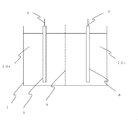
- FIG. 1 is an explanatory diagram showing the configuration of an electrolytic cell used for electrolytic synthesis.
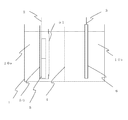
- FIG. 2 is an explanatory diagram showing the configuration of an electrolytic cell equipped with an anode basket used for electrolytic synthesis.
- the anhydrous nickel chloride of the present invention uses raw metal nickel as an anode, a conductive material as a cathode, high-purity hydrochloric acid as an electrolytic solution, anorite and catholyte separated by an anion exchange membrane, A step of obtaining a nickel chloride solution as anolyte by performing exchange membrane electrolysis, and a step of obtaining a concentrated nickel chloride solution by concentrating the purified nickel chloride solution obtained by heating to 80 to 100 ° C. under atmospheric pressure.
- the concentrated nickel chloride solution can be produced by a method comprising heating to 180 to 220 ° C. under atmospheric pressure to dry and dehydrate to obtain anhydrous nickel chloride.
- iron ions as impurities may be mixed in the resulting nickel chloride solution.
- a step of removing iron ions can be performed. This iron removal step can be performed after the step of obtaining a nickel chloride solution as the anolyte, and the nickel chloride solution purified by removing iron is heated to 80 to 100 ° C. under the above atmospheric pressure and concentrated. And can be used as a material for the step of obtaining a concentrated nickel chloride solution.
- the iron removal step the following “solvent extraction”, “ion exchange” or “iron oxidation” steps can be used.
- a solvent extraction step can be performed as the iron removal step.
- the iron ion is extracted and removed by bringing the solvent extractant into contact with the nickel chloride solution.
- the solvent extractant include 2-ethylhexyl 2-ethylhexylphosphonate hydrogen, bis (2-ethylhexyl) hydrogen phosphate, bis (2-ethylhexyl) phosphinic acid, and 2-ethylhexyl 2-ethylhexylphosphonate hydrogen Is preferred.
- the solvent extractant can be removed by separation from the nickel chloride solution, and if necessary, the removal can be completed by a known means such as activated carbon.
- an ion exchange step can be performed as the iron removal step.
- iron ions are removed by ion exchange by contacting with an ion exchange resin.
- the ion exchange resin include strong basic anion exchange resins and chelate resins, and strong basic anion exchange resins are preferred.
- an iron oxidation step can be performed as the iron removal step.
- iron ions are oxidized to make the iron ions in the nickel chloride solution trivalent, and are precipitated and precipitated, and separated by filtration.
- the oxidation of iron ions can be performed by adding hydrogen peroxide water or blowing an oxygen-containing gas into the nickel chloride solution and setting the oxidation-reduction potential to 700 mV or higher.
- the raw material nickel metal can be used without limitation as long as it has a purity of 4N (99.99%) or more, but it has a higher purity such as 5N (99.999%) or 6N (99.9999%). It is more preferable to use a material having purity because the step of removing iron, which is the main impurity, can be omitted.
- the raw metal nickel is preferably one having a flat and smooth shape in order to stabilize the electrolytic state in order to perform electrolysis.
- 4N (99.99%) metallic nickel is a metal having a purity in which the total content of impurities detected excluding gas components such as hydrogen, carbon, nitrogen and oxygen is less than 0.01%. Nickel.
- anode In electrolyzing nickel, there are a method in which nickel is directly used as an anode, or a method in which nickel is energized through an insoluble electrode.
- an insoluble electrode it can be used without limitation as long as it is a general one, but for example, platinum or titanium plated with platinum, titanium coated with a platinum group oxide, and the like are preferable.
- the cathode can be used without limitation as long as it has conductivity, but for example, titanium, nickel or graphite is preferable.
- the electrolyte can be used without limitation as long as it has a high purity, but high-grade hydrochloric acid for special grades or electronics industry can be used, which is diluted with pure water at the time of use, for example, at a concentration of 0.1 to 6. Can be used as 0N dilute hydrochloric acid.
- a known anion exchange membrane can be used as the anion exchange membrane.
- Nickel chloride solution The nickel chloride solution obtained as anolyte is already highly pure except for gas components. Therefore, the present invention is also in a high-purity nickel chloride solution and a method for producing the same.
- the nickel chloride solution is concentrated by heating to obtain a concentrated nickel chloride solution.
- the heat concentration is performed by heating to 80 to 100 ° C., preferably 90 to 100 ° C. under atmospheric pressure. In a preferred embodiment, the heat concentration is performed in the atmosphere.
- a nickel chloride solution (nickel chloride dilute hydrochloric acid solution) is heated and concentrated in a quartz container.
- Heat drying dehydration The concentrated nickel chloride solution is heated and dehydrated and dried to obtain anhydrous nickel chloride. Heat dehydration drying is performed by heating to 180 to 220 ° C., preferably 190 to 210 ° C. under atmospheric pressure. In a preferred embodiment, the heat drying is performed in an inert gas. In a preferred embodiment, the concentrated nickel chloride solution is heat dried on a quartz container.
- the concentrated nickel chloride solution can be ground with heat drying to obtain powdered anhydrous nickel chloride. In a preferred embodiment, this grinding can be performed on a quartz vessel.
- Anhydrous nickel chloride has a total content of impurity elements other than gas components of less than 10 wtppm, boron, sodium, magnesium, aluminum, potassium, calcium, titanium, chromium, manganese, iron, copper, zinc, arsenic Silver, cadmium, indium, tin, thallium, and lead content are each less than 1 wtppm, and silicon and cobalt content are each less than 5 wtppm.
- the gas component elements refer to oxygen, nitrogen, hydrogen, and carbon.
- the content of impurity elements other than gas component elements refers to a value measured by glow discharge mass spectrometry (hereinafter referred to as GD-MS: Glow Discharge Mass Spectrometry).
- anhydrous nickel chloride powder In a preferred embodiment, anhydrous nickel chloride is obtained as a powder.
- the anhydrous nickel chloride powder has a total particle size of 4 mm or more, for example, 10% by mass or more, preferably 50% by mass or more, and particles having a particle size of 0.3 mm or less, preferably 30% by mass or less, preferably It is 10 mass% or less. These particle sizes and content ratios can be measured by sieving.
- the high purity anhydrous nickel chloride according to the present invention is an excellent CVD (chemical vapor deposition) raw material. Therefore, the present invention also exists in a CVD raw material using high-purity anhydrous nickel chloride, a nickel film or nickel fine powder formed by the CVD raw material, and a semiconductor device, electronic circuit or electronic formed by the nickel film or nickel fine powder. There are also devices, etc., and these manufacturing methods.
- Example 1 An electrolytic cell equipped with an ion exchange membrane (hydrocarbon anion exchange membrane) is prepared, and 8L each of high purity hydrochloric acid diluted to 1N concentration with pure water is added to anolyte and 6L hydrochloric acid is similarly added to catholyte. It was.
- As the anode 2,409 g of nickel having a purity of 5N and a titanium plate were prepared as the cathode.
- a direct current power source was connected between the anode and the cathode, and the current value was 5 A constant current, and the current was supplied for 120 hours. Meanwhile, the voltage fluctuated between 1.4 and 2.8V.
- the liquid temperature rose from 30 ° C at the start to a maximum of 35 ° C.
- the nickel weight was measured and decreased to 1,736 g, and the dissolved weight was 673 g. In this way, a nickel chloride solution was obtained by electrolytic synthesis.
- the concentration of the solution was analyzed, the nickel concentration was 84 g / L and the iron concentration was 0.1 mg / L or less.
- Example 1 In Example 1, 1.5 L of the nickel chloride solution obtained after completion of the electrolysis step was put in a quartz container and heated to 90 ° C. on a hot plate to evaporate water. When the water was exhausted, the temperature was further increased to 160 ° C. in the atmosphere and maintained for 2 hours. When the completed crystals were recovered, 285 g was obtained. This was pulverized and sieved using a quartz container in a nitrogen atmosphere to obtain nickel chloride powder. When the crystal structure of the nickel chloride powder was analyzed by X-ray diffraction, it was confirmed that nickel chloride hexahydrate was formed in addition to anhydrous nickel chloride. The anhydrous nickel chloride crystals were subjected to impurity quality determination by GD-MS analysis. The results are shown in Table 1. Table 1 also shows the results of measuring the particle size using a sieve, the bulk density, and the tap density.
- Example 2 The same electrolytic cell as in Example 1 was prepared, and the same hydrochloric acid was added to anolyte and catholyte.
- a direct current power source was connected between the anode and the cathode, and the current value was 5 A constant current, and the current was supplied for 120 hours. Meanwhile, the voltage fluctuated between 1.5 and 3.2V.
- the liquid temperature rose from 28 ° C at the start to a maximum of 36 ° C.
- the nickel weight was measured and decreased to 1,840 g, and the dissolved weight was 680 g. In this way, a nickel chloride solution was obtained by electrolytic synthesis. When the concentration of the solution was analyzed, the nickel concentration was 86 g / L and the iron concentration was 0.6 mg / L.
- Solvent extraction in which 1.5 L of nickel chloride solution obtained after the electrolysis step was mixed with 1.0 L of a part of the solution, 830 mL of normal paraffin, and 170 mL of solvent extractant (2-ethylhexyl hydrogen 2-ethylhexylphosphonate) The agent was put in the same container and stirred for 30 minutes, and then allowed to stand for 1 hour, the solvent extractant separated in the upper layer was separated, and the lower layer nickel chloride solution was recovered. Next, 20 g of activated carbon was added to the nickel chloride solution, and the mixture was stirred for 1 hour and filtered to remove the solvent extractant remaining in the nickel chloride solution. The solvent extraction treatment was performed in this way to obtain a purified nickel chloride solution.
- the nickel chloride solution was put in a quartz container and heated to 90 ° C. on a hot plate to evaporate water. When the water was exhausted, the temperature was further increased to 200 ° C. in the atmosphere and maintained for 2 hours. When the completed crystals were collected, 278 g was obtained. This was pulverized and sieved using a quartz container in a nitrogen atmosphere to obtain nickel chloride powder. When the crystal structure of the nickel chloride powder was analyzed by X-ray diffraction, it was confirmed that anhydrous nickel chloride was formed. The anhydrous nickel chloride crystals were subjected to impurity quality determination by GD-MS analysis. The results are shown in Table 1. Table 1 also shows the results of measuring the particle size using a sieve, the bulk density, and the tap density.
- Example 3 High purity hydrochloric acid was added to 1.5 L of nickel chloride solution obtained after completion of the electrolysis step in Example 2 to adjust the acid concentration in the solution to 6N.
- the nickel chloride solution was passed through a column packed with 0.5 L of strong basic anion exchange resin manufactured by Mitsubishi Chemical Corporation at a space velocity of SV5-10. Thus, the anion exchange process was performed and the refined nickel chloride solution was obtained.
- the nickel chloride solution was put into a quartz container and heated to 80 ° C. on a hot plate to evaporate water. When the water was exhausted, the temperature was further increased to 220 ° C. in the atmosphere and maintained for 2 hours. When the completed crystals were recovered, 276 g was obtained. This was pulverized and sieved using a quartz mortar under a nitrogen atmosphere to obtain nickel chloride powder. When the crystal structure of the nickel chloride powder was analyzed by X-ray diffraction, it was confirmed that anhydrous nickel chloride was formed. The anhydrous nickel chloride crystals were subjected to impurity quality determination by GD-MS analysis. The results are shown in Table 1. Table 1 also shows the results of measuring the particle size using a sieve, the bulk density, and the tap density.
- Example 2 The same crystal formation process as in Example 2 was performed except that 1.5 L of the nickel chloride solution obtained after completion of the electrolysis process in Example 2 was used without performing the purification process to remove iron, Obtained.
- the crystal structure of the nickel chloride powder was analyzed by X-ray diffraction, it was confirmed that anhydrous nickel chloride was formed.
- the anhydrous nickel chloride crystal was subjected to impurity quality determination by GD-MS analysis and found to contain 7 wtppm of iron.
- Table 1 also shows the results of measuring the particle size using a sieve, the bulk density, and the tap density.
- Example 1 0.4
- Example 2 0.3
- Comparative Example 1 15.3 Comparative Example 2: 0.3 (wt%)
- Electrolytic synthesis was performed using the apparatus shown in FIG.
- the electrolytic cell 1 is partitioned by an anion exchange membrane 4, and the anode side is filled with anolyte 10a and the cathode side is filled with catholyte 10b.
- the anode 2 is attached to the anolyte 10a, and the raw material nickel 5 is attached in a state of being immersed in the anolyte.
- the cathode 3 is attached to the catholyte 10b, and the conductive material 6 is attached in a state of being immersed in the catholyte 10b.
- FIG. 2 shows another type of apparatus.
- the cathode side is the same as in FIG. 1, but the raw material nickel 5 is placed in the anode basket 50 on the anode side.
- An opening is provided on the surface of the anode basket 50 facing the cathode 3, and the surface is closed with a filter cloth 51 so that the raw material nickel 5 does not come out.
- anhydrous nickel chloride having a higher purity than that of the prior art and particularly a reduced content of the iron component can be obtained by a process with a lower environmental load than that of the prior art.
- the present invention is industrially useful.
Landscapes
- Chemical & Material Sciences (AREA)
- Organic Chemistry (AREA)
- Metallurgy (AREA)
- Chemical Kinetics & Catalysis (AREA)
- Engineering & Computer Science (AREA)
- Materials Engineering (AREA)
- Inorganic Chemistry (AREA)
- General Chemical & Material Sciences (AREA)
- Mechanical Engineering (AREA)
- Electrochemistry (AREA)
- Electrolytic Production Of Metals (AREA)
- Inorganic Compounds Of Heavy Metals (AREA)
- Electrolytic Production Of Non-Metals, Compounds, Apparatuses Therefor (AREA)
Abstract
Priority Applications (4)
| Application Number | Priority Date | Filing Date | Title |
|---|---|---|---|
| US15/753,126 US10882757B2 (en) | 2016-01-21 | 2017-01-13 | Anhydrous nickel chloride and method for producing the same |
| KR1020177031839A KR102048134B1 (ko) | 2016-01-21 | 2017-01-13 | 무수 염화 니켈 및 그 제조 방법 |
| JP2017531646A JPWO2017126442A1 (ja) | 2016-01-21 | 2017-01-13 | 無水塩化ニッケル及びその製造方法 |
| EP17741320.0A EP3406568A4 (fr) | 2016-01-21 | 2017-01-13 | Chlorure de nickel anhydre et procédé pour le produire |
Applications Claiming Priority (2)
| Application Number | Priority Date | Filing Date | Title |
|---|---|---|---|
| JP2016010031 | 2016-01-21 | ||
| JP2016-010031 | 2016-01-21 |
Publications (1)
| Publication Number | Publication Date |
|---|---|
| WO2017126442A1 true WO2017126442A1 (fr) | 2017-07-27 |
Family
ID=59362305
Family Applications (1)
| Application Number | Title | Priority Date | Filing Date |
|---|---|---|---|
| PCT/JP2017/001085 Ceased WO2017126442A1 (fr) | 2016-01-21 | 2017-01-13 | Chlorure de nickel anhydre et procédé pour le produire |
Country Status (6)
| Country | Link |
|---|---|
| US (1) | US10882757B2 (fr) |
| EP (1) | EP3406568A4 (fr) |
| JP (1) | JPWO2017126442A1 (fr) |
| KR (1) | KR102048134B1 (fr) |
| TW (1) | TWI639557B (fr) |
| WO (1) | WO2017126442A1 (fr) |
Cited By (4)
| Publication number | Priority date | Publication date | Assignee | Title |
|---|---|---|---|---|
| JP2020169344A (ja) * | 2019-04-01 | 2020-10-15 | 住友金属鉱山株式会社 | 電解槽および酸溶液の製造方法 |
| CN112359206A (zh) * | 2020-10-10 | 2021-02-12 | 福达合金材料股份有限公司 | 一种银氧化锡角料电解除杂和再利用的方法 |
| CN112563489A (zh) * | 2020-12-16 | 2021-03-26 | 北方特种能源集团有限公司西安庆华公司 | 一种新型热电池用氯化镍正极的制备方法 |
| JP2024097610A (ja) * | 2023-01-06 | 2024-07-19 | レアメタルリサイクル環境合同会社 | 無水塩化ニッケル粉末の製造方法 |
Families Citing this family (4)
| Publication number | Priority date | Publication date | Assignee | Title |
|---|---|---|---|---|
| CN114314699A (zh) * | 2021-12-31 | 2022-04-12 | 金川集团镍盐有限公司 | 一种氯化体系中镍丸溶解液的除铁方法 |
| CN114212836A (zh) * | 2021-12-31 | 2022-03-22 | 金川集团镍盐有限公司 | 一种无水氯化镍粉体材料的制备方法 |
| CN114835176A (zh) * | 2022-05-30 | 2022-08-02 | 金川集团镍盐有限公司 | 一种球形无水氯化镍产品的制备方法 |
| CN115403082A (zh) * | 2022-10-11 | 2022-11-29 | 金川集团镍盐有限公司 | 一种以电积镍为原料生产电镀氯化镍的方法 |
Citations (6)
| Publication number | Priority date | Publication date | Assignee | Title |
|---|---|---|---|---|
| JPS4918194B1 (fr) | 1965-12-30 | 1974-05-08 | ||
| JPH0632618A (ja) * | 1992-07-15 | 1994-02-08 | Sumitomo Metal Mining Co Ltd | 金属塩化物の精製方法 |
| JPH11263625A (ja) | 1998-03-19 | 1999-09-28 | Sumitomo Metal Mining Co Ltd | 無水塩化ニッケルの製造方法 |
| JP2002348122A (ja) * | 2001-03-22 | 2002-12-04 | Kawatetsu Mining Co Ltd | 無水塩化ニッケル及びニッケル超微粉の製造方法 |
| JP2007290937A (ja) * | 2006-04-27 | 2007-11-08 | Sumitomo Metal Mining Co Ltd | 塩化ニッケル水溶液の精製方法 |
| JP2010248043A (ja) * | 2009-04-17 | 2010-11-04 | Sumitomo Metal Mining Co Ltd | 塩化ニッケル水溶液の精製方法 |
Family Cites Families (8)
| Publication number | Priority date | Publication date | Assignee | Title |
|---|---|---|---|---|
| JPS5144974B2 (fr) | 1972-06-12 | 1976-12-01 | ||
| CA1134701A (fr) | 1977-10-17 | 1982-11-02 | David T. Green | Applicateur d'agrafes chirurgicales |
| KR960005510B1 (ko) | 1993-07-02 | 1996-04-25 | 포항종합제철주식회사 | 폐니켈양극활용 고순도 염화니켈의 제조방법 |
| JPH11228145A (ja) * | 1998-02-20 | 1999-08-24 | Sumitomo Metal Mining Co Ltd | 塩化ニッケルの製造方法およびこれを用いたニッケル粉末の製造方法 |
| JP2000219988A (ja) * | 1999-02-01 | 2000-08-08 | Japan Energy Corp | 高純度ニッケル材の製造法及び薄膜形成用高純度ニッケル材 |
| JP4918194B2 (ja) * | 2001-03-22 | 2012-04-18 | Jfeミネラル株式会社 | 無水塩化ニッケルの製造方法 |
| US6893996B2 (en) | 2001-11-26 | 2005-05-17 | Invista North America S.A.R.L. | Process for the preparation of a nickel/phosphorous ligand catalyst for olefin hydrocyanation |
| CN105220184A (zh) | 2015-08-11 | 2016-01-06 | 模德模具(苏州工业园区)有限公司 | 一种电铸镍电解液及其制备方法 |
-
2017
- 2017-01-13 KR KR1020177031839A patent/KR102048134B1/ko active Active
- 2017-01-13 EP EP17741320.0A patent/EP3406568A4/fr not_active Withdrawn
- 2017-01-13 WO PCT/JP2017/001085 patent/WO2017126442A1/fr not_active Ceased
- 2017-01-13 JP JP2017531646A patent/JPWO2017126442A1/ja active Pending
- 2017-01-13 US US15/753,126 patent/US10882757B2/en active Active
- 2017-01-19 TW TW106101844A patent/TWI639557B/zh active
Patent Citations (7)
| Publication number | Priority date | Publication date | Assignee | Title |
|---|---|---|---|---|
| JPS4918194B1 (fr) | 1965-12-30 | 1974-05-08 | ||
| JPH0632618A (ja) * | 1992-07-15 | 1994-02-08 | Sumitomo Metal Mining Co Ltd | 金属塩化物の精製方法 |
| JPH11263625A (ja) | 1998-03-19 | 1999-09-28 | Sumitomo Metal Mining Co Ltd | 無水塩化ニッケルの製造方法 |
| JP2002348122A (ja) * | 2001-03-22 | 2002-12-04 | Kawatetsu Mining Co Ltd | 無水塩化ニッケル及びニッケル超微粉の製造方法 |
| JP4127477B2 (ja) | 2001-03-22 | 2008-07-30 | Jfeミネラル株式会社 | 無水塩化ニッケル及びニッケル超微粉の製造方法 |
| JP2007290937A (ja) * | 2006-04-27 | 2007-11-08 | Sumitomo Metal Mining Co Ltd | 塩化ニッケル水溶液の精製方法 |
| JP2010248043A (ja) * | 2009-04-17 | 2010-11-04 | Sumitomo Metal Mining Co Ltd | 塩化ニッケル水溶液の精製方法 |
Non-Patent Citations (1)
| Title |
|---|
| See also references of EP3406568A4 |
Cited By (6)
| Publication number | Priority date | Publication date | Assignee | Title |
|---|---|---|---|---|
| JP2020169344A (ja) * | 2019-04-01 | 2020-10-15 | 住友金属鉱山株式会社 | 電解槽および酸溶液の製造方法 |
| JP7188239B2 (ja) | 2019-04-01 | 2022-12-13 | 住友金属鉱山株式会社 | 電解槽および酸溶液の製造方法 |
| CN112359206A (zh) * | 2020-10-10 | 2021-02-12 | 福达合金材料股份有限公司 | 一种银氧化锡角料电解除杂和再利用的方法 |
| CN112563489A (zh) * | 2020-12-16 | 2021-03-26 | 北方特种能源集团有限公司西安庆华公司 | 一种新型热电池用氯化镍正极的制备方法 |
| JP2024097610A (ja) * | 2023-01-06 | 2024-07-19 | レアメタルリサイクル環境合同会社 | 無水塩化ニッケル粉末の製造方法 |
| JP7798365B2 (ja) | 2023-01-06 | 2026-01-14 | レアメタルリサイクル環境合同会社 | 無水塩化ニッケル粉末の製造方法 |
Also Published As
| Publication number | Publication date |
|---|---|
| US10882757B2 (en) | 2021-01-05 |
| JPWO2017126442A1 (ja) | 2018-11-08 |
| KR20170134618A (ko) | 2017-12-06 |
| KR102048134B1 (ko) | 2019-11-22 |
| TW201730114A (zh) | 2017-09-01 |
| TWI639557B (zh) | 2018-11-01 |
| EP3406568A4 (fr) | 2019-08-21 |
| EP3406568A1 (fr) | 2018-11-28 |
| US20180237313A1 (en) | 2018-08-23 |
Similar Documents
| Publication | Publication Date | Title |
|---|---|---|
| JPWO2017126442A1 (ja) | 無水塩化ニッケル及びその製造方法 | |
| KR20030023640A (ko) | 금속처리방법, 그 방법에 사용되는 장치 및 그로부터제조된 금속 | |
| JPS6218632B2 (fr) | ||
| CN111039265A (zh) | 一种高纯硒的制备方法 | |
| CN109777968A (zh) | 一种电子行业用高纯金的制备方法 | |
| WO2014112198A1 (fr) | Procédé de récupération d'un alliage indium-étain à partir d'un déchet cible d'oxyde d'indium et d'étain (ito), et procédés pour produire une poudre d'oxyde d'indium-oxyde d'étain et cible d'oxyde d'indium et d'étain | |
| JP2015086436A (ja) | 有価物の回収方法 | |
| JP5032400B2 (ja) | ニッケル酸化物 | |
| WO2025081845A1 (fr) | Procédé de purification pour éliminer de l'arsenic d'une solution de chlorure d'antimoine | |
| CN105925811B (zh) | 一种协同氧化浸出碲渣中碲的方法 | |
| JP2017178749A (ja) | 硫酸マンガン水溶液の製造方法、及びマンガン酸化物の製造方法 | |
| KR101340601B1 (ko) | 실리콘 슬러지로부터 비수계 전해액에서의 전해법을 이용한 원소 형태 실리콘의 회수방법 | |
| JP2004043946A (ja) | 高純度金属の製造方法及び装置 | |
| JP4663053B2 (ja) | インジウムの回収方法 | |
| JP5533770B2 (ja) | セレンの分離方法 | |
| JP6201154B2 (ja) | 塩化コバルト水溶液の浄液方法 | |
| TWI557074B (zh) | 氯化銅、cvd原料、銅配線膜及氯化銅之製造方法 | |
| JP2004099975A (ja) | ルテニウム及び/又はイリジウムの回収方法 | |
| JP5993097B2 (ja) | 高純度塩化コバルトの製造方法 | |
| CN116283552A (zh) | 一种草酸精制方法 | |
| JPH11269569A (ja) | ガリウムの精製方法 | |
| KR20220000622A (ko) | 전기화학적 세정 공법을 이용한 초고순도 금속 니켈 분말 및 그 제조 방법 | |
| TW200535252A (en) | Method for producing indium-containing aqueous solution | |
| JPH06192874A (ja) | コバルトの精製方法 | |
| JP7368802B2 (ja) | 重金属分離方法および金属回収方法 |
Legal Events
| Date | Code | Title | Description |
|---|---|---|---|
| ENP | Entry into the national phase |
Ref document number: 2017531646 Country of ref document: JP Kind code of ref document: A |
|
| 121 | Ep: the epo has been informed by wipo that ep was designated in this application |
Ref document number: 17741320 Country of ref document: EP Kind code of ref document: A1 |
|
| ENP | Entry into the national phase |
Ref document number: 20177031839 Country of ref document: KR Kind code of ref document: A |
|
| WWE | Wipo information: entry into national phase |
Ref document number: 15753126 Country of ref document: US |
|
| NENP | Non-entry into the national phase |
Ref country code: DE |