WO2017130659A1 - エポキシ樹脂組成物、プリプレグおよび繊維強化複合材料 - Google Patents
エポキシ樹脂組成物、プリプレグおよび繊維強化複合材料 Download PDFInfo
- Publication number
- WO2017130659A1 WO2017130659A1 PCT/JP2017/000270 JP2017000270W WO2017130659A1 WO 2017130659 A1 WO2017130659 A1 WO 2017130659A1 JP 2017000270 W JP2017000270 W JP 2017000270W WO 2017130659 A1 WO2017130659 A1 WO 2017130659A1
- Authority
- WO
- WIPO (PCT)
- Prior art keywords
- component
- epoxy resin
- resin composition
- moles
- formula
- Prior art date
- Legal status (The legal status is an assumption and is not a legal conclusion. Google has not performed a legal analysis and makes no representation as to the accuracy of the status listed.)
- Ceased
Links
Classifications
-
- C—CHEMISTRY; METALLURGY
- C08—ORGANIC MACROMOLECULAR COMPOUNDS; THEIR PREPARATION OR CHEMICAL WORKING-UP; COMPOSITIONS BASED THEREON
- C08J—WORKING-UP; GENERAL PROCESSES OF COMPOUNDING; AFTER-TREATMENT NOT COVERED BY SUBCLASSES C08B, C08C, C08F, C08G or C08H
- C08J5/00—Manufacture of articles or shaped materials containing macromolecular substances
- C08J5/24—Impregnating materials with prepolymers which can be polymerised in situ, e.g. manufacture of prepregs
-
- B—PERFORMING OPERATIONS; TRANSPORTING
- B29—WORKING OF PLASTICS; WORKING OF SUBSTANCES IN A PLASTIC STATE IN GENERAL
- B29C—SHAPING OR JOINING OF PLASTICS; SHAPING OF MATERIAL IN A PLASTIC STATE, NOT OTHERWISE PROVIDED FOR; AFTER-TREATMENT OF THE SHAPED PRODUCTS, e.g. REPAIRING
- B29C70/00—Shaping composites, i.e. plastics material comprising reinforcements, fillers or preformed parts, e.g. inserts
- B29C70/04—Shaping composites, i.e. plastics material comprising reinforcements, fillers or preformed parts, e.g. inserts comprising reinforcements only, e.g. self-reinforcing plastics
- B29C70/06—Fibrous reinforcements only
-
- C—CHEMISTRY; METALLURGY
- C08—ORGANIC MACROMOLECULAR COMPOUNDS; THEIR PREPARATION OR CHEMICAL WORKING-UP; COMPOSITIONS BASED THEREON
- C08G—MACROMOLECULAR COMPOUNDS OBTAINED OTHERWISE THAN BY REACTIONS ONLY INVOLVING UNSATURATED CARBON-TO-CARBON BONDS
- C08G59/00—Polycondensates containing more than one epoxy group per molecule; Macromolecules obtained by polymerising compounds containing more than one epoxy group per molecule using curing agents or catalysts which react with the epoxy groups
- C08G59/18—Macromolecules obtained by polymerising compounds containing more than one epoxy group per molecule using curing agents or catalysts which react with the epoxy groups ; e.g. general methods of curing
- C08G59/20—Macromolecules obtained by polymerising compounds containing more than one epoxy group per molecule using curing agents or catalysts which react with the epoxy groups ; e.g. general methods of curing characterised by the epoxy compounds used
- C08G59/32—Epoxy compounds containing three or more epoxy groups
- C08G59/3227—Compounds containing acyclic nitrogen atoms
-
- C—CHEMISTRY; METALLURGY
- C08—ORGANIC MACROMOLECULAR COMPOUNDS; THEIR PREPARATION OR CHEMICAL WORKING-UP; COMPOSITIONS BASED THEREON
- C08G—MACROMOLECULAR COMPOUNDS OBTAINED OTHERWISE THAN BY REACTIONS ONLY INVOLVING UNSATURATED CARBON-TO-CARBON BONDS
- C08G59/00—Polycondensates containing more than one epoxy group per molecule; Macromolecules obtained by polymerising compounds containing more than one epoxy group per molecule using curing agents or catalysts which react with the epoxy groups
- C08G59/18—Macromolecules obtained by polymerising compounds containing more than one epoxy group per molecule using curing agents or catalysts which react with the epoxy groups ; e.g. general methods of curing
- C08G59/20—Macromolecules obtained by polymerising compounds containing more than one epoxy group per molecule using curing agents or catalysts which react with the epoxy groups ; e.g. general methods of curing characterised by the epoxy compounds used
- C08G59/32—Epoxy compounds containing three or more epoxy groups
- C08G59/38—Epoxy compounds containing three or more epoxy groups together with di-epoxy compounds
-
- C—CHEMISTRY; METALLURGY
- C08—ORGANIC MACROMOLECULAR COMPOUNDS; THEIR PREPARATION OR CHEMICAL WORKING-UP; COMPOSITIONS BASED THEREON
- C08G—MACROMOLECULAR COMPOUNDS OBTAINED OTHERWISE THAN BY REACTIONS ONLY INVOLVING UNSATURATED CARBON-TO-CARBON BONDS
- C08G59/00—Polycondensates containing more than one epoxy group per molecule; Macromolecules obtained by polymerising compounds containing more than one epoxy group per molecule using curing agents or catalysts which react with the epoxy groups
- C08G59/18—Macromolecules obtained by polymerising compounds containing more than one epoxy group per molecule using curing agents or catalysts which react with the epoxy groups ; e.g. general methods of curing
- C08G59/40—Macromolecules obtained by polymerising compounds containing more than one epoxy group per molecule using curing agents or catalysts which react with the epoxy groups ; e.g. general methods of curing characterised by the curing agents used
- C08G59/4007—Curing agents not provided for by the groups C08G59/42 - C08G59/66
- C08G59/4071—Curing agents not provided for by the groups C08G59/42 - C08G59/66 phosphorus containing compounds
-
- C—CHEMISTRY; METALLURGY
- C08—ORGANIC MACROMOLECULAR COMPOUNDS; THEIR PREPARATION OR CHEMICAL WORKING-UP; COMPOSITIONS BASED THEREON
- C08G—MACROMOLECULAR COMPOUNDS OBTAINED OTHERWISE THAN BY REACTIONS ONLY INVOLVING UNSATURATED CARBON-TO-CARBON BONDS
- C08G59/00—Polycondensates containing more than one epoxy group per molecule; Macromolecules obtained by polymerising compounds containing more than one epoxy group per molecule using curing agents or catalysts which react with the epoxy groups
- C08G59/18—Macromolecules obtained by polymerising compounds containing more than one epoxy group per molecule using curing agents or catalysts which react with the epoxy groups ; e.g. general methods of curing
- C08G59/40—Macromolecules obtained by polymerising compounds containing more than one epoxy group per molecule using curing agents or catalysts which react with the epoxy groups ; e.g. general methods of curing characterised by the curing agents used
- C08G59/50—Amines
-
- C—CHEMISTRY; METALLURGY
- C08—ORGANIC MACROMOLECULAR COMPOUNDS; THEIR PREPARATION OR CHEMICAL WORKING-UP; COMPOSITIONS BASED THEREON
- C08G—MACROMOLECULAR COMPOUNDS OBTAINED OTHERWISE THAN BY REACTIONS ONLY INVOLVING UNSATURATED CARBON-TO-CARBON BONDS
- C08G59/00—Polycondensates containing more than one epoxy group per molecule; Macromolecules obtained by polymerising compounds containing more than one epoxy group per molecule using curing agents or catalysts which react with the epoxy groups
- C08G59/18—Macromolecules obtained by polymerising compounds containing more than one epoxy group per molecule using curing agents or catalysts which react with the epoxy groups ; e.g. general methods of curing
- C08G59/40—Macromolecules obtained by polymerising compounds containing more than one epoxy group per molecule using curing agents or catalysts which react with the epoxy groups ; e.g. general methods of curing characterised by the curing agents used
- C08G59/50—Amines
- C08G59/5033—Amines aromatic
-
- C—CHEMISTRY; METALLURGY
- C08—ORGANIC MACROMOLECULAR COMPOUNDS; THEIR PREPARATION OR CHEMICAL WORKING-UP; COMPOSITIONS BASED THEREON
- C08G—MACROMOLECULAR COMPOUNDS OBTAINED OTHERWISE THAN BY REACTIONS ONLY INVOLVING UNSATURATED CARBON-TO-CARBON BONDS
- C08G59/00—Polycondensates containing more than one epoxy group per molecule; Macromolecules obtained by polymerising compounds containing more than one epoxy group per molecule using curing agents or catalysts which react with the epoxy groups
- C08G59/18—Macromolecules obtained by polymerising compounds containing more than one epoxy group per molecule using curing agents or catalysts which react with the epoxy groups ; e.g. general methods of curing
- C08G59/40—Macromolecules obtained by polymerising compounds containing more than one epoxy group per molecule using curing agents or catalysts which react with the epoxy groups ; e.g. general methods of curing characterised by the curing agents used
- C08G59/50—Amines
- C08G59/504—Amines containing an atom other than nitrogen belonging to the amine group, carbon and hydrogen
-
- C—CHEMISTRY; METALLURGY
- C08—ORGANIC MACROMOLECULAR COMPOUNDS; THEIR PREPARATION OR CHEMICAL WORKING-UP; COMPOSITIONS BASED THEREON
- C08J—WORKING-UP; GENERAL PROCESSES OF COMPOUNDING; AFTER-TREATMENT NOT COVERED BY SUBCLASSES C08B, C08C, C08F, C08G or C08H
- C08J5/00—Manufacture of articles or shaped materials containing macromolecular substances
- C08J5/04—Reinforcing macromolecular compounds with loose or coherent fibrous material
-
- C—CHEMISTRY; METALLURGY
- C08—ORGANIC MACROMOLECULAR COMPOUNDS; THEIR PREPARATION OR CHEMICAL WORKING-UP; COMPOSITIONS BASED THEREON
- C08J—WORKING-UP; GENERAL PROCESSES OF COMPOUNDING; AFTER-TREATMENT NOT COVERED BY SUBCLASSES C08B, C08C, C08F, C08G or C08H
- C08J5/00—Manufacture of articles or shaped materials containing macromolecular substances
- C08J5/04—Reinforcing macromolecular compounds with loose or coherent fibrous material
- C08J5/0405—Reinforcing macromolecular compounds with loose or coherent fibrous material with inorganic fibres
- C08J5/042—Reinforcing macromolecular compounds with loose or coherent fibrous material with inorganic fibres with carbon fibres
-
- C—CHEMISTRY; METALLURGY
- C08—ORGANIC MACROMOLECULAR COMPOUNDS; THEIR PREPARATION OR CHEMICAL WORKING-UP; COMPOSITIONS BASED THEREON
- C08J—WORKING-UP; GENERAL PROCESSES OF COMPOUNDING; AFTER-TREATMENT NOT COVERED BY SUBCLASSES C08B, C08C, C08F, C08G or C08H
- C08J5/00—Manufacture of articles or shaped materials containing macromolecular substances
- C08J5/04—Reinforcing macromolecular compounds with loose or coherent fibrous material
- C08J5/0405—Reinforcing macromolecular compounds with loose or coherent fibrous material with inorganic fibres
- C08J5/043—Reinforcing macromolecular compounds with loose or coherent fibrous material with inorganic fibres with glass fibres
-
- C—CHEMISTRY; METALLURGY
- C08—ORGANIC MACROMOLECULAR COMPOUNDS; THEIR PREPARATION OR CHEMICAL WORKING-UP; COMPOSITIONS BASED THEREON
- C08L—COMPOSITIONS OF MACROMOLECULAR COMPOUNDS
- C08L63/00—Compositions of epoxy resins; Compositions of derivatives of epoxy resins
-
- B—PERFORMING OPERATIONS; TRANSPORTING
- B29—WORKING OF PLASTICS; WORKING OF SUBSTANCES IN A PLASTIC STATE IN GENERAL
- B29B—PREPARATION OR PRETREATMENT OF THE MATERIAL TO BE SHAPED; MAKING GRANULES OR PREFORMS; RECOVERY OF PLASTICS OR OTHER CONSTITUENTS OF WASTE MATERIAL CONTAINING PLASTICS
- B29B11/00—Making preforms
- B29B11/14—Making preforms characterised by structure or composition
-
- B—PERFORMING OPERATIONS; TRANSPORTING
- B29—WORKING OF PLASTICS; WORKING OF SUBSTANCES IN A PLASTIC STATE IN GENERAL
- B29C—SHAPING OR JOINING OF PLASTICS; SHAPING OF MATERIAL IN A PLASTIC STATE, NOT OTHERWISE PROVIDED FOR; AFTER-TREATMENT OF THE SHAPED PRODUCTS, e.g. REPAIRING
- B29C2949/00—Indexing scheme relating to blow-moulding
- B29C2949/07—Preforms or parisons characterised by their configuration
- B29C2949/0715—Preforms or parisons characterised by their configuration the preform having one end closed
-
- B—PERFORMING OPERATIONS; TRANSPORTING
- B29—WORKING OF PLASTICS; WORKING OF SUBSTANCES IN A PLASTIC STATE IN GENERAL
- B29C—SHAPING OR JOINING OF PLASTICS; SHAPING OF MATERIAL IN A PLASTIC STATE, NOT OTHERWISE PROVIDED FOR; AFTER-TREATMENT OF THE SHAPED PRODUCTS, e.g. REPAIRING
- B29C49/00—Blow-moulding, i.e. blowing a preform or parison to a desired shape within a mould; Apparatus therefor
- B29C49/071—Preforms or parisons characterised by their configuration, e.g. geometry, dimensions or physical properties
-
- C—CHEMISTRY; METALLURGY
- C08—ORGANIC MACROMOLECULAR COMPOUNDS; THEIR PREPARATION OR CHEMICAL WORKING-UP; COMPOSITIONS BASED THEREON
- C08J—WORKING-UP; GENERAL PROCESSES OF COMPOUNDING; AFTER-TREATMENT NOT COVERED BY SUBCLASSES C08B, C08C, C08F, C08G or C08H
- C08J2363/00—Characterised by the use of epoxy resins; Derivatives of epoxy resins
-
- C—CHEMISTRY; METALLURGY
- C08—ORGANIC MACROMOLECULAR COMPOUNDS; THEIR PREPARATION OR CHEMICAL WORKING-UP; COMPOSITIONS BASED THEREON
- C08J—WORKING-UP; GENERAL PROCESSES OF COMPOUNDING; AFTER-TREATMENT NOT COVERED BY SUBCLASSES C08B, C08C, C08F, C08G or C08H
- C08J2463/00—Characterised by the use of epoxy resins; Derivatives of epoxy resins
- C08J2463/02—Polyglycidyl ethers of bis-phenols
-
- C—CHEMISTRY; METALLURGY
- C08—ORGANIC MACROMOLECULAR COMPOUNDS; THEIR PREPARATION OR CHEMICAL WORKING-UP; COMPOSITIONS BASED THEREON
- C08J—WORKING-UP; GENERAL PROCESSES OF COMPOUNDING; AFTER-TREATMENT NOT COVERED BY SUBCLASSES C08B, C08C, C08F, C08G or C08H
- C08J2481/00—Characterised by the use of macromolecular compounds obtained by reactions forming in the main chain of the macromolecule a linkage containing sulfur with or without nitrogen, oxygen, or carbon only; Polysulfones; Derivatives of such polymers
- C08J2481/06—Polysulfones; Polyethersulfones
Definitions
- the present invention is an epoxy resin composition for producing a fiber-reinforced composite material that has excellent heat resistance and has both latency and excellent curability that can be cured in a short time. And a fiber-reinforced composite material comprising an epoxy resin composition and reinforcing fibers.
- fiber-reinforced composite materials made of carbon fiber, glass fiber, and other reinforcing fibers and epoxy resins, phenol resins, and other thermosetting resins are lightweight, yet have mechanical properties such as strength and rigidity, heat resistance, and corrosion resistance. It has been applied to many fields such as aviation / space, automobiles, rail cars, ships, civil engineering and sports equipment. Especially in applications where high performance is required, fiber reinforced composite materials using continuous reinforcing fibers are used, carbon fibers with excellent specific strength and specific elastic modulus are used as reinforcing fibers, and thermosetting is used as a matrix resin.
- epoxy resins having adhesiveness to carbon fibers, heat resistance, elastic modulus and chemical resistance and minimal curing shrinkage are used.
- a polymer-based composite material has an advantage of being lightweight, but heat resistance is not high, and applicable applications may be limited.
- An aromatic amine compound, an acid anhydride, or a phenol novolac compound is often used for aerospace applications that require heat resistance as a curing agent for an epoxy resin.
- these curing agents tend to require heating for a long time at a high curing temperature around 180 ° C. during molding.
- a long time will be required for shaping
- Patent Documents 1 and 2 show that the curing time of the epoxy resin can be shortened by using a cationic polymerizable curing accelerator such as boron trifluoride-amine complex or sulfonium salt.
- Patent Document 3 it is shown that by using a microencapsulated imidazole compound as a curing accelerator, the curing time can be shortened while exhibiting good storage stability at 25 ° C.
- Patent Document 4 a cured product having high heat resistance is obtained while maintaining good storage stability at 50 ° C. by using a microencapsulated phosphorus-based curing accelerator.
- Patent Document 5 shows that by adding a microcapsule type cationic polymerization initiator to an epoxy resin, the curing time can be shortened while maintaining good storage stability.
- Patent Document 4 shortening of the curing time of the resin composition is not sufficient, and there is a problem in rapid curability.
- Patent Document 5 is a curing reaction by cationic polymerization of an epoxy resin, the heat resistance of the obtained cured product was a low value.
- an object of the present invention is to provide an epoxy resin composition that has excellent heat resistance, has both latency and excellent curability that cures in a short time, and a prepreg and a fiber-reinforced composite material using the epoxy resin composition.
- the present invention has the following constitution (i) or (ii) in order to solve such a problem. That is, (i) an epoxy resin composition containing at least the following constituent elements [A] to [C], wherein the blending ratio of each constituent element satisfies (1) and (2).
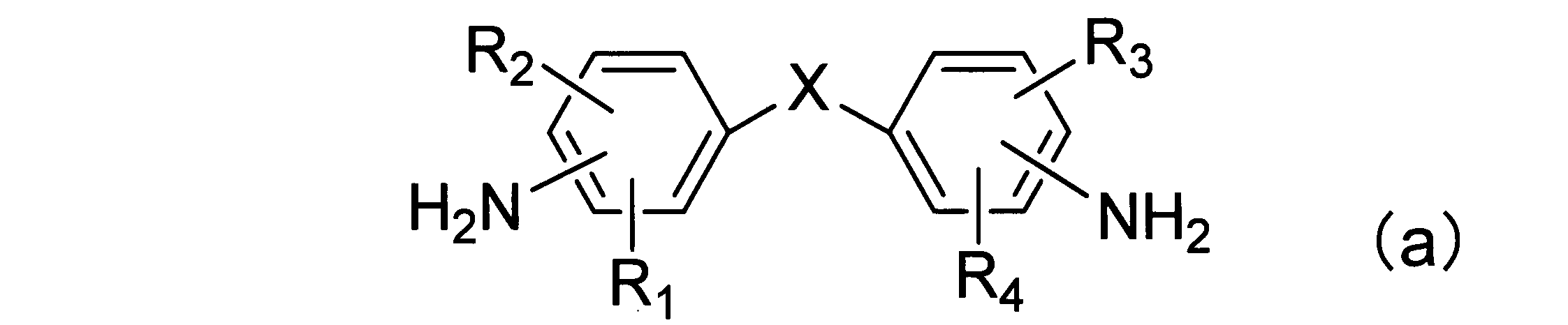
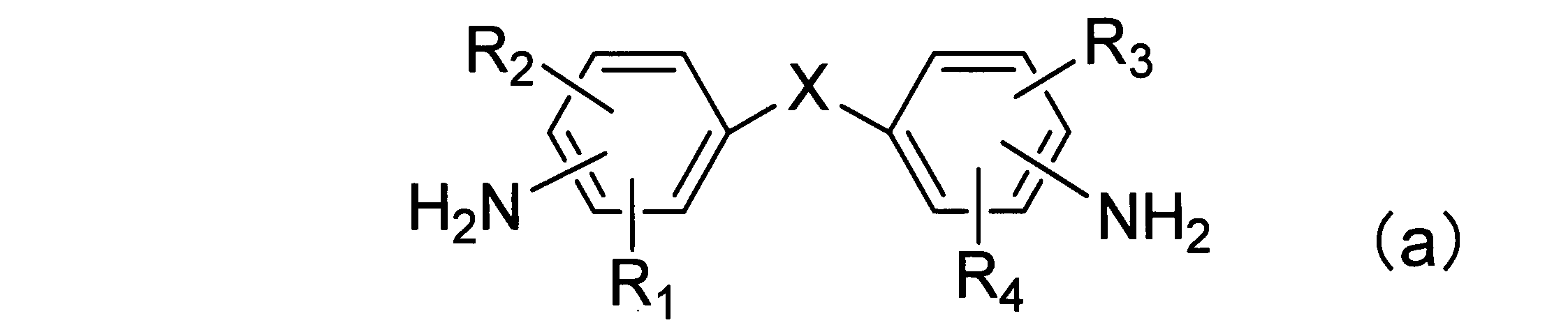
- [C] Compound represented by formula (a)
- X is selected from C ⁇ O, S ⁇ O, and O ⁇ P—OH
- R 1 to R 4 are hydrogen atoms, aliphatic hydrocarbon groups having 1 to 4 carbon atoms, 4 or less alicyclic hydrocarbon groups and at least one selected from the group consisting of halogen atoms).
- X is selected from C ⁇ O, S ⁇ O, and O ⁇ P—OH
- R 1 to R 4 are hydrogen atoms, aliphatic hydrocarbon groups having 1 to 4 carbon atoms, 4 or less alicyclic hydrocarbon groups and at least one selected from the group consisting of halogen atoms).
- the prepreg of the present invention is obtained by impregnating reinforcing fibers with the epoxy resin composition (i) or (ii).
- the fiber-reinforced composite material of the present invention comprises a cured resin obtained by curing the prepreg, or a cured resin obtained by curing the epoxy resin composition of (i) or (ii), and a reinforcing fiber. .
- the compound represented by Formula (a) reacts with an epoxy group by containing the compound represented by Formula (a) as a hardening accelerator in the epoxy resin composition containing a curing agent.
- heat is generated, the reaction between the curing agent and the epoxy group is promoted, and an epoxy resin composition having both high curability that can be molded in a short time and good pot life at the prepreg manufacturing process temperature can be provided.
- an aromatic amine having a structure other than the formula (a) is used as a curing accelerator, high curability that can be molded in a short time is obtained, but the pot life is not sufficient.
- the compound represented by the formula (a) has a rigid chemical structure
- the cured epoxy resin in the present invention has high heat resistance.
- the fiber reinforced composite material obtained by curing the epoxy resin composition and the prepreg of the present invention can be molded in a shorter time compared with a conventional fiber reinforced composite material that does not contain a curing accelerator. It is possible to greatly reduce the molding time and molding cost of products such as members, windmill blades, automobile outer plates, and computer trays such as IC trays and notebook computer casings.
- the epoxy resin composition of the present invention has the following constitution (i) or (ii).
- the constituent element [A] used in the invention is an epoxy resin having two or more glycidyl groups in one molecule. In the case of an epoxy resin having less than 2 glycidyl groups in one molecule, the glass transition temperature of a cured product obtained by heating and curing a mixture mixed with a curing agent described later is not preferable.
- epoxy resin used in the present invention examples include bisphenol A type epoxy resins, bisphenol F type epoxy resins, bisphenol AD type epoxy resins, bisphenol type epoxy resins such as bisphenol S type epoxy resins, and tetrabromobisphenol A diglycidyl ether.
- Brominated epoxy resins epoxy resins having a biphenyl skeleton, epoxy resins having a naphthalene skeleton, epoxy resins having a dicyclopentadiene skeleton, phenol novolac epoxy resins, novolac epoxy resins such as cresol novolac epoxy resins, N, N, O-triglycidyl-m-aminophenol, N, N, O-triglycidyl-p-aminophenol, N, N, O-triglycidyl-4-amino-3-methylphenol, , N, N ′, N′-tetraglycidyl-4,4′-methylenedianiline, N, N, N ′, N′-tetraglycidyl-2,2′-diethyl-4,4′-methylenedianiline, N, N, N ′, N′-tetraglycidyl-m-xylylenediamine, N, N-diglycidylaniline, N, N-dig
- epoxy resins may be used alone or may be contained as appropriate.
- the inclusion of an epoxy resin that exhibits fluidity at an arbitrary temperature and an epoxy resin that does not exhibit fluidity at an arbitrary temperature is effective in controlling the fluidity of the matrix resin when the resulting prepreg is thermoset. For example, if the fluidity shown until the matrix resin is gelled at the time of thermosetting is large, the orientation of the reinforcing fibers is disturbed or the matrix resin flows out of the system, so that the fiber mass content is predetermined. As a result, the mechanical properties of the resulting fiber-reinforced composite material may be reduced. Further, combining a plurality of epoxy resins exhibiting various viscoelastic behaviors at an arbitrary temperature is also effective for making the tackiness and draping properties of the obtained prepreg appropriate.
- the epoxy resin composition of the present invention has an epoxy resin other than the constituent element [A], for example, only one epoxy group in one molecule, as long as the heat resistance and mechanical properties are not significantly lowered.
- a monoepoxy resin having an alicyclic epoxy resin or the like can be appropriately contained.
- the curing agent for the component [B] included in the present invention is a compound having an active group capable of reacting with an epoxy group, having an exothermic starting temperature measured by a differential scanning calorimeter higher than that of the component [C].
- the exothermic start temperature is a bisphenol A type epoxy resin (“jER (registered trademark)” 825, manufactured by Mitsubishi Chemical Corporation) containing an epoxy resin composition containing the component [B] or the component [C].
- the epoxy resin composition for measuring the heat generation starting temperature is: [Epoxy equivalent of bisphenol A type epoxy resin / Content mass of bisphenol A type epoxy resin]: [Active hydrogen equivalent of (component [B] or component [C]) / (Content of component [B] or component [C])] is contained so as to be 1: 1.
- DSC Q2000 manufactured by TA Instruments
- Examples of the curing agent for the component [B] include dicyandiamide, aromatic amine compounds, phenol novolac resins, cresol novolac resins, polyphenol compounds, imidazole derivatives, tetramethylguanidine, thiourea-added amines, carboxylic acid hydrazides, and carboxylamides. And polymercaptan.
- aromatic amine curing agent examples include 3,3′-diisopropyl-4,4′-diaminodiphenylsulfone, 3,3′-di-t-butyl-4,4′-diaminodiphenylsulfone, 3,3′- Diethyl-5,5′-dimethyl-4,4′-diaminodiphenylsulfone, 3,3′-diisopropyl-5,5′-dimethyl-4,4′-diaminodiphenylsulfone, 3,3′-di-t- Butyl-5,5′-dimethyl-4,4′-diaminodiphenylsulfone, 3,3 ′, 5,5′-tetraethyl-4,4′-diaminodiphenylsulfone, 3,3
- 4,4′-diaminodiphenylsulfone and 3,3 ′ are obtained which are excellent in heat resistance and elastic modulus, and can obtain a cured product having a small linear expansion coefficient and a decrease in heat resistance due to water absorption. It is preferred to use diaminodiphenyl sulfone.
- aromatic amine compounds may be used alone or as a mixture of two or more thereof. When mixing with other components, either powder or liquid form may be used, and powder and liquid aromatic amine compounds may be mixed and used.
- the component [C] in the present invention is an aromatic amine compound represented by the above formula (a).
- X is selected from C ⁇ O, S ⁇ O, and O ⁇ P—OH.
- R 1 to R 4 are at least one selected from the group consisting of a hydrogen atom, an aliphatic hydrocarbon group having 1 to 4 carbon atoms, an alicyclic hydrocarbon group having 4 or less carbon atoms, and a halogen atom.
- Component [C] is used as an accelerator for the reaction between the epoxy resin of component [A] and the curing agent of component [B], and the aromatic amine compound of component [C] is an epoxy of component [A].
- Reaction heat is generated by reacting with the resin, and the temperature inside the epoxy resin composition rises locally. Due to this local temperature increase, the reaction between the curing agent of the component [B] and the epoxy resin of the component [A] is accelerated, so that the time required for completing the curing reaction can be shortened. . Further, since the aromatic amine compound of the component [C] has an electron-withdrawing functional group, the nucleophilicity of the amine is moderately suppressed, and a good pot life at the prepreg manufacturing process temperature can be obtained.
- the curing time can be shortened, but the nucleophilicity of the amine is too strong, so that the prepreg manufacturing process temperature is good. Can not get a pot life. Furthermore, since the aromatic amine compound of the component [C] has a rigid chemical structure, a cured epoxy resin having high heat resistance can be obtained.
- those in which X in the formula (a) is C ⁇ O include 4,4′-diaminodiphenyl ketone, 4,4′-diamino-3,3 ′, 5,5 ′. -Tetraethyl diphenyl ketone, 4,4'-diamino-3,3 ', 5,5'-tetrabromodiphenyl ketone, 3,4'-diaminodiphenyl ketone, 3,3'-diaminodiphenyl ketone, 4,4'- Diamino-2,2′-dimethyldiphenyl ketone, 4,4′-diamino-2,3′-dimethyldiphenyl ketone, 4,4′-diamino-3,3′-dimethyldiphenyl ketone, 3,4′-diamino- 5-methyldiphenyl ketone, 3,4'-diamino-2'-methyldiphenyl
- those in which X in the formula (a) is S ⁇ O include 4,4′-diaminodiphenyl sulfoxide, 4,4′-diamino-3,3 ′, 5,5 ′.
- those in which X in the formula (a) is O ⁇ P—OH are 4,4′-diaminodiphenylphosphinic acid, 4,4′-diamino-3,3 ′, 5 , 5′-Tetraethyldiphenylphosphinic acid, 4,4′-diamino-3,3 ′, 5,5′-tetrabromodiphenylphosphinic acid, 3,4′-diaminodiphenylphosphinic acid, 3,3′-diaminodiphenylphosphine Acid, 4,4'-diamino-2,2'-dimethyldiphenylphosphinic acid, 4,4'-diamino-2,3'-dimethyldiphenylphosphinic acid, 4,4'-diamino-3,3'-dimethyldiphenyl Phosphinic acid, 3,4'-diamino-5-methyldiphenylpho
- the epoxy resin composition of the present invention satisfies the following (1) and (2) at the same time, or satisfies the following (I) and (II) at the same time.
- the content of component [C] is 1 to 25 parts by mass with respect to 100 parts by mass of component [A].
- the content of component [C] is 1 to 55 parts by mass with respect to 100 parts by mass of component [B].
- the number of moles of active hydrogen of the component [B] or [C] is calculated as follows.
- the number of moles of active hydrogen contained in component [C] / the number of moles of epoxy group of component [A] 0.05 to 0.9.
- the epoxy resin composition may be used in combination with another curing accelerator as long as the heat resistance and thermal stability of the epoxy resin composition are not impaired.
- other curing accelerators include cationic polymerization initiators, tertiary amines, imidazole compounds, urea compounds, and hydrazide compounds.
- thermoplastic resin as the constituent element [D].
- the thermoplastic resin of component [D] impairs the heat resistance and elastic modulus of the resulting fiber-reinforced composite material, and the control of the tackiness of the resulting prepreg, the fluidity of the matrix resin when the prepreg is heat-cured. It is contained for imparting toughness.
- a thermoplastic resin a thermoplastic resin composed of a polyaryl ether skeleton is preferable.
- thermoplastic resins composed of these polyaryl ether skeletons may be used alone or in combination as appropriate.
- polyethersulfone and polyetherimide can be preferably used because they can impart toughness without deteriorating the heat resistance and mechanical properties of the resulting fiber-reinforced composite material.
- thermoplastic resins composed of these polyaryl ether skeletons include primary amines, secondary amines, hydroxyl groups, carboxyl groups, thiol groups, acid anhydrides and halogen groups (chlorine, bromine), etc. Can be used. Among these, in the case of a halogen group having a low reactivity with an epoxy resin, a prepreg excellent in storage stability can be obtained. On the other hand, in the case of a functional group excluding a halogen group, it has a high reactivity with an epoxy resin. This is preferable because a resin composition excellent in adhesion between the epoxy resin and the thermoplastic resin can be obtained.
- the viscosity when held at 80 ° C. for 2 hours is preferably 3.0 times or less of the initial viscosity at 80 ° C., more preferably 2.0 times or less, more preferably 1.5 times or less.
- the thickening ratio when held at 80 ° C. for 2 hours is the viscosity when held at 80 ° C. for 1 minute (initial viscosity at 80 ° C.) ⁇ * 1
- the viscosity ⁇ * when held at 80 ° C. for 2 hours . 120 is measured, and the thickening factor is determined from ⁇ * 120 ⁇ ⁇ * 1 .
- the viscosity is a complex viscosity ⁇ measured using a dynamic viscoelasticity measuring apparatus (ARES rheometer: manufactured by TA Instruments) using a parallel plate with a diameter of 40 mm and a frequency of 0.5 Hz and a gap of 1 mm. * Indicates a point.
- the viscosity increase ratio when held at 80 ° C. can be used as an index of the pot life of the epoxy resin composition in the resin composition kneading step or the prepreg manufacturing step. That is, the smaller the viscosity increase ratio when held at 80 ° C., the better the pot life.
- the viscosity increase ratio when the epoxy resin composition is kept at 80 ° C. for 2 hours is 3.0 times or less, the resin composition has high thermal stability, and the impregnation property of the resin to the reinforced fiber in the prepreg manufacturing process is high. It does not decrease, and voids are less likely to occur in the molded product.
- the cured epoxy resin When applied to structural materials such as aerospace applications and vehicles, the cured epoxy resin must have high heat resistance. Heat resistance can be evaluated by measuring the glass transition temperature by dynamic viscoelasticity measurement.
- the epoxy resin composition of the present invention preferably has a glass transition temperature of 170 ° C. or higher, more preferably 180 ° C. or higher, and still more preferably 190 ° C. or higher. A higher glass transition temperature of the epoxy resin composition is preferable because it can be applied to a member that requires higher heat resistance.
- thermoplastic resin layer a resin layer formed between layers of reinforcing fibers of the fiber reinforced composite material.
- thermoplastic resin particles a thermoplastic resin that can be used by mixing with an epoxy resin composition can be used.
- polyamide is most preferable, and among polyamides, polyamide 12, polyamide 6, polyamide 11, polyamide 6 /
- the polyamide (semi-IPN polyamide) made into a semi-IPN (polymer interpenetrating network structure) with a 12 copolymer or an epoxy compound described in Example 1 of JP-A-1-104624 is particularly good adhesion to an epoxy resin. Give strength.
- the shape of the thermoplastic resin particles may be spherical particles, non-spherical particles, or porous particles, but the spherical shape is superior in viscoelasticity because it does not deteriorate the flow characteristics of the resin, and there is no origin of stress concentration. This is a preferred embodiment in terms of giving high impact resistance.
- Commercially available polyamide particles include SP-500, SP-10, TR-1, TR-2, 842P-48, 842P-80 (above, manufactured by Toray Industries, Inc.), “Orgasol (registered trademark)” 1002D. , 2001UD, 2001EXD, 2002D, 3202D, 3501D, 3502D, (manufactured by Arkema Co., Ltd.) and the like can be used. These polyamide particles may be used alone or in combination.
- the epoxy resin composition of the present invention is a coupling agent, thermosetting resin particles, silica gel, carbon black, clay, carbon nanotube, graphene, carbon particles, metal powder, etc., as long as the effects of the present invention are not hindered.
- An inorganic filler or the like can be contained.
- the prepreg of the present invention is obtained by using the above-described epoxy resin composition as a matrix resin and combining this resin composition with reinforcing fibers.
- the reinforcing fiber include carbon fiber, graphite fiber, aramid fiber, and glass fiber. Among them, carbon fiber is particularly preferable.
- Carbon fibers include “Torayca (registered trademark)” T800G-24K, “Torayca (registered trademark)” T800S-24K, “Torayca (registered trademark)” T700G-24K, and “Torayca (registered trademark)” T300- 3T, and “Torayca®” T700S-12K (above, manufactured by Toray Industries, Inc.).
- the form and arrangement of the carbon fibers can be appropriately selected from long fibers and woven fabrics arranged in one direction. However, in order to obtain a carbon fiber reinforced composite material that is lighter and more durable, It is preferably in the form of continuous fibers such as long fibers (fiber bundles) or woven fabrics arranged in one direction.
- the prepreg of the present invention can be produced by various known methods.
- the matrix resin is dissolved in an organic solvent selected from acetone, methyl ethyl ketone, methanol, and the like to lower the viscosity, and the wet method in which the reinforcing fiber is impregnated, or the matrix resin is heated to lower the viscosity without using the organic solvent,
- a prepreg can be produced by a method such as a hot melt method for impregnating reinforcing fibers.
- a prepreg in the wet method, can be obtained by dipping a reinforcing fiber in a liquid containing a matrix resin and then pulling it up and evaporating the organic solvent using an oven or the like.
- a matrix resin whose viscosity has been reduced by heating is impregnated directly into a reinforcing fiber, or a release paper sheet with a resin film once coated with a matrix resin on a release paper (hereinafter referred to as “resin”).
- the film may be referred to as “film” first), then a resin film is laminated on the reinforcing fiber side from both sides or one side of the reinforcing fiber, and the reinforcing fiber is impregnated with the matrix resin by heating and pressing. .
- the method for producing the prepreg of the present invention is preferably a hot melt method in which a matrix resin is impregnated into a reinforcing fiber without using an organic solvent, since substantially no organic solvent remains in the prepreg.
- the prepreg of the present invention preferably has a reinforcing fiber amount per unit area of 30 to 2000 g / m 2 .
- the amount of the reinforcing fibers is less than 30 g / m 2, it is necessary to increase the number of laminated layers in order to obtain a predetermined thickness at the time of forming the fiber reinforced composite material, and the work may be complicated.
- the amount of reinforcing fibers exceeds 2000 g / m 2 , the prepreg drapability tends to deteriorate.
- the fiber mass content of the prepreg of the present invention is preferably 30 to 90% by mass, more preferably 35 to 85% by mass, and further preferably 40 to 80% by mass.
- the fiber mass content is less than 30% by mass, the amount of the resin is too large to obtain the advantages of the fiber reinforced composite material having excellent specific strength and specific elastic modulus, and it is hardened when molding the fiber reinforced composite material. Sometimes the amount of heat generated is too high. On the other hand, if the fiber mass content exceeds 90% by mass, poor resin impregnation may occur, and the resulting composite material may have many voids.
- the fiber-reinforced composite material of the present invention can be manufactured by taking, as an example, a method of laminating the above-described prepreg of the present invention in a predetermined form and curing the resin by applying pressure and heating.
- a method for applying heat and pressure a press molding method, an autoclave molding method, a bagging molding method, a wrapping tape method, an internal pressure molding method, or the like is employed.
- the reinforcing fiber is directly impregnated into the reinforcing fiber, followed by heat curing, such as a hand layup method, a filament winding method, a pultrusion method, a resin injection,
- a fiber reinforced composite material can also be produced by molding methods such as molding methods, resin transfer molding methods and the like.
- the unit “part” of the composition ratio means part by mass unless otherwise specified.
- Various characteristics were measured in an environment at a temperature of 23 ° C. and a relative humidity of 50% unless otherwise specified.
- Component [B] Curing agent having a heat generation start temperature measured by a differential scanning calorimeter higher than the heat generation start temperature of component [C].
- 4,4′-diaminodiphenyl sulfone (Seika Cure S, Seika Wakayama) Chemical Industry Co., Ltd.) Exothermic starting temperature measured with a differential scanning calorimeter: 175 ° C., active hydrogen equivalent: 62 (g / eq.) 3,3′-diaminodiphenylsulfone (3,3′-DAS, manufactured by Mitsui Chemicals Fine Co., Ltd.) Exothermic onset temperature measured by a differential scanning calorimeter: 166 ° C., active hydrogen equivalent: 62 (g / eq. ).
- Component [C] Compound represented by formula (a) 4,4′-diaminodiphenyl ketone Exothermic onset temperature measured by differential scanning calorimeter: 151 ° C., active hydrogen equivalent: 53 (g / eq.) 4,4′-diaminodiphenyl sulfoxide Exothermic onset temperature measured by differential scanning calorimeter: 152 ° C., active hydrogen equivalent: 58 (g / eq.) -4,4'-diaminodiphenylphosphinic acid Exothermic onset temperature measured by differential scanning calorimeter: 155 ° C, active hydrogen equivalent: 62 (g / eq.) 3,3′-diaminodiphenyl ketone Exothermic onset temperature measured by a differential scanning calorimeter: 143 ° C., active hydrogen equivalent: 53 (g / eq.) 3,3′-diaminodiphenyl sulfoxide Exothermic onset temperature
- Viscosity of epoxy resin composition when held at 80 ° C. for 1 minute and viscosity when held for 2 hours The viscosity of an epoxy resin composition is determined by a dynamic viscoelasticity measuring device ARES rheometer (TA instrument). Using a flat parallel plate with a diameter of 40 mm for the upper and lower measurement jigs, and setting the epoxy resin composition so that the distance between the upper and lower jigs is 1 mm, then the torsion mode (measurement frequency: 0.5 Hz). The viscosity ⁇ * 1 when held at 80 ° C. for 1 minute and the viscosity ⁇ * 120 when held at 80 ° C.
- ARES rheometer TA instrument
- the thickening ratio (pot life) was determined from ⁇ * 120 ⁇ ⁇ * 1 .
- the viscosity increase ratio is 1.5 times or less A, 1.5 times or more, 2.0 times or less B, 2.0 times or more, 3.0 times or less. C, more than 3.0 times is indicated by D.
- the glass transition temperature In the storage elastic modulus G ′ curve, the intersection temperature value between the tangent in the glass state and the tangent in the transition state was defined as the glass transition temperature.
- the measurement was performed at a heating rate of 5 ° C./min and a frequency of 1 Hz.
- the glass transition temperature is represented by A when the temperature is 190 ° C or higher, B when 180 ° C or higher and lower than 190 ° C, C when 170 ° C or higher and lower than 180 ° C, and D when lower than 170 ° C.
- the gel time was expressed as A for 80 minutes or less, B for more than 80 minutes, B for 90 minutes or less, C for more than 90 minutes, C for less than 95 minutes, and D for more than 95 minutes.
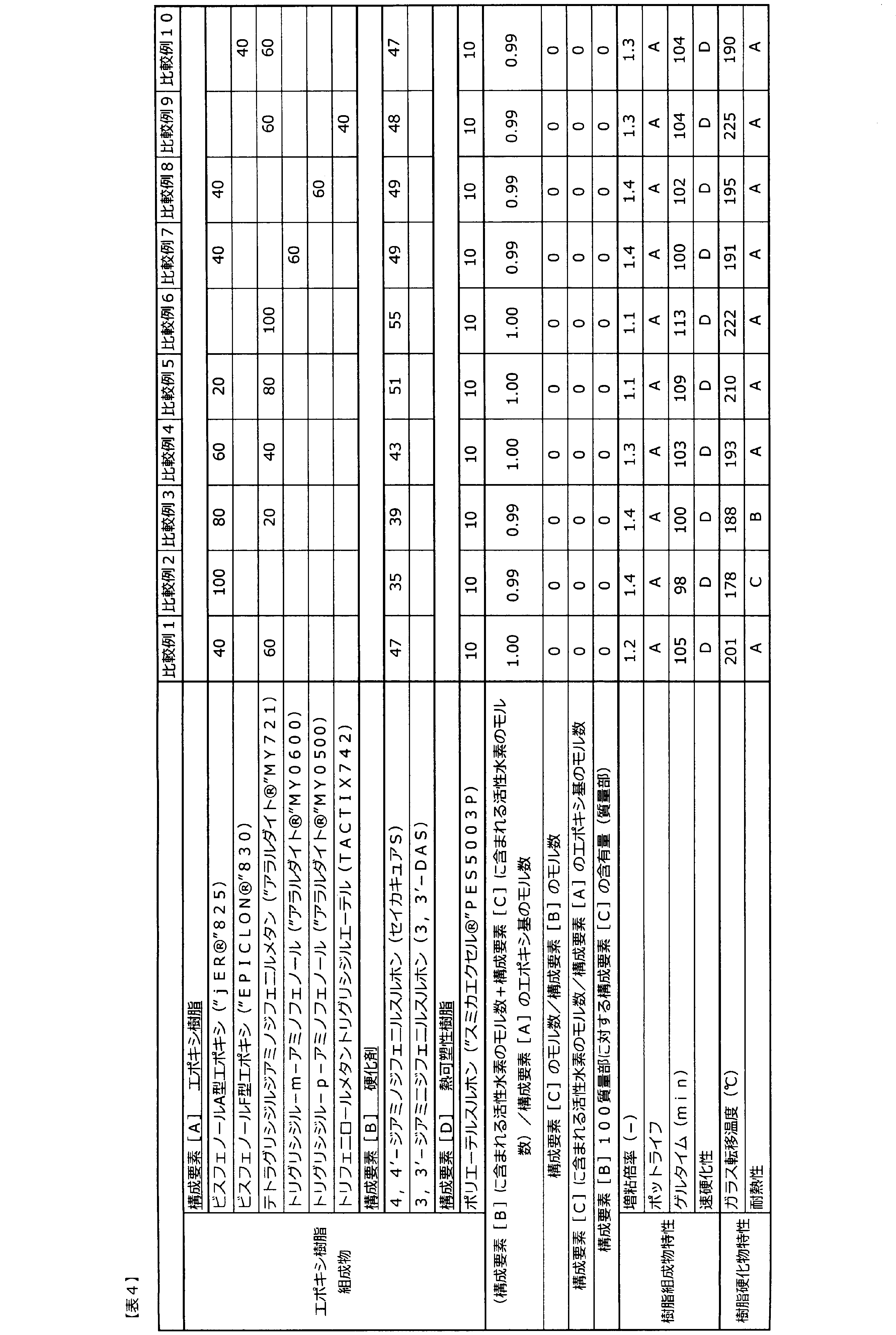
- Examples 1 to 6 and Comparative Example 1> As a result of using various curing accelerators described in Table 1 as the constituent element [C], the viscosity increase ratio is the same as that of Comparative Example 1 (not including the constituent element [C]) described in Table 4, The gel time was greatly shortened and excellent fast curability was exhibited. Regarding the glass transition temperature, Examples 1 to 6 did not decrease as compared with Comparative Example 1, and showed a high value of 190 ° C. or higher.
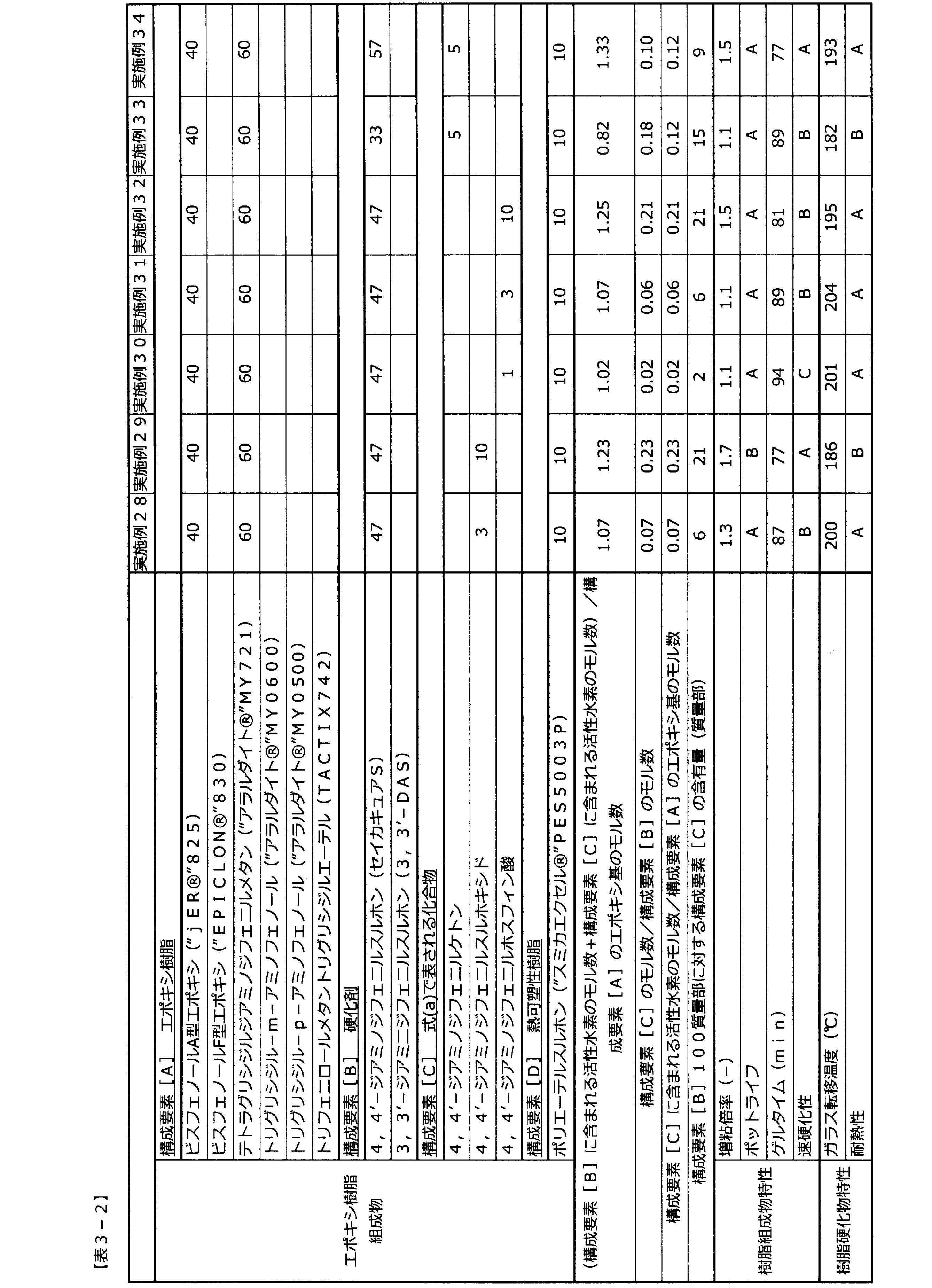
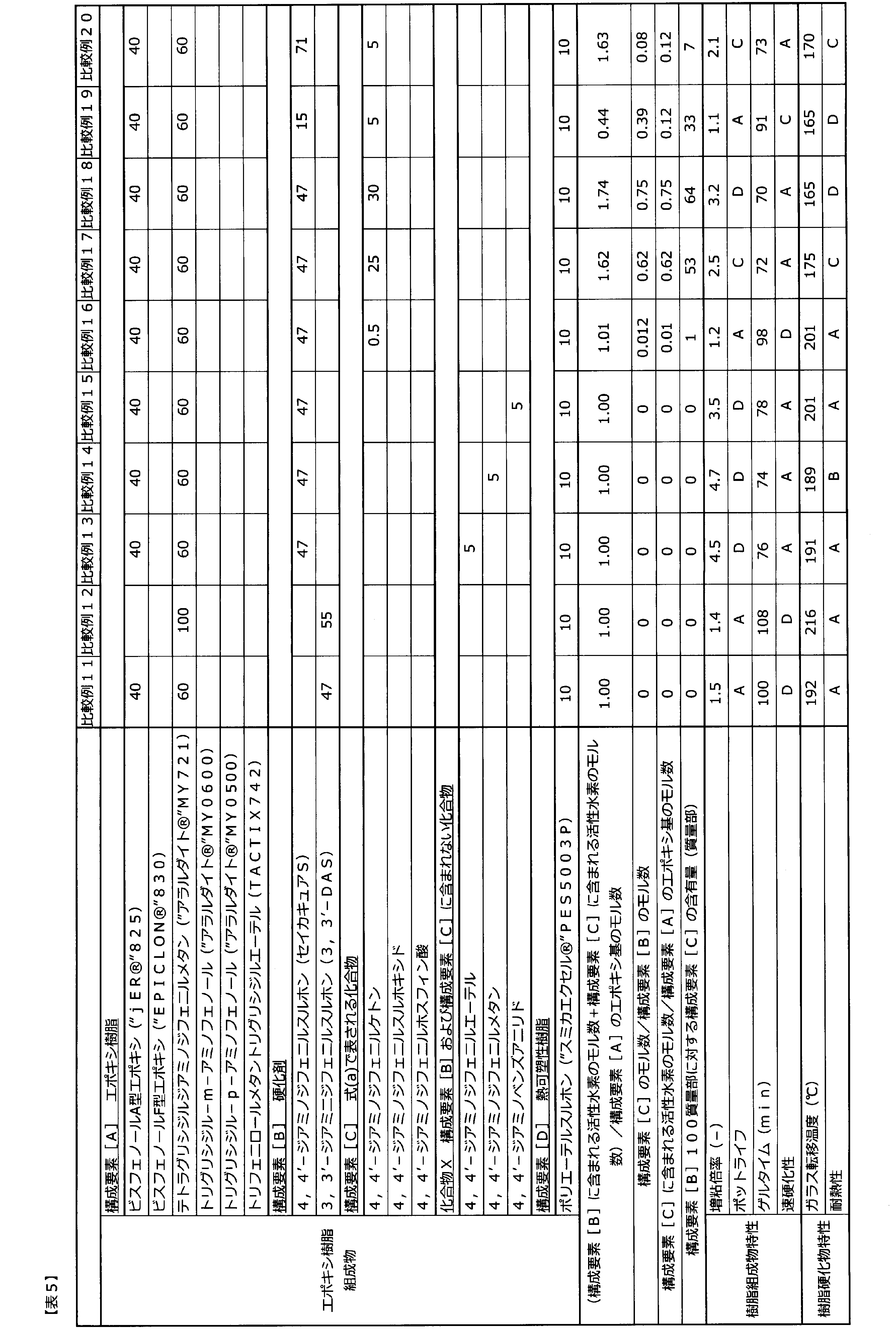
- Examples 16 and 17 and Comparative Examples 11 and 12 As shown in Tables 2 and 5, in Examples 16 and 17, as a result of changing the curing agents of Examples 1 and 11 and Comparative Examples 1 and 6, Comparative Examples 11 and 12 (component [C] not contained) In comparison, the gel time was shortened without impairing pot life and heat resistance. Although the pot life and heat resistance tended to be reduced by changing the curing agent from Examples 1 and 11 to Examples 16 and 17, excellent values without practical problems were shown.
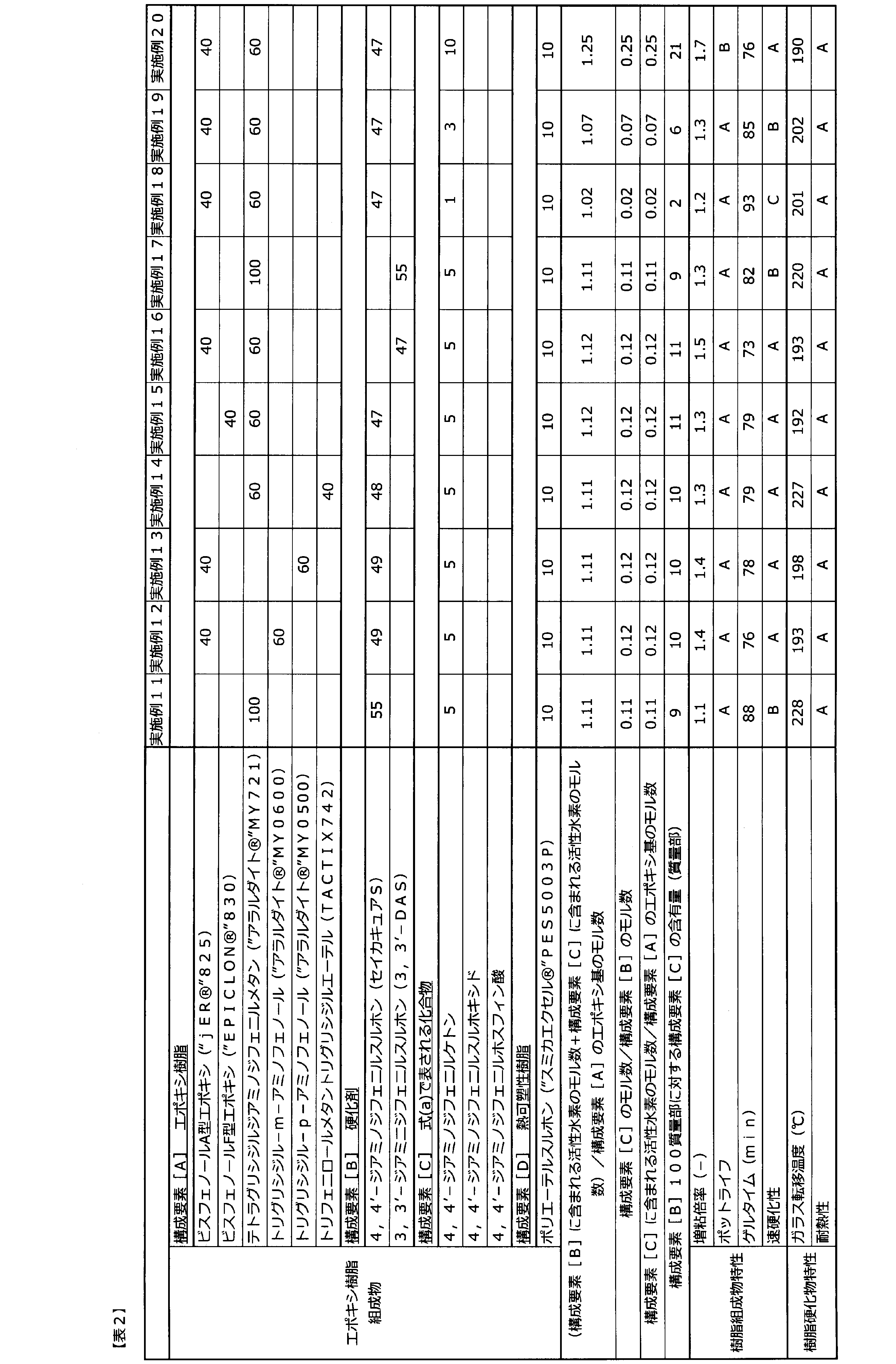
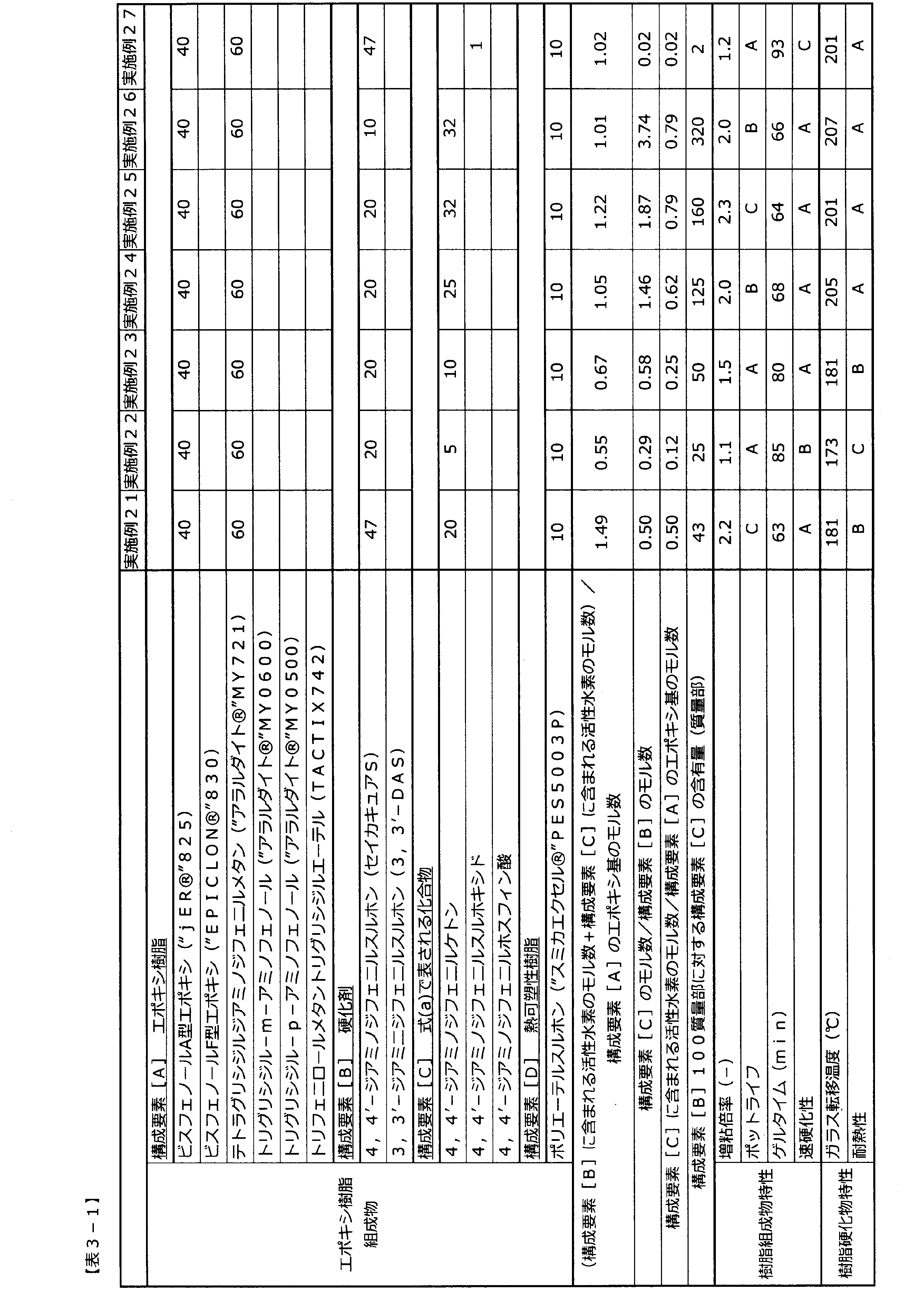
- Examples 18 to 32 As shown in Tables 2 and 3, as a result of changing the content of the component [C] in Examples 18 to 21 and Examples 27 to 32, the increase in the content leads to an increase in the viscosity increase rate as the gel time is shortened. Although there was a tendency, it showed excellent characteristics with no practical problems.
- Comparative Examples 16 to 18 As shown in Comparative Example 16 of Table 5, as a result of the content of the constituent element [C] being less than 1 part by mass with respect to 100 parts by mass of the constituent element [A], the effect of shortening the gel time is not sufficient. There was no result. As shown in Comparative Examples 17 and 18, when the content of the constituent element [C] is larger than 25 parts by mass with respect to 100 parts by mass of the constituent element [A], the increase in the thickening factor and the decrease in the glass transition temperature are large. This was an undesirable characteristic.
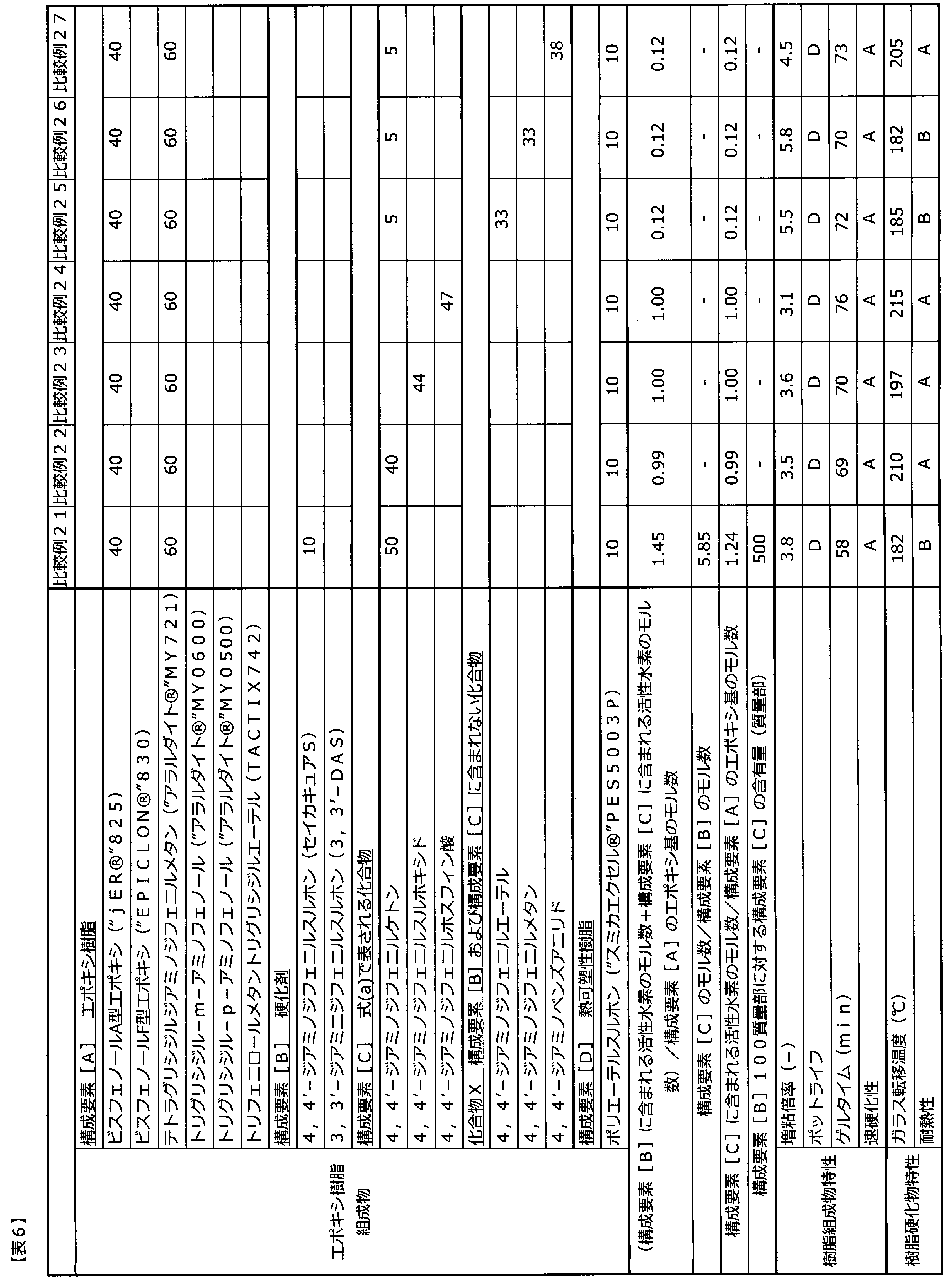
- Comparative Examples 19 to 21 As shown in Comparative Example 19 of Table 5, (number of moles of active hydrogen contained in component [B] + number of moles of active hydrogen contained in component [C]) / (epoxy group of component [A]) When the number of moles is lower than 0.5, the heat resistance is low and the gel time shortening effect is not sufficient, which is an undesirable result. Further, as shown in Comparative Example 20, (number of moles of active hydrogen contained in component [B] + number of moles of active hydrogen contained in component [C]) / (of epoxy group of component [A]) When the number of moles) was larger than 1.5, the increase in the viscosity increase ratio and the decrease in the glass transition temperature were large, which was an undesirable characteristic. As shown in Table 6, Comparative Example 21 having a large content of the constituent element [C] had a large rate of increase in viscosity, which was an undesirable characteristic.
Landscapes
- Chemical & Material Sciences (AREA)
- Chemical Kinetics & Catalysis (AREA)
- Medicinal Chemistry (AREA)
- Polymers & Plastics (AREA)
- Organic Chemistry (AREA)
- Health & Medical Sciences (AREA)
- Engineering & Computer Science (AREA)
- Materials Engineering (AREA)
- Manufacturing & Machinery (AREA)
- Inorganic Chemistry (AREA)
- Composite Materials (AREA)
- Mechanical Engineering (AREA)
- Reinforced Plastic Materials (AREA)
- Epoxy Resins (AREA)
Abstract
Description
[A]:エポキシ樹脂
[B]:示差走査熱量計により測定される発熱開始温度が、構成要素[C]の発熱開始温度より高い硬化剤
[C]:式(a)で表される化合物
(1)0.5≦(構成要素[B]に含まれる活性水素のモル数+構成要素[C]に含まれる活性水素のモル数)/構成要素[A]のエポキシ基のモル数≦1.5
(2)0.02≦構成要素[C]のモル数/構成要素[B]のモル数≦5.0
または、(ii)少なくとも次の構成要素[A]~[C]を含み、構成要素[C]の含有量が、構成要素[A]100質量部に対して1~25質量部であり、かつ構成要素[C]の含有量が、構成要素[B]100質量部に対して1~55質量部であるエポキシ樹脂組成物
[A]:エポキシ樹脂
[B]:示差走査熱量計により測定される発熱開始温度が、構成要素[C]の発熱開始温度より高い硬化剤
[C]:式(a)で表される化合物
(i)少なくとも次の構成要素[A]~[C]を含み、各構成要素の配合割合が(1)と(2)を満たすエポキシ樹脂組成物。
[A]:エポキシ樹脂
[B]:示差走査熱量計により測定される発熱開始温度が、構成要素[C]の発熱開始温度より高い硬化剤
[C]:式(a)で表される化合物。
(1)0.5≦(構成要素[B]に含まれる活性水素のモル数+構成要素[C]に含まれる活性水素のモル数)/構成要素[A]のエポキシ基のモル数0.02≦1.5
(2)0.02≦構成要素[C]のモル数/構成要素[B]のモル数≦5.0
または、(ii)少なくとも次の構成要素[A]~[C]を含み、構成要素[C]の含有量が、構成要素[A]100質量部に対して1~25質量部であり、かつ構成要素[C]の含有量が、構成要素[B]100質量部に対して1~55質量部であるエポキシ樹脂組成物。
[A]:エポキシ樹脂
[B]:示差走査熱量計により測定される発熱開始温度が、構成要素[C]の発熱開始温度より高い硬化剤
[C]:式(a)で表される化合物
本発明で用いる構成要素[A]は、1分子中に2個以上のグリシジル基を有するエポキシ樹脂である。1分子中にグリシジル基が2個未満のエポキシ樹脂の場合、後述する硬化剤と混合した混合物を加熱硬化して得られる硬化物のガラス転移温度が低くなるため好ましくない。本発明で用いられるエポキシ樹脂としては、例えばビスフェノールA型エポキシ樹脂、ビスフェノールF型エポキシ樹脂、ビスフェノールAD型エポキシ樹脂、ビスフェノールS型エポキシ樹脂などのビスフェノール型エポキシ樹脂、テトラブロモビスフェノールAジグリシジルエーテルなどの臭素化エポキシ樹脂、ビフェニル骨格を有するエポキシ樹脂、ナフタレン骨格を有するエポキシ樹脂、ジシクロペンタジエン骨格を有するエポキシ樹脂、フェノールノボラック型エポキシ樹脂、クレゾールノボラック型エポキシ樹脂などのノボラック型エポキシ樹脂、N,N,O-トリグリシジル-m-アミノフェノール、N,N,O-トリグリシジル-p-アミノフェノール、N,N,O-トリグリシジル-4-アミノ-3-メチルフェノール、N,N,N’,N’-テトラグリシジル-4,4’-メチレンジアニリン、N,N,N’,N’-テトラグリシジル-2,2’-ジエチル-4,4’-メチレンジアニリン、N,N,N’,N’-テトラグリシジル-m-キシリレンジアミン、N,N-ジグリシジルアニリン、N,N-ジグリシジル-o-トルイジンなどのグリシジルアミン型エポキシ樹脂、レゾルシンジグリシジルエーテル、トリグリシジルイソシアヌレートなどを挙げることができる。中でも、1分子中にグリシジル基を3個以上含むエポキシ樹脂は、高いガラス転移温度や弾性率を有する硬化物が得られるため、航空・宇宙機用途に好適に用いられる。
(1)(構成要素[B]に含まれる活性水素のモル数+構成要素[C]に含まれる活性水素のモル数)/構成要素[A]のエポキシ基のモル数=0.5~1.5である。
(2)構成要素[C]のモル数/構成要素[B]のモル数=0.02~5.0である。
(I)構成要素[C]の含有量が、構成要素[A]100質量部に対して、1~25質量部である。
(II)構成要素[C]の含有量が、構成要素[B]100質量部に対して、1~55質量部である。
(1)において、0.5以上1.5以下とすることで、優れた速硬化性と耐熱性が得られる。(2)において、0.02以上にすることにより樹脂組成物の硬化反応を促進する効果が得られ、5.0以下にすることにより樹脂組成物のポットライフの悪化を抑制することができる。また、(I)において、含有量を1質量部以上にすることにより樹脂組成物の硬化反応を促進する効果が得られ、25質量部以下にすることにより樹脂組成物のポットライフの悪化を抑制することができる。(II)において、含有量を1~55質量部とすることで、硬化剤とエポキシ樹脂反応の促進が行われ、優れた速硬化性と耐熱性が得られる。
構成要素[A]のエポキシ基のモル数=構成要素[A]の質量部数/構成要素[A]のエポキシ当量。
構成要素[A]のエポキシ基のモル数=構成要素[A]成分1の質量部数/構成要素[A]成分1のエポキシ当量+構成要素[A]成分2の質量部数/構成要素[A]成分2のエポキシ当量。
構成要素[B]の活性水素のモル数=構成要素[B]の質量部数/構成要素[B]の活性水素当量
構成要素[C]の活性水素のモル数=構成要素[C]の質量部数/構成要素[C]の活性水素当量。
構成要素[B]のモル数=構成要素[B]の質量部数/構成要素[B]の分子量
構成要素[C]のモル数=構成要素[C]の質量部数/構成要素[C]の分子量。
(1)構成要素[A]:エポキシ樹脂
・ビスフェノールA型エポキシ樹脂(“jER(登録商標)”825、三菱化学(株)製)エポキシ当量:175(g/eq.)
・ビスフェノールF型エポキシ樹脂(“EPICLON(登録商標)”830、DIC(株)製)エポキシ当量:172(g/eq.)
・テトラグリシジルジアミノジフェニルメタン(“アラルダイト(登録商標)”MY721、ハンツマン・アドバンスト・マテリアルズ社製)エポキシ当量:113(g/eq.)
・トリグリシジル-m-アミノフェノール(“アラルダイト(登録商標)”MY0600、ハンツマン・アドバンスト・マテリアルズ社製)エポキシ当量:106(g/eq.)
・トリグリシジル-p-アミノフェノール(“アラルダイト(登録商標)”MY0500、ハンツマン・アドバンスト・マテリアルズ社製)エポキシ当量:106(g/eq.)
・トリフェニロールメタントリグリシジルエーテル(TACTIX742、ハンツマン・アドバンスト・マテリアルズ社製)エポキシ当量:160(g/eq.)。
・4,4’-ジアミノジフェニルスルホン(セイカキュアS、和歌山精化工業(株)製) 示差走査熱量計により測定される発熱開始温度:175℃、活性水素当量:62(g/eq.)
・3,3’-ジアミノジフェニルスルホン(3,3’-DAS、三井化学ファイン(株)製) 示差走査熱量計により測定される発熱開始温度:166℃、活性水素当量:62(g/eq.)。
・4,4’-ジアミノジフェニルケトン 示差走査熱量計により測定される発熱開始温度:151℃、活性水素当量:53(g/eq.)
・4,4’-ジアミノジフェニルスルホキシド 示差走査熱量計により測定される発熱開始温度:152℃、活性水素当量:58(g/eq.)
・4,4’-ジアミノジフェニルホスフィン酸 示差走査熱量計により測定される発熱開始温度:155℃、活性水素当量:62(g/eq.)
・3,3’-ジアミノジフェニルケトン 示差走査熱量計により測定される発熱開始温度:143℃、活性水素当量:53(g/eq.)
・3,3’-ジアミノジフェニルスルホキシド 示差走査熱量計により測定される発熱開始温度:143℃、活性水素当量:58(g/eq.)
・3,3’-ジアミノジフェニルホスフィン酸 示差走査熱量計により測定される発熱開始温度:146℃、活性水素当量:62(g/eq.)。
・4,4’-ジアミノジフェニルエーテル 示差走査熱量計により測定される発熱開始温度:121℃、活性水素当量:50(g/eq.)
・4,4’-ジアミノジフェニルメタン 示差走査熱量計により測定される発熱開始温度:118℃、活性水素当量:50(g/eq.)
・4,4’-ジアミノベンズアニリド 示差走査熱量計により測定される発熱開始温度:129℃、活性水素当量:57(g/eq.)。
・ポリエーテルスルホン(“スミカエクセル(登録商標)”PES5003P、住友化学(株)社製)。
以下の方法にて各実施例および比較例のエポキシ樹脂組成物を測定した。
混練装置中に、表1~5に記載の構成要素[A]に該当するエポキシ樹脂および構成要素[D]を投入し、加熱混練を行い、構成要素[D]成分を溶解させた。次いで、混練を続けたまま100℃以下の温度まで降温させ、表1~5に記載の構成要素[B]と構成要素[C](ただし、比較例においては、構成要素[B]または構成要素[C]を加えない場合や、構成要素[C]の代わりに化合物Xを加える場合もある。)を加えて撹拌し、エポキシ樹脂組成物を得た。
エポキシ樹脂組成物の粘度は、動的粘弾性測定装置ARESレオメーター(TAインスツルメント社製)を用い、上下部測定冶具に直径40mmの平板のパラレルプレートを用い、上部と下部の冶具間距離が1mmとなるように該エポキシ樹脂組成物をセット後、ねじりモード(測定周波数:0.5Hz)で測定した。80℃で1分間保持した時の粘度η* 1、80℃で2時間保持した時の粘度η* 120を測定し、増粘倍率(ポットライフ)をη* 120÷η* 1より求めた。ポットライフの評価に関し、表1~5において、増粘倍率が1.5倍以下をA、1.5倍超、2.0倍以下をB、2.0倍超、3.0倍以下をC、3.0倍超をDで表記した。
エポキシ樹脂組成物をモールドに注入した後、熱風乾燥機中で30℃から速度1.5℃/分で昇温し、180℃で2時間加熱硬化した後、30℃まで速度2.5℃/分で降温して厚さ2mmの樹脂硬化板を作製した。作製した樹脂硬化板から幅12.7mm、長さ55mmの試験片を切り出し、SACMA SRM18R-94に従い、DMA法によりガラス転移温度を求めた。貯蔵弾性率G’曲線において、ガラス状態での接線と転移状態での接線との交点温度値をガラス転移温度とした。ここでは、昇温速度5℃/分、周波数1Hzで測定した。耐熱性の評価に関し、表1~5において、ガラス転移温度が190℃以上をA、180℃以上190℃未満をB、170℃以上180℃未満をC、170℃未満をDで表記した。
キュラストメーターにより、回転トルクの経時変化からエポキシ樹脂組成物の硬化反応性を評価した。ここでは、Rubber Process Analyzer RPA2000(ALPHA TECHNOLOGIES社製)を用い、40℃から180℃まで1.7℃/minの速度で昇温し、180℃で2時間加熱した。ゲルタイムは、40℃で加熱開始時点からトルクが1dNmを超えるまでの時間とした。速硬化性の評価に関し、表1~5において、ゲルタイムが80分以下をA、80分超、90分以下をB、90分超、95分以下をC、95分超をDで表記した。
構成要素[C]として、表1に記載の各種硬化促進剤を用いた結果、表4に記載の比較例1(構成要素[C]非含有)と比べ、増粘倍率は同等の値で、大幅なゲルタイムの短縮がなされ、優れた速硬化性を示した。ガラス転移温度に関しては、実施例1~6とも比較例1に比べて低下はなく、190℃以上の高い値を示した。
表1,2,4に示すように、種々のエポキシ樹脂を用いた結果、実施例7~15では、4,4’-ジアミノジフェニルケトンを含有することにより、比較例2~10(構成要素[C]非含有)に比べて、増粘倍率は同等の値で、大幅なゲルタイムの短縮がなされた。実施例7~11において、1分子中にグリシジル基を3個以上含むエポキシ樹脂であるテトラグリシジルジアミノジフェニルメタンの含有量が増えることで、速硬化性、ポットライフへの悪影響なく、ガラス転移温度の向上が見られ、好ましい傾向を示した。
表2,5に示すように、実施例16,17では、実施例1,11および比較例1,6の硬化剤を変更した結果、比較例11,12(構成要素[C]非含有)に比べて、ポットライフ、耐熱性を損なうことなく、ゲルタイムの短縮が見られた。実施例1,11から実施例16,17への硬化剤の変更により、ポットライフおよび耐熱性が低下する傾向が見られたが、実用上問題のない優れた値を示した。
表2,3に示すように、実施例18~21および実施例27~32において構成要素[C]の含有量を変更した結果、含有量の増加により、ゲルタイムの短縮と共に増粘倍率が上昇する傾向が見られたが、実用上問題のない優れた特性を示した。
表3に示すように、硬化剤の含有量を変更した結果、含有量の増加に伴い、ゲルタイムが短縮される傾向を示した。
表5に示すように、硬化促進剤として構成要素[C]に含まれない化合物Xを用いた結果、増粘倍率が高く、好ましくない特性であった。
表5の比較例16に示すように、構成要素[A]100質量部に対し、構成要素[C]の含有量が1質量部未満であった結果、ゲルタイムの短縮効果が十分ではなく、好ましくない結果であった。比較例17,18に示すように、構成要素[A]100質量部に対し、構成要素[C]の含有量が25質量部より大きい場合、増粘倍率の上昇およびガラス転移温度の低下が大きく、好ましくない特性であった。
表5の比較例19に示すように、(構成要素[B]に含まれる活性水素のモル数+構成要素[C]に含まれる活性水素のモル数)/(構成要素[A]のエポキシ基のモル数)が0.5より低い場合、耐熱性が低く、さらにゲルタイムの短縮効果も十分ではなく、好ましくない結果であった。また、比較例20に示すように、(構成要素[B]に含まれる活性水素のモル数+構成要素[C]に含まれる活性水素のモル数)/(構成要素[A]のエポキシ基のモル数)が1.5より大きい場合、増粘倍率の上昇およびガラス転移温度の低下が大きく、好ましくない特性であった。表6に示すように、構成要素[C]の含有量が大きい比較例21は、粘度上昇の割合が大きく、好ましくない特性であった。
表6に示すように、構成要素[A]、[C]および[D]のみで構成されるエポキシ樹脂組成物を評価した結果、増粘倍率が高く、好ましくない結果であった。
表6に示すように、構成要素[B]に含まれない化合物Xを硬化剤として用いた結果、増粘倍率が高く、好ましくない結果であった。

Claims (15)
- 少なくとも次の構成要素[A]~[C]を含み、各構成要素の配合割合が(1)と(2)を満たすエポキシ樹脂組成物。
[A]:エポキシ樹脂
[B]:示差走査熱量計により測定される発熱開始温度が、構成要素[C]の発熱開始温度より高い硬化剤
[C]:式(a)で表される化合物

(1)0.5≦(構成要素[B]に含まれる活性水素のモル数+構成要素[C]に含まれる活性水素のモル数)/構成要素[A]のエポキシ基のモル数≦1.5
(2)0.02≦構成要素[C]のモル数/構成要素[B]のモル数≦5.0 - 構成要素[A]と構成要素[C]の配合割合が(3)を満たす、請求項1に記載のエポキシ樹脂組成物。
(3)0.05≦構成要素[C]に含まれる活性水素のモル数/構成要素[A]のエポキシ基のモル数≦0.9 - 少なくとも次の構成要素[A]~[C]を含み、構成要素[C]の含有量が、構成要素[A]100質量部に対して1~25質量部であり、かつ構成要素[C]の含有量が、構成要素[B]100質量部に対して1~55質量部である、エポキシ樹脂組成物。
[A]:エポキシ樹脂
[B]:示差走査熱量計により測定される発熱開始温度が、構成要素[C]の発熱開始温度より高い硬化剤
[C]:式(a)で表される化合物

- 構成要素[A]が1分子中にグリシジル基を3個以上有するエポキシ樹脂を含む、請求項1から3のいずれかに記載のエポキシ樹脂組成物。
- 構成要素[A]が1分子中にグリシジル基を3個以上有するグリシジルアミン型エポキシ樹脂を、構成要素[A]100質量部に対して40~100質量部含む、請求項4に記載のエポキシ樹脂組成物。
- 構成要素[B]が芳香族アミン化合物である、請求項1から5のいずれかに記載のエポキシ樹脂組成物。
- 式(a)におけるXがC=Oである、請求項1から6のいずれかに記載のエポキシ樹脂組成物。
- 式(a)におけるXがS=Oである、請求項1から6のいずれかに記載のエポキシ樹脂組成物。
- 式(a)におけるXがO=P-OHである、請求項1から6のいずれかに記載のエポキシ樹脂組成物。
- さらに下記構成要素[D]を含む、請求項1から9のいずれかに記載のエポキシ樹脂組成物。
[D]:熱可塑性樹脂 - 180℃で2時間硬化して得られる硬化物を、動的粘弾性測定で評価したガラス転移温度が170℃以上である、請求項1から10のいずれかに記載のエポキシ樹脂組成物。
- 80℃で2時間保持した時の粘度が80℃における初期粘度の3.0倍以下である、請求項1から11のいずれかに記載のエポキシ樹脂組成物。
- 請求項1から12のいずれかに記載のエポキシ樹脂組成物を強化繊維に含浸させてなるプリプレグ。
- 請求項13に記載のプリプレグを硬化させてなる繊維強化複合材料。
- 請求項1から12のいずれかに記載のエポキシ樹脂組成物を硬化させてなる樹脂硬化物、および強化繊維を含んでなる繊維強化複合材料。
Priority Applications (7)
| Application Number | Priority Date | Filing Date | Title |
|---|---|---|---|
| ES17743893T ES2779882T3 (es) | 2016-01-26 | 2017-01-06 | Composición de resina epoxi, material de composite preimpregnado y reforzado con fibra |
| KR1020187010830A KR20180104283A (ko) | 2016-01-26 | 2017-01-06 | 에폭시 수지 조성물, 프리프레그 및 섬유 강화 복합 재료 |
| JP2017501734A JP6237951B1 (ja) | 2016-01-26 | 2017-01-06 | エポキシ樹脂組成物、プリプレグおよび繊維強化複合材料 |
| CN201780004338.6A CN108291010B (zh) | 2016-01-26 | 2017-01-06 | 环氧树脂组合物、预浸料坯及纤维增强复合材料 |
| US16/072,361 US10344132B2 (en) | 2016-01-26 | 2017-01-06 | Epoxy resin composition, prepreg and fiber reinforced composite material |
| EP17743893.4A EP3409706B1 (en) | 2016-01-26 | 2017-01-06 | Epoxy resin composition, prepreg and fiber reinforced composite material |
| RU2018129965A RU2726406C2 (ru) | 2016-01-26 | 2017-01-06 | Композиция эпоксидной смолы, препрег и композитный материал, армированный волокном |
Applications Claiming Priority (2)
| Application Number | Priority Date | Filing Date | Title |
|---|---|---|---|
| JP2016-012165 | 2016-01-26 | ||
| JP2016012165 | 2016-01-26 |
Publications (1)
| Publication Number | Publication Date |
|---|---|
| WO2017130659A1 true WO2017130659A1 (ja) | 2017-08-03 |
Family
ID=59397665
Family Applications (1)
| Application Number | Title | Priority Date | Filing Date |
|---|---|---|---|
| PCT/JP2017/000270 Ceased WO2017130659A1 (ja) | 2016-01-26 | 2017-01-06 | エポキシ樹脂組成物、プリプレグおよび繊維強化複合材料 |
Country Status (8)
| Country | Link |
|---|---|
| US (1) | US10344132B2 (ja) |
| EP (1) | EP3409706B1 (ja) |
| JP (1) | JP6237951B1 (ja) |
| KR (1) | KR20180104283A (ja) |
| CN (1) | CN108291010B (ja) |
| ES (1) | ES2779882T3 (ja) |
| RU (1) | RU2726406C2 (ja) |
| WO (1) | WO2017130659A1 (ja) |
Cited By (2)
| Publication number | Priority date | Publication date | Assignee | Title |
|---|---|---|---|---|
| WO2020003662A1 (ja) * | 2018-06-26 | 2020-01-02 | 東レ株式会社 | プリプレグおよびその製造方法、スリットテーププリプレグ、炭素繊維強化複合材料 |
| WO2021117465A1 (ja) * | 2019-12-11 | 2021-06-17 | 東レ株式会社 | プリプレグ、積層体および一体化成形品 |
Families Citing this family (6)
| Publication number | Priority date | Publication date | Assignee | Title |
|---|---|---|---|---|
| JP6709943B2 (ja) * | 2017-12-13 | 2020-06-17 | ナミックス株式会社 | 導電性ペースト |
| GB201905741D0 (en) | 2019-04-24 | 2019-06-05 | Hexcel Composites Ltd | Improvements in or relating to curatives |
| CN110128785B (zh) * | 2019-05-10 | 2022-03-01 | 汉硕高新材料(天津)有限公司 | 一种用于复合材料预浸料的耐高温环氧树脂及合成工艺 |
| WO2021095534A1 (ja) * | 2019-11-14 | 2021-05-20 | Dic株式会社 | 硬化性組成物、硬化物、繊維強化複合材料、成形品及びその製造方法 |
| JP7647102B2 (ja) * | 2019-11-15 | 2025-03-18 | 東レ株式会社 | エポキシ樹脂組成物、プリプレグおよび繊維強化複合材料 |
| CN116162225B (zh) * | 2023-01-09 | 2024-04-02 | 华东理工大学 | 一种环氧树脂材料及其制备方法和应用 |
Citations (14)
| Publication number | Priority date | Publication date | Assignee | Title |
|---|---|---|---|---|
| JPS6181423A (ja) * | 1984-09-28 | 1986-04-25 | Mitsui Toatsu Chem Inc | 熱硬化性組成物 |
| JPS6189223A (ja) * | 1984-10-08 | 1986-05-07 | Toray Ind Inc | 複合材料用樹脂組成物 |
| JPS61152724A (ja) * | 1984-12-27 | 1986-07-11 | Toray Ind Inc | 複合材料用熱硬化性樹脂組成物 |
| JPS63250351A (ja) * | 1987-04-06 | 1988-10-18 | アモコ コーポレーション | 新規低重合体ジアミン硬化剤及びエポキシ樹脂系硬化のためのそれらの用途 |
| JPH01104624A (ja) | 1987-10-16 | 1989-04-21 | Toray Ind Inc | 樹脂微粒子を用いたプリプレグ |
| JPH01319526A (ja) * | 1988-05-13 | 1989-12-25 | M & T Chem Inc | 硬化性且つ相溶性組成物 |
| JPH0873566A (ja) | 1994-09-06 | 1996-03-19 | Nippon Kayaku Co Ltd | マイクロカプセル型硬化促進剤、これを含むエポキシ樹脂組成物及びその硬化物 |
| JP2001261783A (ja) | 2000-03-16 | 2001-09-26 | Toray Ind Inc | エポキシ樹脂組成物 |
| WO2001081445A1 (fr) | 2000-04-21 | 2001-11-01 | Mitsubishi Rayon Co., Ltd. | Composition de resine epoxy et preimpregne fabrique avec cette composition de resine epoxy |
| JP2002003581A (ja) | 2000-06-19 | 2002-01-09 | Toray Ind Inc | エポキシ樹脂組成物 |
| JP2012140574A (ja) | 2011-01-06 | 2012-07-26 | Yokohama Rubber Co Ltd:The | マイクロカプセル型硬化剤および熱硬化性エポキシ樹脂組成物 |
| JP2012518707A (ja) * | 2009-02-24 | 2012-08-16 | ダウ グローバル テクノロジーズ エルエルシー | 硬化性エポキシ樹脂組成物及びその硬化体生成物 |
| JP2015232145A (ja) * | 2012-12-18 | 2015-12-24 | エア プロダクツ アンド ケミカルズ インコーポレイテッドAir Products And Chemicals Incorporated | 溶媒和された固体を使用するエポキシ樹脂組成物 |
| JP2016003335A (ja) * | 2014-06-12 | 2016-01-12 | 廣東生益科技股▲ふん▼有限公司Shengyi Technologyco.,Ltd. | 熱硬化性エポキシ樹脂組成物、プリプレグおよび積層板 |
Family Cites Families (6)
| Publication number | Priority date | Publication date | Assignee | Title |
|---|---|---|---|---|
| DE3424700A1 (de) * | 1984-07-05 | 1986-02-06 | Basf Ag, 6700 Ludwigshafen | Faserverbundwerkstoffe auf basis von epoxidharzen |
| US5049627A (en) | 1988-05-13 | 1991-09-17 | Investment Holding Corporation | Epoxy-aromatic polysiloxane compositions |
| SG72708A1 (en) * | 1995-10-31 | 2000-05-23 | Sumitomo Bakelite Co | Multilayer printed circuit board and process for producing and using the same |
| CN103282456B (zh) * | 2010-12-27 | 2016-12-14 | 第一毛织株式会社 | 用于半导体的粘合剂组合物和包含它的粘合剂膜 |
| CN104487495B (zh) * | 2012-07-25 | 2016-09-07 | 东丽株式会社 | 预浸料坯及碳纤维增强复合材料 |
| RU2570434C1 (ru) * | 2014-06-11 | 2015-12-10 | Закрытое акционерное общество "Институт новых углеродных материалов и технологий" (ЗАО "ИНУМиТ") | Эпоксидная композиция и способ ее изготовления |
-
2017
- 2017-01-06 RU RU2018129965A patent/RU2726406C2/ru active
- 2017-01-06 US US16/072,361 patent/US10344132B2/en active Active
- 2017-01-06 ES ES17743893T patent/ES2779882T3/es active Active
- 2017-01-06 CN CN201780004338.6A patent/CN108291010B/zh not_active Expired - Fee Related
- 2017-01-06 EP EP17743893.4A patent/EP3409706B1/en active Active
- 2017-01-06 JP JP2017501734A patent/JP6237951B1/ja active Active
- 2017-01-06 WO PCT/JP2017/000270 patent/WO2017130659A1/ja not_active Ceased
- 2017-01-06 KR KR1020187010830A patent/KR20180104283A/ko not_active Withdrawn
Patent Citations (14)
| Publication number | Priority date | Publication date | Assignee | Title |
|---|---|---|---|---|
| JPS6181423A (ja) * | 1984-09-28 | 1986-04-25 | Mitsui Toatsu Chem Inc | 熱硬化性組成物 |
| JPS6189223A (ja) * | 1984-10-08 | 1986-05-07 | Toray Ind Inc | 複合材料用樹脂組成物 |
| JPS61152724A (ja) * | 1984-12-27 | 1986-07-11 | Toray Ind Inc | 複合材料用熱硬化性樹脂組成物 |
| JPS63250351A (ja) * | 1987-04-06 | 1988-10-18 | アモコ コーポレーション | 新規低重合体ジアミン硬化剤及びエポキシ樹脂系硬化のためのそれらの用途 |
| JPH01104624A (ja) | 1987-10-16 | 1989-04-21 | Toray Ind Inc | 樹脂微粒子を用いたプリプレグ |
| JPH01319526A (ja) * | 1988-05-13 | 1989-12-25 | M & T Chem Inc | 硬化性且つ相溶性組成物 |
| JPH0873566A (ja) | 1994-09-06 | 1996-03-19 | Nippon Kayaku Co Ltd | マイクロカプセル型硬化促進剤、これを含むエポキシ樹脂組成物及びその硬化物 |
| JP2001261783A (ja) | 2000-03-16 | 2001-09-26 | Toray Ind Inc | エポキシ樹脂組成物 |
| WO2001081445A1 (fr) | 2000-04-21 | 2001-11-01 | Mitsubishi Rayon Co., Ltd. | Composition de resine epoxy et preimpregne fabrique avec cette composition de resine epoxy |
| JP2002003581A (ja) | 2000-06-19 | 2002-01-09 | Toray Ind Inc | エポキシ樹脂組成物 |
| JP2012518707A (ja) * | 2009-02-24 | 2012-08-16 | ダウ グローバル テクノロジーズ エルエルシー | 硬化性エポキシ樹脂組成物及びその硬化体生成物 |
| JP2012140574A (ja) | 2011-01-06 | 2012-07-26 | Yokohama Rubber Co Ltd:The | マイクロカプセル型硬化剤および熱硬化性エポキシ樹脂組成物 |
| JP2015232145A (ja) * | 2012-12-18 | 2015-12-24 | エア プロダクツ アンド ケミカルズ インコーポレイテッドAir Products And Chemicals Incorporated | 溶媒和された固体を使用するエポキシ樹脂組成物 |
| JP2016003335A (ja) * | 2014-06-12 | 2016-01-12 | 廣東生益科技股▲ふん▼有限公司Shengyi Technologyco.,Ltd. | 熱硬化性エポキシ樹脂組成物、プリプレグおよび積層板 |
Non-Patent Citations (1)
| Title |
|---|
| See also references of EP3409706A4 |
Cited By (8)
| Publication number | Priority date | Publication date | Assignee | Title |
|---|---|---|---|---|
| WO2020003662A1 (ja) * | 2018-06-26 | 2020-01-02 | 東レ株式会社 | プリプレグおよびその製造方法、スリットテーププリプレグ、炭素繊維強化複合材料 |
| JPWO2020003662A1 (ja) * | 2018-06-26 | 2021-05-13 | 東レ株式会社 | プリプレグおよびその製造方法、スリットテーププリプレグ、炭素繊維強化複合材料 |
| JP7188384B2 (ja) | 2018-06-26 | 2022-12-13 | 東レ株式会社 | プリプレグおよびその製造方法、スリットテーププリプレグ、炭素繊維強化複合材料 |
| US11939465B2 (en) | 2018-06-26 | 2024-03-26 | Toray Industries, Inc. | Prepreg and production method therefor, slit tape prepreg, carbon fiber-reinforced composite material |
| WO2021117465A1 (ja) * | 2019-12-11 | 2021-06-17 | 東レ株式会社 | プリプレグ、積層体および一体化成形品 |
| JPWO2021117465A1 (ja) * | 2019-12-11 | 2021-06-17 | ||
| JP7088320B2 (ja) | 2019-12-11 | 2022-06-21 | 東レ株式会社 | プリプレグ、積層体および一体化成形品 |
| US12454603B2 (en) | 2019-12-11 | 2025-10-28 | Toray Industries, Inc. | Prepreg, laminate, and integrated product |
Also Published As
| Publication number | Publication date |
|---|---|
| EP3409706A1 (en) | 2018-12-05 |
| JP6237951B1 (ja) | 2017-11-29 |
| RU2018129965A3 (ja) | 2020-02-28 |
| CN108291010B (zh) | 2020-05-08 |
| RU2726406C2 (ru) | 2020-07-14 |
| RU2018129965A (ru) | 2020-02-27 |
| EP3409706A4 (en) | 2019-07-03 |
| EP3409706B1 (en) | 2020-02-19 |
| US10344132B2 (en) | 2019-07-09 |
| ES2779882T3 (es) | 2020-08-20 |
| JPWO2017130659A1 (ja) | 2018-02-01 |
| KR20180104283A (ko) | 2018-09-20 |
| CN108291010A (zh) | 2018-07-17 |
| US20190031847A1 (en) | 2019-01-31 |
Similar Documents
| Publication | Publication Date | Title |
|---|---|---|
| JP6237951B1 (ja) | エポキシ樹脂組成物、プリプレグおよび繊維強化複合材料 | |
| JP5800031B2 (ja) | エポキシ樹脂組成物、プリプレグおよび炭素繊維強化複合材料 | |
| JP7200928B2 (ja) | 熱硬化性樹脂組成物、プリプレグおよび繊維強化複合材料 | |
| JP6710972B2 (ja) | エポキシ樹脂組成物、プリプレグ、樹脂硬化物および繊維強化複合材料 | |
| WO2011118106A1 (ja) | 炭素繊維強化複合材料用エポキシ樹脂組成物、プリプレグおよび炭素繊維強化複合材料 | |
| WO2016204173A1 (ja) | エポキシ樹脂組成物、プリプレグおよび繊維強化複合材料 | |
| KR20190046842A (ko) | 에폭시 수지 조성물, 프리프레그, 및 섬유 강화 플라스틱 재료 | |
| JP2016132709A (ja) | エポキシ樹脂組成物、プリプレグおよび繊維強化複合材料 | |
| WO2017163129A1 (en) | Epoxy resin composition, prepreg, and fiber reinforced plastic material | |
| JP7014153B2 (ja) | エポキシ樹脂組成物、プリプレグおよび繊維強化複合材料 | |
| JP2017066218A (ja) | エポキシ樹脂組成物、プリプレグおよび繊維強化複合材料 | |
| JP2018012797A (ja) | エポキシ樹脂組成物、プリプレグ、樹脂硬化物および繊維強化複合材料 | |
| JP2019059827A (ja) | エポキシ樹脂組成物、プリプレグ、樹脂硬化物および繊維強化複合材料 | |
| JP2018012798A (ja) | エポキシ樹脂組成物、プリプレグ、樹脂硬化物および繊維強化複合材料 | |
| WO2018207509A1 (ja) | エポキシ樹脂組成物、プリプレグ、繊維強化複合材料およびその製造方法 | |
| JP2018012796A (ja) | エポキシ樹脂組成物、プリプレグ、樹脂硬化物および繊維強化複合材料 |
Legal Events
| Date | Code | Title | Description |
|---|---|---|---|
| ENP | Entry into the national phase |
Ref document number: 2017501734 Country of ref document: JP Kind code of ref document: A |
|
| 121 | Ep: the epo has been informed by wipo that ep was designated in this application |
Ref document number: 17743893 Country of ref document: EP Kind code of ref document: A1 |
|
| ENP | Entry into the national phase |
Ref document number: 20187010830 Country of ref document: KR Kind code of ref document: A |
|
| NENP | Non-entry into the national phase |
Ref country code: DE |
|
| WWE | Wipo information: entry into national phase |
Ref document number: 2017743893 Country of ref document: EP |
|
| ENP | Entry into the national phase |
Ref document number: 2017743893 Country of ref document: EP Effective date: 20180827 |