WO2017132910A1 - Procédé et appareil d'accès aléatoire, station de base et ue - Google Patents
Procédé et appareil d'accès aléatoire, station de base et ue Download PDFInfo
- Publication number
- WO2017132910A1 WO2017132910A1 PCT/CN2016/073379 CN2016073379W WO2017132910A1 WO 2017132910 A1 WO2017132910 A1 WO 2017132910A1 CN 2016073379 W CN2016073379 W CN 2016073379W WO 2017132910 A1 WO2017132910 A1 WO 2017132910A1
- Authority
- WO
- WIPO (PCT)
- Prior art keywords
- transport block
- dci
- indication information
- transmission time
- time unit
- Prior art date
- Legal status (The legal status is an assumption and is not a legal conclusion. Google has not performed a legal analysis and makes no representation as to the accuracy of the status listed.)
- Ceased
Links
Images




Classifications
-
- H—ELECTRICITY
- H04—ELECTRIC COMMUNICATION TECHNIQUE
- H04W—WIRELESS COMMUNICATION NETWORKS
- H04W74/00—Wireless channel access
- H04W74/08—Non-scheduled access, e.g. ALOHA
- H04W74/0833—Random access procedures, e.g. with 4-step access
-
- H—ELECTRICITY
- H04—ELECTRIC COMMUNICATION TECHNIQUE
- H04W—WIRELESS COMMUNICATION NETWORKS
- H04W72/00—Local resource management
- H04W72/20—Control channels or signalling for resource management
- H04W72/21—Control channels or signalling for resource management in the uplink direction of a wireless link, i.e. towards the network
-
- H—ELECTRICITY
- H04—ELECTRIC COMMUNICATION TECHNIQUE
- H04W—WIRELESS COMMUNICATION NETWORKS
- H04W72/00—Local resource management
- H04W72/20—Control channels or signalling for resource management
- H04W72/23—Control channels or signalling for resource management in the downlink direction of a wireless link, i.e. towards a terminal
-
- H—ELECTRICITY
- H04—ELECTRIC COMMUNICATION TECHNIQUE
- H04W—WIRELESS COMMUNICATION NETWORKS
- H04W74/00—Wireless channel access
- H04W74/002—Transmission of channel access control information
-
- H—ELECTRICITY
- H04—ELECTRIC COMMUNICATION TECHNIQUE
- H04W—WIRELESS COMMUNICATION NETWORKS
- H04W76/00—Connection management
- H04W76/10—Connection setup
-
- H—ELECTRICITY
- H04—ELECTRIC COMMUNICATION TECHNIQUE
- H04W—WIRELESS COMMUNICATION NETWORKS
- H04W88/00—Devices specially adapted for wireless communication networks, e.g. terminals, base stations or access point devices
- H04W88/02—Terminal devices
-
- H—ELECTRICITY
- H04—ELECTRIC COMMUNICATION TECHNIQUE
- H04W—WIRELESS COMMUNICATION NETWORKS
- H04W88/00—Devices specially adapted for wireless communication networks, e.g. terminals, base stations or access point devices
- H04W88/08—Access point devices
Definitions
- the present invention relates to the field of wireless communications technologies, and in particular, to a method, an apparatus, a base station, and a UE for random access.
- the process of establishing a connection between a UE (User Equipment) and a network is a random access procedure, and the UE is randomly connected.
- the process is: the UE sends a random access preamble to the base station through the PRACH.
- the base station After receiving the random access preamble, the base station returns a RAR (Random Access Response) to the UE through the PDSCH, and then the UE sends a random access procedure through the PUSCH.
- the base station finally replies to the UE with a contention resolution message.
- the base station and the UE transmit a message with a 1 ms TTI (Transmission Time Interval) as a basic transmission unit.
- TTI Transmission Time Interval
- a shorter TTI may be used, but it is limited by In the channel environment of the UE itself or the scheduling situation of the base station itself, in the random access process, directly shortening the TTI of the transmitted message may result in the UE not receiving the message correctly, which may result in the access failure. Therefore, the prior art still has a random access time. Long question.
- the embodiments of the present invention provide a method, an apparatus, a base station, and a UE for random access, which can solve the problem of long random access time.
- a first aspect of the present invention provides a method for random access, including:
- a random access preamble sent by the user equipment UE where the random access preamble is used to indicate that the UE has a first transmission capability, and the first transmission capability is a capability of transmitting a transmission time unit of a first time length;
- the base station sends downlink control to the UE by using a physical downlink control channel PDCCH Information DCI, wherein the DCI bears transmission time unit indication information and/or transport block indication information, where the transmission time unit indication information is used to indicate that a DL-SCH transport block and/or an uplink shared channel UL-SCH transport block is located
- PDCCH Information DCI bears transmission time unit indication information and/or transport block indication information, where the transmission time unit indication information is used to indicate that a DL-SCH transport block and/or an uplink shared channel UL-SCH transport block is located
- the length of time of the transmission time unit is a first time length or a second time length, the second time length is greater than the first time length
- the transport block indication information includes a DL-SCH Transport block location information and/or UL-SCH transport block location information
- the base station receives a UL-SCH transport block that is sent by the UE according to uplink scheduling information carried by the RAR.
- the method directly indicates that the TTI of the transmission message may cause the UE to fail to receive the message correctly, and may indicate the base station due to the bearer transmission time unit indication information, the transmission time unit indication information, and/or the transmission block indication information in the DCI.
- the length of time of the transmission unit of the transport block in which the transmitted RAR is located and/or the location information of the transport block in which the RAR is located so even if the base station transmits a message with a short TTI, the UE can according to the length of the transport block and/or the location information of the transport block
- the UE can correctly send out the message sent by the base station, and the UE can also send the message to the base station by using the short TTI according to the transmission time unit indication information of the base station, thereby shortening the time length of the transmission time unit during information transmission, thereby shortening the time of random access.
- the base station sends the random access preamble random access response RAR to the UE by using the DL-SCH transport block indicated by the DCI, including:
- the base station When the DCI bears transmission time unit indication information, the base station sends, to the UE, a DL-SCH transport block carrying the RAR of the random access preamble, where the transmission time unit of the DL-SCH transport block is located
- the length of time is the length of time indicated by the transmission time unit indication information, where the transmission time unit in which the DL-SCH transmission block is located is a transmission time unit adjacent to the transmission time unit in which the PDCCH is located, or the PDCCH is located Transmission time unit;
- the base station refers to the transport block Transmitting, at the location indicated by the DL-SCH transport block location information indicated by the information, a DL-SCH transport block carrying the RAR of the random access preamble to the UE, where the DL-SCH transport block is located
- the transmission time unit time length is a preset time length
- the DL-SCH transport block location information includes time domain resource information and/or frequency domain resource information where the DL-SCH transport block is located;
- the base station When the DCI bears transmission time unit indication information and transport block indication information, the base station sends the random to the UE at a location indicated by the DL-SCH transport block location information indicated by the transport block indication information. And a DL-SCH transport block of the preamble RAR, where a length of time of the transmission time unit in which the DL-SCH transport block is located is a length of time indicated by the transmission time unit indication information.
- the base station receives the UL-SCH transport block that is sent by the UE according to the uplink scheduling information carried by the RAR, and includes:
- the base station receives, according to the transmission time unit indication information, the uplink carried by the UE according to the RAR on the time domain resource of the preset UL-SCH transmission block.
- a UL-SCH transport block for scheduling information transmission where a length of time of the transmission time unit in which the UL-SCH transport block is located is a length of time indicated by the transmission time unit indication information;
- the base station receives the UE at a location indicated by the UL-SCH transport block location information indicated by the transport block indication information according to the transport block indication information of the DCI bearer.
- a UL-SCH transport block that is sent according to the uplink scheduling information carried by the RAR, where the UL-SCH transport block location information includes time domain resource information and/or frequency domain resource information where the UL-SCH transport block is located, where The length of time of the transmission time unit in which the UL-SCH transport block is located is the length of time of the preset transmission time unit;
- the base station indicates, according to the DCI bearer transmission time unit indication information and transport block indication information, the UL-SCH indicated by the transport block indication information.
- the method for random access may indicate the length of time and/or RAR of the transmission unit of the transport block where the RAR is transmitted by the base station due to the bearer transmission time unit indication information and/or the transport block indication information in the DCI.
- the location information of the transport block so even if the base station sends a message with a short TTI, the UE can correctly identify the message sent by the base station according to the length of the transport block and/or the location information of the transport block, and according to the transmission time unit indication of the base station.
- the information is sent to the base station by using the short TTI, and the base station can also correctly receive the UL-SCH transmission block sent by the UE according to the transmission time unit indication information and/or the transmission block indication information of the DCI bearer, thereby shortening the time of the transmission time unit during information transmission.
- the length which in turn shortens the time for random access.
- the method further includes: before the sending, by the base station, the downlink control information DCI to the UE by using the physical downlink control channel PDCCH, the method further includes:
- the base station determines, according to the random access preamble, that the format of the DCI is a first DCI format, where the first DCI format is a DCI format that is only detected by a UE having the first transmission capability.
- the UE with the first transmission capability can detect only the DCI of the first DCI format, and does not need to detect the DCI of other formats, thereby avoiding blind detection of the DCI of other formats by the UE.
- the method further includes: before the sending, by the base station, the downlink control information DCI to the UE by using the physical downlink control channel PDCCH, the method further includes:
- the unit indicates information and/or the transport block indication information.
- DCI format 1A and DCI format 1C are both existing DCI formats, and time unit indication information and/or transport block indication information are added in DCI of the existing format, but DCI format 1A and The total number of bits in 1C. Since DCI format 1A and DCI format 1C are DCI formats that all UEs can recognize, the UE does not add additional blind detection.
- the bit information in the MCS bit region in the DCI is used to indicate transmission time unit indication information
- the new data in the DCI indicates an NDI bit region, a redundancy version RV bit region, and a bit region of at least one of the most significant bit TPC (MSB) bit regions of the transmission power.
- the bit information is used to indicate transmission time unit indication information and/or transport block indication information.
- the method before the sending, by the base station, the downlink control information DCI to the UE by using the physical downlink control channel PDCCH, the method further includes:
- the base station scrambles the DCI carried by the PDCCH according to a random access radio network temporary identifier RA-RNTI;
- the RA-RNTI is (1+t_id+10*f_id+X deta)mod Y+1, and X and Y are integers, or the RA-RNTI is 65301+(10*t_id+f_id)mod 9
- the t_id is the sequence number of the first subframe in which the PRACH carrying the random access preamble is detected by the base station, 0 ⁇ t_id ⁇ 10; the f_id is the first PRACH carrying the random access preamble
- the bearer transmission time unit indication information, the transmission time unit indication information, and/or the transport block indication information in the DCI may indicate the length of time and/or the transmission unit of the transport block in which the RAR is transmitted by the base station.
- the location information of the transport block where the RAR is located so even if the base station sends a message with a short TTI, the UE can correctly identify the message sent by the base station according to the length of the transport block and/or the location information of the transport block, and the UE can also transmit according to the base station.
- the time unit indication information sends a message to the base station with a short TTI, which shortens the time length of the transmission time unit when the information is transmitted, thereby shortening the time of random access.
- a second aspect of the present invention provides a method for random access, including:
- the user equipment UE sends a random access preamble to the base station, where the random access preamble is used to indicate that the UE has a first transmission capability, and the first transmission capability is a capability of transmitting a transmission time unit of a first time length;
- the UE Receiving, by the UE, downlink control information DCI sent by the base station by using a physical downlink control channel PDCCH, where the DCI bearer transmission time unit indication information and/or transport block indication information, where the transmission time unit indication information is used to indicate DL a length of time of the transmission time unit in which the -SCH transport block and/or the uplink shared channel UL-SCH transport block is located, the length of time of the transmission time unit being a first time length or a second time length, the second time length being greater than The first time length, the transport block indication information includes DL-SCH transport block location information and/or UL-SCH transport block location information;
- the UE sends a UL-SCH transport block according to the uplink scheduling information carried by the RAR.
- the bearer transmission time unit indication information, the transmission time unit indication information, and/or the transport block indication information in the DCI may indicate the length of time and/or the transmission unit of the transport unit in which the RAR is transmitted by the base station.
- the location information of the transport block where the RAR is located so even if the base station transmits the message with a short TTI, the UE can correctly identify the message sent by the base station according to the length of the transport block and/or the location information of the transport block, and according to the transmission time unit of the base station.
- the indication information sends a message to the base station with a short TTI, which shortens the time length of the transmission time unit when the information is transmitted, thereby shortening the time of random access.
- the UE receives the random access response RAR of the random access preamble sent by the base station according to the DL-SCH transport block indicated by the DCI, and includes:
- the UE When the DCI carries a transmission time unit indication information, the UE receives a DL-SCH transmission block of the RAR carrying the random access preamble sent by the base station, where the time of the transmission time unit where the DL-SCH transmission block is located
- the length is the length of time indicated by the transmission time unit indication information, where the transmission time unit in which the DL-SCH transmission block is located is a transmission time unit adjacent to the transmission time unit in which the PDCCH is located, or is the transmission in which the PDCCH is located.
- the UE When the DCI carries a transport block indication information, the UE receives the base at a location indicated by the DL-SCH transport block location information indicated by the transport block indication information.
- a DL-SCH transport block that carries the RAR of the random access preamble, where a length of a transmission time unit in which the DL-SCH transport block is located is a preset time length, and the DL-SCH transport block location
- the information includes time domain resource information and/or frequency domain resource information where the DL-SCH transport block is located;
- the UE When the DCI carries the transmission time unit indication information and the transport block indication information, the UE receives the carried by the base station at the location indicated by the DL-SCH transport block location information indicated by the transport block indication information.
- a DL-SCH transport block of a preamble RAR is randomly accessed, wherein a length of time of the transmission time unit in which the DL-SCH transport block is located is a length of time indicated by the transmission time unit indication information.
- the UE sends the UL-SCH transport block according to the uplink scheduling information carried by the RAR, including:
- the UE When the DCI bears the transmission time unit indication information, the UE, according to the uplink scheduling information carried by the RAR and the transmission time unit indication information, on the time domain resource of the preset UL-SCH transmission block, Transmitting, by the base station, a UL-SCH transport block, where a length of time of the transmission time unit in which the UL-SCH transport block is located is a length of time indicated by the transmission time unit indication information;
- the UE When the DCI carries the transport block indication information, the UE according to the uplink scheduling information carried by the RAR and the transport block indication information of the DCI bearer, the UL-SCH transport block location information indicated by the transport block indication information Transmitting, in the indicated location, a UL-SCH transport block to the base station, where a length of time of the transmission time unit in which the UL-SCH transport block is located is a preset time length, and the UL-SCH transport block location information includes Decoding time domain resource information and/or frequency domain resource information where the UL-SCH transport block is located;
- the UE When the DCI carries the transmission time unit indication information and the transport block indication information, the UE is configured according to the uplink scheduling information carried by the RAR, the DCI bearer transmission time unit indication information, and the transport block indication information, in the transport block. Transmitting, to the base station, a UL-SCH transport block at a location indicated by the UL-SCH transport block location information indicated by the indication information, wherein a length of time of the transmission time unit in which the UL-SCH transport block is located is the transmission time The unit indicates the length of time indicated by the information.
- Transmission time unit indication information due to bearer transmission time unit indication information in DCI Information and/or transport block indication information may indicate that the UE sends a message to the base station in a short TTI, and the base station can also correctly receive the UL-SCH transport block sent by the UE according to the transmission time unit indication information and/or the transport block indication information of the DCI bearer.
- the time length of the transmission time unit is shortened when the information is transmitted, thereby shortening the time of random access.
- the method further includes:
- the UE acquires the transmission time unit indication information and/or the transmission block indication information from the DCI, where the first DCI format is only for the first a DCI format detected by a UE capable of transmission;
- the UE with the first transmission capability can detect only the DCI of the first DCI format, and does not need to detect the DCI of other formats, thereby avoiding blind detection of the DCI of other formats by the UE.
- the UE acquires transmission time unit indication information from bit information in the MCS bit region in the DCI;
- the UE indicates at least one of an NDI bit region, a redundancy version RV bit region, and a most significant bit TPC (MSB) bit region of a transmission power from the new data in the DCI.
- the transmission time unit indication information and/or the transmission block indication information are acquired in the bit information of the bit area.
- the DCI format 1A and the DCI format 1C are both existing DCI formats, and the time unit indication information and/or the transport block indication information are added in the DCI of the existing format, but the total number of bits of the DCI formats 1A and 1C is not increased. Since DCI format 1A and DCI format 1C are DCI formats that all UEs can recognize, the UE does not add additional blind detection.
- the method further includes:
- a radio network temporary identifier RA-RNTI Determining, by the UE, a radio network temporary identifier RA-RNTI, where the RA-RNTI is (1+t_id+10*f_id+X deta) mod Y+1, X and Y are integers, or the RA-RNTI 65301+(10*t_id+f_id)mod 9, where t_id is the sequence number of the first subframe in which the PRACH carrying the random access preamble is located, 0 ⁇ t_id ⁇ 10; F_id is the PRACH second index of the first subframe in which the PRACH carrying the random access preamble is located, 0 ⁇ f_id ⁇ 6;
- the time length and/or RAR of the transmission unit of the transport block in which the RAR is transmitted by the base station may be indicated.
- the location information of the transport block so even if the base station sends a message with a short TTI, the UE can correctly identify the message sent by the base station according to the length of the transport block and/or the location information of the transport block, and according to the transmission time unit indication of the base station.
- the information sends a message to the base station with a short TTI, which shortens the time length of the transmission time unit when the information is transmitted, thereby shortening the time of random access.
- a third aspect of the present invention provides a device for random access, where the device is applied to a base station, including:
- a receiving unit configured to receive a random access preamble sent by the user equipment UE, where the random access preamble is used to indicate that the UE has a first transmission capability, and the first transmission capability is a transmission time unit that transmits a first time length Ability;
- a sending unit configured to send downlink control information DCI to the UE by using a physical downlink control channel PDCCH, where the DCI bearer transmission time unit indication information and/or transport block indication information, where the transmission time unit indication information is used to indicate a length of time of the transmission time unit in which the DL-SCH transport block and/or the uplink shared channel UL-SCH transport block is located, where the length of the transmission time unit is a first time length or a second time length, the second time length More than the first time length, the transport block indication information includes DL-SCH transport block location information and/or UL-SCH transport block location information;
- a processing unit configured to control, by using the DL-SCH transport block indicated by the DCI, the random access response RAR of the random access preamble to the UE;
- the receiving unit is further configured to receive a UL-SCH transport block that is sent by the UE according to uplink scheduling information carried by the RAR.
- the processing unit is further configured to: when the DCI bears transmission time unit indication information, control the sending unit to send, to the UE, an RAR that carries the random access preamble.
- a DL-SCH transport block wherein a time length of a transmission time unit in which the DL-SCH transport block is located is a length of time indicated by the transmission time unit indication information, and a transmission time unit in which the DL-SCH transport block is located is a transmission time unit adjacent to a transmission time unit in which the PDCCH is located, or a transmission time unit in which the PDCCH is located; and when the DCI carries a transmission block indication information, controlling, by the sending unit, the indication indicated by the transmission block indication information Transmitting, at the location indicated by the DL-SCH transport block location information, a DL-SCH transport block carrying the RAR of the random access preamble to the UE, where the transmission time unit length of the DL-SCH transport block is located For the preset time length,
- the processing unit is further configured to: when the DCI bears transmission time unit indication information, control the receiving unit to preset the UL according to the transmission time unit indication information.
- a UL-SCH transport block that is sent by the UE according to uplink scheduling information carried by the RAR where the UL-SCH transport block location information includes a time domain in which the UL-SCH transport block is located Resource information and/or frequency domain resource information, wherein a length of time of the transmission time unit in which the UL-SCH transport block is located is a length of time of a preset transmission time unit; when the DCI And when the transmission time unit indication information and the transport block indication information are carried, controlling, by the receiving unit, the UL-SCH transport block indicated by the transport block indication information according to the DCI bearer transmission time unit indication information and transport block indication information Receiving, by the location information, a UL-SCH transport block that is sent by the UE according to the uplink scheduling information carried by the RAR, where a time length of the transmission time unit where the UL-SCH transport block is located is the transmission time unit Indicates the length of time indicated by the message.
- the processing unit includes:
- a determining module configured to determine, according to the random access preamble received by the receiving unit, that the format of the DCI is a first DCI format, where the first DCI format is only detected by a UE having the first transmission capability. DCI format.
- the determining module is further configured to determine, according to the random access preamble received by the receiving unit, that the format of the DCI is DCI format 1A or DCI format 1C, where A bit area exists in both the DCI format 1A and the DCI format 1C for carrying the transmission time unit indication information and/or the transmission block indication information.
- the bit information in the MCS bit region in the DCI is used to indicate transmission time unit indication information
- the new data in the DCI indicates an NDI bit region, a redundancy version RV bit region, and a bit region of at least one of the most significant bit TPC (MSB) bit regions of the transmission power.
- the bit information is used to indicate transmission time unit indication information and/or transport block indication information.
- the processing unit further includes:
- a scrambling module configured to perform scrambling on the DCI carried by the PDCCH according to a random access radio network temporary identifier RA-RNTI;
- the RA-RNTI is (1+t_id+10*f_id+X deta) mod Y+1, X and Y are integers, or the RA-RNTI is 65301+(10*t_id+f_id)mod 9, where t_id is the bearer of the random access preamble detected by the base station.
- the sequence number of the first subframe in which the PRACH is located 0 ⁇ t_id ⁇ 10; f_id is the first of the PRACH carrying the random access preamble
- the PRACH second index of the subframes 0 ⁇ f_id ⁇ 6.
- directly shortening the TTI of the transmission message in the prior art may result in the UE not receiving the message correctly, because the transmission time unit indication information in the DCI, the transmission time unit indication information and/or The transport block indication information may indicate the time length of the transmission unit of the transport block in which the RAR is transmitted by the base station and/or the location information of the transport block in which the RAR is located, so even if the base station transmits the message in the short TTI, the UE can according to the length of the transport block.
- the UE may also send the message to the base station by using the short TTI according to the transmission time unit indication information of the base station, thereby shortening the time length of the transmission time unit during information transmission, thereby shortening The time of random access.
- a fourth aspect of the present invention provides a device for random access, where the device is applied to a user equipment UE, including:
- a sending unit configured to send a random access preamble to the base station, where the random access preamble is used to indicate that the UE has a first transmission capability, where the first transmission capability is a capability of transmitting a transmission time unit of a first time length;
- a receiving unit configured to receive downlink control information DCI sent by the base station by using a physical downlink control channel PDCCH, where the DCI bearer transmission time unit indication information and/or transport block indication information, where the transmission time unit indication information is used And indicating a length of time of the transmission time unit where the DL-SCH transport block and/or the uplink shared channel UL-SCH transport block is located, where the length of the transmission time unit is a first time length or a second time length, the second time The length is greater than the first time length, and the transport block indication information includes DL-SCH transport block location information and/or UL-SCH transport block location information;
- a processing unit configured to control, by the receiving unit, the random access response RAR of the random access preamble sent by the base station according to the DL-SCH transport block indicated by the DCI according to the DCI; and the sending unit is controlled according to the sending unit
- the uplink scheduling information carried by the RAR transmits a UL-SCH transport block.
- the processing unit is further configured to: when the DCI bears transmission time unit indication information, control the receiving unit to receive the base station a DL-SCH transport block that carries a random access preamble RAR, where a time length of a transmission time unit in which the DL-SCH transport block is located is a length of time indicated by the transmission time unit indication information, the DL-SCH a transmission time unit in which the transport block is located is a transmission time unit adjacent to a transmission time unit in which the PDCCH is located, or a transmission time unit in which the PDCCH is located; and when the DCI bears a transport block indication information, the receiving unit is controlled Receiving, at a location indicated by the DL-SCH transport block location information indicated by the transport block indication information, a DL-SCH transport block that is sent by the base station and carries the RAR of the random access preamble, where the DL- The length of the transmission time unit in which the SCH transport block is located is a preset time length
- a DL-SCH transport block that carries the RAR of the random access preamble, where a time length of a transmission time unit in which the DL-SCH transport block is located is a length of time indicated by the transmission time unit indication information .
- the processing unit is further configured to: when the DCI bears transmission time unit indication information, control, by the sending unit, the uplink scheduling information carried by the RAR and the transmission time.
- the unit indication information is that, on a time domain resource of the preset UL-SCH transport block, a UL-SCH transport block is sent to the base station, where a time length of the transmission time unit in which the UL-SCH transport block is located is the transmission.
- the time unit indicates the length of time indicated by the information; when the DCI carries the transport block indication information, the sending unit controls the uplink scheduling information carried by the RAR and the transport block indication information of the DCI bearer in the transport block.
- the UL-SCH transport block location information includes time domain resource information and/or frequency domain resource information of the UL-SCH transport block; when the DCI bearer transmission time unit indicates information and transmission
- the sending unit controls, according to the uplink scheduling information carried by the RAR, the DCI bearer transmission time unit indication information, and the transport block indication information, Transmitting, to the base station, a UL-SCH transport block at a location indicated by the UL-SCH transport block location information indicated by the transport block indication information, wherein a length of a transmission time unit in which the UL-SCH transport block is located Indicates the length of time indicated by the information for the transmission time unit.
- the processing unit includes:
- a determining module configured to determine a format of the DCI received by the receiving unit
- an obtaining module configured to: when the determining module determines that the format of the DCI is the first DCI format, acquiring the transmission time unit indication information and/or transport block indication information from the DCI, the first DCI
- the format is a DCI format that is only detected by the UE having the first transmission capability; if the format of the DCI is the DCI format 1A, the transmission time unit indication information is obtained from the bit information in the MCS bit region in the DCI. If the format of the DCI is DCI format 1C, the new data in the DCI indicates at least one bit of the NDI bit region, the redundancy version RV bit region, and the most significant bit TPC (MSB) bit region of the transmission power.
- the transmission time unit indication information and/or the transmission block indication information are acquired in the bit information of the area.
- the processing unit further includes: a descrambling module
- the determining module is further configured to determine a radio network temporary identifier RA-RNTI, where the RA-RNTI is (1+t_id+10*f_id+X deta) mod Y+1, and X and Y are integers, or The RA-RNTI is 65301+(10*t_id+f_id)mod 9, where t_id is the sequence number of the first subframe in which the PRACH carrying the random access preamble is located, 0 ⁇ t_id ⁇ 10; f_id is the bearer a second PRACH index of the first subframe in which the PRACH of the random access preamble is located, 0 ⁇ f_id ⁇ 6;
- the descrambling module is configured to descramble the DCI carried by the PDCCH according to the RA-RNTI determined by the determining module.
- the technical solution provided by the embodiment of the present invention can directly shorten the TTI of the transmission message in the prior art, and the UE may not receive the message correctly.
- the transmission time unit indication information and the transmission time unit indication information and/or transmission are compared due to the bearer transmission time unit indication information in the DCI.
- the block indication information may indicate the time length of the transmission unit of the transport block where the RAR is transmitted by the base station and/or the location information of the transport block where the RAR is located, so even if the base station sends a message with a short TTI, the UE It is also possible to correctly identify the message sent by the base station according to the length of the transport block and/or the location information of the transport block, and send a message to the base station with a short TTI according to the transmission time unit indication information of the base station, thereby shortening the transmission time unit during information transmission. The length of time, which in turn shortens the time for random access.
- a fifth aspect of the present invention provides a base station, including:
- a receiver configured to receive a random access preamble sent by the user equipment UE, where the random access preamble is used to indicate that the UE has a first transmission capability, and the first transmission capability is a transmission time unit that transmits a first time length Ability;
- a transmitter configured to send downlink control information DCI to the UE by using a physical downlink control channel PDCCH, where the DCI bearer transmission time unit indication information and/or transport block indication information, where the transmission time unit indication information is used to indicate a length of time of the transmission time unit in which the DL-SCH transport block and/or the uplink shared channel UL-SCH transport block is located, where the length of the transmission time unit is a first time length or a second time length, the second time length More than the first time length, the transport block indication information includes DL-SCH transport block location information and/or UL-SCH transport block location information;
- a processor coupled to the receiver and the transmitter, for controlling execution of a program instruction, specifically for controlling the transmitter to send the DL-SCH transport block indicated by the DCI to the UE Random access preamble random access response RAR;
- the receiver is further configured to receive a UL-SCH transport block that is sent by the UE according to uplink scheduling information carried by the RAR.
- the processor is further configured to: when the DCI bears transmission time unit indication information, control the transmitter to send, to the UE, an RAR that carries the random access preamble.
- a DL-SCH transport block wherein a time length of a transmission time unit in which the DL-SCH transport block is located is a length of time indicated by the transmission time unit indication information, and a transmission time unit in which the DL-SCH transport block is located is a transmission time unit adjacent to a transmission time unit in which the PDCCH is located, or a transmission time unit in which the PDCCH is located; and when the DCI bears a transmission block indication information, controlling, by the transmitter, the indication indicated by the transmission block indication information DL-SCH transport block location information a DL-SCH transport block carrying the RAR of the random access preamble, where the length of the transmission time unit of the DL-SCH transport block is a preset time length, where The DL-SCH transport block location information includes time domain resource information and/
- the length of time of the transmission time unit is the length of time indicated by the transmission time unit indication information.
- the processor is further configured to: when the DCI bears transmission time unit indication information, control the receiver according to the transmission time unit indication information, in a preset UL Receiving, on a time domain resource of the -SCH transport block, a UL-SCH transport block that is sent by the UE according to uplink scheduling information carried by the RAR, where a length of time of the transmission time unit in which the UL-SCH transport block is located is The transmission time unit indicates the length of time indicated by the information; when the DCI carries the transport block indication information, controls the receiver to perform UL-SCH transmission indicated by the transport block indication information according to the transport block indication information of the DCI bearer.
- a UL-SCH transport block that is sent by the UE according to uplink scheduling information carried by the RAR receives, by the location information indicated by the block location information, a UL-SCH transport block that is sent by the UE according to uplink scheduling information carried by the RAR, where the UL-SCH transport block location information includes a time domain in which the UL-SCH transport block is located Resource information and/or frequency domain resource information, where a length of time of the transmission time unit in which the UL-SCH transport block is located is a time length of a preset transmission time unit; when the DCI bears transmission time And indicating, by the receiver, the UL-SCH transport block location information indication indicated by the transport block indication information according to the DCI bearer transmission time unit indication information and the transport block indication information, when the information indicates the information and the transport block indication information a location of the UL-SCH transport block that is sent by the UE according to the uplink scheduling information carried by the RAR, where a time length of the transmission time unit where the UL-SCH transport block is located
- the processor is further configured to determine, according to the random access preamble received by the receiver, that the format of the DCI is a first DCI format,
- the first DCI format is a DCI format that is only detected by the UE having the first transmission capability.
- the processor is further configured to determine, according to the random access preamble received by the receiver, that the format of the DCI is DCI format 1A or DCI format 1C, where A bit area exists in both the DCI format 1A and the DCI format 1C for carrying the transmission time unit indication information and/or the transmission block indication information.
- the bit information in the MCS bit region in the DCI is used to indicate transmission time unit indication information
- the new data in the DCI indicates an NDI bit region, a redundancy version RV bit region, and a bit region of at least one of the most significant bit TPC (MSB) bit regions of the transmission power.
- the bit information is used to indicate transmission time unit indication information and/or transport block indication information.
- the processor is further configured to perform scrambling on the DCI carried by the PDCCH according to a random access radio network temporary identifier RA-RNTI;
- the RA-RNTI is (1+) T_id+10*f_id+X deta)mod Y+1, X and Y are integers, or the RA-RNTI is 65301+(10*t_id+f_id)mod 9, where t_id is detected by the base station The sequence number of the first subframe in which the PRACH carrying the random access preamble is located, 0 ⁇ t_id ⁇ 10; f_id is the PRACH second index of the first subframe in which the PRACH carrying the random access preamble is located , 0 ⁇ f_id ⁇ 6.
- a sixth aspect of the present invention provides a user equipment UE, including:
- a transmitter configured to send a random access preamble to the base station, where the random access preamble is used to indicate that the UE has a first transmission capability, where the first transmission capability is a capability of transmitting a transmission time unit of a first time length;
- a receiver configured to receive downlink control information DCI sent by the base station by using a physical downlink control channel PDCCH, where the DCI bearer transmission time unit indication information and/or transport block indication information, where the transmission time unit indication information is used
- the transmission time unit indication information is used
- the length of time, the length of time of the transmission time unit is a first time length or a second time length, the second time length is greater than the first time length
- the transport block indication information includes DL-SCH transport block location information And/or UL-SCH transport block location information;
- a processor coupled to the transmitter and the receiver, for controlling execution of a program instruction, specifically for controlling the receiver to receive, according to the DCI, a DL-SCH transport block according to the DCI indication by the base station according to the DCI Sending the random access preamble random access response RAR; and controlling the transmitter to send the UL-SCH transport block according to the uplink scheduling information carried by the RAR.
- the processor is further configured to: when the DCI bears transmission time unit indication information, control the receiver to receive the DL of the RAR that carries the random access preamble sent by the base station.
- a transmission block in which the length of the transmission time unit in which the DL-SCH transport block is located is the length of time indicated by the transmission time unit indication information
- the transmission time unit in which the DL-SCH transport block is located is a transmission time unit adjacent to a transmission time unit in which the PDCCH is located, or a transmission time unit in which the PDCCH is located
- the DCI carries a transmission block indication information, controlling, by the receiver, the indication indicated by the transmission block indication information
- the processor is further configured to: when the DCI bears transmission time unit indication information, control, according to the uplink scheduling information carried by the sender according to the RAR, and the transmission time.
- the unit indication information is that, on a time domain resource of the preset UL-SCH transport block, sends a UL-SCH transport block to the base station, where the The time length of the transmission time unit in which the UL-SCH transport block is located is the length of time indicated by the transmission time unit indication information.
- the transmitter is controlled to perform uplink scheduling according to the RAR.
- the transport block indication information of the DCI bearer where the UL-SCH transport block is sent to the base station at a location indicated by the UL-SCH transport block location information indicated by the transport block indication information, where the UL-SCH
- the time length of the transmission time unit in which the transport block is located is a preset time length
- the UL-SCH transport block location information includes time domain resource information and/or frequency domain resource information in which the UL-SCH transport block is located
- the length of time of the time unit is the length of time indicated by the transmission time unit indication information.
- the device further includes:
- the processor is further configured to determine a format of the received DCI, and if the format of the DCI is a first DCI format, obtain the transmission time unit indication information and/or a transport block indication from the DCI.
- Information, the first DCI format is a DCI format that is only detected by the UE having the first transmission capability; and if the format of the DCI is DCI format 1A, bit information in an MCS bit region from the DCI Obtaining transmission time unit indication information; if the format of the DCI is DCI format 1C, indicating new data from the DCI, the redundancy version RV bit area, and the most significant bit of the transmission power TPC (MSB)
- MSB most significant bit of the transmission power TPC
- the processor is further configured to determine a radio network temporary identifier RA-RNTI, where the RA-RNTI is (1+t_id+10*f_id+X deta)mod Y+1, X And the value of Y is an integer, or the RA-RNTI is 65301+(10*t_id+f_id)mod 9, where t_id is the sequence number of the first subframe in which the PRACH carrying the random access preamble is located, 0 ⁇ t_id ⁇ 10; f_id is to carry the random connection The PRACH second index of the first subframe in which the preamble PRACH is located, 0 ⁇ f_id ⁇ 6; according to the RA-RNTI, the DCI carried by the PDCCH is descrambled.
- RA-RNTI the RA-RNTI is (1+t_id+10*f_id+X deta)mod Y+1, X And the value of Y is an integer, or the RA-RN
- the base station receives the random access preamble sent by the user equipment UE, and the random access preamble is used to indicate that the UE has the first transmission capability, and the base station sends the UE to the UE through the PDCCH.
- the DCI is configured to enable the UE to receive the RAR of the random access preamble according to the DCI, and the base station sends the RAR of the random access preamble to the UE by using the DL-SCH transport block indicated by the DCI, and the base station receives the UL sent by the UE according to the uplink scheduling information carried by the RAR. -SCH transport block.
- the TTI directly shortening the transmission message may cause the UE to fail to correctly receive the message, and the transmission time unit indication information and/or the transmission block indication information may be indicated by the base station due to the bearer transmission time unit indication information in the DCI.
- the time length of the transmission unit of the transport block where the RAR is located and/or the location information of the transport block where the RAR is located so even if the base station transmits the message with a short TTI, the UE can correctly according to the length of the transport block and/or the location information of the transport block.
- the message sent by the base station is identified, and the UE may also send a message to the base station in a short TTI according to the transmission time unit indication information of the base station, thereby shortening the time length of the transmission time unit during information transmission, thereby shortening the time of random access.
- FIG. 1 is a flowchart of a method for random access according to an embodiment of the present invention
- FIG. 3 is a flowchart of another method for random access according to an embodiment of the present invention.
- FIG. 4 is a flowchart of another method for random access according to an embodiment of the present invention.
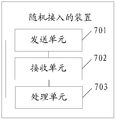
- FIG. 5 is a schematic diagram of a logical structure of a device for random access according to an embodiment of the present disclosure
- FIG. 6 is a schematic structural diagram of another random access device according to an embodiment of the present invention. schematic diagram;
- FIG. 7 is a schematic structural diagram of another apparatus for random access according to an embodiment of the present disclosure.
- FIG. 8 is a schematic structural diagram of another apparatus for random access according to an embodiment of the present disclosure.
- FIG. 9 is a schematic diagram of a logical structure of a base station in a method for random access according to an embodiment of the present disclosure.
- FIG. 10 is a schematic diagram of a logical structure of a UE in a method for random access according to an embodiment of the present invention.
- a plurality means two or more.
- "and/or” describing the association relationship of the associated objects, indicating that there may be three relationships, for example, A and/or B, which may indicate that there are three cases where A exists separately, A and B exist at the same time, and B exists separately.
- the character "/" generally indicates that the contextual object is an "or" relationship.
- the embodiment of the present invention provides a method for random access, which may be applied to an LTE or LTE-A scenario. As shown in FIG. 1 , the method includes:
- the base station receives a random access preamble sent by the user equipment UE, where the random access preamble is used to indicate that the UE has the first transmission capability.
- the first transmission capability is the capability of transmitting a transmission time unit of a first time length.
- a message is transmitted between the base station and the UE by using a 1 ms TTI as a basic transmission time unit.
- the transmission time unit of the first time length is a TTI less than 1 ms, and the first time length may be specifically For t SC-FDMA symbols or The length of t OFDM symbols, where t is a positive integer less than or equal to 14.
- the length of the first time length may be 0.5 ms or less than 0.5 ms.
- the first time length is 1 SC-FDMA symbol, 2 SC-FDMA symbols, 3 SC-FDMA symbols, 4 SC-FDMA symbols, 5 SC-FDMA symbols, 6 SC-FDMA symbols 7 SC-FDMA symbols, 1 OFDM symbol, 2 OFDM symbols, 3 OFDM symbols, 4 OFDM symbols, 5 OFDM symbols, 6 OFDM symbols, 7 OFDM symbols.
- the first time length can be 0.5ms, 0.125ms, 0.1ms.
- the first transmission capability is an ability to transmit a transmission time unit that is greater than or equal to a transmission time unit of a first time length and less than or less than a second time length.
- the first time length is the above example and the second time length is 1 ms.
- the base station sends a DCI (Downlink Control Indicator) to the UE through a PDCCH (Physical Downlink Control Channel).
- DCI Downlink Control Indicator
- PDCCH Physical Downlink Control Channel
- the DCI carries transmission time unit indication information and/or transport block indication information.
- the transmission time unit indication information is used to indicate the length of time of the transmission time unit in which the DL-SCH (Downlink Shared Channel) transport block and/or the UL-SCH (Uplink Shared Channel) transport block is located, and the transmission time.
- the length of time of the unit is a first time length or a second time length, and the second time length is greater than the first time length.
- the transmission time unit of the second time length is 1 ms TTI, and the transmission time unit of the first time length is a TTI less than 1 ms. It is also possible that the transmission time unit of the second time length is 0.5 ms TTI, and the transmission time unit of the first time length is a TTI of less than 0.5 ms.
- the transmission unit of the second time length is not limited.
- the transport block indication information includes DL-SCH transport block location information, and/or UL-SCH transport block location information.
- the DL-SCH transport block location information includes time domain resource information and/or frequency domain resource information in which the DL-SCH transport block is located, and the same UL-SCH transport block location information includes time domain resource information in which the UL-SCH transport block is located and/or Frequency domain resource information.
- the time domain resource information may be: a first time length / a second time length a start symbol number in which the UL-SCH transport block/DL-SCH transport block is transmitted on the time unit, or a UL-SCH transport block/DL-SCH transport block on the transmission time unit of the first time length/second time length
- the frequency domain resource information may be: the first time length/second time The PRB number of the UL-SCH transport block/DL-SCH transport block on the transmission time unit of the length, or the sub-band number, or the carrier number.
- the UE generally sends a message to the UE by using the 1 ms TTI.
- the transmission time unit indication information included in the DCI sent by the base station to the UE in this step may inform the UE.
- the time length of the transmission time unit when the base station sends the RAR, and the transport block indication information may inform the UE base station of the time domain resource information and/or the frequency domain resource information of the transport block for carrying the RAR, so that the UE can be instructed according to the DCI.
- the length of time and/or the RAR is received at the location indicated by the DCI.
- the base station sends a random access preamble RAR to the UE by using a DL-SCH transport block indicated by the DCI.
- the base station sends the DL-SCH transport block carrying the RAR to the UE with the 0.5 ms TTI as the transmission time unit.
- the DL-SCH transport block may occupy all the symbols in the transmission time unit in time, or may be part of the symbols occupied in the transmission time unit, but may not occupy the transmission time unit. symbol.
- the length of the transmission time unit is not limited.
- the base station receives a UL-SCH transport block that is sent by the UE according to uplink scheduling information carried by the RAR.
- the uplink scheduling information carried in the RAR includes: a frequency hopping indication identifier, a fixed size resource block allocation, a puncturing modulation and coding mode, a transmission power control command of the scheduled PUSCH channel, an uplink delay indication information, and a CSI request.
- the base station receives a random access preamble sent by the user equipment UE, and the random access preamble is used to indicate that the UE has the first transmission capability,
- the base station sends the DCI to the UE through the PDCCH, so that the UE can receive the RAR of the random access preamble according to the DCI, and the base station sends the RAR of the random access preamble to the UE by using the DL-SCH transport block indicated by the DCI, and the base station receives the RAR carried by the UE according to the RAR.
- UL-SCH transport block for uplink scheduling information transmission.
- the TTI directly shortening the transmission message may cause the UE to fail to correctly receive the message, and the transmission time unit indication information and/or the transmission block indication information may be indicated by the base station due to the bearer transmission time unit indication information in the DCI.
- the time length of the transmission unit of the transport block where the RAR is located and/or the location information of the transport block where the RAR is located so even if the base station transmits the message with a short TTI, the UE can correctly according to the length of the transport block and/or the location information of the transport block.
- the message sent by the base station is identified, and the UE may also send a message to the base station in a short TTI according to the transmission time unit indication information of the base station, thereby shortening the time length of the transmission time unit during information transmission, thereby shortening the time of random access.
- the DCI bearer transmission time unit indication information and/or the transport block indication information there may be three cases of DCI bearer information.
- the first type only carries the transmission time unit information
- the second type only carries the transport block indication information
- the third in another implementation manner provided by the embodiment of the present invention, the foregoing step 103, the DL-SCH transport block indicated by the base station by using the DCI, is configured to carry both the transmission time unit information and the transport block indication information.
- the random access response RAR of the random access preamble is sent to the UE, and specifically includes the following three implementation manners.
- the first implementation manner is: when the DCI bears the transmission time unit indication information, the base station sends a DL-SCH transport block carrying the RAR of the random access preamble to the UE, where the time length of the transmission time unit where the DL-SCH transport block is located is the transmission
- the time unit indicates the length of time indicated by the information.
- the length of time indicated by the transmission time unit indication information may be the first time length. In order to ensure the accuracy of the random access, the length of time indicated by the transmission time unit indication information may be the second time length.
- the length of time indicated by the transmission time unit indication information may be the length of time of one transmission time unit, or may be the length of time of multiple transmission time units.
- the transmission time unit in which the DL-SCH transport block is located is a transmission time unit adjacent to a transmission time unit in which the PDCCH is located, or a transmission time unit in which the PDCCH is located.
- the second implementation manner is: when the DCI carries the transport block indication information, the base station sends the DL-SCH transmission of the RAR carrying the random access preamble to the UE at the location indicated by the DL-SCH transport block location information indicated by the transport block indication information.
- Block where the length of the transmission time unit in which the DL-SCH transport block is located is a preset length of time.
- the DL-SCH transport block location information includes time domain resource information and/or frequency domain resource information where the DL-SCH transport block is located.
- the time length of the preset transmission time unit may be greater than or equal to the first time length and less than or equal to the second time length. For example, if the second time length is 14 symbols (1 ms), the first time length is 1 symbol, and the preset transmission time unit has a time length of 1 symbol to 14 symbols, but Cannot be greater than 14 symbols or less than 1 symbol.
- the third implementation manner is: when the DCI bears the transmission time unit indication information and the transport block indication information, the base station sends the random access preamble to the UE at the location indicated by the DL-SCH transport block location information indicated by the transport block indication information.
- the DL-SCH transport block of the RAR wherein the length of time of the transmission time unit in which the DL-SCH transport block is located is the length of time indicated by the transmission time unit indication information.
- the step 104, the receiving, by the base station, the UL-SCH transmission block that is sent by the UE according to the uplink scheduling information carried by the RAR includes:
- the first implementation manner is: when the DCI bears the transmission time unit indication information, the base station sends, according to the transmission time unit indication information, the uplink scheduling information that is sent by the UE according to the RAR on the time domain resource of the preset UL-SCH transmission block.
- the UL-SCH transport block, wherein the length of time of the transmission time unit in which the UL-SCH transport block is located is the length of time indicated by the transmission time unit indication information.
- the specific implementation is: when the DCI bears the transmission time unit indication information, the base station according to the transmission time unit indication information and the uplink scheduling information carried by the RAR, the frequency domain resource of the UL-SCH transmission block indicated by the uplink scheduling information, and the preset UL- Time domain of the SCH transport block On the resource, the UL-SCH transport block that is sent by the UE according to the uplink scheduling information carried by the RAR is received by the length of the transmission time unit indicated by the transmission time unit indication information.
- the length of time indicated by the transmission time unit indication information may be the first time length. In order to ensure the accuracy of the random access, the length of time indicated by the transmission time unit indication information may be the second time length.
- the time domain resource of the preset UL-SCH transport block may be a time domain resource that is separated from the DCI or the RAR by a first time length or a second time length, where k is positive. Integer.
- the first time length or the second time length is determined by the length of time indicated by the transmission time unit information.
- the time domain resource of the preset UL-SCH transmission block may be the first time interval of the first time length of the k DCI or the RAR.
- the second implementation manner is: when the DCI carries the transport block indication information, the base station receives, according to the transport block indication information of the DCI bearer, the location that is received by the UE according to the RAR at the location indicated by the UL-SCH transport block location information indicated by the transport block indication information.
- the UL-SCH transport block in which the uplink scheduling information is transmitted, where the length of the transmission time unit in which the UL-SCH transport block is located is the length of time of the preset transmission time unit.
- the UL-SCH transport block location information includes time domain resource information and/or frequency domain resource information where the UL-SCH transport block is located.
- the time length of the preset transmission time unit may be greater than or equal to the first time length and less than or equal to the second time length. For example, if the second time length is 14 symbols (1 ms), the first time length is 1 symbol, and the preset transmission time unit has a time length of 1 symbol to 14 symbols, but Cannot be greater than 14 symbols or less than 1 symbol.
- the third implementation manner is: when the DCI bears the transmission time unit indication information and the transport block indication information, the base station transmits the UL-SCH transport block location information indicated by the transport block indication information according to the DCI bearer transmission time unit indication information and the transport block indication information. Receiving, in the indicated position, the UL-SCH transport block sent by the UE according to the uplink scheduling information carried by the RAR, where the time length of the transmission time unit in which the UL-SCH transport block is located is the transmission time unit Indicates the length of time indicated by the message.
- the method for random access may indicate the length of time and/or RAR of the transmission unit of the transport block where the RAR is transmitted by the base station due to the bearer transmission time unit indication information and/or the transport block indication information in the DCI.
- the location information of the transport block so even if the base station sends a message with a short TTI, the UE can correctly identify the message sent by the base station according to the length of the transport block and/or the location information of the transport block, and according to the transmission time unit indication of the base station.
- the information is sent to the base station by using the short TTI, and the base station can also correctly receive the UL-SCH transmission block sent by the UE according to the transmission time unit indication information and/or the transmission block indication information of the DCI bearer, thereby shortening the time of the transmission time unit during information transmission.
- the length which in turn shortens the time for random access.
- the transmission time indication information and/or the transmission block indication information may be carried in the DCI of different formats, and the format of the DCI needs to be determined before the base station sends the DCI to the UE, so that the transmission time unit indication information and/or the transmission block are to be transmitted.
- the indication information is carried in a suitable location in the DCI. Based on this, in another implementation manner provided by the embodiment of the present invention, as shown in FIG. 2, before the base station sends the downlink control information DCI to the UE by using the PDCCH, The method also includes step 105 or step 106.
- the base station determines, according to the random access preamble, that the format of the DCI is the first DCI format.
- the first DCI format is a DCI format that is only detected by the UE with the first transmission capability.
- the base station can send the DCI in the first DCI format and other formats, and the DCI in other formats can be recognized by the old version or the UE without the first transmission capability, and the DCI of the first DCI format can only be the first.
- the UE of the transmission capability is identified, so after the UE having the first transmission capability recognizes the DCI of the first DCI format, it can receive the message and/or send according to the transmission time unit indication information and/or the transmission block indication information carried in the DCI. Message.
- the transmission time unit indication information and/or the transmission block indication information are not included in the DCI of other formats. Therefore, if the UE receives the DCI of other formats, the default message is transmitted by using the 1 ms TTI as the transmission time unit.
- the UE with the first transmission capability can only detect the DCI of the first DCI format, and does not need to detect the DCI of other formats, thereby avoiding the blind detection of the DCI of other formats by the UE. Measurement.
- the base station determines, according to the random access preamble, that the format of the DCI is DCI format 1A or DCI format 1C, where a bit region exists in both DCI format 1A and DCI format 1C for carrying time unit indication information and/or transport block indication information.
- both the DCI format 1A and the DCI format 1C are in the existing DCI format.
- the time unit indication information and/or the transport block indication information are added in the DCI of the existing format, but the increase is not added.
- the total number of bits in DCI format 1A and 1C Since DCI format 1A and DCI format 1C are DCI formats that all UEs can recognize, the UE does not add additional blind detection.
- the bit information in the MCS bit region in the DCI is used to indicate the time unit indication information.
- the NDI New Data Indicator, NDI, New Data Indicator
- the RV Redundancy Version
- the most significant bit of the transmit power TPC Transmitter Power
- the bit information of the bit region of at least one of the Control, Transmitter Control (MSB) (Most Significant Bit) bits is used to indicate time unit indication information and/or transport block indication information.
- the NDI bit area, the redundancy version RV bit area, and the most significant bit of the transmit power TPC (MSB) bit area are not commonly used, so they can be used to carry transmission time unit indication information and/or transport block indication information without affecting the transmission of information.
- the transmission time unit indication information and/or the transmission block indication information are not limited to being located in the bit regions enumerated above.
- the base station may flexibly instruct the UE to transmit a message by using a transmission time unit of a first time length or a transmission time unit of a second time length according to a situation of its own load or the like.
- the DCI needs to be scrambled. That is, before the base station sends the downlink control information DCI to the UE through the physical downlink control channel PDCCH, the step 107 is performed.
- the base station performs scrambling on the DCI carried by the PDCCH according to the random access radio network temporary identifier RA-RNTI.
- the RA-RNTI is (1+t_id+10*f_id+X deta)mod Y+1
- X and Y are integers
- X and Y are parameters received by the UE having the first transmission capability in the system broadcast message. . It should be noted that only the UE having the first transmission capability can receive X and Y.
- the RA-RNTI is 65301+(10*t_id+f_id)mod 9, where t_id is the sequence number of the first subframe in which the PRACH carrying the random access preamble detected by the base station is located, 0 ⁇ t_id ⁇ 10; f_id The PRACH second index of the first subframe in which the PRACH carrying the random access preamble is located, 0 ⁇ f_id ⁇ 6.
- the base station receives a random access preamble sent by the user equipment UE, and the random access preamble is used to indicate that the UE has the first transmission capability, and the base station sends the DCI to the UE through the PDCCH, so that the UE can enable the UE to
- the base station receives the RAR of the random access preamble according to the DL-SCH transport block indicated by the DCI, and the base station receives the UL-SCH transport block that is sent by the UE according to the uplink scheduling information carried by the RAR.
- the TTI directly shortening the transmission message may cause the UE to fail to correctly receive the message, and the transmission time unit indication information and/or the transmission block indication information may be indicated by the base station due to the bearer transmission time unit indication information in the DCI.
- the time length of the transmission unit of the transport block where the RAR is located and/or the location information of the transport block where the RAR is located so even if the base station transmits the message with a short TTI, the UE can correctly according to the length of the transport block and/or the location information of the transport block.
- the message sent by the base station is identified, and the UE may also send a message to the base station in a short TTI according to the transmission time unit indication information of the base station, thereby shortening the time length of the transmission time unit during information transmission, thereby shortening the time of random access.
- the embodiment of the present invention provides a method for random access, which may be applied to an LTE or LTE-A scenario, as shown in FIG. 3, including:
- the UE sends a random access preamble to the base station, where the random access preamble is used to indicate that the UE has the first transmission capability.
- the first transmission capability is the capability of transmitting the transmission time unit of the first time length force.
- a message is transmitted between the base station and the UE by using a 1 ms TTI as a basic transmission time unit.
- the transmission time unit of the first time length is a TTI less than 1 ms, and the first time length may be specifically Is the length of t SC-FDMA symbols or t OFDM symbols, where t is a positive integer less than or equal to 14.
- the length of the first time length may be 0.5 ms or less than 0.5 ms.
- the first time length is 1 SC-FDMA symbol, 2 SC-FDMA symbols, 3 SC-FDMA symbols, 4 SC-FDMA symbols, 5 SC-FDMA symbols, 6 SC-FDMA symbols 7 SC-FDMA symbols, 1 OFDM symbol, 2 OFDM symbols, 3 OFDM symbols, 4 OFDM symbols, 5 OFDM symbols, 6 OFDM symbols, 7 OFDM symbols.
- the first time length can be 0.5ms, 0.125ms, 0.1ms.
- the first transmission capability is an ability to transmit a transmission time unit that is greater than or equal to a transmission time unit of a first time length and less than or less than a second time length.
- the first time length is the above example and the second time length is 1 ms.
- the UE receives a DCI sent by the base station by using a PDCCH.
- the DCI bearer transmission time unit indication information and/or transport block indication information where the transmission time unit indication information is used to indicate a time length of a transmission time unit in which the DL-SCH transport block and/or the uplink shared channel UL-SCH transport block is located,
- the length of the transmission time unit is a first time length or a second time length, and the second time length is greater than the first time length.
- the transport block indication information includes DL-SCH transport block location information and/or UL-SCH transport block location information.
- the DL-SCH transport block location information includes time domain resource information and/or frequency domain resource information in which the DL-SCH transport block is located, and the same UL-SCH transport block location information includes time domain resource information in which the UL-SCH transport block is located and/or Frequency domain resource information.
- the UE receives, according to the DCI, a random access response RAR of the random access preamble sent by the base station according to the DL-SCH transport block indicated by the DCI.
- the UE receives according to the transmission time unit of the 0.5 ms TTI.
- the UE sends the UL-SCH transport block according to the uplink scheduling information carried by the RAR.
- the uplink scheduling information carried in the RAR includes: a frequency hopping indication identifier, a fixed size resource block allocation, a puncturing modulation and coding mode, a transmission power control command of the scheduled PUSCH channel, an uplink delay indication information, and a CSI request.
- the UE sends a random access preamble to the base station, where the random access preamble is used to indicate that the UE has the first transmission capability, the UE receives the DCI sent by the base station through the PDCCH, and receives the base station according to the DCI according to the DCI. And transmitting, by the DL-SCH transport block, the random access preamble random access response RAR, and then sending the UL-SCH transport block according to the uplink scheduling information carried by the RAR.
- the TTI directly shortening the transmission message may cause the UE to fail to correctly receive the message, and the transmission time unit indication information and/or the transmission block indication information may be indicated by the base station due to the bearer transmission time unit indication information in the DCI.
- the time length of the transmission unit of the transport block where the RAR is located and/or the location information of the transport block where the RAR is located so even if the base station transmits the message with a short TTI, the UE can correctly according to the length of the transport block and/or the location information of the transport block.
- the message sent by the base station is identified, and the message is sent to the base station by using a short TTI according to the transmission time unit indication information of the base station, which shortens the time length of the transmission time unit during information transmission, thereby shortening the time of random access.
- the UE receives the DL according to the DCI indication according to the DCI, and the UE transmits the transmission time unit information and the transmission block indication information.
- the random access preamble random access response RAR sent by the -SCH transport block includes the following three implementation manners.
- the first implementation manner is: when the DCI bears the transmission time unit indication information, the UE receives the DL-SCH transport block of the RAR that carries the random access preamble sent by the base station, where the length of the transmission time unit where the DL-SCH transport block is located is The transmission time unit indicates the length of time indicated by the information.
- the length of time indicated by the transmission time unit indication information may be the first time length. In order to ensure the accuracy of the random access, the length of time indicated by the transmission time unit indication information may be the second time length.
- the transmission time unit in which the DL-SCH transport block is located is a transmission time unit adjacent to a transmission time unit in which the PDCCH is located, or a transmission time unit in which the PDCCH is located.
- the second implementation manner is: when the DCI carries the transport block indication information, the UE receives the DL-SCH of the RAR carrying the random access preamble sent by the base station at the location indicated by the DL-SCH transport block location information indicated by the transport block indication information.
- the transport block wherein the length of time of the transmission time unit in which the DL-SCH transport block is located is a preset length of time.
- the DL-SCH transport block location information includes time domain resource information and/or frequency domain resource information where the DL-SCH transport block is located.
- the time length of the preset transmission time unit may be greater than or equal to the first time length and less than or equal to the second time length. For example, if the second time length is 14 symbols (1 ms), the first time length is 1 symbol, and the preset transmission time unit has a time length of 1 symbol to 14 symbols, but Cannot be greater than 14 symbols or less than 1 symbol.
- the third implementation manner is: when the DCI bears the transmission time unit indication information and the transport block indication information, the UE receives the random access preamble sent by the base station at the location indicated by the DL-SCH transport block location information indicated by the transport block indication information.
- the DL-SCH transport block of the RAR wherein the length of the transmission time unit in which the DL-SCH transport block is located is the length of time indicated by the transmission time unit indication information.
- the UE sends the UL-SCH transport block according to the uplink scheduling information carried by the RAR, and specifically includes the following three implementation manners.
- the first implementation manner is: when the DCI carries the transmission time unit indication information, the UE sends the UL to the base station on the time domain resource of the preset UL-SCH transmission block according to the uplink scheduling information and the transmission time unit indication information carried by the RAR.
- -SCH transport block wherein the length of time of the transmission time unit in which the UL-SCH transport block is located is the length of time indicated by the transmission time unit indication information.
- the specific implementation is: when the DCI bears the transmission time unit indication information, the UE according to the uplink scheduling information and the transmission time unit indication information carried by the RAR, the frequency domain resource of the UL-SCH transmission block indicated by the uplink scheduling information, and the preset UL- On the time domain resource of the SCH transport block, the UL-SCH transport block is transmitted to the base station with the length of time of the transmission time unit indicated by the transmission time unit indication information.
- the length of time indicated by the transmission time unit indication information may be the first time length. In order to ensure the accuracy of the random access, the length of time indicated by the transmission time unit indication information may be the second time length.
- the time domain resource of the preset UL-SCH transport block may be a time domain resource that is separated from the DCI or the RAR by a first time length or a second time length, where k is positive. Integer.
- the first time length or the second time length is determined by the length of time indicated by the transmission time unit information.
- the time domain resource of the preset UL-SCH transmission block may be the first time interval of the first time length of the k DCI or the RAR.
- the second implementation manner is: when the DCI carries the transport block indication information, the UE according to the uplink scheduling information carried by the RAR and the transport block indication information of the DCI bearer, where the UL-SCH transport block location information indicated by the transport block indication information indicates And transmitting, to the base station, a UL-SCH transport block, where a length of time of the transmission time unit in which the UL-SCH transport block is located is a preset time length.
- the UL-SCH transport block location information includes time domain resource information and/or frequency domain resource information where the UL-SCH transport block is located.
- the time length of the preset transmission time unit may be greater than or equal to the first time length and less than or equal to the second time length. For example, if the second time length is 14 symbols (1 ms), the first time length is 1 symbol, and the preset transmission time unit has a time length of 1 symbol to 14 symbols, but Cannot be greater than 14 symbols or less than 1 symbol.
- the third implementation manner is: when the DCI bears the transmission time unit indication information and the transport block indication information, the UE performs the uplink scheduling information and the DCI bearer transmission time according to the RAR.
- the length is the length of time indicated by the transmission time unit indication information.
- the method for performing random access may indicate that the UE transmits a message to the base station by using a short TTI, because the bearer transmission time unit indication information, the transmission time unit indication information, and/or the transport block indication information in the DCI, and the base station can also The transmission time unit indication information and/or the transmission block indication information of the DCI bearer correctly receive the UL-SCH transmission block sent by the UE, which shortens the time length of the transmission time unit during information transmission, thereby shortening the time of random access.
- the transmission time indication information and/or the transmission block indication information may be carried in the DCI of different formats. After the UE receives the DCI sent by the base station, the format of the DCI needs to be determined to determine which position of the DCI is obtained.
- the transmission time unit indication information and/or the transmission block indication information based on this, in another implementation manner provided by the embodiment of the present invention, as shown in FIG. 4, after the UE receives the DCI sent by the base station through the PDCCH, in the foregoing step 302
- the method further includes:
- the UE determines a format of the received DCI.
- the UE acquires transmission time unit indication information and/or transport block indication information from the DCI.
- the first DCI format is a DCI format that is only detected by the UE with the first transmission capability.
- the UE with the first transmission capability only recognizes the DCI of the first DCI format, and the old version or the UE without the first transmission capability recognizes the DCI of other formats. Since the DCI of the first DCI format is only recognized by the UE having the first transmission capability, and the format of the DCI is determined by the base station according to the random access preamble sent by the UE, the UE having the first transmission capability can directly obtain the UE from the DCI. Transmission time unit indication information and/or transport block indication information.
- the UE with the first transmission capability can only detect the DCI of the first DCI format, and does not need to detect the DCI of other formats, thereby avoiding the blind detection of the DCI of other formats by the UE. Measurement.
- the UE acquires the transmission time unit indication information from the bit information in the MCS bit region in the DCI.
- the UE indicates, from the new data in the DCI, an NDI bit region, a redundancy version RV bit region, and a bit region of at least one of the most significant bit TPC (MSB) bit regions of the transmit power.
- MSB most significant bit TPC
- the NDI bit area, the redundancy version RV bit area, and the most significant bit of the transmit power TPC (MSB) bit area are not commonly used, so they can be used to carry transmission time unit indication information and/or transport block indication information without affecting information. transmission.
- the transmission time unit indication information and/or the transmission block indication information are not limited to being located in the bit regions enumerated above.
- both the DCI format 1A and the DCI format 1C are in the existing DCI format.
- the time unit indication information and/or the transport block indication information are added in the DCI of the existing format, but the increase is not added.
- the total number of bits in DCI format 1A and 1C Since DCI format 1A and DCI format 1C are DCI formats that all UEs can recognize, the UE does not add additional blind detection.
- the base station is required to perform the descrambling operation after receiving the DCI transmitted by the PDCCH by the PDCCH before the base station sends the DCI to the UE through the PDCCH. That is, the UE needs to perform the descrambling operation after the DCI is sent by the PDCCH. After the DCI transmitted through the PDCCH, steps 309 and 310 are also performed.
- the UE determines a radio network temporary identifier RA-RNTI.
- the RA-RNTI is (1+t_id+10*f_id+X deta) mod Y+1, and X and Y are integers, or the RA-RNTI is 65301+(10*t_id+f_id)mod 9, wherein , t_id is the sequence number of the first subframe in which the PRACH carrying the random access preamble is located, 0 ⁇ t_id ⁇ 10; f_id is the PRACH second index of the first subframe in which the PRACH carrying the random access preamble is located, 0 ⁇ F_id ⁇ 6.
- the UE performs descrambling on the DCI carried by the PDCCH according to the RA-RNTI.
- a UE sends a random access to a base station
- the preamble, the random access preamble is used to indicate that the UE has the first transmission capability
- the UE receives the DCI sent by the base station through the PDCCH, and receives the random access preamble random access response RAR sent by the base station according to the DL-SCH transport block indicated by the DCI according to the DCI.
- the TTI directly shortening the transmission message may cause the UE to fail to correctly receive the message, and the transmission time unit indication information and/or the transmission block indication information may be indicated by the base station due to the bearer transmission time unit indication information in the DCI.
- the time length of the transmission unit of the transport block where the RAR is located and/or the location information of the transport block where the RAR is located so even if the base station transmits the message with a short TTI, the UE can correctly according to the length of the transport block and/or the location information of the transport block.
- the message sent by the base station is identified, and the message is sent to the base station by using a short TTI according to the transmission time unit indication information of the base station, which shortens the time length of the transmission time unit during information transmission, thereby shortening the time of random access.
- the embodiment of the present invention further provides a device for random access, where the device is applied to a base station, as shown in FIG. 5, the device includes: a receiving unit 501, which sends Unit 502, processing unit 503.
- the receiving unit 501 is configured to receive a random access preamble sent by the user equipment UE, where the random access preamble is used to indicate that the UE has the first transmission capability, and the first transmission capability is the capability of transmitting the transmission time unit of the first time length;
- the sending unit 502 is configured to send downlink control information DCI to the UE by using a physical downlink control channel PDCCH, where the DCI bears transmission time unit indication information and/or transport block indication information, where the transmission time unit indication information is used to indicate the DL-SCH transport block. And the length of time of the transmission time unit in which the uplink shared channel UL-SCH transport block is located, the length of the transmission time unit is the first time length or the second time length, and the second time length is greater than the first time length, the transport block indication
- the information includes DL-SCH transport block location information and/or UL-SCH transport block location information; the random access preamble random access response RAR is sent to the UE through the DL-SCH transport block indicated by the DCI;
- the processing unit 503 is configured to control the receiving unit 501 to receive the UL-SCH transport block that is sent by the UE according to the uplink scheduling information carried by the RAR.
- the apparatus for random access provided by the embodiment of the present invention, in the prior art, directly shortens the TTI of the transmission message, and causes the UE to fail to correctly receive the message, because the transmission time unit indication information in the DCI, the transmission time unit indication information, and And/or transport block indication information, which may indicate the time length of the transmission unit of the transport block in which the RAR is transmitted by the base station and/or the location information of the transport block in which the RAR is located, so even if the base station transmits the message in a short TTI, the UE can according to the transport block.
- the length and/or the location information of the transport block correctly identifies the message sent by the base station, and the UE may also send a message to the base station in a short TTI according to the transmission time unit indication information of the base station, thereby shortening the time length of the transmission time unit when the information is transmitted. In turn, the time for random access is shortened.
- the processing unit 503 is further configured to: when the DCI bears the transmission time unit indication information, the control sending unit 502 sends the DL-SCH transport block that carries the RAR of the random access preamble to the UE, where the DL- The length of the transmission time unit in which the SCH transport block is located is the length of time indicated by the transmission time unit indication information, and the transmission time unit in which the DL-SCH transport block is located is a transmission time unit adjacent to the transmission time unit in which the PDCCH is located, or is a PDCCH.
- the transmission time unit is located; when the DCI carries the transport block indication information, the control sending unit 502 sends the DL- carrying the RAR of the random access preamble to the UE at the location indicated by the DL-SCH transport block location information indicated by the transport block indication information.
- a SCH transport block where a transmission time unit length of the DL-SCH transport block is a preset time length, and the DL-SCH transport block location information includes time domain resource information and/or frequency domain resources where the DL-SCH transport block is located Information; when the DCI bears the transmission time unit indication information and the transport block indication information, the control transmitting unit 502 transmits the DL-SCH transport block indicated by the block indication information.
- Positional information indicating the position on the random access to the UE carries the DL-SCH transport block RAR preamble, wherein the transmission time length DL-SCH transport block where the unit length of transmission time unit indicated by the instruction information.
- the processing unit 503 is further configured to: when the DCI bears the transmission time unit indication information, the control receiving unit 501, according to the transmission time unit indication information, the time domain resource in the preset UL-SCH transmission block. And receiving, by the UE, the UL-SCH transport block that is sent according to the uplink scheduling information carried by the RAR, where the length of the transmission time unit where the UL-SCH transport block is located is the length of time indicated by the transmission time unit indication information;
- the control receiving unit 501 receives the uplink scheduling information carried by the UE according to the RAR, at the location indicated by the UL-SCH transport block location information indicated by the transport block indication information, according to the transport block indication information of the DCI bearer.
- the transmitted UL-SCH transport block, the UL-SCH transport block location information includes time domain resource information and/or frequency domain resource information in which the UL-SCH transport block is located, where the length of the transmission time unit in which the UL-SCH transport block is located is a length of time of the preset transmission time unit; when the DCI bears the transmission time unit indication information and the transmission block indication information, the control receiving unit 501 indicates, according to the DCI bearer transmission time unit indication information and the transmission block indication information, the transmission block indication information At the location indicated by the UL-SCH transport block location information, the UL-SCH transport block sent by the UE according to the uplink scheduling information carried by the RAR is received, where the length of the transmission time unit in which the UL-SCH transport block is located is the indication of the transmission time unit indication information. Length of time.
- the bearer transmission time unit indication information and/or the transport block indication information in the DCI may indicate the time length of the transmission unit of the transport block where the RAR is transmitted by the base station and/or the location of the transport block where the RAR is located. Information, so even if the base station transmits a message with a short TTI, the UE can correctly identify the message sent by the base station according to the length of the transport block and/or the location information of the transport block, and to the base station with a short TTI according to the transmission time unit indication information of the base station.
- the message is sent, and the base station can also correctly receive the UL-SCH transmission block sent by the UE according to the transmission time unit indication information and/or the transmission block indication information of the DCI bearer, thereby shortening the time length of the transmission time unit during information transmission, thereby shortening the randomness. Access time.
- the processing unit 503 includes: a determining module 5031, and a scrambling module 5032.
- the determining module 5031 is configured to determine, according to the random access preamble received by the receiving unit 501, that the format of the DCI is a first DCI format, where the first DCI format is a DCI format that is only detected by the UE with the first transmission capability.
- the determining module 5031 is further configured to determine, according to the random access preamble received by the receiving unit 501, that the format of the DCI is DCI format 1A or DCI format 1C, where the bit region exists in both the DCI format 1A and the DCI format 1C for carrying the transmission time unit. Instructions and / or transport block indication information.
- the bit information in the MCS bit region in the DCI is used to indicate the transmission time unit indication information
- the new data in the DCI indicates bit information of the bit region of at least one of the NDI bit region, the redundancy version RV bit region, and the most significant bit TPC (MSB) bit region of the transmission power is used for The transmission time unit indication information and/or the transmission block indication information are indicated.
- MSB most significant bit TPC
- the scrambling module 5032 is configured to perform scrambling on the DCI carried by the PDCCH according to the random access radio network temporary identifier RA-RNTI; the RA-RNTI is (1+t_id+10*f_id+X deta) mod Y+1, X And the value of Y is an integer, or the RA-RNTI is 65301+(10*t_id+f_id)mod 9, where t_id is the sequence number of the first subframe in which the PRACH carrying the random access preamble detected by the base station is located, 0 ⁇ t_id ⁇ 10; f_id is the PRACH second index of the first subframe in which the PRACH carrying the random access preamble is located, 0 ⁇ f_id ⁇ 6.
- the receiving unit receives a random access preamble sent by the user equipment UE, the random access preamble is used to indicate that the UE has the first transmission capability, and the sending unit sends the DCI to the UE by using the PDCCH, so that The UE can receive the RAR of the random access preamble according to the DCI, and send the RAR of the random access preamble to the UE through the DL-SCH transport block indicated by the DCI, and then the receiving unit receives the UL-SCH transmission sent by the UE according to the uplink scheduling information carried by the RAR. Piece.
- the TTI directly shortening the transmission message may cause the UE to fail to correctly receive the message, and the transmission time unit indication information and/or the transmission block indication information may be indicated by the base station due to the bearer transmission time unit indication information in the DCI.
- the time length of the transmission unit of the transport block where the RAR is located and/or the location information of the transport block where the RAR is located so even if the base station transmits the message with a short TTI, the UE can correctly according to the length of the transport block and/or the location information of the transport block.
- the message sent by the base station is identified, and the UE may also send a message to the base station in a short TTI according to the transmission time unit indication information of the base station, thereby shortening the time length of the transmission time unit during information transmission, thereby shortening the time of random access.
- the embodiment of the present invention further provides a device for random access, which is applied to the user equipment UE.
- the device includes: a sending unit 701, a receiving unit 702, and processing. Unit 703.
- the sending unit 701 is configured to send a random access preamble to the base station, where the random access preamble is used to indicate that the UE has the first transmission capability, and the first transmission capability is a capability of transmitting the transmission time unit of the first time length;
- the receiving unit 702 is configured to receive downlink control information DCI sent by the base station by using a physical downlink control channel PDCCH, where the DCI bears transmission time unit indication information and/or transport block indication information, where the transmission time unit indication information is used to indicate DL-SCH transmission.
- the indication information includes DL-SCH transport block location information and/or UL-SCH transport block location information;
- the processing unit 703 is configured to control the receiving unit 702 to receive, according to the DCI, the random access response (RAR) of the random access preamble sent by the base station according to the DL-SCH transport block indicated by the DCI; and the control sending unit 701 to send the UL according to the uplink scheduling information carried by the RAR. SCH transport block.
- RAR random access response
- the apparatus for random access provided by the embodiment of the present invention, in the prior art, directly shortens the TTI of the transmission message, and causes the UE to fail to correctly receive the message, because the transmission time unit indication information in the DCI, the transmission time unit indication information, and And/or transport block indication information, which may indicate the time length of the transmission unit of the transport block in which the RAR is transmitted by the base station and/or the location information of the transport block in which the RAR is located, so even if the base station transmits the message in a short TTI, the UE can according to the transport block.
- the length and/or the location information of the transport block correctly identifies the message sent by the base station, and sends a message to the base station in a short TTI according to the transmission time unit indication information of the base station, thereby shortening the time length of the transmission time unit during information transmission, thereby shortening The time of random access.
- the processing unit 703 is further configured to: when the DCI bears the transmission time unit indication information, the control receiving unit 702 receives the DL-SCH transport block of the RAR that carries the random access preamble sent by the base station, where the DL The length of time of the transmission time unit in which the -SCH transport block is located is the length of time indicated by the transmission time unit indication information.
- the transmission time unit in which the DL-SCH transport block is located is a transmission time unit adjacent to the transmission time unit in which the PDCCH is located, or is a transmission time unit in which the PDCCH is located; when the DCI carries the transmission block indication information, the control receiving unit 702 indicates in the transmission block At the location indicated by the DL-SCH transport block location information indicated by the information, the DL-SCH transport block carrying the RAR of the random access preamble transmitted by the base station is received, where the length of the transmission time unit in which the DL-SCH transport block is located is preset The length of time, the DL-SCH transport block location information includes time domain resource information and/or frequency domain resource information in which the DL-SCH transport block is located; and when the DCI bears transmission time unit indication information and transport block indication information, the control receiving unit 702 Receiving, at a position indicated by the DL-SCH transport block location information indicated by the transport block indication information, a DL-SCH transport block of the RAR carrying the random access preamble transmitted by the base station
- the processing unit 703 is further configured to: when the DCI bears the transmission time unit indication information, the control sending unit 701, according to the uplink scheduling information and the transmission time unit indication information carried by the RAR, in the preset UL- Transmitting, on the time domain resource of the SCH transport block, a UL-SCH transport block to the base station, where the length of the transmission time unit in which the UL-SCH transport block is located is the length of time indicated by the transmission time unit indication information; when the DCI bears the transport block indication information
- the control sending unit 701 sends the UL-SCH transport block to the base station at the location indicated by the UL-SCH transport block location information indicated by the transport block indication information according to the uplink scheduling information carried by the RAR and the transport block indication information of the DCI bearer.
- the length of the transmission time unit in which the UL-SCH transport block is located is a preset time length, and the UL-SCH transport block location information includes time domain resource information and/or frequency domain resource information where the UL-SCH transport block is located;
- the control sending unit 701 performs the uplink scheduling information and the DCI bearer transmission time list carried according to the RAR.
- the meta indication information and the transport block indication information, the UL-SCH transport block is transmitted to the base station at a position indicated by the UL-SCH transport block location information indicated by the transport block indication information, wherein the time of the transmission time unit in which the UL-SCH transport block is located
- the length is the length of time indicated by the transmission time unit indication information.
- the transmission time unit indication information and/or the transmission block indication information may indicate that the UE sends a message to the base station by using a short TTI, and the base station can also correctly receive the UL sent by the UE according to the transmission time unit indication information and/or the transmission block indication information of the DCI bearer.
- the -SCH transport block shortens the length of time for transmitting time units during information transfer, thereby shortening the time for random access.
- the processing unit 703 includes: a determining module 7031, an obtaining module 7032, and a descrambling module 7033.
- a determining module 7031 configured to determine a format of the DCI received by the receiving unit 702;
- the obtaining module 7032 is configured to: if the format of the determining module 7031 DCI is the first DCI format, obtain the transmission time unit indication information and/or the transport block indication information from the DCI, where the first DCI format is only for the UE with the first transmission capability.
- the detected DCI format if the DCI format is DCI format 1A, the transmission time unit indication information is obtained from the bit information in the MCS bit region in the DCI; if the DCI format is DCI format 1C, the new data from the DCI is obtained.
- the transmission time unit indication information and/or the transmission block indication information are acquired in bit information indicating a bit region of at least one of an NDI bit region, a redundancy version RV bit region, and a most significant bit TPC (MSB) bit region of transmission power.
- MSB most significant bit TPC
- the determining module 7031 is further configured to determine a radio network temporary identifier RA-RNTI, where the RA-RNTI is (1+t_id+10*f_id+X deta) mod Y+1, and X and Y are integers, or RA-RNTI 65301+(10*t_id+f_id)mod 9, where t_id is the sequence number of the first subframe in which the PRACH carrying the random access preamble is located, 0 ⁇ t_id ⁇ 10; f_id is the PRACH carrying the random access preamble PRACH second index of the first subframe, 0 ⁇ f_id ⁇ 6;
- the descrambling module 7033 is configured to descramble the DCI carried by the PDCCH according to the RA-RNTI determined by the determining module 7031.
- the sending unit sends a random access preamble to the base station, where the random access preamble is used to indicate that the UE has the first transmission capability
- the receiving unit receives the DCI sent by the base station through the PDCCH, and receives the base station according to the DCI.
- the transmitting unit sends the UL-SCH transport block according to the uplink scheduling information carried by the RAR according to the random access preamble random access response RAR sent by the DL-SCH transport block indicated by the DCI.
- existing technology In the process of directly shortening the TTI of the transmitted message, the UE may not receive the message correctly.
- the RAR where the base station sends the RAR may be indicated.
- the time length of the transmission unit of the transport block and/or the location information of the transport block where the RAR is located so even if the base station transmits the message with a short TTI, the UE can correctly identify the base station according to the length of the transport block and/or the location information of the transport block.
- the transmitted message transmits a message to the base station in a short TTI according to the transmission time unit indication information of the base station, which shortens the time length of the transmission time unit when the information is transmitted, thereby shortening the time of random access.
- the embodiment of the present invention further provides a device for random access.
- the device is a hardware structure diagram of the base station described in FIG. 5 and FIG.
- the base station may include a memory 901, a processor 902, a receiver 903, a transmitter 904, and a bus 905.
- the memory 901 may be a ROM (Read Only Memory), a static storage device, a dynamic storage device, or a RAM (Random Access Memory).
- the memory 901 can store an operating system and other applications.
- the program code for implementing the technical solution provided by the embodiment of the present invention is stored in the memory 901 and executed by the processor 902.
- the receiver 903 is used for communication between the device and other devices or communication networks (such as, but not limited to, Ethernet, RAN Radio Access Network, WLAN (Wireless Local Area Network), etc.).
- devices or communication networks such as, but not limited to, Ethernet, RAN Radio Access Network, WLAN (Wireless Local Area Network), etc.
- the processor 902 can be a general-purpose central processing unit (CPU), a microprocessor, an application specific integrated circuit (ASIC), or one or more integrated circuits for executing related programs.
- CPU central processing unit
- ASIC application specific integrated circuit
- Bus 905 can include a path for communicating information between various components of the device, such as memory 901, receiver 903, transmitter 904, and processor 902.
- FIG. 9 only shows the memory 901, the receiver 903, the transmitter 904 and the processor 902, and the bus 904, in the specific implementation process Those skilled in the art will appreciate that the apparatus also includes other components necessary to achieve proper operation. At the same time, those skilled in the art will appreciate that hardware devices that implement other functions may also be included, depending on the particular needs.
- the receiver 903 in the apparatus is configured to receive a random access preamble sent by the user equipment UE, and obtain a random access preamble.
- the first transmission capability is the capability of transmitting the transmission time unit of the first time length;
- the transmitter 904 is configured to send downlink control information DCI to the UE by using a physical downlink control channel PDCCH, where the DCI bears transmission time unit indication information and/or transport block indication information, where the transmission time unit indication information is used to indicate the DL-SCH transport block. And the length of time of the transmission time unit in which the uplink shared channel UL-SCH transport block is located, the length of the transmission time unit is the first time length or the second time length, and the second time length is greater than the first time length, the transport block indication
- the information includes DL-SCH transport block location information and/or UL-SCH transport block location information;
- the processor 902 is coupled to the receiver 903 and the transmitter 904, and is configured to control the execution of the program instruction, specifically, to control the transmitter 904 to send the random access preamble random access to the UE by using the DL-SCH transport block indicated by the DCI. Responding to RAR;
- the receiver 903 is further configured to receive a UL-SCH transport block that is sent by the UE according to uplink scheduling information carried by the RAR.
- the receiver receives the random access preamble sent by the user equipment UE, and the random access preamble is used to indicate that the UE has the first transmission capability, and the transmitter sends the DCI to the UE through the PDCCH, so that the UE can perform the DCI according to the DCI.
- the RAR that receives the random access preamble transmits the RAR of the random access preamble to the UE through the DL-SCH transport block indicated by the DCI, and the receiver receives the UL-SCH transport block that is sent by the UE according to the uplink scheduling information carried by the RAR.
- the TTI directly shortening the transmission message may cause the UE to fail to correctly receive the message, and the transmission time unit indication information and/or the transmission block indication information may be indicated by the base station due to the bearer transmission time unit indication information in the DCI.
- the length of time of the transmission unit of the transport block where the RAR is located and/or the location information of the transport block where the RAR is located so even if the base station transmits a message with a short TTI, the UE can according to the length of the transport block And the location information of the transport block correctly identifies the message sent by the base station, and the UE may also send the message to the base station by using the short TTI according to the transmission time unit indication information of the base station, thereby shortening the time length of the transmission time unit during information transmission, thereby shortening The time of random access.
- the processor 902 is further configured to: when the DCI bears the transmission time unit indication information, control the transmitter 904 to send, to the UE, a DL-SCH transport block that carries the RAR of the random access preamble, where the DL- The length of the transmission time unit in which the SCH transport block is located is the length of time indicated by the transmission time unit indication information, and the transmission time unit in which the DL-SCH transport block is located is a transmission time unit adjacent to the transmission time unit in which the PDCCH is located, or is a PDCCH.
- the transmission time unit is located; when the DCI carries the transport block indication information, the control transmitter 904 sends the DL- carrying the RAR of the random access preamble to the UE at the location indicated by the DL-SCH transport block location information indicated by the transport block indication information.
- a SCH transport block where a transmission time unit length of the DL-SCH transport block is a preset time length, and the DL-SCH transport block location information includes time domain resource information and/or frequency domain resources where the DL-SCH transport block is located Information; when the DCI bears the transmission time unit indication information and the transport block indication information, the control transmitter 904 transmits the DL-SCH transport block location information indicated by the transport block indication information.
- the processor 902 is further configured to: when the DCI bears the transmission time unit indication information, control the receiver 903, according to the transmission time unit indication information, the time domain resource in the preset UL-SCH transmission block. And receiving, by the UE, the UL-SCH transport block that is sent according to the uplink scheduling information carried by the RAR, where the length of the transmission time unit where the UL-SCH transport block is located is the length of time indicated by the transmission time unit indication information; when the DCI bearer transport block indicates In the information, the control receiver 903 receives the UL-SCH transmission sent by the UE according to the uplink scheduling information carried by the RAR, according to the transport block indication information of the DCI bearer, at the location indicated by the UL-SCH transport block location information indicated by the transport block indication information.
- the UL-SCH transport block location information includes time domain resource information and/or frequency domain resource information where the UL-SCH transport block is located, where the time length of the transmission time unit in which the UL-SCH transport block is located is a preset transmission time unit. Length of time; when DCI bears transmission time list
- the control receiver 903 receives the UE according to the DCI bearer transmission time unit indication information and the transport block indication information at the position indicated by the UL-SCH transport block location information indicated by the transport block indication information.
- the UL-SCH transport block sent by the uplink scheduling information carried by the RAR, where the length of the transmission time unit in which the UL-SCH transport block is located is the length of time indicated by the transmission time unit indication information.
- the bearer transmission time unit indication information and/or the transport block indication information in the DCI may indicate the time length of the transmission unit of the transport block where the RAR is transmitted by the base station and/or the location of the transport block where the RAR is located. Information, so even if the base station transmits a message with a short TTI, the UE can correctly identify the message sent by the base station according to the length of the transport block and/or the location information of the transport block, and to the base station with a short TTI according to the transmission time unit indication information of the base station.
- the message is sent, and the base station can also correctly receive the UL-SCH transmission block sent by the UE according to the transmission time unit indication information and/or the transmission block indication information of the DCI bearer, thereby shortening the time length of the transmission time unit during information transmission, thereby shortening the randomness. Access time.
- the processor 902 is further configured to determine, according to the random access preamble received by the receiver 903, that the format of the DCI is a first DCI format, where the first DCI format is a DCI format that is only detected by the UE with the first transmission capability.
- the processor 902 is further configured to determine, according to the random access preamble received by the receiver 903, that the format of the DCI is DCI format 1A or DCI format 1C, where the bit region exists in both the DCI format 1A and the DCI format 1C for carrying the transmission time unit. Indication information and/or transport block indication information.
- the bit information in the MCS bit region in the DCI is used to indicate the transmission time unit indication information
- the new data in the DCI indicates bit information of the bit region of at least one of the NDI bit region, the redundancy version RV bit region, and the most significant bit TPC (MSB) bit region of the transmission power is used for The transmission time unit indication information and/or the transmission block indication information are indicated.
- MSB most significant bit TPC
- the processor 902 is further configured to perform scrambling on the DCI carried by the PDCCH according to the random access radio network temporary identifier RA-RNTI; the RA-RNTI is (1+t_id+10*f_id+X deta)mod Y+1, X and Y are integers, or RA-RNTI is 65301+(10*t_id+f_id)mod 9, where t_id is detected by the base station The sequence number of the first subframe in which the PRACH carrying the random access preamble is located, 0 ⁇ t_id ⁇ 10; f_id is the PRACH second index of the first subframe in which the PRACH carrying the random access preamble is located, 0 ⁇ f_id ⁇ 6.
- the receiver receives the random access preamble sent by the user equipment UE, and the random access preamble is used to indicate that the UE has the first transmission capability, and the transmitter sends the DCI to the UE through the PDCCH, so that the UE can perform the DCI according to the DCI.
- the RAR that receives the random access preamble transmits the RAR of the random access preamble to the UE through the DL-SCH transport block indicated by the DCI, and the receiver receives the UL-SCH transport block that is sent by the UE according to the uplink scheduling information carried by the RAR.
- the TTI directly shortening the transmission message may cause the UE to fail to correctly receive the message, and the transmission time unit indication information and/or the transmission block indication information may be indicated by the base station due to the bearer transmission time unit indication information in the DCI.
- the time length of the transmission unit of the transport block where the RAR is located and/or the location information of the transport block where the RAR is located so even if the base station transmits the message with a short TTI, the UE can correctly according to the length of the transport block and/or the location information of the transport block.
- the message sent by the base station is identified, and the UE may also send a message to the base station in a short TTI according to the transmission time unit indication information of the base station, thereby shortening the time length of the transmission time unit during information transmission, thereby shortening the time of random access.
- the embodiment of the present invention further provides a device for random access.
- the device is a hardware structure diagram of the UE described in FIG. 7 and FIG.
- the UE may include a memory 1001, a processor 1002, a receiver 1003, a transmitter 1004, and a bus 1005.
- the memory 1001 may be a ROM (Read Only Memory), a static storage device, a dynamic storage device, or a RAM (Random Access Memory).
- the memory 1001 can store an operating system and other applications.
- the program code for implementing the technical solution provided by the embodiment of the present invention is saved in the memory 1001 and executed by the processor 1002.
- Receiver 1003 is used for devices and other devices or communication networks (such as but not limited to Communication between WAN, RAN Radio Access Network, WLAN (Wireless Local Area Network, etc.).
- WAN Wide Area Network
- WLAN Wireless Local Area Network
- the processor 1002 may be a general-purpose central processing unit (CPU), a microprocessor, an application specific integrated circuit (ASIC), or one or more integrated circuits for executing related programs.
- CPU central processing unit
- ASIC application specific integrated circuit
- Bus 1005 can include a path for communicating information between various components of the device (e.g., memory 1001, receiver 1003, transmitter 1004, and processor 1002).
- FIG. 10 only shows the memory 1001, the receiver 1003, the transmitter 1004, and the processor 1002, and the bus 1004, in the specific implementation process, those skilled in the art will understand that the device also Contains other devices necessary to achieve proper operation. At the same time, those skilled in the art will appreciate that hardware devices that implement other functions may also be included, depending on the particular needs.
- the transmitter 1004 in the apparatus is configured to send a random access preamble to the base station, and the random access preamble is used to indicate
- the UE has a first transmission capability, and the first transmission capability is a capability of transmitting a transmission time unit of a first time length;
- the receiver 1003 is configured to receive downlink control information DCI sent by the base station by using a physical downlink control channel PDCCH, where the DCI bears transmission time unit indication information and/or transport block indication information, where the transmission time unit indication information is used to indicate DL-SCH transmission.
- the indication information includes DL-SCH transport block location information and/or UL-SCH transport block location information;
- the processor 1002 is coupled to the transmitter 1004 and the receiver 1003, and is configured to control the execution of the program instruction, and is specifically used to control the randomness of the random access preamble sent by the receiver 1003 according to the DL-SCH transmission block indicated by the DCI according to the DCI.
- the access response RAR is sent; the control transmitter 1004 transmits the UL-SCH transport block according to the uplink scheduling information carried by the RAR.
- the processor 1002 is further configured to transmit a DCI bearer.
- the control receiver 1003 receives the DL-SCH transport block of the RAR carrying the random access preamble sent by the base station, where the length of the transmission time unit in which the DL-SCH transport block is located is indicated by the transmission time unit indication information.
- the length of time, the transmission time unit in which the DL-SCH transport block is located is the transmission time unit adjacent to the transmission time unit in which the PDCCH is located, or the transmission time unit in which the PDCCH is located; when the DCI carries the transport block indication information, the control receiver 1003 is in the The DL-SCH transport block carrying the RAR of the random access preamble transmitted by the base station at the location indicated by the DL-SCH transport block location information indicated by the transport block indication information, wherein the length of the transmission time unit in which the DL-SCH transport block is located
- the DL-SCH transport block location information includes time domain resource information and/or frequency domain resource information where the DL-SCH transport block is located; when the DCI bears transmission time unit indication information and transport block indication information, control The receiver 1003 receives the carried by the base station at the location indicated by the DL-SCH transport block location information indicated by the transport block indication information.
- Access preamble RAR DL-SCH transport block wherein a length of transmission time DL-
- the processor 1002 is further configured to: when the DCI bears the transmission time unit indication information, control the transmitter 1004 according to the uplink scheduling information and the transmission time unit indication information carried by the RAR, in the preset UL- Transmitting, on the time domain resource of the SCH transport block, a UL-SCH transport block to the base station, where the length of the transmission time unit in which the UL-SCH transport block is located is the length of time indicated by the transmission time unit indication information; when the DCI bears the transport block indication information
- the control transmitter 1004 transmits the UL-SCH transport block to the base station at the location indicated by the UL-SCH transport block location information indicated by the transport block indication information according to the uplink scheduling information carried by the RAR and the transport block indication information of the DCI bearer.
- the length of the transmission time unit in which the UL-SCH transport block is located is a preset time length, and the UL-SCH transport block location information includes time domain resource information and/or frequency domain resource information where the UL-SCH transport block is located;
- the control transmitter 1004 controls the uplink scheduling information and the DCI bearer transmission time unit according to the RAR.
- Information and information indicating the transport block, transport block indicating UL-SCH transport block position information indicating the position information indicating on transmission UL-SCH transmission to the base station The block, wherein the length of time of the transmission time unit in which the UL-SCH transport block is located is the length of time indicated by the transmission time unit indication information.
- the processor 1002 is further configured to determine a format of the received DCI; if the format of the DCI is the first DCI format, obtain the transmission time unit indication information and/or the transmission block indication information from the DCI,
- a DCI format is a DCI format that is only detected by a UE having a first transmission capability; if the format of the DCI is a DCI format 1A, the transmission time unit indication information is obtained from the bit information in the MCS bit region in the DCI;
- the format is DCI format 1C, and the transmission time is obtained from the bit information of the bit region of at least one of the NDI bit region, the redundancy version RV bit region, and the most significant bit TPC (MSB) bit region of the transmission power from the new data in the DCI.
- the unit indicates information and/or transport block indication information.
- the processor 1002 is further configured to determine a radio network temporary identifier RA-RNTI, where the RA-RNTI is (1+t_id+10*f_id+X deta)mod Y+1, X and Y are taken The value is an integer, or the RA-RNTI is 65301+(10*t_id+f_id)mod 9, where t_id is the sequence number of the first subframe in which the PRACH carrying the random access preamble is located, 0 ⁇ t_id ⁇ 10; f_id The PRACH second index of the first subframe in which the PRACH carrying the random access preamble is located, 0 ⁇ f_id ⁇ 6; according to the RA-RNTI, the DCI carried by the PDCCH is descrambled.
- RA-RNTI the RA-RNTI is (1+t_id+10*f_id+X deta)mod Y+1, X and Y are taken The value is an integer, or the RA
- the transmitter sends a random access preamble to the base station, where the random access preamble is used to indicate that the UE has the first transmission capability
- the receiver receives the DCI sent by the base station through the PDCCH, and the receiving base station according to the DCI indicates according to the DCI.
- the random access preamble random access response RAR sent by the DL-SCH transport block, and the transmitter sends the UL-SCH transport block according to the uplink scheduling information carried by the RAR.
- the TTI directly shortening the transmission message may cause the UE to fail to correctly receive the message, and the transmission time unit indication information and/or the transmission block indication information may be indicated by the base station due to the bearer transmission time unit indication information in the DCI.
- the time length of the transmission unit of the transport block where the RAR is located and/or the location information of the transport block where the RAR is located so even if the base station transmits the message with a short TTI, the UE can correctly according to the length of the transport block and/or the location information of the transport block.
- Sending a message to the base station shortens the length of time for transmitting the time unit when the information is transmitted, thereby shortening the time of random access.
- the present invention can be implemented by means of software plus necessary general hardware, and of course, by hardware, but in many cases, the former is a better implementation. .
- the technical solution of the present invention which is essential or contributes to the prior art, can be embodied in the form of a software product stored in a readable storage medium, such as a floppy disk of a computer.
- a hard disk or optical disk, etc. includes instructions for causing a computer device (which may be a personal computer, server, or network device, etc.) to perform the methods described in various embodiments of the present invention.
Landscapes
- Engineering & Computer Science (AREA)
- Computer Networks & Wireless Communication (AREA)
- Signal Processing (AREA)
- Mobile Radio Communication Systems (AREA)
Abstract
Priority Applications (5)
| Application Number | Priority Date | Filing Date | Title |
|---|---|---|---|
| JP2018540369A JP6568322B2 (ja) | 2016-02-03 | 2016-02-03 | ランダム・アクセス方法および装置、基地局およびue |
| CN201680079644.1A CN108476511B (zh) | 2016-02-03 | 2016-02-03 | 一种随机接入的方法、装置、基站及ue |
| PCT/CN2016/073379 WO2017132910A1 (fr) | 2016-02-03 | 2016-02-03 | Procédé et appareil d'accès aléatoire, station de base et ue |
| EP16888735.4A EP3404984B1 (fr) | 2016-02-03 | 2016-02-03 | Procédé et appareil d'accès aléatoire, station de base et ue |
| US16/053,351 US10631340B2 (en) | 2016-02-03 | 2018-08-02 | Random access method and apparatus, base station, and UE |
Applications Claiming Priority (1)
| Application Number | Priority Date | Filing Date | Title |
|---|---|---|---|
| PCT/CN2016/073379 WO2017132910A1 (fr) | 2016-02-03 | 2016-02-03 | Procédé et appareil d'accès aléatoire, station de base et ue |
Related Child Applications (1)
| Application Number | Title | Priority Date | Filing Date |
|---|---|---|---|
| US16/053,351 Continuation US10631340B2 (en) | 2016-02-03 | 2018-08-02 | Random access method and apparatus, base station, and UE |
Publications (1)
| Publication Number | Publication Date |
|---|---|
| WO2017132910A1 true WO2017132910A1 (fr) | 2017-08-10 |
Family
ID=59500556
Family Applications (1)
| Application Number | Title | Priority Date | Filing Date |
|---|---|---|---|
| PCT/CN2016/073379 Ceased WO2017132910A1 (fr) | 2016-02-03 | 2016-02-03 | Procédé et appareil d'accès aléatoire, station de base et ue |
Country Status (5)
| Country | Link |
|---|---|
| US (1) | US10631340B2 (fr) |
| EP (1) | EP3404984B1 (fr) |
| JP (1) | JP6568322B2 (fr) |
| CN (1) | CN108476511B (fr) |
| WO (1) | WO2017132910A1 (fr) |
Cited By (2)
| Publication number | Priority date | Publication date | Assignee | Title |
|---|---|---|---|---|
| CN111295866A (zh) * | 2018-04-02 | 2020-06-16 | Lg 电子株式会社 | 无线通信系统中发送和接收随机接入前导的方法及装置 |
| TWI702876B (zh) * | 2017-09-11 | 2020-08-21 | 大陸商電信科學技術研究院有限公司 | 一種ra-rnti確定方法及裝置 |
Families Citing this family (8)
| Publication number | Priority date | Publication date | Assignee | Title |
|---|---|---|---|---|
| EP3536019B1 (fr) * | 2016-11-04 | 2026-03-25 | Nokia Technologies Oy | Rétroaction point à multipoint mono-cellule |
| CN112469127B (zh) * | 2017-03-20 | 2024-03-19 | 华为技术有限公司 | 一种通信方法、终端及网络设备 |
| JP7037635B2 (ja) | 2017-08-04 | 2022-03-16 | 北京小米移動軟件有限公司 | データ送信方法、デバイス、およびコンピュータ可読記憶媒体 |
| US11096043B2 (en) * | 2018-02-16 | 2021-08-17 | Apple Inc. | Downlink control information format for ultra-reliable physical downlink control channel |
| US10912071B2 (en) | 2018-02-16 | 2021-02-02 | Apple Inc. | Reliability mechanisms for physical downlink control channel (PDCCH) transmissions in new radio (NR) systems |
| WO2020019258A1 (fr) * | 2018-07-26 | 2020-01-30 | 北京小米移动软件有限公司 | Procédé d'envoi et procédé de réception d'informations de commande de liaison descendante, appareil et support de stockage |
| WO2020034303A1 (fr) * | 2018-09-20 | 2020-02-20 | Zte Corporation | Procédés, appareil et systèmes pour programmer des ressources dans une communication sans fil |
| WO2022110143A1 (fr) * | 2020-11-30 | 2022-06-02 | 北京小米移动软件有限公司 | Procédé d'envoi et procédé de réception de réponse d'accès aléatoire, appareil et dispositif terminal |
Citations (4)
| Publication number | Priority date | Publication date | Assignee | Title |
|---|---|---|---|---|
| CN101128028A (zh) * | 2006-08-17 | 2008-02-20 | 北京三星通信技术研究有限公司 | 传输随机接入信息的设备和方法 |
| CN102740407A (zh) * | 2011-04-11 | 2012-10-17 | 中兴通讯股份有限公司 | 上行调度方法及系统、终端及基站 |
| WO2014133320A1 (fr) * | 2013-02-26 | 2014-09-04 | Samsung Electronics Co., Ltd. | Programmation sur une pluralité d'intervalles de temps de transmission |
| CN104067683A (zh) * | 2012-01-26 | 2014-09-24 | 诺基亚通信公司 | 用于确定传输时间间隔长度的方法和装置 |
Family Cites Families (7)
| Publication number | Priority date | Publication date | Assignee | Title |
|---|---|---|---|---|
| WO2008131401A1 (fr) * | 2007-04-23 | 2008-10-30 | Interdigital Technology Corporation | Gestion d'échec de liaison radio et de transfert |
| CN102273309B (zh) * | 2009-01-08 | 2015-02-11 | Lg电子株式会社 | 在随机接入过程期间处理时间对准命令的方法 |
| US9295056B2 (en) * | 2012-03-23 | 2016-03-22 | Qualcomm Incorporated | Systems and methods for signaling and determining transmission time interval bundling parameters |
| KR101982306B1 (ko) * | 2014-03-21 | 2019-05-24 | 후아웨이 테크놀러지 컴퍼니 리미티드 | 랜덤 액세스 응답 방법, 기지국, 및 단말기 |
| CN104468030B (zh) * | 2014-08-26 | 2018-06-05 | 上海华为技术有限公司 | 一种数据传输方法、用户设备及基站 |
| CN106550459B (zh) * | 2015-09-18 | 2020-03-13 | 中兴通讯股份有限公司 | 一种下行控制方法及装置 |
| JPWO2017135026A1 (ja) * | 2016-02-03 | 2018-11-29 | ソニー株式会社 | 無線通信装置、通信方法、コンピュータプログラム及び無線通信システム |
-
2016
- 2016-02-03 WO PCT/CN2016/073379 patent/WO2017132910A1/fr not_active Ceased
- 2016-02-03 CN CN201680079644.1A patent/CN108476511B/zh active Active
- 2016-02-03 EP EP16888735.4A patent/EP3404984B1/fr active Active
- 2016-02-03 JP JP2018540369A patent/JP6568322B2/ja not_active Expired - Fee Related
-
2018
- 2018-08-02 US US16/053,351 patent/US10631340B2/en active Active
Patent Citations (4)
| Publication number | Priority date | Publication date | Assignee | Title |
|---|---|---|---|---|
| CN101128028A (zh) * | 2006-08-17 | 2008-02-20 | 北京三星通信技术研究有限公司 | 传输随机接入信息的设备和方法 |
| CN102740407A (zh) * | 2011-04-11 | 2012-10-17 | 中兴通讯股份有限公司 | 上行调度方法及系统、终端及基站 |
| CN104067683A (zh) * | 2012-01-26 | 2014-09-24 | 诺基亚通信公司 | 用于确定传输时间间隔长度的方法和装置 |
| WO2014133320A1 (fr) * | 2013-02-26 | 2014-09-04 | Samsung Electronics Co., Ltd. | Programmation sur une pluralité d'intervalles de temps de transmission |
Non-Patent Citations (1)
| Title |
|---|
| See also references of EP3404984A4 * |
Cited By (5)
| Publication number | Priority date | Publication date | Assignee | Title |
|---|---|---|---|---|
| TWI702876B (zh) * | 2017-09-11 | 2020-08-21 | 大陸商電信科學技術研究院有限公司 | 一種ra-rnti確定方法及裝置 |
| US11178701B2 (en) | 2017-09-11 | 2021-11-16 | Datang Mobile Communications Equipment Co., Ltd. | Method and apparatus for determining RA-RNTI |
| US11723076B2 (en) | 2017-09-11 | 2023-08-08 | Datang Mobile Communications Equipment Co., Ltd. | Method and apparatus for determining RA-RNTI |
| CN111295866A (zh) * | 2018-04-02 | 2020-06-16 | Lg 电子株式会社 | 无线通信系统中发送和接收随机接入前导的方法及装置 |
| CN111295866B (zh) * | 2018-04-02 | 2022-10-28 | Lg 电子株式会社 | 无线通信系统中发送和接收随机接入前导的方法及装置 |
Also Published As
| Publication number | Publication date |
|---|---|
| US20180343683A1 (en) | 2018-11-29 |
| JP6568322B2 (ja) | 2019-08-28 |
| EP3404984B1 (fr) | 2021-04-28 |
| CN108476511B (zh) | 2021-09-14 |
| CN108476511A (zh) | 2018-08-31 |
| EP3404984A1 (fr) | 2018-11-21 |
| EP3404984A4 (fr) | 2019-01-02 |
| US10631340B2 (en) | 2020-04-21 |
| JP2019504570A (ja) | 2019-02-14 |
Similar Documents
| Publication | Publication Date | Title |
|---|---|---|
| CN116321513B (zh) | 用于执行随机接入信道进程的方法及其用户设备 | |
| WO2017132910A1 (fr) | Procédé et appareil d'accès aléatoire, station de base et ue | |
| EP3566368B1 (fr) | Signalisation, procédures, équipement utilisateur et stations de base pour communications à faible latence ultra-fiables en liaison montante | |
| US20210176017A1 (en) | HARQ Feedback Method And Apparatus | |
| WO2020255531A1 (fr) | Équipements utilisateur, stations de base et procédés pour des informations de commande en liaison descendante (dci) dans un/des format(s) dci | |
| US20170079065A1 (en) | Downlink control information sending method and device, and downlink control information receiving method and device | |
| US10645683B2 (en) | Physical downlink control channel transmission method and apparatus | |
| CN110419186A (zh) | 用于上行链路超高可靠和低延迟通信的下行链路控制通道 | |
| WO2021092902A1 (fr) | Procédés et appareils pour transmissions pusch multiples sur un spectre sans licence | |
| WO2017024998A1 (fr) | Procédé et dispositif de transmission de données | |
| US12471104B2 (en) | User equipments, base stations and methods for priority rules of channel state information reports | |
| US11258557B2 (en) | Transmission method and device | |
| WO2020196237A1 (fr) | Équipements utilisateurs, stations de base et procédés de configuration pour indication de priorité | |
| WO2021060231A1 (fr) | Équipements utilisateur, stations de base et procédés de transmission(s) d'un canal de commande de liaison montante physique (pucch) et d'un canal partagé de liaison montante physique (pusch) | |
| US11528714B2 (en) | Data transmission method and apparatus | |
| EP3386254B1 (fr) | Procédés de programmation inter-porteuse, et appareils | |
| WO2020196166A1 (fr) | Équipements d'utilisateur, stations de base et procédés de traitement d'indication de priorité | |
| EP4035477A1 (fr) | Équipements utilisateur, stations de base et procédés de priorisation de transmissions en liaison montante | |
| CN118075813A (zh) | 协议数据单元生成方法、配置方法、装置及电子设备 | |
| EP3843488B1 (fr) | Procédé de transmission de données, et procédé et dispositif pour l'envoi d'informations de commande | |
| WO2021090609A1 (fr) | Équipements utilisateurs, stations de base et procédés de demande de csi | |
| CN113796139B (zh) | 用于中断传输指示中的上行链路传输的用户设备、基站和方法 | |
| US20200053732A1 (en) | Subframe configuration indication method and apparatus |
Legal Events
| Date | Code | Title | Description |
|---|---|---|---|
| 121 | Ep: the epo has been informed by wipo that ep was designated in this application |
Ref document number: 16888735 Country of ref document: EP Kind code of ref document: A1 |
|
| ENP | Entry into the national phase |
Ref document number: 2018540369 Country of ref document: JP Kind code of ref document: A |
|
| NENP | Non-entry into the national phase |
Ref country code: DE |
|
| WWE | Wipo information: entry into national phase |
Ref document number: 2016888735 Country of ref document: EP |
|
| ENP | Entry into the national phase |
Ref document number: 2016888735 Country of ref document: EP Effective date: 20180814 |