WO2017135290A1 - Liquide de revêtement pour micro-aiguilles, substance de revêtement de micro-aiguille et ensemble de micro-aiguilles - Google Patents
Liquide de revêtement pour micro-aiguilles, substance de revêtement de micro-aiguille et ensemble de micro-aiguilles Download PDFInfo
- Publication number
- WO2017135290A1 WO2017135290A1 PCT/JP2017/003565 JP2017003565W WO2017135290A1 WO 2017135290 A1 WO2017135290 A1 WO 2017135290A1 JP 2017003565 W JP2017003565 W JP 2017003565W WO 2017135290 A1 WO2017135290 A1 WO 2017135290A1
- Authority
- WO
- WIPO (PCT)
- Prior art keywords
- microneedle
- water
- mass
- base
- coating
- Prior art date
- Legal status (The legal status is an assumption and is not a legal conclusion. Google has not performed a legal analysis and makes no representation as to the accuracy of the status listed.)
- Ceased
Links
Images
Classifications
-
- A—HUMAN NECESSITIES
- A61—MEDICAL OR VETERINARY SCIENCE; HYGIENE
- A61K—PREPARATIONS FOR MEDICAL, DENTAL OR TOILETRY PURPOSES
- A61K9/00—Medicinal preparations characterised by special physical form
- A61K9/0012—Galenical forms characterised by the site of application
- A61K9/0019—Injectable compositions; Intramuscular, intravenous, arterial, subcutaneous administration; Compositions to be administered through the skin in an invasive manner
- A61K9/0021—Intradermal administration, e.g. through microneedle arrays or needleless injectors
-
- A—HUMAN NECESSITIES
- A61—MEDICAL OR VETERINARY SCIENCE; HYGIENE
- A61K—PREPARATIONS FOR MEDICAL, DENTAL OR TOILETRY PURPOSES
- A61K39/00—Medicinal preparations containing antigens or antibodies
- A61K39/12—Viral antigens
-
- A—HUMAN NECESSITIES
- A61—MEDICAL OR VETERINARY SCIENCE; HYGIENE
- A61K—PREPARATIONS FOR MEDICAL, DENTAL OR TOILETRY PURPOSES
- A61K47/00—Medicinal preparations characterised by the non-active ingredients used, e.g. carriers or inert additives; Targeting or modifying agents chemically bound to the active ingredient
- A61K47/06—Organic compounds, e.g. natural or synthetic hydrocarbons, polyolefins, mineral oil, petrolatum or ozokerite
- A61K47/08—Organic compounds, e.g. natural or synthetic hydrocarbons, polyolefins, mineral oil, petrolatum or ozokerite containing oxygen, e.g. ethers, acetals, ketones, quinones, aldehydes, peroxides
- A61K47/10—Alcohols; Phenols; Salts thereof, e.g. glycerol; Polyethylene glycols [PEG]; Poloxamers; PEG/POE alkyl ethers
-
- A—HUMAN NECESSITIES
- A61—MEDICAL OR VETERINARY SCIENCE; HYGIENE
- A61K—PREPARATIONS FOR MEDICAL, DENTAL OR TOILETRY PURPOSES
- A61K47/00—Medicinal preparations characterised by the non-active ingredients used, e.g. carriers or inert additives; Targeting or modifying agents chemically bound to the active ingredient
- A61K47/06—Organic compounds, e.g. natural or synthetic hydrocarbons, polyolefins, mineral oil, petrolatum or ozokerite
- A61K47/26—Carbohydrates, e.g. sugar alcohols, amino sugars, nucleic acids, mono-, di- or oligo-saccharides; Derivatives thereof, e.g. polysorbates, sorbitan fatty acid esters or glycyrrhizin
-
- A—HUMAN NECESSITIES
- A61—MEDICAL OR VETERINARY SCIENCE; HYGIENE
- A61K—PREPARATIONS FOR MEDICAL, DENTAL OR TOILETRY PURPOSES
- A61K47/00—Medicinal preparations characterised by the non-active ingredients used, e.g. carriers or inert additives; Targeting or modifying agents chemically bound to the active ingredient
- A61K47/30—Macromolecular organic or inorganic compounds, e.g. inorganic polyphosphates
- A61K47/32—Macromolecular compounds obtained by reactions only involving carbon-to-carbon unsaturated bonds, e.g. carbomers, poly(meth)acrylates, or polyvinyl pyrrolidone
-
- A—HUMAN NECESSITIES
- A61—MEDICAL OR VETERINARY SCIENCE; HYGIENE
- A61K—PREPARATIONS FOR MEDICAL, DENTAL OR TOILETRY PURPOSES
- A61K47/00—Medicinal preparations characterised by the non-active ingredients used, e.g. carriers or inert additives; Targeting or modifying agents chemically bound to the active ingredient
- A61K47/30—Macromolecular organic or inorganic compounds, e.g. inorganic polyphosphates
- A61K47/34—Macromolecular compounds obtained otherwise than by reactions only involving carbon-to-carbon unsaturated bonds, e.g. polyesters, polyamino acids, polysiloxanes, polyphosphazines, copolymers of polyalkylene glycol or poloxamers
-
- A—HUMAN NECESSITIES
- A61—MEDICAL OR VETERINARY SCIENCE; HYGIENE
- A61K—PREPARATIONS FOR MEDICAL, DENTAL OR TOILETRY PURPOSES
- A61K47/00—Medicinal preparations characterised by the non-active ingredients used, e.g. carriers or inert additives; Targeting or modifying agents chemically bound to the active ingredient
- A61K47/30—Macromolecular organic or inorganic compounds, e.g. inorganic polyphosphates
- A61K47/36—Polysaccharides; Derivatives thereof, e.g. gums, starch, alginate, dextrin, hyaluronic acid, chitosan, inulin, agar or pectin
-
- A—HUMAN NECESSITIES
- A61—MEDICAL OR VETERINARY SCIENCE; HYGIENE
- A61K—PREPARATIONS FOR MEDICAL, DENTAL OR TOILETRY PURPOSES
- A61K47/00—Medicinal preparations characterised by the non-active ingredients used, e.g. carriers or inert additives; Targeting or modifying agents chemically bound to the active ingredient
- A61K47/30—Macromolecular organic or inorganic compounds, e.g. inorganic polyphosphates
- A61K47/36—Polysaccharides; Derivatives thereof, e.g. gums, starch, alginate, dextrin, hyaluronic acid, chitosan, inulin, agar or pectin
- A61K47/38—Cellulose; Derivatives thereof
-
- A—HUMAN NECESSITIES
- A61—MEDICAL OR VETERINARY SCIENCE; HYGIENE
- A61K—PREPARATIONS FOR MEDICAL, DENTAL OR TOILETRY PURPOSES
- A61K9/00—Medicinal preparations characterised by special physical form
- A61K9/08—Solutions
-
- A—HUMAN NECESSITIES
- A61—MEDICAL OR VETERINARY SCIENCE; HYGIENE
- A61M—DEVICES FOR INTRODUCING MEDIA INTO, OR ONTO, THE BODY; DEVICES FOR TRANSDUCING BODY MEDIA OR FOR TAKING MEDIA FROM THE BODY; DEVICES FOR PRODUCING OR ENDING SLEEP OR STUPOR
- A61M37/00—Other apparatus for introducing media into the body; Percutany, i.e. introducing medicines into the body by diffusion through the skin
-
- A—HUMAN NECESSITIES
- A61—MEDICAL OR VETERINARY SCIENCE; HYGIENE
- A61M—DEVICES FOR INTRODUCING MEDIA INTO, OR ONTO, THE BODY; DEVICES FOR TRANSDUCING BODY MEDIA OR FOR TAKING MEDIA FROM THE BODY; DEVICES FOR PRODUCING OR ENDING SLEEP OR STUPOR
- A61M37/00—Other apparatus for introducing media into the body; Percutany, i.e. introducing medicines into the body by diffusion through the skin
- A61M37/0015—Other apparatus for introducing media into the body; Percutany, i.e. introducing medicines into the body by diffusion through the skin by using microneedles
-
- A—HUMAN NECESSITIES
- A61—MEDICAL OR VETERINARY SCIENCE; HYGIENE
- A61M—DEVICES FOR INTRODUCING MEDIA INTO, OR ONTO, THE BODY; DEVICES FOR TRANSDUCING BODY MEDIA OR FOR TAKING MEDIA FROM THE BODY; DEVICES FOR PRODUCING OR ENDING SLEEP OR STUPOR
- A61M37/00—Other apparatus for introducing media into the body; Percutany, i.e. introducing medicines into the body by diffusion through the skin
- A61M37/0015—Other apparatus for introducing media into the body; Percutany, i.e. introducing medicines into the body by diffusion through the skin by using microneedles
- A61M2037/0023—Drug applicators using microneedles
-
- A—HUMAN NECESSITIES
- A61—MEDICAL OR VETERINARY SCIENCE; HYGIENE
- A61M—DEVICES FOR INTRODUCING MEDIA INTO, OR ONTO, THE BODY; DEVICES FOR TRANSDUCING BODY MEDIA OR FOR TAKING MEDIA FROM THE BODY; DEVICES FOR PRODUCING OR ENDING SLEEP OR STUPOR
- A61M37/00—Other apparatus for introducing media into the body; Percutany, i.e. introducing medicines into the body by diffusion through the skin
- A61M37/0015—Other apparatus for introducing media into the body; Percutany, i.e. introducing medicines into the body by diffusion through the skin by using microneedles
- A61M2037/0061—Methods for using microneedles
Definitions
- the present invention relates to a coating solution for applying a drug to microneedles and a coated product obtained by drying the microneedles at the tip of the microneedle.
- the stratum corneum acts as a barrier for drug permeation, and simply applying medicinal ingredients to the skin surface does not sufficiently penetrate medicinal ingredients.
- a microneedle by perforating the stratum corneum using a fine needle, that is, a microneedle, the medicinal component permeation efficiency can be remarkably improved by the coating method.
- a microneedle array is a large number of microneedles integrated on a substrate.
- a product that is easy to use by adding an adhesive tape for attaching the microneedle array to the skin or a cover sheet for maintaining sterility until use is called a microneedle patch.
- the tape means a film or cloth or paper coated with an adhesive.
- Two methods are well known for retaining medicinal ingredients in the microneedle.
- One is a method in which a medicinal component is mixed in advance into a microneedle material that can be dissolved in the body, and the mixture is solidified into a microneedle to obtain a medicinal component-containing microneedle.
- the other is a method in which a solution containing a medicinal ingredient is applied to a microneedle manufactured in advance and dried to obtain a medicinal ingredient-attached microneedle.
- the present application relates to a technique for preparing a coating solution in which an appropriate medicinal component is dissolved in the latter method.
- the solution applied to the microneedles is referred to as a coating solution, and the one that is attached to the microneedles after being applied and dried and becomes a part of the microneedles is referred to as a coated product.
- Patent Document 1 Application of a medicinal component to a microneedle that also serves as an electrode (Patent Document 1) and application of a medicinal component to a metal microneedle (Patent Document 2) have already been reported.
- An apparatus for quantitatively applying a medicinal component to a microneedle is also disclosed (Patent Document 3).
- Patent Document 3 An apparatus for quantitatively applying a medicinal component to a microneedle is also disclosed (Patent Document 3).
- Patent Document 3 An apparatus for quantitatively applying a medicinal component to a microneedle is also disclosed.
- it is difficult to quantitatively hold the medicinal ingredients in the application, and the medicinal ingredients are peeled off when trying to pierce the skin with a microneedle coated with medicinal ingredients. It has been known that there is.
- the microneedle material is preferably a harmless water-soluble or biodegradable polymer that dissolves and disappears in the body.
- a preferred medicinal component solution composition for applying a medicinal component to a microneedle made of polylactic acid (biodegradable polymer) has been investigated (Patent Document 5), but when applying a medicinal component to the tip of the microneedle.
- the optimum coating solution composition has not been generally examined yet.
- the problem to be solved by the present invention is to provide an optimal composition of a microneedle coating solution when a medicinal component is applied to microneedles.
- the microneedle coating liquid of the present invention is an aqueous solution containing water-soluble polysaccharides and monosaccharides and / or disaccharides and a surfactant as essential components, The ratio is 5 to 60% by mass.
- the coating solution contains a base and medicinal ingredients.
- the base refers to water-soluble polysaccharides, monosaccharides and / or disaccharides, surfactants and water-soluble polyhydric alcohols in the coating solution, but auxiliary additives excluding these other medicinal ingredients are also used as a base material. Include in A part of the base may act as a medicinal component.
- the solvent of the coating solution is basically water, but a mixed solvent containing an organic solvent miscible with water such as ethanol, methanol, acetone or the like may be used as long as the base and the medicinal component are not precipitated. Therefore, the aqueous solution referred to in this specification includes a mixed solvent containing an organic solvent in such a range that the base or the medicinal component does not precipitate, in addition to the case where the solvent is only water.
- the coating liquid is applied to the tip of the microneedle and dried, and the obtained microneedle coated with the medicinal component is transdermally administered. If the coated material is too soft, a part or all of the coated material may be peeled off and adhere to the stratum corneum during transdermal administration. Therefore, the coating must have the hardness necessary to pass through the stratum corneum without peeling off during transdermal administration.
- the coated material is composed of a base and medicinal ingredients.
- water-soluble polysaccharides form a tough film when dried to increase mechanical strength. Therefore, water-soluble polysaccharides are essential for encapsulating medicinal ingredients and making hard coatings.
- the viscosity of the aqueous solution increases.
- the tip of the microneedle is immersed in the coating liquid and the coating liquid is attached, There is an important relationship. If the viscosity of the coating solution is appropriate, a large amount of coating solution is applied to the tip of the microneedle. When the viscosity of the coating solution is low, a sufficient amount of the coating solution may not be applied even if the tip of the microneedle is immersed in the coating solution.
- the proportion of the water-soluble polysaccharide in the base is preferably 2 to 60% by mass.
- Water-soluble polysaccharides are commercially available with various molecular weights. Water-soluble polysaccharides having different molecular weights can be mixed to optimize the physical properties of the coating solution. It is also effective to improve the hardness of the microneedle coating by adding a water-soluble polymer such as polyvinyl pyrrolidone or polyvinyl alcohol to the water-soluble polysaccharide. When a water-soluble polymer such as polyvinyl pyrrolidone or polyvinyl alcohol is further added, the ratio of the water-soluble polysaccharide and the water-soluble polymer in the base is preferably 2 to 60% by mass.
- monosaccharides and / or disaccharides have the effect of accelerating the diffusion of medicinal ingredients from the applied material in the skin. It also makes an important contribution to the viscosity of the coating solution.
- the proportion of monosaccharide and / or disaccharide in the base is low and the proportion of water-soluble polysaccharide is large, it takes a long time for the coating to dissolve in the skin, and thus it takes a long time for the medicinal ingredients to be released into the skin. May be necessary. Therefore, the proportion of monosaccharide and / or disaccharide in the base is preferably 30 to 95% by mass.
- the effect of surfactants is to stabilize medicinal ingredients.
- protein drugs have poor stability.
- a surfactant is extremely effective for stabilizing a medicinal component (influenza vaccine antigen).
- the mechanism of protein drug stabilization of surfactants is not clear, but surfactants that surround proteins in solution state protect and surround proteins even when water is volatilized. It seems to be preventing aggregation.
- the proportion of the surfactant in the base is preferably 0.05 to 5% by mass. When the ratio is too low, the effect of the surfactant is small, and when the ratio is too high, the coated material after application becomes soft, the mechanical strength and hardness are insufficient, and it may be easily peeled off during insertion.
- liquid polyhydric alcohol is not an essential component, but its role is to make the coated material softer by shortening the dissolution time of the microneedles.
- the content of the liquid polyhydric alcohol in the base is preferably 10% by mass or less.
- the hardness of the coated material it was necessary that the hardness against compression was 10 N or more based on quantitative measurement of various samples.
- hydroxypropylcellulose, hyaluronic acid, carboxymethylcellulose, chondroitin sulfate, alginic acid, dextran, or the like can be suitably used.
- Glucose can be suitably used as the monosaccharide of the coating liquid for microneedles of the present invention, and sucrose or trehalose can be suitably used as the disaccharide.
- polysorbate 80 As the surfactant for the microneedle coating liquid of the present invention, polysorbate 80, polysorbate 20, polyoxyethylene polyoxypropylene glycol (POP), or a mixture thereof can be suitably used.
- POP polyoxyethylene polyoxypropylene glycol
- Polysorbate is an abbreviation for “polyoxyethylene sorbitan mono-higher fatty acid ester”.
- liquid polyhydric alcohol glycerin, ethylene glycol, propylene glycol, butylene glycol, mannitol, polyethylene glycol having a molecular weight of 500 or less, or a mixture thereof can be suitably used.
- the coating solution must have excellent stability of medicinal ingredients in the coating solution. If the medicinal component concentration is small, the medicinal effect is only small, and there is no particular lower limit.
- the total nonvolatile content (base + medicinal component) in the coating solution is preferably 20 to 40%. If the total non-volatile content in the coating solution is 20% or less, it is not preferable for applying a large amount of medicinal ingredients, and if it is 40% or more, the viscosity becomes too high and the coating amount is also reduced in this case.
- the medicinal component includes all compounds that act on the skin or permeate the skin and cause some beneficial effect.
- the medicinal component is not necessarily water-soluble. It may be a medicinal component dispersed in a coating solution in a suspended state.
- Examples of medicinal components suitable for the purpose of the present invention include, for example, bioactive peptides and derivatives thereof, nucleic acids, oligonucleotides, various antigenic proteins, bacteria, virus fragments, or drugs composed of low molecular weight compounds or microneedles Any device that exhibits its characteristics by making it into a structure is the subject of the present invention.
- Examples of the physiologically active peptides and derivatives thereof include calcitonin, adrenocorticotropic hormone, parathyroid hormone (PTH), hPTH (1 ⁇ 34), insulin, growth hormone, growth hormone releasing hormone, bradykinin, substance P, dyno.
- Antigen proteins include influenza antigens, HBs surface antigens, HBe antigens, and the like.
- the viscosity of the microneedle coating solution of the present invention is preferably about 100 mPa ⁇ s to 2500 mPa ⁇ s because there is a possibility that the amount of the coated material may decrease if the viscosity is too low or too high.
- the coating solution is attached to the tip of the microneedle. After application, package and ship in the applied state. Therefore, the storage stability of medicinal ingredients in the coating formulation is extremely important.
- the present inventors actually applied a microneedle array in which a drug was applied to the tip of the microneedle to an animal and measured the skin stratum corneum of the application part by tape stripping. I found out that Therefore, even if the drug can be quantitatively applied to the tip of the microneedle, when it is actually applied as a transdermal absorption preparation, a drug residue is generated in the stratum corneum and the purpose of quantitative administration of the drug cannot be achieved. The possibility surfaced as a problem.
- the microneedles constituting the microneedle array to which the microneedle coating liquid of the present invention is applied preferably have the following shape.
- the microneedles constituting the microneedle array preferably have a needle length of 350 ⁇ m or more and 900 ⁇ m or less, more preferably 400 to 800 ⁇ m, and still more preferably 400 to 800 ⁇ m in order to further ensure percutaneous absorption of the drug. 600 ⁇ m.
- the diameter of the apex of the tip of the needle is preferably 20 ⁇ m or more and 100 ⁇ m or less, and more preferably 30 ⁇ m or more and 60 ⁇ m or less in order to further reduce the ease of penetration into the skin and the remaining drug on the skin.
- Each microneedle has a cylindrical or conical shape with a circular bottom surface, or an elliptical columnar or elliptical cone shape with an elliptical bottom surface.
- the major axis is expressed as a diameter
- the minor axis is shorter than the major axis as long as an ellipse can be formed.
- These shaped microneedles may have a step.
- the microneedle array of the present invention has the microneedle coating of the present invention at the needle tip.
- the lower end of the coated material is preferably 200 ⁇ m or more from the root of the needle. If the lower end of the coated material is 200 ⁇ m or more from the base of the needle, the upper end may be any height depending on the amount of the coated material. More preferably, the upper end is the tip of the microneedle, but it does not necessarily have to be applied to the tip.
- the length of the application part is typically 100 ⁇ m or more and 800 ⁇ m or less, and preferably 150 ⁇ m or more and 600 ⁇ m or less.
- the coating liquid for microneedles of the present invention has a suitable viscosity, a suitable adhesion strength, a suitable solubility in the skin, and good storage stability of medicinal ingredients when applied to the microneedle.
- This coating solution for microneedles is optimal for administration of protein drugs.
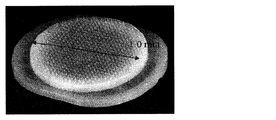
- FIG. 1 is a photomicrograph showing the overall image of the microneedle array used in the examples.
- PGA-MN water-insoluble microneedle array
- PGA-MN water-insoluble microneedle array
- the tip of the microneedle was dipped in the coating solution, pulled up and allowed to air dry for 5 seconds. Immersion and air drying were repeated 5 times, and then dried for 12 hours in a dry box (at room temperature and humidity of 1 to 2%) to obtain a test sample (dry sample).
- the measurement includes the amount of application, the amount of application, the strength of adhesion of the application on the microneedles, the time of dissolution of the application attached to the microneedle array into the skin, and the coating solution.
- the viscosity of the coating, the stability of the applied medicinal component, and the hardness of the coated material were measured.
- polysaccharides include hydroxypropylcellulose (HPC-SSL (molecular weight 40,000), (HPC-SL (molecular weight 100,000), HPC-L (molecular weight 140,000), HPC-M (molecular weight 620,000)). ), Sodium carboxymethylcellulose (CMC) (Wako Pure Chemical Industries, Ltd.
- FCH-80 molecular weight 800,000
- FCH-200 molecular weight 2 million
- PVP polyvinylpyrrolidone
- sucrose sucrose
- trehalose tre
- polyhydric alcohol glycerin (gly) or propylene glycol (pg) or mannitol (man) was used, and as the surfactant, polysorbate 80 (p80) or polysorbate 20 (p20) was used.
- influenza antigens manufactured by Osakaken Microken
- examples 1 to 10 and Comparative Examples 1 to 5 were used in Examples 14 15, 16, and 17, bovine serum albumin (Nacalai Tesque) was used.
- the unit of the numerical value of the composition of each reagent in Table 1 and Table 2 is mass% in the base.
- the unit of the numerical value of the medicinal component is a part by mass based on 100 parts by mass of the base.
- microneedle Water-insoluble microneedle array It was prepared by injection molding using polyglycolic acid and used in Examples 1 to 13, 16, and 17 and Comparative Examples 1 to 4, 6, and 7. 480 microneedles having a needle length of 400 ⁇ m are provided on a circular substrate having a diameter of 10 mm. Details of the production method are described in Japanese Patent No. 5852280.
- a water-soluble microneedle array was prepared by molding using hyaluronic acid (FCH-80, FCH-200) and carboxymethylcellulose, and used in Examples 14 and 15 and Comparative Example 5.
- hyaluronic acid FCH-80, FCH-200
- carboxymethylcellulose carboxymethylcellulose
- the tip of the microneedle was immersed in the coating solution, pulled up after 0.1 second, and dried for 5 seconds. The immersion by the operation was repeated 5 times and dried to prepare a microneedle coated with a tip medicinal component.
- Viscosity The viscosity of the coating solution was measured using a tuning fork type vibration viscometer (SV-10, A & D Co., Ltd.). The measurement temperature was 25 ° C., the sample amount was 10 mL, and the measurement time was 15 seconds.
- Medicinal component stability test Using an influenza vaccine protein as an example of a medicinal component, the stability of the medicinal component after microneedle application was tested.
- a micro BCA protein assay kit (Thermo Scientific) was used for protein quantification.
- the influenza vaccine protein on the microneedle array was dissolved in 0.5 ml of water, and the influenza vaccine protein mass was measured.
- the amount of protein immediately after coating was compared with the amount of protein after storage at 35 ° C. for 3 months. In Examples 14, 15, 16, and 17, bovine serum albumin was evaluated by the same protein quantification method.
- Hardness of the coated material A coated sheet with a thickness of 1 mm was prepared, and a stainless steel cylinder rod with a diameter of 1.5 mm was vertically pressed on the sheet using a small desktop testing machine EZ Test EZSX (Shimadzu Corporation). did. The pressing speed was 0.5 mm / min. The slope of the obtained stress-strain curve at the linear portion was calculated, and the compressive stress at the indentation distance of 0.1 mm was obtained to quantify the hardness (unit N) of the coated material.
- the amount of the remaining stratum corneum of the drug depending on the position of the application part (1) The FITC-coated PGA-MN having different needle height and (2) the diameter of the needle application part was subjected to the experiment, and the amount of the remaining FITC on the keratin was examined.
- a coating liquid containing FITC as a fluorescent dye was applied to the tip of a PGA microneedle (hereinafter referred to as PGA-MN) and subjected to a rat application experiment. After FITC-coated PGA-MN was applied to the rat and removed, the skin was removed by stripping with a tape, and the tape was extracted with a solvent to measure the fluorescence intensity.
- PGA-MN PGA microneedle
- the PGA-MN substrate has an elliptical shape with a major axis of 14 mm, a minor axis of 12 mm, and a thickness of 1.0 mm, and has a disk-shaped base portion with a thickness of 1.0 mm and a diameter of 10 mm on the top.
- the needle has a two-stage structure.
- Table 3 shows the dimensions of two types of PGA-MN with different needle heights used in the experiment.
- the materials used for coating are as follows. Hydroxypropylcellulose (HPC-L) manufactured by Nippon Soda Co., Ltd. Fluorescein-4-isothiocyanate manufactured by Dojindo Laboratories
Landscapes
- Health & Medical Sciences (AREA)
- Chemical & Material Sciences (AREA)
- Life Sciences & Earth Sciences (AREA)
- Animal Behavior & Ethology (AREA)
- General Health & Medical Sciences (AREA)
- Public Health (AREA)
- Veterinary Medicine (AREA)
- Medicinal Chemistry (AREA)
- Pharmacology & Pharmacy (AREA)
- Epidemiology (AREA)
- Engineering & Computer Science (AREA)
- Dermatology (AREA)
- Inorganic Chemistry (AREA)
- General Chemical & Material Sciences (AREA)
- Chemical Kinetics & Catalysis (AREA)
- Oil, Petroleum & Natural Gas (AREA)
- Medical Informatics (AREA)
- Hematology (AREA)
- Heart & Thoracic Surgery (AREA)
- Biomedical Technology (AREA)
- Anesthesiology (AREA)
- Biochemistry (AREA)
- Molecular Biology (AREA)
- Mycology (AREA)
- Microbiology (AREA)
- Immunology (AREA)
- Virology (AREA)
- Proteomics, Peptides & Aminoacids (AREA)
- Medicinal Preparation (AREA)
- Media Introduction/Drainage Providing Device (AREA)
- Medicines Containing Antibodies Or Antigens For Use As Internal Diagnostic Agents (AREA)
Abstract
Priority Applications (6)
| Application Number | Priority Date | Filing Date | Title |
|---|---|---|---|
| KR1020187022174A KR102790169B1 (ko) | 2016-02-03 | 2017-02-01 | 마이크로니들용 도포액, 마이크로니들 도포물 및 마이크로니들 어레이 |
| EP17747446.7A EP3412312B1 (fr) | 2016-02-03 | 2017-02-01 | Liquide de revêtement pour micro-aiguilles, substance de revêtement de micro-aiguille et ensemble de micro-aiguilles |
| CA3013704A CA3013704C (fr) | 2016-02-03 | 2017-02-01 | Liquide de revetement pour micro-aiguilles, substance de revetement de micro-aiguille et ensemble de micro-aiguilles |
| AU2017215012A AU2017215012B2 (en) | 2016-02-03 | 2017-02-01 | Coating liquid for microneedles, microneedle-coating substance, and microneedle array |
| CN201780009633.0A CN108601845B (zh) | 2016-02-03 | 2017-02-01 | 微针用涂敷液、微针涂敷物及微针矩阵 |
| US16/075,099 US11045417B2 (en) | 2016-02-03 | 2017-02-01 | Coating liquid for microneedles, microneedle-coating substance, and microneedle array |
Applications Claiming Priority (2)
| Application Number | Priority Date | Filing Date | Title |
|---|---|---|---|
| JP2016-018844 | 2016-02-03 | ||
| JP2016018844 | 2016-02-03 |
Publications (1)
| Publication Number | Publication Date |
|---|---|
| WO2017135290A1 true WO2017135290A1 (fr) | 2017-08-10 |
Family
ID=59499877
Family Applications (1)
| Application Number | Title | Priority Date | Filing Date |
|---|---|---|---|
| PCT/JP2017/003565 Ceased WO2017135290A1 (fr) | 2016-02-03 | 2017-02-01 | Liquide de revêtement pour micro-aiguilles, substance de revêtement de micro-aiguille et ensemble de micro-aiguilles |
Country Status (8)
| Country | Link |
|---|---|
| US (1) | US11045417B2 (fr) |
| EP (1) | EP3412312B1 (fr) |
| JP (2) | JP6914503B2 (fr) |
| KR (1) | KR102790169B1 (fr) |
| CN (1) | CN108601845B (fr) |
| AU (1) | AU2017215012B2 (fr) |
| CA (1) | CA3013704C (fr) |
| WO (1) | WO2017135290A1 (fr) |
Cited By (4)
| Publication number | Priority date | Publication date | Assignee | Title |
|---|---|---|---|---|
| WO2018124290A1 (fr) * | 2016-12-28 | 2018-07-05 | コスメディ製薬株式会社 | Réseau de micro-aiguilles revêtu de médicament |
| CN108888577A (zh) * | 2018-09-11 | 2018-11-27 | 无锡元旭生物技术有限公司 | 一种可溶性玻尿酸美容微针贴及其制备方法 |
| JP2021500399A (ja) * | 2017-10-23 | 2021-01-07 | マイクロキュアーズ, インコーポレイテッド | 美容レーザーで処置された皮膚の回復を増進する方法 |
| WO2024078319A1 (fr) * | 2022-10-09 | 2024-04-18 | 深圳青澜生物技术有限公司 | Formulation de micro-aiguilles et procédé de préparation de timbre à micro-aiguilles |
Families Citing this family (11)
| Publication number | Priority date | Publication date | Assignee | Title |
|---|---|---|---|---|
| DE102017126501A1 (de) | 2017-11-10 | 2019-05-16 | Lts Lohmann Therapie-Systeme Ag | Mikronadelsystem zur Applikation eines Hepatitis-Impfstoffes |
| KR102376556B1 (ko) * | 2018-12-27 | 2022-03-18 | 삼성에스디아이 주식회사 | 편광판 및 이를 포함하는 광학표시장치 |
| KR102093235B1 (ko) * | 2019-03-20 | 2020-03-25 | 주식회사 쿼드메디슨 | 마이크로 니들 및 이의 제조방법 |
| WO2020196810A1 (fr) * | 2019-03-28 | 2020-10-01 | 富士フイルム株式会社 | Réseau de micro-aiguilles contenant un vaccin contre la grippe et procédé de production d'un réseau de microaiguilles |
| CN110664646B (zh) * | 2019-11-14 | 2022-04-29 | 广州新济薇娜生物科技有限公司 | 具有美白功效的组合物、高载药量的美白可溶性微针贴片及其制备方法 |
| AU2021280068A1 (en) | 2020-05-25 | 2022-12-15 | Cosmed Pharmaceutical Co., Ltd. | High-performance micro-needle array |
| WO2022140984A1 (fr) * | 2020-12-28 | 2022-07-07 | 深圳由莱智能电子有限公司 | Poignée cosmétique |
| KR102926506B1 (ko) | 2022-02-15 | 2026-02-11 | 주식회사 티앤엘 | 약물 전달용 마이크로니들 및 이의 제조방법 |
| CN116270418B (zh) * | 2022-12-12 | 2023-09-05 | 暨南大学 | 可溶性微针贴片及其制备方法 |
| JP2025112280A (ja) | 2024-01-18 | 2025-07-31 | コスメディ製薬株式会社 | マイクロニードルアレイ |
| KR20260025403A (ko) | 2024-07-09 | 2026-02-24 | 코스메드 파마소티컬 씨오 쩜 엘티디 | 약물 피부 침투성이 개량된 경피 흡수 제제 |
Citations (5)
| Publication number | Priority date | Publication date | Assignee | Title |
|---|---|---|---|---|
| JP2008510520A (ja) * | 2004-08-19 | 2008-04-10 | アルザ・コーポレーシヨン | 血管内皮増殖因子の経皮的送達のための微小突起アレイパッチ |
| WO2008139648A1 (fr) * | 2007-05-15 | 2008-11-20 | Hisamitsu Pharmaceutical Co., Inc. | Procédé de revêtement d'une micro-aiguille |
| JP2011224308A (ja) * | 2010-04-21 | 2011-11-10 | Kosumedei Seiyaku Kk | マイクロニードル溶着法 |
| WO2011148994A1 (fr) * | 2010-05-28 | 2011-12-01 | 久光製薬株式会社 | Dispositif pourvu d'une matrice dotée de fines saillies |
| WO2012115207A1 (fr) * | 2011-02-24 | 2012-08-30 | 久光製薬株式会社 | Composition non aqueuse biologiquement active pour des dispositifs à micro-aiguilles et composition non aqueuse biologiquement active adhérant à une micro-aiguille |
Family Cites Families (10)
| Publication number | Priority date | Publication date | Assignee | Title |
|---|---|---|---|---|
| EP1163024B1 (fr) | 1999-01-28 | 2003-12-17 | Cyto Pulse Sciences, Inc. | Administration de macromolecules dans des cellules |
| US6713291B2 (en) | 1999-01-28 | 2004-03-30 | Alan D. King | Electrodes coated with treating agent and uses thereof |
| US20020193729A1 (en) | 2001-04-20 | 2002-12-19 | Cormier Michel J.N. | Microprojection array immunization patch and method |
| FR2827427B1 (fr) | 2001-07-12 | 2003-11-28 | Commissariat Energie Atomique | Pile a combustile a gestion thermique optimisee |
| WO2006138719A2 (fr) * | 2005-06-17 | 2006-12-28 | Georgia Tech Research Corporation | Microstructures revetues et procede de fabrication de celles-ci |
| ES2691259T3 (es) | 2009-06-10 | 2018-11-26 | Hisamitsu Pharmaceutical Co., Inc. | Dispositivo de microagujas |
| EP2575845B1 (fr) * | 2010-05-28 | 2017-02-15 | 3M Innovative Properties Company | Formulations aqueuses pour l'enrobage de puces à injections |
| EP2679242B1 (fr) | 2011-02-25 | 2020-09-09 | Hisamitsu Pharmaceutical Co., Inc. | Adjuvant pour l'administration transdermique ou transmuqueuse et préparation pharmaceutique le contenant |
| CN104602752A (zh) | 2012-08-30 | 2015-05-06 | 帝人株式会社 | 涂布有药物组合物的微针阵列 |
| JP5472771B1 (ja) * | 2012-09-28 | 2014-04-16 | コスメディ製薬株式会社 | 段差に薬物を保持したマイクロニードル |
-
2017
- 2017-02-01 CA CA3013704A patent/CA3013704C/fr active Active
- 2017-02-01 CN CN201780009633.0A patent/CN108601845B/zh active Active
- 2017-02-01 WO PCT/JP2017/003565 patent/WO2017135290A1/fr not_active Ceased
- 2017-02-01 AU AU2017215012A patent/AU2017215012B2/en active Active
- 2017-02-01 EP EP17747446.7A patent/EP3412312B1/fr active Active
- 2017-02-01 KR KR1020187022174A patent/KR102790169B1/ko active Active
- 2017-02-01 US US16/075,099 patent/US11045417B2/en active Active
- 2017-02-02 JP JP2017018001A patent/JP6914503B2/ja active Active
-
2021
- 2021-07-07 JP JP2021112494A patent/JP7097643B2/ja active Active
Patent Citations (5)
| Publication number | Priority date | Publication date | Assignee | Title |
|---|---|---|---|---|
| JP2008510520A (ja) * | 2004-08-19 | 2008-04-10 | アルザ・コーポレーシヨン | 血管内皮増殖因子の経皮的送達のための微小突起アレイパッチ |
| WO2008139648A1 (fr) * | 2007-05-15 | 2008-11-20 | Hisamitsu Pharmaceutical Co., Inc. | Procédé de revêtement d'une micro-aiguille |
| JP2011224308A (ja) * | 2010-04-21 | 2011-11-10 | Kosumedei Seiyaku Kk | マイクロニードル溶着法 |
| WO2011148994A1 (fr) * | 2010-05-28 | 2011-12-01 | 久光製薬株式会社 | Dispositif pourvu d'une matrice dotée de fines saillies |
| WO2012115207A1 (fr) * | 2011-02-24 | 2012-08-30 | 久光製薬株式会社 | Composition non aqueuse biologiquement active pour des dispositifs à micro-aiguilles et composition non aqueuse biologiquement active adhérant à une micro-aiguille |
Non-Patent Citations (1)
| Title |
|---|
| See also references of EP3412312A4 * |
Cited By (6)
| Publication number | Priority date | Publication date | Assignee | Title |
|---|---|---|---|---|
| WO2018124290A1 (fr) * | 2016-12-28 | 2018-07-05 | コスメディ製薬株式会社 | Réseau de micro-aiguilles revêtu de médicament |
| JP2018108375A (ja) * | 2016-12-28 | 2018-07-12 | コスメディ製薬株式会社 | 薬剤を塗布したマイクロニードルアレイ |
| JP7509393B2 (ja) | 2016-12-28 | 2024-07-02 | コスメディ製薬株式会社 | 薬剤を塗布したマイクロニードルアレイ |
| JP2021500399A (ja) * | 2017-10-23 | 2021-01-07 | マイクロキュアーズ, インコーポレイテッド | 美容レーザーで処置された皮膚の回復を増進する方法 |
| CN108888577A (zh) * | 2018-09-11 | 2018-11-27 | 无锡元旭生物技术有限公司 | 一种可溶性玻尿酸美容微针贴及其制备方法 |
| WO2024078319A1 (fr) * | 2022-10-09 | 2024-04-18 | 深圳青澜生物技术有限公司 | Formulation de micro-aiguilles et procédé de préparation de timbre à micro-aiguilles |
Also Published As
| Publication number | Publication date |
|---|---|
| EP3412312B1 (fr) | 2021-08-25 |
| JP6914503B2 (ja) | 2021-08-04 |
| KR20180105153A (ko) | 2018-09-27 |
| JP2017137311A (ja) | 2017-08-10 |
| CN108601845B (zh) | 2022-09-06 |
| CA3013704A1 (fr) | 2017-08-10 |
| CA3013704C (fr) | 2024-04-16 |
| KR102790169B1 (ko) | 2025-04-04 |
| CN108601845A (zh) | 2018-09-28 |
| US20190038550A1 (en) | 2019-02-07 |
| EP3412312A4 (fr) | 2019-10-02 |
| JP7097643B2 (ja) | 2022-07-08 |
| EP3412312A1 (fr) | 2018-12-12 |
| JP2021165302A (ja) | 2021-10-14 |
| US11045417B2 (en) | 2021-06-29 |
| AU2017215012A1 (en) | 2018-08-16 |
| AU2017215012B2 (en) | 2022-04-21 |
Similar Documents
| Publication | Publication Date | Title |
|---|---|---|
| JP7097643B2 (ja) | マイクロニードル塗布物 | |
| US9993423B2 (en) | Microneedle deposition method | |
| CN104066475B (zh) | 迅速溶解型微针 | |
| RU2662432C2 (ru) | Массив микроструктур для доставки действующих агентов | |
| JP7509393B2 (ja) | 薬剤を塗布したマイクロニードルアレイ | |
| EP2957297B1 (fr) | Composition de revêtement de micro-aiguille et dispositif à micro-aiguille | |
| JP2021072884A (ja) | 薬剤組成物が塗布されたマイクロニードルアレイ | |
| JP2006500974A (ja) | 被覆され微細突起物を有する経皮的薬物送達装置 | |
| US9849170B2 (en) | Microneedle coating composition and microneedle device | |
| JP5688752B2 (ja) | 経皮吸収製剤およびその製造方法 | |
| JP6198373B2 (ja) | マイクロニードル | |
| JP7313683B2 (ja) | ワクチンアジュバント及びマイクロニードル製剤 | |
| WO2023042889A1 (fr) | Réseau de micro-aiguilles revêtu de médicament |
Legal Events
| Date | Code | Title | Description |
|---|---|---|---|
| 121 | Ep: the epo has been informed by wipo that ep was designated in this application |
Ref document number: 17747446 Country of ref document: EP Kind code of ref document: A1 |
|
| ENP | Entry into the national phase |
Ref document number: 20187022174 Country of ref document: KR Kind code of ref document: A |
|
| WWE | Wipo information: entry into national phase |
Ref document number: 3013704 Country of ref document: CA |
|
| NENP | Non-entry into the national phase |
Ref country code: DE |
|
| ENP | Entry into the national phase |
Ref document number: 2017215012 Country of ref document: AU Date of ref document: 20170201 Kind code of ref document: A |
|
| WWE | Wipo information: entry into national phase |
Ref document number: 2017747446 Country of ref document: EP |
|
| ENP | Entry into the national phase |
Ref document number: 2017747446 Country of ref document: EP Effective date: 20180903 |