WO2017138190A1 - Capteur de gaz - Google Patents
Capteur de gaz Download PDFInfo
- Publication number
- WO2017138190A1 WO2017138190A1 PCT/JP2016/081416 JP2016081416W WO2017138190A1 WO 2017138190 A1 WO2017138190 A1 WO 2017138190A1 JP 2016081416 W JP2016081416 W JP 2016081416W WO 2017138190 A1 WO2017138190 A1 WO 2017138190A1
- Authority
- WO
- WIPO (PCT)
- Prior art keywords
- mesoporous silica
- gas sensor
- gas
- filter
- siloxane
- Prior art date
- Legal status (The legal status is an assumption and is not a legal conclusion. Google has not performed a legal analysis and makes no representation as to the accuracy of the status listed.)
- Ceased
Links
Images





Classifications
-
- G—PHYSICS
- G01—MEASURING; TESTING
- G01N—INVESTIGATING OR ANALYSING MATERIALS BY DETERMINING THEIR CHEMICAL OR PHYSICAL PROPERTIES
- G01N27/00—Investigating or analysing materials by the use of electric, electrochemical, or magnetic means
- G01N27/02—Investigating or analysing materials by the use of electric, electrochemical, or magnetic means by investigating impedance
- G01N27/04—Investigating or analysing materials by the use of electric, electrochemical, or magnetic means by investigating impedance by investigating resistance
- G01N27/12—Investigating or analysing materials by the use of electric, electrochemical, or magnetic means by investigating impedance by investigating resistance of a solid body in dependence upon absorption of a fluid; of a solid body in dependence upon reaction with a fluid, for detecting components in the fluid
-
- G—PHYSICS
- G01—MEASURING; TESTING
- G01N—INVESTIGATING OR ANALYSING MATERIALS BY DETERMINING THEIR CHEMICAL OR PHYSICAL PROPERTIES
- G01N27/00—Investigating or analysing materials by the use of electric, electrochemical, or magnetic means
- G01N27/02—Investigating or analysing materials by the use of electric, electrochemical, or magnetic means by investigating impedance
- G01N27/04—Investigating or analysing materials by the use of electric, electrochemical, or magnetic means by investigating impedance by investigating resistance
- G01N27/14—Investigating or analysing materials by the use of electric, electrochemical, or magnetic means by investigating impedance by investigating resistance of an electrically-heated body in dependence upon change of temperature
- G01N27/16—Investigating or analysing materials by the use of electric, electrochemical, or magnetic means by investigating impedance by investigating resistance of an electrically-heated body in dependence upon change of temperature caused by burning or catalytic oxidation of surrounding material to be tested, e.g. of gas
Definitions
- the present invention relates to a gas sensor, and more particularly to its filter.
- the gas sensor has a problem with poisoning by siloxane gas.
- siloxane gas can be adsorbed and removed by an activated carbon filter, but in detection of isobutane, LPG, etc., activated carbon adsorbs these detection target gases.
- the applicant has proposed a filter in which zeolite and activated alumina are mixed (Patent Document 1, JP 2013-88267).
- mesoporous silica exhibits a high adsorption ability to siloxane gas, and that when mesoporous silica is used in a filter, the response of the gas sensor to isobutane or the like is delayed.
- a silica-alumina-based adsorbent is placed in the previous stage (detected atmosphere side), and a layered filter with a small amount of mesoporous silica attached to a nonwoven fabric is placed in the subsequent stage (gas sensor side of the gas sensor). Proposed (Patent Document 2 JP 2013-242269). In this way, the siloxane gas can be removed while keeping the detection delay of isobutane or the like within an allowable range. *
- the inventor studied the particle structure and components of mesoporous silica in order to shorten the detection delay of gas such as isobutane and further improve the durability to siloxane gas, and reached the present invention.
- An object of the present invention is to further shorten the detection delay of a gas sensor to a gas such as isobutane and further improve the durability to a siloxane gas.
- the gas sensor of the present invention has a gas detection part and a filter disposed on the detected atmosphere side of the gas detection part, and the filter contains plate-like mesoporous silica particles.
- the plate shape means that the particle is a polygonal plate shape, and the average value of the ratio of the diagonal length of the plate to the plate thickness is 2: 1 or more. For rods, this value is much smaller than 1: 1.
- the detection delay time by the filter can be shortened compared with the case where conventional rod-like mesoporous silica particles are used, or a larger amount of mesoporous silica can be contained in the filter. Toxicity can be improved.
- the mesoporous silica particles contain a sulfonic group.
- siloxane gas can be reacted and fixed in mesopores of the mesoporous silica particles. For this reason, the poisoning resistance of the gas sensor with respect to siloxane gas can be improved.
- the ratio of the S element in the sulfone group to the Si element of mesoporous silica is, for example, 1:21 to 3:13 at the time of preparation.
- the ratio of S element to Si element in the mesoporous silica particles is, for example, 1: 100 to 1: 4. is there.
- the mesoporous silica particles further contain any element of Zr, Ti, Nb, and Ta, and particularly preferably contain a Zr element.
- the mesoporous silica particles contain any one element of Zr, Ti, Nb, and Ta, particularly the Zr element, plate-like particles can be easily obtained instead of rod-like particles.
- these metal elements are also important as sites that strongly adsorb siloxane.
- FIG. 1 H NMR spectrum of cyclic siloxanes adsorbed to the mesoporous silica Sectional view of the gas sensor of the embodiment
- the figure which shows the drive pattern of the gas sensor of an Example The figure which shows the behavior of the resistance value of the gas sensor in the air, hydrogen, and isobutane by the endurance test in the siloxane gas in an Example.
- FIG. 1 shows the conditions for preparing the mesoporous silica of Examples.
- P123 represents the surfactant Pluonic P123 Surfantant
- TEOS represents Tetra Ethoxy Ortho Silicate
- MpTMS represents 3-mercapto-propyl-trimethoxy-silane.
- SBA-15 indicates the type of mesoporous silica prepared, Zr indicates that it contains a Zr element, SA indicates that it contains a sulfone group, and p in SBA-15-p indicates the particle size of SBA-15 Represents a plate shape.
- Mesoporous silica is usually composed of rod-like particles and has mesopores parallel to the longitudinal direction of the rod.
- preparation conditions were selected, and plate-like SBA-15 was prepared.
- the TEOS solution was mixed with 1M hydrogen chloride solution of P123 at 30 ° C with stirring, stirred and allowed to stand, then treated in an autoclave at 100 ° C for 24 hours, suction filtered and washed with pure water. And baked at 500 ° C. for 12 hours to prepare plate-like SBA-15-p.
- the atomic ratio in the charging stage of Zr and Si was 1:20, and ZrO 2 was added to the solution of P123 to prepare Zr-SBA-15-p.
- Zr exists so as to substitute Si atoms in the skeleton of mesoporous silica, and when Zr element is contained, the atomic ratio of Zr / Si is, for example, 1: 100 to 1: 8.
- Ti element, Ta element, and Nb element may be contained in the mesoporous silica, and the atomic ratio with Si in that case is the same as in the case of Zr.
- a sulfone group was contained in mesoporous silica, an organic silicon compound containing S element was added, and the sulfone group was introduced into mesoporous silica by oxidation with hydrogen peroxide or the like.
- the method for introducing the sulfone group is arbitrary, but it is preferably introduced as an organic compound of silicon containing S element before the growth of mesoporous silica in the autoclave.
- the oxidation of the S element to the sulfone group may be performed at any point.
- the atomic ratio at the charging stage of S element and Si element was set to 1:11 in the example of FIG. 1, but the experiment was performed in the range of 1:21 to 3:13. In the case of containing a Zr element, the atomic ratio of Zr to Si is 1:20 in FIG. 1, but a range of 1: 100 to 1:10 is preferable.
- FIG. 3 shows a scanning electron micrograph of each sample of FIG.
- the mesoporous silica particles are almost hexagonal, plate-shaped, the depth direction of the mesopores is directed to the thickness direction of the plate, the thickness of the plate is about 200 to 300 nm, the diameter of the plate (the hexagonal diagonal line) The length) is about 1 ⁇ m, and the average aspect ratio of diameter to thickness is about 3: 1 to 10: 1.
- Zr element particles tend to be small, and it is easy to control the form in a plate shape instead of a rod shape.
- the hexagonal shape tended to be slightly broken. The same applies when a Ti element, an Nb element or a Ta element is introduced instead of the Zr element.
- FIG. 3 shows the adsorption isotherm of cyclic siloxane (D4) on each sample.
- D4 cyclic siloxane
- FIG. 4 shows the H + acid amount and the BET specific surface area of mesoporous silica and other adsorbents.
- the amount of H + acid was measured as follows. At room temperature, 0.1 g of the adsorbent was added to 20 mL of 2M NaCl aqueous solution, and the mixture was stirred under reduced pressure to ion-exchange H + in the adsorbent with Na + . Subsequently, the mixture was filtered, and 10 mL of the filtrate was subjected to neutralization titration, and the amount of H + acid was measured.
- the plate-shaped mesoporous silica has a large specific surface area, and the acid amount increased by introduction of the sulfone group, and the H + acid amount increased even when the Zr element was contained.
- FIG. 5 shows the 1 H NMR spectrum of cyclic siloxane adsorbed on mesoporous silica.
- Each sample was pretreated at 200 to 400 ° C. in a vacuum and left in an atmosphere containing D4 gas having a saturated vapor pressure at room temperature for 1 hour.
- siloxane was extracted from 100 mg of sample into CDCl 3 , and 1 H NMR spectrum was measured.
- the numbers such as 1.00 in the figure indicate the area ratio of each peak, and TMS is the peak of the standard substance Tetra Methyl Silane.
- mesoporous silica containing a sulfone group and a large amount of H + acid a peak derived from D5, which is another cyclic siloxane, was detected. This suggests that the siloxane is ring-opening polymerized by the sulfone group and fixed in the mesoporous silica.
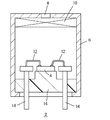
- FIG. 6 shows the structure of the gas sensor 2.
- the gas sensor 4 of the gas sensor 2 has a mems structure and uses SnO 2 as a gas detection material.
- a Pt heater is formed on a thin film of 52 tantalum oxide on the cavity of the Si substrate, an interlayer insulating film is laminated, and a pair of electrodes and a thick film of SnO 2 are laminated thereon, and the gas sensing part 4 It was.
- the gas sensing unit 4 is accommodated in the metal can 6, and the detected atmosphere is supplied to the gas sensing unit 4 side through the mesoporous silica filter 10 from the opening 8 at the top of the metal can 6.
- 12 is a lead
- 14 is a pin
- 16 is a base.
- the structure of the gas sensor is optional except that a mesoporous silica filter is used, and the gas sensing part uses a metal oxide semiconductor other than SnO 2 , a catalytic combustion type using a Pt catalyst bead, or a solid high An electrochemical type using a molecular electrolyte membrane or the like may also be used.
- the structure of the mesoporous silica filter is arbitrary, and a filter such as JP 2013-88267 may be disposed in front of another filter such as zeolite, silica, or amberlist. Further, mesoporous silica may be used by mixing with other filter materials such as zeolite, silica, and amberlist.
- the amber list is an adsorbent shown in FIG. 4 and is a strong acid ion exchange resin.
- FIG. 7 shows the driving conditions of the gas sensor.
- the gas sensor 2 is driven at a period P, the heater is turned on for the time T, and the signal of the gas sensor 2 is sampled in synchronization with the heater being turned off.
- the period P is 30 seconds and the time T is 1 second under standard driving conditions.
- the period P was 1 second and the time T was 0.1 second.
- the SnO 2 temperature during signal sampling was about 350 ° C. for detection of isobutane (FIGS. 8, 9, and 13) and about 450 ° C. for detection of methane (FIGS. 10 to 12).
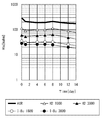
- the gas sensor 2 was driven for 12 days in an atmosphere containing 10 ppm of siloxane gas M3, D4, D5, and the resistance value of the gas sensor 2 was measured by switching to an atmosphere containing a predetermined concentration of gas in clean air during measurement.
- FIG. 8 shows the results in the example (the filter used 45 mg of 10SA-Zr-SBA-15-p).
- FIG. 9 shows the results of a conventional filter in which zeolite and activated alumina are mixed (composition is silica: alumina in a mass ratio of 1: 1 and the amount used is 60 mg) (Japanese Patent Laid-Open No. 2013-88267).
- the poisoning was within the allowable range, but in the conventional example, it was beyond the allowable range. *
- FIG. 10, FIG. 11, and FIG. 12 show the difference depending on the presence and shape of the sulfone group in mesoporous silica. Hydrogen and methane are detected as gases, the temperature of the gas sensing unit when the heater is turned on is 450 ° C., and the poisoning conditions are the same as in FIGS.
- FIG. 10 shows the result of mesoporous silica composed of plate-like particles and containing sulfone groups (45 mg of 10SA-Zr-SBA-15-p used), and FIG. 11 shows mesoporous composed of plate-like particles and containing no sulfone groups.
- FIG. 12 shows the results for silica (using 60 mg of SBA-15-p), and FIG. 12 shows the results for mesoporous silica composed of rod-shaped particles (using 75 mg of SBA-15).
- the ratio of S element to Si element in the mesoporous silica particles is, for example, 1: 100 to 1: 4, preferably 1: 20 to 1: 4.
- the order of poisoning resistance corresponds to the fact that a sulfone group contains ring-opening polymerization of siloxane (FIG. 5), and the introduction of Zr element increases the amount of H + acid in mesoporous silica (FIG. 4).
- the plate-like mesoporous silica improves the poisoning resistance of the gas sensor compared to the rod-like mesoporous silica.
- FIG. 13 shows the relationship between the amount of mesoporous silica filled in the filter and the detection delay time until an output equivalent to 1800 ppm of isobutane is obtained after 4500 ppm of isobutane is injected.
- ⁇ shows the results with rod-shaped SBA-15
- ⁇ shows the results with SBA-15-p
- the detection delay could be shortened by using a plate. This is because the mesoporous silica plate has a short mesopore depth, so that the adsorbed isobutane is held in the mesopore for a short time. This suggests that the adsorbed isobutane is retained in the mesopores for a long time.
- the detection delay is shortened by using a plate shape, and the detection delay is increased by using a rod shape, as is the case with other mesoporous silicas containing a sulfone group or a Zr element.
- siloxane is polymerized by ring-opening polymerization or the like in the mesopores of mesoporous silica
- a metal element other than Zr, Nb, Ta, Ti such as a noble metal element may be contained in the mesopores.
- the inventor has developed a filter that has a high ability to remove siloxane gas and that does not increase the detection delay time of the gas sensor. By using this filter, it is possible to detect gases such as isobutane and LPG while preventing poisoning and keeping the detection delay time within an allowable range.
Landscapes
- Chemical & Material Sciences (AREA)
- Chemical Kinetics & Catalysis (AREA)
- Electrochemistry (AREA)
- Physics & Mathematics (AREA)
- Health & Medical Sciences (AREA)
- Life Sciences & Earth Sciences (AREA)
- Analytical Chemistry (AREA)
- Biochemistry (AREA)
- General Health & Medical Sciences (AREA)
- General Physics & Mathematics (AREA)
- Immunology (AREA)
- Pathology (AREA)
- Investigating Or Analyzing Materials By The Use Of Fluid Adsorption Or Reactions (AREA)
- Investigating Or Analyzing Materials By The Use Of Electric Means (AREA)
Abstract
Selon l'invention, un filtre de capteur de gaz contient un groupe sulfone et contient également des particules de silice mésoporeuse en forme de plaquette. Le gaz siloxane peut être supprimé, et le temps de retard de détection du capteur de gaz pour l'isobutane est court.
Priority Applications (1)
| Application Number | Priority Date | Filing Date | Title |
|---|---|---|---|
| JP2017566507A JP6485890B2 (ja) | 2016-02-12 | 2016-10-24 | ガスセンサ |
Applications Claiming Priority (2)
| Application Number | Priority Date | Filing Date | Title |
|---|---|---|---|
| JP2016-024410 | 2016-02-12 | ||
| JP2016024410 | 2016-02-12 |
Publications (1)
| Publication Number | Publication Date |
|---|---|
| WO2017138190A1 true WO2017138190A1 (fr) | 2017-08-17 |
Family
ID=59563863
Family Applications (1)
| Application Number | Title | Priority Date | Filing Date |
|---|---|---|---|
| PCT/JP2016/081416 Ceased WO2017138190A1 (fr) | 2016-02-12 | 2016-10-24 | Capteur de gaz |
Country Status (2)
| Country | Link |
|---|---|
| JP (1) | JP6485890B2 (fr) |
| WO (1) | WO2017138190A1 (fr) |
Cited By (6)
| Publication number | Priority date | Publication date | Assignee | Title |
|---|---|---|---|---|
| CN108508065A (zh) * | 2018-04-03 | 2018-09-07 | 宁夏大学 | 一种超细骨架有序介孔铁酸镍甲苯气敏材料及其制备方法 |
| WO2018159348A1 (fr) * | 2017-03-02 | 2018-09-07 | フィガロ技研株式会社 | Capteur de gaz et procédé de fabrication associé |
| JPWO2017221574A1 (ja) * | 2016-06-23 | 2018-11-08 | フィガロ技研株式会社 | ガスセンサ |
| WO2020031723A1 (fr) | 2018-08-10 | 2020-02-13 | フィガロ技研株式会社 | Détecteur de gaz |
| WO2020031724A1 (fr) | 2018-08-10 | 2020-02-13 | フィガロ技研株式会社 | Détecteur de gaz |
| US20210310906A1 (en) * | 2019-05-17 | 2021-10-07 | Figaro Engineering Inc. | Gas detection device and gas detection method |
Citations (4)
| Publication number | Priority date | Publication date | Assignee | Title |
|---|---|---|---|---|
| JP2007112948A (ja) * | 2005-10-21 | 2007-05-10 | National Institute Of Advanced Industrial & Technology | 薄板状もしくは繊維状の有機無機多孔質シリカ粒子とその製造方法 |
| WO2012096171A1 (fr) * | 2011-01-11 | 2012-07-19 | 日本板硝子株式会社 | Granulé mésoporeux sous forme de paillette, et procédé de fabrication de celui-ci |
| JP2013242269A (ja) * | 2012-05-22 | 2013-12-05 | Figaro Eng Inc | ガスセンサ |
| JP2015044175A (ja) * | 2013-08-29 | 2015-03-12 | 東洋紡株式会社 | シロキサン除去剤およびそれを用いたシロキサン除去フィルタ |
-
2016
- 2016-10-24 WO PCT/JP2016/081416 patent/WO2017138190A1/fr not_active Ceased
- 2016-10-24 JP JP2017566507A patent/JP6485890B2/ja active Active
Patent Citations (4)
| Publication number | Priority date | Publication date | Assignee | Title |
|---|---|---|---|---|
| JP2007112948A (ja) * | 2005-10-21 | 2007-05-10 | National Institute Of Advanced Industrial & Technology | 薄板状もしくは繊維状の有機無機多孔質シリカ粒子とその製造方法 |
| WO2012096171A1 (fr) * | 2011-01-11 | 2012-07-19 | 日本板硝子株式会社 | Granulé mésoporeux sous forme de paillette, et procédé de fabrication de celui-ci |
| JP2013242269A (ja) * | 2012-05-22 | 2013-12-05 | Figaro Eng Inc | ガスセンサ |
| JP2015044175A (ja) * | 2013-08-29 | 2015-03-12 | 東洋紡株式会社 | シロキサン除去剤およびそれを用いたシロキサン除去フィルタ |
Cited By (13)
| Publication number | Priority date | Publication date | Assignee | Title |
|---|---|---|---|---|
| JPWO2017221574A1 (ja) * | 2016-06-23 | 2018-11-08 | フィガロ技研株式会社 | ガスセンサ |
| WO2018159348A1 (fr) * | 2017-03-02 | 2018-09-07 | フィガロ技研株式会社 | Capteur de gaz et procédé de fabrication associé |
| US11638895B2 (en) | 2017-03-02 | 2023-05-02 | Figaro Engineering Inc. | Gas sensor and method for producing same |
| CN108508065A (zh) * | 2018-04-03 | 2018-09-07 | 宁夏大学 | 一种超细骨架有序介孔铁酸镍甲苯气敏材料及其制备方法 |
| KR20210039472A (ko) | 2018-08-10 | 2021-04-09 | 피가로 기켄 가부시키가이샤 | 가스 검출기 |
| KR20210039471A (ko) | 2018-08-10 | 2021-04-09 | 피가로 기켄 가부시키가이샤 | 가스 검출기 |
| WO2020031724A1 (fr) | 2018-08-10 | 2020-02-13 | フィガロ技研株式会社 | Détecteur de gaz |
| JPWO2020031723A1 (ja) * | 2018-08-10 | 2021-08-26 | フィガロ技研株式会社 | ガス検出器 |
| JP7021756B2 (ja) | 2018-08-10 | 2022-02-17 | フィガロ技研株式会社 | ガス検出器 |
| WO2020031723A1 (fr) | 2018-08-10 | 2020-02-13 | フィガロ技研株式会社 | Détecteur de gaz |
| US11940432B2 (en) | 2018-08-10 | 2024-03-26 | Figaro Engineering Inc. | Gas detector |
| US20210310906A1 (en) * | 2019-05-17 | 2021-10-07 | Figaro Engineering Inc. | Gas detection device and gas detection method |
| US11977007B2 (en) * | 2019-05-17 | 2024-05-07 | Figaro Engineering Inc. | Gas detection device and gas detection method |
Also Published As
| Publication number | Publication date |
|---|---|
| JPWO2017138190A1 (ja) | 2018-12-06 |
| JP6485890B2 (ja) | 2019-03-20 |
Similar Documents
| Publication | Publication Date | Title |
|---|---|---|
| WO2017138190A1 (fr) | Capteur de gaz | |
| Bhagiyalakshmi et al. | Synthesis of chloropropylamine grafted mesoporous MCM-41, MCM-48 and SBA-15 from rice husk ash: their application to CO2 chemisorption | |
| Hu et al. | SnO 2 nanorods based sensing material as an isopropanol vapor sensor | |
| Prodinger et al. | Impact of chabazite SSZ-13 textural properties and chemical composition on CO 2 adsorption applications | |
| Wan et al. | Versatile drug releaser derived from the Ti-substituted mesoporous silica SBA-15 | |
| JP6935886B2 (ja) | ガスセンサ及びその製造方法 | |
| Khader et al. | Adsorption of CO2 on polyethyleneimine 10k-mesoporous silica sorbent: XPS and TGA studies | |
| KR20170028592A (ko) | 플라즈마 중합법을 이용한 산성기체 흡착소재의 제조방법 및 이에 따라 제조된 산성기체 흡착소재 | |
| US9327989B2 (en) | Compositions, systems and methods for separating ethanol from water and methods of making compositions for separating ethanol from water | |
| Zheng et al. | Fluoroalcohol and fluorinated-phenol derivatives functionalized mesoporous SBA-15 hybrids: high-performance gas sensing toward nerve agent | |
| JP5881205B2 (ja) | ガスセンサ | |
| JP7057576B2 (ja) | ガス検出装置及びガス検出方法 | |
| Zukal et al. | Alkali metal cation doped Al-SBA-15 for carbon dioxide adsorption | |
| US20190137426A1 (en) | Gas Sensor | |
| Othman et al. | Efficiency of new ozone filters for NO2 sensing and air depollution | |
| JP2011056494A (ja) | 水溶性揮発性有機化合物吸着剤 | |
| Kimura et al. | Trace-level gravimetric detection promoted by surface interactions of mesoporous materials with chemical vapors | |
| Oliva et al. | Detection of volatile organic compounds adsorbed onto zeolite layers | |
| JP4887493B2 (ja) | 疎水性ゼオライトの製造方法 | |
| CN114280111B (zh) | 铈掺杂氧化钨复合材料和硫化氢传感器、以及制备方法 | |
| Patel et al. | Enrichment of benzene from benzene–water mixture by adsorption in silylated mesoporous silica | |
| JP5035819B2 (ja) | 多孔質シリカ被膜の形成方法及びそれに用いられる多孔質シリカ形成用塗布液 | |
| Carotenuto | Isothermal kinetic investigation of the water-cations interaction in natural clinoptilolite | |
| Drago et al. | Pore-resolved NMR porosimetry | |
| Kosmulski et al. | Uptake of vapors of Cd at 480–600 C and of Zn at 750–880 C by SBA-15 |
Legal Events
| Date | Code | Title | Description |
|---|---|---|---|
| 121 | Ep: the epo has been informed by wipo that ep was designated in this application |
Ref document number: 16889891 Country of ref document: EP Kind code of ref document: A1 |
|
| ENP | Entry into the national phase |
Ref document number: 2017566507 Country of ref document: JP Kind code of ref document: A |
|
| NENP | Non-entry into the national phase |
Ref country code: DE |
|
| 122 | Ep: pct application non-entry in european phase |
Ref document number: 16889891 Country of ref document: EP Kind code of ref document: A1 |