WO2017141643A1 - Verre de protection thermique - Google Patents
Verre de protection thermique Download PDFInfo
- Publication number
- WO2017141643A1 WO2017141643A1 PCT/JP2017/002338 JP2017002338W WO2017141643A1 WO 2017141643 A1 WO2017141643 A1 WO 2017141643A1 JP 2017002338 W JP2017002338 W JP 2017002338W WO 2017141643 A1 WO2017141643 A1 WO 2017141643A1
- Authority
- WO
- WIPO (PCT)
- Prior art keywords
- layer
- glass
- heat
- shielding
- coating film
- Prior art date
- Legal status (The legal status is an assumption and is not a legal conclusion. Google has not performed a legal analysis and makes no representation as to the accuracy of the status listed.)
- Ceased
Links
Images

Classifications
-
- C—CHEMISTRY; METALLURGY
- C03—GLASS; MINERAL OR SLAG WOOL
- C03C—CHEMICAL COMPOSITION OF GLASSES, GLAZES OR VITREOUS ENAMELS; SURFACE TREATMENT OF GLASS; SURFACE TREATMENT OF FIBRES OR FILAMENTS MADE FROM GLASS, MINERALS OR SLAGS; JOINING GLASS TO GLASS OR OTHER MATERIALS
- C03C17/00—Surface treatment of glass, not in the form of fibres or filaments, by coating
- C03C17/34—Surface treatment of glass, not in the form of fibres or filaments, by coating with at least two coatings having different compositions
-
- B—PERFORMING OPERATIONS; TRANSPORTING
- B32—LAYERED PRODUCTS
- B32B—LAYERED PRODUCTS, i.e. PRODUCTS BUILT-UP OF STRATA OF FLAT OR NON-FLAT, e.g. CELLULAR OR HONEYCOMB, FORM
- B32B17/00—Layered products essentially comprising sheet glass, or glass, slag, or like fibres
- B32B17/06—Layered products essentially comprising sheet glass, or glass, slag, or like fibres comprising glass as the main or only constituent of a layer, next to another layer of a specific material
Definitions
- the present invention relates to a thermal barrier glass having a coating film.
- Such a heat insulating glass is configured by, for example, installing a coating film having a heat insulating property on one surface of a glass plate.
- Patent Document 1 describes a thermal barrier glass provided with a multilayer coating film composed of two layers of an antimony-containing tin oxide layer and a fluorine-containing tin oxide layer on a base layer.
- the heat shielding property of the heat shielding glass can be improved by forming a multilayer coating film on the glass plate.
- the heat shielding glass may require various properties in addition to the heat shielding properties. For example, depending on the place of application of the heat shield glass, design properties, transparency, and the like may be required for the heat shield glass.
- the present invention has been made in view of such a background, and an object of the present invention is to provide a thermal barrier glass having good thermal barrier properties and having a haze value significantly suppressed.
- a heat-shielding glass having a glass plate having first and second surfaces facing each other, and a coating film provided on the first surface of the glass plate,
- the coating film includes a base layer, and a first layer and a second layer disposed on the base layer, and the first layer includes the base layer and the second layer.
- the total thickness of the first layer and the second layer is 340 nm or more, In the coating layer surface of the thermal barrier glass, measured in the region of 8 [mu] m ⁇ 8 [mu] m, an average power spectral density between the frequency 1 [mu] m -1 ⁇ 2 [mu] m -1 is 6 ⁇ 10 6 nm 4 or less, Thermal barrier glass is provided.
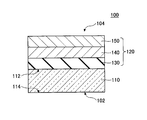
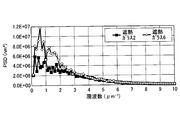
- FIG. 1 It is sectional drawing which showed roughly the example of 1 structure of the thermal insulation glass by one Embodiment of this invention. It is the graph which compared and showed the evaluation result of the frequency dependence of the power spectrum density in the thermal insulation glass 2 and the thermal insulation glass 7.
- FIG. It is the graph which showed collectively the relationship between the average P value and haze value which were obtained in each heat insulation glass.
- FIG. 1 schematically shows a cross section of a heat insulating glass (hereinafter referred to as “first heat insulating glass”) according to an embodiment of the present invention.
- the first thermal barrier glass 100 has a first side 102 and a second side 104.
- the first heat shield glass 100 includes a glass plate 110 and a coating film 120.
- the first side 102 of the first thermal barrier glass 100 corresponds to the glass plate 110 side
- the second side 104 of the first thermal barrier glass 100 corresponds to the coating film 120 side.
- the glass plate 110 has a first surface 112 and a second surface 114.
- the coating film 120 is provided on the first surface 112 side of the glass plate 110.
- the coating film 120 is configured by laminating a base layer 130, a first layer 140, and a second layer 150 in this order.
- the coating film 120 is not limited to such a three-layer structure, and may be composed of four or more layers.
- the underlayer 130 of the coating film 120 has a layer containing, for example, silicon oxide or tin oxide.
- the first layer 140 and the second layer 150 of the coating film 120 are both composed of a layer containing tin oxide.
- One of the first layer 140 and the second layer 150 contains tin oxide containing antimony, and the other of the first layer 140 and the second layer 150 contains tin oxide containing fluorine. Moreover, it is preferable that the 1st layer 140 and the 2nd layer 150 contain 50 mass% or more of tin oxides, for example, 60 mass% or more.
- the first thermal barrier glass 100 is The total thickness of the first layer 140 and the second layer 150 is 340 nm or more;
- the average power spectral density between frequencies 1 ⁇ m ⁇ 1 and 2 ⁇ m ⁇ 1 (hereinafter referred to as “average P value”) measured in the region of 8 ⁇ m ⁇ 8 ⁇ m is 6 ⁇ 10 6 nm 4 or less. It has the characteristic that
- the total thickness of the first layer 140 and the second layer 150 exhibiting heat-shielding properties is sufficiently thick at 340 nm or more. Therefore, the first heat insulating glass 100 can exhibit a sufficient heat insulating property.
- the average P value measured in the region of 8 [mu] m ⁇ 8 [mu] m is 6 ⁇ 10 6 nm 4 below.
- the first heat-shielding glass 100 is significantly suppressed from being clouded or clouded.
- the first heat-insulating glass 100 can provide a heat-insulating glass exhibiting good heat-insulating properties and having a significantly reduced haze value.
- the surface of the coating film in the heat shielding glass has a form in which fine irregularities are distributed on a two-dimensional plane.
- Each form of these irregularities can be represented by a two-dimensional function h (x, y) of coordinates (x, y).
- f x and f y are frequency in the x and y directions, respectively, having the dimensions of reciprocal length.
- ⁇ is a circumference ratio
- i is an imaginary unit (for details, refer to WO2014 / 097807).
- a function H 2 (f x , f y ) obtained by squaring the two-dimensional function H (f x , f y ) represented by the expression (1) is also called a two-dimensional power spectrum. This represents the spatial frequency distribution of the unevenness.
- the unit of the two-dimensional power spectrum is (length) 6 , for example, nm 6 or the like.
- the two-dimensional power spectrum H 2 (f x , f y ) is dependent on only the distance f from the origin (0, 0). It can be represented by (f).
- the two-dimensional power spectrum H 2 (f x , f y ) is displayed in polar coordinates based on the equation (2).
- ⁇ is a declination angle in Fourier space.
- the one-dimensional power spectrum I (f) can be obtained by calculating the rotational average of the two-dimensional power spectrum displayed in polar coordinates based on the equation (3).
- the power spectral density (PSD) in the present application is obtained by dividing the one-dimensional power spectrum I (f) by the area to be evaluated (8 ⁇ m ⁇ 8 ⁇ m), and therefore the unit is (length) 4 , for example, nm 4 .
- the two-dimensional function h (x, y) can be measured using a device that can obtain three-dimensional information of the surface shape, such as a confocal microscope, an interference microscope, and an atomic force microscope. Further, the two-dimensional power spectrum H 2 (f x , f y ) and the one-dimensional power spectrum I (f) are calculated from the measured two-dimensional function h (x, y) using various analysis softwares. Can do. Furthermore, the power spectral density (PSD) can be calculated from the calculated one-dimensional power spectrum I (f).
- PSD power spectral density
- the power spectrum may be calculated.
- image processing software examples include, for example, commercially available SPIP (registered trademark) image analysis software (Image Metrology).
- the power spectral density (PSD) of the thermal barrier glass was evaluated using SPIP (registered trademark) image analysis software (version 6.4.2). The average P value was calculated from the obtained PSD-frequency relationship.
- the g value is a solar heat gain rate, and the heat directly transmitted to the other side (second side) with respect to the total solar heat incident from one side (first side) of the heat shielding glass ( (Transmission heat) and the heat absorbed in the heat insulating glass and then released to the second side.
- SC is a shielding coefficient.
- the g value can be measured according to ISO 9050: 2003.
- the heat shielding property of the heat shielding glass was evaluated using this shielding coefficient SC.
- each member that constitutes thermal barrier glass (Each member that constitutes thermal barrier glass) Next, each member which comprises the 1st thermal insulation glass 100 which has the above characteristics is demonstrated in detail.
- the first layer 140 includes antimony-containing tin oxide
- the second layer 150 includes fluorine-containing tin oxide.
- the glass plate 110 may be made of, for example, soda lime glass, borosilicate glass, non-alkali glass, or aluminosilicate glass.
- the glass plate 110 may be transparent or colored.
- the color of the colored glass plate 110 is not particularly limited, but the color of the glass plate 110 may be, for example, green or blue.
- the thickness of the glass plate 110 is not particularly limited, but the thickness is, for example, in the range of 2 mm to 12 mm.
- the glass plate 110 is preferably a tempered glass, particularly a chemically tempered glass, because the plate thickness can be reduced.
- the underlayer 130 has a role of suppressing diffusion of predetermined elements between the glass plate 110 and the first layer 140 and a role of adjusting the appearance color of the heat shielding glass 100.
- the underlayer 130 may be composed of, for example, a layer mainly composed of silicon oxide or a layer mainly composed of tin oxide.
- the layer mainly composed of the material A means that the material A is contained in an amount of 50% by mass or more in the target layer.
- the underlayer 130 may be silicon oxide (SiO x ) or tin oxide (SnO x ).
- the foundation layer 130 may be made of silicon oxycarbide (SiOC).
- the underlayer 130 does not necessarily need to be composed of a single layer, and the underlayer 130 may be composed of two or more layers.
- the foundation layer 130 may be composed of two layers of tin oxide and silicon oxide.
- the thickness of the underlayer 130 is, for example, in the range of 10 nm to 100 nm.
- the installation method of the foundation layer 130 is not particularly limited.
- the underlayer 130 is formed by, for example, physical vapor deposition (for example, vacuum deposition, ion plating, and sputtering), chemical vapor deposition (for example, thermal CVD, plasma CVD, and photo CVD), and the like. You may comprise by the method selected from the ion beam sputtering method etc.
- the first layer 140 has tin oxide containing antimony.
- the first layer 140 may be made of tin oxide containing antimony.
- the content of antimony with respect to the first layer 140 is, for example, in the range of 1% by mass to 15% by mass, and 6% by mass to 10% by mass. A range is preferable.
- the amount of doping can be measured by, for example, XRF (fluorescence X-ray analysis).
- the thickness of the first layer 140 is, for example, in the range of 50 nm to 500 nm, preferably in the range of 150 nm to 350 nm, and more preferably in the range of 170 nm to 250 nm.
- the installation method of the first layer 140 is not particularly limited.
- the first layer 140 is formed by, for example, physical vapor deposition (for example, vacuum vapor deposition, ion plating, and sputtering), chemical vapor deposition (for example, thermal CVD, plasma CVD, and photo CVD). , And a method selected from ion beam sputtering and the like.
- the second layer 150 includes tin oxide containing fluorine.
- the second layer 150 may be made of tin oxide containing fluorine.
- the thickness of the second layer 150 is, for example, in the range of 50 nm to 500 nm, preferably in the range of 150 nm to 350 nm, and more preferably in the range of 170 to 250 nm.
- the total thickness of the first layer 140 and the second layer 150 is 340 nm or more, and preferably 360 nm to 420 nm.
- the installation method of the second layer 150 is not particularly limited.
- the second layer 150 may be formed by, for example, physical vapor deposition (for example, vacuum vapor deposition, ion plating, and sputtering), chemical vapor deposition (for example, thermal CVD, plasma CVD, and photo CVD). , And a method selected from ion beam sputtering and the like.
- the first heat blocking glass 100 is measured in the region of 8 [mu] m ⁇ 8 [mu] m on the second side 104, the average power spectrum density between the frequency 1 ⁇ m -1 ⁇ 2 ⁇ m -1 (average P values) Is 6 ⁇ 10 6 nm 4 or less.
- the haze value measured in the first thermal barrier glass 100 decreases as the average P value decreases.
- the average P value is preferably 5 ⁇ 10 6 nm 4 or less.
- the thermal insulation glass whose average P value is 6 ⁇ 10 6 nm 4 or less is, for example, (I)
- the film formation temperature is set to 580 ° C. or less, and (ii) the unevenness of the underlayer 130 is suppressed as much as possible (for example, arithmetic average roughness) Ra ⁇ 10 nm), Etc. can be obtained.
- these (i) and (ii) are merely examples, and heat shielding glass having an average P value of 6 ⁇ 10 6 nm 4 or less can be obtained by other methods.
- the haze value is, for example, 0.8% or less.
- the haze value is preferably 0.7% or less.
- the shielding coefficient is preferably SC ⁇ 0.6, and particularly preferably SC ⁇ 0.55.
- the shielding coefficient SC can vary greatly depending on whether the glass plate 110 is colored or not.
- the aforementioned preferred range is a value when the glass plate 110 is uncolored.
- Examples 1 to 4 are Examples, and Examples 5 to 7 are Comparative Examples.
- Example 1 Thermal barrier glass was manufactured by the following method.
- a transparent uncolored glass plate was prepared.
- a coating film was formed on the surface (first surface) of the glass plate.
- the coating film has a three-layer structure as shown in FIG.
- the underlayer was a SiOC layer (target thickness: 58 nm) and formed by a normal pressure CVD method.
- the arithmetic average roughness (Ra) of the underlayer after film formation was about 9.3 nm.
- the first layer was an antimony-doped tin oxide layer.
- the first layer was formed by a normal pressure CVD method.
- a raw material gas a mixture gas obtained by diluting monobutyltin chloride (MBTC), water, and antimony trichloride (SbCl 3 ) with air was used.
- the target thickness of the first layer was 185 nm.
- the second layer was a fluorine-doped tin oxide layer.
- the second layer was formed by a normal pressure CVD method.
- a source gas a gas obtained by diluting a mixed gas obtained by vaporizing monobutyltin chloride (MBTC), water, and hydrogen fluoride with air was used.
- the temperature of the glass plate in forming the second layer was about 550 ° C.
- the target thickness of the second layer was 182 nm. Therefore, the total thickness of the first layer and the second layer is about 367 nm.
- thermal barrier glass 1 a thermal barrier glass (hereinafter referred to as thermal barrier glass 1) was produced.
- Example 2 to Example 7 In the same manner as in Example 1, thermal insulation glass 2 to thermal insulation glass 7 were produced. However, in these examples, the color of the glass plate, the configuration of the coating film, the surface roughness of the underlayer, the film thickness of the first layer and the second layer, and / or the film formation temperature of the second layer The conditions different from those in Example 1 were adopted.
- Table 1 below summarizes the manufacturing conditions for each of the heat shield glasses 1-7.
- this measurement was performed by irradiating light from the glass plate side of each heat shielding glass (that is, the opposite side of the coating film).
- the frequency dependence of the PSD is evaluated by measuring the surface morphology of each thermal barrier glass using an atomic force microscope and then using SPIP (registered trademark) image analysis software (version 6.4.2). The analysis was carried out. The average P value was calculated from the obtained frequency-PSD relationship.
- FIG. 2 shows, as an example, evaluation results of the frequency dependence of PSD in the heat shielding glasses 2 and 6.
- the horizontal axis is frequency
- the vertical axis is PSD.
- the average power spectral density that is, the average P value in the frequency region of 1 ⁇ m ⁇ 1 to 2 ⁇ m ⁇ 1 is calculated.
- FIG. 3 collectively shows the relationship between the average P value and the haze value obtained in each heat shielding glass.
- the numbers in the plots represent the numbers of the heat shielding glass.
- FIG. 3 shows that the average P value has a positive correlation with the haze value. Further, in the heat glass 7 barrier average P value exceeds 6.0 ⁇ 10 6 nm 4, haze value exceeds 0.8%, it is found to have no less good transparency. On the other hand, in the heat shield glasses according to the heat shield glasses 1 to 4, the average P value is suppressed to 6.0 ⁇ 10 6 nm 4 or less, and further to 5.0 ⁇ 10 6 nm 4 or less. As a result, it can be seen that the haze value is suppressed to 0.8% or less, and further 0.7 or less.
Landscapes
- Chemical & Material Sciences (AREA)
- Life Sciences & Earth Sciences (AREA)
- Engineering & Computer Science (AREA)
- Chemical Kinetics & Catalysis (AREA)
- General Chemical & Material Sciences (AREA)
- Geochemistry & Mineralogy (AREA)
- Materials Engineering (AREA)
- Organic Chemistry (AREA)
- Surface Treatment Of Glass (AREA)
- Laminated Bodies (AREA)
Abstract
L'invention concerne un verre de protection thermique qui comporte une plaque de verre présentant une première et une seconde surface opposées, et un film de revêtement qui est disposé sur la première surface de la plaque de verre, le film de revêtement comprenant une sous-couche et une première et une seconde couche qui sont disposées sur la sous-couche; la première couche est disposée entre la sous-couche et la seconde couche; une couche parmi la première couche et la seconde couche comprend de l'oxyde d'étain contenant de l'antimoine et l'autre couche parmi la première couche et la seconde couche comprend de l'oxyde d'étain contenant du fluor; l'épaisseur totale de la première couche et de la seconde couche est de 340 nm ou plus; et la densité spectrale de puissance moyenne, à des fréquences comprises entre 1 et 2 μm-1 telles que mesurées dans une région de 8 μm × 8 µm dans la surface côté film de revêtement du verre de protection thermique, est inférieure ou égale à 6×10⁶nm4.
Applications Claiming Priority (2)
| Application Number | Priority Date | Filing Date | Title |
|---|---|---|---|
| JP2016-028393 | 2016-02-17 | ||
| JP2016028393A JP2019064837A (ja) | 2016-02-17 | 2016-02-17 | 遮熱ガラス |
Publications (1)
| Publication Number | Publication Date |
|---|---|
| WO2017141643A1 true WO2017141643A1 (fr) | 2017-08-24 |
Family
ID=59624965
Family Applications (1)
| Application Number | Title | Priority Date | Filing Date |
|---|---|---|---|
| PCT/JP2017/002338 Ceased WO2017141643A1 (fr) | 2016-02-17 | 2017-01-24 | Verre de protection thermique |
Country Status (2)
| Country | Link |
|---|---|
| JP (1) | JP2019064837A (fr) |
| WO (1) | WO2017141643A1 (fr) |
Cited By (1)
| Publication number | Priority date | Publication date | Assignee | Title |
|---|---|---|---|---|
| JPWO2022255199A1 (fr) * | 2021-05-31 | 2022-12-08 |
Families Citing this family (2)
| Publication number | Priority date | Publication date | Assignee | Title |
|---|---|---|---|---|
| WO2022114038A1 (fr) * | 2020-11-27 | 2022-06-02 | Agc株式会社 | Verre d'isolation thermique |
| JP7283530B1 (ja) * | 2021-12-28 | 2023-05-30 | Agc株式会社 | 積層膜付き基材 |
Citations (4)
| Publication number | Priority date | Publication date | Assignee | Title |
|---|---|---|---|---|
| JP2001002449A (ja) * | 1999-04-22 | 2001-01-09 | Nippon Sheet Glass Co Ltd | 低放射ガラスと該低放射ガラスを使用したガラス物品 |
| JP2001114534A (ja) * | 1999-10-20 | 2001-04-24 | Nippon Sheet Glass Co Ltd | 金属酸化物膜付きガラス板およびその製造方法、ならびにこれを用いた複層ガラス |
| JP2001199744A (ja) * | 1999-03-19 | 2001-07-24 | Nippon Sheet Glass Co Ltd | 低放射ガラスと該低放射ガラスを使用したガラス物品 |
| WO2014112415A1 (fr) * | 2013-01-16 | 2014-07-24 | 旭硝子株式会社 | Procédé de fabrication d'un substrat de verre présentant un film laminé |
-
2016
- 2016-02-17 JP JP2016028393A patent/JP2019064837A/ja active Pending
-
2017
- 2017-01-24 WO PCT/JP2017/002338 patent/WO2017141643A1/fr not_active Ceased
Patent Citations (4)
| Publication number | Priority date | Publication date | Assignee | Title |
|---|---|---|---|---|
| JP2001199744A (ja) * | 1999-03-19 | 2001-07-24 | Nippon Sheet Glass Co Ltd | 低放射ガラスと該低放射ガラスを使用したガラス物品 |
| JP2001002449A (ja) * | 1999-04-22 | 2001-01-09 | Nippon Sheet Glass Co Ltd | 低放射ガラスと該低放射ガラスを使用したガラス物品 |
| JP2001114534A (ja) * | 1999-10-20 | 2001-04-24 | Nippon Sheet Glass Co Ltd | 金属酸化物膜付きガラス板およびその製造方法、ならびにこれを用いた複層ガラス |
| WO2014112415A1 (fr) * | 2013-01-16 | 2014-07-24 | 旭硝子株式会社 | Procédé de fabrication d'un substrat de verre présentant un film laminé |
Cited By (2)
| Publication number | Priority date | Publication date | Assignee | Title |
|---|---|---|---|---|
| JPWO2022255199A1 (fr) * | 2021-05-31 | 2022-12-08 | ||
| CN117412935A (zh) * | 2021-05-31 | 2024-01-16 | Agc株式会社 | 带有层叠膜的基材 |
Also Published As
| Publication number | Publication date |
|---|---|
| JP2019064837A (ja) | 2019-04-25 |
Similar Documents
| Publication | Publication Date | Title |
|---|---|---|
| JP5336739B2 (ja) | 反射防止特性および断熱特性を有する窓ガラス | |
| KR102500410B1 (ko) | 반사 방지 코팅된 유리 제품 | |
| JP5972359B2 (ja) | 連続層の被覆を持つ透明ガラス基板 | |
| JPWO2015190111A1 (ja) | 複層ガラスユニットおよび複層ガラスユニット用ガラス板 | |
| US9664822B2 (en) | Cover glass for photoelectric conversion device | |
| RU2610044C2 (ru) | Стекла с покрытием, имеющие низкое поверхностное сопротивление, гладкую поверхность и/или низкий коэффициент теплового излучения | |
| JP2021191727A (ja) | 複層ガラスユニット | |
| WO2016208444A1 (fr) | Verre thermo-isolant | |
| FI101532B (fi) | Karhealla läpinäkyvällä pinnoitteella varustettu rakenne ja menetelmä sen valmistamiseksi | |
| WO2017141643A1 (fr) | Verre de protection thermique | |
| WO2022255200A1 (fr) | Substrat muni d'un film stratifié | |
| WO2022255201A1 (fr) | Substrat avec film stratifié | |
| AU2014354173B2 (en) | Thin film formation method and coated glass | |
| TWI487625B (zh) | 紅外光阻隔之金屬氧化物多層膜結構 | |
| JP2025041257A (ja) | 膜付き基材及びその製造方法 | |
| JPWO2016167127A1 (ja) | 反射防止膜付きガラス | |
| WO2018003619A1 (fr) | Élément en verre d'isolation thermique et procédé de production d'un élément en verre d'isolation thermique | |
| US20230204840A1 (en) | Polarizing plate, method of manufacturing the same and optical apparatus | |
| JP7545276B2 (ja) | ガラス材、及び窓材 | |
| JP7283530B1 (ja) | 積層膜付き基材 | |
| JP2017075080A (ja) | 遮熱ガラス | |
| JP7241699B2 (ja) | 積層膜付き透明基板 | |
| JP2024083020A (ja) | 膜付き基材 | |
| WO2019003579A1 (fr) | Stratifié ayant une capacité de protection thermique | |
| WO2025239125A1 (fr) | Matériau de base avec film, vitre pour véhicule et procédé de fabrication de matériau de base avec film |
Legal Events
| Date | Code | Title | Description |
|---|---|---|---|
| 121 | Ep: the epo has been informed by wipo that ep was designated in this application |
Ref document number: 17752907 Country of ref document: EP Kind code of ref document: A1 |
|
| NENP | Non-entry into the national phase |
Ref country code: DE |
|
| 122 | Ep: pct application non-entry in european phase |
Ref document number: 17752907 Country of ref document: EP Kind code of ref document: A1 |
|
| NENP | Non-entry into the national phase |
Ref country code: JP |