WO2017141792A1 - Verre en paillettes et composition de résine - Google Patents
Verre en paillettes et composition de résine Download PDFInfo
- Publication number
- WO2017141792A1 WO2017141792A1 PCT/JP2017/004608 JP2017004608W WO2017141792A1 WO 2017141792 A1 WO2017141792 A1 WO 2017141792A1 JP 2017004608 W JP2017004608 W JP 2017004608W WO 2017141792 A1 WO2017141792 A1 WO 2017141792A1
- Authority
- WO
- WIPO (PCT)
- Prior art keywords
- flaky glass
- resin
- binder
- lubricant
- glass
- Prior art date
- Legal status (The legal status is an assumption and is not a legal conclusion. Google has not performed a legal analysis and makes no representation as to the accuracy of the status listed.)
- Ceased
Links
Images
Classifications
-
- C—CHEMISTRY; METALLURGY
- C08—ORGANIC MACROMOLECULAR COMPOUNDS; THEIR PREPARATION OR CHEMICAL WORKING-UP; COMPOSITIONS BASED THEREON
- C08L—COMPOSITIONS OF MACROMOLECULAR COMPOUNDS
- C08L77/00—Compositions of polyamides obtained by reactions forming a carboxylic amide link in the main chain; Compositions of derivatives of such polymers
- C08L77/06—Polyamides derived from polyamines and polycarboxylic acids
-
- C—CHEMISTRY; METALLURGY
- C08—ORGANIC MACROMOLECULAR COMPOUNDS; THEIR PREPARATION OR CHEMICAL WORKING-UP; COMPOSITIONS BASED THEREON
- C08G—MACROMOLECULAR COMPOUNDS OBTAINED OTHERWISE THAN BY REACTIONS ONLY INVOLVING UNSATURATED CARBON-TO-CARBON BONDS
- C08G18/00—Polymeric products of isocyanates or isothiocyanates
- C08G18/06—Polymeric products of isocyanates or isothiocyanates with compounds having active hydrogen
- C08G18/28—Polymeric products of isocyanates or isothiocyanates with compounds having active hydrogen characterised by the compounds used containing active hydrogen
- C08G18/40—High-molecular-weight compounds
- C08G18/42—Polycondensates having carboxylic or carbonic ester groups in the main chain
-
- C—CHEMISTRY; METALLURGY
- C03—GLASS; MINERAL OR SLAG WOOL
- C03B—MANUFACTURE, SHAPING, OR SUPPLEMENTARY PROCESSES
- C03B37/00—Manufacture or treatment of flakes, fibres, or filaments from softened glass, minerals, or slags
- C03B37/005—Manufacture of flakes
-
- C—CHEMISTRY; METALLURGY
- C03—GLASS; MINERAL OR SLAG WOOL
- C03C—CHEMICAL COMPOSITION OF GLASSES, GLAZES OR VITREOUS ENAMELS; SURFACE TREATMENT OF GLASS; SURFACE TREATMENT OF FIBRES OR FILAMENTS MADE FROM GLASS, MINERALS OR SLAGS; JOINING GLASS TO GLASS OR OTHER MATERIALS
- C03C17/00—Surface treatment of glass, not in the form of fibres or filaments, by coating
- C03C17/28—Surface treatment of glass, not in the form of fibres or filaments, by coating with organic material
- C03C17/30—Surface treatment of glass, not in the form of fibres or filaments, by coating with organic material with silicon-containing compounds
-
- C—CHEMISTRY; METALLURGY
- C03—GLASS; MINERAL OR SLAG WOOL
- C03C—CHEMICAL COMPOSITION OF GLASSES, GLAZES OR VITREOUS ENAMELS; SURFACE TREATMENT OF GLASS; SURFACE TREATMENT OF FIBRES OR FILAMENTS MADE FROM GLASS, MINERALS OR SLAGS; JOINING GLASS TO GLASS OR OTHER MATERIALS
- C03C17/00—Surface treatment of glass, not in the form of fibres or filaments, by coating
- C03C17/28—Surface treatment of glass, not in the form of fibres or filaments, by coating with organic material
- C03C17/32—Surface treatment of glass, not in the form of fibres or filaments, by coating with organic material with synthetic or natural resins
-
- C—CHEMISTRY; METALLURGY
- C03—GLASS; MINERAL OR SLAG WOOL
- C03C—CHEMICAL COMPOSITION OF GLASSES, GLAZES OR VITREOUS ENAMELS; SURFACE TREATMENT OF GLASS; SURFACE TREATMENT OF FIBRES OR FILAMENTS MADE FROM GLASS, MINERALS OR SLAGS; JOINING GLASS TO GLASS OR OTHER MATERIALS
- C03C3/00—Glass compositions
- C03C3/04—Glass compositions containing silica
- C03C3/076—Glass compositions containing silica with 40% to 90% silica, by weight
- C03C3/089—Glass compositions containing silica with 40% to 90% silica, by weight containing boron
- C03C3/091—Glass compositions containing silica with 40% to 90% silica, by weight containing boron containing aluminium
-
- C—CHEMISTRY; METALLURGY
- C08—ORGANIC MACROMOLECULAR COMPOUNDS; THEIR PREPARATION OR CHEMICAL WORKING-UP; COMPOSITIONS BASED THEREON
- C08G—MACROMOLECULAR COMPOUNDS OBTAINED OTHERWISE THAN BY REACTIONS ONLY INVOLVING UNSATURATED CARBON-TO-CARBON BONDS
- C08G18/00—Polymeric products of isocyanates or isothiocyanates
- C08G18/06—Polymeric products of isocyanates or isothiocyanates with compounds having active hydrogen
- C08G18/08—Processes
- C08G18/0804—Manufacture of polymers containing ionic or ionogenic groups
- C08G18/0819—Manufacture of polymers containing ionic or ionogenic groups containing anionic or anionogenic groups
-
- C—CHEMISTRY; METALLURGY
- C08—ORGANIC MACROMOLECULAR COMPOUNDS; THEIR PREPARATION OR CHEMICAL WORKING-UP; COMPOSITIONS BASED THEREON
- C08K—Use of inorganic or non-macromolecular organic substances as compounding ingredients
- C08K9/00—Use of pretreated ingredients
- C08K9/04—Ingredients treated with organic substances
-
- C—CHEMISTRY; METALLURGY
- C08—ORGANIC MACROMOLECULAR COMPOUNDS; THEIR PREPARATION OR CHEMICAL WORKING-UP; COMPOSITIONS BASED THEREON
- C08K—Use of inorganic or non-macromolecular organic substances as compounding ingredients
- C08K9/00—Use of pretreated ingredients
- C08K9/04—Ingredients treated with organic substances
- C08K9/06—Ingredients treated with organic substances with silicon-containing compounds
-
- C—CHEMISTRY; METALLURGY
- C08—ORGANIC MACROMOLECULAR COMPOUNDS; THEIR PREPARATION OR CHEMICAL WORKING-UP; COMPOSITIONS BASED THEREON
- C08L—COMPOSITIONS OF MACROMOLECULAR COMPOUNDS
- C08L71/00—Compositions of polyethers obtained by reactions forming an ether link in the main chain; Compositions of derivatives of such polymers
- C08L71/08—Polyethers derived from hydroxy compounds or from their metallic derivatives
- C08L71/10—Polyethers derived from hydroxy compounds or from their metallic derivatives from phenols
- C08L71/12—Polyphenylene oxides
-
- C—CHEMISTRY; METALLURGY
- C08—ORGANIC MACROMOLECULAR COMPOUNDS; THEIR PREPARATION OR CHEMICAL WORKING-UP; COMPOSITIONS BASED THEREON
- C08L—COMPOSITIONS OF MACROMOLECULAR COMPOUNDS
- C08L75/00—Compositions of polyureas or polyurethanes; Compositions of derivatives of such polymers
- C08L75/04—Polyurethanes
-
- C—CHEMISTRY; METALLURGY
- C09—DYES; PAINTS; POLISHES; NATURAL RESINS; ADHESIVES; COMPOSITIONS NOT OTHERWISE PROVIDED FOR; APPLICATIONS OF MATERIALS NOT OTHERWISE PROVIDED FOR
- C09C—TREATMENT OF INORGANIC MATERIALS, OTHER THAN FIBROUS FILLERS, TO ENHANCE THEIR PIGMENTING OR FILLING PROPERTIES ; PREPARATION OF CARBON BLACK ; PREPARATION OF INORGANIC MATERIALS WHICH ARE NO SINGLE CHEMICAL COMPOUNDS AND WHICH ARE MAINLY USED AS PIGMENTS OR FILLERS
- C09C1/00—Treatment of specific inorganic materials other than fibrous fillers; Preparation of carbon black
- C09C1/0015—Pigments exhibiting interference colours, e.g. transparent platelets of appropriate thinness or flaky substrates, e.g. mica, bearing appropriate thin transparent coatings
- C09C1/0018—Pigments exhibiting interference colours, e.g. transparent platelets of appropriate thinness or flaky substrates, e.g. mica, bearing appropriate thin transparent coatings uncoated and unlayered plate-like particles
-
- C—CHEMISTRY; METALLURGY
- C09—DYES; PAINTS; POLISHES; NATURAL RESINS; ADHESIVES; COMPOSITIONS NOT OTHERWISE PROVIDED FOR; APPLICATIONS OF MATERIALS NOT OTHERWISE PROVIDED FOR
- C09C—TREATMENT OF INORGANIC MATERIALS, OTHER THAN FIBROUS FILLERS, TO ENHANCE THEIR PIGMENTING OR FILLING PROPERTIES ; PREPARATION OF CARBON BLACK ; PREPARATION OF INORGANIC MATERIALS WHICH ARE NO SINGLE CHEMICAL COMPOUNDS AND WHICH ARE MAINLY USED AS PIGMENTS OR FILLERS
- C09C3/00—Treatment in general of inorganic materials, other than fibrous fillers, to enhance their pigmenting or filling properties
- C09C3/08—Treatment with low-molecular-weight non-polymer organic compounds
-
- C—CHEMISTRY; METALLURGY
- C09—DYES; PAINTS; POLISHES; NATURAL RESINS; ADHESIVES; COMPOSITIONS NOT OTHERWISE PROVIDED FOR; APPLICATIONS OF MATERIALS NOT OTHERWISE PROVIDED FOR
- C09J—ADHESIVES; NON-MECHANICAL ASPECTS OF ADHESIVE PROCESSES IN GENERAL; ADHESIVE PROCESSES NOT PROVIDED FOR ELSEWHERE; USE OF MATERIALS AS ADHESIVES
- C09J175/00—Adhesives based on polyureas or polyurethanes; Adhesives based on derivatives of such polymers
- C09J175/04—Polyurethanes
- C09J175/06—Polyurethanes from polyesters
-
- C—CHEMISTRY; METALLURGY
- C01—INORGANIC CHEMISTRY
- C01P—INDEXING SCHEME RELATING TO STRUCTURAL AND PHYSICAL ASPECTS OF SOLID INORGANIC COMPOUNDS
- C01P2004/00—Particle morphology
- C01P2004/60—Particles characterised by their size
- C01P2004/61—Micrometer sized, i.e. from 1-100 micrometer
-
- C—CHEMISTRY; METALLURGY
- C03—GLASS; MINERAL OR SLAG WOOL
- C03C—CHEMICAL COMPOSITION OF GLASSES, GLAZES OR VITREOUS ENAMELS; SURFACE TREATMENT OF GLASS; SURFACE TREATMENT OF FIBRES OR FILAMENTS MADE FROM GLASS, MINERALS OR SLAGS; JOINING GLASS TO GLASS OR OTHER MATERIALS
- C03C2217/00—Coatings on glass
- C03C2217/20—Materials for coating a single layer on glass
-
- C—CHEMISTRY; METALLURGY
- C08—ORGANIC MACROMOLECULAR COMPOUNDS; THEIR PREPARATION OR CHEMICAL WORKING-UP; COMPOSITIONS BASED THEREON
- C08G—MACROMOLECULAR COMPOUNDS OBTAINED OTHERWISE THAN BY REACTIONS ONLY INVOLVING UNSATURATED CARBON-TO-CARBON BONDS
- C08G2170/00—Compositions for adhesives
- C08G2170/80—Compositions for aqueous adhesives
-
- C—CHEMISTRY; METALLURGY
- C08—ORGANIC MACROMOLECULAR COMPOUNDS; THEIR PREPARATION OR CHEMICAL WORKING-UP; COMPOSITIONS BASED THEREON
- C08K—Use of inorganic or non-macromolecular organic substances as compounding ingredients
- C08K2201/00—Specific properties of additives
- C08K2201/002—Physical properties
- C08K2201/003—Additives being defined by their diameter
Definitions
- the present invention relates to flaky glass and a resin composition containing the same.
- flaky glass is widely used for applications such as a thermosetting resin and a thermoplastic resin reinforcing material and a filler for anticorrosion lining.
- the flaky glass has a problem that it is a flaky flake and has high scattering properties, and the workability until blended with a thermoplastic resin is poor.
- an extruder is generally used.
- flaky glass is bulky and has poor flowability, the flaky glass is clogged in the feed portion, or the thermoplastic resin is mixed. There was a problem that the bite was bad.
- a technique has been developed in which flaky glass is granulated using a binder or a surface treatment agent to form granules and then blended into a thermoplastic resin.
- JP 62-109855 A International Publication No. 2007/111221 International Publication No. 2012/026127 International Publication No. 2013/121756
- the flaky glass is fine, the fluidity at the time of melting of the resin composition containing the flaky glass is lowered. As a result, depending on the type and molding conditions of the resin, the resin composition becomes poorly filled in the fine cavities of the mold, and the compound becomes non-uniform due to the occurrence of jetting, resulting in the resin molding obtained. There has been a problem that the mechanical strength is reduced due to stress concentration in the product. In order to ensure a certain fluidity of the resin composition, a resin having a low molecular weight must be used for the resin in which the flaky glass is blended, and the range of selection of the resin becomes very limited. It was.
- the flake glass when the flake glass is granulated by using a binder or a surface treatment agent and then granulated, the flake glass itself is slippery if the feeder supply capacity is insufficient. Due to the poorness of the powder, the granular flaky glass adheres to the parts of the extruder at the time of compounding with the resin, and the flaky glass cannot be satisfactorily bitten into the resin. A part with a high blending ratio and a part with a low content occur. As a result, the effect of imparting high mechanical strength to the resin molded product by the flaky glass is reduced.
- An object of the present invention is to provide a flaky glass capable of suppressing a decrease in fluidity of a resin composition and improving a decrease in strength of a resin molded product and a deterioration in filling property of a resin composition when blended in a resin. It is to be. Furthermore, another object of the present invention is to provide a flaky glass which is less likely to cause problems such as adhesion to parts of an extruder used when compounded into a resin, has good feedability, and is easy to be compounded into a resin. Furthermore, another object of the present invention is to provide a resin composition that can realize a resin molded product having high mechanical strength, has good fluidity during melting, and has excellent filling properties.
- the present invention A flaky glass substrate; A coating film made of a binder that covers at least a part of the surface of the flaky glass substrate; and Including
- the binder contains a lubricant (excluding silicone) or contains a lubricant and an aminosilane; The ratio of the lubricant in the binder is 30% by mass or less.
- a flaky glass is provided.
- the present invention also provides a resin composition comprising the flaky glass of the present invention and a matrix resin.
- the flaky glass of the present invention When the flaky glass of the present invention is blended in a resin, it is possible to suppress a decrease in fluidity of the resin composition and improve a decrease in strength of the resin molded product and a deterioration in the filling property of the resin composition. Furthermore, the flaky glass of the present invention is a flaky glass that is less likely to cause problems such as adhesion to the parts of an extruder used at the time of blending into a resin, has good feed properties, and is easy to blend into a resin. Further, since the resin composition of the present invention contains the flaky glass of the present invention, a resin molded product having high mechanical strength can be realized, and the fluidity during melting is excellent and excellent. It also has a filling property.
- the flaky glass of the present embodiment includes a flaky glass substrate and a coating film made of a binder that covers at least a part of the surface of the flaky glass substrate.
- This binder contains a lubricant (except silicone) or contains a lubricant and an aminosilane. Furthermore, the ratio of the lubricant in the binder is 30% by mass or less.
- Such a flaky glass of this embodiment when compounded in a resin, suppresses a decrease in fluidity of the resin composition, and as a result, reduces the strength of the resin molded product and fillability of the resin composition. Deterioration can be improved.
- the flaky glass of the present embodiment is less likely to cause problems such as adhesion to parts of an extruder used when compounded into a resin, has good feedability, and is easily compounded into a resin.
- the flaky glass of this embodiment may couple
- the flaky glass substrate used for the flaky glass of the present embodiment is, for example, the so-called blow method disclosed in Japanese Patent Publication No. 41-17148 and Japanese Patent Publication No. 45-3541, It can be produced by the so-called rotary method disclosed in Japanese Patent No. 21533 and Japanese Patent Laid-Open No. 2-503669.
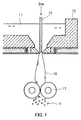
- the glass manufacturing apparatus shown in FIG. 1 can be used.
- This glass manufacturing apparatus includes a fireproof kiln 12, a blow nozzle 15, and a press roll 17.
- the glass substrate 11 melted in the refractory kiln 12 (melting tank) is inflated into a balloon shape by the gas fed into the blow nozzle 15 to become a hollow glass film 16.
- the hollow glass film 16 is pulverized by the pressing roll 17 to obtain the flaky glass substrate 1.
- the thickness of the flaky glass substrate 1 can be controlled by adjusting the tensile speed of the hollow glass film 16 and the flow rate of the gas fed from the blow nozzle 15.
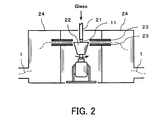
- the glass manufacturing apparatus shown in FIG. 2 can be used.
- the glass manufacturing apparatus includes a rotating cup 22, a pair of annular plates 23, and an annular cyclone collector 24.
- the molten glass substrate 11 is poured into the rotating cup 22, flows out radially from the upper edge of the rotating cup 22 by centrifugal force, is sucked by the air flow between the annular plates 23, and the annular cyclone collector 24.
- the glass While passing through the annular plate 23, the glass is cooled and solidified in the form of a thin film, and further crushed into fine pieces, whereby the flaky glass substrate 1 is obtained.
- the thickness of the flaky glass substrate 1 can be controlled by adjusting the interval between the annular plates 23, the speed of the air flow, and the like.
- composition of the flaky glass substrate a generally known glass composition can be used. Specifically, a glass with little alkali metal oxide such as E glass can be suitably used. A typical composition of E glass is shown below. The unit of the following composition is mass%.
- each content of B 2 O 3 , F, ZnO, BaO, SrO and ZrO 2 is less than 0.1% by mass (preferably less than 0.05% by mass, more preferably 0.03% by mass). Less).
- the average thickness and the average particle diameter of the flaky glass substrate are not particularly limited.
- a thin flaky glass base material has a larger aspect ratio (a value obtained by dividing the average particle diameter by the average thickness) as it becomes thinner, thus preventing the penetration of moisture and gas into the resin composition filled with the flaky glass.
- the average thickness and the average particle size can be determined from the balance of shielding effect, effect of reinforcing the resin molded product and effect of reducing the molding shrinkage, workability, technical difficulty, and product economics. Specifically, when producing flaky glass, it is possible to use the flaky glass having an average thickness of 7 ⁇ m or less and an aspect ratio of 50 or more.
- the average thickness is preferably 2.0 ⁇ m or less.
- the average thickness is preferably 0.1 ⁇ m or more.
- the average particle diameter is preferably 10 to 2000 ⁇ m in order to more effectively realize the reinforcing effect of the resin molded product.
- the average aspect ratio is preferably 2000 or less because of dispersibility in the resin.
- the average thickness of the flaky glass substrate means that 100 or more flaky glasses are extracted from the flaky glass substrate, and a scanning electron microscope (SEM) is used for these flaky glass substrates. It is a value obtained by measuring the thickness and dividing the total thickness by the number of sheets to be measured.
- the average particle size is a particle size (D50) corresponding to a cumulative mass percentage of 50% in the particle size distribution measured based on the laser diffraction scattering method.
- the binder that forms the coating film is as described above.
- (A) contains a lubricant (except silicone), or
- (B) contains a lubricant and aminosilane, One of them.
- the lubricant contained in the binder includes alkyl imidazoline derivatives (for example, formed by reaction of fatty acid with polyalkylene polyamine), fatty acid / polyethylene polyamine condensate, fatty acid with polyethylene imine and amide.
- alkyl imidazoline derivatives for example, formed by reaction of fatty acid with polyalkylene polyamine
- fatty acid / polyethylene polyamine condensate for example, fatty acid with polyethylene imine and amide.
- fatty acid / polyethylene polyamine condensate, polyethyleneimine polyamide, and paraffin are preferably used.
- silicone can be further included in addition to the above.
- aminosilane is a compound contained in the binder as a coupling agent described later.
- silicone can be used as a lubricant when the binder includes an aminosilane is believed to be as follows. Since silicone is mainly composed of siloxane bonds, it is relatively inferior to resins compared to hydrocarbon-based lubricants.
- the silane coupling agent is bonded to the resin through a functional group having high reactivity with the resin, and is also compatible with silicone.
- aminosilane is particularly highly reactive with the resin. Therefore, by including aminosilane in the binder, even if silicone is included as a lubricant, the fluidity improvement effect of the flake glass by the lubricant without reducing the interfacial adhesion between the coating film and the resin. It is considered that the mechanical strength of the resin molded product can be improved.
- the ratio of the lubricant contained in the binder is 30% by mass or less, and preferably 20% by mass or less. Further, the ratio of the lubricant contained in the binder is preferably 1% by mass or more, and more preferably 2% by mass or more. When the ratio of the lubricant is lower than 1% by mass, the effect of improving the fluidity of the resin composition (the effect of suppressing the decrease in fluidity of the resin composition due to the addition of the flaky glass) may be low. In addition, the effect of suppressing the strength reduction of the resin molded product is difficult to appear.
- the ratio of the lubricant when the ratio of the lubricant is higher than 30% by mass, the further improvement effect of the fluidity of the resin composition hardly appears, and the excessive lubricant inhibits the adhesion between the glass and the matrix resin, and the resin It may cause a decrease in strength of the molded product.
- the blending ratio of the lubricant in the binder is 1% by mass or more and 30% by mass or less, the fluidity of the resin composition is improved and the strength characteristics are improved when the flaky glass is blended with the resin. Cheap. As a result, a resin molded product having high strength and low shrinkage characteristics is easily realized.
- the binder granulates the flaky glass and reacts with the adhesive for increasing the affinity between the flaky glass and the matrix resin and / or the surface of the flaky glass substrate, so that the glass surface and the matrix are reacted.
- a coupling agent for increasing the affinity with the resin may be further included.
- the binder may further contain a surfactant.
- the adhesive is not particularly limited.
- the organic adhesive include methyl cellulose, carboxymethyl cellulose, starch, carboxymethyl starch, hydroxyethyl cellulose, hydroxypropyl cellulose, polyvinyl alcohol, acrylic resin, epoxy resin, phenol resin, vinyl acetate, and polyurethane resin.
- the inorganic adhesive include water glass, colloidal silica, and colloidal alumina.
- the coupling agent is not particularly limited.
- a silane coupling agent, a titanium coupling agent, an aluminum coupling agent, a zirconia coupling agent, etc. are illustrated, and a mixture thereof can also be used.
- the silane coupling agent for example, aminosilane can be used.
- aminosilane 3-aminopropyltrimethoxysilane, 3-aminopropyltriethoxysilane, N-2- (aminoethyl) -3-aminopropylmethyldimethoxysilane, N-2- (aminoethyl) -3-aminopropyl Trimethoxysilane, N-2- (aminoethyl) -3-aminopropyltriethoxysilane, N-phenyl-3-aminopropyltrimethoxysilane, 3-triethoxysilyl-N- (1,3-dimethyl-butylidene) And propylamine and hydrochloride of N- (vinylbenzyl) -2-aminoethyl-3-aminopropyltrimethoxysilane.
- Other silane coupling agents include 3-glycidoxypropyltrimethoxysilane, vinyltriethoxysilane, and 3-methacryl
- the method for producing the binder is not particularly limited.
- a solution containing a binder (binder solution) can be produced by appropriately adding each component such as a lubricant to a solvent at room temperature and atmospheric pressure and stirring until uniform.
- a coating film covering at least a part of the surface of the flaky glass substrate is prepared by adding a binder solution containing the binder to the flaky glass substrate, stirring and drying.
- a binder solution containing the binder is added to the flaky glass substrate, stirring and drying.
- the specific method for adding, stirring and drying the binder solution is not particularly limited, but examples thereof will be described below.
- a predetermined amount of a binder is added by spraying or the like while the flaky glass substrate is flowing, and mixed and stirred.
- the flaky glass substrate is dried while stirring in the mixer, or the flaky glass substrate is taken out from the mixer and dried.
- flaky glass can also be produced by using a rolling granulation method as described in JP-A-2-124732. That is, a flaky glass can also be produced by placing a flaky glass substrate in a horizontal vibration granulator equipped with stirring blades and spraying the binder solution for granulation.
- flaky glass can be produced by applying known methods generally called agitation granulation method, fluidized bed granulation method, spray granulation method, and rotary granulation method.
- the drying step is performed, for example, by heating the flaky glass substrate to a temperature equal to or higher than the boiling point of the solvent used in the binder solution and drying it until the solvent volatilizes.
- the content ratio of the coating film in the flake glass (adhesion rate of the binder in the flake glass) can be controlled by adjusting the concentration of the binder in the binder solution to be added or sprayed. That is, by adding or spraying a predetermined amount of binder solution to a predetermined amount of flaky glass base material so that the amount of the binder becomes a predetermined amount, the content ratio of the coating film made of the binder is a predetermined value. Can be produced.
- the content of the coating film is preferably 0.05 to 3% by mass, more preferably 0.2 to 2% by mass, and still more preferably 0.3 to 1% by mass.
- the content rate of a coating film is less than 0.05 mass%, a flake shaped glass base material cannot fully be coat
- the content rate of a coating film is larger than 3 mass%, gas may generate
- the content of the coating film exceeds 3% by mass, the bonding strength between the flaky glasses becomes too strong, and if the resin molding is insufficiently kneaded, the flaky glass becomes an agglomerated resin molded product. It may remain inside and cause a decrease in strength of the resin molded product. Furthermore, if the content of the coating film is larger than 3% by mass, the excessive components of the coating film will adversely inhibit the adhesion between the glass and the matrix resin, and good molded product characteristics cannot be obtained. There is.
- the resin composition of the present embodiment includes the flaky glass of the present embodiment as described above and a matrix resin.
- the matrix resin is not particularly limited.
- the flaky glass of the present embodiment can suppress a decrease in the fluidity of the resin composition due to the addition of the flaky glass, so that a resin having a high molecular weight can be used for the matrix resin. is there. Therefore, the resin composition of the present embodiment can impart high mechanical strength to the resin molded product by using a resin having a high molecular weight as the matrix resin.
- the content of flaky glass in the resin composition is preferably 5 to 70% by mass. By setting it as 5 mass% or more, the function as a reinforcing material of flake shaped glass can fully be exhibited. On the other hand, by setting it as 70 mass% or less, it becomes easy to disperse
- the resin composition may contain a reinforcing material other than the flaky glass such as glass fiber depending on the application.
- a reinforcing material other than the flaky glass such as glass fiber depending on the application.
- glass fibers of the same amount as that of flake glass may be mixed.
- the resin molded product produced using the resin composition of the present embodiment can obtain high tensile strength and bending strength due to the reinforcing effect of the flaky glass. Moreover, since the resin composition of this embodiment has a low mold shrinkage rate, a resin molded product having excellent dimensional stability can be obtained. Further, since the average thickness of the flaky glass contained in the resin composition of the present embodiment is smaller than the conventional one, according to the resin composition of the present embodiment, the molded product having a small surface roughness and a smooth surface. Can be obtained.
- a flaky glass substrate was produced by a blow method using E glass having the composition shown in Table 1. Specifically, E glass is put into a melting tank heated to 1200 ° C. or more to be melted, a nozzle is inserted into the melting tank, a thin glass is produced while air is blown from the nozzle, and the thin glass is continuously formed with a roller. Pulled out. The amount of air blown and the number of roller rotations were adjusted to obtain a glass having an average thickness of 0.7 ⁇ m. Then, grinding
- the binder solution contained a lubricant, an adhesive, and a silane coupling agent as a binder component (solid content) and water as a solvent.
- fatty acid / polyethylene polyamine condensate Sophon GW-18 manufactured by Toho Chemical Industry Co., Ltd.
- polyethyleneimine polyamide Pulcra Chemicals KATAX 6717L
- paraffin KEW J-200 manufactured by Kanei Sangyo Co., Ltd.
- a hydrogen group-containing silicone emulsion Poly MWS manufactured by Shin-Etsu Chemical Co., Ltd.
- polyurethane resin Imperil DLS manufactured by Sumika Bayer Urethane Co., Ltd.
- silane coupling agent 3-aminopropyltriethoxysilane (Silaace S330, manufactured by JNC Corporation) was used.
- the ratio of each component in the binder component of the binder solution used in Examples 1 to 8 is as shown in Table 3. Thereafter, the flaky glass (undried) was taken out from the mixer, and dried at 125 ° C. for 8 hours with a dryer to obtain flaky glasses of Examples 1 to 8.
- the adhesion rate of the binder in the obtained flaky glass was examined by an ignition loss method. Specifically, an appropriate amount of flaky glass was extracted from the obtained flaky glass, dried at 110 ° C., and then heated in an atmosphere of 625 ° C. to remove the binder from the surface of the flaky glass. From the difference between the mass of the flaky glass before heating and the mass of the flaky glass after heating, the adhesion rate of the binder in the flaky glass was calculated. The results are shown in Table 3.
- Comparative Example 2 The flakes of Comparative Example 2 were prepared in the same manner as in Examples 1 to 8, except that the binder solution did not contain a lubricant and each component (adhesive and silane coupling agent) in the binder solution was adjusted. Glass was obtained. The adhesion rate of the binder in the flaky glass was determined by the same method as that of the flaky glass of Examples 1 to 8.
- the content of flaky glass in the obtained resin molded product was 50% by mass.
- PA66 Similar CM3001-N, manufactured by Toray Industries, Inc.
- PA9T Kerray Genesta N1000A
- PPE Alignment Polyethylene
- molded product weight (normal) means the weight of the molded product when the injection speed of the injection molding machine is normal, and the normal injection speed is 100% of resin in the mold cavity.
- the flaky glass is blended because the binder contains a lubricant in the range of 30% by mass or less. Good results were also shown for ease of handling, the fluidity during molding was good, and the resin molded product showed high strength characteristics.
- the flaky glasses of Examples 1 to 7 in which the ratio of the lubricant contained in the binder is 1% by mass or more and 30% by mass or less show better results in terms of ease of blending, and further during molding. The resin molded product showed high strength characteristics.
- the evaluation score of ease of blending the flaky glass is 4 or more
- the filling rate of the resin molded product which is an evaluation of fluidity at the time of molding when polyamide is used as the matrix resin, was as high as 90% or more, and the tensile strength of the resin molded product was also high.
- Example 4 in which silicone was used as the lubricant, high strength characteristics of the resin molded product were obtained.
- the flaky glass of the present invention can realize both effective reinforcement and a good appearance of a resin molded product when mixed with a resin, it can be applied to various applications.
- the flaky glass of the present invention and the resin composition containing the flaky glass are preferably used in the fields of automobiles, electric / electronic parts and the like.
Landscapes
- Chemical & Material Sciences (AREA)
- Organic Chemistry (AREA)
- Chemical Kinetics & Catalysis (AREA)
- Medicinal Chemistry (AREA)
- Polymers & Plastics (AREA)
- Health & Medical Sciences (AREA)
- Engineering & Computer Science (AREA)
- Life Sciences & Earth Sciences (AREA)
- Geochemistry & Mineralogy (AREA)
- Materials Engineering (AREA)
- General Chemical & Material Sciences (AREA)
- Manufacturing & Machinery (AREA)
- General Life Sciences & Earth Sciences (AREA)
- Compositions Of Macromolecular Compounds (AREA)
- Surface Treatment Of Glass (AREA)
- Laminated Bodies (AREA)
Abstract
Priority Applications (4)
| Application Number | Priority Date | Filing Date | Title |
|---|---|---|---|
| US16/075,523 US11008459B2 (en) | 2016-02-18 | 2017-02-08 | Glass flakes and resin composition |
| EP17753050.8A EP3418260B1 (fr) | 2016-02-18 | 2017-02-08 | Verre en paillettes et composition de résine |
| JP2018500064A JP6838042B2 (ja) | 2016-02-18 | 2017-02-08 | フレーク状ガラス及び樹脂組成物 |
| CN201780012057.5A CN108698919B (zh) | 2016-02-18 | 2017-02-08 | 片状玻璃和树脂组合物 |
Applications Claiming Priority (2)
| Application Number | Priority Date | Filing Date | Title |
|---|---|---|---|
| JP2016028891 | 2016-02-18 | ||
| JP2016-028891 | 2016-02-18 |
Publications (1)
| Publication Number | Publication Date |
|---|---|
| WO2017141792A1 true WO2017141792A1 (fr) | 2017-08-24 |
Family
ID=59626080
Family Applications (1)
| Application Number | Title | Priority Date | Filing Date |
|---|---|---|---|
| PCT/JP2017/004608 Ceased WO2017141792A1 (fr) | 2016-02-18 | 2017-02-08 | Verre en paillettes et composition de résine |
Country Status (5)
| Country | Link |
|---|---|
| US (1) | US11008459B2 (fr) |
| EP (1) | EP3418260B1 (fr) |
| JP (1) | JP6838042B2 (fr) |
| CN (1) | CN108698919B (fr) |
| WO (1) | WO2017141792A1 (fr) |
Cited By (2)
| Publication number | Priority date | Publication date | Assignee | Title |
|---|---|---|---|---|
| JP2021178976A (ja) * | 2017-10-03 | 2021-11-18 | 三菱エンジニアリングプラスチックス株式会社 | 熱可塑性樹脂組成物、樹脂成形品、メッキ付樹脂成形品の製造方法および携帯電子機器部品の製造方法 |
| JP2022153333A (ja) * | 2021-03-29 | 2022-10-12 | エボニック オペレーションズ ゲーエムベーハー | ポリウレタン水性分散液におけるポリアミンおよび/またはポリアルカノールアミンベースのカルボン酸誘導体の使用 |
Families Citing this family (1)
| Publication number | Priority date | Publication date | Assignee | Title |
|---|---|---|---|---|
| CN109399952B (zh) * | 2018-09-26 | 2021-09-21 | 西安建筑科技大学 | 一种金属-非金属中空Janus颗粒的制备方法 |
Citations (7)
| Publication number | Priority date | Publication date | Assignee | Title |
|---|---|---|---|---|
| JP2004011036A (ja) * | 2002-06-04 | 2004-01-15 | Nippon Sheet Glass Co Ltd | 集束剤、ガラス繊維、ガラスフレークおよび熱可塑性樹脂組成物 |
| WO2008133042A1 (fr) * | 2007-04-25 | 2008-11-06 | Nippon Sheet Glass Company, Limited | Verre en paillettes et préparation cosmétique dans laquelle est mélangé du verre en paillettes |
| JP2010269995A (ja) * | 2009-04-22 | 2010-12-02 | Asahi Kasei Chemicals Corp | ガラス繊維集束剤及びガラス繊維強化熱可塑性樹脂組成物 |
| JP2010270326A (ja) * | 2009-04-22 | 2010-12-02 | Asahi Kasei Chemicals Corp | ガラス繊維強化ポリアミド樹脂組成物及び成形体 |
| WO2012026127A1 (fr) * | 2010-08-26 | 2012-03-01 | 日本板硝子株式会社 | Composition de résine et verre feuilleté granulaire |
| WO2012096182A1 (fr) * | 2011-01-14 | 2012-07-19 | 日本板硝子株式会社 | Flocon de verre et cosmétiques comprenant celui-ci |
| WO2013121756A1 (fr) * | 2012-02-16 | 2013-08-22 | 日本板硝子株式会社 | Granulés de verre floconneux et composition de résine les utilisant |
Family Cites Families (13)
| Publication number | Priority date | Publication date | Assignee | Title |
|---|---|---|---|---|
| US3257184A (en) | 1961-02-04 | 1966-06-21 | Owens Corning Fiberglass Corp | Apparatus and method for producing flake glass |
| JPS5921533A (ja) | 1982-07-29 | 1984-02-03 | Asahi Glass Co Ltd | ガラス薄片の製造方法 |
| JPH06104758B2 (ja) | 1985-11-08 | 1994-12-21 | 旭化成工業株式会社 | 射出成形用熱可塑性樹脂組成物 |
| GB8709608D0 (en) | 1987-04-23 | 1987-05-28 | Corrocoat Ltd | Forming glass flakes |
| JPH02124732A (ja) | 1988-10-31 | 1990-05-14 | Nippon Glass Fiber Co Ltd | 顆粒状のフレーク状ガラスの製造方法 |
| KR100971686B1 (ko) * | 2002-04-23 | 2010-07-22 | 도레이 카부시키가이샤 | 프리프레그, 그 제조방법 및 성형품 |
| US8383531B2 (en) | 2004-12-24 | 2013-02-26 | Nippon Sheet Glass Company, Limited | Glass flake |
| CN101405333B (zh) * | 2006-03-24 | 2011-08-31 | 日本板硝子株式会社 | 薄片状玻璃填料及含有它的树脂组合物 |
| US20110230615A1 (en) * | 2007-11-08 | 2011-09-22 | Van Der Woude Jacobus Hendricus Antonius | Fiber Glass Strands And Reinforced Products Comprising The Same |
| KR101680253B1 (ko) * | 2010-07-27 | 2016-11-29 | 삼성디스플레이 주식회사 | 정전용량 터치패널용 스타일러스펜 |
| US8962735B2 (en) * | 2011-12-22 | 2015-02-24 | Johns Manville | Methods of making reactive fiber/flake prepregs and reactive prepregs |
| JP5869893B2 (ja) * | 2012-01-24 | 2016-02-24 | 株式会社Adeka | 水系ポリウレタン樹脂組成物を含有するガラス繊維集束剤、繊維強化樹脂用ガラス繊維及び繊維強化合成樹脂組成物 |
| US20140080951A1 (en) * | 2012-09-19 | 2014-03-20 | Chandrashekar Raman | Thermally conductive plastic compositions, extrusion apparatus and methods for making thermally conductive plastics |
-
2017
- 2017-02-08 US US16/075,523 patent/US11008459B2/en not_active Expired - Fee Related
- 2017-02-08 EP EP17753050.8A patent/EP3418260B1/fr not_active Not-in-force
- 2017-02-08 WO PCT/JP2017/004608 patent/WO2017141792A1/fr not_active Ceased
- 2017-02-08 JP JP2018500064A patent/JP6838042B2/ja active Active
- 2017-02-08 CN CN201780012057.5A patent/CN108698919B/zh not_active Expired - Fee Related
Patent Citations (7)
| Publication number | Priority date | Publication date | Assignee | Title |
|---|---|---|---|---|
| JP2004011036A (ja) * | 2002-06-04 | 2004-01-15 | Nippon Sheet Glass Co Ltd | 集束剤、ガラス繊維、ガラスフレークおよび熱可塑性樹脂組成物 |
| WO2008133042A1 (fr) * | 2007-04-25 | 2008-11-06 | Nippon Sheet Glass Company, Limited | Verre en paillettes et préparation cosmétique dans laquelle est mélangé du verre en paillettes |
| JP2010269995A (ja) * | 2009-04-22 | 2010-12-02 | Asahi Kasei Chemicals Corp | ガラス繊維集束剤及びガラス繊維強化熱可塑性樹脂組成物 |
| JP2010270326A (ja) * | 2009-04-22 | 2010-12-02 | Asahi Kasei Chemicals Corp | ガラス繊維強化ポリアミド樹脂組成物及び成形体 |
| WO2012026127A1 (fr) * | 2010-08-26 | 2012-03-01 | 日本板硝子株式会社 | Composition de résine et verre feuilleté granulaire |
| WO2012096182A1 (fr) * | 2011-01-14 | 2012-07-19 | 日本板硝子株式会社 | Flocon de verre et cosmétiques comprenant celui-ci |
| WO2013121756A1 (fr) * | 2012-02-16 | 2013-08-22 | 日本板硝子株式会社 | Granulés de verre floconneux et composition de résine les utilisant |
Non-Patent Citations (1)
| Title |
|---|
| See also references of EP3418260A4 * |
Cited By (3)
| Publication number | Priority date | Publication date | Assignee | Title |
|---|---|---|---|---|
| JP2021178976A (ja) * | 2017-10-03 | 2021-11-18 | 三菱エンジニアリングプラスチックス株式会社 | 熱可塑性樹脂組成物、樹脂成形品、メッキ付樹脂成形品の製造方法および携帯電子機器部品の製造方法 |
| JP7305094B2 (ja) | 2017-10-03 | 2023-07-10 | グローバルポリアセタール株式会社 | 熱可塑性樹脂組成物、樹脂成形品、メッキ付樹脂成形品の製造方法および携帯電子機器部品の製造方法 |
| JP2022153333A (ja) * | 2021-03-29 | 2022-10-12 | エボニック オペレーションズ ゲーエムベーハー | ポリウレタン水性分散液におけるポリアミンおよび/またはポリアルカノールアミンベースのカルボン酸誘導体の使用 |
Also Published As
| Publication number | Publication date |
|---|---|
| EP3418260B1 (fr) | 2021-09-22 |
| US20190040255A1 (en) | 2019-02-07 |
| JPWO2017141792A1 (ja) | 2018-12-13 |
| EP3418260A1 (fr) | 2018-12-26 |
| CN108698919B (zh) | 2022-09-13 |
| JP6838042B2 (ja) | 2021-03-03 |
| CN108698919A (zh) | 2018-10-23 |
| EP3418260A4 (fr) | 2019-11-13 |
| US11008459B2 (en) | 2021-05-18 |
Similar Documents
| Publication | Publication Date | Title |
|---|---|---|
| JP4320372B2 (ja) | ガラス含有成形用ペレット及びその製造方法 | |
| JP6152086B2 (ja) | 顆粒フレーク状ガラス及びそれを用いた樹脂組成物 | |
| EP3330321B1 (fr) | Composition de résine et de verre en forme de paillettes | |
| JP6634085B2 (ja) | フレーク状ガラス及び樹脂組成物 | |
| TW200838946A (en) | Carbon black pellets and method of forming same | |
| JP6838042B2 (ja) | フレーク状ガラス及び樹脂組成物 | |
| CN109986725A (zh) | 一种脱模剂及其制造方法及使用其的滚塑工艺 | |
| JP7001609B2 (ja) | フレーク状ガラス及び樹脂組成物 | |
| JP5858916B2 (ja) | 樹脂組成物 | |
| CN112760012A (zh) | 一种金属表面涂层组合物及其制备方法、喷涂方法与应用 | |
| WO2017204039A1 (fr) | Flocons de verre et composition de résine | |
| WO2007020855A1 (fr) | Procédé de production de particules inorganiques sphériques | |
| JP5350262B2 (ja) | 顆粒フレーク状ガラスの製造方法、並びに顆粒フレーク状ガラス及びそれを用いた樹脂組成物 | |
| JP6054587B1 (ja) | フレーク状ガラス及び樹脂組成物 | |
| WO2018221313A1 (fr) | Flocons de verre et composition de résine | |
| JP4718015B2 (ja) | 熱可塑性樹脂組成物の製造方法 | |
| JP2017128839A (ja) | 補強材及び樹脂成形品 | |
| JPWO2000063278A1 (ja) | 熱可塑性樹脂組成物の製造方法及び熱可塑性樹脂組成物 | |
| JPWO2017204039A1 (ja) | フレーク状ガラス及び樹脂組成物 | |
| JP2002220783A (ja) | 集束剤、ガラス繊維、ガラスフレーク及びフェノール樹脂組成物 |
Legal Events
| Date | Code | Title | Description |
|---|---|---|---|
| 121 | Ep: the epo has been informed by wipo that ep was designated in this application |
Ref document number: 17753050 Country of ref document: EP Kind code of ref document: A1 |
|
| WWE | Wipo information: entry into national phase |
Ref document number: 2018500064 Country of ref document: JP |
|
| NENP | Non-entry into the national phase |
Ref country code: DE |
|
| WWE | Wipo information: entry into national phase |
Ref document number: 2017753050 Country of ref document: EP |
|
| ENP | Entry into the national phase |
Ref document number: 2017753050 Country of ref document: EP Effective date: 20180918 |