WO2017142012A1 - 洗浄剤組成物 - Google Patents
洗浄剤組成物 Download PDFInfo
- Publication number
- WO2017142012A1 WO2017142012A1 PCT/JP2017/005689 JP2017005689W WO2017142012A1 WO 2017142012 A1 WO2017142012 A1 WO 2017142012A1 JP 2017005689 W JP2017005689 W JP 2017005689W WO 2017142012 A1 WO2017142012 A1 WO 2017142012A1
- Authority
- WO
- WIPO (PCT)
- Prior art keywords
- component
- mass
- group
- carbon atoms
- cleaning composition
- Prior art date
- Legal status (The legal status is an assumption and is not a legal conclusion. Google has not performed a legal analysis and makes no representation as to the accuracy of the status listed.)
- Ceased
Links
Classifications
-
- C—CHEMISTRY; METALLURGY
- C11—ANIMAL OR VEGETABLE OILS, FATS, FATTY SUBSTANCES OR WAXES; FATTY ACIDS THEREFROM; DETERGENTS; CANDLES
- C11D—DETERGENT COMPOSITIONS; USE OF SINGLE SUBSTANCES AS DETERGENTS; SOAP OR SOAP-MAKING; RESIN SOAPS; RECOVERY OF GLYCEROL
- C11D1/00—Detergent compositions based essentially on surface-active compounds; Use of these compounds as a detergent
- C11D1/66—Non-ionic compounds
- C11D1/74—Carboxylates or sulfonates esters of polyoxyalkylene glycols
-
- C—CHEMISTRY; METALLURGY
- C11—ANIMAL OR VEGETABLE OILS, FATS, FATTY SUBSTANCES OR WAXES; FATTY ACIDS THEREFROM; DETERGENTS; CANDLES
- C11D—DETERGENT COMPOSITIONS; USE OF SINGLE SUBSTANCES AS DETERGENTS; SOAP OR SOAP-MAKING; RESIN SOAPS; RECOVERY OF GLYCEROL
- C11D3/00—Other compounding ingredients of detergent compositions covered in group C11D1/00
- C11D3/16—Organic compounds
- C11D3/37—Polymers
- C11D3/3703—Macromolecular compounds obtained otherwise than by reactions only involving carbon-to-carbon unsaturated bonds
- C11D3/3723—Polyamines or polyalkyleneimines
-
- C—CHEMISTRY; METALLURGY
- C11—ANIMAL OR VEGETABLE OILS, FATS, FATTY SUBSTANCES OR WAXES; FATTY ACIDS THEREFROM; DETERGENTS; CANDLES
- C11D—DETERGENT COMPOSITIONS; USE OF SINGLE SUBSTANCES AS DETERGENTS; SOAP OR SOAP-MAKING; RESIN SOAPS; RECOVERY OF GLYCEROL
- C11D1/00—Detergent compositions based essentially on surface-active compounds; Use of these compounds as a detergent
- C11D1/66—Non-ionic compounds
- C11D1/83—Mixtures of non-ionic with anionic compounds
-
- C—CHEMISTRY; METALLURGY
- C11—ANIMAL OR VEGETABLE OILS, FATS, FATTY SUBSTANCES OR WAXES; FATTY ACIDS THEREFROM; DETERGENTS; CANDLES
- C11D—DETERGENT COMPOSITIONS; USE OF SINGLE SUBSTANCES AS DETERGENTS; SOAP OR SOAP-MAKING; RESIN SOAPS; RECOVERY OF GLYCEROL
- C11D3/00—Other compounding ingredients of detergent compositions covered in group C11D1/00
- C11D3/16—Organic compounds
- C11D3/37—Polymers
-
- C—CHEMISTRY; METALLURGY
- C11—ANIMAL OR VEGETABLE OILS, FATS, FATTY SUBSTANCES OR WAXES; FATTY ACIDS THEREFROM; DETERGENTS; CANDLES
- C11D—DETERGENT COMPOSITIONS; USE OF SINGLE SUBSTANCES AS DETERGENTS; SOAP OR SOAP-MAKING; RESIN SOAPS; RECOVERY OF GLYCEROL
- C11D3/00—Other compounding ingredients of detergent compositions covered in group C11D1/00
- C11D3/16—Organic compounds
- C11D3/38—Products with no well-defined composition, e.g. natural products
- C11D3/386—Preparations containing enzymes, e.g. protease or amylase
-
- C—CHEMISTRY; METALLURGY
- C11—ANIMAL OR VEGETABLE OILS, FATS, FATTY SUBSTANCES OR WAXES; FATTY ACIDS THEREFROM; DETERGENTS; CANDLES
- C11D—DETERGENT COMPOSITIONS; USE OF SINGLE SUBSTANCES AS DETERGENTS; SOAP OR SOAP-MAKING; RESIN SOAPS; RECOVERY OF GLYCEROL
- C11D3/00—Other compounding ingredients of detergent compositions covered in group C11D1/00
- C11D3/50—Perfumes
Definitions
- the present invention relates to a cleaning composition.
- This application claims priority based on Japanese Patent Application No. 2016-027293 filed in Japan on February 16, 2016, the contents of which are incorporated herein by reference.
- Patent Document 1 discloses a perfume delivery system suitable for delivering a perfume to the surface using a composition containing polyethyleneimine and a perfume.
- the present invention has been made in view of the above circumstances, and relates to a cleaning composition having a high residual fragrance. Furthermore, the present invention is also excellent in recontamination prevention performance (performance for preventing dirt from re-adhering to an object to be washed).
- this invention has the following aspects.
- the cleaning composition whose mass ratio represented by a component (B1) / component (B2) is 1.0 or more.
- the component (B1) contains a fatty acid methyl ester ethoxylate
- the detergent composition according to [1] wherein the content of the fatty acid methyl ester ethoxylate is 10% by mass or more based on the total mass of the component (B).
- component (D) containing a polymer having at least one repeating unit (d1) selected from the group consisting of an alkylene terephthalate unit and an alkylene isophthalate unit and an oxyalkylene unit (d2) [1] or The cleaning composition according to [2].
- component (E) at least one selected from carboxylic acids represented by the following general formula (VII) and salts thereof
- component (F) an enzyme containing [1] to [3] The cleaning composition according to any one of the above.
- R 1 is a divalent hydrocarbon group having 1 to 4 carbon atoms or an arylene group
- X is —H, —OH, —CH 3 , or —COOH.
- the cleaning composition of the present invention contains the following components (A) to (C).
- Component (A) is an alkylene oxide adduct of polyalkyleneamine.
- Examples of the component (A) include the following component (a1) and component (a2).
- Component (a1) is an alkylene oxide adduct of polyalkyleneimine.
- the polyalkyleneimine of component (a1) is represented by the following general formula (I), for example. NH 2 —R 21 — (NA—R 21 ) n —NH 2 (I)
- R 21 each independently represents an alkylene group having 2 to 6 carbon atoms
- A represents a hydrogen atom or another polyamine chain by branching
- n is an integer of 1 or more.
- the polyalkyleneimine represented by the formula (I) has a polyamine chain branched in the structure.
- R 21 is a linear alkylene group having 2 to 6 carbon atoms or a branched alkylene group having 3 to 6 carbon atoms.
- R 21 is preferably an alkylene group having 2 to 4 carbon atoms, more preferably an alkylene group having 2 carbon atoms.
- the polyalkyleneimine can be obtained by polymerizing one or more alkyleneimines having 2 to 6 carbon atoms by a conventional method. Examples of the alkyleneimine having 2 to 6 carbon atoms include ethyleneimine, propyleneimine, 1,2-butyleneimine, 2,3-butyleneimine, 1,1-dimethylethyleneimine and the like.
- polyethyleneimine (hereinafter also referred to as “PEI”) (in formula (I), R 21 represents an ethylene group), polypropyleneimine (in formula (I), R 21 represents a propylene group) Is preferred, and PEI is more preferred.
- PEI is obtained by polymerizing ethyleneimine and has a branched chain structure containing primary, secondary and tertiary amine nitrogen atoms in the structure. n is an integer of 1 or more.
- the mass average molecular weight of the polyalkyleneimine is preferably 200 to 2000, more preferably 300 to 1500, still more preferably 400 to 1000, and particularly preferably 500 to 800.
- active hydrogen means a highly reactive hydrogen atom, specifically, a hydrogen atom bonded to a nitrogen atom.
- Component (a1) is obtained by adding an alkylene oxide to a polyalkyleneimine.
- an alkylene oxide such as ethylene oxide is added to the starting polyalkyleneimine at 100 to 180 ° C. in the presence of a basic catalyst such as sodium hydroxide, potassium hydroxide or sodium methylate.
- a basic catalyst such as sodium hydroxide, potassium hydroxide or sodium methylate.
- the alkylene oxide include alkylene oxides having 2 to 4 carbon atoms.
- Examples of the alkylene oxide include ethylene oxide, propylene oxide, and butylene oxide. Ethylene oxide and propylene oxide are preferable, and ethylene oxide is more preferable.
- Examples of the component (a1) include polyalkyleneimine ethylene oxide adducts, polyalkyleneimine propylene oxide adducts, and polyalkyleneimine ethylene oxide-propylene oxide adducts.
- the ethylene oxide-propylene oxide adduct of polyalkyleneimine is obtained by adding ethylene oxide and propylene oxide to polyalkyleneimine.
- the addition order and addition form of ethylene oxide and propylene oxide with respect to polyalkyleneimine (block shape, random shape) ) Is optional.
- an ethylene oxide adduct of polyalkyleneimine and an ethylene oxide-propylene oxide adduct of polyalkyleneimine are preferable, and an ethylene oxide adduct of polyalkyleneimine is more preferable.
- an average of 5 to 40 alkylene oxides are preferably added to one active hydrogen atom of the starting polyalkyleneimine, and an average of 10 to 30 alkylene oxides are added. Those are more preferred. That is, an average of 5 to 40 moles of alkylene oxide is preferably added per mole of active hydrogen contained in the starting polyalkyleneimine, and an average of 10 to 30 moles of alkylene oxide is more preferable.
- the mass average molecular weight of the component (a1) is preferably 1000 to 80000, more preferably 2000 to 50000, still more preferably 5000 to 30000, and particularly preferably 10,000 to 20000.
- a mass average molecular weight shows the value which converted the value measured by GPC (gel permeation chromatography) using THF (tetrahydrofuran) as a solvent based on the calibration curve in PEG (polyethylene glycol).
- Examples of the component (a1) include compounds represented by the formula (Ia).
- R 22 is each independently an alkylene group having 2 to 6 carbon atoms, and m is each independently a number of 1 or more.
- R 22 is preferably an alkylene group having 2 or 3 carbon atoms, and more preferably an alkylene group having 2 carbon atoms.
- m is the average number of repetitions of (R 22 O), preferably 5 to 40, and more preferably 10 to 30.
- in — (R 22 O) m —H, —R 22 O— may be bonded randomly or in a block form.
- a synthetic product may be used, or a commercially available product may be used.
- the brand name "Sokalan HP20" by BASF, etc. are mentioned, for example.
- Component (a2) is an alkylene oxide adduct of a polyalkyleneamine represented by the following formula (II). NH 2 (R 31 NH) 1 H (II) In the formula (II), R 31 is an alkylene group having 2 to 6 carbon atoms, and l is a number of 1 or more.
- R 31 is a linear alkylene group having 2 to 6 carbon atoms or a branched alkylene group having 3 to 6 carbon atoms.
- R 31 is preferably an alkylene group having 2 to 4 carbon atoms, and more preferably an alkylene group having 2 carbon atoms.
- polyethyleneamine is preferable. Examples of polyethyleneamine include ethylenediamine, diethylenetriamine, triethylenetetramine, tetraethylenepentamine, and pentaethylenehexamine. These polyethyleneamines can be obtained by a known production method, for example, by reacting ammonia and ethylene dichloride. l is a number of 1 or more.
- the mass average molecular weight of the polyalkyleneamine is preferably 60 to 1800, more preferably 60 to 1000, and still more preferably 60 to 800.
- polyalkyleneamine those having 6 to 30 active hydrogens in one molecule are preferable, and those having 7 to 20 active hydrogens are more preferable.
- Component (a2) is obtained by adding alkylene oxide to polyalkyleneamine. This reaction can be carried out in the same manner as component (a1).
- alkylene oxide include alkylene oxides having 2 to 4 carbon atoms.
- alkylene oxide include ethylene oxide, propylene oxide, and butylene oxide. Ethylene oxide and propylene oxide are preferable, and ethylene oxide is more preferable.
- component (a2) examples include polyalkyleneamine ethylene oxide adducts, polyalkyleneamine propylene oxide adducts, polyalkyleneamine ethylene oxide-propylene oxide adducts, and the like.
- alkylene oxide adduct of polyalkylene amine an ethylene oxide adduct of polyalkylene amine and an ethylene oxide-propylene oxide adduct of polyalkylene amine are preferable, and an ethylene oxide adduct of polyalkylene amine is more preferable.
- an average of 5 to 40 alkylene oxides are preferably added to an active hydrogen atom of the polyalkyleneamine as a raw material, and an average of 10 to 30 alkylene oxides are added. Those are more preferred. That is, an average of 5 to 40 moles of alkylene oxide is added per mole of active hydrogen of the polyalkyleneamine as a raw material, and an average of 10 to 30 moles of alkylene oxide is more preferable.
- the mass average molecular weight of the component (a2) is preferably 1000 to 80000, more preferably 2000 to 50000, still more preferably 5000 to 30000, and particularly preferably 10,000 to 20000.
- Component (A1) is preferred as component (A).
- component (A) an ethylene oxide adduct of polyethyleneimine represented by the formula (Ia) is particularly preferable.
- the component (A) one type may be used alone, or two or more types may be used in combination.
- the content of the component (A) is preferably 0.01 to 5% by mass, preferably 0.05 to 3% by mass, and more preferably 0.1 to 2% by mass with respect to the total mass of the cleaning composition. If content of a component (A) is below the said upper limit, it will become easy to maintain the freedom degree of a mixing
- Component (B) is a surfactant containing a nonionic surfactant (hereinafter also referred to as component (B1)) and an anionic surfactant (hereinafter also referred to as component (B2)).
- component (B1) is a nonionic surfactant.
- the component (B1) include the following (1) to (8). (1) An average of 3 to 30 moles, preferably 3 to 20 moles, more preferably 5 to 20 moles of an alkylene oxide having 2 to 4 carbon atoms to a monovalent aliphatic alcohol having 6 to 22 carbon atoms, preferably 8 to 18 carbon atoms. Added polyoxyalkylene alkyl (or alkenyl) ether.
- polyoxyethylene alkyl (or alkenyl) ether and polyoxyethylene polyoxypropylene alkyl (or alkenyl) ether are preferable.
- the monohydric aliphatic alcohol used here include primary alcohols and secondary alcohols.
- the alkyl group may have a branched chain.
- a primary alcohol is preferable.
- Polyoxyethylene sorbitan fatty acid ester (5) Polyoxyethylene sorbite fatty acid ester. (6) Polyoxyethylene fatty acid ester. (7) Polyoxyethylene hydrogenated castor oil. (8) Glycerin fatty acid ester.
- R 2 is a hydrocarbon group having 7 to 22 carbon atoms
- R 3 is an alkyl group having 1 to 6 carbon atoms
- s represents the average number of repeating EO
- t represents the average number of repetitions of PO and is a number from 0 to 6
- u represents the average number of repetitions of EO
- PO is Represents an oxypropylene group.
- R 4 is a hydrocarbon having 6 to 22 carbon atoms
- v represents an average number of repetitions of EO
- w represents an average number of repetitions of PO
- x represents the average number of repetitions of EO
- EO represents an oxyethylene group
- PO represents an oxypropylene group.
- R 2 is a hydrocarbon group having 7 to 22 carbon atoms.
- the carbon number of R 2 is preferably 9 to 21, and more preferably 11 to 21.
- R 2 is preferably an alkyl group or an alkenyl group.
- R 2 may be linear or branched. From the viewpoint of further improving detergency, R 2 is preferably a linear or branched alkyl group having 7 to 22 carbon atoms, or a linear or branched chain alkenyl group having 7 to 22 carbon atoms.
- R 3 is an alkyl group having 1 to 6 carbon atoms and may be linear or branched. Of these, a methyl group and an ethyl group are preferable.
- s and u are each independently a number representing the average number of repetitions of EO.
- s + u is preferably 6 to 20, more preferably 6 to 18, still more preferably 11 to 18, and particularly preferably 14 to 18. If it is more than the said lower limit, liquid stability will become easy to improve more. If it is below the said upper limit, cleaning power will improve more easily.
- t is a number representing the average number of repetitions of PO. t is a number from 0 to 6, preferably 0 to 3, and more preferably 0. If it is below the said upper limit, liquid stability will improve more easily.
- the oxyethylene group and the oxypropylene group may be bonded in a random manner or in a block shape.
- the average number of repetitions can be measured by gas chromatography or the like.
- R 4 is a hydrocarbon group having 6 to 22 carbon atoms.
- the carbon number of R 4 is preferably 10 to 22, more preferably 10 to 20, and further preferably 10 to 18 from the viewpoint of further improving the detergency.
- R 4 may be linear or branched.
- Preferable R 4 —O— includes a group represented by the following general formula (V).
- R 101 and R 102 each independently represent a hydrogen atom or a chain hydrocarbon group, and the total number of carbon atoms of R 101 and R 102 is 5 to 21.
- the total number of carbon atoms of R 101 and R 102 is preferably 9 to 21, more preferably 9 to 19, and still more preferably 9 to 17.
- R 101 and R 102 may be linear or branched.
- R 4 is preferably an alkyl group derived from a secondary alcohol having 12 to 14 carbon atoms.
- v and x are numbers independently representing the average number of repetitions of EO.
- v + x is preferably from 3 to 20, more preferably from 5 to 18, even more preferably from 6 to 18, even more preferably from 11 to 18, and even more preferably from 14 to 18. If it is more than the said lower limit, liquid stability will become easy to improve more. If it is below the said upper limit, cleaning power will improve more easily.
- w is a number representing the average number of repetitions of PO. w is a number from 0 to 6, preferably 0 to 3, and more preferably 0. If it is below the said upper limit, liquid stability will improve more easily.
- w is 1 or more, in [(EO) v / (PO) w ], the oxyethylene group and the oxypropylene group may be bonded randomly or in a block form.
- the distribution of EO or PO in the formula (III) varies depending on the reaction method in production. For example, when ethylene oxide or propylene oxide is added to a raw material using sodium hydroxide, potassium hydroxide, or the like, which is a general alkali catalyst, the distribution of v or w becomes relatively wide.
- a specific alkoxylation catalyst such as magnesium oxide to which metal ions such as Al 3+ , Ga 3+ , In 3+ , Tl 3+ , Co 3+ , Sc 3+ , La 3+ , Mn 2+ and the like described in JP-B-6-15038 is added.
- metal ions such as Al 3+ , Ga 3+ , In 3+ , Tl 3+ , Co 3+ , Sc 3+ , La 3+ , Mn 2+ and the like described in JP-B-6-15038 is added.
- ethylene oxide or propylene oxide is added to the raw material, the distribution of v or w becomes relatively narrow.
- the nonionic surfactant represented by formula (III) (hereinafter also referred to as component (b11)) and the nonionic surfactant represented by formula (IV) (hereinafter also referred to as component (b12)) have a narrow rate. Is preferably 20% by mass or more, and more preferably 25% by mass or more. The higher the narrow rate, the better the cleaning power. Further, when the narrow ratio is 20% by mass or more, particularly 25% by mass or more, a detergent composition having a low raw material odor for the surfactant is easily obtained.
- component (b11) When component (b11) is produced by a conventional method, in the product, together with component (b11), a component that does not contribute to detergency, for example, a fatty acid ester that is a raw material of component (b11), or a formula (III)
- a component that does not contribute to detergency for example, a fatty acid ester that is a raw material of component (b11), or a formula (III)
- the nonionic surfactant s with an ethylene oxide adduct having s of 1 or 2 coexists to reduce the narrow rate. For this reason, if the narrow ratio is high, the coexisting components are sufficiently small, and the problem of reduced cleaning power and raw material odor hardly occurs.
- the component (b12) Although it does not specifically limit as an upper limit of the said narrow rate, It is preferable that it is 80 mass% or less substantially.
- the narrow ratio is more preferably 20 to 50% by mass and further preferably 20 to 40% by mass in order to improve liquid stability and solubility.
- the “narrow ratio” indicates a distribution ratio of ethylene oxide adducts having different EO addition mole numbers, and is represented by the following formula (S).
- p max represents the number of moles of EO added to the ethylene oxide adduct most present in the entire ethylene oxide adduct.
- i represents the number of moles of EO added.
- Yi represents the ratio (% by mass) of the ethylene oxide adduct present in the entire ethylene oxide adduct, where the number of moles of EO added is i. ]
- the narrow rate can be controlled by, for example, the production method of the component (b11) or the component (b12).
- the production method of component (b11) is not particularly limited, but for example, a method in which ethylene oxide is addition-polymerized to a fatty acid alkyl ester using a surface-modified composite metal oxide catalyst (JP 2000-144179 A). Can be easily manufactured.
- the component (b12) can be produced, for example, by a method in which ethylene oxide is addition-polymerized to an alcohol having 6 to 22 carbon atoms using a surface-modified composite metal oxide catalyst.
- suitable surface-modified composite metal oxide catalysts used in such a method include metal ions (Al 3+ , Ga 3+ , In 3+ , Tl 3+ , Co 3+ , Sc 3+ , La 3+ , Mn 2+, etc.) are added to the composite metal oxide catalyst such as magnesium oxide and the hydrotalcite surface-modified with metal hydroxide and / or metal alkoxide.
- metal ions Al 3+ , Ga 3+ , In 3+ , Tl 3+ , Co 3+ , Sc 3+ , La 3+ , Mn 2+, etc.
- a calcined product catalyst is mentioned.
- the proportion of the metal hydroxide and / or metal alkoxide is preferably 0.5 to 10 parts by mass, more preferably 1 to 5 parts by mass with respect to 100 parts by mass of the composite metal oxide.
- a method for producing the component (b11) there is a method of adding an alkylene oxide to a fatty acid alkyl ester with an alkoxylation catalyst prepared from a mixture of an alkaline earth metal compound and oxyacid.
- the above alkoxylation catalyst is disclosed in Japanese Patent No. 04977609, WO1993004030, WO2002028269, WO201220435, and the like, for example, alkaline earth metal salts of carboxylic acids and / or hydroxycarboxylic acids.
- nonionic surfactant a commercially available product may be used, or a nonionic surfactant manufactured by a known synthesis method may be used.
- component (b11) can be produced, for example, by a method of addition polymerization of ethylene oxide and / or propylene oxide to a fatty acid alkyl ester.
- component (b12) can be produced, for example, by a method of addition polymerization of ethylene oxide and / or propylene oxide to an alcohol having 6 to 22 carbon atoms.
- Component (B1) is preferably component (b11), more preferably a compound in which t in formula (III) is 0 (ie, a polyoxyethylene fatty acid alkyl ester), and R 3 in formula (III) is methyl.
- the group is particularly preferably polyoxyethylene fatty acid methyl ester (fatty acid methyl ester ethoxylate) (hereinafter referred to as “MEE”).
- MEE polyoxyethylene fatty acid methyl ester ethoxylate
- the content of the fatty acid methyl ester ethoxylate is preferably 10% by mass or more, more preferably 15 to 90% by mass, and further preferably 20 to 80% by mass with respect to the total mass of the component (B).
- the residual fragrance is easily enhanced.
- the content of the fatty acid methyl ester ethoxylate is not less than the above lower limit, the residual fragrance property is easily improved and the recontamination preventing performance is easily improved.
- the cleaning composition of the present invention is preferably used in combination of component (b11) and component (b12).
- the mass ratio represented by component (b11) / component (b12) (hereinafter also referred to as b11 / b12 ratio) is preferably from 0.1 to 65, more preferably from 0.5 to 50.
- the ratio b11 / b12 is within the above numerical range, the residual fragrance property is easily improved and the recontamination preventing performance is easily improved.
- the content of the component (B1) is preferably 20 to 90% by mass, more preferably 25 to 80% by mass, and further preferably 30 to 70% by mass with respect to the total mass of the component (B).
- the content of the component (B1) is equal to or less than the above upper limit value, it becomes easy to increase the residual fragrance.
- the content of the component (B1) is equal to or higher than the lower limit, it becomes easy to improve the residual fragrance and to improve the recontamination preventing performance.
- the content of the component (B1) is preferably 20 to 70% by mass, more preferably 20 to 60% by mass, further preferably 35 to 60% by mass, and more preferably 40 to 60% by mass with respect to the total mass of the cleaning composition. Is particularly preferred.
- the content of the component (B1) is equal to or less than the above upper limit value, it becomes easy to increase the residual fragrance.
- the content of the component (B1) is equal to or higher than the lower limit, it becomes easy to improve the residual fragrance and to improve the recontamination preventing performance.
- the mass ratio represented by component (A) / component (B1) (hereinafter also referred to as A / B1 ratio) is preferably 0.001 to 1.0, more preferably 0.005 to 0.5, and More preferably, 01 to 0.25. If the A / B1 ratio is equal to or less than the above upper limit value, the residual fragrance property is easily improved and the recontamination preventing performance is easily improved. If A / B1 ratio is more than the said lower limit, it will become easy to improve a residual fragrance property.
- Component (B2) is an anionic surfactant.
- anionic surfactant include the following (1) to (12).
- Alkanesulfonate having 10 to 20 carbon atoms.
- ⁇ -olefin sulfonate (AOS) having 10 to 20 carbon atoms.
- AS Alkyl sulfate or alkenyl sulfate
- Any of alkylene oxides having 2 to 4 carbon atoms, or ethylene oxide (EO) and propylene oxide (PO) (molar ratio EO / PO 0.1 / 9.9 to 9.9 / 0.1)
- Polyoxyalkylene alkyl (or alkenyl) ether sulfate (AES) having a linear or branched alkyl (or alkenyl) group having 10 to 20 carbon atoms added with an average of 0.5 to 10 moles.
- Alkyl polyhydric alcohol ether sulfates such as alkyl glyceryl ether sulfonic acids having 10 to 20 carbon atoms.
- Polyoxyethylene monoalkyl, dialkyl or sesquialkyl phosphate (12) A higher fatty acid or a salt thereof.
- Anionic surfactants other than those exemplified above may be used.
- carboxylic acid type anionic surfactants such as alkyl ether carboxylates, polyoxyalkylene ether carboxylates, alkylamide ether carboxylates or alkenylamide ether carboxylates, acylaminocarboxylates; alkyl phosphate ester salts
- phosphoric acid ester type anionic surfactants such as polyoxyalkylene alkyl phosphoric acid ester salt, polyoxyalkylene alkyl phenyl phosphoric acid ester salt and glycerin fatty acid ester monophosphoric acid ester salt.
- the anionic surfactant the above (2) or (6) is preferable.
- the polyoxyalkylene alkyl ether sulfate (6) is preferably a compound represented by the general formula (VI).
- R 40 represents a linear or branched alkyl group having 8 to 20 carbon atoms.
- EO represents an oxyethylene group
- PO represents an oxypropylene group.
- m represents the average number of repetitions of EO and is a number of 1 or more.
- n represents the average number of repetitions of PO and is a number from 0 to 6.
- M + is a counter cation.
- PO and EO in [(PO) m (EO) n ] may be arranged in blocks or randomly. Also, PO and EO may be bonded PO in the "R 40 -O-", EO may be attached to "R 40 -O-”.
- the polyoxyalkylene alkyl ether sulfate those having a linear or branched alkyl group having 10 to 20 carbon atoms and having an average of 1 to 5 moles of alkylene oxide added are preferred.
- the number of carbon atoms in the alkyl group is preferably 10 to 20, and more preferably 12 to 14. Specifically, a dodecyl group, a tridecyl group, a tetradecyl group, etc. are mentioned.
- the average number of EO repeats is preferably 1 to 5, and more preferably 1 to 3.
- salt form of the anionic surfactant examples include alkali metal salts such as sodium salts and potassium salts; alkaline earth metal salts such as magnesium salts; alkanolamine salts such as monoethanolamine salts and diethanolamine salts; ammonium salts and the like. It is done. Of these, alkali metal salts are preferred.
- alkylbenzene can be produced by sulfonating with sulfuric anhydride and neutralizing with alkali.
- AES it can be produced by a method in which polyoxyalkylene alkyl ether is reacted with sulfuric anhydride or chlorsulfonic acid to be sulfonated and neutralized with an alkali.
- the detergent composition of the present invention is preferably used in combination of AES, LAS and higher fatty acid or a salt thereof.
- the component (B2) one type may be used alone, or two or more types may be used in combination.
- the content of the component (B2) is preferably 2 to 50% by mass, more preferably 5 to 45% by mass, and still more preferably 10 to 40% by mass with respect to the total mass of the component (B). If content of a component (B2) is below the said upper limit, it will become easy to improve a residual fragrance property. If content of a component (B2) is more than the said lower limit, it will become easy to improve recontamination prevention performance, improving residual fragrance property.
- the content of the component (B2) is preferably 1 to 40% by mass, more preferably 2 to 35% by mass, and still more preferably 5 to 30% by mass with respect to the total mass of the cleaning composition. If content of a component (B2) is below the said upper limit, it will become easy to improve a residual fragrance property. If content of a component (B2) is more than the said lower limit, it will become easy to improve recontamination prevention performance, improving residual fragrance property.
- the mass ratio represented by component (A) / component (B2) (hereinafter also referred to as A / B2 ratio) is preferably 0.01 to 5, more preferably 0.05 to 2, and preferably 0.1 to 1. Further preferred. If A / B2 ratio is below the said upper limit, it will become easy to improve recontamination prevention performance, improving residual fragrance property. If A / B2 ratio is more than the said lower limit, it will become easy to improve a residual fragrance property.
- the mass ratio (hereinafter also referred to as B1 / B2 ratio) represented by component (B1) / component (B2) is 1.0 or more, preferably more than 1.0, more preferably 1.5 or more, and 2 0.0 or more is particularly preferable. Further, the B1 / B2 ratio is preferably 30 or less, more preferably 15 or less, and even more preferably 10 or less. Specifically, the B1 / B2 ratio is preferably 1.0 to 30, more preferably more than 1.0 and 15 or less, and further preferably 1.5 to 10. If the B1 / B2 ratio is equal to or less than the above upper limit value, the recontamination prevention performance can be easily enhanced while enhancing the residual fragrance. If B1 / B2 ratio is more than the said lower limit, it will become easy to improve a residual fragrance property.
- cationic surfactant examples include an alkyltrimethylammonium salt, a dialkyldimethylammonium salt, an alkylbenzyldimethylammonium salt, and an alkylpyridinium salt cationic surfactant.
- these salts include alkali metal salts such as sodium and potassium, alkaline earth metal salts such as magnesium, and alkanolamine salts such as monoethanolamine and diethanolamine.
- One type of cationic surfactant may be used alone, or two or more types may be used in combination.
- the content of the cationic surfactant is preferably 0 to 10% by mass and more preferably 0 to 5% by mass with respect to the total mass of the cleaning composition.
- amphoteric surfactant examples include alkylbetaine type, alkylamide betaine type, imidazoline type, alkylaminosulfone type, alkylaminocarboxylic acid type, alkylamidecarboxylic acid type, amide amino acid type, and phosphoric acid type amphoteric surfactant. Can be mentioned. One amphoteric surfactant may be used alone, or two or more amphoteric surfactants may be used in combination. The content of the amphoteric surfactant is preferably 0 to 10% by mass, more preferably 0 to 5% by mass, based on the total mass of the cleaning composition.
- the content of component (B) is 15 to 70% by mass, and more preferably 20 to 65% by mass, based on the total mass of the cleaning composition.
- the content of component (B) is less than or equal to the above upper limit value, it becomes easy to increase the residual fragrance.
- the content of the component (B) is not less than the above lower limit value, it becomes easy to improve the recontamination preventing performance while enhancing the residual fragrance.
- Ingredient (C) is a fragrance.
- Ingredient (C) is a fragrance.
- the “perfume” contains at least one perfume component, and a solvent (perfume solvent) is blended as necessary.
- flavor component is suitably selected according to the desired fragrance, and a some fragrance
- the fragrance component is not particularly limited, and fragrance components generally used for detergents, fiber finishes, hair cosmetics, and the like can be used. Specific examples of such fragrance components include phenols, alcohols, carboxylic acids, aldehydes, ethers, esters, hydrocarbons, ketones, lactones, musks, natural fragrances as shown below, for example. And animal flavors.
- the carboxylic acids are not particularly limited and may be appropriately selected depending on the intended purpose. For example, geranilic acid, citronellic acid, phenylpropionic acid, cinnamic acid, 2-methyl-2-pentenoic acid, anthranilic acid, benzoic acid An acid, phenylacetic acid, etc. are mentioned.
- the phenols are not particularly limited and can be appropriately selected according to the purpose.
- the alcohols are not particularly limited and can be appropriately selected depending on the purpose.
- the aldehydes are not particularly limited and may be appropriately selected depending on the intended purpose.
- the ethers are not particularly limited and may be appropriately selected depending on the intended purpose. Examples thereof include cedula bar, glycalva, ⁇ -naphthol methyl ether, ⁇ -naphthol ethyl ether, herbooxide, and rose oxide.
- the esters are not particularly limited and may be appropriately selected depending on the intended purpose. Examples thereof include cis-3-hexenyl acetate, cis-3-hexenyl propionate, cis-3-hexenyl salicylate, p-cresate.
- the hydrocarbons are not particularly limited and may be appropriately selected depending on the intended purpose.
- the ketones are not particularly limited and may be appropriately selected depending on the intended purpose.
- Examples thereof include ⁇ -ionone, ⁇ -ionone, methyl- ⁇ -naphthyl ketone, ⁇ -damascon, ⁇ -damascon, and ⁇ -damascon.
- the lactone is not particularly limited and may be appropriately selected depending on the intended purpose. Examples thereof include ⁇ -decalactone, ⁇ -undecalactone, ⁇ -nonalactone, ⁇ -dodecalactone, coumarin, ambroxan, and amblet. Examples thereof include lido, pentalide, habanolide, and traseolide.
- the musk is not particularly limited and may be appropriately selected depending on the intended purpose.
- cyclopentadecanolide ethylene brushate, galaxolide, musk ketone, tonalid, nitromusk, musk ambulette, musk civeten, muscone
- Examples include ambretlide, cyclohexadecanolide, and galaxolide.
- the natural perfume is not particularly limited and may be appropriately selected depending on the intended purpose.
- perfume solvent examples include ethanol, acetin (triacetin), MMB acetate (3-methoxy-3-methylbutyl acetate), sucrose diacetate hexaisobutyrate, ethylene glycol dibutyrate, hexylene glycol, dibutyl sebacate, Deltyl extra (isopropyl myristate), methyl carbitol (diethylene glycol monomethyl ether), carbitol (diethylene glycol monoethyl ether), TEG (triethylene glycol), benzyl benzoate, propylene glycol, diethyl phthalate, tripropylene glycol, aboline (Dimethyl phthalate), deltyl prime (isopropyl palmitate), dipropylene glycol DPG-FC (dipropylene glycol) ), Farnesene, dioctyl adipate, tributyrin (glyceryl tributanoate), hydrolite-5 (1,2-pent
- Component (C) preferably contains 30 to 75% by mass of a compound having at least one functional group selected from the group consisting of a hydroxyl group and a carboxyl group, based on the total mass of component (C). More preferably, it is contained in an amount of ⁇ 50 mass%.
- the compound having at least one functional group selected from the group consisting of a hydroxyl group and a carboxyl group include carboxylic acids, phenols, alcohols and the like among the fragrance components described above.
- the component (C) one type may be used alone, or two or more types may be used in combination.
- the content of the component (C) is preferably 0.01 to 5% by mass, more preferably 0.05 to 3% by mass, and further preferably 0.1 to 2% by mass with respect to the total mass of the cleaning composition. preferable. When the content of the component (C) is within the numerical range, it becomes easy to increase the residual fragrance.
- the mass ratio represented by component (A) / component (C) (hereinafter also referred to as A / C ratio) is preferably 0.01 to 100, and preferably 0.1 to 50.
- a / C ratio is within the above numerical range, it becomes easy to enhance the residual fragrance.
- the sum of components (A) to (C) does not exceed 100% by weight.
- Component (D) is a polymer having at least one repeating unit (d1) and oxyalkylene unit (d2) selected from the group consisting of alkylene terephthalate units and alkylene isophthalate units.
- the liquid cleaning agent of the present invention has an effect of easily removing dirt adhering to the object to be cleaned by combining the component (A) and the component (D) (soil release effect, hereinafter also referred to as “SR effect”).
- SR effect oil release effect
- “repeating unit” means a monomer unit constituting a polymer.
- repeating unit (d1) As the alkylene terephthalate unit (hereinafter, this repeating unit is also referred to as "repeating unit (d11)"), the following general formula (D1-1) The repeating unit represented by these is mentioned.
- R 41 represents a lower alkylene group.
- the lower alkylene group for R 41 preferably has 1 to 5 carbon atoms, more preferably 1 to 4 carbon atoms, and still more preferably 2 to 4 carbon atoms.
- Specific examples of the repeating unit (d11) include an ethylene terephthalate unit, an n-propylene terephthalate unit, an isopropylene terephthalate unit, an n-butylene terephthalate unit, an isobutylene terephthalate unit, a sec-butylene terephthalate unit, and a tert-butylene terephthalate unit. It is done. Of these, isopropylene terephthalate units are preferred.
- the repeating unit (d11) one type may be used alone, or two or more types may be used in combination.
- repeating unit (d1) the alkylene isophthalate unit (hereinafter, this repeating unit is also referred to as “repeating unit (d12)”) includes a repeating unit represented by the following general formula (D1-2). It is done.
- R 42 represents a lower alkylene group.
- the lower alkylene group for R 42 preferably has 1 to 5 carbon atoms, more preferably 1 to 4 carbon atoms, and still more preferably 2 to 4 carbon atoms.
- Specific examples of the repeating unit (d12) include ethylene isophthalate units, n-propylene isophthalate units, isopropylene isophthalate units, n-butylene isophthalate units, sec-butylene isophthalate units, tert-butylene isophthalate units, and the like. Is mentioned. Of these, isopropylene isophthalate units are preferred.
- the repeating unit (d12) one type may be used alone, or two or more types may be used in combination.
- Component (D) may have only one type of repeating unit (d1), or may have two or more types. That is, the component (D) may have only the repeating unit (d11) as the repeating unit (d1) or only the repeating unit (d12) in one molecule. You may have both a unit (d11) and a repeating unit (d12). Moreover, you may have 2 or more types of repeating units (d11) and / or 2 or more types of repeating units (d12).
- the repeating unit (d1) may be introduced as one unit in one molecule, or may be introduced as two or more units (that is, in a block form).
- the number of repeating units (d1) of one molecule in component (D) is preferably 1 to 10, more preferably 1 to 6, and further preferably 1 to 4. When the number of repeating units (d1) is within the above preferred range, the cleaning effect is easily enhanced.
- repeating unit (d2) examples include repeating units represented by the following general formula (D2-1).
- R 43 represents a lower alkylene group.
- the lower alkylene group for R 43 preferably has 1 to 4 carbon atoms, more preferably 2 to 4 carbon atoms, and still more preferably 2 or 3 carbon atoms.
- Examples of the repeating unit (d2) include oxyethylene units, oxypropylene units, and oxybutylene units. Of these, oxyethylene units and oxypropylene units are preferred.
- Component (D) may have only one type of repeating unit (d2), or may have two or more types. That is, the component (D) may have, for example, only an oxyethylene unit, only an oxypropylene unit, or only an oxyethylene unit as a repeating unit (d2) in one molecule. And an oxypropylene unit. In addition, the component (D) may have an oxyalkylene group (one having a repeating unit (d2) of 1) as a repeating unit (d2) in one molecule, and a polyoxyalkylene group (The number of repeating units (d2) is 2 or more) and may have both an oxyalkylene group and a polyoxyalkylene group.
- the number of repeating units (d2) contained in one molecule in component (D) is 1 or more, preferably 1 to 100, more preferably 1 to 80, and still more preferably 1 to 50.
- the number of repeating units (d2) is in the above-mentioned preferable range, the cleaning effect on oily soil is likely to be enhanced.
- Component (D) may be a polymer in which the repeating unit (d1) and the repeating unit (d2) are polymerized in a block shape, or a polymer in which the repeating unit (d1) is polymerized in a random shape.
- a polymer polymerized in a block shape is preferable.
- the component (D) may have other repeating units.
- the other repeating unit include a repeating unit derived from a polymerization initiator, a polymerization terminator and the like, a repeating unit derived from a monomer copolymerizable with the monomer that provides the repeating unit (d1) or the repeating unit (d2), and the like. It is done.
- the component (D) has another repeating unit, the total of the repeating unit (d1) and the repeating unit (d2) is 80 mol% based on the total of all the repeating units constituting the component (D). Preferably, it is 90 mol% or more, and may be 100 mol%.
- the sum of the repeating unit (d1) and the repeating unit (d2) is not less than the preferable lower limit value, the detergency is more likely to be increased.
- Component (D) is preferably a water-soluble polymer from the standpoint of its own solubility and liquid stability when used as a liquid detergent.
- water-soluble polymer as used herein means that 10 g of polymer is added to 1000 g of water in a 1 liter beaker at 40 ° C. and stirred for 12 hours (200 rpm) with a stirrer (thickness 8 mm, length 50 mm). The one that has been dissolved after.
- the weight average molecular weight of component (D) is preferably 500 to 10,000. If a weight average molecular weight is in the said range, the solubility dispersibility to water will improve and it will become easy to raise SR effect and a recontamination prevention effect more. In addition, the low temperature stability of the liquid detergent is likely to be increased.
- the lower limit of the weight average molecular weight is more preferably 800 or more, and even more preferably 1000 or more.
- the upper limit of the weight average molecular weight is more preferably 9000 or less, and even more preferably 8000 or less.
- the weight average molecular weight of the component (D) is more preferably 800 to 9000, further preferably 1000 to 8000.
- the weight average molecular weight of a component (D) is the value which converted the value measured by GPC (gel permeation chromatography) using THF (tetrahydrofuran) as a solvent based on the calibration curve in PEG (polyethylene glycol). Show.
- Component (D) is a synthesis method disclosed in various documents, textbooks, patent documents, etc., for example, Journal of Polymer Science, Vol. 3, pages 609 to 630 (1948); Journal of Polymer Science, No. 8. Volume 1 pages 22 (1951); can be produced by the method described in JP-A-61-218699.
- component (D) include a polymer compound represented by the following general formula (D1), a polymer compound represented by the general formula (D2), or a mixture thereof. .
- R 40 and R 50 are each independently a hydrogen atom or a methyl group, each preferably a methyl group, and more preferably a methyl group.
- R 44 and R 47 are each a methyl group or a hydrogen atom, and each is preferably a methyl group.
- R 45 , R 46 , R 48 and R 49 are each independently an alkylene group having 2 to 4 carbon atoms.
- s1 and s2 are each 0 to 10, preferably 0.5 to 5, and more preferably 0.5 to 2.5.
- t1, t2, u1 and u2 are each independently 1 to 100, preferably 1 to 80, more preferably 1 to 50, still more preferably 10 to 50, and particularly preferably 20 ⁇ 30.
- component (D) When s1, s2, t1, t2, u1, and u2 are within the above preferred ranges, the blending effect of component (D) can be sufficiently exerted. Moreover, the solubility with respect to water improves more, and when it mix
- the ratio [s1: (t1 + u1)] of s1 to (t1 + u1) is preferably 1: 5 to 1:20, more preferably 1: 8 to 1:18.
- the ratio [s2: (t2 + u2)] of s2 and (t2 + u2) in (D2) is preferably in the same range as the ratio [s1: (t1 + u1)].
- TexCare SRN-100 (Clariant, weight average molecular weight 2000-3000), trade name TexCare SRN-300 (Clariant, weight average molecular weight 7000), trade name Repel- Examples thereof include O-Tex Crystal (manufactured by Rhodia) and trade name Repel-O-Tex QC (manufactured by Rhodia).
- TexCare SRN-100 is preferable because it is highly soluble in water and excellent in storage stability.
- TexCare SRN-170 (manufactured by Clariant) commercially available as a 70% aqueous solution of the TexCare SRN-100.
- the content of component (D) is preferably from 0.1 to 1.5% by mass, more preferably from 0.5 to 1% by mass, based on the total mass of the cleaning agent.
- the content of the component (D) is equal to or greater than the lower limit, the SR effect is more easily enhanced. In addition, the effect of preventing recontamination can be further enhanced.
- the content of the component (D) is not more than the above upper limit value, the blending stability into the liquid detergent is likely to be enhanced, and the low temperature stability is likely to be enhanced.
- the total content of the component (A) and the component (D) in the liquid detergent is preferably 0.1 to 3.5% by mass, 0.6 More preferably, it is preferably -3.3 mass%, more preferably 1-3 mass%.
- the total content of (A + D) in the liquid detergent is equal to or more than the lower limit value, the SR effect is more easily enhanced. In addition, the effect of preventing recontamination can be further enhanced.
- the (A + D) total content in the liquid detergent is not more than the above upper limit value, the low temperature stability is more likely to be enhanced.
- the mass ratio represented by the component (A) / component (D) [the mass ratio of the content of the component (A) to the content of the component (D), hereinafter also referred to as “A / D ratio”) is 0.5 To 4 are preferable, and 1 to 3 are more preferable.
- a / D ratio is within the above-mentioned preferable range, the SR effect is more easily enhanced.
- the EO average added mole number of the nonionic surfactant (B1) is 10 or more, the SR effect is further enhanced.
- Component (E) is at least one selected from carboxylic acids represented by the following general formula (VII) and salts thereof.
- X—R 1 —COOH (VII) In the formula (VII), R 1 is a divalent hydrocarbon group having 1 to 4 carbon atoms or an arylene group, and X is —H, —OH, —CH 3 , or —COOH.
- the enzyme stability is enhanced by the combined use of the component (B) and the component (E).
- R 1 is a divalent hydrocarbon group having 1 to 4 carbon atoms or an arylene group. These divalent hydrocarbon groups having 1 to 4 carbon atoms and arylene groups may or may not have a substituent. A hydroxy group etc. are mentioned as a substituent. Further, the divalent hydrocarbon group having 1 to 4 carbon atoms may be saturated or unsaturated, and may be linear, branched or cyclic. Good. Examples of such a divalent hydrocarbon group having 1 to 4 carbon atoms include a divalent group obtained by removing one hydrogen atom from an alkyl group having 1 to 4 carbon atoms, and one from an alkenyl group having 1 to 4 carbon atoms.
- a divalent group obtained by removing one hydrogen atom from an alkynyl group having 1 to 4 carbon atoms examples include a phenylene group.
- X is —H, —OH, —CH 3 , or —COOH.
- Examples of the carboxylic acid represented by the formula (VII) include benzoic acid, acetic acid, propionic acid, butyric acid, hydroxybutyric acid, hydroxyisobutyric acid, lactic acid, adipic acid, maleic acid, fumaric acid, phthalic acid, isophthalic acid, terephthalic acid. , Malic acid, glutaric acid and the like.
- Examples of the carboxylic acid salt include sodium salt, potassium salt, calcium salt, monoethanolamine salt, diethanolamine salt, triethanolamine salt and the like.
- benzoic acid, lactic acid, or a salt thereof is preferable, and lactic acid or a salt thereof is more preferable because the enzyme stability is further improved.
- a sodium salt is preferable from the point which external appearance stability is improved more.
- sodium lactate is preferable because the enzyme stability and the appearance stability are further improved.
- any one kind may be used alone, or two or more kinds may be used in combination.
- the content of the component (E) is preferably 0.1 to 5% by mass, more preferably 0.1 to 3% by mass, and further preferably 0.2 to 2% by mass with respect to the total mass of the liquid detergent. .
- Component (F) is an enzyme.
- the liquid cleaning agent of the present invention contains the component (F), so that the cleaning power is further enhanced.
- enzymes used for laundry detergent applications can be used, and examples thereof include protease, amylase, lipase, cellulase, mannanase and the like.
- enzyme means an enzyme preparation.
- proteases trade names Savinase 16L, Savinase Ultra 16L, Savinase Ultra 16XL, Everase 16L Type 2.5, Eraase Ultra 16L, Esperase 2.5L, Esperase 2.5L, Esperase 2.5L, Esperase L , Liquanase Ultra 2.5L, Liquanase Ultra 2.5XL, Coronase 48L, trade names available from Genencor, Inc., Purefect L, Purefect OX, Properase L, and the like.
- amylases trade names available from Novozymes as amylase preparations are: Termamyl 300L, Termamyl Ultra 300L, Duramyl 300L, Stainzyme 12L, Steinzyme Plus 12L And trade name DB-250 available from Seikagaku Corporation.
- lipase examples include trade names Lipex 100L and Lipolase 100L, which are available from Novozymes as lipase preparations.
- cellulase include trade names Endolase 5000L, Celluzyme 0.4L, Carzyme 4500L and the like which are available from Novozymes as cellulase preparations.
- mannanase include Mannaway 4L, which is a mannanase preparation available from Novozymes.
- Component (F) preferably contains a protease.
- proteases include, among others, trade names Savinase 16L, Savinase Ultra 16L, Savinase Ultra 16XL, Everase 16L, Everase Ultra 16L, Alcalase 2.5L, Alcalase 2.5L, Alcalase Ultra 2.5L, Alcalase Ultra 2.5L, Alcalase Ultra 2.5L Ultra 2.5XL and Coronase 48L are preferable, and Alcalase 2.5L, Everase 16L, Savinase 16L, and Coronase 48L are particularly preferable.
- the component (F) any one kind may be used alone, or two or more kinds may be used in combination.
- the content of the component (F) is preferably 0.01 to 3% by mass, more preferably 0.05 to 2% by mass, and more preferably 0.1 to 1.5% by mass with respect to the total mass of the liquid detergent. Further preferred.
- the content of the component (D) is not less than the lower limit of the preferable range, the detergency is further increased.
- the content of the component (D) is not more than the upper limit of the preferable range, the precipitation of the enzyme is suppressed and the appearance stability is further improved.
- the compounding quantity of the enzyme in a liquid detergent is a compounding quantity as a formulation.
- the blending amount is obtained by a general method, for example, by calculating back from the amount of raw material used or the amount of enzyme protein in the liquid detergent.
- Mass ratio represented by said component (A) / component (E) [mass ratio of content of component (A) to content of component (E), hereinafter also referred to as “A / E ratio”. ] Is 0.1-20.
- a / E ratio is less than 0.1 or more than 20, appearance stability is impaired.
- the A / E ratio is preferably 0.3 to 10, more preferably 0.5 to 7, and further preferably 1 to 5.
- the total content of component (A) and component (E) is preferably from 0.1 to 4% by mass, more preferably from 0.5 to 3% by mass, based on the total mass of the liquid detergent. 5 mass% is more preferable.
- the total content of the component (A) and the component (E) is not less than the lower limit, it is easy to adjust the A / E ratio to a specific range of the present application, and a liquid detergent excellent in appearance stability is easily obtained. Moreover, it becomes easy to maintain the freedom degree of the mixing
- the detergent composition of the present invention comprises an enzyme such as protease, a water-miscible organic solvent such as ethanol, an alkaline agent such as monoethanolamine, an antioxidant such as dibutylhydroxytoluene, a preservative such as sodium benzoate, calcium chloride Further, an enzyme stabilizer such as sodium lactate, a colorant such as a pigment, zeolite, a detergency builder and the like may be contained.
- the component (A) is at least one selected from the group consisting of the compound represented by the general formula (I) and the compound represented by the general formula (II).
- the component (B1) is at least one selected from the group consisting of the compound represented by the general formula (III) and the compound represented by the general formula (IV), and the component (C) is a phenol. , Alcohols, carboxylic acids, aldehydes, ethers, esters, hydrocarbons, ketones, lactones, musks, natural fragrances, and animal fragrances.
- the mass ratio represented by (B1) / component (B2) is preferably 1.0 or more.
- the component (A) is at least one selected from the group consisting of the compound represented by the general formula (I) and the compound represented by the general formula (II).
- Component (B1), component (B1) contains fatty acid methyl ester ethoxylate
- component (C) is phenols, alcohols, carboxylic acids, aldehydes, ethers, esters, hydrocarbons, ketones
- It is at least one selected from the group consisting of lactones, musks, natural fragrances, and animal fragrances
- the mass ratio represented by component (B1) / component (B2) is 1.0 or more. preferable.
- the component (A) is at least one selected from the group consisting of the compound represented by the general formula (I) and the compound represented by the general formula (II).
- Component (B1) contains fatty acid methyl ester ethoxylate
- component (C) contains phenols, alcohols, carboxylic acids, aldehydes, ethers, esters, hydrocarbons, ketones, lactones, musk
- the mass ratio represented by component (B1) / component (B2) is 1.0 or more
- the content of the rate is preferably 10% by mass or more based on the total mass of the component (B).
- the component (A) is at least one selected from the group consisting of the compound represented by the general formula (I) and the compound represented by the general formula (II).
- the component (B1) is at least one selected from the group consisting of the compound represented by the general formula (III) and the compound represented by the general formula (IV), and the component (B2) is the above formula.
- the component (A) is a compound represented by the above general formula (Ia)
- the component (B1) is represented by the above general formula (III)
- the above general formula A compound selected from the group consisting of compounds represented by formula (IV) is at least one selected from the group consisting of compounds represented by the above formula (VI) and component (B2) and an alkyl group having 8 to 18 carbon atoms.
- component (C) is phenols, alcohols, carboxylic acids, aldehydes, ethers, esters, hydrocarbons, It is at least one selected from the group consisting of ketones, lactones, musks, natural fragrances, and animal fragrances, and the mass ratio represented by component (B1) / component (B2) is 1.0 or more. Ah It is preferable.
- the component (A) is a compound represented by the above general formula (Ia)
- the component (B1) is represented by the above general formula (III)
- the above general formula A compound selected from the group consisting of compounds represented by formula (IV) is at least one selected from the group consisting of compounds represented by the above formula (VI) and component (B2) and an alkyl group having 8 to 18 carbon atoms.
- component (C) is phenols, alcohols, carboxylic acids, aldehydes, ethers, esters, hydrocarbons, It is at least one selected from the group consisting of ketones, lactones, musks, natural fragrances, and animal fragrances, and the mass ratio represented by component (B1) / component (B2) is 1.0 to 30 so Ri is preferably a mass ratio represented by component (A) / component (B2) is 0.01 to 5.
- the cleaning composition of the present invention is a liquid, it is produced by mixing the components (A) to (C) and optional components as required by a conventionally known method.
- the cleaning composition of the present invention is granular, it can be produced by a conventionally known method, for example, a dry blend method in which each raw material is powder-mixed, a dry granulation method in which powder raw materials are mixed and fluidized to granulate, Agitation granulation method in which powder raw material is mixed and fluidized while spraying and granulating by liquid binder, extrusion granulation method in which raw material is kneaded and extruded with an extruder, raw material is kneaded and pulverized Examples thereof include a pulverization granulation method and a spray drying method in which a slurry containing raw materials is spray dried.
- Examples of the method of using the cleaning composition of the present invention include a normal method of use.
- a method of cleaning an object to be cleaned with a washing machine using a cleaning liquid in which 5 to 30 mL of the cleaning composition is added to 30 L of water Examples include a method of immersing an object to be washed in the cleaning liquid.
- the cleaning composition may be applied directly to an object to be washed and left for a certain period of time, and then used in a normal washing method (application cleaning).
- the cleaning composition of the present invention When the cleaning composition of the present invention is used for cleaning a hard surface, the cleaning composition is dissolved in water to prepare a cleaning solution, and applied to the hard surface to be cleaned by spraying or the like.
- a method of scrubbing with a cleaning tool such as When the cleaning composition of the present invention is used for cleaning dishes, etc., a method of cleaning the dishes by including the cleaning composition in a sponge, a diluted cleaning solution is prepared by dissolving the cleaning composition in water And a method of rubbing with a sponge while immersing tableware or the like in the cleaning liquid.
- Tables 6 to 7 show the composition (content (mass%)) of the cleaning composition in each example.
- the blending component is not blended.
- “balance” means the balance added so that the total amount of all the ingredients contained in the cleaning composition is 100% by mass.
- the raw materials used in this example are as follows.
- A-1 Polyethyleneimine ethylene oxide adduct, manufactured by BASF, trade name “Sokalan HP20”. In the above formula (Ia), compounds wherein R 22 is an ethylene group and m is 20.
- A-2 Polyethyleneimine, manufactured by BASF, trade name “Lupazole P”, weight average molecular weight of about 75000, comparative product of component (A).
- MEE Fatty acid methyl ester ethoxylate
- Composition alumina hydroxide magnesium is 2.5MgO ⁇ Al 2 O 3 ⁇ zH 2 O ( Kyoward 300 (trade name), manufactured by Kyowa Chemical Industry Co., Ltd.) for 1 hour at 600 ° C., and calcined in a nitrogen atmosphere
- a calcined alumina / magnesium hydroxide (unmodified) catalyst was obtained.
- An autoclave was charged with 2.2 g of calcined alumina / magnesium hydroxide (unmodified) catalyst, 2.9 mL of 0.5N potassium hydroxide ethanol solution, 280 g of lauric acid methyl ester, and 70 g of myristic acid methyl ester in a 4 L autoclave. The catalyst was reformed inside.
- MEE fatty acid methyl ester ethoxylate
- Synthesized by the following synthesis method. (Synthesis of B1-2) 224.4 g of CO-1214 (trade name) manufactured by Procter & Gamble Co. and 2.0 g of 30% by mass NaOH aqueous solution were charged into a pressure-resistant reaction vessel, and the inside of the reaction vessel was purged with nitrogen. Next, after dehydrating for 30 minutes at a temperature of 100 ° C. and a pressure of 2.0 kPa or less, the temperature was raised to 160 ° C.
- B1-3 Alcohol ethoxylate (AE), natural alcohol with 7 mole equivalent of ethylene oxide added.
- R 4 an alkyl group having 12 carbon atoms and an alkyl group having 14 carbon atoms
- B1-5 A product obtained by adding 7 moles of ethylene oxide to a secondary alcohol having 12 carbon atoms and a secondary alcohol having 14 carbon atoms.
- B2-3 monoethanolamine salt (AEPS) of polyoxyalkylene alkyl ether sulfate.
- AEPS monoethanolamine salt
- Synthesized by the following synthesis method. (Synthesis of B2-3) In an autoclave equipped with a stirrer, a temperature controller and an automatic introduction device, a linear primary alcohol having 12 carbon atoms [manufactured by Tokyo Chemical Industry Co., Ltd., trade name: 1-dodecanol (molecular weight 186.33), purity > 99%] 640 g and KOH 1.0 g were charged and dehydrated at 110 ° C.
- the alkyl group was dodecyl group, the average added mole number of PO was 1.0, EO An alkoxylate having an average added mole number of 2.0 was obtained.
- the resulting alkoxylate was sulfated in a falling film reactor using SO 3 gas.
- the obtained sulfate was neutralized with monoethanolamine to obtain a composition containing a monoethanolamine salt (AEPS) of polyoxyethylene polyoxypropane-1,2-diylalkyl ether sulfate.
- AEPS monoethanolamine salt
- B2-4 Coconut fatty acid, trade name “Zushi fatty acid”, manufactured by NOF Corporation.
- D-1 a polymer having a specific repeating unit (d1) and an oxyalkylene unit (d2). Made by Clariant, trade name “TexCare SRN-170”, weight average molecular weight 2000 to 3000, and a polymer compound represented by the above general formula (D1).
- D-1 was added to 1000 g of water under the conditions of the above-mentioned “water-soluble polymer” (that is, in a 1 liter beaker at 40 ° C.) and stirred with a stirrer (thickness 8 mm, length 50 mm). ) And then dissolved after stirring (200 rpm) for 12 hours.
- MEA Monoethanolamine (alkaline agent), manufactured by Nippon Shokubai Co., Ltd., trade name “monoethanolamine”.
- BHT dibutylhydroxytoluene (antioxidant), manufactured by Sumitomo Chemical Co., Ltd., trade name “SUMILZER BHT-R”.
- -Ethanol water-miscible organic solvent
- -Sodium benzoate preservative
- Toa Gosei Co., Ltd. trade name “Sodium benzoate”.
- Examples 1 to 13, Comparative Examples 1 to 5 According to the compositions shown in Tables 6 to 7, the respective components were added to water and mixed to obtain cleaning compositions of Examples 1 to 13 and Comparative Examples 1 to 5.
- the cleaning compositions of Examples 1 to 13 and Comparative Examples 1 to 5 were evaluated for recontamination prevention performance, residual fragrance property, and storage stability as follows.
- -Skin shirt 150 skin shirts (LL size, manufactured by DVD) finely cut (about 3 cm x 3 cm).
- 900 mL of 3 ° DH hard water at 25 ° C. is added, and 0.6 g of the detergent composition is added thereto, and then the washing object is added to adjust the bath ratio. It was adjusted to 20 times and washed at 120 rpm and 25 ° C. for 10 minutes.
- Rinsing process The washed article after dehydration was dehydrated for 1 minute, and then 900 mL of 3 ° DH hard water at 25 ° C. was added and rinsed at 120 rpm, 25 ° C. for 3 minutes. This operation (dehydration, rinsing) was repeated twice. In the second time, a predetermined amount of a softening agent was added to 900 mL of 3 ° DH hard water at 25 ° C. and rinsed. As the softener, room-dried Soflan (manufactured by Lion Corporation) was used.
- ⁇ Z is less than 5.
- ⁇ : ⁇ Z is 5 or more and less than 7.
- ⁇ : ⁇ Z is 7 or more and less than 9.
- X: ⁇ Z is 9 or more.
- ⁇ Precipitated material is observed at the bottom of the glass bottle, but when the glass bottle is shaken lightly, the precipitated material disappears (dissolves).
- X A precipitated substance is observed at the bottom of the glass bottle, and even if the glass bottle is shaken lightly, the precipitated substance does not disappear, or gelation or white turbidity occurs immediately after the production of the cleaning composition.
- the evaluation tet cotton cloth was dried overnight in a flat lay, and the evaluation tet cotton cloth after drying was cut into 5 ⁇ 5 cm to obtain an evaluation cloth.
- the evaluation cloth was coated with 50 ⁇ L of fat (oleic acid, palmitic acid, myristic acid, lauric acid, triolein, tripalmitin, hexadecyl palmitate, squalene, carbon black), and dried for 24 hours.
- a paste cloth was produced.
- the dirt cloth was subjected to a cleaning test as follows. As a cleaning tester, Terg-O-meter (manufactured by UNITED STATES TESTING) was used.
- the cleaning solution a solution prepared by adding 300 ⁇ L of the liquid cleaning agent of Comparative Example 4 to 900 mL of water and stirring for 30 seconds was used.
- the cleaning tester was charged with 900 mL of the cleaning liquid, the five soiled cloths, and the cleaning knitted cloth, and was washed at 120 rpm and 15 ° C. for 20 minutes in accordance with the bath ratio of 20 times. Next, it was transferred to a two-tank washing machine (product name: CW-C30A1-H1 manufactured by Mitsubishi Electric Corporation), dehydrated for 1 minute, rinsed in 30 L of tap water (15 ° C., 4 ° DH) for 3 minutes, and air-dried.
- CW-C30A1-H1 manufactured by Mitsubishi Electric Corporation
- washing rate (%) (K / S of dirty cloth before washing ⁇ K / S of dirty cloth after washing) / (K / S of dirty cloth before washing ⁇ K / S of unsoiled cloth) ) ⁇ 100
- K / S is (1-R / 100) 2 / (2R / 100) (R is the reflectance of the dirt cloth before washing, the reflectance of the dirt cloth after washing, or unstained Indicates the reflectance (%) of the cloth).
- the average value of the cleaning rate of the five soiled cloths was determined, and the SR effects of the liquid cleaning agents of Examples 1 and 12 were evaluated according to the following evaluation criteria using this average value as an index. ⁇ and ⁇ were accepted.
- Example 1 ⁇ Evaluation of enzyme stability (enzyme activity remaining rate)>
- the liquid detergents of Example 1, Example 13, and Comparative Example 1 were manufactured and stored at 37 ° C. and 4 ° C. for 4 weeks, respectively.
- the following protease activity was measured for a liquid detergent stored at 37 ° C. for 4 weeks (stored at 37 ° C.) and a liquid detergent stored at 4 ° C. for 4 weeks (stored at 4 ° C.).
- Milk casein (Casein, Bovine Milk, Carbohydrate and Fatty Acid Free / Calbiochem (registered trademark)) is dissolved in 1N sodium hydroxide (1 mol / L sodium hydroxide solution (1N), manufactured by Kanto Chemical Co., Inc.), and the pH is adjusted to 10. 5 was diluted with 0.05M boric acid (boric acid (special grade), manufactured by Kanto Chemical Co., Ltd.) aqueous solution so that the concentration of milk casein was 0.6% to obtain a protease substrate.
- a solution obtained by diluting 1 g of the obtained liquid cleaning agent 25 times with calcium chloride (calcium chloride (special grade), manufactured by Kanto Chemical Co., Inc.) 3 ° DH hard water was used as a sample solution.
- 5 g of the protease substrate was added to 1 g of the sample solution, and the mixture was stirred for 10 seconds with a vortex mixer, and then allowed to stand at 37 ° C. for 30 minutes to proceed the enzyme reaction. Thereafter, 5 g of a 0.44M aqueous solution of TCA (trichloroacetic acid (special grade), manufactured by Kanto Chemical Co., Inc.), an enzyme reaction terminator, was added to the solution and stirred for 10 seconds with a vortex mixer.
- TCA trichloroacetic acid
- TCA which is an enzyme reaction terminator
- 5 g of TCA which is an enzyme reaction terminator was separately added to 1 g of each sample solution, stirred for 10 seconds with a vortex mixer, then 5 g of protease substrate was added, and 10 times with a vortex mixer. Stir for 2 seconds and remove with a 0.45 ⁇ m filter to collect the filtrate. Thereafter, the absorbance (absorbance B) at a wavelength of 275 nm of the filtrate was measured using UV-160.
- the remaining rate of protease activity was determined by the following formula.
- the absorbance value at 275 nm of each sample assigned to the following formula was used by dividing the absorbance value at 600 nm measured at the same time in order to exclude scattered light such as bubbles from the absorbance.
- Protease activity remaining rate (Absorbance of product stored at 37 ° C. ⁇ Absorbance B of product stored at 37 ° C.) / (Absorbance of product stored at 4 ° C. A-4 Absorbance B of product stored at 4 ° C.) ⁇ 100
- enzyme stability was evaluated based on the following criteria, and ⁇ , ⁇ , and ⁇ were accepted.
- X Less than 60%.
- Examples 1 to 13 to which the present invention was applied were excellent in recontamination prevention performance and excellent in residual fragrance properties.
- the comparative example 1 which does not contain a component (A) was inferior to residual fragrance property.
- Comparative Examples 2 and 5 in which the B1 / B2 ratio was outside the numerical range of the present invention were inferior in residual fragrance properties.
- the comparative example 3 which does not contain a component (A) and whose B1 / B2 ratio is outside the numerical range of this invention was inferior to a residual scent property.
- the comparative example 4 which used the polyethyleneimine instead of the component (A) was inferior in the recontamination prevention performance and the residual fragrance property.
Landscapes
- Chemical & Material Sciences (AREA)
- Life Sciences & Earth Sciences (AREA)
- Engineering & Computer Science (AREA)
- Chemical Kinetics & Catalysis (AREA)
- Oil, Petroleum & Natural Gas (AREA)
- Wood Science & Technology (AREA)
- Organic Chemistry (AREA)
- Detergent Compositions (AREA)
- Cosmetics (AREA)
Abstract
Description
本願は、2016年2月16日に、日本に出願された特願2016-027293号に基づき優先権を主張し、その内容をここに援用する。
このような要望に対して、被洗物に残留しやすい香料成分を配合したり、カチオン界面活性剤を配合することにより残香性を改善してきた。
本発明は上記事情に鑑みてなされたものであり、高い残香性を有する洗浄剤組成物に関する。さらに、本発明は、再汚染防止性能(洗浄後の被洗物に汚れが再付着するのを防止する性能)も優れる。
すなわち本発明は、以下の態様を有する。
[1]ポリアルキレンアミンのアルキレンオキシド付加体(A)、
ノニオン界面活性剤(B1)及びアニオン界面活性剤(B2)を含む界面活性剤(B)、及び
香料(C)を含み、
成分(B1)/成分(B2)で表される質量比が1.0以上である、洗浄剤組成物。
[2]前記成分(B1)が脂肪酸メチルエステルエトキシレートを含み、
前記脂肪酸メチルエステルエトキシレートの含有量が、前記成分(B)の総質量に対し、10質量%以上である、[1]に記載の洗浄剤組成物。
[3]さらに、成分(D):アルキレンテレフタレート単位及びアルキレンイソフタレート単位からなる群より選択される少なくとも一種の繰り返し単位(d1)並びにオキシアルキレン単位(d2)を有するポリマーを含有する[1]又は[2]に記載の洗浄剤組成物。
[4]さらに、成分(E):下記一般式(VII)で表されるカルボン酸及びその塩から選ばれる少なくとも1種、及び成分(F):酵素を含有する[1]~[3]のいずれか一項に記載の洗浄剤組成物。
X-R1-COOH ・・・(VII)
ただし、式(VII)中、R1は、炭素数1~4の二価の炭化水素基、またはアリーレン基であり、Xは、-H、-OH、-CH3、または-COOHである。
本発明の洗浄剤組成物は、以下の成分(A)~(C)を含有する。
成分(A)は、ポリアルキレンアミンのアルキレンオキシド付加体である。
成分(A)としては、例えば、下記成分(a1)、成分(a2)が挙げられる。
成分(a1)は、ポリアルキレンイミンのアルキレンオキシド付加体である。
成分(a1)のポリアルキレンイミンは、例えば、下記一般式(I)で表される。
NH2-R21-(NA-R21)n-NH2 ・・・(I)
式(I)中、R21は、それぞれ独立して炭素数2~6のアルキレン基であり、Aは、水素原子又は分岐による別のポリアミン鎖を示し、nは、1以上の整数である。ただし、前記Aがすべて水素原子であることはない。
即ち、(I)式で表されるポリアルキレンイミンは、構造中に分岐したポリアミン鎖を有する。
ポリアルキレンイミンは、炭素数2~6のアルキレンイミンの1種又は2種以上を常法により重合して得られる。炭素数2~6のアルキレンイミンとしては、エチレンイミン、プロピレンイミン、1,2-ブチレンイミン、2,3-ブチレンイミン、1,1-ジメチルエチレンイミン等が挙げられる。
ポリアルキレンイミンとしては、ポリエチレンイミン(以下、「PEI」ともいう)(式(I)中、R21はエチレン基を表す)、ポリプロピレンイミン(式(I)中、R21はプロピレン基を表す)が好ましく、PEIがより好ましい。PEIは、エチレンイミンを重合することによって得られ、その構造中に、1級、2級及び3級アミン窒素原子を含む分岐鎖構造を有している。
nは1以上の整数である。
アルキレンオキシドとしては、炭素数2~4のアルキレンオキシドが挙げられる。前記アルキレンオキシドとしては、エチレンオキシド、プロピレンオキシド、ブチレンオキシドが挙げられ、エチレンオキシド及びプロピレンオキシドが好ましく、エチレンオキシドがより好ましい。
成分(a1)としては、ポリアルキレンイミンのエチレンオキシド付加体、ポリアルキレンイミンのエチレンオキシド-プロピレンオキシド付加体が好ましく、ポリアルキレンイミンのエチレンオキシド付加体がより好ましい。
なお、質量平均分子量は、溶媒としてTHF(テトラヒドロフラン)を用いてGPC(ゲルパーミネーションクロマトグラフィー)により測定した値を、PEG(ポリエチレングリコール)における較正曲線に基づいて換算した値を示す。
成分(a1)としては、例えば、式(I-a)で示される化合物が挙げられる。

R22は、炭素数2又は3のアルキレン基が好ましく、炭素数2のアルキレン基がより好ましい。mは、(R22O)の平均繰り返し数であり、5~40が好ましく、10~30がより好ましい。
式(I-a)中、-(R22O)m-Hにおいて、-R22O-はランダム状に結合してもよいし、ブロック状に結合してもよい。
成分(a1)としては、合成品が用いられてもよいし、市販品が用いられてもよい。
市販品としては、例えばBASF社製の商品名「Sokalan HP20」等が挙げられる。
成分(a2)は、下記式(II)で表されるポリアルキレンアミンのアルキレンオキシド付加体である。
NH2(R31NH)lH ・・・(II)
式(II)中、R31は、炭素数2~6のアルキレン基であり、lは、1以上の数である。
ポリアルキレンアミンとしては、ポリエチレンアミンが好ましい。ポリエチレンアミンとしては、エチレンジアミン、ジエチレントリアミン、トリエチレンテトラミン、テトラエチレンペンタミン、ペンタエチレンヘキサミン等が挙げられる。なお、これらのポリエチレンアミンは、公知の製造方法、例えばアンモニア及びエチレンジクロリドを反応させることで得られる。
lは1以上の数である。
ポリアルキレンアミンのアルキレンオキシド付加体としては、ポリアルキレンアミンのエチレンオキシド付加体、ポリアルキレンアミンのエチレンオキシド-プロピレンオキシド付加体が好ましく、ポリアルキレンアミンのエチレンオキシド付加体がより好ましい。
成分(A)の含有量は、洗浄剤組成物の総質量に対し、0.01~5質量%が好ましく、0.05~3質量%が好ましく、0.1~2質量%がさらに好ましい。
成分(A)の含有量が上記上限値以下であれば、他の成分の配合の自由度を保ちやすくなる。
成分(A)の含有量が上記下限値以上であれば、残香性を高められやすくなり、保存安定性を高められやすくなる。
成分(B)は、ノニオン界面活性剤(以下、成分(B1)ともいう)、及びアニオン界面活性剤(以下、成分(B2)ともいう)を含む界面活性剤である。
[成分(B1)]
成分(B1)は、ノニオン界面活性剤である。
成分(B1)としては、例えば以下の(1)~(8)が挙げられる。
(1)炭素数6~22、好ましくは8~18の1価脂肪族アルコールに炭素数2~4のアルキレンオキシドを平均3~30モル、好ましくは3~20モル、さらに好ましくは5~20モル付加した、ポリオキシアルキレンアルキル(又はアルケニル)エーテル。この中でも、ポリオキシエチレンアルキル(又はアルケニル)エーテル、ポリオキシエチレンポリオキシプロピレンアルキル(又はアルケニル)エーテルが好適である。ここで使用される1価脂肪族アルコールとしては、第1級アルコール、第2級アルコールが挙げられる。また、そのアルキル基は、分岐鎖を有していてもよい。脂肪族アルコールとしては、第1級アルコールが好ましい。
(2)ポリオキシエチレンアルキル(又はアルケニル)フェニルエーテル。
(3)長鎖脂肪酸アルキルエステルのエステル結合間にアルキレンオキシドが付加した脂肪酸アルキルエステルアルコキシレート。
(4)ポリオキシエチレンソルビタン脂肪酸エステル。
(5)ポリオキシエチレンソルビット脂肪酸エステル。
(6)ポリオキシエチレン脂肪酸エステル。
(7)ポリオキシエチレン硬化ヒマシ油。
(8)グリセリン脂肪酸エステル。
R2-C(=O)O-[(EO)s/(PO)t]-(EO)u-R3 ・・・(III)
R4-O-[(EO)v/(PO)w]-(EO)x-H ・・・(IV)
(式(III)中、R2は炭素数7~22の炭化水素基であり、R3は炭素数1~6のアルキル基であり、sはEOの平均繰り返し数を表し、6~20の数であり、tはPOの平均繰り返し数を表し、0~6の数であり、uはEOの平均繰り返し数を表し、0~20の数であり、EOはオキシエチレン基を表し、POはオキシプロピレン基を表す。
式(IV)中、R4は炭素数6~22の炭化水素であり、vはEOの平均繰り返し数を表し、3~20の数であり、wはPOの平均繰り返し数を表し、0~6の数であり、xはEOの平均繰り返し数を表し、0~20の数であり、EOはオキシエチレン基を表し、POはオキシプロピレン基を表す。)
R2は、アルキル基、アルケニル基が好ましい。
R2は直鎖又は分岐鎖のいずれであってもよい。
洗浄力のさらなる向上を図る観点から、R2は、直鎖もしくは分岐鎖の炭素数7~22のアルキル基、又は直鎖もしくは分岐鎖の炭素数7~22のアルケニル基が好ましい。
R3は、炭素数1~6のアルキル基であり、直鎖又は分岐鎖のいずれであってもよい。
なかでもメチル基及びエチル基が好ましい。
式(III)中、s、uは、それぞれ独立にEOの平均繰り返し数を表す数である。
s+uは6~20であることが好ましく、6~18がより好ましく、11~18がさらに好ましく、14~18が特に好ましい。上記下限値以上であれば、液安定性がより向上しやすくなる。上記上限値以下であれば、洗浄力がより向上しやすくなる。
式(III)中、tは、POの平均繰り返し数を表す数である。
tは0~6の数であり、0~3が好ましく、0がより好ましい。上記上限値以下であれば、液安定性がより向上しやすくなる。
tが1以上である場合、[(EO)s/(PO)t]において、オキシエチレン基とオキシプロピレン基とは、ランダム状に結合してもよいし、ブロック状に結合してもよい。
なお、本明細書において平均繰り返し数は、ガスクロマトグラフィー等によって測定することができる。
式(IV)において、R4の炭素数は、洗浄力のさらなる向上を図る観点から、10~22が好ましく、10~20がより好ましく、10~18がさらに好ましい。
R4は、直鎖又は分岐鎖であってもよい。
好ましいR4-O-としては、下記一般式(V)で表される基が挙げられる。
(R101)(R102)CH-O-・・・(V)
(式(V)中、R101及びR102は、それぞれ独立して水素原子、又は鎖状の炭化水素基を表し、R101とR102の合計の炭素数は5~21である。)
R101とR102との合計の炭素数は、9~21が好ましく、9~19より好ましく、9~17がさらに好ましい。
R101及びR102は直鎖又は分岐鎖であってもよい。
R4としては、具体的には、炭素数12~14の第2級アルコール由来のアルキル基が好ましい。
式(IV)中、v、xは、それぞれ独立にEOの平均繰り返し数を表す数である。
v+xは3~20であることが好ましく、5~18がより好ましく、6~18がさらに好ましく、11~18が特に好ましく、14~18が(さらに)好ましい。上記下限値以上であれば、液安定性がより向上しやすくなる。上記上限値以下であれば、洗浄力がより向上しやすくなる。
式(IV)中、wは、POの平均繰り返し数を表す数である。
wは0~6の数であり、0~3が好ましく、0がより好ましい。上記上限値以下であれば、液安定性がより向上しやすくなる。
wが1以上である場合、[(EO)v/(PO)w]において、オキシエチレン基とオキシプロピレン基とは、ランダム状に結合してもよいし、ブロック状に結合してもよい。
式(III)中のEO又はPOの分布は、製造する際の反応方法によって変動する。例えば、一般的なアルカリ触媒である水酸化ナトリウムや水酸化カリウム等を用いて、エチレンオキシドやプロピレンオキシドを原料に付加した場合には、v又はwの分布は、比較的広くなる。特公平6-15038号公報に記載のAl3+、Ga3+、In3+、Tl3+、Co3+、Sc3+、La3+、Mn2+等の金属イオンを添加した酸化マグネシウム等の特定のアルコキシル化触媒を用いてエチレンオキシドやプロピレンオキシドを原料に付加した場合には、v又はwの分布は、比較的狭くなる。
前記ナロー率が高いほど、良好な洗浄力が得られる。また、前記ナロー率が20質量%以上、特に25質量%以上であると、界面活性剤の原料臭気の少ない洗浄剤組成物が得られやすくなる。
成分(b11)を常法により製造した場合、生成物中には、成分(b11)とともに、洗浄力に寄与しない成分、例えば成分(b11)の原料である脂肪酸エステルや、式(III)で表されるノニオン界面活性剤のsが1または2であるエチレンオキシド付加体が共存し、ナロー率を低下させる。そのためナロー率が高いと、共存する成分が充分に少なく、洗浄力の低下、原料臭気の問題が生じにくくなる。成分(b12)の場合も同様である。
前記ナロー率の上限値としては特に限定されないが、実質的には80質量%以下であることが好ましい。
前記ナロー率としては、液安定性と溶解性が向上するため、20~50質量%であることがより好ましく、20~40質量%がさらに好ましい。
ここで、本明細書において「ナロー率」とは、EOの付加モル数が異なるエチレンオキシド付加体の分布の割合を示し、下記の数式(S)で表される。

かかる方法に用いられる表面改質された複合金属酸化物触媒の好適なものとしては、具体的には、金属水酸化物等により表面改質された金属イオン(Al3+、Ga3+、In3+、Tl3+、Co3+、Sc3+、La3+、Mn2+等)が添加された酸化マグネシウム等の複合金属酸化物触媒や金属水酸化物および/または金属アルコキシド等により表面改質されたハイドロタルサイトの焼成物触媒が挙げられる。
前記複合金属酸化物触媒を用いた表面改質においては、複合金属酸化物と、金属水酸化物および/または金属アルコキシドとを併用することが好ましい。この場合、複合金属酸化物100質量部に対して、金属水酸化物及び/または金属アルコキシドの割合を0.5~10質量部とすることが好ましく、1~5質量部とすることがより好ましい。
また、その他の成分(b11)の製造法としては、アルカリ土類金属化合物とオキシ酸等の混合物より調製されるアルコキシル化触媒により、脂肪酸アルキルエステルにアルキレンオキシドを付加する方法がある。上記のアルコキシル化触媒については、日本国特許第04977609号公報、WO1993004030号公報、WO2002038269号公報、WO2012028435号公報等で開示されており、例えば、カルボン酸のアルカリ土類金属塩及び/又はヒドロキシカルボン酸のアルカリ土類金属塩と硫酸等の混合物より調製したアルコキシル化触媒等が挙げられる。
成分(B1)としては、成分(b11)が好ましく、式(III)中のtが0である化合物(即ち、ポリオキシエチレン脂肪酸アルキルエステル)がさらに好ましく、式(III)中のR3がメチル基であるポリオキシエチレン脂肪酸メチルエステル(脂肪酸メチルエステルエトキシレート)(以下「MEE」と表記する。)が特に好ましい。
脂肪酸メチルエステルエトキシレートの含有量は、成分(B)の総質量に対し、10質量%以上が好ましく、15~90質量%がより好ましく、20~80質量%がさらに好ましい。
脂肪酸メチルエステルエトキシレートの含有量が上記上限値以下であると、残香性を高められやすくなる。
脂肪酸メチルエステルエトキシレートの含有量が上記下限値以上であると、残香性が高められやすくなるとともに、再汚染防止性能を高められやすくなる。
成分(b11)/成分(b12)で表される質量比(以下、b11/b12比ともいう)は、0.1~65が好ましく、0.5~50がより好ましい。
b11/b12比が上記数値範囲内であると、残香性が高められやすくなるとともに、再汚染防止性能を高められやすくなる。
成分(B1)の含有量が上記上限値以下であると、残香性を高められやすくなる。
成分(B1)の含有量が上記下限値以上であると、残香性が高められやすくなるとともに、再汚染防止性能を高められやすくなる。
成分(B1)の含有量が上記上限値以下であると、残香性を高められやすくなる。
成分(B1)の含有量が上記下限値以上であると、残香性が高められやすくなるとともに、再汚染防止性能を高められやすくなる。
A/B1比が上記上限値以下であれば、残香性が高められやすくなるとともに、再汚染性防止性能を高められやすくなる。
A/B1比が上記下限値以上であれば、残香性を高められやすくなる。
成分(B2)はアニオン界面活性剤である。
アニオン界面活性剤としては、例えば以下の(1)~(12)が挙げられる。
(1)炭素数8~20の飽和又は不飽和α-スルホ脂肪酸のメチル、エチルもしくはプロピルエステル塩。
(2)炭素数8~18のアルキル基を有する直鎖状又は分岐鎖状のアルキルベンゼンスルホン酸塩(LAS又はABS)。
(3)炭素数10~20のアルカンスルホン酸塩。
(4)炭素数10~20のα-オレフィンスルホン酸塩(AOS)。
(5)炭素数10~20のアルキル硫酸塩又はアルケニル硫酸塩(AS)。
(6)炭素数2~4のアルキレンオキシドのいずれか、又はエチレンオキシド(EO)とプロピレンオキシド(PO)(モル比EO/PO=0.1/9.9~9.9/0.1)を、平均0.5~10モル付加した炭素数10~20の直鎖状又は分岐鎖状のアルキル(又はアルケニル)基を有するポリオキシアルキレンアルキル(又はアルケニル)エーテル硫酸塩(AES)。
(7)炭素数2~4のアルキレンオキシドのいずれか、又はエチレンオキシドとプロピレンオキシド(モル比EO/PO=0.1/9.9~9.9/0.1)を、平均3~30モル付加した炭素数10~20の直鎖状又は分岐鎖状のアルキル(又はアルケニル)基を有するアルキル(又はアルケニル)フェニルエーテル硫酸塩。
(8)炭素数2~4のアルキレンオキシドのいずれか、又はエチレンオキシドとプロピレンオキシド(モル比EO/PO=0.1/9.9~9.9/0.1)を、平均0.5~10モル付加した炭素数10~20の直鎖状又は分岐鎖状のアルキル(又はアルケニル)基を有するアルキル(又はアルケニル)エーテルカルボン酸塩。
(9)炭素数10~20のアルキルグリセリルエーテルスルホン酸のようなアルキル多価アルコールエーテル硫酸塩。
(10)長鎖(炭素数8~20の)モノアルキル、ジアルキル又はセスキアルキルリン酸塩。
(11)ポリオキシエチレンモノアルキル、ジアルキル又はセスキアルキルリン酸塩。
(12)高級脂肪酸又はその塩。平均炭素数が10~20(好ましくは炭素数12~18)の高級脂肪酸又はその塩。
アニオン界面活性剤としては、上記(2)又は(6)のものが好ましい。
R40-O-[(EO)m/(PO)n]-SO3 -M+・・・(VI)
[式(VI)中、R40は炭素数8~20の直鎖もしくは分岐鎖のアルキル基である。EOはオキシエチレン基を表し、POはオキシプロピレン基を表す。mは、EOの平均繰り返し数を表し、1以上の数である。nは、POの平均繰り返し数を表し、0~6の数である。M+は対カチオンである。nが0超の場合、[(PO)m(EO)n]におけるPOとEOは、ブロック状に配列しても、ランダム状に配列してもよい。また、POとEOは、POが「R40-O-」に結合してもよいし、EOが「R40-O-」に結合してもよい。]
ポリオキシアルキレンアルキルエーテル硫酸塩としては、炭素数10~20の直鎖もしくは分岐鎖のアルキル基を有し、平均1~5モルのアルキレンオキシドが付加されたものが好ましい。
アルキル基の炭素数としては、10~20が好ましく、12~14がより好ましい。具体的には、ドデシル基、トリデシル基、テトラデシル基等が挙げられる。なかでもドデシル基が好ましい。
EOの平均繰り返し数は、1~5であることが好ましく、1~3がより好ましい。
POの平均繰り返し数は、0~3であることが好ましく、0がより好ましい。
式(VI)で表されるポリオキシアルキレンアルキルエーテル硫酸塩全体に対して、上記式(VI)におけるm=0、n=0の化合物を35~55質量%含有することが好ましい。
成分(B2)の含有量は、成分(B)の総質量に対し、2~50質量%が好ましく、5~45質量%がより好ましく、10~40質量%がさらに好ましい。
成分(B2)の含有量が前記上限値以下であれば、残香性を高められやすくなる。
成分(B2)の含有量が前記下限値以上であれば、残香性を高めつつ、再汚染防止性能を高められやすくなる。
成分(B2)の含有量が前記上限値以下であれば、残香性を高められやすくなる。
成分(B2)の含有量が前記下限値以上であれば、残香性を高めつつ、再汚染防止性能を高められやすくなる。
A/B2比が上記上限値以下であれば、残香性を高めつつ、再汚染性防止性能を高められやすくなる。
A/B2比が上記下限値以上であれば、残香性を高められやすくなる。
B1/B2比が上記上限値以下であれば、残香性を高めつつ、再汚染防止性能を高められやすくなる。
B1/B2比が上記下限値以上であれば、残香性を高められやすくなる。
カチオン界面活性剤としては、例えばアルキルトリメチルアンモニウム塩、ジアルキルジメチルアンモニウム塩、アルキルベンジルジメチルアンモニウム塩、アルキルピリジニウム塩の陽イオン性界面活性剤等が挙げられる。これらの塩としては、ナトリウム、カリウムなどのアルカリ金属塩、マグネシウムなどのアルカリ土類金属塩、モノエタノールアミン、ジエタノールアミンなどのアルカノールアミン塩などが挙げられる。
カチオン界面活性剤の含有量は、洗浄剤組成物の総質量に対し、0~10質量%が好ましく、0~5質量%がより好ましい。
両性界面活性剤としては、例えばアルキルベタイン型、アルキルアミドベタイン型、イミダゾリン型、アルキルアミノスルホン型、アルキルアミノカルボン酸型、アルキルアミドカルボン酸型、アミドアミノ酸型、リン酸型両性界面活性剤等が挙げられる。
両性界面活性剤は、1種が単独で用いられてもよいし、2種以上が組み合わされて用いられてもよい。
両性界面活性剤の含有量は、洗浄剤組成物の総質量に対し、0~10質量%が好ましく、0~5質量%がより好ましい。
成分(B)の含有量が上記上限値以下であると、残香性を高められやすくなる。
成分(B)の含有量が上記下限値以上であると、残香性を高めつつ、再汚染防止性能を高められやすくなる。
成分(C)は、香料である。
成分(C)は、香料である。「香料」は、少なくとも1種の香料成分を含有するものであり、必要に応じて、溶剤(香料用溶剤)が配合される。香料成分は、所望の香りに応じて適宜選定され、通常は複数の香料成分が組み合わされる。
香料成分としては、特に限定されず、洗剤や繊維用仕上げ剤、毛髪化粧料等に一般的に使用される香料成分を使用できる。このような香料成分の具体例としては、例えば下記に示すようなフェノール類、アルコール類、カルボン酸類、アルデヒド類、エーテル類、エステル類、ハイドロカーボン類、ケトン類、ラクトン類、ムスク類、天然香料、動物性香料などが挙げられる。
前記カルボン酸類としては、特に制限はなく、目的に応じて適宜選択することができ、例えば、ゲラニル酸、シトロネリル酸、フェニルプロピオン酸、桂皮酸、2-メチル-2-ペンテノ酸、アントラニル酸、安息香酸、フェニル酢酸などが挙げられる。
前記フェノール類としては、特に制限はなく、目的に応じて適宜選択することができ、例えば、オイゲノール、イソオイゲノール、メチルイソオイゲノール、エチルイソオイゲノール、エチルオイゲノール、ベンジルオイゲノール、ベンジルイソオイゲノール、アセチルオイゲノール、アセチルイソオイゲノール、メチルオイゲノール、ラズベリーケトン、バニリンプロピレングリコールアセタール、サリチル酸エチル、サリチル酸ベンジル、などが挙げられる。
前記アルコール類としては、特に制限はなく、目的に応じて適宜選択することができ、例えば、バクダノール、シトロネロール、ジハイドロミルセノール、ジハイドロリナロール、ゲラニオール、リナロール、ネロール、サンダロール、サンタレックス、ターピネオール、テトラハイドロリナロール、フェニルエチルアルコール、trans-2-ヘキセノール、trans-3-ヘキセノール、ミルセノール、ジヒドロミルセノール、テトラヒドロミルセノール、テルピネオール、ファルネソール、ネロリドール、1-オクタノール、1-ノナノール、リーフアルコール、メントール、マツタケオール、1,8-シネオール、チャビコール、カルバクロール、クミンアルコール、アニスアルコール、チモール、テトラヒドロリナロール、ベンジルアルコール、β-フェニルアルコール、β-フェニルエチルアルコール、スチラリルアルコール、シンナミックアルコール、フェノキシエチルアルコール、リナロールオキサイド、グアヤコール、ヒドロキシシトロネラール、ネロール、セドロール、サンタリノール、アンブリノール、チンベロール、ボルネオール、イソボルネオール、ポリサントール、バニリン、マルトール、エチルマルトール、ベチベロール、パチュリアルコール、オランチオール、アネトール、4-ダマスコール、ガルバナムレジノイド、などが挙げられる。
前記アルデヒド類としては、特に制限はなく、目的に応じて適宜選択することができ、例えば、ウンデシレンアルデヒド、ラウリルアルデヒド、アルデヒドC-12MNA、ミラックアルデヒド、α-アミルシンナミックアルデヒド、シクラメンアルデヒド、シトラール、シトロネラール、エチルバニリン、ヘリオトロピン、アニスアルデヒド、α-ヘキシルシンナミックアルデヒド、オクタナール、リグストラール、リリアール、リラール、トリプラール、バニリン、ヘリオナール、ノナナール、デカナール、ウンデカナール、ドデカナール、cis-3-ヘキサナール、ベンズアルデヒド、ミュゲアルデヒド、デュピカール、ブルジェオナール、シンナミックアルデヒド、ジャスマール、リガントラールなどが挙げられる。
前記エーテル類としては、特に制限はなく、目的に応じて適宜選択することができ、例えば、セドランバー、グリサルバ、β-ナフトールメチルエーテル、β-ナフトールエチルエーテル、ヘルボオキサイド、ローズオキサイドなどが挙げられる。
前記エステル類としては、特に制限はなく、目的に応じて適宜選択することができ、例えば、シス-3-ヘキセニルアセテート、シス-3-ヘキセニルプロピオネート、シス-3-ヘキセニルサリシレート、p-クレジルアセテート、p-t-ブチルシクロヘキシルアセテート、アミルアセテート、メチルジヒドロジャスモネート、アミルサリシレート、ベンジルベンゾエート、ベンジルアセテート、セドリルアセテート、シトロネリルアセテート、デカハイドロ-β-ナフチルアセテート、ジメチルベンジルカルビニルアセテート、エリカプロピオネート、エチルアセトアセテート、エリカアセテート、ゲラニルアセテート、ゲラニルフォーメート、シトロネリルフォーメート、ネリルフォーメート、ヘディオン、リナリルアセテート、β-フェニルエチルアセテート、トリシクロデセニルアセテート、シンナミルアセテート、ヘキシルサリシレート、スチラリルアセテート、ターピニルアセテート、ベチベリルアセテート、o-t-ブチルシクロヘキシルアセテート、マンザネート、アリルヘプタノエート、アリルアミルグリコレート、エチルアセテート、ネリルアセテート、イソボルニルアセテート、アントラニル酸メチル、アントラニル酸cis-3-ヘキセニル、アントラニル酸フェニルエチル、アントラニル酸シンナミル、N-メチルアントラニル酸メチル、プロピオン酸トリシクロデセニル、プロピオン酸ベンジル、ジャスモン酸メチル、ケイ皮酸メチル、ケイ皮酸エチル、エチル-2,2,6-トリメチルシクロヘキサンカーボネート、フルテートなどが挙げられる。
前記ハイドロカーボン類としては、特に制限はなく、目的に応じて適宜選択することができ、例えば、d-リモネン、α-ピネン、β-ピネン、ミルセン、3-カレン、β-カリオレフィン、p-サイメン、セドレン、シトロネリルニトリル、レモニール、インドール、6-イソプロピルキノリン、イソブチルキノリン、2-イソブチルキノリン、ベンゾチアゾール、ミントスルフィドなどが挙げられる。
前記ケトン類としては、特に制限はなく、目的に応じて適宜選択することができ、例えば、α-イオノン、β-イオノン、メチル-β-ナフチルケトン、α-ダマスコン、β-ダマスコン、δ-ダマスコン、シス-ジャスモン、メチルイオノン、アリルイオノン、カシュメラン、ジハイドロジャスモン、ベルトフィックス、イソロンジフォラノン、コアボン、ローズフェノン、ダイナスコン、ヌートカトン、カルボン、メントン、フロラロゾン、ダマセノン、カロン、イソジャスモン、ヨノン、メチルヨノン、トナリド、ベルドックス、イソ・イー・スーパーなどが挙げられる。
前記ラクトン類としては、特に制限はなく、目的に応じて適宜選択することができ、例えば、γ-デカラクトン、γ-ウンデカラクトン、γ-ノナラクトン、γ-ドデカラクトン、クマリン、アンブロキサン、アンブレットリド、ペンタリド、ハバノリド、トラセオライドなどが挙げられる。
前記ムスク類としては、特に制限はなく、目的に応じて適宜選択することができ、例えば、シクロペンタデカノライド、エチレンブラシレート、ガラキソライド、ムスクケトン、トナリッド、ニトロムスク、ムスクアンブレット、ムスクチベテン、ムスコン、アンブレットリド、シクロヘキサデカノリド、ガラクソリド類などが挙げられる。
前記天然香料としては、特に制限はなく、目的に応じて適宜選択することができ、例えば、オレンジ油、レモン油、ライム油、プチグレン油、ユズ油、ネロリ油、ベルガモット油、ラベンダー油、ラバンジン油、アビエス油、アニス油、ベイ油、ボアドローズ油、イランイラン油、シトロネラ油、ゼラニウム油、ペパーミント油、ハッカ油、スペアミント油、ユーカリ油、レモングラス油、パチュリ油、ジャスミン油、ローズ油、シダー油、ベチバー油、ガルバナム油、オークモス油、パイン油、樟脳油、白檀油、芳樟油、テレピン油、クローブ油、クローブリーフ油、カシア油、ナツメッグ油、カナンガ油、タイム油、マンダリン油、バジル油、フェンネル油、クラリセージ油、ローズマリー油、キャラウェーシード油、コリアンダー油、サンダルウッド油、アンブレット・シード油、エレミオレオレジン、エレミアブソリュート、グァヤックウッド油、スチラックス油、パチョリ油、ラブダナム油、ミモザコンクリート、ジャスミンコンクリート、ローズコンクリート、ローズワックス、ジャスミンワックス、オレンジフラワーアブソリュート、バイオレットアブソリュート、オポパナックスレジノイド、カストリウムアブソリュート、イリスレジノイド、オリバナムレジノイド、コパイババルサム、トルーバルサム、バニラアブソリュート、ベンゾインレジノイドなどの精油が挙げられる。
前記動物性香料としては、特に制限はなく、目的に応じて適宜選択することができ、例えば、じゃ香、霊猫香、海狸香、竜涎香などが挙げられる。
水酸基及びカルボキシル基からなる群から選択される少なくとも1種の官能基を有する化合物としては、上述した香料成分のうち、カルボン酸類、フェノール類、アルコール類等が挙げられる。
成分(C)の含有量は、洗浄剤組成物の総質量に対して、0.01~5質量%が好ましく、0.05~3質量%がより好ましく、0.1~2質量%がさらに好ましい。
成分(C)の含有量が前記数値範囲内であると、残香性を高められやすくなる。
A/C比を上記数値範囲内であると、残香性を高められやすくなる。
成分(A)~(C)の合計は、100質量%を超えない。
成分(D)は、アルキレンテレフタレート単位及びアルキレンイソフタレート単位からなる群より選択される少なくとも一種の繰り返し単位(d1)並びにオキシアルキレン単位(d2)を有するポリマーである。
本発明の液体洗浄剤は、成分(A)及び成分(D)が併用されることで被洗物に付着した汚れを落ちやすくする効果(ソイルリリース効果、以下「SR効果」ともいう)をより高められる。
なお、本明細書において「繰り返し単位」とは、重合体を構成するモノマー単位をいう。
特定の繰り返し単位(d1)のうち、アルキレンテレフタレート単位(以下、この繰り返し単位を「繰り返し単位(d11)」ともいう)としては、下記一般式(D1-1)で表される繰り返し単位が挙げられる。

繰り返し単位(d11)として具体的には、エチレンテレフタレート単位、n-プロピレンテレフタレート単位、イソプロピレンテレフタレート単位、n-ブチレンテレフタレート単位、イソブチレンテレフタレート単位、sec-ブチレンテレフタレート単位、tert-ブチレンテレフタレート単位等が挙げられる。中でも、イソプロピレンテレフタレート単位が好ましい。
繰り返し単位(d11)は、1種が単独で用いられてもよく、2種以上が組み合わされて用いられてもよい。
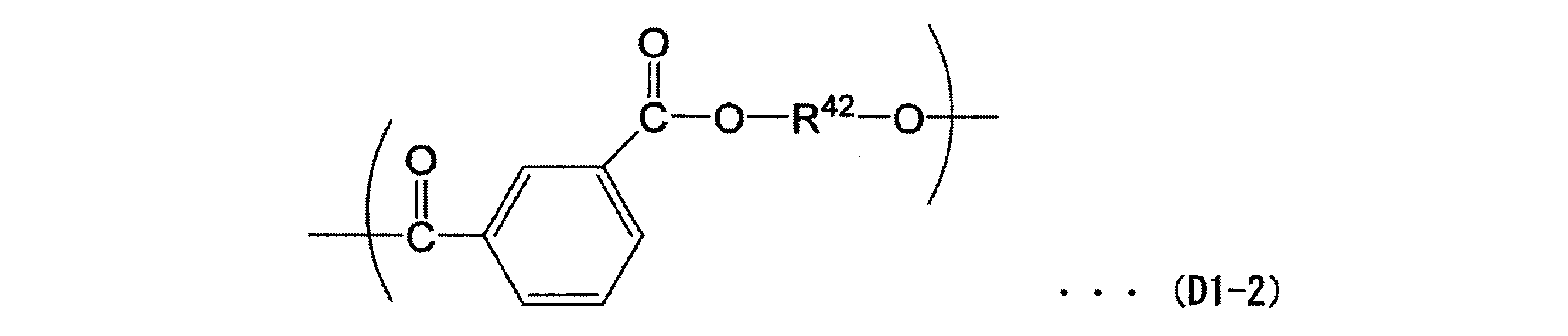
繰り返し単位(d12)として具体的には、エチレンイソフタレート単位、n-プロピレンイソフタレート単位、イソプロピレンイソフタレート単位、n-ブチレンイソフタレート単位、sec-ブチレンイソフタレート単位、tert-ブチレンイソフタレート単位等が挙げられる。中でも、イソプロピレンイソフタレート単位が好ましい。
繰り返し単位(d12)は、1種が単独で用いられてもよく、2種以上が組み合わされて用いられてもよい。
また、繰り返し単位(d11)を2種以上、及び/又は、繰り返し単位(d12)を2種以上有していてもよい。
繰り返し単位(d1)は、1分子中に、1単位で導入されてもよいし、2単位以上(即ちブロック状)で導入されてもよい。
繰り返し単位(d1)の数が、前記の好ましい範囲であると、洗浄効果が高められやすくなる。
オキシアルキレン単位(以下、この繰り返し単位を「繰り返し単位(d2)」ともいう)としては、下記一般式(D2-1)で表される繰り返し単位が挙げられる。

繰り返し単位(d2)としては、オキシエチレン単位、オキシプロピレン単位、オキシブチレン単位等が挙げられる。なかでも、オキシエチレン単位、オキシプロピレン単位が好ましい。
また、成分(D)は、その1分子中に、繰り返し単位(d2)として、オキシアルキレン基(繰り返し単位(d2)の繰り返し数が1のもの)を有していてもよく、ポリオキシアルキレン基(繰り返し単位(d2)の繰り返し数が2以上のもの)を有していてもよく、オキシアルキレン基とポリオキシアルキレン基との両方を有していてもよい。
繰り返し単位(d2)の繰り返し数が、前記の好ましい範囲であると、油性汚れに対する洗浄効果が高められやすくなる。
成分(D)中にその他の繰り返し単位を有する場合、繰り返し単位(d1)と繰り返し単位(d2)との合計は、成分(D)を構成する全部の繰り返し単位の合計に対して、80モル%以上であることが好ましく、90モル%以上であることがより好ましく、100モル%であってもよい。繰り返し単位(d1)と繰り返し単位(d2)との合計が、前記の好ましい下限値以上であると、洗浄力がより高められやすくなる。
ここでいう「水溶性ポリマー」とは、1リットルビーカー内で、ポリマー10gを、40℃の条件で、水1000gに添加し、スターラー(太さ8mm、長さ50mm)により12時間撹拌(200rpm)した後に溶解しているものをいう。
なお、成分(D)の重量平均分子量は、溶媒としてTHF(テトラヒドロフラン)を用いてGPC(ゲルパーミネーションクロマトグラフィー)により測定した値を、PEG(ポリエチレングリコール)における較正曲線に基づいて換算した値を示す。

R44及びR47は、それぞれメチル基又は水素原子であり、それぞれメチル基であることが好ましい。
R45、R46、R48及びR49は、それぞれ独立して、炭素数2~4のアルキレン基である。
s1及びs2は、それぞれ0~10であり、好ましくは0.5~5であり、より好ましくは0.5~2.5である。t1、t2、u1及びu2は、それぞれ独立して1~100であり、好ましくは1~80であり、より好ましくは1~50であり、さらに好ましくは10~50であり、特に好ましくは、20~30である。s1、s2、t1、t2、u1及びu2が前記の好ましい範囲であると、成分(D)の配合効果が充分に発揮されやすくなる。また、水に対する溶解性がより向上し、液体洗浄剤に配合した際に透明感に優れる液体洗浄剤が得られやすくなる。
(D2)中のs2と(t2+u2)の比[s2:(t2+u2)]は、上記[s1:(t1+u1)]の比と同様の範囲が好ましい。
また、成分(D)としては、合成品が用いられてもよく、市販品が用いられてもよい。
成分(D)の市販品としては、商品名TexCare SRN-100(クラリアント社製、重量平均分子量2000~3000)、商品名TexCare SRN-300(クラリアント社製、重量平均分子量7000)、商品名Repel-O-Tex Crystal(ローディア社製)、商品名Repel-O-Tex QC(ローディア社製)等が挙げられる。
これらのなかでは、水への溶解性が高く、保存安定性にも優れる点から、TexCare SRN-100が好ましい。また、取り扱い性に優れる点から、前記TexCare SRN-100の70%水溶液として市販されている商品名TexCare SRN-170(クラリアント社製)が用いられることが好ましい。
また、ノニオン界面活性剤(B1)のEO平均付加モル数が10以上であると、SR効果はより高まる。
成分(E)は、下記一般式(VII)で表されるカルボン酸及びその塩から選ばれる少なくとも1種である。
X-R1-COOH ・・・(VII)
ただし、式(VII)中、R1は炭素数1~4の二価の炭化水素基、またはアリーレン基であり、Xは-H、-OH、-CH3、または-COOHである。
本発明の液体洗浄剤は、上記成分(B)と成分(E)とが併用されることで、酵素安定性が高められる。
また、炭素数1~4の二価の炭化水素基は、飽和であってもよく不飽和であってもよいし、直鎖状であっても分岐鎖状であっても環状であってもよい。このような炭素数1~4の二価の炭化水素基としては、炭素数1~4のアルキル基から1個の水素原子を除去した二価基、炭素数1~4のアルケニル基から1個の水素原子を除去した二価基、炭素数1~4のアルキニル基から1個の水素原子を除去した二価基などが挙げられる。
アリーレン基としては、フェニレン基が挙げられる。
Xは-H、-OH、-CH3、または-COOHである。
また、カルボン酸の塩としては、ナトリウム塩、カリウム塩、カルシウム塩、モノエタノールアミン塩、ジエタノールアミン塩、トリエタノールアミン塩等が挙げられる。
これらの中でも成分(E)としては、酵素安定性がより高められる点から、安息香酸、乳酸又はこれらの塩が好ましく、乳酸又はその塩がより好ましい。また、外観安定性がより高められる点から、成分(E)としては、ナトリウム塩が好ましい。
成分(E)としては、酵素安定性及び外観安定性がより高められる点から、乳酸ナトリウムが好ましい。
成分(E)は、いずれか1種が単独で用いられてもよいし、2種以上が組み合わされて用いられてもよい。
成分(F)は、酵素である。
本発明の液体洗浄剤は、成分(F)を含有することで洗浄力がより高められる。
成分(F)としては、衣料用洗剤用途等に用いられている酵素が利用でき、例えばプロテアーゼ、アミラーゼ、リパーゼ、セルラーゼ、マンナナーゼ等が挙げられる。
なお、本明細書において「酵素」とは酵素製剤を意味する。
アミラーゼとしては、アミラーゼ製剤としてノボザイムズ社から入手できる商品名Termamyl 300L、Termamyl Ultra 300L、Duramyl 300L、Stainzyme 12L、Stainzyme Plus 12L、ジェネンコア社から入手できる商品名Maxamyl、天野製薬社から入手できる商品名プルラナーゼアマノ、生化学工業社から入手できる商品名DB-250等が挙げられる。
リパーゼとしては、リパーゼ製剤としてノボザイムズ社から入手できる商品名Lipex 100L、Lipolase 100L等が挙げられる。
セルラーゼとして、セルラーゼ製剤としてノボザイムズ社から入手できる商品名Endolase 5000L、Celluzyme 0.4L、Carzyme 4500L等が挙げられる。
マンナナーゼとして、マンナナーゼ製剤としてノボザイムズ社から入手できる商品名Mannaway 4L等が挙げられる。
プロテアーゼとしては、上記の中でも、商品名Savinase16L、Savinase Ultra 16L、Savinase Ultra 16XL、Everlase 16L、Everlase Ultra 16L、Alcalase 2.5L、Alcalase Ultra 2.5L、Liquanase 2.5L、Liquanase Ultra 2.5L、Liquanase Ultra 2.5XL、Coronase 48L、が好ましく、Alcalase 2.5L、Everlase 16L、Savinase 16L、Coronase 48Lが特に好ましい。
成分(F)は、いずれか1種が単独で用いられてもよいし、2種以上が組み合わされて用いられてもよい。
なお、本明細書において、液体洗浄剤中の酵素の配合量は、製剤としての配合量である。前記配合量は、一般的な方法により、例えば原料の使用量、又は、液体洗浄剤中の酵素たんぱく量から逆算して求められる。
A/E比が、0.1未満又は20超であると、外観安定性が損なわれる。
A/E比は、0.3~10が好ましく、0.5~7がより好ましく、1~5がさらに好ましい。
本発明の洗浄剤組成物は、本発明の効果を妨げない範囲で洗浄剤組成物に通常使用される成分を目的に応じ使用しても良い。
本発明の洗浄剤組成物は、プロテアーゼ等の酵素、エタノール等の水混和性有機溶剤、モノエタノールアミン等のアルカリ剤、ジブチルヒドロキシトルエン等の酸化防止剤、安息香酸ナトリウム等の防腐剤、塩化カルシウム、乳酸ナトリウム等の酵素安定化剤、色素等の着色剤、ゼオライト、洗浄性ビルダー等を含んでいてもよい。
本発明の洗浄剤組成物が液体の場合、従来公知の方法により、成分(A)~(C)と、必要に応じて任意成分と、を混合することにより製造される。
本発明の洗浄剤組成物が粒状の場合、従来公知の方法により製造でき、例えば、各原料を粉体混合するドライブレンド法、粉体原料を混合し流動させながら造粒する乾式造粒法、粉体原料を混合し流動させながら液体バインダーを噴霧して造粒する撹拌造粒法、原料を捏和してこれを押出機で押し出す押出造粒法、原料を捏和してこれを粉砕する粉砕造粒法、原料を含有するスラリーを噴霧乾燥する噴霧乾燥法等が挙げられる。
本発明の洗浄剤組成物の使用方法としては、通常の使用方法が挙げられる。
本発明の洗浄剤組成物を繊維製品の洗浄に使用する場合には、例えば、水30Lに対し洗浄剤組成物5~30mLを添加した洗浄液を用い、洗濯機で被洗物を洗浄する方法、前記洗浄液に被洗物を漬け置く方法等が挙げられる。また、洗浄剤組成物を被洗物に直接塗布して一定時間放置し、その後、通常の洗濯を行う方法(塗布洗浄)で使用されてもよい。
本発明の洗浄剤組成物を硬表面の洗浄に使用する場合には、洗浄剤組成物を水に溶解して洗浄液を調整し、洗浄対象である硬表面にスプレー等して塗布した後、スポンジ等の洗浄用具で擦り洗いする方法が挙げられる。
本発明の洗浄剤組成物を食器等の洗浄に用いる場合には、洗浄剤組成物をスポンジに含ませて食器等を洗浄する方法、洗浄剤組成物を水に溶解して希薄な洗浄液を調製し、この洗浄液に食器等を浸しつつスポンジで擦る方法等が挙げられる。
各例の洗浄剤組成物の組成(含有量(質量%))を表6~7に示す。
表中、空欄の配合成分がある場合、その配合成分は配合されていない。
表中、「バランス」は、洗浄剤組成物に含まれる全配合成分の合計の配合量が100質量%となるように加えられる残部を意味する。
本実施例において使用した原料は下記の通りである。
・A-1:ポリエチレンイミンのエチレンオキシド付加体、BASF社製、商品名「Sokalan HP20」。上記式(I-a)において、R22がエチレン基、mが20である化合物。
・A-2:ポリエチレンイミン、BASF社製、商品名「ルパゾールP」、重量平均分子量約75000、成分(A)の比較品。
[成分(B1)]
・B1-1:脂肪酸メチルエステルエトキシレート(MEE)(脂肪酸の炭素数12~14、EOの平均付加モル数15)、一般式(III)中、R2=炭素数11のアルキル基及び炭素数13のアルキル基、R3=メチル基、s=15、t=0、u=0。下記合成方法により合成されたもの。
(B1-1の合成)
特開2000-144179号公報に記載の合成方法に準じて合成した。
組成が2.5MgO・Al2O3・zH2Oである水酸化アルミナ・マグネシウム(キョーワード300(商品名)、協和化学工業株式会社製)を600℃で1時間、窒素雰囲気下で焼成して、焼成水酸化アルミナ・マグネシウム(未改質)触媒を得た。焼成水酸化アルミナ・マグネシウム(未改質)触媒2.2gと、0.5N水酸化カリウムエタノール溶液2.9mLと、ラウリン酸メチルエステル280gと、ミリスチン酸メチルエステル70gとを4Lオートクレーブに仕込み、オートクレーブ内で触媒の改質を行った。次いで、オートクレーブ内を窒素で置換した後、温度を180℃、圧力を0.3MPaに維持しつつ、エチレンオキシド1052gを導入し、撹拌しながら反応させた。
得られた反応液を80℃に冷却し、水159gと、濾過助剤として活性白土及び珪藻土をそれぞれ5gとを添加し混合した後、触媒を濾別してB1-1を得た。B1-1のナロー率は30質量%であった。
・B1-1’:脂肪酸メチルエステルエトキシレート(MEE)(脂肪酸の炭素数12~14、EOの平均付加モル数15)、一般式(III)中、R2=炭素数11のアルキル基及び炭素数13のアルキル基、R3=メチル基、s=15、t=0、u=0。下記合成方法により合成されたもの。
(B1-1’の合成)
B1-1’を以下の合成方法に準じて合成した。
500mLビーカーに、2-エチルヘキサノール(一級試薬、関東化学株式会社製)137gと、酢酸カルシウム一水和物(特級試薬、関東化学株式会社製)41.7gを入れ、パドル攪拌翼により室温(25℃)で混合して分散物を得た(分散工程)。前記分散物を攪拌しながら、滴下ロートによって、硫酸(特級試薬、関東化学株式会社製)20.9gを10分間かけて添加し混合した(混合工程)。混合工程では硫酸の添加で発熱するので、ビーカーを水浴して冷却し、反応温度を30~50℃に制御した。硫酸を添加した後、50℃に保ちながら、さらに2時間攪拌し(触媒熟成工程)、アルコキシル化触媒を得た。
オートクレーブに、上記アルコキシル化触媒12.5gと、ラウリン酸メチル(パステルM12、ライオンケミカル株式会社製)462gと、ミリスチン酸メチル(パステルM14、ライオンケミカル株式会社製)166gとを入れ、攪拌した。攪拌しながら、オートクレーブ内を窒素置換し、100℃に昇温し、1.3kPa以下の減圧条件で30分間、脱水を行った。次いで、160℃に昇温し、0.1~0.5MPaの条件で、エチレンオキシド(EO)1876g(ラウリン酸メチルとミリスチン酸メチルとの合計の15倍モル)を導入して攪拌した(付加反応工程)。さらに、付加反応温度で0.5時間攪拌した(熟成工程)後、80℃に冷却し、反応粗製物(脂肪酸メチルエステルエトキシレート(MEE)、EO平均付加モル数=15)2516gを得た。前記反応粗製物をろ過して触媒を除去したものをB1-1’とした。
・B1-2:アルコールエトキシレート(AE)、天然アルコールに15モル相当のエチレンオキシドを付加したもの。一般式(IV)中、R4=炭素数12のアルキル基及び炭素数14のアルキル基、v=15、w=0、x=0。下記合成方法により合成されたもの。
(B1-2の合成)
プロクター・アンド・ギャンブル社製のCO-1214(商品名)224.4gと、30質量%NaOH水溶液2.0gとを耐圧型反応容器内に仕込み、前記反応容器内を窒素置換した。次に、温度100℃、圧力2.0kPa以下で30分間脱水した後、温度を160℃まで昇温した。次いで、反応液を撹拌しながら、エチレンオキシド(ガス状)760.6gを反応液中に徐々に加えた。この時、反応温度が180℃を超えないように添加速度を調節しながら、エチレンオキシドを吹き込み管で加えた。
エチレンオキシドの添加終了後、温度180℃、圧力0.3MPa以下で30分間熟成した後、温度180℃、圧力6.0kPa以下で10分間、未反応のエチレンオキシドを留去した。
次に、温度を100℃以下まで冷却した後、反応物の1質量%水溶液のpHが約7になるように、70質量%p-トルエンスルホン酸を加えて中和し、B1-2を得た。
・B1-3:アルコールエトキシレート(AE)、天然アルコールに7モル相当のエチレンオキシドを付加したもの。一般式(IV)中、R4=炭素数12のアルキル基及び炭素数14のアルキル基、v=7、w=0、x=0。下記合成方法により合成されたもの。
(B1-3の合成)
プロクター・アンド・ギャンブル社製のCO-1214(商品名)224.4gと、30質量%NaOH水溶液2.0gとを耐圧型反応容器内に仕込み、前記反応容器内を窒素置換した。次に、温度100℃、圧力2.0kPa以下で30分間脱水した後、温度を160℃まで昇温した。次いで、反応液を撹拌しながら、エチレンオキシド(ガス状)355.0gを反応液中に徐々に加えた。この時、反応温度が180℃を超えないように添加速度を調節しながら、エチレンオキシドを吹き込み管で加えた。
エチレンオキシドの添加終了後、温度180℃、圧力0.3MPa以下で30分間熟成した後、温度180℃、圧力6.0kPa以下で10分間、未反応のエチレンオキシドを留去した。
次に、温度を100℃以下まで冷却した後、反応物の1質量%水溶液のpHが約7になるように、70質量%p-トルエンスルホン酸を加えて中和し、B1-3を得た。
・B1-4:天然アルコール(質量比で炭素数12アルコール/炭素数14アルコール=7/3)に、8モル相当のエチレンオキシド、2モル相当のプロピレンオキシド、8モル相当のエチレンオキシドを、この順にブロック付加したもの。上記一般式(IV)中、R4=炭素数12のアルキル基及び炭素数14のアルキル基、v=8、w=2、x=8。
・B1-5:炭素数12の第2級アルコール及び炭素数14の第2級アルコールに、7モル相当のエチレンオキシドを付加したもの。商品名「ソフタノール70」、株式会社日本触媒製。上記一般式(IV)中、R4=炭素数12の第2級アルキル基及び炭素数14の第2級のアルキル基、v=7、w=0、x=0。
・B2-1:ポリオキシエチレンアルキルエーテル硫酸ナトリウム(AES)。式(VI)中、R40=炭素数12~14の直鎖アルキル基、m=1.0、n=0、M=ナトリウムである化合物。下記合成方法により合成されたもの。
(B2-1の合成)
容量4Lのオートクレーブ中に、原料アルコールとしてP&G社製の商品名CO1270アルコール(炭素数12のアルコールと炭素数14のアルコールとの質量比75/25の混合物)400gと、反応用触媒として水酸化カリウム0.8gとを仕込み、前記オートクレーブ内を窒素で置換した後、攪拌しながら昇温した。続いて、温度を180℃、圧力を0.3MPa以下に維持しながらエチレンオキシド91gを導入し、反応させることによりアルコールエトキシレートを得た。
ガスクロマトグラフ質量分析計:Hewlett-Packard社製のGC-5890と、検出器:水素炎イオン化型検出器(FID)と、カラム:Ultra-1(HP社製、L25m×φ0.2mm×T0.11μm)とを用いて分析した結果、得られたアルコールエトキシレートは、エチレンオキシドの平均付加モル数が1.0であった。また、エチレンオキシドが付加していない化合物は、得られたアルコールエトキシレートの総質量に対して43質量%であった。
次に、上記で得たアルコールエトキシレート237gを、攪拌装置付の500mLフラスコに採り、窒素で置換した後、液体無水硫酸(サルファン)96gを、反応温度40℃に保ちながらゆっくりと滴下した。滴下終了後、1時間攪拌を続け(硫酸化反応)、ポリオキシエチレンアルキルエーテル硫酸を得た。次いで、これを水酸化ナトリウム水溶液で中和することによりB2-1を得た。
・B2-2:直鎖アルキルベンゼンスルホン酸ナトリウム(LAS)、ライオン株式会社製、商品名「ライポンLH-200」。
・B2-3:ポリオキシアルキレンアルキルエーテル硫酸エステルのモノエタノールアミン塩(AEPS)。式(VI)中、R40=炭素数12の直鎖のアルキル基、m=2.0、n=1.0、M=モノエタノールアミンである化合物。下記合成方法により合成されたもの。
(B2-3の合成)
撹拌装置、温度制御装置及び自動導入装置を備えたオートクレーブ内に、炭素数12の直鎖の第1級アルコール[東京化成工業株式会社製、商品名:1-ドデカノール(分子量186.33)、純度>99%]640gと、KOH1.0gと、を仕込み、110℃、1.3kPaにて30分間脱水を行った。脱水後、窒素置換を行い、120℃まで昇温した後、プロパン-1,2-ジイルオキシド199gを仕込んだ。次いで、120℃にて付加反応・熟成を行った後、145℃に昇温し、エチレンオキシド303gを仕込んだ。次いで、145℃にて付加反応・熟成を行った後、80℃まで冷却し、4.0kPaで未反応のエチレンオキシドを除去した。未反応のエチレンオキシドを除去した後、酢酸1.0gをオートクレーブ内に加え、80℃で30分間撹拌した後、抜き出しを行い、アルキル基がドデシル基、POの平均付加モル数が1.0、EOの平均付加モル数が2.0であるアルコキシレートを得た。
得られたアルコキシレートを、SO3ガスを用いて下降薄膜式反応器により硫酸化した。得られた硫酸化物をモノエタノールアミンにて中和し、ポリオキシエチレンポリオキシプロパン-1,2-ジイルアルキルエーテル硫酸エステルのモノエタノールアミン塩(AEPS)を含む組成物を得た。
・B2-4:ヤシ脂肪酸、商品名「椰子脂肪酸」、日油株式会社製。
・C-1:表1~5に示す香料。
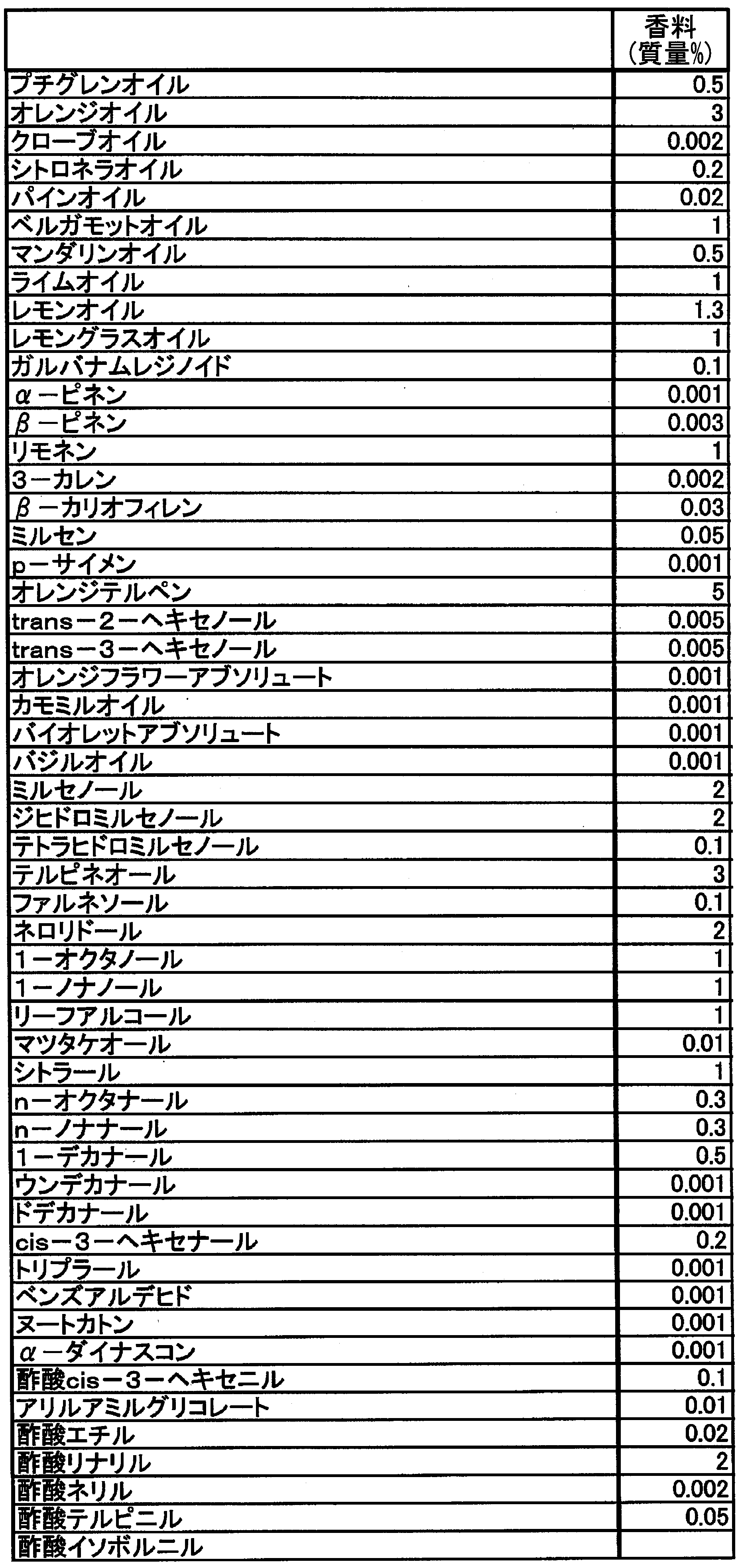

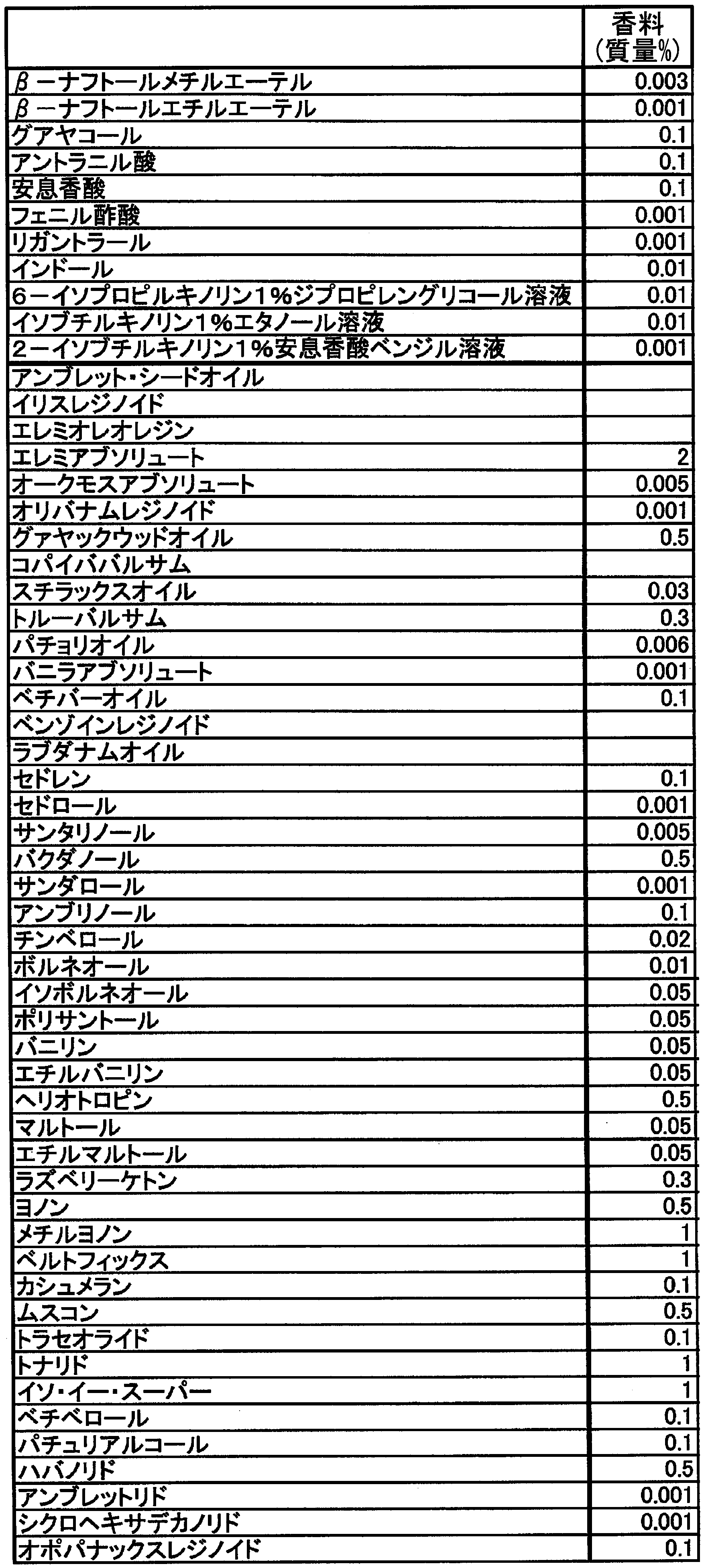
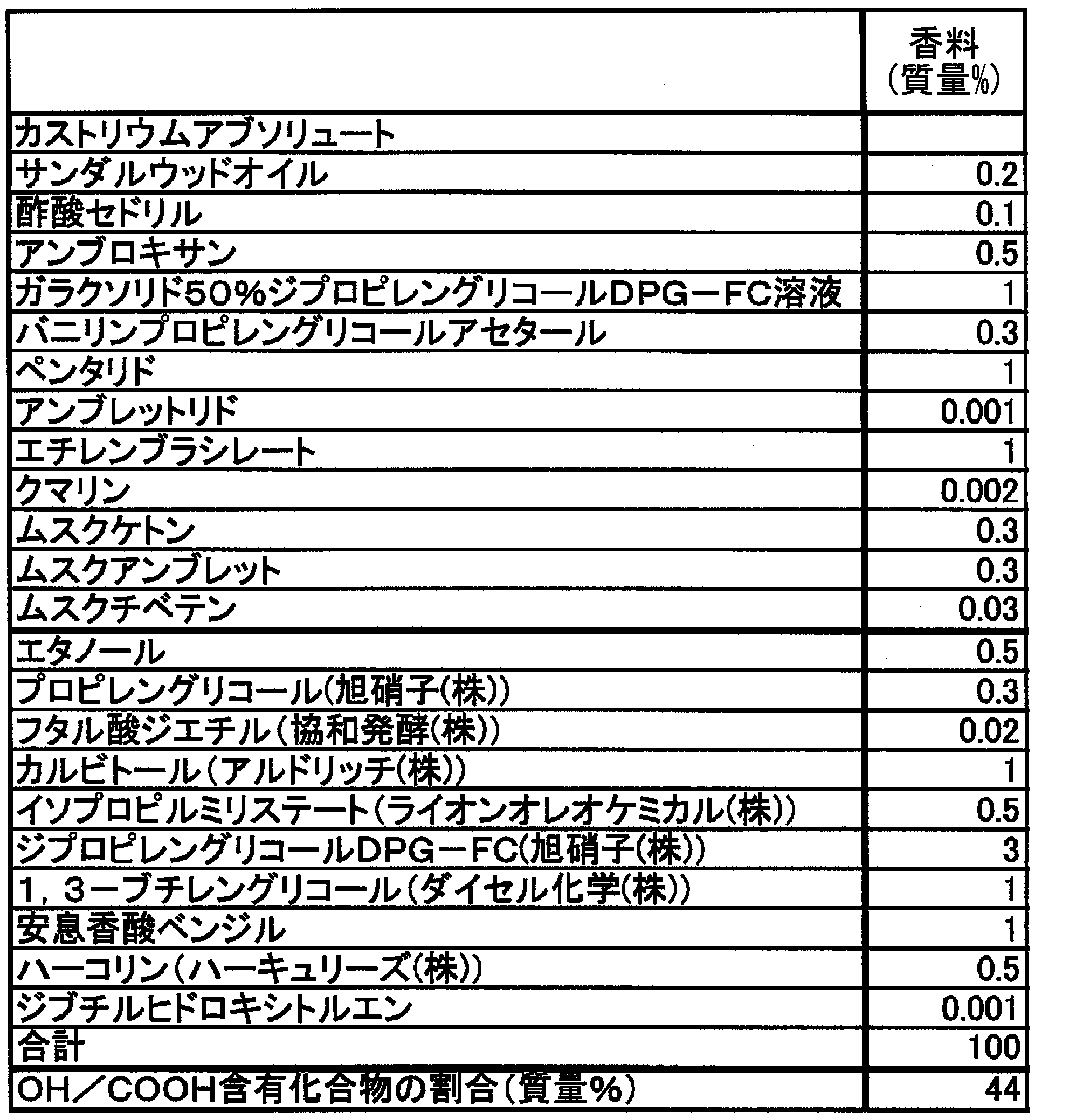
D-1:特定の繰り返し単位(d1)とオキシアルキレン単位(d2)とを有するポリマー。クラリアント社製、商品名「TexCare SRN-170」、重量平均分子量2000~3000、上記一般式(D1)で表される高分子化合物を含む。なお、D-1は、上述した「水溶性ポリマー」の条件(すなわち、1リットルビーカー内で、ポリマー10gを、40℃の条件で、水1000gに添加し、スターラー(太さ8mm、長さ50mm)により12時間撹拌(200rpm)した後に溶解していること)を満たす。
<成分(E)>
・乳酸ナトリウム(安定化剤)、関東化学株式会社製、商品名「乳酸ナトリウム」。
<成分(F)>
・アルカラーゼ(プロテアーゼ)、ノボザイムズ社製、商品名「Alcalase2.5L」。
・MEA:モノエタノールアミン(アルカリ剤)、株式会社日本触媒製、商品名「モノエタノールアミン」。
・BHT:ジブチルヒドロキシトルエン(酸化防止剤)、住友化学株式会社製、商品名「SUMILZER BHT-R」。
・エタノール(水混和性有機溶剤)、日本アルコール販売株式会社製、商品名「特定アルコール95度合成」。
・安息香酸ナトリウム(防腐剤)、東亜合成株式会社製、商品名「安息香酸ナトリウム」。
・塩化カルシウム(酵素安定化剤)、関東化学株式会社製、商品名「塩化カルシウム(特級)」。
・色素(着色剤)、癸巳化成株式会社製、商品名「緑色3号」。
(実施例1~13、比較例1~5)
表6~7に示す組成に従い、水に各成分を添加し混合して、実施例1~13、比較例1~5の洗浄剤組成物を得た。
実施例1~13、比較例1~5の洗浄剤組成物について、再汚染防止性能、残香性、保存安定性を以下のように評価した。
各例の洗浄剤組成物を用いて、以下に示す洗浄工程、すすぎ工程、乾燥工程をこの順序で3回繰り返す洗濯処理を行った。
被洗物として、下記の綿布、湿式人工汚染布及び肌シャツを用いた。
・綿布:再汚染判定布として綿メリヤス(谷頭商店製)5cm×5cmを5枚。
・湿式人工汚染布:財団法人洗濯科学協会製の汚染布(オレイン酸28.3質量%、トリオレイン15.6質量%、コレステロールオレート12.2質量%、流動パラフィン2.5質量%、スクアレン2.5質量%、コレステロール1.6質量%、ゼラチン7.0質量%、泥29.8質量%、カーボンブラック0.5質量%の組成の汚れが付着した布)を20枚。
・肌シャツ:肌シャツ(LLサイズ、DVD社製)を細かく(3cm×3cm程度)裁断したものを150枚。
Terg-o-tometer(UNITED STATES TESTING社製)内に、25℃の3°DH硬水900mLを入れ、ここに洗浄剤組成物0.6gを加え、次いで、前記被洗物を加えて浴比を20倍に調整し、120rpm、25℃で10分間洗浄した。
洗浄後の被洗物を、1分間脱水した後、25℃の3°DH硬水900mLを入れ、120rpm、25℃で3分間すすいだ。この操作(脱水、すすぎ)を2回繰り返した。2回目には、25℃の3°DH硬水900mLに、所定量の柔軟剤を添加してすすぎを行った。柔軟剤には、部屋干しソフラン(ライオン株式会社製)を用いた。
すすいだ被洗物を1分間脱水した後、再汚染判定布(綿布)のみを取り出し、濾紙に挟み、アイロンで乾燥した。
ΔZ=(洗濯処理前のZ値)-(洗濯処理後のZ値)
綿布の再汚染判定布におけるΔZについて、5枚の平均値を求めた。そして、この平均値を指標とした下記判定基準に従い、洗浄剤組成物による綿布への再汚染防止効果を評価した。下記評価基準において、◎及び○を合格とした。評価結果を表6~7に示す。
◎:ΔZが5未満。
○:ΔZが5以上7未満。
△:ΔZが7以上9未満。
×:ΔZが9以上。
(1)洗浄剤組成物を用いた綿タオルの処理
(評価用布の前処理)
市販の綿タオル(東進社製)を、市販洗剤「トッププラチナクリア」(ライオン社製)で、二槽式洗濯機(東芝製VH-30S)を用いて、以下の前処理を3回行った。
前処理:洗剤標準使用量、浴比30倍、45℃の水道水での洗浄10分間と、続く注水すすぎ10分間とのサイクルを2回。
(洗濯時すすぎ工程における洗浄剤組成物による処理)
前処理洗浄した綿タオル(東進社製)1.0kgを、二槽式洗濯機(東芝製VH-30S)を用いて、表6~7に記載の洗浄剤組成物で10分間洗浄し(標準使用量、標準コース、浴比30倍、25℃の水道水使用)、その後、1分間の脱水を行い、次いで1回目のすすぎを3分間行った。1回目のすすぎの後、1分間の脱水を行い、続いて2回目のすすぎを3分間行い、次いで1分間の脱水を行った。
(2)処理布の評価
上記した18時間の乾燥後、20℃、40RHの条件下で5日間保管した後の処理布(綿タオル)の香気強度を、下記の6段階臭気強度表示法に準拠して官能評価した。専門パネラー8人の平均点(小数点第1位まで算出)により、下記判定基準で香り持続性を評価した。商品価値上、○以上を合格とした。評価結果を表6~7に示す。
<6段階臭気強度表示法>
0:無臭
1:やっと検知できる程度の香り
2:何の香りか分かる程度の香り
3:楽に感知できる香り
4:強い香り
5:強烈な香り
[評価基準]
◎◎◎:3.0点以上
◎◎:2.9~2.5点
◎:2.4~2.0点
○:1.9~1.5点
△:1.4~1.0点
×:0.9点以下
透明のガラス瓶(広口規格びん、PS-NO.11)に、各例の洗浄剤組成物100mLを充填し、蓋を閉めて密封した。この状態で5℃又は25℃の恒温槽内に7日間静置して保存した。
かかる保存の後、液の外観を目視で観察し、下記評価基準に従って、洗浄剤組成物の保存安定性を評価した。△以上を合格とした。評価結果を表6~7に示す。
[評価基準]
○:ガラス瓶の底部に沈殿物質が認められず、液の流動性がある。
△:ガラス瓶の底部に沈殿物質が認められるが、ガラス瓶を軽く振ると、その沈殿物質は消失(溶解)する。
×:ガラス瓶の底部に沈殿物質が認められ、ガラス瓶を軽く振ってもその沈殿物質は消失しない、又は、洗浄剤組成物の製造直後にゲル化もしくは白濁を生じる。
全自動電気洗濯機(AW-80VC、株式会社東芝製)に、評価用テト綿布(綿/ポリエステル=40/60)と綿メリヤスを投入し、浴比20倍に合わせた。そこに、実施例1、実施例12の液体洗浄剤12gを添加し、標準コースにて洗浄、すすぎ、脱水を順次行う洗濯操作を行った。洗浄時間、すすぎ、脱水、水量(36Lに設定)に関しては、一切調整せず、洗濯機の標準設定を使用した。用いた水道水の温度は、15℃であった。この洗濯操作を5回繰り返した。5回の洗濯操作を終えた後、評価用テト綿布を平干しにて一晩乾燥させ、乾燥後の評価用テト綿布を5×5cmにカットしたものを評価用布とした。この評価用布に汚れとなる脂(オレイン酸、パルミチン酸、ミリスチン酸、ラウリン酸、トリオレイン、トリパルミチン、パルミチン酸ヘキサデシル、スクアレン、カーボンブラックの混合物)50μLを塗布して24時間乾燥させ、汚垢布を作製した。
この汚垢布について下記のように洗浄試験を行った。
洗浄試験器として、Terg-O-tometer(UNITED STATES TESTING社製)を用いた。洗浄液としては、水900mLに比較例4の液体洗浄剤300μLを加え30秒間撹拌して調製したものを用いた。前記洗浄試験器に、前記洗浄液900mLと、前記汚垢布5枚と、洗浄メリヤス布とを投入し、浴比20倍に合わせて、120rpm、15℃で20分間洗浄した。次に、二槽式洗濯機(三菱電機社製:製品名CW-C30A1-H1)に移し、1分間脱水後、水道水(15℃、4゜DH)30L中で3分間濯ぎ、風乾した。未汚垢布(評価用布)、洗浄前の汚垢布、及び洗浄後の汚垢布について、それぞれ反射率を色差計(日本電色株式会社製:製品名SE200型)で測定し、下式により洗浄率(%)を求めた。
洗浄率(%)=(洗浄前の汚垢布のK/S-洗浄後の汚垢布のK/S)/(洗浄前の汚垢布のK/S-未汚垢布のK/S)×100
ただし、K/Sは、(1-R/100)2/(2R/100)である(Rは、洗浄前の汚垢布の反射率、洗浄後の汚垢布の反射率又は未汚垢布の反射率(%)を示す)。汚垢布5枚の洗浄率の平均値を求め、この平均値を指標とした下記の評価基準に従い、実施例1、実施例12の液体洗浄剤のSR効果を評価した。◎、○を合格とした。
◎:洗浄率が10%以上。
○:洗浄率が7%以上、10%未満。
△:洗浄率が4%以上、7%未満。
×:洗浄率が4%未満。
実施例1、実施例13、及び比較例1の液体洗浄剤を製造後、37℃及び4℃でそれぞれ4週間保存した。37℃で4週間保存した液体洗浄剤(37℃保存品)および4℃で4週間保存した液体洗浄剤(4℃保存品)について、以下に示すプロテアーゼ活性の測定を行った。
ミルクカゼイン(Casein、Bovine Milk、Carbohydrate and Fatty Acid Free/Calbiochem(登録商標))を1N水酸化ナトリウム(1mol/L水酸化ナトリウム溶液(1N)、関東化学社製)に溶解し、pHを10.5とし、0.05Mホウ酸(ホウ酸(特級)、関東化学社製)水溶液でミルクカゼインの濃度が0.6%になるよう希釈し、プロテアーゼ基質とした。
得られた液体洗浄剤1gを、塩化カルシウム(塩化カルシウム(特級)、関東化学社製)3°DH硬水で25倍希釈した溶液をサンプル溶液とした。
サンプル溶液1gに、上記プロテアーゼ基質5gを添加し、ボルテックスミキサーで10秒間攪拌した後、37℃、30分間静置して酵素反応を進めた。その後、前記溶液に酵素反応停止剤のTCA(トリクロロ酢酸(特級)、関東化学社製)の0.44M水溶液5gを添加し、ボルテックスミキサーで10秒間攪拌した。その後、この溶液を20℃、30分間静置して、析出する未反応基質を0.45μmフィルターで除去し、ろ液を回収した。
回収したろ液の波長275nmにおける吸光度(吸光度A)を、島津製作所社製紫外可視分光光度計UV-160を用いて測定した。吸光度Aが大きいほど、ろ液中に存在するチロシン(プロテアーゼがプロテアーゼ基質を分解することにより産生)の量が多かったことを示す。
目的成分以外の吸収の影響を除くため、別途、各サンプル溶液1gに、酵素反応停止剤であるTCA5gを添加し、ボルテックスミキサーで10秒間攪拌した後、プロテアーゼ基質を5g添加し、ボルテックスミキサーで10秒間攪拌し、0.45μmフィルターで除去してろ液を回収した。その後、前記ろ液の波長275nmの吸光度(吸光度B)を、UV-160を用いて測定した。
なお、下式に代入した各試料の275nmにおける吸光度の値は、気泡等の散乱光を吸光度から除外するため、同時に測定した600nmの吸光度値を除し用いた。
プロテアーゼ活性残存率=(37℃保存品の吸光度A-37℃保存品の吸光度B)/(4℃保存品の吸光度A-4℃保存品の吸光度B)×100
◎:80%以上。
○:70%以上80%未満。
△:60%以上70%未満。
×:60%未満。
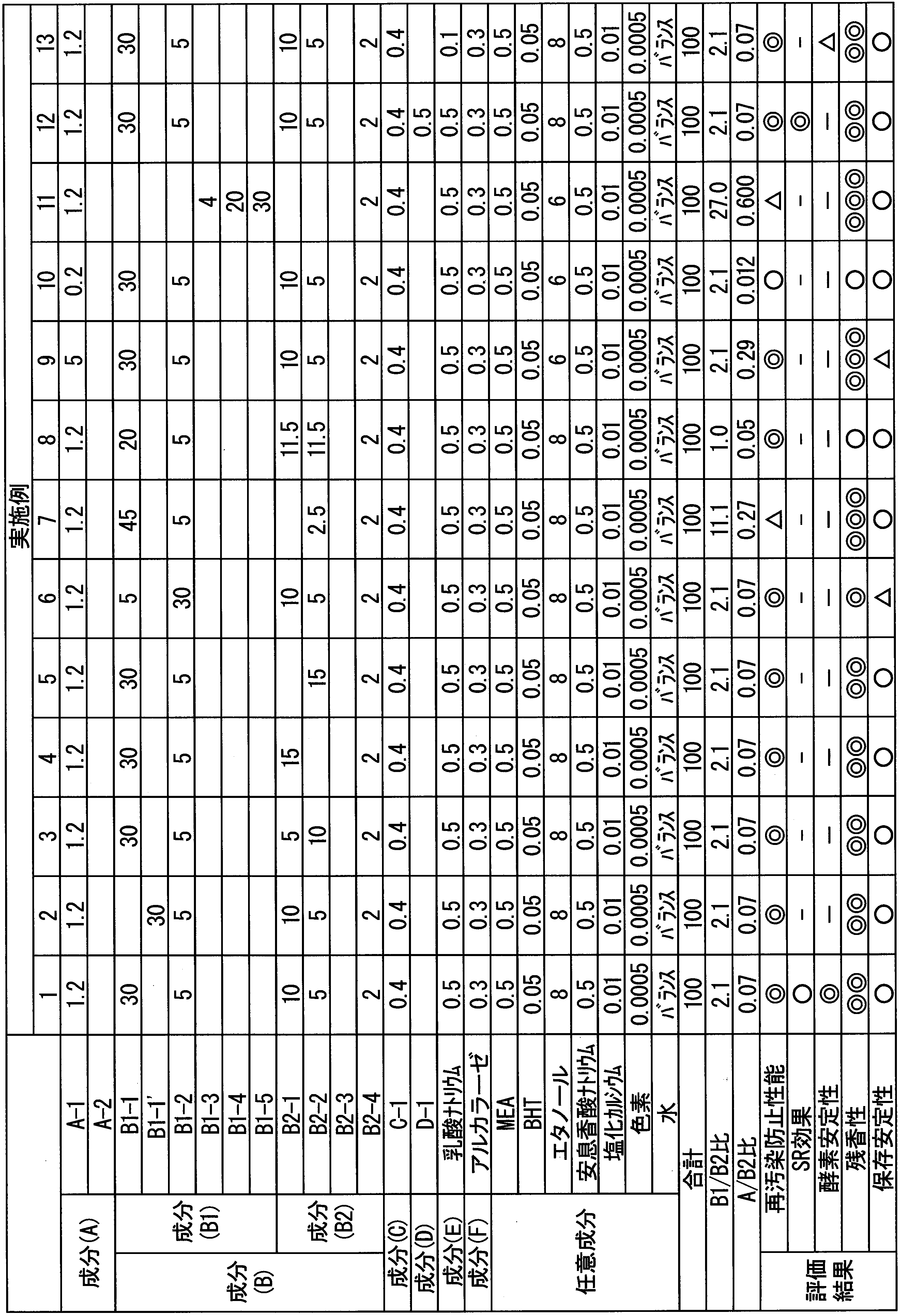

成分(A)を含まない比較例1は、残香性に劣るものであった。
B1/B2比が本発明の数値範囲外である比較例2及び5は、残香性に劣るものであった。
成分(A)を含まず、且つB1/B2比が本発明の数値範囲外である比較例3は、残香性に劣るものであった。
成分(A)の代わりにポリエチレンイミンを用いた比較例4は、再汚染防止性能及び残香性に劣るものであった。
Claims (4)
- ポリアルキレンアミンのアルキレンオキシド付加体(A)、
ノニオン界面活性剤(B1)及びアニオン界面活性剤(B2)を含む界面活性剤(B)、及び
香料(C)を含み、
成分(B1)/成分(B2)で表される質量比が1.0以上である、洗浄剤組成物。 - 前記成分(B1)が脂肪酸メチルエステルエトキシレートを含み、
前記脂肪酸メチルエステルエトキシレートの含有量が、前記成分(B)の総質量に対し、10質量%以上である、請求項1に記載の洗浄剤組成物。 - さらに、成分(D):アルキレンテレフタレート単位及びアルキレンイソフタレート単位からなる群より選択される少なくとも一種の繰り返し単位(d1)並びにオキシアルキレン単位(d2)を有するポリマーを含有する請求項1又は2に記載の洗浄剤組成物。
- さらに、成分(E):下記一般式(VII)で表されるカルボン酸及びその塩から選ばれる少なくとも1種、及び成分(F):酵素を含有する請求項1~3のいずれか一項に記載の洗浄剤組成物。
X-R1-COOH ・・・(VII)
ただし、式(VII)中、R1は、炭素数1~4の二価の炭化水素基、またはアリーレン基であり、Xは、-H、-OH、-CH3、または-COOHである。
Priority Applications (5)
| Application Number | Priority Date | Filing Date | Title |
|---|---|---|---|
| SG11201806877XA SG11201806877XA (en) | 2016-02-16 | 2017-02-16 | Detergent composition |
| MYPI2018702816A MY191406A (en) | 2016-02-16 | 2017-02-16 | Detergent composition |
| CN201780011861.1A CN108699493B (zh) | 2016-02-16 | 2017-02-16 | 洗涤剂组合物 |
| JP2018500187A JP6591033B2 (ja) | 2016-02-16 | 2017-02-16 | 洗浄剤組成物 |
| KR1020187022155A KR20180114019A (ko) | 2016-02-16 | 2017-02-16 | 세정제 조성물 |
Applications Claiming Priority (2)
| Application Number | Priority Date | Filing Date | Title |
|---|---|---|---|
| JP2016-027293 | 2016-02-16 | ||
| JP2016027293 | 2016-02-16 |
Publications (1)
| Publication Number | Publication Date |
|---|---|
| WO2017142012A1 true WO2017142012A1 (ja) | 2017-08-24 |
Family
ID=59626084
Family Applications (1)
| Application Number | Title | Priority Date | Filing Date |
|---|---|---|---|
| PCT/JP2017/005689 Ceased WO2017142012A1 (ja) | 2016-02-16 | 2017-02-16 | 洗浄剤組成物 |
Country Status (7)
| Country | Link |
|---|---|
| JP (1) | JP6591033B2 (ja) |
| KR (1) | KR20180114019A (ja) |
| CN (1) | CN108699493B (ja) |
| MY (1) | MY191406A (ja) |
| SG (1) | SG11201806877XA (ja) |
| TW (1) | TWI799373B (ja) |
| WO (1) | WO2017142012A1 (ja) |
Cited By (4)
| Publication number | Priority date | Publication date | Assignee | Title |
|---|---|---|---|---|
| JP2019073568A (ja) * | 2017-10-12 | 2019-05-16 | ライオン株式会社 | 液体洗浄剤組成物 |
| JP2019189690A (ja) * | 2018-04-19 | 2019-10-31 | ライオン株式会社 | 衣料用液体洗浄剤 |
| JP2020050839A (ja) * | 2018-09-28 | 2020-04-02 | ライオン株式会社 | 繊維製品用液体洗浄剤組成物 |
| JP2023506052A (ja) * | 2020-05-08 | 2023-02-14 | ザ プロクター アンド ギャンブル カンパニー | 液体洗濯洗剤組成物 |
Families Citing this family (4)
| Publication number | Priority date | Publication date | Assignee | Title |
|---|---|---|---|---|
| CN111433337A (zh) * | 2017-12-08 | 2020-07-17 | 狮王株式会社 | 香料组合物 |
| PH12021551820A1 (en) * | 2019-03-26 | 2022-03-28 | Unilever Ip Holdings B V | Composition |
| US20220378043A1 (en) * | 2019-07-08 | 2022-12-01 | Seiko Pmc Corporation | Biofilm treatment agent and biofilm treatment method |
| JP7801995B2 (ja) * | 2020-04-01 | 2026-01-19 | ライオン株式会社 | 繊維製品処理剤組成物及び繊維製品の処理方法 |
Citations (5)
| Publication number | Priority date | Publication date | Assignee | Title |
|---|---|---|---|---|
| JP2001503803A (ja) * | 1996-11-07 | 2001-03-21 | ザ、プロクター、エンド、ギャンブル、カンパニー | 香料組成物 |
| JP2008519148A (ja) * | 2004-11-19 | 2008-06-05 | ザ プロクター アンド ギャンブル カンパニー | 酸性洗濯洗剤組成物 |
| JP2009536248A (ja) * | 2006-05-05 | 2009-10-08 | ザ プロクター アンド ギャンブル カンパニー | コンパクト流体洗濯洗剤組成物 |
| JP2011503295A (ja) * | 2007-11-09 | 2011-01-27 | ザ プロクター アンド ギャンブル カンパニー | 少なくとも1のアルコキシル化グリース洗浄ポリマーを含む多重ポリマー系を含む洗浄組成物 |
| JP2011522914A (ja) * | 2008-05-28 | 2011-08-04 | ザ プロクター アンド ギャンブル カンパニー | 安定性の良好な布地柔軟化洗濯洗剤 |
Family Cites Families (21)
| Publication number | Priority date | Publication date | Assignee | Title |
|---|---|---|---|---|
| EP0111984B1 (en) * | 1982-12-23 | 1989-08-02 | THE PROCTER & GAMBLE COMPANY | Ethoxylated amine polymers having clay soil removal/anti-redeposition properties useful in detergent compositions |
| US4676921A (en) * | 1982-12-23 | 1987-06-30 | The Procter & Gamble Company | Detergent compositions containing ethoxylated amine polymers having clay soil removal/anti-redeposition properties |
| US5714447A (en) * | 1996-01-24 | 1998-02-03 | Church & Dwight Co., Inc. | Deodorant soap or detergent composition containing a zinc compound and a polyamine |
| US6127331A (en) * | 1998-06-23 | 2000-10-03 | The Procter & Gamble Company | Laundry compositions comprising alkoxylated polyalkyleneimine dispersants |
| AU2997000A (en) * | 1999-02-19 | 2000-09-04 | Procter & Gamble Company, The | Laundry detergent compositions comprising fabric enhancement polyamines |
| DE10027634A1 (de) * | 2000-06-06 | 2001-12-13 | Basf Ag | Verwendung von kationisch modifizierten, teilchenförmigen, hydrophoben Polymeren als Zusatz zu Spül- oder Pflegemitteln für Textilien und als Zusatz zu Waschmitteln |
| US20070253926A1 (en) * | 2006-04-28 | 2007-11-01 | Tadrowski Tami J | Packaged cleaning composition concentrate and method and system for forming a cleaning composition |
| DE102007016382A1 (de) * | 2007-04-03 | 2008-10-09 | Henkel Ag & Co. Kgaa | Vergrauungsinhibierendes Waschmittel |
| MX2009012974A (es) * | 2007-06-11 | 2010-01-18 | Appleton Paper Inc | Agente benefico que contiene una particula de suministro. |
| RU2469080C2 (ru) * | 2007-11-09 | 2012-12-10 | Дзе Проктер Энд Гэмбл Компани | Чистящие композиции, содержащие амфифильные водорастворимые полиалкиленимины, имеющие внутренний полиэтиленоксидный блок и концевой полипропиленоксидный блок |
| WO2011105449A1 (ja) * | 2010-02-23 | 2011-09-01 | ライオン株式会社 | 金属用洗浄剤 |
| US9993793B2 (en) * | 2010-04-28 | 2018-06-12 | The Procter & Gamble Company | Delivery particles |
| US20110268778A1 (en) * | 2010-04-28 | 2011-11-03 | Jiten Odhavji Dihora | Delivery particles |
| US20110269657A1 (en) * | 2010-04-28 | 2011-11-03 | Jiten Odhavji Dihora | Delivery particles |
| JP5580166B2 (ja) * | 2010-10-20 | 2014-08-27 | 花王株式会社 | 液体洗浄剤組成物 |
| BR112014014072B1 (pt) * | 2011-12-12 | 2022-05-10 | Unilever Ip Holdings B.V | Composição detergente de lavanderia e seu uso |
| JP2013133383A (ja) * | 2011-12-26 | 2013-07-08 | Lion Corp | 衣料用液体洗剤組成物 |
| WO2013109671A1 (en) * | 2012-01-18 | 2013-07-25 | The Procter & Gamble Company | Acidic laundry detergent compositions |
| EP2813564A1 (en) * | 2013-06-14 | 2014-12-17 | Unilever PLC | Laundry formulation comprising a dye |
| CN103923754A (zh) * | 2014-04-08 | 2014-07-16 | 余姚市德派日用品有限公司 | 一种家用洗衣洗碗液 |
| US9850452B2 (en) * | 2014-09-25 | 2017-12-26 | The Procter & Gamble Company | Fabric care compositions containing a polyetheramine |
-
2017
- 2017-02-16 WO PCT/JP2017/005689 patent/WO2017142012A1/ja not_active Ceased
- 2017-02-16 SG SG11201806877XA patent/SG11201806877XA/en unknown
- 2017-02-16 JP JP2018500187A patent/JP6591033B2/ja active Active
- 2017-02-16 MY MYPI2018702816A patent/MY191406A/en unknown
- 2017-02-16 CN CN201780011861.1A patent/CN108699493B/zh not_active Expired - Fee Related
- 2017-02-16 TW TW106104992A patent/TWI799373B/zh not_active IP Right Cessation
- 2017-02-16 KR KR1020187022155A patent/KR20180114019A/ko not_active Ceased
Patent Citations (5)
| Publication number | Priority date | Publication date | Assignee | Title |
|---|---|---|---|---|
| JP2001503803A (ja) * | 1996-11-07 | 2001-03-21 | ザ、プロクター、エンド、ギャンブル、カンパニー | 香料組成物 |
| JP2008519148A (ja) * | 2004-11-19 | 2008-06-05 | ザ プロクター アンド ギャンブル カンパニー | 酸性洗濯洗剤組成物 |
| JP2009536248A (ja) * | 2006-05-05 | 2009-10-08 | ザ プロクター アンド ギャンブル カンパニー | コンパクト流体洗濯洗剤組成物 |
| JP2011503295A (ja) * | 2007-11-09 | 2011-01-27 | ザ プロクター アンド ギャンブル カンパニー | 少なくとも1のアルコキシル化グリース洗浄ポリマーを含む多重ポリマー系を含む洗浄組成物 |
| JP2011522914A (ja) * | 2008-05-28 | 2011-08-04 | ザ プロクター アンド ギャンブル カンパニー | 安定性の良好な布地柔軟化洗濯洗剤 |
Cited By (6)
| Publication number | Priority date | Publication date | Assignee | Title |
|---|---|---|---|---|
| JP2019073568A (ja) * | 2017-10-12 | 2019-05-16 | ライオン株式会社 | 液体洗浄剤組成物 |
| JP2019189690A (ja) * | 2018-04-19 | 2019-10-31 | ライオン株式会社 | 衣料用液体洗浄剤 |
| JP7250432B2 (ja) | 2018-04-19 | 2023-04-03 | ライオン株式会社 | 衣料用液体洗浄剤 |
| JP2020050839A (ja) * | 2018-09-28 | 2020-04-02 | ライオン株式会社 | 繊維製品用液体洗浄剤組成物 |
| JP7122923B2 (ja) | 2018-09-28 | 2022-08-22 | ライオン株式会社 | 繊維製品用液体洗浄剤組成物 |
| JP2023506052A (ja) * | 2020-05-08 | 2023-02-14 | ザ プロクター アンド ギャンブル カンパニー | 液体洗濯洗剤組成物 |
Also Published As
| Publication number | Publication date |
|---|---|
| KR20180114019A (ko) | 2018-10-17 |
| JPWO2017142012A1 (ja) | 2018-12-06 |
| CN108699493A (zh) | 2018-10-23 |
| SG11201806877XA (en) | 2018-09-27 |
| CN108699493B (zh) | 2021-10-08 |
| JP6591033B2 (ja) | 2019-10-16 |
| TW201732025A (zh) | 2017-09-16 |
| MY191406A (en) | 2022-06-24 |
| TWI799373B (zh) | 2023-04-21 |
Similar Documents
| Publication | Publication Date | Title |
|---|---|---|
| JP6591033B2 (ja) | 洗浄剤組成物 | |
| CN104508000B (zh) | 包含聚酯的碱性液体洗衣洗涤剂组合物 | |
| JP6770964B2 (ja) | 液体洗浄剤組成物 | |
| JP5986887B2 (ja) | 繊維製品用の液体洗浄剤 | |
| EP1863894B1 (de) | Verwendung von acetalen in wasch- und reinigungsmitteln | |
| JP6275122B2 (ja) | 液体洗浄剤 | |
| JPWO2018056197A1 (ja) | 液体洗浄剤 | |
| JP2016113606A (ja) | 衣料用洗剤 | |
| JP2022072732A (ja) | 繊維製品の処理方法 | |
| JP2018188600A (ja) | 液体洗浄剤 | |
| WO2008012129A1 (de) | Oh-gruppenhaltige esterquats zur verbesserten duftstoffausbeute | |
| WO2017073741A1 (ja) | 液体洗浄剤 | |
| JP7737797B2 (ja) | 洗浄剤組成物と香料組成物からなる繊維製品用洗濯物品 | |
| JP2020050839A (ja) | 繊維製品用液体洗浄剤組成物 | |
| JP2011225743A (ja) | 衣料用液体漂白剤組成物 | |
| JP6930850B2 (ja) | 液体洗浄剤組成物 | |
| HK1260007A1 (en) | Detergent composition | |
| JP2000355700A (ja) | 液体洗浄剤組成物 | |
| HK1260007B (zh) | 洗涤剂组合物 | |
| WO2017038930A1 (ja) | 衣料用液体洗浄剤 | |
| JP2022115502A (ja) | 液体洗浄剤組成物 | |
| JP2023053751A (ja) | 洗濯方法 | |
| JP6718777B2 (ja) | 衣料用洗浄剤組成物 | |
| JP2021105157A (ja) | 液体洗浄剤 | |
| EP2404988A1 (en) | Laundry pre-spotting composition |
Legal Events
| Date | Code | Title | Description |
|---|---|---|---|
| 121 | Ep: the epo has been informed by wipo that ep was designated in this application |
Ref document number: 17753267 Country of ref document: EP Kind code of ref document: A1 |
|
| WWE | Wipo information: entry into national phase |
Ref document number: 2018500187 Country of ref document: JP |
|
| WWE | Wipo information: entry into national phase |
Ref document number: 11201806877X Country of ref document: SG |
|
| NENP | Non-entry into the national phase |
Ref country code: DE |
|
| 122 | Ep: pct application non-entry in european phase |
Ref document number: 17753267 Country of ref document: EP Kind code of ref document: A1 |