WO2017144402A1 - N-(5-halogen-1,3,4-oxadiazol-2-yl)arylcarbonsäureamide und ihre verwendung als herbizide - Google Patents
N-(5-halogen-1,3,4-oxadiazol-2-yl)arylcarbonsäureamide und ihre verwendung als herbizide Download PDFInfo
- Publication number
- WO2017144402A1 WO2017144402A1 PCT/EP2017/053763 EP2017053763W WO2017144402A1 WO 2017144402 A1 WO2017144402 A1 WO 2017144402A1 EP 2017053763 W EP2017053763 W EP 2017053763W WO 2017144402 A1 WO2017144402 A1 WO 2017144402A1
- Authority
- WO
- WIPO (PCT)
- Prior art keywords
- alkyl
- cycloalkyl
- heterocyclyl
- halogen
- halo
- Prior art date
- Legal status (The legal status is an assumption and is not a legal conclusion. Google has not performed a legal analysis and makes no representation as to the accuracy of the status listed.)
- Ceased
Links
- 0 *c(cc1)c(*)c(*)c1C(Nc([o]1)nnc1I)=O Chemical compound *c(cc1)c(*)c(*)c1C(Nc([o]1)nnc1I)=O 0.000 description 1
Classifications
-
- C—CHEMISTRY; METALLURGY
- C07—ORGANIC CHEMISTRY
- C07D—HETEROCYCLIC COMPOUNDS
- C07D271/00—Heterocyclic compounds containing five-membered rings having two nitrogen atoms and one oxygen atom as the only ring hetero atoms
- C07D271/02—Heterocyclic compounds containing five-membered rings having two nitrogen atoms and one oxygen atom as the only ring hetero atoms not condensed with other rings
- C07D271/10—1,3,4-Oxadiazoles; Hydrogenated 1,3,4-oxadiazoles
- C07D271/113—1,3,4-Oxadiazoles; Hydrogenated 1,3,4-oxadiazoles with oxygen, sulfur or nitrogen atoms, directly attached to ring carbon atoms, the nitrogen atoms not forming part of a nitro radical
-
- A—HUMAN NECESSITIES
- A01—AGRICULTURE; FORESTRY; ANIMAL HUSBANDRY; HUNTING; TRAPPING; FISHING
- A01N—PRESERVATION OF BODIES OF HUMANS OR ANIMALS OR PLANTS OR PARTS THEREOF; BIOCIDES, e.g. AS DISINFECTANTS, AS PESTICIDES OR AS HERBICIDES; PEST REPELLANTS OR ATTRACTANTS; PLANT GROWTH REGULATORS
- A01N43/00—Biocides, pest repellants or attractants, or plant growth regulators containing heterocyclic compounds
- A01N43/72—Biocides, pest repellants or attractants, or plant growth regulators containing heterocyclic compounds having rings with nitrogen atoms and oxygen or sulfur atoms as ring hetero atoms
- A01N43/82—Biocides, pest repellants or attractants, or plant growth regulators containing heterocyclic compounds having rings with nitrogen atoms and oxygen or sulfur atoms as ring hetero atoms five-membered rings with three ring hetero atoms
-
- C—CHEMISTRY; METALLURGY
- C07—ORGANIC CHEMISTRY
- C07D—HETEROCYCLIC COMPOUNDS
- C07D413/00—Heterocyclic compounds containing two or more hetero rings, at least one ring having nitrogen and oxygen atoms as the only ring hetero atoms
- C07D413/02—Heterocyclic compounds containing two or more hetero rings, at least one ring having nitrogen and oxygen atoms as the only ring hetero atoms containing two hetero rings
- C07D413/12—Heterocyclic compounds containing two or more hetero rings, at least one ring having nitrogen and oxygen atoms as the only ring hetero atoms containing two hetero rings linked by a chain containing hetero atoms as chain links
Definitions
- the invention relates to the technical field of herbicides, in particular that of herbicides for the selective control of weeds and grass weeds in crops.
- WO 2012/126932 A1 discloses herbicidally active N- (l, 3,4-oxadiazol-3-yl) arylcarboxamides which carry a hydrogen atom or a radical bonded via a carbon atom in the 5-position of the oxadiazole ring.
- WO 2001/002354 A1 discloses N-heterocyclylphthalamides as insecticides. There is also the under the CAS no. No. 1,323,324-77-1 discloses a known compound N 1 - (5-chloro-1, 3,4-oxadiazol-2-yl) -N 2 , N 2 -diethyl-3-iodo-phthalamide.
- Object of the present invention was the provision of other herbicidally active compounds. This object has been achieved by providing N- (l, 3,4-oxadiazol-2-yl) arylcarbonklareamiden which carry a halogen atom in the 5-position of the Oxadiazolrings.
- An object of the present invention are thus N- (5-halo-l, 3,4-oxadiazol-2-yl) arylcarbonklareamide of formula I) and their salts
- X is nitro, halogen, cyano, formyl, thiocyanato, (Ci-C6) alkyl, halo (Ci-C6) alkyl, (C 2 - C 6) alkenyl, halo (C 2 -C 6) - alkenyl, (C 2 -C 6) alkynyl, halo (C 3 -C 6) -alkynyl, (C 3 -C 6) cycloalkyl, halo (C 3 -C 6) cycloalkyl, (C3-C 6) -cycloalkyl- (Ci-C 6) alkyl, halo (C3-C6) cycloalkyl- (Ci-C 6) - alkyl, COR 1, COOR 1, OCOOR ' ⁇ R'COOR 1, C ( 0) N (R 1 ) 2 , NR 1 C (O) N (R 1 ) 2 , OC (O) N (
- Y is hydrogen, nitro, halogen, cyano, rhodano, (C 1 -C 6 ) -alkyl, halogeno (C 1 -C 6 ) -alkyl, (C 2 -C 6 ) -alkenyl, halogen (C 2 -C 6 ) - alkenyl, (C 2 -C 6 ) alkynyl, halo (C 2 -C 6 ) alkynyl, (C 3 -C 6 ) cycloalkyl, (C 3 -C 6 ) cycloalkenyl, halogen (C 3 -) C 6 ) -cycloalkyl, (C 3 -C 6 ) -cycloalkyl- (C 1 -C 6 ) -alkyl, halogeno (C 3 -C 6 ) -cycloalkyl- (C 1 -C 6 ) -alkyl, COR 1 , COOR
- Z is hydrogen, halogen, cyano, thiocyanato, (Ci-C6) alkyl, (Ci-C6) alkoxy, halo (Ci- C6) alkyl, (C 2 -C 6) alkenyl, halo ( C 2 -C 6) alkenyl, (C 2 -C 6) alkynyl, halo (C 2 -C 6) -alkynyl, (C 3 - C 6) cycloalkyl, halo (C 3 -C 6) cycloalkyl, (C3-C6) cycloalkyl (Ci-C 6) alkyl, halo (C 3 -C 6) - cycloalkyl- (Ci-C 6) alkyl, COR 1, COOR 1, OCOOR 1 , NR 1 COOR 1 , C (O) N (R 1 ) 2 , NR 1 C (O) N (R 1 ) 2 , OC (O
- W is hydrogen, halogen, (Ci-C 4) alkyl, (Ci-C 4) haloalkyl, OR 1, S (0) n R 2, R 1 represents hydrogen, (Ci-C 6) alkyl, ( Ci-C 6) -haloalkyl, (C 2 -C 6) alkenyl, (C 2 -C 6) -
- R 2 is (Ci-C 6) -alkyl, (Ci-C 6) -haloalkyl, (C 2 -C 6) alkenyl, (C 2 -C 6) -haloalkenyl, (C 2 -C 6) - alkynyl , (C 2 -C 6) -haloalkynyl, (C3-C6) -cycloalkyl, (C3-C6) cycloalkenyl, (C3-C6) halocycloalkyl, (Ci-C6) alkyl-0- (Ci-C 6 ) -alkyl, (C 3 -C 6 ) -cycloalkyl- (C 1 -C 6 ) -alkyl, phenyl, phenyl (C 1 -C 6 ) -alkyl, heteroaryl, (C 1 -C 6 ) -alkyl-heteroaryl, heterocyclyl, ( C 1
- R 3 is hydrogen, (C 1 -C 6 ) -alkyl, (C 2 -C 6 ) -alkenyl, (C 2 -C 6 ) -alkynyl, (C 3 -C 6 ) -cycloalkyl or (C 3 -C 6 ) Cycloalkyl- (C 1 -C 6 ) -alkyl,
- R 4 is (C 1 -C 6 ) -alkyl, (C 2 -C 6 ) -alkenyl or (C 2 -C 6 ) -alkynyl, R 5 is methyl or ethyl, n is 0, 1 or 2, s is 0 , 1, 2 or 3,
- Alkyl radicals are, for example, methyl, ethyl, n- or i-propyl, n-, i-, t- or 2-butyl, pentyls, hexyls, such as n-hexyl, i-hexyl and 1,3-dimethylbutyl.
- Halogen is fluorine, chlorine, bromine or iodine.
- Heterocyclyl means a saturated, partially saturated or fully unsaturated cyclic radical containing from 3 to 6 ring atoms, of which from 1 to 4 are from the group consisting of oxygen, nitrogen and sulfur, and may additionally be fused by a benzo ring. For example, stands
- Heteroaryl means an aromatic cyclic radical containing 3 to 6 ring atoms, of which 1 to 4 are from the group oxygen, nitrogen and sulfur, and additionally by a
- Benzoring can be annealed.
- heteroaryl is benzimidazol-2-yl, furanyl, imidazolyl, isoxazolyl, isothiazolyl, oxazolyl, pyrazinyl, pyrimidinyl, pyridazinyl, pyridinyl,
- the compounds of the general formula (I) can exist as stereoisomers. For example, if one or more asymmetric carbon atoms are present, enantiomers and diastereomers may occur. Similarly, stereoisomers occur when n is 1 (sulfoxides). Stereoisomers can be obtained from the mixtures obtained in the preparation by customary separation methods, for example by chromatographic separation methods. Similarly, stereoisomers can be selectively prepared by using stereoselective reactions using optically active sources and / or adjuvants. The invention also relates to all stereoisomers and mixtures thereof which are of the general formula (I), but not specifically defined.
- A is N or CY
- Hal is chlorine
- X is nitro, halo, cyano, (Ci-C 6) alkyl, halo (Ci-C 6) alkyl, (C 3 -C 6) -cycloalkyl, OR 1, S (0) n R 2 , (C 1 -C 6 ) -alkyl-S (0) n R 2 , (C 1 -C 6 ) -alkyl-OR 1 , (C 1 -C 6 ) -alkyl-CON (R 1 ) 2 , (Ci -C 6) alkyl S0 2 N (R 1) 2, (Ci-C 6) alkyl-NR 1 COR 1, (Ci-C 6) alkyl-NR 1 S0 2 R 2, (Ci-C 6 ) -Alkyl heteroaryl, (Ci-C 6 ) - Alkyl heterocyclyl, where the latter two radicals in each case by s radicals from the group consisting of halogen, (Ci
- Heterocyclyl where the 6 last-mentioned radicals in each case by s radicals selected from the group consisting of halogen, nitro, cyano, (Ci-C 6) alkyl, halo (Ci-C 6) alkyl, (C 3 -C 6) - Cycloalkyl, S (0) n - (C 1 -C 6 ) -alkyl, (C 1 -C 6 ) -alkoxy, halogeno (C 1 -C 6 ) -alkoxy, (C 1 -C 6 ) -alkoxy- (C 1 -C 4) -alkyl and cyanomethyl are substituted, and wherein heterocyclyl carries n oxo groups,
- Z is hydrogen, halogen, methyl, ethyl, isopropyl, halogeno (Ci-C6) -alkyl, (C 3 -Ce) -cycloalkyl, S (0) n R 2 or
- V is hydrogen
- W means hydrogen
- R 1 represents hydrogen, (Ci-C 6) -alkyl, (C 2 -C 6) alkenyl, (C 2 -C 6) -alkynyl, (C 3 -C 6) -cycloalkyl, (C 3 - C 6 ) -Cycloalkyl- (C 1 -C 6 ) -alkyl, (C 1 -C 6 ) -alkyl-O- (C 1 -C 6 ) -alkyl, phenyl, phenyl- (C 1 -C 6 ) -alkyl, heteroaryl, (Ci -C 6 ) -alkyl heteroaryl, heterocyclyl, (C 1 -C 6 ) -alkyl heterocyclyl, (C 1 -C 6 ) -alkyl-0-heteroaryl, (C 1 -C 6 ) -alkyl-O-heterocyclyl, (Ci C 6 ) -
- R 2 is (Ci-C 6) -alkyl, (C 3 -C 6) -cycloalkyl or (C 3 -C 6) -cycloalkyl- (Ci-C 6) -alkyl, where the three abovementioned radicals are each substituted by s radicals from the group consisting of halogen and OR 3 are substituted,
- R 3 is hydrogen or (C 1 -C 6 ) -alkyl, is (C 1 -C 6 ) -alkyl, n is 0, 1 or 2, s is 0, 1, 2 or 3.
- benzoic acid chlorides of the formula (II) or the benzoic acids on which they are based are known in principle and can be synthesized, for example, according to the methods described in WO 2012/126932 A1, US Pat
- Amidation reactions such as. B. ⁇ , ⁇ -carbonyldiimidazole (CDI), dicyclohexyl-carbodiimide (DCC), 2,4,6-tripropyl-l, 3,5,2,4,6-trioxatriphosphinane 2,4,6-trioxides (T3P) etc . are used.
- CDI ⁇ -carbonyldiimidazole
- DCC dicyclohexyl-carbodiimide
- T3P 3,5,2,4,6-trioxatriphosphinane 2,4,6-trioxides
- the 2-amino-5-halo-l, 3,4-oxadiazoles (III) are known and can be prepared according to methods known to those skilled in the art.
- Collections of compounds of formula (I) and / or their salts, which may be synthesized following the above reactions, may also be prepared in a parallelized manner, which may be done in a manual, partially automated or fully automated manner. It is possible, for example, to automate the reaction procedure, the work-up or the purification of the products or intermediates. Overall, this is one
- Calypso reaction blocks (Caylpso reaction blocks) from Barnstead International, Dubuque, Iowa 52004-0797, USA or reaction stations from Radleys, Shirehill, Saffron Waiden, Essex, CB 11 3AZ, England or
- Chromatographieapparaturen available, for example, the company ISCO, Inc., 4700 Superior Street, Lincoln, NE 68504, USA.
- the listed equipment leads to a modular procedure, in which the individual work steps are automated, but between the work steps, manual operations must be performed.
- This can be circumvented by the use of partially or fully integrated automation systems in which the respective automation modules are operated, for example, by robots.
- Such automation systems can be obtained, for example, from Caliper, Hopkinton, MA 01748, USA.
- Solid-phase assisted synthesis methods allow a number of protocols known from the literature, which in turn can be performed manually or automatically.
- the reactions can be carried out, for example, by means of IRORI technology in microreactors (microreactors) from Nexus Biosystems, 12140 Community Road, Poway, CA92064, USA.
- Both solid and liquid phases may require the performance of one or more
- the preparation according to the methods described herein provides compounds of formula (I) and their salts in the form of substance collections called libraries.
- the present invention also provides libraries containing at least two compounds of formula (I) and their salts.
- the compounds of the formula (I) according to the invention (and / or their salts), together referred to as “compounds according to the invention", have excellent herbicidal activity against a broad spectrum of economically important monocotyledonous and dicotyledonous harmful plants which are expelled from rhizomes, rhizomes or other long-term organs, are well detected by the active ingredients.
- the present invention therefore also provides a method for combating
- Plant cultures in which one or more compounds of the invention (s) on the plants eg harmful plants such as mono- or dicotyledonous weeds or undesirable crops
- the seed eg grains, seeds or vegetative propagules such as tubers or sprouts with buds
- the area on the plants grow eg the acreage
- the compounds according to the invention can be applied, for example, in pre-sowing (optionally also by incorporation into the soil), pre-emergence or postemergence process.
- the compounds according to the invention are applied to the surface of the earth before germination, then either the emergence of the weed seedlings is completely prevented or the weeds grow up to the cotyledon stage, but then cease their growth and finally die off completely after a lapse of three to four weeks.
- the compounds according to the invention have excellent herbicidal activity against monocotyledonous and dicotyledonous weeds, crops of economically important crops, eg dicotyledonous crops of the genera Arachis, Beta, Brassica, Cucumis, Cucurbita, Helianthus, Daucus, Glycine, Gossypium, Ipomoea, Lactuca, Linum, Lycopersicon, Nicotiana, Phaseolus, Pisum, Solanum, Vicia, or monocotyledonous cultures of the genera Allium, Pineapple, Asparagus, Avena, Hordeum, Oryza, Panicum, Saccharum, Seeal, Sorghum, Triticale, Triticum, Zea, especially Zea and Triticum, depending on the structure of the respective compound of the invention and its application rate only insignificantly damaged or not at all.
- the present compounds are suitable for these Reason very well for the selective control of undesirable plant growth in crops such as agricultural crops or ornamental plantings.
- the compounds according to the invention (depending on their respective structure and the applied application rate) have excellent growth-regulatory properties in crop plants. They regulate the plant's metabolism and can thus be used to specifically influence plant constituents and facilitate harvesting, such as be used by triggering desiccation and stunted growth. Furthermore, they are also suitable for the general control and inhibition of undesirable vegetative growth, without killing the plants. Inhibition of vegetative growth plays an important role in many monocotyledonous and dicotyledonous crops, since, for example, storage formation can thereby be reduced or completely prevented.
- the active compounds can also be used to control harmful plants in crops of genetically engineered or conventional mutagenized plants.
- the transgenic plants are usually characterized by particular advantageous properties, for example by resistance to certain pesticides, especially certain herbicides, resistance to plant diseases or pathogens of plant diseases such as certain insects or microorganisms such as fungi, bacteria or viruses.
- Other special properties relate to z. B. the crop in terms of quantity, quality, shelf life, composition and special ingredients. So are transgenic plants with increased starch content or altered quality of starch or those with others
- transgenic crops Fatty acid composition of the crop known.
- transgenic crops is the use of the compounds of the invention in economically important transgenic crops of useful and ornamental plants, eg.
- cereals such as wheat, barley, rye, oats, millet, rice and corn or even crops of sugar beet, cotton, soy, rape, potato, tomato, pea and other vegetables.
- the compounds of the invention in economically important transgenic crops of useful and ornamental plants, eg.
- cereals such as wheat, barley, rye, oats, millet, rice and corn or even crops of sugar beet, cotton, soy, rape, potato, tomato, pea and other vegetables.
- Compounds of the invention are used as herbicides in crops that are resistant to the phytotoxic effects of herbicides or have been made genetically resistant.
- the application of the compounds of the invention or their salts in economically important transgenic crops of useful and ornamental plants eg.
- cereals such as wheat, barley, rye, oats, millet, rice, cassava and corn or cultures of sugar beet, cotton, soy, rape, potato, tomato, pea and other vegetables.
- the compounds of the invention or their salts in economically important transgenic crops of useful and ornamental plants, eg.
- cereals such as wheat, barley, rye, oats, millet, rice, cassava and corn or cultures of sugar beet, cotton, soy, rape, potato, tomato, pea and other vegetables.
- the compounds of the invention or their salts in economically important transgenic crops of useful and ornamental plants, eg.
- cereals such as wheat, barley, rye, oats, millet, rice, cassava and corn or cultures of sugar beet, cotton, soy, rape, potato, tomato, pea
- Compounds of the invention are used as herbicides in crops, which are resistant to the phytotoxic effects of the herbicides or have been made genetically resistant.
- transgenic crops which are resistant to certain glufosinate-type herbicides (cf., for example, EP-A-0242236, EP-A-242246) or glyphosates
- Bacillus thuringiensis toxins Bacillus thuringiensis toxins (Bt toxins) to produce, which the
- transgenic crops which are characterized by higher yields or better quality transgenic crops characterized by a combination of z.
- Numerous molecular biological techniques by which new transgenic plants with altered properties can be produced are known in principle, see, for example, I. Potrykus and G.
- nucleic acid molecules can be introduced into plasmids that allow mutagenesis or sequence alteration by recombination of DNA sequences. With the help of standard methods z. B. base exchanges, Partial sequences are removed or natural or synthetic sequences are added. For the connection of the DNA fragments with one another adapters or linkers can be attached to the fragments, see, for example, US Pat. Sambrook et al., 1989, Molecular Cloning, A Laboratory Manual, 2nd ed. Cold Spring Harbor Laboratory Press, Cold Spring Harbor, NY, or Winnacker "Gene and Clones", VCH Weinheim 2nd edition, 1996
- the production of plant cells having a reduced activity of a gene product can be achieved, for example, by the expression of at least one corresponding antisense RNA, a sense RNA to obtain a cosuppression effect, or the expression of at least one appropriately engineered ribozyme which specifically cleaves transcripts of the above gene product.
- DNA molecules may be used which comprise the entire coding sequence of a gene product, including any flanking sequences that may be present, as well as DNA molecules which comprise only parts of the coding sequence, which parts must be long enough to be present in the cells to cause an antisense effect. It is also possible to use DNA sequences which have a high degree of homology to the coding sequences of a gene product, but are not completely identical.
- the synthesized protein may be located in any compartment of the plant cell. But to achieve the localization in a particular compartment, z.
- the coding region can be linked to DNA sequences that ensure localization in a particular compartment. Such sequences are known to those skilled in the art (see, for example, Braun et al., EMBO J. 11 (1992), 3219-3227, Wolter et al., Proc. Natl. Acad., U.S.A. 85 (1988), 846-850, Sonnewald et al., Plant J. 1 (1991), 95-106).
- the expression of the nucleic acid molecules can also take place in the organelles of the plant cells.
- the transgenic plant cells can be regenerated to whole plants by known techniques.
- the transgenic plants can in principle be plants of any one
- Plant species that is, both monocotyledonous and dicotyledonous plants.
- the compounds of the invention can be used in transgenic cultures which are resistant to growth factors, such as. B. Dicamba or against herbicides, the essential plant enzymes, eg. Acetolactate synthases (ALS), EPSP synthases, glutamine synthases (GS) or hydroxyphenylpyruvate Dioxygenases (HPPD) inhibit or are resistant to herbicides from the group of sulfonylureas, the glyphosate, glufosinate or benzoylisoxazole and analogues.
- the essential plant enzymes eg. Acetolactate synthases (ALS), EPSP synthases, glutamine synthases (GS) or hydroxyphenylpyruvate Dioxygenases (HPPD) inhibit or are resistant to herbicides from the group of sul
- the invention therefore also relates to the use of the compounds according to the invention as herbicides for controlling harmful plants in transgenic crop plants.
- the compounds according to the invention can be used in the form of wettable powders, emulsifiable concentrates, sprayable solutions, dusts or granules in the customary formulations.
- the invention therefore also relates to herbicidal and plant growth-regulating agents which contain the compounds according to the invention.
- the compounds according to the invention can be formulated in various ways, depending on which biological and / or chemical-physical parameters are predetermined.
- Formulation options are, for example: wettable powder (WP), water-soluble powders (SP), water-soluble concentrates, emulsifiable concentrates (EC), emulsions (EW), such as oil-in-water and water-in-oil emulsions, sprayable solutions, Suspension concentrates (SC), oil- or water-based dispersions, oil-miscible solutions, capsule suspensions (CS), dusts (DP), mordants, granules for litter and soil application, granules (GR) in the form of micro, spray, elevator and adsorption granules, water-dispersible granules (WG), water-soluble granules (SG), ULV formulations, microcapsules and waxes.
- WP wettable powder
- SP water-soluble powders
- EC emulsifiable concentrates
- EW emulsions
- SC Suspension concentrates
- SC oil- or water-based dispersions
- Injectable powders are preparations which are uniformly dispersible in water and, in addition to the active substance, also contain surfactants of an ionic and / or nonionic type (wetting agent,
- Dispersant e.g. polyoxyethylated alkylphenols, polyoxethylated fatty alcohols, polyoxethylated fatty amines, fatty alcohol polyglycol ether sulfates, alkanesulfonates, alkylbenzenesulfonates, sodium lignosulfonate, sodium 2,2'-dinaphthylmethane-6,6'-disulfonate, sodium dibutylnaphthalene-sulfonate, or sodium oleoylmethyltaurine.
- the herbicidal active ingredients are finely ground, for example, in conventional apparatus such as hammer mills, blower mills and air jet mills and simultaneously or subsequently with the
- Formulation aids mixed.
- Emulsifiable concentrates are prepared by dissolving the active ingredient in an organic solvent, e.g. Butanol, cyclohexanone, dimethylformamide, xylene or higher-boiling aromatics or hydrocarbons or mixtures of organic solvents with the addition of one or more surfactants of ionic and / or nonionic type (emulsifiers).
- organic solvent e.g. Butanol, cyclohexanone, dimethylformamide, xylene or higher-boiling aromatics or hydrocarbons or mixtures of organic solvents
- surfactants of ionic and / or nonionic type emulsifiers
- alkylarylsulfonic acid calcium salts such as
- Ca-dodecylbenzenesulfonate or nonionic emulsifiers such as fatty acid polyglycol esters
- Alkylaryl polyglycol ethers fatty alcohol polyglycol ethers,
- Propylene oxide-ethylene oxide condensation products alkyl polyethers, sorbitan esters, e.g.
- Sorbitan fatty acid esters or polyoxethylenesorbitan esters such as e.g. Polyoxyethylene.
- Dusts are obtained by milling the active ingredient with finely divided solids, e.g.
- Talc natural clays such as kaolin, bentonite and pyrophyllite, or diatomaceous earth.
- Suspension concentrates may be water or oil based. They can be prepared, for example, by wet grinding by means of commercially available bead mills and, if appropriate, addition of surfactants, as already listed above, for example, in the other formulation types.
- Emulsions for example oil-in-water emulsions (EW)
- EW oil-in-water emulsions
- Granules can either be prepared by spraying the active ingredient onto adsorptive, granulated inert material or by applying active substance concentrates by means of adhesives, for example polyvinyl alcohol, polyacrylic acid sodium or else mineral oils to the
- the agrochemical preparations generally contain from 0.1 to 99% by weight, in particular from 0.1 to 95% by weight, of compounds according to the invention.
- the drug concentration is e.g. about 10 to 90 wt .-%, the balance to 100 wt .-% consists of conventional formulation ingredients.
- the active ingredient concentration may be about 1 to 90, preferably 5 to 80 wt .-%.
- 1 to 30 wt .-% of active ingredient, preferably usually 5 to 20 wt .-% of active ingredient sprayable solutions contain about 0.05 to 80, preferably 2 to 50 wt .-% active ingredient.
- the active ingredient content depends in part on whether the active compound is liquid or solid and which granulation aids, fillers, etc. are used.
- the content of active ingredient is, for example, between 1 and 95% by weight, preferably between 10 and 80% by weight.
- the active substance formulations mentioned optionally contain the customary adhesion, wetting, dispersing, emulsifying, penetrating, preserving, antifreezing and solvent, fillers, carriers and dyes, antifoams, evaporation inhibitors and the pH and the Viscosity-influencing agent.
- other pesticidally active substances such as, for example, insecticides, acaricides, herbicides, fungicides, and with safeners, fertilizers and / or growth regulators, for example in the form of a ready-to-use formulation or as a tank mix.
- combination partners for the compounds according to the invention in mixture formulations or in the tank mix are known active compounds which are based on an inhibition of, for example, acetolactate synthase, acetyl-CoA carboxylase, cellulose synthase, enolpyruvylshikimate-3-phosphate synthase, glutamine Synthetase, p-hydroxyphenylpyruvate dioxygenase, phytoene desaturase, photosystem I, photosystem II, protoporphyrinogen oxidase, can be used, as described, for example, in Weed Research 26 (1986) 441-445 or "The Pesticide Manual", 15th edition, The British Crop Protection Council and the Royal Soc. of Chemistry, 2009 and cited therein.
- herbicides or plant growth regulators with the inventive
- Compounds can be combined, e.g. the following active ingredients (the compounds are denoted either by the "common name” according to the International Organization for Standardization (ISO) or the chemical name or with the code number) and always include all forms of use such as acids, salts, esters and isomers such as stereoisomers and optical isomers.
- ISO International Organization for Standardization
- the formulations present in commercial form are optionally diluted in a customary manner, e.g. for wettable powders, emulsifiable concentrates, dispersions and water-dispersible granules by means of water. Dust-like preparations, soil or
- Spreading granulates and sprayable solutions are usually no longer diluted with other inert substances before use.
- the type of herbicide used u.a. varies the required application rate of the compounds of formula (I). It can vary within wide limits, e.g. between 0.001 and 1.0 kg / ha or more of active substance, but is preferably between 0.005 and 750 g / ha.
- W stands for hydrogen and shark stands for chlorine
- ⁇ 8.225 (2.4); 8.205 (2.5); 7,519 (0.9); 7.2733 (0.5); 7.2726 (0.6); 7.272 (0.7); 7.271 (0.7); 7.270 (0.9); 7.2693 (1.1); 7.2686 (1.2); 7.268 (1.5); 7.267 (1.7); 7.266 (1.9); 7.2653 (2.3); 7.2645 (3.0); 7,264 (4,1); 7.260 (167.9); 7.2563 (1.3); 7.2555 (1.0); 7.255 (0.8); 7.254 (0.6); 7.211 (1.1); 6.996 (1.0); 3,477 (16.0); 3.286 (0.5); 3,006 (0.5); 2,544 (10.9); 1,539 (14.4); 0.008 (2.1); 0.006 (0.6); 0.005 (0.7); 0,000 (73.2); -0.009 (2.0)
- ⁇ 7.750 (0.7); 7.729 (0.7); 7.265 (0.5); 7.264 (0.7); 7,261 (29.5); 6,886 (1.6); 6.865 (1.5); 2,841 (0.6); 2,417 (16,0); 1,543 (6.5); 1.193 (1.1); 1,189 (1,1); 1.184 (0.6); 1.177 (0.6); 1,172 (1,1); 1.168 (1.1); 1.156 (0.5); 0.809 (0.5); 0.797 (1.1); 0.793 (1.1); 0.784 (1.0); 0.780 (1.2); 0,000 (12,8)
- ⁇ 7.587 (0.7); 7,583 (0.7); 7,568 (0.9); 7,564 (0.9); 7.438 (1.7); 7,419 (3.0); 7,399 (2.3); 7.358 (1.5); 7,354 (1.5); 7,338 (0.9); 7.334 (0.8); 7.265 (0.6); 7.264 (0.8); 7,261 (33,9); 2,535 (16.0); 1.547 (2.4); 0.002 (0.6); 0.000 (13.9); -0.003 (0.5)
- ⁇ 8.280 (0.5); 7,573 (1.9); 7,553 (2.0); 7.289 (2.0); 7.268 (2.4); 7,261 (34.4); 7.210 (0.8); 3,092 (16.0); 3.041 (0.5); 2,772 (11,4); 2,694 (10.1); 0.008 (0.6); 0.000 (13.7); -0.008 (0.7)
- ⁇ 8.356 (1.0); 8.335 (1.1); 7.695 (1.2); 7.674 (1.1); 7,392 (0.7); 7,262 (14.4); 7.254 (1.5); 7.117 (0.7); 4,171 (16,0); 2,986 (0.9); 2,967 (2.7); 2,949 (2.8); 2,930 (0.9); 1,549 (0.5); 1,249 (3,4); 1,231 (7.0); 1,212 (3,2); 0,000 (6.0)
- Table 5 Compounds of the general formula (I) according to the invention, in which A is N and V and W is hydrogen.
- a dust is obtained by mixing 10 parts by weight of a compound of formula (I) and / or salts thereof and 90 parts by weight of talc as an inert material and comminuting in a hammer mill.
- a wettable powder readily dispersible in water is obtained by adding 25
- a dispersion concentrate readily dispersible in water is obtained by adding 20 parts by weight of a compound of the formula (I) and / or its salts with 6 parts by weight
- Alkylphenolpolyglyko lether (®Triton X 207), 3 parts by weight Isotridecanolpolyglykolether (8 EO) and 71 parts by weight of paraffinic mineral oil (boiling range, for example, about 255 to about 277 C) mixed and in a ball mill to a fineness of less than 5 microns married.
- An emulsifiable concentrate is obtained from 15 parts by weight of a compound of the formula (I) and / or salts thereof, 75 parts by weight of cyclohexanone as solvent and 10 parts by weight of ethoxylated nonylphenol as emulsifier.
- a water-dispersible granules are obtained by
- a water-dispersible granule is also obtained by
- Seeds of monocotyledonous or dicotyledonous weed or crop plants are laid out in sandy loam in wood fiber pots and covered with soil.
- the compounds of the invention formulated in the form of wettable powders (WP) or as emulsion concentrates (EC) are then applied to the surface of the cover soil as an aqueous suspension or emulsion having a water application rate of 600 to 800 l / ha with the addition of 0.2% wetting agent applied.
- WP wettable powders
- EC emulsion concentrates
- Seeds of monocotyledonous or dicotyledonous crops are laid out in sandy loam soil in wood fiber pots, covered with soil and grown in the greenhouse under good growth conditions. 2 to 3 weeks after sowing, the test plants are treated in the single leaf stage.
- compounds Nos. 1-143, 1-145, 1-153, 1-161, 1-185, 1-250, 1-290, 1-384, 1-385, 1-448, 1-451 show , 1-454, 1-455, 1-461, 1-469 and 1-472 at an application rate of 80 g / ha each have at least 80% activity against Amaranthus retroflexus, Setaria viridis and
Landscapes
- Chemical & Material Sciences (AREA)
- Organic Chemistry (AREA)
- Life Sciences & Earth Sciences (AREA)
- Agronomy & Crop Science (AREA)
- Pest Control & Pesticides (AREA)
- Plant Pathology (AREA)
- Health & Medical Sciences (AREA)
- Engineering & Computer Science (AREA)
- Dentistry (AREA)
- General Health & Medical Sciences (AREA)
- Wood Science & Technology (AREA)
- Zoology (AREA)
- Environmental Sciences (AREA)
- Plural Heterocyclic Compounds (AREA)
- Heterocyclic Carbon Compounds Containing A Hetero Ring Having Nitrogen And Oxygen As The Only Ring Hetero Atoms (AREA)
- Agricultural Chemicals And Associated Chemicals (AREA)
Abstract
Es werden N-(5-Halogen-1,3,4-Oxadiazol-2-yl)arylcarbonsäureamide der allgemeinen Formel (I) als Herbizide beschrieben. In dieser Formel (I) bedeutet A Stickstoff oder CY. R, V, W X, Y und Z stehen für Reste wie Wasserstoff, organische Reste wie Alkyl, und andere Reste wie Halogen.
Description
N-(5-Halogen-l,3,4-oxadiazol-2-yl)arylcarbonsäureamide und ihre Verwendung als Herbizide
Die Erfindung betrifft das technische Gebiet der Herbizide, insbesondere das der Herbizide zur selektiven Bekämpfung von Unkräutern und Ungräsern in Nutzpflanzenkulturen.
Aus WO 2012/126932 AI sind herbizid wirksame N-(l ,3,4-Oxadiazol-3-yl)arylcarboxamide bekannt, die in 5-Position des Oxadiazolrings ein Wasserstoffatom oder einen über ein Kohlenstoffatom gebundenden Rest tragen. Aus WO 2001/002354 AI sind N-Heterocyclylphtalamide als Insektizide bekannt. Dort wird auch die unter der CAS-Nr. 1323324-77-1 bekannte Verbindung N1-(5-Chlor-l,3,4- oxadiazol-2-yl)-N2,N2-diethyl-3-iodphthalamid offenbart.
Aufgabe vorliegender Erfindung war die Bereitstellung weiterer herbizid wirksamer Verbindungen. Gelöst wurde diese Aufgabe durch Bereitstellung von N-(l ,3,4-Oxadiazol-2-yl)arylcarbonsäureamiden, die in 5-Position des Oxadiazolrings ein Halogenatom tragen.
Ein Gegenstand der vorliegenden Erfindung sind somit N-(5-Halogen-l,3,4-Oxadiazol-2- yl)arylcarbonsäureamide der Formel I) und deren Salze
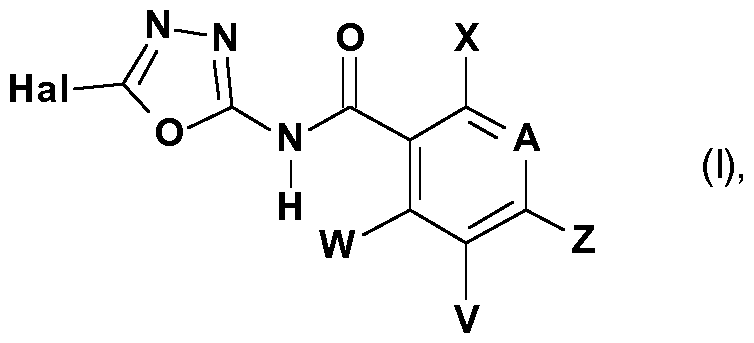
X bedeutet Nitro, Halogen, Cyano, Formyl, Rhodano, (Ci-C6)-Alkyl, Halogen-(Ci-C6)-alkyl, (C2- C6)-Alkenyl, Halogen-(C2-C6)-alkenyl, (C2-C6)-Alkinyl, Halogen-(C3-C6)-alkinyl, (C3-C6)-Cycloalkyl, Halogen-(C3-C6)-cycloalkyl, (C3-C6)-Cycloalkyl-(Ci-C6)-alkyl, Halogen-(C3-C6)-cycloalkyl-(Ci-C6)- alkyl, COR1, COOR1, OCOOR'^R'COOR1, C(0)N(R1)2, NR1C(0)N(R1)2, OC(0)N(R1)2,
C(0)NR1OR1, OR1, OCOR1, OS02R2, S(0)nR2, S02OR1, SO^R1)^ NR'SO^2, NR'COR1, (CI-C6)- Alkyl-S(0)nR2, (Ci-C6)-Alkyl-OR1, (Ci-C6)-Alkyl-OCOR1, (Ci-C6)-Alkyl-OS02R2, (Ci-C6)-Alkyl- CO2R1, (Ci-C6)-Alkyl-S02OR1, (Ci-C6)-Alkyl-CON(R1)2, (Ci-C6)-Alkyl-S02N(R1)2, (Ci-C6)-Alkyl- NR'COR1, (Ci-C6)-Alkyl-NR1S02R2, NRiR2, P(0)(OR5)2, CH2P(0)(OR5)2, (Ci-C6)-Alkyl-Heteroaryl, (Ci-C6)-Alkyl-Heterocyclyl, wobei die beiden letztgenannten Reste jeweils durch s Reste aus der
Gruppe bestehend aus Halogen, (Ci-C6)-Alkyl, Halogen-(Ci-C6)-alkyl, S(0)n-(Ci-C6)-Alkyl, (Ci-C6)- Alkoxy und Halogen-(Ci-C6)-alkoxy substituiert sind, und wobei Heterocyclyl n Oxogruppen trägt,
Y bedeutet Wasserstoff, Nitro, Halogen, Cyano, Rhodano, (Ci-C6)-Alkyl, Halogen-(Ci-C6)-alkyl, (C2-C6)-Alkenyl, Halogen-(C2-C6)-alkenyl, (C2-C6)-Alkinyl, Halogen-(C2-C6)-alkinyl, (C3-C6)- Cycloalkyl, (C3-C6)-Cycloalkenyl, Halogen-(C3-C6)-cycloalkyl, (C3-C6)-Cycloalkyl-(Ci-C6)-alkyl, Halogen-(C3-C6)-cycloalkyl-(Ci-C6)-alkyl, COR1, COOR1, OCOOR1, NR1COOR1, C(0)N(R1)2, NR1C(0)N(R1)2, OC(0)N(R1)2, COCNOR^R1, NR'SC R2, NR'COR1, OR1, OS02R2, S(0)nR2, S02OR1, SO^R1^ (Ci-C6)-Alkyl-S(0)nR2, (Ci-C6)-Alkyl-OR1, (Ci-C6)-Alkyl-OCOR1, (Ci-C6)-Alkyl-OS02R2, (Ci-C6)-Alkyl-C02R1, (Ci-C6)-Alkyl-CN, (Ci-C6)-Alkyl-S02OR1, (Ci-C6)-Alkyl-CON(R1)2, (Ci-C6)- Alkyl-SO^R1)^ (Ci-C6)-Alkyl-NR1COR1, (Ci-C6)-Alkyl-NR1S02R2, N(R1)2, P(0)(OR5)2,
CH2P(0)(OR5)2, (Ci-C6)-Alkyl-Phenyl, (Ci-C6)-Alkyl-Heteroaryl, (Ci-C6)-Alkyl-Heterocyclyl, Phenyl, Heteroaryl oder Heterocyclyl, wobei die 6 letztgenannten Reste jeweils durch s Reste aus der Gruppe bestehend aus Halogen, Nitro, Cyano, (Ci-C6)-Alkyl, Halogen-(Ci-C6)-alkyl, (C3-C6)-Cycloalkyl, S(0)n-(Ci-C6)-Alkyl, (Ci-C6)-Alkoxy, Halogen-(Ci-C6)-alkoxy, (Ci-C6)-Alkoxy-(Ci-C4)-alkyl und Cyanomethyl substituiert sind, und wobei Heterocyclyl n Oxogruppen trägt,
Z bedeutet Wasserstoff, Halogen, Cyano, Rhodano, (Ci-C6)-Alkyl, (Ci-C6)-Alkoxy, Halogen-(Ci- C6)-alkyl, (C2-C6)-Alkenyl, Halogen-(C2-C6)-alkenyl, (C2-C6)-Alkinyl, Halogen-(C2-C6)-alkinyl, (C3- C6)-Cycloalkyl, Halogen-(C3-C6)-cycloalkyl, (C3-C6)-Cycloalkyl-(Ci-C6)-alkyl, Halogen-(C3-C6)- cycloalkyl-(Ci-C6)-alkyl, COR1, COOR1, OCOOR1, NR1COOR1, C(0)N(R1)2, NR1C(0)N(R1)2, OC(0)N(R1)2, C(0)NR1OR1, OS02R2, S(0)nR2, S02OR1, SO^R1)^ NR^O^2, NR^OR1, (Ci-C6)- Alkyl-S(0)nR2, (Ci-C6)-Alkyl-OR1, (Ci-C6)-Alkyl-OCOR1, (Ci-C6)-Alkyl-OS02R2, (Ci-C6)-Alkyl- CO2R1, (Ci-C6)-Alkyl-S02OR1, (Ci-C6)-Alkyl-CON(R1)2, (Ci-C6)-Alkyl-S02N(R1)2, (Ci-C6)-Alkyl- N 'COR1, (Ci-C6)-Alkyl-NR1S02R2, N(R1)2, P(0)(OR5)2, Heteroaryl, Heterocyclyl oder Phenyl, wobei die drei letztgenannten Reste jeweils durch s Reste aus der Gruppe bestehend aus Halogen, Nitro, Cyano, (Ci-C6)-Alkyl, Halogen-(Ci-C6)-alkyl, (C3-C6)-Cycloalkyl, S(0)n-(Ci-C6)-Alkyl, (Ci-C6)- Alkoxy und Halogen-(Ci-C6)-alkoxy substituiert sind, und wobei Heterocyclyl n Oxogruppen trägt, oder V bedeutet Wasserstoff, Nitro, Halogen, Cyano, (Ci-C4)-Alkyl, (Ci-C4)-Halogenalkyl, OR1, S(0)nR2,
W bedeutet Wasserstoff, Halogen, (Ci-C4)-Alkyl, (Ci-C4)-Halogenalkyl, OR1, S(0)nR2, R1 bedeutet Wasserstoff, (Ci-C6)-Alkyl, (Ci-C6)-Halogenalkyl, (C2-C6)-Alkenyl, (C2-C6)-
Halogenalkenyl, (C2-C6)-Alkinyl, (C2-C6)-Halogenalkinyl, (C3-C6)-Cycloalkyl, (C3-C6)-Cycloalkenyl, (C3-C6)-Halogencycloalkyl, (Ci-C6)-Alkyl-0-(Ci-C6)-alkyl, (C3-C6)-Cycloalkyl-(Ci-C6)-alkyl, Phenyl,
Phenyl-(Ci-C6)-alkyl, Heteroaryl, (Ci-C6)-Alkyl-Heteroaryl, Heterocycl, (Ci-C6)-Alkyl-Heterocyclyl, (Ci-C6)-Alkyl-0-Heteroaryl, (Ci-C6)-Alkyl-0-Heterocyclyl, (Ci-C6)-Alkyl-NR3-Heteroaryl, (Ci-C6)- Alkyl-NR3-Heterocyclyl wobei die 21 letztgenannten Reste durch s Reste aus der Gruppe bestehend aus Cyano, Halogen, Nitro, Rhodano, OR3, S(0)nR4, N(R3)2, NR3OR3, COR3, OCOR3, SCOR4, NR3COR3, NR3S02R4' C02R3, COSR4, CON(R3)2 und (Ci-C4)-Alkoxy-(C2-C6)-alkoxycarbonyl substituiert sind, und wobei Heterocyclyl n Oxogruppen trägt,
R2 bedeutet (Ci-C6)-Alkyl, (Ci-C6)-Halogenalkyl, (C2-C6)-Alkenyl, (C2-C6)-Halogenalkenyl, (C2-C6)- Alkinyl, (C2-C6)-Halogenalkinyl, (C3-C6)-Cycloalkyl, (C3-C6)-Cycloalkenyl, (C3-C6)-Halogencycloalkyl, (Ci-C6)-Alkyl-0-(Ci-C6)-alkyl, (C3-C6)-Cycloalkyl-(Ci-C6)-alkyl, Phenyl, Phenyl-(Ci-C6)-alkyl, Heteroaryl, (Ci-C6)-Alkyl-Heteroaryl, Heterocyclyl, (Ci-C6)-Alkyl-Heterocyclyl, (Ci-C6)-Alkyl-0- Heteroaryl, (Ci-C6)-Alkyl-0-Heterocyclyl, (Ci-C6)-Alkyl-NR3-Heteroaryl, (Ci-C6)-Alkyl-NR3- Heterocyclyl wobei die 21 letztgenannten Reste durch s Reste aus der Gruppe bestehend aus Cyano, Halogen, Nitro, Rhodano, OR3, S(0)nR4, N(R3)2, NR3OR3, COR3, OCOR3, SCOR4, NR3COR3,
NR3S02R4, C02R3, COSR4, CON(R3)2 und (Ci-C4)-Alkoxy-(C2-C6)-alkoxycarbonyl substituiert sind, und wobei Heterocyclyl n Oxogruppen trägt,
R3 bedeutet Wasserstoff, (Ci-C6)-Alkyl, (C2-C6)-Alkenyl, (C2-C6)-Alkinyl, (C3-C6)-Cycloalkyl oder (C3-C6)-Cycloalkyl-(Ci-C6)-alkyl,
R4 bedeutet (Ci-C6)-Alkyl, (C2-C6)-Alkenyl oder (C2-C6)-Alkinyl, R5 bedeutet Methyl oder Ethyl, n bedeutet 0, 1 oder 2, s bedeutet 0, 1 , 2 oder 3,
mit der Maßgabe, dass die Verbindung N^5-Chlor ,3,4-oxadiazol-2-yl)-N2,N2-diethyl-3- iodphthalamid ausgenommen ist.
In der Formel (I) und allen nachfolgenden Formeln können Alkylreste mit mehr als zwei
Kohlenstoffatomen geradkettig oder verzweigt sein. Alkylreste bedeuten z.B. Methyl, Ethyl, n- oder i-Propyl, n-, i-, t- oder 2-Butyl, Pentyle, Hexyle, wie n-Hexyl, i-Hexyl und 1 ,3-Dimethylbutyl. Halogen steht für Fluor, Chlor, Brom oder Iod.
Heterocyclyl bedeutet einen gesättigten, teilgesättigten oder vollständig ungesättigten cyclischen Rest, der 3 bis 6 Ringatome enthält, von denen 1 bis 4 aus der Gruppe Sauerstoff, Stickstoff und Schwefel stammen, und der zusätzlich durch einen Benzoring annelliert sein kann. Beispielsweise steht
Heterocyclyl für Piperidinyl, Pyrrolidinyl, Tetrahydrofuranyl, Dihydrofuranyl und Oxetanyl.
Heteroaryl bedeutet einen aromatischen cyclischen Rest, der 3 bis 6 Ringatome enthält, von denen 1 bis 4 aus der Gruppe Sauerstoff, Stickstoff und Schwefel stammen, und der zusätzlich durch einen
Benzoring annelliert sein kann. Beispielsweise steht Heteroaryl für Benzimidazol-2-yl, Furanyl, Imidazolyl, Isoxazolyl, Isothiazolyl, Oxazolyl, Pyrazinyl, Pyrimidinyl, Pyridazinyl, Pyridinyl,
Benzisoxazolyl, Thiazolyl, Pyrrolyl, Pyrazolyl, Thiophenyl, 1 ,2,3-Oxadiazolyl, 1 ,2,4-Oxadiazolyl, 1 ,2,5- Oxadiazolyl, 1 ,3,4-Oxadiazolyl, 1 ,2,4-Triazolyl, 1 ,2,3-Triazolyl, 1 ,2,5-Triazolyl, 1 ,3,4-Triazolyl, 1 ,2,4- Triazolyl, 1 ,2,4-Thiadiazolyl, 1 ,3,4-Thiadiazolyl, 1 ,2,3-Thiadiazolyl, 1 ,2,5-Thiadiazolyl, 2H-1 ,2,3,4- Tetrazolyl, lH-l ,2,3,4-Tetrazolyl, 1,2,3,4-Oxatriazolyl, 1 ,2,3,5-Oxatriazolyl, 1 ,2,3,4-Thiatriazolyl und 1 ,2,3,5-Thiatriazolyl.
Ist eine Gruppe mehrfach durch Reste substituiert, so ist darunter zu verstehen, daß diese Gruppe durch ein oder mehrere gleiche oder verschiedene der genannten Reste substituiert ist.
Die Verbindungen der allgemeinen Formel (I) können je nach Art und Verknüpfung der Substituenten als Stereoisomere vorliegen. Sind beispielsweise ein oder mehrere asymmetrische Kohlenstoffatome vorhanden, so können Enantiomere und Diastereomere auftreten. Ebenso treten Stereoisomere auf, wenn n für 1 steht (Sulfoxide). Stereoisomere lassen sich aus den bei der Herstellung anfallenden Gemischen nach üblichen Trennmethoden, beispielsweise durch chromatographische Trennverfahren, erhalten. Ebenso können Stereoisomere durch Einsatz stereoselektiver Reaktionen unter Verwendung optisch aktiver Ausgangs- und/oder Hilfsstoffe selektiv hergestellt werden. Die Erfindung betrifft auch alle Stereoisomeren und deren Gemische, die von der allgemeinen Formel (I) umfasst, jedoch nicht spezifisch definiert sind.
Bevorzugt sind Verbindungen der allgemeinen Formel (I), worin
A bedeutet N oder CY,
Hai bedeutet Chlor, X bedeutet Nitro, Halogen, Cyano, (Ci-C6)-Alkyl, Halogen-(Ci-C6)-alkyl, (C3-C6)-Cycloalkyl, OR1, S(0)nR2, (Ci-C6)-Alkyl-S(0)nR2, (Ci-C6)-Alkyl-OR1, (Ci-C6)-Alkyl-CON(R1)2, (Ci-C6)-Alkyl- S02N(R1)2, (Ci-C6)-Alkyl-NR1COR1, (Ci-C6)-Alkyl-NR1S02R2, (Ci-C6)-Alkyl-Heteroaryl, (Ci-C6)-
Alkyl-Heterocyclyl, wobei die beiden letztgenannten Reste jeweils durch s Reste aus der Gruppe bestehend aus Halogen, (Ci-C6)-Alkyl, Halogen-(Ci-C6)-alkyl, S(0)n-(Ci-C6)-Alkyl, (Ci-C6)-Alkoxy und Halogen-(Ci-C6)-alkoxy substituiert sind, und wobei Heterocyclyl n Oxogruppen trägt, Y Wasserstoff, Nitro, Halogen, Cyano, (Ci-C6)-Alkyl, (Ci-C6)-Halogenalkyl, OR1, S(0)nR2,
S02N(R1)2, N(R1)2, NR1S02R2, NR'COR1, (Ci-C6)-Alkyl-S(0)nR2, (Ci-C6)-Alkyl-OR1, (Ci-C6)-Alkyl- CON(R1)2, (Ci-C6)-Alkyl-S02N(R1)2, (Ci-C6)-Alkyl-NR1COR1, (Ci-C6)-Alkyl-NR1S02R2, (Ci-C6)- Alkyl-Phenyl, (Ci-C6)-Alkyl-Heteroaryl, (Ci-C6)-Alkyl-Heterocyclyl, Phenyl, Heteroaryl oder
Heterocyclyl, wobei die 6 letztgenannten Reste jeweils durch s Reste aus der Gruppe bestehend aus Halogen, Nitro, Cyano, (Ci-C6)-Alkyl, Halogen-(Ci-C6)-alkyl, (C3-C6)-Cycloalkyl, S(0)n-(Ci-C6)- Alkyl, (Ci-Cö)-Alkoxy, Halogen-(Ci-C6)-alkoxy, (Ci-C6)-Alkoxy-(Ci-C4)-alkyl und Cyanomethyl substituiert sind, und wobei Heterocyclyl n Oxogruppen trägt,
Z bedeutet Wasserstoff, Halogen, Methyl, Ethyl, Isopropyl, Halogen-(Ci-C6)-alkyl, (C3-Ce)- Cycloalkyl, S(0)nR2 oder
V bedeutet Wasserstoff,
W bedeutet Wasserstoff,
R1 bedeutet Wasserstoff, (Ci-C6)-Alkyl, (C2-C6)-Alkenyl, (C2-C6)-Alkinyl, (C3-C6)-Cycloalkyl, (C3- C6)-Cycloalkyl-(Ci-C6)-alkyl, (Ci-C6)-Alkyl-0-(Ci-C6)-alkyl, Phenyl, Phenyl-(Ci-C6)-alkyl, Heteroaryl, (Ci-C6)-Alkyl-Heteroaryl, Heterocyclyl, (Ci-C6)-Alkyl-Heterocyclyl, (Ci-C6)-Alkyl-0-Heteroaryl, (Ci- C6)-Alkyl-0-Heterocyclyl, (Ci-C6)-Alkyl-NR3-Heteroaryl oder (Ci-C6)-Alkyl-NR3-Heterocyclyl, wobei die 16 letztgenannten Reste durch s Reste aus der Gruppe bestehend aus Cyano, Halogen, Nitro, OR3, S(0)nR4, N(R3)2, NR3OR3, COR3, OCOR3, NR3COR3, NR3S02R4, C02R3, CON(R3)2 und (C1-C4)- Alkoxy-(C2-C6)-alkoxycarbonyl substituiert sind, und wobei Heterocyclyl n Oxogruppen trägt,
R2 bedeutet (Ci-C6)-Alkyl, (C3-C6)-Cycloalkyl oder (C3-C6)-Cycloalkyl-(Ci-C6)-alkyl, wobei diese drei vorstehend genannten Reste jeweils durch s Reste aus der Gruppe bestehend aus Halogen und OR3 substituiert sind,
R3 bedeutet Wasserstoff oder (Ci-C6)-Alkyl, bedeutet (Ci-C6)-Alkyl, n bedeutet 0, 1 oder 2,
s bedeutet 0, 1 , 2 oder 3.
In allen nachfolgend genannten Formeln haben die Substituenten und Symbole, sofern nicht anders definiert, dieselbe Bedeutung wie unter Formel (I) beschrieben.
Erfindungsgemäße Verbindungen können beispielsweise nach der in Schema 1 angegebenen Methode durch basenkatalysierte Umsetzung eines Benzoesäure- bzw. Nicotinsäurechlorids (II) mit einem 2- Amino-l ,3,4-oxadiazol (III) hergestellt werden:
Schema 1

(III) (II) (I)
Die Benzoesäurechloride der Formel (II) beziehungsweise die ihnen zugrunde liegenden Benzoesäuren sind grundsätzlich bekannt und können beispielsweise gemäß den in WO 2012/126932 AI, US
6,376,429 Bl , EP 1 585 742 AI und EP 1 202 978 AI beschriebenen Methoden hergestellt werden.
Erfindungsgemäße Verbindungen können auch nach der in Schema 2 angegebenen Methode durch Umsetzung einer Benzoe- bzw. Nicotinsäure der Formel (IV) mit einem 2-Amino-l ,3,4-oxadiazol (III) hergestellt werden:

(Hl) (IV) (I)
Für die Aktivierung können wasserentziehende Reagenzien, die üblicherweise für
Amidierungsreaktionen, wie z. B. Ι,Γ-Carbonyldiimidazol (CDI), Dicyclohexyl-carbodiimid (DCC), 2,4,6-Tripropyl-l,3,5,2,4,6-trioxatriphosphinane 2,4,6-trioxide (T3P) etc. eingesetzt werden. Die 2-Amino-5-halogen-l,3,4-oxadiazole (III) sind bekannt und können gemäß dem Fachmann bekannten Methoden hergestellt werden.
Kollektionen aus Verbindungen der Formel (I) und/oder deren Salzen, die nach den oben genannten Reaktionen synthetisiert werden können, können auch in parallelisierter Weise hergestellt werden, wobei dies in manueller, teilweise automatisierter oder vollständig automatisierter Weise geschehen kann. Dabei ist es beispielsweise möglich, die Reaktionsdurchführung, die Aufarbeitung oder die Reinigung der Produkte bzw. Zwischenstufen zu automatisieren. Insgesamt wird hierunter eine
Vorgehensweise verstanden, wie sie beispielsweise durch D. Tiebes in Combinatorial Chemistry - Synthesis, Analysis, Screening (Herausgeber Günther Jung), Verlag Wiley 1999, auf den Seiten 1 bis 34 beschrieben ist.
Zur parallelisierten Reaktionsdurchführung und Aufarbeitung können eine Reihe von im Handel erhältlichen Geräten verwendet werden, beispielsweise Calpyso-Reaktionsblöcke (Caylpso reaction blocks) der Firma Barnstead International, Dubuque, Iowa 52004-0797, USA oder Reaktionsstationen (reaction stations) der Firma Radleys, Shirehill, Saffron Waiden, Essex, CB 11 3AZ, England oder
MultiPROBE Automated Workstations der Firma Perkin Elmar, Waltham, Massachusetts 02451, USA. Für die parallelisierte Aufreinigung von Verbindungen der allgemeinen Formel (I) und deren Salzen beziehungsweise von bei der Herstellung anfallenden Zwischenprodukten stehen unter anderem
Chromatographieapparaturen zur Verfügung, beispielsweise der Firma ISCO, Inc., 4700 Superior Street, Lincoln, NE 68504, USA.
Die aufgeführten Apparaturen führen zu einer modularen Vorgehensweise, bei der die einzelnen Arbeitsschritte automatisiert sind, zwischen den Arbeitsschritten jedoch manuelle Operationen durchgeführt werden müssen. Dies kann durch den Einsatz von teilweise oder vollständig integrierten Automationssystemen umgangen werden, bei denen die jeweiligen Automationsmodule beispielsweise durch Roboter bedient werden. Derartige Automationssysteme können zum Beispiel von der Firma Caliper, Hopkinton, MA 01748, USA bezogen werden.
Die Durchführung einzelner oder mehrerer Syntheseschritte kann durch den Einsatz von Polymer- supported reagents/Scavanger-Harze unterstützt werden. In der Fachliteratur sind eine Reihe von Versuchsprotokollen beschrieben, beispielsweise in ChemFiles, Vol. 4, No. 1, Polymer-Supported Scavengers and Reagents for Solution-Phase Synthesis (Sigma-Aldrich).
Neben den hier beschriebenen Methoden kann die Herstellung von Verbindungen der allgemeinen Formel (I) und deren Salzen vollständig oder partiell durch Festphasen unterstützte Methoden erfolgen. Zu diesem Zweck werden einzelne Zwischenstufen oder alle Zwischenstufen der Synthese oder einer für die entsprechende Vorgehensweise angepassten Synthese an ein Syntheseharz gebunden. Festphasen- unterstützte Synthesemethoden sind in der Fachliteratur hinreichend beschrieben, z.B. Barry A. Bunin in "The Combinatorial Index", Verlag Academic Press, 1998 und Combinatorial Chemistry - Synthesis, Analysis, Screening (Herausgeber Günther Jung), Verlag Wiley, 1999. Die Verwendung von
Festphasen- unterstützten Synthesemethoden erlaubt eine Reihe von literaturbekannten Protokollen, die wiederum manuell oder automatisiert ausgeführt werden können. Die Reaktionen können beispielsweise mittels IRORI-Technologie in Mikroreaktoren (microreactors) der Firma Nexus Biosystems, 12140 Community Road, Poway, CA92064, USA durchgeführt werden.
Sowohl an fester als auch in flüssiger Phase kann die Durchführung einzelner oder mehrerer
Syntheseschritte durch den Einsatz der Mikrowellen-Technologie unterstützt werden. In der
Fachliteratur sind eine Reihe von Versuchsprotokollen beschrieben, beispielsweise in Microwaves in Organic and Medicinal Chemistry (Herausgeber C. O. Kappe und a. Stadler), Verlag Wiley, 2005.
Die Herstellung gemäß der hier beschriebenen Verfahren liefert Verbindungen der Formel (I) und deren Salze in Form von Substanzkollektionen, die Bibliotheken genannt werden. Gegenstand der vorliegenden Erfindung sind auch Bibliotheken, die mindestens zwei Verbindungen der Formel (I) und deren Salzen enthalten.
Die erfindungsgemäßen Verbindungen der Formel (I) (und/oder deren Salze), im folgenden zusammen als„erfindungsgemäße Verbindungen" bezeichnet, weisen eine ausgezeichnete herbizide Wirksamkeit gegen ein breites Spektrum wirtschaftlich wichtiger mono- und dikotyler annueller Schadpflanzen auf. Auch schwer bekämpfbare perennierende Schadpflanzen, die aus Rhizomen, Wurzelstöcken oder anderen Dauerorganen austreiben, werden durch die Wirkstoffe gut erfaßt. Gegenstand der vorliegenden Erfindung ist daher auch ein Verfahren zur Bekämpfung von
unerwünschten Pflanzen oder zur Wachstumsregulierung von Pflanzen, vorzugsweise in
Pflanzenkulturen, worin eine oder mehrere erfindungsgemäße Verbindung(en) auf die Pflanzen (z.B. Schadpflanzen wie mono- oder dikotyle Unkräuter oder unerwünschte Kulturpflanzen), das Saatgut (z.B. Körner, Samen oder vegetative Vermehrungsorgane wie Knollen oder Sprossteile mit Knospen) oder die Fläche, auf der die Pflanzen wachsen (z.B. die Anbaufläche), ausgebracht werden. Dabei können die erfindungsgemäßen Verbindungen z.B. im Vorsaat- (ggf. auch durch Einarbeitung in den Boden), Vorauflauf- oder Nachauflaufverfahren ausgebracht werden. Im einzelnen seien beispielhaft
einige Vertreter der mono- und dikotylen Unkrautflora genannt, die durch die erfindungsgemäßen Verbindungen kontrolliert werden können, ohne dass durch die Nennung eine Beschränkung auf bestimmte Arten erfolgen soll. Monokotyle Schadpflanzen der Gattungen: Aegilops, Agropyron, Agrostis, Alopecurus, Apera, Avena, Brachiaria, Bromus, Cenchrus, Commelina, Cynodon, Cyperus, Dactyloctenium, Digitaria, Echinochloa, Eleocharis, Eleusine, Eragrostis, Eriochloa, Festuca, Fimbristylis, Heteranthera, Imperata, Ischaemum, Leptochloa, Lolium, Monochoria, Panicum, Paspalum, Phalaris, Phleum, Poa, Rottboellia, Sagittaria, Scirpus, Setaria, Sorghum.
Dikotyle Unkräuter der Gattungen: Abutilon, Amaranthus, Ambrosia, Anoda, Anthemis, Aphanes, Artemisia, Atriplex, Bellis, Bidens, Capsella, Carduus, Cassia, Centaurea, Chenopodium, Cirsium, Convolvulus, Datura, Desmodium, Emex, Erysimum, Euphorbia, Galeopsis, Galinsoga, Galium, Hibiscus, Ipomoea, Kochia, Lamium, Lepidium, Lindernia, Matricaria, Mentha, Mercurialis, Mullugo, Myosotis, Papaver, Pharbitis, Plantago, Polygonum, Portulaca, Ranunculus, Raphanus, Rorippa, Rotala, Rumex, Salsola, Senecio, Sesbania, Sida, Sinapis, Solanum, Sonchus, Sphenoclea, Stellaria, Taraxacum, Thlaspi, Trifolium, Urtica, Veronica, Viola, Xanthium.
Werden die erfindungsgemäßen Verbindungen vor dem Keimen auf die Erdoberfläche appliziert, so wird entweder das Auflaufen der Unkrautkeimlinge vollständig verhindert oder die Unkräuter wachsen bis zum Keimblattstadium heran, stellen jedoch dann ihr Wachstum ein und sterben schließlich nach Ablauf von drei bis vier Wochen vollkommen ab.
Bei Applikation der Wirkstoffe auf die grünen Pflanzenteile im Nachauflaufverfahren tritt nach der Behandlung Wachstumsstop ein und die Schadpflanzen bleiben in dem zum Applikationszeitpunkt vorhandenen Wachstumsstadium stehen oder sterben nach einer gewissen Zeit ganz ab, so dass auf diese Weise eine für die Kulturpflanzen schädliche Unkrautkonkurrenz sehr früh und nachhaltig beseitigt wird. Obgleich die erfindungsgemäßen Verbindungen eine ausgezeichnete herbizide Aktivität gegenüber mono- und dikotylen Unkräutern aufweisen, werden Kulturpflanzen wirtschaftlich bedeutender Kulturen z.B. dikotyler Kulturen der Gattungen Arachis, Beta, Brassica, Cucumis, Cucurbita, Helianthus, Daucus, Glycine, Gossypium, Ipomoea, Lactuca, Linum, Lycopersicon, Nicotiana, Phaseolus, Pisum, Solanum, Vicia, oder monokotyler Kulturen der Gattungen Allium, Ananas, Asparagus, Avena, Hordeum, Oryza, Panicum, Saccharum, Seeale, Sorghum, Triticale, Triticum, Zea, insbesondere Zea und Triticum, abhängig von der Struktur der jeweiligen erfindungsgemäßen Verbindung und deren Aufwandmenge nur unwesentlich oder gar nicht geschädigt. Die vorliegenden Verbindungen eignen sich aus diesen
Gründen sehr gut zur selektiven Bekämpfung von unerwünschtem Pflanzenwuchs in Pflanzenkulturen wie landwirtschaftlichen Nutzpflanzungen oder Zierpflanzungen.
Darüberhinaus weisen die erfindungsgemäßen Verbindungen (abhängig von ihrer jeweiligen Struktur und der ausgebrachten Aufwandmenge) hervorragende wachstumsregulatorische Eigenschaften bei Kulturpflanzen auf. Sie greifen regulierend in den pflanzeneigenen Stoffwechsel ein und können damit zur gezielten Beeinflussung von Pflanzeninhaltsstoffen und zur Ernteerleichterung wie z.B. durch Auslösen von Desikkation und Wuchsstauchung eingesetzt werden. Desweiteren eignen sie sich auch zur generellen Steuerung und Hemmung von unerwünschtem vegetativen Wachstum, ohne dabei die Pflanzen abzutöten. Eine Hemmung des vegetativen Wachstums spielt bei vielen mono- und dikotylen Kulturen eine große Rolle, da beispielsweise die Lagerbildung hierdurch verringert oder völlig verhindert werden kann.
Aufgrund ihrer herbiziden und pflanzenwachstumsregulatorischen Eigenschaften können die Wirkstoffe auch zur Bekämpfung von Schadpflanzen in Kulturen von gentechnisch oder durch konventionelle Mutagenese veränderten Pflanzen eingesetzt werden. Die transgenen Pflanzen zeichnen sich in der Regel durch besondere vorteilhafte Eigenschaften aus, beispielsweise durch Resistenzen gegenüber bestimmten Pestiziden, vor allem bestimmten Herbiziden, Resistenzen gegenüber Pflanzenkrankheiten oder Erregern von Pflanzenkrankheiten wie bestimmten Insekten oder Mikroorganismen wie Pilzen, Bakterien oder Viren. Andere besondere Eigenschaften betreffen z. B. das Erntegut hinsichtlich Menge, Qualität, Lagerfähigkeit, Zusammensetzung und spezieller Inhaltsstoffe. So sind transgene Pflanzen mit erhöhtem Stärkegehalt oder veränderter Qualität der Stärke oder solche mit anderer
Fettsäurezusammensetzung des Ernteguts bekannt. Bevorzugt bezüglich transgener Kulturen ist die Anwendung der erfindungsgemäßen Verbindungen in wirtschaftlich bedeutenden transgenen Kulturen von Nutz- und Zierpflanzen, z. B. von Getreide wie Weizen, Gerste, Roggen, Hafer, Hirse, Reis und Mais oder auch Kulturen von Zuckerrübe, Baumwolle, Soja, Raps, Kartoffel, Tomate, Erbse und anderen Gemüsesorten. Vorzugsweise können die
erfindungsgemäßen Verbindungen als Herbizide in Nutzpflanzenkulturen eingesetzt werden, welche gegenüber den phytotoxischen Wirkungen der Herbizide resistent sind bzw. gentechnisch resistent gemacht worden sind.
Bevorzugt ist die Anwendung der erfindungsgemäßen Verbindungen oder deren Salze in wirtschaftlich bedeutenden transgenen Kulturen von Nutz-und Zierpflanzen, z. B. von Getreide wie Weizen, Gerste, Roggen, Hafer, Hirse, Reis, Maniok und Mais oder auch Kulturen von Zuckerrübe, Baumwolle, Soja, Raps, Kartoffel, Tomate, Erbse und anderen Gemüsesorten. Vorzugsweise können die
erfindungsgemäßen Verbindungen als Herbizide in Nutzpflanzenkulturen eingesetzt werden, welche
gegenüber den phytotoxischen Wirkungen der Herbizide resistent sind bzw. gentechnisch resistent gemacht worden sind.
Herkömmliche Wege zur Herstellung neuer Pflanzen, die im Vergleich zu bisher vorkommenden Pflanzen modifizierte Eigenschaften aufweisen, bestehen beispielsweise in klassischen
Züchtungsverfahren und der Erzeugung von Mutanten. Alternativ können neue Pflanzen mit veränderten Eigenschaften mit Hilfe gentechnischer Verfahren erzeugt werden (siehe z. B. EP-A-0221044, EP-A- 0131624). Beschrieben wurden beispielsweise in mehreren Fällen
gentechnische Veränderungen von Kulturpflanzen zwecks Modifikation der in den Pflanzen synthetisierten Stärke (z. B. WO 92/11376, WO 92/14827, WO 91/19806),
transgene Kulturpflanzen, welche gegen bestimmte Herbizide vom Typ Glufosinate (vgl. z. B. EP-A-0242236, EP-A-242246) oder Glyphosate
(WO 92/00377) oder der Sulfonylharnstoffe (EP-A-0257993, US-A-5013659)
resistent sind,
- transgene Kulturpflanzen, beispielsweise Baumwolle, mit der Fähigkeit
Bacillus thuringiensis-Toxine (Bt-Toxine) zu produzieren, welche die
Pflanzen gegen bestimmte Schädlinge resistent machen (EP-A-0142924,
EP-A-0193259).
transgene Kulturpflanzen mit modifizierter Fettsäurezusammensetzung (WO 91/13972).
- gentechnisch veränderte Kulturpflanzen mit neuen Inhalts- oder Sekundärstoffen z. B. neuen
Phytoalexinen, die eine erhöhte Krankheitsresistenz verursachen (EPA 309862, EPA0464461) gentechnisch veränderte Pflanzen mit reduzierter Photorespiration, die höhere Erträge und höhere Stresstoleranz aufweisen (EPA 0305398).
Transgene Kulturpflanzen, die pharmazeutisch oder diagnostisch wichtige Proteine produzieren („molecular pharming")
transgene Kulturpflanzen, die sich durch höhere Erträge oder bessere Qualität auszeichnen transgene Kulturpflanzen die sich durch eine Kombinationen z. B. der o. g. neuen Eigenschaften auszeichnen („gene stacking") Zahlreiche molekularbiologische Techniken, mit denen neue transgene Pflanzen mit veränderten Eigenschaften hergestellt werden können, sind im Prinzip bekannt, siehe z. B. I. Potrykus und G.
Spangenberg (eds.) Gene Transfer to Plants, Springer Lab Manual (1995), Springer Verlag Berlin, Heidelberg, oder Christou, "Trends in Plant Science" 1 (1996) 423-431). Für derartige gentechnische Manipulationen können Nucleinsäuremoleküle in Plasmide eingebracht werden, die eine Mutagenese oder eine Sequenzveränderung durch Rekombination von DNA- Sequenzen erlauben. Mit Hilfe von Standardverfahren können z. B. Basenaustausche vorgenommen,
Teilsequenzen entfernt oder natürliche oder synthetische Sequenzen hinzugefügt werden. Für die Verbindung der DNA-Fragmente untereinander können an die Fragmente Adaptoren oder Linker angesetzt werden, siehe z. B. Sambrook et al., 1989, Molecular Cloning, A Laboratory Manual, 2. Aufl. Cold Spring Harbor Laboratory Press, Cold Spring Harbor, NY, oder Winnacker "Gene und Klone", VCH Weinheim 2. Auflage 1996
Die Herstellung von Pflanzenzellen mit einer verringerten Aktivität eines Genprodukts kann beispielsweise erzielt werden durch die Expression mindestens einer entsprechenden antisense-RNA, einer sense-RNA zur Erzielung eines Cosuppressionseffektes oder die Expression mindestens eines entsprechend konstruierten Ribozyms, das spezifisch Transkripte des obengenannten Genprodukts spaltet. Hierzu können zum einen DNA-Moleküle verwendet werden, die die gesamte codierende Sequenz eines Genprodukts einschließlich eventuell vorhandener flankierender Sequenzen umfassen, als auch DNA-Moleküle, die nur Teile der codierenden Sequenz umfassen, wobei diese Teile lang genug sein müssen, um in den Zellen einen antisense-Effekt zu bewirken. Möglich ist auch die Verwendung von DNA- Sequenzen, die einen hohen Grad an Homologie zu den codiereden Sequenzen eines Genprodukts aufweisen, aber nicht vollkommen identisch sind.
Bei der Expression von Nucleinsäuremolekülen in Pflanzen kann das synthetisierte Protein in jedem beliebigen Kompartiment der pflanzlichen Zelle lokalisiert sein. Um aber die Lokalisation in einem bestimmten Kompartiment zu erreichen, kann z. B. die codierende Region mit DNA-Sequenzen verknüpft werden, die die Lokalisierung in einem bestimmten Kompartiment gewährleisten. Derartige Sequenzen sind dem Fachmann bekannt (siehe beispielsweise Braun et al., EMBO J. 11 (1992), 3219- 3227, Wolter et al., Proc. Natl. Acad. Sei. USA 85 (1988), 846-850, Sonnewald et al., Plant J. 1 (1991), 95-106). Die Expression der Nukleinsäuremoleküle kann auch in den Organellen der Pflanzenzellen stattfinden.
Die transgenen Pflanzenzellen können nach bekannten Techniken zu ganzen Pflanzen regeneriert werden. Bei den transgenen Pflanzen kann es sich prinzipiell um Pflanzen jeder beliebigen
Pflanzenspezies handeln, d.h., sowohl monokotyle als auch dikotyle Pflanzen.
So sind transgene Pflanzen erhältlich, die veränderte Eigenschaften durch Überexpression, Suppression oder Inhibierung homologer (= natürlicher) Gene oder Gensequenzen oder Expression heterologer (= fremder) Gene oder Gensequenzen aufweisen. Vorzugsweise können die erfindungsgemäßen Verbindungen in transgenen Kulturen eingesetzt werden, welche gegen Wuchsstoffe, wie z. B. Dicamba oder gegen Herbizide, die essentielle Pflanzenenzyme, z. B. Acetolactatsynthasen (ALS), EPSP Synthasen, Glutaminsynthasen (GS) oder Hydroxyphenylpyruvat
Dioxygenasen (HPPD) hemmen, respektive gegen Herbizide aus der Gruppe der Sulfonylharnstoffe, der Glyphosate, Glufosinate oder Benzoylisoxazole und analogen Wirkstoffe, resistent sind.
Bei der Anwendung der erfindungsgemäßen Wirkstoffe in transgenen Kulturen treten neben den in anderen Kulturen zu beobachtenden Wirkungen gegenüber Schadpflanzen oftmals Wirkungen auf, die für die Applikation in der jeweiligen transgenen Kultur spezifisch sind, beispielsweise ein verändertes oder speziell erweitertes Unkrautspektrum, das bekämpft werden kann, veränderte Aufwandmengen, die für die Applikation eingesetzt werden können, vorzugsweise gute Kombinierbarkeit mit den Herbiziden, gegenüber denen die transgene Kultur resistent ist, sowie Beeinflussung von Wuchs und Ertrag der transgenen Kulturpflanzen.
Gegenstand der Erfindung ist deshalb auch die Verwendung der erfindungsgemäßen Verbindungen als Herbizide zur Bekämpfung von Schadpflanzen in transgenen Kulturpflanzen. Die erfindungsgemäßen Verbindungen können in Form von Spritzpulvern, emulgierbaren Konzentraten, versprühbaren Lösungen, Stäubemitteln oder Granulaten in den üblichen Zubereitungen angewendet werden. Gegenstand der Erfindung sind deshalb auch herbizide und pflanzenwachstumsregulierende Mittel, welche die erfindungsgemäßen Verbindungen enthalten. Die erfindungsgemäßen Verbindungen können auf verschiedene Art formuliert werden, je nachdem welche biologischen und/oder chemisch-physikalischen Parameter vorgegeben sind. Als
Formulierungsmöglichkeiten kommen beispielsweise in Frage: Spritzpulver (WP), wasserlösliche Pulver (SP), wasserlösliche Konzentrate, emulgierbare Konzentrate (EC), Emulsionen (EW), wie Öl-in- Wasser- und Wasser-in-Öl-Emulsionen, versprühbare Lösungen, Suspensionskonzentrate (SC), Dispersionen auf Öl- oder Wasserbasis, ölmischbare Lösungen, Kapselsuspensionen (CS), Stäubemittel (DP), Beizmittel, Granulate für die Streu- und Bodenapplikation, Granulate (GR) in Form von Mikro-, Sprüh-, Aufzugs- und Adsorptionsgranulaten, wasserdispergierbare Granulate (WG), wasserlösliche Granulate (SG), ULV-Formulierungen, Mikrokapseln und Wachse.
Diese einzelnen Formulierungstypen sind im Prinzip bekannt und werden beispielsweise beschrieben in: Winnacker-Küchler, "Chemische Technologie",
Band 7, C. Hanser Verlag München, 4. Aufl. 1986, Wade van Valkenburg, "Pesticide Formulations", Marcel Dekker, N.Y., 1973, K. Martens, "Spray Drying" Handbook, 3rd Ed. 1979, G. Goodwin Ltd. London. Die notwendigen Formulierungshilfsmittel wie Inertmaterialien, Tenside, Lösungs-mittel und weitere Zusatzstoffe sind ebenfalls bekannt und werden beispielsweise beschrieben in: Watkins, "Handbook of Insecticide Dust Diluents and Carriers", 2nd Ed., Darland Books, Caldwell N.J., H.v. Olphen,
"Introduction to Clay Colloid Chemistry", 2nd Ed., J. Wiley & Sons, N.Y., C. Marsden, "Solvents Guide", 2nd Ed., Interscience, N.Y. 1963, McCutcheon's "Detergents and Emulsifiers Annual", MC Publ. Corp., Ridgewood N.J., Sisley and Wood, "Encyclopedia of Surface Active Agents", Chem. Publ. Co. Inc., N.Y. 1964, Schönfeldt, "Grenzflächenaktive Äthylenoxidaddukte", Wiss. Verlagsgesell., Stuttgart 1976, Winnacker-Küchler, "Chemische Technologie", Band 7, C. Hanser Verlag München, 4. Aufl. 1986.
Auf der Basis dieser Formulierungen lassen sich auch Kombinationen mit anderen pestizid wirksamen Stoffen, wie z.B. Insektiziden, Akariziden, Herbiziden, Fungiziden, sowie mit Safenern, Düngemitteln und/oder Wachstumsregulatoren herstellen, z.B. in Form einer Fertigformulierung oder als Tankmix.
Spritzpulver sind in Wasser gleichmäßig dispergierbare Präparate, die neben dem Wirkstoff außer einem Verdünnungs- oder Inertstoff noch Tenside ionischer und/oder nichtionischer Art (Netzmittel,
Dispergiermittel), z.B. polyoxyethylierte Alkylphenole, polyoxethylierte Fettalkohole, polyoxethylierte Fettamine, Fettalkoholpolyglykol-ethersulfate, Alkansulfonate, Alkylbenzolsulfonate, ligninsulfonsaures Natrium, 2,2'-dinaphthylmethan-6,6'-disulfonsaures Natrium, dibutylnaphthalin-sulfonsaures Natrium oder auch oleoylmethyltaurinsaures Natrium enthalten. Zur Herstellung der Spritzpulver werden die herbiziden Wirkstoffe beispielsweise in üblichen Appara-turen wie Hammermühlen, Gebläsemühlen und Luftstrahlmühlen feingemahlen und gleichzeitig oder anschließend mit den
Formulierungshilfsmitteln vermischt.
Emulgierbare Konzentrate werden durch Auflösen des Wirkstoffes in einem organischen Lösungsmittel z.B. Butanol, Cyclohexanon, Dimethylformamid, Xylol oder auch höhersiedenden Aromaten oder Kohlenwasserstoffen oder Mischungen der organischen Lösungsmittel unter Zusatz von einem oder mehreren Tensiden ionischer und/oder nichtionischer Art (Emulgatoren) hergestellt. Als Emulgatoren können beispielsweise verwendet werden: Alkylarylsulfonsaure Calzium-Salze wie
Ca-Dodecylbenzolsulfonat oder nichtionische Emulgatoren wie Fettsäurepolyglykol-ester,
Alkylarylpolyglykolether, Fettalkoholpolyglykolether,
Propylenoxid-Ethylenoxid- Kondensationsprodukte, Alkylpolyether, Sorbitanester wie z.B.
Sorbitanfettsäure-ester oder Polyoxethylensorbitanester wie z.B. Polyoxyethylensorbitanfettsäureester.
Stäubemittel erhält man durch Vermählen des Wirkstoffes mit fein verteilten festen Stoffen, z.B.
Talkum, natürlichen Tonen, wie Kaolin, Bentonit und Pyrophyllit, oder Diatomeenerde.
Suspensionskonzentrate können auf Wasser- oder Ölbasis sein. Sie können beispielsweise durch Naß-Vermahlung mittels handelsüblicher Perlmühlen und gegebenenfalls Zusatz von Tensiden, wie sie z.B. oben bei den anderen Formulierungstypen bereits aufgeführt sind, hergestellt werden. Emulsionen, z.B. Öl-in- Wasser-Emulsionen (EW), lassen sich beispielsweise mittels Rührern, Kolloidmühlen
und/oder statischen Mischern unter Verwendung von wäßrigen organischen Lösungsmitteln und gegebenenfalls Tensiden, wie sie z.B. oben bei den anderen Formulierungstypen bereits aufgeführt sind, herstellen. Granulate können entweder durch Verdüsen des Wirkstoffes auf adsorptionsfähiges, granuliertes Inertmaterial hergestellt werden oder durch Aufbringen von Wirkstoffkonzentraten mittels Klebemitteln, z.B. Polyvinylalkohol, polyacrylsaurem Natrium oder auch Mineralölen, auf die
Oberfläche von Trägerstoffen wie Sand, Kaolinite oder von granuliertem Inertmaterial. Auch können geeignete Wirkstoffe in der für die Herstellung von Düngemittelgranulaten üblichen Weise - gewünschtenfalls in Mischung mit Düngemitteln - granuliert werden. Wasserdispergierbare Granulate werden in der Regel nach den üblichen Verfahren wie Sprühtrocknung, Wirbelbett-Granulierung, Teller-Granulierung, Mischung mit Hochgeschwindigkeitsmischern und Extrusion ohne festes
Inertmaterial hergestellt. Zur Herstellung von Teller-, Fließbett-, Extruder- und Sprühgranulate siehe z.B. Verfahren in "Spray-Drying Handbook" 3rd ed. 1979, G. Goodwin Ltd., London, J.E. Browning, "Agglomeration", Chemical and Engineering 1967, Seiten 147 ff, "Perry's Chemical Engineer's Handbook", 5th Ed., McGraw-Hill, New York 1973, S. 8-57. Für weitere Einzelheiten zur Formulierung von Pflanzenschutzmitteln siehe z.B. G.C. Klingman, "Weed Control as a Science", John Wiley and Sons, Inc., New York, 1961, Seiten 81-96 und J.D. Freyer, S.A. Evans, "Weed Control Handbook", 5th Ed., Blackwell Scientific Publications, Oxford, 1968, Seiten 101-103.
Die agrochemischen Zubereitungen enthalten in der Regel 0.1 bis 99 Gew.-%, insbesondere 0.1 bis 95 Gew.-%, erfindungsgemäße Verbindungen.
In Spritzpulvern beträgt die Wirkstoffkonzentration z.B. etwa 10 bis 90 Gew.-%, der Rest zu 100 Gew.-% besteht aus üblichen Formulierungsbestandteilen. Bei emulgierbaren Konzentraten kann die Wirkstoffkonzentration etwa 1 bis 90, vorzugsweise 5 bis 80 Gew.-% betragen. Staubförmige
Formulierungen enthalten
1 bis 30 Gew.-% Wirkstoff, vorzugsweise meistens 5 bis 20 Gew.-% an Wirkstoff, versprühbare Lösungen enthalten etwa 0.05 bis 80, vorzugsweise 2 bis 50 Gew.-% Wirkstoff. Bei
wasserdispergierbaren Granulaten hängt der Wirkstoffgehalt zum Teil davon ab, ob die wirksame Verbindung flüssig oder fest vorliegt und welche Granulierhilfsmittel, Füllstoffe usw. verwendet werden. Bei den in Wasser dispergierbaren Granulaten liegt der Gehalt an Wirkstoff beispielsweise zwischen 1 und 95 Gew.-%, vorzugsweise zwischen 10 und 80 Gew.-%.
Daneben enthalten die genannten Wirkstofformulierungen gegebenenfalls die jeweils üblichen Haft-, Netz-, Dispergier-, Emulgier-, Penetrations-, Konservierungs-, Frostschutz- und Lösungsmittel, Füll-, Träger- und Farbstoffe, Entschäumer, Verdunstungshemmer und den pH- Wert und die Viskosität beeinflussende Mittel.
Auf der Basis dieser Formulierungen lassen sich auch Kombinationen mit anderen pestizid wirksamen Stoffen, wie z.B. Insektiziden, Akariziden, Herbiziden, Fungiziden, sowie mit Safenern, Düngemitteln und/oder Wachstumsregulatoren herstellen, z.B. in Form einer Fertigformulierung oder als Tankmix. Als Kombinationspartner für die erfindungsgemäßen Verbindungen in Mischungs-formulierungen oder im Tank-Mix sind beispielsweise bekannte Wirkstoffe, die auf einer Inhibition von beispielsweise Acetolactat-Synthase, Acetyl-CoA-Carboxylase, Cellulose-Synthase, Enolpyruvylshikimat-3-phosphat- Synthase, Glutamin-Synthetase, p-Hydroxyphenylpyruvat-Dioxygenase, Phytoendesaturase, Photosystem I, Photosystem II, Protoporphyrinogen-Oxidase beruhen, einsetzbar, wie sie z.B. aus Weed Research 26 (1986) 441-445 oder "The Pesticide Manual", 15th edition, The British Crop Protection Council and the Royal Soc. of Chemistry, 2009 und dort zitierter Literatur beschrieben sind. Als bekannte Herbizide oder Pflanzen- Wachstumsregulatoren, die mit den erfindungsgemäßen
Verbindungen kombiniert werden können, sind z.B. folgende Wirkstoffe zu nennen (die Verbindungen sind entweder mit dem "common name" nach der International Organization for Standardization (ISO) oder mit dem chemischen Namen oder mit der Codenummer bezeichnet) und umfassen stets sämtliche Anwendungsformen wie Säuren, Salze, Ester und Isomere wie Stereoisomere und optische Isomere.
Zur Anwendung werden die in handelsüblicher Form vorliegenden Formulierungen gegebenenfalls in üblicher Weise verdünnt z.B. bei Spritzpulvern, emulgierbaren Konzentraten, Dispersionen und wasserdispergierbaren Granulaten mittels Wasser. Staubförmige Zubereitungen, Boden- bzw.
Streugranulate sowie versprühbare Lösungen werden vor der Anwendung üblicherweise nicht mehr mit weiteren inerten Stoffen verdünnt.
Mit den äußeren Bedingungen wie Temperatur, Feuchtigkeit, der Art des verwendeten Herbizids, u.a. variiert die erforderliche Aufwandmenge der Verbindungen der Formel (I). Sie kann innerhalb weiter Grenzen schwanken, z.B. zwischen 0,001 und 1,0 kg/ha oder mehr Aktivsubstanz, vorzugsweise liegt sie jedoch zwischen 0,005 und 750 g/ha.
Die nachstehenden Beispiele erläutern die Erfindung.
A. Chemische Beispiele
1. Herstellung von N-(5-Chlor-l,3,4-oxadiazol-2-yl)-2-methyl-3-(methylsulfanyl)-4- (trifluormethyl)benzamid (Beisp. Nr. 1-143)
Zu einer Lösung von 700 mg (2,80 mmol) 2-Methyl-3-(methylsulfanyl)-4-(trifluormethyl)benzoesäure und 435 mg (3,64 mmol) 2-Amino-5-chlor-l,3,4-oxadiazol in 20 ml Pyridin werden bei 0 °C 0,342 ml (3,92 mmol) Oxalylchlorid zugetropft. Nach 30 min. Rühren bei 0°C wird das Reaktionsgemisch weitere 14 Stunden bei Raumtemperatur gerührt. Anschließend werden 40 ml Dichlormethan und 20 ml Wasser
zugegeben. Die organische Phase wird abgetrennt und dann zweimal mit Wasser gewaschen, über Na2SÜ4 getrocknet und eingedampft. Der Rückstand wird säulenchromatographisch (prep. HPLC; Acetonitril / Wasser) gereinigt. Ausbeute 642 mg (62%).
'H-NMR (400 MHz; DMSO-de: 7,72 ppm (d, 1H), 7,60 (s, 1H), 7,58 (d, 1H), 2,81 (s, 3H), 2,32 (s, 3H).
2. Herstellung von N-(5-Chlor-l,3,4-oxadiazol-2-yl)-2-methyl-3-(methylsulfinyl)-4- (trifluormethyl)benzamid (Beisp.-Nr. 1-144)
Eine Lösung von 220 mg (0,63 mmol) N-(5-Chlor-l,3,4-oxadiazol-2-yl)-2-methyl-3-(methylsulfanyl)-4- (trifluormethyl)benzamid (Beisp. Nr. 1-143) in 20 ml Dichlormethan wird bei Raumtemperatur mit 144 mg (0,63 mmol) meta-Chlorperbenzoesäure versetzt. Nach 8 h Rühren bei Raumtemperatur, werden 5 ml einer wäßrigen Natriumbisulfit-Lösung zugegeben. Die organische Phase wird abgetrennt und dann zweimal mit Wasser gewaschen, über Na2SÜ4 getrocknet und eingedampft. Der Rückstand wird säulenchromatographisch (prep. HPLC; Acetonitril / Wasser) gereinigt. Ausbeute 149 mg (61%).
gereinigt. Ausbeute 642 mg (62%).
'H-NMR (400 MHz; DMSO-de: 11,82 ppm (bs, 1H), 7,88 (d, 1H), 7,85 (d, 1H), 3,05 (s, 3H), 2,87 (s, 3H).
3. Herstellung von N-(5-Chlor-l,3,4-oxadiazol-2-yl)-2-methyl-3-(methylsulfonyl)-4- (trifluormethyl)benzamid (Beisp.-Nr. 1-145)
Eine Lösung von 220 mg (0,63 mmol) N-(5-Chlor-l,3,4-oxadiazol-2-yl)-2-methyl-3-(methylsulfanyl)-4- (trifluormethyl)benzamid (Beisp. Nr. 1-143) in 20 ml Dichlormethan wird bei Raumtemperatur mit 331 mg (1,44 mmol) meta-Chlorperbenzoesäure versetzt. Nach 30 h Rühren bei Raumtemperatur, werden 15 ml einer wäßrigen Natriumbisulfit-Lösung zugegeben. Die ausgefallenen Kristalle werden ab filtriert und getrocknet.
Ausbeute 186 mg (61%).
'H-NMR (400 MHz; DMSO-de: 8,02 ppm (d, 1H), 7,96 (d, 1H), 3,42 (s, 3H), 2,74 (s, 3H).
Die verwendeten Abkürzungen bedeuten:
Et = Ethyl Me = Methyl n-Pr = n-Propyl i-Pr = Isopropyl c-Pr = Cyclopropyl Ph = Phenyl Ac = Acetyl Bz = Benzoyl
Die in nachfolgenden Tabellen genannten Verbindungen wurden nach den oben genannten Methoden hergestellt beziehungsweise können analog 'dazu hergestellt werden.
I i
Tabelle 1 : Erfindungsgemäße Verbindungen der allgemeinen Formel (I), worin A für CY, V und
W für Wasserstoff und Hai für Chlor steht

Nr. X Y Z Physikalische Daten
(Ή-NMR, DMSO-de,400 MHz)
1-1 F H Cl
1-2 F H S02Me
1-3 F H S02Et
1-4 F H CF3
1-5 F H N02
1-6 Cl H Br
1-7 Cl H SMe
1-8 Cl H SOMe
1-9 Cl H S02Me
1-10 Cl H S02CH2C1
1-11 Cl H SEt
1-12 Cl H S02Et
1-13 Cl H CF3
1-14 Cl H N02
1-15 Cl H pyrazol-l-yl
1-16 Cl H lH-l,2,4-triazol- 1-yl
1-17 Br H Cl
1-18 Br H Br
1-19 Br H S02Me
1-20 Br H S02Et
1-21 Br H CF3
1-22 S02Me H Cl
1-23 S02Me H Br
1-24 S02Me H SMe
1-25 S02Me H SOMe
1-26 S02Me H S02Me
1-27 S02Me H S02Et
Nr. X Y Z Physikalische Daten
(Ή-NMR, DMSO-de, 400 MHz)-28 S02Me H CF3 'H-NMR
(400,0 MHz, de-DMSO):
5 = 12,048 (1,9); 8,333 (1,8); 8,313 (2,2); 8,296 (5,6); 8,295 (5,4); 8,292 (4,2); 8,076 (2,5); 8,056 (2,1); 3,434 (33,4); 3,324 (105,2); 3,274 (1,0); 2,524 (1,0); 2,519 (1,4); 2,510 (18,2); 2,506 (39,9); 2,501 (56,1); 2,497 (38,9); 2,492 (16,9); 2,451 (0,5); 2,073 (16,0)
-29 S02Et H Cl
-30 S02Et H Br
-31 S02Et H SMe
-32 S02Et H SOMe
-33 S02Et H S02Me
-34 S02Et H CF3
-35 N02 H F
-36 N02 H Cl
-37 N02 H Br
-38 N02 H I
-39 N02 H CN
-40 N02 H S02Me 'H-NMR (400,0 MHz, CDCb):
δ = 7,268 (0,5); 7,2674 (0,6); 7,2666 (0,7); 7,266 (0,8); 7,265 (1,0); 7,264 (1,2); 7,263 (1,6); 7,260 (67,5); 7,257 (1,0); 7,256 (0,6); 1,534 (16,0); 0,008 (0,9); 0,000 (30,3); -0,009 (0,8)-41 N02 H S02Et
-42 N02 H CF3
-43 Me H Cl
-44 Me H Br
-45 Me H SMe
-46 Me H S02Me
-47 Me H S02CH2C1
-48 Me H SEt
-49 Me H S02Et
-50 Me H CF3
-51 CH2S02Me H CF3
-52 Et H Cl
-53 Et H Br
-54 Et H SMe
-55 Et H S02Me
-56 Et H S02CH2C1
-57 Et H SEt
Nr. X Y Z Physikalische Daten
(Ή-NMR, DMSO-de,400 MHz)-58 Et H S02Et
-59 Et H CF3
-60 CF3 H Cl
-61 CF3 H Br
-62 CF3 H S02Me
-63 CF3 H S02Et
-64 CF3 H CF3
-65 N02 NH2 F
-66 N02 NHMe F
-67 N02 NMe2 F
-68 N02 Me Cl
-69 N02 NH2 Cl
-70 N02 NHMe Cl
-71 N02 NMe2 Cl
-72 N02 NH2 Br
-73 N02 NHMe Br
-74 N02 NMe2 Br
-75 N02 NH2 CF3
-76 N02 NMe2 CF3
-77 N02 NH2 S02Me
-78 N02 NH2 S02Et
-79 N02 NHMe S02Me
-80 N02 NMe2 S02Me
-81 N02 NMe2 S02Et
-82 N02 NH2 lH-l,2,4-triazol- 1-yl
-83 N02 NHMe lH-l,2,4-triazol- 1-yl
-84 N02 NMe2 lH-l,2,4-triazol- 1-yl
-85 Me SMe H
-86 Me SOMe H
-87 Me S02Me H
-88 Me SEt H
-89 Me SOEt H
-90 Me S02Et H
-91 Me S(CH2)2OMe H
-92 Me SO(CH2)2OMe H
-93 Me S02(CH2)2OMe H
-94 Me F F
-95 Me F Cl
Nr. X Y Z Physikalische Daten
(Ή-NMR, DMSO-de, 400 MHz)-96 Me SEt F
-97 Me SOEt F
-98 Me S02Et F
-99 Me Me Cl
-100 Me F Cl
-101 Me Cl Cl
-102 Me NH2 Cl
-103 Me NHMe Cl
-104 Me NMe2 Cl
-105 Me 0(CH2)2OMe Cl
-106 Me 0(CH2)3OMe Cl
-107 Me 0(CH2)4OMe Cl
-108 Me OCH2CONMe2 Cl
-109 Me 0(CH2)2-CO-NMe2 Cl
-110 Me 0(CH2)2- Cl
NH(CO)NMe2
-111 Me 0(CH2)2- Cl
NH(CO)NHC02Et
-112 Me 0(CH2)2-NHC02Me Cl
-113 Me OCH2-NHS02cPr Cl
-114 Me 0(CH2)-5-2,4- Cl
dimethyl-2,4-dihydro- 3H- 1 ,2,4-triazol-3 -on
-115 Me 0(CH2)-3,5-dime- Cl
thyl- 1 ,2-oxazol-4-yl
-116 Me SMe Cl Ή-NMR (400,0 MHz, CDCb):
5 = 7,451 (0,5); 7,430 (1,8); 7,413 (2,1); 7,393 (0,6); 7,262 (11,0); 2,746 (7,9); 2,374 (16,0); 0,000 (4,7)
-117 Me SOMe Cl Ή-NMR (400,0 MHz, CDCb):
5 = 7,561 (0,9); 7,541 (1,1); 7,388 (1,0); 7,366 (0,8); 7,310 (0,8); 7,260 (53,1); 7,210 (2,0); 3,150 (0,7); 2,932 (8,5); 2,697 (5,3); 1,540 (16,0); 1,490 (0,7); 0,008 (0,8); 0,000 (22,3); -0,009 (1,2); -0,050 (0,9)
-118 Me S02Me Cl
-119 Me SEt Cl
-120 Me SOEt Cl
-121 Me S02Et Cl
-122 Me S(CH2)2OMe Cl
-123 Me SO(CH2)2OMe Cl
-124 Me S02(CH2)2OMe Cl
-125 Me NH2 Br
Nr. X Y Z Physikalische Daten
(Ή-NMR, DMSO-de, 400 MHz)-126 Me NHMe Br
-127 Me NMe2 Br
-128 Me OCH2(CO)NMe2 Br
-129 Me 0(CH2)-5-pyrrolidin- Br
2-on
-130 Me SMe Br
-131 Me SOMe Br
-132 Me S02Me Br
-133 Me SEt Br
-134 Me SOEt Br
-135 Me S02Et Br
-136 Me SMe I
-137 Me SOMe I
-138 Me S02Me I
-139 Me SEt I
-140 Me SOEt I
-141 Me S02Et I
-142 Me Cl CF3
-143 Me SMe CF3 'H-NMR (400,0 MHz, CDCb):
5 = 7,729 (1,3); 7,709 (1,8); 7,598 (1,7); 7,578 (1,0); 7,518 (1,2); 7,260 (222,5); 6,996 (1,2); 2,807 (11,7); 2,321 (16,0); 1,534 (6,6); 0,008 (2,5); 0,000 (86,9); - 0,009 (2,4)
-144 Me SOMe CF3 'H-NMR (400,0 MHz, de-DMSO):
δ = 7,889 (1,0); 7,869 (3,7); 7,856 (3,1); 7,835 (0,8); 3,312 (13,6); 3,055 (16,0); 2,870 (14,9); 2,523 (1,0); 2,518 (1,5); 2,510 (16,5); 2,505 (34,6); 2,501 (47,5); 2,496 (33,2); 2,491 (14,8); 0,000 (0,6)-145 Me S02Me CF3 1 H-NMR (400,0 MHz, de-DMSO):
5 = 11,858 (0,9); 8,032 (1,5); 8,012 (2,6); 7,974 (2,4); 7,953 (1,2); 3,421 (18,0); 3,312 (572,1); 3,261 (4,7); 2,745 (16,0); 2,669 (3,6); 2,501 (460,6); 2,327 (3,4); 2,209 (0,9); 1,209 (0,6); 1,193 (0,6); 0,000 (1,0)
-146 Me SEt CF3
-147 Me SOEt CF3
-148 Me S02Et CF3
-149 Me S(CH2)2OMe CF3
-150 Me SO(CH2)2OMe CF3
-151 Me S02(CH2)2OMe CF3
Nr. X Y Z Physikalische Daten
(!H-NMR, DMSO-de, 400 MHz)-152 Me Me S02Me
-153 Me 4,5-dihydro-l,2- S02Me Ή-NMR (400,0 MHz, CDCb):
oxazol-3 yl δ = 7,930 (1,0); 7,910 (1,2); 7,762
(1,9); 7,741 (1,5); 7,264 (21,1); 4,622 (1,6); 4,597 (3,7); 4,572 (1,8); 3,475 (2,0); 3,350 (0,9); 3,325 (1,7); 3,300 (0,8); 3,185 (16,0); 3,057 (0,7); 2,940 (4,1); 2,824 (3,2); 2,461 (10,3); 1,604 (0,5); 0,000 (9,3)
-154 Me 4,5-dihydro-l,2- S02Et
oxazol-3 yl
-155 Me 5-cyanomethyl- 4,5- S02Me
dihydro- 1 ,2-oxazol-3 - yi
-156 Me 5-cyanomethyl- 4,5- S02Et
dihydro- 1 ,2-oxazol-3 - yi
-157 Me NH2 S02Me
-158 Me NHMe S02Me
-159 Me NMe2 S02Me
-160 Me NH(CH2)2OMe S02Me
-161 Me pyrazol-l-yl S02Me Ή-NMR (400,0 MHz, CDCb):
δ = 9,070 (0,5); 7,930 (1,4); 7,910 (1,6); 7,815 (2,3); 7,802 (2,3); 7,801 (2,5); 7,797 (2,6); 7,796 (2,8); 7,706 (2,3); 7,705 (2,4); 7,700 (2,5); 7,698 (2,2); 7,264 (18,9); 6,571 (2,2); 6,566 (2,4); 6,565 (2,4); 6,560 (2,1); 3,475 (1,0); 2,972 (16,0); 2,953 (5,0); 2,952 (5,1); 2,849 (4,2); 2,847 (4,0); 2,050 (11,0); 0,000 (8,4)-162 Me OH S02Me
-163 Me OMe S02Me
-164 Me OMe S02Et
-165 Me OEt S02Me
-166 Me OEt S02Et
-167 Me OiPr S02Me
-168 Me OiPr S02Et
-169 Me 0(CH2)2OMe S02Me
-170 Me 0(CH2)2OMe S02Et
-171 Me 0(CH2)3OMe S02Me
-172 Me 0(CH2)3OMe S02Et
-173 Me 0(CH2)4OMe S02Me
-174 Me 0(CH2)4OMe S02Et
-175 Me 0(CH2)2NHS02Me S02Me
Nr. X Y Z Physikalische Daten
(Ή-NMR, DMSO-de,400 MHz)-176 Me 0(CH2)2NHS02Me S02Et
-177 Me OCH2(CO)NMe2 S02Me
-178 Me OCH2(CO)NMe2 S02Et
-179 Me [l,4]dioxan-2-yl- S02Me
methoxy
-180 Me [l,4]dioxan-2-yl- S02Et
methoxy
-181 Me 0(CH2)2-0(3,5-di- S02Me
methoxypyrimidin-2- yi
-182 Me Cl S02Me
-183 Me SMe S02Me
-184 Me SOMe S02Me
-185 Me S02Me S02Me Ή-NMR (400,0 MHz, CDCb):
δ = 8,369 (0,5); 8,348 (0,6); 7,519 (0,9); 7,260 (154,8); 7,210 (1,1); 6,996 (0,9); 3,579 (6,2); 3,488 (5,7); 2,867 (2,6); 1,537 (16,0); 0,008 (2,1); 0,000 (63,4); -0,009 (1,9); -0,050 (0,6)
-186 Me S02Me S02Et
-187 Me SEt S02Me
-188 Me SOEt S02Me
-189 Me S02Et S02Me
-190 Me S(CH2)2OMe S02Me
-191 Me SO(CH2)2OMe S02Me
-192 Me S02(CH2)2OMe S02Me
-193 CH2SMe OMe S02Me
-194 CH2OMe OMe S02Me
-195 CH20(CH2)2OMe NH(CH2)2OEt S02Me
-196 CH20(CH2)2OMe NH(CH2)3OEt S02Me
-197 CH20(CH2)3OMe OMe S02Me
-198 CH20(CH2)2OMe NH(CH2)2OMe S02Me
-199 CH20(CH2)2OMe NH(CH2)3OMe S02Me
-200 Et SMe Cl
-201 Et S02Me Cl
-202 Et SMe CF3
-203 Et S02Me CF3
-204 Et F S02Me
-205 Et NH(CH2)2OMe S02Me
-206 iPr S02Me CF3
-207 cPr S02Me CF3
-208 CF3 0(CH2)2OMe F
Nr. X Y Z Physikalische Daten
(Ή-NMR, DMSO-de,400 MHz)-209 CF3 0(CH2)3OMe F
-210 CF3 OCH2CONMe2 F
-211 CF3 [l,4]dioxan-2-yl- F
methoxy
-212 CF3 0(CH2)2OMe Cl
-213 CF3 0(CH2)3OMe Cl
-214 CF3 OCH2CONMe2 Cl
-215 CF3 [l,4]dioxan-2-yl- Cl
methoxy
-216 CF3 0(CH2)2OMe Br
-217 CF3 0(CH2)3OMe Br
-218 CF3 OCH2CONMe2 Br
-219 CF3 [l,4]dioxan-2-yl- Br
methoxy
-220 CF3 0(CH2)2OMe I
-221 CF3 0(CH2)3OMe I
-222 CF3 OCH2CONMe2 I
-223 CF3 [l,4]dioxan-2-yl- I
methoxy
-224 CF3 F S02Me
-225 CF3 F S02Et
-226 CF3 0(CH2)2OMe S02Me
-227 CF3 0(CH2)2OMe S02Et
-228 CF3 0(CH2)3OMe S02Me
-229 CF3 0(CH2)3OMe S02Et
-230 CF3 OCH2CONMe2 S02Me
-231 CF3 OCH2CONMe2 S02Et
-232 CF3 [l,4]dioxan-2-yl- S02Me
methoxy
-233 CF3 [l,4]dioxan-2-yl- S02Et
methoxy
-234 F SMe CF3 Ή-NMR (400,0 MHz, CDCb):
δ = 8,282 (0,8); 8,280 (0,8); 8,261 (1,5); 8,243 (0,9); 7,739 (2,2); 7,719 (2,0); 7,267 (0,5); 7,266 (0,6); 7,2653 (0,8); 7,2645 (1,1); 7,261 (49,0); 7,258 (0,7); 2,523 (16,0); 1,546 (5,9); 0,008 (0,6); 0,000 (21,3); -0,009 (0,6)-235 F SOMe CF3

 Nr. X Y Z Physikalische Daten
(Ή-NMR, DMSO-de, 400 MHz)-273 Cl OMe S02Me !H-NMR (400,0 MHz, CDCb):
δ = 7,975 (2,5); 7,955 (2,9); 7,2654 (0,5); 7,2646 (0,7); 7,264 (1,1); 7,261 (33,8); 7,258 (0,6); 4,109 (15,3); 3,266 (16,0); 1,552 (3,0); 0,000 (15,4)
-274 Cl OMe S02Et
-275 Cl OEt S02Me
-276 Cl OEt S02Et
-277 Cl OiPr S02Me
-278 Cl OiPr S02Et
-279 Cl 0(CH2)2OMe S02Me
-280 Cl 0(CH2)4OMe S02Me
-281 Cl 0(CH2)4OMe S02Et
-282 Cl 0(CH2)3OMe S02Me
-283 Cl 0(CH2)3OMe S02Et
-284 Cl 0(CH2)2OMe S02Me
-285 Cl 0(CH2)2OMe S02Et
-286 Cl [l,4]dioxan-2-yl- S02Me
methoxy
-287 Cl [l,4]dioxan-2-yl- S02Et
methoxy
-288 Cl OCH2(CO)NMe2 S02Me
-289 Cl OCH2(CO)NMe2 S02Et
-290 Cl SMe S02Me Ή-NMR (400,0 MHz, CDCb):
δ = 8,225 (2,4); 8,205 (2,5); 7,519 (0,9); 7,2733 (0,5); 7,2726 (0,6); 7,272 (0,7); 7,271 (0,7); 7,270 (0,9); 7,2693 (1,1); 7,2686 (1,2); 7,268 (1,5); 7,267 (1,7); 7,266 (1,9); 7,2653 (2,3); 7,2645 (3,0); 7,264 (4,1); 7,260 (167,9); 7,2563 (1,3); 7,2555 (1,0); 7,255 (0,8); 7,254 (0,6); 7,211 (1,1); 6,996 (1,0); 3,477 (16,0); 3,286 (0,5); 3,006 (0,5); 2,544 (10,9); 1,539 (14,4); 0,008 (2,1); 0,006 (0,6); 0,005 (0,7); 0,000 (73,2); -0,009 (2,0)
-291 Cl S02Me S02Me Ή-NMR (400,0 MHz, CDCb):
δ = 8,452 (0,6); 8,432 (0,6); 7,519 (0,6); 7,309 (1,3); 7,260 (109,0); 7,209 (3,1); 6,996 (0,6); 3,623 (3,6); 3,524 (2,6); 1,538 (16,0); 1,488 (0,7); 0,049 (0,5); 0,008 (2,2); 0,000 (45,2); -0,008 (2,4); - 0,051 (1,4)
-292 Br OMe Br
-293 Br 0(CH2)2OMe Br
Nr. X Y Z Physikalische Daten
(Ή-NMR, DMSO-de, 400 MHz)-294 Br 0(CH2)2OMe S02Me
-295 Br 0(CH2)2OMe S02Et
-296 Br 0(CH2)3OMe S02Me
-297 Br 0(CH2)3OMe S02Et
-298 Br 0(CH2)4OMe S02Me
-299 Br 0(CH2)4OMe S02Et
-300 Br [l,4]dioxan-2-yl- S02Me
methoxy
-301 Br [l,4]dioxan-2-yl- S02Et
methoxy
-302 I 0(CH2)2OMe S02Me
-303 I 0(CH2)2OMe S02Et
-304 I 0(CH2)3OMe S02Me
-305 I 0(CH2)3OMe S02Et
-306 I 0(CH2)4OMe S02Me
-307 I 0(CH2)4OMe S02Et
-308 [l,4]dioxan-2-yl- S02Me
1
methoxy
-309 I [l,4]dioxan-2-yl- S02Et
methoxy
-310 OMe SMe CF3 !H-NMR (400,0 MHz, CDCb):
δ =8,330 (1,0); 8,309 (1,0); 7,707 (1,7); 7,686 (1,6); 7,261 (25,9); 4,200 (16,0); 2,501 (11,9); 1,543 (1,5); 0,000 (11,0)
-311 OMe SOMe CF3 Ή-NMR (400,0 MHz, CDCb):
δ =9,829 (0,6); 8,427 (1,0); 8,405 (1,2); 7,777 (2,3); 7,756 (2,2); 7,519 (0,9); 7,309 (1,7); 7,260 (167,0); 7,219 (1,9); 7,210 (5,5); 6,996 (0,9); 4,237 (16,0); 4,187 (0,6); 3,154 (12,5); 3,104 (0,6); 1,544 (6,2); 0,049 (0,5); 0,008 (3,1); 0,000 (69,3); -0,008 (4,0); - 0,042 (0,9); -0,051 (2,4)-312 OMe S02Me CF3 Ή-NMR (400,0 MHz, CDCb):
δ =8,439 (0,8); 8,419 (0,9); 7,938 (2,6); 7,917 (2,4); 7,263 (21,1); 4,185 (16,0); 3,487 (4,7); 3,404 (11,1); 3,194 (1,2); 2,952 (0,9); 2,860 (0,8); 1,579 (0,8); 0,000 (8,7)
-313 OMe SOEt CF3
-314 OMe S02Et CF3
-315 OMe S(CH2)2OMe CF3
-316 OMe SO(CH2)2OMe CF3
-317 OMe S02(CH2)2OMe CF3
Nr. X Y Z Physikalische Daten
(Ή-NMR, DMSO-de,400 MHz)-318 OMe SMe Cl
-319 OMe SOMe Cl
-320 OMe S02Me Cl
-321 OMe SEt Cl
-322 OMe SOEt Cl
-323 OMe S02Et Cl
-324 OMe S(CH2)2OMe Cl
-325 OMe SO(CH2)2OMe Cl
-326 OMe S02(CH2)2OMe Cl
-327 OCH2c-Pr SMe CF3
-328 OCH2c-Pr SOMe CF3
-329 OCH2c-Pr S02Me CF3
-330 OCH2c-Pr SEt CF3
-331 OCH2c-Pr SOEt CF3
-332 OCH2c-Pr S02Et CF3
-333 OCH2c-Pr S(CH2)2OMe CF3
-334 OCH2c-Pr SO(CH2)2OMe CF3
-335 OCH2c-Pr S02(CH2)2OMe CF3
-336 OCH2c-Pr SMe Cl
-337 OCH2c-Pr SOMe Cl
-338 OCH2c-Pr S02Me Cl
-339 OCH2c-Pr SEt Cl
-340 OCH2c-Pr SOEt Cl
-341 OCH2c-Pr S02Et Cl
-342 OCH2c-Pr S(CH2)2OMe Cl
-343 OCH2c-Pr SO(CH2)2OMe Cl
-344 OCH2c-Pr S02(CH2)2OMe Cl
-345 OCH2c-Pr SMe S02Me
-346 OCH2c-Pr SOMe S02Me
-347 OCH2c-Pr S02Me S02Me
-348 OCH2c-Pr SEt S02Me
-349 OCH2c-Pr SOEt S02Me
-350 OCH2c-Pr S02Et S02Me
-351 OCH2c-Pr S(CH2)2OMe S02Me
-352 OCH2c-Pr SO(CH2)2OMe S02Me
-353 OCH2c-Pr S02(CH2)2OMe S02Me
-354 S02Me F CF3
-355 S02Me NH2 CF3
-356 S02Me NHEt Cl
-357 SMe SEt F
Nr. X Y Z Physikalische Daten
(!H-NMR, DMSO-de, 400 MHz)-358 SMe SMe F
-359 SMe SMe CF3 Ή-NMR (400,0 MHz, CDCb):
δ =7,861 (1,8); 7,840 (1,5); 7,262 (20,0); 2,571 (16,0); 2,500 (12,2); 2,450 (1,1); 1,555 (0,7); 0,000 (8,7)
-360 SMe SOMe CF3
-361 SMe S02Me CF3
-362 SMe SMe Cl
-363 SMe SMe Br
-364 Cl Ac CF3
-365 Cl Ac S02Me
-366 Cl C(0)cPr CF3
-367 Cl C(0)cPr S02Me
-368 Cl CH2SMe CF3
-369 Cl CH2S(0)Me CF3
-370 Cl CH2S02Me CF3
-371 Cl CH2SMe S02Me
-372 Cl CH2S(0)Me S02Me
-373 Cl CH2S02Me S02Me
-374 Cl CH=NOMe CF3
-375 Cl CH=NOMe S02Me
-376 Cl 4,5-dihydro-l,2- CF3
oxazol-5-yl
-377 Cl 4,5-dihydro-l,2- S02Me
oxazol-5-yl
-378 Cl 3-methyl-4,5- CF3
dihydro- 1 ,2-oxazol-5- yi
-379 Cl 3-methyl-4,5-dihydro- S02Me
l,2-oxazol-5-yl
-380 Cl vinyl CF3
-381 Cl vinyl S02Me
-382 Cl C02Me CF3
-383 Cl C02Me S02Me
-384 Cl SMe CF3 Ή-NMR (400,0 MHz, CDCb):
5 = 7,814 (4,0); 7,2664 (0,6); 7,2656 (0,8); 7,265 (1,0); 7,264 (1,5); 7,261 (66,9); 7,257 (0,8); 7,256 (0,6); 2,453 (16,0); 1,547 (2,9); 0,008 (0,8); 0,002 (1,2); 0,000 (28,1); -0,004 (0,5); -0,009 (0,8)
Nr. X Y z Physikalische Daten
(!H-NMR, DMSO-de, 400 MHz)-385 Cl S(0)Me CF3 !H-NMR (400,0 MHz, CDCb):
δ =8,057 (1,1); 7,950 (0,7); 7,838 (2,1); 7,826 (4,0); 7,805 (1,1); 7,571 (0,8); 7,519 (2,1); 7,437 (0,7); 7,417 (1,0); 7,398 (0,6); 7,310 (4,6); 7,292 (0,9); 7,260 (395,5); 7,210 (12,7); 6,996 (2,4); 3,491 (1,4); 3,113 (16,0); 3,063 (0,8); 1,542 (7,8); 0,050 (1,8); 0,008 (5,3); 0,000 (163,4); -0,008 (7,9); -0,050 (5,3); -0,150 (0,7)-386 Cl S02Me CF3 Ή-NMR (400,0 MHz, CDCb):
δ = 8,009 (0,6); 7,260 (38,7); 7,210 (1,0); 3,361 (3,7); 1,543 (16,0); 0,008 (0,7); 0,000 (16,4); - 0,009 (0,8)
-387 Cl S02Me S02Me
-388 Cl SMe Me
-389 Cl SOMe Me
-390 Cl S02Me Me Ή-NMR (400,0 MHz, CDCb):
5 = 7,614 (0,7); 7,593 (1,3);
7.543 (2,0); 7,522 (1,2); 7,310 (1,1); 7,260 (71,2); 7,210 (2,9); 3,395 (1,2); 3,392 (1,2); 3,282 (13,1); 3,232 (0,6); 2,811 (9,2);
1.544 (16,0); 1,494 (0,8); 0,008 (0,9); 0,000 (29,9); -0,008 (1,7); - 0,050 (1,3)
-391 Cl lH-l,2,4-triazol-l-yl CF3
-392 Cl lH-l,2,3-triazol-l-yl CF3
-393 Cl 2H-l,2,3-triazol-2-yl CF3
-394 Cl lH-pyrazol-l-yl CF3
-395 Cl 1 Η-4-Chlorpyrazol- 1 - CF3
yi
-396 Cl 1 H-3 -brom-pyrazol- CF3
1-yl
-397 Cl 1 Η-4-trifluormethyl- CF3
pyrazol-l-yl
-398 Cl pyrolidin-2-οη- 1 -yl CF3
-399 Cl Γηο 1ιο1ίη-3 -οη-4-yl CF3
-400 Cl 1 ,2-Thiazolidin- 1,1- CF3
dioxid-2-yl
-401 Br lH-l,2,4-triazol-l-yl CF3
-402 Br 1H-1, 2,3 -triazol- 1-yl CF3
-403 Br 2H-l,2,3-triazol-2-yl CF3
-404 Br lH-pyrazol-l-yl CF3
-405 Br 1 H-4-Chlo yrazol- 1 - CF3
yi
Nr. X Y z Physikalische Daten
(!H-NMR, DMSO-de,400 MHz)-406 Br 1 H-3 -brom-pyrazol- CF3
1-yl
-407 Br 1 Η-4-trifluormethyl- CF3
pyrazol-l-yl
-408 Br pyrolidin-2-οη- 1 -yl CF3
-409 Br morpholin-3 -οη-4-yl CF3
-410 Br 1 ,2-Thiazolidin- 1,1- CF3
dioxid-2-yl
-411 CH2OMe lH-l,2,4-triazol-l-yl CF3
-412 CH2OMe 1H-1, 2,3 -triazol- 1-yl CF3
-413 CH2OMe 2H-l,2,3-triazol-2-yl CF3
-414 CF3 OCH2CH2F CF3
-415 CF3 OMe CF3
-416 CF3 SMe CF3
-417 CF3 SOMe CF3
-418 CF3 S02Me CF3
-419 CF3 lH-pyrazol-l-yl CF3
-420 Me SMe Et
-421 Me SOMe Et
-422 Me S02Me Et
-423 Me lH-pyrazol-l-yl Et
-424 Me OCH2CH2F Et
-425 Me OMe Et
-426 Me Ac CF3
-427 Me Ac S02Me
-428 Me C(0)cPr CF3
-429 Me C(0)cPr S02Me
-430 Me CH2SMe CF3
-431 Me CH2S(0)Me CF3
-432 Me CH2S02Me CF3
-433 Me CH2SMe S02Me
-434 Me CH2S(0)Me S02Me
-435 Me CH2S02Me S02Me
-436 Me CH=NOMe CF3
-437 Me CH=NOMe S02Me
-438 Me 4,5-dihydro-l,2- CF3
oxazol-5-yl
-439 Me 4,5-dihydro-l,2- S02Me
oxazol-5-yl
-440 Me 3-methyl-4,5- CF3
dihydro- 1 ,2-oxazol-5- yi
Nr. X Y Z Physikalische Daten
(Ή-NMR, DMSO-de, 400 MHz)-441 Me 3-methyl-4,5-dihydro- S02Me
l,2-oxazol-5-yl
-442 Me vinyl CF3
-443 Me vinyl S02Me
-444 Me C02Me CF3
-445 Me C02Me S02Me
-446 CF3 lH-pyrazol-l-yl CF3
-447 CF3 lH-pyrazol-l-yl S02Me !H-NMR (400,0 MHz, CDCb):
δ = 8,465 (3,1); 8,445 (3,3); 7,935 (2,4); 7,817 (5,0); 7,816 (5,4); 7,812 (5,2); 7,811 (5,2); 7,794 (2,9); 7,788 (2,8); 7,520 (0,6); 7,272 (0,6); 7,271 (0,7); 7,2704 (0,8); 7,2695 (0,8); 7,269 (0,9); 7,268 (1,0); 7,267 (1,3); 7,2663 (1,6); 7,2655 (2,0); 7,261 (107,4); 7,2574 (1,1); 7,2565 (0,8); 7,256 (0,5); 7,211 (0,6); 6,997 (0,6); 6,576 (4,5); 6,571 (4,8); 6,570 (4,9); 6,565 (4,3); 3,005 (9,1); 2,9502 (15,5); 2,9495 (16,0); 2,837 (12,8); 2,835 (12,5); 1,589 (2,2); 0,008 (1,4); 0,000 (44,8); - 0,009 (1,3)
-448 CF3 lH-pyrazol-l-yl S02Et Ή-NMR (400,0 MHz, CDCb):
δ = 8,392 (2,1); 8,372 (2,3); 7,937
(2.6) ; 7,923 (0,8); 7,791 (8,5); 7,786 (8,4); 7,262 (79,8); 6,556
(3.7) ; 6,551 (4,5); 6,545 (3,7); 3,116 (0,6); 3,098 (1,5); 3,079 (1,6); 3,062 (0,6); 2,950 (16,0); 2,949 (16,0); 2,839 (13,4); 2,837 (13,5); 1,597 (1,1); 1,220 (6,7); 1,201 (15,2); 1,183 (6,5); 0,008 (0,9); 0,000 (34,7); -0,009 (1,0)-449 OEt lH-pyrazol-l-yl CF3 Ή-NMR (400,0 MHz, CDCb):
5 = 10,270 (0,9); 8,485 (1,6); 8,483 (1,6); 8,464 (1,7); 8,462
(1.7) ; 7,850 (3,0); 7,848 (3,1); 7,845 (3,1); 7,844 (2,9); 7,776
(2.8) ; 7,775 (2,7); 7,755 (2,6); 7,754 (2,6); 7,661 (2,4); 7,655 (2,4); 7,267 (0,5); 7,266 (0,7); 7,263 (28,3); 6,580 (3,2); 6,576 (3,4); 6,574 (3,4); 6,570 (3,0); 3,743 (2,1); 3,726 (7,1); 3,708 (7,1); 3,690 (2,2); 1,566 (1,3); 1,206 (7,3); 1,188 (16,0); 1,170 (7,1); 0,000 (12,0)
-450 OMe lH-pyrazol-l-yl CF3
Nr. X Y Z Physikalische Daten
(Ή-NMR, DMSO-de, 400 MHz)-451 Cl lH-pyrazol-l-yl S02Me !H-NMR (400,0 MHz, CDCb):
δ =8,133 (1,9); 8,113 (2,4); 7,977 (1,2); 7,956 (1,0); 7,833 (2,1); 7,830 (2,1); 7,829 (2,1); 7,754 (2,0); 7,748 (2,0); 7,263 (15,4); 6,591 (1,8); 6,586 (2,0); 6,585
(2.0) ; 6,580 (1,7); 3,474 (1,2); 3,076 (16,0); 2,953 (2,5); 2,840
(2.1) ; 2,838 (2,0); 1,635 (0,9); 0,000 (6,6)
-452 Cl SMe c-Pr Ή-NMR (400,0 MHz, CDCb):
δ = 7,750 (0,7); 7,729 (0,7); 7,265 (0,5); 7,264 (0,7); 7,261 (29,5); 6,886 (1,6); 6,865 (1,5); 2,841 (0,6); 2,417 (16,0); 1,543 (6,5); 1,193 (1,1); 1,189 (1,1); 1,184 (0,6); 1,177 (0,6); 1,172 (1,1); 1,168 (1,1); 1,156 (0,5); 0,809 (0,5); 0,797 (1,1); 0,793 (1,1); 0,784 (1,0); 0,780 (1,2); 0,000 (12,8)
-453 Cl SOMe c-Pr
-454 Cl S02Me c-Pr Ή-NMR (400,0 MHz, CDCb):
δ =7,744 (0,6); 7,722 (0,7); 7,310
(1.1) ; 7,260 (78,7); 7,235 (1,9); 7,210 (2,8); 3,352 (11,4); 3,057 (0,6); 1,545 (16,0); 1,495 (0,8); 1,216 (1,1); 1,213 (1,2); 1,207 (0,7); 1,200 (0,6); 1,195 (1,2); 1,191 (1,2); 1,179 (0,6); 0,818
(1.2) ; 0,815 (1,3); 0,804 (1,3); 0,801 (1,3); 0,008 (1,1); 0,000 (32,5); -0,009 (1,6); -0,050 (1,2)-455 Cl SMe H Ή-NMR (400,0 MHz, CDCb):
δ =7,587 (0,7); 7,583 (0,7); 7,568 (0,9); 7,564 (0,9); 7,438 (1,7); 7,419 (3,0); 7,399 (2,3); 7,358 (1,5); 7,354 (1,5); 7,338 (0,9); 7,334 (0,8); 7,265 (0,6); 7,264 (0,8); 7,261 (33,9); 2,535 (16,0); 1,547 (2,4); 0,002 (0,6); 0,000 (13,9); -0,003 (0,5)
-456 Cl SOMe H
-457 Cl S02Me H
-458 Cl SEt H
-459 Cl SOEt H
-460 Cl S02Et H
Nr. X Y Z Physikalische Daten
(Ή-NMR, DMSO-de, 400 MHz)-461 Cl NH(CO)-pyrrolidin Cl !H-NMR (400,0 MHz, CDCb):
δ = 9,387 (1,7); 7,595 (5,0); 7,574 (7,5); 7,520 (1,8); 7,494 (11,2); 7,473 (7,6); 7,279 (0,6); 7,278 (0,6); 7,277 (0,5); 7,276 (0,7); 7,2754 (0,8); 7,2746 (0,8); 7,274 (0,8); 7,273 (0,9); 7,272 (1,1); 7,2714 (1,2); 7,2706 (1,5); 7,270 (1,8); 7,269 (2,1); 7,268 (2,2); 7,2674 (2,6); 7,2666 (3,1); 7,266
(3.8) ; 7,265 (5,0); 7,264 (7,0); 7,261 (299,5); 7,258 (4,5); 7,257
(2.9) ; 7,256 (2,3); 7,255 (1,6); 7,2543 (1,3); 7,2535 (1,2); 7,253 (0,8); 7,252 (0,7); 7,251 (0,6); 7,2503 (0,6); 7,2495 (0,6); 7,249 (0,5); 7,211 (1,6); 6,997 (1,7); 6,100 (4,4); 3,595 (1,3); 3,552
(6.2) ; 3,543 (4,0); 3,535 (16,0); 3,527 (4,0); 3,518 (6,5); 2,035 (5,0); 1,821 (12,8); 0,008 (3,6); 0,006 (0,9); 0,005 (1,0); 0,004
(1.3) ; 0,002 (4,1); 0,000 (136,1); - 0,006 (1,2); -0,009 (3,6); -0,050 (0,6)
-462 Me SMe Me Ή-NMR (400,0 MHz, CDCb):
δ =7,406 (1,0); 7,387 (1,3); 7,266 (0,5); 7,265 (0,7); 7,264 (0,9); 7,261 (25,8); 7,257 (0,7); 7,256 (0,5); 7,237 (1,0); 7,217 (0,8); 2,752 (7,4); 2,628 (7,1); 2,248 (16,0); 1,543 (2,0); 0,000 (11,2); - 0,003 (0,7)
-463 Me SOMe Me Ή-NMR (400,0 MHz, CDCb):
δ =7,519 (0,5); 7,512 (1,0); 7,492 (1,1); 7,310 (1,4); 7,260 (91,3); 7,210 (3,4); 7,156 (1,0); 7,136 (0,9); 6,996 (0,6); 4,225 (0,6); 2,867 (5,6); 2,611 (3,1); 2,577 (3,4); 1,538 (16,0); 1,489 (0,8); 0,050 (0,6); 0,008 (1,4); 0,000 (39,4); -0,009 (2,1); -0,050 (1,5)-464 Me S02Me Me Ή-NMR (400,0 MHz, CDCb):
δ =8,280 (0,5); 7,573 (1,9); 7,553 (2,0); 7,289 (2,0); 7,268 (2,4); 7,261 (34,4); 7,210 (0,8); 3,092 (16,0); 3,041 (0,5); 2,772 (11,4); 2,694 (10,1); 0,008 (0,6); 0,000 (13,7); -0,008 (0,7)
-465 Et SEt CF3
-466 Et SOEt CF3
-467 Et S02Et CF3
Nr. X Y Z Physikalische Daten
(!H-NMR, DMSO-de, 400 MHz)-468 CH2OMe SMe CF3 Ή-NMR (400,0 MHz, CDCb):
δ =7,986 (0,7); 7,965 (1,1); 7,910 (1,8); 7,889 (1,0); 7,268 (0,6); 7,267 (0,7); 7,265 (1,0); 7,260 (58,5); 5,110 (6,3); 3,632 (16,0); 2,407 (10,1); 1,539 (7,2); 0,008 (0,7); 0,000 (25,1); -0,009 (0,7)-469 CH2OMe SOMe CF3 Ή-NMR (400,0 MHz, CDCb):
δ =7,914 (0,7); 7,893 (0,5); 7,309 (0,8); 7,260 (63,9); 7,209 (1,7); 5,874 (0,5); 5,847 (0,6); 5,014 (0,7); 4,987 (0,7); 3,642 (4,8); 3,086 (3,9); 1,538 (16,0); 1,488 (0,6); 0,008 (1,1); 0,000 (27,0); - 0,009 (1,3); -0,051 (0,8)-470 CH2OMe S02Me CF3
-471 OMe SEt CHF2 Ή-NMR (400,0 MHz, CDCb):
δ = 8,356 (1,0); 8,335 (1,1); 7,695 (1,2); 7,674 (1,1); 7,392 (0,7); 7,262 (14,4); 7,254 (1,5); 7,117 (0,7); 4,171 (16,0); 2,986 (0,9); 2,967 (2,7); 2,949 (2,8); 2,930 (0,9); 1,549 (0,5); 1,249 (3,4); 1,231 (7,0); 1,212 (3,2); 0,000 (6,0)
-472 OMe S(0)Et CHF2 Ή-NMR (400,0 MHz, CDCb):
δ = 8,383 (1,2); 8,363 (1,3); 8,085 (0,8); 7,948 (1,1); 7,903 (1,3); 7,901 (1,4); 7,882 (1,2); 7,880 (1,3); 7,811 (0,9); 7,263 (13,4); 4,093 (16,0); 4,042 (0,7); 3,488 (1,5); 3,347 (0,7); 3,329 (0,7); 3,315 (1,0); 3,296 (1,0); 3,188 (1,0); 3,169 (1,1); 3,155 (0,8); 3,136 (0,8); 1,446 (3,1); 1,428 (6,3); 1,409 (3,1); 0,000 (5,4)-473 OMe S02Et CHF2 Ή-NMR (400,0 MHz, CDCb):
δ = 8,480 (0,9); 8,459 (1,0); 7,966 (3,7); 7,945 (2,3); 7,830 (2,7); 7,693 (1,3); 7,261 (36,8); 7,211 (0,8); 4,158 (16,0); 3,527 (0,9); 3,508 (2,8); 3,490 (2,9); 3,471 (1,0); 1,546 (8,7); 1,380 (4,0); 1,361 (8,3); 1,343 (4,0); 0,008 (0,8); 0,000 (15,1); -0,009 (0,6)
Erfindungsgemäße Verbindungen der allgemeinen Formel (I), worin A für CY, V und W für Wasserstoff und Hai für Brom steht. Tabelle 2 enthält 473 Verbindungen (2-1 bis 2-473), bei denen X, Y und Z wie in Tabelle 1 definiert sind.

Erfindungsgemäße Verbindungen der allgemeinen Formel (I), worin A für CY, V und W für Wasserstoff und Hai für Fluor steht. Tabelle 3 enthält 473 Verbindungen 3-1 bis 3-473), bei denen X, Y und Z wie in Tabelle 1 definiert sind.

Erfindungsgemäße Verbindungen der allgemeinen Formel (I), worin A für CY, V und W für Wasserstoff und Hai für Jod steht. Tabelle 4 enthält 473 Verbindungen (4-1 bis4 473), bei denen X, Y und Z wie in Tabelle 1 definiert sind.


Nr. Hai X Z Physikalische Daten
(Ή-NMR, DMSO-de,400 MHz)
5-1 Cl Cl CF3
5-2 Br Cl CF3
5-3 F Cl CF3
5-4 I Cl CF3
5-5 Cl Cl Cl
5-6 Br Cl Cl
5-7 F Cl Cl
5-8 I Cl Cl
5-9 Cl Me Cl
5-10 Br Me Cl
5-11 F Me Cl
5-12 I Me Cl
5-13 Cl Cl SMe
5-14 Br Cl SMe
5-15 F Cl SMe
5-16 I Cl SMe
5-17 Cl Cl S02Me
5-18 Br Cl S02Me
5-19 F Cl S02Me
5-20 I Cl S02Me
5-21 Cl CH2OMe CF3
5-22 Br CH2OMe CF3
5-23 F CH2OMe CF3
5-24 I CH2OMe CF3
5-25 Cl CH2OCH2CH2OMe CF3
5-26 Br CH2OCH2CH2OMe CF3
5-27 F CH2OCH2CH2OMe CF3
5-28 I CH2OCH2CH2OMe CF3
Formulierungsbeispiele
Ein Stäubemittel wird erhalten, indem man 10 Gew. -Teile einer Verbindung der Formel (I) und/oder deren Salze und 90 Gew. -Teile Talkum als Inertstoff mischt und in einer Schlagmühle zerkleinert.
Ein in Wasser leicht dispergierbares, benetzbares Pulver wird erhalten, indem man 25
Gewichtsteile einer Verbindung der Formel (I) und/oder deren Salze, 64 Gew. -Teile kaolinhaltigen Quarz als Inertstoff, 10 Gewichtsteile ligninsulfonsaures Kalium und 1 Gew. -Teil oleoylmethyltaurinsaures Natrium als Netz- und Dispergiermittel mischt und in einer Stiftmühle mahlt.
Ein in Wasser leicht dispergierbares Dispersionskonzentrat wird erhalten, indem man 20 Gew. -Teile einer Verbindung der Formel (I) und/oder deren Salze mit 6 Gew. -Teilen
Alkylphenolpolyglyko lether (®Triton X 207), 3 Gew. -Teilen Isotridecanolpolyglykolether (8 EO) und 71 Gew. -Teilen paraffinischem Mineralöl (Siedebereich z.B. ca. 255 bis über 277 C) mischt und in einer Reibkugelmühle auf eine Feinheit von unter 5 Mikron vermahlt.
Ein emulgierbares Konzentrat wird erhalten aus 15 Gew. -Teilen einer Verbindung der Formel (I) und/oder deren Salze, 75 Gew. -Teilen Cyclohexanon als Lösungsmittel und 10 Gew. -Teilen oxethyliertes Nonylphenol als Emulgator.
Ein in Wasser dispergierbares Granulat wird erhalten indem man
75 Gew. -Teile einer Verbindung der Formel (I) und/oder deren Salze,
10 Gew. -Teile ligninsulfonsaures Calcium,
5 Gew. -Teile Natriumlaurylsulfat,
3 Gew. -Teile Polyvinylalkohol und
7 Gew. -Teile Kaolin
mischt, auf einer Stiftmühle mahlt und das Pulver in einem Wirbelbett durch Aufsprühen von Wasser als Granulierflüssigkeit granuliert.
Ein in Wasser dispergierbares Granulat wird auch erhalten, indem man
25 Gew. -Teile einer Verbindung der Formel (I) und/oder deren Salze,
5 Gew. -Teile 2,2'-dinaphthylmethan-6,6'-disulfonsaures Natrium
2 Gew. -Teile oleoylmethyltaurinsaures Natrium,
1 Gew. -Teil Polyvinylalkohol,
17 Gew. -Teile Calciumcarbonat und
50 Gew. -Teile Wasser
auf einer Kolloidmühle homogenisiert und vorzerkleinert, anschließend auf einer Perlmühle mahlt und die so erhaltene Suspension in einem Sprühturm mittels einer Einstoffdüse zerstäubt und trocknet.
C. Biologische Beispiele
1. Herbizide Wirkung gegen Schadpflanzen im Vorauflauf
Samen von mono- bzw. dikotylen Unkraut- bzw. Kulturpflanzen werden in Holzfasertöpfen in sandiger Lehmerde ausgelegt und mit Erde abgedeckt. Die in Form von benetzbaren Pulvern (WP) oder als Emulsionskonzentrate (EC) formulierten erfindungsgemäßen Verbindungen werden dann als wäßrige Suspension bzw. Emulsion mit einer Wasseraufwandmenge von umgerechnet 600 bis 800 1/ha unter Zusatz von 0,2% Netzmittel auf die Oberfläche der Abdeckerde appliziert. Nach der Behandlung werden die Töpfe im Gewächshaus aufgestellt und unter guten Wachstumsbedingungen für die Testpflanzen gehalten. Die visuelle Bonitur der Schäden an den Versuchspflanzen erfolgt nach einer Versuchszeit von 3 Wochen im Vergleich zu unbehandelten Kontrollen (herbizide Wirkung in Prozent (%): 100% Wirkung = Pflanzen sind abgestorben, 0 % Wirkung = wie Kontrollpflanzen). Dabei zeigen
beispielsweise die Verbindungen Nr. 1-028, 1-116, 1-143, 1-144, 1-145, 1-153, 1-161, 1-185, 1-242, 1- 250, 1-255, 1-290, 1-310, 1-311, 1-359, 1-384, 1-385, 1-447, 1-451, 1-452, 1-454, 1-468 sowie 1-472 bei einer Aufwandmenge von 320 g/ha jeweils eine mindestens 80%>-ige Wirkung gegen Amaranthus retroflexus, Setaria viridis und Echinocloa crus galli.
2. Herbizide Wirkung gegen Schadpflanzen im Nachauflauf
Samen von mono- bzw. dikotylen Unkraut- bzw. Kulturpflanzen werden in Holzfasertöpfen in sandigem Lehmboden ausgelegt, mit Erde abgedeckt und im Gewächshaus unter guten Wachstumsbedingungen angezogen. 2 bis 3 Wochen nach der Aussaat werden die Versuchspflanzen im Einblattstadium behandelt. Die in Form von benetzbaren Pulvern (WP) oder als Emulsionskonzentrate (EC) formulierten erfindungsgemäßen Verbindungen werden dann als wäßrige Suspension bzw. Emulsion mit einer Wasseraufwandmenge von umgerechnet 600 bis 800 1/ha unter Zusatz von 0,2% Netzmittel auf die grünen Pflanzenteile gesprüht. Nach ca. 3 Wochen Standzeit der Versuchspflanzen im Gewächshaus unter optimalen Wachstumsbedingungen wird die Wirkung der Präparate visuell im Vergleich zu unbehandelten Kontrollen bonitiert (herbizide Wirkung in Prozent (%): 100% Wirkung = Pflanzen sind abgestorben, 0 % Wirkung = wie Kontrollpflanzen).
Dabei zeigen beispielsweise die Verbindungen Nr. 1-143, 1-145, 1-153, 1-161, 1-185, 1-250, 1-290, 1- 384, 1-385, 1-448, 1-451, 1-454, 1-455, 1-461, 1-469 sowie 1-472 bei einer Aufwandmenge von 80 g/ha jeweils eine mindestens 80 %-ige Wirkung gegen Amaranthus retroflexus, Setaria viridis und
Echinocloa crus galli.
Claims
1. N-(5-Halogen-l,3,4-Oxadiazol-2-yl)arylcarbonsäureamide der Formel (I) und deren
Salze

A bedeutet N oder CY,
Hai bedeutet Halogen,
X bedeutet Nitro, Halogen, Cyano, Formyl, Rhodano, (Ci-C6)-Alkyl, Halogen-(Ci-C6)-alkyl, (C2- C6)-Alkenyl, Halogen-(C2-C6)-alkenyl, (C2-C6)-Alkinyl, Halogen-(C3-C6)-alkinyl, (C3-C6)-Cycloalkyl, Halogen-(C3-C6)-cycloalkyl, (C3-C6)-Cycloalkyl-(Ci-C6)-alkyl, Halogen-(C3-C6)-cycloalkyl-(Ci-C6)- alkyl, COR1, COOR1, OCOOR1, NR1COOR1, C(0)N(R1)2, NR1C(0)N(R1)2, OC(0)N(R1)2,
C(0)NR1OR1, OR1, OCOR1, OS02R2, S(0)nR2, S02OR1, SO^R1)^ NR'SO^2, NR'COR1, (CI-C6)- Alkyl-S(0)nR2, (Ci-C6)-Alkyl-OR1, (Ci-C6)-Alkyl-OCOR1, (Ci-C6)-Alkyl-OS02R2, (Ci-C6)-Alkyl- CO2R1, (Ci-C6)-Alkyl-S02OR1, (Ci-C6)-Alkyl-CON(R1)2, (Ci-C6)-Alkyl-S02N(R1)2, (Ci-C6)-Alkyl- NR'COR1, (Ci-C6)-Alkyl-NR1S02R2, NRiR2, P(0)(OR5)2, CH2P(0)(OR5)2, (Ci-C6)-Alkyl-Heteroaryl, (Ci-C6)-Alkyl-Heterocyclyl, wobei die beiden letztgenannten Reste jeweils durch s Reste aus der Gruppe bestehend aus Halogen, (Ci-C6)-Alkyl, Halogen-(Ci-C6)-alkyl, S(0)n-(Ci-C6)-Alkyl, (Ci-C6)- Alkoxy und Halogen-(Ci-C6)-alkoxy substituiert sind, und wobei Heterocyclyl n Oxogruppen trägt, Y bedeutet Wasserstoff, Nitro, Halogen, Cyano, Rhodano, (Ci-C6)-Alkyl, Halogen-(Ci-C6)-alkyl, (C2-C6)-Alkenyl, Halogen-(C2-C6)-alkenyl, (C2-C6)-Alkinyl, Halogen-(C2-C6)-alkinyl, (C3-C6)- Cycloalkyl, (C3-C6)-Cycloalkenyl, Halogen-(C3-C6)-cycloalkyl, (C3-C6)-Cycloalkyl-(Ci-C6)-alkyl, Halogen-(C3-C6)-cycloalkyl-(Ci-C6)-alkyl, COR1, COOR1, OCOOR1, NR1COOR1, C(0)N(R1)2, NR1C(0)N(R1)2, OC(0)N(R1)2, COCNOR^R1, NR^O^2, NR^OR1, OR1, OS02R2, S(0)nR2, S02OR1, SO^R1^ (Ci-C6)-Alkyl-S(0)nR2, (Ci-C6)-Alkyl-OR1, (Ci-C6)-Alkyl-OCOR1, (Ci-C6)-Alkyl-OS02R2, (Ci-C6)-Alkyl-C02R1, (Ci-C6)-Alkyl-CN, (Ci-C6)-Alkyl-S02OR1, (Ci-C6)-Alkyl-CON(R1)2, (Ci-C6)- Alkyl-S02N(R1)2> (Ci-C6)-Alkyl-NR1COR1, (Ci-C6)-Alkyl-NR1S02R2, N(R1)2, P(0)(OR5)2,
CH2P(0)(OR5)2, (Ci-C6)-Alkyl-Phenyl, (Ci-C6)-Alkyl-Heteroaryl, (Ci-C6)-Alkyl-Heterocyclyl, Phenyl,
Heteroaryl oder Heterocyclyl, wobei die 6 letztgenannten Reste jeweils durch s Reste aus der Gruppe bestehend aus Halogen, Nitro, Cyano, (Ci-C6)-Alkyl, Halogen-(Ci-C6)-alkyl, (C3-C6)-Cycloalkyl, S(0)n-(Ci-C6)-Alkyl, (Ci-C6)-Alkoxy, Halogen-(Ci-C6)-alkoxy, (Ci-C6)-Alkoxy-(Ci-C4)-alkyl und Cyanomethyl substituiert sind, und wobei Heterocyclyl n Oxogruppen trägt,
Z bedeutet Wasserstoff, Halogen, Cyano, Rhodano, (Ci-C6)-Alkyl, (Ci-C6)-Alkoxy, Halogen-(Ci- C6)-alkyl, (C2-C6)-Alkenyl, Halogen-(C2-C6)-alkenyl, (C2-C6)-Alkinyl, Halogen-(C2-C6)-alkinyl, (C3- C6)-Cycloalkyl, Halogen-(C3-C6)-cycloalkyl, (C3-C6)-Cycloalkyl-(Ci-C6)-alkyl, Halogen-(C3-C6)- cycloalkyl-(Ci-C6)-alkyl, COR1, COOR1, OCOOR'^'COOR1, C(0)N(R1)2, NR1C(0)N(R1)2, OC(0)N(R1)2, C(0)NR1OR1, OS02R2, S(0)nR2, S02OR1, SO^R1)^ NR'SO^2, NR'COR1, (CI-C6)- Alkyl-S(0)nR2, (Ci-C6)-Alkyl-OR1, (Ci-C6)-Alkyl-OCOR1, (Ci-C6)-Alkyl-OS02R2, (Ci-C6)-Alkyl- CO2R1, (Ci-C6)-Alkyl-S02OR1, (Ci-C6)-Alkyl-CON(R1)2, (Ci-C6)-Alkyl-S02N(R1)2, (Ci-C6)-Alkyl- NR'COR1, (Ci-C6)-Alkyl-NR1S02R2, N(R1)2, P(0)(OR5)2, Heteroaryl, Heterocyclyl oder Phenyl, wobei die drei letztgenannten Reste jeweils durch s Reste aus der Gruppe bestehend aus Halogen, Nitro, Cyano, (Ci-C6)-Alkyl, Halogen-(Ci-C6)-alkyl, (C3-C6)-Cycloalkyl, S(0)n-(Ci-C6)-Alkyl, (Ci-C6)-
Alkoxy und Halogen-(Ci-C6)-alkoxy substituiert sind, und wobei Heterocyclyl n Oxogruppen trägt, oder
V bedeutet Wasserstoff, Nitro, Halogen, Cyano, (Ci-C4)-Alkyl, (Ci-C4)-Halogenalkyl, OR1, S(0)nR2,
W bedeutet Wasserstoff, Halogen, (Ci-C4)-Alkyl, (Ci-C4)-Halogenalkyl, OR1, S(0)nR2,
R1 bedeutet Wasserstoff, (Ci-C6)-Alkyl, (Ci-C6)-Halogenalkyl, (C2-C6)-Alkenyl, (C2-C6)- Halogenalkenyl, (C2-C6)-Alkinyl, (C2-C6)-Halogenalkinyl, (C3-C6)-Cycloalkyl, (C3-C6)-Cycloalkenyl, (C3-C6)-Halogencycloalkyl, (Ci-C6)-Alkyl-0-(Ci-C6)-alkyl, (C3-C6)-Cycloalkyl-(Ci-C6)-alkyl, Phenyl, Phenyl-(Ci-C6)-alkyl, Heteroaryl, (Ci-C6)-Alkyl-Heteroaryl, Heterocycl, (Ci-C6)-Alkyl-Heterocyclyl, (Ci-C6)-Alkyl-0-Heteroaryl, (Ci-C6)-Alkyl-0-Heterocyclyl, (Ci-C6)-Alkyl-NR3-Heteroaryl, (Ci-C6)- Alkyl-NR3-Heterocyclyl wobei die 21 letztgenannten Reste durch s Reste aus der Gruppe bestehend aus Cyano, Halogen, Nitro, Rhodano, OR3, S(0)nR4, N(R3)2, NR3OR3, COR3, OCOR3, SCOR4, NR3COR3, NR3S02R4' C02R3, COSR4, CON(R3)2 und (Ci-C4)-Alkoxy-(C2-C6)-alkoxycarbonyl substituiert sind, und wobei Heterocyclyl n Oxogruppen trägt,
R2 bedeutet (Ci-C6)-Alkyl, (Ci-C6)-Halogenalkyl, (C2-C6)-Alkenyl, (C2-C6)-Halogenalkenyl, (C2-C6)- Alkinyl, (C2-C6)-Halogenalkinyl, (C3-C6)-Cycloalkyl, (C3-C6)-Cycloalkenyl, (C3-C6)-Halogencycloalkyl, (Ci-C6)-Alkyl-0-(Ci-C6)-alkyl, (C3-C6)-Cycloalkyl-(Ci-C6)-alkyl, Phenyl, Phenyl-(Ci-C6)-alkyl, Heteroaryl, (Ci-C6)-Alkyl-Heteroaryl, Heterocyclyl, (Ci-C6)-Alkyl-Heterocyclyl, (Ci-C6)-Alkyl-0- Heteroaryl, (Ci-C6)-Alkyl-0-Heterocyclyl, (Ci-C6)-Alkyl-NR3-Heteroaryl, (Ci-C6)-Alkyl-NR3-
Heterocyclyl wobei die 21 letztgenannten Reste durch s Reste aus der Gruppe bestehend aus Cyano, Halogen, Nitro, Rhodano, OR3, S(0)nR4, N(R3)2, NR3OR3, COR3, OCOR3, SCOR4, NR3COR3, NR3S02R4, C02R3, COSR4, CON(R3)2 und (Ci-C4)-Alkoxy-(C2-C6)-alkoxycarbonyl substituiert sind, und wobei Heterocyclyl n Oxogruppen trägt,
R3 bedeutet Wasserstoff, (Ci-C6)-Alkyl, (C2-C6)-Alkenyl, (C2-C6)-Alkinyl, (C3-C6)-Cycloalkyl oder (C3-C6)-Cycloalkyl-(Ci-C6)-alkyl,
R4 bedeutet (Ci-C6)-Alkyl, (C2-C6)-Alkenyl oder (C2-C6)-Alkinyl,
R5 bedeutet Methyl oder Ethyl, n bedeutet 0, 1 oder 2, s bedeutet 0, 1 , 2 oder 3,
mit der Maßgabe, dass die Verbindung N^S-Chlo ^^-oxadiazol^-y^-N^N^diethyl-S- iodphthalamid ausgenommen ist.
2. N-(5-Halogen-l ,3,4-Oxadiazol-2-yl)arylcarbonsäureamide nach Anspruch 1 , worin
A bedeutet N oder CY,
Hai bedeutet Chlor, X bedeutet Nitro, Halogen, Cyano, (Ci-C6)-Alkyl, Halogen-(Ci-C6)-alkyl, (C3-C6)-Cycloalkyl, OR1, S(0)nR2, (Ci-C6)-Alkyl-S(0)nR2, (Ci-C6)-Alkyl-OR1, (Ci-C6)-Alkyl-CON(R1)2, (Ci-C6)-Alkyl- SO^R1)^ (Ci-C6)-Alkyl-NR1COR1, (Ci-C6)-Alkyl-NR1S02R2, (Ci-C6)-Alkyl-Heteroaryl, (Ci-C6)- Alkyl-Heterocyclyl, wobei die beiden letztgenannten Reste jeweils durch s Reste aus der Gruppe bestehend aus Halogen, (Ci-C6)-Alkyl, Halogen-(Ci-C6)-alkyl, S(0)n-(Ci-C6)-Alkyl, (Ci-C6)-Alkoxy und Halogen-(Ci-C6)-alkoxy substituiert sind, und wobei Heterocyclyl n Oxogruppen trägt,
Y Wasserstoff, Nitro, Halogen, Cyano, (Ci-C6)-Alkyl, (Ci-C6)-Halogenalkyl, OR1, S(0)nR2, SO^R1)^ N(R1)2, NR^O^2, NR^OR1, (Ci-C6)-Alkyl-S(0)nR2, (Ci-C6)-Alkyl-OR1, (Ci-C6)-Alkyl- CONCR^, (Ci-C6)-Alkyl-S02N(R1)2, (Ci-C6)-Alkyl-NR1COR1, (Ci-C6)-Alkyl-NR1S02R2, (Ci-C6)- Alkyl-Phenyl, (Ci-C6)-Alkyl-Heteroaryl, (Ci-C6)-Alkyl-Heterocyclyl, Phenyl, Heteroaryl oder
Heterocyclyl, wobei die 6 letztgenannten Reste jeweils durch s Reste aus der Gruppe bestehend aus Halogen, Nitro, Cyano, (Ci-C6)-Alkyl, Halogen-(Ci-C6)-alkyl, (C3-C6)-Cycloalkyl, S(0)n-(Ci-C6)-
Alkyl, (Ci-Cö)-Alkoxy, Halogen-(Ci-C6)-alkoxy, (Ci-C6)-Alkoxy-(Ci-C4)-alkyl und Cyanomethyl substituiert sind, und wobei Heterocyclyl n Oxogruppen trägt,
Z bedeutet Wasserstoff, Halogen, Methyl, Ethyl, Isopropyl, Halogen-(Ci-C6)-alkyl, (C3-C6)- Cycloalkyl, S(0)nR2 oder
V bedeutet Wasserstoff,
W bedeutet Wasserstoff,
R1 bedeutet Wasserstoff, (Ci-C6)-Alkyl, (C2-C6)-Alkenyl, (C2-C6)-Alkinyl, (C3-C6)-Cycloalkyl, (C3- C6)-Cycloalkyl-(Ci-C6)-alkyl, (Ci-C6)-Alkyl-0-(Ci-C6)-alkyl, Phenyl, Phenyl-(Ci-C6)-alkyl, Heteroaryl, (Ci-C6)-Alkyl-Heteroaryl, Heterocyclyl, (Ci-C6)-Alkyl-Heterocyclyl, (Ci-C6)-Alkyl-0-Heteroaryl, (Ci- C6)-Alkyl-0-Heterocyclyl, (Ci-C6)-Alkyl-NR3-Heteroaryl oder (Ci-C6)-Alkyl-NR3-Heterocyclyl, wobei die 16 letztgenannten Reste durch s Reste aus der Gruppe bestehend aus Cyano, Halogen, Nitro, OR3, S(0)nR4, N(R3)2, NR3OR3, COR3, OCOR3, NR3COR3, NR3S02R4, C02R3, CON(R3)2 und (C1-C4)- Alkoxy-(C2-C6)-alkoxycarbonyl substituiert sind, und wobei Heterocyclyl n Oxogruppen trägt,
R2 bedeutet (Ci-C6)-Alkyl, (C3-C6)-Cycloalkyl oder (C3-C6)-Cycloalkyl-(Ci-C6)-alkyl, wobei diese drei vorstehend genannten Reste jeweils durch s Reste aus der Gruppe bestehend aus Halogen und OR3 substituiert sind,
R3 bedeutet Wasserstoff oder (Ci-C6)-Alkyl, R4 bedeutet (Ci-C6)-Alkyl, n bedeutet 0, 1 oder 2, s bedeutet 0, 1, 2 oder 3.
3. Herbizide Mittel nach Anspruch 1 oder 2 in Mischung mit Formulierungshilfsmitteln.
4. Herbizide Mittel nach Anspruch 3 enthaltend mindestens einen weiteren pestizid wirksamen Stoff aus der Gruppe Insektizide, Akarizide, Herbizide, Fungizide, Safener und Wachstumsregulatoren.
5. Verfahren zur Bekämpfung unerwünschter Pflanzen, dadurch gekennzeichnet, daß man eine wirksame Menge mindestens einer Verbindung der Formel (I) gemäß Anspruch 1 oder 2 oder eines herbiziden Mittels nach Anspruch 3 oder 4 auf die Pflanzen oder auf den Ort des unerwünschten Pflanzenwachstums appliziert.
6. Verwendung von Verbindungen der Formel (I) gemäß Anspruch 1 oder 2 oder von herbiziden Mitteln nach Anspruch 3 oder 4 zur Bekämpfung unerwünschter Pflanzen.
7. Verwendung nach Anspruch 6, dadurch gekennzeichnet, daß die Verbindungen der Formel (I) zur Bekämpfung unerwünschter Pflanzen in Kulturen von Nutzpflanzen eingesetzt werden.
8. Verwendung nach Anspruch 7, dadurch gekennzeichnet, daß die Nutzpflanzen transgene Nutzpflanzen sind.
Applications Claiming Priority (2)
| Application Number | Priority Date | Filing Date | Title |
|---|---|---|---|
| EP16157057.7 | 2016-02-24 | ||
| EP16157057 | 2016-02-24 |
Publications (1)
| Publication Number | Publication Date |
|---|---|
| WO2017144402A1 true WO2017144402A1 (de) | 2017-08-31 |
Family
ID=55411300
Family Applications (1)
| Application Number | Title | Priority Date | Filing Date |
|---|---|---|---|
| PCT/EP2017/053763 Ceased WO2017144402A1 (de) | 2016-02-24 | 2017-02-20 | N-(5-halogen-1,3,4-oxadiazol-2-yl)arylcarbonsäureamide und ihre verwendung als herbizide |
Country Status (2)
| Country | Link |
|---|---|
| AR (1) | AR107738A1 (de) |
| WO (1) | WO2017144402A1 (de) |
Cited By (14)
| Publication number | Priority date | Publication date | Assignee | Title |
|---|---|---|---|---|
| CN110016019A (zh) * | 2019-04-30 | 2019-07-16 | 河北大学 | 一种基于呋喃酚的噁二唑类衍生物及其制备方法与应用 |
| WO2020108518A1 (zh) * | 2018-11-30 | 2020-06-04 | 青岛清原化合物有限公司 | N-(1,3,4-噁二唑-2-基)芳基甲酰胺类或其盐、制备方法、除草组合物和应用 |
| CN111484487A (zh) * | 2019-01-29 | 2020-08-04 | 青岛清原化合物有限公司 | 杂环基芳基甲酰胺类或其盐、制备方法、除草组合物和应用 |
| WO2021078174A1 (zh) | 2019-10-23 | 2021-04-29 | 青岛清原化合物有限公司 | 一种含手性硫氧化物的芳基甲酰胺类化合物或其盐、制备方法、除草组合物和应用 |
| WO2021083245A1 (zh) * | 2019-10-30 | 2021-05-06 | 江苏清原农冠杂草防治有限公司 | 包含n-(1,3,4-噁二唑-2-基)芳基甲酰胺类化合物的除草组合物及其应用 |
| DE112019005943T5 (de) | 2018-11-30 | 2021-08-26 | Qingdao Kingagroot Chemical Compound Co., Ltd. | N-(1, 3, 4-Oxadiazol-2-yl)arylcarboxamide oder deren Salze, Herstellungsverfahren, Herbizidzusammensetzungen und Verwendungen dieser |
| WO2021204669A1 (de) | 2020-04-07 | 2021-10-14 | Bayer Aktiengesellschaft | Substituierte isophtalsäurediamide |
| WO2021204665A1 (de) | 2020-04-07 | 2021-10-14 | Bayer Aktiengesellschaft | Substituierte isophtalsäurediamide |
| WO2021204666A1 (de) | 2020-04-07 | 2021-10-14 | Bayer Aktiengesellschaft | Substituierte isophtalsäurediamide und ihre verwendung als herbizide |
| WO2021204667A1 (de) | 2020-04-07 | 2021-10-14 | Bayer Aktiengesellschaft | Substituierte isophtalsäurediamide |
| JP2022518414A (ja) * | 2019-01-14 | 2022-03-15 | バイエル アクチェンゲゼルシャフト | 除草性置換n-テトラゾリルアリールカルボキサミド |
| WO2023280772A1 (de) | 2021-07-08 | 2023-01-12 | Bayer Aktiengesellschaft | N-(1,3,4-oxadiazol-2-yl)phenylcarboxamide als herbizide |
| RU2789195C2 (ru) * | 2018-11-30 | 2023-01-31 | Циндао Кингагрут Кемикал Компаунд Ко., Лтд. | N-(1,3,4-оксадиазол-2-ил)арилкарбоксамиды или их соли, способы получения, гербицидные композиции и их применения |
| WO2025207968A1 (en) * | 2024-03-27 | 2025-10-02 | Faeth Therapeutics, Inc. | Hpd inhibitor compositions and methods of use |
Citations (18)
| Publication number | Priority date | Publication date | Assignee | Title |
|---|---|---|---|---|
| CH570759A5 (en) * | 1972-10-19 | 1975-12-31 | Ciba Geigy Ag | 2-Acylamino-5-halo-1,3,4-thiadiazoles as pesticides - e.g. 2-chloroacetamido-5-bromo-1,3,4-thiadiazole |
| EP0131624A1 (de) | 1983-01-17 | 1985-01-23 | Monsanto Co | Plasmide zur transformation von pflanzenzellen. |
| EP0142924A2 (de) | 1983-09-26 | 1985-05-29 | Mycogen Plant Science, Inc. | Insektresistente Pflanzen |
| EP0193259A1 (de) | 1985-01-18 | 1986-09-03 | Plant Genetic Systems N.V. | Modifikation von Pflanzen auf pentechnologischem Wege zur Bekämpfung oder zur Kontrolle von Insekten |
| EP0221044A1 (de) | 1985-10-25 | 1987-05-06 | Monsanto Company | Pflanzenvektoren |
| EP0242236A1 (de) | 1986-03-11 | 1987-10-21 | Plant Genetic Systems N.V. | Durch Gentechnologie erhaltene und gegen Glutaminsynthetase-Inhibitoren resistente Pflanzenzellen |
| EP0257993A2 (de) | 1986-08-26 | 1988-03-02 | E.I. Du Pont De Nemours And Company | Herbizid-resistante Pflanzen-Acetolactatsynthase kodierendes Nucleinsäurefragment |
| US5013659A (en) | 1987-07-27 | 1991-05-07 | E. I. Du Pont De Nemours And Company | Nucleic acid fragment encoding herbicide resistant plant acetolactate synthase |
| WO1991013972A1 (en) | 1990-03-16 | 1991-09-19 | Calgene, Inc. | Plant desaturases - compositions and uses |
| WO1991019806A1 (en) | 1990-06-18 | 1991-12-26 | Monsanto Company | Increased starch content in plants |
| WO1992000377A1 (en) | 1990-06-25 | 1992-01-09 | Monsanto Company | Glyphosate tolerant plants |
| WO1992011376A1 (en) | 1990-12-21 | 1992-07-09 | Amylogene Hb | Genetically engineered modification of potato to form amylopectin-type starch |
| WO1992014827A1 (en) | 1991-02-13 | 1992-09-03 | Institut Für Genbiologische Forschung Berlin Gmbh | Plasmids containing dna-sequences that cause changes in the carbohydrate concentration and the carbohydrate composition in plants, as well as plant cells and plants containing these plasmids |
| WO2001002354A1 (en) | 1999-07-05 | 2001-01-11 | Nihon Nohyaku Co., Ltd. | Phthalamide derivatives, intermediates in the production thereof, and agricultural/horticultural insecticides and method of using the same |
| US6376429B1 (en) | 1998-10-10 | 2002-04-23 | Hoechst Schering Agrevo Gmbh | Benzoylcyclohexanediones, process for their preparation and their use as herbicides and plant growth regulators |
| EP1202978A1 (de) | 1999-07-27 | 2002-05-08 | Aventis CropScience GmbH | Isoxazolyl- und isoxazolinyl-substituierte benzoylcyclohexandione, verfahren zu ihrer herstellung und ihre verwendung als herbizide und pflanzenwachstumsregulatoren |
| EP1585742A1 (de) | 2003-01-09 | 2005-10-19 | Bayer CropScience GmbH | Substituierte benzoylderivate als herbizide |
| WO2012126932A1 (de) | 2011-03-22 | 2012-09-27 | Bayer Cropscience Ag | N-(1,3,4-oxadiazol-2-yl)arylcarbonsäureamide und ihre verwendung als herbizide |
-
2017
- 2017-02-20 WO PCT/EP2017/053763 patent/WO2017144402A1/de not_active Ceased
- 2017-02-24 AR ARP170100474A patent/AR107738A1/es unknown
Patent Citations (20)
| Publication number | Priority date | Publication date | Assignee | Title |
|---|---|---|---|---|
| CH570759A5 (en) * | 1972-10-19 | 1975-12-31 | Ciba Geigy Ag | 2-Acylamino-5-halo-1,3,4-thiadiazoles as pesticides - e.g. 2-chloroacetamido-5-bromo-1,3,4-thiadiazole |
| EP0131624A1 (de) | 1983-01-17 | 1985-01-23 | Monsanto Co | Plasmide zur transformation von pflanzenzellen. |
| EP0142924A2 (de) | 1983-09-26 | 1985-05-29 | Mycogen Plant Science, Inc. | Insektresistente Pflanzen |
| EP0193259A1 (de) | 1985-01-18 | 1986-09-03 | Plant Genetic Systems N.V. | Modifikation von Pflanzen auf pentechnologischem Wege zur Bekämpfung oder zur Kontrolle von Insekten |
| EP0221044A1 (de) | 1985-10-25 | 1987-05-06 | Monsanto Company | Pflanzenvektoren |
| EP0242236A1 (de) | 1986-03-11 | 1987-10-21 | Plant Genetic Systems N.V. | Durch Gentechnologie erhaltene und gegen Glutaminsynthetase-Inhibitoren resistente Pflanzenzellen |
| EP0242246A1 (de) | 1986-03-11 | 1987-10-21 | Plant Genetic Systems N.V. | Durch Gentechnologie erhaltene und gegen Glutaminsynthetase-Inhibitoren resistente Pflanzenzellen |
| EP0257993A2 (de) | 1986-08-26 | 1988-03-02 | E.I. Du Pont De Nemours And Company | Herbizid-resistante Pflanzen-Acetolactatsynthase kodierendes Nucleinsäurefragment |
| US5013659A (en) | 1987-07-27 | 1991-05-07 | E. I. Du Pont De Nemours And Company | Nucleic acid fragment encoding herbicide resistant plant acetolactate synthase |
| WO1991013972A1 (en) | 1990-03-16 | 1991-09-19 | Calgene, Inc. | Plant desaturases - compositions and uses |
| WO1991019806A1 (en) | 1990-06-18 | 1991-12-26 | Monsanto Company | Increased starch content in plants |
| WO1992000377A1 (en) | 1990-06-25 | 1992-01-09 | Monsanto Company | Glyphosate tolerant plants |
| WO1992011376A1 (en) | 1990-12-21 | 1992-07-09 | Amylogene Hb | Genetically engineered modification of potato to form amylopectin-type starch |
| WO1992014827A1 (en) | 1991-02-13 | 1992-09-03 | Institut Für Genbiologische Forschung Berlin Gmbh | Plasmids containing dna-sequences that cause changes in the carbohydrate concentration and the carbohydrate composition in plants, as well as plant cells and plants containing these plasmids |
| US6376429B1 (en) | 1998-10-10 | 2002-04-23 | Hoechst Schering Agrevo Gmbh | Benzoylcyclohexanediones, process for their preparation and their use as herbicides and plant growth regulators |
| WO2001002354A1 (en) | 1999-07-05 | 2001-01-11 | Nihon Nohyaku Co., Ltd. | Phthalamide derivatives, intermediates in the production thereof, and agricultural/horticultural insecticides and method of using the same |
| EP1193254A1 (de) * | 1999-07-05 | 2002-04-03 | Nihon Nohyaku Co., Ltd. | Phthalamid-derivate, zwischenprodukte ihrer herstellung und insktizide für landwirtsschaft/gartenbau und verfahren zu ihrer anwendung |
| EP1202978A1 (de) | 1999-07-27 | 2002-05-08 | Aventis CropScience GmbH | Isoxazolyl- und isoxazolinyl-substituierte benzoylcyclohexandione, verfahren zu ihrer herstellung und ihre verwendung als herbizide und pflanzenwachstumsregulatoren |
| EP1585742A1 (de) | 2003-01-09 | 2005-10-19 | Bayer CropScience GmbH | Substituierte benzoylderivate als herbizide |
| WO2012126932A1 (de) | 2011-03-22 | 2012-09-27 | Bayer Cropscience Ag | N-(1,3,4-oxadiazol-2-yl)arylcarbonsäureamide und ihre verwendung als herbizide |
Non-Patent Citations (31)
| Title |
|---|
| "Combinatorial Chemistry - Synthesis, Analysis, Screening", 1999, VERLAG WILEY |
| "Gene Transfer to Plants, Springer Lab Manual", 1995, SPRINGER VERLAG |
| "Microwaves in Organic and Medicinal Chemistry", 2005, VERLAG WILEY |
| "Perry's Chemical Engineer's Handbook", 1973, MCGRAW-HILL, pages: 8 - 57 |
| "Polymer-Supported Scavengers and Reagents for Solution-Phase Synthesis (Sigma-Aldrich", CHEMFILES, vol. 4, no. 1 |
| "Spray-Drying Handbook", 1979, G. GOODWIN LTD. |
| "The Pesticide Manual", 2009, THE BRITISH CROP PROTECTION COUNCIL AND THE ROYAL SOC. OF CHEMISTRY |
| BARRY A. BUNIN: "The Combinatorial Index", 1998, VERLAG ACADEMIC PRESS |
| BRAUN ET AL., EMBO J., vol. 11, 1992, pages 3219 - 3227 |
| C. MARSDEN: "Solvents Guide", 1963, INTERSCIENCE |
| CHRISTOU: "Trends in Plant Science", vol. 1, 1996, pages: 423 - 431 |
| D. TIEBES: "Combinatorial Chemistry - Synthesis, Analysis, Screening", 1999, VERLAG WILEY, pages: 1 - 34 |
| DATABASE CA [online] CHEMICAL ABSTRACTS SERVICE, COLUMBUS, OHIO, US; 1975, EL-DINE; HAZZAA: "Chemical studies in the field of oral hypoglycemic agents. III", XP002756342, retrieved from STN Database accession no. 1975:531514 * |
| G.C. KLINGMAN: "Weed Control as a Science", 1961, JOHN WILEY AND SONS, INC., pages: 81 - 96 |
| H.V. OLPHEN: "Introduction to Clay Colloid Chemistry", J. WILEY & SONS |
| J.D. FREYER; S.A. EVANS: "Weed Control Handbook", 1968, BLACKWELL SCIENTIFIC PUBLICATIONS, pages: 101 - 103 |
| J.E. BROWNING: "Chemical and Engineering", 1967, article "Agglomeration", pages: 147 FF |
| JOURNAL OF DRUG RESEARCH, vol. 6, no. 3, 1974, pages 203 - 207 * |
| K. MARTENS: "Spray Drying", 1979, G. GOODWIN LTD. |
| MCCUTCHEON'S: "Detergents and Emulsifiers Annual", MC PUBL. CORP. |
| SAMBROOK ET AL.: "Molecular Cloning, A Laboratory Manual", 1989, COLD SPRING HARBOR LABORATORY PRESS |
| SCHÖNFELDT: "Grenzflächenaktive Äthylenoxidaddukte", 1976, WISS. VERLAGSGESELL. |
| SISLEY; WOOD: "Encyclopedia of Surface Active Agents", 1964, CHEM. PUBL. CO. INC. |
| SONNEWALD ET AL., PLANT J., vol. 1, 1991, pages 95 - 106 |
| WADE VAN VALKENBURG: "Pesticide Formulations", 1973, MARCEL DEKKER |
| WATKINS: "Handbook of Insecticide Dust Diluents and Carriers", DARLAND BOOKS |
| WEED RESEARCH, vol. 26, 1986, pages 441 - 445 |
| WINNACKER: "Gene und Klone", 1996, VCH |
| WINNACKER-KÜCHLER: "Chemische Technologie", vol. 7, 1986 |
| WINNACKER-KÜCHLER: "Chemische Technologie", vol. 7, 1986, C. HANSER VERLAG |
| WOLTER ET AL., PROC. NATL. ACAD. SCI. USA, vol. 85, 1988, pages 846 - 850 |
Cited By (25)
| Publication number | Priority date | Publication date | Assignee | Title |
|---|---|---|---|---|
| JP2022519798A (ja) * | 2018-11-30 | 2022-03-25 | チンタオ、キングアグルート、ケミカル、コンパウンド、カンパニー、リミテッド | N-(1,3,4-オキサジアゾール-2-イル)アリールカルボキサミドまたはその塩、調製方法、除草組成物およびその用途 |
| JP7419372B2 (ja) | 2018-11-30 | 2024-01-22 | チンタオ、キングアグルート、ケミカル、コンパウンド、カンパニー、リミテッド | N-(1,3,4-オキサジアゾール-2-イル)アリールカルボキサミドまたはその塩、調製方法、除草組成物およびその用途 |
| US20230041563A1 (en) * | 2018-11-30 | 2023-02-09 | Qingdao Kingagroot Chemical Compound Co., Ltd. | N-(1,3,4-oxadiazol-2-yl)arylcarboxamides or salts thereof, preparation methods, herbicidal compositions and uses thereof |
| DE112019005943T5 (de) | 2018-11-30 | 2021-08-26 | Qingdao Kingagroot Chemical Compound Co., Ltd. | N-(1, 3, 4-Oxadiazol-2-yl)arylcarboxamide oder deren Salze, Herstellungsverfahren, Herbizidzusammensetzungen und Verwendungen dieser |
| RU2789195C2 (ru) * | 2018-11-30 | 2023-01-31 | Циндао Кингагрут Кемикал Компаунд Ко., Лтд. | N-(1,3,4-оксадиазол-2-ил)арилкарбоксамиды или их соли, способы получения, гербицидные композиции и их применения |
| WO2020108518A1 (zh) * | 2018-11-30 | 2020-06-04 | 青岛清原化合物有限公司 | N-(1,3,4-噁二唑-2-基)芳基甲酰胺类或其盐、制备方法、除草组合物和应用 |
| JP2022518414A (ja) * | 2019-01-14 | 2022-03-15 | バイエル アクチェンゲゼルシャフト | 除草性置換n-テトラゾリルアリールカルボキサミド |
| JP7422772B2 (ja) | 2019-01-14 | 2024-01-26 | バイエル アクチェンゲゼルシャフト | 除草性置換n-テトラゾリルアリールカルボキサミド |
| CN111484487A (zh) * | 2019-01-29 | 2020-08-04 | 青岛清原化合物有限公司 | 杂环基芳基甲酰胺类或其盐、制备方法、除草组合物和应用 |
| CN110016019A (zh) * | 2019-04-30 | 2019-07-16 | 河北大学 | 一种基于呋喃酚的噁二唑类衍生物及其制备方法与应用 |
| RU2847079C1 (ru) * | 2019-10-23 | 2025-09-24 | Циндао Кингагрут Кемикал Компаунд Ко., Лтд. | Соединение арилформамида, содержащее хиральный оксид серы или его соль, способ получения, гербицидная композиция и его применение |
| WO2021078174A1 (zh) | 2019-10-23 | 2021-04-29 | 青岛清原化合物有限公司 | 一种含手性硫氧化物的芳基甲酰胺类化合物或其盐、制备方法、除草组合物和应用 |
| KR102925916B1 (ko) | 2019-10-23 | 2026-02-09 | 칭다오 킹아그루트 케미컬 컴파운드 컴퍼니 리미티드 | 키랄 황 산화물 또는 이의 염을 함유하는 아릴 포름아마이드 화합물, 이의 제조 방법, 제초제 조성물 및 용도 |
| JP2022553987A (ja) * | 2019-10-23 | 2022-12-27 | チンタオ、キングアグルート、ケミカル、コンパウンド、カンパニー、リミテッド | キラル硫黄酸化物を含むアリールホルムアミド化合物またはその塩、調製方法、除草剤組成物およびそれらの使用 |
| KR20220088449A (ko) * | 2019-10-23 | 2022-06-27 | 칭다오 킹아그루트 케미컬 컴파운드 컴퍼니 리미티드 | 키랄 황 산화물 또는 이의 염을 함유하는 아릴 포름아마이드 화합물, 이의 제조 방법, 제초제 조성물 및 용도 |
| WO2021082345A1 (zh) * | 2019-10-30 | 2021-05-06 | 江苏清原农冠杂草防治有限公司 | 包含n-(1,3,4-噁二唑-2-基)芳基甲酰胺类化合物的除草组合物及其应用 |
| WO2021083245A1 (zh) * | 2019-10-30 | 2021-05-06 | 江苏清原农冠杂草防治有限公司 | 包含n-(1,3,4-噁二唑-2-基)芳基甲酰胺类化合物的除草组合物及其应用 |
| WO2021204669A1 (de) | 2020-04-07 | 2021-10-14 | Bayer Aktiengesellschaft | Substituierte isophtalsäurediamide |
| WO2021204667A1 (de) | 2020-04-07 | 2021-10-14 | Bayer Aktiengesellschaft | Substituierte isophtalsäurediamide |
| CN115768752A (zh) * | 2020-04-07 | 2023-03-07 | 拜耳公司 | 取代的间苯二酸二酰胺 |
| WO2021204665A1 (de) | 2020-04-07 | 2021-10-14 | Bayer Aktiengesellschaft | Substituierte isophtalsäurediamide |
| WO2021204666A1 (de) | 2020-04-07 | 2021-10-14 | Bayer Aktiengesellschaft | Substituierte isophtalsäurediamide und ihre verwendung als herbizide |
| US12599136B2 (en) | 2020-04-07 | 2026-04-14 | Bayer Aktiengesellschaft | Substituted isophthalic acid diamides and their use as herbicides |
| WO2023280772A1 (de) | 2021-07-08 | 2023-01-12 | Bayer Aktiengesellschaft | N-(1,3,4-oxadiazol-2-yl)phenylcarboxamide als herbizide |
| WO2025207968A1 (en) * | 2024-03-27 | 2025-10-02 | Faeth Therapeutics, Inc. | Hpd inhibitor compositions and methods of use |
Also Published As
| Publication number | Publication date |
|---|---|
| AR107738A1 (es) | 2018-05-30 |
Similar Documents
| Publication | Publication Date | Title |
|---|---|---|
| EP3356334A1 (de) | Acylierte n-(1,2,5-oxadiazol-3-yl)-, n-(1,3,4-oxadiazol-2-yl)-, n-(tetrazol-5-yl)- und n-(triazol-5-yl)-arylcarbonsäureamide und ihre verwendung als herbizide | |
| ES2929395T3 (es) | 4-difluorometil-benzoilamidas de acción herbicida | |
| WO2016146561A1 (de) | Salze von n-(1,3,4-oxadiazol-2-yl)arylcarbonsäureamiden und ihre verwendung als herbizide | |
| EP2855437B1 (de) | N-(tetrazol-5-yl)- und n-(triazol-5-yl)arylcarbonsäurethioamide und ihre verwendung als herbizide | |
| WO2014086746A1 (de) | N-(isoxazol-3-yl)-arylcarbonsäureamide und ihre verwendung als herbizide | |
| WO2017005564A1 (de) | Herbizid wirksame n-(1,3,4-oxadiazol-2-yl)arylcarboxamid-derivate | |
| WO2013164331A1 (de) | Salze von n-(tetrazol-5-yl)- und n-(triazol-5-yl)arylcarbonsäureamiden und ihre verwendung als herbizide | |
| WO2014053473A1 (de) | 1,2,4-triazin-3,5-dion-6-carboxamide und ihre verwendung als herbizide | |
| EP2928887A1 (de) | N-(oxazol-2-yl)-arylcarbonsäureamide und ihre verwendung als herbizide | |
| EP3317268A1 (de) | Herbizid wirksame n-(tetrazol-5-yl)- und n-(triazol-5-yl)arylcarboxamid-derivate | |
| EP3068773B1 (de) | Pyridazinon-derivate und ihre verwendung als herbizide | |
| EP3145917A1 (de) | 5-(hetero)aryl-pyridazinone und ihre verwendung als herbizide | |
| EP2844650A1 (de) | 6-pyridon-2-carbamoyl-azole und ihre verwendung als herbizide | |
| EP3068772A1 (de) | 2-hetaryl-pyridazinonderivate und ihre verwendung als herbizide | |
| EP3174871B1 (de) | Bicyclische arylcarbonsäureamide und ihre verwendung als herbizide | |
| WO2015007632A1 (de) | Uracil-5-carboxamide und ihre verwendung als herbizide | |
| WO2015007662A1 (de) | Azin-2-on-3-carboxamide und ihre verwendung als herbizide | |
| EP3118199A1 (de) | Herbizid wirksame n-(tetrazol-5-yl)-, n-(triazol-5-yl)- und n-(1,3,4-oxadiazol-2-yl)arylcarboxamid-derivate | |
| WO2015007633A1 (de) | 6-azinon-2-carbonyl-derivate und ihre verwendung als herbizide | |
| EP2882732B1 (de) | Herbizid wirksame 6'-phenyl-2,2'-bipyridin-3-carbonsäure-derivate | |
| WO2013124230A1 (de) | Herbizid wirksame sulfinimidoyl- und sulfonimidoylbenzoylderivate | |
| WO2014086738A1 (de) | Herbizid wirksame 4-amino-6-acyloxymethylpyrimidine und 4-amino-2-acyloxymethylpyridine | |
| EP2918581A1 (de) | 2-(Azindionyl)-Pyridazinonderivate und ihre Verwendung als Herbizide | |
| WO2014023669A1 (de) | Herbizid wirksame 2'-phenyl-2,4'-bipyridin-3-carbonsäure-derivate | |
| WO2015177108A1 (de) | 2-(hetero)aryl-pyridazinone und ihre verwendung als herbizide |
Legal Events
| Date | Code | Title | Description |
|---|---|---|---|
| NENP | Non-entry into the national phase |
Ref country code: DE |
|
| 121 | Ep: the epo has been informed by wipo that ep was designated in this application |
Ref document number: 17706236 Country of ref document: EP Kind code of ref document: A1 |
|
| 122 | Ep: pct application non-entry in european phase |
Ref document number: 17706236 Country of ref document: EP Kind code of ref document: A1 |