WO2017145420A1 - Biocapteur - Google Patents
Biocapteur Download PDFInfo
- Publication number
- WO2017145420A1 WO2017145420A1 PCT/JP2016/077154 JP2016077154W WO2017145420A1 WO 2017145420 A1 WO2017145420 A1 WO 2017145420A1 JP 2016077154 W JP2016077154 W JP 2016077154W WO 2017145420 A1 WO2017145420 A1 WO 2017145420A1
- Authority
- WO
- WIPO (PCT)
- Prior art keywords
- opening
- substrate
- introduction
- electrode
- biosensor
- Prior art date
- Legal status (The legal status is an assumption and is not a legal conclusion. Google has not performed a legal analysis and makes no representation as to the accuracy of the status listed.)
- Ceased
Links
Images


Classifications
-
- G—PHYSICS
- G01—MEASURING; TESTING
- G01N—INVESTIGATING OR ANALYSING MATERIALS BY DETERMINING THEIR CHEMICAL OR PHYSICAL PROPERTIES
- G01N27/00—Investigating or analysing materials by the use of electric, electrochemical, or magnetic means
- G01N27/26—Investigating or analysing materials by the use of electric, electrochemical, or magnetic means by investigating electrochemical variables; by using electrolysis or electrophoresis
- G01N27/28—Electrolytic cell components
- G01N27/30—Electrodes, e.g. test electrodes; Half-cells
- G01N27/327—Biochemical electrodes, e.g. electrical or mechanical details for in vitro measurements
- G01N27/3271—Amperometric enzyme electrodes for analytes in body fluids, e.g. glucose in blood
- G01N27/3272—Test elements therefor, i.e. disposable laminated substrates with electrodes, reagent and channels
-
- C—CHEMISTRY; METALLURGY
- C12—BIOCHEMISTRY; BEER; SPIRITS; WINE; VINEGAR; MICROBIOLOGY; ENZYMOLOGY; MUTATION OR GENETIC ENGINEERING
- C12Q—MEASURING OR TESTING PROCESSES INVOLVING ENZYMES, NUCLEIC ACIDS OR MICROORGANISMS; COMPOSITIONS OR TEST PAPERS THEREFOR; PROCESSES OF PREPARING SUCH COMPOSITIONS; CONDITION-RESPONSIVE CONTROL IN MICROBIOLOGICAL OR ENZYMOLOGICAL PROCESSES
- C12Q1/00—Measuring or testing processes involving enzymes, nucleic acids or microorganisms; Compositions therefor; Processes of preparing such compositions
- C12Q1/001—Enzyme electrodes
-
- G—PHYSICS
- G01—MEASURING; TESTING
- G01N—INVESTIGATING OR ANALYSING MATERIALS BY DETERMINING THEIR CHEMICAL OR PHYSICAL PROPERTIES
- G01N27/00—Investigating or analysing materials by the use of electric, electrochemical, or magnetic means
- G01N27/26—Investigating or analysing materials by the use of electric, electrochemical, or magnetic means by investigating electrochemical variables; by using electrolysis or electrophoresis
- G01N27/416—Systems
- G01N27/49—Systems involving the determination of the current at a single specific value, or small range of values, of applied voltage for producing selective measurement of one or more particular ionic species
-
- G—PHYSICS
- G01—MEASURING; TESTING
- G01N—INVESTIGATING OR ANALYSING MATERIALS BY DETERMINING THEIR CHEMICAL OR PHYSICAL PROPERTIES
- G01N33/00—Investigating or analysing materials by specific methods not covered by groups G01N1/00 - G01N31/00
- G01N33/48—Biological material, e.g. blood, urine; Haemocytometers
- G01N33/50—Chemical analysis of biological material, e.g. blood, urine; Testing involving biospecific ligand binding methods; Immunological testing
- G01N33/72—Chemical analysis of biological material, e.g. blood, urine; Testing involving biospecific ligand binding methods; Immunological testing involving blood pigments, e.g. haemoglobin, bilirubin or other porphyrins; involving occult blood
- G01N33/721—Haemoglobin
- G01N33/725—Haemoglobin using peroxidative activity
-
- G—PHYSICS
- G01—MEASURING; TESTING
- G01N—INVESTIGATING OR ANALYSING MATERIALS BY DETERMINING THEIR CHEMICAL OR PHYSICAL PROPERTIES
- G01N33/00—Investigating or analysing materials by specific methods not covered by groups G01N1/00 - G01N31/00
- G01N33/48—Biological material, e.g. blood, urine; Haemocytometers
- G01N33/50—Chemical analysis of biological material, e.g. blood, urine; Testing involving biospecific ligand binding methods; Immunological testing
- G01N33/72—Chemical analysis of biological material, e.g. blood, urine; Testing involving biospecific ligand binding methods; Immunological testing involving blood pigments, e.g. haemoglobin, bilirubin or other porphyrins; involving occult blood
- G01N33/721—Haemoglobin
- G01N33/726—Devices
-
- G—PHYSICS
- G01—MEASURING; TESTING
- G01N—INVESTIGATING OR ANALYSING MATERIALS BY DETERMINING THEIR CHEMICAL OR PHYSICAL PROPERTIES
- G01N27/00—Investigating or analysing materials by the use of electric, electrochemical, or magnetic means
- G01N27/26—Investigating or analysing materials by the use of electric, electrochemical, or magnetic means by investigating electrochemical variables; by using electrolysis or electrophoresis
- G01N27/28—Electrolytic cell components
- G01N27/30—Electrodes, e.g. test electrodes; Half-cells
- G01N27/327—Biochemical electrodes, e.g. electrical or mechanical details for in vitro measurements
-
- G—PHYSICS
- G01—MEASURING; TESTING
- G01N—INVESTIGATING OR ANALYSING MATERIALS BY DETERMINING THEIR CHEMICAL OR PHYSICAL PROPERTIES
- G01N33/00—Investigating or analysing materials by specific methods not covered by groups G01N1/00 - G01N31/00
- G01N33/48—Biological material, e.g. blood, urine; Haemocytometers
- G01N33/483—Physical analysis of biological material
- G01N33/487—Physical analysis of biological material of liquid biological material
- G01N33/49—Blood
Definitions
- This application relates to a biosensor that measures the concentration of a specific substance contained in a subject.
- Biosensors have been put into practical use in various fields including medical / clinical testing and pharmaceutical fields. For example, biosensors that measure the concentration of various substances in blood have been put into practical use and are widely used in the medical and clinical laboratory fields.
- Patent Document 1 discloses a microfluidic sensor that can be used as an electrochemical blood test strip for blood coagulation measurement and the like.
- This microfluidic sensor has a flow path having a branch through which a fluid to be measured flows by capillary action, and an electrode pair provided in a reaction zone located at the end of the two branched flow paths.
- coagulation time is important in blood coagulation measurement, and it is important to minimize factors that hinder fluid flow in the reaction zone in order to perform measurement with high accuracy and reproducibility. is doing.
- the structure of the biosensor is preferably optimized according to the characteristics of the substance to be detected and the measurement method used for detection.
- the present disclosure provides a biosensor using an electrochemical measurement method capable of more accurately measuring two or more substances.
- the biosensor of the present disclosure includes a base substrate having a main surface, an electrode layer that is located on the main surface of the base substrate and includes a first electrode pair and a second electrode pair each having a working electrode and a counter electrode, A spacer disposed on the electrode layer and having a first opening that exposes a part of the first electrode pair and a second opening that is independent of the first opening and exposes a part of the second electrode pair A second reagent that includes a substrate, a first reagent that reacts with the analyte, and that is located within the first opening; and a second reagent that reacts with the analyte and is located within the second opening.
- a top cover substrate disposed on the spacer substrate, wherein the introduction portion includes a part of the first opening of the spacer substrate and the reagent layer; and an introduction portion including at least one introduction opening. Top cover that overlaps part of the second opening And a plate.
- the electrode since the introduction opening of the top cover substrate overlaps with the first opening and the second opening, the electrode is provided without providing a branched flow path for guiding the analyte to the reaction chamber.
- the subject can be introduced into the first opening and the second opening. Therefore, by increasing the area of the first opening and / or the second opening, it is possible to increase the amount of the subject used for the measurement and to increase the length of the boundary between the working electrode and the counter electrode.
- the detection sensitivity of the biosensor can be increased. Therefore, it is possible to accurately measure two or more substances by an electrochemical measurement method.
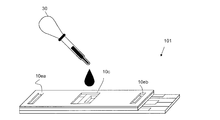
- FIG. 1 is a block diagram which shows the structure of a measuring apparatus. It is a perspective view which shows a mode that the test object is dripped at a biosensor.
- the inventor of the present application has examined in detail the structure of a biosensor that can accurately measure two or more substances by an electrochemical measurement method.
- HbA1c hemoglobin A1c
- the HbA1c value is a test value indicated by the proportion of hemoglobin (HbA1c) bound to sugar in hemoglobin (denoted as Hb) in erythrocytes.
- HbA1c value reflects the average blood glucose level in the past 1 to 2 months, so it is less affected by the diet before the test and should be used as a more accurate indicator for managing diabetes. Is possible.
- HbA1c value In order to obtain the HbA1c value, it is necessary to obtain the concentration (amount) of HbA1c and the concentration (amount) of Hb.
- Hb means total Hb including HbA1c and other derivatives.
- the concentration of HbA1c is generally low, it is particularly difficult to electrochemically measure the concentration of HbA1c. For this reason, the HbA1c value was mainly measured using an optical spectroscopic method.
- a base substrate having a main surface;
- An electrode layer located on the main surface of the base substrate and including a first electrode pair and a second electrode pair each having a working electrode and a counter electrode;
- a spacer disposed on the electrode layer and having a first opening exposing a part of the first electrode pair and a second opening exposing a part of the second electrode pair, independent of the first opening.
- a substrate A first reagent layer that includes a first reagent that reacts with the analyte and is located within the first opening; A second reagent layer that includes a second reagent that reacts with the analyte and is located within the second opening; A top cover substrate disposed on the spacer substrate, the introduction portion including a part of the first opening and the second opening of the spacer substrate. A top cover substrate overlapping with a part, Biosensor equipped with.
- the introduction opening of the top cover substrate overlaps with the first opening and the second opening
- the first electrode provided with the electrodes is provided without providing a branched flow path for guiding the analyte to the reaction chamber.
- a subject can be introduced into the opening and the second opening. Therefore, by increasing the area of the first opening and / or the second opening, it is possible to increase the amount of the subject used for the measurement and to increase the length of the boundary between the working electrode and the counter electrode.
- the detection sensitivity of the biosensor can be increased.
- the subject can be introduced simultaneously with the first opening and the second opening provided in the spacer substrate by introducing the subject from the introduction portion, the first opening and the second opening can be introduced.
- the first opening and the second opening are independent, the size of each can be arbitrarily set, and the amount of the subject to be used can be adjusted independently. For this reason, the amount of the analyte to be used can be changed according to the concentration and detection sensitivity of the substance to be detected in the analyte, and measurement can be performed with appropriate sensitivity.
- the introduction part is provided on the top cover substrate, it is possible to fill the first opening and the second opening with the subject in a short time by increasing the dropping amount of the subject, and shorten the measurement time. it can. Further, even if the areas of the first electrode pair and the second electrode pair for detection are increased, a sufficient amount of the subject can be brought into contact with the electrode pair in a short time. For this reason, detection sensitivity can be raised.
- the measurement can be performed using a larger number of subjects, and the detection accuracy of the substance to be detected using the first substance can be increased.
- the length of the boundary between the working electrode of the first electrode pair exposed in the first opening and the adjacent counter electrode is the second electrode pair exposed in the second opening.
- the biosensor according to item 1 or 2 wherein the biosensor is longer than a boundary length between the working electrode and the counter electrode adjacent thereto.
- the detection sensitivity can be increased.
- the subject since the first discharge port and the second discharge port are provided, the subject can be reliably introduced into the first opening and the second opening by capillary force.
- the first discharge port and the second discharge port are located in the spacer substrate, have an opening on a side surface of the spacer substrate, and are connected to the first opening and the second opening, respectively.
- the first discharge port and the second discharge port are located on the top cover substrate and overlap with another part of the first opening and the other part of the second opening of the spacer substrate. 4. The biosensor according to 4.
- the introduction portion has one introduction opening, and the introduction opening overlaps a part of the first opening and a part of the second opening of the spacer substrate.
- the biosensor according to any one of 6 to 6.
- the introduction portion has two introduction openings, one introduction opening overlaps a part of the first opening of the spacer substrate, and the other introduction opening is the second introduction opening.
- the biosensor according to any one of items 1 to 6, wherein the biosensor overlaps a part of the opening.
- the introduction opening is provided in each of the first opening and the second opening of the spacer substrate, the capillary force of the first opening and the second opening can be easily adjusted independently. Therefore, even when the amount of the subject to be introduced into the first opening and the second opening is greatly different because the detection sensitivities are different, the time required for introduction is made uniform, or the subject is placed over the first opening and the second opening. Can be reliably introduced, and measurement time can be shortened and highly reproducible measurement can be performed.
- the base substrate, the spacer substrate, and the top cover substrate have a strip shape in which a length in a first direction is larger than a length in a second direction orthogonal to the first direction;
- the first opening and the second opening are arranged adjacent to each other in the first direction in the spacer substrate,
- the top cover substrate further has a first outlet and a second outlet,
- the introduction openings of the first discharge port and the introduction portion respectively overlap with both ends in the first direction of the first opening of the spacer substrate, 10.
- the biosensor according to item 9 wherein the introduction opening of the second discharge port and the introduction part overlaps both ends of the second opening of the spacer substrate in the first direction, respectively.
- the subject includes hemoglobin separated from red blood cells, The hemoglobin includes hemoglobin A1c, The first reagent specifically reacts with the hemoglobin A1c or a substance derived from the hemoglobin A1c, The biosensor according to any one of items 1 to 10, wherein the second reagent reacts with the hemoglobin.
- the biosensor of the present disclosure can electrochemically detect and / or quantify two or more different substances contained in a subject.
- one mode of a biosensor that detects a first substance and a second substance contained in a subject will be described.
- the biosensor of the present disclosure can detect a substance having a relatively low detection sensitivity with an increased sensitivity, particularly when the detection sensitivities of two or more substances contained in the subject are different.
- a biosensor that electrochemically measures the concentrations of HbA1c and Hb in a subject in which blood has been pretreated as the first substance and the second substance will be described as an example.
- the biosensor of the present disclosure can be suitably used for detecting other substances.
- the following embodiment is an exemplification, and the present invention is not limited by the embodiment.
- reference numerals are attached to the drawings, and the same description is omitted, or reference is made to components that are not referred to in the description. There are cases where no reference is given.
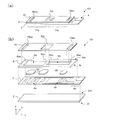
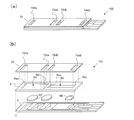
- FIG. 1A and 1B are a perspective view and an exploded perspective view of a biosensor 101 of the present embodiment.
- the biosensor 101 includes a base substrate 2, an electrode layer 4, first and second reagent layers 6 ⁇ / b> A and 6 ⁇ / b> B, a spacer substrate 8, and a top cover substrate 10.
- the base substrate 2, the spacer substrate 8, and the top cover substrate 10 have, for example, a longitudinal direction along the x direction, and are more in the x direction than the length in the y direction that is the width direction. It has a strip shape with a large length.
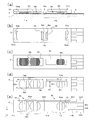
- 2A and 2B are a cross-sectional view and a plan view of the biosensor 101, respectively.
- 2C, 2D, and 2E are a plan view with the top cover substrate 10 removed, a plan view with the top cover substrate 10 and the first and second reagent layers 6A and 6B removed, and a spacer substrate, respectively. It is the top view which removed the structure above 8.
- the structure of the biosensor 101 will be described in detail with reference to these drawings.
- the base substrate 2 supports the entire structure of the biosensor 101.
- the base substrate 2 has a main surface 2m and a main surface 2r, and has a strip shape as described above.
- the main surface of the substrate means a main wide surface that supports a structure as a substrate.
- the electrode layer 4 is located on the main surface 2 m of the base substrate 2.
- the electrode layer 4 includes at least a first electrode pair 4a and a second electrode pair 4b.
- the first electrode pair 4a and the second electrode pair 4b are used to detect the first substance and the second substance, which are different substances in the subject.
- the first substance is HbA1c
- the second substance is Hb.
- the first electrode pair 4a includes a working electrode 4aw and a counter electrode 4ac.
- the first electrode pair 4a includes two working electrodes 4aw and three counter electrodes 4ac.
- the two working electrodes 4aw are connected to the terminal 4ed by the wiring part 4dd.
- the three counter electrodes 4ac are connected to the terminal 4ea by the wiring part 4da.
- the working electrode 4aw and the counter electrode 4ac are alternately arranged.
- the second electrode pair 4b includes a working electrode 4bw and a counter electrode 4bc.
- the second electrode pair 4b includes one working electrode 4bw and two counter electrodes 4bc.
- the working electrode 4bw is connected to the terminal 4ec by the wiring portion 4dc.
- the two counter electrodes 4bc are connected to the terminal 4eb by the wiring part 4db.
- the working electrode 4bw and the counter electrode 4bc are alternately arranged.
- a pair of counter electrodes 4ac sandwiching each working electrode 4aw is provided with a circular cut ca.
- a pair of counter electrodes 4bc sandwiching the working electrode 4bw is also provided with a circular cut cb.
- the above-described electrode structure in the electrode layer 4 is configured by patterning a metal film that continuously covers substantially the entire main surface 2 m of the base substrate 2.
- the spacer substrate 8 is disposed on the electrode layer 4 and includes a first opening 8a and a second opening 8b.
- the length of the spacer substrate 8 in the longitudinal direction is smaller than the length of the base substrate 2. Therefore, the terminals 4ea to 4ed of the electrode layer 4 are not covered with the spacer substrate 8, but are exposed.
- the first opening 8 a and the second opening 8 b are through holes that reach the two main surfaces 8 m and 8 r of the spacer substrate 8. Further, the first opening 8a and the second opening 8b are independent spaces and do not communicate with each other.
- the spacer substrate 8 is sandwiched between the base substrate 2 and the top cover substrate 10, the first opening 8a and the second opening 8b hold the specimen, and the specimen is connected to the first and second reagent layers 6A and 6B. It becomes a reaction chamber for detecting an electrical change of the subject caused by the reaction.
- Each of the first opening 8 a and the second opening 8 b has a rectangular shape having a length along the longitudinal direction of the spacer substrate 8, and is arranged along the longitudinal direction of the spacer substrate 8. Therefore, in the vicinity of the center of the spacer substrate 8, one end 8ac of the first opening 8a is close to one end 8bc of the second opening 8b. The other end 8ae of the first opening 8a and the other end 8be of the second opening 8b are close to both ends in the longitudinal direction of the spacer substrate 8, respectively.
- the first substance in the subject held in the first opening 8a is detected with high sensitivity. That is, the volume of the reaction chamber for detecting the first substance is larger than the volume of the reaction chamber for detecting the second substance. For this reason, it is preferable that the area of the first opening 8a is larger than the area of the second opening 8b.
- the lengths of the first opening 8a and the second opening 8b in the x direction are La and Lb, and the y direction (direction perpendicular to the longitudinal direction).
- Wa and Wb are La, L> Lb and Wa> Wb.
- the size of the first opening 8a and the second opening 8b can be determined according to the concentration of the first substance and the second substance in the subject, the required amount of the subject taking into account the detection sensitivity in the detection method used.
- the spacer substrate 8 has a thickness (z direction) at which the capillary force can act on the subject. )have.
- the spacer substrate 8 is disposed on the electrode layer 4, a part of the first electrode pair 4a and a part of the second electrode pair 4b are exposed in the first opening 8a and the second opening 8b, respectively.
- the electrical or electrochemical change of the subject held in the first opening 8a and the second opening 8b can be detected by the first electrode pair 4a and the second electrode pair 4b.
- the first opening 8a the sum of the lengths of the boundaries between the working electrode 4aw and the counter electrode 4ac of the first electrode pair 4a is 4 ⁇ Wa, and in the second opening 8b, the working electrode 4bw of the second electrode pair 4b.
- the total length of the boundary between the counter electrode 4bc and 2 ⁇ Wb That is, the total length of the boundary between the working electrode and the counter electrode is longer in the first electrode pair 4a than in the second electrode pair 4b, and the detection sensitivity of the first electrode pair 4a is enhanced.
- the first reagent layer 6A and the second reagent layer 6B include a first reagent and a second reagent, respectively.
- the first reagent and the second reagent react with the first substance and the second substance of the specimen, or the substances derived from the first substance and the second substance generated by the pretreatment, respectively, and are electrically detected by the specimen.
- the first reagent is fructosyl peptidase, which is a detection enzyme that specifically reacts with fructosylvalylhistidine generated by pretreating Hb1Ac, and is immobilized on the first reagent layer.
- the second reagent is potassium ferricyanide that is a mediator that reacts with all Hb including Hb1Ac, and is immobilized on the second reagent layer.
- the first reagent layer 6A and the second reagent layer 6B are disposed in the first opening 8a and the second opening 8b of the spacer substrate 8, respectively. More specifically, the first reagent layer 6A is located near the boundary between the working electrode 4aw and the counter electrode 4ac of the two first electrode pairs 4a, and the second reagent layer 6B is an action of the second electrode pair 4b. It is located on the vicinity of the boundary between the pole 4bw and the counter electrode 4bc. In the present embodiment, when the materials of the first reagent layer 6A and the second reagent layer 6B are dropped from above the electrode layer 4, the regions where the material spreads are defined by the circular cuts ca and cb provided in the counter electrode. Is done.
- the amount of the first reagent layer 6A and the second reagent layer 6B located in the vicinity between the working electrode and the counter electrode is constant, and variation in current during detection of the first substance and the second substance between the biosensors. Can be suppressed.
- the top cover substrate 10 is located on the spacer substrate 8.
- the top cover substrate 10 has an introduction portion including at least one introduction opening. In this embodiment, it has one introduction opening 10c.
- the introduction opening 10c overlaps a part of the first opening 8a and a part of the second opening 8b. More specifically, one end 8ac in the longitudinal direction of the first opening 8a and one end 8bc in the longitudinal direction of the second opening 8b are located in the introduction opening 10c. Therefore, the introduction opening 10c communicates with the first opening 8a and the second opening 8b, and when the subject is dropped onto the introduction opening 10c, the subject flows to the first opening 8a and the second opening 8b. .
- the top cover substrate 10 further includes a first discharge port 10ea and a second discharge port 10eb.
- the first outlet 10ea and the second outlet 10eb overlap a part of the first opening 8a and a part of the second opening 8b, and the other end 8ae of the first opening 8a and the other end 8be of the second opening 8b.
- the subject to the first opening 8a and the second opening 8b by capillary force.
- the first discharge port 10ea and the second discharge port 10eb may not be provided.
- the subject introduced from the introduction opening 10c flows into the first opening 8a and the second opening 8b according to gravity.
- the first substance that includes the introduction opening 10c, the first opening 8a, and the first discharge port 10ea is detected.
- the first cell 11a and the second cell 11b that includes the introduction opening 10c, the second opening 8b, and the second discharge port 10eb and detects the second substance are configured.
- the base substrate 2, the spacer substrate 8, and the top cover substrate 10 are made of an insulating material.
- various resin materials such as PET (polyethylene terephthalate) resin can be used.
- the electrode layer 4 is made of a conductive material. For example, it is formed by patterning a metal film such as palladium with a laser beam or the like.
- the base substrate 2, the electrode layer 4, the spacer substrate 8, and the top cover substrate 10 are bonded together by an adhesive, for example.
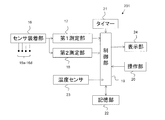
- FIG. 3 shows a configuration example of a measuring apparatus 201 that is loaded with the biosensor 101 and measures the first substance and the second substance of the subject.
- the measurement apparatus 201 includes a sensor mounting unit 16, a first measurement unit 17, a second measurement unit 18, and a control unit 19.
- the sensor mounting unit 16 includes connectors 16a to 16d that are in contact with the terminals 4ea to 4ed of the biosensor 101 and are electrically connected to the first measurement unit 17 and the second measurement unit 18.
- the first measurement unit 17 and the second measurement unit 18 apply predetermined voltages to the first electrode pair 4a and the second electrode pair 4b via the connectors 16a to 16d and the terminals 4ea to 4ed, respectively, and measure current values. To do.
- the measured current value is output to the control unit 19.
- the control unit 19 determines the concentrations of the first substance and the second substance from the current values (or voltage values) received from the first measurement unit 17 and the second measurement unit 18. For example, the control unit 19 stores a table in which the current value and the concentration value are related, or a function of the current value and the concentration value, and the concentrations of the first substance and the second substance based on the table or the function. Is calculated.
- the first substance is HbA1c and the second substance is Hb
- the ratio of HbA1c to Hb is calculated from the current value or concentration value to determine the HbA1c value.
- the measuring apparatus 201 further includes an operation unit 20, a timer 21, a storage unit 22, a temperature sensor 23, and a display unit 24, and the HbA1c value may be corrected with reference to information from the temperature sensor 23.
- the corrected HbA1c value is stored in the storage unit 22 together with information related to the time from the timer 21 and displayed on the display unit 24.
- the control unit 19 performs processing such as measurement, display, and measurement result storage based on a command input by the operator from the operation unit 20.
- the control unit 19 of the measuring apparatus 201 includes an arithmetic device such as a microcomputer and a storage unit.
- the storage unit stores a program that defines the measurement procedure, and the arithmetic device executes the program to measure the concentrations of the first substance and the second substance.
- the first measuring unit 17 and the second measuring unit 18 include a power supply circuit that generates a predetermined voltage and an ammeter that measures a current value. The measured current value is converted into a digital signal, for example, and the above-described processing is performed by the control unit 19.
- the display unit 24 may be a liquid crystal display device, an organic EL display device, or the like.
- Pretreatment of subject pretreatment of a blood sample collected from a subject is performed. Specifically, a hemolytic agent such as a surfactant is added to the collected blood sample, and Hb in erythrocytes of the blood sample is eluted.
- a hemolytic agent such as a surfactant
- protease which is a degrading enzyme
- HbA1c in Hb produces fructosyl valyl histidine.
- the pretreated blood sample is simply referred to as a subject.
- the biosensor 101 is attached to the measuring apparatus 201.
- the subject is sucked by the dropper 30 and dropped onto the vicinity of the introduction opening 10c of the biosensor 101 as shown in FIG.
- the subject spotted in the vicinity of the introduction opening 10c is drawn from the introduction opening 10c by capillary force and is introduced into the first opening 8a and the second opening 8b simultaneously, that is, in parallel.
- fructosyl valyl histidine in the subject introduced into the first opening 8a reacts with fructosyl peptidase, which is the first reagent in the first reagent layer 6A, to generate hydrogen peroxide.
- fructosyl peptidase which is the first reagent in the first reagent layer 6A
- the conductivity of the specimen changes.
- the value of the current flowing between the working electrode 4aw and the counter electrode 4ac of the first electrode pair 4a also changes according to the amount of generated hydrogen peroxide. Since fructosyl valyl histidine is derived from HbA1c, the current value changes according to the amount of HbA1c in the subject.
- a current value corresponding to the amount of Hb can be detected.
- the measuring device 201 applies a voltage of 0.1V to 0.4V between the working electrode 4aw and the counter electrode 4ac of the first electrode pair 4a for 5 to 10 seconds, thereby working electrode. The amount of current flowing between 4aw and the counter electrode 4ac is measured. Similarly, a voltage of 0.1 V to 0.4 V is applied between the working electrode 4bw and the counter electrode 4bc of the second electrode pair 4b for 5 to 10 seconds, and flows between the working electrode 4bw and the counter electrode 4bc. Measure the amount of current.
- the current values measured by the first measuring unit 17 and the second measuring unit 18 correspond to the amount of HbA1c and the amount of Hb.
- the measuring apparatus 201 obtains the HbA1c value using these current values.
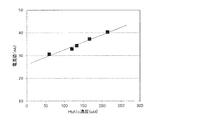
- FIG. 5 and FIG. 6 show the results of measurement using a subject whose HbA1c and Hb concentrations are known.
- the current value was measured by the first measurement unit 17 using five types of specimens whose HbA1c concentrations were known in advance.
- FIG. 5 shows a graph in which the HbA1c concentration of the subject is plotted on the horizontal axis and the measured current value is plotted on the vertical axis.
- the current value was measured by the second measurement unit 18 using five types of specimens whose Hb concentrations were known in advance.
- FIG. 6 shows a graph in which the Hb concentration of the subject is plotted on the horizontal axis and the measured current value is plotted on the vertical axis.
- the HbA1c concentration and the current value, and the Hb concentration and the current value show a linear relationship. From this, it can be seen that the HbA1c concentration and the Hb concentration are electrochemically measured using the biosensor 101 of the present disclosure, and the HbA1c value can be obtained with high accuracy.
- the electrode is provided without providing a branched flow path that guides the analyte to the reaction chamber.
- the subject can be introduced into the first opening and the second opening provided with. That is, the biosensor does not have a branched flow path. For this reason, by increasing the area of the first opening and / or the second opening, it is possible to increase the amount of the subject used for the measurement and to increase the length of the boundary between the working electrode and the counter electrode. The detection sensitivity of the biosensor can be increased.
- the subject can be introduced simultaneously with the first opening and the second opening provided in the spacer substrate by introducing the subject from the introduction portion, the first opening and the second opening can be introduced. It is possible to shorten the time until the sample is filled and the measurement is started.
- the subject by reacting the subject with the first substance and the second substance in the first opening and the second opening, respectively, two kinds of kinds in the subject are obtained using the first electrode pair and the second electrode pair. Substances can be detected or quantified. Since the first opening and the second opening are independent, the measurement of one of the first substance and the second substance does not affect the measurement of the other, and two kinds of substances are independently and highly accurately It can be detected.
- the first opening and the second opening are independent, each size can be arbitrarily set, and the amount of the subject to be used can be adjusted independently. For this reason, the amount of the analyte to be used can be changed according to the concentration and detection sensitivity of the substance to be detected in the analyte, and measurement can be performed with appropriate sensitivity. For example, by making the area of the first opening larger than the area of the second opening, the detection accuracy of the substance to be detected using the first substance can be increased. Further, by increasing the area of the first opening, the length of the boundary between the working electrode and the counter electrode in the first electrode pair can be increased, and the detection sensitivity can be further increased. Since the first opening and the second opening are independent, when the subject is introduced into the first opening and the second opening using the capillary force, the capillary force acting on each of them can be adjusted independently.
- the introduction part is provided on the top cover substrate, it is possible to fill the first opening and the second opening with the subject in a short time by increasing the dropping amount of the subject, and shorten the measurement time. it can. Further, even if the areas of the first electrode pair and the second electrode pair for detection are increased, a sufficient amount of the subject can be brought into contact with the electrode pair in a short time. For this reason, detection sensitivity can be raised.
- the subject can be introduced into the first opening and the second opening using capillary force. For this reason, the first opening and the second opening can be filled with the subject stably and reliably.
- FIGS. 7A and 7B are a perspective view and an exploded perspective view of the biosensor 101 of the present embodiment.
- the biosensor 102 differs from the biosensor 101 of the first embodiment in that the top cover substrate 10 includes an introduction portion including a first introduction opening 10ca and a second introduction opening 10cb.
- One end 8ac of the first opening 8a is located in the first introduction opening 10ca, and one end 8bc of the second opening 8b is located in the second introduction opening 10cb.
- the first introduction opening 10ca and the second introduction opening 10cb are independent from each other and do not communicate with each other. For this reason, it is possible to adjust each area (size) independently.
- the magnitude of the capillary force acting on the first opening 8a and the second opening 8b can be adjusted independently by changing the areas of the first introduction opening 10ca and the second introduction opening 10cb that overlap with each of them. Can do. Therefore, even if the areas or shapes of the first opening 8a and the second opening 8b are different, it is possible to adjust so that an appropriate capillary force acts on each of them, and the subject is more reliably placed in the biosensor 102. It is possible to introduce.
- the first introduction opening 10ca and the second introduction opening 10cb are close to each other. Therefore, for example, if the subject is dropped between the first introduction opening 10ca and the second introduction opening 10cb, the subject can be introduced into both the first introduction opening 10ca and the second introduction opening 10cb. It is possible to introduce the subject into the first opening 8a and the second opening 8b substantially simultaneously.
- FIG. 8 is an exploded perspective view of the biosensor 103 of the present embodiment.
- the biosensor 103 is different from the biosensor 101 of the first embodiment in that the first discharge port 8ad and the second discharge port 8bd are provided in the spacer substrate 8.
- the first discharge port 8ad is provided at the other end 8ae of the first opening 8a and has an opening on the side surface in the longitudinal direction of the spacer substrate 8.
- the second discharge port 8bd is provided at the other end 8be of the second opening 8b, and has an opening on the other side surface of the spacer substrate 8 in the longitudinal direction.
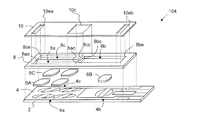
- FIG. 9 is an exploded perspective view of the biosensor 104 of the present embodiment.
- the biosensor 104 includes a first opening 8a, a second opening 8b, and a third opening 8c provided in the spacer substrate 8, a point that the electrode layer 4 further includes a third electrode pair 4c, and a third reagent. It differs from the biosensor 101 of the first embodiment in that the layer 6C is provided.
- the first opening 8a and the third opening 8c are arranged in a direction perpendicular to the longitudinal direction. Further, one end 8ac of the first opening 8a and one end 8cc of the third opening 8c are close to one end 8bc of the second opening 8b.
- the introduction opening 10c overlaps one end 8ac of the first opening 8a, one end 8cc of the third opening 8c, and one end 8bc of the second opening 8b.
- the first outlet 10ea overlaps the other end 8ae of the first opening 8a and the one end 8ce of the third opening 8c.
- a part of the third electrode pair 4c is exposed in the third opening 8c.
- the third reagent layer 6C is located in the third opening 8c.
- the subject is introduced in parallel with the first opening 8a, the second opening 8b, and the third opening 8c provided in the spacer substrate 8 by introducing the subject from the introduction portion of the top cover substrate 10.
- a substance that reacts with the third substance in the subject or a substance derived from the third substance in the third reagent layer 6C it is possible to detect three substances in the subject.
- the first to fourth embodiments can be implemented in combination as appropriate.
- the number of openings provided independently in the spacer substrate 8 is not limited to 2 or 3, but may be 4 or more.
- the subject is not limited to blood or a liquid pretreated with blood, and the first substance and the second substance are not limited to Hb1Ac and Hb, and a biosensor that detects various substances can be realized.
- the biosensor of the present disclosure can be suitably used for a biosensor used in the medical / clinical testing field, the pharmaceutical field, or various industrial fields.
Landscapes
- Health & Medical Sciences (AREA)
- Life Sciences & Earth Sciences (AREA)
- Chemical & Material Sciences (AREA)
- Engineering & Computer Science (AREA)
- Hematology (AREA)
- Molecular Biology (AREA)
- Immunology (AREA)
- Biomedical Technology (AREA)
- Physics & Mathematics (AREA)
- Analytical Chemistry (AREA)
- General Health & Medical Sciences (AREA)
- Biochemistry (AREA)
- Urology & Nephrology (AREA)
- General Physics & Mathematics (AREA)
- Pathology (AREA)
- Microbiology (AREA)
- Biotechnology (AREA)
- Organic Chemistry (AREA)
- Food Science & Technology (AREA)
- Medicinal Chemistry (AREA)
- Cell Biology (AREA)
- Biophysics (AREA)
- Wood Science & Technology (AREA)
- Zoology (AREA)
- Proteomics, Peptides & Aminoacids (AREA)
- Chemical Kinetics & Catalysis (AREA)
- Electrochemistry (AREA)
- Bioinformatics & Cheminformatics (AREA)
- General Engineering & Computer Science (AREA)
- Genetics & Genomics (AREA)
- Ecology (AREA)
- Apparatus Associated With Microorganisms And Enzymes (AREA)
Abstract
La présente invention concerne un biocapteur qui est pourvu de : un substrat de base 2 ayant une surface principale ; une couche d'électrode 4 disposée sur la surface principale du substrat de base 2 et comprenant une première paire d'électrodes 4a et une deuxième paire d'électrodes 4b dont chacune comporte une électrode de travail et une contre-électrode ; un substrat d'espacement 8 disposé sur la couche d'électrode et comportant une première ouverture 8a depuis laquelle une partie de la première paire d'électrodes est exposée et une deuxième ouverture 8b qui est indépendante de la première ouverture et depuis laquelle une partie de la deuxième paire d'électrodes est exposée ; une première couche de réactif 6A disposée dans la première ouverture et contenant un premier réactif qui réagit avec un échantillon ; une deuxième couche de réactif 6B disposée dans la deuxième ouverture et contenant un deuxième réactif qui réagit avec l'échantillon ; et un substrat de couverture supérieur 10 qui comporte une section d'introduction 10c comprenant au moins une ouverture d'introduction et qui est disposé sur le substrat d'espacement, la section d'introduction chevauchant une partie de la première ouverture et une partie de la deuxième ouverture dans le substrat d'espacement.
Priority Applications (3)
| Application Number | Priority Date | Filing Date | Title |
|---|---|---|---|
| EP16891576.7A EP3454056A4 (fr) | 2016-02-25 | 2016-09-14 | Biocapteur |
| JP2017509798A JP6126325B1 (ja) | 2016-02-25 | 2016-09-14 | バイオセンサ |
| US16/111,882 US20190017957A1 (en) | 2016-02-25 | 2018-08-24 | Biosensor |
Applications Claiming Priority (2)
| Application Number | Priority Date | Filing Date | Title |
|---|---|---|---|
| JP2016-034671 | 2016-02-25 | ||
| JP2016034671 | 2016-02-25 |
Related Child Applications (1)
| Application Number | Title | Priority Date | Filing Date |
|---|---|---|---|
| US16/111,882 Continuation US20190017957A1 (en) | 2016-02-25 | 2018-08-24 | Biosensor |
Publications (1)
| Publication Number | Publication Date |
|---|---|
| WO2017145420A1 true WO2017145420A1 (fr) | 2017-08-31 |
Family
ID=59686062
Family Applications (1)
| Application Number | Title | Priority Date | Filing Date |
|---|---|---|---|
| PCT/JP2016/077154 Ceased WO2017145420A1 (fr) | 2016-02-25 | 2016-09-14 | Biocapteur |
Country Status (3)
| Country | Link |
|---|---|
| US (1) | US20190017957A1 (fr) |
| EP (1) | EP3454056A4 (fr) |
| WO (1) | WO2017145420A1 (fr) |
Cited By (3)
| Publication number | Priority date | Publication date | Assignee | Title |
|---|---|---|---|---|
| WO2020166545A1 (fr) * | 2019-02-15 | 2020-08-20 | Phcホールディングス株式会社 | Biocapteur |
| EP3779425A4 (fr) * | 2018-03-26 | 2021-12-22 | PHC Holdings Corporation | Capteur de détection de substance biologique |
| EP3879261A4 (fr) * | 2018-11-08 | 2022-08-10 | Leadway (HK) Limited | Biocapteur potentiométrique et méthode de détection |
Families Citing this family (1)
| Publication number | Priority date | Publication date | Assignee | Title |
|---|---|---|---|---|
| WO2019010152A1 (fr) * | 2017-07-03 | 2019-01-10 | Arch Chemicals, Inc. | Capteur pour analytes |
Citations (9)
| Publication number | Priority date | Publication date | Assignee | Title |
|---|---|---|---|---|
| JPH01291153A (ja) * | 1988-05-18 | 1989-11-22 | Matsushita Electric Ind Co Ltd | バイオセンサ |
| JP2000214170A (ja) * | 1999-01-27 | 2000-08-04 | Matsushita Electric Ind Co Ltd | コレステロ―ルの定量方法およびそれを用いたセンサ |
| JP2004257944A (ja) * | 2003-02-27 | 2004-09-16 | Matsushita Electric Ind Co Ltd | バイオセンサ |
| JP2005283192A (ja) * | 2004-03-29 | 2005-10-13 | Citizen Watch Co Ltd | バイオセンサ |
| WO2007094354A1 (fr) * | 2006-02-14 | 2007-08-23 | National Institute Of Advanced Industrial Science And Technology | CAPTEUR D'HÉMOGLOBINE A1c |
| JP2008076143A (ja) * | 2006-09-20 | 2008-04-03 | Citizen Holdings Co Ltd | ヘモグロビン濃度測定装置 |
| WO2009140343A1 (fr) * | 2008-05-13 | 2009-11-19 | General Atomics | Biodétecteur électrochimique pour une détermination directe du pourcentage d'hémoglobine glyquée |
| JP2013061336A (ja) * | 2011-09-12 | 2013-04-04 | Nova Biomedical Corp | ヘモグロビンの電気化学的検出のためのディスポーザブルセンサ |
| JP2014102144A (ja) * | 2012-11-20 | 2014-06-05 | Nipro Corp | 糖化ヘモグロビン測定キットおよび糖化ヘモグロビン測定方法 |
Family Cites Families (26)
| Publication number | Priority date | Publication date | Assignee | Title |
|---|---|---|---|---|
| DE68924026T3 (de) * | 1988-03-31 | 2008-01-10 | Matsushita Electric Industrial Co., Ltd., Kadoma | Biosensor und dessen herstellung. |
| US20150344929A9 (en) * | 1999-11-15 | 2015-12-03 | Panasonic Corporation | Biosensor, thin film electrode forming method, quantification apparatus, and quantification method |
| US20030175946A1 (en) * | 2001-04-16 | 2003-09-18 | Hiroyuki Tokunaga | Biosensor |
| US7005273B2 (en) * | 2001-05-16 | 2006-02-28 | Therasense, Inc. | Method for the determination of glycated hemoglobin |
| JP2005530179A (ja) * | 2002-06-19 | 2005-10-06 | ベクトン・ディキンソン・アンド・カンパニー | 多成分の微量分析のための微細加工で作られたセンサーアレイ |
| EP1396717A1 (fr) * | 2002-09-03 | 2004-03-10 | Matsushita Electric Industrial Co., Ltd. | Biocapteur et methode d'utilisation |
| US8071030B2 (en) * | 2003-06-20 | 2011-12-06 | Roche Diagnostics Operations, Inc. | Test strip with flared sample receiving chamber |
| EP1642125B1 (fr) * | 2003-06-20 | 2017-09-27 | Roche Diabetes Care GmbH | Biocapteur a fonctionnalites electriques multiples |
| US7622026B2 (en) * | 2004-03-02 | 2009-11-24 | Panasonic Corporation | Biosensor |
| US8372600B2 (en) * | 2004-03-05 | 2013-02-12 | The Research Foundation Of State University Of New York | Method and apparatus for measuring changes in cell volume |
| CN1938590B (zh) * | 2004-04-19 | 2010-05-05 | 松下电器产业株式会社 | 血液成分的测定方法、该方法中使用的生物传感器和测定装置 |
| US20080083618A1 (en) * | 2006-09-05 | 2008-04-10 | Neel Gary T | System and Methods for Determining an Analyte Concentration Incorporating a Hematocrit Correction |
| US7674616B2 (en) * | 2006-09-14 | 2010-03-09 | Hemosense, Inc. | Device and method for measuring properties of a sample |
| WO2008044530A1 (fr) * | 2006-10-05 | 2008-04-17 | Panasonic Corporation | Capteur d'analyse multi composant et procédé de mesure de composants multiples |
| US8679309B2 (en) * | 2007-07-31 | 2014-03-25 | Bayer Healthcare Llc | Test sensors and methods of using side mounted meter contacts |
| TW200914826A (en) * | 2007-09-21 | 2009-04-01 | Apex Biotechnology Corp | Electrochemical quantitative analysis system and method for the same |
| WO2009060849A1 (fr) * | 2007-11-05 | 2009-05-14 | Nippon Kayaku Kabushiki Kaisha | Biocapteur |
| JP5405916B2 (ja) * | 2008-06-24 | 2014-02-05 | パナソニック株式会社 | バイオセンサ、その製造方法、及びそれを備える検出システム |
| PL2387714T3 (pl) * | 2009-01-23 | 2018-08-31 | Polymer Technology Systems, Inc. | Diagnostyczny wielowarstwowy pasek testowy fazy suchej ze zintegrowanymi bioczujnikami |
| CN102608196A (zh) * | 2011-01-18 | 2012-07-25 | 爱科来株式会社 | 分析装置和分析方法 |
| US8702931B2 (en) * | 2011-04-18 | 2014-04-22 | Indian Institute Of Science | Low cost electrochemical disposable sensor for measuring glycated hemoglobin |
| JP5730396B2 (ja) * | 2011-07-28 | 2015-06-10 | 京セラ株式会社 | バイオセンサ |
| US20130084591A1 (en) * | 2011-09-30 | 2013-04-04 | Lifescan Scotland Ltd. | Analytical test strip with isolated bodily fluid phase-shift and analyte determination sample chambers |
| US9128038B2 (en) * | 2012-06-21 | 2015-09-08 | Lifescan Scotland Limited | Analytical test strip with capillary sample-receiving chambers separated by a physical barrier island |
| TWI477772B (zh) * | 2013-02-25 | 2015-03-21 | Apex Biotechnology Corp | 電極試片及感測試片及其系統 |
| US20140262833A1 (en) * | 2013-03-14 | 2014-09-18 | Magellan Diagnostics, Inc. | Sensor with a bifurcated flowpath |
-
2016
- 2016-09-14 EP EP16891576.7A patent/EP3454056A4/fr not_active Withdrawn
- 2016-09-14 WO PCT/JP2016/077154 patent/WO2017145420A1/fr not_active Ceased
-
2018
- 2018-08-24 US US16/111,882 patent/US20190017957A1/en not_active Abandoned
Patent Citations (9)
| Publication number | Priority date | Publication date | Assignee | Title |
|---|---|---|---|---|
| JPH01291153A (ja) * | 1988-05-18 | 1989-11-22 | Matsushita Electric Ind Co Ltd | バイオセンサ |
| JP2000214170A (ja) * | 1999-01-27 | 2000-08-04 | Matsushita Electric Ind Co Ltd | コレステロ―ルの定量方法およびそれを用いたセンサ |
| JP2004257944A (ja) * | 2003-02-27 | 2004-09-16 | Matsushita Electric Ind Co Ltd | バイオセンサ |
| JP2005283192A (ja) * | 2004-03-29 | 2005-10-13 | Citizen Watch Co Ltd | バイオセンサ |
| WO2007094354A1 (fr) * | 2006-02-14 | 2007-08-23 | National Institute Of Advanced Industrial Science And Technology | CAPTEUR D'HÉMOGLOBINE A1c |
| JP2008076143A (ja) * | 2006-09-20 | 2008-04-03 | Citizen Holdings Co Ltd | ヘモグロビン濃度測定装置 |
| WO2009140343A1 (fr) * | 2008-05-13 | 2009-11-19 | General Atomics | Biodétecteur électrochimique pour une détermination directe du pourcentage d'hémoglobine glyquée |
| JP2013061336A (ja) * | 2011-09-12 | 2013-04-04 | Nova Biomedical Corp | ヘモグロビンの電気化学的検出のためのディスポーザブルセンサ |
| JP2014102144A (ja) * | 2012-11-20 | 2014-06-05 | Nipro Corp | 糖化ヘモグロビン測定キットおよび糖化ヘモグロビン測定方法 |
Non-Patent Citations (1)
| Title |
|---|
| See also references of EP3454056A4 * |
Cited By (6)
| Publication number | Priority date | Publication date | Assignee | Title |
|---|---|---|---|---|
| EP3779425A4 (fr) * | 2018-03-26 | 2021-12-22 | PHC Holdings Corporation | Capteur de détection de substance biologique |
| EP3879261A4 (fr) * | 2018-11-08 | 2022-08-10 | Leadway (HK) Limited | Biocapteur potentiométrique et méthode de détection |
| WO2020166545A1 (fr) * | 2019-02-15 | 2020-08-20 | Phcホールディングス株式会社 | Biocapteur |
| JPWO2020166545A1 (ja) * | 2019-02-15 | 2021-12-02 | Phcホールディングス株式会社 | バイオセンサ |
| US20220134339A1 (en) * | 2019-02-15 | 2022-05-05 | Phc Holdings Corporation | Biosensor |
| JP7076015B2 (ja) | 2019-02-15 | 2022-05-26 | Phcホールディングス株式会社 | バイオセンサ |
Also Published As
| Publication number | Publication date |
|---|---|
| EP3454056A1 (fr) | 2019-03-13 |
| US20190017957A1 (en) | 2019-01-17 |
| EP3454056A4 (fr) | 2019-06-26 |
Similar Documents
| Publication | Publication Date | Title |
|---|---|---|
| US8557104B2 (en) | In vitro analyte sensor, and methods | |
| US7887682B2 (en) | Analyte sensors and methods of use | |
| ES2657627T3 (es) | Biosensores electroquímicos | |
| US20050176133A1 (en) | Measuring instrument for biosensor and measuring method using same | |
| JP6539369B2 (ja) | 分析物濃度決定の正規化された較正 | |
| US20260056157A1 (en) | Electrochemical test strip for testing multiple indicators, and testing method thereof | |
| JP7076015B2 (ja) | バイオセンサ | |
| US8182747B2 (en) | Test device for analyzing a biological sample liquid | |
| WO2017145420A1 (fr) | Biocapteur | |
| CA3082898C (fr) | Ensemble de capteur et procede utilisant celui-ci | |
| KR101104400B1 (ko) | 생체물질을 측정하는 바이오센서 | |
| US20260009809A1 (en) | Method of detecting an obstruction in a fluid analyzer | |
| JP6126325B1 (ja) | バイオセンサ | |
| TWI621852B (zh) | 樣品分析物濃度之漸進式近似 | |
| EP2297574B1 (fr) | Biocapteur | |
| US8323475B2 (en) | Apparatus and method for analytical determinations using amperometric techniques | |
| EP3814773B1 (fr) | Trajet d'échantillon optimisé pour analyseur de fluide | |
| US20250383316A1 (en) | Test strip with multiplt electrochemical reaction blocks | |
| US20080169799A1 (en) | Method for biosensor analysis | |
| US20260118343A1 (en) | Methods and apparatus for hemolysis detection | |
| TW202514107A (zh) | 多電化學反應區塊之檢測試片 | |
| CN119715730A (zh) | 多电化学反应区块的检测试片 | |
| US20150068893A1 (en) | Biosensor test strip for biosensor test device | |
| KR20240162769A (ko) | 바이오 센서 및 그 제조방법 | |
| CN120569630A (zh) | 用于溶血检测的方法和设备 |
Legal Events
| Date | Code | Title | Description |
|---|---|---|---|
| ENP | Entry into the national phase |
Ref document number: 2017509798 Country of ref document: JP Kind code of ref document: A |
|
| NENP | Non-entry into the national phase |
Ref country code: DE |
|
| 121 | Ep: the epo has been informed by wipo that ep was designated in this application |
Ref document number: 16891576 Country of ref document: EP Kind code of ref document: A1 |
|
| ENP | Entry into the national phase |
Ref document number: 2016891576 Country of ref document: EP Effective date: 20180925 |