WO2017145592A1 - 潤滑油組成物 - Google Patents
潤滑油組成物 Download PDFInfo
- Publication number
- WO2017145592A1 WO2017145592A1 PCT/JP2017/001754 JP2017001754W WO2017145592A1 WO 2017145592 A1 WO2017145592 A1 WO 2017145592A1 JP 2017001754 W JP2017001754 W JP 2017001754W WO 2017145592 A1 WO2017145592 A1 WO 2017145592A1
- Authority
- WO
- WIPO (PCT)
- Prior art keywords
- lubricating oil
- oil composition
- carbon atoms
- group
- formula
- Prior art date
- Legal status (The legal status is an assumption and is not a legal conclusion. Google has not performed a legal analysis and makes no representation as to the accuracy of the status listed.)
- Ceased
Links
Classifications
-
- C—CHEMISTRY; METALLURGY
- C10—PETROLEUM, GAS OR COKE INDUSTRIES; TECHNICAL GASES CONTAINING CARBON MONOXIDE; FUELS; LUBRICANTS; PEAT
- C10M—LUBRICATING COMPOSITIONS; USE OF CHEMICAL SUBSTANCES EITHER ALONE OR AS LUBRICATING INGREDIENTS IN A LUBRICATING COMPOSITION
- C10M169/00—Lubricating compositions characterised by containing as components a mixture of at least two types of ingredient selected from base-materials, thickeners or additives, covered by the preceding groups, each of these compounds being essential
- C10M169/04—Mixtures of base-materials and additives
- C10M169/045—Mixtures of base-materials and additives the additives being a mixture of compounds of unknown or incompletely defined constitution and non-macromolecular compounds
-
- C—CHEMISTRY; METALLURGY
- C10—PETROLEUM, GAS OR COKE INDUSTRIES; TECHNICAL GASES CONTAINING CARBON MONOXIDE; FUELS; LUBRICANTS; PEAT
- C10M—LUBRICATING COMPOSITIONS; USE OF CHEMICAL SUBSTANCES EITHER ALONE OR AS LUBRICATING INGREDIENTS IN A LUBRICATING COMPOSITION
- C10M129/00—Lubricating compositions characterised by the additive being an organic non-macromolecular compound containing oxygen
- C10M129/02—Lubricating compositions characterised by the additive being an organic non-macromolecular compound containing oxygen having a carbon chain of less than 30 atoms
- C10M129/68—Esters
- C10M129/70—Esters of monocarboxylic acids
-
- C—CHEMISTRY; METALLURGY
- C10—PETROLEUM, GAS OR COKE INDUSTRIES; TECHNICAL GASES CONTAINING CARBON MONOXIDE; FUELS; LUBRICANTS; PEAT
- C10M—LUBRICATING COMPOSITIONS; USE OF CHEMICAL SUBSTANCES EITHER ALONE OR AS LUBRICATING INGREDIENTS IN A LUBRICATING COMPOSITION
- C10M133/00—Lubricating compositions characterised by the additive being an organic non-macromolecular compound containing nitrogen
- C10M133/02—Lubricating compositions characterised by the additive being an organic non-macromolecular compound containing nitrogen having a carbon chain of less than 30 atoms
- C10M133/04—Amines, e.g. polyalkylene polyamines; Quaternary amines
- C10M133/06—Amines, e.g. polyalkylene polyamines; Quaternary amines having amino groups bound to acyclic or cycloaliphatic carbon atoms
-
- C—CHEMISTRY; METALLURGY
- C10—PETROLEUM, GAS OR COKE INDUSTRIES; TECHNICAL GASES CONTAINING CARBON MONOXIDE; FUELS; LUBRICANTS; PEAT
- C10M—LUBRICATING COMPOSITIONS; USE OF CHEMICAL SUBSTANCES EITHER ALONE OR AS LUBRICATING INGREDIENTS IN A LUBRICATING COMPOSITION
- C10M133/00—Lubricating compositions characterised by the additive being an organic non-macromolecular compound containing nitrogen
- C10M133/02—Lubricating compositions characterised by the additive being an organic non-macromolecular compound containing nitrogen having a carbon chain of less than 30 atoms
- C10M133/04—Amines, e.g. polyalkylene polyamines; Quaternary amines
- C10M133/12—Amines, e.g. polyalkylene polyamines; Quaternary amines having amino groups bound to a carbon atom of a six-membered aromatic ring
-
- C—CHEMISTRY; METALLURGY
- C10—PETROLEUM, GAS OR COKE INDUSTRIES; TECHNICAL GASES CONTAINING CARBON MONOXIDE; FUELS; LUBRICANTS; PEAT
- C10M—LUBRICATING COMPOSITIONS; USE OF CHEMICAL SUBSTANCES EITHER ALONE OR AS LUBRICATING INGREDIENTS IN A LUBRICATING COMPOSITION
- C10M137/00—Lubricating compositions characterised by the additive being an organic non-macromolecular compound containing phosphorus
- C10M137/02—Lubricating compositions characterised by the additive being an organic non-macromolecular compound containing phosphorus having no phosphorus-to-carbon bond
- C10M137/04—Phosphate esters
- C10M137/08—Ammonium or amine salts
-
- C—CHEMISTRY; METALLURGY
- C10—PETROLEUM, GAS OR COKE INDUSTRIES; TECHNICAL GASES CONTAINING CARBON MONOXIDE; FUELS; LUBRICANTS; PEAT
- C10M—LUBRICATING COMPOSITIONS; USE OF CHEMICAL SUBSTANCES EITHER ALONE OR AS LUBRICATING INGREDIENTS IN A LUBRICATING COMPOSITION
- C10M141/00—Lubricating compositions characterised by the additive being a mixture of two or more compounds covered by more than one of the main groups C10M125/00 - C10M139/00, each of these compounds being essential
- C10M141/10—Lubricating compositions characterised by the additive being a mixture of two or more compounds covered by more than one of the main groups C10M125/00 - C10M139/00, each of these compounds being essential at least one of them being an organic phosphorus-containing compound
-
- C—CHEMISTRY; METALLURGY
- C10—PETROLEUM, GAS OR COKE INDUSTRIES; TECHNICAL GASES CONTAINING CARBON MONOXIDE; FUELS; LUBRICANTS; PEAT
- C10M—LUBRICATING COMPOSITIONS; USE OF CHEMICAL SUBSTANCES EITHER ALONE OR AS LUBRICATING INGREDIENTS IN A LUBRICATING COMPOSITION
- C10M159/00—Lubricating compositions characterised by the additive being of unknown or incompletely defined constitution
-
- C—CHEMISTRY; METALLURGY
- C10—PETROLEUM, GAS OR COKE INDUSTRIES; TECHNICAL GASES CONTAINING CARBON MONOXIDE; FUELS; LUBRICANTS; PEAT
- C10M—LUBRICATING COMPOSITIONS; USE OF CHEMICAL SUBSTANCES EITHER ALONE OR AS LUBRICATING INGREDIENTS IN A LUBRICATING COMPOSITION
- C10M2207/00—Organic non-macromolecular hydrocarbon compounds containing hydrogen, carbon and oxygen as ingredients in lubricant compositions
- C10M2207/26—Overbased carboxylic acid salts
- C10M2207/262—Overbased carboxylic acid salts derived from hydroxy substituted aromatic acids, e.g. salicylates
-
- C—CHEMISTRY; METALLURGY
- C10—PETROLEUM, GAS OR COKE INDUSTRIES; TECHNICAL GASES CONTAINING CARBON MONOXIDE; FUELS; LUBRICANTS; PEAT
- C10M—LUBRICATING COMPOSITIONS; USE OF CHEMICAL SUBSTANCES EITHER ALONE OR AS LUBRICATING INGREDIENTS IN A LUBRICATING COMPOSITION
- C10M2207/00—Organic non-macromolecular hydrocarbon compounds containing hydrogen, carbon and oxygen as ingredients in lubricant compositions
- C10M2207/28—Esters
- C10M2207/284—Esters of aromatic monocarboxylic acids
-
- C—CHEMISTRY; METALLURGY
- C10—PETROLEUM, GAS OR COKE INDUSTRIES; TECHNICAL GASES CONTAINING CARBON MONOXIDE; FUELS; LUBRICANTS; PEAT
- C10M—LUBRICATING COMPOSITIONS; USE OF CHEMICAL SUBSTANCES EITHER ALONE OR AS LUBRICATING INGREDIENTS IN A LUBRICATING COMPOSITION
- C10M2215/00—Organic non-macromolecular compounds containing nitrogen as ingredients in lubricant Compositions
- C10M2215/02—Amines, e.g. polyalkylene polyamines; Quaternary amines
- C10M2215/04—Amines, e.g. polyalkylene polyamines; Quaternary amines having amino groups bound to acyclic or cycloaliphatic carbon atoms
-
- C—CHEMISTRY; METALLURGY
- C10—PETROLEUM, GAS OR COKE INDUSTRIES; TECHNICAL GASES CONTAINING CARBON MONOXIDE; FUELS; LUBRICANTS; PEAT
- C10M—LUBRICATING COMPOSITIONS; USE OF CHEMICAL SUBSTANCES EITHER ALONE OR AS LUBRICATING INGREDIENTS IN A LUBRICATING COMPOSITION
- C10M2215/00—Organic non-macromolecular compounds containing nitrogen as ingredients in lubricant Compositions
- C10M2215/02—Amines, e.g. polyalkylene polyamines; Quaternary amines
- C10M2215/06—Amines, e.g. polyalkylene polyamines; Quaternary amines having amino groups bound to carbon atoms of six-membered aromatic rings
-
- C—CHEMISTRY; METALLURGY
- C10—PETROLEUM, GAS OR COKE INDUSTRIES; TECHNICAL GASES CONTAINING CARBON MONOXIDE; FUELS; LUBRICANTS; PEAT
- C10M—LUBRICATING COMPOSITIONS; USE OF CHEMICAL SUBSTANCES EITHER ALONE OR AS LUBRICATING INGREDIENTS IN A LUBRICATING COMPOSITION
- C10M2219/00—Organic non-macromolecular compounds containing sulfur, selenium or tellurium as ingredients in lubricant compositions
- C10M2219/04—Organic non-macromolecular compounds containing sulfur, selenium or tellurium as ingredients in lubricant compositions containing sulfur-to-oxygen bonds, i.e. sulfones, sulfoxides
- C10M2219/046—Overbased sulfonic acid salts
-
- C—CHEMISTRY; METALLURGY
- C10—PETROLEUM, GAS OR COKE INDUSTRIES; TECHNICAL GASES CONTAINING CARBON MONOXIDE; FUELS; LUBRICANTS; PEAT
- C10M—LUBRICATING COMPOSITIONS; USE OF CHEMICAL SUBSTANCES EITHER ALONE OR AS LUBRICATING INGREDIENTS IN A LUBRICATING COMPOSITION
- C10M2223/00—Organic non-macromolecular compounds containing phosphorus as ingredients in lubricant compositions
- C10M2223/02—Organic non-macromolecular compounds containing phosphorus as ingredients in lubricant compositions having no phosphorus-to-carbon bonds
- C10M2223/04—Phosphate esters
-
- C—CHEMISTRY; METALLURGY
- C10—PETROLEUM, GAS OR COKE INDUSTRIES; TECHNICAL GASES CONTAINING CARBON MONOXIDE; FUELS; LUBRICANTS; PEAT
- C10M—LUBRICATING COMPOSITIONS; USE OF CHEMICAL SUBSTANCES EITHER ALONE OR AS LUBRICATING INGREDIENTS IN A LUBRICATING COMPOSITION
- C10M2223/00—Organic non-macromolecular compounds containing phosphorus as ingredients in lubricant compositions
- C10M2223/02—Organic non-macromolecular compounds containing phosphorus as ingredients in lubricant compositions having no phosphorus-to-carbon bonds
- C10M2223/04—Phosphate esters
- C10M2223/043—Ammonium or amine salts thereof
-
- C—CHEMISTRY; METALLURGY
- C10—PETROLEUM, GAS OR COKE INDUSTRIES; TECHNICAL GASES CONTAINING CARBON MONOXIDE; FUELS; LUBRICANTS; PEAT
- C10M—LUBRICATING COMPOSITIONS; USE OF CHEMICAL SUBSTANCES EITHER ALONE OR AS LUBRICATING INGREDIENTS IN A LUBRICATING COMPOSITION
- C10M2223/00—Organic non-macromolecular compounds containing phosphorus as ingredients in lubricant compositions
- C10M2223/02—Organic non-macromolecular compounds containing phosphorus as ingredients in lubricant compositions having no phosphorus-to-carbon bonds
- C10M2223/049—Phosphite
-
- C—CHEMISTRY; METALLURGY
- C10—PETROLEUM, GAS OR COKE INDUSTRIES; TECHNICAL GASES CONTAINING CARBON MONOXIDE; FUELS; LUBRICANTS; PEAT
- C10N—INDEXING SCHEME ASSOCIATED WITH SUBCLASS C10M RELATING TO LUBRICATING COMPOSITIONS
- C10N2010/00—Metal present as such or in compounds
- C10N2010/04—Groups 2 or 12
-
- C—CHEMISTRY; METALLURGY
- C10—PETROLEUM, GAS OR COKE INDUSTRIES; TECHNICAL GASES CONTAINING CARBON MONOXIDE; FUELS; LUBRICANTS; PEAT
- C10N—INDEXING SCHEME ASSOCIATED WITH SUBCLASS C10M RELATING TO LUBRICATING COMPOSITIONS
- C10N2030/00—Specified physical or chemical properties which is improved by the additive characterising the lubricating composition, e.g. multifunctional additives
- C10N2030/04—Detergent property or dispersant property
-
- C—CHEMISTRY; METALLURGY
- C10—PETROLEUM, GAS OR COKE INDUSTRIES; TECHNICAL GASES CONTAINING CARBON MONOXIDE; FUELS; LUBRICANTS; PEAT
- C10N—INDEXING SCHEME ASSOCIATED WITH SUBCLASS C10M RELATING TO LUBRICATING COMPOSITIONS
- C10N2030/00—Specified physical or chemical properties which is improved by the additive characterising the lubricating composition, e.g. multifunctional additives
- C10N2030/06—Oiliness; Film-strength; Anti-wear; Resistance to extreme pressure
-
- C—CHEMISTRY; METALLURGY
- C10—PETROLEUM, GAS OR COKE INDUSTRIES; TECHNICAL GASES CONTAINING CARBON MONOXIDE; FUELS; LUBRICANTS; PEAT
- C10N—INDEXING SCHEME ASSOCIATED WITH SUBCLASS C10M RELATING TO LUBRICATING COMPOSITIONS
- C10N2030/00—Specified physical or chemical properties which is improved by the additive characterising the lubricating composition, e.g. multifunctional additives
- C10N2030/52—Base number [TBN]
-
- C—CHEMISTRY; METALLURGY
- C10—PETROLEUM, GAS OR COKE INDUSTRIES; TECHNICAL GASES CONTAINING CARBON MONOXIDE; FUELS; LUBRICANTS; PEAT
- C10N—INDEXING SCHEME ASSOCIATED WITH SUBCLASS C10M RELATING TO LUBRICATING COMPOSITIONS
- C10N2030/00—Specified physical or chemical properties which is improved by the additive characterising the lubricating composition, e.g. multifunctional additives
- C10N2030/76—Reduction of noise, shudder, or vibrations
-
- C—CHEMISTRY; METALLURGY
- C10—PETROLEUM, GAS OR COKE INDUSTRIES; TECHNICAL GASES CONTAINING CARBON MONOXIDE; FUELS; LUBRICANTS; PEAT
- C10N—INDEXING SCHEME ASSOCIATED WITH SUBCLASS C10M RELATING TO LUBRICATING COMPOSITIONS
- C10N2040/00—Specified use or application for which the lubricating composition is intended
- C10N2040/04—Oil-bath; Gear-boxes; Automatic transmissions; Traction drives
- C10N2040/045—Oil-bath; Gear-boxes; Automatic transmissions; Traction drives for continuous variable transmission [CVT]
Definitions
- the present invention relates to a lubricating oil composition, for example, a lubricating oil composition for a continuously variable automatic transmission.
- CVT continuously variable automatic transmission
- AT multi-stage automatic transmission
- the mounting ratio is increasing.
- the CVT is a belt type for a relatively low torque engine, and a chain type is generally used for a high torque engine.
- the belt-type or tune-type CVT transmits power by friction between the pulley and the belt or the pulley and the chain.
- the belt or chain is pressed against the pulley with a large force.
- the pulley and belt or the pulley and chain are lubricated with lubricating oil. Since the reduction of the pressing force between them will lead to improved fuel efficiency, the CVT lubricating oil should have a high coefficient of friction between metals. Is required. In addition, vibration or noise may occur between the pulley and the belt or between the pulley and the chain.
- the present invention has been made in view of the above problems, and the problem of the present invention is that the pulley and the chain or the pulley can be used while increasing the friction coefficient between metals even when the lubrication state is severe in CVT or the like.
- An object of the present invention is to provide a lubricating oil composition capable of suppressing vibration and noise generated between the belt and the belt.
- this invention provides the following lubricating oil composition and the manufacturing method of a lubricating oil composition.
- Base oil alkaline earth metal detergent (A), phosphite ester (B1), phosphate ester amine salt (B2), acidic phosphate ester (B3), and aliphatic monoamine
- a lubricating oil composition capable of suppressing vibration and noise generated between a pulley and a chain or between a pulley and a belt while increasing a coefficient of friction between metals even when the lubrication state is severe in CVT or the like To do.
- the lubricating oil composition according to one embodiment of the present invention comprises a base oil, an alkaline earth metal detergent (A), a phosphite (B1), a phosphate ester amine salt (B2), and an acid.
- the phosphoric ester (B3), the aliphatic monoamine (C1), and the aromatic monoamine (C2) are contained.
- the above three types of phosphorus compounds and two types of amine compounds are used in combination, and the lubricating state is severe. Even if it becomes, it becomes possible to raise the friction coefficient between metals.
- metal-to-metal ⁇ -V characteristics the coefficient of friction between metal and sliding speed characteristics
- the base oil used in the lubricating oil composition is not particularly limited, and any mineral oil or synthetic oil can be used as long as it can be used in an automatic transmission.
- the mineral oil include paraffin-based mineral oil, intermediate-based mineral oil, and naphthene-based mineral oil, and specific examples include light neutral oil, medium neutral oil, heavy neutral oil, bright stock, and the like.
- GTL oil etc. which are manufactured by isomerizing GTL WAX (Gas Liquid Wax) are also mentioned as mineral oil.
- Synthetic oils include, for example, polybutene, ⁇ -olefin homopolymers and copolymers (for example, ethylene- ⁇ -olefin copolymers) such as polyolefins, polyol esters, dibasic acid esters, and phosphate esters. Examples include various esters, various ethers such as polyphenyl ether and polyoxyalkylene glycol, alkylbenzene, and alkylnaphthalene.
- one type of the mineral oil may be used as the base oil, or two or more types may be used in combination.
- the said synthetic oil may be used 1 type and may be used in combination of 2 or more types. Further, one or more types of mineral oil and one or more types of synthetic oil may be used in combination.
- the base oil is not particularly limited, is preferably 0.5 ⁇ 10mm 2 / s kinematic viscosity at 100 ° C., more preferably from 1 ⁇ 7mm 2 / s, more preferably 1.5 ⁇ 4mm 2 / s. By setting it as these minimum values or more, the friction coefficient between metals becomes easy to become high. Moreover, fuel consumption efficiency improves by setting it as below an upper limit. Further, the viscosity index of the base oil is preferably 80 or more, more preferably 90 or more, and further preferably 100 or more. The kinematic viscosity and viscosity index are measured in accordance with JIS K 2283: 2000. In the lubricating oil composition, the base oil is preferably contained in an amount of 60% by mass or more, more preferably 65 to 97% by mass, and further preferably 70 to 95% by mass with respect to the total amount of the lubricating oil composition.
- the lubricating oil composition of this embodiment contains an alkaline earth metal detergent (A).
- the alkaline earth metal detergent (A) include alkaline earth metal sulfonates, alkaline earth metal salicylates, and alkaline earth metal phenates.
- examples of the alkaline earth metal include magnesium and calcium, and calcium is preferably used.
- Preferable specific examples of the alkaline earth metal detergent (A) include calcium sulfonate and calcium salicylate.
- Alkaline earth metal detergent (A) may be used individually by 1 type, and may use 2 or more types together.
- the alkaline earth metal detergent (A) basic and overbased ones are preferably used, and the base number is preferably 10 to 500 mgKOH / g.
- the base number is more preferably 200 to 500 mgKOH / g, and further preferably 250 to 450 mgKOH / g.
- the total base number is measured according to the perchloric acid method of JIS K-2501.
- the alkaline earth metal atomic weight derived from the alkaline earth metal detergent (A) is preferably 10-1500 mass ppm, more preferably 150-1000 mass ppm, more preferably 250-750 mass ppm, based on the total amount of the lubricating oil composition. Further preferred. By including the component (A) in the lubricating oil composition so that the amount of metal is within the above range, the friction coefficient between metals can be more easily increased.
- the alkaline earth metal atomic weight is obtained by measuring the amount of the alkaline earth metal atom of component (A) by ICP analysis and converting it to the composition total amount standard.
- the lubricating oil composition contains three types of phosphorous compounds (P1), phosphoric ester amine salts (B2), and acidic phosphoric esters (B3) as phosphorus compounds. Since the lubricating oil composition contains these three types of phosphorus compounds, even when the lubrication state becomes severe as described above, the inter-metal ⁇ -V characteristic is improved while the inter-metal friction coefficient is increased. It becomes easy to.
- phosphite (B1) Specific examples include compounds represented by the following formula (I). (R 1 O) a P (OH) 3-a (I) (In Formula (I), R 1 represents a hydrocarbon group having 2 to 24 carbon atoms, and a represents an integer of 1 to 3. When a is 2 or 3, R 1 may be the same as each other. And may be different.)
- the hydrocarbon group having 2 to 24 carbon atoms represented by R 1 includes an alkyl group having 2 to 24 carbon atoms, an alkenyl group having 2 to 24 carbon atoms, an aryl group having 6 to 24 carbon atoms, And an aralkyl group having 7 to 24 carbon atoms.
- the alkyl group and alkenyl group may be linear, branched or cyclic, and examples thereof include ethyl group, n-propyl group, isopropyl group, n-butyl group, isobutyl group and sec-butyl group.
- aryl group having 6 to 24 carbon atoms include phenyl group, tolyl group, xylyl group, and naphthyl group.
- aralkyl group having 7 to 24 carbon atoms include benzyl group, phenethyl group, naphthylmethyl group, Examples thereof include a methylbenzyl group, a methylphenethyl group, and a methylnaphthylmethyl group.
- phosphite (B1) in formula (I), a is 2 and R 1 is preferably an aliphatic hydrocarbon group having 8 to 20 carbon atoms.
- the aliphatic hydrocarbon group having 10 to 18 carbon atoms is more preferable, and the aliphatic hydrocarbon group is more preferably an alkyl group.
- Examples of such phosphite (B1) include didecyl hydrogen phosphite, dilauryl hydrogen phosphite, dimyristyl hydrogen phosphite, dipalmityl hydrogen phosphite, distearyl hydrogen phosphite, and the like. Among them, dilauryl hydrogen phosphite is preferable.
- phosphorous acid ester (B1) may be used individually by 1 type, and may use 2 or more types together.
- the content of the phosphite (B1) in the lubricating oil composition is preferably 0.01 to 0.5% by mass, more preferably 0.02 to 0.3% by mass, based on the total amount of the lubricating oil composition. More preferably, the content is 0.03 to 0.2% by mass.
- phosphate ester amine salt (B2) Specific examples of the phosphate ester amine salt (B2) include amine salts of acidic phosphate esters represented by the following formula (II).
- R 2 O) b P ( ⁇ O) (OH) 3-b (II) In the formula (II), R 2 represents a hydrocarbon group having 2 to 24 carbon atoms, b represents an integer of 1 or 2. When b is 2, R 2 may be the same as each other, May be different.
- the hydrocarbon group having 2 to 24 carbon atoms represented by R 2 an alkyl group having 2-24 carbon atoms, an alkenyl group having 2 to 24 carbon atoms, an aryl group having 6 to 24 carbon atoms, And an aralkyl group having 7 to 24 carbon atoms.
- the alkyl group and the alkenyl group may be linear, branched or cyclic.
- Examples of the alkyl group, alkenyl group, aryl group and aralkyl group for R 2 include the same groups as those listed for R 1 above.
- the phosphate ester used in the phosphate ester amine salt (B2) is preferably one in which R 2 is an aliphatic hydrocarbon group having 8 to 20 carbon atoms in the formula (II), and has 12 to 18 carbon atoms. Those that are aliphatic hydrocarbon groups are more preferred, and those that are alkenyl groups having 12 to 18 carbon atoms are more preferred.
- phosphate ester used in the phosphate ester amine salt (B2) include monolauryl acid phosphate, monomyristyl acid phosphate, monopalmityl acid phosphate, monostearyl acid phosphate, monooleyl acid phosphate, diester Lauryl acid phosphate, dimyristyl acid phosphate, dipalmityl acid phosphate, distearyl acid phosphate, dioleyl acid phosphate, etc., among which monooleyl acid phosphate, dioleyl acid phosphate, or mixtures thereof are preferred. .
- the phosphate ester used for phosphate ester amine salt (B2) may be used individually by 1 type, and may use 2 or more types together.
- any of a primary amine, a secondary amine and a tertiary amine may be used.
- the amine is represented by the general formula NR 3 , and examples thereof include those in which 1 to 3 of R are aliphatic hydrocarbon groups and the rest are hydrogen atoms.
- the aliphatic hydrocarbon group is preferably an alkyl group or an unsaturated hydrocarbon group having 1 to 2 unsaturated double bonds.
- the alkyl group and the unsaturated hydrocarbon group are each linear, It may be either branched or annular.
- the aliphatic hydrocarbon group preferably has 6 to 20 carbon atoms, and more preferably has 12 to 20 carbon atoms.
- the amine is more preferably a primary amine having an aliphatic hydrocarbon group having 12 to 20 carbon atoms, such as oleylamine.
- An amine may be used individually by 1 type and may be used in combination of 2 or more type.
- the content of the phosphate ester amine salt (B2) in the lubricating oil composition is preferably 0.01 to 0.5 mass%, more preferably 0.02 to 0.3 mass%, based on the total amount of the lubricating oil composition. More preferably, the content is 0.03 to 0.2% by mass.
- ⁇ Acid phosphate ester (B3) Specific examples of the acidic phosphate ester (B3) include compounds represented by the following formula (III).
- (R 3 O) c P ( ⁇ O) (OH) 3-c (III) In the formula (III), R 3 represents a hydrocarbon group having 2 to 24 carbon atoms, c represents an integer of 1 or 2. When c is 2, R 3 may be the same as each other, May be different.
- the hydrocarbon group having 2 to 24 carbon atoms represented by R 3 is an alkyl group having 2 to 24 carbon atoms, an alkenyl group having 2 to 24 carbon atoms, an aryl group having 6 to 24 carbon atoms, And an aralkyl group having 7 to 24 carbon atoms.
- the alkyl group and the alkenyl group may be linear, branched or cyclic.
- Examples of the alkyl group, alkenyl group, aryl group and aralkyl group represented by R 3 include the same groups as those listed for R 1 above.
- R 3 is preferably an aliphatic hydrocarbon group having 8 to 20 carbon atoms, and an aliphatic hydrocarbon group having 12 to 18 carbon atoms. Is more preferable, and an alkenyl group having 12 to 18 carbon atoms is more preferable.
- the acid phosphate ester (B3) include monolauryl acid phosphate, monomyristyl acid phosphate, monopalmityl acid phosphate, monostearyl acid phosphate, monooleyl acid phosphate, dilauryl acid phosphate, dimyristyl acid phosphate , Dipalmityl acid phosphate, distearyl acid phosphate, dioleyl acid phosphate, and the like. Among these, monooleyl acid phosphate, dioleyl acid phosphate, or a mixture thereof is preferable.
- the acidic phosphate ester (B3) may be used alone or in combination of two or more.
- the content of the acidic phosphate ester (B3) in the lubricating oil composition is preferably 0.01 to 0.8% by mass, more preferably 0.02 to 0.5% by mass, based on the total amount of the lubricating oil composition. More preferably, the content is 0.03 to 0.3% by mass.
- the total amount of phosphorus atoms derived from the components (B1) to (B3) is preferably 10 to 1000 ppm by mass, based on the total amount of the lubricating oil composition, and preferably 30 to 500. More preferred is ppm by mass, and even more preferred is 60 to 190 ppm by mass. When the amount of phosphorus derived from the components (B1) to (B3) is within these ranges, it is easy to achieve both a high metal friction coefficient and good inter-metal ⁇ -V characteristics.
- the phosphorus atom content derived from the components (B1) to (B3) is obtained by measuring the phosphorus amounts of the components (B1) to (B3) by ICP analysis and converting them on the basis of the total amount of the composition.
- the total amount of phosphorus atoms means the total amount.
- the lubricating oil composition in the present embodiment contains an aliphatic monoamine (C1) and an aromatic monoamine (C2) as an amine compound.
- the lubricating oil composition of this embodiment contains these two types of amine compounds, so that it is easy to improve the inter-metal ⁇ -V characteristics even when the lubricating state becomes severe.
- aliphatic monoamine (C1) examples include compounds represented by the following formula (IV).
- NR 4 R 5 R 6 (IV) (In formula (IV), R 4 represents an aliphatic hydrocarbon group having 10 to 24 carbon atoms, R 5 and R 6 represent a hydrogen atom, or an alkyl group having 1 to 4 carbon atoms. R 5 and R 6 are It may be the same or different.)
- examples of the aliphatic hydrocarbon group having 10 to 24 carbon atoms represented by R 4 include an alkyl group having 10 to 24 carbon atoms and an alkenyl group having 10 to 24 carbon atoms.
- the alkyl group and alkenyl group may be linear, branched or cyclic. Examples thereof include various decyl groups, various dodecyl groups, various tetradecyl groups, various hexadecyl groups, various octadecyl groups, and various nonadecyl groups.
- the alkyl group having 1 to 4 carbon atoms represented by R 5 and R 6 is a methyl group, an ethyl group, an n-propyl group, an isopropyl group, an n-butyl group, an isobutyl group, sec- Examples thereof include a butyl group and a tert-butyl group.
- the aliphatic monoamine (C1) is an aliphatic monoamine (C1) in which R 4 is an aliphatic hydrocarbon group having 12 to 18 carbon atoms, and R 5 and R 6 are hydrogen atoms or alkyl groups having 1 to 2 carbon atoms.
- a monoamine is preferable, among which R 4 is an aliphatic hydrocarbon group having 12 to 18 carbon atoms, and a primary amine in which R 5 and R 6 are hydrogen atoms is more preferable, and the aliphatic hydrocarbon group is an alkenyl group Is more preferable.
- An aliphatic monoamine (C1) may be used individually by 1 type, and may use 2 or more types together.
- a primary amine is preferable as described above, and as the component (C1), a primary amine (that is, an amine in which R 5 and R 6 are hydrogen atoms) can be used alone.
- a primary amine and a tertiary amine that is, an amine in which R 5 and R 6 are alkyl groups
- the primary amine is, as described above, R 4 is an aliphatic hydrocarbon group having 12 to 18 carbon atoms, R 5 and R 6 are hydrogen atoms, and the tertiary amine is R 4.
- R 5 and R 6 are alkyl groups having 1 to 2 carbon atoms.
- the ratio of the mass of the tertiary amine in terms of nitrogen atom to the mass of the primary amine in terms of nitrogen atom is 0.15 to 6 Is preferable, 0.25 to 4 is preferable, and 0.33 to 3 is more preferable.
- the primary amine that can be used as the aliphatic monoamine (C1) include laurylamine, myristylamine, palmitylamine, stearylamine, and oleylamine, and oleylamine is particularly preferable.
- the tertiary amine include dimethyl lauryl amine, dimethyl myristyl amine, dimethyl palmityl amine, dimethyl stearyl amine, and dimethyl oleyl amine. Among them, dimethyl stearyl amine is particularly preferable.
- the content of the aliphatic monoamine (C1) in the lubricating oil composition is preferably 0.01 to 0.8% by mass, more preferably 0.02 to 0.6% by mass, further based on the total amount of the lubricating oil composition. Preferably, the content is 0.03 to 0.4% by mass.
- aromatic monoamine (C2) examples include compounds represented by the following formula (V).
- NR 7 R 8 R 9 (V) (In Formula (V), R 7 represents an aromatic hydrocarbon group having 6 to 12 carbon atoms, R 8 and R 9 represent a hydrogen atom, or an alkyl group having 1 to 4 carbon atoms. R 8 and R 9 are It may be the same or different.)
- examples of the aromatic hydrocarbon group having 6 to 12 carbon atoms represented by R 7 include an aryl group having 6 to 12 carbon atoms and an aralkyl group having 7 to 12 carbon atoms.
- examples of the aryl group having 6 to 12 carbon atoms include phenyl group, tolyl group, xylyl group, and naphthyl group.
- examples of the aralkyl group having 7 to 12 carbon atoms include benzyl group, phenethyl group, naphthylmethyl group, Examples thereof include a methylbenzyl group, a methylphenethyl group, and a methylnaphthylmethyl group.
- alkyl group having 1 to 4 carbon atoms represented by R 8 and R 9 examples include a methyl group, an ethyl group, an n-propyl group, an isopropyl group, an n-butyl group, an isobutyl group, a sec-butyl group, and a tert-butyl group.
- a butyl group is mentioned.
- Aromatic monoamine (C2) may be used individually by 1 type, and may use 2 or more types together.
- R 8 and R 9 are preferably both hydrogen atoms, and specifically, phenylamine is more preferable.
- the content of the aromatic monoamine (C2) in the lubricating oil composition is preferably 0.01 to 1% by mass, more preferably 0.05 to 0.7% by mass, and still more preferably based on the total amount of the lubricating oil composition. 0.1 to 0.5% by mass.
- the total amount of nitrogen atoms derived from the components (C1) to (C2) is preferably 100 to 3000 ppm by mass, more preferably 125 to 1000 ppm by mass, based on the total amount of the lubricating oil composition. More preferred is 150 to 600 ppm by mass.
- the nitrogen atom amounts derived from the components (C1) to (C2) are obtained by measuring the nitrogen atom amounts of the components (C1) and (C2) in accordance with JIS K 2609: 1998 and converting them to the composition total amount standard. Yes, the total content of nitrogen atoms means the total amount.
- a base oil As a more preferable lubricating oil composition in this embodiment, a base oil; at least one component (A) selected from the group consisting of calcium sulfonate and calcium salicylate; and the above formula (I) And (B1) component in which a is 2 and R 1 is an aliphatic hydrocarbon group having 10 to 18 carbon atoms; and R 2 is a compound having 12 to 18 carbon atoms represented by formula (II)
- a component (B2) which is an amine salt of a phosphate ester which is an aliphatic hydrocarbon group; and a component (B3) which is represented by the formula (III) and wherein R 3 is an aliphatic hydrocarbon group having 12 to 18 carbon atoms;
- a component (C1) comprising a primary amine represented by formula (IV), wherein R 4 is an aliphatic hydrocarbon group having 12 to 18 carbon atoms, and R 5 and R 6 are hydrogen atoms; R 7 is an aromatic hydrocarbon group having 6 to 12 carbon atoms
- the most preferable lubricating oil composition includes a base oil; at least one selected from the group consisting of calcium sulfonate and calcium salicylate; dilauryl hydrogen phosphite; and dioleyl acid phosphate. And an amine salt of at least one phosphate ester selected from the group consisting of monooleyl acid phosphate; and at least one selected from the group consisting of dioleyl acid phosphate and monooleyl acid phosphate; oleylamine; The thing containing is mentioned.
- the lubricating oil composition may further contain other components other than the above components (A), (B1) to (B3), and (C1) and (C2).
- An agent may be contained.
- other additives include an antioxidant, a viscosity index improver, an ashless dispersant, a sulfur extreme pressure agent, a copper deactivator, a rust inhibitor, a friction modifier, and an antifoaming agent. It is done. These other additives may be used by appropriately selecting one kind or two or more kinds.
- the lubricating oil composition may comprise the above component (A), the components (B1) to (B3), and the components (C1) and (C2), or the components (A), (B1) to (B1) B3) Components, (C1) and (C2) components, and other additives may be used.
- antioxidants examples include amine-based antioxidants (for example, diphenylamines and phenylnaphthylamines) other than the components (C1) and (C2) described above, phenol-based antioxidants, sulfur-based antioxidants, and the like. Can be mentioned.
- the content of the antioxidant is preferably 0.05 to 7% by mass, more preferably 0.1 to 5% by mass, based on the total amount of the lubricating oil composition.
- the viscosity index improver examples include olefin copolymers such as polymethacrylate, dispersed polymethacrylate, ethylene-propylene copolymer, dispersed olefin copolymer, styrene-diene copolymer, styrene-isoprene copolymer. Examples thereof include styrenic copolymers such as polymers.
- the content of the viscosity index improver is preferably 0.5 to 20% by mass, more preferably 1 to 15% by mass, based on the total amount of the composition.
- Examples of the ashless dispersant include a succinimide compound, a boron imide compound, and an acid amide compound.
- the content of the ashless dispersant is preferably 0.1 to 20% by mass, more preferably 0.5 to 15% by mass, based on the total amount of the composition.
- Examples of the sulfur-based extreme pressure agent include thiadiazole-based compounds, polysulfide-based compounds, thiocarbamate-based compounds, sulfurized fat and oil-based compounds, and sulfurized olefin-based compounds.
- the content of the sulfur-based extreme pressure agent is preferably 0.02 to 3% by mass, more preferably 0.05 to 2% by mass, based on the total amount of the lubricating oil composition.
- Examples of the copper deactivator include benzotriazole, benzotriazole derivatives, triazole, triazole derivatives, imidazole, imidazole derivatives, thiadiazole, and thiadiazole derivatives.
- the content of the copper deactivator is preferably 0.01 to 5% by mass, more preferably 0.02 to 3% by mass, based on the total amount of the lubricating oil composition.
- Examples of the rust inhibitor include fatty acid, alkenyl succinic acid half ester, fatty acid soap, alkyl sulfonate, polyhydric alcohol fatty acid ester, fatty acid amide, oxidized paraffin, and alkyl polyoxyethylene ether.
- the content of the rust inhibitor is preferably 0.01 to 3% by mass, more preferably 0.02 to 2% by mass, based on the total amount of the lubricating oil composition.
- Examples of the friction modifier include carboxylic acids, carboxylic acid esters, oils and fats, carboxylic acid amides, and sarcosine derivatives.
- the content of the friction modifier is preferably 0.01 to 5% by mass, more preferably 0.05 to 3% by mass, based on the total amount of the lubricating oil composition.
- Examples of antifoaming agents include silicone compounds, fluorinated silicone compounds, and ester compounds.
- the content of the antifoaming agent is preferably 0.01 to 5% by mass, more preferably 0.01 to 0.5% by mass, based on the total amount of the lubricating oil composition.
- at least the phosphate ester (B3), the aliphatic monoamine (C1), and the aromatic monoamine (C2) are blended to obtain a lubricating oil composition.
- other additives other than the components (A), (B1) to (B3), (C1), and (C2) may be further blended in the base oil. Since the details of these components are as described above, the description thereof is omitted.
- the lubricating oil composition of this embodiment is used in a manual transmission, a multi-stage automatic transmission (AT), a continuously variable automatic transmission (CVT), etc., but is preferably used for an automatic transmission, particularly for CVT. Is done.
- Specific examples of the CVT include a chain type CVT and a belt type CVT, among which the chain type CVT is particularly suitable.
- the lubricating oil composition is used for lubricating between a pulley and a chain or between a pulley and a belt in a chain type CVT and a belt type CVT.
- the evaluation method in the present invention is as follows. (1) Coefficient of friction between metals It evaluated using the block-on-ring tester (made by Farex) based on ASTM D2714. The higher the coefficient of friction between metals, the greater the transmission torque capacity.
- the evaluation conditions are as follows. ⁇ Running condition> Surface pressure: 0.8 GPa Oil temperature: 90 ° C Average sliding speed: 0.500m / s Time: 30 minutes ⁇ Measurement conditions> Surface pressure: 0.8 GPa Oil temperature: 90 ° C Average sliding speed: 0.500m / s ⁇ Specimen material> Steel-steel
- Example 1 to 3 Lubricating oil compositions of Examples 1 to 3 and Comparative Examples 1 to 8 were prepared according to the formulation shown in Table 1.
- each component used by the Example and the comparative example is as follows.
- Base oil 70N mineral oil (100 ° C.
- kinematic viscosity 2.8 mm 2 / s, viscosity index: 100) (Alkaline earth metal detergent) Calcium sulfonate (A): Calcium sulfonate calcium salicylate having a base number of 400 mgKOH / g (A): Calcium salicylate having a base number of 300 mgKOH / g (phosphorus compound) Phosphite ester (B1): Dilauryl hydrogen phosphite phosphate ester amine salt (B2): Amine salt of a mixture of monooleyl acid phosphate and dioleyl acid phosphate; oleylamine as amine Acid phosphate ester (B3) : Mixture of monooleyl acid phosphate and dioleyl acid phosphate (amine compound) Aliphatic monoamine 1 (C1): Oleylamine aromatic monoamine (C2): Phenylamine aliphatic monoamine 2 (tertiary amine) (C1): Dimethylstearylamine ali
- the lubricating oil compositions of Examples 1 to 3 include the components (B1) to (B3) as phosphorus compounds and the compounds (C1) as amine compounds in addition to the alkaline earth metal detergent (A). ) And (C2) components, the friction coefficient between metals could be made high even under conditions where the sliding speed was high and the lubrication state was severe. In addition, since the metal-to-metal ⁇ -V characteristics are improved, vibration and noise can be reduced.
Landscapes
- Chemical & Material Sciences (AREA)
- Chemical Kinetics & Catalysis (AREA)
- General Chemical & Material Sciences (AREA)
- Oil, Petroleum & Natural Gas (AREA)
- Organic Chemistry (AREA)
- Lubricants (AREA)
Abstract
CVT等において、金属間摩擦係数を高くしつつ、プーリーとチェーン又はプーリーとベルトとの間で発生する振動やノイズを抑制し得る潤滑油組成物であり、該組成物は、基油と、アルカリ土類金属系清浄剤(A)と、亜リン酸エステル(B1)と、リン酸エステルアミン塩(B2)と、酸性リン酸エステル(B3)と、脂肪族モノアミン(C1)と、芳香族モノアミン(C2)とを含有する。
Description
本発明は、潤滑油組成物に関し、例えば、無段式自動変速機用の潤滑油組成物に関する。
近年、地球環境問題から自動車においても燃費向上が重要な課題となっており、多段式自動変速機(AT:Automatic Transmission)よりも効率の高い無段式自動変速機(CVT:Continuously Variable Transmission)の装着比率が高まっている。CVTは、比較的低トルクのエンジンに対してはベルト式のものが使用され、高トルクのエンジンに対してはチェーン式のものが一般的に使用される。
ベルト式又はチューン式のCVTは、プーリーとベルト又はプーリーとチェーンの間の摩擦で動力を伝達させている。これらの間でスリップが発生することを防止するため、ベルト又はチェーンはプーリーに大きな力で押し付けられている。プーリーとベルト又はプーリーとチェーンとの間は、潤滑油で潤滑されるが、これらの間の押し付け力の低減が燃費向上に繋がるため、CVT用の潤滑油には金属間摩擦係数を高くすることが求められている。また、プーリーとベルト又はプーリーとチェーンとの間では、振動が発生したり、ノイズが生じたりすることがある。
そのため、従来、金属間摩擦係数を高くしつつ、上記振動やノイズを防止するために、高塩基価のアルカリ土類金属スルフォネートと、硫黄含有リン化合物と、脂肪族1級アミンとを配合したCVT用の潤滑油が知られている(例えば、特許文献1参照)。
そのため、従来、金属間摩擦係数を高くしつつ、上記振動やノイズを防止するために、高塩基価のアルカリ土類金属スルフォネートと、硫黄含有リン化合物と、脂肪族1級アミンとを配合したCVT用の潤滑油が知られている(例えば、特許文献1参照)。
しかし、近年、エンジンが高出力となり、トルク等が高くなってきているため、CVT、特にチェーン式のCVTでは、プーリーとチェーン又はベルトの間の潤滑状態が過酷となってきている。そのため、特許文献1に開示される従来のCVT用潤滑油を用いても、金属間摩擦係数を十分に高くできなくなることがある。さらに、プーリーとチェーン又はプーリーとベルトの間で発生する振動やノイズを抑制することも難しくなってきている。
本発明は、以上の問題点に鑑みてなされたものであり、本発明の課題は、CVT等において潤滑状態が過酷となっても、金属間摩擦係数を高くしつつ、プーリーとチェーン又はプーリーとベルトとの間で発生する振動やノイズを抑制することが可能な潤滑油組成物を提供することである。
本発明者は、鋭意検討の結果、アルカリ土類金属系清浄剤に加え、特定のリン系化合物と、アミン系化合物とを基油に配合することで、上記課題を解決できることを見出し、以下の発明を完成させた。すなわち、本発明は、以下の潤滑油組成物、及び潤滑油組成物の製造方法を提供する。
(1)基油と、アルカリ土類金属系清浄剤(A)と、亜リン酸エステル(B1)と、リン酸エステルアミン塩(B2)と、酸性リン酸エステル(B3)と、脂肪族モノアミン(C1)と、芳香族モノアミン(C2)とを含有する潤滑油組成物。
(2)基油に、アルカリ土類金属系清浄剤(A)、亜リン酸エステル(B1)、リン酸エステルアミン塩(B2)、酸性リン酸エステル(B3)、脂肪族モノアミン(C1)、及び芳香族モノアミン(C2)を少なくとも配合して潤滑油組成物を得る、潤滑油組成物の製造方法。
(1)基油と、アルカリ土類金属系清浄剤(A)と、亜リン酸エステル(B1)と、リン酸エステルアミン塩(B2)と、酸性リン酸エステル(B3)と、脂肪族モノアミン(C1)と、芳香族モノアミン(C2)とを含有する潤滑油組成物。
(2)基油に、アルカリ土類金属系清浄剤(A)、亜リン酸エステル(B1)、リン酸エステルアミン塩(B2)、酸性リン酸エステル(B3)、脂肪族モノアミン(C1)、及び芳香族モノアミン(C2)を少なくとも配合して潤滑油組成物を得る、潤滑油組成物の製造方法。
CVT等において潤滑状態が過酷となっても、金属間摩擦係数を高くしつつ、プーリーとチェーン又はプーリーとベルトとの間で発生する振動やノイズを抑制することが可能な潤滑油組成物を提供する。
以下、本発明について、実施形態を用いて説明する。
本発明の一実施形態に係る潤滑油組成物は、基油と、アルカリ土類金属系清浄剤(A)と、亜リン酸エステル(B1)と、リン酸エステルアミン塩(B2)と、酸性リン酸エステル(B3)と、脂肪族モノアミン(C1)と、芳香族モノアミン(C2)とを含有する。本実施形態の潤滑油組成物では、アルカリ土類金属系清浄剤(A)に加えて、上記3種のリン系化合物と、2種のアミン系化合物を併用することで、潤滑状態が過酷となっても金属間摩擦係数を高めることが可能になる。また、金属間の摩擦係数-すべり速度特性(以下、「金属間μ-V特性」ともいう)も良好となるため、プーリーとチェーン又はプーリーとベルトの間で発生する振動及びノイズを低減させることも可能になる。
本発明の一実施形態に係る潤滑油組成物は、基油と、アルカリ土類金属系清浄剤(A)と、亜リン酸エステル(B1)と、リン酸エステルアミン塩(B2)と、酸性リン酸エステル(B3)と、脂肪族モノアミン(C1)と、芳香族モノアミン(C2)とを含有する。本実施形態の潤滑油組成物では、アルカリ土類金属系清浄剤(A)に加えて、上記3種のリン系化合物と、2種のアミン系化合物を併用することで、潤滑状態が過酷となっても金属間摩擦係数を高めることが可能になる。また、金属間の摩擦係数-すべり速度特性(以下、「金属間μ-V特性」ともいう)も良好となるため、プーリーとチェーン又はプーリーとベルトの間で発生する振動及びノイズを低減させることも可能になる。
以下、潤滑油組成物に使用される各成分について詳細に説明する。
<基油>
潤滑油組成物において使用される基油は、特に制限はなく、自動変速機に使用しうるものであれば、鉱油、及び合成油のいずれも使用することができる。
鉱油としては、パラフィン基系鉱油、中間基系鉱油又はナフテン基系鉱油などが挙げられ、具体的には、軽質ニュートラル油、中質ニュートラル油、重質ニュートラル油、ブライトストックなどが挙げられる。また、GTL WAX(ガストゥリキッド ワックス)を異性化することによって製造されるGTL油なども鉱油として挙げられる。
合成油としては、例えば、ポリブテン、α-オレフィン単独重合体や共重合体(例えば、エチレン-α-オレフィン共重合体)で代表されるポリオレフィン、ポリオールエステル、二塩基酸エステル、リン酸エステルなどの各種エステル、ポリフェニルエーテル、ポリオキシアルキレングリコールなどの各種エーテル、アルキルベンゼン、アルキルナフタレンなどが挙げられる。
潤滑油組成物では、基油として、上記鉱油を一種類用いてもよく、二種類以上を組み合わせて用いてもよい。また、上記合成油を一種類用いてもよく、二種類以上を組み合わせて用いてもよい。さらには、鉱油一種類以上と合成油一種類以上とを組み合わせて用いてもよい。
<基油>
潤滑油組成物において使用される基油は、特に制限はなく、自動変速機に使用しうるものであれば、鉱油、及び合成油のいずれも使用することができる。
鉱油としては、パラフィン基系鉱油、中間基系鉱油又はナフテン基系鉱油などが挙げられ、具体的には、軽質ニュートラル油、中質ニュートラル油、重質ニュートラル油、ブライトストックなどが挙げられる。また、GTL WAX(ガストゥリキッド ワックス)を異性化することによって製造されるGTL油なども鉱油として挙げられる。
合成油としては、例えば、ポリブテン、α-オレフィン単独重合体や共重合体(例えば、エチレン-α-オレフィン共重合体)で代表されるポリオレフィン、ポリオールエステル、二塩基酸エステル、リン酸エステルなどの各種エステル、ポリフェニルエーテル、ポリオキシアルキレングリコールなどの各種エーテル、アルキルベンゼン、アルキルナフタレンなどが挙げられる。
潤滑油組成物では、基油として、上記鉱油を一種類用いてもよく、二種類以上を組み合わせて用いてもよい。また、上記合成油を一種類用いてもよく、二種類以上を組み合わせて用いてもよい。さらには、鉱油一種類以上と合成油一種類以上とを組み合わせて用いてもよい。
基油は、特に限定されないが、100℃における動粘度が0.5~10mm2/sが好ましく、1~7mm2/sがより好ましく、1.5~4mm2/sがさらに好ましい。これら下限値以上とすることで、金属間摩擦係数が高くなりやすくなる。また、上限値以下とすることで、省燃費性が向上する。
また、基油の粘度指数は、80以上であることが好ましく、90以上であることがより好ましく、100以上であることがさらに好ましい。なお、動粘度及び粘度指数は、JIS K 2283:2000に準拠して測定したものである。
潤滑油組成物において基油は、潤滑油組成物全量に対して60質量%以上含有されることが好ましく、より好ましくは65~97質量%、さらに好ましくは70~95質量%含有される。
また、基油の粘度指数は、80以上であることが好ましく、90以上であることがより好ましく、100以上であることがさらに好ましい。なお、動粘度及び粘度指数は、JIS K 2283:2000に準拠して測定したものである。
潤滑油組成物において基油は、潤滑油組成物全量に対して60質量%以上含有されることが好ましく、より好ましくは65~97質量%、さらに好ましくは70~95質量%含有される。
<アルカリ土類金属系清浄剤(A)>
本実施形態の潤滑油組成物は、アルカリ土類金属系清浄剤(A)を含有する。本実施形態では、アルカリ土類金属系清浄剤(A)を含有することで、金属間摩擦係数を高め、かつ金属間μ-V特性を良好にできる。アルカリ土類金属系清浄剤(A)としては、アルカリ土類金属スルフォネート、アルカリ土類金属サリチレート、及びアルカリ土類金属フェネートが挙げられる。ここで、アルカリ土類金属としては、マグネシウム、カルシウムが挙げられ、カルシウムが好適に用いられる。アルカリ土類金属系清浄剤(A)の好適な具体例としては、カルシウムスルフォネート、及びカルシウムサリチレートが挙げられる。アルカリ土類金属系清浄剤(A)は、1種単独で使用してもよいし、2種以上を併用してもよい。
本実施形態の潤滑油組成物は、アルカリ土類金属系清浄剤(A)を含有する。本実施形態では、アルカリ土類金属系清浄剤(A)を含有することで、金属間摩擦係数を高め、かつ金属間μ-V特性を良好にできる。アルカリ土類金属系清浄剤(A)としては、アルカリ土類金属スルフォネート、アルカリ土類金属サリチレート、及びアルカリ土類金属フェネートが挙げられる。ここで、アルカリ土類金属としては、マグネシウム、カルシウムが挙げられ、カルシウムが好適に用いられる。アルカリ土類金属系清浄剤(A)の好適な具体例としては、カルシウムスルフォネート、及びカルシウムサリチレートが挙げられる。アルカリ土類金属系清浄剤(A)は、1種単独で使用してもよいし、2種以上を併用してもよい。
アルカリ土類金属系清浄剤(A)としては、塩基性、過塩基性のものが好ましく使用され、その塩基価が10~500mgKOH/gであることが好ましい。また、塩基価は、200~500mgKOH/gがより好ましく、250~450mgKOH/gがさらに好ましい。このように、アルカリ土類金属系清浄剤(A)の塩基価を高くすることで、金属間摩擦係数をより高めやすくなる。なお、全塩基価は、JIS K-2501の過塩素酸法に従って測定したものである。
アルカリ土類金属系清浄剤(A)由来のアルカリ土類金属原子量は、潤滑油組成物全量基準で、10~1500質量ppmが好ましく、150~1000質量ppmがより好ましく、250~750質量ppmがさらに好ましい。金属量が上記範囲内となるように、(A)成分を潤滑油組成物中に含有させることで、金属間摩擦係数をより高めやすくなる。
なお、アルカリ土類金属原子量は、(A)成分のアルカリ土類金属原子の量をICP分析により測定して組成物全量基準に換算したものである。
アルカリ土類金属系清浄剤(A)由来のアルカリ土類金属原子量は、潤滑油組成物全量基準で、10~1500質量ppmが好ましく、150~1000質量ppmがより好ましく、250~750質量ppmがさらに好ましい。金属量が上記範囲内となるように、(A)成分を潤滑油組成物中に含有させることで、金属間摩擦係数をより高めやすくなる。
なお、アルカリ土類金属原子量は、(A)成分のアルカリ土類金属原子の量をICP分析により測定して組成物全量基準に換算したものである。
(リン系化合物)
潤滑油組成物は、リン系化合物として亜リン酸エステル(B1)、リン酸エステルアミン塩(B2)、及び酸性リン酸エステル(B3)の3種を含有する。潤滑油組成物は、これら3種のリン系化合物を含有することで、上記したように潤滑状態が過酷となった場合でも、金属間摩擦係数を高くしつつ、金属間μ-V特性を良好にしやすくなる。
潤滑油組成物は、リン系化合物として亜リン酸エステル(B1)、リン酸エステルアミン塩(B2)、及び酸性リン酸エステル(B3)の3種を含有する。潤滑油組成物は、これら3種のリン系化合物を含有することで、上記したように潤滑状態が過酷となった場合でも、金属間摩擦係数を高くしつつ、金属間μ-V特性を良好にしやすくなる。
<亜リン酸エステル(B1)>
亜リン酸エステル(B1)としては、具体的には、以下の式(I)で表される化合物が挙げられる。
(R1O)aP(OH)3-a ・・・(I)
(式(I)において、R1は炭素数2~24の炭化水素基を表し、aは1~3の整数を示す。aが2又は3の場合、R1は互いに同一であってもよいし、異なっていてもよい。)
亜リン酸エステル(B1)としては、具体的には、以下の式(I)で表される化合物が挙げられる。
(R1O)aP(OH)3-a ・・・(I)
(式(I)において、R1は炭素数2~24の炭化水素基を表し、aは1~3の整数を示す。aが2又は3の場合、R1は互いに同一であってもよいし、異なっていてもよい。)
式(I)において、R1で示される炭素数2~24の炭化水素基としては、炭素数2~24のアルキル基、炭素数2~24のアルケニル基、炭素数6~24のアリール基、炭素数7~24のアラルキル基などが挙げられる。
アルキル基及びアルケニル基は直鎖状、分岐状、環状のいずれであってもよく、その例としては、エチル基、n-プロピル基、イソプロピル基、n-ブチル基、イソブチル基,sec-ブチル基、tert-ブチル基、各種ペンチル基、各種ヘキシル基、各種オクチル基、各種デシル基、各種ドデシル基、各種テトラデシル基、各種ヘキサデシル基、各種オクタデシル基、各種ノナデシル基、各種イコシル基、各種ヘンイコシル基、各種ドコシル基、各種トリコシル基、各種テトラコシル基、シクロペンチル基、シクロヘキシル基、アリル基、プロペニル基、各種ブテニル基、各種ヘキセニル基、各種オクテニル基、各種デセニル基、各種ドデセニル基、各種テトラデセニル基、各種ヘキサデセニル基、各種オクタデセニル基、各種ノナデセニル基、各種イコセニル基、各種ヘンイコセニル基、各種ドコセニル基、各種トリコセニル基、各種テトラコセニル基、シクロペンテニル基、シクロヘキセニル基などが挙げられる。なお、ここでいう「各種」とは、直鎖状、及びその構造異性体であるあらゆる分岐鎖状のものを含むことを示し、以下、同様である。
炭素数6~24のアリール基としては、例えばフェニル基、トリル基、キシリル基、ナフチル基などが挙げられ、炭素数7~24のアラルキル基としては、例えばベンジル基、フェネチル基、ナフチルメチル基、メチルベンジル基、メチルフェネチル基、メチルナフチルメチル基などが挙げられる。
アルキル基及びアルケニル基は直鎖状、分岐状、環状のいずれであってもよく、その例としては、エチル基、n-プロピル基、イソプロピル基、n-ブチル基、イソブチル基,sec-ブチル基、tert-ブチル基、各種ペンチル基、各種ヘキシル基、各種オクチル基、各種デシル基、各種ドデシル基、各種テトラデシル基、各種ヘキサデシル基、各種オクタデシル基、各種ノナデシル基、各種イコシル基、各種ヘンイコシル基、各種ドコシル基、各種トリコシル基、各種テトラコシル基、シクロペンチル基、シクロヘキシル基、アリル基、プロペニル基、各種ブテニル基、各種ヘキセニル基、各種オクテニル基、各種デセニル基、各種ドデセニル基、各種テトラデセニル基、各種ヘキサデセニル基、各種オクタデセニル基、各種ノナデセニル基、各種イコセニル基、各種ヘンイコセニル基、各種ドコセニル基、各種トリコセニル基、各種テトラコセニル基、シクロペンテニル基、シクロヘキセニル基などが挙げられる。なお、ここでいう「各種」とは、直鎖状、及びその構造異性体であるあらゆる分岐鎖状のものを含むことを示し、以下、同様である。
炭素数6~24のアリール基としては、例えばフェニル基、トリル基、キシリル基、ナフチル基などが挙げられ、炭素数7~24のアラルキル基としては、例えばベンジル基、フェネチル基、ナフチルメチル基、メチルベンジル基、メチルフェネチル基、メチルナフチルメチル基などが挙げられる。
亜リン酸エステル(B1)としては、式(I)において、aが2であるとともに、R1が炭素数8~20の脂肪族炭化水素基であるものが好ましく、aが2であるとともに、炭素数10~18の脂肪族炭化水素基であることがより好ましく、該脂肪族炭化水素基がアルキル基であることがより好ましい。
そのような亜リン酸エステル(B1)としては、ジデシルハイドロジェンホスファイト、ジラウリルハイドロジェンホスファイト、ジミリスチルハイドロジェンホスファイト、ジパルミチルハイドロジェンホスファイト、ジステアリルハイドロジェンホスファイト等が挙げられるが、中でもジラウリルハイドロジェンホスファイトが好ましい。
なお、亜リン酸エステル(B1)は、1種単独で使用してもよいし、2種以上を併用してもよい。
潤滑油組成物における亜リン酸エステル(B1)の含有量は、潤滑油組成物全量基準で、好ましくは0.01~0.5質量%、より好ましくは0.02~0.3質量%、さらに好ましくは0.03~0.2質量%である。
そのような亜リン酸エステル(B1)としては、ジデシルハイドロジェンホスファイト、ジラウリルハイドロジェンホスファイト、ジミリスチルハイドロジェンホスファイト、ジパルミチルハイドロジェンホスファイト、ジステアリルハイドロジェンホスファイト等が挙げられるが、中でもジラウリルハイドロジェンホスファイトが好ましい。
なお、亜リン酸エステル(B1)は、1種単独で使用してもよいし、2種以上を併用してもよい。
潤滑油組成物における亜リン酸エステル(B1)の含有量は、潤滑油組成物全量基準で、好ましくは0.01~0.5質量%、より好ましくは0.02~0.3質量%、さらに好ましくは0.03~0.2質量%である。
<リン酸エステルアミン塩(B2)>
リン酸エステルアミン塩(B2)としては、具体的には、以下の式(II)で表される酸性リン酸エステルのアミン塩が挙げられる。
(R2O)bP(=O)(OH)3-b ・・・(II)
(式(II)において、R2は炭素数2~24の炭化水素基を表し、bは1又は2の整数を示す。bが2の場合、R2は互いに同一であってもよいし、異なっていてもよい。)
リン酸エステルアミン塩(B2)としては、具体的には、以下の式(II)で表される酸性リン酸エステルのアミン塩が挙げられる。
(R2O)bP(=O)(OH)3-b ・・・(II)
(式(II)において、R2は炭素数2~24の炭化水素基を表し、bは1又は2の整数を示す。bが2の場合、R2は互いに同一であってもよいし、異なっていてもよい。)
式(II)において、R2で示される炭素数2~24の炭化水素基としては、炭素数2~24のアルキル基、炭素数2~24のアルケニル基、炭素数6~24のアリール基、炭素数7~24のアラルキル基などが挙げられる。
ここで、アルキル基及びアルケニル基は、直鎖状、分岐状、環状のいずれであってもよい。また、R2のアルキル基、アルケニル基、アリール基及びアラルキル基の例としては、上記R1で列挙したものと同様のものが挙げられる。
ここで、アルキル基及びアルケニル基は、直鎖状、分岐状、環状のいずれであってもよい。また、R2のアルキル基、アルケニル基、アリール基及びアラルキル基の例としては、上記R1で列挙したものと同様のものが挙げられる。
リン酸エステルアミン塩(B2)に使用されるリン酸エステルとしては、式(II)において、R2が炭素数8~20の脂肪族炭化水素基であるものが好ましく、炭素数12~18の脂肪族炭化水素基であるものがより好ましく、炭素数12~18のアルケニル基であるものがさらに好ましい。
リン酸エステルアミン塩(B2)に使用されるリン酸エステルとしては、具体的には、モノラウリルアシッドホスフェート、モノミリスチルアシッドホスフェート、モノパルミチルアシッドホスフェート、モノステアリルアシッドホスフェート、モノオレイルアシッドホスフェート、ジラウリルアシッドホスフェート、ジミリスチルアシッドホスフェート、ジパルミチルアシッドホスフェート、ジステアリルアシッドホスフェート、ジオレイルアシッドホスフェートなどが挙げられ、これらの中では、モノオレイルアシッドホスフェート、ジオレイルアシッドホスフェート、又はこれらの混合物が好ましい。
リン酸エステルアミン塩(B2)に使用されるリン酸エステルは、1種単独で使用してもよいし、2種以上を併用してもよい。
リン酸エステルアミン塩(B2)に使用されるリン酸エステルとしては、具体的には、モノラウリルアシッドホスフェート、モノミリスチルアシッドホスフェート、モノパルミチルアシッドホスフェート、モノステアリルアシッドホスフェート、モノオレイルアシッドホスフェート、ジラウリルアシッドホスフェート、ジミリスチルアシッドホスフェート、ジパルミチルアシッドホスフェート、ジステアリルアシッドホスフェート、ジオレイルアシッドホスフェートなどが挙げられ、これらの中では、モノオレイルアシッドホスフェート、ジオレイルアシッドホスフェート、又はこれらの混合物が好ましい。
リン酸エステルアミン塩(B2)に使用されるリン酸エステルは、1種単独で使用してもよいし、2種以上を併用してもよい。
リン酸エステルアミン塩を形成するためのアミンとしては、1級アミン、2級アミンおよび3級アミンのいずれでもよい。また、当該アミンは、一般式NR3で表され、Rのうち1~3個が脂肪族炭化水素基であり、残りが水素原子であるものが挙げられる。ここで、脂肪族炭化水素基は、好ましくはアルキル基又は不飽和二重結合を1~2個有する不飽和炭化水素基であり、アルキル基及び不飽和炭化水素基は、それぞれ、直鎖状、分岐状、環状のいずれでもよい。上記脂肪族炭化水素基は、炭素数6~20のものが好ましく、炭素数12~20のものがより好ましい。そして、アミンとしては、脂肪族炭化水素基が炭素数12~20である1級アミンがさらに好ましく、例えばオレイルアミンが挙げられる。
アミンは、1種を単独で用いてもよく、2種以上を組み合わせて用いてもよい。
アミンは、1種を単独で用いてもよく、2種以上を組み合わせて用いてもよい。
潤滑油組成物におけるリン酸エステルアミン塩(B2)の含有量は、潤滑油組成物全量基準で、好ましくは0.01~0.5質量%、より好ましくは0.02~0.3質量%、さらに好ましくは0.03~0.2質量%である。
<酸性リン酸エステル(B3)>
酸性リン酸エステル(B3)としては、具体的には、以下の式(III)で表される化合物が挙げられる。
(R3O)cP(=O)(OH)3-c ・・・(III)
(式(III)において、R3は炭素数2~24の炭化水素基を表し、cは1又は2の整数を示す。cが2の場合、R3は互いに同一であってもよいし、異なっていてもよい。)
酸性リン酸エステル(B3)としては、具体的には、以下の式(III)で表される化合物が挙げられる。
(R3O)cP(=O)(OH)3-c ・・・(III)
(式(III)において、R3は炭素数2~24の炭化水素基を表し、cは1又は2の整数を示す。cが2の場合、R3は互いに同一であってもよいし、異なっていてもよい。)
式(III)において、R3で示される炭素数2~24の炭化水素基としては、炭素数2~24のアルキル基、炭素数2~24のアルケニル基、炭素数6~24のアリール基、炭素数7~24のアラルキル基などが挙げられる。
ここで、アルキル基及びアルケニル基は、直鎖状、分岐状、環状のいずれであってもよい。また、R3で示されるアルキル基、アルケニル基、アリール基及びアラルキル基の例としては、上記R1で列挙したものと同様のものが挙げられる。
ここで、アルキル基及びアルケニル基は、直鎖状、分岐状、環状のいずれであってもよい。また、R3で示されるアルキル基、アルケニル基、アリール基及びアラルキル基の例としては、上記R1で列挙したものと同様のものが挙げられる。
酸性リン酸エステル(B3)としては、式(III)において、R3が炭素数8~20の脂肪族炭化水素基であるものが好ましく、炭素数12~18の脂肪族炭化水素基であるものがより好ましく、炭素数12~18のアルケニル基であるものがさらに好ましい。
酸性リン酸エステル(B3)としては、具体的には、モノラウリルアシッドホスフェート、モノミリスチルアシッドホスフェート、モノパルミチルアシッドホスフェート、モノステアリルアシッドホスフェート、モノオレイルアシッドホスフェート、ジラウリルアシッドホスフェート、ジミリスチルアシッドホスフェート、ジパルミチルアシッドホスフェート、ジステアリルアシッドホスフェート、ジオレイルアシッドホスフェートなどが挙げられ、これらの中では、モノオレイルアシッドホスフェート、ジオレイルアシッドホスフェート又はこれらの混合物が好ましい。
酸性リン酸エステル(B3)は、1種単独で使用してもよいし、2種以上を併用してもよい。
潤滑油組成物における酸性リン酸エステル(B3)の含有量は、潤滑油組成物全量基準で、好ましくは0.01~0.8質量%、より好ましくは0.02~0.5質量%、さらに好ましくは0.03~0.3質量%である。
酸性リン酸エステル(B3)としては、具体的には、モノラウリルアシッドホスフェート、モノミリスチルアシッドホスフェート、モノパルミチルアシッドホスフェート、モノステアリルアシッドホスフェート、モノオレイルアシッドホスフェート、ジラウリルアシッドホスフェート、ジミリスチルアシッドホスフェート、ジパルミチルアシッドホスフェート、ジステアリルアシッドホスフェート、ジオレイルアシッドホスフェートなどが挙げられ、これらの中では、モノオレイルアシッドホスフェート、ジオレイルアシッドホスフェート又はこれらの混合物が好ましい。
酸性リン酸エステル(B3)は、1種単独で使用してもよいし、2種以上を併用してもよい。
潤滑油組成物における酸性リン酸エステル(B3)の含有量は、潤滑油組成物全量基準で、好ましくは0.01~0.8質量%、より好ましくは0.02~0.5質量%、さらに好ましくは0.03~0.3質量%である。
本実施形態の潤滑油組成物は、上記の(B1)~(B3)成分由来のリン原子量の合計が、潤滑油組成物全量基準で、10~1000質量ppmであることが好ましく、30~500質量ppmがより好ましく、60~190質量ppmがさらに好ましい。(B1)~(B3)成分由来のリン量がこれら範囲内となることで、高い金属摩擦係数と、良好な金属間μ-V特性の両立を図りやすくなる。
なお、(B1)~(B3)成分由来のリン原子含有量は、成分(B1)~(B3)それぞれのリン量をICP分析により測定して組成物全量基準で換算して求めたものであり、リン原子量の合計は、その合計量を意味する。
なお、(B1)~(B3)成分由来のリン原子含有量は、成分(B1)~(B3)それぞれのリン量をICP分析により測定して組成物全量基準で換算して求めたものであり、リン原子量の合計は、その合計量を意味する。
(アミン系化合物)
本実施形態における潤滑油組成物は、アミン系化合物として、脂肪族モノアミン(C1)と、芳香族モノアミン(C2)とを含有する。本実施形態の潤滑油組成物は、これら2種のアミン系化合物を含有することで、潤滑状態が過酷となった場合でも、金属間μ-V特性を良好にしやすくなる。
本実施形態における潤滑油組成物は、アミン系化合物として、脂肪族モノアミン(C1)と、芳香族モノアミン(C2)とを含有する。本実施形態の潤滑油組成物は、これら2種のアミン系化合物を含有することで、潤滑状態が過酷となった場合でも、金属間μ-V特性を良好にしやすくなる。
<脂肪族モノアミン(C1)>
脂肪族モノアミン(C1)としては、具体的には、以下の式(IV)で表される化合物が挙げられる。
NR4R5R6 ・・・(IV)
(式(IV)において、R4は炭素数10~24の脂肪族炭化水素基、R5及びR6は水素原子、又は炭素数1~4のアルキル基を表す。R5及びR6は互いに同一であってもよいし、異なっていてもよい。)
脂肪族モノアミン(C1)としては、具体的には、以下の式(IV)で表される化合物が挙げられる。
NR4R5R6 ・・・(IV)
(式(IV)において、R4は炭素数10~24の脂肪族炭化水素基、R5及びR6は水素原子、又は炭素数1~4のアルキル基を表す。R5及びR6は互いに同一であってもよいし、異なっていてもよい。)
式(IV)において、R4で示される炭素数10~24の脂肪族炭化水素基としては、炭素数10~24のアルキル基、炭素数10~24のアルケニル基などが挙げられる。
アルキル基及びアルケニル基は直鎖状、分岐状、環状のいずれであってもよく、その例としては、各種デシル基、各種ドデシル基、各種テトラデシル基、各種ヘキサデシル基、各種オクタデシル基、各種ノナデシル基、各種イコシル基、各種ヘンイコシル基、各種ドコシル基、各種トリコシル基、各種テトラコシル基、各種デセニル基、各種ドデセニル基、各種テトラデセニル基、各種ヘキサデセニル基、各種オクタデセニル基、各種ノナデセニル基、各種イコセニル基、各種ヘンイコセニル基、各種ドコセニル基、各種トリコセニル基、各種テトラコセニル基などが挙げられる。
また、式(IV)において、R5、R6で示される炭素数1~4のアルキル基は、メチル基、エチル基、n-プロピル基、イソプロピル基、n-ブチル基、イソブチル基,sec-ブチル基、tert-ブチル基が挙げられる。
アルキル基及びアルケニル基は直鎖状、分岐状、環状のいずれであってもよく、その例としては、各種デシル基、各種ドデシル基、各種テトラデシル基、各種ヘキサデシル基、各種オクタデシル基、各種ノナデシル基、各種イコシル基、各種ヘンイコシル基、各種ドコシル基、各種トリコシル基、各種テトラコシル基、各種デセニル基、各種ドデセニル基、各種テトラデセニル基、各種ヘキサデセニル基、各種オクタデセニル基、各種ノナデセニル基、各種イコセニル基、各種ヘンイコセニル基、各種ドコセニル基、各種トリコセニル基、各種テトラコセニル基などが挙げられる。
また、式(IV)において、R5、R6で示される炭素数1~4のアルキル基は、メチル基、エチル基、n-プロピル基、イソプロピル基、n-ブチル基、イソブチル基,sec-ブチル基、tert-ブチル基が挙げられる。
脂肪族モノアミン(C1)としては、式(IV)において、R4が炭素数12~18の脂肪族炭化水素基、R5及びR6が水素原子又は炭素数1~2のアルキル基である脂肪族モノアミンが好ましく、中でもR4が炭素数12~18の脂肪族炭化水素基、R5及びR6が水素原子である1級アミンがより好ましく、該脂肪族炭化水素基がアルケニル基であるものがさらに好ましい。
脂肪族モノアミン(C1)は、1種単独で使用してもよいし、2種以上を併用してもよい。
脂肪族モノアミン(C1)は、1種単独で使用してもよいし、2種以上を併用してもよい。
脂肪族モノアミン(C1)としては、上記のように1級アミンが好ましく、(C1)成分として、1級アミン(すなわち、R5及びR6が水素原子であるアミン)を単独で使用してもよいが、1級アミンと3級アミン(すなわち、R5及びR6がアルキル基であるアミン)とを併用してもよい。
併用する場合には、1級アミンが、上記したように、R4が炭素数12~18の脂肪族炭化水素基、R5及びR6が水素原子であるとともに、3級アミンが、R4が炭素数12~18の脂肪族炭化水素基、R5及びR6が炭素数1~2のアルキル基であるものが好ましい。
上記1級アミンと3級アミンを併用する場合、1級アミンの窒素原子換算の質量に対する3級アミンの窒素原子換算の質量の比(3級アミン/1級アミン)は、0.15~6が好ましく、0.25~4が好ましく、0.33~3がさらに好ましい。
脂肪族モノアミン(C1)として使用可能な1級アミンの好適な具体例としては、ラウリルアミン、ミリスチルアミン、パルミチルアミン、ステアリルアミン、及びオレイルアミンが挙げられ、中でもオレイルアミンが特に好ましい。また、3級アミンとしては、ジメチルラウリルアミン、ジメチルミリスチルアミン、ジメチルパルミチルアミン、ジメチルステアリルアミン、ジメチルオレイルアミン等が挙げられ、中でもジメチルステアリルアミンが特に好ましい。
潤滑油組成物における脂肪族モノアミン(C1)の含有量は、潤滑油組成物全量基準で、好ましくは0.01~0.8質量%、より好ましくは0.02~0.6質量%、さらに好ましくは0.03~0.4質量%である。
併用する場合には、1級アミンが、上記したように、R4が炭素数12~18の脂肪族炭化水素基、R5及びR6が水素原子であるとともに、3級アミンが、R4が炭素数12~18の脂肪族炭化水素基、R5及びR6が炭素数1~2のアルキル基であるものが好ましい。
上記1級アミンと3級アミンを併用する場合、1級アミンの窒素原子換算の質量に対する3級アミンの窒素原子換算の質量の比(3級アミン/1級アミン)は、0.15~6が好ましく、0.25~4が好ましく、0.33~3がさらに好ましい。
脂肪族モノアミン(C1)として使用可能な1級アミンの好適な具体例としては、ラウリルアミン、ミリスチルアミン、パルミチルアミン、ステアリルアミン、及びオレイルアミンが挙げられ、中でもオレイルアミンが特に好ましい。また、3級アミンとしては、ジメチルラウリルアミン、ジメチルミリスチルアミン、ジメチルパルミチルアミン、ジメチルステアリルアミン、ジメチルオレイルアミン等が挙げられ、中でもジメチルステアリルアミンが特に好ましい。
潤滑油組成物における脂肪族モノアミン(C1)の含有量は、潤滑油組成物全量基準で、好ましくは0.01~0.8質量%、より好ましくは0.02~0.6質量%、さらに好ましくは0.03~0.4質量%である。
<芳香族モノアミン(C2)>
芳香族モノアミン(C2)の具体例としては、以下の式(V)で表される化合物が挙げられる。
NR7R8R9 ・・・(V)
(式(V)において、R7は炭素数6~12の芳香族炭化水素基、R8及びR9は水素原子、又は炭素数1~4のアルキル基を表す。R8及びR9は互いに同一であってもよいし、異なっていてもよい。)
芳香族モノアミン(C2)の具体例としては、以下の式(V)で表される化合物が挙げられる。
NR7R8R9 ・・・(V)
(式(V)において、R7は炭素数6~12の芳香族炭化水素基、R8及びR9は水素原子、又は炭素数1~4のアルキル基を表す。R8及びR9は互いに同一であってもよいし、異なっていてもよい。)
式(V)において、R7で示される炭素数6~12の芳香族炭化水素基としては、炭素数6~12のアリール基、炭素数7~12のアラルキル基などが挙げられる。
炭素数6~12のアリール基としては、例えばフェニル基、トリル基、キシリル基、ナフチル基などが挙げられ、炭素数7~12のアラルキル基としては、例えばベンジル基、フェネチル基、ナフチルメチル基、メチルベンジル基、メチルフェネチル基、メチルナフチルメチル基などが挙げられる。
また、R8及びR9で示される炭素数1~4のアルキル基としては、メチル基、エチル基、n-プロピル基、イソプロピル基、n-ブチル基、イソブチル基,sec-ブチル基、tert-ブチル基が挙げられる。
芳香族モノアミン(C2)は、1種単独で使用してもよいし、2種以上を併用してもよい。
芳香族モノアミン(C2)としては、式(V)において、R8及びR9がいずれも水素原子であることが好ましく、具体的には、フェニルアミンがより好ましい。
潤滑油組成物における芳香族モノアミン(C2)の含有量は、潤滑油組成物全量基準で、好ましくは0.01~1質量%、より好ましくは0.05~0.7質量%、さらに好ましくは0.1~0.5質量%である。
炭素数6~12のアリール基としては、例えばフェニル基、トリル基、キシリル基、ナフチル基などが挙げられ、炭素数7~12のアラルキル基としては、例えばベンジル基、フェネチル基、ナフチルメチル基、メチルベンジル基、メチルフェネチル基、メチルナフチルメチル基などが挙げられる。
また、R8及びR9で示される炭素数1~4のアルキル基としては、メチル基、エチル基、n-プロピル基、イソプロピル基、n-ブチル基、イソブチル基,sec-ブチル基、tert-ブチル基が挙げられる。
芳香族モノアミン(C2)は、1種単独で使用してもよいし、2種以上を併用してもよい。
芳香族モノアミン(C2)としては、式(V)において、R8及びR9がいずれも水素原子であることが好ましく、具体的には、フェニルアミンがより好ましい。
潤滑油組成物における芳香族モノアミン(C2)の含有量は、潤滑油組成物全量基準で、好ましくは0.01~1質量%、より好ましくは0.05~0.7質量%、さらに好ましくは0.1~0.5質量%である。
潤滑油組成物において、(C1)~(C2)成分由来の窒素原子量の合計は、潤滑油組成物全量基準で、100~3000質量ppmであることが好ましく、125~1000質量ppmがより好ましく、150~600質量ppmがさらに好ましい。
窒素原子量の合計が、これら範囲内になることで、過酷な条件下でも良好な金属間μ-V特性を得やすくなる。
なお、(C1)~(C2)成分由来の窒素原子量は、成分(C1),(C2)それぞれの窒素原子量をJIS K 2609:1998に準拠して測定し、組成物全量基準に換算したものであり、窒素原子含有量の合計は、その合計量を意味する。
窒素原子量の合計が、これら範囲内になることで、過酷な条件下でも良好な金属間μ-V特性を得やすくなる。
なお、(C1)~(C2)成分由来の窒素原子量は、成分(C1),(C2)それぞれの窒素原子量をJIS K 2609:1998に準拠して測定し、組成物全量基準に換算したものであり、窒素原子含有量の合計は、その合計量を意味する。
本実施形態においてより好適な潤滑油組成物としては、基油と;カルシウムスルフォネート、及びカルシウムサリチレートからなる群から選択される少なくとも1種の(A)成分と;上記式(I)で示され、aが2であるとともに、R1が炭素数10~18の脂肪族炭化水素基である(B1)成分と;式(II)で示され、R2が炭素数12~18の脂肪族炭化水素基であるリン酸エステルのアミン塩である(B2)成分と;式(III)で示され、R3が炭素数12~18の脂肪族炭化水素基である(B3)成分と;式(IV)で示され、R4が炭素数12~18の脂肪族炭化水素基、R5及びR6が水素原子である1級アミンを含む(C1)成分と;式(V)で示され、R7が炭素数6~12の芳香族炭化水素基であり、R8及びR9がいずれも水素原子である(C2)成分とを含むものが挙げられる。
そして、最も好適な潤滑油組成物としては、基油と;カルシウムスルフォネート、及びカルシウムサリチレートからなる群から選択される少なくとも1種と;ジラウリルハイドロジェンホスファイトと;ジオレイルアシッドホスフェート及びモノオレイルアシッドホスフェートからなる群から選択される少なくとも1種のリン酸エステルのアミン塩と;ジオレイルアシッドホスフェート及びモノオレイルアシッドホスフェートからなる群から選択される少なくとも1種と;オレイルアミンと;フェニルアミンとを含むものが挙げられる。
そして、最も好適な潤滑油組成物としては、基油と;カルシウムスルフォネート、及びカルシウムサリチレートからなる群から選択される少なくとも1種と;ジラウリルハイドロジェンホスファイトと;ジオレイルアシッドホスフェート及びモノオレイルアシッドホスフェートからなる群から選択される少なくとも1種のリン酸エステルのアミン塩と;ジオレイルアシッドホスフェート及びモノオレイルアシッドホスフェートからなる群から選択される少なくとも1種と;オレイルアミンと;フェニルアミンとを含むものが挙げられる。
(その他の添加剤)
潤滑油組成物は、本発明の効果を損なわない範囲で、必要に応じてさらに、上記(A)成分、(B1)~(B3)成分、(C1)及び(C2)成分以外のその他の添加剤を含有してもよい。その他の添加剤としては、例えば、酸化防止剤、粘度指数向上剤、無灰系分散剤、硫黄系極圧剤、銅不活性化剤、防錆剤、摩擦調整剤、消泡剤などが挙げられる。これらのその他の添加剤は、1種又は2種以上を適宜選択して使用すればよい。
すなわち、潤滑油組成物は、上記(A)成分、(B1)~(B3)成分、及び(C1)及び(C2)成分からなってもよいし、上記(A)成分、(B1)~(B3)成分、(C1)及び(C2)成分、及びその他の添加剤からなるものでもよい。
潤滑油組成物は、本発明の効果を損なわない範囲で、必要に応じてさらに、上記(A)成分、(B1)~(B3)成分、(C1)及び(C2)成分以外のその他の添加剤を含有してもよい。その他の添加剤としては、例えば、酸化防止剤、粘度指数向上剤、無灰系分散剤、硫黄系極圧剤、銅不活性化剤、防錆剤、摩擦調整剤、消泡剤などが挙げられる。これらのその他の添加剤は、1種又は2種以上を適宜選択して使用すればよい。
すなわち、潤滑油組成物は、上記(A)成分、(B1)~(B3)成分、及び(C1)及び(C2)成分からなってもよいし、上記(A)成分、(B1)~(B3)成分、(C1)及び(C2)成分、及びその他の添加剤からなるものでもよい。
酸化防止剤としては、例えば、上記した(C1)、(C2)成分以外のアミン系酸化防止剤(例えば、ジフェニルアミン類、フェニルナフチルアミン類など)、フェノール系酸化防止剤、硫黄系酸化防止剤などが挙げられる。酸化防止剤の含有量は、潤滑油組成物全量に対して、好ましくは0.05~7質量%、より好ましくは0.1~5質量%である。
粘度指数向上剤としては、例えば、ポリメタクリレート、分散型ポリメタクリレート、エチレン-プロピレン共重合体などのオレフィン系共重合体、分散型オレフィン系共重合体、スチレン-ジエン共重合体、スチレン-イソプレン共重合体などのスチレン系共重合体などが挙げられる。粘度指数向上剤の含有量は、粘度指数を適切に向上させるために、組成物全量基準で、好ましくは0.5~20質量%、より好ましくは1~15質量%である。
粘度指数向上剤としては、例えば、ポリメタクリレート、分散型ポリメタクリレート、エチレン-プロピレン共重合体などのオレフィン系共重合体、分散型オレフィン系共重合体、スチレン-ジエン共重合体、スチレン-イソプレン共重合体などのスチレン系共重合体などが挙げられる。粘度指数向上剤の含有量は、粘度指数を適切に向上させるために、組成物全量基準で、好ましくは0.5~20質量%、より好ましくは1~15質量%である。
無灰系分散剤としては、例えば、コハク酸イミド化合物、ホウ素系イミド化合物、酸アミド系化合物などが挙げられる。無灰系分散剤の含有量は、組成物全量基準で、好ましくは0.1~20質量%、より好ましくは0.5~15質量%である。
硫黄系極圧剤としては、例えば、チアジアゾール系化合物、ポリサルファイド系化合物、チオカーバメイト系化合物、硫化油脂系化合物、および硫化オレフィン系化合物などが挙げられる。硫黄系極圧剤の含有量は、潤滑油組成物全量基準で、好ましくは0.02~3質量%、より好ましくは0.05~2質量%である。
硫黄系極圧剤としては、例えば、チアジアゾール系化合物、ポリサルファイド系化合物、チオカーバメイト系化合物、硫化油脂系化合物、および硫化オレフィン系化合物などが挙げられる。硫黄系極圧剤の含有量は、潤滑油組成物全量基準で、好ましくは0.02~3質量%、より好ましくは0.05~2質量%である。
銅不活性化剤としては、例えば、ベンゾトリアゾール、ベンゾトリアゾール誘導体、ト
リアゾール、トリアゾール誘導体、イミダゾール、イミダゾール誘導体、チアジアゾール、およびチアジアゾール誘導体などが挙げられる。銅不活性化剤の含有量は、潤滑油組成物全量基準で、好ましくは0.01~5質量%、より好ましくは0.02~3質量%である。
防錆剤としては、例えば、脂肪酸、アルケニルコハク酸ハーフエステル、脂肪酸セッケン、アルキルスルホン酸塩、多価アルコール脂肪酸エステル、脂肪酸アミド、酸化パラフィン、およびアルキルポリオキシエチレンエーテルなどが挙げられる。防錆剤の含有量は、潤滑油組成物全量基準で、好ましくは0.01~3質量%、より好ましくは0.02~2質量%である。
リアゾール、トリアゾール誘導体、イミダゾール、イミダゾール誘導体、チアジアゾール、およびチアジアゾール誘導体などが挙げられる。銅不活性化剤の含有量は、潤滑油組成物全量基準で、好ましくは0.01~5質量%、より好ましくは0.02~3質量%である。
防錆剤としては、例えば、脂肪酸、アルケニルコハク酸ハーフエステル、脂肪酸セッケン、アルキルスルホン酸塩、多価アルコール脂肪酸エステル、脂肪酸アミド、酸化パラフィン、およびアルキルポリオキシエチレンエーテルなどが挙げられる。防錆剤の含有量は、潤滑油組成物全量基準で、好ましくは0.01~3質量%、より好ましくは0.02~2質量%である。
摩擦調整剤としては、例えば、カルボン酸、カルボン酸エステル、油脂、カルボン酸アミド、およびサルコシン誘導体などが挙げられる。摩擦調整剤の含有量は、潤滑油組成物全量基準で、好ましくは0.01~5質量%、より好ましくは0.05~3質量%である。
消泡剤としては、例えば、シリコーン系化合物、フッ化シリコーン系化合物、およびエステル系化合物などが挙げられる。消泡剤の含有量は、潤滑油組成物全量基準で、好ましくは0.01~5質量%、さらに好ましくは0.01~0.5質量%である。
消泡剤としては、例えば、シリコーン系化合物、フッ化シリコーン系化合物、およびエステル系化合物などが挙げられる。消泡剤の含有量は、潤滑油組成物全量基準で、好ましくは0.01~5質量%、さらに好ましくは0.01~0.5質量%である。
(潤滑油組成物の製造方法)
本発明の一実施形態に係る潤滑油組成物の製造方法は、基油に、アルカリ土類金属系清浄剤(A)、亜リン酸エステル(B1)、リン酸エステルアミン塩(B2)、酸性リン酸エステル(B3)、脂肪族モノアミン(C1)、及び芳香族モノアミン(C2)を少なくとも配合して潤滑油組成物を得る方法である。本方法においては、(A)、(B1)~(B3)、(C1)、及び(C2)成分以外のその他の添加剤を基油にさらに配合してよい。これら各成分の詳細は、上記したとおりであるので、その説明は省略する。
本発明の一実施形態に係る潤滑油組成物の製造方法は、基油に、アルカリ土類金属系清浄剤(A)、亜リン酸エステル(B1)、リン酸エステルアミン塩(B2)、酸性リン酸エステル(B3)、脂肪族モノアミン(C1)、及び芳香族モノアミン(C2)を少なくとも配合して潤滑油組成物を得る方法である。本方法においては、(A)、(B1)~(B3)、(C1)、及び(C2)成分以外のその他の添加剤を基油にさらに配合してよい。これら各成分の詳細は、上記したとおりであるので、その説明は省略する。
(潤滑油組成物の用途)
本実施形態の潤滑油組成物は、手動変速機、多段式自動変速機(AT)、無段式自動変速機(CVT)等で使用されるが、自動変速機、特にCVT用として好適に使用される。CVTの具体例としては、チェーン式CVT,ベルト式CVTが挙げられるが、中でもチェーン式CVTに特に好適である。潤滑油組成物は、チェーン式CVT、ベルト式CVTにおいて、プーリーとチェーン又はプーリーとベルト間を潤滑するために使用される。
本実施形態の潤滑油組成物は、手動変速機、多段式自動変速機(AT)、無段式自動変速機(CVT)等で使用されるが、自動変速機、特にCVT用として好適に使用される。CVTの具体例としては、チェーン式CVT,ベルト式CVTが挙げられるが、中でもチェーン式CVTに特に好適である。潤滑油組成物は、チェーン式CVT、ベルト式CVTにおいて、プーリーとチェーン又はプーリーとベルト間を潤滑するために使用される。
以下に、本発明を、実施例により、さらに具体的に説明するが、本発明は、これらの例によってなんら限定されるものではない。
本発明における評価方法は以下のとおりである。
(1)金属間摩擦係数
ASTM D2714に準拠したブロックオンリング試験機(ファレックス社製)を用いて評価した。金属間摩擦係数が高いほど、伝達トルク容量も大きくなる。評価条件は下記の通りである。
<ならし条件>
面圧 :0.8GPa
油温 :90℃
平均すべり速度:0.500m/s
時間 :30分
<測定条件>
面圧 :0.8GPa
油温 :90℃
平均すべり速度:0.500m/s
<試験片材質>
鋼-鋼
(1)金属間摩擦係数
ASTM D2714に準拠したブロックオンリング試験機(ファレックス社製)を用いて評価した。金属間摩擦係数が高いほど、伝達トルク容量も大きくなる。評価条件は下記の通りである。
<ならし条件>
面圧 :0.8GPa
油温 :90℃
平均すべり速度:0.500m/s
時間 :30分
<測定条件>
面圧 :0.8GPa
油温 :90℃
平均すべり速度:0.500m/s
<試験片材質>
鋼-鋼
(2)金属間μ-V特性(μ比)
ASTM D2714に準拠したブロックオンリング試験機(ファレックス社製)を用いてμ比を求めて評価した。μ比が小さい値であるほど、振動やノイズを生じにくい。評価条件は下記の通りである。
<ならし条件>
面圧 :0.8GPa
油温 :90℃
平均すべり速度:0.500m/s
時間 :30分
<測定条件>
面圧 :0.8GPa
油温 :90℃
平均すべり速度 :0.025m/s、0.500m/s
<試験片材質>
鋼-鋼
<μ比の算出法>
μ比=(0.025m/sにおける摩擦係数)/(0.500m/sにおける摩擦係数)
ASTM D2714に準拠したブロックオンリング試験機(ファレックス社製)を用いてμ比を求めて評価した。μ比が小さい値であるほど、振動やノイズを生じにくい。評価条件は下記の通りである。
<ならし条件>
面圧 :0.8GPa
油温 :90℃
平均すべり速度:0.500m/s
時間 :30分
<測定条件>
面圧 :0.8GPa
油温 :90℃
平均すべり速度 :0.025m/s、0.500m/s
<試験片材質>
鋼-鋼
<μ比の算出法>
μ比=(0.025m/sにおける摩擦係数)/(0.500m/sにおける摩擦係数)
[実施例1~3、比較例1~8]
表1に示す配合により、実施例1~3、比較例1~8の潤滑油組成物を調製した。なお、実施例、比較例で使用した各成分は、以下のとおりである。
基油:70N鉱油(100℃動粘度:2.8mm2/s、粘度指数:100)
(アルカリ土類金属系清浄剤)
カルシウムスルフォネート(A):塩基価400mgKOH/gのカルシウムスルフォネート
カルシウムサリチレート(A):塩基価300mgKOH/gのカルシウムサリチレート
(リン系化合物)
亜リン酸エステル(B1):ジラウリルハイドロジェンホスファイト
リン酸エステルアミン塩(B2):モノオレイルアシッドホスフェートとジオレイルアシッドホスフェートの混合物のアミン塩;アミンとしてオレイルアミンを使用
酸性リン酸エステル(B3):モノオレイルアシッドホスフェートとジオレイルアシッドホスフェートの混合物
(アミン系化合物)
脂肪族モノアミン1(C1):オレイルアミン
芳香族モノアミン(C2):フェニルアミン
脂肪族モノアミン2(3級アミン)(C1):ジメチルステアリルアミン
脂肪族モノアミン3(C1):オクチルアミン
その他添加剤:ポリメタクリレート、イミド化合物、アミド化合物
表1に示す配合により、実施例1~3、比較例1~8の潤滑油組成物を調製した。なお、実施例、比較例で使用した各成分は、以下のとおりである。
基油:70N鉱油(100℃動粘度:2.8mm2/s、粘度指数:100)
(アルカリ土類金属系清浄剤)
カルシウムスルフォネート(A):塩基価400mgKOH/gのカルシウムスルフォネート
カルシウムサリチレート(A):塩基価300mgKOH/gのカルシウムサリチレート
(リン系化合物)
亜リン酸エステル(B1):ジラウリルハイドロジェンホスファイト
リン酸エステルアミン塩(B2):モノオレイルアシッドホスフェートとジオレイルアシッドホスフェートの混合物のアミン塩;アミンとしてオレイルアミンを使用
酸性リン酸エステル(B3):モノオレイルアシッドホスフェートとジオレイルアシッドホスフェートの混合物
(アミン系化合物)
脂肪族モノアミン1(C1):オレイルアミン
芳香族モノアミン(C2):フェニルアミン
脂肪族モノアミン2(3級アミン)(C1):ジメチルステアリルアミン
脂肪族モノアミン3(C1):オクチルアミン
その他添加剤:ポリメタクリレート、イミド化合物、アミド化合物
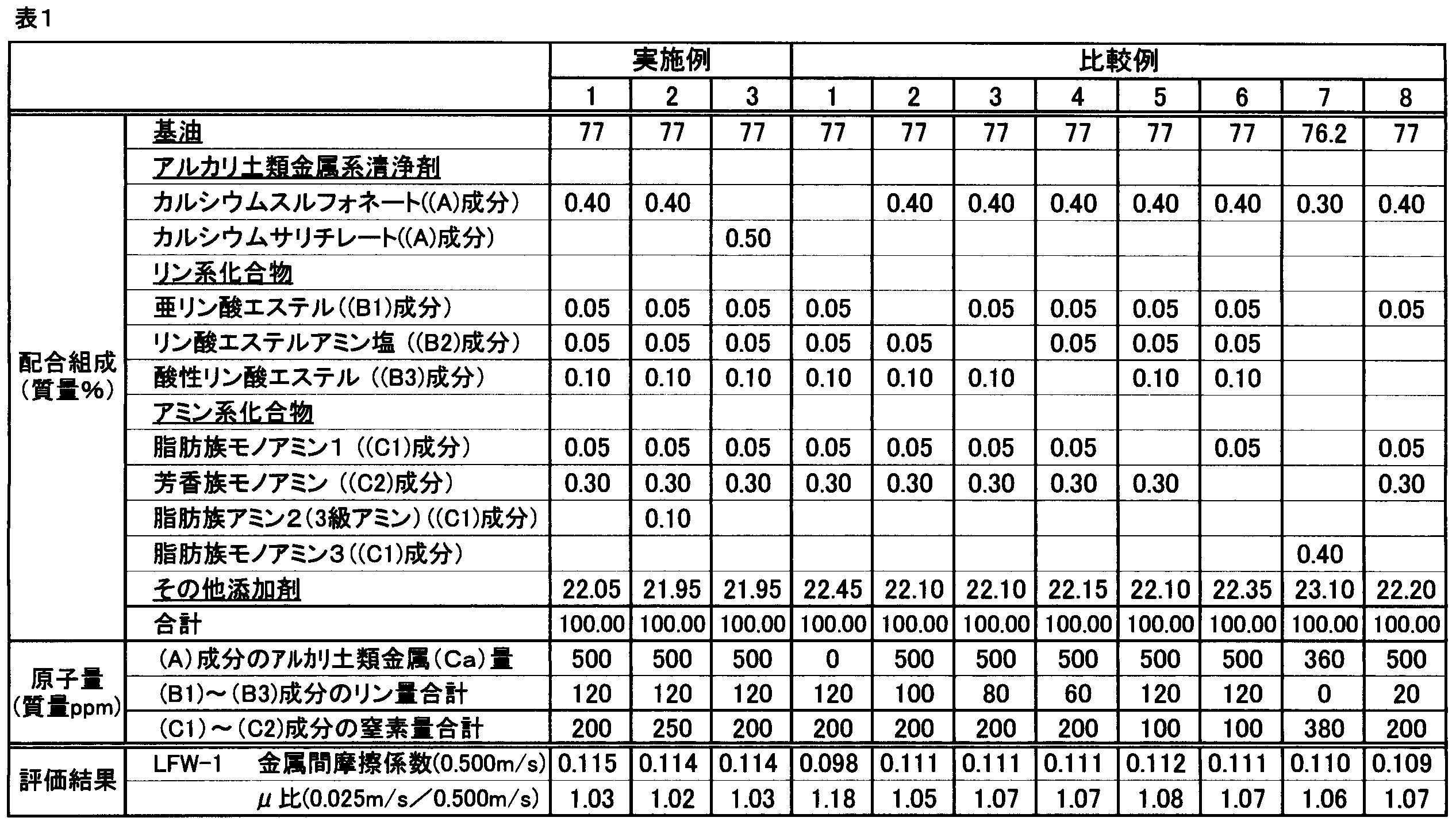
以上のように、実施例1~3の潤滑油組成物は、アルカリ土類金属系清浄剤(A)に加えて、リン系化合物として(B1)~(B3)成分、アミン系化合物として(C1)及び(C2)成分を含有することで、すべり速度が速く潤滑状態が過酷な条件下でも、金属間摩擦係数を高い値とすることができた。また、金属間μ-V特性が良好となったため、振動及びノイズを低減させることもできる。
それに対して、比較例1~8の潤滑油組成物は、(A)成分、(B1)~(B3)成分、(C1)及び(C2)成分のいずれか1種を含有しないため、金属間摩擦係数が低い値となり、さらには、金属間μ-V特性も良好にならなかった。
それに対して、比較例1~8の潤滑油組成物は、(A)成分、(B1)~(B3)成分、(C1)及び(C2)成分のいずれか1種を含有しないため、金属間摩擦係数が低い値となり、さらには、金属間μ-V特性も良好にならなかった。
Claims (15)
- 基油と、アルカリ土類金属系清浄剤(A)と、亜リン酸エステル(B1)と、リン酸エステルアミン塩(B2)と、酸性リン酸エステル(B3)と、脂肪族モノアミン(C1)と、芳香族モノアミン(C2)とを含有する潤滑油組成物。
- 亜リン酸エステル(B1)が、以下の式(I)で表される化合物である請求項1に記載の潤滑油組成物。
(R1O)aP(OH)3-a ・・・(I)
(式(I)において、R1は炭素数2~24の炭化水素基を表し、aは1~3の整数を示す。aが2又は3の場合、R1は互いに同一であってもよいし、異なっていてもよい。) - 前記式(I)において、aが2であるとともに、R1が炭素数8~20の脂肪族炭化水素基である請求項2に記載の潤滑油組成物。
- リン酸エステルアミン塩(B2)が、以下の式(II)で表される酸性リン酸エステルのアミン塩である請求項1又は2に記載の潤滑油組成物。
(R2O)bP(=O)(OH)3-b ・・・(II)
(式(II)において、R2は炭素数2~24の炭化水素基を表し、bは1又は2の整数を示す。bが2の場合、R2は互いに同一であってもよいし、異なっていてもよい。) - 前記式(II)において、R2が炭素数8~20の脂肪族炭化水素基である請求項4に記載の潤滑油組成物。
- 酸性リン酸エステル(B3)が、以下の式(III)で表される化合物である請求項1~5のいずれか1項に記載の潤滑油組成物。
(R3O)cP(=O)(OH)3-c ・・・(III)
(式(III)において、R3は炭素数2~24の炭化水素基を表し、cは1又は2の整数を示す。cが2の場合、R3は互いに同一であってもよいし、異なっていてもよい。) - 前記式(III)において、R3が炭素数8~20の脂肪族炭化水素基である請求項6に記載の潤滑油組成物。
- 脂肪族モノアミン(C1)が、以下の式(IV)で表される化合物である請求項1~7のいずれか1項に記載の潤滑油組成物。
NR4R5R6 ・・・(IV)
(式(IV)において、R4は炭素数10~24の脂肪族炭化水素基、R5及びR6は水素原子、又は炭素数1~4のアルキル基を表す。R5及びR6は互いに同一であってもよいし、異なっていてもよい。) - 式(IV)において、R4が炭素数12~18の脂肪族炭化水素基、R5及びR6が水素原子又は炭素数1~2のアルキル基を表す請求項8に記載の潤滑油組成物。
- 芳香族モノアミン(C2)が、以下の式(V)で表される化合物である請求項1~9のいずれか1項に記載の潤滑油組成物。
NR7R8R9 ・・・(V)
(式(V)において、R7は炭素数6~12の芳香族炭化水素基、R8及びR9は水素原子、又は炭素数1~4のアルキル基を表す。R8及びR9は互いに同一であってもよいし、異なっていてもよい。) - アルカリ土類金属系清浄剤(A)の塩基価が、10~500mgKOH/gである請求項1~10のいずれか1項に記載の潤滑油組成物。
- アルカリ土類金属系清浄剤(A)由来のアルカリ土類金属原子量が、組成物全量基準で10~1500質量ppmである請求項1~11のいずれか1項に記載の潤滑油組成物。
- (B1)~(B3)成分由来のリン原子量合計が、組成物全量基準で10~1000質量ppmである請求項1~12のいずれか1項に記載の潤滑油組成物。
- (C1)~(C2)成分由来の窒素量合計が、組成物全量基準で100~3000質量ppmである請求項1~13のいずれか1項に記載の潤滑油組成物。
- 基油に、アルカリ土類金属系清浄剤(A)、亜リン酸エステル(B1)、リン酸エステルアミン塩(B2)、酸性リン酸エステル(B3)、脂肪族モノアミン(C1)、及び芳香族モノアミン(C2)を少なくとも配合して潤滑油組成物を得る、潤滑油組成物の製造方法。
Priority Applications (3)
| Application Number | Priority Date | Filing Date | Title |
|---|---|---|---|
| EP17756034.9A EP3421578B1 (en) | 2016-02-25 | 2017-01-19 | Lubricating oil composition |
| US16/076,376 US20190040336A1 (en) | 2016-02-25 | 2017-01-19 | Lubricating oil composition |
| US16/806,432 US11111457B2 (en) | 2016-02-25 | 2020-03-02 | Lubricating oil composition |
Applications Claiming Priority (2)
| Application Number | Priority Date | Filing Date | Title |
|---|---|---|---|
| JP2016034153A JP6590442B2 (ja) | 2016-02-25 | 2016-02-25 | 潤滑油組成物 |
| JP2016-034153 | 2016-02-25 |
Related Child Applications (2)
| Application Number | Title | Priority Date | Filing Date |
|---|---|---|---|
| US16/076,376 A-371-Of-International US20190040336A1 (en) | 2016-02-25 | 2017-01-19 | Lubricating oil composition |
| US16/806,432 Continuation US11111457B2 (en) | 2016-02-25 | 2020-03-02 | Lubricating oil composition |
Publications (1)
| Publication Number | Publication Date |
|---|---|
| WO2017145592A1 true WO2017145592A1 (ja) | 2017-08-31 |
Family
ID=59685069
Family Applications (1)
| Application Number | Title | Priority Date | Filing Date |
|---|---|---|---|
| PCT/JP2017/001754 Ceased WO2017145592A1 (ja) | 2016-02-25 | 2017-01-19 | 潤滑油組成物 |
Country Status (4)
| Country | Link |
|---|---|
| US (2) | US20190040336A1 (ja) |
| EP (1) | EP3421578B1 (ja) |
| JP (1) | JP6590442B2 (ja) |
| WO (1) | WO2017145592A1 (ja) |
Cited By (1)
| Publication number | Priority date | Publication date | Assignee | Title |
|---|---|---|---|---|
| JP2020164588A (ja) * | 2019-03-28 | 2020-10-08 | Eneos株式会社 | 潤滑油組成物 |
Families Citing this family (4)
| Publication number | Priority date | Publication date | Assignee | Title |
|---|---|---|---|---|
| EP3487965B1 (en) * | 2016-07-20 | 2022-02-09 | The Lubrizol Corporation | Alkyl phosphate amine salts for use in lubricants |
| WO2018017449A1 (en) * | 2016-07-20 | 2018-01-25 | The Lubrizol Corporation | Alkyl phosphate amine salts for use in lubricants |
| JP7029947B2 (ja) * | 2017-11-30 | 2022-03-04 | 出光興産株式会社 | 潤滑油組成物 |
| JP2020041055A (ja) * | 2018-09-11 | 2020-03-19 | Emgルブリカンツ合同会社 | 潤滑油組成物 |
Citations (6)
| Publication number | Priority date | Publication date | Assignee | Title |
|---|---|---|---|---|
| JPH10265793A (ja) * | 1997-03-24 | 1998-10-06 | Tonen Corp | 自動変速機用潤滑油組成物 |
| JP2001513140A (ja) * | 1997-03-07 | 2001-08-28 | エクソン ケミカル パテンツ インコーポレイテッド | 潤滑剤組成物 |
| JP2009167337A (ja) * | 2008-01-18 | 2009-07-30 | Idemitsu Kosan Co Ltd | 潤滑油組成物および無段変速機 |
| WO2013137258A1 (ja) * | 2012-03-14 | 2013-09-19 | 出光興産株式会社 | 潤滑油組成物 |
| JP2014098063A (ja) * | 2012-11-13 | 2014-05-29 | Idemitsu Kosan Co Ltd | 潤滑油組成物 |
| WO2015141026A1 (ja) * | 2014-03-20 | 2015-09-24 | Jx日鉱日石エネルギー株式会社 | 潤滑油組成物 |
Family Cites Families (5)
| Publication number | Priority date | Publication date | Assignee | Title |
|---|---|---|---|---|
| IN163879B (ja) * | 1984-09-17 | 1988-12-03 | Bank Of America | |
| JP4142115B2 (ja) * | 1994-11-09 | 2008-08-27 | シエル・インターナシヨナル・リサーチ・マートスハツペイ・ベー・ヴエー | 潤滑油組成物 |
| JP4334623B2 (ja) * | 1996-06-12 | 2009-09-30 | 出光興産株式会社 | 自動変速機用潤滑油組成物 |
| JP5721983B2 (ja) * | 2010-09-14 | 2015-05-20 | 株式会社Adeka | 酸化防止剤組成物及びそれを含有する潤滑油組成物 |
| EP2661482B1 (en) * | 2011-01-04 | 2016-12-28 | The Lubrizol Corporation | Continuously variable transmission fluid with extended anti-shudder durability |
-
2016
- 2016-02-25 JP JP2016034153A patent/JP6590442B2/ja active Active
-
2017
- 2017-01-19 WO PCT/JP2017/001754 patent/WO2017145592A1/ja not_active Ceased
- 2017-01-19 US US16/076,376 patent/US20190040336A1/en not_active Abandoned
- 2017-01-19 EP EP17756034.9A patent/EP3421578B1/en active Active
-
2020
- 2020-03-02 US US16/806,432 patent/US11111457B2/en active Active
Patent Citations (6)
| Publication number | Priority date | Publication date | Assignee | Title |
|---|---|---|---|---|
| JP2001513140A (ja) * | 1997-03-07 | 2001-08-28 | エクソン ケミカル パテンツ インコーポレイテッド | 潤滑剤組成物 |
| JPH10265793A (ja) * | 1997-03-24 | 1998-10-06 | Tonen Corp | 自動変速機用潤滑油組成物 |
| JP2009167337A (ja) * | 2008-01-18 | 2009-07-30 | Idemitsu Kosan Co Ltd | 潤滑油組成物および無段変速機 |
| WO2013137258A1 (ja) * | 2012-03-14 | 2013-09-19 | 出光興産株式会社 | 潤滑油組成物 |
| JP2014098063A (ja) * | 2012-11-13 | 2014-05-29 | Idemitsu Kosan Co Ltd | 潤滑油組成物 |
| WO2015141026A1 (ja) * | 2014-03-20 | 2015-09-24 | Jx日鉱日石エネルギー株式会社 | 潤滑油組成物 |
Non-Patent Citations (1)
| Title |
|---|
| See also references of EP3421578A4 * |
Cited By (2)
| Publication number | Priority date | Publication date | Assignee | Title |
|---|---|---|---|---|
| JP2020164588A (ja) * | 2019-03-28 | 2020-10-08 | Eneos株式会社 | 潤滑油組成物 |
| JP7159097B2 (ja) | 2019-03-28 | 2022-10-24 | Eneos株式会社 | 潤滑油組成物 |
Also Published As
| Publication number | Publication date |
|---|---|
| EP3421578A1 (en) | 2019-01-02 |
| US20190040336A1 (en) | 2019-02-07 |
| EP3421578B1 (en) | 2021-10-13 |
| JP2017149856A (ja) | 2017-08-31 |
| EP3421578A4 (en) | 2019-10-23 |
| US20200199484A1 (en) | 2020-06-25 |
| US11111457B2 (en) | 2021-09-07 |
| JP6590442B2 (ja) | 2019-10-16 |
Similar Documents
| Publication | Publication Date | Title |
|---|---|---|
| US11111457B2 (en) | Lubricating oil composition | |
| JP5395453B2 (ja) | 無段変速機油組成物 | |
| EP2826846B1 (en) | Lubricant composition | |
| JP6228104B2 (ja) | 潤滑油組成物 | |
| EP2481790B1 (en) | Lubricant composition and continuously-variable transmission | |
| US10011802B2 (en) | Lubricating oil composition | |
| JP6035175B2 (ja) | 潤滑油組成物 | |
| US20160201002A1 (en) | Lubricating oil composition for traction drive transmission | |
| WO2015133529A1 (ja) | 潤滑油組成物 | |
| JP7029947B2 (ja) | 潤滑油組成物 | |
| JP5961097B2 (ja) | 潤滑油組成物 | |
| JP2018188549A (ja) | 潤滑油組成物 | |
| JP7034921B2 (ja) | 潤滑油組成物 | |
| WO2024166719A1 (ja) | 潤滑油基油 | |
| JP7304336B2 (ja) | 潤滑油組成物 | |
| JP6857317B2 (ja) | 潤滑油組成物 | |
| JP2023125591A (ja) | 潤滑油組成物 | |
| US12600918B2 (en) | Lubricating oil composition | |
| WO2024242040A1 (ja) | 化合物、添加剤及び潤滑油組成物 | |
| WO2013147182A1 (ja) | コハク酸イミド化合物、潤滑油添加剤および潤滑油組成物 |
Legal Events
| Date | Code | Title | Description |
|---|---|---|---|
| NENP | Non-entry into the national phase |
Ref country code: DE |
|
| WWE | Wipo information: entry into national phase |
Ref document number: 2017756034 Country of ref document: EP |
|
| ENP | Entry into the national phase |
Ref document number: 2017756034 Country of ref document: EP Effective date: 20180925 |
|
| 121 | Ep: the epo has been informed by wipo that ep was designated in this application |
Ref document number: 17756034 Country of ref document: EP Kind code of ref document: A1 |