WO2017145609A1 - Ruban de toile et produit fibreux - Google Patents
Ruban de toile et produit fibreux Download PDFInfo
- Publication number
- WO2017145609A1 WO2017145609A1 PCT/JP2017/002305 JP2017002305W WO2017145609A1 WO 2017145609 A1 WO2017145609 A1 WO 2017145609A1 JP 2017002305 W JP2017002305 W JP 2017002305W WO 2017145609 A1 WO2017145609 A1 WO 2017145609A1
- Authority
- WO
- WIPO (PCT)
- Prior art keywords
- cloth tape
- cloth
- tape according
- fabric
- aromatic polyamide
- Prior art date
- Legal status (The legal status is an assumption and is not a legal conclusion. Google has not performed a legal analysis and makes no representation as to the accuracy of the status listed.)
- Ceased
Links
Images


Classifications
-
- D—TEXTILES; PAPER
- D04—BRAIDING; LACE-MAKING; KNITTING; TRIMMINGS; NON-WOVEN FABRICS
- D04B—KNITTING
- D04B21/00—Warp knitting processes for the production of fabrics or articles not dependent on the use of particular machines; Fabrics or articles defined by such processes
- D04B21/14—Fabrics characterised by the incorporation by knitting, in one or more thread, fleece, or fabric layers, of reinforcing, binding, or decorative threads; Fabrics incorporating small auxiliary elements, e.g. for decorative purposes
- D04B21/16—Fabrics characterised by the incorporation by knitting, in one or more thread, fleece, or fabric layers, of reinforcing, binding, or decorative threads; Fabrics incorporating small auxiliary elements, e.g. for decorative purposes incorporating synthetic threads
-
- A—HUMAN NECESSITIES
- A41—WEARING APPAREL
- A41D—OUTERWEAR; PROTECTIVE GARMENTS; ACCESSORIES
- A41D13/00—Professional, industrial or sporting protective garments, e.g. surgeons' gowns or garments protecting against blows or punches
- A41D13/008—Professional, industrial or sporting protective garments, e.g. surgeons' gowns or garments protecting against blows or punches protecting against electric shocks or static electricity
-
- A—HUMAN NECESSITIES
- A41—WEARING APPAREL
- A41D—OUTERWEAR; PROTECTIVE GARMENTS; ACCESSORIES
- A41D31/00—Materials specially adapted for outerwear
- A41D31/04—Materials specially adapted for outerwear characterised by special function or use
- A41D31/08—Heat resistant; Fire retardant
-
- D—TEXTILES; PAPER
- D03—WEAVING
- D03D—WOVEN FABRICS; METHODS OF WEAVING; LOOMS
- D03D1/00—Woven fabrics designed to make specified articles
-
- D—TEXTILES; PAPER
- D03—WEAVING
- D03D—WOVEN FABRICS; METHODS OF WEAVING; LOOMS
- D03D1/00—Woven fabrics designed to make specified articles
- D03D1/0035—Protective fabrics
-
- D—TEXTILES; PAPER
- D03—WEAVING
- D03D—WOVEN FABRICS; METHODS OF WEAVING; LOOMS
- D03D15/00—Woven fabrics characterised by the material, structure or properties of the fibres, filaments, yarns, threads or other warp or weft elements used
- D03D15/50—Woven fabrics characterised by the material, structure or properties of the fibres, filaments, yarns, threads or other warp or weft elements used characterised by the properties of the yarns or threads
- D03D15/513—Woven fabrics characterised by the material, structure or properties of the fibres, filaments, yarns, threads or other warp or weft elements used characterised by the properties of the yarns or threads heat-resistant or fireproof
-
- D—TEXTILES; PAPER
- D03—WEAVING
- D03D—WOVEN FABRICS; METHODS OF WEAVING; LOOMS
- D03D15/00—Woven fabrics characterised by the material, structure or properties of the fibres, filaments, yarns, threads or other warp or weft elements used
- D03D15/50—Woven fabrics characterised by the material, structure or properties of the fibres, filaments, yarns, threads or other warp or weft elements used characterised by the properties of the yarns or threads
- D03D15/567—Shapes or effects upon shrinkage
-
- D—TEXTILES; PAPER
- D04—BRAIDING; LACE-MAKING; KNITTING; TRIMMINGS; NON-WOVEN FABRICS
- D04B—KNITTING
- D04B21/00—Warp knitting processes for the production of fabrics or articles not dependent on the use of particular machines; Fabrics or articles defined by such processes
-
- A—HUMAN NECESSITIES
- A41—WEARING APPAREL
- A41D—OUTERWEAR; PROTECTIVE GARMENTS; ACCESSORIES
- A41D27/00—Details of garments or of their making
- A41D27/28—Means for ventilation
-
- D—TEXTILES; PAPER
- D10—INDEXING SCHEME ASSOCIATED WITH SUBLASSES OF SECTION D, RELATING TO TEXTILES
- D10B—INDEXING SCHEME ASSOCIATED WITH SUBLASSES OF SECTION D, RELATING TO TEXTILES
- D10B2331/00—Fibres made from polymers obtained otherwise than by reactions only involving carbon-to-carbon unsaturated bonds, e.g. polycondensation products
- D10B2331/02—Fibres made from polymers obtained otherwise than by reactions only involving carbon-to-carbon unsaturated bonds, e.g. polycondensation products polyamides
- D10B2331/021—Fibres made from polymers obtained otherwise than by reactions only involving carbon-to-carbon unsaturated bonds, e.g. polycondensation products polyamides aromatic polyamides, e.g. aramides
-
- D—TEXTILES; PAPER
- D10—INDEXING SCHEME ASSOCIATED WITH SUBLASSES OF SECTION D, RELATING TO TEXTILES
- D10B—INDEXING SCHEME ASSOCIATED WITH SUBLASSES OF SECTION D, RELATING TO TEXTILES
- D10B2403/00—Details of fabric structure established in the fabric forming process
- D10B2403/03—Shape features
- D10B2403/031—Narrow fabric of constant width
- D10B2403/0311—Small thickness fabric, e.g. ribbons, tapes or straps
-
- D—TEXTILES; PAPER
- D10—INDEXING SCHEME ASSOCIATED WITH SUBLASSES OF SECTION D, RELATING TO TEXTILES
- D10B—INDEXING SCHEME ASSOCIATED WITH SUBLASSES OF SECTION D, RELATING TO TEXTILES
- D10B2501/00—Wearing apparel
-
- D—TEXTILES; PAPER
- D10—INDEXING SCHEME ASSOCIATED WITH SUBLASSES OF SECTION D, RELATING TO TEXTILES
- D10B—INDEXING SCHEME ASSOCIATED WITH SUBLASSES OF SECTION D, RELATING TO TEXTILES
- D10B2501/00—Wearing apparel
- D10B2501/04—Outerwear; Protective garments
Definitions
- the present invention relates to a fabric tape that can be used as a constituent member of a textile product and has flame retardancy, and a textile product using the fabric tape.
- Patent Document 1 Conventionally, a cloth tape that can be used as a constituent member of a textile product has been proposed in Patent Document 1, for example.
- flame resistance is required in the fields of protective clothing, fire and fire prevention clothing, fire fighting activity clothing, rescue clothing, flame retardant workwear, police uniforms, Self-Defense Force clothing and military clothing.
- the present invention has been made in view of the above-described background, and an object of the present invention is to provide a fabric tape that can be used as a constituent member of a textile product and has flame retardancy, and a textile product using the fabric tape. It is to provide.
- a cloth tape made of organic fibers having an afterflame time of 2.0 seconds or less in the flammability measurement defined in JIS L1091-1999 A-4 method (12-second heating method) A cloth tape characterized in that "is provided.
- the residual time is 3.0 seconds or less and the carbonization length is 10 cm or less.
- the width of the cloth tape is preferably in the range of 1 to 30 cm.
- a fabric tape is comprised with a knitted fabric.
- a cloth tape contains a fully aromatic polyamide fiber.
- a cloth tape contains 30 weight% or more of meta-type wholly aromatic polyamide fibers with respect to the weight of the cloth tape.
- the cloth tape preferably contains 50 to 99% by weight of meta-type wholly aromatic polyamide fiber based on the weight of the cloth tape.
- the cloth tape preferably contains 2 to 20% by weight of para-type wholly aromatic polyamide fiber based on the weight of the cloth tape.
- the cloth tape is dyed.
- the cloth tape preferably includes a bent portion.
- the advancing direction of the said bending part corresponds with the longitudinal direction or width direction of a fabric tape.
- the width of the bent portion is preferably in the range of 0.3 to 20 cm. Further, it is preferable that the bent portion has an expansion / contraction rate of 10% or more.
- the cloth tape preferably has a mesh portion. In that case, it is preferable that an aperture ratio is 20% or more in the said mesh part.
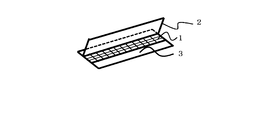
- the mesh portion has a width of 1 to 5 cm and is continuous in the longitudinal direction of the cloth tape. Moreover, it is preferable to have a non-mesh part with an aperture ratio of 10% or less on both sides of the mesh part continuous in the longitudinal direction. Moreover, it is preferable to have a cloth covering at least a part of the mesh portion. Moreover, it is preferable that this cloth can be opened and closed freely.
- a cloth tape and a textile product that can be used as a constituent member of a textile product and have flame resistance are obtained.
- the cloth tape is continuous in the longitudinal direction (L direction). It is an example of the knitting structure chart which can be used when manufacturing the fabric tape of this invention. It is an example of the perspective view of the fabric tape of this invention. The cloth tape is continuous in the longitudinal direction.
- the afterflame time is 2.0 seconds or less (preferably 0.001 to 1.0 seconds) in the flammability measurement prescribed in JIS L1091-1999 A-4 method (12-second heating method). Is essential. If the afterflame time exceeds 2.0 seconds, sufficient flame retardancy is not maintained, and it is dangerous to ignite when subjected to a flame or the like.
- the residual time is 3.0 seconds or less and the carbonization length is 10 cm or less.
- a flame retardant material as at least part of the fabric of the cloth tape. You may give a flame-resistant process to cloth tape.
- flame-retardant materials include meta-type wholly aromatic polyamide fibers, para-type wholly aromatic polyamide fibers, flame-retardant rayon fibers, modacrylic fibers, flame-retardant acrylic fibers, flame-retardant vinylon fibers, and the like. is not.
- a raw material is not specifically limited.
- the cloth tape includes at least a wholly aromatic polyamide fiber. More preferably, the meta-type wholly aromatic polyamide fiber is contained in the fabric tape in an amount of 30% by weight or more (more preferably 50 to 99% by weight) relative to the weight of the fabric tape. When the weight ratio of the meta-type wholly aromatic polyamide fiber is less than 30% by weight with respect to the weight of the cloth tape, sufficient flame retardancy cannot be obtained, and there is a possibility that the cloth tape becomes brittle due to carbonization when exposed to a flame. is there.
- the cloth tape preferably contains 2 to 20% by weight of para-type wholly aromatic polyamide fiber relative to the weight of the cloth tape. If the weight ratio of the para-type wholly aromatic polyamide fiber is less than 2% by weight with respect to the weight of the cloth tape, there is a possibility that the shrinkage upon receiving a flame becomes large. On the other hand, if it exceeds 20% by weight, the cloth tape becomes hard and the wearing comfort may be reduced.
- the cloth tape is composed only of meta-type wholly aromatic polyamide fibers and / or para-type wholly aromatic polyamide fibers.
- the cloth tape is made of only a spun yarn obtained by mixing a meta-type wholly aromatic polyamide fiber and para-type wholly aromatic polyamide fiber.
- the meta-type wholly aromatic polyamide fiber is a fiber made of a polymer in which 85 mol% or more of the repeating unit is m-phenylene isophthalamide.
- Such a meta-type wholly aromatic polyamide may be a copolymer containing the third component within a range of less than 15 mol%.
- Such a meta-type wholly aromatic polyamide can be produced by a conventionally known interfacial polymerization method.
- the polymerization degree of the polymer is N-methyl-2-pyrrolidone solution having a concentration of 0.5 g / 100 ml.
- Those having a measured intrinsic viscosity (IV) in the range of 1.3 to 1.9 dl / g are preferably used.
- the meta-type wholly aromatic polyamide may contain an alkylbenzene sulfonic acid onium salt.
- alkylbenzene sulfonic acid onium salt examples include tetrabutyl phosphonium salt of hexyl benzene sulfonate, tributyl benzyl phosphonium salt of hexyl benzene sulfonate, tetraphenyl phosphonium salt of dodecyl benzene sulfonate, tributyl tetradecyl phosphonate of dodecyl benzene sulfonate.
- Preferred examples include compounds such as a nium salt, tetrabutylphosphonium salt of dodecylbenzenesulfonate, and tributylbenzylammonium salt of dodecylbenzenesulfonate.
- dodecylbenzenesulfonic acid tetrabutylphosphonium salt or dodecylbenzenesulfonic acid tributylbenzylammonium salt is particularly easy to obtain and has good thermal stability and high solubility in N-methyl-2-pyrrolidone.
- tributylbenzylammonium salt is particularly easy to obtain and has good thermal stability and high solubility in N-methyl-2-pyrrolidone.
- the content of the onium salt of alkylbenzene sulfonic acid is 2.5 mol% or more based on poly-m-phenylene isophthalamide (more preferably 3.0 to 7.0) in order to obtain a sufficient dyeing effect. Mol%).
- poly-m-phenylene isophthalamide As a method of mixing poly-m-phenylene isophthalamide and alkylbenzene sulfonic acid onium salt, poly-m-phenylene isophthalamide is mixed and dissolved in a solvent, and alkylbenzene sulfonic acid onium salt is dissolved in the solvent. Etc., and any of them may be used. The dope thus obtained is formed into fibers by a conventionally known method.
- the polymer used for the meta-type wholly aromatic polyamide fiber is used in the aromatic polyamide skeleton containing a repeating structural unit represented by the following formula (1) for the purpose of improving dyeability and resistance to discoloration.
- An aromatic diamine component or an aromatic dicarboxylic acid halide component different from the main structural unit of the structure may be copolymerized so as to be 1 to 10 mol% based on the total amount of the repeating structural units of the aromatic polyamide as the third component. Is possible.
- Ar1 is a divalent aromatic group having a bonding group other than the meta-coordination or parallel axis direction.
- aromatic diamines represented by the formulas (2) and (3) include, for example, p-phenylenediamine, chlorophenylenediamine, methylphenylenediamine, acetylphenylenediamine, aminoanisidine, benzidine, and bis (aminophenyl).
- aromatic diamines represented by the formulas (2) and (3) include, for example, p-phenylenediamine, chlorophenylenediamine, methylphenylenediamine, acetylphenylenediamine, aminoanisidine, benzidine, and bis (aminophenyl).
- examples include ether, bis (aminophenyl) sulfone, diaminobenzanilide, diaminoazobenzene and the like.
- aromatic dicarboxylic acid dichloride represented by the formulas (4) and (5) include, for example, terephthalic acid chloride, 1,4-naphthalenedicarboxylic acid chloride, 2,6-naphthalenedicarboxylic acid chloride, 4,4 Examples include '-biphenyldicarboxylic acid chloride, 5-chloroisophthalic acid chloride, 5-methoxyisophthalic acid chloride, bis (chlorocarbonylphenyl) ether, and the like.
- Ar2 is a divalent aromatic group different from Ar1
- Ar3 is a divalent aromatic group different from Ar1
- Y is at least one atom selected from the group consisting of an oxygen atom, a sulfur atom, and an alkylene group Or it is a functional group and X represents a halogen atom.
- the crystallinity of the meta-type wholly aromatic polyamide fiber is 5 to 35% in terms of good dye exhaustion and easy adjustment to the target color with less dye or weak dyeing conditions. It is preferable that Further, it is more preferably 15 to 25% from the viewpoint that the surface uneven distribution of the dye hardly occurs, the discoloration resistance is high, and the dimensional stability necessary for practical use can be secured.
- the residual solvent amount of the meta-type wholly aromatic polyamide fiber is 0 in that it does not impair the excellent flame retardant performance of the meta-type wholly aromatic polyamide fiber, and the surface unevenness of the dye hardly occurs, and the discoloration resistance is high. .1% by weight or less is preferable.
- the meta-type wholly aromatic polyamide fiber can be produced by the following method.
- the crystallinity and the amount of residual solvent can be adjusted to the above ranges by the following method.
- the polymerization method of the meta-type wholly aromatic polyamide polymer is not particularly limited.
- the solution weight described in Japanese Patent Publication No. 35-14399, US Pat. No. 3,360,595, Japanese Patent Publication No. 47-10863, etc. A combination method or an interfacial polymerization method may be used.
- the spinning solution is not particularly limited, and an amide solvent solution containing an aromatic copolyamide polymer obtained by the above solution polymerization or interfacial polymerization may be used, or the polymer is isolated from the polymerization solution, You may use what melt
- amide solvent examples include N, N-dimethylformamide, N, N-dimethylacetamide, N-methyl-2-pyrrolidone (NMP), and dimethyl sulfoxide. -Dimethylacetamide is preferred.
- the copolymerized aromatic polyamide polymer solution obtained as described above is preferably stabilized by containing an alkali metal salt or an alkaline earth metal salt, and can be used at a higher concentration and lower temperature.
- the alkali metal salt and alkaline earth metal salt are preferably 1% by weight or less (more preferably 0.1% by weight or less) based on the total weight of the polymer solution.
- the spinning solution metal-type wholly aromatic polyamide polymer solution obtained above is spun into a coagulating solution and coagulated.
- the spinning apparatus is not particularly limited, and a conventionally known wet spinning apparatus can be used.
- the number of spinning holes, the arrangement state, the hole shape, etc. of the spinneret need not be particularly limited as long as they can be stably wet-spun.
- the number of holes is 1,000 to 30,000, and the spinning hole diameter is 0.05.
- a multi-hole spinneret for ⁇ 0.2 mm sufu may be used.
- the temperature of the spinning solution (meta-type wholly aromatic polyamide polymer solution) when spinning from the spinneret is preferably in the range of 20 to 90 ° C.
- an amide solvent preferably an aqueous solution having an NMP concentration of 45 to 60% by mass
- substantially no inorganic salt is used at a bath temperature of 10 to 50 ° C.
- concentration of the amide solvent preferably NMP
- the concentration of the amide solvent preferably NMP
- the concentration of the amide solvent exceeds 60% by mass, uniform coagulation cannot be performed up to the inside of the fiber, and therefore, the residual solvent amount of the fiber can be reduced. May become difficult.
- the fiber immersion time in the coagulation bath is preferably in the range of 0.1 to 30 seconds.
- the stretching ratio is 3 to 4 times in a plastic stretching bath in which the concentration of the amide solvent (preferably NMP) is 45 to 60% by mass and the bath temperature is in the range of 10 to 50 ° C. Stretching with. After stretching, the film is thoroughly washed through an aqueous solution having an NMP concentration of 20 to 40% by mass at 10 to 30 ° C., followed by a hot water bath at 50 to 70 ° C.
- concentration of the amide solvent preferably NMP
- the washed fibers can be subjected to a dry heat treatment at a temperature of 270 to 290 ° C. to obtain meta-type wholly aromatic polyamide fibers satisfying the above crystallinity and residual solvent range.
- the fiber may be a long fiber (multifilament) or a short fiber.
- short fibers having a fiber length of 25 to 200 mm are preferable in blending with other fibers.
- the single fiber fineness is preferably in the range of 1 to 5 dtex.
- meta-type wholly aromatic polyamide fibers examples include Conex (trade name), Conex Neo (trade name), Nomex (trade name), and the like.
- Para-type wholly aromatic polyamide fibers are typified by Technora (trade name), Kevlar (trade name) and Twaron (trade name), and fibers made of polyamide having an aromatic ring in the main chain.
- Poly-p-phenylene terephthalamide (PPTA) or copolymer type copolyparaphenylene-3,4'oxydiphenylene terephthalamide (PPODPA) may be used.
- the first aspect has a bent portion.
- the “bent portion” means that the rib portions on the front surface and the rib portions on the back surface are alternately formed in the cross section of the cloth tape as shown in FIG. is there.
- the cloth tape has elasticity by having such a bent portion.
- the width W1 of the cloth tape is preferably in the range of 1 to 30 cm (more preferably 2 to 10 cm). If the width W1 is smaller than 1 cm, sufficient stretchability may not be obtained. Conversely, if the width W1 is greater than 30 cm, the handleability of the fabric tape may be reduced.
- the traveling direction of the bent portion coincides with the longitudinal direction or the width direction of the cloth tape.
- the advancing direction of a bending part corresponds with the width direction (W direction) of a fabric tape.
- the width W2 of the bent portion is preferably in the range of 0.3 to 20 cm (more preferably 1 to 8 cm). If the width W2 is smaller than 0.3 cm, sufficient stretchability may not be obtained. Conversely, if the width W2 is greater than 20 cm, the handleability of the fabric tape may be reduced.
- the thickness of the bent portion is preferably in the range of 1 to 10 mm.
- the bending rate defined by the following formula is 1.1 or more (more preferably 1.3 to 10) in the bent portion.
- the bent portion preferably has an expansion / contraction ratio of 10% or more (more preferably 25% or more, particularly preferably 50 to 300%). If the expansion / contraction ratio is less than 10%, the wearing comfort may be reduced.
- the fabric structure of the fabric tape is not limited, but is preferably made of woven fabric and / or knitted fabric. In particular, it is preferably made of a knitted fabric. Among these, a denbi knitted fabric is preferable.
- a denvi knitting portion front side main knitting portion having a predetermined width is knitted at a predetermined interval in the weft direction with a front side needle of a double raschel knitting machine, while a denvi knitting portion (back side) with a predetermined width is similarly applied to a back side needle.
- the main knitting part is knitted at predetermined intervals in the weft direction, and the phase of the back side main knitting part in parallel is shifted in the weft direction with respect to that of the front side main knitting part, and each back side main knitting part is front side main knitting.
- the knitting ears are preferably knitted on both sides of the knitted fabric and the knitted fabric with the same knitting structure as the knitting knitting portion.
- the tape is dyed.
- dye it is possible to prepare a colorless fabric and dye and ship it according to the use and demand.
- dyeing it is possible to match the color with the other part of the fabric when it is made into a textile product.
- the cloth tape has the above-described configuration, it has not only flame retardancy but also stretchability.
- the textile product according to the first aspect is formed by using the cloth tape as a part, and includes protective clothing, fire-fighting clothing, fire-fighting clothing, rescue clothing, flame-retardant workwear, police uniforms, self-defense clothing, and military clothing. Any fiber product selected from the group.
- the cloth tape should be partially placed on the shoulders, elbows, knees and other joints.
- the fibers constituting the portion other than the cloth tape are meta-type wholly aromatic polyamide fibers and / or para-type wholly aromatic polyamide fibers.
- Such a textile product uses the above-mentioned cloth tape, it has an excellent feature that it has not only flame retardancy but also stretchability.
- the second aspect has a mesh portion.
- the opening ratio defined by the following formula is preferably 20% or more (more preferably 30% to 60%).
- the opening ratio is less than 20%, sufficient air permeability cannot be obtained, and comfort may be hindered.
- Opening ratio (C / D) x 100 (%)
- C is the total area of the void portion surrounded by the fiber portion when the fabric is projected
- D is the total value of the area of the void portion and the area of the fiber portion.
- the mesh portion has a width of 1 to 5 cm and is continuous in the longitudinal direction of the cloth tape. If the width is smaller than 1 cm, the air permeability may be lowered. Conversely, if the width is greater than 5 cm, the flame may pass through the mesh portion.
- the aperture ratio of a non-mesh part is 10% or less. If the opening ratio of the non-mesh portion is larger than 10%, there is a possibility that the yarn may be unstable when attached with a sewing thread when making a fiber product.
- the cloth tape has a double structure and has a fabric (flap portion) that covers the mesh portion so that the flame hardly passes through the mesh portion.
- the cloth covering the mesh portion is preferably one having an opening ratio of less than 20% (non-mesh).
- the fabric is not particularly limited, such as a woven fabric or a knitted fabric, but is preferably warp knitted, and it is more preferable that the mesh portion and the non-mesh portion of the fabric tape are integrally formed.
- the above-mentioned flame retardant material is used as the cloth covering the cloth body (fabric having a mesh part) and the mesh part, or is difficult. You may give a post-combustion process.
- Such fabric tape is preferably made of woven fabric and / or knitted fabric.
- Each of the woven fabric and the knitted fabric may be constituted alone, or the woven fabric and the knitted fabric may be connected by sewing with a sewing thread.
- plain weave, twill weave, satin weave and the like are preferable, but are not particularly limited.
- circular knitting (weft knitting), warp knitting and the like are not particularly limited, but warp knitting is more preferable because the structure of the fabric tape is stable.
- the width of the cloth tape is preferably 1 to 30 cm (more preferably 2 to 10 cm).
- Such a fabric tape for example, as described in JP-A-2002-249959, it can be produced with a double raschel knitting machine.
- the cloth tape is dyed.
- a colorless fabric is prepared, and it is possible to ship it after dyeing depending on the application and demand.
- dyeing it is possible to match the color with the other part of the fabric when it is made into a textile product.
- the textile product of the present invention uses the cloth tape as a part, and comprises a group consisting of protective clothing, fire fighting clothing, fire fighting clothing, rescue clothing, flame retardant workwear, police uniforms, SDF clothing, and military clothing. Any textile product selected.
- the cloth covering the opening when the cloth covering the opening is provided, it is preferable that the cloth is on the outside air side. Moreover, it is better not to use the cloth tape on the entire surface of the textile product, but to use it only on a part such as a side part where sweat easily or a part where body temperature does not easily fall. In that case, it is preferable that the fibers constituting the portion other than the cloth tape are meta-type wholly aromatic polyamide fibers and / or para-type wholly aromatic polyamide fibers.
- the textile product of the second aspect has the excellent characteristics of having high air permeability and flame retardancy because the fabric is used.
- Bending rate Bending rate [B + (A ⁇ 2 ⁇ (number of bendings))] / B
- A Bending thickness (cm)
- B Bending width (cm)
- Opening ratio (C / D) x 100 (%)
- C is the total area of the void portion surrounded by the fiber portion when the fabric is projected
- D is the total value of the area of the void portion and the area of the fiber portion.
- MA / PA consisting of meta-type wholly aromatic polyamide fibers (Conex (trade name) MA) and para-type wholly aromatic polyamide fibers (Twaron (trade name) PA) (each fiber length is 51 mm)
- a warp knitted fabric was knitted with a knitting structure shown in FIG. 2 using a double raschel machine using only a 40th yarn / twist yarn spun at a mass ratio of 95/5. Then, after refining in a conventional manner and dyeing the meta-type wholly aromatic polyamide fiber, it is fixed with a pin while being stretched so that the width of the bent portion is 1.3 times, and is heat set. A cloth tape was obtained. The width was 4 cm and the thickness of the bent portion was 3 mm. Further, as shown in FIG. 1, the traveling direction of the bent portion coincided with the width direction of the cloth tape.
- the obtained fabric tape had a stretch rate of 121%, a residual flame time of 0.1 seconds, a residual dust time of 1.2 seconds, a carbonization length of 6.0 cm, and had flame retardancy. .
- Conex trade name
- Twaron trademark
- Example 1 was carried out in the same manner as Example 1 except that the spun yarn was changed to spun yarn 40 / twist yarn made of only polyester fibers.
- the obtained fabric tape has a flexion ratio of 1.58 and an expansion / contraction ratio of 132%, the flammability prescribed in JIS L1091-1999 A-4 method (12-second heating method) is completely burned and has flame retardancy. It was not.
- Example 2 The same operation as in Example 1 was performed except that the bending rate was set to 1.03 by extending the width of the bent portion by 2.6 times and performing heat setting.
- the resulting fabric tape has a stretch ratio of 23% and insufficient stretchability, but the flammability is flame retardant with a residual flame time of 0.2 seconds, a residual dust time of 1.1 seconds, and a carbonization length of 5.3 cm. It was what had.
- the fabric tape is used for the shoulder portion of the textile product (protective clothing), and the other portion is a meta type wholly aromatic polyamide fiber (Conex (trade name)) MA, para type wholly aroma produced by a conventional method.
- a woven fabric using spun yarn 40 yarn / twist yarn blended at a mass ratio of MA / PA 95/5 consisting of each staple fiber of PA group polyamide fiber (Twaron (trade name) PA (each fiber length is 51 mm)) It was set as the used textile product (protective clothing).
- MA / PA consisting of meta-type wholly aromatic polyamide fibers (Conex (trade name) MA) and para-type wholly aromatic polyamide fibers (Twaron (trade name) PA) (each fiber length is 51 mm)
- a warp knitted fabric was knitted with a double raschel machine using a spun yarn 40 / twist yarn blended at a mass ratio of 95/5, and the fabric tape shown in FIG. 3 was knitted. At that time, the mesh part (opening ratio 35%), the non-mesh part (opening ratio 7%), and the flap part (opening ratio 7%) were integrally molded.
- the resulting fabric tape has a flammability specified by JIS L1091-1999 A-4 method (12-second heating method) with a residual flame of 0.7 seconds, a residual dust of 0.9 seconds, and a carbonization length of 4.8 cm. Yes, it was flame retardant.
- the side part When the tester wore the textile product, the side part had good air permeability and was very comfortable.
- Example 2 The same procedure as in Example 3 was performed except that spun yarn 40 / twist yarn composed of polyester fiber alone was used.
- the obtained fabric tape had a flammability defined by JIS L1091-1999 A-4 method (12-second heating method) that was completely burned and had no flame retardancy.
- Example 4 In Example 3, the opening ratio was changed for each of the mesh part (opening ratio 10%), the meshed part (opening ratio 5%), and the flap fabric (opening ratio 5%). Other than that was carried out similarly to Example 3.
- the resulting fabric tape has a combustibility specified by JIS L1091-1999 A-4 method (12-second heating method), with a residual flame time of 0.9 seconds, a residual dust time of 1.1 seconds, and a carbonization length of 5 It was .3 cm and had flame retardancy.
- a fabric tape and a textile product having flame retardancy are provided, and their industrial value is extremely large.
Landscapes
- Engineering & Computer Science (AREA)
- Textile Engineering (AREA)
- Mechanical Engineering (AREA)
- Health & Medical Sciences (AREA)
- General Health & Medical Sciences (AREA)
- Physical Education & Sports Medicine (AREA)
- Woven Fabrics (AREA)
- Knitting Of Fabric (AREA)
- Professional, Industrial, Or Sporting Protective Garments (AREA)
- Decoration Of Textiles (AREA)
- Yarns And Mechanical Finishing Of Yarns Or Ropes (AREA)
Abstract
Priority Applications (7)
| Application Number | Priority Date | Filing Date | Title |
|---|---|---|---|
| EP17756051.3A EP3421651A4 (fr) | 2016-02-23 | 2017-01-24 | Ruban de toile et produit fibreux |
| CN201780002144.2A CN107735521B (zh) | 2016-02-23 | 2017-01-24 | 布带和纤维制品 |
| RU2018132492A RU2710114C1 (ru) | 2016-02-23 | 2017-01-24 | Тканевая лента и волокнистый продукт |
| CA2987915A CA2987915A1 (fr) | 2016-02-23 | 2017-01-24 | Ruban de toile et produit fibreux |
| US15/568,149 US20180080153A1 (en) | 2016-02-23 | 2017-01-24 | Cloth tape and fiber product |
| BR112017026047-6A BR112017026047A2 (pt) | 2016-02-23 | 2017-01-24 | fita de pano, e, produto de fibra |
| JP2017529092A JP6247797B1 (ja) | 2016-02-23 | 2017-01-24 | 布テープおよび繊維製品 |
Applications Claiming Priority (4)
| Application Number | Priority Date | Filing Date | Title |
|---|---|---|---|
| JP2016-031814 | 2016-02-23 | ||
| JP2016031814 | 2016-02-23 | ||
| JP2016035776 | 2016-02-26 | ||
| JP2016-035776 | 2016-02-26 |
Publications (1)
| Publication Number | Publication Date |
|---|---|
| WO2017145609A1 true WO2017145609A1 (fr) | 2017-08-31 |
Family
ID=59685142
Family Applications (1)
| Application Number | Title | Priority Date | Filing Date |
|---|---|---|---|
| PCT/JP2017/002305 Ceased WO2017145609A1 (fr) | 2016-02-23 | 2017-01-24 | Ruban de toile et produit fibreux |
Country Status (9)
| Country | Link |
|---|---|
| US (1) | US20180080153A1 (fr) |
| EP (1) | EP3421651A4 (fr) |
| JP (1) | JP6247797B1 (fr) |
| CN (1) | CN107735521B (fr) |
| BR (1) | BR112017026047A2 (fr) |
| CA (1) | CA2987915A1 (fr) |
| RU (1) | RU2710114C1 (fr) |
| TW (1) | TW201800629A (fr) |
| WO (1) | WO2017145609A1 (fr) |
Families Citing this family (2)
| Publication number | Priority date | Publication date | Assignee | Title |
|---|---|---|---|---|
| CN108882760A (zh) * | 2016-04-05 | 2018-11-23 | 帝人株式会社 | 布帛、多层结构布帛以及纤维制品 |
| US20220307168A1 (en) * | 2021-03-29 | 2022-09-29 | Hornwood, Inc. | Mesh fabric and mesh fabric garment |
Citations (8)
| Publication number | Priority date | Publication date | Assignee | Title |
|---|---|---|---|---|
| JP2002249959A (ja) * | 2001-02-22 | 2002-09-06 | New Knit:Kk | 二重テープ |
| JP2002302837A (ja) * | 2001-04-05 | 2002-10-18 | Teijin Ltd | 染色性の改良された全芳香族ポリアミド繊維構造物 |
| JP2007016343A (ja) * | 2005-07-07 | 2007-01-25 | Teijin Techno Products Ltd | 全芳香族ポリアミド繊維構造物 |
| WO2010122836A1 (fr) * | 2009-04-24 | 2010-10-28 | 日本毛織株式会社 | Tissu ignifugé et vêtement ignifugé l'incorporant |
| JP2010285721A (ja) * | 2009-06-12 | 2010-12-24 | New Knit:Kk | 経編地 |
| JP2011144487A (ja) * | 2010-01-18 | 2011-07-28 | Shindo:Kk | 通気性細幅編織物 |
| WO2012102090A1 (fr) * | 2011-01-27 | 2012-08-02 | 日本毛織株式会社 | Tissu pour vêtement protecteur et filé pour ledit tissu |
| WO2014199969A1 (fr) * | 2013-06-11 | 2014-12-18 | 帝人株式会社 | Tissu et produit textile |
Family Cites Families (16)
| Publication number | Priority date | Publication date | Assignee | Title |
|---|---|---|---|---|
| JPS482378Y1 (fr) * | 1966-12-01 | 1973-01-22 | ||
| FR2639963B1 (fr) * | 1988-12-07 | 1991-02-08 | Leconte Roger | Tissu elastique resistant a une elevation de temperature et son application notamment a la confection de vetements |
| US5727401A (en) * | 1995-08-09 | 1998-03-17 | Southern Mills, Inc. | Fire resistant fleece fabric and garment |
| JP4114112B2 (ja) * | 1998-11-12 | 2008-07-09 | 東レ・デュポン株式会社 | ポリパラフェニレンテレフタルアミド短繊維からなる紡績糸、繊維構造物および防護材 |
| JP2001037893A (ja) * | 1999-07-28 | 2001-02-13 | Kuramoto Sangyo:Kk | 防護性と動作性とを兼ね備えた防火服の構成方法、および、同防火服 |
| TW200302894A (en) * | 2002-02-05 | 2003-08-16 | Y K K Corp | Flame-resistance molded article and fabric product |
| JP3920691B2 (ja) * | 2002-04-12 | 2007-05-30 | 日華化学株式会社 | 難燃加工剤、難燃加工方法、及び難燃加工物 |
| JP4354835B2 (ja) * | 2004-02-02 | 2009-10-28 | 帝人テクノプロダクツ株式会社 | 難燃性複合糸及びそれからなる遮熱性裏地並びにその製造方法 |
| JP2005273064A (ja) * | 2004-03-24 | 2005-10-06 | Teijin Techno Products Ltd | 耐熱性防護服 |
| JP5248064B2 (ja) * | 2007-08-31 | 2013-07-31 | 帝人株式会社 | 全芳香族ポリアミド繊維布帛 |
| JP5464424B2 (ja) * | 2010-01-15 | 2014-04-09 | 国立大学法人信州大学 | 防炎性繊維、防炎性繊維製品及び防炎性膜、並びにその製造方法 |
| EP2739361B8 (fr) * | 2011-08-02 | 2018-03-07 | Lion Group, Inc. | Vêtement de protection à orifices |
| JP3174763U (ja) * | 2012-01-25 | 2012-04-05 | 小林防火服株式会社 | ヒートストレス対策機能を備えた防火服用上着 |
| CN102839484A (zh) * | 2012-09-25 | 2012-12-26 | 哈尔滨工业大学 | 一种超强耐磨编织带的编织制备方法 |
| US20140223648A1 (en) * | 2013-02-14 | 2014-08-14 | Massif Mountain Gear Company | Exterior Facing Stretch and Flame Resistant Seam Tape |
| JP3193039U (ja) * | 2014-07-02 | 2014-09-11 | 関電プラント株式会社 | 耐熱性防護服 |
-
2017
- 2017-01-24 WO PCT/JP2017/002305 patent/WO2017145609A1/fr not_active Ceased
- 2017-01-24 BR BR112017026047-6A patent/BR112017026047A2/pt not_active Application Discontinuation
- 2017-01-24 EP EP17756051.3A patent/EP3421651A4/fr not_active Withdrawn
- 2017-01-24 US US15/568,149 patent/US20180080153A1/en not_active Abandoned
- 2017-01-24 RU RU2018132492A patent/RU2710114C1/ru active
- 2017-01-24 CA CA2987915A patent/CA2987915A1/fr not_active Abandoned
- 2017-01-24 JP JP2017529092A patent/JP6247797B1/ja not_active Expired - Fee Related
- 2017-01-24 CN CN201780002144.2A patent/CN107735521B/zh not_active Expired - Fee Related
- 2017-02-09 TW TW106104288A patent/TW201800629A/zh unknown
Patent Citations (8)
| Publication number | Priority date | Publication date | Assignee | Title |
|---|---|---|---|---|
| JP2002249959A (ja) * | 2001-02-22 | 2002-09-06 | New Knit:Kk | 二重テープ |
| JP2002302837A (ja) * | 2001-04-05 | 2002-10-18 | Teijin Ltd | 染色性の改良された全芳香族ポリアミド繊維構造物 |
| JP2007016343A (ja) * | 2005-07-07 | 2007-01-25 | Teijin Techno Products Ltd | 全芳香族ポリアミド繊維構造物 |
| WO2010122836A1 (fr) * | 2009-04-24 | 2010-10-28 | 日本毛織株式会社 | Tissu ignifugé et vêtement ignifugé l'incorporant |
| JP2010285721A (ja) * | 2009-06-12 | 2010-12-24 | New Knit:Kk | 経編地 |
| JP2011144487A (ja) * | 2010-01-18 | 2011-07-28 | Shindo:Kk | 通気性細幅編織物 |
| WO2012102090A1 (fr) * | 2011-01-27 | 2012-08-02 | 日本毛織株式会社 | Tissu pour vêtement protecteur et filé pour ledit tissu |
| WO2014199969A1 (fr) * | 2013-06-11 | 2014-12-18 | 帝人株式会社 | Tissu et produit textile |
Non-Patent Citations (1)
| Title |
|---|
| See also references of EP3421651A4 * |
Also Published As
| Publication number | Publication date |
|---|---|
| EP3421651A4 (fr) | 2019-01-23 |
| JP6247797B1 (ja) | 2017-12-13 |
| RU2710114C1 (ru) | 2019-12-24 |
| CN107735521A (zh) | 2018-02-23 |
| US20180080153A1 (en) | 2018-03-22 |
| JPWO2017145609A1 (ja) | 2018-03-01 |
| CN107735521B (zh) | 2020-06-23 |
| CA2987915A1 (fr) | 2017-08-31 |
| EP3421651A1 (fr) | 2019-01-02 |
| TW201800629A (zh) | 2018-01-01 |
| BR112017026047A2 (pt) | 2018-08-14 |
Similar Documents
| Publication | Publication Date | Title |
|---|---|---|
| RU2671648C2 (ru) | Ткань и волоконный продукт | |
| JP6975531B2 (ja) | 布帛および繊維製品 | |
| JP6714074B2 (ja) | 布帛および多層構造布帛および繊維製品 | |
| JP2018188753A (ja) | 布帛および繊維製品 | |
| JP2018021275A (ja) | 積層布帛および繊維製品 | |
| JP6247797B1 (ja) | 布テープおよび繊維製品 | |
| JP6832742B2 (ja) | 繊維製品 | |
| JP2019014994A (ja) | 布帛および繊維製品 | |
| JP7051378B2 (ja) | 布帛および熱防護衣料 | |
| JP6940422B2 (ja) | 衣料用編物および衣料 | |
| JP7444653B2 (ja) | 耐熱布帛および繊維製品 | |
| JP2018184686A (ja) | 織物および繊維製品 | |
| JP2020016003A (ja) | 難燃生地および積層難燃生地および繊維製品 | |
| JP6873683B2 (ja) | 三層構造織編物および繊維製品 | |
| JP2019035167A (ja) | 布テープおよび繊維製品 | |
| JP2019099945A (ja) | 防蚊用布帛および繊維製品 | |
| JP2021181646A (ja) | 布帛および繊維製品 | |
| JP7633129B2 (ja) | 織編物および熱防護衣料 | |
| JP6811632B2 (ja) | 繊維製品 | |
| JP6449616B2 (ja) | 布帛および繊維製品および布帛の処理方法 | |
| JP2019189957A (ja) | 衣料用編物および衣料 | |
| JP2020165030A (ja) | 布テープおよび繊維製品 | |
| JP2020026598A (ja) | 織物および防護製品 | |
| JP2022121885A (ja) | 布帛および積層布帛および繊維製品 | |
| JP2024118523A (ja) | 織編物および熱防護衣料 |
Legal Events
| Date | Code | Title | Description |
|---|---|---|---|
| ENP | Entry into the national phase |
Ref document number: 2017529092 Country of ref document: JP Kind code of ref document: A |
|
| WWE | Wipo information: entry into national phase |
Ref document number: 15568149 Country of ref document: US |
|
| ENP | Entry into the national phase |
Ref document number: 2987915 Country of ref document: CA |
|
| REG | Reference to national code |
Ref country code: BR Ref legal event code: B01A Ref document number: 112017026047 Country of ref document: BR |
|
| ENP | Entry into the national phase |
Ref document number: 112017026047 Country of ref document: BR Kind code of ref document: A2 Effective date: 20171204 |
|
| NENP | Non-entry into the national phase |
Ref country code: DE |
|
| 121 | Ep: the epo has been informed by wipo that ep was designated in this application |
Ref document number: 17756051 Country of ref document: EP Kind code of ref document: A1 |