WO2017145772A1 - Epoxy resin, curable resin composition, and cured product thereof - Google Patents
Epoxy resin, curable resin composition, and cured product thereof Download PDFInfo
- Publication number
- WO2017145772A1 WO2017145772A1 PCT/JP2017/004697 JP2017004697W WO2017145772A1 WO 2017145772 A1 WO2017145772 A1 WO 2017145772A1 JP 2017004697 W JP2017004697 W JP 2017004697W WO 2017145772 A1 WO2017145772 A1 WO 2017145772A1
- Authority
- WO
- WIPO (PCT)
- Prior art keywords
- epoxy resin
- group
- epoxy
- resin composition
- resin
- Prior art date
- Legal status (The legal status is an assumption and is not a legal conclusion. Google has not performed a legal analysis and makes no representation as to the accuracy of the status listed.)
- Ceased
Links
Images

Classifications
-
- C—CHEMISTRY; METALLURGY
- C08—ORGANIC MACROMOLECULAR COMPOUNDS; THEIR PREPARATION OR CHEMICAL WORKING-UP; COMPOSITIONS BASED THEREON
- C08G—MACROMOLECULAR COMPOUNDS OBTAINED OTHERWISE THAN BY REACTIONS ONLY INVOLVING UNSATURATED CARBON-TO-CARBON BONDS
- C08G59/00—Polycondensates containing more than one epoxy group per molecule; Macromolecules obtained by polymerising compounds containing more than one epoxy group per molecule using curing agents or catalysts which react with the epoxy groups
- C08G59/02—Polycondensates containing more than one epoxy group per molecule
- C08G59/04—Polycondensates containing more than one epoxy group per molecule of polyhydroxy compounds with epihalohydrins or precursors thereof
- C08G59/06—Polycondensates containing more than one epoxy group per molecule of polyhydroxy compounds with epihalohydrins or precursors thereof of polyhydric phenols
- C08G59/08—Polycondensates containing more than one epoxy group per molecule of polyhydroxy compounds with epihalohydrins or precursors thereof of polyhydric phenols from phenol-aldehyde condensates
-
- C—CHEMISTRY; METALLURGY
- C08—ORGANIC MACROMOLECULAR COMPOUNDS; THEIR PREPARATION OR CHEMICAL WORKING-UP; COMPOSITIONS BASED THEREON
- C08G—MACROMOLECULAR COMPOUNDS OBTAINED OTHERWISE THAN BY REACTIONS ONLY INVOLVING UNSATURATED CARBON-TO-CARBON BONDS
- C08G59/00—Polycondensates containing more than one epoxy group per molecule; Macromolecules obtained by polymerising compounds containing more than one epoxy group per molecule using curing agents or catalysts which react with the epoxy groups
- C08G59/18—Macromolecules obtained by polymerising compounds containing more than one epoxy group per molecule using curing agents or catalysts which react with the epoxy groups ; e.g. general methods of curing
- C08G59/20—Macromolecules obtained by polymerising compounds containing more than one epoxy group per molecule using curing agents or catalysts which react with the epoxy groups ; e.g. general methods of curing characterised by the epoxy compounds used
- C08G59/32—Epoxy compounds containing three or more epoxy groups
-
- H—ELECTRICITY
- H05—ELECTRIC TECHNIQUES NOT OTHERWISE PROVIDED FOR
- H05K—PRINTED CIRCUITS; CASINGS OR CONSTRUCTIONAL DETAILS OF ELECTRIC APPARATUS; MANUFACTURE OF ASSEMBLAGES OF ELECTRICAL COMPONENTS
- H05K1/00—Printed circuits
- H05K1/02—Details
- H05K1/03—Use of materials for the substrate
-
- H—ELECTRICITY
- H10—SEMICONDUCTOR DEVICES; ELECTRIC SOLID-STATE DEVICES NOT OTHERWISE PROVIDED FOR
- H10W—GENERIC PACKAGES, INTERCONNECTIONS, CONNECTORS OR OTHER CONSTRUCTIONAL DETAILS OF DEVICES COVERED BY CLASS H10
- H10W74/00—Encapsulations, e.g. protective coatings
- H10W74/10—Encapsulations, e.g. protective coatings characterised by their shape or disposition
-
- H—ELECTRICITY
- H10—SEMICONDUCTOR DEVICES; ELECTRIC SOLID-STATE DEVICES NOT OTHERWISE PROVIDED FOR
- H10W—GENERIC PACKAGES, INTERCONNECTIONS, CONNECTORS OR OTHER CONSTRUCTIONAL DETAILS OF DEVICES COVERED BY CLASS H10
- H10W74/00—Encapsulations, e.g. protective coatings
- H10W74/40—Encapsulations, e.g. protective coatings characterised by their materials
Definitions
- the present invention relates to an epoxy resin having a low melt viscosity, a high heat resistance in a cured product, and a small heat resistance change after a heat history, a curable resin composition containing the epoxy resin, a cured product thereof, a semiconductor sealing material, a print
- the present invention relates to a wiring board.
- Epoxy resins are used in adhesives, molding materials, paints, and other materials, and the resulting cured products have excellent heat resistance and moisture resistance. Widely used in the electrical and electronic fields.
- power semiconductors represented by in-vehicle power modules
- in-vehicle power modules are important technologies that hold the key to energy saving in electrical and electronic equipment.
- Si silicon
- SiC silicon carbide
- the advantage of the SiC semiconductor is that it can be operated under higher temperature conditions. Therefore, the semiconductor encapsulant is required to have higher heat resistance and less change in physical properties under a high temperature environment.
- high flame retardancy without using halogen-based flame retardants, low viscosity and excellent flowability, and high filler filling performance are important performance requirements for semiconductor encapsulant resins. Therefore, a resin material having all of these performances is required.
- an epoxy resin having a triphenylmethane skeleton wherein the epoxy equivalent value of the epoxy resin is ( ⁇ ), and the epoxy group of the epoxy resin is equimolar.
- An epoxy resin having a value of 1000 ⁇ [( ⁇ ) / ⁇ ] of 480 or less when the value of the hydroxyl equivalent of the reaction product obtained by reacting phenol with ( ⁇ ) is 480 or less has a melt viscosity.
- the present inventors have found that it is low, has high heat resistance in a cured product, and has little change in heat resistance after heat history, and has completed the present invention.
- R 3 and R 4 are each independently a hydrogen atom, a hydrocarbon group having 1 to 4 carbon atoms, an alkoxy group having 1 to 4 carbon atoms, or a halogen atom, and m is 1 to 3 An integer, n is an integer of 1 to 4. ]
- an epoxy resin having a low melt viscosity, a high heat resistance in a cured product, and a small heat resistance change after heat history a curable resin composition containing the epoxy resin, a cured product thereof, and a semiconductor sealing material A printed wiring board can be provided.
- the epoxy resin of the present invention has the following structural formula (1)
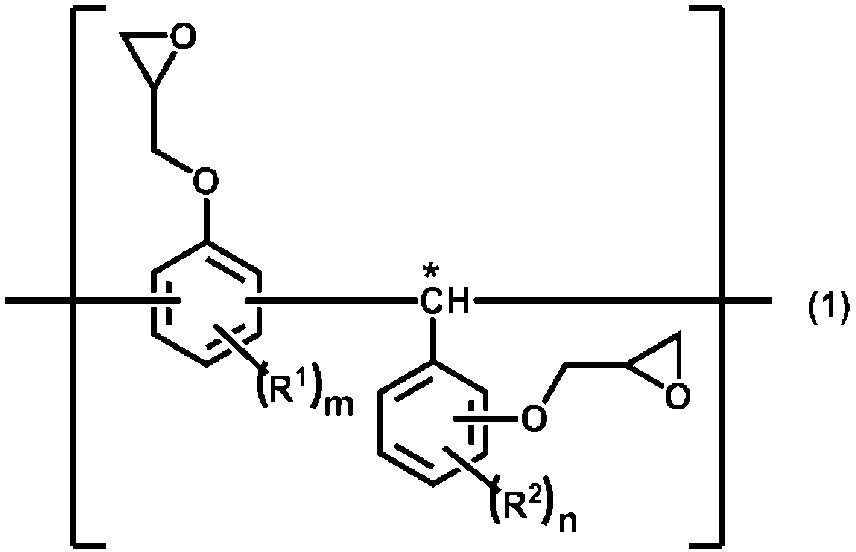
- R 1 and R 2 are each independently a hydrogen atom, a hydrocarbon group having 1 to 4 carbon atoms, an alkoxy group having 1 to 4 carbon atoms, a halogen atom, or a structure represented by the structural formula (1) It is one of bonding points that are linked to the site (I) through a methylene group marked with *, m is an integer of 1 to 3, and n is an integer of 1 to 4.
- R 1 and R 2 in the structural formula (1) are each independently a hydrogen atom, a hydrocarbon group having 1 to 4 carbon atoms, an alkoxy group having 1 to 4 carbon atoms, a halogen atom, or the structural formula (1) Or a bonding point that is linked via a methylene group marked with an asterisk (*).
- the hydrocarbon group having 1 to 4 carbon atoms include a methyl group, an ethyl group, a propyl group, and a butyl group.
- the alkoxy group having 1 to 4 carbon atoms include a methoxy group, an ethoxy group, a propyloxy group, and a butoxy group.
- R 1 and R 2 are bonding points that are linked to the structural moiety (I) represented by the structural formula (1) via a methylene group marked with *.
- the other structural site (I) is connected to the aromatic ring in the site (I) via a methylene group marked with *.
- R 2 is a bonding point that connects to the structural moiety (I) represented by the structural formula (1) via a methylene group marked with *, the following structural formula (1- It becomes a structure represented by 1).
- R 1 and R 2 are each independently a hydrogen atom, a hydrocarbon group having 1 to 4 carbon atoms, an alkoxy group having 1 to 4 carbon atoms, a halogen atom, or a structure represented by the structural formula (1) It is one of bonding points that are linked to the site (I) through a methylene group marked with *, m is an integer of 1 to 3, and n is an integer of 1 to 4. ]
- the epoxy resin of the present invention has a structural site (I ′) in which one or both of two epoxy groups in the structural site (I) are opened in addition to the structural site (I) represented by the structural formula (1). You may have.
- the proportion of the structural site (I) and the structural site (I ′) is preferably such that the epoxy equivalent falls within the aforementioned range.
- the value of 1000 ⁇ [( ⁇ - ⁇ ) / ⁇ ] is more preferably in the range of 430 to 475, since it is an epoxy resin having an excellent balance between the melt viscosity and the heat resistance in the cured product.
- a range of 470 is particularly preferable.
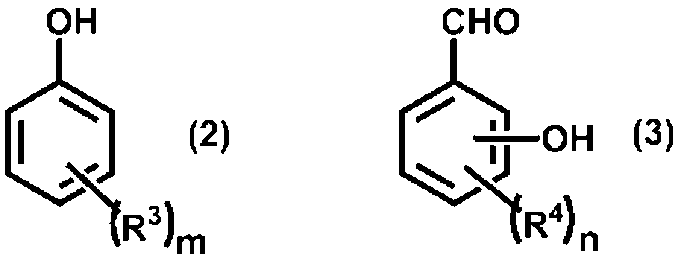
- the epoxy resin of the present invention includes, for example, a phenolic hydroxyl group-containing compound (A) represented by the following structural formula (2) and a formyl group-containing phenolic hydroxyl group-containing compound (B) represented by the following structural formula (3).
- A phenolic hydroxyl group-containing compound
- B formyl group-containing phenolic hydroxyl group-containing compound
- R 3 and R 4 in the structural formulas (2) and (3) are each independently a hydrogen atom, a hydrocarbon group having 1 to 4 carbon atoms, an alkoxy group having 1 to 4 carbon atoms, or a halogen atom. It is.
- the hydrocarbon group having 1 to 4 carbon atoms include a methyl group, an ethyl group, a propyl group, and a butyl group.
- the alkoxy group having 1 to 4 carbon atoms include a methoxy group, an ethoxy group, a propyloxy group, and a butoxy group.
- the halogen atom include a fluorine atom, a chlorine atom, and a bromine atom. Especially, since it becomes an epoxy resin excellent in the balance between melt viscosity and heat resistance in the cured product, it is preferable that all of R 3 and R 4 are hydrogen atoms.
- the hydroxyl group in the structural formula (3) may be bonded to any of the ortho, meta, and para positions of the formyl group. Especially, since it is excellent in the reactivity with a phenolic hydroxyl-containing compound (A), it is preferable that the hydroxyl group has couple
- the reaction between the phenolic hydroxyl group-containing compound (A) and the formyl group-containing phenolic hydroxyl group-containing compound (B) is preferably performed in the presence of an acid catalyst because the reaction proceeds efficiently.
- the acid catalyst include inorganic acids such as hydrochloric acid, sulfuric acid, and phosphoric acid, organic acids such as methanesulfonic acid, paratoluenesulfonic acid, and oxalic acid, and Lewis acids such as boron trifluoride, anhydrous aluminum chloride, and zinc chloride. Is mentioned.
- the amount of the polymerization catalyst used is preferably in the range of 0.1 to 5% by mass relative to the total mass of the reaction raw materials.
- the reaction between the phenolic hydroxyl group-containing compound (A) and the formyl group-containing phenolic hydroxyl group-containing compound (B) is usually carried out at a temperature of 100 to 200 ° C. for 1 to 20 hours.
- the reaction may be performed in an organic solvent as necessary.
- the organic solvent used here is not particularly limited as long as it is an organic solvent that can be used under the above temperature conditions. Specific examples include methyl cellosolve, ethyl cellosolve, toluene, xylene, and methyl isobutyl ketone. . When these organic solvents are used, they are preferably used in the range of 10 to 500% by mass relative to the total mass of the reaction raw materials.
- the triphenylmethane type resin obtained above is reacted with epihalohydrin to obtain the target epoxy resin.
- the reaction is carried out using both epihalohydrin in a range of 2 to 10 moles per mole of the phenolic hydroxyl group in the triphenylmethane type resin, and 0.9 to 2 per mole of the phenolic hydroxyl group.
- a method of reacting at a temperature of 20 to 120 ° C. for 0.5 to 10 hours while adding 0.0 mol of basic catalyst all at once or in divided portions can be mentioned.
- the basic catalyst include alkaline earth metal hydroxides, alkali metal carbonates, and alkali metal hydroxides.
- alkali metal hydroxides are preferable from the viewpoint of excellent catalytic activity, and specifically sodium hydroxide and potassium hydroxide are preferable.
- the reaction between the triphenylmethane type resin and epihalohydrin is carried out in the presence of water and alcohols, so that the value of 1000 ⁇ [( ⁇ ) / ⁇ ] can be easily adjusted to 480 or less.
- the alcohol solvent include methanol, ethanol, 1-propyl alcohol, isopropyl alcohol, 1-butanol, secondary butanol, tertiary butanol and the like. These may be used alone or in combination of two or more.
- the mass ratio of water to alcohol (water) / (alcohol) is preferably in the range of 1/1 to 1/20, more preferably in the range of 1/3 to 1/10.
- the curable resin composition of the present invention contains the epoxy resin detailed above and a curing agent as essential components.
- Examples of the acid anhydride include phthalic anhydride, trimellitic anhydride, pyromellitic anhydride, maleic anhydride, tetrahydrophthalic anhydride, methyltetrahydrophthalic anhydride, methyl nadic anhydride, hexahydrophthalic anhydride, methylhexahydro And phthalic anhydride.
- Examples of the phenol resin include phenol novolac resins, cresol novolac resins, aromatic hydrocarbon formaldehyde resin-modified phenol resins, dicyclopentadiene phenol addition type resins, phenol aralkyl resins (Zylok resins), and polyvalent resins represented by resorcin novolac resins.
- epoxy resins various epoxy resins can be used.
- the blending ratio of the epoxy resin component and the curing agent is excellent in curability, and a cured product excellent in heat resistance and toughness is obtained. Therefore, the total number of epoxy groups in the epoxy resin component An amount that gives 0.7 to 1.5 equivalents of the active group in the curing agent is preferable with respect to 1 equivalent.
- the curable resin composition of the present invention may contain various additives such as a curing accelerator, a flame retardant, an inorganic filler, a silane coupling agent, a release agent, a pigment, and an emulsifier, if necessary.
- the flame retardant is, for example, red phosphorus, monoammonium phosphate, diammonium phosphate, triammonium phosphate, ammonium phosphate such as ammonium polyphosphate, inorganic phosphorus compounds such as phosphate amide; phosphate ester compound, phosphonic acid Compound, phosphinic acid compound, phosphine oxide compound, phosphorane compound, organic nitrogen-containing phosphorus compound, 9,10-dihydro-9-oxa-10-phosphaphenanthrene-10-oxide, 10- (2,5-dihydrooxyphenyl) ) Cyclic organic phosphorus such as -10H-9-oxa-10-phosphaphenanthrene-10-oxide, 10- (2,7-dihydrooxynaphthyl) -10H-9-oxa-10-phosphaphenanthrene-10-oxide Compound and its compound such as epoxy resin and phenol resin Organophosphorus compounds such as derivatives reacted with nitrogen; nitrogen
- the inorganic filler is blended, for example, when the curable resin composition of the present invention is used for semiconductor sealing materials.
- the inorganic filler include fused silica, crystalline silica, alumina, silicon nitride, and aluminum hydroxide.
- the said fused silica is preferable.
- the fused silica can be used in either a crushed or spherical shape, but in order to increase the blending amount of the fused silica and to suppress an increase in the melt viscosity of the curable resin composition, a spherical one is mainly used. It is preferable to use it.
- the filling rate is preferably in the range of 0.5 to 95 parts by mass in 100 parts by mass of the curable resin composition.
- a conductive filler such as silver powder or copper powder can be used.
- the curable resin composition of the present invention can be obtained by uniformly mixing the above-described components.
- the curable resin composition of the present invention in which an epoxy resin component, a curing agent and, if necessary, a curing accelerator are blended can be easily made into a cured product by a method similar to a conventionally known method.
- Examples of the cured product include molded cured products such as laminates, cast products, adhesive layers, coating films, and films.
- the curable resin composition of the present invention is used for printed wiring board applications or build-up adhesive film applications, it is preferable to add an organic solvent.
- the organic solvent include methyl ethyl ketone, acetone, dimethylformamide, methyl isobutyl ketone, methoxypropanol, cyclohexanone, methyl cellosolve, ethyl diglycol acetate, propylene glycol monomethyl ether acetate and the like.
- the type and blending amount of the organic solvent can be adjusted as appropriate according to the use environment of the curable resin composition.
- a solvent an aromatic hydrocarbon solvent such as toluene and xylene, dimethylformamide, dimethylacetamide, N-methylpyrrolidone, and the like, and it is preferable to use them in a proportion that the nonvolatile content is 30 to 60% by mass.
- the curable resin composition of the present invention is used for semiconductor sealing material applications, for example, a compound such as an epoxy resin component, a curing agent, and a filler is uniformly mixed using an extruder, a kneader, a roll, or the like.
- the semiconductor sealing material can be obtained by a method of sufficiently mixing until it becomes.
- the filler used here include the inorganic filler described above.
- the filler is preferably used in the range of 0.5 to 95 parts by mass in 100 parts by mass of the curable resin composition. Among these, it is preferable to use in the range of 70 to 95 parts by weight, particularly in the range of 80 to 95 parts by weight because flame retardancy, moisture resistance and solder crack resistance are improved and the linear expansion coefficient can be reduced. preferable.
- a method for molding a semiconductor package using the obtained semiconductor sealing material includes, for example, molding the semiconductor sealing material using a casting or transfer molding machine, injection molding machine, etc., and further a temperature of 50 to 200 ° C. Examples of the method include heating for 2 to 10 hours under conditions, and by such a method, a semiconductor device which is a molded product can be obtained.
- triphenylmethane type resin (1) had a softening point of 127 ° C. and a hydroxyl group equivalent of 97 g / equivalent.
- Example 1 Production of Epoxy Resin (1) While purging a flask equipped with a thermometer, condenser and stirrer with nitrogen gas purge, 97 g of triphenylmethane type resin (1) (hydroxyl content 1 mol), 555 g of epichlorohydrin (6. 0 mol), 111 g of n-butanol and 17 g of water were charged and dissolved. After the temperature was raised to 50 ° C., 220 g of a 20 mass% sodium hydroxide aqueous solution (amount of sodium hydroxide of 1.10 mol) was added over 3 hours, and the reaction was further continued at 50 ° C. for 1 hour.
- the water distillate recovered by azeotropic dehydration was separated in a Dean-Stark trap, and the reaction was carried out by returning epichlorohydrin to the reactor. Moreover, the water
- 300 g of methyl isobutyl ketone and 50 g of n-butanol were added to the obtained crude product and dissolved, and 15 g of a 10% by mass aqueous sodium hydroxide solution was added and reacted at 80 ° C. for 2 hours. After completion of the reaction, washing with 100 g of water was repeated 3 times.
- the system was azeotropically dehydrated and subjected to microfiltration, and then the solvent was distilled off under reduced pressure to obtain 150 g of an epoxy resin (1 ′).
- the epoxy equivalent of the epoxy resin (1 ′) was 165 g / equivalent.
- melt viscosity at 150 ° C. was measured with an ICI viscometer in accordance with ASTM D4287. The results are shown in Table 1.
- Example 2 and Comparative Example 1 About epoxy resin (1) and epoxy resin (1 '), the curable resin composition and hardened
- TPP curing accelerator Triphenylphosphine
- the curable resin composition obtained in the above was poured into a 11 cm ⁇ 9 cm ⁇ 2.4 mm mold and molded with a press at a temperature of 150 ° C. for 10 minutes.
- the molded product was taken out from the mold and post-cured at a temperature of 175 ° C. for 5 hours to obtain a cured product.
Landscapes
- Chemical & Material Sciences (AREA)
- Health & Medical Sciences (AREA)
- Chemical Kinetics & Catalysis (AREA)
- Medicinal Chemistry (AREA)
- Polymers & Plastics (AREA)
- Organic Chemistry (AREA)
- Engineering & Computer Science (AREA)
- Microelectronics & Electronic Packaging (AREA)
- Epoxy Resins (AREA)
- Structures Or Materials For Encapsulating Or Coating Semiconductor Devices Or Solid State Devices (AREA)
Abstract
Description
本発明は、溶融粘度が低く、硬化物における耐熱性が高く、かつ熱履歴後の耐熱性変化が少ないエポキシ樹脂、これを含有する硬化性樹脂組成物とその硬化物、半導体封止材料、プリント配線基板に関する。 The present invention relates to an epoxy resin having a low melt viscosity, a high heat resistance in a cured product, and a small heat resistance change after a heat history, a curable resin composition containing the epoxy resin, a cured product thereof, a semiconductor sealing material, a print The present invention relates to a wiring board.
エポキシ樹脂は、接着剤や、成形材料、塗料等の材料に用いられている他、得られる硬化物が耐熱性や耐湿性などに優れる点から半導体封止材料やプリント配線板用絶縁材料等の電気・電子分野で幅広く用いられている。 Epoxy resins are used in adhesives, molding materials, paints, and other materials, and the resulting cured products have excellent heat resistance and moisture resistance. Widely used in the electrical and electronic fields.
このうち、車載用パワーモジュールに代表されるパワー半導体は電気・電子機器における省エネルギー化の鍵を握る重要な技術であり、パワー半導体の更なる大電流化、小型化、高効率化に伴い、従来のシリコン(Si)半導体から炭化ケイ素(SiC)半導体への移行が進められている。SiC半導体の利点はより高温条件下での動作が可能な点にあり、従って、半導体封止材にはこれまで以上に高い耐熱性と、高温環境下で物性変化が少ないことが要求される。これに加え、ハロゲン系難燃剤を用いずとも高い難燃性を示すこと、低粘度かつ流動性に優れフィラーの高充填が可能であることも半導体封止材用樹脂の重要な要求性能であり、これらの性能を全て兼備する樹脂材料が求められている。 Of these, power semiconductors, represented by in-vehicle power modules, are important technologies that hold the key to energy saving in electrical and electronic equipment. As power semiconductors become more current, smaller, and more efficient, The transition from silicon (Si) semiconductors to silicon carbide (SiC) semiconductors is in progress. The advantage of the SiC semiconductor is that it can be operated under higher temperature conditions. Therefore, the semiconductor encapsulant is required to have higher heat resistance and less change in physical properties under a high temperature environment. In addition to this, high flame retardancy without using halogen-based flame retardants, low viscosity and excellent flowability, and high filler filling performance are important performance requirements for semiconductor encapsulant resins. Therefore, a resin material having all of these performances is required.
これら様々な要求特性に対応するための樹脂材料として、例えば、下記構造式 As a resin material to meet these various required characteristics, for example, the following structural formula

で表されるエポキシ化合物を含有するエポキシ樹脂が知られている(特許文献1参照)。このようなエポキシ樹脂は耐熱性に優れる特徴を有するものの、溶融粘度が高い。したがって、高耐熱かつ低粘度の新規エポキシ樹脂材料が求められていた。
The epoxy resin containing the epoxy compound represented by these is known (refer patent document 1). Such an epoxy resin has a feature of excellent heat resistance, but has a high melt viscosity. Therefore, a new epoxy resin material having high heat resistance and low viscosity has been demanded.
従って、本発明が解決しようとする課題は、溶融粘度が低く、硬化物における耐熱性が高く、かつ熱履歴後の耐熱性変化が少ないエポキシ樹脂、これを含有する硬化性樹脂組成物とその硬化物、半導体封止材料、プリント配線基板を提供することにある。 Accordingly, the problem to be solved by the present invention is an epoxy resin having a low melt viscosity, a high heat resistance in a cured product, and a small heat resistance change after heat history, a curable resin composition containing the epoxy resin, and its curing It is in providing a thing, a semiconductor sealing material, and a printed wiring board.
本発明者らは上記課題を解決するため鋭意検討した結果、トリフェニルメタン骨格を有するエポキシ樹脂であって、該エポキシ樹脂のエポキシ当量の値を(α)、エポキシ樹脂が有するエポキシ基と当モルのフェノールを反応させて得られる反応生成物の水酸基当量の値を(β)とした場合に、1000×[(β-α)/α]の値が480以下であるエポキシ樹脂は、溶融粘度が低く、硬化物における耐熱性が高く、かつ熱履歴後の耐熱性変化が少ないことを見出し、本発明を完成するに至った。 As a result of intensive studies to solve the above-mentioned problems, the present inventors have obtained an epoxy resin having a triphenylmethane skeleton, wherein the epoxy equivalent value of the epoxy resin is (α), and the epoxy group of the epoxy resin is equimolar. An epoxy resin having a value of 1000 × [(β−α) / α] of 480 or less when the value of the hydroxyl equivalent of the reaction product obtained by reacting phenol with (β) is 480 or less has a melt viscosity. The present inventors have found that it is low, has high heat resistance in a cured product, and has little change in heat resistance after heat history, and has completed the present invention.
即ち、本発明は、下記構造式(1)で表される構造部位(I)を繰り返し構造単位として有するエポキシ樹脂であって、エポキシ樹脂のエポキシ当量の値を(α)、エポキシ樹脂が有するエポキシ基と当モルのフェノールを反応させて得られる反応生成物の水酸基当量の値を(β)とした場合に、1000×[(β-α)/α]の値が480以下であることを特徴とするエポキシ樹脂に関する。 That is, the present invention relates to an epoxy resin having a structural unit (I) represented by the following structural formula (1) as a repeating structural unit, wherein the epoxy resin has an epoxy equivalent value (α), and the epoxy resin has an epoxy equivalent value. The value of 1000 × [(β-α) / α] is 480 or less, where (β) is the hydroxyl equivalent value of the reaction product obtained by reacting a group with an equimolar amount of phenol. It relates to an epoxy resin.

本発明は更に、前記エポキシ樹脂と、硬化剤とを含有する硬化性樹脂組成物に関する。 The present invention further relates to a curable resin composition containing the epoxy resin and a curing agent.
本発明は更に、前記硬化性樹脂組成物を硬化反応させてなる硬化物に関する。 The present invention further relates to a cured product obtained by curing reaction of the curable resin composition.
本発明は更に、前記硬化性樹脂組成物を用いてなるプリント配線基板に関する。 The present invention further relates to a printed wiring board using the curable resin composition.
本発明は更に、前記エポキシ樹脂と、硬化剤、及び無機充填剤を含有する半導体封止材料に関する。 The present invention further relates to a semiconductor sealing material containing the epoxy resin, a curing agent, and an inorganic filler.
本発明は更に、下記構造式(2)で表されるフェノール性水酸基含有化合物(A)と、下記構造式(3)で表されるホルミル基含有フェノール性水酸基含有化合物(B)とを反応させて得られるトリフェニルメタン型樹脂を、水およびアルコール類の存在下で、エピハロヒドリンと反応させることを特徴とするエポキシ樹脂の製造方法に関する。 The present invention further comprises reacting a phenolic hydroxyl group-containing compound (A) represented by the following structural formula (2) with a formyl group-containing phenolic hydroxyl group-containing compound (B) represented by the following structural formula (3). It is related with the manufacturing method of the epoxy resin characterized by making the triphenylmethane type resin obtained by this react with epihalohydrin in presence of water and alcohols.

本発明によれば、溶融粘度が低く、硬化物における耐熱性が高く、かつ熱履歴後の耐熱性変化が少ないエポキシ樹脂、これを含有する硬化性樹脂組成物とその硬化物、半導体封止材料、プリント配線基板を提供できる。 According to the present invention, an epoxy resin having a low melt viscosity, a high heat resistance in a cured product, and a small heat resistance change after heat history, a curable resin composition containing the epoxy resin, a cured product thereof, and a semiconductor sealing material A printed wiring board can be provided.
以下、本発明を詳細に説明する。
本発明のエポキシ樹脂は、下記構造式(1)
Hereinafter, the present invention will be described in detail.
The epoxy resin of the present invention has the following structural formula (1)
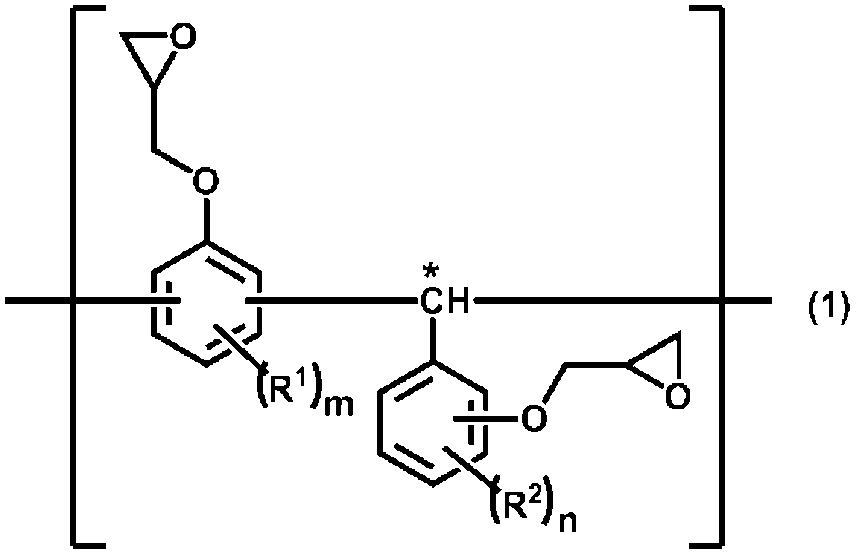
で表される構造部位(I)を繰り返し構造単位として有する。
The structural site (I) represented by
前記構造式(1)中のR1、R2はそれぞれ独立に水素原子、炭素原子数1~4の炭化水素基、炭素原子数1~4のアルコキシ基、ハロゲン原子、又は構造式(1)で表される構造部位(I)と*印が付されたメチレン基を介して連結する結合点の何れかである。炭素原子数1~4の炭化水素基は、メチル基、エチル基、プロピル基、ブチル基等が挙げられる。炭素原子数1~4のアルコキシ基は、メトキシ基、エトキシ基、プロピルオキシ基、ブトキシ基等が挙げられる。ハロゲン原子は、フッ素原子、塩素原子、臭素原子等が挙げられる。中でも、溶融粘度と硬化物における耐熱性とのバランスに優れるエポキシ樹脂となることから、R1、R2は水素原子又は前記構造式(1)で表される構造部位(I)と*印が付されたメチレン基を介して連結する結合点のいずれかであることが好ましい。 R 1 and R 2 in the structural formula (1) are each independently a hydrogen atom, a hydrocarbon group having 1 to 4 carbon atoms, an alkoxy group having 1 to 4 carbon atoms, a halogen atom, or the structural formula (1) Or a bonding point that is linked via a methylene group marked with an asterisk (*). Examples of the hydrocarbon group having 1 to 4 carbon atoms include a methyl group, an ethyl group, a propyl group, and a butyl group. Examples of the alkoxy group having 1 to 4 carbon atoms include a methoxy group, an ethoxy group, a propyloxy group, and a butoxy group. Examples of the halogen atom include a fluorine atom, a chlorine atom, and a bromine atom. Especially, since it becomes an epoxy resin excellent in the balance between the melt viscosity and the heat resistance in the cured product, R 1 and R 2 are a hydrogen atom or a structural site (I) represented by the structural formula (1) and an asterisk (*). It is preferably any of the bonding points linked via the attached methylene group.
R1、R2が、構造式(1)で表される構造部位(I)と*印が付されたメチレン基を介して連結する結合点であるとは、具体的には、一つの構造部位(I)中の芳香環に、他の構造部位(I)が、*印が付されたメチレン基を介して連結した状態である。例えば、R2の一つが、構造式(1)で表される構造部位(I)と*印が付されたメチレン基を介して連結する結合点である場合には、下記構造式(1-1)で表されるような構造となる。 Specifically, R 1 and R 2 are bonding points that are linked to the structural moiety (I) represented by the structural formula (1) via a methylene group marked with *. The other structural site (I) is connected to the aromatic ring in the site (I) via a methylene group marked with *. For example, when one of R 2 is a bonding point that connects to the structural moiety (I) represented by the structural formula (1) via a methylene group marked with *, the following structural formula (1- It becomes a structure represented by 1).
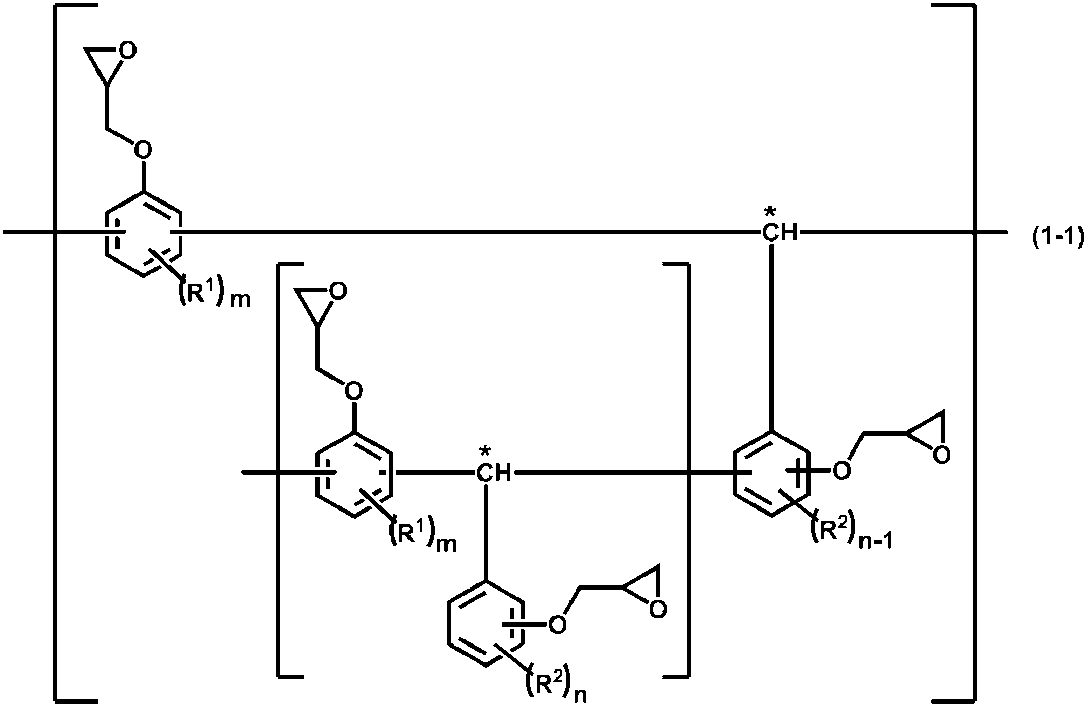
本発明のエポキシ樹脂は、溶融粘度と硬化物における耐熱性とのバランスに優れるエポキシ樹脂となることから、エポキシ当量が150~200g/当量の範囲であることが好ましい。また、本発明のエポキシ樹脂の溶融粘度は、150℃での測定値が0.01~3dPa・sの範囲であることが好ましい。 The epoxy resin of the present invention is an epoxy resin having an excellent balance between the melt viscosity and the heat resistance of the cured product, so that the epoxy equivalent is preferably in the range of 150 to 200 g / equivalent. The melt viscosity of the epoxy resin of the present invention is preferably in the range of 0.01 to 3 dPa · s as measured at 150 ° C.
本発明のエポキシ樹脂は、前記構造式(1)で表される構造部位(I)の他、構造部位(I)中の2つのエポキシ基の一方又は両方が開環した構造部位(I’)を有していても良い。構造部位(I)と構造部位(I’)との存在割合は、エポキシ当量が前述の範囲内となる割合であることが好ましい。 The epoxy resin of the present invention has a structural site (I ′) in which one or both of two epoxy groups in the structural site (I) are opened in addition to the structural site (I) represented by the structural formula (1). You may have. The proportion of the structural site (I) and the structural site (I ′) is preferably such that the epoxy equivalent falls within the aforementioned range.
本発明のエポキシ樹脂は、エポキシ樹脂のエポキシ当量の値を(α)、エポキシ樹脂が有するエポキシ基と当モルのフェノールを反応させて得られる反応生成物の水酸基当量の値を(β)とした場合に、1000×[(β-α)/α]の値が480以下であることを特徴とする。本発明においてエポキシ樹脂のエポキシ当量の値(α)は、JIS K 7236に準拠して測定される値である。また、水酸基当量の値(β)は、以下の手順で、JIS K 0070に準拠して測定される値である。
1.エポキシ樹脂と、エポキシ樹脂中のエポキシ基に対して過剰量のフェノールとを、塩基触媒条件下、150℃で6時間加熱撹拌する。
2.反応混合物から未反応のフェノールを180℃減圧下で除去し、反応生成物を得る。
3.反応生成物の水酸基当量をJIS K 0070に基づいて測定する。
In the epoxy resin of the present invention, the value of the epoxy equivalent of the epoxy resin is (α), and the value of the hydroxyl equivalent of the reaction product obtained by reacting the epoxy group of the epoxy resin with an equimolar amount of phenol is (β). In this case, the value of 1000 × [(β−α) / α] is 480 or less. In the present invention, the epoxy equivalent value (α) of the epoxy resin is a value measured in accordance with JIS K 7236. Moreover, the value (β) of the hydroxyl equivalent is a value measured according to JIS K 0070 in the following procedure.
1. The epoxy resin and an excessive amount of phenol with respect to the epoxy group in the epoxy resin are heated and stirred at 150 ° C. for 6 hours under basic catalyst conditions.
2. Unreacted phenol is removed from the reaction mixture under reduced pressure at 180 ° C. to obtain a reaction product.
3. The hydroxyl equivalent of the reaction product is measured based on JIS K 0070.
前記1000×[(β-α)/α]の値は、溶融粘度と硬化物における耐熱性とのバランスに優れるエポキシ樹脂となることから、430~475の範囲であることがより好ましく、450~470の範囲であることが特に好ましい。 The value of 1000 × [(β-α) / α] is more preferably in the range of 430 to 475, since it is an epoxy resin having an excellent balance between the melt viscosity and the heat resistance in the cured product. A range of 470 is particularly preferable.
本発明のエポキシ樹脂は、例えば、下記構造式(2)で表されるフェノール性水酸基含有化合物(A)と、下記構造式(3)で表されるホルミル基含有フェノール性水酸基含有化合物(B)とを反応させて得られるトリフェニルメタン型樹脂を、水およびアルコール類の存在下で、エピハロヒドリンおよびアルカリ金属水酸化物と反応させる方法により製造することができる。 The epoxy resin of the present invention includes, for example, a phenolic hydroxyl group-containing compound (A) represented by the following structural formula (2) and a formyl group-containing phenolic hydroxyl group-containing compound (B) represented by the following structural formula (3). Can be produced by a method of reacting with an epihalohydrin and an alkali metal hydroxide in the presence of water and alcohols.

前記構造式(2)、(3)中のR3、R4はそれぞれ独立に水素原子、炭素原子数1~4の炭化水素基、炭素原子数1~4のアルコキシ基、ハロゲン原子の何れかである。炭素原子数1~4の炭化水素基は、メチル基、エチル基、プロピル基、ブチル基等が挙げられる。炭素原子数1~4のアルコキシ基は、メトキシ基、エトキシ基、プロピルオキシ基、ブトキシ基等が挙げられる。ハロゲン原子は、フッ素原子、塩素原子、臭素原子等が挙げられる。中でも、溶融粘度と硬化物における耐熱性とのバランスに優れるエポキシ樹脂となることから、R3、R4の全てが水素原子であることが好ましい。 R 3 and R 4 in the structural formulas (2) and (3) are each independently a hydrogen atom, a hydrocarbon group having 1 to 4 carbon atoms, an alkoxy group having 1 to 4 carbon atoms, or a halogen atom. It is. Examples of the hydrocarbon group having 1 to 4 carbon atoms include a methyl group, an ethyl group, a propyl group, and a butyl group. Examples of the alkoxy group having 1 to 4 carbon atoms include a methoxy group, an ethoxy group, a propyloxy group, and a butoxy group. Examples of the halogen atom include a fluorine atom, a chlorine atom, and a bromine atom. Especially, since it becomes an epoxy resin excellent in the balance between melt viscosity and heat resistance in the cured product, it is preferable that all of R 3 and R 4 are hydrogen atoms.
前記構造式(3)中の水酸基は、ホルミル基のオルソ位、メタ位、パラ位のいずれに結合していても良い。中でも、フェノール性水酸基含有化合物(A)との反応性に優れることから、水酸基がホルミル基のオルソ位に結合していることが好ましい。 The hydroxyl group in the structural formula (3) may be bonded to any of the ortho, meta, and para positions of the formyl group. Especially, since it is excellent in the reactivity with a phenolic hydroxyl-containing compound (A), it is preferable that the hydroxyl group has couple | bonded with the ortho position of the formyl group.
前記フェノール性水酸基含有化合物(A)と前記ホルミル基含有フェノール性水酸基含有化合物(B)との反応比率は、溶融粘度と硬化物における耐熱性とのバランスに優れるエポキシ樹脂となることから、前記フェノール性水酸基含有化合物(A)1モルに対し、前記ホルミル基含有フェノール性水酸基含有化合物(B)が0.01~0.9モルの範囲であることが好ましい。 Since the reaction ratio between the phenolic hydroxyl group-containing compound (A) and the formyl group-containing phenolic hydroxyl group-containing compound (B) is an epoxy resin excellent in the balance between melt viscosity and heat resistance in the cured product, the phenol The formyl group-containing phenolic hydroxyl group-containing compound (B) is preferably in the range of 0.01 to 0.9 mol relative to 1 mol of the functional hydroxyl group-containing compound (A).
前記フェノール性水酸基含有化合物(A)と前記ホルミル基含有フェノール性水酸基含有化合物(B)との反応は、効率的に反応が進むことから、酸触媒の存在下で行うことが好ましい。前記酸触媒は、例えば、塩酸、硫酸、リン酸などの無機酸、メタンスルホン酸、パラトルエンスルホン酸、シュウ酸などの有機酸、三フッ化ホウ素、無水塩化アルミニウム、塩化亜鉛などのルイス酸などが挙げられる。このとき、重合触媒の使用量は、反応原料の総質量に対して0.1~5質量%の範囲であることが好ましい。 The reaction between the phenolic hydroxyl group-containing compound (A) and the formyl group-containing phenolic hydroxyl group-containing compound (B) is preferably performed in the presence of an acid catalyst because the reaction proceeds efficiently. Examples of the acid catalyst include inorganic acids such as hydrochloric acid, sulfuric acid, and phosphoric acid, organic acids such as methanesulfonic acid, paratoluenesulfonic acid, and oxalic acid, and Lewis acids such as boron trifluoride, anhydrous aluminum chloride, and zinc chloride. Is mentioned. At this time, the amount of the polymerization catalyst used is preferably in the range of 0.1 to 5% by mass relative to the total mass of the reaction raw materials.
前記フェノール性水酸基含有化合物(A)と前記ホルミル基含有フェノール性水酸基含有化合物(B)との反応は、通常、100~200℃の温度条件下、1~20時間で行う。該反応は必要に応じて有機溶剤中で行っても良い。ここで用いる有機溶剤は、前記温度条件下で使用可能な有機溶剤であれば特に限定されるものではなく、具体的には、メチルセロソルブ、エチルセロソルブ、トルエン、キシレン、メチルイソブチルケトン等が挙げられる。これら有機溶剤を用いる場合には反応原料の総質量に対し10~500質量%の範囲で用いることが好ましい。 The reaction between the phenolic hydroxyl group-containing compound (A) and the formyl group-containing phenolic hydroxyl group-containing compound (B) is usually carried out at a temperature of 100 to 200 ° C. for 1 to 20 hours. The reaction may be performed in an organic solvent as necessary. The organic solvent used here is not particularly limited as long as it is an organic solvent that can be used under the above temperature conditions. Specific examples include methyl cellosolve, ethyl cellosolve, toluene, xylene, and methyl isobutyl ketone. . When these organic solvents are used, they are preferably used in the range of 10 to 500% by mass relative to the total mass of the reaction raw materials.
前記フェノール性水酸基含有化合物(A)と前記ホルミル基含有フェノール性水酸基含有化合物(B)との反応では、反応生成物の着色を抑制する目的で、各種の酸化防止剤や還元剤を用いても良い。前記酸化防止剤は、例えば、2,6-ジアルキルフェノール誘導体などのヒンダードフェノール化合物、2価の硫黄化合物、3価のリン原子を含む亜リン酸エステル化合物等が挙げられる。前記還元剤は、例えば、次亜リン酸、亜リン酸、チオ硫酸、亜硫酸、ハイドロサルファイト、これらの塩や亜鉛等が挙げられる。 In the reaction of the phenolic hydroxyl group-containing compound (A) and the formyl group-containing phenolic hydroxyl group-containing compound (B), various antioxidants and reducing agents may be used for the purpose of suppressing coloring of the reaction product. good. Examples of the antioxidant include hindered phenol compounds such as 2,6-dialkylphenol derivatives, divalent sulfur compounds, and phosphite compounds containing a trivalent phosphorus atom. Examples of the reducing agent include hypophosphorous acid, phosphorous acid, thiosulfuric acid, sulfurous acid, hydrosulfite, salts thereof, and zinc.
前記フェノール性水酸基含有化合物(A)と前記ホルミル基含有フェノール性水酸基含有化合物(B)との反応終了後は、未反応の反応原料や副生成物等を留去することにより、中間体であるトリフェニルメタン型樹脂が得られる。 After completion of the reaction between the phenolic hydroxyl group-containing compound (A) and the formyl group-containing phenolic hydroxyl group-containing compound (B), it is an intermediate by distilling off unreacted reaction raw materials and by-products. A triphenylmethane type resin is obtained.
次いで、先で得たトリフェニルメタン型樹脂とエピハロヒドリンとを反応させ、目的のエポキシ樹脂を得る。該反応は、例えば、トリフェニルメタン型樹脂中のフェノール性水酸基の1モルに対し、エピハロヒドリンが2~10モルの範囲となる割合で両者を用い、フェノール性水酸基1モルに対し0.9~2.0モルの塩基性触媒を一括又は分割添加しながら20~120℃の温度で0.5~10時間反応させる方法が挙げられる。 Next, the triphenylmethane type resin obtained above is reacted with epihalohydrin to obtain the target epoxy resin. For example, the reaction is carried out using both epihalohydrin in a range of 2 to 10 moles per mole of the phenolic hydroxyl group in the triphenylmethane type resin, and 0.9 to 2 per mole of the phenolic hydroxyl group. A method of reacting at a temperature of 20 to 120 ° C. for 0.5 to 10 hours while adding 0.0 mol of basic catalyst all at once or in divided portions can be mentioned.
なお、工業生産を行う際、エポキシ樹脂生産の初バッチでは仕込みに用いるエピハロヒドリン類の全てが新しいものであるが、次バッチ以降は、粗反応生成物から回収されたエピハロヒドリンと、反応で消費される分で消失する分に相当する新しいエピハロヒドリンとを併用することが好ましい。この時、使用するエピハロヒドリンは特に限定されないが、例えばエピクロルヒドリン、エピブロモヒドリン、β-メチルエピクロルヒドリン等が挙げられる。なかでも工業的入手が容易なことからエピクロルヒドリンが好ましい。 In addition, in the first batch of epoxy resin production, all of the epihalohydrins used for charging are new when industrial production is performed, but after the next batch, the epihalohydrin recovered from the crude reaction product is consumed in the reaction. It is preferable to use in combination with a new epihalohydrin corresponding to the amount disappeared in minutes. At this time, the epihalohydrin used is not particularly limited, and examples thereof include epichlorohydrin, epibromohydrin, β-methylepichlorohydrin, and the like. Of these, epichlorohydrin is preferred because it is easily available industrially.
前記塩基性触媒は、具体的には、アルカリ土類金属水酸化物、アルカリ金属炭酸塩及びアルカリ金属水酸化物等が挙げられる。中でも、触媒活性に優れる点からアルカリ金属水酸化物が好ましく、具体的には、水酸化ナトリウムや水酸化カリウム等が好ましい。 Specific examples of the basic catalyst include alkaline earth metal hydroxides, alkali metal carbonates, and alkali metal hydroxides. Among these, alkali metal hydroxides are preferable from the viewpoint of excellent catalytic activity, and specifically sodium hydroxide and potassium hydroxide are preferable.
前記トリフェニルメタン型樹脂とエピハロヒドリンとの反応は水とアルコール類の存在下で行うことにより、前記1000×[(β-α)/α]の値を480以下に調整することが容易となる。前記アルコール溶媒は、例えば、メタノール、エタノール、1-プロピルアルコール、イソプロピルアルコール、1-ブタノール、セカンダリーブタノール、ターシャリーブタノール等が挙げられる。これらは、それぞれ単独で使用してもよいし、2種類以上を併用しても良い。水とアルコール類との質量比(水)/(アルコール類)は、1/1~1/20の範囲であることが好ましく、1/3~1/10の範囲であることがより好ましい。 The reaction between the triphenylmethane type resin and epihalohydrin is carried out in the presence of water and alcohols, so that the value of 1000 × [(β−α) / α] can be easily adjusted to 480 or less. Examples of the alcohol solvent include methanol, ethanol, 1-propyl alcohol, isopropyl alcohol, 1-butanol, secondary butanol, tertiary butanol and the like. These may be used alone or in combination of two or more. The mass ratio of water to alcohol (water) / (alcohol) is preferably in the range of 1/1 to 1/20, more preferably in the range of 1/3 to 1/10.
反応終了後は、反応混合物を水洗した後、加熱減圧下での蒸留によって未反応のエピハロヒドリンや有機溶媒を留去する。また、加水分解性ハロゲンの一層少ないエポキシ樹脂とするために、得られたエポキシ樹脂を再び有機溶媒に溶解し、水酸化ナトリウム、水酸化カリウムなどのアルカリ金属水酸化物の水溶液を加えてさらに反応を行うこともできる。この際、反応速度の向上を目的として、4級アンモニウム塩やクラウンエーテル等の相関移動触媒を存在させてもよい。相関移動触媒を使用する場合の使用量はエポキシ樹脂100質量部に対して0.1~3.0質量部となる割合であることが好ましい。反応終了後、生成した塩を濾過や水洗等により除去し、加熱減圧下で有機溶媒を留去することにより、目的とする本発明のエポキシ樹脂を得ることができる。 After completion of the reaction, the reaction mixture is washed with water, and unreacted epihalohydrin and the organic solvent are distilled off by distillation under heating and reduced pressure. In addition, in order to obtain an epoxy resin with less hydrolyzable halogen, the obtained epoxy resin is dissolved again in an organic solvent, and an aqueous solution of an alkali metal hydroxide such as sodium hydroxide or potassium hydroxide is added for further reaction. Can also be done. At this time, a phase transfer catalyst such as a quaternary ammonium salt or crown ether may be present for the purpose of improving the reaction rate. When the phase transfer catalyst is used, the amount used is preferably 0.1 to 3.0 parts by mass with respect to 100 parts by mass of the epoxy resin. After completion of the reaction, the produced salt is removed by filtration, washing with water, and the like, and the organic solvent is distilled off under heating and reduced pressure, whereby the target epoxy resin of the present invention can be obtained.
本発明の硬化性樹脂組成物は、以上詳述したエポキシ樹脂と、硬化剤とを必須成分として含有するものである。 The curable resin composition of the present invention contains the epoxy resin detailed above and a curing agent as essential components.
ここで用いる硬化剤は、アミン化合物、アミド化合物、酸無水物、フェノ-ル樹脂等が挙げられ、これらはそれぞれ単独で用いても良いし、二種類以上を併用しても良い。前記アミン化合物は、例えば、ジアミノジフェニルメタン、ジエチレントリアミン、トリエチレンテトラミン、ジアミノジフェニルスルホン、イソホロンジアミン、イミダゾ-ル、BF3-アミン錯体、グアニジン誘導体等が挙げられる。前記アミド系化合物は、例えば、ジシアンジアミド、脂肪族二塩基酸やダイマー酸、脂肪酸のカルボン酸化合物とエチレンジアミン等のアミンとより合成されるポリアミド樹脂等が挙げられる。前記酸無水物は、例えば、無水フタル酸、無水トリメリット酸、無水ピロメリット酸、無水マレイン酸、テトラヒドロ無水フタル酸、メチルテトラヒドロ無水フタル酸、無水メチルナジック酸、ヘキサヒドロ無水フタル酸、メチルヘキサヒドロ無水フタル酸等が挙げられる。前記フェノール樹脂は、例えば、フェノールノボラック樹脂、クレゾールノボラック樹脂、芳香族炭化水素ホルムアルデヒド樹脂変性フェノール樹脂、ジシクロペンタジエンフェノール付加型樹脂、フェノールアラルキル樹脂(ザイロック樹脂)、レゾルシンノボラック樹脂に代表される多価ヒドロキシ化合物とホルムアルデヒドから合成される多価フェノールノボラック樹脂、ナフトールアラルキル樹脂、トリメチロールメタン樹脂、テトラフェニロールエタン樹脂、ナフトールノボラック樹脂、ナフトール-フェノール共縮ノボラック樹脂、ナフトール-クレゾール共縮ノボラック樹脂、ビフェニル変性フェノール樹脂(ビスメチレン基でフェノール核が連結された多価フェノール化合物)、ビフェニル変性ナフトール樹脂(ビスメチレン基でフェノール核が連結された多価ナフトール化合物)、アミノトリアジン変性フェノール樹脂(メラミン、ベンゾグアナミンなどでフェノール核が連結された多価フェノール化合物)やアルコキシ基含有芳香環変性ノボラック樹脂(ホルムアルデヒドでフェノール核及びアルコキシ基含有芳香環が連結された多価フェノール化合物)等の多価フェノール化合物等が挙げられる。これらはそれぞれ単独で用いても良いし、2種類以上を併用しても良い。 Examples of the curing agent used here include amine compounds, amide compounds, acid anhydrides, phenol resins, and the like. These may be used alone or in combination of two or more. Examples of the amine compound include diaminodiphenylmethane, diethylenetriamine, triethylenetetramine, diaminodiphenylsulfone, isophoronediamine, imidazole, BF 3 -amine complex, and guanidine derivative. Examples of the amide compound include dicyandiamide, aliphatic dibasic acid, dimer acid, polyamide resin synthesized from a carboxylic acid compound of fatty acid and an amine such as ethylenediamine. Examples of the acid anhydride include phthalic anhydride, trimellitic anhydride, pyromellitic anhydride, maleic anhydride, tetrahydrophthalic anhydride, methyltetrahydrophthalic anhydride, methyl nadic anhydride, hexahydrophthalic anhydride, methylhexahydro And phthalic anhydride. Examples of the phenol resin include phenol novolac resins, cresol novolac resins, aromatic hydrocarbon formaldehyde resin-modified phenol resins, dicyclopentadiene phenol addition type resins, phenol aralkyl resins (Zylok resins), and polyvalent resins represented by resorcin novolac resins. Polyhydric phenol novolak resin, naphthol aralkyl resin, trimethylol methane resin, tetraphenylol ethane resin, naphthol novolak resin, naphthol-phenol co-condensed novolak resin, naphthol-cresol co-condensed novolak resin, biphenyl synthesized from hydroxy compound and formaldehyde Modified phenolic resin (polyhydric phenol compound with phenolic nuclei linked by bismethylene group), biphenyl modified naphthol resin (bismethyle) Polyhydric naphthol compounds linked with phenolic nuclei), aminotriazine-modified phenolic resins (polyhydric phenolic compounds linked with phenolic melamine, benzoguanamine, etc.) and alkoxy group-containing aromatic ring-modified novolak resins (formaldehyde-based phenolic nuclei) And polyhydric phenol compounds such as alkoxy group-containing aromatic rings linked to each other). These may be used alone or in combination of two or more.
本発明の硬化性樹脂組成物は、エポキシ樹脂成分として本発明のエポキシ樹脂以外のその他のエポキシ樹脂を使用してもよい。本発明のエポキシ樹脂とその他のエポキシ樹脂との配合比は特に限定されないが、本発明が奏する効果が十分に発現することから、エポキシ樹脂成分の全質量に対して本発明のエポキシ樹脂が30質量%以上、好ましくは40質量%以上となる範囲でその他のエポキシ樹脂を併用することが好ましい。 The curable resin composition of the present invention may use an epoxy resin other than the epoxy resin of the present invention as an epoxy resin component. The compounding ratio of the epoxy resin of the present invention and the other epoxy resin is not particularly limited, but the effect exhibited by the present invention is sufficiently manifested, so that the epoxy resin of the present invention is 30 mass with respect to the total mass of the epoxy resin component %, Preferably 40 mass% or more in the range of other epoxy resins.
前記その他のエポキシ樹脂は種々のエポキシ樹脂を用いることができるが、例えば、2,7-ジグリシジルオキシナフタレン、α-ナフトールノボラック型エポキシ樹脂、β-ナフトールノボラック型エポキシ樹脂、α-ナフトール/β-ナフトール共縮合型ノボラックのポリグリシジルエーテル、ナフトールアラルキル型エポキシ樹脂、1,1-ビス(2,7-ジグリシジルオキシ-1-ナフチル)アルカン等のナフタレン骨格含有エポキシ樹脂;ビスフェノールA型エポキシ樹脂、ビスフェノールF型エポキシ樹脂等のビスフェノール型エポキシ樹脂;ビフェニル型エポキシ樹脂、テトラメチルビフェニル型エポキシ樹脂等のビフェニル型エポキシ樹脂;フェノールノボラック型エポキシ樹脂、クレゾールノボラック型エポキシ樹脂、ビスフェノールAノボラック型エポキシ樹脂、ビフェニルノボラック型エポキシ樹脂等のノボラック型エポキシ樹脂;テトラフェニルエタン型エポキシ樹脂;ジシクロペンタジエン-フェノール付加反応型エポキシ樹脂;フェノールアラルキル型エポキシ樹脂;リン原子含有エポキシ樹脂等が挙げられる。前記リン原子含有エポキシ樹脂は、9,10-ジヒドロ-9-オキサ-10-ホスファフェナントレン-10-オキサイド(以下、「HCA」と略記する。)のエポキシ化物、HCAとキノン類とを反応させて得られるフェノール樹脂のエポキシ化物、フェノールノボラック型エポキシ樹脂をHCAで変性したエポキシ樹脂、クレゾールノボラック型エポキシ樹脂をHCAで変性したエポキシ樹脂、ビスフェノールA型エポキシ樹脂を及びHCAとキノン類とを反応させて得られるフェノール樹脂で変成して得られるエポキシ樹脂等が挙げられる。これらはそれぞれ単独で用いても良いし、2種類以上を併用しても良い。 As the other epoxy resins, various epoxy resins can be used. For example, 2,7-diglycidyloxynaphthalene, α-naphthol novolak type epoxy resin, β-naphthol novolak type epoxy resin, α-naphthol / β- Polyglycidyl ether of naphthol co-condensation type novolak, naphthol aralkyl type epoxy resin, naphthalene skeleton-containing epoxy resin such as 1,1-bis (2,7-diglycidyloxy-1-naphthyl) alkane; bisphenol A type epoxy resin, bisphenol Bisphenol type epoxy resin such as F type epoxy resin; Biphenyl type epoxy resin such as biphenyl type epoxy resin and tetramethylbiphenyl type epoxy resin; Phenol novolak type epoxy resin, Cresol novolak type epoxy resin, Bi Novolak type epoxy resins such as phenol A novolak type epoxy resins and biphenyl novolak type epoxy resins; tetraphenylethane type epoxy resins; dicyclopentadiene-phenol addition reaction type epoxy resins; phenol aralkyl type epoxy resins; Can be mentioned. The phosphorus atom-containing epoxy resin is obtained by reacting an epoxidized product of 9,10-dihydro-9-oxa-10-phosphaphenanthrene-10-oxide (hereinafter abbreviated as “HCA”), HCA and quinones. Epoxidized phenol resin, epoxy resin obtained by modifying phenol novolac type epoxy resin with HCA, epoxy resin obtained by modifying cresol novolac type epoxy resin with HCA, bisphenol A type epoxy resin, and HCA and quinones. And an epoxy resin obtained by modification with a phenol resin obtained in the above manner. These may be used alone or in combination of two or more.
本発明の硬化性樹脂組成物において、エポキシ樹脂成分と硬化剤との配合割合は、硬化性に優れ、耐熱性や靭性に優れる硬化物が得られることから、エポキシ樹脂成分中のエポキシ基の合計1当量に対して、硬化剤中の活性基が0.7~1.5当量になる量が好ましい。 In the curable resin composition of the present invention, the blending ratio of the epoxy resin component and the curing agent is excellent in curability, and a cured product excellent in heat resistance and toughness is obtained. Therefore, the total number of epoxy groups in the epoxy resin component An amount that gives 0.7 to 1.5 equivalents of the active group in the curing agent is preferable with respect to 1 equivalent.
本発明の硬化性樹脂組成物は必要に応じて硬化促進剤、難燃剤、無機質充填材、シランカップリング剤、離型剤、顔料、乳化剤等の各種添加剤を含有しても良い。 The curable resin composition of the present invention may contain various additives such as a curing accelerator, a flame retardant, an inorganic filler, a silane coupling agent, a release agent, a pigment, and an emulsifier, if necessary.
前記硬化促進剤は、例えば、リン系化合物、第3級アミン、イミダゾール、有機酸金属塩、ルイス酸、アミン錯塩等が挙げられる。中でも、硬化性、耐熱性、電気特性、耐湿信頼性等に優れる点から、イミダゾール化合物では2-エチル-4-メチルイミダゾール、リン系化合物ではトリフェニルホスフィン、第3級アミンでは1,8-ジアザビシクロ-[5.4.0]-ウンデセン(DBU)が好ましい。 Examples of the curing accelerator include phosphorus compounds, tertiary amines, imidazoles, organic acid metal salts, Lewis acids, amine complex salts, and the like. Of these, 2-ethyl-4-methylimidazole is used for imidazole compounds, triphenylphosphine is used for phosphorus compounds, and 1,8-diazabicyclo is used for tertiary amines because of its excellent curability, heat resistance, electrical properties, moisture resistance reliability, and the like. -[5.4.0] -undecene (DBU) is preferred.
前記難燃剤は、例えば、赤リン、リン酸一アンモニウム、リン酸二アンモニウム、リン酸三アンモニウム、ポリリン酸アンモニウム等のリン酸アンモニウム、リン酸アミド等の無機リン化合物;リン酸エステル化合物、ホスホン酸化合物、ホスフィン酸化合物、ホスフィンオキシド化合物、ホスホラン化合物、有機系含窒素リン化合物、9,10-ジヒドロ-9-オキサ-10-ホスファフェナントレン-10-オキシド、10-(2,5―ジヒドロオキシフェニル)―10H-9-オキサ-10-ホスファフェナントレン-10-オキシド、10―(2,7-ジヒドロオキシナフチル)-10H-9-オキサ-10-ホスファフェナントレン-10-オキシド等の環状有機リン化合物、及びそれをエポキシ樹脂やフェノール樹脂等の化合物と反応させた誘導体等の有機リン化合物;トリアジン化合物、シアヌル酸化合物、イソシアヌル酸化合物、フェノチアジン等の窒素系難燃剤;シリコーンオイル、シリコーンゴム、シリコーン樹脂等のシリコーン系難燃剤;金属水酸化物、金属酸化物、金属炭酸塩化合物、金属粉、ホウ素化合物、低融点ガラス等の無機難燃剤等が挙げられる。これら難燃剤を用いる場合は、硬化性樹脂組成物中0.1~20質量%の範囲であることが好ましい。 The flame retardant is, for example, red phosphorus, monoammonium phosphate, diammonium phosphate, triammonium phosphate, ammonium phosphate such as ammonium polyphosphate, inorganic phosphorus compounds such as phosphate amide; phosphate ester compound, phosphonic acid Compound, phosphinic acid compound, phosphine oxide compound, phosphorane compound, organic nitrogen-containing phosphorus compound, 9,10-dihydro-9-oxa-10-phosphaphenanthrene-10-oxide, 10- (2,5-dihydrooxyphenyl) ) Cyclic organic phosphorus such as -10H-9-oxa-10-phosphaphenanthrene-10-oxide, 10- (2,7-dihydrooxynaphthyl) -10H-9-oxa-10-phosphaphenanthrene-10-oxide Compound and its compound such as epoxy resin and phenol resin Organophosphorus compounds such as derivatives reacted with nitrogen; nitrogen-based flame retardants such as triazine compounds, cyanuric acid compounds, isocyanuric acid compounds and phenothiazines; silicone-based flame retardants such as silicone oil, silicone rubber and silicone resin; metal hydroxides; Examples include inorganic flame retardants such as metal oxides, metal carbonate compounds, metal powders, boron compounds, and low-melting glass. When these flame retardants are used, the content is preferably in the range of 0.1 to 20% by mass in the curable resin composition.
前記無機質充填材は、例えば、本発明の硬化性樹脂組成物を半導体封止材料用途に用いる場合などに配合される。前記無機質充填材は、例えば、溶融シリカ、結晶シリカ、アルミナ、窒化珪素、水酸化アルミ等が挙げられる。中でも、無機質充填材をより多く配合することが可能となることから、前記溶融シリカが好ましい。前記溶融シリカは破砕状、球状のいずれでも使用可能であるが、溶融シリカの配合量を高め、且つ、硬化性樹脂組成物の溶融粘度の上昇を抑制するためには、球状のものを主に用いることが好ましい。更に、球状シリカの配合量を高めるためには、球状シリカの粒度分布を適当に調整することが好ましい。その充填率は硬化性樹脂組成物100質量部中、0.5~95質量部の範囲で配合することが好ましい。 The inorganic filler is blended, for example, when the curable resin composition of the present invention is used for semiconductor sealing materials. Examples of the inorganic filler include fused silica, crystalline silica, alumina, silicon nitride, and aluminum hydroxide. Especially, since it becomes possible to mix | blend more inorganic fillers, the said fused silica is preferable. The fused silica can be used in either a crushed or spherical shape, but in order to increase the blending amount of the fused silica and to suppress an increase in the melt viscosity of the curable resin composition, a spherical one is mainly used. It is preferable to use it. Furthermore, in order to increase the blending amount of the spherical silica, it is preferable to appropriately adjust the particle size distribution of the spherical silica. The filling rate is preferably in the range of 0.5 to 95 parts by mass in 100 parts by mass of the curable resin composition.
この他、本発明の硬化性樹脂組成物を導電ペーストなどの用途に使用する場合は、銀粉や銅粉等の導電性充填剤を用いることができる。 In addition, when the curable resin composition of the present invention is used for applications such as a conductive paste, a conductive filler such as silver powder or copper powder can be used.
本発明の硬化性樹脂組成物は、上記した各成分を均一に混合することにより得られる。エポキシ樹成分、硬化剤、更に必要により硬化促進剤の配合された本発明の硬化性樹脂組成物は、従来知られている方法と同様の方法で容易に硬化物とすることができる。該硬化物は、積層物、注型物、接着層、塗膜、フィルム等の成形硬化物が挙げられる。 The curable resin composition of the present invention can be obtained by uniformly mixing the above-described components. The curable resin composition of the present invention in which an epoxy resin component, a curing agent and, if necessary, a curing accelerator are blended can be easily made into a cured product by a method similar to a conventionally known method. Examples of the cured product include molded cured products such as laminates, cast products, adhesive layers, coating films, and films.
本発明の硬化性樹脂組成物をプリント配線基板用途やビルドアップ接着フィルム用途に用いる場合には、有機溶剤を配合することが好ましい。前記有機溶剤は、メチルエチルケトン、アセトン、ジメチルホルムアミド、メチルイソブチルケトン、メトキシプロパノール、シクロヘキサノン、メチルセロソルブ、エチルジグリコールアセテート、プロピレングリコールモノメチルエーテルアセテート等が挙げられる。有機溶剤の種類や配合量は硬化性樹脂組成物の使用環境に応じて適宜調整できるが、例えば、プリント配線板用途では、メチルエチルケトン、アセトン、ジメチルホルムアミド等の沸点が160℃以下の極性溶剤であることが好ましく、不揮発分が40~80質量%となる割合で使用することが好ましい。ビルドアップ接着フィルム用途では、アセトン、メチルエチルケトン、シクロヘキサノン等のケトン溶剤、酢酸エチル、酢酸ブチル、セロソルブアセテート、プロピレングリコールモノメチルエーテルアセテート、カルビトールアセテート等の酢酸エステル溶剤、セロソルブ、ブチルカルビトール等のカルビトール溶剤、トルエン、キシレン等の芳香族炭化水素溶剤、ジメチルホルムアミド、ジメチルアセトアミド、N-メチルピロリドン等を用いることが好ましく、不揮発分が30~60質量%となる割合で使用することが好ましい。 When the curable resin composition of the present invention is used for printed wiring board applications or build-up adhesive film applications, it is preferable to add an organic solvent. Examples of the organic solvent include methyl ethyl ketone, acetone, dimethylformamide, methyl isobutyl ketone, methoxypropanol, cyclohexanone, methyl cellosolve, ethyl diglycol acetate, propylene glycol monomethyl ether acetate and the like. The type and blending amount of the organic solvent can be adjusted as appropriate according to the use environment of the curable resin composition. For example, for printed wiring board applications, methyl ethyl ketone, acetone, dimethylformamide and the like are polar solvents having a boiling point of 160 ° C. or lower. The non-volatile content is preferably 40 to 80% by mass. For build-up adhesive film applications, ketone solvents such as acetone, methyl ethyl ketone, cyclohexanone, etc., acetate solvents such as ethyl acetate, butyl acetate, cellosolve acetate, propylene glycol monomethyl ether acetate, carbitol acetate, carbitols such as cellosolve, butyl carbitol, etc. It is preferable to use a solvent, an aromatic hydrocarbon solvent such as toluene and xylene, dimethylformamide, dimethylacetamide, N-methylpyrrolidone, and the like, and it is preferable to use them in a proportion that the nonvolatile content is 30 to 60% by mass.
また、本発明の硬化性樹脂組成物を用いてプリント配線基板を製造する方法は、例えば、エポキシ樹脂成分、硬化剤、有機溶剤、その他添加剤等を含むワニス状の硬化性樹脂組成物を、補強基材に含浸し硬化させてプリプレグを得、これと銅箔とを重ねて加熱圧着させる方法が挙げられる。前記補強基材は、紙、ガラス布、ガラス不織布、アラミド紙、アラミド布、ガラスマット、ガラスロービング布などが挙げられる。硬化性樹脂組成物の含浸量は特に限定されないが、通常、プリプレグ中の樹脂分が20~60質量%となるように調製することが好ましい。 Moreover, the method for producing a printed wiring board using the curable resin composition of the present invention includes, for example, a varnish-like curable resin composition containing an epoxy resin component, a curing agent, an organic solvent, and other additives. Examples include a method of impregnating and curing a reinforcing base material to obtain a prepreg, and stacking this with a copper foil and heat-pressing. Examples of the reinforcing substrate include paper, glass cloth, glass nonwoven fabric, aramid paper, aramid cloth, glass mat, and glass roving cloth. The amount of impregnation of the curable resin composition is not particularly limited, but it is usually preferable to prepare so that the resin content in the prepreg is 20 to 60% by mass.
本発明の硬化性樹脂組成物を半導体封止材料用途に用いる場合には、例えば、エポキシ樹脂成分、硬化剤、及び充填材等の配合物を、押出機、ニーダー、ロール等を用いて均一になるまで十分に混合する方法により半導体封止材料を得ることが出来る。ここで用いる充填材は前記した無機充填材が挙げられ、前述の通り、硬化性樹脂組成物100質量部中、0.5~95質量部の範囲で用いることが好ましい。中でも、難燃性や耐湿性、耐半田クラック性が向上し、線膨張係数を低減できることから、70~95質量部の範囲で用いることが好ましく、80~95質量部の範囲で用いることが特に好ましい。 When the curable resin composition of the present invention is used for semiconductor sealing material applications, for example, a compound such as an epoxy resin component, a curing agent, and a filler is uniformly mixed using an extruder, a kneader, a roll, or the like. The semiconductor sealing material can be obtained by a method of sufficiently mixing until it becomes. Examples of the filler used here include the inorganic filler described above. As described above, the filler is preferably used in the range of 0.5 to 95 parts by mass in 100 parts by mass of the curable resin composition. Among these, it is preferable to use in the range of 70 to 95 parts by weight, particularly in the range of 80 to 95 parts by weight because flame retardancy, moisture resistance and solder crack resistance are improved and the linear expansion coefficient can be reduced. preferable.
得られた半導体封止材料を用いて半導体パッケージを成型する方法は、例えば、該半導体封止材料を注型或いはトランスファー成形機、射出成型機などを用いて成形し、更に50~200℃の温度条件下で2~10時間加熱する方法が挙げられ、このような方法により、成形物である半導体装置を得ることが出来る。 A method for molding a semiconductor package using the obtained semiconductor sealing material includes, for example, molding the semiconductor sealing material using a casting or transfer molding machine, injection molding machine, etc., and further a temperature of 50 to 200 ° C. Examples of the method include heating for 2 to 10 hours under conditions, and by such a method, a semiconductor device which is a molded product can be obtained.
次に本発明を実施例、比較例により具体的に説明するが、以下において「部」及び「%」は特に断わりのない限り質量基準である。尚、エポキシ当量、150℃における溶融粘度、GPC、NMR、MSスペクトルは以下の条件にて測定した。 Next, the present invention will be specifically described with reference to examples and comparative examples. In the following, “part” and “%” are based on mass unless otherwise specified. The epoxy equivalent, melt viscosity at 150 ° C., GPC, NMR, and MS spectrum were measured under the following conditions.
◆エポキシ当量の測定
JIS K 7236に基づいて測定した。
◆ Measurement of Epoxy Equivalent Measured based on JIS K 7236.
◆150℃における溶融粘度測定法
ASTM D4287に準拠し、ICI粘度計にて測定した。
◆ Measured with an ICI viscometer in accordance with ASTM D4287, a method for measuring melt viscosity at 150 ° C.
◆GPCの測定条件
測定装置 :東ソー株式会社製「HLC-8220 GPC」、
カラム:東ソー株式会社製ガードカラム「HXL-L」
+東ソー株式会社製「TSK-GEL G2000HXL」
+東ソー株式会社製「TSK-GEL G2000HXL」
+東ソー株式会社製「TSK-GEL G3000HXL」
+東ソー株式会社製「TSK-GEL G4000HXL」
検出器: RI(示差屈折計)
データ処理:東ソー株式会社製「GPC-8020モデルIIバージョン4.10」
測定条件: カラム温度 40℃
展開溶媒 テトラヒドロフラン
流速 1.0ml/分
標準 : 前記「GPC-8020モデルIIバージョン4.10」の測定マニュアルに準拠して、分子量が既知の下記の単分散ポリスチレンを用いた。
(使用ポリスチレン)
東ソー株式会社製「A-500」
東ソー株式会社製「A-1000」
東ソー株式会社製「A-2500」
東ソー株式会社製「A-5000」
東ソー株式会社製「F-1」
東ソー株式会社製「F-2」
東ソー株式会社製「F-4」
東ソー株式会社製「F-10」
東ソー株式会社製「F-20」
東ソー株式会社製「F-40」
東ソー株式会社製「F-80」
東ソー株式会社製「F-128」
試料 : 樹脂固形分換算で1.0質量%のテトラヒドロフラン溶液をマイクロフィルターでろ過したもの(50μl)。
◆ GPC measurement conditions Measuring device: “HLC-8220 GPC” manufactured by Tosoh Corporation
Column: Guard column "HXL-L" manufactured by Tosoh Corporation
+ "TSK-GEL G2000HXL" manufactured by Tosoh Corporation
+ "TSK-GEL G2000HXL" manufactured by Tosoh Corporation
+ Tosoh Corporation “TSK-GEL G3000HXL”
+ “TSK-GEL G4000HXL” manufactured by Tosoh Corporation
Detector: RI (differential refractometer)
Data processing: “GPC-8020 Model II version 4.10” manufactured by Tosoh Corporation
Measurement conditions:
Developing solvent Tetrahydrofuran Flow rate 1.0 ml / min Standard: The following monodisperse polystyrene having a known molecular weight was used according to the measurement manual of “GPC-8020 model II version 4.10”.
(Polystyrene used)
“A-500” manufactured by Tosoh Corporation
“A-1000” manufactured by Tosoh Corporation
“A-2500” manufactured by Tosoh Corporation
"A-5000" manufactured by Tosoh Corporation
“F-1” manufactured by Tosoh Corporation
“F-2” manufactured by Tosoh Corporation
“F-4” manufactured by Tosoh Corporation
“F-10” manufactured by Tosoh Corporation
“F-20” manufactured by Tosoh Corporation
“F-40” manufactured by Tosoh Corporation
“F-80” manufactured by Tosoh Corporation
“F-128” manufactured by Tosoh Corporation
Sample: A 1.0 mass% tetrahydrofuran solution filtered in terms of resin solids and filtered through a microfilter (50 μl).
製造例1 トリフェニルメタン型樹脂(1)の製造
温度計、滴下ロート、冷却管、撹拌器を取り付けたフラスコに窒素ガスパージを施しながらサリチルアルデヒド122g、フェノール370g、p-トルエンスルホン酸2.4gを仕込み、100℃まで昇温し、5時間撹拌して反応させた。反応後、温度を80℃まで下げた後、49質量%水酸化ナトリウム水溶液1.4gを添加し、触媒を中和して反応を完全に停止させた。その後、過剰のフェノールを減圧条件下で留去することにより、トリフェニルメタン型樹脂(1)220gを得た。得られたトリフェニルメタン型樹脂(1)の軟化点は127℃、水酸基当量は97g/当量であった。
Production Example 1 Production of Triphenylmethane Type Resin (1) A flask equipped with a thermometer, a dropping funnel, a condenser and a stirrer was charged with 122 g of salicylaldehyde, 370 g of phenol, and 2.4 g of p-toluenesulfonic acid while purging nitrogen gas. First, the temperature was raised to 100 ° C., and the reaction was stirred for 5 hours. After the reaction, the temperature was lowered to 80 ° C., and then 1.4 g of a 49% by mass aqueous sodium hydroxide solution was added to neutralize the catalyst to completely stop the reaction. Thereafter, excess phenol was distilled off under reduced pressure to obtain 220 g of triphenylmethane type resin (1). The obtained triphenylmethane type resin (1) had a softening point of 127 ° C. and a hydroxyl group equivalent of 97 g / equivalent.
実施例1 エポキシ樹脂(1)の製造
温度計、冷却管、撹拌器を取り付けたフラスコに窒素ガスパージを施しながらトリフェニルメタン型樹脂(1)97g(水酸基含有量1モル)、エピクロルヒドリン555g(6.0モル)、n-ブタノール111g、水17gを仕込み溶解させた。50℃に昇温した後に、20質量%水酸化ナトリウム水溶液220g(水酸化ナトリウム量1.10モル)を3時間要して添加し、50℃で更に1時間反応させた。反応終了後、150℃減圧条件下で未反応のエピクロルヒドリンを留去し、粗生成物を得た。得られた粗生成物にメチルイソブチルケトン300gとn-ブタノール50gとを加えて溶解し、10質量%水酸化ナトリウム水溶液15gを添加して80℃で2時間反応させた。反応終了後、水100gでの水洗を3回行い、洗浄液のpHが中性となったことを確認した。次いで、系内を共沸させて脱水し、精密濾過を行った後、溶媒を減圧条件下で留去してエポキシ樹脂(1)150gを得た。エポキシ樹脂(1)のエポキシ当量は167g/当量であった。エポキシ樹脂(1)のGPCチャートを図1に示す。
Example 1 Production of Epoxy Resin (1) While purging a flask equipped with a thermometer, condenser and stirrer with nitrogen gas purge, 97 g of triphenylmethane type resin (1) (hydroxyl content 1 mol), 555 g of epichlorohydrin (6. 0 mol), 111 g of n-butanol and 17 g of water were charged and dissolved. After the temperature was raised to 50 ° C., 220 g of a 20 mass% sodium hydroxide aqueous solution (amount of sodium hydroxide of 1.10 mol) was added over 3 hours, and the reaction was further continued at 50 ° C. for 1 hour. After completion of the reaction, unreacted epichlorohydrin was distilled off under reduced pressure at 150 ° C. to obtain a crude product. To the resulting crude product, 300 g of methyl isobutyl ketone and 50 g of n-butanol were added and dissolved, and 15 g of a 10% by mass aqueous sodium hydroxide solution was added and reacted at 80 ° C. for 2 hours. After completion of the reaction, washing with 100 g of water was performed 3 times, and it was confirmed that the pH of the washing solution became neutral. Next, the system was azeotropically dehydrated and subjected to microfiltration, and then the solvent was distilled off under reduced pressure to obtain 150 g of epoxy resin (1). The epoxy equivalent of the epoxy resin (1) was 167 g / equivalent. A GPC chart of the epoxy resin (1) is shown in FIG.
比較製造例1 エポキシ樹脂(1’)の製造
温度計、冷却管、撹拌器を取り付けたフラスコに窒素ガスパージを施しながらトリフェニルメタン型樹脂(1)97g(水酸基含有量1モル)、エピクロルヒドリン555g(6.0モル)、ジオキサン111gを仕込み溶解させた。50℃に昇温した後に、減圧条件下で共沸脱水を行ないながら、20質量%水酸化ナトリウム水溶液220g(水酸化ナトリウム量1.10モル)を3時間要して添加し、50℃で更に1時間反応させて、粗生成物を得た。反応中、共沸脱水により回収された水留出分はディーンスタークトラップ内で分離し、エピクロルヒドリンを反応器内に戻す方法で反応を行った。また、反応溶液中の水分を適宜測定し、反応終了時の水分濃度は0.2質量%であったことを確認した。次に、得られた粗生成物にメチルイソブチルケトン300gとn-ブタノール50gとを加えて溶解し、10質量%水酸化ナトリウム水溶液15gを添加して80℃で2時間反応させた。反応修了後、水100gでの水洗を3回繰り返した。次いで、系内を共沸させて脱水し、精密濾過を行った後、溶媒を減圧条件下で留去してエポキシ樹脂(1’)150gを得た。エポキシ樹脂(1’)のエポキシ当量は165g/当量であった。
Comparative Production Example 1 Production of Epoxy Resin (1 ′) 97 g of triphenylmethane type resin (1) (hydroxyl content: 1 mol) and 555 g of epichlorohydrin while purging a nitrogen gas purge to a flask equipped with a thermometer, a condenser, and a stirrer. 6.0 mol) and 111 g of dioxane were charged and dissolved. After raising the temperature to 50 ° C., azeotropic dehydration was performed under reduced pressure, and 220 g of a 20 mass% sodium hydroxide aqueous solution (amount of sodium hydroxide of 1.10 mol) was added over 3 hours. The reaction was carried out for 1 hour to obtain a crude product. During the reaction, the water distillate recovered by azeotropic dehydration was separated in a Dean-Stark trap, and the reaction was carried out by returning epichlorohydrin to the reactor. Moreover, the water | moisture content in a reaction solution was measured suitably, and it confirmed that the water | moisture concentration at the time of completion | finish of reaction was 0.2 mass%. Next, 300 g of methyl isobutyl ketone and 50 g of n-butanol were added to the obtained crude product and dissolved, and 15 g of a 10% by mass aqueous sodium hydroxide solution was added and reacted at 80 ° C. for 2 hours. After completion of the reaction, washing with 100 g of water was repeated 3 times. Next, the system was azeotropically dehydrated and subjected to microfiltration, and then the solvent was distilled off under reduced pressure to obtain 150 g of an epoxy resin (1 ′). The epoxy equivalent of the epoxy resin (1 ′) was 165 g / equivalent.
(β)値の測定
前記エポキシ樹脂(1)とエポキシ樹脂(1’)について、エポキシ樹脂が有するエポキシ基と当モルのフェノールを反応させて得られる反応生成物の水酸基当量の値(β)を以下の手順で測定した。
1.エポキシ樹脂と、エポキシ樹脂中のエポキシ基に対して過剰量のフェノールとを、塩基触媒条件下、150℃で6時間加熱撹拌した。
2.反応混合物から未反応のフェノールを180℃減圧下で除去し、反応生成物を得た。
3.反応生成物の水酸基当量をJIS K 0070に基づいて測定した。
(Β) Measurement of value For the epoxy resin (1) and the epoxy resin (1 ′), the value (β) of the hydroxyl equivalent of the reaction product obtained by reacting the epoxy group of the epoxy resin with an equimolar amount of phenol. The measurement was performed according to the following procedure.
1. The epoxy resin and an excessive amount of phenol with respect to the epoxy group in the epoxy resin were heated and stirred at 150 ° C. for 6 hours under basic catalyst conditions.
2. Unreacted phenol was removed from the reaction mixture at 180 ° C. under reduced pressure to obtain a reaction product.
3. The hydroxyl equivalent of the reaction product was measured based on JIS K 0070.
1000×[(β-α)/α]の算出
エポキシ樹脂(1)、エポキシ樹脂(1’)について1000×[(β-α)/α]の値を計算し、結果を表1に示す。
Calculation of 1000 × [(β−α) / α] The value of 1000 × [(β−α) / α] was calculated for the epoxy resin (1) and the epoxy resin (1 ′), and the results are shown in Table 1.
溶融粘度の測定
エポキシ樹脂(1)、エポキシ樹脂(1’)について、ASTM D4287に準拠し、ICI粘度計にて150℃における溶融粘度を測定した。結果を表1に示す。
Measurement of Melt Viscosity For epoxy resin (1) and epoxy resin (1 ′), melt viscosity at 150 ° C. was measured with an ICI viscometer in accordance with ASTM D4287. The results are shown in Table 1.

実施例2及び比較例1
エポキシ樹脂(1)、エポキシ樹脂(1’)について、下記要領で硬化性樹脂組成物及び硬化物を作成し、耐熱性を評価した。結果を表2に示す。
Example 2 and Comparative Example 1
About epoxy resin (1) and epoxy resin (1 '), the curable resin composition and hardened | cured material were created in the following way, and heat resistance was evaluated. The results are shown in Table 2.
硬化性樹脂組成物の製造
エポキシ樹脂(1)又はエポキシ樹脂(1’)と、硬化剤としてフェノールノボラック型樹脂(DIC株式会社製「TD-2131」水酸基当量104g/当量)と、硬化促進剤としてトリフェニルホスフィン(以下「TPP」と略記する。)とを、下記表2に示す組成で配合して硬化性樹脂組成物を得た。
Production of Curable Resin Composition Epoxy resin (1) or epoxy resin (1 ′), phenol novolac resin (“TD-2131” hydroxyl group equivalent 104 g / equivalent by DIC Corporation) as a curing agent, and curing accelerator Triphenylphosphine (hereinafter abbreviated as “TPP”) was blended with the composition shown in Table 2 below to obtain a curable resin composition.
硬化物の製造
先で得た硬化性樹脂組成物を11cm×9cm×2.4mmの型枠に流し込み、プレスで150℃の温度で10分間成型した。型枠から成型物を取り出し、175℃の温度で5時間後硬化させて硬化物を得た。
Production of Cured Product The curable resin composition obtained in the above was poured into a 11 cm × 9 cm × 2.4 mm mold and molded with a press at a temperature of 150 ° C. for 10 minutes. The molded product was taken out from the mold and post-cured at a temperature of 175 ° C. for 5 hours to obtain a cured product.
耐熱性の評価
粘弾性測定装置(DMA:レオメトリック社製固体粘弾性測定装置RSAII、レクタンギュラーテンション法;周波数1Hz、昇温速度3℃/min、最高測定温度300℃)を用い、前記硬化物について弾性率変化が最大となる(tanδ変化率が最も大きい)温度を測定し、これをガラス転移温度(Tg)として評価した。結果を表2に示す。
Evaluation of heat resistance About the cured product using a viscoelasticity measuring device (DMA: solid viscoelasticity measuring device RSAII manufactured by Rheometric, rectangular tension method; frequency 1 Hz, temperature rising rate 3 ° C./min, maximum measuring temperature 300 ° C.) The temperature at which the elastic modulus change was maximized (the tan δ change rate was the largest) was measured, and this was evaluated as the glass transition temperature (Tg). The results are shown in Table 2.
熱履歴後の耐熱性変化(△Tg)の評価
先のガラス転移温度(Tg)測定を2回繰り返し、両者の差(△Tg)を測定した。結果を表2に示す。
Evaluation of heat resistance change (ΔTg) after heat history The previous glass transition temperature (Tg) measurement was repeated twice, and the difference between them (ΔTg) was measured. The results are shown in Table 2.

Claims (6)
Priority Applications (1)
| Application Number | Priority Date | Filing Date | Title |
|---|---|---|---|
| JP2018501559A JP6900949B2 (en) | 2016-02-23 | 2017-02-09 | Epoxy resin, curable resin composition and its cured product |
Applications Claiming Priority (2)
| Application Number | Priority Date | Filing Date | Title |
|---|---|---|---|
| JP2016032057 | 2016-02-23 | ||
| JP2016-032057 | 2016-02-23 |
Publications (1)
| Publication Number | Publication Date |
|---|---|
| WO2017145772A1 true WO2017145772A1 (en) | 2017-08-31 |
Family
ID=59685577
Family Applications (1)
| Application Number | Title | Priority Date | Filing Date |
|---|---|---|---|
| PCT/JP2017/004697 Ceased WO2017145772A1 (en) | 2016-02-23 | 2017-02-09 | Epoxy resin, curable resin composition, and cured product thereof |
Country Status (3)
| Country | Link |
|---|---|
| JP (1) | JP6900949B2 (en) |
| TW (1) | TW201800438A (en) |
| WO (1) | WO2017145772A1 (en) |
Cited By (1)
| Publication number | Priority date | Publication date | Assignee | Title |
|---|---|---|---|---|
| CN114945268A (en) * | 2021-02-15 | 2022-08-26 | 信越聚合物株式会社 | Electromagnetic wave shielding film and printed wiring board with electromagnetic wave shielding film |
Families Citing this family (1)
| Publication number | Priority date | Publication date | Assignee | Title |
|---|---|---|---|---|
| KR102725613B1 (en) * | 2018-09-21 | 2024-11-05 | 디아이씨 가부시끼가이샤 | Resin compositions, cured products and laminates |
Citations (7)
| Publication number | Priority date | Publication date | Assignee | Title |
|---|---|---|---|---|
| JPS61112066A (en) * | 1984-11-05 | 1986-05-30 | Dainippon Ink & Chem Inc | Production of epoxy resin |
| JPS63174981A (en) * | 1987-01-14 | 1988-07-19 | Yuka Shell Epoxy Kk | Purification of epoxy compound |
| JPH07258382A (en) * | 1994-03-24 | 1995-10-09 | Sumitomo Chem Co Ltd | Method for producing epoxy resin |
| JP2001040065A (en) * | 1999-07-28 | 2001-02-13 | Dainippon Ink & Chem Inc | Manufacturing method of high purity epoxy resin |
| JP2004131636A (en) * | 2002-10-11 | 2004-04-30 | Dainippon Ink & Chem Inc | Epoxy resin composition, prepreg and cured product thereof |
| JP2008074898A (en) * | 2006-09-19 | 2008-04-03 | Nippon Kayaku Co Ltd | Epoxy resin composition |
| WO2015146504A1 (en) * | 2014-03-25 | 2015-10-01 | Dic株式会社 | Epoxy resin, method for producing epoxy resin, curable resin composition and cured product thereof, fiber-reinforced composite material, and molded article |
-
2017
- 2017-02-09 WO PCT/JP2017/004697 patent/WO2017145772A1/en not_active Ceased
- 2017-02-09 JP JP2018501559A patent/JP6900949B2/en active Active
- 2017-02-15 TW TW106104886A patent/TW201800438A/en unknown
Patent Citations (7)
| Publication number | Priority date | Publication date | Assignee | Title |
|---|---|---|---|---|
| JPS61112066A (en) * | 1984-11-05 | 1986-05-30 | Dainippon Ink & Chem Inc | Production of epoxy resin |
| JPS63174981A (en) * | 1987-01-14 | 1988-07-19 | Yuka Shell Epoxy Kk | Purification of epoxy compound |
| JPH07258382A (en) * | 1994-03-24 | 1995-10-09 | Sumitomo Chem Co Ltd | Method for producing epoxy resin |
| JP2001040065A (en) * | 1999-07-28 | 2001-02-13 | Dainippon Ink & Chem Inc | Manufacturing method of high purity epoxy resin |
| JP2004131636A (en) * | 2002-10-11 | 2004-04-30 | Dainippon Ink & Chem Inc | Epoxy resin composition, prepreg and cured product thereof |
| JP2008074898A (en) * | 2006-09-19 | 2008-04-03 | Nippon Kayaku Co Ltd | Epoxy resin composition |
| WO2015146504A1 (en) * | 2014-03-25 | 2015-10-01 | Dic株式会社 | Epoxy resin, method for producing epoxy resin, curable resin composition and cured product thereof, fiber-reinforced composite material, and molded article |
Cited By (2)
| Publication number | Priority date | Publication date | Assignee | Title |
|---|---|---|---|---|
| CN114945268A (en) * | 2021-02-15 | 2022-08-26 | 信越聚合物株式会社 | Electromagnetic wave shielding film and printed wiring board with electromagnetic wave shielding film |
| CN114945268B (en) * | 2021-02-15 | 2025-11-21 | 拓自达电线株式会社 | Electromagnetic wave shielding film and printed wiring board with electromagnetic wave shielding film |
Also Published As
| Publication number | Publication date |
|---|---|
| TW201800438A (en) | 2018-01-01 |
| JPWO2017145772A1 (en) | 2018-12-13 |
| JP6900949B2 (en) | 2021-07-14 |
Similar Documents
| Publication | Publication Date | Title |
|---|---|---|
| JP5637419B1 (en) | Epoxy compound, epoxy resin, curable composition, cured product thereof, semiconductor sealing material, and printed wiring board | |
| JP5664817B2 (en) | Phenolic hydroxyl group-containing compound, phenol resin, curable composition, cured product thereof, semiconductor sealing material, and printed wiring board | |
| JP4259536B2 (en) | Method for producing phenol resin and method for producing epoxy resin | |
| JP5692471B1 (en) | Phenolic hydroxyl group-containing compound, phenol resin, curable composition, cured product thereof, semiconductor sealing material, and printed wiring board | |
| JP5682805B1 (en) | Phenolic hydroxyl group-containing compound, phenol resin, curable composition, cured product thereof, semiconductor sealing material, and printed wiring board | |
| JP5679248B1 (en) | Epoxy compound, epoxy resin, curable composition, cured product thereof, semiconductor sealing material, and printed wiring board | |
| JP6900949B2 (en) | Epoxy resin, curable resin composition and its cured product | |
| JP6584515B2 (en) | Epoxy resin composition, curable composition, and semiconductor sealing material | |
| JP2017105898A (en) | Epoxy resin, method for producing epoxy resin, curable resin composition and cured product thereof | |
| JP5024604B2 (en) | Epoxy resin composition, cured product thereof, novel epoxy resin and production method thereof | |
| JP5682804B1 (en) | Phenolic hydroxyl group-containing compound, phenol resin, curable composition, cured product thereof, semiconductor sealing material, and printed wiring board | |
| JP5035604B2 (en) | Epoxy resin composition, cured product thereof, and novel epoxy resin | |
| JP5082492B2 (en) | Bifunctional hydroxy compound, epoxy resin, production method thereof, epoxy resin composition, cured product thereof, and semiconductor sealing material | |
| JP6750427B2 (en) | Polyfunctional epoxy resin, production method thereof, curable resin composition and cured product thereof | |
| JP2003073318A (en) | Polyvalent hydroxy compound, epoxy resin, epoxy resin composition and cured product thereof |
Legal Events
| Date | Code | Title | Description |
|---|---|---|---|
| WWE | Wipo information: entry into national phase |
Ref document number: 2018501559 Country of ref document: JP |
|
| NENP | Non-entry into the national phase |
Ref country code: DE |
|
| 121 | Ep: the epo has been informed by wipo that ep was designated in this application |
Ref document number: 17756213 Country of ref document: EP Kind code of ref document: A1 |
|
| 122 | Ep: pct application non-entry in european phase |
Ref document number: 17756213 Country of ref document: EP Kind code of ref document: A1 |