WO2017145904A1 - カルボキシメチルセルロースまたはその塩の製造方法、および電極用結着剤 - Google Patents
カルボキシメチルセルロースまたはその塩の製造方法、および電極用結着剤 Download PDFInfo
- Publication number
- WO2017145904A1 WO2017145904A1 PCT/JP2017/005647 JP2017005647W WO2017145904A1 WO 2017145904 A1 WO2017145904 A1 WO 2017145904A1 JP 2017005647 W JP2017005647 W JP 2017005647W WO 2017145904 A1 WO2017145904 A1 WO 2017145904A1
- Authority
- WO
- WIPO (PCT)
- Prior art keywords
- salt
- electrode
- mass
- less
- alkali
- Prior art date
- Legal status (The legal status is an assumption and is not a legal conclusion. Google has not performed a legal analysis and makes no representation as to the accuracy of the status listed.)
- Ceased
Links
Classifications
-
- C—CHEMISTRY; METALLURGY
- C08—ORGANIC MACROMOLECULAR COMPOUNDS; THEIR PREPARATION OR CHEMICAL WORKING-UP; COMPOSITIONS BASED THEREON
- C08B—POLYSACCHARIDES; DERIVATIVES THEREOF
- C08B11/00—Preparation of cellulose ethers
- C08B11/02—Alkyl or cycloalkyl ethers
- C08B11/04—Alkyl or cycloalkyl ethers with substituted hydrocarbon radicals
- C08B11/10—Alkyl or cycloalkyl ethers with substituted hydrocarbon radicals substituted with acid radicals
- C08B11/12—Alkyl or cycloalkyl ethers with substituted hydrocarbon radicals substituted with acid radicals substituted with carboxylic radicals, e.g. carboxymethylcellulose [CMC]
-
- C—CHEMISTRY; METALLURGY
- C08—ORGANIC MACROMOLECULAR COMPOUNDS; THEIR PREPARATION OR CHEMICAL WORKING-UP; COMPOSITIONS BASED THEREON
- C08B—POLYSACCHARIDES; DERIVATIVES THEREOF
- C08B1/00—Preparatory treatment of cellulose for making derivatives thereof, e.g. pre-treatment, pre-soaking, activation
- C08B1/08—Alkali cellulose
-
- C—CHEMISTRY; METALLURGY
- C08—ORGANIC MACROMOLECULAR COMPOUNDS; THEIR PREPARATION OR CHEMICAL WORKING-UP; COMPOSITIONS BASED THEREON
- C08B—POLYSACCHARIDES; DERIVATIVES THEREOF
- C08B11/00—Preparation of cellulose ethers
- C08B11/20—Post-etherification treatments of chemical or physical type, e.g. mixed etherification in two steps, including purification
-
- C—CHEMISTRY; METALLURGY
- C08—ORGANIC MACROMOLECULAR COMPOUNDS; THEIR PREPARATION OR CHEMICAL WORKING-UP; COMPOSITIONS BASED THEREON
- C08B—POLYSACCHARIDES; DERIVATIVES THEREOF
- C08B11/00—Preparation of cellulose ethers
- C08B11/20—Post-etherification treatments of chemical or physical type, e.g. mixed etherification in two steps, including purification
- C08B11/22—Isolation
-
- H—ELECTRICITY
- H01—ELECTRIC ELEMENTS
- H01M—PROCESSES OR MEANS, e.g. BATTERIES, FOR THE DIRECT CONVERSION OF CHEMICAL ENERGY INTO ELECTRICAL ENERGY
- H01M4/00—Electrodes
- H01M4/02—Electrodes composed of, or comprising, active material
- H01M4/62—Selection of inactive substances as ingredients for active masses, e.g. binders, fillers
-
- H—ELECTRICITY
- H01—ELECTRIC ELEMENTS
- H01M—PROCESSES OR MEANS, e.g. BATTERIES, FOR THE DIRECT CONVERSION OF CHEMICAL ENERGY INTO ELECTRICAL ENERGY
- H01M4/00—Electrodes
- H01M4/02—Electrodes composed of, or comprising, active material
- H01M4/62—Selection of inactive substances as ingredients for active masses, e.g. binders, fillers
- H01M4/621—Binders
- H01M4/622—Binders being polymers
-
- Y—GENERAL TAGGING OF NEW TECHNOLOGICAL DEVELOPMENTS; GENERAL TAGGING OF CROSS-SECTIONAL TECHNOLOGIES SPANNING OVER SEVERAL SECTIONS OF THE IPC; TECHNICAL SUBJECTS COVERED BY FORMER USPC CROSS-REFERENCE ART COLLECTIONS [XRACs] AND DIGESTS
- Y02—TECHNOLOGIES OR APPLICATIONS FOR MITIGATION OR ADAPTATION AGAINST CLIMATE CHANGE
- Y02E—REDUCTION OF GREENHOUSE GAS [GHG] EMISSIONS, RELATED TO ENERGY GENERATION, TRANSMISSION OR DISTRIBUTION
- Y02E60/00—Enabling technologies; Technologies with a potential or indirect contribution to GHG emissions mitigation
- Y02E60/10—Energy storage using batteries
Definitions
- the present invention relates to a method for producing carboxymethyl cellulose or a salt thereof, and an electrode binder.
- Non-aqueous electrolyte secondary batteries for example, lithium secondary batteries having a high energy density and high capacity are widely used in portable devices and the like.
- the electrode of such a non-aqueous electrolyte secondary battery is obtained by applying and drying a slurry (or paste) containing an active material and a binder on a current collecting substrate, and its performance depends on the type of the binder. Is greatly affected.
- carboxymethyl cellulose or a salt thereof As such a binder, it is known to use carboxymethyl cellulose or a salt thereof.
- carboxymethyl cellulose or a salt thereof obtained by further pulverizing and classifying commercially available carboxymethyl cellulose or a salt thereof is used as an electrode binder to prevent pinholes on the electrode. It describes what you can do.
- carboxymethyl cellulose or a salt thereof is produced by performing an alkali cellulose reaction in which cellulose is allowed to react with an alkali, and then adding an etherifying agent to the obtained alkali cellulose to perform an etherification reaction.
- an etherification reaction is performed by adding monochloroacetic acid, and then the excess alkali is neutralized with an acid, followed by removal of the mixed solvent.
- a production method is known that is pulverized after washing and drying (for example, see Patent Document 2).
- Embodiments of the present invention when used as a binder for an electrode of a nonaqueous electrolyte secondary battery, suppresses defects on the electrode surface such as pinholes and is excellent in capacity retention of a battery using the same.
- An object is to provide carboxymethylcellulose or a salt thereof.
- an alkali cellulose conversion step in which cellulose and an alkali are reacted in the presence of a mixed solvent containing water and an organic solvent, the alkali cellulose obtained in the step 1 and
- An etherification step step 2) for reacting with an etherifying agent, a purification step (step 3) for washing and drying the reaction mixture obtained in the step 2, and a refined product obtained in the step 3 are pulverized.
- a process for producing carboxymethyl cellulose or a salt thereof, comprising a pulverization step (step 4), wherein the step 1 is carried out under a condition of pH 9 or higher and a reaction temperature of 5 ° C. or higher and 25 ° C. or lower and a reaction time of 60 minutes or longer and 120 minutes or shorter. It is.
- the second embodiment of the present invention (1) 1% by weight aqueous solution viscosity (25 ° C.) is 5000 mPa ⁇ s or more and 20000 mPa ⁇ s or less, and (2) The dry mass of the residue after filtering a 0.05 mass% aqueous solution through a 200 mesh polyester screen under a reduced pressure of -13.3 kPa is 0.100 mass of the dry mass of the carboxymethyl cellulose or its salt used. % Or less, It is the binder for electrodes containing the carboxymethylcellulose or its salt which satisfy
- a third embodiment of the present invention is an electrode including the electrode binder. Moreover, the 4th Embodiment of this invention is a battery which has the said electrode.
- the present embodiment when used as a binder for an electrode of a nonaqueous electrolyte secondary battery, defects on the electrode surface such as pinholes are suppressed, and the capacity retention rate of the battery using this is suppressed. Can be improved.
- the method for producing carboxymethylcellulose or a salt thereof includes the following steps 1 to 4.
- -Step 1 Alkaline cellulose conversion step in which cellulose and alkali are reacted in the presence of a mixed solvent containing water and an organic solvent
- Step / Step 3 Ether in which alkali cellulose obtained in Step 1 is reacted with an etherifying agent
- Step / Step 3 Purification step for washing and drying the reaction mixture obtained in Step 2 / Step 4: Grinding step for pulverizing the purified product obtained in Step 3
- each step will be described in detail.
- ⁇ cellulose The cellulose is not particularly limited, and examples thereof include pulverized pulp, wood pulp, cotton linter pulp, and waste paper pulp. These raw material celluloses may be used alone or in combination of two or more.
- alkali examples include alkali metal hydroxides such as lithium hydroxide, sodium hydroxide, and potassium hydroxide, and any one kind or a combination of two or more kinds can be used.
- the amount of alkali used is preferably 0.5 mol or more and 2.5 mol or less, and more preferably 0.8 mol or more and 1.8 mol or less, relative to 100 g of cellulose.
- a mixed solvent containing water and an organic solvent is used as a solvent for performing the alkali cellulose reaction.
- content of the water with respect to 100 mass parts of organic solvents is not specifically limited, It is preferable that they are 20 mass parts or more and 60 mass parts or less. By setting it as the above range, it is possible to improve the uniformity of the alkali cellulose reaction by alkali dissolved in water, and to further suppress defects on the electrode surface such as pinholes, as well as the capacity retention rate of the battery using this The capacity at high output is better.
- the lower limit of the water content is more preferably 25 parts by mass or more, and further preferably 30 parts by mass or more.
- the upper limit is more preferably 50 parts by mass or less.
- Organic solvent examples include alcohol solvents such as ethyl alcohol, methyl alcohol, n-propyl alcohol, isopropyl alcohol, n-butyl alcohol and isobutyl alcohol, ketone solvents such as acetone, diethyl ketone and methyl ethyl ketone, dioxane, diethyl ether and the like. Can be mentioned. These may be used alone or as a mixture of two or more. Of these, monohydric alcohols having 1 to 4 carbon atoms are preferred and monohydric alcohols having 1 to 3 carbon atoms are more preferred because of their excellent compatibility with water.
- alcohol solvents such as ethyl alcohol, methyl alcohol, n-propyl alcohol, isopropyl alcohol, n-butyl alcohol and isobutyl alcohol
- ketone solvents such as acetone, diethyl ketone and methyl ethyl ketone, dioxane, diethyl ether and the like.
- the content of the organic solvent is preferably 20 to 70% by mass, more preferably 30 to 60% by mass in the reaction solution (the whole reaction solution containing cellulose, alkali and mixed solvent).
- ⁇ Ratio of water and alkali It is preferable that it is 0.8 mol or more and 1.5 mol or less of alkali with respect to 100 g of water. By setting the above range, it is possible to improve the uniformity of the alkali cellulose reaction and suppress defects on the electrode surface such as pinholes, and more excellent in capacity retention and high output capacity of the battery using this. It will be.
- the lower limit of the alkali content with respect to 100 g of water is more preferably 0.9 mol or more, and still more preferably 1.0 mol or more.
- the upper limit of the alkali content with respect to 100 g of water is more preferably 1.4 mol or less, and still more preferably 1.3 mol or less.
- the organic solvent is preferably used in an amount of 250 parts by mass or more and 1000 parts by mass or less with respect to 100 parts by mass of cellulose. By setting it as the said range, the defects of electrode surfaces, such as a pinhole, can be suppressed more.
- the lower limit of the content of the organic solvent is more preferably 350 parts by mass or more, and the upper limit is more preferably 700 parts by mass or less.
- the alkali cellulose reaction is carried out under conditions of pH 9 or more and reaction temperature of 5 ° C. or more and 25 ° C. or less with a reaction time of 60 minutes or more and 120 minutes or less.
- the alkali cellulose reaction is carried out under conditions of pH 9 or more and reaction temperature of 5 ° C. or more and 25 ° C. or less with a reaction time of 60 minutes or more and 120 minutes or less.
- the pH is 9 or more, and this allows the alkali cellulose reaction to proceed.
- the pH is more preferably 11 or more, still more preferably 12 or more, and may be 13 or more.
- the upper limit of pH is not particularly limited.
- the reaction temperature is 5 ° C. or more and 25 ° C. or less
- the lower limit is more preferably 10 ° C. or more
- the upper limit is more preferably 23 ° C. or less
- the reaction time is 60 minutes or more and 120 minutes or less
- the lower limit is more preferably 70 minutes or more, still more preferably 80 minutes or more
- the upper limit is more preferably 110 minutes or less, still more preferably 100 minutes or less. is there.
- the alkali cellulose process can be performed using a reactor capable of mixing and stirring the above components while controlling the temperature, and using various reactors conventionally used for the alkali cellulose reaction. Can do.
- Etherification agent After the alkali cellulose reaction, an etherifying agent is added to perform the etherification reaction, thereby completing the carboxymethylation reaction.
- the etherifying agent include monochloroacetic acid, sodium monochloroacetate, methyl monochloroacetate, ethyl monochloroacetate, isopropyl monochloroacetate and the like.
- the etherifying agent is preferably used in an amount of 0.5 mol to 1.5 mol with respect to 1 mol of cellulose glucose unit (anhydroglucose unit). By setting it as the said range, the defect of electrode surfaces, such as a pinhole, can be suppressed more.
- the lower limit of the ratio of the etherifying agent to 1 mol of glucose units of cellulose is more preferably 0.6 mol or more, still more preferably 0.7 mol or more, and the upper limit is more preferably 1.3 mol or less, still more preferably. 1.1 mol or less.
- Mixing of the liquid containing the alkali cellulose and the etherifying agent is preferably performed in a plurality of times or by dropping in order to prevent the reaction mixture from becoming high temperature.
- the temperature of the reaction mixture during mixing is preferably 30 ° C. or higher and 80 ° C. or lower.
- the reaction temperature after completion of the mixing is not particularly limited, but is preferably 60 ° C. or higher and 100 ° C. or lower. By setting it as such a range, the defect of electrode surfaces, such as a pinhole, can be suppressed more.
- the lower limit of the reaction temperature is more preferably 70 ° C or higher, and the upper limit is more preferably 90 ° C or lower.
- the reaction time is not particularly limited, but is preferably 10 minutes or more and 90 minutes or less. By setting it as such a range, the defect of electrode surfaces, such as a pinhole, can be suppressed more.
- the lower limit of the reaction time is more preferably 20 minutes or more, and the upper limit is more preferably 80 minutes or less.
- the etherification step may be performed using the reactor used for the alkali cellulose reaction as it is, or using another reactor capable of mixing and stirring the above components while controlling the temperature. You may go.
- the purification step is a step of washing and drying the reaction mixture obtained in the above step 2.
- the purification step may include a solvent removal step, a washing step, and a drying step, and prior to the solvent removal step.
- a pH adjustment step may be further included.
- the purification step is a step of removing the mixed solvent from the reaction mixture after completion of the etherification reaction, using a reaction mixture having a pH of 9 or more and 11 or less, and then washing and drying. Also good.
- a reaction mixture having a pH of 9 or more and 11 or less and then washing and drying. Also good.
- alkaline celluloseation is made under mild reaction conditions to suppress a decrease in the molecular weight of carboxymethyl cellulose or a salt thereof, so depolymerization is performed by maintaining the reaction mixture in an alkaline region.
- the lower limit of the pH of the reaction mixture is more preferably 9.5 or more.
- the pH adjustment step is a step of adjusting the pH of the reaction mixture to 9 or more and 11 or less by adding an acid after completion of the etherification reaction, and neutralizing a part of excess alkali with an acid.
- the pH adjustment step is basically performed when the pH of the reaction mixture after completion of the etherification reaction is larger than the above range, but may be performed when the pH is within the above range (for example, the pH is For example, when it is 11 or less, it is set to about 9.5).
- finish of etherification reaction you may cool a reaction mixture to the temperature of 60 degrees C or less, for example.
- the acid examples include organic acids such as formic acid, acetic acid, propionic acid, malic acid, citric acid and sulfamic acid, and inorganic acids such as hydrochloric acid, nitric acid and sulfuric acid.
- organic acids such as formic acid, acetic acid, propionic acid, malic acid, citric acid and sulfamic acid
- inorganic acids such as hydrochloric acid, nitric acid and sulfuric acid.
- the solvent removal step is a step of removing the mixed solvent including water and an organic solvent by, for example, filtration, distillation under reduced pressure, or a combination thereof.
- Content of the mixed solvent in the reaction mixture after solvent removal is not specifically limited, For example, 70 mass% or less may be sufficient, and 60 mass% or less may be sufficient. Moreover, you may remove using a kneader etc. until content of a mixed solvent becomes 5 mass% or less.
- an alkali is added to the reaction mixture after removing the solvent (hereinafter referred to as crude carboxymethyl cellulose salt), and the pH is adjusted within the range of 9 to 11 (more preferably 9.5 to 11). Also good.
- the alkali in this case the same alkali as that used in Step 1 can be used.
- a mixed solvent of water and an organic solvent can be used, and the crude carboxymethyl cellulose salt is washed using the mixed solvent.
- the mixed solvent the same solvent as in Step 1 can be used, and the organic solvent is more preferably a monohydric alcohol having 1 to 4 carbon atoms.
- the drying step is a step of drying the washed crude carboxymethyl cellulose salt, and examples of the drying method include air drying, heat drying, reduced pressure drying, and reduced pressure heat drying.
- the pulverization step is a step of pulverizing the purified product obtained in the above step 3.
- a dry pulverizer or a wet pulverizer may be used.
- any of the various pulverizers described below may be used alone, or two or more pulverization processes may be carried out in combination of two or more types, and two steps in the same model. The above pulverization process may be performed.
- dry pulverizers include cutting mills, impact mills, airflow mills, and media mills.
- Cutting mills include mesh mills (manufactured by Horai), Atoms (manufactured by Yamamoto Hyakuma Mfg.), Knife mills (manufactured by Palman), granulators (manufactured by Herbolt), rotary cutter mills (manufactured by Nara Machinery Co., Ltd.), etc. Is mentioned.
- Impact mills include pulperizers, fine impact mills, super micron mills (above Hosokawa micron), sample mills, bantam mills, atomizers (above Seisin), tornado mills (Nikkiso Co., Ltd.), turbo mills (Turbo Kogyo Co., Ltd.) And bevel impactor (manufactured by Aikawa Tekko Co., Ltd.).
- CGS type jet mill (Mitsui Mining Co., Ltd.), jet mill (Misho Industry Co., Ltd.), Ebara Jet Micronizer (Ebara Seisakusho Co., Ltd.), Selenium Mirror (Masuko Sangyo Co., Ltd.), supersonic speed
- jet mill manufactured by Nippon Pneumatic Industry Co., Ltd.
- Examples of the media mill include a vibration ball mill.
- wet pulverizer examples include a mass collider (manufactured by Masuko Sangyo Co., Ltd.), a high-pressure homogenizer (manufactured by Sanmaru Kikai Kogyo Co., Ltd.), and a bead mill (manufactured by Imex Co., Ltd.).
- the carboxymethylcellulose after pulverization or a salt thereof can be further classified.
- the classification method include a method using a sieve and a method using a classifier such as a cyclone classifier.
- carboxymethylcellulose or a salt thereof As described above, carboxymethylcellulose or a salt thereof according to this embodiment is obtained.
- Carboxymethyl cellulose or a salt thereof has a structure in which a hydroxyl group in a glucose residue constituting cellulose is substituted with a carboxymethyl ether group. Even if it has a carboxyl group, it is in the form of a carboxylic acid metal salt such as a sodium salt. It may also have both forms.
- the metal salt include alkali metal salts such as sodium salt, lithium salt and potassium salt.
- the carboxymethyl cellulose or a salt thereof can be used as a binder for an electrode of a nonaqueous electrolyte secondary battery.
- the electrode binder according to the present embodiment contains carboxymethyl cellulose or a salt thereof that satisfies the following (1) and (2).
- the 1 mass% aqueous solution viscosity (25 degreeC) is 5000 mPa * s or more and 20000 mPa * s or less.
- the dry mass of the residue after filtering a 0.05 mass% aqueous solution through a 200 mesh polyester screen under a reduced pressure of -13.3 kPa is 0.100 mass of the dry mass of the carboxymethyl cellulose or its salt used. % Or less.
- Such carboxymethylcellulose or a salt thereof can be prepared, for example, by the production method according to the above embodiment.
- the dry mass of the residue after filtration is 0.100% by mass or less of the original dry mass, defects on the electrode surface such as pinholes can be further suppressed.
- the dry mass of the residue is preferably 0.080% by mass or less, and more preferably 0.050% by mass or less. Although a minimum is not specifically limited, For example, 0.0001 mass% or more may be sufficient.
- the 1% by weight aqueous solution viscosity (25 ° C.) of carboxymethyl cellulose or a salt thereof was set to 5000 mPa ⁇ s or more and 20000 mPa ⁇ s or less, thereby While suppressing defects on the electrode surface such as holes, it is possible to improve the capacity retention rate of a battery using this and the capacity at high output.
- the lower limit of the 1% by mass aqueous solution viscosity is preferably 5500 mPa ⁇ s or more, more preferably 6000 mPa ⁇ s or more, and the upper limit is preferably 15000 mPa ⁇ s or less, more preferably 12000 mPa ⁇ s or less, and still more preferably. It is 10,000 mPa ⁇ s or less, and may be 8000 mPa ⁇ s or less.
- the carboxymethylcellulose or a salt thereof preferably has a degree of etherification of 0.5 or more and 0.9 or less. By setting it as such a range, while the defect of electrode surfaces, such as a pinhole, can be suppressed more, the capacity
- the lower limit of the average degree of etherification is more preferably 0.6 or more, and the upper limit is more preferably 0.8 or less.
- the carboxymethyl cellulose or a salt thereof preferably has an average particle size (50% cumulative volume particle size) of 5 ⁇ m or more and 100 ⁇ m or less. By setting it as such a range, while the defect of electrode surfaces, such as a pinhole, can be suppressed more, the capacity
- the lower limit of the average particle diameter is more preferably 10 ⁇ m or more, and the upper limit is more preferably 70 ⁇ m or less, still more preferably 50 ⁇ m or less, and particularly preferably 30 ⁇ m or less.
- the electrode according to the present embodiment is obtained by using the electrode binder.
- the binder and the active material are dry-mixed, and then mixed by adding water and a binder, or the binder is dissolved in water. Thereafter, an active material and a binder are added and mixed to prepare a slurry-like or paste-like electrode composition, and the electrode composition is applied to a current collector.
- the content of carboxymethyl cellulose or a salt thereof in the electrode composition may be, for example, 0.1 to 4.0% by mass in terms of solid content.
- the active material is not particularly limited, and examples of the negative electrode active material include graphite materials such as graphite, coke, and carbon fiber; elements capable of forming an alloy with lithium such as Al and Si. Or a compound containing the element; a composite of the element or compound and carbon and / or the graphite material; a nitride containing lithium.
- Examples of the positive electrode active material include LiMe x O y (Me represents a transition metal containing at least one of Ni, Co, and Mn. X and y represent arbitrary numbers).
- the electrode composition may contain a conductive material such as carbon black.
- the binder is not particularly limited, and examples of the binder for the negative electrode include synthetic rubber binders such as styrene butadiene rubber (SBR). Examples of the binder for the positive electrode include those of the synthetic rubber binder. Other examples include polytetrafluoroethylene.
- SBR styrene butadiene rubber
- the current collector is not particularly limited, and examples of the current collector for the negative electrode include stainless steel, nickel, copper, and examples of the current collector for the positive electrode include aluminum and stainless steel. Moreover, the method of applying the electrode composition to the current collector is not particularly limited, and for example, a known method such as a roll coater, an air knife coater, or a blade coater can be used.
- the battery according to this embodiment has the electrode.
- Examples of the battery include a nonaqueous electrolyte secondary battery.
- the structure of the non-aqueous electrolyte secondary battery according to one embodiment is not particularly limited, and can be constituted by, for example, a positive electrode, a negative electrode, a separator, and a non-aqueous electrolyte.
- the electrode according to this embodiment is used.
- a battery includes a laminated body in which positive electrodes and negative electrodes are alternately laminated via separators, a container that accommodates the laminated body, and a nonaqueous electrolyte such as an electrolyte injected into the container. It may be.
- Average particle diameter Using isopropyl alcohol as a dispersion medium, measurement was performed using a laser diffraction particle size distribution analyzer (Malvern Mastersizer 2000), and the value of 50% cumulative volume particle diameter was defined as the average particle diameter ( ⁇ m). .
- Microgel amount 1 liter of 0.05 mass% (mass% based on the dry mass of carboxymethylcellulose or its salt) aqueous solution of carboxymethylcellulose or its salt was prepared.
- One liter of this aqueous solution was filtered through a 200 mesh polyester screen (aperture 75 ⁇ m) under a reduced pressure condition of ⁇ 13.3 kPa.
- the screen containing the residue was dried at 105 ° C. for 2 hours and precisely weighed, and the dry mass of the residue was calculated using the screen mass before use that was precisely weighed in advance. From the dry mass of the obtained residue, the ratio (microgel amount) (mass%) of the dry mass of the residue with respect to the dry mass of the carboxymethylcellulose used or its salt was calculated.
- reaction solution was cooled to 60 ° C. and adjusted to pH 9.5 using a 50 mass% aqueous acetic acid solution, and then the reaction solvent was evaporated and collected using a vacuum filter to obtain crude carboxymethylcellulose sodium salt (nonvolatile). 40% by mass).
- Sodium hydroxide was added to the obtained crude carboxymethylcellulose sodium salt to adjust the pH to 9.5. Then, it wash
- cleaned using a 10 times amount solvent (methanol / water 70/30 (mass ratio)) with respect to the mass of a crude carboxymethylcellulose sodium salt, and dried for 45 minutes at 105 degreeC after that.
- the obtained dried product was pulverized using an impact mill (Pulperizer manufactured by Hosokawa Micron Corporation) and classified with an 80 mesh standard sieve.
- the obtained pulverized product was further pulverized using the above impact mill and classified with a 440 mesh standard sieve to obtain sodium carboxymethyl cellulose.
- Example 2 Except that the alkali cellulose reaction was carried out at 10 ° C. for 120 minutes, the same operation as in Example 1 was performed to obtain carboxymethylcellulose sodium salt.
- Example 3 After completion of the etherification reaction, the same operation as in Example 1 was carried out except that the pH of the reaction solution was adjusted to 11 using an aqueous 50% by mass acetic acid solution to obtain a carboxymethyl cellulose sodium salt.
- Example 4 Except for changing the reaction time of the alkali cellulose reaction to 70 minutes, the same operation as in Example 1 was performed to obtain a carboxymethylcellulose sodium salt.
- Example 5 The same operation as in Example 1 was carried out except that the alkali cellulose reaction was carried out at 23 ° C. for 80 minutes to obtain carboxymethyl cellulose sodium salt.
- Example 1 The conditions for the alkali cellulose reaction were the same as in Example 1 except that the reaction temperature was 40 ° C., the reaction time was 30 minutes, and the pH at the time of neutralization using a 50% by mass aqueous acetic acid solution after the ether reaction was changed to 8. The operation was performed to obtain carboxymethylcellulose sodium salt.
- Table 1 below shows the results of analysis and measurement of the carboxymethylcellulose salt obtained as described above.
- Table 1 shows the results of analysis and measurement of the carboxymethylcellulose salt obtained as described above.
- Examples 1 to 5 in which the alkali cellulose reaction was performed under the specified conditions as described above, the formation of microgels can be suppressed while maintaining a high 1% by mass aqueous solution viscosity. It was.
- Comparative Example 1 in which the alkali cellulose reaction was performed at a relatively high temperature, the 1% by mass aqueous solution viscosity was less than the specified value, and the amount of microgel was also large.
- Comparative Example 3 in which the alkali cellulose reaction was carried out at a low temperature and the reaction time was short, the viscosity of the 1% by mass aqueous solution could be kept high, but the amount of microgel was large.
- Comparative Example 2 although the formation of microgel was suppressed, the 1% by mass aqueous solution viscosity was low, and in Comparative Example 4, the 1% by mass aqueous solution viscosity was Although it could be maintained high, the amount of microgel was large.
- Electrodes 1-9 100 g of spherical natural graphite, 0.5 g of carbon black (manufactured by Timcal, Super-P) and 1 g of carboxymethyl cellulose or a salt thereof shown in Table 2 were mixed with a planetary mixer. To this, 101.5 g of water and 1 g of a 50% by weight aqueous dispersion of styrene-butadiene rubber (SBR) were added and mixed to obtain a slurry having a solid content of 50% by mass.
- SBR styrene-butadiene rubber
- This slurry was applied on the electrolytic copper foil using a coating machine so that the spherical natural graphite was 8 mg / cm 2 , dried at 120 ° C., and then subjected to roll press treatment to obtain negative electrodes 1 to 9. .
- LiNi 1/3 Mn 1/3 Co 1/3 O 2 (LNMCO) 100g, carbon black (Timcal Ltd., Super-P) 7.8g, polyvinylidene fluoride 6 g, a N- methyl-2-pyrrolidone 61.3g
- LNMCO LiNi 1/3 Mn 1/3 Co 1/3 O 2
- LiMn 2 O 4 200g, carbon black (Timcal Ltd., Super-P) 12g were mixed carboxymethyl cellulose salt 2g of Example 1 in a planetary mixer.
- 113 g of water and 8 g of a 50 wt% aqueous dispersion of styrene-butadiene rubber (SBR) were added and mixed to obtain a slurry having a solid content of 65 mass%.
- SBR styrene-butadiene rubber
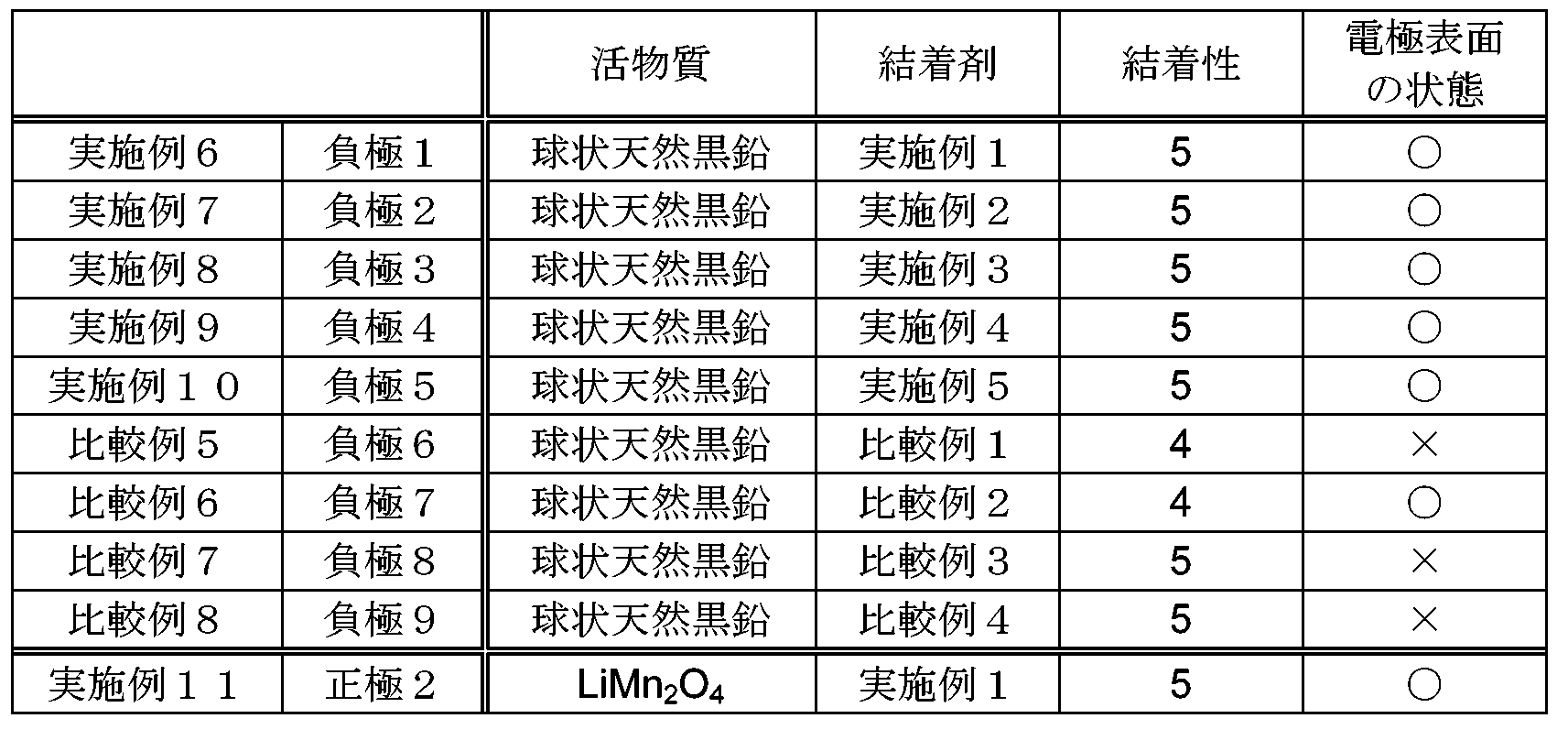
- Comparative Example 6 since the carboxymethyl cellulose salt having a small amount of microgel was used, the state of the electrode surface was excellent, but the 1% by mass aqueous solution viscosity was low, so that the binding property was poor. On the other hand, in Comparative Examples 7 and 8, although the binding property was excellent, since the carboxymethyl cellulose salt with a large amount of microgel was used, defects were observed on the electrode surface.
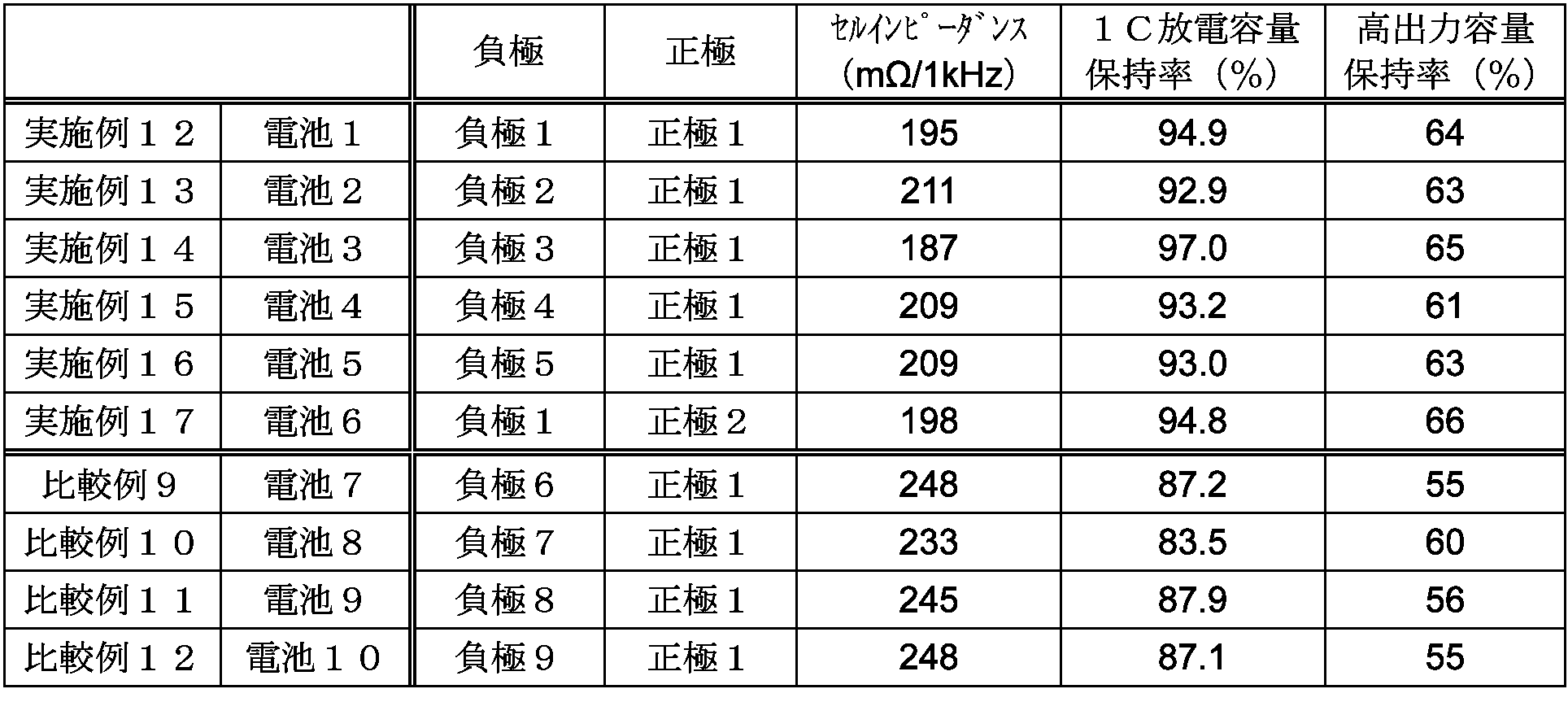
- Comparative Example 9 since the carboxymethyl cellulose salt having a low 1% by weight aqueous solution viscosity and a large amount of microgel was used, the capacity retention of the battery was low and the capacity at the time of high output was inferior. In addition, the cell impedance was high. In Comparative Example 10, since a carboxymethyl cellulose salt having a low 1% by mass aqueous solution viscosity was used although the amount of microgel was small, the capacity retention rate of the battery was inferior and the cell impedance was high.
- the carboxymethylcellulose obtained by the production method of the present invention or a salt thereof can be used for various applications as, for example, a binder (binding agent), a dispersant, a thickener, and the like. It can be suitably used as a binder for electrodes of non-aqueous electrolyte secondary batteries such as batteries.
Landscapes
- Chemical & Material Sciences (AREA)
- Chemical Kinetics & Catalysis (AREA)
- Biochemistry (AREA)
- Life Sciences & Earth Sciences (AREA)
- Materials Engineering (AREA)
- Health & Medical Sciences (AREA)
- Engineering & Computer Science (AREA)
- Medicinal Chemistry (AREA)
- Polymers & Plastics (AREA)
- Organic Chemistry (AREA)
- Electrochemistry (AREA)
- General Chemical & Material Sciences (AREA)
- Battery Electrode And Active Subsutance (AREA)
- Polysaccharides And Polysaccharide Derivatives (AREA)
Abstract
Description
(1)1質量%水溶液粘度(25℃)が5000mPa・s以上20000mPa・s以下であること、および、
(2)0.05質量%水溶液を-13.3kPaの減圧条件にて200メッシュのポリエステルスクリーンでろ過した後の残渣の乾燥質量が、使用したカルボキシメチルセルロースまたはその塩の乾燥質量の0.100質量%以下であること、
を満たすカルボキシメチルセルロースまたはその塩を含有する電極用結着剤である。
・工程1:セルロースとアルカリとを、水および有機溶媒を含む混合溶媒の存在下で、反応させるアルカリセルロース化工程
・工程2:工程1で得られたアルカリセルロースとエーテル化剤とを反応させるエーテル化工程
・工程3:工程2で得られた反応混合物を洗浄および乾燥する精製工程
・工程4:工程3で得られた精製物を粉砕する粉砕工程
以下、各工程について詳細に説明する。
・セルロース:
セルロースとしては、特に限定されず、例えば、粉砕パルプ、木材パルプ、コットンリンターパルプ、古紙パルプなどが挙げられる。これらの原料セルロースは、いずれか1種または2種以上を組み合わせて用いてもよい。
アルカリとしては、例えば、水酸化リチウム、水酸化ナトリウム、水酸化カリウムなどのアルカリ金属水酸化物が挙げられ、いずれか1種または2種以上組み合わせて用いることができる。アルカリの使用量は、一実施形態において、セルロース100gに対して0.5モル以上2.5モル以下であることが好ましく、0.8モル以上1.8モル以下であることがより好ましい。
アルカリセルロース化反応を行う際の溶媒として、水と有機溶媒を含む混合溶媒を用いる。有機溶媒100質量部に対する水の含有量は、特に限定されないが、20質量部以上60質量部以下であることが好ましい。上記範囲とすることにより、水に溶解したアルカリによるアルカリセルロース化反応の均一性を高めることができ、ピンホールなどの電極表面の欠陥をより抑制できるとともに、これを用いた電池の容量保持率や高出力時の容量がより優れたものとなる。上記水の含有量は、下限が25質量部以上であることがより好ましく、30質量部以上であることがさらに好ましい。また、上限が50質量部以下であることがより好ましい。
有機溶媒としては、例えば、エチルアルコール、メチルアルコール、n-プロピルアルコール、イソプロピルアルコール、n-ブチルアルコールおよびイソブチルアルコールなどのアルコール溶媒、アセトン、ジエチルケトンおよびメチルエチルケトンなどのケトン溶媒、ジオキサン、ジエチルエーテルなどが挙げられる。これらは単独で用いてもよく、2種以上の混合物として用いてもよい。これらのうち、水との相溶性が優れることから、炭素数1~4の一価アルコールが好ましく、炭素数1~3の一価アルコールがさらに好ましい。
水100gに対してアルカリ0.8モル以上1.5モル以下であることが好ましい。上記範囲とすることにより、アルカリセルロース化反応の均一性を高めて、ピンホールなどの電極表面の欠陥をより抑制できるとともに、これを用いた電池の容量保持率や高出力時の容量がより優れたものとなる。水100gに対するアルカリの含有量の下限は、より好ましくは0.9モル以上、さらに好ましくは1.0モル以上である。また、水100gに対するアルカリの含有量の上限は、より好ましくは1.4モル以下、さらに好ましくは1.3モル以下である。
セルロース100質量部に対して、有機溶媒を250質量部以上1000質量部以下用いることが好ましい。上記範囲とすることにより、ピンホールなどの電極表面の欠陥をより抑制できる。有機溶媒の含有量は、下限がより好ましくは350質量部以上であり、上限がより好ましくは700質量部以下である。
本実施形態では、アルカリセルロース化反応を、pH9以上および反応温度5℃以上25℃以下の条件下、反応時間60分以上120分以下で行うことを特徴とする。このように、低温条件下で比較的長時間にわたってアルカリセルロース化反応を行うことにより、セルロースの分子量の低下を抑えつつ、反応の均一性を高めて水不溶解ミクロゲルの生成を抑えることができる。そのため、最終的に得られたカルボキシメチルセルロースまたはその塩において、水溶液粘度を高く維持しつつ、ミクロゲルの生成を抑えて電極表面の欠陥を抑制することができ、よって、電池の容量保持率や高出力時の容量などの電池性能を高めながら、電極表面の欠陥抑制効果を発揮することができる。
・エーテル化剤:
上記アルカリセルロース化反応後、エーテル化剤を加えてエーテル化反応を行い、カルボキシメチル化反応を完成させる。エーテル化剤としては、モノクロロ酢酸、モノクロロ酢酸ナトリウム、モノクロロ酢酸メチル、モノクロロ酢酸エチル、モノクロロ酢酸イソプロピルなどが挙げられる。
セルロースのグルコースユニット(無水グルコース単位)1モルに対して、エーテル化剤を0.5モル以上1.5モル以下用いることが好ましい。上記範囲とすることにより、ピンホールなどの電極表面の欠陥をより抑制することができる。セルロースのグルコースユニット1モルに対するエーテル化剤の割合は、下限がより好ましくは0.6モル以上、さらに好ましくは0.7モル以上であり、上限がより好ましくは1.3モル以下、さらに好ましくは1.1モル以下である。
アルカリセルロースを含む液とエーテル化剤との混合は、反応混合物が高温になることを防止するために、複数回に分けて、または、滴下により行うことが好ましい。混合中の反応混合物の温度は、30℃以上80℃以下であることが好ましい。
精製工程は、上記工程2で得られた反応混合物を洗浄および乾燥する工程であり、一実施形態として、溶媒除去工程と、洗浄工程と、乾燥工程を含んでもよく、また、溶媒除去工程に先立って、更にpH調整工程を含んでもよい。
pH調整工程は、上記エーテル化反応終了後に酸を添加して反応混合物のpHを9以上11以下に調整する工程であり、過剰に残るアルカリの一部を酸で中和する。pH調整工程は、基本的には、エーテル化反応終了後の反応混合物のpHが上記範囲内よりも大きい場合に実施するが、上記範囲内にある場合に実施してもよい(例えば、pHが11弱の場合に9.5程度にする場合など)。なお、エーテル化反応終了後に、反応混合物を、例えば60℃以下の温度に冷却してもよい。
溶媒除去工程は、例えば、ろ過、減圧留去またはこれらの組合せなどにより、水および有機溶媒を含む混合溶媒を除去する工程である。溶媒除去後の反応混合物中における混合溶媒の含有量は、特に限定されず、例えば70質量%以下でもよく、60質量%以下でもよい。また、混練機などを用いて、混合溶媒の含有量が5質量%以下となるまで除去してもよい。
洗浄工程では、水と有機溶媒の混合溶媒を用いることができ、上記粗カルボキシメチルセルロース塩を、該混合溶媒を用いて洗浄する。混合溶媒としては、工程1と同じものを用いることができ、有機溶媒としては炭素数1~4の一価アルコールがより好ましい。
乾燥工程は、洗浄した上記粗カルボキシメチルセルロース塩を乾燥する工程であり、乾燥方法としては、例えば、風乾、加熱乾燥、減圧乾燥、減圧加熱乾燥などが挙げられる。
粉砕工程は、上記工程3で得られた精製物を粉砕する工程である。粉砕には、乾式粉砕機を用いてもよく、湿式粉砕機を用いてもよい。なお、粉砕工程では、以下に述べる種々の粉砕機をいずれか単独で用いてもよく、あるいはまた2種以上組み合わせて2段階以上の粉砕処理を実施してもよく、更には同一機種で2段階以上の粉砕処理を実施してもよい。
本実施形態に係る電極用結着剤は、下記(1)および(2)を満たすカルボキシメチルセルロースまたはその塩を含有するものである。
(1)1質量%水溶液粘度(25℃)が5000mPa・s以上20000mPa・s以下である。
(2)0.05質量%水溶液を-13.3kPaの減圧条件にて200メッシュのポリエステルスクリーンでろ過した後の残渣の乾燥質量が、使用したカルボキシメチルセルロースまたはその塩の乾燥質量の0.100質量%以下である。
本実施形態に係る電極は、上記電極用結着剤を用いて得られたものである。一実施形態に係る非水電解質二次電池用電極は、上記結着剤と活物質を乾式混合した後、水及びバインダーを加えて混合することにより、または上記結着剤を水に溶解させた後、活物質およびバインダーを加えて混合することにより、スラリー状またはペースト状の電極用組成物を調製し、該電極用組成物を集電体に塗工することにより形成されるものである。
本実施形態に係る電池は、上記電極を有するものである。電池としては、非水電解質二次電池が挙げられる。一実施形態に係る非水電解質二次電池の構造は、特に限定されず、例えば、正極、負極、セパレータ、および非水電解質で構成することができ、正極と負極のいずれか一方または双方に上記本実施形態に係る電極が用いられる。一実施形態として、電池は、セパレータを介して正極と負極を交互に積層した積層体と、該積層体を収容する容器と、容器内に注入された電解液などの非水電解質とを備えてなるものでもよい。
各物性の測定方法は以下の方法による。
カルボキシメチルセルロースまたはその塩を精秤した。これを、105℃で4時間乾燥し、さらにデシケーター内で25℃まで冷却し、質量を測定した。乾燥前後の質量より減少率を算出し、水分量(質量%)とした。
カルボキシメチルセルロースまたはその塩0.6gを105℃で4時間乾燥した。乾燥物の質量を精秤した後、ろ紙に包んで磁製ルツボ中で灰化した。灰化物を500mlビーカーに移し、水250mlおよび0.05mol/lの硫酸水溶液35mlを加えて30分間煮沸した。冷却後、過剰の酸を0.1mol/lの水酸化カリウム水溶液で逆滴定した。なお、指示薬としてフェノールフタレインを用いた。測定結果を用いて、下記式よりエーテル化度を算出した。
式: (エーテル化度)=162×A/(10000-80A)
A=(af-bf1)/乾燥物の重量(g)
A:試料1g中の結合アルカリに消費された0.05mol/lの硫酸水溶液の量(ml)
a:0.05mol/lの硫酸水溶液の使用量(ml)
f:0.05mol/lの硫酸水溶液の力価
b:0.1mol/lの水酸化カリウム水溶液の滴定量(ml)
f1:0.1mol/lの水酸化カリウム水溶液の力価
カルボキシメチルセルロースまたはその塩(約2.2g)を共栓付き300ml三角フラスコに入れて精秤した。ここに、計算式「試料(g)×(99-水分量(質量%))」により算出される量の水を加えて12時間静置し、さらに5分間混合した。得られた溶液を用いて、JIS Z8803に準じてBM型粘度計(単一円筒型回転粘度計)を用いて25℃における粘度を測定した。その際、(a)ロータ回転数を60rpmとして測定し、(b)上記(a)での測定値が8000mPa・s以上の場合にはロータ回転数を30rpmに変更して測定し、(c)上記(b)での測定値が16000mPa・s以上の場合にはロータ回転数を12rpmに変更して測定した。
分散媒としてイソプロピルアルコールを用い、レーザー回折式粒度分布測定装置(Malvern社Mastersizer 2000)を用いて測定し、体積累計50%粒子径の値を平均粒子径(μm)とした。
カルボキシメチルセルロースまたはその塩の0.05質量%(カルボキシメチルセルロースまたはその塩の乾燥質量を基準とした質量%)水溶液1リットルを調製した。この水溶液1リットルを、200メッシュポリエステルスクリーン(目開き75μm)で、-13.3kPaの減圧条件にて濾過した。続いて、残渣を含む上記スクリーンを105℃で2時間乾燥して精秤し、予め精秤した使用前のスクリーン質量を用いて、残渣の乾燥質量を算出した。得られた残渣の乾燥質量から、使用したカルボキシメチルセルロースまたはその塩の乾燥質量に対する残渣の乾燥質量の割合(ミクロゲル量)(質量%)を算出した。
(実施例1)
溶媒(イソプロピルアルコール/水=80/20(質量比))2318g、53質量%水酸化ナトリウム水溶液589gおよびチップ状のセルロース(リンターパルプ:中国Gaomi山東シルバーホーク社製PCS2500)450gを、2軸ニーダー型反応機に投入し、20℃で90分間、アルカリセルロース化反応を行った。反応時のpHは14.47であった(ガラス電極を備えたpHメータで測定。以下同じ)。
アルカリセルロース化反応を10℃で120分間行った以外は、実施例1と同様の操作を行い、カルボキシメチルセルロースナトリウム塩を得た。
エーテル化反応終了後に50質量%酢酸水溶液を用いて反応溶液のpHを11に調整した以外は実施例1と同様の操作を行い、カルボキシメチルセルロースナトリウム塩を得た。
アルカリセルロース化反応の反応時間を70分間に変更した以外は実施例1と同様の操作を行い、カルボキシメチルセルロースナトリウム塩を得た。
アルカリセルロース化反応を23℃で80分間行った以外は実施例1と同様の操作を行い、カルボキシメチルセルロースナトリウム塩を得た。
アルカリセルロース化反応の条件を、反応温度40℃、反応時間30分とし、エーテル反応終了後の50質量%酢酸水溶液を用いた中和時のpHを8とした以外は、実施例1と同様の操作を行い、カルボキシメチルセルロースナトリウム塩を得た。
市販のカルボキシメチルセルロースナトリウム塩(25℃における1質量%水溶液粘度:3500mPa・s、エーテル化度0.76)を、気流式ミルを用いて乾式粉砕処理を行った。得られた粉砕物を80メッシュの標準篩にて分級処理を行うことにより、カルボキシメチルセルロースナトリウム塩を得た。
アルカリセルロース化反応の反応時間を50分間に変更した以外は、実施例1と同様の操作を行い、カルボキシメチルセルロースナトリウム塩を得た。
市販のカルボキシメチルセルロースナトリウム塩(25℃における1質量%水溶液粘度:8000mPa・s、エーテル化度0.69)を、気流式ミルを用いて乾式粉砕処理を行った。得られた粉砕物を80メッシュの標準篩にて分級処理を行うことにより、カルボキシメチルセルロースナトリウム塩を得た。

(負極1~9)
球状天然黒鉛100g、カーボンブラック0.5g(Timcal社製、Super-P)および表2に記載のカルボキシメチルセルロースまたはその塩1gを遊星型ミキサーで混合した。ここに、水101.5gおよびスチレン・ブタジエンゴム(SBR)の50重量%水分散体1gを加えて混合することにより、固形分50質量%のスラリーを得た。このスラリーを、球状天然黒鉛が8mg/cm2となるように塗工機を用いて電解銅箔上に塗布し、120℃で乾燥後、ロールプレス処理を行うことにより負極1~9を得た。
LiNi1/3Mn1/3Co1/3O2(LNMCO)100g、カーボンブラック(Timcal社製、Super-P)7.8g、ポリフッ化ビニリデン6g、N-メチル-2-ピロリドン61.3gを遊星型ミキサーで混合することにより、固形分65質量%のスラリーを得た。このスラリーを、LNMCOが13.8mg/cm2となるように塗工機を用いてアルミニウム箔上に塗布し、130℃で乾燥後、ロールプレス処理を行うことにより正極1を得た。
LiMn2O4200g、カーボンブラック(Timcal社製、Super-P)12g、実施例1のカルボキシメチルセルロース塩2gを遊星型ミキサーで混合した。ここに、水113gおよびスチレン・ブタジエンゴム(SBR)の50重量%水分散体8gを加えて混合することにより、固形分65質量%のスラリーを得た。このスラリーを、LiMn2O4が22mg/cm2となるように塗工機を用いてアルミニウム箔上に塗布し、130℃で乾燥後、ロールプレス処理を行うことにより正極2を得た。
(1)結着性
上記の通り得られた電極について、結着性評価を実施した。結着性評価は、上記の通り得られた電極の塗工面を外側にして180℃折り曲げて戻した後に、塗工面の活物質の脱落程度(脱落部分の面積が全体に占める割合)を目視で判断し、次の基準で評価した。評価結果を表2に示す。
5点:脱落なし
4点:25%以下脱落
3点:25%を超えて50%以下脱落
2点:50%を超えて75%以下脱落
1点:75%を超えて脱落(100%迄)
上記の通り得られた電極について、電極表面の状態を評価した。評価は、スポット、突起および筋の有無を目視で判断し、次の基準で評価した。評価結果を表2に示す。
○:スポット、突起および筋が見られない
×:スポット、突起および筋の少なくとも1つが見られる。
上記で得られた負極及び正極を下記表3のように組み合わせて、電極間にセパレータとしてポリオレフィン系(PE/PP)セパレータを挟んで積層し、各正負極に正極端子と負極端子を超音波溶接した。この積層体をアルミラミネート包材に入れ、注液用の開口部を残しヒートシールして、正極面積18cm2、負極面積19.8cm2とした注液前電池を作製した。次にエチレンカーボネートとジエチルカーボネート(30/70vol比)とを混合した溶媒にLiPF6(1.0mol/L)を溶解させた電解液を注液し、開口部をヒートシールして、実施例12~17及び比較例9~12の評価用電池1~10を得た。
上記の通り作製したリチウム二次電池について、20℃における性能試験を行った。試験方法は下記の通りである。試験結果を表3に示す。
インピーダンスアナライザー(ZAHNER社製)を用いて、周波数1kHzでの抵抗値を測定した。
20℃環境下において、作製した電池に1C相当の電流密度で4.2VまでCC(定電流)充電し、さらに4.2VでCV(定電圧)充電に切り替えて1.5時間充電した後、1C相当の電流密度で2.7VまでCC放電する操作を300サイクル繰り返した。1サイクル目の1C放電容量を100%とした場合における300サイクル目の1C放電容量を算出し、1C放電容量保持率とした。
20℃環境下において、作製した電池に1C相当の電流密度で4.2VまでCC(定電流)充電し、さらに4.2VでCV(定電圧)充電に切り替えて1.5時間充電した後、0.2C相当の電流密度で2.7VまでCC放電し、放電容量を測定した。また、CC放電時の電流密度を5C相当に変更し、同様の操作を行った。0.2C放電容量を100%とした場合における5C放電容量を高出力容量保持率(%)とした。
Claims (8)
- セルロースとアルカリとを、水および有機溶媒を含む混合溶媒の存在下で、反応させるアルカリセルロース化工程(工程1)、
前記工程1で得られたアルカリセルロースとエーテル化剤とを反応させるエーテル化工程(工程2)、
前記工程2で得られた反応混合物を洗浄および乾燥する精製工程(工程3)、および、
前記工程3で得られた精製物を粉砕する粉砕工程(工程4)、を含み、
前記工程1は、pH9以上および反応温度5℃以上25℃以下の条件下、反応時間60分以上120分以下で行われる、
カルボキシメチルセルロースまたはその塩の製造方法。 - 前記工程3は、前記工程2のエーテル化反応終了後、pHが9以上11以下の反応混合物を用いて当該反応混合物から混合溶媒を除去し、次いで洗浄および乾燥を行う工程である、請求項1に記載のカルボキシメチルセルロースまたはその塩の製造方法。
- 前記工程1において、水100gに対して前記アルカリ0.8モル以上1.5モル以下を使用する、請求項1または2に記載のカルボキシメチルセルロースまたはその塩の製造方法。
- 前記カルボキシメチルセルロースまたはその塩が非水電解質二次電池の電極用結着剤である請求項1~3のいずれか1項に記載のカルボキシメチルセルロースまたはその塩の製造方法。
- 下記(1)および(2)を満たすカルボキシメチルセルロースまたはその塩を含有する電極用結着剤。
(1)25℃における1質量%水溶液粘度が5000mPa・s以上20000mPa・s以下である。
(2)0.05質量%水溶液を-13.3kPaの減圧条件にて200メッシュのポリエステルスクリーンでろ過した後の残渣の乾燥質量が、使用したカルボキシメチルセルロースまたはその塩の乾燥質量の0.100質量%以下である。 - 前記カルボキシメチルセルロースまたはその塩のエーテル化度が0.5以上0.9以下である、請求項5に記載の電極用結着剤。
- 請求項5または6に記載の電極用結着剤を含む電極。
- 請求項7に記載の電極を有する電池。
Priority Applications (4)
| Application Number | Priority Date | Filing Date | Title |
|---|---|---|---|
| US16/078,835 US10941218B2 (en) | 2016-02-26 | 2017-02-16 | Method for producing carboxymethyl cellulose or salt thereof, and binding agent for electrode |
| EP17756343.4A EP3421501A4 (en) | 2016-02-26 | 2017-02-16 | PROCESS FOR THE PREPARATION OF CARBOXYMETHYL CELLULOSE OR SALT AND BINDER FOR ELECTRODE |
| KR1020187023052A KR20180117611A (ko) | 2016-02-26 | 2017-02-16 | 카르복시메틸셀룰로오스 또는 그 염의 제조 방법, 및 전극용 결착제 |
| CN201780006993.5A CN108473594B (zh) | 2016-02-26 | 2017-02-16 | 羧甲基纤维素或其盐的制造方法、电极粘合剂、电极以及电池 |
Applications Claiming Priority (2)
| Application Number | Priority Date | Filing Date | Title |
|---|---|---|---|
| JP2016035815A JP6669529B2 (ja) | 2016-02-26 | 2016-02-26 | 電極用結着剤 |
| JP2016-035815 | 2016-02-26 |
Publications (1)
| Publication Number | Publication Date |
|---|---|
| WO2017145904A1 true WO2017145904A1 (ja) | 2017-08-31 |
Family
ID=59685180
Family Applications (1)
| Application Number | Title | Priority Date | Filing Date |
|---|---|---|---|
| PCT/JP2017/005647 Ceased WO2017145904A1 (ja) | 2016-02-26 | 2017-02-16 | カルボキシメチルセルロースまたはその塩の製造方法、および電極用結着剤 |
Country Status (7)
| Country | Link |
|---|---|
| US (1) | US10941218B2 (ja) |
| EP (1) | EP3421501A4 (ja) |
| JP (1) | JP6669529B2 (ja) |
| KR (1) | KR20180117611A (ja) |
| CN (1) | CN108473594B (ja) |
| TW (1) | TWI679213B (ja) |
| WO (1) | WO2017145904A1 (ja) |
Cited By (3)
| Publication number | Priority date | Publication date | Assignee | Title |
|---|---|---|---|---|
| WO2019064633A1 (ja) * | 2017-09-27 | 2019-04-04 | 第一工業製薬株式会社 | カルボキシメチルセルロースまたはその塩の製造方法 |
| WO2020100315A1 (ja) * | 2018-11-13 | 2020-05-22 | 住友精化株式会社 | 高分子組成物 |
| JPWO2021235511A1 (ja) * | 2020-05-22 | 2021-11-25 |
Families Citing this family (17)
| Publication number | Priority date | Publication date | Assignee | Title |
|---|---|---|---|---|
| WO2019111939A1 (ja) | 2017-12-07 | 2019-06-13 | 日本製紙株式会社 | カルボキシメチル化セルロースナノファイバー |
| EP3722327B1 (en) | 2017-12-07 | 2022-11-02 | Nippon Paper Industries Co., Ltd. | Method for manufacturing carboxymethylated cellulose nanofiber |
| US11591412B2 (en) | 2017-12-07 | 2023-02-28 | Nippon Paper Industries Co., Ltd. | Carboxymethylated cellulose nanofibers |
| WO2019111934A1 (ja) | 2017-12-07 | 2019-06-13 | 日本製紙株式会社 | カルボキシメチル化セルロース |
| US12031016B2 (en) | 2018-05-18 | 2024-07-09 | Nippon Paper Industries Co., Ltd. | Dispersion composition containing carboxymethyl cellulose |
| US20210079173A1 (en) | 2018-05-18 | 2021-03-18 | Nippon Paper Industries Co., Ltd. | Pulverized product of carboxymethylated pulp and additive containing said pulverized product |
| CN112204079B (zh) | 2018-05-29 | 2024-03-01 | 日本制纸株式会社 | 包含羧甲基化纤维素纳米纤维的粉末 |
| KR102873228B1 (ko) * | 2018-12-19 | 2025-10-20 | 닛뽄세이시가부시끼가이샤 | 비수 전해질 이차 전지용 카르복시메틸 셀룰로오스 또는 그 염 |
| WO2021095920A1 (ko) * | 2019-11-13 | 2021-05-20 | 주식회사 위즈켐 | 친수성 및 유효성분 고정화 성능이 우수한 셀룰로스 섬유 겔시트의 제조방법 |
| CN111423518B (zh) * | 2019-11-21 | 2022-04-19 | 瑞红锂电池材料(苏州)有限公司 | 一种锂电池粘结剂羧甲基纤维素盐的合成方法 |
| JP6865489B1 (ja) | 2020-10-20 | 2021-04-28 | 株式会社エス・ディー・エス バイオテック | 2,3,5,6−テトラクロロ−1,4−ベンゼンジカルボン酸ジメチルの製造方法 |
| CN113265008B (zh) * | 2021-07-02 | 2022-03-01 | 重庆力宏精细化工有限公司 | 一种高黏度羧甲基纤维素锂及其制备方法和应用 |
| KR102753403B1 (ko) | 2021-11-29 | 2025-01-10 | 주식회사 지엘켐 | 습식분쇄 공정을 통한 마이크로 겔이 제어된 이차전지 음극용 카르복시메틸셀룰로오스 분말의 제조방법 |
| CN114622407B (zh) * | 2022-04-01 | 2023-09-19 | 浙江隆腾医用新材料有限公司 | 一种羧甲基纤维素钠纤维的洗脱方法 |
| JP7232951B1 (ja) * | 2022-06-23 | 2023-03-03 | 日本製紙株式会社 | カルボキシメチルセルロースおよび/又はその塩、非水電解質二次電池用電極組成物、非水電解質二次電池用電極および非水電解質二次電池 |
| US20250054984A1 (en) * | 2022-06-23 | 2025-02-13 | Nippon Paper Industries Co., Ltd. | Carboxymethyl cellulose and/or salt thereof, electrode composition for nonaqueous electrolyte secondary batteries, electrode for nonaqueous electrolyte secondary batteries, and nonaqueous electrolyte secondary battery |
| JP7262913B1 (ja) * | 2022-06-23 | 2023-04-24 | 日本製紙株式会社 | カルボキシメチルセルロースおよび/又はその塩、非水電解質二次電池用電極組成物、非水電解質二次電池用電極および非水電解質二次電池 |
Citations (8)
| Publication number | Priority date | Publication date | Assignee | Title |
|---|---|---|---|---|
| JPS5514734B2 (ja) | 1975-02-03 | 1980-04-18 | ||
| JPS6296501A (ja) * | 1985-07-03 | 1987-05-06 | Dai Ichi Kogyo Seiyaku Co Ltd | カルボキシメチルセルロ−スエ−テルアルカリ塩の製造方法 |
| JPH0655761B2 (ja) * | 1985-11-13 | 1994-07-27 | ダイセル化学工業株式会社 | 耐塩水性の優れたカルボキシメチルセルロースアルカリ塩の製造法 |
| JP2002536507A (ja) * | 1999-02-10 | 2002-10-29 | ハーキュリーズ・インコーポレイテッド | 誘導微小繊維ポリサッカライド |
| JP2005108833A (ja) * | 2003-10-01 | 2005-04-21 | Samsung Sdi Co Ltd | カルボキシメチルセルロース系結合剤及びこれを用いたリチウム電池 |
| JP2009191233A (ja) | 2008-02-18 | 2009-08-27 | Dai Ichi Kogyo Seiyaku Co Ltd | カルボキシメチルセルロースナトリウムの製造方法 |
| WO2010061871A1 (ja) * | 2008-11-26 | 2010-06-03 | 日本製紙ケミカル株式会社 | 非水電解質二次電池の電極用カルボキシメチルセルロースまたはその塩、及びその水溶液 |
| JP2013114959A (ja) * | 2011-11-30 | 2013-06-10 | Panasonic Corp | リチウムイオン二次電池用負極スラリー、リチウムイオン二次電池用負極板およびリチウムイオン二次電池 |
Family Cites Families (8)
| Publication number | Priority date | Publication date | Assignee | Title |
|---|---|---|---|---|
| JPH0235761B2 (ja) * | 1982-02-26 | 1990-08-13 | Daicel Chem | Arukariseruroosunoseizohoho |
| JPS62149701A (ja) * | 1985-12-24 | 1987-07-03 | Daicel Chem Ind Ltd | 低置換度カルボキシメチルセルロ−スエ−テルアルカリ金属塩の製造法 |
| JP2566510B2 (ja) * | 1992-10-02 | 1996-12-25 | 日本製紙株式会社 | 粉体流動性に優れたカルボキシメチルセルロース塩 |
| IN190599B (ja) * | 1994-12-30 | 2003-08-09 | Council Scient Ind Res | |
| BR0316623A (pt) * | 2002-11-26 | 2005-10-11 | Hercules Inc | Carboximetilcelulose associativa, solúvel, método para a fabricação e usos da mesma |
| CN102153663B (zh) * | 2011-02-22 | 2012-10-10 | 玉林师范学院 | 用甘蔗渣制备高取代度羧甲基纤维素钠的方法 |
| JP6098542B2 (ja) * | 2014-02-14 | 2017-03-22 | トヨタ自動車株式会社 | 負極ペースト及びその製造方法 |
| WO2018096838A1 (ja) * | 2016-11-25 | 2018-05-31 | 第一工業製薬株式会社 | 非水電解質二次電池負極および非水電解質二次電池 |
-
2016
- 2016-02-26 JP JP2016035815A patent/JP6669529B2/ja active Active
- 2016-12-28 TW TW105143462A patent/TWI679213B/zh not_active IP Right Cessation
-
2017
- 2017-02-16 EP EP17756343.4A patent/EP3421501A4/en not_active Withdrawn
- 2017-02-16 US US16/078,835 patent/US10941218B2/en not_active Expired - Fee Related
- 2017-02-16 CN CN201780006993.5A patent/CN108473594B/zh not_active Expired - Fee Related
- 2017-02-16 WO PCT/JP2017/005647 patent/WO2017145904A1/ja not_active Ceased
- 2017-02-16 KR KR1020187023052A patent/KR20180117611A/ko not_active Ceased
Patent Citations (8)
| Publication number | Priority date | Publication date | Assignee | Title |
|---|---|---|---|---|
| JPS5514734B2 (ja) | 1975-02-03 | 1980-04-18 | ||
| JPS6296501A (ja) * | 1985-07-03 | 1987-05-06 | Dai Ichi Kogyo Seiyaku Co Ltd | カルボキシメチルセルロ−スエ−テルアルカリ塩の製造方法 |
| JPH0655761B2 (ja) * | 1985-11-13 | 1994-07-27 | ダイセル化学工業株式会社 | 耐塩水性の優れたカルボキシメチルセルロースアルカリ塩の製造法 |
| JP2002536507A (ja) * | 1999-02-10 | 2002-10-29 | ハーキュリーズ・インコーポレイテッド | 誘導微小繊維ポリサッカライド |
| JP2005108833A (ja) * | 2003-10-01 | 2005-04-21 | Samsung Sdi Co Ltd | カルボキシメチルセルロース系結合剤及びこれを用いたリチウム電池 |
| JP2009191233A (ja) | 2008-02-18 | 2009-08-27 | Dai Ichi Kogyo Seiyaku Co Ltd | カルボキシメチルセルロースナトリウムの製造方法 |
| WO2010061871A1 (ja) * | 2008-11-26 | 2010-06-03 | 日本製紙ケミカル株式会社 | 非水電解質二次電池の電極用カルボキシメチルセルロースまたはその塩、及びその水溶液 |
| JP2013114959A (ja) * | 2011-11-30 | 2013-06-10 | Panasonic Corp | リチウムイオン二次電池用負極スラリー、リチウムイオン二次電池用負極板およびリチウムイオン二次電池 |
Non-Patent Citations (1)
| Title |
|---|
| See also references of EP3421501A4 |
Cited By (8)
| Publication number | Priority date | Publication date | Assignee | Title |
|---|---|---|---|---|
| WO2019064633A1 (ja) * | 2017-09-27 | 2019-04-04 | 第一工業製薬株式会社 | カルボキシメチルセルロースまたはその塩の製造方法 |
| JP2019059856A (ja) * | 2017-09-27 | 2019-04-18 | 第一工業製薬株式会社 | カルボキシメチルセルロースまたはその塩の製造方法 |
| WO2020100315A1 (ja) * | 2018-11-13 | 2020-05-22 | 住友精化株式会社 | 高分子組成物 |
| JP2020079379A (ja) * | 2018-11-13 | 2020-05-28 | 住友精化株式会社 | 高分子組成物 |
| US11920024B2 (en) | 2018-11-13 | 2024-03-05 | Sumitomo Seika Chemicals Co., Ltd. | Polymer composition |
| JPWO2021235511A1 (ja) * | 2020-05-22 | 2021-11-25 | ||
| WO2021235511A1 (ja) * | 2020-05-22 | 2021-11-25 | 日本製紙株式会社 | 非水電解質二次電池電極用結合剤、水溶液、非水電解質二次電池用電極組成物および非水電解質二次電池用電極 |
| JP7714298B2 (ja) | 2020-05-22 | 2025-07-29 | 日本製紙株式会社 | 非水電解質二次電池電極用結合剤、水溶液、非水電解質二次電池用電極組成物および非水電解質二次電池用電極 |
Also Published As
| Publication number | Publication date |
|---|---|
| JP2017149901A (ja) | 2017-08-31 |
| KR20180117611A (ko) | 2018-10-29 |
| CN108473594B (zh) | 2020-12-01 |
| US10941218B2 (en) | 2021-03-09 |
| US20190055323A1 (en) | 2019-02-21 |
| JP6669529B2 (ja) | 2020-03-18 |
| TW201800422A (zh) | 2018-01-01 |
| TWI679213B (zh) | 2019-12-11 |
| EP3421501A1 (en) | 2019-01-02 |
| EP3421501A4 (en) | 2019-12-04 |
| CN108473594A (zh) | 2018-08-31 |
Similar Documents
| Publication | Publication Date | Title |
|---|---|---|
| JP6669529B2 (ja) | 電極用結着剤 | |
| CN105140522A (zh) | 非水电解质二次电池的电极用羧甲基纤维素或其盐、及其水溶液 | |
| TWI872036B (zh) | 非水電解質二次電池用羧甲基纖維素或其鹽 | |
| JP7748405B2 (ja) | カルボキシメチルセルロースおよび/又はその塩、非水電解質二次電池用電極組成物、非水電解質二次電池用電極および非水電解質二次電池 | |
| JP7714298B2 (ja) | 非水電解質二次電池電極用結合剤、水溶液、非水電解質二次電池用電極組成物および非水電解質二次電池用電極 | |
| JP7748406B2 (ja) | カルボキシメチルセルロースおよび/又はその塩、非水電解質二次電池用電極組成物、非水電解質二次電池用電極および非水電解質二次電池 | |
| JP7690810B2 (ja) | 非水電解質二次電池電極用結合剤、非水電解質二次電池用電極組成物および非水電解質二次電池用電極 | |
| TWI837024B (zh) | 羧甲基纖維素及/或其鹽、非水電解質二次電池用電極組成物、非水電解質二次電池用電極及非水電解質二次電池 | |
| JP2024168872A (ja) | 非水電解質二次電池用電極組成物の製造方法、非水電解質二次電池用電極の製造方法および非水電解質二次電池の製造方法 | |
| TW202523782A (zh) | 非水電解質二次電池電極用結合劑、非水電解質二次電池用電極組成物、非水電解質二次電池用電極及非水電解質二次電池 | |
| CN118451570A (zh) | 羧甲基纤维素和/或其盐、非水电解质二次电池用电极组合物、非水电解质二次电池用电极和非水电解质二次电池 | |
| KR20240004856A (ko) | 비수 전해질 이차전지 전극용 결합제, 비수 전해질 이차전지용 전극 조성물, 비수 전해질 이차전지용 전극 및 비수 전해질 이차전지 |
Legal Events
| Date | Code | Title | Description |
|---|---|---|---|
| ENP | Entry into the national phase |
Ref document number: 20187023052 Country of ref document: KR Kind code of ref document: A |
|
| NENP | Non-entry into the national phase |
Ref country code: DE |
|
| WWE | Wipo information: entry into national phase |
Ref document number: 2017756343 Country of ref document: EP |
|
| ENP | Entry into the national phase |
Ref document number: 2017756343 Country of ref document: EP Effective date: 20180926 |
|
| 121 | Ep: the epo has been informed by wipo that ep was designated in this application |
Ref document number: 17756343 Country of ref document: EP Kind code of ref document: A1 |