WO2017146047A1 - Roulement à rouleaux pour environnements à températures extrêmement basses - Google Patents
Roulement à rouleaux pour environnements à températures extrêmement basses Download PDFInfo
- Publication number
- WO2017146047A1 WO2017146047A1 PCT/JP2017/006378 JP2017006378W WO2017146047A1 WO 2017146047 A1 WO2017146047 A1 WO 2017146047A1 JP 2017006378 W JP2017006378 W JP 2017006378W WO 2017146047 A1 WO2017146047 A1 WO 2017146047A1
- Authority
- WO
- WIPO (PCT)
- Prior art keywords
- clearance
- rolling
- cage
- rolling bearing
- rolling element
- Prior art date
- Legal status (The legal status is an assumption and is not a legal conclusion. Google has not performed a legal analysis and makes no representation as to the accuracy of the status listed.)
- Ceased
Links
Images

Classifications
-
- F—MECHANICAL ENGINEERING; LIGHTING; HEATING; WEAPONS; BLASTING
- F04—POSITIVE - DISPLACEMENT MACHINES FOR LIQUIDS; PUMPS FOR LIQUIDS OR ELASTIC FLUIDS
- F04D—NON-POSITIVE-DISPLACEMENT PUMPS
- F04D7/00—Pumps adapted for handling specific fluids, e.g. by selection of specific materials for pumps or pump parts
- F04D7/02—Pumps adapted for handling specific fluids, e.g. by selection of specific materials for pumps or pump parts of centrifugal type
-
- F—MECHANICAL ENGINEERING; LIGHTING; HEATING; WEAPONS; BLASTING
- F04—POSITIVE - DISPLACEMENT MACHINES FOR LIQUIDS; PUMPS FOR LIQUIDS OR ELASTIC FLUIDS
- F04D—NON-POSITIVE-DISPLACEMENT PUMPS
- F04D29/00—Details, component parts, or accessories
- F04D29/04—Shafts or bearings, or assemblies thereof
- F04D29/046—Bearings
- F04D29/049—Roller bearings
-
- F—MECHANICAL ENGINEERING; LIGHTING; HEATING; WEAPONS; BLASTING
- F16—ENGINEERING ELEMENTS AND UNITS; GENERAL MEASURES FOR PRODUCING AND MAINTAINING EFFECTIVE FUNCTIONING OF MACHINES OR INSTALLATIONS; THERMAL INSULATION IN GENERAL
- F16C—SHAFTS; FLEXIBLE SHAFTS; ELEMENTS OR CRANKSHAFT MECHANISMS; ROTARY BODIES OTHER THAN GEARING ELEMENTS; BEARINGS
- F16C33/00—Parts of bearings; Special methods for making bearings or parts thereof
- F16C33/30—Parts of ball or roller bearings
- F16C33/303—Parts of ball or roller bearings of hybrid bearings, e.g. rolling bearings with steel races and ceramic rolling elements
-
- F—MECHANICAL ENGINEERING; LIGHTING; HEATING; WEAPONS; BLASTING
- F16—ENGINEERING ELEMENTS AND UNITS; GENERAL MEASURES FOR PRODUCING AND MAINTAINING EFFECTIVE FUNCTIONING OF MACHINES OR INSTALLATIONS; THERMAL INSULATION IN GENERAL
- F16C—SHAFTS; FLEXIBLE SHAFTS; ELEMENTS OR CRANKSHAFT MECHANISMS; ROTARY BODIES OTHER THAN GEARING ELEMENTS; BEARINGS
- F16C33/00—Parts of bearings; Special methods for making bearings or parts thereof
- F16C33/30—Parts of ball or roller bearings
- F16C33/38—Ball cages
- F16C33/3837—Massive or moulded cages having cage pockets surrounding the balls, e.g. machined window cages
- F16C33/3843—Massive or moulded cages having cage pockets surrounding the balls, e.g. machined window cages formed as one-piece cages, i.e. monoblock cages
- F16C33/3856—Massive or moulded cages having cage pockets surrounding the balls, e.g. machined window cages formed as one-piece cages, i.e. monoblock cages made from plastic, e.g. injection moulded window cages
-
- F—MECHANICAL ENGINEERING; LIGHTING; HEATING; WEAPONS; BLASTING
- F04—POSITIVE - DISPLACEMENT MACHINES FOR LIQUIDS; PUMPS FOR LIQUIDS OR ELASTIC FLUIDS
- F04D—NON-POSITIVE-DISPLACEMENT PUMPS
- F04D29/00—Details, component parts, or accessories
- F04D29/04—Shafts or bearings, or assemblies thereof
- F04D29/046—Bearings
-
- F—MECHANICAL ENGINEERING; LIGHTING; HEATING; WEAPONS; BLASTING
- F16—ENGINEERING ELEMENTS AND UNITS; GENERAL MEASURES FOR PRODUCING AND MAINTAINING EFFECTIVE FUNCTIONING OF MACHINES OR INSTALLATIONS; THERMAL INSULATION IN GENERAL
- F16C—SHAFTS; FLEXIBLE SHAFTS; ELEMENTS OR CRANKSHAFT MECHANISMS; ROTARY BODIES OTHER THAN GEARING ELEMENTS; BEARINGS
- F16C19/00—Bearings with rolling contact, for exclusively rotary movement
- F16C19/02—Bearings with rolling contact, for exclusively rotary movement with bearing balls essentially of the same size in one or more circular rows
- F16C19/04—Bearings with rolling contact, for exclusively rotary movement with bearing balls essentially of the same size in one or more circular rows for radial load mainly
- F16C19/06—Bearings with rolling contact, for exclusively rotary movement with bearing balls essentially of the same size in one or more circular rows for radial load mainly with a single row or balls
-
- F—MECHANICAL ENGINEERING; LIGHTING; HEATING; WEAPONS; BLASTING
- F16—ENGINEERING ELEMENTS AND UNITS; GENERAL MEASURES FOR PRODUCING AND MAINTAINING EFFECTIVE FUNCTIONING OF MACHINES OR INSTALLATIONS; THERMAL INSULATION IN GENERAL
- F16C—SHAFTS; FLEXIBLE SHAFTS; ELEMENTS OR CRANKSHAFT MECHANISMS; ROTARY BODIES OTHER THAN GEARING ELEMENTS; BEARINGS
- F16C19/00—Bearings with rolling contact, for exclusively rotary movement
- F16C19/22—Bearings with rolling contact, for exclusively rotary movement with bearing rollers essentially of the same size in one or more circular rows, e.g. needle bearings
- F16C19/24—Bearings with rolling contact, for exclusively rotary movement with bearing rollers essentially of the same size in one or more circular rows, e.g. needle bearings for radial load mainly
- F16C19/26—Bearings with rolling contact, for exclusively rotary movement with bearing rollers essentially of the same size in one or more circular rows, e.g. needle bearings for radial load mainly with a single row of rollers
-
- F—MECHANICAL ENGINEERING; LIGHTING; HEATING; WEAPONS; BLASTING
- F16—ENGINEERING ELEMENTS AND UNITS; GENERAL MEASURES FOR PRODUCING AND MAINTAINING EFFECTIVE FUNCTIONING OF MACHINES OR INSTALLATIONS; THERMAL INSULATION IN GENERAL
- F16C—SHAFTS; FLEXIBLE SHAFTS; ELEMENTS OR CRANKSHAFT MECHANISMS; ROTARY BODIES OTHER THAN GEARING ELEMENTS; BEARINGS
- F16C2208/00—Plastics; Synthetic resins, e.g. rubbers
- F16C2208/20—Thermoplastic resins
- F16C2208/30—Fluoropolymers
- F16C2208/32—Polytetrafluorethylene [PTFE]
-
- F—MECHANICAL ENGINEERING; LIGHTING; HEATING; WEAPONS; BLASTING
- F16—ENGINEERING ELEMENTS AND UNITS; GENERAL MEASURES FOR PRODUCING AND MAINTAINING EFFECTIVE FUNCTIONING OF MACHINES OR INSTALLATIONS; THERMAL INSULATION IN GENERAL
- F16C—SHAFTS; FLEXIBLE SHAFTS; ELEMENTS OR CRANKSHAFT MECHANISMS; ROTARY BODIES OTHER THAN GEARING ELEMENTS; BEARINGS
- F16C2240/00—Specified values or numerical ranges of parameters; Relations between them
- F16C2240/40—Linear dimensions, e.g. length, radius, thickness, gap
- F16C2240/46—Gap sizes or clearances
-
- F—MECHANICAL ENGINEERING; LIGHTING; HEATING; WEAPONS; BLASTING
- F16—ENGINEERING ELEMENTS AND UNITS; GENERAL MEASURES FOR PRODUCING AND MAINTAINING EFFECTIVE FUNCTIONING OF MACHINES OR INSTALLATIONS; THERMAL INSULATION IN GENERAL
- F16C—SHAFTS; FLEXIBLE SHAFTS; ELEMENTS OR CRANKSHAFT MECHANISMS; ROTARY BODIES OTHER THAN GEARING ELEMENTS; BEARINGS
- F16C2300/00—Application independent of particular apparatuses
- F16C2300/40—Application independent of particular apparatuses related to environment, i.e. operating conditions
- F16C2300/52—Application independent of particular apparatuses related to environment, i.e. operating conditions low temperature, e.g. cryogenic temperature
-
- F—MECHANICAL ENGINEERING; LIGHTING; HEATING; WEAPONS; BLASTING
- F16—ENGINEERING ELEMENTS AND UNITS; GENERAL MEASURES FOR PRODUCING AND MAINTAINING EFFECTIVE FUNCTIONING OF MACHINES OR INSTALLATIONS; THERMAL INSULATION IN GENERAL
- F16C—SHAFTS; FLEXIBLE SHAFTS; ELEMENTS OR CRANKSHAFT MECHANISMS; ROTARY BODIES OTHER THAN GEARING ELEMENTS; BEARINGS
- F16C2360/00—Engines or pumps
Definitions
- the present invention relates to a rolling bearing for a cryogenic environment used at a cryogenic temperature, such as a bearing used in a submerged pump for transferring a liquefied gas in a cryogenic state such as liquefied natural gas.
- a rolling bearing used in a normal temperature environment requires a rolling element to be rotatably held between an inner ring and an outer ring and requires liquid lubrication with a lubricating oil or the like.
- liquid lubrication with a normal lubricating oil or the like cannot be expected.
- rolling bearings for cryogenic environments are liable to deteriorate in strength and durability due to shrinkage and deformation of parts, and are required to withstand such severe use conditions.
- liquefied natural gas which is a typical example of a cryogenic liquefied gas, has methane as a main component and has a physical property that does not liquefy unless it is below ⁇ 161.5 ° C. (about ⁇ 162 ° C.) under normal pressure.
- examples of liquefied gas used in a liquefied state such as a refrigerant, a heat medium, and a filling gas include nitrogen and helium.
- a dedicated pump When transporting or storing such a liquefied gas while maintaining a liquid state at a cryogenic temperature, it is necessary to use a dedicated pump at a cryogenic temperature.
- a submerged pump As a type of such a pump, a submerged pump is used. Are known. Since this type of pump is used by immersing the entire pump device including the motor in liquefied gas, it does not require a mechanical seal to seal the main body from the outside air, and is excellent in that there is little loss due to dissipation of the vaporized gas. It is a thing.
- the rolling bearing supporting the motor shaft and the like is also lubricated with a liquefied gas such as LNG having poor lubricity at extremely low temperatures.
- a liquefied gas such as LNG having poor lubricity at extremely low temperatures.
- it is required to have a good rotation state with good durability and stability.
- the environmental temperature is not limited to the above-described environment where liquefied gas exists, but also in a high altitude space beyond the stratosphere far from the surface of the earth, and in a far away space, Since the temperature is about 50 to ⁇ 270 ° C., similar characteristics are required for rolling bearings for cryogenic environments used in such artificial satellites and spacecraft.
- an outer ring and an inner ring are made of martensitic stainless steel, a rolling element is made of ceramic, and a cage is made of a fluororesin. (Patent Document 1 below).
- the rolling bearings used in the cryogenic environment described above are only those in which the material of the inner ring, outer ring, rolling element, and cage is specified to make it difficult to cause dimensional changes due to low temperatures.
- the dimensions of the parts when assembled were not specified.
- outer rings, inner rings, rolling elements, and cages are made of a predetermined material and have a low heat shrinkage at a very low temperature, the dimensional change due to low temperatures is to some extent. I have to accept it.
- the following types (1) to (3) are available as guide types for cages made of resin material for rolling bearings at extremely low temperatures.
- Rolling element guide A gap corresponding to the expected heat shrinkage is provided between the rolling element and the cage pocket to achieve appropriate contact.
- Inner ring guide A gap corresponding to the expected heat shrinkage is provided between the outer diameter of the inner ring and the inner diameter of the cage to achieve appropriate contact.
- Outer ring guide A gap corresponding to the expected heat shrinkage between the inner diameter of the outer ring and the outer diameter of the cage is provided to achieve appropriate contact.
- the object of the present invention is to solve the above-mentioned problems and to provide clearances between parts in a predetermined range during assembly at room temperature in order to prevent rotation failure of a rolling bearing used at an extremely low temperature.
- it is to reliably prevent a rotation failure due to a change in dimensions of a rolling bearing component at a cryogenic temperature in a guide gap for supplying a solid lubricant by contact from a cage or a radial internal gap.
- a cage for rotatably holding a plurality of rolling elements is provided between inner and outer diameter surfaces of inner and outer rings made of martensitic stainless steel or high-speed tool steel.
- the rolling element is a ceramic rolling element
- the cage is made of a resin material
- a gap ratio C at a normal temperature (20 ° C.) represented by the following formula is 2.5 to 4. This is a rolling bearing for a cryogenic environment characterized by this.
- Clearance ratio C (Rolling element diameter ⁇ Guide clearance) / (Inner ring outer diameter ⁇ Radial internal clearance) (In the above formula, the guide gap is the gap width between the inner ring outer diameter surface and the cage inner diameter surface, and the radial inner gap is the gap width between the outer ring raceway surface and the rolling element surface.)
- the clearance (mm) between the outer surface of the inner ring and the inner surface of the cage is at room temperature or higher.
- the interval of the same location of the rolling bearing of a normal use used at a temperature of 5 mm it has a large gap width exceeding the technical common sense.
- the guide gap and the radial inner gap between the inner ring outer diameter surface and the cage inner diameter surface are from ordinary temperature (20 ° C.) to cryogenic temperature.
- the gap ratio C described above is set to 2.5-4.
- the main components of the resin cage are polytetrafluoroethylene, polypropylene, polystyrene, acrylonitrile styrene, acrylonitrile-butadiene-styrene plastic, polytrifluoroethylene chloride, polycarbonate, polymethyl methacrylate, polyamide 6, polyamide 66, polysulfone.
- Polyphenylene oxide, phenol resin, epoxy resin, unsaturated polyester resin, urea resin, melamine resin, etc. are used, but polytetrafluoroethylene (PTFE) is particularly preferable in the use state at an extremely low temperature ( ⁇ 196 ° C.). .
- the inner surface of the cage and the inner ring outer diameter surface made of a predetermined steel material made of martensite stainless steel or high-speed tool steel come into contact with each other at an appropriate frequency.
- the PTFE-based resin is transferred to the outer surface of the inner ring and exhibits good lubricity.
- the clearance ratio C is not simply obtained by calculation based only on the thermal expansion coefficient and temperature of the material of each component, but the load on the bearing ring during use, the amount of movement of the outer ring in the radial direction, Under these influences, the clearance ratio C is obtained according to the above-described formula, and an appropriate numerical value that can reliably prevent a rotation failure due to a change in the dimensions of the bearing component and achieve a good rotation state is experimentally found. It was possible to specify.
- the inner ring and outer ring made of martensitic stainless steel or high-speed tool steel are materials that do not easily undergo dimensional changes at extremely low temperatures, and wear during use is also unlikely to occur. And a good rotation state is more stable.
- the rolling elements that are in frictional contact during rotation of the inner ring and the outer ring are made of ceramics in which the resin component is easily transferred. Therefore, the resin component that transfers at an appropriate frequency from the cage with rotation, particularly polytetrafluoroethylene. (PTFE) stably exhibits excellent solid lubricity even at extremely low temperatures, and every time the inner ring and outer ring come into contact with the rolling element, the rolling element is solid-lubricated to suppress wear and rotate smoothly and stably. To do.
- PTFE polytetrafluoroethylene
- the ceramic rolling element is preferably a silicon nitride ceramic rolling element because of its high hardness and excellent wear resistance.
- the rolling bearing for the cryogenic environment can be applied to a rolling bearing of a liquefied gas pump.
- the liquefied natural gas submerged pump, which is a liquefied gas pump, is an application example that increases the practical utility value of the rolling bearing of the present invention.
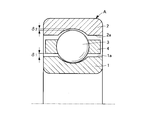
- the rolling bearing of the embodiment holds a plurality of rolling elements (balls) 3 rotatably between an outer diameter surface 1 a of an inner ring 1 and an inner diameter surface 2 a of an outer ring 2, which will be described later.
- the rolling element 3 is made of ceramics
- the cage 4 is made of a resin material mainly composed of polytetrafluoroethylene
- the clearance ratio C (Rolling element diameter ⁇ guide).
- This is a rolling bearing for a cryogenic environment having a predetermined gap ratio C of 2.5 to 4 represented by the equation of gap ⁇ 1 ) / (inner ring outer diameter ⁇ radial inner gap ⁇ 2 ).
- the guide gap ⁇ 1 in the above formula is the gap (mm) between the inner ring outer diameter surface 1a and the inner diameter surface of the cage 4 at room temperature (20 ° C.), and the radial inner gap ⁇ 2 is at a very low temperature ( ⁇ The clearance (mm) between the outer ring inner surface 2a and the surface of the rolling element 3 at 196 ° C.).
- the inner ring 1 and the outer ring 2 described above are martensitic stainless steel or high-speed tool steel, and these are steel materials that are hard and have excellent wear resistance.
- martensitic stainless steel include SUS403, SUS420, and SUS440C.
- high-speed tool steel include American Steel Association AISI standard high-speed steel M50, Japanese Industrial Standard SKH4, and the like.
- diamond-like carbon having a Vickers hardness (Hv) of about 1000 to 4000 is provided on the surface side of the base material of the inner ring 1 and the outer ring 2, at least on the raceway surface (or also called the rolling surface).
- Hv Vickers hardness
- the rolling element 3 used in this invention is made of ceramics, and the type of ceramics is not particularly limited, but silicon nitride-based, zirconia-based, silicon carbide-based, and alumina-based ceramics can be prepared.
- rolling elements made of silicon nitride ceramics are preferable because they are particularly hard and excellent in wear resistance.
- the cage 4 used in the present invention includes polytetrafluoroethylene (PTFE), polypropylene, polystyrene, acrylonitrile styrene, acrylonitrile-butadiene-styrene plastic, polytrifluoroethylene chloride, polycarbonate, polymethyl methacrylate, polyamide 6, polyamide 66, A resin material mainly composed of polysulfone, polyphenylene oxide, phenol resin, epoxy resin, unsaturated polyester resin, urea resin, melamine resin or the like is used. In consideration of particularly good lubricity, one made of polytetrafluoroethylene (for example, NTN Corporation: BEAREE FL3000) is employed. This is because such a resin material transfers a solid lubricant to the surface of the rolling element even at an extremely low temperature and exhibits good and stable solid lubricity.
- PTFE polytetrafluoroethylene
- polypropylene polystyrene
- polystyrene acrylon
- the type (or form) of the cage 4 is not particularly limited, and is a well-known annular type, for example, a crown type type, or a circular shape in which pocket holes are formed at equal intervals in the circumferential direction of a cylinder or a ring.
- the type (model) of the rolling bearing is not particularly limited as long as it has a radial internal clearance.
- it is a rolling bearing for cryogenic environments such as a deep groove ball bearing or a cylindrical roller bearing. There may be.
- the rolling bearing for the cryogenic environment of the present invention may be a rolling bearing for a pump for a liquefied gas, the rolling bearing used for supporting or driving a satellite antenna. Also good.
- the rolling bearing When the application of the rolling bearing is a pump for liquefied gas, it may be a submerged pump for liquefied natural gas (LNG), but in that case, since the rolling bearing directly contacts the cryogenic LNG, the inner and outer rings and rolling elements of the present invention have a remarkable effect of becoming a rolling bearing for a cryogenic environment excellent in durability that withstands long-term use and does not deteriorate wear resistance and lubricity.
- LNG liquefied natural gas
- the submerged pump for liquefied natural gas exhibits airtightness in a pot (pressure vessel) 8 by immersing the entire pump in the liquid.
- a pot pressure vessel 8 by immersing the entire pump in the liquid.
- the pot 8 is opened with the LNG suction port 11 facing outward, and has a discharge port 12 leading to an external pipe (not shown).
- the motor 13 mounted in the pot 8 supports the upper and lower sides of the motor shaft 10 rotated by an external power source with the ball bearing A of the embodiment shown in FIG.
- a plurality of stages of impellers 14 are attached to the rotating pump shaft 9.
- the flow path in the illustrated apparatus of the pump is such that the LNG flowing from the suction port 11 into the pot 8 along the inner surface of the pot 8 by the impeller 14 that rotates integrally with the pump shaft 9 by the driven motor 13. It flows downward and flows into the discharge port 12 from the pipe 16 inside the cylindrical inner wall 15 arranged around the impeller 14, and is sucked in from the lowermost portion of the multistage impeller 14.
- the other pipe 17 inside the cylindrical inner wall 15 flows in the motor 13 as a lubricating liquid, lubricates and cools the ball bearing A, joins the downward flow along the inner side surface of the pot 8, and again multistage. Is sucked from the tip of the impeller 14.
- the ball bearing A used in this way holds the rolling element with a resin cage, the rolling element is a ceramic rolling element, and the cage is a resin material mainly composed of polytetrafluoroethylene. Since the predetermined gap ratio C expressed by the following formula is 2.5 to 4, the guide gap for supplying the solid lubricant by contact from the cage at a very low temperature and the radial internal gap Dimensional change is suppressed, and rotation failure can be reliably prevented. As a result, the wear of the raceway surface and rolling elements becomes extremely low, and it can withstand long-term use even in a cryogenic environment such as a space environment or a cryogenic environment that is lubricated and cooled by a liquefied gas such as LNG. It becomes a rolling bearing for a cryogenic environment where the wear resistance and lubricity do not deteriorate with time and the rotational state is stable.
- a rolling bearing for a cryogenic environment is shown as an embodiment of the present invention.
- an outer ring having a predetermined inner diameter is set so that the clearance ratio C represented by the above formula is 2.5 to 4.
- the invention may be an invention of a method for adjusting a bearing internal clearance of a rolling bearing for a cryogenic environment characterized by selecting and adjusting the radial internal clearance.
- Examples 1 to 3 Made by BEAREE FL made by NTN Precision Resin Co., Ltd., which has martensitic stainless steel (SUS440C) inner and outer rings, with silicon nitride ceramic balls as rolling elements and polytetrafluoroethylene (PTFE) as the main component
- SUS440C martensitic stainless steel
- PTFE polytetrafluoroethylene
- Table 1 shows the model numbers of various rolling (ball) bearings manufactured by NTN, the inner ring inner diameter ⁇ d (mm) and the outer ring outer diameter ⁇ D (mm), and the ball diameter (mm) at room temperature (20 ° C.).
- Comparative Examples 1 and 2 in which the value of the gap ratio C C 1 / C 2 is less than 2.5 is 1/2 or less of the appropriate guide gap (Comparative Example 1).
- the value of the ball diameter ⁇ guide gap is a negative value, indicating a pressure contact state (Comparative Example 2), and the cage comes into contact with the inner ring and is in a state of poor rotation or heat generation.
- Comparative Example 3 in which the gap ratio C is 4.5 the cage is loosely moved inside the rolling bearing, causing a so-called rattling and vibration, resulting in poor rotation.
- each of Examples 1 to 3 in which the gap ratio C is 2.7 to 3.6 has a smooth rotation state, can withstand long-term use even in an extremely low temperature environment, and is resistant to wear over time. It was in a stable rotational state without lowering the lubricity.
Landscapes
- Engineering & Computer Science (AREA)
- General Engineering & Computer Science (AREA)
- Mechanical Engineering (AREA)
- Ceramic Engineering (AREA)
- Rolling Contact Bearings (AREA)
- Structures Of Non-Positive Displacement Pumps (AREA)
Abstract
L'invention concerne un roulement à rouleaux pour des environnements à températures extrêmement basses, le roulement à rouleaux étant conçu de sorte qu'une bague de roulement intérieure (1) et une bague de roulement extérieure (2) comprennent un acier inoxydable à base de martensite ou un acier à coupe rapide, un élément roulant (3) est constitué d'une céramique, un dispositif de retenue (4) comprend un matériau de résine, et le rapport du jeu (C) à la température ambiante (20 °C) est de 2,5-4. Le rapport du jeu C est obtenu en divisant le produit du diamètre de l'élément roulant et le jeu permettant le déplacement dans la cage par le produit du diamètre extérieur de la bague intérieure et du jeu intérieur radial. Le jeu permettant le déplacement dans la cage est la largeur du jeu entre la surface de diamètre extérieur de la bague intérieure et la surface de diamètre intérieur du dispositif de retenue, et le jeu intérieur radial est la largeur du jeu entre la surface d'orbite de la bague extérieure et la surface de l'élément roulant. Des variations dans les dimensions du jeu intérieur radial et du jeu permettant le déplacement dans la cage pour amener un lubrifiant solide par contact à partir du dispositif de retenue à des températures extrêmement basses sont supprimées, et une défaillance de rotation est empêchée de manière fiable.
Applications Claiming Priority (2)
| Application Number | Priority Date | Filing Date | Title |
|---|---|---|---|
| JP2016034422A JP2017150593A (ja) | 2016-02-25 | 2016-02-25 | 極低温環境用転がり軸受 |
| JP2016-034422 | 2016-02-25 |
Publications (1)
| Publication Number | Publication Date |
|---|---|
| WO2017146047A1 true WO2017146047A1 (fr) | 2017-08-31 |
Family
ID=59685269
Family Applications (1)
| Application Number | Title | Priority Date | Filing Date |
|---|---|---|---|
| PCT/JP2017/006378 Ceased WO2017146047A1 (fr) | 2016-02-25 | 2017-02-21 | Roulement à rouleaux pour environnements à températures extrêmement basses |
Country Status (2)
| Country | Link |
|---|---|
| JP (1) | JP2017150593A (fr) |
| WO (1) | WO2017146047A1 (fr) |
Cited By (1)
| Publication number | Priority date | Publication date | Assignee | Title |
|---|---|---|---|---|
| CN113614398A (zh) * | 2019-03-22 | 2021-11-05 | Ntn株式会社 | 深沟球轴承 |
Families Citing this family (4)
| Publication number | Priority date | Publication date | Assignee | Title |
|---|---|---|---|---|
| CH714176A1 (de) * | 2017-09-19 | 2019-03-29 | Fives Cryomec Ag | Zentrifugalpumpe für kryogene Fördermedien. |
| CN109557799B (zh) * | 2017-09-25 | 2022-08-05 | 劳力士有限公司 | 钟表轴承 |
| JP2021191948A (ja) * | 2018-09-04 | 2021-12-16 | 日立ジョンソンコントロールズ空調株式会社 | 電動圧縮機及びこれを用いた冷凍空調装置 |
| JP2025134136A (ja) * | 2024-03-04 | 2025-09-17 | Ntn株式会社 | 玉軸受 |
Citations (3)
| Publication number | Priority date | Publication date | Assignee | Title |
|---|---|---|---|---|
| JP2006224816A (ja) * | 2005-02-17 | 2006-08-31 | Nsk Ltd | コラムアシスト式電動パワーステアリング装置 |
| JP2012149702A (ja) * | 2011-01-19 | 2012-08-09 | Nsk Ltd | 転がり軸受 |
| JP2015096768A (ja) * | 2013-10-09 | 2015-05-21 | 日本精工株式会社 | 保持器及び転がり軸受、並びに液化ガス用ポンプ |
-
2016
- 2016-02-25 JP JP2016034422A patent/JP2017150593A/ja active Pending
-
2017
- 2017-02-21 WO PCT/JP2017/006378 patent/WO2017146047A1/fr not_active Ceased
Patent Citations (3)
| Publication number | Priority date | Publication date | Assignee | Title |
|---|---|---|---|---|
| JP2006224816A (ja) * | 2005-02-17 | 2006-08-31 | Nsk Ltd | コラムアシスト式電動パワーステアリング装置 |
| JP2012149702A (ja) * | 2011-01-19 | 2012-08-09 | Nsk Ltd | 転がり軸受 |
| JP2015096768A (ja) * | 2013-10-09 | 2015-05-21 | 日本精工株式会社 | 保持器及び転がり軸受、並びに液化ガス用ポンプ |
Cited By (1)
| Publication number | Priority date | Publication date | Assignee | Title |
|---|---|---|---|---|
| CN113614398A (zh) * | 2019-03-22 | 2021-11-05 | Ntn株式会社 | 深沟球轴承 |
Also Published As
| Publication number | Publication date |
|---|---|
| JP2017150593A (ja) | 2017-08-31 |
Similar Documents
| Publication | Publication Date | Title |
|---|---|---|
| US8746982B2 (en) | Rolling bearing device | |
| JP2017150593A (ja) | 極低温環境用転がり軸受 | |
| CN203009563U (zh) | 滚动轴承及液化气用泵装置 | |
| WO2017082249A1 (fr) | Palier à roulement pour environnement à températures extrêmement basses | |
| CN202851630U (zh) | 角接触球轴承及液化气用泵装置 | |
| JP2015086940A (ja) | 転がり軸受 | |
| KR100374388B1 (ko) | 구름베어링 | |
| WO2016140225A1 (fr) | Palier à roulement pour une utilisation dans un environnement à températures extrêmement basses | |
| WO2016140224A1 (fr) | Palier à roulement pour une utilisation dans un environnement à températures extrêmement basses | |
| JP2013072439A (ja) | 転がり軸受 | |
| WO2017043445A1 (fr) | Palier à roulement pour environnements à température extrêmement basse | |
| JP2025134136A (ja) | 玉軸受 | |
| WO2017082205A1 (fr) | Roulement à rouleaux destiné à des environnements à très basse température | |
| US11773899B2 (en) | Rolling bearing | |
| JP2017172678A (ja) | 極低温環境用転がり軸受 | |
| WO2017078151A1 (fr) | Palier à roulement destiné à être utilisé dans un environnement à température extrêmement basse | |
| JP2006046373A (ja) | 転がり軸受 | |
| JP2015045397A (ja) | 転がり軸受 | |
| JP2014101985A (ja) | 転がり軸受及び液化ガス用ポンプ装置 | |
| JP5985684B2 (ja) | スラスト軸受及びその保持器 | |
| JP2017172663A (ja) | 転がり軸受用保持器及び転がり軸受 | |
| JP2017166627A (ja) | アンギュラ玉軸受 | |
| WO2017098886A1 (fr) | Roulement | |
| KR20220144266A (ko) | 극저온 액화 가스의 유동 경로 및 유량 제어 기능을 갖는 케이지를 구비한 극저온 볼 베어링 | |
| KR20230048869A (ko) | 극저온 회전 베어링 |
Legal Events
| Date | Code | Title | Description |
|---|---|---|---|
| NENP | Non-entry into the national phase |
Ref country code: DE |
|
| 121 | Ep: the epo has been informed by wipo that ep was designated in this application |
Ref document number: 17756485 Country of ref document: EP Kind code of ref document: A1 |
|
| 122 | Ep: pct application non-entry in european phase |
Ref document number: 17756485 Country of ref document: EP Kind code of ref document: A1 |