WO2017146143A1 - Insert, outil de coupe et procédé de fabrication de pièces de fabrication coupée - Google Patents
Insert, outil de coupe et procédé de fabrication de pièces de fabrication coupée Download PDFInfo
- Publication number
- WO2017146143A1 WO2017146143A1 PCT/JP2017/006821 JP2017006821W WO2017146143A1 WO 2017146143 A1 WO2017146143 A1 WO 2017146143A1 JP 2017006821 W JP2017006821 W JP 2017006821W WO 2017146143 A1 WO2017146143 A1 WO 2017146143A1
- Authority
- WO
- WIPO (PCT)
- Prior art keywords
- cutting edge
- region
- cutting
- inclination angle
- insert
- Prior art date
- Legal status (The legal status is an assumption and is not a legal conclusion. Google has not performed a legal analysis and makes no representation as to the accuracy of the status listed.)
- Ceased
Links
Images









Classifications
-
- B—PERFORMING OPERATIONS; TRANSPORTING
- B23—MACHINE TOOLS; METAL-WORKING NOT OTHERWISE PROVIDED FOR
- B23B—TURNING; BORING
- B23B27/00—Tools for turning or boring machines; Tools of a similar kind in general; Accessories therefor
- B23B27/14—Cutting tools of which the bits or tips or cutting inserts are of special material
- B23B27/141—Specially shaped plate-like cutting inserts, i.e. length greater or equal to width, width greater than or equal to thickness
- B23B27/145—Specially shaped plate-like cutting inserts, i.e. length greater or equal to width, width greater than or equal to thickness characterised by having a special shape
-
- B—PERFORMING OPERATIONS; TRANSPORTING
- B23—MACHINE TOOLS; METAL-WORKING NOT OTHERWISE PROVIDED FOR
- B23B—TURNING; BORING
- B23B2200/00—Details of cutting inserts
- B23B2200/04—Overall shape
- B23B2200/0447—Parallelogram
-
- B—PERFORMING OPERATIONS; TRANSPORTING
- B23—MACHINE TOOLS; METAL-WORKING NOT OTHERWISE PROVIDED FOR
- B23B—TURNING; BORING
- B23B2200/00—Details of cutting inserts
- B23B2200/04—Overall shape
- B23B2200/0447—Parallelogram
- B23B2200/0452—Parallelogram rounded
-
- B—PERFORMING OPERATIONS; TRANSPORTING
- B23—MACHINE TOOLS; METAL-WORKING NOT OTHERWISE PROVIDED FOR
- B23B—TURNING; BORING
- B23B2200/00—Details of cutting inserts
- B23B2200/12—Side or flank surfaces
- B23B2200/125—Side or flank surfaces discontinuous
-
- B—PERFORMING OPERATIONS; TRANSPORTING
- B23—MACHINE TOOLS; METAL-WORKING NOT OTHERWISE PROVIDED FOR
- B23B—TURNING; BORING
- B23B2200/00—Details of cutting inserts
- B23B2200/20—Top or side views of the cutting edge
- B23B2200/201—Details of the nose radius and immediately surrounding area
-
- B—PERFORMING OPERATIONS; TRANSPORTING
- B23—MACHINE TOOLS; METAL-WORKING NOT OTHERWISE PROVIDED FOR
- B23B—TURNING; BORING
- B23B2200/00—Details of cutting inserts
- B23B2200/24—Cross section of the cutting edge
- B23B2200/245—Cross section of the cutting edge rounded
-
- B—PERFORMING OPERATIONS; TRANSPORTING
- B23—MACHINE TOOLS; METAL-WORKING NOT OTHERWISE PROVIDED FOR
- B23B—TURNING; BORING
- B23B2200/00—Details of cutting inserts
- B23B2200/28—Angles
-
- B—PERFORMING OPERATIONS; TRANSPORTING
- B23—MACHINE TOOLS; METAL-WORKING NOT OTHERWISE PROVIDED FOR
- B23B—TURNING; BORING
- B23B2224/00—Materials of tools or workpieces composed of a compound including a metal
- B23B2224/04—Aluminium oxide
-
- B—PERFORMING OPERATIONS; TRANSPORTING
- B23—MACHINE TOOLS; METAL-WORKING NOT OTHERWISE PROVIDED FOR
- B23B—TURNING; BORING
- B23B2224/00—Materials of tools or workpieces composed of a compound including a metal
- B23B2224/20—Tantalum carbide
-
- B—PERFORMING OPERATIONS; TRANSPORTING
- B23—MACHINE TOOLS; METAL-WORKING NOT OTHERWISE PROVIDED FOR
- B23B—TURNING; BORING
- B23B2224/00—Materials of tools or workpieces composed of a compound including a metal
- B23B2224/32—Titanium carbide nitride (TiCN)
-
- B—PERFORMING OPERATIONS; TRANSPORTING
- B23—MACHINE TOOLS; METAL-WORKING NOT OTHERWISE PROVIDED FOR
- B23B—TURNING; BORING
- B23B2224/00—Materials of tools or workpieces composed of a compound including a metal
- B23B2224/36—Titanium nitride
-
- B—PERFORMING OPERATIONS; TRANSPORTING
- B23—MACHINE TOOLS; METAL-WORKING NOT OTHERWISE PROVIDED FOR
- B23B—TURNING; BORING
- B23B2228/00—Properties of materials of tools or workpieces, materials of tools or workpieces applied in a specific manner
- B23B2228/04—Properties of materials of tools or workpieces, materials of tools or workpieces applied in a specific manner applied by chemical vapour deposition [CVD]
-
- B—PERFORMING OPERATIONS; TRANSPORTING
- B23—MACHINE TOOLS; METAL-WORKING NOT OTHERWISE PROVIDED FOR
- B23B—TURNING; BORING
- B23B2228/00—Properties of materials of tools or workpieces, materials of tools or workpieces applied in a specific manner
- B23B2228/08—Properties of materials of tools or workpieces, materials of tools or workpieces applied in a specific manner applied by physical vapour deposition [PVD]
-
- B—PERFORMING OPERATIONS; TRANSPORTING
- B23—MACHINE TOOLS; METAL-WORKING NOT OTHERWISE PROVIDED FOR
- B23B—TURNING; BORING
- B23B27/00—Tools for turning or boring machines; Tools of a similar kind in general; Accessories therefor
- B23B27/14—Cutting tools of which the bits or tips or cutting inserts are of special material
- B23B27/16—Cutting tools of which the bits or tips or cutting inserts are of special material with exchangeable cutting bits or cutting inserts, e.g. able to be clamped
- B23B27/1603—Cutting tools of which the bits or tips or cutting inserts are of special material with exchangeable cutting bits or cutting inserts, e.g. able to be clamped with specially shaped plate-like exchangeable cutting inserts, e.g. chip-breaking groove
Definitions
- This aspect relates to a method for manufacturing an insert, a cutting tool, and a cut workpiece.
- the insert (insert) described in Patent Document 1 is known as an insert used for cutting.
- the chip described in Patent Document 1 has a nose cutting edge, a wiping edge, and a linear cutting edge.
- the chip disclosed in Patent Document 1 is a so-called negative type chip in which the angle formed by the flank and the rake face is 90 °. In such a negative type insert, the insert may come into contact with the work material, which may affect the smoothness of the processed surface of the work material.
- An insert includes a first surface having corners, a second surface, a third surface positioned between the first surface and the second surface, and the first surface and the third surface. It has a cutting edge located in at least a part of the intersecting portion, and a central axis passing through the center of the first surface and the center of the second surface.
- the cutting edge has a first cutting edge located at the corner and a second cutting edge adjacent to the first cutting edge.
- the third surface includes a first portion located along the first cutting edge and a second portion located along the second cutting edge.
- the second portion includes a first region having a first end and a second end, and a second region having a third end and a fourth end.
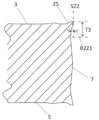
- the inclination angle 212 at the second end is larger than the inclination angle ⁇ 211 at the first end, and the inclination angle ⁇ 222 at the fourth end is smaller than the inclination angle ⁇ 221 at the third end.
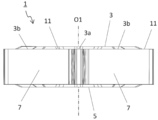
- FIG. 1 It is a perspective view which shows the insert of one Embodiment. It is a top view of the insert shown in FIG. It is the side view seen from the B1 direction in the insert shown in FIG. It is the side view seen from the B2 direction in the insert shown in FIG. It is an enlarged view in area
- a cutting insert (hereinafter also referred to as an insert) according to an embodiment of the present disclosure and a cutting tool including the same will be described in detail with reference to the drawings.
- each drawing referred to below shows only the main members necessary for explaining the embodiment in a simplified manner for convenience of explanation. Therefore, the insert and the cutting tool of the present disclosure may include arbitrary components that are not shown in the respective drawings to be referred to.
- the dimension of the member in each figure does not faithfully represent the dimension of the actual component member, the dimension ratio of each member, or the like.
- the insert 1 of the present embodiment is used as an insert in a cutting edge exchange type turning tool used for outer diameter machining or the like.
- the insert 1 of this embodiment includes a first surface (hereinafter also referred to as an upper surface) 3, a second surface (hereinafter also referred to as a lower surface) 5, and a third surface (hereinafter also referred to as a side surface). 7, a through hole 9, and a cutting edge 11.
- the insert 1 has a generally square plate shape.
- the upper surface 3 is a surface that at least partially functions as a rake surface. As shown in FIG. 2, the upper surface 3 has a quadrangular shape and includes at least one corner 3a and a plurality of sides 3b. The four corners are constituted by two acute angles and two obtuse angles. In FIG. 2, two acute angles are “corner portion 3 a”, and “side portion 3 b” extends from this corner portion 3 a.
- the upper surface 3 in the present embodiment is axisymmetric with respect to a virtual straight line connecting the two corners 3a, but is not particularly limited to such a configuration.
- the corners 3a on the upper surface 3 are not strict corners as shown in FIG. 2 and the like, but are rounded. Further, the side 3b on the upper surface 3 is not strictly limited to a linear shape, and may have a curved region.
- the lower surface 5 is a surface located on the side opposite to the upper surface 3 and functions as a seating surface when the insert 1 is attached to the holder.
- the lower surface 5 has a polygonal shape, specifically a quadrangular shape, like the upper surface 3.
- the lower surface 5 has the same shape as the upper surface 3, and the upper surface 3 and the lower surface 5 overlap when viewed from above.
- the lower surface 5 may be slightly smaller than the upper surface 3. In this case, the lower surface 5 is similar to the upper surface 3.
- the shape of the upper surface 3 and the lower surface 5 is not limited to the above form.
- the shape of the upper surface 3 and the lower surface 5 when viewed from above is a square shape.
- the shape of the upper surface 3 and the lower surface 5 when viewed from above is triangular, pentagonal or It may be hexagonal.
- the shapes of the upper surface 3 and the lower surface 5 may be a rectangle, a parallelogram, a rhombus, or a square.
- the side surface 7 is a surface that at least partially functions as a flank. As shown in FIGS. 1 and 3, etc., it is located between the upper surface 3 and the lower surface 5, and is connected to the upper surface 3 and the lower surface 5, respectively. More specifically, the side surface 7 has a substantially flat area (below the side part 3b) and a curved area (below the corner part 3a) positioned between the flat areas.
- Examples of the material of the insert 1 include cemented carbide or cermet.
- Examples of the composition of the cemented carbide include WC—Co, WC—TiC—Co, and WC—TiC—TaC—Co.
- WC—Co is produced by adding cobalt (Co) powder to tungsten carbide (WC) and sintering.
- WC—TiC—Co is obtained by adding titanium carbide (TiC) to WC—Co.
- WC—TiC—TaC—Co is obtained by adding tantalum carbide (TaC) to WC—TiC—Co.
- cermet is a sintered composite material in which a metal is combined with a ceramic component.
- examples of the cermet include those containing a titanium compound such as titanium carbide (TiC) or titanium nitride (TiN) as a main component.
- the surface of the insert 1 may be coated with a film using a chemical vapor deposition (CVD) method or a physical vapor deposition (PVD) method.
- CVD chemical vapor deposition
- PVD physical vapor deposition
- the composition of the coating include titanium carbide (TiC), titanium nitride (TiN), titanium carbonitride (TiCN), and alumina (Al 2 O 3 ).
- the through-hole 9 penetrates from the center of the upper surface 3 to the center of the lower surface 5.
- the through hole 9 is provided to fix the insert 1 to the holder of the cutting tool.
- the through-hole 9 is provided to insert a screw when the insert 1 is fixed to the holder of the cutting tool with a screw.
- the method for fixing the insert 1 to the holder is not limited to the above-described screw fixing.
- the through hole 9 is also used when the insert 1 is fixed to the holder with a clamper or a lever. In this case, the through hole 9 may not penetrate to the lower surface 9.
- the axis of the through hole 9 coincides with the center axis O1 of the insert 1 passing through the center of the upper surface 3 and the center of the lower surface 5.
- the direction of the axis of the through hole 9 is orthogonal to the upper surface 3 and the lower surface 5.
- the through hole 9 is not limited to a configuration that is located from the center of the upper surface 3 to the center of the lower surface 5. For example, you may locate over the area
- the maximum width of the upper surface 3 when viewed from above is, for example, 6 to 25 mm.
- the maximum width of the upper surface 3 in a top view is the distance between the two corners 3a according to FIG.
- the height from the lower surface 5 to the upper surface 3 is, for example, 1 to 10 mm.
- the height from the lower surface 5 to the upper surface 3 means a length in a direction parallel to the central axis O ⁇ b> 1 between the upper end of the upper surface 3 and the lower end of the lower surface 5.
- the cutting edge 11 is used for cutting a work material, and as shown in FIG. 1 and FIG. That is, the cutting edge 11 is at least a part of the corner 3a and the side 3b connected to the corner 3a. In addition, the cutting blade 11 may be located over the whole side part 3b.
- a portion where the upper surface 3 and the side surface 7 intersect and where the cutting edge 11 is formed may be subjected to so-called honing.
- honing the portion where the upper surface 3 and the side surface 7 intersect with each other is not a strict line shape due to the intersection of the two surfaces, but a slightly curved surface shape.
- the cutting edge 11 has a first cutting edge 13 and a second cutting edge 15 in order from the corner 3a as shown in FIGS.
- the first cutting edge 13 is located at the corner 3a of the upper surface 3 and can be used as a so-called corner cutting edge. As described above, the corner 3a on the top surface 3 has a rounded shape when viewed from above. Therefore, the first cutting edge 13 has a rounded shape when viewed from above. Specifically, the first cutting edge 13 has an arc shape protruding outward when viewed from above.
- the second cutting edge 15 is located from the corner 3a to the side 3b of the upper surface 3, and can be used as a so-called wiper blade or wiper blade.
- the second cutting edge 15 is adjacent to the first cutting edge 13. More specifically, the corner 3 a side end of the second cutting edge 15 is connected to the first cutting edge 13.
- the second cutting edge 15 has a convex curve shape that slightly protrudes outward in a top view. In the insert 1 of the present embodiment, two side portions 3b extend from one corner portion 3a. For this reason, there are two second cutting edges 15 for one first cutting edge 13.
- the side surface 7 has a first portion 19 and a second portion 21 as shown in FIG.
- the first portion 19 is located along the first cutting edge 13.
- the second portion 21 is located along the second cutting edge 15. Since the 1st part 19 and the 2nd part 21 are located along the cutting blade 11, at least one part functions as what is called a flank.
- the first part 19 and the second part may not be located from the upper surface 3 to the lower surface 5.
- the second portion 21 has a first region 21a and a second region 21b as shown in FIG.
- the first region 21 a is located on the first portion 19 side and the upper surface 3 side in the second portion 21.
- the second region 21 b is located on the side farther from the first portion 19 than the first region 21 a in the second portion 21 and on the upper surface 3 side.
- the first region 21 a has a first end T ⁇ b> 1 located near the first portion 19 and a second end T ⁇ b> 2 located away from the first portion 19.
- the second region 21b has a third end T3 located near the first region 21a and a fourth end T4 located away from the first region 21a.
- the second region 21b in the present embodiment is adjacent to a third surface 23 described later.
- the first region 21a is inclined toward the central axis O1 as the distance from the second cutting edge 15 increases.
- the second region 21 b is inclined toward the central axis O ⁇ b> 1 as the distance from the second cutting edge 15 increases.
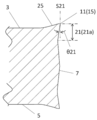
- the first region 21a and the second region 21b of the second portion 21 are, as shown in FIGS. 9 and 10, an imaginary straight line S21 or S22 parallel to the central axis O1 in contact with the second cutting edge 15. It is inclined with respect to. Therefore, the second portion 21 has a shape that is recessed inward from the virtual straight line S21 or the virtual straight line S22 in a cross section orthogonal to the second cutting edge 15.
- the inclination angle ⁇ 212 at the second end T2 is larger than the inclination angle ⁇ 211 at the first end T1, and the inclination angle ⁇ 222 at the fourth end T4 is smaller than the inclination angle ⁇ 221 at the third end T3.
- the inclination angle at each end satisfies such a relationship.
- the center part (2nd end part T2 and 3rd end part T3) which plays a main role as a wiping edge rather than both ends (1st end part T1 and 4th end part T4).
- the clearance angle can be set large. Therefore, in the second portion 21 along the second cutting edge 15, a space is secured between the second portion 21 and the work material in the central portion that functions as a wiping edge while ensuring strength at both end portions. Can be secured. Therefore, a good finished surface can be obtained while having good strength.
- the inclination angle at each end can be defined as follows, as shown in FIGS. 16 to 19, for example.
- the definition of the inclination angle ⁇ 211 at the first end T1 will be described as an example.
- the inclination of the first region 21a with respect to a virtual straight line S21 parallel to the central axis O1 in contact with the end corresponding to the first end T1 of the first region 21a among the both ends of the second cutting edge 15 The angle is ⁇ 211.
- the inclination angle ⁇ 211 of the first region 21a is a so-called clearance angle of the first region 21a.
- the inclination angle ⁇ 21 of the first region 21a increases as the distance from the first portion 19 increases, and the inclination angle ⁇ 22 of the second region 21b decreases as the distance from the first portion 19 increases. It may be.
- the inclination angle ⁇ 21 and the inclination angle ⁇ 22 can be defined as follows, similarly to the inclination angles ⁇ 211, ⁇ 212, ⁇ 221, and ⁇ 222 described above.
- the inclination angle of the second portion 21 with respect to the virtual straight line S21 parallel to the central axis O1 in contact with the second cutting edge 15 can be ⁇ 21.
- the inclination angle of the second portion 21 with respect to the virtual straight line S22 parallel to the central axis O1 in contact with the second cutting edge 15 can be set to ⁇ 22.
- the increasing rate of the inclination angle ⁇ 21 of the first region 21a may be larger than the decreasing rate of the inclination angle ⁇ 22 of the second region 21b.
- the thickness of the insert 1 is easily secured in a portion closer to the first cutting edge 13 that functions as a corner cutting edge, and the wear resistance is easily improved.
- the inclination angle ⁇ 1 of the first part 19 when the inclination angle of the first part 19 with respect to the virtual straight line S1 parallel to the central axis O1 in contact with the first cutting edge 13 is ⁇ 1, the inclination angle ⁇ 1 of the first part 19 May be 0 °.
- the thickness of the insert 1 of the part located under the 1st cutting blade 13 which functions as a corner cutting blade is ensured. Therefore, the strength of the insert 1 is increased.
- the inclination angle ⁇ 1 of the first portion 19 is 0 °, as shown in FIG. 8, in the cross section along the bisector (so-called corner bisector) of the corner 3a, the first portion 19 is shown in a straight line.
- the first portion 19 may be located continuously from the upper surface 3 to the lower surface 5 as shown in FIG. In such a case, strength can be ensured.
- the cutting edge 11 may further include a third cutting edge 17 adjacent to the second cutting edge 19.
- the third cutting edge 17 is located on the side 3b of the upper surface 3 and is a so-called main cutting edge. As shown in FIG. 5, like the second cutting edge 15, two third cutting edges 17 may exist for one first cutting edge 13.
- the third cutting edge 17 may be linear when viewed from above, and the first cutting edge 13 and the second cutting edge 15 may be arcuate when viewed from above.
- the radius of curvature R2 of the arc of the second cutting edge 15 may be larger than the radius of curvature R1 of the arc of the first cutting edge 13.
- the durability of the third cutting edge 17 to which a relatively large cutting load is applied when used as the main cutting edge can be enhanced, and the function of the second cutting edge 15 as a wiping edge Can be increased.
- the function of the second cutting edge 15 as the wiping edge is enhanced because the arrangement angle of the second cutting edge 15 with respect to the work material may slightly shift due to a manufacturing error or an attachment error.
- the 1st cutting blade 13, the 2nd cutting blade 15, and the 3rd cutting blade 17 are not limited to said structure.
- the second cutting edge 15 may be linear in a top view, and the radius of curvature R2 of the arc of the second cutting edge 15 may be smaller than the radius of curvature R1 of the arc of the first cutting edge 13.
- the third cutting edge 17 may be curved when viewed from above.
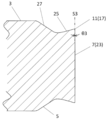
- the side surface 7 may further include a third portion 23 positioned along the third cutting edge 17.
- the inclination angle of the third portion 23 with respect to the virtual straight line S3 parallel to the central axis O1 in contact with the third cutting edge 17 is ⁇ 3
- the inclination angle ⁇ 3 of the third portion 23 is constant. There may be. According to such a configuration, since the inclination angle ⁇ 3 does not change as the distance from the second portion 21 increases, the durability of the third cutting edge 17 that functions as the main cutting edge is enhanced.
- the inclination angle ⁇ 3 of the third portion 23 may be 0 °.
- the third surface 23 having an inclination angle ⁇ 3 of 0 ° may be located continuously from the upper surface 3 to the lower surface 5. According to such a configuration, the thickness of the insert 1 in the portion located below the third cutting edge 17 is ensured, so that the strength of the insert 1 is further increased.
- the inclination angle ⁇ 3 is 0 °
- the third portion 23 is shown in a straight line in the cross section orthogonal to the third cutting edge 17, as shown in FIG.
- the second portion 21 may have a third region 21c in addition to the first region 21a and the second region 21b.
- the third region 21c is a region located between the first region 21a and the second region 21b.
- the inclination angle ⁇ 23 with respect to the central axis O1 of the third region 21c may be constant. More specifically, in the third region 21c, the inclination angle ⁇ 23 may be constant from the end adjacent to the first region 21a to the end adjacent to the second region 21b.
- the inclination angle of the second portion 21 increases as the distance from the first portion 19 increases in the first region 21a (inclination angle ⁇ 21), and is constant in the third region 21c (inclination angle). ⁇ 23), the second region 21b becomes smaller as the distance from the third region 21c increases (inclination angle ⁇ 22). Therefore, heat generated at the time of cutting is easily released to the outside in a wide range of the second portion 21 positioned along the second cutting edge 15 that functions as a wiping edge. As a result, the precision of the finished surface is increased and the durability of the insert 1 is improved.
- the second portion 21 has a region (first region 21 a and second region 21 b) that inclines inward once away from the second cutting edge 15, And a region that is located below the region and is inclined outward as it is away from the second cutting edge 15.
- first region 21 a and second region 21 b that inclines inward once away from the second cutting edge 15
- the upper surface 3 may have the inclined surface 25 which inclines below as it leaves
- the inclined surface 25 functions as a so-called rake face.
- the inclined surface 25 is inclined downward as it is away from the cutting blade 11 in order to allow chips to flow smoothly.
- the inclined surface 25 is inclined so as to approach the lower surface 5 as it approaches the through hole 9.
- the upper surface 3 is a rising surface located on the inner side of the upper surface 3 (on the through hole 9 side) than the inclined surface 25 in addition to the inclined surface 25 described above. 27 may be further included.
- the rising surface 27 plays a role of curling the chips flowing on the inclined surface 25 to make the chips spiral. Therefore, the rising surface 27 is located on the inner side of the inclined surface 25 and is inclined upward as the distance from the inclined surface 25 increases.
- the insert of one embodiment was explained using a drawing, the insert of this indication is not limited to the composition of the above-mentioned embodiment, and is the range which does not deviate from the gist of this indication, and is detailed in particular. This includes modifications that have not been made.
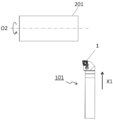
- the cutting tool 101 of this embodiment includes a holder 105 having a pocket 103 on the tip side and the insert 1 positioned in the pocket 103 as shown in FIG.
- the insert 1 is mounted so that a portion used as the cutting blade 11 at a portion where the upper surface 3 and the side surface 7 intersect protrude from the tip of the holder 105.
- the holder 105 is an elongated rod-like body.
- One pocket 103 is provided on the tip side of the holder 105.
- the pocket 103 is a portion to which the insert 1 is attached, and is open to the front end surface of the holder 105. At this time, since the pocket 103 is also open to the side surface of the holder 105, the insert 1 can be easily mounted.
- the pocket 103 has a seating surface (not shown) that contacts the lower surface 5 of the insert 1 and a restraining side surface (not shown) that is orthogonal to the seating surface.
- the insert 1 is located in the pocket 103. At this time, the lower surface 5 of the insert 1 may be in direct contact with the pocket 103, or a sheet may be sandwiched between the insert 1 and the pocket 103.
- the insert 1 is attached to the holder 105 by the lever 107. That is, the insert 1 is mounted on the holder 105 by inserting the lever 107 into the through hole 9 of the insert 1 and pressing the tip of the lever 107 against the inner wall of the through hole 9 of the insert 1.
- steel or cast iron can be used as the material of the holder 105.
- steel having high toughness may be used.
- a cutting tool used for so-called turning is illustrated.
- the turning process include an inner diameter process, an outer diameter process, and a grooving process.
- the cutting tool is not limited to that used for turning. For example, you may use the insert 1 of said embodiment for the cutting tool used for a turning process.
- the cut workpiece is produced by cutting the work material 201.
- the method for manufacturing a cut product according to the present embodiment includes the following steps (1) to (3). (1) A step of rotating the work material 201. (2) The process of making the cutting tool 101 represented by the said embodiment contact the rotating work material 201. FIG. (3) A step of separating the cutting tool 101 from the work material 201.
- the work material 201 is rotated around the axis O ⁇ b> 2, and the cutting tool 101 is relatively brought closer to the work material 201.
- the ridgeline (cutting edge) in the cutting tool 101 is brought into contact with the work material 201 to cut the work material 201.
- the cutting tool 101 is relatively moved away from the work material 201.
- the cutting tool 101 is moved in the X1 direction while the axis O2 is fixed and the workpiece 201 is rotated around the axis O2, so that the workpiece 201 is brought closer to the workpiece 201. Further, in FIG. 14, the work material 201 is cut by bringing the cutting blade in the insert 1 into contact with the rotating work material 201. Further, in FIG. 15, the cutting tool 101 is moved away in the X2 direction while the work material 201 is rotated.
- the cutting tool 101 is brought into contact with the work material 201 by moving the cutting tool 101 in each step, or the cutting tool 101 is separated from the work material 201.
- the cutting tool 101 is not limited to such a form.
- the work material 201 may be brought close to the cutting tool 101 in the step (1).
- the work material 201 may be moved away from the cutting tool 101.
- the state in which the work material 201 is rotated may be maintained, and the process of bringing the cutting edge in the insert 1 into contact with a different part of the work material 201 may be repeated.
- representative examples of the material of the work material 201 include carbon steel, alloy steel, stainless steel, cast iron, or non-ferrous metal.
- the present disclosure is not limited to the above-described embodiment, and it is needless to say that the embodiment can be arbitrarily set without departing from the gist of the present disclosure.
Landscapes
- Engineering & Computer Science (AREA)
- Mechanical Engineering (AREA)
- Milling Processes (AREA)
- Cutting Tools, Boring Holders, And Turrets (AREA)
Abstract
Un insert d'un mode de réalisation de la présente invention comprend une première surface avec une section d'angle, une deuxième surface, une troisième surface et une lame de coupe qui est située sur au moins une partie d'une portion dans laquelle la première surface et la troisième surface se rencontrent. La lame de coupe est pourvue d'une première lame de coupe, située sur la section d'angle, et d'une deuxième lame de coupe, adjacente à la première lame de coupe, et la troisième surface est pourvue d'une première portion, située le long de la première lame de coupe, et d'une deuxième portion, située le long de la deuxième lame de coupe. La deuxième partie comprend une première région qui comprend une première section d'extrémité et une deuxième section d'extrémité, et une deuxième région qui comprend une troisième section d'extrémité et une quatrième section d'extrémité. L'angle d'inclinaison θ212 de la deuxième section d'extrémité est supérieur à l'angle d'inclinaison θ211 de la première section d'extrémité, et l'angle d'inclinaison θ222 de la quatrième section d'extrémité est inférieur à l'angle d'inclinaison θ221 de la troisième section d'extrémité.
Priority Applications (2)
| Application Number | Priority Date | Filing Date | Title |
|---|---|---|---|
| US16/078,347 US10576548B2 (en) | 2016-02-24 | 2017-02-23 | Insert, cutting tool, and method for manufacturing machined product |
| JP2018501757A JP6542975B2 (ja) | 2016-02-24 | 2017-02-23 | インサート、切削工具及び切削加工物の製造方法 |
Applications Claiming Priority (2)
| Application Number | Priority Date | Filing Date | Title |
|---|---|---|---|
| JP2016-033035 | 2016-02-24 | ||
| JP2016033035 | 2016-02-24 |
Publications (1)
| Publication Number | Publication Date |
|---|---|
| WO2017146143A1 true WO2017146143A1 (fr) | 2017-08-31 |
Family
ID=59686263
Family Applications (1)
| Application Number | Title | Priority Date | Filing Date |
|---|---|---|---|
| PCT/JP2017/006821 Ceased WO2017146143A1 (fr) | 2016-02-24 | 2017-02-23 | Insert, outil de coupe et procédé de fabrication de pièces de fabrication coupée |
Country Status (3)
| Country | Link |
|---|---|
| US (1) | US10576548B2 (fr) |
| JP (1) | JP6542975B2 (fr) |
| WO (1) | WO2017146143A1 (fr) |
Cited By (2)
| Publication number | Priority date | Publication date | Assignee | Title |
|---|---|---|---|---|
| JP2020124798A (ja) * | 2019-01-18 | 2020-08-20 | ダイアメタル アクチェンゲゼルシャフト | 旋削工具 |
| JP7778293B1 (ja) * | 2025-03-24 | 2025-12-02 | 株式会社タンガロイ | 切削インサート及び回転切削工具 |
Families Citing this family (2)
| Publication number | Priority date | Publication date | Assignee | Title |
|---|---|---|---|---|
| US10710170B2 (en) * | 2016-08-03 | 2020-07-14 | Kyocera Corporation | Cutting insert, cutting tool, and method of manufacturing machined product |
| WO2020045438A1 (fr) * | 2018-08-30 | 2020-03-05 | 三菱マテリアル株式会社 | Plaquette de coupe et outil de coupe du type à remplacement de bord de coupe |
Citations (5)
| Publication number | Priority date | Publication date | Assignee | Title |
|---|---|---|---|---|
| JPS627318U (fr) * | 1985-05-25 | 1987-01-17 | ||
| JPH08505813A (ja) * | 1993-01-27 | 1996-06-25 | サンドビック アクティエボラーグ | 捩れチップ面を備えた切削インサート |
| JP2000005922A (ja) * | 1998-06-18 | 2000-01-11 | Dijet Ind Co Ltd | スローアウェイチップ |
| JP2002178210A (ja) * | 2001-10-22 | 2002-06-25 | Mitsubishi Materials Corp | スローアウェイチップ |
| JP2009184086A (ja) * | 2008-02-08 | 2009-08-20 | Tungaloy Corp | スローアウェイチップ |
Family Cites Families (15)
| Publication number | Priority date | Publication date | Assignee | Title |
|---|---|---|---|---|
| US4065223A (en) * | 1975-07-31 | 1977-12-27 | Nelson Stanford C | Disposable cutting insert and tool holder therefor |
| SE509224C2 (sv) * | 1994-05-19 | 1998-12-21 | Sandvik Ab | Vändskär |
| IL119776A0 (en) * | 1996-12-06 | 1997-03-18 | Iscar Ltd | Cutting tool assembly |
| DE10018452A1 (de) * | 2000-04-13 | 2001-10-25 | Widia Gmbh | Schneideinsatz |
| US6623217B2 (en) * | 2001-09-24 | 2003-09-23 | Valenite, Inc. | Indexable turning insert |
| SE523620C2 (sv) * | 2001-10-01 | 2004-05-04 | Sandvik Ab | Skär för spånavskiljande bearbetning med ytavstrykande eggsegment. |
| US6742970B2 (en) * | 2002-06-12 | 2004-06-01 | Kennametal Inc. | Cutting tool |
| SE525829C2 (sv) * | 2002-06-26 | 2005-05-10 | Seco Tools Ab | Dubbelsidigt vändskär med bomberad biskäregg samt tillverkningsmetod för skäret |
| JP4121449B2 (ja) | 2003-01-16 | 2008-07-23 | 日本特殊陶業株式会社 | スローアウェイチップ及びバイト |
| AT500864B1 (de) * | 2004-06-02 | 2008-12-15 | Boehlerit Gmbh & Co Kg | Wendeschneidplatte für iso-klemmhalter |
| SE531250C2 (sv) * | 2007-06-05 | 2009-02-03 | Sandvik Intellectual Property | Indexerbart hörnfrässkär |
| SE531508C2 (sv) * | 2007-08-31 | 2009-05-05 | Sandvik Intellectual Property | Skär för spånavskiljande bearbetning med ett avstrykningssegment |
| JP6127439B2 (ja) * | 2011-12-12 | 2017-05-17 | 三菱マテリアル株式会社 | 刃先交換式切削工具および切削インサート |
| EP3006140B1 (fr) * | 2014-10-08 | 2017-04-19 | Sandvik Intellectual Property AB | Insert de tournage et outil de tournage |
| JP6711842B2 (ja) * | 2015-11-28 | 2020-06-17 | 京セラ株式会社 | 切削インサート、切削工具及び切削加工物の製造方法 |
-
2017
- 2017-02-23 WO PCT/JP2017/006821 patent/WO2017146143A1/fr not_active Ceased
- 2017-02-23 US US16/078,347 patent/US10576548B2/en active Active
- 2017-02-23 JP JP2018501757A patent/JP6542975B2/ja active Active
Patent Citations (5)
| Publication number | Priority date | Publication date | Assignee | Title |
|---|---|---|---|---|
| JPS627318U (fr) * | 1985-05-25 | 1987-01-17 | ||
| JPH08505813A (ja) * | 1993-01-27 | 1996-06-25 | サンドビック アクティエボラーグ | 捩れチップ面を備えた切削インサート |
| JP2000005922A (ja) * | 1998-06-18 | 2000-01-11 | Dijet Ind Co Ltd | スローアウェイチップ |
| JP2002178210A (ja) * | 2001-10-22 | 2002-06-25 | Mitsubishi Materials Corp | スローアウェイチップ |
| JP2009184086A (ja) * | 2008-02-08 | 2009-08-20 | Tungaloy Corp | スローアウェイチップ |
Cited By (2)
| Publication number | Priority date | Publication date | Assignee | Title |
|---|---|---|---|---|
| JP2020124798A (ja) * | 2019-01-18 | 2020-08-20 | ダイアメタル アクチェンゲゼルシャフト | 旋削工具 |
| JP7778293B1 (ja) * | 2025-03-24 | 2025-12-02 | 株式会社タンガロイ | 切削インサート及び回転切削工具 |
Also Published As
| Publication number | Publication date |
|---|---|
| US20190061012A1 (en) | 2019-02-28 |
| JPWO2017146143A1 (ja) | 2018-10-11 |
| US10576548B2 (en) | 2020-03-03 |
| JP6542975B2 (ja) | 2019-07-10 |
Similar Documents
| Publication | Publication Date | Title |
|---|---|---|
| JP6356781B2 (ja) | 切削インサート、切削工具及び切削加工物の製造方法 | |
| JP6612900B2 (ja) | インサート、切削工具及び切削加工物の製造方法 | |
| JP6730442B2 (ja) | 切削インサート、切削工具及び切削加工物の製造方法 | |
| JP6608938B2 (ja) | 切削インサート、切削工具及び切削加工物の製造方法 | |
| JP6470405B2 (ja) | 切削インサート、切削工具及びこれを用いた切削加工物の製造方法 | |
| WO2019065525A1 (fr) | Insert de coupe, outil de coupe, et procédé de production d'un objet coupé | |
| JP6542975B2 (ja) | インサート、切削工具及び切削加工物の製造方法 | |
| WO2018012463A1 (fr) | Plaquette de coupe, outil de coupe et procédé de production d'objet usiné | |
| JP6711842B2 (ja) | 切削インサート、切削工具及び切削加工物の製造方法 | |
| WO2013129016A1 (fr) | Insert de coupe, outil de coupe et procédé de fabrication d'un produit coupé | |
| JP7128185B2 (ja) | 切削インサート、切削工具及び切削加工物の製造方法 | |
| JP6185376B2 (ja) | 切削インサート、切削工具および被削加工物の製造方法 | |
| WO2018159499A1 (fr) | Plaquette de coupe, outil de coupe et procédé de fabrication de pièce coupée | |
| WO2018021419A1 (fr) | Plaquette de coupe, outil de coupe et procédé de fabrication de pièce par découpe | |
| WO2019004030A1 (fr) | Insert de coupe, outil de coupe, et procédé de fabrication d'une pièce coupée | |
| JP6352639B2 (ja) | 切削インサート、切削工具および切削加工物の製造方法 | |
| WO2019026697A1 (fr) | Insert de coupe, outil de coupe et procédé de fabrication d'une pièce coupée | |
| JP2019171511A (ja) | 切削インサート、切削工具及び切削加工物の製造方法 | |
| JP6495681B2 (ja) | 切削インサート、切削工具及び切削加工物の製造方法 | |
| JPWO2018043373A1 (ja) | 切削インサート、切削工具及び切削加工物の製造方法 | |
| JP7117389B2 (ja) | 切削インサート、切削工具及び切削加工物の製造方法 | |
| JP2015208793A (ja) | 切削インサート、切削工具および切削加工物の製造方法 | |
| JP7455964B2 (ja) | 切削インサート、切削工具および切削加工物の製造方法 | |
| CN115551663B (zh) | 切削刀片、切削刀具以及切削加工物的制造方法 | |
| JP6418765B2 (ja) | 切削インサート、切削工具および切削加工物の製造方法 |
Legal Events
| Date | Code | Title | Description |
|---|---|---|---|
| ENP | Entry into the national phase |
Ref document number: 2018501757 Country of ref document: JP Kind code of ref document: A |
|
| NENP | Non-entry into the national phase |
Ref country code: DE |
|
| 121 | Ep: the epo has been informed by wipo that ep was designated in this application |
Ref document number: 17756581 Country of ref document: EP Kind code of ref document: A1 |
|
| 122 | Ep: pct application non-entry in european phase |
Ref document number: 17756581 Country of ref document: EP Kind code of ref document: A1 |