WO2017149559A1 - Un système de traitement d'information, un procédé de traitement d'information et un support de stockage lisible par ordinateur - Google Patents
Un système de traitement d'information, un procédé de traitement d'information et un support de stockage lisible par ordinateur Download PDFInfo
- Publication number
- WO2017149559A1 WO2017149559A1 PCT/JP2016/001076 JP2016001076W WO2017149559A1 WO 2017149559 A1 WO2017149559 A1 WO 2017149559A1 JP 2016001076 W JP2016001076 W JP 2016001076W WO 2017149559 A1 WO2017149559 A1 WO 2017149559A1
- Authority
- WO
- WIPO (PCT)
- Prior art keywords
- relation
- event
- feature
- events
- layer
- Prior art date
- Legal status (The legal status is an assumption and is not a legal conclusion. Google has not performed a legal analysis and makes no representation as to the accuracy of the status listed.)
- Ceased
Links
Images




Classifications
-
- G—PHYSICS
- G06—COMPUTING OR CALCULATING; COUNTING
- G06N—COMPUTING ARRANGEMENTS BASED ON SPECIFIC COMPUTATIONAL MODELS
- G06N3/00—Computing arrangements based on biological models
- G06N3/02—Neural networks
- G06N3/04—Architecture, e.g. interconnection topology
- G06N3/042—Knowledge-based neural networks; Logical representations of neural networks
-
- G—PHYSICS
- G06—COMPUTING OR CALCULATING; COUNTING
- G06F—ELECTRIC DIGITAL DATA PROCESSING
- G06F18/00—Pattern recognition
- G06F18/20—Analysing
- G06F18/21—Design or setup of recognition systems or techniques; Extraction of features in feature space; Blind source separation
- G06F18/214—Generating training patterns; Bootstrap methods, e.g. bagging or boosting
-
- G—PHYSICS
- G06—COMPUTING OR CALCULATING; COUNTING
- G06F—ELECTRIC DIGITAL DATA PROCESSING
- G06F18/00—Pattern recognition
- G06F18/20—Analysing
- G06F18/22—Matching criteria, e.g. proximity measures
-
- G—PHYSICS
- G06—COMPUTING OR CALCULATING; COUNTING
- G06F—ELECTRIC DIGITAL DATA PROCESSING
- G06F18/00—Pattern recognition
- G06F18/20—Analysing
- G06F18/24—Classification techniques
- G06F18/241—Classification techniques relating to the classification model, e.g. parametric or non-parametric approaches
- G06F18/2413—Classification techniques relating to the classification model, e.g. parametric or non-parametric approaches based on distances to training or reference patterns
-
- G—PHYSICS
- G06—COMPUTING OR CALCULATING; COUNTING
- G06N—COMPUTING ARRANGEMENTS BASED ON SPECIFIC COMPUTATIONAL MODELS
- G06N3/00—Computing arrangements based on biological models
- G06N3/02—Neural networks
- G06N3/04—Architecture, e.g. interconnection topology
- G06N3/045—Combinations of networks
-
- G—PHYSICS
- G06—COMPUTING OR CALCULATING; COUNTING
- G06N—COMPUTING ARRANGEMENTS BASED ON SPECIFIC COMPUTATIONAL MODELS
- G06N3/00—Computing arrangements based on biological models
- G06N3/02—Neural networks
- G06N3/04—Architecture, e.g. interconnection topology
- G06N3/045—Combinations of networks
- G06N3/0455—Auto-encoder networks; Encoder-decoder networks
-
- G—PHYSICS
- G06—COMPUTING OR CALCULATING; COUNTING
- G06N—COMPUTING ARRANGEMENTS BASED ON SPECIFIC COMPUTATIONAL MODELS
- G06N3/00—Computing arrangements based on biological models
- G06N3/02—Neural networks
- G06N3/04—Architecture, e.g. interconnection topology
- G06N3/0464—Convolutional networks [CNN, ConvNet]
-
- G—PHYSICS
- G06—COMPUTING OR CALCULATING; COUNTING
- G06N—COMPUTING ARRANGEMENTS BASED ON SPECIFIC COMPUTATIONAL MODELS
- G06N3/00—Computing arrangements based on biological models
- G06N3/02—Neural networks
- G06N3/08—Learning methods
- G06N3/09—Supervised learning
Definitions
- the present invention relates to an information processing system, an information processing method and a computer readable storage medium thereof.
- PAS predicated argument structure
- the first and second applications are, for example, realized by using existing synonym dictionaries as described in NPL2, and this way improve the robustness of the logical reasoning system. In more general, these applications are realized by a textual entailment system in NPL1.
- NPL 3 discloses a method for learning a model to detect semantically matching between text documents.
- NPL5 discloses a neural network architecture using a convolution layer.
- NPL6 discloses an event prediction using a neural network.
- An object of the present invention is to resolve the issue mentioned above. Specifically, the object is to provide an information processing system, an information processing method and a computer readable storage medium thereof which improve detection of a relation between events.
- An information processing system includes: a training data storing means for storing a training pair of a first and second event, and a relation between the training pair of the first and second events, the relation being a first or second relation; and a learning means for learning a neural network for classifying a relation between a pair of the first and second events to be classified as the first or second relation, by using the training pair, the neural network including a first layer to extract a feature of the first relation from features of the first and second events, a second layer to extract a feature of the second relation from the features of the first and second events, and a joint layer to extract a joint feature of the first and second relations from the features of the first and second relations.
- An information processing method includes: reading out a training pair of a first and second event, and a relation between the training pair of the first and second events, the relation being a first or second relation; and learning a neural network for classifying a relation between a pair of the first and second events to be classified as the first or second relation, by using the training pair, the neural network including a first layer to extract a feature of the first relation from features of the first and second events, a second layer to extract a feature of the second relation from the features of the first and second events, and a joint layer to extract a joint feature of the first and second relations from the features of the first and second relations.
- a computer readable storage medium records thereon a program, causing a computer to perform a method including: reading out a training pair of a first and second event, and a relation between the training pair of the first and second events, the relation being a first or second relation; and learning a neural network for classifying a relation between a pair of the first and second events to be classified as the first or second relation, by using the training pair, the neural network including a first layer to extract a feature of the first relation from features of the first and second events, a second layer to extract a feature of the second relation from the features of the first and second events, and a joint layer to extract a joint feature of the first and second relations from the features of the first and second relations.
- An advantageous effect of the present invention is improving detection of a relation between events.
- Fig. 1 is a block diagram illustrating a characteristic configuration of a first exemplary embodiment of the present invention.
- Fig. 2 is a block diagram illustrating a configuration of a learning system 100 in the first exemplary embodiment of the present invention.
- Fig. 3 is a block diagram illustrating a configuration of the learning system 100 in the first exemplary embodiment of the present invention, in the case that the learning system 100 is implemented on a computer.
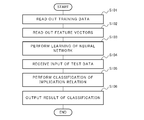
- Fig. 4 is a flowchart illustrating a process of the learning system 100 in the first exemplary embodiment of the present invention.
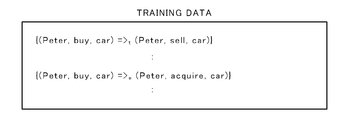
- Fig. 5 is a diagram illustrating an example of training data in the first exemplary embodiment of the present invention.
- Fig. 6 is a diagram illustrating an example of a neural network in the first exemplary embodiment of the present invention.
- Fig. 7 is a diagram illustrating an example of a neural network in a second exemplary embodiment of the present invention.
- Fig. 8 is a diagram illustrating a neural network to detect a temporal relation based
- An event may be represented as a predicate argument structure, or a neo-davidsonian event representation.
- the event "a” is also referred to as an observed event or a first event
- the event "b” is also referred to as a predicted event or a second event.
- V be vocabulary which contains all words, and assume that a feature vector is given for all words in V.
- the feature vector may be defined by a bag-of-words, where the feature vector has dimension s which is the number of words in the vocabulary.
- the feature vector may also be defined by a word embedding disclosed in NPL1. The word embedding is learned for each word in V.
- a feature vector representation for each event is created.
- One possible way to create the feature vector representation of an event is to sum a feature vector for the predicate and feature vectors for all of the arguments as expressed by Math. 1.
- x a is a feature vector for event "a”
- x a,i is a feature vector for the i-th word of the event
- k is the number of words in the event.
- Another possible way to create the feature vector representation of the event is using a convolution neural network as disclosed in NPL 5, or finding an event representation using auto-encoder as disclosed in NPL 6 to summarize the event into a fixed length vector.
- k is fixed to 2
- x a,0 , x a,1 , and x a,2 correspond to the feature vector of a semantic subject, predicate, and semantic object, respectively.
- the predicate is "kisses”
- the subject is “Peter”
- the object is "Sara”.
- x a,0 , x a,1 , and x a,2 are expressed by their word embeddings like word2vec.
- the subject and object in both events are the same (same surface form) and refer to the same entities.
- “Peter” in both events refer to the same person, and "car” refers to the same car.
- each word embedding has dimension d.
- an implication relation (also simply referred to as a relation) is able to be classified as two types: a temporal relation (also referred to as a before-after relation or a future prediction relation) or an entailment relation.
- entailment and logical implication are considered as equivalent.
- the temporal relation and the entailment relation are exemplary embodiments of a first relation and a second relation of the present invention, respectively.
- a neural network disclosed in NPL4 is can be used.
- Fig. 8 is a diagram illustrating a neural network to detect the temporal relation based on the neural network proposed in NPL4.
- event embeddings e a , e b having dimension h are calculated by using Math. 3.
- M a and M b are weight matrixes having dimension h ⁇ 3d and g is a non-linear function like sigmoid which is applied element-wise.
- the resulting event embeddings e a , e b are then used to calculate a score s(a,b) which indicates whether an event "a" occurs before an event "b", by using Math. 4.
- w a and w b are weight vectors having dimension h.
- a neural network that jointly classifies temporal relations and entailment relations is used, in order to overcome the drawbacks from the neural network shown in Fig. 8.
- Fig. 2 is a block diagram illustrating a configuration of a learning system 100 in the first exemplary embodiment of the present invention.
- the learning system 100 is an exemplary embodiment of an information processing system of the present invention.
- the learning system 100 in the first exemplary embodiment of the present invention includes a feature vector storage 110, a training data storage 120, a learning module (also referred to as a learning unit) 130, and a classify module (also referred to as a classify unit) 140.
- the feature vector storage 110 stores feature vectors of respective words in vocabulary.
- the feature vector is defined by a word embedding, for example.
- the feature vector may be defined by bag-of-words or the other vector as long as it represents the feature of the word.
- the feature vectors are inputted from a user or the like and stored in the feature vector storage 110 beforehand.
- the training data storage 120 stores pairs of events as training data (training pairs of events).
- Fig. 5 is a diagram illustrating an example of training data in the first exemplary embodiment of the present invention.
- the training data is inputted from a user or the like and stored in the training data storage 120 beforehand.
- the learning module 130 learns a neural network for classifying the implication relation between the events.
- the classify module 140 performs classification of the implication relation for pairs of events to be classified (a test pairs of events).
- the neural network of the first exemplary embodiment of the present invention will be described below.
- Fig. 6 is a diagram illustrating an example of the neural network in the first exemplary embodiment of the present invention.
- the neural network includes input layers, event layers, feature layers (also referred to as feature extractors), a joint feature layer (also referred to as a joint layer).
- feature layers also referred to as feature extractors
- joint feature layer also referred to as a joint layer.
- the neural network further includes, as an output layer, a temporal score layer, an entailment score layer, and a class layer. It is noted that the temporal feature layer and the entailment feature layer are exemplary embodiments of a first layer and a second layer of the present invention, respectively.
- the input layers are the same as the input layers of the neural network in Fig. 8.
- the input layers respectively receives inputs of feature vectors x a , x b of event pair "a", "b" for which the implication relation is to be classified.
- the event layers are the same as the hidden layers of the neural network in Fig. 8.
- the event layers respectively calculate event embeddings e a , e b which represent features of the events "a", "b", respectively, by Math. 3, using outputs from the input layers.
- the temporal feature f t (a,b) has dimension h 2
- M t is a weight matrix having dimension h 2 ⁇ 2h.
- the entailment feature f e (a,b) has dimension h 2
- M e is a weight matrix having dimension h 2 ⁇ 2h.
- the temporal score layer calculates a temporal score s t (a,b) by Math. 7, using outputs from the temporal feature layer.
- w t is a weight vector having dimension h 2 .
- the entailment score layer calculates an entailment score s e (a,b) by Math. 8 using outputs from the entailment feature layer.
- w e is a weight vector having dimension h 2 .
- the joint feature f j (a,b) has dimension h 3
- M j is a weight matrix having dimension h 3 ⁇ 2 h 2 .
- the class layer calculates a class score for classifying a temporal relation, an entailment relation, or both of them, using an output from the joint feature layer.
- the class layer may calculate class probabilities each representing a probability of the temporal relation, the entailment relation, or the other, by a soft-max function.
- the class layer may calculate a single class score s c (a,b) to classify the temporal relation or the entailment relation by Math. 10.
- Math. 10 w c is a weight vector having dimension h 3 .
- All layers in the neural network may be learned with standard back-propagation, and, if needed, the learning may be combined with Drop-out and l2/l1 regularization.
- the learning of neural network by the learning module 130 is performed in three steps shown below, for example.
- Step 1) The learning module 130 learns the parameters (weight matrixes M a , M b ) of the event layers by learning to re-construct the input (auto-encoder), as described in NPL6, for example.
- Step 2 The learning module 130 learns the parameters (weight matrixes M t , M e ) of the temporal feature layer and the entailment feature layer, independently, in such a way as to minimize the rank margin loss expressed by Math. 11 and Math. 12 below, as described in NPL5, for example.
- t is a threshold value, for example "1", that is predetermined by a user, or the like.
- s t (a,b) and s t (a,b') (b ⁇ b') are the scores for a positive example and a negative example of event pair for a temporal relation, respectively, in the training data.
- the weight vector w t of the temporal score layer is jointly learned with the weight matrix M t using back-propagation.
- s e (a,b) and s e (a,b') (b ⁇ b') are the scores for a positive example and a negative example of event pair for an entailment relation, respectively, in the training data.
- the weight vector w e of the entailment score layer is jointly learned with the weight matrix M e using back-propagation.
- the event "b'" for the negative example is, for example, randomly drawn from the training data.
- the parameters of the event layers may be left constant or may also be adjusted by back-propagation.
- Step 3) The learning module 130 learns the parameters (weight matrixes M j ) of the joint feature layer.
- the weight matrixes M j of the joint feature layer is learned in such a way as to minimize the rank margin loss expressed by Math. 13, in the same way as step 2.
- s c (a,b) and s c (a,b') (b ⁇ b') are the scores for a positive example and a negative example of event pair, respectively, in the training data.
- a positive example and a negative example of event pair for the temporal relation are used.
- the weight matrix M j is learned with the cross-entropy criteria.
- the parameters of the layers learned in step 1 and step 2 may be left constant or may also be adjusted by back-propagation.
- the dimension h 2 of the temporal feature f t (a,b) and the entailment feature f e (a,b) in the event layers may be set to 1.
- the temporal feature f t (a,b) and the entailment feature f e (a,b) are considered as a scoring function for a temporal relation and an entailment relation, respectively, and learned using the rank margin loss as described above.
- the learning system 100 may be a computer which includes a central processing unit (CPU) and a storage medium storing a program and which operates according to the program-based control.
- Fig. 3 is a block diagram illustrating a configuration of the learning system 100 in the first exemplary embodiment of the present invention, in a case that the learning system 100 is implemented on a computer.
- the learning system 100 includes a CPU 101, a storage device 102 (storage medium), a communication device 103, an input device 104 such as a keyboard, and an output device 105 such as a display.
- the CPU 101 executes a computer program to implement the functions of the learning module 130 and the classify module 140.
- the storage device 102 stores information in the feature vector storage 110 and the training data storage 120.
- the communication device 103 may receive training data and/or test data from the other system and send a result of classification of the test data to the other system.
- the input device 104 may receive the training data and/or the test data from a user or the like.
- the output device 105 may output (display) the result of the classification to the user or the like.
- the modules and storages in the learning system 100 in Fig. 3 may be allocated respectively to a plurality of devices interconnected with wired or wireless channels.
- a service of learning and/or classifying of the learning system 100 is provided to a user or the like as SaaS (Software as a Service).
- circuitry is defined as a term conceptually including a single chip, multiple devices, a chipset, or a cloud.
- Fig. 4 is a flowchart illustrating a process of the learning system 100 in the first exemplary embodiment of the present invention.
- the learning module 130 reads out pairs of events as training data from training data storage 120 (Step S101).
- the learning module 130 reads out feature vectors of words included in the pairs of events read out as the training data (Step S102).
- the learning module 130 performs learning of the parameters of the neural network for the pairs of events read out as the training data using the feature vectors (Step S103).
- the classify module 140 receives an input of a pair of events to be classified as test data (Step S104).
- the classify module 140 performs classification of an implication relation for the pair of events inputted as test data (Step S105).
- the classify module 140 outputs the result of the classification to a user or the like (Step S106).
- training data shown in Fig. 5 is stored in the training data storage 120 and feature vectors of events in the training data are stored in the feature vector storage 110.
- the learning module 130 performs learning of the parameters of the neural network for the training data.
- the learning module 130 for example, learns the neural network to output the single class score for determining whether an event pair as a temporal relation.
- the classify module 140 inputs the test data to the neural network learned by the learning module 130 to obtain the single class score.
- the classify module 140 determine whether an implication relation of the test data is classified as the temporal relation by comparing the single class score with a predetermined threshold.
- the neural network of the first exemplary embodiment of the present invention is able to leverage training data having the entailment relation to improve the classification of the temporal relation. If the test data is close to training data having the entailment relation, the test data is not classified as the temporal relation.
- Fig. 1 is a block diagram illustrating a characteristic configuration of the first exemplary embodiment of the present invention.
- a learning system 100 includes a training data storage 120 and a learning module 130.
- the training data storage 120 stores a training pair of a first and second event, and a relation between the training pair of the first and second events.
- the relation is a first or second relation.
- the learning module 130 learns a neural network for classifying a relation between a pair of the first and second events to be classified as the first or second relation, by using the training pair.
- the neural network includes a first layer to extract a feature of the first relation from features of the first and second events, a second layer to extract a feature of the second relation from the features of the first and second events, and a joint layer to extract a joint feature of the first and second relations from the features of the first and second relations.
- the learning module 130 learns a neural network including a first layer to extract a feature of the first relation from features of the first and second events, a second layer to extract a feature of the second relation from the features of the first and second events, and a joint layer to extract a joint feature of the first and second relations from the features of the first and second relations.
- Entailment relations of verbs can be categorized into five groups:
- the first group is synonyms, that is word pairs where an entailment relation holds in both directions between words ("buy” and "purchase”, for example).
- the other four groups can be defined according to NPL7, such as troponymy with temporal co-extensiveness (e.g. "limp” and “walk”), (non-troponymy with) proper temporal inclusion (e.g. "snore” and “sleep”, “succeed” and “try”), backward presupposition (e.g. "tie” and “untie”), and cause (e.g. "give” and “have”).
- NPL7 such as troponymy with temporal co-extensiveness (e.g. "limp” and “walk"), (non-troponymy with) proper temporal inclusion (e.g. "snore” and “sleep", “succeed” and “try”), backward pres
- Fig. 7 is a diagram illustrating an example of the neural network in the second exemplary embodiment of the present invention.
- a proper entailment feature layer is defined as a feature layer. It is noted that the proper entailment feature layer is an exemplary embodiment of a third layer of the present invention.
- the proper entailment feature layer calculates a proper entailment feature f p (a,b) that represents a feature of a proper entailment relation in the same manner as the other feature layers (extracts the proper entailment feature from the features of the events "a" and "b").
- the joint feature layer calculates the joint feature f j (a,b) using outputs from the temporal feature layer, the entailment feature layer, and the proper entailment feature layer (extracts the joint feature from the temporal feature, the entailment feature, and the proper entailment feature).
- the class layer calculates a class score for classifying relation as a temporal relation, an entailment relation, or a proper entailment relation using an output from the joint feature layer.
- the learning module 130 learns the joint feature layer and the class layer using event pairs of a positive example and a negative example for a temporal relation, a (synonyms) entailment relation, or a proper entailment relation in such a way as to additionally distinguish between the (synonyms) entailment relation and the proper entailment relation.
- the learning module 130 learns a neural network further including a third layer to extract a feature of the third relation from the features of the first and second events, and the joint layer extracts the joint feature of the first, second, and third relations from the features of the first, second, and third relations.
- the proper entailment feature layer is added as a feature layer.
- other feature layers to extract other features from the features of events may be added as a feature layer.
- a “topic feature layer” or “context feature layer” which is learned to extract topics or contexts that are common to both events in a pair of events may be added.
- a “topic feature layer” or “context feature layer” which is learned to extract topics or contexts that are common to both events in a pair of events may be added.
- a “topic feature layer” or “context feature layer” which is learned to extract topics or contexts that are common to both events in a pair of events may be added.
- both of events “Peter plays soccer” and “Peter loves soccer” have the same topic "soccer”.
- features like topic or context similarity can, for example, be included in a one dimensional feature layer which contains the similarity given by the inner product (or cosine similarity) between the word embeddings of predicates of events.
- an "antonym feature layer” to extract an antonym feature from the features of events may be added. This is because antonyms (e.g. "buy” and “sell”, “untie” and “tie”) can indicate that a temporal relation exists.
- a "language model feature” that extracts a language model feature from only one event may be added as a feature layer.
- the present invention is applicable to a reasoning system, a clustering system, or the like, in which a relation between events, such as an entailment relation or a temporal relation is detected.
- learning system 101 CPU 102 storage device 103 communication device 104 input device 105 output device 110 feature vector storage 120 training data storage 130 learning module 140 classify module
Landscapes
- Engineering & Computer Science (AREA)
- Theoretical Computer Science (AREA)
- Physics & Mathematics (AREA)
- Data Mining & Analysis (AREA)
- Evolutionary Computation (AREA)
- Life Sciences & Earth Sciences (AREA)
- Artificial Intelligence (AREA)
- General Physics & Mathematics (AREA)
- General Engineering & Computer Science (AREA)
- Computing Systems (AREA)
- Software Systems (AREA)
- Molecular Biology (AREA)
- Computational Linguistics (AREA)
- Biophysics (AREA)
- Biomedical Technology (AREA)
- Mathematical Physics (AREA)
- General Health & Medical Sciences (AREA)
- Health & Medical Sciences (AREA)
- Bioinformatics & Cheminformatics (AREA)
- Bioinformatics & Computational Biology (AREA)
- Computer Vision & Pattern Recognition (AREA)
- Evolutionary Biology (AREA)
- Machine Translation (AREA)
- Information Retrieval, Db Structures And Fs Structures Therefor (AREA)
Abstract
La présente invention concerne un système de traitement d'information destiné à améliorer la détection d'une relation entre des évènements. Un système d'apprentissage (100) comprend un stockage de données d'apprentissage (120) et un module d'apprentissage (130). Le stockage de données d'apprentissage (120) stocke une paire d'apprentissage d'un premier et d'un second événement, et une relation entre la paire d'apprentissage desdits premier et second évènements. La relation est une première ou une seconde relation. Le module d'apprentissage (130) apprend un réseau neural destiné à classer une relation entre une paire desdits premier et second événements à être classée comme la première ou la seconde relation, au moyen d'une paire d'apprentissage. Le réseau neural comprend une première couche pour extraire une caractéristique de la première relation émanant des caractéristiques desdits premier et second événements, une seconde couche pour extraire une caractéristique de la seconde relation émanant des caractéristiques desdits premier et second événements, et une couche de jointure desdites première et seconde relations émanant des caractéristiques de ces dernières.
Priority Applications (3)
| Application Number | Priority Date | Filing Date | Title |
|---|---|---|---|
| JP2018560270A JP6590086B2 (ja) | 2016-02-29 | 2016-02-29 | 情報処理システム、情報処理方法、及び、プログラム |
| US16/078,697 US11200453B2 (en) | 2016-02-29 | 2016-02-29 | Information processing system, an information processing method and a computer readable storage medium |
| PCT/JP2016/001076 WO2017149559A1 (fr) | 2016-02-29 | 2016-02-29 | Un système de traitement d'information, un procédé de traitement d'information et un support de stockage lisible par ordinateur |
Applications Claiming Priority (1)
| Application Number | Priority Date | Filing Date | Title |
|---|---|---|---|
| PCT/JP2016/001076 WO2017149559A1 (fr) | 2016-02-29 | 2016-02-29 | Un système de traitement d'information, un procédé de traitement d'information et un support de stockage lisible par ordinateur |
Publications (1)
| Publication Number | Publication Date |
|---|---|
| WO2017149559A1 true WO2017149559A1 (fr) | 2017-09-08 |
Family
ID=55521777
Family Applications (1)
| Application Number | Title | Priority Date | Filing Date |
|---|---|---|---|
| PCT/JP2016/001076 Ceased WO2017149559A1 (fr) | 2016-02-29 | 2016-02-29 | Un système de traitement d'information, un procédé de traitement d'information et un support de stockage lisible par ordinateur |
Country Status (3)
| Country | Link |
|---|---|
| US (1) | US11200453B2 (fr) |
| JP (1) | JP6590086B2 (fr) |
| WO (1) | WO2017149559A1 (fr) |
Cited By (4)
| Publication number | Priority date | Publication date | Assignee | Title |
|---|---|---|---|---|
| CN111967256A (zh) * | 2020-06-30 | 2020-11-20 | 北京百度网讯科技有限公司 | 事件关系的生成方法、装置、电子设备和存储介质 |
| CN112819164A (zh) * | 2021-02-02 | 2021-05-18 | 京东数科海益信息科技有限公司 | 事理图谱的推理方法、装置及计算机设备 |
| WO2021120543A1 (fr) * | 2019-12-17 | 2021-06-24 | 北京百度网讯科技有限公司 | Procédé et dispositif basés sur un graphe de connaissances et un langage naturel pour l'apprentissage par représentation |
| US20220164652A1 (en) * | 2019-02-15 | 2022-05-26 | Nokia Technologies Oy | Apparatus and a method for neural network compression |
Families Citing this family (3)
| Publication number | Priority date | Publication date | Assignee | Title |
|---|---|---|---|---|
| CN111325020B (zh) * | 2020-03-20 | 2023-03-31 | 北京百度网讯科技有限公司 | 一种事件论元抽取方法、装置以及电子设备 |
| CN113704476B (zh) * | 2021-09-02 | 2022-03-04 | 中科雨辰科技有限公司 | 目标事件抽取数据处理系统 |
| US12118295B2 (en) * | 2022-10-11 | 2024-10-15 | Adobe Inc. | Text simplification with minimal hallucination |
Family Cites Families (1)
| Publication number | Priority date | Publication date | Assignee | Title |
|---|---|---|---|---|
| US20160321522A1 (en) * | 2015-04-30 | 2016-11-03 | Canon Kabushiki Kaisha | Devices, systems, and methods for pairwise multi-task feature learning |
-
2016
- 2016-02-29 WO PCT/JP2016/001076 patent/WO2017149559A1/fr not_active Ceased
- 2016-02-29 US US16/078,697 patent/US11200453B2/en not_active Expired - Fee Related
- 2016-02-29 JP JP2018560270A patent/JP6590086B2/ja not_active Expired - Fee Related
Non-Patent Citations (11)
| Title |
|---|
| ASHUTOSH MODI ET AL.: "Inducing Neural Models of Script Knowledge", PROCEEDINGS OF THE EIGHTEENTH CONFERENCE ON COMPUTATIONAL LANGUAGE LEARNING, 2014, pages 49 - 57 |
| BIN BAI ET AL.: "Supervised Semantic Indexing", PROCEEDINGS OF THE 18TH ACM CONFERENCE ON INFORMATION AND KNOWLEDGE MANAGEMENT, 2009, pages 187 - 196 |
| FELLBAUM; CHRISTIANE: "English Verbs as a Semantic Net", INTERNATIONAL JOURNAL OF LEXICOGRAPHY, vol. 3, no. 4, 1990, pages 278 - 301 |
| HYUN WOO DO ET AL: "Temporal relation classification with deep neural network", 2016 INTERNATIONAL CONFERENCE ON BIG DATA AND SMART COMPUTING (BIGCOMP), IEEE, 18 January 2016 (2016-01-18), pages 454 - 457, XP032877111, DOI: 10.1109/BIGCOMP.2016.7425969 * |
| ION ANDROUTSOPOULOS ET AL.: "A Survey of Paraphrasing and Textual Entailment Methods", JOURNAL OF ARTIFICIAL INTELLIGENCE RESEARCH, vol. 38, 2010, pages 135 - 187 |
| LIANG ZHONGPING ET AL: "Recognition of Person Relation Indicated by Predicates", 20 October 2015, NETWORK AND PARALLEL COMPUTING; [LECTURE NOTES IN COMPUTER SCIENCE; LECT.NOTES COMPUTER], SPRINGER INTERNATIONAL PUBLISHING, CHAM, PAGE(S) 313 - 324, ISBN: 978-3-642-36762-5, ISSN: 0302-9743, XP047324427 * |
| MARK GRANROTH-WILDING ET AL.: "What Happens Next? Event Prediction Using a Compositional Neural Network", PROCEEDINGS 13TH AAAI CONFERENCE ON ARTIFICIAL INTELLIGENCE, 2016 |
| RONAN COLLOBERT ET AL.: "Natural Language Processing (almost) from Scratch", JOURNAL OF MACHINE LEARNING RESEARCH, vol. 12, 2011, pages 2493 - 2537, XP055273931 |
| SHARKEY A J C: "Combining Artificial Neural Nets, Multi-Net Systems", INTERNET CITATION, 26 June 1998 (1998-06-26), XP002441332, Retrieved from the Internet <URL:http://citeseer.ist.psu.edu/438101.html> [retrieved on 20070706] * |
| TUSHAR KHOT ET AL.: "Markov Logic Networks for Natural Language Question Answering", ARXIV, 2015 |
| YAN XU ET AL: "Improved Relation Classification by Deep Recurrent Neural Networks with Data Augmentation", ARXIV.ORG, CORNELL UNIVERSITY LIBRARY, 201 OLIN LIBRARY CORNELL UNIVERSITY ITHACA, NY 14853, 14 January 2016 (2016-01-14), XP080678970 * |
Cited By (7)
| Publication number | Priority date | Publication date | Assignee | Title |
|---|---|---|---|---|
| US20220164652A1 (en) * | 2019-02-15 | 2022-05-26 | Nokia Technologies Oy | Apparatus and a method for neural network compression |
| WO2021120543A1 (fr) * | 2019-12-17 | 2021-06-24 | 北京百度网讯科技有限公司 | Procédé et dispositif basés sur un graphe de connaissances et un langage naturel pour l'apprentissage par représentation |
| US12019990B2 (en) | 2019-12-17 | 2024-06-25 | Beijing Baidu Netcom Science Technology Co., Ltd. | Representation learning method and device based on natural language and knowledge graph |
| CN111967256A (zh) * | 2020-06-30 | 2020-11-20 | 北京百度网讯科技有限公司 | 事件关系的生成方法、装置、电子设备和存储介质 |
| CN111967256B (zh) * | 2020-06-30 | 2023-08-04 | 北京百度网讯科技有限公司 | 事件关系的生成方法、装置、电子设备和存储介质 |
| CN112819164A (zh) * | 2021-02-02 | 2021-05-18 | 京东数科海益信息科技有限公司 | 事理图谱的推理方法、装置及计算机设备 |
| CN112819164B (zh) * | 2021-02-02 | 2024-05-24 | 京东科技信息技术有限公司 | 事理图谱的推理方法、装置及计算机设备 |
Also Published As
| Publication number | Publication date |
|---|---|
| JP6590086B2 (ja) | 2019-10-16 |
| US20210192277A1 (en) | 2021-06-24 |
| JP2019511797A (ja) | 2019-04-25 |
| US11200453B2 (en) | 2021-12-14 |
Similar Documents
| Publication | Publication Date | Title |
|---|---|---|
| US11200453B2 (en) | Information processing system, an information processing method and a computer readable storage medium | |
| Alqahtani et al. | Is image-based CAPTCHA secure against attacks based on machine learning? An experimental study | |
| Lu et al. | Visual relationship detection with language priors | |
| CN112966074A (zh) | 一种情感分析方法、装置、电子设备以及存储介质 | |
| KR102695381B1 (ko) | 엔티티-속성 관계 식별 | |
| CN113095072B (zh) | 文本处理方法及装置 | |
| CN113392179B (zh) | 文本标注方法及装置、电子设备、存储介质 | |
| CN113407660A (zh) | 非结构化文本事件抽取方法 | |
| CN113762998B (zh) | 类别分析方法、装置、设备及存储介质 | |
| CN113515935B (zh) | 一种标题生成方法、装置、终端及介质 | |
| US20240331425A1 (en) | Method, device, computer equipment and storage medium for identifying illegal commodity | |
| CN112364912B (zh) | 信息分类方法、装置、设备及存储介质 | |
| US20250342215A1 (en) | Content search method and apparatus, electronic device, storage medium, and program product | |
| CN111783473B (zh) | 医疗问答中最佳答案的识别方法、装置和计算机设备 | |
| Kim et al. | A convolutional neural network in legal question answering | |
| Hakami et al. | Compositional approaches for representing relations between words: A comparative study | |
| CN116245139A (zh) | 图神经网络模型训练方法和装置、事件检测方法和装置 | |
| Perez-Martin et al. | Semantic search of memes on twitter | |
| CN116109887A (zh) | 一种基于打乱问题类型的视觉问答去偏方法 | |
| CN112883191B (zh) | 一种农业实体自动识别的分类方法及装置 | |
| Lin | Copyright protection and risk assessment based on information extraction and machine learning: the case of online literary works | |
| CN113821610A (zh) | 信息匹配方法、装置、设备及存储介质 | |
| Sileo et al. | Composition of sentence embeddings: Lessons from statistical relational learning | |
| Syaputra et al. | Improving mental health surveillance over Twitter text classification using word embedding techniques | |
| Patel | Detection of Maliciously Authored News Articles |
Legal Events
| Date | Code | Title | Description |
|---|---|---|---|
| ENP | Entry into the national phase |
Ref document number: 2018560270 Country of ref document: JP Kind code of ref document: A |
|
| NENP | Non-entry into the national phase |
Ref country code: DE |
|
| 121 | Ep: the epo has been informed by wipo that ep was designated in this application |
Ref document number: 16709157 Country of ref document: EP Kind code of ref document: A1 |
|
| 122 | Ep: pct application non-entry in european phase |
Ref document number: 16709157 Country of ref document: EP Kind code of ref document: A1 |