WO2017149897A1 - 癒着防止材 - Google Patents
癒着防止材 Download PDFInfo
- Publication number
- WO2017149897A1 WO2017149897A1 PCT/JP2016/087183 JP2016087183W WO2017149897A1 WO 2017149897 A1 WO2017149897 A1 WO 2017149897A1 JP 2016087183 W JP2016087183 W JP 2016087183W WO 2017149897 A1 WO2017149897 A1 WO 2017149897A1
- Authority
- WO
- WIPO (PCT)
- Prior art keywords
- adhesion
- coating layer
- layer
- substrate
- ascorbic acid
- Prior art date
- Legal status (The legal status is an assumption and is not a legal conclusion. Google has not performed a legal analysis and makes no representation as to the accuracy of the status listed.)
- Ceased
Links
Images
Classifications
-
- A—HUMAN NECESSITIES
- A61—MEDICAL OR VETERINARY SCIENCE; HYGIENE
- A61L—METHODS OR APPARATUS FOR STERILISING MATERIALS OR OBJECTS IN GENERAL; DISINFECTION, STERILISATION OR DEODORISATION OF AIR; CHEMICAL ASPECTS OF BANDAGES, DRESSINGS, ABSORBENT PADS OR SURGICAL ARTICLES; MATERIALS FOR BANDAGES, DRESSINGS, ABSORBENT PADS OR SURGICAL ARTICLES
- A61L15/00—Chemical aspects of, or use of materials for, bandages, dressings or absorbent pads
- A61L15/16—Bandages, dressings or absorbent pads for physiological fluids such as urine or blood, e.g. sanitary towels, tampons
- A61L15/42—Use of materials characterised by their function or physical properties
- A61L15/44—Medicaments
-
- A—HUMAN NECESSITIES
- A61—MEDICAL OR VETERINARY SCIENCE; HYGIENE
- A61K—PREPARATIONS FOR MEDICAL, DENTAL OR TOILETRY PURPOSES
- A61K31/00—Medicinal preparations containing organic active ingredients
- A61K31/33—Heterocyclic compounds
- A61K31/335—Heterocyclic compounds having oxygen as the only ring hetero atom, e.g. fungichromin
- A61K31/365—Lactones
- A61K31/375—Ascorbic acid, i.e. vitamin C; Salts thereof
-
- A—HUMAN NECESSITIES
- A61—MEDICAL OR VETERINARY SCIENCE; HYGIENE
- A61L—METHODS OR APPARATUS FOR STERILISING MATERIALS OR OBJECTS IN GENERAL; DISINFECTION, STERILISATION OR DEODORISATION OF AIR; CHEMICAL ASPECTS OF BANDAGES, DRESSINGS, ABSORBENT PADS OR SURGICAL ARTICLES; MATERIALS FOR BANDAGES, DRESSINGS, ABSORBENT PADS OR SURGICAL ARTICLES
- A61L15/00—Chemical aspects of, or use of materials for, bandages, dressings or absorbent pads
- A61L15/16—Bandages, dressings or absorbent pads for physiological fluids such as urine or blood, e.g. sanitary towels, tampons
- A61L15/22—Bandages, dressings or absorbent pads for physiological fluids such as urine or blood, e.g. sanitary towels, tampons containing macromolecular materials
- A61L15/26—Macromolecular compounds obtained otherwise than by reactions only involving carbon-to-carbon unsaturated bonds; Derivatives thereof
-
- A—HUMAN NECESSITIES
- A61—MEDICAL OR VETERINARY SCIENCE; HYGIENE
- A61L—METHODS OR APPARATUS FOR STERILISING MATERIALS OR OBJECTS IN GENERAL; DISINFECTION, STERILISATION OR DEODORISATION OF AIR; CHEMICAL ASPECTS OF BANDAGES, DRESSINGS, ABSORBENT PADS OR SURGICAL ARTICLES; MATERIALS FOR BANDAGES, DRESSINGS, ABSORBENT PADS OR SURGICAL ARTICLES
- A61L31/00—Materials for other surgical articles, e.g. stents, stent-grafts, shunts, surgical drapes, guide wires, materials for adhesion prevention, occluding devices, surgical gloves, tissue fixation devices
- A61L31/04—Macromolecular materials
- A61L31/041—Mixtures of macromolecular compounds
-
- A—HUMAN NECESSITIES
- A61—MEDICAL OR VETERINARY SCIENCE; HYGIENE
- A61L—METHODS OR APPARATUS FOR STERILISING MATERIALS OR OBJECTS IN GENERAL; DISINFECTION, STERILISATION OR DEODORISATION OF AIR; CHEMICAL ASPECTS OF BANDAGES, DRESSINGS, ABSORBENT PADS OR SURGICAL ARTICLES; MATERIALS FOR BANDAGES, DRESSINGS, ABSORBENT PADS OR SURGICAL ARTICLES
- A61L31/00—Materials for other surgical articles, e.g. stents, stent-grafts, shunts, surgical drapes, guide wires, materials for adhesion prevention, occluding devices, surgical gloves, tissue fixation devices
- A61L31/08—Materials for coatings
- A61L31/10—Macromolecular materials
-
- A—HUMAN NECESSITIES
- A61—MEDICAL OR VETERINARY SCIENCE; HYGIENE
- A61L—METHODS OR APPARATUS FOR STERILISING MATERIALS OR OBJECTS IN GENERAL; DISINFECTION, STERILISATION OR DEODORISATION OF AIR; CHEMICAL ASPECTS OF BANDAGES, DRESSINGS, ABSORBENT PADS OR SURGICAL ARTICLES; MATERIALS FOR BANDAGES, DRESSINGS, ABSORBENT PADS OR SURGICAL ARTICLES
- A61L31/00—Materials for other surgical articles, e.g. stents, stent-grafts, shunts, surgical drapes, guide wires, materials for adhesion prevention, occluding devices, surgical gloves, tissue fixation devices
- A61L31/14—Materials characterised by their function or physical properties, e.g. injectable or lubricating compositions, shape-memory materials, surface modified materials
-
- A—HUMAN NECESSITIES
- A61—MEDICAL OR VETERINARY SCIENCE; HYGIENE
- A61L—METHODS OR APPARATUS FOR STERILISING MATERIALS OR OBJECTS IN GENERAL; DISINFECTION, STERILISATION OR DEODORISATION OF AIR; CHEMICAL ASPECTS OF BANDAGES, DRESSINGS, ABSORBENT PADS OR SURGICAL ARTICLES; MATERIALS FOR BANDAGES, DRESSINGS, ABSORBENT PADS OR SURGICAL ARTICLES
- A61L31/00—Materials for other surgical articles, e.g. stents, stent-grafts, shunts, surgical drapes, guide wires, materials for adhesion prevention, occluding devices, surgical gloves, tissue fixation devices
- A61L31/14—Materials characterised by their function or physical properties, e.g. injectable or lubricating compositions, shape-memory materials, surface modified materials
- A61L31/148—Materials at least partially resorbable by the body
-
- A—HUMAN NECESSITIES
- A61—MEDICAL OR VETERINARY SCIENCE; HYGIENE
- A61L—METHODS OR APPARATUS FOR STERILISING MATERIALS OR OBJECTS IN GENERAL; DISINFECTION, STERILISATION OR DEODORISATION OF AIR; CHEMICAL ASPECTS OF BANDAGES, DRESSINGS, ABSORBENT PADS OR SURGICAL ARTICLES; MATERIALS FOR BANDAGES, DRESSINGS, ABSORBENT PADS OR SURGICAL ARTICLES
- A61L31/00—Materials for other surgical articles, e.g. stents, stent-grafts, shunts, surgical drapes, guide wires, materials for adhesion prevention, occluding devices, surgical gloves, tissue fixation devices
- A61L31/14—Materials characterised by their function or physical properties, e.g. injectable or lubricating compositions, shape-memory materials, surface modified materials
- A61L31/16—Biologically active materials, e.g. therapeutic substances
-
- A—HUMAN NECESSITIES
- A61—MEDICAL OR VETERINARY SCIENCE; HYGIENE
- A61P—SPECIFIC THERAPEUTIC ACTIVITY OF CHEMICAL COMPOUNDS OR MEDICINAL PREPARATIONS
- A61P17/00—Drugs for dermatological disorders
- A61P17/02—Drugs for dermatological disorders for treating wounds, ulcers, burns, scars, keloids, or the like
-
- A—HUMAN NECESSITIES
- A61—MEDICAL OR VETERINARY SCIENCE; HYGIENE
- A61L—METHODS OR APPARATUS FOR STERILISING MATERIALS OR OBJECTS IN GENERAL; DISINFECTION, STERILISATION OR DEODORISATION OF AIR; CHEMICAL ASPECTS OF BANDAGES, DRESSINGS, ABSORBENT PADS OR SURGICAL ARTICLES; MATERIALS FOR BANDAGES, DRESSINGS, ABSORBENT PADS OR SURGICAL ARTICLES
- A61L2420/00—Materials or methods for coatings medical devices
- A61L2420/08—Coatings comprising two or more layers
Definitions
- the present invention relates to an adhesion preventing material.
- the present invention relates to a solid or semi-solid substrate composed of a water-soluble polymer and a polyaliphatic ester and an adhesion preventing material composed of ascorbic acid or a derivative thereof as an antioxidant contained in the substrate.
- Patent Document 1 discloses a novel anti-adhesion material invention for the purpose of providing an anti-adhesion material excellent in adhesion when affixed to an adhesive.
- the gist of the adhesion preventing material described in Patent Document 1 is that an ultrathin film (using a spectroscopic ellipsometer) containing a water-soluble polymer for the base layer and containing a biodegradable polyaliphatic ester on at least one or both sides of the base layer.
- Patent Document 2 discloses an invention of an anti-tissue adhesion solution containing trehalose as an active ingredient and an ascorbic acid derivative as an antioxidant.
- Patent No. 5686297 (Claims, FIGS. 1 to 4)
- Patent No. 4447640 (Claims, claims 1 to 3)
- Patent Document 1 includes (a) degradability when affixed to a living tissue, (c) handleability when wet, and (d) adhesion when affixed to a living tissue.
- the present invention provides an anti-adhesive material having excellent characteristics in several points. However, as a result of further investigation by the present inventors, (b) the point of ensuring sufficient anti-adhesion performance and others Recognizing that there are still some issues to be improved in order to provide a better anti-adhesive material.
- the tissue adhesion preventing liquid described in Patent Document 2 is of a spray type, and has a different dosage form from the film or sheet-shaped adhesion preventing material described in Patent Document 1, and as a result, the mechanism of expression of the adhesion preventing function. Is different.
- an adhesion comprising an ascorbic acid or ascorbic acid derivative as an antioxidant in a solid or semi-solid substrate comprising a water-soluble polymer and a polyaliphatic ester.
- Preventive materials are provided.
- the solid substrate is one of a film shape, a sheet shape, and a mesh shape.
- the film-like, sheet-like, and mesh-like forms have a single-layer structure substantially composed of the substrate, or a laminate provided with a coating layer composed of a polyaliphatic ester on the substrate layer of the substrate.
- the mesh form has a fibrous structure composed of a composite in which a solid water-soluble polymer and a polyaliphatic ester base are formed in a rod shape, and the basis weight thereof is 0.8 g / m 2 to 830 g / An anti-adhesive material characterized by being m 2 is provided.
- the semi-solid substrate has a single-layer structure or a laminated structure in a gel-like form including a colloidal form.
- An anti-adhesion material characterized by having a viscosity at 100 ° C. of 100 Pa ⁇ s to 1,000,000 Pa ⁇ s is provided.
- the laminated structure provided with the coating layer on the base layer of the base has the coating layers on both sides of the base layer.
- An anti-adhesion material characterized by being formed of three layers of a double-sided coating layer and a base layer provided is provided.
- ascorbic acid and a derivative thereof are 0.1 (w) with respect to the weight (mass) of the substrate constituting the substrate or the substrate layer. / W)% to 20 (w / w)% or less is provided.
- the adhesion preventing material according to any one of [1] to [6] is immersed in bovine plasma, its pH is 7.5 to 6.
- An anti-adhesive material characterized by being zero is provided.
- the covering layer in the adhesion preventing material according to any one of [2] to [7], may be a first layer disposed on one surface of the base layer.
- An adhesion prevention comprising: 1 covering layer; and a second covering layer disposed on the other surface of the base layer, wherein the first covering layer and the second covering layer are made of the same material. Materials are provided.
- the covering layer in the adhesion preventing material according to any one of [2] to [7], is a first layer disposed on one surface of the base layer.
- the water-soluble polymer is a polysaccharide, a protein, or a synthetic polymer.
- An anti-adhesion material characterized by the above is provided.
- the adhesion-preventing material according to any one of [1] to [10], wherein the adhesion preventing material is provided.
- a solid or semi-solid substrate substantially composed of a water-soluble polymer contains ascorbic acid or an ascorbic acid derivative as an antioxidant, or further comprises the substrate.
- an anti-adhesive material comprising a coating layer made of a polyaliphatic ester on both sides of a layer.
- the antioxidant substance of the above [1] is characterized by containing a plant-derived antioxidant substance containing carotenoids or polyphenols which are fat-soluble pigments of plants.
- the adhesion-preventing material according to any one of [2] to [12] is provided.
- the adhesion-preventing material of the present invention basically has a structure in which ascorbic acid or an ascorbic acid derivative is contained as an antioxidant in a solid or semi-solid substrate composed of a water-soluble polymer and a polyaliphatic ester. It is characterized by.
- the adhesion preventing material of the present invention has such a configuration, ⁇ 1> Ascorbic acid, in which a substrate composed of a polyaliphatic ester and a water-soluble polymer functions as a physical barrier between the wound surface and the wound surface, and the wound surface is continuously released to promote healing of the wound surface Alternatively, by being promoted by a derivative thereof, the anti-adhesion function synergistically appears very efficiently.
- the shape of the substrate is solid (film shape, sheet shape, mesh shape) or semi-solid (gel shape including colloidal shape), and the substrate or substrate layer having such shape is used. Since ascorbic acid or an ascorbic acid derivative is contained in the wound surface, the physical barrier function can be ensured and the wound surface healing effect can be reliably expressed on the wound surface. Ascorbic acid or the like contained in the substrate or the substrate layer gradually dissolves together with the water-soluble polymer forming a viscous solution, stays on the substrate surface (near the wound surface), and contributes to the healing promoting effect.
- sustained ascorbic acid can be sustainedly released to the wound surface. It is generally said that wound healing usually requires at least 24 to 48 hours, sometimes 1 to 2 weeks, and ascorbic acid or an ascorbic acid derivative is continuously released on the wound surface over the required period. Can continue to exist.
- the anti-adhesion material described in Patent Document 1 does not take into account the sustained release of these ascorbic acid or ascorbic acid derivatives, which is intended to speed up the decomposition and absorption of the base layer. Even when ascorbic acid or an ascorbic acid derivative is added as a healing promoting component), the ascorbic acid or ascorbic acid derivative cannot be sustainedly released over a sufficient period of time, and there is a possibility that sufficient adhesion prevention effect may not be obtained. . That is, in the adhesion preventing material described in Patent Document 1, the base layer is made of a water-soluble polymer, and the base layer dissolves in water relatively quickly and is absorbed and decomposed. There is no room to consider the sustained release of ascorbic acid from the layer.
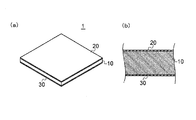
- FIG. 1A and 1B are views for explaining an adhesion preventing material 1 according to a representative embodiment of the present invention.
- FIG. 1A is a perspective view of the adhesion preventing material 1
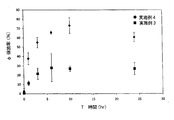
- FIG. FIG. 2 is a graph in which sustained release of ascorbic acid added to the base layer of the adhesion preventing material 1 is evaluated over time.
- “Substrate” is a main matrix member constituting the anti-adhesion material, and is composed of a water-soluble polymer (A) and a polyaliphatic ester (B). Ascorbic acid and ascorbic acid derivatives (hereinafter referred to as “ascorbic acid etc.”) ”)”) Is added and contained to constitute an adhesion preventing material.
- A water-soluble polymer
- B polyaliphatic ester
- Ascorbic acid and ascorbic acid derivatives hereinafter referred to as “ascorbic acid etc.”
- the substrate gradually releases ascorbic acid or the like while maintaining its shape for a certain period.
- the substrate usually has a single-layer structure or a layered structure in order to be stuck to an organ in a living body, and the substrate particularly having a single-layer structure is referred to as a “substrate layer”.
- the laminated structure includes an outer layer (also referred to as a “coating layer”) formed to cover the surface (both sides or one side) of the “base layer”.
- the base layer is a relatively thick layer, and the coating layer is configured as a thin layer compared to the base layer.
- the “coating layer” is a layer that mainly controls the sustained release of ascorbic acid and the like from the base layer, and when the anti-adhesive material is placed in the living body while holding the base layer strong. , A layer having a function of retaining the shape.
- the “substrate” is a matrix member to which ascorbic acid or the like is added, and since the antioxidant is gradually released from now on, not only the “substrate layer” but also the coating layer ”is the“ substrate ”. (See Example 5-6 below).
- the matrix member of the antiadhesive material of the present invention is composed of a water-soluble polymer (A) and a polyfatty acid ester (B) by definition, but in the case of a single layer structure, the layer has a high water-solubility. It is composed of a two-component composition (A / B) of a molecule (A) and a polyfatty acid ester (B).
- the “base layer” can be substantially composed only of the water-soluble polymer (A), and the “coating layer” can be composed substantially only of the polyfatty acid ester (B) (described later). See Example 1-4).
- the anti-adhesion material of the present invention comprises an ascorbic acid or an ascorbic acid derivative (as described above, “ascorbic acid”) on a so-called solid substrate comprising a water-soluble polymer and a polyaliphatic ester. It may be referred to as “acid, etc.”)).
- the form of the anti-adhesion material, specifically, the solid substrate is any one selected from a film, a sheet, and a mesh, and the semi-solid substrate is in a gel form including a colloid form. is there.
- the structure is basically a substrate layer having a single-layer structure, but if desired, a laminated structure further provided with a coating layer on the substrate layer as described below It can be. That is, in the case of such a laminated structure, the substrate is typically composed of a substrate layer composed of a water-soluble polymer and a coating layer composed of a polyaliphatic ester formed thereon. .
- the distinction between the film form and the sheet form is not definite, but in the present invention, a film having a thickness of less than 200 ⁇ m is defined as a film, and a sheet having a thickness of 200 ⁇ m or more. It shall be said.
- the mesh shape is a fibrous structure composed of a composite in which a base composed of a solid water-soluble polymer and a polyaliphatic ester is formed in a rod shape, and its basis weight is 0.8 g / m 2 to 830 g / m. Set to a range of 2 .
- the solid substrate When the solid substrate is semi-solid, it is in a gel-like form including colloid, has a single layer structure or a laminated structure, and has a viscosity at 37 ° C. of 100 Pa ⁇ s to 1,000,000 Pa ⁇ s. Those having physical properties in this range exhibit an effective physical barrier function.
- Any type of substrate is a so-called solid or semi-solid substrate comprising a water-soluble polymer and a polyaliphatic ester, and contains ascorbic acid and the like, which serve as a physical barrier between the wound surface and the wound surface.
- ascorbic acid and the like that are gradually released to the wound surface are based on the fact that a synergistic anti-adhesion function by promoting the healing of the wound surface is efficiently and reliably exhibited.
- FIG. 1 is a view for explaining an adhesion preventing material 1 according to a representative embodiment of the present invention.
- the present invention is not limited to the following representative embodiments. Needless to say, when a coating layer is formed only on one side of the substrate layer as shown in FIG. 2 of Patent Document 1, or a coating layer is formed on both sides of the substrate layer as shown in FIG. It can also be made into the form of the fibrous (mesh shape) structure which consists of a composite.
- FIG. 1A is a perspective view of the adhesion preventing material 1
- FIG. 1B is a partially enlarged sectional view of the adhesion preventing material 1.
- 1A and 1B in order to facilitate understanding of the invention, the layer thickness of the base layer 10 and the layer thicknesses of the first cover layer 20 and the second cover layer 30 with respect to the base layer 10 are shown. Is exaggerated to some extent.
- the antiadhesive material 1 includes a base layer 10 made of a film, and a first covering layer 20 disposed on one surface of the base layer 10 provided as desired, And a second coating layer 30 disposed on the other surface of the base layer 10.
- a two-component resin composition (a homogeneous mixture of resins) comprising a water-soluble polymer (A) and a biodegradable polyaliphatic ester (B)
- a base layer made of a water-soluble polymer (A) and a solid or semi-solid coating layer made of a biodegradable polyaliphatic ester (B)
- Patent Document 1 it is fundamentally different from the conventional one disclosed in Patent Document 1 based on a base layer composed of only a water-soluble polymer (single component).
- the substrate in the present invention has a single-layer structure of a two-component composition composed of a water-soluble polymer and a biodegradable polyaliphatic ester or is composed of the above-mentioned laminated structure.
- the polyaliphatic ester portion does not decompose rapidly (unlike the water-soluble polymer portion) and maintains a layered (film-like or sheet-like) form for a long period of time (film shape retention) portion).
- the water-soluble polymer part is mixed with the biodegradable polyaliphatic ester which is the shape-retaining part or is in contact with each other (relatively quickly as in the case of a single component layer). It is gradually dissolved from the portion of the surface of the substrate that is in contact with the biological fluid. In this way, the water-soluble polymer component that gradually elutes from the substrate (sustained release) has a healing promoting effect on the wound surface.
- ascorbic acid or an ascorbic acid derivative is added as an antioxidant to a single-layer structure substrate composed of the two-component composition constructed as described above or a substrate composed of the laminated structure. It is characterized by According to the study by the present inventors, when ascorbic acid or the like is blended in the substrate and intended to be released slowly from the substrate, as described in Patent Document 1, in the case of a substrate layer consisting only of a water-soluble polymer such as pullulan As described above, since the base layer itself dissolves in a relatively short time and does not function as a matrix layer (shape retention layer), sufficient sustained release cannot be realized.
- a biodegradable polyaliphatic ester is a matrix (skeleton). The substrate retains its form for a long time.
- ascorbic acid or the like blended in the substrate is eluted from the surface of the substrate.
- the water-soluble polymer portion is mixed with or in contact with the biodegradable polyaliphatic ester that is the shape-retaining portion, and gradually elutes from the surface of the substrate. It is considered that ascorbic acid and the like (contained in this part) are eluted together with the water-soluble polymer part to be eluted. As described above, ascorbic acid and the like are gradually eluted together with the aqueous polymer component eluted from the substrate and are always present on the wound surface, and thus are considered to have a high healing promoting effect.
- the sustained release rate of ascorbic acid and the like can be controlled in a wide range. That is, the proportion of the water-soluble polymer (A) in a single-layer structure or a laminated structure composed of a two-component composition comprising the water-soluble polymer (A) and the biodegradable polyaliphatic ester (B) The larger the is, the greater the amount of elution (elution rate) of the water-soluble polymer.
- the substrate in the case of a single layer structure, most typically, is composed of a water-soluble polymer and a biodegradable polyaliphatic ester. As described above, it is usually composed of a water-soluble polymer, and the coating layer is composed of a biodegradable polyaliphatic ester.
- the water-soluble polymer will be described.
- Water-soluble polymer As the water-soluble polymer, polysaccharides, proteins or synthetic polymers can be preferably used.
- polysaccharides include, for example, storage polysaccharides of animals and plants such as starch, amylose, amylopectin, glycogen, glucomannan, dextrin, glucan and fructan; structural polysaccharides of animals and plants such as cellulose, pectin and chitin; seaweeds such as carrageenan and agarose Derived polysaccharides; microbial polysaccharides such as pullulan; plant gum polysaccharides such as locust bean gum and guar gum; glycosaminoglycans such as heparin, hyaluronic acid, chondroitin sulfate, heparan sulfate, dermatan sulfate, and keratan sulfate; Polysaccharide derivatives can be preferably used.
- protein for example, gelatin, casein, collagen or the like can be suitably used.
- Synthetic polymers include, for example, polyvinyl alcohol, polyvinyl alcohol derivatives, polyacrylic acid-based water-soluble polymers, polyacrylamide, polyacrylamide derivatives, polyethylene oxide, polyethylene oxide derivatives, polyvinyl pyrrolidone, polyvinyl pyrrolidone derivatives, polyamide polymers, polyalkylenes.
- Oxide polymers, polyether glycol polymers, maleic anhydride copolymer polymers, and the like can be suitably used. From the viewpoint of increasing the flexibility of the entire adhesion preventing material, pullulan can be particularly suitably used among the water-soluble polymers exemplified.
- the polyfatty acid esters used in the present invention are preferably biodegradable, and examples of such polyaliphatic esters include poly (lactides); poly (glycolides); poly (lactide- ⁇ - Poly (lactic acid) s; poly (glycolic acid) s; poly (lactic acid- ⁇ -glycolic acid) s; polycaprolactones; polyesteramides; polyanhydrides; polyorthoesters; Polyetheresters; poly (dioxanone) s; poly (alkylene alkylates); copolymers of polyethylene glycol and polyorthoesters, other copolymers thereof; polymer alloys and the like can be suitably used.
- poly (lactic acid) s since it is excellent in biocompatibility and biodegradability, it is preferable to use at least one of poly (lactic acid) s, poly (glycolic acid) s, polycaprolactones, and copolymers thereof.
- poly (lactic acid) s Particularly preferred is a lactic acid / glycolic acid / ⁇ -caprolactone terpolymer (LA / GA / ⁇ -CLT) having a molecular weight of about 20,000 to 300,000.
- the layer thickness LD of the substrate or the substrate layer 10 (hereinafter sometimes simply referred to as the substrate layer 10) is set to 1 ⁇ m to 5000 ⁇ m, for example.
- the thickness of the base layer 10 is less than 200 ⁇ m, preferably 1 ⁇ m to 150 ⁇ m, more preferably 10 ⁇ m to 100 ⁇ m, and most preferably 30 ⁇ m to 80 ⁇ m.
- the base layer 10 is formed to have a thickness of 200 ⁇ m or more.
- the thickness is preferably 200 ⁇ m to 5000 ⁇ m, more preferably 300 ⁇ m to 3000 ⁇ m, still more preferably 500 to 2000 ⁇ m, and most preferably 800 to 1000 ⁇ m.
- the thickness of the base layer 10 can be measured by using an appropriate device such as an infrared film thickness meter, a capacitance thickness meter, or a laser displacement sensor, in addition to measurement by direct contact such as calipers or a micro gauge.
- ascorbic acid ascorbic acid derivatives
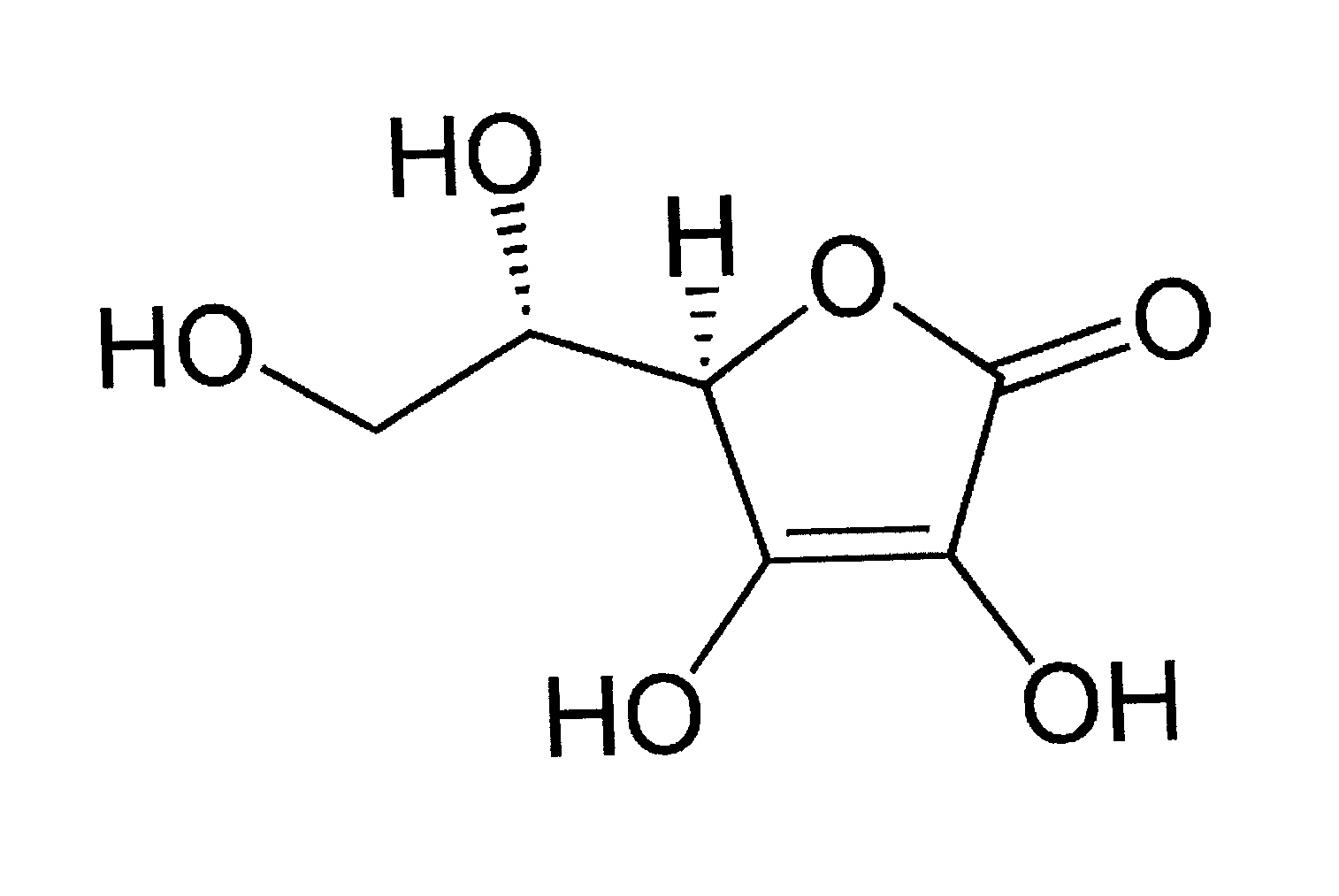
- ascorbic acid is an organic compound having a lactone structure that works as a nutrient vitamin C, and has a chemical formula as shown below. In (IUPAC nomenclature), it is represented as (R) -3,4-dihydroxy-5-((S) -1,2-dihydroxyethyl) furan-2 (5H) -one as a derivative of furan. .
- L-form known as vitamin C that is, L-ascorbic acid can be preferably used.
- ascorbic acid derivatives that can be used include calcium ascorbate, sodium ascorbate, sodium phosphate-L-ascorbate, magnesium phosphate-L-ascorbate, ascorbyl glucoside, ascorbyl ethyl and the like. included.
- Ascorbic acid or an ascorbic acid derivative is at least 0.1 (w / w)% to 20 (w / w)%, usually 0.5%, based on the weight (mass) of the entire anti-adhesion material or substrate layer.
- the pH in the vicinity of the placement portion of the anti-adhesion material is the initial value as long as the ascorbic acid or the like contained in the base or base layer is continuously released.
- the optimal value for healing can be maintained at 7.5 to 6.0.
- the anti-adhesion material of the present invention can change the sustained release property over a wide range according to the purpose, and can maintain a constant desired pH for a long time in the vicinity of the wound surface.
- the water-soluble polymer portion when the water-soluble polymer portion is gradually eluted from the surface of the substrate, ascorbic acid and the like are also eluted.
- the eluted water-soluble polymer, pullulan, and the like forms a viscous solution, and it is estimated that the solution remains in that position so as to cover the substrate surface while dissolving ascorbic acid and the like. is there.
- the concentration of ascorbic acid or the like in the viscous water-soluble polymer solution should be almost equal to the concentration Cm * in the substrate.
- the substrate of the present invention may be formed by forming a predetermined resin composition such as ascorbic acid by a film extrusion method or a sheet extrusion method, or by casting from a solution of the resin composition.
- antioxidants In the present invention, ascorbic acid or the like is most effective, but the following antioxidants can be used instead of ascorbic acid or the like, if desired. That is, vitamin E; ⁇ -carotene, ⁇ -carotene, ⁇ -carotene, lycopene, xanthophylls and other carotenoids that are fat-soluble pigments of plants; flowers, leaves and bark of plants such as flavonoids, catechins, tannins, anthocyanins, isoflavones, quercetin -Plant-derived antioxidant substances (SOD substances) containing polyphenols contained in stems and the like can also be used.
- SOD substances quercetin -Plant-derived antioxidant substances
- Coating layer in the present invention, basically, it has a single-layer structure consisting essentially of a substrate composed of the composition of the water-soluble polymer (A) and the polyfatty acid ester (B) as described above, and does not have a coating layer. However, sustained release properties such as ascorbic acid can be achieved. However, if desired, it may have a laminated structure provided with a coating layer made of a polyaliphatic ester on a base layer made of the base. In the case of such a laminated structure, as described above, in the most typical case, the substrate is composed of a substrate layer consisting essentially of a water-soluble polymer and a polyaliphatic ester formed thereon. It is comprised from a coating layer.
- the function of the coating layer made of the polyfatty acid ester is basically to control the sustained release of ascorbic acid added to the base layer made of the water-soluble polymer.
- ascorbic acid is also eluted in a short time together with the water-soluble polymer in a short time, making it difficult to ensure the sustained release over a sufficient time. That is, in the case of a laminated structure, as shown in FIG. 1, a coating layer 20 (first coating layer) may be formed on one surface of the base layer 10, and a coating layer 30 (second coating layer) may be formed on the other surface. it can.
- the first coating layer 20 and the second coating layer 30 as the coating layers are preferably both composed of a biodegradable polyaliphatic ester. That is, the same polyaliphatic ester that is a constituent component of the substrate can be used. As a precaution, I will re-exemplify again without hesitation.
- polyaliphatic esters examples include poly (lactides), poly (glycolides); poly (lactide- ⁇ -glycolide) s; poly (lactic acid) s; poly (glycolic acid) s; poly (lactic acid-co- Glycolic acid) s; polycaprolactones; polyesteramides; polyanhydrides; polyorthoesters; polycyanoacrylates; polyetheresters; poly (dioxanone) s; poly (alkylene alkylates); Copolymers with orthoesters, other copolymers thereof; polymer alloys and the like can be suitably used.
- the base layer in the same manner as in the case of constituting the base layer, it is excellent in biocompatibility and biodegradability, so that poly (lactic acid) s; poly (glycolic acid) s; polycaprolactones; and copolymers thereof It is preferable to use at least one of them. Particularly preferred is a terpolymer (LA / GA / ⁇ -CLT) of lactic acid / glycolic acid / ⁇ -caprolactone as described above.
- the first coating layer 20 and the second coating layer 30 are preferably made of the same material from these exemplified materials.
- the coating layer is composed of these polyaliphatic esters (B), but a relatively thick coating layer is formed for the purpose of maintaining the strength of the coating layer as described later.
- ascorbic acid or the like may be contained in the coating layer as desired.
- the covering layer it is possible to reliably perform sustained release in the initial stage particularly when the adhesion preventing material is set in the wound part.
- the thickness Ld of the coating layer is much thinner than the thickness LD of the base layer as described above, the total amount of ascorbic acid and the like contained in the coating layer cannot be increased so much and is too long. It is difficult to continue the sustained release for a long time (long term), and it is preferably performed in order to exert an auxiliary effect such as ascorbic acid contained in the base layer.
- ascorbic acid is added only to the base layer.
- ascorbic acid is contained in the water-soluble polysaccharide, so that the sustained release is performed relatively quickly.
- the ascorbic acid elution rate ⁇ can be appropriately controlled to achieve a desired sustained release rate.
- the coating layer is formed thicker than usual, it is preferable to add ascorbic acid to both the base layer and the coating layer.
- the sustained release rate (elution rate) ⁇ of the coating layer portion is considered to proceed as follows.
- the thickness Ld of above coated layer by adjusting the addition amount of ascorbic acid (concentration) Cm * appropriate controlled release rate, because it is possible to arbitrarily change the controlled release duration, etc., methods of treatment
- the options can be greatly expanded.
- the content (concentration) Cm * of ascorbic acid in the coating layer is 0.01 (w / w)% to 1.0 (w / w)%, preferably 0.02 (w / w)% or more It is desirable to add it to ⁇ 0.8 (w / w)% or less, more preferably from 0.1 (w / w)% to ⁇ 0.5 (w / w)%.
- the function of the coating layer is basically control of the sustained release rate (dissolution rate) as described above.
- the sustained release rate dissolution rate
- the sustained release of ascorbic acid from the substrate layer
- the coating thickness (the first coating layer 20 and the second coating layer 30) is measured when the spectral thickness is measured at a wavelength of 380 nm to 900 nm using a spectroscopic ellipsometer when the ascorbic acid or ascorbic acid derivative is added to the base layer 10.
- 50 nm to 800 nm preferably 75 nm to less than 600 nm. More preferably, it is formed to 75 nm or more and 500 nm or less. Even if the optical thickness of the coating layers (the first coating layer 20 and the second coating layer 30) is thin (about 50-75 nm), in the present invention, ascorbic acid or the like is added to the base layer 10, so that sufficient adhesion is achieved. Preventive performance can be demonstrated.
- the coating layer is too thick (for example, more than 800 nm), the decomposition performance of the coating layer in the living body is degraded. Moreover, since the elution (diffusion) of ascorbic acid from the base layer into the living body is hindered, it is not preferable from the viewpoint of maintaining sustained release. On the other hand, however, from the viewpoint of maintaining the strength (maintenance of the form) of the base layer (and hence the adhesion preventing material), the coating layer itself has a certain thickness so as not to be easily broken.
- the thickness of the coating layer needs to be considered from the viewpoint of maintaining strength.
- the film-like or sheet-like membrane constituting the substrate (or coating layer) of the anti-adhesion material is broken by an increase in intra-abdominal pressure or movement of an organ such as the stomach or intestine.
- the present inventors have confirmed that it is preferable to make the coating layer as thick as described above. As mentioned above, if the coating layer is too thick, degradation of the degradation performance (decrease in sustained release of ascorbic acid) may be a concern.
- a thickness of the above degree is basically preferable.
- by sufficiently increasing the concentration Cm * of ascorbic acid or the like to be blended in the coating layer it is possible to substantially suppress the decrease in the sustained release property.
- by including a water-soluble polymer in a relatively thick coating layer it is possible to suppress a decrease in the sustained release of ascorbic acid to some extent.
- the thickness Ld of the coating layer is 50 nm to 7000 nm, preferably 100 nm to 5000 nm, and more preferably 1000 nm to 3000 nm. And in this thickness range, give consideration to various conditions such as intraperitoneal pressure where the anti-adhesion material is placed, force environment, target organ type, required sustained release period, etc., and give priority to sustained release or form retention by either (but in any case they should be considered.) it is preferable to determine the (ascorbic acid concentration Cm * formulated in and coated layer) thickness of the coating layer.
- Example (A) Based on the structure of the adhesion preventing material 1 according to the representative embodiment as shown in FIG. 1 described above, a predetermined amount of L-ascorbic acid (manufactured by Wako Pure Chemical Industries, Ltd.) is added to the material of the base layer, and the film A first coating layer and a second coating layer (hereinafter sometimes simply referred to as “coating layer”) made of the same material are disposed on both surfaces of the base layer molded into a shape, and the pH is predetermined as described above. What was adjusted so that it might become the range of this was made into the sample of an Example. (In addition, a sample to which L-ascorbic acid was not added was used as a comparative sample.)
- a coating layer was formed by a dipping method which is a conventional method. That is, a toluene solution of polylactic acid-polyglycolic acid-poly ⁇ -caprolactone, which is a polyaliphatic ester adjusted to a predetermined concentration (hereinafter referred to as a coating solution), is prepared, and the substrate layer prepared above is placed in the coating solution. Dipping was carried out to form coating layers made of polylactic acid-polyglycolic acid-poly ⁇ -caprolactone terpolymer on both surfaces of the substrate layer. After dipping, the sample was dried at room temperature for about 30 minutes to 1 hour, and this was used as a sample (test piece) according to the example.
- optical thickness (Ld) of the coating layer laminated on the substrate layer was measured using a spectroscopic ellipsometer (“alpha-SE (US registered trademark)” manufactured by JA Woollam Japan). The measurement wavelength was 380 nm to 900 nm.
- Example 1-3 (Examination of addition concentration Cm * of ascorbic acid)
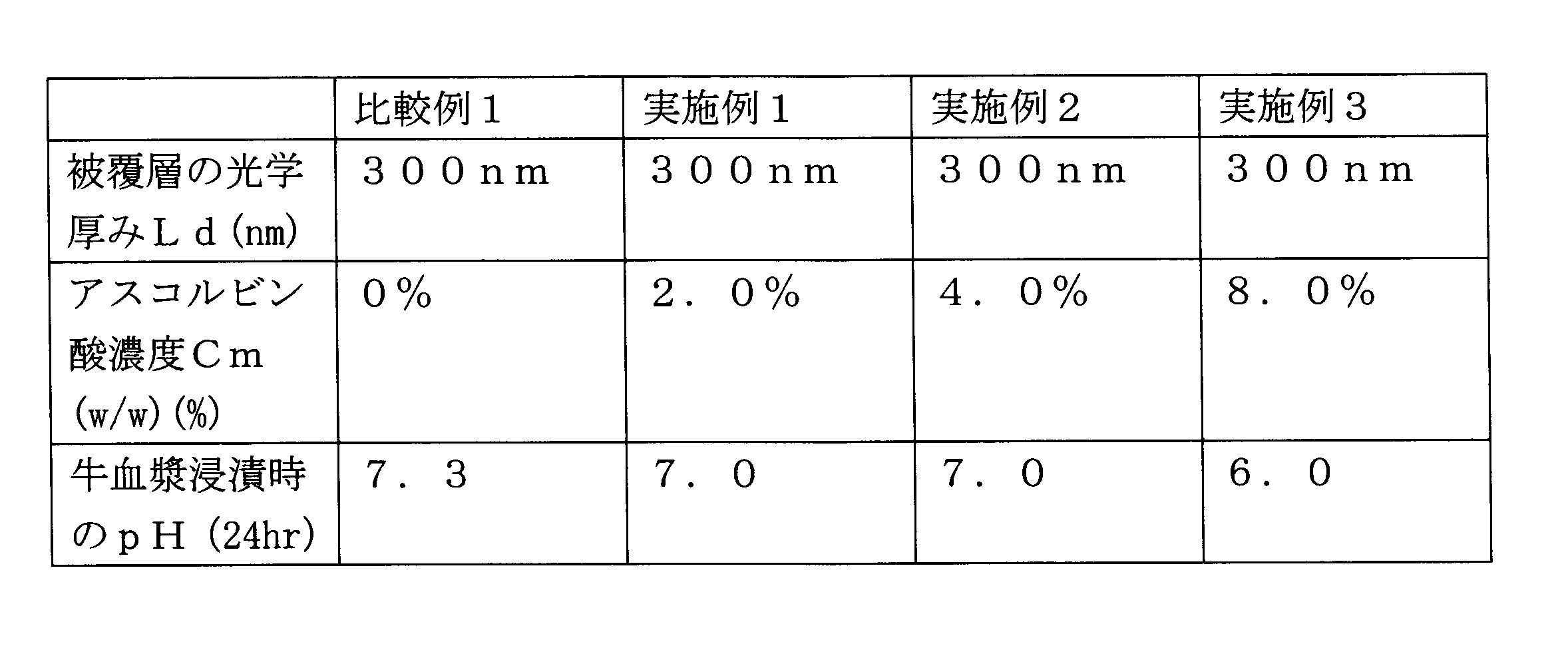
- the thickness (Ld) of the coating layer made of polylactic acid-polyglycolic acid-poly ⁇ -caprolactone was fixed to 300 nm, and the concentration of ascorbic acid added to the base layer was changed to Cm (w / w)%, so that the bovine plasma
- the pH (24) 24 hours after immersion was measured.
- Test Example I (Adhesion prevention performance evaluation) This Test Example I is a test for evaluating the adhesion prevention performance of the adhesion preventing material (Note that this Test Example I corresponds to Test Example 2 of Patent Document 1 by the present applicants). In evaluating the adhesion prevention performance, by preparing a test piece from the samples according to Examples and Comparative Examples, by pasting the test piece in the abdominal cavity of a pig (Swine) and observing and scoring the degree of adhesion, The anti-adhesion performance was evaluated.
- Example 1 (1) (Examination of ascorbic acid addition concentration Cm (i)) From Table 4, when the thickness (Ld) of the coating layer is 300 nm, the ascorbic acid to the base layer is changed from a predetermined addition concentration Cm (2.0 (w / w)% to 8.0 (w / w). The results of Example 1 (adhesion occurrence rate ⁇ is 20%) and Example 2-3 (adhesion occurrence rate ⁇ is 0%) are changed to ascorbine with the same coating layer thickness (Ld) of 300 nm. When compared with Comparative Example 1 in which no acid was added (adhesion occurrence rate ⁇ was 66%), it was confirmed that in the example, the adhesion occurrence rate was significantly reduced.
- Example 1 and Example 2-3 are compared, adhesion increases when the concentration Cm of ascorbic acid increases from 2.0 (w / w)% to 4.0 to 8.0 (w / w)%. It was confirmed that the incidence ⁇ was further reduced from 20% to 0%.
- Example 3 75 nm
- Example 4 300 nm
- phosphate buffer pH 7.4
- the ascorbic acid concentration in the medium was measured over time up to 24 hours.
- Ascorbic acid was quantitatively determined by a colorimetric method using a vitamin C quantitative kit (manufactured by Cosmo Bio). Further, the sustained release rate ( ⁇ ) at each measurement point was determined with the concentration when the amount of ascorbic acid contained in the anti-adhesive material dissolved in the phosphate buffer was 100%. Further, the shape of the material used in the test was observed for 24 hours.
- the sustained release rate differs depending on whether a solid or semi-solid material is used. More specifically, ascorbine (added to the base layer) is provided by providing a coating layer made of a polyaliphatic ester (B) that is biodegradable and controlling the thickness of the coating layer in the range of optical thickness of 75 nm to less than 600 nm.
- the sustained release of the acid can be maintained for a long time. This indicates that the material properties can be adjusted according to the site of damage to be applied and the depth of damage.
- Example (B) Similar to Example (A), based on the structure of the adhesion preventing material 1 according to the embodiment as shown in FIG. 1, a predetermined amount of L-ascorbic acid (manufactured by Wako Pure Chemical Industries, Ltd.) is used as the material of the base layer.
- the first coating layer and the second coating layer (hereinafter also simply referred to as “coating layer”) in which L-ascorbic acid is similarly added to both sides of the base layer that has been added and formed into a film shape may be omitted. ) was used as a sample of the example. (In addition, a sample in which L-ascorbic acid was not added to either the base layer or the coating layer was used as a sample for comparison.)
- Example 5-6 Formation of relatively thick coating layer to which ascorbic acid was added
- substrate layer a pullulan that is a water-soluble polymer
- a film made of pullulan having a size of 100 mm ⁇ 120 mm ⁇ thickness (LD) 50 ⁇ m was formed by a casting method to form an ascorbic acid-containing substrate layer.
- a coating solution polylactic acid-polyglycolic acid-poly ⁇ -caprolactone
- the film was dried at room temperature for about 30 minutes to 1 hour.
- Test Example III is a test for evaluating the anti-adhesion performance of the anti-adhesion material as in Test Example I, but the subject animal species was changed to a human-like one. In that case, it is a test to check whether the environment to which the antiadhesive material is applied (occurrence of intra-abdominal pressure or organ movement) is a severer condition and confirms whether it is suitable for this environment.
- a test piece was prepared from the samples according to Example (B) and the comparative example, and the test piece was attached to the abdominal cavity of a monkey (Macaca fascicularis) to observe the degree of adhesion.
- the adhesion prevention performance was evaluated by measuring the adhesion length.
- the adhesion prevention material was confirmed to have almost the same original shape after 14 days, and provided with a coating layer having a thickness of the same level as that used in the examples. (It was confirmed that the initial purpose was achieved in terms of maintaining the form.)
- the coating layer Ld is currently composed only of the biodegradable polyfatty acid ester (B), but the coating layer Ld also has a small amount of a water-soluble polymer (A) such as pullulan, which is similar to ascorbic acid. It is considered that the inclusion of can further adopt a means such as accelerating the sustained release of ascorbic acid, and can further reduce the adhesion incidence ⁇ .
- Test Example 4 Evaluation of adhesion when an anti-adhesive material is attached to a living tissue: In Test Example 2, the pigs and monkeys were stuck in the abdominal cavity, but could be stuck without any problem.
- the anti-adhesion material of the present invention basically comprises ascorbic acid or ascorbic acid as an antioxidant on a solid or semi-solid substrate comprising a water-soluble polymer (A) and a biodegradable polyaliphatic ester (B). Since it has a structure containing a derivative, a substrate made of a water-soluble polymer and a polyaliphatic ester functions as a physical barrier between the wound surface and the wound surface, and healing on the wound surface is gradually released from the substrate. As a result of being promoted by the ascorbic acid or derivatives thereof, the anti-adhesion function is synergistically expressed very efficiently, and thus the industrial applicability in the medical field is extremely large.
Landscapes
- Health & Medical Sciences (AREA)
- Life Sciences & Earth Sciences (AREA)
- Veterinary Medicine (AREA)
- Animal Behavior & Ethology (AREA)
- General Health & Medical Sciences (AREA)
- Public Health (AREA)
- Epidemiology (AREA)
- Vascular Medicine (AREA)
- Surgery (AREA)
- Heart & Thoracic Surgery (AREA)
- Chemical & Material Sciences (AREA)
- Engineering & Computer Science (AREA)
- Medicinal Chemistry (AREA)
- Pharmacology & Pharmacy (AREA)
- Chemical Kinetics & Catalysis (AREA)
- Materials Engineering (AREA)
- Hematology (AREA)
- Organic Chemistry (AREA)
- Bioinformatics & Cheminformatics (AREA)
- Dermatology (AREA)
- General Chemical & Material Sciences (AREA)
- Nuclear Medicine, Radiotherapy & Molecular Imaging (AREA)
- Molecular Biology (AREA)
- Biomedical Technology (AREA)
- Materials For Medical Uses (AREA)
- Pharmaceuticals Containing Other Organic And Inorganic Compounds (AREA)
- Medicinal Preparation (AREA)
Abstract
Description
特許文献1に記載の癒着防止材の要旨は、基体層に水溶性高分子を使用し、当該基体層の少なくとも一方または両面に生体分解性のポリ脂肪族エステルを含む極薄膜(分光エリプソメータを用いて波長380nm~900nmで測定したときの前記被覆層の光学厚みが、27nm以上160nm未満のもの)からなる被覆層を配置したものである。
一方、特許文献2には、トレハロースを有効成分とし、抗酸化物質としてアスコルビン酸誘導体を含有する組織癒着防止液の発明が開示されている。
特許文献2に記載の組織癒着防止液は、スプレー方式のものであり、特許文献1に記載のフィルムないしシート状の癒着防止材とは剤型が異なり、その結果、癒着防止機能の発現機序が異なる。
[1]本発明にしたがえば、水溶性高分子及びポリ脂肪族エステルからなる固形または半固形の基体に抗酸化物質として、アスコルビン酸またはアスコルビン酸誘導体を含有させてなることを特徴とする癒着防止材、が提供される。
[2]また、本発明にしたがえば、[1]に記載の癒着防止材において、前記固形の基体は、フィルム状、シート状、及びメッシュ状の中から選ばれるいずれか一つの形態であり、
前記フィルム状、前記シート状及びメッシュ状の形態は、当該基体から実質的になる単層構造であるか、または、当該基体の基体層上にさらにポリ脂肪族エステルからなる被覆層を備えた積層構造を有するものであり、
または前記メッシュ状の形態は、固形の水溶性高分子及びポリ脂肪族エステルの基体を棒状に形成した複合体からなる繊維状構造を有し、かつその目付けは0.8g/m2~830g/m2であることを特徴とする癒着防止材、が提供される。
[4]また、本発明にしたがえば、[2]に記載の癒着防止材において、当該基体の基体層の上に被覆層を備えた積層構造は、その基体層の両面にそれぞれ被覆層を備えた両面被覆層及び基体層の3層で形成されていることを特徴とする癒着防止材、が提供される。
[6]また、本発明にしたがえば、[1]に記載の癒着防止材において、アスコルビン酸及びその誘導体は、基体または基体層を構成する基材重量(質量)に対し0.1(w/w)%以上~20(w/w)%以下含有することを特徴とする癒着防止材、が提供される。
[7]また、本発明にしたがえば、[1]から[6]のいずれかに記載の癒着防止材を、牛血漿に浸漬した場合、24時間後に、そのpHは7.5~6.0となることを特徴とする癒着防止材、が提供される。
[9]また、本発明にしたがえば、[2]~[7]のいずれか1項に記載の癒着防止材において、前記被覆層として、前記基体層の一方側の面に配置された第1被覆層と、前記基体層の他方側の面に配置された第2被覆層とを備え、前記第1被覆層と前記第2被覆層とが異なる材料で構成されていることを特徴とする癒着防止材、が提供される。
[10]また、本発明にしたがえば、[1]~[9]のいずれか1項に記載の癒着防止材において、前記水溶性高分子は、多糖類、蛋白質又は合成高分子であることを特徴とする癒着防止材、が提供される。
[12]また、本発明にしたがえば、水溶性高分子から実質的になる固形または半固形の基体に抗酸化物質として、アスコルビン酸またはアスコルビン酸誘導体を含有させ、またはさらに当該基体からなる基体層の両面にそれぞれポリ脂肪族エステルからなる被覆層を備えたことを特徴とする癒着防止材、が提供される。
[13]また、本発明にしたがえば、前記[1]の抗酸化物質として、植物の脂溶性色素であるカロチノイド類またはポリフェノール類を含む植物由来の抗酸化物質を含有させてなることを特徴とする[2]~[12]いずれか1項に記載の癒着防止材、が提供される。
本発明の癒着防止材はかかる構成を有することにより、
〈1〉創傷面と創傷面の物理バリアとしてポリ脂肪族エステル及び水溶性高分子からなる基体が機能すること、並びに、創傷面の治癒の促進が創傷面に継続的に徐放されるアスコルビン酸またはその誘導体で促進されることにより、相乗効果的に癒着防止機能がきわめて効率よく発現する。
すなわち、特許文献1に記載の癒着防止材は、基体層が水溶性高分子からなるものであり、比較的速やかに当該基体層は水へ溶解し、分解吸収されてしまうのであるから、当該基体層からのアスコルビン酸の徐放を考慮する余地がない。
また特許文献2に記載の組織癒着防止液のように、液体状では同様に薬剤の徐放、創傷面への持続的な薬剤の徐放を考慮できておらず、本発明による癒着防止機能の発現機序は異なる。
この点に関して、本発明者らは鋭意検討した結果、後記する代表例にあらわす適切な形状な場合、最適な徐放性を確保することができることを確認できた。
本発明の癒着防止材を明確に説明するため、本発明における「基体」、「基体層」、「被覆層」について以下の定義をおく。
「基体」とは癒着防止材を構成する主要なマトリクス部材であり、水溶性高分子(A)及びポリ脂肪族エステル(B)からなり、これにアスコルビン酸やアスコルビン酸誘導体(以下「アスコルビン酸等」ということがある。)を添加、含有させて癒着防止材を構成するものである。当該癒着防止材は生体内に置かれた場合、当該基体は、一定期間その形状を保持したままアスコルビン酸等を徐放するものである。
「被覆層」は後述するように、主として基体層からのアスコルビン酸等の徐放を制御する層であり、また、基体層を強度的に保持して癒着防止材が生体中に置かれた場合、形状を保持する機能を有する層である。
また、本発明の癒着防止材のマトリクス部材は、定義より水溶性高分子(A)及びポリ脂肪酸エステル(B)からなるものであるが、単層構造の場合は、当該層は、水溶性高分子(A)及びポリ脂肪酸エステル(B)の2成分組成物(A/B)から構成され、一方、積層構造の場合、例えば典型的には「基体層」と「被覆層」から構成されるとすると、「基体層」は実質的に水溶性高分子(A)のみから構成され、「被覆層」は実質的にポリ脂肪酸エステル(B)のみから構成されるようにすることができる(後記実施例1-4参照)。
まず、本発明の概要について説明すると、本発明の癒着防止材は、水溶性高分子及びポリ脂肪族エステルからなる、いわゆる固形の基体にアスコルビン酸またはアスコルビン酸誘導体(すでに述べたように、「アスコルビン酸等」という場合がある。)を含有させてなるものである。
癒着防止材の形態、具体的には固形の基体は、フィルム状、シート状及びメッシュ状の中から選ばれるいずれか一つであり、半固形の基体は、コロイド状を含むゲル状の形態である。
なお、一般的にフィルム状とシート状の両者の区別は確定的なものではないが、本発明においては、厚みが200μm未満のものをフィルム状とし、シート状とは厚みが200μm以上のものをいうものとする。メッシュ状の場合は、固形の水溶性高分子及びポリ脂肪族エステルからなる基体を棒状に形成した複合体からなる繊維状構造体であり、その目付けは、0.8g/m2~830g/m2の範囲に設定される。
いずれの形態の基体においても、水溶性高分子及びポリ脂肪族エステルからなるいわゆる固形または半固形の基体であって、アスコルビン酸等が含有され、それらが、創傷面と創傷面の物理バリアとなるとともに、当該創傷面に徐放されるアスコルビン酸等が創傷面の治癒の促進をすることによる相乗的な癒着防止機能が効率的に確実に発揮されることを基礎としたものである
図1は、本発明の代表実施形態に係る癒着防止材1を説明するために示す図である。本発明は下記の代表実施形態に限定されるものではない。あえて図示するまでもなく特許文献1の図2のような基体層の片面にのみ被覆層を形成した場合や、図4のような基体層の両面に被覆層を形成しこれを棒状に形成した複合体からなる繊維状(メッシュ状)構造の形態とすることもできる。
図1(a)は癒着防止材1の斜視図であり、図1(b)は癒着防止材1の一部拡大断面図である。なお、図1(a)及び図1(b)においては、発明の理解を容易にするため、基体層10の層厚並びに基体層10に対する第1被覆層20及び第2被覆層30の層厚をある程度誇張して表している。
本発明の癒着防止材においては、基体は、単層構造の場合は、水溶性高分子(A)及び生体分解性のポリ脂肪族エステル(B)からなる二成分樹脂組成物(樹脂の均一混合物)からなり、積層構造の場合は、少なくとも水溶性高分子(A)からなる基体層と生体分解性のポリ脂肪族エステル(B)からなる固形または半固形の被覆層を備えることを特徴とする。この点において、水溶性高分子のみ(単一成分)から構成される基体層をベースとする特許文献1に開示された従来のものとは根本的に異なる。
このように基体から徐々に溶出する(徐放性)水溶性高分子成分は創傷面に対し治癒促進作用を奏するものである。
本発明の癒着防止材においては、このように構成された二成分組成物からなる単層構造の基体、または前記積層構造からなる基体に抗酸化物質として、アスコルビン酸またはアスコルビン酸誘導体を含有させてなるものであることを特徴としている。
本発明者らの検討によると、基体にアスコルビン酸等を配合し、当該基体から徐放させることを企図した場合、特許文献1記載のごとく、プルラン等水溶性高分子のみからなる基体層の場合は、上記したように基体層自体が比較的短時間で溶解してしまい、マトリックス層(形態保持層)としての機能を奏さなくなるので、十分な徐放性を実現することはできない。一方、本発明における水溶性高分子及びポリ脂肪族エステルからなる二成分組成物からなる単層構造の基体、または、積層構造の基体の場合は、生体分解性のポリ脂肪族エステルがマトリックス(骨格形成)の機能を奏するので、基体は長時間その形態を保持する。
本発明において基体中に含有させたアスコルビン酸等の徐放メカニズムは上記のようなものと考えられることから、アスコルビン酸等の徐放速度も広範囲に制御することができる。すなわち、水溶性高分子(A)及び生体分解性のポリ脂肪族エステル(B)からなる二成分組成物からなる単層構造の基体、または、積層構造において、水溶性高分子(A)の割合を大きくすればするほど、当該水溶性高分子の溶出量(溶出速度)が大きくなる。(但し、水溶性高分子の割合をあまり大きくすると、生体分解性のポリ脂肪族エステル(B)が減少するのでフィルム状の形態保持力は低下する。)
一方、ポリ脂肪族エステル(B)の割合を増加させると、フィルム状等の基体の形態は長時間安定的に保持されるが、逆に水溶性高分子(A)、ひいてはアスコルビン酸等の溶出速度は低下する。以上の点を考慮して、その目的に応じて、最適な徐放性を実現することができる。
水溶性高分子としては、多糖類、蛋白質又は合成高分子を好ましく用いることができる。
癒着防止材全体のしなやかさを高める観点から言えば、例示した水溶性高分子のなかでも、プルランを特に好適に用いることができる。
つぎにポリ脂肪族エステルについて説明する。本発明で使用するポリ脂肪酸エステルは好ましくは生体分解性のものであって、このようなポリ脂肪族エステルとしては、例えば、ポリ(ラクチド)類;ポリ(グリコリド)類;ポリ(ラクチド-ε-グリコリド)類;ポリ(乳酸)類;ポリ(グリコール酸)類;ポリ(乳酸-ε-グリコール酸)類;ポリカプロラクトン類;ポリエステルアミド類;ポリアンヒドリド類;ポリオルトエステル類;ポリシアノアクリレート類;ポリエーテルエステル類;ポリ(ジオキサノン)類;ポリ(アルキレンアルキレート)類;ポリエチレングリコールとポリオルトエステルとのコポリマー、その他これらの共重合体;ポリマーアロイなどを好適に用いることができる。特に、生体内適合性及び生体分解性に優れることから、ポリ(乳酸)類、ポリ(グリコール酸)類、ポリカプロラクトン類、及びこれらの共重合体のうちの少なくとも1種を用いることが好ましい。特に好ましくは乳酸/グリコール酸/ε-カプロラクトンの三元共重合体(LA/GA/ε-CLT)で、分子量20,00~300,000程度のものが好適である。
基体または基体層10(以下単に基体層10という場合がある。)の層厚LDは、例えば、1μm~5000μm、に設定されている。
フィルム状の癒着防止材の場合は、基体層10の層厚は200μm未満、好ましくは1μm~150μm、さらに好ましくは10μmから100μm、最も好ましくは30μm~80μmである。
シート状の癒着防止材の場合は、基体層10の層厚は200μm以上に形成する。好ましくは200μmから5000μm、より好ましくは300μm~3000μm、さらに好ましくは500~2000μm、最も好ましくは800~1000μmである。基体層10の厚みは、ノギス、マイクロゲージ等直接接触による測定のほか、赤外線膜厚計、静電容量式厚み計、レーザ変位センサー等適当なものを採用して測定することが可能である。
本発明においては抗酸化成分として、アスコルビン酸またはその誘導体を癒着防止材から徐放させる最も好ましいものとして使用し、これを基体または基体層(または場合によってはさらに被覆層にも)含有させる。
アスコルビン酸( ascorbic acid)は、栄養素ビタミンCとしてはたらく、ラクトン構造を持つ有機化合物の1種で、化学式は以下に示すとおりである。(IUPAC命名法)では、フランの誘導体と見なして、(R)-3,4-ジヒドロキシ-5-((S)-1,2-ジヒドロキシエチル)フラン-2(5H)-オンと表される。分子量は176.13 g/mol、融点は190℃、沸点は553℃の、光学活性化合物である。本発明では、ビタミンCとして知られているL体、すなわちL-アスコルビン酸を好適に使用することができる。
アスコルビン酸またはアスコルビン酸誘導体は、癒着防止材全体、または基体層の重量(質量)に対して、少なくとも0.1(w/w)%以上~20(w/w)%以下、通常0.5(w/w)%以上~10(w/w)%以下、好ましくは1.0(w/w)%以上~9.0(w/w)%以下、さらに好ましくは1.5(w/w)%以上~8.0(w/w)%以下添加するのが望ましい。
アスコルビン酸またはアスコルビン酸誘導体を、上記の割合で基体または基体層に添加、含有させた本発明の癒着防止材を100×100mm/30mL牛血漿に浸漬した場合、24時間後に、そのpHは7.5~6.0となる。これは創傷面の治癒を促進するために最も好ましいpHである。
このようにしてアスコルビン酸等を含有するプルラン等の粘性溶液が創傷部を安定的に覆っているので、当該創傷部はアスコルビン酸とプルラン等の相乗的効果で保護されることにより癒着防止効果が促進されると考えられる。
本発明の基体の形成は所定のアスコルビン酸等樹脂組成物をフィルム押出法、シート押出法で形成してもよいし、また当該樹脂組成物の溶液から流延法などにより形成してもよい。
本発明においては、アスコルビン酸等が最も効果を有するが、所望により、アスコルビン酸等の代わりに、例えば以下の抗酸化剤を用いることができる。すなわち、ビタミンE;α-カロチン,β-カロチン,γ-カロチン,リコピン,キサントフィル等植物の脂溶性色素であるカロチノイド類;フラボノイド,カテキン,タンニン,アントシアニン,イソフラボン,ケルセチン等植物の花や葉・樹皮・茎等に含まれるポリフェノール類を含む植物由来の抗酸化物質(SOD用物質)等を用いることもできる。
本発明においては、基本的に、上記したような、水溶性高分子(A)とポリ脂肪酸エステル(B)の組成物からなる基体から実質的になる単層構造であり、被覆層を備えなくてもアスコルビン酸等の徐放性を奏することができる。ただし所望により、当該基体からなる基体層上にさらにポリ脂肪族エステルからなる被覆層を備えた積層構造を有するものとすることができる。このような積層構造の場合は、すでに述べたように、最も典型的な場合は、基体は、実質的に水溶性高分子からなる基体層と、その上に形成されるポリ脂肪族エステルからなる被覆層から構成されることになる。この場合のポリ脂肪酸エステルからなる被覆層の機能は、基本的に、水溶性高分子からなる基体層に添加したアスコルビン酸の徐放性の制御である。被覆層が存在しない場合は、短時間で水溶性高分子とともにアスコルビン酸も短時間で溶出してしまい十分な時間に渡ってその徐放性を確保することが困難になる。
すなわち、積層構造の場合は、図1に示すように、基体層10の一面に被覆層20(第1被覆層)を、他の面に被覆層30(第2被覆層)を形成することができる。
被覆層としての第1被覆層20及び第2被覆層30は、好ましくは、ともに生体分解性ポリ脂肪族エステルから構成されている。すなわち、基体の構成成分であるポリ脂肪族エステルと同じものを使用することができる。念のため、煩を厭わずに再度例示する。ポリ脂肪族エステルとしては、例えば、ポリ(ラクチド)類、ポリ(グリコリド)類;ポリ(ラクチド-ε-グリコリド)類;ポリ(乳酸)類;ポリ(グリコール酸)類;ポリ(乳酸-コ-グリコール酸)類;ポリカプロラクトン類;ポリエステルアミド類;ポリアンヒドリド類;ポリオルトエステル類;ポリシアノアクリレート類;ポリエーテルエステル類;ポリ(ジオキサノン)類;ポリ(アルキレンアルキレート)類;ポリエチレングリコールとポリオルトエステルとのコポリマー、その他これらの共重合体;ポリマーアロイなどを好適に用いることができる。特に、基体層を構成する場合と同様にして、生体内適合性及び生体分解性に優れることから、ポリ(乳酸)類;ポリ(グリコール酸)類;ポリカプロラクトン類;及びこれらの共重合体のうちの少なくとも1種を用いることが好ましい。特に好ましくは前記した特に好ましくは乳酸/グリコール酸/ε-カプロラクトンの三元共重合体(LA/GA/ε-CLT)である。なお、代表実施形態において、第1被覆層20及び第2被覆層30は、これら例示した材料の中から同じ材料で構成されていることが好ましい。
なお、基本的に、被覆層はこれらポリ脂肪族エステル(B)から構成されるが、後記するように当該被覆層の強度保持を目的とする場合は、比較的厚い被覆層を形成する。その場合は、所望により当該被覆層にアスコルビン酸等を含有させてもよい。被覆層に含有させることにより特に癒着防止材を創傷部にセットした場合の初期段階においての徐放を確実に行うことができる。但し、被覆層の厚みLdは、すでに述べたように基体層の厚みLDに比較してはるかに薄いので、当該被覆層に含有させるアスコルビン酸等の総量をそれほど大きくすることはできず、あまり長時間(長期間)徐放を続けることは困難であり、一義的には、基体層に含有させたアスコルビン酸等の補助的効果を奏させるために行うことが好ましい。
一方、積層構造の場合について、後記する実施例5-6のように、被覆層を通常より厚く形成した場合は、基体層と被覆層の両方にアスコルビン酸を添加することが好ましい。アスコルビン酸が被覆層にも含まれる場合は被覆層部分の徐放率(溶出速度)φは以下のように進行すると考えられる。
また、被覆層の厚みLdが一定で、被覆層へのアスコルビン酸の添加量(濃度)Cm*を変えた場合について考察すると、濃度Cm*が高いほど初期段階においての徐放が速くなり、濃度Cm*が低いほど徐放は緩慢となる。
以上のように被覆層の厚みLd、アスコルビン酸の添加量(濃度)Cm*を適宜調整することにより、徐放速度、徐放持続時間等を任意に変更することが可能となるので、治療方法の選択肢を大幅に広げることができる。
被覆層へのアスコルビン酸の含有量(濃度)Cm*は、0.01(w/w)%以上~1.0(w/w)%以下、好ましくは0.02(w/w)%以上~0.8(w/w)%以下、さらに好ましくは0.1(w/w)%以上~0.5(w/w)%以下添加するのが望ましい。
被覆層の機能は、基本的には、すでに述べたように徐放率(溶解速度)の制御である。
例えば後記実施例に示すように、生分解性であるポリ脂肪族エステルからなる被覆層を設けその厚みを光学厚みが50nm以上800nm以下、好ましくは75nm以上600nm未満程度の範囲で制御することにより、(基体層からの)アスコルビン酸の徐放性を変化させることができる。
さらに言えば、本発明においては、すでに述べたように、基本的には、基体層を構成する水溶性高分子(A)とポリ脂肪族エステル(B)の重量割合ω(=A/B)を変えることにより、水溶性高分子(A)の溶出速度(及び、ひいてはアスコルビン酸等の溶出速度)を制御することが可能であるが、さらに被覆層を形成し、その厚み(Ld)を上記の範囲で変化させることによってもより精妙に徐放性の制御を行うことができる。
被覆層(第1被覆層20と第2被覆層30)の光学厚みが薄くても(50-75nm程度)、本発明においては基体層10にアスコルビン酸等を添加しているので、充分な癒着防止性能が発揮できる。
なお前記のように被覆層はあまり厚くすると分解性能の低下(アスコルビン酸徐放性の低下)が懸念されるが、サルやヒトのように二足歩行動物に適用して、被覆層の機械的強度を確保することを優先する場合は、上記程度の厚みであることが基本的に好ましい。この場合は、被覆層に配合するアスコルビン酸等の濃度Cm*を十分高くすることにより、その徐放性の低下を実質的に押さえることも可能である。
また、比較的厚い被覆層に水溶性高分子を含ませることにより、アスコルビン酸の徐放性の低下をある程度抑止することができる。
上述の図1に示すような代表実施形態に係る癒着防止材1の構成をもとに、基体層の材料に所定量のL-アスコルビン酸(和光純薬製社製)を添加して、フィルム状に成型した基体層の両面に同一材料からなる第1被覆層及び第2被覆層(以下、単に「被覆層」と省略する場合もある。)が配置され、前記したように、pHが所定の範囲となるように調整したものを実施例の試料とした。(また、L-アスコルビン酸を添加しないものを比較例の試料とした。)
具体的には、まず、基体層の材料として水溶性高分子であるプルランを使用しこれに所定量のアスコルビン酸を添加して、100mm×120mm×厚さ50μmのプルランからなる膜を流延法により成膜して、アスコルビン酸含有基体層を形成した(基体層中のアスコルビン酸濃度:Cm)。
次に、常法であるディッピング法により、被覆層の形成を行った。すなわち、所定濃度に調整したポリ脂肪族エステルであるポリ乳酸-ポリグリコール酸-ポリε-カプロラクトンのトルエン溶液(以下、コーティング液という。)を作製し、当該コーティング液中に上記調製した基体層を浸し、当該基体層の両表面にポリ乳酸-ポリグリコール酸-ポリε-カプロラクトン三元共重合体からなる被覆層を形成した。ディッピング後に30分~1時間程度室温で乾燥させ、これを実施例に係る試料(試験片)とした。
前記実施例の基体層にアスコルビン酸を添加しない(含まない)他は、前記実施例と同様にして癒着防止材を作製し、比較例に係る試料(試験片)とした。
本発明における被覆層はきわめて薄膜であるため、光学厚み(Ld)で表示することが好ましい。
基体層に積層された被覆層の光学厚み(Ld)の測定は、分光エリプソメータ(ジェー・エー・ウーラム・ジャパン社製「alpha-SE(米国登録商標)」)を用いた。なお、測定波長は、380nm~900nmとした。
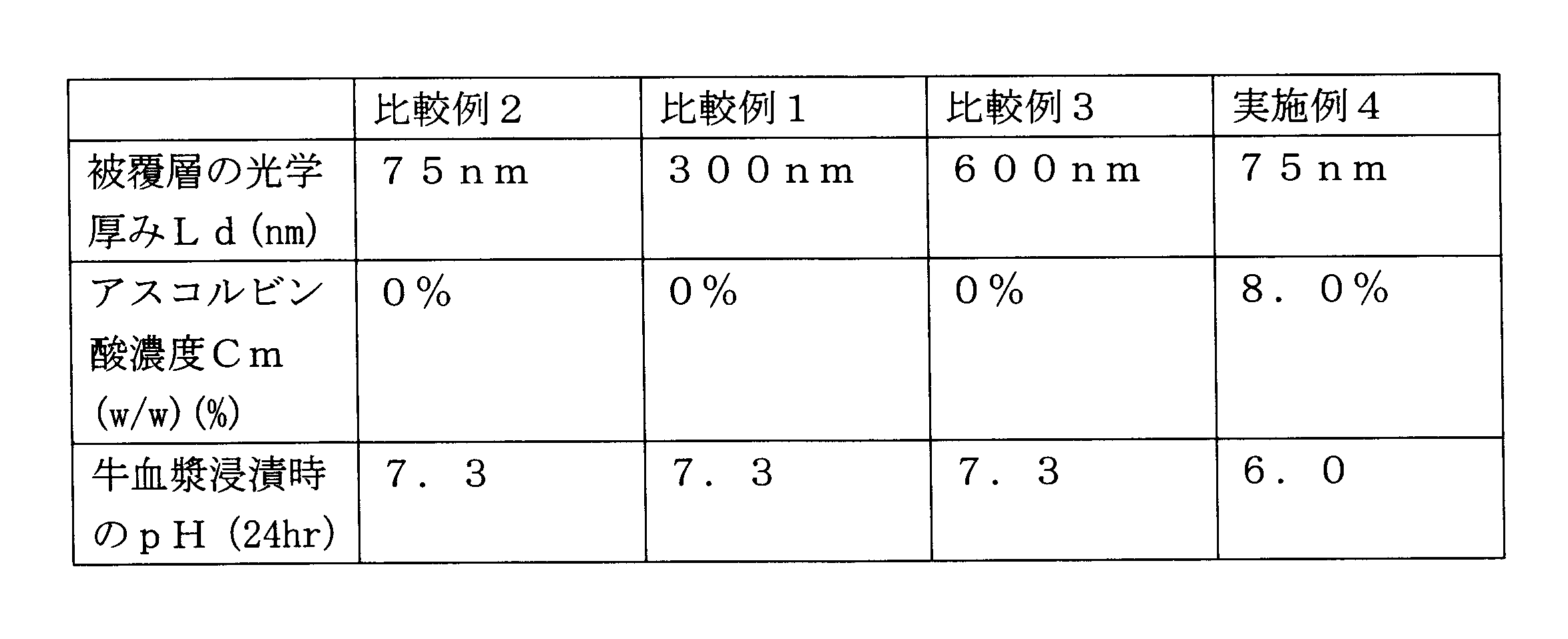
上記したポリ乳酸-ポリグリコール酸-ポリε-カプロラクトンからなる被覆層の厚み(Ld)を300nmと固定し、基体層へのアスコルビン酸の添加濃度Cm(w/w)%を変え、牛血漿に浸漬後24時間後のpH(24)を測定した。結果を表1に示した。すなわち、実施例1はアスコルビン酸の添加濃度Cm=2.0(w/w)%で、pH(24)=7.0、実施例2はCm=4.0(w/w)%でpH(24)=7.0、実施例3はCm=8.0(w/w)%でpH(24)=6.0であった。
比較例1として、基体層にアスコルビン酸を添加しない(Cm=0%)ほかは実施例1-3と同様の試験(被覆層の厚み(Ld)=300nm)を行った。牛血漿に浸漬後24時間後のpH(24)=7.3であった。結果を表1に示した。
被覆層の厚み(Ld)を75nmとする他は、実施例3と同じ試験を行った。結果は表2に示すように、Cm=8.0%の場合、Ld=300nmの場合のpH(24)=6.0との差違は認められなかった。
被覆層の厚み(Ld)を75nm(比較例2)又は600nm(比較例3)とする他は、比較例1と同じ試験を行った。結果を比較例1(Ld=300nm)とともに表2に示す。基体層にアスコルビン酸の添加しない(Cm=0%)比較例の場合は、被覆層の厚み(Ld)を75nm→300nm→600nmと変化させてもpH(24)=7.3(一定)であった。
(アスコルビン酸添加量とpH)
(被覆層の光学厚みとアスコルビン酸添加量)
本試験例Iは、癒着防止材の癒着防止性能を評価するための試験である(なお、本試験例Iは、本出願人らによる特許文献1の試験例2に対応する。)。
癒着防止性能を評価するにあたっては、実施例及び比較例に係る試料から試験片を作製し、試験片をブタ(Swine)の腹腔内に貼り付けて癒着の程度を観察及びスコア化することにより、癒着防止性能を評価した。
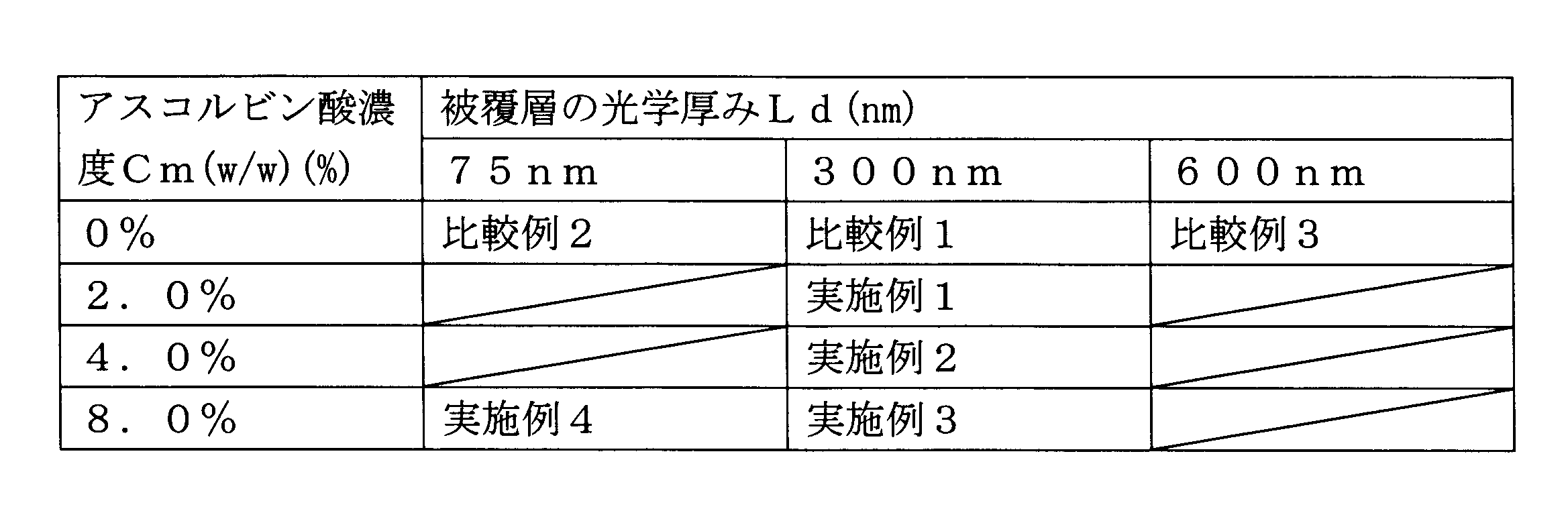
上記した実施例1-4及び比較例1-3に係る試料を裁断して、100mm×120mmの長方形状の試験片を作製した。
まず、ブタを全身麻酔下で15cmの腹部正中切開によって開腹し、小腸を創外に露出させた。
次に、露出させた小腸の一定面積(1×5cm程度)について、ヤスリを用いて点状出血が生じるまで擦過した。
点状出血が生じた後は、正確に10分間空気中に曝露した。そして小腸を腹腔内に戻し、切開した部分の真下に上記した試験片に係る癒着防止材を貼付した。腹壁を吸収性縫合糸(2-0)を用いて2層で連続縫合し、閉鎖し、癒着モデルを作製した。なお、実施例、比較例とも各群5例程度の例数とした。
癒着モデル作製から14日後、ブタを全身麻酔下で放血、犠牲死させ、開腹し正中創直下の癒着を肉眼観察し癒着の発生確率をもとめた。なお、本件下腹部の評価のため上腹部の肝臓の癒着は無視した。
(1)(アスコルビン酸の添加濃度Cmの検討(i))
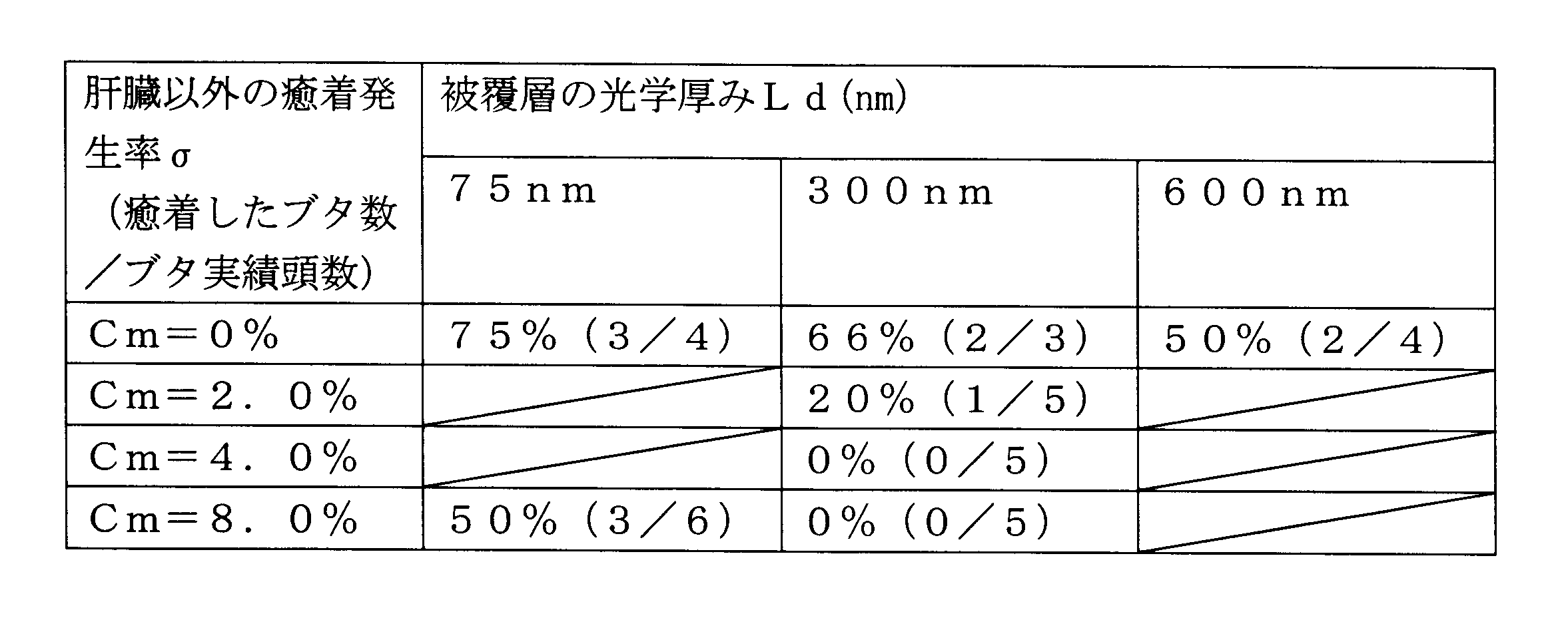
表4より、被覆層の厚み(Ld)を300nmとした場合において、基体層へのアスコルビン酸を、所定の添加濃度Cm(2.0(w/w)%から8.0(w/w)%)と変えた実施例1(癒着発生率σが20%)及び実施例2-3(癒着発生率σが0%)の結果を、同じ被覆層の厚み(Ld)が300nmであってアスコルビン酸を添加していない比較例1(癒着発生率σが66%)と対比すると、実施例の場合は、癒着発生率が顕著に低減することが確認できた。また実施例1と実施例2-3を比較すると、アスコルビン酸の添加濃度Cmが2.0(w/w)%から4.0~8.0(w/w)%へと増加すると、癒着発生率σが20%→0%へとさらに低減することが確認できた。
(2)(アスコルビン酸の添加濃度Cmの検討(ii))
被覆層の光学厚み(Ld)を75nmに固定して、基体層へのアスコルビン酸を高濃度(Cm=8.0(w/w)%)添加した実施例4(癒着発生率σ=50%)は、アスコルビン酸を添加していない比較例2(癒着発生率σ=75%)と比較して、癒着発生率σが低減することが確認できた。
本試験例IIは、癒着防止性能発現のためのアスコルビン酸の徐放性を評価するための試験である。すなわち基体層へのアスコルビン酸の添加濃度Cm=8.0w/w%(一定)で、ただ被覆層の厚みLdが異なるもの([実施例3](Ld=75nm)及び[実施例]4(Ld=300nm))を比較し、最適な徐放が達成されているかどうかを確認した。
(1)試験片の準備
上記した実施例及び比較例に係る試料を裁断して、50mm×50mmの正方形状の試験片を作製した。
リン酸緩衝液(pH7.4)100mLに、前述の実施例3(Ld=75nm)及び実施例4(Ld=300nm)の癒着防止材を1枚浸漬し、リン酸緩衝液中のアスコルビン酸濃度を経時的に24時間まで測定した。アスコルビン酸の定量はビタミンC定量キット(コスモ・バイオ社製)を用い比色定量法にて行なった。
また癒着防止材に含まれるアスコルビン酸量が全量リン酸緩衝液に溶け出した時の濃度を100%として各測定点の徐放率(φ)を求めた。
さらに試験に用いた材料は24時間に形状を観察した。
試験結果を図2に示す。なお24時時間を超えるデータはアスコルビン酸が分解してしまったため採取しなかった。
24時間までのデータでは実施例4は徐放率φが60~70%であり実施例3は徐放率φは20~30%程度であった。両者を比較すると、被覆層厚みLdが薄い実施例4(Ld=75nm)は、被覆層厚みが大きい実施例3(Ld=300nm)より、徐放速度はずっと大きく経過時間T=10hrにおいて70%以上が溶出してしまっている。これに対して、より厚い被覆層を有する実施例3(Ld=300nm)は、徐放はずっと緩慢である(T=24hrにおいてもφ=30%程度)ことがわかる。
しかしながらT=14日後の癒着発生率σについては、実施例3の癒着発生率σは0%であり、実施例4の50%より遙かにすぐれた癒着防止効果が奏されている。これは実施例3においてはT=14日に渡って、最適に徐放速度が維持されているためと推定される。逆に実施例4の場合は徐放速度が大きすぎて短時間で当該基体層中のアスコルビン酸が枯渇してしまうためと思われる。
また、試験に用いた材料(試験片)は24時間後にほぼゲル化しており形状は維持しているものの半固形といえるものであった。
固形または半固形の材料を用いることによってその徐放率は異なることがわかった。より具体的には、生分解性であるポリ脂肪族エステル(B)からなる被覆層を設けその厚みを光学厚みが75nm以上600nm未満の範囲で制御することにより、(基体層に添加した)アスコルビン酸の徐放性を長時間に渡って維持するようにできる。このことは、適応する損傷の部位や損傷の深さによって材料特性を調整することが可能であることが示されている。また液性のもの(例えば特許文献2)のように直後に(全量が一時に)徐放されることはなく、本発明の基体層の形態を有する癒着防止材によれば、経時的(長期間、例えば実施例で示されたように14日)に渡って徐放を維持することが可能である、すなわち長期間徐放が進んでいることが示された。
実施例(A)と同様、図1に示すような実施形態に係る癒着防止材1の構成をもとに、基体層の材料に所定量のL-アスコルビン酸(和光純薬製社製)を添加して、フィルム状に成型した基体層の両面に、同様にL-アスコルビン酸を添加した第1被覆層及び第2被覆層(以下、同様に単に「被覆層」と省略する場合もある。)を配置したものを実施例の試料とした。(また、基体層、被覆層のいずれにもL-アスコルビン酸を添加しないものを比較例の試料とした。)
(基体層の形成)
実施例(A)と同様に、基体層の材料として水溶性高分子であるプルランを使用しこれに(Cm=4(w/w)%となるように)所定量のアスコルビン酸を添加して、100mm×120mm×厚さ(LD)50μmのプルランからなる膜を流延法により成膜して、アスコルビン酸含有基体層を形成した。
次に、ディッピング法により、被覆層の形成を行った。すなわち、所定濃度に調整したポリ脂肪族エステルであるポリ乳酸-ポリグリコール酸-ポリε-カプロラクトンのトルエン溶液(以下、コーティング液という。)を作製し、当該コーティング液に所定量(Cm*=0.4(w/w)%)となるようにアスコルビン酸を添加した。当該アスコルビン酸含有コーティング液中に上記調製した基体層を浸し、当該基体層の両表面にポリ乳酸-ポリグリコール酸-ポリε-カプロラクトン三元共重合体からなる被覆層を形成した。ディッピング後に30分~1時間程度室温で乾燥させた。この塗布工程(ディッピング)、乾燥工程を繰り返して行うことにより、実施例1-4に比較してより厚い膜厚(Ld)の被覆層(基体層の両面の第1外層、第2外層)(但し、Cm*=0.4w/w%)を形成した。ここでは、被覆層の厚みLd=1000nm(実施例5)、Ld=3000nm(実施例6)の試料(試験片)とした。
なお、比較例として、実施例5-6と同様に、基体層(LD=50μm)の両側に被覆層(Ld=1000nm)を形成したが、いずれの層にもアスコルビン酸を全く添加しないもの(Cm=0、Cm*=0)を、比較例4にかかる試料(試験片)とした。
本試験例IIIは、試験例Iと同様癒着防止材の癒着防止性能を評価するための試験であるが、対象の動物種を、よりヒトに近いものに変更した。その場合は、癒着防止材の適用される環境(腹腔内圧や臓器の移動の発生)がより過酷な条件であることを想定し、この環境に適合するかを確認する試験である。
癒着防止性能を評価するにあたっては、上記した実施例(B)及び比較例に係る試料から試験片を作製し、試験片をサル(Macaca fascicularis)の腹腔内に貼り付けて癒着の程度を観察し、かつ、癒着長さを測定することにより、癒着防止性能を評価した。
上記した実施例5-6及び比較例4に係る試料を裁断して、100mm×120mmの長方形状の試験片を作製した。
まず、サルを全身麻酔下で8cmの腹部正中切開によって開腹し、大腸を創外に露出させた。
次に、露出させた大腸の一定面積(3×4cm程度)について、ヤスリを用いて点状出血が生じるまで擦過した。
点状出血が生じた後は、正確に10分間空気中に曝露した。そして大腸を腹腔内に戻し、切開した部分の真下に上記した試験片に係る癒着防止材を貼付した。腹膜、腹壁及び筋層をナイロン縫合糸(3-0)を用いて連続縫合し、皮下組織及び皮膚をナイロン縫合糸(4-0)で単純結紮し、閉鎖し癒着モデルを作製した。なお、実施例5-6、比較例4とも各群3例程度の例数とした。
癒着モデル作製から14日後、サルを全身麻酔下で開腹し正中創直下の癒着を肉眼観察し、癒着の発生確率、癒着長さ割合を求めた。
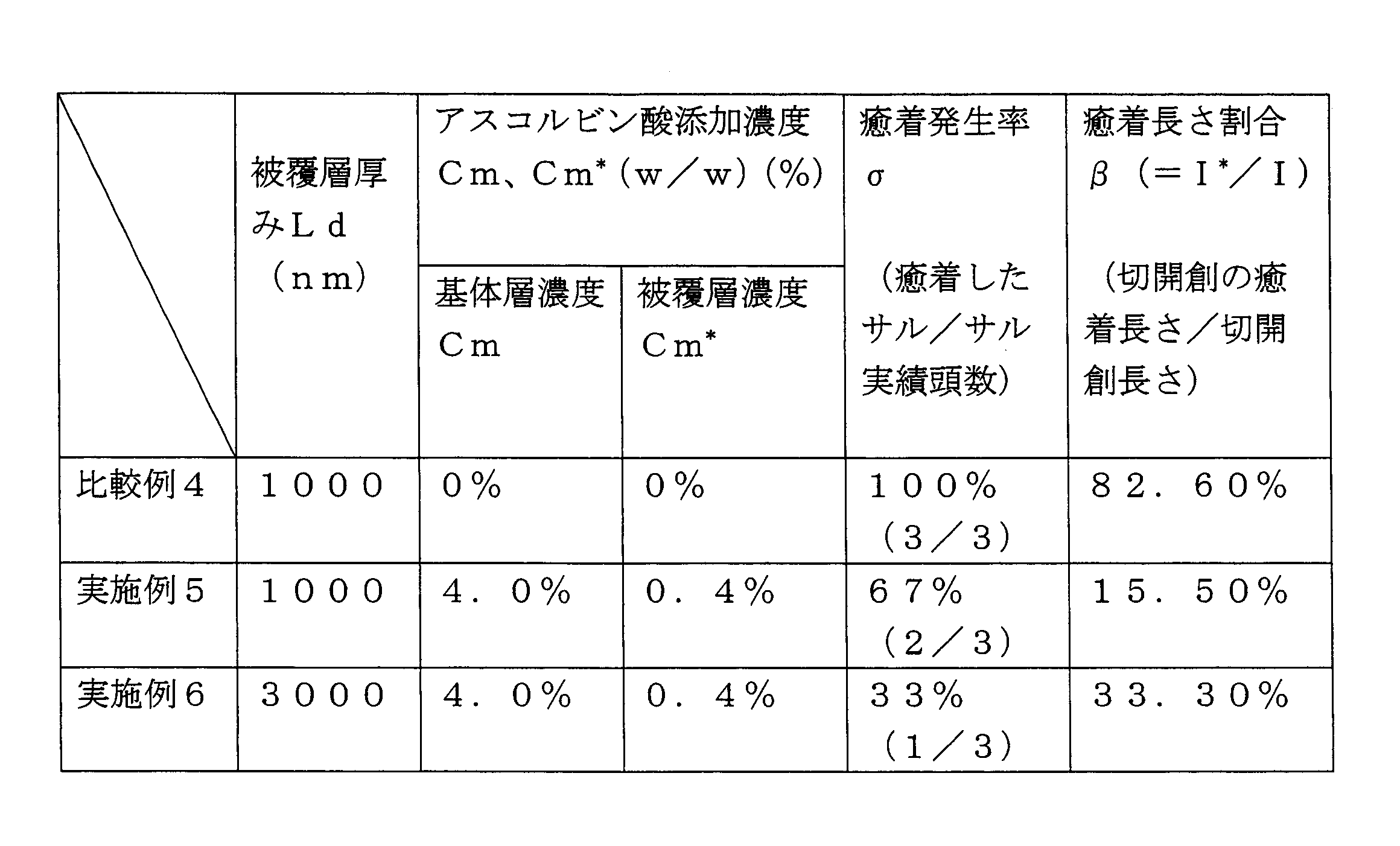
癒着防止材の強度を高め確実に形態維持を行うための観点から、実施例1-4と同じ厚みのプルランからなる基体層(LD=50μm)に対してより厚いポリ脂肪酸エステルの被覆層を(その両面に)形成した場合は、当該厚い被覆層を形成することにより、基体層からのアスコルビン酸の徐放が妨げられると考えられた。しかしながら、その場合であっても(Ld=1000nm(実施例5)、Ld=3000nm(実施例6))、当該被覆層にもアスコルビン酸を含有させることにより、表5に示すように、癒着発生率σをかなり低下させることができることが示された。
(なお、貼附した癒着防止材の形状は14日後にも、ほぼ当初の形態を保持していることが確認され、実施例で使用した程度の厚みの被覆層の備えることにより、癒着防止材は形態維持の点からは初期の目的を達成したことが確認された。)
この点においては、当該被覆層に添加するアスコルビン酸の濃度Cm* を0.4%→0.6%→0.8%→1.0%等とさらに増加させることにより、癒着発生率をσを十分に低減させうると考えられる。また、被覆層Ldを現在は生体分解性のポリ脂肪酸エステル(B)のみにより構成しているが、被覆層Ldにも少量の例えばアスコルビン酸と同程度のプルラン等の水溶性高分子(A)を含有させることにより、よりアスコルビン酸の徐放を加速させる等の手段を採用することができ、癒着発生率σをさらに低減させうると考えられる。
(i)(試験例1)(癒着防止材を生体組織に貼り付けたときの分解性評価):
生体に貼り付けて強度を発現するまでの時間は若干長くなるが、機能に影響はない。
(ii)(試験例3)(癒着防止材が濡れたときの取り扱い性評価):
試験例2において、ブタ及びサルの腹腔内での貼付を行ったが、問題なく貼付できた。
(iii)(試験例4)(生体組織に癒着防止材を貼り付けたときの密着性を評価):
試験例2において、ブタ及びサルの腹腔内での貼付を行ったが、問題なく貼付できた。
10 基体層
20 第1被覆層(第1外層)
30 第2被覆層(第2外層)
Cm 基体層のアスコルビン酸等の濃度
Cm* 被覆層(外層)のアスコルビン酸等の濃度
LD 基体層の厚み
Ld 被覆層の厚み(光学厚み)
I 切開創長さ
I* 切開創の癒着長さ
Φ アスコルビン酸の徐放率(溶出速度)
Claims (13)
- 水溶性高分子及びポリ脂肪族エステルからなる固形または半固形の基体に抗酸化物質として、アスコルビン酸またはアスコルビン酸誘導体を含有させてなることを特徴とする癒着防止材。
- 請求項1に記載の癒着防止材において、前記固形の基体は、フィルム状、シート状、及びメッシュ状のいずれか一つの中から選ばれる形態であり、
前記フィルム状、前記シート状及びメッシュ状の形態は、当該基体から実質的になる単層構造であるか、または、当該基体の基体層上にさらにポリ脂肪族エステルからなる被覆層を備えた積層構造を有するものであり、
または前記メッシュ状の形態は、固形の水溶性高分子及びポリ脂肪族エステルの基体を棒状に形成した複合体からなる繊維状構造を有し、かつその目付けは0.8g/m2~830g/m2であることを特徴とする癒着防止材。 - 請求項1に記載の癒着防止材において、半固形の基体は、単層構造または積層構造を有し、コロイド状を含むゲル状の形態で、37℃の粘度が100Pa・sから1,000,000Pa・sであることを特徴する癒着防止材。
- 請求項2に記載の癒着防止材において、当該基体の基体層の上に被覆層を備えた積層構造は、その基体層の両面にそれぞれ被覆層を備えた両面被覆層及び基体層の3層で形成されていることを特徴とする癒着防止材。
- 請求項4に記載の癒着防止材において、前記被覆層の厚みを、分光エリプソメータを用いて波長380nm~900nmで測定したときの前記被覆層の光学厚みが50nm以上7000nm未満であることを特徴とする癒着防止材。
- 請求項1に記載の癒着防止材において、アスコルビン酸及びその誘導体は、基体または基体層を構成する基材重量に対し0.1(w/w)%以上~20(w/w)%以下含有することを特徴とする癒着防止材。
- 請求項1から請求項6のいずれかに記載の癒着防止材を、牛血漿に浸漬した場合、24時間後に、pHは7.5~6.0となることを特徴とする癒着防止材。
- 請求項2~請求項7のいずれか1項に記載の癒着防止材において、
前記被覆層として、前記基体層の一方側の面に配置された第1被覆層と、前記基体層の他方側の面に配置された第2被覆層とを備え、前記第1被覆層及び第2被覆層が同一材料で構成されていることを特徴とする癒着防止材。 - 請求項2~請求項7のいずれか1項に記載の癒着防止材において、前記被覆層として、前記基体層の一方側の面に配置された第1被覆層と、前記基体層の他方側の面に配置された第2被覆層とを備え、前記第1被覆層と前記第2被覆層とが異なる材料で構成されていることを特徴とする癒着防止材。
- 請求項1~請求項9のいずれか1項に記載の癒着防止材において、
前記水溶性高分子は、多糖類、蛋白質又は合成高分子であることを特徴とする癒着防止材。 - 前記基体を構成する水溶性高分子(A)とポリ脂肪族エステル(B)の重量割合ω(=A/B)が1~99/99~1であることを特徴とする請求項1~10のいずれか1項に記載の癒着防止材。
- 水溶性高分子から実質的になる固形または半固形の基体に抗酸化物質として、アスコルビン酸またはアスコルビン酸誘導体を含有させ、またはさらに当該基体からなる基体層の両面にそれぞれポリ脂肪族エステルからなる被覆層を備えたことを特徴とする癒着防止材。
- 請求項1の抗酸化物質として、植物の脂溶性色素であるカロチノイド類またはポリフェノール類を含む植物由来の抗酸化物質を含有させてなることを特徴とする請求項2~12のいずれか1項に記載の癒着防止材。
Priority Applications (6)
| Application Number | Priority Date | Filing Date | Title |
|---|---|---|---|
| BR112017004866A BR112017004866A2 (pt) | 2016-02-29 | 2016-12-14 | material de anti-aderência |
| JP2017516808A JP6979646B2 (ja) | 2016-02-29 | 2016-12-14 | 徐放性癒着防止材 |
| CN201680003412.8A CN107148307A (zh) | 2016-02-29 | 2016-12-14 | 防粘连材料 |
| EP16836071.7A EP3434293A4 (en) | 2016-02-29 | 2016-12-14 | PREVENTING SUBSTANCE |
| US15/504,536 US20180221532A1 (en) | 2016-02-29 | 2016-12-14 | Anti-adhesion material |
| TW106105734A TW201731492A (zh) | 2016-02-29 | 2017-02-21 | 防沾黏材 |
Applications Claiming Priority (2)
| Application Number | Priority Date | Filing Date | Title |
|---|---|---|---|
| PCT/JP2016/055988 WO2017149584A1 (ja) | 2016-02-29 | 2016-02-29 | 癒着防止材 |
| JPPCT/JP2016/055988 | 2016-02-29 |
Publications (1)
| Publication Number | Publication Date |
|---|---|
| WO2017149897A1 true WO2017149897A1 (ja) | 2017-09-08 |
Family
ID=59742777
Family Applications (2)
| Application Number | Title | Priority Date | Filing Date |
|---|---|---|---|
| PCT/JP2016/055988 Ceased WO2017149584A1 (ja) | 2016-02-29 | 2016-02-29 | 癒着防止材 |
| PCT/JP2016/087183 Ceased WO2017149897A1 (ja) | 2016-02-29 | 2016-12-14 | 癒着防止材 |
Family Applications Before (1)
| Application Number | Title | Priority Date | Filing Date |
|---|---|---|---|
| PCT/JP2016/055988 Ceased WO2017149584A1 (ja) | 2016-02-29 | 2016-02-29 | 癒着防止材 |
Country Status (7)
| Country | Link |
|---|---|
| US (1) | US20180221532A1 (ja) |
| EP (1) | EP3434293A4 (ja) |
| JP (1) | JP6979646B2 (ja) |
| CN (1) | CN107148307A (ja) |
| BR (1) | BR112017004866A2 (ja) |
| TW (1) | TW201731492A (ja) |
| WO (2) | WO2017149584A1 (ja) |
Families Citing this family (4)
| Publication number | Priority date | Publication date | Assignee | Title |
|---|---|---|---|---|
| WO2019044765A1 (ja) * | 2017-08-28 | 2019-03-07 | 川澄化学工業株式会社 | 癒着防止材 |
| CN113081482B (zh) * | 2021-04-23 | 2024-02-27 | 柏为(武汉)医疗科技股份有限公司 | 一种中耳防粘连膜及其制备方法 |
| CN114522268B (zh) * | 2021-12-16 | 2023-02-10 | 浙江瑞谷生物科技有限公司 | 一种皮肤修复材料及其制备方法和应用 |
| CN116173316A (zh) * | 2023-03-28 | 2023-05-30 | 赛克赛斯生物科技股份有限公司 | 一种防粘连的制剂、装置及其制备方法和应用 |
Citations (9)
| Publication number | Priority date | Publication date | Assignee | Title |
|---|---|---|---|---|
| JP2002515086A (ja) * | 1996-08-27 | 2002-05-21 | フュージョン メディカル テクノロジーズ,インコーポレイテッド | 癒着防止用の断片化重合体ヒドロゲルおよびそれらの調製 |
| JP2005224445A (ja) * | 2004-02-13 | 2005-08-25 | Terumo Corp | 生体吸収性材料 |
| WO2006132310A1 (ja) * | 2005-06-08 | 2006-12-14 | Cellex K.K. | 組織癒着防止液及び組織癒着防止方法 |
| JP2007209748A (ja) * | 2006-01-16 | 2007-08-23 | Ito:Kk | 創傷治癒用高分子組成物 |
| JP2008109979A (ja) * | 2006-10-30 | 2008-05-15 | Kawasumi Lab Inc | 癒着防止材 |
| WO2011081162A1 (ja) * | 2009-12-28 | 2011-07-07 | 川澄化学工業株式会社 | 癒着防止材 |
| WO2014141983A1 (ja) * | 2013-03-15 | 2014-09-18 | 東レ株式会社 | ポリ乳酸系樹脂を用いた積層フィルム |
| JP5685297B2 (ja) | 2006-12-05 | 2015-03-18 | 株式会社半導体エネルギー研究所 | 半導体装置 |
| WO2015152204A1 (ja) * | 2014-03-31 | 2015-10-08 | 東レ株式会社 | 多層シートおよびそれを用いた一体化シート並びにその製造方法 |
Family Cites Families (14)
| Publication number | Priority date | Publication date | Assignee | Title |
|---|---|---|---|---|
| JPH07195824A (ja) * | 1993-12-28 | 1995-08-01 | New Oji Paper Co Ltd | インクジェット記録用紙の製造方法、記録用紙及びそれを用いた記録方法 |
| JPH08150773A (ja) * | 1994-11-28 | 1996-06-11 | Mitsubishi Paper Mills Ltd | インクジェット記録シート |
| US5612321A (en) * | 1995-06-22 | 1997-03-18 | Hercules Incorporated | Antioxidant grafted polysaccharides |
| US6566345B2 (en) * | 2000-04-28 | 2003-05-20 | Fziomed, Inc. | Polyacid/polyalkylene oxide foams and gels and methods for their delivery |
| CN1403163A (zh) * | 2002-10-23 | 2003-03-19 | 东南大学 | 可吸收纤维增强多层膜材料及其制备方法 |
| KR100785378B1 (ko) * | 2005-09-05 | 2007-12-14 | 주식회사 바이오레인 | 다층구조의 유착방지제 |
| US8933290B2 (en) * | 2007-06-26 | 2015-01-13 | Sofradim Production Sas | Mesh implant |
| US20090143348A1 (en) * | 2007-11-30 | 2009-06-04 | Ahmet Tezel | Polysaccharide gel compositions and methods for sustained delivery of drugs |
| EP2711031A3 (en) * | 2008-09-22 | 2014-07-02 | Boston Scientific Neuromodulation Corporation | Implantable or Insertable Medical Devices |
| CN101559242B (zh) * | 2009-05-22 | 2015-07-29 | 广州迈普再生医学科技有限公司 | 一种可同时作为药物缓释体系的纳米人工硬脑膜及其制备方法 |
| CN101760146A (zh) * | 2010-02-05 | 2010-06-30 | 东莞市富邦科技应用材料有限公司 | 聚烯烃材质喷烤漆遮蔽胶带 |
| US9005746B2 (en) * | 2012-05-31 | 2015-04-14 | Covidien Lp | Polymeric ascorbic acid devices for tissue regeneration |
| CN102908677A (zh) * | 2012-11-09 | 2013-02-06 | 无锡中科光远生物材料有限公司 | 防粘连可吸收疝气补片的制备方法 |
| WO2015194616A1 (ja) * | 2014-06-18 | 2015-12-23 | 東レ株式会社 | 積層体及びその製造方法 |
-
2016
- 2016-02-29 WO PCT/JP2016/055988 patent/WO2017149584A1/ja not_active Ceased
- 2016-12-14 WO PCT/JP2016/087183 patent/WO2017149897A1/ja not_active Ceased
- 2016-12-14 BR BR112017004866A patent/BR112017004866A2/pt not_active Application Discontinuation
- 2016-12-14 US US15/504,536 patent/US20180221532A1/en not_active Abandoned
- 2016-12-14 EP EP16836071.7A patent/EP3434293A4/en not_active Withdrawn
- 2016-12-14 JP JP2017516808A patent/JP6979646B2/ja active Active
- 2016-12-14 CN CN201680003412.8A patent/CN107148307A/zh active Pending
-
2017
- 2017-02-21 TW TW106105734A patent/TW201731492A/zh unknown
Patent Citations (10)
| Publication number | Priority date | Publication date | Assignee | Title |
|---|---|---|---|---|
| JP2002515086A (ja) * | 1996-08-27 | 2002-05-21 | フュージョン メディカル テクノロジーズ,インコーポレイテッド | 癒着防止用の断片化重合体ヒドロゲルおよびそれらの調製 |
| JP2005224445A (ja) * | 2004-02-13 | 2005-08-25 | Terumo Corp | 生体吸収性材料 |
| WO2006132310A1 (ja) * | 2005-06-08 | 2006-12-14 | Cellex K.K. | 組織癒着防止液及び組織癒着防止方法 |
| JP4447640B2 (ja) | 2005-06-08 | 2010-04-07 | 株式会社セレックス | 組織癒着防止液及び組織癒着防止方法 |
| JP2007209748A (ja) * | 2006-01-16 | 2007-08-23 | Ito:Kk | 創傷治癒用高分子組成物 |
| JP2008109979A (ja) * | 2006-10-30 | 2008-05-15 | Kawasumi Lab Inc | 癒着防止材 |
| JP5685297B2 (ja) | 2006-12-05 | 2015-03-18 | 株式会社半導体エネルギー研究所 | 半導体装置 |
| WO2011081162A1 (ja) * | 2009-12-28 | 2011-07-07 | 川澄化学工業株式会社 | 癒着防止材 |
| WO2014141983A1 (ja) * | 2013-03-15 | 2014-09-18 | 東レ株式会社 | ポリ乳酸系樹脂を用いた積層フィルム |
| WO2015152204A1 (ja) * | 2014-03-31 | 2015-10-08 | 東レ株式会社 | 多層シートおよびそれを用いた一体化シート並びにその製造方法 |
Non-Patent Citations (1)
| Title |
|---|
| See also references of EP3434293A4 |
Also Published As
| Publication number | Publication date |
|---|---|
| BR112017004866A2 (pt) | 2017-12-12 |
| EP3434293A4 (en) | 2020-01-15 |
| JPWO2017149897A1 (ja) | 2019-01-17 |
| JP6979646B2 (ja) | 2021-12-15 |
| US20180221532A1 (en) | 2018-08-09 |
| TW201731492A (zh) | 2017-09-16 |
| WO2017149584A1 (ja) | 2017-09-08 |
| EP3434293A1 (en) | 2019-01-30 |
| CN107148307A (zh) | 2017-09-08 |
Similar Documents
| Publication | Publication Date | Title |
|---|---|---|
| Nakipoglu et al. | Bioadhesives with antimicrobial properties | |
| Balakrishnan et al. | A novel injectable tissue adhesive based on oxidized dextran and chitosan | |
| Gao et al. | Transdermal delivery of therapeutics through dissolvable gelatin/sucrose films coated on PEGDA microneedle arrays with improved skin permeability | |
| CN100400114C (zh) | 可控降解速率的生物医用植入材料及其应用 | |
| MX2008009752A (es) | Materiales adhesivos a tejidos. | |
| JP5686297B2 (ja) | 癒着防止材 | |
| CA2653156C (en) | Drug eluting stent with a biodegradable release layer attached with an electro-grafted primer coating | |
| JPWO2017149897A1 (ja) | 癒着防止材 | |
| JP2007526793A (ja) | 生分解性を有する薬剤溶出ステント | |
| JP7025930B2 (ja) | 癒着防止材 | |
| US20070288088A1 (en) | Drug eluting stent with a biodegradable release layer attached with an electro-grafted primer coating | |
| EP2257274A2 (en) | Treatment of aneurysm with application of connective tissue stabilization agent in combination with a delivery vehicle | |
| US12186447B2 (en) | Pectin-carboxymethylcellulose mesothelial sealants and protectants | |
| Ohta et al. | The prevention of hepatectomy-induced adhesions by bilayer sponge composed of ultrapure alginate | |
| Weickert et al. | Optimizing biliary stent patency by coating with hydrophobin alone or hydrophobin and antibiotics or heparin: an in vitro proof of principle study | |
| WO2009019516A2 (en) | Tissue-adhesive materials | |
| US20140296967A1 (en) | Drug eluting stent with a biodegradable release layer attached with an electro-grafted primer coating | |
| JP7362986B2 (ja) | 癒着防止材 | |
| EP3169371B1 (en) | Surgical hemostatic based rice starch | |
| JP4851086B2 (ja) | 埋め込み型医用機器用のコーティング用組成物及び該機器をコーティングする方法 | |
| CN110623946B (zh) | 基于亲疏水性的双层皮肤修复膜的制备方法 | |
| JP5838025B2 (ja) | 癒着防止材 | |
| US20240325108A1 (en) | Drug-refillable, biocompatible, and biodegradable tissue markers and methods of making and using the same | |
| Ladurner et al. | Polypropylene meshes coated with a polysaccharide based bioadhesive for intra-abdominal mesh fixation in a rabbit model | |
| Alonci | Injectable hydrogels for innovative clinical applications |
Legal Events
| Date | Code | Title | Description |
|---|---|---|---|
| REEP | Request for entry into the european phase |
Ref document number: 2016836071 Country of ref document: EP |
|
| WWE | Wipo information: entry into national phase |
Ref document number: 2016836071 Country of ref document: EP |
|
| WWE | Wipo information: entry into national phase |
Ref document number: 15504536 Country of ref document: US |
|
| ENP | Entry into the national phase |
Ref document number: 2017516808 Country of ref document: JP Kind code of ref document: A |
|
| REG | Reference to national code |
Ref country code: BR Ref legal event code: B01A Ref document number: 112017004866 Country of ref document: BR |
|
| ENP | Entry into the national phase |
Ref document number: 112017004866 Country of ref document: BR Kind code of ref document: A2 Effective date: 20170310 |
|
| NENP | Non-entry into the national phase |
Ref country code: DE |
|
| 121 | Ep: the epo has been informed by wipo that ep was designated in this application |
Ref document number: 16836071 Country of ref document: EP Kind code of ref document: A1 |