WO2017149959A1 - Climatiseur pour véhicule à deux roues et véhicule à deux roues équipé de climatiseur comportant un tel climatiseur - Google Patents
Climatiseur pour véhicule à deux roues et véhicule à deux roues équipé de climatiseur comportant un tel climatiseur Download PDFInfo
- Publication number
- WO2017149959A1 WO2017149959A1 PCT/JP2017/001301 JP2017001301W WO2017149959A1 WO 2017149959 A1 WO2017149959 A1 WO 2017149959A1 JP 2017001301 W JP2017001301 W JP 2017001301W WO 2017149959 A1 WO2017149959 A1 WO 2017149959A1
- Authority
- WO
- WIPO (PCT)
- Prior art keywords
- air conditioner
- air
- wheeled vehicle
- motorcycle
- duct
- Prior art date
- Legal status (The legal status is an assumption and is not a legal conclusion. Google has not performed a legal analysis and makes no representation as to the accuracy of the status listed.)
- Ceased
Links
Images





Classifications
-
- B—PERFORMING OPERATIONS; TRANSPORTING
- B60—VEHICLES IN GENERAL
- B60H—ARRANGEMENTS OF HEATING, COOLING, VENTILATING OR OTHER AIR-TREATING DEVICES SPECIALLY ADAPTED FOR PASSENGER OR GOODS SPACES OF VEHICLES
- B60H1/00—Heating, cooling or ventilating devices
- B60H1/00357—Air-conditioning arrangements specially adapted for particular vehicles
- B60H1/00407—Air-conditioning arrangements specially adapted for particular vehicles for open or convertible vehicles
-
- B—PERFORMING OPERATIONS; TRANSPORTING
- B60—VEHICLES IN GENERAL
- B60H—ARRANGEMENTS OF HEATING, COOLING, VENTILATING OR OTHER AIR-TREATING DEVICES SPECIALLY ADAPTED FOR PASSENGER OR GOODS SPACES OF VEHICLES
- B60H1/00—Heating, cooling or ventilating devices
- B60H1/32—Cooling devices
-
- B—PERFORMING OPERATIONS; TRANSPORTING
- B62—LAND VEHICLES FOR TRAVELLING OTHERWISE THAN ON RAILS
- B62J—CYCLE SADDLES OR SEATS; AUXILIARY DEVICES OR ACCESSORIES SPECIALLY ADAPTED TO CYCLES AND NOT OTHERWISE PROVIDED FOR, e.g. ARTICLE CARRIERS OR CYCLE PROTECTORS
- B62J33/00—Arrangements for warming riders specially adapted for cycles
-
- B—PERFORMING OPERATIONS; TRANSPORTING
- B62—LAND VEHICLES FOR TRAVELLING OTHERWISE THAN ON RAILS
- B62J—CYCLE SADDLES OR SEATS; AUXILIARY DEVICES OR ACCESSORIES SPECIALLY ADAPTED TO CYCLES AND NOT OTHERWISE PROVIDED FOR, e.g. ARTICLE CARRIERS OR CYCLE PROTECTORS
- B62J43/00—Arrangements of batteries
- B62J43/30—Arrangements of batteries for providing power to equipment other than for propulsion
-
- B—PERFORMING OPERATIONS; TRANSPORTING
- B62—LAND VEHICLES FOR TRAVELLING OTHERWISE THAN ON RAILS
- B62J—CYCLE SADDLES OR SEATS; AUXILIARY DEVICES OR ACCESSORIES SPECIALLY ADAPTED TO CYCLES AND NOT OTHERWISE PROVIDED FOR, e.g. ARTICLE CARRIERS OR CYCLE PROTECTORS
- B62J50/00—Arrangements specially adapted for use on cycles not provided for in main groups B62J1/00 - B62J45/00
- B62J50/20—Information-providing devices
- B62J50/21—Information-providing devices intended to provide information to rider or passenger
- B62J50/22—Information-providing devices intended to provide information to rider or passenger electronic, e.g. displays
Definitions
- the present invention relates to an air conditioner for a two-wheeled vehicle and a two-wheeled vehicle with an air conditioner such as an electric assist bicycle and an electric motorcycle equipped with the same.
- motorcycles such as motorcycles and bicycles are not shaped to be covered by a vehicle body frame like a car, so they feel hot and cold during driving and lack comfort.
- two-wheeled vehicles for example, motorcycles, have proposed air-conditioner-equipped motorcycles provided with an air conditioner and an air duct that blows out cool air from the air-conditioner (see, for example, Patent Document 1 and Patent Document 2).
- This air-conditioned motorcycle has an air duct connected to a passenger's air-conditioning helmet or air-conditioning clothing to cool the human body by flowing cool air, and then directly releases the air to the outside.
- a conventional motorcycle with an air conditioner is configured to supply cold air into a passenger's air conditioning helmet or air conditioning clothing through a long and winding duct, in other words, a duct with high ventilation resistance. It is necessary to use an air conditioner with an air blowing capacity, and energy consumption becomes large.
- the present invention provides a two-wheeled vehicle air conditioner that can be driven with low power consumption, and a two-wheeled vehicle equipped with an air conditioner that has both the comfort and energy saving.
- An air conditioner for a motorcycle includes a refrigeration cycle circuit including a compressor, a condenser, and an evaporator, and is configured to be installed on a loading platform behind a passenger of the motorcycle, and a refrigeration cycle circuit in the air conditioner casing And a duct for discharging the conditioned air generated in step 4 to the outside of the air conditioner casing, and the duct opens toward the back of the passenger.
- the two-wheeled vehicle with an air conditioner has a battery, and the air conditioner casing of the two-wheeled vehicle air conditioner described above is mounted on the loading frame of the vehicle body frame so that the duct opens toward the back of the passenger, and the battery is used for the two-wheeled vehicle.
- the air conditioner is driven.
- the air conditioner for motorcycles is blown to the occupant in such a way that the conditioned air discharged from the duct is sucked into the vortex generated in the back of the occupant's back by traveling. It can be made small in terms of energy consumption, and can reduce power consumption and realize comfortable air conditioning.
- FIG. 1 is an external view of an electrically assisted bicycle, which is a two-wheeled vehicle with an air conditioner, equipped with an air conditioner for a motorcycle according to a first embodiment of the present invention.
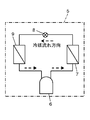
- FIG. 2 is a refrigeration cycle diagram of the motorcycle air conditioner according to the first embodiment of the present invention.
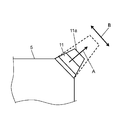
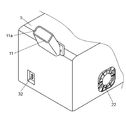
- FIG. 3 is a side view showing a duct portion of the motorcycle air conditioner according to the first embodiment of the present invention.
- FIG. 4 is a sectional view of the motorcycle air conditioner according to the first embodiment of the present invention.
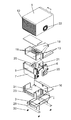
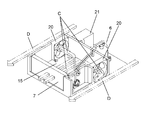
- FIG. 5 is an exploded perspective view of the motorcycle air conditioner according to the first embodiment of the present invention.
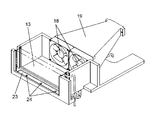
- FIG. 6 is a perspective view showing the upper chamber of the motorcycle air conditioner according to the first embodiment of the present invention.
- FIG. 7 is a perspective view showing a lower chamber of the motorcycle air conditioner according to the first embodiment of the present invention.
- FIG. 8 is a perspective view showing an air conditioner casing of the motorcycle air conditioner according to the first embodiment of the present invention.
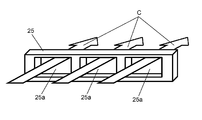
- FIG. 9 is a perspective view of the regenerator material provided in the motorcycle air conditioner according to the first embodiment of the present invention.
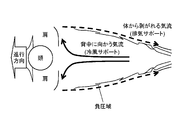
- FIG. 10 is an analysis diagram of vortex flow generated on the back of a motorcycle occupant in the motorcycle air conditioner according to the first embodiment of the present invention.
- FIG. 11 is an external view of an electrically assisted bicycle that is a two-wheeled vehicle with an air conditioner equipped with a two-wheeled vehicle air conditioner according to the second embodiment of the present invention.
- FIG. 12 is a plan view of an air conditioner for a motorcycle according to the second embodiment of the present invention.
- FIG. 13 is an external view of an electrically assisted bicycle that is a two-wheeled vehicle with an air conditioner according to the third embodiment of the present invention.
- FIG. 14 is a communication control configuration diagram of an electrically assisted bicycle which is a two-wheeled vehicle with an air conditioner according to the third embodiment of the present invention.
- FIG. 15 is a front view showing a display operation unit of an electrically assisted bicycle that is a two-wheeled vehicle with an air conditioner according to the third embodiment of the present invention.
- FIG. 16 is a flowchart showing the operations of the display operation unit, the motorcycle air conditioner, and the motor unit of the electrically assisted bicycle that is a two-wheeled vehicle with an air conditioner according to the third embodiment of the present invention.
- FIG. 17 is a diagram showing the relationship between the traveling speed of an electrically assisted bicycle, which is a two-wheeled vehicle with an air conditioner, and the capacity ratio of the two-wheeled vehicle air conditioner in the third embodiment of the present invention.
- FIG. 1 is an external view of an electrically assisted bicycle, which is a two-wheeled vehicle with an air conditioner, equipped with an air conditioner for a motorcycle according to a first embodiment of the present invention.
- This motor-assisted bicycle 1 which is a two-wheeled vehicle with an air conditioner has a two-wheeled vehicle air conditioner 4 attached to a loading platform 3 of the body frame 2.
- the air conditioner 4 for a motorcycle has a refrigeration cycle circuit formed by connecting a compressor 6, a condenser 7, an expansion device 8 for expanding refrigerant and an evaporator 9 in an air conditioner housing 5 in an annular shape. It is incorporated.
- the motorcycle air conditioner 4 is provided with a duct 11 that blows out conditioned air on the surface on the side of the saddle 10 on which the passenger sits, in other words, on the downstream side of the air flow generated in the air conditioner housing 5, and the upstream side surface opposite thereto. Is provided with a suction port 12 (see FIG. 4) for taking in outside air.
- the duct 11 is attached to the air conditioner casing 5 so that the opening 11a faces the upper side of the saddle 10, that is, the back of the passenger riding on the saddle 10.
- the duct 11 is formed in a tapered cylindrical shape with a small opening 11a at the tip, and the duct 11 is formed of a bellows cylinder as shown in FIG. And, as shown by arrow B, the elevation angle can be varied up and down.
- the interior of the air conditioner housing 5 is separated into an upper chamber 14 in the upper space and a lower chamber 15 in the lower space by a partition wall 13, and a machine room partitioned by a partition wall 16 on the downstream side of the lower chamber 15. 17 is provided.
- the upper chamber 14 is provided with an evaporator 9 upstream and an evaporator blower 18 downstream thereof. Further, a duct 11 is provided downstream of the evaporator blower 18 via a blowout passage 19.
- the lower chamber 15 is provided with a condenser 7 upstream, and a condenser blower 20 is provided downstream of the condenser 7. Further, an electrical component 21 (see FIG. 5) for controlling the compressor 6 and the two-wheeled air conditioner 4 is provided in the machine room 17 across the partition wall 16 downstream of the condenser blower 20.
- the condenser blower 20 in the lower chamber 15 is installed in a direction in which air is blown out from the side surface of the air conditioner casing 5, and from the blowout openings 22 (see FIGS. 1 and 5) formed on both side surfaces of the air conditioner casing 5. It is configured to blow out the wind.
- a drain pan 23 for collecting drain water generated in the evaporator 9 is disposed at the lower part of the evaporator 9 in the upper chamber 14.
- a plurality of holes 24 are provided at the bottom of the drain pan 23, and the drain water collected in the drain pan 23 is sprinkled into the condenser 7 provided in the lower portion of the drain pan 23.
- FIG. 9 shows an example of the shape of the cold storage material 25.
- a through hole 25a is provided in the central portion of the cold storage material 25 toward the traveling direction of the bicycle.
- the thickness of the regenerator material 25, the area of the through-hole 25a, and the quantity be determined by the decrease range of the ambient temperature and the increase range of the ventilation resistance.
- the electrically assisted bicycle 1 which is a two-wheeled vehicle equipped with an air conditioner 4 for a motorcycle includes a motor unit 26 serving as an auxiliary power source and a battery unit 27 for supplying electric power to the motor unit 26.
- the motor unit 26 combines the pedal depression force with the auxiliary force from the motor unit 26 and transmits the rotational force to the rear wheel 28.
- the air conditioner 4 for a motorcycle is mounted with the duct 11 directed in the forward direction of the bicycle, and a mounting screw 30 screwed through a mounting tool 29 on the lower surface of the loading platform 3 as shown in FIG. It is fixed by tightening it in a mounting hole (not shown) provided in.
- the battery part 27 and the electrical equipment part 21 are connected with the electric wire.
- the outside air is sucked in from the suction port 12 by the rotation of the evaporator blower 18, and this air is heat-exchanged by the evaporator 9 and blown out from the duct 11 through the blowing passage 19.
- the passenger of the motorcycle can receive the conditioned air (in this case, cold air) from the duct 11 and can travel comfortably.
- the duct 11 blows cold air above the saddle 10 in front of the loading platform 3, that is, toward the back of the passenger who is riding the motorcycle, but at this time, as shown in FIG.
- a vortex is formed and is in a negative pressure region. Accordingly, the cold air from the duct 11 is sucked out by a vortex that forms a negative pressure region. Therefore, the air blowing capability of the two-wheeled vehicle air conditioner 4 for blowing out the cold air can be reduced by the amount assisted by the sucking effect by the vortex action. In other words, the energy consumption of the entire air conditioner can be reduced, and the power consumption can be suppressed.
- the duct 11 is formed of an expandable / contractible bellows tube as shown in FIG. 3 so that the length thereof can be varied. Therefore, even if the height of the passenger is different, the passenger The distance between the back and the opening 11a of the duct 11 can be optimized. Therefore, the cool air blown out from the duct 11 extends and contracts the duct 11 so that, regardless of who the occupant is, the suction effect by the eddy current is satisfactorily exerted and is reliably blown onto the occupant's back. Therefore, it is possible to provide good air conditioning and to effectively suppress power consumption.
- the duct 11 can change the elevation angle toward the occupant, the position of the cool air blowing from the duct 11 to the occupant can be arbitrarily corrected, and the optimum air conditioning can be performed according to the occupant's preference. It becomes possible.
- the effect of sucking out the eddy current generated on the back of the passenger can be improved by correcting the blowing position, providing effective air conditioning and reducing power consumption. Is possible.
- drain water is generated during heat exchange in the evaporator 9 performed by the refrigeration cycle operation.
- This drain water is collected in the drain pan 23 provided in the lower part of the evaporator 9 and provided in the drain pan 23. After passing through the plurality of holes 24, the water is sprinkled on the condenser 7 below the drain pan 23.
- drain water sprayed to the condenser 7 and not separated by the condenser 7 is collected by a drain pan 23a provided at the lower part of the condenser 7, and drained outside the motorcycle air conditioner 4 from the drain port provided in the drain pan 23a. Is done.
- the air sucked from the suction port 12 by the rotation of the condenser blower 20 is heat-exchanged by the condenser 7 and blown out from the blowing opening 22.
- the cold storage material 25 is provided between the suction port 12 and the condenser 7, the temperature of the suction air passing through the condenser 7 can be lowered below the outside air temperature. Therefore, the heat exchange efficiency of the condenser 7 is increased, and the energy required for operation can be efficiently reduced. And since the cool storage material 25 can be replaced
- the cold storage material 25 is provided with a through hole 25a in the direction of travel of the bicycle, the ambient temperature of the condenser 7 is lowered while minimizing the ventilation resistance. Heat exchange efficiency can be increased, refrigeration cycle efficiency can be increased, and power consumption can be suppressed.
- the condenser blower 20 is arranged substantially parallel to the side surface of the air conditioner casing 5, and the air is blown out substantially vertically to the side surface of the air conditioner casing 5. For this reason, as shown by the arrow C in FIG. 7, the air blown out from the side surface of the air conditioner housing 5 is sucked by the wind (arrow D in FIG. 7) due to the bicycle running at a higher speed. Wind speed goes up. As a result, if the traveling speed of the bicycle increases, the air volume necessary for condensation can be obtained even if the rotational speed of the condenser blower 20 is decreased, and the power consumption can be reduced.
- the air blown out from the blowout opening 22 is blown sideways with respect to the traveling direction, so that the blown warm wind can be prevented from hitting the bicycle occupant.
- the description has been made on the assumption that the air conditioner 4 for motorcycles blows out cool air.
- the air conditioner 4 is a cooling / heating switching type air conditioner using a four-way valve, and the passenger is switched using the cold / hot air switching SW.
- the ambient temperature may be detected using a temperature sensor, and cold air and hot air may be switched according to the temperature.
- FIG. 11 is an external view of a motor-assisted bicycle with an air conditioner, which is a two-wheeled vehicle equipped with an air conditioner for a motorcycle according to the second embodiment.
- FIG. 12 is a plan view of the air conditioner for a motorcycle according to the second embodiment. .
- the two-wheeled vehicle air conditioner 104 and the electrically assisted bicycle 101 which is a two-wheeled vehicle with an air conditioner, can obtain cool and warm air without using a four-way valve.
- the two-wheeled vehicle air conditioner 104 installed on the turntable 133 is attached to the loading platform 103 of the body frame 102.
- the turntable 133 can rotate approximately 180 °.
- the motorcycle air conditioner 104 incorporates a refrigeration cycle circuit equipped with a compressor 106, and as shown in FIG. 12, a condenser 107 installed substantially in parallel with an air inlet 136 of a condenser fan 135 for hot air, An evaporator 109 installed substantially parallel to the air suction port 138 of the evaporator fan 137 for cold air, and the hot air outlet 139 of the condenser fan 135 and the cold air outlet 140 of the evaporator fan 137 are opposite to each other by about 180 °. It is installed facing.
- the hot air outlet 139 is connected with a first duct 111a for blowing hot air
- the cold air outlet 140 is connected with a second duct 111b for blowing cold air.
- the arrows in the figure indicate the air flow.
- the hot air condenser fan 135 sucks air through the condenser 107 connected by the hot air passage cylinder 141, and exchanges heat with the refrigerant flowing through the condenser 107 for hot air blowing. From the first duct 111a.
- the evaporator blower 137 for cold air sucks air through the evaporator 109 connected by the cold air passage tube 142, and exchanges heat with the refrigerant flowing through the evaporator 109 to convert the air that has become cold air into a first air for blowing cold air. 2 is blown out from the duct 111b.
- the two-wheeled vehicle air conditioner 104 rotates the turntable 133 so that either the first duct 111a for blowing hot air or the second duct 111b for blowing cold air is directed toward the back of the two-wheeled vehicle occupant. Wind can be supplied to the occupant of the motorcycle.
- the refrigerant compressed by the compressor 106 is sent to the condenser 107 as a high-temperature and high-pressure refrigerant.
- the refrigerant is depressurized by the throttling device to form a low-temperature and low-pressure two-phase refrigerant and sent to the evaporator 109.
- the evaporator blower 137 sucks air through the evaporator 109 connected by the cool air passage tube 142, promotes heat exchange between the refrigerant flowing through the evaporator 109 and the air, releases the heat, lowers the temperature, and becomes cold air. Absorbs heat and returns to the compressor 106 as a low-pressure gas refrigerant. At this time, cold air is blown out from the second duct 111b for blowing cold air.
- the motorcycle air conditioner 104 rotates the turntable 133 so that either the first duct 111a for blowing hot air or the second duct 111b for blowing cold air is directed toward the back of the passenger of the motorcycle.
- warm air can be supplied to the passenger. That is, if the second duct 111b for blowing cold air faces the passenger side, the passenger feels cool, and if the first duct 111a for blowing hot air faces the passenger side, the passenger feels warm. I can feel it. As a result, the passenger can feel comfort in both summer and winter.
- the direction of the air outlet can be arbitrarily and simply adjusted by the passenger using the turntable 133.
- the two-wheeled vehicle air conditioner 104 can supply both cold air and hot air to the two-wheeled vehicle occupant by exchanging the directions of the first duct 111a and the second duct 111b.
- the electrically assisted bicycle 101 which is an air-conditioned two-wheeled vehicle equipped with the two-wheeled air conditioner 104, obtains conditioned air from the two-wheeled vehicle air-conditioner 104 and can travel comfortably in summer and winter. can do.
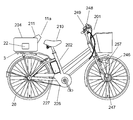
- FIG. 13 is an external view of a power-assisted bicycle that is a two-wheeled vehicle with an air conditioner according to the third embodiment.
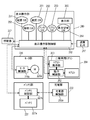
- FIG. 14 is a communication control configuration diagram of an electrically assisted bicycle which is a two-wheeled vehicle with an air conditioner according to the third embodiment.
- FIG. 15 is a front view showing a display operation unit of an electrically assisted bicycle which is a two-wheeled vehicle with an air conditioner according to the third embodiment.
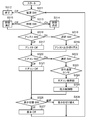
- FIG. 16 is a flowchart showing the operations of the display operation unit, the motorcycle air conditioner, and the motor unit of the electrically assisted bicycle that is a two-wheeled vehicle with an air conditioner according to the third embodiment.
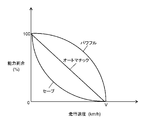
- FIG. 17 is a graph showing the relationship between the traveling speed of an electrically assisted bicycle, which is a two-wheeled vehicle with an air conditioner, and the capacity ratio of the two-wheeled vehicle air conditioner in the third embodiment of the present invention.
- This electrically assisted bicycle 201 which is a motorcycle with an air conditioner, can suppress the power consumption of the battery unit without impairing comfort by suppressing the ability of the air conditioner for the motorcycle according to the speed.
- this electric assist bicycle 201 is provided with a speed sensor 247 for detecting the traveling speed of the electric assist bicycle 201 at the tip of the front fork 246 of the body frame 202.
- a display operation unit 249 is provided in the steering device 248 of the vehicle body frame 202.
- the display operation unit 249 wirelessly controls communication with sensors (not shown) such as a motor unit 226, a battery unit 227, a two-wheeled vehicle air conditioner 204, and a speed sensor 247 attached to the electric assist bicycle 201. And the operating state of the motor unit 226 and the charging status of the battery unit 227 are displayed. Thereby, even when the user is sitting on the saddle 210, the user can easily grasp and operate the operation state of each component of the electrically assisted bicycle 201.
- the display operation unit 249 can be easily detached from the steering device 248. Even if the driver is away from the electric assist bicycle 201, if the display operation unit 249 is removed and attached to the body, for example, an arm, the electric assist The operation state of each component of the bicycle 201 can be easily grasped and operated.
- FIG. 14 is a communication control configuration diagram showing an outline of a communication control layout of the motor unit 226, the battery unit 227, the display operation unit 249, the charger 250, and the motorcycle air conditioner 204.
- FIG. 15 is a front view of the display operation unit 249.
- the switch including the figure and the text is represented by a symbol SW.
- the motor unit 226 includes a motor 226a that outputs auxiliary power and a motor control unit 226b that variably controls the auxiliary power by the motor 226a, as shown in FIG.
- the battery unit 227 includes a battery 227a and a battery control unit 227b that performs charge / discharge management of the battery 227a that supplies power from the battery 227a to the motor unit 226 and the two-wheeled vehicle air conditioner 204.
- the display operation unit 249 starts transmission / reception of signals from the motor unit 226, the battery unit 227, the motorcycle air conditioner 204, and the speed sensor 247.
- the display operation unit 249 includes a display operation unit control unit 252 that controls communication with other sensors (not shown) and the motorcycle air conditioner 204, and a liquid crystal display 253 that visually conveys various information to the user (see FIG. 15) and a display unit 255 having a display switching SW 254 for switching display contents. Furthermore, it has mode indicator lamps 256a, 256b, and 256c (refer to FIG. 15) configured by light emitting diodes for displaying the current operation state.
- an illumination SW 258 for controlling ON / OFF of the illuminator 257, an assist SW 260 for turning ON / OFF the control of auxiliary power by the motor unit 226, and an air conditioner SW259 for turning ON / OFF the control of the motorcycle air conditioner 204 are provided. Yes.
- a selection SW 261 having two SW 261a and SW 261b for switching a power assist rate by the motor unit 226 or a capacity adjustment rate of the motorcycle air conditioner 204 is provided.
- the charger 250 for charging the battery 227a monitors the status of the battery 227a being charged, such as the temperature and the charging capacity, and the charging current supplied to the battery 227a according to the status. Is provided with a charger control unit 250a that variably controls the battery.
- the charger 250 is detachably attached to the battery unit 227 by a connector (not shown), and is connected to the battery unit 227 when charging the battery 227a.
- the arrows (broken lines) in FIG. 14 indicate signal paths for performing communication between the components.
- the temperature, charging capacity, etc. of the battery 227a being charged are communicated from the battery control unit 227b to the display operation unit control unit 252 and the charger control unit 250a.
- a signal representing the power assist ratio is transmitted from the display operation section control section 252 to the motor control section 226b.
- pulse signals with different periods are transmitted according to the power assist ratio.
- a signal indicating the abnormality is transmitted from the motor control unit 226b to the display operation unit control unit 252 and displayed on the display unit 255.
- a signal indicating the abnormality is transmitted from the motorcycle air conditioner 204 to the display operation unit control unit 252 and displayed on the display unit 255.
- FIG. 16 is a flowchart showing the operations of the display / operation unit 249, the motor unit 226, and the motorcycle air conditioner 204.
- step S311 the passenger of the motorcycle turns on / off the power source SW251. Note that the current state is maintained when no operation is performed.
- the process proceeds to step S312 and the power supply from the battery unit 227 to each component including the display operation unit 249 is cut off.
- the power SW 251 is turned on, power supply is started from the battery unit 227 to each component including the display operation unit 249, and the process proceeds to step S313.
- step S313 the rider of the motorcycle turns on / off the lighting SW258. Note that the current state is maintained when no operation is performed. If the illumination SW 258 is turned on, the process proceeds to step S314 and the illuminator 257 is turned on. If the illumination SW 258 is turned off, the process proceeds to step S315 and the illuminator 257 is turned off. Regardless of the operation of the illumination SW 258, the process proceeds to step S316.
- step S316 the passenger of the motorcycle turns the assist SW 260 on and off. Note that the current state is maintained when no operation is performed. If the assist SW 260 is turned off, the process proceeds to step S317, and the power from the motor unit 226 is not assisted. If the assist SW 260 is turned on, the process proceeds to step S318, and the power assist rate of the assist power is selected using, for example, the two SW 261a and SW 261b of the selection SW 261 from three types of powerful, automatic, and save. Each of the mode indicator lamps 256a, 256b, and 256c is turned on by the operation of the SW 261a and SW 261b constituting the selection SW 261 to indicate the selected power assist ratio. As an example of the power assist ratio, 60 to 80% is powerful, 40 to 60% is automatic, and 20 to 40% is save.
- step S319 After selecting the power assist rate, the process proceeds to step S319, and the motor unit 226 transmits power to the wheel shaft so that the selected power assist rate is obtained. Regardless of whether the assist SW 260 is operated, the process proceeds to step S320.
- step S320 the passenger of the motorcycle turns on / off the air conditioner SW259. Note that the current state is maintained when no operation is performed. If the air conditioner SW259 is turned off, the process proceeds to step S321 and the two-wheeled vehicle air conditioner 204 is stopped. If the air conditioner SW259 is turned on, the process proceeds to step S322, and the capacity ratio of the motorcycle air conditioner 204 is selected from the three types of powerful, automatic, and save using the two SW261a and SW261b of the selection SW261.
- Each of the mode indicators 256a, 256b, and 256c is turned on by the operation of the SW 261a and SW 261b constituting the selection SW 261 to indicate the selected ability ratio.
- step S323 the process proceeds to step S323, and the current traveling speed of the electrically assisted bicycle 201 is measured by the speed sensor 247.
- the air conditioner start / stop unit 263 stops the two-wheeled vehicle air conditioner 204.
- the air conditioner start / stop unit 263 operates the motorcycle air conditioner 204.
- the capacity control unit 262 operates the motorcycle air conditioner 204 at a predetermined capacity ratio based on the capacity ratio selected by the SW 261a and SW 261b of the selection SW 261 and the traveling speed measured by the speed sensor 247.
- FIG. 17 is a diagram showing the relationship between the traveling speed and the capacity ratio of the electrically assisted bicycle 201 which is a two-wheeled vehicle with an air conditioner.
- the horizontal axis represents the traveling speed of the electrically assisted bicycle 201
- the vertical axis represents the capacity ratio of the motorcycle air conditioner 204 when the maximum capacity that the motorcycle air conditioner 204 can output is 100%. Further, the relationship between the driving speed of the powerful, automatic, and save selected using the SW 261a and SW 261b of the selection SW 261 and the capacity ratio is shown.
- the capacity ratio of the motorcycle air conditioner 204 becomes 0%. That is, it stops. Further, in any of the powerful, automatic, and save cases, the capacity ratio of the motorcycle air conditioner 204 is reduced as the traveling speed increases. The reduction rate with respect to the running speed is powerful ⁇ automatic ⁇ save. Further, when the traveling speed of the electrically assisted bicycle 201 which is a two-wheeled vehicle with an air conditioner is 0 km / h, that is, when the vehicle is stopped, the capacity ratio of the two-wheeled vehicle air conditioner 204 is 100%.
- the capacity control unit 262 operates the two-wheeled vehicle air conditioner 204 at a predetermined capacity ratio based on the capacity ratio selected by the two SW 261a and SW 261b constituting the selection SW 261 and the traveling speed measured by the speed sensor 247.
- step S320 When the air conditioner SW259 is ON in step S320, the monitoring of the steps S322, S323, S324, and S325 is always performed, and the motorcycle air conditioner 204 is operated so as to meet the respective conditions.
- step S326 the passenger of the motorcycle operates the display switching SW254. Note that the current state is maintained when no operation is performed. If the display switch SW254 is turned off, the process proceeds to step S327 and the display on the liquid crystal display 253 is stopped.
- the passenger can select an arbitrary display and display it on the liquid crystal display 253.
- Examples of display contents include the remaining amount of the battery 227a, travel speed, travel distance, time, map, air temperature of the duct 211 (temperature sensor not shown), and the like, which are switched by the operation of the display switch SW254 and the liquid crystal display 253. Is displayed.
- step S311 the process returns to step S311 to detect whether the power SW 251 is turned on or off, and the display operation unit control unit 252 constantly monitors the above flow until the passenger turns off the power SW 251 and adjusts to the operation of the passenger. Control each component.
- the electrically assisted bicycle 201 which is a two-wheeled vehicle with an air conditioner, can improve the comfort by supplying cool air when the traveling speed is below a certain speed and the passenger cannot feel the air flow. it can.
- the air conditioner is stopped to suppress the power consumption of the battery unit 227 when the traveling speed becomes a certain speed or more and the passenger can feel the air flow and can maintain a certain level of comfort. It is possible to efficiently achieve both comfort and energy saving.
- the electrically assisted bicycle 201 which is a two-wheeled vehicle with an air conditioner according to the present embodiment, includes a display operation unit 249 that can display the remaining amount of the battery unit 227, and the capacity control unit 262 uses the power assist rate of the motor unit 226 and the motorcycle.
- the capacity ratio of the air conditioner 204 is adjustable. Therefore, both the comfort and energy saving can be achieved more efficiently by adjusting the power assist rate of the motor unit 226 and the capacity ratio of the motorcycle air conditioner 204 while checking the remaining amount of the battery unit 227.
- the explanation is made on the assumption that the cool air is blown out from the duct 211 particularly in the summer, and the switching between the cool air and the hot air is not described, but the two-wheeled air conditioner 204 is shown in the second embodiment. If the air conditioner 104 for a motorcycle is used, it is possible to switch between cold and hot air.
- the battery for traveling is not limited to such an electrically assisted bicycle. It may be an electric motorcycle equipped with.
- a battery is mounted on the bicycle, and the battery air conditioner is driven by the battery. It may be a bicycle.
- a motorcycle using an engine as a driving power source can drive an air conditioner with a battery mounted on the motorcycle, and thus may be such a battery-mounted engine motorcycle.
- the two-wheeled vehicle may be a bicycle, a power-assisted bicycle, an electric motorcycle, or a battery-mounted engine type motorcycle in which the number of wheels is a total of three wheels, with one of the rear wheels or the front wheels being two. Then, such a three-wheeled type is also defined as a two-wheeled vehicle and is included in the scope.
- the air conditioner for a motorcycle includes an air conditioner casing that includes a refrigeration cycle circuit having a compressor, a condenser, and an evaporator, and that can be installed on a loading platform behind the rider of the motorcycle.
- a duct that discharges conditioned air generated by the refrigeration cycle circuit in the housing to the outside of the air conditioner housing. Further, the duct has an opening directed to blow conditioned air toward the back of the passenger.
- the air conditioner discharged from the duct of the air conditioner for the motorcycle is blown to the passenger in such a shape that the conditioned air discharged from the duct is sucked into the vortex generated in the back rear portion of the rider of the motorcycle. Accordingly, the air blowing capacity of the motorcycle air conditioner can be reduced so that the energy consumption can be reduced, and power consumption can be suppressed and comfortable air conditioning can be realized.
- the present invention may be configured such that the length of the duct can be varied by making it extendable.
- the distance between the passenger's back and the opening of the duct can be optimized even if the passenger's height is different, and the air-conditioned air suction effect by the vortex flow on the back of the passenger is always good. Effective air conditioning and reduction of power consumption can be realized.
- the present invention may be configured such that the elevation angle at which the duct faces the passenger can be varied.
- the air conditioner casing is separated into two upper and lower chambers by a partition, and an evaporator, an evaporator blower, and an air-conditioned air outlet are arranged in the upper chamber from the upstream side to the downstream side.
- a condenser, a condenser fan, and a blow-off opening may be arranged in the lower chamber from the upstream side toward the downstream side.
- the air conditioner for motorcycles can reduce the ambient temperature of the condenser by the drain water generated in the evaporator to increase the heat exchange efficiency of the condenser, and can suppress the power consumption by the increased efficiency.
- the present invention may be configured such that an air blowing opening that is heat-exchanged by a condenser is provided on a side surface of an air conditioner casing that is parallel to the traveling direction of the motorcycle.
- the present invention may be configured to provide a cold storage material on the upstream side of the condenser.
- the temperature of the intake air passing through the condenser is lowered, the heat exchange efficiency of the condenser is increased, and the energy required for operation can be efficiently reduced, and the power consumption can be suppressed correspondingly.
- the present invention installs the condenser provided in the air conditioner casing substantially parallel to the air suction port of the condenser fan, and installs the evaporator provided in the air conditioner casing substantially parallel to the air suction opening of the evaporator fan. May be.
- a first duct that discharges hot air generated by the condenser to the outside of the air conditioner casing and a second duct that discharges cold air generated by the evaporator to the outside of the air conditioner casing are provided, and the first duct and the second duct are provided.
- the duct may be configured to be installed in the air conditioner casing so as to face approximately 180 °.
- the direction of the duct of the air conditioner for the motorcycle can be changed to supply cold air and hot air to the passenger. Furthermore, in order to be able to supply both cold air and hot air, it is not necessary to increase the number of parts as a complicated circuit switching configuration using a four-way valve such as a cooling / heating air conditioner, and the size can be reduced.
- the motorcycle with an air conditioner according to the present invention has a battery, and the above-described two-wheeled vehicle air conditioner according to the present invention is mounted on the loading platform of the vehicle body frame such that the duct opens toward the back of the passenger, and The battery air conditioner is driven by a battery.
- the two-wheeled vehicle with an air conditioner includes a motor unit for driving or driving assist whose body frame is driven by a battery together with a battery, and further includes a speed sensor for detecting a traveling speed and a traveling speed detected by the speed sensor. And a capacity control unit that adjusts the capacity ratio of the motorcycle air conditioner.
- the two-wheeled vehicle with an air conditioner includes an air conditioner start / stop unit that operates the two-wheeled vehicle air conditioner when the traveling speed becomes a certain speed or less and stops the two-wheeled vehicle air conditioner when the traveling speed becomes the certain speed or more. It is good.
- the two-wheeled vehicle with an air conditioner includes a display operation unit that can display the remaining amount of the battery, and the capability control unit can adjust the power assist rate of the motor unit and the capability ratio of the two-wheeled vehicle air conditioner. Good.
- the present invention it is possible to provide a motorcycle with an air conditioner that achieves both comfort and energy saving, as well as a motorcycle air conditioner with low power consumption, and can be applied to vehicles used by a wide range of users.
Landscapes
- Engineering & Computer Science (AREA)
- Mechanical Engineering (AREA)
- Physics & Mathematics (AREA)
- Thermal Sciences (AREA)
- Air-Conditioning For Vehicles (AREA)
Abstract
La présente invention concerne un climatiseur équipé: d'un boîtier de climatiseur (5) comportant un circuit de cycle de réfrigération comprenant un compresseur, un condenseur, et un évaporateur, et qui peut être installé sur un porte-bagages (3) derrière un conducteur d'un véhicule à deux roues; et d'un conduit (11) pour décharger l'air conditionné, qui a été généré par le circuit de cycle de réfrigération à l'intérieur du boîtier de climatiseur (5), vers l'extérieur du carter de climatiseur (5), le conduit (11) ayant une ouverture (11a) faisant face au dos du conducteur. L'air conditionné évacué depuis le conduit (11) est ainsi aspiré dans un courant tourbillonnaire qui est formé sur la zone de surface arrière du dos du conducteur dû au déplacement du véhicule à deux roues; par conséquent, l'énergie consommée est donc réduite, et la consommation d'énergie peut être réduite au minimum.
Priority Applications (2)
| Application Number | Priority Date | Filing Date | Title |
|---|---|---|---|
| CN201780001354.XA CN107531131B (zh) | 2016-03-03 | 2017-01-17 | 两轮车用空调机和装载它的带空调机的两轮车 |
| DE112017001102.7T DE112017001102T5 (de) | 2016-03-03 | 2017-01-17 | Zweirad-Klimagerät und mit Klimagerät ausgestattetes Zweirad, an welchem ein solches Klimagerät montiert ist |
Applications Claiming Priority (2)
| Application Number | Priority Date | Filing Date | Title |
|---|---|---|---|
| JP2016-040606 | 2016-03-03 | ||
| JP2016040606A JP6572442B2 (ja) | 2016-03-03 | 2016-03-03 | 二輪車用エアコンおよびこれを搭載したエアコン付き二輪車 |
Publications (1)
| Publication Number | Publication Date |
|---|---|
| WO2017149959A1 true WO2017149959A1 (fr) | 2017-09-08 |
Family
ID=59742745
Family Applications (1)
| Application Number | Title | Priority Date | Filing Date |
|---|---|---|---|
| PCT/JP2017/001301 Ceased WO2017149959A1 (fr) | 2016-03-03 | 2017-01-17 | Climatiseur pour véhicule à deux roues et véhicule à deux roues équipé de climatiseur comportant un tel climatiseur |
Country Status (4)
| Country | Link |
|---|---|
| JP (1) | JP6572442B2 (fr) |
| CN (1) | CN107531131B (fr) |
| DE (1) | DE112017001102T5 (fr) |
| WO (1) | WO2017149959A1 (fr) |
Cited By (1)
| Publication number | Priority date | Publication date | Assignee | Title |
|---|---|---|---|---|
| WO2024018840A1 (fr) * | 2022-07-19 | 2024-01-25 | サンデン株式会社 | Dispositif de climatisation |
Families Citing this family (5)
| Publication number | Priority date | Publication date | Assignee | Title |
|---|---|---|---|---|
| KR102045505B1 (ko) * | 2018-08-17 | 2019-11-15 | 김명진 | 센싱형 자동 그늘막, 후방 감지 모터 제어 시스템 |
| CN110159489B (zh) * | 2019-05-28 | 2020-11-13 | 诸暨易行企业管理咨询有限公司 | 一种音频设备 |
| CN111137385B (zh) * | 2019-12-31 | 2020-11-24 | 重庆克维思机械制造有限公司 | 一种摩托车挡风板 |
| US12466506B2 (en) * | 2022-09-26 | 2025-11-11 | Jahnkay Summons | Bicycle air conditioning assembly |
| US20250162376A1 (en) * | 2023-11-20 | 2025-05-22 | Marion Lee Chatman | Portable motorsports personal evaporative cooler |
Citations (11)
| Publication number | Priority date | Publication date | Assignee | Title |
|---|---|---|---|---|
| JPS6361310U (fr) * | 1986-10-09 | 1988-04-23 | ||
| JPH0453009U (fr) * | 1990-09-12 | 1992-05-06 | ||
| JPH0540731U (ja) * | 1991-10-25 | 1993-06-01 | 郷商事株式会社 | 冷風機 |
| JPH0732422U (ja) * | 1993-11-05 | 1995-06-16 | 五十一 紫垣 | 携帯式空調装置 |
| WO2005054751A2 (fr) * | 2003-11-24 | 2005-06-16 | Olimpia Splendid S.P.A. | Conditionneur d'air portable |
| JP2005255078A (ja) * | 2004-03-15 | 2005-09-22 | Yazaki Corp | 車両用ヒータ制御装置 |
| JP2013124807A (ja) * | 2011-12-14 | 2013-06-24 | Fujitsu General Ltd | 一体型空気調和機 |
| JP2013224813A (ja) * | 2012-03-21 | 2013-10-31 | Kamakura Seisakusho:Kk | スポットエアコン |
| JP2015028222A (ja) * | 2013-07-30 | 2015-02-12 | 隆大 切中 | オートバイ用冷気・暖気送風装置 |
| JP2015085767A (ja) * | 2013-10-30 | 2015-05-07 | 統亞電子科技股▲ふん▼有限公司 | グリップヒータ装置 |
| JP2015123859A (ja) * | 2013-12-26 | 2015-07-06 | トヨタ自動車株式会社 | バッテリの満充電容量の算出方法 |
Family Cites Families (1)
| Publication number | Priority date | Publication date | Assignee | Title |
|---|---|---|---|---|
| CN105531130B (zh) * | 2013-03-13 | 2019-05-31 | 博格思众公司 | 利用来自压缩流体膨胀的热容量的空调系统 |
-
2016
- 2016-03-03 JP JP2016040606A patent/JP6572442B2/ja not_active Expired - Fee Related
-
2017
- 2017-01-17 DE DE112017001102.7T patent/DE112017001102T5/de not_active Withdrawn
- 2017-01-17 WO PCT/JP2017/001301 patent/WO2017149959A1/fr not_active Ceased
- 2017-01-17 CN CN201780001354.XA patent/CN107531131B/zh active Active
Patent Citations (11)
| Publication number | Priority date | Publication date | Assignee | Title |
|---|---|---|---|---|
| JPS6361310U (fr) * | 1986-10-09 | 1988-04-23 | ||
| JPH0453009U (fr) * | 1990-09-12 | 1992-05-06 | ||
| JPH0540731U (ja) * | 1991-10-25 | 1993-06-01 | 郷商事株式会社 | 冷風機 |
| JPH0732422U (ja) * | 1993-11-05 | 1995-06-16 | 五十一 紫垣 | 携帯式空調装置 |
| WO2005054751A2 (fr) * | 2003-11-24 | 2005-06-16 | Olimpia Splendid S.P.A. | Conditionneur d'air portable |
| JP2005255078A (ja) * | 2004-03-15 | 2005-09-22 | Yazaki Corp | 車両用ヒータ制御装置 |
| JP2013124807A (ja) * | 2011-12-14 | 2013-06-24 | Fujitsu General Ltd | 一体型空気調和機 |
| JP2013224813A (ja) * | 2012-03-21 | 2013-10-31 | Kamakura Seisakusho:Kk | スポットエアコン |
| JP2015028222A (ja) * | 2013-07-30 | 2015-02-12 | 隆大 切中 | オートバイ用冷気・暖気送風装置 |
| JP2015085767A (ja) * | 2013-10-30 | 2015-05-07 | 統亞電子科技股▲ふん▼有限公司 | グリップヒータ装置 |
| JP2015123859A (ja) * | 2013-12-26 | 2015-07-06 | トヨタ自動車株式会社 | バッテリの満充電容量の算出方法 |
Cited By (2)
| Publication number | Priority date | Publication date | Assignee | Title |
|---|---|---|---|---|
| WO2024018840A1 (fr) * | 2022-07-19 | 2024-01-25 | サンデン株式会社 | Dispositif de climatisation |
| JP2024013075A (ja) * | 2022-07-19 | 2024-01-31 | サンデン株式会社 | 空調装置 |
Also Published As
| Publication number | Publication date |
|---|---|
| CN107531131A (zh) | 2018-01-02 |
| JP2017154645A (ja) | 2017-09-07 |
| DE112017001102T5 (de) | 2018-12-06 |
| CN107531131B (zh) | 2021-06-01 |
| JP6572442B2 (ja) | 2019-09-11 |
Similar Documents
| Publication | Publication Date | Title |
|---|---|---|
| WO2017149959A1 (fr) | Climatiseur pour véhicule à deux roues et véhicule à deux roues équipé de climatiseur comportant un tel climatiseur | |
| CN108473027B (zh) | 两轮车用空调机和装载其的带空调机的两轮车 | |
| JP4784633B2 (ja) | 電気自動車の空気調和機及び空気調和機の制御方法 | |
| JPH07212902A (ja) | 電気自動車の空調装置制御システム | |
| CN206374503U (zh) | 一种汽车及其驻车空调系统 | |
| CN109927653A (zh) | 车内环境舒适控制方法和系统及车辆、控制器和存储介质 | |
| CN106457976B (zh) | 车辆用加湿装置 | |
| KR20070122413A (ko) | 도로 차량의 엔진 정지 공조 모듈에 대한 에너지 절감 제어방법 및 시스템 | |
| CN109945446B (zh) | 空调器的控制方法 | |
| JP2003326962A (ja) | 車両用空調装置 | |
| CN203438902U (zh) | 一种汽车座椅空调系统 | |
| CA2524546A1 (fr) | Systeme de commande de puissance efficace pour motoneige | |
| JP2004066847A (ja) | 車両用空調装置 | |
| JP2005206014A (ja) | 車両用空調装置の冷凍サイクルの制御方法及び制御装置 | |
| JP6535880B2 (ja) | エアコン付き電動二輪車 | |
| JP2009184377A (ja) | 車両用屋上装着型空調装置 | |
| CN115465053A (zh) | 一种应用于房车的驻车空调系统及控制方法 | |
| CN202703185U (zh) | 一种车载空调系统 | |
| JP6528132B2 (ja) | 二輪車用エアコンおよびこれを搭載したエアコン付き二輪車 | |
| JP2004249897A (ja) | 車両用空調装置 | |
| JP2013088072A (ja) | 空気調和機 | |
| JPH07149138A (ja) | 電気自動車用空調装置 | |
| CN214523277U (zh) | 一种可移动的车用空调出风装置及车用空调 | |
| CN201986329U (zh) | 车载空调鼓风机调速模块 | |
| JP6547131B2 (ja) | 二輪車用エアコンおよびこれを搭載したエアコン付き二輪車 |
Legal Events
| Date | Code | Title | Description |
|---|---|---|---|
| 121 | Ep: the epo has been informed by wipo that ep was designated in this application |
Ref document number: 17759431 Country of ref document: EP Kind code of ref document: A1 |
|
| 122 | Ep: pct application non-entry in european phase |
Ref document number: 17759431 Country of ref document: EP Kind code of ref document: A1 |