WO2017150042A1 - Procédé et appareil de communication de transmission d'accusé de réception de bloc - Google Patents
Procédé et appareil de communication de transmission d'accusé de réception de bloc Download PDFInfo
- Publication number
- WO2017150042A1 WO2017150042A1 PCT/JP2017/003283 JP2017003283W WO2017150042A1 WO 2017150042 A1 WO2017150042 A1 WO 2017150042A1 JP 2017003283 W JP2017003283 W JP 2017003283W WO 2017150042 A1 WO2017150042 A1 WO 2017150042A1
- Authority
- WO
- WIPO (PCT)
- Prior art keywords
- fragments
- bitmap
- msdu
- bits
- packet
- Prior art date
- Legal status (The legal status is an assumption and is not a legal conclusion. Google has not performed a legal analysis and makes no representation as to the accuracy of the status listed.)
- Ceased
Links
Images

















Classifications
-
- H—ELECTRICITY
- H04—ELECTRIC COMMUNICATION TECHNIQUE
- H04L—TRANSMISSION OF DIGITAL INFORMATION, e.g. TELEGRAPHIC COMMUNICATION
- H04L1/00—Arrangements for detecting or preventing errors in the information received
- H04L1/12—Arrangements for detecting or preventing errors in the information received by using return channel
- H04L1/16—Arrangements for detecting or preventing errors in the information received by using return channel in which the return channel carries supervisory signals, e.g. repetition request signals
- H04L1/1607—Details of the supervisory signal
- H04L1/1621—Group acknowledgement, i.e. the acknowledgement message defining a range of identifiers, e.g. of sequence numbers
-
- H—ELECTRICITY
- H04—ELECTRIC COMMUNICATION TECHNIQUE
- H04L—TRANSMISSION OF DIGITAL INFORMATION, e.g. TELEGRAPHIC COMMUNICATION
- H04L1/00—Arrangements for detecting or preventing errors in the information received
- H04L1/12—Arrangements for detecting or preventing errors in the information received by using return channel
- H04L1/16—Arrangements for detecting or preventing errors in the information received by using return channel in which the return channel carries supervisory signals, e.g. repetition request signals
- H04L1/1607—Details of the supervisory signal
- H04L1/1614—Details of the supervisory signal using bitmaps
-
- H—ELECTRICITY
- H04—ELECTRIC COMMUNICATION TECHNIQUE
- H04L—TRANSMISSION OF DIGITAL INFORMATION, e.g. TELEGRAPHIC COMMUNICATION
- H04L1/00—Arrangements for detecting or preventing errors in the information received
- H04L1/12—Arrangements for detecting or preventing errors in the information received by using return channel
- H04L1/16—Arrangements for detecting or preventing errors in the information received by using return channel in which the return channel carries supervisory signals, e.g. repetition request signals
-
- H—ELECTRICITY
- H04—ELECTRIC COMMUNICATION TECHNIQUE
- H04L—TRANSMISSION OF DIGITAL INFORMATION, e.g. TELEGRAPHIC COMMUNICATION
- H04L1/00—Arrangements for detecting or preventing errors in the information received
- H04L1/12—Arrangements for detecting or preventing errors in the information received by using return channel
- H04L1/16—Arrangements for detecting or preventing errors in the information received by using return channel in which the return channel carries supervisory signals, e.g. repetition request signals
- H04L1/1607—Details of the supervisory signal
- H04L1/1642—Formats specially adapted for sequence numbers
-
- H—ELECTRICITY
- H04—ELECTRIC COMMUNICATION TECHNIQUE
- H04L—TRANSMISSION OF DIGITAL INFORMATION, e.g. TELEGRAPHIC COMMUNICATION
- H04L1/00—Arrangements for detecting or preventing errors in the information received
- H04L1/12—Arrangements for detecting or preventing errors in the information received by using return channel
- H04L1/16—Arrangements for detecting or preventing errors in the information received by using return channel in which the return channel carries supervisory signals, e.g. repetition request signals
- H04L1/1607—Details of the supervisory signal
- H04L1/1685—Details of the supervisory signal the supervisory signal being transmitted in response to a specific request, e.g. to a polling signal
-
- H—ELECTRICITY
- H04—ELECTRIC COMMUNICATION TECHNIQUE
- H04L—TRANSMISSION OF DIGITAL INFORMATION, e.g. TELEGRAPHIC COMMUNICATION
- H04L1/00—Arrangements for detecting or preventing errors in the information received
- H04L1/12—Arrangements for detecting or preventing errors in the information received by using return channel
- H04L1/16—Arrangements for detecting or preventing errors in the information received by using return channel in which the return channel carries supervisory signals, e.g. repetition request signals
- H04L1/18—Automatic repetition systems, e.g. Van Duuren systems
- H04L1/1829—Arrangements specially adapted for the receiver end
- H04L1/1832—Details of sliding window management
Definitions
- the present disclosure is generally related to a communication apparatus and a communication method for Block Acknowledgement transmission.
- the techniques disclosed here feature: a communication method comprising: receiving a plurality of frames from a transmitting device, wherein the payload of a frame may consist of either fragmented or unfragmented packet; recording the receive status of the frames; generating a BlockAck frame that contains at least one Bitmap field used to indicate the receive status of the frames, wherein the number of bits allocated in the Bitmap field for a packet is variable; and transmitting the BlockAck frame.
- the apparatus and method described in the present disclosure improve the efficiency of the BlockAck frame.
- Figure 1 is a diagram of a particular embodiment of a system that makes use of the efficient Block Acknowledgement.
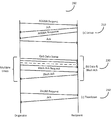
- Figure 2 is a diagram of an example frame exchange sequence involving Setup and Teardown of Block Ack mechanism.
- Figure 3 is a diagram of an Uplink Multi-User frame exchange sequence highlighting the usage of fragmentation in 802.11ax.
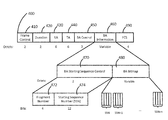
- Figure 4 is a diagram of the frame structure of the "Dedicated" C-BA frame introduced in 802.11ax.
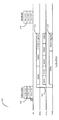
- Figure 5 is a diagram of Downlink Multi-User frame exchange sequence highlighting the technical problem addressed by the present disclosure.
- Figure 6A is a diagram of the structure of the Sequence Control field as per the first embodiment.
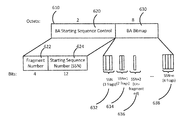
- Figure 6B is a diagram of the structure of the BA Information field as per the first embodiment.
- Figure 6C is a diagram of the encoding table for the encoding of the Number of Fragments field.
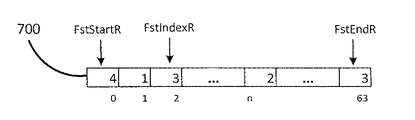
- Figure 7A is a diagram of the Fragment Size Table maintained by the recipient station as per the first embodiment.
- Figure 7B is a diagram of the Scoreboard Bitmap used to record the receive status of MPDUs as per the first embodiment.
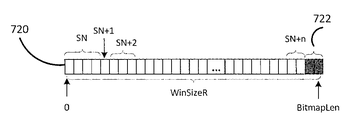
- Figure 7C is a diagram of an example BA Bitmap as per the first embodiment.
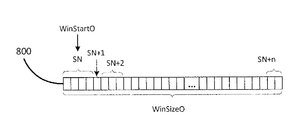
- Figure 8A is a diagram of the transmission window maintained by the transmitting station as per the first embodiment.
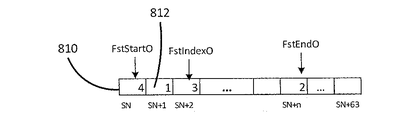
- Figure 8B is a diagram of the Fragment Size Table maintained by the transmitting station as per the first embodiment.
- Figure 8C is a diagram of an example BA Bitmap as per the first embodiment illustrating the scenario of when an entire MSDU is not received.
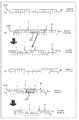
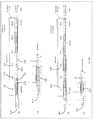
- Figure 10C is a right-hand portion of a diagram of an example frame exchange sequence that highlights the Block Acknowledgement mechanism as per the second embodiment.
- Figure 11A is a diagram of the Add Block Acknowledgment (ADDBA) Extension element per the third embodiment.
- Figure 11B is a diagram of the ADDBA capabilities field.
- Figure 11C is a diagram of the encoding table of the Maximum Fragments per MSDU field.
- Figure 11D is a diagram of the Scoreboard Bitmap used to record the receive status of MPDUs per the third embodiment.
- Figure 11E is a diagram of the Scoreboard Bitmap encoding scheme as per the third embodiment.
- Figure 12A is a diagram of an example frame exchange sequence that highlights the Block Acknowledgement mechanism as per the third embodiment.
- Figure 12B is a center portion of a diagram of an example frame exchange sequence that highlights the Block Acknowledgement mechanism as per the third embodiment.
- Figure 12C is a left-hand portion of a diagram of an example frame exchange sequence that highlights the Block Acknowledgement mechanism as per the third embodiment.
- Figure 12D is a right-hand portion of a diagram of an example frame exchange sequence that highlights the Block Acknowledgement mechanism as per the third embodiment.
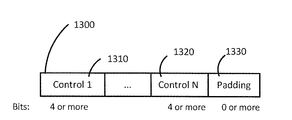
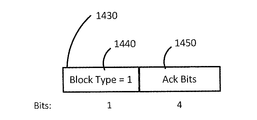
- Figure 13A is a diagram of the structure of the HE Variant HT Control field used to carry the Number of fragments field as per the fourth embodiment.
- Figure 13B is another diagram of the structure of the HE Variant HT Control field used to carry the Number of fragments field as per the fourth embodiment.
- Figure 16B is a left-hand portion of a diagram of an example frame exchange sequence that highlights the Block Acknowledgement mechanism as per the fifth embodiment.
- Figure 16C is a right-hand portion of a diagram of an example frame exchange sequence that highlights the Block Acknowledgement mechanism as per the fifth embodiment.
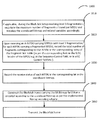
- Figure 17 is a flowchart of the operations carried out by the Originator in order to accomplish the efficient Block Acknowledgment mechanism introduced in the present disclosure.
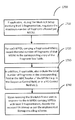
- Figure 18 is a flowchart of the operations carried out by the Recipient in order to accomplish the efficient Block Acknowledgment mechanism introduced in the present disclosure.
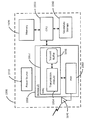
- Figure 19A is a block diagram of an example Originator.
- Figure 19B is a detailed block diagram of an example Originator.
- Figure 20 is a block diagram of a Transmission module of the Originator.
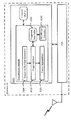
- Figure 21A is a block diagram of an example Recipient.
- Figure 21B is a detailed block diagram of an example Recipient.
- Figure 22 is a block diagram of a Reception module of the Re
- Block Acknowledgment mechanism was introduced in the 802.11e amendment. It allows the transfer of a block of frames that are acknowledged with a single Block Acknowledgment (Block Ack or BA) frame instead of a group of ACK frames, each of which indicates ACK/NACK of an individual data frame.
- Block Ack Block Acknowledgment
- BA Block Acknowledgment
- the original BlockAck frame is known as the Basic BlockAck variant, containing a 1024-bit BA bitmap and can acknowledge 64 MSDUs, each of which can be fragmented with up to 16 fragments. At higher data rates, however, fragmentation does not provide much benefit and 802.11n made the Basic BlockAck obsolete and introduced the compressed BlockAck variant.
- the compressed BlockAck variant does away with the 16 bits per MSDU for fragmentation, resulting in a 64-bit BA bitmap. Due to this, 802.11n and 802.11ac do not allow MPDUs carrying fragmented MSDUs or MMPDUs to be carried in an Aggregate MAC Protocol Data Unit (A-MPDU).
- A-MPDU Aggregate MAC Protocol Data Unit
- 802.11ax Working Group has introduced the following four types (levels) of fragmentation in order to cater to various device capabilities.
- Level 0 No support for fragments
- Level 1 Support for a fragment in a "VHT" single MPDU only
- Level 2 Support for up to one fragment per MSDU in an A-MPDU
- Level 3 Support for multiple fragments of an MSDU per A-MPDU
- Conventional BlockAck mechanism can support Level 0, Level 1 and Level 2 fragmentations but cannot support Level 3 fragmentation.
- Compressed Block Acknowledgement (C-BA) variant also called as "Dedicated" C-BA frame has been introduced in 802.11ax to support the above mentioned Level 3 fragmentation.
- Originator and Recipient are specifically used in the context of the Block Ack protocol.
- Each individual Block Ack agreement will have one wireless device acting as an Originator and another wireless device acting as a Recipient.
- Both AP as well as STAs can act as either Originator or Recipient.
- a wireless device may act as an Originator for one Block Ack agreement and at the same time, the device may also act as a Recipient for a different Block Ack agreement.
- both the Originator and the Recipient need to prepare additional resources.
- the Recipient not only needs to allocate additional buffers to receive the burst of frames, but it also needs to maintain a scoreboard to record the reception status of each frame.
- the Originator also needs to maintain a record of the transmitted frames. This preparation is done in the Block Ack Setup phase 210.
- the two 802.11 devices can negotiate the buffer size, the Traffic Identifier (TID) of the frames involved, the duration for which the negotiation will be in effect etc.
- TID Traffic Identifier
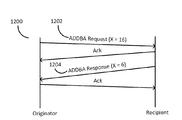
- the Legacy Block Ack Action frames (Add Block Acknowledgment (ADDBA) Request, ADDBA Response and Delete Block Acknowledgment (DELBA) may be customized to indicate that the Block Ack agreement involves Level 3 fragmentation, or new Block Ack Action frames may be defined to request, respond and delete the Block Ack agreement that involves Level 3 fragmentation.
- a one-octet field called the Block Ack action field is used to differentiate the various types of Block Ack Action frame.
- Block Ack Action field values 0, 1 and 2 are used to indicate ADDBA Request, ADDBA Response and DELBA, respectively.
- Block Ack Action field values of 3, 4 and 5 may be used to define new Block Ack Action frames for Level 3 ADDBA Request, ADDBA Response and DELBA respectively.
- a fragment of an MSDU may be transmitted such that its transmission ends at the time stipulated by the Trigger frame 310.
- STA2 happens to have the required number of integer MSDUs ready for transmission and exactly matching the duration allocation.
- STA1 and STA3 need to apply fragmentation in order to meet the duration allocation (PPDU length) and transmits the MSDU fragments 322 and 324 respectively as the last frames of their respective UL PPDUs.
- the AP concludes the frame exchange by transmitting respective Block Acks in the DL MU PPDU 330.
- FIG. 4 illustrates the structure of the "Dedicated" C-BA frame 400 that has been introduced in 802.11ax to acknowledge multiple fragments of an MSDU per A-MPDU.
- the "Dedicated" C-BA frame 400 shares the same structure as that of other BlockAck frames and is made up of a Frame Control field 410, a Duration field 420, a Receiver Address (RA) field 430, a Transmitter Address (TA) field 440, a BA Control field 450, a BA Information field 460 and a Frame Check Sequence (FCS) field 490.
- the BA Information field 460 is further comprised of a BA Starting Sequence Control field 470 and a BA Bitmap field 480.
- the BA Bitmap field 480 is divided into 64/X blocks such that each bit in the BA Bitmap 480 acknowledges the successful reception of a single MSDU or the fragments of an MSDU, with the first X bits of the BA Bitmap corresponding to the MSDU with Sequence Number (SN) matching the value of the Starting Sequence Number (SSN) subfield 474.
- SN Sequence Number
- SSN Starting Sequence Number
- the corresponding bits in the BA Bitmap 480 are set to 0 by default.
- the value of X has been agreed as 4, which mean that the "Dedicated" C-BA frame 400 can only acknowledge a maximum of 16 MSDUs.
- BA Bitmap 480 is statically divided into 16 blocks of 4 bits each, it is possible that in the absence of many fragmented MSDUs, many of the BA Bitmap bits will be left unused. In the worst case scenario, assuming that only one MSDU is fragmented, only one block will have multiple bits used to acknowledge the MSDU fragments while only the first bit is used in the rest of the blocks leading to 45 bits, representing around 70% of the available BA Bitmap bits, being unused.
- A-MPDU 534 requires padding 537 to align with the PPDU end time.
- A-MPDU 536 only 3 MPDUs can be accommodated due to the fact that the remaining duration is smaller than the minimum size allowed for fragments and hence padding 538 has to be applied.
- Figure 6A illustrates the structure of the Sequence Control field 600 as per the first embodiment. While the Sequence Number field 606 remains unchanged, only 2 bits are used for the Fragment Number field 604 and the remaining 2 bits are used for the Number of Fragments field 602, which is used to indicate the number of fragments into which the MSDU matching the Sequence Number 606 is divided.
- the encoding table 640 in Figure 6C lists the encoding of the Number of Fragments field 602.
- the 2 bits of the Number of Fragments field 602 in Figure 6A can indicate up to 4 fragments.
- the value of the Number of Fragments field 602 remains constant in all the fragments of the MSDU matching the Sequence Number 606.
- each MPDU carries the Sequence Control field 600 in respective MAC header, by inspecting the Number of Fragments field 602, a recipient of the MPDU can quickly find out the number of fragments that the MSDU matching the Sequence Number 606 is divided into, without having to track the More Fragments bit in the Frame Control field.
- the Starting Sequence Number (SSN) field 624 indicates the Sequence Number (SN) of the MSDU that is acknowledged by the first bit or blocks of bits of the BA Bitmap field 630.
- SSN Sequence Number
- each bit of the BA Bitmap is used to acknowledge one MSDU.
- the BA Bitmap field 630 is statically divided into 16 blocks of 4 bits each.
- Each bit in the BA Bitmap is used to acknowledge successful reception of a single MSDU or fragments of an MSDU, with the first 4 bits of the BA Bitmap field 630 corresponding to the MSDU with Sequence Number (SN) matching the value of the Starting Sequence Number (SSN) subfield 624.
- the first embodiment proposes a dynamic encoding of the BA Bitmap field 630, such that block of bits are assigned only as needed. A block of bits are allocated to an MSDU, equal to the number of fragments of the MSDU carried in the received A-MPDU.
- the Recipient may use the value of the Number of Fragments field 602 in the received MPDUs to figure out the bits allocations in the BA Bitmap field 630. For example, a block 632 of 3 bits is allocated for an MSDU with 3 fragments; a block 634 of 2 bits is allocated for an MSDU with 2 fragments; a single bit 636 is allocated for an unfragmented MSDU while a block 638 of 4 bits is allocated for an MSDU with 4 fragments.
- the FST 700 can be implemented as a circular array with BitmapLen entries, Variables FstStartR and FstEndR are used to tract the start and end position of the FST respectively, while FstIndexR is used to track the entry corresponding to the MSDU that is currently being processed.
- Figure 7B illustrates a bitmap used to record the receive status of the received MSDUs.
- 710 represent the entire sequence number space, with 4 bits per sequence number.
- the Scoreboard bitmap 712 is a part of the Block Acknowledgement record that is initialized during the setup phase 210 of an HT-immediate Block Ack agreement between the Originator and the Recipient and represents the sequence number space of the current transmission window.
- the Scoreboard bitmap 712 is maintained in statically assigned memory, while in partial-state operation, the Scoreboard bitmap 712 is maintained in a cache memory. All operations on FstStartR, FstEndR and FstIndexR are performed circular modulo WinSizeR.
- SN is the value of the Sequence Number field 606 of the received frame.
- FN is the value of the Fragment Number field 604 of the received frame.
- NF is the value of the Number of Fragments field 602 of the received frame.
- SSN is the value of the Starting Sequence Number field 624 of the received BlockAckReq frame.
- BitmapLen is the bit length of the BA Bitmap field 630.
- WinEndR ⁇ SSN ⁇ WinStartR + 211
- Set WinStartR SSN.
- Set WinEndR WinStartR + WinSizeR - 1.
- iv) Set to 4 the entries of FST corresponding to FstIndexR from FstStartR to FstEndR. 3) If WinStartR + 211 ⁇ SSN ⁇ WinStartR, make no changes to the record.
- ⁇ Scoreboard Context during partial-state operation> For each HT-immediate Block Ack agreement that involves Level 3 fragmentation and uses partial-state operation, a recipient maintains a Block Acknowledgment record which includes a temporary scoreboard bitmap of size WinSizeR*4 and a temporary Fragment Size Table (FST) with WinSizeR.
- a STA implementing an HT-immediate Block Ack agreement that uses partial-state operation shall maintain the Block Acknowledgment record for that agreement according to the following rules:
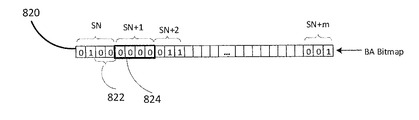
- Figure 7C is a diagram of the BA Bitmap 720 as per the first embodiment.
- the size or the number of bits in the BA Bitmap 720, BitmapLen depends on the BlockAck frame type. For example, for legacy Compressed BlockAck frame, Multi-TID BlockAck frame, GCR BlockAck frame, BitmapLen is equal to 64. However, 802.11ax may define new BlockAck frames with shorter or longer, or even variable length BA Bitmap.
- Figure 7c illustrates an example BA Bitmap when WinSizeR is equal to BitmapLen.
- the BA Bitmap Upon receiving an implicit Block Ack request (a received A-MPDU with Ack Policy equal to Normal Ack) or a BlockAckReq frame, the BA Bitmap is generated based on the content of the relevant section of the Scoreboard Bitmap. Only the bits in the Scoreboard Bitmap that correspond to the received MSDUs and their fragments, if any, are copied over to the BA Bitmap. Since the number of fragments may vary from MSDU to MSDU, the number of bits per MSDU in the BA Bitmap can vary from 1 (no fragments) to 4 (4 fragments). Starting from WinStartR in the Scoreboard Bitmap and the first bit in the BA Bitmap, by referencing the corresponding entry in the Fragment Size Table (FST), the numbers of bits as indicated by the FST entry are copied over to the BA Bitmap.
- FST Fragment Size Table
- any MSDU in the valid Sequence number range (WinStartR to WinEndR) that is not received will result in four consecutive zeros in the BA Bitmap. If all four consecutive zeros in the BA Bitmap corresponding to an MSDU are zero, it has a special meaning to the Originator and alerts the Originator that none of the MPDUs of that MSDU were received. Since some of the MSDUs that were not received may have less than 4 fragments per MSDU, such MSDUs will result in extra bits in the BA Bitmap. As a consequence, some of the valid bits towards the end of the Scoreboard Bitmap may not be able to fit in the current BA Bitmap.
- Block Ack mechanism proposed by the current disclosure is able to acknowledge many more MSDUs compared to what is possible with the "Dedicated" BlockAck. Even in worst case scenario when all MSDUs are fragmented into 4 fragments each, the efficiency is equal to that of the "Dedicated" BlockAck.
- Figure 8A illustrates a transmission window 800 that may be maintained by an Originator to keep track of the number of MPDUs that may be transmitted in a single A-MPDU. Since level-3 fragmentation allows multiple fragments of an MSDU (up to 4) to be transmitted in a single A-MPDU, and the number of fragments per MSDU may vary from MSDU to MSDU. And the valid Sequence Number space, i.e. the number of unique Sequence Numbers that may be transmitted within one transmission window is not fixed.
- Variable WinStartO tracks the Sequence Number of the first MSDU in the current transmission window while the maximum number of MPDUs that may be transmitted within a transmission window is indicated by the variable WinSizeO, which is lesser than the value of the Buffer Size field of the associated ADDBA Response frame that established the Block Ack agreement and is not greater than the number of bits in the BA Bitmap of the associated BlockAck frame.
- the purpose of maintaining the transmission window 800 is to ensure that the Recipient is able to keep record of the receive status of all the received MDPUs.
- FIG. 8B illustrates a Fragment Size Table (FST) 810 that may be maintained by an Originator to keep track of the number of fragments present in the MSDUs being transmitted in the current transmission window. Even though the originator can read the number of fragments of each of its MSDUs in the transmission buffer, for ease of access, the originator may also maintain a FST.
- One FST is associated with every new HT-immediate Block Ack agreement that involves a level-3 fragmentation. Assuming that the BlockAck frame related to the HT-immediate Block Ack agreement has a 64-bit BA Bitmap, the FST can be implemented as an up to 64 entries table that records the number of fragments of up to 64 MSDUs.
- FST may be implemented as an up to 64 entries cyclic buffer with FstStartO and FstEndO tracking the start and the end of the FST while FstIndexO is used to as an index to individual entries of the FST.
- the FST can be implemented as a table with entries equal to BitmapLen.
- the entry of FST at position FstStartO corresponds to the sequence number of the first MSDU in the current transmission window i.e. the MSDU with Sequence Number subfield value equal to WinStartO while the entry of FST at position FstEndO corresponds to the sequence number of the last MSDU in the current transmission window.
- Each entry of the FST records the number of fragments per respective.
- WinSizeO represents the maximum unique Sequence Numbers that may be transmitted within one transmission window, all operations on FstStartO, FstEndO and FstIndexO are performed circular modulo WinSizeO.
- Figure 8C is a diagram of an example BA Bitmap field as per the first embodiment illustrating the scenario of when an entire MSDU is not received. Since the number of acknowledgment bits per Sequence Number is not fixed in the BA Bitmap, the Originator needs to refer to the corresponding FST entry in FST 810 to correctly decode the acknowledgment bits. If the Recipient correctly receives at least one fragment of each MSDU, based on the Number of Fragments field 602 in the MPDU header, the Recipient will know the correct number of bits to assign for each MSDU in the BA Bitmap. In such cases, the BA Bitmap will have a one to one relationship with the MPDUs in the transmission window and the Originator can correctly decode the acknowledgment status.
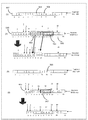
- FIGS 9A, 9B and 9C illustrate an example frame exchange sequence 900 that makes use of the efficient Block Ack mechanism as per the first embodiment. It is assumed that prior to the frame exchange, an HT-immediate Block Ack agreement involving a Level 3 fragmentation has already been negotiated between the two wireless devices involved in the frame exchange. In this example, the value of WinSizeO, WinSizeR and BitmapLen is equal to 64. The Originator and Recipient maintain the Fragment Size Tables 902 and 920 to keep track of the number of fragments present in the MSDUs being transmitted or received in the current transmission window respectively. All the entries of FST are initialized to the maximum number of fragments allowed per MSDU under the current HT-immediate Block Ack agreement, 4 in this example.
- Each MPDU also carries the Number of Fragments field 602 in the respective MAC header.
- the Recipient also records the receive status of each MPDU in the corresponding bit of the Scoreboard Bitmap 926, setting to 1 each bit corresponding to a correctly received MPDU.
- A-MPDU 910 indicates an implicit Block Ack request (Ack Policy equal to Normal Ack).
- Ack Policy equal to Normal Ack.
- FST Fragment Size Table
- the FST entry #5 922 indicates a value of 4
- the rest of the bits within the valid range of the Scoreboard Bitmap 926 are copied over to the respective bits of the BA Bitmap 930 in similar fashion.
- the Recipient acknowledges the receipt of the A-MPDU 910 by transmitting a BlockAck frame 938 carrying the BA Bitmap 930.
- the Starting Sequence Number field 624 of the BlockAck frame 938 is set to the Sequence Number of the first MSDU acknowledged by the BA Bitmap 930, while one bit (e.g. B0) of the Fragment Number field 622 may be used to indicate that the BA Bitmap 930 is encoded as per the first embodiment, and two bits (e.g. B1, B2) may be used to indicate the length (number of bits) of the BA Bitmap 930.
- the entries of FST 902 are updated accordingly.
- the FST entries #32 949 as well as all entries corresponding to MSDUs with SN outside the transmission window remain unchanged at the initial value of 4.
- the Recipient acknowledges the receipt of the A-MPDU 940 by transmitting a BlockAck frame 954 carrying the BA Bitmap 950.
- the Originator proceeds to decode the BA Bitmap 950 as explained earlier.
- significant gain in acknowledgment efficiency can be achieved by adopting the Block Acknowledgment mechanism presented in the first embodiment.
- the second embodiment improves the mechanism presented in the first embodiment and recommends that in the event where the entire MSDU is not received, the FST entry corresponding to the MSDU is updated as the maximum number of fragments of a same MSDU present in the received A-MPDU, for example 2. This leads to the number of consecutive zeros in the BA Bitmap, used to represent completely not received MSDUs, to 2.
- the Recipient indicates this value using two bits of the Fragment Number field 622 in the BlockAck frame. In case the two bits are used jointly, the following four cases can be signaled: 00 (unfragmented); 01 (two fragments); 10 (three fragments); and 11 (four fragments).
- Level 3 fragmentation Aside from the unfragmented case, the remaining three values also indicate the use of Level 3 fragmentation.
- one bit is used to indicate the use of Level 3 fragmentation (0: Level 3 fragmentation is not used; 1: Level 3 fragmentation is used) while the second bit is used to indicate the maximum number of fragments present in the received A-MPDU. For example: 0 to indicate two fragments and 1 to indicate four fragments.
- the Originator transmits the A-MPDU 1010 which is exactly the same as the A-MPDU 940 in the frame exchange 900.
- the maximum number of fragments allowed per MSDU is fixed at 4.
- the Originator and the Recipient may be allowed to negotiate this value during the setup phase of the HT-immediate Block Ack mechanism between the two devices. Bigger values may be used when the MSDUs that are to be communicated are comparatively bigger, while smaller values may be negotiated if the MSDUs are smaller.
- the maximum number of fragments allowed per MSDU may also depend on the resources available at either of the devices as bigger values would require the device to possess bigger buffer etc.
- the maximum number of fragments allowed per MSDU may be carried in the ADDBA Extension element 1100 as shown in Figure 11A.
- the Element ID 1102 is set as specified by the 802.11 specification; the Length field 1104 indicates one octet, while the ADDBA Capabilities field 1106 is customized as illustrated in Figure 11B. Aside from the existing No-Fragmentation subfield 1112, the remaining seven bits are currently reserved. As per the third embodiment, some of the reserved bits, e.g. two bits are used to indicate the Maximum Fragments per MSDU 1124 while the remaining five bits are reserved.
- the encoding of the Maximum Fragments per MSDU 1124 may be as shown in Table 1130 in Figure 11C whereby values 0, 1, 2 and 3 represent a maximum of 2, 4, 8 and 16 fragments per MSDU respectively. If four bits are used to encode the Maximum Fragments per MSDU, even finer levels can be indicated.
- the Scoreboard as well as the Fragment Size Table would need to be changed as well. While two bits per FST entry would be enough to record the number of fragment when the Maximum Fragments per MSDU is 4 or less, four bits per FST entry would be required when the Maximum Fragments per MSDU is 16. Additionally, 16 bits per MSDU are required in the Scoreboard Bitmap to record the receive status of the MPDUs.
- the third embodiment introduces a novel encoding method for the Scoreboard Bitmap that, by adding one extra bit per MSDU, allows the scoreboard bitmap to jointly record both the receive status as well as the number of fragments per MSDU.
- This is illustrated in Figure 11D, for the example when the Maximum Fragments per MSDU is negotiated to be 4.
- a number of bits equal to the Maximum Fragments per MSDU plus one, 5 in this case, are allocated in the Scoreboard Bitmap 1140 per MSDU.
- the bit numbering for each bit group is illustrated in 1150, with B0, B1, B2, B3 and B4 representing the first, second, third, fourth and fifth bit of the bit group 1150.
- Figure 11E illustrates Table 1160 of the encoding of each bit group of the Scoreboard Bitmap 1140.
- the Maximum Fragments per MSDU is negotiated as 4, there are four possible encodings.
- B4 0 there are two possibilities: either the entire MSDU is not received, in which case the rest of the bits B0, B1, B2 and B3 are all set to 0, or the number of fragments per MSDU is equal to 4 and the bits B0, B1, B2 and B3 indicate the receive status of fragments 0, 1, 2 and 3 respectively.
- This encoding is represented by the bit group 1142.
- This encoding is represented by the bit group 1144.
- This encoding is represented by the bit group 1144.
- This encoding is represented by the bit group 1148.
- the shaded boxes in 1140 represent the bits that are used to record the receive status of the MPDUs and will be copied over to the BA Bitmap.
- the position of the last bit that is set to 0 in a bit group indicates the encoding of the bit group. If "n" represents the maximum number of fragments allowed per MSDU as negotiated during the HT-immediate Block Ack Setup, a bit group of n+1 bits is required per MSDU in the Scoreboard Bitmap. If B0 represents the first bit in the bit group and Bn represents the bit at position n+1, then the Scoreboard Bitmap encoding can be generalizes as follows:
- the scoreboard bitmap operation is briefly explained next. All bits of the scoreboard bitmaps are initialized to 0.
- the corresponding bits are set to the values as described in the Table 1160 for example if the value of the Number of Fragments field 602 is 3, B4 is set to 1 and B3 is set to 0; if the value of the Number of Fragments field 602 is 1, B4, B3 and B2 are set to 1 and B1 set to 0.
- the bit corresponding to the Fragment Number field 604 is set to 1; B0 for fragment 0, B1 for fragment 1, B2 for fragment 2 and B3 for fragment 4.
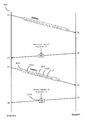
- the Recipient Upon receiving the A-MPDU 1610, the Recipient starts to record the receive status of each individual MPDU of the A-MPDU in the Scoreboard bitmap as explained earlier.
- the Originator 1900 may comprise many other components that are not illustrated, for sake of clarity, in Figure 19B and Figure 20. Only those components that are most pertinent to the present disclosure are illustrated.
- the Reception module 2154 may also comprise one or more memory units 2240 to store the Scoreboard contexts, one per each block ack agreement. Among them, there may be one or more L3 Scoreboard bitmaps that are used to record the reception status of incoming MSDUs when a block ack agreement involving a Level 3 fragmentation has been established with the wireless device 2100 as the Recipient.
- the Reception module 2154 may also comprise a BA Bitmap encoder module 2250 that is responsible for encoding the reception status of the MSDUs onto the BA Bitmaps according to the implemented encoding scheme. If applicable, the Reception module 2154 may also store one or more Fragment Size Tables 2230 to store the number of fragments in the received MSDUs.
- the operating system comprises a Real Time Operating System (RTOS)
- the user application comprise a web browser or a smartphone app
- device drivers comprises a WLAN driver
- the execution code may comprise code which when executed by the CPU 2130, causes the method 1800 to be executed.
- the Fragment Size Table 2230 is used in 1820 to keep a record of the number of fragments.
- the L3 Scoreboard bitmap within the Scoreboard context 2240 is used in 1830.
- the BA Bitmap encoder 2250 is used in 1840 as an encoder to encode the BA Bitmap to be transmitted.
- the Recipient 2100 may comprise many other components that are not illustrated, for sake of clarity, in Figure 21B and Figure 22. Only those components that are most pertinent to the present disclosure are illustrated.
- a wireless device may have several concurrent block ack agreements where it acts as an Originator in some and a Recipient in others, a wirless device may concurrently implement both the Originator as well as the Recipient modules.
- Originator 1901 2101 Transmitter 1903 Frame Generator 1907 Decoder 1909, 2109 Receiver 1910, 2110 Power Source 1920, 2107, 2120 Memory 1930, 2130 CPU 1940, 2140 Secondary Storage 1950, 2150 Wireless Interface 1952, 2152 MAC module 1954 Transmission module 1956 Transmit Buffer 1960, 2160 PHY module 1970, 2170 Antenna 2000 Sequence Number Generator 2010 Fragmentation 2020 Frame Aggregation 2030, 2230 Fragment Size Table 2040 BA Bitmap Decoder 2100 Recipient 2103 Acknowledgement Generator 2154 Reception module 2156 Receive Buffer 2200 Receive Reordering 2210 De-fragmentation 2220 Frame De-aggregation 2240 Scoreboard 2250 BA Bitmap Encoder
Landscapes
- Engineering & Computer Science (AREA)
- Computer Networks & Wireless Communication (AREA)
- Signal Processing (AREA)
- Mobile Radio Communication Systems (AREA)
Abstract
L'invention concerne un procédé de communication de transmission d'une trame d'accusé de réception de bloc (BlockAck). Ce procédé consiste : à recevoir une pluralité de trames d'un dispositif de transmission, la charge utile d'une trame pouvant être un paquet fragmenté ou non fragmenté, à enregistrer le statut de réception des trames, à générer une trame de BlockAck qui contient au moins un champ de table de bits servant à indiquer le statut de réception des trames, le nombre de bits attribués dans le champ de table de bits pour un paquet étant variable, et à transmettre la trame de BlockAck.
Priority Applications (2)
| Application Number | Priority Date | Filing Date | Title |
|---|---|---|---|
| US16/073,293 US11177908B2 (en) | 2016-03-03 | 2017-01-31 | Communication method and communication apparatus for block acknowledgment transmission |
| JP2018530808A JP2019513308A (ja) | 2016-03-03 | 2017-01-31 | ブロック肯定応答送信のための通信方法及び通信装置 |
Applications Claiming Priority (4)
| Application Number | Priority Date | Filing Date | Title |
|---|---|---|---|
| US201662303178P | 2016-03-03 | 2016-03-03 | |
| US62/303178 | 2016-03-03 | ||
| JP2016211813 | 2016-10-28 | ||
| JP2016-211813 | 2016-10-28 |
Publications (1)
| Publication Number | Publication Date |
|---|---|
| WO2017150042A1 true WO2017150042A1 (fr) | 2017-09-08 |
Family
ID=59742724
Family Applications (1)
| Application Number | Title | Priority Date | Filing Date |
|---|---|---|---|
| PCT/JP2017/003283 Ceased WO2017150042A1 (fr) | 2016-03-03 | 2017-01-31 | Procédé et appareil de communication de transmission d'accusé de réception de bloc |
Country Status (2)
| Country | Link |
|---|---|
| US (1) | US11177908B2 (fr) |
| WO (1) | WO2017150042A1 (fr) |
Cited By (6)
| Publication number | Priority date | Publication date | Assignee | Title |
|---|---|---|---|---|
| WO2020142214A1 (fr) * | 2019-01-03 | 2020-07-09 | Qualcomm Incorporated | Relais sélectif de paquets de données |
| US10750403B2 (en) | 2016-03-10 | 2020-08-18 | Wilus Institute Of Standards And Technology Inc. | Multi-user wireless communication method and wireless communication terminal using same |
| US11240705B2 (en) | 2016-04-04 | 2022-02-01 | Wilus Institute Of Standards And Technology Inc. | Wireless communication method using fragmentation and wireless communication terminal using same |
| WO2022022727A1 (fr) * | 2020-07-31 | 2022-02-03 | 华为技术有限公司 | Procédé et appareil de transmission de blocs de bits |
| EP4109798A4 (fr) * | 2020-03-12 | 2023-07-19 | Huawei Technologies Co., Ltd. | Procédé et appareil de communication |
| US20230362996A1 (en) * | 2022-05-06 | 2023-11-09 | Nxp Usa, Inc. | Low latency decode-and-forward (df) relaying for a wireless network |
Families Citing this family (20)
| Publication number | Priority date | Publication date | Assignee | Title |
|---|---|---|---|---|
| US11659439B2 (en) * | 2015-11-30 | 2023-05-23 | Sony Corporation | Information processing apparatus, communication system, information processing method, and program |
| US20180062805A1 (en) * | 2016-08-25 | 2018-03-01 | Po-Kai Huang | Setting of spatial reuse field for he trigger-based ppdu |
| US11337263B2 (en) | 2017-01-19 | 2022-05-17 | Qualcomm Incorporated | Packet based link aggregation architectures |
| US10856203B2 (en) | 2017-01-19 | 2020-12-01 | Qualcomm Incorporated | Signaling for link aggregation setup and reconfiguration |
| US11082887B2 (en) * | 2017-02-27 | 2021-08-03 | Lg Electronics Inc. | Method for retransmitting frame in wireless LAN system, and wireless terminal using same |
| US11197193B2 (en) * | 2018-03-15 | 2021-12-07 | Intel Corporation | Methods and apparatus to perform multi-band link aggregation in a wireless network |
| US11076385B2 (en) * | 2018-08-10 | 2021-07-27 | Intel Corporation | Block acknowledgement and fragmentation in multi-link communication between multi-link logical entities |
| CN110167201B (zh) * | 2018-09-30 | 2022-05-17 | 腾讯科技(深圳)有限公司 | 一种数据传输的方法、相关装置以及系统 |
| US11363657B1 (en) * | 2019-05-16 | 2022-06-14 | Marvell Asia Pte Ltd | WiFi network operation with channel aggregation |
| CN111294286B (zh) * | 2019-05-20 | 2023-05-09 | 展讯通信(上海)有限公司 | 多链路系统的mpdu发送、接收方法及装置、存储介质、发送端、接收端 |
| CN114097272B (zh) * | 2019-06-25 | 2025-04-08 | 华为技术有限公司 | 用于聚合通信链路的系统和方法 |
| CN110636451B (zh) * | 2019-08-21 | 2021-06-11 | 深圳市天彦通信股份有限公司 | 信息管理方法及相关装置 |
| CN110601988B (zh) * | 2019-09-11 | 2022-09-27 | 紫光展讯通信(惠州)有限公司 | 基于802.11协议的数据接收方法及装置、存储介质、终端 |
| US11750329B2 (en) * | 2020-01-04 | 2023-09-05 | Nxp Usa, Inc. | Apparatus and method for block acknowledgement management in multi-link communication systems |
| US11665588B2 (en) * | 2020-01-07 | 2023-05-30 | Mediatek Singapore Pte. Ltd | Extended sequence control for fragmented frames in WLAN |
| US20210111836A1 (en) * | 2020-02-14 | 2021-04-15 | Po-Kai Huang | Block acknowledgement reception window size for eht networks |
| US12273203B2 (en) * | 2020-05-07 | 2025-04-08 | Sony Group Corporation | Communication device and communication method |
| CN115334680A (zh) * | 2021-05-11 | 2022-11-11 | 半导体元件工业有限责任公司 | 用于自适应地选择上行链路持续时间的方法 |
| US20250047446A1 (en) * | 2021-12-17 | 2025-02-06 | Nokia Technologies Oy | Efficient block-acknowledgement mechanism |
| CN114598651B (zh) * | 2022-02-15 | 2024-04-09 | 阿里巴巴(中国)有限公司 | 数据传输方法以及装置 |
Citations (3)
| Publication number | Priority date | Publication date | Assignee | Title |
|---|---|---|---|---|
| WO2006016745A1 (fr) * | 2004-08-12 | 2006-02-16 | Samsung Electronics Co., Ltd. | Procede et appareil pour emettre la trame d'accuse de reception |
| US20100118986A1 (en) * | 2008-11-11 | 2010-05-13 | Electronics And Telecommunications Research Institute | Acknowledgement method and apparatus of aggregated frame in wideband high frequency wireless system |
| US20120014335A1 (en) * | 2009-01-16 | 2012-01-19 | Kabushiki Kaisha Toshiba | Wireless terminal |
Family Cites Families (3)
| Publication number | Priority date | Publication date | Assignee | Title |
|---|---|---|---|---|
| US7944819B2 (en) * | 2004-10-29 | 2011-05-17 | Texas Instruments Incorporated | System and method for transmission and acknowledgment of blocks of data frames in distributed wireless networks |
| US20130294360A1 (en) * | 2012-05-01 | 2013-11-07 | Futurewei Technologies, Inc. | System and Method for Acknowledging Multiple Frames from Multiple Communications Devices |
| US20140351446A1 (en) * | 2013-05-21 | 2014-11-27 | Samsung Electronics Co., Ltd. | Electronic device using logical channels for communication |
-
2017
- 2017-01-31 US US16/073,293 patent/US11177908B2/en active Active
- 2017-01-31 WO PCT/JP2017/003283 patent/WO2017150042A1/fr not_active Ceased
Patent Citations (3)
| Publication number | Priority date | Publication date | Assignee | Title |
|---|---|---|---|---|
| WO2006016745A1 (fr) * | 2004-08-12 | 2006-02-16 | Samsung Electronics Co., Ltd. | Procede et appareil pour emettre la trame d'accuse de reception |
| US20100118986A1 (en) * | 2008-11-11 | 2010-05-13 | Electronics And Telecommunications Research Institute | Acknowledgement method and apparatus of aggregated frame in wideband high frequency wireless system |
| US20120014335A1 (en) * | 2009-01-16 | 2012-01-19 | Kabushiki Kaisha Toshiba | Wireless terminal |
Cited By (23)
| Publication number | Priority date | Publication date | Assignee | Title |
|---|---|---|---|---|
| US10750403B2 (en) | 2016-03-10 | 2020-08-18 | Wilus Institute Of Standards And Technology Inc. | Multi-user wireless communication method and wireless communication terminal using same |
| US12207132B2 (en) | 2016-03-10 | 2025-01-21 | Wilus Institute Of Standards And Technology Inc. | Multi-user wireless communication method and wireless communication terminal using same |
| US11304094B2 (en) | 2016-03-10 | 2022-04-12 | Wilus Institute Of Standards And Technology Inc. | Multi-user wireless communication method and wireless communication terminal using same |
| US11700546B2 (en) | 2016-03-10 | 2023-07-11 | Wilus Institute Of Standards And Technology Inc. | Multi-user wireless communication method and wireless communication terminal using same |
| US11683719B2 (en) | 2016-04-04 | 2023-06-20 | Wilus Institute Of Standards And Technology Inc. | Wireless communication method using fragmentation and wireless communication terminal using same |
| US12593243B2 (en) | 2016-04-04 | 2026-03-31 | Wilus Institute Of Standards And Technology Inc. | Wireless communication method using fragmentation and wireless communication terminal using same |
| US11240705B2 (en) | 2016-04-04 | 2022-02-01 | Wilus Institute Of Standards And Technology Inc. | Wireless communication method using fragmentation and wireless communication terminal using same |
| US12063545B2 (en) | 2016-04-04 | 2024-08-13 | Wilus Institute Of Standards And Technology Inc. | Wireless communication method using fragmentation and wireless communication terminal using same |
| US11683718B2 (en) | 2016-04-04 | 2023-06-20 | Wilus Institute Of Standards And Technology Inc. | Wireless communication method using fragmentation and wireless communication terminal using same |
| KR102611388B1 (ko) * | 2019-01-03 | 2023-12-06 | 퀄컴 인코포레이티드 | 데이터 패킷들의 선택적 중계 |
| CN113366783B (zh) * | 2019-01-03 | 2024-06-11 | 高通股份有限公司 | 数据分组的选择性中继 |
| KR20210108405A (ko) * | 2019-01-03 | 2021-09-02 | 퀄컴 인코포레이티드 | 데이터 패킷들의 선택적 중계 |
| TWI811507B (zh) * | 2019-01-03 | 2023-08-11 | 美商高通公司 | 對資料封包的選擇性中繼 |
| US11785502B2 (en) | 2019-01-03 | 2023-10-10 | Qualcomm Incorporated | Selective relay of data packets |
| CN113366783A (zh) * | 2019-01-03 | 2021-09-07 | 高通股份有限公司 | 数据分组的选择性中继 |
| WO2020142214A1 (fr) * | 2019-01-03 | 2020-07-09 | Qualcomm Incorporated | Relais sélectif de paquets de données |
| US11582638B2 (en) | 2019-01-03 | 2023-02-14 | Qualcomm Incorporated | Selective relay of data packets |
| AU2021233050B2 (en) * | 2020-03-12 | 2024-03-21 | Nokia Technologies Oy | Communication method and apparatus |
| AU2021233050B9 (en) * | 2020-03-12 | 2024-04-04 | Nokia Technologies Oy | Communication method and apparatus |
| EP4109798A4 (fr) * | 2020-03-12 | 2023-07-19 | Huawei Technologies Co., Ltd. | Procédé et appareil de communication |
| WO2022022727A1 (fr) * | 2020-07-31 | 2022-02-03 | 华为技术有限公司 | Procédé et appareil de transmission de blocs de bits |
| US12470321B2 (en) | 2020-07-31 | 2025-11-11 | Huawei Technologies Co., Ltd. | Bit block sending method and apparatus |
| US20230362996A1 (en) * | 2022-05-06 | 2023-11-09 | Nxp Usa, Inc. | Low latency decode-and-forward (df) relaying for a wireless network |
Also Published As
| Publication number | Publication date |
|---|---|
| US20190036651A1 (en) | 2019-01-31 |
| US11177908B2 (en) | 2021-11-16 |
Similar Documents
| Publication | Publication Date | Title |
|---|---|---|
| US11177908B2 (en) | Communication method and communication apparatus for block acknowledgment transmission | |
| US11464059B2 (en) | Acknowledgment data unit for multiple uplink data units | |
| US11075717B2 (en) | Receiving state indication method for A-MPDU and receive end device | |
| US9929847B2 (en) | Shortened block acknowledgement with fragmentation acknowledgement signaling | |
| KR101216100B1 (ko) | 단편화 패킹 확장헤더를 수반하는 mac pdu를 전송하는 방법 및 장치 | |
| JP6165859B2 (ja) | ブロック確認応答圧縮のための装置および方法 | |
| US12267163B2 (en) | Retransmitted data sending method, retransmitted data receiving method, and apparatus | |
| US10873878B2 (en) | Acknowledgement of transmissions in a wireless local area network | |
| EP2424144A1 (fr) | Procédé de communication et équipement de compression d'en-tête | |
| US10454626B2 (en) | Transmitter defragmentation for data unit fragments | |
| EP3643109B1 (fr) | Distribution d'unité de données de service de contrôle de commande au support (msdu) | |
| CN102076023A (zh) | 缓存空间的分配方法和设备 | |
| US20200145145A1 (en) | Acknowledgment data unit for data unit fragment | |
| WO2021013026A1 (fr) | Procédé de transmission et procédé de réception d'unité de données, et dispositifs | |
| KR20110004260A (ko) | 무선 통신 시스템에서 arq 피드백 정보 전송 및 수신 방법 | |
| US20250203357A1 (en) | Communication method and device in wireless local area network | |
| JP2019513308A (ja) | ブロック肯定応答送信のための通信方法及び通信装置 | |
| US20220060291A1 (en) | Communication method and apparatus | |
| EP3550727B1 (fr) | Procédé et appareil de transmission de données | |
| KR100631742B1 (ko) | Ack 프레임 전송 방법 및 장치 | |
| JP7521608B2 (ja) | 送信局及び受信局 | |
| CN108271217A (zh) | 一种信息传输方法及相关设备 |
Legal Events
| Date | Code | Title | Description |
|---|---|---|---|
| ENP | Entry into the national phase |
Ref document number: 2018530808 Country of ref document: JP Kind code of ref document: A |
|
| NENP | Non-entry into the national phase |
Ref country code: DE |
|
| 121 | Ep: the epo has been informed by wipo that ep was designated in this application |
Ref document number: 17759513 Country of ref document: EP Kind code of ref document: A1 |
|
| 122 | Ep: pct application non-entry in european phase |
Ref document number: 17759513 Country of ref document: EP Kind code of ref document: A1 |