WO2017154545A1 - レジストプロセス用膜形成材料、パターン形成方法及び重合体 - Google Patents
レジストプロセス用膜形成材料、パターン形成方法及び重合体 Download PDFInfo
- Publication number
- WO2017154545A1 WO2017154545A1 PCT/JP2017/006231 JP2017006231W WO2017154545A1 WO 2017154545 A1 WO2017154545 A1 WO 2017154545A1 JP 2017006231 W JP2017006231 W JP 2017006231W WO 2017154545 A1 WO2017154545 A1 WO 2017154545A1
- Authority
- WO
- WIPO (PCT)
- Prior art keywords
- group
- film
- resist
- polymer
- alcoholic hydroxyl
- Prior art date
- Legal status (The legal status is an assumption and is not a legal conclusion. Google has not performed a legal analysis and makes no representation as to the accuracy of the status listed.)
- Ceased
Links
Classifications
-
- G—PHYSICS
- G03—PHOTOGRAPHY; CINEMATOGRAPHY; ANALOGOUS TECHNIQUES USING WAVES OTHER THAN OPTICAL WAVES; ELECTROGRAPHY; HOLOGRAPHY
- G03F—PHOTOMECHANICAL PRODUCTION OF TEXTURED OR PATTERNED SURFACES, e.g. FOR PRINTING, FOR PROCESSING OF SEMICONDUCTOR DEVICES; MATERIALS THEREFOR; ORIGINALS THEREFOR; APPARATUS SPECIALLY ADAPTED THEREFOR
- G03F7/00—Photomechanical, e.g. photolithographic, production of textured or patterned surfaces, e.g. printing surfaces; Materials therefor, e.g. comprising photoresists; Apparatus specially adapted therefor
- G03F7/004—Photosensitive materials
- G03F7/09—Photosensitive materials characterised by structural details, e.g. supports, auxiliary layers
- G03F7/11—Photosensitive materials characterised by structural details, e.g. supports, auxiliary layers having cover layers or intermediate layers, e.g. subbing layers
-
- G—PHYSICS
- G03—PHOTOGRAPHY; CINEMATOGRAPHY; ANALOGOUS TECHNIQUES USING WAVES OTHER THAN OPTICAL WAVES; ELECTROGRAPHY; HOLOGRAPHY
- G03F—PHOTOMECHANICAL PRODUCTION OF TEXTURED OR PATTERNED SURFACES, e.g. FOR PRINTING, FOR PROCESSING OF SEMICONDUCTOR DEVICES; MATERIALS THEREFOR; ORIGINALS THEREFOR; APPARATUS SPECIALLY ADAPTED THEREFOR
- G03F7/00—Photomechanical, e.g. photolithographic, production of textured or patterned surfaces, e.g. printing surfaces; Materials therefor, e.g. comprising photoresists; Apparatus specially adapted therefor
- G03F7/26—Processing photosensitive materials; Apparatus therefor
- G03F7/30—Imagewise removal using liquid means
- G03F7/32—Liquid compositions therefor, e.g. developers
-
- H—ELECTRICITY
- H10—SEMICONDUCTOR DEVICES; ELECTRIC SOLID-STATE DEVICES NOT OTHERWISE PROVIDED FOR
- H10P—GENERIC PROCESSES OR APPARATUS FOR THE MANUFACTURE OR TREATMENT OF DEVICES COVERED BY CLASS H10
- H10P76/00—Manufacture or treatment of masks on semiconductor bodies, e.g. by lithography or photolithography
-
- C—CHEMISTRY; METALLURGY
- C08—ORGANIC MACROMOLECULAR COMPOUNDS; THEIR PREPARATION OR CHEMICAL WORKING-UP; COMPOSITIONS BASED THEREON
- C08G—MACROMOLECULAR COMPOUNDS OBTAINED OTHERWISE THAN BY REACTIONS ONLY INVOLVING UNSATURATED CARBON-TO-CARBON BONDS
- C08G77/00—Macromolecular compounds obtained by reactions forming a linkage containing silicon with or without sulfur, nitrogen, oxygen or carbon in the main chain of the macromolecule
- C08G77/04—Polysiloxanes
- C08G77/14—Polysiloxanes containing silicon bound to oxygen-containing groups
Definitions
- the present invention relates to a film forming material for a resist process, a pattern forming method, and a polymer.
- a resist process is often used in which a resist film laminated on a substrate to be processed is exposed and developed through an organic antireflection film, and etching is performed using the obtained resist pattern as a mask.
- a phenomenon in which the resist pattern is peeled off at the time of development or after development is likely to occur due to high integration of semiconductor elements or the like, that is, miniaturization of the resist pattern.
- the difference in etching rate between the resist film and the organic antireflection film is small. For this reason, with the miniaturization and thinning of the resist film, there is an inconvenience that the substrate to be processed coated with the organic antireflection film cannot be finely processed by etching using the resist pattern as a mask.
- the present invention has been made based on the above circumstances, and can form a resist intermediate film (silicon-containing film) that is excellent in adhesion to a resist film, has a good resist pattern shape, and has little collapse.
- a resist forming film forming material, a pattern forming method using the resist forming film forming material, and a polymer suitable as such a resist processing film forming material is a resist intermediate film (silicon-containing film) that is excellent in adhesion to a resist film, has a good resist pattern shape, and has little collapse.
- the present invention made in order to solve the above problems is a film forming material for a resist process containing a polymer having a structural unit derived from a silane monomer having two or more protected alcoholic hydroxyl groups, and an organic solvent. is there.
- Another invention made in order to solve the above-described problems includes a step of forming a silicon-containing film on at least one surface side of the substrate by using the film forming material for a resist process, a polymer having an acid dissociable group, and A step of forming a resist film on the surface of the silicon-containing film opposite to the substrate, a step of exposing the resist film, and a step of exposing the radiation-containing resin composition containing a radiation-sensitive acid generator. And a step of developing the resist film formed.
- R 1 is a monovalent organic group containing two or more protected alcoholic hydroxyl groups, or a monovalent organic group containing one protected alcoholic hydroxyl group.
- R 2 represents a monovalent organic group containing two or more protected alcoholic hydroxyl groups, a monovalent organic group containing one protected alcoholic hydroxyl group, a hydrogen atom, a hydroxy group, or a protected alcoholic group.
- a is 0 or 1.
- R 1 is a monovalent organic group containing one protected alcoholic hydroxyl group
- a is 1.
- R 3 is a monovalent organic group having a light-absorbing group that does not have a protected alcoholic hydroxyl group.
- R 4 is a substituted or unsubstituted monovalent hydrocarbon group having 1 to 20 carbon atoms which does not have a hydrogen atom, a hydroxy group, or a protected alcoholic hydroxyl group.
- b is 0 or 1.
- R 5 is a non-light-absorbing substituted or unsubstituted monovalent aliphatic hydrocarbon group that does not have a protected alcoholic hydroxyl group.
- c is an integer of 0-2. When c is 2, the plurality of R 5 may be the same or different.
- d represents the molar ratio of the structural unit U X to all the structural units constituting the polymer.
- e represents a molar ratio of structural units U Y to the total structural units constituting the polymer.
- f represents the molar ratio of structural units U Z to the total structural units constituting the polymer.
- d, e, and f satisfy 0 ⁇ d ⁇ 1, 0 ⁇ e ⁇ 1, and 0 ⁇ f ⁇ 1, respectively, and d + e + f ⁇ 1.
- the film forming material for a resist process of the present invention it is possible to form a silicon-containing film that is excellent in adhesiveness with a resist film, has a good resist pattern shape, and has little collapse.
- the silicon-containing film obtained from the resist process film-forming material is also excellent in the resist composition's resistance to solvents, antireflection properties, and etching resistance.
- an excellent resist pattern can be formed by using an excellent silicon-containing film formed of the resist process film forming material.
- the polymer of the present invention is preferably used as a main component of a film forming material for a resist process that can form a silicon-containing film that has excellent adhesion to a resist film, has a good resist pattern shape, and has little collapse. Can do. Therefore, these can be suitably used for manufacturing semiconductor devices and the like that are expected to be further miniaturized in the future.
- the resist process film forming material according to an embodiment of the present invention (hereinafter, also simply referred to as “film forming material”) is derived from [A] a silane monomer having two or more protected alcoholic hydroxyl groups. A polymer having a structural unit and [B] an organic solvent.
- the film-forming material may contain optional components such as [C] nitrogen-containing compound, [D] acid generator, and [E] water as long as the effects of the present invention are not impaired. However, each optional component such as [C] nitrogen-containing compound, [D] acid generator, and [E] water may not be contained.
- each component will be described in detail.
- the polymer has a structural unit derived from a silane monomer having two or more protected alcoholic hydroxyl groups.
- a silicon-containing film is formed from the film-forming material and a resist pattern is formed, it is assumed that the resist pattern has excellent adhesion with the following reasons, and pattern collapse during development can be suppressed.
- the reason why the present invention has the above effects is not limited to the following reasons.
- the protected alcoholic hydroxyl group is preferably an alcoholic hydroxyl group protected by an acid-dissociable protecting group.
- the resist film laminated on the surface of the silicon-containing film is usually formed of a radiation-sensitive composition containing a radiation-sensitive acid generator (hereinafter sometimes simply referred to as “acid generator”). For this reason, an acid is generated in the resist film when the resist film is exposed.
- acid generator a radiation-sensitive acid generator
- the alcoholic hydroxyl group of the structural unit in the polymer [A] is deprotected by the acid, and the silicon-containing film (hereinafter referred to as “resist intermediate film”, “resist underlayer” in the exposed portion is exposed. It may be referred to as a “film” or the like.)
- the surface is hydrophilized.
- the exposed resist film (resist pattern) It is presumed that the adhesion with the silicon-containing film is increased and the pattern collapse during development can be suppressed.
- the above structural unit of the [A] polymer has two or more protected alcoholic hydroxyl groups, it is presumed that the hydrophilicity can be effectively increased and the ability to suppress pattern collapse is excellent. . Since substances with low surface energy are unevenly distributed at the gas phase interface, when a film is formed using a polymer having a hydrophilic group such as an unprotected alcoholic hydroxyl group, the hydrophilic group is unevenly distributed on the surface. do not do.
- the film surface after exposure is effectively made hydrophilic. It is speculated that the adhesion to the resist pattern can be improved.
- the polymer has, for example, a structure represented by the following formula (1).
- R 1 is a monovalent organic group containing two or more protected alcoholic hydroxyl groups, or a monovalent organic group containing one protected alcoholic hydroxyl group.
- R 2 represents a monovalent organic group containing two or more protected alcoholic hydroxyl groups, a monovalent organic group containing one protected alcoholic hydroxyl group, a hydrogen atom, a hydroxy group, or a protected alcoholic group.
- a is 0 or 1. However, when R 1 is a monovalent organic group containing one protected alcoholic hydroxyl group, a is 1.
- R 3 is a monovalent organic group having a light-absorbing group that does not have a protected alcoholic hydroxyl group.
- R 4 is a substituted or unsubstituted monovalent hydrocarbon group having 1 to 20 carbon atoms which does not have a hydrogen atom, a hydroxy group, or a protected alcoholic hydroxyl group.
- b is 0 or 1.
- R 5 is a non-light-absorbing substituted or unsubstituted monovalent aliphatic hydrocarbon group that does not have a protected alcoholic hydroxyl group.
- c is an integer of 0-2. When c is 2, the plurality of R 5 may be the same or different.
- d represents the molar ratio of the structural unit U X to all the structural units constituting the polymer.
- e represents a molar ratio of structural units U Y to the total structural units constituting the polymer.
- f represents the molar ratio of structural units U Z to the total structural units constituting the polymer.
- d, e, and f satisfy 0 ⁇ d ⁇ 1, 0 ⁇ e ⁇ 1, and 0 ⁇ f ⁇ 1, respectively, and d + e + f ⁇ 1.
- the structure represented by the above formula (1) may further include a structural unit U Y in addition to the structural unit U X. That is, in the above formula (1), 0 ⁇ d ⁇ 1 and 0 ⁇ e ⁇ 1 may be satisfied.
- the structure represented by the above formula (1) may further include a structural unit U Z in addition to the structural unit U X and the structural unit U Y. That is, in the above formula (1), 0 ⁇ d ⁇ 1 and 0 ⁇ f ⁇ 1 may be satisfied, or 0 ⁇ d ⁇ 1, 0 ⁇ e ⁇ 1, and 0 ⁇ f ⁇ 1 may be satisfied. .
- the formula (1) it further has a structural unit U Z, silicon content of the polymer is increased, it is like to improve the oxygen gas etching resistance.
- the structural unit U X is a structural unit derived from a silane monomer having two or more alcoholic hydroxyl group protected.
- examples of the monovalent organic group containing two or more protected alcoholic hydroxyl groups represented by R 1 and R 2 include groups represented by the following formula (2). Can do.
- X 1 is a trivalent organic group having 1 to 20 carbon atoms.
- Each R 6 is independently a single bond or a substituted or unsubstituted divalent hydrocarbon group having 1 to 10 carbon atoms.
- Y 1 is each independently a monovalent protecting group, or two Y 1 may be bonded to each other to form a divalent protecting group. * Indicates a binding site.
- Examples of the trivalent organic group having 1 to 20 carbon atoms represented by X 1 include a trivalent hydrocarbon group having 1 to 20 carbon atoms, and a heteroatom-containing group between carbon-carbon or at the terminal of the hydrocarbon group. And groups in which part or all of the hydrogen atoms of these groups are substituted with substituents.
- Examples of the trivalent hydrocarbon group having 1 to 20 carbon atoms include a trivalent aliphatic hydrocarbon group having 1 to 20 carbon atoms and a trivalent aromatic hydrocarbon group having 6 to 20 carbon atoms. it can. Note that when X 1 is a trivalent aromatic hydrocarbon group having 6 to 20 carbon atoms, each R 6 is independently a substituted or unsubstituted divalent hydrocarbon group having 1 to 10 carbon atoms. can do.
- Examples of the trivalent aliphatic hydrocarbon group having 1 to 20 carbon atoms include a trivalent chain hydrocarbon group having 1 to 20 carbon atoms and a trivalent alicyclic hydrocarbon group having 3 to 20 carbon atoms. be able to.
- Examples of the trivalent chain hydrocarbon group having 1 to 20 carbon atoms include alkanetriyl groups such as methanetriyl group, ethanetriyl group, propanetriyl group, butanetriyl group, and pentanetriyl group, Alkenetriyl groups such as ethenetriyl group, propenetriyl group, butenetriyl group, pentenetriyl group, Examples thereof include alkynetriyl groups such as propynetriyl group, butynetriyl group and pentynetriyl group.
- Examples of the trivalent alicyclic hydrocarbon group having 3 to 20 carbon atoms include cycloalkanetriyl groups such as cyclopropanetriyl group, cyclopentanetriyl group, and cyclohexanetriyl group, Cycloalkenetriyl group such as cyclopropenetriyl group, cyclopentenetriyl group, cyclohexentriyl group, And trivalent bridged ring hydrocarbon groups such as a norbornanetriyl group, an adamantanetriyl group, and a norbornenetriyl group.
- cycloalkanetriyl groups such as cyclopropanetriyl group, cyclopentanetriyl group, and cyclohexanetriyl group
- Cycloalkenetriyl group such as cyclopropenetriyl group, cyclopentenetriyl group, cyclohexentriyl group
- trivalent aromatic hydrocarbon group having 6 to 20 carbon atoms examples include benzenetriyl group, naphthalenetriyl group, anthracentriyl group and the like.
- the above heteroatom-containing group refers to a group having a divalent or higher valent heteroatom in the structure.
- the hetero atom-containing group may have one hetero atom or two or more hetero atoms.
- the heteroatom-containing group may be composed of only one heteroatom.
- the divalent or higher valent hetero atom of the hetero atom-containing group is not particularly limited as long as it is a hetero atom having a valence of 2 or higher.
- a hetero atom having a valence of 2 or higher For example, an oxygen atom, a nitrogen atom, a sulfur atom, a silicon atom, a phosphorus atom And boron atoms.
- heteroatom-containing group examples include groups consisting of only heteroatoms such as —O—, —S—, —SO—, —SO 2 —, —SO 2 O—, —SO 3 —, etc. Combination of carbon atom and hetero atom such as —CO—, —COO—, —COS—, —CONH—, —OCOO—, —OCOS—, —OCONH—, —SCONH—, —SCSNH—, —SCSS—, etc. Group and the like.
- the carbon number of the organic groups represented by X 1 also includes the number of carbon atoms in these heteroatom-containing group. The same applies to the carbon number of the organic group.
- Examples of the substituent include a halogen atom, a hydroxy group, a carboxy group, a nitro group, and a cyano group.
- the carbon number of the organic groups represented by X 1, also includes the number of carbon atoms in these substituents. The same applies to the carbon number of the organic group.
- the group represented by X 1 is preferably a substituted or unsubstituted trivalent hydrocarbon group, more preferably a substituted or unsubstituted trivalent aliphatic hydrocarbon group, and a substituted or unsubstituted trivalent hydrocarbon group.
- a chain hydrocarbon group is more preferred, a substituted or unsubstituted alkanetriyl group is more preferred, and a linear alkanetriyl group is still more preferred.
- a group containing an oxygen atom or a sulfur atom between carbon-carbons of these hydrocarbon groups is also preferred.
- the lower limit of the carbon number of the group represented by X 1 is 1, but 2 is preferable and 3 is more preferable.
- the upper limit of the carbon number of the group represented by X 1 is preferably 20, more preferably 10, and still more preferably 6.
- Examples of the substituted or unsubstituted divalent hydrocarbon group having 1 to 10 carbon atoms represented by R 6 include a divalent aliphatic hydrocarbon group having 1 to 10 carbon atoms and a divalent hydrocarbon group having 6 to 10 carbon atoms. And a group in which part or all of the hydrogen atoms of these groups are substituted with a substituent.
- Examples of the divalent aliphatic hydrocarbon group having 1 to 10 carbon atoms include a divalent chain hydrocarbon group having 1 to 10 carbon atoms and a divalent alicyclic hydrocarbon group having 3 to 10 carbon atoms. be able to.
- Examples of the divalent chain hydrocarbon group having 1 to 10 carbon atoms include alkanediyl groups such as methanediyl group, ethanediyl group, propanediyl group, butanediyl group, and pentanediyl group, Alkenediyl groups such as ethenediyl group, propenediyl group, butenediyl group, pentenediyl group, Examples thereof include alkynediyl groups such as ethynediyl group, propynediyl group, butynediyl group, and pentynediyl group.
- Examples of the divalent alicyclic hydrocarbon group having 3 to 10 carbon atoms include cycloalkanediyl groups such as cyclopropanediyl group, cyclopentanediyl group, and cyclohexanediyl group, Cycloalkenediyl groups such as cyclopropenediyl group, cyclopentenediyl group, cyclohexenediyl group, And divalent bridged ring hydrocarbon groups such as a norbornanediyl group, an adamantanediyl group, and a norbornenediyl group.
- cycloalkanediyl groups such as cyclopropanediyl group, cyclopentanediyl group, and cyclohexanediyl group
- Cycloalkenediyl groups such as cyclopropenediyl group, cyclopentenediyl group, cyclohexenedi
- Examples of the divalent aromatic hydrocarbon group having 6 to 10 carbon atoms include a benzenediyl group, a naphthalenediyl group, and an anthracenediyl group.
- Examples of the substituent of the hydrocarbon group represented by R 6 include the same groups as those exemplified as the substituent of the group represented by X 1 .
- R 6 is preferably a single bond or a divalent chain hydrocarbon group having 1 to 10 carbon atoms.
- divalent chain hydrocarbon groups having 1 to 10 carbon atoms divalent chain hydrocarbon groups having 1 to 4 carbon atoms are more preferable, and divalent chain hydrocarbon groups having 1 to 2 carbon atoms are preferable. More preferred is a methanediyl group.
- X 1 is a linear alkanetriyl group or a group containing an oxygen atom or a sulfur atom between the carbon-carbon, and two R 6 are bonded to the terminal carbon atom of X 1. More preferably.
- the monovalent protecting group represented by Y 1 is not particularly limited as long as it is a group that is deprotected by an acid or the like, but is preferably a group that is deprotected by an acid, for example, R a- , R It may be mentioned and R a -O-CO-, a group represented by - a -CO-, R a -O- C (R b) 2.
- R a is a substituted or unsubstituted monovalent hydrocarbon group having 1 to 10 carbon atoms.
- Two R b s are each independently a hydrogen atom or a substituted or unsubstituted monovalent hydrocarbon group having 1 to 10 carbon atoms.
- R b may combine with R a to form part of the ring structure.
- Y 1 is a group represented by R a
- an ether type protective structure is formed.
- R a is a group represented by R a —CO—
- an ester-type protective structure such as alkylcarbonyloxy group protection is formed.
- R a is a group represented by R a —O—C (R b ) 2 —
- an acetal type protective structure is formed.
- Examples of the substituted or unsubstituted monovalent hydrocarbon group having 1 to 10 carbon atoms represented by R a and R b include a monovalent aliphatic hydrocarbon group having 1 to 10 carbon atoms and 6 to 10 carbon atoms. And monovalent aromatic hydrocarbon groups, groups obtained by substituting some or all of the hydrogen atoms of these groups with substituents, and the like.
- Examples of the monovalent aliphatic hydrocarbon group having 1 to 10 carbon atoms include a monovalent chain hydrocarbon group having 1 to 10 carbon atoms and a monovalent alicyclic hydrocarbon group having 3 to 10 carbon atoms. be able to.
- Examples of the monovalent chain hydrocarbon group having 1 to 10 carbon atoms include alkyl groups such as methyl group, ethyl group, propyl group, butyl group, and pentyl group, ethenyl group, propenyl group, butenyl group, and pentenyl group.
- Alkynyl groups such as an alkenyl group and an ethynyl group can be exemplified.
- Examples of the monovalent alicyclic hydrocarbon group having 3 to 10 carbon atoms include a cycloalkyl group such as a cyclopropyl group, a cyclopentyl group, and a cyclohexyl group, and a cycloalkenyl group such as a cyclopropenyl group, a cyclopentenyl group, and a cyclohexenyl group. And monovalent bridged ring hydrocarbon groups such as a norbornyl group and an adamantyl group.
- Examples of the monovalent aromatic hydrocarbon group having 6 to 10 carbon atoms include aryl groups such as phenyl group, tolyl group, xylyl group and naphthyl group, aralkyl groups such as benzyl group and phenethyl group.
- Examples of the substituent for the hydrocarbon group represented by R a and R b include the same groups as those exemplified as the substituent for the group represented by X 1 .
- R a an alkyl group and a cycloalkyl group are preferable, and secondary and tertiary alkyl groups and a cycloalkyl group are more preferable, and a tertiary alkyl group is more preferable from the viewpoint of detachability.
- the t-butyl group is particularly preferred.
- R b is preferably a hydrogen atom and an alkyl group, more preferably a hydrogen atom and an alkyl group having 1 to 4 carbon atoms.
- Examples of the divalent protecting group formed by bonding the two Y 1 to each other include a substituted or unsubstituted divalent hydrocarbon group.
- Examples of the substituted or unsubstituted divalent hydrocarbon group include the groups exemplified as the group represented by R 6 .
- the preferred form of the divalent protecting group is the same as the preferred form of the divalent protecting group represented by Y 1b described later.
- the monovalent organic group containing two or more protected alcoholic hydroxyl groups represented by R 1 and R 2 is preferably a group represented by the following formula (2a) or (2b).
- R 7 is a divalent organic group having 1 to 10 carbon atoms.
- p is an integer of 1 to 5.
- q is an integer of 0 to 5.
- Y 1a is each independently a monovalent protecting group.
- Y 1b is a divalent protecting group.
- Examples of the divalent organic group having 1 to 10 carbon atoms represented by R 7 include a substituted or unsubstituted divalent hydrocarbon group having 1 to 10 carbon atoms represented by R 6 , and this hydrocarbon group. And a group containing a hetero atom-containing group between carbon atoms or at the terminal thereof, a group in which part or all of the hydrogen atoms of these groups are substituted with a substituent, and the like.
- substituent include those similar to those exemplified as the substituent of the group represented by X 1.
- Examples of the divalent organic group having 1 to 10 carbon atoms represented by R 7 include a substituted or unsubstituted divalent hydrocarbon group having 1 to 10 carbon atoms and a carbon-carbon bond between the hydrocarbon groups.
- a group containing a heteroatom is preferred, a substituted or unsubstituted alkanediyl group having 1 to 10 carbon atoms and a group containing a heteroatom at the carbon-carbon or terminal end of this alkanediyl group are more preferred, substituted or unsubstituted carbon
- a linear alkanediyl group of 1 to 6 and a group containing an oxygen atom or a sulfur atom at the carbon-carbon boundary or at the terminal of the alkanediyl group are more preferable.
- the two bonding positions are preferably at both ends.
- the carbon number of the divalent organic group represented by R 7 is more preferably 1 to 3. By reducing the number of carbon atoms within the above range, the oxygen etching resistance of the obtained silicon-containing film can be further increased.
- P is an integer of 1 to 5, preferably 1 and 2, and more preferably 1.
- the q is an integer of 0 to 5, preferably 0 and 1, and more preferably 0.
- Examples of the monovalent protecting group represented by Y 1a include R a —, R a —CO—, R a —O—C (R b ) 2 — and R a described in the description of formula (2).
- a group represented by —O—CO— is preferred. Details of these groups and more preferable groups among these groups are as described in the description of the formula (2).
- Examples of the divalent protecting group represented by Y 1b include a substituted or unsubstituted divalent hydrocarbon group.
- Examples of the substituted or unsubstituted divalent hydrocarbon group include the groups exemplified as the group represented by R 6 .
- the substituted or unsubstituted divalent hydrocarbon group is preferably a substituted or unsubstituted methanediyl group and a group represented by the following formula (4).
- n is an integer of 0-4.
- Each R c is independently a substituted or unsubstituted monovalent hydrocarbon group having 1 to 10 carbon atoms.
- Each R d is independently a hydrogen atom or a substituted or unsubstituted monovalent hydrocarbon group having 1 to 10 carbon atoms.
- Two R d s may be bonded to each other to form a carbocyclic structure having 4 to 12 carbon atoms (an alicyclic structure, an aromatic ring structure, or a combined ring structure thereof) together with the carbon chain to which they are bonded. . * Indicates a binding position.
- Examples of the substituted or unsubstituted monovalent hydrocarbon group having 1 to 10 carbon atoms represented by R c and R d include those exemplified as the group represented by R a .
- R c is preferably an alkyl group, more preferably an alkyl group having 1 to 4 carbon atoms, and still more preferably a methyl group.
- R d is preferably an alkyl group, more preferably an alkyl group having 1 to 4 carbon atoms, and still more preferably a methyl group.
- N is an integer of 0 to 4, preferably 0 and 1, and more preferably 0.
- Examples of the substituent that the methanediyl group represented by Y 1b may have include a hydrocarbon group in addition to the halogen atom described above, and is preferably a hydrocarbon group having 1 to 10 carbon atoms.
- a hydrocarbon group is more preferred.
- This hydrocarbon group may be an aliphatic hydrocarbon group such as an alkyl group or an aromatic hydrocarbon group such as a phenyl group.
- Two substituents may be bonded to each other to form a ring structure together with the carbon atom to which they are bonded. Examples of the ring structure include alicyclic groups having 3 to 20 carbon atoms and aromatic groups.
- Y 1b is a methanediyl group which may have a substituent
- a methanediyl group having two hydrocarbon groups as a substituent is preferable. These two hydrocarbon groups may be bonded to each other to form an alicyclic structure.
- Y 1 (Y 1a and Y 1b ), which is a protecting group for an alcoholic hydroxyl group, preferably forms an acetal-type or ester-type protecting group from the viewpoint of elimination by an acid or the like.
- a is 0 or 1, but 0 is preferable. By setting a to 0, oxygen etching resistance of the obtained silicon-containing film can be increased.
- the monovalent organic group containing one protected alcoholic hydroxyl group represented by R 1 and R 2 is not particularly limited, but includes a group represented by the following formula (3). Can be mentioned.
- X 2 is a single bond or a divalent organic group having 1 to 20 carbon atoms.
- Y 2 is a monovalent protecting group. * Indicates a binding site.
- Examples of the divalent organic group having 1 to 20 carbon atoms represented by X 2 include those exemplified as the divalent organic group represented by R 7 .
- the group represented by X 2 is preferably a substituted or unsubstituted divalent hydrocarbon group having 1 to 10 carbon atoms, and a group containing a hetero atom at the carbon-carbon end of the hydrocarbon group.
- the two bonding positions are preferably at both ends.
- Examples of the monovalent protecting group represented by Y 2 include those described as the monovalent protecting group represented by Y 1 and Y 1a .
- the preferable group of the monovalent protecting group represented by Y 2 is the same as Y 1 and Y 1a . That is, groups represented by R a —, R a —CO—, R a —O—C (R b ) 2 —, and R a —O—CO— described in the description of the formula (2) are preferable. Specific structures of these groups and more preferable structures are also as described above.
- Y 2 which is a protective group for an alcoholic hydroxyl group preferably forms an acetal-type or ester-type protective group from the standpoint of detachment by an acid.
- Examples of the substituted or unsubstituted monovalent hydrocarbon group having 1 to 20 carbon atoms that does not have a protected alcoholic hydroxyl group represented by R 2 include substituted or non-substituted groups represented by the above R a and R b. Examples thereof include the same groups as those exemplified as the substituted monovalent hydrocarbon group having 1 to 10 carbon atoms.
- R 1 in the above formula (1) is preferably a monovalent organic group containing two or more protected alcoholic hydroxyl groups.
- Structural unit R 1 is a monovalent organic group containing two or more alcoholic hydroxyl group protected
- U X includes two or more alcoholic hydroxyl group protected, and hydrolyzable groups bonded to the silicon atom It is obtained by hydrolytic condensation of a silane monomer (I) having Examples of the hydrolyzable group include alkoxy groups such as methoxy group and ethoxy group, acyloxy groups such as acetoxy group, halogen atoms such as chlorine atom, and the like.
- the silane monomer (I) preferably has 2 or 3 hydrolyzable groups, and more preferably has 3 hydrolyzable groups.
- silane monomer (I) examples include compounds represented by the following formulas (i-1) to (i-27).
- the silane monomer (I) may be used alone or in combination of two or more.
- [A] structural units derived from the silane monomer having two or more alcoholic hydroxyl group protected in the polymer lower limit of the content of specifically structural unit U X (mol ratio d) is, [A] 0.1 mol% is preferable with respect to all structural units constituting the polymer, 1 mol% is more preferable, and 3 mol% is more preferable.
- As this upper limit 40 mol% is preferable, 30 mol% is more preferable, 25 mol% is further more preferable, and 20 mol% is especially preferable.
- the content of the structural unit U X is set to be lower than or equal the upper limit, it is possible to sufficiently contain other structural units, and antireflective properties, can be exhibited well-balanced etching resistance and the like.
- the content ratio of the structural unit in the [A] polymer can be regarded as the same as the ratio of the charged amount of each corresponding silane monomer when the [A] polymer is synthesized by hydrolysis condensation of the silane monomer.
- Examples of the monovalent organic group having a light-absorbing group that does not have a protected alcoholic hydroxyl group represented by R 3 include an alkenyl group having 2 to 10 carbon atoms or an aromatic group having 6 to 20 ring members. And monovalent groups containing a carbocyclic ring or an aromatic heterocyclic ring having 4 to 20 ring members. Some or all of the hydrogen atoms contained in these groups may be substituted with a substituent.
- alkenyl group having 2 to 10 carbon atoms examples include ethenyl group, 1-propen-1-yl group, 1-propen-2-yl group, 1-propen-3-yl group and 1-buten-1-yl.
- Examples of the monovalent group containing an aromatic carbocyclic ring having 6 to 20 ring members include phenyl group, naphthyl group, methylphenyl group, benzyl group, phenethyl group, ethylphenyl group, chlorophenyl group, bromophenyl group, and fluorophenyl. And an aryl group such as a group. Among these, a phenyl group and a methylphenyl group are preferable.
- Examples of the monovalent group containing an aromatic heterocyclic ring having 4 to 20 ring members include a pyridyl group, a furyl group, and a thienyl group.
- R 3 is preferably a group containing an aromatic carbocycle, more preferably an aryl group, and still more preferably a phenyl group and a methylphenyl group.
- Examples of the substituted or unsubstituted monovalent hydrocarbon group having 1 to 20 carbon atoms which does not have a protected alcoholic hydroxyl group represented by R 4 include a substituted or unsubstituted 1 represented by Ra above.
- the group similar to the group illustrated as a valent hydrocarbon group can be mentioned.
- the silane monomer providing the structural unit U Y may include, for example, phenyl trimethoxysilane, phenyl triethoxysilane, methylphenyl trimethoxy silane, vinyl trimethoxy silane.
- the lower limit of the content ratio (molar ratio e) of the structural unit U Y in the polymer preferably 0.1 mol% with respect to the total structural units constituting the [A] polymer, 1 mol% Gayori
- 3 mol% is more preferable, and 5 mol% is especially preferable.
- 40 mol% is preferable, 30 mol% is more preferable, 20 mol% is further more preferable, and 15 mol% is especially preferable.
- the content of the structural unit U Y improving the adhesion and the like of the resist pattern by the above-mentioned range it is possible to more satisfactorily balanced manner exhibits antireflective properties and the like.
- the non-light-absorbing substituted or unsubstituted monovalent aliphatic hydrocarbon group having no protected alcoholic hydroxyl group represented by R 5 is a substituted or unsubstituted group represented by Ra above.
- the monovalent hydrocarbon group include monovalent chain hydrocarbon groups and monovalent alicyclic hydrocarbon groups. Some or all of the hydrogen atoms of these chain hydrocarbon group and alicyclic hydrocarbon group may be substituted with a substituent.
- the number of carbon atoms of the group represented by R 5 can be, for example, 1 to 10, and in the case of an alicyclic hydrocarbon group, the number of carbon atoms can be 3 to 10.
- R 5 is preferably a chain hydrocarbon group, more preferably a chain hydrocarbon group having 1 to 4 carbon atoms, and still more preferably a methyl group.
- c is preferably 0 or 1, and more preferably 0.
- the silane monomer providing the structural unit U Z for example, tetramethoxysilane, tetraethoxysilane, tetrabutoxysilane, methyl trimethoxysilane, methyl triethoxysilane, ethyl trimethoxysilane, dimethyldimethoxysilane and the like.
- the content of the structural unit U Z in the above range, while increasing the adhesion or the like of the resist pattern, such as solvent resistance and etching resistance can be further improved.
- the polymer may have a structural unit other than the structural unit U X , the structural unit U Y and the structural unit U Z.
- other structural units include structural units derived from silane monomers containing a plurality of silicon atoms, such as hexamethoxydisilane, bis (trimethoxysilyl) methane, polydimethoxymethylcarbosilane, and the like.
- the upper limit of the content ratio of the other structural units is preferably 20 mol% with respect to all the structural units constituting the [A] polymer, and is preferably 10 mol%. Is more preferable, 3 mol is more preferable, and 1 mol% is particularly preferable. That is, the lower limit of the sum (d + e + f) of d, e, and f in formula (1) is preferably 0.8, more preferably 0.9, even more preferably 0.97, and particularly preferably 0.99.
- the lower limit of the content of the polymer is preferably 50% by mass, more preferably 70% by mass, still more preferably 80% by mass, and particularly preferably 90% by mass with respect to the total solid content of the film-forming material. preferable. As an upper limit of the said content, 99 mass% is preferable and 97 mass% is more preferable.
- the total solid content of the film-forming material refers to the sum of components other than [B] organic solvent and [E] water. [A] Only one type of polymer may be contained, or two or more types may be contained.
- the lower limit of the weight average molecular weight (Mw) in terms of polystyrene by size exclusion chromatography of the polymer is preferably 1,000, more preferably 1,300, and even more preferably 1,500.
- the upper limit of Mw is preferably 100,000, more preferably 30,000, still more preferably 10,000, and particularly preferably 4,000.
- the Mw of the [A] polymer in this specification is, for example, using a Tosoh GPC column (“G2000HXL”, “G3000HXL” and “G4000HXL”), flow rate: 1.0 mL / min, Elution solvent: Tetrahydrofuran, column temperature: A value measured by gel permeation chromatography (detector: differential refractometer) using monodisperse polystyrene as a standard under analysis conditions of 40 ° C.
- the production method of the polymer can be obtained by a method of hydrolyzing and condensing a hydrolyzable silane monomer corresponding to each structural unit described above. This hydrolysis condensation of the silane monomer can be performed by a conventionally known method.
- the upper limit of the content of the alcohol solvent having a boiling point of 100 ° C. or lower in the solvent in the reaction solution is preferably 20% by mass, and more preferably 5% by mass.
- the alcohol solvent having a boiling point of 100 ° C. or less may be generated during the hydrolysis and condensation of each of the above silane monomers, and the content of the solvent in the reaction solution is 20% by mass or less, preferably 5% by mass or less. It is preferable to remove by distillation or the like.
- Organic solvent Any organic solvent can be used as long as it can dissolve or disperse the polymer (polysiloxane) and optional components.
- organic solvent examples include alcohol solvents, ketone solvents, ether solvents, ester solvents, nitrogen-containing solvents, and the like.
- An organic solvent can be used individually by 1 type or in combination of 2 or more types.
- the alcohol solvent examples include monoalcohol solvents such as methanol, ethanol, n-propanol, iso-propanol, n-butanol and iso-butanol, ethylene glycol, 1,2-propylene glycol, diethylene glycol, dipropylene glycol and the like.
- monoalcohol solvents such as methanol, ethanol, n-propanol, iso-propanol, n-butanol and iso-butanol, ethylene glycol, 1,2-propylene glycol, diethylene glycol, dipropylene glycol and the like.
- polyhydric alcohol solvents examples include polyhydric alcohol solvents.
- ketone solvents include acetone, methyl ethyl ketone, methyl-n-propyl ketone, methyl-iso-butyl ketone, and cyclohexanone.
- ether solvents include ethyl ether, iso-propyl ether, ethylene glycol dibutyl ether, diethylene glycol monomethyl ether, diethylene glycol monoethyl ether, diethylene glycol diethyl ether, propylene glycol monomethyl ether, propylene glycol monoethyl ether, propylene glycol monopropyl ether, Tetrahydrofuran etc. are mentioned.
- ester solvent examples include ethyl acetate, ⁇ -butyrolactone, n-butyl acetate, ethylene glycol monomethyl ether acetate, ethylene glycol monoethyl ether acetate, diethylene glycol monomethyl ether acetate, diethylene glycol monoethyl ether acetate, propylene glycol monomethyl ether acetate, acetic acid
- Examples include propylene glycol monoethyl ether, dipropylene glycol monomethyl ether acetate, dipropylene glycol monoethyl ether acetate, ethyl propionate, n-butyl propionate, methyl lactate, and ethyl lactate.
- nitrogen-containing solvent examples include N, N-dimethylformamide, N, N-dimethylacetamide, N-methylpyrrolidone and the like.
- ether solvents and ester solvents are preferable, and ether solvents and ester solvents having a glycol structure are more preferable because of excellent film-forming properties.
- ether solvents and ester solvents having a glycol structure examples include propylene glycol monomethyl ether, propylene glycol monoethyl ether, propylene glycol monopropyl ether, propylene glycol monomethyl ether acetate, propylene glycol monoethyl ether acetate, propylene glycol monopropyl acetate
- examples include ether. Among these, propylene glycol monomethyl ether acetate is particularly preferable.
- the organic solvents may be used singly or in combination of two or more.
- the lower limit of the content of the [B] organic solvent in the film forming material is preferably 80% by mass, more preferably 90% by mass, and further preferably 95% by mass.
- 99 mass% is preferable and 98 mass% is more preferable.
- the nitrogen-containing compound is a compound having a nitrogen atom.
- the film forming material contains a [C] nitrogen-containing compound, it is possible to further improve the shape of the resist pattern formed in the resist process while maintaining the above effects. Moreover, hardening can be accelerated
- the nitrogen-containing compounds may be used alone or in combination of two or more.
- the nitrogen-containing compound is preferably a compound having a basic amino group and a compound that generates a basic amino group by the action of an acid or the action of heat.
- Examples of the compound having a basic amino group and the compound that generates a basic amino group by the action of an acid or the action of heat include amine compounds, amide group-containing compounds, urea compounds, nitrogen-containing heterocyclic compounds, and the like.
- Examples of the amine compound include mono (cyclo) alkylamines, di (cyclo) alkylamines, tri (cyclo) alkylamines, substituted alkylanilines or derivatives thereof, ethylenediamine, N, N, N ′, N′— Tetramethylethylenediamine, tetramethylenediamine, hexamethylenediamine, 4,4'-diaminodiphenylmethane, 4,4'-diaminodiphenyl ether, 4,4'-diaminobenzophenone, 4,4'-diaminodiphenylamine, 2,2-bis ( 4-aminophenyl) propane, 2- (3-aminophenyl) -2- (4-aminophenyl) propane, 2- (4-aminophenyl) -2- (3-hydroxyphenyl) propane, 2- (4- Aminophenyl) -2- (4-hydroxyphenyl) propane 1,4-bis (1- (4-aminophenyl)
- Examples of the amide group-containing compound include Nt-butoxycarbonyl-4-hydroxypiperidine, Nt-butoxycarbonyl-2-carboxy-4-hydroxypyrrolidine, and Nt-butoxycarbonyl-2-carboxypyrrolidine.
- Nt-butoxycarbonyl group-containing amino compounds Nt-amyloxycarbonyl group-containing amino compounds such as Nt-amyloxycarbonyl-4-hydroxypiperidine, N- (9-anthrylmethyloxycarbonyl) piperidine, etc.
- N- (9-anthrylmethyloxycarbonyl) group-containing amino compounds formamide, N-methylformamide, N, N-dimethylformamide, acetamide, N-methylacetamide, N, N-dimethylacetamide, propionamide, benzamide, Piro Don, N- methylpyrrolidone, N- acetyl-1-adamantyl amine, and the like.
- urea compounds include urea, methylurea, 1,1-dimethylurea, 1,3-dimethylurea, 1,1,3,3-tetramethylurea, 1,3-diphenylurea, tri-n-butylthiourea, etc. Is mentioned.
- nitrogen-containing heterocyclic compound examples include imidazoles; pyridines; piperazines; pyrazine, pyrazole, pyridazine, quinosaline, purine, pyrrolidine, piperidine, piperidine ethanol, 3- (N-piperidino) -1,2-propanediol, Morpholine, 4-methylmorpholine, 1- (4-morpholinyl) ethanol, 4-acetylmorpholine, 3- (N-morpholino) -1,2-propanediol, 1,4-dimethylpiperazine, 1,4-diazabicyclo [2 2.2] octane and the like.
- amide group-containing compounds and nitrogen-containing heterocyclic compounds are preferable, and amide group-containing compounds are more preferable.
- the amide group-containing compound an Nt-butoxycarbonyl group-containing amino compound, an Nt-amyloxycarbonyl group-containing amino compound, and an N- (9-anthrylmethyloxycarbonyl) group-containing amino compound are preferable.
- t-butoxycarbonyl-4-hydroxypiperidine, Nt-butoxycarbonyl-2-carboxy-4-hydroxypyrrolidine, Nt-butoxycarbonyl-2-carboxy-pyrrolidine, Nt-amyloxycarbonyl-4-hydroxy Piperidine and N- (9-anthrylmethyloxycarbonyl) piperidine are more preferred.
- the lower limit of the content of the [C] nitrogen-containing compound is preferably 0.1 parts by mass with respect to 100 parts by mass of the [A] polymer. 1 part by mass is more preferred, and 3 parts by mass is still more preferred. As an upper limit of the said content, 30 mass parts is preferable, 15 mass parts is more preferable, and 10 mass parts is further more preferable.
- the film-forming material may not substantially contain [C] nitrogen-containing compound, and the upper limit of the content of [C] nitrogen-containing compound is 100 mass of [A] polymer. 5 parts by mass, 1 part by mass, or 0.1 parts by mass may be used.
- the acid generator is a compound that generates an acid upon irradiation with radiation such as ultraviolet rays and / or heating.
- radiation such as ultraviolet rays and / or heating.
- the film forming material contains a [D] acid generator, the surface of the resulting silicon-containing film can be further hydrophilized.
- Examples of the acid generator include onium salts such as sulfonium salts, tetrahydrothiophenium salts and iodonium salts, sulfone compounds such as N-sulfonyloxyimide compounds, organic halogen compounds, disulfones and diazomethane sulfones. It is done.
- Examples of the sulfonium salt include the sulfonium salts described in paragraph [0110] of JP-A-2014-037386, and more specifically, triphenylsulfonium trifluoromethanesulfonate, triphenylsulfonium nonafluoro-n-butanesulfonate, Examples include triphenylsulfonium 2-bicyclo [2.2.1] hept-2-yl-1,1,2,2-tetrafluoroethane sulfonate, 4-cyclohexylphenyl diphenylsulfonium trifluoromethane sulfonate, and the like.
- tetrahydrothiophenium salt examples include tetrahydrothiophenium salts described in paragraph [0111] of JP 2014-037386 A, and more specifically, 1- (4-n-butoxynaphthalene-1- Yl) tetrahydrothiophenium trifluoromethanesulfonate, 1- (4-n-butoxynaphthalen-1-yl) tetrahydrothiophenium nonafluoro-n-butanesulfonate, 1- (4-n-butoxynaphthalen-1-yl) And tetrahydrothiophenium 2-bicyclo [2.2.1] hept-2-yl-1,1,2,2-tetrafluoroethanesulfonate.
- iodonium salts examples include iodonium salts described in paragraph [0112] of JP 2014-037386 A, and more specifically, diphenyliodonium trifluoromethanesulfonate, diphenyliodonium nonafluoro-n-butanesulfonate, diphenyliodonium.
- examples include 2-bicyclo [2.2.1] hept-2-yl-1,1,2,2-tetrafluoroethane sulfonate, bis (4-t-butylphenyl) iodonium nonafluoro-n-butane sulfonate, and the like. .
- N-sulfonyloxyimide compound examples include N-sulfonyloxyimide compounds described in paragraph [0113] of JP-A No. 2014-037386, and more specifically, N- (trifluoromethanesulfonyloxy) bicyclo [ 2.2.1] Hept-5-ene-2,3-dicarboximide, N- (nonafluoro-n-butanesulfonyloxy) bicyclo [2.2.1] hept-5-ene-2,3-di Carboximide, N- (2-bicyclo [2.2.1] hept-2-yl-1,1,2,2-tetrafluoroethanesulfonyloxy) bicyclo [2.2.1] hept-5-ene- 2,3-dicarboximide and the like can be mentioned.
- Acid generators include compounds represented by the following formulas (4-1) to (4-7) which are sulfonium salts (hereinafter referred to as “compounds (4-1) to (4-7)”. Also referred to as).
- [D] acid generators may be used alone or in combination of two or more.
- the acid generator is preferably an onium salt, more preferably a sulfonium salt, still more preferably compounds (4-1) to (4-7), and particularly preferably compound (4-1).
- the lower limit of the content of the [D] acid generator is preferably 0.1 parts by mass with respect to 100 parts by mass of the [A] polymer, 0.5 mass part is more preferable, 1 mass part is further more preferable, and 3 mass parts is further more preferable.
- As an upper limit of the said content 30 mass parts is preferable, 20 mass parts is more preferable, 15 mass parts is further more preferable, and 10 mass parts is still more preferable.
- the film forming material may not substantially contain the [D] acid generator, and the upper limit of the content of the [D] acid generator is [A] 100 mass of the polymer. 5 parts by mass, 1 part by mass, or 0.1 parts by mass may be used.
- the film-forming material may contain [E] water as necessary. Since the film forming material further contains [E] water, the [A] polymer and the like are hydrated, so that the storage stability is improved. [E] By containing water, curing during film formation is promoted, and a dense silicon-containing film can be obtained.
- the lower limit of the content of [E] water is preferably 0.01% by mass, more preferably 0.1% by mass, and further 0.3% by mass. preferable.
- the upper limit of the content is preferably 10% by mass, more preferably 5% by mass, still more preferably 2% by mass, and particularly preferably 1% by mass.
- the film forming material may contain other optional components in addition to the components [A] to [E].
- other optional components include surfactants, colloidal silica, colloidal alumina, and organic polymers.
- the said film forming material contains another arbitrary component, as an upper limit of the content, 2 mass parts is preferable with respect to 100 mass parts of [A] polymers, and 1 mass part is more preferable.
- the method for preparing the film-forming material is not particularly limited.
- the lower limit of the solid content concentration of the film forming material is preferably 0.01% by mass, more preferably 0.1% by mass, more preferably 0.5% by mass, and particularly preferably 1% by mass.
- the upper limit of the solid content concentration is preferably 20% by mass, more preferably 10% by mass, further preferably 5% by mass, and particularly preferably 3% by mass.
- the solid content concentration of the film forming material means that the mass of the solid content in the film forming material is measured by baking the film forming material at 250 ° C. for 30 minutes, and the mass of the solid content is the mass of the film forming material. It is a value (mass%) calculated by dividing.
- a silicon-containing film obtained from the film-forming material has high adhesion to a resist film (resist pattern) or the like, and when used as a resist intermediate film, a resist pattern having a favorable shape can be formed on this surface. Therefore, the film-shaped material can be suitably used as a resist intermediate film forming material in a resist process, particularly in a multilayer resist process. Further, among the multilayer resist processes, it is particularly preferably used in pattern formation using a multilayer resist process in a region finer than 90 nm (ArF, ArF in immersion exposure, F 2 , EUV, nanoimprint, etc.). it can.
- the silicon-containing film is formed by applying the film-forming material described above to the surface of another lower layer film such as a substrate or an organic lower layer film, and then heat-treating and curing the coating film. Can be formed.
- Examples of the method for applying the film forming material include spin coating, roll coating, and dipping.
- As temperature of heat processing it is 50 to 450 degreeC normally.
- the average thickness of the formed silicon-containing film is usually from 10 nm to 200 nm.
- the said film formation material can be used for resist process uses other than formation of the resist intermediate film in a resist process, such as the formation material of the pattern (reversal pattern) obtained through a reversal process, for example.
- the pattern forming method includes a silicon-containing film forming process, a resist film forming process, an exposure process, and a developing process.
- the pattern forming method may include an organic underlayer film forming process before the silicon-containing film forming process, and may include an etching process after the developing process.
- each step will be described.
- Organic underlayer formation process In this step, an organic underlayer film is formed on the side of the substrate on which the silicon-containing film is formed.
- the substrate examples include an insulating film such as silicon oxide, silicon nitride, silicon oxynitride, and polysiloxane, and a resin substrate.
- an interlayer insulating film such as a wafer coated with a low dielectric insulating film such as “Black Diamond” from AMAT, “Silk” from Dow Chemical, or “LKD5109” from JSR can be used.
- a patterned substrate such as a wiring course (trench) or a plug groove (via) may be used.
- the organic underlayer film is different from the silicon-containing film formed from the film forming material.
- the organic underlayer film has a predetermined function (for example, an antireflection function) required to further supplement the function of the silicon-containing film and / or the resist film in forming the resist pattern, or to obtain a function that these do not have. , Coating film flatness, high etching resistance against fluorine-based gas such as CF 4 ).
- organic underlayer film examples include an antireflection film.
- an antireflection film for example, “NFC HM8006” manufactured by JSR Corporation may be mentioned as a commercially available product.
- the organic underlayer film can be formed by applying a composition for forming an organic underlayer film by a spin coat method or the like to form a coating film and then heating.
- a silicon-containing film is formed on at least one surface side of the substrate by using the film forming material described above.
- the organic underlayer film is formed on the substrate, it is formed on the surface opposite to the substrate of the organic underlayer film. Thereby, the substrate with a silicon-containing film in which the silicon-containing film is formed on the substrate can be obtained.
- the method for forming the silicon-containing film is not particularly limited.
- the coating film formed by applying the film-forming material on the substrate by a known method such as a spin coating method is cured by exposure and / or heating. Can be formed.
- Examples of the radiation used for exposure include visible light, ultraviolet light, far ultraviolet light, X-rays, electron beams, ⁇ -rays, molecular beams, ion beams, and the like.
- As a minimum of the temperature at the time of heating a coating film 90 degreeC is preferable, 150 degreeC is more preferable, and 200 degreeC is further more preferable.
- As an upper limit of the said temperature 550 degreeC is preferable, 450 degreeC is more preferable, and 300 degreeC is further more preferable.
- the lower limit of the average thickness of the formed silicon-containing film is preferably 1 nm, more preferably 10 nm, and even more preferably 20 nm.
- the upper limit of the average thickness is preferably 20,000 nm, more preferably 1,000 nm, and even more preferably 100 nm.
- ⁇ Resist film formation process> In this step, a resist film is formed on the surface of the silicon-containing film opposite to the substrate.
- the resist composition used for forming the resist film includes a radiation sensitive resin composition (chemically amplified resist) containing a polymer having an acid dissociable group and a radiation sensitive acid generator (radiation sensitive acid generator).
- Composition a positive resist composition comprising an alkali-soluble resin and a quinonediazide-based photosensitizer, and a negative resist composition containing an alkali-soluble resin, a crosslinking agent, and a photosensitizer such as a photopolymerization initiator or photoacid generator.
- the above chemical amplification resist composition is preferable.
- a positive pattern can be formed by developing with an alkaline developer, and a negative pattern can be formed by developing with an organic solvent.
- a double patterning method, a double exposure method, or the like which is a method for forming a fine pattern, may be used as appropriate.
- the solid content concentration of the resist composition is not particularly limited, but is preferably 5% by mass or more and 50% by mass. Moreover, as a resist composition, what was filtered using the filter with a hole diameter of about 0.2 micrometer can be used conveniently. In the pattern forming method of the present invention, a commercially available resist composition can be used as it is as such a resist composition.
- the method for applying the resist composition is not particularly limited, and can be applied by a conventional method such as a spin coating method.
- the amount of the resist composition to be applied is adjusted so that the resulting resist film has a predetermined thickness.
- the resist film can be formed by volatilizing the solvent in the coating film by pre-baking the coating film formed by applying the resist composition.
- the pre-baking temperature is appropriately adjusted according to the type of resist composition to be used, and the like.
- the lower limit of the pre-baking temperature is preferably 30 ° C., more preferably 50 ° C.
- 200 degreeC is preferable and 150 degreeC is more preferable.
- the resist film is exposed by selectively irradiating radiation through a photomask.
- the radiation used for the exposure includes visible light, ultraviolet light, far ultraviolet light, X-rays, electron beams, ⁇ -rays, molecular beams, depending on the type of radiation-sensitive acid generator used in the resist composition.
- far ultraviolet rays are preferable, and KrF excimer laser (248 nm), ArF excimer laser (193 nm), F 2 excimer laser (wavelength 157 nm), Kr 2 excimer laser ( A wavelength of 147 nm), an ArKr excimer laser (wavelength of 134 nm) and extreme ultraviolet light (wavelength of 13 nm, etc.) are more preferred.
- the exposure method is not particularly limited, and can be performed in accordance with a conventionally known pattern formation method.
- a resist pattern is formed by developing the exposed resist film.
- the development may be alkaline development or organic solvent development, but when organic solvent development is used, particularly excellent resist pattern adhesion can be exhibited.
- Examples of the developer used for alkali development include sodium hydroxide, potassium hydroxide, sodium carbonate, sodium silicate, sodium metasilicate, ammonia, ethylamine, n-propylamine, diethylamine, di-n-propylamine, triethylamine, and methyl. Diethylamine, dimethylethanolamine, triethanolamine, tetramethylammonium hydroxide, tetraethylammonium hydroxide, pyrrole, piperidine, choline, 1,8-diazabicyclo [5.4.0] -7-undecene, 1,5-diazabicyclo [ 4.3.0] -5-nonene and the like.
- These alkaline aqueous solutions may be those obtained by adding an appropriate amount of a water-soluble organic solvent, for example, alcohols such as methanol and ethanol, surfactants and the like.
- the developer used for organic solvent development is an organic solvent-containing solution.
- the developer include ketone solvents, alcohol solvents, amide solvents, ether solvents, ester solvents, and the like.
- these solvents include those similar to the respective solvents exemplified as the [B] organic solvent. These solvents may be used singly or in combination, or may be used by mixing with water.
- the polarity of the exposed portion is increased, so that the exposed portion becomes a resist pattern.
- the exposed portion on the surface of the silicon-containing film formed from the film forming material has increased hydrophilicity due to the acid generated by the acid generator. Therefore, the adhesion between the resist film (resist pattern) and the silicon-containing film is high with respect to the organic solvent that is the developer, and pattern collapse or the like can be suppressed.
- a predetermined resist pattern corresponding to the photomask can be formed by performing development with a developer, washing, and drying.
- the post-baking temperature is appropriately adjusted according to the type of resist composition used, but the lower limit of the post-baking temperature is preferably 50 ° C., more preferably 80 ° C. As an upper limit of the said temperature, 200 degreeC is preferable and 150 degreeC is more preferable.
- the dry etching can be performed using a known dry etching apparatus.
- a source gas at the time of dry etching although depending on the elemental composition of the film to be etched, for example, fluorine gas such as CHF 3 , CF 4 , C 2 F 6 , C 3 F 8 , SF 6 , Cl 2 , Chlorine gas such as BCl 3 , oxygen gas such as O 2 and O 3 , H 2 , NH 3 , CO, CO 2 , CH 4 , C 2 H 2 , C 2 H 4 , C 2 H 6 , C 3 Reducing gas such as H 4 , C 3 H 6 , C 3 H 8 , HF, HI, HBr, HCl, NO, NH 3 , BCl 3 , inert gas such as He, N 2 , Ar, etc. are used, These gases can also be mixed and used.
- a fluorine-based gas is usually used, and a mixture
- the resist underlayer film is also dry etched together with the silicon-containing film and the substrate.
- a predetermined pattern can be formed by appropriately performing the above steps.
- the polymer which concerns on one Embodiment of this invention is a polymer which has a structure represented by the said Formula (1).
- the details of the polymer are as described above for the [A] polymer that is a component of the “film forming material for resist process”, and the description thereof is omitted here.
- the polymer can be suitably used as a main component of a film forming material for a resist process that has excellent adhesion to a resist film and can form a pattern having a good shape.
- the solid content concentration and the weight average molecular weight (Mw) of the polymer solution in this example were measured by the following methods.
- Solid content concentration of polymer solution By baking 0.5 g of the polymer solution at 250 ° C. for 30 minutes, the mass of the solid content relative to 0.5 g of the polymer solution was measured, and the solid content concentration (% by mass) of the polymer solution was calculated.
- Average thickness of film The average thickness of the film was measured using a spectroscopic ellipsometer (“M2000D” from JA WOOLLAM).
- Example 1 Synthesis of Polymer A-1
- An aqueous tetraammonium hydroxide solution was prepared by dissolving 7.22 g of tetramethylammonium hydroxide in 21.67 g of water by heating. Thereafter, a cooling tube and a dropping funnel charged with a silane monomer were set in a reaction vessel containing the prepared tetraammonium hydroxide aqueous solution and 40.89 g of methanol.
- the silane monomer includes a compound represented by the chemical formula (M-1), a compound represented by the chemical formula (M-2), a compound represented by the chemical formula (M-3), and a compound represented by the chemical formula (M-4) in a molar ratio of 50.
- the total mass of the silane monomer was 30.21 g.
- the liquid mixture of the said adjusted silane monomer was dripped over 10 minutes.
- the dripping start was set as the reaction start time, and the reaction was carried out at 60 ° C. for 4 hours.
- the reaction vessel was cooled to 10 ° C. or lower.
- reaction solution in the reaction vessel was dropped into a maleic acid aqueous solution at 10 ° C. or lower prepared by dissolving 9.33 g of maleic anhydride in 34.25 g of water, and the mixture was stirred at 10 ° C. or lower for 30 minutes.
- 143.58 g of 1-butyl alcohol and water were added, and liquid-liquid extraction with a separatory funnel water was performed to obtain a 1-butanol solution of the polysiloxane polymer (A-1).
- propylene glycol monoethyl ether acetate 143.58 g was added and 1-butanol was removed using an evaporator to obtain a propylene glycol monoethyl ether acetate solution of the polymer (A-1).
- the solid content concentration of the polymer (A-1) solution in propylene glycol monoethyl ether acetate was 9.8% by mass.
- the polymer (A-1) had a weight average molecular weight (Mw) of 1,780.
- Example 13 Synthesis of polymer (A-13)
- An aqueous oxalic acid solution was prepared by dissolving 0.75 g of oxalic acid in 11.23 g of water by heating.
- the reaction vessel was charged with silane monomer and 14.09 g of methanol.
- silane monomer compound (M-1), compound (M-2), compound (M-3) and compound (M-10) were used at a molar ratio of 30/50/10/10 (mol%).
- the total mass of the silane monomer was 23.93 g.
- a dropping funnel containing the cooling tube and the prepared oxalic acid aqueous solution was set in the reaction vessel.
- the said oxalic acid aqueous solution was dripped over 10 minutes.
- the dripping start was set as the reaction start time, and the reaction was carried out at 60 ° C. for 4 hours.
- the inside of the reaction vessel was cooled to 30 ° C or lower.
- water and generated alcohols are removed using an evaporator to obtain a propylene glycol monoethyl ether solution of the polymer (A-13). It was.
- the solid content concentration of the polymer (A-13) solution in propylene glycol monoethyl ether acetate was 12.1% by mass. Further, Mw of the polymer (A-13) was 1,850.
- Example 14 Comparative Example 2
- a polymer (A-14) and a polymer (a-2) were synthesized in the same manner as in Example 13 except that the silane monomers having the types and amounts used shown in Table 1 below were used.
- the solid content concentration (% by mass) of the obtained polymer solution and the Mw of the [A] polymer are shown together in Table 1.
- D-1 4-cyclohexylphenyldiphenylsulfonium 2,4-difluorobenzene-1-sulfonate
- the structural formula is shown below.
- Example 15 [A] 2.0 parts by mass of (A-1) as a polymer (solid content), [B] 97.4 parts by mass of (B-1) as an organic solvent (included in the solution of [A] polymer Solvent (B-1) is also included), [D] 0.1 part by mass of (D-1) as an acid generator, and 0.5 part by mass of [E] water are mixed, and the resulting mixed solution is mixed with a pore size. Filtration through a 0.2 ⁇ m filter gave a film forming material (J-1) for resist processing.
- the obtained film forming material for process was applied onto a silicon wafer by a spin coat method using a spin coater (“CLEAN TRACK ACT12” manufactured by Tokyo Electron Ltd.).
- the obtained coating film was heat-treated on a hot plate at 220 ° C. for 60 seconds and then cooled at 23 ° C. for 60 seconds, whereby an average thickness of 30 nm shown in Examples 15 to 28 and Comparative Examples 3 and 4 in Table 2 was obtained.
- a substrate on which the silicon-containing film was formed was obtained.
- An antireflection film-forming material (“HM8006” manufactured by JSR) was spin-coated on a 12-inch silicon wafer, followed by heat treatment at 250 ° C. for 60 seconds to form an antireflection film having an average thickness of 100 nm.
- the obtained film forming material for a resist process was spin-coated using the spin coater, heat-treated at 220 ° C. for 60 seconds, and then cooled at 23 ° C. for 60 seconds.
- a silicon-containing film having a thickness of 30 nm was formed.
- a resist material (“ARF AR2772JN” from JSR) is spin-coated on this silicon-containing film, heat-treated at 90 ° C. for 60 seconds, and then cooled at 23 ° C. for 30 seconds to form a resist film having an average thickness of 100 nm. Formed.
- the exposure amount formed a resist pattern having a line width of 42 nm and a distance (space) between adjacent lines of 84 nm (line and space is 1 to 2).
- (MJ / cm 2 ) was set as the optimum exposure amount, and the exposure amount was increased stepwise from the optimum exposure amount, and the exposure was sequentially performed.
- the line width corresponding to the maximum exposure amount at which the resist pattern collapse was not confirmed was defined as the minimum pre-collapse dimension (nm) and used as an index for pattern collapse resistance.
- the minimum dimension before collapse is “A” (good) when it is 30 nm or less, “B” (slightly good) when it is over 30 nm and 40 nm or less, and when it is over 40 nm or cannot be evaluated due to pattern collapse Evaluated as “C” (bad).
- the pattern shape was evaluated as “A” when the bottom of the resist pattern was not skirted, “B” when pattern collapse or skirting could be confirmed, and “C” when pattern collapse or skirting could be confirmed at many locations. .
- the silicon-containing film thus formed was O 2 treated at 100 W for 120 seconds using a dry etching apparatus (“Telius SCCM” manufactured by Tokyo Electron Ltd.), and the difference in film thickness before and after the treatment was measured.
- the oxygen etching resistance is “A” (good) when the difference in film thickness before and after treatment is less than 10 nm, “B” (slightly good) when it is 10 nm or more and 15 nm or less, and “C” when it exceeds 15 nm. (Poor).
- the resist composition has excellent resistance to solvents, excellent antireflection properties, etching resistance, good resist pattern shape, and low silicon content It can be seen that a film can be formed.
- the film forming material for a resist process according to the present invention can be suitably used as a material for forming various silicon-containing films such as a resist intermediate film and a resist underlayer film in a resist process.
Landscapes
- Physics & Mathematics (AREA)
- General Physics & Mathematics (AREA)
- Engineering & Computer Science (AREA)
- Architecture (AREA)
- Structural Engineering (AREA)
- Materials For Photolithography (AREA)
- Silicon Polymers (AREA)
Abstract
レジスト膜との密着性に優れ、レジストパターンの形状が良好で倒れが少ないシリコン含有膜を形成することができるレジストプロセス用膜形成材料、これを用いたパターン形成方法、及びこのようなレジストプロセス用膜形成材料として好適な重合体の提供を目的とする。本発明のレジストプロセス用膜形成材料は、保護された2つ以上のアルコール性水酸基を有するシランモノマーに由来する構造単位を有する重合体、及び有機溶媒を含有する。本発明のパターン形成方法は、レジストプロセス用膜形成材料により、基板の少なくとも一方の面側に、シリコン含有膜を形成する工程と、酸解離性基を有する重合体及び感放射線性酸発生体を含む感放射線性樹脂組成物により、上記シリコン含有膜の上記基板とは反対の面側に、レジスト膜を形成する工程と、上記レジスト膜を露光する工程と、上記露光されたレジスト膜を現像する工程とを備える。
Description
本発明は、レジストプロセス用膜形成材料、パターン形成方法及び重合体に関する。
半導体用素子等のパターン形成には、被加工基板上に有機系の反射防止膜を介して積層されたレジスト膜を露光及び現像し、得られたレジストパターンをマスクとしてエッチングを行うレジストプロセスが多用されている。このようなレジストプロセスにおいては、半導体素子等の高集積化、すなわちレジストパターンの微細化に伴い、現像の際又は現像後にレジストパターンが剥離してしまう現象が生じやすくなっている。また、レジスト膜と有機系反射防止膜とはエッチング速度の差が小さい。このため、レジスト膜の微細化及び薄膜化に伴い、レジストパターンをマスクとしたエッチングによっては、有機系反射防止膜で被覆された被加工基板の微細加工ができないという不都合がある。
そこで、レジスト膜と有機系反射防止膜との間に無機系のレジスト中間膜を設ける多層レジストプロセス技術が検討されている(国際公開第2006/126406号参照)。この多層レジストプロセスは、まずレジストパターンをマスクとしてレジスト中間膜をエッチングし、得られたレジスト中間膜のパターンをマスクとしてレジスト下層膜をエッチングして、レジスト下層膜のパターンをマスクとして被加工基板をエッチングする方法である。
一方、化学増幅型レジスト材料の特徴を利用し解像力を高める技術として、現像液にアルカリ水溶液よりも極性の低い有機溶媒を用い、露光部をパターンとして形成する技術が開示されている(特開2000-199953号公報参照)。このような現像後に露光部がパターンとして残るネガ現像プロセスと、現像後に未露光部がパターンとして残るポジ現像プロセスでは、パターンとして残るレジストの性状が異なる為、それぞれのプロセスに適した多層レジストプロセス用レジスト中間膜は一般的に異なる。
パターンの微細化が進むにつれて、上記レジスト中間膜に対してより高い性能が求められるようになってきた。
本発明は、以上のような事情に基づいてなされたものであり、レジスト膜との密着性に優れ、レジストパターンの形状が良好で倒れが少ないレジスト中間膜(シリコン含有膜)を形成することができるレジストプロセス用膜形成材料、これを用いたパターン形成方法、及びこのようなレジストプロセス用膜形成材料として好適な重合体を提供することである。
本発明は、以上のような事情に基づいてなされたものであり、レジスト膜との密着性に優れ、レジストパターンの形状が良好で倒れが少ないレジスト中間膜(シリコン含有膜)を形成することができるレジストプロセス用膜形成材料、これを用いたパターン形成方法、及びこのようなレジストプロセス用膜形成材料として好適な重合体を提供することである。
上記課題を解決するためになされた本発明は、保護された2つ以上のアルコール性水酸基を有するシランモノマーに由来する構造単位を有する重合体、及び有機溶媒を含有するレジストプロセス用膜形成材料である。
上記課題を解決するためになされた別の発明は、上記レジストプロセス用膜形成材料により、基板の少なくとも一方の面側に、シリコン含有膜を形成する工程と、酸解離性基を有する重合体及び感放射線性酸発生体を含む感放射線性樹脂組成物により、上記シリコン含有膜の上記基板とは反対の面側に、レジスト膜を形成する工程と、上記レジスト膜を露光する工程と、上記露光されたレジスト膜を現像する工程とを備えるパターン形成方法である。
上記課題を解決するためになされた別の発明は、下記式(1)で表される構造を有する重合体である。
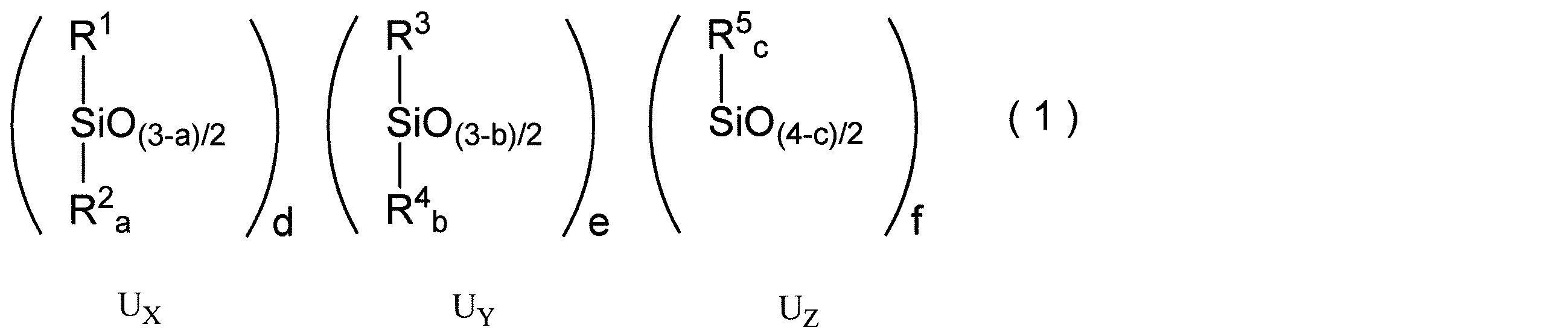
(式(1)中、
R1は、保護された2つ以上のアルコール性水酸基を含む1価の有機基、又は保護された1つのアルコール性水酸基を含む1価の有機基である。
R2は、保護された2つ以上のアルコール性水酸基を含む1価の有機基、保護された1つのアルコール性水酸基を含む1価の有機基、水素原子、ヒドロキシ基、又は保護されたアルコール性水酸基を有さない置換若しくは非置換の炭素数1~20の1価の炭化水素基である。aは、0又は1である。但し、R1が保護された1つのアルコール性水酸基を含む1価の有機基である場合は、aは1である。
R3は、保護されたアルコール性水酸基を有さない、光吸収性基を有する1価の有機基である。
R4は、水素原子、ヒドロキシ基、保護されたアルコール性水酸基を有さない置換又は非置換の炭素数1~20の1価の炭化水素基である。bは、0又は1である。
R5は、保護されたアルコール性水酸基を有さない、非光吸収性の置換若しくは非置換の1価の脂肪族炭化水素基である。cは、0~2の整数である。cが2の場合、複数のR5は、同一でも異なっていてもよい。
dは、上記重合体を構成する全構造単位に対する構造単位UXのモル比率を表す。
eは、上記重合体を構成する全構造単位に対する構造単位UYのモル比率を表す。
fは、上記重合体を構成する全構造単位に対する構造単位UZのモル比率を表す。
d、e及びfは、それぞれ0<d<1、0≦e<1及び0≦f<1を満たし、かつd+e+f≦1である。)
R1は、保護された2つ以上のアルコール性水酸基を含む1価の有機基、又は保護された1つのアルコール性水酸基を含む1価の有機基である。
R2は、保護された2つ以上のアルコール性水酸基を含む1価の有機基、保護された1つのアルコール性水酸基を含む1価の有機基、水素原子、ヒドロキシ基、又は保護されたアルコール性水酸基を有さない置換若しくは非置換の炭素数1~20の1価の炭化水素基である。aは、0又は1である。但し、R1が保護された1つのアルコール性水酸基を含む1価の有機基である場合は、aは1である。
R3は、保護されたアルコール性水酸基を有さない、光吸収性基を有する1価の有機基である。
R4は、水素原子、ヒドロキシ基、保護されたアルコール性水酸基を有さない置換又は非置換の炭素数1~20の1価の炭化水素基である。bは、0又は1である。
R5は、保護されたアルコール性水酸基を有さない、非光吸収性の置換若しくは非置換の1価の脂肪族炭化水素基である。cは、0~2の整数である。cが2の場合、複数のR5は、同一でも異なっていてもよい。
dは、上記重合体を構成する全構造単位に対する構造単位UXのモル比率を表す。
eは、上記重合体を構成する全構造単位に対する構造単位UYのモル比率を表す。
fは、上記重合体を構成する全構造単位に対する構造単位UZのモル比率を表す。
d、e及びfは、それぞれ0<d<1、0≦e<1及び0≦f<1を満たし、かつd+e+f≦1である。)
本発明のレジストプロセス用膜形成材料によれば、レジスト膜との密着性に優れ、レジストパターンの形状が良好で倒れが少ないシリコン含有膜を形成することができる。
しかも、当該レジストプロセス用膜形成材料から得られるシリコン含有膜は、レジスト組成物の溶媒に対する耐性、反射防止性及びエッチング耐性にも優れる。
本発明のパターン形成方法によれば、上記レジストプロセス用膜形成材料により形成された優れたシリコン含有膜を用いることにより、優れたレジストパターンを形成することができる。
本発明の重合体は、レジスト膜との密着性に優れ、レジストパターンの形状が良好で倒れが少ないシリコン含有膜を形成することができるレジストプロセス用膜形成材料の主成分などとして好適に用いることができる。
従って、これらは、今後さらに微細化が進行すると予想される半導体デバイスの製造等に好適に用いることができる。
しかも、当該レジストプロセス用膜形成材料から得られるシリコン含有膜は、レジスト組成物の溶媒に対する耐性、反射防止性及びエッチング耐性にも優れる。
本発明のパターン形成方法によれば、上記レジストプロセス用膜形成材料により形成された優れたシリコン含有膜を用いることにより、優れたレジストパターンを形成することができる。
本発明の重合体は、レジスト膜との密着性に優れ、レジストパターンの形状が良好で倒れが少ないシリコン含有膜を形成することができるレジストプロセス用膜形成材料の主成分などとして好適に用いることができる。
従って、これらは、今後さらに微細化が進行すると予想される半導体デバイスの製造等に好適に用いることができる。
以下、本発明のレジストプロセス用膜形成材料、パターン形成方法及び重合体を実施するための実施形態について説明する。
<レジストプロセス用膜形成材料>
本発明の一実施形態に係るレジストプロセス用膜形成材料(以下、単に「膜形成材料」と称することもある)は、[A]保護された2つ以上のアルコール性水酸基を有するシランモノマーに由来する構造単位を有する重合体、及び[B]有機溶媒を含有する。当該膜形成材料は、本発明の効果を損なわない範囲において、[C]窒素含有化合物、[D]酸発生剤、[E]水等の任意成分を含有していてもよい。但し、[C]窒素含有化合物、[D]酸発生剤、[E]水等の各任意成分は、含有されていなくてもよい。以下、各成分について詳述する。
本発明の一実施形態に係るレジストプロセス用膜形成材料(以下、単に「膜形成材料」と称することもある)は、[A]保護された2つ以上のアルコール性水酸基を有するシランモノマーに由来する構造単位を有する重合体、及び[B]有機溶媒を含有する。当該膜形成材料は、本発明の効果を損なわない範囲において、[C]窒素含有化合物、[D]酸発生剤、[E]水等の任意成分を含有していてもよい。但し、[C]窒素含有化合物、[D]酸発生剤、[E]水等の各任意成分は、含有されていなくてもよい。以下、各成分について詳述する。
<[A]重合体>
[A]重合体は、保護された2つ以上のアルコール性水酸基を有するシランモノマーに由来する構造単位を有する。当該膜形成材料からシリコン含有膜を形成し、レジストパターンを形成する場合、以下の理由によりレジストパターンとの優れた密着性を有し、現像の際のパターン倒れを抑制することができると推察される。但し、本発明が上記効果を奏する理由は、以下の理由に限定されるものでは無い。本発明において、保護されたアルコール性水酸基は、酸解離性の保護基により保護されたアルコール性水酸基であることが好ましい。
[A]重合体は、保護された2つ以上のアルコール性水酸基を有するシランモノマーに由来する構造単位を有する。当該膜形成材料からシリコン含有膜を形成し、レジストパターンを形成する場合、以下の理由によりレジストパターンとの優れた密着性を有し、現像の際のパターン倒れを抑制することができると推察される。但し、本発明が上記効果を奏する理由は、以下の理由に限定されるものでは無い。本発明において、保護されたアルコール性水酸基は、酸解離性の保護基により保護されたアルコール性水酸基であることが好ましい。
シリコン含有膜の表面に積層されるレジスト膜は、通常、感放射線性酸発生体(以下、単に「酸発生剤」と称することもある)を含有する感放射線性組成物などにより形成される。このため、レジスト膜に対する露光の際にレジスト膜中で酸が発生する。このとき、シリコン含有膜表面においても、上記酸によって[A]重合体中の上記構造単位のアルコール性水酸基が脱保護され、露光部分のシリコン含有膜(以下、「レジスト中間膜」、「レジスト下層膜」等と称することもある。)表面が親水化される。現像液として有機溶媒を用いたネガ型現像を行う場合、上述のように露光部分のシリコン含有膜表面が親水化されているため、露光部分において、親水化されているレジスト膜(レジストパターン)とシリコン含有膜との密着性が高まり、現像の際のパターン倒れを抑制することができると推察される。特に、[A]重合体が有する上記構造単位は、保護された2つ以上のアルコール性水酸基を有するため、効果的に親水性を高めることができ、パターン倒れの抑制能が優れると推察される。なお、表面エネルギーの低い物質は気相界面に偏在するため、保護されていないアルコール性水酸基等の親水性基を有する重合体を用いて膜を形成した場合、この親水性基は表面には偏在しない。これに対して、保護された2つ以上のアルコール性水酸基を有するシランモノマーに由来する構造単位を有する[A]重合体を用いることにより、露光後の膜表面の効果的な親水化を図ることができ、レジストパターンとの密着性を高めることができると推察される。
[A]重合体は、例えば下記式(1)で表される構造を有する。
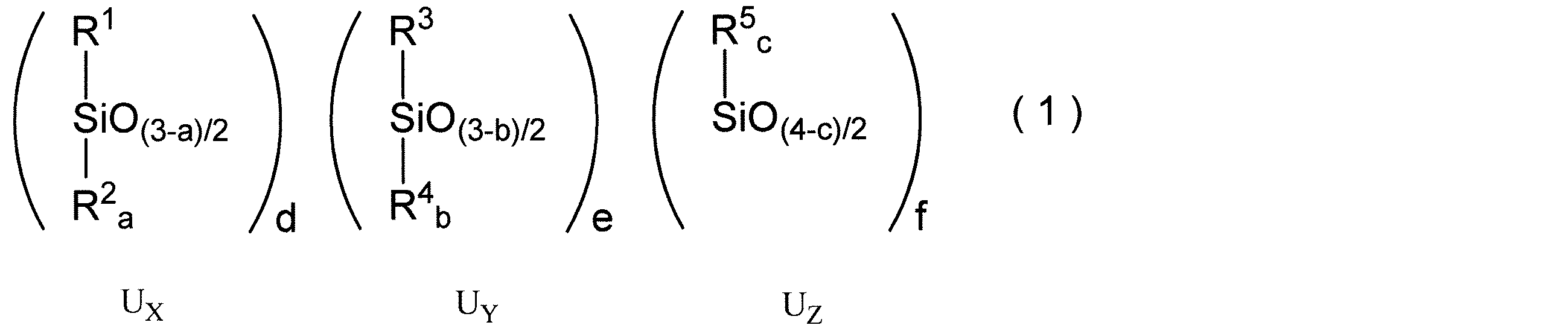
上記式(1)中、
R1は、保護された2つ以上のアルコール性水酸基を含む1価の有機基、又は保護された1つのアルコール性水酸基を含む1価の有機基である。
R2は、保護された2つ以上のアルコール性水酸基を含む1価の有機基、保護された1つのアルコール性水酸基を含む1価の有機基、水素原子、ヒドロキシ基、又は保護されたアルコール性水酸基を有さない置換若しくは非置換の炭素数1~20の1価の炭化水素基である。aは、0又は1である。但し、R1が保護された1つのアルコール性水酸基を含む1価の有機基である場合は、aは1である。
R3は、保護されたアルコール性水酸基を有さない、光吸収性基を有する1価の有機基である。
R4は、水素原子、ヒドロキシ基、保護されたアルコール性水酸基を有さない置換又は非置換の炭素数1~20の1価の炭化水素基である。bは、0又は1である。
R5は、保護されたアルコール性水酸基を有さない、非光吸収性の置換若しくは非置換の1価の脂肪族炭化水素基である。cは、0~2の整数である。cが2の場合、複数のR5は、同一でも異なっていてもよい。
dは、上記重合体を構成する全構造単位に対する構造単位UXのモル比率を表す。
eは、上記重合体を構成する全構造単位に対する構造単位UYのモル比率を表す。
fは、上記重合体を構成する全構造単位に対する構造単位UZのモル比率を表す。
d、e及びfは、それぞれ0<d<1、0≦e<1及び0≦f<1を満たし、かつd+e+f≦1である。
R1は、保護された2つ以上のアルコール性水酸基を含む1価の有機基、又は保護された1つのアルコール性水酸基を含む1価の有機基である。
R2は、保護された2つ以上のアルコール性水酸基を含む1価の有機基、保護された1つのアルコール性水酸基を含む1価の有機基、水素原子、ヒドロキシ基、又は保護されたアルコール性水酸基を有さない置換若しくは非置換の炭素数1~20の1価の炭化水素基である。aは、0又は1である。但し、R1が保護された1つのアルコール性水酸基を含む1価の有機基である場合は、aは1である。
R3は、保護されたアルコール性水酸基を有さない、光吸収性基を有する1価の有機基である。
R4は、水素原子、ヒドロキシ基、保護されたアルコール性水酸基を有さない置換又は非置換の炭素数1~20の1価の炭化水素基である。bは、0又は1である。
R5は、保護されたアルコール性水酸基を有さない、非光吸収性の置換若しくは非置換の1価の脂肪族炭化水素基である。cは、0~2の整数である。cが2の場合、複数のR5は、同一でも異なっていてもよい。
dは、上記重合体を構成する全構造単位に対する構造単位UXのモル比率を表す。
eは、上記重合体を構成する全構造単位に対する構造単位UYのモル比率を表す。
fは、上記重合体を構成する全構造単位に対する構造単位UZのモル比率を表す。
d、e及びfは、それぞれ0<d<1、0≦e<1及び0≦f<1を満たし、かつd+e+f≦1である。
上記式(1)で表される構造は、構造単位UX以外に、構造単位UYをさらに有してもよい。即ち、上記式(1)中、0<d<1かつ0<e<1であってもよい。
上記式(1)中、構造単位UYをさらに有することで、光吸収性基を含むことにより、基盤反射率を低くすることができ、良好なレジストパターンを得ることができる。
上記式(1)で表される構造は、構造単位UX及び構造単位UY以外に、構造単位UZをさらに有してもよい。即ち、上記式(1)中、0<d<1かつ0<f<1であってもよいし、0<d<1、0<e<1、かつ0<f<1であってもよい。
上記式(1)中、構造単位UZをさらに有することで、重合体のケイ素含有割合が増加し、酸素ガスエッチング耐性を向上させることなどができる。
以下、上記式(1)で表される各構造単位について説明する。
[構造単位UX]
上記構造単位UXは、保護された2つ以上のアルコール性水酸基を有するシランモノマーに由来する構造単位である。
上記構造単位UXは、保護された2つ以上のアルコール性水酸基を有するシランモノマーに由来する構造単位である。
(保護された2つ以上のアルコール性水酸基を含む1価の有機基)
上記式(1)中、R1及びR2で表される保護された2つ以上のアルコール性水酸基を含む1価の有機基としては、例えば下記式(2)で表される基を挙げることができる。
上記式(1)中、R1及びR2で表される保護された2つ以上のアルコール性水酸基を含む1価の有機基としては、例えば下記式(2)で表される基を挙げることができる。

上記式(2)中、X1は、炭素数1~20の3価の有機基である。R6は、それぞれ独立して、単結合、又は置換若しくは非置換の炭素数1~10の2価の炭化水素基である。Y1は、それぞれ独立して1価の保護基であるか、2つのY1が互いに結合して2価の保護基を形成していてもよい。*は、結合部位を示す。
上記X1で表される炭素数1~20の3価の有機基としては、炭素数1~20の3価の炭化水素基、この炭化水素基の炭素-炭素間又は末端にヘテロ原子含有基を含む基、及びこれらの基の水素原子の一部又は全部を置換基で置換した基等が挙げられる。
上記炭素数1~20の3価の炭化水素基としては、炭素数1~20の3価の脂肪族炭化水素基、及び炭素数6~20の3価の芳香族炭化水素基を挙げることができる。なお、X1が炭素数6~20の3価の芳香族炭化水素基である場合、R6は、それぞれ独立して、置換若しくは非置換の炭素数1~10の2価の炭化水素基とすることができる。
炭素数1~20の3価の脂肪族炭化水素基としては、炭素数1~20の3価の鎖状炭化水素基や、炭素数3~20の3価の脂環式炭化水素基を挙げることができる。
炭素数1~20の3価の鎖状炭化水素基としては、例えば
メタントリイル基、エタントリイル基、プロパントリイル基、ブタントリイル基、ペンタントリイル基等のアルカントリイル基、
エテントリイル基、プロペントリイル基、ブテントリイル基、ペンテントリイル基等のアルケントリイル基、
プロピントリイル基、ブチントリイル基、ペンチントリイル基等のアルキントリイル基等を挙げることができる。
メタントリイル基、エタントリイル基、プロパントリイル基、ブタントリイル基、ペンタントリイル基等のアルカントリイル基、
エテントリイル基、プロペントリイル基、ブテントリイル基、ペンテントリイル基等のアルケントリイル基、
プロピントリイル基、ブチントリイル基、ペンチントリイル基等のアルキントリイル基等を挙げることができる。
炭素数3~20の3価の脂環式炭化水素基としては、例えば
シクロプロパントリイル基、シクロペンタントリイル基、シクロヘキサントリイル基等のシクロアルカントリイル基、
シクロプロペントリイル基、シクロペンテントリイル基、シクロヘキセントリイル基等のシクロアルケントリイル基、
ノルボルナントリイル基、アダマンタントリイル基、ノルボルネントリイル基等の3価の橋かけ環炭化水素基等を挙げることができる。
シクロプロパントリイル基、シクロペンタントリイル基、シクロヘキサントリイル基等のシクロアルカントリイル基、
シクロプロペントリイル基、シクロペンテントリイル基、シクロヘキセントリイル基等のシクロアルケントリイル基、
ノルボルナントリイル基、アダマンタントリイル基、ノルボルネントリイル基等の3価の橋かけ環炭化水素基等を挙げることができる。
炭素数6~20の3価の芳香族炭化水素基としては、例えばベンゼントリイル基、ナフタレントリイル基、アントラセントリイル基等を挙げることができる。
上記ヘテロ原子含有基とは、構造中に2価以上のヘテロ原子を有する基をいう。上記ヘテロ原子含有基はヘテロ原子を1個有していてもよく、2個以上有していてもよい。また、上記ヘテロ原子含有基は、1個のヘテロ原子のみから構成されるものであってもよい。
上記ヘテロ原子含有基が有する2価以上のへテロ原子としては、2価以上の原子価を有するヘテロ原子であれば特に限定されず、例えば酸素原子、窒素原子、硫黄原子、ケイ素原子、リン原子、ホウ素原子等が挙げられる。
上記ヘテロ原子含有基としては、例えば
-O-、-S-、-SO-、-SO2-、-SO2O-、-SO3-等のヘテロ原子のみからなる基、
-CO-、-COO-、-COS-、-CONH-、-OCOO-、-OCOS-、-OCONH-、-SCONH-、-SCSNH-、-SCSS-等の炭素原子とヘテロ原子とを組み合わせた基などが挙げられる。なお、上記X1で表される有機基の炭素数には、これらのヘテロ原子含有基中の炭素数も含まれる。以下、有機基の炭素数について、同様である。
-O-、-S-、-SO-、-SO2-、-SO2O-、-SO3-等のヘテロ原子のみからなる基、
-CO-、-COO-、-COS-、-CONH-、-OCOO-、-OCOS-、-OCONH-、-SCONH-、-SCSNH-、-SCSS-等の炭素原子とヘテロ原子とを組み合わせた基などが挙げられる。なお、上記X1で表される有機基の炭素数には、これらのヘテロ原子含有基中の炭素数も含まれる。以下、有機基の炭素数について、同様である。
上記置換基としては、例えばハロゲン原子、ヒドロキシ基、カルボキシ基、ニトロ基、シアノ基等が挙げられる。なお、上記X1で表される有機基の炭素数には、これらの置換基中の炭素数も含まれる。以下、有機基の炭素数について、同様である。
上記X1で表される基としては、置換又は非置換の3価の炭化水素基が好ましく、置換又は非置換の3価の脂肪族炭化水素基がより好ましく、置換又は非置換の3価の鎖状炭化水素基がさらに好ましく、置換又は非置換のアルカントリイル基がよりさらに好ましく、直鎖状のアルカントリイル基がよりさらに好ましい。
これらの炭化水素基の炭素-炭素間に酸素原子又は硫黄原子を含む基も好ましい。上記X1で表される基の炭素数の下限としては、1であるが、2が好ましく、3がさらに好ましい。一方、X1で表される基の炭素数の上限としては、20が好ましく、10がより好ましく、6がさらに好ましい。
上記R6で表される置換又は非置換の炭素数1~10の2価の炭化水素基としては、炭素数1~10の2価の脂肪族炭化水素基、炭素数6~10の2価の芳香族炭化水素基、これらの基の水素原子の一部又は全部を置換基で置換した基等が挙げられる。
炭素数1~10の2価の脂肪族炭化水素基としては、炭素数1~10の2価の鎖状炭化水素基や、炭素数3~10の2価の脂環式炭化水素基を挙げることができる。
炭素数1~10の2価の鎖状炭化水素基としては、例えば
メタンジイル基、エタンジイル基、プロパンジイル基、ブタンジイル基、ペンタンジイル基等のアルカンジイル基、
エテンジイル基、プロペンジイル基、ブテンジイル基、ペンテンジイル基等のアルケンジイル基、
エチンジイル基、プロピンジイル基、ブチンジイル基、ペンチンジイル基等のアルキンジイル基等を挙げることができる。
メタンジイル基、エタンジイル基、プロパンジイル基、ブタンジイル基、ペンタンジイル基等のアルカンジイル基、
エテンジイル基、プロペンジイル基、ブテンジイル基、ペンテンジイル基等のアルケンジイル基、
エチンジイル基、プロピンジイル基、ブチンジイル基、ペンチンジイル基等のアルキンジイル基等を挙げることができる。
炭素数3~10の2価の脂環式炭化水素基としては、例えば
シクロプロパンジイル基、シクロペンタンジイル基、シクロヘキサンジイル基等のシクロアルカンジイル基、
シクロプロペンジイル基、シクロペンテンジイル基、シクロヘキセンジイル基等のシクロアルケンジイル基、
ノルボルナンジイル基、アダマンタンジイル基、ノルボルネンジイル基等の2価の橋かけ環炭化水素基等を挙げることができる。
シクロプロパンジイル基、シクロペンタンジイル基、シクロヘキサンジイル基等のシクロアルカンジイル基、
シクロプロペンジイル基、シクロペンテンジイル基、シクロヘキセンジイル基等のシクロアルケンジイル基、
ノルボルナンジイル基、アダマンタンジイル基、ノルボルネンジイル基等の2価の橋かけ環炭化水素基等を挙げることができる。
炭素数6~10の2価の芳香族炭化水素基としては、例えばベンゼンジイル基、ナフタレンジイル基、アントラセンジイル基等を挙げることができる。
上記R6で表される炭化水素基の置換基としては、X1で表される基の置換基として例示したものと同様の基を挙げることができる。
上記R6としては、単結合及び炭素数1~10の2価の鎖状炭化水素基が好ましい。炭素数1~10の2価の鎖状炭化水素基の中でも、炭素数1~4の2価の鎖状炭化水素基がより好ましく、炭素数1~2の2価の鎖状炭化水素基がさらに好ましく、メタンジイル基が特に好ましい。
2つのR6は、X1における同一の炭素原子に結合していることが好ましい。さらに、X1が直鎖状のアルカントリイル基又はこの炭素-炭素間に酸素原子又は硫黄原子を含む基であって、2つのR6は、このX1の末端の炭素原子に結合していることがより好ましい。
上記Y1で表される1価の保護基としては、酸等により脱保護される基であれば特に限定されないが、酸により脱保護される基であることが好ましく、例えばRa-、Ra-CO-、Ra-O-C(Rb)2-及びRa-O-CO-で表される基を挙げることができる。
上記各式中、Raは、置換又は非置換の炭素数1~10の1価の炭化水素基である。2つのRbは、それぞれ独立して、水素原子又は置換若しくは非置換の炭素数1~10の1価の炭化水素基である。Rbは、Raと結合して環構造の一部を形成していてもよい。
上記Y1がRaで表される基の場合、エーテル型の保護構造を形成する。上記Y1がRa-CO-で表される基の場合、アルキルカルボニルオキシ基保護等のエステル型の保護構造を形成する。上記Y1がRa-O-C(Rb)2-で表される基の場合、アセタール型の保護構造を形成する。
上記Ra及びRbで表される置換又は非置換の炭素数1~10の1価の炭化水素基としては、炭素数1~10の1価の脂肪族炭化水素基、炭素数6~10の1価の芳香族炭化水素基、これらの基の水素原子の一部又は全部を置換基で置換した基等が挙げられる。炭素数1~10の1価の脂肪族炭化水素基としては、炭素数1~10の1価の鎖状炭化水素基や、炭素数3~10の1価の脂環式炭化水素基を挙げることができる。
炭素数1~10の1価の鎖状炭化水素基としては、例えばメチル基、エチル基、プロピル基、ブチル基、ペンチル基等のアルキル基、エテニル基、プロペニル基、ブテニル基、ペンテニル基等のアルケニル基、エチニル基等のアルキニル基等を挙げることができる。
炭素数3~10の1価の脂環式炭化水素基としては、例えばシクロプロピル基、シクロペンチル基、シクロヘキシル基等のシクロアルキル基、シクロプロペニル基、シクロペンテニル基、シクロヘキセニル基等のシクロアルケニル基、ノルボルニル基、アダマンチル基等の1価の橋かけ環炭化水素基等を挙げることができる。
炭素数6~10の1価の芳香族炭化水素基としては、例えばフェニル基、トリル基、キシリル基、ナフチル基等のアリール基、ベンジル基、フェネチル基等のアラルキル基等を挙げることができる。
上記Ra及びRbで表される炭化水素基の置換基としては、X1で表される基の置換基として例示したものと同様の基を挙げることができる。
上記Raとしては、アルキル基及びシクロアルキル基が好ましく、脱離性の点などから、第二級及び第三級のアルキル基並びにシクロアルキル基がより好ましく、第三級のアルキル基がさらに好ましく、t-ブチル基が特に好ましい。上記Rbとしては、水素原子及びアルキル基が好ましく、水素原子及び炭素数1~4のアルキル基がより好ましい。
上記2つのY1が互いに結合して形成する2価の保護基としては、置換又は非置換の2価の炭化水素基を挙げることができる。上記置換又は非置換の2価の炭化水素基としては、上記R6で表される基として例示した基を挙げることができる。この2価の保護基の好ましい形態としては、後述するY1bで表される2価の保護基における好ましい形態と同様である。
上記R1及びR2で表される保護された2つ以上のアルコール性水酸基を含む1価の有機基としては、下記式(2a)又は(2b)で表される基が好ましい。

上記式(2a)及び(2b)中、R7は、炭素数1~10の2価の有機基である。pは、1~5の整数である。qは、0~5の整数である。Y1aは、それぞれ独立して、1価の保護基である。Y1bは、2価の保護基である。
上記R7で表される炭素数1~10の2価の有機基としては、上記R6で表される置換又は非置換の炭素数1~10の2価の炭化水素基、この炭化水素基の炭素-炭素間又は末端にヘテロ原子含有基を含む基、これらの基の水素原子の一部又は全部を置換基で置換した基などが挙げられる。上記置換基としては、X1で表される基の置換基として例示したものと同様のものを挙げることができる。
上記R7で表される炭素数1~10の2価の有機基としては、置換又は非置換の炭素数1~10の2価の炭化水素基、及びこの炭化水素基の炭素-炭素間にヘテロ原子を含む基が好ましく、置換又は非置換の炭素数1~10のアルカンジイル基及びこのアルカンジイル基の炭素-炭素間又は末端にヘテロ原子を含む基がより好ましく、置換又は非置換の炭素数1~6の直鎖状のアルカンジイル基及びこのアルカンジイル基の炭素-炭素間又は末端に酸素原子又は硫黄原子を含む基がさらに好ましい。
なお、上記直鎖状のアルカンジイル基において、2つの結合位置は、両末端に有することが好ましい。
上記R7で表される2価の有機基の炭素数は、1~3であることがさらに好ましい。炭素数を上記範囲と小さくすることで、得られるシリコン含有膜の酸素エッチング耐性をより高めることなどができる。
上記pは、1~5の整数であるが、1及び2が好ましく、1がより好ましい。
上記qは、0~5の整数であるが、0及び1が好ましく、0がより好ましい。
上記Y1aで表される1価の保護基としては、式(2)の説明中で記載したRa-、Ra-CO-、Ra-O-C(Rb)2-及びRa-O-CO-で表される基が好ましい。これらの基の詳細、及びこれらの基の中でのより好ましい基については、式(2)の説明中で記載した通りである。
上記Y1bで表される2価の保護基としては、置換又は非置換の2価の炭化水素基を挙げることができる。上記置換又は非置換の2価の炭化水素基としては、上記R6で表される基として例示した基を挙げることができる。上記置換又は非置換の2価の炭化水素基としては、置換又は非置換のメタンジイル基、及び下記式(4)で表される基が好ましい。上記Y1bで表される2価の保護基が、置換又は非置換のメタンジイル基、又は下記式(4)で表される基である場合、アセタール型の保護基を形成する。

上記式(4)中、nは、0~4の整数である。Rcは、それぞれ独立して、置換又は非置換の炭素数1~10の1価の炭化水素基である。Rdは、それぞれ独立して、水素原子、又は置換若しくは非置換の炭素数1~10の1価の炭化水素基である。2つのRdは、互いに結合して、これらが結合する炭素鎖と共に炭素数4~12の炭素環構造(脂環構造、芳香環構造又はこれらの組み合わせの環構造)を形成していてもよい。*は、結合位置を示す。
上記Rc及びRdで表される置換又は非置換の炭素数1~10の1価の炭化水素基としては、上記Raで表される基として例示したものを挙げることができる。
上記Rcとしては、アルキル基が好ましく、炭素数1~4のアルキル基がより好ましく、メチル基がさらに好ましい。
上記Rdとしては、アルキル基が好ましく、炭素数1~4のアルキル基がより好ましく、メチル基がさらに好ましい。上記nは、0~4の整数であるが、0及び1が好ましく、0がより好ましい。
上記Y1bで表されるメタンジイル基が有していてもよい置換基としては、上述したハロゲン原子等の他、炭化水素基を挙げることができ、炭化水素基が好ましく、炭素数1~10の炭化水素基がより好ましい。この炭化水素基は、アルキル基等の脂肪族炭化水素基であってもよいし、フェニル基等の芳香族炭化水素基であってもよい。また、2つの置換基が互いに結合して、これらが結合する炭素原子と共に環構造を形成していてもよい。上記環構造としては、例えば炭素数3~20の脂環式基や芳香族基などを挙げることができる。上記Y1bが、置換基を有していてもよいメタンジイル基である場合、置換基として2つの炭化水素基を有するメタンジイル基が好ましい。この2つの炭化水素基は、互いに結合して脂環構造を形成していてもよい。
アルコール性水酸基の保護基であるY1(Y1a及びY1b)は、酸による脱離性等の点からは、アセタール型又はエステル型の保護基を形成することが好ましい。
上記式(1)中、上記aは、0又は1であるが、0が好ましい。aを0とすることで、得られるシリコン含有膜の酸素エッチング耐性を高めることなどができる。
(保護された1つのアルコール性水酸基を含む1価の有機基)
上記式(1)中、R1及びR2で表される保護された1つのアルコール性水酸基を含む1価の有機基としては、特に限定されないが、下記式(3)で表される基を挙げることができる。
上記式(1)中、R1及びR2で表される保護された1つのアルコール性水酸基を含む1価の有機基としては、特に限定されないが、下記式(3)で表される基を挙げることができる。

上記式(3)中、X2は、単結合、又は炭素数1~20の2価の有機基である。Y2は、1価の保護基である。*は、結合部位を示す。
上記X2で表される炭素数1~20の2価の有機基としては、上記R7で表される2価の有機基として例示したものなどを挙げることができる。上記X2で表される基としては、置換又は非置換の炭素数1~10の2価の炭化水素基、及びこの炭化水素基の炭素-炭素間端にヘテロ原子を含む基が好ましく、置換又は非置換の炭素数1~10のアルカンジイル基及びこのアルカンジイル基の炭素-炭素間にヘテロ原子を含む基がより好ましく、置換又は非置換の炭素数1~6の直鎖状のアルカンジイル基及びこのアルカンジイル基の炭素-炭素間又に酸素原子又は硫黄原子を含む基がさらに好ましい。
なお、上記直鎖状のアルカンジイル基において、2つの結合位置は、両末端に有することが好ましい。
上記Y2で表される1価の保護基としては、上記Y1及びY1aで表される1価の保護基として説明したものを例示することができる。上記Y2で表される1価の保護基の好ましい基も、上記Y1及びY1aと同様である。すなわち、式(2)の説明中で記載したRa-、Ra-CO-、Ra-O-C(Rb)2-及びRa-O-CO-で表される基が好ましい。これらの基の具体的構造、及びより好ましい構造も上述した通りである。
アルコール性水酸基の保護基であるY2は、酸による脱離性等の点からは、アセタール型又はエステル型の保護基を形成することが好ましい。
上記R2で表される保護されたアルコール性水酸基を有さない置換又は非置換の炭素数1~20の1価の炭化水素基としては、上記Ra及びRbで表される置換又は非置換の炭素数1~10の1価の炭化水素基として例示した基と同様のものなどを挙げることができる。
上記式(1)におけるR1としては、保護された2つ以上のアルコール性水酸基を含む1価の有機基であることが好ましい。
R1が保護された2つ以上のアルコール性水酸基を含む1価の有機基である構造単位UXは、保護された2つ以上のアルコール性水酸基と、ケイ素原子に結合する加水分解性基とを有するシランモノマー(I)の加水分解縮合により得られる。上記加水分解性基としては、メトキシ基、エトキシ基等のアルコキシ基、アセトキシ基等のアシロキシ基、塩素原子等のハロゲン原子等を挙げることができる。シランモノマー(I)は、2又は3の加水分解性基を有することが好ましく、3の加水分解性基を有することがより好ましい。
上記シランモノマー(I)の具体例としては、下記式(i-1)~(i-27)でそれぞれ表される化合物等を挙げることができる。シランモノマー(I)は、1種単独でも複数種を混合して用いてもよい。

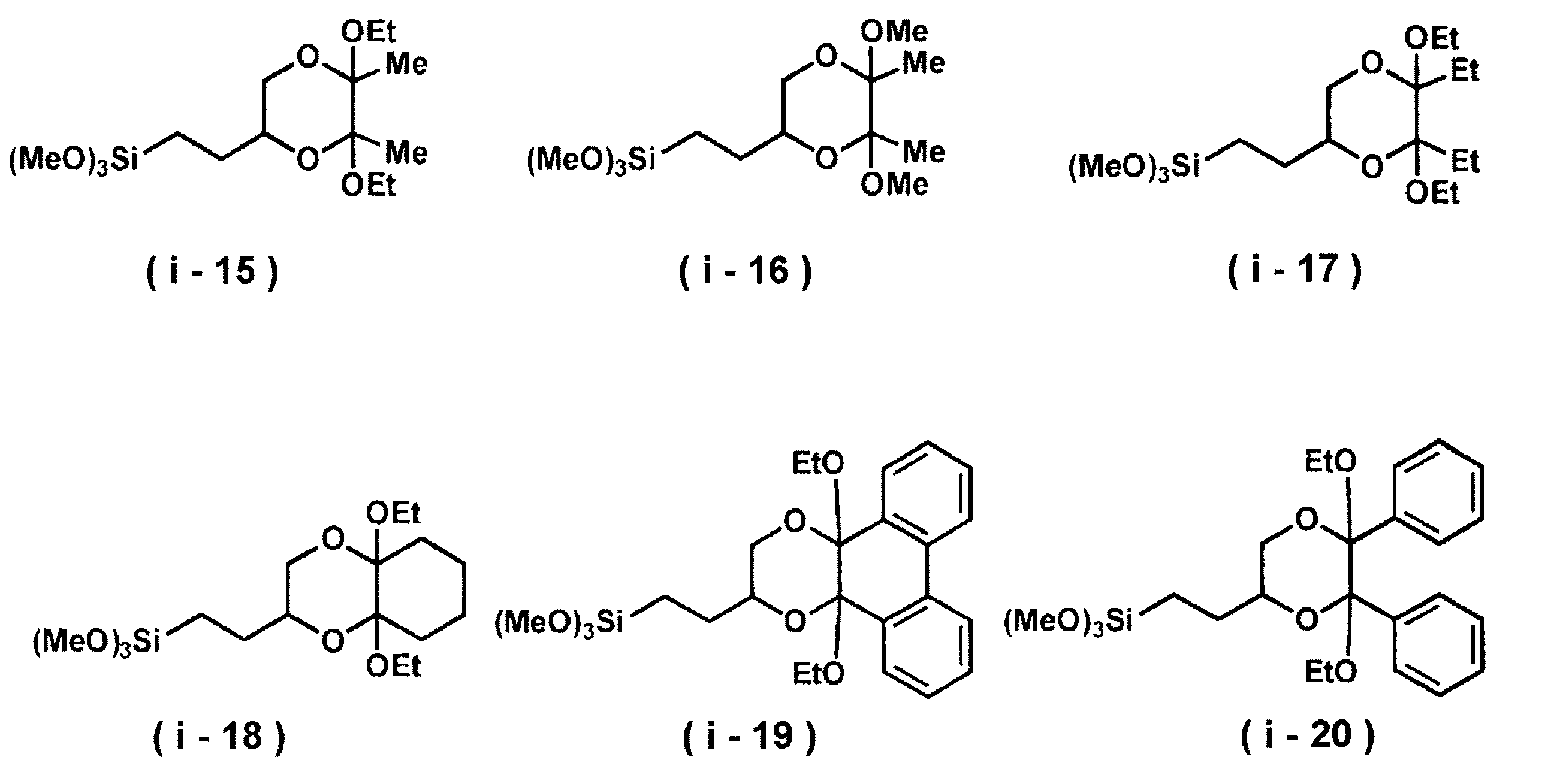
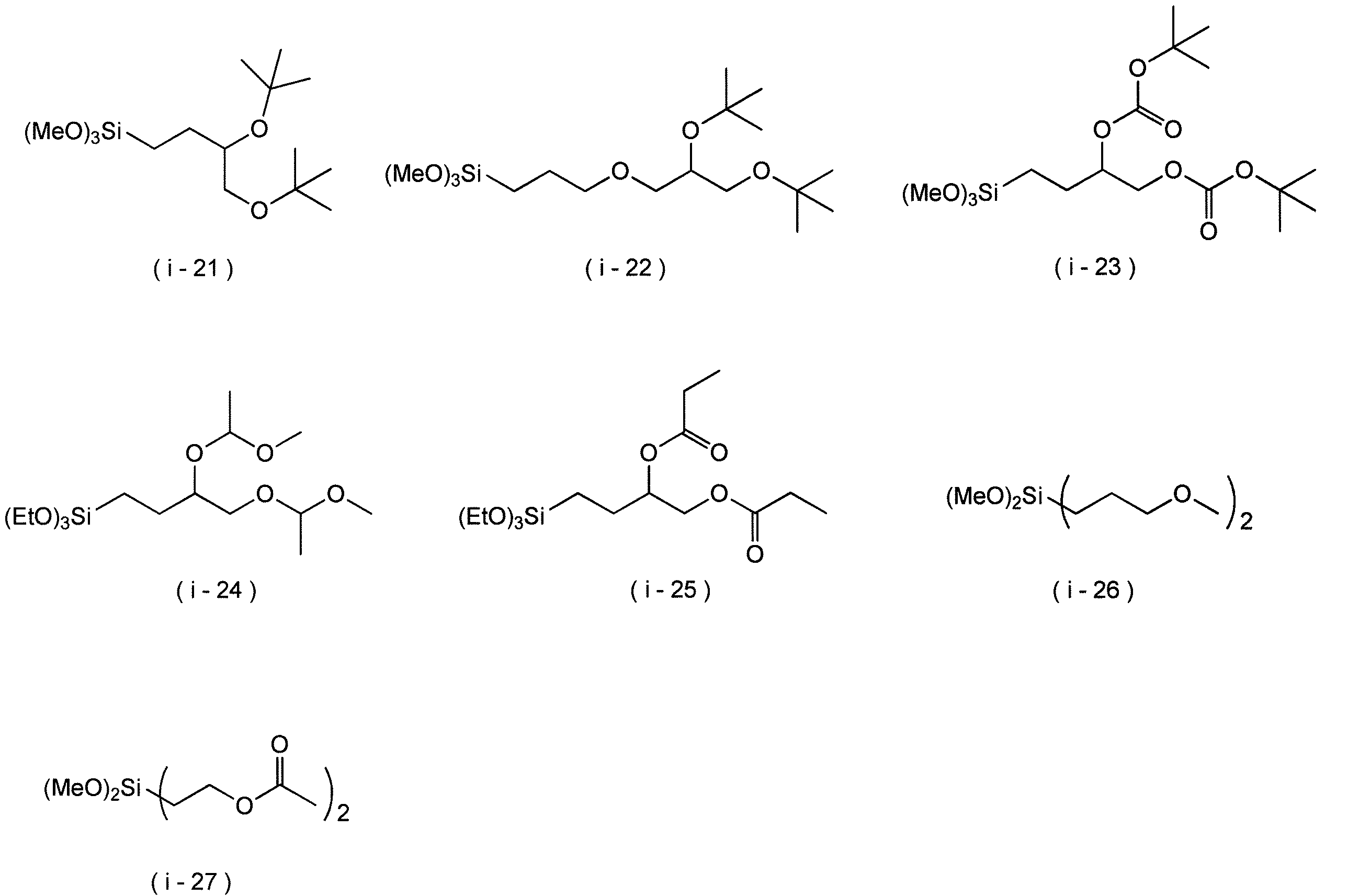
[A]重合体における保護された2つ以上のアルコール性水酸基を有するシランモノマーに由来する構造単位、具体的には構造単位UXの含有割合(モル比率d)の下限としては、[A]重合体を構成する全構造単位に対して0.1モル%が好ましく、1モル%がより好ましく、3モル%がさらに好ましい。一方、この上限としては、40モル%が好ましく、30モル%がより好ましく、25モル%がさらに好ましく、20モル%が特に好ましい。構造単位UXの含有割合を上記下限以上とすることで、露光後のシリコン含有膜表面の親水性がより高まり、レジストパターンの密着性をより高めることができる。一方、構造単位UXの含有割合を上記上限以下とすることで、他の構造単位を十分に含有させることができ、反射防止性や、エッチング耐性等をバランスよく発揮させることができる。
なお、[A]重合体における構造単位の含有割合は、[A]重合体をシランモノマーの加水分解縮合において合成する際の対応する各シランモノマーの仕込量の割合と同じとみなすことができる。
[構造単位UY]
上記R3で表される保護されたアルコール性水酸基を有さない、光吸収性基を有する1価の有機基としては、炭素数2~10のアルケニル基、又は環員数6~20の芳香族炭素環若しくは環員数4~20の芳香族複素環を含む1価の基を挙げることができる。これらの基が有する水素原子の一部又は全部は、置換基で置換されていてもよい。
上記R3で表される保護されたアルコール性水酸基を有さない、光吸収性基を有する1価の有機基としては、炭素数2~10のアルケニル基、又は環員数6~20の芳香族炭素環若しくは環員数4~20の芳香族複素環を含む1価の基を挙げることができる。これらの基が有する水素原子の一部又は全部は、置換基で置換されていてもよい。
上記炭素数2~10のアルケニル基としては、例えばエテニル基、1-プロペン-1-イル基、1-プロペン-2-イル基、1-プロペン-3-イル基、1-ブテン-1-イル基、1-ブテン-2-イル基、1-ブテン-3-イル基、1-ブテン-4-イル基、2-ブテン-1-イル基、2-ブテン-2-イル基、1-ペンテン-5-イル基、2-ペンテン-1-イル基、2-ペンテン-2-イル基、1-ヘキセン-6-イル基、2-ヘキセン-1-イル基、2-ヘキセン-2-イル基等を挙げることができる。
上記環員数6~20の芳香族炭素環を含む1価の基としては、例えばフェニル基、ナフチル基、メチルフェニル基、ベンジル基、フェネチル基、エチルフェニル基、クロロフェニル基、ブロモフェニル基、フルオロフェニル基等のアリール基などを挙げることができる。これらの中で、フェニル基及びメチルフェニル基が好ましい。
上記環員数4~20の芳香族複素環を含む1価の基としては、例えばピリジル基、フリル基、チエニル基等を挙げることができる。
上記R3としては、芳香族炭素環を含む基が好ましく、アリール基がより好ましく、フェニル基及びメチルフェニル基がさらに好ましい。
上記R4で表される保護されたアルコール性水酸基を有さない置換又は非置換の炭素数1~20の1価の炭化水素基としては、上記Raで表される置換又は非置換の1価の炭化水素基として例示した基と同様の基を挙げることができる。
上記bとしては、0が好ましい。
上記構造単位UYを与えるシランモノマーとしては、例えばフェニルトリメトキシシラン、フェニルトリエトキシシラン、メチルフェニルトリメトキシシラン、ビニルトリメトキシシラン等を挙げることができる。
[A]重合体における構造単位UYの含有割合(モル比率e)の下限としては、[A]重合体を構成する全構造単位に対して0.1モル%が好ましく、1モル%がより好ましく、3モル%がさらに好ましく、5モル%が特に好ましい。一方、この上限としては、40モル%が好ましく、30モル%がより好ましく、20モル%がさらに好ましく、15モル%が特に好ましい。構造単位UYの含有割合を上記範囲とすることでレジストパターンの密着性等を高めつつ、反射防止性等をより良好にバランスよく発揮させることができる。
[構造単位UZ]
上記R5で表される保護されたアルコール性水酸基を有さない、非光吸収性の置換若しくは非置換の1価の脂肪族炭化水素基としては、上記Raで表される置換又は非置換の1価の炭化水素基として例示した1価の鎖状炭化水素基や1価の脂環式炭化水素基等を挙げることができる。これらの鎖状炭化水素基及び脂環式炭化水素基が有する水素原子の一部又は全部は置換基で置換されていてもよい。上記R5で表される基の炭素数としては、例えば1~10とすることができ、脂環式炭化水素基の場合は、その炭素数は3~10とすることができる。
上記R5で表される保護されたアルコール性水酸基を有さない、非光吸収性の置換若しくは非置換の1価の脂肪族炭化水素基としては、上記Raで表される置換又は非置換の1価の炭化水素基として例示した1価の鎖状炭化水素基や1価の脂環式炭化水素基等を挙げることができる。これらの鎖状炭化水素基及び脂環式炭化水素基が有する水素原子の一部又は全部は置換基で置換されていてもよい。上記R5で表される基の炭素数としては、例えば1~10とすることができ、脂環式炭化水素基の場合は、その炭素数は3~10とすることができる。
上記R5としては、鎖状炭化水素基が好ましく、炭素数1~4の鎖状炭化水素基がより好ましく、メチル基がさらに好ましい。
上記式(1)中、構造単位UZにおいてcは0及び1が好ましく、0がより好ましい。
上記構造単位UZを与えるシランモノマーとしては、例えばテトラメトキシシラン、テトラエトキシシラン、テトラブトキシシラン、メチルトリメトキシシラン、メチルトリエトキシシラン、エチルトリメトキシシラン、ジメチルジメトキシシラン等を挙げることができる。
[A]重合体における構造単位UZの含有割合(モル比率f)の下限としては、[A]重合体を構成する全構造単位に対して20モル%が好ましく、40モル%がより好ましく、60モル%がさらに好ましく、70モル%が特に好ましい。一方、この上限としては、95モル%が好ましく、90モル%がより好ましく、85モル%がさらに好ましい。構造単位UZの含有割合を上記範囲とすることで、レジストパターンの密着性等を高めつつ、溶媒耐性やエッチング耐性などをより高めることができる。
[A]重合体は、上記構造単位UX、構造単位UY及び構造単位UZ以外の構造単位を有していてもよい。その他の構造単位としては、ヘキサメトキシジシラン、ビス(トリメトキシシリル)メタン、ポリジメトキシメチルカルボシラン等の複数のケイ素原子を含むシランモノマーに由来する構造単位などを挙げることができる。[A]重合体がその他の構造単位を有する場合、その他の構造単位の含有割合の上限としては、[A]重合体を構成する全構造単位に対して、20モル%が好ましく、10モル%がより好ましく、3モルがさらに好ましく、1モル%が特に好ましい。即ち、式(1)中のd、e及びfの和(d+e+f)の下限は、0.8が好ましく、0.9がより好ましく、0.97がさらに好ましく、0.99が特に好ましい。
[A]重合体の含有量の下限としては、当該膜形成材料の全固形分に対して、50質量%が好ましく、70質量%がより好ましく、80質量%がさらに好ましく、90質量%が特に好ましい。上記含有量の上限としては、99質量%が好ましく、97質量%がより好ましい。当該膜形成材料の全固形分とは、[B]有機溶媒及び[E]水以外の成分の総和をいう。[A]重合体は、1種のみ含有されていてもよいし、2種以上含有されていてもよい。
[A]重合体のサイズ排除クロマトグラフィによるポリスチレン換算の重量平均分子量(Mw)の下限としては、1,000が好ましく、1,300がより好ましく、1,500がさらに好ましい。上記Mwの上限としては、100,000が好ましく、30,000がより好ましく、10,000がさらに好ましく、4,000が特に好ましい。
本明細書における[A]重合体のMwは、例えば東ソー社のGPCカラム(「G2000HXL」2本、「G3000HXL」1本及び「G4000HXL」1本)を使用し、流量:1.0mL/分、溶出溶媒:テトラヒドロフラン、カラム温度:40℃の分析条件で、単分散ポリスチレンを標準とするゲルパーミエーションクロマトグラフィ(検出器:示差屈折計)により測定した値である。
[A]重合体の製造方法は、上述した各構造単位に対応する加水分解性シランモノマーを加水分解縮合する方法により得ることができる。このシランモノマーの加水分解縮合は、従来公知の方法により行うことができる。
[A]重合体の合成の際、反応液中の溶媒における沸点100℃以下のアルコール系溶媒の含有率の上限としては、20質量%が好ましく、5質量%がより好ましい。沸点100℃以下のアルコール系溶媒は、上記各シランモノマー等の加水分解縮合の際に生じる場合があり、反応液中の溶媒におけるこの含有率が、20質量%以下、好ましくは5質量%以下になるよう、蒸留等により除去することが好ましい。
<[B]有機溶媒>
[B]有機溶媒としては、[A]重合体(ポリシロキサン)及び任意成分を溶解又は分散させることができるものであれば用いることができる。
[B]有機溶媒としては、[A]重合体(ポリシロキサン)及び任意成分を溶解又は分散させることができるものであれば用いることができる。
[B]有機溶媒としては、例えばアルコール系溶媒、ケトン系溶媒、エーテル系溶媒、エステル系溶媒、含窒素系溶媒等が挙げられる。[B]有機溶媒は、1種単独で又は2種以上を組み合わせて用いることができる。
アルコール系溶媒としては、例えばメタノール、エタノール、n-プロパノール、iso-プロパノール、n-ブタノール、iso-ブタノール等のモノアルコール系溶媒、エチレングリコール、1,2-プロピレングリコール、ジエチレングリコール、ジプロピレングリコール等の多価アルコール系溶媒などが挙げられる。
ケトン系溶媒としては、例えばアセトン、メチルエチルケトン、メチル-n-プロピルケトン、メチル-iso-ブチルケトン、シクロヘキサノン等が挙げられる。
エーテル系溶媒としては、例えばエチルエーテル、iso-プロピルエーテル、エチレングリコールジブチルエーテル、ジエチレングリコールモノメチルエーテル、ジエチレングリコールモノエチルエーテル、ジエチレングリコールジエチルエーテル、プロピレングリコールモノメチルエーテル、プロピレングリコールモノエチルエーテル、プロピレングリコールモノプロピルエーテル、テトラヒドロフラン等が挙げられる。
エステル系溶媒としては、例えば酢酸エチル、γ-ブチロラクトン、酢酸n-ブチル、酢酸エチレングリコールモノメチルエーテル、酢酸エチレングリコールモノエチルエーテル、酢酸ジエチレングリコールモノメチルエーテル、酢酸ジエチレングリコールモノエチルエーテル、酢酸プロピレングリコールモノメチルエーテル、酢酸プロピレングリコールモノエチルエーテル、酢酸ジプロピレングリコールモノメチルエーテル、酢酸ジプロピレングリコールモノエチルエーテル、プロピオン酸エチル、プロピオン酸n-ブチル、乳酸メチル、乳酸エチル等が挙げられる。
含窒素系溶媒としては、例えばN,N-ジメチルホルムアミド、N,N-ジメチルアセトアミド、N-メチルピロリドン等が挙げられる。
これらの中でも、エーテル系溶媒及びエステル系溶媒が好ましく、成膜性に優れるため、グリコール構造を有するエーテル系溶媒及びエステル系溶媒がより好ましい。
グリコール構造を有するエーテル系溶媒及びエステル系溶媒としては、例えばプロピレングリコールモノメチルエーテル、プロピレングリコールモノエチルエーテル、プロピレングリコールモノプロピルエーテル、酢酸プロピレングリコールモノメチルエーテル、酢酸プロピレングリコールモノエチルエーテル、酢酸プロピレングリコールモノプロピルエーテル等が挙げられる。これらの中でも、特に、酢酸プロピレングリコールモノメチルエーテルが好ましい。
[B]有機溶媒は1種単独で用いてもよいし、2種以上を組み合わせて用いてもよい。
当該膜形成材料における[B]有機溶媒の含有量の下限としては、80質量%が好ましく、90質量%がより好ましく、95質量%がさらに好ましい。上記含有量の上限としては、99質量%が好ましく、98質量%がより好ましい。
<[C]窒素含有化合物>
[C]窒素含有化合物は、窒素原子を有する化合物である。当該膜形成材料は、[C]窒素含有化合物を含有すると、上記効果を維持しつつ、レジストプロセスにおいて形成されるレジストパターンの形状をより向上させることができる。また、硬化を促進することができ、その結果、得られるシリコン含有膜の強度をより高めることができる。[C]窒素含有化合物は、1種単独で使用してもよく、2種以上を併用してもよい。
[C]窒素含有化合物は、窒素原子を有する化合物である。当該膜形成材料は、[C]窒素含有化合物を含有すると、上記効果を維持しつつ、レジストプロセスにおいて形成されるレジストパターンの形状をより向上させることができる。また、硬化を促進することができ、その結果、得られるシリコン含有膜の強度をより高めることができる。[C]窒素含有化合物は、1種単独で使用してもよく、2種以上を併用してもよい。
[C]窒素含有化合物としては、塩基性アミノ基を有する化合物、及び酸の作用又は熱の作用により塩基性アミノ基を生じる化合物が好ましい。
塩基性アミノ基を有する化合物、及び酸の作用又は熱の作用により塩基性アミノ基を生じる化合物としては、例えばアミン化合物、アミド基含有化合物、ウレア化合物、含窒素複素環化合物等が挙げられる。
上記アミン化合物としては、例えばモノ(シクロ)アルキルアミン類、ジ(シクロ)アルキルアミン類、トリ(シクロ)アルキルアミン類、置換アルキルアニリン又はその誘導体、エチレンジアミン、N,N,N’,N’-テトラメチルエチレンジアミン、テトラメチレンジアミン、ヘキサメチレンジアミン、4,4’-ジアミノジフェニルメタン、4,4’-ジアミノジフェニルエーテル、4,4’-ジアミノベンゾフェノン、4,4’-ジアミノジフェニルアミン、2,2-ビス(4-アミノフェニル)プロパン、2-(3-アミノフェニル)-2-(4-アミノフェニル)プロパン、2-(4-アミノフェニル)-2-(3-ヒドロキシフェニル)プロパン、2-(4-アミノフェニル)-2-(4-ヒドロキシフェニル)プロパン、1,4-ビス(1-(4-アミノフェニル)-1-メチルエチル)ベンゼン、1,3-ビス(1-(4-アミノフェニル)-1-メチルエチル)ベンゼン、ビス(2-ジメチルアミノエチル)エーテル、ビス(2-ジエチルアミノエチル)エーテル、1-(2-ヒドロキシエチル)-2-イミダゾリジノン、2-キノキサリノール、N,N,N’,N’-テトラキス(2-ヒドロキシプロピル)エチレンジアミン、N,N,N’,N’’N’’-ペンタメチルジエチレントリアミン等が挙げられる。
上記アミド基含有化合物としては、例えばN-t-ブトキシカルボニル-4-ヒドロキシピペリジン、N-t-ブトキシカルボニル-2-カルボキシ-4-ヒドロキシピロリジン、N-t-ブトキシカルボニル-2-カルボキシピロリジン等のN-t-ブトキシカルボニル基含有アミノ化合物、N-t-アミロキシカルボニル-4-ヒドロキシピペリジン等のN-t-アミロキシカルボニル基含有アミノ化合物、N-(9-アントリルメチルオキシカルボニル)ピペリジン等のN-(9-アントリルメチルオキシカルボニル)基含有アミノ化合物、ホルムアミド、N-メチルホルムアミド、N,N-ジメチルホルムアミド、アセトアミド、N-メチルアセトアミド、N,N-ジメチルアセトアミド、プロピオンアミド、ベンズアミド、ピロリドン、N-メチルピロリドン、N-アセチル-1-アダマンチルアミン等が挙げられる。
ウレア化合物としては、例えば尿素、メチルウレア、1,1-ジメチルウレア、1,3-ジメチルウレア、1,1,3,3-テトラメチルウレア、1,3-ジフェニルウレア、トリ-n-ブチルチオウレア等が挙げられる。
含窒素複素環化合物としては、例えばイミダゾール類;ピリジン類;ピペラジン類;ピラジン、ピラゾール、ピリダジン、キノザリン、プリン、ピロリジン、ピペリジン、ピペリジンエタノール、3-(N-ピペリジノ)-1,2-プロパンジオール、モルホリン、4-メチルモルホリン、1-(4-モルホリニル)エタノール、4-アセチルモルホリン、3-(N-モルホリノ)-1,2-プロパンジオール、1,4-ジメチルピペラジン、1,4-ジアザビシクロ[2.2.2]オクタン等が挙げられる。
これらの中でも、アミド基含有化合物及び含窒素複素環化合物が好ましく、アミド基含有化合物がより好ましい。アミド基含有化合物としては、N-t-ブトキシカルボニル基含有アミノ化合物、N-t-アミロキシカルボニル基含有アミノ化合物及びN-(9-アントリルメチルオキシカルボニル)基含有アミノ化合物が好ましく、N-t-ブトキシカルボニル-4-ヒドロキシピペリジン、N-t-ブトキシカルボニル-2-カルボキシ-4-ヒドロキシピロリジン、N-t-ブトキシカルボニル-2-カルボキシ-ピロリジン、N-t-アミロキシカルボニル-4-ヒドロキシピペリジン及びN-(9-アントリルメチルオキシカルボニル)ピペリジンがより好ましい。
当該膜形成材料が[C]窒素含有化合物を含有する場合、[C]窒素含有化合物の含有量の下限としては、[A]重合体100質量部に対して、0.1質量部が好ましく、1質量部がより好ましく、3質量部がさらに好ましい。上記含有量の上限としては、30質量部が好ましく、15質量部がより好ましく、10質量部がさらに好ましい。
但し、上述のように、当該膜形成材料は、実質的に[C]窒素含有化合物を含有していなくてもよく、[C]窒素含有化合物の含有量の上限が[A]重合体100質量部に対して、5質量部であってもよく、1質量部であってもよく、0.1質量部であってもよい。
<[D]酸発生剤>
[D]酸発生剤は、紫外線等の放射線の照射及び/又は加熱により酸を発生する化合物である。当該膜形成材料は、[D]酸発生剤を含有すると、得られるシリコン含有膜の表面の親水化をさらに促進させることができる。[D]酸発生剤としては、例えばスルホニウム塩、テトラヒドロチオフェニウム塩、ヨードニウム塩等のオニウム塩、N-スルホニルオキシイミド化合物、有機ハロゲン化合物、ジスルホン類、ジアゾメタンスルホン類等のスルホン化合物などが挙げられる。
[D]酸発生剤は、紫外線等の放射線の照射及び/又は加熱により酸を発生する化合物である。当該膜形成材料は、[D]酸発生剤を含有すると、得られるシリコン含有膜の表面の親水化をさらに促進させることができる。[D]酸発生剤としては、例えばスルホニウム塩、テトラヒドロチオフェニウム塩、ヨードニウム塩等のオニウム塩、N-スルホニルオキシイミド化合物、有機ハロゲン化合物、ジスルホン類、ジアゾメタンスルホン類等のスルホン化合物などが挙げられる。
スルホニウム塩としては、特開2014-037386号公報の段落[0110]に記載のスルホニウム塩が挙げられ、より具体的には、トリフェニルスルホニウムトリフルオロメタンスルホネート、トリフェニルスルホニウムノナフルオロ-n-ブタンスルホネート、トリフェニルスルホニウム2-ビシクロ[2.2.1]ヘプト-2-イル-1,1,2,2-テトラフルオロエタンスルホネート、4-シクロヘキシルフェニルジフェニルスルホニウムトリフルオロメタンスルホネート等が挙げられる。
テトラヒドロチオフェニウム塩としては、特開2014-037386号公報の段落[0111]に記載のテトラヒドロチオフェニウム塩が挙げられ、より具体的には、1-(4-n-ブトキシナフタレン-1-イル)テトラヒドロチオフェニウムトリフルオロメタンスルホネート、1-(4-n-ブトキシナフタレン-1-イル)テトラヒドロチオフェニウムノナフルオロ-n-ブタンスルホネート、1-(4-n-ブトキシナフタレン-1-イル)テトラヒドロチオフェニウム2-ビシクロ[2.2.1]ヘプト-2-イル-1,1,2,2-テトラフルオロエタンスルホネート等が挙げられる。
ヨードニウム塩としては、特開2014-037386号公報の段落[0112]に記載のヨードニウム塩が挙げられ、より具体的には、ジフェニルヨードニウムトリフルオロメタンスルホネート、ジフェニルヨードニウムノナフルオロ-n-ブタンスルホネート、ジフェニルヨードニウム2-ビシクロ[2.2.1]ヘプト-2-イル-1,1,2,2-テトラフルオロエタンスルホネート、ビス(4-t-ブチルフェニル)ヨードニウムノナフルオロ-n-ブタンスルホネート等が挙げられる。
N-スルホニルオキシイミド化合物としては、特開2014-037386号公報の段落[0113]に記載のN-スルホニルオキシイミド化合物が挙げられ、より具体的には、N-(トリフルオロメタンスルホニルオキシ)ビシクロ[2.2.1]ヘプト-5-エン-2,3-ジカルボキシイミド、N-(ノナフルオロ-n-ブタンスルホニルオキシ)ビシクロ[2.2.1]ヘプト-5-エン-2,3-ジカルボキシイミド、N-(2-ビシクロ[2.2.1]ヘプト-2-イル-1,1,2,2-テトラフルオロエタンスルホニルオキシ)ビシクロ[2.2.1]ヘプト-5-エン-2,3-ジカルボキシイミド等が挙げられる。
また、[D]酸発生剤としては、スルホニウム塩である下記式(4-1)~(4-7)で表される化合物(以下、「化合物(4-1)~(4-7)」ともいう)等も挙げられる。

これらの[D]酸発生剤は、1種単独で用いてもよいし、2種以上を組み合わせて用いてもよい。
[D]酸発生剤としては、オニウム塩が好ましく、スルホニウム塩がより好ましく、化合物(4-1)~(4-7)がさらに好ましく、化合物(4-1)が特に好ましい。
当該膜形成材料が[D]酸発生剤を含有する場合、[D]酸発生剤の含有量の下限としては、[A]重合体100質量部に対して、0.1質量部が好ましく、0.5質量部がより好ましく、1質量部がさらに好ましく、3質量部がさらに好ましい。上記含有量の上限としては、30質量部が好ましく、20質量部がより好ましく、15質量部がさらに好ましく、10質量部がよりさらに好ましい。
但し、上述のように、当該膜形成材料は、実質的に[D]酸発生剤を含有していなくてもよく、[D]酸発生剤の含有量の上限が[A]重合体100質量部に対して、5質量部であってもよく、1質量部であってもよく、0.1質量部であってもよい。
<[E]水>
当該膜形成材料は、必要に応じて、[E]水を含有していてもよい。当該膜形成材料は、[E]水をさらに含有することで、[A]重合体等が水和されるため、保存安定性が向上する。また、[E]水を含有することにより、成膜時の硬化が促進され、緻密なシリコン含有膜を得ることができる。
当該膜形成材料は、必要に応じて、[E]水を含有していてもよい。当該膜形成材料は、[E]水をさらに含有することで、[A]重合体等が水和されるため、保存安定性が向上する。また、[E]水を含有することにより、成膜時の硬化が促進され、緻密なシリコン含有膜を得ることができる。
当該膜形成材料が[E]水を含有する場合、[E]水の含有量の下限としては、0.01質量%が好ましく、0.1質量%がより好ましく、0.3質量%がさらに好ましい。上記含有量の上限としては、10質量%が好ましく、5質量%がより好ましく、2質量%がさらに好ましく、1質量%が特に好ましい。水の含有量が上記上限を超えると、保存安定性が悪化したり、塗布膜の均一性が悪くなったりする場合がある。
<その他の任意成分>
当該膜形成材料は、上記[A]~[E]成分以外にも、その他の任意成分を含有していてもよい。その他の任意成分としては、例えば界面活性剤、コロイド状シリカ、コロイド状アルミナ、有機ポリマー等が挙げられる。当該膜形成材料がその他の任意成分を含有する場合、その含有量の上限としては、[A]重合体100質量部に対して、2質量部が好ましく、1質量部がより好ましい。
当該膜形成材料は、上記[A]~[E]成分以外にも、その他の任意成分を含有していてもよい。その他の任意成分としては、例えば界面活性剤、コロイド状シリカ、コロイド状アルミナ、有機ポリマー等が挙げられる。当該膜形成材料がその他の任意成分を含有する場合、その含有量の上限としては、[A]重合体100質量部に対して、2質量部が好ましく、1質量部がより好ましい。
<レジストプロセス用膜形成材料の調製方法>
当該膜形成材料の調製方法は特に限定されず、例えば[A]重合体、[B]有機溶媒及び必要に応じて[C]窒素含有化合物、[D]酸発生剤、[E]水等を所定の割合で混合し、好ましくは、得られた混合溶液を孔径0.2μmのフィルターでろ過することにより調製することができる。
当該膜形成材料の調製方法は特に限定されず、例えば[A]重合体、[B]有機溶媒及び必要に応じて[C]窒素含有化合物、[D]酸発生剤、[E]水等を所定の割合で混合し、好ましくは、得られた混合溶液を孔径0.2μmのフィルターでろ過することにより調製することができる。
当該膜形成材料の固形分濃度の下限としては、0.01質量%が好ましく、0.1質量%がより好ましく、0.5質量%がより好ましく、1質量%が特に好ましい。上記固形分濃度の上限としては、20質量%が好ましく、10質量%がより好ましく、5質量%がさらに好ましく、3質量%が特に好ましい。当該膜形成材料の固形分濃度とは、膜形成材料を250℃で30分間焼成することで、膜形成材料中の固形分の質量を測定し、この固形分の質量を膜形成材料の質量で除することにより算出される値(質量%)である。
<用途及びシリコン含有膜>
当該膜形成材料から得られるシリコン含有膜は、レジスト膜(レジストパターン)等との密着性が高く、レジスト中間膜として使用した場合、この表面に良好な形状のレジストパターンを形成することができる。従って、当該膜形材料は、レジストプロセス、特に多層レジストプロセスにおけるレジスト中間膜形成材料として好適に用いることができる。また、多層レジストプロセスの中でも、90nmよりも微細な領域(ArF、液侵露光でのArF、F2、EUV、ナノインプリント等)での多層レジストプロセスを用いたパターン形成において、特に好適に用いることができる。
当該膜形成材料から得られるシリコン含有膜は、レジスト膜(レジストパターン)等との密着性が高く、レジスト中間膜として使用した場合、この表面に良好な形状のレジストパターンを形成することができる。従って、当該膜形材料は、レジストプロセス、特に多層レジストプロセスにおけるレジスト中間膜形成材料として好適に用いることができる。また、多層レジストプロセスの中でも、90nmよりも微細な領域(ArF、液侵露光でのArF、F2、EUV、ナノインプリント等)での多層レジストプロセスを用いたパターン形成において、特に好適に用いることができる。
上記シリコン含有膜は、上述の当該膜形成材料を、基板、有機下層膜等の他の下層膜の表面に塗布することにより塗膜を形成し、この塗膜を加熱処理し、硬化させることにより形成することができる。
当該膜形成材料を塗布する方法としては、例えばスピンコート法、ロールコート法、ディップ法等が挙げられる。加熱処理の温度としては、通常50℃以上450℃以下である。形成されるシリコン含有膜の平均厚みとしては、通常10nm以上200nm以下である。
なお、当該膜形成材料は、例えば反転プロセスを経て得られるパターン(反転パターン)の形成材料など、レジストプロセスにおけるレジスト中間膜の形成以外のレジストプロセス用途に用いることができる。
<パターン形成方法>
当該パターン形成方法は、シリコン含有膜形成工程と、レジスト膜形成工程と、露光工程と、現像工程とを備える。当該パターン形成方法は、シリコン含有膜形成工程の前に、有機下層膜形成工程を備えていてもよく、現像工程の後にエッチング工程を備えていてもよい。以下、各工程について説明する。
当該パターン形成方法は、シリコン含有膜形成工程と、レジスト膜形成工程と、露光工程と、現像工程とを備える。当該パターン形成方法は、シリコン含有膜形成工程の前に、有機下層膜形成工程を備えていてもよく、現像工程の後にエッチング工程を備えていてもよい。以下、各工程について説明する。
<有機下層膜形成工程>
本工程では基板の上記シリコン含有膜が形成される面側に有機下層膜を形成する。
本工程では基板の上記シリコン含有膜が形成される面側に有機下層膜を形成する。
上記基板としては、例えば酸化シリコン、窒化シリコン、酸窒化シリコン、ポリシロキサン等の絶縁膜や、樹脂基板などが挙げられる。また、市販品として、AMAT社の「ブラックダイヤモンド」、ダウケミカル社の「シルク」、JSR社の「LKD5109」等の低誘電体絶縁膜で被覆したウェハ等の層間絶縁膜を使用することができる。この基板としては、配線講(トレンチ)、プラグ溝(ビア)等のパターン化された基板を用いてもよい。
上記有機下層膜は、当該膜形成材料から形成されるシリコン含有膜とは異なるものである。有機下層膜は、レジストパターン形成において、シリコン含有膜及び/又はレジスト膜が有する機能をさらに補ったり、これらが有していない機能を得るために、必要とされる所定の機能(例えば反射防止機能、塗布膜平坦性、CF4等のフッ素系ガスに対する高エッチング耐性)が付与された膜のことである。
有機下層膜としては、例えば反射防止膜等が挙げられる。反射防止膜形成用の組成物としては、市販品として、例えばJSR社の「NFC HM8006」等が挙げられる。
有機下層膜は、有機下層膜形成用組成物をスピンコート法等により塗布して塗膜を形成した後、加熱することにより形成することができる。
<シリコン含有膜形成工程>
本工程では、上述の当該膜形成材料により、基板の少なくとも一方の面側に、シリコン含有膜を形成する。基板上に有機下層膜を形成した場合は、有機下層膜の基板とは反対の面に形成する。これにより、基板上にシリコン含有膜が形成されたシリコン含有膜付き基板を得ることができる。
本工程では、上述の当該膜形成材料により、基板の少なくとも一方の面側に、シリコン含有膜を形成する。基板上に有機下層膜を形成した場合は、有機下層膜の基板とは反対の面に形成する。これにより、基板上にシリコン含有膜が形成されたシリコン含有膜付き基板を得ることができる。
シリコン含有膜の形成方法は特に限定されないが、例えば当該膜形成材料を基板上に、スピンコート法等の公知の方法により塗布して形成された塗膜を、露光及び/又は加熱することにより硬化して形成することができる。
露光に用いられる放射線としては、例えば可視光線、紫外線、遠紫外線、X線、電子線、γ線、分子線、イオンビーム等が挙げられる。塗膜を加熱する際の温度の下限としては、90℃が好ましく、150℃がより好ましく、200℃がさらに好ましい。上記温度の上限としては、550℃が好ましく、450℃がより好ましく、300℃がさらに好ましい。形成されるシリコン含有膜の平均厚みの下限としては、1nmが好ましく、10nmがより好ましく、20nmがさらに好ましい。上記平均厚みの上限としては、20,000nmが好ましく、1,000nmがより好ましく、100nmがさらに好ましい。
<レジスト膜形成工程>
本工程では、上記シリコン含有膜の上記基板とは反対の面側にレジスト膜を形成する。
本工程では、上記シリコン含有膜の上記基板とは反対の面側にレジスト膜を形成する。
上記レジスト膜の形成に用いられるレジスト組成物としては、酸解離性基を有する重合体及び感放射線性酸発生体(感放射線性酸発生剤)を含む感放射線性樹脂組成物(化学増幅型レジスト組成物)や、アルカリ可溶性樹脂とキノンジアジド系感光剤とからなるポジ型レジスト組成物、アルカリ可溶性樹脂と架橋剤と光重合開始剤や光酸発生剤等の感光剤とを含有するネガ型レジスト組成物等を挙げることができるが、上記化学増幅型レジスト組成物が好ましい。上記化学増幅型レジスト組成物を用いた場合、アルカリ現像液で現像することでポジ型パターンを形成することができ、有機溶媒で現像することでネガ型パターンを形成することができる。レジストパターンの形成には、微細パターンを形成する手法であるダブルパターニング法、ダブルエクスポージャー法等を適宜用いてもよい。
レジスト組成物の固形分濃度は特に限定されないが、5質量%以上50質量%が好ましい。また、レジスト組成物としては、孔径0.2μm程度のフィルターを用いてろ過したものを好適に用いることができる。本発明のパターン形成方法においては、このようなレジスト組成物として、市販品のレジスト組成物をそのまま使用することもできる。
レジスト組成物を塗布する方法は特に限定されず、例えばスピンコート法等の従来の方法によって塗布することができる。レジスト組成物を塗布する際には、得られるレジスト膜が所定の膜厚となるように、塗布するレジスト組成物の量を調整する。
レジスト膜は、レジスト組成物を塗布することによって形成された塗膜をプレベークすることにより、塗膜中の溶媒を揮発させて形成することができる。プレベークの温度は、使用するレジスト組成物の種類等に応じて適宜調整されるが、プレベークの温度の下限としては、30℃が好ましく、50℃がより好ましい。上記温度の上限としては、200℃が好ましく、150℃がより好ましい。
<露光工程>
本工程では、フォトマスクを透過させることにより選択的に放射線を照射して上記レジスト膜を露光する。
本工程では、フォトマスクを透過させることにより選択的に放射線を照射して上記レジスト膜を露光する。
上記露光に用いられる放射線としては、レジスト組成物に使用されている感放射線性酸発生体等の種類等に応じて、可視光線、紫外線、遠紫外線、X線、電子線、γ線、分子線、イオンビーム等から適切に選択されるが、これらの中で、遠紫外線が好ましく、KrFエキシマレーザー(248nm)、ArFエキシマレーザー(193nm)、F2エキシマレーザー(波長157nm)、Kr2エキシマレーザー(波長147nm)、ArKrエキシマレーザー(波長134nm)及び極紫外線(波長13nm等)がより好ましい。また、露光の方法についても特に限定されず、従来公知のパターン形成において行われる方法に準じて行うことができる。
<現像工程>
本工程では、上記露光されたレジスト膜の現像により、レジストパターンを形成する。
本工程では、上記露光されたレジスト膜の現像により、レジストパターンを形成する。
上記現像は、アルカリ現像でも、有機溶媒現像でもよいが、有機溶媒現像による場合、特に優れたレジストパターンの密着性等を発揮することができる。
アルカリ現像に用いられる現像液としては、例えば水酸化ナトリウム、水酸化カリウム、炭酸ナトリウム、珪酸ナトリウム、メタ珪酸ナトリウム、アンモニア、エチルアミン、n-プロピルアミン、ジエチルアミン、ジ-n-プロピルアミン、トリエチルアミン、メチルジエチルアミン、ジメチルエタノールアミン、トリエタノールアミン、テトラメチルアンモニウムヒドロキシド、テトラエチルアンモニウムヒドロキシド、ピロール、ピペリジン、コリン、1,8-ジアザビシクロ[5.4.0]-7-ウンデセン、1,5-ジアザビシクロ[4.3.0]-5-ノネン等のアルカリ性水溶液などが挙げられる。また、これらのアルカリ性水溶液は、水溶性有機溶媒、例えばメタノール、エタノール等のアルコール類、界面活性剤等を適量添加したものであってもよい。
有機溶媒現像に用いられる現像液は、有機溶媒含有液である。この現像液としては、例えばケトン系溶媒、アルコール系溶媒、アミド系溶媒、エーテル系溶媒、エステル系溶媒等が挙げられる。これらの溶媒としては、例えば[B]有機溶媒として例示したそれぞれの溶媒と同様のもの等が挙げられる。これらの溶媒は1種単独でも、複数混合して用いてもよく、また、水と混合して用いてもよい。
上記化学増幅型レジスト組成物から形成されたレジスト膜を有機溶媒現像する場合、露光部の極性が高まるため、この露光部がレジストパターンとなる。一方、当該膜形成用材料から形成されたシリコン含有膜の表面における露光部は、酸発生剤により生じた酸により親水性が高まっている。このため現像液である有機溶媒に対して、レジスト膜(レジストパターン)とシリコン含有膜との密着性が高く、パターン倒れ等を抑制することができる。
現像液で現像を行った後、洗浄し、乾燥することによって、フォトマスクに対応した所定のレジストパターンを形成することができる。
本工程において、解像度、パターンプロファイル、現像性等を向上させるため、現像を行う前に、ポストベークを行うことが好ましい。このポストベークの温度は、使用されるレジスト組成物の種類等に応じて適宜調整されるが、ポストベークの温度の下限としては、50℃が好ましく、80℃がより好ましい。上記温度の上限としては、200℃が好ましく、150℃がより好ましい。
<エッチング工程>
本工程では、上記レジストパターンをマスクとして、上記シリコン含有膜及び上記基板をドライエッチングする。
本工程では、上記レジストパターンをマスクとして、上記シリコン含有膜及び上記基板をドライエッチングする。
上記ドライエッチングは、公知のドライエッチング装置を用いて行うことができる。また、ドライエッチング時のソースガスとしては、被エッチ膜の元素組成にもよるが、例えばCHF3、CF4、C2F6、C3F8、SF6等のフッ素系ガス、Cl2、BCl3等の塩素系ガス、O2、O3等の酸素系ガス、H2、NH3、CO、CO2、CH4、C2H2、C2H4、C2H6、C3H4、C3H6、C3H8、HF、HI、HBr、HCl、NO、NH3、BCl3等の還元性ガス、He、N2、Ar等の不活性ガス等が用いられ、これらのガスは混合して用いることもできる。ケイ素含有膜のドライエッチングには、通常、フッ素系ガスが用いられ、これに酸素系ガスと不活性ガスとを混合したものが好適に用いられる。
他のレジスト下層膜が形成された基板を用いた場合には、シリコン含有膜及び基板と共にこのレジスト下層膜もドライエッチングする。
当該パターン形成方法によれば、上記各工程を適宜行うことにより、所定のパターンを形成することができる。
<重合体>
本発明の一実施形態に係る重合体は、上記式(1)で表される構造を有する重合体である。当該重合体についての詳細は、「レジストプロセス用膜形成材料」の成分である[A]重合体として上述したとおりであり、ここでの説明を省略する。当該重合体は、レジスト膜との密着性に優れ、良好な形状のパターンを形成することができるレジストプロセス用膜形成材料の主成分などとして好適に用いることができる。
本発明の一実施形態に係る重合体は、上記式(1)で表される構造を有する重合体である。当該重合体についての詳細は、「レジストプロセス用膜形成材料」の成分である[A]重合体として上述したとおりであり、ここでの説明を省略する。当該重合体は、レジスト膜との密着性に優れ、良好な形状のパターンを形成することができるレジストプロセス用膜形成材料の主成分などとして好適に用いることができる。
以下、本発明を実施例に基づいて具体的に説明するが、本発明はこれらの実施例に限定されるものではない。本実施例における重合体溶液の固形分濃度及び重量平均分子量(Mw)の測定は下記の方法により行った。
[重合体溶液の固形分濃度]
重合体溶液0.5gを30分間250℃で焼成することで、重合体溶液0.5gに対する固形分の質量を測定し、重合体溶液の固形分濃度(質量%)を算出した。
重合体溶液0.5gを30分間250℃で焼成することで、重合体溶液0.5gに対する固形分の質量を測定し、重合体溶液の固形分濃度(質量%)を算出した。
[重量平均分子量(Mw)]
東ソー社のGPCカラム(「G2000HXL」2本、「G3000HXL」1本及び「G4000HXL」1本)を使用し、流量:1.0mL/分、溶出溶媒:テトラヒドロフラン、カラム温度:40℃の分析条件で、単分散ポリスチレンを標準とするゲルパーミエーションクロマトグラフィ(検出器:示差屈折計)により測定した。
東ソー社のGPCカラム(「G2000HXL」2本、「G3000HXL」1本及び「G4000HXL」1本)を使用し、流量:1.0mL/分、溶出溶媒:テトラヒドロフラン、カラム温度:40℃の分析条件で、単分散ポリスチレンを標準とするゲルパーミエーションクロマトグラフィ(検出器:示差屈折計)により測定した。
[膜の平均厚み]
膜の平均厚みは、分光エリプソメーター(J.A.WOOLLAM社の「M2000D」)を用いて測定した。
膜の平均厚みは、分光エリプソメーター(J.A.WOOLLAM社の「M2000D」)を用いて測定した。
<[A]重合体の合成>
[A]重合体(ポリシロキサン)の合成に用いたシランモノマーを以下に示す。
化合物(M-1)~(M-16):下記式(M-1)~(M-16)で表される化合物
なお、化合物(M-1)及び(M-2)は構造単位UZを与えるシランモノマーであり、化合物(M-3)は構造単位UYを与えるシランモノマーであり、化合物(M-4)~(M-15)は構造単位UXを与えるシランモノマーである。
[A]重合体(ポリシロキサン)の合成に用いたシランモノマーを以下に示す。
化合物(M-1)~(M-16):下記式(M-1)~(M-16)で表される化合物
なお、化合物(M-1)及び(M-2)は構造単位UZを与えるシランモノマーであり、化合物(M-3)は構造単位UYを与えるシランモノマーであり、化合物(M-4)~(M-15)は構造単位UXを与えるシランモノマーである。
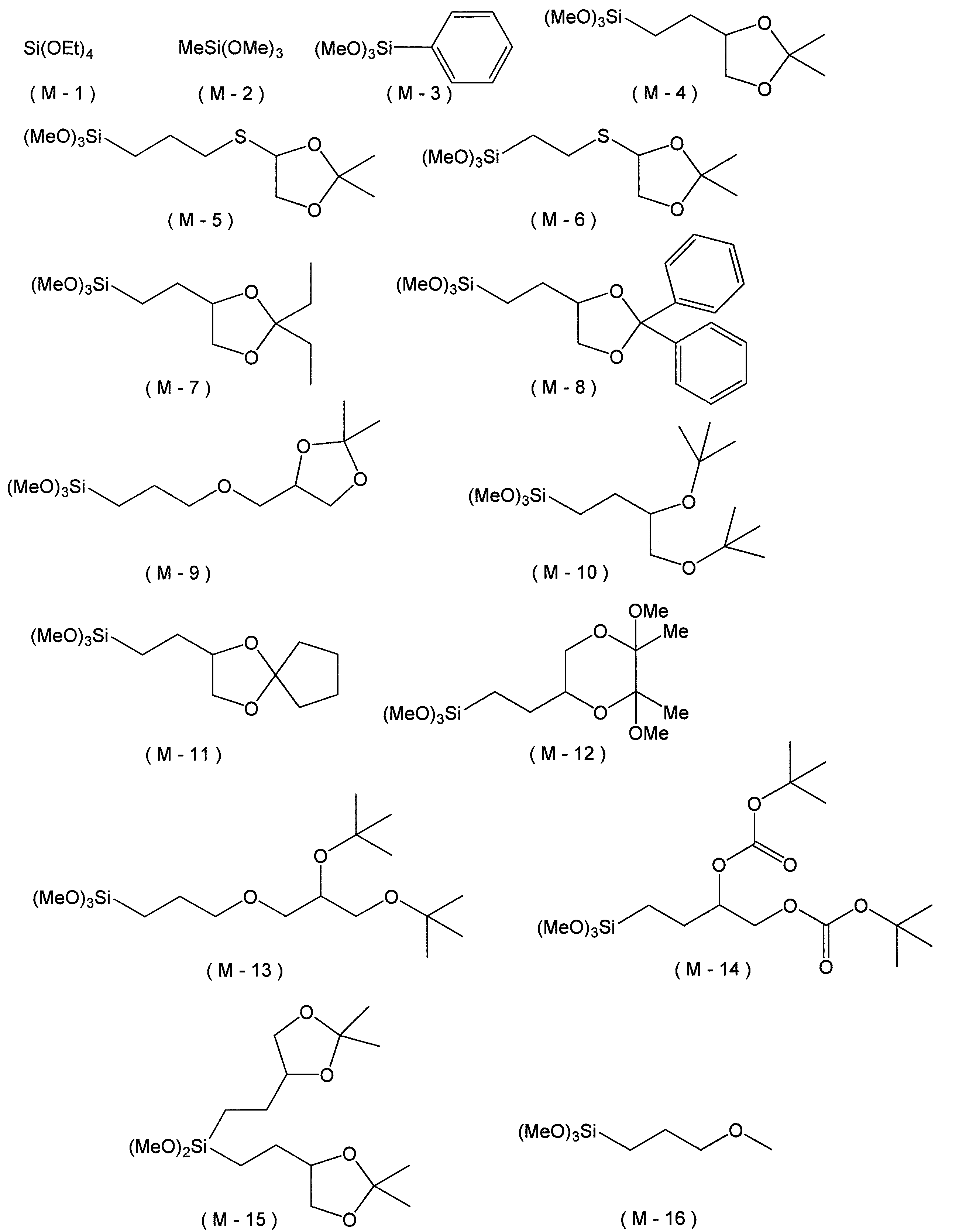
[実施例1](重合体A-1の合成)
テトラメチルアンモニウムヒドロキシド7.22gを水21.67gに加熱溶解させて、テトラアンモニウムヒドロキシド水溶液を調製した。その後、調製したテトラアンモニウムヒドロキシド水溶液及びメタノール40.89gを入れた反応容器に、冷却管と、シランモノマーを投入した滴下ロートをセットした。上記シランモノマーとしては、化学式(M-1)に示す化合物、化学式(M-2)に示す化合物、化学式(M-3)に示す化合物、及び化学式(M-4)に示す化合物をモル比率50/25/10/15(モル%)で用い、シランモノマーの合計質量は30.21gとした。次いで、反応容器をオイルバスにて60℃に加熱した後、上記調整したシランモノマーの混合液を10分間かけて滴下した。滴下開始を反応の開始時間とし、反応を60℃で4時間実施した。反応終了後、反応容器を10℃以下に冷却した。
テトラメチルアンモニウムヒドロキシド7.22gを水21.67gに加熱溶解させて、テトラアンモニウムヒドロキシド水溶液を調製した。その後、調製したテトラアンモニウムヒドロキシド水溶液及びメタノール40.89gを入れた反応容器に、冷却管と、シランモノマーを投入した滴下ロートをセットした。上記シランモノマーとしては、化学式(M-1)に示す化合物、化学式(M-2)に示す化合物、化学式(M-3)に示す化合物、及び化学式(M-4)に示す化合物をモル比率50/25/10/15(モル%)で用い、シランモノマーの合計質量は30.21gとした。次いで、反応容器をオイルバスにて60℃に加熱した後、上記調整したシランモノマーの混合液を10分間かけて滴下した。滴下開始を反応の開始時間とし、反応を60℃で4時間実施した。反応終了後、反応容器を10℃以下に冷却した。
その後、無水マレイン酸9.33gを、水34.25gに溶解させて調製した10℃以下のマレイン酸水溶液へ、上記反応容器内の反応液を滴下し、10℃以下で30分間攪拌した。次いで、1-ブチルアルコール143.58g及び水を添加して、分液ロート水による液液抽出を行い、ポリシロキサン系重合体(A-1)の1-ブタノール溶液を得た。酢酸プロピレングリコールモノエチルエーテル143.58gを添加し、エバポレーターを用いて、1-ブタノールを除去することで重合体(A-1)の酢酸プロピレングリコールモノエチルエーテル溶液を得た。重合体(A-1)の酢酸プロピレングリコールモノエチルエーテル溶液の固形分濃度は9.8質量%であった。また、重合体(A-1)の重量平均分子量(Mw)は1,780であった。
[実施例13](重合体(A-13)の合成)
シュウ酸0.75gを水11.23gに加熱溶解させて、シュウ酸水溶液を調製した。反応容器に、シランモノマー及びメタノール14.09gを投入した。上記シランモノマーとしては、化合物(M-1)、化合物(M-2)、化合物(M-3)及び化合物(M-10)をモル比率30/50/10/10(モル%)で用い、シランモノマーの合計質量は23.93gとした。上記反応容器に、冷却管及び上記調製したシュウ酸水溶液を入れた滴下ロートをセットした。次いで、上記フラスコをオイルバスにて60℃に加熱した後、上記シュウ酸水溶液を10分間かけて滴下した。滴下開始を反応の開始時間とし、反応を60℃で4時間反応実施した。反応終了後、反応容器内を30℃以下に冷却した。酢酸プロピレングリコールモノメチルエーテルアセテート200.0gを上記反応容器に添加した後、エバポレーターを用いて、水及び生成したアルコール類を除去し、重合体(A-13)の酢酸プロピレングリコールモノエチルエーテル溶液を得た。重合体(A-13)の酢酸プロピレングリコールモノエチルエーテル溶液の固形分濃度は12.1質量%であった。また、重合体(A-13)のMwは1,850であった。
シュウ酸0.75gを水11.23gに加熱溶解させて、シュウ酸水溶液を調製した。反応容器に、シランモノマー及びメタノール14.09gを投入した。上記シランモノマーとしては、化合物(M-1)、化合物(M-2)、化合物(M-3)及び化合物(M-10)をモル比率30/50/10/10(モル%)で用い、シランモノマーの合計質量は23.93gとした。上記反応容器に、冷却管及び上記調製したシュウ酸水溶液を入れた滴下ロートをセットした。次いで、上記フラスコをオイルバスにて60℃に加熱した後、上記シュウ酸水溶液を10分間かけて滴下した。滴下開始を反応の開始時間とし、反応を60℃で4時間反応実施した。反応終了後、反応容器内を30℃以下に冷却した。酢酸プロピレングリコールモノメチルエーテルアセテート200.0gを上記反応容器に添加した後、エバポレーターを用いて、水及び生成したアルコール類を除去し、重合体(A-13)の酢酸プロピレングリコールモノエチルエーテル溶液を得た。重合体(A-13)の酢酸プロピレングリコールモノエチルエーテル溶液の固形分濃度は12.1質量%であった。また、重合体(A-13)のMwは1,850であった。
[実施例2~12、比較例1](重合体(A-2)~(A-12)、及び重合体(a-1)の合成)
下記表1に示す種類及び使用量の各シランモノマーを用いた以外は、実施例1と同様の手法にて、重合体(A-2)~(A-12)及び重合体(a-1)を合成した。得られた重合体溶液の固形分濃度(質量%)と、[A]重合体のMwとを表1にあわせて示す。
下記表1に示す種類及び使用量の各シランモノマーを用いた以外は、実施例1と同様の手法にて、重合体(A-2)~(A-12)及び重合体(a-1)を合成した。得られた重合体溶液の固形分濃度(質量%)と、[A]重合体のMwとを表1にあわせて示す。
[実施例14、比較例2](重合体(A-14)及び重合体(a-2)の合成)
下記表1に示す種類及び使用量の各シランモノマーを用いた以外は、実施例13と同様の手法にて、重合体(A-14)及び重合体(a-2)を合成した。得られた重合体溶液の固形分濃度(質量%)と、[A]重合体のMwとを表1にあわせて示す。
下記表1に示す種類及び使用量の各シランモノマーを用いた以外は、実施例13と同様の手法にて、重合体(A-14)及び重合体(a-2)を合成した。得られた重合体溶液の固形分濃度(質量%)と、[A]重合体のMwとを表1にあわせて示す。
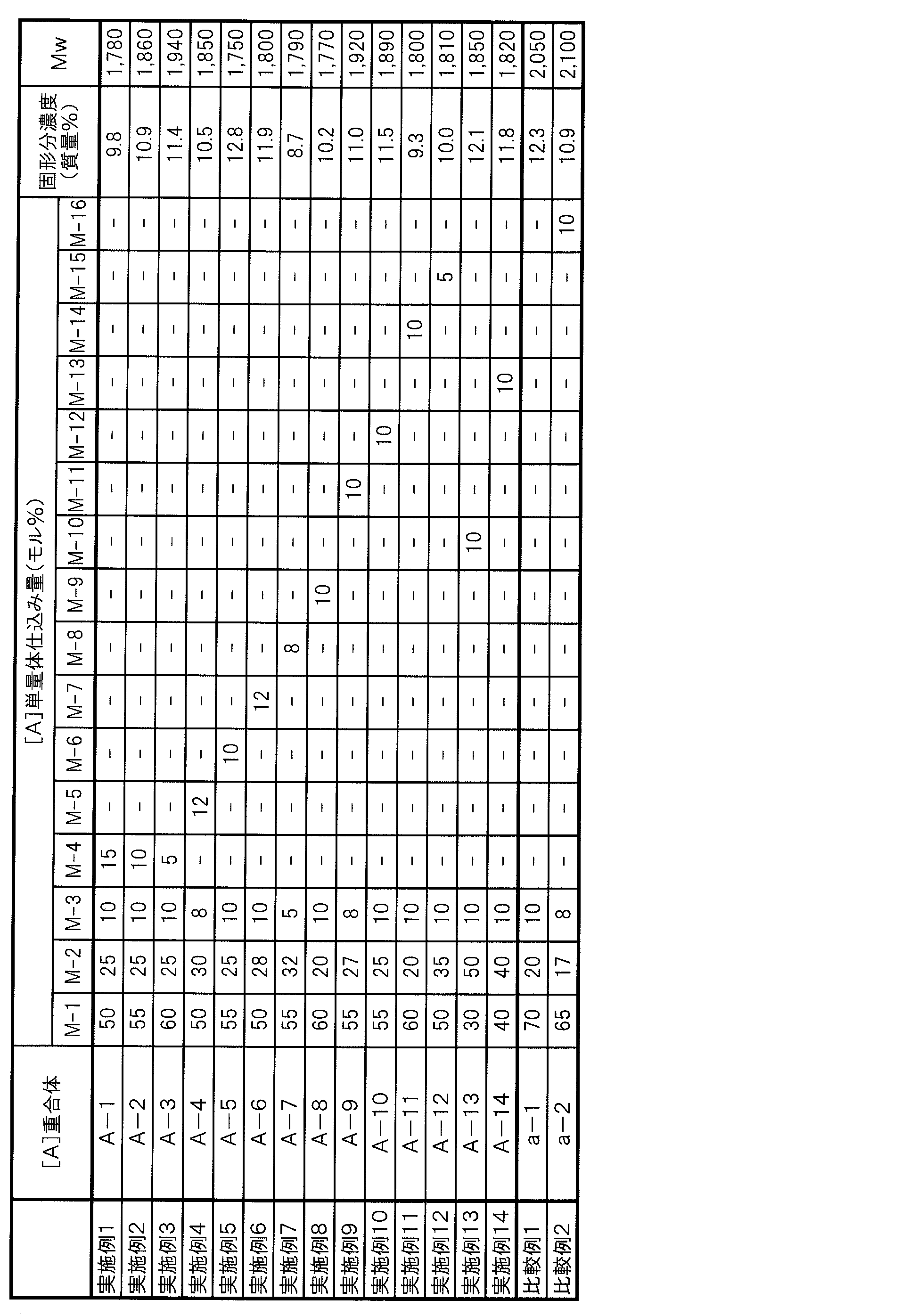
[レジストプロセス用膜形成材料の調製]
レジストプロセス用膜形成材料の調製に用いた[A]重合体以外の成分を以下に示す。
レジストプロセス用膜形成材料の調製に用いた[A]重合体以外の成分を以下に示す。
[[B]有機溶媒]
B-1:酢酸プロピレングリコールモノメチルエーテル
B-1:酢酸プロピレングリコールモノメチルエーテル
[[C]窒素含有化合物]
C-1:N-t-ブトキシカルボニル-4-ヒドロキシピペリジン
構造式を以下に示す。
C-1:N-t-ブトキシカルボニル-4-ヒドロキシピペリジン
構造式を以下に示す。

[[D]酸発生剤]
D-1:4-シクロヘキシルフェニルジフェニルスルホニウム2,4-ジフルオロベンゼン-1-スルホネート
構造式を以下に示す。
D-1:4-シクロヘキシルフェニルジフェニルスルホニウム2,4-ジフルオロベンゼン-1-スルホネート
構造式を以下に示す。
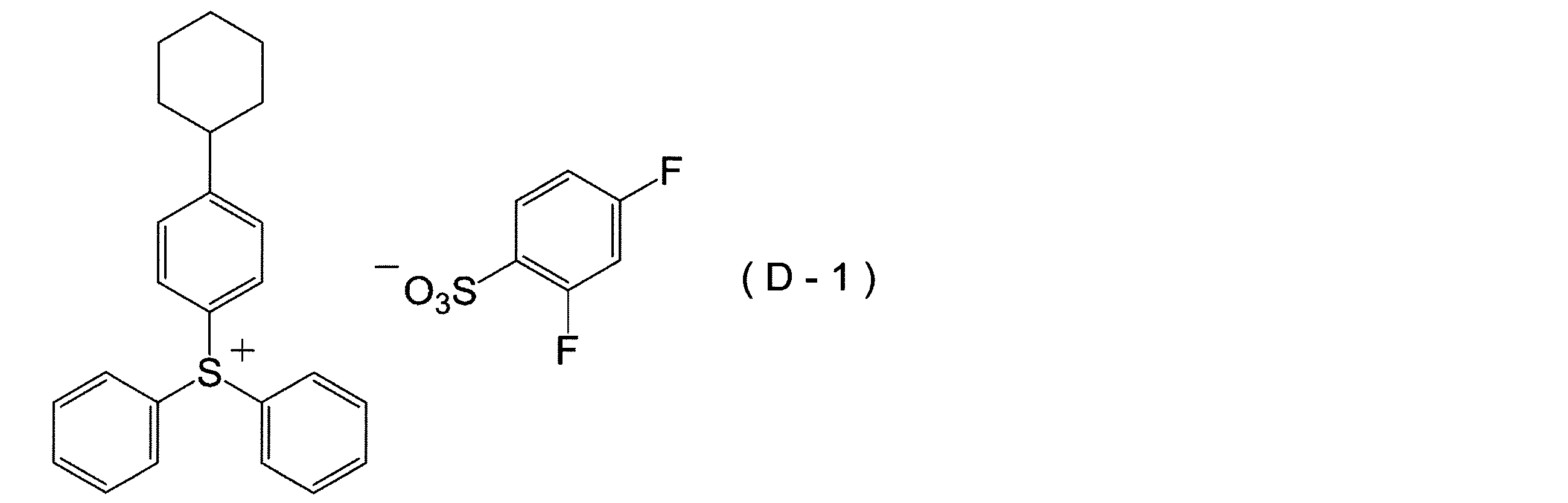
[実施例15]
[A]重合体(固形分)としての(A-1)2.0質量部、[B]有機溶媒としての(B-1)97.4質量部([A]重合体の溶液に含まれる溶媒(B-1)も含む)、[D]酸発生剤としての(D-1)0.1質量部、及び[E]水0.5質量部を混合し、得られた混合溶液を孔径0.2μmのフィルターでろ過して、レジストプロセス用膜形成材料(J-1)を得た。
[A]重合体(固形分)としての(A-1)2.0質量部、[B]有機溶媒としての(B-1)97.4質量部([A]重合体の溶液に含まれる溶媒(B-1)も含む)、[D]酸発生剤としての(D-1)0.1質量部、及び[E]水0.5質量部を混合し、得られた混合溶液を孔径0.2μmのフィルターでろ過して、レジストプロセス用膜形成材料(J-1)を得た。
[実施例16~28及び比較例3~4]
下記表2に示す種類及び配合量の各成分を用いた以外は、実施例15と同じ要領にて、レジストプロセス用膜形成材料(J-2)~(J-14)及び(j-1)~(j-2)を調製した。
下記表2に示す種類及び配合量の各成分を用いた以外は、実施例15と同じ要領にて、レジストプロセス用膜形成材料(J-2)~(J-14)及び(j-1)~(j-2)を調製した。
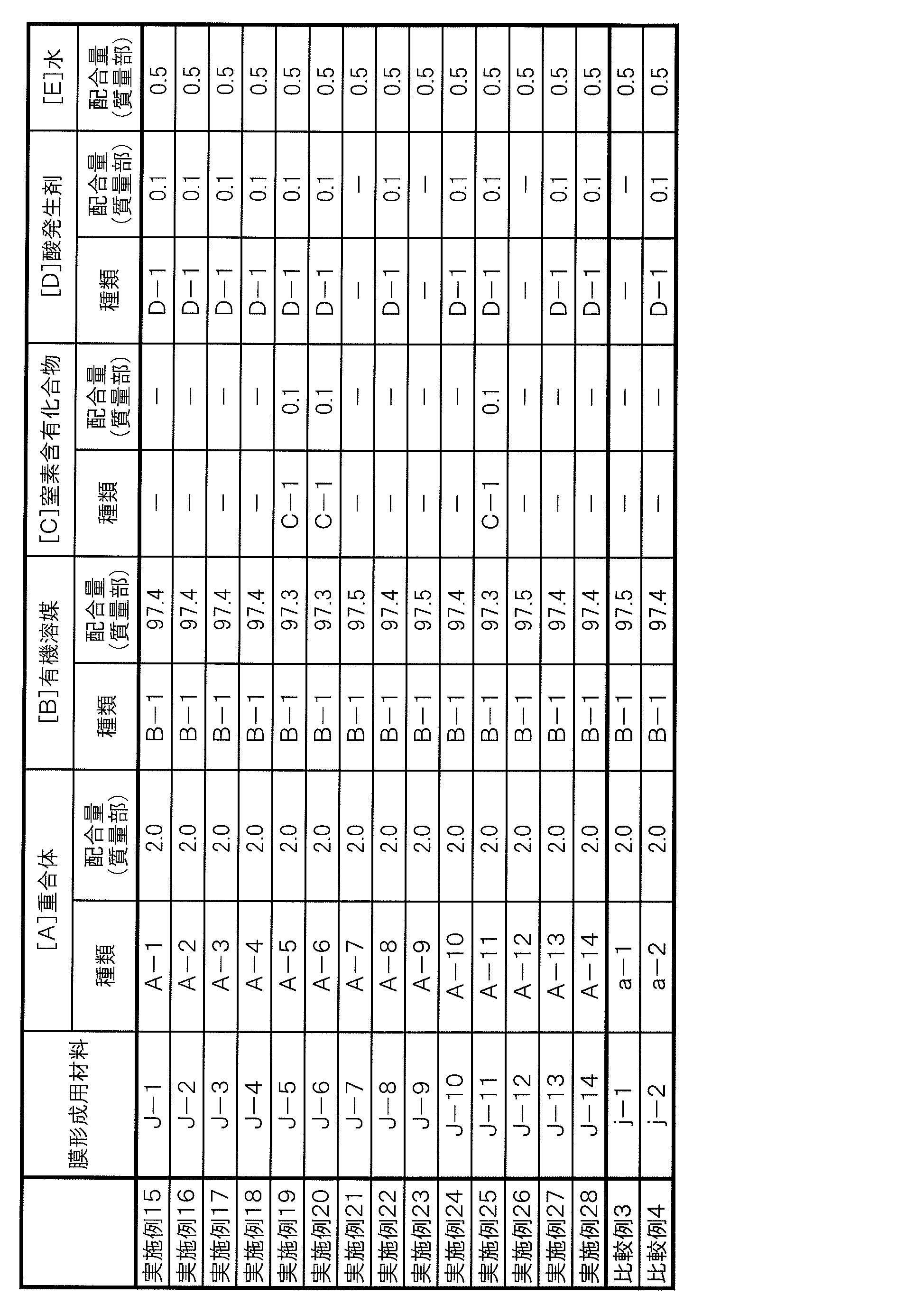
<シリコン含有膜の形成>
シリコンウェハー上に、上記得られたプロセス用膜形成材料を、スピンコーター(東京エレクトロン社の「CLEAN TRACK ACT12」)を用い、スピンコート法により塗布した。得られた塗膜に対し、220℃のホットプレートで60秒間加熱処理した後、23℃で60秒間冷却することにより、表2の実施例15~28並びに比較例3及び4に示す平均厚み30nmのシリコン含有膜が形成された基板を得た。
シリコンウェハー上に、上記得られたプロセス用膜形成材料を、スピンコーター(東京エレクトロン社の「CLEAN TRACK ACT12」)を用い、スピンコート法により塗布した。得られた塗膜に対し、220℃のホットプレートで60秒間加熱処理した後、23℃で60秒間冷却することにより、表2の実施例15~28並びに比較例3及び4に示す平均厚み30nmのシリコン含有膜が形成された基板を得た。
<評価>
上記形成されたシリコン含有膜について、以下に示す方法で下記項目の評価を行った。評価結果を下記表3に示す。
上記形成されたシリコン含有膜について、以下に示す方法で下記項目の評価を行った。評価結果を下記表3に示す。
[基板反射率]
上記形成されたシリコン含有膜、下層膜形成用組成物(JSR社の「NFC HM8006」)及びレジスト材料(JSR社の「ARF AR2772JN」)のそれぞれの屈折率パラメーター(n)及び消衰係数(k)を高速分光エリプソメーター(J.A.Woollam社の「M-2000D」)により測定し、この測定値を元にシュミレーションソフト(KLA-Tencor社の「プロリス」)を用いて、NA1.3、Dipoleの条件下におけるレジスト材料/シリコン含有膜/下層膜形成用組成物を積層させた膜の基板反射率を求めた。基板反射率は、1%以下の場合は「A」と、1%を超える場合は「B」と評価した。
上記形成されたシリコン含有膜、下層膜形成用組成物(JSR社の「NFC HM8006」)及びレジスト材料(JSR社の「ARF AR2772JN」)のそれぞれの屈折率パラメーター(n)及び消衰係数(k)を高速分光エリプソメーター(J.A.Woollam社の「M-2000D」)により測定し、この測定値を元にシュミレーションソフト(KLA-Tencor社の「プロリス」)を用いて、NA1.3、Dipoleの条件下におけるレジスト材料/シリコン含有膜/下層膜形成用組成物を積層させた膜の基板反射率を求めた。基板反射率は、1%以下の場合は「A」と、1%を超える場合は「B」と評価した。
[溶媒耐性]
上記得られたシリコン含有膜が形成された基板を、シクロヘキサノンに、室温で10秒間浸漬した。シリコン含有膜の浸漬前後の平均厚みを、分光エリプソメーターを用いて測定した。浸漬前の平均厚みをT0と、浸漬後の平均厚みをT1とした場合、溶媒浸漬による膜厚変化率(%)を下記式により求めた。
膜厚変化率(%)=│T1-T0│×100/T0
溶媒耐性は、膜厚変化率が1%未満の場合は「A」(良好)、1%以上の場合は「B」(不良)と評価した。
上記得られたシリコン含有膜が形成された基板を、シクロヘキサノンに、室温で10秒間浸漬した。シリコン含有膜の浸漬前後の平均厚みを、分光エリプソメーターを用いて測定した。浸漬前の平均厚みをT0と、浸漬後の平均厚みをT1とした場合、溶媒浸漬による膜厚変化率(%)を下記式により求めた。
膜厚変化率(%)=│T1-T0│×100/T0
溶媒耐性は、膜厚変化率が1%未満の場合は「A」(良好)、1%以上の場合は「B」(不良)と評価した。
[最小倒壊前寸法及びパターン形状]
最小倒壊前寸法及びパターン形状は、以下に示すリソグラフィー評価を行うことにより評価した。
最小倒壊前寸法及びパターン形状は、以下に示すリソグラフィー評価を行うことにより評価した。
(リソグラフィー評価、有機溶媒現像)
12インチシリコンウェハ上に、反射防止膜形成材料(JSR社の「HM8006」)をスピンコートした後、250℃で60秒間加熱処理を行うことにより平均厚み100nmの反射防止膜を形成した。この反射防止膜上に、上記得られたレジストプロセス用膜形成材料を、上記スピンコーターを使用してスピンコートし、220℃で60秒間加熱処理した後、23℃で60秒間冷却することにより平均厚み30nmのシリコン含有膜を形成した。次いで、レジスト材料(JSR社の「ARF AR2772JN」)をこのシリコン含有膜上にスピンコートし、90℃で60秒間加熱処理した後、23℃で30秒間冷却することにより平均厚み100nmのレジスト膜を形成した。
12インチシリコンウェハ上に、反射防止膜形成材料(JSR社の「HM8006」)をスピンコートした後、250℃で60秒間加熱処理を行うことにより平均厚み100nmの反射防止膜を形成した。この反射防止膜上に、上記得られたレジストプロセス用膜形成材料を、上記スピンコーターを使用してスピンコートし、220℃で60秒間加熱処理した後、23℃で60秒間冷却することにより平均厚み30nmのシリコン含有膜を形成した。次いで、レジスト材料(JSR社の「ARF AR2772JN」)をこのシリコン含有膜上にスピンコートし、90℃で60秒間加熱処理した後、23℃で30秒間冷却することにより平均厚み100nmのレジスト膜を形成した。
次いで、ArF液浸露光装置(NIKON社の「S610C」)を使用し、NA:1.30、Dipoleの光学条件にて、40nmライン/80nmピッチ形成用のマスクサイズのマスクを介して露光した。「Lithius Pro-i」のホットプレート上で、100℃で60秒間PEBを行い、23℃で30秒間冷却した後、酢酸ブチルを現像液として30秒間パドル現像し、メチルイソブチルカルビノール(MIBC)でリンスした。2,000rpm、15秒間振り切りでスピンドライすることにより、40nmライン/80nmピッチのレジストパターンが形成された評価用基板を得た。
(最小倒壊前寸法及びパターン形状の評価)
最小倒壊前寸法及びパターン形状は、以下のようにして測定した。評価用基板のレジストパターンの測長及び観察には走査型電子顕微鏡(日立ハイテクノロジーズ社の「CG-4000」)を用いた。
最小倒壊前寸法及びパターン形状は、以下のようにして測定した。評価用基板のレジストパターンの測長及び観察には走査型電子顕微鏡(日立ハイテクノロジーズ社の「CG-4000」)を用いた。
上記評価用基板を得た際に、ラインの線幅が42nmであり、隣り合うライン間の距離(スペース)が84nm(ライン・アンド・スペースが1対2)であるレジストパターンを形成した露光量(mJ/cm2)を最適露光量とし、この最適露光量よりも段階的に露光量を大きくして順次露光を行った。このとき、得られるパターンの線幅は次第に細くなるため、ある露光量に対応する線幅で最終的にレジストパターンの倒壊が観察される。レジストパターンの倒壊が確認されない最大の露光量に対応する線幅を最小倒壊前寸法(nm)と定義してパターン倒れ耐性の指標とした。最小倒壊前寸法は、30nm以下の場合は「A」(良好)と、30nmを超え40nm以下の場合は「B」(やや良好)と、40nmを超える場合又はパターン倒れにより評価不可能の場合は「C」(不良)と評価した。パターン形状はレジストパターンのボトムに裾引きがない場合は「A」、パターン倒れ又は裾引きが確認できる場合は「B」、パターン倒れ又は裾引きが多数箇所確認できる場合は「C」と評価した。
[酸素エッチング耐性]
上記形成したシリコン含有膜を、ドライエッチンッグ装置(東京エレクトロン社の「Telius SCCM」)を用いて、100Wで120秒間O2処理し、処理前後の膜厚の差を測定した。酸素エッチング耐性は、処理前後の膜厚の差が10nm未満の場合は「A」(良好)と、10nm以上15nm以下の場合は「B」(やや良好)と、15nmを超える場合は「C」(不良)と評価した。
上記形成したシリコン含有膜を、ドライエッチンッグ装置(東京エレクトロン社の「Telius SCCM」)を用いて、100Wで120秒間O2処理し、処理前後の膜厚の差を測定した。酸素エッチング耐性は、処理前後の膜厚の差が10nm未満の場合は「A」(良好)と、10nm以上15nm以下の場合は「B」(やや良好)と、15nmを超える場合は「C」(不良)と評価した。
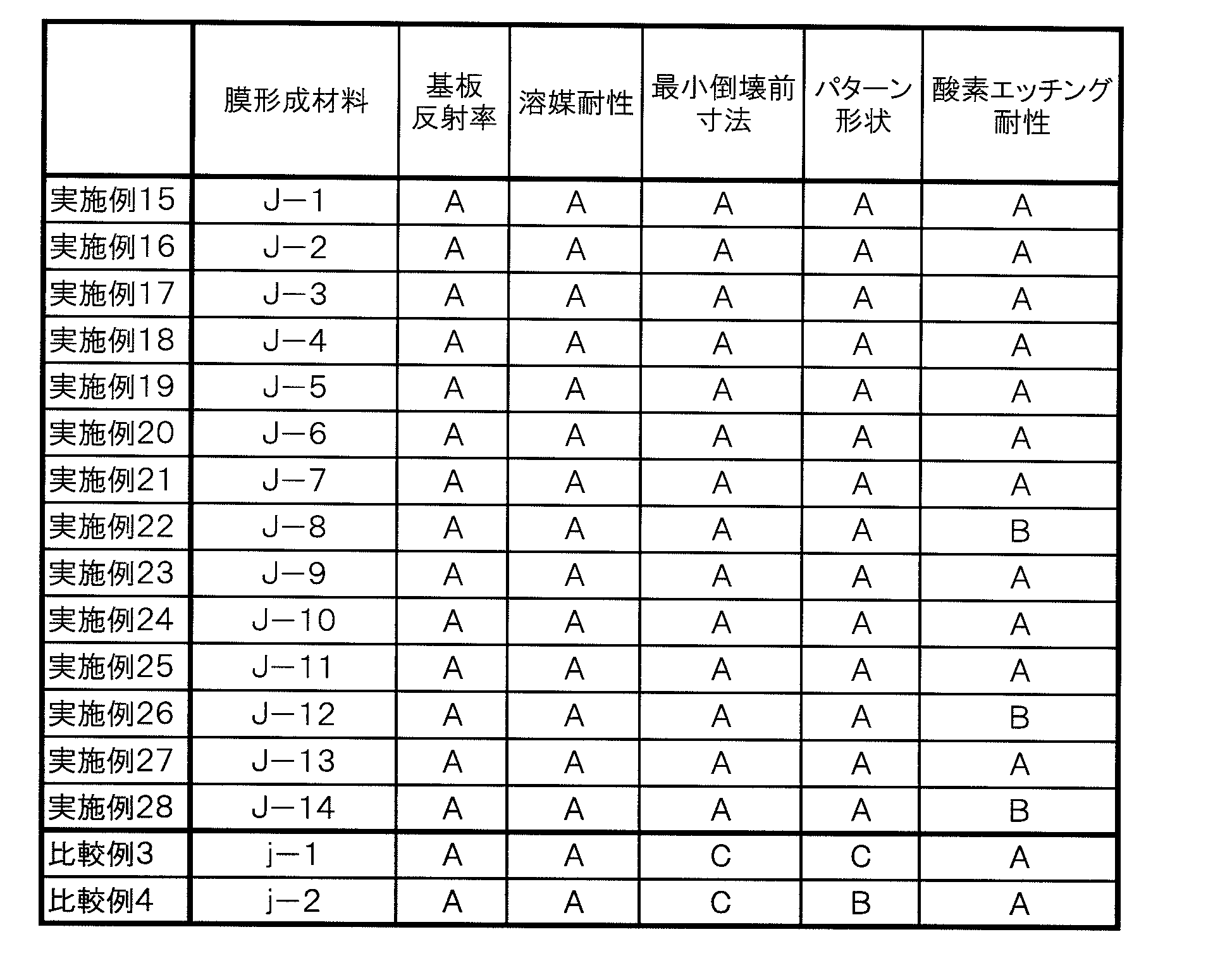
表3の結果から、実施例の膜形成材料によれば、レジスト組成物の溶媒に対する耐性に優れ、反射防止性に優れ、エッチング耐性を有し、レジストパターンの形状が良好で倒れが少ないシリコン含有膜を形成できることが分かる。
本発明に係るレジストプロセス用膜形成材料は、レジストプロセスにおけるレジスト中間膜、レジスト下層膜等の各種シリコン含有膜の形成材料として好適に用いることができる。
Claims (10)
- 保護された2つ以上のアルコール性水酸基を有するシランモノマーに由来する構造単位を有する重合体、及び有機溶媒を含有するレジストプロセス用膜形成材料。
- 上記重合体が、下記式(1)で表される構造を有する請求項1に記載のレジストプロセス用膜形成材料。

R1は、保護された2つ以上のアルコール性水酸基を含む1価の有機基、又は保護された1つのアルコール性水酸基を含む1価の有機基である。
R2は、保護された2つ以上のアルコール性水酸基を含む1価の有機基、保護された1つのアルコール性水酸基を含む1価の有機基、水素原子、ヒドロキシ基、又は保護されたアルコール性水酸基を有さない置換若しくは非置換の炭素数1~20の1価の炭化水素基である。aは、0又は1である。但し、R1が保護された1つのアルコール性水酸基を含む1価の有機基である場合は、aは1である。
R3は、保護されたアルコール性水酸基を有さない、光吸収性基を有する1価の有機基である。
R4は、水素原子、ヒドロキシ基、保護されたアルコール性水酸基を有さない置換又は非置換の炭素数1~20の1価の炭化水素基である。bは、0又は1である。
R5は、保護されたアルコール性水酸基を有さない、非光吸収性の置換若しくは非置換の1価の脂肪族炭化水素基である。cは、0~2の整数である。cが2の場合、複数のR5は、同一でも異なっていてもよい。
dは、上記重合体を構成する全構造単位に対する構造単位UXのモル比率を表す。
eは、上記重合体を構成する全構造単位に対する構造単位UYのモル比率を表す。
fは、上記重合体を構成する全構造単位に対する構造単位UZのモル比率を表す。
d、e及びfは、それぞれ0<d<1、0≦e<1及び0≦f<1を満たし、かつd+e+f≦1である。) - 上記式(1)におけるeが、0<e<1を満たす請求項2に記載のレジストプロセス用膜形成材料。
- 上記式(1)におけるfが、0<f<1を満たす請求項2又は請求項3に記載のレジストプロセス用膜形成材料。
- 上記R1及びR2で表される保護された2つ以上のアルコール性水酸基を含む1価の有機基が、下記式(2)で表される請求項2、請求項3又は請求項4に記載のレジストプロセス用膜形成材料。

- 上記X1が、置換又は非置換の炭素数1~20の3価の脂肪族炭化水素基である請求項5に記載のレジストプロセス用膜形成材料。
- 上記R1及びR2で表される保護された1つのアルコール性水酸基を含む1価の有機基が、下記式(3)で表される請求項2から請求項6のいずれか1項に記載のレジストプロセス用膜形成材料。

- 請求項1から請求項7のいずれか1項に記載のレジストプロセス用膜形成材料により、基板の少なくとも一方の面側に、シリコン含有膜を形成する工程と、
酸解離性基を有する重合体及び感放射線性酸発生体を含む感放射線性樹脂組成物により、上記シリコン含有膜の上記基板とは反対の面側に、レジスト膜を形成する工程と、
上記レジスト膜を露光する工程と、
上記露光されたレジスト膜を現像する工程と
を備えるパターン形成方法。 - 上記レジスト膜の現像を有機溶媒含有液により行う請求項8に記載のパターン形成方法。
- 下記式(1)で表される構造を有する重合体。
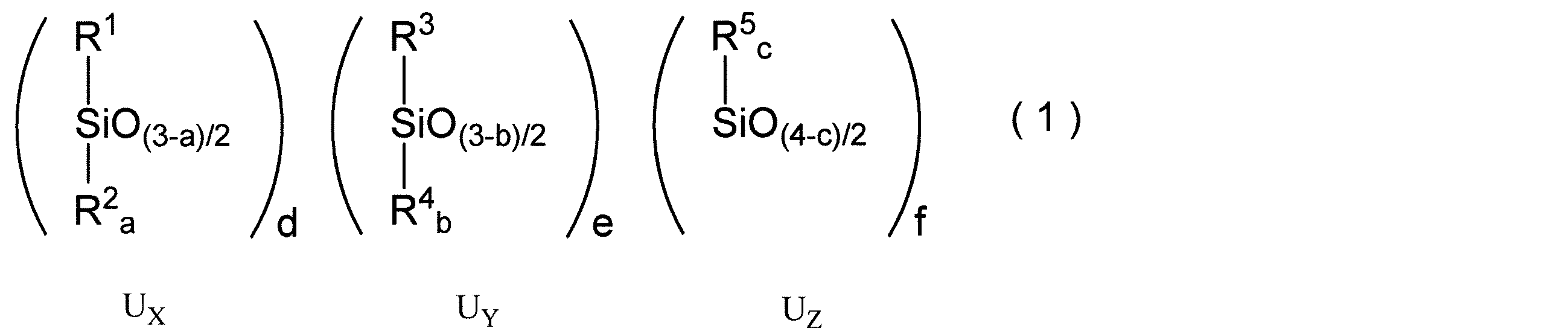
R1は、保護された2つ以上のアルコール性水酸基を含む1価の有機基、又は保護された1つのアルコール性水酸基を含む1価の有機基である。
R2は、保護された2つ以上のアルコール性水酸基を含む1価の有機基、保護された1つのアルコール性水酸基を含む1価の有機基、水素原子、ヒドロキシ基、又は保護されたアルコール性水酸基を有さない置換若しくは非置換の炭素数1~20の1価の炭化水素基である。aは、0又は1である。但し、R1が保護された1つのアルコール性水酸基を含む1価の有機基である場合は、aは1である。
R3は、保護されたアルコール性水酸基を有さない、光吸収性基を有する1価の有機基である。
R4は、水素原子、ヒドロキシ基、保護されたアルコール性水酸基を有さない置換又は非置換の炭素数1~20の1価の炭化水素基である。bは、0又は1である。
R5は、保護されたアルコール性水酸基を有さない、非光吸収性の置換若しくは非置換の1価の脂肪族炭化水素基である。cは、0~2の整数である。cが2の場合、複数のR5は、同一でも異なっていてもよい。
dは、上記重合体を構成する全構造単位に対する構造単位UXのモル比率を表す。
eは、上記重合体を構成する全構造単位に対する構造単位UYのモル比率を表す。
fは、上記重合体を構成する全構造単位に対する構造単位UZのモル比率を表す。
d、e及びfは、それぞれ0<d<1、0≦e<1及び0≦f<1を満たし、かつd+e+f≦1である。)
Priority Applications (1)
| Application Number | Priority Date | Filing Date | Title |
|---|---|---|---|
| JP2018504339A JP6741957B2 (ja) | 2016-03-10 | 2017-02-20 | レジストプロセス用膜形成材料及びパターン形成方法 |
Applications Claiming Priority (2)
| Application Number | Priority Date | Filing Date | Title |
|---|---|---|---|
| JP2016047353 | 2016-03-10 | ||
| JP2016-047353 | 2016-03-10 |
Publications (1)
| Publication Number | Publication Date |
|---|---|
| WO2017154545A1 true WO2017154545A1 (ja) | 2017-09-14 |
Family
ID=59790341
Family Applications (1)
| Application Number | Title | Priority Date | Filing Date |
|---|---|---|---|
| PCT/JP2017/006231 Ceased WO2017154545A1 (ja) | 2016-03-10 | 2017-02-20 | レジストプロセス用膜形成材料、パターン形成方法及び重合体 |
Country Status (3)
| Country | Link |
|---|---|
| JP (1) | JP6741957B2 (ja) |
| TW (1) | TW201800863A (ja) |
| WO (1) | WO2017154545A1 (ja) |
Cited By (1)
| Publication number | Priority date | Publication date | Assignee | Title |
|---|---|---|---|---|
| WO2020100633A1 (ja) * | 2018-11-13 | 2020-05-22 | 東京エレクトロン株式会社 | 基板処理方法及び基板処理装置 |
Citations (12)
| Publication number | Priority date | Publication date | Assignee | Title |
|---|---|---|---|---|
| JPS63101388A (ja) * | 1986-10-03 | 1988-05-06 | ダウ コーニング コーポレーション | ジオキソラン置換有機ケイ素化合物及びその製造方法 |
| JP2005048152A (ja) * | 2002-12-24 | 2005-02-24 | Shin Etsu Chem Co Ltd | 高分子化合物、反射防止膜材料及びパターン形成方法 |
| WO2005077960A1 (ja) * | 2004-02-16 | 2005-08-25 | Toagosei Co., Ltd. | 新規な有機ケイ素化合物及びジオールを有する有機ケイ素樹脂並びにそれらの製造方法 |
| JP2005352107A (ja) * | 2004-06-10 | 2005-12-22 | Shin Etsu Chem Co Ltd | 犠牲膜形成用組成物、パターン形成方法、犠牲膜及びその除去方法 |
| JP2005352104A (ja) * | 2004-06-10 | 2005-12-22 | Shin Etsu Chem Co Ltd | 反射防止膜材料、及びこれの製造方法、これを用いた反射防止膜、パターン形成 |
| JP2006009000A (ja) * | 2004-05-28 | 2006-01-12 | Toray Fine Chemicals Co Ltd | 水酸基を有するシリコーン共重合体及びその製造方法 |
| JP2007015974A (ja) * | 2005-07-07 | 2007-01-25 | Shin Etsu Chem Co Ltd | 含フッ素環状構造を有するケイ素化合物及びシリコーン樹脂、それを用いたレジスト組成物、及びパターン形成方法 |
| WO2012039337A1 (ja) * | 2010-09-21 | 2012-03-29 | 日産化学工業株式会社 | 保護された脂肪族アルコールを含有する有機基を有するシリコン含有レジスト下層膜形成組成物 |
| JP2015129908A (ja) * | 2013-11-01 | 2015-07-16 | セントラル硝子株式会社 | ポジ型感光性樹脂組成物、それを用いた膜の製造方法および電子部品 |
| WO2016009965A1 (ja) * | 2014-07-15 | 2016-01-21 | 日産化学工業株式会社 | 脂肪族多環構造含有有機基を有するシリコン含有レジスト下層膜形成組成物 |
| WO2016080226A1 (ja) * | 2014-11-19 | 2016-05-26 | 日産化学工業株式会社 | 架橋反応性シリコン含有膜形成組成物 |
| WO2016121686A1 (ja) * | 2015-01-30 | 2016-08-04 | 日産化学工業株式会社 | カーボネート骨格を有する加水分解性シランを含むリソグラフィー用レジスト下層膜形成組成物 |
Family Cites Families (2)
| Publication number | Priority date | Publication date | Assignee | Title |
|---|---|---|---|---|
| JP2014010352A (ja) * | 2012-06-29 | 2014-01-20 | Fujifilm Corp | 感活性光線性又は感放射線性樹脂組成物、並びに、該組成物を用いたレジスト膜、パターン形成方法、電子デバイスの製造方法及び電子デバイス |
| JP5713508B2 (ja) * | 2013-05-31 | 2015-05-07 | 愼一 石井 | 免振装置 |
-
2017
- 2017-02-20 WO PCT/JP2017/006231 patent/WO2017154545A1/ja not_active Ceased
- 2017-02-20 JP JP2018504339A patent/JP6741957B2/ja active Active
- 2017-03-09 TW TW106107654A patent/TW201800863A/zh unknown
Patent Citations (12)
| Publication number | Priority date | Publication date | Assignee | Title |
|---|---|---|---|---|
| JPS63101388A (ja) * | 1986-10-03 | 1988-05-06 | ダウ コーニング コーポレーション | ジオキソラン置換有機ケイ素化合物及びその製造方法 |
| JP2005048152A (ja) * | 2002-12-24 | 2005-02-24 | Shin Etsu Chem Co Ltd | 高分子化合物、反射防止膜材料及びパターン形成方法 |
| WO2005077960A1 (ja) * | 2004-02-16 | 2005-08-25 | Toagosei Co., Ltd. | 新規な有機ケイ素化合物及びジオールを有する有機ケイ素樹脂並びにそれらの製造方法 |
| JP2006009000A (ja) * | 2004-05-28 | 2006-01-12 | Toray Fine Chemicals Co Ltd | 水酸基を有するシリコーン共重合体及びその製造方法 |
| JP2005352107A (ja) * | 2004-06-10 | 2005-12-22 | Shin Etsu Chem Co Ltd | 犠牲膜形成用組成物、パターン形成方法、犠牲膜及びその除去方法 |
| JP2005352104A (ja) * | 2004-06-10 | 2005-12-22 | Shin Etsu Chem Co Ltd | 反射防止膜材料、及びこれの製造方法、これを用いた反射防止膜、パターン形成 |
| JP2007015974A (ja) * | 2005-07-07 | 2007-01-25 | Shin Etsu Chem Co Ltd | 含フッ素環状構造を有するケイ素化合物及びシリコーン樹脂、それを用いたレジスト組成物、及びパターン形成方法 |
| WO2012039337A1 (ja) * | 2010-09-21 | 2012-03-29 | 日産化学工業株式会社 | 保護された脂肪族アルコールを含有する有機基を有するシリコン含有レジスト下層膜形成組成物 |
| JP2015129908A (ja) * | 2013-11-01 | 2015-07-16 | セントラル硝子株式会社 | ポジ型感光性樹脂組成物、それを用いた膜の製造方法および電子部品 |
| WO2016009965A1 (ja) * | 2014-07-15 | 2016-01-21 | 日産化学工業株式会社 | 脂肪族多環構造含有有機基を有するシリコン含有レジスト下層膜形成組成物 |
| WO2016080226A1 (ja) * | 2014-11-19 | 2016-05-26 | 日産化学工業株式会社 | 架橋反応性シリコン含有膜形成組成物 |
| WO2016121686A1 (ja) * | 2015-01-30 | 2016-08-04 | 日産化学工業株式会社 | カーボネート骨格を有する加水分解性シランを含むリソグラフィー用レジスト下層膜形成組成物 |
Cited By (1)
| Publication number | Priority date | Publication date | Assignee | Title |
|---|---|---|---|---|
| WO2020100633A1 (ja) * | 2018-11-13 | 2020-05-22 | 東京エレクトロン株式会社 | 基板処理方法及び基板処理装置 |
Also Published As
| Publication number | Publication date |
|---|---|
| JP6741957B2 (ja) | 2020-08-19 |
| JPWO2017154545A1 (ja) | 2019-01-10 |
| TW201800863A (zh) | 2018-01-01 |
Similar Documents
| Publication | Publication Date | Title |
|---|---|---|
| TWI687773B (zh) | 圖案形成方法、積層體以及有機溶劑顯影用抗蝕劑組成物 | |
| US20190310552A1 (en) | Radiation-sensitive composition, pattern-forming method, and metal-containing resin and production method thereof | |
| TWI596159B (zh) | Reverse pattern forming method and polysiloxane resin composition | |
| TWI521018B (zh) | Poly Silicon alumoxane composition and pattern forming method | |
| TWI702469B (zh) | 感光化射線性或感放射線性樹脂組成物、圖案形成方法及電子元件的製造方法 | |
| JPWO2013080929A1 (ja) | 多層レジストプロセスに用いられるレジスト下層膜形成用組成物、レジスト下層膜及びその形成方法、並びにパターン形成方法 | |
| JP2013083963A (ja) | パターン形成方法及びポリシロキサン組成物 | |
| US20250011507A1 (en) | Polycyclic aromatic hydrocarbon photocurable resin composition | |
| JP2010285403A (ja) | 架橋剤及び該架橋剤を含有するレジスト下層膜形成組成物 | |
| WO2016111210A1 (ja) | シリコン含有膜形成用組成物及び該組成物を用いたパターン形成方法 | |
| JP2016011411A (ja) | シリコン含有膜形成用組成物、パターン形成方法及びポリシロキサン化合物 | |
| WO2021220648A1 (ja) | 感放射線性樹脂組成物及びそれを用いたレジストパターンの形成方法、並びに、スルホン酸塩化合物及びそれを含む感放射線性酸発生剤 | |
| JP6786783B2 (ja) | 多層レジストプロセス用シリコン含有膜形成組成物及びパターン形成方法 | |
| JP2017045044A (ja) | レジストパターン形成方法及び化学増幅型感放射線性樹脂組成物 | |
| WO2018159356A1 (ja) | ケイ素含有膜形成用組成物、ケイ素含有膜、パターン形成方法及びポリシロキサン | |
| JP6897071B2 (ja) | レジストプロセス用膜形成材料、パターン形成方法及び重合体 | |
| JP6741957B2 (ja) | レジストプロセス用膜形成材料及びパターン形成方法 | |
| JP6511931B2 (ja) | レジスト下層膜形成用ポリシロキサン組成物及びパターン形成方法 | |
| WO2018155377A1 (ja) | レジストプロセス用膜形成材料、パターン形成方法及びポリシロキサン | |
| KR102310571B1 (ko) | 실리콘 함유막 형성용 조성물, 패턴 형성 방법 및 폴리실록산 화합물 | |
| JP7342953B2 (ja) | 組成物、ケイ素含有膜、ケイ素含有膜の形成方法及び半導体基板の処理方法 | |
| JP5534205B2 (ja) | 感光性レジスト下層膜形成組成物及びレジストパターンの形成方法 | |
| WO2021065350A1 (ja) | 感放射線性樹脂組成物及びそれを用いたレジストパターンの形成方法 | |
| US12346026B2 (en) | Composition for forming underlayer film, resist pattern forming method, and manufacturing method of electronic device | |
| TW202231626A (zh) | 感放射線性樹脂組成物及使用其的抗蝕劑圖案的形成方法、以及鋶鹽化合物及包含鋶鹽化合物的感放射線性酸產生劑 |
Legal Events
| Date | Code | Title | Description |
|---|---|---|---|
| WWE | Wipo information: entry into national phase |
Ref document number: 2018504339 Country of ref document: JP |
|
| NENP | Non-entry into the national phase |
Ref country code: DE |
|
| 121 | Ep: the epo has been informed by wipo that ep was designated in this application |
Ref document number: 17762888 Country of ref document: EP Kind code of ref document: A1 |
|
| 122 | Ep: pct application non-entry in european phase |
Ref document number: 17762888 Country of ref document: EP Kind code of ref document: A1 |