WO2017155019A1 - Protein adsorption inhibitor and method for inhibiting adsorption of protein - Google Patents
Protein adsorption inhibitor and method for inhibiting adsorption of protein Download PDFInfo
- Publication number
- WO2017155019A1 WO2017155019A1 PCT/JP2017/009405 JP2017009405W WO2017155019A1 WO 2017155019 A1 WO2017155019 A1 WO 2017155019A1 JP 2017009405 W JP2017009405 W JP 2017009405W WO 2017155019 A1 WO2017155019 A1 WO 2017155019A1
- Authority
- WO
- WIPO (PCT)
- Prior art keywords
- protein adsorption
- water
- protein
- acrylic polymer
- adsorption inhibitor
- Prior art date
- Legal status (The legal status is an assumption and is not a legal conclusion. Google has not performed a legal analysis and makes no representation as to the accuracy of the status listed.)
- Ceased
Links
Images

Classifications
-
- C—CHEMISTRY; METALLURGY
- C08—ORGANIC MACROMOLECULAR COMPOUNDS; THEIR PREPARATION OR CHEMICAL WORKING-UP; COMPOSITIONS BASED THEREON
- C08F—MACROMOLECULAR COMPOUNDS OBTAINED BY REACTIONS ONLY INVOLVING CARBON-TO-CARBON UNSATURATED BONDS
- C08F20/00—Homopolymers and copolymers of compounds having one or more unsaturated aliphatic radicals, each having only one carbon-to-carbon double bond, and only one being terminated by only one carboxyl radical or a salt, anhydride, ester, amide, imide or nitrile thereof
- C08F20/02—Monocarboxylic acids having less than ten carbon atoms, Derivatives thereof
- C08F20/10—Esters
- C08F20/26—Esters containing oxygen in addition to the carboxy oxygen
-
- C—CHEMISTRY; METALLURGY
- C08—ORGANIC MACROMOLECULAR COMPOUNDS; THEIR PREPARATION OR CHEMICAL WORKING-UP; COMPOSITIONS BASED THEREON
- C08J—WORKING-UP; GENERAL PROCESSES OF COMPOUNDING; AFTER-TREATMENT NOT COVERED BY SUBCLASSES C08B, C08C, C08F, C08G or C08H
- C08J7/00—Chemical treatment or coating of shaped articles made of macromolecular substances
- C08J7/04—Coating
- C08J7/056—Forming hydrophilic coatings
-
- G—PHYSICS
- G01—MEASURING; TESTING
- G01N—INVESTIGATING OR ANALYSING MATERIALS BY DETERMINING THEIR CHEMICAL OR PHYSICAL PROPERTIES
- G01N33/00—Investigating or analysing materials by specific methods not covered by groups G01N1/00 - G01N31/00
- G01N33/48—Biological material, e.g. blood, urine; Haemocytometers
-
- G—PHYSICS
- G01—MEASURING; TESTING
- G01N—INVESTIGATING OR ANALYSING MATERIALS BY DETERMINING THEIR CHEMICAL OR PHYSICAL PROPERTIES
- G01N33/00—Investigating or analysing materials by specific methods not covered by groups G01N1/00 - G01N31/00
- G01N33/48—Biological material, e.g. blood, urine; Haemocytometers
- G01N33/50—Chemical analysis of biological material, e.g. blood, urine; Testing involving biospecific ligand binding methods; Immunological testing
- G01N33/53—Immunoassay; Biospecific binding assay; Materials therefor
- G01N33/531—Production of immunochemical test materials
Definitions
- the present invention relates to a non-specific adsorption inhibitor for proteins and a method for inhibiting adsorption.
- a protein adsorption inhibitor that can prevent the adsorption of impurities (proteins) in a sample to the solid phase surface of a substrate such as an immune reaction container or a measurement instrument, and has a high washing resistance
- a protein that can prevent the adsorption of impurities (proteins) in a sample to the solid phase surface of a substrate such as an immune reaction container or a measurement instrument, and has a high washing resistance
- the present invention also relates to a method for suppressing adsorption, and further to a substrate treated with the adsorption inhibitor.
- the detection method is being switched from a method using an enzyme reaction such as peroxidase or alkaline phosphatase to a method using fluorescence or chemiluminescence. Theoretically, it is said that the presence of one molecule to be inspected can be confirmed by using fluorescence or chemiluminescence as a detection method, but in reality, the desired sensitivity cannot be obtained.
- the antibody to be measured, the antigen, or the label of these labels used for measurement such as the substrate of an immune reaction container or measuring instrument
- Non-specific adsorption to the solid surface is mentioned.
- a substance that coexists with multiple types of biomolecules such as serum, plasma, cell extract and urine
- an unspecified number of coexisting substances representing various proteins are used as a base material for immune reaction containers and measuring instruments.
- Generation of noise due to non-specific adsorption to the solid phase surface is also a factor preventing high sensitivity.
- Non-Patent Document 1 and Patent Document 1 biologically-derived proteins such as bovine serum albumin, casein, and gelatin that have not been involved in an immune reaction are conventionally used as a buffer.
- a method for suppressing non-specific adsorption of proteins involved in immune reactions by adsorbing biologically-derived proteins on a fixed surface of a substrate such as an immune reaction container or measuring instrument using a treatment solution as a solution. It is used.
- Patent Document 2 contains 2-methacryloyloxyethyl phosphorylcholine polymer
- Patent Document 3 contains glycosylethyl (meth) acrylate
- Patent Document 4 contains an oxyalkylene group.
- a chemical synthetic product as a protein adsorption inhibitor is physically adsorbed on a solid phase surface such as an immune reaction container or a measuring instrument, thereby producing an effect.
- the adsorption suppression ability of the level of the non-specific adsorption inhibitor based on the above-described conventional technology may still be insufficient to suppress the generation of noise due to non-specific adsorption in the high sensitivity measurement.
- biocompatible materials that are used in contact with bodily fluids such as blood or living tissue and can reduce damage to living body components are known (for example, Patent Document 5).
- Patent Document 5 biocompatible materials that are used in contact with bodily fluids such as blood or living tissue and can reduce damage to living body components.
- a biocompatible material is applied to a solid phase surface such as an immune reaction container or a measuring instrument, there may be a problem that the biocompatible material is removed from the solid phase surface in the washing step after the above-described adsorption treatment. .
- the object of the present invention is to suppress, at a high level, nonspecific adsorption of a protein such as an antibody or an enzyme to the solid phase surface of a substrate such as an immune reaction container or a measurement instrument, and further improve the washing resistance. It is in providing the protein adsorption inhibitor which improves.
- the present inventors have a specific range of lower critical shared temperature (hereinafter abbreviated as “LCST”) and a polyoxyethylene chain having a specific chain length (meth).
- LCST lower critical shared temperature
- meth a polyoxyethylene chain having a specific chain length
- an acrylate copolymer can solve the above problems, and have completed the present invention. That is, the present invention includes the following [1] to [5].
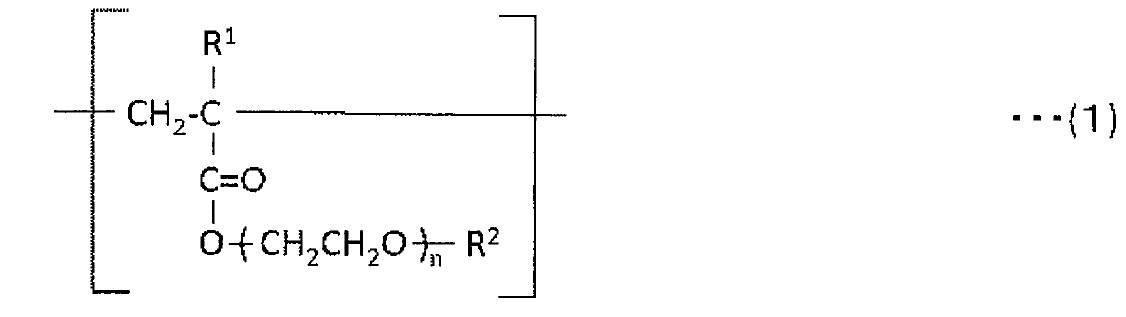
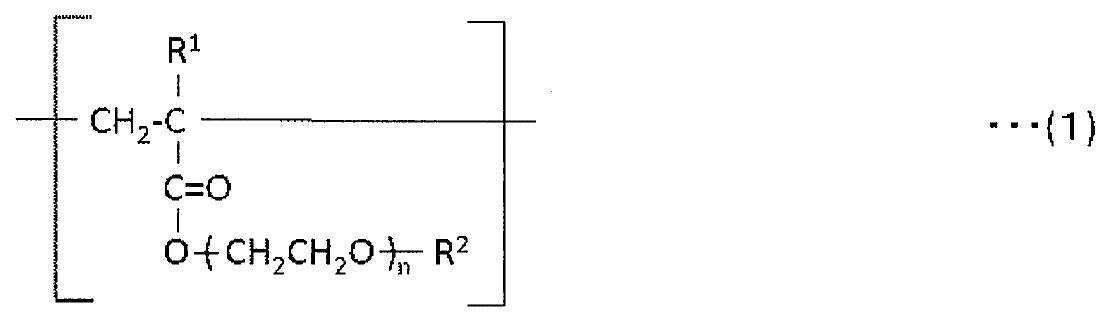
- [1] A water-soluble acrylic polymer containing a repeating structural unit [A] represented by the following formula (1), having a number average molecular weight of 5,000 to 250,000 and an LCST of 25 to 45 ° C.
- [R 1 is a hydrogen atom or a methyl group
- R 2 is a methyl group or an ethyl group
- n is an average addition mole number of an oxyalkylene group of 2 to 3.
- [2] A protein adsorption inhibitor coating solution containing the protein adsorption inhibitor of [1] above and water.
- a base material provided with a coating layer of the protein adsorption inhibitor according to [1] on the surface.
- a method for inhibiting protein adsorption comprising forming a coating layer on the surface of the substrate by P) and inhibiting adsorption of the protein to the substrate.
- a water-soluble acrylic polymer (P) containing P) and having an LCST of 25 to 45 ° C. is supplied to the surface of the substrate to form a coating layer of the water-soluble acrylic polymer (P) on the surface of the substrate.
- R 1 is a hydrogen atom or a methyl group
- R 2 is a methyl group or an ethyl group
- n is an average addition mole number of an oxyalkylene group of 2 to 3.
- the protein adsorption inhibitor according to the present invention By removing the aqueous solution or the like in which the protein adsorption inhibitor according to the present invention is dissolved in contact with the solid surface of the substrate at a predetermined temperature, proteins such as antibodies and enzymes are non-specific on the solid surface of the substrate. Adsorption is suppressed at a high level. Furthermore, even when various washings are performed after removing the aqueous solution or the like by bringing it into contact with the solid phase surface of the base material, a protein adsorption inhibitor having improved washing resistance is provided.
- the protein adsorption inhibitor of the present invention is a chemically synthesized product, the protein adsorption inhibitor containing it as an active ingredient is concerned with problems such as differences between lots or biological contamination of biological protein adsorption inhibitors. It exhibits protein adsorption inhibition ability safely and stably.
- FIG. 1 is a diagram showing the protein adsorption inhibiting effect of a substrate provided with the coating layer of the protein adsorption inhibitor of Example 1 on the surface.
- the protein adsorption inhibitor of the present invention contains a water-soluble acrylic polymer (P) as an active ingredient.
- the water-soluble acrylic polymer (P) used in the present invention includes a repeating structural unit [A] represented by the following formula (1), and the repeating unit [A] is represented by the following formula (2). Obtained by polymerization of the monomer.
- R 1 is a hydrogen atom or a methyl group, preferably a methyl group.
- R 2 is a methyl group or an ethyl group, preferably a methyl group.
- the water-soluble acrylic polymer (P) used in the present invention is selected (co) polymerized by selecting one or more of the monomers represented by the formula (2), and the LCST is 25 to 45 ° C. To be.
- the LCST range is preferably 30 to 45 ° C, more preferably 33 to 43 ° C.
- the LCST design of the copolymer can be estimated from the weighted average value of the homopolymer, and the required monomer blending ratio can be estimated.
- LCST (lower critical shared temperature) in the present invention refers to a temperature at which the transmittance at a wavelength of 500 nm is 50% when a 1% by mass aqueous solution is heated at a heating rate of 1 ° C./min.
- other comonomers can be used in combination.
- intermediate water is a water molecule exhibiting a specific behavior, and is considered to exist in a material exhibiting biocompatibility according to recent research, for example, as a result of the following observation. For example, a differential scan of the endothermic amount observed when a sample containing water in PMEA (poly (2-methoxyethyl acrylate)) is cooled to ⁇ 100 ° C. and then heated at a rate of 2.5 ° C./min.
- PMEA poly (2-methoxyethyl acrylate
- a predetermined heat generation occurs in a specific temperature range of 0 ° C. or less (eg, around ⁇ 40 ° C.), and endotherm is observed in a wide temperature range from around ⁇ 10 ° C. to 0 ° C. Due to various studies, heat generation near ⁇ 40 ° C. is due to the regularization of some of the water molecules contained in PMEA, and the endotherm from around ⁇ 10 ° C. to 0 ° C. In this way, water molecules that exhibit behavior that does not occur in water alone are present in the water-containing PMEA, and this behavior is exhibited. Water is called “intermediate water” It is.
- intermediate water is a biologically derived biocompatible material, such as biologically derived polysaccharides such as hyaluronic acid, heparin, gelatin, proteins such as albumin, nucleic acids such as DNA and RNA, and artificially synthesized materials. It is becoming clear that it is contained in substances having excellent biocompatibility, such as being contained in PEG. Thus, “intermediate water” is considered to be closely related to the development of biocompatibility in substances. The reason why “intermediate water” is generated in the substance is not clear, but it is the result of the interaction between the polymer chain with high molecular mobility in the substance and the water molecule with a specific intermolecular force. It is thought that there is. In biocompatible materials, the presence of intermediate water between the surface of the material and the hydration shell of the biological component prevents the direct contact between the two and suppresses foreign body reaction. .
- LCST is a phase transition temperature similar to a so-called cloud point, and is a temperature at which a polymer such as polyalkylene glycol (meth) acrylate causes a coil-globule transition in an aqueous solution. That is, at a temperature lower than the LCST, the hydrophilicity of the polymer increases and is soluble in water, but the polymer under the temperature exceeding the LCST increases in hydrophobicity and becomes insoluble in water.
- the polyalkylene glycol (meth) acrylate according to the present invention is a polymer that has been known to exhibit predetermined biocompatibility.
- the polyalkylene glycol (meth) acrylate functions as a high-performance protein adsorption inhibitor by using a composition having a specific LCST value. That is, by removing an aqueous solution or the like in which the protein adsorption inhibitor according to the present invention is dissolved at a temperature equal to or lower than the LCST of the protein adsorption inhibitor to contact with the solid phase surface of the substrate to be treated, It was revealed that non-specific adsorption of proteins such as enzymes to the solid surface of the substrate can be suppressed at a high level.
- the specific polyalkylene glycol (meth) acrylate of the present composition is water-soluble at the LCST temperature, but particularly in the temperature range immediately below the LCST. It has a driving force for precipitation, and when the aqueous solution comes into contact with the solid surface, the polymer precipitates in a form such as adsorption to the surface, and as a result, a coating that inhibits nonspecific adsorption of proteins is formed. It is thought to form. That is, according to the present invention, it is possible to realize an excellent protein adsorption inhibitor capable of preventing nonspecific adsorption of a protein to a substrate by a film formed of a polymer containing intermediate water.
- the protein adsorption inhibitor is preferably a transparent and uniform solution when used. Because it is transparent, it does not interfere with optical detection even when a protein adsorption inhibitor is contained in the liquid to be evaluated. Also, since the protein adsorption inhibitor is a homogeneous solution, This is because the coating can be easily made uniform, that is, the thickness of the coating can be made uniform. On the other hand, when a protein adsorption inhibitor is used as an opaque solution, a cloudy solution enters the evaluation system, which may harm the detection and evaluation of the in vitro diagnostic agent in the optical system, and the resulting coating becomes non-uniform, and the ability to suppress protein adsorption may vary.
- the protein adsorption inhibitor of the present invention contains a water-soluble acrylic polymer (P) having an LCST of 25 to 45 ° C. as an active ingredient, it can be easily transparent and uniform even when used at room temperature without heating. It is also excellent in that it can be.
- P water-soluble acrylic polymer
- the water-soluble acrylic polymer (P) used in the present invention has a number average molecular weight of 5,000 to 250,000, preferably 6,000 to 1,000,000, more preferably 7,000 to 200,000. It is. If the number average molecular weight is too low, the ability to suppress the adsorption of protein molecules will not be sufficient, and if it is too high, the water solubility will decrease, so the effects of the present invention may not be exhibited.
- the value of the water-soluble acrylic polymer (P) polydispersity (Mw / Mn) is preferably 1.0 to 5.0, more preferably 1.0 to 4.4.
- any of random copolymer, block copolymer, and graft copolymer may be used, and the copolymerization reaction for producing the copolymer is not particularly limited, and includes free radical polymerization, ionic polymerization, It can be used by a known synthesis method such as coordinate polymerization or ring-opening polymerization.
- a water-soluble acrylic polymer (P) can be obtained by polymerizing a monomer in an inert gas atmosphere such as nitrogen gas or argon gas.
- Examples of the organic solvent used in the polymerization of the monomer include alcohols such as methyl alcohol, ethyl alcohol, isopropyl alcohol, ethylene glycol, and propylene glycol; ketones such as acetone and methyl ethyl ketone; diethyl ether and tetrahydrofuran. Ethers such as benzene, toluene and xylene, and acetates such as methyl acetate and ethyl acetate, but are not limited thereto.
- the concentration of the monomer in the monomer solution used in the solution polymerization method is not particularly limited, but is preferably about 10 to 80% by mass in consideration of the operability and efficiency of polymerization.
- the polymerization initiator used above is not particularly limited.
- azobisisobutyronitrile hereinafter abbreviated as “AIBN”
- AIBN azobisisobutyronitrile
- azoisobutyronitrile azoisobutyric acid methyl
- azobisdimethylvaleronitrile peroxide
- peroxide Light of azo polymerization initiators and peroxide polymerization initiators such as benzoyl, potassium persulfate and ammonium persulfate, benzophenone derivatives, phosphine oxide derivatives, benzoketone derivatives, phenylthioether derivatives, azide derivatives, diazo derivatives, disulfide derivatives, etc.
- An initiator etc. are mentioned.
- the amount of the polymerization initiator is not particularly limited, but usually it is preferably about 0.01 to 5 parts by mass with respect to 100 parts by mass of the monomer.
- the polymer obtained by polymerization can be used after diluting and dissolving in an aqueous medium as it is, but it is preferable to carry out purification to remove impurities.
- Known methods can be applied for purification. Specifically, a precipitation purification method in which a 10 to 80% by mass solution of a polymer in a good solvent is mixed with a 5 to 50 times poor solvent, and the good solvent solution of the polymer is compatible with the monomer.
- an adsorption treatment method in which a monomer is separated by contacting with a certain adsorbent, and a membrane separation purification method of a monomer utilizing size separation by membrane separation of a good solvent solution of a polymer.
- the protein adsorption inhibitor of the present invention is, for example, a protein, polypeptide, steroid, lipid, hormone, etc., more specifically, an enzyme reaction using various antigens, antibodies, receptors, enzymes, or the like, or an immunoglobulin antigen-antibody reaction It can be used in an immunological measurement method for measuring using Specifically, known radioimmunoassay (RIA), enzyme immunoassay (EIA), fluorescence immunoassay (FIA), latex turbidimetry, etc., particularly preferably enzyme immunoassay (EIA), fluorescence immunity It can be applied to measurement methods (FIA), latex turbidimetry, Western blotting, etc.
- RIA radioimmunoassay
- EIA enzyme immunoassay
- FIA fluorescence immunoassay
- EIA enzyme immunoassay
- FSA fluorescence immunity
- antibodies or antigens are bound to the solid phase surface, and then the antibody on the solid phase surface Alternatively, protein adsorption is suppressed by treating the solid surface to which no antigen is bound with the protein adsorption inhibitor of the present invention.
- the solvent for dissolving the protein adsorption inhibitor for obtaining the protein adsorption inhibitor coating solution of the present invention is not only purified water, pure water, ion-exchanged water, but also a buffer that can be used in an immunological measurement method. Any liquid can be used. For example, phosphate buffer, acetate buffer, carbonate buffer, citrate buffer, Tris buffer, HEPES buffer, physiological saline, and the like can be used.
- the protein adsorption inhibitor contained in the protein adsorption inhibitor coating solution is preferably 0.01% by mass or more, and more preferably 0.1% by mass or more.
- the upper limit is not particularly limited as long as it dissolves in water as the main solvent, but is, for example, 20% by mass or less, preferably 10% by mass or less. This is because an effective protein adsorption suppressing effect can be obtained within these ranges.
- a compound which can be contained in a protein adsorption inhibitor coating solution other than the protein adsorption inhibitor of the present invention the following compounds can be exemplified. That is, other reagents ordinarily used in this field, such as saccharides, salts, and surfactants. For example, as sugars, lactose, sucrose, trehalose and the like can be mentioned.
- the salts include amino acids such as glycine, alanine, serine, threonine, glutamic acid, aspartic acid, glutamine, asparagine, lysine, histidine and the like, peptides such as glycylglycine, phosphate, borate, sulfate
- examples thereof include inorganic salts such as salts, tris salts, sodium chloride and potassium chloride, flavins, organic acids such as acetic acid, citric acid, malic acid, maleic acid and gluconic acid, and salts of organic acids.
- the surfactant include polyoxyethylene sorbitan fatty acid ester and polyoxyethylene alkyl ether.
- examples of compounds that can be contained in the coating solution of the protein adsorption inhibitor include water-soluble polymers such as MPC (2-methacryloyloxyethyl phosphorylcholine) polymer and polyvinyl alcohol.
- the material of the base material used in the present invention is not particularly limited, but for example, polystyrene, polyvinyl chloride, polypropylene, acrylic resin, polymethyl methacrylate, polycarbonate, glass, metal, ceramic, silicon rubber, polyvinylidene fluoride, Examples thereof include nylon and nitrocellulose. Among these, polystyrene and polyvinylidene fluoride are preferable, and polystyrene is particularly preferable.
- the shape of the substrate is not particularly limited, but specific examples include a film (film) shape, a plate shape, a particle shape, and a test tube shape, a vial shape, a flask shape, and the like. can do.
- Examples of the method for forming a protein adsorption inhibitor coating layer on these substrates include the following methods. That is, the substrate is immersed in a protein adsorption inhibitor coating solution prepared by dissolving the protein adsorption inhibitor of the present invention in water or a solvent in which water and methanol, ethanol, and isopropanol are mixed at any ratio. Then, it can be dried at room temperature or by heating. Thereby, the coating layer is formed.
- the concentration of the protein adsorption inhibitor is preferably 0.1 to 5.0% by mass, more preferably 1.0 to 3%. 0.0% by mass.
- the solvent for diluting the protein adsorption inhibitor of the present invention is preferably water or a water / alcohol mixed solvent, more preferably water.
- the protein adsorption inhibitor of the present invention As described above, by supplying a coating layer of the adsorption inhibitor on the substrate by supplying it to the surface of the substrate, the protein adsorption to the substrate during various measurements is performed.
- a method of suppressing adsorption is one form of use. That is, the water-soluble acrylic polymer (P) used in the present invention is adsorbed as the coating layer on the solid phase surface of a substrate such as an immune reaction container or a measurement instrument, so that the protein is deposited on the solid phase surface. It suppresses adsorbing.
- the reagent of the present invention is used in various measurements.
- the method of adding a protein adsorption inhibitor is mentioned. That is, it is a method of forming a coating layer of the adsorption inhibitor on the substrate as one step of various measurements.
- the protein adsorption inhibitor of this invention can also be added and used for all the reagents and solutions at the time of measuring.
- the concentration of the protein adsorption inhibitor in each reagent and solution is preferably 0.0125 to 5.0% by mass, more preferably 0.1 to 5.0% by mass.
- the protein adsorption inhibitor is added before adding a protein-containing sample such as serum, labeled antibody, or labeled antigen as the measurement target.
- a protein or the like that can bind to a target component contained in a sample such as an antibody or an antigen is first bound to a fixed surface of a substrate such as the above-described immune reaction container or measurement instrument, and then the protein adsorption of the present invention is performed.
- This is a method of treating with an inhibitor.
- the protein binding inhibitor of the present invention is physically or chemically adsorbed to a protein that binds to the target component, for example, a substance that reacts with the measurement target, on the plate. It is the method of processing with.
- the adsorption inhibitor of the present application is adsorbed to suppress adsorption of proteins to the plate surface on which the substance that binds to the measurement object is not adsorbed. It is a method to make it. As a result, a solid surface having a protein adsorption inhibiting effect can be obtained.
- the base material of the same kind and shape as the above-mentioned "base material provided with a coating layer of a protein adsorption inhibitor on its surface" can be exemplified.
- LCST lower critical shared temperature in the present invention refers to a temperature at which the transmittance at a wavelength of 500 nm is 50% when a 1% by mass aqueous solution is heated at a rate of temperature increase of 1 ° C./min. .
- the LCST measurement was performed using a UV-visible spectrophotometer V-650 manufactured by JASCO Corporation.
- ⁇ Synthesis Example 2> ⁇ Synthesis of ethoxytriethylene glycol monoacrylate homopolymer> The same procedure as in Synthesis Example 1 was performed except that ethoxytriethylene glycol monoacrylate was used as a raw material. It was confirmed by 1 H-NMR measurement that it was an ethoxytriethylene glycol monoacrylate homopolymer. The number average molecular weight (Mn) was 14,000 and the LCST was 33.8 ° C.
- the number average molecular weight (Mn) was 7,000 and the LCST was 37.2 ° C.
- ⁇ Synthesis Example 7> ⁇ Synthesis of methoxydiethylene glycol monomethacrylate-methoxytriethylene glycol monoacrylate copolymer (50/50, low molecular weight)> The same procedure as in Synthesis Example 1 was performed except that 3.5 g of methoxydiethylene glycol monomethacrylate and 4.0 g of methoxytriethylene glycol monoacrylate were used as raw materials, for a total of 7.5 g and 30 mg of initiator.
- the number average molecular weight (Mn) was 17,000, and the LCST was 37.2 ° C.
- the number average molecular weight (Mn) was 4,000 and the LCST was 52.0 ° C.
- Example 1 ⁇ Preparation of protein adsorption inhibiting solution>
- the polymer of Synthesis Example 1 was mixed in Dulbecco's phosphate buffer solution (manufactured by Sigma-Aldrich, hereinafter abbreviated as D-PBS) so as to be 0.1% by mass, and stirred and dissolved in a vortex mixer for 1 hour to adsorb protein. An inhibitor coating solution was obtained. The coating solution was transparent at room temperature, and it was considered that the whole amount of the charged polymer was dissolved.
- D-PBS Dulbecco's phosphate buffer solution
- the effect of the protein adsorption inhibitor according to the present invention will be described based on the schematic diagram of FIG.
- a sample to be measured such as the antigen 14 is adsorbed to the antibody 16 on the left side of FIG.
- the protein adsorption inhibitor 18 exerts an adsorption inhibiting effect, it is considered that adsorption of a specimen such as the antigen 14 is prevented like the antibody 16 on the right side of FIG.
- the protein adsorption inhibitor of the present invention as shown on the right side of FIG. 1, adsorption of the specimen to the antibody 16 is effectively suppressed.
- the washing resistance of the protein adsorption inhibitor coating solution was evaluated based on the “difference in protein adsorption rate” between “when not washed” and “after washing”. It can be said that the adsorption inhibitor having a small value of “difference in protein adsorption rate” ( ⁇ %) was well retained on the surface of the base material even after being washed, and can be said to exhibit good washing resistance.
- Example 2-7 A protein adsorption inhibitor coating solution was prepared in the same manner as in Example 1 except that the polymer was used. Each coating solution was transparent at room temperature, and it was considered that the total amount of each charged polymer was dissolved. Furthermore, the protein adsorption inhibitory effect and washing resistance were evaluated in the same manner as in Example 1. The results are shown in Table 3.
- Example 8> The polymer of Synthesis Example 4 was mixed with Dulbecco's phosphate buffer solution (manufactured by Sigma-Aldrich, hereinafter abbreviated as D-PBS) so as to be 0.04% by mass, and stirred and dissolved in a vortex mixer for 1 hour to adsorb protein. An inhibitor coating solution was obtained. The coating solution was transparent at room temperature, and it was considered that the whole amount of the charged polymer was dissolved. Otherwise, the evaluation was performed in the same manner as in Example 1.
- D-PBS Dulbecco's phosphate buffer solution
- a solution was prepared in the same manner as in Example 1 except that the compounds of Comparative Synthesis Examples 1 to 5 were used instead of the polymer of Synthesis Example 1.
- the substrates treated with the protein adsorption inhibitor of the present invention were compared with the substrates treated with other oxyalkylene group-containing acrylic polymers (Comparative Examples 1 to 5). And has the ability to suppress nonspecific protein adsorption.
- Such a result is that when the acrylic polymer (P) according to the present invention is brought into contact with the aqueous solution, a coating layer of the acrylic polymer (P) is formed on the surface, and protein adsorption is suppressed by the coating layer. It is considered a thing.
- the protein adsorption inhibitor of each example has an overall "protein adsorption rate" value of "when not washed” and "after washing” as compared with the protein adsorption inhibitor of the comparative example. Since it was low, it was confirmed that the protein adsorption inhibitor of the present invention is excellent in nonspecific protein adsorption inhibiting ability. Furthermore, it was confirmed that the protein adsorption inhibitor of the present invention has excellent washing resistance. That is, in each Example of the present invention, the difference in protein adsorption rate from the unwashed case is also obtained after further washing after contacting the aqueous solution of the protein adsorption inhibitor with the substrate.
- washing resistance ( ⁇ %) is small, which indicates that the adsorption inhibitor was well retained on the surface of the substrate even after washing.
- the value of the washing resistance ( ⁇ %) was large, it was confirmed that the adsorption inhibitor was easily detached from the surface of the substrate by washing.
- the substrate provided with the coating layers shown in Examples 4, 5, 7, and 8 on the surface had a protein adsorption inhibiting ability and washing resistance more predominately.
- BSA whose results are shown in Table 4 is known to be excellent in protein adsorption inhibitor and washing resistance.
- the protein adsorption inhibitors of the respective examples are substantially equivalent in adsorption inhibition effect and have higher durability cleaning properties.
- the protein adsorption inhibitors of Examples 4, 5, 7, and 8 have better protein adsorption inhibition ability after washing than BSA as a reference example. As described above, it was confirmed that the stability of the analysis accuracy can be improved by using the protein adsorption inhibitor of the present invention.
- Immune reaction container 12 Wall surface of the immune reaction container 14: Antigen (specimen) 16: Antibody 18: Protein adsorption inhibitor
Landscapes
- Health & Medical Sciences (AREA)
- Chemical & Material Sciences (AREA)
- Life Sciences & Earth Sciences (AREA)
- Medicinal Chemistry (AREA)
- Immunology (AREA)
- Engineering & Computer Science (AREA)
- Chemical Kinetics & Catalysis (AREA)
- Polymers & Plastics (AREA)
- Organic Chemistry (AREA)
- Hematology (AREA)
- Molecular Biology (AREA)
- Urology & Nephrology (AREA)
- Biomedical Technology (AREA)
- Analytical Chemistry (AREA)
- Food Science & Technology (AREA)
- Physics & Mathematics (AREA)
- Biochemistry (AREA)
- General Health & Medical Sciences (AREA)
- General Physics & Mathematics (AREA)
- Pathology (AREA)
- Microbiology (AREA)
- Cell Biology (AREA)
- Biotechnology (AREA)
- Addition Polymer Or Copolymer, Post-Treatments, Or Chemical Modifications (AREA)
- Coating Of Shaped Articles Made Of Macromolecular Substances (AREA)
- Solid-Sorbent Or Filter-Aiding Compositions (AREA)
Abstract
Description
本発明は、蛋白質の非特異的な吸着抑制剤と吸着抑制の方法に関する。詳しくは、免疫反応容器や測定器具等の基材の固相表面に対する、検体中の不純物(蛋白質)の吸着等を防止することができ、かつ耐洗浄性の高い蛋白質吸着抑制剤、および蛋白質の吸着抑制の方法、さらには該吸着抑制剤により処理された基材に関する。 The present invention relates to a non-specific adsorption inhibitor for proteins and a method for inhibiting adsorption. Specifically, a protein adsorption inhibitor that can prevent the adsorption of impurities (proteins) in a sample to the solid phase surface of a substrate such as an immune reaction container or a measurement instrument, and has a high washing resistance, and a protein The present invention also relates to a method for suppressing adsorption, and further to a substrate treated with the adsorption inhibitor.
疾病の早期発見のために、臨床検査、診断薬の分野において、免疫反応を利用した測定方法が広く行われている。その中で検査の高感度化が求められており、臨床検査、診断薬の感度向上は大きな課題となっている。高感度化のため、検出方式がペルオキシダーゼやアルカリフォスファターゼといった酵素反応を用いる方法から、蛍光や化学発光を用いる方法へと切り替えられつつある。検出方式を蛍光や化学発光とすることで、理論的には検査対象物質1分子の存在を確認できるといわれているが、実際には目的とする感度を得ることができていない。
免疫反応を利用して測定する際の検出感度を左右する要因の一つとして、測定対象となる抗体、抗原若しくは測定に利用するこれらの標識体の、免疫反応容器や測定器具等の基材の固相表面への非特異的な吸着が挙げられる。また、検体として血清、血漿、細胞抽出物および尿といった複数種の生体分子が共存する物質を用いた場合、各種蛋白質を代表する不特定多数の共存物質が免疫反応容器や測定器具等の基材の固相表面へ非特異的に吸着することによるノイズの発生も、高感度化を妨げる要因となっている。
For early detection of diseases, measurement methods using immune reactions are widely used in the fields of clinical tests and diagnostic agents. In such a situation, it is demanded to increase the sensitivity of the test, and the improvement of the sensitivity of the clinical test and the diagnostic agent is a big problem. In order to increase sensitivity, the detection method is being switched from a method using an enzyme reaction such as peroxidase or alkaline phosphatase to a method using fluorescence or chemiluminescence. Theoretically, it is said that the presence of one molecule to be inspected can be confirmed by using fluorescence or chemiluminescence as a detection method, but in reality, the desired sensitivity cannot be obtained.
As one of the factors that influence the detection sensitivity when measuring using an immune reaction, the antibody to be measured, the antigen, or the label of these labels used for measurement, such as the substrate of an immune reaction container or measuring instrument Non-specific adsorption to the solid surface is mentioned. In addition, when a substance that coexists with multiple types of biomolecules such as serum, plasma, cell extract and urine is used as a specimen, an unspecified number of coexisting substances representing various proteins are used as a base material for immune reaction containers and measuring instruments. Generation of noise due to non-specific adsorption to the solid phase surface is also a factor preventing high sensitivity.
これらの非特異的な吸着を防止するために、非特許文献1と特許文献1に示されるように、従来から免疫反応に関与しないウシ血清アルブミン、カゼイン、ゼラチンといった生物由来の蛋白質を緩衝剤で溶液とした処理液を用いて、免疫反応容器や測定器具等の基材の固定表面に生物由来の蛋白質を吸着させることにより、免疫反応に関与する蛋白質の非特異的な吸着を抑制する方法が用いられている。さらには化学合成品を主成分とする蛋白質吸着抑制剤として、特許文献2は2-メタクリロイルオキシエチルホスホリルコリン重合体を、特許文献3はグリコシルエチル(メタ)アクリレートを、特許文献4はオキシアルキレン基含有アクリル系重合体を用いる方法を、それぞれ開示している。これらの方法は、免疫反応容器や測定器具等の固相表面へ、蛋白質吸着抑制剤としての化学合成品を物理吸着させることにより、効果を発現させている。 In order to prevent such non-specific adsorption, as shown in Non-Patent Document 1 and Patent Document 1, biologically-derived proteins such as bovine serum albumin, casein, and gelatin that have not been involved in an immune reaction are conventionally used as a buffer. There is a method for suppressing non-specific adsorption of proteins involved in immune reactions by adsorbing biologically-derived proteins on a fixed surface of a substrate such as an immune reaction container or measuring instrument using a treatment solution as a solution. It is used. Furthermore, as a protein adsorption inhibitor mainly composed of a chemically synthesized product, Patent Document 2 contains 2-methacryloyloxyethyl phosphorylcholine polymer, Patent Document 3 contains glycosylethyl (meth) acrylate, and Patent Document 4 contains an oxyalkylene group. Each method using an acrylic polymer is disclosed. In these methods, a chemical synthetic product as a protein adsorption inhibitor is physically adsorbed on a solid phase surface such as an immune reaction container or a measuring instrument, thereby producing an effect.
しかしながら、上述の従来の技術に基づく非特異吸着抑制剤の程度の吸着抑制能では、高感度化測定においては未だ非特異的に吸着することによるノイズの発生を抑えるには不十分である場合が多い。これは非特異的吸着抑制剤の機能が未だ不十分であるのみならず、非特異的吸着処理後に、緩衝溶液や活性剤水溶液を用いて行う洗浄工程において、非特異的吸着抑制剤が容易に脱離してしまい、したがって後工程において非特異的吸着抑制能を十分に発揮するための非特異的吸着抑制剤が反応容器内に残存しないためでもある。 However, the adsorption suppression ability of the level of the non-specific adsorption inhibitor based on the above-described conventional technology may still be insufficient to suppress the generation of noise due to non-specific adsorption in the high sensitivity measurement. Many. This is not only because the function of the nonspecific adsorption inhibitor is still insufficient, but the nonspecific adsorption inhibitor can be easily removed in the washing process using a buffer solution or an aqueous activator solution after the nonspecific adsorption treatment. This is also because the non-specific adsorption inhibitor for fully exhibiting the non-specific adsorption inhibiting ability in the subsequent process does not remain in the reaction vessel.
また、血液などの体液または生体組織と接触して使用され、生体成分へのダメージを軽微にできる生体適合性材料が知られている(例えば特許文献5など)。しかしながら、このような生体適合性材料を、免疫反応容器や測定器具等の固相表面に適用したとしても、上述の吸着処理後の洗浄工程において固相表面から除去されてしまうという問題が生じ得る。 Also, biocompatible materials that are used in contact with bodily fluids such as blood or living tissue and can reduce damage to living body components are known (for example, Patent Document 5). However, even when such a biocompatible material is applied to a solid phase surface such as an immune reaction container or a measuring instrument, there may be a problem that the biocompatible material is removed from the solid phase surface in the washing step after the above-described adsorption treatment. .
上記の通り、本発明の課題は、抗体や酵素といった蛋白質が免疫反応容器や測定器具等の基材の固相表面に非特異的に吸着することを高いレベルで抑制し、さらに耐洗浄性を向上させる蛋白吸着抑制剤を提供することにある。 As described above, the object of the present invention is to suppress, at a high level, nonspecific adsorption of a protein such as an antibody or an enzyme to the solid phase surface of a substrate such as an immune reaction container or a measurement instrument, and further improve the washing resistance. It is in providing the protein adsorption inhibitor which improves.
本発明者らは、上記課題に鑑み鋭意検討した結果、特定範囲の下限臨界共有温度(以下、「LCST」と略記する)を有し、かつ特定鎖長のポリオキシエチレン鎖を有する(メタ)アクリレート共重合体が上記課題を解決することの知見を見出し、本発明を完成するに至った。
すなわち、本発明は次の〔1〕~〔5〕を含む。
〔1〕下記の式(1)で表される繰り返し構成単位[A]を含み、数平均分子量が5,000~250,000であり、LCSTが25~45℃である水溶性アクリル重合体(P)を有効成分として含有する、蛋白質吸着抑制剤。
As a result of intensive studies in view of the above problems, the present inventors have a specific range of lower critical shared temperature (hereinafter abbreviated as “LCST”) and a polyoxyethylene chain having a specific chain length (meth). The inventors have found that an acrylate copolymer can solve the above problems, and have completed the present invention.
That is, the present invention includes the following [1] to [5].
[1] A water-soluble acrylic polymer containing a repeating structural unit [A] represented by the following formula (1), having a number average molecular weight of 5,000 to 250,000 and an LCST of 25 to 45 ° C. A protein adsorption inhibitor containing P) as an active ingredient.

[R1は水素原子またはメチル基であり、R2はメチル基またはエチル基であり、nはオキシアルキレン基の平均付加モル数で2~3である。]
〔2〕前記の〔1〕に記載の蛋白質吸着抑制剤と水とを含有する蛋白質吸着抑制剤塗布液。
〔3〕前記の〔1〕に記載の蛋白質吸着抑制剤の被覆層を表面に備えた基材。
〔4〕下記の式(1)で表される繰り返し構成単位[A]を含み、数平均分子量が5,000~250,000であり、LCSTが25~45℃である水溶性アクリル重合体(P)により、基材表面に被覆層を形成して前記基材への蛋白質の吸着を抑制する、蛋白質吸着抑制の方法。
[R 1 is a hydrogen atom or a methyl group, R 2 is a methyl group or an ethyl group, and n is an average addition mole number of an oxyalkylene group of 2 to 3. ]
[2] A protein adsorption inhibitor coating solution containing the protein adsorption inhibitor of [1] above and water.
[3] A base material provided with a coating layer of the protein adsorption inhibitor according to [1] on the surface.
[4] A water-soluble acrylic polymer containing a repeating structural unit [A] represented by the following formula (1), having a number average molecular weight of 5,000 to 250,000 and an LCST of 25 to 45 ° C. A method for inhibiting protein adsorption, comprising forming a coating layer on the surface of the substrate by P) and inhibiting adsorption of the protein to the substrate.
[R1は水素原子またはメチル基であり、R2はメチル基またはエチル基であり、nはオキシアルキレン基の平均付加モル数で2~3である。]
〔5〕下記の式(1)で表される繰り返し構成単位[A]を含み、数平均分子量が5,000~250,000であり、LCSTが25~45℃である水溶性アクリル重合体(P)を含有し、LCSTが25~45℃である水溶性アクリル重合体(P)を、基材表面に供給し、該基材表面に水溶性アクリル重合体(P)の被覆層を形成させることによる、基材への蛋白質吸着抑制性を付与する方法。
[R 1 is a hydrogen atom or a methyl group, R 2 is a methyl group or an ethyl group, and n is an average addition mole number of an oxyalkylene group of 2 to 3. ]
[5] A water-soluble acrylic polymer containing a repeating structural unit [A] represented by the following formula (1), having a number average molecular weight of 5,000 to 250,000 and an LCST of 25 to 45 ° C. A water-soluble acrylic polymer (P) containing P) and having an LCST of 25 to 45 ° C. is supplied to the surface of the substrate to form a coating layer of the water-soluble acrylic polymer (P) on the surface of the substrate. The method of providing protein adsorption | suction inhibitory property to a base material by doing.
[R1は水素原子またはメチル基であり、R2はメチル基またはエチル基であり、nはオキシアルキレン基の平均付加モル数で2~3である。] [R 1 is a hydrogen atom or a methyl group, R 2 is a methyl group or an ethyl group, and n is an average addition mole number of an oxyalkylene group of 2 to 3. ]
[6]水溶性アクリル重合体(P)を含む蛋白質吸着抑制剤を、水溶性アクリル重合体(P)のLCST以下の温度で基材の表面に接触させることをさらに含む、前記の〔4〕に記載の蛋白吸着抑制の方法。 [6] The above [4], further comprising contacting the protein adsorption inhibitor containing the water-soluble acrylic polymer (P) with the surface of the substrate at a temperature equal to or lower than the LCST of the water-soluble acrylic polymer (P). The method for inhibiting protein adsorption according to claim 1.
[7]水溶性アクリル重合体(P)を含む蛋白質吸着抑制剤を、水溶性アクリル重合体(P)のLCST以下の温度で基材の表面に接触させることをさらに含む、前記の〔5〕に記載の蛋白質吸着抑制性を付与する方法。 [7] The above [5], further comprising bringing a protein adsorption inhibitor containing the water-soluble acrylic polymer (P) into contact with the surface of the substrate at a temperature equal to or lower than the LCST of the water-soluble acrylic polymer (P). A method for imparting the protein adsorption-suppressing property described in 1.
本発明に係る蛋白質吸着抑制剤を溶解した水溶液等を、所定の温度で基材の固相表面に接触させて除去することによって、抗体や酵素といった蛋白質が当該基材の固相表面に非特異的に吸着することが高いレベルで抑制される。さらに、上記水溶液等を基材の固相表面に接触させて除去した後に各種洗浄を行った場合にも当該効果が維持され、耐洗浄性を向上させた蛋白吸着抑制剤が提供される。また、本発明の蛋白質吸着抑制剤は化学合成品であるため、それを有効成分として含有する蛋白質吸着抑制剤は、生物由来の蛋白質吸着抑制剤が有するロット間差や生物汚染などといった問題の懸念が無く、安全かつ安定的に蛋白質吸着抑制能を発揮する。 By removing the aqueous solution or the like in which the protein adsorption inhibitor according to the present invention is dissolved in contact with the solid surface of the substrate at a predetermined temperature, proteins such as antibodies and enzymes are non-specific on the solid surface of the substrate. Adsorption is suppressed at a high level. Furthermore, even when various washings are performed after removing the aqueous solution or the like by bringing it into contact with the solid phase surface of the base material, a protein adsorption inhibitor having improved washing resistance is provided. In addition, since the protein adsorption inhibitor of the present invention is a chemically synthesized product, the protein adsorption inhibitor containing it as an active ingredient is concerned with problems such as differences between lots or biological contamination of biological protein adsorption inhibitors. It exhibits protein adsorption inhibition ability safely and stably.
以下、本発明をさらに詳細に説明する。
本発明の蛋白質吸着抑制剤は、水溶性アクリル重合体(P)を有効成分として含有する。
(水溶性アクリル重合体(P))
本発明に用いる水溶性アクリル重合体(P)は、下記の式(1)で表される繰り返し構成単位[A]を含み、該繰り返し単位[A]は、下記の式(2)で表される単量体の重合によって得られる。
Hereinafter, the present invention will be described in more detail.
The protein adsorption inhibitor of the present invention contains a water-soluble acrylic polymer (P) as an active ingredient.
(Water-soluble acrylic polymer (P))
The water-soluble acrylic polymer (P) used in the present invention includes a repeating structural unit [A] represented by the following formula (1), and the repeating unit [A] is represented by the following formula (2). Obtained by polymerization of the monomer.


式(1)、(2)において、R1は水素原子またはメチル基であり、好ましくはメチル基である。また、R2はメチル基またはエチル基であり、好ましくはメチル基である。nはオキシアルキレン基の平均付加モル数でありm=2~3であり、好ましくは2である。
式(2)で表される単量体としては具体的には、メチルジエチレングリコールアクリレート(R1=H、n=2、R2=CH3)、エチルトリエチレングリコールアクリレート(R1=H、n=3、R2=C2H5)、メチルジエチレングリコールメタクリレート(R1=CH3、n=2、R2=CH3)、メチルトリエチレングリコールメタクリレート(R1=CH3、n=3、R2=CH3)、メチルトリエチレングリコールアクリレート(R1=H、n=3、R2=CH3)等が挙げられる。これらの中では、メチルジエチレングリコールメタクリレート(R1=CH3、n=2、R2=CH3)が好ましく挙げられる。
In the formulas (1) and (2), R 1 is a hydrogen atom or a methyl group, preferably a methyl group. R 2 is a methyl group or an ethyl group, preferably a methyl group. n is the average number of added moles of the oxyalkylene group, m = 2 to 3, and preferably 2.
Specific examples of the monomer represented by the formula (2) include methyldiethylene glycol acrylate (R 1 = H, n = 2, R 2 = CH 3 ), ethyl triethylene glycol acrylate (R 1 = H, n = 3, R 2 = C 2 H 5 ), methyl diethylene glycol methacrylate (R 1 = CH 3 , n = 2, R 2 = CH 3 ), methyl triethylene glycol methacrylate (R 1 = CH 3 , n = 3, R 2 = CH 3 ), methyltriethylene glycol acrylate (R 1 = H, n = 3, R 2 = CH 3 ) and the like. Among these, methyldiethylene glycol methacrylate (R 1 = CH 3 , n = 2, R 2 = CH 3 ) is preferable.
本発明に用いる水溶性アクリル重合体(P)は、これらの式(2)で表される単量体の1種以上を選択して(共)重合して、そのLCSTが25~45℃になるようにする。このLCSTの範囲は、好ましくは30~45℃、より好ましくは33~43℃である。共重合体のLCSTの設計は、単独重合体の加重平均値から予測して、所要の単量体配合比率を見積もることができる。
なお、本発明におけるLCST(下限臨界共有温度)は、1質量%水溶液を昇温速度1℃/minで昇温したときの、波長500nmにおける透過率が50%となる温度をいう。
また、水溶性アクリル重合体(P)において、繰り返し構成単位[A]以外の繰り返し単位として、他のコモノマーを組み合わせて用いることもできる。
The water-soluble acrylic polymer (P) used in the present invention is selected (co) polymerized by selecting one or more of the monomers represented by the formula (2), and the LCST is 25 to 45 ° C. To be. The LCST range is preferably 30 to 45 ° C, more preferably 33 to 43 ° C. The LCST design of the copolymer can be estimated from the weighted average value of the homopolymer, and the required monomer blending ratio can be estimated.
In addition, LCST (lower critical shared temperature) in the present invention refers to a temperature at which the transmittance at a wavelength of 500 nm is 50% when a 1% by mass aqueous solution is heated at a heating rate of 1 ° C./min.
Further, in the water-soluble acrylic polymer (P), as a repeating unit other than the repeating structural unit [A], other comonomers can be used in combination.
一般にポリアルキレングリコール(メタ)アクリレートは、中間水を有していて蛋白質を吸着し難いことが知られている。しかし同時に、中間水の存在は基材への吸着にも影響を及ぼす。
なお、上述の「中間水」とは、特有の挙動を示す水分子であり、最近の研究により、例えば以下の観察の結果などにより、生体適合性を示す材料中において存在すると考えられている。例えば、PMEA(ポリ(2-メトキシエチルアクリレート)に水を含水した試料を-100℃まで冷却した後、毎分2.5℃の割合で昇温した際に観察される吸発熱量を示差走査熱量計(DSC)により測定すると、0℃以下の特定の温度域(例えば、-40℃近辺)において所定の発熱を生じると共に、-10℃近辺から0℃までの広い温度範囲において吸熱が観察される。さまざまな検討により、-40℃近辺での発熱はPMEAに含まれる水分子の一部が規則化したことに伴うものであり、-10℃近辺から0℃での吸熱は、その水分子が再び不規則化したことに伴うものであることが明らかになっており、このように、含水したPMEA中には水単体では生じない挙動を示す水分子が存在し、このような挙動を示す水が「中間水」と呼ばれている。
このような「中間水」は、生体由来のヒアルロン酸、へパリンなどの多糖類やゼラチン、アルブミンなどのタンパク質等やDNAやRNAなどの核酸、人工的に合成された生体適合性材料である上記PEGにも含まれるなど、生体適合性に優れる物質に含有されることが明らかになってきつつある。このように、「中間水」は物質における生体適合性の発現と密接に関連していると考えられている。
物質内に「中間水」が生成される理由は明らかでないが、物質内の高い分子運動性を有する高分子鎖と、水分子とが特定の分子間力で相互作用を生じる結果として生じるものであると考えられている。そして、生体適合性材料においては、材料表面と生体成分の水和殻の間に中間水が存在することで両者が直接触れることが阻害され、生体の異物反応が抑制されると考えられている。
Generally, it is known that polyalkylene glycol (meth) acrylate has intermediate water and hardly adsorbs proteins. At the same time, however, the presence of intermediate water also affects the adsorption to the substrate.
The above-mentioned “intermediate water” is a water molecule exhibiting a specific behavior, and is considered to exist in a material exhibiting biocompatibility according to recent research, for example, as a result of the following observation. For example, a differential scan of the endothermic amount observed when a sample containing water in PMEA (poly (2-methoxyethyl acrylate)) is cooled to −100 ° C. and then heated at a rate of 2.5 ° C./min. When measured with a calorimeter (DSC), a predetermined heat generation occurs in a specific temperature range of 0 ° C. or less (eg, around −40 ° C.), and endotherm is observed in a wide temperature range from around −10 ° C. to 0 ° C. Due to various studies, heat generation near −40 ° C. is due to the regularization of some of the water molecules contained in PMEA, and the endotherm from around −10 ° C. to 0 ° C. In this way, water molecules that exhibit behavior that does not occur in water alone are present in the water-containing PMEA, and this behavior is exhibited. Water is called “intermediate water” It is.
Such “intermediate water” is a biologically derived biocompatible material, such as biologically derived polysaccharides such as hyaluronic acid, heparin, gelatin, proteins such as albumin, nucleic acids such as DNA and RNA, and artificially synthesized materials. It is becoming clear that it is contained in substances having excellent biocompatibility, such as being contained in PEG. Thus, “intermediate water” is considered to be closely related to the development of biocompatibility in substances.
The reason why “intermediate water” is generated in the substance is not clear, but it is the result of the interaction between the polymer chain with high molecular mobility in the substance and the water molecule with a specific intermolecular force. It is thought that there is. In biocompatible materials, the presence of intermediate water between the surface of the material and the hydration shell of the biological component prevents the direct contact between the two and suppresses foreign body reaction. .
また、LCSTとは、いわゆる曇点にも似た相転移温度であり、例えばポリアルキレングリコール(メタ)アクリレート等の高分子が、水溶液中でコイル・グロビュール転移を起こす温度のことである。すなわち、LCST以下の温度では、高分子の親水性が増して水に可溶であるが、LCSTを越えた温度下にある高分子は、疎水性が増し、水に不溶となる。
本発明に係るポリアルキレングリコール(メタ)アクリレートは、所定の生体適合性を示すことが知られていた高分子である。一方、当該ポリアルキレングリコール(メタ)アクリレートにおいて、特定のLCSTの値を有する組成を用いることによって、意外にも、高性能な蛋白質吸着抑制剤として機能することが本発明により明らかにされた。すなわち、本発明に係る蛋白質吸着抑制剤を溶解した水溶液等を、当該蛋白質吸着抑制剤のLCST以下の温度で被処理物である基材の固相表面に接触させて除去することによって、抗体や酵素といった蛋白質が当該基材の固相表面に非特異的に吸着することを高いレベルで抑制可能であることが明らかになった。さらに、上記水溶液等を基材の固相表面に接触させて除去した後に各種洗浄を行った場合にも当該効果が維持されることから、実際に各種の評価等を行うに際して各種の洗浄を行った場合にも蛋白質の非特異吸着を抑制可能である。このような現象を生じる作用機序については解明された訳ではないが、本願構成の特定のポリアルキレングリコール(メタ)アクリレートはLCSTの温度下で水溶性であるが、特にLCST直下の温度域では析出の駆動力を有しており、水溶液が固体表面に接触した際に、その表面への吸着等の形態で当該高分子が析出し、その結果として蛋白質の非特異的吸着を阻害する被膜を形成するものと考えられる。すなわち本発明によれば、中間水を含む高分子により形成された被膜により基材への蛋白質の非特異的吸着を防止可能な、優れた蛋白質吸着抑制剤を実現できる。
LCST is a phase transition temperature similar to a so-called cloud point, and is a temperature at which a polymer such as polyalkylene glycol (meth) acrylate causes a coil-globule transition in an aqueous solution. That is, at a temperature lower than the LCST, the hydrophilicity of the polymer increases and is soluble in water, but the polymer under the temperature exceeding the LCST increases in hydrophobicity and becomes insoluble in water.
The polyalkylene glycol (meth) acrylate according to the present invention is a polymer that has been known to exhibit predetermined biocompatibility. On the other hand, it was revealed by the present invention that the polyalkylene glycol (meth) acrylate functions as a high-performance protein adsorption inhibitor by using a composition having a specific LCST value. That is, by removing an aqueous solution or the like in which the protein adsorption inhibitor according to the present invention is dissolved at a temperature equal to or lower than the LCST of the protein adsorption inhibitor to contact with the solid phase surface of the substrate to be treated, It was revealed that non-specific adsorption of proteins such as enzymes to the solid surface of the substrate can be suppressed at a high level. Furthermore, when various washings are performed after removing the aqueous solution by bringing it into contact with the solid surface of the base material, the effects are maintained. In this case, nonspecific adsorption of protein can be suppressed. Although the mechanism of action causing such a phenomenon has not been elucidated, the specific polyalkylene glycol (meth) acrylate of the present composition is water-soluble at the LCST temperature, but particularly in the temperature range immediately below the LCST. It has a driving force for precipitation, and when the aqueous solution comes into contact with the solid surface, the polymer precipitates in a form such as adsorption to the surface, and as a result, a coating that inhibits nonspecific adsorption of proteins is formed. It is thought to form. That is, according to the present invention, it is possible to realize an excellent protein adsorption inhibitor capable of preventing nonspecific adsorption of a protein to a substrate by a film formed of a polymer containing intermediate water.
また、蛋白質吸着抑制剤は、使用時に透明で均一な溶液であることが好ましい。透明であることにより、評価対象の液体に蛋白質吸着抑制剤が含まれたときにも光学検出の妨げとならず、また、蛋白質吸着抑制剤が均一な溶液であることにより、蛋白質吸着抑制剤のコーティングを容易に均一化、すなわちコーティングの厚さを均等にできるためである。これに対し、不透明な溶液として蛋白質吸着抑制剤が使用されると、濁った溶液が評価系の中に入り、体外診断薬の光学系での検出、及び評価を害する恐れがあるとともに、生じるコーティングが不均一となり、蛋白質の吸着を抑制する性能にばらつきが生じ得る。
本発明の蛋白質吸着抑制剤は、LCSTが25~45℃である水溶性アクリル重合体(P)を有効成分として含むために、加熱せずに室温で使用しても容易に透明かつ均一な溶液とすることができる点においても優れている。
The protein adsorption inhibitor is preferably a transparent and uniform solution when used. Because it is transparent, it does not interfere with optical detection even when a protein adsorption inhibitor is contained in the liquid to be evaluated. Also, since the protein adsorption inhibitor is a homogeneous solution, This is because the coating can be easily made uniform, that is, the thickness of the coating can be made uniform. On the other hand, when a protein adsorption inhibitor is used as an opaque solution, a cloudy solution enters the evaluation system, which may harm the detection and evaluation of the in vitro diagnostic agent in the optical system, and the resulting coating Becomes non-uniform, and the ability to suppress protein adsorption may vary.
Since the protein adsorption inhibitor of the present invention contains a water-soluble acrylic polymer (P) having an LCST of 25 to 45 ° C. as an active ingredient, it can be easily transparent and uniform even when used at room temperature without heating. It is also excellent in that it can be.
本発明に用いる水溶性アクリル重合体(P)は、数平均分子量が5,000~250,000であり、好ましくは6,000~1,000,000、より好ましくは7,000~200,000である。数平均分子量が低すぎると蛋白質分子の吸着を抑制する力が十分でなくなるため、また、高すぎると水溶性が低下してしまうために、本発明の効果が発現しない可能性がある。 The water-soluble acrylic polymer (P) used in the present invention has a number average molecular weight of 5,000 to 250,000, preferably 6,000 to 1,000,000, more preferably 7,000 to 200,000. It is. If the number average molecular weight is too low, the ability to suppress the adsorption of protein molecules will not be sufficient, and if it is too high, the water solubility will decrease, so the effects of the present invention may not be exhibited.
本発明に用いる水溶性アクリル重合体(P)においては、分子量分布を揃えることにより、診断薬分野に用いた際のロット間のばらつきをすくなくすることができる。このため、水溶性アクリル重合体(P)多分散度(Mw/Mn)の値は、好ましくは1.0~5.0であり、より好ましくは1.0~4.4である。また、ランダム共重合体、ブロック共重合体、グラフト共重合体のいずれでもよく、該共重合体を製造するための共重合反応それ自体には特別の制限はなく、フリーラジカル重合、イオン重合、配意重合、開環重合等の公知の合成方法で使用できる。例えば、溶媒として水または有機溶媒を用いた溶液重合法により、単量体を重合させることによって調製することができる。より詳しくは、式(1)記載の1種または2種以上の単量体を、精製水または有機溶媒に溶解させ、得られた溶液を攪拌しながら、該溶液に重合開始剤を添加し、窒素ガス、アルゴンガス等の不活性ガス雰囲気中で単量体を重合させることによって、水溶性アクリル重合体(P)を得ることができる。 In the water-soluble acrylic polymer (P) used in the present invention, it is possible to eliminate a lot-to-lot variation when used in the diagnostic medicine field by aligning the molecular weight distribution. Therefore, the value of the water-soluble acrylic polymer (P) polydispersity (Mw / Mn) is preferably 1.0 to 5.0, more preferably 1.0 to 4.4. Moreover, any of random copolymer, block copolymer, and graft copolymer may be used, and the copolymerization reaction for producing the copolymer is not particularly limited, and includes free radical polymerization, ionic polymerization, It can be used by a known synthesis method such as coordinate polymerization or ring-opening polymerization. For example, it can be prepared by polymerizing a monomer by a solution polymerization method using water or an organic solvent as a solvent. More specifically, one or more monomers described in formula (1) are dissolved in purified water or an organic solvent, and a polymerization initiator is added to the solution while stirring the resulting solution. A water-soluble acrylic polymer (P) can be obtained by polymerizing a monomer in an inert gas atmosphere such as nitrogen gas or argon gas.
また、上記単量体の重合の際に用いられる有機溶媒としては、例えばメチルアルコール、エチルアルコール、イソプロピルアルコール、エチレングリコール、プロピレングリコール等のアルコール類、アセトン、メチルエチルケトン等のケトン類、ジエチルエーテル、テトラヒドロフラン等のエーテル類、ベンゼン、トルエン、キシレン等の芳香族化合物、酢酸メチル、酢酸エチル等の酢酸エステル等が挙げられるが、これらに限定されない。
溶液重合法に用いられるモノマー溶液におけるモノマーの濃度は、特に限定されないが、重合の操作性、効率を考慮して10~80質量%程度であることが好ましい。
上記で使用する重合開始剤は、特に限定されないが、例えば、アゾビスイソブチロニトリル(以下「AIBN」と省略する)、アゾイソブチロニチル、アゾイソ酪酸メチル、アゾビスジメチルバレロニトリル、過酸化ベンゾイル、過硫酸カリウム、過硫酸アンモニウム等のアゾ系重合開始剤や過酸化物系重合開始剤等、ベンゾフェノン誘導体、ホスフィンオキサイド誘導体、ベンゾケトン誘導体、フェニルチオエーテル誘導体、アジド誘導体、ジアゾ誘導体、ジスルフィド誘導体等の光開始剤等が挙げられる。重合開始剤の量は、特に限定されないが、通常、モノマー100質量部に対して、0.01~5質量部程度であることが好ましい。
重合により得られた重合体はそのまま水系媒質にて希釈溶解して使用することもできるが、不純物除去のために精製を行うことが好ましい。精製にあたっては既知の手法を適用することができる。具体的には、重合体を良溶媒に10~80質量%の溶液としたものを、5~50倍の貧溶媒と混和する沈殿精製法、重合体の良溶媒溶液を単量体と親和性のある吸着剤と接触させて単量体を分離する吸着処理法、重合体の良溶媒溶液の膜分離よるサイズ分離を利用した単量体の膜分離精製法が挙げられる。
Examples of the organic solvent used in the polymerization of the monomer include alcohols such as methyl alcohol, ethyl alcohol, isopropyl alcohol, ethylene glycol, and propylene glycol; ketones such as acetone and methyl ethyl ketone; diethyl ether and tetrahydrofuran. Ethers such as benzene, toluene and xylene, and acetates such as methyl acetate and ethyl acetate, but are not limited thereto.
The concentration of the monomer in the monomer solution used in the solution polymerization method is not particularly limited, but is preferably about 10 to 80% by mass in consideration of the operability and efficiency of polymerization.
The polymerization initiator used above is not particularly limited. For example, azobisisobutyronitrile (hereinafter abbreviated as “AIBN”), azoisobutyronitrile, azoisobutyric acid methyl, azobisdimethylvaleronitrile, peroxide Light of azo polymerization initiators and peroxide polymerization initiators such as benzoyl, potassium persulfate and ammonium persulfate, benzophenone derivatives, phosphine oxide derivatives, benzoketone derivatives, phenylthioether derivatives, azide derivatives, diazo derivatives, disulfide derivatives, etc. An initiator etc. are mentioned. The amount of the polymerization initiator is not particularly limited, but usually it is preferably about 0.01 to 5 parts by mass with respect to 100 parts by mass of the monomer.
The polymer obtained by polymerization can be used after diluting and dissolving in an aqueous medium as it is, but it is preferable to carry out purification to remove impurities. Known methods can be applied for purification. Specifically, a precipitation purification method in which a 10 to 80% by mass solution of a polymer in a good solvent is mixed with a 5 to 50 times poor solvent, and the good solvent solution of the polymer is compatible with the monomer. For example, an adsorption treatment method in which a monomer is separated by contacting with a certain adsorbent, and a membrane separation purification method of a monomer utilizing size separation by membrane separation of a good solvent solution of a polymer.
本発明の蛋白質吸着抑制剤は、例えば蛋白質、ポリペプチド、ステロイド、脂質、ホルモン等、さらに具体的には各種抗原、抗体、レセプター、酵素等を利用した酵素反応、あるいは、免疫グロブリンの抗原抗体反応を利用して測定する免疫学的測定法等において使用可能である。具体的には、公知の放射免疫測定法(RIA)、酵素免疫測定法(EIA)、蛍光免疫測定法(FIA)、ラテックス比濁法等、特に好ましくは酵素免疫測定法(EIA)、蛍光免疫測定法(FIA)、ラテックス比濁法、ウェスタンブロッティング等に適用することができ、これらの公知の免疫学的測定法において、固相表面に抗体あるいは抗原を結合させた後、固相表面の抗体あるいは抗原が結合していない固相表面を、本発明の蛋白質吸着抑制剤で処理することによって、蛋白質の吸着を抑制する。 The protein adsorption inhibitor of the present invention is, for example, a protein, polypeptide, steroid, lipid, hormone, etc., more specifically, an enzyme reaction using various antigens, antibodies, receptors, enzymes, or the like, or an immunoglobulin antigen-antibody reaction It can be used in an immunological measurement method for measuring using Specifically, known radioimmunoassay (RIA), enzyme immunoassay (EIA), fluorescence immunoassay (FIA), latex turbidimetry, etc., particularly preferably enzyme immunoassay (EIA), fluorescence immunity It can be applied to measurement methods (FIA), latex turbidimetry, Western blotting, etc. In these known immunological measurement methods, antibodies or antigens are bound to the solid phase surface, and then the antibody on the solid phase surface Alternatively, protein adsorption is suppressed by treating the solid surface to which no antigen is bound with the protein adsorption inhibitor of the present invention.
本発明の蛋白質吸着抑制剤塗布液を得るための、蛋白質吸着抑制剤を溶解させる溶媒としては、精製水、純水、イオン交換水だけでなく、免疫学的測定方法に使用することができる緩衝液であれば全て用いることができる。例えばリン酸緩衝液、酢酸緩衝液、炭酸緩衝液、クエン酸緩衝液、トリス緩衝液、HEPES緩衝液、生理食塩水等を用いることができる。
また、蛋白質吸着抑制剤塗布液中に含有される、蛋白質吸着抑制剤は、0.01質量%以上であることが好ましく、0.1質量%以上であることがより好ましい。上限値としては、主溶媒である水に溶解する限り特に制限はないが、例えば、20質量%以下、好ましくは10質量%以下である。これらの範囲であれば有効な蛋白質吸着抑制効果が得られるからである。
The solvent for dissolving the protein adsorption inhibitor for obtaining the protein adsorption inhibitor coating solution of the present invention is not only purified water, pure water, ion-exchanged water, but also a buffer that can be used in an immunological measurement method. Any liquid can be used. For example, phosphate buffer, acetate buffer, carbonate buffer, citrate buffer, Tris buffer, HEPES buffer, physiological saline, and the like can be used.
The protein adsorption inhibitor contained in the protein adsorption inhibitor coating solution is preferably 0.01% by mass or more, and more preferably 0.1% by mass or more. The upper limit is not particularly limited as long as it dissolves in water as the main solvent, but is, for example, 20% by mass or less, preferably 10% by mass or less. This is because an effective protein adsorption suppressing effect can be obtained within these ranges.
また、本発明の蛋白質吸着抑制剤以外の、蛋白質吸着抑制剤塗布液中に含有し得る化合物としては、以下のような化合物を例示できる。
すなわち、通常この分野で用いられるその他の試薬類等であって、例えば、糖類、塩類、界面活性剤等が挙げられる。例えば、糖類としては、ラクトース、スクロース、トレハロース等が挙げられる。例えば、塩類としては、グリシン、アラニン、セリン、トレオニン、グルタミン酸、アスパラギン酸、グルタミン、アスパラギン、リジン、ヒスチジン等のアミノ酸およびアミノ酸塩、グリシルグリシン等のペプチド類、リン酸塩、ホウ酸塩、硫酸塩、トリス塩、塩化ナトリウム、塩化カリウム等の無機塩類、フラビン類、酢酸、クエン酸、リンゴ酸、マレイン酸、グルコン酸などの有機酸および有機酸の塩等が挙げられる。例えば、界面活性剤としては、ポリオキシエチレンソルビタン脂肪酸エステル、ポリオキシエチレンアルキルエーテル等が挙げられる。
さらに、蛋白質吸着抑制剤の塗布液中に含有し得る化合物として、水溶性高分子、例えば、MPC(2-メタクリロイルオキシエチルホスホリルコリン)ポリマー、及びポリビニルアルコール等が挙げられる。
Moreover, as a compound which can be contained in a protein adsorption inhibitor coating solution other than the protein adsorption inhibitor of the present invention, the following compounds can be exemplified.
That is, other reagents ordinarily used in this field, such as saccharides, salts, and surfactants. For example, as sugars, lactose, sucrose, trehalose and the like can be mentioned. For example, the salts include amino acids such as glycine, alanine, serine, threonine, glutamic acid, aspartic acid, glutamine, asparagine, lysine, histidine and the like, peptides such as glycylglycine, phosphate, borate, sulfate Examples thereof include inorganic salts such as salts, tris salts, sodium chloride and potassium chloride, flavins, organic acids such as acetic acid, citric acid, malic acid, maleic acid and gluconic acid, and salts of organic acids. Examples of the surfactant include polyoxyethylene sorbitan fatty acid ester and polyoxyethylene alkyl ether.
Furthermore, examples of compounds that can be contained in the coating solution of the protein adsorption inhibitor include water-soluble polymers such as MPC (2-methacryloyloxyethyl phosphorylcholine) polymer and polyvinyl alcohol.
次に、蛋白質吸着抑制剤の被覆層を表面に備える基材について説明する。
本発明に用いる基材の材質は、特に限定されるものではないが、例えばポリスチレン、ポリ塩化ビニル、ポリプロピレン、アクリル樹脂、ポリメチルメタクリレート、ポリカーボネート、ガラス、金属、セラミック、シリコンラバー、ポリフッ化ビニリデン、ナイロン、ニトロセルロース等を挙げることができる。それらの中でも、ポリスチレンとポリフッ化ビニリデンが好ましく、特にポリスチレンが好ましい。
また、基材の形状としては特に限定されるものではないが、具体的には膜(フィルム)状、プレート状、粒子状、さらには、試験管形状、バイアル瓶形状、およびフラスコ形状等を例示することができる。
Next, the base material provided with the coating layer of the protein adsorption inhibitor on the surface will be described.
The material of the base material used in the present invention is not particularly limited, but for example, polystyrene, polyvinyl chloride, polypropylene, acrylic resin, polymethyl methacrylate, polycarbonate, glass, metal, ceramic, silicon rubber, polyvinylidene fluoride, Examples thereof include nylon and nitrocellulose. Among these, polystyrene and polyvinylidene fluoride are preferable, and polystyrene is particularly preferable.
Further, the shape of the substrate is not particularly limited, but specific examples include a film (film) shape, a plate shape, a particle shape, and a test tube shape, a vial shape, a flask shape, and the like. can do.
これらの基材上に蛋白質吸着抑制剤の被覆層を形成する方法としては、たとえば、次のような方法を挙げることができる。すなわち、水、あるいは水とメタノール、エタノール、イソプロパノールをこれらの任意の割合で混合した溶媒に本発明の蛋白質吸着抑制剤を溶解させて調製した蛋白質吸着抑制剤塗布液中に、基材を浸漬するだけで良く、その後、室温または加温により乾燥させることもできる。これによって当該被覆層を形成する。
蛋白質吸着抑制剤の被覆層形成のための蛋白質吸着抑制剤塗布液において、その蛋白質吸着抑制剤の濃度は0.1~5.0質量%であることが好ましく、より好ましくは1.0~3.0質量%である。また本発明の蛋白質吸着抑制剤を希釈する溶媒としては、水、水/アルコール混合溶媒が好ましく、より好ましくは水である。
Examples of the method for forming a protein adsorption inhibitor coating layer on these substrates include the following methods. That is, the substrate is immersed in a protein adsorption inhibitor coating solution prepared by dissolving the protein adsorption inhibitor of the present invention in water or a solvent in which water and methanol, ethanol, and isopropanol are mixed at any ratio. Then, it can be dried at room temperature or by heating. Thereby, the coating layer is formed.
In the protein adsorption inhibitor coating solution for forming a coating layer of the protein adsorption inhibitor, the concentration of the protein adsorption inhibitor is preferably 0.1 to 5.0% by mass, more preferably 1.0 to 3%. 0.0% by mass. The solvent for diluting the protein adsorption inhibitor of the present invention is preferably water or a water / alcohol mixed solvent, more preferably water.
つづいて、本発明の蛋白質吸着抑制剤の使用方法について説明する。
本発明の蛋白質吸着抑制剤においては、上述したように、基材表面に供給することによって基材上に該吸着抑制剤の被覆層を形成させることにより、各種測定時における基材への蛋白質の吸着を抑制する方法が、一つの使用形態である。すなわち、本発明に用いる水溶性アクリル重合体(P)が、免疫反応容器や測定器具等の基材の固相表面に当該被覆層となって吸着することにより、該固相表面上に蛋白質が吸着することを抑制するものである。
なお、蛋白質吸着抑制剤の被覆層を表面に備える基材をあらかじめ作製して、該基材を免疫反応容器や測定器具等に使用する方法の他に、各種測定において使用する試薬に本発明の蛋白質吸着抑制剤を添加する方法が挙げられる。つまり、各種測定の1工程として、基材上に該吸着抑制剤の被覆層を形成させる方法である。なお、測定を実施する際の全ての試薬や溶液に本発明の蛋白質吸着抑制剤を添加して使用することもできる。
このような使用方法において、各試薬および溶液中の蛋白質吸着抑制剤の濃度は、0.0125~5.0質量%であることが好ましく、より好ましくは0.1~5.0質量%である。ただし、各種測定の1工程として蛋白質吸着抑制剤を添加する場合には、測定対象物である血清、標識抗体または標識抗原等の蛋白質含有試料を添加する前に、蛋白質吸着抑制剤を添加する。
Next, a method for using the protein adsorption inhibitor of the present invention will be described.
In the protein adsorption inhibitor of the present invention, as described above, by supplying a coating layer of the adsorption inhibitor on the substrate by supplying it to the surface of the substrate, the protein adsorption to the substrate during various measurements is performed. A method of suppressing adsorption is one form of use. That is, the water-soluble acrylic polymer (P) used in the present invention is adsorbed as the coating layer on the solid phase surface of a substrate such as an immune reaction container or a measurement instrument, so that the protein is deposited on the solid phase surface. It suppresses adsorbing.
In addition to a method in which a substrate having a protein adsorption inhibitor coating layer on its surface is prepared in advance and the substrate is used in an immune reaction container, a measuring instrument or the like, the reagent of the present invention is used in various measurements. The method of adding a protein adsorption inhibitor is mentioned. That is, it is a method of forming a coating layer of the adsorption inhibitor on the substrate as one step of various measurements. In addition, the protein adsorption inhibitor of this invention can also be added and used for all the reagents and solutions at the time of measuring.
In such a method of use, the concentration of the protein adsorption inhibitor in each reagent and solution is preferably 0.0125 to 5.0% by mass, more preferably 0.1 to 5.0% by mass. . However, when a protein adsorption inhibitor is added as one step of various measurements, the protein adsorption inhibitor is added before adding a protein-containing sample such as serum, labeled antibody, or labeled antigen as the measurement target.
また、別の使用形態として、以下の方法を挙げることができる。
すなわち、上記免疫反応容器や測定器具等の基材の固定表面に、まず、抗体または抗原等の試料中に含まれる目的の成分と結合可能な蛋白質等を結合させた後、本発明の蛋白質吸着抑制剤で処理する方法である。例えば、ポリスチレン製プレートを使用する際に、該プレートに目的の成分と結合する蛋白質、例えば測定対象物と反応する物質を物理的、あるいは化学的に吸着させた後、本発明の蛋白質吸着抑制剤で処理する方法である。つまり、測定対象物と結合可能な物質をプレート表面に吸着させた後、該測定対象物と結合する物質が吸着していないプレート表面への蛋白質の吸着抑制するため、本願の吸着抑制剤を吸着させる方法である。これによって、蛋白質吸着抑制効果をもつ固相表面を得ることができる。
このような使用方法における基材としては、上記した「蛋白質吸着抑制剤の被覆層を表面に備える基材」と同様な種類および形状の基材を例示できる。
Moreover, the following method can be mentioned as another usage pattern.
That is, a protein or the like that can bind to a target component contained in a sample such as an antibody or an antigen is first bound to a fixed surface of a substrate such as the above-described immune reaction container or measurement instrument, and then the protein adsorption of the present invention is performed. This is a method of treating with an inhibitor. For example, when using a polystyrene plate, the protein binding inhibitor of the present invention is physically or chemically adsorbed to a protein that binds to the target component, for example, a substance that reacts with the measurement target, on the plate. It is the method of processing with. In other words, after adsorbing a substance that can bind to the measurement object on the plate surface, the adsorption inhibitor of the present application is adsorbed to suppress adsorption of proteins to the plate surface on which the substance that binds to the measurement object is not adsorbed. It is a method to make it. As a result, a solid surface having a protein adsorption inhibiting effect can be obtained.
As a base material in such a usage method, the base material of the same kind and shape as the above-mentioned "base material provided with a coating layer of a protein adsorption inhibitor on its surface" can be exemplified.
<合成例1>
<メトキシジエチレングリコールモノアクリレート単独重合体の合成>
単量体としてメトキシジエチレングリコールモノアクリレート15gを四つ口フラスコに秤量し、ラジカル重合開始剤としてアゾビスイソブチロニトリルを15mg添加し、1,4-ジオキサン60gに常温で溶解した。開始剤の溶解確認後、オイルバスで75℃に昇温し、75℃に到達後、8時間重合反応を行った。重合反応終了後、1,000mLの反応液を約1,000mLヘキサンで希釈洗浄して有機相を取り除いて生成物を回収し、これを70mLのテトラヒドロフランに再溶解して、再度n-ヘキサンで洗浄することで生成物を回収し、一昼夜減圧乾燥することで目的のオキシアルキレン重合体を得た。1H-NMR測定により、生成物がメトキシジエチレングリコールモノアクリレート単独重合体であることを確認した。またGPCの分子量分析の結果では、数平均分子量(Mn)は13,000であった。さらに重合体が1質量%の水溶液を調製し、波長500nmにおけるUV測定により、その水溶液中の重合体のLCSTが43.1℃であることを確認した。
なお上述のように、本発明におけるLCST(下限臨界共有温度)は、1質量%水溶液を昇温速度1℃/minで昇温したときの、波長500nmにおける透過率が50%となる温度をいう。LCSTの測定には、日本分光株式会社製 紫外可視分光光度計 V-650を用い、光路長1.0cmのセルに1重量%の水溶液3mLを入れ、昇温速度1℃/minで昇温させたときの水溶液の透過率の値に基づき、測定した。
本発明に用いる水溶性アクリル重合体(P)においては、これらの式(2)で表される単量体の1種以上を選択して(共)重合して、そのLCSTが25~45℃になるようにする。このLCSTの範囲は、好ましくは30~45℃、より好ましくは33~43℃である。共重合体のLCSTの設計は、単独重合体の加重平均値から予測して、所要の単量体配合比率を見積もることができる。
<Synthesis Example 1>
<Synthesis of methoxydiethylene glycol monoacrylate homopolymer>
15 g of methoxydiethylene glycol monoacrylate as a monomer was weighed into a four-necked flask, 15 mg of azobisisobutyronitrile as a radical polymerization initiator was added, and dissolved in 60 g of 1,4-dioxane at room temperature. After confirming dissolution of the initiator, the temperature was raised to 75 ° C. with an oil bath, and after reaching 75 ° C., a polymerization reaction was carried out for 8 hours. After the completion of the polymerization reaction, 1,000 mL of the reaction solution was diluted and washed with about 1,000 mL of hexane, the organic phase was removed, and the product was recovered. This product was redissolved in 70 mL of tetrahydrofuran and washed again with n-hexane. As a result, the product was recovered and dried under reduced pressure all day and night to obtain the target oxyalkylene polymer. 1 H-NMR measurement confirmed that the product was a methoxydiethylene glycol monoacrylate homopolymer. In addition, as a result of GPC molecular weight analysis, the number average molecular weight (Mn) was 13,000. Furthermore, an aqueous solution containing 1% by mass of the polymer was prepared, and the LCST of the polymer in the aqueous solution was confirmed to be 43.1 ° C. by UV measurement at a wavelength of 500 nm.
As described above, LCST (lower critical shared temperature) in the present invention refers to a temperature at which the transmittance at a wavelength of 500 nm is 50% when a 1% by mass aqueous solution is heated at a rate of temperature increase of 1 ° C./min. . The LCST measurement was performed using a UV-visible spectrophotometer V-650 manufactured by JASCO Corporation. 3 mL of a 1 wt% aqueous solution was placed in a cell with an optical path length of 1.0 cm, and the temperature was raised at a rate of temperature increase of 1 ° C / min. Measured based on the transmittance value of the aqueous solution.
In the water-soluble acrylic polymer (P) used in the present invention, one or more of the monomers represented by the formula (2) are selected (co) polymerized, and the LCST is 25 to 45 ° C. To be. The LCST range is preferably 30 to 45 ° C, more preferably 33 to 43 ° C. The LCST design of the copolymer can be estimated from the weighted average value of the homopolymer, and the required monomer blending ratio can be estimated.
<合成例2>
<エトキシトリエチレングリコールモノアクリレート単独重合体の合成>
原料としてエトキシトリエチレングリコールモノアクリレートを用いた他は、合成例1と同様に行った。1H-NMR測定によりエトキシトリエチレングリコールモノアクリレート単独重合体であることを確認した。数平均分子量(Mn)は14,000であり、LCSTは33.8℃であった。
<Synthesis Example 2>
<Synthesis of ethoxytriethylene glycol monoacrylate homopolymer>
The same procedure as in Synthesis Example 1 was performed except that ethoxytriethylene glycol monoacrylate was used as a raw material. It was confirmed by 1 H-NMR measurement that it was an ethoxytriethylene glycol monoacrylate homopolymer. The number average molecular weight (Mn) was 14,000 and the LCST was 33.8 ° C.
<合成例3>
<メトキシトリエチレングリコールモノメタクリレート単独重合体の合成>
原料として、メトキシトリエチレングリコールモノメタクリレートを用いた他は、合成例1と同様に行った。1H-NMR測定によりメトキシトリエチレングリコールモノメタクリレート単独重合体であることを確認した。数平均分子量(Mn)は105,000であり、LCSTは42.5℃であった。
<Synthesis Example 3>
<Synthesis of methoxytriethylene glycol monomethacrylate homopolymer>
The same procedure as in Synthesis Example 1 was performed except that methoxytriethylene glycol monomethacrylate was used as a raw material. It was confirmed by 1 H-NMR measurement that it was a methoxytriethylene glycol monomethacrylate homopolymer. The number average molecular weight (Mn) was 105,000 and the LCST was 42.5 ° C.
<合成例4>
<メトキシジエチレングリコールモノメタクリレート - メトキシトリエチレングリコールモノアクリレート共重合体(50/50)の合成>
原料として、メトキシジエチレングリコールモノメタクリレートを6.9gとメトキシトリエチレングリコールモノアクリレート8.1gとして合計15gとした他は、合成例1と同様に行った。1H-NMR測定により、生成物が、メトキシジエチレングリコールモノメタクリレート-メトキシトリエチレングリコールモノアクリレート共重合体(メトキシジエチレングリコールモノメタクリレート/メトキシトリエチレングリコールモノアクリレート=47/53;モル比)であることを確認した。数平均分子量(Mn)は48,000であり、LCSTは37.2℃であった。
<Synthesis Example 4>
<Synthesis of Methoxydiethylene Glycol Monomethacrylate-Methoxytriethylene Glycol Monoacrylate Copolymer (50/50)>
The procedure was the same as in Synthesis Example 1 except that 6.9 g of methoxydiethylene glycol monomethacrylate and 8.1 g of methoxytriethylene glycol monoacrylate were used as raw materials, for a total of 15 g. 1 H-NMR measurement confirmed that the product was a methoxydiethylene glycol monomethacrylate-methoxytriethylene glycol monoacrylate copolymer (methoxydiethylene glycol monomethacrylate / methoxytriethylene glycol monoacrylate = 47/53; molar ratio). did. The number average molecular weight (Mn) was 48,000, and the LCST was 37.2 ° C.
<合成例5>
<メトキシジエチレングリコールモノメタクリレート - メトキシトリエチレングリコールモノメタクリレート共重合体(60/40)の合成>
原料としてメトキシジエチレングリコールモノメタクリレート8.2gとメトキシトリエチレングリコールモノメタクリレート6.8gとして合計15gとした他は、合成例1と同様に行った。1H-NMR測定により、生成物が、メトキシジエチレングリコールモノメタクリレート-メトキシトリエチレングリコールモノメタクリレート共重合体(メトキシジエチレングリコールモノメタクリレート/メトキシトリエチレングリコールモノメタクリレート=58/42;モル比)であることを確認した。数平均分子量(Mn)は188,000であり、LCSTは35.1℃であった。
<Synthesis Example 5>
<Synthesis of Methoxydiethylene Glycol Monomethacrylate-Methoxytriethylene Glycol Monomethacrylate Copolymer (60/40)>
The procedure was the same as in Synthesis Example 1 except that 8.2 g of methoxydiethylene glycol monomethacrylate and 6.8 g of methoxytriethylene glycol monomethacrylate were used as raw materials, for a total of 15 g. 1 H-NMR measurement confirmed that the product was a methoxydiethylene glycol monomethacrylate-methoxytriethylene glycol monomethacrylate copolymer (methoxydiethylene glycol monomethacrylate / methoxytriethylene glycol monomethacrylate = 58/42; molar ratio). did. The number average molecular weight (Mn) was 188,000 and the LCST was 35.1 ° C.
<合成例6>
<メトキシジエチレングリコールモノメタクリレート - メトキシトリエチレングリコールモノアクリレート共重合体(40/60)の合成>
原料としてメトキシジエチレングリコールモノメタクリレート5.5gとメトキシトリエチレングリコールモノアクリレート9.5gとして合計15gとした他は、合成例1と同様に行った。1H-NMR測定により、生成物が、メトキシジエチレングリコールモノメタクリレート-メトキシトリエチレングリコールモノアクリレート共重合体(メトキシジエチレングリコールモノメタクリレート/メトキシトリエチレングリコールモノアクリレート共重合体=35/65;モル比)であることを確認した。数平均分子量(Mn)は7,000であり、LCSTは37.2℃であった。
<Synthesis Example 6>
<Synthesis of Methoxydiethylene Glycol Monomethacrylate-Methoxytriethylene Glycol Monoacrylate Copolymer (40/60)>
The procedure was the same as in Synthesis Example 1 except that 5.5 g of methoxydiethylene glycol monomethacrylate and 9.5 g of methoxytriethylene glycol monoacrylate were used as raw materials, for a total of 15 g. According to 1 H-NMR measurement, the product is a methoxydiethylene glycol monomethacrylate-methoxytriethylene glycol monoacrylate copolymer (methoxydiethylene glycol monomethacrylate / methoxytriethylene glycol monoacrylate copolymer = 35/65; molar ratio). It was confirmed. The number average molecular weight (Mn) was 7,000 and the LCST was 37.2 ° C.
<合成例7>
<メトキシジエチレングリコールモノメタクリレート - メトキシトリエチレングリコールモノアクリレート共重合体(50/50、低分子量体)の合成>
原料としてメトキシジエチレングリコールモノメタクリレート3.5gとメトキシトリエチレングリコールモノアクリレート4.0gとして合計7.5gとし、開始剤30mgとした他は、合成例1と同様に行った。1H-NMR測定により、生成物が、メトキシジエチレングリコールモノメタクリレート-メトキシトリエチレングリコールモノアクリレート共重合体(メトキシジエチレングリコールモノメタクリレート/メトキシトリエチレングリコールモノアクリレート共重合体=47/53;モル比)であることを確認した。数平均分子量(Mn)は17,000であり、LCSTは37.2℃であった。
<Synthesis Example 7>
<Synthesis of methoxydiethylene glycol monomethacrylate-methoxytriethylene glycol monoacrylate copolymer (50/50, low molecular weight)>
The same procedure as in Synthesis Example 1 was performed except that 3.5 g of methoxydiethylene glycol monomethacrylate and 4.0 g of methoxytriethylene glycol monoacrylate were used as raw materials, for a total of 7.5 g and 30 mg of initiator. According to 1 H-NMR measurement, the product is a methoxydiethylene glycol monomethacrylate-methoxytriethylene glycol monoacrylate copolymer (methoxydiethylene glycol monomethacrylate / methoxytriethylene glycol monoacrylate copolymer = 47/53; molar ratio). It was confirmed. The number average molecular weight (Mn) was 17,000, and the LCST was 37.2 ° C.
<比較合成例1>
<メトキシトリエチレングリコールモノアクリレート単独重合体の合成>
原料としてメトキシトリエチレングリコールモノメタクリレートを用いた他は、合成例1と同様に行った。1H-NMR測定により、生成物が、メトキシトリエチレングリコールモノアクリレート共重合体であることを確認した。数平均分子量(Mn)は12,000であり、LCSTは63.8℃であった。
<Comparative Synthesis Example 1>
<Synthesis of methoxytriethylene glycol monoacrylate homopolymer>
The same procedure as in Synthesis Example 1 was performed except that methoxytriethylene glycol monomethacrylate was used as a raw material. 1 H-NMR measurement confirmed that the product was a methoxytriethylene glycol monoacrylate copolymer. The number average molecular weight (Mn) was 12,000 and the LCST was 63.8 ° C.
<比較合成例2>
<2-メトキシエチルビニルエーテル単独重合体の合成>
原料として2-メトキシエチルビニルエーテルモノマー15gを乾燥酢酸エチル15gで希釈して四つ口フラスコに秤量し、重合開始剤としての1-ブトキシエチルアセテート40mMのトルエン溶液15mLを加え、乾燥トルエン180mL中でアルゴン気流下、0℃に冷却した後、撹拌しながらルイス酸としてEt1.5AlCl1.5の1Mトルエン溶液3.75mLを添加した。これを0℃で30分撹拌後、反応液にエタノールを22.5mL添加し、反応停止した。重合反応終了後、反応液をトルエンで希釈して洗浄し、有機相から溶媒を留去し生成物を得た。次いで、80℃の温水で3回洗浄を行った。生成物を回収し、一昼夜減圧乾燥して目的のオキシアルキレン重合体を得た。得られたポリマーの構造は、1H-NMR測定により2-メトキシエチルビニルエーテル単独重合体であることを確認した。数平均分子量(Mn)は26,000であり、LCSTは69.0℃であった。
<Comparative Synthesis Example 2>
<Synthesis of 2-methoxyethyl vinyl ether homopolymer>
15 g of 2-methoxyethyl vinyl ether monomer as a raw material is diluted with 15 g of dry ethyl acetate, weighed into a four-necked flask, added with 15 mL of a 1-butoxyethyl acetate 40 mM toluene solution as a polymerization initiator, and argon in 180 mL of dry toluene After cooling to 0 ° C. under a stream of air, 3.75 mL of a 1M toluene solution of Et 1.5 AlCl 1.5 was added as a Lewis acid while stirring. After stirring this at 0 ° C. for 30 minutes, 22.5 mL of ethanol was added to the reaction solution to stop the reaction. After completion of the polymerization reaction, the reaction solution was diluted with toluene and washed, and the solvent was distilled off from the organic phase to obtain a product. Subsequently, it was washed three times with warm water at 80 ° C. The product was collected and dried under reduced pressure all day and night to obtain the desired oxyalkylene polymer. The structure of the obtained polymer was confirmed to be 2-methoxyethyl vinyl ether homopolymer by 1 H-NMR measurement. The number average molecular weight (Mn) was 26,000, and the LCST was 69.0 ° C.
<比較合成例3>
<メトキシジエチレングリコールモノメタクリレート - メトキシトリエチレングリコールモノアクリレート共重合体(20/80、低分子量)の合成>
原料としてメトキシジエチレングリコールモノメタクリレート1.3gとメトキシトリエチレングリコールモノアクリレート6.2gとして合計7.5gとし、開始剤を30mgとした他は、合成例1と同様に行った。1H-NMR測定により、生成物が、メトキシジエチレングリコールモノメタクリレート-メトキシトリエチレングリコールモノアクリレート共重合体(メトキシジエチレングリコールモノメタクリレート/メトキシトリエチレングリコールモノアクリレート共重合体=15/85;モル比)であることを確認した。数平均分子量(Mn)は4,000であり、LCSTは52.0℃であった。
<Comparative Synthesis Example 3>
<Synthesis of Methoxydiethylene Glycol Monomethacrylate-Methoxytriethylene Glycol Monoacrylate Copolymer (20/80, Low Molecular Weight)>
The same procedure as in Synthesis Example 1 was performed except that 1.3 g of methoxydiethylene glycol monomethacrylate and 6.2 g of methoxytriethylene glycol monoacrylate were used as raw materials to make a total of 7.5 g and the initiator was 30 mg. According to 1 H-NMR measurement, the product is a methoxydiethylene glycol monomethacrylate-methoxytriethylene glycol monoacrylate copolymer (methoxydiethylene glycol monomethacrylate / methoxytriethylene glycol monoacrylate copolymer = 15/85; molar ratio). It was confirmed. The number average molecular weight (Mn) was 4,000 and the LCST was 52.0 ° C.
<比較合成例4>
<メトキシテトラエチレングリコールモノアクリレート単独重合体の合成>
原料としてメトキシテトラエチレングリコールモノアクリレートを用いた他は、合成例1と同様に行った。1H-NMR測定により、生成物が、メトキシテトラエチレングリコールモノアクリレート単独重合体であることを確認した。数平均分子量(Mn)は87,000であり、LCSTは75℃以上であった。
<Comparative Synthesis Example 4>
<Synthesis of methoxytetraethylene glycol monoacrylate homopolymer>
The same procedure as in Synthesis Example 1 was performed except that methoxytetraethylene glycol monoacrylate was used as a raw material. 1 H-NMR measurement confirmed that the product was a methoxytetraethylene glycol monoacrylate homopolymer. The number average molecular weight (Mn) was 87,000, and the LCST was 75 ° C. or higher.
<比較合成例5>
<メトキシテトラエチレングリコールモノメタクリレート単独重合体の合成>
原料としてメトキシテトラエチレングリコールモノメタクリレートを用いた他は、合成例1と同様に行った。1H-NMR測定により、生成物が、メトキシテトラエチレングリコールモノメタクリレート単独重合体であることを確認した。数平均分子量(Mn)は122,000であり、LCSTは75℃以上であった。
<比較合成例6>
<メトキシジエチレングリコールモノメタクリレート単独重合体の合成>
原料としてメトキシジエチレングリコールモノメタクリレートを用いた他は、合成例1と同様に行った。1H-NMR測定により、生成物が、メトキシジエチレングリコールモノメタクリレート単独重合体であることを確認した。数平均分子量(Mn)は、25,000であり、LCSTは23.5℃であった。
<Comparative Synthesis Example 5>
<Synthesis of methoxytetraethylene glycol monomethacrylate homopolymer>
The same procedure as in Synthesis Example 1 was performed except that methoxytetraethylene glycol monomethacrylate was used as a raw material. 1 H-NMR measurement confirmed that the product was a methoxytetraethylene glycol monomethacrylate homopolymer. The number average molecular weight (Mn) was 122,000 and the LCST was 75 ° C. or higher.
<Comparative Synthesis Example 6>
<Synthesis of methoxydiethylene glycol monomethacrylate homopolymer>
The same procedure as in Synthesis Example 1 was performed except that methoxydiethylene glycol monomethacrylate was used as a raw material. It was confirmed by 1 H-NMR measurement that the product was a methoxydiethylene glycol monomethacrylate homopolymer. The number average molecular weight (Mn) was 25,000 and the LCST was 23.5 ° C.

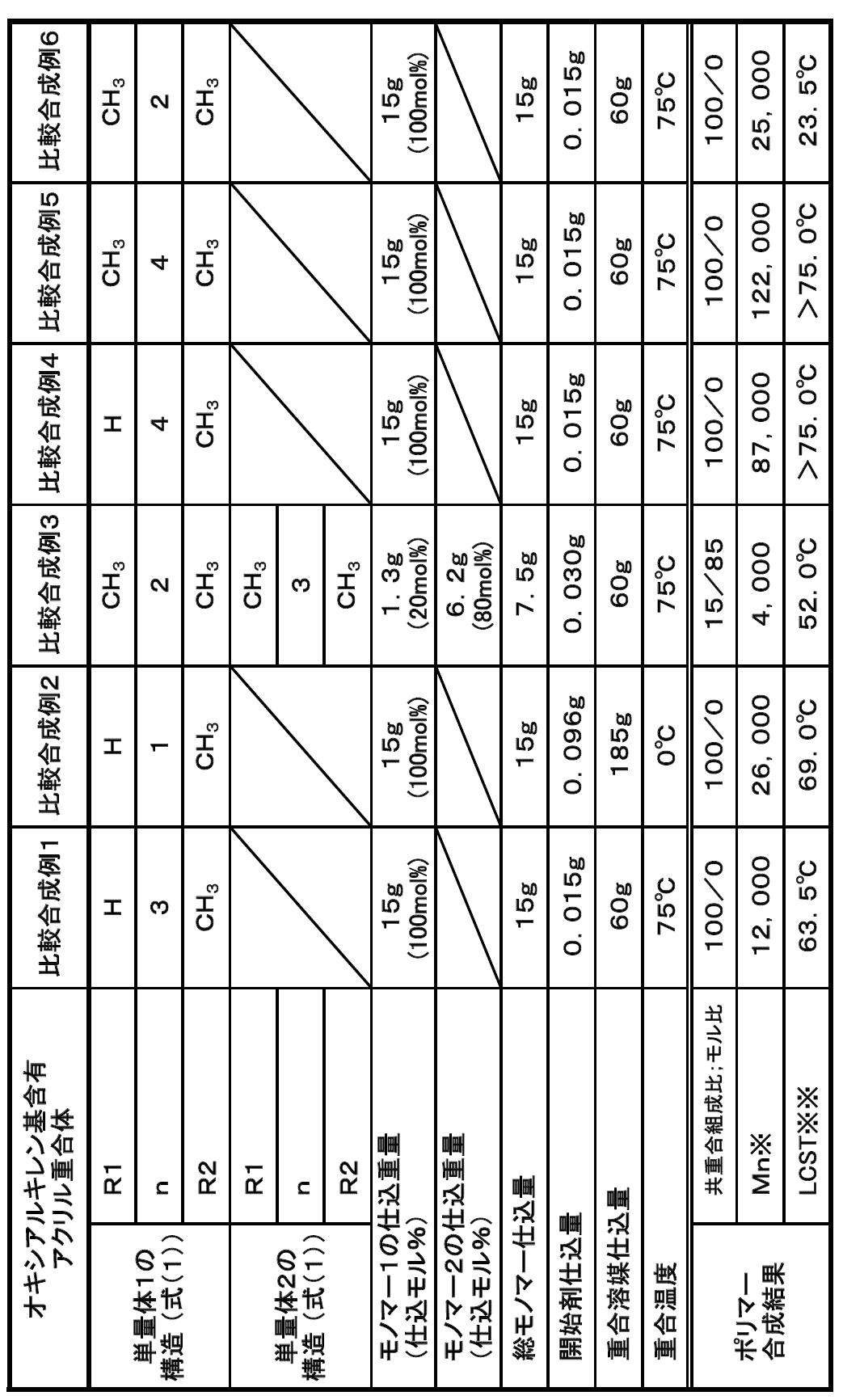
表中の略号の意味は次の通りである。
※ Mn: 数平均分子量
※※LCST: 下限臨界溶液温度(Lower Critical Solution Temperature)
The meanings of the abbreviations in the table are as follows.
* Mn: Number average molecular weight * * LCST: Lower Critical Solution Temperature
<実施例1>
<蛋白吸着抑制溶液の調製>
合成例1の重合体をダルベッコリン酸緩衝液(Sigma-Aldrich社製、以後D-PBSと略称する)に0.1質量%となるように混合、ボルテックスミキサーで1時間攪拌溶解し、蛋白質吸着抑制剤塗布液とした。塗布液は室温において透明であり、投入した重合体の全量が溶解したものと考えられた。
<Example 1>
<Preparation of protein adsorption inhibiting solution>
The polymer of Synthesis Example 1 was mixed in Dulbecco's phosphate buffer solution (manufactured by Sigma-Aldrich, hereinafter abbreviated as D-PBS) so as to be 0.1% by mass, and stirred and dissolved in a vortex mixer for 1 hour to adsorb protein. An inhibitor coating solution was obtained. The coating solution was transparent at room temperature, and it was considered that the whole amount of the charged polymer was dissolved.
<蛋白質吸着抑制効果の評価>
上記実施例1の蛋白質吸着抑制剤塗布液について、以下のような方法によって、その蛋白質吸着抑制効果を測定した。
MaxiSoap plate(Thermofisher Scientific社製ポリスチレン製プレート)に、蛋白質吸着抑制剤塗布液を200μL/wellにて分注し、室温で2時間静置した。その後、アスピレーターで溶液を完全に除去し、一方はそのまま(表3中、「未洗浄時」と表記した欄に結果を記載)、もう一方は、直ちにD-PBSを200μL/wellに分注、アスピレータで液を除く操作をそれぞれ5回、繰り返した(表3中、「洗浄後」と表記した欄に結果を記載)。続いて、D-PBSで20,000倍希釈したPOD-IgG(ペルオキシダーゼ標識免疫グロブリンG、Biorad社製)を100μL/wellに分注し、室温で2時間静置した。その後、ツイーン20を0.05%の濃度で含有するD-PBSを200μL/wellに分注、アスピレータで溶液を完全に除去した。この操作を4回繰り返し、プレート表面の洗浄を行った。洗浄後に、TMB Microwell Peroxidase Substrate(KPL社製)を用いて調製した発色液100μL/wellを加え、室温で7分間反応させた。発色反応を1mol/Lの硫酸溶液を50μL/wellに分注することで停止させ、450nmの吸光度を測定し、吸着した蛋白質を検出した。吸光度が小さいほど蛋白質の吸着が抑制されていることを示す。吸光度測定には、Spectra Max M3(Molecular Device社製)を使用した。評価結果を表3に示した。
<Evaluation of protein adsorption inhibition effect>
About the protein adsorption inhibitor coating liquid of the said Example 1, the protein adsorption | suction inhibitory effect was measured with the following methods.
A protein adsorption inhibitor coating solution was dispensed at 200 μL / well on MaxiSoap plate (a polystyrene plate manufactured by Thermofisher Scientific) and allowed to stand at room temperature for 2 hours. Thereafter, the solution was completely removed with an aspirator, one of which was left as it is (the result is shown in the column labeled “not washed” in Table 3), and the other was immediately dispensed with 200 μL / well of D-PBS. The operation of removing the liquid with an aspirator was repeated 5 times each (in Table 3, the result is shown in the column labeled “After washing”). Subsequently, POD-IgG (peroxidase-labeled immunoglobulin G, manufactured by Biorad) diluted 20,000 times with D-PBS was dispensed at 100 μL / well and allowed to stand at room temperature for 2 hours. Thereafter, D-PBS containing Tween 20 at a concentration of 0.05% was dispensed at 200 μL / well, and the solution was completely removed with an aspirator. This operation was repeated 4 times to wash the plate surface. After washing, 100 μL / well of a color developing solution prepared using TMB Microwell Peroxidase Substrate (manufactured by KPL) was added and reacted at room temperature for 7 minutes. The coloring reaction was stopped by dispensing a 1 mol / L sulfuric acid solution into 50 μL / well, the absorbance at 450 nm was measured, and the adsorbed protein was detected. A smaller absorbance indicates that protein adsorption is suppressed. For absorbance measurement, Spectra Max M3 (Molecular Device) was used. The evaluation results are shown in Table 3.
本発明に係る蛋白質吸着抑制剤の効果について、図1の概略図に基づき説明する。例えば、免疫反応容器10の壁面12を基材としたときに、図1の左側では、抗原14等の測定対象の検体が、抗体16に吸着されている。これに対し、蛋白質吸着抑制剤18が吸着抑制効果を奏する場合には、図1の右側の抗体16のように、抗原14等の検体の吸着が防止されると考えられる。詳細を後述するように、本発明の蛋白質吸着抑制剤によれば、図1の右側に示されているように、検体の抗体16への吸着が効果的に抑制される。
The effect of the protein adsorption inhibitor according to the present invention will be described based on the schematic diagram of FIG. For example, when the
<耐洗浄性の評価>
また、蛋白質吸着抑制剤塗布液の耐洗浄性については、上記「未洗浄時」と、上記「洗浄後」の「蛋白質の吸着率の差」に基づいて、評価した。この「蛋白質の吸着率の差」(Δ%)の値が小さい吸着抑制剤は、洗浄されても基材の表面に良く保持されていたといえ、良好な耐洗浄性を示すものといえる。
<Evaluation of washing resistance>
The washing resistance of the protein adsorption inhibitor coating solution was evaluated based on the “difference in protein adsorption rate” between “when not washed” and “after washing”. It can be said that the adsorption inhibitor having a small value of “difference in protein adsorption rate” (Δ%) was well retained on the surface of the base material even after being washed, and can be said to exhibit good washing resistance.
<実施例2~実施例7>
合成例2~7重合体を使用した以外は、実施例1と同様にして蛋白質吸着抑制剤塗布液を調製した。各塗布液は室温において透明であり、それぞれ投入した重合体の全量が溶解したものと考えられた。さらに、実施例1と同様にして蛋白質吸着抑制効果および耐洗浄性を評価した。結果を表3に示した。
<Example 2 to Example 7>
Synthesis Example 2-7 A protein adsorption inhibitor coating solution was prepared in the same manner as in Example 1 except that the polymer was used. Each coating solution was transparent at room temperature, and it was considered that the total amount of each charged polymer was dissolved. Furthermore, the protein adsorption inhibitory effect and washing resistance were evaluated in the same manner as in Example 1. The results are shown in Table 3.
<実施例8>
合成例4の重合体をダルベッコリン酸緩衝液(Sigma-Aldrich社製、以後D-PBSと略称する)に0.04質量%となるように混合、ボルテックスミキサーで1時間攪拌溶解し、蛋白質吸着抑制剤塗布液とした。塗布液は室温において透明であり、投入した重合体の全量が溶解したものと考えられた。それ以外は、実施例1と同様にして評価を実施した。
<比較例1~5>
合成例1の重合体の代わりに比較合成例1~5の化合物を使用した以外は、実施例1と同様にして溶液を調整した。各溶液は室温において透明であり、それぞれ投入した重合体の全量が溶解したものと考えられた。さらに、実施例1と同様にして蛋白質吸着抑制効果および耐洗浄性を評価した。結果を表4に示した。
<比較例6>
合成例1の重合体の代わりに比較合成例6の化合物を使用したが、濁りが生じたため、タンパク質吸着抑制効果、及び耐洗浄性の試験は中止した。
合成例1の重合体の代わりに、アルブミン ウシ血清由来のたんぱく質(BSA)を使用した以外は、実施例1と同様にして蛋白吸着抑制溶液を調整した。さらに、実施例1と同様にして蛋白質吸着抑制効果および耐洗浄性を評価した。結果を表4に示した。
<Example 8>
The polymer of Synthesis Example 4 was mixed with Dulbecco's phosphate buffer solution (manufactured by Sigma-Aldrich, hereinafter abbreviated as D-PBS) so as to be 0.04% by mass, and stirred and dissolved in a vortex mixer for 1 hour to adsorb protein. An inhibitor coating solution was obtained. The coating solution was transparent at room temperature, and it was considered that the whole amount of the charged polymer was dissolved. Otherwise, the evaluation was performed in the same manner as in Example 1.
<Comparative Examples 1 to 5>
A solution was prepared in the same manner as in Example 1 except that the compounds of Comparative Synthesis Examples 1 to 5 were used instead of the polymer of Synthesis Example 1. Each solution was transparent at room temperature, and it was considered that the total amount of each charged polymer was dissolved. Furthermore, the protein adsorption inhibitory effect and washing resistance were evaluated in the same manner as in Example 1. The results are shown in Table 4.
<Comparative Example 6>
The compound of Comparative Synthesis Example 6 was used in place of the polymer of Synthesis Example 1, but turbidity occurred, so the protein adsorption inhibitory effect and washing resistance test were stopped.
A protein adsorption inhibiting solution was prepared in the same manner as in Example 1, except that protein (BSA) derived from albumin bovine serum was used instead of the polymer of Synthesis Example 1. Furthermore, the protein adsorption inhibitory effect and washing resistance were evaluated in the same manner as in Example 1. The results are shown in Table 4.


本発明の蛋白質吸着抑制剤で処理を行った基材(実施例1~8)は、これ以外のオキシアルキレン基含有アクリル重合体で処理を行った基材(比較例1~5)に比較して非特異的蛋白吸着抑制能に有していた。このような結果は、本発明に係るアクリル重合体(P)の水溶液に接触させることで、当該アクリル重合体(P)の被覆層を表面に生じて、この被覆層により蛋白質吸着が抑制されたものと考えられる。
すなわち、各実施例の蛋白質吸着抑制剤は、比較例の蛋白質吸着抑制剤に比べて、「未洗浄時」と「洗浄後」のいずれにおいても、「蛋白質の吸着率」の値が全般的に低かったため、本発明の蛋白質吸着抑制剤が、非特異的蛋白吸着抑制能に優れていることが確認された。
さらに、本発明の蛋白質吸着抑制剤が、優れた耐洗浄性を有することが確認された。すなわち、本発明の各実施例においては、各蛋白質吸着抑制剤の水溶液と基材を接触させて除去した後に、更に洗浄を行った場合についても、未洗浄時との蛋白質の吸着率の差に相当する耐洗浄性(Δ%)の値が小さく、このことは、洗浄されても基材の表面に吸着抑制剤が良く保持されていたことを示す。これに対し、各比較例においては、耐洗浄性(Δ%)の値が大きかったことから、洗浄により吸着抑制剤が基材の表面から脱離し易いことが確認された。とくには実施例4、5、7、および8で示される被覆層を表面に備える基材はより優位に蛋白吸着抑制能力、ならびに耐洗浄を有していた。
なお、参考比較例として結果を表4に示したBSAは、蛋白吸着抑制剤および耐洗浄性に優れていることが知られている。このような参考比較例と比べても、各実施例の蛋白質吸着抑制剤は、吸着抑制効果においてほぼ同等である上に、耐久洗浄性がより高いことが分かる。特に、実施例4、5、7、および8の蛋白質吸着抑制剤は、参考例であるBSAよりも洗浄後の蛋白質吸着抑制能が優れている。以上のように、本発明の蛋白質吸着抑制剤を用いることにより、分析精度の安定性の向上が可能であることが確認された。
The substrates treated with the protein adsorption inhibitor of the present invention (Examples 1 to 8) were compared with the substrates treated with other oxyalkylene group-containing acrylic polymers (Comparative Examples 1 to 5). And has the ability to suppress nonspecific protein adsorption. Such a result is that when the acrylic polymer (P) according to the present invention is brought into contact with the aqueous solution, a coating layer of the acrylic polymer (P) is formed on the surface, and protein adsorption is suppressed by the coating layer. It is considered a thing.
That is, the protein adsorption inhibitor of each example has an overall "protein adsorption rate" value of "when not washed" and "after washing" as compared with the protein adsorption inhibitor of the comparative example. Since it was low, it was confirmed that the protein adsorption inhibitor of the present invention is excellent in nonspecific protein adsorption inhibiting ability.
Furthermore, it was confirmed that the protein adsorption inhibitor of the present invention has excellent washing resistance. That is, in each Example of the present invention, the difference in protein adsorption rate from the unwashed case is also obtained after further washing after contacting the aqueous solution of the protein adsorption inhibitor with the substrate. The corresponding value of washing resistance (Δ%) is small, which indicates that the adsorption inhibitor was well retained on the surface of the substrate even after washing. On the other hand, in each comparative example, since the value of the washing resistance (Δ%) was large, it was confirmed that the adsorption inhibitor was easily detached from the surface of the substrate by washing. In particular, the substrate provided with the coating layers shown in Examples 4, 5, 7, and 8 on the surface had a protein adsorption inhibiting ability and washing resistance more predominately.
As a reference comparative example, BSA whose results are shown in Table 4 is known to be excellent in protein adsorption inhibitor and washing resistance. Even when compared with such a reference comparative example, it can be seen that the protein adsorption inhibitors of the respective examples are substantially equivalent in adsorption inhibition effect and have higher durability cleaning properties. In particular, the protein adsorption inhibitors of Examples 4, 5, 7, and 8 have better protein adsorption inhibition ability after washing than BSA as a reference example. As described above, it was confirmed that the stability of the analysis accuracy can be improved by using the protein adsorption inhibitor of the present invention.
10:免疫反応容器
12:免疫反応容器の壁面
14:抗原(検体)
16:抗体
18:蛋白質吸着抑制剤
10: Immune reaction container 12: Wall surface of the immune reaction container 14: Antigen (specimen)
16: Antibody 18: Protein adsorption inhibitor
Claims (7)


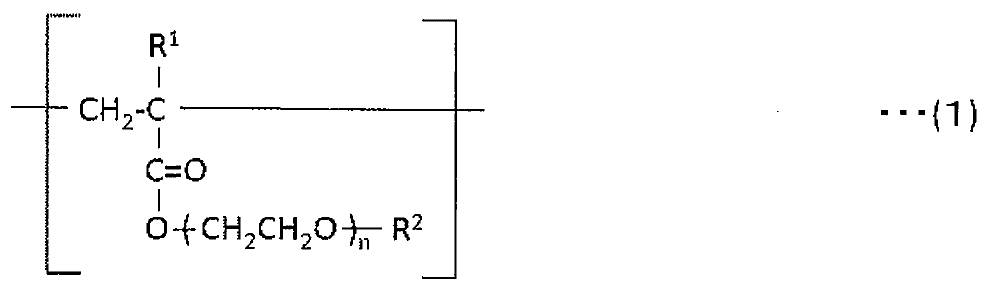
Priority Applications (1)
| Application Number | Priority Date | Filing Date | Title |
|---|---|---|---|
| JP2018504575A JP6803371B2 (en) | 2016-03-10 | 2017-03-09 | Protein adsorption inhibitor and method of protein adsorption inhibitor |
Applications Claiming Priority (2)
| Application Number | Priority Date | Filing Date | Title |
|---|---|---|---|
| JP2016-046829 | 2016-03-10 | ||
| JP2016046829 | 2016-03-10 |
Publications (1)
| Publication Number | Publication Date |
|---|---|
| WO2017155019A1 true WO2017155019A1 (en) | 2017-09-14 |
Family
ID=59790614
Family Applications (1)
| Application Number | Title | Priority Date | Filing Date |
|---|---|---|---|
| PCT/JP2017/009405 Ceased WO2017155019A1 (en) | 2016-03-10 | 2017-03-09 | Protein adsorption inhibitor and method for inhibiting adsorption of protein |
Country Status (2)
| Country | Link |
|---|---|
| JP (1) | JP6803371B2 (en) |
| WO (1) | WO2017155019A1 (en) |
Citations (7)
| Publication number | Priority date | Publication date | Assignee | Title |
|---|---|---|---|---|
| JPH10153599A (en) * | 1996-11-22 | 1998-06-09 | Nof Corp | Agent for preventing nonspecific adsorption of protein |
| JP3443891B2 (en) * | 1993-09-14 | 2003-09-08 | 日本油脂株式会社 | Protein adsorption inhibitor |
| WO2008146631A1 (en) * | 2007-05-30 | 2008-12-04 | Jsr Corporation | Non-specific adsorption inhibitor |
| JP2011225769A (en) * | 2010-04-22 | 2011-11-10 | Kawamura Institute Of Chemical Research | Method for preparing organic and inorganic composite material fluid dispersion |
| WO2013024815A2 (en) * | 2011-08-15 | 2013-02-21 | 一般財団法人川村理化学研究所 | Block copolymer, and antithrombotic coating agent |
| JP2013148484A (en) * | 2012-01-20 | 2013-08-01 | Sumitomo Bakelite Co Ltd | Manufacturing method of biochip, and biochip |
| JP2014102194A (en) * | 2012-11-21 | 2014-06-05 | Sumitomo Bakelite Co Ltd | High polymer and carrier having surface covered with high polymer |
-
2017
- 2017-03-09 JP JP2018504575A patent/JP6803371B2/en active Active
- 2017-03-09 WO PCT/JP2017/009405 patent/WO2017155019A1/en not_active Ceased
Patent Citations (8)
| Publication number | Priority date | Publication date | Assignee | Title |
|---|---|---|---|---|
| JP3443891B2 (en) * | 1993-09-14 | 2003-09-08 | 日本油脂株式会社 | Protein adsorption inhibitor |
| JPH10153599A (en) * | 1996-11-22 | 1998-06-09 | Nof Corp | Agent for preventing nonspecific adsorption of protein |
| WO2008146631A1 (en) * | 2007-05-30 | 2008-12-04 | Jsr Corporation | Non-specific adsorption inhibitor |
| JP2011225769A (en) * | 2010-04-22 | 2011-11-10 | Kawamura Institute Of Chemical Research | Method for preparing organic and inorganic composite material fluid dispersion |
| WO2013024815A2 (en) * | 2011-08-15 | 2013-02-21 | 一般財団法人川村理化学研究所 | Block copolymer, and antithrombotic coating agent |
| JP2013057058A (en) * | 2011-08-15 | 2013-03-28 | Kawamura Institute Of Chemical Research | Block copolymer |
| JP2013148484A (en) * | 2012-01-20 | 2013-08-01 | Sumitomo Bakelite Co Ltd | Manufacturing method of biochip, and biochip |
| JP2014102194A (en) * | 2012-11-21 | 2014-06-05 | Sumitomo Bakelite Co Ltd | High polymer and carrier having surface covered with high polymer |
Non-Patent Citations (2)
| Title |
|---|
| KITANO, HIROMI ET AL.: "Temperature-responsive polymer-brush constructed on a grass substrate by atom transfer radical polymerization", JOURNAL OF COLLOID AND INTERFACE SCIENCE, vol. 345, 2010, pages 325 - 331, XP055420902 * |
| YOON, JEONG AE ET AL.: "Comparison of the Thermoresponsive Deswelling Kinetics of Poly(2-(2-methoxyethoxy)ethyl methacrylate) Hydrogels Prepared by ATRP and FRP", MACROMOLECULES, vol. 43, 2010, pages 4791 - 4797, XP055420903 * |
Also Published As
| Publication number | Publication date |
|---|---|
| JPWO2017155019A1 (en) | 2019-01-10 |
| JP6803371B2 (en) | 2020-12-23 |
Similar Documents
| Publication | Publication Date | Title |
|---|---|---|
| CN107110841B (en) | Methods of inhibiting protein adsorption | |
| JP5344148B2 (en) | Non-specific adsorption inhibitor and article coating method | |
| JP5365623B2 (en) | Method for immobilizing physiologically active substances | |
| JP4733335B2 (en) | Aggregation immunoassay and reagent with good reproducibility | |
| WO2014192731A1 (en) | Surface treatment agent for surface configured from inorganic material, tool and device having modified surface, and method for manufacturing tool and device | |
| JP2010117189A (en) | Substrate for immobilizing physiological active substance | |
| JP4821444B2 (en) | Polymer compound for bioassay and base material for bioassay using the same | |
| US20150219641A1 (en) | Analysis carrier and manufacturing method and use method therefor | |
| JP2006176720A (en) | High polymer for medical material and polymer solution using the same | |
| JP6803371B2 (en) | Protein adsorption inhibitor and method of protein adsorption inhibitor | |
| JP6085983B2 (en) | Blocking agent, carrier on which antigen or antibody to target substance is immobilized, in vitro diagnostic reagent and kit containing the same, and method for detecting target substance | |
| JP6299862B2 (en) | COATING COMPOSITION AND USE THEREOF | |
| JP2022158008A (en) | Blocking agent for in vitro diagnosis, in vitro diagnostic carrier including the same, and kit | |
| JPWO2016039319A1 (en) | Protein adsorption inhibitor and protein adsorption inhibition method | |
| JP4640150B2 (en) | Biochip and method of use thereof | |
| JP2012032260A (en) | Sugar chain array | |
| JPWO2006123737A1 (en) | Polymer compound for medical material and biochip substrate using the polymer compound | |
| JP6965933B2 (en) | New polyethylene glycol derivative and protein adsorption inhibitor | |
| JP5958911B2 (en) | Glycopeptide array | |
| JP4682828B2 (en) | Biochip and method of use thereof | |
| JP5364971B2 (en) | Method for immobilizing physiologically active substances | |
| JP5364973B2 (en) | Method for immobilizing physiologically active substances | |
| JP2017044705A (en) | Glycan array | |
| JP2015099162A (en) | Sugar chain array | |
| JP2016114410A (en) | Protein array manufacturing method and protein array |
Legal Events
| Date | Code | Title | Description |
|---|---|---|---|
| ENP | Entry into the national phase |
Ref document number: 2018504575 Country of ref document: JP Kind code of ref document: A |
|
| NENP | Non-entry into the national phase |
Ref country code: DE |
|
| 121 | Ep: the epo has been informed by wipo that ep was designated in this application |
Ref document number: 17763359 Country of ref document: EP Kind code of ref document: A1 |
|
| 122 | Ep: pct application non-entry in european phase |
Ref document number: 17763359 Country of ref document: EP Kind code of ref document: A1 |