WO2017155116A1 - 半導体実装用接着剤及び半導体センサ - Google Patents
半導体実装用接着剤及び半導体センサ Download PDFInfo
- Publication number
- WO2017155116A1 WO2017155116A1 PCT/JP2017/009815 JP2017009815W WO2017155116A1 WO 2017155116 A1 WO2017155116 A1 WO 2017155116A1 JP 2017009815 W JP2017009815 W JP 2017009815W WO 2017155116 A1 WO2017155116 A1 WO 2017155116A1
- Authority
- WO
- WIPO (PCT)
- Prior art keywords
- spacer
- adhesive
- semiconductor
- meth
- less
- Prior art date
- Legal status (The legal status is an assumption and is not a legal conclusion. Google has not performed a legal analysis and makes no representation as to the accuracy of the status listed.)
- Ceased
Links
Images
Classifications
-
- H—ELECTRICITY
- H10—SEMICONDUCTOR DEVICES; ELECTRIC SOLID-STATE DEVICES NOT OTHERWISE PROVIDED FOR
- H10W—GENERIC PACKAGES, INTERCONNECTIONS, CONNECTORS OR OTHER CONSTRUCTIONAL DETAILS OF DEVICES COVERED BY CLASS H10
- H10W72/00—Interconnections or connectors in packages
- H10W72/30—Die-attach connectors
-
- H—ELECTRICITY
- H10—SEMICONDUCTOR DEVICES; ELECTRIC SOLID-STATE DEVICES NOT OTHERWISE PROVIDED FOR
- H10W—GENERIC PACKAGES, INTERCONNECTIONS, CONNECTORS OR OTHER CONSTRUCTIONAL DETAILS OF DEVICES COVERED BY CLASS H10
- H10W20/00—Interconnections in chips, wafers or substrates
- H10W20/40—Interconnections external to wafers or substrates, e.g. back-end-of-line [BEOL] metallisations or vias connecting to gate electrodes
-
- C—CHEMISTRY; METALLURGY
- C08—ORGANIC MACROMOLECULAR COMPOUNDS; THEIR PREPARATION OR CHEMICAL WORKING-UP; COMPOSITIONS BASED THEREON
- C08L—COMPOSITIONS OF MACROMOLECULAR COMPOUNDS
- C08L25/00—Compositions of, homopolymers or copolymers of compounds having one or more unsaturated aliphatic radicals, each having only one carbon-to-carbon double bond, and at least one being terminated by an aromatic carbocyclic ring; Compositions of derivatives of such polymers
- C08L25/02—Homopolymers or copolymers of hydrocarbons
-
- C—CHEMISTRY; METALLURGY
- C09—DYES; PAINTS; POLISHES; NATURAL RESINS; ADHESIVES; COMPOSITIONS NOT OTHERWISE PROVIDED FOR; APPLICATIONS OF MATERIALS NOT OTHERWISE PROVIDED FOR
- C09J—ADHESIVES; NON-MECHANICAL ASPECTS OF ADHESIVE PROCESSES IN GENERAL; ADHESIVE PROCESSES NOT PROVIDED FOR ELSEWHERE; USE OF MATERIALS AS ADHESIVES
- C09J11/00—Features of adhesives not provided for in group C09J9/00, e.g. additives
-
- C—CHEMISTRY; METALLURGY
- C09—DYES; PAINTS; POLISHES; NATURAL RESINS; ADHESIVES; COMPOSITIONS NOT OTHERWISE PROVIDED FOR; APPLICATIONS OF MATERIALS NOT OTHERWISE PROVIDED FOR
- C09J—ADHESIVES; NON-MECHANICAL ASPECTS OF ADHESIVE PROCESSES IN GENERAL; ADHESIVE PROCESSES NOT PROVIDED FOR ELSEWHERE; USE OF MATERIALS AS ADHESIVES
- C09J11/00—Features of adhesives not provided for in group C09J9/00, e.g. additives
- C09J11/08—Macromolecular additives
-
- C—CHEMISTRY; METALLURGY
- C09—DYES; PAINTS; POLISHES; NATURAL RESINS; ADHESIVES; COMPOSITIONS NOT OTHERWISE PROVIDED FOR; APPLICATIONS OF MATERIALS NOT OTHERWISE PROVIDED FOR
- C09J—ADHESIVES; NON-MECHANICAL ASPECTS OF ADHESIVE PROCESSES IN GENERAL; ADHESIVE PROCESSES NOT PROVIDED FOR ELSEWHERE; USE OF MATERIALS AS ADHESIVES
- C09J171/00—Adhesives based on polyethers obtained by reactions forming an ether link in the main chain; Adhesives based on derivatives of such polymers
- C09J171/02—Polyalkylene oxides
-
- C—CHEMISTRY; METALLURGY
- C09—DYES; PAINTS; POLISHES; NATURAL RESINS; ADHESIVES; COMPOSITIONS NOT OTHERWISE PROVIDED FOR; APPLICATIONS OF MATERIALS NOT OTHERWISE PROVIDED FOR
- C09J—ADHESIVES; NON-MECHANICAL ASPECTS OF ADHESIVE PROCESSES IN GENERAL; ADHESIVE PROCESSES NOT PROVIDED FOR ELSEWHERE; USE OF MATERIALS AS ADHESIVES
- C09J183/00—Adhesives based on macromolecular compounds obtained by reactions forming in the main chain of the macromolecule a linkage containing silicon, with or without sulfur, nitrogen, oxygen, or carbon only; Adhesives based on derivatives of such polymers
- C09J183/04—Polysiloxanes
-
- C—CHEMISTRY; METALLURGY
- C09—DYES; PAINTS; POLISHES; NATURAL RESINS; ADHESIVES; COMPOSITIONS NOT OTHERWISE PROVIDED FOR; APPLICATIONS OF MATERIALS NOT OTHERWISE PROVIDED FOR
- C09J—ADHESIVES; NON-MECHANICAL ASPECTS OF ADHESIVE PROCESSES IN GENERAL; ADHESIVE PROCESSES NOT PROVIDED FOR ELSEWHERE; USE OF MATERIALS AS ADHESIVES
- C09J9/00—Adhesives characterised by their physical nature or the effects produced, e.g. glue sticks
- C09J9/02—Electrically-conducting adhesives
-
- G—PHYSICS
- G01—MEASURING; TESTING
- G01L—MEASURING FORCE, STRESS, TORQUE, WORK, MECHANICAL POWER, MECHANICAL EFFICIENCY, OR FLUID PRESSURE
- G01L9/00—Measuring steady of quasi-steady pressure of fluid or fluent solid material by electric or magnetic pressure-sensitive elements; Transmitting or indicating the displacement of mechanical pressure-sensitive elements, used to measure the steady or quasi-steady pressure of a fluid or fluent solid material, by electric or magnetic means
-
- H—ELECTRICITY
- H10—SEMICONDUCTOR DEVICES; ELECTRIC SOLID-STATE DEVICES NOT OTHERWISE PROVIDED FOR
- H10D—INORGANIC ELECTRIC SEMICONDUCTOR DEVICES
- H10D48/00—Individual devices not covered by groups H10D1/00 - H10D44/00
- H10D48/50—Devices controlled by mechanical forces, e.g. pressure
-
- H—ELECTRICITY
- H10—SEMICONDUCTOR DEVICES; ELECTRIC SOLID-STATE DEVICES NOT OTHERWISE PROVIDED FOR
- H10W—GENERIC PACKAGES, INTERCONNECTIONS, CONNECTORS OR OTHER CONSTRUCTIONAL DETAILS OF DEVICES COVERED BY CLASS H10
- H10W72/00—Interconnections or connectors in packages
- H10W72/071—Connecting or disconnecting
-
- H—ELECTRICITY
- H10—SEMICONDUCTOR DEVICES; ELECTRIC SOLID-STATE DEVICES NOT OTHERWISE PROVIDED FOR
- H10W—GENERIC PACKAGES, INTERCONNECTIONS, CONNECTORS OR OTHER CONSTRUCTIONAL DETAILS OF DEVICES COVERED BY CLASS H10
- H10W72/00—Interconnections or connectors in packages
- H10W72/851—Dispositions of multiple connectors or interconnections
-
- H—ELECTRICITY
- H10—SEMICONDUCTOR DEVICES; ELECTRIC SOLID-STATE DEVICES NOT OTHERWISE PROVIDED FOR
- H10W—GENERIC PACKAGES, INTERCONNECTIONS, CONNECTORS OR OTHER CONSTRUCTIONAL DETAILS OF DEVICES COVERED BY CLASS H10
- H10W74/00—Encapsulations, e.g. protective coatings
- H10W74/10—Encapsulations, e.g. protective coatings characterised by their shape or disposition
- H10W74/111—Encapsulations, e.g. protective coatings characterised by their shape or disposition the semiconductor body being completely enclosed
- H10W74/129—Encapsulations, e.g. protective coatings characterised by their shape or disposition the semiconductor body being completely enclosed forming a chip-scale package [CSP]
-
- C—CHEMISTRY; METALLURGY
- C08—ORGANIC MACROMOLECULAR COMPOUNDS; THEIR PREPARATION OR CHEMICAL WORKING-UP; COMPOSITIONS BASED THEREON
- C08G—MACROMOLECULAR COMPOUNDS OBTAINED OTHERWISE THAN BY REACTIONS ONLY INVOLVING UNSATURATED CARBON-TO-CARBON BONDS
- C08G65/00—Macromolecular compounds obtained by reactions forming an ether link in the main chain of the macromolecule
- C08G65/02—Macromolecular compounds obtained by reactions forming an ether link in the main chain of the macromolecule from cyclic ethers by opening of the heterocyclic ring
- C08G65/32—Polymers modified by chemical after-treatment
- C08G65/329—Polymers modified by chemical after-treatment with organic compounds
- C08G65/336—Polymers modified by chemical after-treatment with organic compounds containing silicon
-
- C—CHEMISTRY; METALLURGY
- C09—DYES; PAINTS; POLISHES; NATURAL RESINS; ADHESIVES; COMPOSITIONS NOT OTHERWISE PROVIDED FOR; APPLICATIONS OF MATERIALS NOT OTHERWISE PROVIDED FOR
- C09J—ADHESIVES; NON-MECHANICAL ASPECTS OF ADHESIVE PROCESSES IN GENERAL; ADHESIVE PROCESSES NOT PROVIDED FOR ELSEWHERE; USE OF MATERIALS AS ADHESIVES
- C09J2203/00—Applications of adhesives in processes or use of adhesives in the form of films or foils
- C09J2203/326—Applications of adhesives in processes or use of adhesives in the form of films or foils for bonding electronic components such as wafers, chips or semiconductors
-
- H—ELECTRICITY
- H10—SEMICONDUCTOR DEVICES; ELECTRIC SOLID-STATE DEVICES NOT OTHERWISE PROVIDED FOR
- H10W—GENERIC PACKAGES, INTERCONNECTIONS, CONNECTORS OR OTHER CONSTRUCTIONAL DETAILS OF DEVICES COVERED BY CLASS H10
- H10W72/00—Interconnections or connectors in packages
- H10W72/071—Connecting or disconnecting
- H10W72/073—Connecting or disconnecting of die-attach connectors
- H10W72/07321—Aligning
- H10W72/07327—Aligning involving guiding structures, e.g. spacers or supporting members
-
- H—ELECTRICITY
- H10—SEMICONDUCTOR DEVICES; ELECTRIC SOLID-STATE DEVICES NOT OTHERWISE PROVIDED FOR
- H10W—GENERIC PACKAGES, INTERCONNECTIONS, CONNECTORS OR OTHER CONSTRUCTIONAL DETAILS OF DEVICES COVERED BY CLASS H10
- H10W72/00—Interconnections or connectors in packages
- H10W72/071—Connecting or disconnecting
- H10W72/073—Connecting or disconnecting of die-attach connectors
- H10W72/07331—Connecting techniques
- H10W72/07337—Connecting techniques using a polymer adhesive, e.g. an adhesive based on silicone or epoxy
- H10W72/07338—Connecting techniques using a polymer adhesive, e.g. an adhesive based on silicone or epoxy hardening the adhesive by curing, e.g. thermosetting
-
- H—ELECTRICITY
- H10—SEMICONDUCTOR DEVICES; ELECTRIC SOLID-STATE DEVICES NOT OTHERWISE PROVIDED FOR
- H10W—GENERIC PACKAGES, INTERCONNECTIONS, CONNECTORS OR OTHER CONSTRUCTIONAL DETAILS OF DEVICES COVERED BY CLASS H10
- H10W72/00—Interconnections or connectors in packages
- H10W72/30—Die-attach connectors
- H10W72/321—Structures or relative sizes of die-attach connectors
- H10W72/325—Die-attach connectors having a filler embedded in a matrix
-
- H—ELECTRICITY
- H10—SEMICONDUCTOR DEVICES; ELECTRIC SOLID-STATE DEVICES NOT OTHERWISE PROVIDED FOR
- H10W—GENERIC PACKAGES, INTERCONNECTIONS, CONNECTORS OR OTHER CONSTRUCTIONAL DETAILS OF DEVICES COVERED BY CLASS H10
- H10W72/00—Interconnections or connectors in packages
- H10W72/30—Die-attach connectors
- H10W72/351—Materials of die-attach connectors
- H10W72/353—Materials of die-attach connectors not comprising solid metals or solid metalloids, e.g. ceramics
- H10W72/354—Materials of die-attach connectors not comprising solid metals or solid metalloids, e.g. ceramics comprising polymers
-
- H—ELECTRICITY
- H10—SEMICONDUCTOR DEVICES; ELECTRIC SOLID-STATE DEVICES NOT OTHERWISE PROVIDED FOR
- H10W—GENERIC PACKAGES, INTERCONNECTIONS, CONNECTORS OR OTHER CONSTRUCTIONAL DETAILS OF DEVICES COVERED BY CLASS H10
- H10W72/00—Interconnections or connectors in packages
- H10W72/30—Die-attach connectors
- H10W72/381—Auxiliary members
-
- H—ELECTRICITY
- H10—SEMICONDUCTOR DEVICES; ELECTRIC SOLID-STATE DEVICES NOT OTHERWISE PROVIDED FOR
- H10W—GENERIC PACKAGES, INTERCONNECTIONS, CONNECTORS OR OTHER CONSTRUCTIONAL DETAILS OF DEVICES COVERED BY CLASS H10
- H10W72/00—Interconnections or connectors in packages
- H10W72/50—Bond wires
- H10W72/59—Bond pads specially adapted therefor
-
- H—ELECTRICITY
- H10—SEMICONDUCTOR DEVICES; ELECTRIC SOLID-STATE DEVICES NOT OTHERWISE PROVIDED FOR
- H10W—GENERIC PACKAGES, INTERCONNECTIONS, CONNECTORS OR OTHER CONSTRUCTIONAL DETAILS OF DEVICES COVERED BY CLASS H10
- H10W72/00—Interconnections or connectors in packages
- H10W72/90—Bond pads, in general
-
- H—ELECTRICITY
- H10—SEMICONDUCTOR DEVICES; ELECTRIC SOLID-STATE DEVICES NOT OTHERWISE PROVIDED FOR
- H10W—GENERIC PACKAGES, INTERCONNECTIONS, CONNECTORS OR OTHER CONSTRUCTIONAL DETAILS OF DEVICES COVERED BY CLASS H10
- H10W72/00—Interconnections or connectors in packages
- H10W72/90—Bond pads, in general
- H10W72/951—Materials of bond pads
- H10W72/952—Materials of bond pads comprising metals or metalloids, e.g. PbSn, Ag or Cu
-
- H—ELECTRICITY
- H10—SEMICONDUCTOR DEVICES; ELECTRIC SOLID-STATE DEVICES NOT OTHERWISE PROVIDED FOR
- H10W—GENERIC PACKAGES, INTERCONNECTIONS, CONNECTORS OR OTHER CONSTRUCTIONAL DETAILS OF DEVICES COVERED BY CLASS H10
- H10W90/00—Package configurations
- H10W90/701—Package configurations characterised by the relative positions of pads or connectors relative to package parts
- H10W90/731—Package configurations characterised by the relative positions of pads or connectors relative to package parts of die-attach connectors
- H10W90/732—Package configurations characterised by the relative positions of pads or connectors relative to package parts of die-attach connectors between stacked chips
-
- H—ELECTRICITY
- H10—SEMICONDUCTOR DEVICES; ELECTRIC SOLID-STATE DEVICES NOT OTHERWISE PROVIDED FOR
- H10W—GENERIC PACKAGES, INTERCONNECTIONS, CONNECTORS OR OTHER CONSTRUCTIONAL DETAILS OF DEVICES COVERED BY CLASS H10
- H10W90/00—Package configurations
- H10W90/701—Package configurations characterised by the relative positions of pads or connectors relative to package parts
- H10W90/731—Package configurations characterised by the relative positions of pads or connectors relative to package parts of die-attach connectors
- H10W90/734—Package configurations characterised by the relative positions of pads or connectors relative to package parts of die-attach connectors between a chip and a stacked insulating package substrate, interposer or RDL
Definitions
- the present invention relates to an adhesive for semiconductor mounting used for mounting semiconductors.
- the present invention also relates to a semiconductor sensor using the above adhesive.
- Patent Document 1 a second adhesive that is formed of a silicone-based resin and maintains a constant distance between the package and the circuit chip and a silicone-based resin that bonds the package and the circuit chip.
- a sensor device comprising an adhesive is disclosed.
- the first adhesive functions as a spacer.
- the adhesive described in Patent Document 1 since the first adhesive (spacer) formed of a silicone resin is soft, the chip cannot be bonded horizontally to the substrate, and a sufficient gap control effect is obtained. There may not be. In addition, the adhesive described in Patent Document 1 may have low heat resistance.
- an adhesive used for mounting a semiconductor which includes a silicone resin and a spacer, and the content of the spacer is 0.1% by weight in 100% by weight of the adhesive. Or more, 5% by weight or less, 10% compression elastic modulus of the spacer is 5000 N / mm 2 or more and 15000 N / mm 2 or less, and the average particle diameter of the spacer is 10 ⁇ m or more and 200 ⁇ m or less.
- a mounting adhesive (hereinafter sometimes referred to as an adhesive) is provided.
- the ratio of the 10% compression modulus of the spacer after heating to the 10% compression modulus of the spacer before heating is 0.95 or more and 1.05 or less.
- the spacer included in the adhesive is there a spacer having an average particle diameter of 1.5 times or more with respect to the average particle diameter of the spacer?
- the number of spacers having an average particle diameter of 1.5 times or more with respect to the average particle diameter of the spacers is 0.1% or less.
- the specific gravity of the spacer is 1.05 or more and less than 1.30.
- the compression recovery rate of the spacer is 50% or more.
- the spacer is a copolymer of polymerization components including divinylbenzene.
- the said spacer is a copolymer of the polymerization component containing a (meth) acryl compound, and the said (meth) acryl compound has four or more (meth) acryloyl groups.
- (Meth) acrylic compound is included.
- the spacer is a polymer of a polymerization component, and the residual ratio of the polymerizable group of the spacer is less than 1%.
- the semiconductor mounting adhesive is a semiconductor sensor chip mounting adhesive used for mounting a semiconductor sensor chip.
- the adhesive layer includes a first member, a semiconductor that is a second member, and an adhesive layer that bonds the first member and the second member.
- the semiconductor sensor which is the hardened
- the adhesive for semiconductor mounting according to the present invention includes a silicone resin and a spacer, and the content of the spacer is 0.1% by weight or more and 5% by weight or less in 100% by weight of the adhesive.
- the spacer has a 10% compressive elastic modulus of 5000 N / mm 2 or more and 15000 N / mm 2 or less, and the average particle diameter of the spacer is 10 ⁇ m or more and 200 ⁇ m or less. The accuracy can be controlled and the heat resistance can be increased.
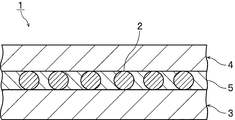
- FIG. 1 is a cross-sectional view showing an example of a semiconductor sensor using a semiconductor mounting adhesive according to the present invention.
- the adhesive for semiconductor mounting according to the present invention (hereinafter sometimes referred to as adhesive) is an adhesive used for mounting semiconductors.
- the adhesive according to the present invention includes a silicone resin and a spacer.
- the content of the spacer contained in the adhesive according to the present invention is 0.1 wt% or more and 5 wt% or less in 100 wt% of the adhesive.
- the spacer has a 10% compression elastic modulus of 5000 N / mm 2 or more and 15000 N / mm 2 or less.
- the spacer has an average particle size of 10 ⁇ m or more and 200 ⁇ m or less.
- the gap can be controlled with high accuracy and the heat resistance can be improved in the mounting of the semiconductor.
- the semiconductor chip can be bonded more horizontally.
- the adhesive strength at high temperature can be increased.
- the content of the spacer is 0.1% by weight or more and 5% by weight or less in 100% by weight of the adhesive. From the viewpoint of further enhancing the gap control effect, the content of the spacer is preferably 0.5% by weight or more, more preferably 1% by weight or more, and preferably 4% by weight in 100% by weight of the adhesive. Hereinafter, it is more preferably 3% by weight or less.
- the 10% compression elastic modulus is a compression elastic modulus when the spacer is compressed 10%.
- the 10% compression elastic modulus of the spacer is 5000 N / mm 2 or more and 15000 N / mm 2 or less.
- 10% compressive elasticity modulus of the spacers preferably 5500N / mm 2 or more, more preferably 6000 N / mm 2 or more, preferably 10000 N / mm 2 or less, more preferably Is 8000 N / mm 2 or less.
- the 10% compression modulus of the spacer can be measured as follows.
- the spacer is compressed with a smooth indenter end face of a cylinder (diameter 50 ⁇ m, made of diamond) under conditions where a maximum test load of 20 mN is applied for 60 seconds.
- the load value (N) and compression displacement (mm) at this time are measured. From the measured value obtained, the compression elastic modulus can be obtained by the following formula.
- the micro compression tester for example, “Fischer Scope H-100” manufactured by Fischer is used.
- the average particle diameter of the spacer is 10 ⁇ m or more and 200 ⁇ m or less. From the viewpoint of further enhancing the gap control effect, the average particle diameter of the spacer is preferably 20 ⁇ m or more, more preferably 30 ⁇ m or more, preferably 150 ⁇ m or less, more preferably 110 ⁇ m or less, and even more preferably 100 ⁇ m or less. .
- the average particle diameter is obtained by observing the spacers with a scanning electron microscope and arithmetically averaging the maximum diameters of 50 arbitrarily selected spacers in the observed image.
- the spacer before heating has a 10% compression modulus of the spacer after heating.
- 10% compression modulus of elasticity is preferably 0.95 or more, more preferably 0.98 or more, Preferably it is 1.05 or less, More preferably, it is 1.02 or less.
- the spacer included in the adhesive there is no spacer having an average particle diameter of 1.5 times or more with respect to the average particle diameter of the spacer. .
- the spacer contained in the adhesive The total number of the spacers is preferably 100%, and the number of spacers having an average particle size of 1.5 times or more with respect to the average particle size of the spacers is preferably 0.1% or less. More preferably, it is present in a number of 05% or less.
- the specific gravity of the spacer is preferably 1.05 or more, more preferably 1.10 or more, preferably less than 1.30, more preferably. Is less than 1.25.
- the difference between the specific gravity after curing of the adhesive excluding the spacer and the specific gravity of the spacer is preferably 0.5 or less.
- the compression recovery rate of the spacer is preferably 50% or more, more preferably 60% or more.
- the upper limit of the compression recovery rate of the spacer is not particularly limited.
- the compression recovery rate of the spacer may be 100% or less.
- the compression recovery rate of the spacer can be measured as follows.
- ⁇ Spray the spacer on the sample table With respect to one dispersed spacer, a load (reverse load value) is applied in the center direction of the spacer until the spacer is compressed and deformed by 30% using a micro compression tester. Thereafter, unloading is performed up to the origin load value (0.40 mN). The load-compression displacement during this period is measured, and the compression recovery rate can be obtained from the following equation.
- the load speed is 0.33 mN / sec.
- the micro compression tester for example, “Fischer Scope H-100” manufactured by Fischer is used.
- Compression recovery rate (%) [(L1-L2) / L1] ⁇ 100
- L1 Compressive displacement from the origin load value to the reverse load value when applying a load
- L2 Unloading displacement from the reverse load value to the origin load value when releasing the load
- the spacer is preferably a polymer of a polymerization component.
- the above polymerization component is a polymerizable component.
- the polymerization component preferably contains a polymerizable monomer having an ethylenically unsaturated group.
- Examples of the polymerizable monomer having an ethylenically unsaturated group include non-crosslinkable monomers and crosslinkable monomers.
- non-crosslinkable monomer examples include, as vinyl compounds, styrene monomers such as styrene, ⁇ -methyl styrene, chlorostyrene; methyl vinyl ether, ethyl vinyl ether, propyl vinyl ether, 1,4-butanediol diester.
- Vinyl ether compounds such as vinyl ether, cyclohexanedimethanol divinyl ether, diethylene glycol divinyl ether; acid vinyl ester compounds such as vinyl acetate, vinyl butyrate, vinyl laurate, vinyl stearate; halogen-containing monomers such as vinyl chloride, vinyl fluoride;
- (Meth) acrylic compounds include methyl (meth) acrylate, ethyl (meth) acrylate, propyl (meth) acrylate, butyl (meth) acrylate, 2-ethylhexyl (meth) acrylate, lauric Alkyl (meth) acrylate compounds such as (meth) acrylate, cetyl (meth) acrylate, stearyl (meth) acrylate, cyclohexyl (meth) acrylate, isobornyl (meth) acrylate; 2-hydroxyethyl (meth) acrylate, glycerol (meth) Oxygen
- crosslinkable monomer examples include vinyl monomers such as vinyl compounds such as divinylbenzene, 1,4-divinyloxybutane and divinylsulfone; (meth) acrylic compounds such as tetramethylolmethanetetra ( (Meth) acrylate, tetramethylolmethane tri (meth) acrylate, tetramethylolmethane di (meth) acrylate, trimethylolpropane tri (meth) acrylate, dipentaerythritol hexa (meth) acrylate, dipentaerythritol penta (meth) acrylate, glycerol Tri (meth) acrylate, glycerol di (meth) acrylate, (poly) ethylene glycol di (meth) acrylate, (poly) propylene glycol di (meth) acrylate, (poly) tetramethyleneglycol Polyfunctional (meth) acrylate
- (meth) acrylate indicates acrylate and methacrylate.
- (meth) acryl refers to acrylic and methacrylic.
- (meth) acryloyl refers to acryloyl and methacryloyl.
- the polymerization component preferably contains a vinyl compound or a (meth) acrylic compound.
- the spacer is preferably a copolymer of a polymerization component containing divinylbenzene.
- the spacer is a copolymer of a polymerization component containing a (meth) acryl compound, and the (meth) acryl compound is (meth) acryloyl. It is preferable to include a (meth) acrylic compound having 4 or more groups.
- Examples of the (meth) acrylic compound having four or more (meth) acryloyl groups include dipentaerythritol penta (meth) acrylate, dipentaerythritol hexa (meth) acrylate, ditrimethylolpropane tetra (meth) acrylate, and pentaerythritol. Examples include tetra (meth) acrylate and tetramethylolmethane tetra (meth) acrylate.
- the residual ratio of the polymerizable group of the spacer is preferably less than 1%, more preferably less than 0.5%.
- the residual ratio of the polymerizable group of the spacer can be measured as follows.
- nuclear magnetic resonance apparatus After filling the spacer 0.4g to 8mm rotor for a solid, Single Pulse (DD / MAS) method: in (Measurement Condition MAS rpm 7 kHz, the number of scans 1000), the 13 C Perform the measurement. The residual ratio of the polymerizable group is calculated from the peak attributed to the vinyl group in the obtained DD / MAS spectrum.
- DD / MAS Single Pulse
- the adhesive includes the above-described spacer and silicone resin.
- the spacer is preferably dispersed in a silicone resin and used as an adhesive.
- the adhesive is preferably used for mounting the semiconductor sensor chip.
- the adhesive since the adhesive requires high gap performance and high heat resistance, the adhesive is preferably an adhesive for mounting a semiconductor sensor chip.
- the silicone resin preferably has fluidity.
- the silicone resin is preferably pasty.
- the paste form includes liquid.
- the adhesive may be a one-component type in which a main agent and a curing agent are mixed in advance, or a two-component type in which a main agent and a curing agent are separated.
- the adhesive may be a condensation curable type or an addition curable type.
- the adhesive may be cured using a catalyst such as platinum, or may be cured by heating or moisture.
- the silicone resin is not particularly limited.
- the silicone resin may be an organopolysiloxane compound, and the organopolysiloxane may have a hydroxyl group at a terminal or a vinyl group at a terminal.
- the silicone resin may be a polypropylene oxide having a methyldimethoxysilyl group.
- the adhesive may contain a vinyl resin, a thermoplastic resin, a curable resin, a thermoplastic block copolymer, an elastomer and a solvent in addition to the silicone resin and the spacer.
- a vinyl resin a thermoplastic resin
- a curable resin a thermoplastic block copolymer
- an elastomer a solvent in addition to the silicone resin and the spacer.
- Examples of the vinyl resin include vinyl acetate resin, acrylic resin, and styrene resin.
- examples of the thermoplastic resin include polyolefin resin, ethylene-vinyl acetate copolymer, and polyamide resin.
- examples of the curable resin include an epoxy resin, a urethane resin, a polyimide resin, and an unsaturated polyester resin.
- the curable resin may be a room temperature curable resin, a thermosetting resin, a photocurable resin, or a moisture curable resin.
- the curable resin may be used in combination with a curing agent.
- thermoplastic block copolymer examples include a styrene-butadiene-styrene block copolymer, a styrene-isoprene-styrene block copolymer, a hydrogenated product of a styrene-butadiene-styrene block copolymer, and a styrene-isoprene. -Hydrogenated products of styrene block copolymers.
- the elastomer examples include styrene-butadiene copolymer rubber and acrylonitrile-styrene block copolymer rubber.
- Examples of the solvent include water and organic solvents.
- An organic solvent is preferred because it can be easily removed.
- Examples of the organic solvent include alcohol compounds such as ethanol, ketone compounds such as acetone, methyl ethyl ketone, and cyclohexanone, aromatic hydrocarbon compounds such as toluene, xylene, and tetramethylbenzene, cellosolve, methyl cellosolve, butyl cellosolve, carbitol, and methylcarbitol.
- the adhesive includes, for example, a filler, an extender, a softener, a plasticizer, a polymerization catalyst, a curing catalyst, a colorant, an antioxidant, a heat stabilizer, a light stabilizer, Various additives such as ultraviolet absorbers, lubricants, antistatic agents and flame retardants may be included.
- the method for dispersing the spacer in the silicone resin may be any conventionally known dispersion method and is not particularly limited.
- Examples of a method for dispersing the spacer in the silicone resin include a method in which the spacer is added to the silicone resin and then kneaded and dispersed with a planetary mixer or the like, and the spacer is homogenized in water or an organic solvent. Etc., and then added to the silicone resin, kneaded with a planetary mixer, etc. and dispersed, and after the silicone resin is diluted with water or an organic solvent, the spacer is added. And a method of kneading and dispersing with a planetary mixer or the like.
- the content of the silicone resin is preferably 70% by weight or more, more preferably 80% by weight in 100% by weight of the adhesive. It is above, Preferably it is 99 weight% or less, More preferably, it is 95 weight% or less.
- a semiconductor sensor according to the present invention includes a first member, a semiconductor that is a second member, and an adhesive layer that bonds the first and second members.
- the adhesive layer is formed of a cured product of the adhesive.
- the semiconductor as the second member is preferably a semiconductor sensor chip.
- FIG. 1 is a cross-sectional view showing an example of a semiconductor sensor using a semiconductor mounting adhesive according to the present invention.
- a semiconductor sensor 1 shown in FIG. 1 includes a first member 3, a semiconductor sensor chip that is a second member 4, and an adhesive layer 5 that bonds the first member 3 and the second member 4.
- the adhesive layer 5 is a cured product of an adhesive including the spacer 2 and the silicone resin.
- the spacer 2 exists between the first member 3 and the second member 4, and the first member 3 and the second member 4 are horizontally bonded at a constant interval (gap). .
- the manufacturing method of the semiconductor sensor is not particularly limited.
- An example of a method for manufacturing a semiconductor sensor includes a method in which the adhesive is disposed between a first member and a second member to obtain a laminate, and then the laminate is heated and pressurized.
- the first member include electronic components such as semiconductor chips, capacitors and diodes, and electronic components such as printed circuit boards, flexible printed circuit boards, glass epoxy substrates, and glass substrates.
- the first member is preferably an electronic component.
- the adhesive is preferably an adhesive for bonding electronic components.
- the semiconductor is preferably a sensor chip, and more preferably a pressure sensor chip.
- the first member may have a first electrode on the surface.
- the second member may have a second electrode on the surface.
- the electrode provided on the member include metal electrodes such as a gold electrode, a nickel electrode, a tin electrode, an aluminum electrode, a copper electrode, a silver electrode, a titanium electrode, a molybdenum electrode, and a tungsten electrode.
- the electrode is preferably a gold electrode, a nickel electrode, a titanium electrode, a tin electrode, or a copper electrode.
- the electrode is preferably an aluminum electrode, a titanium electrode, a copper electrode, a molybdenum electrode, or a tungsten electrode.
- the electrode formed only with aluminum may be sufficient and the electrode by which the aluminum layer was laminated
- the material for the metal oxide layer include indium oxide doped with a trivalent metal element and zinc oxide doped with a trivalent metal element.
- the trivalent metal element include Sn, Al, and Ga.
- the monomer mixture 1000 g was added 48 hours after the first addition of the monomer mixture. After the second monomer mixture was added, the mixture was further reacted for 48 hours. Then, after washing several times with water and methanol, it was dried at 50 ° C. under vacuum for 48 hours. The dried particles were fired in a nitrogen atmosphere at 375 ° C. for 10 hours to obtain a spacer. Classification operation of the obtained spacer was performed, and the spacer 4 was obtained. In the obtained spacer 4, the average particle diameter was 19.0 ⁇ m, and the CV value of the particle diameter was 4.7 ⁇ m.
- a solution A was prepared by dissolving 0.5 parts by weight of tert-butyl-2-ethylperoxyhexanoate (polymerization initiator, “Perbutyl O” manufactured by NOF Corporation) in 30 parts by weight of acrylic silicone oil at both ends. .
- aqueous solution B was prepared by mixing 80 parts by weight of a 5 wt% aqueous solution of “GOHSENOL GH-20” manufactured by Nippon Synthetic Chemical Co., Ltd. After the said solution A was put into the separable flask installed in the warm bath, the said aqueous solution B was added.
- spacer B In a 500 ml separable flask placed in a hot tub, 6.5 parts by weight of the obtained silicone particles, 0.6 parts by weight of hexadecyltrimethylammonium bromide, 240 parts by weight of distilled water, and 120 parts by weight of methanol are added. I put it in. After stirring at 40 ° C. for 1 hour, 3.0 parts by weight of divinylbenzene and 0.5 part by weight of styrene were added, the temperature was raised to 75 ° C., and the mixture was stirred for 0.5 hours. Thereafter, 0.4 part by weight of 2,2′-azobis (isobutyric acid) dimethyl was added, and the reaction was carried out with stirring for 8 hours. The whole amount of the particles after polymerization was washed with water by centrifugal separation to obtain spacer B. In the obtained spacer B, the average particle size was 20.3 ⁇ m, and the CV value of the particle size was 3.6%.
- Example 1 Preparation of silicone adhesive
- One-component thermosetting silicone adhesive TSE322 (made by Momentive Performance Materials Co., Ltd.) is added with spacer 1 so that the content in the resulting adhesive is 1% by weight and stirred with a planetary stirrer. And uniformly dispersed to prepare a silicone adhesive.
- Example 2 A pressure sensor structure was obtained in the same manner as in Example 1 except that the spacer 2 was used instead of the spacer 1 when preparing the silicone adhesive.
- Example 3 In the preparation of the silicone adhesive, the spacer 3 was used instead of the spacer 1, and the content of the spacer in the obtained adhesive was 0.5% by weight with respect to the silicone adhesive. A pressure sensor structure was obtained in the same manner as in Example 1 except that 3 was added.
- Example 4 A pressure sensor structure was obtained in the same manner as in Example 1 except that the spacer 3 was used instead of the spacer 1 when preparing the silicone adhesive.
- Example 5 In preparing the silicone adhesive, the spacer 3 was used in place of the spacer 1, and the spacer 3 was adjusted so that the content in the obtained adhesive was 3% by weight with respect to the silicone adhesive. A pressure sensor structure was obtained in the same manner as Example 1 except for the addition.
- Example 6 In the preparation of the silicone adhesive, the spacer 4 was used in place of the spacer 1 and the content of the spacer 4 in the obtained adhesive was 2.5% by weight with respect to the silicone adhesive. A pressure sensor structure was obtained in the same manner as in Example 1 except that was added.
- Gap controllability was determined according to the following criteria.
- connection strength The shear strength at 260 ° C of the obtained pressure sensor structure was measured. From the shear strength, heat resistance: connection strength was determined.
- Shear strength is 150 N / cm 2 or more ⁇ : Shear strength is 100 N / cm 2 or more and less than 150 N / cm 2 ⁇ : Shear strength is less than 100 N / cm 2 The results are shown in Table 1 below.
Landscapes
- Chemical & Material Sciences (AREA)
- Organic Chemistry (AREA)
- Chemical Kinetics & Catalysis (AREA)
- Physics & Mathematics (AREA)
- General Physics & Mathematics (AREA)
- Medicinal Chemistry (AREA)
- Health & Medical Sciences (AREA)
- Polymers & Plastics (AREA)
- Adhesives Or Adhesive Processes (AREA)
- Measuring Fluid Pressure (AREA)
- Engineering & Computer Science (AREA)
- Microelectronics & Electronic Packaging (AREA)
- Die Bonding (AREA)
- Compositions Of Macromolecular Compounds (AREA)
Abstract
Description
本発明に係る半導体実装用接着剤(以下、接着剤と記載することがある)は、半導体の実装に用いられる接着剤である。本発明に係る接着剤は、シリコーン樹脂とスペーサとを含む。
F:スペーサが10%圧縮変形したときの荷重値(N)
S:スペーサが10%圧縮変形したときの圧縮変位(mm)
R:スペーサの半径(mm)
L1:負荷を与えるときの原点用荷重値から反転荷重値に至るまでの圧縮変位
L2:負荷を解放するときの反転荷重値から原点用荷重値に至るまでの除荷変位
本発明に係る半導体センサは、第1の部材と、第2の部材である半導体と、第1,第2の部材を接着している接着層とを備える。本発明に係る半導体センサでは、上記接着層が、上記接着剤の硬化物により形成されている。第2の部材である半導体は、半導体センサチップであることが好ましい。
テトラメチロールメタン500gと、ジビニルベンゼン500gと、過酸化ベンゾイル20gとを混合し、均一に溶解させてモノマー混合液を得た。1重量%ポリビニルアルコール水溶液5kgを作製し、反応釜に入れた。この反応釜の中に上記モノマー混合液を更に入れ、2~4時間攪拌することで、モノマー混合液の液滴が所定の粒子径になるように、粒子径を調整した。この後85℃の窒素雰囲気下で10時間反応を行い、スペーサ1を得た。得られたスペーサ1を熱水にて数回洗浄した後、分級操作を行った。得られたスペーサ1では、平均粒子径は19.8μm、粒子径のCV値は3.5%であった。
ジビニルベンゼン1000gと、過酸化ベンゾイル56gとを混合し、均一に溶解させてモノマー混合液を得た。1重量%ポリビニルアルコール水溶液5kgを作製し、反応釜に入れた。この反応釜の中に上記モノマー混合液を更に入れ、2~4時間攪拌することで、モノマー混合液の液滴が所定の粒子径になるように、粒子径を調整した。この後90℃の窒素雰囲気下で10時間反応を行い、スペーサ2を得た。得られたスペーサ2を熱水にて数回洗浄した後、分級操作を行った。得られたスペーサ2では、平均粒子径は20.1μm、粒子径のCV値は3.2%であった。
ジビニルベンゼン800gと、アクリロニトリル200g、過酸化ベンゾイル20gとを混合し、均一に溶解させてモノマー混合液を得た。1重量%ポリビニルアルコール水溶液5kgを作製し、反応釜に入れた。この反応釜の中に上記モノマー混合液を更に入れ、2~4時間攪拌することで、モノマー混合液の液滴が所定の粒子径になるように、粒子径を調整した。この後140℃の窒素雰囲気下で6時間反応を行い、スペーサ3を得た。得られたスペーサ3を熱水にて数回洗浄した後、分級操作を行った。得られたスペーサ3では、平均粒子径は20.5μm、粒子径のCV値は2.9%であった。
メチルトリメトキシシラン400gと、ビニルトリメトキシシラン1600gとを混合し、モノマー混合液を得た。メタノール100gと、15℃のイオン交換水(アンモニア水でpH10.5に調整されている)30kgとの混合液中に、上記モノマー混合液1000gを添加し撹拌しながら反応した。
エチレングリコールジメタクリレート100gと、イソボルニルアクリレート800gと、シクロヘキシルメタクリレート100gと、過酸化ベンゾイル35gとを混合し、均一に溶解させて、モノマー混合液を得た。1重量%ポリビニルアルコール水溶液5kgを作製し、反応釜に入れた。この反応釜の中に上記モノマー混合液を更に入れ、2~4時間攪拌することで、モノマー混合液の液滴が所定の粒子径になるように、粒子径を調整した。この後90℃の窒素雰囲気下で9時間反応を行い、スペーサAを得た。得られたスペーサAを熱水にて数回洗浄した後、分級操作を行った。得られたスペーサAでは、平均粒子径は20.1μm、粒子径のCV値は3.1%であった。
シリコーン粒子の作製:
両末端アクリルシリコーンオイル30重量部に、tert-ブチル-2-エチルペルオキシヘキサノアート(重合開始剤、日油社製「パーブチルO」)0.5重量部を溶解させた溶解液Aを用意した。また、イオン交換水150重量部と、ラウリル硫酸トリエタノールアミン塩の40重量%水溶液(乳化剤)0.8重量部と、ポリビニルアルコール(重合度:約2000、けん化度:86.5~89モル%、日本合成化学社製「ゴーセノールGH-20」)の5重量%水溶液80重量部とを混合して、水溶液Bを用意した。温浴槽中に設置したセパラブルフラスコに、上記溶解液Aを入れた後、上記水溶液Bを添加した。その後、Shirasu Porous Glass(SPG)膜(細孔平均径約20μm)を用いることで、乳化を行った。その後、85℃に昇温して、9時間重合を行った。重合後の粒子の全量を遠心分離により水洗浄した後、分級操作を行ってシリコーン粒子を得た。
温浴槽内に設置した500mlのセパラブルフラスコに、得られたシリコーン粒子6.5重量部と、ヘキサデシルトリメチルアンモニウムブロミド0.6重量部と、蒸留水240重量部と、メタノール120重量部とを入れた。40℃で1時間攪拌した後、ジビニルベンゼン3.0重量部とスチレン0.5重量部とを添加して、75℃まで昇温して0.5時間攪拌を行った。その後、2,2’-アゾビス(イソ酪酸)ジメチル0.4重量部を入れて8時間攪拌、反応を行った。重合後の粒子の全量を遠心分離により水洗浄して、スペーサBを得た。得られたスペーサBでは、平均粒子径は20.3μm、粒子径のCV値は3.6%であった。
(シリコーン接着剤の調製)
1成分加熱硬化型シリコーン接着剤 TSE322(モメンティブパフォーマンスマテリアルズ社製)に対して、得られる接着剤中での含有量が1重量%となるようにスペーサ1を添加し、遊星式攪拌機にて攪拌し、均一に分散させて、シリコーン接着剤を調製した。
上記シリコーン接着剤をシリンジに充填し、ディスペンサを用いてプリント基板上に厚さが20μmとなるように塗布した後、塗布した接着剤上に圧力センサチップを配し、150℃で10分加熱して硬化、接着し、圧力センサ構造体を得た。
シリコーン接着剤の調製の際、スペーサ2をスペーサ1の代わりに用いたこと以外は実施例1と同様にして、圧力センサ構造体を得た。
シリコーン接着剤の調製の際、スペーサ3をスペーサ1の代わりに用いたこと、並びに、シリコーン接着剤に対して、得られる接着剤中での含有量が0.5重量%となるように、スペーサ3を添加したこと以外は実施例1と同様にして、圧力センサ構造体を得た。
シリコーン接着剤の調製の際、スペーサ3をスペーサ1の代わりに用いたこと以外は実施例1と同様にして、圧力センサ構造体を得た。
シリコーン接着剤の調製の際、スペーサ3をスペーサ1の代わりに用いたこと、並びに、シリコーン接着剤に対して、得られる接着剤中での含有量が3重量%となるように、スペーサ3を添加したこと以外は実施例1と同様にして、圧力センサ構造体を得た。
シリコーン接着剤の調製の際、スペーサ4をスペーサ1の代わりに用いたこと並びに、シリコーン接着剤に対して、得られる接着剤中での含有量が2.5重量%となるように、スペーサ4を添加したこと以外は実施例1と同様にして、圧力センサ構造体を得た。
シリコーン接着剤の調製の際、スペーサAをスペーサ1の代わりに用いたこと、並びに、シリコーン接着剤に対して、得られる接着剤中での含有量が8重量%となるように、スペーサAを添加したこと以外は実施例1と同様にして、圧力センサ構造体を得た。
シリコーン接着剤の調製の際、スペーサBをスペーサ1の代わりに用いたこと、並びに、シリコーン接着剤に対して、得られる接着剤中での含有量が10重量%となるように、スペーサBを添加したこと以外は実施例1と同様にして、圧力センサ構造体を得た。
(1)10%圧縮弾性率
フィッシャー社製「フィッシャースコープH-100」を用いて、上述した方法で、スペーサの10%圧縮弾性率を測定した。
スペーサを走査型電子顕微鏡(SEM)で観察し、観察された画像における任意に選択した50個の各スペーサの最大粒子径を算術平均することにより求めた。
フィッシャー社製「フィッシャースコープH-100」を用いて、上述した方法で、スペーサの圧縮回復率を測定した。
フィッシャー社製「フィッシャースコープH-100」を用いて、スペーサを150℃、大気中で1000時間加熱した後の10%圧縮弾性率を測定した。スペーサの熱経時変化を以下の基準で判定した。
○:加熱後の10%圧縮弾性率の加熱前の10%圧縮弾性率に対する比が、0.95以上、1.05以下
△:加熱後の10%圧縮弾性率の加熱前の10%圧縮弾性率に対する比が、0.9以上、0.95未満、又は、1.05より大きく、1.10以下
×:加熱後の10%圧縮弾性率の加熱前の10%圧縮弾性率に対する比が、0.9未満、又は、1.10より大きい
得られた圧力センサ構造体を走査型電子顕微鏡(SEM)で観察し、接着層の最小厚みと最大厚みとを評価した。ギャップ制御性を以下の基準で判定した。
○○:最大厚みが最小厚みの1.2倍未満
○:最大厚みが最小厚みの1.2倍以上、1.5倍未満
×:最大厚みが最小厚みの1.5倍以上
得られた圧力センサ構造体の260℃でのシェア強度を測定した。シェア強度から、耐熱性:接続強度を判定した。
○○:シェア強度が150N/cm2以上
○:シェア強度が100N/cm2以上、150N/cm2未満
×:シェア強度が100N/cm2未満
結果を下記の表1に示す。

2…スペーサ
3…第1の部材
4…第2の部材(半導体センサチップ)
5…接着層
Claims (10)
- 半導体の実装に用いられる接着剤であって、
シリコーン樹脂と、スペーサとを含み、
前記スペーサの含有量が、前記接着剤100重量%中、0.1重量%以上、5重量%以下であり、
前記スペーサの10%圧縮弾性率が、5000N/mm2以上、15000N/mm2以下であり、
前記スペーサの平均粒子径が、10μm以上、200μm以下である、半導体実装用接着剤。 - 前記スペーサを150℃で1000時間加熱したときに、加熱後のスペーサの10%圧縮弾性率の加熱前のスペーサの10%圧縮弾性率に対する比が、0.95以上、1.05以下である、請求項1に記載の半導体実装用接着剤。
- 前記接着剤中に含まれる前記スペーサにおいて、前記スペーサの平均粒子径に対して、平均粒子径が1.5倍以上であるスペーサが存在しないか、又は、前記スペーサの全個数100%中、前記スペーサの平均粒子径に対して、平均粒子径が1.5倍以上であるスペーサが0.1%以下の個数で存在する、請求項1又は2に記載の半導体実装用接着剤。
- 前記スペーサの比重が、1.05以上、1.30未満である、請求項1~3のいずれか1項に記載の半導体実装用接着剤。
- 前記スペーサの圧縮回復率が、50%以上である、請求項1~4のいずれか1項に記載の半導体実装用接着剤。
- 前記スペーサが、ジビニルベンゼンを含む重合成分の共重合体である、請求項1~5のいずれか1項に記載の半導体実装用接着剤。
- 前記スペーサが、(メタ)アクリル化合物を含む重合成分の共重合体であり、
前記(メタ)アクリル化合物が、(メタ)アクリロイル基を4つ以上有する(メタ)アクリル化合物を含む、請求項1~5のいずれか1項に記載の半導体実装用接着剤。 - 前記スペーサが、重合成分の重合体であり、
前記スペーサの重合性基の残存率が、1%未満である、請求項6又は7に記載の半導体実装用接着剤。 - 半導体センサチップの実装に用いられる半導体センサチップ実装用接着剤である、請求項1~8のいずれか1項に記載の半導体実装用接着剤。
- 第1の部材と、
第2の部材である半導体と、
前記第1の部材と前記第2の部材とを接着している接着層とを備え、
前記接着層が、請求項1~9のいずれか1項に記載の半導体実装用接着剤の硬化物である、半導体センサ。
Priority Applications (6)
| Application Number | Priority Date | Filing Date | Title |
|---|---|---|---|
| KR1020227002671A KR20220019061A (ko) | 2016-03-10 | 2017-03-10 | 반도체 실장용 접착제 및 반도체 센서 |
| US16/082,430 US10679925B2 (en) | 2016-03-10 | 2017-03-10 | Adhesive for semiconductor mounting, and semiconductor sensor |
| CN201780003507.4A CN108139286B (zh) | 2016-03-10 | 2017-03-10 | 半导体安装用粘结剂以及半导体传感器 |
| JP2017516172A JP6322336B2 (ja) | 2016-03-10 | 2017-03-10 | 半導体実装用接着剤及び半導体センサ |
| KR1020187006708A KR102356926B1 (ko) | 2016-03-10 | 2017-03-10 | 반도체 실장용 접착제 및 반도체 센서 |
| EP17763448.2A EP3428599B1 (en) | 2016-03-10 | 2017-03-10 | Adhesive for semiconductor mounting, and semiconductor sensor |
Applications Claiming Priority (4)
| Application Number | Priority Date | Filing Date | Title |
|---|---|---|---|
| JP2016047173 | 2016-03-10 | ||
| JP2016-047173 | 2016-03-10 | ||
| JP2016047174 | 2016-03-10 | ||
| JP2016-047174 | 2016-03-10 |
Publications (1)
| Publication Number | Publication Date |
|---|---|
| WO2017155116A1 true WO2017155116A1 (ja) | 2017-09-14 |
Family
ID=59790414
Family Applications (2)
| Application Number | Title | Priority Date | Filing Date |
|---|---|---|---|
| PCT/JP2017/009815 Ceased WO2017155116A1 (ja) | 2016-03-10 | 2017-03-10 | 半導体実装用接着剤及び半導体センサ |
| PCT/JP2017/009816 Ceased WO2017155117A1 (ja) | 2016-03-10 | 2017-03-10 | 半導体センサチップ実装用接着剤及び半導体センサ |
Family Applications After (1)
| Application Number | Title | Priority Date | Filing Date |
|---|---|---|---|
| PCT/JP2017/009816 Ceased WO2017155117A1 (ja) | 2016-03-10 | 2017-03-10 | 半導体センサチップ実装用接着剤及び半導体センサ |
Country Status (7)
| Country | Link |
|---|---|
| US (2) | US10679925B2 (ja) |
| EP (2) | EP3428600B1 (ja) |
| JP (4) | JP6322336B2 (ja) |
| KR (3) | KR20220019061A (ja) |
| CN (2) | CN108139286B (ja) |
| TW (2) | TWI751142B (ja) |
| WO (2) | WO2017155116A1 (ja) |
Cited By (2)
| Publication number | Priority date | Publication date | Assignee | Title |
|---|---|---|---|---|
| WO2019230881A1 (ja) * | 2018-05-31 | 2019-12-05 | 積水化学工業株式会社 | スペーサ粒子、接着剤及び接着構造体 |
| JPWO2021075485A1 (ja) * | 2019-10-15 | 2021-04-22 |
Families Citing this family (4)
| Publication number | Priority date | Publication date | Assignee | Title |
|---|---|---|---|---|
| WO2017082353A1 (ja) * | 2015-11-11 | 2017-05-18 | 積水化学工業株式会社 | 粒子、粒子材料、接続材料及び接続構造体 |
| US10679925B2 (en) * | 2016-03-10 | 2020-06-09 | Sekisui Chemical Co., Ltd. | Adhesive for semiconductor mounting, and semiconductor sensor |
| EP3796373B1 (de) | 2019-09-20 | 2023-06-28 | BIOTRONIK SE & Co. KG | Platinenanordnung eines implantierbaren medizinischen geräts |
| KR102584513B1 (ko) * | 2020-12-31 | 2023-10-06 | 세메스 주식회사 | 온도 변화가 수반되는 분위기에 제공되는 기판 지지 부재의 수평 측정용 기판형 센서, 이를 이용한 수평 측정 방법 및 비일시적 컴퓨터 판독가능 매체 |
Citations (4)
| Publication number | Priority date | Publication date | Assignee | Title |
|---|---|---|---|---|
| JPH0745642A (ja) * | 1993-07-30 | 1995-02-14 | Nippondenso Co Ltd | 半導体装置 |
| JP2007322160A (ja) * | 2006-05-30 | 2007-12-13 | Hitachi Metals Ltd | 3軸加速度センサー |
| JP2009158712A (ja) * | 2007-12-26 | 2009-07-16 | Sekisui Chem Co Ltd | 電子部品用接着剤 |
| JP2011198953A (ja) * | 2010-03-18 | 2011-10-06 | Sekisui Chem Co Ltd | 電子部品積層体の製造方法 |
Family Cites Families (26)
| Publication number | Priority date | Publication date | Assignee | Title |
|---|---|---|---|---|
| JPH10300772A (ja) | 1997-04-24 | 1998-11-13 | Denso Corp | 半導体加速度センサ |
| JP3384949B2 (ja) | 1997-06-26 | 2003-03-10 | 日新製鋼株式会社 | 耐汚染性に優れた金属パネル |
| JPH11108782A (ja) * | 1997-10-02 | 1999-04-23 | Denso Corp | 半導体力学量センサ |
| CN1900195B (zh) | 1998-08-13 | 2011-06-22 | 日立化成工业株式会社 | 电路构件连接用的粘结剂、电路板及其制造方法 |
| JP2003322573A (ja) * | 2002-04-30 | 2003-11-14 | Fujikura Ltd | 電子デバイスの取付構造 |
| JP2005294044A (ja) * | 2004-03-31 | 2005-10-20 | Sekisui Chem Co Ltd | 導電性微粒子、及び接続構造体 |
| JP4839041B2 (ja) | 2005-08-29 | 2011-12-14 | 東レ・ダウコーニング株式会社 | 絶縁性液状ダイボンディング剤および半導体装置 |
| JP4802667B2 (ja) | 2005-11-08 | 2011-10-26 | 住友金属鉱山株式会社 | エポキシ樹脂接着組成物及びそれを用いた光半導体用接着剤 |
| EP2322585A1 (en) | 2005-12-26 | 2011-05-18 | Hitachi Chemical Co., Ltd. | Adhesive composition, circuit connecting material and connecting structure of circuit member |
| EP2045839A4 (en) * | 2006-07-20 | 2009-08-05 | Sekisui Chemical Co Ltd | GLUE FOR ELECTRONIC COMPONENTS, METHOD FOR PRODUCING A SEMICONDUCTOR CHIP LAMINATE AND SEMICONDUCTOR ARRANGEMENT |
| CN103205231A (zh) | 2006-07-21 | 2013-07-17 | 日立化成工业株式会社 | 电路连接材料、电路部件的连接结构及电路部件的连接方法 |
| JP5108556B2 (ja) * | 2007-02-27 | 2012-12-26 | 積水化成品工業株式会社 | アクリル系樹脂粒子の製造方法及び樹脂粒子の製造方法 |
| US20090050266A1 (en) * | 2007-08-21 | 2009-02-26 | Kang Yang | Crosslinked polymeric materials as filler and spacers in adhesives |
| WO2009044706A1 (ja) | 2007-10-02 | 2009-04-09 | Hitachi Chemical Company, Ltd. | 回路接続材料、回路端子の接続構造 |
| CN102112507B (zh) * | 2008-07-31 | 2013-12-11 | 积水化学工业株式会社 | 聚合物粒子、导电性粒子、各向异性导电材料以及连接结构体 |
| JP5287763B2 (ja) | 2010-02-24 | 2013-09-11 | 株式会社デンソー | センサ装置およびその製造方法 |
| JP2010237686A (ja) * | 2010-05-21 | 2010-10-21 | Sekisui Chem Co Ltd | 液晶表示装置の製造方法 |
| JP2012004224A (ja) | 2010-06-15 | 2012-01-05 | Sekisui Chem Co Ltd | 電子部品接合体の製造方法及び電子部品接合体 |
| JP2012060020A (ja) * | 2010-09-10 | 2012-03-22 | Sekisui Chem Co Ltd | 半導体チップ実装体の製造方法及び半導体装置 |
| KR101374365B1 (ko) | 2010-12-27 | 2014-03-17 | 제일모직주식회사 | 반도체용 접착 조성물 및 이를 포함하는 접착 필름 |
| JP5583714B2 (ja) * | 2011-04-01 | 2014-09-03 | 株式会社日本触媒 | 導電性微粒子及びそれを用いた異方性導電材料 |
| MY165741A (en) * | 2011-09-27 | 2018-04-23 | Sekisui Plastics | Spacer particle for resin composition layer and use thereof |
| US20140120356A1 (en) | 2012-06-18 | 2014-05-01 | Ormet Circuits, Inc. | Conductive film adhesive |
| JP6131819B2 (ja) | 2013-10-10 | 2017-05-24 | 株式会社デンソー | 圧力センサ |
| US9607086B2 (en) * | 2014-03-27 | 2017-03-28 | Mcafee, Inc. | Providing prevalence information using query data |
| US10679925B2 (en) * | 2016-03-10 | 2020-06-09 | Sekisui Chemical Co., Ltd. | Adhesive for semiconductor mounting, and semiconductor sensor |
-
2017
- 2017-03-10 US US16/082,430 patent/US10679925B2/en active Active
- 2017-03-10 JP JP2017516172A patent/JP6322336B2/ja active Active
- 2017-03-10 EP EP17763449.0A patent/EP3428600B1/en active Active
- 2017-03-10 US US16/082,491 patent/US10790217B2/en active Active
- 2017-03-10 CN CN201780003507.4A patent/CN108139286B/zh active Active
- 2017-03-10 WO PCT/JP2017/009815 patent/WO2017155116A1/ja not_active Ceased
- 2017-03-10 TW TW106108073A patent/TWI751142B/zh active
- 2017-03-10 KR KR1020227002671A patent/KR20220019061A/ko not_active Ceased
- 2017-03-10 KR KR1020187006708A patent/KR102356926B1/ko active Active
- 2017-03-10 CN CN201780003503.6A patent/CN108139285B/zh active Active
- 2017-03-10 EP EP17763448.2A patent/EP3428599B1/en active Active
- 2017-03-10 TW TW106108074A patent/TWI725131B/zh active
- 2017-03-10 WO PCT/JP2017/009816 patent/WO2017155117A1/ja not_active Ceased
- 2017-03-10 JP JP2017516173A patent/JP6322337B2/ja active Active
- 2017-03-10 KR KR1020187006709A patent/KR102331523B1/ko active Active
-
2018
- 2018-04-05 JP JP2018073140A patent/JP2018135525A/ja active Pending
- 2018-04-05 JP JP2018073139A patent/JP6971192B2/ja active Active
Patent Citations (4)
| Publication number | Priority date | Publication date | Assignee | Title |
|---|---|---|---|---|
| JPH0745642A (ja) * | 1993-07-30 | 1995-02-14 | Nippondenso Co Ltd | 半導体装置 |
| JP2007322160A (ja) * | 2006-05-30 | 2007-12-13 | Hitachi Metals Ltd | 3軸加速度センサー |
| JP2009158712A (ja) * | 2007-12-26 | 2009-07-16 | Sekisui Chem Co Ltd | 電子部品用接着剤 |
| JP2011198953A (ja) * | 2010-03-18 | 2011-10-06 | Sekisui Chem Co Ltd | 電子部品積層体の製造方法 |
Non-Patent Citations (1)
| Title |
|---|
| See also references of EP3428599A4 * |
Cited By (4)
| Publication number | Priority date | Publication date | Assignee | Title |
|---|---|---|---|---|
| WO2019230881A1 (ja) * | 2018-05-31 | 2019-12-05 | 積水化学工業株式会社 | スペーサ粒子、接着剤及び接着構造体 |
| JPWO2019230881A1 (ja) * | 2018-05-31 | 2021-04-22 | 積水化学工業株式会社 | スペーサ粒子、接着剤及び接着構造体 |
| JP7316223B2 (ja) | 2018-05-31 | 2023-07-27 | 積水化学工業株式会社 | スペーサ粒子、接着剤及び接着構造体 |
| JPWO2021075485A1 (ja) * | 2019-10-15 | 2021-04-22 |
Also Published As
| Publication number | Publication date |
|---|---|
| JPWO2017155117A1 (ja) | 2018-03-15 |
| EP3428599B1 (en) | 2023-06-07 |
| CN108139285B (zh) | 2021-06-04 |
| TWI725131B (zh) | 2021-04-21 |
| KR20180118102A (ko) | 2018-10-30 |
| CN108139285A (zh) | 2018-06-08 |
| EP3428600A1 (en) | 2019-01-16 |
| TW201800546A (zh) | 2018-01-01 |
| EP3428600A4 (en) | 2019-09-25 |
| EP3428599A4 (en) | 2019-09-25 |
| KR102331523B1 (ko) | 2021-11-26 |
| CN108139286A (zh) | 2018-06-08 |
| WO2017155117A1 (ja) | 2017-09-14 |
| JPWO2017155116A1 (ja) | 2018-03-15 |
| KR20220019061A (ko) | 2022-02-15 |
| JP6971192B2 (ja) | 2021-11-24 |
| CN108139286B (zh) | 2021-06-25 |
| EP3428599A1 (en) | 2019-01-16 |
| US20190088573A1 (en) | 2019-03-21 |
| US10790217B2 (en) | 2020-09-29 |
| JP2018135525A (ja) | 2018-08-30 |
| JP6322337B2 (ja) | 2018-05-09 |
| US20190078002A1 (en) | 2019-03-14 |
| EP3428600B1 (en) | 2023-05-24 |
| KR20180117589A (ko) | 2018-10-29 |
| TW201800545A (zh) | 2018-01-01 |
| JP2018142709A (ja) | 2018-09-13 |
| TWI751142B (zh) | 2022-01-01 |
| US10679925B2 (en) | 2020-06-09 |
| KR102356926B1 (ko) | 2022-01-28 |
| JP6322336B2 (ja) | 2018-05-09 |
Similar Documents
| Publication | Publication Date | Title |
|---|---|---|
| JP6322336B2 (ja) | 半導体実装用接着剤及び半導体センサ | |
| CN105765744A (zh) | 荧光体组合物、荧光体片材、荧光体片材层合体及使用了它们的led芯片、led封装体及其制造方法 | |
| KR101560075B1 (ko) | 에폭시 수지 조성물, 경화물 및 광 반도체 밀봉 재료 | |
| TWI756224B (zh) | 接合用組成物、光學用接著劑及壓力感測器用接著劑 | |
| WO2017078087A1 (ja) | 接着剤組成物及び構造体 | |
| JP7316223B2 (ja) | スペーサ粒子、接着剤及び接着構造体 | |
| JP2007308708A (ja) | 樹脂ペースト組成物及びこれを用いた半導体装置 | |
| JP2022063652A (ja) | フィルム状接着剤、接合体及びそれらの製造方法 |
Legal Events
| Date | Code | Title | Description |
|---|---|---|---|
| ENP | Entry into the national phase |
Ref document number: 2017516172 Country of ref document: JP Kind code of ref document: A |
|
| ENP | Entry into the national phase |
Ref document number: 20187006708 Country of ref document: KR Kind code of ref document: A |
|
| NENP | Non-entry into the national phase |
Ref country code: DE |
|
| WWE | Wipo information: entry into national phase |
Ref document number: 2017763448 Country of ref document: EP |
|
| ENP | Entry into the national phase |
Ref document number: 2017763448 Country of ref document: EP Effective date: 20181010 |
|
| 121 | Ep: the epo has been informed by wipo that ep was designated in this application |
Ref document number: 17763448 Country of ref document: EP Kind code of ref document: A1 |