WO2017159288A1 - トナー、トナー収容ユニット、及び画像形成装置 - Google Patents
トナー、トナー収容ユニット、及び画像形成装置 Download PDFInfo
- Publication number
- WO2017159288A1 WO2017159288A1 PCT/JP2017/007056 JP2017007056W WO2017159288A1 WO 2017159288 A1 WO2017159288 A1 WO 2017159288A1 JP 2017007056 W JP2017007056 W JP 2017007056W WO 2017159288 A1 WO2017159288 A1 WO 2017159288A1
- Authority
- WO
- WIPO (PCT)
- Prior art keywords
- toner
- mass
- molecular weight
- polyester resin
- electrostatic latent
- Prior art date
- Legal status (The legal status is an assumption and is not a legal conclusion. Google has not performed a legal analysis and makes no representation as to the accuracy of the status listed.)
- Ceased
Links
Images



Classifications
-
- G—PHYSICS
- G03—PHOTOGRAPHY; CINEMATOGRAPHY; ANALOGOUS TECHNIQUES USING WAVES OTHER THAN OPTICAL WAVES; ELECTROGRAPHY; HOLOGRAPHY
- G03G—ELECTROGRAPHY; ELECTROPHOTOGRAPHY; MAGNETOGRAPHY
- G03G9/00—Developers
- G03G9/08—Developers with toner particles
- G03G9/087—Binders for toner particles
- G03G9/08784—Macromolecular material not specially provided for in a single one of groups G03G9/08702 - G03G9/08775
- G03G9/08795—Macromolecular material not specially provided for in a single one of groups G03G9/08702 - G03G9/08775 characterised by their chemical properties, e.g. acidity, molecular weight, sensitivity to reactants
-
- G—PHYSICS
- G03—PHOTOGRAPHY; CINEMATOGRAPHY; ANALOGOUS TECHNIQUES USING WAVES OTHER THAN OPTICAL WAVES; ELECTROGRAPHY; HOLOGRAPHY
- G03G—ELECTROGRAPHY; ELECTROPHOTOGRAPHY; MAGNETOGRAPHY
- G03G9/00—Developers
- G03G9/08—Developers with toner particles
- G03G9/087—Binders for toner particles
- G03G9/08742—Binders for toner particles comprising macromolecular compounds obtained otherwise than by reactions only involving carbon-to-carbon unsaturated bonds
- G03G9/08755—Polyesters
-
- G—PHYSICS
- G03—PHOTOGRAPHY; CINEMATOGRAPHY; ANALOGOUS TECHNIQUES USING WAVES OTHER THAN OPTICAL WAVES; ELECTROGRAPHY; HOLOGRAPHY
- G03G—ELECTROGRAPHY; ELECTROPHOTOGRAPHY; MAGNETOGRAPHY
- G03G9/00—Developers
- G03G9/08—Developers with toner particles
- G03G9/087—Binders for toner particles
- G03G9/08775—Natural macromolecular compounds or derivatives thereof
- G03G9/08782—Waxes
-
- G—PHYSICS
- G03—PHOTOGRAPHY; CINEMATOGRAPHY; ANALOGOUS TECHNIQUES USING WAVES OTHER THAN OPTICAL WAVES; ELECTROGRAPHY; HOLOGRAPHY
- G03G—ELECTROGRAPHY; ELECTROPHOTOGRAPHY; MAGNETOGRAPHY
- G03G9/00—Developers
- G03G9/08—Developers with toner particles
- G03G9/087—Binders for toner particles
- G03G9/08784—Macromolecular material not specially provided for in a single one of groups G03G9/08702 - G03G9/08775
- G03G9/08797—Macromolecular material not specially provided for in a single one of groups G03G9/08702 - G03G9/08775 characterised by their physical properties, e.g. viscosity, solubility, melting temperature, softening temperature, glass transition temperature
-
- G—PHYSICS
- G03—PHOTOGRAPHY; CINEMATOGRAPHY; ANALOGOUS TECHNIQUES USING WAVES OTHER THAN OPTICAL WAVES; ELECTROGRAPHY; HOLOGRAPHY
- G03G—ELECTROGRAPHY; ELECTROPHOTOGRAPHY; MAGNETOGRAPHY
- G03G9/00—Developers
- G03G9/08—Developers with toner particles
- G03G9/09—Colouring agents for toner particles
- G03G9/0906—Organic dyes
- G03G9/091—Azo dyes
Definitions
- the present invention relates to a toner, a toner storage unit, and an image forming apparatus.
- printers of the single component development type tend to require further miniaturization and longer life, and in addition to these, low-temperature fixing is being promoted. Accordingly, there is an urgent need to improve the stress resistance of the toner and ensure excellent fixing properties.
- Patent Document 1 in a toner containing at least a binder resin, a colorant, and a release agent, the molecular weight by GPC (gel permeation chromatography) determined by the THF soluble content of the toner (mainly the binder resin).
- the distribution has a main peak in the range of 1,000 to 10,000, the half width of the molecular weight distribution is 15,000 or less in molecular weight, and contains 5 to 40% chloroform insoluble matter.
- a toner for charge development is disclosed. As a result, it is possible to provide a toner that achieves low-temperature fixing that can be fixed at a low temperature, and furthermore, it is possible to provide a toner for image formation with good hot offset resistance and heat storage stability. Yes.
- Patent Document 1 does not have sufficient resistance to stress in the toner, and the problem that toner cracks occur when it is used in a one-component development system cannot be solved.
- the molecular weight is low and the half width is small, especially in the case of pulverized toner, the viscosity of the toner is low, so that sufficient shearing is difficult to be applied. There is a fear.
- the present invention has excellent fixability (low temperature fixability and hot offset resistance), has sufficient stress resistance, and is free from cracks and sticking to regulated blades even when used in a one-component development system.
- An object of the present invention is to provide a toner that does not generate toner.
- the toner of the present invention is A toner containing a binder resin,
- the toner contains 10% by mass to 40% by mass of THF-insoluble matter
- GPC gel permeation chromatography
- the toner has a main peak between 10,000 and 16,000, and the half width of the main peak has a molecular weight of 60,000.
- the component having a molecular weight of 2,000 or less by GPC is 15.0% by mass to 25.0% by mass, and the component having a molecular weight of 100,000 or more is 10.0% by mass. It is characterized by the following.
- the present invention has excellent fixability (low temperature fixability and hot offset resistance), has sufficient stress resistance, and has cracks and restriction blades even when used in a one-component development system.
- a toner that does not cause sticking can be provided.
- FIG. 1 is a schematic diagram illustrating an example of a molecular weight distribution of toner.
- FIG. 2 is a schematic view showing an example of a process cartridge according to the present invention.
- FIG. 3 is a schematic diagram showing an example of the image forming apparatus of the present invention.
- FIG. 4 is a schematic view showing another example of the image forming apparatus of the present invention.
- FIG. 5 is a schematic view showing another example of the image forming apparatus of the present invention.
- FIG. 6 is a schematic view showing another example of the image forming apparatus of the present invention.
- the toner of the present invention contains at least a binder resin.
- the toner contains 10% by mass to 40% by mass of THF-insoluble matter.
- the toner has a main peak between 10,000 and 16,000 in the molecular weight distribution by GPC (gel permeation chromatography) of the THF soluble content of the toner, and the half width of the main peak is The molecular weight is 60,000 to 90,000.
- the component having a molecular weight of 2,000 or less by GPC is 15.0% by mass to 25.0% by mass, and the component having a molecular weight of 100,000 or more is 10.0% by mass. It is as follows.
- the present invention while having excellent fixability (low-temperature fixability and hot offset resistance), it has sufficient stress resistance, even when used in a one-component development system (one-component development). It is possible to provide a toner that does not cause cracks (even if it is a toner for use).
- the present inventors have greatly improved the resistance to cracking of a toner by defining the peak molecular weight after setting the half width of the main peak in the molecular weight distribution of the toner to 60,000 to 90,000. We confirmed a new technical idea that it is effective.
- the molecular weight distribution by GPC determined by the THF soluble content of the resin constituting the toner has a main peak between 10,000 and 16,000, and half of the main peak. It is important that the value range is a molecular weight of 60,000 to 90,000. As a result, it was found that particularly excellent resistance to cracking and cracking can be realized as compared with the prior art, and the present invention has been achieved. Details will be described below.
- the toner of the present invention contains 10 mass% to 40 mass% of THF (tetrahydrofuran) insoluble matter. It is important that the absolute amount of the THF-insoluble matter in the toner is smaller than the absolute amount of the THF-soluble matter, that is, the THF-insoluble content in the toner is 10% by mass to 40% by mass. As a result, low-temperature fixability and hot offset resistance can be improved. When the THF-insoluble content is less than 10% by mass, the fixing property is deteriorated and the toner is not cracked. When the THF-insoluble content is more than 40% by mass, the low-temperature fixing property is deteriorated.
- the toner preferably contains 16% by mass to 40% by mass, more preferably 30% by mass to 40% by mass, of THF insoluble matter.
- the method for obtaining the THF-insoluble matter is not particularly limited, but can be obtained, for example, as follows. About 50 mg of the toner is weighed, and 10 g of THF is added to the toner solution and sufficiently dissolved. Then, the solution is separated by centrifugation, and then the supernatant is dried to calculate the solid content of the supernatant. The difference between the solid content of the toner solution prepared first and the solid content of the supernatant is defined as the THF-insoluble content.
- FIG. 1 A schematic diagram of an example of the molecular weight distribution obtained by GPC measurement of the THF soluble content of the toner is shown in FIG.
- the horizontal axis in FIG. 1 is the molecular weight, and the vertical axis is the peak intensity.
- (A) shown in FIG. 1 shows a low molecular weight region, and low temperature fixability is secured by the components of the low molecular weight region.
- FIG. 1B shows that a main peak exists between 10,000 and 16,000 in molecular weight, and the toughness of the toner is ensured by controlling the molecular weight and half-value width of the main peak. Is done.
- FIG. 1C shows a high molecular weight region, and the influence on the fixing lower limit can be suppressed by reducing the components of the high molecular weight region.
- the peak value of the molecular weight distribution by GPC and the half-value width molecular weight of the distribution are important, and in order to obtain cracking chipping resistance by controlling these to the desired values.
- a necessary skeleton part of the molecular weight distribution is defined (see FIG. 1A).
- the value of the molecular weight distribution by GPC determined from the THF-soluble component has a main peak between 10,000 and 16,000, and the half width of the main peak has a molecular weight of 60,000 to 90, 000.
- the main peak means a peak having the highest intensity among the measurement results.
- the value of the main peak in the molecular weight distribution and the half-width molecular weight of the main peak it is possible to suppress cracking of the toner.
- sufficient shearing is applied to the toner, so that the dispersibility of a charge control agent or a release agent contained in the toner can be improved.
- the value of the main peak is less than 10,000, cracking of the toner occurs.
- the half width of the main peak is less than 60,000, toner cracks occur, and the dispersion of wax and charge control agent decreases. Deterioration, sticking to a regulating blade, photoconductor filming, etc. are likely to occur, and if it is larger than 90,000, the low-temperature fixability deteriorates.
- the toughness of the binder resin improves as the length of the main chain of the binder resin in the toner increases, because the toughness of the resin increases as the length of the main chain of the resin increases.
- the toughness of the resin can be improved and cracking of the toner can be suppressed.
- distribution of molecular weight distribution shows presence of a low molecular weight component, and the low molecular weight component which leads to the fall of toughness of resin can be suppressed by making a half value width into the expected range.
- the value of the main peak in the molecular weight distribution is preferably 12,000 to 15,000, and the half width of the main peak is preferably a molecular weight of 65,000 to 80,000.
- the component having a molecular weight of 2,000 or less by GPC of the THF soluble part of the toner is 15.0% by mass to 25.0% by mass and the component having a molecular weight of 100,000 or more is 10.0. It is important that it is less than mass%. By satisfying this, excellent low-temperature fixability can be realized. This is mainly because the low molecular weight component of the resin contributes to the lower limit of fixing.
- the fixability by securing the fixability by ensuring the gel content (THF insoluble content) for ensuring hot offset resistance to a predetermined content, it is possible to ensure the fixability without impairing the stress resistance. Is possible.
- the component having a molecular weight of 2,000 or less is less than 15.0% by mass, the low-temperature fixability becomes insufficient.
- the component having a molecular weight of 2,000 or less exceeds 25.0% by mass, the resistance to hot offset is insufficient, and further, the cracking of the toner is lost and the fixing to the regulating blade occurs.
- the component having a molecular weight of 100,000 or more exceeds 10.0% by mass, the low-temperature fixability becomes insufficient.
- the component having a molecular weight of 2,000 or less is preferably 15.5% by mass to 21.0% by mass, and more preferably 16.5% by mass to 19.0% by mass.
- the component having a molecular weight of 100,000 or less is preferably 9.5% by mass or less, and more preferably 9.0% by mass or less.
- the lower limit is not particularly limited and may be appropriately selected according to the purpose.
- the component having a molecular weight of 100,000 or less is preferably 3.0% by mass or more, and more preferably 4.0% by mass or more. 5.0 mass% or more is especially preferable.
- the GPC measurement can be performed as follows, for example.
- ⁇ Device GPC-150C (Waters) Column: KF801-807 (manufactured by Showex) ⁇ Temperature: 40 °C ⁇
- Solvent THF (tetrahydrofuran) Flow rate: 1.0 mL / min
- Sample Inject 0.1 mL of a sample with a concentration of 0.05 to 0.6%.
- the number average molecular weight and weight average molecular weight of the resin are calculated from the molecular weight distribution measured under the above conditions using a molecular weight calibration curve prepared with a monodisperse polystyrene standard sample.
- Examples of standard polystyrene samples for preparing calibration curves include Showdex STANDARD Std. No. S-7300, S-210, S-390, S-875, S-1980, S-10.9, S-629, S-3.0, S-0.580, and toluene are used.
- An RI (refractive index) detector is used as the detector.
- the toner of the present invention is, for example, a toner base containing at least a binder resin, containing other components as necessary, and further adding external additives as necessary.
- Binder resin examples include a polyester resin, and the polyester resin is usually obtained by condensation polymerization of alcohol and carboxylic acid.
- the alcohol examples include glycols such as ethylene glycol, diethylene glycol, triethylene glycol and propylene glycol, etherified bisphenols such as 1.4-bis (hydroxymethyl) cyclohexane and bisphenol A, and other dihydric alcohols. Mention may be made of monomers and trihydric or higher polyhydric alcohol monomers.
- carboxylic acid examples include divalent organic acid monomers such as maleic acid, fumaric acid, phthalic acid, isophthalic acid, terephthalic acid, succinic acid, and malonic acid, 1,2,4-benzenetricarboxylic acid, 1 , 2,5-benzenetricarboxylic acid, 1,2,4-cyclohexanetricarboxylic acid, 1,2,4-naphthalenetricarboxylic acid, 1,2,5-hexanetricarboxylic acid, 1,3-dicarboxyl-2-methylenecarboxy And trivalent or higher polyvalent carboxylic acid monomers such as propane and 1,2,7,8-octanetetracarboxylic acid.
- divalent organic acid monomers such as maleic acid, fumaric acid, phthalic acid, isophthalic acid, terephthalic acid, succinic acid, and malonic acid
- 1,2,4-benzenetricarboxylic acid 1
- polyester resin those having a glass transition temperature Tg of 55 ° C. or higher, and more preferably 60 ° C. or higher are preferable from the viewpoint of heat preservation.
- polyester resin As described above, it is most suitable to use a polyester resin as the resin component in the toner, but other resins can be used in combination as long as the performance of the toner is not impaired.
- examples of usable resins other than the polyester resin include the following. Polystyrene, chloropolystyrene, poly ⁇ -methylstyrene, styrene / chlorostyrene copolymer, styrene / propylene copolymer, styrene / butadiene copolymer, styrene / vinyl chloride copolymer, styrene / vinyl acetate copolymer, styrene / Maleic acid copolymer, styrene / acrylic acid ester copolymer (styrene / methyl acrylate copolymer, styrene / ethyl acrylate copolymer, styrene
- the glass transition temperature Tg of the resin is preferably 55 ° C. or higher, more preferably 60 ° C. or higher, from the viewpoint of heat storage, similarly to the polyester resin.
- Releasing agent all known release agents for use in the toner can be used, and in particular, de-free fatty acid type carnauba wax, montan wax and oxidized rice wax can be used alone or in combination.
- the carnauba wax is preferably a microcrystalline wax, preferably having an acid value of 5 or less and a particle size of 1 ⁇ m or less when dispersed in a toner binder.
- the montan wax generally refers to a montan wax refined from minerals, and like a carnauba wax, it is preferably microcrystalline and has an acid value of 5 to 14.
- the oxidized rice wax is obtained by air-oxidizing rice bran wax, and the acid value is preferably 10-30.
- any conventionally known mold release agents such as solid silicone varnish, higher fatty acid higher alcohol, montan ester wax, and low molecular weight polypropylene wax can be mixed and used.
- the endothermic start temperature of the release agent in the second temperature increase is preferably 50 ° C. or higher and 75 ° C. or lower, and more preferably 55 ° C. or higher and 70 ° C. or lower.
- the endothermic start temperature is less than 50 ° C., fixing to the regulating blade occurs, and when it exceeds 75 ° C., the hot offset resistance becomes insufficient.
- the endothermic start temperature range of the release agent is 50 ° C. or higher and 75 ° C. or lower, the THF insoluble content of the toner is preferably 16% by mass to 20% by mass.
- a differential scanning calorimeter (DSC-6220R: Seiko Instruments Inc.) is used for measuring the melting point of the release agent (wax).
- DSC-6220R Seiko Instruments Inc.
- the sample is left standing at 150 ° C. for 10 minutes, the sample is cooled to room temperature and left for 10 minutes, and then again heated to 150 ° C. at a temperature rising rate of 10 ° C./min.
- the intersection of the tangent of the base line and the inflection point is taken, and the intersection is taken as the endothermic start temperature.
- the content of these release agents is not particularly limited and may be appropriately selected depending on the intended purpose, but is preferably 1 to 20 parts by mass with respect to 100 parts by mass of the binder resin in the toner. More preferred is 10 to 10 parts by mass, and more preferred is 1 to 6 parts by mass.
- colorant used in the toner of the present invention examples include carbon black, lamp black, iron black, aniline blue, phthalocyanine blue, phthalocyanine green, Hansa Yellow G, rhodamine 6C lake, calco oil blue, chrome yellow, quinacridone, benzidine yellow, Any conventionally known dyes and pigments such as rose bengal and triallylmethane dyes can be used alone or as a mixture, and can be used as a black toner or a full color toner.
- the content of these colorants is not particularly limited and may be appropriately selected depending on the intended purpose, but is preferably 1 part by mass to 30 parts by mass with respect to 100 parts by mass of the binder resin in the toner. Part to 20 parts by mass is more preferable. *
- any conventionally known polarity control agent such as a nigrosine dye, a metal complex dye, or a quaternary ammonium salt can be used alone or in combination.
- a complex having a trivalent or higher metal capable of taking a six-coordinate structure as a charge control agent examples include Al, Fe, Cr, Zr and the like, and among them, those using Fe that is not toxic as the central metal are more preferable. Among these, it is preferable to use an azo iron compound from the viewpoint that the stress resistance of the toner can be improved. Two or more of those shown above may be mixed.
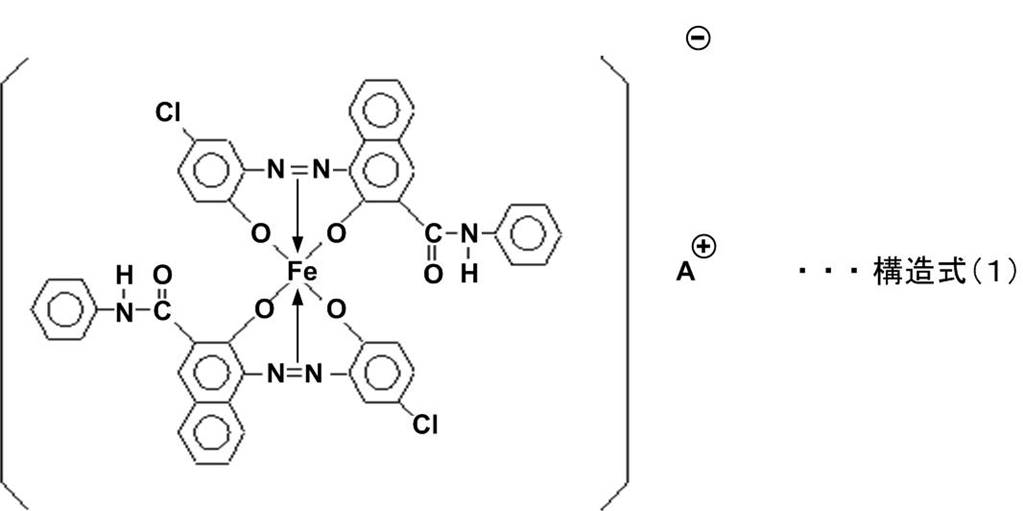
- Examples of the azo iron compound include compounds represented by the following structural formula (1) and the following structural formula (2).
- a + represents an ammonium ion.
- J + represents H + , an alkali metal cation, an ammonium ion, or an alkyl ammonium ion.
- Two or more of those shown above may be mixed. Among these, it is preferable to use a compound represented by the structural formula (1) that has an appropriate chargeability and has a high effect of improving background stains.
- a commercial product of the compound represented by the structural formula (1) is not particularly limited, and examples thereof include T-77 manufactured by Hodogaya Chemical Co., Ltd.
- a commercial product of the compound represented by the structural formula (2) is not particularly limited, and examples thereof include T-159 manufactured by Hodogaya Chemical Co., Ltd.
- the content of the azo iron compound is preferably 0.5 to 3.0 parts by mass with respect to 100 parts by mass of the binder resin in the toner.
- the content of these charge control agents is not particularly limited and may be appropriately selected depending on the intended purpose, but is 0.1 to 5 parts by mass with respect to 100 parts by mass of the binder resin in the toner.
- the amount is preferably 1 part by mass to 3 parts by mass.
- the toner of the present invention can be blended with a fluidity improver and the like as required.
- a fluidity improver any conventionally known fluidity improver such as silicon oxide, titanium oxide, silicon carbide, aluminum oxide, and barium titanate can be used alone or in combination.
- the content of these fluidity improvers is not particularly limited and may be appropriately selected depending on the intended purpose, but is preferably 0.1 to 5 parts by weight, more preferably 100 parts by weight of toner. 0.5 parts by mass to 2 parts by mass.
- the toner storage unit in the present invention refers to a unit in which toner is stored in a unit having a function of storing toner.
- examples of the toner storage unit include a toner storage container, a developing device, and a process cartridge.
- the toner container is a container that contains toner.
- the developing device has a means for containing and developing toner.
- the process cartridge is a cartridge in which at least the image carrier and the developing unit are integrated, accommodates toner, and is detachable from the image forming apparatus.
- the process cartridge may further include at least one selected from a charging unit, an exposure unit, and a cleaning unit.
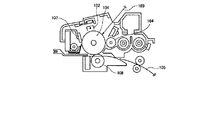
- the process cartridge includes a latent image carrier 101, includes a charging device 102, a developing device 104, and a cleaning unit 107, and further includes other means as necessary.
- reference numeral 103 denotes exposure from the exposure apparatus
- reference numeral 105 denotes recording paper.
- the latent image carrier 101 the same one as an electrostatic latent image carrier in an image forming apparatus described later can be used.
- An arbitrary charging member is used for the charging device 102. In the image forming process using the process cartridge shown in FIG.
- the latent image carrier 101 is exposed on the surface thereof by rotating in the direction of the arrow, charging by the charging device 102, and exposure 103 by the exposure means (not shown).
- An electrostatic latent image corresponding to is formed.
- the electrostatic latent image is developed with toner by the developing device 104, and the toner development is transferred to the recording paper 105 by the transfer roller 108 and printed out.
- the surface of the latent image carrier after the image transfer is cleaned by the cleaning unit 107 and further neutralized by a neutralizing unit (not shown), and the above operation is repeated again.
- the toner storage unit of the present invention is mounted on an image forming apparatus to form an image, image formation is performed using the toner of the present invention, and thus excellent fixability (low temperature fixability and hot offset resistance).
- a toner containing unit having toner that has sufficient stress resistance and does not cause cracking or sticking of the regulating blade even when used in a one-component development system can be obtained.
- the image forming apparatus of the present invention has at least an electrostatic latent image carrier (hereinafter sometimes referred to as a “photosensitive member”), an electrostatic latent image forming unit, and a developing unit, and if necessary. And other means such as static elimination means, cleaning means, recycling means, and control means.
- the image forming method according to the present invention includes at least an electrostatic latent image forming step and a developing step, and further includes other steps such as a static elimination step, a cleaning step, a recycling step, and a control step as necessary.
- the image forming method can be preferably performed by the image forming apparatus, the electrostatic latent image forming step can be preferably performed by the electrostatic latent image forming unit, and the developing step can be performed by the developing unit.
- the other steps can be preferably performed by the other means.
- the electrostatic latent image forming step is a step of forming an electrostatic latent image on the electrostatic latent image carrier.
- the electrostatic latent image carrier (sometimes referred to as “electrophotographic photosensitive member” or “photosensitive member”) is not particularly limited in terms of material, shape, structure, size, etc. Although it can be selected as appropriate, the shape thereof is preferably a drum shape, and examples of the material thereof include inorganic photoreceptors such as amorphous silicon and selenium, organic photoreceptors (OPC) such as polysilane and phthalopolymethine, and the like. Is mentioned. Among these, an organic photoreceptor (OPC) is preferable in that a higher definition image can be obtained.
- OPC organic photoreceptor
- the formation of the electrostatic latent image can be performed, for example, by uniformly charging the surface of the electrostatic latent image carrier and then performing imagewise exposure, and is performed by electrostatic latent image forming means.
- the electrostatic latent image forming unit includes, for example, a charging unit (charger) that uniformly charges the surface of the electrostatic latent image carrier, and an exposure that exposes the surface of the electrostatic latent image carrier imagewise. Means (exposure unit).
- the charging can be performed, for example, by applying a voltage to the surface of the electrostatic latent image carrier using the charger.
- the charger is not particularly limited and may be appropriately selected depending on the purpose.
- a known contact charging device including a conductive or semiconductive roll, brush, film, rubber blade, etc.
- non-contact chargers utilizing corona discharge such as corotrons and corotrons.
- the charger is preferably one that is arranged in contact or non-contact with the electrostatic latent image carrier and charges the surface of the electrostatic latent image carrier by applying a direct current and an alternating voltage.
- the charger is a charging roller disposed in a non-contact proximity to the electrostatic latent image carrier via a gap tape, and the electrostatic latent image is carried by applying a direct current and an alternating voltage to the charging roller. Those that charge the body surface are preferred.
- the exposure can be performed, for example, by exposing the surface of the latent electrostatic image bearing member imagewise using the exposure device.
- the exposure device is not particularly limited as long as it can expose the surface of the electrostatic latent image carrier charged by the charger so as to form an image to be formed, and is appropriately selected according to the purpose.
- various exposure devices such as a copying optical system, a rod lens array system, a laser optical system, and a liquid crystal shutter optical system can be used.
- a back light system in which imagewise exposure is performed from the back side of the electrostatic latent image carrier may be employed.
- the developing step is a step of developing the electrostatic latent image with the toner to form a visible image.
- the visible image can be formed, for example, by developing the electrostatic latent image using the toner, and can be performed by the developing unit.
- the developing unit preferably includes, for example, at least a developing unit that accommodates the toner and can apply the toner to the electrostatic latent image in a contact or non-contact manner, and includes a toner-containing container. Etc. are more preferable.
- the developing device may be a monochromatic developing device or a multi-color developing device, and has, for example, an agitator that frictionally agitates and charges the toner and a rotatable magnet roller.
- an agitator that frictionally agitates and charges the toner and a rotatable magnet roller.
- a thing etc. are mentioned suitably.
- the toner and the carrier are mixed and agitated, and the toner is charged by friction at that time, and held on the surface of the rotating magnet roller in a raised state to form a magnetic brush.
- the magnet roller is disposed in the vicinity of the electrostatic latent image carrier (photoconductor), a part of the toner constituting the magnetic brush formed on the surface of the magnet roller is electrically attracted. It moves to the surface of the electrostatic latent image carrier (photoconductor) by force.
- the electrostatic latent image is developed with the toner, and a visible image is formed with the toner on the surface of the electrostatic latent image carrier (photoconductor
- the transfer step is a step of transferring the visible image onto a recording medium. After the primary transfer of the visible image onto the intermediate transfer member using an intermediate transfer member, the visible image is transferred onto the recording medium.
- a mode including a secondary transfer step of transferring the transfer image onto the recording medium is more preferable.
- the transfer can be performed, for example, by charging the latent electrostatic image bearing member (photoconductor) of the visible image using a transfer charger, and can be performed by the transfer unit.
- the transfer means includes a primary transfer means for transferring a visible image onto an intermediate transfer member to form a composite transfer image, and a secondary transfer means for transferring the composite transfer image onto a recording medium.
- Embodiments are preferred.
- the intermediate transfer member is not particularly limited and may be appropriately selected from known transfer members according to the purpose. For example, a transfer belt and the like are preferable.
- the transfer means (the primary transfer means and the secondary transfer means) is a transfer for peeling and charging the visible image formed on the electrostatic latent image carrier (photoconductor) to the recording medium side. It is preferable to have at least a vessel.
- the number of the transfer means may be one, or two or more.
- Examples of the transfer device include a corona transfer device using corona discharge, a transfer belt, a transfer roller, a pressure transfer roller, and an adhesive transfer device.
- the recording medium is not particularly limited and can be appropriately selected from known recording media (recording paper).
- the fixing step is a step of fixing the visible image transferred to the recording medium using a fixing device, and may be performed each time the developer of each color is transferred to the recording medium, or the developer of each color. On the other hand, it may be carried out at the same time in a state where these are laminated.
- a well-known heating-pressing means is suitable. Examples of the heating and pressing means include a combination of a heating roller and a pressing roller, a combination of a heating roller, a pressing roller, and an endless belt.
- the fixing device includes a heating body including a heating element, a film in contact with the heating body, and a pressure member in pressure contact with the heating body through the film, and the film and the pressure member It is preferably a unit that heats and fixes a recording medium on which an unfixed image is formed.
- the heating in the heating and pressurizing means is usually preferably 80 ° C to 200 ° C.
- a known optical fixing device may be used together with or in place of the fixing step and the fixing unit depending on the purpose.
- the neutralization step is a step of performing neutralization by applying a neutralization bias to the electrostatic latent image carrier, and can be suitably performed by a neutralization unit.
- the neutralization means is not particularly limited, and may be appropriately selected from known neutralizers as long as it can apply a neutralization bias to the electrostatic latent image carrier. Preferably mentioned.
- the cleaning step is a step of removing the toner remaining on the electrostatic latent image carrier and can be suitably performed by a cleaning unit.
- the cleaning unit is not particularly limited, and may be selected from known cleaners as long as it can remove the toner remaining on the electrostatic latent image carrier.
- a magnetic brush cleaner Suitable examples include electrostatic brush cleaners, magnetic roller cleaners, blade cleaners, brush cleaners, web cleaners, and the like.
- the recycling step is a step of recycling the toner removed by the cleaning step to the developing unit, and can be suitably performed by the recycling unit.
- the control step is a step of controlling each step, and each step can be suitably performed by a control means.
- the control means is not particularly limited as long as the movement of each means can be controlled, and can be appropriately selected according to the purpose. Examples thereof include devices such as a sequencer and a computer.
- FIG. 3 shows a first example of the image forming apparatus of the present invention.
- the image forming apparatus 100 ⁇ / b> A includes a photosensitive drum 10, a charging roller 20, an exposure device, a developing device 40, an intermediate transfer belt 50, a cleaning device 60 having a cleaning blade, and a static elimination lamp 70.
- the intermediate transfer belt 50 is an endless belt stretched by three rollers 51 arranged on the inner side, and can move in the direction of the arrow in the figure.
- a part of the three rollers 51 also functions as a transfer bias roller that can apply a transfer bias (primary transfer bias) to the intermediate transfer belt 50.
- a cleaning device 90 having a cleaning blade is disposed in the vicinity of the intermediate transfer belt 50.
- a transfer roller 80 capable of applying a transfer bias (secondary transfer bias) for transferring the toner image to the transfer paper 95 is disposed to face the intermediate transfer belt 50.
- a corona charging device 58 for applying a charge to the toner image transferred to the intermediate transfer belt 50 is connected to the photosensitive drum 10 with respect to the rotation direction of the intermediate transfer belt 50. It is disposed between the contact portion of the intermediate transfer belt 50 and the contact portion of the intermediate transfer belt 50 and the transfer paper 95.
- the developing device 40 includes a developing belt 41 and a black developing unit 45K, a yellow developing unit 45Y, a magenta developing unit 45M, and a cyan developing unit 45C provided around the developing belt 41.
- Each color developing unit 45 includes a developer container 42, a developer supply roller 43, and a developing roller (developer carrier) 44.
- the developing belt 41 is an endless belt stretched by a plurality of belt rollers, and can move in the direction of the arrow in the figure. Further, a part of the developing belt 41 is in contact with the photosensitive drum 10.
- the surface of the photosensitive drum 10 is uniformly charged by using the charging roller 20, and then the exposure light L is exposed to the photosensitive drum 10 by using an exposure device (not shown). Form.
- the electrostatic latent image formed on the photosensitive drum 10 is developed with the toner supplied from the developing device 40 to form a toner image.
- the transfer bias applied from the transfer roller 80 is used. Then, it is transferred (secondary transfer) onto the transfer paper 95.
- the photosensitive drum 10 on which the toner image is transferred to the intermediate transfer belt 50 is discharged by the discharging lamp 70 after the toner remaining on the surface is removed by the cleaning device 60.
- FIG. 4 shows a second example of the image forming apparatus used in the present invention.
- the black developing unit 45K, the yellow developing unit 45Y, the magenta developing unit 45M, and the cyan developing unit 45C are arranged directly facing each other around the photosensitive drum 10 without providing the developing belt 41.
- the configuration is the same as that of the image forming apparatus 100A.
- FIG. 5 shows a third example of the image forming apparatus used in the present invention.
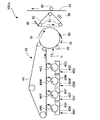
- the image forming apparatus 100 ⁇ / b> C is a tandem type color image forming apparatus, and includes a copying apparatus main body 150, a paper feed table 200, a scanner 300, and an automatic document feeder (ADF) 400.
- ADF automatic document feeder
- the intermediate transfer belt 50 provided at the center of the copying apparatus main body 150 is an endless belt stretched around three rollers 14, 15 and 16, and can move in the direction of the arrow in the figure.
- a cleaning device 17 having a cleaning blade for removing toner remaining on the intermediate transfer belt 50 on which the toner image has been transferred onto the recording paper is disposed.
- the image forming units 120Y, 120C, 120M, and 120K for yellow, cyan, magenta, and black are juxtaposed along the conveyance direction while facing the intermediate transfer belt 50 stretched by the rollers 14 and 15.
- an exposure device 21 is disposed in the vicinity of the image forming unit 120.
- the secondary transfer belt 24 is disposed on the side of the intermediate transfer belt 50 opposite to the side on which the image forming unit 120 is disposed.
- the secondary transfer belt 24 is an endless belt stretched around a pair of rollers 23, and the recording paper and the intermediate transfer belt 50 conveyed on the secondary transfer belt 24 are between the rollers 16 and 23. Can touch.
- a fixing device 25 is provided with a fixing belt 26 that is an endless belt stretched between a pair of rollers, and a pressure roller 27 that is arranged to be pressed against the fixing belt 26. Is arranged.
- a sheet reversing device 28 for reversing the recording paper when an image is formed on both sides of the recording paper is disposed in the vicinity of the secondary transfer belt 24 and the fixing device 25.
- a color document is set on the document table 130 of the automatic document feeder (ADF) 400, or the automatic document feeder 400 is opened and a color document is set on the contact glass 32 of the scanner 300 to automatically convey the document.
- the device 400 is closed.
- the start switch is pressed, when an original is set on the automatic document feeder 400, after the original is conveyed and moved onto the contact glass 32, on the other hand, when the original is set on the contact glass 32, Immediately, the scanner 300 is driven, and the first traveling body 33 including the light source and the second traveling body 34 including the mirror travel.
- the reflected light from the original surface of the light irradiated from the first traveling body 33 is reflected by the second traveling body 34 and then received by the reading sensor 36 via the imaging lens 35, whereby the original is received. It is read and image information of black, yellow, magenta and cyan is obtained.
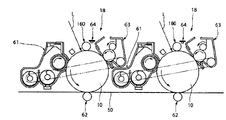
- each color image forming unit 120 includes a photosensitive drum 10, a charging roller 160 that uniformly charges the photosensitive drum 10, and image information of each color, respectively.
- An exposure device that exposes the exposure light L to form an electrostatic latent image of each color; a developing device 61 that develops the electrostatic latent image with a developer of each color to form a toner image of each color;
- a transfer roller 62 for transferring onto the transfer belt 50, a cleaning device 63 having a cleaning blade, and a static elimination lamp 64 are provided.
- the toner images of the respective colors formed by the image forming units 120 of the respective colors are sequentially transferred (primary transfer) onto the intermediate transfer belt 50 that is stretched over the rollers 14, 15, and 16, and superimposed to form a composite toner image. It is formed.
- one of the paper feed rollers 142 is selectively rotated to feed recording paper from one of the paper feed cassettes 144 provided in multiple stages in the paper bank 143, and one sheet at a time by the separation roller 145.
- the paper is separated and sent to the paper feed path 146, transported by the transport roller 147, guided to the paper feed path 148 in the copying apparatus main body 150, and abutted against the registration roller 49 to stop.
- the paper feed roller is rotated to feed out the recording paper on the manual feed tray 54, separated one by one by the separation roller 52, guided to the manual paper feed path 53, and abutted against the registration roller 49 and stopped.
- the registration roller 49 is generally used while being grounded, but may be used in a state in which a bias is applied in order to remove paper dust from the recording paper.
- the recording paper is sent between the intermediate transfer belt 50 and the secondary transfer belt 24, and the composite toner image is sent.
- the toner image is transferred onto the recording paper (secondary transfer).
- the toner remaining on the intermediate transfer belt 50 to which the composite toner image has been transferred is removed by the cleaning device 17.
- the recording paper on which the composite toner image has been transferred is conveyed by the secondary transfer belt 24 and then the composite toner image is fixed by the fixing device 25.
- the conveyance path of the recording paper is switched by the switching claw 55, and the recording paper is discharged onto the paper discharge tray 57 by the discharge roller 56.
- the recording path of the recording paper is switched by the switching claw 55, reversed by the sheet reversing device 28, an image is similarly formed on the back side, and then discharged onto the discharge tray 57 by the discharge roller 56. .
- Part represents “part by mass” unless otherwise specified.
- % Represents “% by mass” unless otherwise specified.
- THF-insoluble matter About 50 mg of the binder resin was weighed, and 10 g of THF was added to this and the resin solution sufficiently dissolved was separated by centrifugation. Then, the supernatant was dried and the solid content of the supernatant was calculated. The difference between the solid content of the resin solution prepared first and the solid content of the supernatant was defined as the THF-insoluble content.
- Tables 1 and 2 show the prescription and physical properties of each polyester resin.
- the acid component and the alcohol component represent “parts by mass”
- Mw represents the weight average molecular weight
- THF-insoluble matter represents “%”.
- the numerical value of “peak top molecular weight” represents the molecular weight of the main peak value.
- Example 1-1 A mixture having the following composition was sufficiently stirred and mixed in a Henschel mixer, heated and melted at a temperature of 130 to 140 ° C. for about 30 minutes with a roll mill, cooled to room temperature, and then the obtained kneaded product was jet mill or mechanical pulverizer, The toner base was obtained by pulverization and classification with an air classifier.
- the toner base thus obtained was mixed with 0.5% by weight of hydrophobic silica to obtain [Toner 1-1].
- Example 1-2 [Toner 1-2] was obtained in the same manner as in Example 1-1 except that [Polyester resin B-1] was changed to [Polyester resin B-2] in Example 1-1.
- Example 1-3 Example 1 except that [Polyester resin A-1] was changed to [Polyester resin A-2] and [Polyester resin B-1] was changed to [Polyester resin B-3] in Example 1-1. [Toner 1-3] was obtained in the same manner as -1.
- Example 1-4 [Toner 1-4] was obtained in the same manner as in Example 1-1 except that [Polyester resin B-1] was changed to [Polyester resin B-4] in Example 1-1.
- Example 1-5 In Example 1-1, except that the type and amount of the binder resin were changed to 60 parts by mass of [Polyester resin A-2] and 40 parts by mass of [Polyester resin B-3], the same as Example 1-1 Thus, [Toner 1-5] was obtained.
- Example 1-6 Example 1 except that [Polyester Resin A-1] was changed to [Polyester Resin A-3] and [Polyester Resin B-1] was changed to [Polyester Resin B-4] in Example 1-1. [Toner 1-6] was obtained in the same manner as -1.
- Example 1-7 In Example 1-1, except that the type and amount of the binder resin were changed to 40 parts by mass of [Polyester resin A-3] and 60 parts by mass of [Polyester resin B-4], the same as Example 1-1 [Toner 1-7] was thus obtained.
- Example 1-1 was the same as Example 1-1 except that the type and amount of the binder resin were changed to 70 parts by weight of [Polyester resin A-2] and 30 parts by weight of [Polyester resin B-3]. Thus, [Toner 1-8] was obtained.
- Example 1-1 In Example 1-1, except that the type and amount of the binder resin were changed to 35 parts by mass of [Polyester resin A-1] and 65 parts by mass of [Polyester resin B-2], the same as Example 1-1 [Comparative toner 1-2] was thus obtained.
- Example 1-1 In Example 1-1, except that the type and amount of the binder resin were changed to 35 parts by mass of [Polyester resin A-2] and 65 parts by mass of [Polyester resin B-2], the same as Example 1-1 [Comparative toner 1-4] was thus obtained.
- Example 1-5 In Example 1-1, except that the type and amount of the binder resin were changed to 60 parts by mass of [Polyester resin A-2] and 40 parts by mass of [Polyester resin B-3], the same as Example 1-1 [Comparative toner 1-5] was thus obtained.
- Example 1-1 In Example 1-1, except that the type and amount of the binder resin were changed to 35 parts by weight of [Polyester resin A-3] and 65 parts by weight of [Polyester resin B-4], the same as Example 1-1 [Comparative toner 1-6] was thus obtained.
- Example 1-7 In Example 1-1, except that the type and amount of the binder resin were changed to 60 parts by mass of [Polyester resin A-2] and 40 parts by mass of [Polyester resin B-7], the same as Example 1-1 [Comparative toner 1-7] was thus obtained.
- Example 1 Example 1 except that [Polyester Resin A-1] was changed to [Polyester Resin A-5] and [Polyester Resin B-1] was changed to [Polyester Resin B-4] in Example 1-1. [Comparative Toner 1-8] was obtained in the same manner as -1.
- Example 1-1 In Example 1-1, except that the type and amount of the binder resin were changed to 40 parts by mass of [Polyester resin A-6] and 60 parts by mass of [Polyester resin B-4], the same as Example 1-1 [Comparative toner 1-9] was thus obtained.
- Example 1-1 was the same as Example 1-1 except that the type and amount of the binder resin were changed to 75 parts by weight of [Polyester resin A-2] and 25 parts by weight of [Polyester resin B-3]. [Comparative toner 1-10] was thus obtained.
- Example 1-11 In Example 1-1, except that the type and amount of the binder resin were changed to 40 parts by mass of [Polyester resin A-3] and 60 parts by mass of [Polyester resin B-8], the same as Example 1-1 [Comparative toner 1-11] was thus obtained.
- THF insoluble matter About 50 mg of the toner was weighed, and 10 g of THF was added to the toner solution, and the toner solution was sufficiently dissolved. Then, the solution was separated by centrifugation, and then the supernatant was dried to calculate the solid content of the supernatant. The difference between the solid content of the toner solution prepared first and the solid content of the supernatant was defined as the THF-insoluble content.
- Table 3 shows a list of physical properties of the obtained toner.
- ⁇ Crack chip resistance> After putting 50 g of toner into a 250 ml plastic container, 120 g of ⁇ 10 mm alumina beads were added and stirred for 40 hours at 150 rpm in a ball mill. After stirring, the initial particle size and the amount of increase in the fine powder component after stirring were evaluated. The increase in fine powder was measured by the Coulter counter method. A Coulter Multisizer III (manufactured by Coulter, Inc.) was used as an apparatus for measuring the particle size distribution of toner particles. First, 0.1 to 5 mL of a surfactant (preferably alkylbenzene sulfonate) was added as a dispersing agent to 100 to 150 mL of an electrolytic aqueous solution.
- a surfactant preferably alkylbenzene sulfonate
- the electrolytic solution was prepared by preparing approximately 1% NaCl aqueous solution using first grade sodium chloride, and ISOTON-II (manufactured by Coulter) was used. Further, 2 to 20 mg of a measurement sample was added to a solid content.
- the electrolytic solution in which the sample is suspended is subjected to a dispersion treatment with an ultrasonic disperser for about 1 to 3 minutes, and the measurement device is used to measure the volume and number of toner particles or toner using a 100 ⁇ m aperture as an aperture. Volume distribution and number distribution were calculated, and an increase in number% of less than 3.00 ⁇ m was evaluated according to the following criteria.
- ⁇ Blade fixing durability evaluation> After putting 50 g of toner into a 250 ml plastic container, 120 g of ⁇ 10 mm alumina beads were added and stirred at 150 rpm for 40 hours in a ball mill to prepare a deteriorated toner for evaluation. 20 g of the deteriorated toner for this evaluation was put into a development unit of IPSiO SP C220 manufactured by Ricoh, and the blade adhesion was evaluated with an external idling machine. Blade sticking was visually confirmed every 5 minutes for streaks originating from the sticking to the 5 cm both ends of the developing roller in the image area.
- the evaluation criteria are as follows.
- ⁇ Fixability evaluation> A modified Ricoh IPSiO SP C220 was used, and a toner was added. A 40 mm square unfixed solid image was printed on a Ricoh type 6000T eye paper with an adhesion amount of 10 g / m 2 . . Next, using a modified fixing unit of IPSiO SP 4510SF made by Ricoh, the system speed was set to 240 mm / sec, and the prepared unfixed solid image was passed through to fix the image. The fixing temperature was tested from 120 ° C. to 200 ° C. in increments of 5 ° C., and the toner was visually observed for toner offset. The evaluation criteria for the minimum fixing temperature and the maximum fixing temperature are as follows.
- Fixing lower limit temperature is less than 130 ° C.
- Fixing lower limit temperature is 150 ° C. or more.
- Upper limit fixing temperature is lower than 170 ° C.
- Table 4 shows the evaluation results of Examples and Comparative Examples. The overall evaluation is “ ⁇ ” if all items are “ ⁇ ” or more, “ ⁇ ” if all items are “ ⁇ ” or more, “X” if any item is “ ⁇ ”, and “ ⁇ ”. The above are acceptable levels.
- Example 2-1 A mixture having the following composition was sufficiently stirred and mixed in a Henschel mixer, heated and melted at a temperature of 130 to 140 ° C. for about 30 minutes with a roll mill, and cooled to room temperature.
- the toner base was obtained by pulverization and classification with an air classifier.
- the toner base thus obtained was mixed with 0.5% by weight of hydrophobic silica to obtain toner 2-1.
- Example 2-2 Toner 2-2 was obtained in the same manner as in Example 2-1, except that [Polyester resin B-1] was changed to [Polyester resin B-2] in Example 2-1.
- Example 2-3 Example 2 except that [Polyester Resin A-1] was changed to [Polyester Resin A-2] and [Polyester Resin B-1] was changed to [Polyester Resin B-3] in Example 2-1. Toner 2-3 was obtained in the same manner as -1.
- Example 2-4 Toner 2-4 was obtained in the same manner as in Example 2-1, except that [Polyester resin B-1] was changed to [Polyester resin B-4] in Example 2-1.
- Example 2-5) Example 2-1 was the same as Example 2-1 except that the type and amount of the binder resin were changed to [Polyester resin A-2] 60 parts by mass and [Polyester resin B-3] 40 parts by mass. Thus, toner 2-5 was obtained.
- Example 2-6 Example 2 except that [Polyester Resin A-1] was changed to [Polyester Resin A-3] and [Polyester Resin B-1] was changed to [Polyester Resin B-4] in Example 2-1. Toner 2-6 was obtained in the same manner as -1.
- Example 2--7 Example 2-1 was the same as Example 2-1 except that the type and amount of the binder resin were changed to 40 parts by weight of [Polyester resin A-3] and 60 parts by weight of [Polyester resin B-4]. Thus, toner 2-7 was obtained.
- Example 2-8 In Example 2-1, the type and amount of the binder resin were changed to 70 parts by mass of [Polyester resin A-2] and 30 parts by mass of [Polyester resin B-3]. Thus, toner 2-8 was obtained.
- Example 2-9 Toner 2-9 was obtained in the same manner as in Example 2-1, except that the type of wax in Example 2-1 was changed to a synthesized monoester wax having an endothermic start temperature of 52.3 ° C.
- Example 2-10 Example 2-1 was the same as Example 2-1 except that the type of wax was changed to a pre-refined rice wax (TOWAX-3F16, manufactured by Toa Kasei Co., Ltd., endothermic start temperature: 59.2 ° C.). Thus, toner 2-10 was obtained.
- TOWAX-3F16 manufactured by Toa Kasei Co., Ltd., endothermic start temperature: 59.2 ° C.
- Example 2-11 Toner 2-11 was obtained in the same manner as in Example 2-1, except that the type of wax was changed to a synthesized monoester wax having an endothermic start temperature of 72.1 ° C.
- Example 2-12 Toner 2-12 was obtained in the same manner as in Example 2-1, except that the amount of wax added was changed to 0.5 parts by mass in Example 2-1.
- Example 2-13 Toner 2-13 was obtained in the same manner as in Example 2-1, except that in Example 2-1, the amount of wax added was changed to 7 parts by mass.
- Example 2-14 Toner 2 in the same manner as in Example 2-1, except that the type of wax in Example 2-1 was changed to paraffin wax (HNP-9, manufactured by Nippon Seiki Co., Ltd., endothermic start temperature: 60.4 ° C.). -14 was obtained.
- paraffin wax HNP-9, manufactured by Nippon Seiki Co., Ltd., endothermic start temperature: 60.4 ° C.
- Example Comparative Example 2-1 In Example 2-1, except that [Polyester resin B-1] was changed to [Polyester resin B-5] and the type of wax was changed to rice wax (endothermic start temperature: 66.3 ° C.), Example Comparative toner 2-1 was obtained in the same manner as in 2-1.
- Comparative Example 2-2 Comparative Example 2-2
- Example 2-1 the type and amount of the binder resin were changed to 35 parts by mass of [Polyester resin A-1] and 65 parts by mass of [Polyester resin B-2], and the type of wax was changed to rice wax (starting endotherm). Comparative toner 2-2 was obtained in the same manner as in Example 2-1, except that the temperature was changed to 66.3 ° C.
- Comparative Example 2-3 In Example 2-1, the type and amount of binder resin were changed to 65 parts by weight of [Polyester resin A-2] and 35 parts by weight of [Polyester resin B-3], and the type of wax was changed to rice wax (starting endotherm). Comparative toner 2-3 was obtained in the same manner as in Example 2-1, except that the temperature was changed to 66.3 ° C.
- Comparative Example 2-4 Comparative Example 2-4
- Example 2-1 the type and addition amount of the binder resin were changed to 35 parts by mass of [Polyester resin A-1] and 65 parts by mass of [Polyester resin B-4], and the type of wax was changed to rice wax (starting endotherm). Comparative toner 2-4 was obtained in the same manner as in Example 2-1, except that the temperature was changed to 66.3 ° C.
- Example 2-5 In Example 2-1, [Polyester Resin A-1] was changed to [Polyester Resin A-2], [Polyester Resin B-1] was changed to [Polyester Resin B-5], and the type of wax was rice A comparative toner 2-5 was obtained in the same manner as in Example 2-1, except that the wax was changed to wax (endothermic start temperature: 66.3 ° C.).
- Example 2-6 In Example 2-1, [Polyester Resin A-1] was changed to [Polyester Resin A-3], [Polyester Resin B-1] was changed to [Polyester Resin B-4], and the type of wax was rice Comparative toner 2-6 was obtained in the same manner as in Example 2-1, except that the wax was changed to wax (endothermic start temperature: 66.3 ° C.).
- Comparative Example 2--7 In Example 2-1, the type and addition amount of the binder resin were changed to 45 parts by mass of [Polyester resin A-4] and 55 parts by mass of [Polyester resin B-4], and the type of wax was changed to rice wax (starting endotherm). Comparative toner 2-7 was obtained in the same manner as in Example 2-1, except that the temperature was changed to 66.3 ° C.
- Comparative Example 2-8 In Example 2-1, the type and addition amount of the binder resin were changed to 70 parts by mass of [Polyester resin A-2] and 30 parts by mass of [Polyester resin B-5], and the type of wax was rice wax (starting endotherm). Comparative toner 2-8 was obtained in the same manner as in Example 2-1, except that the temperature was changed to 66.3 ° C.
- Comparative Example 2-9 In Example 2-1, the type and addition amount of the binder resin were changed to 40 parts by mass of [Polyester resin A-1] and 60 parts by mass of [Polyester resin B-6], and the type of wax was changed to rice wax (starting endotherm). Comparative toner 2-9 was obtained in the same manner as in Example 2-1, except that the temperature was changed to 66.3 ° C.
- Example 2-10 In Example 2-1, [Polyester Resin A-1] was changed to [Polyester Resin A-2], [Polyester Resin B-1] was changed to [Polyester Resin B-4], and the type of wax was rice A comparative toner 2-10 was obtained in the same manner as in Example 2-1, except that the wax was changed to wax (endothermic start temperature: 66.3 ° C.).
- Example 2-11 Comparative Example 2-11
- the type and addition amount of the binder resin were changed to 65 parts by mass of [Polyester resin A-2] and 35 parts by mass of [Polyester resin B-5], and the type of wax was rice wax (starting endotherm).
- Comparative toner 2-11 was obtained in the same manner as in Example 2-1, except that the temperature was changed to 66.3 ° C.
- Example 2-12 Comparative Example 2-12
- Example 1 was changed except that [Polyester resin A-1] was changed to [Polyester resin A-4] and the type of wax was changed to rice wax (endothermic start temperature: 66.3 ° C.).
- Comparative toner 2-12 was obtained in the same manner as in 2-1.
- Example 2-13 (Comparative Example 2-13)
- the type and amount of the binder resin were changed to 30 parts by weight of [Polyester Resin A-4] and changed to 70 parts by weight of [Polyester Resin B-5], and the type of wax was changed to Rice Wax.
- a comparative toner 2-13 was obtained in the same manner as in Example 2-1, except that the temperature was changed to (endotherm start temperature: 66.3 ° C.).
- THF insoluble matter About 50 mg of the toner was weighed, and 10 g of THF (tetrahydrofuran) was added to the toner solution and sufficiently dissolved. Then, the solution was separated by centrifugation, and then the supernatant was dried to calculate the solid content of the supernatant. The difference between the solid content of the toner solution prepared first and the solid content of the supernatant was defined as the THF-insoluble content.
- a differential scanning calorimeter (DSC-6220R: Seiko Instruments Inc.) was used to measure the melting point of the wax used. First, after heating from room temperature to 150 ° C. at a temperature rising rate of 10 ° C./min, the sample is left standing at 150 ° C. for 10 minutes, the sample is cooled to room temperature and left for 10 minutes, and then again heated to 150 ° C. at a temperature rising rate of 10 ° C./min. When heated, the intersection of the tangent line between the base line and the inflection point was taken, and the intersection was defined as the endothermic start temperature.
- Table 5 shows a list of physical properties of the obtained toner.
- ⁇ Blade fixing durability evaluation> After putting 50 g of toner into a 250 ml plastic container, 120 g of ⁇ 10 mm alumina beads were added and stirred at 150 rpm for 40 hours in a ball mill to prepare a deteriorated toner for evaluation. 20 g of the deteriorated toner for this evaluation was put into a development unit of IPSiO SP C220 manufactured by Ricoh, and the blade adhesion was evaluated with an external idling machine. Blade sticking was visually confirmed every 5 minutes for streaks originating from the sticking to the 5 cm both ends of the developing roller in the image area.
- the evaluation criteria are as follows.
- ⁇ Fixability evaluation> A modified Ricoh IPSiO SP C220 was used, and a toner was added. A 40 mm square unfixed solid image was printed on a Ricoh type 6000T eye paper with an adhesion amount of 10 g / m 2 . . Next, using a modified fixing unit of IPSiO SP 4510SF made by Ricoh, the system speed was set to 240 mm / sec, and the prepared unfixed solid image was passed through to fix the image. The fixing temperature was tested from 120 ° C. to 220 ° C. in increments of 2 ° C., and the toner was visually observed for toner offset. The evaluation criteria for the minimum fixing temperature and the maximum fixing temperature are as follows.
- Fixing lower limit temperature is less than 130 ° C.
- Fixing lower limit temperature is 150 ° C. or more.
- Upper limit fixing temperature is lower than 170 ° C.
- Table 6 shows the evaluation results of Examples and Comparative Examples.
- the overall evaluation was “ ⁇ ” if all items were “ ⁇ ” or more, “ ⁇ ” if all items were “ ⁇ ” or more, and “ ⁇ ” if any item was “ ⁇ ”.
- “x” is a failure level
- “ ⁇ ” and “ ⁇ ” are acceptance levels
- “ ⁇ ” represents a result superior to “ ⁇ ”.
- Example 3-1 A mixture having the following composition was sufficiently stirred and mixed in a Henschel mixer, melt-kneaded with a twin-screw extrusion kneader (TEM-18SS, manufactured by Toshiba Machine Co., Ltd.), cooled to room temperature, and the resulting kneaded product was jet milled (IDS). -2) (manufactured by Nippon New Matchk Co., Ltd.) and a rotor classifier (50 ATP, manufactured by Hosokawa Micron Corporation) to obtain a toner base having an average particle size of 8 ⁇ m.
- TEM-18SS twin-screw extrusion kneader
- Polyester resin A-1 50 parts Polyester resin B-1 50 parts Rice wax (TOWAX-3F16, manufactured by Toa Kasei Co., Ltd.) 5 parts Carbon black (# 44, manufactured by Mitsubishi Kasei Co., Ltd.) 10 parts Azo-iron compound (T-77, Preservation) 1.8 parts by Tsuchiya Chemical Co., Ltd., referred to as [CCA1]
- Toner 3-1 was obtained by adding and mixing 2 parts by mass of 12 nm HMDS-treated hydrophobic silica (RX200: manufactured by Nippon Aerosil Co., Ltd.) to 100 parts by mass of the obtained toner base.
- Table 7 shows the toner physical properties.
- Examples 3-2 to 3-13 Comparative Examples 3-1 to 3-11
- each toner was obtained in the same manner as in Example 3-1, except that the toner configuration shown in Table 7 was changed.
- THF insoluble matter About 50 mg of the toner was weighed, and 10 g of THF (tetrahydrofuran) was added to the toner solution and sufficiently dissolved. Then, the solution was separated by centrifugation, and then the supernatant was dried to calculate the solid content of the supernatant. The difference between the solid content of the toner solution prepared first and the solid content of the supernatant was defined as the THF-insoluble content.
- Table 7 shows the physical properties and evaluation results of the toner thus obtained.
- the CCA content (parts by mass) represents the content (parts by mass) relative to 100 parts by mass of the binder resin.
- CCA2 is a compound in which J + is an alkyl ammonium ion in the structural formula (2).
- CCA3 is TN-105 manufactured by Hodogaya Chemical Co., Ltd.
- Fixing lower limit temperature is less than 130 ° C.
- a modified Ricoh IPSiO SP C220 was used, and a toner was added.
- a 40 mm square unfixed solid image was printed on a Ricoh type 6000T eye paper with an adhesion amount of 10 g / m 2 . .
- the system speed was set to 240 mm / sec, and the prepared unfixed solid image was passed through to fix the image.
- the fixing temperature was tested from 160 ° C. to 200 ° C. in increments of 2 ° C., and visually observed, and the temperature at which the toner image did not appear on the white paper portion was defined as the fixing upper limit temperature.
- the evaluation criteria are as follows.
- Upper limit fixing temperature is lower than 170 ° C.
- ⁇ Blade fixing durability evaluation> After putting 50 g of toner into a 250 ml plastic container, 120 g of ⁇ 10 mm alumina beads were added and stirred at 150 rpm for 40 hours in a ball mill to prepare a deteriorated toner for evaluation. 20 g of the deteriorated toner for this evaluation was put into a development unit of IPSiO SP C220 manufactured by Ricoh, and the blade adhesion was evaluated with an external idling machine. Blade sticking was visually confirmed every 5 minutes for streaks originating from the sticking to the 5 cm both ends of the developing roller in the image area.
- the evaluation criteria are as follows. [Evaluation criteria] A: Time for blade fixing to be 120 minutes or longer O: Time for blade fixing to be 60 minutes to less than 120 minutes ⁇ : Time for blade fixing to be 30 minutes to less than 60 minutes ⁇ : Time for blade fixing to occur Less than 30 minutes
- Table 8 shows the evaluation results of Examples and Comparative Examples. The overall evaluation was “ ⁇ ” if all items were “ ⁇ ” or more, “ ⁇ ” if all items were “ ⁇ ” or more, and “ ⁇ ” if any item was “ ⁇ ”. In the comprehensive evaluation, “x” is a failure level, “ ⁇ ” and “ ⁇ ” are acceptance levels, and “ ⁇ ” represents a result superior to “ ⁇ ”.
- a toner containing a binder resin contains 10% by mass to 40% by mass of THF-insoluble matter
- GPC gel permeation chromatography
- the toner has a main peak between 10,000 and 16,000, and the half width of the main peak has a molecular weight of 60,000.
- the component having a molecular weight of 2,000 or less by GPC is 15.0% by mass to 25.0% by mass, and the component having a molecular weight of 100,000 or more is 10.0% by mass.
- the toner is characterized by the following.
- ⁇ 2> The toner according to ⁇ 1>, wherein the molecular weight distribution has a main peak between 12,000 and 15,000, and the half width of the main peak is a molecular weight of 65,000 to 80,000. is there.
- ⁇ 3> The toner according to any one of ⁇ 1> to ⁇ 2>, wherein the toner contains 30% by mass to 40% by mass of a THF-insoluble content.
- ⁇ 4> Further containing a release agent, and in differential scanning calorimetry (DSC), the endothermic start temperature of the release agent at the second temperature increase is from 50 ° C. to 75 ° C.
- DSC differential scanning calorimetry
- ⁇ 5> The toner according to ⁇ 4>, wherein the endothermic start temperature of the release agent is 55 ° C. or higher and 70 ° C. or lower.
- ⁇ 6> The toner according to any one of ⁇ 1> to ⁇ 3>, further including an azo iron compound.
- ⁇ 7> The toner according to ⁇ 6>, wherein the azo iron compound is represented by the following structural formula (1). (In the structural formula (1), A + represents an ammonium ion.)
- ⁇ 8> The toner according to any one of ⁇ 1> to ⁇ 7>, which is a one-component developing toner.
- a toner storage unit that stores the toner according to any one of ⁇ 1> to ⁇ 8>.
- an electrostatic latent image carrier An electrostatic latent image forming means for forming an electrostatic latent image on the electrostatic latent image carrier; Developing means comprising toner for developing the electrostatic latent image formed on the electrostatic latent image carrier to form a visible image;
- the toner is the toner according to any one of ⁇ 1> to ⁇ 8>.
- the present invention it is possible to solve the above-mentioned problems and to have excellent stress resistance (low temperature fixability and hot offset resistance) while having sufficient stress resistance. Even if it is used, it is possible to provide a toner that does not cause cracking or sticking of the regulating blade.
- Electrostatic latent image carrier (photosensitive drum) 10K Black electrostatic latent image carrier 10Y Yellow electrostatic latent image carrier 10M Magenta electrostatic latent image carrier 10C Cyan electrostatic latent image carrier 14 Roller 15 Roller 16 Roller 17 Cleaning device 18 Image forming means 20 Charging roller 21 Exposure device 22 Secondary transfer device 23 Roller 24 Secondary transfer belt 25 Fixing device 26 Fixing belt 27 Pressure roller 28 Sheet reversing device 32 Contact glass 33 First traveling body 34 Second traveling body 35 Imaging lens 36 Reading Sensor 40 Developing device 41 Developing belt 42K Developer container 42Y Developer container 42M Developer container 42C Developer container 43K Developer supply roller 43Y Developer supply roller 43M Developer supply roller 43M Developer supply roller 43C Developer supply roller 44K Developer roller 44Y Developing roller 44M Developing roller 44C Developing roller 45K Black developing unit 45Y Yellow developing unit 45M Magenta developing unit 45C Cyan developing unit 49 Registration roller 50 Intermediate transfer belt 51 Roller 52 Separating roller 53 Manual feed path 54 Manual feed tray 55 Switching claw 56 Ejection roller 57 Ejection tray 58 Corona charging device 60 Cleaning device 61 Developing
Landscapes
- Physics & Mathematics (AREA)
- General Physics & Mathematics (AREA)
- Spectroscopy & Molecular Physics (AREA)
- Chemical & Material Sciences (AREA)
- Chemical Kinetics & Catalysis (AREA)
- Developing Agents For Electrophotography (AREA)
Abstract
Description
本発明のトナーは、
結着樹脂を含有するトナーであって、
前記トナーは、THF不溶分を10質量%~40質量%含み、
前記トナーのTHF可溶分のGPC(ゲルパミエーションクロマトグラフィー)による分子量分布において、10,000~16,000の間にメインピークを有し、かつ、該メインピークの半値幅が分子量60,000~90,000であり、
前記トナーのTHF可溶分において、GPCによる分子量2,000以下の成分が、15.0質量%~25.0質量%であり、かつ、分子量100,000以上の成分が、10.0質量%以下であることを特徴とする。
本発明のトナーは、少なくとも結着樹脂を含む。
前記トナーは、THF不溶分を10質量%~40質量%含む。
前記トナーは、前記トナーのTHF可溶分のGPC(ゲルパミエーションクロマトグラフィー)による分子量分布において、10,000~16,000の間にメインピークを有し、かつ、該メインピークの半値幅が分子量60,000~90,000である。
前記トナーのTHF可溶分において、GPCによる分子量2,000以下の成分は、15.0質量%~25.0質量%であり、かつ、分子量100,000以上の成分は、10.0質量%以下である。
本発明のトナーは、THF(テトラヒドロフラン)不溶分を10質量%~40質量%含んでいる。トナーのTHF不溶分の絶対量をTHF可溶分の絶対量より少なくすること、すなわち、前記トナーにおいてTHF不溶分を10質量%~40質量%にすることが重要である。これによって、低温定着性や耐ホットオフセット性を向上させることができる。前記THF不溶分が、10質量%未満の場合、定着性の悪化やトナーの割れ欠けが生じ、40質量%より大きい場合、低温定着性が悪化する。
前記トナーはTHF不溶分を16質量%~40質量%含むことが好ましく、30質量%~40質量%含むことがより好ましい。
トナーのTHF可溶分のGPC測定により得られる分子量分布の一例の模式図を図1に示す。図1の横軸は分子量であり、縦軸はピーク強度である。図1に示される(A)は低分子量域を示し、該低分子量域の成分によって低温定着性が確保される。また、図1の(B)は分子量10,000~16,000の間にメインピークが存在することを示しており、該メインピークの分子量と半値幅を制御することにより、トナーの靱性が確保される。図1の(C)は高分子量域を示し、該高分子量域の成分を減らすことにより、定着下限への影響を抑制することができる。
本発明では、THF可溶分により求められたGPCによる分子量分布の値が、10,000~16,000の間にメインピークを有し、該メインピークの半値幅が分子量60,000~90,000である。本発明でメインピークとは、測定結果のうち最も強度の高いピークのことをいう。
これは主に樹脂の低分子量成分が定着下限に寄与しているためである。このことに加えて、耐ホットオフセット性を確保するためのゲル分(THF不溶分)を所定の含有量にして定着性を確保することで、耐ストレス性を損なわず、定着性を確保することが可能となる。
なお、分子量2,000以下の成分が15.0質量%未満であると、低温定着性が不十分となる。分子量2,000以下の成分が25.0質量%を超えると、耐ホットオフセット性が不十分であり、更にトナー割れ欠け性の悪化、規制ブレードへの固着が生じる。分子量100,000以上の成分が10.0質量%を超えると、低温定着性が不十分となる。
前記分子量2,000以下の成分は、15.5質量%~21.0質量%が好ましく、16.5質量%~19.0質量%がより好ましい。
前記分子量100,000以下の成分は、9.5質量%以下が好ましく、9.0質量%以下がより好ましい。下限値は、特に制限はなく、目的に応じて適宜選択することができるが、前記分子量100,000以下の成分は、3.0質量%以上が好ましく、4.0質量%以上がより好ましく、5.0質量%以上が特に好ましい。
・装置:GPC-150C(ウォーターズ社製)
・カラム:KF801~807(ショウデックス社製)
・温度:40℃
・溶媒:THF(テトラヒドロフラン)
・流速:1.0mL/分
・試料:濃度0.05~0.6%の試料を0.1mL注入する。
以上の条件で測定した分子量分布から単分散ポリスチレン標準試料により作製した分子量校正曲線を使用して樹脂の数平均分子量及び重量平均分子量を算出する。
本発明のトナーは、例えば、少なくとも結着樹脂を含有するトナー母体に、必要に応じてその他の成分を含み、さらに必要に応じて外添剤を添加するものである。
本発明で用いられる結着樹脂としては例えばポリエステル樹脂が挙げられ、ポリエステル樹脂は、アルコールとカルボン酸との縮重合によって通常得られるものである。
ポリスチレン、クロロポリスチレン、ポリα-メチルスチレン、スチレン/クロロスチレン共重合体、スチレン/プロピレン共重合体、スチレン/ブタジエン共重合体、スチレン/塩化ビニル共重合体、スチレン/酢酸ビニル共重合体、スチレン/マレイン酸共重合体、スチレン/アクリル酸エステル共重合体(スチレン/アクリル酸メチル共重合体、スチレン/アクリル酸エチル共重合体、スチレン/アクリル酸ブチル共重合体、スチレン/アクリル酸オクチル共重合体、スチレン/アクリル酸フェニル共重合体等)、スチレン/メタクリル酸エステル共重合体(スチレン/メタクリル酸メチル共重合体、スチレン/メタクリル酸エチル共重合体、スチレン/メタクリル酸ブチル共重合体、スチレン/メタクリル酸フェニル共重合体等)、スチレン/α-クロルアクリル酸メチル共重合体、スチレン/アクリロニトリル/アクリル酸エステル共重合体等のスチレン系樹脂(スチレン又はスチレン置換体を含む単独重合体又は共重合体)、塩化ビニル樹脂、スチレン/酢酸ビニル共重合体、ロジン変性マレイン酸樹脂、フェノール樹脂、エポキシ樹脂、ポリエチレン樹脂、ポリプロピレン樹脂、アイオノマー樹脂、ポリウレタン樹脂、シリコーン樹脂、ケトン樹脂、エチレン/エチルアクリレート共重合体、キシレン樹脂、ポリビニルブチラール樹脂等、石油系樹脂、水素添加された石油系樹脂。
これらの樹脂の製造法は、特に限定されるものではなく、塊状重合、溶液重合、乳化重合、懸濁重合のいずれも利用できる。
本発明において、トナーに使用される離型剤としては公知のものが全て使用できるが、特に、脱遊離脂肪酸型カルナウバワックス、モンタンワックス及び酸化ライスワックスを単独又は組み合わせて使用することができる。
モンタンワックスについては、一般に鉱物より精製されたモンタン系ワックスを指し、カルナウバワックス同様、微結晶であり、酸価が5~14であることが好ましい。
酸化ライスワックスは、米ぬかワックスを空気酸化したものであり、その酸価は10~30が好ましい。
その他の離型剤としては、固形シリコーンワニス、高級脂肪酸高級アルコール、モンタン系エステルワックス、低分子量ポリプロピレンワックス等、従来公知のいかなる離型剤をも混合して使用できる。
前記離型剤(ワックス)の融点の測定としては、示差走査熱量計(DSC-6220R:セイコーインスツル社)を用いる。まず、室温から昇温速度10℃/minで150℃まで加熱した後、150℃で10min間放置し、室温まで試料を冷却して10min放置し、再度150℃まで昇温速度10℃/minで加熱した際に、ベースラインと変曲点の接線の交点を取り、その交点を吸熱開始温度とする。
本発明のトナーに用いる着色剤としては、例えばカーボンブラック、ランプブラック、鉄黒、アニリンブルー、フタロシアニンブルー、フタロシアニングリーン、ハンザイエローG、ローダミン6Cレーキ、カルコオイルブルー、クロムイエロー、キナクリドン、ベンジジンイエロー、ローズベンガル、トリアリルメタン系染料等の染顔料など、従来公知のいかなる染顔料をも単独あるいは混合して使用でき、ブラックトナーとしてもフルカラートナーとしても使用できる。
帯電制御剤としては、ニグロシン染料、金属錯塩型染料、第四級アンモニウム塩等の従来公知のいかなる極性制御剤も、単独あるいは混合して使用できる。
上記で示されるもののうち2種以上が混合されていてもよい。

これらの中でも、適度な帯電性を持ち、地汚れの改善の効果が高い前記構造式(1)で表される化合物を用いることが好ましい。
前記構造式(2)で表される化合物の市販品としては、特に制限されるものではないが、例えば保土谷化学社製のT-159が挙げられる。
本発明のトナーは、必要に応じて流動性改良剤などを配合することも可能である。
流動性改良剤としては、酸化ケイ素、酸化チタン、炭化ケイ素、酸化アルミニウム、チタン酸バリウム等、従来公知のいかなる流動性改良剤をも単独あるいは混合して使用できる。
これらの流動性改良剤の含有量は、特に制限はなく、目的に応じて適宜選択することができるが、トナー100質量部に対し、0.1質量部~5質量部が好ましく、より好ましくは0.5質量部~2質量部である。
本発明におけるトナー収容ユニットとは、トナーを収容する機能を有するユニットに、トナーを収容したものをいう。ここで、トナー収容ユニットの態様としては、例えばトナー収容容器、現像器、プロセスカートリッジなどが挙げられる。
前記トナー収容容器とは、トナーを収容した容器をいう。
前記現像器は、トナーを収容し現像する手段を有するものをいう。
前記プロセスカートリッジとは、少なくとも像担持体と現像手段とを一体とし、トナーを収容し、画像形成装置に対して着脱可能であるものをいう。前記プロセスカートリッジは、更に帯電手段、露光手段、クリーニング手段のから選ばれる少なくとも一つを備えてもよい。
潜像担持体101としては、後述する画像形成装置における静電潜像担持体と同様なものを用いることができる。また帯電装置102には、任意の帯電部材が用いられる。
図2に示すプロセスカートリッジによる画像形成プロセスについては、潜像担持体101は、矢印方向に回転しながら、帯電装置102による帯電、露光手段(図示せず)による露光103により、その表面に露光像に対応する静電潜像が形成される。
この静電潜像は、現像装置104でトナー現像され、該トナー現像は転写ローラ108により、記録紙105に転写され、プリントアウトされる。次いで、像転写後の潜像担持体表面は、クリーニング部107によりクリーニングされ、さらに除電手段(図示せず)により除電されて、再び、以上の操作を繰り返すものである。
本発明の画像形成装置は、静電潜像担持体(以下、「感光体」と称することがある。)と、静電潜像形成手段と、現像手段とを少なくとも有し、更に必要に応じて、除電手段、クリーニング手段、リサイクル手段、制御手段などのその他の手段を有する。
本発明に関する画像形成方法は、静電潜像形成工程と、現像工程とを少なくとも含み、更に必要に応じて、除電工程、クリーニング工程、リサイクル工程、制御工程などのその他の工程を含む。
前記画像形成方法は、前記画像形成装置により好適に行うことができ、前記静電潜像形成工程は、前記静電潜像形成手段により好適に行うことができ、前記現像工程は、前記現像手段により好適に行うことができ、前記その他の工程は、前記その他の手段により好適に行うことができる。
前記静電潜像形成工程は、静電潜像担持体上に静電潜像を形成する工程である。
前記静電潜像担持体(「電子写真感光体」、「感光体」と称することがある)としては、その材質、形状、構造、大きさ、等について特に制限はなく、公知のものの中から適宜選択することができるが、その形状としてはドラム状が好適に挙げられ、その材質としては、例えばアモルファスシリコン、セレン等の無機感光体、ポリシラン、フタロポリメチン等の有機感光体(OPC)、等が挙げられる。これらの中でも、より高精細な画像が得られる点で、有機感光体(OPC)が好ましい。
前記静電潜像形成手段は、例えば、前記静電潜像担持体の表面を一様に帯電させる帯電手段(帯電器)と、前記静電潜像担持体の表面を像様に露光する露光手段(露光器)とを少なくとも備える。
前記帯電器としては、特に制限はなく、目的に応じて適宜選択することができるが、例えば、導電性又は半導電性のロール、ブラシ、フィルム、ゴムブレード等を備えたそれ自体公知の接触帯電器、コロトロン、スコロトロン等のコロナ放電を利用した非接触帯電器、等が挙げられる。
前記帯電器としては、静電潜像担持体に接触乃至非接触状態で配置され、直流及び交流電圧を重畳印加することによって静電潜像担持体表面を帯電するものが好ましい。
また、前記帯電器が、静電潜像担持体にギャップテープを介して非接触に近接配置された帯電ローラであり、該帯電ローラに直流並びに交流電圧を重畳印加することによって静電潜像担持体表面を帯電するものが好ましい。
前記露光器としては、前記帯電器により帯電された前記静電潜像担持体の表面に、形成すべき像様に露光を行うことができる限り特に制限はなく、目的に応じて適宜選択することができるが、例えば、複写光学系、ロッドレンズアレイ系、レーザー光学系、液晶シャッタ光学系、等の各種露光器が挙げられる。
なお、本発明においては、前記静電潜像担持体の裏面側から像様に露光を行う光背面方式を採用してもよい。
前記現像工程は、前記静電潜像を、前記トナーを用いて現像して可視像を形成する工程である。
前記可視像の形成は、例えば、前記静電潜像を前記トナーを用いて現像することにより行うことができ、前記現像手段により行うことができる。
前記現像手段は、例えば、前記トナーを収容し、前記静電潜像に該トナーを接触又は非接触的に付与可能な現像器を少なくとも有するものが好適であり、トナー入り容器を備えた現像器等がより好ましい。
前記現像器内では、例えば、前記トナーと前記キャリアとが混合攪拌され、その際の摩擦により該トナーが帯電し、回転するマグネットローラの表面に穂立ち状態で保持され、磁気ブラシが形成される。該マグネットローラは、前記静電潜像担持体(感光体)近傍に配置されているため、該マグネットローラの表面に形成された前記磁気ブラシを構成する前記トナーの一部は、電気的な吸引力によって該静電潜像担持体(感光体)の表面に移動する。その結果、前記静電潜像が該トナーにより現像されて該静電潜像担持体(感光体)の表面に該トナーによる可視像が形成される。
前記転写工程は、前記可視像を記録媒体に転写する工程であるが、中間転写体を用い、該中間転写体上に可視像を一次転写した後、該可視像を前記記録媒体上に二次転写する態様が好ましく、前記トナーとして二色以上、好ましくはフルカラートナーを用い、可視像を中間転写体上に転写して複合転写像を形成する第一次転写工程と、該複合転写像を記録媒体上に転写する第二次転写工程とを含む態様がより好ましい。
前記転写は、例えば、前記可視像を転写帯電器を用いて前記静電潜像担持体(感光体)を帯電することにより行うことができ、前記転写手段により行うことができる。前記転写手段としては、可視像を中間転写体上に転写して複合転写像を形成する第一次転写手段と、該複合転写像を記録媒体上に転写する第二次転写手段とを有する態様が好ましい。
なお、前記中間転写体としては、特に制限はなく、目的に応じて公知の転写体の中から適宜選択することができ、例えば、転写ベルト等が好適に挙げられる。
前記転写器としては、コロナ放電によるコロナ転写器、転写ベルト、転写ローラ、圧力転写ローラ、粘着転写器、等が挙げられる。
なお、前記記録媒体としては、特に制限はなく、公知の記録媒体(記録紙)の中から適宜選択することができる。
前記定着工程は、記録媒体に転写された可視像を定着装置を用いて定着させる工程であり、各色の現像剤に対し前記記録媒体に転写する毎に行ってもよいし、各色の現像剤に対しこれを積層した状態で一度に同時に行ってもよい。
前記定着装置としては、特に制限はなく、目的に応じて適宜選択することができるが、公知の加熱加圧手段が好適である。前記加熱加圧手段としては、加熱ローラと加圧ローラとの組合せ、加熱ローラと加圧ローラと無端ベルトとの組合せ、等が挙げられる。
前記定着装置が、発熱体を具備する加熱体と、該加熱体と接触するフィルムと、該フィルムを介して前記加熱体と圧接する加圧部材とを有し、前記フィルムと前記加圧部材の間に未定着画像を形成させた記録媒体を通過させて加熱定着する手段であることが好ましい。前記加熱加圧手段における加熱は、通常、80℃~200℃が好ましい。
なお、本発明においては、目的に応じて、前記定着工程及び定着手段と共にあるいはこれらに代えて、例えば、公知の光定着器を用いてもよい。
前記除電手段としては、特に制限はなく、前記静電潜像担持体に対し除電バイアスを印加することができればよく、公知の除電器の中から適宜選択することができ、例えば、除電ランプ等が好適に挙げられる。
前記クリーニング手段としては、特に制限はなく、前記静電潜像担持体上に残留する前記トナーを除去することができればよく、公知のクリーナの中から適宜選択することができ、例えば、磁気ブラシクリーナ、静電ブラシクリーナ、磁気ローラクリーナ、ブレードクリーナ、ブラシクリーナ、ウエブクリーナ等が好適に挙げられる。
前記制御工程は、前記各工程を制御する工程であり、各工程は制御手段により好適に行うことができる。
前記制御手段としては、前記各手段の動きを制御することができる限り特に制限はなく、目的に応じて適宜選択することができ、例えば、シークエンサー、コンピュータ等の機器が挙げられる。
<ポリエステル樹脂A-1~A-6、及びポリエステル樹脂B-1~B-8の製造>
表1及び表2に示した組成物を、温度計、攪拌器、コンデンサー及び窒素ガス導入管を備えた容量1Lの4つ口丸底フラスコ内に入れ、このフラスコをマントルヒーターにセットし、窒素ガス導入管より窒素ガスを導入してフラスコ内を不活性雰囲気下に保った状態で昇温した。次いで0.05質量部のジブチルスズオキシドを加えて温度を200℃に保って反応させ、表1及び表2に示す各ポリエステル樹脂を得た。
得られた各ポリエステルについて、下記の測定を行った。
-分子量測定(GPC)-
GPC(gel permeation chromatography)測定は、以下の条件で行った。
・装置:GPC-150C(ウォーターズ社製)
・カラム:KF801~807(ショウデックス社製)
・温度:40℃
・溶媒:THF(テトラヒドロフラン)
・流速:1.0mL/分
・試料:濃度0.05~0.6%の試料を0.1mL注入した。
以上の条件で測定した樹脂の分子量分布から単分散ポリスチレン標準試料により作製した分子量校正曲線を使用して樹脂の数平均分子量及び重量平均分子量を算出した。
結着樹脂約50mgを秤量し、これにTHF10gを加えて十分に溶解させた樹脂溶液を、遠心分離でわけた後、上澄み液を乾燥させて上澄み液の固形分を算出した。はじめに作成した樹脂溶液の固形分と、上澄み液の固形分との差分をTHF不溶分とした。
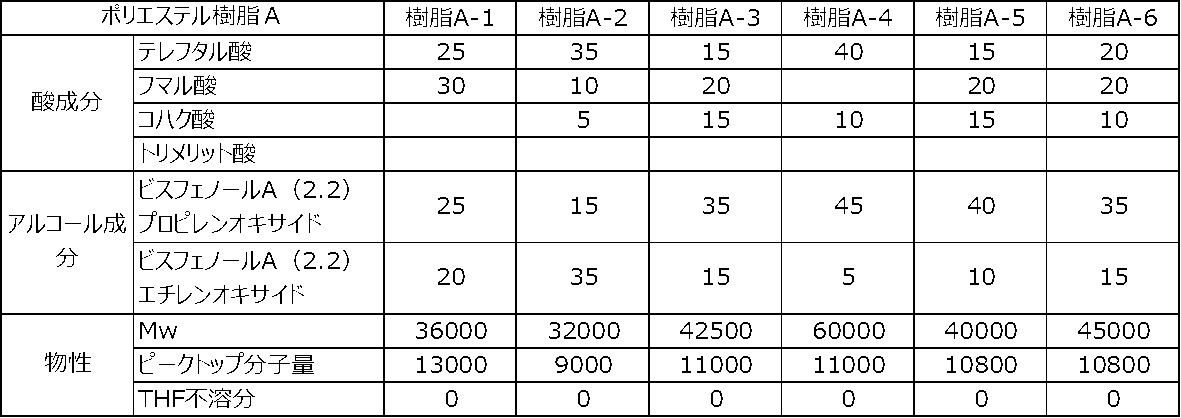
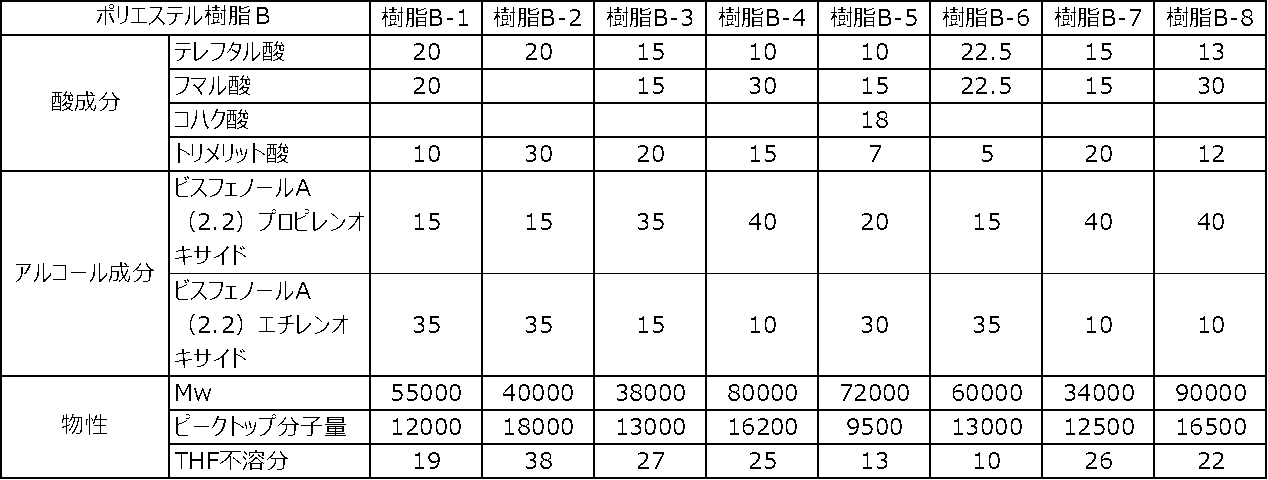
下記組成の混合物をヘンシェルミキサー中で十分撹拌混合した後、ロールミルで130~140℃の温度で約30分間加熱溶融し、室温まで冷却後、得られた混練物をジェットミル又は機械式粉砕機、風力分級機で粉砕分級しトナー母体を得た。
ポリエステル樹脂A-1 50部
ポリエステル樹脂B-1 50部
ライスワックス(TOWAX-3F16、東亜化成社製) 5部
カーボンブラック(#44、三菱化成社製) 10部
含金属アゾ化合物(T-77、保土谷化学社製) 1部
実施例1-1において、[ポリエステル樹脂B-1]を[ポリエステル樹脂B-2]に変更した以外は、実施例1-1と同様にして[トナー1-2]を得た。
実施例1-1において、[ポリエステル樹脂A-1]を[ポリエステル樹脂A-2]に変更し、[ポリエステル樹脂B-1]を[ポリエステル樹脂B-3]に変更した以外は、実施例1-1と同様にして[トナー1-3]を得た。
実施例1-1において、[ポリエステル樹脂B-1]を[ポリエステル樹脂B-4]に変更した以外は、実施例1-1と同様にして[トナー1-4]を得た。
実施例1-1において、結着樹脂の種類及び添加量を[ポリエステル樹脂A-2]60質量部、[ポリエステル樹脂B-3]40質量部に変更した以外は、実施例1-1と同様にして[トナー1-5]を得た。
実施例1-1において、[ポリエステル樹脂A-1]を[ポリエステル樹脂A-3]に変更し、[ポリエステル樹脂B-1]を[ポリエスエル樹脂B-4]に変更した以外は、実施例1-1と同様にして[トナー1-6]を得た。
実施例1-1において、結着樹脂の種類及び添加量を[ポリエステル樹脂A-3]40質量部、[ポリエステル樹脂B-4]60質量部に変更した以外は、実施例1-1と同様にして[トナー1-7]を得た。
実施例1-1において、結着樹脂の種類及び添加量を[ポリエステル樹脂A-2]70質量部、[ポリエステル樹脂B-3]30質量部に変更した以外は、実施例1-1と同様にして[トナー1-8]を得た。
実施例1-1において、[ポリエステル樹脂B-1]を[ポリエステル樹脂B-5]に変更した以外は、実施例1-1と同様にして[比較トナー1-1]を得た。
実施例1-1において、結着樹脂の種類及び添加量を[ポリエステル樹脂A-1]35質量部、[ポリエステル樹脂B-2]65質量部に変更した以外は、実施例1-1と同様にして[比較トナー1-2]を得た。
実施例1-1において、[ポリエステル樹脂B-1]を[ポリエステル樹脂B-6]に変更した以外は、実施例1-1と同様にして[比較トナー1-3]を得た。
実施例1-1において、結着樹脂の種類及び添加量を[ポリエステル樹脂A-2]35質量部、[ポリエステル樹脂B-2]65質量部に変更した以外は、実施例1-1と同様にして[比較トナー1-4]を得た。
実施例1-1において、結着樹脂の種類及び添加量を[ポリエステル樹脂A-2]60質量部、[ポリエステル樹脂B-3]40質量部に変更した以外は、実施例1-1と同様にして[比較トナー1-5]を得た。
実施例1-1において、結着樹脂の種類及び添加量を[ポリエステル樹脂A-3]35質量部、[ポリエステル樹脂B-4]65質量部に変更した以外は、実施例1-1と同様にして[比較トナー1-6]を得た。
実施例1-1において、結着樹脂の種類及び添加量を[ポリエステル樹脂A-2]60質量部、[ポリエステル樹脂B-7]40質量部に変更した以外は、実施例1-1と同様にして[比較トナー1-7]を得た。
実施例1-1において、[ポリエステル樹脂A-1]を[ポリエステル樹脂A-5]に変更し、[ポリエステル樹脂B-1]を[ポリエステル樹脂B-4]に変更した以外は、実施例1-1と同様にして[比較トナー1-8]を得た。
実施例1-1において、結着樹脂の種類及び添加量を[ポリエステル樹脂A-6]40質量部、[ポリエステル樹脂B-4]60質量部に変更した以外は、実施例1-1と同様にして[比較トナー1-9]を得た。
実施例1-1において、結着樹脂の種類及び添加量を[ポリエステル樹脂A-2]75質量部、[ポリエステル樹脂B-3]25質量部に変更した以外は、実施例1-1と同様にして[比較トナー1-10]を得た。
実施例1-1において、結着樹脂の種類及び添加量を[ポリエステル樹脂A-3]40質量部、[ポリエステル樹脂B-8]60質量部に変更した以外は、実施例1-1と同様にして[比較トナー1-11]を得た。
上記得られたトナーについて、下記の測定を行った。
トナー約50mgを秤量し、これにTHF10gを加えて十分に溶解させたトナー溶液を、遠心分離でわけた後、上澄み液を乾燥させて上澄み液の固形分を算出した。はじめに作成したトナー溶液の固形分と、上澄み液の固形分との差分をTHF不溶分とした。
トナー50mgを秤量し、これにTHF10gを加えて十分に溶解させた溶液を、遠心分離でわけた後、上澄み液を乾燥させて上澄み液の固形分質量〔X(mg)〕を求めた。
更に、下記式(1)を用いてトナーのTHF可溶分(質量%)を求めた。
トナーのTHF可溶分(質量%)=X/50mg×100・・式(1)
なお、上澄み液の固形分がTHF可溶分に相当する。
上記で得られたトナーのTHF可溶分について、GPC(gel permeation chromatography)測定を以下の条件で行った。
・装置:GPC-150C(ウォーターズ社製)
・カラム:KF801~807(ショウデックス社製)
・温度:40℃
・溶媒:THF(テトラヒドロフラン)
・流速:1.0mL/分
・試料:濃度0.05~0.6%の試料を0.1mL注入した。
以上の条件で測定した分子量分布から単分散ポリスチレン標準試料により作製した分子量校正曲線を使用して樹脂の数平均分子量及び重量平均分子量を算出した。
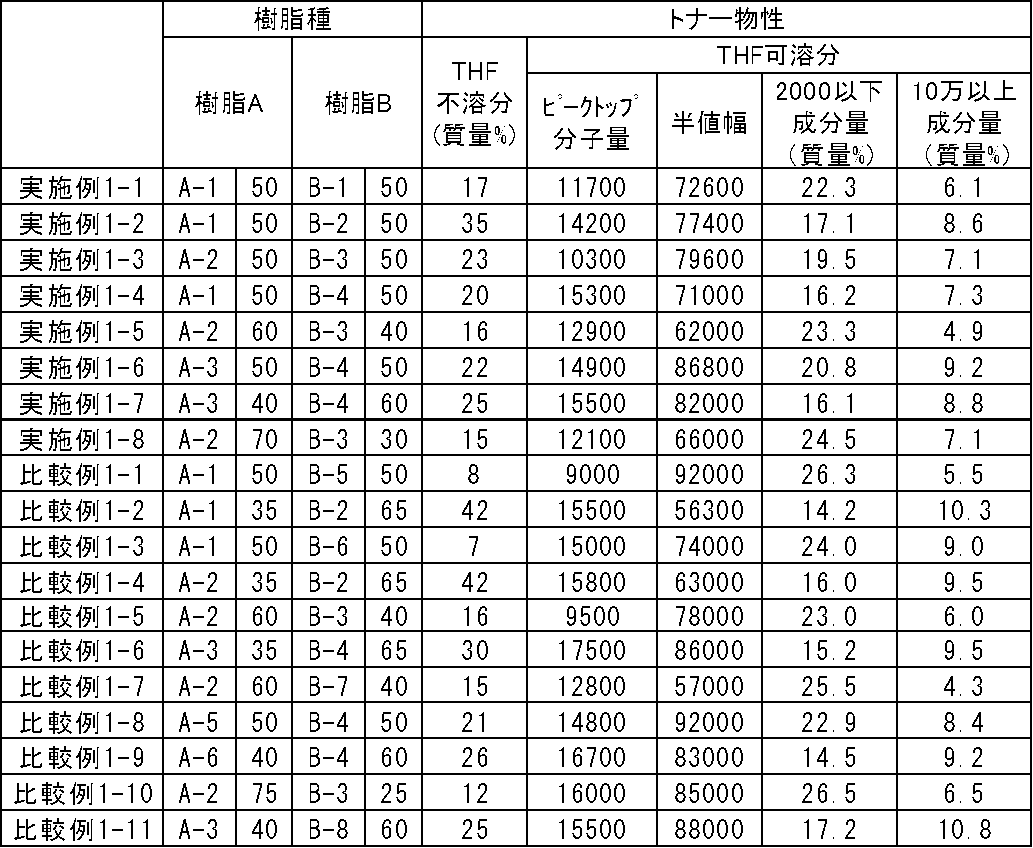
上記で得られたトナーについて、下記の評価を行った。
250mlのポリ容器にトナー50gを入れた後、φ10mmアルミナビーズ120gを投入し、ボールミルにて150rpmで40時間撹拌した。撹拌後、初期粒径と撹拌後の微粉成分の増加量により評価した。
微粉増加量は、コールターカウンター法により測定した。トナー粒子の粒度分布の測定装置としては、コールターマルチサイザーIII(コールター社製)を用いた。
まず、電解水溶液100~150mL中に分散剤として界面活性剤(好ましくはアルキルベンゼンスルフォン酸塩)を0.1~5mL加えた。ここで、電解液とは1級塩化ナトリウムを用いて約1%NaCl水溶液を調製したもので、ISOTON-II(コールター社製)を使用した。更に測定試料を固形分にして2~20mg加えた。試料を懸濁した電解液は、超音波分散器で約1~3分間分散処理を行い、前記測定装置により、アパーチャーとして100μmアパーチャーを用いて、トナー粒子又はトナーの体積、個数を測定して、体積分布と個数分布を算出し、3.00μm未満の個数%の増加量を下記の基準にて評価した。
◎:増加量が4%未満
○:増加量が4%以上7%未満
△:増加量が7%以上10%未満
×:増加量が10%以上
250mlのポリ容器にトナー50gを入れた後、φ10mmアルミナビーズ120gを投入し、ボールミルにて150rpmで40時間撹拌し、評価用の劣化トナーを作製した。本評価用劣化トナーをリコー社製IPSiO SP C220の現像ユニットに20g投入し、外部空転機にてブレード固着評価を行った。ブレード固着は画像部の現像ローラの両端5cmの部分に固着に由来する筋を目視にて、5分ごとに確認した。評価基準は以下の通りである。
◎:ブレード固着が発生する時間が120分以上
○:ブレード固着が発生する時間が60分以上120分未満
△:ブレード固着が発生する時間が30分以上60分未満
×:ブレード固着が発生する時間が30分未満
リコー社製IPSiO SP C220を改造しトナーを入れ、リコー社製タイプ6000T目紙上に、付着量が10g/m2になるように設定して40mm角の未定着ベタ画像を印字したものを用意した。
次に、リコー社製IPSiO SP 4510SFの改造した定着ユニットを用い、システムスピードを240mm/secに設定し、用意した未定着のベタ画像を通紙して画像を定着させた。定着温度を120℃から5℃刻みで200℃まで試験を行い、目視によりトナーオフセットしていないかを観察した。定着下限温度及び定着上限温度の評価基準は以下の通りである。
◎:定着下限温度が130℃未満
○:定着下限温度が130℃以上140℃未満
△:定着下限温度が140℃以上150℃未満
×:定着下限温度が150℃以上
◎:定着上限温度が210℃以上
○:定着上限温度が190℃以上210℃未満
△:定着上限温度が170℃以上190℃未満
×:定着上限温度が170℃未満
総合評価は全ての項目で「○」以上であれば「◎」、全ての項目で「△」以上であれば「○」、一項目でも「×」がある場合は「×」とし、「○」以上が合格レベルである。
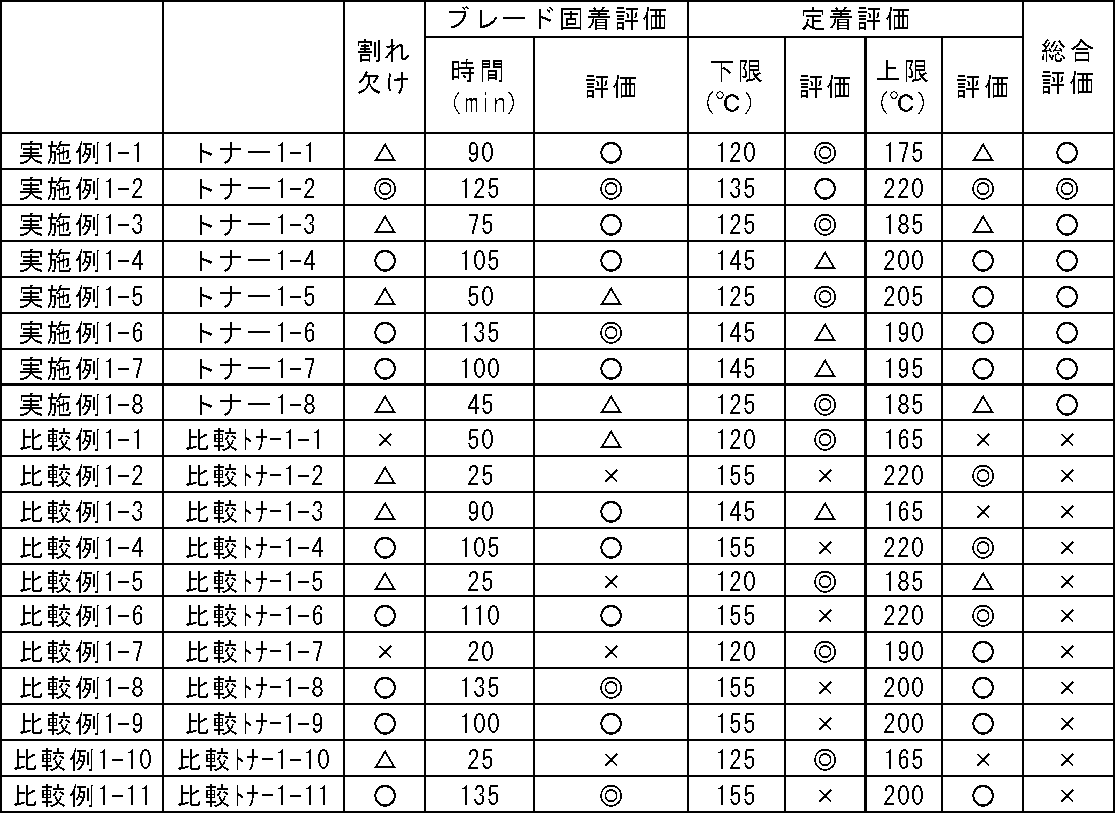
下記組成の混合物をヘンシェルミキサー中で十分撹拌混合した後、ロールミルで130~140℃の温度で約30分間加熱溶融し、室温まで冷却後、得られた混練物をジェットミル又は機械式粉砕機、風力分級機で粉砕分級しトナー母体を得た。
ポリエステル樹脂A-1 50部
ポリエステル樹脂B-1 50部
カルナウバ/ライス混合ワックス 3部
(WA-05:セラリカ野田製、吸熱開始温度:72.5℃)
カーボンブラック(#44、三菱化成社製) 10部
含金属アゾ化合物(T-77、保土谷化学社製) 1部
実施例2-1において、[ポリエステル樹脂B-1]を[ポリエステル樹脂B-2]に変更した以外は、実施例2-1と同様にしてトナー2-2を得た。
実施例2-1において、[ポリエステル樹脂A-1]を[ポリエステル樹脂A-2]に変更し、[ポリエステル樹脂B-1]を[ポリエステル樹脂B-3]に変更した以外は、実施例2-1と同様にしてトナー2-3を得た。
実施例2-1において、[ポリエステル樹脂B-1]を[ポリエステル樹脂B-4]に変更した以外は、実施例2-1と同様にしてトナー2-4を得た。
実施例2-1において、結着樹脂の種類及び添加量を[ポリエステル樹脂A-2]60質量部、[ポリエステル樹脂B-3]40質量部に変更した以外は、実施例2-1と同様にしてトナー2-5を得た。
実施例2-1において、[ポリエステル樹脂A-1]を[ポリエステル樹脂A-3]に変更し、[ポリエステル樹脂B-1]を[ポリエスエル樹脂B-4]に変更した以外は、実施例2-1と同様にしてトナー2-6を得た。
実施例2-1において、結着樹脂の種類及び添加量を[ポリエステル樹脂A-3]40質量部、[ポリエステル樹脂B-4]60質量部に変更した以外は、実施例2-1と同様にしてトナー2-7を得た。
実施例2-1において、結着樹脂の種類及び添加量を[ポリエステル樹脂A-2]70質量部、[ポリエステル樹脂B-3]30質量部に変更した以外は、実施例2-1と同様にしてトナー2-8を得た。
実施例2-1において、ワックスの種類を吸熱開始温度が52.3℃の合成したモノエステルワックスに変更した以外は、実施例2-1と同様にしてトナー2-9を得た。
実施例2-1において、ワックスの種類を再精製前のライスワックス(TOWAX-3F16、東亜化成社製、吸熱開始温度:59.2℃)に変更した以外は、実施例2-1と同様にしてトナー2-10を得た。
実施例2-1において、ワックスの種類を吸熱開始温度が72.1℃の合成したモノエステルワックスに変更した以外は、実施例2-1と同様にしてトナー2-11を得た。
実施例2-1において、ワックスの添加量を0.5質量部に変更した以外は、実施例2-1と同様にしてトナー2-12を得た。
実施例2-1において、ワックスの添加量を7質量部に変更した以外は、実施例2-1と同様にしてトナー2-13を得た。
実施例2-1において、ワックスの種類をパラフィンワックス(HNP-9、日本精鑞社製、吸熱開始温度:60.4℃)に変更した以外は、実施例2-1と同様にしてトナー2-14を得た。
実施例2-1において、[ポリエステル樹脂B-1]を[ポリエステル樹脂B-5]に変更し、ワックスの種類をライスワックス(吸熱開始温度:66.3℃)に変更した以外は、実施例2-1と同様にして比較トナー2-1を得た。
実施例2-1において、結着樹脂の種類及び添加量を[ポリエステル樹脂A-1]35質量部、[ポリエステル樹脂B-2]65質量部に変更し、ワックスの種類をライスワックス(吸熱開始温度:66.3℃)に変更した以外は、実施例2-1と同様にして比較トナー2-2を得た。
実施例2-1において、結着樹脂の種類及び添加量を[ポリエステル樹脂A-2]65質量部、[ポリエステル樹脂B-3]35質量部に変更し、ワックスの種類をライスワックス(吸熱開始温度:66.3℃)に変更した以外は、実施例2-1と同様にして比較トナー2-3を得た。
実施例2-1において、結着樹脂の種類及び添加量を[ポリエステル樹脂A-1]35質量部、[ポリエステル樹脂B-4]65質量部に変更し、ワックスの種類をライスワックス(吸熱開始温度:66.3℃)に変更した以外は、実施例2-1と同様にして比較トナー2-4を得た。
実施例2-1において、[ポリエステル樹脂A-1]を[ポリエステル樹脂A-2]に変更し、[ポリエステル樹脂B-1]を[ポリエステル樹脂B-5]に変更し、ワックスの種類をライスワックス(吸熱開始温度:66.3℃)に変更した以外は、実施例2-1と同様にして比較トナー2-5を得た。
実施例2-1において、[ポリエステル樹脂A-1]を[ポリエステル樹脂A-3]に変更し、[ポリエステル樹脂B-1]を[ポリエステル樹脂B-4]に変更し、ワックスの種類をライスワックス(吸熱開始温度:66.3℃)に変更した以外は、実施例2-1と同様にして比較トナー2-6を得た。
実施例2-1において、結着樹脂の種類及び添加量を[ポリエステル樹脂A-4]45質量部、[ポリエステル樹脂B-4]55質量部に変更し、ワックスの種類をライスワックス(吸熱開始温度:66.3℃)に変更した以外は、実施例2-1と同様にして比較トナー2-7を得た。
実施例2-1において、結着樹脂の種類及び添加量を[ポリエステル樹脂A-2]70質量部、[ポリエステル樹脂B-5]30質量部に変更し、ワックスの種類をライスワックス(吸熱開始温度:66.3℃)に変更した以外は、実施例2-1と同様にして比較トナー2-8を得た。
実施例2-1において、結着樹脂の種類及び添加量を[ポリエステル樹脂A-1]40質量部、[ポリエステル樹脂B-6]60質量部に変更し、ワックスの種類をライスワックス(吸熱開始温度:66.3℃)に変更した以外は、実施例2-1と同様にして比較トナー2-9を得た。
実施例2-1において、[ポリエステル樹脂A-1]を[ポリエステル樹脂A-2]に変更し、[ポリエステル樹脂B-1]を[ポリエステル樹脂B-4]に変更し、ワックスの種類をライスワックス(吸熱開始温度:66.3℃)に変更した以外は、実施例2-1と同様にして比較トナー2-10を得た。
実施例2-1において、結着樹脂の種類及び添加量を[ポリエステル樹脂A-2]65質量部、[ポリエステル樹脂B-5]35質量部に変更し、ワックスの種類をライスワックス(吸熱開始温度:66.3℃)に変更した以外は、実施例2-1と同様にして比較トナー2-11を得た。
実施例2-1において、[ポリエステル樹脂A-1]を[ポリエステル樹脂A-4]に変更し、ワックスの種類をライスワックス(吸熱開始温度:66.3℃)に変更した以外は、実施例2-1と同様にして比較トナー2-12を得た。
実施例2-1において、結着樹脂の種類及び添加量を[ポリエステル樹脂A-4]30質量部に変更し、[ポリエステル樹脂B-5]70質量部に変更し、ワックスの種類をライスワックス(吸熱開始温度:66.3℃)に変更した以外は、実施例2-1と同様にして比較トナー2-13を得た。
上記得られたトナーについて、下記の測定を行った。
トナー約50mgを秤量し、これにTHF(テトラヒドロフラン)10gを加えて十分に溶解させたトナー溶液を、遠心分離でわけた後、上澄み液を乾燥させて上澄み液の固形分を算出した。はじめに作成したトナー溶液の固形分と、上澄み液の固形分との差分をTHF不溶分とした。
トナー50mgを秤量し、これにTHF10gを加えて十分に溶解させた溶液を、遠心分離でわけた後、上澄み液を乾燥させて上澄み液の固形分質量〔X(mg)〕を求めた。
更に、下記式(1)を用いてトナーのTHF可溶分量(質量%)を求めた。
トナーのTHF可溶分(質量%)=X/50mg×100・・式(1)
なお、上澄み液の固形分がTHF可溶分に相当する。
上記で得られたトナーのTHF可溶分について、GPC(gel permeation chromatography)測定を以下の条件で行った。
・装置:GPC-150C(ウォーターズ社製)
・カラム:KF801~807(ショウデックス社製)
・温度:40℃
・溶媒:THF(テトラヒドロフラン)
・流速:1.0mL/分
・試料:濃度0.05~0.6%の試料を0.1mL注入した。
以上の条件で測定した分子量分布から単分散ポリスチレン標準試料により作製した分子量校正曲線を使用して樹脂の数平均分子量及び重量平均分子量を算出した。
使用するワックス融点の測定としては、示差走査熱量計(DSC-6220R:セイコーインスツル社)を用いた。まず、室温から昇温速度10℃/minで150℃まで加熱した後、150℃で10min間放置し、室温まで試料を冷却して10min放置し、再度150℃まで昇温速度10℃/minで加熱した際に、ベースラインと変曲点の接線の交点を取り、その交点を吸熱開始温度とした。
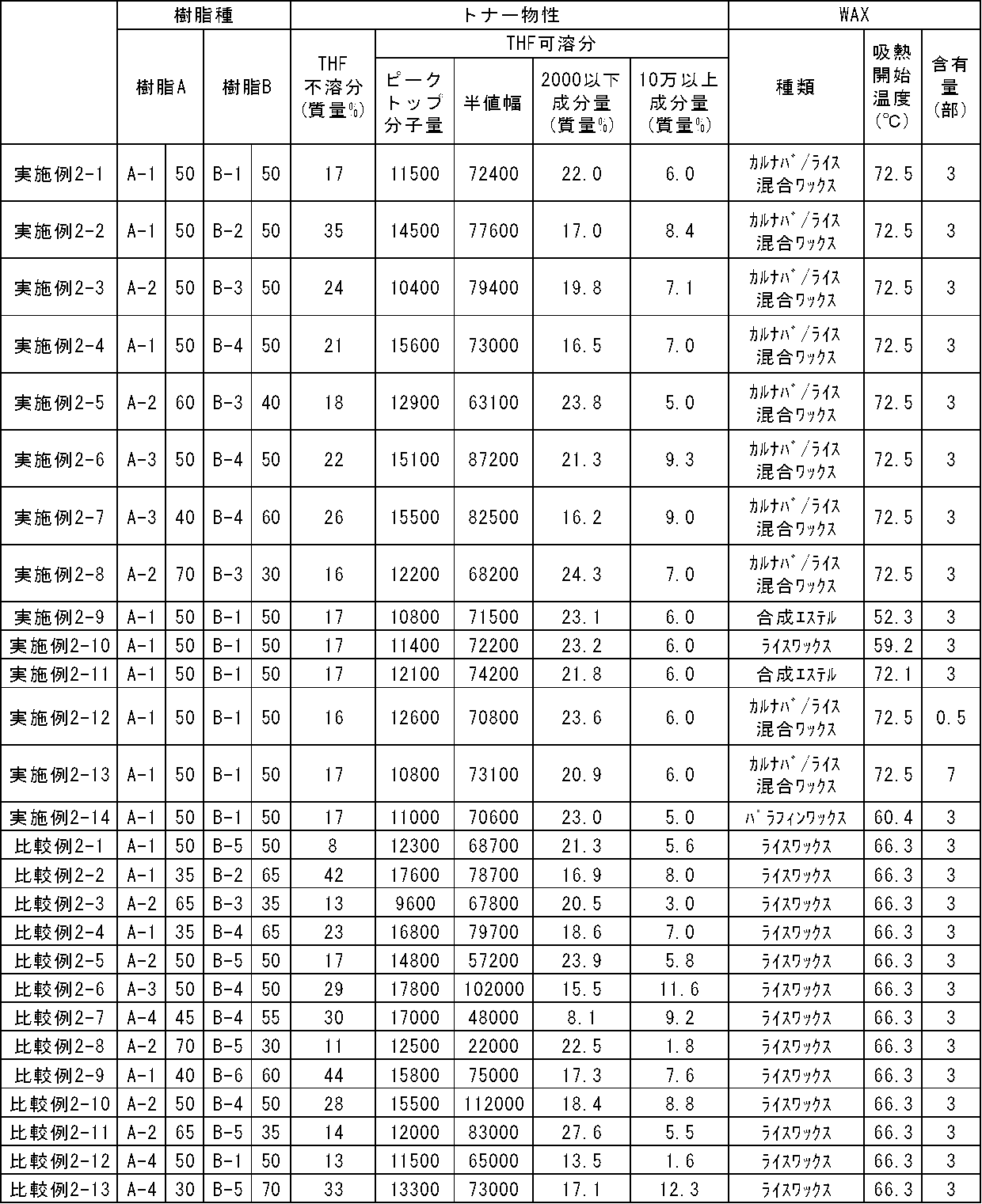
上記で得られたトナーについて、下記の評価を行った。
250mlのポリ容器にトナー50gを入れた後、φ10mmアルミナビーズ120gを投入し、ボールミルにて150rpmで40時間撹拌し、評価用の劣化トナーを作製した。本評価用劣化トナーをリコー社製IPSiO SP C220の現像ユニットに20g投入し、外部空転機にてブレード固着評価を行った。ブレード固着は画像部の現像ローラの両端5cmの部分に固着に由来する筋を目視にて、5分ごとに確認した。評価基準は以下の通りである。
◎:ブレード固着が発生する時間が150分以上
○:ブレード固着が発生する時間が120分以上150分未満
△:ブレード固着が発生する時間が60分以上120分未満
×:ブレード固着が発生する時間が60分未満
リコー社製IPSiO SP C220を改造しトナーを入れ、リコー社製タイプ6000T目紙上に、付着量が10g/m2になるように設定して40mm角の未定着ベタ画像を印字したものを用意した。
次に、リコー社製IPSiO SP 4510SFの改造した定着ユニットを用い、システムスピードを240mm/secに設定し、用意した未定着のベタ画像を通紙して画像を定着させた。定着温度を120℃から2℃刻みで220℃まで試験を行い、目視によりトナーオフセットしていないかを観察した。定着下限温度及び定着上限温度の評価基準は以下の通りである。
◎:定着下限温度が130℃未満
○:定着下限温度が130℃以上140℃未満
△:定着下限温度が140℃以上150℃未満
×:定着下限温度が150℃以上
◎:定着上限温度が210℃以上
○:定着上限温度が190℃以上210℃未満
△:定着上限温度が170℃以上190℃未満
×:定着上限温度が170℃未満
総合評価は全ての項目で「○」以上であれば「◎」、全ての項目で「△」以上であれば「○」、一項目でも「×」がある場合は「×」とした。総合評価において「×」は不合格レベルであり、「○」及び「◎」は合格レベルであり、「◎」は「○」よりも優れる結果を表す。
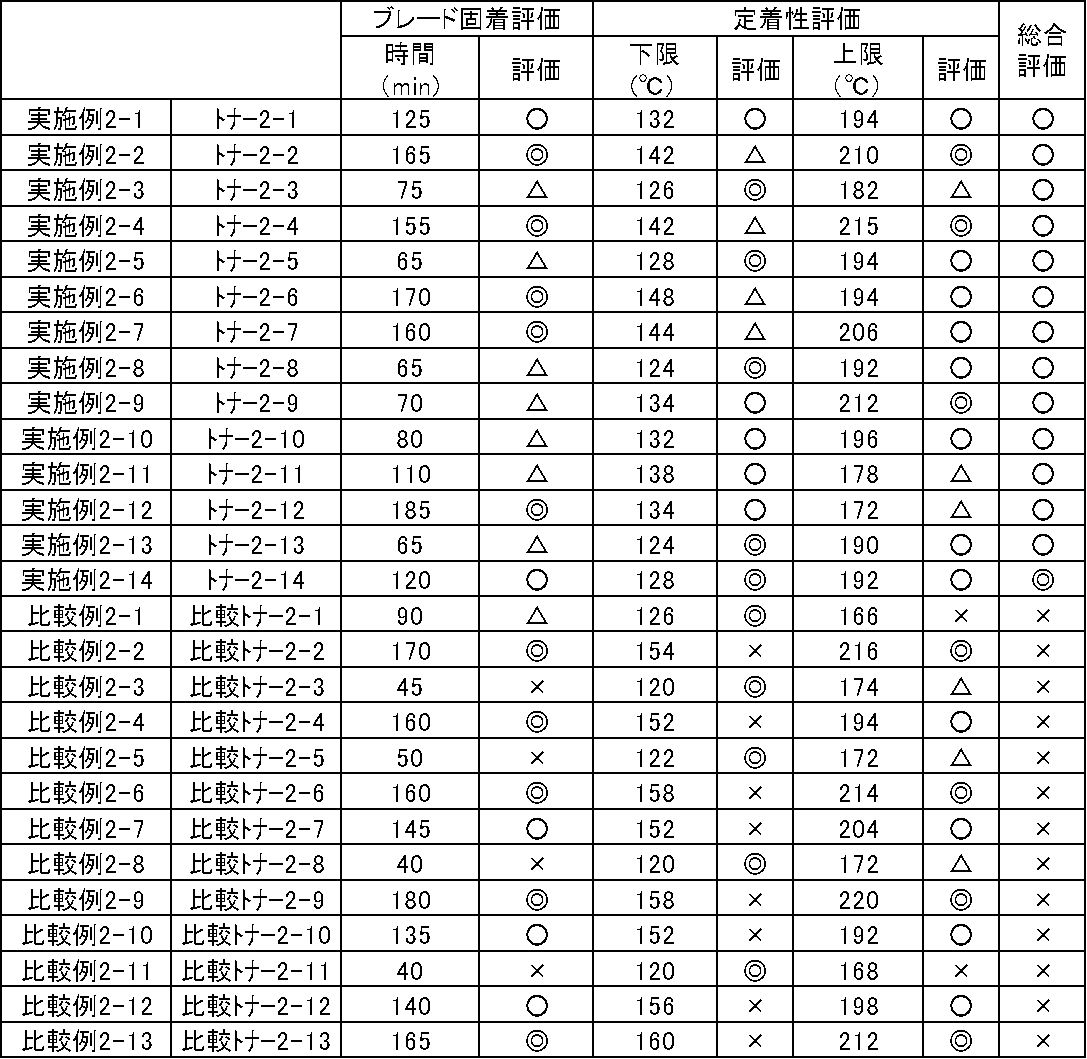
下記組成の混合物をヘンシェルミキサー中で十分撹拌混合した後、二軸押出混練機(TEM-18SS、東芝機械社製)で溶融混練し、室温まで冷却後、得られた混練物をジェットミル(IDS-2、日本ニューマッチク社製)及びローター分級機(50ATP、ホソカワミクロン社製)で粉砕分級し、平均粒径8μmのトナー母体を得た。
ポリエステル樹脂A-1 50部
ポリエステル樹脂B-1 50部
ライスワックス(TOWAX-3F16、東亜化成社製) 5部
カーボンブラック(#44、三菱化成社製) 10部
アゾ鉄化合物(T-77、保土谷化学社製、[CCA1]と称する)1.8部
以下、表7に示すトナー構成に変更した以外は、実施例3-1と同様にして各トナーを得た。
上記得られたトナーについて、下記の測定を行った。
トナー約50mgを秤量し、これにTHF(テトラヒドロフラン)10gを加えて十分に溶解させたトナー溶液を、遠心分離でわけた後、上澄み液を乾燥させて上澄み液の固形分を算出した。はじめに作成したトナー溶液の固形分と、上澄み液の固形分との差分をTHF不溶分とした。
トナー50mgを秤量し、これにTHF10gを加えて十分に溶解させた溶液を、遠心分離でわけた後、上澄み液を乾燥させて上澄み液の固形分質量〔X(mg)〕を求めた。
更に、下記式(1)を用いてトナーのTHF可溶分(質量%)を求めた。
トナーのTHF可溶分(質量%)=X/50mg×100・・式(1)
なお、上澄み液の固形分がTHF可溶分に相当する。
上記で得られたトナーのTHF可溶分について、GPC(gel permeation chromatography)測定を以下の条件で行った。
・装置:GPC-150C(ウォーターズ社製)
・カラム:KF801~807(ショウデックス社製)
・温度:40℃
・溶媒:THF(テトラヒドロフラン)
・流速:1.0mL/分
・試料:濃度0.05~0.6%の試料を0.1mL注入した。
以上の条件で測定した分子量分布から単分散ポリスチレン標準試料により作製した分子量校正曲線を使用して樹脂の数平均分子量及び重量平均分子量を算出した。
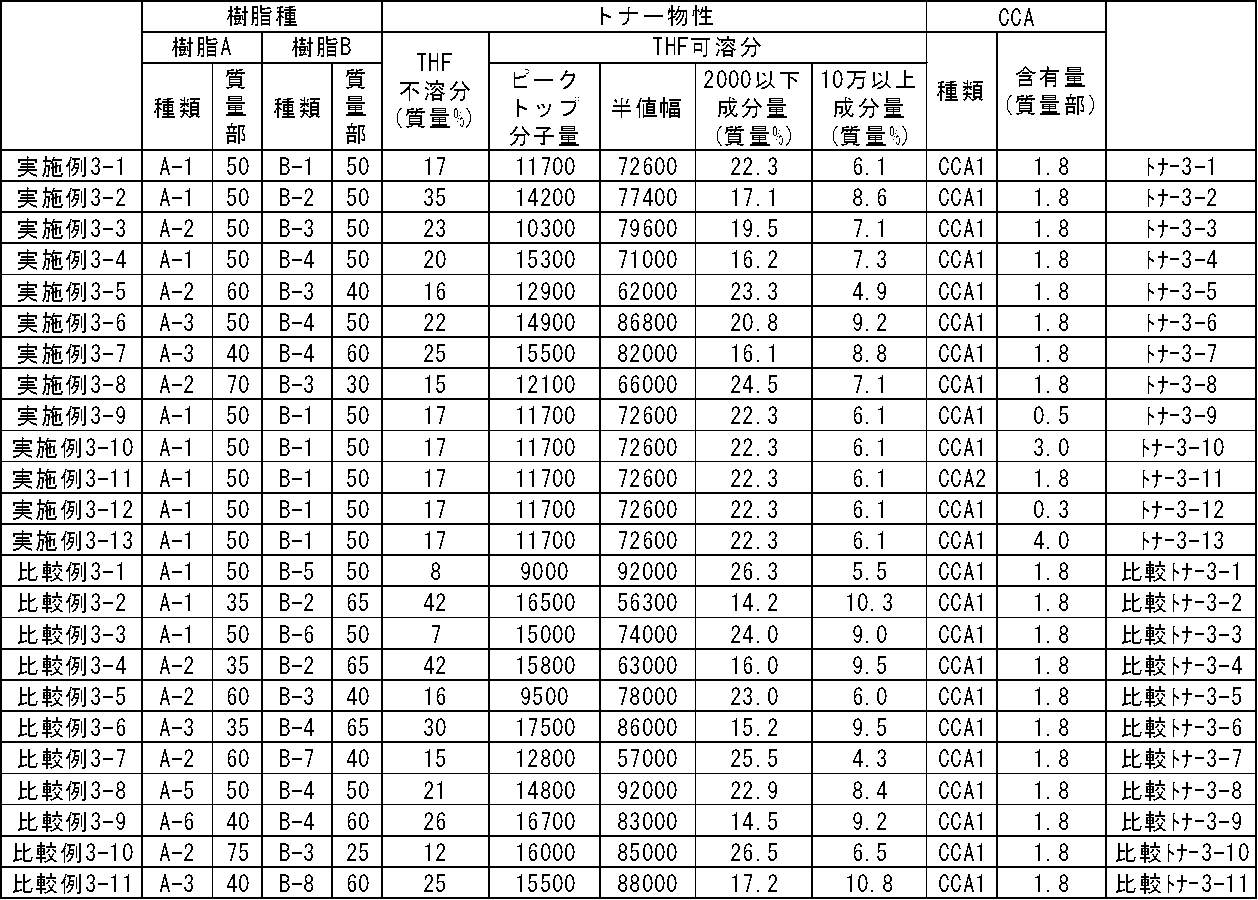
CCA2は、前記構造式(2)において、J+が、アルキルアンモニウムイオンである化合物である。
CCA3は、保土谷化学社製のTN-105である。
上記で得られたトナーについて、下記の評価を行った。
リコー社製IPSiO SP C220を改造し、上記ブレード固着耐久性評価で作製した劣化トナーを13.5g入れ、白紙印字中に停止になった感光体露出部全面にスコッチテープを貼り、剥がしたスコッチテープをリコー社製タイプ6000T目紙に貼り保管した。そのテープ上をX-rite(ビデオジェット・エックスライト社製)によりL*を測定した。評価基準は下記の通りである。
[評価基準]
◎:L*が91.0以上
○:L*が89.0以上91.0未満
△:L*が85.0以上89.0未満
×:L*が85.0未満
-低温定着性-
リコー社製IPSiO SP C220を改造しトナーを入れ、リコー社製タイプ6000T目紙上に、付着量が10g/m2になるように設定して40mm角の未定着ベタ画像を印字したものを用意した。
次に、リコー社製IPSiO SP 4510SFの改造した定着ユニットを用い、システムスピードを240mm/secに設定し、用意した未定着のベタ画像を通紙して画像を定着させた。定着温度を120℃から2℃刻みで160℃まで試験を行い、目視により観察し、白紙部にトナー写りが発生しない温度を定着下限温度とした。評価基準は下記の通りである。
[評価基準]
◎:定着下限温度が130℃未満
○:定着下限温度が130℃以上140℃未満
△:定着下限温度が140℃以上150℃未満
×:定着下限温度が150℃以上
リコー社製IPSiO SP C220を改造しトナーを入れ、リコー社製タイプ6000T目紙上に、付着量が10g/m2になるように設定して40mm角の未定着ベタ画像を印字したものを用意した。
次に、リコー社製IPSiO SP 4510SFの改造した定着ユニットを用い、システムスピードを240mm/secに設定し、用意した未定着のベタ画像を通紙して画像を定着させた。定着温度を160℃から2℃刻みで200℃まで試験を行い、目視により観察し、白紙部にトナー写りが発生しない温度を定着上限温度とした。評価基準は下記の通りである。
[評価基準]
◎:定着上限温度が210℃以上
○:定着上限温度が190℃以上210℃未満
△:定着上限温度が170℃以上190℃未満
×:定着上限温度が170℃未満
250mlのポリ容器にトナー50gを入れた後、φ10mmアルミナビーズ120gを投入し、ボールミルにて150rpmで44時間撹拌し、評価用の劣化トナーを作製した。COULTER COUNTER MultisizerIIIを使用し、劣化前トナーと劣化後トナーの粒径を測定し、3μmよりも小さい小径成分増加量を測定した。評価基準は下記の通りである。
[評価基準]
◎:増加量が4%未満
○:増加量が4%以上7%未満
△:増加量が7%以上10%未満
×:増加量が10%以上
250mlのポリ容器にトナー50gを入れた後、φ10mmアルミナビーズ120gを投入し、ボールミルにて150rpmで40時間撹拌し、評価用の劣化トナーを作製した。本評価用劣化トナーをリコー社製IPSiO SP C220の現像ユニットに20g投入し、外部空転機にてブレード固着評価を行った。ブレード固着は画像部の現像ローラの両端5cmの部分に固着に由来する筋を目視にて、5分ごとに確認した。評価基準は以下の通りである。
[評価基準]
◎:ブレード固着が発生する時間が120分以上
○:ブレード固着が発生する時間が60分以上120分未満
△:ブレード固着が発生する時間が30分以上60分未満
×:ブレード固着が発生する時間が30分未満
総合評価は全ての項目で「○」以上であれば「◎」、全ての項目で「△」以上であれば「○」、一項目でも「×」がある場合は「×」とした。総合評価において「×」は不合格レベルであり、「○」及び「◎」は合格レベルであり、「◎」は「○」よりも優れる結果を表す。
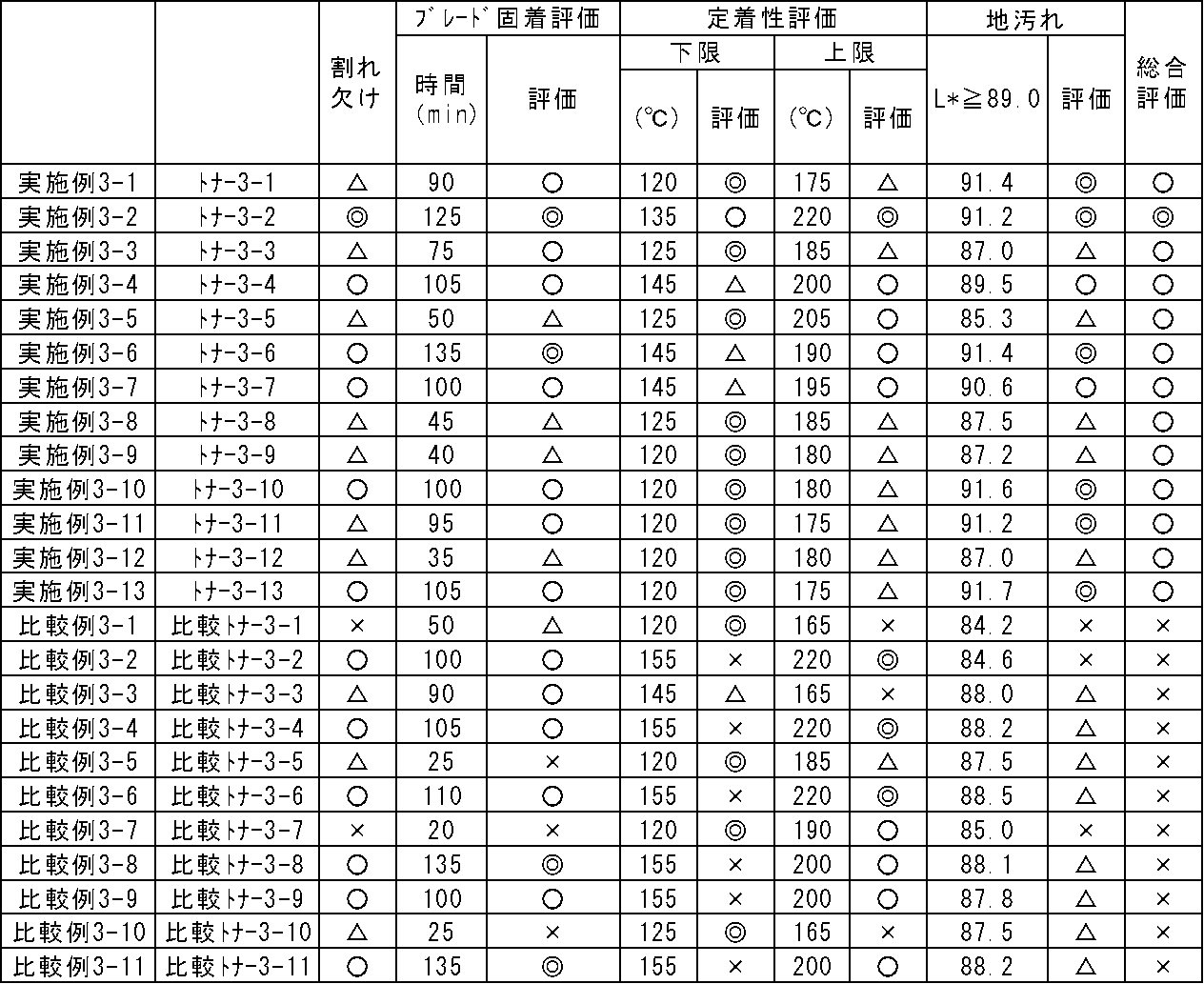
<1> 結着樹脂を含有するトナーであって、
前記トナーは、THF不溶分を10質量%~40質量%含み、
前記トナーのTHF可溶分のGPC(ゲルパミエーションクロマトグラフィー)による分子量分布において、10,000~16,000の間にメインピークを有し、かつ、該メインピークの半値幅が分子量60,000~90,000であり、
前記トナーのTHF可溶分において、GPCによる分子量2,000以下の成分が、15.0質量%~25.0質量%であり、かつ、分子量100,000以上の成分が、10.0質量%以下であることを特徴とするトナーである。
<2> 前記分子量分布において、12,000~15,000の間にメインピークを有し、該メインピークの半値幅が分子量65,000~80,000である前記<1>に記載のトナーである。
<3> 前記トナーは、THF不溶分を30質量%~40質量%含む前記<1>から<2>のいずれかに記載のトナーである。
<4> 離型剤を更に含有し、 示差走査熱量測定(DSC)において、2回目の昇温における前記離型剤の吸熱開始温度が50℃以上75℃以下である前記<1>から<3>のいずれかに記載のトナーである。
<5> 前記離型剤の前記吸熱開始温度が、55℃以上70℃以下である前記<4>に記載のトナーである。
<6> アゾ鉄化合物を更に含有する前記<1>から<3>のいずれかに記載のトナーである。
<7> 前記アゾ鉄化合物が下記構造式(1)で表される前記<6>に記載のトナーである。
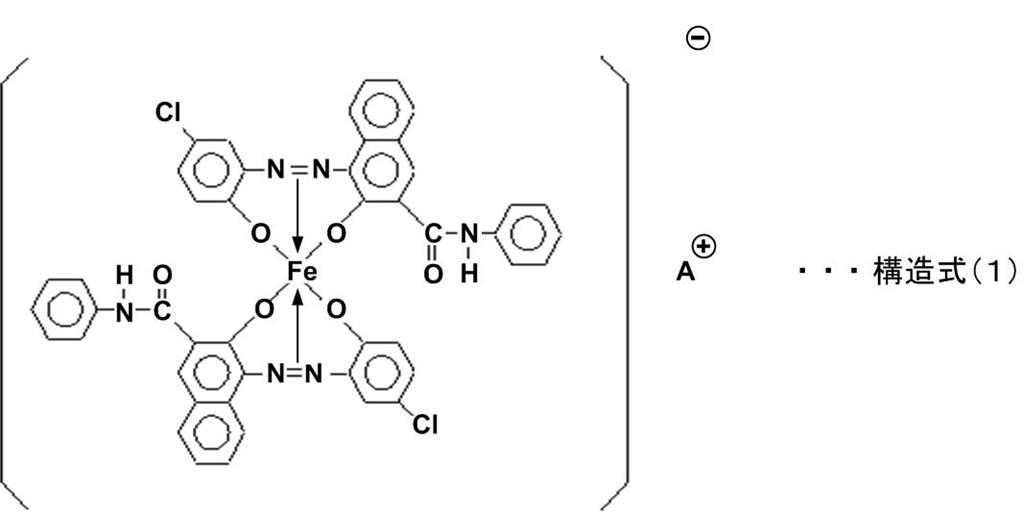
<8> 一成分現像用トナーである前記<1>から<7>のいずれかに記載のトナーである。
<9> 前記<1>から<8>のいずれかに記載のトナーを収容したことを特徴とするトナー収容ユニットである。
<10> 静電潜像担持体と、
前記静電潜像担持体上に静電潜像を形成する静電潜像形成手段と、
前記静電潜像担持体に形成された前記静電潜像を現像して可視像を形成する、トナーを備える現像手段とを有し、
前記トナーが、前記<1>から<8>のいずれかに記載のトナーであることを特徴とする画像形成装置である。
10K ブラック用静電潜像担持体
10Y イエロー用静電潜像担持体
10M マゼンタ用静電潜像担持体
10C シアン用静電潜像担持体
14 ローラ
15 ローラ
16 ローラ
17 クリーニング装置
18 画像形成手段
20 帯電ローラ
21 露光装置
22 二次転写装置
23 ローラ
24 二次転写ベルト
25 定着装置
26 定着ベルト
27 加圧ローラ
28 シート反転装置
32 コンタクトガラス
33 第1走行体
34 第2走行体
35 結像レンズ
36 読み取りセンサ
40 現像装置
41 現像ベルト
42K 現像剤収容部
42Y 現像剤収容部
42M 現像剤収容部
42C 現像剤収容部
43K 現像剤供給ローラ
43Y 現像剤供給ローラ
43M 現像剤供給ローラ
43C 現像剤供給ローラ
44K 現像ローラ
44Y 現像ローラ
44M 現像ローラ
44C 現像ローラ
45K ブラック現像ユニット
45Y イエロー現像ユニット
45M マゼンタ現像ユニット
45C シアン現像ユニット
49 レジストローラ
50 中間転写ベルト
51 ローラ
52 分離ローラ
53 手差し給紙路
54 手差しトレイ
55 切換爪
56 排出ローラ
57 排紙トレイ
58 コロナ帯電装置
60 クリーニング装置
61 現像装置
62 転写ローラ
63 クリーニング装置
64 除電ランプ
70 除電ランプ
80 転写ローラ
90 クリーニング装置
95 転写紙
100A、100B、100C 画像形成装置
120 画像形成ユニット
130 原稿台
142 給紙ローラ
143 ペーパーバンク
144 給紙カセット
145 分離ローラ
146 給紙路
147 搬送ローラ
148 給紙路
150 複写装置本体
160 帯電ローラ
200 給紙テーブル
300 スキャナ
400 原稿自動搬送装置(ADF)
Claims (10)
- 結着樹脂を含有するトナーであって、
前記トナーは、THF不溶分を10質量%~40質量%含み、
前記トナーのTHF可溶分のGPC(ゲルパミエーションクロマトグラフィー)による分子量分布において、10,000~16,000の間にメインピークを有し、かつ、該メインピークの半値幅が分子量60,000~90,000であり、
前記トナーのTHF可溶分において、GPCによる分子量2,000以下の成分が、15.0質量%~25.0質量%であり、かつ、分子量100,000以上の成分が、10.0質量%以下であることを特徴とするトナー。 - 前記分子量分布において、12,000~15,000の間にメインピークを有し、該メインピークの半値幅が分子量65,000~80,000である請求項1に記載のトナー。
- 前記トナーは、THF不溶分を30質量%~40質量%含む請求項1から2のいずれかに記載のトナー。
- 離型剤を更に含有し、
示差走査熱量測定(DSC)において、2回目の昇温における前記離型剤の吸熱開始温度が50℃以上75℃以下である請求項1から3のいずれかに記載のトナー。 - 前記離型剤の前記吸熱開始温度が、55℃以上70℃以下である請求項4に記載のトナー。
- アゾ鉄化合物を更に含有する請求項1から3のいずれかに記載のトナー。
- 前記アゾ鉄化合物が下記構造式(1)で表される請求項6に記載のトナー。
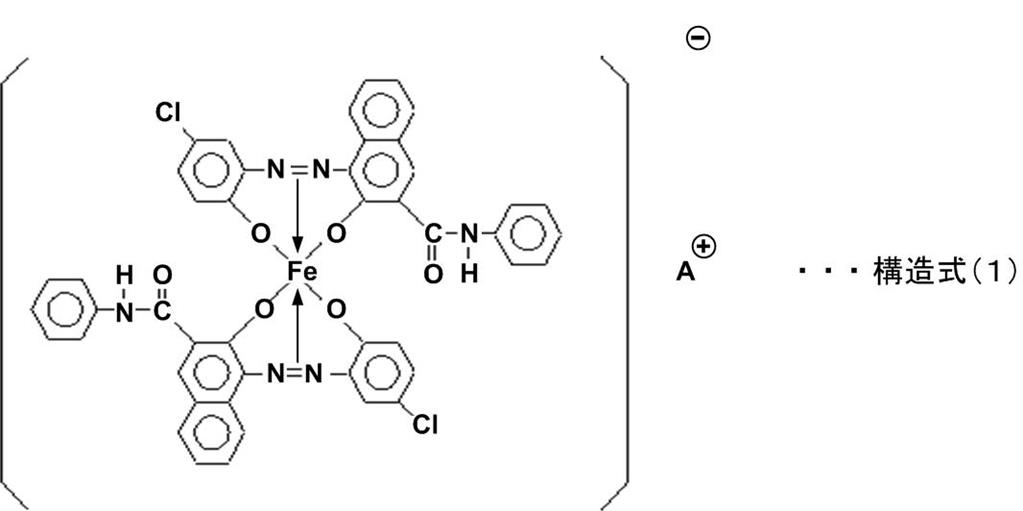
- 一成分現像用トナーである請求項1から7のいずれかに記載のトナー。
- 請求項1から8のいずれかに記載のトナーを収容したことを特徴とするトナー収容ユニット。
- 静電潜像担持体と、
前記静電潜像担持体上に静電潜像を形成する静電潜像形成手段と、
前記静電潜像担持体に形成された前記静電潜像を現像して可視像を形成する、トナーを備える現像手段とを有し、
前記トナーが、請求項1から8のいずれかに記載のトナーであることを特徴とする画像形成装置。
Priority Applications (4)
| Application Number | Priority Date | Filing Date | Title |
|---|---|---|---|
| JP2018505400A JPWO2017159288A1 (ja) | 2016-03-15 | 2017-02-24 | トナー、トナー収容ユニット、及び画像形成装置 |
| EP17766293.9A EP3432074A4 (en) | 2016-03-15 | 2017-02-24 | TONER, TONER HOUSING UNIT, AND IMAGE FORMING APPARATUS |
| CN201780017441.4A CN108780287A (zh) | 2016-03-15 | 2017-02-24 | 调色剂、调色剂容纳单元和图像形成设备 |
| US16/131,538 US20190011847A1 (en) | 2016-03-15 | 2018-09-14 | Toner, toner stored unit, and image forming apparatus |
Applications Claiming Priority (6)
| Application Number | Priority Date | Filing Date | Title |
|---|---|---|---|
| JP2016-051573 | 2016-03-15 | ||
| JP2016051573 | 2016-03-15 | ||
| JP2016-051553 | 2016-03-15 | ||
| JP2016051553 | 2016-03-15 | ||
| JP2016-051558 | 2016-03-15 | ||
| JP2016051558 | 2016-03-15 |
Related Child Applications (1)
| Application Number | Title | Priority Date | Filing Date |
|---|---|---|---|
| US16/131,538 Continuation US20190011847A1 (en) | 2016-03-15 | 2018-09-14 | Toner, toner stored unit, and image forming apparatus |
Publications (1)
| Publication Number | Publication Date |
|---|---|
| WO2017159288A1 true WO2017159288A1 (ja) | 2017-09-21 |
Family
ID=59851816
Family Applications (1)
| Application Number | Title | Priority Date | Filing Date |
|---|---|---|---|
| PCT/JP2017/007056 Ceased WO2017159288A1 (ja) | 2016-03-15 | 2017-02-24 | トナー、トナー収容ユニット、及び画像形成装置 |
Country Status (5)
| Country | Link |
|---|---|
| US (1) | US20190011847A1 (ja) |
| EP (1) | EP3432074A4 (ja) |
| JP (1) | JPWO2017159288A1 (ja) |
| CN (1) | CN108780287A (ja) |
| WO (1) | WO2017159288A1 (ja) |
Cited By (1)
| Publication number | Priority date | Publication date | Assignee | Title |
|---|---|---|---|---|
| JP2018156066A (ja) * | 2017-03-17 | 2018-10-04 | 株式会社リコー | トナーおよびその製造方法、画像形成方法、画像形成装置並びにプロセスカートリッジ |
Families Citing this family (2)
| Publication number | Priority date | Publication date | Assignee | Title |
|---|---|---|---|---|
| JP7151413B2 (ja) | 2018-11-22 | 2022-10-12 | 株式会社リコー | 電子写真画像形成用キャリア、電子写真画像形成用現像剤、電子写真画像形成方法、電子写真画像形成装置およびプロセスカートリッジ |
| JP7577928B2 (ja) | 2019-06-19 | 2024-11-06 | 株式会社リコー | トナー及び現像剤 |
Citations (13)
| Publication number | Priority date | Publication date | Assignee | Title |
|---|---|---|---|---|
| US5422218A (en) * | 1993-03-25 | 1995-06-06 | Industrial Technology Research Institute | Electrophotographic toner compositions |
| JPH1087837A (ja) * | 1996-09-11 | 1998-04-07 | Mitsui Petrochem Ind Ltd | 電子写真用トナー |
| JPH11282198A (ja) * | 1997-12-25 | 1999-10-15 | Canon Inc | トナ―及び画像形成方法 |
| JP2000227678A (ja) * | 1998-06-30 | 2000-08-15 | Canon Inc | 負摩擦帯電性トナー及び画像形成方法 |
| JP2002040712A (ja) * | 2000-07-24 | 2002-02-06 | Matsushita Electric Ind Co Ltd | トナー及び電子写真装置 |
| JP2003215844A (ja) * | 2002-01-24 | 2003-07-30 | Canon Inc | トナー |
| JP2004151443A (ja) * | 2002-10-31 | 2004-05-27 | Canon Inc | トナー、画像形成方法及び画像形成装置 |
| JP2005134891A (ja) * | 2003-10-06 | 2005-05-26 | Canon Inc | トナー |
| WO2007034813A1 (ja) * | 2005-09-20 | 2007-03-29 | Mitsubishi Rayon Co., Ltd. | トナー用ポリエステル樹脂、その製造方法、およびトナー |
| JP2012047771A (ja) * | 2010-08-24 | 2012-03-08 | Canon Inc | 磁性トナー |
| JP2016170343A (ja) * | 2015-03-13 | 2016-09-23 | 株式会社リコー | トナー、トナー収容ユニット及び画像形成装置 |
| JP2016170345A (ja) * | 2015-03-13 | 2016-09-23 | 株式会社リコー | トナー、トナー収容ユニット及び画像形成装置 |
| JP2016170342A (ja) * | 2015-03-13 | 2016-09-23 | 株式会社リコー | トナー、トナー収容ユニット及び画像形成装置 |
Family Cites Families (10)
| Publication number | Priority date | Publication date | Assignee | Title |
|---|---|---|---|---|
| US5605778A (en) * | 1995-04-07 | 1997-02-25 | Canon Kabushiki Kaisha | Toner with wax component for developing electrostatic image |
| CN1165814C (zh) * | 1997-03-11 | 2004-09-08 | 佳能株式会社 | 用以使静电图像显影的调色剂,及成像方法 |
| FR2795190B1 (fr) * | 1999-06-17 | 2002-03-15 | Ricoh Kk | Developpateur, recipient de developpateur, et procede et appareil de formation d'images |
| JP3912649B2 (ja) * | 2000-11-30 | 2007-05-09 | 株式会社リコー | 画像形成用トナー、画像形成方法および画像形成装置 |
| JP4189923B2 (ja) * | 2004-06-25 | 2008-12-03 | 株式会社リコー | 画像形成方法及びこれを用いた画像形成装置、プロセスカートリッジ |
| JP2010197594A (ja) * | 2009-02-24 | 2010-09-09 | Oki Data Corp | 現像剤、画像形成ユニット及び画像形成装置 |
| JP2014074882A (ja) * | 2012-03-15 | 2014-04-24 | Ricoh Co Ltd | トナー、画像形成装置、画像形成方法、及びプロセスカートリッジ |
| JP6160133B2 (ja) * | 2012-04-03 | 2017-07-12 | 株式会社リコー | 電子写真画像形成用トナー、画像形成方法及びプロセスカートリッジ |
| JP5892089B2 (ja) * | 2013-03-07 | 2016-03-23 | 株式会社リコー | 電子写真画像形成用トナー、画像形成方法、画像形成装置及びプロセスカートリッジ |
| JP6535988B2 (ja) * | 2014-03-18 | 2019-07-03 | 株式会社リコー | トナー、画像形成装置、画像形成方法、及びプロセスカートリッジ |
-
2017
- 2017-02-24 EP EP17766293.9A patent/EP3432074A4/en not_active Withdrawn
- 2017-02-24 CN CN201780017441.4A patent/CN108780287A/zh active Pending
- 2017-02-24 WO PCT/JP2017/007056 patent/WO2017159288A1/ja not_active Ceased
- 2017-02-24 JP JP2018505400A patent/JPWO2017159288A1/ja not_active Ceased
-
2018
- 2018-09-14 US US16/131,538 patent/US20190011847A1/en not_active Abandoned
Patent Citations (13)
| Publication number | Priority date | Publication date | Assignee | Title |
|---|---|---|---|---|
| US5422218A (en) * | 1993-03-25 | 1995-06-06 | Industrial Technology Research Institute | Electrophotographic toner compositions |
| JPH1087837A (ja) * | 1996-09-11 | 1998-04-07 | Mitsui Petrochem Ind Ltd | 電子写真用トナー |
| JPH11282198A (ja) * | 1997-12-25 | 1999-10-15 | Canon Inc | トナ―及び画像形成方法 |
| JP2000227678A (ja) * | 1998-06-30 | 2000-08-15 | Canon Inc | 負摩擦帯電性トナー及び画像形成方法 |
| JP2002040712A (ja) * | 2000-07-24 | 2002-02-06 | Matsushita Electric Ind Co Ltd | トナー及び電子写真装置 |
| JP2003215844A (ja) * | 2002-01-24 | 2003-07-30 | Canon Inc | トナー |
| JP2004151443A (ja) * | 2002-10-31 | 2004-05-27 | Canon Inc | トナー、画像形成方法及び画像形成装置 |
| JP2005134891A (ja) * | 2003-10-06 | 2005-05-26 | Canon Inc | トナー |
| WO2007034813A1 (ja) * | 2005-09-20 | 2007-03-29 | Mitsubishi Rayon Co., Ltd. | トナー用ポリエステル樹脂、その製造方法、およびトナー |
| JP2012047771A (ja) * | 2010-08-24 | 2012-03-08 | Canon Inc | 磁性トナー |
| JP2016170343A (ja) * | 2015-03-13 | 2016-09-23 | 株式会社リコー | トナー、トナー収容ユニット及び画像形成装置 |
| JP2016170345A (ja) * | 2015-03-13 | 2016-09-23 | 株式会社リコー | トナー、トナー収容ユニット及び画像形成装置 |
| JP2016170342A (ja) * | 2015-03-13 | 2016-09-23 | 株式会社リコー | トナー、トナー収容ユニット及び画像形成装置 |
Non-Patent Citations (1)
| Title |
|---|
| See also references of EP3432074A4 * |
Cited By (2)
| Publication number | Priority date | Publication date | Assignee | Title |
|---|---|---|---|---|
| JP2018156066A (ja) * | 2017-03-17 | 2018-10-04 | 株式会社リコー | トナーおよびその製造方法、画像形成方法、画像形成装置並びにプロセスカートリッジ |
| JP7069788B2 (ja) | 2017-03-17 | 2022-05-18 | 株式会社リコー | トナーおよびその製造方法、画像形成方法、画像形成装置並びにプロセスカートリッジ |
Also Published As
| Publication number | Publication date |
|---|---|
| CN108780287A (zh) | 2018-11-09 |
| EP3432074A1 (en) | 2019-01-23 |
| JPWO2017159288A1 (ja) | 2019-01-17 |
| US20190011847A1 (en) | 2019-01-10 |
| EP3432074A4 (en) | 2019-01-23 |
Similar Documents
| Publication | Publication Date | Title |
|---|---|---|
| JP2015194667A (ja) | トナー、画像形成装置、画像形成方法、及びプロセスカートリッジ | |
| US20160370725A1 (en) | Electrostatic charge image developing toner, electrostatic charge image developer, and toner cartridge | |
| JP2014174501A (ja) | トナー、及び画像形成方法 | |
| JP6511882B2 (ja) | トナー、トナー収容ユニット及び画像形成装置 | |
| JP6511881B2 (ja) | トナー、トナー収容ユニット及び画像形成装置 | |
| US20190011847A1 (en) | Toner, toner stored unit, and image forming apparatus | |
| JP2016029471A (ja) | トナー、画像形成装置、画像形成方法、及びプロセスカートリッジ | |
| JP6492813B2 (ja) | トナー、トナー収容ユニット及び画像形成装置 | |
| JP7069788B2 (ja) | トナーおよびその製造方法、画像形成方法、画像形成装置並びにプロセスカートリッジ | |
| JP6032064B2 (ja) | トナー、画像形成装置、及びプロセスカートリッジ | |
| JP2011002557A (ja) | 電子写真用トナー、トナーの製造方法、現像剤、トナー入り容器、画像形成方法、画像形成装置、及びプロセスカートリッジ | |
| JP2010160234A (ja) | 電子写真用トナーの製造方法、トナー、現像剤、画像形成方法、画像形成装置及びプロセスカートリッジ | |
| US9523935B1 (en) | Electrostatic charge image developing toner, electrostatic charge image developer, and toner cartridge | |
| JP4566905B2 (ja) | トナーキット、並びに現像剤、プロセスカートリッジ、画像形成方法、及び画像形成装置 | |
| JP4472903B2 (ja) | 電子写真用トナー、現像剤及び画像形成方法 | |
| JP3906070B2 (ja) | 電子写真用マゼンタトナー、現像剤、及び画像形成装置 | |
| JP7069820B2 (ja) | トナー、画像形成方法、画像形成装置並びにプロセスカートリッジ | |
| JP2002304023A (ja) | イエロートナー及び画像形成装置 | |
| JP6926974B2 (ja) | トナー、トナー収容ユニット及び画像形成装置 | |
| JP2007178549A (ja) | 粉砕トナー及びその製造方法、並びに現像剤、プロセスカートリッジ、画像形成方法、及び画像形成装置 |
Legal Events
| Date | Code | Title | Description |
|---|---|---|---|
| WWE | Wipo information: entry into national phase |
Ref document number: 2018505400 Country of ref document: JP |
|
| NENP | Non-entry into the national phase |
Ref country code: DE |
|
| WWE | Wipo information: entry into national phase |
Ref document number: 2017766293 Country of ref document: EP |
|
| ENP | Entry into the national phase |
Ref document number: 2017766293 Country of ref document: EP Effective date: 20181015 |
|
| 121 | Ep: the epo has been informed by wipo that ep was designated in this application |
Ref document number: 17766293 Country of ref document: EP Kind code of ref document: A1 |