WO2017159654A1 - Feuille de résine repoussant les liquides et article la comprenant - Google Patents
Feuille de résine repoussant les liquides et article la comprenant Download PDFInfo
- Publication number
- WO2017159654A1 WO2017159654A1 PCT/JP2017/010114 JP2017010114W WO2017159654A1 WO 2017159654 A1 WO2017159654 A1 WO 2017159654A1 JP 2017010114 W JP2017010114 W JP 2017010114W WO 2017159654 A1 WO2017159654 A1 WO 2017159654A1
- Authority
- WO
- WIPO (PCT)
- Prior art keywords
- resin
- liquid
- layer
- resin sheet
- convex
- Prior art date
- Legal status (The legal status is an assumption and is not a legal conclusion. Google has not performed a legal analysis and makes no representation as to the accuracy of the status listed.)
- Ceased
Links
Images



Classifications
-
- B—PERFORMING OPERATIONS; TRANSPORTING
- B32—LAYERED PRODUCTS
- B32B—LAYERED PRODUCTS, i.e. PRODUCTS BUILT-UP OF STRATA OF FLAT OR NON-FLAT, e.g. CELLULAR OR HONEYCOMB, FORM
- B32B3/00—Layered products comprising a layer with external or internal discontinuities or unevennesses, or a layer of non-planar shape; Layered products comprising a layer having particular features of form
- B32B3/26—Layered products comprising a layer with external or internal discontinuities or unevennesses, or a layer of non-planar shape; Layered products comprising a layer having particular features of form characterised by a particular shape of the outline of the cross-section of a continuous layer; characterised by a layer with cavities or internal voids ; characterised by an apertured layer
- B32B3/30—Layered products comprising a layer with external or internal discontinuities or unevennesses, or a layer of non-planar shape; Layered products comprising a layer having particular features of form characterised by a particular shape of the outline of the cross-section of a continuous layer; characterised by a layer with cavities or internal voids ; characterised by an apertured layer characterised by a layer formed with recesses or projections, e.g. hollows, grooves, protuberances, ribs
-
- B—PERFORMING OPERATIONS; TRANSPORTING
- B32—LAYERED PRODUCTS
- B32B—LAYERED PRODUCTS, i.e. PRODUCTS BUILT-UP OF STRATA OF FLAT OR NON-FLAT, e.g. CELLULAR OR HONEYCOMB, FORM
- B32B27/00—Layered products comprising a layer of synthetic resin
- B32B27/18—Layered products comprising a layer of synthetic resin characterised by the use of special additives
-
- B—PERFORMING OPERATIONS; TRANSPORTING
- B65—CONVEYING; PACKING; STORING; HANDLING THIN OR FILAMENTARY MATERIAL
- B65D—CONTAINERS FOR STORAGE OR TRANSPORT OF ARTICLES OR MATERIALS, e.g. BAGS, BARRELS, BOTTLES, BOXES, CANS, CARTONS, CRATES, DRUMS, JARS, TANKS, HOPPERS, FORWARDING CONTAINERS; ACCESSORIES, CLOSURES, OR FITTINGS THEREFOR; PACKAGING ELEMENTS; PACKAGES
- B65D65/00—Wrappers or flexible covers; Packaging materials of special type or form
- B65D65/38—Packaging materials of special type or form
- B65D65/40—Applications of laminates for particular packaging purposes
Definitions
- the present invention relates to a resin sheet having liquid repellency and an article using the same.
- Patent Document 1 proposes a resin sheet having liquid repellency, in which a concavo-convex shape is provided on a resin sheet and the surface thereof is coated with a water repellent.
- the liquid repellent resin sheet described in Patent Document 1 is subject to a phenomenon that the liquid conforms to the surface of the liquid repellent resin sheet, that is, the liquid repellency is reduced or lost when pressure is applied from the liquid. There was a problem with stability.
- An object of the present invention is to provide a resin sheet having stable liquid repellency against pressure from a liquid and an article using the same.
- the present inventor provides a liquid-repellent layer that gives a fine convex shape to the sheet surface and contains hydrophobic inorganic fine particles and a binder resin in a specific ratio.
- a liquid-repellent layer that gives a fine convex shape to the sheet surface and contains hydrophobic inorganic fine particles and a binder resin in a specific ratio.
- the present invention for solving the above-described problems is composed of the following.
- the liquid repellent layer has a hydrophobic inorganic fine particle content of more than 80% by mass and 95% by mass or less, and a binder resin content of 5% by mass or more and less than 20% by mass.
- Resin sheet (2)
- the liquid repellent resin sheet according to (1) which has liquid repellency with respect to an aqueous liquid containing sugar.
- thermoplastic resin composition has a melt mass flow rate at 230 ° C. of 5 g / 10 min or more.
- thermoplastic resin composition includes a polyolefin-based resin composition.
- the polyolefin-based resin composition contains 35% by mass to 100% by mass of a polyolefin-based resin.
- hydrophobic inorganic fine particles are hydrophobic silica fine particles having a trimethylsilyl group on the surface.
- the convex shape includes a first convex shape and a second convex shape, and the height of the first convex shape and the height of the second convex shape are 20 ⁇ m to 150 ⁇ m, respectively, and are adjacent to each other.
- the other surface of the convex layer having the convex shape is selected from styrene resin, olefin resin, polyester resin, nylon resin, ethylene-vinyl alcohol copolymer resin, and acrylic resin.
- a sealant resin layer containing at least one resin selected from a modified olefin polymer resin and a thermoplastic elastomer is formed between the convex layer and the base material layer.
- the liquid-repellent resin sheet as described.
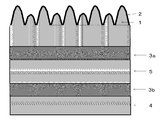
- the liquid repellent resin sheet according to the first embodiment of the present invention includes a convex layer (1) containing a thermoplastic resin composition having at least one fine convex shape (1a), as shown in FIG. And a liquid repellent layer (2) containing hydrophobic inorganic fine particles and a binder resin on the surface having the convex shape (1a), and the content of the hydrophobic inorganic fine particles in the liquid repellent layer exceeds 80% by mass, and It is 95 mass% or less, content of binder resin is 5 mass% or more and less than 20 mass%, and has liquid repellency.
- the convex layer can be formed using a thermoplastic resin composition.
- the thermoplastic resin composition include polyolefin resins, polystyrene resins, polyester resins, and polyvinylidene fluoride resins.
- a polyolefin resin is preferable, and it is particularly preferable to contain 35% by mass or more of a polyolefin resin.
- the convex shape transferability can be improved. Further, the melt mass flow rate at 230 ° C.
- the polyolefin-based resin composition is preferably 5 g / 10 min or more, and more preferably 15 g / 10 min or more.
- the melt mass flow rate is calculated by measuring the outflow mass (g / 10 minutes) at regular intervals in accordance with JIS K 7210. The melt mass flow rate is measured at a test temperature of 190 ° C. to 230 ° C. and a load of 2.16 kg to 10.00 kg as standard conditions.
- the polyolefin resin means a resin mainly containing a polymer containing an ⁇ -olefin as a monomer, and particularly preferably includes a polyethylene resin and a polypropylene resin.
- the polyethylene resin include high-density polyethylene, low-density polyethylene, linear low-density polyethylene, linear medium-density polyethylene, copolymers mainly composed of ethylene, and graft copolymers. included.
- copolymer examples include an ethylene-vinyl acetate copolymer, an ethylene-acrylic acid copolymer, an ethylene-acrylic acid ester copolymer, an ethylene-methacrylic acid ester copolymer, and an ethylene-vinyl acetate-vinyl chloride.
- graft copolymer examples include a styrene-ethylene graft copolymer.
- examples of the polypropylene resin include homopolypropylene, random polypropylene, and block polypropylene.
- the structure of the homopolypropylene may be any of isotactic, atactic, and syndiotactic.
- the ⁇ -olefin copolymerized with propylene preferably includes those having 2 to 20 carbon atoms, more preferably 4 to 12 carbon atoms, such as ethylene, 1-butene, 1-pentene, 1 Examples include -hexene, 1-heptene, 1-octene, 1-nonene, 1-decene and the like.
- block polypropylene When block polypropylene is used, a block copolymer (block polypropylene), a block copolymer containing a rubber component, a graft copolymer, or the like can be given. In addition to using these olefin resins alone, other olefin resins can also be used in combination.
- thermoplastic resin composition may contain other additives as long as the effects of the present invention are not impaired.
- additives include stabilizers, surfactants, lubricants, fillers, foaming agents, coloring materials, crystal nucleating agents, and the like.
- the convex layer has one or more kinds of fine convex shapes.
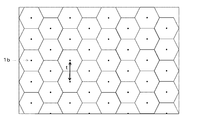
- the convex shape may be one type of convex shape as shown in FIG. 1, but preferably has a first convex shape and a second convex shape having different shapes as shown in FIG. .
- the convex shape may have three or more types of convex shapes having different shapes.
- the convex shape has the first convex shape and the second convex shape, the height of the first convex shape is higher than the height of the second convex shape.
- the 1st convex shape and a 2nd convex shape are arrange
- the arrangement form of the convex shape is not particularly limited, and there are a grid arrangement and a zigzag arrangement arranged vertically and horizontally. A staggered arrangement is preferred if more liquid repellency is desired.
- the formation method of a convex-shaped layer is not specifically limited, A well-known method can be used.
- a method of forming a resin sheet surface by casting with a transfer roll and a touch roll formed with a concavo-convex shape by a laser engraving method or a method of transferring a concavo-convex by heating and pressing a sheet using a belt-shaped mold Etc.
- the convex shape preferably has a height (h) of 20 ⁇ m to 150 ⁇ m.
- h height of the convex shape
- liquid repellency can be sufficiently secured, and by setting the height of the convex shape to 150 ⁇ m or more, the convex shape dimensions in the mold for imparting the convex shape Can be stabilized.
- the height of the convex shape is obtained by adding the thickness (100 nm to 4000 nm) of the liquid repellent layer described later.
- the thickness of the convex layer is not particularly limited, and may be 50 ⁇ m to 1000 ⁇ m including the height of the convex shape described above.
- the apex interval (t) between adjacent convex shapes is preferably 20 ⁇ m to 100 ⁇ m.
- the vertex interval is an interval between the convex shapes at the shortest adjacent distance, and means an interval between the convex shapes if they are adjacent even if the convex shapes are different.
- the convex height and the convex vertex interval can be measured using a laser microscope (for example, VK-X100 manufactured by Keyence Corporation).
- the ratio of the height of the second convex shape to the first convex shape is preferably 0.4 or more and 0.8 or less. By making the height ratio 0.4 or more and 0.8 or less, liquid repellency can be obtained more effectively.
- the bottom surface of the convex shape may be a pyramid shape such as a triangular pyramid, a quadrangular pyramid, a hexagonal pyramid, an octagonal pyramid, a cone, a truncated pyramid shape, or a truncated cone shape.
- a hexagonal pyramid convex shape is particularly preferable.
- the liquid repellent layer is formed on the surface of the convex layer with a substantially constant thickness so that the convex shape of the convex layer is maintained almost as it is on the sheet surface.
- the liquid repellent layer is provided in order to maintain liquid repellency even after molding into a member, and is formed using hydrophobic inorganic fine particles and a binder resin.
- the thickness of the liquid repellent layer is preferably 100 nm to 4000 nm, but is not particularly limited as long as the effects of the present invention can be obtained.
- “liquid repellency” means liquid repellency sufficient to prevent adhesion of saccharide-based liquid (liquid containing saccharide) to the resin sheet.
- the contact angle of the liquid to the liquid resin sheet is 130 ° or more and / or the falling angle is 40 ° or less.
- the contact angle and the sliding angle can be measured for the resin sheet using an automatic contact angle meter (for example, DM-501 manufactured by Kyowa Interface Chemical Co., Ltd.).
- the liquid repellency is maintained even when a pressure of 866 Pa is applied from above the liquid means that the liquid repellency is stable with respect to the pressure from the liquid. It means that liquid repellency is maintained even when added.
- the liquid repellent layer is characterized in that the content of the hydrophobic inorganic fine particles exceeds 80% by mass and 95% by mass or less, and the content of the binder resin is 5% by mass or more and less than 20% by mass. Further, the content of the hydrophobic inorganic fine particles is preferably 85% by mass to 95% by mass, and the content of the binder resin is preferably 5% by mass to 15% by mass.
- the composition within this range, stable liquid repellency can be obtained even when pressure is applied from the liquid.
- the content of the hydrophobic inorganic fine particles is 80% by mass or less, a sufficiently stable liquid repellency may not be obtained when pressure is applied from the liquid. If it exceeds 95% by mass, the hydrophobic inorganic fine particles may be peeled off.
- a dispersion liquid in which hydrophobic inorganic fine particles are added to isopropyl alcohol (IPA) in advance is prepared, and then mixed with a binder resin at an arbitrary ratio, and the convex shape is formed.
- IPA isopropyl alcohol
- a method of applying to the surface with a coater or the like is employed.
- the hydrophobic inorganic fine particles may be those having a hydrophobic group, and may be those hydrophobized by surface treatment.
- hydrophobic silica fine particles having a trimethylsilyl group, dimethylsiloxane group, alkylsilyl group, aminoalkylsilyl group, methacrylsilyl group, dimethylpolysiloxane group or dimethylsilyl group on the surface are preferred.
- fine particles in which hydrophilic inorganic fine particles are surface treated with a silane coupling agent or the like to make the surface state hydrophobic can also be used.
- the kind of inorganic substance is not limited as long as it has hydrophobicity.
- hydrophobic fumed silica fused silica, alumina, titania and the like
- hydrophobic there is no restriction on the shape of these particles, and either spherical or non-spherical (crushed) shape can be used.
- the average primary particle diameter is preferably 5 nm to 1000 nm, more preferably 7 nm to 200 nm, and even more preferably 7 nm to 25 nm.
- the average primary particle diameter is a diameter of 3000 to 5000 hydrophobic inorganic fine particles arbitrarily extracted by using a scanning electron microscope, taking a plurality of images while changing the visual field, and using image analysis software. Is a value obtained by measuring and calculating an average value.
- silica product names “AEROSIL R972”, “AEROSIL R972V”, “AEROSIL R972CF”, “AEROSIL R974”, “AEROSIL RX200”, “AEROSIL RY200” (above, Nippon Aerosil Co., Ltd.) Company-made), “AEROSIL R202”, “AEROSIL R805”, “AEROSIL R812”, “AEROSIL R812S”, “AEROSIL RY300” (above, manufactured by Evonik Degussa).
- titania include “AEROXIDE TiO2 T805” (manufactured by Evonik Degussa).
- alumina include fine particles in which the product name “AEROXIDE Alu C” (manufactured by Evonik Degussa) is treated with a silane coupling agent to make the particle surface hydrophobic.
- the binder resin represents a dispersion in which one or more of an olefin copolymer and a fluorine copolymer are dispersed in water.
- the content of the binder resin indicates the content of solid content mainly composed of the resin in the used binder resin.
- the olefin copolymer means a polymer containing an ⁇ -olefin as a monomer, and includes a polyethylene polymer and a polypropylene polymer.
- low density polyethylene very low density polyethylene (copolymer of ethylene and ⁇ -olefin), ethylene-vinyl acetate copolymer (EVA), ethylene-alkyl acrylate copolymer, ethylene-alkyl methacrylate copolymer
- EVA ethylene-vinyl acetate copolymer
- Examples include ethylene-acrylic acid copolymers, ethylene-methacrylic acid copolymers, ionomers such as low-density polyethylene, and propylene-based elastomer materials.
- the fluorine-based copolymer is a hydrocarbon-based resin containing fluorine, and preferably contains a copolymer (1) and a copolymer (2) described below.
- the copolymer (1) and the copolymer (2) can contain the structural units (a) to (d) described below.
- the copolymer (1) contains the structural unit (a) and the structural unit (b)
- the copolymer (2) contains the structural unit (a) and the structural unit (c).
- the copolymer (1) mainly contributes to the expression of the liquid repellency of the resin sheet
- the copolymer (2) mainly contributes to the durability of the resin sheet.
- the structural unit (a) is a group in which some or all of the hydrogen atoms of the alkyl group are substituted with fluorine atoms, and has 1 to 6 carbon atoms.
- the structural unit (a) may be a chain polyfluorohydrocarbon group having one or more unsaturated groups such as a carbon-carbon unsaturated double bond. As the unsaturated group, (meth) acrylate is preferable.
- the structural unit (b) is preferably a monomer having a saturated hydrocarbon group having 16 to 40 carbon atoms, and is a (meth) acrylate containing an alkyl group having 16 to 40 carbon atoms. More preferred are stearyl (meth) acrylate and behenyl (meth) acrylate.
- the structural unit (c) is a monomer derived from a monomer that does not contain a fluorine atom and has a functional group capable of crosslinking.
- Crosslinkable functional groups include isocyanate groups, blocked isocyanate groups, alkoxysilyl groups, amino groups, alkoxymethylamide groups, silanol groups, ammonium groups, amide groups, epoxy groups, hydroxyl groups, oxazoline groups, carboxyl groups, alkenyl groups. A sulfonic acid group and the like are preferable.
- an epoxy group, a hydroxyl group, a blocked isocyanate group, an alkoxysilyl group, an amino group, and a carboxyl group are more preferable.
- Preferred examples of the monomer that forms the structural unit (c) include (meth) acrylates, compounds having two or more copolymerizable groups, vinyl ethers, and vinyl esters.
- the structural unit (c) may be derived from a mixture of two or more.
- the structural unit (c) mainly affects the film-forming property of the liquid-repellent film and the adhesiveness and adhesion of the liquid-repellent composition to the base material, and contributes to enhancing the durability.
- the structural unit (d) is a structural unit derived from a monomer having a polymerizable group other than the structural units (a), (b), and (c). Moreover, it is preferable that it is derived from the monomer which has favorable film forming property and can obtain a uniform copolymer solution or dispersion.
- the structural unit (d) is particularly preferably derived from vinyl chloride, vinylidene chloride, cyclohexyl methacrylate, polyoxyethylene di (meth) acrylate, alkyl ether of polyoxyethylene di (meth) acrylate, or dioctyl maleate. .
- the structural unit (d) can contribute to improving the adhesion of the composition to the substrate and improving the dispersibility.
- the aqueous liquid in the present embodiment is a liquid having fluidity using water as a solvent, and the viscosity of the liquid is not limited.
- food-grade liquids such as liquids containing sugars are included.
- yogurt, jelly, pudding, fruit sauce, syrup, ketchup, juice, porridge, honey, molasses, liquid sugar and the like are included.
- the layer structure of the resin sheet according to the second embodiment includes a liquid repellent layer (2), a convex shaped layer (1), a sealant resin layer (3), and a base material layer (4) from top to bottom. is there.
- the thickness of the convex layer is preferably 50 ⁇ m to 200 ⁇ m. By setting the thickness to 50 ⁇ m or more, it is possible to prevent the convex transfer from being defective. Moreover, it can prevent that a production cost becomes high by setting it as 200 micrometers or more.
- Base material layer is made of styrene resin (impact polystyrene, polybutadiene-polystyrene-polyacrylonitrile graft polymer, etc.), olefin resin (polyethylene, polypropylene, etc.), polycarbonate, polyester resin (polyethylene terephthalate, polybutylene terephthalate, etc.)
- Thermoplastic resins such as nylon resins (nylon 6, nylon-66, etc.), ethylene-vinyl alcohol copolymers, and acrylic resins are preferred.
- lamination there are lamination by co-extrusion molding, extrusion lamination molding using an unstretched film, biaxially stretched film, and lamination by dry lamination molding.
- the polyester resin used as the base material layer includes polyethylene terephthalate, polybutylene terephthalate, polyethylene-2,6-naphthalate, polymethylene terephthalate, and copolymer components such as diethylene glycol, neopentyl glycol, polyalkylene glycol, etc.
- Polyester resins obtained by copolymerizing diol components, dicarboxylic acid components such as adipic acid, sebacic acid, phthalic acid, isophthalic acid, and 2,6-naphthalenedicarboxylic acid can be used.
- a colorant such as a pigment and a dye, a release agent such as silicone oil, a fibrous reinforcing agent such as glass fiber, talc, clay, Additives such as a colorant such as silica, a salt compound of sulfonic acid and an alkali metal, an antistatic agent such as polyalkylene glycol, an ultraviolet absorber, and an antibacterial agent can be added.
- a colorant such as silica, a salt compound of sulfonic acid and an alkali metal, an antistatic agent such as polyalkylene glycol, an ultraviolet absorber, and an antibacterial agent can be added.
- the scrap resin generated in the production process of the multilayer resin sheet of the present invention can be mixed and used.
- a sealant resin layer expresses the adhesiveness of a convex shaped layer and a base material layer.
- the resin component include 100% by mass of a modified olefin polymer resin and 100 parts by mass of a thermoplastic elastomer.
- a modified olefin polymer is preferable.
- the modified olefin polymer resin include olefins having about 2 to 8 carbon atoms such as ethylene, propylene, and butene-1, and these olefins and ethylene, propylene, butene-1, 3-methylbutene-1, pentene-1, 4 -Copolymers with other olefins having about 2 to 20 carbon atoms such as methylpentene-1, hexene-1, octene-1, decene-1, etc., vinyl acetate, vinyl chloride, acrylic acid, methacrylic acid, acrylic esters Olefin resins such as copolymers with vinyl compounds such as methacrylic acid esters and styrene; ethylene-propylene copolymers, ethylene-propylene-diene copolymers, ethylene-butene-1 copolymers, propylene-butene- 1 Copoly
- an ethylene-propylene-diene copolymer or an ethylene-propylene-butene-1 copolymer rubber modified with an unsaturated dicarboxylic acid or an anhydride thereof, particularly maleic acid or an anhydride thereof, is preferable.
- the thickness of the sealant resin layer is preferably 20 ⁇ m to 90 ⁇ m, more preferably 40 to 80 ⁇ m. When the thickness is less than 20 ⁇ m, delamination may occur between the convex layer and the base material layer, and when it exceeds 90 ⁇ m, the production cost may increase.
- the resin sheet according to the third embodiment of the present invention does not use the sealant resin layer (3) shown in the second embodiment, and the convex layer (1) and the base material layer (4 ) Directly laminated. That is, the layer structure of the resin sheet according to the third embodiment is the liquid repellent layer (2), the convex layer (1), and the base material layer (4) from the top to the bottom.
- the thermoplastic resin sheet has a layer configuration in which the sealant resin layer is removed.
- the base material layer (4) in this embodiment has sufficient adhesiveness with the convex shaped layer.
- the base material layer it is preferable to use a styrene resin that is excellent in adhesiveness with the convex layer.
- the styrenic resin is preferably 60% by mass to 15% by mass, more preferably 55% by mass to 15% by mass polystyrene resin, and 40% by mass to 85% by mass, more preferably 45% by mass to 85% by mass.
- a styrene-based substrate layer comprising a high-impact polystyrene resin is preferred.
- a styrene resin composition to which a hydrogenated styrene thermoplastic elastomer is added can also be used.
- styrene comprising 90% by mass to 95% by mass of a polystyrene resin and 5% by mass to 10% by mass of a hydrogenated styrene thermoplastic elastomer. Based resin compositions are preferred.
- the addition amount of the hydrogenated styrene-based thermoplastic elastomer is less than 5% by mass, the adhesiveness with the convex layer becomes insufficient, and delamination may occur. If it exceeds 10% by mass, the production cost is increased. May be higher.
- the resin sheet according to the fourth embodiment of the present invention includes a liquid repellent layer (2), a convex layer (1), a first sealant resin layer (3a), an oxygen barrier base material layer ( 5) A resin sheet in which a second sealant resin layer (3b) and a base material layer (4) are laminated in this order.
- the first sealant resin layer and the second sealant resin layer may have the same composition or different compositions.
- the thickness of the convex layer is preferably 50 to 250 ⁇ m. If it is less than 50 ⁇ m, the convex transfer may be poor. Moreover, when it exceeds 200 micrometers, production cost may become high.
- the resin used as the base material layer in the fourth embodiment is preferably a nylon resin or a methacrylic ester resin.
- Nylon resins include lactam polymers such as caprolactam and laurolactam, polymers of aminocarboxylic acids such as 6-aminocaproic acid, 11-aminoundecanoic acid and 12-aminododecanoic acid, hexamethylenediamine, decamethylenediamine, and dodeca Aliphatic diamines such as methylenediamine, 2,2,4- or 2,4,4-trimethylhexamethylenediamine, 1,3- or 1,4-bis (aminomethyl) cyclohexane, bis (p-aminocyclohexylmethane) Diamine units such as alicyclic diamines such as m- or p-xylylenediamine, aliphatic dicarboxylic acids such as adipic acid, suberic acid and sebacic acid, and aliphatic dicar
- nylon 6 nylon 9, nylon 11, nylon 12, nylon 66, nylon 610, nylon 611, nylon 612, nylon 6T, nylon 6I, nylon MXD6, nylon 6/66, nylon 6/610, nylon 6 / 6T, nylon 6I / 6T, etc.
- nylon 6 and nylon MXD6 are preferable.
- the methacrylic ester resin is not particularly limited as long as it is a vinyl polymer based on a methacrylic ester monomer.
- the methacrylic acid ester monomer include methyl methacrylate, ethyl methacrylate, propyl methacrylate, butyl methacrylate, pentyl methacrylate and hexyl methacrylate. Of these, methyl methacrylate is particularly preferred.
- alkyl groups such as propyl group, butyl group, pentyl group and hexyl group in the methacrylic acid ester monomer may be linear or branched.
- the methacrylic ester resin blended in the resin composition of the present embodiment may be a homopolymer of a methacrylic ester monomer or a copolymer of a plurality of methacrylic ester monomers. Alternatively, it may have a monomer unit derived from ethylene, propylene, butadiene, styrene, ⁇ -methylstyrene, acrylonitrile, acrylic acid and the like, which are known vinyl compounds other than methacrylic acid esters.
- oxygen barrier substrate layer examples include ethylene-vinyl alcohol copolymer resin and nylon resin. Among these, ethylene-vinyl alcohol copolymer resin is preferable in terms of processability and moldability.
- the ethylene-vinyl alcohol copolymer resin is usually obtained by saponifying an ethylene-vinyl acetate copolymer, and has an ethylene content of 10 mol in order to have oxygen barrier properties, processability, and moldability. % To 65 mol%, preferably 20 mol% to 50 mol%, and a saponification degree of 90% or more, preferably 95% or more.
- nylon resins examples include lactam polymers such as caprolactam and laurolactam, polymers of aminocarboxylic acids such as 6-aminocaproic acid, 11-aminoundecanoic acid, and 12-aminododecanoic acid, hexamethylenediamine, and decamethylenediamine.
- Aromatic dicarbohydrates such as dicarboxylic acid, terephthalic acid and isophthalic acid
- nylon resins include nylon 6, nylon 9, nylon 11, nylon 12, nylon 66, nylon 610, nylon 611, nylon 612, nylon 6T, nylon 6I, nylon MXD6, nylon 6/66, nylon 6 / 610, nylon 6 / 6T, nylon 6I / 6T, etc., among which nylon 6 and nylon MXD6 are preferred.
- a modified olefin polymer is preferable.
- the modified olefin polymer resin include olefins having about 2 to 8 carbon atoms such as ethylene, propylene, and butene-1, and these olefins and ethylene, propylene, butene-1, 3-methylbutene-1, pentene-1, 4 -Copolymers of other olefins having about 2 to 20 carbon atoms such as methylpentene-1, hexene-1, octene-1 and decene-1, vinyl acetate, vinyl chloride, acrylic acid, methacrylic acid, acrylic ester, Olefin resins such as copolymers with methacrylic acid esters and vinyl compounds such as styrene; ethylene-propylene copolymers, ethylene-propylene-diene copolymers, ethylene-butene-1 copolymers, propylene-butylene
- an ethylene-based resin, a propylene-based resin, or an ethylene-propylene or butene-1 copolymer rubber modified with an unsaturated dicarboxylic acid or an anhydride thereof, particularly maleic acid or an anhydride thereof is preferable.
- the thickness of the sealant resin layer is preferably 10 ⁇ m to 50 ⁇ m, more preferably 20 ⁇ m to 40 ⁇ m on either side. If the thickness is less than 10 ⁇ m, sufficient interlayer adhesion strength may not be obtained, and if it exceeds 50 ⁇ m, the production cost may increase.
- the method for producing the resin sheet according to the present invention is not limited and may be any method, but typically, a single-layer sheet having at least one or more types of convex shapes on one surface or a layer having the convex shapes. And finally forming a liquid repellent layer on the convex surface.
- any resin sheet molding method can be used.
- a single-screw extruder is used, and in the case of a multi-layer, each raw material resin is melt-extruded using a single-screw extruder, and a resin sheet is obtained by a T-die. It is done.
- a multi-manifold die may be used.
- the layer structure of each embodiment of the resin sheet of the present invention is basically the same as described above.
- a convex shape is formed on the single-layer or multilayer resin sheet, but this method is not particularly limited, and any method known to those skilled in the art can be used.
- a manufacturing method using an extrusion molding method a manufacturing method using a photolithography method, a manufacturing method using a hot press method, a manufacturing method using a pattern roll and a UV curable resin, and the like.
- liquid repellent layer containing a specific content of hydrophobic inorganic fine particles and a binder resin is formed on the surface of the convex layer.
- the method for forming the liquid repellent layer is not particularly limited, and for example, a known coating method such as roll coating, gravure coating, bar coating, doctor blade coating, brush coating, or electrostatic powder method can be employed.
- the solvent for preparing the coating liquid is not particularly limited, and other than water, for example, alcohol (ethanol), cyclohexane, toluene, acetone, IPA, propylene glycol, hexylene glycol, butyl diglycol, pentamethylene glycol, An organic solvent such as normal pentane, normal hexane, and hexyl alcohol can be appropriately selected.
- a very small amount of a dispersant, a colorant, an anti-settling agent, a viscosity modifier and the like can be used in combination.
- liquid repellent resin sheet according to the present invention can be applied to the above-described articles that require liquid repellency. Specific description will be given below.
- the liquid-repellent resin sheet of the present invention can be applied as packaging materials such as food containers and pouches, household items such as rain feathers and umbrellas, watering parts such as kitchens, bathrooms, and toilets, and building materials such as wallpaper.
- the liquid-repellent resin sheet of the present invention can be applied to food containers, pouches, etc. to prevent the contents from adhering to the inner wall of the containers, etc.
- the effect of reducing the trouble of washing the container at the time of separation can be obtained.
- liquid-repellent resin sheet of the present invention when the liquid-repellent resin sheet of the present invention is applied to rain gear such as rain feathers and umbrellas, it is difficult for water droplets to adhere to the liquid repellent resin sheet.
- liquid repellent resin sheet of the present invention when the liquid repellent resin sheet of the present invention is applied to a wall panel in a bathroom, it is possible to obtain an effect that it is difficult for water droplets or the like to adhere thereto.
- liquid repellent resin sheet of the present invention when the liquid repellent resin sheet of the present invention is applied to an interior material or the like, an effect that dirt or the like hardly adheres can be obtained.
- Convex layer (A) Random polypropylene “PM921V” (manufactured by Sun Allomer Co.), melt mast flow rate: 25 g / 10 min (test temperature: 230 ° C., load: 2.16 kg)
- Liquid repellent layer (B) Hydrophobic inorganic fine particles: Hydrophobic silica “AEROSIL R812S” (Evonik Degussa), average primary particle size: 7 nm, trimethylsilyl group modification (C) Hydrophobic inorganic fine particles: Hydrophobic silica “ “AEROSIL R8200” (Evonik Degussa), average primary particle size: 12 nm, trimethylsilyl group-modified (D) hydrophobic inorganic fine particles: hydrophobic silica “AEROSIL NAX50” (manufactured by Aerosil Japan), average primary particle size: 30 nm, trimethylsilyl Group modification (E) Binder resin:
- the evaluation method of various characteristics about the resin sheet produced in the example etc. is as follows.
- the convex shape of the sheet was measured by using a laser microscope VK-X100 (manufactured by Keyence Corporation), and measuring the height of the convex shape and the vertex interval of the convex shape. Further, in order to measure the convex height and the vertex interval, a convex cross-section sample was prepared using a microtome. As for the height of the convex shape, 10 heights having the same shape were measured from arbitrary three locations of the resin sheet, and the arithmetic average value of the 30 measured values was used. When there were two or more types of convex shapes, the heights of the first convex shape and the second convex shape were determined in the same manner for each.
- interval the vertex space
- vertex interval between the first convex shape and the second convex shape was measured, and the arithmetic average value of the 30 measured values was used.
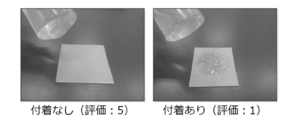
- the pressurization test was performed by placing 1 g of the test solution on the resin sheet, and further placing a cylindrical polypropylene case (hereinafter, cylindrical case) on the solution.
- the cylindrical case has a diameter of 32 mm and a weight of 70 g, and the pressure applied to the liquid is 866 Pa.
- the state where there is no adhesion at all is “5”, and the state where there is the most adhesion is “1”.
- the visual evaluation was made in 5 stages. In this five-step evaluation, it was determined that adhesion was suppressed if it was “4” or more.
- Example 1 (layer structure of FIG. 1)> A single 65 mm single screw extruder was used to extrude the resin sheet by the T-die method. This extruded sheet was cast by a transfer roll having a concavo-convex shape on the surface and a touch roll by a laser engraving method to obtain a resin sheet having a convex layer having a convex shape on the surface.
- the hydrophobic silica and the binder resin are mixed in a composition ratio such that the hydrophobic silica in the liquid repellent layer is 90% by volume and the binder resin is 10% by mass.
- the dispersion was prepared (both solvents were a mixture of purified water / isopropyl alcohol).
- the mixed dispersion was coated on the surface of the convex layer using a bar coater and dried at 90 ° C. to form a liquid repellent layer.
- Examples 2 to 8 Comparative Examples 1 to 5> Resin sheets according to Examples 2 to 8 and Comparative Examples 1 to 5 in the same manner as in Example 1 except that the composition of the liquid repellent layer, the presence or absence of the liquid repellent layer, and the presence or absence of the convex shape were set as shown in Table 1. Were made and evaluated. The composition of the liquid repellent layer is shown in Table 1, and the results are shown in Table 2.
- Comparative Examples 1 to 3 the silica fine particle content and the binder resin content in the liquid repellent layer were changed. In Comparative Example 4, no liquid repellent layer was formed, and in Comparative Example 5, no convex shape was imparted. .
- Comparative Example 3 Although a result that the contact angle was 130 ° or more was obtained, the falling angle was 40 ° or more and 2 or less in the pressure test. In Comparative Examples 4 and 5, no effect was obtained with respect to any of the contact angle, the falling angle, and the pressure test.
Landscapes
- Engineering & Computer Science (AREA)
- Mechanical Engineering (AREA)
- Laminated Bodies (AREA)
- Bag Frames (AREA)
- Wrappers (AREA)
Abstract
L'invention concerne une feuille de résine repoussant les liquides, dotée d'une répulsion de liquide stable en réponse à une pression exercée par un liquide, pouvant être obtenue au moyen d'une feuille de résine comprenant une couche de forme convexe (1) présentant au moins un type de formes convexes fines (1a) et contenant une composition de résine thermoplastique, et une couche de répulsion de liquide (2) contenant des microparticules inorganiques hydrophobes et une résine de liant sur la surface comportant les formes convexes (1a), la couche de répulsion de liquide (2) présentant une teneur en microparticules inorganiques hydrophobes comprise entre plus de 80% en masse et 95% en masse, ainsi qu'une teneur en résine de liant comprise entre 5% en masse et moins de 20% en masse.
Priority Applications (2)
| Application Number | Priority Date | Filing Date | Title |
|---|---|---|---|
| CN201780016423.4A CN108883596B (zh) | 2016-03-14 | 2017-03-14 | 拒液性树脂片和利用了该拒液性树脂片的物品 |
| JP2018505935A JP6941597B2 (ja) | 2016-03-14 | 2017-03-14 | 撥液性樹脂シート及びそれを用いた物品 |
Applications Claiming Priority (2)
| Application Number | Priority Date | Filing Date | Title |
|---|---|---|---|
| JP2016050225 | 2016-03-14 | ||
| JP2016-050225 | 2016-03-14 |
Publications (1)
| Publication Number | Publication Date |
|---|---|
| WO2017159654A1 true WO2017159654A1 (fr) | 2017-09-21 |
Family
ID=59850872
Family Applications (1)
| Application Number | Title | Priority Date | Filing Date |
|---|---|---|---|
| PCT/JP2017/010114 Ceased WO2017159654A1 (fr) | 2016-03-14 | 2017-03-14 | Feuille de résine repoussant les liquides et article la comprenant |
Country Status (4)
| Country | Link |
|---|---|
| JP (1) | JP6941597B2 (fr) |
| CN (1) | CN108883596B (fr) |
| TW (1) | TW201800224A (fr) |
| WO (1) | WO2017159654A1 (fr) |
Cited By (8)
| Publication number | Priority date | Publication date | Assignee | Title |
|---|---|---|---|---|
| JP2019073331A (ja) * | 2017-10-19 | 2019-05-16 | 住友ベークライト株式会社 | 包装材および包装体 |
| KR20190061436A (ko) * | 2017-11-28 | 2019-06-05 | 주식회사 엘지화학 | 내부 표면이 개질된 라미네이트 시트 및 이를 포함하는 파우치형 전지 |
| WO2019244752A1 (fr) * | 2018-06-20 | 2019-12-26 | 凸版印刷株式会社 | Structure hydrofuge, son procédé de production, matériau d'emballage et feuille de séparation |
| WO2020179412A1 (fr) * | 2019-03-07 | 2020-09-10 | 東洋紡株式会社 | Film de stratification |
| JPWO2021182043A1 (fr) * | 2020-03-12 | 2021-09-16 | ||
| JPWO2021182044A1 (fr) * | 2020-03-12 | 2021-09-16 | ||
| US20210309428A1 (en) * | 2018-09-21 | 2021-10-07 | Toppan Printing Co., Ltd. | Liquid repellent layer-forming resin composition, and liquid repellent film, liquid repellent laminate, packaging material, and container using same |
| JP2022501210A (ja) * | 2018-08-03 | 2022-01-06 | クライオバック・エル・エル・シー | 包装用超疎水性熱可塑性フィルム及びそれから製造されるパッケージ |
Citations (6)
| Publication number | Priority date | Publication date | Assignee | Title |
|---|---|---|---|---|
| JPH1191024A (ja) * | 1997-09-19 | 1999-04-06 | Hitachi Ltd | 撥水性部材及びその製造方法 |
| JP2010132839A (ja) * | 2008-12-08 | 2010-06-17 | Nissan Motor Co Ltd | 撥水性構造及び撥水性構造体 |
| JP2013035559A (ja) * | 2011-08-05 | 2013-02-21 | Showa Denko Packaging Co Ltd | 内容物付着防止蓋材およびその製造方法 |
| WO2014087696A1 (fr) * | 2012-12-07 | 2014-06-12 | 電気化学工業株式会社 | Feuille de résine thermoplastique dotée de propriétés hydrofuges, et article moulé |
| WO2014087695A1 (fr) * | 2012-12-07 | 2014-06-12 | 電気化学工業株式会社 | Feuille de résine thermoplastique dotée de propriétés hydrofuges, et article moulé |
| JP2014532012A (ja) * | 2011-09-08 | 2014-12-04 | シージェイ チェイルジェダン コーポレーションCj Cheiljedang Corporation | ナノ構造の疎水性表面を有する食品容器及びその製造方法 |
Family Cites Families (2)
| Publication number | Priority date | Publication date | Assignee | Title |
|---|---|---|---|---|
| JP2003001736A (ja) * | 2001-06-27 | 2003-01-08 | Toto Ltd | 撥水性高輝度透明材 |
| JP5994338B2 (ja) * | 2012-03-30 | 2016-09-21 | 凸版印刷株式会社 | 熱シール性フィルム及び熱シール性フィルムの製造方法 |
-
2017
- 2017-03-14 CN CN201780016423.4A patent/CN108883596B/zh active Active
- 2017-03-14 WO PCT/JP2017/010114 patent/WO2017159654A1/fr not_active Ceased
- 2017-03-14 JP JP2018505935A patent/JP6941597B2/ja active Active
- 2017-03-14 TW TW106108362A patent/TW201800224A/zh unknown
Patent Citations (6)
| Publication number | Priority date | Publication date | Assignee | Title |
|---|---|---|---|---|
| JPH1191024A (ja) * | 1997-09-19 | 1999-04-06 | Hitachi Ltd | 撥水性部材及びその製造方法 |
| JP2010132839A (ja) * | 2008-12-08 | 2010-06-17 | Nissan Motor Co Ltd | 撥水性構造及び撥水性構造体 |
| JP2013035559A (ja) * | 2011-08-05 | 2013-02-21 | Showa Denko Packaging Co Ltd | 内容物付着防止蓋材およびその製造方法 |
| JP2014532012A (ja) * | 2011-09-08 | 2014-12-04 | シージェイ チェイルジェダン コーポレーションCj Cheiljedang Corporation | ナノ構造の疎水性表面を有する食品容器及びその製造方法 |
| WO2014087696A1 (fr) * | 2012-12-07 | 2014-06-12 | 電気化学工業株式会社 | Feuille de résine thermoplastique dotée de propriétés hydrofuges, et article moulé |
| WO2014087695A1 (fr) * | 2012-12-07 | 2014-06-12 | 電気化学工業株式会社 | Feuille de résine thermoplastique dotée de propriétés hydrofuges, et article moulé |
Cited By (22)
| Publication number | Priority date | Publication date | Assignee | Title |
|---|---|---|---|---|
| JP2019073331A (ja) * | 2017-10-19 | 2019-05-16 | 住友ベークライト株式会社 | 包装材および包装体 |
| KR20190061436A (ko) * | 2017-11-28 | 2019-06-05 | 주식회사 엘지화학 | 내부 표면이 개질된 라미네이트 시트 및 이를 포함하는 파우치형 전지 |
| KR102374818B1 (ko) * | 2017-11-28 | 2022-03-15 | 주식회사 엘지에너지솔루션 | 내부 표면이 개질된 라미네이트 시트 및 이를 포함하는 파우치형 전지 |
| WO2019244752A1 (fr) * | 2018-06-20 | 2019-12-26 | 凸版印刷株式会社 | Structure hydrofuge, son procédé de production, matériau d'emballage et feuille de séparation |
| US11969977B2 (en) | 2018-06-20 | 2024-04-30 | Toppan Printing Co., Ltd. | Liquid-repellent structure, production method thereof, wrapping material, and separation sheet |
| JP7388351B2 (ja) | 2018-06-20 | 2023-11-29 | Toppanホールディングス株式会社 | 撥液性構造体及びその製造方法並びに包装材及び剥離シート |
| CN112512803A (zh) * | 2018-06-20 | 2021-03-16 | 凸版印刷株式会社 | 拒液性结构体及其制造方法、以及包装材料和剥离片 |
| JPWO2019244752A1 (ja) * | 2018-06-20 | 2021-07-08 | 凸版印刷株式会社 | 撥液性構造体及びその製造方法並びに包装材及び剥離シート |
| JP2022501210A (ja) * | 2018-08-03 | 2022-01-06 | クライオバック・エル・エル・シー | 包装用超疎水性熱可塑性フィルム及びそれから製造されるパッケージ |
| US12330849B2 (en) * | 2018-09-21 | 2025-06-17 | Toppan Printing Co., Ltd. | Liquid repellent layer-forming resin composition, and liquid repellent film, liquid repellent laminate, packaging material, and container using same |
| US20210309428A1 (en) * | 2018-09-21 | 2021-10-07 | Toppan Printing Co., Ltd. | Liquid repellent layer-forming resin composition, and liquid repellent film, liquid repellent laminate, packaging material, and container using same |
| JPWO2020179412A1 (fr) * | 2019-03-07 | 2020-09-10 | ||
| WO2020179412A1 (fr) * | 2019-03-07 | 2020-09-10 | 東洋紡株式会社 | Film de stratification |
| JP7452416B2 (ja) | 2019-03-07 | 2024-03-19 | 東洋紡株式会社 | 積層フィルム |
| CN115244114A (zh) * | 2020-03-12 | 2022-10-25 | 凸版印刷株式会社 | 疏液性结构体、疏液性结构体的制造方法、疏液层形成用涂液以及包装材料 |
| EP4119604A4 (fr) * | 2020-03-12 | 2023-08-30 | Toppan Inc. | Structure de répulsion de liquide, procédé de production de structure de répulsion de liquide, liquide de revêtement pour formation de couche de répulsion de liquide, et matériau d'emballage |
| EP4119603A4 (fr) * | 2020-03-12 | 2023-08-30 | Toppan Inc. | Structure hydrophobe, procédé de production de structure hydrophobe, liquide de revêtement pour formation de couche hydrophobe, et matériau d'emballage |
| CN115279822A (zh) * | 2020-03-12 | 2022-11-01 | 凸版印刷株式会社 | 疏液性结构体、疏液性结构体的制造方法、疏液层形成用涂液以及包装材料 |
| JPWO2021182043A1 (fr) * | 2020-03-12 | 2021-09-16 | ||
| JPWO2021182044A1 (fr) * | 2020-03-12 | 2021-09-16 | ||
| JP7746982B2 (ja) | 2020-03-12 | 2025-10-01 | Toppanホールディングス株式会社 | 撥液性構造体、撥液性構造体の製造方法、及び包装材 |
| JP7746983B2 (ja) | 2020-03-12 | 2025-10-01 | Toppanホールディングス株式会社 | 撥液性構造体、撥液性構造体の製造方法、及び包装材 |
Also Published As
| Publication number | Publication date |
|---|---|
| JPWO2017159654A1 (ja) | 2019-01-17 |
| CN108883596B (zh) | 2021-06-18 |
| TW201800224A (zh) | 2018-01-01 |
| JP6941597B2 (ja) | 2021-09-29 |
| CN108883596A (zh) | 2018-11-23 |
Similar Documents
| Publication | Publication Date | Title |
|---|---|---|
| JP6941597B2 (ja) | 撥液性樹脂シート及びそれを用いた物品 | |
| KR102253424B1 (ko) | 발액성 수지 시트 및 그것을 사용한 물품 | |
| JP6298767B2 (ja) | 撥水性を備えた熱可塑性樹脂シート及び成形品 | |
| JP6895747B2 (ja) | 撥液性樹脂シート及びそれを用いた物品 | |
| JP6641284B2 (ja) | 撥液性樹脂シート、成形品及び撥液性樹脂シートの製造方法 | |
| JP6694388B2 (ja) | 撥液性樹脂シートおよびそれを用いた建材用シート、生活品包装材用シート | |
| CN101405136A (zh) | 金属化多层薄膜,制造方法和由其制得的制品 | |
| WO2014087696A1 (fr) | Feuille de résine thermoplastique dotée de propriétés hydrofuges, et article moulé | |
| JP6131034B2 (ja) | 撥水性を付与した積層シート及びラミネート用フィルム | |
| WO2021132461A1 (fr) | Feuille décorative à fini métallique et corps moulé décoratif à fini métallique comportant une feuille décorative à fini métallique | |
| JP2014046455A (ja) | 積層体の製造方法 | |
| JP2014046456A (ja) | 積層体の製造方法 |
Legal Events
| Date | Code | Title | Description |
|---|---|---|---|
| WWE | Wipo information: entry into national phase |
Ref document number: 2018505935 Country of ref document: JP |
|
| NENP | Non-entry into the national phase |
Ref country code: DE |
|
| 121 | Ep: the epo has been informed by wipo that ep was designated in this application |
Ref document number: 17766653 Country of ref document: EP Kind code of ref document: A1 |
|
| 122 | Ep: pct application non-entry in european phase |
Ref document number: 17766653 Country of ref document: EP Kind code of ref document: A1 |