WO2017159663A1 - 二酸化炭素吸着剤及びその製造方法、並びに、二酸化炭素処理システム - Google Patents
二酸化炭素吸着剤及びその製造方法、並びに、二酸化炭素処理システム Download PDFInfo
- Publication number
- WO2017159663A1 WO2017159663A1 PCT/JP2017/010143 JP2017010143W WO2017159663A1 WO 2017159663 A1 WO2017159663 A1 WO 2017159663A1 JP 2017010143 W JP2017010143 W JP 2017010143W WO 2017159663 A1 WO2017159663 A1 WO 2017159663A1
- Authority
- WO
- WIPO (PCT)
- Prior art keywords
- carbon dioxide
- silica gel
- adsorbent
- amine compound
- dioxide adsorbent
- Prior art date
- Legal status (The legal status is an assumption and is not a legal conclusion. Google has not performed a legal analysis and makes no representation as to the accuracy of the status listed.)
- Ceased
Links
Images



Classifications
-
- B—PERFORMING OPERATIONS; TRANSPORTING
- B01—PHYSICAL OR CHEMICAL PROCESSES OR APPARATUS IN GENERAL
- B01J—CHEMICAL OR PHYSICAL PROCESSES, e.g. CATALYSIS OR COLLOID CHEMISTRY; THEIR RELEVANT APPARATUS
- B01J20/00—Solid sorbent compositions or filter aid compositions; Sorbents for chromatography; Processes for preparing, regenerating or reactivating thereof
- B01J20/22—Solid sorbent compositions or filter aid compositions; Sorbents for chromatography; Processes for preparing, regenerating or reactivating thereof comprising organic material
-
- B—PERFORMING OPERATIONS; TRANSPORTING
- B01—PHYSICAL OR CHEMICAL PROCESSES OR APPARATUS IN GENERAL
- B01D—SEPARATION
- B01D53/00—Separation of gases or vapours; Recovering vapours of volatile solvents from gases; Chemical or biological purification of waste gases, e.g. engine exhaust gases, smoke, fumes, flue gases, aerosols
- B01D53/02—Separation of gases or vapours; Recovering vapours of volatile solvents from gases; Chemical or biological purification of waste gases, e.g. engine exhaust gases, smoke, fumes, flue gases, aerosols by adsorption, e.g. preparative gas chromatography
-
- B—PERFORMING OPERATIONS; TRANSPORTING
- B01—PHYSICAL OR CHEMICAL PROCESSES OR APPARATUS IN GENERAL
- B01D—SEPARATION
- B01D53/00—Separation of gases or vapours; Recovering vapours of volatile solvents from gases; Chemical or biological purification of waste gases, e.g. engine exhaust gases, smoke, fumes, flue gases, aerosols
- B01D53/34—Chemical or biological purification of waste gases
- B01D53/46—Removing components of defined structure
- B01D53/62—Carbon oxides
-
- B—PERFORMING OPERATIONS; TRANSPORTING
- B01—PHYSICAL OR CHEMICAL PROCESSES OR APPARATUS IN GENERAL
- B01D—SEPARATION
- B01D53/00—Separation of gases or vapours; Recovering vapours of volatile solvents from gases; Chemical or biological purification of waste gases, e.g. engine exhaust gases, smoke, fumes, flue gases, aerosols
- B01D53/34—Chemical or biological purification of waste gases
- B01D53/74—General processes for purification of waste gases; Apparatus or devices specially adapted therefor
- B01D53/81—Solid phase processes
- B01D53/83—Solid phase processes with moving reactants
-
- B—PERFORMING OPERATIONS; TRANSPORTING
- B01—PHYSICAL OR CHEMICAL PROCESSES OR APPARATUS IN GENERAL
- B01J—CHEMICAL OR PHYSICAL PROCESSES, e.g. CATALYSIS OR COLLOID CHEMISTRY; THEIR RELEVANT APPARATUS
- B01J20/00—Solid sorbent compositions or filter aid compositions; Sorbents for chromatography; Processes for preparing, regenerating or reactivating thereof
- B01J20/02—Solid sorbent compositions or filter aid compositions; Sorbents for chromatography; Processes for preparing, regenerating or reactivating thereof comprising inorganic material
- B01J20/10—Solid sorbent compositions or filter aid compositions; Sorbents for chromatography; Processes for preparing, regenerating or reactivating thereof comprising inorganic material comprising silica or silicate
- B01J20/103—Solid sorbent compositions or filter aid compositions; Sorbents for chromatography; Processes for preparing, regenerating or reactivating thereof comprising inorganic material comprising silica or silicate comprising silica
-
- B—PERFORMING OPERATIONS; TRANSPORTING
- B01—PHYSICAL OR CHEMICAL PROCESSES OR APPARATUS IN GENERAL
- B01J—CHEMICAL OR PHYSICAL PROCESSES, e.g. CATALYSIS OR COLLOID CHEMISTRY; THEIR RELEVANT APPARATUS
- B01J20/00—Solid sorbent compositions or filter aid compositions; Sorbents for chromatography; Processes for preparing, regenerating or reactivating thereof
- B01J20/28—Solid sorbent compositions or filter aid compositions; Sorbents for chromatography; Processes for preparing, regenerating or reactivating thereof characterised by their form or physical properties
- B01J20/28002—Solid sorbent compositions or filter aid compositions; Sorbents for chromatography; Processes for preparing, regenerating or reactivating thereof characterised by their form or physical properties characterised by their physical properties
- B01J20/28004—Sorbent size or size distribution, e.g. particle size
-
- B—PERFORMING OPERATIONS; TRANSPORTING
- B01—PHYSICAL OR CHEMICAL PROCESSES OR APPARATUS IN GENERAL
- B01J—CHEMICAL OR PHYSICAL PROCESSES, e.g. CATALYSIS OR COLLOID CHEMISTRY; THEIR RELEVANT APPARATUS
- B01J20/00—Solid sorbent compositions or filter aid compositions; Sorbents for chromatography; Processes for preparing, regenerating or reactivating thereof
- B01J20/28—Solid sorbent compositions or filter aid compositions; Sorbents for chromatography; Processes for preparing, regenerating or reactivating thereof characterised by their form or physical properties
- B01J20/28014—Solid sorbent compositions or filter aid compositions; Sorbents for chromatography; Processes for preparing, regenerating or reactivating thereof characterised by their form or physical properties characterised by their form
- B01J20/28016—Particle form
-
- B—PERFORMING OPERATIONS; TRANSPORTING
- B01—PHYSICAL OR CHEMICAL PROCESSES OR APPARATUS IN GENERAL
- B01J—CHEMICAL OR PHYSICAL PROCESSES, e.g. CATALYSIS OR COLLOID CHEMISTRY; THEIR RELEVANT APPARATUS
- B01J20/00—Solid sorbent compositions or filter aid compositions; Sorbents for chromatography; Processes for preparing, regenerating or reactivating thereof
- B01J20/28—Solid sorbent compositions or filter aid compositions; Sorbents for chromatography; Processes for preparing, regenerating or reactivating thereof characterised by their form or physical properties
- B01J20/28054—Solid sorbent compositions or filter aid compositions; Sorbents for chromatography; Processes for preparing, regenerating or reactivating thereof characterised by their form or physical properties characterised by their surface properties or porosity
- B01J20/28069—Pore volume, e.g. total pore volume, mesopore volume, micropore volume
-
- B—PERFORMING OPERATIONS; TRANSPORTING
- B01—PHYSICAL OR CHEMICAL PROCESSES OR APPARATUS IN GENERAL
- B01J—CHEMICAL OR PHYSICAL PROCESSES, e.g. CATALYSIS OR COLLOID CHEMISTRY; THEIR RELEVANT APPARATUS
- B01J20/00—Solid sorbent compositions or filter aid compositions; Sorbents for chromatography; Processes for preparing, regenerating or reactivating thereof
- B01J20/28—Solid sorbent compositions or filter aid compositions; Sorbents for chromatography; Processes for preparing, regenerating or reactivating thereof characterised by their form or physical properties
- B01J20/28054—Solid sorbent compositions or filter aid compositions; Sorbents for chromatography; Processes for preparing, regenerating or reactivating thereof characterised by their form or physical properties characterised by their surface properties or porosity
- B01J20/28069—Pore volume, e.g. total pore volume, mesopore volume, micropore volume
- B01J20/28073—Pore volume, e.g. total pore volume, mesopore volume, micropore volume being in the range 0.5-1.0 ml/g
-
- B—PERFORMING OPERATIONS; TRANSPORTING
- B01—PHYSICAL OR CHEMICAL PROCESSES OR APPARATUS IN GENERAL
- B01J—CHEMICAL OR PHYSICAL PROCESSES, e.g. CATALYSIS OR COLLOID CHEMISTRY; THEIR RELEVANT APPARATUS
- B01J20/00—Solid sorbent compositions or filter aid compositions; Sorbents for chromatography; Processes for preparing, regenerating or reactivating thereof
- B01J20/28—Solid sorbent compositions or filter aid compositions; Sorbents for chromatography; Processes for preparing, regenerating or reactivating thereof characterised by their form or physical properties
- B01J20/28054—Solid sorbent compositions or filter aid compositions; Sorbents for chromatography; Processes for preparing, regenerating or reactivating thereof characterised by their form or physical properties characterised by their surface properties or porosity
- B01J20/28069—Pore volume, e.g. total pore volume, mesopore volume, micropore volume
- B01J20/28076—Pore volume, e.g. total pore volume, mesopore volume, micropore volume being more than 1.0 ml/g
-
- B—PERFORMING OPERATIONS; TRANSPORTING
- B01—PHYSICAL OR CHEMICAL PROCESSES OR APPARATUS IN GENERAL
- B01J—CHEMICAL OR PHYSICAL PROCESSES, e.g. CATALYSIS OR COLLOID CHEMISTRY; THEIR RELEVANT APPARATUS
- B01J20/00—Solid sorbent compositions or filter aid compositions; Sorbents for chromatography; Processes for preparing, regenerating or reactivating thereof
- B01J20/28—Solid sorbent compositions or filter aid compositions; Sorbents for chromatography; Processes for preparing, regenerating or reactivating thereof characterised by their form or physical properties
- B01J20/28054—Solid sorbent compositions or filter aid compositions; Sorbents for chromatography; Processes for preparing, regenerating or reactivating thereof characterised by their form or physical properties characterised by their surface properties or porosity
- B01J20/28078—Pore diameter
-
- B—PERFORMING OPERATIONS; TRANSPORTING
- B01—PHYSICAL OR CHEMICAL PROCESSES OR APPARATUS IN GENERAL
- B01J—CHEMICAL OR PHYSICAL PROCESSES, e.g. CATALYSIS OR COLLOID CHEMISTRY; THEIR RELEVANT APPARATUS
- B01J20/00—Solid sorbent compositions or filter aid compositions; Sorbents for chromatography; Processes for preparing, regenerating or reactivating thereof
- B01J20/28—Solid sorbent compositions or filter aid compositions; Sorbents for chromatography; Processes for preparing, regenerating or reactivating thereof characterised by their form or physical properties
- B01J20/28054—Solid sorbent compositions or filter aid compositions; Sorbents for chromatography; Processes for preparing, regenerating or reactivating thereof characterised by their form or physical properties characterised by their surface properties or porosity
- B01J20/28078—Pore diameter
- B01J20/28083—Pore diameter being in the range 2-50 nm, i.e. mesopores
-
- B—PERFORMING OPERATIONS; TRANSPORTING
- B01—PHYSICAL OR CHEMICAL PROCESSES OR APPARATUS IN GENERAL
- B01J—CHEMICAL OR PHYSICAL PROCESSES, e.g. CATALYSIS OR COLLOID CHEMISTRY; THEIR RELEVANT APPARATUS
- B01J20/00—Solid sorbent compositions or filter aid compositions; Sorbents for chromatography; Processes for preparing, regenerating or reactivating thereof
- B01J20/28—Solid sorbent compositions or filter aid compositions; Sorbents for chromatography; Processes for preparing, regenerating or reactivating thereof characterised by their form or physical properties
- B01J20/28054—Solid sorbent compositions or filter aid compositions; Sorbents for chromatography; Processes for preparing, regenerating or reactivating thereof characterised by their form or physical properties characterised by their surface properties or porosity
- B01J20/28078—Pore diameter
- B01J20/28085—Pore diameter being more than 50 nm, i.e. macropores
-
- B—PERFORMING OPERATIONS; TRANSPORTING
- B01—PHYSICAL OR CHEMICAL PROCESSES OR APPARATUS IN GENERAL
- B01J—CHEMICAL OR PHYSICAL PROCESSES, e.g. CATALYSIS OR COLLOID CHEMISTRY; THEIR RELEVANT APPARATUS
- B01J20/00—Solid sorbent compositions or filter aid compositions; Sorbents for chromatography; Processes for preparing, regenerating or reactivating thereof
- B01J20/30—Processes for preparing, regenerating, or reactivating
- B01J20/32—Impregnating or coating ; Solid sorbent compositions obtained from processes involving impregnating or coating
- B01J20/3202—Impregnating or coating ; Solid sorbent compositions obtained from processes involving impregnating or coating characterised by the carrier, support or substrate used for impregnation or coating
- B01J20/3204—Inorganic carriers, supports or substrates
-
- B—PERFORMING OPERATIONS; TRANSPORTING
- B01—PHYSICAL OR CHEMICAL PROCESSES OR APPARATUS IN GENERAL
- B01J—CHEMICAL OR PHYSICAL PROCESSES, e.g. CATALYSIS OR COLLOID CHEMISTRY; THEIR RELEVANT APPARATUS
- B01J20/00—Solid sorbent compositions or filter aid compositions; Sorbents for chromatography; Processes for preparing, regenerating or reactivating thereof
- B01J20/30—Processes for preparing, regenerating, or reactivating
- B01J20/32—Impregnating or coating ; Solid sorbent compositions obtained from processes involving impregnating or coating
- B01J20/3231—Impregnating or coating ; Solid sorbent compositions obtained from processes involving impregnating or coating characterised by the coating or impregnating layer
-
- B—PERFORMING OPERATIONS; TRANSPORTING
- B01—PHYSICAL OR CHEMICAL PROCESSES OR APPARATUS IN GENERAL
- B01J—CHEMICAL OR PHYSICAL PROCESSES, e.g. CATALYSIS OR COLLOID CHEMISTRY; THEIR RELEVANT APPARATUS
- B01J20/00—Solid sorbent compositions or filter aid compositions; Sorbents for chromatography; Processes for preparing, regenerating or reactivating thereof
- B01J20/30—Processes for preparing, regenerating, or reactivating
- B01J20/32—Impregnating or coating ; Solid sorbent compositions obtained from processes involving impregnating or coating
- B01J20/3231—Impregnating or coating ; Solid sorbent compositions obtained from processes involving impregnating or coating characterised by the coating or impregnating layer
- B01J20/3242—Layers with a functional group, e.g. an affinity material, a ligand, a reactant or a complexing group
- B01J20/3244—Non-macromolecular compounds
- B01J20/3246—Non-macromolecular compounds having a well defined chemical structure
-
- B—PERFORMING OPERATIONS; TRANSPORTING
- B01—PHYSICAL OR CHEMICAL PROCESSES OR APPARATUS IN GENERAL
- B01J—CHEMICAL OR PHYSICAL PROCESSES, e.g. CATALYSIS OR COLLOID CHEMISTRY; THEIR RELEVANT APPARATUS
- B01J20/00—Solid sorbent compositions or filter aid compositions; Sorbents for chromatography; Processes for preparing, regenerating or reactivating thereof
- B01J20/30—Processes for preparing, regenerating, or reactivating
- B01J20/32—Impregnating or coating ; Solid sorbent compositions obtained from processes involving impregnating or coating
- B01J20/3231—Impregnating or coating ; Solid sorbent compositions obtained from processes involving impregnating or coating characterised by the coating or impregnating layer
- B01J20/3242—Layers with a functional group, e.g. an affinity material, a ligand, a reactant or a complexing group
- B01J20/3244—Non-macromolecular compounds
- B01J20/3246—Non-macromolecular compounds having a well defined chemical structure
- B01J20/3248—Non-macromolecular compounds having a well defined chemical structure the functional group or the linking, spacer or anchoring group as a whole comprising at least one type of heteroatom selected from a nitrogen, oxygen or sulfur, these atoms not being part of the carrier as such
-
- B—PERFORMING OPERATIONS; TRANSPORTING
- B01—PHYSICAL OR CHEMICAL PROCESSES OR APPARATUS IN GENERAL
- B01J—CHEMICAL OR PHYSICAL PROCESSES, e.g. CATALYSIS OR COLLOID CHEMISTRY; THEIR RELEVANT APPARATUS
- B01J20/00—Solid sorbent compositions or filter aid compositions; Sorbents for chromatography; Processes for preparing, regenerating or reactivating thereof
- B01J20/30—Processes for preparing, regenerating, or reactivating
- B01J20/32—Impregnating or coating ; Solid sorbent compositions obtained from processes involving impregnating or coating
- B01J20/3231—Impregnating or coating ; Solid sorbent compositions obtained from processes involving impregnating or coating characterised by the coating or impregnating layer
- B01J20/3242—Layers with a functional group, e.g. an affinity material, a ligand, a reactant or a complexing group
- B01J20/3244—Non-macromolecular compounds
- B01J20/3246—Non-macromolecular compounds having a well defined chemical structure
- B01J20/3248—Non-macromolecular compounds having a well defined chemical structure the functional group or the linking, spacer or anchoring group as a whole comprising at least one type of heteroatom selected from a nitrogen, oxygen or sulfur, these atoms not being part of the carrier as such
- B01J20/3251—Non-macromolecular compounds having a well defined chemical structure the functional group or the linking, spacer or anchoring group as a whole comprising at least one type of heteroatom selected from a nitrogen, oxygen or sulfur, these atoms not being part of the carrier as such comprising at least two different types of heteroatoms selected from nitrogen, oxygen or sulphur
-
- B—PERFORMING OPERATIONS; TRANSPORTING
- B01—PHYSICAL OR CHEMICAL PROCESSES OR APPARATUS IN GENERAL
- B01J—CHEMICAL OR PHYSICAL PROCESSES, e.g. CATALYSIS OR COLLOID CHEMISTRY; THEIR RELEVANT APPARATUS
- B01J20/00—Solid sorbent compositions or filter aid compositions; Sorbents for chromatography; Processes for preparing, regenerating or reactivating thereof
- B01J20/30—Processes for preparing, regenerating, or reactivating
- B01J20/32—Impregnating or coating ; Solid sorbent compositions obtained from processes involving impregnating or coating
- B01J20/3231—Impregnating or coating ; Solid sorbent compositions obtained from processes involving impregnating or coating characterised by the coating or impregnating layer
- B01J20/3242—Layers with a functional group, e.g. an affinity material, a ligand, a reactant or a complexing group
- B01J20/3268—Macromolecular compounds
- B01J20/3272—Polymers obtained by reactions otherwise than involving only carbon to carbon unsaturated bonds
-
- B—PERFORMING OPERATIONS; TRANSPORTING
- B01—PHYSICAL OR CHEMICAL PROCESSES OR APPARATUS IN GENERAL
- B01J—CHEMICAL OR PHYSICAL PROCESSES, e.g. CATALYSIS OR COLLOID CHEMISTRY; THEIR RELEVANT APPARATUS
- B01J20/00—Solid sorbent compositions or filter aid compositions; Sorbents for chromatography; Processes for preparing, regenerating or reactivating thereof
- B01J20/30—Processes for preparing, regenerating, or reactivating
- B01J20/32—Impregnating or coating ; Solid sorbent compositions obtained from processes involving impregnating or coating
- B01J20/3291—Characterised by the shape of the carrier, the coating or the obtained coated product
- B01J20/3293—Coatings on a core, the core being particle or fiber shaped, e.g. encapsulated particles, coated fibers
-
- B—PERFORMING OPERATIONS; TRANSPORTING
- B01—PHYSICAL OR CHEMICAL PROCESSES OR APPARATUS IN GENERAL
- B01J—CHEMICAL OR PHYSICAL PROCESSES, e.g. CATALYSIS OR COLLOID CHEMISTRY; THEIR RELEVANT APPARATUS
- B01J20/00—Solid sorbent compositions or filter aid compositions; Sorbents for chromatography; Processes for preparing, regenerating or reactivating thereof
- B01J20/30—Processes for preparing, regenerating, or reactivating
- B01J20/34—Regenerating or reactivating
- B01J20/3425—Regenerating or reactivating of sorbents or filter aids comprising organic materials
-
- B—PERFORMING OPERATIONS; TRANSPORTING
- B01—PHYSICAL OR CHEMICAL PROCESSES OR APPARATUS IN GENERAL
- B01J—CHEMICAL OR PHYSICAL PROCESSES, e.g. CATALYSIS OR COLLOID CHEMISTRY; THEIR RELEVANT APPARATUS
- B01J20/00—Solid sorbent compositions or filter aid compositions; Sorbents for chromatography; Processes for preparing, regenerating or reactivating thereof
- B01J20/30—Processes for preparing, regenerating, or reactivating
- B01J20/34—Regenerating or reactivating
- B01J20/3433—Regenerating or reactivating of sorbents or filter aids other than those covered by B01J20/3408 - B01J20/3425
-
- B—PERFORMING OPERATIONS; TRANSPORTING
- B01—PHYSICAL OR CHEMICAL PROCESSES OR APPARATUS IN GENERAL
- B01J—CHEMICAL OR PHYSICAL PROCESSES, e.g. CATALYSIS OR COLLOID CHEMISTRY; THEIR RELEVANT APPARATUS
- B01J20/00—Solid sorbent compositions or filter aid compositions; Sorbents for chromatography; Processes for preparing, regenerating or reactivating thereof
- B01J20/30—Processes for preparing, regenerating, or reactivating
- B01J20/34—Regenerating or reactivating
- B01J20/345—Regenerating or reactivating using a particular desorbing compound or mixture
- B01J20/3458—Regenerating or reactivating using a particular desorbing compound or mixture in the gas phase
- B01J20/3466—Regenerating or reactivating using a particular desorbing compound or mixture in the gas phase with steam
-
- C—CHEMISTRY; METALLURGY
- C01—INORGANIC CHEMISTRY
- C01B—NON-METALLIC ELEMENTS; COMPOUNDS THEREOF; METALLOIDS OR COMPOUNDS THEREOF NOT COVERED BY SUBCLASS C01C
- C01B33/00—Silicon; Compounds thereof
- C01B33/113—Silicon oxides; Hydrates thereof
- C01B33/12—Silica; Hydrates thereof, e.g. lepidoic silicic acid
- C01B33/14—Colloidal silica, e.g. dispersions, gels, sols
- C01B33/157—After-treatment of gels
- C01B33/159—Coating or hydrophobisation
-
- B—PERFORMING OPERATIONS; TRANSPORTING
- B01—PHYSICAL OR CHEMICAL PROCESSES OR APPARATUS IN GENERAL
- B01D—SEPARATION
- B01D2253/00—Adsorbents used in seperation treatment of gases and vapours
- B01D2253/10—Inorganic adsorbents
- B01D2253/106—Silica or silicates
-
- B—PERFORMING OPERATIONS; TRANSPORTING
- B01—PHYSICAL OR CHEMICAL PROCESSES OR APPARATUS IN GENERAL
- B01D—SEPARATION
- B01D2253/00—Adsorbents used in seperation treatment of gases and vapours
- B01D2253/20—Organic adsorbents
-
- B—PERFORMING OPERATIONS; TRANSPORTING
- B01—PHYSICAL OR CHEMICAL PROCESSES OR APPARATUS IN GENERAL
- B01D—SEPARATION
- B01D2253/00—Adsorbents used in seperation treatment of gases and vapours
- B01D2253/25—Coated, impregnated or composite adsorbents
-
- B—PERFORMING OPERATIONS; TRANSPORTING
- B01—PHYSICAL OR CHEMICAL PROCESSES OR APPARATUS IN GENERAL
- B01D—SEPARATION
- B01D2257/00—Components to be removed
- B01D2257/50—Carbon oxides
- B01D2257/504—Carbon dioxide
-
- B—PERFORMING OPERATIONS; TRANSPORTING
- B01—PHYSICAL OR CHEMICAL PROCESSES OR APPARATUS IN GENERAL
- B01D—SEPARATION
- B01D2258/00—Sources of waste gases
- B01D2258/02—Other waste gases
- B01D2258/0283—Flue gases
-
- B—PERFORMING OPERATIONS; TRANSPORTING
- B01—PHYSICAL OR CHEMICAL PROCESSES OR APPARATUS IN GENERAL
- B01D—SEPARATION
- B01D53/00—Separation of gases or vapours; Recovering vapours of volatile solvents from gases; Chemical or biological purification of waste gases, e.g. engine exhaust gases, smoke, fumes, flue gases, aerosols
- B01D53/02—Separation of gases or vapours; Recovering vapours of volatile solvents from gases; Chemical or biological purification of waste gases, e.g. engine exhaust gases, smoke, fumes, flue gases, aerosols by adsorption, e.g. preparative gas chromatography
- B01D53/06—Separation of gases or vapours; Recovering vapours of volatile solvents from gases; Chemical or biological purification of waste gases, e.g. engine exhaust gases, smoke, fumes, flue gases, aerosols by adsorption, e.g. preparative gas chromatography with moving adsorbents, e.g. rotating beds
- B01D53/08—Separation of gases or vapours; Recovering vapours of volatile solvents from gases; Chemical or biological purification of waste gases, e.g. engine exhaust gases, smoke, fumes, flue gases, aerosols by adsorption, e.g. preparative gas chromatography with moving adsorbents, e.g. rotating beds according to the "moving bed" method
-
- C—CHEMISTRY; METALLURGY
- C01—INORGANIC CHEMISTRY
- C01P—INDEXING SCHEME RELATING TO STRUCTURAL AND PHYSICAL ASPECTS OF SOLID INORGANIC COMPOUNDS
- C01P2004/00—Particle morphology
- C01P2004/60—Particles characterised by their size
- C01P2004/61—Micrometer sized, i.e. from 1-100 micrometer
-
- C—CHEMISTRY; METALLURGY
- C01—INORGANIC CHEMISTRY
- C01P—INDEXING SCHEME RELATING TO STRUCTURAL AND PHYSICAL ASPECTS OF SOLID INORGANIC COMPOUNDS
- C01P2006/00—Physical properties of inorganic compounds
- C01P2006/14—Pore volume
-
- C—CHEMISTRY; METALLURGY
- C01—INORGANIC CHEMISTRY
- C01P—INDEXING SCHEME RELATING TO STRUCTURAL AND PHYSICAL ASPECTS OF SOLID INORGANIC COMPOUNDS
- C01P2006/00—Physical properties of inorganic compounds
- C01P2006/16—Pore diameter
- C01P2006/17—Pore diameter distribution
-
- Y—GENERAL TAGGING OF NEW TECHNOLOGICAL DEVELOPMENTS; GENERAL TAGGING OF CROSS-SECTIONAL TECHNOLOGIES SPANNING OVER SEVERAL SECTIONS OF THE IPC; TECHNICAL SUBJECTS COVERED BY FORMER USPC CROSS-REFERENCE ART COLLECTIONS [XRACs] AND DIGESTS
- Y02—TECHNOLOGIES OR APPLICATIONS FOR MITIGATION OR ADAPTATION AGAINST CLIMATE CHANGE
- Y02A—TECHNOLOGIES FOR ADAPTATION TO CLIMATE CHANGE
- Y02A50/00—TECHNOLOGIES FOR ADAPTATION TO CLIMATE CHANGE in human health protection, e.g. against extreme weather
- Y02A50/20—Air quality improvement or preservation, e.g. vehicle emission control or emission reduction by using catalytic converters
-
- Y—GENERAL TAGGING OF NEW TECHNOLOGICAL DEVELOPMENTS; GENERAL TAGGING OF CROSS-SECTIONAL TECHNOLOGIES SPANNING OVER SEVERAL SECTIONS OF THE IPC; TECHNICAL SUBJECTS COVERED BY FORMER USPC CROSS-REFERENCE ART COLLECTIONS [XRACs] AND DIGESTS
- Y02—TECHNOLOGIES OR APPLICATIONS FOR MITIGATION OR ADAPTATION AGAINST CLIMATE CHANGE
- Y02C—CAPTURE, STORAGE, SEQUESTRATION OR DISPOSAL OF GREENHOUSE GASES [GHG]
- Y02C20/00—Capture or disposal of greenhouse gases
- Y02C20/40—Capture or disposal of greenhouse gases of CO2
-
- Y—GENERAL TAGGING OF NEW TECHNOLOGICAL DEVELOPMENTS; GENERAL TAGGING OF CROSS-SECTIONAL TECHNOLOGIES SPANNING OVER SEVERAL SECTIONS OF THE IPC; TECHNICAL SUBJECTS COVERED BY FORMER USPC CROSS-REFERENCE ART COLLECTIONS [XRACs] AND DIGESTS
- Y02—TECHNOLOGIES OR APPLICATIONS FOR MITIGATION OR ADAPTATION AGAINST CLIMATE CHANGE
- Y02P—CLIMATE CHANGE MITIGATION TECHNOLOGIES IN THE PRODUCTION OR PROCESSING OF GOODS
- Y02P20/00—Technologies relating to chemical industry
- Y02P20/151—Reduction of greenhouse gas [GHG] emissions, e.g. CO2
Definitions
- the present invention relates to a carbon dioxide adsorbent that reversibly adsorbs carbon dioxide contained in a gas to be treated, a method for producing the same, and a system using the carbon dioxide adsorbent.
- Patent Documents 1 and 2 disclose this type of carbon dioxide separation system.
- the carbon dioxide separation system (carbon dioxide removal system) described in Patent Document 1 includes a container containing a carbon dioxide adsorbent, and reversibly removes carbon dioxide from a gas to be treated in which the carbon dioxide adsorbent is introduced into the container.
- Adsorb The carbon dioxide adsorbent comprises an amine, a carbon dioxide activated catalyst, and a porous material that supports the amine and the catalyst.
- one cycle including an “adsorption process” in which the carbon dioxide adsorbent adsorbs and removes carbon dioxide from the gas to be treated and a “desorption process” in which the carbon dioxide adsorbed from the carbon dioxide adsorbent is desorbed.
- Processing is performed by a “batch processing method” in which processing steps are repeated.
- processing is performed by a “continuous processing method” in which an adsorption step and a desorption step are continuously performed in parallel.
- the carbon dioxide separation system described in Patent Document 2 includes a hopper that is sequentially arranged downward in the vertical direction, an adsorption tower in which an adsorption process is performed, a desorption tower (regeneration tower) in which a desorption process is performed, and a drying tower that dries the adsorbent. And a cooling tower for cooling the adsorbent, and a conveyor for transferring the adsorbent from the cooling tower to the hopper.
- the carbon dioxide adsorbent accommodated in the hopper moves by its own weight in the order of the adsorption tower, the desorption tower, the drying tower, and the cooling tower, and is conveyed from the cooling tower to the hopper by the conveyor.
- the carbon dioxide adsorbent In the adsorption tower and desorption tower, a moving bed is formed by the carbon dioxide adsorbent that descends in the tower and the gas that rises in each tower.
- the carbon dioxide adsorbent is a porous material carrying an amine compound, and examples of the porous material include activated carbon and activated alumina.
- the carbon dioxide adsorbent In the system of Patent Document 1, the carbon dioxide adsorbent is stationary with respect to the container. On the other hand, in the system of Patent Document 2, the carbon dioxide adsorbent moves relative to the container, and friction and collision occur between the carbon dioxide adsorbent and the container and between the carbon dioxide adsorbents. Therefore, particularly in the continuous processing method, higher strength (particularly, abrasion resistance) is required than the carbon dioxide adsorbent used in the batch processing method.
- the present invention has been made in view of the above circumstances, and its purpose is to provide a carbon dioxide adsorbent having excellent adsorptivity and strength sufficient to withstand use in a continuous processing method, and a method for producing the same, Another object is to provide a system using a carbon dioxide adsorbent.
- the method for producing a carbon dioxide adsorbent according to the present invention comprises: Preparing an aqueous amine solution having an amine compound concentration of 5% to 70% and a temperature of 10 ° C to 100 ° C; Impregnating the aqueous amine solution with silica gel; And air-drying the silica gel carrying the amine compound,
- the silica gel has a particle size of 1 mm to 5 mm, an average pore size of 10 nm to 100 nm, and a pore volume of 0.1 cm 3 / g to 1.3 cm 3 / g. It is said. However, the particle diameter, the pore volume, and the average pore diameter are all values in silica gel in a state where no amine compound is supported.
- the carbon dioxide adsorbent according to the present invention has a particle size of 1 mm to 5 mm, an average pore size of 10 nm to 100 nm, and a pore volume of 0.1 cm 3 / g to 1.3 cm 3. It is characterized by comprising an amine compound supported on silica gel of / g or less.
- a carbon dioxide treatment system includes an adsorption tank in which a moving bed is formed by the carbon dioxide adsorbent, and a gas to be treated containing carbon dioxide is supplied to a lower part of the adsorption tank.
- a processing gas supply port is provided, and an off-gas discharge port for discharging off-gas from which the carbon dioxide is adsorbed and removed by the carbon dioxide adsorbent is provided at the upper portion of the adsorption tank.
- a carbon dioxide adsorbent having excellent carbon dioxide adsorption performance and wear resistance that can withstand use in a continuous treatment type carbon dioxide treatment system is provided. be able to.
- a carbon dioxide adsorbent having excellent adsorptivity and strength sufficient to withstand use in a continuous processing system, a manufacturing method thereof, and a system using the carbon dioxide adsorbent are provided. be able to.
- FIG. 1 is a diagram showing a schematic configuration of a carbon dioxide treatment system in which a carbon dioxide adsorbent according to the present invention can be used.
- FIG. 2A is a diagram schematically showing the particle diameter of silica gel.
- FIG. 2B is a diagram schematically showing the pore volume and pore diameter of silica gel.
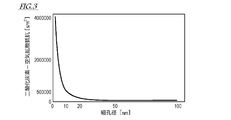
- FIG. 3 is a chart showing the relationship between the carbon dioxide-air diffusion resistance in the porous material and the pore diameter.
- FIG. 4 is a chart showing the relationship between the pore volume of silica gel and the carbon dioxide adsorption amount of an adsorbent obtained by supporting diethanolamine on silica gel.
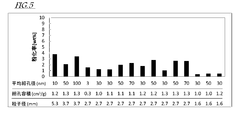
- FIG. 5 is a chart showing the results of the rotational wear test of silica gel.
- the carbon dioxide adsorbent according to the present invention (hereinafter sometimes simply referred to as “adsorbent”) is used for reversibly adsorbing and removing carbon dioxide from a gas to be treated containing carbon dioxide.
- This adsorbent has excellent carbon dioxide adsorption ability and wear resistance, and is suitable for use in a system that adsorbs and removes carbon dioxide from a gas to be treated by a continuous treatment method.
- FIG. 1 shows a schematic configuration of a carbon dioxide treatment system 1 in which a carbon dioxide adsorbent can be used.
- a carbon dioxide treatment system 1 shown in FIG. 1 has a carbon dioxide separation system 1A that selectively separates carbon dioxide contained in a gas to be treated using an adsorbent, and desorbs (desorbs) carbon dioxide from the adsorbent. This is a continuous processing system combined with a carbon dioxide recovery system 1B for recovery.
- the carbon dioxide treatment system 1 includes an adsorption tank 11, a desorption tank 12, a drying tank 13, and a conveyor 15 that conveys the adsorbent from the outlet of the drying tank 13 to the inlet of the adsorption tank 11.
- the adsorbent 11, the desorption tank 12, and the drying tank 13 are arranged in the vertical direction from the top so that the adsorbent moves by gravity from the adsorption tank 11 to the drying tank 13.
- the adsorbent transported by the conveyor 15 is supplied to the adsorption tank 11 at a predetermined supply speed from an inlet provided in the upper part. Further, the adsorbent is discharged at a predetermined discharge speed from an outlet provided in the lower portion of the adsorption tank 11.
- the gas to be processed generated by the gas source to be processed 35 is introduced through the gas supply pipe 36 to be processed.
- the gas to be treated is, for example, a gas near atmospheric pressure containing 10 to 30% carbon dioxide, such as combustion exhaust gas.
- the gas supply pipe 36 to be processed may be provided with at least one pretreatment tank 37.
- the gas to be treated is cooled to a temperature suitable for the carbon dioxide adsorption reaction.
- the gas to be treated introduced into the adsorption tank 11 may be subjected to pretreatment such as desulfurization, dust removal, temperature reduction, and dehumidification in addition to cooling.
- a moving layer is formed in which the gas to be processed that flows upward and the adsorbent that moves downward are in contact with each other.
- the adsorbent in contact with the gas to be processed selectively adsorbs carbon dioxide contained in the gas to be processed.
- the temperature of the adsorbent at that time is 40 ° C., for example.
- the treated gas (off-gas) from which carbon dioxide has been separated and removed is discharged from the upper part of the adsorption tank 11.
- the adsorbent that has adsorbed carbon dioxide is discharged from the lower part of the adsorption tank 11 and moves to the inlet of the desorption tank 12 by its own weight.
- the adsorbent that adsorbs carbon dioxide is supplied from the inlet provided in the upper part, and the adsorbent is discharged from the outlet provided in the lower part at a predetermined discharge speed. It moves at a predetermined speed from the top to the bottom. Further, desorption water vapor supplied from the steam generator 38 is supplied to the lower part of the desorption tank 12.
- a moving layer is formed in which the desorption water vapor flowing upward and the adsorbent moving downward are in contact with each other.
- the desorption water vapor and the adsorbent come into contact with each other, the desorption water vapor condenses on the surface of the adsorbent and releases heat of condensation at that time. Carbon dioxide is desorbed from the adsorbent using the heat of condensation as desorption energy.
- a carbon dioxide holder 17 is connected to the top of the desorption tank 12 through a carbon dioxide recovery pipe 31.
- the carbon dioxide recovery pipe 31 is provided with a pump 16 that sends the gas in the desorption tank 12 to the carbon dioxide holder 17.
- the gas (that is, carbon dioxide) in the desorption tank 12 is forcibly exhausted to the carbon dioxide recovery pipe 31, compressed by the pump 16, and stored in the carbon dioxide holder 17.
- the adsorbent containing the condensed water after desorption of carbon dioxide is discharged from the lower part of the desorption tank 12 and moves to the inlet of the drying tank 13 by its own weight.
- the adsorbent containing condensed water is supplied from the inlet provided in the upper part, and the adsorbent is discharged from the outlet provided in the lower part at a predetermined discharge speed, so that the adsorbent is stored in the tank. It moves at a predetermined speed from the top to the bottom.
- the adsorbent is dried while moving in the drying tank 13.
- the drying of the adsorbent is performed by contact between the drying gas supplied from the drying gas source 39 to the lower portion of the drying tank 13 and flowing upward in the tank, and the adsorbent moving downward in the tank. Done.
- the drying gas (dry exhaust gas) used for drying the adsorbent is discharged from the upper part of the drying tank 13.
- the dried adsorbent is discharged from the lower part of the drying tank 13, falls onto the conveyor 15, is transferred to the adsorption tank 11 while being cooled by the conveyor 15, and is reused as an adsorbent for carbon dioxide.
- the adsorbent (carbon dioxide adsorbent) used in the carbon dioxide treatment system 1 is formed by supporting an amine compound on silica gel.
- the above-described amine compound is at least one selected from the group consisting of amines having at least one hydroxyl group and polyamines. That is, the amine compound may contain a mixture of amines and polyamines. Such amines and polyamines are known to reversibly desorb carbon dioxide, that is, adsorb and desorb carbon dioxide. Examples of the amine compound containing amines having at least one hydroxyl group include monoethanolamine, diethanolamine, and triethanolamine. Examples of the amine compound containing polyamines include polyethyleneimine, ethylenediamine, diethylenetriamine, triethylenetetramine, tetraethylenepentamine, and pentaethylenehexamine.
- the particle diameter of the silica gel is 1 mm or more and 5 mm or less.
- the pore volume of silica gel is 0.1 cm 3 / g or more and 1.3 cm 3 / g or less.
- the average pore diameter of silica gel is 10 nm or more and 100 nm or less.
- the particle diameter, pore volume, and average pore diameter are all values in silica gel in which no amine compound is supported.
- FIG. 2A is a diagram schematically showing the particle diameter of silica gel
- FIG. 2A is a diagram schematically showing the pore volume and pore diameter of silica gel
- FIG. 2B shows an enlarged cross section near the surface of the silica gel.
- silica gel is a spherical particle.
- “spherical” particles do not necessarily mean true spherical particles, and are particles having a shape in which 90% by mass or more falls when placed on a smooth plate inclined by about 30 ° from the horizontal. .
- the carbon dioxide adsorbent based on silica gel having a particle diameter of 1 mm to 5 mm also has a particle diameter of 1 mm to 5 mm.
- Silica gel carries an amine compound, but the amine compound enters the pores formed inside the silica gel, so that the diameter of the silica gel is not greatly expanded by carrying the amine compound.
- the adsorbent fluidizes with a small amount of gas, and the moving bed cannot be established.
- the particle diameter of the carbon dioxide adsorbent exceeds 5 mm, the weight increases with the increase in the particle diameter of the adsorbent, so that the wear due to the impact received at the time of dropping becomes severe and the life of the adsorbent is remarkably shortened. Therefore, by using a carbon dioxide adsorbent having a particle diameter in the range of 1 mm or more and 5 mm or less, it becomes easy to form a moving bed in which the adsorbent and the gas to be treated are preferably in countercurrent contact, and the adsorbent. Can give a proper lifespan.
- the “particle diameter” of carbon dioxide and silica gel is the particle diameter.
- the particle diameters of carbon dioxide and silica gel can be measured, for example, by the following steps (1) to (4).
- (1) Arrange 100 or more silica gel samples on a black felt so that the particles do not contact each other as much as possible.
- (2) Photograph the particles of the silica gel sample with a field of view of 100 mm ⁇ 140 mm.
- (3) The imaged software ImageJ (National Institutes of Health NIH) is used to binarize the photographed image and determine the area of each particle.
- the average pore diameter of the silica gel is an average value of the diameters of the pores opened on the surface of the silica gel.
- the pore volume of silica gel is the volume of the pores.
- the pore volume of silica gel is determined by the mercury intrusion method.
- the average pore diameter of silica gel is obtained by obtaining the pore diameter distribution by the mercury intrusion method, and the average pore diameter (median diameter) is the pore diameter when 50% of the total pore volume of mercury is injected. is there.
- the mercury intrusion method is a method that uses the high surface tension of mercury to apply pressure to inject mercury into the pores of the powder, and obtains the specific surface area and pore distribution from the pressure and the amount of mercury intruded. Yes, for example, it can be obtained by using a mercury porosimeter (PASCL240) manufactured by Thermo Qurest Italy.
- the average pore diameter of silica gel has a significant effect on the adsorption rate of the adsorbent.
- the adsorption rate of the adsorbent depends on the carbon dioxide diffusion rate in the pores and the adsorption reaction rate of the adsorbent. Of these, the adsorption reaction rate is sufficiently faster than the carbon dioxide diffusion rate in the pores, so the adsorption rate of the adsorbent is actually limited by the carbon dioxide diffusion rate in the pores.
- FIG. 3 is a chart showing the relationship between the carbon dioxide-air diffusion resistance in the porous material and the pore diameter. From FIG. 3, it can be seen that when the pore diameter is smaller than about 10 nm, the carbon dioxide-air diffusion resistance increases rapidly and remarkably. This is considered because the ratio of Knudsen diffusion to the total diffusion resistance in the pores is 90% or more. Therefore, when the average pore diameter of silica gel is smaller than about 10 nm, it is considered difficult to cause carbon dioxide to be saturated and adsorbed on the adsorbent within a realistic processing time.
- the average pore diameter of the silica gel exceeds 100 nm, the strength of the silica primary particle skeleton constituting the silica gel is lowered, so that the particle strength required for the adsorbent is not satisfied.
- the carbon dioxide adsorption rate of the adsorbent can be maintained in a suitable range, and the particle strength required for the adsorbent can be provided.
- the average pore diameter of silica gel can be controlled by subjecting the silica gel to a steaming treatment. More specifically, the average pore diameter can be controlled between 10 nm and 100 nm by adjusting the pressure during steaming and the pH of the xerogel.
- the steaming treatment is usually carried out by circulating steam under pressure in an autoclave, and the treatment time is usually 10 minutes to 24 hours. The pressure at this time is 0.5 to 20 kg / cm 2 .
- the pH of the xerogel during the steaming process is preferably controlled to 5-9.
- FIG. 4 is a chart showing the relationship between the pore volume of silica gel and the amount of carbon dioxide adsorption of an adsorbent comprising diethanolamine (amine solution concentration 40%) supported on silica gel. It can be seen from FIG. 4 that carbon dioxide can be adsorbed with an adsorbent having a pore volume of silica gel of approximately 0.1 cm 3 / g or more.
- silica gel having a pore volume of 0.1 cm 3 / g or more and 1.3 cm 3 / g or less carbon dioxide can be adsorbed and the particle strength required for the adsorbent can be given. it can.
- a condition that the specific surface area is 10 m 2 / g or more and 300 m 2 / g or less may be added to silica gel having a particle diameter of 1 mm or more and 5 mm.
- the specific surface area of silica gel can be determined by mercury porosimetry as with the average pore diameter and pore volume.
- an aqueous amine solution having an amine compound concentration of 5% to 70% and a temperature of 10 ° C to 100 ° C is prepared.
- the temperature of the aqueous amine solution is 10 ° C. or higher.
- the temperature of the aqueous amine solution is preferably 10 ° C. or higher and 100 ° C. or lower.
- the concentration of the amine compound in the aqueous amine solution is desirably an appropriate value corresponding to the amine compound in the range of 5% to 70%.
- the concentration of the amine compound in the aqueous amine solution is appropriately 5% to 55%.
- the amine compound is polyethyleneimine, since the viscosity is high, a concentration of about 10% is preferable.
- the concentration of the amine compound in the aqueous amine solution is less than the lower limit, the amount of the amine compound supported on the silica gel is not sufficient, and the amount of drainage after the supporting treatment becomes enormous.
- the concentration of the amine compound in the aqueous amine solution exceeds the upper limit, the amine compound may block the pores of the silica gel and reduce the adsorption performance of the adsorbent.
- the concentration of the amine compound is within the range of 5 to 70%, the amount of the amine supported on the silica gel increases as the concentration of the amine compound in the aqueous amine solution increases, and the specific gravity of the adsorbent and the carbon dioxide adsorption amount of the adsorbent.
- the impregnation time of silica gel can be set to 24 hours, for example.
- the silica gel carrying the amine compound is dried by ventilation at a temperature close to room temperature.
- the adsorbent can be manufactured through the above steps.
- silica gel having water resistance is defined as silica gel having a water resistance N defined by the following formula (1) of 45% or more.
- N (W / W 0 ) ⁇ 100 (1)
- N Water resistance of silica gel [%]
- W 0 Total number of silica gel particles immersed in water [pieces]
- W Number of W 0 that did not crack [number]
- water-resistant spherical silica As the silica gel having water resistance as described above, commercially available water-resistant spherical silica may be used.
- This water-resistant spherical silica is obtained by, for example, calcining a spherical silica xerogel obtained by neutralizing an aqueous alkali silicate solution at a temperature of 100 to 1000 ° C. by superheat steam at 500 to 1000 ° C. Can be manufactured.
- the inventors confirmed that the silica gel is hardly cracked or cracked in the step of impregnating the silica gel into the aqueous amine solution in the adsorbent production method. Has been. *
- Samples of carbon dioxide adsorbent were prepared by the following procedures (1) to (5).
- the weight ratio of the base material to the drug was set to 1: 3.
- the base material is taken out from (3) and centrifuged (1100 rpm).
- the container is filled, and a dry gas (nitrogen gas at 40 ° C., 15 L / min) is supplied to dry the substrate carrying the drug by ventilation. It should be noted that after 2 hours from the time when the gas temperature at the outlet of the drying tank for drying the substrate carrying the drug was stabilized, the drying completion condition of the substrate carrying the drug (that is, the carbon dioxide adsorbent) was set.
- a dry gas nitrogen gas at 40 ° C., 15 L / min
- the carbon dioxide adsorption test (column test) of the carbon dioxide adsorbent sample was performed according to the following procedures (1) to (4).
- the sample is tightly filled in an adsorption tank having an inner diameter of 25 mm to a height of 300 mm. Here, the sample filled was 147 mL.
- (2) Flow the adsorbed gas through the bypass line and confirm that the concentration is 10.0%.
- the adsorption gas is 10% by volume of carbon dioxide, humidity of 5% RH or less, and air at 25 ° C.
- the superficial velocity of the adsorbed gas is 0.05 m / s.
- the amine compound of sample 1 and sample 2 is diethanolamine (DEA)
- the amine compound of sample 2 and sample 3 is pentaethylenehexamine (PEHA)
- the amine compound of sample 5 is tetraethylenepentamine (TEPA).
- concentration of the drug-carrying solution in sample 1, sample 4 and sample 5 is 40%
- concentration of the drug-carrying solution in sample 2 is 60%
- concentration of the drug-carrying solution in sample 3 is 20%.
- Sample 1 has a carbon dioxide adsorption amount of 35.4 kgCO 2 / m 3
- Sample 2 has a carbon dioxide adsorption amount of 52.1 kgCO 2 / m 3
- 3 has a carbon dioxide adsorption of 33.1 kgCO 2 / m 3
- sample 4 has a carbon dioxide adsorption of 58.4 kgCO 2 / m 3
- sample 5 has a carbon dioxide adsorption of 65.9 kgCO 2 / m 3.
- the carbon dioxide adsorption amount of these samples is 30 kgCO 2 / m 3 or more, and it can be objectively evaluated that these samples have good carbon dioxide adsorption performance.
- each of the samples 1 to 5 had excellent adsorptivity. In each sample 1 to 5, no crack of the carbon dioxide adsorbent was found visually.
- Sample 6 is obtained by supporting DEA having a support solution concentration of 40% on a base material having a pore size of 10 mm, a pore volume of 1.0 ml / g, and an average particle size of 2.7 mm.
- Sample 7 is obtained by supporting DEA having a supporting solution concentration of 40% on a base material having a pore diameter of 30 mm, a pore volume of 1.0 ml / g, and an average particle diameter of 1.6 mm.
- Sample 8 is obtained by supporting DEA having a supporting solution concentration of 60% on a base material having a pore diameter of 30 mm, a pore volume of 1.0 ml / g, and an average particle diameter of 1.6 mm.
- Sample 9 is obtained by supporting DEA having a supporting solution concentration of 40% on a base material having a pore diameter of 70 mm, a pore volume of 1.1 ml / g, and an average particle diameter of 2.7 mm.
- Sample 10 is obtained by supporting DEA having a supporting solution concentration of 60% on a base material having a pore diameter of 70 mm, a pore volume of 1.1 ml / g, and an average particle diameter of 2.7 mm.
- Sample 11 is obtained by supporting DEA having a supporting solution concentration of 40% on a base material having a pore diameter of 30 mm, a pore volume of 1.3 ml / g, and an average particle diameter of 2.7 mm.
- Sample 12 is obtained by supporting DEA having a supporting solution concentration of 60% on a base material having a pore diameter of 30 mm, a pore volume of 1.3 ml / g, and an average particle diameter of 2.7 mm.
- Sample 13 is obtained by supporting DEA having a supporting solution concentration of 40% on a base material having a pore diameter of 70 mm, a pore volume of 1.3 ml / g, and an average particle diameter of 2.7 mm.
- Sample 14 is obtained by supporting DEA having a supporting solution concentration of 60% on a base material having a pore diameter of 70 mm, a pore volume of 1.3 ml / g, and an average particle diameter of 2.7 mm.
- Sample 15 is obtained by supporting DEA having a support solution concentration of 40% on a base material having a pore diameter of 80 mm, a pore volume of 1.0 ml / g, and an average particle diameter of 2.7 mm.
- the carbon dioxide adsorption amount of the samples 6, 7, 9, 11, 13, and 15 is 34.0 to 39.9 kgCO 2 / m 3
- the carbon dioxide of the samples 10 and 12 is The adsorption amount was 40.0 to 49.9 kgCO 2 / m 3
- the carbon dioxide adsorption amount of Samples 3 and 14 was 50.0 to 59.9 kgCO 2 / m 3 . That is, it was found that Samples 6 to 15 all had excellent carbon dioxide adsorption performance.
- a substrate (silica gel) having a particle diameter of 1 mm to 5 mm, an average pore diameter of 10 nm to 100 nm, and a pore volume of 0.1 cm 3 / g to 1.3 cm 3 / g. It was found that the carbon dioxide adsorbent with an amine compound loaded on the surface has excellent carbon dioxide adsorption performance.
- ⁇ Rotational wear test> In order to evaluate the wear resistance of the carbon dioxide adsorbent, a rotational wear test was performed according to the following procedures (1) to (2). (1) 245 ml of the sample was put in one cylindrical drum with a partition wall, and the drum was rotated at 60 rpm for 48 hours. (2) The powdering rate was calculated from the change in the weight of the sample before and after rotating the drum. The details of the test procedures other than those described above were in accordance with JIS K1150: 1994 “5.9 Particle strength—5.9.1 when the lower limit of the particle size distribution is 1.4 mm or more”.
- the carbon dioxide adsorbent is produced when the carbon dioxide adsorbent is produced by the above-described carbon dioxide adsorbent sample production procedure.
- the adsorbent can withstand use in a continuous process carbon dioxide separation system with a moving bed in the apparatus. Therefore, when the powdering rate of the sample is 5 wt% or less, it is evaluated that the carbon dioxide adsorbent based on the sample has wear resistance that can withstand use in a continuous processing type carbon dioxide treatment system. It was decided.
- FIG. 5 is a chart showing the results of the rotational wear test of silica gel.
- the average particle size is about 1 mm to 5 mm
- the pore size is about 10 nm to 100 nm
- the pore volume is about 0.1 cm 3 / g to 1. All the samples (silica gel) of 3 cm3 / g or less had a powdering rate of 5 wt% or less.
- the pore diameter is at about 10nm or 100nm or less, and a pore volume of approximately 0.1 cm 3 / g or more 1.3 cm 3 / g or less of silica gel amine compound
- the carbon dioxide adsorbent formed by supporting the carbon dioxide adsorbent has abrasion resistance that can withstand use in a continuous processing type carbon dioxide separation system.
Landscapes
- Chemical & Material Sciences (AREA)
- Analytical Chemistry (AREA)
- Chemical Kinetics & Catalysis (AREA)
- Organic Chemistry (AREA)
- Engineering & Computer Science (AREA)
- Inorganic Chemistry (AREA)
- General Chemical & Material Sciences (AREA)
- Oil, Petroleum & Natural Gas (AREA)
- Dispersion Chemistry (AREA)
- Environmental & Geological Engineering (AREA)
- Biomedical Technology (AREA)
- Nanotechnology (AREA)
- Health & Medical Sciences (AREA)
- Solid-Sorbent Or Filter-Aiding Compositions (AREA)
- Treating Waste Gases (AREA)
- Gas Separation By Absorption (AREA)
- Carbon And Carbon Compounds (AREA)
Abstract
Description
アミン化合物の濃度が5%以上70%以下、且つ、温度が10℃以上100℃以下のアミン水溶液を調製する工程と、
前記アミン水溶液にシリカゲルを含浸させる工程と、
前記アミン化合物を担持した前記シリカゲルを通気乾燥させる工程とを含み、
前記シリカゲルは、粒子径が1mm以上5mm以下であり、平均細孔径が10nm以上100nm以下であり、且つ、細孔容積が0.1cm3/g以上1.3cm3/g以下であることを特徴としている。但し、上記粒子径、細孔容積、及び平均細孔径は、いずれもアミン化合物が担持されていない状態のシリカゲルにおける値である。
図1では、二酸化炭素吸着剤が使用され得る二酸化炭素処理システム1の概略構成が示されている。図1に示す二酸化炭素処理システム1は、吸着剤を用いて被処理ガスに含まれる二酸化炭素を選択的に分離する二酸化炭素分離システム1Aと、吸着剤から二酸化炭素を脱着(脱離)して回収する二酸化炭素回収システム1Bとが複合された連続処理方式のシステムである。
上記二酸化炭素処理システム1で使用される吸着剤(二酸化炭素吸着剤)は、シリカゲルにアミン化合物を担持させて成るものである。
(1)黒色フェルト上に100粒以上のシリカゲル試料を、なるべく粒子同士が接触しないように並べる。
(2)シリカゲル試料の粒子を100mm×140mmの範囲視野で撮影する。
(3)画像処理ソフトウェアImageJ(アメリカ国立衛生研究所NIH)を用いて、撮影した画像を二値化し、各粒子の面積を求める。
(4)粒子が真球であると仮定し、求めた各粒子の面積から粒子径を求める。
なお、求めた粒子径から、個数平均径(=Σ(粒子径)/(評価した粒子の数))を求め、この個数平均径を粒子径として用いてもよい。
上記の吸着剤は、以下に説明する方法で製造することができる。
N=(W/W0)×100…(1)
但し、 N:シリカゲルの耐水性[%]
W0:水に浸漬したシリカゲルの粒子の全個数[個]
W:W0のうち割れの発生しなかったものの個数[個]
以下(1)~(5)の手順で二酸化炭素吸着剤の試料を作製した。
(1)基材(シリカゲル)を約300mL採取し、重量(W)を測定する。
(2)薬剤(アミン化合物)を所定の担持溶液濃度(%)に希釈し、瓶に入れる。
(3)(1)の基材を(2)の瓶に入れ、室温で8時間以上放置する。ここで、基材と薬剤の重量比が1:3となるようにした。
(4)(3)から基材を取り出し、遠心分離(1100rpm)を行う。
(5)容器に充填し、乾燥ガス(40℃,15L/minの窒素ガス)を流して、薬剤を担持した基材を通気乾燥させる。なお、薬剤を担持した基材を乾燥する乾燥槽の出口のガス温度が安定した時点より2時間経過後を、薬剤を担持した基材(即ち、二酸化炭素吸着剤)の乾燥終了条件とした。
二酸化炭素吸着剤の二酸化炭素吸着性能を評価するために、以下(1)~(4)の手順で二酸化炭素吸着剤試料の二酸化炭素の吸着試験(カラム試験)を行った。
(1)内径25mmの吸着槽に300mmの高さまで試料を固く充填する。ここで、充填された試料は147mLであった。
(2)吸着ガスをバイパスラインに流し、濃度が10.0%であることを確認する。ここで、吸着ガスは、10体積%の二酸化炭素を含み、湿度が湿度5%RH以下、且つ、25℃の空気である。また、吸着ガスの空塔速度は0.05m/sとする。
(3)吸着ガスを吸着槽へ流し、吸着槽の出口のガス濃度を測定する。
(4)出口ガス濃度が10.0%になったこと(即ち、飽和吸着となったこと)を確認し、吸着工程を終了する。
上記試料作製手順により、各基材の物性は共通するが、薬剤の担持条件(担持溶液濃度及び薬剤種)の相違する試料1~5を作製した。各試料における、基材(シリカゲル)の物性と薬剤の担持条件は次表1に示す通りである。

上記試料作製手順により、薬剤の担持条件(担持溶液濃度は40又は60%、薬剤種はジエタノールアミン(DEA))は共通するが、各基材の物性の異なる試料6~15を作製した。各試料6~15における、基材(シリカゲル)の物性と薬剤の担持条件は次表2に示す通りである。

二酸化炭素吸着剤の耐摩耗性を評価するために、次の(1)~(2)の手順で、回転摩耗試験を行った。
(1)1枚の隔壁付円筒状ドラムに試料245mlを入れ、ドラムを60rpmで48hr回転させた。
(2)ドラムを回転させる前後での試料の重量変化から粉化率を算出した。
上記以外の試験手順の詳細については、JIS K1150:1994「5.9 粒子強度-5.9.1粒度分布の下限が1.4mm以上の破砕粒子の場合」に準拠した。
Claims (8)
- アミン化合物の濃度が5%以上70%以下、且つ、温度が10℃以上100℃以下のアミン水溶液を調製する工程と、
前記アミン水溶液にシリカゲルを含浸させる工程と、
前記アミン化合物を担持した前記シリカゲルを通気乾燥させる工程とを含み、
前記シリカゲルは、粒子径が1mm以上5mm以下であり、平均細孔径が10nm以上100nm以下であり、且つ、細孔容積が0.1cm3/g以上1.3cm3/g以下である、
二酸化炭素吸着剤の製造方法。 - 前記シリカゲルは、次式(1)で定義される耐水性Nが45%以上である、
N=(W/W0)×100…(1)
(但し、N:シリカゲルの耐水性[%]、W0:水に浸漬したシリカゲルの粒子の全個数[個]、W:W0のうち割れの発生しなかったものの個数[個])
請求項1に記載の二酸化炭素吸着剤の製造方法。 - 前記アミン化合物が、少なくとも1つのヒドロキシル基を有するアミン類、及びポリアミン類よりなる群から選ばれる少なくとも1種である、
請求項1又は2に記載の二酸化炭素吸着剤の製造方法。 - 粒子径が1mm以上5mm以下であり、平均細孔径が10nm以上100nm以下であり、且つ、細孔容積が0.1cm3/g以上1.3cm3/g以下であるシリカゲルに、アミン化合物を担持させて成る、
二酸化炭素吸着剤。 - 前記シリカゲルは、次式(1)で定義される耐水性Nが45%以上である、
N=(W/W0)×100…(1)
(但し、N:シリカゲルの耐水性[%]、W0:水に浸漬したシリカゲルの粒子の全個数[個]、W:W0のうち割れの発生しなかったものの個数[個])
請求項4に記載の二酸化炭素吸着剤。 - 前記アミン化合物が、少なくとも1つのヒドロキシル基を有するアミン類、及びポリアミン類よりなる群から選ばれる少なくとも1種である、
請求項4又は5に記載の二酸化炭素吸着剤。 - 請求項4~6のいずれか一項に記載の二酸化炭素吸着剤により内部に移動層が形成された吸着槽を備え、前記吸着槽の下部に二酸化炭素を含む被処理ガスが供給される被処理ガス供給口が設けられ、前記吸着槽の上部に前記二酸化炭素が前記二酸化炭素吸着剤に吸着除去されたオフガスを排出するオフガス排出口が設けられている、二酸化炭素処理システム。
- 前記吸着槽から排出された前記二酸化炭素吸着剤により内部に移動層が形成された脱着槽を備え、前記脱着槽の下部に脱着用水蒸気が供給される水蒸気供給口が設けられ、前記脱着槽の上部に前記二酸化炭素吸着剤から脱離した二酸化炭素を排出する二酸化炭素排出口が設けられている、
請求項7に記載の二酸化炭素処理システム。
Priority Applications (4)
| Application Number | Priority Date | Filing Date | Title |
|---|---|---|---|
| CN201780016986.3A CN108778489B (zh) | 2016-03-14 | 2017-03-14 | 二氧化碳吸附剂及其制造方法、以及二氧化碳处理系统 |
| US16/085,044 US11185842B2 (en) | 2016-03-14 | 2017-03-14 | Carbon dioxide adsorbent, method for manufacturing the same, and carbon dioxide processing system |
| AU2017232470A AU2017232470B2 (en) | 2016-03-14 | 2017-03-14 | Carbon dioxide adsorbent and method for manufacturing same, and carbon dioxide processing system |
| US17/510,506 US11529608B2 (en) | 2016-03-14 | 2021-10-26 | Carbon dioxide adsorbent and carbon dioxide processing system |
Applications Claiming Priority (2)
| Application Number | Priority Date | Filing Date | Title |
|---|---|---|---|
| JP2016-049103 | 2016-03-14 | ||
| JP2016049103A JP6055134B1 (ja) | 2016-03-14 | 2016-03-14 | 二酸化炭素吸着剤及びその製造方法、並びに、二酸化炭素分離回収システム |
Related Child Applications (2)
| Application Number | Title | Priority Date | Filing Date |
|---|---|---|---|
| US16/085,044 A-371-Of-International US11185842B2 (en) | 2016-03-14 | 2017-03-14 | Carbon dioxide adsorbent, method for manufacturing the same, and carbon dioxide processing system |
| US17/510,506 Division US11529608B2 (en) | 2016-03-14 | 2021-10-26 | Carbon dioxide adsorbent and carbon dioxide processing system |
Publications (1)
| Publication Number | Publication Date |
|---|---|
| WO2017159663A1 true WO2017159663A1 (ja) | 2017-09-21 |
Family
ID=57582283
Family Applications (1)
| Application Number | Title | Priority Date | Filing Date |
|---|---|---|---|
| PCT/JP2017/010143 Ceased WO2017159663A1 (ja) | 2016-03-14 | 2017-03-14 | 二酸化炭素吸着剤及びその製造方法、並びに、二酸化炭素処理システム |
Country Status (5)
| Country | Link |
|---|---|
| US (2) | US11185842B2 (ja) |
| JP (1) | JP6055134B1 (ja) |
| CN (1) | CN108778489B (ja) |
| AU (1) | AU2017232470B2 (ja) |
| WO (1) | WO2017159663A1 (ja) |
Cited By (2)
| Publication number | Priority date | Publication date | Assignee | Title |
|---|---|---|---|---|
| WO2020095934A1 (ja) * | 2018-11-07 | 2020-05-14 | 川崎重工業株式会社 | 酸性ガス吸収材及びその製造方法 |
| WO2022102683A1 (ja) * | 2020-11-16 | 2022-05-19 | Agc株式会社 | 吸着材 |
Families Citing this family (12)
| Publication number | Priority date | Publication date | Assignee | Title |
|---|---|---|---|---|
| KR20240026525A (ko) | 2015-03-23 | 2024-02-28 | 바스프 코포레이션 | 실내 공기 질을 제어하기 위한 이산화탄소 수착제 |
| EP3414004A4 (en) | 2016-02-12 | 2019-10-09 | BASF Corporation | CARBON DIOXIDE ACTIVE SUBSTANCE FOR AIR QUALITY CONTROL |
| JP2018187574A (ja) * | 2017-05-09 | 2018-11-29 | 川崎重工業株式会社 | 二酸化炭素吸収剤及びその製造方法、並びに、二酸化炭素分離システム |
| WO2021095195A1 (ja) * | 2019-11-14 | 2021-05-20 | 株式会社大木工藝 | 廃棄物減容処理方法および廃棄物減容処理システム |
| KR20230002315A (ko) * | 2020-04-20 | 2023-01-05 | 주식회사 쿠라레 | 탄소질 재료, 그 제조 방법, 및 전기 화학 디바이스 |
| JP7648415B2 (ja) * | 2021-03-24 | 2025-03-18 | Agc株式会社 | 高い機械的強度、並びに大きな細孔容積と細孔径を有するシリカ成形体 |
| US12385818B2 (en) | 2023-02-14 | 2025-08-12 | Saudi Arabian Oil Company | Modeling gas desorption in a subsurface reservoir |
| JP2025008568A (ja) | 2023-07-05 | 2025-01-20 | 川崎重工業株式会社 | 酸性ガス分離回収システムおよび酸性ガス分離回収方法 |
| CN117358197A (zh) * | 2023-10-20 | 2024-01-09 | 山西新华防化装备研究院有限公司 | 一种用于防护CNCl的含有机胺滤毒材料及其制备方法与应用 |
| US20250376935A1 (en) * | 2024-06-10 | 2025-12-11 | Mitsubishi Heavy Industries, Ltd. | Exhaust gas treatment system, absorbing liquid management apparatus and treatment method of exhaust gas |
| CN118594187B (zh) * | 2024-06-14 | 2025-11-11 | 三碳(安徽)科技研究院有限公司 | 一种在线补充固体胺吸附剂活性组分的方法及捕集装置 |
| CN118767665B (zh) * | 2024-09-09 | 2025-01-24 | 华电电力科学研究院有限公司 | 一种移动床固体吸附co2捕集系统 |
Citations (5)
| Publication number | Priority date | Publication date | Assignee | Title |
|---|---|---|---|---|
| JPH04200742A (ja) * | 1990-11-30 | 1992-07-21 | Kuraray Chem Corp | 炭酸ガス吸着剤 |
| WO2011013332A1 (ja) * | 2009-07-27 | 2011-02-03 | 川崎重工業株式会社 | 二酸化炭素分離方法及び装置 |
| JP2012035169A (ja) * | 2010-08-05 | 2012-02-23 | Nippon Telegr & Teleph Corp <Ntt> | 二酸化炭素の吸収方法 |
| WO2013084394A1 (ja) * | 2011-12-09 | 2013-06-13 | 川崎重工業株式会社 | 二酸化炭素分離装置 |
| JP2015113337A (ja) * | 2013-12-16 | 2015-06-22 | 株式会社ノリタケカンパニーリミテド | アミノ化合物担持多孔質材とその製造方法 |
Family Cites Families (15)
| Publication number | Priority date | Publication date | Assignee | Title |
|---|---|---|---|---|
| JP3717266B2 (ja) * | 1996-02-29 | 2005-11-16 | 英史 平井 | 新規な一酸化炭素吸着剤 |
| CA2600751C (en) * | 2005-03-11 | 2012-08-07 | University Of Ottawa | Functionalized adsorbent for removal of acid gases and use thereof |
| US8118914B2 (en) * | 2008-09-05 | 2012-02-21 | Alstom Technology Ltd. | Solid materials and method for CO2 removal from gas stream |
| US8361200B2 (en) * | 2009-10-15 | 2013-01-29 | Abdelhamid Sayari | Materials, methods and systems for selective capture of CO2 at high pressure |
| JP2011183382A (ja) * | 2010-02-15 | 2011-09-22 | Yamagata Promotional Organization For Industrial Technology | 吸着剤 |
| CN101973558B (zh) * | 2010-09-30 | 2012-02-29 | 南京工业大学 | 胺基改性SiO2气凝胶材料及其应用 |
| CN101947430A (zh) * | 2010-10-11 | 2011-01-19 | 孙玉坤 | 用于变压吸附工艺的气体分离吸附剂及其制备方法和应用 |
| JP2012139622A (ja) * | 2010-12-28 | 2012-07-26 | Research Institute Of Innovative Technology For The Earth | 二酸化炭素分離回収用固体吸収材並びに二酸化炭素の回収方法 |
| CN102585952A (zh) * | 2012-02-23 | 2012-07-18 | 清华大学 | 一种利用胺类固体吸收剂脱除合成气中co2及h2s的方法 |
| KR101378995B1 (ko) * | 2012-03-22 | 2014-04-02 | 삼성중공업 주식회사 | 이산화탄소 운영 시스템 및 방법 |
| CN102824895B (zh) * | 2012-08-31 | 2014-06-11 | 华南理工大学 | 介孔受限功能化离子液体复合材料及其制备方法与应用 |
| CN103230783B (zh) * | 2013-04-19 | 2014-12-10 | 上海交通大学 | 复合型二氧化碳吸附剂 |
| JP6427098B2 (ja) | 2013-06-25 | 2018-11-21 | 川崎重工業株式会社 | 二酸化炭素分離回収システム及び方法 |
| JP6300457B2 (ja) * | 2013-06-28 | 2018-03-28 | 公益財団法人地球環境産業技術研究機構 | 二酸化炭素分離材及び二酸化炭素を分離又は回収する方法 |
| CN103801172B (zh) * | 2014-02-19 | 2015-10-28 | 中国科学院山西煤炭化学研究所 | 使用循环流化移动床捕获电厂烟气中co2的工艺及装置 |
-
2016
- 2016-03-14 JP JP2016049103A patent/JP6055134B1/ja active Active
-
2017
- 2017-03-14 CN CN201780016986.3A patent/CN108778489B/zh active Active
- 2017-03-14 WO PCT/JP2017/010143 patent/WO2017159663A1/ja not_active Ceased
- 2017-03-14 US US16/085,044 patent/US11185842B2/en active Active
- 2017-03-14 AU AU2017232470A patent/AU2017232470B2/en active Active
-
2021
- 2021-10-26 US US17/510,506 patent/US11529608B2/en active Active
Patent Citations (5)
| Publication number | Priority date | Publication date | Assignee | Title |
|---|---|---|---|---|
| JPH04200742A (ja) * | 1990-11-30 | 1992-07-21 | Kuraray Chem Corp | 炭酸ガス吸着剤 |
| WO2011013332A1 (ja) * | 2009-07-27 | 2011-02-03 | 川崎重工業株式会社 | 二酸化炭素分離方法及び装置 |
| JP2012035169A (ja) * | 2010-08-05 | 2012-02-23 | Nippon Telegr & Teleph Corp <Ntt> | 二酸化炭素の吸収方法 |
| WO2013084394A1 (ja) * | 2011-12-09 | 2013-06-13 | 川崎重工業株式会社 | 二酸化炭素分離装置 |
| JP2015113337A (ja) * | 2013-12-16 | 2015-06-22 | 株式会社ノリタケカンパニーリミテド | アミノ化合物担持多孔質材とその製造方法 |
Cited By (5)
| Publication number | Priority date | Publication date | Assignee | Title |
|---|---|---|---|---|
| WO2020095934A1 (ja) * | 2018-11-07 | 2020-05-14 | 川崎重工業株式会社 | 酸性ガス吸収材及びその製造方法 |
| JP2020075215A (ja) * | 2018-11-07 | 2020-05-21 | 川崎重工業株式会社 | 酸性ガス吸収材及びその製造方法 |
| JP7273483B2 (ja) | 2018-11-07 | 2023-05-15 | 川崎重工業株式会社 | 酸性ガス吸収材及びその製造方法 |
| WO2022102683A1 (ja) * | 2020-11-16 | 2022-05-19 | Agc株式会社 | 吸着材 |
| JPWO2022102683A1 (ja) * | 2020-11-16 | 2022-05-19 |
Also Published As
| Publication number | Publication date |
|---|---|
| US20190126235A1 (en) | 2019-05-02 |
| CN108778489B (zh) | 2021-08-03 |
| US20220040667A1 (en) | 2022-02-10 |
| JP6055134B1 (ja) | 2016-12-27 |
| US11529608B2 (en) | 2022-12-20 |
| AU2017232470B2 (en) | 2020-04-02 |
| AU2017232470A1 (en) | 2018-11-08 |
| CN108778489A (zh) | 2018-11-09 |
| US11185842B2 (en) | 2021-11-30 |
| JP2017164656A (ja) | 2017-09-21 |
Similar Documents
| Publication | Publication Date | Title |
|---|---|---|
| JP6055134B1 (ja) | 二酸化炭素吸着剤及びその製造方法、並びに、二酸化炭素分離回収システム | |
| WO2018207633A1 (ja) | 二酸化炭素吸収剤及びその製造方法、並びに、二酸化炭素分離システム | |
| CN111801151B (zh) | 酸性气体吸收材料及其制造方法 | |
| CN104117343B (zh) | 一种可再生低浓度co2高效吸附材料的制备方法 | |
| Tan et al. | Adsorption of carbon dioxide by sodium hydroxide-modified granular coconut shell activated carbon in a fixed bed | |
| Yan et al. | Amine-modified mesocellular silica foams for CO2 capture | |
| CN107661748B (zh) | 有机胺功能化大孔容二氧化硅co2吸附剂及其制备方法 | |
| Zhao et al. | Polyethylenimine-impregnated siliceous mesocellular foam particles as high capacity CO 2 adsorbents | |
| US20250018374A1 (en) | Regeneration of degraded amino-sorbents for carbon capture | |
| KR20190030361A (ko) | 아민작용기를 도입하여 이산화탄소 흡착률을 향상시킨 메조다공성 중공형 실리카 물질의 제조방법 | |
| Sakpal et al. | Carbon dioxide capture using amine functionalized silica gel | |
| WO2022102683A1 (ja) | 吸着材 | |
| FR2999448A1 (fr) | Procede de captage du co2 par adsorption | |
| RU2019126277A (ru) | Настраиваемые адсорбенты | |
| Wang et al. | High molecular weight polyethylenimine encapsulated into a porous polymer monolithic by one-step polymerization for CO 2 capture | |
| Bae | CO2 capture by amine-functionalized mesoporous hollow silica | |
| KR102866476B1 (ko) | 이산화탄소 선택적 흡착능을 갖는 기능화된 다공성 유기 중합체 및 이의 제조방법 | |
| Guoliang et al. | Preparation of porous MgO/ZrO2-supported amine-based adsorbents and their application in CO2 capture | |
| Muchan et al. | Development of polymer from high internal phase emulsion for CO2 adsorption | |
| US20260048378A1 (en) | Co2:h2o selectivity of zeolites by way of ptfe coating | |
| JP4017380B2 (ja) | 耐水性球状シリカを吸着剤とするガス処理方法 | |
| Choe | Amine-appended metal-organic framework adsorbents for carbon dioxide capture in realistic environments | |
| WO2025197539A1 (ja) | 酸性ガスの回収方法 | |
| JP2025101283A (ja) | 二酸化炭素吸収材 | |
| Hahn et al. | Impact of solvents and surfactants on the self-assembly of nanostructured amine functionalized silica spheres for CO_ (2) capture |
Legal Events
| Date | Code | Title | Description |
|---|---|---|---|
| NENP | Non-entry into the national phase |
Ref country code: DE |
|
| ENP | Entry into the national phase |
Ref document number: 2017232470 Country of ref document: AU Date of ref document: 20170314 Kind code of ref document: A |
|
| 121 | Ep: the epo has been informed by wipo that ep was designated in this application |
Ref document number: 17766662 Country of ref document: EP Kind code of ref document: A1 |
|
| 122 | Ep: pct application non-entry in european phase |
Ref document number: 17766662 Country of ref document: EP Kind code of ref document: A1 |