WO2017159762A1 - Poudre de verre revêtue d'argent-tellure, procédé de production de poudre de verre revêtue d'argent-tellure, pâte conductrice et procédé de production de pâte conductrice - Google Patents
Poudre de verre revêtue d'argent-tellure, procédé de production de poudre de verre revêtue d'argent-tellure, pâte conductrice et procédé de production de pâte conductrice Download PDFInfo
- Publication number
- WO2017159762A1 WO2017159762A1 PCT/JP2017/010548 JP2017010548W WO2017159762A1 WO 2017159762 A1 WO2017159762 A1 WO 2017159762A1 JP 2017010548 W JP2017010548 W JP 2017010548W WO 2017159762 A1 WO2017159762 A1 WO 2017159762A1
- Authority
- WO
- WIPO (PCT)
- Prior art keywords
- tellurium
- silver
- glass powder
- coated glass
- coating layer
- Prior art date
- Legal status (The legal status is an assumption and is not a legal conclusion. Google has not performed a legal analysis and makes no representation as to the accuracy of the status listed.)
- Ceased
Links
Images


Classifications
-
- H—ELECTRICITY
- H01—ELECTRIC ELEMENTS
- H01B—CABLES; CONDUCTORS; INSULATORS; SELECTION OF MATERIALS FOR THEIR CONDUCTIVE, INSULATING OR DIELECTRIC PROPERTIES
- H01B1/00—Conductors or conductive bodies characterised by the conductive materials; Selection of materials as conductors
-
- H—ELECTRICITY
- H01—ELECTRIC ELEMENTS
- H01B—CABLES; CONDUCTORS; INSULATORS; SELECTION OF MATERIALS FOR THEIR CONDUCTIVE, INSULATING OR DIELECTRIC PROPERTIES
- H01B1/00—Conductors or conductive bodies characterised by the conductive materials; Selection of materials as conductors
- H01B1/20—Conductive material dispersed in non-conductive organic material
- H01B1/22—Conductive material dispersed in non-conductive organic material the conductive material comprising metals or alloys
-
- H—ELECTRICITY
- H01—ELECTRIC ELEMENTS
- H01B—CABLES; CONDUCTORS; INSULATORS; SELECTION OF MATERIALS FOR THEIR CONDUCTIVE, INSULATING OR DIELECTRIC PROPERTIES
- H01B13/00—Apparatus or processes specially adapted for manufacturing conductors or cables
-
- H—ELECTRICITY
- H01—ELECTRIC ELEMENTS
- H01B—CABLES; CONDUCTORS; INSULATORS; SELECTION OF MATERIALS FOR THEIR CONDUCTIVE, INSULATING OR DIELECTRIC PROPERTIES
- H01B5/00—Non-insulated conductors or conductive bodies characterised by their form
-
- H—ELECTRICITY
- H05—ELECTRIC TECHNIQUES NOT OTHERWISE PROVIDED FOR
- H05K—PRINTED CIRCUITS; CASINGS OR CONSTRUCTIONAL DETAILS OF ELECTRIC APPARATUS; MANUFACTURE OF ASSEMBLAGES OF ELECTRICAL COMPONENTS
- H05K1/00—Printed circuits
- H05K1/02—Details
- H05K1/09—Use of materials for the conductive, e.g. metallic pattern
-
- H—ELECTRICITY
- H10—SEMICONDUCTOR DEVICES; ELECTRIC SOLID-STATE DEVICES NOT OTHERWISE PROVIDED FOR
- H10F—INORGANIC SEMICONDUCTOR DEVICES SENSITIVE TO INFRARED RADIATION, LIGHT, ELECTROMAGNETIC RADIATION OF SHORTER WAVELENGTH OR CORPUSCULAR RADIATION
- H10F77/00—Constructional details of devices covered by this subclass
- H10F77/20—Electrodes
Definitions
- the present invention relates to a silver tellurium-coated glass powder suitable as a paste material for a solar cell electrode, a method for producing the same, and a conductive paste and a method for producing the same.
- conductive paste containing silver powder, binder, solvent, glass frit and the like has been used.
- the conductive paste is required to have higher conductivity as a characteristic.
- a tellurium-based glass frit containing tellurium oxide as a glass frit (hereinafter sometimes referred to as “tellurium-based glass powder”) can be used to reduce contact resistance.
- a conductive paste capable of obtaining solar cell characteristics see, for example, Patent Document 1.
- the present inventors have proposed a silver-coated glass powder in which glass particles are coated with silver and a method for producing the same (for example, see Patent Document 2).
- the present invention is a silver tellurium-coated glass powder capable of improving the power generation efficiency (hereinafter also referred to as conversion efficiency) of a solar cell when used for an electrode of a solar cell, a method for producing the same, and the silver
- An object is to provide a conductive paste containing tellurium-coated glass powder and a method for producing the same.
- Patent Document 2 Examples of glass particles by the present inventors in the aforementioned Japanese Patent Application Laid-Open No. 2014-164994 (Patent Document 2) are glasses containing Bi or Zn as a main component.
- the glass containing Bi or Zn as the main component is capable of precipitating silver (reduction reaction) on the glass surface in the silver coating process based on the manufacturing method described in JP-A-2014-164994. Yes, it is possible to stably carry out a silver coating process in which glass is coated with a silver layer.
- tellurium-based glass powder containing tellurium that is easily soluble in acids and alkalis it is impossible to predict whether silver coating is possible, and there is a motive for silver coating for tellurium-based glass powder that may be dissolved. There was no.
- the silver tellurium-coated glass powder of the present invention is characterized by having a coating layer mainly composed of silver and tellurium on the surface of tellurium-based glass powder containing 20% by mass or more of tellurium.
- the coating layer mainly composed of silver and tellurium further includes a component other than silver and tellurium contained in the tellurium-based glass powder, and other than silver and tellurium contained in the tellurium-based glass powder.
- the component contains one or more selected from zinc, lead, bismuth, silicon, and aluminum, and the thickness of the coating layer mainly composed of silver and tellurium is 10 nm or more and 200 nm or less. More preferably, the oxygen content of the coating layer mainly composed of silver and tellurium is particularly preferably lower than the average oxygen content of the tellurium-based glass powder covered with the coating layer.
- the silver tellurium-coated glass powder of the present invention preferably has a silver-rich phase present inside the silver tellurium-coated glass powder when a cross-sectional observation of the silver tellurium-coated glass powder is performed after heat treatment at 350 ° C.
- the conductive paste of the present invention contains the silver tellurium-coated glass powder of the present invention.
- tellurium glass powder containing 20% by mass or more of tellurium is added to a silver complex solution, and then a reducing agent is added to add silver and tellurium to the surface of the tellurium glass powder.
- a coating layer having a main component is formed. It is preferable to have a step of filtering, washing, drying and crushing after depositing silver on the surface of the tellurium-based glass powder.
- the manufacturing method of the electrically conductive paste of this invention adds the reducing agent after adding the tellurium type glass powder containing 20 mass% or more of tellurium to a silver complex solution, and has silver and tellurium as a main component on the surface.
- the silver tellurium-coated glass powder capable of improving the power generation efficiency of the solar cell when used for an electrode application of a solar cell, a method for producing the same, and the conductive material containing the silver tellurium-coated glass powder.
- a paste and a manufacturing method thereof can be provided.
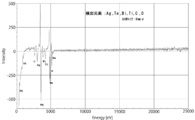
- FIG. 1 is a diagram showing an SEM image of the silver tellurium-coated glass powder of Example 1 and a qualitative analysis result by Auger spectroscopic analysis.
- FIG. 2 is a diagram showing an SEM image of the silver tellurium-coated glass powder of Example 1 and a depth direction analysis result thereof by Auger spectroscopic analysis.
- FIG. 3 is a diagram showing an SEM image of the silver tellurium-coated glass powder of Example 1 in FIG. 2 and an analysis result in which the vertical axis of the graph showing the analysis result in the depth direction by Auger spectroscopic analysis is the composition ratio.
- FIG. 1 is a diagram showing an SEM image of the silver tellurium-coated glass powder of Example 1 and a qualitative analysis result by Auger spectroscopic analysis.
- FIG. 2 is a diagram showing an SEM image of the silver tellurium-coated glass powder of Example 1 and a depth direction analysis result thereof by Auger spectroscopic analysis.
- FIG. 3 is a diagram showing an SEM
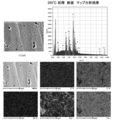
- FIG. 4 is a diagram showing an SEM image and an EDS map analysis result of the cross section of the silver tellurium-coated glass powder after heat-treating the silver tellurium-coated glass powder of Example 1 at 350 ° C.
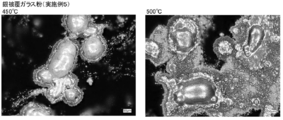
- FIG. 5 is a view showing a microscope image after the silver tellurium-coated glass powder of Example 5 is heat-treated at 450 ° C. or 500 ° C. on the antireflection film (SiN) of the silicon substrate for solar cells.
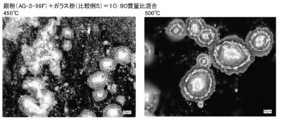
- FIG. 6 shows a microscope image after heat treating the 10:90 mixture of silver powder and tellurium glass powder of Comparative Example 5 at 450 ° C. or 500 ° C. on the antireflection film (SiN) of the silicon substrate for solar cells.
- FIG. 5 is a view showing a microscope image after the silver tellurium-coated glass powder of Example 5 is heat-treated at 450 ° C. or 500 ° C. on the antireflection film (SiN) of the silicon substrate for solar cells.
- the silver tellurium-coated glass powder of the present invention has a coating layer mainly composed of silver and tellurium on the surface of tellurium-based glass powder containing 20% by mass or more of tellurium.
- the tellurium glass powder is a glass powder containing 20% by mass or more of tellurium. Glass powder is also called glass frit.
- the tellurium content is the content contained in the glass when compositional analysis is performed by fluorescent X-rays.
- the tellurium content in the tellurium-based glass powder is not particularly limited as long as it is 20% by mass or more, and can be appropriately selected according to the purpose. In order to reduce the ohmic resistance of the electrode, it is preferably 30% by mass or more, and more preferably 40% by mass or more and 90% by mass or less.
- components other than tellurium contained in the tellurium-based glass powder include bismuth (Bi), zinc (Zn), lithium (Li), sodium (Na), potassium (K), boron (B), and silicon (Si). ), Aluminum (Al), tungsten (W), molybdenum (Mo), manganese (Mn), iron (Fe), vanadium (V), phosphorus (P), lead (Pb), antimony (Sb), magnesium (Mg) ), Calcium (Ca), strontium (Sr), barium (Ba), titanium (Ti), zirconium (Zr), and lanthanum (La), preferably zinc, lead, bismuth More preferably, at least one selected from silicon, lithium, and aluminum is included.
- Tellurium in the tellurium-based glass powder may be in any form of oxide, metal, and alloy, and the oxide may be, for example, tellurium dioxide (TeO 2 ).
- oxide forms include, for example, zinc oxide (ZnO), bismuth oxide (Bi 2 O 3 ), lead oxide (PbO), silicon oxide (SiO 2 ), lithium oxide (Li 2 O). 3 ) and one or more selected from aluminum oxide (Al 2 O 3 ).
- tellurium-based glass powder an appropriately manufactured product or a commercially available product may be used.
- the volume average particle diameter of the tellurium-based glass powder is preferably 0.1 ⁇ m or more and 100 ⁇ m or less, and more preferably 1 ⁇ m or more and 60 ⁇ m or less from the viewpoint of greatly affecting the volume average particle diameter of the obtained silver tellurium-coated glass powder.
- the volume average particle diameter can be measured using, for example, a laser diffraction type particle size distribution analyzer.
- the coating mainly composed of silver and tellurium refers to the presence of a substance mainly composed of silver and tellurium on the tellurium-based glass powder surface
- the coating layer mainly composed of silver and tellurium refers to a substance mainly composed of silver and tellurium present on the surface of tellurium-based glass powder.
- the coating may cover the entire surface of the tellurium-based glass powder or may cover a part thereof. In the case of covering a part, the coverage is preferably 40% or more by area, 60% More preferably, it is the above.
- the said coverage can be calculated
- the coating layer can take various forms. When a part of the coating layer is coated, for example, a form in which particles mainly containing silver and tellurium are scattered on the surface of the tellurium-based glass powder may be used.
- the amount of silver (Ag) and tellurium (Te) in the coating layer can be measured by depth direction analysis from the tellurium-based glass powder surface toward the powder center using an Auger spectroscopic analyzer.
- the phrase “mainly composed of silver and tellurium” means that the total of silver and tellurium is the main component (50% by mass or more and 100% by mass or less) in the coating layer.
- Ag and Te in a coating layer shall contain at least 10 mass% or more, respectively. By including Te in the coating layer, it is considered that the melting point is lowered as compared with the coating of Ag alone, and silver is easily diffused during heating.
- the thickness of the coating layer mainly composed of silver and tellurium is 10 nm or more because the amount of silver and tellurium coexisting is small and the conversion efficiency (power generation efficiency) of the solar battery cell is not improved. 400 nm or less is preferable, 20 nm or more and 300 nm or less is more preferable, and if it exceeds 200 nm, the amount of silver is excessive, which is not preferable from the economical viewpoint, and more preferably 200 nm or less.
- the thickness of the coating layer depends on the depth of the layer mainly composed of silver and tellurium when the depth direction analysis is performed from the surface of the silver tellurium-coated glass powder toward the center of the powder using an Auger spectrometer. Can be measured.
- the boundary between the coating layer and the deep portion made of the raw tellurium glass powder can be, for example, a position where the strength relationship between the detected intensity of Ag and the intensity of oxygen is reversed.
- the value of the thickness (depth) of the coating layer can be obtained by converting the Ar sputtering time to the thickness (depth) using the etching rate for SiO 2 .
- the content of silver (Ag) and tellurium (Te) in the coating layer is analyzed in the depth direction from the surface of the silver tellurium-coated glass powder to the center of the powder using an Auger spectroscopic analyzer (in the data output, the vertical axis is The composition ratio (relat. Con.% (Unit: at%)) can be measured from data in a region corresponding to the coating layer.
- the vertical axis is converted from the intensity (Int.) Of each element to the composition ratio (at%) by automatic calculation by the Auger spectroscopic analyzer and output, and the average value of each element in the region corresponding to the coating layer is calculated.
- Calculate and calculate the mass% of silver (Ag) and tellurium (Te) in the coating layer by converting the atomic weight to mass%.
- the coating layer mainly composed of silver and tellurium includes a solid solution mainly composed of silver and tellurium, an intermetallic compound mainly composed of silver and tellurium, an amorphous material mainly composed of silver and tellurium, and silver Any of a mixture with a tellurium compound may be used.
- a component dissolved with tellurium or a component (oxide) that remains partially without being dissolved. It is conceivable that components other than tellurium contained in the tellurium-based glass powder are mixed (as impurities) in the coating layer.
- the oxygen content of the coating layer mainly composed of silver and tellurium is preferably lower than the average oxygen content of the tellurium-based glass powder covered with the coating layer.
- Tellurium glass is mainly an oxide, but the main composition of the coating layer mainly composed of silver and tellurium is an alloy or intermetallic compound formed under the reducing agent in the presence of silver ions and tellurium ions. It is preferably amorphous and less oxygen than tellurium glass powder.
- the oxygen content can be measured by, for example, depth direction analysis using an Auger spectroscopic analyzer, and the oxygen strength of the coating layer mainly composed of silver and tellurium tends to be lower than that of the powder center. It only has to be shown.
- the viscosity can be lowered.
- Glass powder is also expected to become finer as the finger electrodes of solar cells become thinner, but generally there is a tendency to increase the viscosity as glass powder is made finer, so that the viscosity can be printed. It is considered that additional addition of a solvent is required, which adversely affects the electrode characteristics and the shape thereof.
- the influence of thickening due to miniaturization can be suppressed low, so that the amount of additional solvent can be reduced and the decrease in the silver content in the conductive paste can be suppressed. And adverse effects on the electrode such as line resistance can be reduced. It is also expected to have a positive effect on tellurium and silver diffusion during firing to form a conductive film.
- a baking type conductive paste for a solar cell containing tellurium-based glass powder as a glass frit silver powder is baked at 800 ° C. or higher, but before the silver powder starts baking at 800 ° C. or higher.
- the binder decomposes at 200 ° C. or more and 500 ° C.
- the glass frit melts at 350 ° C. or more and 550 ° C. or less, and the reaction between the glass frit dissolved at 700 ° C. or more and the SiN layer on the solar cell surface Occurs, the Pb or Te in the glass frit is alloyed with Ag at 800 ° C. or higher, and the Ag diffuses into the glass to ensure conduction, while the N-type layer below the SiN layer on the surface of the solar cell. It is thought that it takes ohmic contact with.
- the surface of the glass frit (tellurium-based glass powder) into a coating layer mainly composed of silver and tellurium, alloying at lower temperatures and securing of conduction are more likely to occur than before. It is thought that it contributes to the improvement of the power generation efficiency of the solar cell.
- the cumulative 10% particle diameter (D 10 ) is preferably 0.1 ⁇ m or more and 10 ⁇ m or less, more preferably 0.3 ⁇ m or more and 5 ⁇ m or less, and particularly preferably 0.5 ⁇ m or more and 2 ⁇ m or less.
- the cumulative 50% particle diameter (D 50 ) is preferably from 0.1 ⁇ m to 20 ⁇ m, more preferably from 0.3 ⁇ m to 10 ⁇ m, and particularly preferably from 1 ⁇ m to 5 ⁇ m.
- the cumulative 90% particle diameter (D 90 ) is preferably 1 ⁇ m or more and 60 ⁇ m or less, more preferably 1.5 ⁇ m or more and 30 ⁇ m or less, and particularly preferably 1.5 ⁇ m or more and 20 ⁇ m or less.
- the cumulative 10% particle diameter (D 10 ) is less than 0.1 ⁇ m
- the cumulative 50% particle diameter (D 50 ) is less than 0.1 ⁇ m
- the cumulative 90% particle diameter (D 90 ) is less than 1 ⁇ m
- silver tellurium The conductivity of the coated glass powder may be insufficient
- the cumulative 10% particle diameter (D 10 ) is 10 ⁇ m
- the cumulative 50% particle diameter (D 50 ) is 20 ⁇ m
- the particle size distribution of the silver tellurium-coated glass powder having a coating layer mainly composed of silver and tellurium can be measured by, for example, a laser diffraction particle size distribution measuring device (for example, Microtrack manufactured by Nikkiso Co., Ltd.). .
- the volume average particle diameter of the silver tellurium-coated glass powder is not particularly limited and may be appropriately selected according to the purpose. However, considering application to a conductive application where thinning is progressing, 10 ⁇ m or less is preferable. 5 ⁇ m or less is more preferable. When the volume average particle diameter exceeds 10 ⁇ m, it may be difficult to use in a conductive application where thinning proceeds.
- the volume average particle diameter can be measured by, for example, a laser diffraction particle size distribution measuring apparatus (for example, Microtrack manufactured by Nikkiso Co., Ltd.).
- the BET specific surface area of the silver telluride coated glass powder is not particularly limited and is preferably can be appropriately selected, 0.1 m 2 / g or more 70m 2 / g or less according to the purpose, 0.5 m 2 / g or more and 10 m 2 / g or less is more preferable.
- the BET specific surface area can be measured using, for example, a commercially available BET specific surface area measuring device.
- the surface of the silver tellurium-coated glass powder may be coated with a surface treatment agent made of an organic substance such as a fatty acid.
- the silver content in the silver tellurium-coated glass powder is not particularly limited and may be appropriately selected according to the purpose.
- the silver tellurium-coated glass powder is 5% by mass to 90% by mass with respect to the total amount of the silver tellurium-coated glass powder. Is preferably 5% by mass or more and 70% by mass or less, and more preferably 5% by mass or more and 50% by mass or less.
- the value of L * measured according to JIS standard Z8722 is preferably 60 or less.
- the surface color is greatly changed with respect to the tellurium-based glass powder, and the lightness L * value is lowered.
- FIG. 1 shows a qualitative analysis result by Auger spectroscopic analysis of silver tellurium-coated glass powder of Example 1 described later
- FIG. 2 shows a depth direction analysis result of an element detected in the qualitative analysis result
- FIG. 3 shows the analysis results with the composition ratio on the axis.
- FIG. 2 shows the analysis results in the depth direction from the surface to about 308 nm.
- the analysis conditions are an Ar sputter etching rate of 12.3 nm / min (SiO 2 ) and an analysis area of 8 nm ⁇ .
- Ag, Te, Bi, Ti, O, and C were contained on the outermost surface, and Zn contained in the tellurium-based glass component was not detected.
- a region where both Ag and Te are present surface side region, in FIG. 2 a range from the surface to a depth of about 140 nm) and its deep portion (nuclear region made of tellurium glass powder, figure 2 shows that the peak of the detection element differs from the surface after the depth of about 140 nm.
- the coating layer present on the surface is an alloy (intermetallic compound) containing Ag and Te. It is understood that may be included.
- Example 1 In the depth direction analysis of Example 1 (FIG. 3, the vertical axis is the composition ratio), each element calculated from the average value of the composition ratio (at%) of the measured elements in the range from 0 nm to 140 nm and the sum of the average values
- the composition ratio of Ag is 29.27 at%
- Te is 27.23 at%
- O is 14.91 at%
- Ti is 5.57 at%
- Bi is 1.7 at%
- C 21.33 at%.
- Te converted to% was calculated to be 44.84% by mass, and the total of Ag and Te was calculated to be 85.58% by mass.
- composition ratio of each element calculated from the average value of the composition ratio (at%) of the measured element in the range from 0 nm to 200 nm and the sum of the average values is as follows: Ag is 33.95 at%, Te is 16.1 at%, and O is 18.59 at%, Si was 9.27 at%, C was 22.1 at%, Te converted to mass% was calculated to be 31.4 mass%, and the total of Ag and Te was calculated to be 87.4 mass%.
- the silver tellurium-coated glass powder having a coating layer mainly composed of silver and tellurium when silver tellurium-coated glass powder having a coating layer mainly composed of silver and tellurium is heat-treated at 350 ° C., the silver in the coating layer diffuses into the tellurium-based glass powder and the silver tellurium coating When the glass powder is observed in cross section, silver rich phases are scattered inside.
- the said silver rich phase shall consist of 1 or more types chosen from silver, the solid solution containing silver, the intermetallic compound containing silver, and the amorphous containing silver. This is a phenomenon that is caused by the presence of the coating layer and does not occur in the absence of the coating layer. Therefore, the coating layer mainly composed of silver and tellurium can be used for alloying at a lower temperature than before. It is thought that securing of conduction is likely to occur.
- FIG. 3 shows a cross-sectional SEM image and EDS of silver tellurium-coated glass powder after heat treatment at 350 ° C. of silver tellurium-coated glass powder having a coating layer mainly composed of silver and tellurium described in Example 1 described later.
- the map analysis results are shown.
- the cross-sectional SEM image and its EDS were measured using an FE-SEM apparatus (JSM-6700F, manufactured by JEOL Ltd.). As can be seen from FIG. 3, it is observed that silver is scattered inside the silver tellurium-coated glass powder.
- the silver in the coating layer diffuses throughout the silver tellurium-coated glass powder by heat treatment at 350 ° C.
- a silver-rich phase is precipitated in a granular or linear manner at the grain boundary inside the tellurium-based glass powder.
- most of the silver contained in the silver tellurium-coated glass powder diffuses throughout the silver tellurium-coated glass powder, It is thought that the silver rich phase was scattered throughout the silver tellurium-coated glass powder.
- tellurium glass powder when silver powder and tellurium-based glass powder are mixed and heat-treated at 350 ° C., silver does not diffuse to the inside of the tellurium-based glass powder. There will never be.
- tellurium glass powder is mixed with 11% by weight of silver powder (AG-4-8F, manufactured by DOWA High-Tech Co., Ltd.) and tellurium glass powder and heat-treated at 350 ° C., the inside of tellurium glass powder.
- silver is not usually observed, and even if silver is observed inside, the ratio is very small relative to the amount of mixed silver powder.
- the reason why the power generation efficiency of the solar cell can be improved is It is expected that a conduction path can be easily formed in the tellurium-based glass powder by diffusing silver into the tellurium-based glass powder in a temperature range lower than the firing temperature of the conductive paste. Therefore, it is conceivable that the conductivity of the conductive film after firing is improved, and as a result, the power generation efficiency of the solar cell is improved.
- FIG. 5 shows a microscope image after the silver tellurium-coated glass powder of Example 5 was heat-treated at 450 ° C. or 500 ° C. on the antireflection film (SiN) of the solar cell silicon substrate.
- FIG. 6 shows a microscopic view after the heat treatment at 450 ° C. or 500 ° C. of the 10:90 mixture of the silver powder and tellurium glass powder of Comparative Example 5 on the antireflection film (SiN) of the solar cell silicon substrate. A scope image is shown.
- the reaction with the antireflection film easily proceeds at a low temperature (500 ° C.). It is thought that the ease of wetting and spreading of the silver tellurium-coated glass powder itself to the silicon substrate for solar cells at a low temperature is effective in improving the conversion efficiency when the silver tellurium-coated glass powder is used as a conductive paste. It is done.
- Method for producing silver tellurium-coated glass powder of the present invention after adding tellurium-based glass powder containing 20% by mass or more of tellurium to the silver complex solution, a reducing agent is added, and other components are added as necessary. Thus, a coating layer mainly composed of silver and tellurium is formed on the surface by a silver reduction reaction. Further, in order to eliminate unreduced silver in the silver complex solution, it may have an aging time for depositing at least one of silver and a silver tellurium compound on the surface of the tellurium-based glass powder until the reduction reaction is completed. You may have the process of filtering, washing
- the method for producing the silver tellurium-coated glass powder includes a raw material preparation step for preparing a raw material, a complexing step for complexing silver in the silver compound-containing aqueous solution obtained in the raw material preparation step, and the complexing step.
- Tellurium glass powder is added to the resulting silver complex solution by a coating layer containing silver and tellurium as main components by adding a reducing agent and other components as required to cause a reduction reaction.
- the raw material preparation step is a step of preparing a raw material.
- a silver compound can be obtained by stirring the silver compound in a reaction vessel in which pure water is being stirred.
- the silver compound include silver nitrate, silver carbonate, and silver acetate. These may be used alone or in combination of two or more. Among these, silver nitrate is preferably used from the viewpoint of cost and the like.
- the complexing step is a step of complexing silver in the silver compound-containing aqueous solution obtained in the raw material preparation step.
- a silver complex solution can be obtained by complexing silver in the silver compound-containing aqueous solution obtained in the raw material preparation step.
- a silver complexing agent can be used.
- ammonia water, ammonium salt, a chelate compound, etc. are mentioned. These may be used alone or in combination of two or more. Among these, ammonia water is preferable.
- the pH of the silver compound-containing aqueous solution after the complexing step is preferably in the range of 9-13.
- a tellurium-based glass powder is added to the silver complex solution obtained in the complexing step, a reducing agent and other components are added as necessary, and a reduction reaction is caused to cause silver and tellurium.
- the surface of the tellurium glass powder is coated with a coating layer as a main component.
- the reducing agent is not particularly limited and may be appropriately selected depending on the intended purpose.
- ascorbic acid, sulfite, alkanolamine, aqueous hydrogen peroxide, formic acid, ammonium formate, sodium formate, glyoxal, tartaric acid examples include sodium hypophosphite, sodium borohydride, hydroquinone, hydrazine, hydrazine derivatives, pyrogallol, glucose, gallic acid, formalin, anhydrous sodium sulfite, Rongalite and the like. These may be used individually by 1 type and may use 2 or more types together.
- ascorbic acid, alkanolamine, sodium borohydride, hydroquinone, hydrazine, and formalin are preferable, and formalin, hydrazine, and sodium borohydride are more preferable from an inexpensive point.
- formalin, hydrazine, and sodium borohydride are more preferable from an inexpensive point.
- the coating step may be provided with an aging time.
- the “ripening” refers to a reaction in which a tellurium-based glass powder and a silver complex solution are mixed and stirred to form a coating layer mainly composed of silver and tellurium on the surface of the tellurium-based glass powder. Means to continue until there is no unreacted silver.
- the aging time is not particularly limited but is preferably 1 minute or longer. The presence or absence of unreacted silver in the silver complex solution can be confirmed by adding a saline solution to the filtrate obtained by filtering the reaction solution to make it cloudy.
- the liquid temperature during the coating step and the aging time is not particularly limited, but is preferably 10 ° C or higher and 50 ° C or lower.
- the other components include reduction aids and surface treatment agents. Further, as described below, the surface treatment agent in the surface treatment step may be thrown before the reduction reaction or at a timing during the reduction.
- the silver tellurium-coated glass powder may be treated with a surface treatment agent. Aggregation of the powder can be suppressed.
- ⁇ Filtering step, washing step, drying step, crushing step, and classification step> By sucking and filtering the silver-coated glass powder-containing slurry obtained in the dispersing step and washing with water, a lump cake having almost no fluidity is obtained.
- the water in the cake may be replaced with a lower alcohol or a polyol.
- Silver tellurium-coated glass powder is obtained by drying the cake with a dryer such as a forced circulation air dryer, vacuum dryer, airflow dryer or the like and then crushing the cake.
- silver tellurium-coated glass powder is introduced into an apparatus that can mechanically fluidize the particles, and the particles are mechanically collided with each other, so that the surface of the silver tellurium-coated glass powder is uneven.
- the conductive paste of the present invention contains the silver tellurium-coated glass powder of the present invention, preferably contains a conductive powder such as silver powder, a resin, and an organic solvent, and further contains other components as necessary. In addition, you may further contain glass frit other than the said silver tellurium covering glass powder.
- a tellurium-based glass powder containing 20% by mass or more of tellurium is added to a silver complex solution, and then a reducing agent is added to cover the surface with silver and tellurium as main components.
- Obtaining silver tellurium-coated glass powder by forming The silver tellurium-coated glass powder and a step of mixing at least a conductive powder, a resin, and an organic solvent, and further include other steps as necessary.
- the mixing can be performed using, for example, ultrasonic dispersion, a disper, a three roll mill, a ball mill, a bead mill, a twin screw kneader, a self-revolving stirrer, or the like.
- the viscosity of the said electrically conductive paste is 10 Pa.s or more at 25 degreeC. It is preferable to adjust so that it may be 1,000 Pa.s or less. When the viscosity is less than 10 Pa ⁇ s, “bleeding” may occur in a low-viscosity region, and when it exceeds 1,000 Pa ⁇ s, “blurring” occurs in a high-viscosity region. Problems may occur. Further, the viscosity of the conductive paste can be adjusted by other than the content of silver tellurium-coated glass powder such as addition of a viscosity modifier and the type of solvent.
- the conductive paste containing the silver tellurium-coated glass powder of the present invention is more conductive than the conventional conductive paste for forming electrodes of fired solar cells, electrodes and circuits of various electronic components, etc. It can be suitably used as a paste.
- the silver tellurium-coated glass powder of the present invention is particularly suitably used as a fired conductive paste.
- Example 1 Provide of silver tellurium-coated glass powder- Tellurium-based glass powder (Te: 69.8% by mass, Bi: 23.7% by mass, Zn: 6.5% by mass (analysis result by fluorescent X-ray), softening point 344 ° C., density 5.3 g / cm 3 ) 10g was prepared.
- a silver nitrate aqueous solution containing 1.11 g of silver was prepared by mixing 3.47 g of a silver nitrate aqueous solution containing 32% by mass of silver in a 1 L beaker in which 787 g of pure water was being stirred.
- aqueous silver ammine complex salt solution (pH: 11).
- 10 g of the tellurium-based glass powder was added.
- 0.3 g of hydrazine as a reducing agent silver colloid [solvent is pure water, nanoparticles containing The TEM particle size of silver is 5 nm to 40 nm, the amount of nanoparticle silver is 0.01 g (0.001 times the amount of silver in the aqueous solution)] 10.3 g, and 20 g of pure water mixed in advance.
- the ripening time (waiting time for preventing unreduced silver from remaining in the liquid) was set to 5 minutes, and a coating layer mainly composed of silver and tellurium was formed on the surface of the tellurium glass powder.
- the silver-coated glass powder-containing slurry was suction filtered and washed with pure water until the potential of the solution after washing was 0.5 mS / m or less to obtain a cake.
- the obtained cake was dried with a vacuum dryer at 75 ° C. for 10 hours to obtain silver tellurium-coated glass powder having a coating layer mainly composed of silver and tellurium of Example 1.
- the obtained silver tellurium-coated glass powder was subjected to composition analysis by fluorescent X-ray using an energy dispersive fluorescent X-ray analyzer (JSX-3201, manufactured by JEOL Ltd.). The results are shown in Table 1-1.
- the pH of the filtrate at the time of the suction filtration was 9.6, and as a result of ICP emission analysis (manufactured by SII, SPS5100), Te was 58.0 ppm.
- Table 2 The results are shown in Table 2.
- the thickness of the coating layer was determined by analyzing the depth direction from the surface of the silver tellurium-coated glass powder toward the center of the powder using an Auger spectrometer (JAMP-9500F, manufactured by JEOL Ltd.). Was measured according to the depth of the layer which is the main component.
- the boundary between the coating layer and the deep portion made of the raw tellurium glass powder can be, for example, a position where the peak of Ag is lower than the peak of Te or oxygen.
- the value of the thickness (depth) of the coating layer was obtained by converting the Ar sputtering time into the thickness (depth) using the etching rate for SiO 2 .
- the particle size distribution of the silver tellurium-coated glass powder was measured by a laser diffraction particle size distribution device (Microtrack particle size distribution measurement device manufactured by Nikkiso Co., Ltd., MT3300EXII), and a cumulative 10% particle size (D 10 ), Cumulative 50% particle size (D 50 ), and cumulative 90% particle size (D 90 ).
- the BET specific surface area of the silver tellurium-coated glass powder was measured by a BET one-point method by nitrogen adsorption using a specific surface area measuring device (device name: Macsorb, manufactured by Mountaintech). In the measurement of the BET specific surface area, the deaeration condition before the measurement was 60 ° C. for 10 minutes.
- a conductive paste was produced as follows. ⁇ Preparation of conductive paste> The obtained silver tellurium-coated glass powder (silver content 15.8 mass%) 1.6 mass%, silver powder (manufactured by DOWA Hitec Co., Ltd., AG-4-8F) 88.5 mass%, resin (Wako Pure Chemical Industries, Ltd.) Co., Ltd., ethyl cellulose) 1.2% by mass, solvent (manufactured by JMC Corporation, texanol) 3.95% by mass, solvent (manufactured by Wako Pure Chemical Industries, Ltd., butyl carbitol acetate) 3.95% by mass, stearic acid Magnesium (Wako Pure Chemical Industries, Ltd.) 0.3 mass% and oleic acid (Wako Pure Chemical Industries, Ltd.) 0.5 mass% were weighed, and a self-revolving vacuum stirring deaerator (stock) After mixing (preliminary kn
- a solar cell was produced as follows. ⁇ Production of solar cell> On a silicon substrate for solar cells (80 ⁇ / ⁇ ), using a screen printing machine (MT-320T, manufactured by Microtech), and using an aluminum paste (Alsolar 14-7021, manufactured by Toyo Aluminum Co., Ltd.) on the back surface of the substrate. A solid pattern of 154 mm ⁇ was formed. It dried for 10 minutes at 200 degreeC using the hot air dryer. A finger electrode having a width of 40 ⁇ m and three bus bar electrodes were formed on the substrate surface using the conductive paste of Example 1. It dried for 10 minutes at 200 degreeC using the hot air dryer.
- the peak temperature (firing temperature) was set to 810 ° C. or 830 ° C., and high-speed heating was performed in-out 21 sec.
- the solar cell was produced by the above.
- Example 2 In Example 1, the composition of tellurium glass powder (Te: 69.5% by mass, Bi: 23.8% by mass, Zn: 6.8% by mass (analysis result by fluorescent X-ray)), softening point 334 ° C. Silver tellurium-coated glass powder was obtained in the same manner as in Example 1 except that the density was changed to 5.2 g / cm 3 . Next, the characteristics of the obtained silver tellurium-coated glass powder were measured in the same manner as in Example 1. The results are shown in Table 1-1 and Table 1-2. The pH of the filtrate was 9.6, and Te was 89.7 ppm as a result of ICP emission analysis (manufactured by SII, SPS5100). The results are shown in Table 2.
- a conductive paste and a solar cell were produced in the same manner as in Example 1, and the viscosity of the conductive paste and the solar cell characteristics were evaluated.
- the results are shown in Table 3-1 and Table 3-2.
- the conversion efficiency of the obtained solar cell was 18.14% at a firing temperature of 810 ° C. and 18.14% at a firing temperature of 830 ° C.
- Example 1 In Example 1, in place of silver tellurium-coated glass powder, the same procedure as in Example 1 was performed except that 1.6% by mass of the tellurium-based glass powder of the raw material described in Example 1 in which no coating layer was formed was added. Thus, solar cells were produced and the solar cell characteristics were evaluated. The results are shown in Table 3-2. The conversion efficiency of the obtained solar cell was 17.83% at a firing temperature of 810 ° C. and 17.72% at a firing temperature of 830 ° C.
- Example 2 In Example 2, instead of silver tellurium-coated glass powder, the same procedure as in Example 2 was performed, except that 1.6% by mass of the tellurium-based glass powder of the raw material described in Example 2 without forming a coating layer was added. Thus, solar cells were produced and the solar cell characteristics were evaluated. The results are shown in Table 3-2. The conversion efficiency of the obtained solar cell was 18.12% at a firing temperature of 810 ° C. and 18.05% at a firing temperature of 830 ° C.
- Example 1 glass powder not containing tellurium (Ba: 61.8% by mass, Zn: 29.1% by mass, Bi: 15.0% by mass (analysis by fluorescent X-rays) was used instead of tellurium-based glass powder. Results) A solar cell was produced in the same manner as in Example 1 except that a softening point of 526 ° C. and a density of 3.4 g / cm 3 ) was used, and the solar cell characteristics were evaluated. The results are shown in Table 3-2. Since the solar cell of Reference Example 1 did not contain tellurium, the conversion efficiency was very small, and the conversion efficiency of the solar cell using glass powder coated with a silver layer was 3.41% at a firing temperature of 830 ° C.
- the conductive paste using the silver tellurium-coated glass powder of the present invention improves the conversion efficiency of solar cells compared to the case of using tellurium-based glass powder that does not have a coating layer mainly composed of silver and tellurium. It was found to have an effect.
- Example 3 Next, using the silver tellurium-coated glass powder of Example 1, a conductive paste having a blending ratio different from that of Example 1 was produced. 1.6% by mass of the silver tellurium-coated glass powder of Example 1 above, 89.5% by mass of silver powder (manufactured by DOWA High-Tech Co., AG-4-8F), resin (manufactured by Wako Pure Chemical Industries, Ltd., ethyl cellulose) 1.2% by mass, 3.45% by mass of solvent (manufactured by JMC Corporation, Texanol), 3.45% by mass of solvent (manufactured by Wako Pure Chemical Industries, Ltd., butyl carbitol acetate), magnesium stearate (Wako Pure Chemical Industries, Ltd.) Co., Ltd.) 0.3% by mass, and oleic acid (Wako Pure Chemical Industries, Ltd.) 0.5% by mass, self-revolving vacuum stirring deaerator (Shinky Co., Awatori Co., Ltd.)
- the viscosity was measured by measuring the 5-minute value at 1 rpm and the 1-minute value at 5 rpm using a CPE-52 cone plate on a viscometer (Brookfield, HBDV-III ULTRA). .
- the results are shown in Table 4-1.
- Example 4 Next, using the silver tellurium-coated glass powder of Example 2, a conductive paste having a blending ratio different from that of Example 2 was produced. The manufacturing method of the conductive paste was the same as in Example 3, and the conductive paste related to Example 4 was obtained. The results of measuring the viscosity are shown in Table 4-1.
- the viscosity was adjusted to be approximately the same in a viscosity range (for example, 320 rpm ⁇ 20 rpm) at which printing on a screen printing machine is optimal.
- Table 4-2 shows the results of the additional amount of the solvent used for the adjustment and the viscosity.
- solar cells were produced using the obtained conductive pastes as follows. On the silicon substrate for solar cells (105 ⁇ / ⁇ ), using a screen printer (Microtech, MT-320T), using aluminum paste (Toyo Aluminum Co., Ltd., Alsolar 14-7021) on the back of the substrate. A solid pattern of 154 mm ⁇ was formed. It dried for 10 minutes at 200 degreeC using the hot air dryer. A finger electrode with a width of 40 ⁇ m and three bus bar electrodes were formed on the substrate surface using each conductive paste. It dried for 10 minutes at 200 degreeC using the hot air dryer.
- the peak temperature (firing temperature) was set to 820 ° C., and high-speed heating was performed in-out 21 sec.
- the solar cell was produced by the above.
- the solar cell characteristic was evaluated using the solar simulator by WACOM. The results are shown in Table 5.
- the silver tellurium-coated glass powders of Examples 3 and 4 can have a lower viscosity than the tellurium-based glass powders of Comparative Examples 3 and 4 that do not have a coating layer when pasted. It was. Since the silver tellurium-coated glass powders of Examples 3 and 4 can be suppressed to a low viscosity, a decrease in the silver content in the conductive paste can be avoided when adjusting to an appropriate viscosity, which also improves the conversion efficiency of the solar cell. In addition, it was found to be a significant effect.
- Example 5 Provides silver tellurium-coated glass powder- Instead of the tellurium-based glass powder of Example 1, tellurium-based glass powder containing lead (Te: 34.8% by mass, Pb: 36.7% by mass, Bi: 21.0% by mass, etc. (fluorescent X-ray The silver tellurium-coated glass powder for Example 5 was obtained in the same manner as in Example 1 except that 10 g was used.
- the obtained silver tellurium-coated glass powder was subjected to composition analysis by fluorescent X-ray using an energy dispersive X-ray fluorescence analyzer (manufactured by JEOL Ltd., JSX-3201). The results are shown in Table 6. Light elements such as Li are not analyzed by fluorescent X-rays, but Li is contained in tellurium glass powder. Table 7 shows the particle size distribution and the BET specific surface area of the obtained silver tellurium-coated glass powder.
- Example 5 In place of the silver tellurium-coated glass powder of Example 5, the tellurium-based glass powder containing lead of the raw material described in Example 5 without forming a coating layer was used as the tellurium-based glass powder of Comparative Example 5, and Example 5 In the same manner as above, composition analysis by fluorescent X-rays, measurement of particle size distribution, and measurement of BET specific surface area were performed. The results are shown in Tables 6 and 7.
- a conductive paste and a solar cell using silver tellurium-coated glass powder relating to Example 5 were produced as follows, and the solar cell characteristics were evaluated.
- the silver tellurium-coated glass powder of the present invention can be used as a conductive paste material for forming electrodes and circuits of various electronic components.
- it can be suitably used as a conductive paste for solar cell electrodes.
Landscapes
- Engineering & Computer Science (AREA)
- Microelectronics & Electronic Packaging (AREA)
- Physics & Mathematics (AREA)
- Chemical & Material Sciences (AREA)
- Dispersion Chemistry (AREA)
- Spectroscopy & Molecular Physics (AREA)
- Manufacturing & Machinery (AREA)
- Conductive Materials (AREA)
Abstract
L'invention concerne une poudre de verre revêtue d'argent-tellure qui comprend, sur la surface d'une poudre de verre de tellure qui comprend au moins 20 % en masse de tellure, une couche de revêtement qui comprend de l'argent et du tellure en tant que constituants principaux. En plus de l'argent et du tellure, la couche de revêtement qui comprend de l'argent et du tellure en tant que constituants principaux comprend également de préférence des constituants autres que l'argent et le tellure inclus dans la poudre de verre de tellure. Les constituants autres que l'argent et le tellure inclus dans la poudre de verre de tellure comprennent de préférence au moins un constituant choisi parmi le zinc, le plomb, le bismuth, le silicium, le lithium et l'aluminium.
Priority Applications (3)
| Application Number | Priority Date | Filing Date | Title |
|---|---|---|---|
| CN201780003657.5A CN108140451B (zh) | 2016-03-18 | 2017-03-15 | 银碲包覆玻璃粉及其制造方法和导电浆料及其制造方法 |
| US15/762,766 US10460851B2 (en) | 2016-03-18 | 2017-03-15 | Silver-tellurium-coated glass powder, production method for silver-tellurium-coated glass powder, conductive paste, and production method for conductive paste |
| KR1020187009679A KR101942435B1 (ko) | 2016-03-18 | 2017-03-15 | 은 텔루륨 피복 유리 분말 및 그 제조 방법, 그리고 도전성 페이스트 및 그 제조 방법 |
Applications Claiming Priority (8)
| Application Number | Priority Date | Filing Date | Title |
|---|---|---|---|
| JP2016-055980 | 2016-03-18 | ||
| JP2016055980 | 2016-03-18 | ||
| JPPCT/JP2016/074287 | 2016-08-19 | ||
| PCT/JP2016/074287 WO2017158865A1 (fr) | 2016-03-18 | 2016-08-19 | Poudre de verre revêtue d'argent-tellure, procédé de production de poudre de verre revêtue d'argent-tellure, pâte conductrice et procédé de production de pâte conductrice |
| JP2016-161348 | 2016-08-19 | ||
| JP2016161348 | 2016-08-19 | ||
| JP2017-048982 | 2017-03-14 | ||
| JP2017048982A JP6236557B1 (ja) | 2016-03-18 | 2017-03-14 | 銀テルル被覆ガラス粉およびその製造方法、ならびに導電性ペーストおよびその製造方法 |
Publications (1)
| Publication Number | Publication Date |
|---|---|
| WO2017159762A1 true WO2017159762A1 (fr) | 2017-09-21 |
Family
ID=59852117
Family Applications (1)
| Application Number | Title | Priority Date | Filing Date |
|---|---|---|---|
| PCT/JP2017/010548 Ceased WO2017159762A1 (fr) | 2016-03-18 | 2017-03-15 | Poudre de verre revêtue d'argent-tellure, procédé de production de poudre de verre revêtue d'argent-tellure, pâte conductrice et procédé de production de pâte conductrice |
Country Status (1)
| Country | Link |
|---|---|
| WO (1) | WO2017159762A1 (fr) |
Cited By (5)
| Publication number | Priority date | Publication date | Assignee | Title |
|---|---|---|---|---|
| JP2018041663A (ja) * | 2016-09-08 | 2018-03-15 | Dowaエレクトロニクス株式会社 | 導電性ペーストおよびその製造方法、ならびに太陽電池の製造方法 |
| WO2019054242A1 (fr) * | 2017-09-12 | 2019-03-21 | Dowaエレクトロニクス株式会社 | Poudre de verre revêtue d'argent et son procédé de fabrication |
| JP2019052080A (ja) * | 2017-09-12 | 2019-04-04 | Dowaエレクトロニクス株式会社 | 銀被覆ガラス粉末およびその製造方法 |
| US11107934B2 (en) * | 2018-12-05 | 2021-08-31 | Changzhou Fusion New Material Co. Ltd | Composition for forming solar cell electrode and solar cell electrode prepared using the same |
| CN113698104A (zh) * | 2021-10-19 | 2021-11-26 | 西北大学 | 一种三氧化二铋纳米层修饰的无铅玻璃粉及制备方法 |
Citations (5)
| Publication number | Priority date | Publication date | Assignee | Title |
|---|---|---|---|---|
| JP2011096747A (ja) * | 2009-10-28 | 2011-05-12 | Shoei Chem Ind Co | 太陽電池電極形成用導電性ペースト |
| JP2014022194A (ja) * | 2012-07-18 | 2014-02-03 | Noritake Co Ltd | Ag電極形成用ペースト組成物とその製造方法ならびに太陽電池 |
| JP2014164994A (ja) * | 2013-02-25 | 2014-09-08 | Dowa Electronics Materials Co Ltd | 導電用銀被覆硝子粉末及びその製造方法、並びに導電性ペースト及び導電膜 |
| JP2014207262A (ja) * | 2013-04-10 | 2014-10-30 | 株式会社ノリタケカンパニーリミテド | 太陽電池用導電性ペースト組成物 |
| WO2016147867A1 (fr) * | 2015-03-13 | 2016-09-22 | 昭栄化学工業株式会社 | Pâte électroconductrice pour la formation d'une électrode de cellule solaire |
-
2017
- 2017-03-15 WO PCT/JP2017/010548 patent/WO2017159762A1/fr not_active Ceased
Patent Citations (5)
| Publication number | Priority date | Publication date | Assignee | Title |
|---|---|---|---|---|
| JP2011096747A (ja) * | 2009-10-28 | 2011-05-12 | Shoei Chem Ind Co | 太陽電池電極形成用導電性ペースト |
| JP2014022194A (ja) * | 2012-07-18 | 2014-02-03 | Noritake Co Ltd | Ag電極形成用ペースト組成物とその製造方法ならびに太陽電池 |
| JP2014164994A (ja) * | 2013-02-25 | 2014-09-08 | Dowa Electronics Materials Co Ltd | 導電用銀被覆硝子粉末及びその製造方法、並びに導電性ペースト及び導電膜 |
| JP2014207262A (ja) * | 2013-04-10 | 2014-10-30 | 株式会社ノリタケカンパニーリミテド | 太陽電池用導電性ペースト組成物 |
| WO2016147867A1 (fr) * | 2015-03-13 | 2016-09-22 | 昭栄化学工業株式会社 | Pâte électroconductrice pour la formation d'une électrode de cellule solaire |
Cited By (7)
| Publication number | Priority date | Publication date | Assignee | Title |
|---|---|---|---|---|
| JP2018041663A (ja) * | 2016-09-08 | 2018-03-15 | Dowaエレクトロニクス株式会社 | 導電性ペーストおよびその製造方法、ならびに太陽電池の製造方法 |
| WO2018047822A1 (fr) * | 2016-09-08 | 2018-03-15 | Dowaエレクトロニクス株式会社 | Pâte conductrice, son procédé de production, et procédé de production de cellule solaire |
| US10833209B2 (en) | 2016-09-08 | 2020-11-10 | Dowa Electronics Materials Co., Ltd. | Conductive paste, method for producing same, and method for producing solar cell |
| WO2019054242A1 (fr) * | 2017-09-12 | 2019-03-21 | Dowaエレクトロニクス株式会社 | Poudre de verre revêtue d'argent et son procédé de fabrication |
| JP2019052080A (ja) * | 2017-09-12 | 2019-04-04 | Dowaエレクトロニクス株式会社 | 銀被覆ガラス粉末およびその製造方法 |
| US11107934B2 (en) * | 2018-12-05 | 2021-08-31 | Changzhou Fusion New Material Co. Ltd | Composition for forming solar cell electrode and solar cell electrode prepared using the same |
| CN113698104A (zh) * | 2021-10-19 | 2021-11-26 | 西北大学 | 一种三氧化二铋纳米层修饰的无铅玻璃粉及制备方法 |
Similar Documents
| Publication | Publication Date | Title |
|---|---|---|
| JP6236557B1 (ja) | 銀テルル被覆ガラス粉およびその製造方法、ならびに導電性ペーストおよびその製造方法 | |
| TWI725796B (zh) | 混合銀粉及包含其之導電性糊 | |
| JP6666723B2 (ja) | 銀被覆テルル粉及びその製造方法、並びに導電性ペースト | |
| CN109661707B (zh) | 导电浆料及其制造方法、以及太阳能电池的制造方法 | |
| JP2004330247A (ja) | ニッケル粉末、及び導電性ペースト、並びに積層セラミック電子部品 | |
| WO2017158865A1 (fr) | Poudre de verre revêtue d'argent-tellure, procédé de production de poudre de verre revêtue d'argent-tellure, pâte conductrice et procédé de production de pâte conductrice | |
| JP2019052054A (ja) | 銀被覆鉛テルルガラス粉およびその製造方法、ならびに導電性ペースト | |
| JP7198855B2 (ja) | 銀粉およびその製造方法、並びに導電性ペースト | |
| JP7640791B2 (ja) | 銅含有銀粉及びその製造方法、導電性ペースト、導電膜、並びに太陽電池セル | |
| WO2025204308A1 (fr) | Poudre d'argent sur laquelle est déposé de l'oxyde de gallium, son procédé de production et pâte conductrice | |
| JP2025155478A (ja) | 酸化ガリウム被着銀粉、その製造方法および導電性ペースト | |
| JP2022180322A (ja) | 銅粉末及びこれを含む導電性組成物、並びに、これを用いた配線構造及び導電性部材の製造方法 | |
| JP2025019863A (ja) | 導電性ペースト及び太陽電池セル | |
| WO2025028160A1 (fr) | Poudre d'argent contenant du cuivre, son procédé de production, pâte électroconductrice, film électroconducteur et cellule de batterie solaire | |
| JP2025019865A (ja) | 銅含有銀粉、導電性ペースト、導電膜、及び太陽電池セル | |
| WO2019054242A1 (fr) | Poudre de verre revêtue d'argent et son procédé de fabrication |
Legal Events
| Date | Code | Title | Description |
|---|---|---|---|
| ENP | Entry into the national phase |
Ref document number: 20187009679 Country of ref document: KR Kind code of ref document: A |
|
| NENP | Non-entry into the national phase |
Ref country code: DE |
|
| 121 | Ep: the epo has been informed by wipo that ep was designated in this application |
Ref document number: 17766758 Country of ref document: EP Kind code of ref document: A1 |
|
| 122 | Ep: pct application non-entry in european phase |
Ref document number: 17766758 Country of ref document: EP Kind code of ref document: A1 |