WO2017163442A1 - Dispositif, procédé et programme de traitement d'image - Google Patents
Dispositif, procédé et programme de traitement d'image Download PDFInfo
- Publication number
- WO2017163442A1 WO2017163442A1 PCT/JP2016/072032 JP2016072032W WO2017163442A1 WO 2017163442 A1 WO2017163442 A1 WO 2017163442A1 JP 2016072032 W JP2016072032 W JP 2016072032W WO 2017163442 A1 WO2017163442 A1 WO 2017163442A1
- Authority
- WO
- WIPO (PCT)
- Prior art keywords
- image processing
- processing
- partial
- image
- image data
- Prior art date
- Legal status (The legal status is an assumption and is not a legal conclusion. Google has not performed a legal analysis and makes no representation as to the accuracy of the status listed.)
- Ceased
Links
Images








Classifications
-
- G—PHYSICS
- G06—COMPUTING OR CALCULATING; COUNTING
- G06F—ELECTRIC DIGITAL DATA PROCESSING
- G06F9/00—Arrangements for program control, e.g. control units
- G06F9/06—Arrangements for program control, e.g. control units using stored programs, i.e. using an internal store of processing equipment to receive or retain programs
- G06F9/46—Multiprogramming arrangements
- G06F9/48—Program initiating; Program switching, e.g. by interrupt
- G06F9/4806—Task transfer initiation or dispatching
- G06F9/4843—Task transfer initiation or dispatching by program, e.g. task dispatcher, supervisor, operating system
- G06F9/4881—Scheduling strategies for dispatcher, e.g. round robin, multi-level priority queues
-
- G—PHYSICS
- G06—COMPUTING OR CALCULATING; COUNTING
- G06F—ELECTRIC DIGITAL DATA PROCESSING
- G06F9/00—Arrangements for program control, e.g. control units
- G06F9/06—Arrangements for program control, e.g. control units using stored programs, i.e. using an internal store of processing equipment to receive or retain programs
- G06F9/46—Multiprogramming arrangements
- G06F9/50—Allocation of resources, e.g. of the central processing unit [CPU]
-
- G—PHYSICS
- G06—COMPUTING OR CALCULATING; COUNTING
- G06F—ELECTRIC DIGITAL DATA PROCESSING
- G06F9/00—Arrangements for program control, e.g. control units
- G06F9/06—Arrangements for program control, e.g. control units using stored programs, i.e. using an internal store of processing equipment to receive or retain programs
- G06F9/46—Multiprogramming arrangements
- G06F9/50—Allocation of resources, e.g. of the central processing unit [CPU]
- G06F9/5005—Allocation of resources, e.g. of the central processing unit [CPU] to service a request
- G06F9/5027—Allocation of resources, e.g. of the central processing unit [CPU] to service a request the resource being a machine, e.g. CPUs, Servers, Terminals
- G06F9/5038—Allocation of resources, e.g. of the central processing unit [CPU] to service a request the resource being a machine, e.g. CPUs, Servers, Terminals considering the execution order of a plurality of tasks, e.g. taking priority or time dependency constraints into consideration
Definitions
- the present invention relates to an image processing apparatus, an image processing method, and an image processing program.
- Patent Document 1 a graph structure representing a combination of program modules is converted into a graph structure in which nodes are divided for each divided input data, and nodes that have been processed in the preceding node of the converted graph structure are processed in parallel An information processing apparatus is disclosed.
- Non-Patent Document 1 and Non-Patent Document 2 disclose a technique for performing image processing in parallel according to the execution order of image processing represented by a DAG (Directed Acyclic Graph: directed acyclic graph). Has been.
- DAG Directed Acyclic Graph: directed acyclic graph
- the object group When executing each partial process after performing the process of updating each object of the object group in which objects for executing the image process are connected in a DAG form to a plurality of partial processes, the object group In some cases, it took time to process images.
- An object of at least an embodiment of the present invention is to perform a process of updating each object of an object group in which objects for performing image processing are connected in a DAG form to a plurality of partial processes, and then performing each partial process.
- the present invention provides an image processing apparatus, an image processing method, and an image processing program capable of improving the processing speed of image processing as compared with the case of executing.
- an image processing apparatus that executes image processing with each object in an object group in which a plurality of objects are connected in a directed acyclic graph form.
- the image processing apparatus performs image processing on each divided image data indicating a divided image obtained by dividing the input image indicated by the input image data into a plurality of partial areas, by performing image processing executed by each object of the object group.
- An update process for updating to a partial process to be performed a processing unit for performing a grant process for assigning a process dependency between the partial processes of the linked objects, and the update process and the grant process by the processing unit; And a control unit that performs control to cause the plurality of arithmetic devices to execute the partial processing that can be executed based on the dependency relationship.
- the control unit performs a task of sequentially executing the update process and the assigning process for the object group for each object, and stores a stored task as the plurality of operations.
- Each of the devices sequentially takes out and stores them in a task queue for execution, and stores the partial processes that can be executed based on the dependency relationship in order in the task queue, thereby executing the control in parallel. Preferably it is done.
- the processing unit in the case where image processing is continuously performed on a plurality of input image data, the processing unit operates on input image data input in advance.
- a priority assignment process for assigning a higher priority to the input image data input later than the partial process for performing image processing is further performed.
- an image processing method by an image processing apparatus that executes image processing with each object in an object group in which a plurality of objects are connected in a directed acyclic graph form.
- image processing performed by each object of the object group is performed on each divided image data indicating a divided image obtained by dividing the input image indicated by the input image data into a plurality of partial areas.
- Control is performed to cause a plurality of arithmetic units to execute in parallel.
- an image processing program that causes a computer to function as the processing unit and the control unit of the image processing apparatus according to any one of [1] to [4].
- the apparatus of [1], the method of [5], and the program of [6] a process of updating each object of an object group in which objects for executing image processing are connected in a DAG form to a plurality of partial processes.
- the processing speed of the image processing can be improved as compared with the case where each partial process is executed after all the objects are performed.
- the processing speed of image processing can be easily improved by using a task queue.
- FIG. 1 is a block diagram illustrating an example of a configuration of a computer that functions as an image processing apparatus according to an embodiment. It is a schematic diagram showing an example of image processing DAG. It is the schematic which shows an example at the time of adding the memory for input / output to the image processing DAG. It is a block diagram which shows an example of a functional structure of the process control part which concerns on embodiment. It is the schematic where it uses for description of an example of the division
- the computer 10 may be a copying machine, a printer, a facsimile machine, a multifunction machine having the functions of these machines, and a computer incorporated in an image handling device that performs image processing inside a scanner or the like. Further, the computer 10 may be an independent computer such as a PC (Personal Computer), or may be a computer incorporated in a portable device such as a PDA (Personal Digital Assistant) or a mobile phone.
- PC Personal Computer
- PDA Personal Digital Assistant
- the computer 10 includes a calculation unit 12, a memory 14, a display unit 16, an operation unit 18, a storage unit 20, an image data supply unit 22, and an image output unit 24. Yes. Further, the calculation unit 12, the memory 14, the display unit 16, the operation unit 18, the storage unit 20, the image data supply unit 22, and the image output unit 24 are connected to each other via a bus 26.
- the calculation unit 12 is a main processor of the computer 10, and is a CPU (Central Processing Unit) having a plurality of processor cores 13 (hereinafter referred to as “cores 13”) as an example.
- Each core 13 is an example of an arithmetic device that executes image processing.
- the description will be made by adding an alphabet at the end of the reference numerals, such as the cores 13A and 13B.
- the present invention is not limited to this.
- the plurality of arithmetic units 12 may include a GPU (Graphics Processing Unit) or an arithmetic unit such as an FPGA (Field Programmable Gate Array).
- the memory 14 is a non-volatile storage means in which the arithmetic unit 12 temporarily stores data.
- a display panel such as an LCD (Liquid Crystal Display) provided on the image handling device and a numeric keypad are applied to the display unit 16 and the operation unit 18.
- a display connected to the computer 10 a keyboard, a mouse, and the like are applied to the display unit 16 and the operation unit 18.
- the display unit 16 and the operation unit 18 may be a touch panel display in which a touch panel and a display are integrated.
- the storage unit 20 may be a non-volatile storage medium such as an HDD (Hard Disk Drive), an SSD (Solid State Drive), or a flash memory.
- the image data supply unit 22 only needs to supply image data to be processed. For example, an image reading unit that reads an image recorded on a recording material such as paper or photographic film and outputs the image data is applied.
- a receiving unit that receives image data from an external device via a communication line, an image storage unit (memory 14 or storage unit 20) that stores image data, and the like are applied to the image data supply unit 22.
- the image output unit 24 only needs to output image data that has undergone image processing or an image represented by image data that has undergone image processing. For example, an image that records an image represented by image data on a recording material such as paper or a photosensitive material.
- the recording unit is applied.
- the image output unit 24 includes a display unit (display unit 16) that displays an image represented by the image data on a display or the like, and a writing device that writes the image data to a recording medium such as a CD-ROM (Compact Disk Read Only Memory). Applied.
- the image output unit 24 is a transmission unit that transmits image data that has undergone image processing to an external device via a communication line.
- the image output unit 24 may be an image storage unit (memory 14 or storage unit 20) that stores image data that has undergone image processing.
- the storage unit 20 stores various programs executed by the calculation unit 12.
- the storage unit 20 stores, as various programs, a program of the operating system 30 that manages resource management, program execution management, communication between the computer 10 and an external device, and the like.
- the storage unit 20 stores an image processing program group 34 for causing the computer 10 to function as an image processing apparatus as various programs.
- the storage unit 20 stores various application program groups 32 (hereinafter referred to as “applications 32”) that cause the image processing apparatus to perform desired image processing as various programs.
- the image processing program group 34 is a program developed for the purpose of reducing the load when developing the image processing program executed on the above-described image handling device, portable device, PC, and the like.
- the image processing program group 34 is a program developed so as to be executable in common with various devices (platforms) such as the above-described image handling device, portable device, and PC.
- the image processing apparatus realized by the image processing program group 34 constructs an image processing DAG 50A (details will be described later) that performs image processing instructed by the application 32 in accordance with a construction instruction from the application 32.
- the image processing apparatus executes the processing of the image processing DAG 50A in accordance with the execution instruction from the application 32.
- the image processing program group 34 provides the application 32 with an interface for instructing the construction of the image processing DAG 50A for performing desired image processing and instructing the execution of the image processing by the constructed image processing DAG 50A. providing.
- the development of a program for performing the image processing requires image processing required for the arbitrary device.
- the application 32 to be executed by the image processing program group 34 may be developed using the interface. This eliminates the need for the developer to newly develop a program that actually performs image processing, thereby reducing the load on the developer.
- the image processing program group 34 includes a module library 36, a program for the processing construction unit 42, and a program for the processing control unit 46.
- the module library 36 programs of a plurality of types of image processing modules 38 that perform predetermined different image processing are registered.
- Examples of the image processing include input processing, filter processing, color conversion processing, enlargement / reduction processing (indicated as “enlargement / reduction processing” in FIG. 1), skew angle detection processing, image rotation processing, image composition processing, and output processing. Etc.
- image processing modules 38 having the same image processing type and different image processing contents to be executed are also registered.
- this type of image processing module is distinguished from “module 1” and “module 2” by adding a number at the end.
- the image processing module 38 that performs enlargement / reduction processing reduces the vertical / horizontal size of an image to 50% by thinning the input image data every other pixel in both the horizontal and vertical directions.
- An image processing module 38 that performs processing is prepared. Further, for example, as the image processing module 38 that performs the enlargement / reduction process, an image processing module 38 that performs the enlargement / reduction process with the specified enlargement / reduction ratio for the input image data is prepared.
- an image processing module 38 that performs color conversion processing an image processing module 38 that converts an image in an RGB (Red Green Blue) color space into an image in a CMYK (Cyan Magenta Yellow Key-Plate (black)) color space. And an image processing module 38 for converting an image in the CMYK color space into an image in the RGB color space.
- an image processing module 38 that performs color conversion processing an image processing module 38 that converts an image in the RGB color space into an image in the YCbCr color space, and an image in the YCbCr color space is converted into an image in the RGB color space.
- An image processing module 38 and the like are prepared.
- a buffer module 40 having a storage area (buffer) for storing image data is also registered.
- the process construction unit 42 constructs a DAG-type image processing DAG 50A according to an instruction from the application 32.
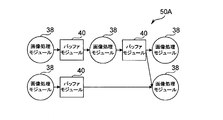
- the image processing DAG 50A as shown in FIG. 2A as an example, one or more image processing modules 38 are connected via a buffer module 40 arranged in at least one of the preceding and following stages of each image processing module 38. .
- Each image processing module 38 is an example of an object that executes image processing on input image data.
- the image processing DAG 50A is an example of an object group in which a plurality of image processing modules 38 are connected.
- the image processing module 38 when the image processing module 38 connected to the preceding stage via the buffer module 40 completes the image processing by the preceding image processing module 38, the image processing module 38 It is shown that it is possible to execute. Further, in the example shown in FIG. 2A, when all image processing of the plurality of image processing modules 38 in the preceding stage is completed for the image processing module 38 in which the plurality of image processing modules 38 are connected to the preceding stage via the buffer module 40. This indicates that it is possible to execute its own image processing.
- FIG. 2A shows a DAG in which only the modules are connected in the order of processing.
- this DAG is executed, image data stored in the memory 14 is input as shown in FIG. 2B. Then, image processing is performed according to the DAG. Finally, the processing result such as processed image data is stored in the memory 14.
- the processing control unit 46 includes a processing unit 60, a control unit 62, a task queue 64, and an output unit 66.
- the processing unit 60 divides an image indicated by a portion to be processed of input image data into a plurality of partial regions (hereinafter referred to as “divided images”). As an example, as shown in FIG. 4, the processing unit 60 divides the image G indicated by the processing target portion of the input image data into a plurality of (three in the example shown in FIG. 4) divided images B1 to B3. .
- image data indicating a divided image is referred to as “divided image data”.
- the part to be processed of the input image data means a part to be processed by the entire input image data in the image processing that processes the entire input image as in the color conversion process.
- the part to be processed of the input image data means a part of the input image in an image process in which a part of the input image is to be processed as in the cutout (trimming) process.
- input image data a portion to be processed of input image data is simply referred to as “input image data”.
- the processing unit 60 divides the image G vertically in front view, but the present invention is not limited to this.
- the processing unit 60 may divide the image G into front view left and right, and may divide front view up and down and left and right.
- the number of divisions of input image data by the processing unit 60 is not particularly limited.
- the processing unit 60 may divide the input image data by a predetermined number or size. Further, for example, the processing unit 60 may divide the input image data into a number equal to or less than the number of processor cores included in the arithmetic unit that executes image processing by the image processing module 38.
- the processing unit 60 may divide the input image data with a size equal to or smaller than the capacity of the cache memory included in the arithmetic unit that executes image processing by the image processing module 38.
- the processing unit 60 is less than or equal to the capacity of a so-called LLC (Last Level Cache) cache memory at a level farthest from the processor of the arithmetic unit that executes image processing by the image processing module 38, and to the LLC capacity as much as possible
- LLC Layer Level Cache
- the processing unit 60 divides the image processing executed by each image processing module 38 of the image processing DAG 50 ⁇ / b> A into partial processing 39 corresponding to each of the divided image data, and performs image processing.
- the DAG 50A is updated to the image processing DAG 50B.
- FIG. 5 shows an image processing DAG 50B when the input image data is divided into four divided image data in the image processing DAG 50A shown in FIG. 2A.
- the buffer module 40 is not shown in order to avoid complications.
- the processing unit 60 includes a partial process 39 of the image processing module 38 connected to the preceding stage and an image processing module 38 connected to the succeeding stage according to the type of image processing executed by the image processing module 38.
- Dependency relationship is given to the partial processing 39. In FIG. 5, this dependency relationship is indicated by a broken-line arrow.
- each partial process 39 also has a one-to-one dependency.
- a dependency relationship is also given to a partial process 39 in the previous stage that performs image processing on the peripheral pixels. That is, when the partial processing 39 of the image processing module 38 connected in the previous stage is completed between the connected image processing modules 38, the dependency processing 39 of the image processing module 38 connected in the subsequent stage is completed. This is an executable relationship. Therefore, each partial process 39 can be executed when there is no partial process 39 to which the dependency relationship is given in the previous stage or when all the partial processes 39 in the previous stage to which the dependency relation is given is completed.
- the partial processing 39A and the partial processing 39B shown in FIG. 5 can be executed at the start of execution of the image processing. Further, for example, the partial process 39C shown in FIG. 5 can be executed when both the partial process 39A and the partial process 39B in the preceding stage to which the dependency relationship is given are completed.
- the control unit 62 parallels the update processing of the image processing DAG 50 ⁇ / b> A by the processing unit 60 and the dependency addition processing, and the partial processing 39 that can be executed based on the dependency in parallel to the plurality of cores 13. Control to be executed.
- parallel here means that at least a part of the update process, the grant process, and the partial process 39 that can be executed based on the dependency relationship are parallel (simultaneously) by the plurality of cores 13. Means to be executed.
- control unit 62 performs a task (process) for executing the update process of the image processing DAG 50 ⁇ / b> A and the dependency assignment process for each image processing module 38, and each of the plurality of cores 13 sequentially stores the stored tasks. It is stored in a task queue 64 for taking out and executing. Further, the control unit 62 sequentially stores the partial processes 39 that can be executed based on the dependency relationship in the task queue 64 during the update process and the grant process by the processing unit 60.
- a task for executing the update process of the image processing DAG 50 ⁇ / b> A and the dependency assignment process for each image processing module 38
- each of the plurality of cores 13 sequentially stores the stored tasks. It is stored in a task queue 64 for taking out and executing. Further, the control unit 62 sequentially stores the partial processes 39 that can be executed based on the dependency relationship in the task queue 64 during the update process and the grant process by the processing unit 60.
- the output unit 66 outputs the output image data obtained as a result of the image processing executed by the image processing module 38 at the final stage of the image processing DAG 50B under the control of the control unit 62.
- the output unit 66 displays an output image indicated by the obtained output image data on the display unit 16.
- the output unit 66 may output (transmit) the output image data to an external device.
- the output unit 66 may output (form) an output image indicated by the output image data on a recording material such as paper.
- FIG. 6 is a flowchart showing the flow of processing of the DAG construction processing program executed by the arithmetic unit 12 when an instruction to start execution of image processing is input by the application 32.
- the DAG construction processing program is preinstalled in the storage unit 20.
- the core 13 capable of executing a task without executing any task in the arithmetic unit 12 executes the DAG construction processing program, thereby functioning as the processing construction unit 42 and the control unit 62 described above.
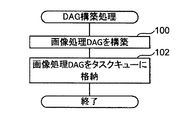
- the process construction unit 42 constructs an image processing DAG 50A that performs image processing instructed by the application 32 in accordance with the construction instruction from the application 32.
- the control unit 62 stores in the task queue 64 a task for executing the update processing and dependency assignment processing of the image processing DAG 50 ⁇ / b> A constructed in step 100 for each image processing module 38. The construction process ends.
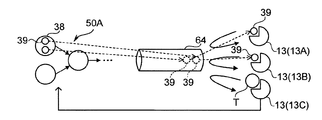
- the task T for executing the update processing of the image processing DAG 50 ⁇ / b> A and the dependency addition processing for each image processing module 38 is stored in the task queue 64 by the processing of step 102. Then, the core 13 that can execute the task (core 13C in the example shown in FIG. 7) takes out the task T from the task queue 64 and executes it, whereby the DAG update process shown in FIG. 8 is executed.
- FIG. 8 is a flowchart showing the flow of processing of the DAG update processing program, and this DAG update processing program is also installed in the storage unit 20 in advance. Further, the core 13 that can execute the task executes the DAG update processing program, thereby functioning as the processing unit 60 and the control unit 62 described above.
- the processing unit 60 sorts all the image processing modules 38 included in the image processing DAG 50A by a known sorting method such as topological sorting. It should be noted that the repetitive processing of the following steps 112 to 118 is performed for each image processing module 38 in order from the top of all the image processing modules 38 sorted in this step 110 (hereinafter referred to as “processing target module 38”). It will be described as being executed.
- step 112 the processing unit 60 divides the input image data into a plurality of divided image data. Then, as described above, the processing unit 60 updates the image processing executed by the processing target module 38 to the partial processing 39 corresponding to each of the divided image data.
- step 114 the processing unit 60 determines whether or not the image processing module 38 is connected to the previous stage of the processing target module 38. If the determination is affirmative, the processing unit 60 proceeds to step 118. If the determination is negative, the processing unit 60 proceeds to step 116.
- step 116 the control unit 62 sequentially stores the partial processing 39 of the processing target module 38 divided in step 112 in the task queue 64.
- step 118 the processing unit 60 determines the partial processing 39 of the image processing module 38 connected in the previous stage and the processing target module according to the type of image processing executed in the processing target module 38. Dependencies are given to 38 partial processes 39.
- step 120 the processing unit 60 determines whether or not the processing in steps 112 to 118 has been executed for all the image processing modules 38 of the image processing DAG 50A. If the determination is negative, the processing unit 60 returns to step 112, whereas if the determination is affirmative, the processing unit 60 ends the DAG update process.
- the partial processing 39 of the image processing module 38 in the foremost stage is sequentially stored in the task queue 64 by the processing of step 116.
- the core 13 that can execute the task extracts the partial process 39 from the task queue 64 and executes it.
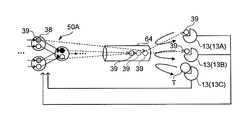
- the processing of step 112 and step 116 is continued. That is, as shown in FIG. 9, the task T and the partial process 39 are executed in parallel by the plurality of cores 13.
- FIG. 10 is a flowchart showing the flow of processing of the partial processing execution processing program executed by the arithmetic unit 12 when an instruction to start execution of image processing is input by the application 32.
- This partial process execution processing program is also installed in the storage unit 20 in advance. Further, the core 13 that can execute the task executes the partial process execution processing program, thereby functioning as the control unit 62 described above.
- control unit 62 determines whether or not the partial process 39 is stored in the task queue 64. When this determination is negative, the control unit 62 repeatedly executes the process of step 130. When the determination is affirmative, the control unit 62 proceeds to step 132.
- step 132 the control unit 62 extracts one partial process 39 from the head of the task queue 64, and executes the extracted partial process 39.
- step 134 the control unit 62 updates the dependency according to the execution of the partial process 39 by the process of step 132, and sequentially executes the partial process 39 that can be newly executed based on the dependency. Store in the queue 64.
- the control unit 62 determines whether or not all the partial processes 39 of all the image processing modules 38 of the image processing DAG 50B have been completed. If this determination is a negative determination, the control unit 62 returns to step 130, whereas if the determination is a positive determination, the control unit 62 ends the partial process execution process.
- the output unit 66 outputs the output image indicated by the output image data output by the partial process 39 of the image processing module 38 at the final stage of the image processing DAG 50B. Is output to the display unit 16.
- the partial process 39 stored in the task queue 64 is executed by the core 13 (the cores 13A and 13B in the example shown in FIG. 11).
- the dependency relationship of the image processing DAG 50A is updated, and the partial process 39 that can be newly executed based on the dependency relationship is stored in the task queue 64.
- the partial process 39 that has been executed is indicated by a shaded circle, and the partial process 39 that can be newly executed based on the dependency relationship is indicated by a black circle.
- the task T and the partial process 39 are executed in parallel. Therefore, as shown in FIG. 12 as an example, the processing speed of the image processing is improved as compared with the case where the task T and the partial processing 39 are executed in series.
- the upper part of FIG. 12 shows the case where the task T and the partial process 39 are executed in series, and the lower part of FIG. 12 shows the case where the task T and the partial process 39 are executed in parallel as in this embodiment. Yes.
- the partial processes 39 may be stored in the task queue 64 in order of priority. Thereby, it is prevented that the image processing for the image data input later is ended before the image processing for the image data input earlier is ended.
Landscapes
- Engineering & Computer Science (AREA)
- Software Systems (AREA)
- Theoretical Computer Science (AREA)
- Physics & Mathematics (AREA)
- General Engineering & Computer Science (AREA)
- General Physics & Mathematics (AREA)
- Image Processing (AREA)
Abstract
L'invention concerne un dispositif de traitement d'image entraînant une pluralité de dispositifs de calcul à exécuter en paralèlle : un traitement de mise à jour, dans lequel le traitement d'image exécuté par chaque module de traitement d'image d'un groupe d'objets dans lequel une pluralité de modules de traitement d'image sont liés dans une configuration de graphe acyclique orienté (DAG), est mis à jour pour un traitement partiel pour effectuer un traitement d'image sur chaque donnée d'image divisée indiquant une image divisée obtenue par division d'une image d'entrée indiquée par des données d'image d'entrée en une pluralité de zones partielles ; un traitement d'application dans lequel une relation de dépendance de traitement est appliquée entre le traitement partiel des modules de traitement d'image liés et le traitement partiel pouvant être exécuté en fonction de la relation de dépendance.
Priority Applications (3)
| Application Number | Priority Date | Filing Date | Title |
|---|---|---|---|
| CN201680078715.6A CN108475213B (zh) | 2016-03-24 | 2016-07-27 | 图像处理装置、图像处理方法和图像处理程序 |
| JP2018506750A JP6648257B2 (ja) | 2016-03-24 | 2016-07-27 | 画像処理装置、画像処理方法、及び画像処理プログラム |
| US16/061,075 US10795725B2 (en) | 2016-03-24 | 2016-07-27 | Image processing device, image processing method, and non-transitory computer readable medium for image processing |
Applications Claiming Priority (2)
| Application Number | Priority Date | Filing Date | Title |
|---|---|---|---|
| JP2016-060526 | 2016-03-24 | ||
| JP2016060526 | 2016-03-24 |
Publications (1)
| Publication Number | Publication Date |
|---|---|
| WO2017163442A1 true WO2017163442A1 (fr) | 2017-09-28 |
Family
ID=59899872
Family Applications (1)
| Application Number | Title | Priority Date | Filing Date |
|---|---|---|---|
| PCT/JP2016/072032 Ceased WO2017163442A1 (fr) | 2016-03-24 | 2016-07-27 | Dispositif, procédé et programme de traitement d'image |
Country Status (4)
| Country | Link |
|---|---|
| US (1) | US10795725B2 (fr) |
| JP (1) | JP6648257B2 (fr) |
| CN (1) | CN108475213B (fr) |
| WO (1) | WO2017163442A1 (fr) |
Cited By (2)
| Publication number | Priority date | Publication date | Assignee | Title |
|---|---|---|---|---|
| JP2020522824A (ja) * | 2017-11-20 | 2020-07-30 | シャンハイ カンブリコン インフォメーション テクノロジー カンパニー リミテッドShanghai Cambricon Information Technology Co.,Ltd. | タスク並列処理方法、装置、システム、記憶媒体およびコンピュータ機器 |
| JP2022130363A (ja) * | 2018-10-10 | 2022-09-06 | グーグル エルエルシー | 機械学習モデルを改良して局所性を改善させること |
Families Citing this family (5)
| Publication number | Priority date | Publication date | Assignee | Title |
|---|---|---|---|---|
| JP7039424B2 (ja) * | 2018-08-31 | 2022-03-22 | 富士フイルム株式会社 | 画像処理装置、画像処理方法、及び画像処理プログラム |
| JP2022500755A (ja) * | 2018-09-11 | 2022-01-04 | ホアウェイ・テクノロジーズ・カンパニー・リミテッド | 順次計算dagのための異種スケジューリング |
| JP6891153B2 (ja) * | 2018-09-18 | 2021-06-18 | 富士フイルムビジネスイノベーション株式会社 | 画像処理装置、画像処理方法、及び画像処理プログラム |
| US11288765B2 (en) * | 2020-04-28 | 2022-03-29 | Sony Interactive Entertainment LLC | System and method for efficient multi-GPU execution of kernels by region based dependencies |
| CN120929473B (zh) * | 2025-10-15 | 2026-02-10 | 深圳金英拓联科技股份有限公司 | 穿戴设备图片资源的差分更新方法及系统 |
Citations (3)
| Publication number | Priority date | Publication date | Assignee | Title |
|---|---|---|---|---|
| JP2009199303A (ja) * | 2008-02-21 | 2009-09-03 | Fuji Xerox Co Ltd | 画像処理装置、画像処理プログラム |
| JP2010146055A (ja) * | 2008-12-16 | 2010-07-01 | Fujifilm Corp | 画像処理装置、方法及びプログラム |
| US20150046678A1 (en) * | 2013-08-08 | 2015-02-12 | Linear Algebra Technologies Limited | Apparatus, systems, and methods for providing configurable computational imaging pipeline |
Family Cites Families (9)
| Publication number | Priority date | Publication date | Assignee | Title |
|---|---|---|---|---|
| JP4965995B2 (ja) | 2006-12-22 | 2012-07-04 | 株式会社東芝 | プログラム処理方法、処理プログラム及び情報処理装置 |
| CN101976348A (zh) * | 2010-10-21 | 2011-02-16 | 中国科学院深圳先进技术研究院 | 图像聚类方法和系统 |
| US9350899B2 (en) * | 2012-09-14 | 2016-05-24 | Qualcomm Incorporated | Methods and device for efficient resampling and resizing of digital images |
| CN102930246B (zh) * | 2012-10-16 | 2015-04-08 | 同济大学 | 一种基于点云片段分割的室内场景识别方法 |
| CN103150148B (zh) * | 2013-03-06 | 2016-06-01 | 中国科学院对地观测与数字地球科学中心 | 一种基于任务树的大尺度遥感影像并行镶嵌方法 |
| US20140259563A1 (en) * | 2013-03-15 | 2014-09-18 | The Procter & Gamble Company | Subassemblies comprising folded fastening tab members |
| CN103268614B (zh) * | 2013-05-31 | 2016-01-20 | 电子科技大学 | 一种用于多前景共分割的前景谱图生成方法 |
| US9348560B2 (en) * | 2013-06-04 | 2016-05-24 | Qualcomm Incorporated | Efficient execution of graph-based programs |
| US9652817B2 (en) * | 2015-03-12 | 2017-05-16 | Samsung Electronics Co., Ltd. | Automated compute kernel fusion, resizing, and interleave |
-
2016
- 2016-07-27 US US16/061,075 patent/US10795725B2/en active Active
- 2016-07-27 WO PCT/JP2016/072032 patent/WO2017163442A1/fr not_active Ceased
- 2016-07-27 CN CN201680078715.6A patent/CN108475213B/zh active Active
- 2016-07-27 JP JP2018506750A patent/JP6648257B2/ja active Active
Patent Citations (3)
| Publication number | Priority date | Publication date | Assignee | Title |
|---|---|---|---|---|
| JP2009199303A (ja) * | 2008-02-21 | 2009-09-03 | Fuji Xerox Co Ltd | 画像処理装置、画像処理プログラム |
| JP2010146055A (ja) * | 2008-12-16 | 2010-07-01 | Fujifilm Corp | 画像処理装置、方法及びプログラム |
| US20150046678A1 (en) * | 2013-08-08 | 2015-02-12 | Linear Algebra Technologies Limited | Apparatus, systems, and methods for providing configurable computational imaging pipeline |
Cited By (9)
| Publication number | Priority date | Publication date | Assignee | Title |
|---|---|---|---|---|
| JP2020522824A (ja) * | 2017-11-20 | 2020-07-30 | シャンハイ カンブリコン インフォメーション テクノロジー カンパニー リミテッドShanghai Cambricon Information Technology Co.,Ltd. | タスク並列処理方法、装置、システム、記憶媒体およびコンピュータ機器 |
| US11113103B2 (en) | 2017-11-20 | 2021-09-07 | Shanghai Cambricon Information Technology Co., Ltd | Task parallel processing method, apparatus and system, storage medium and computer device |
| US11113104B2 (en) | 2017-11-20 | 2021-09-07 | Shanghai Cambricon Information Technology Co., Ltd | Task parallel processing method, apparatus and system, storage medium and computer device |
| US11221877B2 (en) | 2017-11-20 | 2022-01-11 | Shanghai Cambricon Information Technology Co., Ltd | Task parallel processing method, apparatus and system, storage medium and computer device |
| JP7074777B2 (ja) | 2017-11-20 | 2022-05-24 | シャンハイ カンブリコン インフォメーション テクノロジー カンパニー リミテッド | タスク並列処理方法、装置、システム、記憶媒体およびコンピュータ機器 |
| US11360811B2 (en) | 2017-11-20 | 2022-06-14 | Shanghai Cambricon Information Technology Co., Ltd | Task parallel processing method, apparatus and system, storage medium and computer device |
| JP2022130363A (ja) * | 2018-10-10 | 2022-09-06 | グーグル エルエルシー | 機械学習モデルを改良して局所性を改善させること |
| JP7430744B2 (ja) | 2018-10-10 | 2024-02-13 | グーグル エルエルシー | 機械学習モデルを改良して局所性を改善させること |
| US11915139B2 (en) | 2018-10-10 | 2024-02-27 | Google Llc | Modifying machine learning models to improve locality |
Also Published As
| Publication number | Publication date |
|---|---|
| US20180365059A1 (en) | 2018-12-20 |
| JP6648257B2 (ja) | 2020-02-14 |
| CN108475213B (zh) | 2021-11-30 |
| CN108475213A (zh) | 2018-08-31 |
| US10795725B2 (en) | 2020-10-06 |
| JPWO2017163442A1 (ja) | 2019-01-17 |
Similar Documents
| Publication | Publication Date | Title |
|---|---|---|
| JP6648257B2 (ja) | 画像処理装置、画像処理方法、及び画像処理プログラム | |
| JP6632709B2 (ja) | 画像処理装置、画像処理方法、及び画像処理プログラム | |
| US11341599B2 (en) | Image processing apparatus, image processing method, and computer readable medium storing image processing program | |
| JP6592184B2 (ja) | 画像処理装置、画像処理方法、及び画像処理プログラム | |
| JP6534492B2 (ja) | 画像処理装置、画像処理方法、及び画像処理プログラム | |
| JP6945634B2 (ja) | 画像処理装置、画像処理方法、及び画像処理プログラム | |
| JP7039424B2 (ja) | 画像処理装置、画像処理方法、及び画像処理プログラム | |
| US11315212B2 (en) | Image processing apparatus, image processing method, and computer readable medium for executing partial processes on image-section data items | |
| US10783604B2 (en) | Image processing apparatus, image processing method, and image processing program |
Legal Events
| Date | Code | Title | Description |
|---|---|---|---|
| WWE | Wipo information: entry into national phase |
Ref document number: 2018506750 Country of ref document: JP |
|
| NENP | Non-entry into the national phase |
Ref country code: DE |
|
| 121 | Ep: the epo has been informed by wipo that ep was designated in this application |
Ref document number: 16895467 Country of ref document: EP Kind code of ref document: A1 |
|
| 122 | Ep: pct application non-entry in european phase |
Ref document number: 16895467 Country of ref document: EP Kind code of ref document: A1 |