WO2017163556A1 - Figure et procédé de production de figure - Google Patents
Figure et procédé de production de figure Download PDFInfo
- Publication number
- WO2017163556A1 WO2017163556A1 PCT/JP2017/001334 JP2017001334W WO2017163556A1 WO 2017163556 A1 WO2017163556 A1 WO 2017163556A1 JP 2017001334 W JP2017001334 W JP 2017001334W WO 2017163556 A1 WO2017163556 A1 WO 2017163556A1
- Authority
- WO
- WIPO (PCT)
- Prior art keywords
- eye
- molding
- component
- facial
- expression
- Prior art date
- Legal status (The legal status is an assumption and is not a legal conclusion. Google has not performed a legal analysis and makes no representation as to the accuracy of the status listed.)
- Ceased
Links
Images


Classifications
-
- A—HUMAN NECESSITIES
- A63—SPORTS; GAMES; AMUSEMENTS
- A63H—TOYS, e.g. TOPS, DOLLS, HOOPS OR BUILDING BLOCKS
- A63H3/00—Dolls
- A63H3/36—Details; Accessories
- A63H3/38—Dolls' eyes
- A63H3/42—Manufacture of eyes
Definitions
- the present invention relates to a figure and a method for producing the figure.
- Patent Document 1 discloses a method for manufacturing a doll's eyeball, in which a contact body such as an elastic silicone resin is pressed against a coating film that imitates the black eyes of the eyeball by printing, and the attached coating film is applied to the eyeball.
- a technique for transferring to a spherical surface simulating the above is described. In this way, the black eye pattern formed by printing can be formed on the eyeball surface by transferring the coating film, and the black eye can be expressed with high accuracy.
- the present invention provides a figure capable of easily forming an eye expression with high accuracy.
- a figure is formed by assembling an eye part to a face part to form a face, and the eye part covers an eye base part and at least a part of the eye base part. And an eye expression part molded integrally with the eye base part, and the face part is formed with a hole through which a part of the eye part is exposed when the eye part is assembled. Has been.
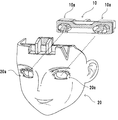
- FIG. 1 A) of the figurative object which concerns on embodiment of this invention is a front view
- FIG. 2 is a perspective view of a back surface.
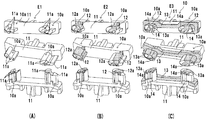
- (A) of an eye part is a primary molded product
- (B) is a secondary molded product
- (C) is a perspective view of a tertiary molded product.
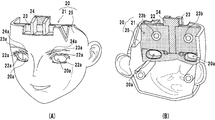
- (A) of a facial part is a front view
- (B) is a perspective view of a back surface.
- (A) of a facial expression part is a primary molded product
- (B) is a secondary molded product
- (C) is a perspective view of a tertiary molded product.
- FIG. 1 shows a figurative A according to an embodiment of the present invention.
- the figurative A described below exemplifies a figure imitating a human face, but is not limited thereto, and in particular, if it is a figurine equipped with eyes, for example, creatures such as animals, insects, dinosaurs, fishes, It may be a figure such as a character having a portion corresponding to the eyes. *
- the figurative A forms the face by assembling the eye part 10 to the face part 20.
- 1A shows the front side of the figure A
- FIG. 1B shows the back side of the figure A.
- the back side of the figurative A in this embodiment is covered with hair parts etc. which are not shown in figure, and is not exposed outside after a figure is completed.
- FIG. 2 shows an exploded perspective view in which the eye component 10 and the facial component 20 are disassembled.
- the eye part 10 is assembled from the back side of the face part 20, and a part of the eye part 10 that constitutes the eye 10 a is exposed from a hole 20 a formed in the face part 20. *
- the eye component 10 is formed by insert molding and multicolor molding using four colors of resin.
- the eye part 10 includes an eye base part 11 and a plurality of eye expression parts 12, 13, and 14 that are integrally formed so as to cover at least a part of the eye base part 11.
- FIG. 3 shows a molded product at each stage in the molding process until the eye component 10 is formed.
- FIG. 3 (A) shows the eye foundation part 11 as the primary molded product E1.
- FIG. 3B shows insert molding using the eye foundation part 11 (insert molding using the eye foundation part 11 as an insert part), and the first eye expression part 12 made of a different resin material from the eye foundation part 11.
- FIG. 3C shows a tertiary molding in which multicolor molding is simultaneously performed on the secondary molded product E2 using the second eye expression component 13 and the third eye expression component 14 made of two different resin materials.
- Product E3 is shown.
- the tertiary molded product E3 is the final molded product of the eye part 10. *
- FIG. 3 is a perspective view of a lower perspective view of the lower stage as viewed from below.
- the front is the front of the face of the figurine A
- the upper is the upper side (for example, the head) of the figurine A
- the lower is the state viewed from the lower side of the figurine A (for example, the jaw part of the face).
- FIG. 3A shows a primary molded product E ⁇ b> 1 including the eye base part 11 of the eye part 10.
- the eye base component 11 is formed of a white resin material, and constitutes a white portion of the figure eye 10a.
- a portion exposed on the surface of the final molded product is indicated by a first exposed portion 11a.
- FIG. 3B shows a secondary molded product E2 in which an eye foundation part 11 and a first eye expression part 12 made of one kind of resin material different from the eye foundation part 11 are integrally molded.
- a resin material which molds the first eye expressing component 12 for example, a black resin material can be exemplified, and the pupil of the eye 10a and the like are expressed.
- the secondary molded product E2 shown in FIG. 3B is molded, after molding the primary molded product E1, a mold different from the mold that molded the primary molded product E1, or the same mold
- the first molded product E1 is transferred to another part of the first molded product E1 so as to cover the first molded product E1 with the black resin material.
- the secondary molded product E2 in which the primary molded product E1 and the first ocular expression component 12 are integrally molded is an insert molding (primary molded product) using the primary molded product E1 (eye basic component 11). Insert molding using E1 as an insert part).
- a portion exposed on the surface of the final molded product is indicated by a second exposed portion 12a. *
- FIG. 3C shows a tertiary molded product obtained by integrally molding the secondary molded product E2 and the second eye expressing component 13 and the third eye expressing component 14 made of two types of resins different from the eye basic component 11.
- E3 final molded product
- the resin material for molding the second eye expression component 13 for example, a gray resin material can be exemplified, and the shadow of the white eye portion by the eyelid of the figure is expressed.
- a resin material for molding the third eye expressing component 14 for example, a purple resin material can be exemplified, and the iris portion of the figure eye 10a is expressed.
- the tertiary molded product E3 shown in FIG. 3C is molded, after molding the secondary molded product E2, a mold different from the mold that molded the secondary molded product E2, or the same mold
- the second molded product E2 is transferred to another portion of the second molded product E2, and the second molded product E2 is coated with the gray resin material and the second molded product E2 is coated with the purple resin material.
- the respective resin materials are simultaneously formed using a multicolor molding technique. Can be injection molded.
- the tertiary molded product E3 in which the secondary molded product E2, the second eye-expressing component 13 and the third eye-expressing component 14 are integrally molded is an insert molding and multicolor using the secondary molded product E2. It is formed by molding. A portion exposed on the surface of the final molded product is indicated by a third exposed portion 13a and a fourth exposed portion 14a.
- the eye 10a of the eye component 10 is formed by repeating insert molding using a plurality of types of resins. Therefore, it is possible to easily form an eye expression conventionally provided by printing or sticking with high accuracy. Furthermore, even when the user performs a part of the assembly as in a plastic model, it is possible to eliminate the user's sticking process as an expression of the eyes, and even without a high technology such as sticking or painting, the user A satisfactory finished product can be created in a form without any sense of incongruity. *
- FIG. 4 shows a perspective view of the facial component 20.
- FIG. 4A shows the front side of the facial part 20, and
- FIG. 4B shows the back side of the facial part 20.
- the facial part 20 includes an expression part 21 and a skin part 25 that covers at least a part of the expression part 21 and is molded integrally with the expression part 21.
- the face part 20 is formed with a hole 20a that exposes a part of the eye part 10 (eye 10a).
- a part of the facial expression component 21 may be exposed from the skin component 25 to express at least one of eyelashes or eyebrows, and may express the shadow of the eyelid.
- the skin component 25 is formed of, for example, a skin-colored resin material, and forms a skin portion of the face of the figure. *
- the facial expression component 21 is disposed at least at a part of the periphery of the hole 20a, the eyelash part 22a expressing the eyelashes, the eyebrow part 23a disposed away from the eyelash part, the eyelash part 22a, and the eyebrows Between the part 23a, the eyelid part 24a expressing the shadow of the eyelid is included.
- the eyelash part 22a, the eyebrow part 23a, and the eyelid part 24a are formed of different resin materials.
- the facial expression component 21 is formed by insert molding using resin materials of three colors.
- the facial expression component 21 includes a primary facial expression component 22 and a secondary facial expression component 23 and a tertiary facial expression component 24 that are formed integrally with the primary facial expression component 22 so as to cover at least a part of the primary facial expression component 22.
- FIG. 5 shows a molded product at each stage in the molding process until the facial expression part 21 is formed. *
- FIG. 5A shows the primary facial expression part 22 as the primary molded product F1.
- FIG. 5B shows a secondary facial expression made of a resin material different from the primary facial expression part 22 by insert molding using the primary facial expression part 22 (insert molding using the primary facial expression part 22 as an insert part).
- a secondary molded product F2 in which the component 23 is an integral molded product is shown.
- FIG. 5 (C) shows a tertiary expression made of a resin material different from the secondary molded product F2 by insert molding using the secondary molded product F2 (insert molding using the secondary molded product F2 as an insert part).
- a tertiary molded product F3 in which the component 24 is an integral molded product is shown.
- the tertiary molded product F3 is the final molded product of the facial expression part 21.
- each figure a perspective view of each molded product viewed from different directions over two steps in the vertical direction in the figure is shown, an upper stage is a perspective view of the molded article viewed from the front (front side), and a lower stage is viewed from the back side. It is a perspective view.
- the front is the front of the face of the figurine A.
- FIG. 5A shows a primary molded product F ⁇ b> 1 including the primary expression part 22 of the expression part 21.
- the primary facial expression component 22 is formed of a black resin material, and includes a portion that expresses eyelashes arranged on the periphery of the eye 10a of the figure. A portion of the final molded product exposed from the skin part 25 to the surface is indicated by an eyelash portion 22a. *
- the eyelash portion 22a is formed to rise from the bottom surface of the primary facial expression component 22, and the portion exposed to the surface may be formed as a thin linear portion or a corner portion formed by a minimal R. Such an eyelash portion 22a may be broken in the mold when the primary molded product F1 is removed from the mold or embedded in the next mold during insert molding. It may be chipped and damaged. In order to prevent such damage, a built-up portion is formed at the joint between the eyelash portion 22 and the bottom surface of the primary facial expression component 22, or a tapered surface is provided from the bottom surface of the primary facial expression component 22 to the eyelash portion 22. It may be reinforced.
- the primary facial expression component 22 includes holes 22b and 22c and a notch 22d.
- the holes 22b and 22c and the notch 22d are formed such that when the mold is opened after injection molding, the primary molded product F1 is not brought to the mold on the side opposite to the core side (the side with the protruding pins). In order to increase the contact area with the mold on the core side and to pull to the core side.
- the holes 22b and 22c and the notch 22d are filled with a secondary facial expression component 23 and a tertiary facial expression component 24, which will be described later. *
- FIG. 5B shows a secondary molded product F2 in which a primary molded product F1 and a secondary facial product part 23 made of one type of resin material different from the primary facial product part 22 are integrally molded products.
- a resin material for molding the secondary facial expression part 23 for example, a brown resin material can be exemplified, which expresses the eyebrows of the figure.
- the secondary molded product F2 shown in FIG. 5B When forming the secondary molded product F2 shown in FIG. 5B, after molding the primary molded product F1 (pre-stage molding), a mold different from the mold that molded the primary molded product F1. Alternatively, the primary molded product F1 is transferred to another part of the same mold, and is molded so that the secondary molded product 23 is covered with the brown resin material. Accordingly, the secondary molded product F2 in which the primary molded product F1 and the secondary expression component 23 are integrally molded is an insert molding using the primary molded product F1 (an insert using the primary molded product F1 as an insert component). Formed). A portion exposed to the surface from the skin component 25 in the final molded product is indicated by an eyebrow portion 23a. *
- the eyebrows portion 23a may have a built-up portion or a tapered surface at the root portion thereof. Further, a part 23 b of the secondary facial expression part is embedded in the hole 22 b of the primary facial expression part 22. *
- FIG. 5C shows a tertiary molded product F3 (final molded product) in which a secondary molded product F2 and a tertiary facial product part 24 made of one kind of resin material different from the secondary facial product part 23 are integrally molded.
- Product As a resin material for molding the third facial expression component 24, for example, a light brown resin material can be exemplified, which expresses the shadow of the skin formed by the eyelid of the figure. *
- the tertiary molded product F3 shown in FIG. 5 (C) is molded, after molding the secondary molded product F2, a mold different from the mold that molded the secondary molded product F2, or the same mold Then, the secondary molded product F2 is transferred to another portion, and the secondary facial product 24 is molded with the light brown resin material so as to cover the secondary molded product F2. Therefore, the tertiary molded product F3 in which the secondary molded product F2 and the tertiary expression component 24 are integrally molded is an insert molding using the secondary molded product F2 (an insert using the secondary molded product F2 as an insert component). Formed). In this way, the facial expression part 21 is formed. A portion exposed to the surface from the skin component 25 in the final molded product is indicated by an eyelid portion 24a. *
- the eyelid portion 24a may have a built-up portion or a tapered surface at its root portion. Further, a part 24 c of the tertiary facial expression component is embedded in the hole 22 c and the notch 22 d of the primary facial expression component 22. *
- the skin component 25 is coated on the facial expression component 21 with a skin-colored resin material.
- the facial component 20 is molded by molding.
- the facial component 20 is a facial expression component by repeating insert molding using a plurality of types of resins using the primary molded product F1 of the facial expression component 21 (using the primary molded product F1 as an insert component). 21 and the skin component 25 are formed by being molded as an integral molded product.
- the eye part 10 and the face part 20 may be formed to have different glossiness.
- the eye part 10 may be molded from a highly transparent resin material such as polystyrene resin
- the face part 20 may be molded from a resin that gives the skin texture by suppressing rubber by blending rubber or the like with polystyrene resin. Good. *
- each face expression member can be accurately arranged even in a product such as the face of a figure that feels uncomfortable when the position of the face expression member becomes a little strange. Therefore, a figure made of a plastic model can be a satisfactory finished product in a form that does not feel uncomfortable for the user.
Landscapes
- Toys (AREA)
- Injection Moulding Of Plastics Or The Like (AREA)
Abstract
Le problème décrit pas la présente invention est de fournir une figure de telle sorte que la représentation des yeux peut être formée facilement avec une grande précision. La solution selon l'invention porte sur une figure qui a un visage formé par assemblage d'un élément d'œil avec un élément de visage. L'élément d'œil comprend un élément de base d'œil et des éléments de représentation d'œil, lesquels recouvrent au moins une partie de l'élément de base d'œil et sont formés d'un seul tenant avec l'élément de base d'œil. L'élément de visage comporte des trous à travers lesquels des parties de l'élément d'œil sont exposées lorsque l'élément d'œil est assemblé avec ce dernier.
Priority Applications (3)
| Application Number | Priority Date | Filing Date | Title |
|---|---|---|---|
| HK18115277.2A HK1256241A1 (zh) | 2016-03-23 | 2017-01-17 | 形象物以及形象物的制造方法 |
| CN201780009896.1A CN108601982B (zh) | 2016-03-23 | 2017-01-17 | 形象物以及形象物的制造方法 |
| CN202110022378.1A CN112717430B (zh) | 2016-03-23 | 2017-01-17 | 形象物以及形象物的制造方法 |
Applications Claiming Priority (2)
| Application Number | Priority Date | Filing Date | Title |
|---|---|---|---|
| JP2016059113A JP6170585B1 (ja) | 2016-03-23 | 2016-03-23 | 形象物及び形象物の製造方法 |
| JP2016-059113 | 2016-03-23 |
Publications (1)
| Publication Number | Publication Date |
|---|---|
| WO2017163556A1 true WO2017163556A1 (fr) | 2017-09-28 |
Family
ID=59384433
Family Applications (1)
| Application Number | Title | Priority Date | Filing Date |
|---|---|---|---|
| PCT/JP2017/001334 Ceased WO2017163556A1 (fr) | 2016-03-23 | 2017-01-17 | Figure et procédé de production de figure |
Country Status (4)
| Country | Link |
|---|---|
| JP (1) | JP6170585B1 (fr) |
| CN (2) | CN112717430B (fr) |
| HK (1) | HK1256241A1 (fr) |
| WO (1) | WO2017163556A1 (fr) |
Cited By (1)
| Publication number | Priority date | Publication date | Assignee | Title |
|---|---|---|---|---|
| US20220347590A1 (en) * | 2019-09-19 | 2022-11-03 | Bandai Co., Ltd. | Model part and method for manufacturing model part |
Families Citing this family (7)
| Publication number | Priority date | Publication date | Assignee | Title |
|---|---|---|---|---|
| JP6539364B1 (ja) * | 2018-02-14 | 2019-07-03 | 株式会社バンダイ | 模型部品、及び、模型部品の製造方法 |
| JP6561191B1 (ja) * | 2018-11-26 | 2019-08-14 | 株式会社バンダイ | 模型部品、及び、模型部品の製造方法 |
| JP7236344B2 (ja) * | 2019-07-19 | 2023-03-09 | 株式会社バンダイ | 模型部品 |
| JP7427620B2 (ja) * | 2019-09-19 | 2024-02-05 | 株式会社バンダイ | 模型部品、及び、模型部品の製造方法 |
| JP7157120B2 (ja) * | 2020-11-04 | 2022-10-19 | 株式会社バンダイ | 眼部品、その製造方法、及び人形体 |
| JP7165768B2 (ja) * | 2021-02-26 | 2022-11-04 | 株式会社エポック社 | マスク製造方法及び人形玩具製造方法 |
| JP7551018B1 (ja) | 2024-03-15 | 2024-09-13 | 株式会社バンダイ | 模型玩具、及び模型部品 |
Citations (8)
| Publication number | Priority date | Publication date | Assignee | Title |
|---|---|---|---|---|
| JPS55171079U (fr) * | 1979-05-25 | 1980-12-08 | ||
| JPH11478A (ja) * | 1997-06-11 | 1999-01-06 | Fumiko Moriya | 模型動物の動く瞳の構造 |
| JP2005118341A (ja) * | 2003-10-17 | 2005-05-12 | Obitsu Seisakusho:Kk | ソフトビニル製人形の頭部構造及び該頭部の製造方法 |
| JP2006158495A (ja) * | 2004-12-03 | 2006-06-22 | Katona Japan Kk | シリコンゴム製人形用眼球部品 |
| JP2009247798A (ja) * | 2008-04-10 | 2009-10-29 | Volks Inc | 義眼及び該義眼を備えた人形の頭部並びに該義眼を備えた人形 |
| JP2010046111A (ja) * | 2008-08-19 | 2010-03-04 | Hongkong Mizutani Yugenkoshi | ぬいぐるみの目玉取り付け構造 |
| JP2010179049A (ja) * | 2009-02-09 | 2010-08-19 | Masakatsu Saito | 視線調整可能な義眼及び該義眼を固定した人形頭部 |
| JP2012024382A (ja) * | 2010-07-26 | 2012-02-09 | Mic:Kk | 人形用眼球の製造方法および人形体 |
Family Cites Families (15)
| Publication number | Priority date | Publication date | Assignee | Title |
|---|---|---|---|---|
| US1601133A (en) * | 1923-10-13 | 1926-09-28 | Marcus Samuel | Artificial eyes for dolls, display figures, and the like and method of making the same |
| GB744823A (en) * | 1952-11-04 | 1956-02-15 | Daniel George Todd | Improvements in or relating to eyes for dolls, toy animals and the like |
| FR2533452A1 (en) * | 1982-09-24 | 1984-03-30 | Berchet Ind Sa | Toy provided with a head with multiple expressions |
| CN2126097U (zh) * | 1992-06-22 | 1992-12-30 | 廖宜山 | 玩具洋娃娃的眼睫毛快速结合结构 |
| WO1997015365A1 (fr) * | 1995-10-23 | 1997-05-01 | The Lifelike Company | Systeme de tete de poupee a facies d'appareance realiste et procede afferent |
| JPH11207047A (ja) * | 1998-01-23 | 1999-08-03 | Sente Creations:Kk | 人形玩具 |
| JP3608114B2 (ja) * | 2001-08-06 | 2005-01-05 | 株式会社ヴァージナルアート | 人形頭及び人形玩具並びに人形頭における義眼部材の固定方法 |
| JP3357948B1 (ja) * | 2001-10-12 | 2002-12-16 | オムロン株式会社 | ロボット用外皮被着構造および該構造を備えたロボット |
| US7037455B2 (en) * | 2001-12-21 | 2006-05-02 | Mattel, Inc. | Insert molding method |
| JP2005176987A (ja) * | 2003-12-17 | 2005-07-07 | Star:Kk | 人形の頭部 |
| JP2007014693A (ja) * | 2005-07-11 | 2007-01-25 | Yutaka Tanaka | 人形、人形注文システムおよび人形の製造方法 |
| CN101346163A (zh) * | 2005-11-03 | 2009-01-14 | 美泰有限公司 | 互动娃娃 |
| JP5713724B2 (ja) * | 2011-02-22 | 2015-05-07 | 株式会社エアリー | マネキン人形の頭部 |
| US8888553B2 (en) * | 2012-04-28 | 2014-11-18 | Matthew McMullen | Doll head having a magnetically adjustable facial contour and method of assembling same |
| WO2015051182A1 (fr) * | 2013-10-03 | 2015-04-09 | Jakks Pacific, Inc. | Ensemble œil-lentille |
-
2016
- 2016-03-23 JP JP2016059113A patent/JP6170585B1/ja active Active
-
2017
- 2017-01-17 WO PCT/JP2017/001334 patent/WO2017163556A1/fr not_active Ceased
- 2017-01-17 HK HK18115277.2A patent/HK1256241A1/zh unknown
- 2017-01-17 CN CN202110022378.1A patent/CN112717430B/zh active Active
- 2017-01-17 CN CN201780009896.1A patent/CN108601982B/zh active Active
Patent Citations (8)
| Publication number | Priority date | Publication date | Assignee | Title |
|---|---|---|---|---|
| JPS55171079U (fr) * | 1979-05-25 | 1980-12-08 | ||
| JPH11478A (ja) * | 1997-06-11 | 1999-01-06 | Fumiko Moriya | 模型動物の動く瞳の構造 |
| JP2005118341A (ja) * | 2003-10-17 | 2005-05-12 | Obitsu Seisakusho:Kk | ソフトビニル製人形の頭部構造及び該頭部の製造方法 |
| JP2006158495A (ja) * | 2004-12-03 | 2006-06-22 | Katona Japan Kk | シリコンゴム製人形用眼球部品 |
| JP2009247798A (ja) * | 2008-04-10 | 2009-10-29 | Volks Inc | 義眼及び該義眼を備えた人形の頭部並びに該義眼を備えた人形 |
| JP2010046111A (ja) * | 2008-08-19 | 2010-03-04 | Hongkong Mizutani Yugenkoshi | ぬいぐるみの目玉取り付け構造 |
| JP2010179049A (ja) * | 2009-02-09 | 2010-08-19 | Masakatsu Saito | 視線調整可能な義眼及び該義眼を固定した人形頭部 |
| JP2012024382A (ja) * | 2010-07-26 | 2012-02-09 | Mic:Kk | 人形用眼球の製造方法および人形体 |
Cited By (2)
| Publication number | Priority date | Publication date | Assignee | Title |
|---|---|---|---|---|
| US20220347590A1 (en) * | 2019-09-19 | 2022-11-03 | Bandai Co., Ltd. | Model part and method for manufacturing model part |
| US12330085B2 (en) * | 2019-09-19 | 2025-06-17 | Bandai Co., Ltd. | Model part and method for manufacturing model part |
Also Published As
| Publication number | Publication date |
|---|---|
| HK1256241A1 (zh) | 2019-09-20 |
| CN112717430B (zh) | 2023-11-07 |
| JP6170585B1 (ja) | 2017-07-26 |
| CN112717430A (zh) | 2021-04-30 |
| CN108601982B (zh) | 2021-01-08 |
| CN108601982A (zh) | 2018-09-28 |
| JP2017169801A (ja) | 2017-09-28 |
Similar Documents
| Publication | Publication Date | Title |
|---|---|---|
| JP6170585B1 (ja) | 形象物及び形象物の製造方法 | |
| US7740953B2 (en) | Skin system with elastic components having differing hardnesses for use with robotics | |
| CN109939448A (zh) | 模型部件及模型部件的制造方法 | |
| JP7637657B2 (ja) | 眼部品、その製造方法、及び人形体 | |
| CN112023410A (zh) | 模型部件和模型部件的制造方法 | |
| JP2017113122A (ja) | 人形用眼球 | |
| JP6694411B2 (ja) | 形象物及び形象物の製造方法 | |
| US20220322774A1 (en) | 3-Dimensional Artificial Eyelashes | |
| JP6945032B2 (ja) | 形象物及び形象物の製造方法 | |
| JP7634624B2 (ja) | 形象物及び形象物の製造方法 | |
| KR102050171B1 (ko) | 동물의 모형안구를 이용한 동물 인형 제조방법 | |
| JP7761887B2 (ja) | 人形用合成樹脂製眼球 | |
| US20080221677A1 (en) | Artificial eye socket system and method | |
| JP7864218B2 (ja) | 眼部品、その製造方法、及び人形体 | |
| JP7656739B2 (ja) | 模型部品、及び、模型部品の製造方法 | |
| WO2019131326A1 (fr) | Objet formé tridimensionnel et sa méthode de fabrication | |
| JP2023114570A (ja) | 人形玩具の顔部構造及び人形玩具 |
Legal Events
| Date | Code | Title | Description |
|---|---|---|---|
| NENP | Non-entry into the national phase |
Ref country code: DE |
|
| 121 | Ep: the epo has been informed by wipo that ep was designated in this application |
Ref document number: 17769603 Country of ref document: EP Kind code of ref document: A1 |
|
| 122 | Ep: pct application non-entry in european phase |
Ref document number: 17769603 Country of ref document: EP Kind code of ref document: A1 |