WO2017163564A1 - Procédé de formation d'image - Google Patents
Procédé de formation d'image Download PDFInfo
- Publication number
- WO2017163564A1 WO2017163564A1 PCT/JP2017/001652 JP2017001652W WO2017163564A1 WO 2017163564 A1 WO2017163564 A1 WO 2017163564A1 JP 2017001652 W JP2017001652 W JP 2017001652W WO 2017163564 A1 WO2017163564 A1 WO 2017163564A1
- Authority
- WO
- WIPO (PCT)
- Prior art keywords
- ink
- mass
- general formula
- image
- gelling agent
- Prior art date
- Legal status (The legal status is an assumption and is not a legal conclusion. Google has not performed a legal analysis and makes no representation as to the accuracy of the status listed.)
- Ceased
Links
Images

Classifications
-
- B—PERFORMING OPERATIONS; TRANSPORTING
- B41—PRINTING; LINING MACHINES; TYPEWRITERS; STAMPS
- B41J—TYPEWRITERS; SELECTIVE PRINTING MECHANISMS, i.e. MECHANISMS PRINTING OTHERWISE THAN FROM A FORME; CORRECTION OF TYPOGRAPHICAL ERRORS
- B41J2/00—Typewriters or selective printing mechanisms characterised by the printing or marking process for which they are designed
- B41J2/005—Typewriters or selective printing mechanisms characterised by the printing or marking process for which they are designed characterised by bringing liquid or particles selectively into contact with a printing material
- B41J2/01—Ink jet
-
- B—PERFORMING OPERATIONS; TRANSPORTING
- B41—PRINTING; LINING MACHINES; TYPEWRITERS; STAMPS
- B41M—PRINTING, DUPLICATING, MARKING, OR COPYING PROCESSES; COLOUR PRINTING
- B41M5/00—Duplicating or marking methods; Sheet materials for use therein
-
- C—CHEMISTRY; METALLURGY
- C09—DYES; PAINTS; POLISHES; NATURAL RESINS; ADHESIVES; COMPOSITIONS NOT OTHERWISE PROVIDED FOR; APPLICATIONS OF MATERIALS NOT OTHERWISE PROVIDED FOR
- C09D—COATING COMPOSITIONS, e.g. PAINTS, VARNISHES OR LACQUERS; FILLING PASTES; CHEMICAL PAINT OR INK REMOVERS; INKS; CORRECTING FLUIDS; WOODSTAINS; PASTES OR SOLIDS FOR COLOURING OR PRINTING; USE OF MATERIALS THEREFOR
- C09D11/00—Inks
- C09D11/30—Inkjet printing inks
- C09D11/38—Inkjet printing inks characterised by non-macromolecular additives other than solvents, pigments or dyes
Definitions
- the present invention relates to an image forming method.
- the ink jet recording method is used in various printing fields because it can form an image easily and inexpensively.
- an ink containing a photopolymerizable compound and a photopolymerization initiator that are cured by irradiation with actinic rays (hereinafter also simply referred to as “actinic ray curable ink”) is known.
- actinic ray curable ink When a droplet of actinic ray curable ink is landed on the surface of the recording medium and the abutted droplet is irradiated with actinic light, a cured film formed by curing the ink is formed on the surface of the recording medium. By forming this cured film, a desired image can be formed.
- the image forming method using actinic ray curable ink can form an image having high adhesiveness regardless of the water absorption of the recording medium, and therefore, an image can be formed on various types of recording media by the ink jet recording method.
- an ink that contains a gelling agent and reversibly undergoes sol-gel phase transition with temperature change (hereinafter also simply referred to as “gel ink”) has been developed.
- the gel ink is in a sol state when heated and discharged from the nozzle of the inkjet head, and when landing on the surface of the recording medium, the gel ink is cooled and crystallized to be gelled. Therefore, the pinning property after landing is high. Has characteristics. By irradiating the gel ink pinned on the surface of the recording medium with an actinic ray, the gel ink is cured and a cured film is formed.
- gel ink also has the feature of actinic ray curable ink that images can be formed on various types of recording media.
- a gelling agent having an alkyl group having about 50 carbon atoms and a photopolymerizable functional group and a gelling agent having an amide group are used in a corrugated cardboard box used for a packaging box or the like. It is described that an image can be formed by using a gel ink containing
- the present invention has been made in view of the above problems, and an object of the present invention is to provide an image forming method in which blooming is unlikely to occur when an image is formed on a cardboard or the like by using an ink jet method using gel ink.
- Inkjet ink containing at least two kinds of compounds represented by the following general formula (G1) and compounds represented by the following general formula (G2) and substantially not containing a gelling agent having an amide group Discharging the liquid droplets from the nozzles of the inkjet head and landing on the surface of the paper substrate having an air layer having a basis weight of 500 g / m 2 or more or a thickness of 0.7 mm or more; Irradiating the droplets landed on the paper substrate with actinic rays in an atmosphere having an oxygen concentration of 0.1% by volume or more and 10.0% by volume or less.
- each R1 is independently an alkyl group having a straight chain portion having 11 to 24 carbon atoms.
- each R1 is independently an alkyl group having a straight chain portion having 11 to 24 carbon atoms.
- the inkjet ink contains at least one compound represented by the general formula (G1) and at least one compound represented by the general formula (G2).
- the total mass of the compound represented by the general formula (G2) to be contained is 50% by mass or more and less than 150% by mass with respect to the total mass of the compound represented by the general formula (G1).
- the image forming method according to any one of [3] to [3].
- the inkjet ink contains, as the compound represented by the general formula (G2), a plurality of compounds in which the carbon number of the alkyl group represented by R1 is different, and the carbon of the alkyl group represented by R1.
- the total mass of the compound having the largest content is 50% by mass or more and less than 100% by mass with respect to the total mass of the compound represented by the general formula (G2).
- an image forming method in which blooming is unlikely to occur when an image is formed on a cardboard or the like using gel ink by an ink jet method.
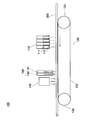
- FIG. 1 is a side view showing an inkjet image forming apparatus according to an embodiment of the present invention.
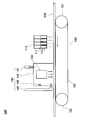
- FIG. 2 is a side view showing an inkjet image forming apparatus according to another embodiment of the present invention.
- FIG. 3 is a side view showing an inkjet image forming apparatus according to still another embodiment of the present invention.
- the inventors of the present invention formed an image using a gel ink described in Patent Document 1 on a recording medium having a large basis weight or thickness such as corrugated cardboard. It has been found that the gelling agent having an amide group easily localizes in the vicinity of the surface of the droplet instantly in the droplet, thereby causing blooming. This is because the compatibility between the radical polymerizable functional group of the radical polymerizable compound and the amide group of the gelling agent is low, so that the gelling agent having an amide group attracts each other to the peripheral portion in the droplet. It is thought that it is easy to move.
- the recording medium such as the corrugated cardboard has high heat insulation and does not easily release heat
- the surface temperature of the recording medium tends to be high. Therefore, the temperature difference between the surface of the recording medium and the landed ink droplets is small, and the ink droplets are difficult to cool. Accordingly, it is considered that blooming is more likely to occur because the gelling agent forms larger crystals in the droplets that have landed on the recording medium such as the cardboard.
- the present inventors have further studied, and by using a combination of two kinds of gelling agents selected from a specific aliphatic ketone and a specific aliphatic ester as the gelling agent, The inventors have devised an image forming method that suppresses the occurrence of blooming, which seems to be due to the low compatibility between the chain and the gelling agent.
- the reason why blooming is suppressed by this method is not necessarily clear, but probably the size of the crystallized gelling agent becomes smaller because the above two types of gelling agent form a eutectic. This is probably because the gelling agent is difficult to deposit, or even if it is deposited, the gelling agent cannot be visually recognized and the powdered appearance cannot be recognized.
- the present inventors have developed a recording medium such as corrugated cardboard, specifically, a paper substrate having an air layer with a basis weight of 500 g / m 2 or more, or a thickness of 0.7 mm or more, Further studies were made on the conditions for sufficiently suppressing blooming when forming an image.
- the amount of the gelling agent contained in the ink is set to 3.0% by mass or less with respect to the total mass of the ink, and the oxygen concentration of the atmosphere when the landed droplets are irradiated with actinic rays is set to 0.00. It was found that blooming can be sufficiently suppressed by setting the content to 1% by volume or more and 10.0% by volume or less, thereby completing the present invention.
- the surface on which the image of the recording medium is formed becomes slippery.
- the recording medium such as the corrugated cardboard is picked up and stored and transported.
- the efficiency of storage and transport may be reduced.
- the surface on which the image is formed is not easily slipped. Therefore, it is expected that the efficiency of storage and transportation due to the collapse of the stacked recording media is unlikely to occur.
- thermo storage paper substrate having an air layer having a basis weight of 500 g / m 2 or more or a thickness of 0.7 mm or more. Also relates to a method for forming an image by an ink jet recording method.
- the present embodiment is an actinic ray-curable inkjet ink containing a radical polymerizable compound and a gelling agent of 0.5% by mass or more and 3.0% by mass or less with respect to the total mass of the ink,
- a radical polymerizable compound containing at least two kinds of compounds of a specific aliphatic ketone or a specific aliphatic ester described later and substantially free of a gelling agent having an amide group
- specific gel ink A droplet of the ink jet head is ejected from the nozzle of the ink jet head and landed on the surface of the heat storage paper base material which is a recording medium (hereinafter also simply referred to as “landing step”), and heat storage properties.
- a step of irradiating droplets landed on a paper substrate with actinic rays in an atmosphere having an oxygen concentration of 0.1% by volume or more and 10.0% by volume or less (hereinafter, simply referred to as “irradiation step”) .
- Specific gel ink contains at least 0.5% by mass or more and 3.0% by mass or less of a gelling agent with respect to the total mass of the radical polymerizable compound and the ink. Since the specific gel ink contains the gelling agent, the sol-gel phase transition is reversibly caused by a temperature change.
- the radical polymerizable compound may be any compound that has a function of causing polymerization or crosslinking reaction upon irradiation with actinic rays to cause polymerization or crosslinking to cure the ink.
- the radical polymerizable compound may be any of a monomer, a polymerizable oligomer, a prepolymer, or a mixture thereof. Only one kind of the radical polymerizable compound may be contained in the specific gel ink, or two or more kinds thereof may be contained.
- the content of the radical polymerizable compound can be, for example, 1% by mass to 97% by mass with respect to the total mass of the specific gel ink.
- the radical polymerizable compound is preferably an unsaturated carboxylic acid ester compound, and more preferably (meth) acrylate.
- (meth) acrylate means acrylate or methacrylate
- (meth) acryloyl group means acryloyl group or methacryloyl group
- (meth) acryl means acrylic. Or methacryl.
- Examples of (meth) acrylates include isoamyl (meth) acrylate, stearyl (meth) acrylate, lauryl (meth) acrylate, octyl (meth) acrylate, decyl (meth) acrylate, isomyristyl (meth) acrylate, isostearyl (meth) Acrylate, 2-ethylhexyl-diglycol (meth) acrylate, 2-hydroxybutyl (meth) acrylate, 2- (meth) acryloyloxyethyl hexahydrophthalic acid, butoxyethyl (meth) acrylate, ethoxydiethylene glycol (meth) acrylate, Methoxydiethylene glycol (meth) acrylate, methoxypolyethylene glycol (meth) acrylate, methoxypropylene glycol (meth) acrylate, phenoxyethyl (meth) acrylate Lilate
- (meth) acrylate is stearyl (meth) acrylate, lauryl (meth) acrylate, isostearyl (meth) acrylate, ethoxydiethylene glycol (meth) acrylate, isobornyl (meth) acrylate, tetraethylene glycol di ( (Meth) acrylate, glycerin propoxytri (meth) acrylate and the like are preferable.
- (Meth) acrylate may be a modified product.
- Examples of (meth) acrylates that are modified products include ethylene oxide-modified trimethylolpropane tri (meth) acrylate, ethylene oxide-modified (meth) acrylate containing ethylene oxide-modified pentaerythritol tetraacrylate, caprolactone-modified trimethylolpropane tri ( Examples include caprolactone-modified (meth) acrylate containing meth) acrylate, and caprolactam-modified (meth) acrylate including caprolactam-modified dipentaerythritol hexa (meth) acrylate.
- (Meth) acrylate may be a polymerizable oligomer.
- Examples of (meth) acrylates that are polymerizable oligomers include epoxy (meth) acrylate oligomers, aliphatic urethane (meth) acrylate oligomers, aromatic urethane (meth) acrylate oligomers, polyester (meth) acrylate oligomers, and linear ( Meth) acrylic oligomers and the like are included.
- the cationically polymerizable compound can be an epoxy compound, a vinyl ether compound, an oxetane compound, or the like. Only one kind of the cationic polymerizable compound may be contained in the specific gel ink, or two or more kinds thereof may be contained.
- the specific gel ink is 50% by mass with respect to the total mass of the ink in order to increase the hardness of the cured film with a smaller amount of light. It is preferable to contain the above polyfunctional radically polymerizable compound. From the above viewpoint, the content of the polyfunctional radically polymerizable compound is preferably 60% by mass or more, more preferably 80% by mass or more, and 90% by mass or more with respect to the total mass of the ink. More preferably it is. The upper limit of the content of the polyfunctional radically polymerizable compound can be 100%. Only one kind of the polyfunctional radically polymerizable compound may be contained in the specific gel ink, or two or more kinds thereof may be contained.
- the specific gel ink preferably contains a trifunctional or higher functional radical polymerizable compound of 20% by mass or more based on the total mass of the ink.
- the hardness of the cured film is not excessively high, and the image is less likely to crack when the recording medium is folded after image formation (hereinafter, image cracking caused by folding is also simply referred to as “folding”). Therefore, the content of the tri- or higher functional radical polymerizable compound is preferably 60% by mass or less based on the total mass of the ink. From the above viewpoint, only one kind of the trifunctional or higher functional radical polymerizable compound may be contained in the specific gel ink, or two or more kinds thereof may be contained.
- Gelling agents are organic substances that are solid at room temperature but become liquid when heated. From the viewpoint of easily controlling the ejection of the sol ink and the pinning property of the ink landed on the heat storage paper base material, the gelling agent preferably has a melting point of 30 ° C. or higher and lower than 150 ° C.
- the content of the gelling agent is 0.5% by mass or more and 3.0% by mass or less with respect to the total mass of the ink.
- the content of the gelling agent is 0.5% by mass or more, the pinning property of the ink can be sufficiently enhanced, and a higher definition image can be formed.
- the content of the gelling agent is 3.0% by mass or less, blooming is less likely to occur, and an increase in the viscosity of the specific gel ink can be suppressed to further improve the discharge performance from the inkjet head.
- the content of the gelling agent in the specific gel ink is preferably 1.0% by mass to 2.9% by mass, and more preferably 1.5% by mass to 2.5% by mass. Is more preferable.
- the specific gel ink contains at least two kinds of compounds among the compound represented by the following general formula (G1) and the compound represented by the following general formula (G2) as a gelling agent.
- each R1 is independently an alkyl group having a straight chain portion having 11 to 24 carbon atoms.
- the above two kinds of gelling agents adsorb to each other to form a eutectic and crystallize. Therefore, it is considered that the crystallized gelling agent is difficult to precipitate, or even if it is deposited, it cannot be visually recognized and cannot be recognized as a powdered appearance.
- the compound represented by the above general formula (G1) and the compound represented by the above general formula (G2) are crystallized into a plate shape when crystallized at a temperature lower than the gelation temperature of the ink.
- a structure in which a radical polymerizable compound is encapsulated in a three-dimensional space formed by an agent (this structure is hereinafter referred to as a “card house structure”) can be formed.
- the card house structure is formed by the gelling agent in the ink droplet immediately after landing on the heat storage paper substrate, the liquid radically polymerizable compound is held in the space. Becomes more difficult to spread and the pinning property of the ink is further increased.
- the ink droplets that have landed on the heat storage paper base material are less likely to coalesce, and a higher definition image can be formed.
- a card house structure is formed by a gelling agent, more gelling agent can be crystallized inside the cured film, so blooming occurs due to the gelling agent crystallizing near the surface of the cured film. Is less likely to occur.
- the gelling agent since the compound represented by the general formula (G1) and the compound represented by the general formula (G2) each have 11 or more carbon atoms in two carbon chains, the gelling agent The crystallinity of the card house is further increased, and more sufficient space is generated in the card house structure. Therefore, it is considered that the radically polymerizable compound is sufficiently included in the space, and the pinning property of the ink is further increased.
- the number of the carbon atoms is 24 or less, the radically polymerizable compound and the gelling agent are easily compatible with each other, and the card house structure is easily formed. Therefore, it is considered that blooming is less likely to occur.
- the specific gel ink may contain two or more compounds represented by the above general formula (G1), or may contain two or more compounds represented by the above general formula (G2).
- the specific gel ink includes at least one compound represented by the general formula (G1) and at least one compound represented by the general formula (G2). It is preferable to contain seeds.
- the total mass of the compound represented by the general formula (G2) is preferably 50% by mass or more and less than 150% by mass with respect to the total mass of the compound represented by the general formula (G1). .
- the size of the gelling agent crystallized by forming the eutectic becomes smaller, so that blooming seems to be further suppressed.
- the total mass of the compound represented by the general formula (G2) is 50% by mass or more and less than 130% by mass with respect to the total mass of the compound represented by the general formula (G1). Is more preferable.
- the compound represented by the general formula (G2) contained in the specific gel ink may include a plurality of compounds having different carbon numbers of the alkyl group represented by R1.
- the compound having the largest content (mass%) among the plurality of types of compounds having different carbon numbers is used as the main component of the compound represented by the general formula (G2)
- the general formula (G2) The ratio of the main component to the total mass of the compound represented by is preferably 50% by mass or more and less than 100% by mass.
- the proportion of the main component is 50% by mass or more
- the compound represented by the general formula (G1) and the compound represented by the general formula (G2) are eutectic, a co-crystal of an appropriate size is used.
- the ratio of the main component is more preferably 70% by mass or more and less than 100% by mass.
- the specific gel ink further contains a compound represented by the general formula (G1), the size of the gelling agent that has crystallized by forming the eutectic becomes smaller, and blooming is further suppressed. I think that the.
- Examples of the compound represented by the general formula (G1) include dilignoseryl ketone (carbon number: 23-23), dibehenyl ketone (carbon number: 21-21), distearyl ketone (carbon number: 17- 17), dieicosyl ketone (carbon number: 19-19), dipalmityl ketone (carbon number: 15-15), dimyristyl ketone (carbon number: 13-13), lauryl myristyl ketone (carbon number: 11-11) 14), lauryl palmityl ketone (11-16), myristyl palmityl ketone (13-16), myristyl stearyl ketone (13-18), myristyl behenyl ketone (13-22), palmityl stearyl ketone (15-18) , Valmityl behenyl ketone (15-22) and stearyl behenyl ketone (17-22).
- the carbon number in the said parenthesis represents the carbon number of each of the two hydrocarbon groups divided by a
- Examples of commercial products of the compound represented by the general formula (G1) include Alfa Aeser, 18-Pentriacontanon and Hentriacontan-16-on, and Kao Corporation, Kao Wax T1. Since these commercially available products are often a mixture of two or more types, they may be separated and purified as necessary and contained in the ink.
- Examples of the compound represented by the general formula (G2) include behenyl behenate (carbon number: 21-22), icosyl icosylate (carbon number: 19-20), behenyl stearate (carbon number: 17-21). ), Stearyl stearate (carbon number: 17-18), palmitic acid stearate (carbon number: 17-16), lauryl stearate (carbon number: 17-12), cetyl palmitate (carbon number: 15-16), Stearyl palmitate (carbon number: 15-18), myristyl myristate (carbon number: 13-14), cetyl myristate (carbon number: 13-16), octyldodecyl myristate (carbon number: 13-20), olein Stearyl acid (carbon number: 17-18), stearyl erucate (carbon number: 21-18), stearyl linoleate (carbon number: 17-18) Behenyl oleate (carbon number: 18-22) and linoleic acid arachidyl
- Examples of commercial products of the compound represented by the above general formula (G2) include NOF Corporation, Unistar M-2222SL and Spam Aceti (“Unistar” is a registered trademark of the company), Kao Corporation, Exepearl SS and Exepal MY-M (“Exepal” is a registered trademark of the company), Nippon Emulsion Co., Ltd., EMALEX CC-18 and EMALEX CC-10 (“EMALEX” is a registered trademark of the company) (“Amlepus” is a registered trademark of the company). Since these commercially available products are often a mixture of two or more types, they may be separated and purified as necessary and contained in the ink.
- the specific gel ink has a gelling agent other than the compound represented by the general formula (G1) and the compound represented by the general formula (G2) (hereinafter simply referred to as “others” unless the blooming is remarkably generated). It may also be referred to as a “gelling agent”.
- the other gelling agent is preferably a gelling agent capable of forming a card house structure when crystallized.
- Examples of the petroleum-based wax include petroleum-based waxes including paraffin wax, microcrystalline wax and petrolactam.
- plant-based wax examples include candelilla wax, carnauba wax, rice wax, wood wax, jojoba oil, jojoba solid wax and jojoba ester.
- animal wax examples include beeswax, lanolin and whale wax.
- mineral wax examples include montan wax and hydrogenated wax.
- modified wax examples include montan wax derivatives, paraffin wax derivatives, microcrystalline wax derivatives, 12-hydroxystearic acid derivatives and polyethylene wax derivatives.
- higher fatty acid examples include behenic acid, arachidic acid, stearic acid, palmitic acid, myristic acid, lauric acid, oleic acid, and erucic acid.
- Examples of the aliphatic alcohol include stearyl alcohol and behenyl alcohol.
- hydroxy stearic acid examples include 12-hydroxy stearic acid.
- fatty acid amide examples include lauric acid amide, stearic acid amide, behenic acid amide, oleic acid amide, erucic acid amide, ricinoleic acid amide and 12-hydroxystearic acid amide.
- fatty acid amides examples include Nippon Kasei Co., Ltd., Nikka Amide Series (“Nikka Amide” is a registered trademark of the company), Ito Oil Co., Ltd., ITOWAX Series, and Kao Corporation, FATTYAMID Series. .
- N-substituted fatty acid amide examples include N-stearyl stearic acid amide and N-oleyl palmitic acid amide.
- Examples of the special fatty acid amide include N, N'-ethylenebisstearylamide, N, N'-ethylenebis-12-hydroxystearylamide and N, N'-xylylenebisstearylamide.
- Examples of the higher amine include dodecylamine, tetradecylamine and octadecylamine.
- ester of sucrose fatty acid examples include sucrose stearic acid and sucrose palmitic acid.
- sucrose fatty acid esters examples include Ryoto Sugar Ester Series (“Ryoto” is a registered trademark of the company) manufactured by Mitsubishi Chemical Foods.
- Examples of the synthetic wax include polyethylene wax and ⁇ -olefin maleic anhydride copolymer wax.
- UNILIN is a registered trademark of the company manufactured by Baker-Petrolite.
- dibenzylidene sorbitol examples include 1,3: 2,4-bis-O-benzylidene-D-glucitol.
- Examples of commercial products of the above-mentioned dibenzylidene sorbitol include Gelol D (“Gelall” is a registered trademark of the company) manufactured by Shin Nippon Rika Co., Ltd.
- dimer diols examples include the PRIDA series (“PRIPOR” is a registered trademark of the company) manufactured by CRODA.
- the gelling agent is incorporated into a hydrocarbon chain formed by the reaction of the gelling agent with the radically polymerizable compound to polymerize or crosslink the radically polymerizable compound. Therefore, blooming is less likely to occur.
- the cured film formed with the ink containing such a gelling agent has a too high hardness, and when the recording medium is folded after the image is formed, the image is likely to be cracked. Therefore, it is preferable that the specific gel ink does not substantially contain a gelling agent having a radical polymerizable functional group from the viewpoint of suppressing the occurrence of cracking.
- substantially not containing a component means that the content of the component is less than 1% by mass, preferably less than 0.1% by mass with respect to the total mass of the specific gel ink. .
- the specific gel ink is It is preferable that a gelling agent having an amide group is not substantially contained.
- the gel ink containing the gelling agent having an amide group has a strong pinning property, so that the ink droplet does not spread easily and the landing of the droplet in the formed image is difficult.
- a difference in gloss is likely to occur between a region where the amount to be applied is large and a region where the amount of droplet landing is small.
- the specific gel ink preferably does not substantially contain a gelling agent having an amide group.
- the specific gel ink is free from radical polymerization initiators, coloring materials, dispersants, photosensitizers, polymerization inhibitors, and surfactants as long as the effect of suppressing blooming is exhibited.
- Other components including an agent and the like may be further included.
- One of these components may be contained in the specific gel ink, or two or more of them may be contained.
- radical polymerization initiator Only one kind of radical polymerization initiator may be contained in the ink of the present invention, or two or more kinds thereof may be contained.
- the radical polymerization initiator includes a cleavage type radical initiator and a hydrogen abstraction type radical initiator.
- cleavage type radical initiator examples include acetophenone-based initiators, benzoin-based initiators, acylphosphine oxide-based initiators, benzyl and methylphenylglyoxyesters.
- hydrogen abstraction type radical initiators examples include benzophenone initiators, thioxanthone initiators, aminobenzophenone initiators, 10-butyl-2-chloroacridone, 2-ethylanthraquinone, 9,10- Phenanthrene quinone and camphor quinone are included.
- photoacid generators examples include compounds described in Organic Electronics Materials Research Group, “Organic Materials for Imaging”, Bunshin Publishing (1993), pages 187-192.
- the content of the radical polymerization initiator may be in a range in which the ink can be sufficiently cured, and can be, for example, 0.01% by mass to 10% by mass with respect to the total mass of the ink of the present invention.
- Color materials include dyes and pigments. From the viewpoint of obtaining an image having good weather resistance, the color material is preferably a pigment.
- the pigment can be selected from, for example, a yellow (yellow) pigment, a red or magenta pigment, a blue or cyan pigment, and a black pigment according to the color of the image to be formed.
- dispersant examples include a hydroxyl group-containing carboxylic acid ester, a salt of a long chain polyaminoamide and a high molecular weight acid ester, a salt of a high molecular weight polycarboxylic acid, a salt of a long chain polyaminoamide and a polar acid ester, a high molecular weight unsaturated acid ester , Polymer copolymer, modified polyurethane, modified polyacrylate, polyether ester type anionic activator, naphthalene sulfonic acid formalin condensate salt, aromatic sulfonic acid formalin condensate salt, polyoxyethylene alkyl phosphate ester, polyoxyethylene Nonylphenyl ether, and stearylamine acetate are included.
- the content of the dispersing agent can be, for example, 20% by mass to 70% by mass with respect to the total mass of the pigment.
- polymerization inhibitors include (alkyl) phenol, hydroquinone, catechol, resorcin, p-methoxyphenol, t-butylcatechol, t-butylhydroquinone, pyrogallol, 1,1-picrylhydrazyl, phenothiazine, p-benzoquinone , Nitrosobenzene, 2,5-di-t-butyl-p-benzoquinone, dithiobenzoyl disulfide, picric acid, cuperone, aluminum N-nitrosophenylhydroxylamine, tri-p-nitrophenylmethyl, N- (3-oxyanilino- 1,3-Dimethylbutylidene) aniline oxide, dibutylcresol, cyclohexanone oxime cresol, guaiacol, o-isopropylphenol, butyraloxime, methyl ethyl ketoxime and cyclohexanone oxy Be
- surfactants include anionic surfactants such as dialkyl sulfosuccinates, alkyl naphthalene sulfonates and fatty acid salts, polyoxyethylene alkyl ethers, polyoxyethylene alkyl allyl ethers, acetylene glycols and polyoxy Nonionic surfactants such as ethylene / polyoxypropylene block copolymers, cationic surfactants such as alkylamine salts and quaternary ammonium salts, and silicone-based and fluorine-based surfactants are included.
- anionic surfactants such as dialkyl sulfosuccinates, alkyl naphthalene sulfonates and fatty acid salts
- polyoxyethylene alkyl ethers polyoxyethylene alkyl allyl ethers
- acetylene glycols acetylene glycols
- Nonionic surfactants such as ethylene / polyoxypropylene block copolymers
- silicone surfactants examples include KF-351A, KF-352A, KF-642 and X-22-4272, manufactured by Shin-Etsu Chemical, BYK307, BYK345, BYK347 and BYK348, manufactured by Big Chemie (“BYK "Is a registered trademark of the same company), as well as TSF4452, manufactured by Toshiba Silicone.
- the viscosity of the specific gel ink at 80 ° C. is preferably 3 mPa ⁇ s or more and 20 mPa ⁇ s or less. Further, from the viewpoint of sufficiently gelling the ink when it is landed and cooled to room temperature, the viscosity of the specific gel ink at 25 ° C. is preferably 1000 mPa ⁇ s or more.
- the gelation temperature of the specific gel ink is preferably 40 ° C. or more and less than 100 ° C.
- the gelation temperature of the ink is 40 ° C. or higher, the ink gels quickly after landing on the heat storage paper base material, so that the pinning property is further improved.
- the gelation temperature of the ink is less than 100 ° C., the ink gelled by heating can be ejected from the inkjet head, so that the ink can be ejected more stably.
- the gelation temperature of the specific gel ink is more preferably 40 ° C. or higher and lower than 70 ° C.
- the viscosity at 80 ° C., the viscosity at 25 ° C. and the gelation temperature of the specific gel ink can be determined by measuring the temperature change of the dynamic viscoelasticity of the ink with a rheometer.
- these viscosity and gelation temperature are values obtained by the following method.
- the specific gel ink was heated to 100 ° C., and the shear rate 11.7 (1/1) was measured while measuring the viscosity by a stress-controlled rheometer Physica MCR301 (cone plate diameter: 75 mm, cone angle: 1.0 °) manufactured by Anton Paar. s)
- the ink is cooled to 20 ° C.
- the viscosity at 80 ° C. and the viscosity at 25 ° C. can be determined by reading the viscosities at 80 ° C. and 25 ° C. in the temperature change curve of the viscosity, respectively.
- the gelation temperature can be determined as the temperature at which the viscosity becomes 200 mPa ⁇ s in the temperature change curve of the viscosity.
- the average particle size of the pigment particles when the specific gel ink contains a pigment is 0.08 ⁇ m or more and 0.5 ⁇ m or less, and the maximum particle size is 0.3 ⁇ m or more and 10 ⁇ m or less. It is preferable that The average particle diameter of the pigment particles in the present invention means a value obtained by a dynamic light scattering method using Data Sizer Nano ZSP, manufactured by Malvern. Note that the ink containing the coloring material has a high concentration, and light does not pass through this measuring instrument. Therefore, the ink is diluted 200 times before measurement. The measurement temperature is room temperature (25 ° C.).
- Step of landing In this step, droplets of the specific gel ink are ejected from the nozzles of the inkjet head and landed on the heat storage paper substrate.
- At least one of the plurality of types of inkjet inks is used.
- a specific gel ink is used.
- two or more of the inkjet inks to be ejected are specific gel inks (a plurality of types of specific gel ink droplets having different compositions are ejected to form a heat-retaining paper base). It is preferable to land on the material. From the above viewpoint, it is more preferable that all of the ejected inkjet ink is a specific gel ink.
- the inkjet head may be either an on-demand type or a continuous type inkjet head.
- on-demand inkjet heads include single-cavity, double-cavity, bender, piston, electro-mechanical conversion including shear mode and shared wall, thermal inkjet and bubble jet (
- the bubble jet includes an electric-thermal conversion system including Canon (registered trademark) type.
- the ink jet head may be either a scan type or a line type ink jet head.
- the heat storage paper substrate is a paper substrate having an air layer with a basis weight of 500 g / m 2 or more or a thickness of 0.7 mm or more.
- Examples of such commercially available paper substrates include Nippon Tokan Package Co., Ltd., G Flute (thickness: 0.9 mm), Oji Materia Co., Ltd., Suncoat (basis weight: 500 g / m 2 , 550 g). / m 2 or 600 g / m 2 ), Sundia N (basis weight: 550 g / m 2 ), MC ball (f) (basis weight: 500 g / m 2 , 550 g / m 2 or 600 g / m 2 ), etc. included.
- Step of Irradiation the specific gel ink that has landed is irradiated with actinic rays in an atmosphere having an oxygen concentration of 0.1% by volume to 10.0% by volume to cure the ink.
- the actinic ray is irradiated between 0.001 seconds and 2.0 seconds after landing of the ink. It is more preferable to irradiate between 001 seconds and 1.0 seconds.
- Examples of actinic rays that can be applied to the ink in this embodiment include electron beams, ultraviolet rays, ⁇ rays, ⁇ rays, and X-rays. Among these, it is preferable to irradiate ultraviolet rays from the viewpoint of easy handling and little influence on the human body.
- the light source is preferably a light emitting diode (LED) from the viewpoint of suppressing the occurrence of ink curing failure due to the specific gel ink being melted by the radiant heat of the light source.
- Examples of the LED light source capable of irradiating actinic rays for curing the specific gel ink include 395 nm, a water-cooled LED, manufactured by Phoseon Technology.
- Oxygen concentration is 0.1 volume% or more and 10.0 volume% or less. From the viewpoint of making blooming more difficult, the oxygen concentration is preferably 0.1% by volume or more and 8.0% by volume or less, and more preferably 0.5% by volume or more and 6.0% by volume or less.
- Image Forming Apparatus Another embodiment of the present invention relates to an inkjet image forming apparatus capable of performing the above method.
- 1, 2 and 3 are side views showing the concept of the inkjet image forming apparatus 100 according to the present embodiment.
- the image forming apparatus 100 includes an inkjet head 110, a transport unit 120, an irradiation unit 130, and an oxygen concentration adjustment unit 140.
- the arrows indicate the conveyance direction of the recording medium.
- the ink jet head 110 has a nozzle surface 113 provided with an ejection port of the nozzle 111 on a surface facing the transport unit 120 when forming an image, and is a heat storage paper base material transported by the transport unit 120. Ink is ejected to 200. From the viewpoint of improving the discharge performance by solding the ink of the present invention, the inkjet head 110 may have a temperature adjusting means for adjusting the temperature of the ink to adjust the ink to a low viscosity. Examples of the temperature adjusting means include a panel heater, a ribbon heater, and a heating means using warm water.
- the inkjet head 110 may be a scanning inkjet head whose width in the direction orthogonal to the heat storage paper base material transport direction is smaller than that of the heat storage paper base material 200, and in the direction orthogonal to the heat storage paper base material transport direction.
- a line-type inkjet head having a width larger than that of the heat storage paper substrate 200 may be used.
- the nozzle 111 has a discharge port on the nozzle surface 113.
- the number of nozzles 111 should just be more than the number (for example, four) of ink used for image formation.
- the plurality of nozzles 111 are arranged in the conveying direction of the thermal storage paper base so as to be substantially equally spaced. It is preferable that they are provided side by side.
- the inkjet head 110 is configured to be able to change the amount of ink that is ejected and landed on the heat storage paper substrate 200.
- the inkjet head 110 is configured to be controlled by the control unit so that the vibration width of the piezoelectric element can be changed or ink can be prevented from being ejected from some nozzles.
- Transport unit 120 When forming an image, the transport unit 120 transports the thermal storage paper substrate 200 so that the thermal storage paper substrate 200 facing the inkjet head 110 moves immediately below the inkjet head 110 in the vertical direction.
- the conveyance unit 120 includes a driving roller 121, a driven roller 122, and a conveyance belt 123.
- the driving roller 121 and the driven roller 122 are arranged in a state where a predetermined interval is provided in the conveyance direction of the heat storage paper substrate 200 and the direction is orthogonal to the conveyance direction of the heat storage paper substrate 200.
- the drive roller 121 is rotated by a drive source (not shown).
- the transport belt 123 is a belt for transporting the heat storage paper base material 200 placed thereon, and is stretched around the driving roller 121 and the driven roller 122.
- the conveyor belt 123 can be, for example, an endless belt formed wider than the heat storage paper substrate 200.
- the irradiation unit 130 has a light source, and irradiates the upper surface of the transport unit 120 with actinic rays from the light source. As a result, the droplets of the inkjet ink landed on the heat storage paper substrate 200 to be conveyed can be irradiated with actinic rays to cure the droplets.
- the irradiation unit 130 can be disposed immediately above the transport unit 120 on the downstream side of the inkjet head 110.
- the light source is preferably a light emitting diode (LED) from the viewpoint of suppressing the occurrence of ink curing failure due to melting of the inkjet ink by the radiant heat of the light source. Examples of LED light sources that can irradiate actinic rays for curing inkjet inks include 395 nm, water-cooled LEDs, manufactured by Phoseon Technology.
- Oxygen concentration adjustment unit 140 The oxygen concentration adjusting unit 140 adjusts the oxygen concentration of the atmosphere surrounding the surface on which the ink of the heat-storing paper substrate 200 has landed when the irradiation unit 130 irradiates the active light beam.
- the configuration of the oxygen concentration adjusting unit 140 is not particularly limited as long as the oxygen concentration in the atmosphere can be 0.1% by volume or more and 10.0% by volume or less.
- the oxygen concentration adjusting unit 140 is connected to an external exhaust device or the like, and an exhaust pipe 141 that can suck and exhaust gas in the vicinity of the surface of the thermal storage paper substrate 200, and nitrogen A supply pipe provided on the downstream side of the exhaust pipe 141 that is connected to a device that generates a gas having a low oxygen concentration, such as a gas generator, and that can supply a gas having a low oxygen concentration in the vicinity of the surface of the heat storage paper substrate 200. 142.
- the oxygen concentration in the atmosphere can be set to 0.1 volume% or more and 10.0 volume% or less.
- the exhaust pipe 141 and the supply pipe 142 are continuous. However, as long as the adjustment to the oxygen concentration is possible, the exhaust pipe 141 and the supply pipe 142 may be separated from each other.
- the supply pipe 142 is preferably in the vicinity of the irradiation unit 130, and may be provided continuously with the irradiation unit 130, for example.
- the oxygen concentration adjusting unit 140 does not have the exhaust pipe 141 as long as the oxygen concentration in the atmosphere can be set to 0.1% by volume or more and 10.0% by volume or less.
- a configuration having only the tube 142 may be used.
- the oxygen concentration adjusting unit 140 may include a partition wall 145 that surrounds the irradiation unit 130 and the transport unit 120. At this time, the exhaust amount from the exhaust pipe 141 and the supply amount of the gas from the supply pipe 142 are adjusted, so that the oxygen concentration in the space defined by the partition wall 145 and the transport unit 120 is 0.1 volume% or more and 10. It can be 0% by volume or less. At this time, an oxygen concentration measuring device 148 may be provided in the space (for example, on the partition wall 145), and the exhaust amount and the supply amount may be adjusted while measuring the oxygen concentration in the space.
- the image forming apparatus 100 includes an ink tank (not shown) for storing inkjet ink before ejection, and an ink flow path that allows ink to communicate between the ink tank and the inkjet head 110. (Not shown) and a control unit (not shown) for controlling operations of the inkjet head 110, the transport unit 120, the irradiation unit 130, and the oxygen concentration adjusting unit 140 may be included.
- Conveying section 120 drives conveying belt 123 by driving roller 121 to move heat storage paper substrate 200 on conveying belt 123 in the direction of the arrow in the figure.
- the inkjet head 110 ejects droplets of inkjet ink of a color corresponding to the image to be formed, and lands on the portion of the thermal storage paper substrate 200 that has moved to form an image.
- a plurality of types of inkjet inks having different compositions for example, the type or amount of color material
- at least one of the plurality of types of inkjet inks is a specific gel ink.
- two or more of the ejected inkjet inks are specific gel inks, and it is more preferable that all are specific gel inks.
- the oxygen concentration adjusting unit 140 adjusts the oxygen concentration so that at least the space between the conveying belt 123 and the irradiation unit 130 has an atmosphere of 0.1 volume% or more and 10.0 volume% or less.
- the thermal storage paper substrate 200 on which the droplets of the inkjet ink ejected from the inkjet head 110 have landed is moved to the space where the oxygen concentration is in the above range, and is irradiated with actinic rays from the irradiation unit 130. In this way, a desired image is formed on the heat storage paper substrate 200.
- ink 1-1 Preparation of Pigment Dispersion 10 parts by mass of a dispersant and 70 parts by mass of a radical polymerizable compound were placed in a stainless beaker and dissolved by stirring and heating for 1 hour while heating on a 65 ° C. hot plate. 20 parts by mass of a pigment was added to the above-mentioned dissolved solution cooled to room temperature, sealed in a glass bottle with 200 g of zirconia beads having a diameter of 0.5 mm, and dispersed with a paint shaker for 4 hours. After the dispersion treatment, the zirconia beads were removed to prepare a pigment dispersion.
- Ink Preparation Inks 1 to 14 were prepared using the following materials.
- Reagent 1 Behenyl stearate (manufactured by Labotest, Docosyl octadedecanoate)
- Reagent 2 Arachidyl arachidylate (manufactured by Sigma-Aldrich, Arachidyl arachidate)
- Reagent 3 Stearyl behenate (Sigma-Aldrich, Stearyl Behenate)
- Reagent 4 Stearyl stearate (Sigma-Aldrich, Stearyl stearate)
- Reagent 5 Nonadecyl nonadecyl (manufactured by Labotest, Nonadecyl nonadecanoate)
- Reagent 6 Behenyl behenate (Sigma-Aldrich, Behenyl behenate)
- reagent 1 40 parts by mass of reagent 1, 30 parts by mass of reagent 2 and 30 parts by mass of reagent 3 were mixed to prepare gelling agent 3 in which reagent 1 is the main component (40% by mass).
- reagent 4 40 parts by mass of reagent 4, 30 parts by mass of reagent 1 and 30 parts by mass of reagent 5 were mixed to prepare gelling agent 4 in which reagent 4 is the main component (40% by mass).
- Image formation KM1800i Konica Minolta Co., Ltd. (number of nozzles: 1776 nozzles) is filled with ink 1 in an ink jet image forming apparatus, and stored in a 23 ° C., 55% RH environment.
- an LED light source unit manufactured by Heraeus Co., Ltd.
- an LED light source unit manufactured by Heraeus Co., Ltd.
- an LED light source unit manufactured by Heraeus Co., Ltd.
- an LED light source unit is used to irradiate ultraviolet rays having a peak wavelength of 385 nm and a peak illuminance of 8 W / cm 2 to obtain an image 1 that is a solid image having a length of 4 cm and a width of 4 cm. It was.
- the oxygen concentration was adjusted by a configuration having only the supply pipe 142 (see FIG. 2) without the exhaust pipe 141.
- a gas supply nozzle is installed between the inkjet head and the light source, and a nitrogen gas generator (Noff IMPACT, manufactured by Coflock Co., Ltd.) is connected at a pressure of 0.5 MPa ⁇ s, and at a flow rate of 8.8 m 3 / hour. Nitrogen (N 2 ) gas was allowed to flow.
- Image 2 to Image 28 were obtained in the same manner except that the ink and oxygen concentrations were changed as shown in Tables 3 to 5.
- the images 23 and 26 to 28 were formed in an air atmosphere without adjusting the oxygen concentration.
- the oxygen concentration is adjusted by controlling the flow rate of nitrogen gas while measuring the oxygen concentration by placing the tip of the sensor of the oxygen concentration meter (Fitech 3 manufactured by Taitec Corporation) between the LED light source unit and the recording medium. did.
- Blooming Inhibitory Image was allowed to stand for 2 weeks in an environment at a temperature of 40 ° C. and a relative humidity of 80%, and then left for 2 weeks in an environment at a temperature of ⁇ 25 ° C. and a relative humidity of 50%.
- Color difference ( ⁇ E) based on the difference in image density measured by a fluorescence spectrodensitometer (FD-7 manufactured by Konica Minolta, Inc.) between before the above test and after four sets of tests. And the image was evaluated according to the following criteria.
- Density difference was 12 or more -2: Density difference was 8 or more and less than 12 -1: Density difference was 5 or more and less than 8 0: Density difference was 2.5 or more and less than 5 1: Density Difference was 2.0 or more and less than 2.5 2: Density difference was 1.5 or more and less than 2.0 3: Density difference was 1.0 or more and less than 1.5 4: Density difference was 0.5 It was less than 1.0. 5: The density difference was less than 0.5.
- Tables 3 to 5 show the types and characteristics of the inks used to form the images 1 to 28, the oxygen concentration during the image formation, and the evaluation results.
- the numerical value described in the column of “gelling agent” in the column of ink characteristics indicates the content of the gelling agent contained in the ink in the column of “multifunctional”.
- the numerical value described is the content of the polyfunctional radically polymerizable compound contained in the ink
- the numerical value described in the column “Trifunctional or higher” is the content of the trifunctional or higher functional radical polymerizable compound contained in the ink.
- Each represents a quantity.
- the numerical value described in the “main component” column indicates the ratio (mass%) of the main component obtained for the compound represented by the general formula (G2) contained in each ink.
- G2 general formula
- the images 4 to 21 formed using the inks 2 to 7 in which the content of the polyfunctional radical polymerizable compound is 50% by mass or more based on the total mass of the ink is less likely to cause blooming, and the image The surface formed was more difficult to slip.
- images 7 to 21 formed using inks 3 to 7 having a content of a tri- or higher functional radical polymerizable compound of 20% by mass or more based on the total mass of the ink are less likely to cause blooming;
- the image hardness could also be increased.
- the compound represented by the general formula (G1) includes at least one compound represented by the general formula (G1) and at least one compound represented by the general formula (G2).
- the total mass of the compound represented by the general formula (G2) with respect to the total mass is 50% by mass or more and less than 150% by mass, blooming is less likely to occur, and The hardness of the image could be increased.
- the images 16 to 21 formed using 7 were less likely to cause blooming, and the surface on which the image was formed was less slippery.
- the image 22 formed using the ink 7 containing the gelling agent having an amide group was able to improve curability by lowering the oxygen concentration, but a lot of blooming occurred.
- the image 23 formed without adjusting the oxygen concentration had a lot of blooming. Even when the amount of oxygen was adjusted, the image 25 formed under the condition where the oxygen concentration was higher than 10% by volume generated much blooming.
- the image 24 formed using the ink 10 containing only one type of the compound represented by the general formula (G1) and the compound represented by the general formula (G2) has an oxygen concentration of 0.1 vol% or more and 10.0. Blooming was likely to occur despite the formation of an image in an atmosphere of less than volume%.
- the image forming method of the present invention it is possible to form an image in which blooming hardly occurs with gel ink on a recording medium such as cardboard. Therefore, the present invention is expected to expand the range of application of gel ink by the ink jet method and contribute to the advancement and spread of technology in the same field.
Landscapes
- Chemical & Material Sciences (AREA)
- Life Sciences & Earth Sciences (AREA)
- Engineering & Computer Science (AREA)
- Materials Engineering (AREA)
- Wood Science & Technology (AREA)
- Organic Chemistry (AREA)
- Ink Jet Recording Methods And Recording Media Thereof (AREA)
Abstract
La présente invention concerne un procédé de formation d'image, une image étant formée à l'aide d'une encre à jet d'encre durcissable à la lumière active, qui contient un composé polymérisable par voie radicalaire et un agent gélifiant dans une quantité allant de 0,5 % en masse à 3,0 % en masse (inclus) par rapport à la masse totale de l'encre, en irradiant l'encre à jet d'encre avec la lumière active une fois que l'encre à jet d'encre est déposée sur une base de papier qui a un poids de base de 500 g/m2 ou plus ou comprend une couche d'air ayant une épaisseur de 0,7 mm ou plus. L'encre à jet d'encre contient, comme agent gélifiant, au moins deux composés choisis parmi des cétones aliphatiques spécifiques et des esters aliphatiques spécifiques. La lumière active est irradiée dans une atmosphère ayant une concentration d'oxygène de 0,1 % en volume à 10,0 % en volume (inclus). Selon la présente invention, un flou n'est pas susceptible de se produire lorsqu'une image est formée sur un carton ondulé ou analogue par un procédé à jet d'encre à l'aide d'une encre de gel.
Applications Claiming Priority (2)
| Application Number | Priority Date | Filing Date | Title |
|---|---|---|---|
| JP2016058520 | 2016-03-23 | ||
| JP2016-058520 | 2016-03-23 |
Publications (1)
| Publication Number | Publication Date |
|---|---|
| WO2017163564A1 true WO2017163564A1 (fr) | 2017-09-28 |
Family
ID=59901005
Family Applications (1)
| Application Number | Title | Priority Date | Filing Date |
|---|---|---|---|
| PCT/JP2017/001652 Ceased WO2017163564A1 (fr) | 2016-03-23 | 2017-01-19 | Procédé de formation d'image |
Country Status (1)
| Country | Link |
|---|---|
| WO (1) | WO2017163564A1 (fr) |
Cited By (3)
| Publication number | Priority date | Publication date | Assignee | Title |
|---|---|---|---|---|
| EP3269782A4 (fr) * | 2015-03-13 | 2018-01-24 | Konica Minolta, Inc. | Encre durcissable par rayonnement actif pour jet d'encre comprenant deux types de cires qui forment un cristal eutectique et procédé d'impression par jet d'encre |
| WO2020241350A1 (fr) * | 2019-05-30 | 2020-12-03 | 富士フイルム株式会社 | Procédé de formation d'image et jeu d'encres |
| WO2021090872A1 (fr) * | 2019-11-08 | 2021-05-14 | コニカミノルタ株式会社 | Encre pour jet d'encre thermodurcissable et procédé d'impression |
Citations (6)
| Publication number | Priority date | Publication date | Assignee | Title |
|---|---|---|---|---|
| WO2012132406A1 (fr) * | 2011-03-28 | 2012-10-04 | コニカミノルタホールディングス株式会社 | Encre à jet d'encre durcissable par rayonnement actinique et procédé d'enregistrement d'image l'utilisant |
| JP2013208807A (ja) * | 2012-03-30 | 2013-10-10 | Fujifilm Corp | インクジェット記録方法及び印刷物 |
| WO2013150802A1 (fr) * | 2012-04-05 | 2013-10-10 | コニカミノルタ株式会社 | Procédé de formation d'image |
| JP2014043010A (ja) * | 2012-08-24 | 2014-03-13 | Fujifilm Corp | インクジェット記録方法及び印刷物 |
| WO2014206940A1 (fr) * | 2013-06-26 | 2014-12-31 | Oce-Technologies B.V. | Procédé pour appliquer une image au moyen d'une encre à changement de phase radiodurcissable |
| WO2015156326A1 (fr) * | 2014-04-09 | 2015-10-15 | コニカミノルタ株式会社 | Procédé et appareil d'impression à jet d'encre |
-
2017
- 2017-01-19 WO PCT/JP2017/001652 patent/WO2017163564A1/fr not_active Ceased
Patent Citations (6)
| Publication number | Priority date | Publication date | Assignee | Title |
|---|---|---|---|---|
| WO2012132406A1 (fr) * | 2011-03-28 | 2012-10-04 | コニカミノルタホールディングス株式会社 | Encre à jet d'encre durcissable par rayonnement actinique et procédé d'enregistrement d'image l'utilisant |
| JP2013208807A (ja) * | 2012-03-30 | 2013-10-10 | Fujifilm Corp | インクジェット記録方法及び印刷物 |
| WO2013150802A1 (fr) * | 2012-04-05 | 2013-10-10 | コニカミノルタ株式会社 | Procédé de formation d'image |
| JP2014043010A (ja) * | 2012-08-24 | 2014-03-13 | Fujifilm Corp | インクジェット記録方法及び印刷物 |
| WO2014206940A1 (fr) * | 2013-06-26 | 2014-12-31 | Oce-Technologies B.V. | Procédé pour appliquer une image au moyen d'une encre à changement de phase radiodurcissable |
| WO2015156326A1 (fr) * | 2014-04-09 | 2015-10-15 | コニカミノルタ株式会社 | Procédé et appareil d'impression à jet d'encre |
Cited By (9)
| Publication number | Priority date | Publication date | Assignee | Title |
|---|---|---|---|---|
| EP3269782A4 (fr) * | 2015-03-13 | 2018-01-24 | Konica Minolta, Inc. | Encre durcissable par rayonnement actif pour jet d'encre comprenant deux types de cires qui forment un cristal eutectique et procédé d'impression par jet d'encre |
| WO2020241350A1 (fr) * | 2019-05-30 | 2020-12-03 | 富士フイルム株式会社 | Procédé de formation d'image et jeu d'encres |
| JPWO2020241350A1 (fr) * | 2019-05-30 | 2020-12-03 | ||
| JP7223131B2 (ja) | 2019-05-30 | 2023-02-15 | 富士フイルム株式会社 | 画像形成方法及びインクセット |
| WO2021090872A1 (fr) * | 2019-11-08 | 2021-05-14 | コニカミノルタ株式会社 | Encre pour jet d'encre thermodurcissable et procédé d'impression |
| JPWO2021090872A1 (fr) * | 2019-11-08 | 2021-05-14 | ||
| CN114651050A (zh) * | 2019-11-08 | 2022-06-21 | 柯尼卡美能达株式会社 | 热固化性喷墨墨及打印方法 |
| CN114651050B (zh) * | 2019-11-08 | 2022-11-29 | 柯尼卡美能达株式会社 | 热固化性喷墨墨及打印方法 |
| JP7600997B2 (ja) | 2019-11-08 | 2024-12-17 | コニカミノルタ株式会社 | 熱硬化性インクジェットインク及び印字方法 |
Similar Documents
| Publication | Publication Date | Title |
|---|---|---|
| JPWO2017217187A1 (ja) | 活性光線硬化型インクジェットインク及び画像形成方法 | |
| WO2013150802A1 (fr) | Procédé de formation d'image | |
| WO2012132406A1 (fr) | Encre à jet d'encre durcissable par rayonnement actinique et procédé d'enregistrement d'image l'utilisant | |
| JP6819298B2 (ja) | インクジェットインクおよび画像形成方法 | |
| JP7006621B2 (ja) | インクジェットインク組成物及び画像形成方法 | |
| JPWO2017163776A1 (ja) | インクジェットインクおよび画像形成方法 | |
| JP6763395B2 (ja) | インクセット及び画像形成方法 | |
| JP6414200B2 (ja) | 活性光線硬化型インクジェットマゼンタインクおよびインクジェット記録方法 | |
| WO2017163564A1 (fr) | Procédé de formation d'image | |
| JP2017071701A (ja) | 光硬化型インクジェットインク及び画像形成方法 | |
| JP6740918B2 (ja) | 画像形成方法 | |
| WO2016148068A1 (fr) | Encre durcissable par rayonnement actif pour jet d'encre comprenant deux types de cires qui forment un cristal eutectique et procédé d'impression par jet d'encre | |
| JPWO2017164164A1 (ja) | 画像形成方法 | |
| WO2018207487A1 (fr) | Procédé de formation d'image | |
| EP3524439B1 (fr) | Procédé et système de formation d'image | |
| JP2015052082A (ja) | 活性光線硬化型インクジェットインク | |
| JP7052329B2 (ja) | 電子線硬化型インクジェットインクおよび画像形成方法 | |
| JPWO2017187905A1 (ja) | 画像形成方法および画像形成装置 | |
| JP6690248B2 (ja) | 活性光線硬化型インクジェットインクおよびインクジェット画像形成方法 | |
| JP7665951B2 (ja) | 活性線硬化型インク、画像形成方法および印刷物 | |
| JP7456223B2 (ja) | 活性線硬化型インクおよび画像形成方法 | |
| JP2018184575A (ja) | 活性光線硬化型インクジェットインクおよびその製造方法 | |
| JP2017113944A (ja) | インクジェット記録方法 | |
| JP2026036497A (ja) | インク、インクジェット記録方法及びインクジェット記録システム | |
| JP2019151773A (ja) | 活性光線硬化型インクジェットインク及び画像形成方法 |
Legal Events
| Date | Code | Title | Description |
|---|---|---|---|
| NENP | Non-entry into the national phase |
Ref country code: DE |
|
| 121 | Ep: the epo has been informed by wipo that ep was designated in this application |
Ref document number: 17769611 Country of ref document: EP Kind code of ref document: A1 |
|
| 122 | Ep: pct application non-entry in european phase |
Ref document number: 17769611 Country of ref document: EP Kind code of ref document: A1 |
|
| NENP | Non-entry into the national phase |
Ref country code: JP |