WO2017163637A1 - Dispositif de traitement d'informations, dispositif électronique, procédé et programme de commande dudit dispositif de traitement d'informations - Google Patents
Dispositif de traitement d'informations, dispositif électronique, procédé et programme de commande dudit dispositif de traitement d'informations Download PDFInfo
- Publication number
- WO2017163637A1 WO2017163637A1 PCT/JP2017/004446 JP2017004446W WO2017163637A1 WO 2017163637 A1 WO2017163637 A1 WO 2017163637A1 JP 2017004446 W JP2017004446 W JP 2017004446W WO 2017163637 A1 WO2017163637 A1 WO 2017163637A1
- Authority
- WO
- WIPO (PCT)
- Prior art keywords
- acceleration
- electronic device
- determination unit
- stationary
- condition
- Prior art date
- Legal status (The legal status is an assumption and is not a legal conclusion. Google has not performed a legal analysis and makes no representation as to the accuracy of the status listed.)
- Ceased
Links
Images




Classifications
-
- H—ELECTRICITY
- H04—ELECTRIC COMMUNICATION TECHNIQUE
- H04W—WIRELESS COMMUNICATION NETWORKS
- H04W52/00—Power management, e.g. Transmission Power Control [TPC] or power classes
- H04W52/02—Power saving arrangements
- H04W52/0209—Power saving arrangements in terminal devices
- H04W52/0251—Power saving arrangements in terminal devices using monitoring of local events, e.g. events related to user activity
- H04W52/0254—Power saving arrangements in terminal devices using monitoring of local events, e.g. events related to user activity detecting a user operation or a tactile contact or a motion of the device
-
- G—PHYSICS
- G01—MEASURING; TESTING
- G01P—MEASURING LINEAR OR ANGULAR SPEED, ACCELERATION, DECELERATION, OR SHOCK; INDICATING PRESENCE, ABSENCE, OR DIRECTION, OF MOVEMENT
- G01P13/00—Indicating or recording presence, absence, or direction, of movement
- G01P13/02—Indicating direction only, e.g. by weather vane
- G01P13/04—Indicating positive or negative direction of a linear movement or clockwise or anti-clockwise direction of a rotational movement
-
- G—PHYSICS
- G06—COMPUTING OR CALCULATING; COUNTING
- G06F—ELECTRIC DIGITAL DATA PROCESSING
- G06F1/00—Details not covered by groups G06F3/00 - G06F13/00 and G06F21/00
- G06F1/16—Constructional details or arrangements
- G06F1/1613—Constructional details or arrangements for portable computers
- G06F1/1633—Constructional details or arrangements of portable computers not specific to the type of enclosures covered by groups G06F1/1615 - G06F1/1626
- G06F1/1684—Constructional details or arrangements related to integrated I/O peripherals not covered by groups G06F1/1635 - G06F1/1675
- G06F1/1694—Constructional details or arrangements related to integrated I/O peripherals not covered by groups G06F1/1635 - G06F1/1675 the I/O peripheral being a single or a set of motion sensors for pointer control or gesture input obtained by sensing movements of the portable computer
-
- G—PHYSICS
- G06—COMPUTING OR CALCULATING; COUNTING
- G06F—ELECTRIC DIGITAL DATA PROCESSING
- G06F1/00—Details not covered by groups G06F3/00 - G06F13/00 and G06F21/00
- G06F1/26—Power supply means, e.g. regulation thereof
- G06F1/32—Means for saving power
- G06F1/3203—Power management, i.e. event-based initiation of a power-saving mode
- G06F1/3206—Monitoring of events, devices or parameters that trigger a change in power modality
-
- G—PHYSICS
- G06—COMPUTING OR CALCULATING; COUNTING
- G06F—ELECTRIC DIGITAL DATA PROCESSING
- G06F1/00—Details not covered by groups G06F3/00 - G06F13/00 and G06F21/00
- G06F1/26—Power supply means, e.g. regulation thereof
- G06F1/32—Means for saving power
- G06F1/3203—Power management, i.e. event-based initiation of a power-saving mode
- G06F1/3206—Monitoring of events, devices or parameters that trigger a change in power modality
- G06F1/3231—Monitoring the presence, absence or movement of users
-
- H—ELECTRICITY
- H04—ELECTRIC COMMUNICATION TECHNIQUE
- H04M—TELEPHONIC COMMUNICATION
- H04M1/00—Substation equipment, e.g. for use by subscribers
-
- H—ELECTRICITY
- H04—ELECTRIC COMMUNICATION TECHNIQUE
- H04M—TELEPHONIC COMMUNICATION
- H04M1/00—Substation equipment, e.g. for use by subscribers
- H04M1/72—Mobile telephones; Cordless telephones, i.e. devices for establishing wireless links to base stations without route selection
- H04M1/724—User interfaces specially adapted for cordless or mobile telephones
- H04M1/72403—User interfaces specially adapted for cordless or mobile telephones with means for local support of applications that increase the functionality
-
- G—PHYSICS
- G06—COMPUTING OR CALCULATING; COUNTING
- G06F—ELECTRIC DIGITAL DATA PROCESSING
- G06F2200/00—Indexing scheme relating to G06F1/04 - G06F1/32
- G06F2200/16—Indexing scheme relating to G06F1/16 - G06F1/18
- G06F2200/163—Indexing scheme relating to constructional details of the computer
- G06F2200/1637—Sensing arrangement for detection of housing movement or orientation, e.g. for controlling scrolling or cursor movement on the display of an handheld computer
-
- H—ELECTRICITY
- H04—ELECTRIC COMMUNICATION TECHNIQUE
- H04M—TELEPHONIC COMMUNICATION
- H04M2250/00—Details of telephonic subscriber devices
- H04M2250/12—Details of telephonic subscriber devices including a sensor for measuring a physical value, e.g. temperature or motion
-
- Y—GENERAL TAGGING OF NEW TECHNOLOGICAL DEVELOPMENTS; GENERAL TAGGING OF CROSS-SECTIONAL TECHNOLOGIES SPANNING OVER SEVERAL SECTIONS OF THE IPC; TECHNICAL SUBJECTS COVERED BY FORMER USPC CROSS-REFERENCE ART COLLECTIONS [XRACs] AND DIGESTS
- Y02—TECHNOLOGIES OR APPLICATIONS FOR MITIGATION OR ADAPTATION AGAINST CLIMATE CHANGE
- Y02D—CLIMATE CHANGE MITIGATION TECHNOLOGIES IN INFORMATION AND COMMUNICATION TECHNOLOGIES [ICT], I.E. INFORMATION AND COMMUNICATION TECHNOLOGIES AIMING AT THE REDUCTION OF THEIR OWN ENERGY USE
- Y02D10/00—Energy efficient computing, e.g. low power processors, power management or thermal management
-
- Y—GENERAL TAGGING OF NEW TECHNOLOGICAL DEVELOPMENTS; GENERAL TAGGING OF CROSS-SECTIONAL TECHNOLOGIES SPANNING OVER SEVERAL SECTIONS OF THE IPC; TECHNICAL SUBJECTS COVERED BY FORMER USPC CROSS-REFERENCE ART COLLECTIONS [XRACs] AND DIGESTS
- Y02—TECHNOLOGIES OR APPLICATIONS FOR MITIGATION OR ADAPTATION AGAINST CLIMATE CHANGE
- Y02D—CLIMATE CHANGE MITIGATION TECHNOLOGIES IN INFORMATION AND COMMUNICATION TECHNOLOGIES [ICT], I.E. INFORMATION AND COMMUNICATION TECHNOLOGIES AIMING AT THE REDUCTION OF THEIR OWN ENERGY USE
- Y02D30/00—Reducing energy consumption in communication networks
- Y02D30/70—Reducing energy consumption in communication networks in wireless communication networks
Definitions
- the present invention relates to an information processing apparatus, an electronic device, a control method for the information processing apparatus, and a control program.
- Patent Document 1 includes an authentication unit and a posture detection unit, and a mobile terminal that activates an application corresponding to the posture of the casing detected by the posture detection unit when the authentication unit successfully authenticates the subject. Is described.
- JP 2013-232816 A Japanese Patent Publication “JP 2013-232816 A” (published on November 14, 2013)
- the portable terminal of Patent Document 1 detects the state in which the portable terminal is lifted (the attitude of the portable terminal) using, for example, the detection result of the acceleration sensor.
- the technique of Patent Literature 1 is not sufficient to prevent erroneous detection of lifting of the mobile terminal, and erroneous detection in which some operation is executed depending on the detection result of the acceleration sensor even though there is no user operation. Is likely to happen. As a result, there is a problem that the power consumption of the mobile terminal increases.
- One aspect of the present invention has been made in view of the above problems, and an object thereof is an information processing apparatus capable of reducing the possibility of erroneous detection in which a lifting function is activated at a timing not intended by the user, It is to realize a control method and a control program for an electronic device and an information processing apparatus.
- an information processing apparatus is an information processing apparatus mounted on an electronic device, and is based on an acceleration detected by an acceleration sensor mounted on the electronic device.
- a stationary determination unit that determines whether or not the stationary condition is satisfied, and a lifting determination unit that determines whether or not the electronic device has been lifted, and the stationary determination unit has a predetermined variation in acceleration. Is determined to satisfy the stationary condition when the electronic device is outside a predetermined complete stationary reference range including acceleration in a state where the electronic device is completely stationary. After the acceleration satisfies a predetermined lifting acceleration condition, when the stationary determination unit determines that the stationary condition is satisfied, it is determined that the electronic device has been lifted.
- An information processing apparatus is an information processing apparatus mounted on an electronic device, and satisfies a predetermined non-impact acceleration condition based on an acceleration detected by an acceleration sensor mounted on the electronic device.
- An impact determination unit for determining whether or not the electronic device has been lifted, and a determination unit for determining whether or not the electronic device has been lifted, wherein the impact determination unit includes the acceleration within a predetermined non-impact reference range.
- the lift determination unit determines that the acceleration satisfies a predetermined lift acceleration condition and the shock determination unit satisfies the non-impact acceleration condition And determining that the electronic device has been lifted.
- an information processing apparatus is an information processing apparatus mounted on an electronic device, and is based on acceleration detected by an acceleration sensor mounted on the electronic device.
- An initial angle determination unit that determines whether or not an angle of the display surface of the electronic device with respect to a horizontal plane satisfies a predetermined initial angle condition, and determines whether or not a predetermined initial stationary condition is satisfied based on the acceleration.
- An initial stillness determination unit; and a lifting determination unit that determines whether or not the electronic device has been lifted.
- the initial stillness determination unit includes a variation in acceleration within a predetermined initial stillness reference range. In the case, it is determined that the initial stationary condition is satisfied, and the lifting determination unit determines whether or not the electronic device is lifted when the initial angle condition and the initial stationary condition are satisfied. It is characterized by performing a process of constant to.
- an information processing apparatus is an information processing apparatus mounted on an electronic device, and is based on acceleration detected by an acceleration sensor mounted on the electronic device.
- a horizontal determination unit that determines whether or not the angle of the display surface of the electronic device is substantially parallel to a horizontal plane; and a stillness determination unit that determines whether or not a predetermined stationary condition is satisfied based on the acceleration.
- a lifting determination unit that determines whether or not the electronic device has been lifted, and the stationary determination unit includes a variation in the acceleration within a predetermined stationary reference range, and the electronic device When it is outside a predetermined complete stationary reference range including acceleration in a completely stationary state, it is determined that the stationary condition is satisfied, and the lifting determination unit, after the angle has changed from a state substantially parallel to the horizontal plane, Up If the still determination unit determines that the still condition is satisfied, and determining means determines that the electronic apparatus is lifted.
- a control method is a control method for an information processing device mounted on an electronic device, and is based on an acceleration detected by an acceleration sensor mounted on the electronic device.
- a stationary determination step for determining whether or not a predetermined stationary condition is satisfied, and a lifting determination step for determining whether or not the electronic device has been lifted.
- the acceleration If the variation is within a predetermined stationary reference range and outside the predetermined complete stationary reference range including the acceleration in a state where the electronic device is completely stationary, it is determined that the stationary condition is satisfied, and the lifting is performed.
- the determination step after the acceleration satisfies a predetermined lifting acceleration condition, the electronic device is lifted when it is determined in the stationary determination step that the stationary condition is satisfied. It is characterized by a constant.
- the present invention it is possible to reduce the possibility of erroneous detection in which the lifting function is activated at a timing not intended by the user.
- FIG. 1 It is a block diagram which shows the principal part structure of the portable terminal which concerns on Embodiment 1 of this invention. It is a figure which shows the external appearance of the said portable terminal, (a) is a figure which shows front side, (b) is a figure which shows a back side. It is a figure which shows the hardware constitutions of the said portable terminal. It is a figure for demonstrating the mechanism of the lift detection in the said portable terminal. It is a flowchart which shows the flow of the process in the said portable terminal. It is a figure for demonstrating the mechanism of the lift detection in the portable terminal which concerns on Embodiment 2 of this invention. It is a flowchart which shows the flow of the process in the said portable terminal.
- Embodiment 1 (Overview of mobile terminal 1)
- the portable terminal (electronic device) 1 executes various processes such as turning on the touch panel and turning on the power based on the result of the lifting determination that determines whether or not the device itself has been lifted. is there.
- the mobile terminal 1 has a plurality of modes such as a normal mode and a horizontal mode in which lifting determination is executed when the initial state of the mobile terminal 1 is a horizontal state. In the present embodiment, an example of lifting determination in the normal mode will be described.
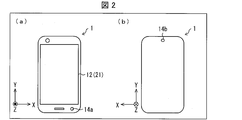
- FIG. 2 is a diagram showing an appearance of the mobile terminal 1, (a) of FIG. 2 is a diagram showing the front side (touch panel 12 side), and (b) of FIG. 2 is a back side (opposite side of the touch panel 12).
- FIG. 1 is a diagram showing an appearance of the mobile terminal 1
- (a) of FIG. 2 is a diagram showing the front side (touch panel 12 side)
- (b) of FIG. 2 is a back side (opposite side of the touch panel 12).
- a smartphone is assumed as the mobile terminal 1.
- the portable terminal 1 is not limited to this, and may be a portable electronic device such as a cellular phone, a portable information terminal, a portable television, and a portable personal computer.
- one proximity sensor 14 a and 14 b for detecting the proximity state of an object is provided on each of the front surface and the back surface.
- the proximity sensors 14a and 14b are generically referred to as the proximity sensor 14.
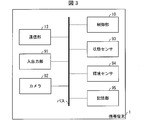
- FIG. 3 is a diagram illustrating a typical hardware configuration of the mobile terminal 1.
- a control unit 10 a communication unit 13
- an input / output unit 91 a camera 92
- a state sensor 93 a state sensor 93
- an environment sensor 94 a storage unit 95
- the control unit 10 comprehensively controls each unit of the mobile terminal 1.
- the function of the control unit 10 may be realized by a CPU (Central Processing Unit) executing a program stored in the storage unit 95.
- the control part 10 performs the lift determination which detects whether the portable terminal 1 was lifted, and performs the function corresponding to the case where it detects that it was lifted.
- CPU Central Processing Unit
- the communication unit 13 is a communication interface for the mobile terminal 1 to perform communication (wired communication or wireless communication) with an external device.
- the storage unit 95 stores various programs executed by the control unit 10 and data used by the programs.
- the input / output unit 91 is a member that accepts an input operation by the user and presents various information to the user, and corresponds to the touch panel 12 described later.
- the camera 92 captures a moving image in response to a command from the control unit 10.
- the state sensor 93 detects various states of the mobile terminal 1. Examples of the state sensor 93 include a gyro sensor, a geomagnetic sensor, and an atmospheric pressure sensor in addition to the acceleration sensor 11 described below.
- the environment sensor 94 detects the situation around the mobile terminal 1. Examples of the environmental sensor 94 include a brightness sensor (illuminance sensor) in addition to the proximity sensor 14 described above.
- FIG. 1 is a block diagram showing a main configuration of the mobile terminal 1.
- the mobile terminal 1 includes a control unit 10, an acceleration sensor 11, a touch panel 12, and a communication unit 13.
- the acceleration sensor 11 detects acceleration in three axial directions orthogonal to each other.
- the lateral direction of the display unit (display surface) 21 of the touch panel 12 is the X direction (X axis)
- the longitudinal direction of the display unit 21 is the Y direction (Y axis)
- the direction from the back surface of the display unit 21 to the front surface is the direction.
- the direction is the Z direction (Z axis) (see FIG. 2 described above).
- the accelerations in the X direction, the Y direction, and the Z direction may be represented as AX, AY, and AZ, respectively.
- the acceleration sensor 11 further detects a combined acceleration (hereinafter, sometimes referred to as V or combined acceleration V) obtained by combining the accelerations AX, AY, and AZ in the respective directions.
- V or combined acceleration V a combined acceleration obtained by combining the accelerations AX, AY, and AZ in the respective directions.
- the detection result of the acceleration sensor 11 is notified to the control unit 10.
- the control unit 10 can detect a horizontal plane (a plane perpendicular to the direction of gravity) based on the detection result of the acceleration sensor 11.
- the touch panel 12 accepts information display and user operations on the mobile terminal 1.
- the touch panel 12 includes a display unit 21 and an operation receiving unit 22.
- the display unit 21 displays various information.
- the operation receiving unit 22 receives an operation by bringing a user's finger or the like into contact or proximity.
- the touch panel 12 has a configuration in which the display unit 21 and the operation receiving unit 22 are superimposed and integrated.
- the control unit 10 includes a timer unit 51, a lifting control unit (information processing device) 52, and a function execution unit 53.
- the timer unit 51 counts up the time and notifies the lifting control unit 52 of it.
- the lifting control unit 52 determines whether or not the mobile terminal 1 has been lifted based on the acceleration detected by the acceleration sensor 11.
- the lifting control unit 52 includes an acceleration determination unit (impact determination unit) 61, an angle determination unit (initial angle determination unit, angle calculation unit, horizontal determination unit) 62, a stillness determination unit (initial stillness determination unit) 63, and a lift determination unit. 64.
- the acceleration determination unit 61 determines whether or not a predetermined acceleration condition (lifting acceleration condition, non-impact acceleration condition) is satisfied based on the acceleration detected by the acceleration sensor 11. As an example, the acceleration determination unit 61 determines whether or not the acceleration detected by the acceleration sensor 11 satisfies a predetermined lifting acceleration condition and a non-impact acceleration condition, and notifies the lifting determination unit 64 of the determination result.
- a predetermined acceleration condition lifting acceleration condition, non-impact acceleration condition
- the acceleration determination unit 61 determines that the lift acceleration condition is satisfied when the acceleration detected by the acceleration sensor 11 satisfies the following conditions (1) to (3), for example (see FIG. 4 described later).
- a waveform indicating a change in acceleration over a predetermined period has a maximum value and a minimum value.
- the acceleration exceeds the threshold Th1 for a predetermined time T1 including the local maximum point (Ma).
- the acceleration falls below the threshold Th2 for a predetermined time T2 including the local minimum time (Mb).
- This lifting acceleration condition is set in consideration of the time change of the acceleration when there is a movement (lifting movement) in which the mobile terminal 1 is lifted.
- the acceleration determination unit 61 determines that the non-impact acceleration condition is satisfied when the acceleration detected by the acceleration sensor 11 is within a predetermined non-impact reference range.
- the angle determination unit 62 calculates the angle of the display unit 21 with respect to the horizontal plane based on the acceleration detected by the acceleration sensor 11, and the angle of the portable terminal 1 satisfies a predetermined angle condition (initial angle condition, handheld angle condition). It is determined whether or not.
- the angle determination unit 62 determines whether or not the angle of the mobile terminal 1 satisfies a predetermined initial angle condition (non-45 ° determination condition) based on the acceleration detected by the acceleration sensor 11, and the determination result Is notified to the lift determination unit 64.
- the angle determination unit 62 determines that the angle of the mobile terminal 1 is a predetermined angle using the acceleration detected by the acceleration sensor 11 after the acceleration determination unit 61 determines that the lifting acceleration condition and the non-impact acceleration condition are satisfied. It is determined whether or not the hand-held angle condition is satisfied (whether it is within a predetermined hand-held angle reference range), and the determination result is notified to the lifting determination unit 64.
- the predetermined hand-held angle reference range is, for example, an angle range in which the Y axis forms an angle including 45 ° with respect to the horizontal plane (eg, 15 ° or more and 68 ° or less). This hand-held angle reference range may be understood to be an angle range when the user lifts the mobile terminal 1 and visually recognizes the display unit 21, for example.
- the state (posture) of the mobile terminal 1 in which the angle is within the handheld angle reference degree range may be referred to as a “45 ° state”.
- the state of the mobile terminal 1 in which the angle is outside the predetermined handheld angle reference range may be referred to as a “non-45 ° state”.
- the stationary determination unit 63 determines whether or not the mobile terminal 1 is in a predetermined stationary state based on the acceleration detected by the acceleration sensor 11.
- the stillness determination unit 63 uses the acceleration detected by the acceleration sensor 11 to determine whether or not the state of the mobile terminal 1 satisfies a predetermined initial stationary condition, and notifies the determination unit 64 of the determination result. To do.
- the stillness determination unit 63 uses the acceleration detected by the acceleration sensor 11 and the mobile terminal 1 satisfies the handheld angle condition. It is determined whether or not the vehicle is in a stationary state (whether or not the stationary condition is satisfied), and the determination result is notified to the lifting determination unit 64.
- the lifting determination unit 64 determines whether or not the mobile terminal 1 has been lifted based on the determination results acquired from the acceleration determination unit 61, the angle determination unit 62, and the stillness determination unit 63.
- the lifting determination unit 64 notifies the function execution unit 53 of the determination result. The details of the processing in the lifting control unit 52 will be described later.
- the function execution unit 53 executes a corresponding function when the lift determination unit 64 determines that the mobile terminal 1 is lifted.
- the corresponding function is a function corresponding to lifting of the mobile terminal 1 such as turning on (brightening) the display of the display unit 21, turning on the power of the mobile terminal 1, or starting communication with another device. Any function may be used.
- FIG. 4 is a diagram for explaining a mechanism of lifting detection. Each numerical value described below is merely an example, and these numerical values may be appropriately changed according to the specifications of the mobile terminal 1.
- the angle determination unit 62 determines whether or not the mobile terminal 1 satisfies a predetermined initial angle condition. Specifically, the angle determination unit 62 satisfies the initial angle condition when the acceleration satisfies the following conditions (4) and (5) for a predetermined time (t1 in FIG. 4, eg, 300 ms). It is determined that the mobile terminal 1 is in a non-45 ° state.
- g is a gravitational acceleration.
- the condition about AZ is not set in particular.
- the stationary determination unit 63 determines whether or not the mobile terminal 1 satisfies a predetermined initial stationary condition. Specifically, the stillness determination unit 63 calculates a variation (standard deviation) in acceleration. This indicates, for example, variation from the average acceleration value per unit time (eg, 500 ms (milliseconds)). When the calculated acceleration variation (standard deviation) satisfies the following condition (6) over a predetermined time (t2, FIG. 4, for example: 1 s (second)) while satisfying the initial angle condition. Then, it is determined that the initial stationary condition is satisfied. (6) Variation in acceleration of AX, AY, and AZ (standard deviation) ⁇ 100 mg (initial stationary reference range).
- the portable terminal 1 when the portable terminal 1 is moved in a bag or the like, the posture of the portable terminal 1 may change due to continuous vibration caused by walking or the like. In this case, there is a possibility that erroneous detection that determines that the mobile terminal 1 is lifted may occur due to the movement of the posture change. In order to prevent such erroneous detection, the stillness determination unit 63 determines whether or not the mobile terminal 1 satisfies the initial stillness condition.
- the variation in acceleration is a predetermined initial stationary reference range (in this embodiment, variations in each acceleration of AX, AY, and AZ (standard deviation). ) Is 100 mg or less) and the initial stationary condition is not satisfied, so that the possibility of the above-described erroneous detection can be reduced. Therefore, the power consumption of the mobile terminal 1 due to the erroneous detection can be reduced.
- the acceleration determination unit 61 determines whether or not the acceleration detected by the acceleration sensor 11 satisfies a predetermined lifting acceleration condition. Specifically, the acceleration determination unit 61 performs the following equations (A) to (C), that is, V (M) ⁇ 1150 mg and min (V (M + 1), V (M + 2))> 1150 mg (A) V (N) ⁇ 850 mg and min (V (N + 1), V (N + 2)) ⁇ 850 mg (B) When 180 ms ⁇ Tb ⁇ Ta ⁇ 1500 ms (C) is satisfied, it is determined that the above-described lifting acceleration conditions (1) to (3) are satisfied.
- V (M) and V (N) are combined accelerations V at time points M and N.
- M and N are integers of 0 or more.
- the time point of V (M + 2) is represented as Ta
- the time point of V (N + 2) is represented as Tb.
- M + 1 indicates the next time point of time point M (eg, 50 ms after time point M).
- M + 2 indicates the next time point of time point M + 1 (eg, 50 ms after time point M + 1) (the same applies to N).
- Expressions (A) and (B) are determination conditions for detecting the maximum value and the minimum value of V, respectively.
- the expression (C) is a determination condition set in consideration of the aspect of the temporal variation of V (the transition from the maximum value to the minimum value).
- the acceleration determination unit 61 determines whether or not the acceleration detected by the acceleration sensor 11 satisfies a predetermined non-impact acceleration condition together with the lifting acceleration condition. Specifically, the acceleration determination unit 61 determines that the non-impact acceleration condition is satisfied when the acceleration satisfies the following condition (7). (7) AX, AY, AZ (or combined acceleration V) ⁇ 1500 mg (non-impact reference range).
- the acceleration determination unit 61 determines whether or not the acceleration detected by the acceleration sensor 11 satisfies the non-impact acceleration condition together with the lifting acceleration condition. Thereby, in the case of acceleration due to a strong impact such as dropping, the acceleration is outside a predetermined non-impact reference range (in this embodiment, all of AX, AY, and AZ are less than 1500 mg, or the combined acceleration V is less than 1500 mg). Since the non-impact acceleration condition is not satisfied, the possibility of the above-described erroneous detection can be reduced. Therefore, the power consumption of the mobile terminal 1 due to the erroneous detection can be reduced.
- condition (8) corresponds to the angle of the X axis with respect to the horizontal plane being within ⁇ 25 ° (not present).
- condition (9) corresponds to the angle of the Y axis with respect to the horizontal plane being (not) within the predetermined angle range (15 ° to 68 °).
- the determination of the conditions (8) to (10) is performed a plurality of times (eg, 7 times) at a predetermined interval (eg, every 30 ms), and the conditions (8) to (10) are satisfied at all times. In this case, it is determined that the mobile terminal 1 is in the 45 ° state.
- the stationary determination unit 63 determines whether or not the portable terminal 1 satisfies a predetermined stationary condition. Specifically, the stationary determination unit 63 determines that the mobile terminal 1 satisfies the stationary condition when the acceleration satisfies the following conditions (11) and (12). (11) Regarding the accelerations (AX, AY, AZ) in each direction acquired continuously from the acceleration sensor 11 at intervals of 30 ms (AX, AY, AZ), variation of the remaining values excluding the maximum value and the minimum value (standard deviation) Is within 40 mg (stationary reference range).
- each acceleration variation is within a range of 0 mg to less than 15 mg (fully stationary reference range). Excluding 15 mg to 40 mg (incomplete stationary reference range).
- the stillness determination unit 63 determines that the variation (standard deviation) of each acceleration detected by the acceleration sensor 11 is an incomplete stationary reference range (15 mg) excluding the complete stationary reference range (0 mg or more and less than 15 mg). If it is within 40 mg or less, it is determined that the stationary condition is satisfied. As a result, when the mobile terminal 1 is placed on an object, the mobile terminal 1 is almost in a completely stationary state (within the completely stationary reference range), and the stationary condition is not satisfied. be able to. Therefore, the power consumption of the mobile terminal 1 due to the erroneous detection can be reduced.
- the stillness determination unit 63 starts determining the stillness condition of the mobile terminal 1 after a predetermined time (t3 in FIG. 4, eg, 120 ms) has elapsed after the above-described predetermined handheld angle condition is satisfied. Also good. Thereby, the stationary condition can be determined by excluding a period in which the state (attitude) of the mobile terminal 1 is unstable. In addition, the stationary determination unit 63 ends the determination of the stationary condition when the stationary condition is not satisfied even after a predetermined time (t4 in FIG. 4, e.g., 3.3 s) has elapsed from the determination start point of the stationary condition. Yes (Stillness judgment times out).
- the lifting determination unit 64 determines that “initial angle condition (non-45 ° determination condition)” ⁇ “initial stillness” ⁇ “acceleration condition” ⁇ “hand-held angle condition (45 ° determination condition)” ⁇ “still condition” in this order. Is satisfied, it is determined that the mobile terminal 1 is lifted (lifting of the mobile terminal 1 is detected). However, when at least one of these conditions is satisfied instead of all the above conditions (eg, when only the acceleration condition is satisfied), the mobile terminal 1 is lifted so as to be determined to be lifted.
- the determination unit 64 may be configured.
- the lifting control unit 52 may execute the next lifting determination after a predetermined time has elapsed after performing the lifting determination.
- FIG. 5 is a flowchart showing the flow of the lifting detection processes S101 to S109 in the portable terminal 1.
- the angle determination unit 62 determines an initial angle condition (non-45 ° determination condition) (S101).
- the stillness determination unit 63 determines the initial stillness condition (S102).
- the acceleration determination unit 61 determines the lifting acceleration condition and the non-impact acceleration condition (S103).
- the angle determination unit 62 determines the hand-held angle condition (45 ° determination condition) (S105). If the handheld angle condition is satisfied (YES in S105), the stillness determination unit 63 determines the stillness condition (S107). If the stationary condition is satisfied, the lifting determination unit 64 determines that the mobile terminal 1 has been lifted (S109).
- the process returns to S101. If the initial stationary condition is not satisfied in S102 (NO in S102), the process returns to S101. If the lifting acceleration condition or the non-impact acceleration condition is not satisfied in S103 (NO in S103) and the predetermined time (lifting determination time) has elapsed (YES in S104), the process returns to S101. If the handheld angle condition (45 ° determination condition) is not satisfied in S105 (NO in S105) and the predetermined time (angle determination time) has elapsed (YES in S106), the process returns to S101. If the still condition is not satisfied in S107 (NO in S107) and the predetermined time (still determination time) has elapsed (YES in S107), the process returns to S101.
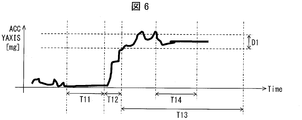
- FIG. 6 is a diagram for explaining a mechanism of lifting detection in the horizontal mode.
- the horizontal axis represents time
- the vertical axis represents the acceleration AY in the Y direction.
- the angle determination unit 62 determines that the mobile terminal 1 is in a horizontal state based on the acceleration. Specifically, the angle determination unit 62 satisfies ⁇ 100 mg ⁇ AY ⁇ 100 mg over a predetermined time T11 (eg, 2 s (seconds)) (in other words, a range in which the angle of the Y axis with respect to the horizontal plane is ⁇ 6 °). If the mobile terminal 1 is in a horizontal state, the mobile terminal 1 is determined to be in a horizontal state.
- T11 eg, 2 s (seconds)
- the acceleration determination unit 61 starts from the horizontal state in the mobile terminal 1 when AX or AY ⁇ 20 mg and AZ ⁇ 30 mg or more during a predetermined time T12 (for example, 2 s (seconds)). It is determined that there has been a movement that causes a state change. This determination may be performed a predetermined number of times (for example, twice). By performing the determination a predetermined number of times (a plurality of times), vibration noise can be removed. If the above condition is not satisfied for a predetermined time T12, the acceleration determination unit 61 times out the determination of the motion.
- T12 for example, 2 s (seconds)
- a period T ⁇ b> 13 indicates a timeout time (for example, 2 s (seconds)) when the stillness determination unit 63 performs a stillness determination
- a period T14 indicates a time during which the stillness determination unit 63 performs a stillness determination.
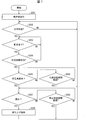
- FIG. 7 is a flowchart showing a flow of lifting detection processes S201 to S209 in the portable terminal 1. The processing flow will be briefly described with reference to FIG. Note that S205 to S209 are the same processes as S105 to S109 described above, and a description thereof will be omitted.
- the control unit 10 initializes the operation (S201).
- the initialization is a process of calculating a reference acceleration at the start of the operation, and is performed, for example, by acquiring the acceleration 40 times every 50 ms in each direction.
- the angle determination unit 62 determines whether or not the mobile terminal 1 is in a horizontal state (S202). If the mobile terminal 1 is not in a horizontal state (NO in S202), the process returns to S202.
- the acceleration determination unit 61 determines whether or not there is the movement (S203). If there is the movement (YES in S203), the movement It is determined whether the determination condition is satisfied a predetermined number of times (S204). If the determination condition is satisfied a predetermined number of times (YES in S204), the process proceeds to S205. In the horizontal mode, each determination condition may be set more gently than in the normal mode. If the stationary condition is satisfied in S207 (YES in S207), the lifting determination unit 64 detects lifting of the mobile terminal 1 (S209).
- the lifting determination is executed.
- the mobile terminal 1 in a state substantially parallel to the horizontal plane shifts to a different state, there is a high possibility that the mobile terminal 1 has been lifted.
- the horizontal mode it is possible to determine whether or not the mobile terminal 1 has been lifted by executing the lift determination when the angle of the mobile terminal 1 changes from a state substantially parallel to the horizontal plane.
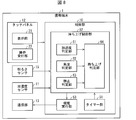
- FIG. 8 is a block diagram showing a main configuration of the mobile terminal 1 according to the present embodiment.
- the mobile terminal 1 includes a brightness sensor 15 in addition to the configurations of the first and second embodiments, and performs a lifting determination based on the detection result of the brightness sensor 15. Decide whether or not.
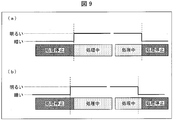
- FIG. 9A is diagrams showing the relationship between the detected brightness and the presence or absence of execution of the lifting process.
- a lifting determination process is executed, and the brightness sensor 15 detects a brightness of less than the predetermined value. If it is, the lifting judgment process is not executed.
- the power consumption of the mobile terminal 1 can be suppressed by not performing (stopping) the lifting determination process.
- the lift determination is executed after a short time, and the brightness sensor 15 detects a brightness of less than the predetermined value. A little time after detection, the lifting process is stopped. Thereby, it is possible to control the execution of the lifting determination process in consideration of erroneous detection due to chattering or the like.
- the camera 92 or the like may have the same role as the brightness sensor 15 of the present embodiment, and the above processing may be executed by these.
- FIG. 10 is a flowchart showing the flow of processing when the normal mode and the horizontal mode are processed in parallel.
- step S301 when horizontal mode processing is started (S301), first, horizontal mode processing is initialized (S302). Thereafter, when the lift is detected by the normal mode process (YES in S303), the horizontal mode process is stopped (S305) for a predetermined time (for example, 2 s (seconds)), and the process returns to step S302.
- step S303 if the lift is not detected by the normal mode process (NO in S303) and the lift is detected by the horizontal mode process (YES in S304), the horizontal mode is set for a predetermined time (for example, 2s (seconds)). The process is stopped (S306), and the process returns to step S302.
- the normal mode process is started (S401), first, the normal mode process is initialized (S402). Thereafter, when it is detected as being lifted by the horizontal mode process (YES in S403), the normal mode process is stopped (S405) for a predetermined time (for example, 2 s (seconds)), and the process returns to step S402.
- the normal mode is set for a predetermined time (for example, 2s (seconds)). The process is stopped (S406), and the process returns to step S402.
- control blocks (particularly the control unit 10 (timer unit 51, lift control unit 52 (acceleration determination unit 61, angle determination unit 62, stillness determination unit 63, lift determination unit 64), function execution unit 53)) of the mobile terminal 1 are: It may be realized by a logic circuit (hardware) formed in an integrated circuit (IC chip) or the like, or may be realized by software using a CPU (Central Processing Unit).
- a logic circuit hardware formed in an integrated circuit (IC chip) or the like, or may be realized by software using a CPU (Central Processing Unit).
- the mobile terminal 1 includes a CPU that executes instructions of a program that is software that implements each function, a ROM (Read Only Memory) in which the program and various data are recorded so as to be readable by a computer (or CPU)
- a storage device (these are referred to as “recording media”), a RAM (Random Access Memory) that expands the program, and the like are provided.
- the objective of this invention is achieved when a computer (or CPU) reads the said program from the said recording medium and runs it.
- a “non-temporary tangible medium” such as a tape, a disk, a card, a semiconductor memory, a programmable logic circuit, or the like can be used.
- An information processing apparatus is an information processing apparatus (control unit 10) mounted on an electronic device (portable terminal 1), and is based on acceleration detected by an acceleration sensor mounted on the electronic device.
- a stationary determination unit that determines whether or not a predetermined stationary condition is satisfied, and a lifting determination unit that determines whether or not the electronic device has been lifted.
- the lifting determination unit determines that the electronic device has been lifted when the stationary determination unit determines that the stationary condition is satisfied after the acceleration satisfies a predetermined lifting acceleration condition. It is characterized by a constant.
- the user may be placed on an object such as a desk immediately without operating the electronic device.
- an object such as a desk immediately without operating the electronic device.
- it is difficult to determine whether the electronic device is in a state of being held by a hand or placed on an object. For this reason, even when the electronic device picked up by the user is immediately placed on the object, there is a possibility that erroneous detection that determines that the electronic device has been lifted may occur.
- the electronic device when the electronic device is held in the hand, the electronic device will not be completely stationary due to vibrations transmitted from the hand. On the other hand, when the electronic device is placed on the object, the electronic device is almost completely stationary.
- the stillness determination unit determines that the stillness condition is satisfied when the variation in acceleration detected by the acceleration sensor is within a predetermined stationary reference range and outside a predetermined complete stationary reference range. . For this reason, when an electronic device picked up by a user is immediately placed on an object, the acceleration is within the complete stationary reference range and does not satisfy the stationary condition. judge.
- An information processing apparatus is an information processing apparatus mounted on an electronic device, and satisfies a predetermined non-impact acceleration condition based on acceleration detected by an acceleration sensor mounted on the electronic device.
- An impact determination unit (acceleration determination unit 61) for determining whether or not the electronic device has been lifted, and the impact determination unit includes a predetermined acceleration.
- the lift determination unit determines that the non-impact acceleration condition is satisfied, and the lift determination unit satisfies a predetermined lift acceleration condition, and the shock determination unit detects the non-impact acceleration. When it is determined that the condition is satisfied, it is determined that the electronic device is lifted.
- the acceleration is due to the movement of the electronic device lifted by the user, or when the electronic device is dropped or placed on a desk, etc. It was difficult to determine whether it was due to an impact. For this reason, there is a possibility that erroneous detection that determines that the electronic device has been lifted may occur even when it is subjected to an impact due to dropping or the like.
- the impact determination unit determines whether or not the non-impact acceleration condition for determining whether or not the acceleration detected by the acceleration sensor is an impact due to a drop or the like is satisfied. For this reason, when the electronic device receives a strong impact due to dropping or the like, the acceleration is outside the non-impact reference range and does not satisfy the non-impact acceleration condition, so the lifting determination unit determines that the electronic device has not been lifted.
- An information processing apparatus is an information processing apparatus mounted on an electronic device, and the display surface of the electronic device with respect to a horizontal plane based on acceleration detected by an acceleration sensor mounted on the electronic device.
- An initial angle determination unit (angle determination unit 62) for determining whether or not the angle of (display unit 21) satisfies a predetermined initial angle condition, and whether or not a predetermined initial stationary condition is satisfied based on the acceleration
- An initial stillness determination unit (stationary determination unit 63) and a lifting determination unit that determines whether or not the electronic device has been lifted.
- the lifting determination unit is configured to perform the electronic device when the initial angle condition and the initial stationary condition are satisfied. It is characterized by performing the process of determining whether or not lifted.
- the posture of the electronic device may change due to continuous vibration caused by walking or the like.
- erroneous detection that determines that the electronic device is lifted may occur due to the movement of the posture change.
- the lifting determination unit executes a process of determining whether or not the electronic device has been lifted when the initial angle condition and the initial stationary condition are satisfied. For this reason, even if the initial angle condition is satisfied, if the variation in acceleration is outside the predetermined initial stationary reference range, the initial stationary condition is not satisfied. The process to determine whether or not.
- the information processing apparatus further includes an acceleration determination unit that determines whether or not a predetermined lifting acceleration condition is satisfied based on the acceleration in the above aspects 1 to 3, and the acceleration determination unit includes: The waveform representing the value of the acceleration with respect to time has a maximum value and a minimum value, and the acceleration exceeds the first predetermined value for a first predetermined time including the time point of the maximum value, and the minimum value If the acceleration falls below the second predetermined value for a second predetermined time including the time point, it may be determined that the lifting acceleration condition is satisfied.
- the acceleration increases when the electronic device is lifted, and the acceleration once decreases after the lift. Therefore, in the above configuration, (i) the waveform representing the acceleration with respect to the passage of time has a maximum value and a minimum value, and (ii) the acceleration is a first predetermined value during a first predetermined time including the time point of the maximum value. (Iii) When the acceleration falls below the second predetermined time for a second predetermined time including the time point of the minimum value, the acceleration determination unit determines that the lifting acceleration condition is satisfied. That is, the acceleration determination unit detects that the acceleration has increased (exceeded the first predetermined value) and has decreased (below the second predetermined value), and satisfies the lifting acceleration condition. judge.
- An information processing apparatus further includes an angle calculation unit (angle determination unit 62) that calculates an angle of the display surface of the electronic device with respect to a horizontal plane based on the acceleration in the aspect 4,
- the lift determination unit may determine that the electronic device is lifted when the lift acceleration condition is satisfied and the angle calculated by the angle calculation unit is within a predetermined angle range.
- the display surface of the electronic device is often directed toward him / her at an angle with respect to the horizontal plane (not parallel to the horizontal plane).
- the lifting determination unit determines that the electronic device has been lifted.
- the lifting determination can be performed more accurately.
- An information processing apparatus is an information processing apparatus mounted on an electronic device, and an angle of a display surface of the electronic device based on an acceleration detected by an acceleration sensor mounted on the electronic device.
- a horizontal determination unit (angle determination unit 62) that determines whether or not a horizontal plane is substantially parallel, a static determination unit that determines whether or not a predetermined static condition is satisfied based on the acceleration, and the above
- a lifting determination unit that determines whether or not the electronic device has been lifted, and the stationary determination unit includes a variation in the acceleration within a predetermined stationary reference range, and the electronic device is completely stationary.
- the lifting determination unit changes the angle from a state substantially parallel to the horizontal plane and then stops the stationary Size If the part is determined to the stationary condition is satisfied, and determining means determines that the electronic apparatus is lifted.
- the stationary determination unit determines that the variation in acceleration detected by the acceleration sensor is within a predetermined stationary reference range, and a predetermined complete When it is outside the stationary reference range, it is determined that the stationary condition is satisfied. For this reason, when an electronic device picked up by a user is immediately placed on an object, the acceleration is within the complete stationary reference range and does not satisfy the stationary condition. judge.
- An electronic apparatus includes the information processing apparatus according to any one of aspects 1 to 6, an acceleration sensor that detects acceleration, and a display surface that displays an image. .
- a control method is a control method for an information processing device mounted on an electronic device, and satisfies a predetermined stationary condition based on acceleration detected by an acceleration sensor mounted on the electronic device.
- a stationary determination step for determining whether or not the electronic device has been lifted, and in the stationary determination step, the variation in acceleration is a predetermined stationary reference. If it is within a range and the electronic device is outside a predetermined complete stationary reference range including acceleration in a state where the electronic device is completely stationary, it is determined that the stationary condition is satisfied, and the acceleration is determined in the lifting determination step. After satisfying a predetermined lifting acceleration condition, when it is determined that the stationary condition is satisfied in the stationary determination step, it is determined that the electronic device is lifted. .
- the information processing apparatus may be realized by a computer.
- the information processing apparatus is operated on each computer by causing the computer to operate as each unit (software element) included in the information processing apparatus.
- the control program for the information processing apparatus to be realized in this way and a computer-readable recording medium on which the control program is recorded also fall within the scope of the present invention.
- 1 mobile terminal (electronic device), 11 acceleration sensor, 21 display unit (display surface), 52 lifting control unit (information processing device), 61 acceleration determination unit (impact determination unit), 62 angle determination unit (initial angle determination unit, Angle calculation unit, horizontal determination unit), 63 still determination unit (initial static determination unit), 64 lifting determination unit, S107 stationary determination step, S109 lifting determination step
Landscapes
- Engineering & Computer Science (AREA)
- Theoretical Computer Science (AREA)
- Physics & Mathematics (AREA)
- General Physics & Mathematics (AREA)
- Computer Hardware Design (AREA)
- General Engineering & Computer Science (AREA)
- Signal Processing (AREA)
- Computer Networks & Wireless Communication (AREA)
- Human Computer Interaction (AREA)
- Telephone Function (AREA)
- User Interface Of Digital Computer (AREA)
Abstract
L'invention concerne un dispositif de traitement d'informations dans lequel la probabilité de détection erronée de soulèvement d'un dispositif électronique est faible. Lorsque la variation d'accélération détectée par un capteur d'accélération (11) se situe dans une plage de référence de stase prescrite et en dehors d'une plage de référence de stase complète prescrite, une unité de détermination de stase (63) détermine qu'une condition de stase est satisfaite, et lorsque l'unité de détermination de stase (63) détermine que la condition de stase est satisfaite, une unité de détermination de soulèvement détermine qu'un dispositif électronique (1) a été soulevé.
Priority Applications (3)
| Application Number | Priority Date | Filing Date | Title |
|---|---|---|---|
| JP2018507106A JP6636131B2 (ja) | 2016-03-25 | 2017-02-07 | 情報処理装置、電子機器、情報処理装置の制御方法および制御プログラム |
| US16/087,620 US10667217B2 (en) | 2016-03-25 | 2017-02-07 | Information processing device, electronic device, and control method for information processing device |
| CN201780019522.8A CN109074155A (zh) | 2016-03-25 | 2017-02-07 | 信息处理装置、电子设备、信息处理装置的控制方法以及控制程序 |
Applications Claiming Priority (2)
| Application Number | Priority Date | Filing Date | Title |
|---|---|---|---|
| JP2016-062767 | 2016-03-25 | ||
| JP2016062767 | 2016-03-25 |
Publications (1)
| Publication Number | Publication Date |
|---|---|
| WO2017163637A1 true WO2017163637A1 (fr) | 2017-09-28 |
Family
ID=59899950
Family Applications (1)
| Application Number | Title | Priority Date | Filing Date |
|---|---|---|---|
| PCT/JP2017/004446 Ceased WO2017163637A1 (fr) | 2016-03-25 | 2017-02-07 | Dispositif de traitement d'informations, dispositif électronique, procédé et programme de commande dudit dispositif de traitement d'informations |
Country Status (4)
| Country | Link |
|---|---|
| US (1) | US10667217B2 (fr) |
| JP (1) | JP6636131B2 (fr) |
| CN (1) | CN109074155A (fr) |
| WO (1) | WO2017163637A1 (fr) |
Families Citing this family (4)
| Publication number | Priority date | Publication date | Assignee | Title |
|---|---|---|---|---|
| WO2018023894A1 (fr) * | 2016-08-01 | 2018-02-08 | 广东乐源数字技术有限公司 | Procédé d'allumage d'écran de bracelet intelligent par élévation de la main et bracelet intelligent |
| JP2021147948A (ja) * | 2020-03-23 | 2021-09-27 | 株式会社東海理化電機製作所 | 認証システム、モバイル装置、処理装置、およびコンピュータプログラム |
| JP2023183696A (ja) * | 2022-06-16 | 2023-12-28 | 富士フイルムヘルスケア株式会社 | 超音波診断装置 |
| CN115230775B (zh) * | 2022-07-27 | 2023-05-30 | 诺优信息技术(上海)有限公司 | 一种列车行驶状态数据处理方法、装置和电子设备 |
Citations (3)
| Publication number | Priority date | Publication date | Assignee | Title |
|---|---|---|---|---|
| JP2007080219A (ja) * | 2005-09-16 | 2007-03-29 | Navitime Japan Co Ltd | 携帯端末装置および携帯端末装置における省電力制御方法 |
| JP2012165243A (ja) * | 2011-02-08 | 2012-08-30 | Ricoh Co Ltd | 撮像装置および撮像方法 |
| JP2014027386A (ja) * | 2012-07-25 | 2014-02-06 | Kyocera Corp | 携帯端末、省電力制御プログラムおよび省電力制御方法 |
Family Cites Families (13)
| Publication number | Priority date | Publication date | Assignee | Title |
|---|---|---|---|---|
| JP2009236535A (ja) | 2008-03-26 | 2009-10-15 | Kddi Corp | 加速度センサを用いて歩行者の歩行タイミングを決定する携帯端末、プログラム及び方法 |
| JP5038240B2 (ja) | 2008-06-30 | 2012-10-03 | 旭化成エレクトロニクス株式会社 | モーションセンサ |
| WO2012023295A1 (fr) * | 2010-08-18 | 2012-02-23 | 三菱電機株式会社 | Dispositif électrique, procédé de commande, et programme associé |
| JP5792570B2 (ja) | 2011-09-21 | 2015-10-14 | 埼玉日本電気株式会社 | 携帯端末装置及びプログラム |
| JP2013232816A (ja) | 2012-04-27 | 2013-11-14 | Panasonic Corp | 携帯端末 |
| JP2013232826A (ja) | 2012-05-01 | 2013-11-14 | Seiko Epson Corp | 通信装置,画像形成装置,通信方法及びそのプログラム |
| JP2014038037A (ja) | 2012-08-16 | 2014-02-27 | Ricoh Co Ltd | 位置情報管理システム及び位置推定プログラム |
| JP6322960B2 (ja) * | 2013-02-01 | 2018-05-16 | 株式会社リコー | 慣性装置、方法及びプログラム |
| JP5896240B2 (ja) | 2013-03-21 | 2016-03-30 | カシオ計算機株式会社 | 運動支援装置、運動支援方法及び運動支援プログラム |
| US8971869B2 (en) * | 2013-05-23 | 2015-03-03 | Elwha Llc | Mobile device that activates upon removal from storage |
| JP2015061299A (ja) | 2013-09-20 | 2015-03-30 | シャープ株式会社 | 携帯情報端末 |
| US20150253351A1 (en) * | 2014-03-07 | 2015-09-10 | Qualcomm Incorporated | Detecting Imminent Use of a Device |
| CN104571529A (zh) | 2015-01-28 | 2015-04-29 | 锤子科技(北京)有限公司 | 一种应用程序唤醒方法以及移动终端 |
-
2017
- 2017-02-07 CN CN201780019522.8A patent/CN109074155A/zh active Pending
- 2017-02-07 WO PCT/JP2017/004446 patent/WO2017163637A1/fr not_active Ceased
- 2017-02-07 JP JP2018507106A patent/JP6636131B2/ja not_active Expired - Fee Related
- 2017-02-07 US US16/087,620 patent/US10667217B2/en not_active Expired - Fee Related
Patent Citations (3)
| Publication number | Priority date | Publication date | Assignee | Title |
|---|---|---|---|---|
| JP2007080219A (ja) * | 2005-09-16 | 2007-03-29 | Navitime Japan Co Ltd | 携帯端末装置および携帯端末装置における省電力制御方法 |
| JP2012165243A (ja) * | 2011-02-08 | 2012-08-30 | Ricoh Co Ltd | 撮像装置および撮像方法 |
| JP2014027386A (ja) * | 2012-07-25 | 2014-02-06 | Kyocera Corp | 携帯端末、省電力制御プログラムおよび省電力制御方法 |
Also Published As
| Publication number | Publication date |
|---|---|
| JPWO2017163637A1 (ja) | 2019-01-10 |
| JP6636131B2 (ja) | 2020-01-29 |
| US20190053163A1 (en) | 2019-02-14 |
| US10667217B2 (en) | 2020-05-26 |
| CN109074155A (zh) | 2018-12-21 |
Similar Documents
| Publication | Publication Date | Title |
|---|---|---|
| CN106453829B (zh) | 一种跌落高度检测方法及装置 | |
| KR102933772B1 (ko) | 전자 장치 및 그의 상황을 감지하는 방법 | |
| KR102379504B1 (ko) | 충돌 분석 방법 및 장치 | |
| JP6333663B2 (ja) | 情報処理装置、情報処理装置の制御方法、およびプログラム | |
| JP6636131B2 (ja) | 情報処理装置、電子機器、情報処理装置の制御方法および制御プログラム | |
| JP6753942B2 (ja) | 情報処理装置、電子機器、情報処理装置の制御方法および制御プログラム | |
| JP6636132B2 (ja) | 情報処理装置、電子機器、情報処理装置の制御方法、および制御プログラム | |
| JP2017068499A (ja) | モード切替装置、電子機器、モード切替装置の制御方法、制御プログラム | |
| CN106646440A (zh) | 一种跌落高度检测方法及装置 | |
| JP6449475B2 (ja) | 情報処理装置、電子機器、情報処理装置の制御方法、および制御プログラム | |
| JP6081324B2 (ja) | 操作入力装置、携帯型情報端末、操作入力装置の制御方法、プログラム、及び記録媒体 | |
| US20130060513A1 (en) | Systems and Methods for Utilizing Acceleration Event Signatures | |
| JP6891891B2 (ja) | 情報処理装置 | |
| WO2015002300A1 (fr) | Terminal portable et procédé de commande | |
| JP2017207953A (ja) | 情報処理装置、電子機器、情報処理装置の制御方法、および制御プログラム | |
| JP2017049720A (ja) | 情報処理装置、情報処理装置を備える電子機器、情報処理装置の制御方法、および、プログラム | |
| CN113760128A (zh) | 电子设备控制方法、装置、存储介质及电子设备 | |
| JPWO2016051947A1 (ja) | 携帯情報端末装置 | |
| WO2018155123A1 (fr) | Dispositif d'affichage, procédé d'affichage, dispositif de commande et véhicule | |
| WO2017056827A1 (fr) | Dispositif électronique | |
| JP6182571B2 (ja) | 携帯機器、制御方法、及び制御プログラム | |
| JP2018136485A (ja) | 表示装置、制御装置および車両 | |
| WO2017056824A1 (fr) | Dispositif de traitement d'informations, procédé de commande de dispositif de traitement d'informations, et programme de commande |
Legal Events
| Date | Code | Title | Description |
|---|---|---|---|
| WWE | Wipo information: entry into national phase |
Ref document number: 2018507106 Country of ref document: JP |
|
| NENP | Non-entry into the national phase |
Ref country code: DE |
|
| 121 | Ep: the epo has been informed by wipo that ep was designated in this application |
Ref document number: 17769684 Country of ref document: EP Kind code of ref document: A1 |
|
| 122 | Ep: pct application non-entry in european phase |
Ref document number: 17769684 Country of ref document: EP Kind code of ref document: A1 |